
TRAINING CURRICULUM FOR CERTIFIED NURSE AIDES LICENSED PRACTICAL NURSES REGISTERED PROFESSIONAL NURSES & OTHER HEALTH CARE PROFESSIONALS
|
|
|
- Mercy Sims
- 10 years ago
- Views:
Transcription
1 TRAINING CURRICULUM FOR CERTIFIED NURSE AIDES LICENSED PRACTICAL NURSES REGISTERED PROFESSIONAL NURSES & OTHER HEALTH CARE PROFESSIONALS IN LONG-TERM CARE FACILITIES FOR RESIDENTS WITH ALZHEIMER S DISEASE AND OTHER DEMENTIA- RELATED DISORDERS DIVISION OF HEALTH FACILITIES EVALUATION AND LICENSING JULY 2005 i

2 Table of Contents Program Guidelines Regulatory Authority...ii Acknowledgement and Disclaimer...iii About the Program and Curriculum...iv Goals and Objectives...v Alzheimer s Disease Resources...viii Alzheimer s Training Pre-Test...x Alzheimer s Training Post-Test...xvi Alzheimer s Training Test Answer Key...xxii Alzheimer s Training Program Agenda...xxiii Training Program Overview of Alzheimer s Disease Module I...1 Communication Module II...9 Activities of Daily Living (ADLs) Module III...15 Common Behavior Problems in Dementia Residents Module IV...25 Caregiver Experience Module V...33 Activities Module VI...40 ii

3 NJ Department of Health and Senior Services Division of Health Facilities Evaluation and Licensing P.O. Box 367 Trenton, NJ Chapter N.J.A.C. 8:39 Particularly N.J.A.C. 8: (c)4 Standards for Licensure of Long-Term Care Facilities Authority N.J.S.A. 26:2M-8 Effective Date June 6, 2005 iii

4 The Division of Long-Term Care Systems gratefully acknowledges The New Jersey Geriatric Education Center and the Alzheimer s Association Delaware Valley Chapter For allowing the use and modification of their curriculum The original project to develop this curriculum was supported by funds from the Division of State, Community, and Public Health (DSCPH), Bureau of Health Professions (BHPr), Health Resources Services Administration (HRSA), Department of Health and Human Services (DHHS) under grant number 6 D31 HP , New Jersey Geriatric Education Center, $1,242,531. The information or content and conclusions are those of the author and should not be construed as the official position of, nor should any endorsements be inferred by DSCPH, BHPr, HRSA, DHSS, or the U.S. Government. Funding for the original curriculum was also provided in part by a grant from the State of New Jersey Department of Health and Senior Services, Division of Aging and Community Services and developed by the New Jersey Geriatric Education Center in conjunction with the Alzheimer s Association. iv

5 About This Program This program has been developed to help prepare Certified Nurse Aides, Licensed Practical Nurses, Registered Professional Nurses, and other health care professionals in nursing homes, to care for residents with Alzheimer s Disease and other dementia-related disorders. Curriculum This curriculum has been modified to allow for a 6-hour training course to be conducted by facility personnel. The agenda provided is a suggested one, and the times for each module may be modified according to your training needs. This is a basic program and does not include the slides, activities, games or tools that were incorporated into the original training manual prepared by the New Jersey Geriatric Education Center and Alzheimer s Association- Delaware Valley Chapter. Their web sites are included within this publication and they may be contacted if you desire a more in-depth program. This curriculum is composed of 6 modules: 1. Overview of Alzheimer s Disease 2. Communication 3. Activities of Daily Living 4. Common Behavior Problems 5. Activities 6. Caregiver Experience Questions? Questions regarding this training manual may be referred to: Division of Health Facilities Evaluation & Licensing PO Box 367 Trenton, NJ (609) v

6 Alzheimer's Training Program Goals and Objectives Goal: The goal of this program is to provide certified nurse aides, licensed practical nurses, registered professional nurses, and other health care professionals who provide direct care to residents in long term care facilities with a basic understanding of the changes in memory, communication, function, and behavior that occur as a result of Alzheimer's disease and the appropriate intervention strategies to enhance the care they provide to individuals with Alzheimer's disease. Objectives: Upon completion of this program, the participants will be able to discuss: 1. Overview of Alzheimer's Disease Define "dementia" Identify 4 cognitive functions lost in Alzheimer's disease Describe 2 changes that occur in the brain as a result of Alzheimer's disease Name 5 areas of the brain affected by Alzheimer's disease Identify the functions/emotions controlled by the Amygdala and Hippocampus List 4 ways to diagnose Alzheimer's disease Identify the 3 stages of Alzheimer's disease and the changes that occur in those stages 2. Communication List 5 communication problems experienced by individuals with Alzheimer's disease Explain the importance of non-verbal communication Demonstrate 5 types of non-verbal communication Identify 6 basic strategies for successful verbal and nonverbal communication List 3 pitfalls to avoid when communicating with an Alzheimer's individual Explain the difference between reality orientation and validation vi

7 3. Activities of Daily Living (ADLs) Identify 3 reasons why ADLs pose a challenge to Alzheimer's caregivers List 6 cognitive and 6 physical changes which complicate ADL care Describe 5 techniques for encouraging participation in personal care Explain 2 tips to assist with bathing in each stage of Alzheimer's disease Give an example of a non-verbal cue for needing to go to the bathroom Identify 3 causes of incontinence Explain 2 ways to assist an Alzheimer's individual with dressing in each stage of the disease Identify 2 problems with eating for each stage of Alzheimer's disease Explain 2 intervention tips for eating and nutrition for someone with Alzheimer's disease 4. Behavior List 3 instances when behavior is a problem Explain the difference between a common behavior, challenging behavior and [potentially] harmful behavior Provide 3 examples of repetitive behaviors Identify 2 types of wanderers Give 2 examples of aggressive behaviors Define the terms hallucination and paranoia Explain what a catastrophic reaction is and what may provoke it Describe 5 interventions for common behavior problems in Alzheimer's disease List 8 basic principles for responding to challenging behaviors Identify 4 common triggers for potential behavior problems Explain why behavior management strategies are preferred to medication use in controlling problem behaviors vii

8 5. Activities Name 3 things that influence the activities in which we can engage an individual with Alzheimer s disease List 3 ways you can find out the life story of the Alzheimer s individual you are caring for Identify 4 ways to assess an Alzheimer s individual s ability to participate in activities List 5 types of activities you can do with an individual with Alzheimer s disease Name 4 roles the Alzheimer s individual may have lost due to the disease Describe 4 ways to rediscover or give back old memories List 5 steps in adapting or modifying activities to meet the needs and preferences of an individual with Alzheimer s disease Describe 2 activities you can develop with the help of the caregiver Explain how to adapt 2 interests of your own to share as an activity with the Alzheimer s individual 6. Caregiver Experience List the 5 stages of grief experienced by Alzheimer's family caregivers Identify 3 ways you can help families Describe 2 opportunities that make caring for an individual with Alzheimer's disease a unique experience Identify 3 demands that are routinely placed on an Alzheimer caregiver Explain 6 ways to "take care of yourself" Identify 4 common ways to relieve stress viii

9 Alzheimer s Disease Resources Note: These organizations or references to Internet sites are provided as a service for information and continuing education and do not constitute or imply endorsement of these organizations or their programs by the New Jersey Department of Health and Senior Services or the Division of Long Term Care (LTC) Systems. LTC Systems is not responsible for the content of pages found at the Internet sites. URL addresses were current as of publication date. The Alzheimer s The local chapter of the National Alzheimer s Association Delaware Disease and Related Disorders Association. Valley Chapter New Jersey Geriatric Organization dedicated to improving the Education Center education/training, supply, distribution and quality of health care professionals. The Alzheimer s Voluntary health organization composed of a Association national network of chapters working towards a cure and providing information. Alzheimer s Disease Current, comprehensive information from the Education & Referral National Institute on Aging. Toll-free number. Center AlzheimersDisease.com Information and resources for those affected with the disease and for caregivers. Cognitive Neurology and Organization providing information on Alzheimer s Disease Ctr. memory, dementia, and AD. Alzheimer s Research Supporting the information needs of Forum researchers and promoting collaboration. National Institute of Biomedical research and general Neurological Disease and information. Stroke: AD information Page Alzheimer s Resources On-line resource on aging information. ix

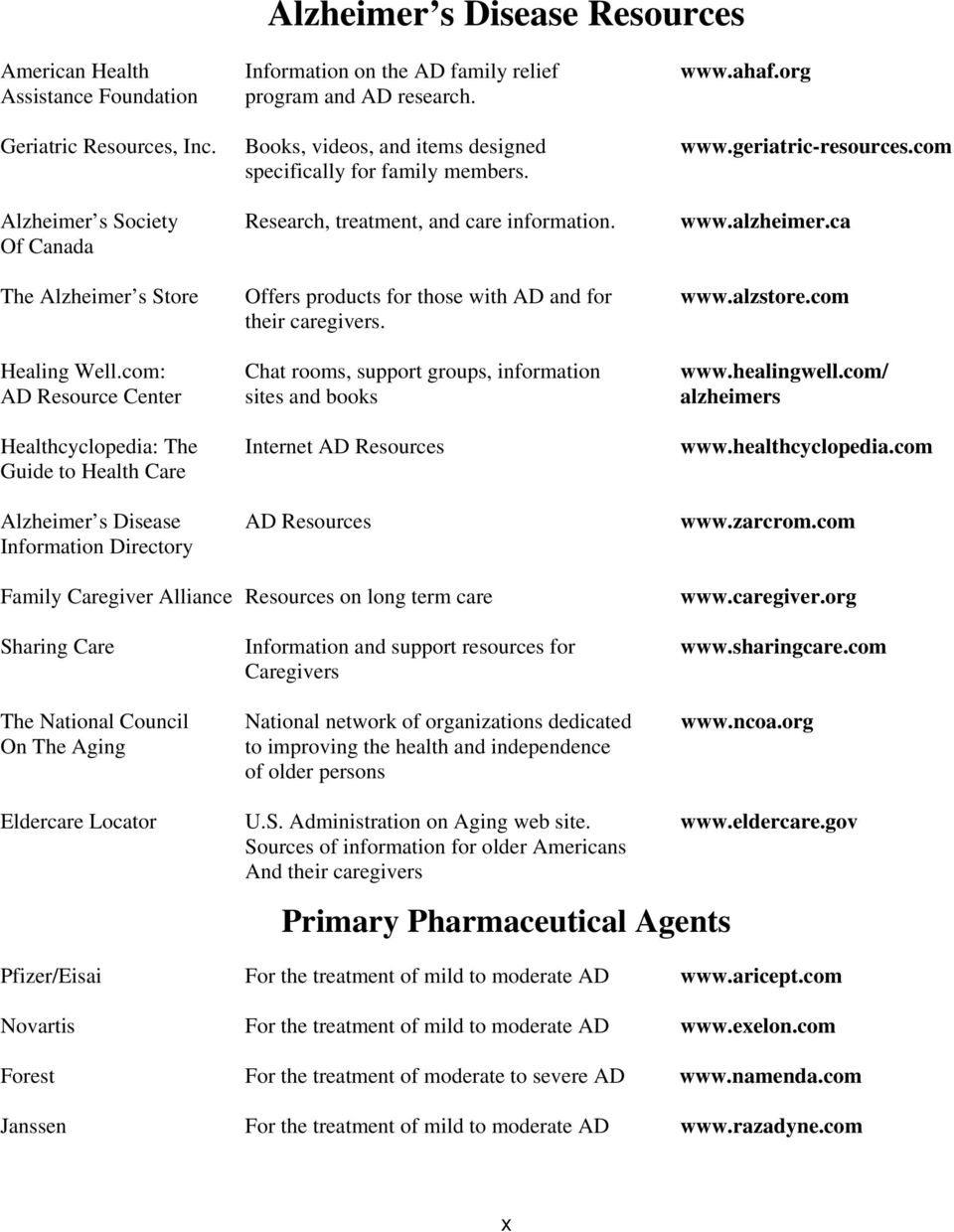
10 Alzheimer s Disease Resources American Health Information on the AD family relief Assistance Foundation program and AD research. Geriatric Resources, Inc. Books, videos, and items designed specifically for family members. Alzheimer s Society Research, treatment, and care information. Of Canada The Alzheimer s Store Offers products for those with AD and for their caregivers. Healing Well.com: Chat rooms, support groups, information AD Resource Center sites and books alzheimers Healthcyclopedia: The Internet AD Resources Guide to Health Care Alzheimer s Disease AD Resources Information Directory Family Caregiver Alliance Resources on long term care Sharing Care Information and support resources for Caregivers The National Council National network of organizations dedicated On The Aging to improving the health and independence of older persons Eldercare Locator U.S. Administration on Aging web site. Sources of information for older Americans And their caregivers Primary Pharmaceutical Agents Pfizer/Eisai For the treatment of mild to moderate AD Novartis For the treatment of mild to moderate AD Forest For the treatment of moderate to severe AD Janssen For the treatment of mild to moderate AD x
11 Alzheimer s Training Pre-Test NAME: DATE FACILITY: HEALTH CARE DISCIPLINE: Please circle or fill in the correct response. 1. Dementia affects an individual s ability to A. Remember B. Reason C. Think D. Communicate E. All of the above 2. The MOST COMMON form of dementia is A. Alzheimer s Disease B. Vascular Disease C. Parkinson s Disease D. Huntington s Disease E. Lewy Body Disease 3. A reversible condition which COULD BE mistaken for dementia is A. Depression B. Infection C. Medication interactions D. Thyroid problems E. All of the above xi

12 4. Which of these changes in the brain are signs of Alzheimer s disease? A. Plaques B. Clots C. A and D D. Tangles E. None of the above 5. List the three stages of Alzheimer s disease. (Please print clearly). A. B. C. 6. Which of the following statements is TRUE concerning the medications available to treat Alzheimer s disease? A. They don t work. B. They may not have any effect. C. They have horrible side effects. D. They may slow the progression of the disease. E. B and D 7. When an Alzheimer s individual experiences aphasia, he or she may have difficulty in: A. Word-finding B. Understanding the spoken word C. Understanding the written word D. A and B E. All of the above xii

13 8. A Certified Nurse Aide provides care for an Alzheimer s resident in the nursing home. One of her residents repeatedly asks, What do I do now? The CNA has tried answering his questions. However, he continues to repeat the same question over and over again. What else could the CNA do to assist the resident? A. Divert him to a meaningful activity.. B. Speak louder to make sure he hears her. C. Ignore him after a while. D. Kindly ask him to stop following her. E. None of the above 9. Alzheimer s individuals may resist personal care because they: A. Are trying to be difficult B. Don t care anymore C. Have privacy issues D. Have personal preferences E. C and D 10. The BEST WAY to complete an ADL activity with an Alzheimer s individual is to: A. Make eye contact B. Approach from the front C. Break it down into simple steps D. A and B E. E. None of the above 11. A COMMON Alzheimer s behavior is: A. Combativeness B. Screaming C. Spitting D. Repetitive questions E. All of the above xiii

14 12. Combativeness occurs MOST OFTEN when an Alzheimer s individual is: A. Angry at the caregiver B. Frightened C. Trying to be difficult D. Depressed E. None of the above 13. The MOST EFFECTIVE intervention for a resident who repetitively bangs on the table is: A. Remove the table B. Give the person something meaningful to hold C. Ignore the situation D. Tell the person to stop banging E. None of the above 14. If an Alzheimer s individual has difficulty understanding the purpose of objects, he or she may have difficulty with: A. Eating B. Dressing C. Grooming D. Bathing E. All of the above 15. Mary is a 75-year-old Alzheimer s resident you are caring for in the nursing home. She receives frequent visits from her children and grandchildren. The children have made it a point to show you pictures of Mary s garden. Based on this information, list three roles that are important to Mary. A. B. C. xiv

15 16. Which of the following is NOT an example of validation? A. Your husband is out at the store, he ll be back later. B. Your children are at school, they get out later this afternoon. C. Your husband died last year, don t you remember? D. You can t go home, you live here with us. E. C and D 17. When dealing with an agitated resident, it is MOST helpful to A. Redirect the individual B. Walk away C. Provide reassurance D. Bring them to an activity E. Tell them with a firm voice to calm down 18. Which of the following is the MOST important to consider when judging if an activity met the needs of an Alzheimer s individual? A. Was the activity interesting? B. Was the activity done correctly? C. Was the activity completed? D. Was the activity safe and enjoyable? E. None of the above 19. List three ways of finding out what hobbies and interests an Alzheimer s individual had in the past. (Please print clearly). A. B. C. xv

16 20. Professional caregivers can help family caregivers by A. Educating them B. Listening to them C. Involving them D. A and B E. All of the above 21. Professional caregivers can reduce their stress by A. Avoiding change B. Asking for help C. Using relaxation techniques D. B and C E. All of the above 22. Safety is a major concern in individuals with Alzheimer s disease because the individual A. Does not recognize familiar objects or places B. Has changes in vision, hearing, depth perception C. Has no sense of danger D. All of the above xvi

17 Alzheimer s Training Post-Test NAME: DATE FACILITY: HEALTH CARE DISCIPLINE: Please circle or fill in the correct response. 1. Dementia affects an individual s ability to A. Remember B. Reason C. Think D. Communicate E. All of the above 2. The MOST COMMON form of dementia is A. Alzheimer s Disease B. Vascular Disease C. Parkinson s Disease D. Huntington s Disease E. Lewy Body Disease 3. A reversible condition which COULD BE mistaken for dementia is A. Depression B. Infection C. Medication interactions D. Thyroid problems E. All of the above xvii

18 4. Which of these changes in the brain are signs of Alzheimer s disease? A. Plaques B. Clots C. A and D D. Tangles E. None of the above 5. List the three stages of Alzheimer s disease. (Please print clearly). A. B. C. 6. Which of the following statements is TRUE concerning the medications available to treat Alzheimer s disease? A. They don t work. B. They may not have any effect. C. They have horrible side effects. D. They may slow the progression of the disease. E. B and D 7. When an Alzheimer s individual experiences aphasia, he or she may have difficulty in: A. Word-finding B. Understanding the spoken word C. Understanding the written word D. A and B E. All of the above xviii

19 8. A Certified Nurse Aide provides care for an Alzheimer s resident in the nursing home. One of her residents repeatedly asks, What do I do now? The CNA has tried answering his questions. However, he continues to repeat the same question over and over again. What else could the CNA do to assist the resident? A. Divert him to a meaningful activity.. B. Speak louder to make sure he hears her. C. Ignore him after a while. D. Kindly ask him to stop following her. E. None of the above 9. Alzheimer s individuals may resist personal care because they: A. Are trying to be difficult B. Don t care anymore C. Have privacy issues D. Have personal preferences E. C and D 10. The BEST WAY to complete an ADL activity with an Alzheimer s individual is to: A. Make eye contact B. Approach from the front C. Break it down into simple steps D. A and B E. None of the above 11. A COMMON Alzheimer s behavior is: A. Combativeness B. Screaming C. Spitting D. Repetitive questions E. All of the above xix

20 12. Combativeness occurs MOST OFTEN when an Alzheimer s individual is: A. Angry at the caregiver B. Frightened C. Trying to be difficult D. Depressed E. None of the above 13. The MOST EFFECTIVE intervention for a resident who repetitively bangs on the table is: A. Remove the table B. Give the person something meaningful to hold C. Ignore the situation D. Tell the person to stop banging E. None of the above 14. If an Alzheimer s individual has difficulty understanding the purpose of objects, he or she may have difficulty with: A. Eating B. Dressing C. Grooming D. Bathing E. All of the above 15. Mary is a 75-year-old Alzheimer s resident you are caring for in the nursing home. She receives frequent visits from her children and grandchildren. The children have made it a point to show you pictures of Mary s garden. Based on this information, list three roles that are important to Mary. A. B. C. xx

21 16. Which of the following is NOT an example of validation? A. Your husband is out at the store, he ll be back later. B. Your children are at school, they get out later this afternoon. C. Your husband died last year, don t you remember? D. You can t go home, you live here with us. E. C and D 17. When dealing with an agitated resident, it is MOST helpful to A. Redirect the individual B. Walk away C. Provide reassurance D. Bring them to an activity E. Tell them with a firm voice to calm down 18. Which of the following is the MOST important to consider when judging if an activity met the needs of an Alzheimer s individual? A. Was the activity interesting? B. Was the activity done correctly? C. Was the activity completed? D. Was the activity safe and enjoyable? E. None of the above 19. List three ways of finding out what hobbies and interests an Alzheimer s individual had in the past. (Please print clearly). A. B. C. xxi
22 20. Professional caregivers can help family caregivers by A. Educating them B. Listening to them C. Involving them D. A and B E. All of the above 21. Professional caregivers can reduce their stress by A. Avoiding change B. Asking for help C. Using relaxation techniques D. B and C E. All of the above 22. Safety is a major concern in individuals with Alzheimer s disease because the individual A. Does not recognize familiar objects or places B. Has changes in vision, hearing, depth perception C. Has no sense of danger D. All of the above xxii
23 ALZHEIMER S TRAINING PRE-TEST AND POST-TEST ANSWER KEY 1. E 2. A 3. E 4. C 5. Early, Middle, Late 6. E 7. E 8. A 9. E 10. C 11. D 12. B 13. B 14. E 15. Mother, Grandmother, Gardener 16. E 17. C 18. D 19. Family, Resident, Activities Assessment 20. E 21. D 22. D xxiii
24 ALZHEIMER S TRAINING PROGRAM 6-HOUR COURSE FOR CERTIFIED NURSE AIDES, LICENSED PRACTICAL NURSES, REGISTERED PROFESSIONAL NURSES, & OTHER HEALTH CARE PROFESSIONALS 8:30 AM 9:15 AM Registration and Pre-Test Welcome and Introductions Goals & Objectives of Training Program 9:15 AM 9:45 AM Overview of Alzheimer's Disease Module I - Definition - Demographics - Cause - Changes in the Brain - Areas of the Brain Affected - Diagnosis and Treatment - Stages of Alzheimer's Disease 9:45 AM 10:45 AM Communication Module II - Effect of Alzheimer's disease on ability to communicate - Types of communication problems in Alzheimer's Disease - Ways to communicate effectively with an Alzheimer's patient 10:45 AM 11:00 AM BREAK 11:00 AM 12:00 PM Activities of Daily Living Module III - Why people with Alzheimer's Disease have difficulty with daily tasks - "Can do" versus "Can't do" - Stages of dementia and impact on ADL functions - Simplifying Tasks 12:00 AM 1:00 PM LUNCH xxiv
25 1:00 PM 2:00 PM 2:00 PM - 2:45 PM Behavior - When is behavior a problem? - Types of problem behaviors - Repetitive behaviors - Wandering - Aggression - Hallucinations and paranoia - Catastrophic reactions - Keys to managing challenging behaviors - - Cues and Clues Medication or creative intervention? Activities - Knowing the individual s interests and capabilities - Types of dementia-specific activities - Modifying activities to ensure success 2:45 PM 3:00 PM BREAK 3:00 PM 3:45 PM Caregiver Experience - Grief and loss - Communicating with caregivers - Identifying common caregiver reactions - What about me? 3:45 PM 4:00 PM Questions & Answers Post Test Evaluation xxv
26 OVERVIEW OF ALZHEIMER'S DISEASE MODULE I 1
27 OVERVIEW OF ALZHEIMER S DISEASE Dementia A general term used for loss of intellectual or "cognitive" functions Memory Thinking Reasoning Judgment Attention or concentration Language Perception (how things are seen in the environment) Severe enough to interfere with an individual's ability to perform routine daily activities Types of dementia Reversible Caused by drugs, depression, infection, brain tumors, head injury, etc. Goes away or gets better with treatment Irreversible Gets progressively worse Can't be cured Some examples include Alzheimer's Disease, Multi-Infarct or Vascular Dementia, Lewy Body Disease, Parkinson's Disease Alzheimer's Disease Most common form of dementia A progressive, degenerative disease that causes changes in brain tissue resulting in impaired memory, thinking and behavior No known cause or cure Who gets Alzheimer's disease? 4 million Americans have Alzheimer's disease 1 out of 3 families are affected 1 in 10 people over age 65 have Alzheimer's disease 1 in 3 people over age 85 have Alzheimer's disease 60% of nursing home residents have Alzheimer's disease 2
28 What changes occur in the brain with Alzheimer's disease? Loss of brain cells Shrinking of brain size "Plaques" and "tangles" develop in nerve cells of brain - Nerve fibers separate and become tangled - Abnormal protein deposits form Production of chemical messengers ("neurotransmitters") is reduced - "Signals" can no longer pass from one nerve cell to another Cells eventually die Which areas of the brain are affected by Alzheimer's Disease? Frontal Lobe - Personality - Reasoning/judgment - Movement - Speech - Concentration/attention span - Alertness - Safety Parietal Lobe - Sensory-perceptual areas - Senses (temperature, touch, pain, space) - Language (letters words thoughts) Occipital Lobe - Vision - Interprets information from eyes for orientation, position, movement Temporal Lobe - Hearing, memory, language - Organizes basic sounds of language into meaningful communication - Ability to draw Amygdala - Emotions - " 3 F's and an S" = Fright, Fight, Flight, and Survival - Anger, sex, fear Hippocampus - Memory and learning ("tape recorder") - Processes short-term memory - Puts new memories into storage 3
29 LOBE Frontal Parietal Occipital Temporal Amygdala NORMAL FUNCTION Personality Reasoning Movement Speech Attention span Alertness Safety Perceptions Senses (temperature, touch, pain, space) Language Vision Interprets information from eyes for orientation, position, movement Hearing Memory Language Ability to draw Emotions Anger, sex, fear IMPAIRMENT IN ALZHEIMER'S DISEASE Change in personality Cannot plan/poor judgment Short attention span/cannot concentrate Easily distracted Can't initiate activity Not alert Cannot understand input from the senses Cannot follow auditory or visual cues Cannot recognize familiar objects by touch Does not understand the purpose of objects Loss of depth perception Loss of peripheral vision Difficulty processing rapid movements Aphasia (impaired language) inability to speak (expressive aphasia) and inability to understand (receptive aphasia) Angry outbursts Inappropriate sexual behavior Afraid WHAT TO DO Give step by step directions Use cues or prompts to start an activity Reduce hazards in the environment Reduce distractions Assist with cueing Use gestures, body language, demonstrate Use "hand under hand" Use a prompt to show the purpose of an object Approach from the front Eye contact Use slow movements Avoid floor and wall designs which could be misinterpreted (e.g., a black floor tile could appear to be a hole) Early stages - Fill in missing words Later stages - Prompt with gestures, body language, physical prompts, hand under hand Distract Reassure Redirect with activities, music, etc. Hippocampus Memory Learning Processes short-term memory Stores new memories Loss of short term memory Asks repetitive questions Gets lost easily No sense of time Easily confused Loses things Reassure Validate Answer questions, even if repeated Redirect Move slowly between tasks Allow time for adjustment 4
30 Diagnosing Alzheimer's Disease No single test for diagnosing Alzheimer's disease An individual should have a full evaluation to diagnose Alzheimer's disease and rule out reversible causes Complete evaluation by a team of health professionals is best - Medical evaluation includes a physical exam, blood work and x-ray studies to rule out treatable conditions - Mental status examination a Mini Mental State Exam (MMSE) screens for memory problems and reasoning skills - Psychological examinations rule out depression or other emotional issues - Family interviews provide information about past and current problems, activities and behaviors Stages of Alzheimer's Disease There are 3 stages: early, middle and late. Because each person with Alzheimer's disease is different, the stages are not clear-cut. A person may have some symptoms from one stage and some from another stage throughout the disease process. I. Early Stage Memory loss - Changes in short-term memory - Family and friends may feel "something is wrong" - Daily routines and ability to function affected - Person with Alzheimer's disease attempts to "cover up" the problems Personality changes - Anxious or withdrawn - Loss of interest, loss of initiative Calculations - Difficult to work with numbers - Trouble paying bills, making change, balancing a checkbook = "executive functions" Communication - Word-finding difficulty - Use the wrong word when communicating 5
31 Judgment - May make bad decisions - May be easily persuaded to buy things or make unwise financial choices Daily living - Difficulty with routine activities - Takes longer to complete everyday tasks Concentration - Attention span is shorter II. Middle Stage Memory loss increases dramatically Sleep disturbances Gets lost easily, even in familiar places Help is needed in activities of daily living (ADLs) May begin to demonstrate agitated behaviors - suspicious, anxious, angry outbursts More confused about time Needs constant supervision III. Late Stage Motor skills such as walking, independent eating are lost Bladder and bowel incontinence Swallowing problems Meaningful speech is gone Does not recognize self or family 6
32 Treatment of Alzheimer's Disease There is no cure for Alzheimer's disease. Maintaining good general health is important, because other conditions can make the symptoms of the disease worse. Medications Some medications may be prescribed for mild, moderate, or severe stages of the disease and may slow the deterioration process by acting on the chemical that helps nerve cells communicate. Currently administered agents are: - Aricept - Exelon - Razadyne - Namenda Medications may also be given to help manage some of the difficult behaviors that occur as a result of the disease process. Do people die from Alzheimer's disease? Alzheimer's disease is a slow, gradual deterioration of the brain that eventually results in death. Areas of the brain that control basic life functions, such as swallowing, thirst, and breathing will be damaged. Individuals usually die from complications brought on by Alzheimer's disease, such as: - Pneumonia - Heart Failure - Diabetes - Infections 7
33 POINTS TO REMEMBER "Dementia" is a general term for loss of ability to think, remember and reason. Alzheimer's disease is the most common form of dementia. "Plaques and tangles" form in the brain and prevent nerve cells from transmitting signals and information to one another. Alzheimer's disease has a progressive downhill course, eventually resulting in death. Areas of the brain that control different functions and emotions are affected by Alzheimer's disease the areas affected and what those effects are varies in different people. People with Alzheimer's disease act the way they do because areas of the brain controlling memory, emotion, and function have been damaged by the disease. Do not argue or try to reason with someone with Alzheimer's disease - they cannot understand because of the disease. There is no cure for Alzheimer's disease we can delay the progression of the disease with medication in some cases and control difficult behaviors. Alzheimer's Disease has 3 stages: Early, Middle and Late. People die from complications brought on by Alzheimer's disease. We can help residents and families cope with Alzheimer's disease if we understand the disease process and the things we can do to help everyone maintain a sense of dignity and control. 8
34 COMMUNICATION MODULE II 9
35 COMMUNICATION Communication is a two-way process What we say (verbal) How we say it (non-verbal) I. Alzheimer s disease damages the part of the brain that controls communication. A. Each person is unique, but all experience some type of communication problems. 1. Communication problems vary from person to person 2. Amount of damage to the language area of the brain influences how communication is impaired 3. People with similar degrees of memory loss may have very different problems communicating 4. In late stages, all written and verbal communication abilities may fail B. Word finding 1. The person may have difficulty finding the right word when speaking Example: Mary, I can't find my, my you know, the thing that goes on my hand. 2. Usually occurs early in the disease process 3. Can be frustrating to the individual C. Memory loss 1. Adds to communication problems 2. Person may ask the same question over and over again 3. Person does not remember the answer or that they already asked the question D. Difficulty following conversations 1. Person may have difficulty filtering out noise 2. Difficulty following conversations when someone is speaking 10
36 E. Automatic speech 1. Social phrases remain even after language is failing 2. Person may respond with common phrases they have used thousands of times Example: Thank you for coming or I am fine." F. Curse words 1. Person who did not use curse words before they were ill may use them 2. The disease causes these outbursts G. Reading 1. May be able to read, but do not understand what the words mean 2. May be able to read Do Not Enter, but do not understand what it means 3. Simple, familiar signs like STOP are often effective II. Non-verbal communication A. Importance 1. How we say something is as important as what we say 2. Communication is 10% verbal, 90% non-verbal B. Ability to understand 1. Person with Alzheimer s disease can understand and communicate non-verbally long after written and spoken language has been impaired C. Types of non-verbal communication 1. Body language (posture, position) 2. Tone of voice 3. Gestures 4. Facial expressions 5. Touch 6. Eye contact 11
37 III. Successful Communication A. Non-verbal strategies 1. Maintain a calm, pleasant approach the person with dementia will mirror your mood 2. Approach the person from the front to avoid startling him/her 3. Establish eye contact when speaking 4. Speak at eye level whenever possible 5. Use gentle touch to calm and reassure the person a. Be aware that a hand on the arm may frighten someone who is not used to physical affection b. Point or demonstrate what you want the person to do B. Verbal strategies 1. Use a calm, gentle voice 2. Call the person by name and identify yourself if necessary 3. Use short, simple sentences 4. Speak slowly 5. Eliminate distracting noises (e.g., turn off the TV, close the door if there are voices in the next room) 6. Give one instruction at a time 7. Allow enough time for the person to respond and repeat if necessary 8. Speak to the person as an adult, even if you use simple language do not be disrespectful or talk down to him/her 9. Answer a frequently asked question several times, using a calm voice try to respond to the underlying feeling C. Pitfalls to avoid 1. Do not talk louder if someone does not understand 2. Avoid giving commands or using a demanding tone of voice 3. Do not ask questions that rely on memory this can be humiliating if the person cannot remember the answer (e.g., Do you remember me? What is my name? Who am I?") 12
38 4. Do not argue--the person can no longer reason and he/she may become angry 5. Accept the fact that you cannot convince someone with Alzheimer s disease to see it your way D. Reality Orientation 1. Technique in which the caregiver helps the person regain their awareness of person, place, and time 2. Useful in early stages, only if the information is reassuring to the person 3. May upset the person in early or later stages if they cannot remember or understand what is told to them E. Validation 1. Technique which responds to the emotion rather than the statement itself 2. Helps reduce stress and establish a bond a. Enter the person s reality if they think it is 1940, then interact as if it really were b. Look for feelings behind the words or behavior c. Empathize d. Be non-judgmental e. Provide reassurance and comfort f. Remain calm g. Allow the person to express negative feelings 13
39 POINTS TO REMEMBER All individuals with Alzheimer's disease have some difficulty communicating. Alzheimer's disease damages the part of the brain that controls communication. Memory loss adds to communication problems. Individuals may repeat the same word over and over again or use curse words they never used when well. Communication is both verbal (10%) and non-verbal (90%). Even after they lose the ability to communicate verbally or in writing, Alzheimer individuals respond to non-verbal communication. Keep communication simple, be calm, speak slowly, and give instructions one step at a time. Eliminate distractions and background noise. Don't "talk down" to the individual avoid giving commands. Don't talk louder if the person does not understand. Do not argue the person is not able to reason and may get upset or angry. Validate - "Meet the person where they are" join them in their reality, rather than trying to convince them otherwise. Always look for behaviors, actions or gestures which may convey the feelings or problem the person is trying to express. Provide reassurance and comfort let the individual know you care and understand. 14
40 ACTIVITIES OF DAILY LIVING (ADLs) MODULE III 15
41 ACTIVITIES OF DAILY LIVING Why ADLs are such a challenge to caregivers "Activities of Daily Living" (ADLs), or routine personal care activities include bathing, dressing, grooming, toileting, eating, and dental care. ADLs are personal and intimate experiences, usually done independently and in private. Individuals with Alzheimer's disease experience increasing difficulties with personal care and eventually need a caregiver to help with all personal care tasks. Alzheimer's individuals experience a loss of independence, control, and privacy when they need assistance with ADLs. It is difficult for the Alzheimer's individual to understand what the activity is for and he/she may view it as threatening, frightening or unpleasant. I. Possible Causes for ADL Difficulties A. Cognitive changes 1. In early stage, memory loss can affect the person's ability to remain independent. The person may forget: a. How often he/she has worn the clothes. b. How to "match" clothing in the appropriate styles. c. How to operate the washing machine. d. The last time he/she took a bath or shower. 2. In middle stage, increasing confusion may cause the person to be: a. Overwhelmed by too many clothes in their closet. b. Unable to make a decision, what to wear, what to do first. c. Confused whether he/she is getting dressed or undressed. d. Unable to remember how to use the shower or bathtub. e. Afraid of falling. f. Humiliated or embarrassed to need help with such private activities. 16
42 B. Physical changes 1. Illness due to infection or flu may create change of interest in personal hygiene or cooperation with personal care. 2. Decreased hearing or eyesight makes it difficult to follow instructions. 3. Balance problems make it difficult to put on clothes. 4. Loss of motor planning skills makes ADLs difficult. 5. Poor circulation 6. Sensitive skin 7. Changes in the body's thermostat. 8. Depression II. Encouraging Participation in Personal Care A. Techniques 1. Focus on their abilities. 2. Be flexible. 3. Routines a. Try to maintain the person's lifelong routines. b. Develop a daily schedule and try not to deviate. 4. Keep distractions to a minimum. 5. Use good communication skills. 6. Encourage independence. Allow the person to do whatever part of the activity they can do. 7. Take extra time and do not rush. The extra effort put in during ADLs may prevent the person from having an outburst that may result in aggression. 8. Break down instructions into steps. 9. Coach the person, offering cues and prompts. 10. Avoid arguing. If the person is resistant, walk away and try again later. 17
43 BATHING I. Tips for Bathing A. All stages 1. Keep routine consistent. 2. Ensure as much privacy as possible. 3. Ensure adequate lighting. 4. Avoid startling the person with the shower sprayer or water. 5. Ensure water is the proper temperature. B. Middle stage 1. Have bath water and supplies ready. 2. Separate bathing from hair washing. 3. Remember that a daily bath may not be necessary. 4. Keep the bathroom as homelike as possible. 5. Keep distractions and noise to a minimum. 6. Encourage the person's participation in the bathing activity. C. Late stage 1. Gently coach the person during each step. 2. Put a washcloth or showerhead in the person's hand and cup your hand over his, letting the person assist in the movements. 3. Minimize frequency of full baths. Sponge baths do get the job done. 18
44 TOILETING I. Tips for Toileting A. Schedules 1. Establish a schedule for reminding the person to use the toilet or assist the person to the restroom. B. Cues 1. Look for non-verbal cues that someone needs to use the toilet, such as increased agitation, picking at a belt or zipper. C. At night 1. The decision to wake the person at night should be on a case-by-case basis. II. Causes of Incontinence A. Medical condition 1. Urinary tract infection (UTI) 2. Vaginitis 3. Enlarged prostate 4. Fecal impaction B. Stress Incontinence 1. Common signs are leakage of urine when coughing, laughing, or sneezing. C. Bladder irritants 1. Coffee 2. Alcohol 3. Citrus juices D. Inadequate hydration 19
45 E. Medications 1. Diuretics 2. Caffeine-containing 3. Anti-hypertensive medication (blood pressure) 4. Sedatives 5. Anti-Parkinsonian medications 6. Anithistamines F. Functional incontinence 1. Person does not go to the toilet when they have the urge and has an accident. 2. Common in persons with Alzheimer's disease, because they often forget where the bathroom is or how to use the facilities. 20
46 DRESSING I. Tips for dressing A. Early stage 1. Keep routine consistent 2. Organize clothing. 3. Get rid of unnecessary clutter in closets and dressers. 4. Use gentle reminders about changing clothes when necessary. 5. Assist as needed, but avoid "doing for" or dressing the individual. B. Middle stage 1. Lay out the day's clothing for the person to dress independently. 2. Limit choices. 3. Speak in a calm voice. 4. Use clear, short instructions. 5. Allow plenty of time for the person to do what you have asked. 6. Limit distractions like the TV or other people talking. 7. Encourage the joy of "dressing up." Offer accessories. C. Late stage 1. Show the person what you want them to do. 2. Give the person something to stroke or manipulate while you do things they are no longer able to do. 21
47 EATING I. Problems in eating A. Early stage 1. The person may simply forget to eat. 2. Forgets how to prepare the food and/or store it properly. 3. Depression can lead to loss of appetite. 4. Medications can make it difficult to eat some foods. 5. Eating out may become difficult or embarrassing. 6. May forget how to use utensils. B. Middle stage 1. Ensuring adequate intake is vital. 2. Appetite varies may eat too little or too much. 3. The person may try to eat non-food items. 4. The person may have perceptual difficulties (e.g., distinguishing food from the plate or the plate from the table). 5. Too many choices may overwhelm the person. C. Late stage 1. The person forgets to chew, swallow, and may swallow food whole. 2. Choking becomes an issue. 3. Be alert for "aspiration" (i.e., where the food or liquid goes down the wrong way into the respiratory tract) this can lead to pneumonia. 22
48 II. Tips for eating and nutrition A. Coping with limitations 1. Consider adaptive equipment to encourage independent eating. 2. Monitor closely for choking episodes. Alter diet as needed. 3. Make use of the sucking reflex by using a straw or spouted drinking cup. 4. Encourage independence. 5. Help compensate for the person's decreased motor planning skills. 6. Simplify the eating process. Use utensils needed to eat the meal. Avoid placing other objects on the table that may distract or confuse the person. 7. Serve meals in a quiet environment. Eliminate distractions, such as TV. 8. Decrease confusion by limiting choices. 9. Be flexible and aware of changes in food preferences. 10. Offer one food at a time. 11. Use food supplements when necessary. 12. Offer finger foods. 13. Have dentures checked regularly. 14. Provide reassurance and encouragement. 23
49 POINTS TO REMEMBER All persons with Alzheimer's disease will eventually need assistance with activities of daily living (ADLs), such as bathing, dressing, grooming, toileting, eating, and dental care. Be aware that the person may be afraid, embarrassed and confused because he/she is unable to understand the process or need for the activity as a result of Alzheimer's disease. Encourage independence. Organize the process. Establish and maintain routines. Know the person. Adapt routines to his/her needs, past routines, and preferences. Respect the person's dignity. Help the person feel in control. Be flexible, patient, understanding, and sensitive. Try new approaches. Avoid rushing through personal tasks. Simplify instructions break tasks down into steps. Include the person in the process. Coach the person through each step, offering cues and prompts. Demonstrate an action and encourage the person to "mirror" what you are doing. Provide assistance, guiding with hand over "hand." 24
50 COMMON BEHAVIOR PROBLEMS IN DEMENTIA RESIDENTS MODULE IV 25
51 COMMON BEHAVIOR PROBLEMS IN DEMENTIA RESIDENTS When is behavior a problem? When the behavior significantly violates the rights of others. When the behavior poses a threat to someone's health or safety. When the behavior makes it significantly more difficult to meet governmental regulations, such as bathing. We can distinguish 3 levels of behaviors in dementia. Common behaviors repetitive behaviors, wandering, etc. Challenging behaviors aggressiveness, shouting, angry outbursts [Potentially] harmful behaviors shouting, screaming, hitting, etc. that is disruptive or upsetting and causes other residents to become agitated I. Repetitive Behaviors A. Verbal 1. Repeating the same question, story or statement over and over 2. Examples: "What time is it? "I want to go home", "Where is my purse?" B. Physical 1. Rummaging 2. Rubbing hands 3. Tapping feet 4. Moving tongue 5. Banging C. Interventions 1. Remember the person is not doing this to annoy you. 2. Try distraction and changing the subject. 3. Respond to the emotion. Question: "Where is my husband?" Response: "You must really miss your husband. Tell me about him." 4. Use written notes and reminders. 26
52 5. Use touch to redirect the person when being physically repetitive. 6. Give the person an object to pet, stroke or fondle. II. Wandering A. Types of wanderers 1. Exit Seeker has a specific goal. Examples: "Going home" or "Going to work." 2. Pacer has excess energy and a need to move. 3. Explorer - interested in everything, likes to touch things or exit doors just because they are there. 4. Follower attracted by visual stimuli and/or may be looking for personal contact. B. Interventions 1. Monitor the person's whereabouts. 2. Ensure the person's physical needs are met: toileting, hunger, thirst, rest. 3. Assess for illness or pain. 4. Distract the wander with an activity. 5. Ensure the environment is safe for wandering. 6. Redirect into safe areas signs with words or pictures can be helpful. 7. Exercise during the day may help. 8. Walk or pace with them, then slow your pace the person may slow with you. Gradually stop the person may also stop. 9. Have an action plan in place in case the person wanders away. III. Aggression A. Examples of Aggressive Behaviors 1. Angry outbursts 2. Yelling/screaming 3. Hitting 4. Biting 5. Throwing things 27
53 B. Interventions 1. Watch for signs of frustration. 2. Stay calm if you become upset, the person may become more aggressive. 3. Assess the danger level and back away, if necessary. 4. Try to soothe and/or redirect the resident. 5. Do not restrain unless safety is an issue. IV. Hallucinations and Paranoia A. Hallucinations 1. Seeing, feeling, hearing, smelling or tasting things that cannot be verified by anyone else. 2. Examples include seeing snakes, feeling bugs, or hearing voices that are not there. 3. Illusions seeing a ghost when it is the curtain something real in the environment is misperceived. B. Paranoia 1. An unrealistic, blaming belief 2. Unreasonable suspiciousness C. Interventions 1. Don't argue with the person. 2. Offer reassurance regarding their fear. 3. Distract the person to another topic. 4. Assess to see if changing the environment may change the response. V. Catastrophic Reactions A. Definition 1. An extreme emotional response that is out of proportion to the actual event. B. Examples 1. Rapid mood changes 2. Uncontrolled crying 3. Anger 4. Increased restlessness 5. Striking out 28
54 6. Screaming C. Interventions 1. Remain calm. 2. Soothe and/or redirect the person. 3. Maintain safety for yourself and the individual. 4. Allow the individual to express feelings. 5. Assess the event that caused the extreme reaction and avoid it in the future. VI. Responding to Challenging Behaviors A. Basic principles 1. All behavior has meaning try to identify the need or purpose and respond to it. 2. Do not take the behavior personally. 3. Be calm, be understanding, be patient. 4. Be alert to the environment and behaviors occurring. 5. Intervene BEFORE a behavior or situation becomes a problem. 6. Remove or avoid triggers that provoke a challenging behavior. 7. Respond to the resident's feelings, thoughts and needs (e.g., validate, empathize). 8. Do not argue with or try to convince the person. 9. Tailor the approach to the resident's functional level. 10. Be creative and flexible. 11. Acknowledge the person's request and respond to it. 12. Try alternative approaches what may work one day may not work the next. 13. Ask other staff members what works and share the knowledge. 14. Seek suggestions from the family. B. Cues and Clues 1. Managing challenging behaviors requires problem solving. 2. Begin by asking the 6 "Cues and Clues" questions. WHO is the person? WHAT is the behavior? WHEN does it happen? 29
55 WHERE does it happen? WHY does it happen? HOW can you fix it? C. Identify triggers for potential problem behaviors 1. Caregiver actions that frighten, annoy, threaten or cause pain to the resident 2. Physical environment that is uncomfortable, noisy, threatening, has too much or too little going on 3. Resident does not understand what is happening 4. Unmet physical or emotional needs of the resident 5. Emotional responses or thoughts of the resident D. Outline the plan 1. Remove the resident from a stressful situation. 2. Validate feelings. 3. Redirect. 4. Simplify the environment. 5. Reassure. 6. Provide outlets for behavior (e.g., walking, dancing). 7. Use appropriate communication techniques. 8. Stay with the resident and encourage expression of feelings. 9. Praise positive behaviors. VII. Medication or Creative Intervention? A. Creative intervention 1. The preferred way of managing challenging behaviors 2. Based on knowledge we cannot modify the behavior because of the disease, but we can manage the behavior by using creative strategies. B. Medication 1. Last resort 2. Try non-medication interventions first. 3. If used, medications shall target specific behavior, not just for generally aggressive or agitated behavior. 30
56 C. Drug reactions vary 1. When initiating a new medication, the resident should be monitored closely. 2. Medication reactions vary from person to person. 3. Medications prescribed may have an opposite effect that the one intended. 4. Residents often become oversedated. This can negatively affect their ADLs and overall functioning skills. D. Types of Medications 1. Antipsychotics 2. Antidepressants 3. Anti-anxiety 4. Anti-convulsants E. Common Side Effects 1. Drowsiness 2. Constipation 3. Increased confusion 4. Dry mouth 5. Blurred vision 6. Tremors 7. Rapid heartbeat 8. Muscle rigidity 31
57 POINTS TO REMEMBER The person with Alzheimer's disease has damage to areas of the brain that cause the behaviors we see. The Alzheimer's individual is confused, frightened, does not feel safe, and cannot reason or make sense of his/her environment. We cannot modify the behavior of the person with Alzheimer's disease we can manage it through creative interventions. There are behaviors that are common in Alzheimer's disease, which can become a problem if they pose a threat to safety, violate others' rights or make it difficult to meet governmental regulations. All behavior has meaning. Tailor your approach to the individual, based on his/her history, likes/dislikes, personality, etc. Identify triggers that cause potential problem behaviors and intervene before a problem arises. A catastrophic reaction is an extreme emotional response that is out of proportion to the actual event. Be calm, flexible, patient, and understanding. Identify the problem by asking Who, What, When, Where, Why, and How. Be creative. Behavioral interventions are the preferred way to manage problem behaviors. Medication is a last resort in managing challenging behaviors. 32
58 CAREGIVER EXPERIENCE MODULE V 33
59 CAREGIVER EXPERIENCE One in 10 American adults has a relative with Alzheimer's disease. The Alzheimer caregiver experience is more common than we think 70% of the 4 million Americans with Alzheimer's disease are cared for at home by family caregivers % of nursing home residents have Alzheimer's disease or a related dementia and are cared for by professional caregivers. 80% of Alzheimer caregivers suffer from high levels of stress and nearly half suffer from depression. Families who have a loved one with Alzheimer s disease go through stages of grief, similar to grieving a death, when they see the changes brought about by the disease and experience the loss of the person they knew continue little by little each day. Families can provide a wealth of information and support when caring for Alzheimer s residents. Understanding the stages family members/caregivers go through will help you interact more positively with them. I. Stages of Grief Experienced by Alzheimer's Family Caregivers A. Denial 1. Most common reaction to hearing tragic news. 2. Families have trouble accepting the diagnosis of Alzheimer's disease and may deny that a problem exists. B. Over- Involvement 1. Family members try to compensate for the individual's losses by becoming overly involved. 2. Families may do more for the individual than they have to. C. Anger 1. Stems from the added burden caused by the deterioration of the individual. 2. Anger may be expressed toward the individual, family or the staff. 34
60 D. Guilt or shame 1. A normal reaction to the disease and choosing to place a loved one in a facility. 2. Person may be ashamed or feel guilty about being unable or unwilling to care for the individual at home any longer. E. Acceptance 1. Not everyone who goes through the grieving process reaches this stage. 2. Ideally, family members will reach a point where they understand and accept the disease and decisions that they have had to make. II. Helping Families A. Educate them 1. Teach them what you know about Alzheimer s disease. 2. Let them know their involvement is important for you as well as the individual. 3. Explain how your facility or program operates. 4. Help them get to know you establish a personal bond. 5. Share with them some of your experiences and the techniques you have learned for interacting with their loved one. B. Listen to them 1. Listen to what families have to say, whether or not they are right. 2. Acknowledge what they have told you. 3. If they had a concern or complaint, tell them you will follow up and really do it. 4. Be honest about your limitations. 5. Try to understand their needs and their limitations. C. Involve them 1. Ask their advice on how to deal with their loved ones. 2. Ask them to tell you what the person was like when he was well. 3. Ask about hobbies, likes, dislikes. 35
61 4. Involve them in activities with the resident. 5. Seek their help and advice in finding new solutions to a care management problem. III. Taking Care of Yourself A. Dementia caregivers are special people 1. Demands of dementia care require extraordinary patience, understanding, and creativity. 2. Professional caregivers experience stress, just as family caregivers do. 3. Professional caregivers often become attached to their residents and may go through a mourning or grief process when the long journey through Alzheimer's disease is over for the individual they have been caring for. B. What makes caring for persons with dementia special? 1. Unique opportunities a. You can improve the quality of life for the individual with dementia. b. Every interaction has the potential to be therapeutic. c. Just "being there" is important. d. You have the power and responsibility to make the present day meaningful for a person who can no longer look forward to a better tomorrow. e. Working closely with families permits you to learn from them and build your communication skills and develop other care strategies. 2. Unique demands a. The person with dementia gets worse, no matter how good your care is. b. The person with dementia may not recognize you from day to day. c. The person with dementia is often unable to give back. The caregiver may do all the giving without receiving a thank you, or any other sign of appreciation. d. The person with dementia may strike out physically. 36
62 e. The routine environment that is ideal for dementia care can become monotonous for the caregiver. C. To take care of others, you must take care of yourself! 1. Be gentle with yourself you did not create all of the problems you face daily. 2. You are not a fixer you cannot change the resident/families, but can change your reaction to them. 3. Time-out find a quiet hideout when you need it. Let another team member know you are taking a "timeout." 4. Support each other pat other staff on the back for success and let them return the favor. Share your successes and failures with other staff let them know if you have found a strategy that works. 5. Feeling helpless hang in there being there is sometimes more important than doing something. 6. Change routines change your home routine often if your work routine is dull. 7. Focus on something good on the way home, think of one good thing that happened that day. 8. Get creative try something new. 9. Getting help use your supervisor or a "buddy system" to reassure yourself and build morale. Two heads are better than one for problem-solving. Trade responsibility for a specific resident with another team member if you are becoming frustrated. 10. Saying NO sometimes you must say, "No, I won't." People will value your "yes, I will" even more. People appreciate a definite answer more than a "maybe" or being ignored. 11. "Smell the roses" Laugh, play and smell the roses along the way." Your residents will be more relaxed and happy if you are. 37
63 IV. Everyone Needs Stress Relievers A. Cool off 1. Count to Step back from the situation, take a break, and try again. B. Practice deep breathing techniques 1. Breathe in deeply through the nose, letting your diaphragm rise. 2. Breathe out slowly through your lips. C. Silent scream 1. When you feel like screaming but can't, duck into a quiet spot and give a silent scream. D. Take a break 1. If you feel ready for a break, let someone know and then leave the area. 2. A five-minute breath of fresh air may help you to be a better caregiver for the rest of the day. 3. Avoid "shop talk" during breaks. 38
64 POINTS TO REMEMBER Family caregivers and professional caregivers of individuals with Alzheimer's disease experience stress. Families with a loved one suffering from Alzheimer's disease go through stages of grief. Stages of grief experienced by Alzheimer's family caregivers are denial, over-involvement, anger, guilt or shame, and acceptance. Be sensitive to the feelings the family may be experiencing once they have made the decision to place their loved one in a facility. They may be ashamed, angry, or over-compensate by being protective, "bossy" or overly critical. They are struggling with giving up control of the caregiving process and need your support to help them adjust to the change in roles. We can help families by educating them, listening to them, and involving them in the care process. Dementia caregivers are special people faced with unique opportunities and unique demands. Professional caregivers often become attached to their residents and may experience a grieving process when the individual further deteriorates or passes away. Dementia care requires patience, understanding, and creativity. No matter how good the care you provide is, the individual with dementia will not get better, may not recognize you from day to day, may hit you, and may never be able to thank you for what you do. To take care of others, you must take care of yourself. Everyone needs stress relievers find what works for you (e.g., cooling off, taking a break, meditation, deep breathing, talking problems out with others). Rely on your sense of humor! 39
65 ACTIVITIES MODULE VI 40
66 ACTIVITIES Activities are an essential aspect of dementia care. Doing activities is not "rocket science." Everyone should be able to do some type of activity with the dementia client. Everything is an activity! I. When planning activities for an Alzheimer s individual, it is important to know his or her life story. A. Individuals have their own likes, dislikes and preferences. B. Past habits and experiences influence the activities in which we can engage the person with Alzheimer's disease. 1. Roles 2. Occupations 3. Strengths 4. Preferences 5. Beliefs 6. Skills 7. Personality C. Obtaining the information you need 1. Ask the family or caregiver 2. Ask the client 3. Ask your supervisor 4. Review the care plan II. It is important to assess what an Alzheimer s individual is capable of doing. A. Each individual with Alzheimer's disease is different. B. Not all individuals with Alzheimer's disease lose the same skills at the same stage of the disease. 41
67 C. Certain skills or talents, such as art and music, remain with the Alzheimer s individual well into the disease process. D. Look at what the individual "can do" rather than what he or she can t do. 1. Attention span 2. Communication style and ability 3. Physical abilities 4. Cognitive abilities (i.e., memory, thinking, reasoning) 5. Spiritual needs III. There are many different types of dementia-specific activities A. Dementia-specific activities cannot be done incorrectly by the individual with Alzheimer's disease. B. Dementia-specific activities are "can t fail" activities. C. Reminiscence 1. Long-term memory remains intact. 2. Remembering is a healthy part of life review. 3. Memories can be happy or sad. 4. Reminiscing with the individual with Alzheimer s disease can help you get to know him/her better. D. Give back the pleasure of old memories. 1. Review past events: political, social, work-related 2. Photographs 3. Magazine pictures 4. Creative writing/journals 5. Story-telling 6. Use memory props (e.g., old name badge, license plate, hymn book, baby doll, etc.). 7. Ask Have you ever. Questions. 8. Make a memory basket. 42
68 E. Music 1. Is part of everyday life 2. Creates and brings back memories 3. Promotes expression 4. Is therapeutic throughout all stages 5. Is a social activity 6. Encourages movement 7. Defines an era (e.g., the 50 s) F. Give back the joy of music 1. Use familiar music from the right era. 2. Consider cultural background. 3. Consider preferences/variety. 4. Assess comfortable volume. 5. Music must match the activity. 6. Use musical instruments (e.g. piano, bells, tambourine). G. Dance 1. Encourages movement 2. Is a social activity 3. Promotes individuality 4. Is easy to plan/implement 5. Does not require verbal skills 6. Creates or brings back memories 7. Is a form of exercise 8. Can even be done with someone in a wheelchair H. Give back the joy of dancing 1. Consider music preferences. 2. Consider physical abilities. 3. Use tapes, records or radio. 4. Demonstrate. 5. Modify based on individual s ability. 6. Make it fun! I. Art 1. Does not require verbal skills 2. Provides control and choice 3. Failure free 4. Recreates life stories 5. Provides socialization 43
69 6. Avenue for creativity 7. Improves self-image J. Give back the role of artist 1. Involve life stories. 2. Consider abilities. 3. Display art work. 4. Be flexible. 5. Use multiple media: a. Clay, paints, markers, crayons, tissue paper b. Use household items if available. K. Work or profession 1. We are what we do % to 70% of our time is spent working. 3. Promotes feelings of self-worth 4. Is a source of pride 5. Provides an appreciation of free time 6. Results in positive feedback 7. Memories of work remain as part of long-term memory. 8. Work patterns can sometimes influence the behavior of an individual with Alzheimer s disease. L. Give back the role of worker 1. Know what the individual did for a living. 2. Think of common tasks related to the individual s past work experience (e.g., filing, sorting, outdoor work). 3. Identify simple tasks in the environment that the Alzheimer s individual can do (e.g., dusting, folding laundry, etc.). 4. Modify tasks based on the individual s ability. 5. Always say Thank you, Great job. 44
70 M. Teacher 1. Individuals with Alzheimer's disease have a lot to offer. 2. When we ask for help we put the Alzheimer s individual in a position to "teach." 3. If you are having a problem at work or at home, you may find that an Alzheimer s individual can provide words of wisdom based on years of life experience. 4. Teaching others provides a great source of pride and a feeling of usefulness for the Alzheimer s individual. N. Give back the role of teacher 1. Try to ask questions based on the individual's prior experiences or expertise. 2. Begin questions with: a. "Can you help me with...?" b. "Please show me how to..." c. "I need your advice..." 3. "How do you make an afghan?" O. Helper 1. Helping others increases self-esteem. 2. We can put an Alzheimer individual in a position to help others by developing a project that is safe and repetitive. 3. Remember to modify the activity based on achieving success. 4. Keep it simple! P. Give back the role of helper 1. Activities which put an Alzheimer s individual in a "helper" role include: a. Clip coupons b. Put together a photo album c. Bake cookies for others d. Do artwork for grandchildren e. Volunteerism f. Folding church bulletins, stuffing envelopes g. Preparing for activities that need to be done 2. Get creative: What jobs do you need help with? 45
71 Q. Homemaker 1. Alzheimer s individuals have had to complete household chores and duties for many years. 2. Household duties and chores are stored in long-term memory. 3. In most cases, the Alzheimer s individual needs cueing and assistance with supplies when completing household tasks. 4. The completion of household tasks provides increased self-esteem for the Alzheimer s individual. 5. It does not matter if the tasks are completed well or correctly just that the person can participate and feel helpful in some way 6. Always say THANK YOU! R. Give back the role of homemaker 1. Activities which put an Alzheimer s individual in a "homemaker" role include: a. Folding b. Dusting c. Outdoor work (e.g., raking leaves) d. Washing dishes/clothes e. Sorting (e.g., nuts/bolts, silverware, playing cards, money, photos) f. Peeling potatoes g. Winding yarn h. Sweeping the floor S. Holidays and Special Occasions 1. Holidays and special events are wonderful opportunities to share and reminisce about past memories. 2. At times, holidays can be depressing and agitating to the Alzheimer s individual. 3. It is important to discover which holidays and special events the Alzheimer s individual celebrated and how they preferred to celebrate 46
72 T. Give back the joy of holidays and special occasions 1. Holidays 2. Seasons 3. Birthdays 4. Anniversaries 5. Intergenerational programs 6. Parties 7. Weddings/Showers 8. Every day is special create a reason to party! 9. Involve families in the planning and celebration of the holiday or special occasion. IV. It is important to adapt and modify activities based on safety, the Alzheimer individual s enjoyment and ability. A. Set up the individual for success 1. Identify past family roles. 2. Identify past work roles. 3. Choose aspects that safely promote abilities. 4. Simplify based on success. 5. Break down tasks into simple steps. 6. Evaluate. 7. Always say thank you. 8. Remember to have patience and flexibility. V. Bring your "self" to work. A. Share your skills and talents 1. Cooking 2. Family videos 3. Children 4. Pets 5. Your hobbies and interests 6. Music 7. Singing 8. Movies 9. Storytelling B. Use your sense of humor 1. Humor is wonderful medicine. 2. Humor can lighten a frustrating situation. 3. Humor is a great stress-reliever! 47
73 POINTS TO REMEMBER "Everything is an activity." When planning activities it is important to know the Alzheimer s individual s life story. Always base your activity on the Alzheimer s individual s abilities. Reminiscence is an approach that focuses on past experiences from an individual s long-term memory. This is typically a strength for an Alzheimer s individual. Music is a part of everyday life and is therapeutic throughout all stages of the disease. Dance is failure-free and encourages movement and exercise. Art improves self-image and does not require verbal skills. Providing work projects can be a source of pride and self-worth. Consider the Alzheimer s individual as an expert. Ask for his/her advice. Alzheimer s individuals enjoy helping others. Homemaking provides safe, adult, and repetitive activities which are familiar to former housekeepers. Always provide celebrations for special occasions and cultural events. Share your life with your clients. Bring your hobbies and skills to work with you and share them with others. 48
Brain Injury: Stages of Recovery
 Brain Injury: Stages of Recovery Recovery after brain injury is a process that occurs in stages. Some people move quickly through the stages, while others make slow, but steady gains. The Rancho Los Amigos'
Delirium. The signs of delirium are managed by treating the underlying cause of the medical condition causing the delirium.
 Delirium Introduction Delirium is a complex symptom where a person becomes confused and shows significant changes in behavior and mental state. Signs of delirium include problems with attention and awareness,
PARTNERING WITH YOUR DOCTOR:
 PARTNERING WITH YOUR DOCTOR: A Guide for Persons with Memory Problems and Their Care Partners Alzheimer s Association Table of Contents PARTNERING WITH YOUR DOCTOR: When is Memory Loss a Problem? 2 What
Progression MIDDLE STAGE. What is Alzheimer s disease?
 Progression MIDDLE STAGE This document is one in a five-part series on the stages of Alzheimer s disease and is written for the person with the disease, their family and caregivers. The middle stage of
Caring for Persons with Dementia during an Influenza Pandemic
 Caring for Persons with Dementia during an Influenza Pandemic PREPARED BY: Alzheimer s Association American Association of Homes and Services for the Aging American Health Care Association American Medical
The road to recovery. The support available to help you with your recovery after stroke
 The road to recovery The road to recovery The support available to help you with your recovery after stroke We re for life after stroke Introduction Need to talk? Call our confidential Stroke Helpline
Incontinence. in con ti nent. adjective. 1. unable to restrain natural discharges or evacuations of urine or faeces.
 PBO 930022142 NPO 049-191 Incontinence Incontinence can be upsetting and humiliating for the person with dementia as well as stressful for the carer. However, there are many ways in which the situation
HOW WOULD I KNOW? WHAT CAN I DO?
 HOW WOULD I KNOW? WHAT CAN I DO? How to help someone with dementia who is in pain or distress Help! 1 Unusual behaviour may be a sign of pain or distress If you are giving care or support to somebody with
How to identify, approach and assist employees with young onset dementia: A guide for employers
 How to identify, approach and assist employees with young onset dementia: A guide for employers What is dementia? Dementia involves the decline of cognitive functions. Young Onset Dementia, also known
communication Tips for successful communication at all stages of Alzheimer's disease
 communication Tips for successful communication at all stages of Alzheimer's disease Communication and dementia As the disease progresses, the communication skills of a person with Alzheimer's disease
Understanding. Depression. The Road to Feeling Better Helping Yourself. Your Treatment Options A Note for Family Members
 TM Understanding Depression The Road to Feeling Better Helping Yourself Your Treatment Options A Note for Family Members Understanding Depression Depression is a biological illness. It affects more than
Registered Charity No. 5365
 THE MULTIPLE SCLEROSIS SOCIETY OF IRELAND Dartmouth House, Grand Parade, Dublin 6. Telephone: (01) 269 4599. Fax: (01) 269 3746 MS Helpline: 1850 233 233 E-mail: [email protected] www.ms-society.ie
Financial Advisors and Alzheimer s Disease: What You Need to Know
 Financial Advisors and Alzheimer s Disease: What You Need to Know In today s aging society, with people living longer lives, chances are good that you ll be called upon to assist clients who have Alzheimer
Steps to getting a diagnosis: Finding out if it s Alzheimer s Disease.
 Steps to getting a diagnosis: Finding out if it s Alzheimer s Disease. Memory loss and changes in mood and behavior are some signs that you or a family member may have Alzheimer s disease. If you have
Depression. What Causes Depression?
 National Institute on Aging AgePage Depression Everyone feels blue now and then. It s part of life. But, if you no longer enjoy activities that you usually like, you may have a more serious problem. Feeling
Caregiving Issues for those with dementia and other cognitive challenges.
 Caregiving Issues for those with dementia and other cognitive challenges. Sue Maxwell, MSW Director of Gerontology Lee Memorial Health System Fort Myers, Florida August 2009 Goals & Objectives Understand
Question Specifications for the Cognitive Test Protocol
 Question Specifications for the Cognitive Test Protocol Core Questions These are the 6 disability questions to be tested in the interview. All of the other questions in the cognitive test protocol are
Problems with food are fairly common try not to panic.
 A Psychological Guide for Families: Feeding & Eating Child & Family Psychology Introduction This booklet is part of a series that has been written by Clinical Child Psychologists from the Child and Family
Memory, Behaviour, Emotional and Personality Changes after a Brain Injury
 Memory, Behaviour, Emotional and Personality Changes after a Brain Injury The consequences of a brain injury on any individual, family or relationship are far reaching. A brain injury not only impacts
A Depression Education Toolkit
 A Depression Education Toolkit Facts about Depression in Older Adults What is Depression? Depression is a medical illness. When sadness persists or interferes with everyday life, it may be depression.
i n s e r v i c e Resident Rights
 i n s e r v i c e Resident Rights The term resident rights refers to legislation that protects nursing home residents and provides for certain freedoms. Resident rights are extremely important and are
Kids Have Stress Too! Especially at Back to School Time As a Parent, You Can Help!
 1 Kids Have Stress Too! Especially at Back to School Time As a Parent, You Can Help! Stress can infect and affect the physical, emotional, intellectual and academic well being of children. It can interfere
NURSING B29 Gerontology Community Nursing. UNIT 2 Care of the Cognitively Impaired Elder in the Community
 NURSING B29 Gerontology Community Nursing UNIT 2 Care of the Cognitively Impaired Elder in the Community INTRODUCTION The goal of this unit is for the learner to be able to differentiate between delirium,
Financial advisors and Alzheimer s disease: What you need to know
 Financial advisors and Alzheimer s disease: What you need to know In today s aging society, with people living longer lives, chances are high that you ll be called upon to assist clients who are caring
APPROVED: Memory Care Requirements for Nursing Care Center Accreditation
 APPROVED: Memory Care Requirements for Nursing Care Center Accreditation Effective July 1, 2014, The Joint Commission will implement new memory care requirements designed to help accredited nursing care
MEDICAL ASSISTANT : COMMUNICATION WITH PATIENTS.
 MEDICAL ASSISTANT : COMMUNICATION WITH PATIENTS. The most important abilities of a CMA are: the ability to Communicate effectively, with professionalism and diplomacy to all types of patients. Recognize
Quality Measures for Long-stay Residents Percent of residents whose need for help with daily activities has increased.
 Quality Measures for Long-stay Residents Percent of residents whose need for help with daily activities has increased. This graph shows the percent of residents whose need for help doing basic daily tasks
if you have alzheimer s disease What you should know, what you should do
 if you have alzheimer s disease What you should know, what you should do what is happening to me? Alzheimer's disease causes gradual, irreversible changes in the brain. These changes usually cause problems
Approaching the End of Life. A Guide for Family & Friends
 Approaching the End of Life A Guide for Family & Friends Approaching the End of Life A Guide for Family & Friends Patrice Villars, MS, GNP and Eric Widera, MD Introduction In this booklet you will find
Certified Nursing Assistant Essential curriculum- Maryland Board of Nursing
 Certified Nursing Assistant Essential curriculum- Maryland Board of Nursing Module I Orientation/Introduction A. Identify general information pertaining to the nursing assistant course B. List requirements
Supporting your child after a burn injury
 Royal Manchester Children s Hospital Supporting your child after a burn injury Information for Parents and Carers of Young Children 2 Contents Page Introduction 4 Trauma and children 4 Normal reactions
Are you feeling... Tired, Sad, Angry, Irritable, Hopeless?
 Are you feeling... Tired, Sad, Angry, Irritable, Hopeless? I feel tired and achy all the time. I can t concentrate and my body just doesn t feel right. Ray B. I don t want to get out of bed in the morning
Understanding late stage dementia Understanding dementia
 Understanding late stage dementia About this factsheet This factsheet is for relatives of people diagnosed with dementia. It provides information about what to expect as dementia progresses to late stage.
How To Write Long Term Care Insurance
 By Lori Boyce, AVP Risk Management and R&D Underwriting long term care insurance: a primer Every day Canadians die, are diagnosed with cancer, have heart attacks and become disabled and our insurance solutions
Brain Injury Association National Help Line: 1-800-444-6443 Brain Injury Association Web site: www.biausa.org Centers for Disease Control and
 Brain Injury Association National Help Line: 1-800-444-6443 Brain Injury Association Web site: www.biausa.org Centers for Disease Control and Prevention Web site: www.cdc.gov/ncipc/tbi Contents About Brain
EMOTIONAL AND BEHAVIOURAL CONSEQUENCES OF HEAD INJURY
 Traumatic brain injury EMOTIONAL AND BEHAVIOURAL CONSEQUENCES OF HEAD INJURY Traumatic brain injury (TBI) is a common neurological condition that can have significant emotional and cognitive consequences.
New Beginnings: Managing the Emotional Impact of Diabetes Module 1
 New Beginnings: Managing the Emotional Impact of Diabetes Module 1 ALEXIS (AW): Welcome to New Beginnings: Managing the Emotional Impact of Diabetes. MICHELLE (MOG): And I m Dr. Michelle Owens-Gary. AW:
Listen, Protect, and Connect
 Page 1 Listen, Protect, and Connect PSYCHOLOGICAL FIRST AID FOR CHILDREN, PARENTS, AND OTHER CAREGIVERS AFTER NATURAL DISASTERS Helping you and your child in times of disaster. Page 2 As a parent or adult
Retirement Research Foundation
 Nursing Home Social Work Network Welcome! http://clas.uiowa.edu/socialwork/nursing-home-social-work-network This webinar series is made possible through the generosity of the Retirement Research Foundation
Lewy body dementia Referral for a Diagnosis
 THE Lewy Body society The more people who know, the fewer people who suffer Lewy body dementia Referral for a Diagnosis Lewy Body Dementias REFERRAL FOR A DIAGNOSIS In the UK people with all forms of dementia
NHS Continuing Healthcare
 NHS Continuing Healthcare Questionnaire In association with Questionnaire 1. Full name of patient 2. Home address (prior to transfer into care home if applicable) 3. Patient s Date of Birth 4. Patient
However, if your child is learning how to use the toilet without problems, there is no need to stop because of these situations.
 Toilet Training Readiness When do I start? Bowel and bladder control is a necessary skill. Teaching your child to use the toilet takes time, understanding, and patience. The important thing to remember
Date Problem Goal Interventions Discipline Review 12/30/ Worried and scared since readmission Crying more frequently
 Mrs. M. Care Plan (Post Significant Change) Mrs. Cynthia M is a 90-year-old, Caucasian female, born June 22, 1920 in Germany and immigrated to the United States when she was seven years old. Mrs. M speaks
Alzheimer s disease. What is Alzheimer s disease?
 Alzheimer s disease What is Alzheimer s disease? What we know about dementia and Alzheimer s disease Alzheimer s disease is the most common of a large group of disorders known as dementias. It is an irreversible
Heads Up for Healthier Living
 Help for today. Hope for tomorrow... Heads Up for Healthier Living For people with Alzheimer s disease and their families Living with Alzheimer s disease can be challenging. Whether you have the disease
end-of-life decisions Honoring the wishes of a person with Alzheimer's disease
 end-of-life decisions Honoring the wishes of a person with Alzheimer's disease Preparing for the end of life When a person with late-stage Alzheimer s a degenerative brain disease nears the end of life
Progression END OF LIFE. What is Alzheimer s disease? End of life what to expect
 Progression END OF LIFE This document is one in a five-part series on the stages of Alzheimer s disease and is written for the person with the disease, their family and caregivers. The end of life stage
Progression LATE STAGE. What is Alzheimer s disease? The late stage - what to expect
 Progression LATE STAGE This document is one in a five-part series on the stages of Alzheimer s disease and is written for the person with the disease, their family and caregivers. The late stage of the
PARKINSON S DISEASE INTRODUCTION. Parkinson s disease is defined as a disease of the nervous system that affects voluntary movement.
 PARKINSON S DISEASE INTRODUCTION Parkinson s disease is a disorder of the brain and the nervous system. It is one of the more common neurological diseases in people over the age of 60, and it is more common
Is It Time for In-Home Care?
 STEP-BY-STEP GUIDE Is It Time for In-Home Care? Helping Your Loved Ones Maintain Their Independence and Quality of Life 2015 CK Franchising, Inc. Welcome to the Comfort Keepers Guide to In-Home Care Introduction
Caring for depression
 Caring for depression Aetna Health Connections SM Disease Management Program Get information. Get help. Get better. 21.05.300.1 B (6/08) Get back to being you How this guide can help you Having an ongoing
CARING FOR PERSONS WITH DEMENTIA
 CARING FOR PERSONS WITH DEMENTIA Many people are caring for an elderly parent or other loved one with dementia. This is a practical guide, in a question and answer format, designed to help caregivers assist
Patients with dementia and other types of structural brain injury are predisposed to delirium (i.e., abrupt onset, temporary confusion caused by
 Dementia is the permanent loss of multiple intellectual functions resulting from neuronal death. Dementia afflicts 10% of individuals over the age of 65 and these patients survive approximately seven years
Background on Brain Injury
 CHAPTER 1 Background on Brain Injury In this chapter, you will: Read about Alberta s definition of Acquired Brain Injury and how that affects which supports you will be able to access. Learn about the
Depression Overview. Symptoms
 1 of 6 6/3/2014 10:15 AM Return to Web version Depression Overview What is depression? When doctors talk about depression, they mean the medical illness called major depression. Someone who has major depression
Coping with Multiple Sclerosis Strategies for you and your family
 Patient Education Coping with Multiple Sclerosis Strategies for you and your family Most people are not prepared to deal with the changes in routine and lifestyle that MS may require. Coping with MS can
Continence in Dementia. Elizabeth Rand Manager, Cognitive Dementia & Memory Service (CDAMS) Caulfield Hospital
 Continence in Dementia. Elizabeth Rand Manager, Cognitive Dementia & Memory Service (CDAMS) Caulfield Hospital Continence Adequate stimulus to initiate voiding reflex Neuromuscular and structural integrity
Chapter 4 COMMUNICATION SKILLS. The difference between verbal and nonverbal communication. The difference between hearing and listening
 Chapter 4 COMMUNICATION SKILLS What You Will Learn The difference between verbal and nonverbal communication The difference between hearing and listening Factors that promote effective communication Barriers
Multiple Sclerosis (MS)
 Multiple Sclerosis (MS) Purpose/Goal: Care partners will have an understanding of Multiple Sclerosis and will demonstrate safety and promote independence while providing care to the client with MS. Introduction
Learning Resource Guide. Understanding Incontinence. 2000 Prism Innovations, Inc. All Rights Reserved
 Learning Resource Guide Understanding Incontinence 2000 Prism Innovations, Inc. All Rights Reserved ElderCare Online s Learning Resource Guide Understanding Incontinence Table of Contents Introduction
Personal Action / Crisis Prevention Plan
 Personal Action / Crisis Prevention Plan This Plan is meant to help clients/consumers, their support persons and providers prepare for times when life seems too hard to manage. This Plan is designed to
MY MEMORY BOOK. My Story IMPACT PROGRAM
 MY MEMORY BOOK My Story IMPACT PROGRAM MY MEMORY BOOK My Story TABLE OF CONTENTS What is memory loss?... 1 About me... 6 My family history... 7 My story Education... 9 Awards and Recognition... 10 Work
O: Gerontology Nursing
 O: Gerontology Nursing Alberta Licensed Practical Nurses Competency Profile 145 Competency: O-1 Aging Process and Health Problems O-1-1 O-1-2 O-1-3 O-1-4 O-1-5 O-1-6 Demonstrate knowledge of effects of
Urinary Incontinence FAQ Sheet
 Urinary Incontinence FAQ Sheet Are you reluctant to talk to your doctor about your bladder control problem? Don t be. There is help. Loss of bladder control is called urinary incontinence. It can happen
The Well Woman Centre. Adult Urinary Incontinence
 The Well Woman Centre Adult Urinary Incontinence 1 Adult Urinary Incontinence... 3 Stress Incontinence Symptoms... 3 Urge Incontinence Symptoms... 4 Mixed Incontinence Symptoms... 5 Where to Start?...
MODULE 1: Introduction
 MODULE 1: Introduction Materials Flipchart, display material, pens Icebreaker Welcome everyone to the first session. Explain how long the training programme will run and how long each session will run
Your guide to. anxiety treatment. after a motor vehicle accident
 Your guide to anxiety treatment after a motor vehicle accident November 2003 ISBN 1 876958 16 2 Published by the Motor Accidents Authority of NSW Level 22, 580 George Street, Sydney 2000 Phone: 1300 137
Manage cancer related fatigue:
 Manage cancer related fatigue: For People Affected by Cancer In this pamphlet: What can I do to manage fatigue? What is cancer related fatigue? What causes cancer related fatigue? How can my health care
Nurse Aide Certification Sample Test
 Nurse Aide Certification Sample Test Notice: This Sample Test is provided as a courtesy to individuals who are preparing to take a Prometric Nurse Aide Competency Examination. You are reminded that how
Depression is a medical illness that causes a persistent feeling of sadness and loss of interest. Depression can cause physical symptoms, too.
 The Family Library DEPRESSION What is depression? Depression is a medical illness that causes a persistent feeling of sadness and loss of interest. Depression can cause physical symptoms, too. Also called
Emergency Room (ER) Visits: A Family Caregiver s Guide
 Family Caregiver Guide Emergency Room (ER) Visits: A Family Caregiver s Guide Your family member may someday have a medical emergency and need to go to a hospital Emergency Room (ER), which is also called
Depression & Multiple Sclerosis
 Depression & Multiple Sclerosis Managing specific issues Aaron, diagnosed in 1995. The words depressed and depression are used so casually in everyday conversation that their meaning has become murky.
Psychological First Aid Red Cross Preparedness Academy 2014
 Caring for Survivors of Trauma and Disaster: An Introduction to Psychological First Aid Biographical Information Rev. William F. Engfehr III LutheranChurch MissouriSynod DisasterResponseChaplain Senior
Diabetes and Emotions
 monitor track manage A TRUEinsight Guide manage Diabetes and Emotions Understanding and Coping With the Emotional Aspects of Diabetes The importance of understanding your emotions A TRUEinsight Guide about
Choosing a Memory Care Provider Checklist (Part One: Comparing Communities)
 Choosing a Memory Care Provider Checklist (Part One: Comparing Communities) Before you choose a memory care community, it is helpful to have a tool to compare your options. We have created the chart below,
Incontinence. What is incontinence?
 Incontinence What is incontinence? Broadly speaking, the medical term incontinence refers to any involuntary release of bodily fluids, but many people associate it strongly with the inability to control
ArlingtonHaus Assisted Living. Assisted Living Application
 ArlingtonHaus Assisted Living Assisted Living Application NAME: APPLICATION DATE:, 20 INTERVIEW DATE:, 20 DATE OF BIRTH: PHIN: PART A: GENERAL DATA INFORMANT FOR INTERVIEW: Self Spouse Child Home Care
Memantine (Ebixa) Drug treatment for Alzheimer s disease
 IS 20 October 2011 Information sheet Memantine (Ebixa) Drug treatment for Alzheimer s disease Introduction... 1 How does Ebixa work?... 1 Who might benefit?... 2 What effect might Ebixa have?... 2 How
Non-epileptic seizures
 Non-epileptic seizures a short guide for patients and families Information for patients Department of Neurology Royal Hallamshire Hospital What are non-epileptic seizures? In a seizure people lose control
Depression. Introduction Depression is a common condition that affects millions of people every year.
 Depression Introduction Depression is a common condition that affects millions of people every year. Depression has an impact on most aspects of everyday life. It affects eating and sleeping routines,
TIPS FOR SUPERVISORS
 TIPS FOR SUPERVISORS IDENTIFYING AND ASSISTING TROUBLED EMPLOYEES The HRS WorkLife Programs, Employee Assistance Program (EAP) is designed to aid staff members in seeking professional assistance to resolve
CDDH FACT SHEET. Working with people with intellectual disabilities in healthcare settings
 CDDH FACT SHEET Working with people with intellectual disabilities in healthcare settings People with intellectual disabilities have the same right as other community members to access community based
USVH Disease of the Week #1: Posttraumatic Stress Disorder (PTSD)
 USVH Disease of the Week #1: Posttraumatic Stress Disorder (PTSD) Effects of Traumatic Experiences A National Center for PTSD Fact Sheet By: Eve B. Carlson, Ph.D. and Josef Ruzek, Ph.D. When people find
Understanding Suicidal Thinking
 Understanding Suicidal Thinking Suicidal thoughts are temporary. Suicide is permanent. Don t give in to suicidal thoughts you can overcome them. If depression or bipolar disorder (also known as manic depression)
Medications to help you quit smoking
 Medications to help you quit smoking How can medication help me quit smoking? Using medications can increase your chances of quitting smoking 2 to 3 times more than quitting without using medications.
Alzheimer s disease Guide for law enforcement
 Alzheimer s disease Guide for law enforcement Law enforcement and Alzheimer s disease As our population ages, the number of people with Alzheimer s continues to grow as does the likelihood that you will
NEUROPSYCHOLOGY QUESTIONNAIRE. (Please fill this out prior to your appointment and bring it with you.) Name: Date of appointment: Home address:
 NEUROPSYCHOLOGY QUESTIONNAIRE (Please fill this out prior to your appointment and bring it with you.) Name: Date of appointment: Date of birth: Age: _ Home address: _ Home phone: Cell phone: Work phone:
National Stroke Association
 CHAPTER 1 WHERE TO BEGIN? Your loved one has just survived a stroke. A great deal of information will be coming at you at once. Focus on the stroke survivor s immediate needs. This section outlines important
Staff, please note that the Head Injury Routine is included on page 3.
 Staff, please note that the Head Injury Routine is included on page 3. This booklet explains what can happen after a concussion, how to get better and where to go for more information and help if needed.
Children s Cancer Pain Can Be Relieved A Guide for Parents and Families
 Children s Cancer Pain Can Be Relieved A Guide for Parents and Families This booklet is dedicated to Shaney Banks and all other children with cancer. Wisconsin Cancer Pain Initiative 1989 This booklet
RESIDENT ASSESSMENT TOOL
 RESIDENT ASSESSMENT TOOL To be completed by a physician, certified nurse practitioner, registered nurse, or physician assistant within 30 days prior to admission, at least annually, & within 48 hours after
Compensation Strategies for Common Challenges after Traumatic Brain Injury
 Compensation Strategies for Common Challenges after Traumatic Brain Injury Annette Pearson MS, LADC, CBIS Vinland National Center [email protected] 1 This is any one of us, with some area(s) of
WHAT IS PTSD? A HANDOUT FROM THE NATIONAL CENTER FOR PTSD BY JESSICA HAMBLEN, PHD
 WHAT IS PTSD? A HANDOUT FROM THE NATIONAL CENTER FOR PTSD BY JESSICA HAMBLEN, PHD Posttraumatic Stress Disorder (PTSD) is an anxiety disorder that can occur following the experience or witnessing of a
Psychotic Disorders. 1995-2013, The Patient Education Institute, Inc. www.x-plain.com mhff0101 Last reviewed: 01/10/2013 1
 Psychotic Disorders Introduction Psychotic disorders are severe mental disorders that cause abnormal thinking and perceptions. These disorders cause people to lose touch with reality. As a result, people
activities at home Planning the day for a person with moderate or severe dementia
 activities at home Planning the day for a person with moderate or severe dementia Activities and a person with dementia Activities are the things we do, like getting dressed, doing chores, playing cards
Helping your child with Non-verbal Learning Disability
 Helping your child with Non-verbal Learning Disability What is non-verbal learning disability? Non-verbal learning disability (NVLD) is a term used to describe a pattern of strengths and weaknesses in
Prescription Drug Abuse
 Prescription Drug Abuse Introduction Most people take medicines only for the reasons their health care providers prescribe them. But millions of people around the world have used prescription drugs for