
2 Transport-level and Message-level Security
|
|
|
- Barnaby Higgins
- 9 years ago
- Views:
Transcription
1 Globus Toolkit Version 4 Grid Security Infrastructure: A Standards Perspective The Globus Security Team 1 Version 4 updated September 12, 2005 Abstract This document provides an overview of the Grid Security Infrastructure (GSI) contained in Web Services-based components of version 4 of the Globus Toolkit (GT4). Particular attention is paid to the relationship between GT4 GSI components and security standards from GGF, IETF, W3C, and OASIS. 1 Introduction Grids [9] have emerged as a common approach to constructing dynamic, inter-domain, distributed computing and data collaborations. The open source Globus Toolkit [8] middleware has been developed to support these environments, and is used in Grid deployments worldwide. The Grid Security Infrastructure (GSI) [3, 10] is the portion of the Globus Toolkit that provides the fundamental security services needed to support Grids. This document describes how GT GSI implements standards from different standards bodies to perform its functions. GT4 contains both Web Service and pre-web Service Grid components. This document discusses solely the Web Service components. The pre- Web Service components use the same authentication mechanisms as the Web Services components described here, but implement application-specific protocols and message protection schemes that are beyond the scope of this document. This document does not discuss either the Globus Toolkit GSI components or the standards in detail, only their relationship. Readers interested in more details should read the documents indicated in the references. 2 Transport-level and Message-level Security GT4.0 supports both message-level and transport-level security, and will continue to support both for the foreseeable future. By "message-level security" we mean support for the WS-Security standard and the WS- SecureConversation specification to provide message protection for SOAP messages. By "transport-level security" we mean authentication via TLS[5] with support for X.509 proxy certificates. 1 Document editor: Von Welch <[email protected]> July 29, 2005 GT4 GSI from a Standards perspective 1
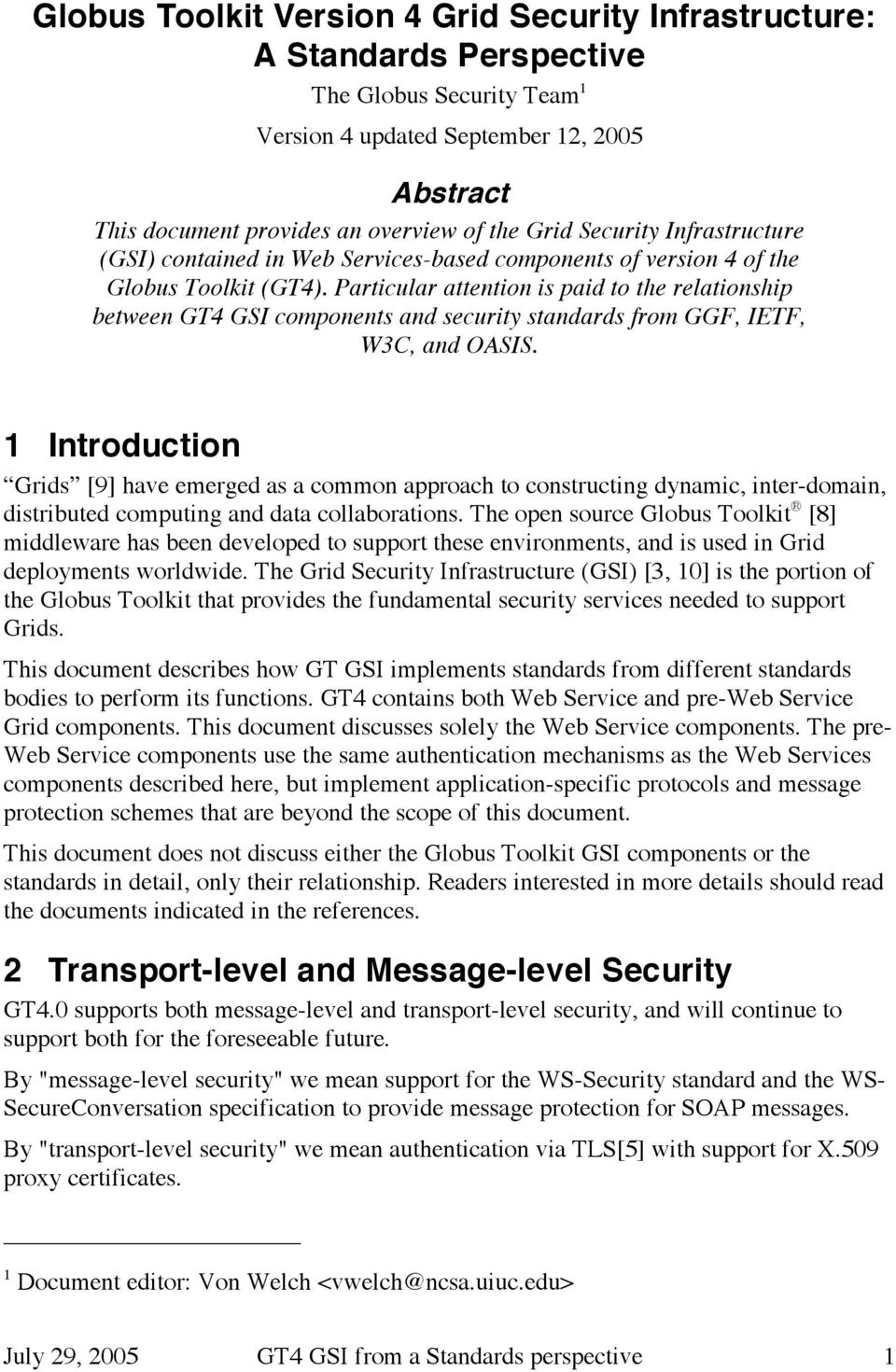
2 GT4.0's support for message-level security is important as it allows us to comply with the WS-Interoperability Basic Security Profile. However, because current message-level security implementations have relatively poor performance, GT4.0 services use transportlevel security by default. This choice is driven by user performance demands. The poor performance of message-level security implementations seems to be partly an implementation issue and partly a specification issues, and it is not clear when it will improve. If and when the performance of message-level security does improve, GT can be expected to move to using message-level security as a default. Eventually, transport-level support could be deprecated. However, this would only be after a transition period and will not occur any time soon. 3 GSI Functional Layers As shown in Figure 1, GSI may be thought of as being composed of four distinct functions: message protection, authentication, delegation, and authorization. Implementations of different standards are used to provide each of these functions: TLS (transport-level) or WS-Security and WS-SecureConversation (messagelevel) are used as message protection mechanisms in combination with SOAP. X.509 End Entity Certificates or Username and Password are used as authentication credentials X.509 Proxy Certificates and WS-Trust are used for delegation SAML assertions are used for authorization Figure 1: Overview of the GT4 Grid Security Infrastructure and standards used for different functions. The left two figures show message-level security, with X.509 credentials and username/password authentication. The figure on the right shows transport-level security with X.509 credentials. July 29, 2005 GT4 GSI from a Standards perspective 2

3 The remainder of this document reviews both the GT implementations of each of these functions and the standards that are used in these implementations. Section 8 discusses the relationship of GSI to WS-I. 4 Message Protection The Web Services portions of GT4 use SOAP [1] as their message protocol for communication. Message protection can be provided either by transporting SOAP messages over TLS, known as Transport-level security, or by signing and/or encrypting portions of the SOAP message using the WS-Security standard, known as Message-level Security. In this section we describe these two methods. 4.1 Transport-level Security Transport-level security entails SOAP messages conveyed over a network connection protected by TLS. TLS provides for both integrity protection and privacy (via encryption). Transport-level security is supported today as a higher-performance alternative to the more standards driven message-level security. If and when message-level security improves in performance, driven by a combination of implementation and specification factors, we expect a gradual deprecation of transport-level security. Transport-level security is normally used in conjunction with X.509 credentials for authentication, but can also be used without such credentials to provide message protection without authentication, often referred to as anonymous transport-level security. In this mode of operation, authentication may be done on a different level, e.g. via username and password in a SOAP message, or communications may be truly unauthenticated. 4.2 Message-level Security The SOAP specification allows for the abstraction of the application-specific portion of the payload from any security (e.g., digital signature, integrity protection, or encryption) applied to that payload, allowing GSI security to be applied in a consistent manner across SOAP messages for any GT4 Web Service-based application or component. GSI implements the WS-Security standard and the WS-SecureConversation specification to provide message protection for SOAP messages. (We use the term specification to denote a scheme that has been well documented but has not passed through a public standards body.) The WS-Security standard [15] from OASIS defines a framework for applying security to individual SOAP messages; GSI conforms to this standard. GSI uses these mechanisms to provide security on a per-message basis, i.e., to an individual message without any preexisting context between the send and receiver (outside sharing some set of trust roots). WS-SecureConversation [13] is a proposed standard from IBM and Microsoft that allows for an initial exchange of message to establish a security context which can then be used to protect subsequent messages in a manner that requires less computational overhead (i.e., it allows the trade-off of initial overhead for setting up the session for lower July 29, 2005 GT4 GSI from a Standards perspective 3

4 overhead for messages). Note that SecureConversation is only offered with GSI when using X.509 credentials as described in the subsequent section on authentication. Both WS-Security and WS-SecureConversation are intentionally neutral to the specific types of credentials used to implement this security. GSI, as described further in the subsequent section on authentication, allows for both X.509 public key credentials and the combination of username and password for this purpose. GSI used with either username/password or X.509 credentials uses the WS-Security standard to allow for authentication; that is a receiver can verify the identity of the communication initiator. When used with X.509 credentials GSI uses WS-Security and WS-SecureConversation to allow for the following additional protection mechanisms (which can be combined): Integrity protection: a receiver can verify messages were not altered in transit from the sender. Encryption: messages can be protected to provide confidentiality. Replay prevention: a receiver can verify that it has not received the same message previously. The specific manner in which these protections are provided varies between WS-Security and WS-SecureConversation. In the case of WS-Security, the keys associated with the sender and receiver s X.509 credentials are used. In the case of WS-SecureConversation, the X.509 credentials are used to establish a session key that is used to provide the message protection. 5 Authentication and Delegation GSI has traditionally supported authentication and delegation through the use of X.509 Certificates and public keys. As a new feature in GT4, GSI also supports authentication through plain username and passwords as a deployment option. We discuss both methods in this section. 5.1 X.509 Credentials GSI uses X.509 end entity certificates (EECs) [17] to identify persistent entities such as users and services. X.509 EECs provide each entity with a unique identifier (i.e., a distinguished name) and a method to assert that identifier to another party through the use of an asymmetric key pair bound to the identifier by the certificate. The X.509 EECs used by GSI are conformant to the relevant standards and conventions. Grid deployments around the world have established their own certification authorities based on third party software to issue X.509 EECs for use with GSI and the Globus Toolkit. GSI also supports delegation and single sign-on through the use of standard X.509 Proxy Certificates [17]. Proxy certificates allow bearers of X.509 EECs to delegate their privileges temporarily to another entity. For the purposes of authentication and authorization, GSI treats EECs and Proxy Certificates equivalently. July 29, 2005 GT4 GSI from a Standards perspective 4

5 Authentication with X.509 Credentials can be accomplished either via TLS, in the case of transport-level security, or via signature as specified by WS-Security, in the case of message-level security X.509 Proxy Certificate Types The Globus Toolkit supports three different forms of Proxy Certificates: Old: These are the legacy proxy certificates used prior to the drafting of RFC These are created by invoking grid-proxy-init old and are recognizable if examined closely by their use of CommonName components with values of proxy and limited proxy. Their use is deprecated and should only be used when necessary to interact with legacy Globus installations. GT4 Default: These proxies follow the format of RFC 3820, except they use a proprietary OID ( ) for the ProxyCertInfo extension. These are created by GT4 grid-proxy-init by default, but will be deprecated in a future version of the Globus Toolkit 2. Fully RFC 3820 compliant: These proxies are fully compliant with RFC 3820 and can be created by grid-proxy-init rfc. They are expected to be the default in the future. Note that other variants of proxy certificates have existed in the past (most notably during the time when RFC 3820 was still in draft and changing regularly), however they are no longer supported and not believed to be in use. All forms of Proxy Certificates support a limited variant that can be created by gridproxy-init limited. Such limited proxies cannot be used to initiate a computation (e.g. they can be used for GridFTP but not GRAM) Delegation GT4 supports a delegation service that provides an interface to allow clients to delegate (and renew) X.509 proxy certificates to a service. The interface to this service is based on the WS-Trust[14] specification (the specification is not well-defined enough to allow claim of compliance). Note that when delegating from a Proxy Certificate, the type of the delegated proxy (as described in section 5.1.1) will always be the same type as the initial proxy. 2 The existence of these proxy certificates was accidental but was not noticed in time before significant GT4 deployment had occurred. 3 Note that this behavior differs from unforwardable Kerberos credentials. July 29, 2005 GT4 GSI from a Standards perspective 5

6 5.2 Username and Password Authentication GSI may use WS-Security with textual Usernames and Passwords as described in the WS-Security standard. This mechanism provides a means to support more rudimentary Web Services applications while conforming to WS-I as described in section 8. Note that when using usernames and passwords as opposed to X.509 credentials, GSI only provides authentication and not advanced security features such as delegation, confidentiality, integrity, and replay prevention. However we do note that one can use usernames and passwords with anonymous transport-level security, i.e. unauthenticated TLS as described in Section 4.1, to allow provide privacy of the password. 6 Authorization In addition the grid-mapfile found in earlier versions of the Globus Toolkit, which provides access control based on a list of acceptable user identifiers, GT4 GSI uses the SAML standard [2] from OASIS. SAML defines formats for a number of types of security assertions and a protocol for retrieving those assertions. GSI uses SAML AuthorizationDecision assertions in two ways: The Community Authorization Service (CAS) [16] issues SAML AuthorizationDecision assertions as its means of communicating the rights of CAS clients to services. GSI uses a callout based on the SAML AuthorizationDecision protocol being defined in GGF [18] to allow the use of a third party authorization decision service, such as PERMIS[4], for access control requests to GT4-based services. 7 Future Plans Role-based authorization is clearly an emerging direction in Grid computing. Services such as PERMIS and the Virtual Organization Membership Service (VOMS) [6] use assertions that bind attributes to users for the purposes of authorization decision making as opposed the typical identity-based authorization done today. Work has also been funded to integrate the Shibboleth service with the Globus Toolkit, providing another avenue of attribute-based authorization. The large challenge facing attribute-based authorization today is that there is currently no standard for how attributes are communicated from the attribute authority to the relying services and no standards for expressing policy regarding those attributes. Work is commencing on a system that leverages the ability of the WS-Security standard to allow for the transport of arbitrary credentials from a client to a service. Mechanisms in GT4 will allow for the canonicalization of those attributes and communication to an authorization decision point as well as an authorization system to enforce simple policies based on those attributes. While the goal is that this work will be generic as to the mechanism of how attributes are expressed, the specific attribute mechanisms that will be targeted for implementation are X.509 Attribute Certificates [7] and SAML Attribute Assertions. July 29, 2005 GT4 GSI from a Standards perspective 6

7 8 Relationship with WS-I The goal of GSI is to adhere to the guidelines established in the WS-I Basic Security Profile 1.0 [19] where applicable. Using GSI with username and password authentication is intended to be WS-I compliant. Using GSI with X.509 credentials is intended to be WS-I compliant apart from the use of those credentials. 9 Conclusion We have described how the GT4 Grid Security Infrastructure is an implementation of existing and emerging standards, many of which are being largely adopted by the broader Web Services community. We also describe GSI s intended compliance with the WS-I Basic Security Profile outside of its use of X.509 credentials. For more information about Globus Toolkit security, please visit the Globus Toolkit Security web pages [11] and the Globus Technical Papers web page[12]. 10 Acknowledgements Work on GT4 GSI has been funded by DOE, NSF, and IBM. Worked described in Future plans is being funded by the DOE SciDAC program and the NSF NMI program. A number of individuals have made contributions to GT4 security including: Rachana Ananthakrishnan, Karl Czajkowski, Ian Foster, Jarek Gawor, Carl Kesselman, Sam Meder, Laura Pearlman, Frank Siebenlist, Steven Tuecke, and Von Welch. 11 Document Change Log Septmeber 12, 2005 version: Added section on different Proxy Certificate formats. July 29, 2005 version: Editorial typo in 5.2 January 2, 2005 version: Fixed caption for Figure 1 to refer to all three figures. December 8, 2004 version: Added description of GT4 adoption of Transport-level security throughout document. Added PERMIS references in Sections 6 and 7. September 22, 2004 version: Original version 12 References 1. Simple Object Access Protocol (SOAP) 1.1, 2. Security Association Markup Language (SAML) Specification v.1.0, July 29, 2005 GT4 GSI from a Standards perspective 7

8 3. Butler, R., et al., A National-Scale Authentication Infrastructure. IEEE Computer, (12): p Chadwick, D.W. and A. Otenko. The PERMIS X.509 Role Based Privilege Management Infrastructure. in 7th ACM Symposium on Access Control Models and Technologies Dierks, T. and C. Allen, The TLS Protocol Version 1.0, 6. EU DataGrid, VOMS Architecture v1.1, 7. Farrell, S. and R. Housley, An Internet Attribute Certificate Profile for Authorization, 8. Foster, I. and C. Kesselman, Globus: A Metacomputing Infrastructure Toolkit. International Journal of Supercomputer Applications, (2): p Foster, I. and C. Kesselman, eds. The Grid: Blueprint for a New Computing Infrastructure (2nd Edition). 2004, Morgan Kaufmann. 10. Foster, I., et al. A Security Architecture for Computational Grids. in 5th ACM Conference on Computer and Communications Security Globus Project, Grid Security Infrastructure (GSI), Globus Project, Globus Project Technical Papers, IBM, et al., Web Services Secure Conversation Language (WS- SecureConversation) Version 1.0, December IBM, et al., Web Services Trust Language (WS-Trust), 15. IBM, Microsoft, and VeriSign, Web Services Security Language (WS-Security), 16. Pearlman, L., et al. A Community Authorization Service for Group Collaboration. in IEEE 3rd International Workshop on Policies for Distributed Systems and Networks Welch, V., et al., X.509 Proxy Certificates for Dynamic Delegation, 18. Welch, V., et al., Use of SAML for OGSA Authorization, WS-I, Web Services Ineroperability (WS-I) Interoperability Profile 1.0a. July 29, 2005 GT4 GSI from a Standards perspective 8
TRUST RELATIONSHIPS AND SINGLE SIGN-ON IN GRID BASED DATA WAREHOUSES
 TRUST RELATIONSHIPS AND SINGLE SIGN-ON IN GRID BASED DATA WAREHOUSES Xiaoyu Li a and Maree Pather b a Department of Information Technology, Nelson Mandela Metropolitan University b Department of Applied
Grid Security : Authentication and Authorization
 Grid Security : Authentication and Authorization IFIP Workshop 2/7/05 Jong Kim Dept. of Computer Sci. and Eng. Pohang Univ. of Sci. and Tech. (POSTECH) Contents Grid Security Grid Security Challenges Grid
Abstract. 1. Introduction. Ohio State University Columbus, OH 43210 {langella,oster,hastings,kurc,saltz}@bmi.osu.edu
 Dorian: Grid Service Infrastructure for Identity Management and Federation Stephen Langella 1, Scott Oster 1, Shannon Hastings 1, Frank Siebenlist 2, Tahsin Kurc 1, Joel Saltz 1 1 Department of Biomedical
USING SAML TO LINK THE GLOBUS TOOLKIT TO THE PERMIS AUTHORISATION INFRASTRUCTURE
 USING SAML TO LINK THE GLOBUS TOOLKIT TO THE PERMIS AUTHORISATION INFRASTRUCTURE Authors David Chadwick 1, Sassa Otenko 1, Von Welch 2 Affiliation 1 ISI, University of Salford, Salford, M5 4WT, England.
GT 6.0 GSI C Security: Key Concepts
 GT 6.0 GSI C Security: Key Concepts GT 6.0 GSI C Security: Key Concepts Overview GSI uses public key cryptography (also known as asymmetric cryptography) as the basis for its functionality. Many of the
Globus Toolkit: Authentication and Credential Translation
 Globus Toolkit: Authentication and Credential Translation JET Workshop, April 14, 2004 Frank Siebenlist [email protected] http://www.globus.org/ Copyright (c) 2002 University of Chicago and The University
Authorization Strategies for Virtualized Environments in Grid Computing Systems
 Authorization Strategies for Virtualized Environments in Grid Computing Systems Xinming Ou Anna Squicciarini Sebastien Goasguen Elisa Bertino Purdue University Abstract The development of adequate security
Chapter 12 GRID SECURITY ARCHITECTURE: Requirements,fundamentals, standards, and models
 Author manuscript, published in Security in Distributed, Grid, Mobile, and Pervasive Computing, Auerbach Publications, pp. 255-288, April, 2007 https://www.nics.uma.es Security in Distributed, Grid, and
Globus Toolkit Firewall Requirements. Abstract
 Globus Toolkit Firewall Requirements Version 9 10/31/06 Von Welch, NCSA/U. of Illinois [email protected] Abstract This document provides requirements and guidance to firewall administrators at sites
An Online Credential Repository for the Grid: MyProxy
 An Online Credential Repository for the Grid: MyProxy Jason Novotny Lawrence Berkeley Laboratory [email protected] Steven Tuecke Mathematics and Computer Science Division Argonne National Laboratory [email protected]
This Working Paper provides an introduction to the web services security standards.
 International Civil Aviation Organization ATNICG WG/8-WP/12 AERONAUTICAL TELECOMMUNICATION NETWORK IMPLEMENTATION COORDINATION GROUP EIGHTH WORKING GROUP MEETING (ATNICG WG/8) Christchurch New Zealand
A CROSS - DOMAIN ROLE MAPPING AND AUTHORIZATION FRAMEWORK FOR RBAC IN GRID SYSTEMS
 International Journal of Computer Science and Applications c 2009 Technomathematics Research Foundation Vol.6 No.1, pp. 1-12 A CROSS - DOMAIN ROLE MAPPING AND AUTHORIZATION FRAMEWORK FOR RBAC IN GRID SYSTEMS
Securing Web Services With SAML
 Carl A. Foster CS-5260 Research Project Securing Web Services With SAML Contents 1.0 Introduction... 2 2.0 What is SAML?... 2 3.0 History of SAML... 3 4.0 The Anatomy of SAML 2.0... 3 4.0.1- Assertion
OIO SAML Profile for Identity Tokens
 > OIO SAML Profile for Identity Tokens Version 1.0 IT- & Telestyrelsen October 2009 Content > Document History 3 Introduction 4 Related profiles 4 Profile Requirements 6 Requirements 6
Web Services Security: What s Required To Secure A Service-Oriented Architecture. An Oracle White Paper January 2008
 Web Services Security: What s Required To Secure A Service-Oriented Architecture An Oracle White Paper January 2008 Web Services Security: What s Required To Secure A Service-Oriented Architecture. INTRODUCTION
A Delegation Framework for Federated Identity Management
 A Framework for Federated Identity Management Hidehito Gomi, Makoto Hatakeyama, Shigeru Hosono and Satoru Fujita NEC Internet Systems Research Laboratories 1753, Shimonumabe, Nakahara-Ku, Kawasaki, Kanagawa
Software Requirement Specification Web Services Security
 Software Requirement Specification Web Services Security Federation Manager 7.5 Version 0.3 (Draft) Please send comments to: [email protected] This document is subject to the following license:
IVOA Single-Sign-On Profile: Authentication Mechanisms Version 2.0
 International Virtual Observatory Alliance IVOA Single-Sign-On Profile: Authentication Mechanisms Version 2.0 IVOA Proposed Recommendation 20151029 Working group http://www.ivoa.net/twiki/bin/view/ivoa/ivoagridandwebservices
Federated Identity Management Solutions
 Federated Identity Management Solutions Jyri Kallela Helsinki University of Technology [email protected] Abstract Federated identity management allows users to access multiple services based on a single
GSI Credential Management with MyProxy
 GSI Credential Management with MyProxy GGF8 Production Grid Management RG Workshop June 26, 2003 Jim Basney [email protected] http://myproxy.ncsa.uiuc.edu/ MyProxy Online repository of encrypted GSI
SINGLE SIGN-ON AND AUTHORIZATION FOR DYNAMIC VIRTUAL ORGANIZATIONS
 58 SINGLE SIGN-ON AND AUTHORIZATION FOR DYNAMIC VIRTUAL ORGANIZATIONS R.O. Sinnott 1, O. Ajayi 1, A.J. Stell 1, J. Watt 1, J. Jiang 1, J. Koetsier 2 National e-science Centre 1 University of Glasgow, Glasgow,
WEB SERVICES SECURITY
 WEB SERVICES SECURITY February 2008 The Government of the Hong Kong Special Administrative Region The contents of this document remain the property of, and may not be reproduced in whole or in part without
Shibboleth : An Open Source, Federated Single Sign-On System David E. Martin [email protected]
 Shibboleth : An Open Source, Federated Single Sign-On System David E. Martin [email protected] International Center for Advanced Internet Research Outline Security Mechanisms Access Control Schemes
GRID COMPUTING Techniques and Applications BARRY WILKINSON
 GRID COMPUTING Techniques and Applications BARRY WILKINSON Contents Preface About the Author CHAPTER 1 INTRODUCTION TO GRID COMPUTING 1 1.1 Grid Computing Concept 1 1.2 History of Distributed Computing
A Conceptual Technique for Modelling Security as a Service in Service Oriented Distributed Systems
 Volume 1, Number 2, December 2014 JOURNAL OF COMPUTER SCIENCE AND SOFTWARE APPLICATION A Conceptual Technique for Modelling Security as a Service in Service Oriented Distributed Systems Satish Kumar*,
Biometric Single Sign-on using SAML
 Biometric Single Sign-on using SAML Architecture & Design Strategies Ramesh Nagappan CISSP [email protected] 1 Setting Expectations What you can take away! Understand the importance of Single Sign-On
T-Check in Technologies for Interoperability: Web Services and Security Single Sign-On
 T-Check in Technologies for Interoperability: Web Services and Security Single Sign-On Lutz Wrage Soumya Simanta Grace A. Lewis Saul Jaspan December 2007 TECHNICAL NOTE CMU/SEI-2008-TN-026 Integration
Copyright 2012, Oracle and/or its affiliates. All rights reserved.
 1 OTM and SOA Mark Hagan Principal Software Engineer Oracle Product Development Content What is SOA? What is Web Services Security? Web Services Security in OTM Futures 3 PARADIGM 4 Content What is SOA?
Using the MyProxy Online Credential Repository
 Using the MyProxy Online Credential Repository Jim Basney National Center for Supercomputing Applications University of Illinois [email protected] What is MyProxy? Independent Globus Toolkit add-on
White Paper Delivering Web Services Security: The Entrust Secure Transaction Platform
 White Paper Delivering Web Services Security: September 2003 Copyright 2003 Entrust. All rights reserved. Entrust is a registered trademark of Entrust, Inc. in the United States and certain other countries.
WebLogic Server 7.0 Single Sign-On: An Overview
 WebLogic Server 7.0 Single Sign-On: An Overview Today, a growing number of applications are being made available over the Web. These applications are typically comprised of different components, each of
OpenHRE Security Architecture. (DRAFT v0.5)
 OpenHRE Security Architecture (DRAFT v0.5) Table of Contents Introduction -----------------------------------------------------------------------------------------------------------------------2 Assumptions----------------------------------------------------------------------------------------------------------------------2
Copyright: WhosOnLocation Limited
 How SSO Works in WhosOnLocation About Single Sign-on By default, your administrators and users are authenticated and logged in using WhosOnLocation s user authentication. You can however bypass this and
Biometric Single Sign-on using SAML Architecture & Design Strategies
 Biometric Single Sign-on using SAML Architecture & Design Strategies Ramesh Nagappan Java Technology Architect Sun Microsystems [email protected] 1 Setting Expectations What you can take away! Understand
IDENTITY INFORMATION MANAGMENT ARCHITECTURE SUMMARY Architecture and Standards Branch Office of the CIO Province of BC People Collaboration Innovation
 IDENTITY INFORMATION MANAGMENT ARCHITECTURE SUMMARY Architecture and Standards Branch Author: Creation Date: Last Updated: Version: I. Bailey May 28, 2008 March 23, 2009 0.7 Reviewed By Name Organization
This project was supported by Grant No. 2009-DB-BX-K105 awarded by the Bureau of Justice, Office of Justice Programs in collaboration with the U.S.
 This project was supported by Grant No. 2009-DB-BX-K105 awarded by the Bureau of Justice, Office of Justice Programs in collaboration with the U.S. Department of Justice s Global Justice Information Sharing
The Primer: Nuts and Bolts of Federated Identity Management
 The Primer: Nuts and Bolts of Federated Identity Management Overview For any IT department, it is imperative to understand how your organization can securely manage and control users identities. With so
Digital Identity and Identity Management Technologies.
 I. Agudo, Digital Identity and Identity Management Technologies, UPGRADE - The European Journal of the Informatics Professional, vol. 2010, pp. 6-12, 2010. NICS Lab. Publications: https://www.nics.uma.es/publications
Web Services Security: OpenSSO and Access Management for SOA. Sang Shin Java Technology Evangelist Sun Microsystems, Inc. javapassion.
 Web Services Security: OpenSSO and Access Management for SOA Sang Shin Java Technology Evangelist Sun Microsystems, Inc. javapassion.com 1 Agenda Need for Identity-based Web services security Single Sign-On
Digital Signature Web Service Interface
 1 2 Digital Signature Web Service Interface 3 4 5 6 7 8 9 10 11 12 13 14 15 16 17 18 19 20 21 22 23 24 25 26 27 28 29 30 31 32 1 Introduction This document describes an RPC interface for a centralized
SAML-Based SSO Solution
 About SAML SSO Solution, page 1 SAML-Based SSO Features, page 2 Basic Elements of a SAML SSO Solution, page 2 SAML SSO Web Browsers, page 3 Cisco Unified Communications Applications that Support SAML SSO,
An Oracle White Paper Dec 2013. Oracle Access Management Security Token Service
 An Oracle White Paper Dec 2013 Oracle Access Management Security Token Service Disclaimer The following is intended to outline our general product direction. It is intended for information purposes only,
Title: A Client Middleware for Token-Based Unified Single Sign On to edugain
 Title: A Client Middleware for Token-Based Unified Single Sign On to edugain Sascha Neinert Computing Centre University of Stuttgart, Allmandring 30a, 70550 Stuttgart, Germany e-mail: [email protected]
Analyses on functional capabilities of BizTalk Server, Oracle BPEL Process Manger and WebSphere Process Server for applications in Grid middleware
 Analyses on functional capabilities of BizTalk Server, Oracle BPEL Process Manger and WebSphere Process Server for applications in Grid middleware R. Goranova University of Sofia St. Kliment Ohridski,
Standards for Identity & Authentication. Catherine J. Tilton 17 September 2014
 Standards for Identity & Authentication Catherine J. Tilton 17 September 2014 Purpose of these standards Wide deployment of authentication technologies that may be used in a global context is heavily dependent
Distributed Identity Management Model for Digital Ecosystems
 International Conference on Emerging Security Information, Systems and Technologies Distributed Identity Management Model for Digital Ecosystems Hristo Koshutanski Computer Science Department University
The Primer: Nuts and Bolts of Federated Identity Management
 The Primer: Nuts and Bolts of Federated Identity Management Executive Overview For any IT department, it is imperative to understand how your organization can securely manage and control users identities.
SAML Federated Identity at OASIS
 International Telecommunication Union SAML Federated Identity at OASIS Hal Lockhart BEA Systems Geneva, 5 December 2006 SAML and the OASIS SSTC o SAML: Security Assertion Markup Language A framework for
Web Service Robust GridFTP
 Web Service Robust GridFTP Sang Lim, Geoffrey Fox, Shrideep Pallickara and Marlon Pierce Community Grid Labs, Indiana University 501 N. Morton St. Suite 224 Bloomington, IN 47404 {sblim, gcf, spallick,
Secure Identity Propagation Using WS- Trust, SAML2, and WS-Security 12 Apr 2011 IBM Impact
 Secure Identity Propagation Using WS- Trust, SAML2, and WS-Security 12 Apr 2011 IBM Impact Robert C. Broeckelmann Jr., Enterprise Middleware Architect Ryan Triplett, Middleware Security Architect Requirements
Using WS-Federation and WS-Security for Identity Management in Virtual Organisations
 Using WS-Federation and WS-Security for Identity Management in Virtual Organisations Demchenko, Yu. , Universiteit van Amsterdam Abstracts The paper provides insight into one of key
Improving performance for security enabled web services. - Dr. Colm Ó héigeartaigh
 Improving performance for security enabled web services - Dr. Colm Ó héigeartaigh Agenda Introduction to Apache CXF WS-Security in CXF 3.0.0 Securing Attachments in CXF 3.0.0 RS-Security in CXF 3.0.0 Some
CSF4:A WSRF Compliant Meta-Scheduler
 CSF4:A WSRF Compliant Meta-Scheduler Wei Xiaohui 1, Ding Zhaohui 1, Yuan Shutao 2, Hou Chang 1, LI Huizhen 1 (1: The College of Computer Science & Technology, Jilin University, China 2:Platform Computing,
Globus Toolkit Version 4: Software for Service-Oriented Systems
 Globus Toolkit Version 4: Software for Service-Oriented Systems Ian Foster Math & Computer Science Division, Argonne National Lab, Argonne, IL 60439, U.S.A. Department of Computer Science, University of
A Federated Authorization and Authentication Infrastructure for Unified Single Sign On
 A Federated Authorization and Authentication Infrastructure for Unified Single Sign On Sascha Neinert Computing Centre University of Stuttgart Allmandring 30a 70550 Stuttgart [email protected]
OIO Web SSO Profile V2.0.5
 ------------------------------------------------------------------------------------------------------------------------------------------------------------------------------------------------------------
The Role of Identity Enabled Web Services in Cloud Computing
 The Role of Identity Enabled Web Services in Cloud Computing April 20, 2009 Patrick Harding CTO Agenda Web Services and the Cloud Identity Enabled Web Services Some Use Cases and Case Studies Questions
2. Create (if required) 3. Register. 4.Get policy files for policy enforced by the container or middleware eg: Gridmap file
 Policy Management for OGSA Applications as Grid Services (Work in Progress) Lavanya Ramakrishnan MCNC-RDI Research and Development Institute 3021 Cornwallis Road, P.O. Box 13910, Research Triangle Park,
IGI Portal architecture and interaction with a CA- online
 IGI Portal architecture and interaction with a CA- online Abstract In the framework of the Italian Grid Infrastructure, we are designing a web portal for the grid and cloud services provisioning. In following
Grid Computing With FreeBSD
 Grid Computing With FreeBSD USENIX ATC '04: UseBSD SIG Boston, MA, June 29 th 2004 Brooks Davis, Craig Lee The Aerospace Corporation El Segundo, CA {brooks,lee}aero.org http://people.freebsd.org/~brooks/papers/usebsd2004/
Chapter 15 User Authentication
 Chapter 15 User Authentication 2015. 04. 06 Jae Woong Joo SeoulTech ([email protected]) Table of Contents 15.1 Remote User-Authentication Principles 15.2 Remote User-Authentication Using Symmetric
IBM SPSS Collaboration and Deployment Services Version 6 Release 0. Single Sign-On Services Developer's Guide
 IBM SPSS Collaboration and Deployment Services Version 6 Release 0 Single Sign-On Services Developer's Guide Note Before using this information and the product it supports, read the information in Notices
Concepts and Architecture of the Grid. Summary of Grid 2, Chapter 4
 Concepts and Architecture of the Grid Summary of Grid 2, Chapter 4 Concepts of Grid Mantra: Coordinated resource sharing and problem solving in dynamic, multi-institutional virtual organizations Allows
CICS Web Service Security. Anthony Papageorgiou IBM CICS Development March 13, 2012 Session: 10282
 Web Service Security Anthony Papageorgiou IBM Development March 13, 2012 Session: 10282 Agenda Web Service Support Overview Security Basics and Terminology Pipeline Security Overview Identity Encryption
Identity Federation in Cloud Computing
 Identity Federation in Cloud Computing Valentina Casola Dipartimento di Informatica e Sistemistica Università degli Studi di Napoli Federico II [email protected] Massimiliano Rak Dipartimento di Ingegneria
Contents at a Glance. 1 Introduction 17. 2 Basic Principles of IT Security 23. 3 Authentication and Authorization in
 at a Glance 1 Introduction 17 2 Basic Principles of IT Security 23 3 Authentication and Authorization in SAP NetWeaver Application Server Java 53 4 Single Sign-On 151 5 Identity Provisioning 289 6 Secure