
Anger Log Date: 1. Describe the event that triggered your anger & how you responded:
|
|
|
- Annice Cameron
- 9 years ago
- Views:
Transcription
1 Anger Management Holding on to anger is like grasping a hot coal with the intent of throwing it at someone else; you are the one who gets burned. (Buddha) Anger is a natural human response to threat. Anger prepares the body to physically incapacitate an enemy and defend one's own body, family, and boundaries. Anger is like fire, a powerful force--and when it gets out of control, powerfully destructive. The physiological effects of anger are rarely needed in modern society, and we face a public health epidemic of anger gone wrong. Whether violent emotional outbursts or soul-destroying resentments, unmanaged anger destroys relationships, families, and individual health. In the workplace, it causes inefficiency, time lost to sickness and disciplinary problems, and industrial accidents. Most angry responses come from learned habits; the anger management process helps to replace habits of anger with conscious processes that lead to emotional growth, better communication, less stress, and the useful expression of anger. Anger management skills are best learned in an anger management class environment where, unlike reading a book by oneself or sitting in a therapist's office, one can interact and re-socialize with peers, suffering from the same struggle to manage their anger. My anger management classes use a model of anger management that is the only one approved by the California Department of Corrections. I teach weekly and intensive weekend anger management classes using this model that has four primary facets: learning effective communications skills, developing emotional intelligence, managing stress, and understanding the anger process. John Elder, MA Certified Anger Management Facilitator & Trainer Diplomat, American Association of Anger Management Providers Certified Group Process Facilitator Certified Victims of Domestic Violence Advocate

2 Anger Log Date: 1. Describe the event that triggered your anger & how you responded: 2. Give a synonym for your anger level (furious, annoyed, enraged, etc.), and rate your anger on a scale of What were the first symptoms of your anger how did you first notice you were angry?! Thoughts/judgments:! Body sensations: 4. What were the primary emotions that you felt? 5. What were your unmet emotional needs? 6. What factors made you more prone to anger in this situation? 7. What beliefs led you to the anger path in this situation? 8. What cognitive distortions did you experience? 9. What anger management steps did you apply? What would you like to do next time? 10.What amends do you need to make? To yourself? To others? Copyright 2003, John Elder, MA, May only be reproduced for personal use.

3 Using the Anger Management Log Effectively Date Writing the date of the event on your anger log will allow you to track your progress with managing anger over time. Sometimes it can get discouraging when change seems to be coming too slow. But going back and reviewing old logs may show you that you have improved your anger management skills. Describe the event that triggered your anger & how you responded: Notice that there isn't much space for this? This is not accidental! It's easy to put a lot of energy into excuses and blame. The purpose of this log is to examine what went wrong so that you can manage your anger better in the future. Just write down enough to remind you of what happened. Give a synonym for your anger (furious, annoyed, enraged, etc.) and rate your anger on a scale of How angry were you? It can be helpful to chart your anger levels on a graph--doing so keeps you conscious and more focused on anger management. There are many possibilities: graph each event, graph the highest/average level for a given day/week/month, or graph the total of your anger levels for each selected time period. Listing synonyms helps you think of your anger more descriptively. It's an exercise in emotional intelligence. By noticing the synonyms you use the most frequently, you will learn about your anger style in more depth. Then, you will be able to design more effective anger management strategies for yourself. What were the first symptoms of your anger--how did you first notice that you were angry? Since anger activates the body and that activation process can reduce conscious control of our anger response, it's very important to notice the onset of anger as early as possible. The sooner you notice that you're getting angry, the sooner you can begin managing your anger. Thus, knowing your early symptoms of anger is a key to anger management. Thoughts What thoughts were you having as you got angry? Rigid thinking can predispose an individual to anger. Is there a pattern in your thinking that leads to anger? Judgments Rarely do we get angry without judging that the other person has done "wrong." Did you form any judgments? How did those judgments distort your understanding of the other person?

4 Body Sensations What physical cues did you notice as you got angry? A knot in your stomach? A headache? Tension? A feeling of heat? Everybody has different cues. It's important to know what your physical cues are so that you can manage your anger before it gets out of control. What were the primary emotions that you felt? Anger is a secondary emotion. Beneath anger lie the primary emotions that trigger it. What was hiding underneath your anger? Learning to identify your primary emotions helps strengthen your emotional intelligence. It also allows you to more clearly communicate how you feel with others. This is a great anger management technique, one that can disarm a fight before it gets started. What were your unmet emotional needs? Negative primary emotions result from unmet emotional needs. If you let the emotions progress to anger and then act the anger out, it is unlikely that you will get your emotional needs met. But, if you identify your emotional needs, you can work directly to fulfill them--or to soothe yourself if they cannot be immediately gratified. By identifying your emotional needs you develop strong emotional intelligence and prepare yourself for more powerful anger management next time those needs arise. What factors made you more prone to anger in this situation? Sometimes we get angry because we're hungry or tired. Other times, a repetitive situation sets us off. If other factors contributed to your anger, it's a good idea to know about them. Maybe next time you can deal with them and stay calm. What beliefs led you to the anger path in this situation? How did your assumptions and interpretations of the situation contribute to your anger? What beliefs was your anger based on? An important step in anger management is noticing beliefs that can lead to justifying anger and challenging them. What cognitive distortions did you experience? Take a look at the Cognitive Distortions Worksheet for a list and explanation of cognitive distortions. Often, our twisted, distorted thinking leads us into anger when we rational thinking could have helped us to stay calm. Identifying your cognitive distortions is an important anger management skill, along with catching "stinking thinking" and redirecting your thoughts into a healthy process. What anger management steps did you apply? Keep track of how you practiced anger management. How effective were you? Did it work well, or do you need to try a different approach next time? What would you like to do next time? Plan for future anger management. How could you have improved your handling of this situation? What could lead to a better outcome?

5 What amends do you need to make? Frequently, our anger harms others, as well as ourselves. What can you do to help heal the situation? To yourself? Your anger damages you. What do you need to do to help yourself heal? To others? What do you need to do to help others who were either the targets of your anger, or who witnessed it, feel better? Are there relationships that you need to mend? Damage to repair? Disclaimer: These pages represent the personal expressions of John Elder, MA, and may not represent the opinions, practices, or policies of any other individual or organization linked to or from this site. All content copyright John Elder unless otherwise specified.

Creating a Safe and Healthy Environment for Neighborhood Councils
 Creating a Safe and Healthy Environment for Neighborhood Councils Department of Neighborhood Empowerment Regional Roundtable and Training Day 2009 Patrick Prince, M.A. & Ann Phelps, Ph.D. PRINCE & PHELPS
Walking a Tightrope. Alcohol and other drug use and violence: A guide for families. Alcohol- and Other Drug-related Violence
 Walking a Tightrope Alcohol and other drug use and violence: A guide for families Alcohol- and Other Drug-related Violence Alcohol and other drug use and family violence often occur together. Families
You Make Me So Mad! The Presenter. Main Topics. Discuss the five natural emotions of humans. Discuss the effects anger has on the brain
 You Make Me So Mad! The Presenter Jennifer Alfonso Jennifer Alfonso, MBA, MSW, LCSW-C is a nationally recognized expert and speaker on anger and stress management, conflict resolution, effective communication,
What is DOMESTIC VIOLENCE?
 What is DOMESTIC VIOLENCE? Domestic violence is a pattern of control used by one person to exert power over another. Verbal abuse, threats, physical, and sexual abuse are the methods used to maintain power
How To Be A Successful Customer Service Member At Walter'S Health Care Insurance
 TASK I: Communication and Cultural Competence Module A: Customer Service California WIC Training Manual 6/1/2010 Task I/Module A Page i TABLE OF CONTENTS OVERVIEW..... 1 What Is Customer Service?......
Self Assessment: Substance Abuse
 Self Assessment: Substance Abuse Please respond TRUE (T) or FALSE (F) to the following items as they apply to you. Part 1 I use or have used alcohol or drugs for recreational purposes. I use alcohol despite
THE EFFECTS OF FAMILY VIOLENCE ON CHILDREN. Where Does It Hurt?
 THE EFFECTS OF FAMILY VIOLENCE ON CHILDREN Where Does It Hurt? Child Abuse Hurts Us All Every child has the right to be nurtured and to be safe. According to: Family Violence in Canada: A Statistical Profile
Supervisor Manufacturing Industry
 Supervisor Manufacturing Industry Name: John Sample Date of Testing: 12/07/2010 Organization: Pearson Sample Corporation Introduction This report provides information about a candidate s potential fit
WHY DO WE HAVE EMOTIONS?
 WHY DO WE HAVE EMOTIONS? Why do we have emotions? This is an excellent question! Did you think: Emotions make us human or They help us feel? These are partly correct. Emotions do define us as humans and
What is an intervention?
 (Adapted from the Mayo Clinic, 2014) It's challenging to help a loved one struggling with any type of addiction. Sometimes a direct, heart-to-heart conversation can start the road to recovery. But when
Anger Management Course Workbook. 5. Challenging Angry Thoughts and Beliefs
 Anger Management Course Workbook 5. Challenging Angry Thoughts and Beliefs Stop-Think-Act In earlier classes, we have introduced the concept of stopping and thinking before acting when we feel angry. In
6 STEPS TO RECOVERY FROM PORN ADDICTION
 6 STEPS TO RECOVERY FROM PORN ADDICTION By Andre Radmall 6 STEPS TO RECOVERY FROM PORN ADDICTION This ebook is written in response to a growing trend in pornography use. A recent survey in the UK showed
Unit 1 Understanding Anger Handout
 Unit 1 Understanding Anger Handout Understanding anger Anger is often seen as a powerful emotion. For many people, because of its association with aggression and violence it is a frightening emotion. The
12 Step Worksheet Questions
 12 Step Worksheet Questions STEP 1 We admitted we were powerless over alcohol that our lives had become unmanageable. The first time I took a drink I knew it wasn't for me. Every time I drank I got drunk
It s an awfully risky thing to live. Carl Rogers. her family. Daily routines that people were used to are now gone.
 It s All My Fault Feelings When a Family Member Has an Accident and Loses a Limb Easy Read Volume # 18 Issue # 4 May/June 2008 Translated into plain language by Helen Osborne of Health Literacy Consulting
101 Meeting Starters. A Guide to Better Twelve Step Discussions. Mel B. Contents
 Why I Prepared This Guidebook A Look at Willpower Am I Different? Are Alcoholics Perfectionists? Are We Passing It On? Are We Victims? Attracting Trouble Be Careful What You Pray For Being Responsible
Adjusting to Spinal Cord Injury
 Adjusting to Spinal Cord Injury After a spinal cord injury, everyone copes differently with the journey toward psychological healing and adjustment. The topics below will explore common issues and concerns
INTRODUCTION. The Seven Rules of. Highly Worried People
 INTRODUCTION The Seven Rules of Highly Worried People WORRYING IS SECOND NATURE to you, but imagine that someone who has been raised in the jungle and knows nothing about conventional modern life approached
Healing the Trauma of Adoption:
 : Juli Alvarado, MA, LPC, NCC Coaching for LIFE 866-570-0604 Most adults with whom I work, as clinicians or adoptive parents, tend to see adoption as a blessing, and in most ways it is. But for the adopted
USVH Disease of the Week #1: Posttraumatic Stress Disorder (PTSD)
 USVH Disease of the Week #1: Posttraumatic Stress Disorder (PTSD) Effects of Traumatic Experiences A National Center for PTSD Fact Sheet By: Eve B. Carlson, Ph.D. and Josef Ruzek, Ph.D. When people find
Healthy Relationships
 Healthy Relationships March 2005 KSC/CCAFS Health Education and Wellness Program Heather Torbett, MPH Kris S. Calderon, PhD, CHES Patricia Bell, LMC Relationship Health Many relationships are not as healthy
The End Result Contents
 The End Result Contents Page E: The End Result 2 Thought Diary (Example) 3 Thought Diary 5 Following Through 7 Reviewing ABCs and DEFs 8 Module Summary 9 Page 1 E: The End Result We ve spent some time
CMA Relapse Prevention Meeting Mondays, 6pm Chairman s Script. Good evening. My name is and I am an addict.
 CMA Relapse Prevention Meeting Mondays, 6pm Chairman s Script Good evening. My name is and I am an addict. Welcome to the Monday Night Relapse Prevention Meeting of Crystal Meth Anonymous. Please join
Employee Drug-Free Workplace Education
 Employee Drug-Free Workplace Education South Carolina State University Alcohol- and Drug-Free Workplace Provided by the Office of Professional Development & Training SC State University Employee Education
Chapter 3.4. Trading Psychology
 1 Chapter 3.4 Trading Psychology 0 Contents TRADING PSYCHOLOGY Stock and CFD traders have to not only compete with other traders in the stock and CFD markets but also with themselves. Often as a stock
SELF-INJURY. Behaviour, Background and Treatment. Source (modified) http://www.selfinjury.com/sifacts.html\
 http://www.selfinjury.com/sifacts.html\") SELF-INJURY Behaviour, Background and Treatment Source (modified) http://www.selfinjury.com/sifacts.html\ Self Injurious behavior is defined as deliberate, repetitive, impulsive, non-lethal harming of
SELF-INJURY Behaviour, Background and Treatment Source (modified) http://www.selfinjury.com/sifacts.html\ Self Injurious behavior is defined as deliberate, repetitive, impulsive, non-lethal harming of
Breathlessness. and anxiety. Being anxious can make breathlessness feel worse. Not being able to catch your breath can be very frightening
 Breathlessness and anxiety Being anxious can make breathlessness feel worse Not being able to catch your breath can be very frightening Learning to relax and slow down can help to build your confidence
Surviving A Relationship Break-Up - Top 20 Strategies
 Surviving A Relationship Break-Up - Top 20 Strategies Surviving a relationship break-up can be one of the most difficult things we ever do and on an emotional level can be one of the most painful processes
Protecting children and supporting families. A guide to reporting child protection concerns and referring families to support services
 Protecting children and supporting families A guide to reporting child protection concerns and referring families to support services About this guide This guide has been developed for professionals working
Psychiatric Issues and Defense Base Act Claims. Dr. Michael Hilton
 Psychiatric Issues and Defense Base Act Claims Dr. Michael Hilton Criteria for DSM-IVRPosttraumatic Stress Disorder with changes now in effect with DSM5 a. The person has been exposed to a traumatic event
Contents. Preface 7. Contents
 Contents Contents Preface 7 Part One: Twelve Steps 9 Step One 10 Step Two 15 Step Three 19 Step Four 25 Step Five 31 Step Six 35 Step Seven 39 Step Eight 43 Step Nine 47 Step Ten 52 Step Eleven 56 Step
What is emotional intelligence?
 What is emotional intelligence? Emotional intelligence is the ability to identify, use, understand, and manage your emotions in positive and constructive ways. It's about recognizing your own emotional
4 What is Sexual Assault? 5 Why Me? 6 Common Reactions Following an Assault. 7 What Next? 10 Civil Legal Remedies. 13 Idaho Crime Victims Rights Act
 sexual assault No one deserves to be sexually assaulted. Most victims are sexually assaulted by someone they know. This handbook provides information on sexual assault and available resources. This handbook
1) What is the difference between compassion fatigue, vicarious trauma and burnout?
 Compassion Fatigue Q&A What is compassion fatigue? Compassion fatigue has been described as cost of caring" for others in emotional pain. (Figley, 1982) The helping field has gradually begun to recognize
Copyright 2001 Janina Fisher, PhD
 MODIFIED EMDR RESOURCE DEVELOPMENT & INSTALLATION PROTOCOL Janina Fisher, Ph.D. The Trauma Center, Boston, MA Center for Integrative Healing, Watertown, MA [This protocol, adapted from the EMDR Resource
By Brianne Masselli and Johanna Bergan Youth M.O.V.E. National. A Guide for Youth. Understanding Trauma
 By Brianne Masselli and Johanna Bergan Youth M.O.V.E. National A Guide for Youth Understanding Trauma For National Technical Assistance Center for Children s Mental Health Georgetown University Center
Target s Guide to Change Management
 Target s Guide to Change Management SUCCESSFUL CHANGE CHANGES EVERYTHING L AMARSH.COM 505 N O R T H L A K E S H O R E D R I V E, S U I T E 1210 C H I C A G O, I L L I N O I S 60611 U S A P. 3 1 2. 4 6
Supporting Employee Success. A Tool to Plan Accommodations that Support Success at Work
 Supporting Employee A Tool to Plan Accommodations that Support at Work Supporting Employee A Tool to Plan Accommodations that Support at Work Table of Contents Background... Page 1 How the process works...
to Send-Off Your Loved One to Rehab
 G O O Y B D to Send-Off Your How Loved One to Rehab O O D B Y E Table of Contents G O O D B Goodbye is Saying Not Easy If a loved one is abusing drugs or alcohol, helping them enter a rehab program is
Making sense of cognitive behaviour therapy (CBT)
 Making sense of cognitive behaviour therapy (CBT) Making sense of cognitive behaviour therapy What is cognitive behaviour therapy? 4 How does negative thinking start? 6 What type of problems can CBT help
Understanding. Depression. The Road to Feeling Better Helping Yourself. Your Treatment Options A Note for Family Members
 TM Understanding Depression The Road to Feeling Better Helping Yourself Your Treatment Options A Note for Family Members Understanding Depression Depression is a biological illness. It affects more than
Your guide to. anxiety treatment. after a motor vehicle accident
 Your guide to anxiety treatment after a motor vehicle accident November 2003 ISBN 1 876958 16 2 Published by the Motor Accidents Authority of NSW Level 22, 580 George Street, Sydney 2000 Phone: 1300 137
Chapter 3.3. Trading Psychology
 1 Chapter 3.3 Trading Psychology 0 TRADING PSYCHOLOGY Forex traders have to not only compete with other traders in the forex market but also with themselves. Oftentimes as a Forex trader, you will be your
Martha T Hinson, M.Ed. Licensed Professional Counselor National Board Certified Counselor
 Martha T Hinson, M.Ed. Licensed Professional Counselor National Board Certified Counselor General uneasiness to panic attacks and phobias Excessive fears and worries, feelings of restlessness Continual
1. The most dominant detail (after you found it) 2. The feelings in your body
 Introduction to the PMA Self- help technique How do you do an effective PMA session on yourself? What do you have to do and what do you have to avoid? Progressive Mental Alignment (PMA) makes use of the
THE PENNSYLVANIA PRISON SOCIETY'S RESTORATIVE JUSTICE PROGRAM
 THE PENNSYLVANIA PRISON SOCIETY'S RESTORATIVE JUSTICE PROGRAM The Pennsylvania Prison Society's Restorative Justice Program seeks to change the lives of incarcerated people and the prison environment by
Return to Work after Brain Injury
 Return to Work after Brain Injury This section talks about return to work after head injury and what kind of difficulties people experience. It moves onto talking about what kind of help and support is
THE CAUSES OF DRUG ADDICTION
 1 Statistical facts associated with addiction and substance abuse are concerning, but many men and women choose to ignore the dangers. By understanding the main causes of addiction to drugs, it is possible
Trauma and the Family: Listening and learning from families impacted by psychological trauma. Focus Group Report
 Trauma and the Family: Listening and learning from families impacted by psychological trauma Focus Group Report A summary of reflections and remarks made by Baltimore City families impacted by trauma and
Managing Conflict: A Practical Approach. Objectives. Managing Conflict. Conflict. Managing Conflict. Claire Tehan, MA
 Managing Conflict: A Practical Approach Claire Tehan, MA Tehan & Associates [email protected] Objectives 1. Identify specific constructive and destructive behavioral responses to conflict. 2. Understand
SLEEP QUESTIONNAIRE. Name: Today s Date: Age (years): Your Sex (M or F): Height: Weight: Collar/Neck Size (inches) Medications you are taking:
 SLEEP QUESTIONNAIRE Name: Today s Date: Age (years): Your Sex (M or F): Height: Weight: Collar/Neck Size (inches) Medications you are taking: Medical conditions: High blood pressure Heart Disease Diabetes
ASSERTIVENESS TRAINING: HOW TO BECOME MORE ASSERTIVE IN ORDER TO MAXIMIZE THE CHANCE OF GETTING WHAT YOU WANT
 ASSERTIVENESS TRAINING: HOW TO BECOME MORE ASSERTIVE IN ORDER TO MAXIMIZE THE CHANCE OF GETTING WHAT YOU WANT WHAT IS ASSERTIVENESS? There are three basic interpersonal styles that we can use when interacting
Victims of crime: Understanding the support you can expect
 Victims of crime: Understanding the support you can expect If you have been a victim of crime, you are entitled to certain information and support from criminal justice organisations such as the police
Government of Western Australia Department for Child Protection and Family Support. How do I recognise when a child is at risk of abuse or neglect?
 Government of Western Australia Department for Child Protection and Family Support How do I recognise when a child is at risk of abuse or neglect? Physical abuse Physical abuse is when someone is deliberately
FAMILY THERAPY CAN HELP FOR PEOPLE IN RECOVERY FROM MENTAL ILLNESS OR ADDICTION
 FAMILY THERAPY CAN HELP FOR PEOPLE IN RECOVERY FROM MENTAL ILLNESS OR ADDICTION U.S. DEPARTMENT OF HEALTH AND HUMAN SERVICES Substance Abuse and Mental Health Services Administration Center for Substance
Physical Symptoms Mood Symptoms Behavioral Symptoms
 Prescription drugs are the 3 rd most commonly abused drugs amongst teens in Nebraska, and the same statistic holds true on a national level. The rise in prescription drug abuse is becoming increasingly
Family Violence. Understanding the Issue. Equay-wuk (Women s Group) 16 Fourth Avenue P.O. Box 1781 Sioux Lookout ON P8T 1C4
 Equay-wuk (Women s Group) Family Violence Understanding the Issue 16 Fourth Avenue P.O. Box 1781 Sioux Lookout ON P8T 1C4 Phone: (807) 737-2214 Toll Free: 1-800-261-8294 Fax: (807) 737-2699 E-Mail: [email protected]
ANSWERS TO COMMON LEGAL QUESTIONS AND RESOURCES FOR VICTIMS OF DOMESTIC VIOLENCE
 ANSWERS TO COMMON LEGAL QUESTIONS AND RESOURCES FOR VICTIMS OF DOMESTIC VIOLENCE WHAT IS DOMESTIC VIOLENCE? Domestic Violence or family violence is the abuse of power or control. It is behavior used by
The movie Office Space illustrates a working life through Peter and Joanna, at two very different
 The movie Office Space illustrates a working life through Peter and Joanna, at two very different yet similar companies. Throughout the movie you see challenges both characters face within their organizations.
--------------------------------------------------------------------------------------------------------------ASSERT YOURSELF! ASSERT YOURSELF!
 ASSERT YOURSELF! Module Three How to Think More Assertively Unassertive Thinking 2 Our Assertive Rights 3 How to change your beliefs 4 Thought Diaries 5 Behavioural Experiments 10 Module summary 14 About
Essential Trauma Informed Practices in Schools. Shannon Cronn, N.C.S.P. Barb Iversen, M.C.
 Essential Trauma Informed Practices in Schools Shannon Cronn, N.C.S.P. Barb Iversen, M.C. Objectives: Participants attending this session will be able to: Define trauma Explain how trauma may impact child/teen
RECOVERY ALTERNATIVES
 RECOVERY ALTERNATIVES Contact us at: 1-800-805-0499 http://www.recoveryalternatives.com INTERVENTION PREPARATION WORKSHEET To help guide you through the process of preparing for the intervention, a series
Healing the Invisible Wound. Recovery and Rehabilitation from a Post Traumatic. Stress Injury. By Dr. Amy Menna
 Healing the Invisible Wound Recovery and Rehabilitation from a Post Traumatic Stress Injury By Dr. Amy Menna Post Traumatic Stress Disorder can affect anyone. It is a term used to describe a reaction to
Providing Support to Those in Recovery. A Christian Perspective
 The Place For Wellness Providing Support to Those in Recovery. A Christian Perspective What does it mean to offer support to a person who is suffering from addiction? Support people are key factors in
Restorative Parenting: A Group Facilitation Curriculum Activities Dave Mathews, Psy.D., LICSW
 Restorative Parenting: A Group Facilitation Curriculum Activities Dave Mathews, Psy.D., LICSW RP Activities 1. Framework of Resourcefulness 2. Identifying the Broken Contract Articles 3. The Process of
Signs of an Abusive Relationship
 Inside This Issue: 1. Signs of an Abusive Relationship 2. How to Avoid Prescription Drug Misuse or Abuse 3. Anger Management Tips: Taming Your Temper 4. For Your Information EAP Services: 1. How to Use
Workbook 4 Noticing unhelpful thinking. Dr. Chris Williams. Overcoming Depression A Five Areas Approach
 Workbook 4 Noticing unhelpful thinking Dr. Chris Williams Overcoming Depression A Five Areas Approach 2 Section 1: Introduction This is the first of two workbooks that will help you find out about and
Objectives, Procedures, Client Handouts, Pregroup Planning, and Sample Round-Robin Discussions Group Session 1
 THERAPIST HANDOUT 5.1 Objectives, Procedures, Client Handouts, Pregroup Planning, and Sample Round-Robin Discussions Group Session 1 INTRODUCTION Each of the group therapist handouts for group sessions
INTRODUCTION TO COMMUNICATION SKILLS *
 Core Competencies: Communication Skills INTRODUCTION TO COMMUNICATION SKILLS * ABOUT THIS ACTIVITY Time: 70 minutes Objectives: By the end of this session, participants will be able to: Define verbal,
Is someone you know being abused? Do you know the warning signs?
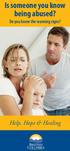 Is someone you know being abused? Do you know the warning signs? Help, Hope & Healing Are you concerned that someone is being abused, but don t know what to do? You may suspect abuse is happening to a
15 things you might not know about back pain
 15 things you might not know about back pain Mary O Keeffe (University of Limerick), Dr Kieran O Sullivan (University of Limerick), Dr Derek Griffin (Tralee Physiotherapy Clinic) Managing back pain costs
USING DIALECTICAL BEHAVIOR THERAPY WITH SUBSTANCE ABUSE DISORDERS
 USING DIALECTICAL BEHAVIOR THERAPY WITH SUBSTANCE ABUSE DISORDERS PRESENTERS: GEOFF WECKEL, PSYD MARK FOSTER, MA, LPC 550 BAILEY AVE, SUITE 302, FORT WORTH, TEXAS WWW.RESTORATIONCEC.COM Dialectical Behavior
What is Divorce Abuse? Susan Boyan LMFT and Ann Marie Termini LPC The Cooperative Parenting Institute
 What is Divorce Abuse? Susan Boyan LMFT and Ann Marie Termini LPC The Cooperative Parenting Institute As a parent you surely pride yourself in protecting your children from harm. However in the midst of
Developing a Therapeutic Relationship with Clients with Personality Disorders. The Therapeutic Relationship. The Therapeutic Relationship 7/31/15&
 Developing a Therapeutic Relationship with Clients with Personality Disorders Jim Seckman, MAC, CACII, CCS The Therapeutic Relationship The therapeutic relationship, also called the therapeutic alliance,
Trauma FAQs. Content. 1. What is trauma? 2. What events are traumatic?
 Trauma FAQs Content 1. What is trauma? 2. What events are traumatic? 3. Who experiences trauma? 4. What are symptoms of trauma? 5. How can I help someone who may be experiencing trauma? 6. Where can people
Post-Traumatic Stress Disorder
 Post-Traumatic Stress Disorder It s natural to be afraid when you re in danger. It s natural to be upset when something bad happens to you or someone you know. But if you feel afraid and upset weeks or
Whiplash. Whiplash is part of our modern lives. One in 200 of us will suffer from it at some point but it is rarely serious.
 Whiplash www.physiofirst.org.uk Whiplash is part of our modern lives. One in 200 of us will suffer from it at some point but it is rarely serious. Most people make a full return to health. What you do
CONTENTS 1. INTRODUCTION 2. RAGE GAUGE 3. ANGER SCALE 4. RULES OF ANGER MANAGEMENT 5. KEEP CALM TIPS 6. CONFLICT CLEARING PROCESS
 CONTENTS 1. INTRODUCTION 2. RAGE GAUGE 3. ANGER SCALE 4. RULES OF ANGER MANAGEMENT 5. KEEP CALM TIPS 6. CONFLICT CLEARING PROCESS 1. INTRODUCTION National Anger Awareness Week the British Association of
Depression in children and adolescents
 Patient information from the BMJ Group Depression in children and adolescents Depression is an illness that affects people of all ages, including children and teenagers. It can stop a child or teenager
ANGER MANAGEMENT. A Practical Guide. ADRIAN FAUPEL ELIZABETH HERRICK and PETER SHARP
 ANGER MANAGEMENT A Practical Guide ADRIAN FAUPEL ELIZABETH HERRICK and PETER SHARP Contents Acknowledgements v SECTION ONE: WHAT IS ANGER? 1 1 Introduction 2 2 Perspectives on anger 7 3 What does anger
A safe, healthy and drug-free workplace is everybody s responsibility. Thanks for making it yours.
 TOOL BOX TALK 1: DRUG-FREE WORKPLACES: The Basic Message Worksite alcohol and drug use cannot be taken lightly, especially on construction sites where we rely on each other for safety. As a worker on this
Experiential Focusing and Twelve Step Recovery Work
 Experiential Focusing and Twelve Step Recovery Work by Steve Crawford, MA After being in Sacramento for a year, my life had truly become unmanageable with the unhappy demise of yet another personal relationship.
MODERN DRIVING HAZARDS: ROAD RAGE, CELL PHONES & OTHER DANGERS
 MODERN DRIVING HAZARDS: ROAD RAGE, CELL PHONES & OTHER DANGERS This easy-to-use Leaders Guide is provided to assist in conducting a successful presentation. Featured are: INTRODUCTION: A brief description
School-Age Child Guidance Technical Assistance Paper #2
 School-Age Child Guidance Technical Assistance Paper #2 School-age Child Guidance High quality out-of-school time programs promote school-age children s emotional and social development as well as their
Goals. A Model for Conceptualizing the Treatment of Trauma, Developmental Immaturity, and Eating Disorders/Addictions CODA TREE C O D A TRAUMA
 A Model for Conceptualizing the Treatment of Trauma, Developmental Immaturity, and Eating Disorders/Addictions Stephanie Schoville, M.A. Lead Clinician Rosewood Outpatient Center Tempe, Arizona Goals To
New Beginnings: Managing the Emotional Impact of Diabetes Module 1
 New Beginnings: Managing the Emotional Impact of Diabetes Module 1 ALEXIS (AW): Welcome to New Beginnings: Managing the Emotional Impact of Diabetes. MICHELLE (MOG): And I m Dr. Michelle Owens-Gary. AW:
Abuse in Same-Sex Relationships
 1 Abuse in Same-Sex Relationships Abuse in relationships is any behavior or pattern of behavior used to coerce, dominate or isolate the other partner. It is the use of any form of power that is imposed
For Those in Treatment
 For Those in Treatment This is NA Fellowship-approved literature. Copyright 1991 by Narcotics Anonymous World Services, Inc. All rights reserved. This pamphlet is designed to introduce you to recovery
Mental Health in the Workplace. Kate Hubl- Occupational Therapist
 Mental Health in the Workplace Kate Hubl- Occupational Therapist So what does the workplace have to do with mental health and mental health issues? Its not abnormal, weird, strange or weak to experience
Choosing the Best Substance Abuse Treatment Facility
 Choosing the Best Substance Abuse Treatment Facility Choosing the Best Substance Abuse Treatment Facility Treatment Alternatives, located in Boca Raton, Florida is an outstanding outpatient treatment facility
Family role in recovery
 Family role in recovery The positive impact of family support on recovery from addiction This is getting out of control I ve got my life back November 2014 VOCAL Family Addictions Service 8-13 Johnston
Personal Information This Wellness Recovery Action Plan belongs to: Name Address City State Zip Telephone E-Mail Special instructions
 My WRAP Plan 1995-2005 Mary Ellen Copeland, MS, MA All Rights Reserved P.O. Box 301, West Dummerston, VT 05357 www.mentalhealthrecovery.com Copeland Center for Wellness & Recovery P.O. Box 6464, Chandler,
National Health Education Standards and Performance Indicators. Interpersonal Communication [4.12.1; 4.12.2; 4.12.3] Self Management [7.12.2; 7.12.
![National Health Education Standards and Performance Indicators. Interpersonal Communication [4.12.1; 4.12.2; 4.12.3] Self Management [7.12.2; 7.12.](/thumbs/27/9539429.jpg "National Health Education Standards and Performance Indicators. Interpersonal Communication [4.12.1; 4.12.2; 4.12.3] Self Management [7.12.2; 7.12.") LESSON 8 Interpersonal Communication and Self Management Student Learning Objectives Identify how interpersonal communication and self management are needed for healthy living. Expand on the definition
LESSON 8 Interpersonal Communication and Self Management Student Learning Objectives Identify how interpersonal communication and self management are needed for healthy living. Expand on the definition
Before You Take That Bite
 Before You Take That Bite Before you take that bite, read this pamphlet and remember today you have a choice. Food Addicts in Recovery Anonymous (FA) offers a solution for all forms of food addiction.
Domestic Violence, Mental Health and Substance Abuse
 Domestic Violence, Mental Health and Substance Abuse Sue Parry, PhD NYS Office for the Prevention of Domestic Violence Why does domestic violence (DV) have so many mental health effects? Put yourself in