
PROTECTION OF SMALL BUSINESSES WHEN PURCHASING GOODS AND SERVICES. Call for evidence MARCH 2015
|
|
|
- Elfreda Goodman
- 10 years ago
- Views:
Transcription
1 PROTECTION OF SMALL BUSINESSES WHEN PURCHASING GOODS AND SERVICES Call for evidence MARCH 2015
2 Contents MINISTERIAL FOREWORD... 3 PART 1: INTRODUCTION... 4 How to respond... 7 PART 2: THE CURRENT LEGISLATIVE FRAMEWORK... 9 PART 3: PROTECTIONS FOR CONSUMERS UNDER THE CONSUMER RIGHTS BILL PART 4: CALL FOR EVIDENCE What happens next? Responding to the Call for Evidence Annex A: List of call for evidence questions Annex B: Call for evidence: Protection of small businesses when purchasing goods and services response form Confidentiality and disclosure of responses Annex C: Consultation principles Comments or complaints on the conduct of this consultation
3 MINISTERIAL FOREWORD Micro and small businesses are vital to the UK economy. These businesses make up 99% of all businesses in the UK, a total of 5.2 million businesses. Of these, 96% are micro businesses, which in aggregate employ around 8.3 million people and have a combined turnover of around 655 billion. The Government wants to make sure that the appropriate conditions are in place to allow these businesses to prosper. With this in mind, the measures we are introducing in the Small Business, Enterprise and Employment Bill including new reporting requirements obliging all large companies to report on their payment performance are designed to support small and micro businesses. There have been calls for the Government to go further in this Bill and give micro and small businesses protections similar to those which consumers will soon have when the Consumer Rights Bill is enacted and comes into force. The protections would apply when these businesses make purchases of goods and services for use in their commercial activities. The Government has heard how such a move may potentially benefit businesses, particularly sole traders and micro businesses, which are often in no better a position than a consumer when making purchases. However, the Government is also aware that micro and small businesses are suppliers as well as customers such that transferring consumer rights to such an important, and varied, business sector may have unintended consequences. I believe we need to approach this carefully. The Government is therefore launching this call for evidence. We are interested in receiving as wide a set of views as possible, so we can understand the concerns about the current framework and any concerns about changing it. We hope this call for evidence triggers a lively debate. Any future policy proposals in this area will no doubt be influenced by this. Jo Swinson MP Parliamentary Under-Secretary of State for Employment Relations and Consumer Affairs 3

4 PART 1: INTRODUCTION Why are we running this call for evidence? 1.1 The Government is calling for evidence on whether the current legislative framework regarding the sale and supply of goods and services to micro and/or small businesses sufficiently protects them; or whether there is a gap in the law; and the potential impacts both the costs and benefits of applying certain consumer protections to micro and/or small businesses, or other options. Definition For the purposes of this call for evidence, we are defining micro businesses as firms which employ 0-9 employees (and this includes sole-traders); and small businesses as firms which employ employees. The concerns raised (see paragraph 1.2 below) relate to micro businesses in particular, but some concerns have been raised about small businesses too. Therefore the focus of this call for evidence is on micro businesses, but we are also interested in views and supporting evidence in relation to small businesses. In the rest of this document, micro and small businesses are referred to collectively as MSBs. 1.2 We have decided to launch this call for evidence following concerns raised that MSBs, and micro businesses in particular, may be vulnerable when a problem arises with purchases they have made 1. There are also concerns that micro businesses are likely to face many of the same problems as individual consumers when making purchasing decisions 2. Furthermore, the laws regarding sales and supply to consumers are being reformed and clarified in the Consumer Rights Bill 3 ( CRB ). 1.3 Following these reforms, consumers will have a clearer set of rights and remedies when things go wrong with goods, services and digital content. Some have argued that if consumers need these provisions to make confident purchasing decisions, then so do MSBs. Worries have been raised in particular about access to redress where goods or services are substandard, as well as how MSBs are treated in the regulated sectors 4. 1 Most recently, an Opposition amendment to the Small Business, Enterprise and Employment Bill, debated at Report Stage in the House of Lords on 3 March 2015, see Hansard report at 2 See also Small Businesses As Consumers: Are They Sufficiently Well Protected? A report for the Federation of Small Businesses by the ESRC Centre for Competition Policy, University of East Anglia, January 2014; and Be the Voice of Small Businesses, FSB Business Manifesto for the Government, November The consumer rights referred to in the document are those under the Consumer Rights Bill, when enacted. Most provisions are expected to come into force in October See Hansard report at 4
5 Regulated Sectors Specific regulatory provisions for certain services are outside the core scope of this call for evidence. These include financial services and utilities (energy and water). Many consumer protection provisions or the protections afforded to MSBs are distinct in these sectors and determined by separate regulatory (and legislative) frameworks 5. While we welcome views on the extent to which MSBs have sufficient protections as customers in these sectors as well, the extent to which these are also covered by different regulatory regimes should also be considered. 1.4 The Government takes these concerns seriously. MSBs make up 99% of all businesses in the UK, a total of around 5.2 million businesses. Of these, 96% (5 million) are micro businesses, which in aggregate employ around 8.3 million people and have a turnover of around 655 billion. They are a vital part of our economy. There may be justification for Government to act should the benefits of extending consumer protections to MSBs outweigh the costs, including any restrictions to economic activity or additional costs to business. But, we have limited evidence on the scale of any problem and the potential consequences for MSBs and their suppliers, which may also be MSBs or larger businesses of applying consumer rights regarding sales and supply to MSBs. The current legislative framework reflects a long-standing principle that businesses in particular should have freedom to agree contractual terms (see Part 2 for further detail): changing the current balance requires careful consideration. For these reasons, we are launching this call for evidence. Scope of the Call for Evidence 1.5 This call for evidence focusses on laws regarding contracts for sales and supply of goods and services to MSBs. By this, we mean statutory protections which form part of the contract for goods or services and set requirements which must be met, and the scope of parties to a contract to limit their liability or contract out of these requirements. These current protections for contracts between businesses are explained in detail in Part 2. This is an established area of law, in which there are some protections applicable to both businesses and consumers but for certain provisions a distinction is made between business-to-business and business-to-consumer transactions, and as described above there have been calls for this area to be amended. 1.6 The most recent calls for change have proposed that MSBs should have the same rights as consumers under the CRB (when enacted), when they purchase goods and services. There has been a particular emphasis on the ability of MSBs to get proper redress when goods and services do not meet expected standards. However, there have also been calls to apply general consumer protection to micro businesses, in line with the CRB and the EU Consumer Rights Directive 6, and for the Government to consider carefully the evidence 5 The most relevant regulatory bodies (and the sectors they cover) are as follows: Financial Conduct Authority (financial services); Office of Communications (communications); Office of Gas and Electricity Markets (energy); The Water Services Regulation Authority (water). 6 The Consumer Rights Directive (2011/83/EU) is an EU measure imposing certain requirements in relation to contracts between traders and consumers. It was implemented in the UK with effect from by the Consumer Contracts (Information, Cancellation and Additional Charges) Regulations 2013 (the CCRs ). See Part 3 for further information. 5
6 both for and against doing so 7. In order to assess the issue, this call for evidence is therefore not limited to considering the redress available under the CRB, but also seeks evidence on the possible impacts of (i) protections under the CRB regarding contracts for digital content, terms limiting liability for key protections being automatically non-binding, and challenging certain terms as unfair 8 ; and (ii) requirements to provide certain information before a contract is made and a right to withdraw from distance and offpremises contracts, under Regulations (referred to as the CCRs ) to implement the EU Consumer Rights Directive. This is therefore the central focus of this call for evidence, i.e., whether MSBs should have the same rights as consumers under the CRB and CCRs. To help us assess whether this might be appropriate, we ask a series of questions in Part 4, to establish the nature and scale of any problem with the current statutory protections as well as the benefits they might offer. 1.7 It may be that respondents have experience and evidence of issues with purchasing decisions which are not covered or affected by the laws regarding contracts for sale and supply of goods and services. For example, there may be issues in relation to advertising, for which there is protection for consumers in relation to unfair commercial practices and for businesses in relation to misleading and comparative advertising. Although outside the central focus of this call for evidence, we would welcome such wider information, where it is relevant. 1.8 In this call for evidence, the Government is not making any proposals or putting forward any preferred options. This is a purely evidence-gathering exercise, to enable further understanding of the concerns which have been raised. 1.9 The issues being raised here are business-to-business issues, in the sense of one business transacting with another. The Government recognises that business-to-business issues are very wide ranging and in particular cover businesses acting as both purchasers and as suppliers. We are introducing policy in the Small Business, Enterprise and Employment Bill ( SBEE Bill ) which will help with other business-to-business concerns (such as provisions on late payments). We are also continuing to research the business-tobusiness agenda, to identify problem areas which Government might help to resolve 1.10 We recognise that any future change to rights of small businesses could potentially impact on both reserved and devolved areas of policy responsibility across the UK s family of nations. The Government would welcome evidence and contributions from the Devolved Administrations, businesses and business associations, and other interested stakeholders in Scotland, Wales and Northern Ireland. Content of the Call for Evidence 1.11 This is a call for evidence in general terms. In the following sections, we explain the current statutory framework which applies to MSBs, in relation to the sale and supply of goods and 7 Be the Voice of Small Businesses, FSB Business Manifesto for the Government, November 2014; Small Businesses As Consumers: Are They Sufficiently Well Protected? A report for the Federation of Small Businesses by the ESRC Centre for Competition Policy, University of East Anglia, January In February 2005, the Law Commissions consulted and reported on whether consumers unfair terms protections should be extended to businesses. They recommended that most of the protections to challenge non-negotiated terms as unfair should be applied to businesses with 9 or fewer employees. 6

7 services. We explain the new statutory framework for consumers contracting for goods, services and digital content, which is to apply under the CRB (once enacted and brought into force) and the consumer protections in the CCRs. We also explain the key differences between these frameworks as they apply to MSBs. We then ask a series of questions, which would be useful in understanding the impact of extending consumer protection provisions to MSBs. How to respond 1.12 We are interested in receiving submissions from any interested parties, individual firms and their representatives, trade bodies, research and academic organisations and others with experience of analysis in this area. We are keen to receive submissions which are supported by the inclusion of robust and clear evidence to support any views offered. Issued: 24 March 2015 Respond by: The deadline has been extended to 30 June 2015 (formerly 15 June 2015) Enquiries and responses to: Sean Browne Consumer and Competition Policy Department for Business, Innovation and Skills 1 Victoria Street LONDON SW1H 0ET Tel: ++44 (0) [email protected] The consultation principles are in Annex C 7
8 Confidentiality & Data Protection 1.13 Information provided in response to this consultation, including personal information, may be subject to publication or release to other parties or to disclosure in accordance with the access to information regimes (these are primarily the Freedom of Information Act 2000 (FOIA), the Data Protection Act 1998 (DPA) and the Environmental Information Regulations 2004). If you want information, including personal data that you provide to be treated as confidential, please be aware that, under the FOIA, there is a statutory Code of Practice with which public authorities must comply and which deals, amongst other things, with obligations of confidence In view of this it would be helpful if you could explain to us why you regard the information you have provided as confidential. If we receive a request for disclosure of the information we will take full account of your explanation, but we cannot give an assurance that confidentiality can be maintained in all circumstances. An automatic confidentiality disclaimer generated by your IT system will not, of itself, be regarded as binding on the Department. 8
9 PART 2: THE CURRENT LEGISLATIVE FRAMEWORK 2.1 The basic premise underpinning the contract laws of the UK jurisdictions is that two (or more) parties should be free to enter into a transaction on whatever terms they wish, provided their agreement is not illegal or contrary to public policy. This is the principle of freedom of contract. However, there are some longstanding exceptions to this principle, to address some areas of unfairness or imbalance: for example, a party can potentially set aside a contract if they entered into on the basis of fraud, duress, misrepresentation, undue influence or unconscionable dealing. These principles have developed in the common law and as underlying equitable doctrines: that is, they are principles applied by the courts rather than being set out in legislation. Legislative controls over certain areas of contractual relationships also limit freedom of contract. This part sets out the main statutory controls regarding general sales and supply of goods and services to MSBs. 2.2 The main pieces of legislation governing contracts under which MSBs purchase goods and services are: The Supply of Good Act 1979 ( SoGA ) This applies to sales of goods in exchange for money, including conditional sales where the purchaser pays in instalments and only obtains ownership of the goods when the final payment is made, although the purchaser may use the goods in the meantime; The Supply of Goods and Services Act 1982 ( SGSA ) This applies to supply of services, hire of goods and transfers of goods other than sales, e.g. barter or exchange of goods for something other than money and work and materials contracts where goods are supplied as an incidental part of a contract for work or services; Supply of Goods (Implied Terms) Act 1973 ( SGITA ) This applies to contracts for hire-purchase of goods; and The Unfair Contract Terms Act 1977 ( UCTA ) This provides protection in relation to contractual terms which seek to limit or exclude liability. It does not regulate the fairness of all terms of contracts. 2.3 In the rest of this call for evidence, the above are collectively referred to as the current arrangements. It should be noted, however, that the current arrangements do not include rules specific to purchases by MSBs. Rather, the current arrangements apply to contracts governed by laws of the UK jurisdictions under which any business purchases from another business Together, the current arrangements provide MSBs with: Rights when buying goods, or contracting for goods under other transactions (such as hire, hire-purchase); Rights when contracting for services; and 9 Until the CRB comes into force these pieces of legislation also contain provisions applicable to business-to-consumer transactions. 9
10 Protection from unreasonable exclusions or limitations of liability in contracts. How the current arrangements work 2.5 Firstly, it is important to note that any business may exclude or limit their liability to other business, including liability for the statutory rights regarding goods and services explained below, if this is made clear in the contract between them. This may be done by including an exclusion or limitation of liability clause in the contract. Such a clause must comply with the UCTA, otherwise it would not be binding. Goods sales under Sale of Goods Act When a MSB buys a good from another business (MSB or otherwise), it means they have entered into a contract with that other business, as the supplier of the goods. Under the SoGA there are rules that form part of the contract, which suppliers must abide by (subject to a valid limitation or exclusion of liability see below). Key rights or implied terms 2.7 The SoGA says that the goods sold must be as described, of satisfactory quality and fit for purpose. Fit for purpose means both their everyday purpose, and also any specific purpose that the MSB made known to the supplier (for example, if the MSB specifically asked for a printer that would be compatible with its computer) at or before the time of purchase. Goods sold must also match any samples by which they are sold. To be as described, goods should match any description by which they are sold, e.g. in a brochure. 2.8 The SoGA also says that the supplier must have the right to sell the goods. Further, the goods must not be subject to undisclosed third-party claims, nor should the MSB s use of the goods be disturbed by anyone with rights over the goods unless the MSB is made aware of such rights before buying. 2.9 These requirements form part of the contract between the MSB buying the goods and the business supplying them: they are implied terms of that contract and have effect in addition to any other requirements in terms directly agreed between the parties, which are known as express terms of the contract (subject to any valid limitation or exclusion of liability see below). If the good sold does not meet the requirements set out above (see paragraphs 2.7 and 2.8), then the supplier is in breach of contract and the MSB, as purchaser, has a claim under the SoGA. Remedies 2.10 The main remedies available to MSBs under the current arrangements are to reject the goods, terminate the contract and receive a refund (collectively referred to as the right to reject ); or to claim damages. Details of how these remedies work and interact with each other are explained below. 10
11 Reject/Refund 2.11 If the goods are not of satisfactory quality or fit for purpose and do not match their description or sample (that is, they breach the requirements referred to in paragraph 2.7 above, subject to any valid limitation or exclusion of liability see below), the MSB can generally terminate the contract and get a refund, provided it rejected the goods before it is deemed to have accepted them. This means they must be rejected within a reasonable time after purchase 10. The goods would also be deemed to have been accepted if the MSB intimates that they are accepted or does something inconsistent with the supplier s ownership, e.g. altering the goods However, the MSB may not reject the goods and terminate the contract for a very minor breach of the implied terms regarding quality, fitness and matching a description or sample. If the breach of any of these requirements is so slight that it would be unreasonable for the MSB to reject the goods, then they may only claim damages (see below) If the supplier did not have the right to sell the goods (see paragraph 2.8 for this requirement), the MSB has the right to terminate the contract and get a refund. However, for breach of this requirement (unlike breaches of the other implied terms described above), the MSB s right to terminate the contract and get a refund is not lost once it has accepted the goods. The MSB can terminate the contract and get a refund whether or not the breach is more than slight, as above If the MSB s use of the goods is disturbed by someone with rights over the goods, which the MSB was not made aware of (in breach of the requirement under paragraph 2.8 above), the MSB may claim damages (see below). However, in this situation it does not have a right to reject the goods and terminate the contract. Damages 2.15 To claim damages means to claim financial compensation which a court can order one party to pay to the other. The MSB can seek damages if they have accepted the goods; or they may choose to seek damages instead of rejecting the goods (if it wants to keep them but to be compensated for where the goods fall short of requirements). In some cases, the MSB may seek damages as well as rejecting the goods for a refund, if they have suffered loss which goes beyond the price paid for the goods Generally, an award of damages for breach of contract is intended to compensate the injured party for loss suffered 11. For a breach of one of the requirements (the implied terms) above, the general rule is that damages are intended to put the MSB in the same position as if there had not been a breach. The level of damages awarded will depend on the specific circumstances and the term which the supplier has breached. Typically, damages would cover the estimated loss directly resulting from the breach, in the ordinary 10 This time period is not specified in the SoGA what is reasonable depends on the circumstances, including the type of product. 11 In some, less frequent, cases the court may award damages which go beyond simply compensating the MSB for loss suffered e.g. a court can sometimes award nominal damages, where there is a breach of contract but no loss, or aggravated damages, to compensate for mental distress. 11
12 course of events 12. Damages may cover loss or damage caused by the faulty goods: for example if a MSB buys goods to use in their business and the goods supplied are not of satisfactory quality and do not work, the MSB may lose profits as a result which in some cases may be recoverable through damages There are legal tests to be satisfied for a MSB to recover damages: a MSB can only recover damages for loss which was caused by the breach (of the implied term) and which was sufficiently foreseeable; and the MSB cannot recover for loss which they could reasonably have acted to limit or mitigate. A MSB does not have a legal right to have the goods repaired or replaced by the supplier, unless the parties have agreed this in their contract. However if the MSB has the goods repaired or buys a replacement, they are likely to be able to recover the cost of doing so through damages, unless this is unreasonable The MSB has six years to take a claim to court for breach of the above requirements regarding goods in England, Wales and Northern Ireland; five years in Scotland. Other rules 2.19 The SoGA also sets out other rules for sale of goods contracts. In particular it provides that, if the parties do not agree a price or a means to determine the price, the MSB must pay a reasonable price for the goods. It requires the supplier to deliver the goods within a reasonable time, where no time is agreed between the parties 13. Other supplies of goods Supply of Goods and Services Act Goods may be supplied under contracts other than sales for example, hire, hirepurchase, under a contract for work and materials or payment-in-kind. Such contracts are not covered by the SoGA, but by the SGSA (hire, barter, work and materials) and SGITA (hire-purchase) For these types of transactions, equivalent rights apply to those for sales contracts: terms are implied in the contract that the goods are as described, of satisfactory quality and fit for purpose, and that they match any sample. Terms are also implied that the supplier has the right to supply the goods and they are not subject to undisclosed third-party claims (other than the rights of the owner, in relation to hired goods) As with sales contracts, the remedies for breach of these rights are rejection and termination of contract, and/or damages. However, for goods contracts other than sales, these are wholly common law remedies, meaning that the remedies are not specified in legislation but apply as a result of case law. Therefore, the concept of acceptance described above does not apply. Instead, there is a common law concept of affirmation, meaning the right to reject the goods is not lost before the buyer is aware of the fault. The buyer may in theory therefore be able to reject goods for longer under a hire-purchase contract than a sales contract. 12 If the MSB keeps the goods, damages would generally be the difference between the value of the goods they received and the value had there not been a breach. 13 The question of what time or price is reasonable is a question of fact, depending on the circumstances. 12
13 2.23 The MSB has six years to take a claim to court for breach of the above requirements regarding goods in England, Wales and Northern Ireland; five years in Scotland. Services 2.24 The term 'services' covers a wide variety of work. From a small repair job, to the installation of solar panels, to major building work all this type of work involves a MSB entering into a contract with a supplier. The SGSA implies into contracts for services that the work will be carried out with reasonable care and skill (again, subject to valid limitation or exclusion of liability 14 ). The SGSA also requires that services will be carried out in a reasonable time (if there is no specific time agreed); and for a reasonable charge (if no price was set in advance) 2.25 What is reasonable will depend on the circumstances, but it is an objective standard. So, for example, the level of care and skill which a business should show in performing a service would usually be that of a reasonably competent service provider in the relevant field, unless the provider had held themselves as having a particularly high level of skill or experience in which case a higher standard would be reasonable. Remedies 2.26 If the requirements above are not met for example, the supplier did not use reasonable care and skill so the service was poor the MSB may be able to claim compensation (the description of damages above applies equally here). If the breach was very severe that is, if the MSB could show that the workmanship was so poor that it got no benefit from it the MSB may be entitled to terminate the contract and get a refund, although this is less readily available than when buying goods The MSB does not have a legal right to ask for remedial work to be carried out or ask for work to be undone (unless agreed in the contract), although they may seek to negotiate this. The MSB could have remedial work done by a third party and is likely to be able to recover damages to cover the cost of this (as above) The MSB has six years to take a claim to court for breach of the above requirements regarding services in England, Wales and Northern Ireland; five years for breach of common law implied terms in Scotland. Unfair Contract Terms Act Statutory protections in relation to unfair contract terms also form part of the legislative framework on the sale and supply of goods and services. There are two statutory regimes in relation to unfair terms. The first determines the extent to which a business can contract out of the protections for goods and services transactions or limit their liability for certain other matters. This is under the UCTA, which provides protection in relation to contractual terms which seek to limit or exclude liability. It does not regulate the fairness of all terms of contracts. There are also legislative controls on the fairness of contract terms more generally (not only terms which limit or exclude liability), but these apply only to businessto-consumer contracts (see Part 3 below). 14 In a contract for the supply of a service in Scotland, the implied terms are found in the common law not in SGSA, although there are parallels between the terms implied at common law for Scotland and those under the SGSA. 13
14 2.30 Under the UCTA, the protections in SoGA, SGSA, SGITA regarding goods being of satisfactory quality and fit for purpose, and conforming with a description or sample, can be excluded in contracts between businesses, but this is subject to a reasonableness test 15. Liability for breach of the protection under SGSA that a service should be performed with reasonable care and skill, can also be limited or excluded, subject to the reasonableness test. This means that, in a contract with a MSB, a supplier can avoid liability for goods meeting the statutory requirements of satisfactory quality, description, fitness for purpose or sample (see paragraph 2.7) if it was reasonable to do so based on the circumstances when the contract was made. The reasonableness test is explained further below The protection in SoGA, SGSA and SGITA that the supplier must have the right to sell (or otherwise transfer) the goods cannot be excluded or limited. A term seeking to exclude or limit liability for this is automatically non-binding. There is an exception in relation to hire, in which case the reasonableness test must be met If a contract between businesses is on one of the party s standard terms, that party can only exclude or limit liability for a failure to perform their contractual obligations if the reasonableness test is met. This covers terms seeking to exclude or limit liability for breach of contract or which seek to allow a party to perform the contract substantially differently than reasonably expected or not to perform at all. A term to exclude or limit liability for damage to property caused by negligence must also satisfy the reasonableness test. Liability cannot be excluded or limited for death or personal injury caused by negligence The reasonableness test is met if the term was a fair and reasonable term to include in the contract, based on the circumstances that the parties did or should reasonably have known or contemplated when the contract was made. If a clause seeks to limit a party s liability to a particular sum then, in considering whether that term meets the reasonableness test, the court must consider in particular the party s resources and how far they could insure against the liability. One factor to be considered, where relevant, is the parties relative bargaining positions If a MSB is purchasing goods from a large supplier and the goods are not available from other suppliers, a clause excluding the supplier s liability for any faults in the goods may be less likely to be reasonable than if the MSB could easily have bought from a different supplier which did not exclude their liability. However, the courts have not necessarily seen size as an indicator of bargaining power UCTA sets out factors for the court to consider, where relevant, in deciding whether a term is reasonable which seeks to limit or exclude liability for the statutory rights regarding goods. This does not prevent the court from considering other factors too. The factors are: The strength of the bargaining positions of the parties taking into account alternative suppliers available to the purchaser; 15 In Scottish law, the test under UCTA is whether it was fair and reasonable to incorporate the exclusion or limitation clause into the contract. In substance, the tests are very similar, so for brevity this document refers to the reasonableness test. 14
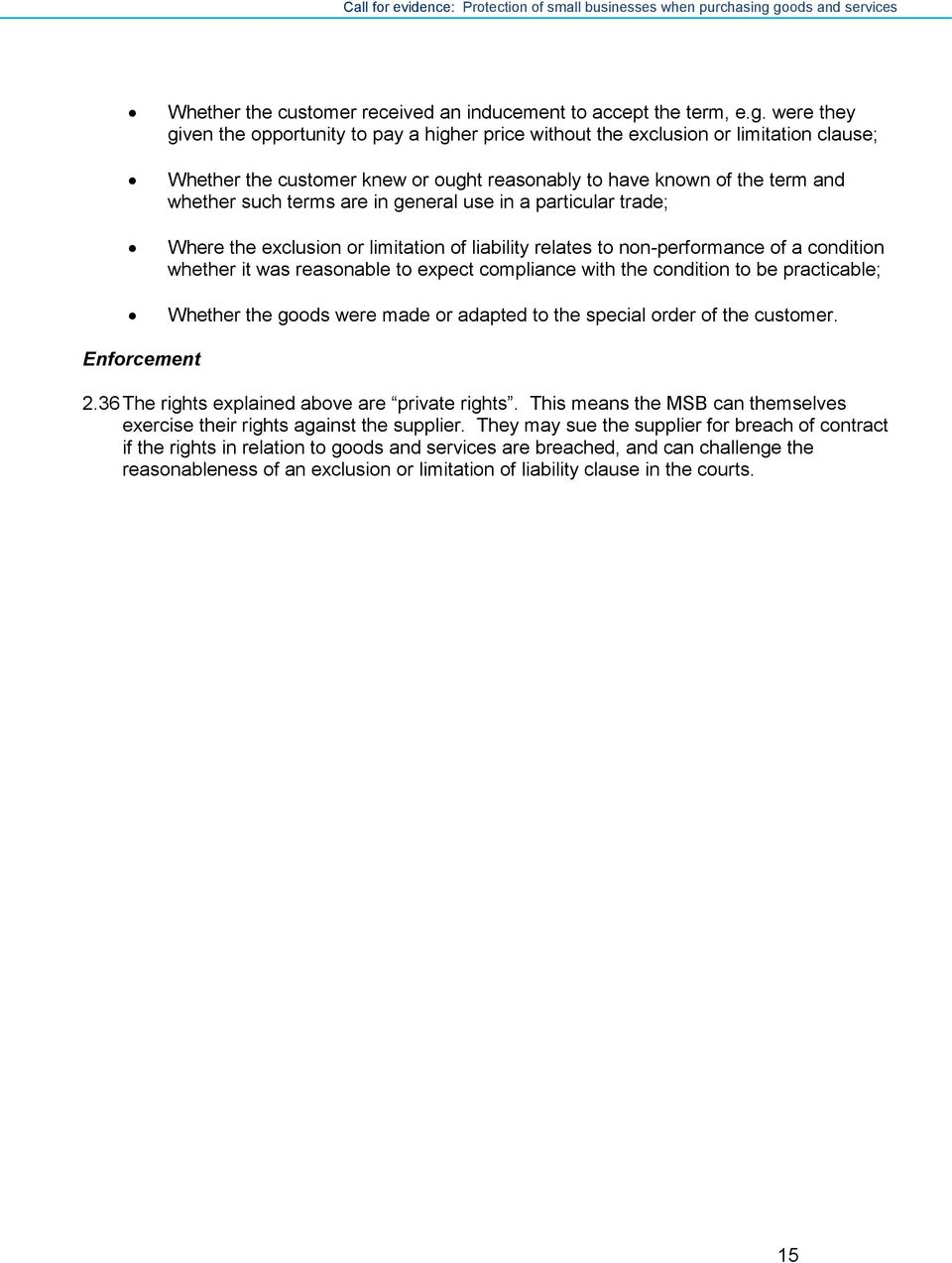
15 Whether the customer received an inducement to accept the term, e.g. were they given the opportunity to pay a higher price without the exclusion or limitation clause; Whether the customer knew or ought reasonably to have known of the term and whether such terms are in general use in a particular trade; Where the exclusion or limitation of liability relates to non-performance of a condition whether it was reasonable to expect compliance with the condition to be practicable; Whether the goods were made or adapted to the special order of the customer. Enforcement 2.36 The rights explained above are private rights. This means the MSB can themselves exercise their rights against the supplier. They may sue the supplier for breach of contract if the rights in relation to goods and services are breached, and can challenge the reasonableness of an exclusion or limitation of liability clause in the courts. 15
16 PART 3: PROTECTIONS FOR CONSUMERS UNDER THE CONSUMER RIGHTS BILL 3.1 The CRB sets out key consumer rights covering contracts for supply by traders to consumers of goods, services, digital content and the law relating to unfair terms in traderto-consumer contracts. 3.2 Under the CRB and the CCRs a consumer is an individual who is acting for purposes that are wholly or mainly outside their trade, business, craft or profession. Under earlier legislation and case law, a company or other organisation had access to some of the rights of consumers if they entered a transaction which was not made in the course of business or was only incidental to their business and not of a kind they made regularly. However, the relevant UK definitions are being brought into line with European law, to simplify and clarify the legislative framework. Businesses will not have access to any consumer protections under the CRB. Consumers rights in relation to goods 3.3 The CRB provides that the goods sold must be as described, of satisfactory quality and fit for purpose. Fit for purpose means both their everyday purpose, and also any specific purpose that the consumer made known to the trader (for example, if the consumer specifically asked for a printer that would be compatible with their computer). Goods sold must also match any samples or model by which they are sold. To be as described, goods should match any description by which they are sold, e.g. in a brochure. 3.4 The trader must have the right to supply the goods and no other person should have rights to the goods. The CRB makes it a requirement of the trader s contract with the consumer that the goods are free from any charges or claims which they have not been told about (or do not know of). This protection does not apply to hire contracts, because the consumer is not contracting to own the goods. So a trader must inform the consumer if anyone else has rights over the goods (e.g. a right to use the goods) during the time that the consumer s contract for the goods is in force. In addition, the consumer s use of the goods should not be disturbed by anyone with rights over the goods, except for any rights the consumer is made aware of. This applies to all goods contracts, including for hire. The above provisions are broadly equivalent to the current arrangements for MSBs. The substantive differences between the current arrangements for business-tobusiness contracts and the position for business-to-consumer contracts are limited, although (as below) there is a difference in the extent to which the parties may contract out of the protections. 16

17 Consumers remedies in relation to goods 3.5 If consumers rights that goods are as described, of satisfactory quality and fit for purpose are not met, consumers are entitled to certain statutory remedies under the CRB, as follows: The consumer can reject the goods within the first 30 days and obtain a full refund of the purchase price (this is called the short term right to reject); The consumer can require that the trader repairs or replaces the goods free of charge (the right to repair or replacement runs in parallel to the short term right to reject and extends beyond the 30 days). The consumer has access to other remedies (see below) if the matter is not resolved after one repair or replacement, but is entitled to more than one repair or replacement in this situation). Repair and replacement are known as the first tier remedies. If a repair or replacement is not carried out in a reasonable time or causes significant inconvenience to the consumer, or if one repair or replacement does not fix the problem, then the consumer can either: - Reject the goods and obtain a refund (this may be a partial refund as the trader may reduce it to take account of the use the consumer has had of the goods in some cases); or - Keep the goods and get a reduction in the purchase price; - The final right to reject and right to a price reduction are known as the second tier remedies. 3.6 If the trader does not have the right to sell the goods, the consumer can terminate the contract and get their money back. There is no 30-day limit, nor may a deduction for use be made. If the trader is required to supply and install the goods and the installation is not done properly, the first tier and second tier remedies are available, but the short-term right to reject is not. If the consumer s use of the goods is disturbed by someone with undisclosed rights over the goods, the consumer does not have statutory remedies, but may claim damages. The consumer may also claim damages as an alternative (and, in some cases, in addition) to the statutory remedies. Damages would be available subject to the same principles as set out in paragraph However, unlike a MSB, a consumer should not suffer commercial losses, as the transaction will be for purposes outside of the consumer s business. Breach of the statutory protections is a breach of contract, whether the purchaser is a consumer or a MSB. In both cases, the purchaser has a right to reject and/or can claim damages. However, there are additional remedies under the above consumer provisions, compared to the current arrangements for MSBs. MSBs do not currently have a statutory right to the first and second tier remedies described above, meaning that businesses selling to MSBs do not currently have to provide these remedies (unless they have agreed in the contract to do so). The short-term right to reject under the above provisions also differs from the remedy of rejection/refund available for the MSB (for breach of the core rights of satisfactory quality, fitness for purpose and requiring the good to match description or model), which is lost after a 17
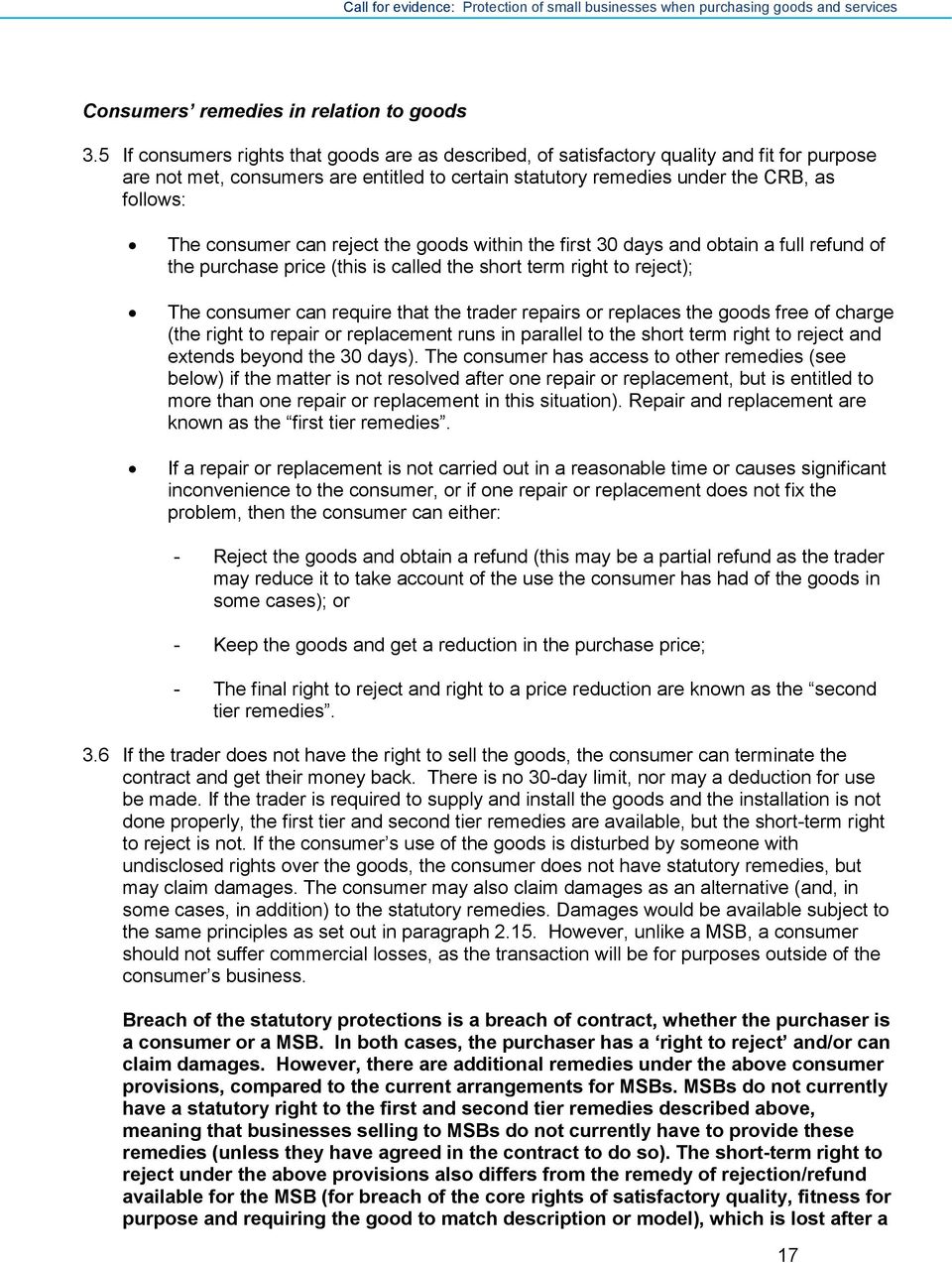
18 reasonable time (or longer for non-sales contracts) and does not apply where the breach is very slight and where this is lost or does not apply, the MSB s only available remedy is damages. Limitation of liability 3.7 Traders may not exclude or limit their liability for complying with the consumer s rights in relation to goods under CRB: a contractual term which seeks to do so is not binding on the consumer. However, in relation to hire of goods, the CRB does not make a contractual term to exclude or limit the trader s liability regarding the right to supply the goods for hire (that is, if the trader does not have the right to transfer possession of the goods or if an undisclosed person disturbs the consumer s use) automatically non-binding. (The consumer may however be able to challenge such a term regarding hire of goods as unfair see paragraphs ). The above provision differs from the current arrangements for MSBs. If this provision were to apply to MSBs, it would mean that neither the supplier, nor the MSB, would be able to agree to limit or exclude liability for any of the implied terms in a contract. A term which did seek to do so would be non-binding. Currently, a supplier may exclude or limit liability to a MSB for the goods being of satisfactory quality, fit for purpose and matching a sample or description, subject to the reasonableness test. A supplier cannot currently exclude or limit liability to a MSB where it does not have the right to supply the goods, so there is no change on this point. Consumers rights in relation to digital content 3.8 The CRB introduces a new category of rights associated with digital content. Digital content means products like software, application software (or apps ) and music downloads. These rights and remedies are based on those for goods, but with some differences to reflect the different nature of digital content. Like goods, digital content must be of satisfactory quality, fit for a particular purpose, and match any description. These requirements form implied terms of the contract. 3.9 As some forms of digital content are frequently updated remotely, this does not prevent updates within the terms of the contract, but the quality of the digital content must not be reduced after any updates. If it is, the consumer is entitled to remedies proportionate to the breach. The trader must also have the right to supply the digital content. Consumers remedies in relation to digital content 3.10 Under the CRB, consumers will not have a right to reject intangible faulty digital content like streamed or downloaded music or film. This differs from faulty goods, which a consumer will be able to reject within 30 days for a full refund (and they currently can do for a reasonable time). This is because such content cannot be returned in any meaningful sense. Instead a consumer will only be entitled to money back if the trader cannot repair or replace the faulty digital content within a reasonable time or without causing significant inconvenience. 18

19 3.11 If the digital content which forms part of goods does not meet the CRB requirements for digital content, the consumer can exercise the remedies for goods, including rejecting the goods for a full refund (see paragraph 3.5 above) If a trader contractually provides digital content to a consumer and that digital content damages the consumer s other digital content or their device, then, if the damage could have been avoided had the trader taken reasonable care and skill, the trader will have to carry out a repair or compensate the consumer for that damage. If the trader does not have the right to supply the digital content, the consumer is entitled to a refund. As an alternative (and, in some cases, in addition) to the statutory remedies, the consumer may claim damages. Limitation of liability 3.13 Generally, a trader may not exclude or limit their liability for complying with the consumer s rights in relation to digital content under the CRB: a contractual term which seeks to do so is not binding on the consumer. There is one exception: a contractual term which seeks to exclude or limit liability for damage to the consumer s other digital content or their device, which could have been avoided with reasonable care and skill, is not automatically nonbinding. The above provisions differ from the current arrangements as equivalent provisions do not existing in the current legislation for MSBs. If these provisions were to apply to MSBs, this would give MSBs clear rights and remedies when purchasing digital content currently the rights and remedies are unclear where substandard digital content is supplied. This includes the provisions relating to the limitation of liability. As with goods, neither the supplier, nor the MSB, would be able to agree to limit or exclude liability for any of the implied terms in a contract for digital content. A term which did seek to limit or exclude liability for the implied terms in a contract for digital content would be non-binding. Consumers rights in relation to a contract for services 3.14 The CRB provides for the following core consumer rights which form terms of the contract for a service: The service must be performed with reasonable care and skill; The service must be performed in line with certain information given about it or about the trader The CRB also provides the following rights, which also form terms of the contract: The consumer should pay a reasonable price for the service, where the price or method of agreeing it has not been agreed in advance; The service should be provided within a reasonable time, where the time for providing the service has not been agreed in advance Again, the question of what time or price is reasonable is a question of fact, depending on the circumstances. 19

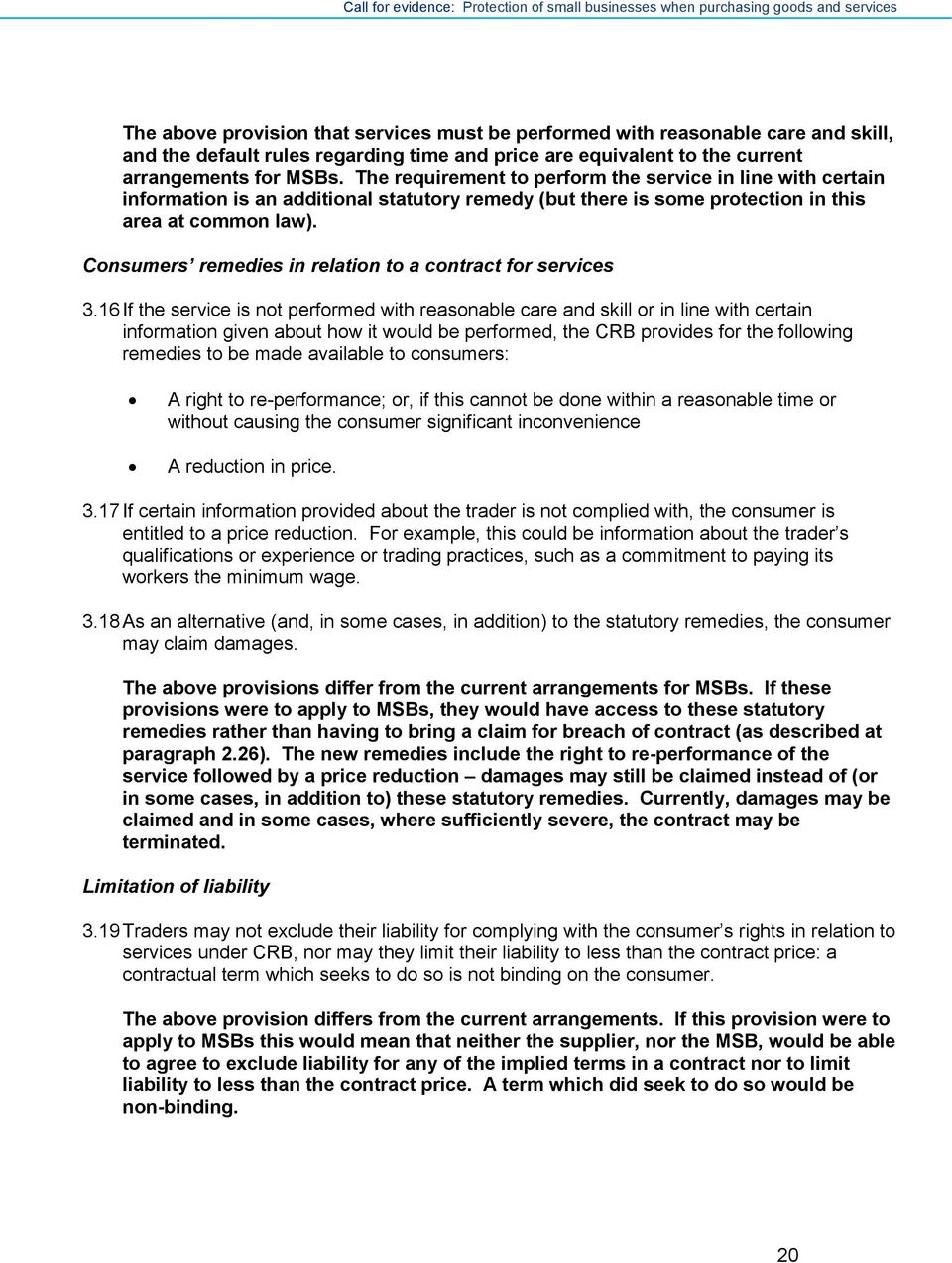
20 The above provision that services must be performed with reasonable care and skill, and the default rules regarding time and price are equivalent to the current arrangements for MSBs. The requirement to perform the service in line with certain information is an additional statutory remedy (but there is some protection in this area at common law). Consumers remedies in relation to a contract for services 3.16 If the service is not performed with reasonable care and skill or in line with certain information given about how it would be performed, the CRB provides for the following remedies to be made available to consumers: A right to re-performance; or, if this cannot be done within a reasonable time or without causing the consumer significant inconvenience A reduction in price If certain information provided about the trader is not complied with, the consumer is entitled to a price reduction. For example, this could be information about the trader s qualifications or experience or trading practices, such as a commitment to paying its workers the minimum wage As an alternative (and, in some cases, in addition) to the statutory remedies, the consumer may claim damages. The above provisions differ from the current arrangements for MSBs. If these provisions were to apply to MSBs, they would have access to these statutory remedies rather than having to bring a claim for breach of contract (as described at paragraph 2.26). The new remedies include the right to re-performance of the service followed by a price reduction damages may still be claimed instead of (or in some cases, in addition to) these statutory remedies. Currently, damages may be claimed and in some cases, where sufficiently severe, the contract may be terminated. Limitation of liability 3.19 Traders may not exclude their liability for complying with the consumer s rights in relation to services under CRB, nor may they limit their liability to less than the contract price: a contractual term which seeks to do so is not binding on the consumer. The above provision differs from the current arrangements. If this provision were to apply to MSBs this would mean that neither the supplier, nor the MSB, would be able to agree to exclude liability for any of the implied terms in a contract nor to limit liability to less than the contract price. A term which did seek to do so would be non-binding. 20
21 Consumers rights in relation to unfair contract terms and notices 3.20 The CRB requires that terms in a consumer contract (that is, a contract between a trader and a consumer), and certain notices, 17 must be fair. 18 This develops existing protections for consumers under the Unfair Terms in Consumer Contracts Regulations 1999 the existing protections apply to terms that have not been individually negotiated, whereas the CRB will apply to negotiated and non-negotiated terms. Under the CRB, a term or notice is unfair if it causes a significant imbalance in the parties rights and obligations, which is detrimental to the consumer To determine whether a term or notice is fair, the subject matter of the contract or notice, all the circumstances at the time of the contract (or the time the rights and obligations to which the notice relates arose) and all the other terms of the contract (or any contract to which the notice relates) should be considered The CRB also sets out an indicative list of terms which may be regarded as unfair and therefore most likely to catch-out consumers (the Grey List terms). The CRB makes it clear that terms on the Grey List can be assessed for fairness, even if they are transparent and prominent or cover the core bargain of the price or subject matter of the contract. The Grey List includes high cost early termination clauses e.g. gym memberships, and terms which give the trader discretion to decide the price or subject matter after the consumer has become bound by the contract. The CRB also requires written terms of a consumer contract, and written notices, to be in plain and intelligible language and legible. Consumers remedies in relation to contract terms and terms in notices 3.23 Where a term in a contract or in a notice is considered unfair by a court, it will not be binding on the consumer. The Competition and Markets Authority, Trading Standards services and other relevant bodies have powers to pursue legal action to stop traders using terms and notices that are unfair or unclear. The above provisions differ from the current arrangements. If these provisions were to apply to MSBs, this would mean that their rights in relation to challenging contract terms would extend beyond the reasonableness test on exclusion and limitation of liability terms (as described at paragraph 2.33). MSBs would be able to challenge contract terms as unfair and this would include terms on the Grey List. Enforcement of the protections under the CRB 3.24 The consumer rights in the CRB are private rights. This means the consumer can themselves exercise their rights against the trader. The consumer has six years to take a claim to court for breach of these rights in England, Wales and Northern Ireland; five years in Scotland. However, if there is a breach of the rights in the CRB on a scale which harms the collective interests of consumers, then regulators such as the Competition and Markets Authority are also able to take action. 17 A notice is covered by this rule to the extent it relates to rights or obligations between a trader and a consumer or seeks to exclude or restrict a trader s liability to a consumer. 18 This protection applies to any term of a consumer contract, except that a term which specifies the subject matter of the contract may not be assessed for fairness, nor can the appropriateness of the price be assessed. However, price and subject matter terms must be both transparent and prominent to avoid a court being able to consider whether they are fair. 21
22 Consumer rights under the CCRs Pre-contract information 3.25 The CCRs require a trader to give or make available to a consumer certain information, in a clear and comprehensible manner, before the consumer is bound by the contract. This includes the main characteristics of the goods or services, the price (or means of calculating this) and relevant charges, details of the trader, and where applicable, details of the consumer s cancellation rights. For on-premises sales (in a shop or at a regular market stall, for example), information only needs to be given if not clear from the context. There are more extensive information requirements for distance contracts (such as online or telephone sales) and off-premises contracts (typically, contracts concluded in a location that is not the trader s business premises) than for on-premises contracts. Remedies regarding information 3.26 If the information is not provided or is not complied with, the trader is in breach of contract in most cases this means the consumer can claim damages although in some cases they may be able to terminate the contract. Under the CRB, the consumer will have a right to recover costs incurred as a result of information which is incorrect or is not complied with, up to the price paid under the contract. If certain information about costs and charges is not provided, the consumer is not bound to pay the costs or charges. If a trader entering into an off-premises contract fails to give notice of the right to cancel, they commit a criminal offence. Right to cancel 3.27 Under the CCRs, consumers buying by distance or off-premises contracts have a 14 calendar day period in which they may change their mind and cancel the contract. (There are limited exceptions for particular types of contract). Other protections 3.28 Traders also have requirements under the CCRs to ensure that any payment obligations are clear and not hidden. In particular, traders need the active consent of the consumer for all payments pre-ticked boxes for instance are not permitted; online traders need to make absolutely clear, through for instance a labelled pay now button, where there is an obligation to pay; where traders offer telephone helplines for consumers to contact them about something they have bought, the consumer must not have to pay more than the basic rate for the phonecall. Consumers are also protected from excessive surcharges for use of payment cards or other means of payment. 19 Enforcement 3.29 In addition to the remedies above, Trading Standards services may be able to seek an injunction ('interdict' in Scotland) from a court to secure compliance with the CCRs. If there 19 This requirement of the Consumer Rights Directive was implemented in the Consumer Rights (Payment Surcharges) Regulations
23 is a breach on a scale which harms the collective interests of consumers, regulators such as the Competition and Markets Authority are also able to take action. Summary of differences between current arrangements for MSB transactions and protections under the CRB 3.30 There are differences between the legislative framework for sale and supply of goods and services which applies to purchases by MSBs and the equivalent framework for businessto-consumer transactions under the CRB In summary, the main ways in which the law currently intervenes more in business-to-consumer than business-to-business transactions, and therefore the additional rights under the CRB regime as compared to the current arrangements for MSBs, if this were to be applied to MSBs, would include the following. These are therefore the areas in relation to which we are keen to understand the potential impacts of applying similar provisions to contracts for sales and supply to MSBs. Supply of goods The reject/refund remedies described at paragraph 2.11 would be replaced by the short-term right to reject and first and second tier remedies described at paragraph 3.5. The MSB would still be able to claim damages as per the current arrangements instead of (or, in some cases in addition to) these remedies. Neither the supplier, nor the MSB, would be able to agree to limit or exclude liability for any of the implied terms in a contract. A term which did seek to do so would be non-binding. Supply of services MSBs would be entitled to the new remedies described at paragraph These include the right to re-performance of the service followed by a price reduction (currently, damages may be claimed and in some cases, where sufficiently severe, the contract may be terminated). Neither the supplier, nor the MSB, would be able to agree to exclude liability for any of the implied terms in a contract or to limit liability to less than the contract price. A term which did seek to do so would be non-binding. Supply of digital content MSBs would have clear rights and remedies in relation to digital content purchases (where the scope and status of such rights currently are unclear). MSBs would be entitled to all the provisions set out at paragraph 3.8. Neither the supplier, nor the MSB, would be able to agree to limit or exclude liability for any of the implied terms in a contract for digital content. A term which did seek to do so would be non-binding. Unfair contract terms MSB rights on contract terms would extend beyond the reasonableness test on exclusion and limitation of liability terms (as described at paragraphs 2.33). MSBs 23
24 would be able to challenge contract terms, other than the core bargain of the contract, as unfair and this would include terms on the Grey List. Pre-contract information The rights to pre-contract information under the CCRs do not currently apply to MSBs. Cancellation rights The right to cancel off-premises and distance contracts under the CCRs does not currently apply to MSBs. Hidden charges etc The other protections under the CCRs do not currently apply to MSBs. 24
25 PART 4: CALL FOR EVIDENCE 4.1 We consider the following to be the main issues raised by this call for evidence. Anyone responding should feel free to raise other points, however, if they think they are relevant. In responding it would be particularly helpful if you could supply any underpinning evidence, examples, case studies or estimates to help illustrate your points. Scope of the Call for Evidence 4.2 This call for evidence is an evidence gathering exercise, which is essentially designed to help Government understand two points: The nature and scale of any problem. In particular: a. The benefits that the current arrangements bring to MSBs (for example in the ease of business transactions and the freedom to contract); and b. The costs of the current arrangements, including any abuses in market transactions, and/or harm or disparity arising from the current arrangements. The impact and consequences of extending specific consumer protection provisions to MSBs. In particular: a. The benefits of addressing any problems (including the benefits to business transactions); and b. The costs of extending consumer protection provisions to MSBs, including on the MSBs who supply goods and services to other MSBs. 4.3 While each of these is similar, the impact of extending consumer protection provisions may extend beyond that which addresses any problem and it is important that any evidence distinguishes between different types of consumer protection. The Government is not proposing any options at this stage. This is a purely evidence gathering exercise. This call for evidence is being held in light of recent parliamentary debates 20 where there were proposals for consumer rights to be extended to MSBs. This call for evidence will inform our assessment of the benefits and costs of the current arrangements, in order to consider whether any action might be appropriate and, if so, to give a basis on which to develop proposals. Key Areas to Explore 4.4 The areas on which we seek views and supporting evidence are explained below. As described in Part 1, one of the purposes of this call for evidence is to determine the extent of any problems and, should they exist, how to address them. We ask what the implications might be of applying any of the consumer protections in this area to MSBs; but first, we ask a series of questions on costs, benefits and other relevant points to do with the current arrangements. Our aim is that this approach will help us assess the nature and scale of any problems; and then assess what the appropriate Government response might be. 20 See paragraph 1.2 in Section 1 25
26 Costs and Benefits 4.5 We want to understand the appropriate framework for protecting MSBs when they make purchases. To do that, we would like to see evidence of the benefits and costs of the current arrangements. Evidence of this nature could be wide ranging, from anecdotal evidence of individual problems, to documented evidence of on-going disputes, to cases of legal action. It may also include examples of where the current arrangements have had beneficial outcomes, for example, in allowing a supplier to offer a wider choice or lower prices, or for MSBs to make discounted purchases. We are therefore interested in all types of evidence both in terms of costs and benefits. We will be particularly looking for evidence of trends and structural issues. Specific examples may be useful, but are likely to be of most value where they are illustrative of wider patterns of behaviour or structural problems with the current arrangements. 4.6 For the sake of clarity, the current arrangements are the legislative provisions which currently provide MSBs with rights and protections in purchasing transactions. These are explained in detail at paragraph 2.2. Questions Q.1 What examples are there of problems with the current arrangements? Q.2 Are these problems one-off examples, or are there problems which suggest trends, or structural issues, in certain sectors? Q.3 Why are these problems not resolved through market mechanisms or current protections (including, for example: the ability to contract; trust, goodwill and supplier reputation or long-term supplier relationships; or the ability to switch supplier)? Q.4 What examples are there of advantages with the current arrangements? Q.5 Are these advantages one-off examples, or are there advantages which are ongoing, or which occur in certain sectors? Q.6 What features of the current arrangements are most beneficial to MSBs? Q.7 What features of the current arrangements are most costly to MSBs? Q.8 How familiar are MSBs with the current arrangements, as described in Section 2? Types of examples (1): Quantifiable evidence 4.7 We also would be grateful for evidence of a quantifiable nature. This will include evidence of the type of MSB affected (micro or small business, nature of business activity, turnover, location), the types of purchases made, the value of the transactions and the costs to the business. MSBs operate across the whole economy, but problems may exist only in some sectors, or in some locations. If issues arise in relation to particular transactions, the type and value of transactions will help us determine the scale of any problem. We are interested in direct effects, such as on the price paid, on other terms of the deal, or in terms 26
27 of the time taken to resolve any problems, which could otherwise have been spent more productively. We are also interested in indirect effects, such as consequential impacts on trade. Questions Q.9 With examples, what types of MSB are affected by any issues identified with the current arrangements, in terms of their size (by employee number and turnover), the nature of their business activity and location of their business? Q.10 What types of transactions are affected with possible reference to the goods or services purchased, the frequency of purchase, the size or volume of purchase, the characteristics of the seller? Q.11 What has been the effect on the terms of trade for the MSB when making the purchase (or purchases) in question? Q.12 What indirect effects have there been on MSBs, for example, in consequential impacts on trade or competitiveness? Q.13 What other losses has the MSB suffered, for example, in time taken to resolve a problem (please quantify where possible)? Q.14 Or, what additional benefits has the MSB enjoyed as a result of the current arrangements, either as a purchaser, or as a supplier? Types of examples (2): Qualitative evidence 4.8 We also would like to understand what types of issues arise. We consider that this falls into two categories: remedial and contractual. With remedial issues, problems would include being unable to satisfactorily obtain a refund or other appropriate remedy for a purchase made. With contractual issues, problems are likely to be more complex and could concern unfair terms and unequal bargaining positions. However, if you consider that there are other categories, please provide details. Questions Q.15 What types of problems are occurring with purchases? For example, are any issues identified mainly about problems of redress, i.e., refund or remedy? Q.16 Or are they about disputes over contract terms, or related to unequal bargaining positions between two parties? Q.17 What other type of problem might there be, if not related to remedy or contract? Q.18 To what extent do MSBs negotiate contract terms as against accepting standard terms and conditions? 27
28 Q.19 To what extent do contracts for sales and supplies to MSBs tend to limit liability for breach of statutory protections regarding goods and services, or other breaches of contract? Approach to purchasing decisions 4.9 In relation to the nature and scale of any problem, there is also a deeper question we would like to understand, which concerns the motivations behind MSB purchasing decisions. Any framework designed to protect business rights must be based on a thorough understanding of this point As with all businesses, we expect MSBs to make purchasing decisions on a commercial basis: that is to say, in order to try and maximise their profits. We would want to see evidence of how purchasing decisions are made and what challenges exist which would prevent an MSB from making effective purchasing decisions We are aware that MSBs will be faced with a range of purchasing decisions. These will include purchasing core items that are especially a part of their business; and non-core items which are less specific to the particular business for example utilities, maintenance, professional services, occasional purchases of items which are incidental to the business (e.g. a gift for a member of staff) etc. We would be interested to know how MSBs approach these different purchasing decisions. Questions Q.20 Do MSBs to struggle to make effective purchasing decisions? Q.21 If so, what are the reasons? Q.22 How do MSBs approach different purchasing decisions? For example, do they approach the purchase of core items and non-core items differently? Q.23 Do MSBs believe they have sufficient information when entering a contract with a larger supplier? Q.24 If so, what steps can MSBs take to ensure this is the case? Q.25 If not, what types of information, and to what extent, are MSBs lacking? Q.26 Does the ability of MSBs to make effective purchasing decisions differ depending on the type of purchase? Q.27 If so, how and for which types of purchases? Position of suppliers to MSBs 4.12 We also need to understand what issues arise for those supplying MSBs. How are the current arrangements reflected in the business models of suppliers both other MSBs and larger firms and would different rights and remedies for MSBs affect the business models of suppliers both other MSBs and larger firms? Would it be costly for firms to distinguish 28
29 between MSBs and other customers. How would firms supplying MSBs respond to changes in the rights of MSBs? Questions Q.28 How are the current arrangements reflected in the business models of suppliers, both other MSBs and larger firms? Q.29 Would different rights and remedies for MSBs affect the business models of suppliers, both other MSBs and larger firms? Q.30 Would it be costly for suppliers to distinguish between MSBs and other customers? Q.31 How would firms supplying MSBs respond to changes in the rights of MSBs? Application of consumer rights 4.13 One of the reasons we are asking for this type of evidence is to help us understand whether additional consumer protections should be extended to MSBs; or whether the existing approach is more appropriate. We would therefore be grateful for details of which specific consumer rights might best address any problems or concerns highlighted. For example, this may be in reference to previous legal provisions, 21 specific provisions within the CRB or within the CRD. Questions Q.32 What might the benefits be of applying any of the consumer protections set out in Part 3 to MSBs? Q.33 We are interested in views, with supporting evidence, on any of the protections in responding, these need not be considered as a package. The key protections are set out in Part 3, but in summary these are: - rights and remedies in relation to contracts for goods; - rights and remedies in relation to contracts for services; - rights and remedies in relation to contracts for digital content; - terms limiting liability for key protections being automatically non-binding; - right to challenging certain terms as unfair; - requirements to provide certain information before a contract is made; - right to withdraw from distance and off-premises contracts. Q.34 Alternatively, is there evidence that regulating MSBs with consumer legislation might have unintended consequences, e.g., chilling effect on the willingness of firms to enter contracts or costs associated with their being less flexibility in contracts etc? 21 Prior to the CRB, a company had access to some of the rights of consumers, where they entered a transaction which was not made in the course of business or was only incidental to their business and not of a kind they made regularly (see paragraph 3.2 above). 29
30 Q.35 If problems arise, to what extent are MSBs also the suppliers and what are the costs to MSBs as supplier of extending consumer protection provisions to SMBs? Q.36 Are there any benefits or costs of having rights for MSBs aligned with those for consumers but not with other businesses? Q.37 What other approaches could the Government take to protecting MSB rights? Q.38 Does an extension of rights need to be applied on a universal basis, i.e., equally to all MSBs? Q.39 Or should it be targeted at micro businesses only, or other specific types of MSB? Q.40 Should any additional protections apply to certain types of transaction only? Q.41 How is the option to limit liability in the current arrangements used? Is it a useful option? Q.42 How would MSBs and their suppliers react if the option to limit liability was removed in all purchases? Q.43 What impact on enforcement might there be if any of the consumer rights set out in Part 3 were applied to MSBs? 30
31 What happens next? Responding to the Call for Evidence 4.14 We are interested in receiving submissions from any interested parties, individual firms and their representatives, trade bodies, research and academic organisations and others with experience of analysis in this area. We are keen to receive submissions which are supported by the inclusion of robust and clear evidence to support any views offered. 31
32 Annex A: List of call for evidence questions Question 1 Question 2 Question 3 Question 4 Question 5 Question 6 Question 7 Question 8 Question 9 Question 10 Question 11 Question 12 Question 13 Question 14 Question 15 What examples are there of problems with the current arrangements? Are these problems one-off examples, or are there problems which suggest trends, or structural issues, in certain sectors? Why are these problems not resolved through market mechanisms or current protections (including, for example: the ability to contract; trust, goodwill and supplier reputation or long-term supplier relationships; or the ability to switch supplier)? What examples are there of advantages with the current arrangements? Are these advantages one-off examples, or are there advantages which are ongoing, or which occur in certain sectors? What features of the current arrangements are most beneficial to MSBs? What features of the current arrangements are most costly to MSBs? How familiar are MSBs with the current arrangements, as described in Section 2? With examples, what types of MSB are affected by any issues identified with the current arrangements, in terms of their size (by employee number and turnover), the nature of their business activity and location of their business? What types of transactions are affected with possible reference to the goods or services purchased, the frequency of purchase, the size or volume of purchase, the characteristics of the seller? What has been the effect on the terms of trade for the MSB when making the purchase (or purchases) in question? What indirect effects have there been on MSBs, for example, in consequential impacts on trade or competitiveness? What other losses has the MSB suffered, for example, in time taken to resolve a problem (please quantify where possible)? Or, what additional benefits has the MSB enjoyed as a result of the current arrangements, either as a purchaser, or as a supplier? What types of problems are occurring with purchases? For example, are any issues identified mainly about problems of redress, i.e., refund or remedy? 32
33 Question 16 Question 17 Question 18 Question 19 Question 20 Question 21 Question 22 Question 23 Question 24 Question 25 Question 26 Question 27 Question 28 Question 29 Question 30 Question 31 Question 32 Or are they about disputes over contract terms, or related to unequal bargaining positions between two parties? What other type of problem might there be, if not related to remedy or contract? To what extent do MSBs negotiate contract terms as against accepting standard terms and conditions? To what extent do contracts for sales and supplies to MSBs tend to limit liability for breach of statutory protections regarding goods and services, or other breaches of contract? Do MSBs to struggle to make effective purchasing decisions? If so, what are the reasons? How do MSBs approach different purchasing decisions? For example, do they approach the purchase of core items and non-core items differently? Do MSBs believe they have sufficient information when entering a contract with a larger supplier? If so, what steps can MSBs take to ensure this is the case? If not, what types of information, and to what extent, are MSBs lacking? Does the ability of MSBs to make effective purchasing decisions differ depending on the type of purchase? If so, how and for which types of purchases? How are the current arrangements reflected in the business models of suppliers, both other MSBs and larger firms? Would different rights and remedies for MSBs affect the business models of suppliers, both other MSBs and larger firms? Would it be costly for suppliers to distinguish between MSBs and other customers? How would firms supplying MSBs respond to changes in the rights of MSBs? What might the benefits be of applying any of the consumer protections set out in Part 3 to MSBs? 33
34 Question 33 We are interested in views, with supporting evidence, on any of the protections in responding, these need not be considered as a package. The key protections are set out in Part 3, but in summary these are: - rights and remedies in relation to contracts for goods; - rights and remedies in relation to contracts for services; - rights and remedies in relation to contracts for digital content; - terms limiting liability for key protections being automatically non-binding; - right to challenging certain terms as unfair; - requirements to provide certain information before a contract is made; - right to withdraw from distance and off-premises contracts. Question 34 Question 35 Question 36 Question 37 Question 38 Question 39 Question 40 Question 41 Question 42 Question 43 Alternatively, is there evidence that regulating MSBs with consumer legislation might have unintended consequences, e.g., chilling effect on the willingness of firms to enter contracts or costs associated with their being less flexibility in contracts etc? If problems arise, to what extent are MSBs also the suppliers and what are the costs to MSBs as supplier of extending consumer protection provisions to SMBs? Are there any benefits or costs of having rights for MSBs aligned with those for consumers but not with other businesses? What other approaches could the Government take to protecting MSB rights? Does an extension of rights need to be applied on a universal basis, i.e., equally to all MSBs? Or should it be targeted at micro businesses only, or other specific types of MSB? Should any additional protections apply to certain types of transaction only? How is the option to limit liability in the current arrangements used? Is it a useful option? How would MSBs and their suppliers react if the option to limit liability was removed in all purchases? What impact on enforcement might there be if any of the consumer rights set out in Part 3 were applied to MSBs? 34
35 Annex B: Call for evidence: Protection of small businesses when purchasing goods and services response form. Confidentiality and disclosure of responses The Department may, in accordance with the Code of Practice on Access to Government Information, make available, on public request, individual responses. The closing date for this consultation has been extended to 30 June 2015 (formerly 15 June 2015). Please return completed forms to: Sean Browne Consumer and Competition Policy Department for Business, Innovation and Skills 1 Victoria Street LONDON SW1H 0ET Tel: ++44 (0) [relevant address here] Your details Name: Organisation (if applicable): Job title (if applicable): Address: Telephone number: 35
36 Please tick the box below that best describes you as a respondent to this consultation Business representative organisation/trade body Central government Charity or social enterprise Individual Large business (over 250 staff) Legal representative Local Government Medium business (50 to 250 staff) Micro business (up to 9 staff) Small business (10 to 49 staff) Trade union or staff association Other (please describe) Question 1 What examples are there of problems with the current arrangements? Question 2 Are these problems one-off examples, or are there problems which suggest trends, or structural issues, in certain sectors? Question 3 Why are these problems not resolved through market mechanisms or current protections (including, for example: the ability to contract; trust, goodwill and supplier reputation or long-term supplier relationships; or the ability to switch supplier)? 36
37 Question 4 What examples are there of advantages with the current arrangements? Question 5 Are these advantages one-off examples, or are there advantages which are ongoing, or which occur in certain sectors? Question 6 What features of the current arrangements are most beneficial to MSBs? Question 7 What features of the current arrangements are most costly to MSBs? Question 8 How familiar are MSBs with the current arrangements, as described in Section 2? Question 9 With examples, what types of MSB are affected by any issues identified with the current arrangements, in terms of their size (by employee number and turnover), the nature of their business activity and location of their business? Question 10 What types of transactions are affected with possible reference to the goods or services purchased, the frequency of purchase, the size or volume of purchase, the characteristics of the seller? Question 11 What has been the effect on the terms of trade for the MSB when making the purchase (or purchases) in question? Question 12 What indirect effects have there been on MSBs, for example, in consequential impacts on trade or competitiveness? 37
38 Question 13 What other losses has the MSB suffered, for example, in time taken to resolve a problem (please quantify where possible)? Question 14 Or, what additional benefits has the MSB enjoyed as a result of the current arrangements, either as a purchaser, or as a supplier? Question 15 What types of problems are occurring with purchases? For example, are any issues identified mainly about problems of redress, i.e., refund or remedy? Question 16 Or are they about disputes over contract terms, or related to unequal bargaining positions between two parties? Question 17 What other type of problem might there be, if not related to remedy or contract? Question 18 To what extent do MSBs negotiate contract terms as against accepting standard terms and conditions? Question 19 To what extent do contracts for sales and supplies to MSBs tend to limit liability for breach of statutory protections regarding goods and services, or other breaches of contract? Question 20 Do MSBs to struggle to make effective purchasing decisions? Question 21 If so, what are the reasons? 38
39 Question 22 How do MSBs approach different purchasing decisions? For example, do they approach the purchase of core items and non-core items differently? Question 23 Do MSBs believe they have sufficient information when entering a contract with a larger supplier? Question 24 If so, what steps can MSBs take to ensure this is the case? Question 25 If not, what types of information, and to what extent, are MSBs lacking? Question 26 Does the ability of MSBs to make effective purchasing decisions differ depending on the type of purchase? Question 27 If so, how and for which types of purchases? Question 28 How are the current arrangements reflected in the business models of suppliers, both other MSBs and larger firms? Question 29 Would different rights and remedies for MSBs affect the business models of suppliers, both other MSBs and larger firms? 39
40 Question 30 Would it be costly for suppliers to distinguish between MSBs and other customers? Question 31 How would firms supplying MSBs respond to changes in the rights of MSBs? Question 32 What might the benefits be of applying any of the consumer protections set out in Part 3 to MSBs? Question 33 We are interested in views, with supporting evidence, on any of the protections in responding, these need not be considered as a package. The key protections are set out in Part 3, but in summary these are: - rights and remedies in relation to contracts for goods; - rights and remedies in relation to contracts for services; - rights and remedies in relation to contracts for digital content; - terms limiting liability for key protections being automatically nonbinding; - right to challenging certain terms as unfair; - requirements to provide certain information before a contract is made; - right to withdraw from distance and off-premises contracts. Question 34 Alternatively, is there evidence that regulating MSBs with consumer legislation might have unintended consequences, e.g., chilling effect on the willingness of firms to enter contracts or costs associated with their being less flexibility in contracts etc? Question 35 If problems arise, to what extent are MSBs also the suppliers and what are the costs to MSBs as supplier of extending consumer protection provisions to SMBs? 40
41 Question 36 Are there any benefits or costs of having rights for MSBs aligned with those for consumers but not with other businesses? Question 37 What other approaches could the Government take to protecting MSB rights? Question 38 Does an extension of rights need to be applied on a universal basis, i.e., equally to all MSBs? Question 39 Or should it be targeted at micro businesses only, or other specific types of MSB? Question 40 Should any additional protections apply to certain types of transaction only? Question 41 How is the option to limit liability in the current arrangements used? Is it a useful option? Question 42 How would MSBs and their suppliers react if the option to limit liability was removed in all purchases? Question 43 What impact on enforcement might there be if any of the consumer rights set out in Part 3 were applied to MSBs? Thank you for taking the time to let us have your views. We do not intend to acknowledge receipt of individual responses unless you tick the box below. Please acknowledge this reply 41
42 42
43 Annex C: Consultation principles The principles that Government departments and other public bodies should adopt for engaging stakeholders when developing policy and legislation are set out in the consultation principles. Comments or complaints on the conduct of this consultation If you wish to comment on the conduct of this consultation or make a complaint about the way this consultation has been conducted, please write to: Angela Rabess BIS Consultation Co-ordinator, 1 Victoria Street, London SW1H 0ET Telephone Angela on or to: [email protected] However if you wish to comment on the specific policy proposals you should contact the policy lead (details on page 10). 43
44 BIS running header 44
45 Crown copyright 2015 This publication is licensed under the terms of the Open Government Licence v3.0 except where otherwise stated. To view this licence, visit nationalarchives.gov.uk/doc/open-government-licence/version/3 or write to the Information Policy Team, The National Archives, Kew, London TW9 4DU, or Where we have identified any third party copyright information you will need to obtain permission from the copyright holders concerned. This publication is available from Contacts us if you have any enquiries about this publication, including requests for alternative formats, at: Department for Business, Innovation and Skills 1 Victoria Street London SW1H 0ET Tel: [email protected] BIS/15/209
Consumer Rights Act 2015
 Consumer Rights Act 2015 CONSUMER RIGHTS ACT 2015 CHAPTER 15 Explanatory Notes have been produced to assist in the understanding of this Act and are available separately Published by TSO (The Stationery
Distance selling: sale of consumer goods over the internet or telephone etc
 Distance selling: sale of consumer goods over the internet or telephone etc Standard Note: SN/HA/5761 Last updated: 23 February 2012 Author: Section Lorraine Conway Home Affairs Section Many people shop
CONSUMER RIGHTS ACT 2015:
 BRIEFING CONSUMER RIGHTS ACT 2015: COMPLIANCE GUIDE FOR BUSINESSES DEALING WITH CONSUMERS SEPTEMBER 2015 THE CONSUMER RIGHTS ACT 2015 WILL TAKE EFFECT FROM 1ST OCTOBER. THIS BRIEFING OFFERS A COMPLIANCE
Guidance for businesses that issue consumer contracts
 1 Guidance for businesses that issue consumer contracts Please note: UTCCR's Explained was originally an OFT document. The following text is substantially taken from the OFT document, with for example
Adviceguide Advice that makes a difference
 Buying at auction What the law says In most circumstances when you buy goods, the law would require that they: match their description. This means they must be as described by the seller. This includes
1999 No. 2083 CONSUMER PROTECTION. The Unfair Terms in Consumer Contracts Regulations 1999
 STATUTORY INSTRUMENTS 1999 No. 2083 CONSUMER PROTECTION The Unfair Terms in Consumer Contracts Regulations 1999 Made - - - - 22nd July 1999 Laid before Parliament 22nd July 1999 Coming into force 1st October
Consumer redress for misleading and aggressive practices: summary of final report
 Consumer redress for misleading and aggressive practices: summary of final report March 2012 THE LAW COMMISSION AND THE SCOTTISH LAW COMMISSION CONSUMER REDRESS FOR MISLEADING AND AGGRESSIVE PRACTICES
UK Government call for views
 DRAFT DIRECTIVES ON THE ONLINE SALE OF DIGITAL CONTENT AND TANGIBLE GOODS UK Government call for views JANUARY 2016 Contents Draft Directives on the online sale of digital content and tangible goods...
Simplification of the Tax and National Insurance Treatment of Termination Payments
 Simplification of the Tax and National Insurance Treatment of Termination Payments Consultation document Publication date: 24 July 2015 Closing date for comments: 16 October 2015 Subject of this consultation:
Quick House Sales. Market Study Annexe A: What are the main laws that may apply to quick house sales? August 2013 OFT1499A
 Quick House Sales Market Study Annexe A: What are the main laws that may apply to quick house sales? August 2013 OFT1499A Crown copyright 2013 You may reuse this information (not including logos) free
Consumer rights to return faulty goods
 Consumer rights to return faulty goods Standard Note: SN/HA/2239 Last updated: 2 April 2012 Author: Lorraine Conway Section Home Affairs Section The Sale of Goods Act 1979, as amended by the Sale and Supply
QUESTIONNAIRE ON CONTRACT RULES FOR ONLINE PURCHASES OF DIGITAL CONTENT AND TANGIBLE GOODS
 QUESTIONNAIRE ON CONTRACT RULES FOR ONLINE PURCHASES OF DIGITAL CONTENT AND TANGIBLE GOODS Information about the respondent 1. Please enter your full name OR the name of the organisation / company / institution
Limiting Liability in Contracts. Thursday, 23 May 2013
 Limiting Liability in Contracts Thursday, 23 May 2013 Agenda Exclusion and Limitation Clauses Financial Cap on Liability Common Law Controls Indirect and Consequential Loss Statutory Controls Entire Agreement
late payment The Late Payment of Commercial Debts (Interest) Act 1998: A User s Guide
 late payment The Late Payment of Commercial Debts (Interest) Act 1998: A User s Guide Index Introduction The importance of prompt payment Legal Warning Section 1: Understanding the legislation What is
Claims Management Services Regulation. Conduct of Authorised Persons Rules 2013 (2)
 Claims Management Services Regulation Conduct of Authorised Persons Rules 2013 (2) Effective from 8 July 2013 Contents Introduction 1 Definitions 1 General Rules Principles 2 Conduct of Business 2 Professional
Buying a motorcycle. In the guide
 Buying a motorcycle When you buy a new or second hand motorcycle from a trader, you enter into a legally binding contract. You are entitled to expect that the motorcycle is of satisfactory quality, fit
TIPS, GRATUITIES, COVER AND SERVICE CHARGES. Call for evidence SEPTEMBER 2015
 TIPS, GRATUITIES, COVER AND SERVICE CHARGES Call for evidence SEPTEMBER 2015 Contents Tips, gratuities, cover and service charges: employer practice... 3 Summary... 3 Tips, gratuities, cover and service
Education and Training Committee, 10 March 2011. Professional indemnity insurance. Executive summary and recommendations.
 Education and Training Committee, 10 March 2011 Professional indemnity insurance Executive summary and recommendations Introduction This paper appeared as a paper to note at the Council meeting on 10 February
TERMS OF BUSINESS AGREEMENT - INSURANCE BROKING
 1. BROKER INFORMATION TERMS OF BUSINESS AGREEMENT - INSURANCE BROKING Stephenson s (2000) Ltd T/As Cooke & Mason, Manor House 3 Low Moor Road Lincoln LN6 3JY is an independent Chartered Insurance Broker.
EUROPEAN METAL RECYCLING LIMITED. Terms & Conditions Applying to the Sale of Auto Parts
 EUROPEAN METAL RECYCLING LIMITED Terms & Conditions Applying to the Sale of Auto Parts 1. Definitions 1.1 The following terms apply in this document: Conditions : these terms and conditions as amended
Claims Management Services Regulation. Conduct of Authorised Persons Rules 2014
 Claims Management Services Regulation Conduct of Authorised Persons Rules 2014 Effective from 1 October 2014 Contents Introduction 1 Definitions 1 General Rules Principles 2 Conduct of Business 2 Professional
contracts consumer protector
 western cape office of the consumer protector What you should know about contracts The purpose of this guide is to give ordinary South African consumers a very basic guide to contracts and what they mean
Bugaboo International BV Spare Parts Web Shop Online Terms and Conditions of Sale
 Bugaboo International BV Spare Parts Web Shop Online Terms and Conditions of Sale This page (together with the documents referred to on it) outlines the terms and conditions on which we supply any of the
Your rights when buying on credit
 Your rights when buying on credit Anyone who offers you credit must be licensed by the Office of Fair Trading (OFT). Most consumer credit agreements are covered by the Consumer Credit Act 1974 and the
Guidance on the requirements of consumer law applicable to the sale and advertising of flights and holidays CAP 1014
 Guidance on the requirements of consumer law applicable to the sale and advertising of flights and holidays CAP 1014 Crown copyright 2013 You may re-use this information (excluding logos) free of charge
Conditions for Intamac Home Monitoring Service via the Internet
 CONTENTS 1. Interpretation 2. The Service 3. Duration 4. Our Commitment 5. Getting Started 6. Making Sure the Service is Secure 7. Things we May Have to Do 8. Repairing Faults in the Service 9. Paying
SRA Compensation Arrangements Review Consultation: The introduction of an eligibility criteria
 SRA Compensation Arrangements Review Consultation: The introduction of an eligibility criteria May 2014 SRA Compensation Arrangements Review Consultation - who should be eligible to benefit from the SRA'
Consumer Code. for Home Builders
 Consumer Code for Home Builders This document contains the Consumer Code requirements together with non-mandatory good practice guidance for Home Builders Second Edition January 2010 Contents Meaning of
Withdrawn BIS GUIDANCE ON: The Consumer Protection (Payment Surcharges) Regulations 2012 MARCH 2013
 BIS GUIDANCE ON: The Consumer Protection (Payment Surcharges) Regulations 2012 MARCH 2013 Contents Contents...2 Introduction...3 Summary of the Regulations...3 Common questions on payment surcharges and
MUSIC RESOURCES TERMS AND CONDITIONS FOR SCHOOLS ( Conditions )
 MUSIC RESOURCES TERMS AND CONDITIONS FOR SCHOOLS ( Conditions ) Please ensure all relevant staff have read and understood these Conditions before signing. Please complete, sign and return the Music Resources
Unfair Terms in Consumer Contracts: Advice to the Department for Business, Innovation and Skills SUMMARY
 Unfair Terms in Consumer Contracts: Advice to the Department for Business, Innovation and Skills SUMMARY March 2013 THE LAW COMMISSION AND THE SCOTTISH LAW COMMISSION UNFAIR TERMS IN CONSUMER CONTRACTS:
Enforced subject access (section 56)
 ICO lo Enforced subject access (section 56) Data Protection Act Contents Introduction... 2 Overview.3 The criminal offence.... 3 Exceptions and penalties.... 7 Relevant records....... 8 Other considerations
Limiting liability for professional firms
 Limiting liability for professional firms Introduction Disputes can arise between providers of professional services and their clients or other (third) parties for a number of reasons. Limiting or excluding
Family Select Legal Protection
 Family Select Legal Protection It may be an employment matter, a dispute over goods that you purchase or sell, or you and your family may find yourself involved in legal areas which are governed by a minefield
CONSUMER INSURANCE LAW: PRE-CONTRACT DISCLOSURE AND MISREPRESENTATION
 THE LAW COMMISSION AND THE SCOTTISH LAW COMMISSION CONSUMER INSURANCE LAW: PRE-CONTRACT DISCLOSURE AND MISREPRESENTATION Joint Report SUMMARY 1.1 The English and Scottish Law Commissions recommend new
Products Liability: Putting a Product on the U.S. Market. Natalia R. Medley Crowell & Moring LLP 14 November 2012
 Products Liability: Putting a Product on the U.S. Market Natalia R. Medley Crowell & Moring LLP 14 November 2012 Overview Regulation of Products» Federal agencies» State laws Product Liability Lawsuits»
DEPARTMENT FOR CONSTITUTIONAL AFFAIRS (DCA) REGULATION OF CLAIMS MANAGEMENT SERVICES
 DEPARTMENT FOR CONSTITUTIONAL AFFAIRS (DCA) REGULATION OF CLAIMS MANAGEMENT SERVICES CONSULTATION ON PART 2 OF THE COMPENSATION ACT 2006 SCOPE ORDER UNDER CLAUSE 3(2)(e); REGULATIONS UNDER CLAUSE 8 AND
Firm Registration Form
 Firm Registration Form Firm Registration Form This registration form should be completed by firms who are authorised and regulated by the Financial Conduct Authority. All sections of this form are mandatory.
SUBSCRIPTION CONTRACT VIEWASIA BOUQUET SUBSCRIPTION TERMS AND CONDITIONS
 SUBSCRIPTION CONTRACT VIEWASIA BOUQUET SUBSCRIPTION TERMS AND CONDITIONS 1. INTRODUCTION A. ABOUT VIEW ASIA BOUQUET View Asia Bouquet (the Bouquet ) and each of the channels comprising and packaged as
Consumer Protection (Fair Trading) (Amendment) Bill
 Consumer Protection (Fair Trading) (Amendment) Bill Bill No. /2012. Read the first time on. 2012. A BILL intituled An Act to amend the Consumer Protection (Fair Trading) Act (Chapter 52A of the 2009 Revised
Product Liability. For the CGA to apply, the supplier must supply goods or services to a consumer. The CGA defines a consumer as:
 Product Liability Product Liability This paper discusses product liability under the Consumer Guarantees Act, Sale of Goods Act and Fair Trading Act. A supplier of goods may also have liability in negligence,
BIS guidance for foreign exchange providers: compliance with consumer protection legislation SEPTEMBER 2012
 BIS guidance for foreign exchange providers: compliance with consumer protection legislation SEPTEMBER 2012 Contents BIS GUIDANCE FOR FOREIGN EXCHANGE PROVIDERS: COMPLIANCE WITH CONSUMER PROTECTION LEGISLATION...
JRI S STANDARD TERMS OF PURCHASE. Business Day: a day (other than a Saturday, Sunday or public holiday) when banks in London are open for business.
 JRI S STANDARD TERMS OF PURCHASE 1. INTERPRETATION 1.1 Definitions. In these Conditions, the following definitions apply: Business Day: a day (other than a Saturday, Sunday or public holiday) when banks
RULES OF ELECTRONIC PAYMENTS ASSOCIATION
 RULES OF ELECTRONIC PAYMENTS ASSOCIATION These are the rules of Electronic Payments Association that have been made by the board of directors of EPA under Article 19 of the articles of association of EPA.
Debt collection guidance
 Debt collection guidance Final guidance on unfair business practices July 2003 (updated December 2006) OFT664 Further copies Further copies of this report can be downloaded from our website at www.oft.gov.uk
Guidance for lettings professionals on consumer protection law
 Guidance for lettings professionals on consumer protection law Helping you comply with your obligations 13 June 2014 CMA31 Contents Page 1. Purpose and scope... 4 Aim of this guidance... 4 Is this guidance
Q2: What does Lemon Law cover? Does it cover secondhand goods and sale/discounted items?
 Lemon Law FAQs Background Q1: What does the new law provide for? A1: More Clarity on Burden of Proof and Rights Period: Under the Lemon Law, if a defect is detected within 6 months, it is presumed that
Recruitment Sector. Consultation on prohibiting employment agencies and employment businesses from advertising jobs exclusively in other EEA countries
 Recruitment Sector Consultation on prohibiting employment agencies and employment businesses from advertising jobs exclusively in other EEA countries JULY 2014 Contents Contents... 2 Prohibiting employment
"Broadband Voice Telephone Adapter" a broadband voice telephone adapter or BT Voyager 220V which may be bought from BT.
 Terms and Conditions 1. Definitions 2. Providing the Service 3. Managing the Service 4. Monitoring Calls 5. Customer Equipment 6. Misusing the Service 7. Security 8. Intellectual Property Rights 9. Intellectual
Insurance Contracts Bill
 Insurance Contracts Bill CONTENTS PART 1 1 Main definitions MAIN DEFINITIONS PART 2 2 Application and interpretation 3 The duty of fair presentation 4 Knowledge of insured Knowledge of insurer 6 Knowledge:
A Users Guide to the recast Late Payment Directive
 DIRECTIVE 2011/7/EU ON COMBATING LATE PAYMENT IN COMMERCIAL TRANSACTIONS A Users Guide to the recast Late Payment Directive OCTOBER 2014) Contents Contents.2 Summary...3 Summary of new measures 4 What
How To Make A Contract Between A Client And A Hoster
 Web Hosting Terms & Conditions Please read these web-hosting terms carefully, as they set out our and your rights and obligations in relation to our web hosting services. AGREEMENT: Whereas: (1) The Ruby
Haynes Manuals & Books
 Haynes Manuals & Books Website Terms and Conditions of supply (for hardcopy manuals & books) This page (together with the documents referred to on it) tells you the terms and conditions on which we supply
Savings Accounts. General Terms and Conditions
 Allenview House, Hanham Road, Wimborne, Dorset BH21 1AG Telephone: 0800 783 2367 Fax: 01202 841694 Email: [email protected] Web: teachersbs.co.uk Savings Accounts General Terms and Conditions 1.
Motor Legal Expenses Insurance
 Motor Legal Expenses Insurance Motor Legal Expenses Insurance Policy Document Certificate of Insurance This insurance is underwritten by Inter Partner Assistance SA and managed on their behalf by Arc Legal
3.6. Please also note, unless your policy confirms otherwise, the rights under your policy may only be pursued in an English court.
 Terms of business agreement - commercial customers M & N Insurance Service Limited Authorised and regulated by the Financial Conduct Authority No: 305837. Registered Office: 248 Hendon Way London NW4 3NL
Loan Contract Terms and Conditions booklet with:
 Loan Contract Terms and Conditions booklet with: Mortgage conditions; and Direct Debit Request Service Agreement This booklet contains some of the terms and conditions that apply to a loan we offer Borrower(s)
General Terms and Conditions for Online Sales of TomTom Inc ( TomTom )
 General Terms and Conditions for Online Sales of TomTom Inc ( TomTom ) 1) Scope a) These Terms and Conditions shall apply to all purchase orders submitted or to be submitted by you for any item, service
Trinity Online Application - Terms and Conditions of Use
 IMPORTANT NOTICE PLEASE READ THE FOLLOWING TERMS AND CONDITIONS CAREFULLY. IF YOU DO NOT AGREE WITH THESE TERMS AND CONDITIONS, YOU MUST NOT USE THIS APPLICATION. BY USING THIS APPLICATION AND/OR ANY OF
Code of Practice for Commercial & Business Agents
 Code of Practice for Commercial & Business Agents Effective from 1 September 2009 Contents: 1. General 2. Instructions 3. For Sale Boards 4. Published Material 5. Offers 6. Access to Premises 7. Clients'
Promoting society and local authority lotteries
 Promoting society and local authority lotteries Advice for society and local authority lotteries which require a licence or registration September 2014 1 Introduction 1.1 Lotteries are illegal unless they
Website Hosting Agreement
 Website Hosting Agreement This Agreement is Between: (1) Tutch Media Limited, a company registered in England whose office is at 121c London Road, Knebworth, Herts, SG3 6EX ( the Host ) and (2) The Client
Terms and Conditions of Sale
 Broadberry Data Systems Limited ("The Company") Terms and Conditions of Sale 1. General a) Unless otherwise expressly agreed in writing by a Director (or authorised executive) of the Company all goods
(1) Helastel Ltd. (2) You WEBSITE HOSTING AGREEMENT
 (1) Helastel Ltd (2) You WEBSITE HOSTING AGREEMENT Helastel Ltd Website Hosting Agreement 1 THIS AGREEMENT IS BETWEEN: (1) Helastel Ltd a company registered in United Kingdom under number 05146061 whose
Co-operative Energy, Co-operative House Warwick Technology Park, Warwick CV34 6DA.
 Terms and Conditions May 2014 Co-operative Energy: General Terms and Conditions for Domestic Customers Only Applicable from 1st June 2014. Co-operative Energy Limited is a limited liability company registered
TERMS OF BUSINESS FROM ROYAL LONDON INCORPORATING OUR TRADING NAME SCOTTISH PROVIDENT
 For advisors only TERMS OF BUSINESS FROM ROYAL LONDON INCORPORATING OUR TRADING NAME SCOTTISH PROVIDENT Protection DOING BUSINESS TOGETHER 1. Our terms of business set out the conditions upon which we
TT ELECTRONICS INTEGRATED MANUFACTURING SERVICES LIMITED CONDITIONS OF PURCHASE
 TT ELECTRONICS INTEGRATED MANUFACTURING SERVICES LIMITED CONDITIONS OF PURCHASE DEFINITIONS In these conditions of purchase: the Buyer means TT electronics integrated manufacturing services Ltd., the Supplier
Annex B Consumer Credit Rules from 6 April 2007
 Annex B Consumer Credit Rules from 6 April 2007 The rules will be available on the internet from 6 April 2007 in the Dispute Resolution: Complaints (DISP) module of the electronic FSA handbook. The extract
Practice Note. 10 (Revised) October 2010 AUDIT OF FINANCIAL STATEMENTS OF PUBLIC SECTOR BODIES IN THE UNITED KINGDOM
 October 2010 Practice Note 10 (Revised) AUDIT OF FINANCIAL STATEMENTS OF PUBLIC SECTOR BODIES IN THE UNITED KINGDOM The Auditing Practices Board (APB) is one of the operating bodies of the Financial Reporting
Terms and Conditions of Offer and Contract (Works & Services) Conditions of Offer
 Conditions of Offer A1 The offer documents comprise the offer form, letter of invitation to offer (if any), these Conditions of Offer and Conditions of Contract (Works & Services), the Working with Queensland
COMPLYING WITH THE E-COMMERCE REGULATIONS 2002
 COMPLYING WITH THE E-COMMERCE REGULATIONS 2002 You should read this guide if you. advertise goods or services online (i.e. via the Internet, interactive television or mobile telephone) sell goods or services
Consumer Code for Home Builders
 Consumer Code for Home Builders This document contains the mandatory Consumer Code requirements that Home Builders are required to follow Clear Print Edition Third Edition April 2013 Contents Meaning of
Consumer Rights Act 2015
 Consumer Rights Act 2015 Point of Sale Designs ENGLAND & WALES In-store: 1 Point of Sale info for GOODS not sold online 2 Point of Sale info for SERVICES not sold online Online, distance and off-premises
Consumer Code. for Home Builders. This document contains the Rules that govern the behaviour of Home Builders and Home Warranty Bodies
 Consumer Code for Home Builders This document contains the Rules that govern the behaviour of Home Builders and Home Warranty Bodies First Edition January 2010 Contents Meaning of words... 3 Introduction...
NHS REDRESS ACT 2006
 INTRODUCTION These notes refer to the NHS Redress Act 2006 (c. 44) NHS REDRESS ACT 2006 EXPLANATORY NOTES 1. These explanatory notes relate to the NHS Redress Act 2006, which received Royal Assent on 8th
STANDARD HOSTING AGREEMENT
 Elysium Ltd Head Office Milton House Whitehill Road Crowborough East Sussex TN6 1LB Phone: +44 (0)1892 667411 Fax: +44 (0)1892 667433 Web: www.elysium.ltd.uk Email: [email protected] STANDARD HOSTING
Consumer protection from unfair trading
 Consumer protection from unfair trading The Consumer Protection from Unfair Trading Regulations 2008 (known as the CPRs) cover commercial practices between traders and consumers and introduce a general
THE CLAIMS MANAGEMENT CODE ( the Code )
 THE CLAIMS MANAGEMENT CODE ( the Code ) CONTENTS 1 Introduction 2 Principles 3 Publishing the Code 4 Training and Competence 5 Advertising, Marketing and Promotional Activities 6 Charges 7 Information
INVESTMENT TRUST COMPANIES: A TAX
 1 INVESTMENT TRUST COMPANIES: A TAX FRAMEWORK Summary 1.1 Budget 2008 announced that the Government would consider adapting the tax rules for Investment Trust Companies to enable tax-efficient investment
Terms and Conditions for Experian s website services
 Terms and Conditions for Experian s website services Last Modified Version: 2.1 Dated: 17/12/14] Contents list 1. Definitions 2. About us 3. Important information about these Terms and Conditions 4. Our
Standard terms of business
 31a Charnham Street, Hungerford, Berkshire, RG17 0EJ Tel: 01488 682546 Fax: 01488 684473 Email: [email protected] Web: www.bradingcryer.co.uk Standard terms of business The following standard
Team Anywhere EMAIL ORDER FORM
 1. Applicant Details Team Anywhere EMAIL ORDER FORM Please complete and return this form to: Quincerto Group (NZ) Ltd, PO Box 31-248, Christchurch, New Zealand Telephone: 0508 332 537 Fax: 03 342 6109