
Affordable Housing: LIHTC Accounting Overview. July 30, 2014
|
|
|
- Eugene Cox
- 9 years ago
- Views:
Transcription
1 Affordable Housing: LIHTC Accounting Overview July 30, 2014
2 Tax Credits 101 TOPIC Welcome and Overview Project Proforma Roles, Motivations and Responsibilities of Developer and Investor 10% Test 50% Test Cost Certification 2

3 Overview of Low Income Housing Tax Credits 3
4 What is a Low-Income Housing Tax Credit? Authorized under Section 42 of the Internal Revenue Code Designed to help fund low-income housing Investors purchase tax credits from developers of low-income housing. The money paid by investors is contributed to the project as equity. 4

5 Types of LIHTCs 9% Credit New construction or substantial rehabilitation awarded through competition 4% Credit New construction or substantial rehabilitation awarded in conjunction with tax-exempt bonds 5

6 How Do You Get Tax Credits? Developer applies to housing credit agency (HCA) for reservation of credits 9% credits are awarded through competition 4% credits are awarded as of right in conjunction with tax exempt bonds 6

7 Role of Housing Credit Agency HCA HCAs are responsible for selecting developments to allocate the Credit, underwriting the Credit (sizing it according to financial needs of the project), reporting Credit activity to the IRS, and monitoring for compliance with federal regulations. 7

8 Qualified Allocation Plan QAP HCA guidelines must be published in annual Qualified Allocation Plans ( QAPs ), which detail selection criteria and compliance monitoring rules. Most HCAs select projects through competitive cycles (at least one per year), with various threshold and scoring criteria. Selection criteria includes project characteristics, owner characteristics, location, market feasibility, energy efficiency, income targeting, and affordability periods. 8
9 Tax Exempt Bonds Tax-Exempt Bond Financed Developments Developments with at least 50% of aggregate basis financed with taxexempt bonds are eligible. Credits are awarded as of right. Projects do not compete. Must meet QAP and underwriting criteria. Applicable Tax Credit Percentage is published monthly by U.S.Treasury, and is a floating rate at or below 4%. August 2014 applicable tax credit percentage is 3.25% Frequently used to finance acquisition and rehabilitation of existing properties (e.g., Preservation deals). Project size usually 100 units or more 9

10 Low Income Use Restriction Minimum Requirement: rent and income restrictions must remain in place for a 15-year Compliance Period, plus an additional 15-year Extended Use Period. Property owners may elect to opt-out of the Extended Use Period with HCA approval under certain circumstances; Qualified Contract. Many QAP s have longer use restrictions and prohibit opting out early. 10
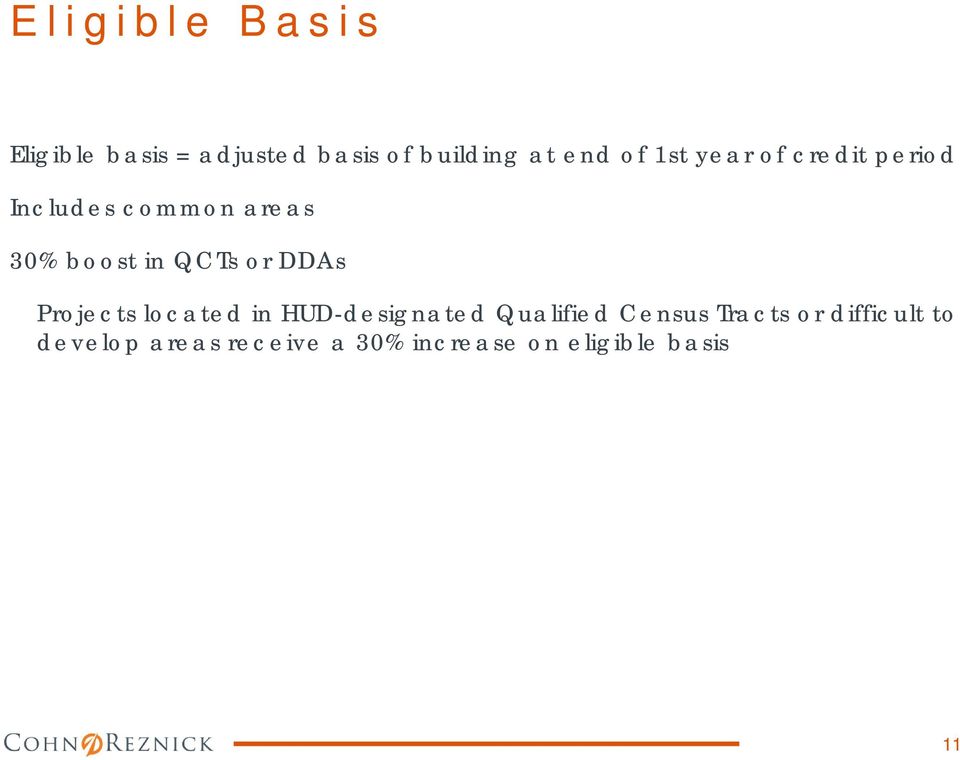
11 Eligible Basis Eligible basis = adjusted basis of building at end of 1st year of credit period Includes common areas 30% boost in QCTs or DDAs Projects located in HUD-designated Qualified Census Tracts or difficult to develop areas receive a 30% increase on eligible basis 11
12 Eligible Basis (cont.) Costs that ARE included: Engineering & architecture Survey Appraisal Construction costs Market study Impact fees/permits Inspections Tenant relocation Accounting & legal Environmental Depreciable land improvement Developer fee Construction period interest, loan fees, insurance, real estate taxes 12

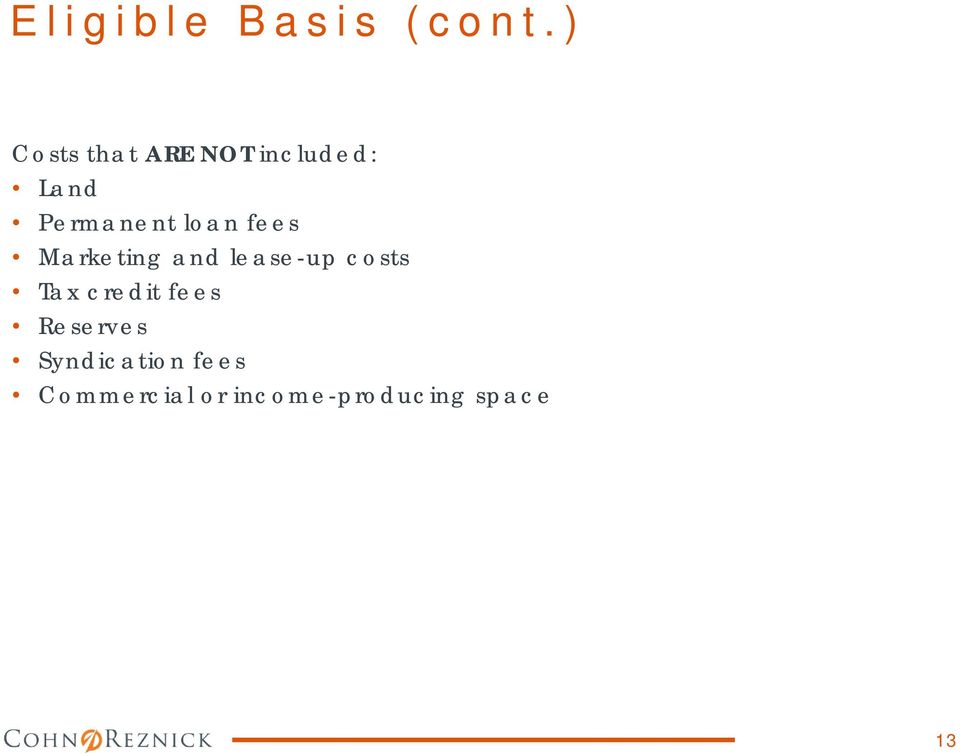
13 Eligible Basis (cont.) Costs that ARE NOT included: Land Permanent loan fees Marketing and lease-up costs Tax credit fees Reserves Syndication fees Commercial or income-producing space 13
14 Community Service Facilities Generally, costs included in basis are limited to space used exclusively for low-income tenants. In qualified census tracts, basis may include costs of providing a community service facility for use primarily by low-income residents of the area. They do not have to be tenants. There are limitations on the percentage of basis that may be eligible for tax credits for community service facilities. Consult your tax credit advisor. 14

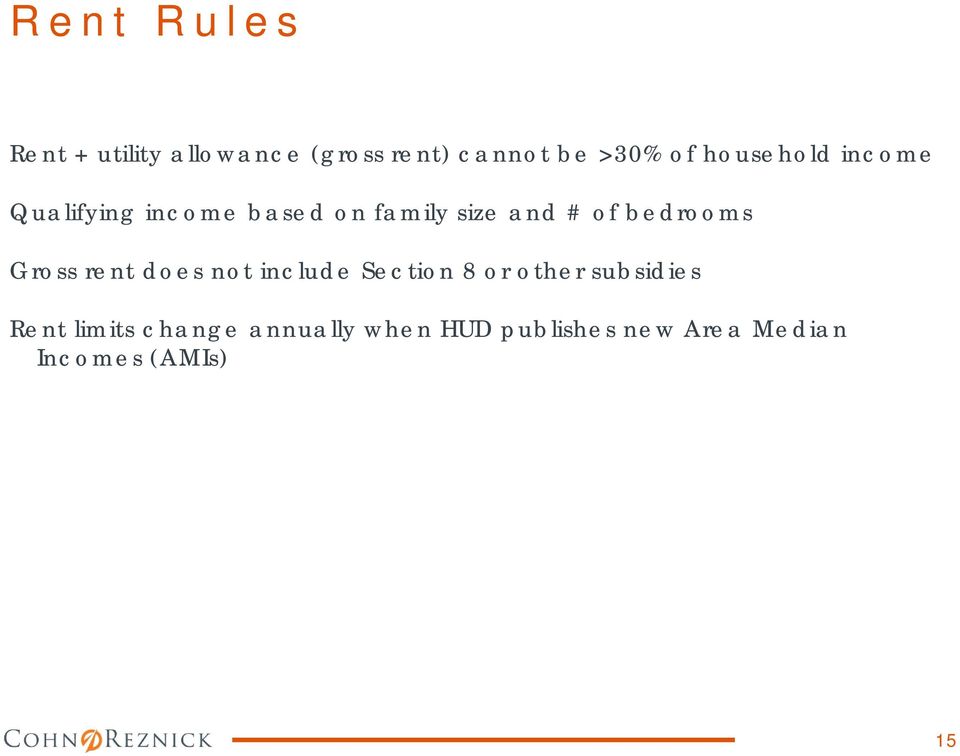
15 Rent Rules Rent + utility allowance (gross rent) cannot be >30% of household income Qualifying income based on family size and # of bedrooms Gross rent does not include Section 8 or other subsidies Rent limits change annually when HUD publishes new Area Median Incomes (AMIs) 15
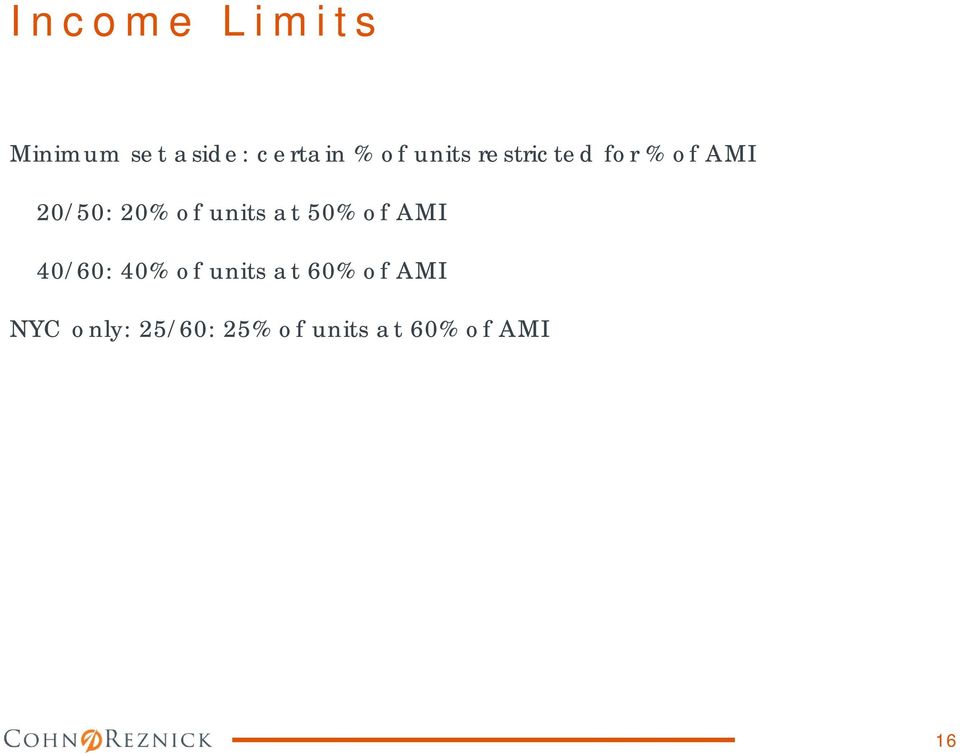
16 Income Limits Minimum set aside: certain % of units restricted for % of AMI 20/50: 20% of units at 50% of AMI 40/60: 40% of units at 60% of AMI NYC only: 25/60: 25% of units at 60% of AMI 16
17 Recapture for Non-Compliance Decrease in qualified basis Not meeting minimum set-aside Low-income occupancy decreases Sale or foreclosure Eminent domain Damaged building out of service (e.g. Sandy casualty losses) 17
18 Role of the Investor Purchases tax credits and tax benefits Current price is approximately $.90 for $1.00 of tax credits Investors may pay more for credits in areas eligible for CRA credit Investors may pay less for credits in areas deemed higher risk Becomes 99.99% limited partner in project ownership entity 18

19 Typical Ownership Structure General Partner Tax Credit Investor Nominal 1% Credits, 99% Credits, $$ Equity Equity Investment Profits & Losses Profits & Losses Operating Partnership Development Fee Rent Developer Mortgage Tenant Group 19

20 Financial Model 20
21 Project Summary & Assumptions Construction start & placed in service dates Occupancy (lease-up) Debt & equity Operating income & expenses Development budget (sources & uses) Tax credit assumptions (4%-9%, 30% basis boost, tax credit pricing) 21
22 Project Income Unit mix Bedrooms Number of units Target median income % LIHTC rent limits Proposed rents Cannot exceed LIHTC rent limits Market study Vacancy allowance Tenant paid utilities 22
23 Project Expenses Administrative Management fees (% of effective gross income) Monitoring fees Annual audit/tax Utilities Operating expenses Realistic per unit cost Replacement reserves Typically $250 - $300 per unit per year 23
24 Operating Pro Forma Income Trend 2% Expense Trend 3% Vacancy Allowance 7% Management Fee 5% Income Year 1 Year 2 Year 3 Year 4 Year 5 Gross Project Income 874, , , , ,912 Vacancy Allowance (61,236) (62,461) (63,710) (64,984) (66,284) Effective Gross Income 813, , , , ,628 Expenses Total Expenses 540, , , , ,118 Net Operating Income 272, , , , ,510 Debt Service Financing Private Loan 238, , , , ,647 Cash Flow 33,944 34,393 34,701 34,860 34,863 Debt Coverage Ratio Cash Flow Financing HOME 16,972 17,196 17,350 17,430 17,432 Remaining Cash Flow 16,972 17,196 17,350 17,430 17,432 Def Dev Fee Balance 691, , , , ,296 Def Dev Fee Payment (16,972) (17,196) (17,350) (17,430) (17,432) Def Dev Fee Balance 674, , , , ,864 24
25 Development Budget - Uses Acquisition costs Land Existing building (rehab) Construction costs (hard costs) General requirements Builder s profit & overhead Hard cost contingency Soft costs Development related Financing (construction/perm) 25
26 Development Budget Uses (cont.) Soft costs Syndication Tax credit related Developer fee Max developer fee limits (state) Reserves Operating Rent-up Escrows 26
27 Development Budget - Sources Construction financing Construction Permanent Debt Permanent debt Cash flow financing Grants Equity LIHTC equity State tax credit equity Deferred developer fee 27
28 Tax Credit Equity Eligible Costs 14,405,812 QCT/DDA Boost (130%) x 100% Eligible Basis 14,405,812 Applicable Fraction x 100% Qualified Basis 14,405,812 Applicable Percentage x 9.0% Annual LIHTC Eligible 1,296, years x 10 Total LIHTCs Over Period 12,965,231 Investor Ownership % x 99.99% Total Investor LIHTCs 12,963,934 Tax Credit Price x.95 Tax Credit Equity 12,315,738 28
29 Investor Metrics Investor IRR Schedule of benefits o Losses Depreciation o Tax credits Distributions (cash flow) Capital contributions o Quarterly compounding Capital account Minimum gain 29
30 The 10% Test 30
31 Why Conduct a 10% Test? If a project is not placed in service in the year of credit allocation, the project must apply for a Carryover of the Allocation. This process is specific only to competitive LIHTCs. LIHTCs in conjunction with tax exempt bonds are exempt. The 10% Test is part of the Carryover Allocation Application to demonstrate progress toward project completion. Typically, the HCA requires an Independent Accountant s Report. The form of report is dictated by the HCA and may vary from state to state. 31
32 What is a 10% Test? A 10% Test supports Accumulated Basis* in a project. Accumulated Basis must be at least 10% of the Reasonably Expected Basis* of the project on a specific date. *Accumulated Basis: Total costs incurred to date which represent project s depreciable basis plus land. *Reasonably Expected Basis: Project s depreciable basis plus land costs. This amount is generally stipulated by the Owner as part of the Carryover Allocation. * Note: terminology varies by HCA 32
33 The 10% Calculation dl 10% < Accumulated Basis (land + depreciable basis) Reasonably Expected Basis (total expected land + depreciable basis) 33
34 What is involved in a 10% Test? The Independent Accountant will test, on a sample basis, costs presented by the Owner as Accumulated Basis. Testing could include: Sampling of invoices or other documentation. Confirmation of costs incurred with third party vendors. Recalculation of fees to determine inclusion in accordance with terms. Relevant project documents will be obtained, reviewed and retained as part of the engagement documentation. Additional specific procedures required by the HCA, if applicable. 34
35 50% Test: Projects Financed with Tax Exempt Bonds 35
36 Background on Bond Financing HCAs allocate competitive LIHTCs to projects based on their annual LIHTC volume cap allocation received from the U.S. Treasury. An exception to this rule relates to projects financed with Tax-Exempt Bonds. LIHTCs awarded as of right to projects financed with Tax-Exempt Bonds do not count against the HCAs LIHTC volume cap allocation. As of right 4% LIHTCs are non-competitive. Projects must only meet requirements under the State s QAP and tax exempt bond rules. 36
37 What is the 50% Test? The 50% test is calculated by dividing the Bond Proceeds by the Aggregate Basis of the Project. For these purposes: Bond Proceeds: Include only the amount of bonds used to finance the acquisition, hard construction and soft costs of the project. Generally this will equal the mortgage amount. Bond Proceeds do include interest earned on the bonds or bond reserve funds. Aggregate Basis: Includes the Project s depreciable basis and land costs. 37
38 The 50% Test Bond Proceeds 50% < Aggregate Basis (of building and land) 38
39 Other Bond Nuances For a bond financed project to obtain LIHTCs the bonds must be volume cap bonds, a separate application and allocation process from an issuing agency. Tax exempt bond volume cap is allocated annually by the U.S. Treasury to issuing agencies. The Project must meet the 95/5 Test. This test is often called the good cost / bad cost test and is typically performed by an Independent Accountant. For these purposes some examples are: Good Costs: Building and land, common space, resident recreation and parking facilities related to the rental residential units. Bad Costs: Commercial space, financing fees, bond issuance costs, some costs incurred prior to bond inducement. 39
40 Meeting the 50% Test If the Project meets the 50% Test, the Project may claim 100% of the 4% credits on the total amount of eligible basis. Example: Volume Cap Bonds 10,000,000 Aggregate Basis 19,900,000 50% Test Ratio % Land in Aggregate Basis 2,000,000 Eligible Basis 17,900,000 Eligible under 50% Test % Final Eligible Basis 17,900,000 40
41 What Happens if a 50% Test Fails? If the Project does not meet the 50% Test the Project is limited to 4% credits on the amount of eligible basis times the final ratio. This has a severe impact on the available credits! Example: Volume Cap Bonds 10,000,000 Aggregate Basis 20,100,000 50% Test Ratio % Land in Aggregate Basis 2,000,000 Eligible Basis 18,100,000 Eligible under 50% Test % Final Eligible Basis 9,004,975 41
42 To prevent failing 50% Test Alternative methods for calculating capitalization of project costs; i.e., construction interest capitalization, 266ii election, etc.. This is typically the first alternative evaluated. Reduction of Aggregate Basis costs via funding at General Partner level through GP guarantees of maximum project costs for construction. Obtain an additional allocation of volume cap bonds to increase the numerator in the calculation. These bonds would be used to pay qualified costs and typically repaid with permanent sources such as equity or other debt. Reduction of developer fee until the 50% ratio is met -- typically the last resort! 42
43 Reporting for 50% Tests 50% Tests are reported in different ways depending on the HCA. Reports are generally required to be prepared by an Independent Accountant. Two options are typical: Report as part of the final 8609 cost certification: In this option there is a separate provision in the HCA s reporting format which includes a calculation and report on the 50% status. Report in a separate letter: In this option there is a separate report stipulated by the HCA which specifically addresses the 50% test. 43
44 The Independent Accountant s Report Report typically in form of an Agreed Upon Procedures (AUP) report performed by an Independent Accountant Specific procedures required by the HCA are reported upon by the Independent Accountant 44
45 8609 Cost Certification 45
46 What is a Cost Certification? CPA s audit of project costs. Required by HCA s to certify eligibility for LIHTCs. Each HCA has specific information required to be included. Typically required: schedules of total and eligible costs by project and building, calculation of credits, sources and uses of funds, gap analysis and project proformas. Upon final issuance of the cost certification, as a part of the final application package, which usually includes additional materials, forms 8609 will be issued to the owner. 46
47 New Construction vs. Acquisition Rehab New Construction: Involves construction of a project from the ground up. In these circumstances, there was either vacant land with no existing building, or all existing structures were demolished and a new structure constructed. Acquisition / Rehabilitation: Involves acquiring an existing project and rehabilitating the structure. This can involve rehabilitation around tenants, tenants do not vacate units, or vacate units on a daily basis; or units can be taken out of service, tenants are relocated during rehabilitation. The nature of the construction/rehabilitation has direct effects on the ability to capitalize costs as eligible as well as the method for determining credit rates. 47
48 Acquisition Rehab Additional Considerations Minimum Rehab Test: Rehabilitation of the Project must meet minimum requirements: $6,200 per unit or 20% of adjusted acquisition basis, or whatever is stipulated in the relevant QAP Purchase from an unrelated party: Acquisition of the Project must be from an unrelated party for tax purposes. 10 Year Rule: The project must not have been placed in service within 10 years previous to acquisition (certain exceptions apply). 48
49 Eligible Costs (Refresher) Costs that ARE included (wholly eligible): Engineering & architecture Survey Appraisal Market study Impact fees/permits Depreciable land improvement Tenant relocation Inspections 49
50 Acquisition Analysis New Construction: Generally limited to ineligible land costs Acquisition/Rehab: Must create or obtain a purchase price analysis to establish basis in acquired assets: In most cases an independent appraisal is used to support allocation of acquisition cost to land and building (potentially furniture & fixtures and existing leases, etc.) In complex transactions involving commercial space, long term tenants, or related parties, a 3 rd party specialist may need to perform a purchase price allocation Basis related to acquired building is eligible for 4% acquisition credits. 50
51 Construction Costs Construction costs related to residential rental units, common space, tenant amenities (non-commercial) and depreciable land improvements are eligible. Construction costs related to demolition (non-rehab), commercial space, permanent land improvements are not eligible. Contractor fees for overhead, general requirements and profit are limited subject to specific limits prescribed by the HCAs. See QAP for year of allocation. Related party contractors require additional documentation for testing purposes to support costs (job costs, etc.). 51
52 Developer Fees Developer Fees are eligible to the extent of underlying developer activity, which can be determined via review of the developer agreement and direct inquiry. Developer Fee may be allocated to: Acquisition / Rehab and Commercial / Residential Development and construction related services: eligible Financing related activity (acquisition of debt/equity): partially eligible (equity related = ineligible) Developer fees are also subject to specific limits prescribed by the HCA. 52
53 Legal Fees Similar to Developer Fees, legal fees are eligible to be capitalized based on the underlying characteristics for which they were rendered. Fees are treated similarly to those underlying costs. For example, if related to organizational/partnership or syndication costs, legal fees are 100% ineligible. Financing fees are amortized over the life of the related financing instrument. 53
54 Monthly Capitalization (for periodic costs) The amount of a specific cost to be capitalized for a specific month; i.e., eligible, can be determined by the proration of the project which is out of service. New Construction: This scenario is straight forward, at inception, 100% of units are out of service, decreasing to 0% as the Project is completed. Rehabilitation: Capitalization is determined by units out of service at the beginning of each month. Factors such as whether the project has in place tenants at acquisition, rehabs around tenants, etc. all factor in to capitalization determination Note: out of service indicates that the unit is NOT ready and available for its intended use 54
55 Monthly Capitalization New Construction Example Example: Uniform units. 100 Units out of service
56 Monthly Capitalization Rehabilitation Example Example: Uniform units with existing tenants in place, units taken offline. 100 Units out of service
57 Monthly Capitalization Rehabilitation (cont.) Project is vacant at acquisition: monthly capitalization will work like New Construction. Rehab around tenants: monthly periodic costs will not be eligible. 57
58 Periodic Costs Costs which attach to specific periods of time such as insurance, real estate taxes, etc. These costs are allocated across the relevant period and are eligible in the percentage that the related month is out of service see monthly capitalization. Construction loan costs and costs of issuance including title & recording on loans are periodic costs. This is an often confused concept. 58
59 Interest Capitalization Interest is also a periodic cost, but varies from the previous costs in that capitalization is typically done on a quarterly basis on the first day of each quarter. Monthly capitalization is an option for acquisition rehab projects with a irregular pattern for quarterly capitalization. Interest capitalization can be a complex calculation. 59
60 Interest Cap Example Traditional Financing Interest Charges Out of Service Capitalized January $ 8, % $ 8,000 February $ 9,000 75% $ 6,750 March $ 10,000 50% $ 5,000 $ 27,000 $ 19,750 60
61 Interest Cap Example Tax- Exempt Bond Financing Total Bond Issue $ 3,000,000 A B C D = (C / A) E = (B x (1 - D)) F = (B - E) G F x G Interest Charges Bonds Drawn for Construction Construction Fraction Investment Interest Expense Construction Interest Expense Out of Service Capitalized Quarter 1 $ 10,000 $ 1,000,000 33% $ 6,667 $ 3, % $ 3,333 Quarter 2 $ 10,000 $ 1,750,000 58% $ 4,167 $ 5,833 75% $ 4,375 Quarter 3 $ 10,000 $ 2,250,000 75% $ 2,500 $ 7,500 50% $ 3,750 $ 30,000 $ 13,334 $ 16,666 $ 11,458 * Note = 266ii election can be made to capitalize investment interest expense rather than deducting the amounts. This results in no offset to any income earned on bond reserves, which will be recognized as revenue. 61
62 Avoided Interest Avoided interest relates to the cost of interest which has been avoided through the use of equity for financing the Project. Avoided interest is calculated on non-traced debt as the weighted average interest rate for the period. 62
63 Determining the Applicable Percentage New Construction 63
64 Determining the Applicable Percentage - Acquisition 64
65 Determining the Applicable Percentage - Rehabilitation 65
66 Definitions 30% Boost : Properties located in a federally-designated Qualified Census Tract, or Difficult Development Area, are eligible for 30% increase in eligible basis in calculating the credit for new construction and rehabilitation costs (acquisition portion not eligible). Aggregate Basis: Land + depreciable basis; relevant for calculating tax exempt bond 50% test. Annual Credit Amount: Product of Qualified Basis and Applicable Credit Percentage Fraction. 66
67 Definitions (cont.) Applicable Fraction: The lesser of the unit fraction or floor space fraction. Must meet for each BIN in project. Applicable Tax Credit Percentage: Rate published monthly by Treasury to determine credit amount based on Qualified Basis. Fixed at 9% for most new construction and rehabilitation expenses for projects receiving allocations until December 31, Floating rate at or below 4% for acquisition and construction/rehab costs financed with tax-exempt bonds. 67
68 Definitions (cont.) Eligible Basis: Development costs related to acquisition, rehabilitation, or construction of a new building that are depreciable to that building. Floor Space Fraction: S. F. low income units S.F. total units Qualified Basis: Product of Eligible Basis and Applicable Fraction. Unit fraction: low income units total units 68
69 QUESTIONS? 69
70 Presenter Marshall Phillips Principal CohnReznick, LLP 525 North Tryon Street, Suite 1000 Charlotte, NC
71 Presenter Marshall Phillips Principal 525 N. Tryon Street, Suite 1000 Charlotte, NC
Housing Tax Credit Essentials
 Housing Tax Credit Essentials 1 Background Part of 1986 Tax Reform to encourage the construction and rehabilitation of low-income rental housing Contained in Section 42 of the tax code Emphasis on private
HOUSING FINANCE AND LOW-INCOME HOUSING TAX CREDITS. September 2012 With gratitude to Kathleen Foster
 BASIC AFFORDABLE HOUSING FINANCE AND LOW-INCOME HOUSING TAX CREDITS September 2012 With gratitude to Kathleen Foster Public Housing Finance Today Conventional Public Housing Finance: Capital and operating
GOAL Program: Project Cost Certification Requirements
 GOAL Program: Project Cost Certification Requirements 1. AHFC will only accept audited cost certifications prepared by an independent Certified Public Accountant or Tax Attorney. 2. AHFC will only use
Combining Tax Exempt, Short-Term Bonds with Taxable GNMA Sale and 4% LIHTCs for Affordable Apartment Financings
 SWAC Southwest LIHTC Workshop Dallas, TX September 22, 2015 Combining Tax Exempt, Short-Term Bonds with Taxable GNMA Sale and 4% LIHTCs for Affordable Apartment Financings Kent Neumann, Esq. Partner Eichner
PENNSYLVANIA HOUSING FINANCE AGENCY COST CERTIFICATION GUIDE TAX CREDIT PROGRAM
 PENNSYLVANIA HOUSING FINANCE AGENCY COST CERTIFICATION GUIDE TAX CREDIT PROGRAM NOTE: THIS IS NOT AN AUTHORITATIVE PRONOUNCEMENT ON THOSE COSTS THAT ARE TAX CREDIT ELIGIBLE AND INELIGIBLE. IT SERVES ONLY
Tax Credits 101 CHPC. California Housing Partnership Corporation Zorica Stancevic Program Manager
 California Housing Partnership Corporation Zorica Stancevic Program Manager CHPC Mission CHPC assists nonprofit and government housing agencies to create, acquire and preserve housing affordable to lower
NlXONPEABODYaP. Suite 900 401 9th Street, N.W. Washington, D.C. 20004-2128 (202) 585-8000 Fax: (202)585-8080
 NlXONPEABODYaP A T T O R N E Y S AT LAW Suite 900 401 9th Street, N.W. Washington, D.C. 20004-2128 (202) 585-8000 Fax: (202)585-8080 THE LOW-INCOME HOUSING TAX CREDIT PROGRAM By: Richard S. Goldstein,
THE FEDERAL LOW-INCOME HOUSING TAX CREDIT AND HISTORIC REHABILITATION TAX CREDIT
 THE FEDERAL LOW-INCOME HOUSING TAX CREDIT AND HISTORIC REHABILITATION TAX CREDIT This outline provides an overview of the federal low-income housing tax credit and historic rehabilitation tax credit. I.
FEDERAL AND STATE HOUSING TAX CREDIT PROGRAMS
 CALIFORNIA TAX CREDIT ALLOCATION COMMITTEE 915 Capitol Mall, Suite 485 MEMBERS Sacramento, CA 95814 JOHN CHIANG, CHAIRMAN p (916) 654-6340 State Treasurer f (916) 654-6033 BETTY YEE [email protected]
LOW-INCOME HOUSING TAX CREDIT PROGRAM OVERVIEW
 LOW-INCOME HOUSING TAX CREDIT PROGRAM OVERVIEW September 2015 TAX CREDIT OVERVIEW The credit is a 10-year tax incentive to encourage the development of residential rental housing at or below 60% of area
DCA s Affordable Rental Housing Program
 DCA s Affordable Rental Housing Program Presented by: David Bartlett Office of Affordable Housing Program Objective Create and preserve quality,affordable rental housing where it s most needed Augusta
Introduction. Capitalized terms used in this Manual are defined in Appendix A, Glossary at the end of this Manual.
 Introduction This Low-Income Housing Tax Credit Compliance Manual (the Manual ) is intended to provide a basic description and explanation of the rules and regulations to maintain compliance for properties
A BRIEF DESCRIPTION OF LOW-INCOME HOUSING TAX CREDITS. Joseph P. McCarthy
 A BRIEF DESCRIPTION OF LOW-INCOME HOUSING TAX CREDITS Joseph P. McCarthy The Low-Income Housing Tax Credit is a federal income tax credit that is available each year for ten years and results in a dollar-for-dollar
BASIC AFFORDABLE HOUSING FINANCE USING LOW-INCOME HOUSING TAX CREDITS. Presentation for Housing Works Conference November 13, 2015
 BASIC AFFORDABLE HOUSING FINANCE USING LOW-INCOME HOUSING TAX CREDITS Presentation for Housing Works Conference November 13, 2015 1 Overview Private Finance Paradigm: The Affordable Housing Development
Welcome! Presented by: Don Bernards, Partner Baker Tilly Brian Coate, Vice President Lancaster Pollard Ryan Miles, Vice President Lancaster Pollard
 Welcome! HUD 202 refinancing: i Preserving multifamily il properties Presented by: Don Bernards, Partner Baker Tilly Brian Coate, Vice President Lancaster Pollard Ryan Miles, Vice President Lancaster Pollard
MSSP. Market Segment Specialization Program. Low-Income Housing Credit
 MSSP Market Segment Specialization Program Low-Income Housing Credit The taxpayer names and addresses shown in this publication are hypothetical. They were chosen at random from a list of names of American
Community Developments
 Office of the Comptroller of the Currency Washington, DC 20219 MARCH 2014 [Revised APRIL 2014] Community Developments COMMUNITY AFFAIRS DEPARTMENT Insights Low-Income Housing Tax Credits: Affordable Housing
The Economics of Historic Preservation Tax Credits. Opportunities
 The Economics of Historic Preservation Tax Credits Opportunities 1 HISTORIC TAX CREDIT WORKSHOP Oneonta, NY May, 29 2014 NYS and Federal Historic Tax Credits Duncan Barrett Omni Housing Development LLC
Tax-Exempt Housing Bond Basics
 Tax-Exempt Housing Bond Basics This handout contains excerpts from the LIHTC Basics workshop presented by Novogradac & Company LLP. Contact Wayne Michael at [email protected], or 415.356.8073 for
LOW INCOME HOUSING TAX CREDIT PROGRAM COMPLIANCE MONITORING MANUAL. **September 9, 2013**
 LOW INCOME HOUSING TAX CREDIT PROGRAM COMPLIANCE MONITORING MANUAL **September 9, 2013** Includes all updates through September 9, 2013 2015 Grand Avenue Des Moines, IA 50312 Telephone: (515) 725 4900
Commonwealth of Massachusetts HOUSING STABILIZATION FUND (HSF) Rental Application Guidelines
 Commonwealth of Massachusetts HOUSING STABILIZATION FUND (HSF) Rental Application Guidelines A. Overview Thousands of residential properties requiring moderate or substantial rehabilitation are located
HOUSING FINANCE AUTHORITY OF PINELLAS COUNTY AFFORDABLE MULTIFAMILY RENTAL DEVELOPMENT LOAN PROCEDURES
 HOUSING FINANCE AUTHORITY OF PINELLAS COUNTY AFFORDABLE MULTIFAMILY RENTAL DEVELOPMENT LOAN PROCEDURES LENDING PHILOSOPHY The Housing Finance Authority of Pinellas County (HFA) follows Pinellas County
MICHIGAN STATE HOUSING DEVELOPMENT AUTHORITY COMMUNITY DEVELOPMENT DIVISION
 MICHIGAN STATE HOUSING DEVELOPMENT AUTHORITY COMMUNITY DEVELOPMENT DIVISION Subject: SUBSIDY LIMITS AND LIEN REQUIREMENTS Effective Date: September 1, 2015 (revised 10/15/15) This policy defines the subsidy
FHA Sections 220, 221 (d)(4) & 221 (d)(3)
 FHA Sections 220, 221 (d)(4) & 221 (d)(3) FHA-Insured Financing for the New Construction or Substantial Rehabilitation Of Multifamily Rental Housing FHA Section 220 provides mortgage insurance for housing
Tab 2 - Multifamily Housing Core Underwriting Application
 Tab 2 - Multifamily Housing Core Underwriting Application An Application is required to be completed for all Agency Multifamily programs. Be sure to complete all sections, answer all questions, and provide
MEMORANDUM. Cynthia Nelson, Deputy City Manager for Development Services City of Santa Ana
 MEMORANDUM To: From: Cynthia Nelson, Deputy City Manager for Development Services City of Santa Ana Kathleen Head Date: May 22, 2010 Subject: Station District EIR: Alternatives Testing Keyser Marston Associates,
FHA INSURED LOANS ~ Multifamily Accelerated Processing (MAP) NEW CONSTRUCTION or SUBSTANTIAL REHABILITATION Of RENTAL APARTMENTS
 FHA INSURED LOANS ~ Multifamily Accelerated Processing (MAP) NEW CONSTRUCTION or SUBSTANTIAL REHABILITATION Of RENTAL APARTMENTS Section 221(d) Family Apartments, all Areas Section 220 Family Apartments,
 Asset Management Outcomes Logic Model Outcomes Asset Management Outcomes Indicators Activities Timing Frequency Who is Accountable Financial Management Process Roles Other Relevant Persons Mission/Housing
- 1 - Neighborhood Stabilization Program Information Summary Sheet
 - 1 - Neighborhood Stabilization Program Information Summary Sheet Eligible Uses: Purchase and rehab abandoned or foreclosed homes and residential properties. Establishing financing mechanisms for purchase
Federal Home Loan Bank of Cincinnati Affordable Housing Program
 Federal Home Loan Bank of Cincinnati Affordable Housing Program Damon V. Allen, Presenter 2014 National Community Land Trust Conference This presentation may contain forward-looking statements that are
UTILIZING THE LOW INCOME HOUSING TAX CREDIT FOR RURAL RENTAL PROJECTS: A GUIDE FOR NONPROFIT DEVELOPERS
 UTILIZING THE LOW INCOME HOUSING TAX CREDIT FOR RURAL RENTAL PROJECTS: A GUIDE FOR NONPROFIT DEVELOPERS HOUSING ASSISTANCE COUNCIL UTILIZING THE LOW INCOME HOUSING TAX CREDIT FOR RURAL RENTAL PROJECTS:
PASS-THROUGH SHORT-TERM BOND PROGRAM. (Debt Financing Under Section 44c of the Authority's Act)
 PASS-THROUGH SHORT-TERM BOND PROGRAM (Debt Financing Under Section 44c of the Authority's Act) The Authority s Act permits the Michigan State Housing Development Authority (the Authority ) to participate
South Carolina State Housing Finance and Development Authority Tax Credit Assistance Program Implementation Plan
 South Carolina State Housing Finance and Development Authority Tax Credit Assistance Program Implementation Plan I. Introduction and Purpose On February 17, 2009, President Obama signed into law the American
Using Tax Incentives to Develop & Invest in Historic Prop erties. Preservation Massachusetts Webinar December, 2013
 Historic Rehabilitation Tax Credits: Using Tax Incentives to Develop & Invest in Historic Prop erties Preservation Massachusetts Webinar December, 2013 Today s Presenters John Mackey, CPA Partner CohnReznick
CITY OF NEWARK SECTION 108 LOAN PROGRAM. DRAFT PROGRAM GUIDELINES As approved on 7/28/13 by HUD and written on 9/15/14
 CITY OF NEWARK SECTION 108 LOAN PROGRAM DRAFT PROGRAM GUIDELINES As approved on 7/28/13 by HUD and written on 9/15/14 A Program Financed Under the U.S. Department of Housing & Urban Development Section
Affordable Housing Tax Credit Program Compliance Manual
 WISCONSIN HOUSING AND ECONOMIC DEVELOPMENT AUTHORITY Affordable Housing Tax Credit Program Compliance Manual PREFACE This manual is a training and reference guide for the compliance monitoring of the Low-
Master Application Checklist Help Text. Table of Contents
 Master Application Checklist Help Text Table of Contents A. All Proposals Intent to Apply 3 A-1 Intent to Apply 3 B-1 Development Team Qualification Forms 3 C. All Proposals Common Application Forms 3
TCAP Guidance On Fees and Asset Management
 TCAP Guidance On Fees and Asset Management As of September 18, 2009 I. INTRODUCTION This guidance addresses TCAP administrative, project compliance, and asset management costs that may occur during the
Acquisition Rehab The Missing Manual
 Acquisition Rehab The Missing Manual Erik Whitton Spectrum Enterprises May 18, 2015 PURPOSE Spectrum staff is often asked to provide guidance to individuals with questions about acquisition rehab LIHTC
Connecticut Housing Finance Authority
 Connecticut Housing Finance Authority Multifamily Rental Housing Program Guidelines 2015 Revised as of December 8, 2015 CHFA MULTIFAMILY UNDERWRITING STANDARDS SUMMARY Debt Service Coverage Ratio 1.15
Tax Exempt Bond Financing For Affordable Housing Projects
 Tax Exempt Bond Financing For Affordable Housing Projects April 9, 2015 Sujyot S. Patel Partner Dinsmore & Shohl LLP (513) 639-9256 [email protected] Lewis Diaz Partner Dinsmore & Shohl LLP (513)
Investit Software Inc. www.investitsoftware.com. Developer Pro USA 21000 SQ. FT RETAIL CENTER DEVELOPMENT EXAMPLE
 Developer Pro USA 21000 SQ. FT RETAIL CENTER DEVELOPMENT EXAMPLE INTRODUCTION This example uses the Quick Proforma Retail template. This practice example consists of three Sections; 1. The input information
IHDA 47 ILLINOIS ADMINISTRATIVE CODE 355 TITLE 47: HOUSING AND COMMUNITY DEVELOPMENT CHAPTER II: ILLINOIS HOUSING DEVELOPMENT AUTHORITY
 IHDA 47 ILLINOIS ADMINISTRATIVE CODE 355 TITLE 47: HOUSING AND COMMUNITY DEVELOPMENT CHAPTER II: ILLINOIS HOUSING DEVELOPMENT AUTHORITY PART 355 ILLINOIS AFFORDABLE HOUSING TAX CREDIT PROGRAM SUBPART A:
CITY OF COVINGTON, KENTUCKY CDBG Upper Floor Residential Rehab Program Application
 CITY OF COVINGTON, KENTUCKY CDBG Upper Floor Residential Rehab Program Application SECTION 1 APPLICATION SUMMARY Project Address: Owner Name: Owner Address: Contact Name: Contact Phone: Contact Fax: Contact
LENDING GUIDELINES AND TERM SHEETS FOR:
 LENDING GUIDELINES AND TERM SHEETS FOR: THE OHIO AFFORDABLE HOUSING LOAN FUND THE OHIO PRESERVATION LOAN FUND THE OCFC PERMANENT LOAN PRODUCT For information, please contact:, 614.224.8446 (p) 614.224.8452
Low Income Housing Tax Credit Program
 Low Income Housing Tax Credit Program By Ed Gramlich, Director of Regulatory Affairs, National Low Income Housing Coalition Administering Agency: Internal Revenue Service (IRS) of the Department of the
FINANCIAL STATEMENTS AND INDEPENDENT AUDITORS REPORT FORE SILVER CREEK LIMITED PARTNERSHIP DECEMBER 31, 2011
 FINANCIAL STATEMENTS AND INDEPENDENT AUDITORS REPORT FORE SILVER CREEK LIMITED PARTNERSHIP DECEMBER 31, 2011 TABLE OF CONTENTS PAGE INDEPENDENT AUDITORS REPORT 3 FINANCIAL STATEMENTS BALANCE SHEET 4 STATEMENT
Tax Credit Assistance Program Notice of Funding Availability
 Tax Credit Assistance Program Notice of Funding Availability Approved by the MFA Board of Directors June 17, 2009 Background and Purpose The American Recovery and Reinvestment Act (ARRA) of 2009 provided
PENNSYLVANIA HOUSING FINANCE AGENCY (2016 UNDERWRITING APPLICATION)
 DEVELOPMENT COST LIMITS The development costs, fees, and expenses contained herein are the maximum amounts that may be included in total development cost and, if applicable, the Tax Credit eligible basis
CHAPTER 2: GENERAL PROGRAM RULES
 The HOME program has a number of basic rules that apply to all program activities. These rules concern: The definition of a project; The form and amount of subsidy; Eligible costs; The property; The applicant
CHAPTER 10: LEVERAGED LOANS SECTION 1: UNDERSTANDING LEVERAGED LOANS
 CHAPTER 10: LEVERAGED LOANS SECTION 1: UNDERSTANDING LEVERAGED LOANS 10.1 OVERVIEW A leveraged loan is an Agency loan that is supplemented by an affordable housing loan or grant from another funding source
LOW INCOME HOUSING TAX CREDIT MONITORING AND COMPLIANCE MANUAL
 LOW INCOME HOUSING TAX CREDIT MONITORING AND COMPLIANCE MANUAL Revised 06/11 i TABLE OF CONTENTS Page Preface vi I. Introduction to the Delaware State Housing Authority (DSHA) 1 II. DSHA as an Allocating
Advanced Topics in Low Income Housing Tax Credits. (Clifton Hall)
 Advanced Topics in Low Income Housing Tax Credits (Clifton Hall) Biographical Information Tim Flaherty, CPA is the managing partner of Salmin, Celona, Wehrle & Flaherty, LLP, CPAs and also heads up the
PHADA s 2009 Commissioners Conference. San Diego, CA Monday, January 26, 2009
 PHADA s 2009 Commissioners Conference San Diego, CA Monday, January 26, 2009 Low-Income Housing Tax Credit Advanced Issues George F. Littlejohn, CPA [email protected] Robert S. Thesman, CPA
Lecture Notes. Dollars and Sense of Building Rehabilitation. Attracting Equity and Debt. National Development Council
 1 Dollars and Sense of Building Rehabilitation Attracting Equity and Debt 2 Lecture Notes 927 Dudley Road Edgewood, KY 41017 ph: 859-578-4850 fax: 859-578-4860 2006 All rights reserved. Version: August
Vacant Properties Rehabilitation Program
 City of Columbus Department of Development Housing Division Vacant Properties Rehabilitation Program Redevelopment for Homeownership/ Lease-Purchase Guidelines Capital Bond Funds Home Funds NSP 1, 2, 3
HAWAII HOUSING FINANCE AND DEVELOPMENT CORPORATION. Low Income Housing Tax Credit Compliance Manual
 HAWAII HOUSING FINANCE AND DEVELOPMENT CORPORATION Low Income Housing Tax Credit Compliance Manual Effective January, 2010 HAWAII COMPLIANCE MANUAL TABLE OF CONTENTS 1. Introduction to Manual 1-1. The
Section 9.4 REPLACEMENT HOUSING PAYMENTS
 Relocation Revised October 1, 2014 Section 9.4 REPLACEMENT HOUSING PAYMENTS TABLE OF CONTENTS PURPOSE... 9-4-1 AUTHORITY... 9-4-1 SCOPE... 9-4-1 REFERENCES... 9-4-1 TRAINING... 9-4-1 FORMS... 9-4-1 9.4.1
STATE OF NEW YORK MORTGAGE AGENCY MORTGAGE INSURANCE FUND NEW YORK STATE HOUSING FINANCE AGENCY NYHOMES CONSTRUCTION LOAN FINANCING PROGRAM
 STATE OF NEW YORK MORTGAGE AGENCY MORTGAGE INSURANCE FUND NEW YORK STATE HOUSING FINANCE AGENCY NYHOMES CONSTRUCTION LOAN FINANCING PROGRAM NYHOMES CONSTRUCTION LOAN FINANCING PROGRAM The State of New
Proposals to Strengthen the Low-Income Housing Tax Credit
 s to Strengthen the Low-Income Housing Tax Credit October 2015 The Low-Income Housing Tax Credit (Housing Credit) is the most successful affordable rental housing production and preservation program in
EHDOC Robert Sharp Towers II Limited Partnership (A Florida Limited Partnership) Financial Report October 31, 2014
 EHDOC Robert Sharp Towers II Limited Partnership Financial Report October 31, 2014 Contents Independent Auditor's Report 1 Financial Statements Balance sheet 2 3 Statement of income 4 Statement of changes
INCOME APPROACH Gross Income Estimate - $198,000 Vacancy and Rent Loss - $9,900
 INCOME APPROACH The Income Approach considers the return on Investment and is similar to the method that investors typically use to make their investment decisions. It is most directly applicable to income
COEUR D ALENE TRIBAL HOUSING AUTHORITY MORTGAGE FINANCING ASSISTANCE FINAL POLICY (CDTHA MFA)
 COEUR D ALENE TRIBAL HOUSING AUTHORITY MORTGAGE FINANCING ASSISTANCE FINAL POLICY (CDTHA MFA) November 2006 TABLE OF CONTENTS I. General...3 II. Eligible Recipients...3 III. Selection Criteria...4 IV.
DHS NEW TIER II SHELTER CONSTRUCTION and OPERATION PROGRAM TERM SHEET
 DHS NEW TIER II SHELTER CONSTRUCTION and OPERATION PROGRAM TERM SHEET 1. PROGRAM DESCRIPTION The NYC Department of Homeless Services (DHS) provides funding to create and operate new Tier II Family Shelters
2016 HOME REQUEST FOR PROPOSALS AFFORDABLE HOUSING ACQUISITION AND/OR REHABILITATION or NEW CONSTRUCTION
 2016 HOME REQUEST FOR PROPOSALS AFFORDABLE HOUSING ACQUISITION AND/OR REHABILITATION or NEW CONSTRUCTION The Eugene-Springfield HOME Consortium invites proposals from for-profit developers, non-profit
Economic Development and Housing Challenge Program
 Economic Development and Housing Challenge Program 8/6/2015 Minnesota Housing does not discriminate on the basis of race, color, creed, national origin, sex, religion, marital status, status with regard
OWNER S COMPLIANCE MANUAL
 LOW-INCOME HOUSING TAX CREDIT AND HOME INVESTMENT PARTNERSHIPS PROGRAM OWNER S COMPLIANCE MANUAL FEBRUARY 2012 JOHN E. HALL, DIRECTOR 1800 Martin Luther King, Jr., Avenue, SE Washington, DC 20020 202.442.7200
Residential Rehabilitation Loan Program Guidelines
 Residential Rehabilitation Loan Program Guidelines City of Middletown Department of Planning, Conservation and Development Community Development Division February 1999 Table of Contents Purpose 1 General
Commercial Mortgage Types and Decisions
 Commercial Loans vs Home Loans Fin 5413 Commercial Mortgage Types and Decisions Commercial mortgages and notes are not as standardized as home loans Although this is changing with growth in commercial
Assistance for the Redevelopment of Abandoned and Foreclosed Properties City of Atlanta, Georgia
 Community Development Block Grant Neighborhood Stabilization Program Title III, Section 2301 of the Housing and Economic Recovery Act of 2008 (HR 3221) Assistance for the Redevelopment of Abandoned and
CONSTRUCTION AND PERMANENT LOAN FINANCING TERM SHEET
 CONSTRUCTION AND PERMANENT LOAN FINANCING TERM SHEET This Term Sheet is to be utilized for disclosure of possible terms and conditions only. This is not to be construed as a commitment to lend. Terms and
Homeownership Preservation Policy for Residential Mortgage Assets. Section 110 of the Emergency Economic Stabilization Act (EESA)
 Homeownership Preservation Policy for Residential Mortgage Assets Section 110 of the Emergency Economic Stabilization Act (EESA) requires that each Federal property manager that holds, owns, or controls
Cooperative Housing/ Share Loan Financing. Larry Mathe Chris Goettke National Cooperative Bank
 Cooperative Housing/ Share Loan Financing Larry Mathe Chris Goettke National Cooperative Bank The NCB Story NCB delivers banking and financial services to cooperative organizations complemented by a special
Multi-family Affordable. Becky Christoffersen, Midwest Housing Development Fund, Inc.
 Multi-family Affordable Housing Capital Solutions Becky Christoffersen, Midwest Housing Development Fund, Inc. Midwest Housing Development Fund, Inc. CDFI since 2000 Revolving loan fund Affordable Housing
MINNEAPOLIS/SAINT PAUL HOUSING FINANCE BOARD 2015 LOW INCOME HOUSING TAX CREDIT PROCEDURAL MANUAL
 MINNEAPOLIS/SAINT PAUL HOUSING FINANCE BOARD 2015 LOW INCOME HOUSING TAX CREDIT PROCEDURAL MANUAL Published May, 2014 TABLE OF CONTENTS Page I. INTRODUCTION...1 II. ROLE OF THE SUBALLOCATORS...2 III. POLICIES
FEDERAL HISTORIC REHABILITATION TAX CREDITS
 FEDERAL HISTORIC REHABILITATION TAX CREDITS July 24, 2013 Roundtable Breakfast Hunton & Williams LLP 200 Park Avenue, 52 nd Floor New York, New York Cameron N. Cosby Hunton & Williams LLP Riverfront Plaza,
Share Loan and Underlying Mortgage Financing. Jeremy Morgan, NCB Larry Mathe, NCB
 Share Loan and Underlying Mortgage Financing Jeremy Morgan, NCB Larry Mathe, NCB About NCB NCB is the premier lender to housing cooperatives nationwide. NCB has financed over $6 Billion to housing cooperatives