
LEMBAGA HASIL DALAM NEGERI INLAND REVENUE BOARD
|
|
|
- Brett Powell
- 9 years ago
- Views:
Transcription
1 INLAND REVENUE BOARD PUBLIC RULING. PUBLIC RULING NO. 2/2005 DATE OF ISSUE: 6 JUNE 2005

2 LEMBAGA HASIL DALAM NEGERI Date of Issue: 6 June 2005 CONTENTS Page 1. Introduction 1 2. Interpretation 1 3. Allowable deductions 2 4. Taxation of husband and wife - section 45 ITA 2 5. Procedure to elect for aggregation of income 5 6. Ascertainment of chargeable income 7 7. Deductions which can be claimed 8 8. Deduction allowed according to the individual s status and circumstance 16 - Category A : Single (includes widower/widow or divorcee) 16 - Category B : Married - husband and wife are assessed separately 18 - Category C : Married - husband and wife are assessed jointly 24 - Category D : Married - husband or wife has total income but the spouse has no total income 35 - Category E : Married - husband has total income but the wife has no source of income 42 - Category F : Married - wife has total income but the husband has no source of income Computation of Income Tax Tax Rebate Deduction of tax credit from dividends - section 110 ITA Bilateral credit - section 132 ITA Unilateral credit - section 133 ITA Payment of husband/wife s tax in combined assessment Proof of payment Effective date 63 ii

3 LEMBAGA HASIL DALAM NEGERI Date of Issue: 6 June 2005 DIRECTOR GENERAL'S PUBLIC RULING A Public Ruling is issued for the purpose of providing guidance for the public and officers of the Inland Revenue Board. It sets out the interpretation of the Director General of Inland Revenue in respect of the particular tax law, and the policy and procedure that are to be applied. A Public Ruling may be withdrawn, either wholly or in part, by notice of withdrawal or by publication of a new ruling which is inconsistent with it. Director General of Inland Revenue, Malaysia iii

4 1. This Ruling explains: i. the deductions that are allowable against the total income of an individual in computing his chargeable income for a year of assessment; and ii. the income tax computation for an individual for a year of assessment. 2. The provisions of the Income Tax Act, 1967 (ITA) related to this Public Ruling are sections 2, 5, 6 to 6C, 7, 18, 45 to 51, 110, 132, 133, Schedule 1, Schedule 6 and Schedule 7 of the ITA. 3. The words used in this Ruling have the following meanings: 3.1 Child in relation to an individual or his wife, means a legitimate child or step-child or an adopted child of the individual or his wife. 3.2 Step-child in relation to an individual or his wife, means a son or daughter of one s husband or wife by a former marriage. 3.3 Adopted child in relation to an individual or his wife, means a child adopted by the individual or his wife under the Registration of Adoptions Act 1952 (Act 253) or in accordance with any law (not necessarily Malaysian law) where the adoption is recognised by the Director General. 3.4 Individual means a natural person. 3.5 Wife in relation to an individual, means a woman who (whether or not she has gone through any religious or other ceremony) is regarded by virtue of any law or custom as the wife of a man or as one of his wives. 3.6 Wife who elects in relation to an individual, means the wife who elects that her total income be aggregated with the total income of her husband and the assessment be made in his name. 3.7 Total income for a year of assessment is the aggregate income less business losses for the basis year, expenditure under Schedule 4, 4A and gifts of money, contributions in kind, manuscripts, artefacts and paintings under section 44 of the ITA. 3.8 Disabled person means any individual certified in writing by the Department of Social Welfare to be a disabled person. 3.9 Medical practitioner in relation to deductions on medical expenses for parents, means a medical practitioner (doctor) registered with the Malaysian Medical Council (MMC) Husband who elects in relation of a wife, means the husband who elects that his total income be aggregated with the total income of his wife and the assessment be made in her name. Page 1 of 77

5 3.11 Basis period for a year of assessment for each source of income in relation to an individual is year ended 31 December Year of assessment means calendar year. 4. Allowable deductions 4.1 This Public Ruling is a continuation of the Public Ruling No.1/2005. Subsection 45(1) of the ITA states that the chargeable income of an individual is computed as follows: RM RM Total income Less: Deductions under section 45A ITA section 46 ITA section 46A ITA section 47 ITA section 48 ITA section 49 ITA Chargeable income Detailed explanation of the above deductions can be obtained beginning from paragraph 6 of this Ruling. 4.2 Taxation of husband and wife - section 45 ITA Under the ITA, an individual and his spouse are taxed as two separate individuals. As such, income from all sources that are earned by the wife will be assessed separately from the income of her husband. However, if a married couple finds it beneficial in terms of a lower tax liability to have their total income aggregated, the ITA allows the wife or the husband to elect to have their total income aggregated in a combined assessment subject to the conditions as stated in paragraphs and of this Public Ruling If a wife elects to have her total income aggregated with the total income of her husband, the assessment shall be made in the husband s name - (paragraph 45(2)(a) of the ITA). Similarly, if a husband elects to have his total income aggregated with the total income of his wife, the assessment shall be made in the wife s name - (paragraph 45(2)(b) of the ITA) A wife can elect to have her total income aggregated with the total income of her husband, if all the following conditions are fulfilled:- XX XX XX XX XX XX XX XX XX Page 2 of 77

6 a. the wife and the husband were living together in the basis year for a year of assessment and did not in that basis year cease to live together or to be husband and wife of each other; b. the wife must have total income to be aggregated with the total income of the husband; and c. if the wife is not a resident for the basis year for that year of assessment, she must be a Malaysian citizen A husband can elect to have his income aggregated with the income of his wife, if all the following conditions are fulfilled:- a. the husband and the wife were living together in the basis year for a year of assessment and did not in that basis year cease to live together or to be husband and wife of each other; b. the husband must have total income to be aggregated with the total income of the wife; c. if the husband is not a resident for the basis year for that year of assessment, he must be a Malaysian citizen; d. the aggregation can be made with one wife only; and e. the election is valid only if no other wife/wives of his elects to combine her total income with his total income. Example 1 Lim and his wife, both resident in Malaysia were living together in the basis year They have income from the following sources for year ended Lim elects for combined assessment. Income Lim (RM) Wife (RM) Employment 12,000 48,000 Dividend (gross) 3,000 Rent 3,000 12,000 The computation of total income of the husband and wife for the year of assessment 2004 is: Combined assessment Income Lim (RM) Wife (RM) Employment 12,000 48,000 Dividend 3,000 Rent 3,000 12,000 Total income 15,000 63,000 The aggregate of the husband s and wife s total income is RM15,000 + RM63,000 = RM78,000 and is assessed in the wife s name. Page 3 of 77

7 Example 2 Suhaimi and his wife, Juriah, were resident in Malaysia for the basis year They have income from the following sources for the year ended : Income Business (loss) Employment Rent Suhaimi (RM) (15,000) 4,000 Juriah (RM) 37,000 The computation of total income for the year of assessment 2004 for the purpose of aggregation is as follows: Income Statutory income from business Statutory income from employment Statutory income from rent Aggregate income Less: basis year loss Total income Suhaimi (RM) (loss 15,000) 4,000 4,000 4,000 (loss 11,000 c/f) Juriah (RM) 37,000 37,000 37,000 In this case, the aggregation of income of Suhaimi and Juriah is not allowed as Suhaimi has no total income to be aggregated with the total income of Juriah. Juriah is assessed separately in her own name. For Suhaimi, the loss (RM11,000) suffered by him is carried forward to the following year to be deducted from the business income only - (subsection 44(5) ITA). Example 3 Khairul who is resident in Malaysia for the basis year 2004, has two wives, Asmah and Salmah. They are employed and have total income in the basis year Asmah makes an election in the Income Tax Form for the year of assessment 2004 that her income be aggregated with the income of her husband. In this case, there are two assessments for the year of assessment i. The assessment made in Khairul s name, together with his wife, Asmah; and Page 4 of 77

8 ii. The assessment made separately in Salmah s name, as Khairul is eligible to elect for aggregation only with one wife The phrase living together means living together in intention. For example, a husband and a wife are treated as living together even though they are temporarily separated because one or the other is away on business or holiday. Usually a husband and wife are treated as living together unless they are separated - a. by a court order; b. by a deed of separation; or c. in such circumstances that the separation is likely to be permanent Where a husband and wife cease to live together as husband and wife due to any one of the three (3) circumstances mentioned in paragraph 4.2.5, the condition of living together for the purposes of aggregation of the total income of a husband with the total income of his wife is not fulfilled. Hence, i. the total income of the former wife cannot be aggregated with the total income of the former husband; and ii. the former wife is taxed as a femme sole (that is as an individual) having her own income tax file In the case where either the husband or the wife passed away in the basis year for a year of assessment, their income for the basis year is assessed separately. If the husband passed away, the wife will be taxed as a femme sole. The husband will still be taxed on his income from the beginning of the basis year up to the date of his death in the name of the executor of the deceased person s estate (the husband). Similarly, in the case where the wife passed away, she will still be taxed on her income in the name of the executor of deceased persons s estate (the wife) from the beginning of the basis year up to the date of her death. 4.3 Procedure to elect for aggregation of income When a husband and a wife obtain their Income Tax Forms for a year of assessment, it is necessary for both of them to decide on two important matters - i. Firstly, whether the husband and wife are to be assessed separately or to elect for combined assessment; and ii. Secondly, if they elect for combined assessment, who is going to make the election. The election for combined assessment must be made at the time of submission of the Income Tax Form to LHDN, as follows: Page 5 of 77

9 for business cases - before or on 30 June; and for cases other than business cases - before or on 30 April. Example 4 Ong and his wife, both residents in Malaysia and were living together in the basis year They have income from the following sources for year ended : Income Employment Dividend (gross) Rent Ong (RM) 36,000 5,000 Wife (RM) 18,000 6,000 The total income for year of assessment 2004 is computed as follows: Income Employment Dividend Rent Total income Ong (RM) 36,000 5,000 41,000 Wife (RM) 18,000 6,000 24,000 In a normal situation, the total income for the year of assessment 2004 to be assessed in Ong s name is RM41,000 while the total income to be assessed in the name of his wife is RM24,000. However, if Ong or his wife elects for combined assessment, the total income to be assessed in the name of Ong s wife or in Ong s name is RM65,000 which is (RM41,000 + RM24,000) Where the total income of the wife is aggregated with the total income of the husband, the wife shall be treated as having no chargeable income for that particular year of assessment. Similarly, where the total income of the husband is aggregated with the total income of the wife, the husband shall be treated as having no chargeable income for that particular year of assessment - (subsection 45(4) ITA) Where the wife elects for combined assessment, the wife and the husband must fill in the relevant parts in their Income Tax Forms in order for the assessment to be made in the name of the husband. For example, where the wife elects for combined assessment for year of assessment 2004, the following action must be taken - I. The wife must fill in the following parts in the Income Tax Form as follows: Particulars If Form BE If Form B Page 6 of 77

10 Type of assessment Assessed in the name of Total income to be entered as 0 Total income transferred to husband Instalments/deductions transferred to husband A7 A8 C16 C17a C17b A7 A8 C32 C33a C33b II. The wife is not required to fill in the following parts in the Income Tax Form: Particulars If Form BE If Form B Part C: Total income - self Total income transferred from husband/wife Total income Reliefs and chargeable income Tax payable Summary of tax and payments C18a C18b C18c Part D Part E Part F C34a C34b C34c Part D Part E Part F III. The husband is required to fill in the parts of the Income Tax Form as follows: Particulars If Form BE If Form B Total income - self C18a C34a Total income transferred from wife C18b C34b Total income C18c C34c Instalments/schedular tax deductions transferred from wife F3 F3 5. Ascertainment of chargeable income 5.1 After computing his total income, an individual must now compute his chargeable income by making claims for several deductions. However, deductions can only be claimed by an individual who is resident in Malaysia. There are two types of deductions as follows - i. deductions which are not based on the amount expended; and ii. deductions which are only allowed when expended and claimed. 5.2 The residence status of an individual is determined by reference to the number of days the individual is in Malaysia in the basis year for a year of assessment. Appendix A of this Public Ruling explains the circumstances in Page 7 of 77

11 which an individual is resident in Malaysia for a basis year for a year of assessment. 6. Deductions which can be claimed 6.1 A summary of the deductions which may be claimed by and given to an individual resident in Malaysia for a basis year of assessment is as follows: Deduction for self and dependent relatives - para. 46(1)(a) ITA Total deduction: RM8,000. Details: Can be claimed by an individual who has total income and is assessed in his own name Medical expenses for parents - para. 46(1)(c) ITA Total deduction: up to a maximum of RM5,000. Details: i. Parents refers to natural parents or foster parents where the individual is an adopted child. ii. Receipt from the medical practitioner is required as evidence for certifying that the medical treatment has been provided to the parents. iii. In a case where the receipt is issued in the name of the patient, the individual who is making the claim, must obtain an endorsement on the receipt by the doctor to certify that the medical charges were paid by him. Medical expenses which qualify for deductions would include: a. medical care and treatment provided by a nursing home; and b. dental treatment limited to tooth extraction, filling, scaling and cleaning but not including cosmetic dental treatment expenses such as teeth restoration and replacement involving crowning, root canal and dentures Basic supporting equipment expenses for disabled persons - para. 46(1)(d) ITA Total deduction: up to a maximum of RM5,000. Details: Can be claimed by an individual or the spouse who has expended expenditure for the purchase of any necessary basic supporting equipment for the use by: i. the individual, if he/she is a disabled person; or ii. the spouse, if he/she is a disabled person; or Page 8 of 77

12 iii. his/her child, if the child is a disabled person; or Page 9 of 77

13 iv. his/her parent, who is a disabled person. Basic supporting equipment includes haemodialysis machine, wheel chair, artificial leg and hearing aids but exclude optical lenses and spectacles Disabled person - para. 46(1)(e) ITA Total deduction: RM6,000 with effect from the year of assessment 2005 and RM5,000 prior to the year of assessment Details: Can be claimed by an individual who has been certified in writing by the Department of Social Welfare as a disabled person Further education fees - para. 46(1)(f) ITA Total deduction: up to a maximum of RM5,000. Details: i. The individual must have expended fees for any course of study undertaken by him up to tertiary level (up to post graduate level) in any institution in Malaysia, recognised by the Government of Malaysia; ii. The course must be undertaken for the purpose of acquiring technical, vocational, industrial, scientific or technology skills or qualifications. iii. Scientific skills means the study of the nature or behaviour of the material and physical universe such as studies in the field of biology, physics, chemistry mathematics, IT, engineering and medicine. iv. Studies do not include studies in political sciences or social sciences. Courses such as management, accountancy and finance do not qualify as courses of study qualifying for the above deduction Medical expenses for serious diseases - para. 46(1)(g) ITA Total deduction: up to a maximum of RM5,000. Details: i. The individual must have expended expenses for the treatment of serious diseases on himself/herself, his/her spouse or his/her child. ii The claim for medical expenses has to be evidenced by a receipt and a certification issued by a registered medical practitioner with the Malaysian Medical Council (MMC). Page 10 of 77

14 iii Serious disease includes Acquired Immunity Deficiency Syndrome, Parkinson s disease, cancer, renal failure, leukaemia and other similar diseases. iv Other similar diseases in relation to serious diseases include heart attack, pulmonary hypertension, chronic liver disease, fulminant viral hepatitis, head trauma with neurological deficit, tumour in brain or vascular malformation, major burns, major organ transplant and major amputation of limbs Complete medical examination expenses - para. 46(1)(h) ITA Total deduction: up to a maximum of RM500 and forms a part of the deduction of RM5,000 under paragraph 46(1)(g) ITA. Details: i. The individual must have incurred expenses for complete medical examination on himself/herself, spouse or child; ii. Complete medical examination for the purposes of the deduction under this paragraph would mean full medical checkup as defined by the Malaysian Medical Council (MMC). iii. Where the expenses for complete medical examination up to a maximum of RM500 is already claimed, the deduction for medical expenses for serious diseases which can be claimed by the individual is limited to an amount of RM4, Reading materials expenses - para. 46(1)(i) ITA Total deduction: up to a maximum of RM700 with effect from year of assessment 2005 and RM500 prior to the year of assessment Details: Expenses expended in the basis year for the purchase of books, journals, magazines and other similar publications (in form of hardcopy or electronic) for enhancing the knowledge of the individual, his/her spouse or his/her child. Books would include school textbooks, periodicals, comics whether purchased locally or overseas but exclude newspapers or banned reading materials such as morally offensive magazines Interest expended on housing loan - section 46A ITA Total deduction: up to RM5,000 for Y/A 2003; RM3,000 for Y/A 2004 and RM2,000 for Y/A Page 11 of 77

15 Details: This deduction is in respect of interest expended on loan taken to finance the purchase of a residential property bought between 1 June 2003 and 31 May Refer to Appendix B for detailed explanation Wife - subsection 47(1) ITA Total deduction: RM3,000. Further deduction of RM3,500 with effect from the Y/A 2005 and RM2,500 prior to the Y/A Details: i Can be claimed by an individual if he has a wife living together with him in the basis year. A further deduction for the wife is given if she is a disabled person. ii An individual will still be entitled to the full deduction and further deduction, even though there is a divorce or death of the wife in the basis year Alimony payments to former wife - subsection 47(2) ITA Total deduction: up to RM3,000. RM3,000 is part of wife s deduction under subsection 47(1) ITA. Details: i. An individual is entitled to claim alimony/maintenance payments made to a former wife if in that basis year he divorces his wife and is required under the law to make those payments. ii. Voluntary payments of alimony to a former wife under a mutual agreement but without any formal agreement would not qualify for deduction Husband - section 45A ITA Total deduction: RM3,000. A further deduction of RM3,500 with effect from the Y/A 2005 and RM2,500 prior to the Y/A 2005 Details: i. This deduction is given to a wife - a. where the husband elects for a combined assessment with his wife and tax is assessed in the name of the wife; or b. where the husband has no total income. ii. A further deduction is given if the husband is a disabled person. iii. The deduction can be allowed to one wife only. Page 12 of 77

16 Child - section 48 ITA Conditions to be fulfilled to be entitled for deduction for child are: a. The individual or spouse must be resident in Malaysia; b. The individual or spouse pays wholly or in part for the maintenance of a child; and c. The child must be unmarried. I. For child under the age of 18 in the basis year - para. 48(1)(a) ITA Total deduction: RM1,000 for each child - (para. 48(2)(a) ITA). II. For child who is 18 years of age and above - para. 48(1)(b) & (c) ITA Total deduction: RM1,000 for each child - (paragraph 48(2)(a) ITA). Details: Additional condition to be fulfilled is that the child must be receiving full-time instruction. III. For child who is over the age of 18 - para. 48(1)(b) & (c) ITA Total deduction: sums expended limited to RM4,000 for each child - subpara. 48(3)(a)(i) ITA. Details: The child is receiving full-time instruction at a university, college, or other similar educational establishment or is serving under articles or indentures with a view to qualifying in a trade or profession in Malaysia. Total deduction: RM1,000 for each child - para. 48(2)(a) ITA. Details: Where the child is receiving full-time instruction at a university, college, or other similar educational establishment or is serving under articles or indentures with a view to qualifying in a trade or profession outside Malaysia. IV. Disabled child - para. 48(1)(d) ITA Total deduction: RM5,000 for each child - para. 48(2)(b) ITA. Details: The individual/spouse is entitled for a deduction of an unmarried child who is physically or mentally disabled regardless of age and whether the child is receiving full time instruction. Additional information pertaining to deduction for child Where a wife is assessed separately in her own name, she may elect by filling in the relevant parts in the Income Tax Form that the appropriate deduction for child be wholly allowed to her - (proviso to subsection 48(1) ITA). Page 13 of 77

17 Where two or more individuals are each entitled to claim a deduction for payment made in respect of the same child, the deduction for the child to be allowed to each of the individuals is 50% of the allowable deduction - (subsection 48(4) ITA). Full-time instruction means the curriculum of the educational establishment requires the child to devote his full time to his studies. Where the child is required to spend part of his time away for reading or practice as in the case of musical studies, the deduction for child can be allowed if the course of study is a full-time course. Other similar educational establishment refer to an establishment which is similar to a university, college or school (where applicable). Serving under articles or indentures means the child who is studying and working at the same time under articles is required to devote the whole of his time to the training for a period of not less than two years. An individual or spouse is not entitled to claim a deduction for a child if the child is in receipt of his own income which exceeds the amount of deduction otherwise due. For example, where the child s income is RM6,000, while the deduction that can be claimed by the individual or spouse is RM4,000, that individual or spouse is not entitled to the deduction for that child - (subsection 48(5) ITA). However, the following receipts are not treated as income of a child: a. amount received as a scholarship, grant or allowance of a similar nature - (paragraph 24, schedule 6 ITA); and b. payments received by a child who is serving an employer under articles or indentures. At the commencement of the training, an amount of premium is payable by the individual or the spouse to enable the child to undergo training with that employer. Payments received by the child from his employer is treated as a return of premium and not his salary Deduction for insurance premiums and contribution to an approved pension or employees provident fund - section 49 and 50 ITA Total deduction: up to RM6,000 for Y/A 2005 and RM5,000 prior to Y/A Details: An individual can claim for deduction on: a. payment of premium on life insurance policy or deferred annuity; Page 14 of 77

18 b. contribution to an approved provident fund/approved pension scheme, such as contribution made by the employee to The Employees Provident Fund (EPF) or contribution made to EPF by a self employed person within the meaning of the Employees Provident Fund Act c. Insurance and deferred annuity mean an insurance or deferred annuity contracted for by the individual, i. on the individual s life; ii. on the life of the wife; or where the individual is a female, on the life of her husband; or iii. on the joint lives of the individual and his wife/wives or where the individual is a female, on the joint lives of herself and her husband or any other wife/wives of her husband; and, the insurance or deferred annuity must be contracted for with - i. an insurance company for securing on death either a capital sum or a deferred annuity or both; or ii. a government, a public body or the controlling authority of any nationalized insurance business. d. Premiums in relation to insurance includes contributions or instalment payable under a takaful scheme pursuant to the Takaful Act Premium on an insurance policy purchased from an overseas company not having a branch in Malaysia is also treated as an allowable premium. e. Only insurance premiums actually paid are available for deduction. f. However, deduction is not allowable for: i. Premiums which are not in fact paid although treated by the insurance company as having been paid because of a non-forfeiture clause in the policy; and ii. Premiums or arrears of premiums which are not in fact paid but carried forward as a debt and deducted from the capital sum due on the maturity or surrender of the policy. g. Only obligatory contribution to an approved provident/pension fund can be allowed as a deduction because of: - a contract of employment; or - any provisions of the rules and regulations of the scheme. Page 15 of 77

19 Premium for insurance on education or for medical benefits - subsection 49(1B) ITA Total deduction: up to RM3,000. Details: i. An education policy must satisfy the following criteria - a. The policy must be contracted by the individual for himself/ herself, his/her spouse or child; b. The beneficiary should be the child; c. Where the insured is the parent, the child must be the nominee; d. Where the child is the insured, - it is compulsory that the life of the person paying the premium (parent) must be covered (payor benefit rider); - the rider must also have the same duration as the basic policy; - where the rider is packaged together with the basic policy in a single premium, the whole premium paid will qualify for deduction; and - where the payor of the policy does not qualify for payor benefit, the premium paid for the basic policy will not qualify for deduction; e. In respect of a takaful policy, the participant is the parent and proceeds of the policy must be made hibah (gift) to the child; f. the maturity amount in respect of both conventional or takaful policy must be scheduled to be payable when the child is between the ages of 13 to 25. ii. A medical policy must satisfy the following criteria - a. the expenses should be related to the medical treatment resulting from a disease or an accident or a disability; b. the policy coverage should be for a period of 12 months or more; c. the policy can be a stand-alone policy or as a rider to a life insurance policy. If it is a rider, only the rider premium can qualify for deduction; d. where a dread disease cover is attached to a basic policy, the whole amount of the rider premium paid is allowed as a deduction; e. where a dread disease cover is packaged together a term life/personal accident cover, 60% of the package premium is allowed as a deduction; Page 16 of 77

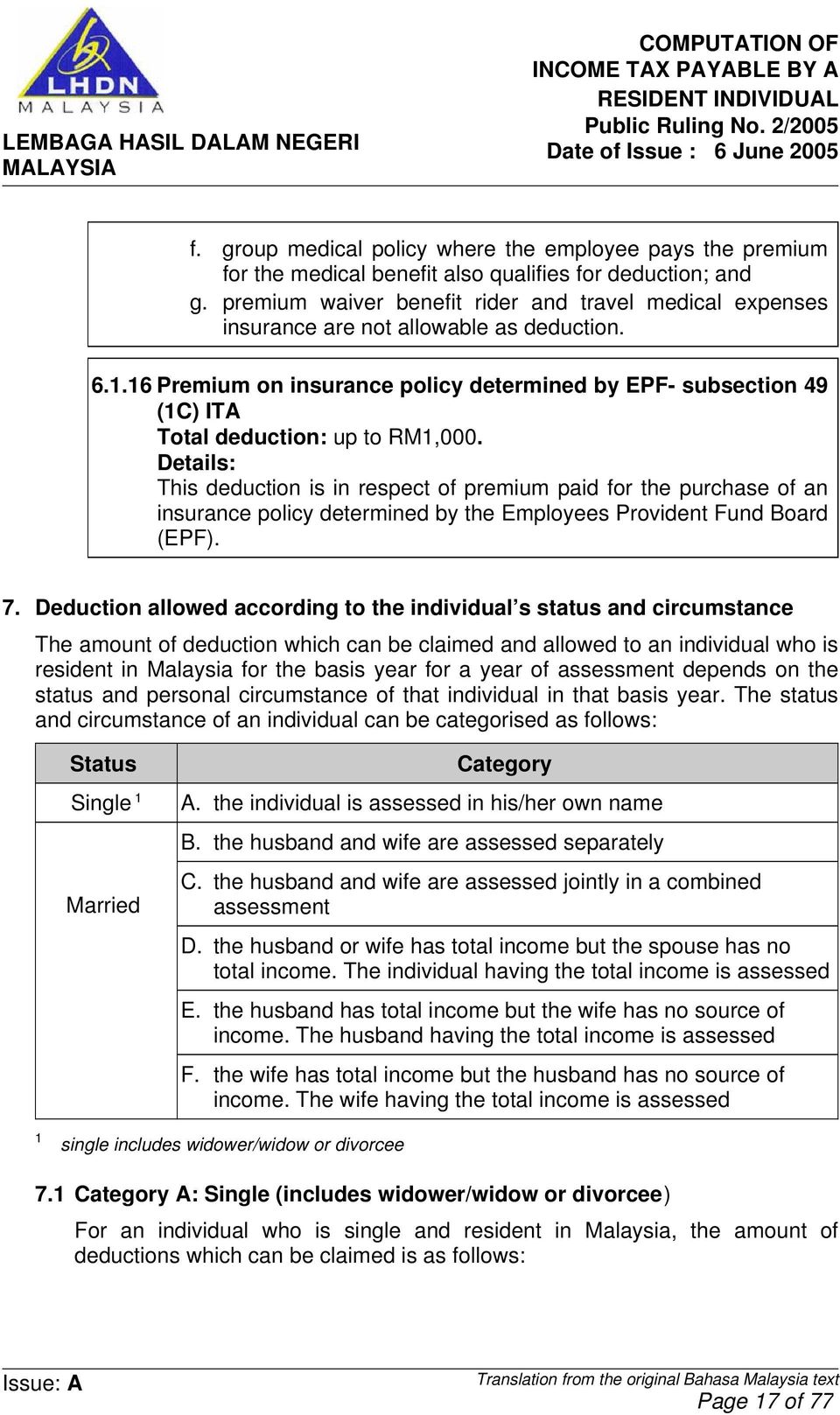
20 f. group medical policy where the employee pays the premium for the medical benefit also qualifies for deduction; and g. premium waiver benefit rider and travel medical expenses insurance are not allowable as deduction Premium on insurance policy determined by EPF- subsection 49 (1C) ITA Total deduction: up to RM1,000. Details: This deduction is in respect of premium paid for the purchase of an insurance policy determined by the Employees Provident Fund Board (EPF). 7. Deduction allowed according to the individual s status and circumstance The amount of deduction which can be claimed and allowed to an individual who is resident in Malaysia for the basis year for a year of assessment depends on the status and personal circumstance of that individual in that basis year. The status and circumstance of an individual can be categorised as follows: Status Single 1 Married Category A. the individual is assessed in his/her own name B. the husband and wife are assessed separately C. the husband and wife are assessed jointly in a combined assessment D. the husband or wife has total income but the spouse has no total income. The individual having the total income is assessed E. the husband has total income but the wife has no source of income. The husband having the total income is assessed F. the wife has total income but the husband has no source of income. The wife having the total income is assessed 1 single includes widower/widow or divorcee 7.1 Category A: Single (includes widower/widow or divorcee) For an individual who is single and resident in Malaysia, the amount of deductions which can be claimed is as follows: Page 17 of 77
21 Deduction Self and dependent relatives Medical expenses for parents Basic supporting equipment for self, parent, child Disabled person Education fees for self Treatment of serious disease for self or child Complete medical examination for self or child Purchase of books and magazines for self or child Interest on housing loan for self For a widower: deduction for wife who died in the basis year and further deduction for that wife if she is disabled; or For a divorcee: alimony to former wife Child - a. below 18 years old. b. 18 years of age and above - Studying in school, college or university/serving under articles/indentures in or outside Malaysia. c. Over 18 years of age - Studying in college or university/serving under articles/indentures in Malaysia. d. Disabled child. When there is a divorce, two or more individuals are entitled to claim deduction in respect of the same child. The deduction for the child to be allowed to each of the individuals is 50% of the allowable deduction Insurance premium and EPFcontribution for self Insurance premium for education and medical benefits for self or child Deduction Amount Limited to RM5,000 Limited to RM5,000 Limited to RM5,000 Limited to RM5,000 Limited to RM500 1 Limited to RM700 Refer Appendix B RM1,000 each child RM1,000 each child RM4,000 each child RM5,000 each child 50% of the allowable deduction Limited to RM6,000 Limited to RM3,000 Amount RM8,000 RM6,000 RM3,000 RM3,500 Limited to RM3,000 Page 18 of 77
22 Insurance premium through EPF for self Limited to RM1,000 1 Total deductions in paragraphs and are limited to RM5,000. Example 5 - deduction for alimony paid to former wife Lim was resident in Malaysia for the basis year He was divorced from his wife on in accordance with a Court Order. In 2004, Lim made alimony payments of RM10,000 to his former wife. Lim is allowed a deduction for alimony payments to his former wife limited to a maximum of RM3,000 for the year of assessment Example 6 - deduction for wife/further deduction for wife Derek and his wife were resident in Malaysia for the basis year His wife who was disabled for some time died on Even though Derek s wife died in 2004, he is still entitled to claim for the full deduction for wife amounting to RM3,000 and also for the further deduction for wife amounting to RM2, Category B: Married - the husband and wife are assessed separately Where the husband and wife have total income and each is being assessed separately in their own names as individuals, the amount of deductions which can be claimed by each individual is as follows: Deduction Self and dependent relatives Medical expenses for parents Basic supporting equipment for self, child or parent Disabled person for self Education fees for self Treatment of serious disease for self or child Complete medical examination for self or child Amount Husband Wife RM8,000 RM8,000 Limited to RM5,000 Limited to RM5,000 Limited to RM5,000 Limited to RM5,000 RM6,000 RM6,000 Limited to RM5,000 Limited to RM5,000 Limited to RM5,000 Limited to RM5,000 Limited to RM500 1 Limited to RM500 1 Page 19 of 77
23 Deduction Husband Amount Wife Purchase of books and magazines for self or child Limited to RM700 Limited to RM Interest on housing loan for self Alimony to former wife Child: Limited to RM3,000 Refer Appendix B - a. under 18 years of age. b. 18 years of age and above - Studying in school, college or university/serving under articles/indentures in or outside Malaysia. c. Above 18 years of age - Studying in college or university/serving under articles/indentures in Malaysia. d. Disabled child. Husband or wife: RM1,000 each child Husband or wife: RM1,000 each child Husband or wife: RM4,000 each child Husband or wife: RM5,000 each child Insurance premium and EPF contribution for self Insurance premium for education and medical benefit for self or child Limited to RM6,000 Limited to RM3,000 Limited to RM6,000 Limited to RM3, Insurance premium through EPF for self Limited to RM1,000 Limited to RM1,000 1 Total deductions in paragraphs and are limited to RM5, By default the husband and wife are assessed separately in their own names except where they elect to be assessed together. In the case where the wife is assessed separately in her name, the husband is not allowed a deduction for the wife (subsection 47(4) ITA). However, the husband is still entitled to claim a deduction for payments of alimony made to a former wife Page 20 of 77
24 (subsection 47(2) ITA). In the case where the husband is assessed separately in his name, the wife is not allowed a deduction for the husband. Example 7 - deduction for alimony to former wife Lim and his wife, Janet, were resident in Malaysia for the basis year Lim also has a former wife and he pays her an alimony of RM6,000 per annum. Lim and Janet have total income for the year ended as follows: Income Total income Lim (RM) 150,000 Janet (RM) 100,000 Lim is not entitled to a deduction for wife for the year of assessment 2004 as Janet - is assessed separately in her name; and qualifies for deduction for self of RM8,000. However, Lim qualifies for a deduction for alimony payments to his former wife, but is limited to a maximum of RM3,000. For Janet, she is not allowed a deduction for husband for the year of assessment 2004 as Lim - is assessed separately in his name; and qualifies for deduction for self of RM8, Example 8 - deduction for treatment of serious disease Lee and his wife were resident in Malaysia for the basis year 2004 and were assessed separately. They were employed in the year 2004 and expended medical expenses as follows: Expenses On himself for treatment of cancer On child for treatment of leukaemia Lee (RM) 4,000 3,000 Wife (RM) - 3,000 For the year of assessment 2004, Lee is entitled to make a claim for a maximum deduction of RM5,000 in relation to medical expenses expended by him on himself and their child. Meanwhile, Lee s wife is entitled to claim a deduction of RM3,000 expended by her on the child Where a wife is assessed separately in her own name, she must fill in the relevant parts of the Income Tax Form so that the appropriate deduction for the child be wholly allowed to her. Example 9 - deduction for children Manaf and his wife, were both resident and were employed in the basis year They have 3 children whose ages range from 4 to 12 years. Manaf s Page 21 of 77
25 wife did not elect for combined assessment and she claimed the deduction in respect of all the 3 children. The couple have income from the following sources for the year ended : Type of income Statutory income from employment Statutory income from rent Manaf (RM) 48,000 Wife (RM) 120,000 24,000 The computation of chargeable income for the year of assessment 2004 is as follows: Type of income/deduction Manaf (RM) Wife (RM) Statutory income from employment Statutory income from rent Aggregate income/total income Less: deductions Self Child Chargeable income 48, ,000 24,000 48, ,000 8,000 8,000 8,000 3, ,000 40, ,000 1 Deduction for children = 3 children X RM1,000 per child = RM3,000. Example 10 - deduction for children Nathan and his wife were resident in Malaysia and were employed in the basis year They have 7 children who are unmarried. Additional information relating to each child is as follows: No. Name of child Age at 1 Jan. Name of educational establishment RM Note 1. John 25 yrs 3 mths Univ. of W. Australia 15, Patrick 23 yrs 9 mths Univ. Bandung 10, Ken 22 yrs 1 mth Univ. Malaya 7, Jane 20 yrs 5 mths UKM 7, Mike 18 yrs exact SMK Taman Tun 3, Pauline 16 yrs 2 mths SMK Taman Tun 3, Mary 14 yrs 10mths nil 5,500 Down Syndrome Page 22 of 77
26 Nathan s wife did not elect for combined assessment. She made a claim for the 3 eldest children. Nathan and his wife have the following income for the year ended : Type of income Statutory income from employment Statutory income from rent Nathan (RM) 70,000 Wife (RM) 45,000 12,000 The computation of chargeable income for the year of assessment 2004 is: Particulars Statutory income from employment Statutory income from rent Total income/chargeable income Less: Self Child: First nil Second nil Third nil Fourth 4,000 Fifth 1,000 Sixth 1,000 Seventh (disabled child) 5,000 Chargeable income Nathan (RM) 8,000 11,000 70,000 70,000 19,000 51,000 1,000 1,000 4,000 nil nil nil nil 8,000 6,000 Wife (RM) 45,000 12,000 57,000 14,000 43, For an individual and his/her spouse who are resident and did not elect for combined assessment, each of them is entitled to claim RM6,000 (RM5,000 prior to Y/A2005) for the payment of insurance premium and contribution to an approved provident fund. Example 11 - deduction for insurance premiums and contribution to EPF Jerry and his wife Joyce, who were resident were assessed separately for the year of assessment In that basis year, they made payments of insurance premiums and contribution to an approved provident fund as follows: Page 23 of 77
27 Type of payment Insurance Premium paid Sum insured Contribution to EPF Jerry (RM) 2, ,000 5,000 Joyce (RM) 1,800 50,000 3,600 The total payments expended in the basis year 2004 are as follows: Premiums/contribution paid Jerry (RM) Joyce (RM) Insurance premium paid Contribution to EPF Total paid 2,500 5,000 7,500 1,800 3,600 5,400 Even though Jerry and Joyce paid RM7,500 and RM5,400 respectively, the amount of deduction that can be claimed for insurance premiums and contribution to EPF by Jerry and Joyce is limited to a maximum of RM5,000 each Where an individual and his/her spouse is assessed separately, each of them is entitled to claim for the payment of premiums for insurance on education or for medical benefits up to an amount of RM3,000 - (subsection 49(1B) ITA). Example 12 - deduction for education and medical insurance premium Mat and his wife were resident in Malaysia for the basis year For year ended , they have total income and paid insurance premiums as follows: Income/payment Total income Education insurance premium Medical insurance premium Mat (RM) 120,000 2,000 1,500 Wife (RM) 100,000 1,500 1,800 Education and medical insurance premium that can be claimed by Mat and his wife in computing the chargeable income for the year of assessment 2004 are: Page 24 of 77
28 Mat (RM) Wife (RM) Total income 120, ,000 Less: Education Insurance premium Medical insurance premium Actual amount paid Deduction allowed 2,000 1,500 3,500 3, ,500 1,800 3,300 3,000 1 Chargeable income 117,000 97,000 1 The amount of education and medical insurance premiums that can be claimed by Mat and his wife respectively is limited to RM3,000 - subsection 49(1B) Where an individual and his/her spouse are assessed separately, both are entitled to claim a deduction up to a maximum of RM1,000 each on the payment of insurance premium purchased through the EPF - (subsection 49(1C) ITA). Example 13 - deduction of insurance premium through EPF Wong and his wife, Alice who were resident in Malaysia for the basis year 2004, both have total income. They paid premiums for the purchase of insurance policies determined by the EPF amounting to RM1,200 each in the basis year Wong and Alice are entitled to a deduction for the payment of insurance premium purchased through EPF up to a maximum of RM1,000 each for the year of assessment Category C: Married - husband and wife are assessed jointly An individual who has total income is allowed to elect to be assessed together with his/her spouse pursuant to paragraph 45(2)(a) and 45(2)(b) ITA on condition that the spouse also has total income. The amount of deductions which that individual is entitled to claim is as follows: Deduction Self and dependent relatives Medical expenses for own parents Basic supporting equipment for self, spouse, child or parent. The amount expended by the spouse is deemed expended by the individual. Amount Husband or wife RM8,000 Limited to RM5,000 Limited to RM5,000 Page 25 of 77
29 Deduction Disabled person for self Education fees for self Amount Husband or wife RM6,000 Limited to RM5, Treatment of serious disease for self, spouse or child. The amount expended by the spouse is deemed expended by the individual Complete medical examination for self, spouse or child. The amount expended by the spouse is deemed expended by the individual Purchase of books and magazines for self, spouse or child. The amount expended by the spouse is deemed expended by the individual Interest on housing loan for self and spouse If the individual is the husband - deduction for wife/wives/alimony to former wife; and further deduction if wife is disabled. Or If the individual is the wife - deduction for husband; and further deduction if husband is disabled Child: a. under 18 years of age. b. 18 years of age and above - Studying in school, college or university/ serving under articles/indentures in or outside Malaysia. c. Over 18 years of age - Studying in college or university/serving under articles/indentures in Malaysia. d. Disabled child Insurance premium and EPF contribution for self and spouse Limited to RM5,000 Limited to RM500 1 Limited to RM700 Refer Appendix B Limited to RM3,000 RM3,500 RM3,000 RM3,500 RM1,000 each child RM1,000 each child RM4,000 each child RM5,000 each child Limited to RM6,000 Page 26 of 77
30 Deduction Insurance premium for education and medical benefits for self, spouse or child Insurance premium through EPF for self and spouse Amount Husband or wife Limited to RM3,000 Limited to RM1,000 1 Total deductions in paragraphs and are limited to RM5, In the case of a combined assessment, only the husband or wife in whose name the assessment is made can make a claim for the deduction for medical expenses expended in respect of his or her parents. Example 14 - deduction for medical expenses for parents Abu and his wife, were both resident in Malaysia for the basis year They have income from the following sources and expended expenses for year ended as follows: Income/expenses Statutory income from employment Statutory income from rent Medical expenses expended Abu (RM) 70,000 3,800 Wife (RM) 8,000 2,000 Abu s wife elect for a combined assessment under paragraph 45(2)(a) ITA. The deductions that can be claimed for the year of assessment 2004 are as follows: Combined assessment Income/ deduction Abu (RM) Wife (RM) Statutory income from employment 70,000 Statutory income from rent 8,000 Total income 70,000 8,000 Less: Total income of wife Husband s aggregate total income Less: Deduction Self and dependent relatives Medical expenses 70, ,000 = 78,000 8,000 3,800 8,000 Abu is only entitled to claim the deduction for medical expenses of RM3,800 expended by him on his parents. He is not entitled to the Page 27 of 77
31 deduction for medical expenses of RM2,000 expended by his wife on her parents In respect of the deduction for basic supporting equipment, where there is aggregation of total income under subsection 45(2) of the ITA, the amount expended by the spouse is deemed to have been expended by the individual limited to a maximum of RM5,000. However, where the husband elects for combined assessment under paragraph 45(2)(b) ITA, the amount expended by the husband is deemed to have been expended by the wife who is allowed a deduction for the husband under section 45A ITA. Example 15 - deduction for basic supporting equipment Tan and his wife were both resident in Malaysia for the basis year They have income from the following sources and expenses expended for year ended are as follows: Income/expenses Statutory income from employment Statutory income from rent Purchased basic supporting equipment for child Tan (RM) 60,000 1,000 Wife (RM) 30,000 8,000 6,000 Tan s wife elects for combined assessment under paragraph 45(2)(a) ITA. The deduction allowed for the year of assessment 2004 is computed as follows: Income/ deduction Statutory income from employment Statutory income from rent Total income Less: Total income of wife Husband s aggregate total income Less: Deduction Self & dependent relatives Basic supporting equipment Combined assessment Tan (RM) 60,000 60,000 60, ,000 = 98,000 8,000 5,000 Wife (RM) 30,000 8,000 38,000 38,000 The expenses expended for the purchase of basic supporting equipment by the wife are deemed to have been expended by Tan. However, the Page 28 of 77
32 amount that could be claimed by Tan is limited to a maximum of RM5, In respect of deduction for medical expenses for serious diseases, where there is aggregation of income under subsection 45(2) of the ITA, any amount expended by the wife who elects for combined assessment is deemed to have been expended by the husband. Similarly, where the husband elects for combined assessment, any amount expended by the husband is deemed to have been expended by the wife. Example 16 - deduction for medical expenses for serious diseases Amran and his wife, Nurul, were resident in Malaysia for the basis year They have the following income and expended expenses for the year ended as follows: Income/expenses Statutory income from employment Statutory income from rent Medical expenses on Amran suffering from a serious disease Amran (RM) 60,000 12,000 4,000 Nurul (RM) 30,000 3,000 Amran s wife elects for combined assessment for the year of assessment Deduction which can be allowed for the year of assessment 2004 is computed as follows: Income/ deduction Combined assessment Amran (RM) Nurul (RM) Statutory income from employment 60,000 30,000 Statutory income from rent 12,000 Total income 72,000 30,000 Less: Total income of wife Husband s aggregate total income income Less: Self and dependent relatives Treatment of serious disease 72, ,000 = 102,000 8,000 5,000 30,000 As Nurul has elected for aggregation of her total income with the total income of Amran, the amount expended by Nurul is deemed to have Page 29 of 77
33 been expended by Amran. Therefore, Amran is entitled to claim a maximum deduction of RM5,000 that is RM4,000 expended by him and RM1,000 expended by Nurul Where there is aggregation of income under subsection 45(2) of the ITA, expenses expended on complete medical examination by the husband or wife are deemed to have been expended by the wife or the husband in whose name the assessment is made. Example 17 - deduction for complete medical examination Soon and his wife, Annie, were resident in Malaysia for the basis year For the year of assessment 2004, Annie elects to be assessed jointly with Soon. They paid complete medical examination expenses as follows: Expenses Soon (RM) Annie (RM) Complete medical examination As Annie elected for combined assessment with Soon, the expenses of RM250 paid by Annie for complete medical examination are deemed to have been expended by Soon. As such, Soon is allowed a deduction of RM500 for the year of assessment 2004, that is RM300 expended by himself and RM200 which was expended by his wife In respect of deduction for the purchase of books, journals and magazines, where there is aggregation of total income under subsection 45(2) of the ITA, expenses expended by the husband or wife are deemed to have been expended by the wife or the husband in whose name the assessment is made. However, the amount of deduction allowed is limited to a maximum of RM700 which can be claimed by the husband or the wife in whose name the assessment is made. Note: Prior to the year of assessment 2005, the amount of deduction was RM500. Example 18 - deduction for the purchase of reading materials Mahmud and his wife were resident in Malaysia for the basis year They have total income and expended expenses for the year ended as follows: Income/expenses Mahmud (RM) Wife (RM) Total income School textbooks for child Magazines 60,000 2,000 50, Mahmud s wife elects for combined assessment. Page 30 of 77
34 Expenses for the purchase of magazines paid by the wife are deemed to have been expended by Mahmud. However, the amount that can be claimed by Mahmud is limited to a maximum of RM In the case of combined assessment, the deduction for wife under subsection 47(1) ITA or deduction for husband under section 45A, can be claimed by the husband or the wife in whose name the assessment is made. Example 19 Firdaus and Faridah were resident in Malaysia for the basis year They were married on and have sources of income for the year ended as follows: Income Business Adjusted income Capital allowance Statutory income from employment Statutory income from rent Firdaus (RM) 20,000 15,000 12,000 Faridah (RM) 84,000 Faridah elects for combined assessment with Firdaus for the year of assessment In determining whether deduction for wife can be given to Firdaus for the year of assessment 2004, it is necessary to confirm that the wife is entitled to elect for combined assessment with the husband and this is determined as follows: Income Firdaus (RM) Faridah (RM) Statutory income from business (20,000-15,000) 5,000 Statutory income from employment 84,000 Statutory income from rent Aggregate income/total income 12,000 17,000 84,000 As Faridah has total income, she is entitled to elect for combined assessment with her husband. Therefore, Firdaus qualifies for a deduction for wife of RM3,000. Example 20 Page 31 of 77
35 Yaacob and his wife, Ros. have income from the income from the following sources for the year ended : Income Statutory income from employment Statutory income from rent Yaacob (RM) 7,000 Ros (RM) 50,000 Yaacob elects for combined assessment pursuant to paragraph 45(2)(b) ITA. The computation of total income for the year of assessment 2004 is computed as follows: Income Statutory income from employment Statutory income from rent Total income Less: Total income of husband Add: total income of husband Wife s aggregate total income Yaacob (RM) 7,000 7,000 7,000 Ros (RM) 50,000 50,000 7,000 57,000 Since Yaacob has total income, he is allowed to elect for combined assessment in the name of his wife - (paragraph 45(2)(b) ITA). As such, Ros qualifies for a deduction for husband of RM3,000 for that year of assessment - (subsection 45A(b) ITA) Where the husband or the wife elects for combined assessment, only the wife or the husband in whose name the assessment is made qualifies for deduction for child provided all conditions as stated in paragraph are fulfilled. Example 21 Shah and his wife, Jehan, were resident in Malaysia for the basis year They have 5 children who are unmarried and information relating to each child is as follows: No. Name of Age at Name of educational Expenses Note Page 32 of 77
36 child Yahya Ismail Yusof Malik Rozila 1 Jan. 23 years 20 yrs 1 mth 18 yrs 4 mths 15 years 7 yrs 10 mths establishment Univ. of W. Australia Univ. Malaya UKM - matriculation SMK Taman Tun Wisma Harapan RM 20,000 7,000 2,000 3,000 3, Down Syndrome Shah elects for combined assessment. As such, Jehan is entitled to claim for deduction for child. Shah and Jehan have income for the year ended as follows: Type of income Statutory income from employment Statutory income from rent Shah (RM) 25,000 Jehan (RM) 70,000 12,000 The computation of chargeable income for Jehan for the year of assessment 2004 is: Particulars Shah Jehan (RM) (RM) Statutory income from employment 25,000 70,000 Statutory income from rent Total income Less: Total income Add: Husband s total income Jehan s aggregate total income Less: Deduction Self Husband Child: First Second Third Fourth Fifth Chargeable income 25,000 25,000 1,000 4,000 1,000 1,000 5,000 8,000 3,000 12,000 12,000 82,000 25, ,000 23,000 84, In respect of deduction for insurance premiums and contribution to approved employees provident fund, where the total income of the individual is aggregated with the total income of the spouse in a combined Page 33 of 77
37 assessment, the individual in whose name the assessment is made is entitled to claim a deduction up to a maximum of RM6,000 (RM5,000 prior to the year of assessment 2005). Where an election for combined assessment is made by the spouse, any amount paid by the spouse is deemed to have been paid by the individual - (paragraph 50(2)(a) and subsection 50(3) ITA). Example 22 Raj and his wife, Jothy were resident in Malaysia for the basis year Jothy elects for combined assessment with Raj. Raj and Jothy have total income for the year ended as follows: Income Total income Raj (RM) 120,000 Jothy (RM) 10,900 Raj and Jothy also made the following payments for the year ended : Type of payment Insurance: Policy 1: Sum insured on his own life Premium paid Policy 2: Sum insured on their joint lives Premium paid Policy 3: Sum insured on his own life Premium paid Contribution to EPF Raj (RM) 175,500 12, ,000 5,200 Not applicable 3,600 Jothy (RM) Not applicable Not applicable 50,000 3,600 1,200 The amount allowed to be claimed for the year of assessment 2004 is as follows: Premium/contribution paid Insurance premium Policy 1: Policy 2: Policy 3: Contribution to EPF Total payment Raj (RM) 12,500 5,200 3,600 21,300 Jothy (RM) 3,600 1,200 4,800 Page 34 of 77
38 As Jothy has elected for combined assessment with Raj, the amount of insurance premium and EPF contribution paid by Jothy is deemed to have been paid by Raj - (paragraph 50(2)(a) and subsection 50(3) ITA). Therefore, Raj is deemed to have paid an amount of RM21,300 + RM4,800 = RM26,100. However, he is entitled to a deduction of only RM5, In respect of deduction for insurance premium on education or for medical benefits, where the total income of the spouse is aggregated with the total income of the individual in a combined assessment, only that individual in whose name the assessment is made is allowed the deduction up to maximum of RM3,000 - (paragraph 49(1B)(b) ITA). Example 23 - deduction for education and medical insurance premiums Rudy and wife were resident in Malaysia for basis year For year ended , they have total income and paid insurance premiums as follows: Income/expenses Total income Insurance premium on education Insurance premium on medical benefits Rudy (RM) 80,000 2,000 1,800 Wife (RM) 70,000 1,500 1,500 Rudy s wife elects for combined assessment under paragraph 45(2)(a) ITA that her total income be aggregated with the total income of Rudy in an assessment to be made in her husband s name. Rudy is entitled to claim deduction for the premiums paid by the wife. However, the deduction for education and medical insurance premiums that can be claimed by Rudy is limited to RM3,000 only. Similarly, where Rudy elects for combined assessment in the wife s name - (paragraph 45(2)(b) ITA), his wife is entitiled to claim deduction for the premiums paid by Rudy. However, the deduction for the total insurance premiums is limited to RM3,000 only - (paragraph 49(1B)(b) ITA) Where the total income of the spouse is aggregated with the total income of the individual in a combined assessment, the individual in whose name the assessment is made is allowed to claim the deduction for insurance premium on policy purchased through EPF limited to a maximum of RM1,000 - (subsection 49(1C) ITA). Example 24 - deduction for insurance premiums through EPF Chew and his wife lived together and were resident in Malaysia for the basis year Chew s wife elects for combined assessment. Her total income Page 35 of 77
39 of RM20,000 is aggregated with the total income of Chew. They have insurance policies and paid premium as follows: Premium paid Education policy EPF insurance policy Chew (RM) Not applicable 3,000 Wife (RM) 1,500 Not applicable The tax treatment for the payment of premium on education insurance and insurance policy purchased through EPF for the year of assessment 2004 is as follows: a. Only Chew is allowed to claim for the deduction; and b. The amount that is allowed to Chew is - i. RM1,500 for annual premium on education policy paid by wife - subsection 49(1B) of the ITA; and ii. RM1,000 for premium policy insurance purchased through EPF paid by himself - subsection 49(1C) ITA. 7.4 Category D: Married - husband or wife has total income but the spouse has no total income Where the husband or wife has total income but the spouse has no total income, the assessment must be made in the name of the husband or wife who has total income. The amount of deductions that can be claimed by the husband or wife who is assessed as an individual is as follows: Self and dependent relatives Medical expenses for parents Basic supporting equipment for self, spouse, child or parent. The amount expended by the spouse is deemed expended by the individual Disabled person for self Education fees for self Deduction Treatment of serious disease for self, spouse or child. The amount expended by the spouse is deemed expended by the individual Complete medical examination for self, spouse or child. The amount expended by the spouse is deemed expended by the individual. Amount RM8,000 Limited to RM5,000 Limited to RM5,000 RM6,000 Limited to RM5,000 Limited to RM5,000 Limited to RM500 1 Page 36 of 77
40 Deduction Amount Purchase of books and magazines for self, spouse or child. The amount expended by the spouse is deemed expended by the individual Interest on housing loan for self. The amount expended by the spouse is deemed expended by the individual If the individual is the husband - deduction for wife/wives/alimony to former wife; and further deduction if wife is disabled. Or If the individual is the wife - deduction for husband; and further deduction if husband is disabled Child: a. under 18 years of age. b. 18 years of age and above - Studying in school, college or university/ serving under articles/indentures in or outside Malaysia. c. Over 18 years of age - Studying in college or university/serving under articles/indentures in Malaysia. d. Disabled child Insurance premium for self and spouse. The amount of premium expended by the spouse is deemed expended by the individual. Contribution to EPF for self Insurance premium for education and medical benefits for self, spouse or child. The amount expended by the spouse is deemed expended by the individual. Limited to RM700 Refer Appendix B Limited to RM3,000 RM3,500 RM3,000 RM3,500 RM1,000 each child RM1,000 each child RM4,000 each child RM5,000 each child Limited to RM6,000 Limited to RM3, Insurance premium through EPF for self and spouse. The amount expended by the spouse is Limited to RM1,000 deemed expended by the individual. 1 Total deductions in paragraphs and are limited to RM5, Claim for expenses in respect of - Page 37 of 77
41 i. Basic supporting equipment (paragraph 7.4.3); ii. Medical expenses for serious diseases (parargraph 7.4.6); iii. Complete medical examination (paragraph 7.4.7); and iv. Purchase of books and magazines (paragraph 7.4.8), the expenses expended by the husband or wife who has no total income are deemed to have been expended by the wife or husband who is assessed. However, the amount that can be claimed is subject to the respective limitations. Example 25 John and his wife, Sally were resident in Malaysia for the basis year In that basis year, John, suffered from diabetes resulting in the amputation of his leg. John and Sally have total income and paid the following expenses for the year ended : Income/expenses Total income Basic supporting equipment Treatment of serious diseases Complete medical examination Purchase of books and magazines John (RM) (business loss) 500 1, Sally (RM) 120,000 2,000 3, Even though John has no total income to be aggregated with Sally s total income, all the expenses expended by John are deemed to have been expended by Sally. The total deductions that can be claimed by Sally are as follows: Type of deduction Basic supporting equipment Treatment of serious disease Complete medical examination Purchase of books and magazines RM 2,500 Limited to 5,000 - RM500 is part of the deduction for treatment of serious disease Limited to RM500 Page 38 of 77
42 For an individual who is resident in Malaysia and has a wife who is living together with him in that basis year and the wife has no total income by reason of: i. loss from business; or ii. in respect of non-business source, the amount of expenditure exceeds the gross income, the husband is still entitled to claim for a deduction for wife of RM3,000. Subsection 47(5) ITA ensures that the right of the individual to a deduction for wife is not deprived. Example 26 - deduction for wife Elman and his wife, Elli were resident in Malaysia for the basis year They have income for year ended as follows: Income Employment Business (loss) Elman (RM) 80,000 Elli (RM) (15,000) The computation of total income for the year of assessment 2004 is: Elman Elli Total income (RM) 80,000 Even though, Elli is not allowed to be assessed jointly with the husband because she has no total income to be aggregated with that of her husband, however, her husband is still entitled to claim for a deduction for wife of RM3,000 for the year of assessment subsection 47(5) ITA. If Elli is a disabled person and is certified by the Department of Social Welfare, Elman is entitled to claim a further deduction for wife of RM3, The deduction for husband amounting to RM3,000 (with a further deduction of RM3,500 if the husband is disabled) is given to the wife where the husband has no total income because of business loss suffered or because the expenditure in relation to a non-business source exceeds the gross income. Where the husband has more than one wife, the deduction for husband can be allowed to one wife only - (proviso to section 45A ITA). Example 27 - deduction for husband Hafiz and his wife, Liza have income for the year ended as follows: Page 39 of 77
43 Income/loss Employment Rent (loss) Expenses exceed income Hafiz(RM) (6,000) Liza (RM) 45,000 The computation of total income for the year of assessment 2004 is as follows: Hafiz Liza Total income (RM) 45,000 Since Hafiz has no total income, Liza is allowed a deduction for husband amounting to RM3,000 for the year of assessment (subsection 45A(a) ITA). If Hafiz is a disabled person and this is certified by the Department of Social Welfare, a further deduction of RM3,500 is given to Liza. If Hafiz has more than one wife, the deduction for husband is allowed to one wife only Where the spouse has no total income, the amount of insurance premium is paid by the spouse is deemed to have been paid by the individual in whose name the assessment is made - (paragraph 50(2)(b) ITA). The amount which qualifies for deduction is limited to a maximum of RM6,000 (RM5,000 prior to the year of assessment 2005). Example 28 - deduction for insurance premium and EPF contribution Ali and his wife, living together in the basis year 2004 were resident in Malaysia. Ali has no total income as his business suffered a loss, while his wife has total income of RM120,000. They paid insurance premiums and made contributions to EPF for the year ended as follows: Insurance premium/epf contribution Policy 1: Sum insured on himself Premium paid Policy 2: Sum insured on their joint lives Premium paid Contribution to EPF Ali (RM) 10, Wife (RM) 30,000 2,000 13,200 Page 40 of 77
44 The amount of deduction for insurance premium and EPF contribution for the year of assessment 2004 can only be claimed by Ali s wife as: Ali has no total income; and his wife is entitled to deduction for husband under subsection 45A(a) ITA. As such, the insurance premiums of RM700 paid by Ali is deemed to have been paid by the wife - (paragraph 50(2)(b)ITA). However, the amount that can be claimed by Ali s wife is limited to RM5,000 only. Therefore, the chargeable income of Ali s wife for the year of assessment 2004 is as follows: Wife: Total income Less: Deduction for husband Self and dependent relatives Insurance premiums and EPF contributions Self (2, ,200) = 15,200 Husband ,900 limited to Chargeable income RM 3,000 8,000 5,000 RM 120,000 16, , Where the spouse has no total income, the amount of premiums on education and medical insurance policies expended by the spouse is deemed to have been expended by the individual in whose name the assessment is made - (paragraph 50(2)(b) ITA). The amount of deduction that can be claimed is limited to a maximum of RM3,000 - subsection 49(1B) ITA). Example 29 - deduction for education and medical insurance premiums Tay and his wife were resident in Malaysia for the basis year Tay has total income of RM150,000 while his wife has no total income as she suffered business loss. Tay and his wife paid premium on education and medical insurance policies as follows: Education policy - premium paid Medical policy - premium paid Tay (RM) 2, Wife (RM) 1,500 Page 41 of 77
45 The amount of premium on education and medical policies paid by Tay and his wife for year of assessment 2004 is: Tay Wife RM 2,360 1,500 Tay can claim the premiums on the education policy paid by his wife. Therefore, the amount of education and medical insurance premiums that can be claimed by Tay in computing the chargeable income for the year of assessment 2004 is: Total income Less: Self and dependent relatives Wife Insurance premiums: Education (2, ,500) = 3,500 Medical 360 3,860 limited to Chargeable income RM 8,000 3,000 3,000 RM 150,000 14, , Where the spouse has no total income because of business loss suffered or where the expenditure exceeds the gross income for a non-business source, the amount of premium paid on insurance policy determined by the EPF paid by the spouse is deemed to have been paid by the individual in whose name the assessment is made - (paragraph 50(2)(b) ITA). The amount of deduction allowed is limited to a maximum of RM1,000. Example 30 - deduction for insurance premium through EPF Velu and his wife were resident in Malaysia for the basis year They have a 12 year old child. For the year ended , Velu has employment income of RM140,000, while his wife suffered business loss of RM10,000. In that year, Velu paid premiums for insurance policies as follows: Page 42 of 77
46 Type of payment Insurance policy on self Paid by Velu (RM) Wife (RM) 1,500 Medical insurance policy for self & wife Education insurance policy - child Insurance policy through EPF 1,500 1,800 1,500 The deduction that can be claimed by Velu and the computation of chargeable income for the year of assessment 2004 are as follows: RM Total income 140,000 Less: deduction Self and dependent relatives 8,000 Wife 3,000 Child 1,000 Insurance premiums Life - paragraph 49(1)(a) ITA Medical & education - subsection 49(1B) ITA 1, ,500 = 3,300 limited to Policy through EPF - subsection 49(1C) ITA 1,500 limited to 1,500 3,000 1,000 5,500 17,500 Chargeable income 122, Category E: Married - husband has total income but the wife has no source of income. The husband having the total income is assessed. The husband who has total income but the wife has no source of income is entitled to claim deductions as follows: Deduction Self and dependent relatives Medical expenses for parents Basic supporting equipment for self, wife, child or parent Disabled person for self Husband RM8,000 Limited to RM5,000 Limited to RM5,000 RM6,000 Page 43 of 77
47 7.5.5 Education fees for self Deduction Husband Limited to RM5, Treatment of serious disease for self, wife or child Complete medical examination for self, wife or child Purchase of books and magazines for self, wife or child Interest on housing loan for self Wife/wives/alimony to former wife; and further deduction if wife is disabled Child: a. under 18 years of age. b. 18 years of age and above - Studying in school, college or university/ serving under articles/indentures in or outside Malaysia. c. Over 18 years of age - Studying in college or university/serving under articles/indentures in Malaysia. d. Disabled child Insurance premium and contribution to EPF for self Insurance premium for education and medical benefits for self or child Limited to RM5,000 Limited to RM500 1 Limited to RM700 Refer Appendix B Limited to RM3,000 RM3,500 RM1,000 each child RM1,000 each child RM4,000 each child RM5,000 each child Limited to RM6,000 Limited to RM3, Insurance premium through EPF for self Limited to RM1,000 1 Total deductions in paragraphs and are limited to RM5, Category F: Married - wife has total income but the husband has no source of income. The wife having the total income is assessed. The wife who has total income but the husband has no source of income is entitled to claim deductions as follows: Deduction Self and dependent relatives Wife RM8,000 Page 44 of 77
48 Deduction Medical expenses for parents Wife Limited to RM5, Basic supporting equipment for self, husband, child or parent Disabled person for self Education fees for self Treatment of serious disease for self, husband or child Complete medical examination for self, husband or child Purchase of books and magazines for self, husband or child Interest on housing loan for self Child: a. under 18 years of age. b. 18 years of age and above - Studying in school, college or university/ serving under articles/indentures in or outside Malaysia. c. Over 18 years of age - Studying in college or university/serving under articles/indentures in Malaysia. d. Disabled child Insurance premium and contribution to EPF for self Insurance premium for education and medical benefits for self or child Limited to RM5,000 RM6,000 Limited to RM5,000 Limited to RM5,000 Limited to RM500 1 Limited to RM700 Refer Appendix B RM1,000 each child RM1,000 each child RM4,000 each child RM5,000 each child Limited to RM6,000 Limited to RM3, Insurance premium through EPF for self Limited to RM1,000 1 Total deductions in paragraphs and are limited to RM5, In accordance with the provisions of ITA, the wife in this category is not entitled to the deduction for husband as the husband has no source of income. 8. Computation of Income Tax Page 45 of 77
49 8.1 After ascertaining the chargeable income, the next step is to compute the income tax payable by the individual/tax repayable to the individual. In the case of an individual who is resident, income tax shall be charged upon the chargeable income of the individual at scale rates as specified in Schedule 1 of the ITA - (see Appendix C). 8.2 The format for the computation of income tax payable/repayable is as follows: RM RM Chargeable income XXXXX Tax on the first XXXXX of chargeable income Tax on the balance XXXXX of chargeable XX % Income tax charged Less: Tax rebate Individual Spouse Zakat and fitrah Personal computer Fees Less: Tax credit Tax credit from dividends Bilateral credit on foreign income where there is a double taxation agreement Unilateral credit on foreign income where there is no double taxation agreement Income tax payable/repayable XX XX XX XX XX XX XX XX XX.XX XX.XX XX.XX XX.XX XX.XX XX.XX XX.XX 8.3 Tax Rebate Tax rebate is a type of deduction of tax given to an individual who is resident in Malaysia for the basis year for a year of assessment to reduce the amount of income tax payable by the individual. The amount of tax rebate is deducted from the income tax charged in ascertaining the tax payable. There are two types of tax rebates allowed, as follows - i. tax rebate which is given if the conditions laid down are fulfilled, irrespective of any expenses. This type of tax rebate is known as the personal rebate; and ii. tax rebate which is given when a taxpayer expended the actual expenses. This type of rebate is the rebate for zakat or fitrah, personal computer not used for the purposes of the business and payment of fees (levy) for employment pass, visit pass (temporary employment) or work pass. Page 46 of 77
50 8.3.2 Pursuant to subsection 6A(4) ITA, where in a year of assessment the tax rebate is greater than the income tax charged, the excess is not to be: i. refunded to the taxpayer; or ii. carried forward as a credit to be allowed against the individual s tax liability for subsequent years of assessment Personal rebate - subsection 6A(2) ITA An individual who is resident and has chargeable income for the basis year for a year of assessment is entitled to claim personal rebate as follows: i. for an individual who has been allowed a deduction for self and dependent relatives of RM8,000 under paragraph 46(1)(a) ITA and his chargeable income for the basis year does not exceed RM35,000, a rebate of RM350 is given to that individual. ii. for a husband who has been allowed a deduction for wife under subsection 47(1) or 47(2) ITA and his chargeable income for that basis year does not exceed RM35,000, a rebate of RM350 is given to that individual and RM350 for his wife. iii. for a wife who has been given a deduction for husband under section 45A ITA, (that is, husband has no total income or husband elects for combined assessment with his wife) and the chargeable income of the wife does not exceed RM35,000, a total rebate of RM700 is allowed that is a rebate of RM350 to her and RM350 for the husband. Example 31 - personal rebate Jane, who is resident in Malaysia for the basis year 2004 has employment income of RM40,000 for year ended In that year, she made contributions to the EPF amounting to RM440. The chargeable income for the year of assessment 2004 is determined as follows: RM RM Total income 40,000 Less: Deduction Self and dependent relatives - para 46(1)(a) ITA 8,000 EPF contribution - para 49(1)(b) ITA 440 8,440 Chargeable income 31,560 As Jane - is resident in Malaysia, is entitled to a deduction for self and dependent relatives under paragraph 46(1)(a) of the ITA, and Page 47 of 77
51 has chargeable income not exceeding RM35,000, she is entitled to a personal rebate of RM350 for the basis year Income tax payable by Jane for the year of assessment 2004 is - RM Tax on the first RM20,000 Tax on the balance RM11,560 X 7% Total income tax charged , Less: deduction Rebate for self - subsection 6A(2) ITA Income tax payable Example 32 - personal rebate Lee and his wife, resident for the basis year They have total income and made contribution to the EPF for year ended as follows: Total income Contribution to EPF Lee (RM) 39, Wife (RM) 24, The chargeable income for Lee and wife for the year of assessment 2004 respectively is determined as follows: Total income Less: deduction Lee (RM) 39,000 Wife (RM) 24,000 Self and dependent relatives 8,000 8,000 Contribution to EPF 429 8, ,264 Chargeable income 30,571 15,736 As Lee and wife respectively is - resident in Malaysia, entitled to a deduction for self under paragraph 46(1)(a) ITA, and has chargeable income not exceeding RM35,000, Lee and wife are entitled to a personal rebate of RM350 each. The income tax payable by Lee for the year of assessment 2004 is - Page 48 of 77
52 Tax on the first 20,000 Tax on the balance 10,571 X 7% Total income tax charged Less : Rebate for self - subsection 6A(2) ITA Income tax payable RM , The income tax payable by wife for the year of assessment 2004 is - Tax on the first 10,000 Tax on the balance 5,736 X 3% Total income tax charged Rebate for self - subsection 6A(2) ITA limited to Income tax payable RM However, the grant of rebate to the wife is limited to her total tax charged. The excess of RM2.92 cannot be refunded to her and is thus forfeited. Example 33 - personal rebate for self and spouse Rashdan and wife were resident in Malaysia for the basis year Rashdan has total income of RM25,000 while his wife has total income of RM15,000. Rashdan s wife elects for combined assessment with her husband under paragraph 45(2)(a) ITA for the year of assessment The chargeable income for the year of assessment 2004 is determined as follows - RM RM Total income of Rashdan Total income of wife Aggregate total income of Rashdan Less: deduction Self and dependent Wife Chargeable income 8,000 3,000 25,000 15,000 40,000 11,000 29,000 As Rashdan - is resident in Malaysia, qualifies for deduction for wife under paragraph 47(1)(a) ITA, and has chargeable income not exceeding RM35,000, Page 49 of 77
53 he is entitled to a personal rebate of RM700 that is RM350 for self and RM350 for wife. Income tax payable by Rashdan for the year of assessment 2004 is- RM RM Tax on the first 20, Tax on the balance 9,000 X 7% Total income tax charged Less: Personal rebate Self - paragraph 6A(2)(a) ITA Wife - paragraph 6A(2)(b) ITA Income tax payable Example 34 - personal rebate for self and spouse 1, Sai Yuk, who is resident in Malaysia for the basis year 2004 divorced his wife on Sai Yuk paid alimony of RM6,000 in 2004 to his former wife pursuant to a court order. The total income of Sai Yuk for the basis year 2004 is RM46,000. The chargeable income for the year of assessment 2004 is determined as follows: RM RM Total income 46,000 Less: deduction Self and dependent relatives 8,000 Alimony to former wife - para 47(2)(b) ITA 3,000 11,000 Chargeable income 35,000 As Sai Yuk- is resident in Malaysia, is entitled to a deduction for former wife under paragraph 47(2)(b) ITA, and has chargeable income not exceeding RM35,000, he is entitled to a personal rebate of RM700 that is RM350 for self and RM350 for wife. The income tax payable by Sai Yuk for the year of assessment 2004 is - RM RM Tax on the first 35,000 1, Less: Personal rebate Page 50 of 77
54 Self - paragraph 6A(2)(a) ITA Wife -paragraph 6A(2)(b) ITA Income tax payable Example 35 - personal rebate for self and spouse Faiz and his wife Faizah were resident in Malaysia for the basis year The total income of Faizah for the basis year 2004 is RM44,000 while Faiz has no total income (since the gross income from the rental source is smaller than the amount of expenses). The income tax payable by Faizah for the year of assessment 2004 is: RM RM Total income 44,000 Less: deduction Self and dependent relatives 8,000 Husband - subsection 45A(a) ITA 3,000 11,000 Chargeable income 33,000 Tax on the first 20,000 Tax on the balance 13,000 X 7% Total income tax charged Less: Personal rebate Self - paragraph 6A(2)(a) ITA Husband - paragraph 6A(2)(c) ITA Income tax payable , Example 36 - personal rebate for self and spouse Nizam and his wife, Nik, were resident in Malaysia for the basis year Nizam has total income of RM15,000 while his wife has total income of RM30,000. Nizam elects for combined assessment with his wife under paragraph 45(2)(b) ITA for the year of assessment As Nizam has elected to be assessed together with the wife for the year of assessment 2004, Nizam is treated as having no chargeable income for that year of assessment. The assessment for the year of assessment 2004 is in Nik s name. Nik s chargeable income for the year of assessment 2004 is computed as follows: RM Total income of individual 30,000 Total income of husband 15,000 Aggregate total income - para 45(2)(b) ITA 45,000 Page 51 of 77
55 Less: deduction Self and dependent relatives Husband - subsection 45A(b) ITA Chargeable income 8,000 3,000 11,000 34,000 As Nik - is resident in Malaysia, is entitled to deduction for husband under subsection 45A(b) of the ITA, and has chargeable income which is not exceeding RM35,000, she is entitled to a personal rebate of RM700 that is RM350 for self and RM350 for the husband. The income tax payable by Nik for the year of assessment 2004 is - RM Tax on the first 20, Tax on the balance 14,000 X 7% Total income tax charged 1, Less: Personal rebate Self - paragraph 6A(2)(a) ITA Husband - paragraph 6A(2)(c) ITA Income tax payable Tax rebate for zakat and fitrah payments - subsection 6A(3) ITA i. An individual taxpayer who is resident in Malaysia and has chargeable income is entitled to claim tax rebate for any zakat, fitrah and other Islamic dues, payment which is obligatory and which are paid to an appropriate religious authority established under any written law. The amount of the rebate allowed to the individual is limited to the total income tax charged for a year of assessment. The appropriate religious authority established under any written law includes Pusat Pungutan Zakat and Majlis Ugama Islam Negeri. Written law means legislative enactments or legislative instruments in force in Malaysia. iii. For an individual and wife who are assessed separately, each will be given tax rebate for zakat paid by them respectively. iii. In accordance with the provisions of the ITA, where - - the wife elects for combined assessment in the name of the husband; or - the husband elects for combined assessment in the name of the wife, Page 52 of 77
56 only the actual zakat payment made by the husband or wife who is assessed is allowed tax rebate. Therefore, the zakat payment made by the wife or the husband who elects for combined assessment is not allowed as tax rebate against the total tax charged of the spouse who is assessed. However, in practice, zakat payment made by the husband or wife who elects for combined assessment is allowed a tax rebate against the total tax charged of the spouse who is assessed. iv. In accordance with the provisions of the ITA, zakat paid by a wife who is unemployed and has no source of income or has no total income is not allowed a rebate against the tax charged on the husband. However, in practice, the zakat payment is allowed a tax rebate against the total tax charged of the husband. Example 37 - zakat payment made to appropriate religious authority Aboo and wife, were resident in Malaysia for the basis year Aboo s wife is unemployed. Aboo has total income and paid zakat for the basis year 2004 as follows: Total income Zakat paid to: Majlis Ugama Islam Selangor Zakat collection centre in Pakistan RM 5,000 5,000 RM 370,000 The computation of zakat and income tax payable for the year of assessment 2004 is: RM RM Total income 370,000 Less: Self and dependent relatives 8,000 Wife 3,000 11,000 Chargeable income 359,000 85, RM RM Tax on 250,000 54, Tax on the balance 109,000 X 28% 30, Total income tax charged Less: rebate for zakat 1 5, Income tax payable 80, Page 53 of 77
57 1 Only rebate for zakat paid to Majlis Ugama Islam Selangor is allowed a rebate. Payment of zakat made to the zakat collection centre in Pakistan will not be allowed a rebate as that zakat collection centre is not established under any written law in Malaysia. Example 38 - rebate for zakat to an individual Zakri and his wife were resident in Malaysia for the basis year Zakri has total income of RM45,000 for the year ended whereas his wife is unemployed. Zakri made payments as follows: i. Contribution to the EPF of RM4,950; and ii. Zakat and fitrah of RM450. The computation of rebate for zakat and income tax payable for the year of assessment 2004 is as follows: RM RM Total income 45,000 Less: deduction Self and dependent relatives 8,000 Wife 3,000 EPF contribution 4,950 15,950 Chargeable income 29,050 Tax on the first 20,000 Tax on the balance 9,050 X 7% Total income tax charged Less: Rebate Self - paragraph 6A(2)(a) ITA Wife - paragraph 6A(2)(b) ITA Zakat - subsection 6A(3) ITA Income tax payable , , Limited to 1 1, the excess rebate (RM1,150- RM1,108.50) = RM41.50 cannot be refunded or carried forward as a credit to be allowed against income tax liability charged on Zakri for subsequent years of assessment.. Example 39 - rebate for zakat where spouse has no source of income Isa and his wife were resident in Malaysia for basis year Isa has total income of RM65,000 for year ended while his wife is unemployed. Isa and wife paid zakat as follows: RM Page 54 of 77
58 Isa Wife 1,500 1,000 The income tax payable for year of assessment 2004 is: Total income Less: deduction Self and dependent relatives Wife Chargeable income Tax on the first 50,000 Tax on the balance 4,000 at 19% Total tax charged Less: tax rebate Zakat - subsection 6A(3) ITA Husband Wife 1 Income tax payable 8,000 3,000 1,500 1,000 RM RM 65,000 11,000 54,000 3, , , , In practice, zakat paid by the wife is allowed a rebate against the total tax charged of the husband. Example 40 - rebate for zakat where spouse has no total income Alimin and his wife were resident in Malaysia for the basis year They have income and paid zakat for the basis year 2004 as follows: Total income Zakat Alimin (RM) - (business loss 10,000) 100 Wife (RM) 45, The computation of rebate for zakat and income tax payable by the wife for the year of assessment 2004 is as follows: RM RM Total income 45,000 Less: deduction Self and dependent relatives 8,000 Husband - subsection 45A(a) ITA 3,000 11,000 Page 55 of 77
59 Chargeable income Tax on the first 20,000 Tax on the balance 14,000 X 7% Total income tax charged Less: tax rebate Self - paragraph 6A(2)(a) ITA Husband - paragraph 6A(2)(c) ITA Zakat Income tax payable , , , Only the zakat which is paid by the wife is allowed a deduction against the tax charged on the wife. Zakat paid by the husband will not be allowed against the tax charged on the wife. Example 41 - rebate for zakat in the case of separate assessment Othman and his wife were resident in Malaysia for the basis year Othman has total income of RM50,000 while the total income of his wife is RM28,000. Othman paid zakat of RM300 while his wife paid zakat of RM200. The computation of chargeable income and income tax payable by Othman and wife for the year of assessment 2004 is as follows: Husband (RM) Wife (RM) Total income 50,000 28,000 Less: deduction Self and dependent relatives 8,000 8,000 Chargeable income 42,000 20,000 Total income tax charged 2, Less: tax rebate Self - paragraph 6A(2)(a) ITA Zakat - subsection 6A(3) ITA Income tax payable 2, The rebate which can be claimed by the wife is limited to the amount of income tax payable. Example 42 - rebate of zakat in the case of combined assessment Mustaffa and his wife were resident in Malaysia for the basis year Mustaffa s wife has total income and elects for combined assessment with her husband. They have total income and paid zakat for the basis year 2004 as follows: Page 56 of 77
60 Total income Zakat Mustaffa (RM) 30, Wife (RM) 10, The computation of rebate for zakat and income tax payable for the year of assessment 2004 is as follows: Total income Add: total income of wife Aggregate of total income - paragraph 45(2)(a) ITA Less: deduction Self and dependent relatives Wife Chargeable income Mustaffa (RM) 30,000 10,000 40,000 8,000 3,000 11,000 29,000 Tax on 20,000 Tax on the balance 9,000 X 7% Total income tax charged Less: tax rebate Self - paragraph 6A(2)(a) ITA Wife - paragraph 6A(2)(b) ITA Rebate for zakat , Limited to Income tax payable , , In practice, the zakat paid by the wife qualifies for rebate against tax charged of the husband. 2 The amount of rebate allowed is limited to the amount of income tax chargedsubsection 6A(4) ITA Tax rebate for purchase of personal computer - subsection 6A(3A) ITA An individual who is resident is entitled to claim for a tax rebate in respect of the purchase of a personal computer which is not used for the purposes of his business. Personal computer includes laptop and desktop but does not include palmtop, Personal Digital Assistant (PDA) and its equivalent. However, the amount of tax rebate that can be allowed is limited to a maximum of RM500 for the husband or the wife and can only be given once in every five years. Prior to the year of assessment 2005, the tax rebate allowed to an individual who is resident in respect of the purchase of personal computer was RM400. Page 57 of 77
61 Example 43 - rebate for the purchase of personal computer Lee purchased a personal computer for RM5,000 on 15 May 2004 for his personal use. On 2 January 2005, his wife purchased another personal computer for RM3,500. At the same time, Lee added some accessories and upgraded his computer at the cost of RM3,000. For the year of assessment 2004, Lee is entitled to a rebate of RM400 in respect of the purchase of the personal computer for his personal use in computing the tax charged on him. However, for the year of assessment 2005, Lee and his wife, even though assessed separately, will not be granted the tax rebate for - the amount expended on the accessories and upgrading of Lee s computer; and the purchase of another personal computer by the wife. Example 44 - purchase of personal computer under hire purchase Siva purchased a personal computer under hire purchase arrangements. He paid an initial deposit of RM1,000 on 2 January 2005 and will pay monthly instalments of RM500 for a period of twelve (12) months. The instalment payments commenced on 2 February 2005 and will end on 2 January Siva is entitled to a rebate of RM500 in computing the tax charged on him for the year of assessment 2005 in respect of the purchase of a personal computer. However, he is not entitled to any further rebate until the year of assessment Example 45 - receipt for the purchase of personal computer issued in the name of child Nora, who is resident in Malaysia for the basis year 2004, has employment income of RM50,000 for the year ended She expended expenses as follows: EPF contributions of RM5,500; maintainence of child over the age of 18 years studying at a local university - RM12,000; and purchased a personal computer - RM7,000 (receipt issued in the name of her child who is studying at the university). The tax computation for the year of assessment 2004 is as follows: RM RM Employment/Total income 50,000 Less: deduction Self and dependent relatives 8,000 Child RM1,000 X 4 4,000 EPF contribution RM5,500 limited to 5,000 17,000 Page 58 of 77
62 Chargeable income 33,000 Tax on the first 20,000 Tax on the balance 13,000 X 7% Total tax charged Less: Rebate Self - para 6A(2)(a) ITA Purchase of computer - subsection 6A(3A) ITA Income tax payable , the rebate in respect of the purchase of personal computer is given to Nora even though the receipt is issued in the name of her child Tax rebate on fees paid by foreign workers - section 6C ITA An individual who is resident is entitled to a tax rebate in respect of fees (referred to as levy by the Immigration Department of Malaysia) paid to the government for the issue of an employment pass, visiting pass or work pass in the basis year for that year of assessment. If the payment for the fees exceeds the income tax charged, the excess shall neither be refunded to the individual nor be available as a credit to set off his tax liability for any subsequent year of assessment. The fees paid for the basis year for a year of assessment is rebated prior to any set-off made under section 110 ITA. This tax rebate is usually claimed by a non-citizen foreign worker who works in Malaysia with an employment pass or working pass issued by the Immigration Department of Malaysia. Example 46 - tax rebate on fees George, a foreigner is working in Malaysia on an employment pass issued by the Immigration Department of Malaysia on On his passport is clearly stamped the following particulars: For employment as Site Engineer With Company ABC Sdn Bhd in Peninsular Malaysia only Employment Pass RM1,100 Levy Paid RM1,200 Receipt No. XXXXXX George is entitled to claim a rebate of RM1,200 for the year of assessment 2004 in respect of the levy paid by him to the Immigration Department of Malaysia. Page 59 of 77
63 If the income tax charged on George for the year of assessment 2004 is RM1,000, the rebate he is entitled to claim for the year of assessment 2004 is computed as follows: RM Total income tax charged 1, Less: Rebate sec 6C ITA - levy of RM1,200 is limited to Income tax payable 1, The balance of levy paid RM200 will not be available as a credit to set-off his tax liability for any subsequent year of assessment. 9. Deduction of tax credit from dividends - section 110 ITA Upon payment of a dividend to a shareholder, the company shall deduct tax from the amount of dividend income declared. Tax deducted on the dividend income by the company is given as a tax credit to the shareholder or that individual in computing his income tax payable. Where the tax credit on the dividend exceeds the total tax charged, the excess shall be refunded to the individual. Example 47 Razif and his wife, Rozie, resident in Malaysia for the basis year 2004, have income from employment and dividend and they made payments for the year ended as follows: Income/payment Employment Gross dividend (Malaysia) EPF contribution Zakat to PPZ, W.P, Kuala Lumpur Razif (RM) 49,000 5, Wife (RM) 2,000 Rozie elects for her total income to be aggregated with the total income of her husband in a combined assessment. The computation of chargeable income of Razif for the year of assessment 2004 is: Employment Gross dividend Razif (RM) 49,000 Wife (RM) 2,000 Page 60 of 77
64 Total income Less: Total income of wife Add: Total income of wife Aggregate total income of Razif Less: deduction Self and dependent relatives Wife EPF contribution RM5,500 limited to Chargeable income 49,000 2,000 51,000 8,000 3,000 5,000 16,000 35,000 2,000 2,000 The computation of tax repayable to Razif for the year of assessment 2004 is: RM RM Tax charged on RM35,000 Less: deduction for rebate Personal rebate - para 6A(2)(a) & (b) ITA Self Wife Rebate for zakat Less: tax credit from dividend 2,000 X 28% Tax repayable , , In the case of combined assessment, subsection 110(12)ITA enabled the excess of tax credit from the wife s dividend to be given to the husband. Example 48 Amanda who is resident in Malaysia for the basis year 2004 has sources of income for the year ended as follows: Income RM Employment 54,000 Page 61 of 77
65 Gross dividend (Malaysian) 1,000 She also expended expenses as follows: contributions to EPF of RM5,940; maintenance of 2 children over the age of 18 studying at local universities - RM 12,500; and purchase of a personal computer - RM5,000. The computation of income tax payable for the year of assessment 2004 is: RM RM Employment Gross dividend (Malaysian) Total income Less: deduction Self and dependent relatives Child RM1,000 x 4 x 2 Contributions to EPF RM5,940 limited to Chargeable income 8,000 8,000 5,000 54,000 1,000 55,000 21,000 34,000 Tax on the first 20,000 Tax on the balance 14,000 at 7% Total tax charged Less : Rebate Self - paragraph 6A(2)(a) ITA Purchase of computer - subsection 6A(3A) ITA Less: tax credit from dividend (1,000 X 28%) Income tax payable , Bilateral credit - section 132 ITA 10.1 Bilateral credit can be claimed by an individual who is resident in Malaysia when the same income is taxed twice for the same year of assessment, that is that income is taxed in the country in which the income arises and again in Page 62 of 77
66 the country in which the individual receiving the income is resident, and Malaysia has entered into double taxation agreement with that country The computation of this credit is as follows: Malaysian tax payable before bilateral credit X Foreign income charged to tax twice Total income for the year of assessment or Foreign tax charged in respect of the foreign income charged to tax twice whichever is the lower 11. Unilateral credit - section 133 ITA 11.1 Unilateral credit can be claimed by an individual whether or not he is resident in Malaysia when the same income is taxed twice for the same year of assessment, that is that income is taxed in the country in which the income arises and again in the country in which the individual received the income, and Malaysia has no double taxation agreement with that country The computation of this credit is as in paragraph 10.2 except that the credit allowed shall not exceed half the foreign tax payable on that income for that year. 12.Payment of husband/wife s tax in combined assessment Where there is aggregation of the total income of the husband and the wife in a combined assessment, the individual in whose name the assessment is made is responsible to pay the tax. However, where necessary, the portion of tax applicable to either the wife s or the husband s income may be collected from either one of them in accordance with the following formula: Tax charged on the husband/wife = Total income of husband/wife Aggregate total income of husband/wife X Total tax charged on the husband/wife for the relevant year of assessment 13. Proof of payment Receipts and other supporting documents relating to claims made need not be submitted together with the Income Tax Forms. However, these receipts and documents should be kept in safe custody for a period of seven (7) years from the Page 63 of 77
67 end of the year of assessment in which the Income Tax Form is furnished for audit purposes. Where there is a refund of excess tax, the original dividend vouchers shall be submitted to the LHDN together with the Income Tax Form. 15.This Ruling is effective for the year of assessment 2004 and subsequent years of assessment. Director General of Inland Revenue DETERMINATION OF RESIDENCE STATUS APPENDIX A 1. The residence status of an individual is determined by reference to the duration of stay of that individual in Malaysia for a basis year for a year of assessment. In Page 64 of 77
68 certain situations, the duration of stay for the basis years preceding and basis years following a particular year of assessment has also to be taken into consideration. 2. There are 4 sets of circumstances in which an individual is resident in Malaysia for the basis year for a year of assessment. If in any particular basis year the individual does not fall within any of these sets of circumstances, then he is not resident for that basis year. 3. In calculating the number of days an individual is in Malaysia, any part of a day is counted as one full day. Example 1 Woods arrived in Malaysia at pm on and left Malaysia at 2.00 am on Woods would have been in Malaysia for 11 days. 4. Circumstances determining residence status There are 4 sets of circumstances which determine the residence status of an individual as provided for in section 7 of the ITA. 4.1 Paragraph 7(1)(a) ITA If an individual is in Malaysia in that basis year for a period or periods amounting in all to 182 or more days, he is resident in Malaysia for that basis year. Example 2 Augustin was in Malaysia from to (214 days). Augustin is resident in Malaysia for the basis year for the year of assessment The period in which the individual is in Malaysia does not have to be consecutive days. Example 3 Angeline was in Malaysia for the following periods: Period Number of days Total number of days to days) = 183 days to days) Angeline is resident in Malaysia for the basis year for the year of assessment Paragraph 7(1)(b) ITA Page 65 of 77
69 4.2.1 If an individual is in Malaysia in a basis year for a period of less than 182 days but the period during which he is in Malaysia in that basis year is linked by or to: another period of 182 or more consecutive days in the basis year for the year of assessment preceding that particular year of assessment; or another period of 182 or more consecutive days in that basis year for the year of assessment immediately following that particular year of assessment; therefore that individual is resident in Malaysia for the basis year for that year of assessment even though he is in Malaysia for a period of less than 182 days In calculating the period of 182 or more consecutive days, relaxation of the requirement is given where the period of temporary absence (period during which an individual is not in Malaysia) shall be taken to form part of the period: of less than 182 days; and/or 182 or more consecutive days, for the purpose of linking the two periods provided that the individual must be in Malaysia immediately prior to and after that temporary absence. Temporary absences allowed are - i. absence which is connected with the individual s service in Malaysia such as attending conferences or seminars or study abroad; ii. absence owing to ill-health involving the individual or a member of his immediate family (immediate family means parent, spouse and children); and iii. absence in respect of social visits not exceeding 14 days in the aggregate (social visits include any form of vacation outside Malaysia besides vacation to home country). Example 4 Benson was in Malaysia and England for the following periods: Year Period of stay Number of days Page 66 of 77
70 (in Malaysia) (in England) (in England) (in Malaysia) (social visit) 2 (social visit) 88 Benson left Malaysia on 1 April Benson is resident for the year of assessment 2005 for the following reasons: i. Benson s absence in Malaysia on and is regarded as temporary absence ; ii. He fulfills the requirement of temporary absence in respect of social visit not exceeding14 days; and iii. He was in Malaysia before and after his temporary absence. Example 5 Kim arrived in Malaysia on 5 January Her employment contract in Malaysia was for one year ending on 4 January On 23 December 2004, Kim left for Seoul to visit her family and never returned to Malaysia after that. Even though Kim was away from Malaysia on social visit for less than 14 days, that period is not regarded as temporary absence since she was not in Malaysia after her absence. Therefore, she is not resident in Malaysia for the basis year for the year of assessment Example 6 Using Example 5 above, Kim returned to Malaysia on 4 January 2005 before leaving for Seoul 2 days later. The period between 23 December 2004 to 4 January 2005 (13 days) is regarded as temporary absence as Kim was present in Malaysia after her absence. She is resident in Malaysia for the basis year for the year of assessment Example 7 Hughes has the following period of stay in Malaysia, Singapore and USA: Year Period of stay Number of days Page 67 of 77
71 (Malaysia) (Singapore) (Malaysia) (USA) (USA) (Malaysia) 22 6 (social visit) 1 2 (social visit) 10 (social visit) 355 Hughes is resident in Malaysia for the basis year for the year of assessment 2004 as the period between 30 December 2004 to 10 January 2005 is considered as temporary absence. The period between 23 to 28 December 2004 is not considered as part of the period that linked the two years. Example 8 Takayama commenced employment on 10 September 2004 and has the following period of stay in Malaysia and Japan: Year Period of stay (Malaysia) (Japan) (Japan) Number of days (social visit) 3 (social visit) 362 Takayama is not a resident for the basis year for the year of assessment 2004 as he was out of Malaysia for 20 days (exceeding the limit of 14 days). If Takayama had left Malaysia on 17 December 2004 and returned to Malaysia on 1 January 2005, the period from 18 December 2004 to 31 December 2004 can be regarded as temporary absence. Takayama cannot leave Malaysia again for the purpose of social visit until after 1 July 2005 (that is after a period of at least 182 consecutive days) since the period of temporary absence has been used up in the year If Takayama had left Malaysia for the purpose of social visit before 1 July 2005, then the period between 1 January 2005 to 1 July 2005 cannot be regarded as consecutive. In this case Takayama will not be resident in Malaysia for the basis year for the year of assessment Paragraph 7(1)(c) ITA If an individual is in Malaysia in a particular basis year for a period or periods amounting in all to 90 days or more (the days need not be consecutive days), he is resident in Malaysia for that particular year of Page 68 of 77
72 assessment if in each of any three out of four immediately preceding basis years he was: i. resident in accordance with section 7 of the ITA; or ii. in Malaysia for a period or periods amounting in all to ninety days or more. Example 9 Jemina has the following periods of stay in Malaysia: Year Period of stay (51) (61) Number of days = 112 The residence status of Jemina is as follows: Basis year Residence status Paragraph 2000 Not resident Not resident Resident 7(1)(a) ITA 2003 Resident 7(1)(a) ITA 2004 Resident 7(1)(c) ITA For the basis year 2004, Jemina is resident by virtue of paragraph 7(1)(c) as she - was in Malaysia for a period or periods amounting in all to 90 days or more in the basis year 2004 (112 days): and was resident (basis year 2002 and 2003) or was in Malaysia for 90 days or more in any three (basis year 2003, 2002 and 2000) out of four immediately preceding basis years. Example 10 Watson has the following periods of stay in Malaysia: Year Period of stay in Malaysia Number of days (31) = 92 Page 69 of 77
73 (61) The residence status of Watson is as follows: Basis year Residence status Not resident Not resident Not resident Not resident Resident Paragraph (1)(c) ITA For basis year 2004, Watson is resident by virtue of paragraph 7(1)(c) of the ITA as - he was in Malaysia for a period or periods amounting in all to 90 days or more (that is 122 days); and for three out of four immediately preceding basis years, he was in Malaysia for a period or periods amounting in all to 90 days or more (basis years 2001, 2002, 2003) An individual need not be resident in Malaysia for all three or four immediately preceding basis years. It will suffice if he is resident for two of those basis years and present in Malaysia for 90 days or more in one of the other basis years. Example 11 Peters has the following periods of stay in Malaysia: Year Period of stay in Malaysia Number of days The residence status of Peters is as follows: Basis year Residence status 2000 Not resident 2001 Resident Paragraph - 7(1)(a) ITA Page 70 of 77
74 Resident Not resident Resident 7(1)(b) ITA - 7(1)(c) ITA For the basis year 2004 Peters is resident by virtue of pargraph 7(1)(c) of the ITA as: he was in Malaysia for a period or periods amounting in all to 90 days or more in that basis year; and In three out of four immediately preceding basis years he was resident (basis year 2002 and 2001) or was in Malaysia for 90 days or more (basis year 2003). 4.4 Paragraph 7(1)(d) ITA An individual is considered to be resident for a basis year if he is resident for the immediately following basis year and had been resident for the three immediately preceding basis years. Therefore, an individual can be resident by virtue of paragraph 7(1)(d) of the ITA even though he might never actually have been in Malaysia at all during that basis year. Example 12 Nicholas has the following period of stay in Malaysia: Year Period of stay in Malaysia Number of days The residence status of Nicholas is as follows: Basis year Residence status Paragraph 2000 Resident 7(1)(b) ITA 2001 Resident 7(1)(a) ITA 2002 Resident 7(1)(a) ITA 2003 Resident 7(1)(d) ITA 2004 Resident 7(1)(a) ITA Example 13 Stanley has the following periods of stay in Malaysia: Year Period of stay in Malaysia Number of days Page 71 of 77
75 Was not in Malaysia The residence status of Stanley is as follows: Basis year Residence status 2000 Resident 2001 Resident 2002 Resident 2003 Resident 2004 Resident Paragraph 7(1)(a) ITA 7(1)(a) ITA 7(1)(b) ITA 7(1)(d) ITA 7(1)(a) ITA Even though Stanley was never actually in Malaysia for the basis year 2003, he is resident for that basis year as he - is resident for the basis year 2004, that is the following basis year; and is resident for each of the three immediately preceding basis years that is basis year 2000, 2001 and DEDUCTION FOR INTEREST EXPENDED ON HOUSING LOAN 1. Qualifying conditions APPENDIX B Page 72 of 77
76 An individual who is resident in Malaysia shall be allowed a deduction in respect of interest expended to finance the purchase of a residential property subject to the following conditions: i. The residential property is the first residential property purchased to be occupied as his place of residence. First residential property includes a second residential property purchased following the disposal of a low cost property by him. Low cost property means the only residential property owned and held for not less than 5 years and costing not more than RM42,000. ii. iii. iv. Example 1 Ali bought a low cost residential property costing RM35,000 on 2 January 1996 and later sold it on 2 March Subsequently, Ali bought another residential property at a cost of RM130,000 from a housing developer. The Sale and Purchase Agreement was signed on 1 July Ali was resident in Malaysia for the basis year Ali qualifies to claim a deduction on interest expenditure on loan taken to finance the purchase of the second residential property since the low cost residential property previously owned by him had been sold. The residential property has to be purchased from a housing developer or a statutory body or a co-operative society. Residential property means a completed house, condominium unit, apartment or flat which had been built as a dwelling house. Housing developer means a housing developer licensed under the Housing Development (Control and Licensing) Act Statutory body means a body incorporated by a State or Federal law. Co-operative society means a co-operative society registered or deemed to be registered under the Co-operative Societies Act The purchase price of the residential property shall not be less than RM100,000 and not more than RM180,000. The Sale and Purchase Agreement must be executed within the period 1 June 2003 to 31 May Example 2 Bakar, resident in Malaysia for the basis year 2003, bought a residential property costing RM150,000 from a co-operative society. The Sale and Purchase Agreement was signed on 1 May The purchase of the house Page 73 of 77
77 was financed by a housing loan. Bakar started paying interest on the loan taken from July Bakar does not qualify for deduction on the interest expended since the Sale and Purchase Agreement was signed before 1 June Example 3 Chai Yean, resident in Malaysia for the basis year 2003, bought a residential property costing RM170,000 from a housing developer. The Sale and Purchase Agreement was signed on 1 July The purchase of the house was financed by a housing loan. Chai Yean paid interest on the loan starting from 1 September For the year of assessment 2003, Chai Yean qualifies to claim for deduction on the interest expended from the month of September to December 2003 since the Sale and Purchase Agreement was signed after 1 June 2003 but not later than 31 May Amount of deduction The amount of interest allowable as a deduction is as follows: i. RM5,000 for the year of assessment 2003; ii. RM3,000 for the year of assessment 2004; and iii. RM2,000 for the year of assessment Example 4 Daniel, resident in Malaysia for the basis year 2003, bought a residential property costing RM140,000 on 15 June 2003 from Perbadanan Kemajuan Negeri Selangor (PKNS). The purchase of the house was financed by a housing loan. He paid interest amounting to RM3,500 on the loan from July to December Daniel qualifies to claim deduction of the whole RM3,500 in the year of assessment Example 5 Following from Example 4, Daniel paid interest amounting to RM6,000 in the year 2004 and RM5,500 in the year Daniel qualifies to claim only RM3,000 for the year of assessment 2004 and RM2,000 in year of assessment Claim by two or more individuals Where two or more individuals are each entitled to claim deduction for a residential property and the total amount of interest expended by those individuals exceed the Page 74 of 77
78 amount allowable in that year, the amount allowed to each individual for each year of assessment is determined as follows: Amount of interest allowed for that relevant year X Total interest expended by the individual in that relevant year Total interest expended by all such individuals in that relevant year Example 6 Shakira and Amir shared the purchase of a completed residential property costing RM150,000 from a housing developer. The Sale and Purchase Agreement was signed on 31 July They took separate housing loans and paid interest on the loans respectively. The total interest expended and entitled to be claimed as a deduction by Shakira and Amir are as follows: Year of assessment Expended Entitled to claim Expended Entitled to claim Shakira (RM) 2,500 2,500 4,000 3,000 X 4,000 7,500 = 1,600 Amir (RM) 2,000 2,000 3,500 3,000 X 3,500 7,500 = 1,400 Total (RM) 4,500 4,500 7,500 3,000 If Shakira and Amir took up a single housing loan on their names (a single loan account on both names), each of them is also entitled to claim for a deduction on interest expended based on the amount of interest paid by them in accordance with the above formula. 4. Claim by husband or wife Where a wife or husband elects for a combined assessment under subsection 45(2) of the ITA, the interest expended by the wife or the husband shall be deemed to have been expended by the husband of the wife who elects for combined assessment or the wife of the husband who elects for combined assessment. Example 7 Suraya was resident in Malaysia for the basis years 2003 and She purchased a residential property costing RM150,000 from a housing developer on through a housing loan. She paid interest amounting to RM3,000 on the Page 75 of 77
79 loan in year Suraya elects for a combined assessment in the name of her husband for the year of assessment Interest of RM3,000 expended by Suraya for basis year 2004 is deemed expended by her husband and the husband is entitled to claim deduction on that interest for the year of assessment Claim by husband or wife who has no total income Where the wife or the husband has no total income, the interest expended by the wife or the husband shall be deemed to have been expended by the husband of that wife or the wife of that husband respectively. Example 8 In the year 2004, Feizril and his wife, Shaliza each paid interest of RM1,500 on loan taken to finance the purchase of a residential property costing RM170,000 from a housing developer. Feizril has no total income for the basis year The interest of RM1,500 paid by Feizril is deemed to be expended by his wife, Shaliza. In computing the chargeable income for the year of assessment 2004, Shaliza is entitled to claim a deduction totalling RM3,000 that is RM1,500 interest paid by her and RM1,500 interest paid by her husband. 6. Procedure for claim The claim on the deduction on interest expended on housing loan can be made by filling in space D9, Income Tax Form B and BE. TAX SCHEDULE FOR A APPENDIX C Page 76 of 77
80 RANGE OF CHARGEABLE INCOME COMPUTATION RM RATE % TAX RM 0-2,500 First 2, ,501-5,000 Next 2, ,001-10,000 First 5,000 Next 5, ,001-20,000 First 10,000 Next 10, ,001-35,000 First 20,000 Next 15, ,050 35,001-50,000 First 35,000 Next 15, ,525 1,950 50,001-70,000 First 50,000 Next 20, ,475 3,800 70, ,000 First 70,000 Next 30, ,275 7, , ,000 First 100,000 Next 50, ,475 13, , ,000 First 150,000 Next 100, ,975 27,000 Exceeding 250,000 First 250,000 For every next ringgit 28 54, Page 77 of 77
RELEVANT TO ACCA QUALIFICATION PAPER F6 (MYS) Studying Paper F6? Performance objectives 19 and 20 are relevant to this exam
 RELEVANT TO ACCA QUALIFICATION PAPER F6 (MYS) Studying Paper F6? Performance objectives 19 and 20 are relevant to this exam Personal reliefs are a significant factor in determining the difference in chargeable
INLAND REVENUE BOARD OF MALAYSIA
 DEFERRED ANNUITY PUBLIC RULING NO. 4/2014 Translation from the original Bahasa Malaysia text DATE OF PUBLICATION: 24 JUNE 2014 Published by Inland Revenue Board of Malaysia Published on 24 June 2014 First
INLAND REVENUE BOARD OF MALAYSIA
 PRIVATE RETIREMENT SCHEME PUBLIC RULING NO. 9/2014 Translation from the original Bahasa Malaysia text DATE OF PUBLICATION: 24 DECEMBER 2014 Date of Publication: 24 December 2014 Published by: Inland Revenue
Again, for tax filing purposes, Separate or Joint Assessment for Married Couples? tax
 tax MIA Professional Standards and Practices Separate or Joint Assessment for Married Couples? Time flies; we now face another round of filing our year 2011 income tax returns. As usual, the due date for
joint and separate assessment relevant to ACCA Qualification Papers F6 and P6 (MYS)
 joint and separate assessment relevant to ACCA Qualification Papers F6 and P6 (MYS) With effect from the year of assessment 2001, either a husband or wife (referred to as the 'joining party') can elect
Expansion of Relief on Medical Expenses for Own Parents
 flash International Executive Alert A Publication for HR and Professionals by KPMG s International Executive Services Practice October 20, 2010 MALAYSIA S 2011 BUDGET PRESENTED BY PRIME MINISTER by KPMG,
Income exemption, deduction and relief to individual employee
 Understanding your tax The April 30 deadline looms for taxpayers to file their returns. Tax consultant Dr Choong Kwai Fatt from the Faculty of Business, Universiti Malaya, takes you through the basic issues
for reference only Form PARTICULARS OF INDIVIDUAL FOR OFFICE USE A7a Knowledge Worker A10 E Date received (1) Date received (2) Date received (3)
 Form BE LEMBAGA HASIL DALAM NEGERI MALAYSIA RETURN FORM OF AN INDIVIDUAL (RESIDENT WHO DOES NOT CARRY ON BUSINESS) UNDER SECTION 77 OF THE INCOME TAX ACT 1967 This form is prescribed under section 152
INLAND REVENUE BOARD MALAYSIA FOREIGN NATIONALS WORKING IN MALAYSIA TAX TREATY RELIEF
 FOREIGN NATIONALS WORKING IN MALAYSIA TAX TREATY RELIEF PUBLIC RULING NO. 2/2012 Translation from the original Bahasa Malaysia text DATE OF ISSUE: 3 MAY 2012 FOREIGN NATIONALS WORKING IN MALAYSIA - TAX
EXPLANATORY NOTES NON-RESIDENT INDIVIDUAL INCOME TAX ADDITIONS & AMENDMENTS. Type of Assessment PAGE 3 4 4 14 19 EXPLANATION
 2010 EXPLANATORY NOTES NON-RESIDENT INDIVIDUAL INCOME TAX ITEM A6 ADDITIONS & AMENDMENTS Type of Assessment EXPLANATION A9 Approved by the Minister as a Knowledge Worker A9a Date of Approval by the Minister
CHAPTER 428. BE IT ENACTED by the Senate and General Assembly of the State of New Jersey:
 CHAPTER 428 AN ACT concerning retirement benefits for members of the Police and Firemen's Retirement System of New Jersey, amending various parts of the statutory law and supplementing P.L.1944, c.255.
Fundamentals Level Skills Module, Paper F6 (MYS)
 Answers Fundamentals Level Skills Module, Paper F6 (MYS) Taxation (Malaysia) Judlee Sdn Bhd June 20 Answers and Marking Scheme Marks (a) Income tax computation Year of assessment 200 Net profit before
How To Pay Tax In The Uk
 Ministry of Finance TAX RETURN 2013/2014 Income Tax Office Form IT1P RETURN OF INCOME FOR THE YEAR ENDED 30 JUNE 2013 AND CLAIM FOR ALLOWANCES FOR THE YEAR COMMENCING 1 JULY 2013 Important notes You are
INCOME TAX OF AN INDIVIDUAL
 INCOME TAX OF AN INDIVIDUAL (RESIDENT WHO CARRIES ON BUSINESS) Item Subject Page D2 Medical treatment, special 9 needs and carer expenses for parents L1 Schedule 7A Allowance 18 & 19 L6 Approved Food Production
RESIDENT WHO DOES NOT CARRIES ON BUSINESS INCOME TAX OF AN INDIVIDUAL
 RESIDENT WHO DOES NOT CARRIES ON BUSINESS INCOME TAX OF AN INDIVIDUAL CONTENTS OF GUIDEBOOK ITEMS Page Foreword 1 What Is Form BE Guidebook? 1 Reminder Before Filling Out The Form 2 Part 1 Form B Basic
Well, the filing timeline is
 tax Updates on tax reliefs for individuals What are the tax deductions or reliefs available for the year 2012? MIA Professional Standards and Practices Well, the filing timeline is around the corner. For
STATUTORY INSTRUMENTS. S.I. No. 582 of 2014 RULES FOR PRE-EXISTING PUBLIC SERVICE PENSION SCHEME MEMBERS REGULATIONS 2014
 STATUTORY INSTRUMENTS. S.I. No. 582 of 2014 RULES FOR PRE-EXISTING PUBLIC SERVICE PENSION SCHEME MEMBERS REGULATIONS 2014 2 [582] S.I. No. 582 of 2014 RULES FOR PRE-EXISTING PUBLIC SERVICE PENSION SCHEME
Funeral Aid Insurance: Application for benefit
 Funeral Aid Insurance: Application for benefit Employee Benefits Name of scheme Code Important: This form must be completed when: the insurance of an employee commences in terms of the policy or there
tes for Guidance Taxes Consolidation Act 1997 Finance Act 2014 Edition - Part 13
 Part 13 Close companies CHAPTER 1 Interpretation and general 430 Meaning of close company 431 Certain companies with quoted shares not to be close companies 432 Meaning of associated company and control
Medical Card/GP Visit Card National Assessment Guidelines for People aged 70 years and over
 Medical Card/GP Visit Card National Assessment Guidelines for People aged 70 years and over February 2015 1 Contents 1 PREFACE 3 2 INTRODUCTION 5 2.1 MEDICAL CARD ENTITLEMENT 5 2.1.1 GP VISIT CARD ENTITLEMENT
INLAND REVENUE BOARD OF MALAYSIA
 UNIT TRUST FUNDS PUBLIC RULING NO. 7/2014 Translation from the original Bahasa Malaysia text. DATE OF PUBLICATION: 4 NOVEMBER 2014 Published by Inland Revenue Board of Malaysia First edition on 23 May
FAQ FORM BE. Q1: How should I fill up the Income Tax File Number in my Form BE? Example : SG 01234567000 ( eleven digits ) without - and ( ).
 FAQ FORM BE PARTICULARS OF TAXPAYERS: Q1: How should I fill up the Income Tax File Number in my Form BE? A1: Enter the eleven (11) digit reference number. Example : SG 01234567000 ( eleven digits ) without
A Financial Planning Technical Guide
 Insurance and Estate Planning A Financial Planning Technical Guide Securitor Financial Group Limited ABN 48 009 189 495 AFSL 240687 Contents Introduction 1 General insurance 1 Private health insurance
tes for Guidance Taxes Consolidation Act 1997 Finance Act 2015 Edition - Part 12
 Part 12 Principal Provisions Relating to Loss Relief, Treatment of Certain Losses and Capital Allowances, and Group Relief CHAPTER 1 Income tax: loss relief 381 Right to repayment of tax by reference to
FREQUENTLY ASKED QUESTIONS - FORM B
 FREQUENTLY ASKED QUESTIONS - FORM B PART 1: GENERAL Q1: Who needs to furnish Form B? A1: Form B needs to be furnished by an individual who is resident in Malaysia and carries on a business. Q2: What is
INLAND REVENUE BOARD OF MALAYSIA
 TAXATION OF PUBLIC RULING NO. 3/2014 Translation from the original Bahasa Malaysia text DATE OF PUBLICATION: 9 MAY 2014 Published by Inland Revenue Board of Malaysia Published on 9 May 2014 First edition
Retirement Facts 5. Survivor Benefits Under the Civil Service Retirement System
 Retirement Facts 5 Survivor Benefits Under the Civil Service Retirement System This is a non-technical summary of the laws and regulations on the subject. It should not be relied upon as a sole source
INCOME TAX COMMON QUERIES Questions And Answers- Compiled By Lembaga Hasil Dalam Negeri (IRB
 INCOME TAX COMMON QUERIES Questions And Answers- Compiled By Lembaga Hasil Dalam Negeri (IRB 1.REQUEST FOR TAX RETURN Q: I have not received my Income Tax Return Form. How do I obtain a copy of the said
GUIDELINES FOR INCOME TAX TREATMENT OF MALAYSIAN FINANCIAL REPORTING STANDARDS (MFRS) 123: BORROWING COST
 LHDN.01/35/42/51/84 GUIDELINES FOR INCOME TAX TREATMENT OF MALAYSIAN FINANCIAL REPORTING STANDARDS (MFRS) 123: BORROWING COST 1. INTRODUCTION MFRS 123 Borrowing Cost shall be applied in the accounting
Insurance and estate planning. A Financial Planning Technical Guide
 Insurance and estate planning A Financial Planning Technical Guide 2 Insurance and estate planning Introduction 4 General insurance 4 Private health insurance 4 Personal insurance 5 Business insurance
Gains on foreign life insurance policies
 Helpsheet 321 Tax year 6 April 2013 to 5 April 2014 Gains on foreign life insurance policies A Contacts Introduction Page 2 Part 1 Types of policy Page 3 What sort of policy do you have? Page 3 When will
You must always read the fine print of the contract and understand the limits or exclusion clauses.
 Introduction This is an introductory guide to help you understand how life insurance works.it gives you basic information so that you can make an informed decision when purchasing life insurance policy.
A brief guide to the pension provisions of the Family Law Acts
 A brief guide to the pension provisions of the Family Law Acts www.pensionsauthority.ie The Pensions Authority Verschoyle House 28/30 Lower Mount Street Dublin 2 Tel: (01) 613 1900 Locall: 1890 65 65 65
Survivor Benefits for Families of Civilian Federal Employees and Retirees
 Order Code RS21029 Updated April 17, 2008 Survivor Benefits for Families of Civilian Federal Employees and Retirees Summary Patrick Purcell Specialist in Social Legislation Domestic Social Policy Division
A Brief Guide to Personal Assessment. Whether Tax may be Reduced through Election for Personal Assessment
 A Brief Guide to Personal Assessment Whether Tax may be Reduced through Election for Personal Assessment Foreword This leaflet explains 1. what Personal Assessment is, 2. how Personal Assessment may reduce
INHERITANCE TAX PLANNING - TRUSTS, INSURANCE AND ALTERNATIVES: SIMPLE USES OF INSURANCE POLICIES IN INHERITANCE TAX PLANNING.
 INHERITANCE TAX PLANNING - TRUSTS, INSURANCE AND ALTERNATIVES: SIMPLE USES OF INSURANCE POLICIES IN INHERITANCE TAX PLANNING 24 TH NOVEMBER 2009 Simon M c Kie MA (Oxon), Barrister, FCA, CTA (Fellow), APFS,
[7.1.2] Compensation Payments in respect of Personal Injuries. (Exemption of Investment Income) Section 189 TCA 1997
![[7.1.2] Compensation Payments in respect of Personal Injuries. (Exemption of Investment Income) Section 189 TCA 1997](/thumbs/18/802597.jpg "[7.1.2] Compensation Payments in respect of Personal Injuries. (Exemption of Investment Income) Section 189 TCA 1997") [7.1.2] Compensation Payments in respect of Personal Injuries (Exemption of Investment Income) Section 189 TCA 1997 Updated January 2015 Other Reference Material: Leaflet IT13 This instruction also includes
[7.1.2] Compensation Payments in respect of Personal Injuries (Exemption of Investment Income) Section 189 TCA 1997 Updated January 2015 Other Reference Material: Leaflet IT13 This instruction also includes
Trust Deed for National Provident Lump Sum Cash Accumulation Scheme
 Trust Deed for National Provident Lump Sum Cash Accumulation Scheme as amended by Deeds of Amendment dated: 30 September 1991 29 May 1992 30 March 1993 21 July 1993 18 November 1993 21 December 1995 29
District of Columbia Judges. Retirement Plan
 District of Columbia Judges Retirement Plan Summary Plan Description 2008 JUDGES_COV_10-5-08.indd 1 10/6/08 7:27:13 AM Summary Plan Description 2008 This booklet is a Summary Plan Description of the benefits
Capital Acquisitions Tax
 Capital Acquisitions Tax 23 Part 23 Exemptions from CAT 23.1 Introduction CATCA 2003 Part 9 provides a number of exemptions from CAT depending on the relationship between the parties and on the nature
THE EMPIRE LIFE INSURANCE COMPANY LIFE INCOME FUND ENDORSEMENT QUÉBEC SUPPLEMENTAL PENSION PLANS ACT AND REGULATIONS
 Policy Number: THE EMPIRE LIFE INSURANCE COMPANY LIFE INCOME FUND ENDORSEMENT QUÉBEC SUPPLEMENTAL PENSION PLANS ACT AND REGULATIONS Owner/Annuitant: The Policy Number indicated above is amended as described
INLAND REVENUE BOARD MALAYSIA
 EMPLOYEE SHARE PUBLIC RULING NO. 11/2012 Translation from the original Bahasa Malaysia text. DATE OF ISSUE: 13 DECEMBER 2012 Published by Inland Revenue Board Malaysia Published on 13 December 2012 First
BERMUDA 1978 : 25 LIFE INSURANCE ACT
 Title 17 Laws of Bermuda Item 50 BERMUDA 1978 : 25 LIFE INSURANCE ACT 1978 ARRANGEMENT OF SECTIONS 1 Interpretation 2 Application 3 Insurer to issue policy 4 Contents of policy 5 Contents of group policy
Guernsey Practice Notes Requirements for Approved Retirement Annuity Trust Schemes and Approved Retirement Annuity Schemes
 Guernsey Practice Notes Requirements for Approved Retirement Annuity Trust Schemes and Approved Retirement Annuity Schemes April 2015 These notes have been prepared by the BWCI Group in conjunction with
LEMBAGA HASIL DALAM NEGERI MALAYSIA INLAND REVENUE BOARD
 INLAND REVENUE BOARD PUBLIC RULING PROFESSIONAL INDEMNITY INSURANCE Translation from the original Bahasa Malaysia text. PUBLIC RULING NO. 5/2006 DATE OF ISSUE: 31 MAY 2006 INDEMNITY INSURANCE CONTENTS
AXA Group Insurance. Group Income Continuance Insurance Policy. Fonterra Welfare Fund. Important Note
 AXA Group Insurance Group Income Continuance Insurance Policy Fonterra Welfare Fund Important Note Cover will not commence under this Policy until all of the following applies: 1. You accept our (the Insurer
You must always read the fine print of the contract and understand the limits or exclusion clauses.
 Life insurance Introduction This is an introductory guide to help you understand how life insurance works. It gives you basic information so that you can make an informed decision when purchasing life
Article 2 This Law shall govern mandatory pension and disability insurance based on generational solidarity.
 PENSION AND DISABILITY INSURANCE LAW 1 ( Official Gazette of the Republic of Montenegro, no. 54/03, 39/04, 61/04, 79/04, 81/04, 14/07 and 47/07 and Official Gazette of Montenegro, no. 79/08, 14/10 and
FATAL ACCIDENTS ACT CHAPTER 32 CAP. 32. Fatal Accidents LAWS OF KENYA
 CAP. 32 LAWS OF KENYA FATAL ACCIDENTS ACT CHAPTER 32 Revised Edition 2012 [2003] Published by the National Council for Law Reporting with the Authority of the Attorney-General www.kenyalaw.org [Rev. 2012]
Insurance (Amendment) Bill
 Bill No. 28/08. Insurance (Amendment) Bill Read the first time on th October 08. A BILL i n t i t u l e d An Act to amend the Insurance Act (Chapter 142 of the 02 Revised Edition) and to make related amendments
DEPARTMENTAL INTERPRETATION AND PRACTICE NOTES NO. 35 (REVISED) CONCESSIONARY DEDUCTIONS: SECTIONS 26E AND 26F HOME LOAN INTEREST
 Inland Revenue Department Hong Kong DEPARTMENTAL INTERPRETATION AND PRACTICE NOTES NO. 35 (REVISED) CONCESSIONARY DEDUCTIONS: SECTIONS 26E AND 26F HOME LOAN INTEREST These notes are issued for the information
LIFE INSURANCE POLICY DOCUMENT. Participating Employer (Universities of NZ) (the employer)
 LIFE INSURANCE POLICY DOCUMENT For Employees (as Voluntary Insured Members) Participating Employer (Universities of NZ) (the employer) Administered by Marsh (the policy owner) Insured by Sovereign Assurance
tes for Guidance Taxes Consolidation Act 1997 Finance Act 2014 Edition - Part 30
 Part 30 Occupational Pension Schemes, Retirement Annuities, Purchased Life Annuities and Certain Pensions CHAPTER 1 Occupational pension schemes 770 Interpretation and supplemental (Chapter 1) 771 Meaning
Tax Benefits for Disabled
 Tax benefits to individual who are disabled, Parents who have dependents who are disabled including minor and certain benefits to private sector for providing employment opportunities to disabled As per
PART 9 LEVIES 2. Page 1 Part 9
 PART 9 LEVIES 2 OVERVIEW 2 SECTION 123 CASH CARDS 2 SECTION 123A DEBIT CARDS 2 SECTION 123B CASH, COMBINED AND DEBIT CARDS 2 SECTION 123C PRELIMINARY DUTY: CASH, COMBINED AND DEBIT CARDS 3 SECTION 124
Income tax computation
 chapter 1 Income tax computation Contents Introduction Examination context Topic List 1 Charge to income tax 2 Gifts to charity 3 Independent taxation and jointly owned assets 4 Allowances for taxpayers
Simply Smarter Life Insurance. Budget Direct Life Insurance and Budget Direct Accidental Death Insurance Product Disclosure Statement
 Simply Smarter Life Insurance Budget Direct Life Insurance and Budget Direct Accidental Death Insurance Product Disclosure Statement Budget Direct Life Insurance and Budget Direct Accidental Death Insurance
INLAND REVENUE BOARD MALAYSIA PROFESSIONAL INDEMNITY INSURANCE
 PROFESSIONAL INDEMNITY INSURANCE PUBLIC RULING NO. 3/2009 Translation from the original Bahasa Malaysia text DATE OF ISSUE: 30 JULY 2009 CONTENTS Page 1. Introduction 1 2. Interpretation 1 3. Prerequisite
For financial advisers only Relevant life technical guide
 For financial advisers only Relevant life technical guide Please note this communication is for financial advisers only. It mustn t be distributed to, or relied on by, customers. About this guide We ve
Insurance in your super
 Insurance in your super Fact sheet Information in this fact sheet is current as at 1 July 2015 Contents Overview 1 What is Life cover? 5 How your Life cover works 6 When is your insured benefit payable?
THE AVAYA INC. LIFE INSURANCE PLANS Active Represented SUMMARY PLAN DESCRIPTION. Effective 1/1/2013 Last Updated 3/31/2013
 THE AVAYA INC. LIFE INSURANCE PLANS Active Represented SUMMARY PLAN DESCRIPTION Effective 1/1/2013 Last Updated 3/31/2013 Helpful search tools: Table of Contents (TOC): Each item on the TOC is a hyperlink
How To Get A Pension In The Uk
 1 The MLA s Annuity Payment Regulations Repealed by Saskatchewan Regulations 62/2008 (effective July 25, 2008) Formerly Chapter M-12.1 Reg 1 (effective April 1, 1979) as amended by Saskatchewan Regulations
K.A.R. 40-2-20. Life insurance; accelerated benefits; contract requirements and
 PROPOSED AMENDMENT K.A.R. 40-2-20. Life insurance; accelerated benefits; contract requirements and restrictions. (a) As used in this regulation, these or in a life insurance or annuity contract providing
Instructions for Form 8853
 2010 Instructions for Form 8853 Archer MSAs and Long-Term Care Insurance Contracts Department of the Treasury Internal Revenue Service Section references are to the Internal Revenue Code unless otherwise
Flexible Spending Account Election of Reimbursement & Compensation Reduction Agreement
 Flexible Spending Account Election of Reimbursement & Compensation Reduction Agreement Medical/Dental Expenses Dependent Care Expenses When you elect a TPA for your University Health Care Plan, that TPA
MANUAL ON SOCIAL SECURITY CONTRIBUTIONS, BENEFITS AND PENSIONS
 S O C I A L S E C U R I T Y D E P A R T M E N T M A N U A L O N S O C I A L S E C U R I T Y C O N T R I B U T I O N S, B E N E F I T S A N D P E N S I O N S Social Security Department 38, Ordnance Street
TOLLEY S INCOME TAX 2013-14
 TOLLEY S INCOME TAX 2013-14 Life Assurance Policies Extract To order your Tolley s Income Tax 2013-14 visit www.lexisnexis.co.uk or call 0845 3701234 42 Life Assurance Policies Introduction 42.1 Miscellaneous
tes for Guidance Taxes Consolidation Act 1997 Finance Act 2014 Edition - Part 8
 Part 8 Annual Payments, Charges and Interest CHAPTER 1 Annual payments 237 Annual payments payable wholly out of taxed income 238 Annual payments not payable out of taxed income 239 Income tax on payments
Trusts and settlements income treated as the settlor s
 Helpsheet 270 Tax year 6 April 2013 to 5 April 2014 Trusts and settlements income treated as the settlor s A Contacts Please phone: the number printed on page TR 1 of your tax return the SA Helpline on
LEMBAGA HASIL DALAM NEGERI INLAND REVENUE BOARD
 LEMBAGA HASIL DALAM NEGERI INLAND REVENUE BOARD PUBLIC RULING EMPLOYEE SHARE OPTION. PUBLIC RULING NO. 4/2004 DATE OF ISSUE: 9 DECEMBER 2004 CONTENTS Page 1. Introduction 1 2. Interpretation 1 3. Employee
Terms of Participation
 Terms of Participation Introduction Effective January 1, 2011, the OMERS Primary Pension Plan ( Primary Plan ) was amended to add an additional voluntary contribution provision (i.e., the AVC Provision
Help with Council Tax
 WR4 April 2011 Welfare rights information sheet Help with Council Tax About this information sheet... 1 Who is liable to pay Council Tax?... 1 Council Tax bills and payment... 1 Help with reducing the
How To Buy A Partnership Pension Annuity
 Helping you decide The Financial Conduct Authority is a financial services regulator. It requires us to give you this important information to help you to decide whether our Pension Annuity is right for
INLAND REVENUE BOARD OF MALAYSIA
 TAXATION OF PUBLIC RULING NO. 5/2015 Translation from the original Bahasa Malaysia text DATE OF PUBLICATION: 14 AUGUST 2015 Published by Inland Revenue Board of Malaysia Second edition First edition on
Retirement and Death Benefit Scheme Rules
 Retirement and Death Benefit Scheme Rules (2012 Rules) AEGON took advice from a firm of specialist pensions lawyers to produce these Rules. It is, however, the Trustees responsibility to ensure that these
CHAPTER 8 TAX CONSIDERATIONS
 CHAPTER 8 TAX CONSIDERATIONS Life insurance traditionally has enjoyed favorable tax treatment. The major advantages are (1) the death benefits of a life policy payable to a beneficiary are not subject
THE UNITED STATES LIFE Insurance Company In the City of New York
 THE UNITED STATES LIFE Insurance Company In the City of New York (Called United States Life) United States Life will pay the benefits of this policy subject to its provisions. This page and the pages that
Quebec Endorsement Form Q.E.F. No. 34 Accident benefits insurance
 Quebec Endorsement Form Q.E.F. No. 34 Accident benefits insurance The endorsement heading must be entered in the Declarations section of the insurance contract. Details required for the endorsement may
Paper P6 (MYS) Advanced Taxation (Malaysia) Friday 7 June 2013. Professional Level Options Module. The Association of Chartered Certified Accountants
 Professional Level Options Module Advanced Taxation (Malaysia) Friday 7 June 2013 Time allowed Reading and planning: Writing: 15 minutes 3 hours This paper is divided into two sections: Section A BOTH
Tax offsets QUESTION 19 SPOUSE TAX OFFSETS STOP NOTE. Did you have a spouse married or de facto?
 Tax offsets 19 QUESTION 19 SPOUSE TAX OFFSETS Did you have a spouse married or de facto? STOP If you maintained a child or a student, you cannot complete your tax return using Retirees TaxPack 2004 see
SAMPLE ONLY. TotalCare Max Personal. Optional Benefit Appendix DISABILITY INCOME PROTECTION BENEFIT AGREED VALUE
 TotalCare Max Personal Optional Benefit Appendix DISABILITY INCOME PROTECTION BENEFIT AGREED VALUE This appendix only applies if cover under the policy schedule includes the disability income protection
CONSULTATION PAPER P006-2007 July 2007. Insurance (Amendment) Bill 2007 on Nomination of Beneficiaries
 CONSULTATION PAPER P006-07 July 07 Insurance (Amendment) Bill 07 on Nomination of Beneficiaries Insurance (Amendment) Bill 07 on Nomination of Beneficiaries July 07 PREFACE 1 Presently, there are no provisions
HR Services. Employee Handbook Conditions Of Service (Research Staff) Duties and Hours of Work. Off-Site Activities
 HR Services Employee Handbook Conditions Of Service (Research Staff) Duties and Hours of Work Full time research staff are contractually required to work a 35 hour week, however all researchers are expected
ZAKAT AND TAX TREATMENT. HJ MUSA BIN OTHMAN Honorary Secretary Malaysian Association of Tax Accountants (M.A.T.A)
 ZAKAT AND TAX TREATMENT HJ MUSA BIN OTHMAN Honorary Secretary Malaysian Association of Tax Accountants (M.A.T.A) INTRODUCTION Zakat - or alms-giving. The practice of charitable giving by Muslims based
United Nations Joint Staff Pension Fund
 United Nations Joint Staff Pension Fund New York & Geneva May 2010 The United Nations Joint Staff Pension Fund (UNJSPF) Regulations and Rules govern the conditions of participation and the determination
CMFAS M9 Life Insurance And Investment Linked Policies
 CMFAS M9 Life Insurance And Investment Linked Policies Module Description: The objectives of this module are to provide candidates with the knowledge on and understanding of traditional life insurance
PERSONAL RETIREMENT SAVINGS ACCOUNT (PRSA)
 PENSIONS INVESTMENTS LIFE INSURANCE PERSONAL RETIREMENT SAVINGS ACCOUNT (PRSA) STANDARD GROUP PRSA POLICY DOCUMENT TERMS AND CONDITIONS ABOUT US Established in Ireland in 1939, Irish Life is now part of
Instructions for Form 8853
 2011 Instructions for Form 8853 Archer MSAs and Long-Term Care Insurance Contracts Department of the Treasury Internal Revenue Service Section references are to the Internal Revenue Code unless otherwise
NEW YORK STATE DEPARTMENT OF TAXATION & FINANCE OFFICE OF REAL PROPERTY TAX SERVICES
 NEW YORK STATE DEPARTMENT OF TAXATION & FINANCE OFFICE OF REAL PROPERTY TAX SERVICES RP-467-Ins (9/09) INSTRUCTIONS FOR THE APPLICATION FOR THE PARTIAL REAL PROPERTY TAX EXEMPTION FOR SENIOR CITIZENS EXEMPTION
Instructions for Form 8853
 2014 Instructions for Form 8853 Archer MSAs and Long-Term Care Insurance Contracts Department of the Treasury Internal Revenue Service Section references are to the Internal Revenue Code unless otherwise
Intermediary guide to trusts
 Intermediary guide to trusts Important: The information in this guide is based on our understanding of current United Kingdom law and HM Revenue & Customs practice, which is subject to change. We cannot
INLAND REVENUE BOARD OF MALAYSIA TAXATION OF FOREIGN FUND MANAGEMENT COMPANY
 TAXATION OF FOREIGN FUND MANAGEMENT COMPANY PUBLIC RULING NO. 6/2014 Translation from the original Bahasa Malaysia text DATE OF PUBLICATION: 4 SEPTEMBER 2014 Published by Inland Revenue Board of Malaysia
New York Life Insurance Company
 New York Life Insurance Company A Mutual Company Founded in 1845 51 Madison Avenue, New York, NY 10010 GROUP DECREASING TERM LIFE & DEPENDENT LIFE INSURANCE TO AGE 70 WITH AN ACCELERATED DEATH BENEFIT