
SUMMARY PLAN DESCRIPTION
|
|
|
- Shannon Wilcox
- 9 years ago
- Views:
Transcription
1 SUMMARY PLAN DESCRIPTION of the UFCW Local 1459 and Contributing Employers Health and Welfare Fund RESTATED AND AMENDED AS OF JANUARY 1, 2011 This booklet describes the benefits available to Plan Participants who work on or after January 1, 2011 The information included in this booklet is provided in accordance with the Employee Retirement Income Security Act of 1974, as amended, and the regulations promulgated thereunder, and summarize the welfare benefits offered under UFCW Local 1459 and Contributing Employers Health and Welfare Fund. This Summary Plan Description is effective January 1, 2011, and replaces all previous Summary Plan Descriptions issued by the UFCW Local 1459 and Contributing Employers Health and Welfare Fund. Printed at the UFCW Local 1459 Health & Welfare Fund Office

2

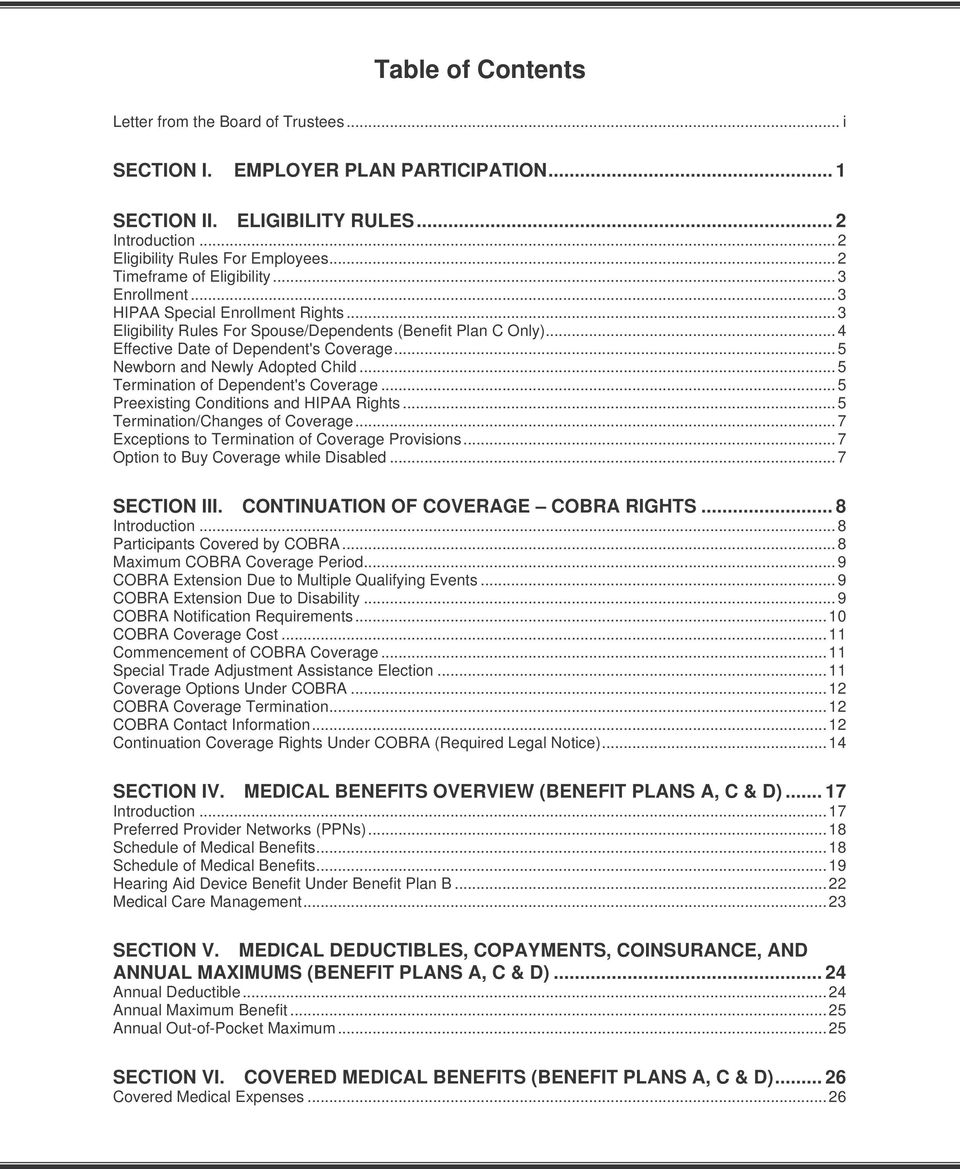
3 Table of Contents Letter from the Board of Trustees... i SECTION I. EMPLOYER PLAN PARTICIPATION... 1 SECTION II. ELIGIBILITY RULES... 2 Introduction...2 Eligibility Rules For Employees...2 Timeframe of Eligibility...3 Enrollment...3 HIPAA Special Enrollment Rights...3 Eligibility Rules For Spouse/Dependents (Benefit Plan C Only)...4 Effective Date of Dependent's Coverage...5 Newborn and Newly Adopted Child...5 Termination of Dependent's Coverage...5 Preexisting Conditions and HIPAA Rights...5 Termination/Changes of Coverage...7 Exceptions to Termination of Coverage Provisions...7 Option to Buy Coverage while Disabled...7 SECTION III. CONTINUATION OF COVERAGE COBRA RIGHTS... 8 Introduction...8 Participants Covered by COBRA...8 Maximum COBRA Coverage Period...9 COBRA Extension Due to Multiple Qualifying Events...9 COBRA Extension Due to Disability...9 COBRA Notification Requirements...10 COBRA Coverage Cost...11 Commencement of COBRA Coverage...11 Special Trade Adjustment Assistance Election...11 Coverage Options Under COBRA...12 COBRA Coverage Termination...12 COBRA Contact Information...12 Continuation Coverage Rights Under COBRA (Required Legal Notice)...14 SECTION IV. MEDICAL BENEFITS OVERVIEW (BENEFIT PLANS A, C & D) Introduction...17 Preferred Provider Networks (PPNs)...18 Schedule of Medical Benefits...18 Schedule of Medical Benefits...19 Hearing Aid Device Benefit Under Benefit Plan B...22 Medical Care Management...23 SECTION V. MEDICAL DEDUCTIBLES, COPAYMENTS, COINSURANCE, AND ANNUAL MAXIMUMS (BENEFIT PLANS A, C & D) Annual Deductible...24 Annual Maximum Benefit...25 Annual Out-of-Pocket Maximum...25 SECTION VI. COVERED MEDICAL BENEFITS (BENEFIT PLANS A, C & D) Covered Medical Expenses...26
4 Mental Health and Substance Abuse Benefit...31 Preventive Benefits...32 SECTION VII. PRESCRIPTION DRUG BENEFITS (BENEFIT PLANS A, B, C & D) 34 Details of Covered Benefits, Copayments and Maximums...34 Retail Pharmacy Program...34 Mail Order Program...35 Covered Prescription Drug Expenses...35 Prescription Drug Benefit Limitations/Exclusions...36 Information on Generic Drugs...37 Medicare Eligible Beneficiaries - Creditable Prescription Coverage...37 SECTION VIII. DENTAL BENEFITS (BENEFIT PLANS A, B, C & D) Overview/General Information...38 Schedule of Dental Benefits...39 Definitions...40 Covered Dental Benefits...41 Dental Benefit Limitations/Exclusions...44 SECTION IX. VISION CARE BENEFITS (BENEFIT PLANS A, B, C & D) Overview/General Information...45 Schedule of Vision Care Benefits...45 Covered Vision Care Benefits...46 Vision Care Benefit Exclusions/Limitations...47 SECTION X. WEEKLY DISABILITY INCOME BENEFIT (BENEFIT PLANS A, B, C & D) Eligibility...48 Amount of Weekly Benefit and Maximum Duration...48 Termination of Weekly Benefit...49 Successive Disabilities...49 Weekly Disability Income Benefit Limitations/Exclusions...49 SECTION XI. ADDITIONAL HEALTH BENEFIT EXCLUSIONS & LIMITATIONS SECTION XII. PROCEDURES FOR CLAIM REVIEW AND APPEALS How to File a Claim for Benefits...54 Adverse Health Benefit Determinations...55 Health and Disability Claims Appeals Procedures...56 Payment and appeal procedures for Life and AD&D Claims...57 SECTION XIII. COORDINATION OF BENEFITS (COB) What is Coordination of Benefits?...59 Frequently Asked Questions about Coordination of Benefits...59 Order of Benefit Determination Rules...61 Overpayments Due to Coordination of Benefits...62 Effect on Benefits When This Fund is Secondary...62 Right to Receive and Release Needed Information...62 Facility of Payment...63 Right of Recovery...63 Coordination of Benefits and Medicare...63 Electing Medicare as the Primary Plan...64

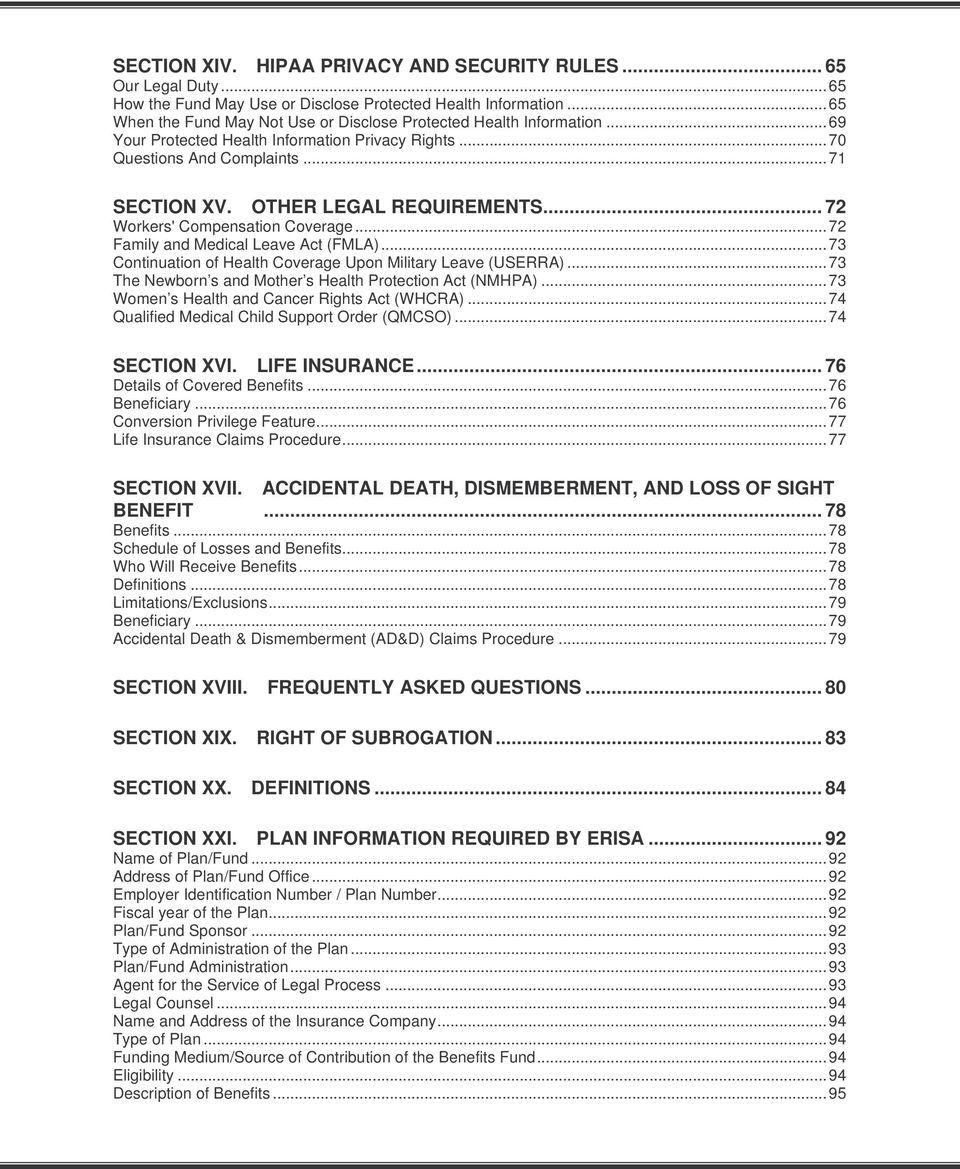
5 SECTION XIV. HIPAA PRIVACY AND SECURITY RULES Our Legal Duty...65 How the Fund May Use or Disclose Protected Health Information...65 When the Fund May Not Use or Disclose Protected Health Information...69 Your Protected Health Information Privacy Rights...70 Questions And Complaints...71 SECTION XV. OTHER LEGAL REQUIREMENTS Workers' Compensation Coverage...72 Family and Medical Leave Act (FMLA)...73 Continuation of Health Coverage Upon Military Leave (USERRA)...73 The Newborn s and Mother s Health Protection Act (NMHPA)...73 Women s Health and Cancer Rights Act (WHCRA)...74 Qualified Medical Child Support Order (QMCSO)...74 SECTION XVI. LIFE INSURANCE Details of Covered Benefits...76 Beneficiary...76 Conversion Privilege Feature...77 Life Insurance Claims Procedure...77 SECTION XVII. ACCIDENTAL DEATH, DISMEMBERMENT, AND LOSS OF SIGHT BENEFIT Benefits...78 Schedule of Losses and Benefits...78 Who Will Receive Benefits...78 Definitions...78 Limitations/Exclusions...79 Beneficiary...79 Accidental Death & Dismemberment (AD&D) Claims Procedure...79 SECTION XVIII. FREQUENTLY ASKED QUESTIONS SECTION XIX. RIGHT OF SUBROGATION SECTION XX. DEFINITIONS SECTION XXI. PLAN INFORMATION REQUIRED BY ERISA Name of Plan/Fund...92 Address of Plan/Fund Office...92 Employer Identification Number / Plan Number...92 Fiscal year of the Plan...92 Plan/Fund Sponsor...92 Type of Administration of the Plan...93 Plan/Fund Administration...93 Agent for the Service of Legal Process...93 Legal Counsel...94 Name and Address of the Insurance Company...94 Type of Plan...94 Funding Medium/Source of Contribution of the Benefits Fund...94 Eligibility...94 Description of Benefits...95
6 Termination Provisions...95 Claims Procedure...95 SECTION XXII. PLAN AMENDMENT AND INTERPRETATION SECTION XXIII. STATEMENT OF RIGHTS UNDER THE EMPLOYEE RETIREMENT INCOME SECURITY ACT OF 1974 (ERISA) SECTION XXIV. GENERAL PROVISIONS/DISCLAIMER Applicable Governing Law...99 No Right of Employment...99 Waiver and Estoppel...99 No Liability for Practice of Medicine...99 Plan Document Controls Misstatement and Fraud Overpayments Notices Sent to Addresses of Employees Effect on Other Benefit Plans Non-Vested Benefits Interests Non-Transferable SECTION XXV. GETTING THE MOST OUT OF YOUR BENEFITS Physicians' or Dentists' Fees and Treatment Plans Utilizing In-network/PPN Providers Bills and Unnecessary Services Hospital Bill Self-Audit Program Other Helpful Hints SECTION XXVI. NOTIFICATION REQUIREMENTS

7 33 Eastland Street - Springfield, MA Phone: Toll Free: Fax: Letter from the Board of Trustees Dear Participant: We are pleased to provide you with this updated Summary Plan Description ( SPD ) for the UFCW Local 1459 and Contributing Employers Health and Welfare Fund. This document is intended to constitute a "Summary Plan Description" as required by Section 102 of the Employee Retirement Income Security Act of 1974 ( ERISA ), as amended and regulations promulgated thereunder. This SPD furnishes a description of the benefits to which Participants and Eligible Dependents are entitled, the rules governing these benefits, and the procedures that you must follow when making a claim. We have also included, in the back of this booklet, certain information concerning the administration of the Plan as required by ERISA. The Trustees reserve the right to amend, modify, or discontinue all or part of this plan at any time, in their sole and absolute discretion. The Trustees have complete discretionary authority to determine eligibility for benefits under the plan or to construe and interpret the terms of the plan, including ambiguous or disputed terms and meanings, and any other instruments or policies of the fund. The Trustees have discretionary authority to make all factual findings. This booklet supersedes all other Summary Plan Descriptions previously published by the Trustees. We suggest you read this booklet carefully in order to fully understand the benefits to which you may be entitled. If you have any questions concerning the benefit coverage, eligibility rules, or how to file a claim, please contact the Fund Manager. Sincerely, Board of Trustees i

8

9 SECTION I. EMPLOYER PLAN PARTICIPATION Employers who have entered a Collective Bargaining Agreement with the United Food and Commercial Workers Local 1459 (the Union ) requiring contributions to the Fund, or by a Participation Agreement by and between an Employer and the Board of Trustees, and whose participation has been approved by the Board of Trustees, are eligible to provide benefits as indicated in this booklet. In addition, staff employees of the Union are eligible to participate as provided for under the Participation Agreement with the Fund. Page 1

10 SECTION II. ELIGIBILITY RULES INTRODUCTION The benefits outlined in this booklet apply to employees of the Contributing Employers who are covered by a current Collective Bargaining Agreement and/or Participation Agreement with UFCW Local 1459 providing for contributions to the UFCW Local 1459 and Contributing Employers Health and Welfare Fund (the Fund ). Your rights to participate will also depend upon the terms of participation accepted by the Board of Trustees and your employer remaining current in its contributions to the Fund. The benefits provided by the Fund are identified in this booklet. However, the specific Schedule of Benefits available for your group of participants may not include all the benefits described in this booklet. IMPORTANT: The latest Collective Bargaining Agreement in effect that governs your employment will determine your eligibility for participation, subject to the terms of the Fund. Please contact the Fund Manager at (413) or with any questions. ELIGIBILITY RULES FOR EMPLOYEES Your eligibility is established in accordance with the terms of the Collective Bargaining Agreement covering your employment. The following employees may become eligible for coverage if required contributions are paid to the Fund on their behalf: 1. Employees of contributing employers. 2. Employees whose employment is the subject of a Collective Bargaining Agreement by and between an Employer and the United Food and Commercial Workers Local 1459 requiring contributions to the Fund, or by a Participation Agreement by and between an Employer and the Board of Trustees, and whose participation has been approved by the Board of Trustees. 3. Staff employees of the United Food and Commercial Workers Local 1459 and management employees of the Fund s claim administrator, Zenith Administrators, Inc., who are located at the Fund Manager's office and are assigned exclusively to the Fund. The benefits outlined in this booklet apply to employees of the contributing employers who are covered by a current Collective Bargaining Agreement and/or Participation Agreement with UFCW Local 1459 providing for contributions to the UFCW Local 1459 and Contributing Employers Health and Welfare Fund. Your rights to participate will also depend upon the terms of participation accepted by the Board of Trustees and your employer remaining current in its contributions to the Fund. Also, in certain cases your eligibility for benefits will depend upon contributions you are required to make to the Fund. The benefits provided by the Fund via its four Benefit Plans of coverage are described in this booklet. Carefully read the Schedule of Benefits for the Benefit Plan that applies to your participation in the Fund. Please note that the specific Schedule of Benefits available to you as a participant may not include all of the benefits described elsewhere in this booklet. Page 2

11 TIMEFRAME OF ELIGIBILITY You will become eligible for benefits provided by the respective Benefit Plan for which you are enrolled pursuant to the Collective Bargaining Agreement governing your employment and the terms applicable to your group's participation in the Fund. To establish your eligibility, a Contributing Employer must remit contributions to the Fund on your behalf and, when applicable, you remit, through your Employer or otherwise, any contributions required to be paid by you to the Fund. You will become eligible for benefits either on 1) the first day of the calendar month during which a contribution is made; or 2) the first day of the calendar month following two months of contributions made to the Fund. Additionally, some Contributing Employers require their employees to elect health coverage during an Open Enrollment Window. In such cases, eligibility commences when you complete all required steps to enroll for and to continue coverage. Your Collective Bargaining Agreement will more specifically identify the period of employment (waiting period), prior to or following the commencement of contributions and any election requirements. You may also obtain this information from your local union representative, the local union office, your employer, or the Fund Manager upon initial enrollment and periodically thereafter as required. ENROLLMENT In order to receive benefits from the Fund, you must provide the Fund Manager with certain enrollment information. Upon initial eligibility, all participants must fully complete an enrollment form. If you are employed by the Stop & Shop Supermarket Company, you may be required to make a health coverage election by completing an enrollment form and authorization form to make a payroll deduction. Thereafter, all participants must complete any requests for updated information including coordination of benefit inquiries by the Fund Manager. If you do not supply this information to the Fund Manager, your claims will be denied. HIPAA SPECIAL ENROLLMENT RIGHTS The Health Insurance Portability and Accountability Act of 1996 (HIPAA) requires group health plans to allow special enrollment for certain individuals to enroll in the plan without having to wait until the plan's next regular open enrollment period. If you decline enrollment for yourself or your dependents (including your spouse) because of other health insurance or group health plan coverage, you may be able to enroll yourself and your dependents in this plan if you or your dependents lose eligibility for that other coverage (or if the employer stops contributing toward you or your dependents other coverage). However, you must request enrollment within 30 days after you or your dependents other coverage ends (or after the employer stops contributing toward the other coverage). In addition, if you have a new dependent as a result of marriage, birth, adoption, or placement for adoption, you may be able to enroll yourself and your dependents. However, you must request enrollment within 30 days after the marriage, birth, adoption, or placement for adoption. A special, longer enrollment period applies to two events only. You must request enrollment within 60 days if you or your dependent 1) lose eligibility for Medicaid or a State Children s Health Insurance Program (CHIP) coverage; or 2) become eligible to participate in a premium assistance program under Medicaid or CHIP. Page 3

12 ELIGIBILITY RULES FOR SPOUSE/DEPENDENTS (BENEFIT PLAN C ONLY) Only Employees covered under Benefit Plan C are eligible to enroll their dependents for coverage. 1. The term Eligible Dependent means: a. Your spouse 1 as determined under applicable state law at the time and location that the marriage was entered into. b. Any of your children who are: i. Less than 19 years of age. ii. At least 19 but less than 26 years of age if they are not eligible to enroll in a group health plan through their employer or, if they are married, through their spouse s employer. A child who is eligible to enroll in another employer-sponsored group health plan will not be eligible for coverage under the Plan. If a child is under the age of 23 and a full-time student, and exhausts the major medical benefit available under their employer-sponsored group health plan, that child may be eligible to enroll under this Plan. Your children will generally remain covered under the Plan after age 19 until the end of the month that he/she reaches age 26, even if he/she or she is not a full-time student, does not reside with you or receive financial support from you, or is married. However, such child s spouse and children are not Dependents under the Plan and, therefore, are not eligible for coverage under the Plan. 2. The term child only includes a child who is: a. Your natural child. b. An adopted child, from the earlier of: i. The date of the filing of a petition to adopt, if the child has been residing in your home as a foster child for whom you have been receiving foster care payments; or ii. The date the child is placed in your home by a licensed placement agency. c. A stepchild or foster child. d. A child named in a valid Qualified Medical Child Support Order (QMCSO). A QMCSO is a court order that requires an employee to provide medical coverage for his/her children (called alternate recipients) in a situation involving divorce, legal separation or a paternity dispute. Please refer to the section in this booklet on QMCSO s for more information. Satisfactory proof of such dependent status may be required. Satisfactory proof will include, but is not limited to: marriage certificates, birth certificates, judgments of divorce, and Child Certification for Health Coverage forms. 1 Eligibility of a same-sex spouse may require your contribution of amounts required to comply with federal income tax laws. Page 4

13 EFFECTIVE DATE OF DEPENDENT'S COVERAGE In order for your Dependents to be eligible for benefits from the Fund, you must provide the Fund Manager with their name, sex, date of birth and Social Security number within 30 days of the marriage, birth, adoption or other event which otherwise qualifies them as eligible dependents. This information must be supplied by completing a Group Benefit Enrollment Form that is available by contacting the Fund Manager. Generally, your Dependent shall become eligible on the date you become eligible. If you acquire a Dependent after the date you become eligible, and provided you notify the Fund Manager within 30 days of the qualifying event, such dependent will become eligible on the first day of the month he/she is determined to be eligible as defined under Eligible Dependents in this section. NEWBORN AND NEWLY ADOPTED CHILD Provided the child is enrolled within the timeframes discussed in the previous section, a newborn child of an Employee or eligible Benefit Plan C Dependent Spouse will be eligible from the date of birth, and an adopted child will be eligible from the earlier date of the filing of a petition to adopt, or the date of adoptive placement. Benefits will be paid for: 1. Treatment of injury or illness, including the necessary care of congenital defects, birth abnormalities, or premature birth; and 2. Routine nursery care. TERMINATION OF DEPENDENT'S COVERAGE Your Benefit Plan C Eligible Dependent's coverage will terminate on the last day of the month during which one of the following events occurs: 1. The date this Plan terminates; 2. The date your coverage terminates; 3. The date a change in the Plan terminates dependent's coverage; or 4. The date the dependent is no longer eligible as defined under eligible dependents, in this section. Upon termination, your dependent may be entitled to pay the premium and continue his/her medical coverage under this Plan. Refer to Continuation of Coverage - COBRA Rights on page 8 of this SPD. PREEXISTING CONDITIONS AND HIPAA RIGHTS What is a Preexisting Condition? A preexisting condition is an injury or illness for which you or your eligible dependent received medical, hospital, or nursing treatment of any kind during the 3-month period immediately prior to the date you or your dependent became covered by the Fund; or were prescribed or taking any drugs or medicines in connection with an injury or illness during the 3-month period immediately prior to the date you became covered by the Fund. Preexisting conditions apply to health benefits only. Page 5

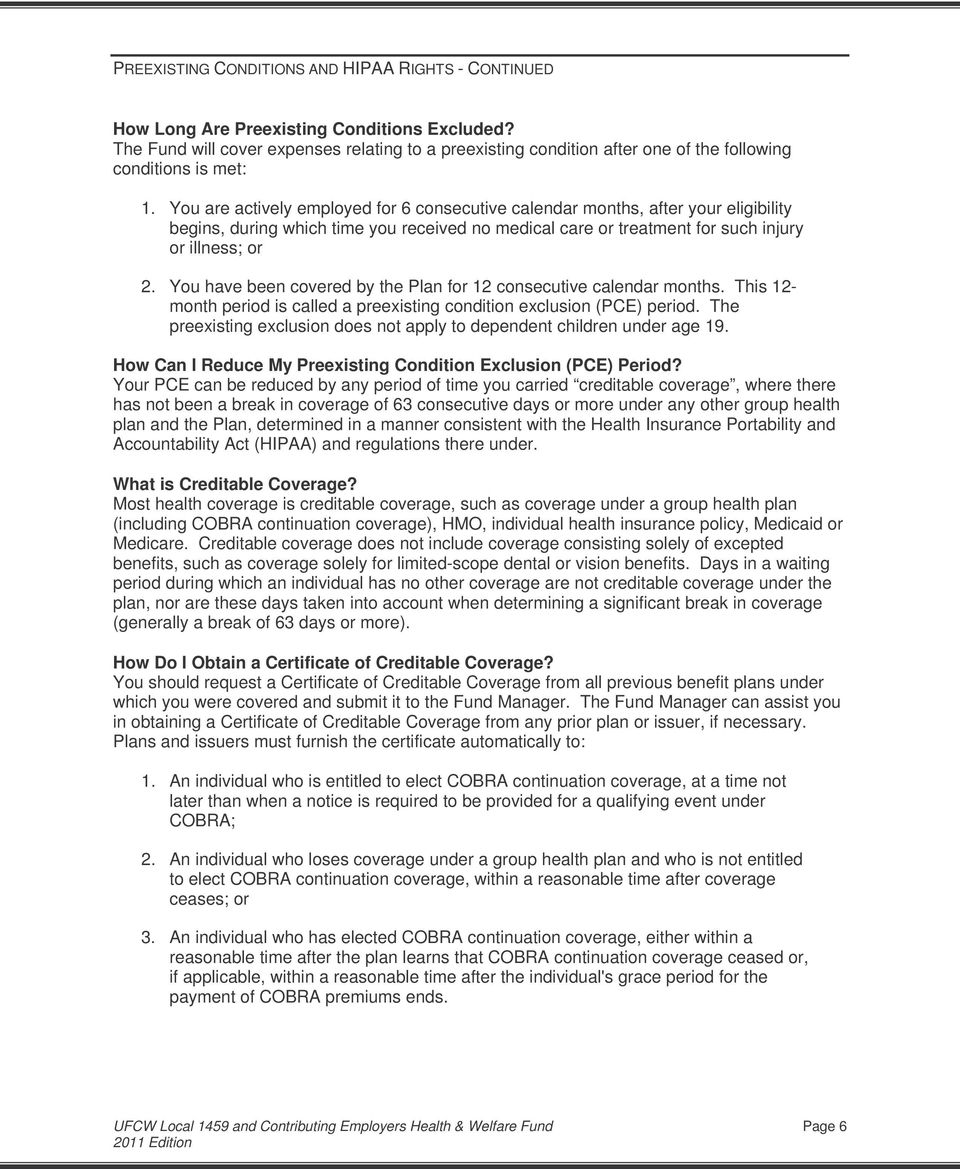
14 PREEXISTING CONDITIONS AND HIPAA RIGHTS - CONTINUED How Long Are Preexisting Conditions Excluded? The Fund will cover expenses relating to a preexisting condition after one of the following conditions is met: 1. You are actively employed for 6 consecutive calendar months, after your eligibility begins, during which time you received no medical care or treatment for such injury or illness; or 2. You have been covered by the Plan for 12 consecutive calendar months. This 12- month period is called a preexisting condition exclusion (PCE) period. The preexisting exclusion does not apply to dependent children under age 19. How Can I Reduce My Preexisting Condition Exclusion (PCE) Period? Your PCE can be reduced by any period of time you carried creditable coverage, where there has not been a break in coverage of 63 consecutive days or more under any other group health plan and the Plan, determined in a manner consistent with the Health Insurance Portability and Accountability Act (HIPAA) and regulations there under. What is Creditable Coverage? Most health coverage is creditable coverage, such as coverage under a group health plan (including COBRA continuation coverage), HMO, individual health insurance policy, Medicaid or Medicare. Creditable coverage does not include coverage consisting solely of excepted benefits, such as coverage solely for limited-scope dental or vision benefits. Days in a waiting period during which an individual has no other coverage are not creditable coverage under the plan, nor are these days taken into account when determining a significant break in coverage (generally a break of 63 days or more). How Do I Obtain a Certificate of Creditable Coverage? You should request a Certificate of Creditable Coverage from all previous benefit plans under which you were covered and submit it to the Fund Manager. The Fund Manager can assist you in obtaining a Certificate of Creditable Coverage from any prior plan or issuer, if necessary. Plans and issuers must furnish the certificate automatically to: 1. An individual who is entitled to elect COBRA continuation coverage, at a time not later than when a notice is required to be provided for a qualifying event under COBRA; 2. An individual who loses coverage under a group health plan and who is not entitled to elect COBRA continuation coverage, within a reasonable time after coverage ceases; or 3. An individual who has elected COBRA continuation coverage, either within a reasonable time after the plan learns that COBRA continuation coverage ceased or, if applicable, within a reasonable time after the individual's grace period for the payment of COBRA premiums ends. Page 6
15 PREEXISTING CONDITIONS AND HIPAA RIGHTS - CONTINUED If you have questions about your HIPAA rights, you may contact your state insurance department or the U.S. Department of Labor, Employee Benefits Security Administration (EBSA) toll-free at (866) (for free HIPAA publications ask for publications concerning changes in health care laws). You may also contact the CMS publication hotline at (800) (ask for Protecting Your Health Insurance Coverage ). These publications and other useful information are also available on the Internet at the DOL and HHS web pages or TERMINATION/CHANGES OF COVERAGE Your coverage under this Fund will terminate on the earliest of the following: 1. The last day of the month in which you are no longer actively employed by a contributing employer; 2. The last day of the month in which your employer remits contributions on your behalf for continuous active employment; 3. The date this Fund terminates; 4. The date you are no longer a member of an eligible class; 5. The date a change is made in this Fund to terminate insurance for your class; or 6. The date you enter into full-time, active duty with the armed forces of any country. EXCEPTIONS TO TERMINATION OF COVERAGE PROVISIONS 1. If eligibility for coverage under this Plan terminates for reasons other than because your weekly disability income benefits have ended, eligibility for weekly disability income benefits will terminate on the last day of the calendar month that is the same as or next follows your last day of work for a contributing employer. 2. If eligibility for coverage under this Plan terminates because your weekly disability income benefits have ended (see page 49 for a full description of when your weekly disability income benefits will end), you will continue to be covered under the Plan until the earlier of: a. the last day of the month that your employer is obligated to contribute to the Plan on your behalf according to the Collective Bargaining Agreement in effect a that time; or b. the last day of the calendar month that follows the maximum period for which you receive weekly disability income benefits unless COBRA rights are elected (see page 8 for a full description of COBRA rights). OPTION TO BUY COVERAGE WHILE DISABLED If you are an employee of a contributing employer that is not required to pay contributions to the Health and Welfare Fund on your behalf during periods that you are Totally Disabled, you may elect to continue coverage for all benefits, including Weekly Disability Income and Life/AD&D insurance, that you were eligible for when your coverage ended. You may continue this coverage for up to three or six months depending on the maximum duration of disability for your benefit plan (refer to page 48 of the Summary Plan Description booklet). You must pay a monthly premium equal to the employer's contribution directly to the Fund Manager's office. You may obtain information from the Fund Manager concerning how to elect this option and remit the premium payments to assure continued coverage. Page 7

16 SECTION III. CONTINUATION OF COVERAGE COBRA RIGHTS INTRODUCTION The Consolidated Omnibus Budget Reconciliation Act of 1985, as amended ( COBRA ) is a law that entitles certain individuals to the continuation of their current health coverage upon the occurrence of certain Qualifying Events. This section summarizes your rights and obligations regarding the COBRA Coverage provisions of the Plan and includes a required legal notice concerning your rights. You and your eligible Benefit Plan C family members should take the time to review this section of the SPD carefully. If you or your Benefit Plan C family members were covered under by the Fund Plans immediately before a qualifying event, as described in the section entitled Who is Covered by COBRA, below, each covered person might be entitled to elect to continue health benefits coverage under these plans for a specified period of time at his/her own expense; this is COBRA Coverage. For example, if you are eligible for benefits provided by the Fund, your eligibility for benefits ends on the last day of the month following the date you terminate employment, unless you are eligible for, elect and pay for COBRA Coverage. PARTICIPANTS COVERED BY COBRA 1. Employees: If you are an employee covered by the one of the Plans offered by the Fund immediately before a qualifying event, you are a covered employee and have a right to pay for continued coverage if you would otherwise lose coverage under the Plan as a result of the following qualifying events : a. a reduction in your hours of employment, except for a reduction in hours in connection with Family and Medical Leave; or b. termination of your employment for reasons other than gross misconduct on your part. 2. Spouses of Benefit Plan C Employees: If you are the spouse of an employee and are covered under the Benefit Plan C immediately before a qualifying event, you are a qualified beneficiary and have the right to pay for continued coverage if you would otherwise lose coverage under Benefit Plan C as a result of any one of the following qualifying events : a. death of your spouse; b. your divorce or legal separation from your Spouse (the covered employee); c. reduction in your spouse s hours of employment, except for a reduction in hours in connection with Family and Medical Leave; d. termination of your spouse s employment for reasons other than gross misconduct; or e. your spouse becomes enrolled in Medicare; 3. Dependent Children of a Benefit Plan C Employee: If you are the dependent child of an employee and are covered under Benefit Plan C immediately before a qualifying event, you are a qualified beneficiary and have the right to pay for continued coverage if you would otherwise lose coverage under Benefit Plan C as a result of any one of the following qualifying events : a. death of your parent (the covered employee); b. reduction in your parent s hours of employment, except for a reduction in hours in connection with Family and Medical Leave; Page 8

17 PARTICIPANTS COVERED BY COBRA - CONTINUED c. termination of your parent s employment for reasons other than gross misconduct; d. your parents divorce or legal separation; e. your parent who is an employee becomes enrolled in Medicare; or f. you cease to be a dependent as determined under Benefit Plan C A child born to or placed for adoption with a covered employee during a COBRA Coverage period also is a qualified beneficiary, if the child is a dependent of the covered employee, as determined under Benefit Plan C. The child s COBRA Coverage period will end on the same date as coverage ends for the covered employee. MAXIMUM COBRA COVERAGE PERIOD The nature of the qualifying event determines the maximum length of your COBRA coverage period, as described below: Qualifying Event Maximum Coverage Period Covered Employee s reduced work hours (except for a reduction in hours in connection with Family and Medical Leave) months Covered Employee s termination (except for gross misconduct) or retirement months Covered Employee s death months Divorce or legal separation of the covered employee and spouse months Covered Dependent child s loss of eligibility (i.e.: reaching the age limit) months Covered Dependent s loss of coverage because covered employee enrolls in Medicare months COBRA EXTENSION DUE TO MULTIPLE QUALIFYING EVENTS If the occurrence of a qualifying event entitles you or your family members to 18 months of continuation coverage and a second qualifying event occurs during the initial 18-month COBRA Coverage period, COBRA Coverage may be extended for an additional 18 months, for a maximum of 36 months measured from the date of the first qualifying event, as determined by the Fund Manager and subject to the notification requirements described on the next page. COBRA EXTENSION DUE TO DISABILITY If you are a covered employee or qualified beneficiary who is eligible for 18 months of COBRA Coverage under the Plan, that coverage may be extended for an additional 11 months if you are determined by the Social Security Administration to have been disabled during the first 60 days of COBRA Coverage, provided that you or your qualified beneficiaries follow the notification requirements described on the next page. Page 9

18 COBRA NOTIFICATION REQUIREMENTS Notice of Qualifying Event In the event that your hours are reduced or your employment is terminated, you die while employed, you become enrolled in Medicare, or the Fund commences certain bankruptcy proceedings, the Fund Manager will notify you and other qualified beneficiaries (within 14 days after receiving notice from you or your employer) of any rights to elect COBRA Coverage. You or your Benefit Plan C family members are required to notify the Fund Manager (refer to the section entitled COBRA Contact Information on page 12) of the divorce or legal separation of a covered employee, or if your child loses dependent status under the Fund; this notice must be provided within 60 days after the later of the date of the qualifying event or the date a qualified beneficiary would lose coverage under the Plan on account of the qualifying event. If the notice described in the preceding sentence is not provided to the Fund Manager, the Fund might not be required to offer COBRA Coverage in connection with the qualifying event. A covered employee and each qualified beneficiary will have 60 days to elect COBRA Coverage; this 60-day period begins on either the date coverage would otherwise be lost or the date the notice of the right to elect continuation coverage was sent, whichever is later. Second Qualifying Event If a second qualifying event that is the divorce or legal separation of a covered employee or an individual s ceasing to satisfy the definition of dependent under the Medical or Dental Plan occurs during the initial 18-month COBRA Coverage period, you or your family members must notify the Fund Manager within 60 days after the occurrence of such qualifying event. See the section entitled Maximum COBRA Coverage Period above regarding extended coverage in connection with a second qualifying event. If a second qualifying event occurs during a disability extension, as described below, COBRA Coverage may be extended for an aggregate of 36 months measured from the date of the first qualifying event and you may be charged 150% of the cost of coverage for the 19th through the 36th month of COBRA Coverage. Disability If you have been determined to be disabled by the Social Security Administration, you must provide to the Fund Manager a written copy of the disability determination from the Social Security Administration not later than (i) 60 days after the date of the disability determination, or (ii) the last day of the 18-month COBRA Coverage period, whichever occurs first. If, during the COBRA Coverage period, the Social Security Administration determines that you are no longer disabled, you must notify the Fund Manager of this determination in writing within 30 days after the determination is made. Page 10

19 COBRA COVERAGE COST You or your qualified beneficiaries must pay the cost of coverage plus a 2% administrative fee for COBRA Coverage. However, during an extension of coverage for disability, you and your qualified beneficiaries may be required to pay 150% (rather than 100%) of the cost of coverage under the Plans. The cost of coverage is the cost of the identical coverage for those actively at work. The Fund Manager will notify you and other qualified beneficiaries of the amount of COBRA Coverage premiums. You will be notified if the Fund designates a different Fund Manager. Once your COBRA Coverage is active, you must make your scheduled premium payments on time. If you fail to make a scheduled payment on time, you will have a 30-day grace period in which to pay your premium. If you do not make your payment by the time the grace period ends, your COBRA Coverage will be cancelled and cannot be reinstated. COMMENCEMENT OF COBRA COVERAGE Your first premium payment for COBRA Coverage is due within 45 days after you elect to receive the coverage. You will not be covered by the Fund if timely payment is not received. Generally, when your first timely premium payment is received by the Fund Manager, your COBRA Coverage will be retroactive to the date you would otherwise have lost group health coverage; the date of coverage may be different, however, if you waived and revoked a waiver of COBRA Coverage during the election period. If you wish, you may enclose your first premium payment with your completed COBRA election form to ensure that you have no lapse in coverage. SPECIAL TRADE ADJUSTMENT ASSISTANCE ELECTION Special COBRA rights may apply to you if you terminate employment or experience a reduction of hours and qualify for a trade adjustment allowance or alternative trade adjustment assistance under federal trade laws. In this situation, you are entitled to a second opportunity to elect COBRA continuation coverage for yourself and certain family members (if they did not already elect COBRA continuation coverage), but only within a limited period of 60 days (or less) and only during the six months immediately after group health Benefit Plan Coverage ended. If you qualify or may qualify for assistance under the federal trade laws, contact the Fund Manager for further information. You must contact the Fund Manager promptly after qualifying for assistance under the federal trade laws or you will lose these special COBRA election rights. Page 11

20 COVERAGE OPTIONS UNDER COBRA Generally, your elections under the Fund at the time of a qualifying event determine the coverage you and your qualified Benefit Plan C beneficiaries will have for the COBRA Coverage period. If you move outside region-specific coverage under the Fund, you will be eligible for the Non-Network benefits beginning on page 17 of this booklet. COBRA COVERAGE TERMINATION Just as certain qualifying events can lead to COBRA Coverage eligibility, other circumstances can result in termination of your COBRA Coverage before the expiration of the 18-, 29-, or 36- month period. COBRA Coverage will be terminated if, during the applicable period of coverage: 1. The Fund no longer provides group health coverage to any of its employees; 2. The premium for COBRA Coverage is not paid in a timely manner; 3. You or other qualified beneficiaries become covered under another group health plan that does not contain any exclusion or limitation with respect to any preexisting condition; 4. You or other qualified beneficiaries become enrolled in Medicare; or 5. During a disability extension, you or other qualified beneficiaries are determined to be no longer disabled. The Fund Manager will notify the qualified beneficiary if continuation coverage terminates before the end of the initial 18- or 36-month continuation period or before the end of any additional 11- or 18-month continuation period for which the qualified beneficiary is eligible to elect continuation coverage. The notification will be provided as soon as practicable following the Fund Manager's determination that continuation coverage will terminate. If your COBRA Coverage terminates for any reason, it cannot be reinstated. COBRA CONTACT INFORMATION This section of the SPD is a summary of the law and therefore is general in nature. The law and any applicable Plan provisions must be consulted with regard to the application of these provisions in any particular circumstance. If you have questions about the law, please contact the Fund Manager. Also, if you have a change in marital status or you or your spouse or dependents have a change of address, please notify the Fund Manager at the address given below. All COBRA premium payments must be forwarded to the Fund Manager at the following address: UFCW Local 1459 and Contributing Employers Health and Welfare Fund 33 Eastland Street Springfield, MA (413) Toll Free Attention: COBRA Notification Page 12

21 COBRA CONTACT INFORMATION - CONTINUED For more information about your rights under COBRA, you may contact the nearest Regional or District Office of the U.S. Department of Labor s Employee Benefits Security Administration (EBSA) in your area or visit the EBSA website at For example, the Boston Regional Office is located at the J.F.K. Building, Room 575, Boston, MA and its telephone number is (617) For legal compliance, the actual required legal notice is provided on the pages that follow. Page 13
22 CONTINUATION COVERAGE RIGHTS UNDER COBRA (REQUIRED LEGAL NOTICE) Introduction Continuation Coverage Rights Under COBRA You are receiving this notice because you have recently become covered under the UFCW Local 1459 and Contributing Employers Health & Welfare Fund (the "Fund"). This notice contains important information about your right to COBRA continuation coverage, which is a temporary extension of coverage under the Fund. The right to COBRA continuation coverage was created by a federal law, the Consolidated Omnibus Budget Reconciliation Act of 1985 (COBRA). COBRA continuation coverage can become available to you and to other members of your family who are covered under the Fund when you would otherwise lose your group health coverage. This notice generally explains COBRA continuation coverage, when it may become available to you and your family, and what you need to do to protect the right to receive it. This notice gives only a summary of your COBRA continuation coverage rights. For more information about your rights and obligations under the Fund and under federal law, you should either review the Fund s Summary Plan Description or get a copy of the Plan Document from the Fund Manager. The Fund Manager is Zenith Administrators, Inc., 33 Eastland Street, Springfield, MA The Fund Manager is responsible for administering COBRA continuation coverage. What is COBRA Continuation Coverage? COBRA continuation coverage is a continuation of Fund coverage when coverage would otherwise end because of a life event known as a qualifying event. Specific qualifying events are listed later in this notice. COBRA continuation coverage must be offered to each person who is a qualified beneficiary. A qualified beneficiary is someone who will lose coverage under the Fund because of a qualifying event. Depending on the type of qualifying event, employees, spouses of employees, and dependent children of employees may be qualified beneficiaries. Under the Fund, qualified beneficiaries who elect COBRA continuation coverage must pay for COBRA continuation coverage. If you are an employee, you will become a qualified beneficiary if you will lose your coverage under the Fund because either one of the following qualifying events happens: Your hours of employment are reduced, or Your employment ends for any reason other than your gross misconduct. If you are the spouse of an employee, you will become a qualified beneficiary if you will lose your coverage under the Fund because any of the following qualifying events happens: Your spouse dies; Your spouse s hours of employment are reduced; Your spouse s employment ends for any reason other than his/her or her gross misconduct; Your spouse becomes enrolled in Medicare (Part A, Part B, or both); or You become divorced or legally separated from your spouse. Your dependent children will become qualified beneficiaries if they will lose coverage under the Fund because any of the following qualifying events happens: The parent-employee dies; Page 14
23 COBRA (REQUIRED LEGAL NOTICE) CONTINUED The parent-employee s hours of employment are reduced; The parent-employee s employment ends for any reason other than his/her or her gross misconduct; The parent-employee becomes enrolled in Medicare (Part A, Part B, or both); The parents become divorced or legally separated; or The child stops being eligible for coverage under the Fund as a dependent child. When is COBRA Coverage Available? The Fund will offer COBRA continuation coverage to qualified beneficiaries only after the Fund Manager has been notified that a qualifying event has occurred. When the qualifying event is the end of employment or reduction of hours of employment, death of the employee, or enrollment of the employee in Medicare (Part A, Part B, or both), the employer must notify the Fund Manager of the qualifying event within 30 days of any of these events. You Must Give Notice of Some Qualifying Events For the other qualifying events (divorce or legal separation of the employee and spouse or a dependent child s losing eligibility for coverage as a dependent child), you must notify the Fund Manager. The Fund requires you to notify the Fund Manager within 60 days after the qualifying event occurs. You must send this notice to: UFCW Local 1459 Health and Welfare Fund, 33 Eastland Street, Springfield, MA You must include the name and social security number of the employee, name and social security number of the qualified beneficiary, description and date of the qualifying event, and appropriate documentation (such as a divorce decree or a marriage certificate for a dependent child) along with the notice. How is COBRA Coverage Provided? Once the Fund Manager receives notice that a qualifying event has occurred, COBRA continuation coverage will be offered to each of the qualified beneficiaries. For each qualified beneficiary who elects COBRA continuation coverage, COBRA continuation coverage will begin on the date of the qualifying event. COBRA continuation coverage is a temporary continuation of coverage. When the qualifying event is the death of the employee, enrollment of the employee in Medicare (Part A, Part B, or both), your divorce or legal separation, or a dependent child losing eligibility as a dependent child, COBRA continuation coverage lasts for up to 36 months. When the qualifying event is the end of employment or reduction of the employee s hours of employment, COBRA continuation coverage lasts for up to18 months. There are two ways in which this 18-month period of COBRA continuation coverage can be extended. Page 15
24 COBRA (REQUIRED LEGAL NOTICE) CONTINUED Disability extension of 18-month period of continuation coverage If you or anyone in your family covered under the Fund is determined by the Social Security Administration to be disabled at any time during the first 60 days of COBRA continuation coverage and you notify the Fund Manager in a timely fashion, you and your entire family can receive up to an additional 11 months of COBRA continuation coverage, for a total maximum of 29 months. You must make sure that the Fund Manager is notified of the Social Security Administration s determination within 60 days of the date of the determination and before the end of the 18-month period of COBRA continuation coverage. This notice should be sent to: UFCW Local 1459 Health and Welfare Fund, 33 Eastland Street, Springfield, MA You must include the name and social security number of the qualified beneficiary and a copy of the determination letter from the Social Security Administration. Second qualifying event extension of 18-month period of continuation coverage If your family experiences another qualifying event while receiving 18 months of COBRA continuation coverage, the spouse and dependent children in your family can get up to 18 additional months of COBRA continuation coverage, for a maximum of 36 months, if notice of the second qualifying event is properly given to the Plan. This extension is available to the spouse and dependent children if the former employee dies, enrolls in Medicare (Part A, Part B, or both), or gets divorced or legally separated. The extension is also available to a dependent child when that child stops being eligible under the Fund as a dependent child, but only if the event would have caused the spouse or dependent child to lose coverage under the Plan had the first qualifying event not occurred. In all of these cases, you must make sure that the Fund Manager is notified of the second qualifying event within 60 days of the second qualifying event. You must send this notice to: UFCW Local 1459 Health and Welfare Fund, 33 Eastland Street, Springfield, MA The notice must include the name and social security number of the qualified beneficiary (ies), description and date of the qualifying event, and appropriate documentation (such as a divorce decree, death certificate, or marriage certificate for a dependent child). If You Have Questions If you have questions about your COBRA continuation coverage, you should contact the Fund Manager at (413) or you may contact the nearest Regional or District Office of the U.S. Department of Labor s Employee Benefits Security Administration (EBSA). Addresses and phone numbers of Regional and District EBSA Offices are available through EBSA s web site at Keep Your Fund Informed of Address Changes In order to protect your family s rights, you should keep the Fund Manager informed of any changes in the addresses of family members. You should also keep a copy, for your records, of any notices you send to the Fund Manager. Plan Contact Information UFCW Local 1459 and Contributing Employers Health and Welfare Fund 33 Eastland Street, Springfield, MA (413) or Toll Free Attention: COBRA Notification Page 16
25 SECTION IV. MEDICAL BENEFITS OVERVIEW (Benefit Plans A, C & D) INTRODUCTION The Fund provides four distinct levels of health coverage within Benefit Plans A, B, C and D. The Collective Bargaining Agreement (CBA) between your employer and the UFCW Local 1459 determines which Benefit Plan you are eligible for. Please refer to your CBA or contact the Fund Office if you are not sure which plan of benefits you are eligible under. Generally, Stop & Shop full-time employees are covered under Benefit Plan C and Stop & Shop part-time employees are covered under Benefit Plan D; full-time employees from other Participating Employers are either Benefit Plan C or Benefit Plan A, while part-timers are Benefit Plan B. Medical benefits are provided to the following employee/dependent eligibility categories: Benefit Plan A... Employee Only Benefit Plan B... Employee Only Benefit Plan C... Employee and Dependents Benefit Plan D... Employee Only The Fund s claim administrator processes medical claims. You may obtain information on your medical claims by calling the Fund Manager's office between the hours of 9:00 A.M. and 5:00 P.M., Monday through Friday at (413) or Periodically, you and your Benefit Plan C family members will be required to provide additional information pertaining to certain claims. Because work related injuries and third party claims (i.e.: motor vehicle accidents, slip and fall injuries, etc.) are not covered by the Plans, you will be asked for more information concerning the details of your injury claims. The Fund requires this information to determine if any other entities (e.g. other insurance or other parties) may be liable for costs submitted to the Fund for payment. Failure to provide such requested information may result in the suspension or loss of coverage for you or your beneficiaries. Page 17
26 PREFERRED PROVIDER NETWORKS (PPNS) To reduce and control health care costs, the Fund has contracted with Preferred Provider Networks (PPNs). These networks allow Participants of the Plan to pick doctors and hospitals from a select group. When you choose providers from this group, the benefit for their services will generally be reimbursed at a higher level, as shown on the following pages. This Plan does not require doctor referrals. To find out if a health care provider participates with the PPN, call the PPN at their toll-free number or access their online provider directory: CIGNA HealthCare PPO Toll-free: If you do not have the ability to access the directory electronically or you wish to have a paper copy, a hardcopy version of the directory will be provided to you upon request, without charge. You may make a request for a written copy by contacting the Fund Manager. Page 18
27 SCHEDULE OF MEDICAL BENEFITS The following is a brief synopsis of deductibles, out-of-pocket maximums, and covered medical benefits. Refer to this schedule for quick reference when you need these services. Additional benefits may be described in the section concerning covered benefits beginning on page 26 in this booklet. Both in-network and non-network deductibles, out-of-pocket and annual maximums are on a calendar year basis: IN-NETWORK: PLAN A PLAN C PLAN D Individual Deductible $ 150 $ 150 $ 150 Family Deductible N/A $ 300 N/A Maximum Individual Out-of-Pocket $1,000 $ 500 $1,000 Maximum Family Out-of-Pocket N/A $1,000 N/A NON-NETWORK: Individual Deductible $ 500 $ 500 $ 500 Family Deductible N/A $1,000 N/A Maximum Individual Out-of-Pocket $5,000 $5,000 $5,000 Maximum Family Out-of-Pocket N/A $10,000 N/A Annual Benefit Maximum (In-Network and Non-Network Combined) $1,000,000 $1,000,000 $20,000 Page 19
28 SCHEDULE OF MEDICAL BENEFITS CONTINUED PREVENTIVE CARE Benefit In-Network Non-Network Routine Physical Exam Employee and Spouse; Once per calendar year. Routine Gynecological Exam Age 18 and over; Once per calendar year. Routine Laboratory Must be performed as part of Routine Physical or Gynecological Exam; Once per calendar year. Well Child Care Exam 6 Visits Birth to Age One; 3 Visits Age One to Age Two; and 1 Visit per Calendar Yr Over Age Two. Well Child Screenings, Laboratory, Immunizations 6 Visits Birth to Age One; 3 Visits Age One to Age Two; and 1 Visit per Calendar Yr Over Age Two. Immunizations Employee and Spouse Pap Smear (Papanicolaou Test) Age 18 and over; Once per calendar year or as recommended by your physician as medically necessary. Mammography Screening Age 35 and over; Once per calendar year or as recommended by your physician as medically necessary. Prostate Screening Includes PSA test and digital rectal exam; Once per calendar year or as recommended by your physician as medically necessary. Colorectal (Colonoscopy) Screening Includes colonoscopy once every 5 years if age 50 or over; Once every 2 years if high risk or as recommended by your physician as medically necessary. Contraceptives Contraceptives requiring the services of a health practitioner: injectable Depo-Provera, subdermal implant, or intrauterine device. (Prescribed contraceptives covered under the drug card program through Medco. See page 34.) 100% after $20 copay 100% after $20 copay 100% - no deductible 100% after $20 copay 100% - no deductible 100% - no deductible 100% - no deductible 100% after $20 copay 100% - no deductible 100% after $20 copay 80% after deductible Not covered unless living 20+ miles from the nearest innetwork provider; then payable as innetwork. 60% after deductible 60% after deductible 60% after deductible 60% after deductible 60% after deductible 60% after deductible 60% after deductible 60% after deductible Page 20
29 SCHEDULE OF MEDICAL BENEFITS CONTINUED PHYSICIAN SERVICES Benefit In-Network Non-Network Sick Office Visit 100% after $15 copay 60% after deductible Allergy Immunotherapy 80% after deductible 60% after deductible Physical Therapy 80% after deductible 60% after deductible Chiropractic Treatment 80% after deductible 60% after deductible Maximum limit of 25 visits per calendar year. Diagnostic X-ray and Laboratory 80% after deductible 60% after deductible Chemotherapy or Radiation Treatment 80% after deductible 60% after deductible Surgical Expense 80% after deductible 60% after deductible Second Surgical Opinion Maximum of 2 consultations per individual. 100% after $15 copay 60% after deductible HOSPITAL SERVICES Benefit In-Network Non-Network Inpatient Hospital Room & Board* Limited to semi-private room rate. 80% after deductible 60% after deductible Inpatient Hospital Ancillary Charges* 80% after deductible 60% after deductible 80% after deductible Emergency Room plus a $50 copay. Copay is waived if admitted 60% after deductible for an inpatient hospital stay. Maternity* 80% after deductible 60% after deductible Same Day (Outpatient) Surgery 80% after deductible 60% after deductible 60% after deductible Pathologists, Anesthesiologists, (Payable as in-network if Radiologists & Emergency Room 80% after deductible rendered in connection with Physician Charges (PARE Providers) services performed at an innetwork facility.) MENTAL HEALTH & SUBSTANCE ABUSE Benefit In-Network Non-Network Outpatient Counseling Individual and Group Sessions 80% after deductible 60% after deductible Inpatient Treatment* Includes partial hospitalization, and intensive outpatient. 80% after deductible 60% after deductible *You or your doctor must call CareAllies at to pre-certify any nonemergency inpatient hospital admission. In an emergency, seek immediate medical care. You, your family, or your doctor must call within 48 hours of an emergency admission. Failure to comply with the pre-certification requirements will result in either non-payment of charges or a $500 reduction of benefits. Page 21
30 SCHEDULE OF MEDICAL BENEFITS CONTINUED OTHER EXPENSES Benefit In-Network Non-Network Home Health Care Maximum limit of 100 visits per calendar year per individual. 80% after deductible 60% after deductible Hospice Care 80% after deductible 60% after deductible Durable Medical Equipment Fund payment limited to the rental cost payable up to the purchase cost. Ambulance Service Ground Transport 80% after deductible 60% after deductible 80% after Deductible 80% after Deductible Non-network charges are payable according to the in-network schedule of benefits. Emergency Air Ambulance 80% after deductible 60% after deductible OTHER BENEFITS NOT SUBJECT TO THE ANNUAL BENEFIT MAXIMUM Benefit In-Network Non-Network Foot Orthotics (Custom made shoe inserts) Limited to maximum Fund payment of $250 once every 24 months per individual. Infertility Treatment and Related Charges $20,000 lifetime maximum per individual. 80% after deductible 60% after deductible 80% after deductible 60% after deductible Hearing Aid Device Limited to maximum Fund payment of $500 once every 36 months per individual. 80% after deductible 60% after deductible HEARING AID DEVICE BENEFIT UNDER BENEFIT PLAN B The Hearing Aid Device benefit listed in the Schedule of Medical Benefits for Benefit Plans A, C and D above is also available to Benefit Plan B employees. The benefit for a hearing aid device is payable at 80% after a $150 deductible up to a maximum of $500 once every 36 months. Page 22
31 MEDICAL CARE MANAGEMENT The Trustees have established a Medical Care Management program, currently managed by CareAllies, to cover all participants eligible for medical benefits from the Fund. This program is not a substitute for the careful consideration of your physician's advice. The program is intended to provide you with information on whether the prescribed treatment follows commonly observed medical practice patterns. It is also intended to control health care costs incurred under the terms of the Benefit Plan. In most cases, CareAllies will resolve their concerns about planned treatment with your treating physician. If CareAllies does not authorize services for coverage, you and your physician will need to make the determination of which treatment method you should follow. The care management program is not a substitute for your physician. Responsibility for your medical care remains a matter for you and your physician to determine. The decision of CareAllies will effect the determination of benefits under your Benefit Plan. Should CareAllies not authorize a procedure or course of treatment proposed by your physician or should they limit the type or period of such treatment to something less than that requested by your physician, you or your physician on your behalf, have the right to appeal this decision directly to CareAllies. Page 55 provides further information on appealing adverse health benefit determinations. Pre-admission Certification/Continued Stay Review Contact CareAllies at , seven to ten days prior to any hospitalization or within 48 hours after an emergency hospitalization. Be sure to identify yourself as a UFCW Local 1459 Health and Welfare Plan participant. A CareAllies nurse will talk to you about your treatment, the guidelines that apply to your hospitalization and any alternatives you should know about. The nurse may also talk to your physician before and during your hospitalization to be sure you get most appropriate care. If you do not contact CareAllies, as required above, one of the following outcomes will occur: 1. If the admission would have been approved by CareAllies as medically necessary, a $500 penalty will be deducted from your benefit payment; or 2. Any admission that would not have been approved as medically necessary by CareAllies or your Plan of Benefits will not be a covered expense and you will be responsible for 100% of the non-covered charges. Case Management This is a voluntary program that is offered to you if you or your eligible Plan C dependent have a catastrophic injury or illness. CareAllies assigns a nurse to the case who works closely with both the patient and physicians to assure that all treatment options are understood, all alternatives are considered, and the most appropriate care is received by the patient in or out of the hospital. Page 23
32 SECTION V. MEDICAL DEDUCTIBLES, COPAYMENTS, COINSURANCE, AND ANNUAL MAXIMUMS (Benefit Plans A, C & D) Benefits will be paid upon receipt of proof that you or your eligible dependent, while covered under this benefit, incurred covered charges. Payment will be made for covered charges in excess of the applicable copayment, coinsurance or deductible up to the annual maximum benefit. ANNUAL DEDUCTIBLE The respective in-network versus non-network deductible is the amount shown in the Schedule of Benefits for In-network versus Non-network services. The different deductibles for each Benefit Plan are as follows: Benefit Plan Type of Deductible In-Network Non-Network A Individual $150 $500 C Individual $150 $500 C Family $300 $1,000 D Individual $150 $500 Non-network expenses may not be used to satisfy the in-network deductible and vice versa. After the respective deductible has been met each calendar year, the Benefit Plan pays a percentage of covered charges and you are responsible for the balance for in-network and nonnetwork services, respectively. Generally, benefits are 80% of the allowable amount for innetwork services and 60% of the reasonable and customary charge for non-network services. The respective annual deductible can be met with a combination of eligible medical expenses paid under the Benefit Plan (exclusive of copayments). The respective deductible is subtracted from eligible claims as they are received by the Fund. This may not be the chronological order in which they were incurred Three-Month Deductible Carry-Over If any or all of the covered charges used to satisfy the in-network and non-network deductible are incurred during the last three months of a calendar year, the respective deductible for the following calendar year will be reduced by the amount incurred in the last three months of the preceding calendar year. Family Maximum Deductible (Applicable to Benefit Plan C Only) The respective family maximum in-network and non-network deductible is the maximum amount of deductible that will be applied to any family in a calendar year for in-network and non-network expenses. After the respective family deductible has been satisfied in a calendar year, no further deductible will be applied towards other covered charges incurred by the entire family during the remainder of that calendar year with respect to in-network and non-network expenses. Common Accident If two or more individuals covered hereunder as members of the same family sustain bodily injuries in the same accident, a single in-network and non-network deductible requirement will be applied to all covered charges incurred in-network and non-network, respectively, during the calendar year in which the accident occurred and the injuries sustained. Page 24
33 ANNUAL MAXIMUM BENEFIT There are annual benefit maximums for Benefit Plans A, C and D. These maximums include the combined total of all medical and hospital benefits incurred during a calendar year. Benefit Plan...Annual Benefit Maximum A...$1,000,000 C...$1,000,000 D...$20,000 ANNUAL OUT-OF-POCKET MAXIMUM Out-of-pocket is the portion of a covered charge you or your Benefit Plan C dependent is liable for. Covered charges do not include: a. Any expenses that exceed reasonable and customary charges; b. Negotiated network discounts; c. Penalties for non-compliance with hospital pre-certification requirements; d. Deductibles; e. Medical benefit or prescription drug benefit copayments; or f. Expenses for benefits not payable under the medical Benefit Plans. Individual Out-of Pocket Maximums Once the liability for a covered individual participant has reached the out-of-pocket maximum in eligible in-network or non-network covered expenses in a calendar year, the medical Benefit Plans will pay 100% of eligible in-network or non-network expenses, respectively, up to the annual maximum benefit for the remainder of the calendar year. Expenses are subject to all other applicable limitations and maximums. Benefit Plan In-Network Non-Network A $1,000 $5,000 C $ 500 $5,000 D $1,000 $5,000 Benefit Plan C Family Out-of Pocket Once the liability for a Benefit Plan C member has reached the out-of-pocket maximum in eligible in-network or non-network covered expenses relative to eligible family members in a calendar year, the medical Benefit Plan C will pay 100% of eligible in-network or non-network expenses, respectively, up to the annual maximum benefit for the remainder of the calendar year. Expenses are subject to all other applicable limitations and maximums. Benefit Plan In-Network Non-Network C $ 1,000 $10,000 Page 25
34 SECTION VI. COVERED MEDICAL BENEFITS (Benefit Plans A, C & D) COVERED MEDICAL EXPENSES Covered charges include the reasonable and customary fees for the following medically necessary treatments, services or supplies: 1. Confinement as an inpatient in a hospital from the first day of confinement provided these services are pre-certified through the Fund's Medical Care Management program detailed on page 23. Covered charges for daily room and board charges shall not exceed the hospital's regular rate for semiprivate rooms unless it is medically necessary to isolate the patient to prevent contagion, as the result of any infectious disease. If the hospital does not have semiprivate rooms, the covered charges will be the average rate for such rooms charged by hospitals located in the surrounding geographical area; 2. Charges incurred for care in an intensive care unit; 3. Hospital charges for services and supplies, other than room and board charges, incurred: a. during an inpatient confinement; or b. for a surgical operation that involves cutting or the reduction of bone fracture. 4. Pre-admission testing in a hospital's outpatient department before a scheduled admission. For benefits to be payable, the scheduled admission must be for an injury or illness that is covered under the Benefit Plans; the tests must be for the diagnosis of such a condition; and the tests and X-rays must be ordered by a physician. The charges will be covered even if the admission is postponed or canceled if: a. the tests show a condition that requires treatment before the admission; b. a medical condition develops that delays the admission; c. a hospital bed is not available on the scheduled admission date; or d. the tests indicate that, contrary to the physician's expectations, the admission is not necessary. 5. Diagnosis, treatment and surgery by a physician or surgeon; 6. Services of a licensed, qualified physician, including a specialist, for surgical and nonsurgical care in a hospital, home, or physician's office; 7. Artificial limbs or eyes for the initial replacements of natural limbs or eyes. Prosthetic appliances provided also include the first pair of aphakic lenses (no implant) following cataract surgery, breast prostheses, and surgical brassieres after surgery. Support hose and dental braces are not covered by the Fund; 8. Initial trusses, braces or supports; 9. Casts, splints and crutches; 10. Charges for custom made shoe inserts or "foot orthotics", prescribed by a physician, to the extent of no more than one pair in any 24 month period, and to a maximum benefit of $250 per pair; Page 26
35 COVERED MEDICAL EXPENSES - CONTINUED 11. Rental of durable medical equipment, such as wheelchairs and hospital-type beds. The benefit payable for rental may not exceed the purchase cost. "Durable medical equipment" means equipment or FDA-approved medical devices that are medically necessary to aid in your recovery, mobility and/or the support of life. Durable medical equipment that is provided by a physician during an office visit will be covered as part of the office visit. Such durable medical equipment must: a. be prescribed by the attending physician; b. be designed for prolonged use; c. not be primarily used for non-medical purposes; and d. not be specifically excluded by this Plan. 12. Rental of an artificial kidney machine and any medically necessary supplies for dialysis home testing related to the dialysis treatments. Benefits for home hemodialysis do not include furniture, installation charges, or any charges for maintenance purposes; 13. Drugs and medicines while hospital-confined; 14. Medical and surgical supplies, such as oxygen, surgical dressings, and colostomy bags. Items ordinarily found in the home for general use, like adhesive bandages, petroleum jelly, and thermometers are not covered; 15. Diagnostic X-ray services and laboratory tests; 16. Charges made by a facility licensed by the state to provide emergency care or surgery on a outpatient basis; 17. Radium, radioactive isotopes, X-ray therapy, and chemotherapy; 18. Anesthesia and its administration, and inhalation therapy for treatment of a respiratory condition by inhalation of water vapors, oxygen, or other substances; 19. Iron lungs, oxygen and rental of equipment for its administration, and other mechanical equipment for the treatment of respiratory paralysis; 20. Ambulance service for emergency use to transport you or your Benefit Plan C eligible dependents from the place where the injury occurred or where the individual was stricken by an illness to the nearest hospital where treatment is rendered; and for local ambulance service from a hospital to another hospital, when the discharging hospital has inadequate facilities for treatment and the receiving hospital has appropriate treatment facilities; 21. Blood, including the cost of blood plasma and blood plasma expanders; 22. Chiropractic treatment including spinal manipulation, adjunctive therapy; vertebral alignment; and spinal column adjustments and X-rays. No benefits will be payable for any treatment or services rendered strictly for palliative or maintenance purposes or visits in excess of 25 per calendar year; 23. Services of a certified nurse midwife up to the reasonable and customary charges which would have been payable, if treatment had been rendered at a hospital; Page 27
36 COVERED MEDICAL EXPENSES CONTINUED 24. Non-experimental treatment of infertility will be covered up to a lifetime maximum benefit of $20,000. The lifetime maximum will not accumulate towards the Annual Maximum Benefits listed on page 25. Covered treatments include the following procedures if performed at medical facilities that conform to the American College of Obstetric and Gynecology guidelines or to the American Fertility Society minimal standards for such programs: a. artificial insemination; b. in vitro fertilization and embryo placement; c. gamete intra-fallopian transfer; d. sperm, egg and/or inseminated egg procurement, processing and banking of sperm or inseminated eggs, to the extent such costs are not covered by the donor's insurer, if any; e. intracytoplasmic sperm injection; f. zygote intrafallopian transfer; and g. infertility related drugs. Infertility is defined for this purpose as a condition of a presumably healthy legally married Employee or Benefit Plan C Spouse who is unable to conceive or produce conception during a period of one (1) year. 25. Enteral formulas for home use, if ordered in writing by a physician as medically necessary for the treatment of: Crohn's disease, ulcerative colitis, gastroesophageal reflux, gastrointestinal motility, or chronic intestinal pseudo-obstruction; 26. Prenatal care, childbirth, and post-partum care. Benefits will be payable the same as any other illness; 27. Inpatient expenses for childbirth for a minimum of 48 hours following a vaginal delivery or 96 hours following a cesarean section. Covered charges will include charges for, but not limited to, home visits, and any necessary and appropriate clinical tests. A registered nurse, physician, or certified nurse midwife must conduct the first home visit. A licensed health care provider must provide any subsequent home visits determined to be medically necessary; 28. Benefit Plan C well-baby nursery. Covered hospital charges for an infant who is insured from birth will include: a. room and board (including normal nursery services); b. medical expenses incurred for a circumcision; c. any other miscellaneous medical care and treatment; d. physician's charges for performing a circumcision; and e. initial pediatrician's visit while the newborn child is confined as an inpatient in a hospital by reason of birth. 29. Cardiac rehabilitation for you or your Benefit Plan C Eligible Dependent that has a documented history of cardiovascular disease, when such treatment is provided in a hospital or other facility that meets the standards set by the Commissioner of Public Health. Such standards include, but are not limited to, outpatient treatment initiated within 26 weeks after diagnosis of the disease; 30. Sterilization of the reproductive system; Page 28
37 COVERED MEDICAL EXPENSES CONTINUED 31. For dental work or oral surgery, as follows: a. the excision of partially or completely unerupted impacted teeth, including removal of tooth, impacted soft tissue; impacted partially by bone or completely by bone; b. the excision of a tooth root without the extraction of the entire tooth; c. alveolar or gingival reconstructions - alveolectomy; excision of pericoronal gingiva; removal of palatal torus; removal of mandibular tori; d. periodontics - gingivectomy (including post surgical visits); subgingival curettage; occlusal adjustment related to periodontal surgery; e. other incision or excision procedures on the gums and tissues of the mouth when not performed in connection with extraction or repair of teeth; f. cysts and neoplasms - removal of cyst or tumor; and g. as required for the prompt repair of natural teeth or other body tissues as a result of an injury covered under this Plan. 32. Cosmetic surgery, when medically necessary, for the prompt repair of an injury that occurred while you or your Benefit Plan C Eligible Dependent are covered under this Benefit Plan. No other expenses for cosmetic surgery are payable; 33. Covered charges include charges for home health care if the plan of treatment is established and approved in writing by the attending physician. The Fund Manager should be contacted prior to treatment and has the right to review the proposed plan of treatment on a regular basis to determine the medical necessity of continued care. Providers of home health care services may include private duty nursing agencies, home health care agencies or independent private duty nurses. Covered charges for home health care are limited to 100 visits in any calendar year by any member of the home health care team, including a home health aide. A "visit" shall consist of up to 4 consecutive hours of service or any fractional part of 4 hours. Home health care services include, but are not limited to: a. wound care for pressure sores or a surgical wound; b. respiratory care, like oxygen or a nebulizer; c. physical, occupational and speech therapy; d. patient and caregiver education; e. intravenous or nutrition therapy; f. chemotherapy; g. medical social work; and h. use of durable medical equipment and supplies. 34. Physical therapy charges when prescribed by a physician, relate directly and specifically to the plan of treatment established by the physician and must be reasonable and necessary for the treatment of the individual s illness or injury. Services must be provided by a physician (a doctor of medicine, doctor of podiatry medicine, or osteopathy) or a physical therapist, who is legally authorized to practice physical therapy services by the state in which he/she performs such function or action. The physical therapy services provided must be restorative or for the purpose of designing and teaching maintenance program for the patient to conduct at home. There must be an expectation that the patient s condition will improve significantly in a reasonable period of time based on the assessment made by the physician. Services that are palliative in nature are not covered; Page 29
38 COVERED MEDICAL EXPENSES CONTINUED 35. Speech therapy for speech and language disorders of an organic/physiologic nature. Services must be rendered by a speech pathologist (or speech and language pathologist) with a referral from a physician. This benefit is limited to speech therapy to restore speech to a person who has lost speech function as a result of disease or injury. Speech therapy for a congenital abnormality is covered if surgery to correct it has been performed prior to the speech therapy. The Fund Manager should be contacted prior to treatment and has the right to review the proposed plan of treatment on a regular basis to determine the medical necessity of continued care; 36. Short term occupational therapy prescribed by a physician and in accordance with a written plan of care for non-chronic conditions and acute illnesses to provide task-orientated therapeutic activities designed to significantly improve, develop or restore physical functions lost or impaired as a result of a disease, or injury; or to learn or relearn daily living skills (e.g., dressing, eating and bathing or compensatory techniques to improve the level of independence in the activities of daily living). Services may be provided by occupational therapists as an employee of a clinic or physician, as an independently practicing therapist or as outpatient services under an arrangement with a hospital. The Fund Manager should be contacted prior to treatment and has the right to review the proposed plan of treatment on a regular basis to determine the medical necessity of continued care; 37. Hospice care. "Hospice care" means services and supplies provided to you or coordinated by a hospice agency while you are terminally ill with a life expectancy of six months or less as determined by your physician. Hospice services must be provided by a certified/accredited hospice agency with care available 24 hours per day, seven days per week. Services must be rendered in accordance with a physician prescribed treatment plan and be performed by appropriately qualified/licensed personnel; and 38. Contraceptives requiring the services of a health practitioner: injectable Depo-Provera, subdermal implant, or intrauterine device. (Prescribed contraceptives covered under the drug card program through Medco. See page 34.) See page 50 for additional Limitation and Exclusions. Page 30
39 MENTAL HEALTH AND SUBSTANCE ABUSE BENEFIT Covered Levels of Care The following levels of care for mental health and substance abuse claims are included as covered expenses under this benefit: Outpatient therapy - is performed in the office of the mental health provider on a short-term or long-term basis, depending upon the condition. Care can be provided to the patient individually, or in group sessions. Intensive outpatient therapy - is similar to outpatient psychotherapy; however, it is performed at greater frequency and over a shorter duration than regular outpatient care. Partial hospitalization - is a program which includes a combination of therapies: individual, group, family therapy, vocational and educational counseling in an intensive non-inpatient setting where the patient spends the day (or part of a day) in the facility and goes home at night. Acute inpatient hospitalization - is treatment in a hospital psychiatric unit that includes 24 hour nursing and daily active treatment under the direction of a psychiatrist. Residential treatment - treats groups of patients with similar mental health conditions, living within a 24-hour community (e.g., a 28-day alcohol rehabilitation program). Licensure requirements can vary by state, but typically these facilities are designated as residential, subacute, or intermediate care facilities. Residential treatment is 24 hours per day and requires a minimum of one physician visit per week. The benefit payable for mental health and substance abuse services, after the respective Benefit Plan deductible is satisfied, is 80% in-network or 60% non-network. Exclusions to Mental Health and Substance Abuse Benefit The following services are excluded as covered expenses from this benefit: 1. Any hospital that is not approved by The Joint Committee on Accreditation of Healthcare Organizations (JCAHO) and does not meet the Plan s definition of Hospital on page 87; 2. Service from a halfway house or supervised living facility; 3. Any practitioner that does not meet the Plan s definition of Physician on page 90; 4. Psychotherapy sessions in excess of one minute outpatient session per day, or a frequency of greater than one session per week; 5. Any inpatient service that was not precertified through CareAllies (see page 23); 6. Education and achievement testing; 7. Early intervention; 8. Intelligence Quotient (IQ) testing; 9. Neuropsychological testing (an exception may be made for neurologically complicated cases such as post head trauma or seizures); and 10. Outpatient family therapy. See page 50 for additional Limitations and Exclusions. Page 31
40 PREVENTIVE BENEFITS Routine Physical Examination Benefit (Employees and Benefit Plan C Spouses Only) Benefits will be payable for you or your Benefit Plan C Spouse for the cost of a routine physical examination once per calendar year from a physician who is an in-network provider. This benefit will include the cost of all preventive services including a physician's exam and laboratory services, unless specifically included elsewhere under this Benefit Plan. The Fund will pay 100% of covered charges after a $20 copayment. If you live more than twenty miles from the nearest in-network provider, you may use a nonnetwork provider for this benefit and the Fund will pay the covered charges according to the innetwork plan of benefits. No benefits are payable under the Routine Physical Examination Benefit for: 1. Any professional fees other than the fee of the physician who performed the physical examination and for laboratory tests necessary for the examination; 2. Services for which you are entitled to receive benefits under any other provision of this Benefit Plan; 3. The diagnosis or treatment of an injury or illness; or 4. A physical examination required by an employer as a condition of employment, or which the employer is required to provide by virtue of a labor agreement, or those required by a governmental body. Routine Gynecological Exam Benefit Benefits will be payable for the cost of a routine gynecological examination once per calendar year for you or your Benefit Plan C Eligible Dependent who is age 18 or over from a physician who is an in-network provider. This benefit will include the cost of all preventive services including a physician's exam and laboratory services, unless specifically included elsewhere under this Benefit Plan. The Fund will pay 100% of covered charges after a $20 copayment. This benefit is available in addition to the Routine Physical Exam Benefit. If you live more than twenty miles from the nearest in-network provider, you may use a nonnetwork provider for this benefit and the Fund will pay the covered charges according to the innetwork plan of benefits. Note, however, that after the Fund has processed your claim, the provider will bill you for any additional patient liability that may be due. Mammography Screening Benefit Benefits will be payable once per calendar year for the cost of a mammography screening for you or your Benefit Plan C Eligible Dependent who is age 35 or over. Benefits may also be payable if your or your Benefit Plan C Eligible Dependent s physician orders a mammography more frequently than once per calendar year or orders a mammography for a woman under age 35 because of a medically necessary reason. The Fund will pay 100% of covered charges after a $20 copayment for services provided by an in-network provider and 60% of covered charges after your $500 calendar year deductible has been satisfied for services from a non-network provider. Page 32
41 PREVENTIVE BENEFITS - CONTINUED Pap Smear Benefit (Papanicolaou Test) Benefits will be payable once per calendar year for the cost of a Pap smear for you or your Benefit Plan C Eligible Dependent who is age 18 or over. Benefits may also be payable if your or your Benefit Plan C Eligible Dependent s physician orders a Pap smear more frequently than once per calendar year or orders a Pap smear for a woman under age 18 because of a medically necessary reason. The Fund will pay 100% of covered charges for services provided by an in-network provider and 60% of covered charges after your $500 calendar year deductible has been satisfied for services from a non-network provider. Prostate Screening Benefit Benefits will be payable once per calendar year for the cost of a Prostate-Specific Antigen (PSA) test and/or digital rectal exam for you or your Benefit Plan C Eligible Dependent. Benefits may also be payable if your or your Benefit Plan C Eligible Dependent s physician orders the screening more frequently than once per calendar year because of a medically necessary reason. The Fund will pay 100% of covered charges for services provided by an in-network provider and 60% of covered charges after your $500 calendar year deductible has been satisfied for services from a non-network provider. Colorectal Screening (Colonoscopy) Benefit Benefits will be payable for the cost of a standard colonoscopy for colorectal screening once every five years for you or your Benefit Plan C Eligible Dependent who are age 50 or over. Benefits may also be payable if your or your Benefit Plan C Eligible Dependent s physician orders a colonoscopy more frequently than once every five years because of a medically necessary reason. The Fund will pay 100% of covered charges after a $20 copayment for services provided by an in-network provider and 60% of covered charges after your $500 calendar year deductible has been satisfied for services from a non-network provider. Covered charges include the facility fee as well as the professional fees of the physician, anesthesiologist and pathologist. Immunization Benefit Benefits will be payable for the cost of immunizations recommended by the Advisory Committee on Immunization Practices (ACIP). For additional information, you may visit their web site at cdc.gov/vaccines. This benefit is limited to the cost of the vaccine and its administration. No benefits are payable under this benefit for immunizations required by your employer. Well Child Care Benefit Benefits will be payable for a Benefit Plan C Eligible Dependent child for a complete physical examination including history, measurements, sensory screening, neuropsychiatric evaluation and development screening and assessment at the following age intervals: Six visits from birth to age 1; Three visits from age 1 to age 2; and One visit per calendar year over age 2. The Fund will pay 100% of covered charges after a $20 copayment. Covered charges will also include the following: a. Hereditary and metabolic screening at birth; b. Immunizations recommended by the Advisory Committee on Immunization Practices (ACIP). c. Tuberculin tests, hematocrit, hemoglobin or other appropriate blood tests; and d. Urinalysis. Page 33
42 SECTION VII. PRESCRIPTION DRUG BENEFITS (Benefit Plans A, B, C & D) DETAILS OF COVERED BENEFITS, COPAYMENTS AND MAXIMUMS PRESCRIPTION DRUG BENEFITS Maximum Fund Payment is $15,000 Per Calendar Year Per Individual for Benefit Plans B and D. There is no Maximum Fund Payment for Benefit Plans A and C. LEVEL 1 LEVEL 2 LEVEL 3 LEVEL 4 GENERIC FORMULARY 1 NON- FORMULARY HIGH-COST DRUGS 2 Retail Pharmacy Card Service, Copayment For Up To a 30-Day Supply: Stop & Shop Pharmacies Other Pharmacies (Exclusive of Walmart and Big Y Pharmacies) $15 $30 $45 $25 $50 $70 Mail Order Pharmacy Service, Copayment For Up To a 90-Day Supply: Medco Mail Order Pharmacy $30 $60 $90 1 List of preferred generic and name-brand drugs. 20% Patient Coinsurance 20% Patient Coinsurance 20% Patient Coinsurance 2 1 to 30-day supply over $500; 31 to 60-day supply over $1,000; 61 to 90-day supply over $1,500. RETAIL PHARMACY PROGRAM This benefit is provided to the following employee/dependent eligibility categories: Benefit Plan A... Employee Only Benefit Plan B... Employee Only Benefit Plan C... Employee and Dependents Benefit Plan D...Employee Only* *Benefit Plans B & D are subject to a $15,000 calendar year benefit maximum. Upon becoming eligible for benefits and returning the required enrollment forms, each employee will receive two prescription drug cards. If an employee wishes to order additional cards, they are available by contacting the Fund Manager. In order to fill a prescription, go to any participating pharmacy, present your prescription identification card to the pharmacist along with the written prescription from your physician, sign the signature log, and pay the applicable copayment as described above. The balance of the covered charge is billed directly to and paid by the Fund with the exception of self-administered injectable drugs for Benefit Plans B and D which are subject to a $25,000 lifetime maximum. If you choose to use a non-participating pharmacy, you must pay the entire cost of the prescription. If you purchase a retail prescription at a participating pharmacy without presenting your prescription drug ID card, you must pay the entire cost of the prescription and then submit a reimbursement claim to Medco. Page 34
43 MAIL ORDER PROGRAM The Fund has an optional mail order program for those participants who utilize maintenance medications. Maintenance medications are those medications that your physician prescribes for regular use over a long period of time to treat chronic or ongoing conditions. This benefit is a companion benefit to the Retail Pharmacy Program and provides benefits for the same employee/dependent eligibility categories. To fill a prescription through the mail order program, you must first obtain an order form and instructions from the Fund Manager. You can receive up to a 90-day supply of your prescription. Your prescription(s) will be filled for the exact quantity prescribed by your physician up to the supply limit. For example, if your prescription is written for a 30-day supply with 2 refills, you will receive a 30-day supply. The Fund encourages you to consider the mail order program for maintenance prescriptions. The mail order program saves you money because it requires a copayment that is less than three times the amount of a 30-day supply at the retail level. Please encourage your doctor to write for up to a 90-day maintenance supply to take full advantage of your mail order pharmacy benefit COVERED PRESCRIPTION DRUG EXPENSES The following items are considered covered expenses: 1. All drugs bearing the legend, "Caution: Federal law prohibits dispensing without a prescription"; 2. Prescribed injectable insulin; 3. Injectable epinephrine - limited to 3 pens per calendar year; 4. When dispensed in any one order, prescriptions up to a 30-day supply can be purchased through the retail pharmacy program and up to a 90-day supply through the mail order program; 5. Blood-glucose monitoring strips, lancets, and syringes which are Medically Necessary and for which a Physician has issued a written prescription; 6. Pre-natal and fluoride vitamins; 7. Smoking cessation products; 8. Self-administered, FDA approved injectable drugs, exclusive of infertility drugs. For Benefit Plan D, injectable drugs are limited to a maximum lifetime Fund payment of $25,000. For injectable drugs over the $25,000 maximum, additional coverage is available for participants eligible for benefits under the medical Benefit Plan D only. 9. Retin-A for the treatment of acne, up to the age of 26. Coverage after age 26 based on medical necessity. 10. Prescribed oral contraceptives, non-oral contraceptives (skin patch and vaginal ring), and self-administered injectable contraceptives (Depo-Provera). Page 35
44 PRESCRIPTION DRUG BENEFIT LIMITATIONS/EXCLUSIONS Covered charges do not include, and no benefits are payable for: 1. Any prescriptions filled at Walmart or Big Y Pharmacies; 2. Any drugs, vitamins, or diet supplements whether or not prescribed by a physician, unless specifically included in this Benefit Plan; 3. Sexual enhancement drugs, (including but not limited to Viagra) unless prescribed for medical purpose other than sexual enhancement; 4. Condoms, spermicides, or contraceptive sponges; 5. Emergency contraception, including but not limited to the Plan B morning after pill and RU486 abortion pill; 6. Prescriptions for animals; 7. Drugs payable under any Workers' Compensation claim; 8. Drugs which may be properly received without charges under local, state, or federal programs; 9. Drugs dispensed during confinement in a hospital, rest home, sanitarium, extended care facility, skilled nursing facility, convalescent facility, nursing home or similar institution which operates on its premises a facility for dispensing pharmaceuticals; 10. Immunological agents; 11. Over-the-counter medications; 12. Rogaine, or any medication used strictly for cosmetic purposes; 13. Medications used for experimental indications and/or dosage regimens determined to be experimental; 14. Charges for injection or administration of drugs; 15. Drugs not received from a licensed pharmacy; 16. Glucometers or any other blood sugar monitoring device; 17. Growth hormones; 18. Infertility drugs; 19. Medications with no approved FDA indications; 20. Prescription refills dispensed after one year from original date of dispensing; or 21. Any other prescriptions or medications not included in the medical benefit. See page 50 for additional Limitation and Exclusions Page 36
45 INFORMATION ON GENERIC DRUGS The Trustees also encourage you to consider asking your physician and/or pharmacist whether there is a generic equivalent of the prescription you are taking and if it is appropriate for you. To assist in your decision-making, here are some facts you should know about generic drugs: Approximately two thirds of all prescriptions in the U.S. today are filled by using generic drugs. A generic drug is made with the same active ingredients and is available in the same strength and dosage form as the equivalent brand-name product. The Food and Drug Administration strictly regulates the manufacturing process of all drugs. A generic drug meets the same stringent performance and bioequivalence standards set by the U.S. Federal Government as the brand-name drug. A generic drug is as safe and provides the same therapeutic effects as the brand-name product for patients of all ages. Companies that also make the brand-name drug manufacture many of the generic drugs approved by the FDA. Health care professionals strongly support the use of generic drugs. Many pharmacies will automatically encourage individuals to take a generic alternative, because this plan design is standard among insurance plans. The decision to use generic medications is ultimately made through the cooperation of your physician, your pharmacist, and you. The copayment for generic prescription drugs is one-half the copayment for a formulary brand name prescription. MEDICARE ELIGIBLE BENEFICIARIES - CREDITABLE PRESCRIPTION COVERAGE Medicare prescription drug coverage became available in 2006 to everyone with Medicare. You can get this coverage if you join a Medicare Prescription Drug Plan or join a Medicare Advantage Plan (like an HMO or PPO) that offers prescription drug coverage. All Medicare drug plans provide at least a standard level of coverage set by Medicare. Some plans may also offer more coverage for a higher monthly premium. The Board of Trustees has determined that the prescription drug coverage offered by the Fund is, on average for all plan participants, expected to pay out as much as standard Medicare prescription drug coverage pays and is therefore considered Creditable Coverage. Because your existing coverage is Creditable Coverage, you can keep this coverage and not pay a higher premium (a penalty) if you later decide to join a Medicare drug plan. You should also know that if you drop or lose your current coverage with the Fund and don t join a Medicare drug plan within 63 continuous days after your current coverage ends, you may pay a higher premium (a penalty) to join a Medicare drug plan later. If you go 63 continuous days or longer without creditable prescription drug coverage, your monthly premium may go up by at least 1% of the Medicare base beneficiary premium per month for every month that you did not have that coverage. For example, if you go nineteen months without creditable coverage, your premium may consistently be at least 19% higher than the Medicare base beneficiary premium. You may have to pay this higher premium (a penalty) as long as you have Medicare prescription drug coverage. In addition, you may have to wait until the following November to join. Page 37
46 SECTION VIII. DENTAL BENEFITS (BENEFIT PLANS A, B, C & D) OVERVIEW/GENERAL INFORMATION Dental disease exists in nearly everyone and is cumulative in its destructive effect. Delayed oral examinations or poor dental health habit leads to tooth decay and severe oral complications. More extensive and expensive dental treatment may be the consequences. The plan recommended and described in the following pages has been designed to: Encourage diagnostic treatment Eradicate existing dental disease The emphasis is upon preventive services such as routine examination and cleaning, application of topical fluoride solutions, and prevention of severe tooth destruction or loss of teeth. These preventive measures lessen the need for extensive tooth restoration or replacement services in the future. Dental benefits are payable under the respective Benefit Plans and employee/dependent eligibility categories: Benefit Plan Eligible Employee/Dependent Categories A...Employees Only B...Employees Only C...Employees and Dependents D...Employees Only Benefits will be payable at the appropriate coinsurance rates for covered dental charges in excess of any respective deductible, up to the maximums shown in the following Schedule of Dental Benefits Page 38
47 SCHEDULE OF DENTAL BENEFITS The following is a brief synopsis of deductibles, coinsurance rates, and maximums. Refer to this schedule for quick reference when you need these services. Additional benefits may be described in the section concerning covered benefits beginning on page 41 in this booklet. All deductibles and annual maximums are on a calendar year basis. PLAN A PLAN B PLAN C PLAN D Individual Deductible Applies to Basic and Major Services only. N/A Basic & Major Services Not Covered $ 50 $ 50 Family Deductible Annual Benefit Maximum (Does not apply to Benefit Plan C dependent children under the age of 19) Preventive Dental Services (i.e.: cleanings, exams, x-rays) Limits: Cleanings/Exams once every 6 mos. Full mouth/panorex once every 36 mos. Bitewings once every 6 mos. Fluoride for dependent children only. Sealants limited to $100 per year. Basic Dental Services (i.e.: Non-routine visits, amalgam & composite restorations, endodontics, stainless steel crowns, simple extractions, root planing, anesthesia, denture relines, night guards, denture adjustments) Limits: Cosmetic services not covered. Major Dental Services (i.e.: porcelain restorations, gold inlays/onlays, initial crowns, bridgework, partial or full dentures, adding teeth to partial denture) Limits: 5 years for replacement of bridgework or dentures. Missing tooth clause. Orthodontia 50% of charges up to a Lifetime Benefit Maximum Benefit: N/A Individual Coverage Only $ 150 N/A Individual Coverage Only $ 200 $ 200 $1,500 $1, % of the Reasonable and Customary Charge N/A Basic & Major Services Not Covered N/A Basic & Major Services Not Covered 80% of the Reasonable and Customary Charge after deductible 50% of the Reasonable and Customary Charge after deductible 50% of the Reasonable and Customary Charge after deductible No Coverage $1,000 $ 750 Page 39
48 DEFINITIONS Covered Dental Charges - the reasonable and customary fees or charges for services rendered or supplies furnished or recommended by a dentist or physician, in connection with the following types of service: Preventive Dental Services Basic Dental Services Major Dental Services Orthodontia Course of Treatment - a planned program of one or more services, whether rendered by one or more dentists, for the treatment of a dental condition diagnosed by the attending dentist, as a result of an oral examination. Dental Hygienist - an individual who is licensed to practice dental hygiene by the government authority which has the jurisdiction over the practice of dental hygiene and works under the supervision of a dentist. If you transfer from one dentist to another in the course of treatment, or if more than one dentist renders service on one dental procedure, the benefits will be determined just as though one dentist had furnished all treatment. Incurred Date - the date the care or service is rendered, except for the orthodontic benefit. The "insert" date of an orthodontic appliance shall be considered the date such charge was incurred. Predetermination - if it is anticipated that dental expense will exceed $500, a written request for benefit approval from the dentist may be submitted to the Fund Manager. The dentist must provide X-rays and/or study models, include a statement regarding the need for treatment and the condition of the teeth prior to treatment, and indicate the proposed cost of treatment. The request will be reviewed by the Fund Manager and returned to the dentist notifying him or her of the benefits available. If necessary, the Fund Manager may refer the treatment plan to a dental consultant. If predetermination of the treatment is not filed with the Fund Manager, the Fund reserves the right to make a determination of benefits payable, taking into account alternative procedures, services or courses of treatment based upon accepted standards of such treatment. Reasonable and Customary - A charge which is not higher than the usual charge made by the provider of the care and does not exceed the usual charge made by most providers of like service in the same area. Page 40
49 COVERED DENTAL BENEFITS Covered charges include the reasonable and customary charges for the following dentally reasonable treatments, services or supplies: Preventive Dental Services The following covered dental charges are included and benefits are payable at the specified coinsurance levels for each respective Benefit Plan as follows: 1. Routine Oral Examinations - once every six months when performed by a dentist; 2. Dental Prophylaxis - limited to once every six months when performed by a dentist or dental hygienist; 3. X-rays/Intra-Oral - as often as dentally reasonable; 4. X-rays/Complete series or Panorex - limited to once in any thirty-six consecutive month period; 5. X-rays/Extra-Oral - limited to one film in any six consecutive month period; 6. X-Rays/Bitewing - limited to one time in any six consecutive month period; 7. Emergency Oral Examinations to relieve dental pain; 8. Space Maintainers - including all adjustments within six months of installation; limited to initial appliance only and dependent children under age sixteen; 9. Diagnostic Casts - limited to one time in any twenty-four consecutive month period; 10. Topical Fluoride Treatments - for dependent children only, once every six months; and 11. Sealants - up to a maximum of $100 per calendar year per individual. Basic Dental Services The following covered dental charges are included and benefits are payable at the specified coinsurance levels for each respective Benefit Plan if the services are received in connection with dental disease or defect: 1. Professional Consultations and Professional Visits - consultation by other than the attending dentist; 2. Non-Surgical Periodontal Service - scaling and root planing, as often as dentally reasonable; 3. Amalgam Restorations; 4. Silicate, Plastic, or Composite Restorations; 5. Simple Extractions - uncomplicated (single) surgical removal of erupted tooth (including tissue flap and bone removal); Page 41
50 COVERED DENTAL EXPENSES CONTINUED 6. Drugs - injectable antibiotics; 7. Anesthesia - general, in conjunction with oral surgical procedures only; 8. Endodontics - root canal therapy, apicoectomy and retrograde filling; 9. Crowns - stainless steel (when tooth cannot be restored with a filling material); 10. Recementation - inlay; crown; bridge; 11. Denture Relinings and Rebasings - upper or lower denture duplication (jump case limited to one in any 36 consecutive months); denture reline (includes full and partial); office, cold cure (limited to one in any 12 consecutive months); denture reline (includes full and partial); laboratory (limited to one in any 12 consecutive months); 12. Occlusal Adjustment - when performed in connection with periodontal surgery; 13. Pin Retention; 14. Periodontal Appliance (nightguard); and 15. Denture Adjustments - adjustment to denture more than six months after installation; adjustments by a dentist other than the original provider. Major Dental Services The following covered dental charges are included and benefits are payable at the specified coinsurance levels for each respective Benefit Plan if the services are received in connection with dental disease, defect or Injury: 1. Initial Gold Inlays and Onlays, only when tooth cannot be restored by silver fillings; 2. Porcelain Restorations, only if the tooth cannot be restored by a filling or by other means; 3. Initial Crowns, only if the tooth cannot be restored by a filling or by other means; 4. Initial Fixed Bridge; 5. Initial Partial or Full Dentures; and 6. Adding Teeth to Partial Denture. Page 42
51 COVERED DENTAL EXPENSES CONTINUED Orthodontia Services The Orthodontic Benefit is payable under the respective Benefit Plans and employee/dependent eligibility categories: Benefit Plan...Eligible Employee/Dependent Categories C...Employees and Dependents D...Employees Only Fixed and/or removable appliances, including braces or retainers, are included and benefits are payable at 50% for the respective employee/dependent eligibility categories up to the following Maximum Lifetime Benefit: Benefit Plan... Lifetime Benefit Maximum C...$1,000 D...$750 Benefits are payable in quarterly or monthly installments over the course of treatment, usually a two to four year period. A benefit payment of up to 25% of the cost of the entire treatment plan is payable upon initial placement of the appliance. You or your dentist must submit claims to the Fund Manager on a quarterly or monthly basis for reimbursement of monthly fees. Treatment Plan An orthodontic treatment plan must be submitted to the Fund Manager's office before any expenses will be considered for payment. After the Fund Manager has reviewed the treatment plan, your or your Dependent's orthodontist will be advised of an estimate of benefits payable under this Benefit Plan. A treatment plan consists of: (1) a description of the malocclusion classification; (2) recommended and prescribed treatment; (3) an estimate of the duration of treatment (completion date); (4) supportive evidence such as cephalomistric X-rays, study models, or other material the Fund Manager's office deems necessary. Covered Orthodontia Conditions Charges for fixed and/or removable appliances are covered only to the extent that they are made in connection with an orthodontic procedure that is required by one or more of the following conditions: 1. Overbite or overjet of at least four millimeters; 2. Maxillary (upper) or mandibular (lower) arches in either protrusive or retrusive relation of at least one cusp; 3. Cross bite; or 4. An arch length discrepancy of more than four millimeters in either the upper or lower arch. Page 43
52 DENTAL BENEFIT LIMITATIONS/EXCLUSIONS No benefits are payable for dental care or services under this section for: 1. Services received from a dental or medical department maintained by the employer or a mutual benefit association; 2. Services for treatment by an individual other than the dentist or physician performing the treatment, except that cleaning or scaling of teeth may be performed by a licensed dental hygienist if such treatment is rendered under the supervision and direction of the dentist; 3. Dental expenses incurred after termination of insurance; 4. Prosthetic devices (including bridges and crowns) and the fitting thereof which were ordered while you or your dependent were not covered under this Benefit Plan, or which were ordered while you or your dependent were covered under this Benefit Plan but which were installed or delivered more than 30 days after termination of coverage; 5. Charges which are not necessary, or not recommended and approved by the attending dentist or physician, or for care or treatment that is deemed inappropriate; 6. Benefits payable under any other provision of this Benefit Plan or under any other plan sponsored by your employer, whether benefits are payable in whole or part of such coverages; 7. Any replacement of an existing partial or full removable denture or fixed bridgework by a new denture or new bridgework, or the addition of teeth to an existing partial removable denture or to bridgework, unless evidence satisfactory to the Fund is presented that: a. the replacement or addition of teeth is required to replace one or more additional natural teeth extracted after the existing denture or bridgework was installed and while you or your dependent was covered under this Benefit Plan; b. the existing denture or bridgework was installed at least five years prior to its replacement and the existing denture or bridgework cannot be made serviceable; or c. the existing denture is an immediate temporary denture; replacement by a permanent denture is required and takes place within twelve months from the date of installation of the immediate denture; 8. Services and supplies that are partially or wholly cosmetic in nature, including charges for personalization or characterization of dentures, bleaching, or veneer facings; 9. Dental implants or tooth transplantation; 10. Missed appointments; 11. Experimental treatment; 12. Oral hygiene, plaque control, or dietary instructions or programs; 13. Infection control (OSHA) fee; 14. The replacement of lost or stolen prosthetic devices; or 15. Any orthodontic charges relating to appliances that were inserted before you or your Benefit Plan C eligible dependents were eligible for such coverage under this Benefit Plan. See page 50 for additional Limitation and Exclusions. Page 44
53 SECTION IX. VISION CARE BENEFITS (BENEFIT PLANS A, B, C & D) OVERVIEW/GENERAL INFORMATION Routine vision benefits are payable under the respective Benefit Plans and employee/dependent eligibility categories: Benefit Plan...Eligible Employee/Dependent Categories A...Employees Only B...Employees Only C...Employees and Dependents D...Employees Only SCHEDULE OF VISION CARE BENEFITS If, while insured, you or your Benefit Plan C Eligible Dependent incur routine vision care expenses, benefits are payable up to the amounts shown below. Maximum Benefit Payment in Any 24 Consecutive Month Period Per Individual: Service or Appliance Category...Maximum Benefit* Routine Vision Examination...$60.00 Eyeglass Lenses, One Type: Single Vision Rx...$60.00 Bifocal Rx...$ Trifocal Rx...$ Lenticular Rx...$ Contact Lenses (In Lieu of Eyeglass Lenses)...$ Eyeglass Frames...$ If the costs for any of the eye care services or appliances is less than the maximum benefit, the remainder may be claimed as an additional benefit during the 24-month period if a covered expense is incurred in that same service or appliance category. Benefits will only be paid for one type of lens in any 24-month period. *The maximum benefit does not apply to dependent children under the age of 19. The Plan will pay for one complete routine vision exam, one pair of standard or non-designer frames, and one pair of prescription eyeglass lenses (exclusive of lens treatments such as tinted lenses, photosensitive lenses, ultraviolet coating, antireflective coating and scratch-resistant coatings) once every 24 months. In lieu of standard frames and eyeglasses, the Plan will pay for one pair of prescribed contact lenses once every 24 months. Page 45
54 COVERED VISION CARE BENEFITS Covered vision care benefits include the following services or appliances: 1. Routine vision examinations performed by a licensed optometrist or ophthalmologist; 2. Lenses prescribed by such optometrist or ophthalmologist; 3. Eyeglass frames purchased by such persons; and 4. Contact lenses in lieu of eyeglasses. Page 46
55 VISION CARE BENEFIT EXCLUSIONS/LIMITATIONS No benefits are payable for vision care services or services under this benefit for: 1. Routine vision examinations in excess of $60 per any twenty-four (24) consecutive month period; 2. Eyeglass lenses (or contact lenses in lieu of eyeglass lenses) in excess of the Maximum Benefits listed on page 45; 3. Lenses from more than one of the appliance categories listed on page 45 per any twentyfour (24) consecutive month period; 4. Eyeglass frames in excess of $100 per any twenty-four (24) consecutive month period; 5. Routine vision examinations, lenses or eyeglass frames more frequently than once every (24) consecutive months for dependent children under the age of 19; 6. Charges for services or supplies that are covered, in whole or in part, under any other provision of this Benefit Plan; 7. Charges from a Walmart Vision Center; 8. Non-prescription sunglasses; 9. Tinted lenses, photosensitive lenses, ultraviolet coating, antireflective coating and scratchresistant coatings in excess of the amount which would be a covered charge for untreated eyeglass lenses; 10. Eye examinations required by an employer as a condition of employment, or which the employer is required to provide by virtue of a labor agreement, or those required by a government body; 11. Charges for services or supplies to treat a medical condition; 12. Refractive Keratoplasty or any surgical procedure on the cornea to improve vision by changing the shape, and thus the refractive index, of the corneal surface. 13. Fundus photography (pictures of the back of the eye) and/or routine extended visual field testing; or 14. Charges for services or supplies received while the individual is not eligible, or charges for lenses and eyeglass frames that are furnished or ordered, prior to the date the individual became insured under this Benefit Plan. See page 50 for additional Limitation and Exclusions. Page 47
56 SECTION X. WEEKLY DISABILITY INCOME BENEFIT (BENEFIT PLANS A, B, C & D) If an Employee Participant is unable to work because of a non-work related illness or injury, he/she may be eligible to receive a weekly disability income benefit. In order to be eligible for this benefit a Participant must be receiving regular care or treatment from a licensed medical provider. Call the Fund Manager to determine eligibility for this benefit. A Disability Claim Form must be completed by you, your employer, and your attending physician and returned to the Fund Manager's office in a timely fashion. ELIGIBILITY This benefit will be payable, in accordance with the respective amounts set forth for each Benefit Plan, if while insured, you become totally and continuously disabled as the result of an injury or illness and cannot work. For the purpose of this benefit, totally and continuously disabled means that you, as a result of a covered injury or illness, are prevented from performing any or all duties of your employment. AMOUNT OF WEEKLY BENEFIT AND MAXIMUM DURATION The maximum amount of benefit and the maximum benefit period for which benefits are payable, whether due to one or more causes and whether involving one or more disability absences, is set in the following Schedule of Benefits. Benefit Plan Maximum Benefit Maximum Duration A $375 per week 13 Weeks B $100 per week 13 Weeks C $420 per week 26 Weeks D $135 per week 26 Weeks The maximum weekly benefit amount may not exceed 66 ⅔ percent of your weekly basic earnings at the time you become totally disabled. Waiting Period Weekly Disability Income Benefits will begin on the first day due to an accident, or the eighth day due to an illness. Partial Weeks For any period of disability that is less than one week in duration, the benefits will be paid at one-seventh of the weekly benefit amount multiplied by the number of days. Pregnancy, Childbirth, or Miscarriage If you are totally disabled and unable to work because of pregnancy, childbirth, or miscarriage, your Weekly Disability Income Benefit is payable on the same basis as any other illness. Page 48
57 TERMINATION OF WEEKLY BENEFIT Weekly disability income benefits will terminate on the earliest of the following events: 1. After the Plan has paid to the Participant the maximum weekly payments; 2. The date the Participant dies; 3. The date the Participant no longer satisfies the eligibility rules; 4. The date of the Participant s return to work; 5. The date the Participant is able to return to work, as determined by the Trustees in their sole discretion. The Trustees have the right to change, limit, or discontinue Plan benefits at any time. If the Trustees abolish the Weekly Disability Income benefit, in whole or in part, the effective date of such amendment is the date in which a Participant s weekly disability income benefits terminate (if such benefits are abolished in whole), or are modified (if such benefits are only reduced). SUCCESSIVE DISABILITIES Separate periods of disability resulting from the same or related causes will be considered one period of disability, unless separated by your return to active work for at least fourteen (14) consecutive days with a contributing employer. Separate periods of disability resulting from unrelated causes will be deemed one period of disability, unless separated by your return to active work for at least one full day. WEEKLY DISABILITY INCOME BENEFIT LIMITATIONS/EXCLUSIONS In addition to the exclusions listed on page 50, no benefits are payable under this section for a period of disability: 1. During which you are not under the direct care of a physician. A period of disability will not be considered as having started more than three days before the date you first see a physician for the condition that caused the disability; 2. Any day you are receiving compensation or performing work of any kind, anywhere, for compensation or profit; 3. Any day you are released by your physician to engage in work of any kind; 4. Those days for which you are receiving compensation for lost wages from automobile reparation (no-fault) insurance or its equivalent; 5. Covered by Workers Compensation Law, Occupational Disease Law or similar legislation; or 6. For which you cannot work arising from an accident or injury for which one or more third parties are or may be legally liable. The Trustees, however, may at their discretion pay some or all of the Weekly Disability Income benefit which otherwise would be payable, even where a third-party liability may exist. Such benefit is paid subject to a duty to reimburse the Fund if payment is received from such third party regardless of whether such payment is specifically identified as compensation for lost earnings. The employee shall acknowledge such obligation to reimburse the Fund by signing a Reimbursement Agreement, as requested by the Trustees. NOTE: Payments received under this benefit are considered as taxable income and must be reported on your federal income tax return. The Health and Welfare Fund will deduct the FICA and other required taxes on your behalf and pay them to the appropriate government agency. Page 49
58 SECTION XI. ADDITIONAL HEALTH BENEFIT EXCLUSIONS & LIMITATIONS In addition to any limits described under the sections that describe the benefits (i.e.: medical, dental, prescription drug, vision) there are specific limitations and exclusions with regard to all health benefits. Covered charges do not include, and no benefits are payable, for: 1. Cosmetic surgery, unless it is required: a. as reconstructive surgery when service is incidental to or follows surgery which results from trauma, infection, or other disease of the involved part; or b. as reconstructive surgery because of congenital disease or anomaly of a Dependent child that has resulted in a functional defect; 2. Charges incurred for any treatment, services or supplies, or hospital confinement (or any part of such confinement), that is not medically necessary and that is not ordered by a physician who is practicing within the scope of his/her license. This provision shall not exclude any services listed under Covered Charges that are specifically included under this Plan. 3. Charges that you or your Plan C Eligible Dependent are not legally obligated to pay, including charges that would not have been made if no insurance coverage existed; 4. Any portion of a charge which is in excess of the reasonable and customary charge for the treatment; 5. Charges incurred for a treatment which is not generally accepted by the medical profession or which is listed as experimental, under investigation, or limited to research: a. by the federal Food and Drug Administration (FDA); the American Medical Association (AMA); Diagnostic and Therapeutic Technology Assessment(DATTA); or the Office of Medical Application of Research of the National Institute of Health Office of Technology Association (OMT); or b. if a treatment has not been addressed by one of the organizations listed in a. above, the Fund has the right to determine if a treatment is appropriate based on the advice of an independent medical reviewer and other medical experts. However, a drug prescribed for the treatment of a certain type of cancer will not be excluded on the basis that such drug has not been approved by the federal Food and Drug Administration (FDA). Provided, however, that such drug must be recognized for Treatment of the specific type of cancer for which the drug has been prescribed in one of the following established reference compendia: the American Medical Association Drug Evaluations; the American Hospital Formulary Service Drug Information; the United States Pharmacopoeia Drug Information; or recommended by review article or editorial comment in a major peer reviewed professional journal. No coverage will be provided for any experimental or investigational drugs or any drug that the FDA has determined to be contraindicated for treatment of the specific type of cancer for which the drug has been prescribed. Page 50
59 HEALTH EXCLUSIONS AND LIMITATIONS - CONTINUED 6. Charges incurred for treatment of any injury that is a result of participation in a felony, riot or insurrection; 7. Charges for services which you or your Plan C Eligible Dependent obtain, or is entitled to obtain, under any plan or program without charge, except Medicaid. This will include charges provided or paid for by the federal government at a Veteran's Administration facility for: a. an injury or illness related to military service; or b. you, or your Plan C Eligible Dependent, if you are retired from the armed services; 8. Charges incurred as a result of: a. an injury or illness which arises out of or in the course of any employment with any employer; or b. an injury or illness; for which you or your dependent are entitled to receive benefits under any Workers' Compensation law or occupational disease law, or any settlement from a Workers' Compensation or occupational disease carrier; 9. Services or supplies not listed as covered charges; 10. Charges for elective abortions, except: a. where the life of the mother would be endangered if the fetus were to be carried to term; or b. for those charges directly resulting from complications of such abortion; 11. Charges made by an individual who usually lives in the same household as you or your dependent, or who is a member of your or your Plan C Eligible Dependent s immediate family, or the immediate family of your spouse; 12. Expenses incurred as a result of past or present service in the armed forces of any government; 13. Charges for custodial care, as defined; 14. Charges that are not received at the Fund Manager s office, along with all required supporting information necessary to process the claim, within fifteen (15) months from the incurred date; 15. Expenses incurred for recreational or leisure therapy; 16. Charges made by a convalescent facility; 17. Expenses incurred by you or your Plan C eligible dependent to the extent that you or your dependent are in any fashion paid or entitled to payment for those expenses by or through a public program; 18. Services of a naturopath or faith healer; 19. Expenses incurred for drugs and medicines while not hospital confined, except those associated with routine immunization and infertility treatment; Page 51
60 HEALTH EXCLUSIONS AND LIMITATIONS - CONTINUED 20. Charges incurred for dental care or treatment, or dental X-rays, unless specifically provided; 21. Any expenses related to surrogate parenting; 22. Any expenses related to transsexual surgery; 23. Personal comfort or service items while confined in a Hospital, such as, but not limited to, radio, television, telephone, and guest meals; 24. Oral appliances for snoring; 25. Charges incurred for surgery to the eye to correct a refractive error, such as radial keratotomy; charges incurred for the purchase or fitting of eyeglasses or contact lens. However, charges incurred for a contact lens or eye glasses and frames required immediately following and as a result of cataract surgery will be a covered charge; 26. Expenses incurred for treatment of any injury or illness that is a result of war, or an act of war, whether declared or undeclared; 27. Expenses incurred for treatment methods not approved by the American Medical Association, the American Dental Association, or the appropriate medical or dental specialty society; 28. Services, treatments, or supplies furnished by or at the direction of the United States Government, any state or other political subdivision thereof, or any of its agents or agencies; 29. Any expenses related to foot care for treatment, services, or supplies unless specifically provided for, in connection with: a. corns; b. calluses; c. nails; d. weak, strained, or flat feet; e. any instability or imbalance of the feet; or f. shoes; 30. Any expenses related to services or treatment received for an accident or injury resulting from operating an automobile or other vehicle while you or your dependent are under the influence of alcohol or any controlled substance, drug, hallucinogen or narcotic not administered on the advice of a Physician. 31. Services and supplies for the diagnosis or treatment of obesity, including diet control, weight reduction programs and weight-loss surgery. An exception may be made for Medically necessary weight-loss surgery only if the following conditions are met and supporting documentation is available for review by the Fund: a. patient has completed growth (18 years of age or documentation of completion of bone growth); b. presence of morbid obesity for more than 5 years; Page 52
61 HEALTH EXCLUSIONS AND LIMITATIONS - CONTINUED c. body mass index (BMI) greater than 40, or BMI greater than 35 in conjunction with other severe co-morbidities: coronary artery disease, type 2 diabetes, chronic obstructive sleep apnea or hypertension; d. unsuccessful long-term weight reduction; and e. participation in a physician-supervised diet program for 6 months within two years prior to surgery. The supervising physician must not perform bariatric surgery; 32. Any drugs, vitamins, or diet supplements, whether or not prescribed by a physician, unless specifically included in this Benefit Plan; 33. Therapeutic devices or appliances, including hypodermic needles, support garments, and other non-medical substances, regardless of the intended use; 34. Condoms, spermicides, or contraceptive sponges; 35. Emergency contraception, including but not limited to the Plan B morning after pill and RU486 abortion pill; 36. Charges incurred for the reversal of a voluntary surgical sterilization of the reproductive system; 37. Charges incurred for any type of treatment used for developmental purposes. This does not exclude medically necessary treatment ordered by a physician to restore a functional loss that was the direct result of an injury or illness; 38. Charges for transportation, except as specifically provided; 39. Health examinations, except as specifically provided; and 40. Expenses related to services performed on or to the teeth, nerves of the teeth, gingivae or alveolar processes, except: a. as specifically provided on page 29, item 31; or b. as required because of an accidental Injury to natural teeth occurring while insured, if treatment begins within 90 days from the date of such accident. Page 53
62 SECTION XII. PROCEDURES FOR CLAIM REVIEW AND APPEALS HOW TO FILE A CLAIM FOR BENEFITS You must present your Insurance Identification Card whenever you visit a health care provider. Before filing a claim for benefits, eligible participants must complete and return a Group Benefit Enrollment Form to the Fund Manager's office. All In-network, Non-Network, Dental, Disability, Life/AD&D and Vision claims should be mailed to the Fund Manager's office at: UFCW Local 1459 and Contributing Employers Health and Welfare Fund 33 Eastland Street Springfield, MA (413) Toll Free A claim that is not filed in accordance with the following rules, or does not include enough information for the Fund to determine whether and to what extent your claim is covered by the Fund, is considered an incomplete claim: Non-Network Provider, Dental, and Vision Claims Depending on the policies of your health care provider, you may need to pay for your care at the time of service and then submit your claim to the Fund Manager for reimbursement along with a claim form. Claim forms may be obtained by contacting the Fund Manager's office at the phone numbers listed above. The claim form is required along with an itemized statement that includes the patient's diagnosis, employee's name and employee's Social Security Number. If the health care provider will accept payment from the Fund, you must sign the Assignment of Benefits section of the claim form and payment will be made directly to the provider of service. In-Network Provider Claims You are not required to complete a claim form for medical services from an In-network provider. You should pay any applicable copayment to the In-network provider, as listed on your Insurance Identification Card, at the time of service. After the Fund has processed your claim, the provider will bill you for any additional patient liability that may be due. Disability Claims You must complete a Disability Claim Form and return it to the Fund Manager's office. All sections on the claim form - Employee's, Physician's and Employer's - must be fully completed in order to receive disability benefits. Life Insurance and Accidental Death & Dismemberment (AD&D) Claims You may name anyone your want as the beneficiary of your life insurance proceeds by completing a Life Insurance Beneficiary Designation form. If you die while insured, the person you named as beneficiary must complete a Proof of Death form and submit it to the Fund Manager's office with a certified copy of the death certificate within 90 days of loss. If you did not designate someone as a beneficiary on the Life Insurance Beneficiary Designation form, your surviving relatives or executor or administrator of your estate must complete an Affidavit of Survivorship. See Page 76 for additional information. Page 54
63 HOW TO FILE A CLAIM FOR BENEFITS - CONTINUED Retail Pharmacy Claims (Medco Health) You do not have to file a paper claim for the prescription drug benefit. Present your pharmacy card to the pharmacist at a participating pharmacy, pay the applicable copayment, and the Fund will be billed directly. If you do not show your pharmacy card, you will have to pay the full cost of the prescription and submit a paper claim to the address listed on the back of your pharmacy card. To request paper claim forms or to locate a participating pharmacy, visit the Medco website at or call Member Services at You will have to pay the full cost of prescriptions or refills purchased at non-participating pharmacies. Mail Order Pharmacy Claims (Medco Health) Ask your physician to write a prescription for up to a 90-day supply with refills for up to one year, when appropriate. Complete and submit a "Medco Health Home Delivery Pharmacy Service Order Form" and the appropriate copayment, to Medco Health in the return envelope. Mail the order to Medco at least two weeks prior to the date you need your medication. Claim Filing Deadline File all claims as soon as possible after expenses are incurred. No claim filed more than fifteen (15) months from the date of service, or other event that may impose liability for any benefit hereunder, will be honored or paid. Furthermore, the Fund will not honor or pay any claims received beyond three (3) years from the date of service that arise because Medicare mistakenly made primary payments for services furnished to Medicare beneficiaries that should have been the primary liability of this Plan. ADVERSE HEALTH BENEFIT DETERMINATIONS The Fund Manager, with the authority granted by the Board of Trustees, will give written notice to an employee or eligible dependent whenever there has been a denial of a claim, in whole or in part, with respect to his/her eligibility for, or the amount of, his/her benefits. Notice will include the following: 1. A clear explanation of the reason for the denial. 2. Reference to the specific provisions of the Plan booklet where appropriate, on which the denial is based. 3. A description of any additional material or information, if any, necessary for you to pursue your claim and, where appropriate, an explanation of why such material or information is necessary. The notice also will include any new or additional evidence considered, relied upon or generated by the Fund in connection with the claim, as well as any new or additional basis for a denial at the internal appeal stage, and provide a reasonable opportunity for you to respond to such new evidence or basis for denial of your claim. 4. An explanation of the Health and Welfare Fund's claim review procedure. Page 55
64 HEALTH AND DISABILITY CLAIMS APPEALS PROCEDURES If an employee or claimant does not receive a written notice from the Board of Trustees within 120 days from the date the claim was filed, the employee or claimant may deem the request for payment denied. If any benefits are denied either in whole or in part, you will be notified of the specific reason or reasons for the denial along with reference to the pertinent provisions on which the denial is based. Guidance as to the additional material or information required to perfect the claim will also be given. After you file your claim, a notice of any decision denying the claim will be furnished to you within the timeframes indicated below: Initial Review Determination Pre-Service Urgent Care Determination 24 hours 15 days Extension None 15 days Pre-Service Non- Urgent Care Determination Concurrent 24 hours None Post- Service Disability Claims 30 days 45 days 15 days Two 30- day extensions In order to assist the Plan in making a benefit determination, please make sure your claims are complete and accurate when filing. If you have any questions about a claim payment, the Fund Manager should be contacted. To request a claim review because there is disagreement with the reasons why the claim was denied, the Fund Manager must be notified in writing, within 180 days after receipt of the written adverse benefit determination. The claimant, or anyone authorized to act on the claimant s behalf, may make a written request for a review of the claim and examination of any pertinent documents. The written request must include the reason(s) why it is believed that the claim should not have been denied, as well as any data, questions or appropriate comments. Failure to file a timely appeal will result in a complete waiver of your right to appeal and the decision of the Fund Manager will be final and binding. In reviewing the appeal, the plan must: Afford No Deference: The review may not afford deference to the initial adverse benefit determination. Record: The review must take into account all comments, documents, records, and other information submitted by the claimant relating to the claim, even if that information was not submitted or considered in the initial benefit determination. Identify the Reviewing Party: The party who reviews the claim must neither be the party who made the adverse benefit determination that is being appealed, or subordinate to that party. Provide Medical Consultation: If an appeal of an adverse benefit determination involves medical judgment, the reviewer must consult with a health care professional that has appropriate training and experience in that field. The health care professional who is used Page 56
65 HEALTH AND DISABILITY CLAIMS APPEALS PROCEDURES - CONTINUED for consultation cannot be the same individual who participated in the initial adverse benefit determination (or his/her or her subordinate). Identify Experts: The Plan must provide for the identification of medical or vocational experts whose advice was obtained on behalf of the plan in connection with a claimant s adverse benefit determination, without regard to whether the advice was relied upon in making the benefit determination. The policy and procedures governing claims for benefits are presented in separate documents. These include procedures for reviewing and/or appealing denied claims. Copies of these documents are available from the Fund Manager's office, upon request, at no charge. PAYMENT AND APPEAL PROCEDURES FOR LIFE AND AD&D CLAIMS If the Beneficiary is a minor or someone not able to give a valid release for payment, the Claims Administrator will pay the benefit to his/her or her legal guardian. If there is no legal guardian, the Claims Administrator may pay the individual or institution who has, in its opinion, custody and principal support of such Beneficiary. The Company will be fully discharged of its liability for any amount of benefit so paid in good faith. If an individual appears to the Claims Administrator to be equitably entitled to compensation because he/she or she has incurred expenses on behalf of the Person s burial, the Claims Administrator may pay to such individual the expenses incurred up to $500. Such payment, however, shall not exceed the amount due under this Policy. The Company will be fully discharged of its liability for any amount of benefit so paid in good faith. Life Insurance Beneficiary If a beneficiary is designated, the beneficiary's consent is not required to change the beneficiary. If your beneficiary predeceases you, such beneficiary's interest will automatically terminate. If you name more than one beneficiary, but do not say how much each beneficiary should receive, all surviving beneficiaries will share the total amount equally. If there is no living beneficiary when you die, the insurance company will make the payment to your surviving spouse; if none, to your surviving children in equal shares; if none, to your surviving parents in equal shares; and if none, to your surviving brothers and sisters in equal shares. However, the insurance company has the option to make the payment to the administrators of your estate. Life Insurance Claim Legal Action No legal action can be brought until at least 60 days after written Proof of Loss is given to the Fund Manager. No legal action can be brought more than three years after the date written Proof of Loss is required. This limitation, and the time permitted for filing this Notice of Claim and Proof of Loss, is extended to comply with the minimum requirements of the state in which the claimant resides at the time his/her insurance under this Plan is in effect. Examination The Fund Manager and/or insurance carrier will have the right and opportunity, through its medical representative to examine any claimant (while living) making a claim, when and so often as it may reasonably require during the pendency of any claim, and also with respect to the Accidental Death & Dismemberment benefit, the right and opportunity to make an autopsy, in the case of death, where it is not forbidden by law. Page 57
66 PAYMENT AND APPEAL PROCEDURES FOR LIFE AND AD&D CLAIMS - CONTINUED Life Insurance Claims Appeals Issues related to rival claimants for proceeds of Group Life Insurance will be referred to the Legal Department of the Union Labor Life Insurance Company ("ULLICO"), the Fund's life insurance carrier, for handling through interpleader actions in state or federal courts. A claim determination, benefit denial, or other matters related to the administration of the policy may be appealed to ULLICO if disputed by an insured or beneficiary or representatives of such persons. A decision will be made within 10 business days of receipt of the claim information. A final denial by ULLICO can be further appealed by the insured or beneficiary in accordance with the appeal procedures available through the Fund. An appeal arising after an insured converts the Group Life Insurance Policy to an Ordinary Life Insurance Policy will only be handled by ULLICO. Page 58
67 SECTION XIII. COORDINATION OF BENEFITS (COB) WHAT IS COORDINATION OF BENEFITS? The possibility of a person profiting from an injury or illness, as a result of duplicate coverage, could occur in the following situations: both a husband and wife are employed; the covered person or a dependent has coverage through a professional association; the covered person holds two jobs; the covered person is retired from previous employment and again actively employed; the covered person has a covered dependent child who has not reached the age limitation in the plan and is also employed; or a child is involved in a divorce situation and group coverage is available through both the natural parents and the step-parents. The insurance industry has adopted rules to address these situations, commonly referred to as Coordination of Benefits ( COB ) provisions. These rules apply to insured plans, but do not apply to employee benefit plans that are self-insured, like the Fund, because federal law precludes the insurance departments of the states from regulating self-insured employee benefit plans. This situation provides an opportunity for the Fund to stretch your benefit dollars by designing some of its benefit plans as last-pay plans. A last pay plan means that whenever there is other group health coverage available, the Fund will only provide benefits after the benefits of such other program(s) are paid. The following indicates the type of COB provision that applies to each of the benefit plans: Benefit Plan Type of COB A & C... Traditional (State) COB Provision (Follows Order of Benefit Determination Rules on page 61) B & D... Last Pay Provision - This Plan always pays last. Participants must report any duplicate group health coverage for themselves or Benefit Plan C Eligible Dependents on the Coordination of Benefits Form required by the Fund Manager. FREQUENTLY ASKED QUESTIONS ABOUT COORDINATION OF BENEFITS Which Benefits are Subject to COB? All medical, dental, vision, and prescription drug benefits under the Fund are subject to this provision. When Does COB Apply? Coordination of Benefits (COB) will apply when you or your Benefit Plan C Eligible Dependents are covered for medical, prescription drug, dental, and vision benefits under more than one Plan. For this Section, "Plan" is defined on page 60. Page 59
68 FREQUENTLY ASKED QUESTIONS ABOUT COORDINATION OF BENEFITS - CONTINUED What Happens If the Other Insurance Plan Refuses to Accept the Last Pay Provision for Benefit Plans B and D? Because the Fund is not subject to state insurance laws, and, therefore, is not following the state COB rule for Benefit Plans B and D, some insurers may refuse to accept primary responsibility under their group health contracts. While the Fund reserves the right to seek judicial resolution of such dispute, your claim will be processed under the state insurance COB provisions, as if the Fund were an insured arrangement. What is a Primary Plan? A "primary plan" means the plan that pays benefits or provides services first according to either state insurance or other provisions. A "secondary plan" is any plan that is not a primary plan. When there are more than two plans covering you or your dependent, this Fund may be a primary plan to one or more other plans, and may be a secondary plan to a different plan or plans. Whether this Plan is a primary plan or a secondary plan will be determined in accordance with the Order of Benefit Determination Rules discussed on page 61. What Plans are Considered for COB? For this Section only, "Plan" is any of the following that provides benefits or services for, or because of, medical, dental, or vision care or treatment: 1. Group, blanket or franchise insurance; this includes HMOs and other prepayment, group practice or individual practice coverage; 2. Union welfare plans, employer organization plans, or labor-management trustee plans; 3. Group-type coverage, whether insured or uninsured; or 4. The medical expense benefits under group automobile policies, to the extent permitted by law. Each contract or other arrangement for coverage under items 1 through 4 above is a separate plan. In addition, if an arrangement has two parts and COB rules apply only to one of the two, each of the parts is a separate plan. "Plan" will not include: 1. Individual or family policies, or individual or family subscriber contracts, except as provided in items 3, and 4 immediately above; 2. School accident-type coverage, including Qualifying Student Health Insurance Programs (QSHIPS) or other student health plans that are designated as "excess only" or "always secondary"; or 3. Medicare or other governmental benefits except to the extent permitted by law. This includes benefits payable under any state plan under Medicaid (Title XIX, Grants to States for Medical Assistance Programs, of the United States Social Security Act, as amended from time to time); or any plan when, by law, its benefits are in excess of those of any private insurance plan or other nongovernmental plan. Page 60
69 ORDER OF BENEFIT DETERMINATION RULES The Fund determines its order of benefits using the first of the following rules which applies: 1. No Coordination of Benefits Provision - A Plan with no coordination of benefits provision pays before this Fund. 2. Benefit Plan B or Plan D - Any other group health plan that covers a Benefit Plan B or Plan D individual will pay before this Fund. 3. Employee/Dependent - The benefits of the Plan that covers the individual as an employee are determined before those of the plan that covers the individual as a dependent. 4. Dependent Whose Parents are Married or Not Separated (whether or not they have ever been married) - When this Plan and another parent's plan cover the same child as a dependent: a. The benefits of the Plan of the parent whose birthday falls earlier in a year are determined before those of the Plan of the parent whose birthday falls later in that year; but b. If both parents have the same birthday, the benefits of the Plan that covered one parent longer are determined before those of the Plan that covered the other parent for a shorter period. However, if the other plan does not have this "birthday rule," but instead has a rule based upon the gender of the parent, and if, as a result, the Plans do not agree on the order of benefits, the birthday rule will determine the order of benefits. 5. Dependent Whose Parents are Separated or Divorced - If two or more Plans cover a child as a dependent child of divorced or separated parents, benefits for the child are determined in this order: a. First, the Plan of the parent with custody of the child; b. Then, the Plan of the spouse of the parent with the custody of the child; and c. Finally, the Plan of the parent not having custody of the child. However, if a court order makes one parent financially responsible for the health care expenses of the child, that parent's Plan will pay first. If the specific terms of a court decree state that the parents shall share joint custody, without stating that one of the parents are responsible for the health care expenses of the child, the Plan covering the child shall follow the order of benefit determination rules outlined in 2 above (the "birthday rule"). 6. Active or Inactive Employee - The benefits of a Plan that covers the individual as an employee who is neither laid off nor retired (or as that employee's dependent) are determined before those of a Plan which covers the individual as a laid off or retired employee (or as that employee's dependent). If the other plan does not have this rule, and if, as a result, the Plans do not agree on the order of benefits, this rule is ignored. 7. Longer or Shorter Length of Coverage - If none of the above rules determines the order of benefits, the benefits of the Plan that covered the individual for the longer period of time is primary. Page 61
70 OVERPAYMENTS DUE TO COORDINATION OF BENEFITS If the Fund Manager's office has made payment of any amount that is in excess of that permitted by these Coordination of Benefits rules, the Fund Manager's office has the right to recover such amount from any party that has received such overpayment. EFFECT ON BENEFITS WHEN THIS FUND IS SECONDARY Once it is determined that this Plan is the secondary payer to other coverage and before a secondary payment can be made, a copy of the primary payer s record of payment, or Explanation of Benefit form (EOB) must be submitted to the Fund Manger. This Plan will only pay as much in benefits as it would in the absence of other coverage and only to the extent that they exceed the benefits of the primary plan. This Plan will not pay for any expenses for which the patient has no legal obligation to pay. This Plan s deductibles, coinsurance, copayments and/or exclusions will be preserved. This Plan will calculate how much it would have paid had it been primary, subtract whatever the primary plan paid (including all discounts available to the primary plan) and pay whatever balance (if any) results as its secondary liability. Allowable expense means a health care service or expense that is covered in full or part by any of the plans covering the person. This means that an expense or service or a portion of an expense or service that is not covered by any of the plans is not an allowable expense. The following are some examples of expenses or services that are not an allowable expense and would not be paid by this Plan: 1. If a covered person is confined in a private hospital room, the difference between the cost of a semi-private room in the hospital and the private room (unless the other plan routinely provides coverage for private rooms or the private room is determined medically necessary) is not an allowable expense. 2. If a person s primary plan and this plan provide benefits on the basis of negotiated fees, any amount in excess of this plan s negotiated fee is not an allowable expense. 3. If a person s primary plan and this plan compute benefit payments on the basis of usual and customary fees, any amount in excess of this plan s usual and customary fee for a specified benefit is not an allowable expense. 4. If the covered person does not comply with their primary plan s provision concerning precertification of admissions or services; or the covered person has a lower benefit because he/she or she did not use a preferred provider, the penalty or reduction of benefits is not an allowable expense under this plan. 5. If the primary plan is a closed-panel plan, this plan shall pay or provide benefits as if it were primary when a covered person uses a non-panel provider, except for emergency services or authorized referrals that are paid or provided by the primary plan. RIGHT TO RECEIVE AND RELEASE NEEDED INFORMATION Certain facts are needed to apply these COB rules. The Fund has the right to decide which facts it needs. It may get needed facts from or give them to any other organization. The Fund need not tell, or get the consent of, any individual to do this. You or your dependent, who are claiming benefits under this Plan, must give the Fund any facts it needs to pay the claim. Page 62
71 FACILITY OF PAYMENT A payment made under another plan may include an amount that should have been paid under this Plan. If it does, the Fund may pay that amount to the organization that made that payment. That amount will then be treated as though it were a benefit paid under this Plan. The Fund will not have to pay that amount again. The term "payment made" includes providing benefits in the form of services, in which case "payment made" means reasonable cash value of the benefits provided in the form of services. RIGHT OF RECOVERY If the amount of the payments made by the Fund is more than it should have paid under this COB provision, it may recover the excess from one or more of: 1. The individuals it has paid or for whom it has paid; 2. Insurance companies; or 3. Other organizations. The "amount of payment made" includes the reasonable cash value of any benefits provided in the form of services. COORDINATION OF BENEFITS AND MEDICARE Medicare Benefits at Age 65 If you or your dependent is entitled to benefits under Medicare because of attainment of age 65, the following rules will determine which Plan is primary under the Coordination of Benefits (COB) provision: 1. For Active Participants and Their Dependents - This Plan will be the primary plan to Medicare for an active employee, or a dependent of an active employee, who is age 65 or older. 2. Medicare Benefits Due to Total Disability - You or your dependent may become entitled to Medicare benefits prior to age 65 due to total disability or end stage renal disease. The following rules apply with respect to COB with Medicare due to total disability or end stage renal disease prior to age 65. Upon attainment of age 65, the rules for COB with Medicare at age 65 will apply: a. During The Medicare Waiting Period - This Plan will be a primary plan to Medicare during any waiting period for Medicare benefits due to total disability or end stage renal disease. b. After the Medicare Waiting Period - After the Medicare waiting period has been met, and you or your dependent are entitled to Medicare benefits, this Plan will be: i. A primary Plan to Medicare for an active participant, or his/her or her Benefit Plan C Eligible Dependent, who is entitled to Medicare benefits due to total disability other than end stage renal disease; and ii. A secondary plan to Medicare for an active participant, or his/her or her dependent, who is entitled to Medicare benefits due to end stage renal disease. Page 63
72 ELECTING MEDICARE AS THE PRIMARY PLAN If you or your Benefit Plan C Eligible Dependent is entitled to Medicare benefits at age 65, or as a result of total disability, you or your dependent may elect to have Medicare as the primary plan by giving notice to the Fund Manager. If Medicare is elected as the primary plan, health insurance under this Plan will cease. If you have any questions regarding whether these rules apply to your circumstances, please contact the Fund Manager. Page 64
73 SECTION XIV. HIPAA PRIVACY AND SECURITY RULES THIS SECTION DESCRIBES HOW MEDICAL INFORMATION ABOUT YOU MAY BE USED AND DISCLOSED AND HOW YOU CAN GET ACCESS TO THIS INFORMATION. PLEASE REVIEW IT CAREFULLY. OUR LEGAL DUTY The UFCW Local 1459 and Contributing Employers Health and Welfare Fund is committed to protecting health information about you and your family. The Fund is required by applicable federal and state law to maintain the privacy of your protected health information. "Protected health information" is information that is created or received by us that reasonably identifies you, and relates to your past, present or future physical or mental condition, or the past, present or future provision for, or payment of, health care for you. We are also required to give you this Notice of our legal duties and privacy practices with respect to your protected health information. We are also required to abide by the terms of this Notice, which may be amended at any time. We reserve the right to change the terms of this Notice at any time in the future and to make the new provisions effective for all protected health information that we maintain. We will promptly revise our Notice and distribute it to all plan participants whenever we make material changes to our privacy policies and procedures. HOW THE FUND MAY USE OR DISCLOSE PROTECTED HEALTH INFORMATION We may use and disclose protected health information about you for payment and health care operations. There are other purposes for which we may use or disclose your protected health information, but these two are the main ones. For each of these primary purposes we list below examples of these kinds of uses and disclosures. These are only examples and are not intended to be a complete list of all the ways we may use or disclose your protected health information within each of these two categories. 1. Payment - We may use or disclose protected health information about you for purposes within the definition of payment. These purposes include, but are not limited to, the following: a. Determining your eligibility for plan benefits. For example, we may use information obtained from your employer to determine whether you have satisfied the plan s requirements for active eligibility. b. Obtaining contributions from you or your employer. For example, we may send your employer a request for payment of contributions on your behalf, and we may send you information about premiums for COBRA continuation coverage. c. Pre-certifying or pre-authorizing health care services. For example, we may consider a request from you or your physician to verify coverage for a specific hospital admission or surgical procedure. d. Determining and fulfilling the plan s responsibility for benefits. For example, we may review health care claims to determine if specific services that were provided by your physician are covered by the plan. e. Providing reimbursement for the treatment and services you received from health care providers. For example, we may send your physician a payment with an explanation of how the amount of the payment was determined. Page 65
74 HOW THE FUND MAY USE OR DISCLOSE PROTECTED HEALTH INFORMATION - CONTINUED f. Subrogating health claim benefits for which a third party is liable. For example, we may exchange information about an accidental injury with your attorney who is pursuing reimbursement from another party. g. Coordinating benefits with other plans under which you have health coverage. For example, we may disclose information about your plan benefits to another group health plan in which you participate. h. Obtaining payment under a contract of reinsurance. For example, if the total amount of your claims exceeds a certain amount, we may disclose information about your claims to our stop-loss insurance carrier. 2. Health Care Operations - We may use and disclose protected health information about you for purposes within the definition of health care operations. These purposes include, but are not limited to: a. Conducting quality assessment and improvement activities. For example, a supervisor or quality specialist may review health care claims to determine the accuracy of a processor s work. b. Case management and care coordination. For example, a case manager may contact home health agencies to determine their ability to provide the specific services you need. c. Contacting you regarding treatment alternatives or other benefits and services that may be of interest to you. For example, a case manager may contact you to give you information about alternative treatments which are neither included nor excluded in the plan s documentation of benefits but which may nevertheless be available in your situation. d. Contacting health care providers with information about treatment alternatives. For example, a case manager may contact your physician to discuss moving you from an acute care facility to a more appropriate care setting. e. Employee training. For example, training of new claims processors may include processing of claims for health benefits under close supervision. f. Accreditation, certification, licensing, or credentialing activities. For example, a company that provides professional services to the plan may disclose your protected health information to an auditor that is determining or verifying its compliance with standards for professional accreditation. g. Securing or placing a contract for reinsurance of risk relating to claims for health care. For example, your demographic information (such as age and sex) may be disclosed to carriers of stop loss insurance to obtain premium quotes. h. Conducting or arranging for legal and auditing services. For example, your protected health information may be disclosed to an auditor who is auditing of the accuracy of claim adjudications. i. Management activities relating to compliance with privacy regulations. For example, the Privacy Officer may use your protected health information while investigating a complaint regarding a reported or suspected violation of your privacy. j. Resolution of internal grievances. For example, your protected health information may be used in the process of settling a dispute about whether or not a violation of our privacy policies and procedures actually occurred. k. Sale, transfer, merger, or consolidation. For example, your protected health information may be disclosed if this health plan merges with another health plan. l. De-identification of protected health information. We may use or disclose your protected health information for the purpose of creating protected health information that is no longer identifiable as pertaining to you. Such de-identified health data may Page 66
75 HOW THE FUND MAY USE OR DISCLOSE PROTECTED HEALTH INFORMATION - CONTINUED then be used for purposes that are not described in this Notice as either permitted or required. m. Creation of a Limited Data Set. We may use your protected health information to create a limited data set which excludes most identifiers but may include partial addresses (city, state, and ZIP code), dates of birth and death, and other dates that pertain to your health care treatment. Such a limited data set may be disclosed for purposes of research, public health, or health care operations. 3. Disclosures To Providers and to Other Health Plans for Their Own Activities Related to Your Health Care - We may disclose information to providers and to other health plans if it is intended to be used for their own purposes, as described below: a. Treatment: A health care provider may obtain your protected health information from us for the purpose of providing health care treatment. For example, we may disclose the identity of your primary care physician to emergency medical staff if requested for treatment purposes. b. Payment - A health care provider or another health plan may obtain your protected health information from us for purposes related to payment for health care. For example, if you have secondary coverage with another health plan we may disclose information to that other plan regarding our payments for your health care. c. Health Care Operations - A health care provider or another health plan may obtain your protected health information from us for some purposes related to health care operations, but only if the provider or plan has a relationship with you and the information pertains to that relationship. The purposes for which such disclosures are permitted include, but are not limited to, quality improvement, case management, performance evaluation, training, and credentialing. 4. Other Uses and Disclosures - Other ways that the Fund may use and disclose your protected health information is described below. Not every potential use or disclosure in each category will be listed, and those that are listed may never actually occur: a. Disclosures to You - We are permitted, and in some circumstances required, to disclose your protected health information to you. Your rights are described below under Your Protected Health Information Privacy Rights. b. Your Personal Representative - Anyone with legal standing to act as your personal representative may, depending on the terms of the legal authority, have any or all of the same rights that you have with regard to obtaining or controlling your protected health information. For example, state law determines the extent to which a parent may act on behalf of a minor with regard to the child s protected health information. Someone who is legally responsible for your affairs after your death may also act as your personal representative. c. Involvement in Payment - With your agreement (even if not written), we may disclose your protected health information to a relative, friend, or other person designated by you as being involved in payment for your health care. For example, if we are discussing your health benefits with you, and you wish to include your spouse or child in the conversation, we may disclose information to that person during the course of the conversation. d. Required by Law - We will disclose your protected health information when required to do so by federal, state, or local law. For example, we may disclose your information to a representative of the U.S. Department of Health and Human Services who is conducting a privacy regulation compliance review. We may also Page 67
76 HOW THE FUND MAY USE OR DISCLOSE PROTECTED HEALTH INFORMATION - CONTINUED use and disclose your protected health information for purposes described below under Your Protected Health Information Privacy Rights. e. Public Health - As permitted and as required by law, we may disclose your protected health information as described below: i. To an authorized public health authority, for purposes of preventing or controlling disease, injury or disability; ii. To a government entity authorized to receive reports of child abuse or neglect; iii. To a person under the jurisdiction of the Food and Drug Administration, for activities related to the quality, safety, or effectiveness of FDA-regulated products. f. Health Oversight Activities - We may disclose your protected health information to health agencies during the course of audits, investigations, inspections, licensure and other proceedings related to oversight of the health care system or of compliance with civil rights laws. However, this permission to disclose your protected health information does not apply to any investigation of you or which is directly related to your health care. g. Judicial and Administrative Proceedings - We may disclose your protected health information in the course of any administrative or judicial proceeding: i. In response to an order of a court or administrative tribunal, or ii. In response to a subpoena, discovery request, or other lawful process. Specific circumstances may require us to make reasonable efforts to notify you about the request or to obtain a court order protecting your protected health information. h. Law Enforcement: We may disclose your protected health information to a law enforcement official for various purposes, such as identifying or locating a suspect, fugitive, material witness or missing person. i. Coroners, Medical Examiners and Funeral Directors: We may disclose your protected health information to coroners, medical examiners and funeral directors. For example, this may be necessary to identify a deceased person or determine the cause of death. j. Organ and Tissue Donation: We may disclose your protected health information to organizations involved in procuring, banking or transplanting organs and tissues. 5. Disclosures to Plan Sponsor - In addition to the circumstances and examples described above, there are three types of protected health information about you that we may disclose to the Board of Trustees, which is the Plan Sponsor: a. We may disclose to the Board of Trustees whether or not you have enrolled in, are participating in, or have un-enrolled from this health plan. b. We may provide the Board of Trustees with summary protected health information, which includes claims totals without any personal identification except your ZIP code, for these two purposes: i. To obtain health insurance premium bids from other health plans; or ii. To consider modifying, amending, or terminating the health plan. c. We may disclose your protected health information to the Board of Trustees for purposes of administering benefits under the plan. These purposes may include, but are not limited to: i. Reviewing and making determinations regarding an appeal of a denial or reduction of benefits. Page 68
77 HOW THE FUND MAY USE OR DISCLOSE PROTECTED HEALTH INFORMATION - CONTINUED ii. Evaluating situations involving suspected or actual fraudulent claims. iii. Monitoring benefit claims that may or do involve stop-loss insurance. 6. Disclosure to Business Associates - Business Associates are individuals and companies who need access to the personal protected health information for which we are responsible in order to act on our behalf or to provide us with services. Examples of business associates include third party administrators; pharmacy benefits managers, attorneys, consultants and auditors. We may disclose your protected health information to our business associates, and we may authorize them to use or disclose your protected health information for any or all of the same purposes for which we are permitted to use or disclose it ourselves, as well as for their own administrative purposes. Our business associates are contractually required not to use or disclose your protected health information for any other purposes. WHEN THE FUND MAY NOT USE OR DISCLOSE PROTECTED HEALTH INFORMATION Except as described in this Notice of Privacy Practices, we will not use or disclose your protected health information without written authorization from you. If you have authorized us to use or disclose your protected health information for another purpose, you may revoke your authorization in writing at any time. If you revoke your authorization, we will no longer be able to use or disclose protected health information about you for the reasons covered by your written authorization. However, the Fund cannot withdraw any disclosures that it previously made with your permission. Requests to revoke a prior authorization must be submitted in writing to the Fund Manager's office, at the address listed at the end of this Notice. Depending on what state you live in, state law may impose more stringent limitations on the Fund's use and disclosure of health information. Where state laws govern, the Fund will comply with the applicable state law. Page 69
78 YOUR PROTECTED HEALTH INFORMATION PRIVACY RIGHTS 1. Right to Request Restrictions - You have the right to request restrictions on certain uses and disclosures of your protected health information. We are not required to agree to restrictions that you request. If you would like to make a request for restrictions, you must submit your request in writing to the Privacy Officer. 2. Right to Request Confidential Communications - You have the right to ask us to communicate with you using an alternative means or at an alternative location. Requests for confidential communications must be submitted in writing to the Privacy Officer. We are not required to agree to your request unless you inform us that failure to grant your request would endanger you. 3. Right to Inspect and Copy - You have the right to inspect and copy protected health information about you that may be used to make decisions about your plan benefits. To inspect or copy such information, you must submit your request in writing to the Privacy Officer. If you request a copy of the information, we may charge you a reasonable fee to cover expenses associated with your request. 4. Right to Request Amendment - If you believe that we possess protected health information about you that is incorrect or incomplete, you have a right to ask us to amend it. To request an amendment of health records, you must make your request in writing to the Privacy Officer. Your request must include a reason for the request. We are not required to change your protected health information. If your request is denied, we will provide you with information about our denial and how you can disagree with the denial. 5. Right to Accounting of Disclosures - You have the right to receive a list or accounting of disclosures of your protected health information made by us. However, we do not have to account for disclosures that were made to you or were authorized by you, or for purposes of payment functions or health care operations. Requests for an accounting of disclosures must be submitted in writing to the Privacy Officer. Your request should specify a time period within the last six years and may not include dates before April 14, We will provide one free list per twelve-month period, but we may charge you for additional lists. 6. Right to Paper Copy - You have a right to receive a paper copy of this Notice of Privacy Practices at any time. To obtain a paper copy of this Notice, contact the Fund s Privacy Officer. To obtain a copy of this Notice from our website, visit and click on Health and Welfare. Page 70
79 QUESTIONS AND COMPLAINTS If you want more information about our privacy practices or have questions or concerns, please contact the Fund Manager who is also the Fund s Privacy Officer. If you believe that your privacy rights have been violated by the Fund or by anyone acting on our behalf, you may notify the Fund s Privacy Officer by writing to the Fund Manager s Office. You may also file a written complaint with the U.S. Department of Health and Human Services by writing to the Secretary at 200 Independence Avenue, SW, Washington, DC Complaints must be referred to the Fund by name and must describe what the Fund did or failed to do that violated federal regulations regarding protected health information privacy. Complaints to the Secretary or to us must be filed within 180 days after you first knew or should have known about the privacy violation that is the subject of your complaint. The Fund supports your right to the privacy of your protected health information. The Fund will not retaliate against you in any way for filing a complaint with it or the U.S. Department of Health and Human Services. Page 71
80 SECTION XV. OTHER LEGAL REQUIREMENTS WORKERS' COMPENSATION COVERAGE Medical expenses covered by the Fund are for services and supplies received for the treatment of non-occupational bodily injuries and illnesses. If you incur a work related injury or illness (one which arises out of or in connection with your employment), your claim for any charges related to that injury or illness must be submitted through your employer for Workers' Compensation coverage. No benefits are payable by the Fund for such charges, unless the claim is denied by the Workers' Compensation Commissioner and is otherwise eligible for payment. However, if you have been notified that your employer is contesting liability of your Workers' Compensation claim, the Fund will pay related medical expenses provided a copy of the Notice to Contest Liability is submitted to the Fund Manager. Weekly Disability Income Benefits will not be paid where the Fund has made payment for an injury irrespective of any signed, written agreement. The Fund will have the right to recover from the claimant the full amount of benefit paid. The Fund must be promptly reimbursed in full or the claimant will have additional liability for interest and all costs of collection, including reasonable attorneys' fees incurred by the Fund. Before related claims will be paid through the Fund, you will be required to sign a Subrogation Agreement as discussed on page 83. Although charges relating to an occupational injury or illness must be submitted to Workers' Compensation, the Life Insurance and other medical benefits will continue for yourself and your Benefit Plan C Eligible Dependents for charges incurred due to non-occupational accidental bodily injuries or illnesses, as long as you are receiving Workers' Compensation payments and contributions are paid on your behalf by your employer. Where a claim for Workers' Compensation is settled by stipulation or agreement, you cannot claim benefits for the same disability from the Fund. If benefits are paid in error, the Fund must be reimbursed for any payments to you or your Dependents or providers, and all costs of collection, including attorney's fees and court costs. Page 72
81 FAMILY AND MEDICAL LEAVE ACT (FMLA) Under this federal law, you may have the right to take up to 12 weeks of unpaid leave in a 12- month period for the birth or adoption of a child; to care for a spouse, child or parent with a serious health condition; and when you are unable to work because of a serious health condition. In addition, you may be able to take up to 26 weeks of unpaid leave during any 12- month period to care for a military service member, provided the service member is your spouse, son, daughter, parent, or next of kin; is undergoing medical treatment, recuperation, or therapy for a serious illness or injury incurred in the line of duty while in military service; and is an outpatient or on the temporary disability retired list of the armed services. If you are out of work as a result of a qualified family and medical leave act leave of absence, you may choose to continue coverage during your leave of absence, or you may choose to suspend coverage during your leave. If you continue coverage during your leave of absence, you and your Benefit Plan C Eligible Dependents will be covered under your plan while you are absent from work. The coverage will continue as if you were actively working until the earlier of the expiration of your FMLA leave or the date you give notice to your employer that you will not return from your leave. You may be required to pay the costs of your coverage. However, if you choose to suspend coverage during your absence, you and your Benefit Plan C Eligible Dependents will become covered immediately upon your return to work without being required to give evidence of insurability. Also, you and your dependents will be excluded from any preexisting requirements under the Plan. If you decide to take a FMLA leave of absence, contact your employer and the Fund Manager as soon as possible for further information and election forms. CONTINUATION OF HEALTH COVERAGE UPON MILITARY LEAVE (USERRA) The Uniformed Services Employment and Reemployment Rights Act (USERRA) of 1994 continues the protection of civilian job rights and benefits for veterans and members of Reserve components. If you are absent from employment due to service in the United States Armed Forces, you may be eligible to continue medical coverage under this Plan for you or your eligible dependents on a self-pay basis for the period of your military service (to a maximum of 24 months). Please contact the Fund Manager for additional information. THE NEWBORN S AND MOTHER S HEALTH PROTECTION ACT (NMHPA) Group health plans and health insurance issuers generally may not, under federal law, restrict benefits for any hospital length of stay in connection with childbirth for the mother or newborn child to less than 48 hours following a vaginal delivery, or less than 96 hours following a cesarean section. However, federal law generally does not prohibit the mother s or the newborn s attending provider, after consulting with the mother, from discharging the mother or her newborn earlier than 48 hours (or 96 hours as applicable). In any case, plans and issuers may not, under federal law, require that a provider obtain authorization from the plan or the insurance issuer for prescribing a length of stay not in excess of 48 hours (or 96 hours). Page 73
82 WOMEN S HEALTH AND CANCER RIGHTS ACT (WHCRA) If you have had or are going to have a mastectomy, you may be entitled to certain benefits under the Women s Health and Cancer Rights Act of 1998 (WHCRA). For individuals receiving mastectomy-related benefits, coverage will be provided in a manner determined in consultation with the attending physician and the patient, for: 1. All stages of reconstruction of the breast on which the mastectomy was performed; 2. Surgery and reconstruction of the other breast to produce a symmetrical appearance; 3. Prostheses; and 4. Treatment of physical complications of the mastectomy, including lymphedemas. These benefits will be provided subject to the same deductibles and coinsurance applicable to other medical and surgical benefits provided under this plan as described in the Schedule of Benefits. Contact the Fund Manager for further information. QUALIFIED MEDICAL CHILD SUPPORT ORDER (QMCSO) The Fund Manager shall enroll for immediate coverage under Benefit Plan C any Alternate Recipient who is the subject of a Medical Child Support Order that is a Qualified Medical Child Support Order ( QMCSO ) or a National Medical Support Notice ( NMSN ) so long as the individual is not already covered by Benefit Plan C as an Eligible Dependent. The Fund Manager will determine if such order meets the standards for qualification set out in paragraph 3 below. The following definitions shall apply for these purposes: 1. Alternate Recipient - Any child of a Participant who is recognized under a Medical Child Support Order as having a right to enrollment under Benefit Plan C as the Employee's Eligible Dependent. For purposes of the benefits provided under Benefit Plan C, an Alternate Recipient shall be treated as an Eligible Dependent, but for purposes of the reporting and disclosure requirements under ERISA, an Alternate Recipient shall have the same status as an employee. 2. Medical Child Support Order - Any judgment, decree, or order (including approval of a domestic relations settlement agreement) issued by a court of competent jurisdiction that (1) provides for child support with respect to an employee's child or directs the employee to provide coverage under a health benefits plan pursuant to a state domestic relations law (including a community property law), or (2) enforces a law relating to medical child support described in Social Security Act 1908 (as added by Omnibus Budget Reconciliation Act of ) with respect to a group health plan. 3. Qualified Medical Child Support Order - A Medical Child Support Order that creates or recognizes the existence of an Alternate Recipient's right to, or assigns to an Alternate Recipient the right to, receive benefits for which an employee or Eligible Dependent is entitled under Benefit Plan C. In order for such an order to be a QMCSO, it must clearly specify (1) the name and last known mailing address (if any) of the employee and the name and mailing address of each such Alternate Recipient covered by the order; (2) a reasonable description of the type of coverage to be provided by Benefit Plan C to each Page 74
83 QUALIFIED MEDICAL CHILD SUPPORT ORDER (QMCSO) - CONTINUED Alternate Recipient, or the manner in which such type of coverage is to be determined; (3) the period of coverage to which the order pertains; and (4) the name of this Fund and Benefit Plan C. However, such an order need not be recognized as qualified if it requires Benefit Plan C to provide any type or form of benefit, or any option, not otherwise provided to employees and Eligible Beneficiaries without regard to this section, except to the extent necessary to meet the requirements of a state law relating to medical child support orders, as described in Social Security Act 1908 (as added by Omnibus Budget Reconciliation Act of ). 4. National Medical Support Notice - is a notice issued by an appropriate agency of a state or local government similar in form, content, and legal effect to a Qualified Medical Child Support Order that directs the Fund Manager to effectuate coverage for an Alternate Recipient as the dependent child of the noncustodial parent who is (or will become) an employee covered by Benefit Plan C pursuant to a domestic relations order that includes a provision for health care coverage. Upon receiving a Medical Child Support Order or National Medical Support Notice, the Fund Manager shall as soon as administratively possible (1) notify the employee and each Alternate Recipient covered by the order (at the address included in the order) in writing of the receipt of such order and the Fund's procedures for determining whether the order qualifies as a QMCSO, and (2) make an administrative determination if the order is a QMCSO and notify the employee and each affected Alternate Recipient of such determination. To give effect to this requirement, the Fund Manager shall (1) establish reasonable, written procedures for determining the qualified status of a Medical Child Support order; and (2) permit any Alternate Recipient to designate a representative for receipt of copies of notices that are sent to the Alternate Recipient with respect to the order. Within twenty (20) business days after the date of the NMSN, the Company shall provide the Fund Manager with the notice. Within forty (40) business days of the date of the notice, the Fund Manager shall: (I) notify the state or local agency issuing the NMSN whether coverage is available to the child who is the subject of the notice and, if so, whether the child is covered under Benefit Plan C, and either the effective date of the coverage or, if necessary, any steps to be taken by the custodial parent (or by an official of the issuing agency) to effectuate coverage, and (II) provide to the custodial parent (or official of the governmental agency involved in the notice) a description of the coverage available and any forms or documents necessary to effectuate the coverage. Contact the Fund Manager to obtain, without charge, a copy of the Fund s QMCSO procedures and further information. Page 75
84 SECTION XVI. LIFE INSURANCE Life insurance protection is a significant part of your long-term financial security and that of your family. The Fund has contracted with an insurance company to provide Participants with life insurance. The following description summarizes the life insurance coverage provided by the Fund. Additional information is available from the Certificate(s) of Insurance from the contracted insurance company. Additional copies are available from the Fund Manager's office. Basis of Insurance Life insurance for Employee Participants is payable through an insurance contract between the Fund and a selected insurance carrier. If you die from any cause while you are eligible for benefits, the proceeds, as shown in the Schedule of Benefits, will be paid to your designated beneficiary. The proceeds may be paid in monthly or annual installments or as a lump sum. DETAILS OF COVERED BENEFITS Benefit Plan Amount Employment Requirements A and C $ 10,000 After 90 days of employment, but less than 3 years of employment $ 15,000 After 3 years of employment, but less than 5 years of employment $ 20,000 After 5 years of employment, but less than 10 years of employment $ 25,000 After 10 or more years of employment B and D $ 7,500 All eligible Benefit Plan B and D Participants The amount of Life Insurance for Plans A and C are based on accumulated employment with a Participating employer, which includes employment with the local union. Employment need not be continuous. Employment in a non-union classification with a Participating Employer will be recognized in determining the Life Insurance amount to which a Person is entitled. The amounts of life insurance are the maximum benefit values used for the determination of accidental death, dismemberment, and loss of sight, which is discussed on page 78. BENEFICIARY You may name anyone you wish as your beneficiary. You may change your beneficiary at any time by completing the proper form. The change will be effective when the completed form is received at the Fund Manager s office and submitted to the insurance company. Page 76
85 CONVERSION PRIVILEGE FEATURE If you are no longer eligible for group life insurance because you no longer belong to an eligible insured class or if you terminate your employment, you may convert that benefit to any form of individual life insurance usually offered by the insurance company and subject to the terms of the insurance contract, except for term insurance or insurance which provides disability or other supplemental benefits, subject to the terms of the policy. You will not need a medical examination. However, you must complete the application form and send it with the first premium payment to the insurance company not later than 31 days after your group life insurance has terminated. The face value of your new policy cannot be more than the amount you had under the group plan less any new amount you may have or for which you may become eligible under another group plan within 31 days of the termination. The rate you pay will depend upon your age (at the nearest birthday to the date of issue of the individual policy), your class of risk at the time of your conversion, and the face amount of your new policy. You may also convert if your life insurance benefits terminate because the policy terminates, or because life insurance benefits for your class terminate. In this case, however, you must have been covered under the group plan for at least five years. You may convert the LESSER of the following amounts: 1. The amount of life insurance you had under this Plan, less any new amount you may have or for which you may become eligible under another group plan within 31 days of the termination; or 2. $2,000. If you should die during the 31-day period after your group life insurance has terminated, the insurance company will pay the amount of life insurance you could have converted to the last beneficiary you named, whether or not you applied for an individual life insurance policy. LIFE INSURANCE CLAIMS PROCEDURE As stated previously in the Claim Procedure Section starting on page 57, if you die while insured, the person you named as beneficiary must complete a Proof of Death Form and submit it to the Fund Manager's office with a certified copy of the death certificate within 90 days of loss. See the Claim Procedure Section for further details. Page 77
86 SECTION XVII. ACCIDENTAL DEATH, DISMEMBERMENT, AND LOSS OF SIGHT BENEFIT The Fund provides you with additional insurance in the case of accidental death, dismemberment, and loss of sight. The Fund has contracted with an insurance company to provide Participants with this coverage. The following description summarizes the insurance coverage provided by the Fund. Additional information is available from the Certificate(s) of Insurance from the contracted insurance company. Additional copies are available from the Fund Manager's office. BENEFITS This benefit will be payable if, while insured, you sustain any of the losses listed below, as a result of an accident, up to the amount shown in the Schedule of Benefits for each respective Plan. For benefits to be payable, the loss must take place within 90 days from the date of the injury. This benefit is in addition to any other benefits under this Plan. SCHEDULE OF LOSSES AND BENEFITS The benefit payable for any loss is that shown opposite the loss in the schedule below. The Maximum Benefit is the amount of life insurance described in the Life Insurance Section of this SPD. No benefit is payable for any item not shown in the following schedule: Description of Loss Benefit Loss of Life... Maximum Benefit Loss of a hand... One-half of Maximum Benefit Loss of a foot... One-half of Maximum Benefit Loss of a eye... One-half of Maximum Benefit More than one of the above, resulting from one accident... Maximum Benefit Loss of a hand or foot means that it is completely cut off at or above the wrist or ankle joint. Loss of an eye means that sight in the eye (a) is completely lost and (b) cannot be completely recovered or restored. WHO WILL RECEIVE BENEFITS For loss of life, the benefits will be payable to your designated beneficiary, as discussed in the Life Insurance section on Page 79. For any other loss, the benefits will be payable to you. DEFINITIONS 1. Loss of Hand or Foot - the limb is severed at or above the wrist or ankle joint, respectively. 2. Loss of Sight - the total and irrecoverable loss of sight. 3. Principal Sum - the benefit amount shown in the Schedule of Benefits and is equal to the amount of life insurance. Page 78
87 LIMITATIONS/EXCLUSIONS No benefit is payable under this section, if your death or any loss is caused directly or indirectly, wholly or partly, by: 1. Bodily or mental Illness or disease of any kind; 2. Ptomaine or bacterial infections (except infections caused by pyogenic organisms which occur with and through an accidental cut or wound); 3. Suicide or attempted suicide while sane or insane; 4. Intentional self-inflicted Injury; 5. Participation in, or the result of participation in, the commission of an assault, or a felony, or a riot, or a civil commotion; 6. War or act of war, declared or undeclared; or any act related to war, or insurrection; 7. Service in the armed forces of any country while such country is engaged in war; or 8. Police duty as a member of any military, naval or air organization. BENEFICIARY You may name anyone you wish as your beneficiary. You may change your beneficiary at any time by completing the proper form. The change will be effective when the completed form is received at the Fund Manager s office and submitted to the insurance company. ACCIDENTAL DEATH & DISMEMBERMENT (AD&D) CLAIMS PROCEDURE As stated previously in the Claim Procedure Section starting on page 57, if you die while insured, the person you named as beneficiary must complete a Proof of Death Form and submit it to the Fund Manager's office with a certified copy of the death certificate within 90 days of loss. See the Claim Procedure Section for further details. Page 79
88 SECTION XVIII. FREQUENTLY ASKED QUESTIONS 1. DO I NEED A REFERRAL TO SEE A SPECIALIST OR ANOTHER DOCTOR? No. The Fund contracts with Preferred Provider Networks, not HMOs. You may use any doctor within the network or outside the network. However, if you choose to use a provider outside the network, you will incur larger out-of-pocket expenses. 2. IS THERE A NETWORK OF DENTAL AND VISION PROVIDERS I MUST USE? No. You may utilize the services of any Dentist for dental services. With the exception of services from any Walmart Vision Center, you may utilize the services of any optometrist or ophthalmologist to obtain glasses or contact lens. The Preferred Provider Network is comprised of health providers only. The only instances where you can use a Preferred Provider for vision or dental is in the case of an ophthalmologist for a routine vision exam or an oral surgeon for dental surgery such as extraction of impacted wisdom teeth. 3. WHAT IF I HAVE A BALANCE DUE FROM THE HEALTH CARE PROVIDER AFTER THE FUND HAS PAID MY BILL? The balance due may be your liability (copayment or coinsurance) for a specific date of service. If you received an Explanation of Benefits statement from the Fund, check to see if the amount in the "Patient Liability" box is the amount that the provider is billing you. If the provider is billing you for an amount different that what you are liable for, please contact the Fund Manager's office so we can investigate the matter further. 4. THE AMOUNT BILLED ON MY CLAIM SEEMS EXCESSIVE. WHO DO I CONTACT? If you suspect that a hospital or other health care provider is billing you for services you did not receive, please contact the provider directly so they can investigate whether a billing error was made. If you and the provider determine that a billing error was made, contact the Fund Manager. If the Fund Manager is successful in getting the bill reduced, the Fund Manager will pay you 50% of the savings realized up to a maximum of $5,000 per incident. 5. MY WIFE JUST HAD A BABY. HOW DO I ENROLL THE NEW BABY FOR BENEFIT PLAN C HEALTH COVERAGE? First, contact the Fund Manager's office and inform them of the baby s name and date of birth as soon as possible but no later than 30 days after the child s birth. You will be asked to add the baby to a new enrollment form and submit a copy of the baby s birth certificate as soon as it becomes available. 6. WHICH CARD IS MY HEALTH PLAN CARD? At present, you should have two (2) cards which will enable providers to identify the type of health plan you have for health services and prescriptions: Health Card - This card contains both the CIGNA HealthCare and UFCW Local 1459 logo. It lists the employee s name and account number. All eligible family members may use this card even though it only lists the employee s name. Please present this card to your healthcare provider at the time of service. Prescription Card - The top of this card reads UFCW Local 1459 and Contributing Employers Health & Welfare Fund and contains the Medco logo. All eligible family members may use this card even though it only lists the employee s name. Please present this card at participating pharmacies when you need to fill a prescription. Page 80
89 FREQUENTLY ASKED QUESTIONS - CONTINUED If you do not have any of these cards or find incorrect information printed on them, contact the Fund Manager's office. 7. SHOULD MY PROVIDER SUBMIT CLAIMS TO MEDICARE OR THE FUND FIRST? Submit all claims to the Fund first. The Fund is always the primary payer before Medicare except in a few circumstances. Show both your Medicare and Fund ID cards when you go to your provider's office or hospital. If your provider insists on billing Medicare first, please contact the Fund Manager so we can resolve the issue. 8. WHAT IF I AM INJURED ON THE JOB? WHO PAYS MY MEDICAL BILLS? Any injury that has occurred on the job should be reported immediately to your employer, and in any case no more than 24 hours after an injury is sustained. An accident report should be filled out promptly. Please notify the Fund Manager's office about work-related injuries as soon as possible. We will be alerted to any medical bills that were incurred because of a work-related injury and contact the providers as to where to submit them for proper payment. All work-related charges should be covered with your employer s workers compensation carrier. The Plan does not cover work-related charges. 9. WHEN TRAVELING OUT OF STATE OR OUT OF THE COUNTRY, WILL I HAVE COVERAGE FOR ANY MEDICAL CARE? Yes, so long as the service is considered a covered expense under the Plan. You may have to pay for services up front if the provider refuses to submit billing to the Fund Manager's office. Please be sure to ask for an itemized bill in English when traveling abroad. 10. HOW OFTEN DO I NEED TO FILL OUT AN ENROLLMENT FORM? The Fund Manager's office requires that an enrollment form be completed upon initial eligibility. If your employer requires you to make an annual health plan election, you will be required to complete a new enrollment form during your employer s open enrollment period. You will also be required to fill out a questionnaire concerning your or your dependent s eligibility under another health plan or Medicare on an annual basis or within 30 days of a change to your eligibility under another health plan. 11. WHY DO I NEED TO GIVE THE FUND MANAGER'S OFFICE DETAILS OF ALL ACCIDENTS I AM INVOLVED IN? Periodically, the Fund Manager's office will request how, when, and where an injury occurred to yourself or a member of your family. The Fund Manager's office needs detailed accident information to determine if another party may be liable for the charges arising out of the injury and that benefits are properly coordinated if more than one party is responsible for your expenses. This includes work-related injuries that may be covered by your employer s workers compensation carrier, slip and fall accidents that may be covered by another third party, or an auto accident that may be covered by your auto insurance carrier. If the Fund Manager determines that a third party may be responsible for the accident, you will have to complete a Subrogation Agreement and Consent to Lien Form. This means that the Fund has the right to be reimbursed for its expenses related to the accident, should you receive any judgment, settlement, or repayment for such Fund expenses. Page 81
90 FREQUENTLY ASKED QUESTIONS - CONTINUED 12. WHY DOES THE FUND MANAGER'S OFFICE INQUIRE ABOUT MY SPOUSE S WORK STATUS? Each year the Fund Manager's office will ask if your spouse is currently employed. Please submit the complete name and address of your spouse s employer to the Fund Manager's office as promptly as possible. We may contact the employer to inquire about other insurance coverage. If you are a Benefit Plan C Employee, it is important to remember that if your spouse has coverage under another health insurance carrier he/she should be using that coverage first. Benefit Plan D Employees must also use any other coverage first. The Fund Manager's office must determine its liability before any benefit payment can be made. This is a cost saving measure for the Plan. Page 82
91 SECTION XIX. RIGHT OF SUBROGATION The Plan does not cover, and the Fund is not liable for, any health expenses and/or other benefits provided by the Fund (other than Accidental Death & Dismemberment or Life Insurance Benefits), including specifically Disability Income Benefits, incurred by a Participant or Benefit Plan C Eligible Dependent (herein sometimes referred to as claimant ), as a result of an accident, injury, sickness or other condition for which one or more third parties are or may be legally liable. The Trustees, however, may at their discretion pay some or all of a claimant s health expenses, which in no case are to exceed $20,000, even where a third-party liability may exist, provided that the claimant and the claimant s attorney sign a Subrogation Agreement and Consent to Lien, before payment is made recognizing the rights of the Fund as set forth below to priority in reimbursement (without deduction for any costs or expenses, including legal fees and expenses). Under such an agreement, the claimant or any of his/her or her agent(s) understands and agrees that monies due to the Fund in accordance with the agreement are assets of the Fund within the meaning of the Employee Retirement Income Security Act (ERISA) of 1974, as amended. Consequently, if the claimant or his/her or her agent(s) exercises any control or authority over such assets, or if the claimant or any of his/her or her agent(s) is in receipt of any monies assigned to or due to the Fund under the terms of the assignment under the agreement, such person will be a fiduciary of the Fund as to those assets, shall hold such assets in trust for the Fund, and shall be liable to the Fund for any breach of his/her or her duty to immediately turn over such assets to the Fund and to render an accounting of all recoveries made by the employee or any eligible dependent of the employee involved. Further, where the Fund has made payments arising from an accident, injury, sickness or other condition for which one or more third parties are or may be liable, or where such payment is made under any insurance plan obtained by the Fund to provide such benefit, irrespective of any signed, written agreement, the Fund will have a right to recover from the claimant or his/her or her agent(s) the full amount of the benefits paid, whether from the general assets of the Fund or otherwise, without deductions or adjustments of any kind, (inclusive of any legal fees or costs incurred by the participant or Benefit Plan C Eligible Dependent), if the claimant or any of his/her or her agent(s) obtains any settlement, judgment arbitration, or recovery from a third party, including, but not limited to, the insurer, no fault protection, personal injury protection, financial responsibility, uninsured or underinsured coverages, as well as medical reimbursement purchased by another. In such event, the Fund must be promptly reimbursed in full (without reduction for any attorney s fees or costs incurred by the claimant), or the claimant or any of his/her or her agent(s) will have additional liability for interest and all costs of collection, including reasonable attorney s fees incurred by the Fund. The Fund will have a priority lien against the proceeds of any such settlement, judgment, arbitration, or recovery to assure that reimbursement is promptly made. Note that the claimant and his/her or her Benefit Plan C Eligible Dependant are jointly and severally liable for any expenses incurred by the Fund on behalf of the Benefit Plan C Eligible Dependant that are subject to the Subrogation Agreement. In the event the claimant or his/her or her Benefit Plan C Eligible Dependant fails to reimburse the Fund from proceeds received from a third party, the Fund also will have the right to withhold future benefits equal to the amount otherwise due the Fund, plus interest, that are otherwise due that participant or any of his/her Benefit Plan C Eligible Dependents. Page 83
92 SECTION XX. DEFINITIONS The following alphabetical listing of words and phrases shall have the following meanings when used herein, unless a different meaning is plainly required by the circumstances. Other terms are described where they are used in this booklet. PLEASE READ THESE TERMS CAREFULLY AS THEY MAY HELP YOU TO BETTER UNDERSTAND YOUR BENEFITS. Age the age an individual attained on his/her last birthday. Allergen Immunotherapy - the parenteral administration of allergenic extracts as antigens at periodic intervals, usually on an increasing dosage scale to a dosage that is maintained as maintenance therapy. Ambulatory Surgical Facility - any public or private establishment that: 1. Is licensed as such by the state; 2. Has an organized medical staff of physicians; 3. Has permanent facilities; 4. Is equipped and operated primarily for the purpose of performing surgical procedures; and 5. Provides continuous physician and registered graduate nursing services, whenever a patient is in the facility. "Ambulatory surgical facility" does not include physicians' or dentists' offices, or any facilities whose primary purpose is the termination of pregnancy, or a facility that provides services or other accommodations for patients to stay overnight. Beneficiary the person or persons designated by a policyholder to receive insurance policy proceeds. Benefit Plans - four distinct combinations of health and welfare benefit coverage provided by the Fund to its Participants (i.e.: Benefit Plans A, B, C, D). Birthing Center - an institution that, for a fee, provides room and board and skilled nursing and midwife services to expectant mothers. One or more licensed nurses must be on duty at all times under the supervision of a registered professional nurse (R.N.). The facility must have available at all times, under an established agreement, the services of physicians licensed to prescribe and administer drugs and perform surgery. Physicians must comply with the legal requirements involved in the operation of such an institution, including the maintenance of medical records on all patients. Board of Trustees the Board of Trustees of the UFCW Local 1459 and Contributing Employers Health and Welfare Fund. Certificate of Creditable Coverage a written document confirming the duration and the type of individual s prior medical coverage that an individual had from any of the following sources: a group health plan, health insurance coverage, Medicare, Medicaid, medical and dental care for members of the unformed services and their dependents, a medical care program of the Indian Health Services or a tribal organization, a state health benefit risk pool, certain other state- Page 84
93 DEFINITIONS - CONTINUED sponsored arrangements established primarily to provide medical benefits to persons who have difficulty in obtaining affordable coverage because of a medical condition, a health plan offered under the Federal Employees Health Benefit Program, a public health plan, or a health benefit plan under the Peace Corps Act. COBRA - the Consolidated Omnibus Budget Reconciliation Act of 1985 as amended including any regulations promulgated thereunder. It is the federal law under which an Employee or a Dependent covered under the Benefit Plan may continue to receive medical benefits available under the terms of the Benefit Plan after such Employee or Dependent no longer satisfies the Benefit Plan s eligibility requirements, provided that such Employee or and Dependent satisfies the criteria for COBRA eligibility. Code - the Internal Revenue Code of 1986 as amended including any regulations promulgated thereunder. Coinsurance - The portion of covered expenses that is shared by the plan and the covered person after the deductible is satisfied. Collective Bargaining Agreement an agreement between a contributing employer and the Union under which the employer agrees upon the wages, benefits provided its covered employees and the payments required to the Fund for such benefits. Consultation - a review of the medical history of the patient, a review of laboratory and X-ray examinations, an examination of the patient, and a report written by the consulting physician, if requested by the primary care physician. Contractual Rate - the Fund s payment for covered medical services, which have been agreed upon by medical providers and Fund s PPN. Copay, Copayment - the dollar amount that an Employee or a Benefit Plan C Eligible Dependent must pay directly to an In-network provider or pharmacy at the time services are rendered. Covered Charges - The reasonable and customary or contracted PPN charges incurred by a covered person that are medically necessary for the treatment of an illness or injury and are not excluded under the plan. Custodial Care - treatment, services, or confinement - regardless of who recommends, prescribes, or performs them, or where they are provided - which could be rendered safely and reasonably by a person not medically skilled, and are designed mainly to help the patient with daily living activities. Custodial Care includes: 1. Personal care, such as help in walking, getting in and out of bed, bathing, eating (including tube or gastrostomy), exercising, dressing, using the toilet, or administration of an enema; 2. Homemaking, such as preparing meals or special diets; 3. Moving the patient; 4. Acting as companion or sitter; and 5. Supervising medication that can usually be self-administered. Page 85
94 DEFINITIONS - CONTINUED The Fund Manager or other agent appointed by the Trustees, which together with its medical staff and/or an independent medical review determines which services are custodial care. The determination of custodial care in no way implies that the care being rendered is not required by the patient; it only means that it is the kind of care that is not covered under this Benefit Plan. Deductible - the amount of eligible expenses, which must be incurred, by an Employee or Benefit Plan C Eligible Dependent covered under the Benefit Plan during each calendar year before benefits become payable under the Benefit Plan. Dentist - a person duly licensed and authorized by law to practice dentistry. Dependent any individual who is a dependent of an Employee Participant within the meaning of IRS Code Section 152 and otherwise qualifies as an Eligible Dependent as further defined on page 4. Emergency Care - emergency services provided after the sudden onset of a medical condition resulting from injury or illness that manifests itself by acute symptoms of sufficient severity, including severe pain, such that the absence of immediate medical attention could reasonably be expected to result in: 1. Placing you or your Benefit Plan C Eligible Dependent's health in serious jeopardy; 2. Serious impairment to bodily functions; or 3. Serious dysfunction of any bodily organ or part. Employee - all active employees on whose behalf contributions are required to be made to the Fund by Employers in accordance with a Collective Bargaining Agreement or other written participation agreement by and between Employers and the United Food and Commercial Workers Union Local 1459, including elected officials of the Union, employees of the Trust Fund and its claim administrator. Employer - means any company which has entered into a Collective Bargaining Agreement with the United Food and Commercial Workers Union Local 1459 or is otherwise obligated to make contributions to the Fund. The term "Contributing Employer" means an employer that contributes to the UFCW Local 1459 and Contributing Employers Health and Welfare Fund by the terms of a participation agreement. The Union, the Trust Fund, and the Fund s claim administrator are also considered Employers with respect to its employees for whom it contributes to this Fund. ERISA - the Employee Retirement Income Security Act of 1974, as amended, including any regulation promulgated thereunder. Experimental Procedure refers to: 1. Any medical procedure, equipment, treatment or course of treatment, or drug or medicine that is meant to investigate and is limited to research; 2. Techniques that are restricted to use at centers that are capable of carrying out disciplined clinical efforts and scientific studies; 3. Procedures which are not proven in an objective way to have therapeutic value or benefit; and 4. Any procedure or treatment whose effectiveness is medically questionable. Page 86
95 DEFINITIONS - CONTINUED FMLA - Family and Medical Leave Act of 1993, as amended, including any regulation promulgated thereunder. Formulary Brand Drug - a brand-name prescription drug that the Fund s Prescription Benefit Manager has selected for its list of brand drugs as more cost effective than other brand-name drugs and, as a result, the copayment is reduced. Fund - the UFCW Local 1459 and Contributing Employers Health and Welfare Fund. Generic Drug - a prescription drug that is a chemical equivalent copy of a brand-name drug. Generic drugs are formulated upon a manufacturer s brand-name drug patent expiration. Generic drugs are usually less expensive than branded drugs and are usually sold by their chemical formula or generic name. For example, Valium is a brand-name drug, whereas Diazepam is its chemically equivalent generic. HIPAA - the Health Insurance Portability and Accountability Act of 1996, as amended, including any regulations promulgated thereunder. HIPAA Special Enrollment Rights - If you are decline enrollment for yourself or your dependents (including your spouse) because of other health insurance or group health plan coverage, you may be able to enroll yourself and your dependents in this plan if you or your dependents lose eligibility for that other coverage (or if the employer stops contributing toward you or your dependents other coverage). However, you must request enrollment within 30 days after you or your dependents other coverage ends (or after the employer stops contributing toward the other coverage). In addition, if you have a new dependent as a result of marriage, birth, adoption, or placement for adoption, you may be able to enroll yourself and your dependents. However, you must request enrollment within 30 days after the marriage, birth, adoption, or placement for adoption. Hospital - an institution that: 1. Is primarily engaged in providing, by or under the supervision of physicians, inpatient diagnostic and therapeutic services for the diagnosis, treatment, and rehabilitation of injured, disabled, or sick persons; 2. Maintains clinical records on all patients; 3. Has bylaws in effect with respect to its staff of physicians; 4. Has a requirement that every patient be under the care of a physician; 5. Provides a 24-hour nursing service rendered or supervised by a registered professional nurse; 6. Has in effect a hospital utilization review plan; and 7. Is licensed pursuant to any state or agency of the state responsible for licensing hospitals; and has accreditation under one of the programs of the Joint Commission on Accreditation of Healthcare Organizations (JCAHO). Unless specifically provided, the term "hospital" does not include any institution, or part thereof, which is used principally as a rest facility, nursing facility, convalescent facility, or facility for the aged or for the care and treatment of drug addicts or alcoholics, except as mandated by state law, nor does it mean any institution that makes a charge that you or your dependents are not required to pay. Page 87
96 DEFINITIONS - CONTINUED Identification Card a card issued by the Fund Manager to each covered employee that (1) discloses the name of the Fund, (2) identifies the Employee as having coverage under the Fund, and (3) supplies telephone numbers that may be used by the Covered Employee, his/her Authorized Representative, his/her physician, or a hospital or other health care facility for contacting the Fund Manager with regard to any matters relating to verification of coverage or certification for coverage of any of the medical care services provided under the Fund. Illness - a non-employment-related sickness, disorder or disease. Pregnancy is treated in the same manner as an illness under this Plan for you or your Benefit Plan C Eligible Dependent Incur - To become liable for. Injury - physical damage to your or your Benefit Plan C Eligible Dependent's body caused by an accident, independent of all other causes. Only non-employment-related Injuries are considered for benefits under this Benefit Plan, except under the Life insurance and Accidental Death & Dismemberment benefits. In-network Provider a provider of health care services who participates in the Fund s Preferred Provider Network under a contract with the network that has been engaged to service participants. Inpatient - treatment provided while an individual is confined as a bed patient in a covered facility for more than twenty-four hours. Insurer - any insurance company selected by the Fund to provide component benefit coverage. The Fund may change insurance companies from time to time and at any time without the prior notice to or necessity of consent of any Employee or Participant. Any dividends, retroactive rate credits, or other refunds which may become payable under any agreement with an Insurer shall be retained by the Fund. Insured - covered for the benefits hereunder, whether provided through insurance contracts or otherwise. Lifetime Maximum - The maximum amount payable for all covered expenses incurred during each covered person s lifetime. The word Lifetime means the duration of participation in the plan and prior plans maintained by the employer. Maximum Benefit - the total amount of benefits payable at any time under any applicable provision of this Benefit Plan, even if such coverage is interrupted or terminated and subsequently reinstated. Any unused portion of the maximum benefit is only payable for expenses incurred while you or your Benefit Plan C Eligible Dependents are eligible for coverage: (1) while this Benefit Plan is in force; or (2) under the Extension of Health Benefits provision of this Benefit Plan. Medically Necessary - any service, supply, treatment, or hospital confinement (or part of a hospital confinement) that meets all of the following standards: 1. It is appropriate and required for the diagnosis or treatment of the injury or illness for which it is prescribed or performed; 2. There is not a less intensive or more appropriate diagnostic or treatment alternative that could have been used in lieu of the service or supply given; Page 88
97 DEFINITIONS - CONTINUED 3. It meets generally accepted standards of medical practice; and 4. A physician orders it. (However, the fact that a physician may prescribe, order, recommend, or approve a service or supply does not, of itself, make it medically necessary or make the expense a covered charge.) A determination that a service or supply is not medically necessary may apply to all or part of the service or supply. Medicare Part A - The Medicare program that covers inpatient hospital stays. Medicare is the United States government's health insurance program for the aged and some disabled persons. Medicare is currently available to people 65 and older and to people with certain disabilities. Medicare Part B - The Medicare program that covers physician and outpatient services. Medicare is the United States government's health insurance program for the aged and some disabled persons. Medicare is currently available to people 65 and older and to people with certain disabilities. Midwife a service-provider who is a certified nurse midwife; provided, however, that expenses for such services are reimbursed when such services are performed by any other duly licensed practitioner; and provided further that such services are within the lawful scope of practice for a certified nurse midwife. NMHPA - the Newborns and Mothers Health Protection Act of 1996 as amended, including any regulation promulgated thereunder. Non-Formulary Brand Drug - a brand-name prescription drug not appearing on the Fund s Prescription Benefit Manager list of formulary drugs. Non-formulary drugs require higher copayments (applicable even if a formulary brand or generic is not available). Non-Network Provider - a provider of health care services who has not contracted with the Fund s Preferred Provider Network. Nurse Registered Graduate Nurse (R.N.), a Licensed Practical Nurse, (L.P.N.), or a Licensed Vocational Nurse who has the right to use the abbreviations "R.N." or "L.P.N." Outpatient - treatment that is provided when you are not confined as a bed patient in a covered facility. This will include outpatient treatment at a covered facility as well as visits to a physician or other covered health care provider. Out-of-Pocket Maximum - The maximum dollar amount a covered person will pay for covered expenses in any benefit period, unless otherwise specified in the Schedule of Benefits. Obstetrical Procedure one of the obstetrical procedures listed below: 1. An abdominal operation for extra-uterine or ectopic pregnancy; 2. The delivery of a child(ren) by means of a cesarean section; 3. The delivery of a child(ren) by means of other than a caesarean section; or 4. Services in connection with miscarriage, with or without dilation and curettage. Page 89
98 DEFINITIONS - CONTINUED Open Enrollment Window Open enrollment (also known as annual enrollment) is a period of time that occurs once per year, when employees of a company may make additions, changes or deletions to their elected benefit options. Participant an individual who is eligible for benefits hereunder. Pharmacy a licensed establishment where a pharmacist dispenses prescription drugs. Physician a person duly licensed as a Doctor of Medicine (M.D.) or Doctor of Osteopathy (D.O.). The term "physician" shall include a duly licensed or certified practitioner, as required by state law, for services that are: 1. Within the scope of the license or certificate; and 2. Covered charges under this Benefit Plan. Plan Year - the twelve-month period beginning January 1 through December 31. Post-Operative Care care rendered by the operating physician, in connection with a surgical procedure, during the period of continuous hospital confinement in which the surgical procedure is performed, subject to the reasonable and customary charges. Preexisting Condition - an injury or illness for which a person receives treatment, incurs expenses, or receives a diagnosis from a physician, during the 3 calendar months prior to the date that person becomes covered for benefits. The term pre-existing condition will also include any condition related to such injuries or illnesses. Preferred Provider a provider of health care services who participates in the Fund s Preferred Provider Network under a contract with the network that has been engaged to service participants. Preferred Provider Network (PPN) the network of medical care providers (hospitals, physicians, laboratories, radiology facilities and other healthcare providers and facilities) that discount their normal service fees in exchange for prompt claim payment and increased patient volume, and which has a contract with the Fund or service provider intermediaries with which the Fund contracts to provide services. Psychiatric Physician a legally qualified physician who either specializes in psychiatric medicine or has, by reason of training or experience, a specialized competency in the field of psychiatric medicine sufficient to render the necessary evaluation and treatment of mental illness. Qualified Beneficiary under COBRA an individual who on the day before a COBRA Qualifying Event is a spouse or dependent child of an Employee and who is covered under the Health Insurance Program. In the case of a Qualifying Event, Qualified Beneficiary means an individual who on the day before the Qualifying Event is an Employee. Qualifying Event under COBRA - generally means any of the following events: (a) death of an Employee; (b) the voluntary or involuntary termination (other than by reason of gross misconduct) of an Employee; (c) a change in an Employee s status to a part-time Employee; (d) divorce or legal separation of an Employee from his/her or her spouse; (e) an Employee s Page 90
99 DEFINITIONS - CONTINUED commencement of entitlement to coverage under Medicare or a similar governmental benefit plan; (f) a dependent child ceasing to be a dependent child under the terms of the Plan. Qualified Medical Child Support Order (QMCSO) - a judgment, decree, or order issued by a court that requires medical plan coverage for a participant's child and that has been determined by the Claims Administrator to be qualified under the Internal Revenue Code of The Fund has a policy or procedure in place to comply with the requirements of a QMCSO. See page 74 Reasonable and Customary the usual charge made by a person, a group, or an entity that renders or furnishes the services, treatments, or supplies that are covered under this Benefit Plan. In no event does it mean a charge in excess of the general level of charges made by others who render or furnish such services, treatments or supplies to persons: 1. Who reside in the same area; and 2. Whose injury or illness is comparable in nature and severity. The term "area" means a county or such greater area that is necessary to obtain a representative cross section of the usual charges made. Skilled Nursing Service(s) - one or more of the professional services that may be rendered by a registered graduate nurse or by a licensed practical nurse under the direction of a registered graduate nurse. Spouse - a person determined to be a spouse under applicable state law at the time and location that the marriage was entered into. Surgical Procedure any procedure in the categories listed below: 1. The incision, excision, or electro cauterization of any organ or part of the body; 2. The manipulative reduction of a fracture or dislocation; 3. The suturing of a wound; or 4. The removal by endoscopic means of a stone or other foreign object from the larynx, bronchus, trachea, esophagus, stomach, urinary bladder, or ureter. Treatment a treatment or course of treatment that is ordered and/or provided by a doctor to diagnose or treat an injury or illness, including: 1. Confinement and inpatient or outpatient services or procedures; and 2. Drugs, supplies, equipment, or devices. Union the United Food and Commercial Workers Union Local 1459 USERRA - the Uniformed Services Employment and Reemployment Rights Act,, as amended, including any regulation promulgated thereunder. WHCRA - the Women s Health and Cancer Rights Act of 1998, as amended, including any regulation promulgated thereunder. Page 91
100 SECTION XXI. PLAN INFORMATION REQUIRED BY ERISA The following information together with the information contained in the Plan Description is being provided to you in accordance with government regulations NAME OF PLAN/FUND UFCW Local 1459 and Contributing Employers Health and Welfare Fund ADDRESS OF PLAN/FUND OFFICE Board of Trustees UFCW Local 1459 and Contributing Employers Health and Welfare Fund 33 Eastland Street Springfield, MA (413) Toll Free EMPLOYER IDENTIFICATION NUMBER / PLAN NUMBER The Employer Identification Number (EIN) assigned by the Internal Revenue Service to the Board of Trustees, as Plan Sponsor is /501 FISCAL YEAR OF THE PLAN All financial records of the Fund are kept on a fiscal year of November 1 to October 31 PLAN/FUND SPONSOR This Fund and its Benefit Plans are maintained pursuant to the Collective Bargaining Agreements between United Food and Commercial Workers Union Local 1459 and those Employers who become parties to a Collective Bargaining Agreement. A copy of any such Agreement may be obtained by Participants and beneficiaries upon written request to the Trustees and is available for examination by Participants and beneficiaries at the Fund Manager's office. Participants and beneficiaries may receive from the Trustees, upon written request, information as to whether a particular employer or employee organization is a sponsor of the Plan. Page 92
101 TYPE OF ADMINISTRATION OF THE PLAN The Plan/Fund is collectively bargained and is administered and maintained by a joint Board of Trustees, currently consisting of two Union Trustees and two Employer Trustees. The Board of Trustees is governed by the Trust Agreement established and maintained in accordance with Collective Bargaining Agreements. Union Trustees Mr. Daniel P. Clifford UFCW Local Eastland Street Springfield, MA Mr. Richard M. Brown UFCW Local Eastland Street Springfield, MA Employer Trustees Mr. Joel A. Boone The Stop & Shop Supermarket Company 136 South Main St Assonet, MA Mr. Jason M. Paradis The Stop & Shop Supermarket Company 1385 Hancock Street Quincy, MA The Board of Trustees is considered the Plan Administrator. The Trustees have complete discretionary authority to determine eligibility for benefits under the Benefit Plan or to construe and interpret the terms of the Benefit Plan, including ambiguous terms and meanings, and any other instruments or policies of the Fund. The duties and responsibilities of the Board of Trustees may be delegated to the Fund Manager. PLAN/FUND ADMINISTRATION The Fund is administered by the Board of Trustees. The Board of Trustees employs Zenith Administrators, Inc. as a Third Party Administrator to perform the routine administration of the Fund: Zenith Administrators, Inc. 33 Eastland Street Springfield, MA AGENT FOR THE SERVICE OF LEGAL PROCESS Laura Lazzara, Administrative Manager Zenith Administrators, Inc. UFCW Local 1459 and Contributing Employers Health and Welfare Fund 33 Eastland Street Springfield, MA Service of legal process may also be made on any Trustee. Page 93
102 LEGAL COUNSEL Mr. Joseph Semo, Esq. Semo Law Group 1800 M Street. NW, Suite 730 S Washington, DC NAME AND ADDRESS OF THE INSURANCE COMPANY The Life Insurance and AD&D programs are insured by The Union Labor Life Insurance Company; The Union Labor Life Insurance Company Group Life Claim Department 8403 Colesville Road Silver Spring, MD TYPE OF PLAN This Plan is a welfare plan that provides Life Insurance, Accidental Death & Dismemberment, Weekly Disability Income, Medical, Dental, Prescription Drug, and Vision Benefits to eligible employees and their dependents (where specifically indicated). FUNDING MEDIUM/SOURCE OF CONTRIBUTION OF THE BENEFITS FUND The Plan is funded through contributions to the Fund by contributing employers at rates established by and in accordance with the Collective Bargaining Agreements between the Union and participating employers, and by investment income earned on a portion of the Fund s assets. Contributions may also be required by employees pursuant to the collective bargaining agreement and/or participation agreement relating to their participation. Contributions are held in a Trust Fund for the purpose of providing benefits to covered Participants and defraying reasonable administrative expenses. Under certain circumstances, Participants and beneficiaries losing eligibility under the Plan may maintain eligibility for a limited period of time on a self-pay basis. The assets and reserves of the trust are held in trust by the Trustees in a trust fund pursuant to an Agreement and Declaration of Trust. ELIGIBILITY The Plan s requirements with respect to eligibility for Participants and for beneficiaries, as well as circumstances that may result in disqualification, ineligibility, or denial, loss, forfeiture, or suspension of any benefits are described in this Plan Description, starting on page 2. Also, please note any restrictions or requirements of particular benefits are set forth in the sections of this document which describe those benefits. Page 94
103 DESCRIPTION OF BENEFITS The benefits provided by this Fund are set forth in the various Plan Descriptions. The complete terms of any insured benefits provided through an insurance company engaged by the Fund are provided in a certificate of coverage. This certificate, if applicable, is available to Participants and beneficiaries from the Fund Manager's office upon request. TERMINATION PROVISIONS The UFCW Local 1459 and Contributing Employers Health and Welfare Fund shall continue during the term of the collective bargaining agreements referred to herein and during the term of any renewal or extension of the agreements. In the event that the obligations of all the participating employers to make contributions and negotiations terminate, the Trustees will determine how any assets, which may remain after expenses have been paid, will be disposed. Any distribution made by the Trustees shall be made only for the benefit of former eligible Participants and for legitimate Fund purposes. CLAIMS PROCEDURE The procedure for filing a claim for benefits is set forth in the document. If all or any part of your claim is denied you may appeal that decision. A Participant or Eligible Dependent must submit the claim within 15 months of the date on which the services were rendered. Page 95
104 SECTION XXII. PLAN AMENDMENT AND INTERPRETATION The Board of Trustees reserve the right to change, to terminate, or to amend, in whole or in part, any and all provisions of the Fund/Plan, by action of the Board of Trustees from time to time in its sole and absolute discretion. Should any provision of the Plan or any regulation adopted thereunder be deemed or held to be unlawful or invalid for any reason, such fact shall not adversely affect the other provisions or regulations unless such invalidity shall render impossible or impractical the functioning of the Plan, and, in such case, the Trustees shall immediately adopt a new provision or regulation to take the place of the one held illegal or invalid. The Trustees have the right to: 1. Obtain or provide information needed to coordinate benefit payment with other plans. This information may be obtained from or provided to any insurance company, organization, or person, without notice to, or consent from, the participant or dependent. 2. Pay benefits to any other organization or person as needed to properly follow the provisions of the Plan. 3. Make eligibility for benefits contingent upon receipt of contributions. 4. Designate, at the Fund s expense, a physician or dentist to examine the participant or dependent whose injury or illness is the basis for the claim for benefits. The Trustees may order this examination, as often as is reasonably required during the time the claim is pending. In the case of death, an autopsy may be performed where law does not forbid it. 5. Require a second medical or dental opinion before a claim is to be paid if there is a question about a patient s disability or treatment. The Fund will coordinate and approve all such second opinions at the expense of the Fund. In addition, Plan benefits and eligibility rules for active or disabled participants: 1. Are not guaranteed; 2. May be changed or discontinued by the Board of Trustees; 3. Are subject to the rules and regulations adopted by the Board of Trustees; 4. Are subject to the Trust Agreement which establishes and governs the Fund's operations; and 5. Are subject to the provisions of the group insurance policies purchased by the Trustees. The nature and amount of Plan benefits are always subject to the actual terms of the Plan, as it exists at the time the claim occurs. If the Plan is changed or discontinued, it will not affect your or your beneficiary's right to any insured benefit to which you have already become entitled. Page 96
105 SECTION XXIII. STATEMENT OF RIGHTS UNDER THE EMPLOYEE RETIREMENT INCOME SECURITY ACT OF 1974 (ERISA) The following statement is required by federal law and regulations: As a Participant in the UFCW Local 1459 and Contributing Employers Health and Welfare Fund, you are entitled to certain rights and protections under the Employee Retirement Income Security Act of 1974 (ERISA). ERISA provides that all plan Participants shall be entitled to: Receive Information about Your Plan and Benefits 1. Examine, without charge, at the plan administrator's office and at other specified locations, such as worksites and union halls, all documents governing the Fund, including insurance contracts and collective bargaining agreements, and a copy of the latest annual report (Form 5500 Series) filed by the Fund with the U.S. Department of Labor and available at the Public Disclosure Room of the Employee Benefits Security Administration. 2. Obtain, upon written request to the Fund Manager, copies of documents governing the operation of the Fund, including insurance contracts and collective bargaining agreements, and copies of the latest annual report (Form 5500 Series) and updated summary plan description. The Fund Manager may make a reasonable charge for the copies. 3. Receive a summary of the plan's annual financial report. The Fund Manager is required by law to furnish each participant with a copy of this summary annual report. Continue Group Health Plan Coverage 1. Continue health care coverage for yourself, Benefit Plan C spouse or Benefit Plan C Eligible Dependents if there is a loss of coverage as a result of a qualifying event. You or your Benefit Plan C Eligible Dependents may have to pay for such coverage. Review this summary plan description and the documents governing the Fund on the rules governing your COBRA continuation coverage rights. 2. Reduction or elimination of exclusionary periods of coverage for preexisting conditions under the Fund, if you have creditable coverage from another plan. You should be provided a certificate of creditable coverage, free of charge, from your group health plan or health insurance issuer when you lose coverage, when you become entitled to elect COBRA continuation coverage, when your COBRA continuation coverage ceases, if you request it before losing coverage, or if you request it up to 24 months after losing coverage. Without evidence of creditable coverage, you may be subject to a preexisting condition exclusion for 12 months (18 months for late enrollees) after your enrollment date in your coverage. Prudent Actions by Plan Fiduciaries In addition to creating rights for plan participants, ERISA imposes duties upon the people who are responsible for the operation of the Fund. The people who operate the Fund, called fiduciaries ' of the Fund, have a duty to do so prudently and in the interest of you and other participants and beneficiaries. No one, including your employer, your union, or any other person, may fire you or otherwise discriminate against you in any way to prevent you from obtaining a welfare benefit or exercising your rights under ERISA. Page 97
106 Enforce Your Rights If your claim for a welfare benefit is denied or ignored, in whole or in part, you have a right to know why this was done, to obtain copies of documents relating to the decision without charge, and to appeal any denial, all within certain time schedules. Under ERISA, there are steps you can take to enforce the above rights. For instance, if you request a copy of plan documents or the latest annual report from the Fund and do not receive them within 30 days, you may file suit in a Federal court. In such a case, the court may require the plan administrator to provide the materials and pay you up to $200 a day until you receive the materials, unless the materials were not sent because of reasons beyond the control of the Fund Manager. If you have a claim for benefits which is denied or ignored, in whole or in part, you may file suit in a state or Federal court. In addition, if you disagree with the Fund's decision or lack thereof concerning the qualified status of a domestic relations order or a medical child support order, you may file suit in Federal court. If it should happen that Fund fiduciaries misuse the Fund's money, or if you are discriminated against for asserting your rights, you may seek assistance from the U.S. Department of Labor, or you may file suit in a Federal court. The court will decide who should pay court costs and legal fees. If you are successful, the court may order the person you have sued to pay these costs and fees. If you lose, the court may order you to pay these costs and fees, for example, if it finds your claim is frivolous. Assistance with Your Questions If you have any questions about the Fund, you should contact the Fund Manager. If you have any questions about this statement or about your rights under ERISA, or if you need assistance in obtaining documents from the Fund Manager, you should contact the nearest office of the Employee Benefits Security Administration, U.S. Department of Labor, listed in the telephone directory or the Division of Technical Assistance and Inquiries, Employee Benefits Security Administration, U.S. Department of Labor, 200 Constitution Ave., N.W., Washington, D.C The Boston Regional Office is located at the J.F.K. Building, Room 575, Boston, MA and its telephone number is (617) You may also obtain certain publications about your rights and responsibilities under ERISA by calling the publications hotline of the Employee Benefits Security Administration. Page 98
107 SECTION XXIV. GENERAL PROVISIONS/DISCLAIMER APPLICABLE GOVERNING LAW To the extent not preempted by the federal law known as ERISA, the Plan will be construed in accordance with the laws of the State of Massachusetts. NO RIGHT OF EMPLOYMENT No provisions of the Plan or this SPD give you or any individual any right to commence or continue employment with the Fund or any contributing employer or shall in any way prohibit changes in the terms of employment of any individual covered by the Plan. WAIVER AND ESTOPPEL No term, condition, or provision of this Fund/Plan shall be deemed to waived, and there shall be no estoppel against enforcing any provision of the Benefits Plans, except through a writing of the party to be charged by the waiver or estoppel. No such written waiver shall be deemed a continuing waiver unless explicitly made so, and it shall operate only with regard to the specific term or condition waived, and shall not be deemed to waive such term or condition in the future, or as to any act other than as specifically waived. No employee or Eligible Beneficiary other than as named or described by class in the waiver shall be entitled to rely on the waiver for any purpose. NO LIABILITY FOR PRACTICE OF MEDICINE The Fund, the Fund Manager, or any of their designees are not engaged in the practice of medicine and do not have any control over any diagnosis, treatment, care or lack thereof, or any health care services provided or delivered to you. Neither the Fund,, the Fund Manager or any of their designees, will have any liability whatsoever for any loss or injury caused to you by any health care provider by reason of negligence, by failure to provide care or treatment, or otherwise. The use of the services or supplies of any hospital, clinic, physician, dentist, podiatrist, or any other person or establishment providing health care or services under this Plan is a voluntary act by you and your dependents. Some benefits may only be obtained from providers designated by this Plan. In such situations, the designation does not constitute a recommendation or instruction by the Fund to you and your dependents to receive services, treatment, or supplies from such provider. An employee and/or dependent should select a provider or course of treatment based on all appropriate factors, only one of which is benefit coverage under this Plan. All providers, their agents and/or subcontractors are independent contractors and are not agents or employees of the Fund. The Plan and Fund make no representations regarding the quality of services, supplies, and/or treatment provided by such Provider, its agents or subcontractors, and are not responsible for any acts of commission or omission by or of any such provider, in connection with the services, supplies, and/or treatment provided by such providers to you or your dependents. The provider is solely responsible to you and your dependents for the services, supplies, and/or treatment that are rendered to you. Page 99
108 PLAN DOCUMENT CONTROLS In the event there appears to be a conflict between the description of any provisions in this booklet and its statement in the Plan document itself (which may be inspected at the Fund Manager's office), the language contained in the Plan document is the official and governing language MISSTATEMENT AND FRAUD In the event an employee or his/her Plan C Eligible Dependent receives benefits, as a result of misleading representations or any type of false information or other fraudulent representations to the Fund, such person will be liable to repay all amounts paid by the Fund. Fraud includes such person's failure to disclose any other group health coverage in which such person is entitled to receive reimbursement of a claim submitted to the Fund for payment. The employee or dependent will be prosecuted for fraud and held liable for all costs of collection, including interest and attorney's fees. OVERPAYMENTS If a claim payment is made to an employee or assigned to a provider that is later determined to be an overpayment, the Board of Trustees may revoke eligibility and/or offset future claim payments, in order to recover said overpayment. NOTICES SENT TO ADDRESSES OF EMPLOYEES The Board of Trustees and/or the Fund Manager will give notice by mail to employees of actions taken with respect to eligibility, claims, and other important matters. All such notices will be sent to your address as it appears in the Fund's records. To protect yourself and your rights, you must be sure the Fund always has your current address. If you fail to notify the Fund of your current address, you may miss receiving an important notice and might lose valuable rights or benefits. You may even lose coverage. Any notice sent to you at the address in the Fund's records will be deemed to have been received by you. The time in which you must reply to such a notice will not be extended if you did not give the Fund Manager your current address. EFFECT ON OTHER BENEFIT PLANS Amounts credited or paid under this Plan/Fund shall not be considered to be compensation for the purposes of a qualified pension plan maintained by the Union or any contributing employers. The treatment of the amounts paid under this Plan/Fund under other employee benefit plans shall be determined under the provisions of the applicable employee benefit plan. NON-VESTED BENEFITS Nothing in this Plan/Fund shall be construed as creating any vested rights to benefits in favor of any Employee or Eligible Dependent except with respect to claims that have actually been Page 100
109 incurred by any such person that would otherwise be eligible for payment under the Plan/Fund, as it is in effect when the expense is incurred. INTERESTS NON-TRANSFERABLE The interests of the employees and their Eligible Dependents under this Plan/Fund are not subject to the claim of their creditors and may not be voluntarily transferred, assigned, alienated, or encumbered without written consent of the Fund Manager. Page 101
110 SECTION XXV. GETTING THE MOST OUT OF YOUR BENEFITS PHYSICIANS' OR DENTISTS' FEES AND TREATMENT PLANS Ask your Non-Network physician or dentist about his/her treatment and medical fees, as it is important to know such information in advance. Remember that Non-Network coverage under this Plan is limited to the reasonable and customary charges for the service in question. UTILIZING IN-NETWORK/PPN PROVIDERS If an In-network provider refers you to a Non-Network provider, coverage will be provided according to the Non-Network schedule of benefits. It is your responsibility to verify if a provider is a participating PPN provider in order to limit your out of pocket costs. Please contact the networks directly to verify provider participation. BILLS AND UNNECESSARY SERVICES Review your medical, dental, and vision care bills thoroughly to assure correct calculations and payments. When deciding upon the methods for treatment, avoid requesting unnecessary services. For example, you may reduce your expenses by: 1. Avoiding weekend hospital admissions; 2. Getting second surgical opinions; 3. Taking advantage of outpatient surgery; 4. Using generic drugs; or 5. Utilizing In-network providers. By adhering to these suggestions, you may utilize your benefit to its fullest, while cutting medical, dental, and vision care costs simultaneously. HOSPITAL BILL SELF-AUDIT PROGRAM According to studies, up to 90% of all hospital bills may contain errors. Therefore, carefully review any hospital bills you receive. If you find an error, notify the Fund Manager. If the Fund Manager is successful in getting the bill reduced, the Fund will pay you 50% of the savings it realizes up to $5,000. OTHER HELPFUL HINTS See your doctor regularly. There is no substitute for preventive care, such as annual physicals, annual flu shots, and having your children receive immunizations. By visiting your doctor regularly, you help your doctor notice any early signs of problems, which will allow you to receive preventive treatment and review before the problem becomes more severe. Consider using generic equivalents to name brand drugs. Generic drugs are equally as effective as their name-brand counterparts, and cost both you and the Fund less. Consider using mail order to fill your prescriptions. This is especially true if you are on a maintenance drug, or one that you are taking regularly. Examples include drugs intended to reduce high levels of cholesterol and those intended to reduce high blood pressure. Our plan Page 102
111 encourages your use of mail order by making your cost of prescriptions less if you have your prescriptions filled in this way. Use emergency rooms only for true medical emergencies. The various Plans offered by the Fund are designed to encourage you to use your regular physician because we believe treatment from your own doctor is more cost-effective and personalized than at an emergency room. Receiving emergency room care is only appropriate when your symptoms are life-threatening or severe. Review your medical charges and all bills and invoices from your providers. Although mistakes from your providers are probably rare, you can help the Fund by reviewing all bills and invoices to ensure that the listed services were actually performed. Make sure you understand what is and is not covered by your Plan of benefits. Your health is important, and knowing what coverage you have can help you be a smart, health consumer. Live a healthy lifestyle. Many medical problems can be traced to poor eating habits, excessive smoking, lack of exercise, and other poor habits. By taking control of your own health, you will feel better, and could reduce your need for medical services. Page 103
112 SECTION XXVI. NOTIFICATION REQUIREMENTS Please notify the Fund Manager If You get married. A child is born or adopted (Benefit Plan C only). You are legally divorced or legally separated (Benefit Plan C only). You change your name or address. A Benefit Plan C Eligible Dependent child reaches the age of 19. A Benefit Plan C Eligible Dependent between the ages of 19 and 26 becomes eligible for other employer-based health coverage. You want to change your life insurance beneficiary. Your employment or eligibility terminates and you want to convert your life insurance to an individual policy. You and/or your spouse or Benefit Plan C Eligible Dependent becomes covered under another health, dental, or prescription drug plan. You and/or your spouse or Benefit Plan C Eligible Dependent lose coverage under another health, dental, or prescription drug plan. UFCW Local 1459 and Contributing Employers Health and Welfare Fund 33 Eastland Street Springfield, MA (413) Toll Free Page 104
SECTION I ELIGIBILITY
 SECTION I ELIGIBILITY A. Who Is Eligible B. When Your Coverage Begins C. Enrolling in the Fund D. Coordinating Your Benefits E. When Your Benefits Stop F. Your COBRA Rights 11 ELIGIBILITY RESOURCE GUIDE
This booklet constitutes a small entity compliance guide for purposes of the Small Business Regulatory Enforcement Fairness Act of 1996.
 This publication has been developed by the U.S. Department of Labor, Employee Benefits Security Administration (EBSA). To view this and other EBSA publications, visit the agency s Website at dol.gov/ebsa.
An Employer s Guide to Group Health Continuation Coverage Under COBRA
 An Employer s Guide to Group Health Continuation Coverage Under COBRA The Consolidated Omnibus Budget Reconciliation Act EMPLOYEE BENEFITS SECURITY ADMINISTRATION UNITED STATES DEPARTMENT OF LABOR This
Continuing Coverage under COBRA
 Continuing Coverage under COBRA The right to purchase a temporary extension of health coverage was created by the Consolidated Omnibus Budget Reconciliation Act of 1985, a federal law commonly known as
HMSA s. COBRA Assist INSTRUCTION GUIDE C ONSOLIDATED O MNIBUS B UDGET R ECONCILIATION A CT
 HMSA s COBRA INSTRUCTION GUIDE To assist employers in meeting their obligations under the final federal COBRA regulations, HMSA s COBRA contains sample notices that incorporate the new requirements. As
General Notice. COBRA Continuation Coverage Notice (and Addendum)
 University Human Resources Benefits Office 3810 Beardshear Hall Ames, Iowa 50011-2033 515-294-4800 / 1-877-477-7485 Phone 515-294-8226 FAX General Notice And COBRA Continuation Coverage Notice (and Addendum)
AN EMPLOYEE S GUIDE TO HEALTH BENEFITS UNDER COBRA EMPLOYEE BENEFITS SECURITY ADMINISTRATION UNITED STATES DEPARTMENT OF LABOR
 AN EMPLOYEE S GUIDE TO HEALTH BENEFITS UNDER COBRA EMPLOYEE BENEFITS SECURITY ADMINISTRATION UNITED STATES DEPARTMENT OF LABOR This publication has been developed by the U.S. Department of Labor, Employee
An Employer s Guide to Group Health Continuation Coverage Under COBRA
 An Employer s Guide to Group Health Continuation Coverage Under COBRA The Consolidated Omnibus Budget Reconciliation Act U.S. Department of Labor Employee Benefits Security Administration This publication
Continuation Coverage Rights Under COBRA
 Continuation Coverage Rights Under COBRA If you have and/or will become covered under the Bowling Green State University (BGSU) Group Insurance Plan (the Plan) it is important to know your COBRA rights.
An Employer s Guide to Group Health Continuation Coverage Under COBRA
 An Employer s Guide to Group Health Continuation Coverage Under COBRA The Consolidated Omnibus Reconciliation Act of 1986 U.S. Department of Labor Employee Benefits Security Administration This publication
APPENDIX D CONTINUATION OF COVERAGE SAMPLE DESCRIPTIONS
 APPENDIX D CONTINUATION OF COVERAGE SAMPLE DESCRIPTIONS This Appendix contains important information about continuation coverage which may be available to Covered Individuals under federal and/or Illinois
Your Health Care Benefit Program
 Your Health Care Benefit Program HMO ILLINOIS A Blue Cross HMO a product of Blue Cross and Blue Shield of Illinois HMO GROUP CERTIFICATE RIDER This Certificate, to which this Rider is attached to and becomes
This booklet constitutes a small entity compliance guide for purposes of the Small Business Regulatory Enforcement Act of 1996.
 This publication has been developed by the U.S. Department of Labor, Employee Benefits Security Administration (EBSA), and is available on the Web at www.dol.gov/ebsa. For a complete list of EBSA publications,
FAQs about COBRA. FAQs About COBRA Continuation Health Coverage. 1 Discovery Benefit Solutions (DBS): 888 490 7530
 FAQs About COBRA Continuation Health Coverage What is COBRA continuation health coverage? Congress passed the landmark Consolidated Omnibus Budget Reconciliation Act (COBRA) health benefit provisions in
Illinois Insurance Facts Health Insurance Continuation Rights -- COBRA. Illinois Department of Insurance
 Illinois Insurance Facts Health Insurance Continuation Rights -- COBRA Illinois Department of Insurance Updated July 2014 Note: This information was developed to provide consumers with general information
Your hours of employment are reduced; or Your employment ends for any reason other than your gross misconduct.
 CONTINUATION COVERAGE RIGHTS UNDER COBRA You (as a covered employee, retiree, spouse or dependent) are receiving this notice because you have recently become covered under the Bates College Group Health
FAQs about COBRA Continuation Health Coverage
 FAQs about COBRA Continuation Health Coverage Q1: What is COBRA continuation health coverage? Congress passed the landmark Consolidated Omnibus Budget Reconciliation Act (COBRA) health benefit provisions
Initial Notice of COBRA Continuation Coverage Rights Time Inc. Ventures Group Benefits Plan and Cafeteria Plan
 Initial Notice of COBRA Continuation Coverage Rights Time Inc. Ventures Group Benefits Plan and Cafeteria Plan Introduction You are receiving this notice because you have recently become covered under
GOVERNMENT OF THE DISTRICT OF COLUMBIA FLEXIBLE SPENDING PLAN SUMMARY PLAN DESCRIPTION
 GOVERNMENT OF THE DISTRICT OF COLUMBIA FLEXIBLE SPENDING PLAN SUMMARY PLAN DESCRIPTION TABLE OF CONTENTS I ELIGIBILITY 1. When can I become a participant in the Plan?...1 2. What are the eligibility requirements
HEALTH REIMBURSEMENT ARRANGEMENT
 HEALTH REIMBURSEMENT ARRANGEMENT C O M M U N I T Y C O L L E G E S Y S T E M O F N E W H A M P S H I R E S U M M A R Y P L A N D E S C R I P T I O N Copyright 2005 SunGard Inc. 04/01/05 TABLE OF CONTENTS
THE STATE FARM INSURANCE COMPANIES GROUP HEALTH AND WELFARE PLAN FOR UNITED STATES EMPLOYEES SUMMARY PLAN DESCRIPTION. Effective January 1, 2012
 THE STATE FARM INSURANCE COMPANIES GROUP HEALTH AND WELFARE PLAN FOR UNITED STATES EMPLOYEES SUMMARY PLAN DESCRIPTION Effective January 1, 2012 This document, together with the attached documents listed
FAQs for Employees about COBRA Continuation Health Coverage
 FAQs for Employees about COBRA Continuation Health Coverage U.S. Department of Labor Employee Benefits Security Administration March 2011 Q1: What is COBRA continuation health coverage? Congress passed
GROUP HEALTH INSURANCE INITIAL CONTINUATION NOTIFICATION
 Human Resources Development 200 Bloomfield Avenue West Hartford, CT 06117 www.hartford.edu/hrd Street City, State, Zip Code Date of Notification: Coverage Effective Date: RE: GROUP HEALTH INSURANCE INITIAL
GENERAL NOTICE OF COBRA CONTINUATION COVERAGE RIGHTS Fred Hutchinson Cancer Research Center Health & Welfare Benefits Plan
 GENERAL NOTICE OF COBRA CONTINUATION COVERAGE RIGHTS Fred Hutchinson Cancer Research Center Health & Welfare Benefits Plan Introduction You are receiving this notice because you are currently covered under
(Available on DOL website) (For use by single-employer group health plans) (Suggested revisions underlined)
 [Enter date of notice] Model Cobra Continuation Coverage Election Notice (Available on DOL website) (For use by single-employer group health plans) (Suggested revisions underlined) Dear: [Identify the
DRAKE UNIVERSITY SECTION 125 PRE-TAX SALARY REDUCTION PREMIUM PAYMENT PLAN
 SUMMARY PLAN DESCRIPTION under the DRAKE UNIVERSITY SECTION 125 PRE-TAX SALARY REDUCTION PREMIUM PAYMENT PLAN Dated August 2012 TABLE OF CONTENTS Q-1. What is the purpose of the Plan?.... Page 1 Q-2. What
This certificate of coverage is only a representative sample and does not constitute an actual insurance policy or contract.
 Your Health Care Benefit Program BLUE PRECISION HMO a product of Blue Cross and Blue Shield of Illinois A message from BLUE CROSS AND BLUE SHIELD Your Group has entered into an agreement with us (Blue
General Notification of Your COBRA Rights and Responsibilities
 (11/6/2015) Mark Porter - Cobra-Notice-for-2016-from-Infinisource.doc Page 1 General Notification of Your COBRA Rights and Responsibilities General Notice-D HMO Blkt Mailing Date: November 5, 2015 From:
EPK & Associates, Inc. MBA Health Insurance Trust Administrative Manual Regence. MBA HEALTH INSURANCE TRUST Administrative Manual
 EPK & Associates, Inc. MBA Health Insurance Trust Administrative Manual MBA HEALTH INSURANCE TRUST Administrative Manual Key Contacts For answers to questions about benefits issues and for help with claims
How To Get A Pension From The Boeing Company
 Employee Benefits Retiree Medical Plan Retiree Medical Plan Boeing Medicare Supplement Plan Summary Plan Description/2006 Retired Union Employees Formerly Represented by SPEEA (Professional and Technical
Carpenters Health and Security Plan of Western Washington
 Carpenters Health and Security Plan of Western Washington COBRA Coverage Election Notice This notice contains important information about your right to continue your health care coverage in the Carpenters
UNIVERSITY AUXILIARY AND RESEARCH SERVICES CORPORATION FLEXIBLE BENEFITS PLAN SUMMARY PLAN DESCRIPTION 01/01/2009
 UNIVERSITY AUXILIARY AND RESEARCH SERVICES CORPORATION FLEXIBLE BENEFITS PLAN SUMMARY PLAN DESCRIPTION 01/01/2009 Copyright 2002-2010 PayPro Administrators UNIVERSITY AUXILIARY AND RESEARCH SERVICES CORPORATION
PEBB Initial Notice of COBRA and Continuation Coverage Rights
 PEBB Initial Notice of COBRA and Continuation Coverage Rights You are receiving this booklet because you recently enrolled in Public Employees Benefits Board (PEBB) coverage. It explains how you can continue
Summary Plan Description (SPD)
 1199SEIU 1199SEIU National Benefit Fund Summary Plan Description (SPD) June 2015 National Benefit Fund SUMMARY PLAN DESCRIPTION June 2015 Section I Eligibility A. Who Is Eligible B. When Your Coverage
FAQs for Employees about COBRA Continuation Health Coverage
 FAQs for Employees about COBRA Continuation Health Coverage U.S. Department of Labor Employee Benefits Security Administration January 2012 Q1: What is COBRA continuation health coverage? Congress passed
SECTION I ELIGIBILITY
 SECTION I ELIGIBILITY A. Who s Eligible B. When Your Coverage Begins C. Enrolling in the Benefit Fund D. How to Determine Your Level of Benefits E. Your ID Cards F. Coordinating Your Benefits G. When Others
SUMMARY PLAN DESCRIPTION. for. the Retiree Medical and Dental Benefits of the. Bentley University. Employee Health and Welfare Benefit Plan
 SUMMARY PLAN DESCRIPTION for the Retiree Medical and Dental Benefits of the Bentley University Employee Health and Welfare Benefit Plan Effective January 1, 2015 Table of Contents page Introduction...
User Guide. COBRA Employer Manual
 Experience Excellence COBRA Manual User Guide COBRA Employer Manual COBRA Responsibilities and Deadlines Under COBRA, specific notices must be provided to covered employees and their families explaining
NC General Statutes - Chapter 58 Article 68 1
 Article 68. Health Insurance Portability and Accountability. 58-68-1 through 58-68-20: Repealed by Session Laws 1997-259, s. 1(a). Part A. Group Market Reforms. Subpart 1. Portability, Access, and Renewability
State Group Insurance Program. Continuing Insurance at Retirement
 State Group Insurance Program Continuing Insurance at Retirement State and Higher Education January 2015 If you need help... For additional information about a specific benefit or program, refer to the
How To Get A Cobra Pension Plan
 SDC-LEAGUE HEALTH PLAN SUMMARY PLAN DESCRIPTION SDC-LEAGUE HEALTH PLAN 1501 Broadway, Suite 1701 New York, New York 10036 (212) 869-8129 (800) 317-9373 Revised August 2012 STAGE DIRECTORS AND CHOREOGRAPHERS
Deciding Whether to Elect COBRA Health Care Continuation Coverage After Enactment of HIPAA INTRODUCTION
 Deciding Whether to Elect COBRA Health Care Continuation Coverage After Enactment of HIPAA Notice 98-12 INTRODUCTION A key decision that millions of Americans face each year is whether to elect COBRA 1
**CONTINUATION COVERAGE RIGHTS UNDER COBRA** BorgWarner Inc. Flexible Benefits Plan
 **CONTINUATION COVERAGE RIGHTS UNDER COBRA** BorgWarner Inc. Flexible Benefits Plan Introduction This notice contains important information about your right to COBRA continuation coverage, which is a temporary
and How to Enroll Medical and Vision Care Programs for Pre-Medicare Retirees WE ARE BNSF.
 Who Is Eligible and and How to Enroll Medical and Vision Care Programs for Pre-Medicare Retirees WE ARE BNSF. Who Is Eligible and How to Enroll Medical and Vision Care Programs for Pre-Medicare Retirees
Summary Plan Description for the North Las Vegas Fire Fighters Health and Welfare Trust Health Reimbursement Arrangement Plan
 Summary Plan Description for the Health Reimbursement Arrangement Plan General Benefit Information Eligible Expenses All expenses that are eligible under Section 213(d) of the Internal Revenue Code, such
Sample COBRA OnQue Notice
 General Notice of COBRA Continuation Coverage Rights Sample COBRA OnQue Notice Mr. John Doe 123 Main Street Anytown, CA 00000 From: Subject: Your Group Health Coverage Continuation Rights under COBRA IMPORTANT
COBRA AND Cal-COBRA. What is COBRA?
 COBRA AND Cal-COBRA What is COBRA? The Consolidated Omnibus Budget Reconciliation Act of 1985 (COBRA) is a federal law enacted to help prevent gaps in healthcare coverage. COBRA applies in general to companies
Your healthcare benefits (Post-1989 associate retirees)
 Your healthcare benefits (Post-1989 associate retirees) Contents Your healthcare benefits...1 About this SPD... 1 Verizon Benefits Center... 3 Changes to the Plan... 3 Participating in the Plan...4 Eligibility...
Sunoco GP LLC Health and Welfare Program for Active Employees Summary Plan Description. Retail Store Employees
 Sunoco GP LLC Health and Welfare Program for Active Employees Summary Plan Description 2016 Retail Store Employees TABLE OF CONTENTS Page Overview...2 Eligibility...3 Coverage for Dependents...4 Enrollment...5
Milwaukee Carpenters' District Council Health Fund. Summary Plan Description
 Milwaukee Carpenters' District Council Health Fund Summary Plan Description Effective June 1, 2014 Milwaukee Carpenters District Council Health Fund To All Active Employees and Retirees: We are happy to
WATCO COMPANIES, LLC 2015 HEALTH PLAN NOTICES
 WATCO COMPANIES, LLC 2015 HEALTH PLAN NOTICES TABLE OF CONTENTS 1. Medicare Part D Creditable Coverage Notice 2. HIPAA Comprehensive Notice of Privacy Policy and Procedures 3. Notice of Special Enrollment
24HourFlex 7100 E. Belleview Ave. Suite 300 Greenwood Village, CO 80111 7/8/2015
 24HourFlex 7100 E. Belleview Ave. Suite 300 Greenwood Village, CO 80111 Demo Guy & Family 7100 E. Belleview Ave. Ste 300 Greenwood Village, CO 80111 7/8/2015 Dear Demo Guy & Family: As your life events
Welfare Fund. Summary Plan Description
 Welfare Fund Summary Plan Description Local 14-14B Table of Contents INTRODUCTION 3 ELIGIBILITY FOR COVERAGE 4 When Coverage Begins 5 ENROLLING FOR COVERAGE 7 Special Enrollment 7 Start of Coverage for
TABLE OF CONTENTS Introduction... 1 Employee Life and AD&D Insurance... 13 Dependent Life Insurance... 15 Long Term Disability Insurance...
 TABLE OF CONTENTS Introduction... 1 Benefits Overview... 6 Flexible Benefits Overview... 6 Non-Flexible Benefits... 6 Flexible Benefit Waiver Payments... 6 Effect on Social Security... 7 How To Enroll
COMMUNITY HEALTHCARE SYSTEM, INC. EMPLOYEE HEALTH CARE PLAN
 COMMUNITY HEALTHCARE SYSTEM, INC. EMPLOYEE HEALTH CARE PLAN Summary Plan Description PO Box 1090, Great Bend, KS 67530/ (620) 792-1779/ (800) 290-1368 www.bmikansas.com COMMUNITY HEALTHCARE SYSTEM, INC.
SECTION 6.25 HEALTH INSURANCE Last Update: 06/09
 SECTION 6.25 HEALTH INSURANCE Last Update: 06/09 Types of Insurance and Specific Carriers Health insurance is provided through Wellmark Blue Cross and Blue Shield. Blue Cross and Blue Shield coverage is
INSIDE. Manage Complexities, Help Avoid Penalties. ibx.com/cobra. An Employer s Guide to COBRA
 Manage Complexities, Help Avoid Penalties The recent ruling by the Supreme Court of the United States upholding the Health Care Reform Act does not affect an employer s obligation to offer COBRA continuation
Eighth District Electrical Benefit Fund
 Eighth District Electrical Benefit Fund Summary Plan Description/Plan Rules Regulations describing the Medical, Dental, Vision Plans, Insured Organ Tissue Transplant Benefit, Personal Care Account, Weekly
State of New Hampshire Employee Health Benefit Program. Health Reimbursement Arrangement. Benefit Booklet
 State of New Hampshire Employee Health Benefit Program Health Reimbursement Arrangement Benefit Booklet January 2014 Table of Contents INTRODUCTION... 4 I. Benefits & Eligibility... 4 1. What Benefits
COBRA & Continuation Election Notice (Full Version)
 COBRA & Continuation Election Notice (Full Version) Instructions: Pages 1-7 to be completed by group prior to giving notice and forms to the employee. Pages 9-12 only to be completed by the plan administrator
CONTINUATION COVERAGE NOTIFICATION (COBRA)
 CONTINUATION COVERAGE NOTIFICATION (COBRA) This notice has important information about your right to continue your health coverage in the Texas Employees Group Benefits Program (GBP), as well as other
Supplemental Term Life Insurance Plan
 Supplemental Term Life Insurance Plan JANUARY 1, 2006 Who Is Eligible Service Requirement Eligibility Date Dependent Age Limit Employee-Only Coverage Options Spouse-Only Coverage Options Children-Only
BARTON COUNTY COMMUNITY COLLEGE EMPLOYEE HEALTH CARE PLAN. Summary Plan Description
 BARTON COUNTY COMMUNITY COLLEGE EMPLOYEE HEALTH CARE PLAN Summary Plan Description PO Box 1090, Great Bend, KS 67530/ (620) 792-1779/ (800) 290-1368 www.bmikansas.com BARTON COUNTY COMMUNITY COLLEGE EMPLOYEE
Basic COBRA Facts. Coverage and eligibility
 Basic COBRA Facts Overview Facts about COBRA coverage, eligibility, and rights and responsibilities of COBRA participants. Coverage and eligibility Qualifying events and length of coverage Responsibilities
WELFARE FUND SUMMARY PLAN DESCRIPTION. Local No.1 U.A. PLUMBING INDUSTRY BOARD - PLUMBERS LOCAL UNION
 WELFARE FUND SUMMARY PLAN DESCRIPTION Local No.1 U.A. PLUMBING INDUSTRY BOARD - PLUMBERS LOCAL UNION 158-29 GEORGE MEANY BOULEVARD, HOWARD BEACH, NEW YORK 11414 2005 To All Eligible Employees: This booklet
COBRA Common Questions: Definitions
 Brought to you by Taylor Insurance Services COBRA Common Questions: Definitions What is COBRA? COBRA stands for the Consolidated Omnibus Budget Reconciliation Act of 1985 (COBRA). COBRA is a federal statute
COUNTY OF KERN. HEALTH BENEFITS ELIGIBILITY POLICY for participants without Active Employee Medical Coverage. Rev 6/13
 COUNTY OF KERN HEALTH BENEFITS ELIGIBILITY POLICY for participants without Active Employee Medical Coverage Rev 6/13 Date: June 2013 To: From: Kern County Health Benefits Plan Participants Kern County
CONTINUATION AND CONVERSION POLICIES
 CHAPTER 5 CONTINUATION AND CONVERSION POLICIES What are they? Who are they for? How to obtain coverage INTRODUCTION Continuation and conversion policies are for certain people who lose their group health
TABLE OF CONTENTS. Page. - i -
 TABLE OF CONTENTS Page I Important Notice... 1 II Highlights... 5 Comprehensive Health Care Benefit (CHCB)... 5 Managed Medical Care Program (MMCP)... 7 Mental Health and Substance Abuse Care Benefit (MHSA)...
CHOICES THE MONTANA UNIVERSITY SYSTEM'S FLEXIBLE BENEFIT PROGRAM SUMMARY PLAN DESCRIPTION
 CHOICES THE MONTANA UNIVERSITY SYSTEM'S FLEXIBLE BENEFIT PROGRAM SUMMARY PLAN DESCRIPTION TABLE OF CONTENTS I ELIGIBILITY 1. When Can I Become a Participant in the Plan?...1 2. What Are the Eligibility
TO OUR VALUED EMPLOYEES
 TO OUR VALUED EMPLOYEES Welcome to the Yakima Valley Memorial Hospital Employee Health Care Plan! We are pleased to provide you with this comprehensive program of medical, prescription drug, and dental
Office of Group Benefits Health Reimbursement Arrangement for State of Louisiana Employees
 Office of Group Benefits Health Reimbursement Arrangement for State of Louisiana Employees provided by 5525 Reitz Avenue Baton Rouge, Louisiana 70809-3802 www.bcbsla.com Blue Cross and Blue Shield of Louisiana
Group Health Benefit. Benefits Handbook
 Group Health Benefit Benefits Handbook IMPORTANT DO NOT THROW AWAY Contents INTRODUCTION... 3 General Overview... 3 Benefit Plan Options in Brief... 4 Contact Information... 4 ELIGIBILITY REQUIREMENTS...
Comparison of Federal and New Jersey Continuation Laws
 COBRA NEW JERSEY Comparison of Federal and New Jersey Continuation Laws Covered Employers and Plan Coverage Qualified Beneficiaries (Employee / Dependents) FEDERAL (COBRA) Group health plans maintained
ExxonMobil Medical Plan (EMMP) Fully-Insured Health Maintenance Organization Option (HMO) Information Booklet
 ExxonMobil Medical Plan (EMMP) Fully-Insured Health Maintenance Organization Option (HMO) Information Booklet Effective As of January 2015 Table of Contents How the ExxonMobil Medical Plan Fully-Insured
METROPOLITAN D.C. PAVING INDUSTRY EMPLOYEES HEALTH AND WELFARE FUND SUMMARY PLAN DESCRIPTION. Effective October 1, 2012
 METROPOLITAN D.C. PAVING INDUSTRY EMPLOYEES HEALTH AND WELFARE FUND SUMMARY PLAN DESCRIPTION Effective October 1, 2012 TABLE OF CONTENTS INTRODUCTION... 1 NOTICE REQUIRED UNDER THE AFFORDABLE CARE ACT...
AT&T Flexible Spending Account Plan
 Summary Plan Description Important Benefits Information AT&T Flexible Spending Account Plan This summary plan description (SPD) is a guide for using the AT&T Flexible Spending Account Plan (Plan). Please
Model COBRA Continuation Coverage Election Notice (For use by single-employer group health plans)
 [Enter date of notice] Model COBRA Continuation Coverage Election Notice (For use by single-employer group health plans) Dear: [Identify the qualified beneficiary(ies), by name or status] This notice contains
ARRA COBRA PREMIUM REDUCTION PROVISION SUMMARY AND FREQUENTLY ASKED QUESTIONS
 **UPDATE** On December 19, 2009, Congress amended the ARRA by extending the COBRA premium reduction eligibility period from December 31, 2009, until February 28, 2010, and increased the maximum period