
Making Ontario a Preferred Location for Global Clinical Trials
|
|
|
- Anastasia Patrick
- 9 years ago
- Views:
Transcription
1 Making Ontario a Preferred Location for Global Clinical Trials Clinical Trials Ontario Inaugural Strategic Plan Strategic Plan
2 Table of Contents LIST OF ABBREVIATIONS... 3 EXECUTIVE SUMMARY... 4 SECTION A: INTRODUCTION AND DRIVERS FOR CHANGE... 6 A.1 INTRODUCTION: THE HISTORY LEADING TO THE CREATION OF CLINICAL TRIALS ONTARIO (CTO)... 7 A.2 DRIVERS FOR CHANGE: A NEW ERA FOR CLINICAL TRIALS... 8 SECTION B: CTO VISION, MANDATE AND STRATEGIC PILLARS B.1 VISION FOR CLINICAL TRIALS ONTARIO B.2 DELIVERING ON THE VISION AND MANDATE SECTION C: STRATEGIC PILLAR ONE C.1 ESTABLISH AN INTEGRATED SYSTEM FOR RESEARCH ETHICS REVIEW FOR MULTI CENTRE TRIALS C.2 FACILITATING ADOPTION OF STANDARD OPERATING PROCEDURES FOR THIS NEW INTEGRATED APPROACH ACROSS ONTARIO S CLINICAL TRIAL SITES TO IMPROVE EFFICIENCIES AND REDUCE BARRIERS TO TIMELY TRIAL INITIATION C.3 IMPROVE COMMUNICATION AND COORDINATION AMONG PROVINCIAL CLINICAL TRIAL SITES TO SUPPORT CLINICAL TRIALS INITIATION AND ONGOING OVERSIGHT C.4 TRACK, DOCUMENT AND BENCHMARK ONTARIO S STRENGTHS AND ECONOMIC GROWTH OF CLINICAL TRIALS C.5 DEVELOP CLINICAL TRIALS ONTARIO AS SINGLE POINT OF ENTRY FOR INDUSTRY SPONSORED MULTI CENTRE TRIALS SECTION D: STRATEGIC PILLAR TWO D.1 BUILD A PROVINCIAL NETWORK OF INVESTIGATORS, INSTITUTIONS AND INDUSTRY LEADERS TO PROMOTE COMMON PROCESSES AND PLATFORMS D.2 PROMOTE CLINICAL TRIAL INVESTMENTS IN ONTARIO AND THE BENEFITS, QUALITY AND EFFICIENCY OF ONTARIO S NEWLY STREAMLINED SYSTEM SECTION E: STRATEGIC PILLAR THREE E.1 WORK WITH VOLUNTEER ASSOCIATIONS TO BUILD PUBLIC AWARENESS AND DISTRIBUTE EDUCATION RELATED TO THE SOCIAL VALUE OF CLINICAL TRIALS E.2 ESTABLISH EDUCATIONAL STRATEGIES TO SUPPORT MORE SUCCESSFUL PATIENT RECRUITMENT AND RETENTION SECTION F: IMPLEMENTATION ROAD MAP SECTION G: ENSURE SUCCESS THROUGH MONITORING OF RESULTS & IMPACT G.1 EVALUATING CTO S ABILITY TO DELIVER ON THE PLAN G.2 ASSESSING THE OVERALL IMPACT OF CTO ON ADVANCING CLINICAL TRIALS IN ONTARIO SECTION H: FINANCIAL SUSTAINABILITY PLAN H.1 ENSURING FINANCIAL SUSTAINABILITY THROUGH LONG TERM REVENUE GENERATION H.2 RATIONALE FOR FINANCIAL SUSTAINABILITY MODEL AND COMPLEMENTARY APPROACHES TO REVENUE GENERATION H.3 PROPOSED COMPLEMENTARY SOURCES OF ALTERNATIVE REVENUE SOURCES TO SUPPORT CTO SECTION I: OPERATIONALIZE CTO I.1 GOVERNANCE I.2 ORGANIZATION Clinical Trials Ontario Page 1
3 SECTION J: BUILD A COMMUNICATION STRATEGY SECTION K: CONCLUSIONS SECTION L: APPENDICES APPENDIX 1: CLINICAL TRIALS ONTARIO S VISION, PRINCIPLES, MANDATE AND OUTCOMES APPENDIX 2: UNDERSTANDING THE CLINICAL TRIALS ENVIRONMENT APPENDIX 3: MODELS FOR STREAMLINED RESEARCH ETHICS REVIEW FOR ONTARIO APPENDIX 4: CTO BOARD OF DIRECTORS Clinical Trials Ontario Page 2

4 List of Abbreviations Abbreviation AAHRPP ACAHO BIOTECanada CAHO CGSB CIHR COFM CONSORT CRO CTO FDA GCP MEDEC MEDI MRI N2 OCUR OCREB PMPRB REB Rx&D SOP SWOT Definition Association for the Accreditation of Human Research Protection Programs Association of Canadian Academic Healthcare Organizations Industrial Biotechnology Association of Canada Council of Academic Hospitals of Ontario Canadian General Standards Board Canadian Institutes of Health Research Council of Ontario Faculties of Medicine Consolidated Standard of Reporting Trials Contract Research Organization Clinical Trials Ontario Food and Drug Administration Good Clinical Practises Canada s Medical Technology Companies Ministry of Economic Development and Innovation Ontario Ministry of Research and Innovation Network of Networks Ontario Council on University Research Ontario Cancer Research Ethics Board Patented Medicine Prices Review Board Research Ethics Board Canada s Research Based Pharmaceutical Companies Standard Operating Procedure Strengths, Weaknesses, Opportunities, Threats Clinical Trials Ontario Page 3

5 Executive Summary In 2008, the Ontario Ministry of Research and Innovation (MRI) convened hospital, academic, university and industry leaders to address the observed reduction in clinical trial activity in Ontario. While historically a strong competitor with respect to clinical trial investment, Canada and Ontario are experiencing a 12% annual loss in global market share and have been facing escalating competition from generous tax and subsidy regimes in developed nations to rapidly increasing clinical trial capacity and quality in low cost emerging economies. From , a stakeholder led working group assessed the multi factorial issues and barriers to maintaining and increasing Ontario s share of global clinical trials and recommended the formation of Clinical Trials Ontario (CTO) in CTO is a not for profit organization led by, and supported by, the academic, research and industry stakeholders involved in clinical trials in Ontario including CAHO, OCUR, COFM, BIOTECanada, MEDEC and Rx&D. Competitiveness in the field of industry sponsored clinical research is largely contingent on speed, quality, and cost. As Ontario is widely recognized as a jurisdiction that generates high quality data, the greatest gains in competiveness can be achieved by making structural changes to improve speed and efficiency, while sustaining quality, at the same or reduced costs. Accordingly, CTO will build on Ontario s recognized strengths while providing province wide solutions to identified structural problems which currently limit Ontario s clinical research environment. Our vision, To Make Ontario a Preferred Location for Global Clinical Trials While Maintaining the Highest Ethical Standards, will be addressed through three strategic pillars: Strategic Pillar One: Improve speed and reduce the cost of multi centre clinical trials by streamlining the research ethics approval process to a single review in Ontario and harmonizing other administrative processes and platforms; Strategic Pillar Two: Leverage strategic partnerships with investigators, industry, and government to gain access to global decision makers for clinical trials and attract clinical trial investment to Ontario based on CTO success; and Strategic Pillar Three: Engage patients and the public to recognize the benefits of clinical trials for their own health and that of their families and society and to improve patient recruitment and retention through education. Success across these pillars can only come from collaboration across sectors and a recognition of current best practices in Ontario, such as Ontario Cancer Research Ethics Board (OCREB) and the Network of Networks (N2), and with national initiatives, such as the common contract effort led by ACAHO, CIHR and Rx&D. Further, these strategic pillars require sustained attention from CTO and will not be effective in shifting Ontario s longer term competitiveness in the global clinical trial marketplace if implemented in isolation. Clinical Trials Ontario Page 4
6 To implement CTO s vision, CTO will stage the activities of the strategic plan to enable us to address short term competitiveness while making the structural changes necessary to secure this for the longer term. The following outlines key initiatives to be implemented in priority sequence. TO BE IMPLEMENTED IMMEDIATELY: 1. Establish an integrated system for research ethics review for multi centre trials that includes the development of Ontario standards for ethics review and a pilot study intended to evaluate this integrated system that will be rolled out across participating institutions across Ontario. 2. Support broad dissemination of best practices in contracts, SOPs, GCP certification across Ontario clinical trial sites and their personnel. 3. Track, Document and Benchmark Ontario s strengths and economic growth of clinical trials. TO BE IMPLEMENTED NEXT: 1. Build a Provincial Network of Investigators, Institutions and Industry Leaders to Promote Common Processes and Platforms. 2. Work with volunteer associations to build public awareness and distribute education related to the social value of clinical trials. 3. Promote Clinical Trial Investments in Ontario. TO BE IMPLEMENTED LATER: 1. Connect with Global Stakeholders to Influence Key Policies and Decisions to Locate Clinical Trials to Ontario. 2. Establish educational strategies to support more successful patient recruitment and retention. This inaugural strategic plan is intended to be a living document which will be reviewed at least annually or more frequently by the CTO Board and the Ministry of Economic Development and Innovation if the context for clinical trials changes locally, provincially, nationally or globally. Moreover, as new opportunities for CTO present themselves or as the proposed strategic pillars are implemented, the strategic plan may be amended as necessary to accommodate the changing environment. Clinical Trials Ontario Page 5
7 Section A: Introduction and Drivers for Change Clinical Trials Ontario Page 6

8 A.1 Introduction: The History Leading to the Creation of Clinical Trials Ontario (CTO) In 2008, the Ontario Ministry of Research and Innovation (MRI) convened hospital, academic, university and industry leaders in Ontario to address the observed reduction in clinical trial activity in Ontario and the expansion of clinical trials activity in emerging economies. From these discussions, a stakeholder led working group was established in to assess the multi factorial issues that have contributed to this decline clinical trial activity. The Ontario Government s Life Sciences Commercialization Strategy, launched in April 2010, included plans to establish a new province wide coordinating infrastructure to streamline administrative processes and ethics reviews across multiple clinical trial sites in order to increase the speed of patient recruitment. Ontario s clinical trials stakeholders set out to build a clinical trials infrastructure to enhance Ontario s capacity to attract and conduct global clinical trials using a tangible and economically justified approach to improve patient recruitment and shorten clinical trial start up times. To lead this effort, the Government of Ontario endorsed a vision, principles, deliverables and mandate (see Appendix 1) for a new organization Clinical Trials Ontario (CTO) to enhance Ontario s capacity to conduct clinical trials within a coordinated system that is safe, efficient and responsive to the needs of all stakeholders. Full implementation of this initiative will provide Ontario with a more competitive edge to maximize its share of the global clinical trials market. To fully realize this goal, CTO was established in December 2011 with a Board of Directors appointed in late January CTO is a not for profit organization led by, and supported by, the academic, research and industry stakeholders involved in clinical trials in Ontario including CAHO, OCUR, COFM, BIOTECanada, MEDEC and Rx&D. Clinical Trials Ontario will organize Ontario s clinical trials sector into a cohesive cluster whose pooled resources will strengthen Ontario s position as a leader in the highly competitive, global clinical trials marketplace. Building on a rich and proud history of research and clinical trial excellence, Clinical Trials Ontario will mobilize all of the partners within the cluster (Government, hospitals, universities, research institutes, investigators and private industry) to move quickly and create a streamlined, seamless system for approving and launching clinical trials with appropriate ongoing oversight. By leveraging the power of Ontario s many renowned networks of academic and community institutions into an integrated network, CTO will to help ensure that Ontario benefits from: 1. Greater investments in Ontario clinical trial sites from industry sponsors; 2. Access to safe and leading edge medical research, and as a result, local access to the best, and most advanced, evidence based care; and 3. Opportunities for economic growth through job creation, and attraction of the best and brightest researchers from around the world by developing leading infrastructure and processes to ease the burden on investigators. This Strategic Plan summarizes the strategic pillars that will guide CTO over the next five years. Clinical Trials Ontario Page 7

9 A.2 Drivers for Change: A New Era for Clinical Trials Clinical trials support the development of new drugs, devices, medical practises and vaccines; and are essential for bringing approved, evidence based medicine to Ontarians. Clinical trials bring together scientific discovery and clinical practice to enhance our understanding of disease, generate new knowledge, and offer patients and clinicians opportunities for novel and advanced treatment options. The result: Improved quality of life of patients by providing early access to innovative approaches for disease prevention, detection and treatment while maintaining the highest ethical standards; Create employment opportunities in Ontario through enhanced clinical trial activity; Attraction of world class researchers and clinicians to help Ontario build a knowledge based economy; and Increased revenues that stimulate new discoveries and enhance Ontario s capacity for future innovation. Clinical trials are a key economic driver in Ontario. Critical to the health of this economic driver is an efficient and nimble administrative infrastructure for clinical trials to allow industry to thrive in Ontario relative to competing jurisdictions. One of the mandates of Clinical Trials Ontario is to coordinate and streamline the regulatory oversight infrastructure to enhance Ontario s competitiveness in the global marketplace. According to the most recent Patented Medicine Prices Review Board (PMPRB) 2010 report, pharmaceutical companies invested about $1.2 billion in Canada of which Ontario receives 44.7% (or about $524 million). 1 Of this total investment, pharmaceutical companies spent approximately $613 million on applied research. Clinical trials accounted for 75.8% (or $464 million) of the applied research budget, and Ontario received more than 43% ($200 million) of this investment. The PMPRB Annual Report does not reflect investments in clinical trial activity from medical device manufacturers or the natural health product sector. These industries also contribute significantly to Ontario s clinical research capacity and investment opportunity within the clinical trial sector. Although clinical trials are recognized as an important economic driver, the level of investment by the pharmaceutical industry has been declining in recent years, with a 12% decrease in Ontario between 2009 and 2010 (See Appendix 2: Understanding of the Clinical Trials Environment and PMPRB 2010 Annual Report). Moreover, Rx&D (the national association for Canada s Research Based Pharmaceutical Companies) reported that recruitment by clinical trial sites has not met industry expectations or site commitments with about two thirds of trial sites significantly under recruiting patients into studies. This results in a significant loss in revenue and a negative view of the Canadian clinical trial marketplace. This trend must be reversed. Based on the PMPRB statistics, this means that as much as $ million annually allocated investment is not retained in the local economy and is reallocated to other international jurisdictions. Ontario has recognized these realities and given CTO a mandate to tackle and correct these issues by improving the clinical trial infrastructure in the province. 1 Patented Medicine Prices Review Board s (PMPRB) Annual Report of Clinical Trials Ontario Page 8
10 A revitalized, more efficient environment for conducting clinical trials is imperative for Ontario to regain its position as a preferred region for clinical trials, and strengthen investments in the province. Ontario is not alone in its efforts to reform the clinical trials environment and secure substantial increases in investments in the local economy. Other provinces are seeking to attract more investment and/or recapture lost revenue. British Columbia has launched a harmonization initiative to foster an environment of collaboration amongst the major institutions and health authorities that conduct clinical trials. Alberta is moving toward a reciprocity model throughout the province and currently is working on harmonizing forms and processes over a multi year timeframe. Quebec legislated a central review for studies involving more than four trial sites. There is a race towards improved and enhanced infrastructure and the course of this race is at the global level. Internationally, developed and developing countries have increased their focus on building clinical trial capacity as a strategic economic driver. Spain provides an excellent example of national awareness and action to enhance their competitiveness in the clinical trials market. For almost a decade, Spain has nurtured a strategic partnership between private and public sector partners (Project BEST) to make its clinical trials environment more agile and nimble, deliver high quality and efficiently run trials, address social challenges related to patient recruitment, and raise the profile of trials within key government agencies. The impact has been impressive. Spain has doubled its patient recruitment reliability from 2005 to 2010 whereas Canadian sites have shown a 40% decline since Emerging economies like Brazil, Russia, India, and China have responded competitively to capture more of the clinical trials market share with lower overall costs associated with the conduct of clinical trials and faster patient recruitment of patients into clinical trials. European countries have also developed clear and focused clinical trial strategies to increase their market share. For instance, Switzerland, Netherlands and Portugal have adopted a centralized ethics review model to streamline ethics review. As a result, Ontario and the other traditional clinical trial markets are seeing a downward trend in clinical trials activity. Health Canada has reported a decrease of 16% in clinical trial applications nationally over the last three years. The lesson for Ontario is clear the landscape has changed and Ontario must seize the opportunity to become a stronger competitor in the global industry driven clinical trials market to enhance the economic opportunities for Ontario through increased market share and job creation. More importantly, access to cutting edge research opportunities will improve the health of Ontarians through novel health promotion and treatment strategies. Clinical Trials Ontario Page 9
11 Section B: CTO Vision, Mandate and Strategic Pillars Clinical Trials Ontario Page 10
12 B.1 Vision for Clinical Trials Ontario While maintaining the Guiding Principles, Mandate and Outcomes originally envisaged by stakeholders (see Appendix 1: Vision, Mandate, Principles and Outcomes), the Clinical Trials Ontario Board of Directors has endorsed the following Vision Statement for CTO: To Make Ontario a Preferred Location for Global Clinical Trials While Maintaining the Highest Ethical Standards B.2 Delivering on the Vision and Mandate CTO will deliver on its Vision and Mandate based on three integrated strategic pillars: Strategic Pillar 1: Improve speed and reduce the cost of multi centre clinical trials by streamlining the research ethics approval process to a single review in Ontario and harmonizing other administrative processes and platforms. Strategic Pillar 2: Leverage strategic partnerships with investigators, industry, and government to gain access to global decision makers for clinical trials and attract clinical trial investment to Ontario based on CTO success Strategic Pillar 3: Engage patients and the public to recognize the benefits of clinical trials for their own health and that of their families and society and to improve patient recruitment through education To implement its vision, CTO has staged the activities of the strategic plan to enable it to address shortterm competitiveness while making the structural changes necessary to secure longer term success and financial sustainability. TO BE IMPLEMENTED IMMEDIATELY: 1. Establish an integrated system for research ethics review for multi centre trials 2. Support broad dissemination of best practices in contracts, SOPs, GCP certification across Ontario clinical trial sites and their personnel 3. Track, Document and Benchmark Ontario s strengths and economic growth of clinical trials TO BE IMPLEMENTED NEXT: 1. Build a Provincial Network of Investigators, Institutions and Industry Leaders to Promote Common Processes and Platforms 2. Work with Volunteer Associations to build Public Awareness and Distribute Education related to the Social Value of clinical trials 3. Promote Clinical Trial investments in Ontario TO BE IMPLEMENTED LATER: 1. Connect with Global Stakeholders to Influence Key Policies and Decisions to Locate Clinical Trials in Ontario 2. Establish Educational Strategies to Support More Successful Patient Recruitment and Retention Clinical Trials Ontario Page 11
13 Achieving the above will reposition Ontario to be more competitive in a global clinical trials market and strengthen Ontario s position as a leader in clinical trials expertise and scientific advancement. While this Strategic Plan focuses on organizing and mobilizing Ontario resources, it is recognized that to achieve success across these strategic pillars there must be a collaborative and synergistic relationship with other federal, provincial and regional initiatives to harmonize clinical trial infrastructure. Clinical Trials Ontario will work cooperatively with these other initiatives to strengthen Ontario s and Canada s competitive position in the global clinical trials marketplace. CTO will work collaboratively with partners who are currently implementing best practices in Ontario, such as Ontario Cancer Research Ethics Board (OCREB) and the Network of Networks (N2), as well as with national initiatives, such as the common contract effort led by ACAHO, CIHR and Rx&D. Further, these strategic pillars require sustained attention from CTO and will not be effective in shifting Ontario s longer term competitiveness in the global clinical trial marketplace if implemented in isolation. While the focus of Clinical Trials Ontario will be on attracting clinical trial activity from industry sponsors, it is expected that publicly funded investigatordriven trials will also derive benefits from this initiative. Clinical Trials Ontario Page 12

14 Section C: Strategic Pillar One Improve speed and reduce the cost of multi centre clinical trials by streamlining the research ethics approval process to a single review in Ontario and harmonizing other administrative processes and platforms Clinical Trials Ontario Page 13
15 To realize the vision of CTO and advance the productivity of clinical trials at the system level, an early focus must be on building core infrastructure and capacity that will form the foundation of Ontario s collaborative efforts in the clinical trial sector. These foundational blocks will establish greater levels of consistency and coordination of core processes and systems, and result in greater levels of efficiency in launching and completing clinical trials that stretch beyond any single or network of institutions. C.1 Establish an Integrated System for Research Ethics Review for Multi Centre Trials A research ethics review is a critical and necessary step in initiating a clinical trial. A Research Ethics Board (REB) reviews the research protocol to ensure that it meets the highest scientific and ethical standards and provides the greatest level of protection to patients. Historically, for multi centre trials, research ethics reviews must be duplicated at each site participating in a clinical trial. This inconsistent and cumbersome process leads to redundant processes, needless expenses, and significant delays in trial initiation without a demonstrable added benefit to patients. The stakeholder community has identified ethics review process as a critical issue that requires early resolution to minimize administrative burden and reduce the time required to initiate a clinical trial. In order to build an integrated system, a credible model of ethics review must be established and endorsed by the CTO Board and stakeholders. Any new form of ethics review will need to rely on a defined and acceptable standard of ethics review and comply with all legal and regulatory requirements. To define and foster a new integrated system for research ethics review, CTO will establish a provincial streamlined research ethics process for multi centre reviews that is informed by experience and best practices. The Ontario standard will be developed with the knowledge of national and international standards (e.g., CGSB, AAHRPP) and build on existing successes (e.g., OCREB). As part of the background work to support this initiative, the Stakeholder Community has previously examined options for streamlined ethics review, tabling a report in 2011 that outlined various options. This work is foundational to this overall direction and will be leveraged by CTO as it moves forward to finalize a model and process (see Appendix 3: Models for Streamlined Research Ethics Review for Ontario). Establishing a research ethics board standard and decision making framework for ethics review is essential to facilitating trust between institutions as well to establish trust with industry to accept this harmonized approach. Such a harmonized approach is expected to increase the speed to trial initiation, reduce administrative costs in research ethics reviews by eliminating redundant processes, reduce inconsistencies associated with multiple reviews and ultimately lead to an increased Ontario market share within the global trial environment. Clinical Trials Ontario Page 14
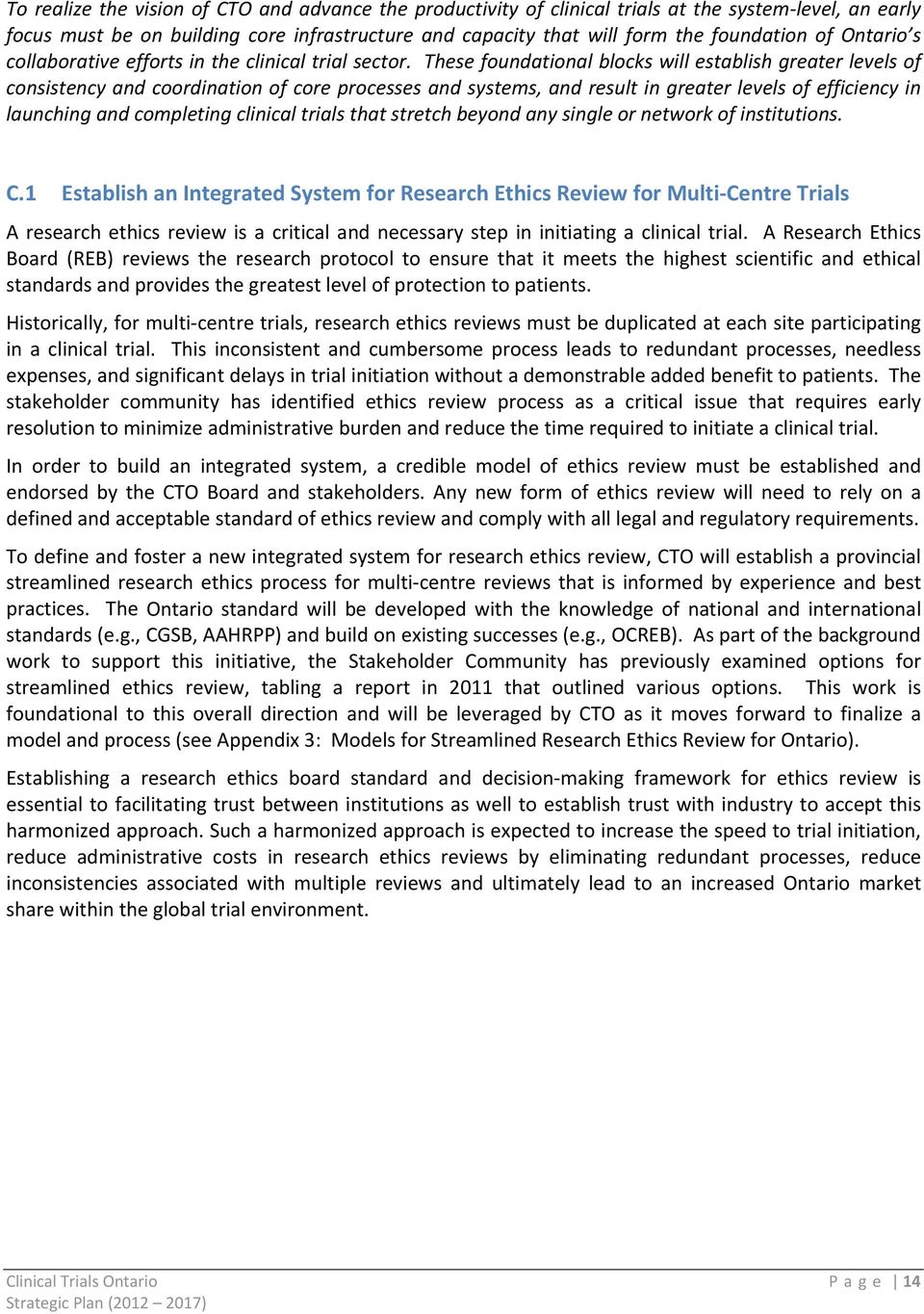
16 Goals Key Areas of Focus Activities C1. Establish an Integrated System for Research Ethics Review for Multi Centre Trials Establish a system to provide increased speed, and reduced administrative costs to research ethics reviews; and ultimately result in an increased Ontario market share within the global trial environment. Obtain CTO Board approval of a preferred model for streamlining ethics review processes Develop Ontario standards (harmonized with national and international standards) Develop a framework for implementation of the preferred model for streamlining the ethics review process Launch a pilot study to evaluate the preferred model for streamlining the ethics review process Officially launch the preferred model across Ontario Establish a multi disciplinary advisory group (from industry, academia, and research institutes) to provide direction in the establishment of the provincial research ethics standard. Establish the Ontario REB standards with a system for certification for Ontario REBs. Engage stakeholders to develop mechanisms and processes for a pilot study of the research ethics review model. Investigate and understand institutional/investigator liability issues associated with the preferred REB Review model where ethics reviews for multi centre trials are coordinated through a collaborative REB process. Launch a pilot study of the preferred REB Review model. Evaluate the pilot study outcomes and rollout the REB Review model for all Ontario institutions and private partners participating in multicentre clinical trials. Establish a baseline inventory of all organizations using the Ontario REB standard. Clinical Trials Ontario Page 15
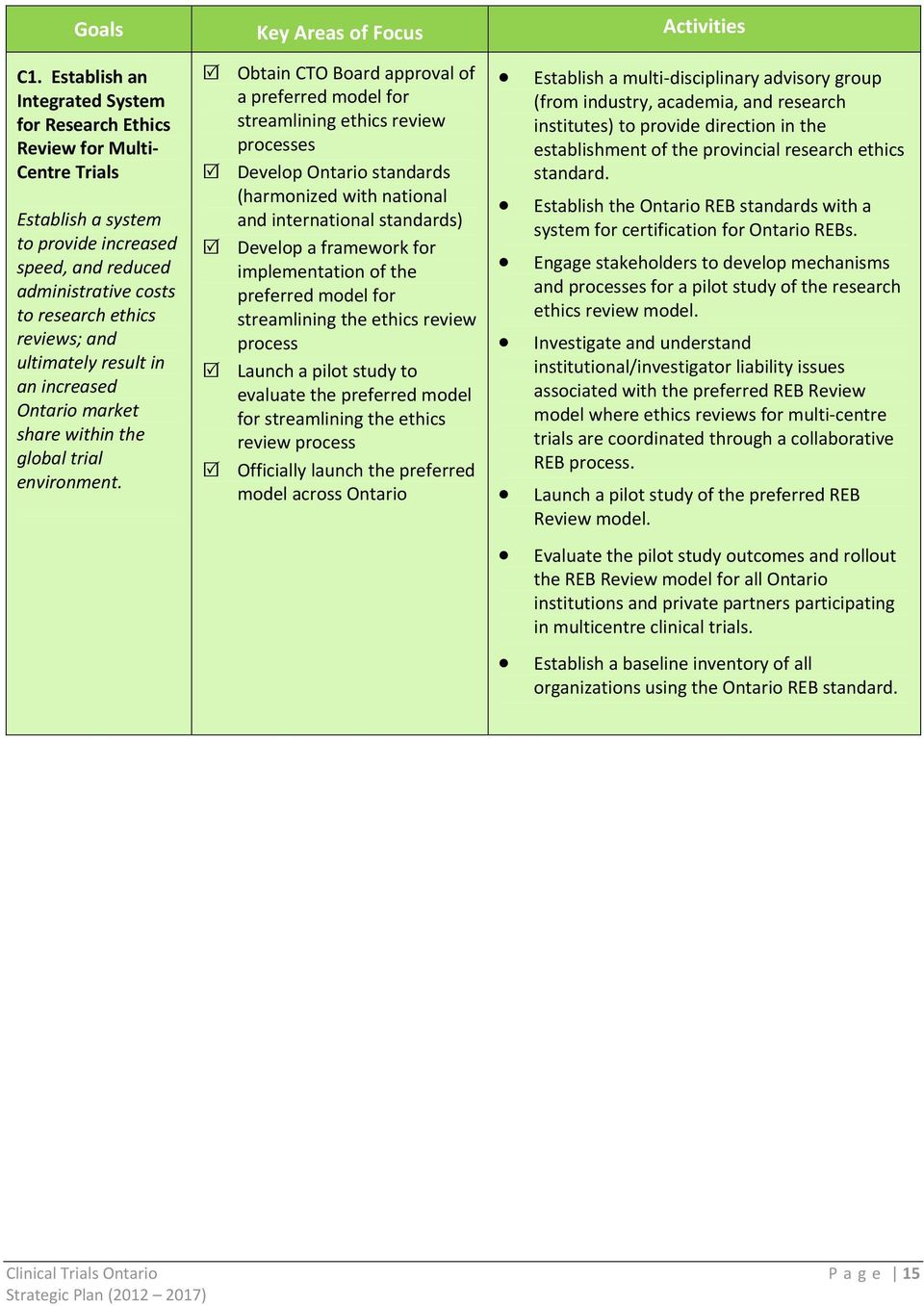
17 C.2 Facilitating Adoption of Standard Operating Procedures for this New Integrated Approach Across Ontario s Clinical Trial Sites to Improve Efficiencies and Reduce Barriers to Timely Trial Initiation Currently, variations in processes and approval mechanisms, including contract negotiations, increases the time required to initiate and complete clinical trials. CTO will leverage standardized approaches for improving the efficiency and effectiveness of multi centre coordination through the development of standardized operating procedures (SOPs) for trials centres that are based on best practice. CTO will also facilitate the implementation of a common contract template to reduce time and cost barriers to trial initiation and make Ontario more attractive to potential investors. As CTO is invested in working collaboratively with other current initiatives and is aware of the national initiative on developing a common contract template, CTO intends to monitor this pilot study carefully in order not to overlap with this initiative. Established processes will align with ongoing initiatives and reflect a Made in Ontario model that meets provincial needs, industry needs, trial centre needs, and build leading practices that position Ontario competitively in the global clinical trials marketplace. All initiatives will comply with current and future regulatory requirements (e.g., GCP, Health Canada, FDA). Goals Key Areas of Focus Activities C2. Facilitating Adoption of Standard Operating Procedures for this New Integrated Approach Across Ontario s Clinical Trial Sites to Improve Efficiencies and Reduce Barriers to Timely Trial Initiation Build standard ways to enhance the efficiency and effectiveness of multicentre coordination through leveraging or facilitating standardized operating procedures (SOPs) for trials centres. Implement a common contract template to reduce delays associated with contract negotiation. Establish a library of best practices and toolkits to support clinical trials sites. Develop Standard Operating Procedures to ensure trial sites follow best practices. Streamline clinical trial contract negotiations and other common processes. Establish a multi disciplinary advisory group from industry, academia, research institutes and leading investigators to provide oversight and direction for the development of a common contract process. Conduct a review of standard operating procedures to understand and build upon current processes for collaboration. Define the mechanism by which this new integrated approach will be implemented and develop operating procedures for integration at clinical trials sites. Pilot common contract templates to streamline contract negotiations, integrated with parallel Canadian initiatives. Develop harmonized processes for application forms, submission processes, and performance tracking across sites. Clinical Trials Ontario Page 16
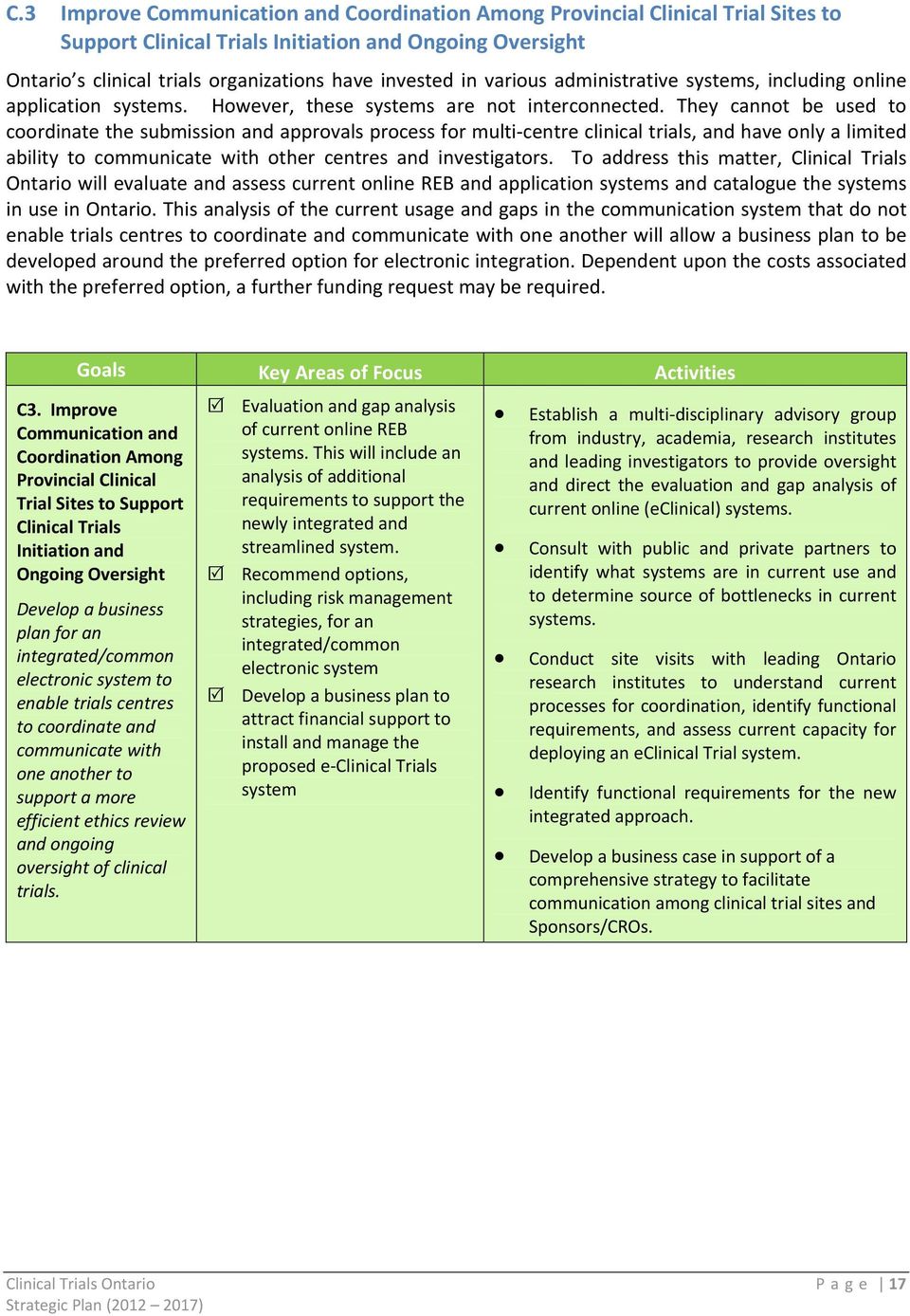
18 C.3 Improve Communication and Coordination Among Provincial Clinical Trial Sites to Support Clinical Trials Initiation and Ongoing Oversight Ontario s clinical trials organizations have invested in various administrative systems, including online application systems. However, these systems are not interconnected. They cannot be used to coordinate the submission and approvals process for multi centre clinical trials, and have only a limited ability to communicate with other centres and investigators. To address this matter, Clinical Trials Ontario will evaluate and assess current online REB and application systems and catalogue the systems in use in Ontario. This analysis of the current usage and gaps in the communication system that do not enable trials centres to coordinate and communicate with one another will allow a business plan to be developed around the preferred option for electronic integration. Dependent upon the costs associated with the preferred option, a further funding request may be required. Goals Key Areas of Focus Activities C3. Improve Communication and Coordination Among Provincial Clinical Trial Sites to Support Clinical Trials Initiation and Ongoing Oversight Develop a business plan for an integrated/common electronic system to enable trials centres to coordinate and communicate with one another to support a more efficient ethics review and ongoing oversight of clinical trials. Evaluation and gap analysis of current online REB systems. This will include an analysis of additional requirements to support the newly integrated and streamlined system. Recommend options, including risk management strategies, for an integrated/common electronic system Develop a business plan to attract financial support to install and manage the proposed e Clinical Trials system Establish a multi disciplinary advisory group from industry, academia, research institutes and leading investigators to provide oversight and direct the evaluation and gap analysis of current online (eclinical) systems. Consult with public and private partners to identify what systems are in current use and to determine source of bottlenecks in current systems. Conduct site visits with leading Ontario research institutes to understand current processes for coordination, identify functional requirements, and assess current capacity for deploying an eclinical Trial system. Identify functional requirements for the new integrated approach. Develop a business case in support of a comprehensive strategy to facilitate communication among clinical trial sites and Sponsors/CROs. Clinical Trials Ontario Page 17
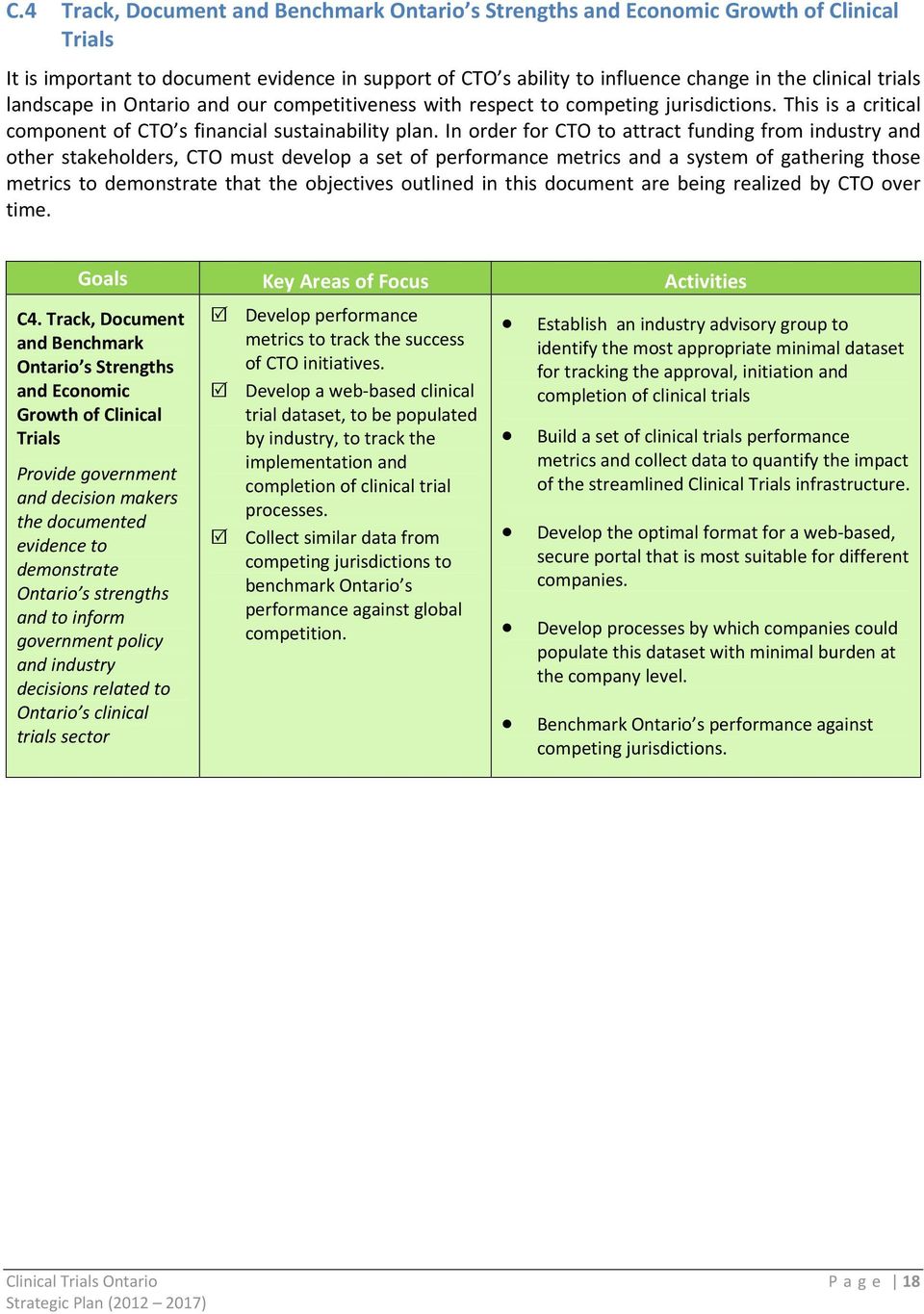
19 C.4 Track, Document and Benchmark Ontario s Strengths and Economic Growth of Clinical Trials It is important to document evidence in support of CTO s ability to influence change in the clinical trials landscape in Ontario and our competitiveness with respect to competing jurisdictions. This is a critical component of CTO s financial sustainability plan. In order for CTO to attract funding from industry and other stakeholders, CTO must develop a set of performance metrics and a system of gathering those metrics to demonstrate that the objectives outlined in this document are being realized by CTO over time. Goals Key Areas of Focus Activities C4. Track, Document and Benchmark Ontario s Strengths and Economic Growth of Clinical Trials Provide government and decision makers the documented evidence to demonstrate Ontario s strengths and to inform government policy and industry decisions related to Ontario s clinical trials sector Develop performance metrics to track the success of CTO initiatives. Develop a web based clinical trial dataset, to be populated by industry, to track the implementation and completion of clinical trial processes. Collect similar data from competing jurisdictions to benchmark Ontario s performance against global competition. Establish an industry advisory group to identify the most appropriate minimal dataset for tracking the approval, initiation and completion of clinical trials Build a set of clinical trials performance metrics and collect data to quantify the impact of the streamlined Clinical Trials infrastructure. Develop the optimal format for a web based, secure portal that is most suitable for different companies. Develop processes by which companies could populate this dataset with minimal burden at the company level. Benchmark Ontario s performance against competing jurisdictions. Clinical Trials Ontario Page 18
20 C.5 Develop Clinical Trials Ontario as Single Point of Entry for Industry Sponsored Multi Centre Trials Based on success of CTO over time, CTO will explore the potential advantages of further streamlining clinical trial efficiencies by making CTO a single point of entry for multi centre clinical trials. As a single point of entry for multi centre clinical trials, further efficiencies may be gained through more centralized support structures. Marketing and communicating with national and international industry partners may be enhanced by promoting the advantages of Ontario s clinical trials infrastructure and capacity. CTO could serve as a broker to advance the speed and breadth of clinical trials coming to Ontario. CTO will also facilitate the work of investigators who are seeking to bring clinical trials to Ontario by providing a streamlined infrastructure to launch clinical trials and recruit participants into those trials. Goals Key Areas of Focus Activities C5. Develop CTO as Single Point of Entry for Industry Sponsored Multi Centre Trials Establish and nurture critical partnerships amongst industry, research institutes, and investigators where CTO will serve as a broker to advance the speed and breadth of trials in Ontario. Based on CTO successes, explore the potential advantages of further streamlining clinical trial efficiencies by making CTO a single point of entry for multi centre clinical trials and promote the advantages of Ontario s new infrastructure to national and international stakeholders. Explore the potential advantages of CTO acting as a single entry point for Ontario in relation to attracting clinical trials. Build partnerships with trial sites to channel access to industry sponsors through CTO. Launch CTO as the single point of entry for all industry sponsored clinical trials Establish an advisory group of industry partners, institutional and trial site leaders to provide oversight and direction to the value of CTO serving as a single point of entry for industry sponsored multicentre clinical trials. Develop mutually beneficial partnerships with industry leaders and other provincial partners to promote the advantages of CTO s role as a single entry point of entry for industrysponsored multicentre trials in Ontario. Build a coordinated network of clinical trial capacity in partnership with trial sites that access industry sponsors through CTO. Establish communication processes to connect industry to trial centres and make Ontario more competitive on the global stage. Promote CTO successes in enhancing patient recruitment for clinical trials to potential investors. Market Ontario s improvements in infrastructure redesign and demonstrate the economic benefits of conducting clinical trials research in Ontario and Canada. Clinical Trials Ontario Page 19

21 Section D: Strategic Pillar Two Leverage strategic partnerships with investigators, industry, and government to gain access to global decision makers for clinical trials and attract clinical trial investment to Ontario based on CTO success Clinical Trials Ontario Page 20
22 The clinical trials stakeholders and Government recognized the need for an entity to play a leadership role to strategically re position Ontario for success in an increasingly competitive and complex clinical trials global market. To achieve this goal, CTO recognizes that it must establish effective partnerships that expedite and fundamentally transform processes between industry and trial centres if it wants to be the game changer envisioned by stakeholders and the Government. D.1 Build a Provincial Network of Investigators, Institutions and Industry Leaders to Promote Common Processes and Platforms The provincial community of investigators represent a diverse group of stakeholders from both the public and private sectors. These include scientists from industry and academic health science centres, individual practitioners in the community, and other leaders in the clinical trials world (e.g., Network of Clinical Research Networks [N2], Ontario Cancer Research Ethics Board [OCREB]). CTO s mandate requires that it reach out to these groups, connecting to first map the richness of the collective community and then working with them to develop common platforms and systems to support their work through established relationships and selected partnerships. Goals Key Areas of Focus Activities D1. Build a Provincial Network of Investigators, Institutional & Industry Leaders to Promote Common Processes and Platforms Build an understanding of the richness of the collective community and work to develop common platforms and systems to support their work through established relationships and selected partnerships. Market to industry the benefits of Ontario s streamlined trial initiation processes. Build partnerships with trial sites and research networks to develop clinical trial capacity and provide easy access to industry through CTO. Develop an advisory group to advise CTO on the development of common provincial platforms and systems to support and advance innovation in Ontario. Establish a provincial inventory of investigator research networks and consortia. Identify partnership opportunities to promote CTO activities. Distribute an annual summary report highlighting advances in Ontario clinical trials. Hold events with investigators, institutional and industry leaders to exchange information for profiling CTO nationally and internationally. Develop communication processes to help inform stakeholders of CTO s role and objectives. Clinical Trials Ontario Page 21
23 D.2 Promote Clinical Trial Investments in Ontario and the Benefits, Quality and Efficiency of Ontario s Newly Streamlined System A number of groups across Canada are focusing on advancing clinical trials capacity at a national level (e.g. Rx & D Canada, CIHR, ACAHO, N2). CTO will enhance integration and relationships with national networks and provincial organizations to promote clinical trial investments in Canada. Goals Key Areas of Focus Activities D2. Attract Clinical Trial Investments to Ontario and market the Benefits, Quality and Efficiency of Ontario s Newly Streamlined System Enhance integration and relationships with provincial and national networks to promote clinical trial investment in Ontario while increasing Ontario s ability to attract new investments to the Province. Enhance integration with national and international networks. Develop a plan to attract global investments to Ontario. Market Ontario s improved and streamlined approach to clinical trials based on evidence from CTO s successes. Synchronize CTO activities with relevant national committees, working groups and/or planning processes (e.g., Rx&D Canada). Participate in key national and provincial conferences and invite leaders from other provinces to showcase the role and impact of CTO. Build relationships with global stakeholders and linkages with other provinces to help improve and promote Ontario s achievements as they evolve. Hold events with investigators, institutional and industry leaders to exchange information for profiling CTO nationally and internationally. Publish and promote Ontario s successes to build appreciation for Ontario as an attractive and competitive region for locating clinical trials. Clinical Trials Ontario Page 22
24 Section E: Strategic Pillar Three Engage patients and the public to recognize the benefits of clinical trials for their own health and that of their families and society and to improve patient recruitment through education Clinical Trials Ontario Page 23
25 To successfully recruit, enrol and retain patients in clinical trials, patients and the public must be informed and supportive of the social value of trials. Clinical trials support the advancement and betterment of society by improving the quality of life of patients by supporting the development of more effective ways to treat or cope with disease; advancing the safety and efficacy of new, innovative approaches to disease prevention, detection and treatment; and enhancing capacity for future innovations and discoveries in novel therapies. CTO will work with industry, investigators, institutions and Government to create vehicles to improve public education and awareness surrounding the social value of clinical trials for Ontarians. E.1 Work with Volunteer Associations to Build Public Awareness and Distribute Education Related to the Social Value of Clinical Trials Clinical trials advance medicine, public health, and technology to improve the quality of healthcare and the quality of life of all Ontarians. Clinical research could not exist without volunteer participants so it is crucial for the general public to be informed about the value of clinical trials and the need to participate. To support this need, CTO will take a leadership role in engaging patients and the general public to build an understanding of the direct benefits of patient participation in clinical trials as well as the social value of clinical trials and improve the patient recruitment process. Goals Key Areas of Focus Activities E1. Work with Volunteer Associations to Build Public Awareness and Distribute Education Related to the Social Value of Clinical Trials Building an understanding of the social value of clinical trials amongst the public through proactive partnerships that will ultimately enhance the patient recruitment process. Build patient and public awareness and confidence in their participation in clinical trials. Promote the health, social and economic value of clinical trials and the impact these have on Ontario. These elements will form part of the CTO Strategic Communications Plan (See Section J) Establish an advisory group of selected volunteer associations to develop options for enhancing the public understanding of the value of clinical trials. Establish mutually beneficial relationships between CTO and Ontario volunteer associations to promote the benefits of participating in clinical trials. Establish a comprehensive library of material to provide clinical trials related information for patients and the public. Compile material and prepare communications products Clinical Trials Ontario Page 24
26 E.2 Establish Educational Strategies to Support More Successful Patient Recruitment and Retention Industry partners, health care providers and many community based volunteer associations have educational materials and formal processes for enhancing public awareness of clinical trials. CTO will work with a network of partners to transform how the public views clinical trials through a greater understanding of the important contributions to science and the important role that each patient has in furthering clinical trials research for themselves and others. To achieve this goal, CTO will support the creation of educational tools, platforms and processes to enhance patient and public understanding of trials with the goal of enhancing patient recruitment. Goals Key Areas of Focus Activities E2. Establish Educational Strategies to Support More Successful Patient Recruitment and Retention Through enhanced educational activity, provide patients and their families with a greater understanding of the direct benefits of participating in clinical trials and the importance of their contribution to improved future medical care for themselves, their families and society as a whole. Inform the public of the benefits and positive outcomes of participating in clinical trials. Complete a comprehensive review of educational strategies. Employ best practices to enhance patient and public awareness of the value and impact of clinical trials. Share education material with selected volunteer associations to advance awareness and promote clinical trials. Clinical Trials Ontario Page 25
27 Section F: Implementation Road Map Clinical Trials Ontario Page 26
28 The following table provides an overview of how CTO activities will be rolled out over the next 3 5 years. In years 1 and 2, the initial focus is centred on building core infrastructure and processes to drive improvement and support innovation (Strategic Pillar 1). In years 3 and 4, CTO will focus on critical partnerships to enhance Ontario s position in the global clinical trial marketplace (Strategic Pillar 2). In years 4 and 5, the focus shifts to enhancing patient and public understanding of the value and impact of clinical trials (Strategic Pillar 3). Goals & Key Areas of Focus Q1 Q2 Q3 Q4 H1 H2 H1 H2 H1 H2 H1 H2 C1. Establish an Integrated System for Research Ethics Review for Multi Centre Trials Board endorsement of preferred research ethics model Develop Ontario standards (harmonized with national and international standards) Develop framework for implementation of the preferred model for streamlining the ethics review process Launch a pilot study to evaluate the preferred model for streamlining the ethics review process Officially launch the preferred ethics review model C2. Facilitating Adoption of Standard Operating Procedures for this New Integrated Approach Across Ontario s Clinical Trial Sites to Improve Efficiencies and Reduce Barriers to Timely Trial Initiation Establish a library of best practices and toolkits Develop Standard Operating Procedures for trial sites Streamline contract approval and reduce delays caused by contract negotiations C3. Improve Communication and Coordination Among Provincial Clinical Trial Sites to Support Clinical Trials Initiation and Ongoing Oversight Conduct an evaluation and gap analysis of current online REB and application systems Provide recommended options for an integrated/ common electronic system with a business case Develop a business plan to attract financial support to install and manage the proposed e Clinical Trials system C4. Track, Document, and Benchmark Ontario s Strengths and Economic Growth of Clinical Trials Develop performance metrics to track the success of CTO initiatives Develop a web based clinical trial dataset Benchmark Ontario s performance against global competition C5. Develop CTO as Single Point of Entry for Industry Sponsored Multi Centre Trials Explore the potential advantages of CTO acting as a single broker for Ontario Build partnerships with trial sites to channel access to industry sponsors through CTO Launch CTO as the single point of entry for all industrysponsored clinical trials Clinical Trials Ontario Page 27
29 Goals & Key Areas of Focus Q1 Q2 Q3 Q4 H1 H2 H1 H2 H1 H2 H1 H2 D1. Build a Provincial Network of Investigators & Industry Leaders to Promote Common Processes and Platforms Market to industry the benefits of Ontario s streamlined trial initiation processes Build partnerships to develop clinical trial capacity and provide easy access to industry through CTO D2. Attract Clinical Trial Investments to Ontario and market the Benefits, Quality and Efficiency of Ontario s Newly Streamlined System Enhance integration with national networks Develop plan to attract global investments to Ontario Market Ontario s improved and streamlined approach to clinical trials E1. Work with Volunteer Associations to Build Public Awareness and Distribute Education Related to the Social Value of Clinical Trials Build patient and public awareness and confidence in their participation in clinical trials Promote the health, social and economic value of clinical trials and the impact these have on Ontario E2. Establish Educational Strategies to Support More Successful Patient Recruitment and Retention Develop education material and best practices to inform the public of the benefits and positive outcomes of participating in clinical trials G. Financial Sustainability Plan Develop a financial sustainability model to support the long term operation of CTO I. Develop a Communication Strategy Develop a communications strategy to effectively disseminate information on CTO activities with stakeholders, investors and other interested parties This inaugural strategic plan is intended to be a living document which will be reviewed at least annually or more frequently by the CTO Board and the Ministry of Economic Development and Innovation if the context for clinical trials changes locally, provincially, nationally or globally. Moreover, as new opportunities for CTO present themselves or as the proposed strategic pillars are implemented, the strategic plan may be amended as necessary to accommodate the changing environment. Clinical Trials Ontario Page 28
30 Section G: Ensure Success Through Monitoring of Results & Impact Clinical Trials Ontario Page 29
31 Ensure Success Through Monitoring of Results and Impact Clinical Trial Ontario s Strategic Plan sets out three strategic pillars to support CTO s vision to provide the life science industry with a streamlined approach to ethics review and contracting for multi centred clinical trials while ensuring highest ethical standards for patient safety. To support achievement of this vision, CTO will monitor results and assess impact using two mechanisms: 1) the ability of CTO to deliver on the plan, and 2) the overall impact of CTO in achieving the vision of improved patient recruitment, shorter trial initiation times, and maximizing Ontario s share of global clinical trials activity. G.1 Evaluating CTO s Ability to Deliver on the Plan The Strategic Plan sets out a clear roadmap for what will be accomplished by CTO. Additional work will be required to quantify and add specificity related to measures, milestones, and the schedule of deliverables. CTO will monitor and report progress on key performance measures to the CTO Board and will provide formal updates to MEDI on the completion of activities to ensure accountability. Initial measures expected to be monitored include: Number of institutions participating in pilot study; Number of sponsors participating in pilot study; Number of institutions adopting the streamlined research ethics review process; Number of REBs certified against the Ontario Standard; Number of sites adopting the SOPs and common contract template; Change in local site burden; Number of strategic partnership initiatives; Number of endorsements received by patient advocacy groups; Value of capital investment in CTO beyond MEDI funding. G.2 Assessing the Overall Impact of CTO on Advancing Clinical Trials in Ontario In addition, to develop measures to assess CTO s ability to deliver on its plan, CTO intends to develop a web based application to collect a minimum common dataset across companies. This common dataset will allow CTO and industry to track commonly collected measures of trial initiation and approval in a similar manner across companies. Using this tool, CTO s performance can be tracked over time and benchmarked against other competitive jurisdictions. Initial measures expected to be monitored include: Time from trial submission to REB approval; Time from trial submission to all site REB sign off/endorsement of the REB decision; Time from trial submission to contract approval (first site and all sites): Time from trial submission to first, median and last patient enrolled; % trials with 100% patient enrollment; Clinical Trials Ontario Page 30
32 Number of sites per trial; Number of patients per site; Cost per patient/trial; Change in trial costs year over year; Change in trial revenue year over year; Change in number of clinical trial studies year over year; % of global market share by revenue. Clinical Trials Ontario Page 31
33 Section H: Financial Sustainability Plan Clinical Trials Ontario Page 32
34 H.1 Ensuring Financial Sustainability Through Long Term Revenue Generation The CTO preliminary budget estimates proposes the cost of operating CTO to be $1.5 2 M per year (with an initial ramp up year to establish CTO and more resources allocated to future years) with salary and benefit inflation adjusted starting in Fiscal Year 4. The Government of Ontario has expressed a willingness to consider supporting CTO during its start up phase (from FY to FY ), with a declining share of support in FY2016 and FY2017. Therefore, CTO would require approximately $ M in committed funding from MEDI over the 5 year strategic plan. CTO will submit to MEDI a detailed Year One Operating Plan upon contract finalization. This Operating Plan will outline the utilization of funds to meet specified deliverables, defined in an accountability agreement. CTO s plan is to generate multiple revenue streams based on the success of CTO activities that will generate $ K from industry by Fiscal Year 04. CTO has identified three complementary alternative revenue streams. The models, described below, form the basis for financial sustainability. During Year One CTO will work with its academic, government and industry partners to determine whether these proposed funding models are feasible and adequate to support CTO in the longer term or if alternative approaches to revenue streams are required to generate revenue to support CTO in years 4 and 5 and beyond. In addition, opportunities to measure and track in kind contributions from institutions and industry will be developed. For instance, CTO will work with industry to leverage in kind contributions of existing resources available from various industry partners as well as work with funders to provide project oriented funds to support continued efficiency gains and innovation. H.2 Rationale for Financial Sustainability Model and Complementary Approaches to Revenue Generation By increasing efficiencies in clinical trial infrastructure, CTO will help attract more clinical trials and/or trial sites to Ontario, hence generating jobs and increasing tax revenue to the province. These increases in efficiencies to the clinical trial infrastructure will benefit industry directly, and will provide the stimulus for industry to invest in CTO. H.3 Proposed Complementary Sources of Alternative Revenue Sources to Support CTO The following financial sustainability options are proposed as complementary options to provide ongoing and long term funding for CTO. These revenue options are examples of reasonable approaches to revenue generation that are currently being explored with industry. It is expected that all three options will yield various amounts of revenue to support CTO in the long term. Together these options will ensure financial sustainability A. Partner s Annual Fee Model It is expected that as CTO creates more efficient clinical trials infrastructure, industry partners will be willing to pay an annual partnership fee to CTO for CTO s provision of the necessary coordination and oversight of the research ethics, contract and coordination processes. The coordination and facilitation function of CTO in the ethics review and administrative streamlining will be discussed with industry as a service that supports all industry trials. As a service, CTO will work with industry to determine which suites of services are of value to industry and determine their willingness to Clinical Trials Ontario Page 33
35 financially support such services. A process to identify and quantify the benefit and value of CTO services to industry partners will be developed. Access to such services as well as influence over the direction of CTO service development will be dependent on industry partners paying an annual partnership fee. This annual fee model will provide a relatively fixed revenue stream. It is expected that this revenue stream will grow over time with increasing numbers of industry partners joining with CTO as CTO services become better recognized as value added services to industry partners. In the steady state we estimate that this source of revenue could be ~$200,000. B. CTO Paymaster Model The current funding model for REB expenditures is based on industry paying a REB fee to each site (e.g., $3,000/site). With the evolution of an integrated approach to research ethics review, the number of required ethics approvals to launch a clinical trial will be reduced. The CTO Paymaster Model will shift from payment to multiple REBs/institutions to payment directly to CTO. CTO becomes the new paymaster responsible for funding REBs. Under the proposed streamlined REB process, the REB responsible for the ethics review (Board of Record) will receive a fee for the provision of the REB review and continuing oversight. Following the initial ethics review in this new integrated system, other participating trial sites would receive little or no funding as the new process requires little effort on their part. CTO will work with hospital and academic institutions to manage the loss of revenues from REB fees and demonstrate the value to the streamlined ethics review process on institutional REB operations. This Paymaster Model has the possibility of generating significant revenue to support CTO in the long term. If it is assumed that a clinical trial engages 6 trial sites in Ontario, the following describes the preliminary model assumptions and revenue opportunities. CTO collects $18,000 from industry based on a $3,000 fee per site CTO pays $3,500 to lead REB and $500 to all other REBs (total payout = $6,000) Net to CTO = $12,000 Assuming 50 trials/year, CTO revenue line = ~$600,000 To address industry concerns about the duplicative efforts created by multiple REB reviews and the required tracking documentation through multiple REBs, the integrated ethics review system proposed by CTO has the potential to reduce these costs. Thus, there is an opportunity to share these savings between industry partners and CTO. Not only are there indirect savings in terms of time to approval but direct savings regarding the management of multiple REBs. CTO will work to identify such potential cost savings for industry and develop proposals to share in anticipated savings arising from using the CTO facilitated review system. This represents an additional revenue stream related to direct ethics review changes. C. Shared Clinical Trial Savings Model As noted in Section F, CTO will develop performance measures or metrics that will quantify CTO s ability to enhance the efficiency and effectiveness of ethics and administrative processes. CTO will begin by establishing baseline clinical trials metrics to establish the current levels of efficiency, or lack thereof, within the system in Ontario (see Section F.1). In this process CTO will work with industry to not only establish these metrics but will also work with industry to cost out these performance metrics. Clinical Trials Ontario Page 34
36 CTO will then work with pharmaceutical and device industry stakeholders to determine changes in these performance metrics over time on a quarterly/semi annual basis. As the efficiencies of these processes improve over time, this represents real savings to industry. For instance, if the time to REB approval is reduced by 20 days per site from the baseline across 5 sites, a cumulative savings opportunity for trial initiation of 100 days exists. If reducing the study initiation time by 1 day results in a cost savings of $100 to the sponsor then a cost sharing agreement can be developed with the sponsor to share some of those savings with CTO. The same approach could be used for other performance metrics (e.g. enhanced recruitment and retention of patients, decrease time to first patient enrolled, decreased time to study completion) such that CTO and sponsors will benefit from enhanced savings. Canadian subsidiaries of global companies will also benefit by becoming more competitive in the view of their global decision makers. It is expected that this approach will be a significant revenue source for CTO; clearly this approach is dependent on CTO demonstrating success in the proposed metrics. It is difficult at present to estimate the revenue from this approach, but we think that it is reasonable in the steady state for this to be on the order of $100k to $400k. D. In Kind Contributions From Industry As mentioned above, in kind contributions could benefit CTO in terms of reducing the need for alternative funding sources. While in kind contributions in the area of Communications, Translation, Printing and Dissemination, Existing Education Products, and Specialists in software, marketing, and business development are not direct revenue streams, such contributions can help defray CTO expenditures over time to reduce the need for direct revenue support. CTO will pursue these opportunities with industry partners. E. Additional Supplementary Project Based Revenue Sources CTO will assess if there are other grants or other funding opportunities that can be accessed from other levels of government and national agencies, either as one time project funds or as sustainable revenue sources. CTO will also explore whether there are other fees that are currently paid by industry partners where CTO could define a similar value proposition for project oriented funding. Clinical Trials Ontario Page 35
37 Section I: Operationalize CTO Clinical Trials Ontario Page 36
38 I.1 Governance Clinical Trials Ontario is a federally incorporated not for profit organization. There are six institutional Members who elect the Board of Directors. The Members are: 1. Council of Academic Hospitals of Ontario (CAHO) 2. Canada s Medical Technology Companies (MEDEC) 3. Canada s Research based Pharmaceutical Companies (Rx&D) 4. Council of Ontario Faculties of Medicine (COFM) 5. Industrial Biotechnology Association of Canada (BIOTECanada) 6. Ontario Council on University Research (OCUR) The Board is comprised of nine Directors (see Appendix 4: CTO Board of Directors) selected by a Nominating Committee according to Rules and Regulations adopted in accordance with the general operating by law of the Corporation. The names of eligible candidates are submitted for endorsement by the Board and approval by the Members. The selection criteria cover a range of essential expertise and valuable skills as well as current experience and relevant sectoral knowledge: Clinical Trial Investigator Experience Knowledge of International Scene Intellectual Property Patient Perspective Business Perspective Industry Perspective Government Relations Start Up knowledge Legal Perspective Audit Knowledge Marketing The Deputy Minister of the Ministry of Economic Development and Innovation, or his/her delegate, is accorded Observer status at the Board. The role of the Board is to set policy and monitor the operations and programs of Clinical Trials Ontario in the best interests of the Corporation and on behalf of the Members. Through its actions the Board enables the Executive Director to effectively manage the organization s activities. One advantage of a skills based Board lies in range of individual skills and expertise related to Clinical trials activity that can be made readily available to committees of the Board and to the Executive Director. In addition, the synergies that will undoubtedly result from discussions from the broad range of skills and experience at Board meetings are expected to generate novel solutions to issues not yet encountered as Clinical Trials Ontario evolves. As a new Board there will likely be a need for some focused Board Development events as the Corporation matures and grows in its first 1 2 years of operation. These events will be planned as Board retreats with focused agendas, supported by a facilitator. Officers of the Corporation are appointed by the Board. Currently CTO has a Chairperson, a Secretary, a Treasurer, and an Executive Director charged with managing the day to day affairs of the Corporation. These four Officers form the Executive Committee of the Board. Clinical Trials Ontario Page 37
39 Other than the Nominating Committee, there are no formal committees of the Board at this time. However it is anticipated that the Board may establish one or more formal committees including: finance and audit; ethics; legal; and technical committees as provided for in the by laws. I.2 Organization The Strategic Plan lays out a plan for how CTO will ramp up over the coming five years to deliver on its vision. To meets it role, CTO will put an action oriented team on the ground to deliver on CTO s mandates with an initial focus on a core team to get CTO mobilized followed by additional team members to provide needed strengths and skills to lead and advance the strategy. The following organizational chart provides a template for a matured CTO structure (after 2 3 years). Immediate focus will be to recruit an Executive Assistant to provide administrative support to the Executive Director and hire a Director of Operations to provide day to day oversight of CTO projects and oversee deployment of the strategic initiatives. Other roles that should be identified and filled within the first 90 days include a Strategic Communications Lead and Manager of Special Projects. The Strategic Communications Lead will assist the Executive Director with all marketing and related initiatives to define the CTO brand and start to position it within local, provincial, national and international circles. The Manager of Special Projects will focus on defining the formal work plans for each initiative, securing ad hoc contractor resources as required to complete the work and managing those resources to ensure deliverables and timelines are met. Clinical Trials Ontario Page 38
40 Chart 1: CTO Organizational Chart (After 2 Years) Clinical Trials Ontario Page 39
41 Section J: Build a Communication Strategy Clinical Trials Ontario Page 40
42 CTO is intended to evolve into a single point of entry for multi centre clinical trials in Ontario. CTO will act as a facilitator for the clinical trials infrastructure in Ontario and as a liaison hub for Ontario clinical trials activity for other provincial, national and international initiatives. Communication is key to this effort. CTO is committed to open, timely and accurate communications, delivered in plain language, and welcomes inquiries, comments and opportunities for dialogue. The communication strategy will educate, inform and engage in dialogue with its stakeholders and the general public to raise awareness and obtain feedback regarding the purpose of clinical trials and the benefits of such trials to the health and well being of Ontarians as well as the economic benefit to Ontario. CTO will develop a communications strategy to support its activities and initiatives supporting an effective exchange of information with its stakeholders, including the public, and feedback from those stakeholders. Key areas of focus include: 1. Educate, inform and engage in a dialogue with patient groups and association as well as the general public to raise awareness and obtain feedback regarding CTO s achievements to advance clinical trial capacity and success in Ontario. Engage in stakeholder relations in the clinical trials community to obtain feedback and support for CTO initiatives, and work with stakeholders to create awareness in the public of clinical trials as a treatment option using display and print material, presentation, media stories and advertisement. 2. Engage in a dialogue with industry and health partner stakeholders to create awareness that will increase participation in clinical trials, and set a clear plan and obtain support for enhancing the efficiency of clinical trials initiation with a goal of capturing a larger share of the global clinical trial market. Establish a multi year plan to communicate CTO achievements, create awareness, and encourage feedback to CTO. Educate and inform government, trial stakeholders, and the public of the measureable success CTO is achieving. Support greater awareness amongst hospital, physicians, researchers, trial personnel through development of marketing material, participation at conferences, and updates to Ministry staff. CTO will develop an integrated strategic communications and outreach program to: Position CTO objectives effectively with all target audiences and stakeholders Build momentum and support for CTO s vision and mandate Showcase the success of CTO Develop a plan to regularly market CTO to the media in order to highlight successes that arise from clinical trials carried out in Ontario Enlist champions of CTO from industry, academia, and patient advocacy groups Align communications and outreach with overall strategic pillars Develop strategies, targets and products (logo, tag line, branding, website etc.) Clinical Trials Ontario Page 41
43 Section K: Conclusions Clinical Trials Ontario Page 42
44 Clinical Trials Ontario (CTO) was established to bring the necessary focus and tools to strategically position Ontario and elevate the collective success of Ontario as a global leader in the Clinical Trials market. Building on a rich and proud history of excellence, CTO is intended to be a key mechanism indeed a game changer to mobilize all of the partners (Government, Hospitals, universities, research institutes, investigators and private industry) to move quickly and create a coordinated, streamlined, seamless model for launching and approving Clinical Trials across the spectrum of disease, specialties and prevention strategies. This Plan provides the strategy roadmap for CTO to reposition Ontario to be more competitive in an increasingly complex global clinical trials environment. We will do this by leveraging the power of the many networks of academic, community and industry institutions into an integrated system supporting clinical trials. The result CTO will help to ensure that Ontario benefits from: Access to leading edge medical research, and as a result, local access to the best, and most advanced, evidence based care; and Opportunities for economic growth through job creation, and attraction to the best and brightest researchers from around the world. To support Clinical Trials Ontario in advancing its strategic mandate, the Strategic Plan been developed to guide the organizational planning and decision making processes. Strategic priorities were developed through consultation with leaders from the field and a review of leading research and experiences. The resulting Strategic Pillars and Initiatives define practical approaches to move towards the vision to provide the life science industry with a streamlined approach to ethics review and contracting for multicentred clinical trials while ensuring highest ethical standards for patient safety. This will lead to improved patient recruitment and shorter trial start up times. It will also help to maximize Ontario s share of global clinical trials activity. The outcome Ontario Will Become a Preferred Location for Global Clinical Trials Activity While Maintaining the Highest Ethical Standards. CTO believe that this Strategic Plan reflects clear and achievable priorities that will enable Ontario to: Become a strong competitor in the global industry driven clinical trials market by maintaining and growing Ontario s position as a leader in clinical trials expertise and scientific advancement; Help maximize Ontario s share of global clinical trials activity by enabling trials to be initiated more smoothly and quickly through leading practices; and Draw more industry investment to Ontario ultimately reversing the loss of revenue from trials. Using the Strategic Plan as an overarching framework, annual business plans will be developed to identify and prioritize specific initiatives and actions within each direction, and develop a multi year plan for action. The resultant action plans and the measurement of CTO s successes will, in turn, be reported back to the CTO Board to ensure that we are achieving the goals we set out to achieve and having the impact necessary to transform clinical trials in Ontario. Clinical Trials Ontario Page 43
45 Section L: Appendices Clinical Trials Ontario Page 44
46 Appendix 1: Clinical Trials Ontario s Vision, Principles, Mandate and Outcomes Clinical Trials Ontario Page 45
47 Vision for Clinical Trials Ontario The vision of Clinical Trials Ontario was adopted from the work completed by the Clinical Trials stakeholder group through consultation with the Ministry of Research and Innovation and endorsed by the Minister. The vision that led to the creation of CTO was to provide the life science industry with a streamlined approach to ethics review and contracting for multi centred clinical trials while ensuring the highest ethical standards for patient safety. While maintaining the Guiding Principles, Mandate and Outcomes originally envisaged, the Clinical Trials Ontario Board of Directors decided to broaden the Vision Statement to the following: To Make Ontario a Preferred Location for Global Clinical Trials While Maintaining the Highest Ethical Standards Guiding Principles This vision is further defined by the following six Guiding Principles: 1. Recognize the goal of maximizing Ontario s share of global clinical trials activity; 2. Build upon current best practices in Research Ethics Board review processes; 3. Be mindful of the impact of proposed changes on research participants, and address the needs of patients in long term trials; 4. Balance industry, institutional and government needs in the context of other local, provincial, and national initiatives in order to minimize overlap and maximize effectiveness; 5. Respect the current provision of high quality ethics review services by public organizations and private sector companies; and 6. Attain financial sustainability within an appropriate timeframe. Mandate These principles result in an agreed upon Mandate for CTO that focuses on: Supporting efforts to maximize investments in the province; Coordinating Research Ethics Boards that participate in multi centre trials; Establishing performance metrics to measure and evaluate the integrated ethics review system over time; Standardizing administrative processes; Implementation of common contracts; Identifying and sharing best practices; Promoting Ontario s Clinical Trials sector and the social value of trials; and Based on demonstrated CTO success, CTO should evolve into a single point of entry for industry sponsored multi centre trials. Clinical Trials Ontario Page 46
48 Outcomes The Outcome while maintaining the highest standard for protection of human subjects, streamlining the research ethics infrastructure is but one of the strategic approaches to help Ontario: Become a strong competitor in the global industry driven clinical trials market; Help maximize Ontario s share of global clinical trials activity; and Attract more industry investment to Ontario. Clinical Trials Ontario Page 47
49 Appendix 2: Understanding the Clinical Trials Environment Clinical Trials Ontario Page 48
50 Understanding the Clinical Trials Environment Clinical trials are the essential underpinning of providing evidence based medicine to patients. Clinical trials support the development of new drugs, devices, medical practises and vaccines by bringing together scientific discovery and practice that enhances our understanding of disease, generates new knowledge, and offers patients and clinicians rare opportunities for novel and advanced treatment options. The end result changing people s lives through the opportunity to more effectively treat or cope with disease; improving the quality of life of patients, and determining the safety and efficacy of new, innovative approaches to disease prevention, detection and treatment; building a knowledgebased economy by attracting world class researchers and clinicians, and creating employment opportunities; and enhancing the capacity for future innovations by generating revenues that lead to further investments to innovate. As Ontario receives the largest investment in Canada from the pharmaceutical industry in the form of clinical trials, a healthy clinical trials industry is essential to Ontario. A New Era for Clinical Trials While there have been a number of initiatives in Canada to reform clinical trials processes, the Canadian Clinical Trials Summit in September 2011 provided an excellent summary of the current thinking and information. The Summit, organized and co sponsored by Rx&D Canada, the Canadian Institutes of Health Research (CIHR), and the Association of Canadian Academic Healthcare Organizations (ACAHO), confirmed that a shift in clinical trials has begun. In fact, a race towards improved and enhanced infrastructure support has begun. And the course of this race is at the global level. The following points extracted from the Summit help to frame the overarching issues in clinical trials: Canada has enjoyed a reputation for excellence in the area of clinical research. Our participation and leadership in clinical trials has led to many world first medical discoveries and innovations; attracted world leading clinicians and researchers; benefited patients and families; and resulted in important pay offs for our economy. However, there are operational barriers that could compromise our future success. We are seeing a decreased number of clinical trial applications in Canada and globally and an increase in the impact of issues related to the cost, quality and speed required to conduct clinical trials in our country. These issues need to be addressed in order to re establish and secure the future human, social and financial benefits from trials that we currently enjoy. Other countries face the same issues. To address them, they are using the full force of their unique populations, environments and competitive advantages. Their strategies range from the selection of clinical areas for strategic foci, to the establishment of nation wide infrastructure that facilitates training, recruitment and operations; the standardization or centralization of legal and ethics review environments; streamlining of forms and processes; the funding, licensing or accreditation of clinical sites participating in trials; and collaboration across geographic regions to maximize harmonization of processes and available populations for recruitment into trials. In Canada, nearly every province has also invested in strategies for strengthening clinical trials; we have formal and informal disease and population based networks; and we are making progress on a variety of individual operational barriers. While many of these initiatives may not yet be fully coordinated across the country, they are living experiments and resources that can catapult our national progress, especially considering our relatively small population size. Establishing and implementing a plan that can harness these efforts, build on our strengths, and successfully address issues related to cost, quality and speed, will help us to secure and expand Canada s position as a leading environment for clinical research. Clinical Trials Ontario Page 49
51 To meet this new era, the Ontario Government in cooperation with industry and institutional leaders have come together to create Clinical Trials Ontario (CTO) a not for profit, independent organization that will provide the required infrastructure, leadership structures and processes to enable the streamlining of essential administrative and ethics review processes across multiple clinical trial sites in order to increase the speed of trial approval, initiation, and ultimately patient recruitment. The Canadian Clinical Trials Environment: Major Issues, Challenges and Opportunities To advance clinical trials in Canada, it is critical to understand our starting point. The following provides a succinct SWOT analysis of the clinical trial industry in Canada 2 prepared by Dr. Slutsky, ACAHO Research Co Chair and VP Research at St. Michaels Hospital, Toronto, Canada. Strengths to Build On: A tradition of excellence Reputation of researchers, organizations and outputs Diverse population (ethnicity, race etc.) Disease/population specific networks and charities Evidence of an interested and supportive public Collaborative intent, volunteer efforts, and goodwill Publicly funded healthcare and provincial funding National & federal leadership Provincial commitments and initiatives Weaknesses to Manage: Nationally, 10+ health care systems, all with their own regulatory environments Ethics approval processes are inconsistent and cumbersome within and between organizations Delays in Contract negotiations delay the efficiency of start up Poor and inconsistent recruiting of trial participants High and increasing costs and insufficient mechanisms to support indirect and overhead costs Diminishing career support and reduced incentives to become involve in trials Opportunities to Explore: Confluence of interest amongst key participants and leaders Areas of clinical excellence that can be leveraged Build a central repository of current ethics and contract processes to facilitate the adoption of standardized approaches tailored to institutional and jurisdictional difference Strong collaborative culture across Canada Build on the current biobank, electronic health records, and research network capability already established Threats to Avoid: Unintended consequence of interventions (e.g. REB: well intended but cause delay) Decreasing ability to leverage hospital resources in the conduct of trials Diminishing training and career support & incentives for researchers and scientists Increasing focus by governments to cut costs by use of generics Cumbersome regulatory environments Real & perceived issues regarding cost, quality and speed Lack of structure for integration Other countries are getting their act together providing cheaper options for global firms 2 Presentation by Dr. Slutsky, ACAHO Research Co-Chair and VP Research, St. Michael s Hospital in Toronto. Starting the Conversation A SWOT, So What, & Now What? Summary, Implications & Next Steps. Clinical Trials Ontario Page 50
52 Valuing the Relationship between Quality, Speed & Cost The following information was conveniently summarized and provided by the Canadian Clinical Trials Summit (2011) and reflects important considerations as part of an environmental scan. The facts are clear with a negative trend in the number of industry sponsored trials initiated worldwide, performance metrics suggest that Canada will face challenges to meet competition for its share of trial activity" 3. Trials and recruitment show a downward trend worldwide, however, emerging countries (and Japan) have shown a positive trend in the global environment for opening clinical trial sites. However this positive trend has not been maintained in Canada. Canada ranks fifth in its share of trials, exhibits a steeper rate of decrease in sites opened, and ranks tenth in site capacity. Within a subset of western countries and globally, Canada has a greater rate of decline in recruitment reliability and an intermediate time to the first subject in trials. It also tends to have a higher per subject cost relative to other countries. There has also been a shift in how clinical trials are conducted. In the past, many studies were carried out in the context of an institutional environment and thus demanded an institutional infrastructure. Because of the greater regulatory demand for evidence to support the use of new and expensive treatments in different patient populations and the advancement of science to move toward personalized medicine by way of genetics, genomics and proteomics, such evidence is increasingly conducted in the context of global trials largely carried out by multinational pharmaceutical and device companies. In a world where emerging markets have lower labour and infrastructure costs, global companies have been more attracted to emerging markets on the basis of lower absolute costs, relatively comparable quality given the cost differential and less bureaucracy with regard to the necessary approval to conduct clinical trials (shown in Figure 1). Canada, Ontario and other established markets have seen clinical trials move to emerging markets even though Canadian and Ontarian scientific expertise has been utilized in an overrepresented way globally to focus these clinical trials. Figure 1 Clinical Trial Market Share Source: Clinical Trial Magnifier, Vol 2:2 (Feb 2009) 3 Metrics Survey of Industry-Sponsored Clinical Trials in Canada and Internationally, Dr. Normand Laberge Clinical Trials Ontario Page 51
53 At the Clinical Trials Summit, Mr. Normand Laberge, Vice President for Rx&D Canada, confirmed the ongoing impact of this trend, noting that while Canada has generally maintained its share of the number of overall trials (with market share steady at ~14%), the trials that are being initiated/performed in Canada have less sites (and less patients) than those that are being established in other countries. This reduction in the number of sites and patients is a major concern as this is where the economic impact through reduced overall investment in the economy is being felt. Turning this around and recapturing some of this investment potential will require focus on four key factors: Quality, Speed, Patient Recruitment and Cost. Quality: Understanding Canada s Leverage Point The structure of the Canadian health care system, which includes large referral centres for specialized medical care, is ideal for conducting clinical research trials. These institutions are established centres of excellence with extensive clinical and academic research infrastructure, including internationally renowned researchers and scientists. (shown in Figure 2) Catherine Dunne, Manager, Heart Failure Therapy Development, Medtronic Canada With the increasing loss of clinical trial activity to emerging markets from established markets on a global basis, one might suggest that a contributing factor might be a decline in academic leadership in the clinical trials area. However, quite the opposite is the case. Data from CIHR shows that Canada is the 5 th leading country in the world in terms of research publications and #1 when publications are restricted to health related clinical research as shown in Figure 2. Figure 2 Scientific Impact: Clinical Versus Health Research Clinical Trials Ontario Page 52
54 Health Canada, in its paper Invest in Canada summarizes the following points and statistics to help illustrate the Quality Advantage: World class researchers and centres of excellence. Canada is home to highly respected clinical research teams experienced in leading large, international studies. These research teams are supported and linked through common health research networks and strong informationmanagement systems. Together, they have helped Canada earn a solid reputation for meeting recruitment targets quickly and generating top quality data and reliable results. However, as noted earlier, our competitive advantage has declined in this area over the last 5 years. A leader in setting the standard. Canada has been a world leader in both developing and implementing quality standards in clinical trials. In fact, it was a Canadian based epidemiologist who led the development of the Consolidated Standard of Reporting Trials (CONSORT) that has since been shown to improve reporting of randomized trials. The CONSORT standard has been recommended by the International Council of Medical Journals Editors and adopted by approximately 500 health care journals internationally. Good Clinical Practice (GCP). Canadian trial sites are regularly monitored by Health Canada, the U.S. FDA and industry sponsors and have earned a reputation for both quality and reliability. Historically, the quality advantage has allowed Canada to maintain a significant (and disproportionate) market position when compared with our total population base (i.e. our share of the trials market is larger than our share of the population). That said, weaknesses and emerging issues with the other factors speed, patient recruitment and overall cost are overriding the quality advantage. Speed: One of Canada s Downfalls Study initiation delays have a number of causes, many of which have become systemic issues in countries like Canada and the US. In a presentation in 2009, Dr. Alain Beaudet, President of CIHR, identified the five primary reasons for study initiation delays (see figure 3 below). Figure 3 Causes of Study Initiation Delays Thomson CenterWatch 2003 (n=396), 2005 (n=612) Clinical Trials Ontario Page 53
55 The figure above shows that 4 of the 5 major sources of delay are related to systemic infrastructure issues, notably: Contract and Budget Negotiation and Approval; Protocol Amendment and Refinement; REB Review and Approval; and Review and Approval of Consent Terms. All of these reflect the clear consensus that exists within the Stakeholder Community on key issues that need to be streamlined and improved and these have been specifically identified within the CTO mandate. The goal will be to reduce the time to study initiation, thereby increasing the competitive advantage that other countries have exploited to increase their share of trial sites and patient recruitment. Patient Recruitment: A Significant Problem, A Potential Game Changer The 4 th factor noted by Dr. Beaudet is the delay associated with patient recruitment/enrolment. The ability to successfully recruit, enrol and retain patients in a trial is a significant problem in many markets and traditional leaders, such as the US and Canada, are experiencing major challenges in this area. Globally, there were 227,000 patients enrolled in trials in 2008, a number that decreased by 26% to 169,000 by As Laberge notes, this has put Canada last out of 16 nations in terms of percent change in patients recruited into clinical trials, dropping from 6% of all patents to 4% in just 5 years. Delays in start up times noted previously exacerbate the patient recruitment has the first patient cannot be recruited until all the necessary approvals are in place. This narrows the window of opportunity to recruit the full number of patients required/projected for the trial at a specific site. In short, those jurisdictions that approve sooner and enrol faster will enrol more patients in global studies due to their competitive edge. The longer term effect of more rapid enrolment in a jurisdiction is an enhanced ability to attract future trials due to superior enrolment capability that reduces the cost to industry for conducting clinical trials in those jurisdictions. Canada ranks 9th out of 10 countries in their ability to recruit patients into clinical trials. Figure 4 below shows that compared to Canada s ability to recruit patients, the US recruits patients at 2 times the rate, India at 2.75 times the rate, and Eastern Europe at 6.67 times the rate. In other words, Canada is only 15% as efficient as Eastern Europe at enrolling patients into clinical trials. As a result, Canada often does not meet its intended recruitment goals and this has caused reputational damage to Canada with the global pharmaceutical industry that, in turn, are preferentially moving to other jurisdictions to increase the speed at which global trials are completed. As a result, some trials only come to Canada after they have been opened and recruiting patients in other jurisdictions has begun. The resulting delay in Canada s ability to recruit represents a significant financial loss of opportunity to Canada and Ontario. 4 Sandra Gazel, Associate Director Clinical Operations, Abbott Canada and Diane Simmons, President & CEO, CISCRP, presentation to Clinical Trials Summit, Ottawa, September 15, 2011 Clinical Trials Ontario Page 54
56 Figure 4 Patient Recruitment by the Numbers Source: Kendle International, Goldman Sachs Research (from Paraxel s Bio/Pharmaceutical R&D Statistical Sourcebook 2008/2009) Cost: An Ugly Truth The stark reality of the above is that Canada has reduced its ability to recruit efficiently and this, according to Gazel and Simmons at the Clinical Trials Summit, leads to the ugly truth that Canada is now viewed as one of the least cost effective environments in the world for clinical trials. This is one of the primary drivers that led the Government of Ontario to establish CTO to provide the leadership required to reverse the trend lines that show decreasing market share by focusing on the integrative opportunities that exist to create common platforms and processes to better position investigators and organizations to undertake trials and maintain the volume and share of global trials in Ontario. The expectation is that the approval of studies will occur earlier, start up times will be reduced, administrative burden will be reduced and Ontario will become more competitive globally. Quantifying the Current Lost Opportunity. Assuming that CTO can be successful in reducing unnecessary delay and can facilitate process changes that enable more effective patient recruitment, the result will be more economic investment in Ontario. Estimates from one Pharmaceutical company have projected the lost revenue associated with (a) a shrinking global clinical trials market and (b) a noncompetitive position by Canada within that shrinking market could be as much as $200 million on a national level. Assuming Ontario represents approximately 50% of the clinical trials market in Canada, the provincial impact is in the range of $100 million. With changing market size and conditions, only a percentage of this investment will ever be recaptured but if 20% can be regained, up to $20 million could potentially be reinvested in the provincial economy every year. This is the opportunity that CTO represents. Clinical Trials Ontario Page 55
57 Realizing the Potential: A Case Study In reviewing the issues and understanding both the challenges and the opportunities, leadership at CTO was able to review a parallel process from Spain. Starting in 2003, Spain launched Project BEST with a goal of (a) understanding the reasons that Spain was losing ground in the global clinical trials market and (b) what they could do to reverse the trend. Dr. Amelia Martín Uranga, presenting at a conference in Buenos Aires in July 2011, described the circumstances that led to the creation of Project BEST, a strategic partnership between private and public sector partners, with the aim of creating a platform of clinical excellence to support trials. This stemmed for the recognition that a significant economic opportunity was being lost or missed by being less competitive which was grounded in a number of obstacles: Growing clinical trials approval times Increasingly bureaucratic regulatory processes A failure to coordinate trials across complex institutions An environment that was becoming less conducive to clinical research Increasing competition from Eastern European and other countries that were more efficient The goals of Project BEST were to: make the clinical trials environment more agile and nimble, deliver high quality in terms of the top standards while being efficient, address social challenges related to patient recruitment, and raise the profile of trials within key government agencies. In pursuing these goals, two key areas of focus emerged: 1. To identify the factors of success that lead to a more efficient clinical investigation and to compare them to national and international standards. 2. To deploy a system of metrics as a set of excellent, performance based indicators of the efficiency and the quality in the changes achieved by modifications to the clinical trials landscape. Results to date have been focused in many areas and include: Excellence in clinical research is emerging and creates a focus for discussions with leaders from government, industry and providers. A number of platforms have been put in place, demonstrating the benefits of public private cooperation in basic, preclinical and clinical research. The benefits from the work were reinforced since 2007 with the launch of the Innovative Medicines Initiative in Europe, showing how national efforts such as those in Spain have the potential to bring scientific and technological returns to the country and region. New challenges ahead in biomedical research will continue to focus Spain on the need to promote excellence and competitiveness at the international level. The impact has been impressive as shown in the chart below (reprinted with permission from Mr. Normand Laberge, Rx&D Canada) where Spain has doubled its patient recruitment reliability from 2005 to 2010 whereas Canada has shown a 40% decline from Clinical Trials Ontario Page 56
58 Figure 5 Average Recruitment Reliability (AvRR): From 2005 to 2010 Source: Canadian Clinical Trial Summit, September 15, 2011 The lesson for Canada and Ontario is that through coordinated and focused efforts, gains can be made and issues can be overcome. Clinical Trials Ontario Page 57
59 Appendix 3: Models for Streamlined Research Ethics Review for Ontario Clinical Trials Ontario Page 58
60 Excerpt A: The Models Considered by Stakeholder Committee to Streamline Ethics Review (January 2011) 1. Distributed Models: May include a reciprocity system, consortium, or facilitated review system: Reciprocity Consortium Facilitated Review The Central Committee on Research Involving Human Subject (CCMO) in the Netherlands accredits REBs so that the decision of one is accepted across the sites involved in a multi centred study. The Toronto Academic Health Sciences Network (TAHSN) shares harmonized core application, policies and guidelines. This model could also include a single REB across the member sites (e.g. Biomedical Research Alliance of New York or BRANY) The Multicentre Ethics Review Mechanism (MERM) in Quebec includes two levels of reviews: one by a central REB and another at the local level to address any site specific issues. 2. Centralized Models: may be disease specific, regional, or a fully centralized model for the entire province: Disease specific Regional REBs Single Central REB The Ontario Cancer Research Ethics Board (OCREB) is a centralized system for ethics review for oncology multicentred trials. The Harmonization of Multi Centre Ethical Review (HoMER) system in Australia contains regional REBs that are coordinated through a central office Newfoundland & Labrador are in the process of implementing a single review board for the entire province. 3. Delegation/Reliance Model Upon review and consideration of the above models, the Stakeholder Committee recommends a hybrid model that is based on the accreditation/reciprocity model and integrates some centralized functions to improve the ethics review process for industry driven multi centre clinical trials. Under this delegation/reliance model, institutions agree to delegate the ethics review process for some clinical trials to another institution s REB, by relying on it as a Board of Record for that institution. Source: Presentation by Ministry of Research and Innovation to Stakeholder Committee. December 15, 2010 Clinical Trials Ontario Page 59
61 Appendix 4: CTO Board of Directors Clinical Trials Ontario Page 60
62 CTO Board of Directors Arthur Slutsky (Chair) Raphael Hofstein Vice President Research, St. Michael s Hospital Chief Executive Officer and President, MaRS Innovation, Toronto Mark Lundie Michael Owen Raphael Saginur Anne Snowdon Clive Ward Able James Wilson Michael Wood Regional Director R&D, Ontario (Pfizer Canada) Rx&D representative Associate Provost, Research University of Ontario Institute of Technology (UOIT) Representative of Ontario Council on University Research Chair Ottawa Hospital REB Chair of the International Centre for Health Innovation Richard Ivey School of Business University of Western Ontario Executive Director, Research & Development, Amgen, Inc. Canada Representative of BIOTECanada Board Chair, MEDEC Vice President Research, Thunder Bay Regional Health Sciences Centre Clinical Trials Ontario Page 61
Clinical Trials Ontario CTO Streamlined Research Ethics Review System
 Clinical Trials Ontario CTO Streamlined Research Ethics Review System Making Ontario a preferred location for global clinical trials, while maintaining the highest ethical standards. About Clinical Trials
BUSINESS SECTOR STRATEGY:
 BUSINESS SECTOR STRATEGY: MEDICAL TECHNOLOGY Created with: MEDEC - CANADA S MEDICAL TECHNOLOGY COMPANIES February 2011 Open for Business is Ontario s initiative to create faster, smarter and streamlined
Department of Human Resources
 Workforce Services Workforce Policy and Planning Department Management/ Human Resource Information Systems Employee Relations Employment Compensation and Workforce Analysis Employee Benefits Organizational
The Canadian Clinical Trials Asset Map (CCTAM) Jared Rhines,
 The Canadian Clinical Trials Asset Map (CCTAM) Jared Rhines, Vice President, Scientifics and Strategic Affairs, Canada s Research-Based Pharmaceutical Companies (Rx&D) Global Patient Recruitment by Region
THIS REPORT CONTAINS ASSESSMENTS OF COMMODITY AND TRADE ISSUES MADE BY USDA STAFF AND NOT NECESSARILY STATEMENTS OF OFFICIAL U.S.
 THIS REPORT CONTAINS ASSESSMENTS OF COMMODITY AND TRADE ISSUES MADE BY USDA STAFF AND NOT NECESSARILY STATEMENTS OF OFFICIAL U.S. GOVERNMENT POLICY Voluntary - Public Date: 5/6/2015 GAIN Report Number:
National Health Research Policy
 National Health Research Policy The establishment of a Department of Health Research (DHR) in the Ministry of Health is recognition by the GOI of the key role that health research should play in the nation.
Clinical Trials: The Crux of Cancer Innovation
 Clinical Trials: The Crux of Cancer Innovation Even as medical science is transforming cancer care, major deficiencies in the way cancer clinical trials are designed, carried out, regulated and funded
The Future of Census Bureau Operations
 The Future of Census Bureau Operations Version 1.0 April 25, 2013 The Future of Census Bureau Operations Page ii [This page intentionally left blank] The Future of Census Bureau Operations Page iii Document
Service Excellence Strategy
 Service Excellence Consolidated report and recommendations SERVE Our standards and commitment to being service-focused and responsive. Contents 3 Executive summary 4 A picture of the future Customer service
EMERGENCY MANAGEMENT BRITISH COLUMBIA A STRATEGY TO ADVANCE SUPPORT FOR LOCAL AUTHORITY EMERGENCY MANAGEMENT PROGRAMS OCTOBER 14, 2015
 EMERGENCY MANAGEMENT BRITISH COLUMBIA A STRATEGY TO ADVANCE SUPPORT FOR LOCAL AUTHORITY EMERGENCY MANAGEMENT PROGRAMS OCTOBER 14, 2015 1 MESSAGE FROM THE ASSISTANT DEPUTY MINISTER I am pleased to introduce
What Lies Ahead? Trends to Watch: Health Care Product Development in North America
 What Lies Ahead? Trends to Watch: Health Care Product Development in North America What Lies Ahead? for 2015 DIA has released its third annual What Lies Ahead? report, providing experts insights into the
Public Sector Chief Information Officer Council
 Report to Public Sector Chief Information Officer Council White Paper on a Pan Canadian Opportunities for Collaboration Project Goal Two Report: Outline and Approach Draft v1.0 Submitted by: Stuart Culbertson
Private Certification to Inform Regulatory Risk-Based Oversight: Discussion Document
 Private Certification to Inform Regulatory Risk-Based Oversight: Discussion Document 1 Table of Contents INTRODUCTION... 3 BACKGROUND... 3 PRIVATE CERTIFICATION SCHEMES VS. REGULATORY STANDARDS... 3 PRIVATE
TransCelerate's Role in Transforming Pharmaceutical Trials Presentation to PCORNet
 TransCelerate's Role in Transforming Pharmaceutical Trials Presentation to PCORNet Dalvir Gill, PhD - Chief Executive Officer 17 October, 2014 Presentation Objectives + TransCelerate History + Participating
Position Profile Executive Director Skills for Change (SfC)
 Position Profile Executive Director Skills for Change (SfC) 1.0 Profile of Skills for Change 1.1 Background Information Since 1982, Skills for Change (SfC) has worked with over 120,000 immigrants and refugees
International Society of Exposure Science (ISES) Strategic Plan: Creating a Safer and Healthier World by Advancing The Science of Exposure 2008 2011
 International Society of Exposure Science (ISES) Strategic Plan: Creating a Safer and Healthier World by Advancing The Science of Exposure 2008 2011 Executive Summary Changes in the field of exposure have
STRATEGIC PLAN. Responsible Regulation in a Dynamic Environment
 STRATEGIC PLAN Responsible Regulation in a Dynamic Environment Vision Framework MFDA Members and their Approved Persons provide the most accessible advice-driven distribution model to retail investors
OMA Submission to the. Patients First: A Proposal to Strengthen Patient-Centred Health Care in Ontario. Discussion Paper Consultation
 OMA Submission to the Patients First: A Proposal to Strengthen Patient-Centred Health Care in Ontario Discussion Paper Consultation February, 2016 OMA Submission to the Patients First: A Proposal to Strengthen
AB Volvo, 405 08 Göteborg, Sweden. Ref No 953810003, August 2009. The Volvo Way
 AB Volvo, 405 08 Göteborg, Sweden Ref No 953810003, August 2009 The Volvo Way index Preface Our mission Customers first Customer focus Clear objectives Quality, safety, environmental care Continuous improvements
Fortune 500 Medical Devices Company Addresses Unique Device Identification
 Fortune 500 Medical Devices Company Addresses Unique Device Identification New FDA regulation was driver for new data governance and technology strategies that could be leveraged for enterprise-wide benefit
Contract Performance Framework
 Contract Performance Framework Version 4 September, 2014 1 Provincial CCAC Client Service Contract Performance Framework Introduction: Home care plays a critical role in achieving successful and sustainable
GOVERNMENT RESPONSE TO THE CHILD INTERVENTION SYSTEM REVIEW
 GOVERNMENT RESPONSE TO THE CHILD INTERVENTION SYSTEM REVIEW October 2010 Closing the Gap Between Vision and Reality: Strengthening Accountability, Adaptability and Continuous Improvement in Alberta s Child
The Ontario Cancer Research Ethics Board Overview
 The Ontario Cancer Research Ethics Board Overview Research Ethics Research ethics review is vital to the advancement of ethically sound research. Before individuals can be enrolled in a research study,
Hunter New England Health Research Plan 2015-2016
 Hunter New England Health Research Plan 2015-2016 Hunter New England Health Research Plan 2015-2016_Final Revised September 2015 Page 1 CONTENTS Foreword... 4 Glossary... 6 HNE Health Strategy Map... 7
The Clinical Trials Directive in the EU: Present and Future Elisabethann Wright, Partner Maurits Lugard, Partner. May 2010
 The Clinical Trials Directive in the EU: Present and Future Elisabethann Wright, Partner Maurits Lugard, Partner May 2010 Background (1) The Clinical Trials Directive 2001/20/EC The intention of this Directive
The Clinical Trials Office: Understanding Organizational Structure, Functions through a Real-World Lens
 The Clinical Trials Office: Understanding Organizational Structure, Functions through a Real-World Lens August 27 th 2015 YOUR MISSION OUR SOLUTIONS Huron Consulting Group Inc. All Rights Reserved. Huron
Request for Applications. Sharing Big Data for Health Care Innovation: Advancing the Objectives of the Global Alliance for Genomics and Health
 1. Overview Request for Applications Sharing Big Data for Health Care Innovation: Advancing the Objectives of the Global Alliance for Genomics and Health In order for Canada to take full advantage of the
Management Initiatives in Ontario School Boards: Supporting Student Achievement by Minimizing Distractors
 Management Initiatives in Ontario School Boards: Supporting Student Achievement by Minimizing Distractors Nancy Naylor Assistant Deputy Minister Business and Finance Division Ontario Ministry of Education
Supporting research & program evaluation, education & professional development and knowledge exchange in public health. Focus group Oct.
 Supporting research & program evaluation, education & professional development and knowledge exchange in public health Focus group Oct. 5, 2010 Thank you To you for travelling and joining us at the planning
I would like to talk to you today about how the three Early Years Studies helped to mobilize change in Canadian early childhood policy and practice.
 I would like to talk to you today about how the three Early Years Studies helped to mobilize change in Canadian early childhood policy and practice. This is not an account of breakthrough neurobiological
Global Drug Development: Keeping Australia Competitive
 : Keeping Australia Competitive Mitch Kirkman, Manager Process, Training & Quality International Clinical Research Operations & Oncology General Monitoring Organisation 07/08 April 2011 Keeping Australia
The mission of the Graduate College is embodied in the following three components.
 Action Plan for the Graduate College Feb. 2012 Western Michigan University Introduction The working premises of this plan are that graduate education at WMU is integral to the identity and mission of the
OUR MISSION. The mission of the USC Rossier School of Education is to improve learning in urban education locally, nationally and globally.
 STRATEGIC PLAN 2012-2017 OUR MISSION The mission of the USC Rossier School of Education is to improve learning in urban education locally, nationally and globally. Urban education takes place within many
Joint Position on the Disclosure of Clinical Trial Information via Clinical Trial Registries and Databases 1 Updated November 10, 2009
 Joint Position on the Disclosure of Clinical Trial Information via Clinical Trial Registries and Databases 1 Updated November 10, 2009 The innovative pharmaceutical industry 2 is committed to the transparency
Deliverable 6: Final Implementation Evaluation Report
 Phase 2 Contract Number: HHSF223201010017B, Order No. 22313004 Deliverable 6: Final Implementation Evaluation Report February 1, 2016 TABLE OF CONTENTS 1. EXECUTIVE SUMMARY... 1 2. PROJECT BACKGROUND AND
RENEWING CAREER AND TECHNICAL EDUCATION IN COLORADO
 RENEWING CAREER AND TECHNICAL EDUCATION IN COLORADO A summary of the Colorado State Plan for Implementation of the Carl D. Perkins Career and Technical Education Act of 2006 Prepared by the Colorado Community
The NIH Roadmap: Re-Engineering the Clinical Research Enterprise
 NIH BACKGROUNDER National Institutes of Health The NIH Roadmap: Re-Engineering the Clinical Research Enterprise Clinical research is the linchpin of the nation s biomedical research enterprise. Before
Professional Standards and Guidelines
 College of Physicians and Surgeons of British Columbia Professional Standards and Guidelines Conflict of Interest Arising from Clinical Research Preamble This document is a guideline of the Board of the
PROMOTING ACCESS AND MEDICAL INNOVATION: INTERSECTIONS BETWEEN PUBLIC HEALTH, INTELLECTUAL PROPERTY AND TRADE
 PROMOTING ACCESS AND MEDICAL INNOVATION: INTERSECTIONS BETWEEN PUBLIC HEALTH, INTELLECTUAL PROPERTY AND TRADE Joint study by the WHO, WIPO and WTO Secretariats Outline and overview The WHO, WIPO and the
PROVINCIAL ABORIGINAL LHIN REPORT 2013/2014
 1 P a g e PROVINCIAL ABORIGINAL LHIN REPORT 2013/2014 HIGHLIGHTS 1 Place Photo Here, 2 P a g e MOVING FORWARD: A COLLABORATIVE APPROACH INTRODUCTION Over the past year, the Local Health Integration Networks
COMPREHENSIVE ASSET MANAGEMENT STRATEGY
 COMPREHENSIVE ASSET MANAGEMENT STRATEGY APPROVED BY SENIOR MANAGEMENT COMMITTEE ON AUGUST 23, 2012 (TO BE FINALIZED AFTER APPROVAL OF CAM POLICY BY COUNCIL) August 2012 Contents CONTENTS EXECUTIVE SUMMARY
FIDUCIARY ADVISORY SERVICES
 FIDUCIARY ADVISORY SERVICES Comprehensive investment oversight for charities and non-profit organizations Boards of Directors have the opportunity to make a difference in how charities fulfill their missions.
Interprofessional Collaboration among Health Colleges and Professions
 Interprofessional Collaboration among Health Colleges and Professions Submission to the Health Professions Regulatory Advisory Council May 2008 101 Davenport Road Toronto ON M5R 3P1 Canada Telephone: ---------------------------
Global regulatory affairs role in the biopharmaceutical industry
 CHAPTER TWO Global affairs role in the biopharmaceutical industry 2.1 Overview 2.2 Global affairs organization 2.3 Role of global affairs 2.4 Key functions and activities 2.5 Global strategy 2.6 Global
Management. Customer Relationship Management /1. Establishing CRM successfully. The essence of Customer relationship Management
 Customer Relationship Management /1 Customer Management Relationship In any rapidly changing business environment it is essential to manage the expectations and quality of service and support to the market.
National Energy Benchmarking Framework: Report on Preliminary Working Group Findings
 National Energy Benchmarking Framework: Report on Preliminary Working Group Findings January 2016 Prepared by: Contact: Sundeep Virdi, MES, SBA Manager, Advocacy & Policy Canada Green Building Council
DIANNA SADLOUSKOS BACKGROUNDER www.sadlouskos.com EXPERIENCE
 EXPERIENCE SADLOUSKOS CONSULTING SERVICES March 2006 to present FOUNDER, PRINCIPAL CONSULTANT Dianna Sadlouskos is a management consultant with twenty years experience supporting higher education institutions
ETI PERSPECTIVE 2020: A FIVE YEAR STRATEGY
 ETI PERSPECTIVE 2020: A FIVE YEAR STRATEGY Introduction This document is the final and Board approved version of ETI s strategic directions based on the ETI Board meeting discussion of 12 th March 2015.
The overall aim for this project is To improve the way that the University currently manages its research publications data
 Project Plan Overview of Project 1. Background The I-WIRE project will develop a workflow and toolset, integrated into a portal environment, for the submission, indexing, and re-purposing of research outputs
pcodr Performance Metrics Report
 pcodr Performance Metrics Report April 2015 TABLE OF CONTENTS EXECUTIVE SUMMARY...ii Operations...ii Transparency...ii Stakeholder Engagement... iii Looking Ahead... iii 1. INTRODUCTION... 1 2. PERFORMANCE
2015-2018 Human Resources Strategic Plan
 2015-2018 Human Resources Strategic Plan Welcome to the 2015-2018 Human Resources Strategic Plan. The purpose of this plan is to stabilize and modernize the Human Resources system (people, processes, organization)
HOT TOPICS IN IN HEALTH CARE REFORM
 By Felicia Fuller Publications Manager, DAC Patient Recruitment Services The Patient Protection and Affordable Care Act (ACA), colloquially known as Obamacare, is in full effect and its impact is palpable
The University of Alabama at Birmingham. Information Technology. Strategic Plan 2011 2013
 The University of Alabama at Birmingham Information Technology Strategic Plan 2011 2013 Table of Contents Message from the Vice President... 3 About UAB... 4 About UAB Information Technology Meeting needs
Service Alberta BUSINESS PLAN 2009-12 ACCOUNTABILITY STATEMENT THE MINISTRY
 Service Alberta BUSINESS PLAN 2009-12 ACCOUNTABILITY STATEMENT The business plan for the three years commencing April 1, 2009 was prepared under my direction in accordance with the Government Accountability
Change Management Trends in Governance Structures
 Change Management Trends in Governance Structures Cheryl Yaeger BenchMark Consulting International OVERVIEW Financial institutions are operating in a very dynamic marketplace today; this requires the ability
Ministry of the Attorney General. Follow-up to VFM Section 3.02, 2012 Annual Report RECOMMENDATION STATUS OVERVIEW
 Chapter 4 Section 4.02 Ministry of the Attorney General Criminal Prosecutions Follow-up to VFM Section 3.02, 2012 Annual Report RECOMMENDATION STATUS OVERVIEW # of Status of Actions Recommended Actions
A Policy Framework for Canadian Digital Infrastructure 1
 A Policy Framework for Canadian Digital Infrastructure 1 Introduction and Context The Canadian advanced digital infrastructure (DI) ecosystem is the facilities, services and capacities that provide the
Service Alberta BUSINESS PLAN 2010 13
 Service Alberta BUSINESS PLAN 2010 13 Service Alberta BUSINESS PLAN 2010-13 ACCOUNTABILITY STATEMENT The business plan for the three years commencing April 1, 2010 was prepared under my direction in accordance
BEST PRACTICES RESEARCH
 2013 Frost & Sullivan 1 We Accelerate Growth Entrepreneurial Company of the Year Award Pharmaceutical Knowledge Process Outsourcing North America, 2013 Frost & Sullivan s Global Research Platform Frost
EXECUTIVE S INTERNATIONAL RELATIONS STRATEGY
 EXECUTIVE S INTERNATIONAL RELATIONS STRATEGY February 2014 Revised 26/02/14 THE EXECUTIVE S INTERNATIONAL RELATIONS STRATEGY 1. INTRODUCTION. 1.1 Key objectives of the Executive s Programme for Government
Health Data Governance: Privacy, Monitoring and Research - Policy Brief
 Health Data Governance: Privacy, Monitoring and Research - Policy Brief October 2015 www.oecd.org/health Highlights All countries can improve their health information systems and make better use of data
2015 Initiatives for Proactive Quality Management. Progress through Collaboration
 2015 Initiatives for Proactive Quality Management Progress through Collaboration 1 2015 AQC Members 2 The Avoca Quality Consortium Accelerating the development of leading practices and industry standards
A Real Time Lab for Pan Canadian Innovation Leveraging Canadian Blood Services Model for Better Value to Health care Systems
 A Real Time Lab for Pan Canadian Innovation Leveraging Canadian Blood Services Model for Better Value to Health care Systems November 14, 2014 Submission to the Advisory Panel on Health Care Innovation
NIST Cloud Computing Program Activities
 NIST Cloud Computing Program Overview The NIST Cloud Computing Program includes Strategic and Tactical efforts which were initiated in parallel, and are integrated as shown below: NIST Cloud Computing
Academic Health Center Six-Year Strategic Plan October 20, 2000
 Goal 1: Create and Prepare the New Health Professionals for Minnesota Strategic Objectives 1.0 Develop and implement interdisciplinary health professional education opportunities that: Emphasize the core
Provide Appropriate Care: Ensure the right care is provided to the right patient with the right resource at the right time.
 2 STRATEGIC PLAN 2015-2018 Who We Are BC Emergency Health Services (BCEHS) is responsible for the delivery, coordination and governance of out-ofhospital emergency health services and inter-facility patient
ESM Management Comments on Board of Auditors Annual Report to the Board of Governors for the period ended 31 December 2014
 ESM Management Comments on Board of Auditors Annual Report to the Board of Governors for the period ended 31 December 2014 Dear Chairperson, I would like to thank you for the opportunity to provide management
MedIT Strategic Plan. Mission: To support excellence in health education, research, and service with innovative and sustainable technology solutions.
 MedIT Strategic Plan 2010 2013 Mission: To support excellence in health education, research, and service with innovative and sustainable technology solutions. The UBC Faculty of Medicine and MedIT work
Transforming study start-up for optimal results
 Insight brief Transforming study start-up for optimal results A holistic, data-driven approach integrating technology, insights and proven processes to position clinical trials for ultimate success Up
Even we will get to use your product someday. Enough reason for us to deliver.
 Even we will get to use your product someday. Enough reason for us to deliver. ClinInvent: Putting our heart and soul behind the research. At ClinInvent, when we talk about clinical research it s not just
Final Business Plan Q10: Pharmaceutical Quality Systems dated 14 October 2005 Endorsed by the ICH SC on 10 November 2005
 INTERNATIONAL CONFERENCE ON HARMONISATION OF TECHNICAL REQUIREMENTS FOR REGISTRATION OF PHARMACEUTICALS FOR HUMAN USE Final Business Plan Q10: Pharmaceutical Quality Systems dated 14 October 2005 Endorsed
Alberta Health. Primary Health Care Evaluation Framework. Primary Health Care Branch. November 2013
 Primary Health Care Evaluation Framewo Alberta Health Primary Health Care Evaluation Framework Primary Health Care Branch November 2013 Primary Health Care Evaluation Framework, Primary Health Care Branch,
GOVERNMENT USE OF MOBILE TECHNOLOGY
 GOVERNMENT USE OF MOBILE TECHNOLOGY Barriers, Opportunities, and Gap Analysis DECEMBER 2012 Product of the Digital Services Advisory Group and Federal Chief Information Officers Council Contents Introduction...
A Master Plan for Nursing Education In Washington State
 A Master Plan for Nursing Education In Washington State Implementation Recommendations Washington Center for Nursing www.wacenterfornursing.org December 2009 This work was funded by Grant N14191 from the
Patient Centric Monitoring Methodology
 Patient Centric Monitoring Methodology The ICON approach to risk based monitoring in clinical trials An ICON White Paper Introduction The pharmaceutical and CRO industries are undergoing a radical shift
The Ohio State University. Office of Research. Five-Year Business Plan for Research Administrative Units
 The Ohio State University Office of Research Five-Year Business Plan for Research Administrative Units March 16, 2007 Table of Contents Executive Summary 3 Overview of OSU Research Enterprise 3 Strategic
Aligning Quality Management Processes to Compliance Goals
 Aligning Quality Management Processes to Compliance Goals MetricStream.com Smart Consulting Group Joint Webinar February 23 rd 2012 Nigel J. Smart, Ph.D. Smart Consulting Group 20 E. Market Street West
Cancer Drug Reimbursement within the Context of Clinical Trials. (Draft for consultation purposes) Version 8.0
 Cancer Drug Reimbursement within the Context of Clinical Trials (Draft for consultation purposes) Version 8.0 May 17, 2013 Introduction Clinical and cost-effectiveness factors have led most public payers