
Analyzing Your Instructional Environment: A Workbook.
|
|
|
- Bennett Brice Porter
- 10 years ago
- Views:
Transcription
1 Analyzing Your Instructional Environment: A Workbook 1

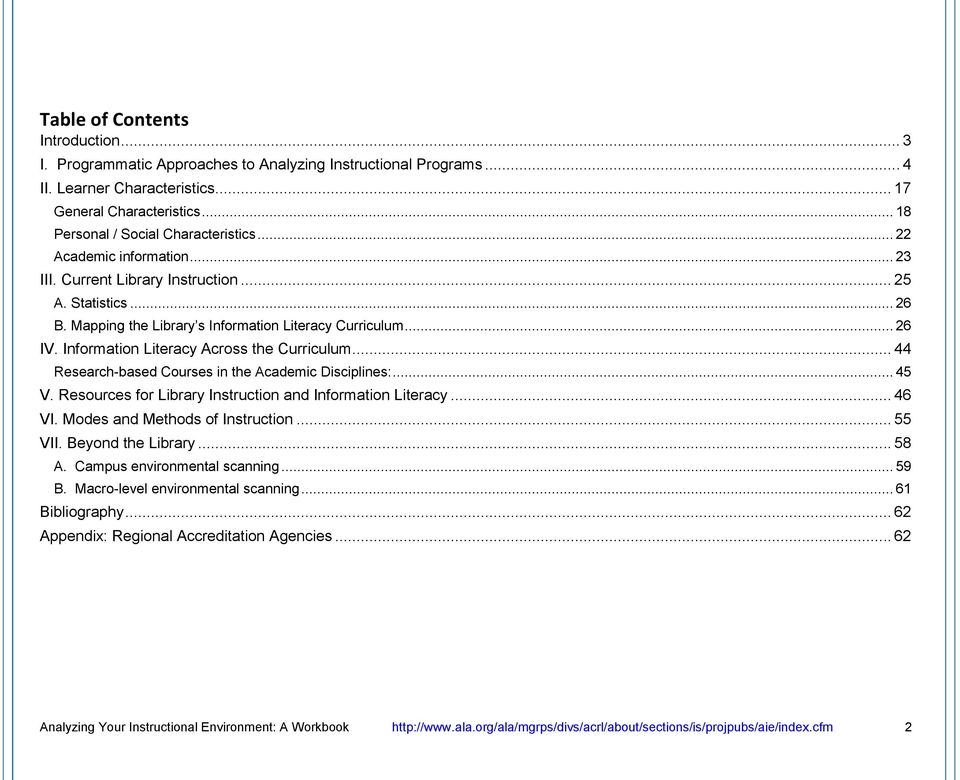
2 Table of Contents Introduction... 3 I. Programmatic Approaches to Analyzing Instructional Programs... 4 II. Learner Characteristics General Characteristics Personal / Social Characteristics Academic information III. Current Library Instruction A. Statistics B. Mapping the Library s Information Literacy Curriculum IV. Information Literacy Across the Curriculum Research-based Courses in the Academic Disciplines: V. Resources for Library Instruction and Information Literacy VI. Modes and Methods of Instruction VII. Beyond the Library A. Campus environmental scanning B. Macro-level environmental scanning Bibliography Appendix: Regional Accreditation Agencies Analyzing Your Instructional Environment: A Workbook 2
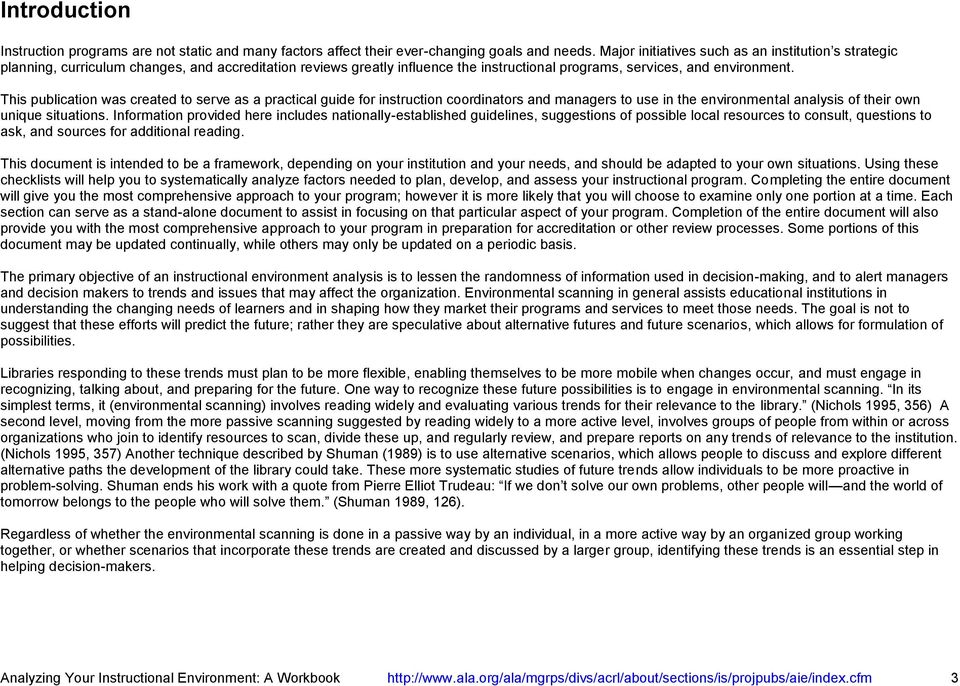
3 Introduction Instruction programs are not static and many factors affect their ever-changing goals and needs. Major initiatives such as an institution s strategic planning, curriculum changes, and accreditation reviews greatly influence the instructional programs, services, and environment. This publication was created to serve as a practical guide for instruction coordinators and managers to use in the environmental analysis of their own unique situations. Information provided here includes nationally-established guidelines, suggestions of possible local resources to consult, questions to ask, and sources for additional reading. This document is intended to be a framework, depending on your institution and your needs, and should be adapted to your own situations. Using these checklists will help you to systematically analyze factors needed to plan, develop, and assess your instructional program. Completing the entire document will give you the most comprehensive approach to your program; however it is more likely that you will choose to examine only one portion at a time. Each section can serve as a stand-alone document to assist in focusing on that particular aspect of your program. Completion of the entire document will also provide you with the most comprehensive approach to your program in preparation for accreditation or other review processes. Some portions of this document may be updated continually, while others may only be updated on a periodic basis. The primary objective of an instructional environment analysis is to lessen the randomness of information used in decision-making, and to alert managers and decision makers to trends and issues that may affect the organization. Environmental scanning in general assists educational institutions in understanding the changing needs of learners and in shaping how they market their programs and services to meet those needs. The goal is not to suggest that these efforts will predict the future; rather they are speculative about alternative futures and future scenarios, which allows for formulation of possibilities. Libraries responding to these trends must plan to be more flexible, enabling themselves to be more mobile when changes occur, and must engage in recognizing, talking about, and preparing for the future. One way to recognize these future possibilities is to engage in environmental scanning. In its simplest terms, it (environmental scanning) involves reading widely and evaluating various trends for their relevance to the library. (Nichols 1995, 356) A second level, moving from the more passive scanning suggested by reading widely to a more active level, involves groups of people from within or across organizations who join to identify resources to scan, divide these up, and regularly review, and prepare reports on any trends of relevance to the institution. (Nichols 1995, 357) Another technique described by Shuman (1989) is to use alternative scenarios, which allows people to discuss and explore different alternative paths the development of the library could take. These more systematic studies of future trends allow individuals to be more proactive in problem-solving. Shuman ends his work with a quote from Pierre Elliot Trudeau: If we don t solve our own problems, other people will and the world of tomorrow belongs to the people who will solve them. (Shuman 1989, 126). Regardless of whether the environmental scanning is done in a passive way by an individual, in a more active way by an organized group working together, or whether scenarios that incorporate these trends are created and discussed by a larger group, identifying these trends is an essential step in helping decision-makers. Analyzing Your Instructional Environment: A Workbook 3
4 I. Programmatic Approaches to Analyzing Instructional Programs Analyzing Your Instructional Environment: A Workbook 4

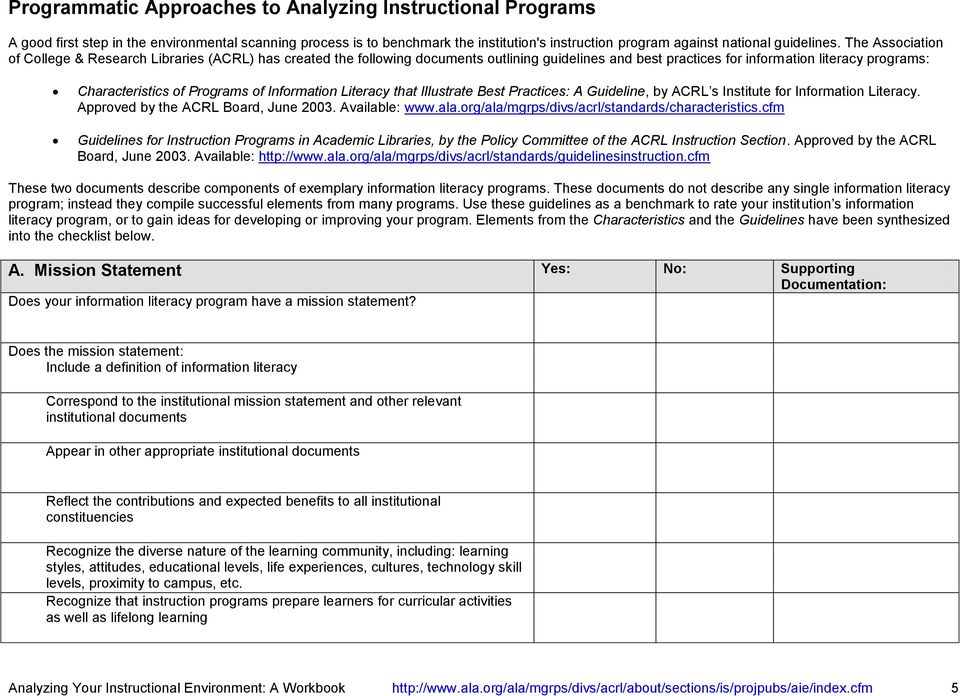
5 Programmatic Approaches to Analyzing Instructional Programs A good first step in the environmental scanning process is to benchmark the institution's instruction program against national guidelines. The Association of College & Research Libraries (ACRL) has created the following documents outlining guidelines and best practices for information literacy programs: Characteristics of Programs of Information Literacy that Illustrate Best Practices: A Guideline, by ACRL s Institute for Information Literacy. Approved by the ACRL Board, June Available: Guidelines for Instruction Programs in Academic Libraries, by the Policy Committee of the ACRL Instruction Section. Approved by the ACRL Board, June Available: These two documents describe components of exemplary information literacy programs. These documents do not describe any single information literacy program; instead they compile successful elements from many programs. Use these guidelines as a benchmark to rate your institution s information literacy program, or to gain ideas for developing or improving your program. Elements from the Characteristics and the Guidelines have been synthesized into the checklist below. A. Mission Statement Yes: No: Supporting Documentation: Does your information literacy program have a mission statement? Does the mission statement: Include a definition of information literacy Correspond to the institutional mission statement and other relevant institutional documents Appear in other appropriate institutional documents Reflect the contributions and expected benefits to all institutional constituencies Recognize the diverse nature of the learning community, including: learning styles, attitudes, educational levels, life experiences, cultures, technology skill levels, proximity to campus, etc. Recognize that instruction programs prepare learners for curricular activities as well as lifelong learning Analyzing Your Instructional Environment: A Workbook 5
6 Is the mission statement consistent with the Information Literacy Competency Standards for Higher Education? (available at: Is the mission statement reviewed regularly to reflect changes in the institution and learning community? B. Goals and Objectives Yes: No: Supporting Documentation: Does your information literacy program have stated goals and objectives? Are the goals and objectives consistent with the mission, goals, and objectives of other programs, departments and the institution? Do the goals and objectives: Articulate the integration of information literacy across the curriculum Establish measurable outcomes for evaluation of the program Reflect the desired outcome of preparing students for academic pursuits and lifelong learning Accommodate student growth in skills and understanding throughout the college years Apply to all learners, regardless of delivery system or location Correspond to the Information Literacy Competency Standards for Higher Education Are the library s specific learning outcomes aligned with the Objectives for Information Literacy Instruction? (available at: [The Objectives for Information Literacy Instruction are designed to assist in expanding upon the more generic Information Literacy Competency Standards for Higher Education, and in specifying discrete, assessable outcomes in the Analyzing context of both Your the Instructional library s and Environment: the institution s A Workbook information literacy goals] 6

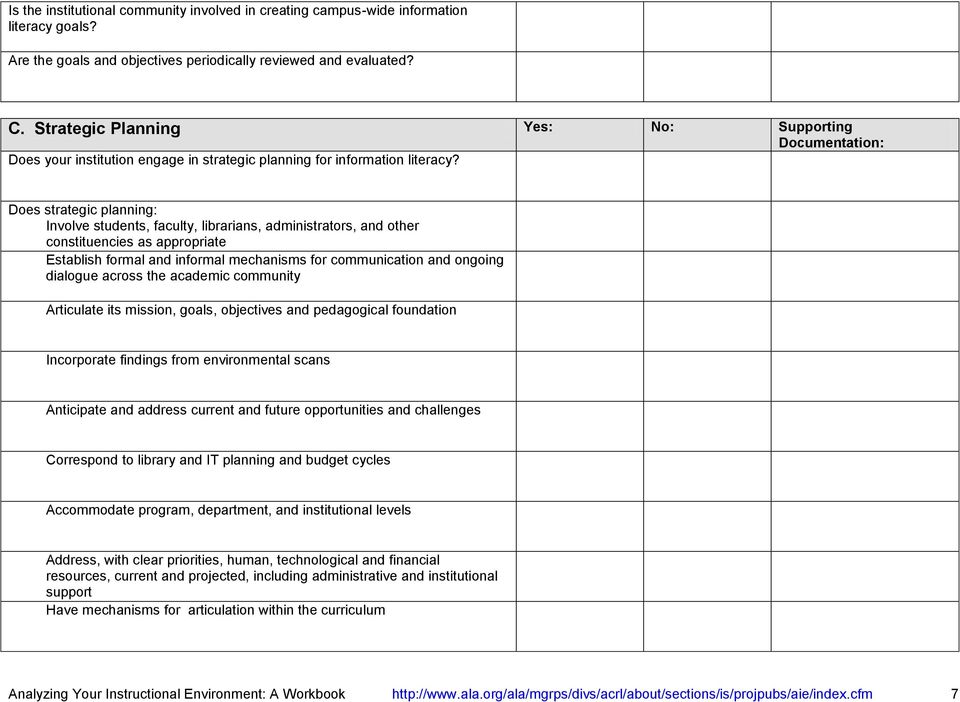
7 Is the institutional community involved in creating campus-wide information literacy goals? Are the goals and objectives periodically reviewed and evaluated? C. Strategic Planning Yes: No: Supporting Documentation: Does your institution engage in strategic planning for information literacy? Does strategic planning: Involve students, faculty, librarians, administrators, and other constituencies as appropriate Establish formal and informal mechanisms for communication and ongoing dialogue across the academic community Articulate its mission, goals, objectives and pedagogical foundation Incorporate findings from environmental scans Anticipate and address current and future opportunities and challenges Correspond to library and IT planning and budget cycles Accommodate program, department, and institutional levels Address, with clear priorities, human, technological and financial resources, current and projected, including administrative and institutional support Have mechanisms for articulation within the curriculum Analyzing Your Instructional Environment: A Workbook 7
8 Establish the means for implementation and adaptation Include a program for professional, faculty, and staff development Establish a process for assessment at the outset, including periodic review of the plan to ensure flexibility D. Institutional and Administrative Support for Information Literacy Does your institution s administration support information literacy? Yes: No: Supporting Documentation: Does the administration: Communicate support for the program Plant information literacy in the institution s mission, strategic plan, policies and procedures Identify or assign information literacy leadership and responsibilities Recognize and encourage collaboration among disciplinary faculty, librarians, and other program staff and among institutional units Provide funding and ongoing support for the stated goals of the program, including: Formal and informal teaching facilities (including equipment and software) Appropriate staffing levels of all personnel connected with the program, (including student, clerical and technical assistance) Professional development & continuing education Analyzing Your Instructional Environment: A Workbook 8

9 Equipment and supplies for design and production of instruction materials Promotion of information literacy program Reward achievement and participation in the information literacy program Are instructional personnel encouraged to work with development/fundraising officers to expand or enhance the program? E. Teaching Facility Yes: No: Supporting Documentation: Does the library have a dedicated teaching facility? Does the library have access to teaching facilities elsewhere on campus? Are available teaching facilities sufficient in size and number to meet the goals of the information literacy program? Does the facility: Allow the instructor to demonstrate information systems Accommodate active learning and student collaboration Analyzing Your Instructional Environment: A Workbook 9
10 F. Information Literacy in the Curriculum Yes: No: Supporting Documentation: Is information literacy formally articulated with your institution s curriculum? Is information literacy s integration into the curriculum included in documents that are widely disseminated? Does the articulation of information literacy in the curriculum: Identify the scope (i.e. depth, complexity) of competencies to be acquired at the disciplinary level and course level Sequence and integrate competencies throughout a student s academic career, progressing in sophistication Specify programs and courses charged with implementation Examples: o First-year seminars o Writing across the curriculum programs o general education core requirements o research methods courses in disciplinary majors o linked credit courses o learning communities/cohorts o undergraduate research experiences o internships o experiential learning/service learning courses) o capstone courses Use local governance structures to ensure institution-wide integration into academic or vocational programs Emphasize student-centered learning Do instruction librarians seek opportunities for collaborative engagement in new institutional initiatives and redesigned curricula? Analyzing Your Instructional Environment: A Workbook 10
11 G. Collaboration with Faculty and Others Yes: No: Supporting Documentation: Do faculty, librarians, and others collaborate in information literacy at your institution? Does the administration recognize and encourage collaboration among disciplinary faculty, librarians, and other appropriate institutional units? Does collaboration: Center around enhanced student learning and the development of lifelong learning skills Engender communication within the academic community to garner support for the program Result in a fusion of information literacy concepts and disciplinary content Identify opportunities for achieving information literacy outcomes through course content and other learning experiences Take place at the planning stages, delivery, assessment of student learning, and evaluation and refinement of the program Involve sharing of budgetary responsibilities with other campus units when appropriate Analyzing Your Instructional Environment: A Workbook 11

12 H. Pedagogical Approach to Information Literacy Yes: No: Supporting Documentation: Does the information literacy program s pedagogy: Support diverse approaches to teaching Respond to multiple learning styles o Sourcebook of Bibliographic Instruction o Designs for Active Learning: A Sourcebook of Classroom Strategies for Information Education Include active and collaborative activities Encompass critical thinking and reflection Support student-centered learning Build on students existing knowledge Link information literacy to ongoing coursework and real-life experiences appropriate to program and course level Include collaboration with faculty in order to increase overall student engagement in the learning process and encourage reflective thinking Incorporate appropriate information technology and media Include multiple modes of instruction, such as: individualized instruction; group instruction; web tutorials or web-based instruction; synchronous and asynchronous modes of instruction; course management software; etc. Analyzing Your Instructional Environment: A Workbook 12
13 I. Staffing Levels Yes: No: Supporting Documentation: Is the staff adequate in number and skills to support the program s mission? Does the staff: Include persons with a variety of expertise, including: librarians, disciplinary faculty, administrators, program coordinators, graphic designers, web designers, Include access teaching/learning to expertise outside specialists of the library, such as: faculty development offices, teaching/learning centers, technology support centers, institutional research/assessment offices, campus/student life offices Serve as role models, exemplifying and advocating information literacy and lifelong learning Develop experience in instruction/teaching and assessment of student learning Develop experience in curriculum development and expertise to develop, coordinate, implement, maintain, and evaluate information literacy programs Employ a collaborative approach to working with others Receive and actively engage in systematic and continual professional development and training Receive regular evaluations about the quality of their contribution to the program Does the library provide a structured program for orientation and training of new instruction personnel Does the library provide release time for staff to engage in continuing education or professional development? Does the instruction coordinator/manager have clearly written position description setting forth the scope of their responsibilities? Analyzing Your Instructional Environment: A Workbook 13

14 J. Outreach Yes: No: Supporting Documentation: Does the information literacy program outreach to the academic community? Do outreach activities: Communicate a clear message defining and describing the program and its value to targeted audiences Target a wide variety of groups Examples: o First-year seminars, writingacross the curriculum programs o general education core requirements o research methods courses in disciplinary majors o linked credit courses o learning communities/cohorts o undergraduate research experiences/internships o experiential learning/service learning courses) o capstone courses Provide targeted marketing and publicity to stakeholders, support groups, and media channels Use a variety of outreach channels and media, both formal and informal Include participation in campus professional development training by offering or co-sponsoring workshops for faculty and staff Advance information literacy by sharing information, methods, and plans with peers from other institutions Are outreach activities the responsibility of all members of the institution, not simply the librarians? Analyzing Your Instructional Environment: A Workbook 14
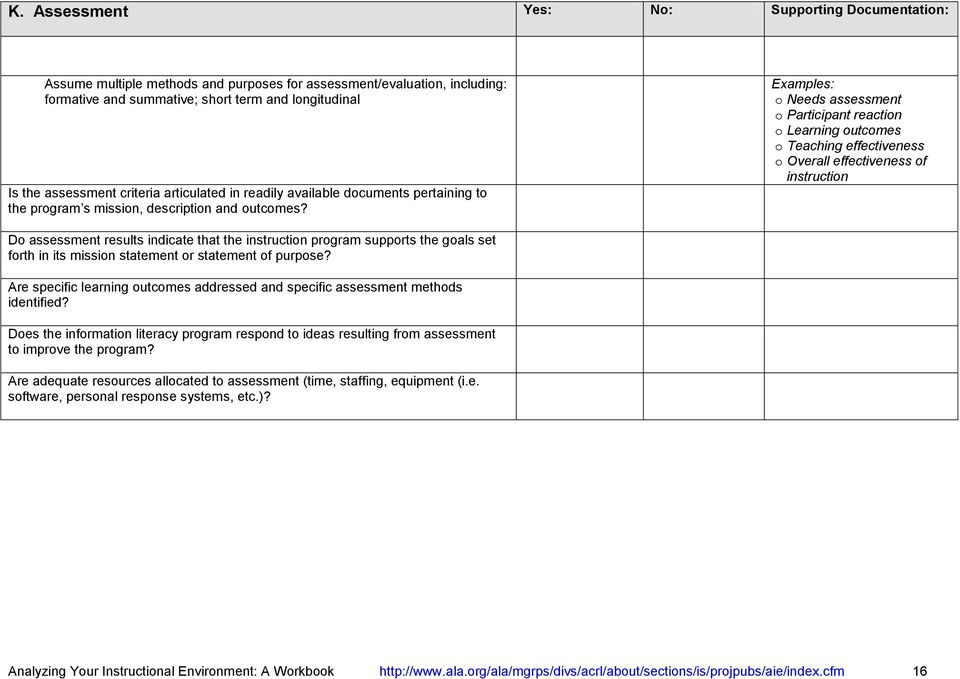
15 K. Assessment Yes: No: Supporting Documentation: Does the information literacy program incorporate student assessment? Does assessment for student outcomes: Include student-, peer-, and self-evaluation Focus on student performance, knowledge acquisition, and attitude appraisal Assess both process and product Acknowledge differences in learning and teaching styles by using a variety of appropriate outcome measures Examples: o portfolio assessment o oral defense o quizzes o essays o direct observation o anecdotal o peer and self review] o experience Occur on an ongoing basis Is assessment coordinated with teaching faculty (since learning outcomes are a shared responsibility)? Does the information literacy program incorporate program-level assessment? Does program-level assessment: Establish the process of ongoing planning/improvement of the program Measure directly progress toward meeting the goals and objectives of the program Integrate with course and curriculum assessment, as well as institutional evaluations and regional/professional accreditation initiatives Analyzing Your Instructional Environment: A Workbook 15

16 K. Assessment Yes: No: Supporting Documentation: Assume multiple methods and purposes for assessment/evaluation, including: formative and summative; short term and longitudinal Is the assessment criteria articulated in readily available documents pertaining to the program s mission, description and outcomes? Examples: o Needs assessment o Participant reaction o Learning outcomes o Teaching effectiveness o Overall effectiveness of instruction Do assessment results indicate that the instruction program supports the goals set forth in its mission statement or statement of purpose? Are specific learning outcomes addressed and specific assessment methods identified? Does the information literacy program respond to ideas resulting from assessment to improve the program? Are adequate resources allocated to assessment (time, staffing, equipment (i.e. software, personal response systems, etc.)? Analyzing Your Instructional Environment: A Workbook 16
17 II. Learner Characteristics Analyzing Your Instructional Environment: A Workbook 17
18 Learner Characteristics It is critical to determine the unique characteristics of your learners and learning environment to ensure a match between the needs of the students and the information literacy offerings provided at your institution. Every institution has its own unique mix of constituents comprising its learning community. How the learners are characterized and their needs identified will depend upon the goals and priorities of that institution. The categories in the chart, below, are intended to be representative but not necessarily comprehensive. Use them as a springboard for getting an accurate picture of your learners. General Characteristics Number Constituencies/Learner Characteristics Percentage of Total Population Data sources: Consider records, interviews, focus groups, surveys, observation, job descriptions, personnel profiles, texts and articles. A. Age Examples include: o Admissions records o Freshman surveys (e.g., NSSE) o Assessment office o Institutional Research office First Year Students Traditional Age Undergraduate (17-22) Graduate Adult/Non-traditional High school students taking college credit courses Other groups: Analyzing Your Instructional Environment: A Workbook 18

19 General Characteristics B. Gender Number Percentage of Total Population Data sources: Consider records, interviews, focus groups, surveys, observation, job descriptions, personnel profiles, texts and articles. Male Female C. Health or Special Needs o Offices working with special populations Physical: Mobility Auditory Visual Other Learning/Developmental: ADHD Dyslexia Other Analyzing Your Instructional Environment: A Workbook 19

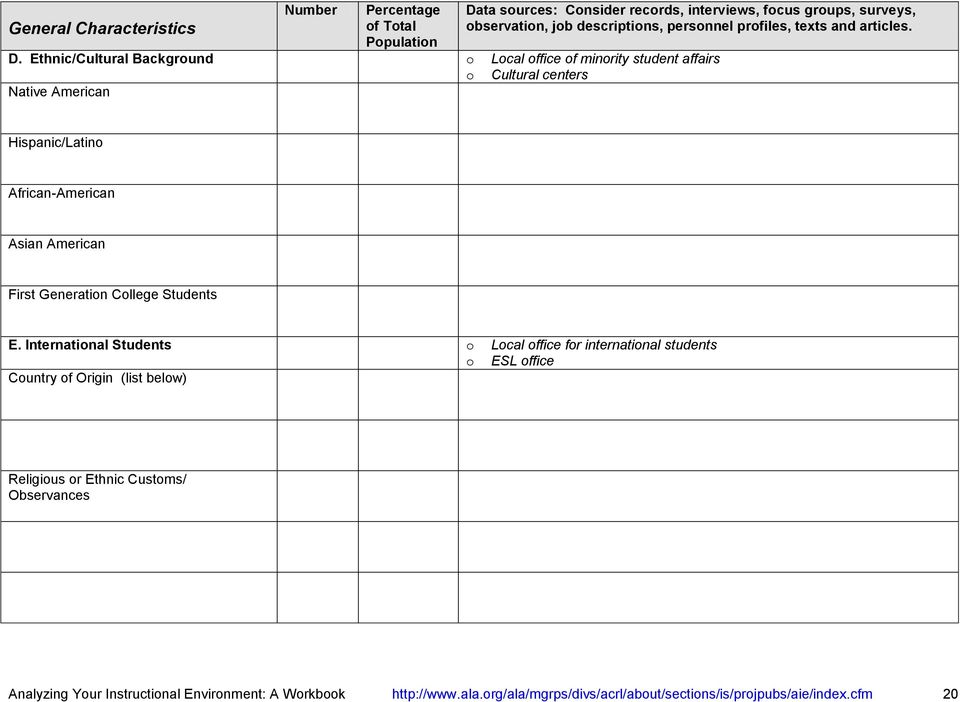
20 General Characteristics Number Percentage of Total Population Data sources: Consider records, interviews, focus groups, surveys, observation, job descriptions, personnel profiles, texts and articles. D. Ethnic/Cultural Background o Local office of minority student affairs o Cultural centers Native American Hispanic/Latino African-American Asian American First Generation College Students E. International Students o Local office for international students o ESL office Country of Origin (list below) Religious or Ethnic Customs/ Observances Analyzing Your Instructional Environment: A Workbook 20
21 General Characteristics F. Languages Number Percentage of Total Population Data sources: Consider records, interviews, focus groups, surveys, observation, job descriptions, personnel profiles, texts and articles. Specific Languages Spoken o ESL office o Admissions Proficiency Considerations: TOEFL AP Exams G. Location / Geographic considerations* Residential *Students may fall into more than one category. Alternative breakdowns appropriate to your campus should be explored. Commuter Satellite/branch campus Distance/online program Analyzing Your Instructional Environment: A Workbook 21
22 Percent of Personal / Social Characteristics Total Number Population A. Expectations Examples: o CIRP Specific list Examples: Residential; Distance; Liberal arts education; Streamlined curriculum for job preparation and performance B. Vocational aspirations Specific List Examples: First job; Career change; Promotion C. Special talents / interests Specific list Examples: sports; leadership (e.g., student government, clubs & organizations); musical or artistic abilities, language, ROTC D. Employment o Dean of Students office Campus Employment Data sources: Consider records, interviews, focus groups, surveys, observation, job descriptions, personnel profiles, texts and articles. Work-Study Other Off-site Employment Internships Clinical hours Analyzing Your Instructional Environment: A Workbook 22
23 Personal / Social Characteristics Related issues or situations Number Percent of Total Population Data sources: Consider records, interviews, focus groups, surveys, observation, job descriptions, personnel profiles, texts and articles. % of students working while attending school Average number of hours students work per week Job skills / competencies impact on curriculum Example: adult programs that give academic credit for life/career skills Academic information Percent of Total Data sources: Consider records, interviews, focus groups, surveys, observation, job descriptions, personnel profiles, texts and articles. Number Population A. Specific Entry Competencies Examples: o Freshman experience coordinators; learning communities coordinators Prerequisite skills (specifically or in general categories) o FITness Report o ETS Technology skills o Local campus testing o ACT, SAT, GRE Reading and Math skills Previous or current experience (specifically or in general categories) B. Education Completed o Admissions and Records Academic levels High School Post-Secondary Undergraduate Degree Associate Degree Graduate Studies Masters Degree Doctoral Degree Analyzing Your Instructional Environment: A Workbook 23
24 Academic information C. Training Level Completed Number Percent of Total Population Data sources: Consider records, interviews, focus groups, surveys, observation, job descriptions, personnel profiles, texts and articles. Actual Level Number of people at each level D. Special Courses or Programs # of Students List specific courses Number of people in each course Examples: Honors programs; Bridge/Remediation programs; Learning communities/cohorts; ESL Percent of Students E. GPA Range Average Analyzing Your Instructional Environment: A Workbook 24
25 III. Current Library Instruction Analyzing Your Instructional Environment: A Workbook 25
26 Current Library Instruction A. Statistics An analysis of the instructional environment is not complete without an examination of the current instructional program, especially in documenting the relationship between the program and the library s and institution s strategic plan. Statistics-gathering serves as a useful mechanism for tracking current practices, determining levels of curriculum integration, sequencing needs, trends, strengths, weaknesses, as well as serving to support budgetary and staffing needs. This information should be gathered in an ongoing basis. Many institutions have developed web-based forms that would allow the information to be entered at distributed locations by librarians, but collected in a format that would allow the instruction coordinator to examine the information in a centralized manner. Other libraries collect this information in a Microsoft Excel spreadsheet, or use a searchable database, such as Microsoft Access, to maintain and access this information. Information that should be gathered includes: Number of sessions offered Number of unique individuals served including academic level Individual classes served Departments served Locations used Amount of actual instruction time Amount of instruction preparation time Research-based, or research assignment Supplemental materials prepared (e.g., handouts, web guides, etc.) Contact mechanism including contacted by faculty/contacted faculty/new contact Instructional offerings not tied to specific courses Learning outcomes Core concepts covered Information Literacy standards addressed Frequency in the instruction program (New; Continuing; Intermittent) Assessment methods used B. Mapping the Library s Information Literacy Curriculum A curriculum map provides a holistic view of the integration of information literacy into your institution. To create a curriculum map, list every course offered at your university, then track which courses have a research component, include information literacy, and the content and duration of the information literacy instruction. This process allows librarians and other members of the university community to identify where students are receiving information literacy instruction, the content that is covered, and where gaps exist. Analyzing Your Instructional Environment: A Workbook 26
27 A major benefit of curriculum mapping is the overall perspective it provides on the sequencing and overlap of information literacy at your institution. Once the map is created, the vertical and horizontal alignment of course content should be reviewed. Vertical alignment ensures that courses that are sequenced use an incremental or building block approach to information literacy instruction. Courses that are correctly aligned permit librarians to quickly assess what students mastered in the preceding course and to focus on building new skills and knowledge. Horizontal alignment, often referred to as "pacing guides," assures that all librarians of a common course level address specific subject matter following the same time line. As a result, overlaps in content or major assignments to promote interdisciplinary connections can be identified. As librarians begin to build on interdisciplinary connections, students naturally begin to link information between and among courses, increasing the relevancy of skills and content in such courses. Additionally, librarians can verify skills or content addressed in other courses and alter their plans to a higher level, making learning more relevant. While curriculum mapping is an intense and time-consuming undertaking, improvements to instruction such as vertical alignment, horizontal alignment, elimination of redundancies, and facilitation of interdisciplinary linking builds stronger curricula and improves overall information literacy instruction. It is recommended that your institution s curriculum map be re-examined annually. Based on the Association of College and Research Libraries Information Literacy Competency Standards for Higher Education (available at this curriculum map details where each of the eighty-nine suggested outcomes is taught in the institution s information literacy program. When using the map below, please delete the examples given before inserting your own data. The map employs the following symbols: Courses should be identified by their course numbers F = Classroom Faculty (as distinct from library faculty). Outcomes so identified are assumed to be taught or reinforced by professors as part of their courses. L = Library Faculty. Outcomes so identified are taught during library instruction activities. I = Skills that are introduced in the designated course. R = Skills that are reinforced in the designated course. Analyzing Your Instructional Environment: A Workbook 27
28 Standard One The information literate student determines the nature and extent of the information needed. Performance Indicators: 1. The information literate student defines and articulates the need for information. Outcome 1. Confers with instructors and participates in class discussions, peer workgroups, and electronic discussion to identify a research topic, or other information need. 2. Develops a thesis statement and formulates questions based on the information need. Course Names or Numbers: ENG 101 SPCH 102 Pol Sci 270 F: I L: R F: I L: R F: I L: R F: I L: R F: I L: R F: I L: R 3. Explores general information sources to increase familiarity with the topic. L: I F: R L: I F: R L: I F: R 4. Defines or modifies the information need to achieve a manageable focus. L: I F: R L: I F: R L: I F: R 5. Identifies key concepts and terms that describe the information need. L: I F: R L: I F: R L: I F: R 6. Recognizes that existing information can be combined with original thought, experimentation, and/or analysis to produce new information. F: I Analyzing Your Instructional Environment: A Workbook 28
29 2. The information literate student identifies a variety of types and formats of potential sources for information. Outcome Course Names or Numbers 1. Knows how information is formally and informally produced, organized, and disseminated. 2. Recognizes that knowledge can be organized into disciplines that influence the way information is accessed. 3. Identifies the value and differences of potential resources in a variety of formats (e.g., multimedia, database, website, data set, audio/visual, book). 4. Identifies the purpose and audience of potential resources (e.g., popular vs. scholarly, current vs. historical). 5. Differentiates between primary and secondary sources, recognizing how their use and importance vary with each discipline. 6. Realizes that information may need to be constructed with raw data from primary sources. Analyzing Your Instructional Environment: A Workbook 29
30 3. The information literate student considers the costs and benefits of acquiring the needed information. Outcome Course Names or Numbers 1. Determines the availability of needed information and makes decisions on broadening the information seeking process beyond local resources (e.g., interlibrary loan; using resources at other locations; obtaining images, videos, text, or sound). 2. Considers the feasibility of acquiring a new language or skill (e.g., foreign discipline-based) in order to gather needed information and to understand its context. 3. Defines a realistic overall plan and timeline to acquire the needed information. 4. The information literate student reevaluates the nature and extent of the information need. Outcome Course Names or Numbers 1. Reviews the initial information need to clarify, revise, or refine the question. 2. Describes criteria used to make information decisions and choices. Analyzing Your Instructional Environment: A Workbook 30
31 Standard Two The information literate student accesses needed information effectively and efficiently. Performance Indicators: 1. The information literate student selects the most appropriate investigative methods or information retrieval systems for accessing the needed information. Outcome 1. Identifies appropriate investigative methods (e.g., laboratory experiment, simulation, fieldwork). Course Names or Numbers 2. Investigates benefits and applicability of various investigative methods. 3. Investigates the scope, content, and organization of information retrieval systems. 4. Selects efficient and effective approaches for accessing the information needed from the investigative method or information retrieval system. 2. The information literate student constructs and implements effectively designed search strategies. Outcome 1. Develops a research plan appropriate to the investigative method. Course Names or Numbers Analyzing Your Instructional Environment: A Workbook 31
32 Outcome Course Names or Numbers 2. Identifies keywords, synonyms and related terms for the information needed. 3. Selects controlled vocabulary specific to the discipline or information retrieval source. 4. Constructs a search strategy using appropriate commands for the information retrieval system selected (e.g., Boolean operators, truncation, and proximity for search engines; internal organizers such as indexes for books). 5. Implements the search strategy in various information retrieval systems using different user interfaces and search engines, with different command languages, protocols, and search parameters. 6. Implements the search using investigative protocols appropriate to the discipline. 3. The information literate student retrieves information online or in person using a variety of methods. Outcome 1. Uses various search systems to retrieve information in a variety of formats. Course Names or Numbers Analyzing Your Instructional Environment: A Workbook 32
33 Outcome 2. Uses various classification schemes and other systems (e.g., call number systems or indexes) to locate information resources within the library or to identify specific sites for physical exploration. 3. Uses specialized online or in person services available at the institution to retrieve information needed (e.g., interlibrary loan/document delivery, professional associations, institutional research offices, community resources, experts and practitioners). 4. Uses surveys, letters, interviews, and other forms of inquiry to retrieve primary information. Course Names or Numbers 4. The information literate student refines the search strategy if necessary. Outcome 1. Assesses the quantity, quality, and relevance of the search results to determine whether alternative information retrieval systems or investigative methods should be utilized. 2. Identifies gaps in the information retrieved and determines if the search strategy should be revised. Course Names or Numbers 3. Repeats the search using the revised strategy as necessary. Analyzing Your Instructional Environment: A Workbook 33
34 5. The information literate student extracts, records, and manages the information and its sources. Outcome 1. Selects among various technologies the most appropriate one for the task of extracting the needed information (e.g., copy/paste software functions, photocopier, scanner, audio/visual equipment, or exploratory instruments). 2. Creates a system for organizing the information. Course Names or Numbers 3. Differentiates between the types of sources cited and understands the elements and correct syntax of a citation for a wide range of resources. 4. Records all pertinent citation information for future reference. 5. Uses various technologies to manage the information selected and organized. Analyzing Your Instructional Environment: A Workbook 34
35 Standard Three The information literate student evaluates information and its sources critically and incorporates selected information into his or her knowledge base and value system. Performance Indicators: 1. The information literate student summarizes the main ideas to be extracted from the information gathered. Outcome 1. Reads the text and selects main ideas. Course Names or Numbers 2. Restates textual concepts in his/her own words and selects data accurately. 3. Identifies verbatim material that can be then appropriately quoted. 2. The information literate student articulates and applies initial criteria for evaluating both the information and its sources. Outcome Course Names or Numbers 1. Examines and compares information from various sources in order to evaluate reliability, validity, accuracy, authority, timeliness, and point of view or bias. 2. Analyzes the structure and logic of supporting arguments or methods. Analyzing Your Instructional Environment: A Workbook 35
36 Outcome 3. Recognizes prejudice, deception, or manipulation. Course Names or Numbers 4. Recognizes the cultural, physical, or other context within which the information was created and understands the impact of context on interpreting the information. 3. The information literate student synthesizes main ideas to construct new concepts. Outcome 1. Recognizes interrelationships among concepts and combines them into potentially useful primary statements with supporting evidence. Course Names or Numbers 2. Extends initial synthesis, when possible, at a higher level of abstraction to construct new hypotheses that may require additional information. 3. Utilizes computer and other technologies (e.g. spreadsheets, databases, multimedia, and audio or visual equipment) for studying the interaction of ideas and other phenomena. 4. The information literate student compares new knowledge with prior knowledge to determine the value added, contradictions, or other unique characteristics of the information. Outcome 1. Determines whether information satisfies the research or other information need. Course Names or Numbers Analyzing Your Instructional Environment: A Workbook 36
37 Outcome 2. Uses consciously selected criteria to determine whether the information contradicts or verifies information used from other sources. Course Names or Numbers 3. Draws conclusions based upon information gathered. 4. Tests theories with discipline-appropriate techniques (e.g., simulators, experiments). 5. Determines probable accuracy by questioning the source of the data, the limitations of the information gathering tools or strategies, and the reasonableness of the conclusions. 6. Integrates new information with previous information or knowledge. 7. Selects information that provides evidence for the topic. 5. The information literate student determines whether the new knowledge has an impact on the individual s value system and takes steps to reconcile differences. Outcome 1. Investigates differing viewpoints encountered in the literature. Course Names or Numbers: ENG 101 SPCH 102 Pol Sci 270 Analyzing Your Instructional Environment: A Workbook 37
38 Outcome 2. Determines whether to incorporate or reject viewpoints encountered. Course Names or Numbers: ENG 101 SPCH 102 Pol Sci The information literate student validates understanding and interpretation of the information through discourse with other individuals, subject-area experts, and/or practitioners. Outcome 1. Participates in classroom and other discussions. Course Names or Numbers: 2. Participates in class-sponsored electronic communication forums designed to encourage discourse on the topic (e.g., , bulletin boards, chat rooms). 3. Seeks expert opinion through a variety of mechanisms (e.g., interviews, , listservs). Analyzing Your Instructional Environment: A Workbook 38
39 7. The information literate student determines whether the initial query should be revised. Outcome Course Names or Numbers 1. Determines if original information need has been satisfied or if additional information is needed. 2. Reviews search strategy and incorporates additional concepts as necessary. 3. Reviews information retrieval sources used and expands to include others as needed. Standard Four The information literate student, individually or as a member of a group, uses information effectively to accomplish a specific purpose. Performance Indicators: 1. The information literate student applies new and prior information to the planning and creation of a particular product or performance. Outcome 1. Organizes the content in a manner that supports the purposes and format of the product or performance (e.g. outlines, drafts, storyboards). 2. Articulates knowledge and skills transferred from prior experiences to planning and creating the product or performance. Course Names or Numbers Analyzing Your Instructional Environment: A Workbook 39
40 Outcome 3. Integrates the new and prior information, including quotations and paraphrasing, in a manner that supports the purposes of the product or performance. 4. Manipulates digital text, images, and data, as needed, transferring them from their original locations and formats to a new context. Course Names or Numbers 2. The information literate student revises the development process for the product or performance. Outcome Course Names or Numbers 1. Maintains a journal or log of activities related to the information seeking, evaluating, and communicating process. 2. Reflects on past successes, failures, and alternative strategies. 3. The information literate student communicates the product or performance effectively to others. Outcome Course Names or Numbers 1. Chooses a communication medium and format that best supports the purposes of the product or performance and the intended audience. Analyzing Your Instructional Environment: A Workbook 40
41 Outcome 2. Uses a range of information technology applications in creating the product or performance. Course Names or Numbers 3. Incorporates principles of design and communication. 4. Communicates clearly and with a style that supports the purposes of the intended audience. Standard Five The information literate student understands many of the economic, legal, and social issues surrounding the use of information and accesses and uses information ethically and legally. Performance Indicators: 1. The information literate student understands many of the ethical, legal and socio-economic issues surrounding information and information technology. Outcome Course Names or Numbers 1. Identifies and discusses issues related to privacy and security in both the print and electronic environments. Analyzing Your Instructional Environment: A Workbook 41
42 Outcome Course Names or Numbers 2. Identifies and discusses issues related to free vs. fee-based access to information. 3. Identifies and discusses issues related to censorship and freedom of speech. 4. Demonstrates an understanding of intellectual property, copyright, and fair use of copyrighted material. 2. The information literate student follows laws, regulations, institutional policies, and etiquette related to the access and use of information resources. Outcome 1. Participates in electronic discussions following accepted practices (e.g. "Netiquette"). Course Names or Numbers 2. Uses approved passwords and other forms of ID for access to information resources. 3. Complies with institutional policies on access to information resources. Analyzing Your Instructional Environment: A Workbook 42
43 Outcome 4. Preserves the integrity of information resources, equipment, systems and facilities. Course Names or Numbers 5. Legally obtains, stores, and disseminates text, data, images, or sounds. 6. Demonstrates an understanding of what constitutes plagiarism and does not represent work attributable to others as his/her own. 7. Demonstrates an understanding of institutional policies related to human subjects research. 3. The information literate student acknowledges the use of information sources in communicating the product or performance. Outcome 1. Selects an appropriate documentation style and uses it consistently to cite sources. Course Names or Numbers 2. Posts permission granted notices, as needed, for copyrighted material. * Thanks to the librarians at Wartburg College for this example of curriculum mapping. To see their completed map, go to Analyzing Your Instructional Environment: A Workbook 43
44 IV. Information Literacy Across the Curriculum Analyzing Your Instructional Environment: A Workbook 44
45 Information Literacy Across the Curriculum In order to maximize the impact of information literacy instruction, it is important for librarians to be strategic in determining where to focus outreach efforts for information literacy. In order to determine whether a particular course should be targeted for instruction, search the course catalog for classes with a major research component, and ask teaching faculty when students typically take particular courses. Investigate how the information literacy program interacts with the curriculum by gathering additional information regarding departments not served, penetration in schools or colleges, instructional offerings not tied to specific courses, and departmental curricular documents. This process should be part of a strategic planning process and re-examined every 3 to 5 years. Questions to consider include: Department Course number Required course for major When is course typically taken (F,S, Jr, Sr, Gr1, Gr2, Gr3) Currently part of instruction program Amount of time allotted for information literacy What are the major concepts addressed during the instruction session Which Information Literacy Standard(s) are addressed (give standard, performance indicator and outcome numbers) Research-based Courses in the Academic Disciplines: Department Course Number Student level Currently part of instruction program? If Yes, amount of time allotted for information literacy? Core concepts covered Biology 205 Freshman Yes 50 minutes Primary vs secondary literature; Biological Abstracts database Business Administration 275 Freshman/Sophomore No 50 minutes Google Scholar, Finding and evaluating articles How was this course identified? Course descriptions Conversation with Faculty Analyzing Your Instructional Environment: A Workbook 45
46 V. Resources for Library Instruction and Information Literacy Analyzing Your Instructional Environment: A Workbook 46
47 Resources for Library Instruction and Information Literacy An essential consideration when analyzing your instructional program is the availability of local resources to support your program. Consider the criteria listed below when assessing your environment to determine the level of personnel, facilities, technology, support, and training allotted to library instruction at your institution. A. Librarians & Staff: Number of Full-Time Personnel or How many professional librarians are involved in the instruction program? How many staff support the instruction program? (Include web designers, graphic designers, instructional technologists, and classified staff) (NOTE: Alternatively, list each position and complete these questions for each) What activities are these personnel involved in? Teaching Creating instructional materials Web development Technical support Other: Is instruction included in the job description(s) for the position(s)? Is instruction a principle responsibility of the position(s)? Full-Time Equivalent Number of Part-Time Personnel or Full-Time Equivalent Documentation of where data obtained: Library personnel office Library personnel office Yes: No: Documentation of where data obtained: Library instruction coordinator; job descriptions Is instruction included in the performance evaluation of the position(s)? Performance evaluation guidelines; Supervisor (NOTE: Alternatively, list each position and complete these questions for each) Yes: No: Documentation of where data obtained: Analyzing Your Instructional Environment: A Workbook 47
48 What techniques are used to evaluate instruction? Teaching portfolios Supervisor evaluation Peer evaluation (classroom observation) Student surveys Assessment of student learning Other: Does the library have an instruction coordinator? What percentage of the instruction coordinator s job is dedicated to instruction? Do you have to refuse instruction requests? Percentage: Job description Instruction coordinator or scheduler Instruction requests are refused due to lack of: Available teaching personnel Available teaching facilities Other: Analyzing Your Instructional Environment: A Workbook 48
49 B. Teaching Facilities: Number: Capacity: Documentation of where data obtained: In the Library: What types of teaching facilities are available in the library? Smart or electronic classroom Meeting room Auditorium Information commons Classroom on wheels (COWs include laptops and portable demonstration equipment) Portable demonstration equipment only Other: Outside of the Library: What types of teaching facilities are available outside of the library for instruction? Smart or Electronic classroom Library instruction coordinator; Registrar s office; Campus Computing office Meeting room Auditorium Information commons Classroom on wheels (COWs include laptops and portable demonstration equipment) Portable demonstration equipment only Other: Analyzing Your Instructional Environment: A Workbook 49
50 C. Technology: Yes: No: Documentation of where data obtained: Technology in Teaching Facilities: Answer for each type of teaching facility listed in Section B What type of equipment is available? Instructor s station Student workstations How many? Audiovisual projector Interactive whiteboard Classroom management system Hardware or software? Personal response system / classroom feedback system ( clickers ) Other: What types of network connections are available? Ethernet Wireless Does the teaching facility have any specialized software that supports instruction? Describe: Analyzing Your Instructional Environment: A Workbook 50
51 Technology for Students: Where is technology available for student use? Campus computer labs Number: Description: Number of workstations; equipment & software available; hours, etc. Documentation of where data obtained: Campus Computing office; residence hall surveys; freshmen surveys Residence hall labs Public workstations in the library: For research For word processing Laptop checkout Individual computer ownership (or percentage): Are students required to purchase computers?; Does the university offer student discounts? Other: D. Technical (Computer) Support: Yes: No: Documentation of where data Is technical support available to support the instruction program? In the library? obtained: Self-reporting; library systems department; campus computing centers Analyzing Your Instructional Environment: A Workbook 51
52 D. Technical (Computer) Support: Yes: No: Documentation of where data obtained: External to the library? Who provides technical support? Staff Librarians Students Number: Number: Number: What is the typical response time? Immediately Within a few hours 1 day 2-5 days A week or more Is technical support available to support new initiatives or projects? Is the technical support staff s level of expertise sufficient to support the library s needs? Is technical support available to students? On-campus Describe: Describe: Off-campus Analyzing Your Instructional Environment: A Workbook 52
53 E. Professional Development & Training: Yes: No: Documentation of where data obtained: Is training or professional development available to persons involved in the instructional program? Library administration; library instruction coordinator What types of training are available? Sessions offered in the library On-campus training Online training Local/regional workshops Conferences or institutes Centers for Teaching Excellence; Scholarship of Teaching and Learning programs Vendors (OCLC, BCR), Community colleges, online seminars or webcasts sponsored by professional associations State library associations, consortia; vendors ACRL s Immersion Program; LOEX Other: Is training supported by the library? Library administration Release time Financial support Does the library have a mentoring program? Formal Informal Analyzing Your Instructional Environment: A Workbook 53
54 F. Other Support: Yes: No: Documentation of where data obtained: Do persons involved in the instructional program have access to other types of specialized support? Centers for Teaching Excellence; Multimedia or Educational Technology centers; library systems department Instructional Designers Graphic Designers Teaching/Learning specialists Multimedia experts Marketing experts Other: Analyzing Your Instructional Environment: A Workbook 54
55 VI. Modes and Methods of Instruction Analyzing Your Instructional Environment: A Workbook 55
56 Modes and Methods of Instruction Library instruction is provided in a variety of formats, both formal and informal, in person and online. The goal of the environmental analysis is to determine the instructional needs of your audience and the best methods/products to meet their needs. The following questions should be asked: Who is the audience? What will be the method/product? How will it be employed? Why is this method/product being considered? How will its effectiveness be determined? Other aspects to consider in the decision-making process include: What are the cost factors in money and time? Where will the method/product be used (all possible sites)? How long will the method/product be used before revision or abandonment (lifespan)? How often will the method/product be revised over its lifespan? What are the patterns of method/product use (sporadic, scheduled)? What are the training needs for method/product providers/administrators/users? Who will provide/produce the method/product and what are their capabilities? Are the proper tools and equipment available at sites to deliver the method/use the product? Who will manage and monitor the method/product after implementation? The worksheet lists possible methods of instruction. Because user communities encompass a variety of learning styles and needs, a combination approach will work best. When using any instruction method it is of paramount importance to include opportunities for active learning as a way of reinforcing the concept and skill building. Opportunities for feedback/assessment are also necessary. Recording the audience, number of sessions offered, participants, and online hits serves as a means of documenting the methods that are utilized most frequently and also demonstrates the importance of your program. Methods of Instruction Audience Includes Active Learning In Person: Formal course-integrated, curriculum-based class/workshop For-credit Library instruction Course Includes Feedback/ Assessment Number of In Person/Online Sessions Number of Participants Number of Hits (online resources) Drop in content-specific class/workshop Formal content-specific class/workshop Analyzing Your Instructional Environment: A Workbook 56
57 Methods of Instruction Audience Includes Active Learning Individual/small group Consultations Individual assistance (e.g., reference desk, chat, , phone) Informal drop in class/workshop Distance education Instructional television (ITV) Includes Feedback/ Assessment Number of In Person/Online Sessions Number of Participants Number of Hits (online resources) Synchronous/asynchronous computer-based Course-management software (WebCT, Blackboard) Web-based Interactive tutorials Static web pages Streaming video Point of use instruction (inperson, handouts, etc) Tours Workbooks Analyzing Your Instructional Environment: A Workbook 57
58 VII. Beyond the Library Analyzing Your Instructional Environment: A Workbook 58
59 Beyond the Library A. Campus environmental scanning Institutional responses to national trends in technology, lifestyle, population, global awareness, and emphasis on employability instead of employment security have led to campus initiatives that have manifested themselves as learning communities, service learning projects, online learning environments, excellence in teaching centers, community engagement, and curriculum changes. These responses can develop from various campus sectors and it is only through institutional analysis of the foci of these projects that these groups can be identified and monitored. The following chart is a sample of the kinds of groups that are typically found at academic institutions and whose activities may have an impact on library information literacy programs. The categories are intended to help librarians monitor the activities of that particular group. Leadership: Use to indicate when librarians take an active role in leading these groups as Chair, subcommittee chairs, or project leaders. Participatory: Use to indicate when individuals from the library are actively involved in the work of these groups, either as members or participants. Informed: Use to indicate when minutes of these meetings are available and scanned on a regular basis, or when an individual from the library attends these meetings, or there is some other mechanism to maintain awareness of this group s work or discussions. Target Groups for Improved Communication: Use to indicate when minutes of meetings are not available or when individuals from the library do not attend meetings; however, the group has an impact on library information literacy programs and efforts to improve linkages with the group are considered desirable. Evidence: Use to note why the category was chosen. For example, if Informed is checked, indicate where the minutes are located or how they are distributed, and the individual in the library who is monitoring this activity. Similarly, if Participatory is checked, indicate the name of the individual who serves on this committee. Campus Activity Leadership Participatory Informed Target Groups for Improved Communication Faculty Governance Faculty Senate Faculty Committees Departmental activities & committees Curriculum planning General curriculum Committee Evidence Analyzing Your Instructional Environment: A Workbook 59
60 Special curriculum committees: General education Writing across the curriculum Technology skills/ Fluency with information technology Teaching Evaluation of teaching Teaching Improvement Use of technology in teaching Research Service Evaluation of research Student engagement in research Evaluation of service Public engagement activities Student service learning Student life and activities Learning communities Impact on students Student surveys (freshman, senior, post graduation) National surveys (NSSE, etc.) Analyzing Your Instructional Environment: A Workbook 60
61 B. Macro-level environmental scanning Renfro and Morrison (1984, 49) suggest that emerging issues in the outside world have had greater impact on an organization s future than internal factors. Macro environmental aspects such as social, technological, economic, environmental, and political changes should be kept under consideration. Financial trends for local, state, and federal government, fees, and private funding directly impact the financing of libraries. The state of the economy suggests that financing of libraries will keep pace with inflation at best, and will lag behind inflation or result in actual cuts in many locations. The loss of discretionary income or a decline in the American standard of living impact the priorities that individuals place on libraries, particularly in light of the increasing availability of information in electronically digitized formats, and the availability of this information from alternative sources. Breakthrough developments in technology, which most people cannot envision except in terms of the technology or medium to be replaced, cannot be accurately forecasted, but may have major implications for libraries. It is impractical for individual libraries to sustain a macro-level scanning project that would encompass all the factors that might have an impact on libraries, including, but not limited to demography, geography, economics, politics, and technology. Available resources for macro-level environmental scanning include: Within the American Library Association, the LITA Top Technology Trends group monitors emerging technologies and sponsors a discussion group. o For political factors, the American Library Association s Federal Library Legislative and Advocacy Network keeps abreast of current federal legislation and political discussions. o Individual state libraries and state library organizations often track political and economic trends within their state. See the bibliography section below on national surveys and studies for further resources of information about macro-level environmental scanning studies. Analyzing Your Instructional Environment: A Workbook 61
62 Bibliography Analyzing Your Instructional Environment: A Workbook 62
63 Bibliography Source List / Recommended Reading: Curriculum Examination Booth, Austin and Carole Ann Fabian Collaborating to advance curriculum-based information literacy initiatives. Journal of Library Administration 36 (1-2): Burkhardt, Joanna, Mary MacDonald, Andree Rathemacher, J. Laurence Kelland, and Michael Vocino Plan for information literacy at the University of Rhode Island. ERIC, ED455849, (accessed May 28, 2010). Donnelly, Kimberley M Building the learning library: Where do we start? College & Undergraduate Libraries 6 (2): Orr, Debbie, Margaret Appleton, and Margie Wallin Information literacy and flexible delivery: Creating a conceptual framework and model. Journal of Academic Librarianship 27 (6): Ratteray, Oswald M T Information literacy in self-study and accreditation. Journal of Academic Librarianship 28 (6): Rockman, Ilene F Integrating information literacy into the higher education curriculum: Practical models for transformation. San Francisco: Jossey-Bass. Simons, Kevin. James Young, and Craig Gibson The learning library in context: Community, integration, and influence. Research Strategies 17 (2-3): Thompson, Gary B Information literacy accreditation mandates: What they mean for faculty and librarians. Library Trends 51 (2): Environmental Scans Albright, Kendra S Environmental scanning: Radar for success. Information Management Journal 38 (3): Alexander, Johanna Olson Alliance building in the information and online database industry. portal: Libraries and the Academy 1 (4): Association of College & Research Libraries ACRL environmental scan (accessed February 22, 2010). Castiglione, James Environmental scanning: An essential tool for twenty-first century librarianship. Library Review 57 (7): Choo, Chun Wei Environmental scanning as information seeking and organizational learning. Information Research 7 (1). (accessed May 28, 2010). 63
64 Information management for the intelligent organization: The art of scanning the environment. 3rd ed. Medford, NJ: Information Today. Nichols, John V Using future trends to inform planning/marketing. Library Trends 43 (3): Renfro, William L. and James L. Morrison Detecting signals of change: The environmental scanning process. The Futurist 18 (4): Shuman, Bruce A The library of the future: Alternative scenarios for the information profession. Englewood, CO: Libraries Unlimited, Inc. Zabel, Diane Trends in reference and public services librarianship and the role of RUSA. Reference & User Services Quarterly 45 (2): Examples of Environmental Scans: 10 core external environmental trends ERIC, ED (accessed May 28, 2010). Association of Colleges of Applied Arts and Technology of Ontario Environmental scan ERIC, ED (accessed May 28, 2010). Kangas, Jon, Kathleen Budros, and Joyce Yoshioka Who are our students? What are our challenges? Our diverse students and their needs: Student demographics and diversity data. ERIC, ED (accessed May 28, 2010) National, state, and local trends: Environmental scan of trends and key issues affecting planning. ERIC, ED (accessed May 28, 2010). Kennedy, M., and M. Stergios. (2009). How to tie everyday work to strategy. Journal of Information & Knowledge Management 8 (.4): OCLC Online Computer Library Center, Inc OCLC environmental scan: Pattern recognition. Dublin, OH: OCLC. (accessed May 28, 2010). Salt Lake Community College strategic vision, September 2001-June ERIC, ED (accessed May 28, 2010). Instruction Section Documents Information Literacy in the Disciplines Committee. n.d. Information literacy in the disciplines. (accessed May 28, 2010). Instruction for Diverse Populations Committee Multilingual glossary. (accessed April 1, 2010). Analyzing Your Instructional Environment: A Workbook 64
65 Library instruction for diverse populations bibliography. April 1, 2010). Research and Scholarship Committee Bibliography of citations related to the research agenda for library instruction and information literacy. (accessed April 1, 2010). See section on Audiences. Task Force for Revision of the Model Statement of Objectives Objectives for information literacy instruction: A model statement for academic libraries. (accessed May 28, 2010). Teaching Methods Committee Teaching and learning information literacy skills: Textbooks for students and instruction librarians. (accessed May 28, 2010). Learners Educause Learning Initiative Net generation learners. (accessed May 28, 2010). Lambrecht, Judith J Learner analysis. (accessed May 28, 2010). O'Bannon, Blanche Learner and context analysis. Based on Gary R. Morrison, Steven M. Ross, and Jerrold E. Kemp. Designing effective instruction. 4th ed. Hoboken, NJ: Wiley & Sons, (accessed May 28, 2010). Management of Instruction Arp, Lori, ed New paradigms: Using the management techniques of instruction to buy (into) a new curriculum. RQ 36 (1): Booth, Austin and Carole Ann Fabian Collaborating to advance curriculum-based information literacy initiatives. Journal of Library Administration. 36, (1-2): Buchanan, Lori, Gina Garber, Aaron Dobbs, Nancy Snyder, and Elaine Berg Information literacy in the first year: Collaborating, planning and assessing at Austin Peay. Tennessee Libraries 55 (2): Mission Statements and Strategic Planning Aamot, Gordon Getting the most out of strategic planning. College & Research Libraries News 68 (7): Balasubramanian, P., A. Rangaswamy, and S. Kanthimathi Strategic planning a tool for future libraries. SRELS Journal of Information Management 43 (3): Analyzing Your Instructional Environment: A Workbook 65
66 Brown, Walter A. and Barbara A. Blake Gonzalez Academic libraries: Should strategic planning be renewed? Technical Services Quarterly 24 (3):1-14. Hallmark, Elizabeth Kennedy, Laura Schwartz, and Loriene Roy Developing a long-range and outreach plan for your academic library. College & Research Libraries News 68 (2):92-5. Keeber, David Process analysis and standardization: The road to strategic planning success. Indiana Libraries 26 (4): Kettunen, Juha The strategic evaluation of academic libraries. Library Hi Tech 25 (3): Ladwig, J. C Assess the state of your strategic plan. Library Administration & Management 19 (2):90-3. Linn, Mott Planning strategically and strategic planning. Bottom Line: Managing Library Finances 21 (1):20-3. Lorenzen, Michael Strategic planning for academic library instructional programming. Illinois Libraries 86 (2): Matthews, Joseph R Strategic planning and management for library managers. Santa Barbara, CA: Libraries Unlimited Phills, James A., Jr Integrating mission and strategy for nonprofit organizations. Oxford: Oxford University Press. Sauer, James The annual report: The academic librarian's tool for management, strategic planning, and advocacy. College & Undergraduate Libraries 13 (2): Shoaf, Eric C Fifteen months in the planning trenches: Strategically positioning the research library for a new century. Library Administration and Management 15 (1): Sullivan, Maureen Organization development in libraries. Library Administration & Management 18 (4): Warren, Rebecca, Sherman Hayes, and Donna Gunter Segmentation techniques for expanding a library instruction market: Evaluating and brainstorming. Research Strategies 18 (3): National Surveys and Studies Association of American Colleges and Universities Liberal education outcomes: A preliminary report on student achievement in college. Washington, D.C.: AACU. (accessed May 28, 2010). Beloit College. Annual. Mindset list. (accessed May 28,2010). Boyer Commission on Educating Undergraduates in the Research University Reinventing undergraduate education: A blueprint for America s research universities. Menlo Park, CA: Carnegie Foundation for the Advancement of Teaching. (accessed May 16, 2006). Analyzing Your Instructional Environment: A Workbook 66
67 Reinventing undergraduate education: Three years after the Boyer report. Menlo Park, CA: Carnegie Foundation for the Advancement of Teaching. (accessed May 16, 2006). Community College Survey of Student Engagement. Annual. Engaging students, challenging the odds. Austin, TX: Community College Program. (accessed May 16, 2006). Leadership National Research Council. Commission on Physical Sciences, Mathematics, and Applications. Computer Science and Telecommunications Committee on Information Literacy Being fluent with information technology. Washington, D.C.: National Academy Press. (accessed May 16, 2006). Board. NSSE: National Survey of Student Engagement. Annual results. Bloomington, IN: Center for Postsecondary Research, Indiana University Bloomington. (accessed June 10, 2010). New Media Consortium A global imperative: The report of the 21st century literacy summit. Austin, TX: New Media Consortium. (accessed May 16, 2006). OCLC Online Computer Library Center, Inc OCLC white paper on the information habits of college students. Dublin, OH: OCLC, (accessed May 16, 2006) a environmental scan: Pattern recognition. Dublin, OH: OCLC. (accessed May 16, 2006) b. Five-year information format trends. Dublin, OH: OCLC. (accessed May 16, 2006) Information format trends: Content, not containers. Dublin, OH: OCLC. (accessed May 28, 2010) a. College students' perceptions of libraries and information resources: A report to the OCLC membership. A companion piece to perceptions of libraries and information resources. Dublin, OH: OCLC. (accessed May 16, 2006) b. Perceptions of libraries and information resources: A report to the OCLC membership. Dublin, OH: OCLC. (accessed May 16, 2006). Analyzing Your Instructional Environment: A Workbook 67
68 Appendix: Regional Accreditation Agencies 68
69 Appendix: Regional Accreditation Agencies Regional accreditation agencies are recognizing the importance of information literacy and are requiring evidence of its inclusion in the learning experiences of each institution. The Middle States Commission on Higher Education; New England Association of Schools and Colleges; and Western Association of Schools and Colleges specifically require information literacy skills development. The other three agencies imply its inclusion. The following is a listing of the regional agencies along with specific sections that address this requirement. Middle States Commission on Higher Education ( Characteristics of Excellence in Higher Education: Eligibility Requirements and Standards for Accreditation Standard 11: Educational Offerings Standard 12: General Education Standard 13: Related Educational Activities New England Association of Schools and Colleges Commission on Technical and Career Institutions ( and Commission on Institutions of Higher Education ( Standards for Accreditation Standard 4: The Academic Program Standard 7: Library and Information Resources North Central Association of Colleges and Schools, The Higher Learning Commission ( Handbook of Accreditation References to library skills are embedded in various sections of the document. Northwest Commission on Colleges and Universities ( Accreditation Standards Standard 5: Library and Information Resources Southern Association of Colleges and Schools, Commission on Colleges ( Principles of Accreditation: Foundations for Quality Enhancement Standard 3.8: Library and Other Learning Resources Western Association of Schools and Colleges, Accrediting Commission for Senior Colleges and Universities ( WASC 2008 Handbook of Accreditation Analyzing Your Instructional Environment: A Workbook 69
70 Standard 2: Achieving Educational Objectives Through Core Functions Standard 3: Developing and Applying Resources and Organizational Structures to Ensure Sustainability ACRL IS Analysis of Instructional Environments Task Force, : Beth S. Woodard (Chair), Barbara Mann, Stephanie Michel, and Terry Taylor. Revised 2010 by IS Management & Leadership Committee Updated June 20 Analyzing Your Instructional Environment: A Workbook 70
The Information Literacy (IL) and Information Technology (IT) Teaching and Learning Circle. Summary, Overview and Index
 The Information Literacy (IL) and Information Technology (IT) Teaching and Learning Circle Summary, Overview and Index The IL-IT Teaching and Learning Circle met during the summer and fall of 2002. The
The Information Literacy Competency
 standards and guidelines Information literacy competency standards for nursing Approved by the ACRL Board of Directors, October 2013 The Information Literacy Competency Standards for Nursing were completed
California Lutheran University Information Literacy Curriculum Map Graduate Psychology Department
 California Lutheran University Information Literacy Curriculum Map Graduate Psychology Department Student Learning Outcomes Learning Outcome 1 LO1 literate student determines the nature and extent of the
Information Literacy Competency Standards for Higher Education
 Information Literacy Competency Standards for Higher Education Approved by the Board of Directors of the Association of College and Research Libraries on January 18, 2000 Endorsed by the American Association
California Lutheran University Information Literacy Curriculum Map Graduate Psychology Department
 California Lutheran University Information Literacy Curriculum Map Graduate Psychology Department Student Outcomes Outcome 1 LO1 determines the nature and extent of the information needed. Outcome 2 LO2
Association of College and Research Libraries Psychology Information Literacy Standards
 1 P a g e Introduction The (ACRL) Information Literacy Competency Standards for Higher Education (2000) provides general performance indicators and outcomes to use in undergraduate settings. The following
Draft Policy on Graduate Education
 Draft Policy on Graduate Education Preface/Introduction Over the past two decades, the number and types of graduate programs have increased dramatically. In particular, the development of clinical master
National Standards. Council for Standards in Human Service Education. http://www.cshse.org 2013 (2010, 1980, 2005, 2009)
 Council for Standards in Human Service Education National Standards ASSOCIATE DEGREE IN HUMAN SERVICES http://www.cshse.org 2013 (2010, 1980, 2005, 2009) I. GENERAL PROGRAM CHARACTERISTICS A. Institutional
School Library Standards. for California Public Schools, Grades Nine through Twelve
 School Library Standards for California Public Schools, Grades Nine through Twelve STANDARD 1 Students Access Information The student will access information by applying knowledge of the organization of
Library Information Literacy Instruction Service Guideline
 Library Information Literacy Instruction Service Guideline Implementation Date: June 2012 Replaces: June 2010 Table of Contents Section Description Page 1.0 Goal of Information Literacy Instruction Service
DEPARTMENT OF MARKETING COLLEGE OF BUSINESS ADMINSTRATION POLICY ON REAPPOINTMENT, TENURE, AND PROMOTION (RTP)
 Approved by Academic Affairs May 2010 DEPARTMENT OF MARKETING COLLEGE OF BUSINESS ADMINSTRATION POLICY ON REAPPOINTMENT, TENURE, AND PROMOTION (RTP) I. DEPARTMENT OF MARKETING RTP POLICY A. Preamble B.
Fall Summer W e s t e r n C o n n e c t i c u t S t a t e U n i v e r s i t y
 Summer 12 WCSU Online Policy Faculty Senate Distance Education Committee Please see http://library.wcsu.edu/wcsu/distanceed/wiki for a list of committee members and working documents. W e s t e r n C o
Assessment Coordinator: Bill Freese 214 Reid Hall 994 3072
 MSU Departmental Assessment Plan 2009 2010 Department: Education Department Head: Dr. Joanne Erickson Assessment Coordinator: Bill Freese 214 Reid Hall 994 3072 Degrees/Majors/Options Offered by Department
National Standards. Council for Standards in Human Service Education. http://www.cshse.org 2013 (2010, 1980, 2005, 2009)
 Council for Standards in Human Service Education National Standards BACCALAUREATE DEGREE IN HUMAN SERVICES http://www.cshse.org 2013 (2010, 1980, 2005, 2009) I. GENERAL PROGRAM CHARACTERISTICS A. Institutional
Information Technology Curriculum
 Information Technology Curriculum St. Francis School District Committee Review Members: Sue Dohr, Peter Graven, Sandy Korom, Michelle Mancl District Websites: http://www.wggators.org http://www.dcchargers.org
Information and Technology Literacy Framework. PreK-12
 Information and Technology Literacy Framework PreK-12 Approved January 2006 Introduction to the Information and Technology Literacy Framework Background Information In 1998, the State Department of Education
NETS for Students: Achievement Rubric
 NETS for Students: Achievement Rubric DRAFT (March 22, 2005) Purpose: This draft version of the NETS for Students: Achievement Rubric is available online for educational technology professionals to review
Master of Arts in Higher Education (both concentrations)
 Higher Education Dickinson Hall, Room 419 (501) 569-3267 Master of Arts and Doctor of Education The Master of Arts in Higher Education is designed for those individuals who are interested in entering or
Standard 2: The program shall have an explicit philosophical statement and clearly defined knowledge base.
 Council for Standards in Human Service Education National Standards MASTER S DEGREE IN HUMAN SERVICES http://www.cshse.org 2013 (2010, 2009) I. GENERALPROGRAM CHARACTERISTICS A. Institutional Requirements
RE: Revised Standards for Accreditation of Master s Programs in Library and Information Studies
 EBD #10.9 2013-2014 TO: ALA Executive Board RE: Revised Standards for Accreditation of Master s Programs in Library and Information Studies ACTION REQUESTED/INFORMATION/REPORT: For information purposes.
Texas State University University Library Strategic Plan 2012 2017
 Texas State University University Library Strategic Plan 2012 2017 Mission The University Library advances the teaching and research mission of the University and supports students, faculty, and other
MILLIKIN TEACHING STANDARDS
 MILLIKIN TEACHING STANDARDS Millikin Teaching Standards are correlated to and modifications of Illinois Professional Teaching Standards. Modifications reflect Millikin s mission and the education unit
Standards for Accreditation of Master s Programs in Library and Information Studies. Introduction
 Standards for Accreditation of Master s Programs in Library and Information Studies Adopted by approval of the Council of the American Library Association, February 2, 2015 Purpose of Accreditation Introduction
Online Course Self-Assessment Form
 Online courses are approved by the University of California in two steps: Online Course Self-Assessment Form 1. Assessment against International Association for K-12 Online Learning (inacol) course standards.
DEVELOPMENT AND ASSESSMENT OF UNDERGRADUATE PROGRAMS COMBINING STUDIES IN MUSIC, BUSINESS, MUSIC INDUSTRY
 DEVELOPMENT AND ASSESSMENT OF UNDERGRADUATE PROGRAMS COMBINING STUDIES IN MUSIC, BUSINESS, MUSIC INDUSTRY Music & Entertainment Industry Educators Association National Association of Schools of Music Published
Section Two: Ohio Standards for the Teaching Profession
 12 Section Two: Ohio Standards for the Teaching Profession 1 Teachers understand student learning and development and respect the diversity of the students they teach. Teachers display knowledge of how
u Field Experience Handbook for Supervising Library Media Teacher or Teacher Librarian
 u Field Experience Handbook for Supervising Library Media Teacher or Teacher Librarian Revised 2010 Dear Supervising Teacher Librarian: Thank you for your willingness to have a student perform fieldwork
The General Education Program at Sweet Briar College
 The General Education Program at Sweet Briar College Introduction The purpose of the General Education Program at Sweet Briar College is to provide all students with a common pattern of skills, experiences
Academic/Instructional Methodologies and Delivery Systems. Classroom Instruction
 Academic/Instructional Methodologies and Delivery Systems ITT Technical Institutes are institutes of higher learning that are committed to offering quality undergraduate and continuing education locally,
Activities (see attached Appendix G) Page 71 of 100
 for I. TECHNOLOGY OPERATIONS AND CONCEPTS A. Demonstrate introductory knowledge, skills and understanding of concepts related to technology 1. Identify CPU, monitor, mouse, printer, projection device See
PRO-NET. A Publication of Building Professional Development Partnerships for Adult Educators Project. April 2001
 Management Competencies and Sample Indicators for the Improvement of Adult Education Programs A Publication of Building Professional Development Partnerships for Adult Educators Project PRO-NET April 2001
James Madison University. Best Practices for Online Programs
 James Madison University Best Practices for Online Programs Updated December 2013 JMU Best Practices for Online Programs I. Introduction... 2 II. Institutional Context and Commitment... 2 III. Curriculum
Guidelines for Massachusetts Early Educator Preparation Programs Participating in the Early Childhood Educator Scholarships Program.
 Guidelines for Massachusetts Early Educator Preparation Programs Participating in the Early Childhood Educator Scholarships Program Background The Departments of Higher Education and Early Education and
ADEPT Performance Standards. for. Classroom-Based Teachers
 ADEPT Performance Standards for Classroom-Based Teachers Revised ADEPT Performance Standards for Classroom-Based Teachers Introduction Central to the ADEPT system is a set of expectations for what teaching
BS Environmental Science (2013-2014)
 BS Environmental Science (2013-2014) Program Information Point of Contact Brian M. Morgan ([email protected]) Support for University and College Missions Marshall University is a multi-campus public
The University of Mississippi School of Education
 The University of Mississippi School of Education Master s Degree in Literacy Education Department of Teacher Education Educators as Reflective Professionals Graduate Handbook Revised Fall 2012 1 Table
Mission/Vision/Strategic Plan Audiology and Speech-Language Sciences 2011-2016
 1 Mission/Vision/Strategic Plan Audiology and Speech-Language Sciences 2011-2016 UNC Mission Statement The University of Northern Colorado shall be a comprehensive baccalaureate and specialized graduate
GRADUATE PROGRAM REVIEW POLICY. Texas Southern University
 GRADUATE PROGRAM REVIEW POLICY Texas Southern University The Purposes of Graduate Program Review Graduate program review at Texas Southern University exists to ensure that programs are functioning at the
English 2950: Scientific and Technical Report Writing Common Syllabus
 English 2950: Scientific and Technical Report Writing Common Syllabus How to Use this Common Syllabus In the summer of 2009, recognizing the impact new technology has had on professional and technical
FAIRFIELD PUBLIC SCHOOLS K-12 Library Media Department DRAFT. Library Media Curriculum Linking Core Curriculum with 21 st Century Skills
 FAIRFIELD PUBLIC SCHOOLS K-12 Library Media Department Library Media Curriculum Linking Core Curriculum with 21 st Century Skills DRAFT Draft September, 2014 1 Fairfield Public Schools Library Media Department,
University of Kentucky 2004-2005 Undergraduate Bulletin 1
 317 INTRODUCTION TO INSTRUCTIONAL MEDIA. (1) An introductory instructional media experience including basic production and utilization techniques for media materials and operation of commonly used educational
THE ASSESSMENT OF GRADUATE PROGRAMS IN ART AND DESIGN. National Association of Schools of Art and Design
 THE ASSESSMENT OF GRADUATE PROGRAMS IN ART AND DESIGN National Association of Schools of Art and Design Copyright 2009, 1992, 1990 by the National Association of Schools of Art and Design Reston, Virginia
Towson University Strategic Academic Plan 2010-2016
 Towson University Strategic Academic Plan 2010-2016 University Summary Mission Statement Towson University, as the state s comprehensive Metropolitan University, offers a broad range of undergraduate and
Department of Mathematics and Computer Sciences
 Department of Mathematics and Computer Sciences DEGREES Learning Technologies (MS) Instructional Design and Technology (MS) CERTIFICATES Learning Technologies Virtual Worlds in Education Instructional
PGCert/PGDip/MA Education PGDip/Masters in Teaching and Learning (MTL) Programme Specifications
 PGCert/PGDip/MA Education PGDip/Masters in Teaching and Learning (MTL) Programme Specifications Faculty of Education, Law and Social Sciences School of Education December 2011 Programme Specification PG
GEORGIA STANDARDS FOR THE APPROVAL OF PROFESSIONAL EDUCATION UNITS AND EDUCATOR PREPARATION PROGRAMS
 GEORGIA STANDARDS FOR THE APPROVAL OF PROFESSIONAL EDUCATION UNITS AND EDUCATOR PREPARATION PROGRAMS (Effective 9/01/08) Kelly Henson Executive Secretary Table of Contents Standard 1: Candidate Knowledge,
Developing Information Literacy for the Maritime Curriculum: Strategy and Pedagogy
 1 Developing Information Literacy for the Maritime Curriculum: Strategy and Pedagogy Constantia Constantinou, Shafeek Fazal Stephen B. Luce Library, Maritime College, The State University of New York Abstract
Master of Library and Information Science (MLIS)
 St. Catherine University 1 Master of Library and Information Science (MLIS) Mission The Master of Library and Information Science (MLIS) program at St. Catherine educates students in the principles, practices
GUIDELINES FOR PROFESSIONAL LIBRARY/INFORMATION EDUCATIONAL PROGRAMS - 2000
 GUIDELINES FOR PROFESSIONAL LIBRARY/INFORMATION EDUCATIONAL PROGRAMS - 2000 Approved by IFLA's Section on Education and Training Aug. 27, 2000 Prepared by the Working Group on the Revision of the Standards
Elementary and Middle School Technology Curriculum Guidelines
 Elementary and Middle School Technology Curriculum Guidelines Catholic Schools Office Diocese of Erie March, 2007 PHILOSOPHY STATEMENT... 1 TECHNOLOGY CURRICULUM FOUNDATION... 1 TECHNOLOGY FOUNDATION STANDARDS
Is the General Education program purpose congruent with the overall mission of the institution?
 Where do we start? MODELS OF GENERAL EDUCATION The best General Education Program is not based simply on choosing specific goals or finding the perfect model. The best program is one that is aligned with
Trinity College Library
 Trinity College Library Strategic 2013/14-2015/16 Introduction This document draws on discussions of the expanded unit heads group during the academic year 2012/2013. It combines the goals articulated
Graduate Program Goals Statements School of Social Work College of Education and Human Development
 Graduate Program Goals Statements School of Social Work College of Education and Human Development December 12, 2014 Program Youth Development Leadership (MEd) Master of Social Work (MSW) Doctorate in
The School of Education & Human Services The University of Michigan Flint Standards and Criteria for Promotion and Tenure
 The School of Education & Human Services The University of Michigan Flint Standards and Criteria for Promotion and Tenure Introduction The primary mission of the University of Michigan Flint is to be the
PRO-NET 2000. A Publication of Building Professional Development Partnerships for Adult Educators Project. April 2002
 Professional Development Coordinator Competencies and Sample Indicators for the Improvement of Adult Education Programs A Publication of Building Professional Development Partnerships for Adult Educators
GUIDE TO EVALUATING INSTITUTIONS
 GUIDE TO EVALUATING INSTITUTIONS A Publication of the Accrediting Commission for Community and Junior Colleges Western Association of Schools and Colleges JULY 2013 Edition ACCJC/WASC 10 Commercial Blvd.
APPLIED SOCIOLOGY, CLINICAL SOCIOLOGY, PUBLIC SOCIOLOGY AND SOCIOLOGICAL PRACTICE PROGRAMS AT THE DOCTORAL LEVEL STANDARDS
 APPLIED SOCIOLOGY, CLINICAL SOCIOLOGY, PUBLIC SOCIOLOGY AND SOCIOLOGICAL PRACTICE PROGRAMS AT THE DOCTORAL LEVEL STANDARDS Box Q University of Tampa 401 West Kennedy Boulevard Tampa Florida 33606-1490
www.simplyapilgrim.com Program Design for the Internship- Based Urban Ministry Program
 Program Design for the Internship- Based Urban Ministry Program The 2009 US Census states there are almost 310 million people living in America today. Of them, 222 million (71.6%) live in an urban (population
Distance Learning Guidelines
 Distance Learning Guidelines Introduction Florida Gateway College strives to offer the highest quality educational learning experience to all of its students, whether it is in a traditional classroom setting
Master Technology Teacher Standards
 Master Technology Teacher Standards FINAL Approved on January 4, 2002 Texas State Board for Educator Certification MASTER TECHNOLOGY TEACHER STANDARDS Standard I. Standard II. Standard III. Standard IV.
Pemberton (Instructional Services Coordinator) and Radom (Instructional Services Librarian) University of North Carolina Wilmington [Wilmington, NC]
![Pemberton (Instructional Services Coordinator) and Radom (Instructional Services Librarian) University of North Carolina Wilmington [Wilmington, NC]](/thumbs/37/17727881.jpg "Pemberton (Instructional Services Coordinator) and Radom (Instructional Services Librarian) University of North Carolina Wilmington [Wilmington, NC]") Constructing a Three Credit Hour Information Literacy Course: A Blueprint for Success Anne Pemberton and Rachel Radom Background With 11,911 students, the University of North Carolina Wilmington (UNCW)
Constructing a Three Credit Hour Information Literacy Course: A Blueprint for Success Anne Pemberton and Rachel Radom Background With 11,911 students, the University of North Carolina Wilmington (UNCW)
University Libraries Strategic Goals and Objectives. extracted from: A Strategic Plan for the UNLV Libraries: 2005-2010.
 University Libraries Strategic Goals and Objectives extracted from: A Strategic Plan for the UNLV Libraries: 2005-2010 June 1, 2005 For a copy of the complete Libraries Strategic Plan, please contact the
Standards for Accreditation of Master's Programs in Library & Information Studies
 Standards for Accreditation of Master's Programs in Library & Information Studies Adopted by the Council of the American Library Association January 15, 2008 Office for Accreditation American Library Association
Combined Curriculum Document Technology High School
 Big Idea: Information, Communication and Productivity High School Students demonstrate a sound understanding of the nature and operations of technology systems. Students use technology to learn, to communicate,
College of Communications and Information Studies
 510 CHILDREN S LITERATURE AND RELATED MATERIALS. (3) A survey of children s literature, traditional and modern. Reading and evaluation of books with multimedia materials with emphasis on the needs and
NETS for Teachers: Achievement Rubric
 NETS for Teachers: Achievement Rubric DRAFT (March 18, 2005) Purpose: This draft version of the NETS for Teachers: Achievement Rubric is available online for educational technology professionals to review
ISTE National Educational Technology Standards for Teachers http://cnets.iste.org/teachers/t_profiles.html
 NETS for Teachers Profiles for Technology-Literate Teachers Today's teacher preparation programs provide a variety of alternative paths to initial licensure. They address economic conditions, needs of
Council on Social Work Education. Curriculum Policy Statement for Baccalaureate Degree Programs in Social Work Education
 Council on Social Work Education Curriculum Policy Statement for Baccalaureate Degree Programs in Social Work Education B1.0 SCOPE AND INTENT OF THE CURRICULUM POLICY STATEMENT B1.1 This document sets
NJ Department of Education Office of Educational Technology Digital Learning NJ (DLNJ)
 8.1 Educational Technology: All students will use digital tools to access, manage, evaluate, and synthesize information in order to solve problems individually and collaborate to create and communicate
Online Course Rubrics, Appendix A in DE Handbook
 Online Course Rubrics, Appendix A in DE Hbook Distance Education Course sites must meet Effective Level scores to meet Distance Education Criteria. Distance Education Course Sites will be reviewed a semester
Library Information Specialist [27.450]
![Library Information Specialist [27.450]](/thumbs/39/19558096.jpg "Library Information Specialist [27.450]") Library Information Specialist [27.450] STANDARD 1 Information Access and Delivery The library information specialist provides equitable intellectual and physical access to information and ideas in support
Library Information Specialist [27.450] STANDARD 1 Information Access and Delivery The library information specialist provides equitable intellectual and physical access to information and ideas in support
NEW YORK STATE TEACHER CERTIFICATION EXAMINATIONS
 NEW YORK STATE TEACHER CERTIFICATION EXAMINATIONS TEST DESIGN AND FRAMEWORK September 2014 Authorized for Distribution by the New York State Education Department This test design and framework document
PROGRAM PUBLIC INFORMATION
 Department of Civil Engineering & Construction Management College Of Engineering and Computer Science California State University-Northridge Northridge, Ca Construction Management Program PROGRAM PUBLIC
NCNSP Design Principle 1: Ready for College
 College Credit College Ready Skills (High School) Course of Study NCNSP Design Principle 1: Ready for College Students are tracked according to past performance into regular and honors level courses. All
TOOL KIT for RESIDENT EDUCATOR and MENT OR MOVES
 Get to Know My RE Observe Collect Evidence Mentor Moments Reflect Review Respond Tailor Support Provide Provide specific feedback specific Feedback What does my RE need? Practice Habits Of Mind Share Data
8.38.1.2.4 Online Program. An academic program that contains only online courses.
 8.38 ONLINE COURSE POLICIES [Administrative Updates 9/9/14] 8.38.1 Institutional Context 8.38.1.1 Introduction. Online courses and programming involving significant online delivery can be educationally
www.simplyapilgrim.com Program Design for the Internship- Based Youth Ministry Program
 Program Design for the Internship- Based Youth Ministry Program Youth ministry is both an ancient and modern phenomenon, where strong Biblical patterns regularly collide with changing cultural and ministry
BSc (Hons) Computer Animation
 BSc (Hons) Computer Animation Programme Specification EDM-DJ-08/2014 Primary Purpose: Course management, monitoring and quality assurance. Secondary Purpose: Detailed information for students, staff and
BARBARA R. ALLEN, Dean
 1 THE COLLEGE OF GENERAL STUDIES BARBARA R. ALLEN, Dean THE COLLEGE of GENERAL STUDIES offers a baccalaureate and associate degree in General Studies for students who desire a plan of study not found in
SELF-STUDY FORMAT FOR REVIEW OF EXISTING DEGREE PROGRAMS
 SELF-STUDY FORMAT FOR REVIEW OF EXISTING DEGREE PROGRAMS Although programs engage in continual self-assessment and review of their work, periodic program reviews are designed to provide a broader view
TEACHER CERTIFICATION STUDY GUIDE THE LIBRARY MEDIA PROGRAM
 Table of Contents pg. SUBAREA I. THE LIBRARY MEDIA PROGRAM COMPETENCY 0001 UNDERSTAND THE ROLE OF THE LIBRARY MEDIA PROGRAM AND ITS RELATIONSHIP TO THE TOTAL SCHOOL PROGRAM...1 Skill 1.1 Skill 1.2 Skill
2. SUMMER ADVISEMENT AND ORIENTATION PERIODS FOR NEWLY ADMITTED FRESHMEN AND TRANSFER STUDENTS
 Chemistry Department Policy Assessment: Undergraduate Programs 1. MISSION STATEMENT The Chemistry Department offers academic programs which provide students with a liberal arts background and the theoretical
Criteria for Approval of Online Providers and Courses to Satisfy UC Subject ( a-g ) Requirements
 Criteria for Approval of Online Providers and Courses to Satisfy UC Subject ( a-g ) Requirements Approved by BOARS Articulation & Evaluation Subcommittee on July 27, 2006 Approved by BOARS on October 6,
Guidelines for Preparing New Graduate Program Proposals
 Guidelines for Preparing New Graduate Program Proposals The New Programs and Program Review Committee of the Graduate Council recommends that the originators of proposals for new graduate programs follow
Honours Degree (top-up) Business Abbreviated Programme Specification Containing Both Core + Supplementary Information
 Honours Degree (top-up) Business Abbreviated Programme Specification Containing Both Core + Supplementary Information 1 Awarding Institution / body: Lancaster University 2a Teaching institution: University
California State University, Stanislaus Doctor of Education (Ed.D.), Educational Leadership Assessment Plan
 California State University, Stanislaus Doctor of Education (Ed.D.), Educational Leadership Assessment Plan (excerpt of the WASC Substantive Change Proposal submitted to WASC August 25, 2007) A. Annual
NETS for Students: Extended Rubric for Grades 6 8
 DRAFT (September 7, 2004) Purpose: This draft version of the NETS extended rubric for Grades 6 8 is available online for educational technology professionals to review and provide feedback to the developers.
CALIFORNIA S TEACHING PERFORMANCE EXPECTATIONS (TPE)
 CALIFORNIA S TEACHING PERFORMANCE EXPECTATIONS (TPE) The Teaching Performance Expectations describe the set of knowledge, skills, and abilities that California expects of each candidate for a Multiple
Template for Departmental Report for Northwest Commission on Colleges and Universities Self Study (The most critical information is in Italic)
 Template for Departmental Report for Northwest Commission on Colleges and Universities Self Study (The most critical information is in Italic) Standard One: Mission and Goals, Planning and Effectiveness
Arkansas Teaching Standards
 Arkansas Teaching Standards The Arkansas Department of Education has adopted the 2011 Model Core Teaching Standards developed by Interstate Teacher Assessment and Support Consortium (InTASC) to replace
THE DEGREE QUALIFICATIONS PROFILE: A FRAMEWORK FOR ASSESSING GENERAL EDUCATION
 THE DEGREE QUALIFICATIONS PROFILE: A FRAMEWORK FOR ASSESSING GENERAL EDUCATION Natasha Jankowski and Pat Hutchings, NILOA Stefani Dawn, Oregon State University Laurie Dodge, Brandman University AAC&U General
TABLE OF CONTENTS Licensure and Accreditation of Institutions and Programs of Higher Learning ARTICLE ONE Policies and Procedures
 Board of Governors for Higher Education Sec. 10a-34 page 1 (12-96) TABLE OF CONTENTS Licensure and Accreditation of Institutions and Programs of Higher Learning ARTICLE ONE Policies and Procedures Introduction....