
De-Identification of Health Data under HIPAA: Regulations and Recent Guidance" " "
|
|
|
- Janel Lee
- 9 years ago
- Views:
Transcription
1 De-Identification of Health Data under HIPAA: Regulations and Recent Guidance" " " D even McGraw " Director, Health Privacy Project January 15,

2 HIPAA Scope Does not cover all health data Applies to covered entities Most health care providers, health insurers/health plans, and health care clearinghouses. Applies to business associates of covered entities (contractors who receive identifiable health information to perform certain services on behalf of a covered entity). So does not cover all health data but does cover predominant sources of identifiable health information

3 Federal (HIPAA) Policy on De-identification Found in regulation the Privacy Rule, plus HHS Guidance (required by ARRA/HITECH) De-identified data = data that meets the Privacy Rule standard for de-identification Data that meets the HIPAA de-identification standard is not PHI and not regulated by HIPAA De-identification standard = no reasonable basis to believe the data can be used to identify an individual (45 CFR (a)) This is a legal standard there is no specific % risk to target; the HHS Guidance addresses why there is no explicit numeral level (because whether the risk is very small is context dependent pgs 10-11)

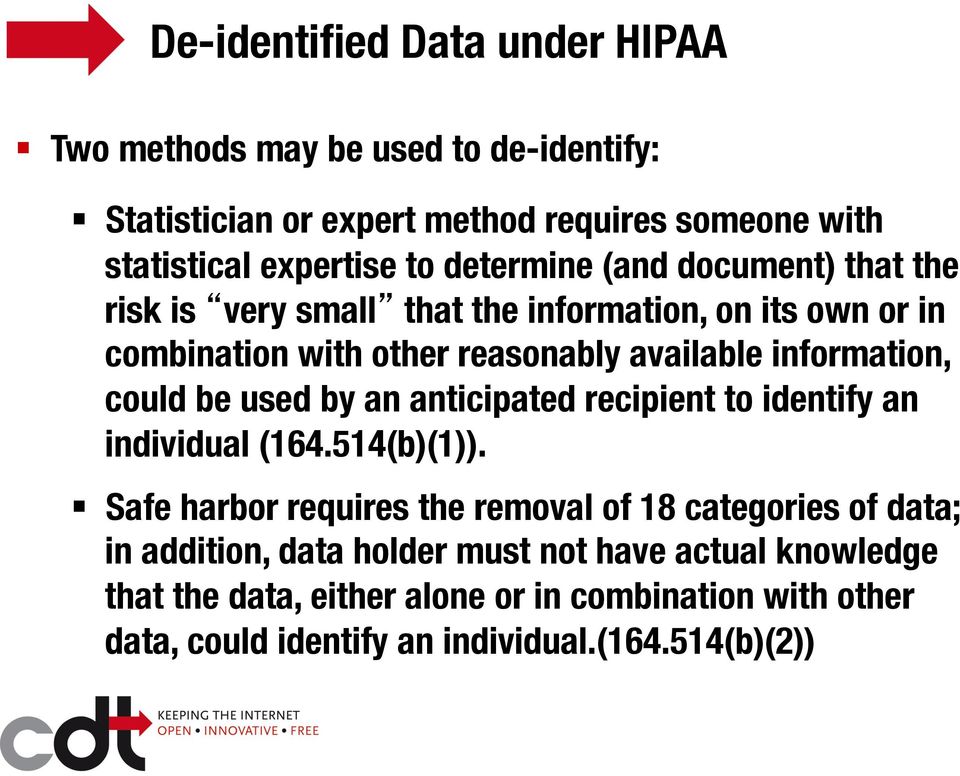
4 De-identified Data under HIPAA Two methods may be used to de-identify: Statistician or expert method requires someone with statistical expertise to determine (and document) that the risk is very small that the information, on its own or in combination with other reasonably available information, could be used by an anticipated recipient to identify an individual ( (b)(1)). Safe harbor requires the removal of 18 categories of data; in addition, data holder must not have actual knowledge that the data, either alone or in combination with other data, could identify an individual.( (b)(2))
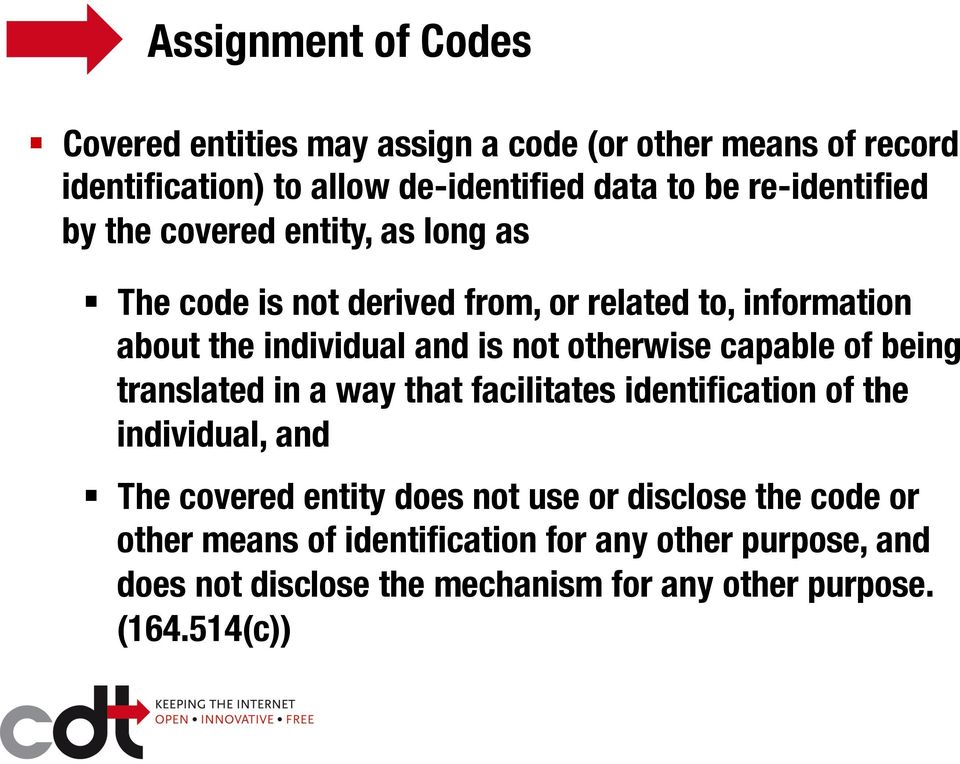
5 Assignment of Codes Covered entities may assign a code (or other means of record identification) to allow de-identified data to be re-identified by the covered entity, as long as The code is not derived from, or related to, information about the individual and is not otherwise capable of being translated in a way that facilitates identification of the individual, and The covered entity does not use or disclose the code or other means of identification for any other purpose, and does not disclose the mechanism for any other purpose. ( (c))
6 Safe Harbor Data Categories Names; All geographic subdivisions smaller than a State, including street address, city, county, precinct, zip code, and their equivalent geocodes, except for the initial three digits of a zip code if, according to the current publicly available data from the Bureau of the Census: (1) The geographic unit formed by combining all zip codes with the same three initial digits contains more than 20,000 people; and The initial three digits of a zip code for all such geographic units containing 20,000 or fewer people is changed to 000.

7 Safe Harbor Data Categories (2) All elements of dates (except year) for dates directly related to an individual, including birth date, admission date, discharge date, date of death; and all ages over 89 and all elements of date(including year) indicative of such age, except that such ages and elements may be aggregated into a single category of age 90 or older; Telephone and fax numbers; Electronic mail addresses; Social Security numbers; Medical record and health plan beneficiary numbers;

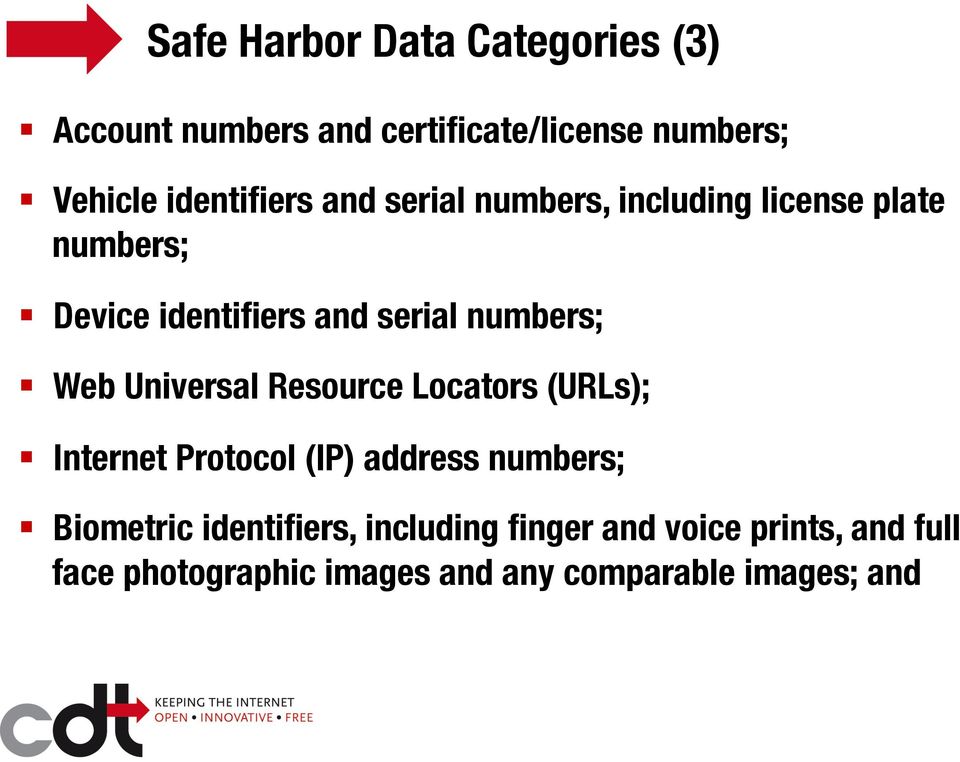
8 Safe Harbor Data Categories (3) Account numbers and certificate/license numbers; Vehicle identifiers and serial numbers, including license plate numbers; Device identifiers and serial numbers; Web Universal Resource Locators (URLs); Internet Protocol (IP) address numbers; Biometric identifiers, including finger and voice prints, and full face photographic images and any comparable images; and
9 Safe Harbor Data Categories (4) Any other unique identifying number, characteristic, or code, except as permitted above (see slide 5 - Covered entities may assign a re-identification code but can t disclose it to the deidentified data recipient). Note: All of the above data categories must be removed in order for a data set to qualify as de-identified under the safe harbor method. If any of the above categories of data is needed to preserve utility, entities can use statistical methodologies to achieve the very low risk standard.

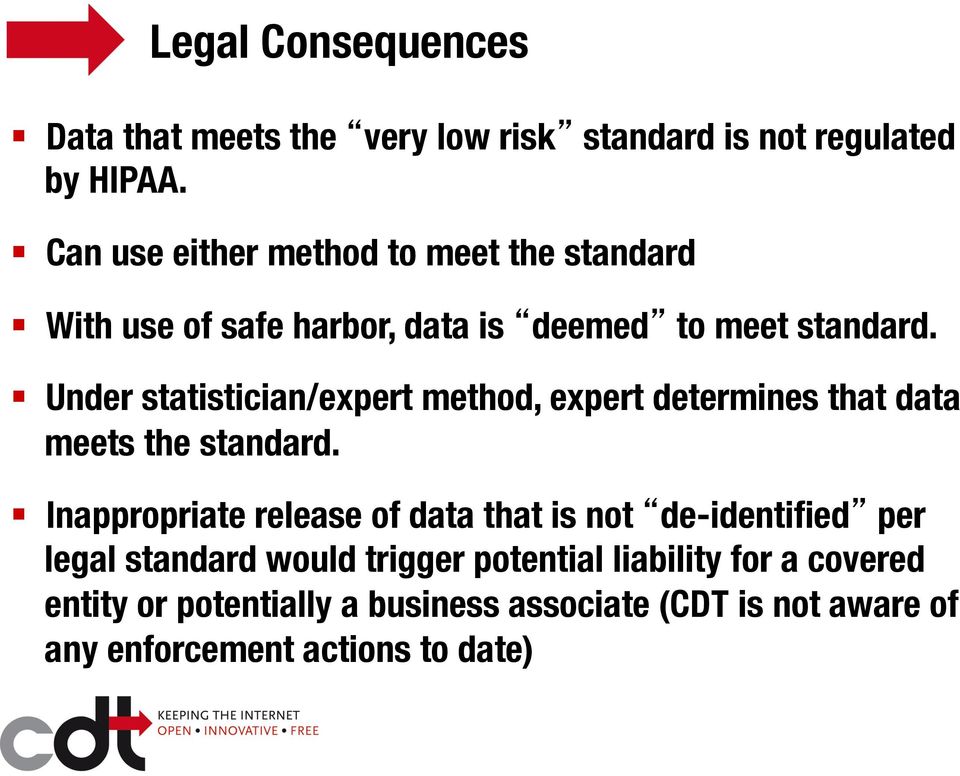
10 Legal Consequences Data that meets the very low risk standard is not regulated by HIPAA. Can use either method to meet the standard With use of safe harbor, data is deemed to meet standard. Under statistician/expert method, expert determines that data meets the standard. Inappropriate release of data that is not de-identified per legal standard would trigger potential liability for a covered entity or potentially a business associate (CDT is not aware of any enforcement actions to date)
11 What does the HHS Guidance Add? Reiterates the legal standard and the two methodologies for de-identification. Acknowledges that de-identified data retains a very small risk of re-identification not required to get to zero risk. Provides guidance on use of both methodologies, and on use of a code that can facilitate re-identification. Clarifies circumstances under which a business associate can de-identify data: when authorized by the business associate agreement. Clarifies that a data use agreement restricting use or prohibiting re-identification is not required but can be used.

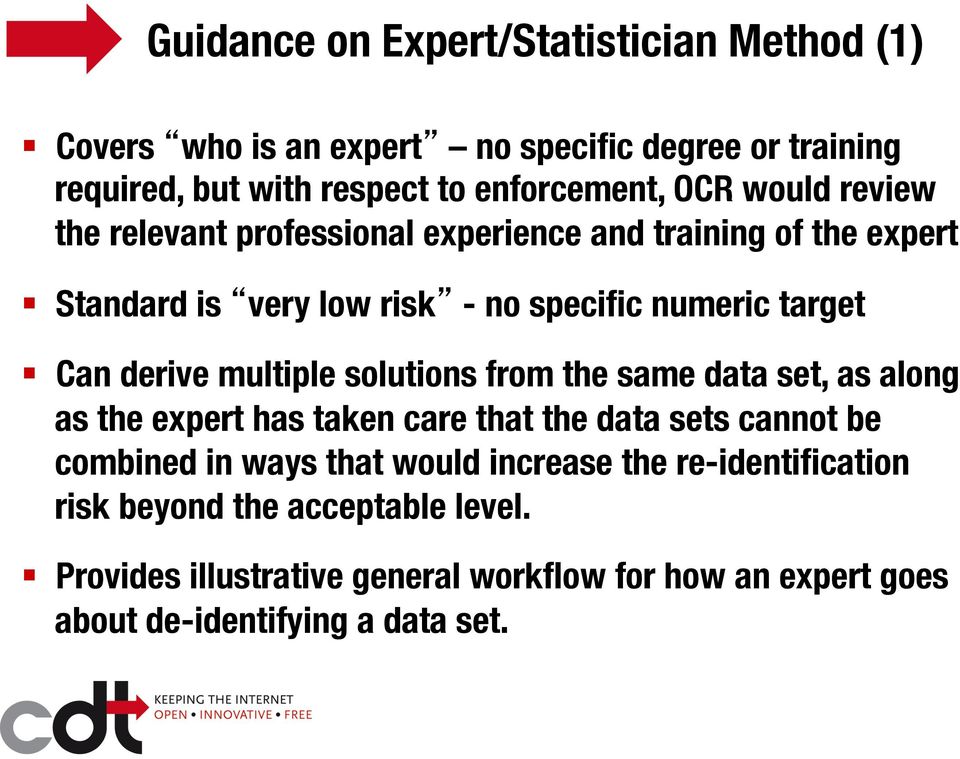
12 Guidance on Expert/Statistician Method (1) Covers who is an expert no specific degree or training required, but with respect to enforcement, OCR would review the relevant professional experience and training of the expert Standard is very low risk - no specific numeric target Can derive multiple solutions from the same data set, as along as the expert has taken care that the data sets cannot be combined in ways that would increase the re-identification risk beyond the acceptable level. Provides illustrative general workflow for how an expert goes about de-identifying a data set.
13 Guidance on Expert/Statistician Method (2) Lists principles used by experts in determining identifiability and typical approaches used to de-identify (suppression, generalization/abbreviation, perturbation; k-anonymity offered as specific example). Can use data use agreement to limit distribution of de-identified data set, but the agreement is not a substitute for application of statistical methods (i.e., it s not a de-identification tool). Covered entities may assign re-identification codes but cannot disclose these with the de-identified data. (In reg) Guidance clarifies that a covered entity may disclose codes derived from PHI as part of a de-identified data if an expert determines that the data meets the de-identification requirements.

14 Guidance on Expert/Statistician Method (3) Question 2.9 Use of codes Bottom line: the data cannot be re-identifiable by the de-identified data recipient. Thus, a covered entity can disclose codes that are derived from PHI as long as the expert determines that the data (including the code) meets the very low risk standard. PHI can also be transformed into values derived by cryptographic hash functions using the expert method, as long as the keys are not disclosed, including to the recipients of the de-identified information.

15 Guidance on Safe Harbor (1) Clarity on when zip codes can be used; must use most current publicly available data from the Census Bureau. Parts or derivatives of the list of identifiers cannot be disclosed (e.g., last 4 numbers of the SSN). Clarity on the prohibition on dates. Clarity in what constitutes any other unique identifying information e.g., other identifying numbers like clinical trial record numbers; non-secure codes (like a hash function without a secret key), barcodes, unique identifying characteristics ( current President of the United States ).

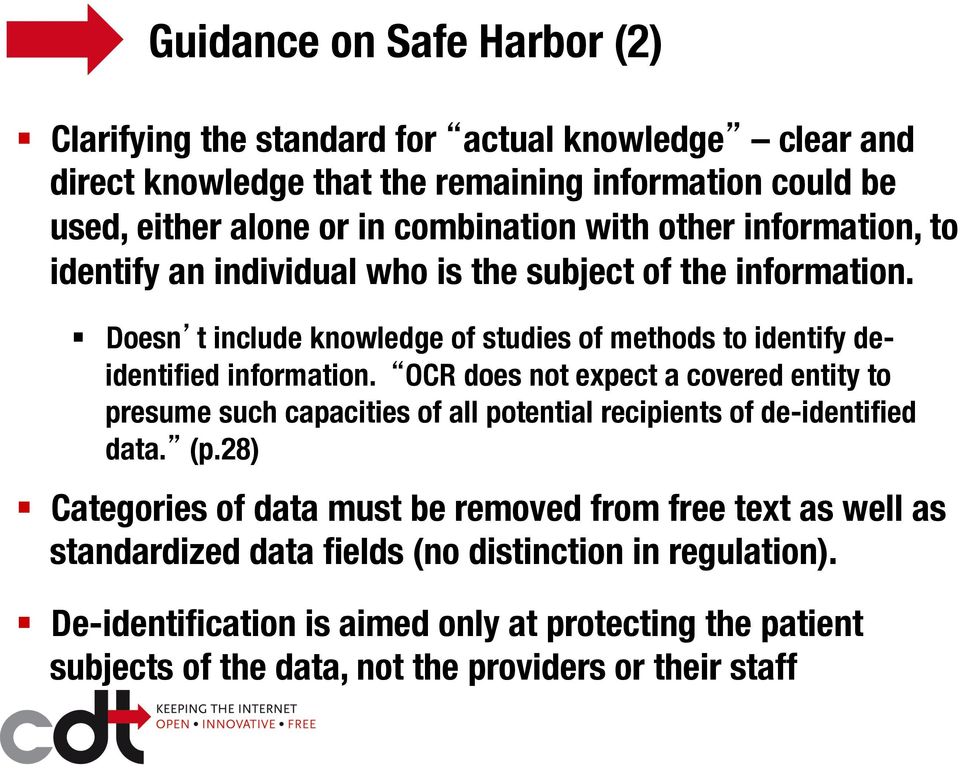
16 Guidance on Safe Harbor (2) Clarifying the standard for actual knowledge clear and direct knowledge that the remaining information could be used, either alone or in combination with other information, to identify an individual who is the subject of the information. Doesn t include knowledge of studies of methods to identify deidentified information. OCR does not expect a covered entity to presume such capacities of all potential recipients of de-identified data. (p.28) Categories of data must be removed from free text as well as standardized data fields (no distinction in regulation). De-identification is aimed only at protecting the patient subjects of the data, not the providers or their staff
17 CDT on Deidentification White Paper (June 2009): Encouraging the Use of, and Rethinking Protections for, De-Identified (and Anonymized ) Health Data : Policy Post (shorter version of above) (6/26/09): stronger-protections-and-encouraging-use-de-identified-and-anonymizedhealth-data ihealthbeat Perspectives (even shorter) (7/30/09): Building Public Trust in Uses of HIPAA De-Identified Data, jamia.bmj.com/content/early/recent

HIPAA-Compliant Research Access to PHI
 HIPAA-Compliant Research Access to PHI HIPAA permits the access, disclosure and use of PHI from a HIPAA Covered Entity s or HIPAA Covered Unit s treatment, payment or health care operations records for
How to De-identify Data. Xulei Shirley Liu Department of Biostatistics Vanderbilt University 03/07/2008
 How to De-identify Data Xulei Shirley Liu Department of Biostatistics Vanderbilt University 03/07/2008 1 Outline The problem Brief history The solutions Examples with SAS and R code 2 Background The adoption
HIPAA COMPLIANCE. What is HIPAA?
 HIPAA COMPLIANCE What is HIPAA? The Health Insurance Portability and Accountability Act (HIPAA) also known as the Privacy Rule specifies the conditions under which protected health information may be used
UPMC POLICY AND PROCEDURE MANUAL
 UPMC POLICY AND PROCEDURE MANUAL POLICY: INDEX TITLE: HS-EC1807 Ethics & Compliance SUBJECT: Honest Broker Certification Process Related to the De-identification of Health Information for Research and
Everett School Employee Benefit Trust. Reportable Breach Notification Policy HIPAA HITECH Rules and Washington State Law
 Everett School Employee Benefit Trust Reportable Breach Notification Policy HIPAA HITECH Rules and Washington State Law Introduction The Everett School Employee Benefit Trust ( Trust ) adopts this policy
LA BioMed Secure Email
 INFORMATION SYSTEMS LA BioMed Secure Email Los Angeles Biomedical Research Institute at Harbor-UCLA 1124 W Carson St Bldg E2.5 Phone 310.222.1212 Table of Contents Intended Audience... 1 Purpose... 1 When
De-Identification of Clinical Data
 De-Identification of Clinical Data Sepideh Khosravifar, CISSP Info Security Analyst IV TEPR Conference 2008 Ft. Lauderdale, Florida May 17-21, 2008 1 1 Slide 1 cmw1 Craig M. Winter, 4/25/2008 Background
HIPAA POLICY REGARDING DE-IDENTIFICATION OF PROTECTED HEALTH INFORMATION AND USE OF LIMITED DATA SETS
 HIPAA POLICY REGARDING DE-IDENTIFICATION OF PROTECTED HEALTH INFORMATION AND USE OF LIMITED DATA SETS SCOPE OF POLICY: What Units Are Covered by this Policy?: This policy applies to the following units
HIPAA-P06 Use and Disclosure of De-identified Data and Limited Data Sets
 HIPAA-P06 Use and Disclosure of De-identified Data and Limited Data Sets FULL POLICY CONTENTS Scope Policy Statement Reason for Policy Definitions ADDITIONAL DETAILS Web Address Forms Related Information
Legal Insight. Big Data Analytics Under HIPAA. Kevin Coy and Neil W. Hoffman, Ph.D. Applicability of HIPAA
 Big Data Analytics Under HIPAA Kevin Coy and Neil W. Hoffman, Ph.D. Privacy laws and regulations such as the Health Insurance Portability and Accountability Act (HIPAA) Privacy Rule can have a significant
De-identification Koans. ICTR Data Managers Darren Lacey January 15, 2013
 De-identification Koans ICTR Data Managers Darren Lacey January 15, 2013 Disclaimer There are several efforts addressing this issue in whole or part Over the next year or so, I believe that the conversation
University of Cincinnati Limited HIPAA Glossary
 University of Cincinnati Limited HIPAA Glossary ephi System A system that creates accesses, transmits or receives: 1) primary source ephi, 2) ephi critical for treatment, payment or health care operations
What is Covered by HIPAA at VCU?
 What is Covered by HIPAA at VCU? The Privacy Rule was designed to protect private health information from incidental disclosures. The regulations specifically apply to health care providers, health plans,
HIPAA OVERVIEW ETSU 1
 HIPAA OVERVIEW ETSU 1 What is HIPAA? Health Insurance Portability and Accountability Act. 2 PURPOSE - TITLE II ADMINISTRATIVE SIMPLIFICATION To increase the efficiency and effectiveness of the entire health
Memorandum. Factual Background
 Memorandum TO: FROM: SUBJECT: Chris Ianelli and Jill Mullan, ispecimen, Inc. Kristen Rosati and Ana Christian, Polsinelli, PC ispecimen Regulatory Compliance DATE: January 26, 2014 You have asked us to
HIPAA and You The Basics
 HIPAA and You The Basics The Purpose of HIPAA Privacy Rules 1. Provide strong federal protections for privacy rights Ensure individual trust in the privacy and security of his or her health information
HIPAA COMPLIANCE INFORMATION. HIPAA Policy
 HIPAA COMPLIANCE INFORMATION HIPAA Policy Use of Protected Health Information for Research Policy University of North Texas Health Science Center at Fort Worth Applicability: All University of North Texas
The De-identification of Personally Identifiable Information
 The De-identification of Personally Identifiable Information Khaled El Emam (PhD) www.privacyanalytics.ca 855.686.4781 [email protected] 251 Laurier Avenue W, Suite 200 Ottawa, ON Canada K1P 5J6
Health Insurance Portability & Accountability Act (HIPAA) Compliance Application
 Health Insurance Portability & Accountability Act (HIPAA) Compliance Application IRB Office 101 - Altru Psychiatry Center 860 S. Columbia Rd, Grand Forks, North Dakota 58201 Phone: (701) 780-6161 PROJECT
Winthrop-University Hospital
 Winthrop-University Hospital Use of Patient Information in the Conduct of Research Activities In accordance with 45 CFR 164.512(i), 164.512(a-c) and in connection with the implementation of the HIPAA Compliance
Protecting Personal Health Information in Research: Understanding the HIPAA Privacy Rule
 AA Privacy RuleP DEPARTMENT OF HE ALTH & HUMAN SERVICES USA Protecting Personal Health Information in Research: Understanding the HIPAA Privacy Rule NIH Publication Number 03-5388 The HI Protecting Personal
Statement of Policy. Reason for Policy
 Table of Contents Statement of Policy 2 Reason for Policy 2 HIPAA Liaison 2 Individuals and Entities Affected by Policy 2 Who Should Know Policy 3 Exclusions 3 Website Address for Policy 3 Definitions
HIPAA 101: Privacy and Security Basics
 HIPAA 101: Privacy and Security Basics Purpose This document provides important information about Kaiser Permanente policies and state and federal laws for protecting the privacy and security of individually
IRB Application for Medical Records Review Request
 Office of Regulatory Research Compliance Institutional Review Board FORM B1 : Medial Records Review Application FORM B1 IRB Application for Medical Records Review Request Principal Investigator: Email:
Computer Security Incident Response Plan. Date of Approval: 23- FEB- 2015
 Name of Approver: Mary Ann Blair Date of Approval: 23- FEB- 2015 Date of Review: 22- FEB- 2015 Effective Date: 23- FEB- 2015 Name of Reviewer: John Lerchey Table of Contents Table of Contents... 2 Introduction...
What is Covered under the Privacy Rule? Protected Health Information (PHI)
 HIPAA & RESEARCH What is Covered under the Privacy Rule? Protected Health Information (PHI) Health information + Identifier = PHI Transmitted or maintained in any form (paper, electronic, forms, web-based,
Presented by Jack Kolk President ACR 2 Solutions, Inc.
 HIPAA 102 : What you don t know about the new changes in the law can hurt you! Presented by Jack Kolk President ACR 2 Solutions, Inc. Todays Agenda: 1) Jack Kolk, CEO of ACR 2 Solutions a information security
4. No accounting of disclosures is required with respect to disclosures of PHI within a Limited Data Set.
 IDAHO STATE UNIVERSITY POLICIES AND PROCEDURES (ISUPP) HIPAA Privacy - Limited Data Sets and Data Use Agreements 10200 POLICY INFORMATION Major Functional Area (MFA): MFA X - Office of General Counsel
HIPAA-G04 Limited Data Set and Data Use Agreement Guidance
 HIPAA-G04 Limited Data Set and Data Use Agreement Guidance GUIDANCE CONTENTS Scope Reason for the Guidance Guidance Statement Definitions ADDITIONAL DETAILS Additional Contacts Web Address Forms Related
HIPAA Privacy and Security Rules: A Refresher. Marilyn Freeman, RHIA California Area HIPAA Coordinator California Area HIM Consultant
 HIPAA Privacy and Security Rules: A Refresher Marilyn Freeman, RHIA California Area HIPAA Coordinator California Area HIM Consultant Objectives Provide overview of Health insurance Portability and Accountability
HIPAA Compliance for Students
 HIPAA Compliance for Students The Health Insurance Portability and Accountability Act (HIPAA) was passed in 1996 by the United States Congress. It s intent was to help people obtain health insurance benefits
Guidance on De-identification of Protected Health Information November 26, 2012.
 Guidance Regarding Methods for De-identification of Protected Health Information in Accordance with the Health Insurance Portability and Accountability Act (HIPAA) Privacy Rule November 26, 2012 OCR gratefully
INDIANA UNIVERSITY SCHOOL OF OPTOMETRY HIPAA COMPLIANCE PLAN TABLE OF CONTENTS. I. Introduction 2. II. Definitions 3
 INDIANA UNIVERSITY SCHOOL OF OPTOMETRY HIPAA COMPLIANCE PLAN TABLE OF CONTENTS I. Introduction 2 II. Definitions 3 III. Program Oversight and Responsibilities 4 A. Structure B. Compliance Committee C.
North Shore LIJ Health System, Inc. Facility Name
 North Shore LIJ Health System, Inc. Facility Name POLICY TITLE: The Medical Record POLICY #: 200.10 Approval Date: 2/14/13 Effective Date: Prepared by: Elizabeth Lotito, HIM Project Manager ADMINISTRATIVE
OCR/HHS HIPAA/HITECH Audit Preparation
 OCR/HHS HIPAA/HITECH Audit Preparation 1 Who are we EHR 2.0 Mission: To assist healthcare organizations develop and implement practices to secure IT systems and comply with HIPAA/HITECH regulations. Education
HIPAA ephi Security Guidance for Researchers
 What is ephi? ephi stands for Electronic Protected Health Information (PHI). It is any PHI that is stored, accessed, transmitted or received electronically. 1 PHI under HIPAA means any information that
2010 i2b2/va Challenge Rules of Conduct
 2010i2b2/VAChallengeRulesofConduct The2010i2b2/VAChallengeisasharedtask.Theformatofthesharedtaskandtheprinciples whichbindtheparticipantsofthissharedtaskareasfollows: 1.Inordertosupportthesharedtask,i2b2andVAwillprovidetheparticipantswithdatafrom
BUSINESS ASSOCIATE AGREEMENT BETWEEN LEWIS & CLARK COLLEGE AND ALLEGIANCE BENEFIT PLAN MANAGEMENT, INC. I. PREAMBLE
 BUSINESS ASSOCIATE AGREEMENT BETWEEN LEWIS & CLARK COLLEGE AND ALLEGIANCE BENEFIT PLAN MANAGEMENT, INC. I. PREAMBLE Lewis & Clark College and Allegiance Benefit Plan Management, Inc., (jointly the Parties
Data Driven Approaches to Prescription Medication Outcomes Analysis Using EMR
 Data Driven Approaches to Prescription Medication Outcomes Analysis Using EMR Nathan Manwaring University of Utah Masters Project Presentation April 2012 Equation Consulting Who we are Equation Consulting
Information Privacy and Security Program Title:
 1 Page: 1 of 5 I. PURPOSE: 1 The purpose of this standard is to identify and define the standards for implementing contracting provisions related to those individuals and organizations identified as Business
Information Security and Privacy. WHAT is to be done? HOW is it to be done? WHY is it done?
 Information Security and Privacy WHAT is to be done? HOW is it to be done? WHY is it done? 1 WHAT is to be done? O Be in compliance of Federal/State Laws O Federal: O HIPAA O HITECH O State: O WIC 4514
Understanding De-identification, Limited Data Sets, Encryption and Data Masking under HIPAA/HITECH: Implementing Solutions and Tackling Challenges
 Understanding De-identification, Limited Data Sets, Encryption and Data Masking under HIPAA/HITECH: Implementing Solutions and Tackling Challenges Daniel C. Barth-Jones, M.P.H., Ph.D. Assistant Professor
BUSINESS ASSOCIATE AGREEMENT HIPAA Protected Health Information
 BUSINESS ASSOCIATE AGREEMENT HIPAA Protected Health Information I. PREAMBLE ( Covered Entity ) and ( Business Associate ) (jointly the Parties ) wish to enter into an Agreement to comply with the requirements
8/3/2015. Integrating Behavioral Health and HIV Into Electronic Health Records Communities of Practice
 Integrating Behavioral Health and HIV Into Electronic Health Records Communities of Practice Monday, August 3, 2015 1 How to ask a question during the webinar If you dialed in to this webinar on your phone
HIPAA and Clinical Research
 To Heal. To Teach. To Discover. HIPAA and Clinical Research 2011 Training Jennifer Edlind, UH Privacy Officer Ryan Terry, UH Information Security Officer 1 Agenda Research credentialing overview HIPAA
HIPAA Basics for Clinical Research
 HIPAA Basics for Clinical Research Audio options: Built-in audio on your computer OR Separate audio dial-in: 415-930-5229 Toll-free: 1-877-309-2074 Access Code: 960-353-248 Audio PIN: Shown after joining
MCDONOUGH CENTER FOR FAMILY DENTISTRY, LLC
 MCDONOUGH CENTER FOR FAMILY DENTISTRY, LLC HIPAA Privacy Policies & Procedures & HIPAA Security Policies & Procedures TABLE OF CONTENTS 1. PROTECTED HEALTH INFORMATION (PHI) 2. HIPAA PRIVACY POLICIES &
Data Masking for HIPAA Compliance
 The Safe Harbor Method: Abstract The Health Insurance Portability and Accountability Act of 1996 (HIPAA) Privacy Rule mandates the de-identification of specific types of Protected Health Information (PHI)
Patient Privacy and HIPAA/HITECH
 Patient Privacy and HIPAA/HITECH What is HIPAA? Health Insurance Portability and Accountability Act of 1996 Implemented in 2003 Title II Administrative Simplification It s a federal law HIPAA is mandatory,
Degrees of De-identification of Clinical Research Data
 Vol. 7, No. 11, November 2011 Can You Handle the Truth? Degrees of De-identification of Clinical Research Data By Jeanne M. Mattern Two sets of U.S. government regulations govern the protection of personal
NLRG HIPAA PRIVACY SHORTCUT ROUTE: AN EMPLOYER GUIDE PARTNERING WITH YOU ON TRENDS AND BEST PRACTICES TO SUPPORT YOUR HUMAN RESOURCES INITIATIVES
 NLRG PARTNERING WITH YOU ON TRENDS AND BEST PRACTICES TO SUPPORT YOUR HUMAN RESOURCES INITIATIVES HIPAA PRIVACY SHORTCUT ROUTE: AN EMPLOYER GUIDE PERFORMANCE MANAGEMENT EMPLOYER GUIDE PAGE 1 HIPAA PRIVACY
Business Associate Agreement
 Business Associate Agreement This Agreement is entered into as of ("Effective Date"), between ( Covered Entity ), and ( Business Associate ). RECITALS WHEREAS, Business Associate provides services on behalf
HIPAA Data Use Agreement Policy R&G Template Updated for Omnibus Rule HIPAA DATE USE AGREEMENT 1
 HIPAA DATE USE AGREEMENT 1 This Data Use Agreement (the "Agreement") is effective as of (the "Agreement Effective Date") by and between ("Covered Entity") and ("Data User"). RECITALS WHEREAS, Covered Entity
IRB Month Investigator Meeting April 2014
 April 2014 AUDITS TRENDS EMR COMPLIANCE PRACTICES EMR FEDERAL REGULATIONS MONITORING REGULATORY SECURITY THREATS ACADEMI CINA BREACHES REVIEW COMPUTING MOBILE CLOUD HIPAA CENTER OPERATION S RESEARCH C
HIPAA means the Health Insurance Portability and Accountability Act of 1996, Public Law 104-191.
 HIPAA Data Use Agreement 1 Revision Date: This Data Use Agreement (the Agreement ) is entered into by and between Yale University ( Covered Entity ) and ( Data User ), collectively, the Parties, and shall
Malpractice Issues for the Radiologic Technologist
 Malpractice Issues for the Radiologic Technologist Carol Ann Marunich, Esquire Dinsmore & Shohl LLP 215 Don Knotts Boulevard, Suite 310 Morgantown, West Virginia 26501 304-296-1100 X44 2006 Dinsmore &
CREATIVE SOLUTIONS IN HEALTHCARE, INC. Privacy Policy
 CREATIVE SOLUTIONS IN HEALTHCARE, INC. Privacy Policy Amended as of February 12, 2010 on the authority of the HIPAA Privacy Officer for Creative Solutions in Healthcare, Inc. TABLE OF CONTENTS ARTICLE
ENSURING ANONYMITY WHEN SHARING DATA. Dr. Khaled El Emam Electronic Health Information Laboratory & uottawa
 ENSURING ANONYMITY WHEN SHARING DATA Dr. Khaled El Emam Electronic Health Information Laboratory & uottawa ANONYMIZATION Motivations for Anonymization Obtaining patient consent/authorization not practical
DEPARTMENT: POLICY DESCRIPTION: HealthTrust Ethics and Compliance. PHI: Managing Protected Health Information
 PAGE: 1 of 15 SCOPE: All departments within HealthTrust Purchasing Group, L.P. ( HealthTrust LP ); Invivolink LLC; and to the extent applicable, direct and indirect subsidiaries or affiliates of HealthTrust
VENDOR / CONTRACTOR. Privacy Basics
 VENDOR / CONTRACTOR Privacy Basics Introduction Premera s mission is to provide our customers with peace of mind about their healthcare. This requires that everyone who works with or for Premera (the Company
HIPAA BREACH RESPONSE POLICY
 http://dhmh.maryland.gov/sitepages/op02.aspx (OIG) DHMH POLICY 01.03.07 Effective Date: July 22, 2014 I. EXECUTIVE SUMMARY The Department of Health and Mental Hygiene (DHMH) is committed to protecting
State of Nevada Public Employees Benefits Program. Master Plan Document for the HIPAA Privacy and Security Requirements for PEBP Health Benefits
 State of Nevada for the Requirements for PEBP Health Benefits Plan Year 2016 July 1, 2015 June 30, 2016 www.pebp.state.nv.us (775) 684-7000 Or (800) 326-5496 Amendments Amendment Log Any amendments, changes