
The Prudential Assurance Company Limited
|
|
|
- Myrtle Park
- 9 years ago
- Views:
Transcription
1 The Prudential Assurance Company Limited Annual FSA Insurance returns for the year ended 31 December 2006 (Appendices 9.4 and 9.4A valuation reports) The Prudential Asurance Company Limited is registered in England and Wales. Registered office at Laurence Pountney Hill, London EC4R 0HH. Registered number Authorised and regulated by the FSA.

2

3 Contents Page Appendix 9.4 Abstract of valuation report 4 Structure of the long term business 4 1. Introduction 7 2. Product range 7 3. Discretionary charges and benefits 8 4. Valuation methods and bases (other than for special reserves) Options and guarantees Expense reserves Mismatching reserves Other special reserves Reinsurance Reversionary (or annual) bonus 34 Appendix 1 Valuation interest rates 39 Appendix 2 Mortality bases 40 Appendix 3 Annuities: expectations of life 43 Appendix 4 Morbidity bases 44 Appendix 5 Expense bases 47 Appendix 9.4A Abstract of valuation report for realistic valuation 50 Appendix 6 Results from the PSALM model 75 Appendix 7 Initial annual reversionary bonus assumptions 76 Appendix 8 Reversionary and terminal bonus rates as a proportion of the sum assured 77 3

4 VALUATION REPORT ON THE PRUDENTIAL ASSURANCE COMPANY LIMITED AS AT 31 DECEMBER 2006 Structure of the long term business 1. Overview The Prudential Assurance Company Limited (PAC) carries on ordinary branch and industrial branch business within its long-term fund. The industrial branch was closed to new business on 1 January The long-term business of Scottish Amicable Life Assurance Society (SALAS) was transferred into PAC on 1 October 1997, and the long term business of Scottish Amicable Life plc (SAL) was transferred into PAC on 31 December The business transferred from SAL itself included business previously transferred into SAL from M&G Life Assurance Company Limited (M&G Life) and M&G Pensions and Annuity Company Limited (M&G Pensions). The long term business is contained within the following four sub-funds: (a) Non-Profit Sub-Fund (NPSF) (b) Scottish Amicable Insurance Fund (SAIF) (c) Defined Charge Participating Sub-Fund (DCPSF) (d) With-Profits Sub-Fund (WPSF) 2. Non-Profit Sub-Fund The business in this sub-fund comprises: (1) Long term sickness and accident business, namely the directly written permanent health business in respect of which the directors have determined that profits should accrue 100% to shareholders. (2) The linked business written directly by PAC, including linked business issued in France, in respect of which the directors have determined that profits should accrue 100% to shareholders. (3) The loan protection business transferred into PAC from SAL on 31 December 2002 and subsequently written directly by PAC, in respect of which the directors have determined that profits should accrue 100% to shareholders. (4) Defined Charge Participating business issued by PAC in France, and Defined Charge Participating business reassured into PAC by Prudential International Assurance plc (PIA) and Canada Life (Europe) Assurance Ltd, excluding the accumulated investment content of premiums paid, which is transferred to the DCPSF (see below). (5) Ex-SAL business, namely the with-profits, non-participating and linked business (including internal linked funds) transferred into PAC from SAL on 31 December 2002 and any new premiums arising on those products, excluding Prudential Protection business written between 1 January 2003 and 25 July 2004 and the accumulated with-profits premiums which are held in the WPSF (see 5 below). (6) Reassurance of the accumulated investment content of linked business written in Prudential (AN) Limited. All profits in the NPSF accrue 100% to shareholders. 4
5 Structure of the long term business (continued) 3. Scottish Amicable Insurance Fund PAC acquired the business of Scottish Amicable Life Assurance Society (SALAS) on 1 October As a consequence a closed sub-fund SAIF and a memorandum account within the WPSF, the Scottish Amicable Account (SAA), were created. SAIF contains the pensions business, annuities and traditional with-profits life business transferred from SALAS and the accumulated investment content of with-profits business in SAA. All profits in SAIF accrue to holders of with-profits contracts in SAIF and SAA. The accumulated investment content of linked premiums is invested in the linked funds that were transferred from SAL to the NPSF on 31 December The WPSF provides financial support to SAIF through a memorandum account, the Scottish Amicable Capital Fund (SACF), some of which may be drawn upon in adverse investment conditions to support the smoothing of bonuses within SAIF. No such drawings have yet been necessary. The WPSF receives an annual charge from SAIF for providing this financial support. 4. Defined Charge Participating Sub-Fund This fund comprises the accumulated investment content of premiums paid in respect of the Defined Charge Participating with-profits business issued in France, and the Defined Charge Participating with-profits business reassured into PAC from Prudential International Assurance plc and Canada Life (Europe) Assurance Ltd. All profits in this fund accrue to policyholders in the DCPSF. A bonus smoothing account is maintained in the WPSF (see below) so that whenever a claim payment is made from the DCPSF any excess of the claim amount over the policy s underlying asset share is transferred from the WPSF to the DCPSF and any shortfall is transferred from the DCPSF to the WPSF. On average, it is intended that these smoothing transfers should generate neither profit nor loss to either fund. 5. With-Profits Sub-Fund The WPSF contains all other long term business, comprising: (1) With-profits, non-participating and linked business (other than the categories defined above) written directly by PAC. This includes the Prudential Protection business written between 1 January 2003 and 25 July (2) With-profits, non-participating and linked life business transferred to SAA from SALAS, excluding the accumulated investment content of with-profits premiums, which is held in SAIF, and also excluding the accumulated investment content of linked premiums, which is invested in the linked funds transferred from SAL to the NPSF on 31 December (3) The accumulated with-profits premiums in respect of business transferred into the NPSF from SAL on 31 December 2002 and any new premiums arising on those products. (4) Reassurance of accumulating with-profits business written in Prudential (AN) Limited. Divisible profits from this business accrue to both shareholders and with-profits policyholders in the WPSF (other than with-profits policyholders in SAA who share in the profits of SAIF). Transfers not exceeding 5% of divisible profits may be made to a common contingency fund. Not less than 90% of the remainder is allocated to the with-profits policyholders, and the balance to shareholders. 5
6 Structure of the long term business (continued) 6. Prudential UK Services Limited As a result of the acquisition of SALAS a service company, Prudential UK Services Limited (formerly Craigforth Services Limited), was created to provide services to PAC and other companies within the Prudential Group. Renewal expenses for all business transferred from SALAS are governed by the Insurance Services Agreement with Prudential UK Services Limited. This sets out a guaranteed fixed rate tariff (with annual inflation adjustments) applicable for ten years from the date of the Scheme of Transfer. Thereafter the charges revert to cost on a basis equivalent to that being charged for PAC s own business. 7. Reinsurance of linked business Much of the linked business in PAC was transferred either from SALAS on 1 October 1997 or from SAL on 31 December Most of the property-linked business issued by PAC is linked, via reinsurance treaties, to the internal linked funds of other life assurance companies. 8. Reinsurance of pensions annuities in payment Some annuities in payment originally written in SAL and transferred to the NPSF on 31 December 2002 are ceded to Prudential Retirement Income Limited. Most of the non-profit and index-linked annuities in payment issued by PAC are ceded to Prudential Annuities Limited, a wholly-owned subsidiary of the WPSF, or to Prudential Retirement Income Limited. Most of the non-profit annuities in payment written in SAIF are ceded to Prudential Retirement Income Limited. 6

7 VALUATION REPORT 1. Introduction 1.(1) The investigation relates to 31 December (2) The previous investigation related to 31 December (3) No interim valuations have been carried out for the purposes of IPRU(INS) 9.4 since 31 December Product range (a) New products Flexible Protection Plan The Flexible Protection Plan, launched on 10 July 2006, is a comprehensive non-profit protection policy which can provide a combination of life cover and/or serious illness cover as well as a range of rider benefits providing disability cover, income protection cover and waiver of premium. It can be written on a single life or joint life basis. A plan account determines the amount of cover available to be paid when a claim occurs. In the event of a claim, the severity of the illness or disability determines whether the full amount of cover or a partial payment is made. The plan does not necessarily cease following a claim and multiple claims may be made. The plan does not acquire a surrender value. For fixed term plans, there is a choice of reviewable or guaranteed premiums. Whole of life plans have reviewable premiums. Premium reviews take place on the tenth and each subsequent anniversary. Once a review changes the premium, the rate will be guaranteed for the following 10 years. (b) Products withdrawn No products were withdrawn during the year. (c) New bonus series No new bonus series have been introduced during the financial year. (d) Changes to options or guarantees under existing products On 14 August 2006, a SIPP option was added to the range of funds available under the Flexible Retirement Plan that was launched in In this fund the customer will be able to choose and manage the assets held. The fund is wholly reassured to and administered by Suffolk Life Annuities Limited, a specialist SIPP provider. There is no fund-related annual management charge. Instead, there is a set-up fee, an annual fee to cover general administration costs and explicit fees to cover investment and asset management activities. The fees can be increased in line with costs. Prudential provides no investment guarantees. (e) With-profits sub-funds The With-Profits Sub-Fund and the Defined Charge Participating Sub-Fund are both open to new with-profits business. The Scottish Amicable Insurance Fund is closed to new business except by increment. 7

8 3. Discretionary charges and benefits 3.(1) Market value reduction Market value reductions have been applied throughout 2006 except on corporate pensions business in the WPSF. The policy years of entry to which market value reductions were applied during 2006 are summarised below: Product Policy years of entry SAIF , , 1999, 2003, 2006 Prudence Bond PSA/PIB , 2005 Personal Pensions 1988, 1989, 1991, , (2) Reviewable protection policies There was no review of premium rates for reviewable protection policies in (3) Non-profit deposit administration benefits There are no non-profit deposit administration contracts. 3.(4) Service charges on linked policies Policy/member fees increased by 2.66% in 2006 for those linked products where the fees increase in line with Retail Price Index (RPI) inflation, based on the increase in RPI from September 2004 to September (5) Benefit charges on linked policies There have been no changes to benefit charges on linked policies during the financial year. 3.(6) Unit management charges and notional charges on accumulating with-profits policies For accumulating with-profits business, changes to notional charges are shown in the table below: Reserves m New charge % Old charge % Prudence Bond Pre Mk9 and Establishment Charge 8, new business and top ups to this business up to 30/09/02 Prudence Bond Top ups to pre Mk7 and all Establishment Charge options made after 30/09/02 Prudence Bond Mk9 new business and top ups to Mk7, Mk8 and Mk9 after 30/09/02 Prudence Bond Pre NIC3 new business and top ups to pre NIC up to 30/09/02 Prudence Bond NIC3 new business and top ups to NIC1, NIC2 and NIC3 after 30/09/02 Prospects Bond The notional charges for Prudential Investment Bond (product codes 500 and 505), all UK pensions business, Hong Kong policies and DCPSF policies were unchanged. 8

9 3. Discretionary charges and benefits (continued) 3.(7) Unit pricing of internal linked funds (a) Hong Kong PruLink policies Prudential Money Fund The unit issue price and redemption price are always Interest is credited to policies in the form of additional units not less frequently than once a month. The rate to be credited is determined from the value of the fund assets, any surplus being distributed by issuing new units on a pro-rata basis. Hong Kong PruLink policies all funds except the Prudential Money Fund The funds are wholly invested in similarly named authorised Guernsey unit trusts managed by Prudential Fund Managers Guernsey. Units are allocated or cancelled on the next weekly valuation date at the prices determined by the unit trust manager. There is no bid/offer spread. PruLink policies provide that the fund unit prices may be varied from the corresponding unit trust price if a variation would be justified by, for example, a change in the basis of Hong Kong life office taxation. Other business written and retained by PAC The company operates its internal linked funds on a forward pricing basis. The daily unit prices used for the allocation of units to and deallocation of units from policies are calculated by a valuation of the internal linked funds. The valuation point of each fund is 12 noon. The allocation and deallocation of units is carried out once the unit prices are available. The unit prices for a fund are determined using either a creation price basis or a cancellation price basis, depending on the net cash flow position of the fund. Creation of asset units is carried out at the creation price, which is based on the purchase cost of the underlying assets plus any associated costs. Cancellation of asset units is carried out at the cancellation price, which is based on the sale value of the underlying assets of the fund less any associated costs. Other The unit pricing methods for all other contracts are described in the regulatory returns of the companies with which the linked liabilities are wholly reassured. (b) Unit pricing bases are determined at fund level, so all policies invested in the same fund have the same basis applied. (c) The price used for collective investment schemes and similar assets is the latest valuation at midday; deals placed before mid-day receive that price. 3.(8) Capital gains tax deductions from internal linked funds Tax deductions are made on net realised gains as they arise, as well as for net unrealised gains on directly held assets. For holdings in collective investment schemes, allowance is made for the spreading over seven years of deemed disposals of net unrealised gains. Withdrawals from the fund for the payment of tax are made quarterly, the same frequency at which the company makes payments to the Inland Revenue. Each unit fund is treated in principle as though it were a stand-alone taxable entity, so no credit is given for a net loss position, but no carry-back of losses is applied. Instead, credit is given for losses that would fall into the company s actual tax computation in a future year to the extent that they do not exceed the amount of deemed gains carried forward to that particular year. Net unrealised gains of directly held assets are not set off against any realised or deemed losses in the same fund, nor is credit given for net unrealised losses. 9
10 3. Discretionary charges and benefits (continued) Allowance is made in determining the tax charge and provision for the time delay until the assets are assumed to be sold (for unrealised gains and losses) and between the date of calculation of the provision and the tax payment being made. The tax rates applied in 2006 were as shown in 3.(9) below. 3.(9) Capital gains tax provisions for internal linked funds Guaranteed Equity Bond Liabilities are matched by a combination of bonds and derivatives which ensure that at maturity the gross amount payable less tax at 22% on the chargeable gain from the derivatives equals the guaranteed maturity benefit. Capital gains tax is allowed for in the valuation by including the gross value of the derivatives in the mathematical reserves. Linked contracts in France and Hong Kong The funds are not subject to capital gains tax. Contracts with linked liabilities wholly reinsured A full description of the capital gains tax provisions for these contracts can be found in the regulatory returns of the companies with which the linked liabilities are wholly reinsured. Other business written by PAC life business As described in 3.(8) above, in determining the price of units in the internal linked funds relating to life business the value of assets is adjusted by a provision to reflect, on a fund by fund basis, the capital gains tax on indexed gains on the assets held within the funds. On certain funds some credit has been given in respect of chargeable losses. The provision for tax is calculated on a daily basis allowing for the movement in unrealised gains, after any indexation, and losses, using a tax rate reflecting the expected tax payable by the Company as these gains and losses are realised. For investments in non loan relationship unit trusts and OEICs, the tax rate used allows for the deemed disposal of the investments at the end of the year and the spreading of the tax payable over 7 years. The mathematical reserves make allowance for the losses for which no credit is currently given that will be carried forward and offset against future gains or deemed disposals carried forward to future years. The following percentages were deducted or provided for during the year: Realised gains/losses Unrealised gains/losses Equities and properties 20% 17% to 20% Unit trusts and OEICS 20% 15% to 20% Gilts and bonds 20% 20% For policies linked directly to unit trusts, a terminal deduction from benefits payable to policyholders is made in respect of any past or potential liabilities to corporation tax on chargeable gains relating to the units allocated to the policy. Other business written by PAC pensions business The funds are not subject to capital gains tax. 10

11 3. Discretionary charges and benefits (continued) 3.(10) Discounts and commission on buying and selling units Linked contracts in France The company receives rebate commission of 0.6% per annum of funds under management from the Réactif and Carmignac external unit-linked funds. Corresponding rebate commission of 0.4% and 0.3% respectively is payable to distributing agents. Policyholders do not benefit from this rebate. Linked contracts in Hong Kong No special terms apply when units are purchased from the unit trust manager. Business written by PAC For investment in unit trusts and OEICs the Company receives a discount equal to the managers initial charge. The internal linked funds also benefit from the rebate of the annual management charge. All of the benefits of annual management charge rebates are passed on to policyholders. Other The unit pricing methods for all other contracts are described in the regulatory returns of the companies with which the linked liabilities are wholly reassured. 4. Valuation methods and bases (other than for special reserves) 4.(1) Valuation methods Unless specified to the contrary in 4.(1).6 on page 13, the following valuation methods apply. 4.(1).1 The mathematical reserve for assurances and annuities reported in Form 51 is the difference between the present value of the benefits and the present value of the future valuation net premiums (a net premium valuation (NPV) method), both calculated with provision for immediate payment of claims. Policies where negative reserves could arise have been valued individually and the mathematical reserves increased to zero so that no policy is treated as an asset. Otherwise, contracts with a common attained age and number of years to run to maturity or premium cessation are grouped together. 4.(1).2 The mathematical reserve for accumulating with-profits business in SAIF and SAA, and for accumulating with-profits business previously written in SAL and in respect of new business on those products, is taken as the lower of: (a) the value at the bid price, excluding terminal bonus, of the notional number of units allocated to policyholders, and (b) the surrender or transfer value which, having regard to the duty to treat customers fairly, would be payable at the valuation date, or, if greater, the value of the guaranteed liabilities, excluding final bonus, calculated on a gross premium bonus reserve method making no allowance for future annual bonus interest. A further non-unit reserve is held in respect of mortality or morbidity, as appropriate, and expenses (including investment management expenses and other outgo associated with payments to third parties). The comparison of the value of units allocated, the surrender or transfer value and the bonus reserve liability is carried out on a policy-by-policy basis. For contracts where actuarial funding is used, the value of the units is net of the present value of future annual establishment charges, recurrent management charges or additional management charges that are used to recoup initial expenses. 11
12 4. Valuation methods and bases (continued) The surrender or transfer value is taken as the accumulated fund, including final bonus and less a market value reduction where appropriate, at the valuation date, less any explicit charge that would apply on immediate surrender. The non-unit reserves are adequate, on the valuation basis, to eliminate any future negative cash flows which would otherwise arise. Section 32 Buy Out contracts include a specific provision for the Guaranteed Minimum Pension. 4.(1).3 The mathematical reserve for all other accumulating with-profits business is the lower of: (a) the accumulated fund or the value at the bid price of the notional number of units allocated to policyholders, in both cases excluding final bonus, and (b) the surrender or transfer value which, having regard to the duty to treat customers fairly, would be payable at the valuation date, or, if greater, the value of the guaranteed liabilities, excluding final bonus, calculated on a gross premium bonus reserve method making no allowance for future annual bonus interest. The comparison of the accumulated fund or value of units allocated, the surrender or transfer value and the bonus reserve liability is carried out on a policy-by-policy basis. For contracts where initial expenses are recouped by an annual cancellation of units allocated in the first year, the number of units valued is reduced appropriately. In cases where a higher benefit would be payable on early death, due allowance has been made. The surrender or transfer value is taken as the accumulated fund, including final bonus and less a market value reduction where appropriate, at the valuation date, less any explicit charge that would apply on immediate surrender. 4.(1).4The mathematical reserve for property-linked contracts is the unit liability together with a non-unit liability (a sterling reserve ) to cover expenses, mortality, morbidity, options and guarantees and, where appropriate, capital gains tax. The unit liability is based on the value at the date of valuation of the units allocated to policyholders. For contracts where actuarial funding is used, the value of the units is net of the present value of future annual establishment charges, recurrent management charges or additional management charges that are used to recoup initial expenses. A non-unit liability for mortality and expenses is determined for each policy using a discounted cash flow method. For property-linked contracts in the NPSF the non-unit liability provides only for attributable expenses and an additional reserve for non-attributable expenses is calculated at a homogeneous risk group level as described in section 6.(6) on page 27. The total non-unit liability is adequate on the valuation basis to ensure that any future negative cash flows which would otherwise arise are eliminated, including ensuring that the reserve for an individual policy both currently and at any future date is at least equal to the surrender value. Provision is also made for tax on capital gains, for outstanding premiums and, where relevant, for premiums received in respect of policies not yet accepted. 4.(1).5 The mathematical reserve for RPI-linked annuities is determined without an explicit allowance for future increases in annuity payments. This is consistent with the treatment of the matching assets. 12

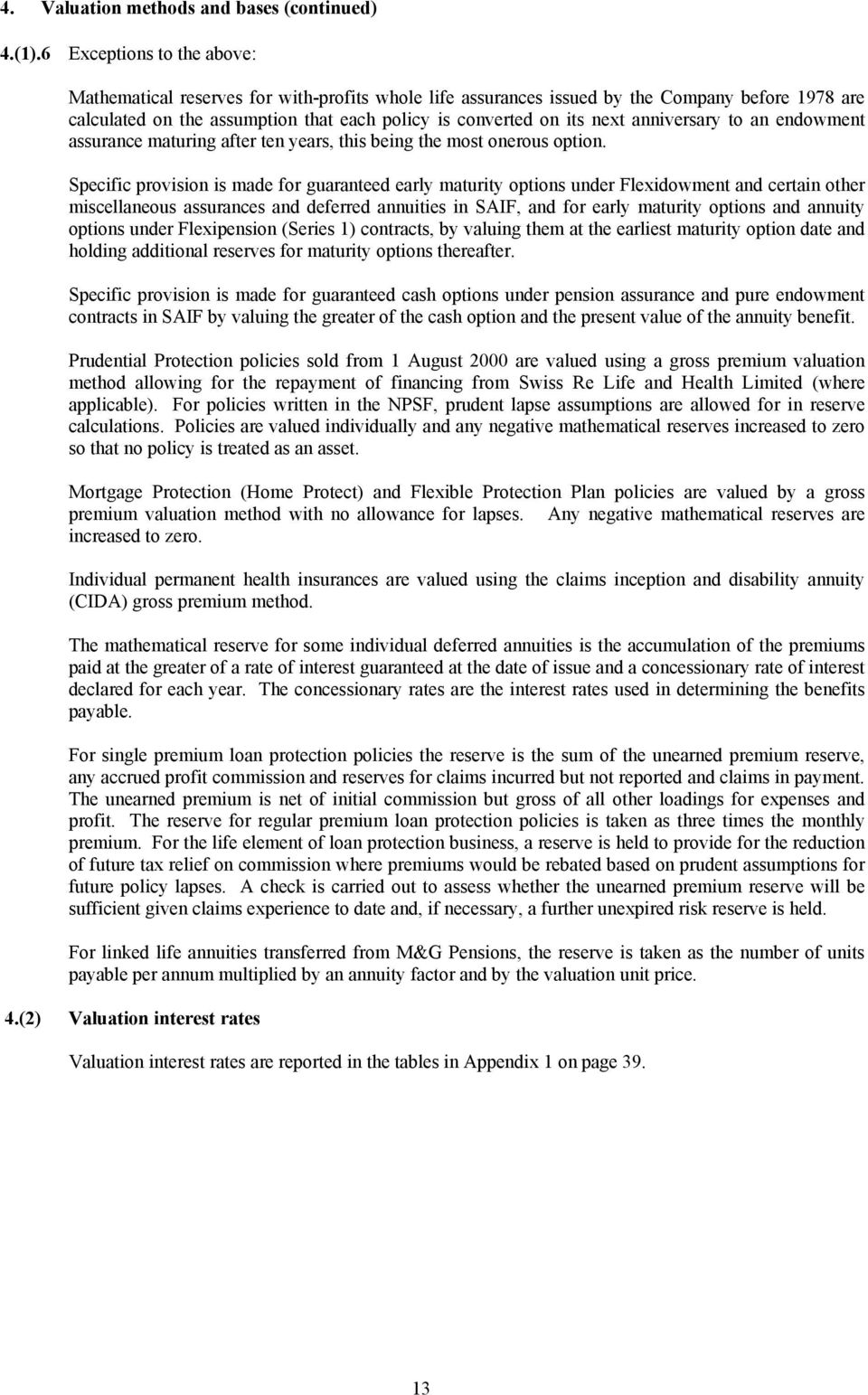
13 4. Valuation methods and bases (continued) 4.(1).6 Exceptions to the above: Mathematical reserves for with-profits whole life assurances issued by the Company before 1978 are calculated on the assumption that each policy is converted on its next anniversary to an endowment assurance maturing after ten years, this being the most onerous option. Specific provision is made for guaranteed early maturity options under Flexidowment and certain other miscellaneous assurances and deferred annuities in SAIF, and for early maturity options and annuity options under Flexipension (Series 1) contracts, by valuing them at the earliest maturity option date and holding additional reserves for maturity options thereafter. Specific provision is made for guaranteed cash options under pension assurance and pure endowment contracts in SAIF by valuing the greater of the cash option and the present value of the annuity benefit. Prudential Protection policies sold from 1 August 2000 are valued using a gross premium valuation method allowing for the repayment of financing from Swiss Re Life and Health Limited (where applicable). For policies written in the NPSF, prudent lapse assumptions are allowed for in reserve calculations. Policies are valued individually and any negative mathematical reserves increased to zero so that no policy is treated as an asset. Mortgage Protection (Home Protect) and Flexible Protection Plan policies are valued by a gross premium valuation method with no allowance for lapses. Any negative mathematical reserves are increased to zero. Individual permanent health insurances are valued using the claims inception and disability annuity (CIDA) gross premium method. The mathematical reserve for some individual deferred annuities is the accumulation of the premiums paid at the greater of a rate of interest guaranteed at the date of issue and a concessionary rate of interest declared for each year. The concessionary rates are the interest rates used in determining the benefits payable. For single premium loan protection policies the reserve is the sum of the unearned premium reserve, any accrued profit commission and reserves for claims incurred but not reported and claims in payment. The unearned premium is net of initial commission but gross of all other loadings for expenses and profit. The reserve for regular premium loan protection policies is taken as three times the monthly premium. For the life element of loan protection business, a reserve is held to provide for the reduction of future tax relief on commission where premiums would be rebated based on prudent assumptions for future policy lapses. A check is carried out to assess whether the unearned premium reserve will be sufficient given claims experience to date and, if necessary, a further unexpired risk reserve is held. For linked life annuities transferred from M&G Pensions, the reserve is taken as the number of units payable per annum multiplied by an annuity factor and by the valuation unit price. 4.(2) Valuation interest rates Valuation interest rates are reported in the tables in Appendix 1 on page
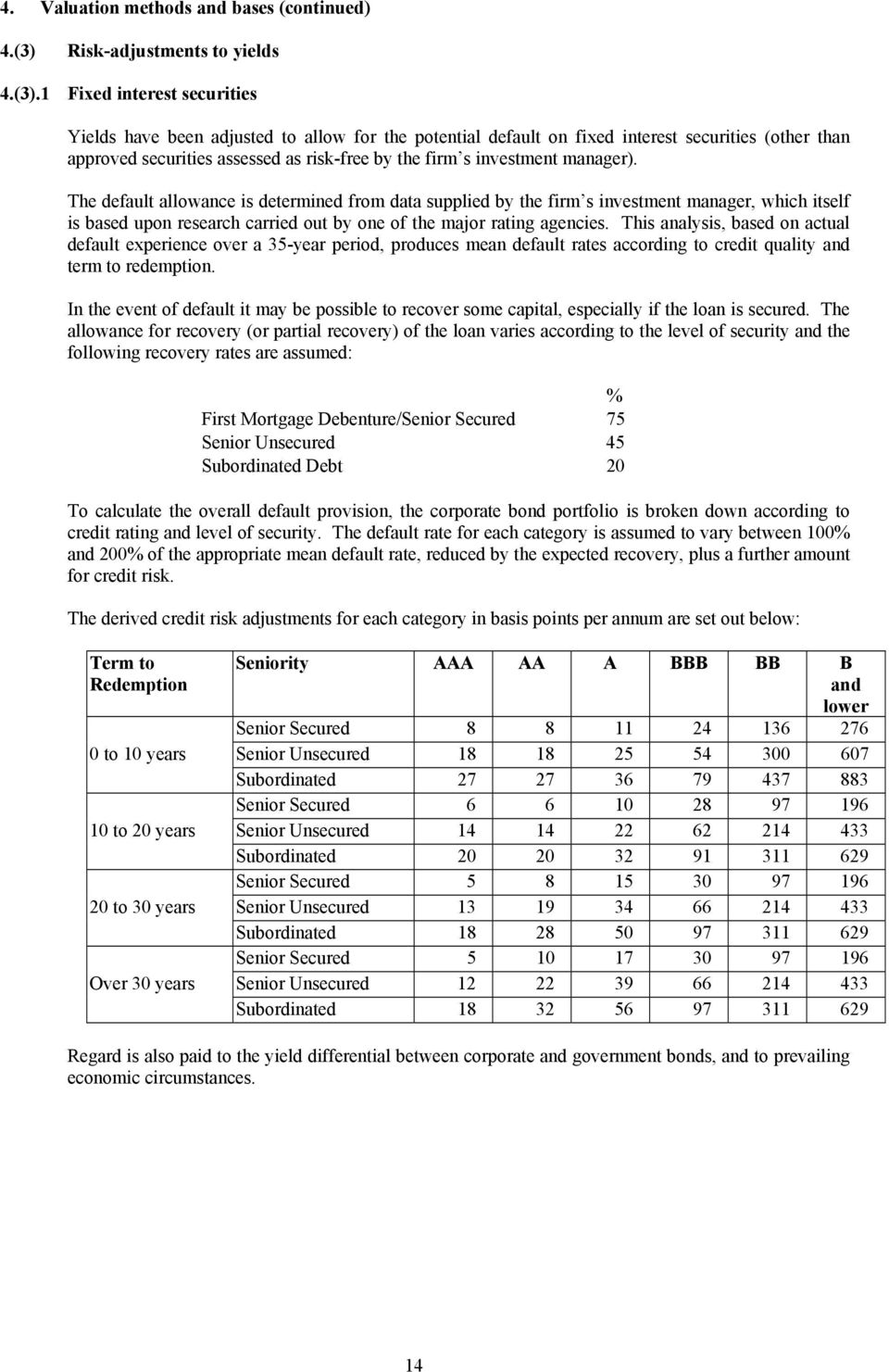
14 4. Valuation methods and bases (continued) 4.(3) Risk-adjustments to yields 4.(3).1 Fixed interest securities Yields have been adjusted to allow for the potential default on fixed interest securities (other than approved securities assessed as risk-free by the firm s investment manager). The default allowance is determined from data supplied by the firm s investment manager, which itself is based upon research carried out by one of the major rating agencies. This analysis, based on actual default experience over a 35-year period, produces mean default rates according to credit quality and term to redemption. In the event of default it may be possible to recover some capital, especially if the loan is secured. The allowance for recovery (or partial recovery) of the loan varies according to the level of security and the following recovery rates are assumed: % First Mortgage Debenture/Senior Secured 75 Senior Unsecured 45 Subordinated Debt 20 To calculate the overall default provision, the corporate bond portfolio is broken down according to credit rating and level of security. The default rate for each category is assumed to vary between 100% and 200% of the appropriate mean default rate, reduced by the expected recovery, plus a further amount for credit risk. The derived credit risk adjustments for each category in basis points per annum are set out below: Term to Redemption Seniority AAA AA A BBB BB B and lower Senior Secured to 10 years Senior Unsecured Subordinated Senior Secured to 20 years Senior Unsecured Subordinated Senior Secured to 30 years Senior Unsecured Subordinated Senior Secured Over 30 years Senior Unsecured Subordinated Regard is also paid to the yield differential between corporate and government bonds, and to prevailing economic circumstances. 14
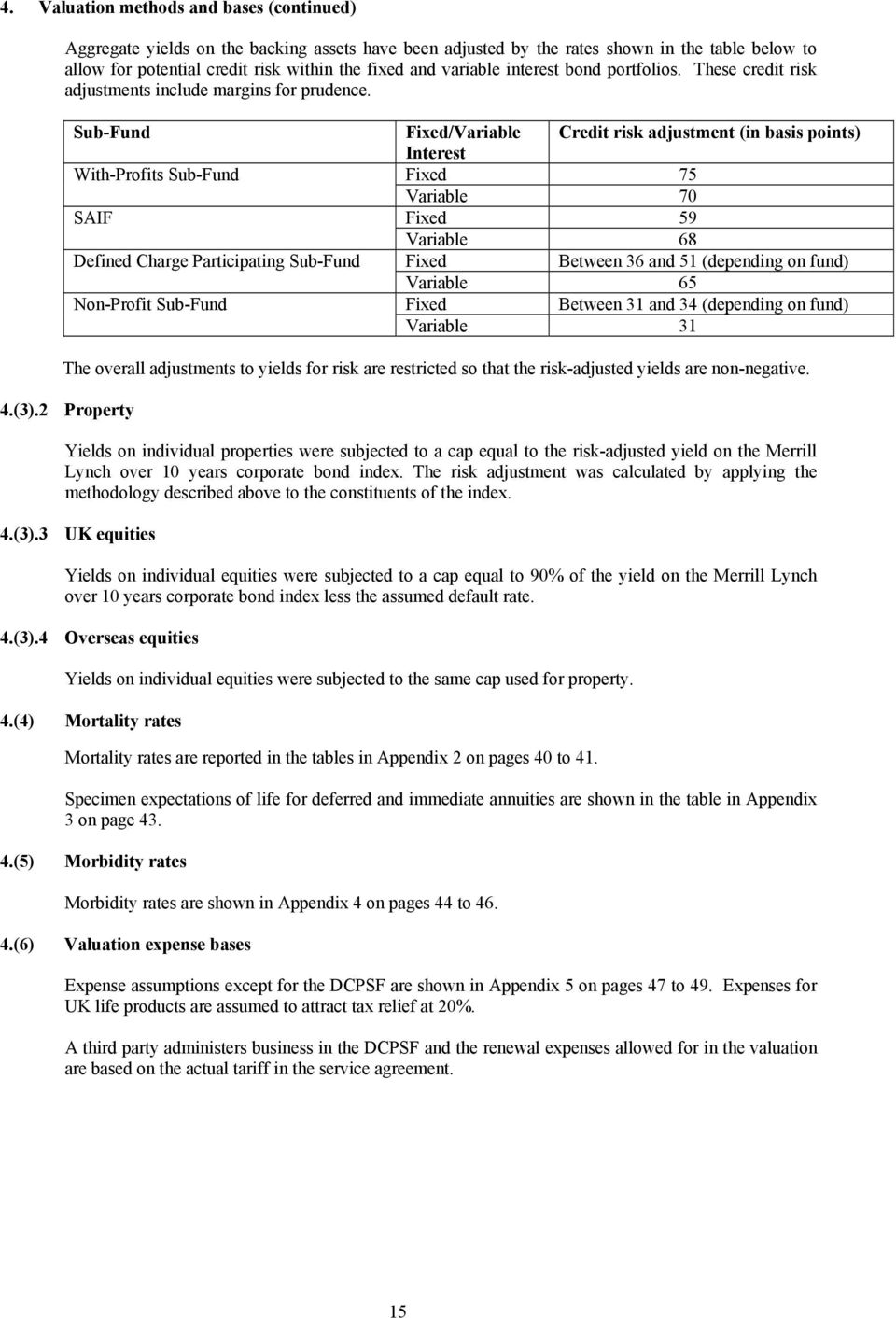
15 4. Valuation methods and bases (continued) Aggregate yields on the backing assets have been adjusted by the rates shown in the table below to allow for potential credit risk within the fixed and variable interest bond portfolios. These credit risk adjustments include margins for prudence. Sub-Fund Fixed/Variable Credit risk adjustment (in basis points) Interest With-Profits Sub-Fund Fixed 75 Variable 70 SAIF Fixed 59 Variable 68 Defined Charge Participating Sub-Fund Fixed Between 36 and 51 (depending on fund) Variable 65 Non-Profit Sub-Fund Fixed Between 31 and 34 (depending on fund) Variable 31 The overall adjustments to yields for risk are restricted so that the risk-adjusted yields are non-negative. 4.(3).2 Property Yields on individual properties were subjected to a cap equal to the risk-adjusted yield on the Merrill Lynch over 10 years corporate bond index. The risk adjustment was calculated by applying the methodology described above to the constituents of the index. 4.(3).3 UK equities Yields on individual equities were subjected to a cap equal to 90% of the yield on the Merrill Lynch over 10 years corporate bond index less the assumed default rate. 4.(3).4 Overseas equities Yields on individual equities were subjected to the same cap used for property. 4.(4) Mortality rates Mortality rates are reported in the tables in Appendix 2 on pages 40 to 41. Specimen expectations of life for deferred and immediate annuities are shown in the table in Appendix 3 on page (5) Morbidity rates Morbidity rates are shown in Appendix 4 on pages 44 to (6) Valuation expense bases Expense assumptions except for the DCPSF are shown in Appendix 5 on pages 47 to 49. Expenses for UK life products are assumed to attract tax relief at 20%. A third party administers business in the DCPSF and the renewal expenses allowed for in the valuation are based on the actual tariff in the service agreement. 15
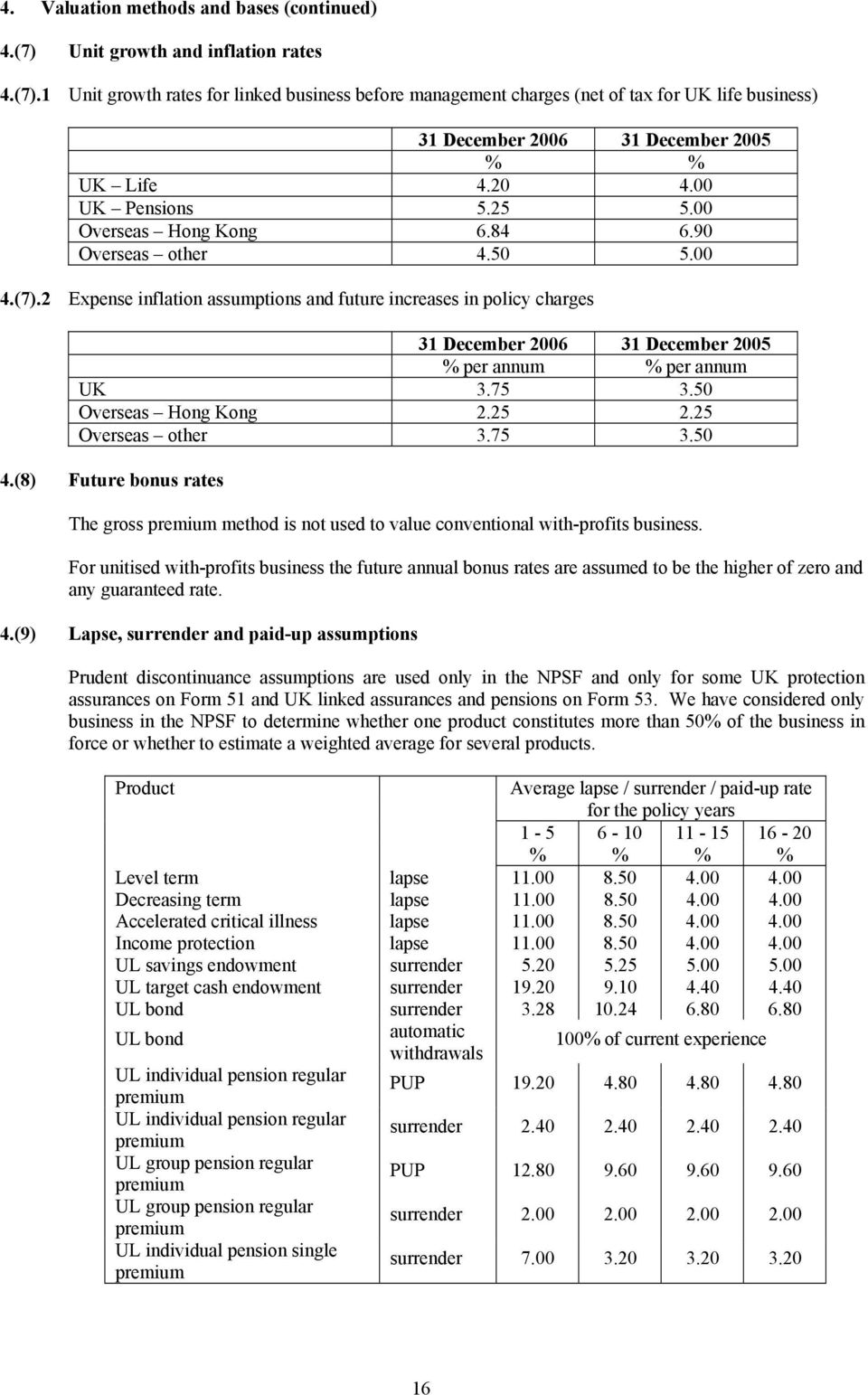
16 4. Valuation methods and bases (continued) 4.(7) Unit growth and inflation rates 4.(7).1 Unit growth rates for linked business before management charges (net of tax for UK life business) 31 December December 2005 % % UK Life UK Pensions Overseas Hong Kong Overseas other (7).2 Expense inflation assumptions and future increases in policy charges 31 December December 2005 % per annum % per annum UK Overseas Hong Kong Overseas other (8) Future bonus rates The gross premium method is not used to value conventional with-profits business. For unitised with-profits business the future annual bonus rates are assumed to be the higher of zero and any guaranteed rate. 4.(9) Lapse, surrender and paid-up assumptions Prudent discontinuance assumptions are used only in the NPSF and only for some UK protection assurances on Form 51 and UK linked assurances and pensions on Form 53. We have considered only business in the NPSF to determine whether one product constitutes more than 50% of the business in force or whether to estimate a weighted average for several products. Product Average lapse / surrender / paid-up rate for the policy years % % % % Level term lapse Decreasing term lapse Accelerated critical illness lapse Income protection lapse UL savings endowment surrender UL target cash endowment surrender UL bond surrender UL bond automatic withdrawals 100% of current experience UL individual pension regular premium PUP UL individual pension regular premium surrender UL group pension regular premium PUP UL group pension regular premium surrender UL individual pension single premium surrender
17 4. Valuation methods and bases (continued) 4.(10) Other material assumptions There were no other material assumptions not stated elsewhere. 4.(11) Derivatives In determining the long-term liabilities, allowance has been made for derivative contracts and contracts or assets having the effect of derivative contracts, by adjusting the existing assets attributed to the long-term business to reflect the underlying investment exposure. SAIF and WPSF hold US dollar/sterling and euro/sterling currency forwards in connection with fixed interest securities denominated in US dollars and euros respectively. Taken in aggregate these combinations of currency forwards and fixed interest securities could be considered to be sterling assets and, as such, the yields should be comparable with sterling yields. To achieve this, the yields on the US dollar and/or euro assets are reduced if the US dollar risk-free yield curve or the euro risk-free yield curve respectively exceeds the sterling risk-free yield curve. 4.(12) Effect of change in methodology The effect on the mathematical reserves of the changes in valuation methodology arising from changes in INSPRU valuation rules effective from 31 December 2006 is: m Allowance for lapses on valuation of protection business 6 Allowance for negative reserves on valuation of protection business - Allowance for lapses and attributable expenses on valuation of unitlinked business 88 The changes in valuation methodology were adopted only in the NPSF. 5. Options and guarantees 5.(1) Guaranteed annuity rate options (a) The mathematical reserves for guaranteed annuity options are calculated assuming a 100% take-up of available options, and are determined as follows: Group cash accumulation contracts For valuation purposes, it is assumed, in line with current practice, that if the guaranteed rates are higher than current rates on the valuation date, the guarantee will be revised with 6 months notice from the next scheme renewal date. As a result, it is assumed that retirements for at most a further 18 months will be subject to the guarantee prior to its amendment. Any additional amount of annuity payable as a result of the guarantee is calculated assuming that the recent profile of retirements (age, sex and purchase money) continues. The resulting annuity is valued on the basis used for non-profit group deferred annuities. EPP Mark 1 The fund in respect of the first 5 years premiums for each scheme is calculated. The additional amount of annuity payable as a result of the guarantee is then calculated by age groups assuming that the recent profile of retirements by age and sex continues (all assumed to be at an age at which a guarantee applies). The distribution of long-term interest rates at retirement was provided by the economic scenario generator used to derive market-consistent returns for use in the Peak 2 valuation and a zero valuation interest rate was assumed in deferment. 17

18 5. Options and guarantees (continued) SAIF products - Flexipension (Series 1 and Series 2) - Series 1 and Series 2 pension contracts written up to and including 26 July 2000 as increments to Flexipension (Series 1) contracts - Individual Endowment/Pure Endowment - Series 1 and Series 2 - Individual Pension Account For accumulating with-profits and linked business, an additional reserve is calculated by rolling up the existing unit reserve with future premiums to the selected retirement date, and calculating the present value of the excess of the annuity guarantee over the projected fund value. The value of the annuity guarantee at retirement is calculated assuming a mortality basis in possession of 71% PMA92/67% PFA92 (c=2004) and a valuation interest rate of 3.5% p.a. in possession. For linked business, the projected fund is calculated assuming a fund growth rate of 7.125% (i.e. 8.0% less an annual management charge). The excess of the annuity guarantee over the projected fund value is discounted at 4.5% per annum. For accumulating with-profits business, no future bonus is allowed for. The projected fund is calculated assuming a fund growth rate of 4.0% (representing the 4.0% guarantee on SAIF pension policies). The present value of the excess of the annuity guarantee over the projected fund value is calculated at a discount rate of 3.35%. For conventional business, the benefit included in the net premium reserve is the greater of the cash benefit and the value of the annuity guarantee. The mortality basis in deferment is AM92/AF for individual endowment/pure endowment and AM92/AF92-4 for Flexipension (Series 1), and in possession is 71% PMA92/ 67% PFA92 (c=2004). The valuation interest rate in deferment is reduced by 0.4% to allow for mortality improvement in deferment. The valuation interest rate (before the 0.4% reduction for mortality improvement) is 4.5% in deferment and 3.5% in possession. For the purpose of determining the valuation interest rate, swaptions held were assumed to be nonyielding. The adequacy of the reserve has been verified using stochastic modelling. An additional expense reserve of 90.8m is held to meet the cost of administering the future annuities in payment under the guaranteed annuity options in SAIF. (b) See the table on the following page. 18
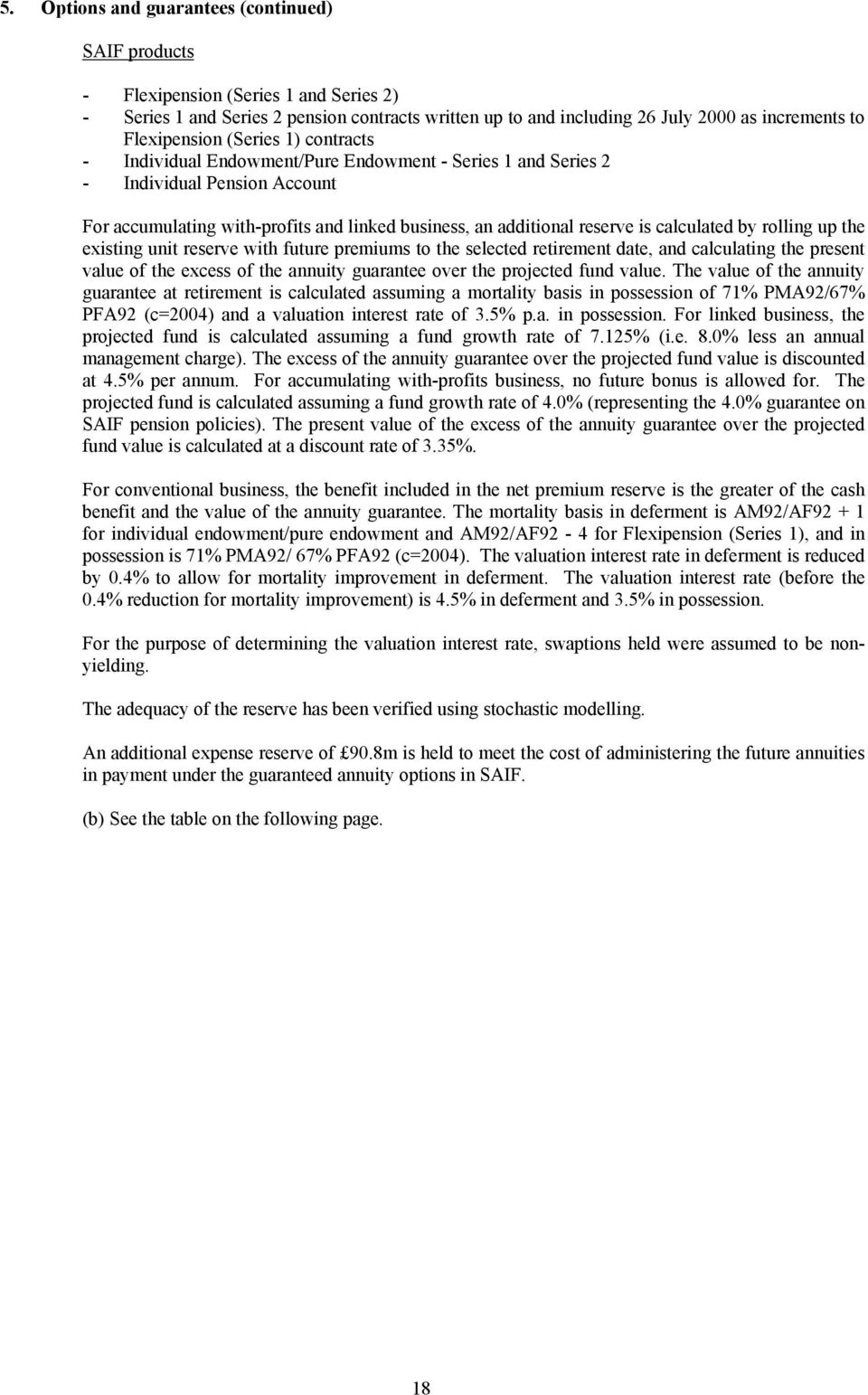
19 5. Options and guarantees (continued) Table 5.(1)(b) Guaranteed annuity rate options Product name Basic reserve m Spread of outstanding durations Guarantee reserve m Guaranteed annuity rate % for a male aged 65 Are increments permitted? Form of the annuity WPSF Group cash accumulation months No Single life, monthly in advance, guaranteed for 5 years Retirement ages Executive Pension Plan Mark yrs Yes in first 5 yrs of scheme Single life, monthly in advance, without guarantee (M) (F) SAIF Flexipension yrs; average 10 yrs No Single life, yearly in arrears, without guarantee Individual Endowment/Pure Endowment yrs; average 10 yrs No Single life, monthly in advance, guaranteed for 5 years (M) (F) Individual Pension Account yrs; average 10 yrs No Single life, monthly in advance, guaranteed for 5 years (M) (F) If the form of annuity taken is different to that shown in the table, by concession an actuarially equivalent rate is given. 19
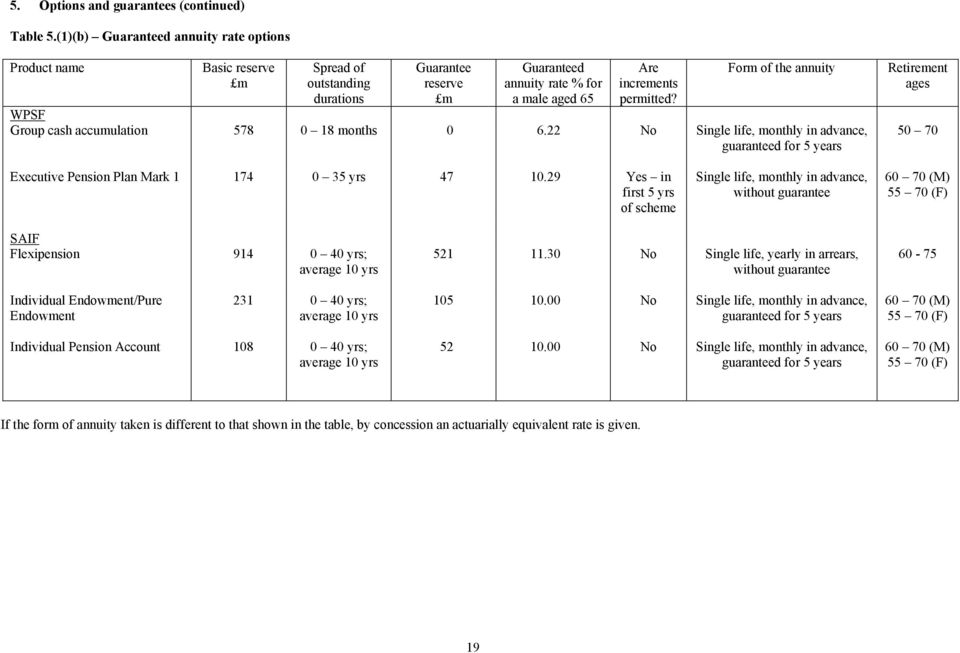
20 5. Options and guarantees (continued) 5.(2) Guaranteed surrender values and guaranteed unit-linked maturity values 5.(2).1 There are no guaranteed unit-linked maturity values. The methods and bases used for guaranteed surrender values were as follows. PruFund Investment Plan This is a single premium whole-life accumulating with-profits contract written in the WPSF. At the 5 th anniversary of a premium payment, the smoothed fund value is increased by the value of additional units credited, if necessary, to give a total value equal to the guaranteed fund minimum fund value (the initial premium adjusted for withdrawals). Policies sold up to 31 July 2005 received this guarantee for no extra cost. After that date, policyholders choosing the guarantee pay an additional annual management charge for 5 years. The reserve for the guarantee was set using the Black-Scholes option pricing formula and is 6% of the current fund value. Prudential Europe Vie This is a single premium whole-life accumulating with-profits contract denominated in euros and written as overseas life assurance business in the DCPSF. The surrender value at any time is guaranteed to be no less than 75% of the initial investment, net of the initial charge, after allowing for any partial surrender and withdrawals made. As at 31 December 2006, the basic policy reserves exceeded the minimum guaranteed surrender values to the extent that no additional reserve was considered necessary. Hong Kong Some products issued in Hong Kong have guaranteed surrender values based on a net premium valuation on specified bases. The valuation reserve is tested against the guarantee basis on a policy-by-policy basis and no additional reserve is required. 20
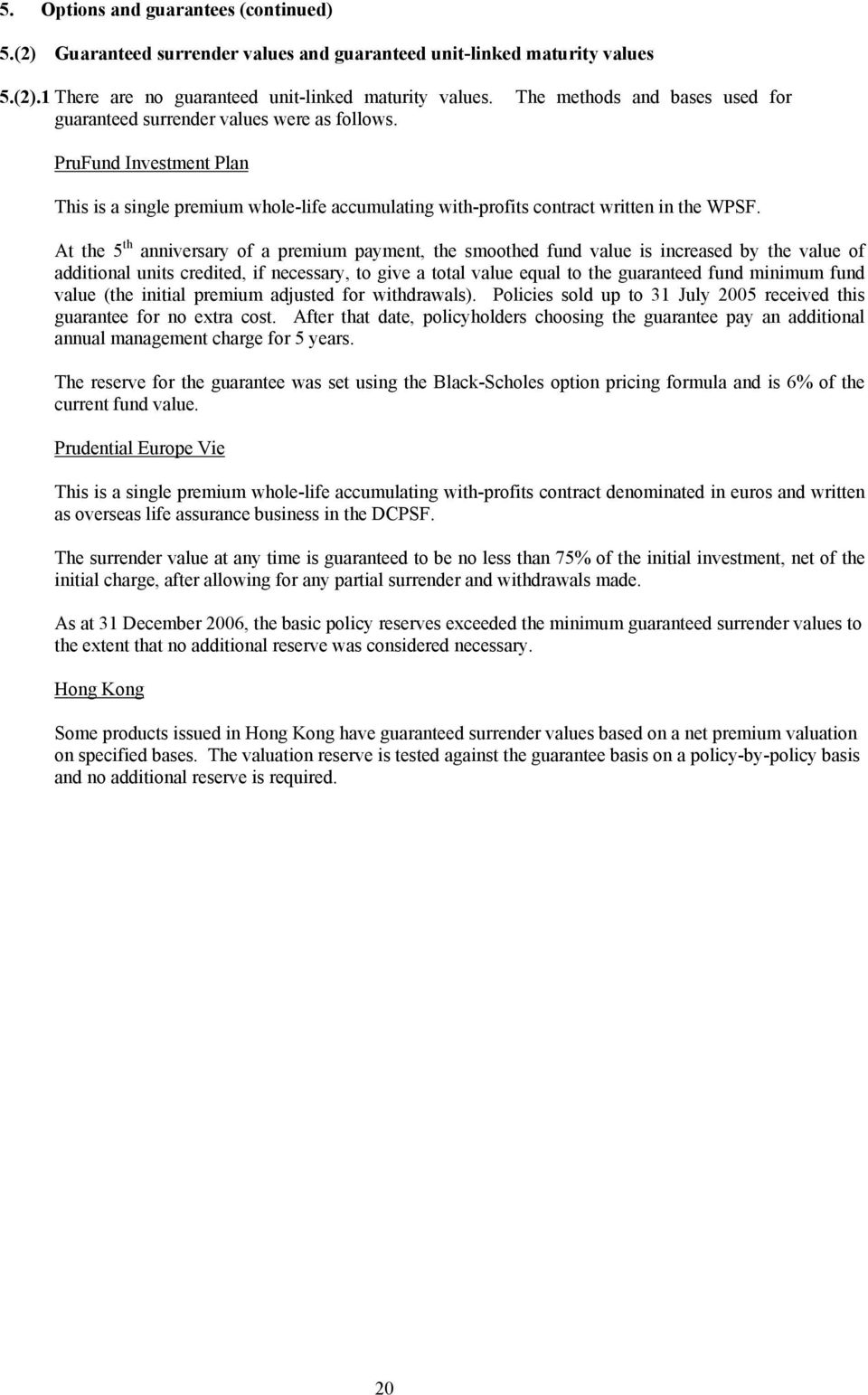
21 5. Options and guarantees (continued) 5.(2).2 Guaranteed surrender values and unit-linked maturity values Product name Basic reserve m Spread of outstanding durations Guarantee reserve m Guaranteed amount m MVA free conditions In force premiums m Are increments permitted? WPSF PruFund Investment Plan yrs 7 Fund increased to initial premium (adjusted for withdrawals) after 5 years DCPSF N/A 110 No Prudential Europe Vie 87 Whole-Life 0 51 Regular withdrawals up to 5% per annum Hong Kong 78 Yes Better Life 941 Whole-Life N/A 126 No Better Life Assurance II 33 Whole-Life 0 0 N/A 26 No With Profit Endowment 1 st yrs; 0 86 N/A 5 No & 2 nd Series average 18 yrs With Profit Whole Life 1 st 53 Whole-Life 0 42 N/A 3 No & 2 nd Series PruFlexLife 21 Whole-Life 0 10 N/A 20 No PRUsave Plus yrs; average 10 yrs 0 9 N/A 47 No 21
22 5. Options and guarantees (continued) 5.(3) Guaranteed insurability options 5.(3).1 There are a number of insurability options for which no additional reserve is considered necessary due to margins in the valuation mortality/morbidity bases. These options are: Amicable Savings Plan Extension Option allows the term of the plan to be extended by a period of at least ten years from the original maturity date. Home Purchaser Mortgage Alteration Option provides a limited facility, subject to conditions, to increase the life cover at ordinary rates of premium for the amount of any increase to the loan. If the term of the loan is also increasing, the term of the existing plan may also be extended to match the maturity date of the new plan. Maximum Investment Plan and Flexible Investment Plan (ex M&G Life) Maximum Investment Plans have an option at maturity to extend the term for a further ten years or to convert to a whole life assurance with a nominal premium. Flexible Investment Plans have an option to extend the premium paying term. Investment Mortgage Plan (Ex M&G Life) There is an option to increase the sum assured without medical evidence if the policyholder increases his or her mortgage. Personal Security Plan (Ex M&G Life) Most policies have an option to increase the benefits each year in line with the Retail Prices Index without medical evidence either to age 65 or throughout life. Benefits other than Keyman Disability Benefit may also be increased by up to 20% without medical evidence on marriage, house purchase or birth of children. On some policies the death benefit can be increased without medical evidence following changes in Inheritance Tax legislation. If any of these options is exercised the Company recommends an appropriate increase in premium. Prudential Protection policies issued at ordinary rates include an option to increase cover without evidence of health in the event of mortgage increase, marriage, childbirth or adoption. The option can be exercised only before the life assured s 50 th birthday and within 3 months of the event occurring. Some UK policies issued between September 1975 and April 1984 and some policies issued in Hong Kong contain an option, in return for an additional premium, to effect further assurances without evidence of health. Some assurance policies contain options to effect further assurances without evidence of health at specific ages, on marriage or on the adoption or birth of a child. Under some assurances in Hong Kong, a guaranteed insurability option of up to five times the basic sum assured is offered at the maturity of the pure endowment part of the assurance. Some assurance policies issued between October 1973 and July 1979 on the life of a parent or guardian for the benefit of a child contain an option to permit the child, after attaining a specified age, to effect a whole life or endowment assurance without evidence of health for a sum assured not exceeding four times that of the original policy. On the marriage of a female child, the option may be exercised on her husband s life if he is under age 45. Some individual level temporary assurance policies contain an option, in return for an additional premium, to convert wholly or partially to a whole life or endowment assurance for a sum assured not exceeding the original sum assured. Some individual temporary assurance policies contain an option to renew the assurance every 5 or 10 years without evidence of health subject to a maximum age at renewal of 55 (65 in Hong Kong). The sum assured under this option can be increased by up to one half of the sum assured remaining at the end of the 5 or 10 year period. There is also an alternative option to convert at the end of the term to any other ordinary branch single life assurance, for a sum assured of up to 150% of that under the temporary assurance policy. Under a few group life assurance policies, premium rates are guaranteed for employees in respect of current levels of sum assured. Group life assurance premium rates are generally guaranteed for 2 or 3 years. 22
23 5. Options and guarantees (continued) Employees leaving group pension schemes, where it has not been possible to remove the option, may replace any temporary life assurance cover with an individual assurance at the relevant rates of premium then in force, based on the original underwriting decision. The continuation option was withdrawn for new schemes during On payment of an additional premium, individual permanent health insurance policies issued in the United Kingdom between January 1982 and July 1988 carry an option to increase the original benefit by up to 25% (subject to the total benefit being no greater than 75% of earnings) on every fifth policy anniversary without medical evidence. This option cannot be exercised whilst incapacitated or within 10 years of the termination date of the policy. Prufund: Protection Plan If the original policy was issued on normal terms, a new policy may be effected without evidence of health every 5 years before the attainment of age 50 for a sum assured of up to 50% of the sum assured under the original policy at the time each option is exercised. The option lapses if it is not exercised in whole or part. The new policy may be a with-profits whole life or endowment assurance. Prufund: Savings Plan At the end of the premium payment term, premiums may be continued for a further 10 years. Under Series 1 plans there is also an option after 10 years to continue the policy for a further 10 years without further payment of premiums. Permanent Health Insurance On payment of an additional premium, individual permanent health insurance policies issued in the United Kingdom between January 1982 and July 1988 carry an option to increase the original benefit by up to 25% (subject to the total benefit being no greater than 75% of earnings) on every fifth policy anniversary without medical evidence. This option cannot be exercised whilst incapacitated or within 10 years of the termination date of the policy. Series A & Premier Pensions plans with Waiver Benefit or Comprehensive Waiver Benefit Long Term Care Double Cover benefit entitles the plan holder to buy a Long Term Care Bond from Prudential International (or another contract approved by the PAC Actuary as a reasonable equivalent) at ordinary rates at retirement. Personal Pension and Group Personal Pension Plan holders with Waiver Benefit may increase the contributions covered by the benefit with no additional underwriting provided the increased contribution is no more than twice the previous contribution. Mortgage Protection (Home Protect) Policies issued at ordinary rates may include an option to increase cover without evidence of health in the event of mortgage increase, marriage, childbirth or adoption. The option can be exercised only before the life assured s 50th birthday and within 3 months of the event occurring. The increase can be up to 50% of the benefit for the mortgage option or 25% for the other options both subject to maxima of 150,000 (life and critical illness) or 1,000 a month (premium waiver and mortgage payment benefits). Mortgage Protection (Ex M&G Life) There are options for each life to continue cover for a further 5 years up to a date specified at the outset of the original cover, and, if the life assured increases his mortgage, to increase the benefit by the lower of 50% of the increase or 50,000 on rates in force at the time. Neither option requires medical evidence. Two schemes incorporate options for each life to add Critical Illness, Waiver of Contribution and PHI benefits. These options are offered subject to provision of satisfactory medical evidence. 5.(3).1 There are no conversion or renewal options where the total sum assured exceeds 1bn. 23
24 5. Options and guarantees (continued) 5.(4) Other guarantees and options 5.(4).1 FSA personal pensions review The mathematical reserve for guarantees issued under the FSA personal pensions review is calculated by valuing the pension scheme benefits to which the policyholder would otherwise have been entitled and subtracting the value of the personal pension policy. Where relevant, each policyholder is assumed to be in a scheme providing an RPI-linked pension of two thirds of final earnings after 40 years service with a 50% continuation to a surviving spouse and equivalent death-in-service benefits. Stochastic modelling is used to calculate the reserves for these guarantees. The distributions of investment returns over the remaining period to retirement and long-term interest rates at retirement were provided by the economic scenario generator used to derive market-consistent returns for use in the Peak 2 valuation. In deferment, allowance is made where appropriate for salaries to increase by 2.0% per annum in excess of RPI and by a further 1% per annum up to age 50. The basic policy reserve held at 31 December 2006 was 369m and the guarantee reserve was 484m. 5.(4).2 Guaranteed Minimum Pensions (GMPs) under Section 32 contracts Under early versions of Section 32 contracts, some or all of the GMP was secured by a non-profit deferred annuity. Those benefits are valued using the methodology described in paragraph 4.(1).1 (page 11). Any remaining GMP was covered by the excess premium not required to purchase the non-profit deferred annuity and this was invested in a cash accumulation or with-profits fund. Under later versions of Section 32 contracts, the whole of the GMP was covered by the with-profits fund. The reserves for that part of the GMP covered by with-profits have been calculated using stochastic modelling. The distributions of investment returns over the remaining period to retirement and long-term interest rates at retirement were provided by the economic scenario generator used to derive market-consistent returns for use in the Peak 2 valuation. The guarantee reserve for a small number of accumulating with-profits contracts (ex-sal) was calculated by a deterministic method, being the excess value on a policy-by-policy basis of the GMP liability (allowing for revaluation) over the basic policy reserve. The GMP liability is valued at a discount rate of 4%, with future increases in National Average Earnings assumed to be at 5% per annum. The total basic reserve for Section 32 contracts is 308m and the guarantee reserve was 274m. 5.(4).3 PLCE100 - Mortgage endowments PLCE100, a conventional with-profits low cost endowment assurance written in the WPSF, was designed to repay a mortgage if annual bonuses continued at the rate current at the date of issue. The policies included a provision that if the declared bonus rate were to fall, causing the projected claim value to fall, then the sum assured and premium would be increased accordingly. The Company has guaranteed that, once the premium has been increased to twice its initial level, and provided that the policy has not been assigned absolutely to a third party, then the maturity value will not be less than the mortgage the policy was intended to cover. The guarantee reserve is determined by projecting current benefits to maturity assuming 4% growth and discounting any shortfall against the mortgage amount at 3%. If policies are not at their maximum premium level, allowance is made for the present value of additional premiums that could be payable up to twice the initial level. The basic reserve for these policies is 28m and the guarantee reserve is 0.5m. 24
25 5. Options and guarantees (continued) 5.(4).4 Home Purchaser (Second Series) Home Purchaser (Second Series) is a mortgage endowment product written in SAIF, for which the company has undertaken to guarantee that the maturity value will be no less than the original target amount if the experienced investment growth rate is greater than or equal to the growth rate assumption selected by the investor at outset. The guarantee reserve is calculated based on a sample of policies by projecting policy benefits to maturity and discounting any shortfall against the mortgage amount at a valuation rate of 3%. The projections to maturity had regard to the distributions of investment returns over an assumed average outstanding term obtained from the economic scenario generator used to derive market-consistent returns for use in the Peak 2 valuation. Prudent allowance was made for an immediate rise/fall in policy values. The basic reserve for these policies is 557m and the guarantee reserve is 8m. 6. Expense reserves 6.(1) Expense loadings of 691 million, grossed up for tax, are expected to arise during the 12 months from the valuation date. This comprises 291 million of explicit and 400 million of implicit loadings. The following table shows a breakdown of the expense loadings by homogeneous risk group where some expenses are treated as non-attributable and total expense loadings for products where all expenses are treated as attributable. Homogeneous risk group Implicit allowances Explicit allowance (investment) Explicit allowance (other) Nonattributable expenses Total m m m m m Individual unit-linked life single premium business Individual unit-linked life regular premium business Individual unit-linked pensions single premium business Group unit-linked pensions single premium business Individual unit-linked pensions regular premium business Group unit-linked pensions regular premium business Stakeholder All expenses attributable n/a Total
26 6. Expense reserves (continued) 6.(2) Implicit allowances are calculated as follows: For contracts valued using the net premium method, 90% of the excess of office over net premiums for ordinary branch with-profits contracts and 100% of the excess for industrial branch with-profits contracts and all non-profit contracts. A margin between the risk-adjusted yields on assets in the WPSF and DCPSF (0.13%) and the NPSF (0.07% for annuities in payment, 0.1% otherwise) and that required to support the valuation interest rates to cover fund management expenses. A margin in property yields to cover maintenance costs and leases. 6.(3) Maintenance expenses shown at line 14 of Form 43 are 650 million. This does not include renewal commission. 6.(4) A new business expense overrun reserve of 30 million is held in the NPSF. The reserve is calculated on a prudent basis as the excess, if any, of the present value of expenses and commission expected to arise in respect of business written in the 12 months following the valuation date over the present value of the charges available to cover such expenses. 6.(5) In the first instance, expense reserves are calculated on the assumption that Prudential s UK insurance operations will continue to write new business indefinitely and hence that there will be no loss of economies of scale. For business valued by the net premium method, under which there is no explicit allowance for expenses, the need for a maintenance expense overrun reserve is tested by comparing the present value of the allowances described in sub-paragraph (2) above with the present value of the expenses and commission expected to be incurred over the remaining lifetime of the business. The calculation of the value of future expenses allows for inflation of 3.75% p.a. An additional reserve is held if the present value of expenses and commission exceeds the present value of the expense allowances. At 31 December 2006 a reserve of 147 million is held in the WPSF and 67 million in SAIF. For all other business, the expense loadings over the remaining lifetime of the contracts in force at the valuation date are included in the reserves reported in Forms 50. In order to allow for the possibility that the firm will cease to transact new business twelve months after the valuation date, all expense provisions are recalculated on the assumption that, over a two year period, unit costs would be reduced by 25% (except in SAIF, where no reductions are assumed) and that thereafter the loss of economies of scale would result in overall expenses being cut more slowly than the rate at which policies run off. In addition the costs associated with closing to new business, such as redundancy payments and the costs of terminating management agreements, are estimated. If the sum of the closed fund expense reserves and termination costs exceed the open fund expense reserve, then the excess is held as an additional reserve, to the extent that this excess cannot be offset by projected surplus on prudent assumptions from existing business. At 31 December 2006, an additional reserve of 166 million is held in the WPSF, 30 million in SAIF and 5 million in the NPSF. 26
27 6. Expense reserves (continued) 6.(6) An additional reserve of 17 million is held in the NPSF to cover the non-attributable expenses. The additional reserve for each homogeneous risk group is calculated as the present value of all future expenses less charges, subject to a maximum of the non-attributable expenses, for the policies in that homogeneous risk group. All future charges and expenses are projected allowing for lapses on a prudent basis. Any future valuation strain is removed at the homogeneous risk group level. The following table shows the reserve for each homogeneous risk group. Homogeneous risk group Additional reserve m Individual unit-linked life single premium business 0.0 Individual unit-linked life regular premium business 3.0 Individual unit-linked pensions single premium business 0.0 Group unit-linked pensions single premium business 0.0 Individual unit-linked pensions regular premium business 0.9 Group unit-linked pensions regular premium business 0.0 Stakeholder 13.4 Total Mismatching reserves 7.(1) and (2) No deposits were received from reinsurers in An analysis of the mathematical reserves (other than liabilities for property-linked benefits) and backing assets by currency is as follows: Currency of Mathematical reserves % of Value of backing assets in currency: liability (excl. property-linked) in m reserves US$ Euro Total 60, , ,066 US$ 2, , ,025 Euro Other Total 63, % of the reserves shown as Other currencies are in Hong Kong dollars and are backed by assets in that currency. The balance is in Maltese currency in which no assets are held. 7.(3) No reserve is held for currency mismatching. 7.(4) to (6) Not applicable for a realistic firm. 7.(7) The NPSF held a reserve of 13.7m in respect of the test for cashflow mismatching under INSPRU R(2). This reserve was set at a level that was sufficient to ensure that it covered the result of projecting (i) the riskadjusted cashflows of the assets backing the liabilities and (ii) the future liability payments on the valuation assumptions. In any year where asset income exceeds liability outgo, the excess is assumed to be invested in cash which is assumed to accumulate at 97.5% of the maximum reinvestment rate specified in INSPRU R. In any year when asset income is insufficient to meet liabilities, the cash reserve is used to meet the shortfall. If the cash reserve is reduced to zero, then the shortfall is assumed to be borrowed at a rate 2% higher than 97.5% of the maximum reinvestment rate. 27
28 8. Other special reserves Other special reserves in excess of 10 million are as follows: Reserves totalling 254 million ( 141 million in the WPSF, 102 million in SAIF and 11 million in the NPSF) are held to cover the potential costs of compensating policyholders, and the associated expenses, in respect of complaints about mortgage endowment policies. The reserves are calculated by making prudent assumptions about the number of future complaints received, the proportion of these where compensation will be paid, the average amount of compensation and recoveries under PI insurance. Reserves totalling 57 million ( 30 million in the WPSF, 16 million in SAIF and 11 million in the NPSF) are held to cover potential additional liabilities in respect of systems and administration errors. The methods used to calculate the reserves vary depending on the nature of the error and take into account data sources alternative to policy valuation systems. Reserves totalling 133 million ( 92 million in the WPSF, 18 million in SAIF and 23 million in the NPSF) are held in respect of the UK life insurance operation s share of additional contributions expected to be required to fund future defined benefits in the Prudential Staff Pension Scheme and the Scottish Amicable Pension Scheme, taking into account the expected run-off of the schemes membership. Reserves totalling 433 million ( 293 million in the WPSF, 56 million in SAIF, 7 million in DCPSF and 77 million in the NPSF) are held to cover general contingencies, taking into account internal assessment of operational risk. A reserve of 83 million is held in respect of Industrial Branch whole life and endowment assurances written in the WPSF, where the maturity date or (for whole life policies) the policy anniversary after age 90 has passed and the policy benefit has not been claimed, taking into account a prudent assumption for the probability that the claim will be made before age 105. A reserve of 25 million is held for the Prudential Personal Retirement Plan (PPRP), a conventional withprofits deferred annuity product written in the WPSF, in respect of any additional cost of policyholders retiring later than age 65, taking into account current late retirement enhancement factors and a prudent assessment of the distribution of late retirements by age and sex. A reserve of 17 million is held for whole of life and endowment assurance business in the WPSF to cover any additional cost of policyholders stopping paying premiums after 40 years from inception or the earlier date of maturity for endowment policies. The additional reserve is the amount by which the liability calculated assuming premiums cease after 40 years, or the earlier date of maturity for endowments, exceeds the basic liability which assumes that premiums will be paid until age 85 or, for endowment assurance policies, the maturity age if earlier. Reserves totalling 12 million ( 5 million in the WPSF, 6 million in SAIF and 1 million in the NPSF) are held in respect of claims that have been incurred but that are not yet reported. These reserves are calculated as a percentage of the retrospective claim amounts based on a prudent assumption about the delay in notification of claims. 9. Reinsurance (1) No premiums were paid in 2006 in respect of reinsurance business ceded on a facultative basis to reinsurers not authorised to carry on business in the United Kingdom. (2) The reinsurance treaties shown in the table below meet the FSA criteria for being reported in this section and were in force as at 31 December
29 9. Reinsurance (continued) Reinsurance treaties: (d) Reinsurer (e) Nature of cover (f) Premiums '000 Barclays Global Investors Pensions Management Ltd Deutsche Asset Management Life & Pensions Limited Munich Reinsurance Company UK Life Branch Linked benefits under GPP3, GPP4, MPP3, stakeholder pensions and the Company Pension Transfer Plan (Bulk Section 32 Buy-Out) where the member has chosen to invest in BGIPM s funds, on a 100% quota share basis. The assets under this treaty are covered by a pari passu charge. Linked benefits under GPP4, MPP3, stakeholder pensions and the Company Pension Transfer Plan (Bulk Section 32 Buy-Out) where the member has chosen to invest in DAML&P s funds, on a 100% quota share basis. The liability reassured is not covered by any charges on assets. Individual UK term insurance issued before 1 January 2000 in surplus form on an original terms basis. (h) Open / Closed (j) Reserves Ceded '000 22,813 Open 21,015 Nil 3,003 Open 15,648 Nil (k) Retention 9,777 Closed 47,758 Nil retention, 100% reinsured Prudential Annuities Limited* United Kingdom non-profit pensions annuities in payment on a 100% quota share basis. This is to a member of the Prudential Group and is covered by a pari passu charge on assets. Prudential Holborn Life Limited * Prudential Pensions Limited * Prudential Retirement Income Limited * United Kingdom linked benefits under Prudence Bond, Prudence Managed Bond and Prudence Distribution Bond on a 100% quota share basis. This business is covered by a pari passu charge on assets. United Kingdom linked benefits under Group AVC, MPP2, GPP1/2/3/4, SHP and PTP contracts on a 100% quota share basis. This is to a member of the Prudential Group and is covered by a pari passu charge on assets. Two related treaties for annuity liabilities for relevant annuities issued by PAC. One covers annuities business from 1 July 2004 to 25 November 2004 and the other annuities after 25 November Under the terms of the agreement Prudential Retirement Income Limited will meet the liability of the Company to pay the benefits due under the reassured policies. This business is covered by a pari passu charge on assets. 1,733 Closed 8,742,470 Nil 445,051 Open 1,779,260 Nil 321,664 Open 1,426,281 Nil 969,195 Open 2,169,056 Nil 29
30 9. Reinsurance (continued) (d) Reinsurer (e) Nature of cover (f) Premiums '000 Prudential Retirement Income Limited * Prudential Retirement Income Limited * Swiss Re Life & Health Limited Annuity liabilities transferred from SAL, in respect of annuity policies in force at 30 September Under the terms of the agreement Prudential Retirement Income Limited will meet the liability of the Company to pay the benefits due under the reassured policies. The Company retains responsibility for the administration of the reassured policies. This business is covered by a pari passu charge on assets. (h) Open / Closed (j) Reserves Ceded '000 Nil Open 308,726 Nil SAIF annuity contracts in payment at 31 December ,415 Closed 568,852 Nil Two treaties covering unit-linked bond business on a quota share basis (premium rebate) (k) Retention Closed 70,627 For certain Flexible Bonds linked to the Extra Yield fund, 89% of all unit-linked liabilities are reinsured For Managed Income Bonds linked to Managed Income (Series A) units, 90% of all unit-linked liabilities are reinsured For Managed Income Bonds linked to Managed Income (Series B) units, 25% of all unit-linked liabilities are reinsured 30
31 9. Reinsurance (continued) (d) Reinsurer (e) Nature of cover (f) Premiums '000 Swiss Re Life & Health Limited Three treaties covering Prudential Protection business over consecutive periods on a quota share basis. The financing agreements with SRL&H detailed below are connected to this business. (h) Open / Closed (j) Reserves Ceded '000 (k) Retention 10,672 Closed 52,645 Mortality Benefits only (per life) 10% up to 50,000 Nil above 50,000 Mortality plus CI and stand alone CI Benefits (per life) 10% up to 50,000 Nil above 50,000 Mortgage Payment Benefits (per life per annum) 25% up to 5,000 Nil above 5,000 Waiver of Premium Benefits (per life per annum) 25% up to 5,000 Nil above 5,000 31
32 9. Reinsurance (continued) (d) Reinsurer (e) Nature of cover (f) Premiums '000 Swiss Re Life & Health Limited European Reinsurance Company of Zurich Two financing arrangements in respect of acquisition costs incurred in writing Prudential Protection contracts with a policy proposal date: prior to 31 December 2002, an acceptance date in 2002 and a policy issue date prior to 31 March 2003 in the range 6 May 2002 to 30 June 2003, a policy issue date in the range 1 January 2003 to 31 December 2003 (i) Payments to the reinsurer are a proportion of the difference between the office premium and the reinsurance premium net of an allowance for renewal expenses for the time that the policy remains in force. If a policy lapses within the initial commission period the Company pays the reinsurer the amount of the indemnity commission that can be clawed back at that time. If a policy lapses outside of the initial commission period or becomes a mortality or morbidity claim at any time then payments to the reinsurer cease. The total amount paid to the reinsurer in respect of an individual policy is independent of the amount originally advanced by the reinsurer and depends on how long each policy remains in force. There is therefore no undischarged obligation. (ii) Allowance has been made for the repayment of this financing in calculating the level of the reserves required for these contracts. Contingent Loan agreement. The repayment of which is contingent on the emerging surplus for the block of business to which it is linked. No allowance has been made in the valuation for the repayment of the contingent loan. (h) Open / Closed (j) Reserves Ceded '000 3,722 Closed - N/A 19,271 (interest and capital repayment) Open - N/A (k) Retention 32
33 9. Reinsurance (continued) (d) Reinsurer (e) Nature of cover (f) Premiums '000 Hannover Rückversicherung AG Financing and quota share risk reassurance arrangement in respect of Flexible Protection Plans. (i) (ii) Payments to the reinsurer are a proportion of the office premium for the time that the policy remains in force. If a policy lapses within the initial commission period the Company pays the reinsurer a proportion of the amount of the indemnity commission that can be clawed back at that time. If a policy lapses outside of the initial commission period or exits due to a mortality claim at any time then payments to the reinsurer cease. The total amount paid to the reinsurer in respect of an individual policy is independent of the amount originally advanced by the reinsurer and depends on how long each policy remains in force. There is therefore no undischarged obligation. Allowance has been made for the repayment of this financing in calculating the level of the reserves required for these contracts. (h) Open / Closed (j) Reserves Ceded '000 (k) Retention 250 Open 135 Mortality Benefits (per life) 10% up to 75,000 Nil above 75,000 Serious Illness Cover and Disability Cover 25% up to 75,000 Nil above 75,000 Waiver of Premium 25% up to 7,500 p.a. Nil above 7,500 p.a. (g) (i) (l) There were no deposit back arrangements under the above treaties. There are no undischarged obligations of the insurer. Premiums are payable only if the gross business remains in force. All of the above companies are authorised to carry on insurance business in the United Kingdom with the exception of European Reinsurance Company of Zurich. (m) An asterisk (*) denotes companies connected to the cedant. (n) (o) In general the treaties are exposed to the credit risk of the reinsurers, against which a reserve is held. The net liability includes no allowance for the refund of any reinsurance commission. 33
34 10. Reversionary (or annual) bonus Table 1 SAIF Bonus series Mathematical reserves Annual bonus rate for UWP unit price increase during the year Guaranteed bonus rate during the year m % % % % Principal 3, / /1.50 Flexidowment (Second Series) / /1.70 Net With Profits Fund / /2.00 Flexipension (First Series) / /1.00 Superannuation (Second Series) / /1.00 Group Exempt With Profits Funds Exempt With Profits Funds 2 1, Exempt With Profits Funds Exempt With Profits Funds 3A * 1, * 4.00 * Exempt With Profits Funds 3B * * 4.00 * Exempt With Profits Funds 4 * * 4.00 * * Bonus rate for investments made after 1/1/06 is 2.25%. Guaranteed bonus applies to pre 2006 investments only. 34
35 10. Reversionary bonus (continued) Table 2 WPSF - UK and, where appropriate, Guernsey, Jersey, and Isle of Man Bonus series Mathematical reserves Annual bonus rate for UWP unit price increase during the year Guaranteed bonus rate during the year m % % % % With-profits industrial branch assurances issued before 1 July / /1.80 Other conventional with-profits assurances 3, / /2.00 Individual with-profits deferred annuities 5, / /0.50 UWP life assurance bonds Prudence Bond optimum return 9, Prospects Bond optimum return Prudence Bond optimum bonus Prospects Bond optimum bonus Prudential Investment Bond (accounts 6,000 and over) 2, Prudential Investment Bond (accounts under 6,000) Group cash accumulation (defined benefit) with a 4.75% guarantee Group cash accumulation (defined benefit) with a 2.5% guarantee Group cash accumulation (defined benefit) with a 0.01% guarantee Other group cash accumulation with a 4.75% guarantee Other group cash accumulation with a 2.5% guarantee 1, Other group cash accumulation with a 0.01% guarantee 1,
36 10. Reversionary bonus (continued) Table 2 WPSF - UK and, where appropriate, Guernsey, Jersey, and Isle of Man (continued) Bonus series Mathematical reserves Annual bonus rate for UWP unit price increase during the year Guaranteed bonus rate during the year m % % % % Flexible Retirement Income Account Individual UWP pensions other than FRIA 12, Pension Savings Plan Group UWP pensions 1, Group UWP pensions with GMP guarantee With-profits pensions annuities in payment 1, Former SAL products Net With Profits Fund / /3.00 Exempt With Profits Funds 5 and Exempt With Profits Funds 7 and Exempt With Profits Funds 9 and 10 (or C and C2)
37 10. Reversionary bonus (continued) Table 3 WPSF - Policies issued in Hong Kong Bonus series Mathematical reserves Annual bonus rate for UWP unit price increase during the year Guaranteed bonus rate during the year m % % % % Conventional with-profits assurances - First series / /3.50 Conventional with-profits assurances - Better Life / /4.30 Conventional with-profits assurances - PRUsave Plus / Group cash accumulation PRUsavings Plan Other UWP - US$ Other UWP - HK$ The table excludes Better Life series II policies with mathematical reserves of 52 million. Annual bonuses are added to these policies only from their third anniversaries, which are on 1 February 2007 at the earliest. Table 4 DCPSF Bonus series Mathematical reserves Annual bonus rate for UWP unit price increase during the year Guaranteed bonus rate during the year m % % % % Contracts expressed in euro Issued in France External reinsurance accepted International Prudence Bond Contracts expressed in sterling Contracts expressed in US dollars
38 10. Reversionary bonus (continued) 10.(4) Cash bonus contracts issued in Hong Kong for which mathematical reserves were 38 million on the valuation date vary by product, by age at entry and by duration in force. Rates vary from $0.80 per $1,000 sum assured at duration one year to $8.00 per $1,000 sum assured at duration 7 years. 38
39 Appendix 1 Valuation interest rates Product group % % UK Pensions - WP CPAs UK Pensions - Index-linked CPA reinsured to PRIL UK Life - UWP (excluding endowment assurances issued by SALAS) UK Pensions - Index-linked CPA reinsured to PAL UK Pensions - UWP in WPSF UK Pensions - Deposit Administration with 0.01% guarantee DCPSF offshore bond - sterling currency Hong Kong UWP - HK$ currency DCPSF products - euro currency Hong Kong UWP US$ currency Life - CWP and CNP in SAIF and WPSF (excluding Hong Kong) UK pensions - CWP group deferred annuities in the WPSF DCPSF products - US$ currency Hong Kong - CWP, term assurance, accelerated CI in WPSF UK Life - Prudential Protection and Home/Synergy Protect in NPSF UK Life - UWP issued by SALAS UK Life - Linked issued by SALAS UK Life - Linked - other Hong Kong - linked and protection riders excluding critical illness in NPSF UK Pensions - non-profit deferred annuities, term assurance and UWP in WPSF UK life - PHI and stand alone critical illness sold by the DSF in NPSF UK Pensions - Linked in SAIF UK pensions - retained non-profit annuities in WPSF UK Life - annuities in WPSF UK Pensions & OS - Deposit Administration with 2.5% guarantee UK Pensions - term assurance UK Pensions - WPDA in WPSF UK Pensions - Group WPDA in SAIF 4.25/ /3.75 UK Pensions - Linked excluding SAIF UK Pensions & OS - Deposit Administration with 4.75% guarantee UK Pensions - with-profits endowments in SAIF UK Pensions - individual with-profits deferred annuities in SAIF 4.50/ /3.75 UK Pensions - CPA reinsured to PAL UK Pensions - CPA retained in NPSF UK Pensions - CPA reinsured to PRIL If deferred annuities are valued at the same rate of interest in possession as in deferment, only one rate of interest is shown. Otherwise, two rates are shown, the first being that in deferment. Valuation interest rates shown for UK Life are net of tax. 39
40 Appendix 2 Valuation mortality bases UK Life - UWP and linked regular premium 85% AM80 / 85% AF80 85% AM80 / 85% AF80 endowment assurances (Home Purchaser) Industrial branch assurances A1967/70 rated up 1 year A1967/70 rated up 1 year UK Life - linked Prudence Bond AM92 / AF92 both rated down 3 years AM92 / AF92 both rated down 3 years UK Pensions NPSF - group stakeholder, personal and money purchase pensions UK Life WPSF - conventional assurances except AM92 / AF92 both rated up 1 year AM92 / AF92 both rated up 1 year Prudential Protection, UWP assurances except those issued by SAL or SALAS UK Pensions WPSF - group deposit administration UK Life - assurances issued by SAL or SALAS, Prudential Protection in WPSF UK Pensions issued by SAL or SALAS AM92 / AF92 both rated up 1 year plus 1/3 of projection R6A of the Institute of Actuaries AIDS Working Party Bulletin No. 5 AM92 / AF92 both rated up 1 year plus 1/3 of projection R6A of the Institute of Actuaries AIDS Working Party Bulletin No. 5 UK Life - Prudential Protection in NPSF UK Pensions - individual UWP pensions sold by the DSF UK Life NPSF - linked assurances sold by the DSF UK Pensions - group deferred annuities in deferment in WPSF and Flexipension in deferment in SAIF UK Pensions WPSF - group deferred annuities in possession ceded to PAL (GPDA admin system) UK Pensions WPSF - group deferred annuities in possession ceded to PAL (DAPA admin system) 110% of AM/AF92 plus 1 year plus 1/3 AIDS R6A for both males and females AM92 rated up 1 year for men and rated down 3 years for women Single life: AM92 rated down 3 years for men and rated down 8 years for women Joint lives: AM92 rated up 3 years AM92 / AF92 both rated down 4 years Modified 126% PNMA00 Modified 117% PNFA00 Modified 112% PNMA00 Modified 107% PNFA00 AM92 / AF92 both rated up 1 year plus 1/3 of projection R6A of the Institute of Actuaries AIDS Working Party Bulletin No. 5 AM92 rated up 1 year for men and rated down 3 years for women Single life: AM92 rated down 3 years for men and rated down 8 years for women Joint lives: AM92 rated up 3 years AM92 / AF92 both rated down 4 years 80% PMA92c % PFA92c2004 Modified 79% PMA92c2004 Modified 86% PFA92c
41 Appendix 2 Valuation mortality bases UK Pensions WPSF - WP individual deferred annuities in deferment AM92 rated down 3 years for men and 7 years for women with mortality improvement being allowed by a reduction of 0.40% p.a. in the valuation interest rate AM92 rated down 3 years for men and 7 years for women with mortality improvement being allowed by a reduction of 0.40% p.a. in the valuation interest rate UK Pensions WPSF - WP individual deferred annuities 68% PMA92c2004 / 67% PFA92c % PMA92c2004 / 68% PFA92c2004 in possession UK Pensions - WPSF annuities reassured to PRIL Modified 99% PNMA00 Modified 85% PNFA00 Modified 88.6% PMA92c2004 Modified 84.4% PFA92c2004 UK Pensions - SAIF deferred annuities in possession Modified 113% PNMA00 Modified 86% PNFA00 Modified 98% PMA92c2004 Modified 84% PFA92c2004 UK Pensions - SAIF annuities ceded to PRIL Modified 99% PNMA00 Modified 85% PNFA00 Modified 98% PMA92c2004 Modified 84% PFA92c2004 UK Pensions - NPSF annuities Modified 110.5% PNMA00 Modified 86.1% PNFA00 Modified 98% PMA92c2004 Modified 84% PFA92c2004 UK Pensions - WP annuities in payment Modified 92%PNMA00 Modified 80% PNFA00 Modified 84% PMA92c2004 Modified 78% PFA92c2004 UK Pensions - WPSF individual annuities retained in PAC or reassured to PAL Modified 106% PNMA00 Modified 84% PNFA00 Modified 93% PMA92c2004 Modified 84% PFA92c2004 UK Pensions - Flexible Lifetime Annuity Modified 105% PNMA00 Modified 80% PNFA00 Modified 94% PMA92c2004 Modified 78% PFA92c2004 Hong Kong assurances except cash bonus and UWP policies 90% AM92 90% AF92 90% AM92 90% AF92 Hong Kong cash bonus policies 125% HKA93 125% of HKA93 Hong Kong UWP assurances 165% HKA93 180% of HKA93 DCPSF - Prudential Vie TV8890 / TD8890 both rated down 3 years TV8890 / TD8890 both rated down 3 years DCPSF - other AM92 / AF92 AM92 / AF92 41
42 Appendix 2 Annuity mortality bases used at 31 December 2006 Annuities are generally valued using a percentage of the 00 series tables for annuitants and pensioners. In order to allow for mortality improvement, improvement factors are applied from 2001 and the bases in the table above are therefore described as "modified". For men these are in line with 100% of the CMI medium cohort projections, subject to future improvement factors not being less than 1.25% p.a. For women, future improvement factors are in line with 75% of the CMI medium cohort projections, subject to future improvement factors not being less than 0.75% p.a. In practice, the individual annuities in payment ceded from the NPSF have been valued using percentages of single entry tables based on the 92 series tables for annuitants and pensioners, with calendar year 2004 (improvements in line with CMIR17 until 2004). The percentages have been chosen so that the rates used are equivalent to the double entry tables with future improvement factors as described above. Annuity mortality bases used at 31 December 2005 Annuities were generally valued using a percentage of the 92 series tables for annuitants and pensioners. In order to allow for mortality improvement, the CMIR17 mortality improvement factors were applied up to and including As with the 00 series, references to the 92 series in the table above are described as "modified" where such improvements have been used. Future improvement factors were applied from 2005, and for men were in line with 100% of the CMI medium cohort projections, subject to future improvement factors not being less than 1.25% p.a. For women, future improvement factors were in line with 75% of the CMI medium cohort projections, subject to future improvement factors not being less than 0.75% p.a. The individual annuities in payment ceded from the NPSF were valued using percentages of single entry tables based on the 92 series with calendar year The percentages were chosen so that the rates used were equivalent to double entry tables with future improvement factors as described above. 42
43 Appendix 3 Immediate and deferred annuities: expectations of life at different ages The table below shows the expectations of life at different ages for the mortality tables reported in Appendix 2 used to value annuities in possession. Basis description Life expectancy for annuities in payment Life expectancy for deferred annuities Modified 126% PNMA00 Modified 117% PNFA00 80%PMA92c %PFA92c2004 Modified 112% PNMA00 Modified 107% PNFA00 Modified 79% PMA92c2004 Modified 86% PFA92c %PMA92c %PFA92c %PMA92c %PFA92c2004 Modified 99% PNMA00 Modified 85% PNFA00 Modified 113% PNMA00 Modified 86% PNFA00 Modified 88.6% PMA92c2004 Modified 84.4% PFA92c2004 Modified 92%PNMA00 Modified 80% PNFA00 Modified 84% PMA92c2004 Modified 78% PFA92c2004 Modified 106% PNMA00 Modified 84% PNFA00 Modified 93% PMA92c2004 Modified 84% PFA92c2004 Modified 105% PNMA00 Modified 80% PNFA00 Modified 94% PMA92c2004 Modified 78% PFA92c2004 Modified 98% PMA92c2004 Modified 84% PFA92c2004 Modified 110.5% PNMA00 Modified 86.1% PNFA00 At 65 At 75 At 65 for current age 45 At 65 for current age 55 men: 21.4 women: 24.9 men: 21.2 women: 24.8 men: 22.4 women: 25.0 men: 22.1 women: 24.9 men: 23.1 women: 25.5 men: 22.6 women: 25.7 men: 21.8 women: 25.1 men: 21.6 women: 25.0 men: 21.9 women: 25.5 men: 21.5 women: 25.7 men: 21.1 women: 25.0 men: 21.5 women: 24.9 men: 13.5 women: 16.6 men: 13.3 women: 16.5 men: 13.7 women: 16.0 men: 13.4 women: 16.2 men: 14.3 women: 16.4 men: 13.8 women: 16.9 men: 13.2 women: 16.1 men: 13.0 women: 16.3 men: 13.3 women: 16.4 men: 13.0 women: 16.9 men: 12.7 women: 16.3 men: 12.9 women: 15.9 men: 22.7 women: 23.7 men: 21.6 women: 24.1 men: 23.7 women: 24.4 men: 21.6 women: 24.1 men: 23.0 women: 26.7 men: 22.8 women: 26.6 men: 23.9 women: 26.3 men: 21.5 women: 23.1 men: 20.9 women: 23.3 men: 22.6 women: 23.8 men: 20.9 women: 23.3 men: 22.2 women: 25.7 men: 22.0 women: 25.6 men: 22.7 women:
44 Appendix 4 Morbidity bases A4.1 Critical illness and total and permanent disability (TPD) business issued in Hong Kong Rates per 10,000 sum assured A4.1.1 Contracts that cover 12 dread diseases. These are closed to new business. Age next Critical illness rates TPD rates Birthday Male Non Smoker Male Smoker Female Non Smoker Female Smoker A4.1.2 Contracts that cover 30 dread diseases. Age next Critical illness rates TPD rates Birthday Male Non Smoker Male Smoker Female Non Smoker Female Smoker A4.2 Lady Prudence contracts issued in Hong Kong Rates per 10,000 sum assured Age next Morbidity rates (for women only) Birthday Basic benefit Extra benefit Not applicable A4.3 Prudential Protection A4.3.1 Life and basic critical illness rates per 10,000 sum assured Age next Men Women Birthday Non Smoker Smoker Non Smoker Smoker
45 Appendix 4 Morbidity bases (continued) A4.3.2 Top-up critical illness rates per 10,000 sum assured Age next Men Women Birthday Non Smoker Smoker Non Smoker Smoker For business written after 13 March 2005 the rates are increased by 14% to cover possible future changes in morbidity. In the NPSF where prudent lapse assumptions are allowed for in the reserve calculations, the rates are increased by 10% to allow for the possibility of selective withdrawals. A4.4 Benefits attached to Home Purchaser (Series 3) and Amicable Savings Plan A4.4.1 Home Purchaser (Series 3) version 2 issued on or after 29 July 1996 Level top-up critical illness rates per 10,000 sum assured Age next Men Women birthday Non Smoker Smoker Non Smoker Smoker A4.4.2 Home Purchaser (Series 3) other than those above and Amicable Savings Plan Level critical illness rates per 10,000 sum assured Age next Men Women Birthday Non Smoker Smoker Non Smoker Smoker A4.4.3 Home Purchaser (Series 3) Decreasing top-up annual critical illness rates per 10,000 sum assured Age next Men Women Birthday Non Smoker Smoker Non Smoker Smoker
46 Appendix 4 Morbidity bases (continued) A4.4.4 Home Purchaser (Series 3) and Amicable Savings Plan Total and permanent disability rates per 10,000 sum assured Age next Birthday Basic Version 2 Level top-up A4.4.5 Home Purchaser (Series 3) Version 2 Decreasing top-up Annual mortgage interest benefit rates per 1,200 annual benefit without critical illness, occupation classes 1, 2 and 3, deferred period 6 months Men Age Next Policy Term Remaining Birthday Women Age Next Policy Term Remaining Birthday No recovery rates are shown as claim inception and recovery are not modelled. Instead an inception annuity approach based on rates from the reinsurer is used. The rates therefore allow implicitly for both the probability of a claim and the expected length of the claim. 46
47 Appendix 5 Valuation expense bases A5.1 SAIF 31 December December 2005 Product code(s) Maintenance expenses Termination expenses Investment expenses Maintenance expenses Termination expenses Investment expenses per annum basis points pa per annum basis points pa 400 Annuity UWP regular premium pension UWP single premium pension UWP group regular premium pension UWP group single premium pension UL regular premium pension UL single premium pension UL group regular premium pension UL group single premium pension Conventional contracts are valued using a net premium method, zillmerised for with-profits contracts and unmodified for term assurances. The zillmer adjustment is 3% of sums assured for with-profits life business and 2% for with-profits pensions. 47
48 Appendix 5 A5.2 WPSF Product code(s) 340 to 355, 365 and 385 Critical illness, income protection in force and income protection claims in payment 31 December December 2005 Maintenance Termination Investment Maintenance Termination Investment expenses expenses expenses expenses expenses expenses per annum basis points pa per annum basis points pa Annuity UWP bond UWP savings endowment UWP target cash endowment UWP regular premium pension UWP single premium pension UWP group pension UL bond UL savings endowment UL target cash endowment UL group pension n/a n/a Conventional contracts are valued using a net premium method, zillmerised for with-profits contracts and unmodified for term assurances. The zillmer adjustment is 3% of sums assured for with-profits life business and 2% of the value of the annuity at retirement for with-profits pensions deferred annuities. 48
49 Appendix 5 A5.3 NPSF Product code(s) 325, 330, 340 to 355 and 365 Term assurance, critical illness and income protection 31 December December 2005 Maintenance Termination Investment Maintenance Termination Investment expenses expenses expenses expenses expenses expenses per annum basis points pa per annum basis points pa Annuity UL bond UL savings endowment UL target cash endowment UL regular premium pension UL single premium pension UL group pension For linked business, the figures for 2006 are for per-policy attributable expenses only. For 2005 they are for total per-policy expenses. 49
50 APPENDIX 9.4A VALUATION REPORT FOR REALISTIC VALUATION ON THE PRUDENTIAL ASSURANCE COMPANY LIMITED AS AT 31 DECEMBER 2006 Throughout this document the abbreviations CWP and AWP are used for Conventional With-Profits business and Accumulating With-Profits business respectively. 1. Introduction 2. Assets (1) The investigation relates to 31 December (2) The date of the previous valuation related to 31 December (3) A valuation was carried out at 30 June 2006 in accordance with IPRU(INS) rule 9.3A. (1) The economic assumptions used to determine the value of future profits on non-profit business written in the WPSF and SAIF are: Description 31 December December 2005 Gross Net Gross Net % % % % Investment return Less: Investment expenses Discount rate Inflation (except IB business) Inflation (IB business) The DCPSF has no non-profit business. (2) For the WPSF, the economic assumptions used to determine any additional amount arising from the excess of the present value of future profits (or losses) of Prudential Annuities Limited (PAL) in accordance with INSPRU R(3)(b)(iii) are: Description 31 December December 2005 % % Investment return Less: Investment expenses Discount rate Rate of tax on profits SAIF and the DCPSF have no assets valued under INSPRU R(3)(b)(iii). (3) Not applicable (4) Not applicable (5) Not applicable 50
51 3. With-Profits Benefits Reserve Liabilities (1) The methods used to calculate the with-profits benefits reserves are: Business class Method With-profits benefits reserves Future policy related liabilities WPSF m m Ex-Direct Sales Force (DSF) Retrospective* Grouped 2, Industrial Branch (IB) DSF CWP Ordinary Branch (OB) Retrospective* Grouped 5,833 (119) assurances DSF PPRP Retrospective* Grouped 6, DSF AWP Life Retrospective* Individual 3, DSF AWP Pensions Retrospective* Grouped 18, Ex-ISC Pensions Retrospective* Individual 1, Group Pensions Retrospective* Individual 7, With profit immediate annuities Retrospective* Individual 1, Prudence Bond Retrospective Individual 12, Ex-SAL AWP Retrospective Individual 1, Hong Kong Retrospective Grouped 2, Malta Retrospective Grouped 10 - Additional reserve Other n/a Sub-total 62,713 2,173 SAIF CWP Retrospective* Individual 6, AWP Pensions Retrospective* Individual 4, AWP Life Retrospective* Individual 1, Additional reserve Other n/a Sub-total 12,483 1,548 DCPSF PAC France Retrospective Individual 88 - Canada Life (Germany) Retrospective Individual 94 - International Prudential Bond Retrospective Individual 1,392 - Sub-total 1,574 - Total PAC 76,770 3,721 * Adjusted as described in section % of SAIF AWP Pensions business has a minimum guarantee attached. Certain Group Pension contracts include minimum rates of guarantee ranging from 2.5% to 4.75% (2) The with-profits benefits reserves and future policy related benefits correspond to the amounts shown in Form
52 4. With-Profits Benefits Reserves Retrospective method (1)(a)&(b) The proportions of the with-profits benefit reserve (excluding additional reserves) calculated using individual or grouped methodology as shown in 3.(1) are: WPSF SAIF DCPSF % % % Individual basis Grouped basis Other Total (1)(c)(i) For WPSF DSF CWP, policies are differentiated by benefit type (eg full endowment, low cost endowment, whole life or deferred annuity), sex (but not for IB assurances) and premium status (single, regular, fully paid or partly paid) and then grouped, by age, duration and original policy term. Only policies with the same age, duration and policy term are grouped together (i.e. data is not grouped into bands). For WPSF DSF AWP pensions business, the approach is the same as for CWP except that policies are not differentiated by sex and paid up policies are grouped only if they had the same curtate duration when they were made paid-up. In addition DWP rebate business is differentiated according to sex, maturity age and curtate duration in force at the valuation date. (1)(c)(ii) The number of individual contracts and the number of model points used to represent them at 31 December 2006 are: Product Policies Valuation file records Number of model points DSF IB 1,215,918 1,215,918 16,068 DSF CWP OB assurances 487, , ,419 DSF CWP PPRP 278, , ,521 DSF AWP pensions - rebates 366, ,849 8,400 DSF AWP pensions - other 588,275 3,276, ,714 The number of records in the valuation file can exceed the number of policies because: new records are set up for increments to existing policies, and for unitised with-profits pensions business, separate records are set up for ordinary rights regular premium, ordinary rights single premium, protected rights and life cover. The Hong Kong with-profits benefits reserve is calculated by scaling up the results in respect of representative sample policies for each product. The sample policies represent 71% of the total Hong Kong with-profits benefits reserve. (1)(c)(iii) The main classes valued on a grouped basis are the products originally sold through the former Direct Sales Force. The business volumes of the grouped classes are large and homogeneous and the grouping basis used has been designed to separate out any significant attributes that affect the retrospective benefit reserve. The model points lead to an accurate retrospective valuation. A previous investigation verified that the asset shares using grouped and ungrouped data were within 0.01% for each class of business. 52
53 (2)(a) (2)(b) Prior to 31 December 2006 the provision for (as yet) unclaimed Industrial Branch (IB) policies at advanced ages was held within the non-profit reserves. As these policies continue to attract bonuses it is more appropriate to include the reserve in the withprofits benefits reserve and this change was made at 31 December Not applicable (3) Directly attributable expenses are allocated to the products or product groups to which they relate. Other expenses are mostly apportioned by reference to such measures as considered appropriate, for example business volumes, time spent, or mean fund (for investment expenses). SAIF is charged expenses in accordance with the provisions of the Scheme of Transfer. (3)(a) The previous full expense investigation related to (3)(b) A full review of the company s cost allocation basis is carried out annually to ensure maintenance of an appropriate allocation of expenses to the with-profit and other parts of the long-term fund. Additional reviews are conducted quarterly. (3)(c)(i)&(ii) Expense allocation for 2006 Description WPSF SAIF DCPSF m m m Initial expenses including commission # Maintenance expenses Investment management expenses Total expenses charged to with profits benefit reserve Total expenses not charged to with (12) profits benefit reserve Total Expenses as shown in Form (2) # Net of any initial expenses written off Investment expenses in respect of property maintenance and PPM Capital are allowed for in the calculation of investment returns credited to asset shares rather than being reflected as an explicit expense charge. The investment expenses shown above exclude those incurred in respect of the assets backing the free estate. For the DCPSF Prudential International Bond, explicit charges are specified in the policy and passed to the Non-Profit Sub-Fund, which bears the actual costs incurred. (3)(c)(iii) Expenses charged to the with-profits benefits reserve are expressed as some or all of an amount per policy, a percentage of premium or sum assured, or a reduction in the investment return, with an allowance for tax relief where appropriate. 53
54 (3)(c)(iv) Certain expenses are not charged to the with-profits benefits reserve. In particular: Expenses related to non-profit or unit-linked business. Deductions for initial expenses are restricted to the policy-specific charges used when illustrating benefits at the point of sale. For the WPSF, expenses associated with the personal pensions mis-selling review are met by the inherited estate rather than asset shares. For a number of pension contracts the net impact of deductions has been limited to 1% p.a. since April 2001, though this level of charge is not guaranteed to apply in future. (4) For WPSF policies, a charge for guarantees is expressed as a proportion of asset shares. The with-profits benefits reserves are shown before this charge. The current charge is 2% for all business although, for With-Profits Immediate Annuities, the charge is expressed as a 0.16% pa reduction in the investment return credited to the with-profits benefits reserve. For SAIF, two charges were made in 2006: an annual charge for the cost of guaranteed annuity options of 0.25% of asset shares for policies with these guarantees. This is the maximum amount which can be charged directly to asset shares for this cost. Any excess of the guaranteed annuity option costs over the charge made reduces the potential surplus available to enhance claim values under the Scheme of Transfer. an annual charge for the capital support provided by the Scottish Amicable Capital Fund (SACF) of 0.15% of asset shares. For the DCPSF, an annual charge equivalent to a 0.2% pa reduction in the investment return is made for the capital support provided by the WPSF. For the WPSF, SAIF and the DCPSF the level of charges deducted during 2005 and 2006 is shown below: Fund 2006 charges m 2005 charges m WPSF DCPSF 1 1 SAIF (5) For the WPSF, shareholder transfers are charged to the with-profits benefits reserve. In 2006 the shareholder transfers amounted to 269m. (6) The table below shows the ratio of claims (excluding deaths) paid over each of the last three years to the asset shares for those policies (including the contribution from miscellaneous surplus). Fund % % % WPSF DCPSF SAIF
55 (7) The 2006 rates of investment return, before tax and investment management expenses, allocated to the with-profits benefits reserves were as follows: Fund Business Investment return % WPSF Prudence Bond Optimum Bonus Other UK SAIF All Sterling funds DCPSF US dollar funds Euro funds The investment return for Prudence Bond Optimum Bonus business reflects a higher fixed interest content than for the main WPSF, in line with the notional investment mix of assets which is appropriate for that product line. The investment return for Hong Kong business reflects the investment mix appropriate to each product line. 5. With-profits benefits reserves Prospective method With-profits benefits reserves are primarily based on the retrospective asset shares. However a number of adjustments are made because: WPSF DSF CWP whole life policies include significant death benefits that are more appropriately valued using expected future bonus rates rather than aggregate asset shares. WPSF IB bonus rates are derived from the corresponding OB rates, as opposed to the IB asset shares, in line with the undertaking given in 1988 when the IB and OB assets were merged. At that time, the Prudential undertook to declare IB bonuses that were equal to 100% of OB rates for new business issued from July 1988 and at least 90% of OB rates for business issued prior to July The Company has restricted the future implicit fund charge on many pension contracts to reflect its intention to restrict charges on personal pensions to stakeholder consistent levels, so restricting its ability to target claim values on the underlying asset shares. For some product lines the only asset shares available are charges asset shares (where asset shares have been built up using the charges associated with that product line) rather than expenses asset share (where the actual expenses have been charged). The prospective method is used to value the future liabilities (based on bonus rates derived from the charges asset shares) and determine the equivalent (expenses) asset shares required to meet such bonus rates. The SAIF asset share liability is increased by the value of the Scottish Amicable Account (SAA) AWP life business, calculated on a charges less expenses basis, that is passed to the WPSF. These adjustments to the underlying asset share liability are determined using a bonus reserve valuation approach. This is a prospective approach which determines the present value of liabilities allowing for expected rates of future reversionary and terminal bonuses. A prospective valuation is not performed for the DCPSF, nor SAIF with the exception of the SAA business mentioned above. The non-economic assumptions largely reflect the realistic component of the regulatory basis excluding the margins for adverse deviation (MADs). The elements of the resulting reserves that represent the bonus glidepath costs and prospective miscellaneous surpluses are identified and deducted from the prospective liability to determine the adjusted with-profits benefits reserves. 55
56 Prospective reserves are also determined for all major WPSF product lines as an additional check that with-profits benefit reserves fully reflect the provision for policyholders benefits. (1)(a)(b)&(c) The economic assumptions for the WPSF and SAA AWP business are: 31 December December 2005 Gross Net Gross Net % % % % Investment return Less: Investment expenses Discount rate Expense Inflation (except IB business) Expense Inflation (IB business) Annuity interest rate (PPRP risk free rate of interest) 4.90 N/A 4.63 N/A The economic assumptions used to value the prospective benefits are the same as those used for European Embedded Value reporting, which represent our best estimate assumptions allowing for prevailing market conditions at the valuation date, thereby complying with INSPRU R. The discount rates therefore differ from the risk free rates required by 6.(4)(a)(iii). (1)(d) (1)(e) Future annual and final bonus rates for WPSF significant product lines are shown in Appendix 8. Future expense assumptions for significant product lines are shown below PER POLICY EXPENSES Product Premium Paying ( ) PUP (% of premium paying) IB OB Life PPRP Personal Pensions AVCs Cash Accumulation Defined Benefit The expense assumptions are the realistic component of the peak 1 basis i.e. before the application of the margin for adverse deviation (MAD). 56
57 (1)(f) Future persistency assumptions for significant product lines are as follows (using the same format as for paragraph 6.(6)): Product Decrement Average surrender/paid-up rate for the policy years CWP savings endowment surrender CWP target cash endowment surrender UWP savings endowment surrender N/A N/A N/A N/A UWP target cash endowment surrender N/A N/A N/A N/A UWP bond surrender UWP bond automatic withdrawals CWP pension regular premium PUP CWP pension regular premium surrender CWP pension single premium surrender UWP individual pension regular premium PUP UWP individual pension regular premium surrender UWP individual pension single premium surrender Cost of guarantees, options and smoothing (1) Not applicable (2)(a) For the WPSF and SAIF, the value of guarantees, options and smoothing costs, net of the charge for such guarantees is determined by using market-consistent stochastic models as follows: For WPSF business issued in Hong Kong, the HK stochastic asset liability model (HKSALM) is used. The reserve in the WPSF for guarantees resulting from the personal pension misselling review is calculated using the Pension Mis-selling Reserve model. The reserve in the WPSF for the guaranteed minimum pensions (GMPs) on Section 32 type products is calculated using the Guaranteed Minimum Pension model. For all other WPSF business issued in the UK, the Prudential Stochastic Asset Liability Model (PSALM), our in-house model, is used to value product-related guarantees, except for the small volume of guaranteed annuity options (GAOs), for which the realistic reserve is set equal to the regulatory reserve. For SAIF business, including SAIF GAOs, PSALM is used. For the DCPSF, a bonus smoothing account is maintained in the WPSF and credited or debited as appropriate with any difference between claim payments made from the DCPSF and the relevant policies underlying asset shares. It is intended that these smoothing transfers should generate no net profit or loss over the long term. Claim payouts can be adjusted to cover the cost of guarantees and smoothing. If, however, in extreme circumstances, a shortfall arises in the bonus smoothing account, additional capital support is provided by the WPSF. The WPSF receives an annual charge from the NPSF for this support. Within the WPSF a further reserve is therefore held in line with the cost on similar contracts. Our presentation of this is that, for the DCPSF, the present value of guarantee and smoothing costs are set equal to the current charge for such costs. In addition, the reserves and charges for guarantees and smoothing costs in the WPSF are increased in proportion to the relative asset shares of DCPSF and similar WPSF contracts. 57
58 (2)(b)(i)(ii) &(iii) The reserves in respect of the personal pension mis-selling review, GMPs and WPSF GAOs are valued on an individual basis. SAIF GAOs are valued on a grouped basis, under which 75,095 contracts have been represented by 891 model points. For other product-related guarantees the model points used in the valuation are all grouped data sets generated using one of the following: individual policy details grouped data from other similar contracts a representative set of policies The business grouped by each method is: Business Valuation method Model point grouping Contracts Model points WPSF-UK PSALM Grouped 4,446,561 8,014 WPSF-HK HKSALM Representative model points 481, SAIF PSALM Grouped 816,660 1,513 Model points used to determine the cost of guarantees and smoothing in the 31 December 2006 FSA return were generated from in-force data extracted at 31 December 2005, 30 June 2006 and 30 September These model points were then rolled forward to 31 December New model points based on data as at 31 December 2005 have been produced for product classes covering 27% (WPSF) and 100% (SAIF) of total asset shares and 7% (WPSF) and 100% (SAIF) of the total net cost of guarantees and smoothing. New model points based on data as at 30 June 2006 have been produced for product classes covering 49% (WPSF) and 0% (SAIF) of total asset shares and 37% (WPSF) and 0% (SAIF) of the total net cost of guarantees and smoothing. New model points based on data as at 30 September 2006 have been produced for product classes covering 23% (WPSF) and 0% (SAIF) of total asset shares and 54% (WPSF) and 0% (SAIF) of the total net cost of guarantees and smoothing. These new model points have been rolled forward to 31 December The Prudential Sourcebook guidance requires that the grouping of policies for valuing the cost of guarantees, options and smoothing should not materially misrepresent the underlying exposure. In particular policies with guarantees in the money should not be grouped with policies with guarantees well out of the money. (The moneyness of guarantees describes the extent to which guarantees are biting for a policy.) To meet this requirement WPSF (excluding Hong Kong) policies have been grouped together where they are subject to the same rate of bonus. This has been done by grouping policies separately for: Major product categories Single premium policies, regular premium policies, and paid-up policies Year of inception Year of maturity 58
59 To more accurately group specific product lines a number of additional fields are also utilised: For Prudence Bond: withdrawal option and duration since top-up For SAIF and PSA: age For Group Pensions and ex-sal Personal Pensions: initial allocation, commission type and front-end commission For DWP Rebates: capital charge period For with-profits annuities, age, sex and guaranteed term have been used as the only grouping variables. Checks were performed to ensure that the model policies suitably reflected the underlying data. The ungrouped policy data and grouped model points were separately projected through the valuation models. Comparisons of revenue and balance sheet items over the projection period were produced to demonstrate that the model points represent the policy data adequately. The key check was to ensure that the run-off of asset share and fund value over the projection period were similar. HKSALM model points are generated from a representative set of policies and scaled up to allow for non-modelled business. (2)(c) Approximations are necessary for WPSF IB business because IB bonus rates are derived from the corresponding OB bonus rates as a result of the bonus harmonisation undertakings given in 1988 when the assets of the two funds were merged. That is, IB bonus rates are 100% of the corresponding OB rates for new business issued since July 1988 and at least 90% for earlier business. The total liability is determined prospectively allowing for the expected OB-related bonuses, but the amount of this liability ascribed to guarantees and smoothing is approximate. (3) During 2006 PSALM has been enhanced to provide a more accurate split between the cost of guarantees and the cost of smoothing for With-Profit Immediate Annuities. In addition, the following changes have been made to the assumed management actions, which are described in more detail in paragraph 6.(5)(a): the MVR-free limit has been increased from 15,000 to 25,000, and smoothing profits in the early years of the projection have been based on smoothing rules whereby claim values are assumed to change by up to ± 7% each year around an assumed growth rate of 8%. (4)(a) (4)(a)(i) The following paragraphs describe the approach taken in respect of the options and guarantees valued using the PSALM model. The same asset model is used to generate the investment returns assumed in the Pension Mis-selling Reserve and Guaranteed Minimum Pension models. A similar approach is also taken for HKSALM. For the WPSF and SAIF, the guarantees valued using the full stochastic model include sums assured and projected reversionary bonuses (including any minimum guaranteed rates of reversionary bonus) payable on death, maturity or vesting. For SAIF, guaranteed annuity options are also valued. The extent to which guarantees are in or out of the money varies greatly across product lines and in particular by duration in force within each product line. The ratio of reversionary bonus funds to asset shares for separate AWP product lines ranged from 61% to 80%, averaging 73% overall for the WPSF and 71% overall for SAIF business. 59
60 (4).(a)(ii) The economic scenario generator Economic scenarios are generated by the GeneSIS model. This is a risk neutral stochastic asset model. The models used for each asset class are as follows: Nominal interest rate model The interest rate model is a Hull and White two-factor model. Current forward rates (the UK gilts instantaneous nominal forward curve) are used to define an initial yield curve. The short rate in the model is assumed to fluctuate around this initial curve. A second random process disturbs the initial curve to which the short rate reverts. Equity model The equity return is generated using a risk-neutral lognormal model. It consists of a drift term and a random process. The drift term is the short rate taken from the nominal interest rate model described above. Equity returns fluctuate about this rate by means of a random process based on an annual volatility and a random number. The volatility assumption is time dependent. The process for dividends is designed to be consistent with the current dividend yield and tends to a defined long-term yield level, whilst being constrained by a total return on equities that is consistent with the risk-neutral framework. Corporate bond model Corporate bond returns are modelled as a gilt return plus additional volatility. This is an approximation to the Merton model which suggests that the return on a corporate bond can be decomposed into the return on a risk-free bond and the return on a put option on the value of a firm. Property model Property returns are modelled as a corporate bond (the lease) and an equity component (the residual price). Property effectively behaves like a lognormal process with annual volatility of 15%. Real interest rate and inflation model Real interest rates are modelled using a one-factor Hull and White model. This model takes current forward rates (the UK gilts instantaneous real forward curve) to define an initial yield curve. The modelled interest rate is assumed to fluctuate around this initial curve. This fluctuation is correlated to the random variables used to derive nominal interest rates. The inflation rate is defined as the difference between the nominal and the real interest rate. 60
61 Calibration of asset model The GeneSIS model has been calibrated to the market prices of traded derivative instruments as at 31 December The assumptions used in the calibration are: Risk free interest rate The yield curve used to calibrate the nominal interest rate model is shown below: 6% Risk Free Yield Curves 5% 4% 3% 2% 1% 31 December December % Time (months) The 2006 FY risk-free rate has been determined as 10 bp over the gilt rate, reflecting the decrease in yield on gilts arising from their repo abilities and other factors. It has been assumed the parameters defining the fluctuation in modelled interest rates around this yield curve are obtained by calibrating the model to replicate observed swaption rates. Equity volatility For UK equities, total return option prices were obtained with exercise dates from 1 to 10 years, and for (forward) strikes K = {0.8, 0.9, 1.0}. The resulting volatility surface (based on moneyness and term) was converted into a structure dependent only on term through determining the moneyness of the policy guarantees. The average strike was 0.70 for the first ten years. 61
62 The resulting volatilities for UK equities are shown in the graph below: 25% Projection of Volatility of Surface 20% Volatility 15% 10% At the money (ATM) 90% ATM 80% ATM Average moneyness Term (years) Due to the geographical diversification, the returns on our overseas equities do not resemble any single overseas index on which market option prices can be obtained. Hence we have assumed that the internal experts (Prudential Portfolio Management Group - PMG) long-term assumption (16%) holds at all durations. The lower volatility assumption than on the UK equity portfolio reflects the geographic diversification. For periods over 15 years, market observation is not possible and we have assumed 20% volatility for UK equities and 16% for overseas. The final volatility term structure is shown in the graph below: 25% Forward Equity Volatility 20% Volatility 15% 10% 5% UK Overseas 0% Time (years) 62
63 Corporate bonds The annualised additional volatility over the gilt return for corporate bonds was 2.51%. This volatility was determined from a historical index of corporate bond returns. Property Property returns were decomposed into a corporate bond return plus the value of upward only rent increases. Due to scarcity of market data and the serial correlation of published indices, the property parameters were based on expert opinion. Real interest rates The model was calibrated using 5 years of real forward rates data, instantaneous nominal forward rates for 25 years and the RPI inflation rate as at December Correlations Correlations between asset classes have been determined based on internal expert opinion and analysis of historical values. The correlations implied by the economic scenarios generated for the valuation are as follows: Cash Corporate UK Overseas Bonds Equities Equities Property Cash 100% 15% 3% 4% 4% Corporate Bonds 15% 100% 27% 17% 27% UK Equities 3% 27% 100% 50% 39% OS Equities 4% 17% 50% 100% 29% Property 4% 27% 39% 29% 100% (4)(a)(iii) (4)(a)(iv) The asset model was used to value the required example options. The same table applies to WPSF UK and SAIF liabilities. The results are set out in Appendix 6. The initial and long-term yields assumed for assets backing WPSF UK and SAIF liabilities are shown below: 31 December December 2005 UK Overseas UK Overseas % % % % Equity dividend yield Current Long term Property rental yield Current 5.50 N/A 5.25 N/A Long term 6.75 N/A 6.25 N/A All overseas territories for the UK business are treated together; we do not isolate significant territories within these. (4)(a)(v) When expressed in sterling, the entries would be the same as for UK assets. 63
64 (4)(a)(vi) A table of the outstanding mean durations of reversionary bonus claims for material products is: 31 December 2006 Product Proportion of total Duration RB guarantee % Years WPSF Pru Bond and PSA WPSF OB/IB 10 6 WPSF Personal Pensions WPSF PPRP WPSF Group Pensions With Profit 1 12 Annuities SAIF 9 15 Total 97 N/A A check of the model was carried out to calculate the (Monte Carlo) prices of the equity put options, after calibrating to a moneyness of 0.7 in order to be consistent with the market prices for Strike = 80% ATM forward. The results are shown below and demonstrate that the GeneSIS model is capable of reproducing market prices. Term (yrs) Strike (ATM forward) Market Price (%) GeneSIS Price (%) k = 0.80 Strike = 80% of ATM forward % 1.198% % 2.739% % 4.189% % 5.632% % 7.024% % 7.929% % 8.890% % 9.755% % % % % (4)(a)(vii) (4)(a)(viii) (4)(b) (4)(c) The model reproduces the current asset values for a wide range of securities, equity options and swaptions when the future income, gains and losses are projected and discounted to the valuation date. The PSALM model projects 5000 scenarios over 40 years. We have demonstrated that this produces statistically credible results, both using statistical theory and empirically by running the model several times on randomly different sets of economic scenarios and demonstrating that the results are materially close. Not applicable Not applicable 64
65 (5)(a) For the WPSF UK business and SAIF, modelled management decisions are consistent with the Principles and Practices of Financial Management (PPFM) available to the public, and with the Financial Condition Reports submitted annually to the PAC Board. Details are given for UK business; a similar approach is used for the Hong Kong business. In practice, a range of management actions would be considered at any time of stress. The actions taken would depend on the economic outlook and the financial position of the fund at that time. The stochastic model cannot reflect all possible actions and so it includes assumptions to broadly reflect the likely decisions. The assumptions made, as described below, are therefore indicative of the actions that might be taken in practice. The results are sensitive to the bonus, MVR and investment policy the company employs. The annual bonuses and investment mix are dynamically modelled in PSALM stochastic projections. Dynamic management actions are assumed to depend on the PAC solvency position during the projection. For this purpose a PAC solvency ratio is calculated as (assets/regulatory liability 1) for the combined with-profits funds. Two ratios are calculated either including or excluding the cost of personal pension mis-selling costs (accumulated past and potential future costs, run-off in line with relevant policy asset shares) as an additional asset. Paragraphs (5)(a)(i) to (5)(a)(vi) below set out the key management actions assumed. (5)(a)(i) Reversionary bonuses (RB) The following rules are assumed for WPSF business: The RB rates shown in Appendix 7 are assumed to apply when the solvency ratio (excluding the cost of personal pension mis-selling) is at or above 8%. If (on the RB declaration month) the solvency level is below 8%, then RB rates are reduced by 50%. If solvency recovers back above 8% then RB rates are assumed to revert back to their original level. The following rules are assumed for SAIF business: The RB rates shown in Appendix 7 are assumed to apply when the solvency ratio (including the cost of personal pension mis-selling) is at or above 16.6%. If (on the RB declaration month) the solvency ratio is below 8.3%, SAIF RB rates are assumed to reduce by 90%. Between 16.6% and 8.3% solvency, SAIF RB rates are reduced linearly. When the solvency ratio rises above 16.6%, RB rates return to their previous levels. If the WPSF RB rates have been cut by 50%, the SAIF RB rates derived above are also assumed to reduce by a further 50%. 65
66 (5)(a)(ii) Smoothing rules Smoothing costs are determined in line with expected company practice to the extent that this can be modelled (given the practical constraints of stochastic modelling). The stochastic asset liability model does not hold specific final bonus rates; instead the approach used is to determine: the opening claim values by applying a ratio of claim value to asset share to each model point asset share, and all future claim values as equal to asset shares, subject to the smoothing of claim values and the reversionary bonus underpin (where applicable). The smoothed claim value between year ends is determined by accumulating the previous year-end claim value at a long term rate of return (which is 6% pa for WPSF AWP business, before charges). The yearly reviews adjust the claim value to the asset share, subject to the revised claim value: being limited to a range of values around the current claim value (e.g. ± 5% for WPSF AWP business), for the WPSF business moving at least one third of the way up or down to asset share, where this leads to a larger adjustment. For SAIF the corresponding limits are 25% up or one third of the way down to asset share, and being at least equal to the RB fund (where the RB underpin is applicable). At 31 December 2006 the application of the rules described above resulted in smoothing profits in the early years of the projection that were larger than would be expected in practice. To correct for this, the smoothing rules for AWP business were modified in the first four years so that claim values were assumed to change by up to ± 7% each year around an assumed growth rate of 8%. In the RCM scenario, the long-term investment return reduces in line with the interest rate event. Claim values would then generally change by up to 5% each year around a reduced long-term growth rate of 5%. It is also assumed that the WPSF and SAIF smoothing limits would be widened to allow claim values to move 50% of the way down to asset share in any one year. (5)(a)(iii) Market value reductions (MVRs) In the base valuation, it is assumed that a 25,000 MVR-free limit would be applied to all AWP business in the sixth and subsequent policy years, reflecting current practice. In the RCM scenario, a 10,000 MVR-free limit is assumed. 66
67 (5)(a)(iv) Asset re-balancing and switching The asset allocations are assumed to be re-balanced on an annual basis towards the long-term benchmark asset allocation. There is no assumed limit on the maximum amount that can be re-balanced in any month. In addition to rebalancing, asset switching (pro rata from UK and overseas equities into corporate bonds) is triggered when the solvency ratio falls below 6%. The amounts to be switched are determined as follows: At 6% solvency or above, UK and overseas equities are assumed to remain at their long-term benchmark proportions (if switching has not yet taken place). If switching has already taken place in the model, switching from corporate bonds back into equities (in order to return to the long-term benchmark) can only occur when solvency rises above 8%. At 2.5% solvency, UK and overseas equities are assumed to be fully switched into corporate bonds. Between 6% and 2.5% solvency, the required switch amount is determined by linear interpolation between the limits specified above. The maximum amount that can be switched in any month is 2% of total assets. The SAIF asset allocation is assumed to be the same as PAC but with around 6% more corporate bonds (and around 6% less in other assets). The property portfolio is assumed to be illiquid over the short term, so no switching of property assets occurs in the model. (5)(a)(v) Tax on shareholders transfers If the PAC solvency level (excluding the cost of personal pension mis-selling) is above 8%, tax on shareholders transfers is assumed to be paid from the WPSF s free assets. (5)(a)(vi) Operation of SAIF PSALM contains rules to model the SAIF Principles of Financial Management. As well as the rules set out above, this includes: recalculating the enhancement factor applied to SAIF asset shares, with the intention of distributing all SAIF assets (including future profits arising in SAIF) to SAIF policies, and merging SAIF into the WPSF when SAIF assets (including the bonus smoothing account but excluding SACF) fall below 1bn, increased in line with RPI from the date of the agreement (1997). 67
68 (5)(b) The proportion of equities and level of reversionary bonus rates after 5 and 10 years are shown below, projected by the PSALM model assuming various specific constant rates of return. (i) Based on forward rates derived from the risk free interest rate curve Year Rate of return Equity proportion Proportion of initial annual bonus rate PAC SAIF PAC SAIF LIFE % % % % % Current n/a years years PENSIONS % % % % % Current n/a years years (ii) Based on forward rates plus 17.5% of the long-term gilt yield Year Rate of return Equity proportion Proportion of initial RB rate PAC SAIF PAC SAIF LIFE % % % % % Current n/a years years PENSIONS % % % % % Current n/a years years (iii) Based on forward rates less 17.5% of the long-term gilt yield Year Rate of return Equity proportion Proportion of initial RB rate PAC SAIF PAC SAIF LIFE % % % % % Current n/a years years PENSIONS % % % % % Current n/a years years The initial reversionary bonus rates are shown in Appendix 7. (6) For SAIF guaranteed annuity options, modelled in PSALM, no decrements are assumed in deferment and 10% of the annuity is assumed to be taken as cash (i.e. the guarantee cost applies only to the remaining 90%). Due to constrained information on the age at vesting and the nature of the annuity, GAO costs are calculated using an annuity certain of 22 years. 68
69 A summary of the decrement assumptions is shown in the table below: Product Decrement Average surrender/paid-up rate for the policy years CWP savings endowment surrender CWP target cash endowment surrender UWP savings endowment surrender N/A N/A N/A N/A UWP target cash endowment surrender N/A N/A N/A N/A UWP bond surrender UWP bond automatic withdrawals CWP pension regular premium PUP CWP pension regular premium surrender CWP pension single premium surrender UWP indiv pension regular premium PUP UWP indiv pension regular premium surrender UWP indiv pension single premium surrender (7) It is assumed that in extreme market scenarios, the group actions of policyholders would serve to increase the costs of guarantees and smoothing. This is modelled by assuming that decrement rates will be 10% lower than our current best estimate. The same assumptions are used in both the base valuation and the RCM. 7. Financing costs Not applicable 8. Other long-term insurance liabilities No liabilities are shown at line 46 of Form 19. Liabilities shown at line 47 of Form 19 are as follows: With-profits fund WPSF Description The tax payable from the estate in respect of future shareholder transfers from the fund Amount m 879 Pensions mis-selling liabilities 401 Reserve for compensation in respect of complaints on mortgage endowment policies 60 Contingencies 100 Other 74 SAIF SACF capital support fee 134 Reserve for compensation in respect of complaints on mortgage endowment policies 45 Other 31 DCPSF The value of the Capital Support content of the annual fund charge 69 30
70 Other comprises various miscellaneous reserves for mis-selling, compensation payable for administration errors, and other liabilities not provided for elsewhere in either the with-profits benefits reserve or future policy related liabilities. 9. Realistic current liabilities Regulatory current liabilities comprise two elements: (i) a provision for the capital gains tax (CGT) expected to be paid on unrealised investment gains, and (ii) other current liabilities, as reported within Form 14 lines 17 to 41. The realistic current liabilities shown at line 51 of Form 19 are the same as the regulatory current liabilities except that: (a) (b) the unrealised CGT provision is determined assuming a discounted CGT rate of 18.5% rather than the undiscounted rate of 20%, and the realistic current liabilities include cash bonuses which had not been paid to policyholders prior to the end of the financial year (as shown at Form 14 line 12). The reconciliation of realistic to regulatory current liabilities is shown below: WPSF m SAIF m DCPSF m 10. Risk capital margin Regulatory CGT provision 1, Less: Impact of discounting (139) (17) - Realistic CGT provision 1, Other Form 14 current liabilities 1, Unpaid cash bonuses (Form 14 line 12) Realistic current liabilities 3, (a) The risk capital margin is 1,818m for the WPSF (plus the DCPSF) and zero for SAIF. This has been calculated assuming: (i) a percentage change in market values, in accordance with INSPRU R, of 20.0% for equities and 12.5% for real estate. The assumed percentage changes for each significant territory were the same as for United Kingdom assets. A fall in market values is the more onerous. 70
71 (ii) a change in the yields of United Kingdom fixed interest securities of 81 bps. For significant territories, the assumed change in yields is 81 bps for the United States and 71 bps for the member states of the European Union that have adopted the euro as their official currency ( euroland ). A fall in yields is the more onerous. The assumed longterm gilt yields or nearest equivalent are shown below: Territory Long-term gilt yield in base valuation % Long-term gilt yield in RCM % UK USA euroland (iii) in respect of credit risk, average changes in spreads and consequent changes in asset values as follows: (a) for bonds issued or guaranteed by an organisation which is a credit risk scenario exempt organisation in accordance with INSPRU R, no credit stress is applied. For other bonds, spreads are assumed to increase on average by 74 basis points (WPSF and DCPSF) and by 66 basis points (SAIF). Asset values (including those in respect of credit risk scenario exempt organisations) fall overall by 5.0% (WPSF and DCPSF) and by 4.4% (SAIF). (b) (c) (d) for debts, it is assumed that spreads increase on average by 146 basis points and asset values fall overall by 13.4%. reinsurance credit risk is covered by the inclusion of a liability of 2.5m. no change is assumed for non-reinsurance financing agreements. These are not considered to present a significant credit risk. (e) for other debtors reported in lines 78 and 79 of Form 13, it is assumed that asset values fall overall by 1.0%. (iv) The impact of the persistency risk scenario is equivalent to an increase in the realistic value of liabilities of 0.6% for the WPSF and 0.2% for SAIF. (v) that any change in asset values in (iii) is independent of the change in liability values in (iv). (b) (i) For the WPSF and SAIF, the following management actions are assumed in addition to those stated in 6.(5)(a) above: The assumed MVR-free limit is 10,000 (compared with 25,000 in the base valuation). For UK business, reversionary bonuses for life policies are reduced to 75% of the long term supportable rates at the next declaration. Reversionary bonus rates for pensions policies remain at 100% of long term supportable rates. See bonus table in Appendix 7. For Hong Kong business, reversionary bonuses are reduced to 75% of the current rates at the next declaration. 71
72 It is also assumed that we would widen the WPSF s smoothing limits to allow claim values to move 50% of the way down to asset share in any one year. For the DCPSF it is assumed that claim payouts will be reduced to a level so that, over the outstanding term of the in-force business, aggregate asset shares will be sufficient to meet claims and expenses. (ii) The table below shows the impact of management actions and assumption changes on the risk capital margin RCM with standard management actions RCM with additional management actions RCM with additional assumptions WPSF & DCPSF 2,830 1,818 1,818 SAIF (iii) If the actions and assumptions listed above in section (b)(i) were included with those disclosed in 6(5)(a) the effect on the tables in 6(5)(b) would be as follows: the equity proportions would be unchanged, the proportions of the initial annual bonus rates for life business would be 75%, and the proportions of the initial annual bonus rates for pensions business would remain at 100%. (iv) The requirements of INSPRU R would be met if the management actions and assumptions described in 10.(b)(i) were integrated into the projection of assets and liabilities and thus disclosed in 6.(5)(a). (c) (i) For PAC, the assets allocated to support the WPBR, FPRL and the reserve for unrealised capital gains reflect the actual asset mix of the with-profits fund, while current assets are used to support current liabilities. The RCM is backed by surplus fixed interest, property and other assets. (ii) For the WPSF and SAIF none of the assets held to cover the risk capital margin are outside the respective fund. For the DCPSF the assets backing the RCM are held in the WPSF. 11. Tax The treatment of tax is set out below. (i) The investment returns credited to the with-profits benefits reserves include an allowance for tax deducted during 2006 at the rates shown below. Further adjustments may be made from time to time to bring the tax charged to asset shares into line with the aggregate tax actually paid and expected to be paid in the future. Tax on shareholders transfers is not currently deducted from asset shares. (ii) The future policy related liabilities include allowance for tax on future investment returns and tax relief on expenses at current rates of tax allowing for any likely deferral of tax on capital gains, as shown in the table below. 72
73 (iii) The realistic current liabilities include a reserve for unrealised capital gains which is the regulatory reserve except that a discounted rate of 18.5% rather than 20% is applied. TAX RATES WPSF and SAIF # Source Tax Rate Franked Investment Income 0.0% Unfranked Investment Income (FI and cash) 20.0% Unfranked Investment Income (property) 20.0% Capital Gains 18.5% Initial Expense Relief 15.0% Renewal Expense Relief 20.0% Shareholder Transfers (gross business) 43.0% Shareholder Transfers (net business) 10.0% # Tax is not applied to pensions or DCPSF business other than in respect of tax on shareholders transfers from the WPSF. 12. Derivatives The WPSF and SAIF hold: Exchange traded equity index futures in the following markets: UK, US and Europe. They also hold exchange traded fixed income futures in the UK, Europe and US markets. All positions are used to reflect tactical asset allocation (short term) views around the strategic (long term) benchmark. Forward currency contracts primarily to hedge currency risk arising from US and European bond exposures, but also to implement tactical asset allocation positions. Over-the-counter (OTC) equity single stock options to increase the equity exposure of the convertible bond sub-fund. OTC fixed income derivatives positions to convert floating rate assets into fixed rate assets. OTC total return swaps based on the IPD Annual All Property index to adjust tactically the fund's exposure to property. SAIF holds OTC swaptions to partially hedge its guaranteed annuity liabilities. 73
74 13. Analysis of change in working capital WPSF m SAIF m Working capital at 1 January ,979 0 Reversal of zeroisation by closed funds Working capital at 1 January 2006 prior to zeroisation 7, Assets: Net investment return on opening working capital (excluding PAL) Return on PAL (6) 0 Increase in inadmissible assets (226) (66) Impact of non-profit business (64) (97) Change in cost of guarantees, options, and smoothing: 2006 economic experience (investment return) non-economic experience (50) 41 Economic assumption changes Non-economic assumption changes (79) (46) Other: Opening adjustments (60) 0 Impact of new business (49) 0 Impact of allowance for pension scheme deficit (37) 0 Increase in provision for tax on future shareholder transfers (118) 0 SAIF miscellaneous surplus allocated to asset shares 0 (31) Increase in contingency reserve (100) 0 Increase in other reserves (189) 13 Other (97) (82) Working capital at 31 December 2006 prior to zeroisation 8, Zeroisation by closed funds - (899) Working capital at 31 December , Optional disclosure Not applicable 74
75 Appendix 6 Asset type K=0.75 K=1 K=1.5 n r Annualised compound equivalent of the risk free rate assumed for the period. (to two decimal places) 5.14% 4.64% 4.26% 4.02% x x x x x x x x Risk-free zero coupon bond 778, , , ,186 x x x x x x x x FTSE All Share Index (p=1) 62, , , , , , , , , , , ,663 FTSE All Share Index (p=0.8) 50, , , , , , , , , , , ,354 4 Property (p=1) 31, , , , , , , , , , , ,615 5 Property (p=0.8) 23,666 67, , , , , , , , , , , year risk free zero 6 coupon bonds (p=1) 1,577 3,624 5,645 18,459 61,357 71,503 78, , , , , , year risk free zero 7 coupon bonds (p=0.8) ,295 38,971 22,184 13,909 20, , , , , year corporate bonds 8 (p=1) 2,205 8,250 15,201 34,639 65,102 87, , , , , , , year corporate bonds (p=0.8) 916 1,595 2,000 5,924 42,159 33,845 28,875 37, , , , , Portfolio of 65% FTSE All Share and 35% property (p=1) 37, , , , , , , , , , , , Portfolio of 65% FTSE All Share and 35% property (p=0.8) 28,385 75, , , , , , , , , , ,952 portfolio of 65% equity and 35% 15 year risk free zero coupn conds (p=1) 21,710 77, , , , , , , , , , ,972 portfolio of 65% equity and 35% 15 year risk free zero coupn conds (p=0.8) 15,203 46,783 75,454 95,674 93, , , , , , , , Portfolio of 40% equity, 15% property, 22.5% 15 year risk free zero coupon bonds and 22.5% 15 year corporate conds (p=1) 9,414 45,067 86, ,659 90, , , , , , , ,402 Portfolio of 40% equity, 15% property, 22.5% year risk free zero coupon bonds and 22.5% 15 year corporate conds (p=0.8) 5,756 22,507 41,050 57,160 66,778 90, , , , , , ,228 L=15 L=20 L=25 16 Receiver swaptions 8.15% 9.68% 7.97% 6.03% 10.80% 12.03% 9.71% 7.35% 13.19% 13.96% 11.14% 8.44% 75
76 Appendix 7 Initial reversionary bonus assumptions in stochastic valuation. Life & Pensions 1. PSA/PIB 2. Personal Pensions 3. OB assurances 4. IB assurances 5. PPRP Annuities 6. Annuities 7. Flexible Retirement Income Account Corporate 8. Unitised 9a. DC Cash Accumulation 9b. DB Cash Accumulation 10. AVC Cash Accumulation 11. Group Personal Pension 12. Pension Savings Plan IFA 13. Prudence Bond - Standard - High RB - Prospect Standard - Prospect High RB 14. Prudential Pensions 15. SAL Life 16. SAL ISA 17. SAL Pensions - Funds 5, 6 - Funds 7, Assumed 2007 and thereafter (Feb 2006 declaration) Base case RCM Scenarios / / / * 2.75* 3.00* N/a / / / * 3.00* 3.25* N/a / / / * 3.00* 3.25* N/a SAIF 18. Principal Endowment 19. Flexidowment (series 2) 20. Flexisave (series 2) 21. Flexipension (series 1) 22. Superannuation 23. Group 24. Life 25. Pensions Fund Pensions Fund Pensions Funds 3 & / / / / / * Subject to a guarantee of 4.75% for certain earlier business 1.30/ / / / / / / / / /
77 Appendix 8 The tables below show the Reversionary Bonus (RB) rates and the Terminal Bonus (TB) as a proportion of the Sum Assured. OB Assurances Reversionary Bonus Rates 2005 Actual Ultimate RB on SA 1.0% 1.0% 1.0% 1.0% RB on RB 2.0% 2.0% 2.0% 2.0% TB as a proportion of Sum Assured Term % 20% 25% 35% 37% 15 36% 41% 45% 48% 49% 20 52% 71% 79% 87% 88% % 110% 122% 114% 109% % 280% 262% 214% 178% PPRP Regular Premium Reversionary Bonus Rates Ultimate RB on SA 0.25% 0.25% 0.25% 0.25% RB on RB 0.50% 0.50% 0.50% 0.50% TB as a proportion of Sum Assured Term % 6% 10% 15% 16% 15 23% 15% 22% 19% 21% 20 18% 20% 39% 46% 45% 25 52% 18% 31% 31% 29% % 149% 145% 105% 79% PPRP Single Premium Reversionary Bonus Rates 2005 Actual Ultimate RB on SA 0.25% 0.25% 0.25% 0.25% RB on RB 0.50% 0.50% 0.50% 0.50% TB as a proportion of Sum Assured Term % 5% 7% 7% 8% 15 13% 14% 28% 51% 48% 20 67% 47% 46% 34% 30% % 166% 186% 155% 103% % 276% 293% 298% 286% PP Regular Premium Reversionary Bonus Rates 2005 actual Ultimate RB rate 3.25% 3.25% 3.25% 3.25% 3.25% TB as a proportion of Sum Assured Term % 12% 16% 19% 20% 15 16% 21% 24% 26% 27% 77
78 Bookmarks Structure of the long term business (continued) 3. Discretionary charges and benefits (continued) 4. Valuation methods and bases (continued) 5. Options and guarantees (continued) 6. Expense reserves (continued) 7. Mismatching reserves (continued) 8. Other special reserves (continued) 9. Reinsurance (continued) 10. Reversionary bonus (continued) Table of product groups used to describe valuation methods, interest rates and mortality and morbidity bases (continued) Valuation methods, interest rates and mortality bases (continued) Morbidity bases (continued) Valuation expense bases (continued) Current year 2006 Prior year 2005 Current 3 years Prior 3 years
life and general annuity, pensions, permanent health and supplementary Appendix 9.4A Abstract of valuation report for realistic valuation 251
 Contents Page Appendix 9.4 Abstract of valuation report 2 Structure of the long term business 2 Valuation Reports Ordinary branch life and general annuity, pensions, permanent health and supplementary
The Prudential Assurance Company Limited
 The Prudential Assurance Company Limited Annual FSA Insurance returns for the year ended 31 December 2005 (Appendices 9.4 and 9.4A valuation reports) The Prudential Asurance Company Limited is registered
The Prudential Assurance Company Limited
 The Prudential Assurance Company Limited Annual FSA Insurance Returns for the year ended 31 December 2010 (Appendices 9.4 and 9.4A valuation reports) The Prudential Assurance Company Limited is registered
Valuation Report on Prudential Annuities Limited as at 31 December 2003. The investigation relates to 31 December 2003.
 PRUDENTIAL ANNUITIES LIMITED Returns for the year ended 31 December 2003 SCHEDULE 4 Valuation Report on Prudential Annuities Limited as at 31 December 2003 1. Date of investigation The investigation relates
Abbey Life Assurance Company Limited Participating Business Fund
 Abbey Life Assurance Company Limited Participating Business Fund Principles and of Financial Management (PPFM) 1 General... 2 1.1 Introduction... 2 1.2 The With-Profits Policies... 2 2 Structure of these
GN8: Additional Guidance on valuation of long-term insurance business
 GN8: Additional Guidance on valuation of long-term insurance business Classification Practice Standard MEMBERS ARE REMINDED THAT THEY MUST ALWAYS COMPLY WITH THE PROFESSIONAL CONDUCT STANDARDS (PCS) AND
THE EQUITABLE LIFE ASSURANCE SOCIETY
 THE EQUITABLE LIFE ASSURANCE SOCIETY Annual PRA Insurance Returns for the year ended 31 December 2013 Appendices 9.1, 9.3, 9.4, 9.4A & 9.6 from the Interim Prudential Sourcebook for Insurers Registered
THE EQUITABLE LIFE ASSURANCE SOCIETY
 Annual FSA Insurance Returns for the year ended 31 December 2004 Appendices 9.1, 9.3, 9.4 & 9.6 from the Interim Prudential Sourcebook for Insurers Registered Office 20-22 Bedford Row, London, WC1R 4JS
ST ANDREW'S LIFE ASSURANCE PLC
 Annual FSA Insurance Returns for the year ended 31 December 2008 Appendices 9.1, 9.3, 9.4, 9.6 Contents Appendix 9.1 Form 2 Statement of solvency - long-term insurance business 1 Form 3 Components of
Windsor Life Assurance Company Limited. Windsor Life With-Profit Fund. Principles and Practices of Financial Management
 Windsor Life Assurance Company Limited Windsor Life With-Profit Fund Principles and Practices of Financial Management July 2011 Registered in England No. 754167. Registered Office: Windsor House, Telford
Royal Scottish Assurance Plc
 Registered office: 24/25 St Andrews Square, Edinburgh, EH2 1AF 31st December 2004 Annual FSA Insurance Returns for the year ended 31 December 2010 Returns under the Accounts and Statements Rules Index
Partnership Life Assurance Company Limited
 Partnership Life Assurance Company Limited Annual PRA Insurance Returns for the year ended 31 December 2013 IPRU(INS) Appendices 9.1, 9.3, 9.4, 9.6 Contents Balance Sheet and Profit and Loss Account Form
Commercial Union Life Assurance Company Limited
 Commercial Union Life Assurance Limited Registered office: St Helen s, 1 Undershaft, London, EC3P 3DQ Annual FSA Insurance Returns for the year ended 31st December 2002 Accounts and statements pursuant
ST ANDREW'S LIFE ASSURANCE PLC
 Annual PRA Insurance Returns for the year ended 31 December 2013 IPRU(INS) Appendices 9.1, 9.3, 9.4, 9.6 Contents Balance Sheet and Profit and Loss Account Form 2 Statement of solvency - long-term insurance
A guide to unit-linked investments
 A guide to unit-linked investments Introduction This guide covers NFU Mutual s unit-linked investments. These are policies in which your money is used to purchase units in a particular fund or combination
ST ANDREW'S LIFE ASSURANCE PLC
 Annual PRA Insurance Returns for the year ended 31 December 2014 IPRU(INS) Appendices 9.1, 9.3, 9.4, 9.6 Balance Sheet and Profit and Loss Account Contents Form 2 Statement of solvency - long-term insurance
NEDGROUP LIFE FINANCIAL MANAGEMENT PRINCIPLES AND PRACTICES OF ASSURANCE COMPANY LIMITED. A member of the Nedbank group
 NEDGROUP LIFE ASSURANCE COMPANY LIMITED PRINCIPLES AND PRACTICES OF FINANCIAL MANAGEMENT A member of the Nedbank group We subscribe to the Code of Banking Practice of The Banking Association South Africa
Hamilton Life Assurance Company Limited
 Hamilton Life Assurance Company Limited Registered office: 2 Rougier Street, York, YO90 1UU Annual FSA Insurance 31st December Returns 2004 for the ended 31 December 2009 FN 02 001 Returns under the Accounts
POLICE MUTUAL ASSURANCE SOCIETY. Principles and Practices of Financial Management July 2015. PPFM v16.4
 PPFM v16.4 1. INTRODUCTION... 1 1.1. Purpose and History... 1 1.2. Fair and effective management... 2 1.2. Overview... 3 1.3. Principles of Financial Management... 4 1.4. Practices of Financial Management...
Scottish Friendly Assurance Society Limited
 Scottish Friendly Assurance Society Limited Principles and Practices of Financial Management for With-Profits Business Transferred from Scottish Legal Life Scottish Friendly Assurance Society Limited Principles
Principles and Practices Of Financial Management
 Principles and Practices Of Financial Management Wesleyan Assurance Society (Open Fund) Effective from 1 August 2008 Wesleyan Assurance Society Head Office: Colmore Circus, Birmingham B4 6AR Telephone:
> How does our With-Profits Fund work? > What are bonuses? > How are regular bonuses worked out?
 Your With-Profits Plan a guide to how we manage the Fund Conventional With-Profits Plans originally issued by Scottish Amicable Life Assurance Society (SALAS) Your With-Profits Plan is a medium to long-term
Report by the With-Profits Actuary of Alico UK on the impact of the proposed transfer on its with-profits policyholders. 12 April 2012.
 Proposed transfer of business from the UK Branch of American Life Insurance Company ( Alico UK ) to Reassure Limited ( ReAssure ) (formerly Windsor Life Assurance Company Limited) Report by the With-Profits
The Prudential Assurance Company Limited
 The Prudential Assurance Company Limited Annual PRA Insurance Returns for the year ended 31 December 2015 IPRU(INS) Appendices 9.1, 9.2, 9.3, 9.4, 9.4A, 9.5, 9.6 Balance Sheet and Profit and Loss Account
Standard Life Assurance Limited OCTOBER 2013. Principles and Practices of Financial Management for the Heritage With Profits Fund
 Standard Life Assurance Limited OCTOBER 2013 Principles and Practices of Financial Management for the Heritage With Profits Fund Preface... 3 Background to the Principles and Practices of Financial Management...
Standard Life Investment Funds Limited
 Standard Life Investment Funds Limited Annual FSA Insurance Returns for the financial year ended 31 December 2011 Prepared in accordance with the Accounts and Statements Rules (Appendices 9.3, and 9.6)
Actuarial Report. On the Proposed Transfer of the Life Insurance Business from. Asteron Life Limited. Suncorp Life & Superannuation Limited
 Actuarial Report On the Proposed Transfer of the Life Insurance Business from Asteron Life Limited to Suncorp Life & Superannuation Limited Actuarial Report Page 1 of 47 1. Executive Summary 1.1 Background
Broker Guide to Canada Life Products Version 42
 This document is intended for Financial Advisors only and not consumers. Broker Guide to Canada Life Products Version 42 SOURCE: Marketing Information valid as per April 2013 This Guide does not form part
MINIMUM SURRENDER VALUES AND PAID-UP VALUES
 MARCH 2002 Actuarial Standard 4.02 MINIMUM SURRENDER VALUES AND PAID-UP VALUES Life Insurance Actuarial Standards Board TABLE OF CONTENTS INTRODUCTION PAGE The Standard 2 Application of the Surrender Value
ACCOUNTING STANDARDS BOARD DECEMBER 2004 FRS 27 27LIFE ASSURANCE STANDARD FINANCIAL REPORTING ACCOUNTING STANDARDS BOARD
 ACCOUNTING STANDARDS BOARD DECEMBER 2004 FRS 27 27LIFE ASSURANCE FINANCIAL REPORTING STANDARD ACCOUNTING STANDARDS BOARD Financial Reporting Standard 27 'Life Assurance' is issued by the Accounting Standards
Phoenix Life Assurance Limited. Phoenix Life Assurance Limited. Principles and Practices of Financial Management
 Phoenix Life Assurance Limited Phoenix Life Assurance Limited Principles and Practices of Financial Management July 2015 Phoenix Life Assurance Limited Principles and Practices of Financial Management
Insurance (Valuation of Long Term Liabilities) Regulations 2007 Consultative Document
 Insurance (Valuation of Long Term Liabilities) Regulations 2007 Consultative Document 1. Introduction The Insurance and Pensions Authority has released a consultative draft of the Insurance (Valuation
INDUSTRIAL-ALLIANCE LIFE INSURANCE COMPANY. FIRST QUARTER 2000 Consolidated Financial Statements (Non audited)
 INDUSTRIAL-ALLIANCE LIFE INSURANCE COMPANY FIRST QUARTER 2000 Consolidated Financial Statements (Non audited) March 31,2000 TABLE OF CONTENTS CONSOLIDATED INCOME 2 CONSOLIDATED CONTINUITY OF EQUITY 3 CONSOLIDATED
Pru Flexible Retirement Plan
 For Adviser use only not approved for use with clients Adviser Guide Pru Flexible Retirement Plan Fast Facts Personal Pension and Drawdown with SIPP Options Prudential offers a personal pension and drawdown
PruFund and With-Profits in Retirement Planning A comparison of how PruFund Funds and the With-Profits Fund work
 For Adviser use only not approved for use with clients Adviser Guide PruFund and With-Profits in Retirement Planning A comparison of how PruFund Funds and the work The PruFund range and With-Profits investment
PRINCIPLES AND PRACTICES OF FINANCIAL MANAGEMENT.
 PPFM JULY 2013 PRINCIPLES AND PRACTICES OF FINANCIAL MANAGEMENT 1 PRINCIPLES AND PRACTICES OF FINANCIAL MANAGEMENT. This is an important document, which you should read and keep. 2 PRINCIPLES AND PRACTICES
GUIDANCE NOTE 253 - DETERMINATION OF LIFE INSURANCE POLICY LIABILITIES
 THE INSTITUTE OF ACTUARIES OF AUSTRALIA A.C.N. 000 423 656 GUIDANCE NOTE 253 - DETERMINATION OF LIFE INSURANCE POLICY LIABILITIES APPLICATION Appointed Actuaries of Life Insurance Companies. LEGISLATION
INSTITUTE AND FACULTY OF ACTUARIES EXAMINATION
 INSTITUTE AND FACULTY OF ACTUARIES EXAMINATION 27 April 2015 (pm) Subject CT5 Contingencies Core Technical Time allowed: Three hours INSTRUCTIONS TO THE CANDIDATE 1. Enter all the candidate and examination
Draft for consultation as part of CP18/16, available at: www.bankofengland.co.uk/pra/pages/publications/cp/2016/cp1816.aspx
 Draft for consultation as part of CP18/16, available at: www.bankofengland.co.uk/pra/pages/publications/cp/2016/cp1816.aspx Form 1 Statement of solvency general insurance business Global business/uk branch
SURRENDER VALUE AND PAID-UP VALUE STANDARD FOR LIFE INSURANCE
 Actuarial Society of Malaysia (ASM) SURRENDER VALUE AND PAID-UP VALUE STANDARD FOR LIFE INSURANCE Prepared by: Life Insurance Sub-Committee of Actuarial Society of Malaysia TABLE OF CONTENTS CONTENTS PAGE
HOW WE MANAGE THE PHOENIX LIFE LIMITED PHOENIX WITH-PROFITS FUND
 HOW WE MANAGE THE PHOENIX LIFE LIMITED PHOENIX WITH-PROFITS FUND A guide for policyholders with unitised with-profits policies (except for Profit Plus Fund policies) invested in this fund The aims of this
This guide is for you, if you have a with-profits life assurance policy with either
 This guide is for you, if you have a with-profits life assurance policy with either Guardian Assurance Ltd or Countrywide Assured 1 of 14 CONTENTS 1 What is this guide for? 2 Background to Guardian Assurance
LIFE INSURANCE. and INVESTMENT
 INVESTMENT SAVINGS & INSURANCE ASSOCIATION OF NZ INC GLOSSARY OF LIFE INSURANCE and INVESTMENT TERMS 2 Accident Benefit A benefit payable should death occur as the result of an accident. It may be a stand-alone
Aviva Insurance Limited
 Annual FSA Insurance Returns for the ended st December (Appendices 9.1, 9.2, 9.5, 9.6) Produced using BestESP Services - UK Year ended st December Contents Page Appendix 9.1 Form 1 Statement of solvency
The Standard Life Assurance Company 2006
 The Standard Life Assurance Company 2006 Annual PRA Insurance Returns for the financial year ended 31 December 2014 Prepared in accordance with the Accounts and Statements Rules (Appendices 9.1, 9.3, 9.4
Standard Life Assurance Limited OCTOBER 2013. Principles and Practices of Financial Management for the UK Smoothed Managed With Profits Fund
 Standard Life Assurance Limited OCTOBER 2013 Principles and Practices of Financial Management for the UK Smoothed Managed With Profits Fund Preface... 2 Background to the Principles and Practices of Financial
Termination Values, Minimum Surrender Values and Paid-up Values
 Prudential Standard LPS 360 Termination Values, Minimum Surrender Values and Paid-up Values Objective and key requirements of this Prudential Standard This Prudential Standard sets out the requirements
Liabilities Policyholder liabilities 717 814 Other liabilities 53 54
 256 Prudential plc Annual Report 2014 Financial statements Notes to primary statements D: Other notes D1: Corporate transactions a Sale of PruHealth and PruProtect businesses On 10 November 2014, the Prudential
Friends Life Limited
 Annual PRA Insurance Returns for the year ended 31 December 2014 IPRU(INS) Appendices 9.1, 9.3, 9.4, 9.4A, 9.6 Balance Sheet and Profit and Loss Account Contents Form 2 Statement of solvency - long-term
LIFE ASSURANCE BUSINESS - REVENUE ACCOUNT FORM 1. Ark Life Assurance Company Limited. Reporting Institution: Written In Ireland - Irish Risk
 LIFE ASSURANCE BUSINESS - REVENUE ACCOUNT FORM 1 Written In Ireland - Irish Risk Items to be shown net of reinsurance ceded Premiums receivable (less rebates and refunds) 1 114,030 Investment income receivable
Objectives and key requirements of this Prudential Standard
 Prudential Standard LPS 001 Definitions Objectives and key requirements of this Prudential Standard This Prudential Standard defines key terms referred to in other Prudential Standards applicable to life
GN45: Determining the With-Profits Insurance Capital Component
 GN45: Determining the With-Profits Insurance Capital Component Classification Practice Standard Purpose The FSA Handbook of Rules and Guidance requires insurance companies and friendly societies with with-profits
A chapter on Valuation basis covering the following minimum criteria should also be displayed on the web-site of the Insurers.
 L-42 42- Valuation Basis (Life Insurance) A chapter on Valuation basis covering the following minimum criteria should also be displayed on the web-site of the Insurers. Data The company maintains the Policy
Legal & General Insurance Limited
 Annual PRA Insurance Returns for the ended 31 December 2014 IPRU(INS) Appendices 9.1, 9.2, 9.5, 9.6 Balance Sheet and Profit and Loss Account Contents Form 1 Statement of solvency - general insurance
Institute of Actuaries of India
 Institute of Actuaries of India GUIDANCE NOTE (GN) 6: Management of participating life insurance business with reference to distribution of surplus Classification: Recommended Practice Compliance: Members
This guide is for you, if you have a traditional with-profits pension policy with either
 This guide is for you, if you have a traditional with-profits pension policy with either Guardian Assurance Ltd or Countrywide Assured 1 of 15 CONTENTS 1 What is this guide for? 2 Background to Guardian
GROUP INCOME PROTECTION
 GROUP INCOME PROTECTION PROACTIVE PROTECTION PROVIDED BY METLIFE POLICY technical guide This document is a guide to the features, benefits, risks and limitations of the policy, including how the policy
ACCOUNTING FOR INSURANCE
 lt:\oslo\lifeos..doc 28.10.96 ACCOUNTING FOR INSURANCE Joanne Horton and Richard Macve University of Bristol and LSE OECD Seminar on Accounting Reform In the Baltic Rim Oslo, 13 th -15 th November 1996
How To Value Royal Life With Profits
 Bonus Rates Royal London - Life Business Regular Bonus Rates: Regular Premium Single Premium 0.5% 0.5% 2011 0.5% 0.5% For policies taken out after 2004 the regular bonus rates are greater than 0.5% Final
Your With-Profits Plan a guide to how we manage the Fund Prudential Conventional With-Profits Plans
 Your With-Profits Plan a guide to how we manage the Fund Prudential Conventional With-Profits Plans Your With-Profits Plan is a medium to long-term investment that: > combines your money with money from
A. Summary of the Scheme
 TRANSFER OF LONG TERM INSURANCE BUSINESS OF CGNU LIFE ASSURANCES LIMITED, COMMERCIAL UNION LIFE ASSURANCE COMPANY LIMITED AND NORWICH UNION LIFE (RBS) LIMITED TO AVIVA LIFE & PENSIONS UK LIMITED (FORMERLY
 2014 Head office: Ballam Road, Lytham St.Annes, FY8 4JZ Annual PRA Insurance Returns for the year ended 31 December 2014 IPRU(INS) Appendices 9.1, 9.2, 9.3, 9.4, 9.4A, 9.5, 9.6 Balance Sheet and Profit
Basis of Preparation and Significant Accounting Policies (note 1)
 Basis of Preparation and Significant Accounting Policies (note 1) Statutory basis (IFRS) results Section Basis of Preparation 1 Basis of presentation of results / supplemental earnings information 2 Policies
Standard Life announced a review of its UK with-profits bonus rates on 28 January 2016.
 Standard Life Assurance Limited With-profits bonus declaration 28 January 2016 Standard Life announced a review of its UK with-profits bonus rates on 28 January 2016. Most customers will have a seen a
A guide to the Prudential International Investment Bond. Your questions answered
 A guide to the Prudential International Investment Bond Your questions answered > Introducing Prudential International Investment Bond When it comes to choosing an investment, you want something that will
INSTITUTE OF ACTUARIES OF INDIA
 INSTITUTE OF ACTUARIES OF INDIA EXAMINATIONS 17 th November 2011 Subject CT5 General Insurance, Life and Health Contingencies Time allowed: Three Hours (10.00 13.00 Hrs) Total Marks: 100 INSTRUCTIONS TO
PREMIUM AND BONUS. MODULE - 3 Practice of Life Insurance. Notes
 4 PREMIUM AND BONUS 4.0 INTRODUCTION A insurance policy needs to be bought. This comes at a price which is known as premium. Premium is the consideration for covering of the risk of the insured. The insured
Flexible Life Plan Key Features
 Flexible Life Plan Flexible Life Plan Key Features This document shows the main points about your plan. Please read it with your personal illustration and keep it with the other documents relating to your
Report of the statutory actuary
 Report of the statutory actuary Pg 1 Report of the statutory actuary Liberty Group Limited 1. Statement of excess assets, liabilities and capital adequacy requirement 2011 2010 Published reporting basis
Key Features of the MetLife Bond Range. Income for Life Bond Guaranteed Investment Bond Protected Growth Bond Investment Bond
 Key Features of the MetLife Bond Range Income for Life Bond Guaranteed Investment Bond Protected Growth Bond Investment Bond Key Features of the MetLife Bond Range 1 Key Features of the MetLife Bond Range
Standard Life Assurance Limited
 Standard Life Assurance Limited Annual PRA Insurance Returns for the financial year ended 31 December 2014 Prepared in accordance with the Accounts and Statements Rules (Appendices 9.1, 9.3, 9.4, 9.4A
Aviva Insurance UK Limited
 Annual FSA Insurance Returns for the ended st December (Appendices 9.1, 9.2, 9.5, 9.6) Produced using BestESP Services - UK AVIVA INSURANCE UK LIMITED Year ended st December Contents The companies included
11.4.2. Phoenix Life Limited. Principles and Practices of Financial Management
 11.4.2 Phoenix Life Limited Principles and Practices of Financial Management July 2015 Phoenix Life Limited Principles and Practices of Financial Management Introduction and Background Contents Page 1.
Summary of the Scheme and of the Independent Expert's Report BACKGROUND
 TRANSFER OF ANNUITY BUSINESS OF THE EQUITABLE LIFE ASSURANCE SOCIETY TO CANADA LIFE LIMITED Summary of the Scheme and of the Independent Expert's Report BACKGROUND It is proposed that certain annuity business
BRIEFING NOTE. With-Profits Policies
 BRIEFING NOTE With-Profits Policies This paper has been prepared by The Actuarial Profession to explain how withprofits policies work. It considers traditional non-pensions endowment policies in some detail
THE INSURANCE BUSINESS (SOLVENCY) RULES 2015
 THE INSURANCE BUSINESS (SOLVENCY) RULES 2015 Table of Contents Part 1 Introduction... 2 Part 2 Capital Adequacy... 4 Part 3 MCR... 7 Part 4 PCR... 10 Part 5 - Internal Model... 23 Part 6 Valuation... 34
HOW WE MANAGE THE PHOENIX LIFE LIMITED SPI WITH-PROFITS FUND
 HOW WE MANAGE THE PHOENIX LIFE LIMITED SPI WITH-PROFITS FUND A guide for trustees with Simplified Pension Investment deposit administration policies invested in this fund The aims of this guide The guide
HSBC Life (UK) Limited Statement of Principles and Practices for Unit-Linked Business
 HSBC Life (UK) Limited Statement of Principles and Practices for Unit-Linked Business Copyright HSBC Life (UK) Limited 2012. All Rights Reserved No part of this publication may be reproduced, stored in
Notes on the parent company financial statements
 316 Financial statements Prudential plc Annual Report 2012 Notes on the parent company financial statements 1 Nature of operations Prudential plc (the Company) is a parent holding company. The Company
ANNUAL RETURN: FORM 1 - FUND BALANCE SHEET
 ANNUAL RETURN: FORM - FUND BALANCE SHEET 6 Life: SIF - Non-Participating Annex Row No. ASSETS Equity securities A Debt securities B Land and buildings C Loans D Cash and deposits 5 976,9 Other invested
Life Assurance (Provision of Information) Regulations, 2001
 ACTUARIAL STANDARD OF PRACTICE LA-8 LIFE ASSURANCE PRODUCT INFORMATION Classification Mandatory MEMBERS ARE REMINDED THAT THEY MUST ALWAYS COMPLY WITH THE CODE OF PROFESSIONAL CONDUCT AND THAT ACTUARIAL
RETIREMENT ACCOUNT ADVISER TECHNICAL GUIDE
 RETIREMENT ACCOUNT ADVISER TECHNICAL GUIDE This information is for UK financial adviser use only and should not be distributed to or relied upon by any other person. INTRODUCTION THE RETIREMENT ACCOUNT
G8 Education Limited ABN: 95 123 828 553. Accounting Policies
 G8 Education Limited ABN: 95 123 828 553 Accounting Policies Table of Contents Note 1: Summary of significant accounting policies... 3 (a) Basis of preparation... 3 (b) Principles of consolidation... 3
MONEY BACK PLANS. For the year 2004-05 the two rates of investment return declared by the Life Insurance Council are 6% and 10% per annum.
 MONEY BACK PLANS 1. Money Back with Profit Unlike ordinary endowment insurance plans where the survival benefits are payable only at the end of the endowment period, this scheme provides for periodic payments
Group Income Protection Technical Guide
 For commercial customers and their advisers only Group Income Protection Technical Guide Reference BGR/4019/OCT12 Contents Page Its aims Employers your commitment Risk factors How does the policy work?
International Bond Key features
 International Bond Key features This is an important document. Please read it and keep for future reference. Helping you decide This key features document contains important information about the main
Important information. Key Features of the Prudential Savings Account Top Up Investment
 Important information Key Features of the Prudential Savings Account Top Up Investment > Contents About this booklet 4 About the Prudential Savings Account 4 Its aim 5 Your Commitment 5 Risks 5 Questions
Glossary of insurance terms
 Glossary of insurance terms I. Insurance Products Annuity is a life insurance policy where an insurance company pays an income stream to an individual, usually until death, in exchange for the payment
Registered No 992726 PRUDENTIAL PENSIONS LIMITED. Annual Report and Financial Statements for the year ended 31 December 2010
 Registered No 992726 PRUDENTIAL PENSIONS LIMITED Annual Report and Financial Statements for the year ended 31 December 2010 Incorporated and registered in England and Wales. Registered No. 992726. Registered
Guide to Financial Reporting In Irish Life & Permanent plc European Embedded Value and IFRS
 Guide to Financial Reporting In Irish Life & Permanent plc European Embedded Value and IFRS This guide to financial reporting is designed to help investors and other users of our financial statements to
GUIDANCE NOTE 252 ACTUARIAL APPRAISALS OF LIFE INSURANCE BUSINESS
 THE INSTITUTE OF ACTUARIES OF AUSTRALIA A.C.N. 000 423 656 GUIDANCE NOTE 252 ACTUARIAL APPRAISALS OF LIFE INSURANCE BUSINESS PURPOSE This guidance note sets out the considerations that bear on the actuary's
Eagle Star Personal Pensions & Associated Policies
 Eagle Star Personal Pensions & Associated Policies Freedom in Retirement Plan - Personal & Personal (Rebate) Single Contribution Pension Plan - Personal & Income Protection Plan Customer Guide Introduction
For financial advisers only Relevant life technical guide
 For financial advisers only Relevant life technical guide Please note this communication is for financial advisers only. It mustn t be distributed to, or relied on by, customers. About this guide We ve