
Multifamily Loan Programs
|
|
|
- Bartholomew Willis Greer
- 9 years ago
- Views:
Transcription
1

2 Multifamily Loan Programs Taxable and Tax-Exempt Direct Lending Programs These programs represent the Authority s response to localized housing and reinvestment needs by financing rental housing. Funding comes from the issuance of taxable and taxexempt bonds to investors, the proceeds of which are then loaned for the acquisition, construction or rehabilitation, and long term financing of affordable rental housing units. Typically, at least 40% of the units in each development must be occupied by households with low incomes, defined as less than or equal to 60% of the Area Median Income. The taxexempt lending programs operated in FY 2010 with a fixed interest rate of 6.75%. In FY 2010, the multifamily lending program financed $36.2 million in loans, representing 10 developments containing a total of 979 housing units. This fell below the FY 2010 goal to produce 1,200 units and $70 million in lending activity. Ongoing weakness in both the general economy and in the capital markets continued to restrain the availability and pricing of equity investment in Low Income Housing Tax Credits. In turn, this reduced lending activity in two ways; fewer developments were financially feasible and those that were viable supported smaller loans. Federal Stimulus Funding During FY 2010, the Authority used Treasury's Section 1602 Program and HUD's Tax Credit Assistance Program (TCAP) to help finance the construction and rehabilitation of affordable multifamily housing developments across the state. Both of these programs provide funding that enables otherwise infeasible multifamily developments to become financially viable. In FY 2010, MSHDA s multifamily lending was aided by the availability of recovery act resources that provided additional soft financing. A total of $19.5 million in 1602 funds and $17.7 million in TCAP funds were used in conjunction with MSHDA dollars to help fund the 10 multifamily loans made in FY In addition to using stimulus funds in conjunction with MSHDA loans, the Authority committed $244.7 million in ARRA funds to assist multifamily rental development in other ways. An additional $149.8 million in 1602 and $25.8 million in TCAP was committed to properties that did not receive a MSHDA loan (or 9% LIHTC tax credits) that otherwise would not have had sufficient funding to be built or rehabilitated. In addition to funding for the construction or rehabilitation of multifamily housing, $69.1 million in 1602 funding was committed in FY 2010 under the Authority s Reinvestment and Innovation Program to shore up struggling existing developments that would otherwise need to pursue a full preservation transaction. Supportive Housing and Homeless Initiatives Programs Homeless Housing Development Programs In FY10 MSHDA provided $771,790 in rental development grants which will provide 24 units of housing for the homeless. This program represents the Authority s investments into new construction or acquisition/rehabilitation of projects for the homeless. Funding comes from MSHDA reserves and a mandatory 25% local match. Units are made available to the tenants 2

3 earning 30% or below of Area Median Income. Loans are structured as a zero percent, nonamortizing repayable loan, although for every 10 years of successful operation, 25 percent of the loan is forgiven. Homeless Grants Under this category, $5.0 million is allocated to match and supplement HUD s Emergency Shelter Grant (ESG) Program. The ESG program offers financial assistance to public and non-profit organizations that are responding to the needs of homeless populations through a Continuum of Care process. ESG funds can be used for shelter operation, essential services, prevention, or Continuum of Care coordination. Grants known as Homeless Facilities Grants are awarded to nonprofit shelter providers to repair shelter structures. Grants, which require dollar-for-dollar matching funds, can be used for such repair items as new roofing, furnace repair, and flooring. Critical Needs Grants are awarded to nonprofit shelter when an immediate, required repair is needed in order to prevent the closure of a shelter. Tenant Based Rental Assistance Program MSHDA uses a combination of MSHDA and federal HOME dollars to administer the Tenant Based Rental Assistance Program (TBRA). MSHDA awards funds to nonprofit agencies throughout the state to administer the program. TBRA provides a two-year rental assistance program to homeless families with children, chronically homeless, homeless youth, and survivors of domestic violence. Federal Stimulus Funding As part of the American Recovery and Reinvestment Act of 2009, the Homeless Prevention and Rapid Re-Housing Program (HPRP) was created to provide financial assistance and services to either prevent households from becoming homeless or to help those who are experiencing homelessness to be quickly re-housed and stabilized. This program targets two populations: those who are currently in housing but are at risk of becoming homeless if not for this assistance, and those who are residing in shelters or on the street. Those meeting income and program eligibility requirements may be assisted with leasing, rental arrearages, security and utility deposits, utility arrearages and utility payments, and stabilization services/case management. During FY 2010, MSHDA awarded 62 HPRP grants to nonprofit organizations and local governments across Michigan in the amount of $23.5 million. Modified Pass-Through Program This program permits the Authority to issue limited obligation bonds on behalf of developers. Sixty percent of the units must be for renters at 60% of area median income or below. The Authority s primary responsibility is to evaluate the degree to which the borrower s credit security is sufficient to ensure repayment of the bonds. No loans closed under this program in FY 2010, as the program was largely infeasible due to credit market conditions and the lack of Low Income Housing Tax Credit Equity. The Authority expects that no Modified Pass- Through loans will close in FY 2011 for the same reasons. 3

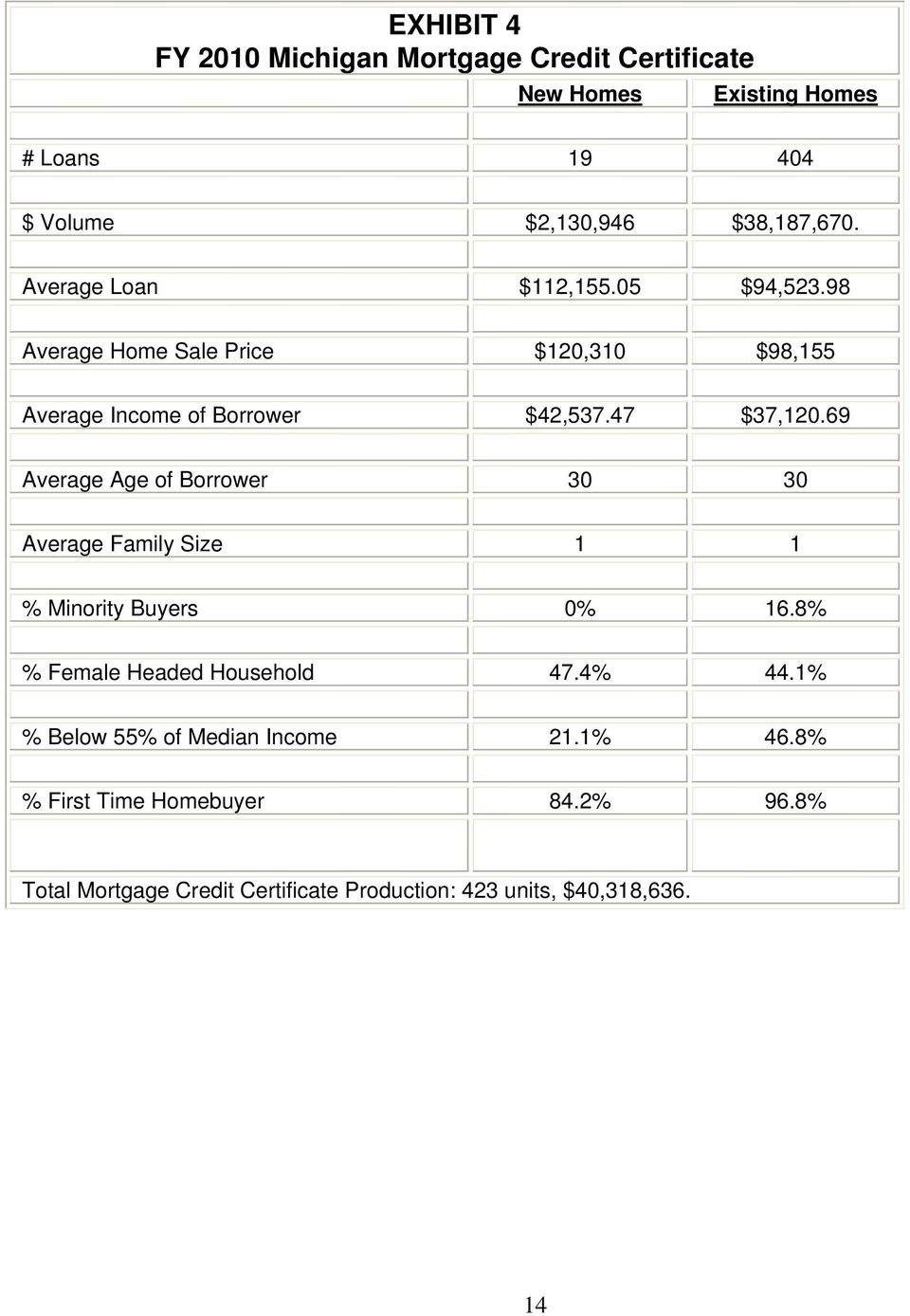
4 Single Family Mortgage Loan Program This program allows the Authority to finance low and moderate-income mortgages for people meeting income and purchase price limits. The loans are fixed-rate, level payment, 30-year mortgages. Optionally, the borrower may elect to take a lower rate for the first three years, to be followed by a higher rate for the remaining term of the mortgage loan. Borrowers must have acceptable credit and the ability to repay the loan. In some areas, federal law permits MSHDA loans only for first-time homebuyers. In FY 2010, this program financed 528 single-family units, representing a total investment of $32.6 million. The average purchaser of an existing home was 31 years of age, with a household size of one and an average income of approximately $38,526. The average loan amount was $62,306. The FY 2009 goal was 2,560 units. The Authority did not meet its goal primarily due to the down turn in the economy. Individuals held off purchasing a single family home out of concern for job security, lower wages and instability in the credit market. In addition to mortgage lending, the Homeownership Division provided counseling funded via Federal funds and general operating income. Counseling was provided in the following areas: Homebuyer education, 3,157 households; Foreclosure prevention, 9,679; Family Self- Sufficiency, 192; Key to Own, 38; and Specialty programs, 421. Federal Stimulus Funding Two loan programs funded with NSP 1 funds under HERA were administered through the Homeownership Division NSP Acquisition Rehab and 80/20 Programs. These programs provided down payment assistance to low/moderate income households purchasing a foreclosed or abandoned property with a 20% second lien or a maximum of $25,000 acquisition rehab subordinate lien for the payment of required down payment, borrower paid closing costs, prepaid expenses, and required repairs. During FY 2010, 42 loans were purchased and funded for a total of $980,523. MSHDA also expended $2.5 million in National Foreclosure Mitigation Counseling (NFMC) program funds and served 6,880 borrowers. The NFMC program, (sometimes called the Neighborworks program, as it is administered by NeighborWorks America) is funded in part by the Housing and Economic Recovery Act of 2008, and uses a network of housing counselors to help families at risk of foreclosure via loss mitigation counseling. Michigan Mortgage Credit Certificate Program This program, authorized by Congress in 1984, reduces the amount of federal income tax a homebuyer pays, thus giving the person more available income to qualify for a conventional mortgage and make house payments. Potential homebuyers must meet income and purchase price limits. The lender sets loan terms. The Authority has to turn in a portion of its allocated mortgage revenue bond authority to the U.S. Treasury to utilize the Mortgage Credit Certificates. In FY 2010, this program was reinstated, after being suspended in December of In FY 2010, the program assisted the financing of 423 single-family units. The total investment was $40.3 million. The average age of a MCC recipient purchasing an existing home was 30; the 4

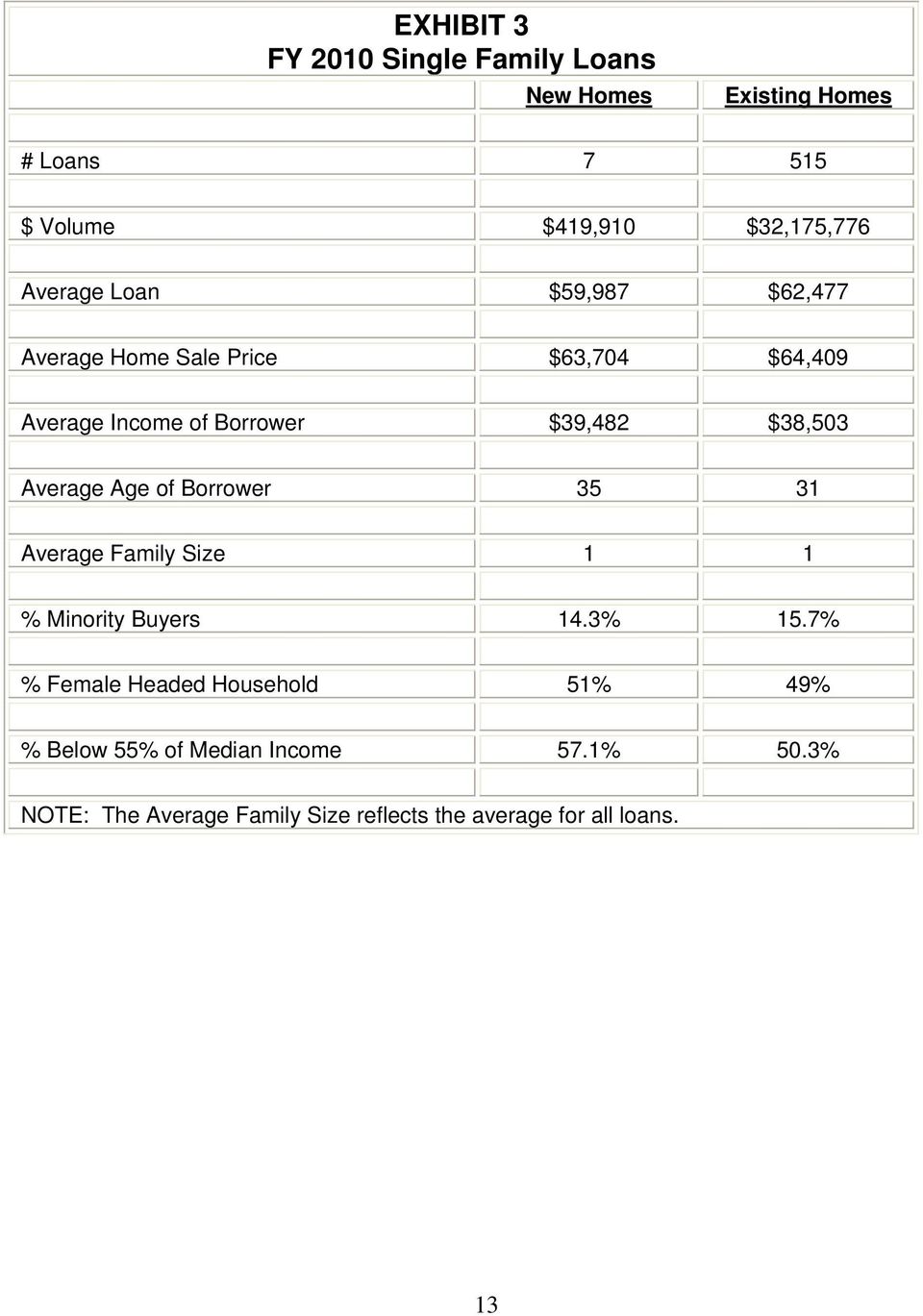
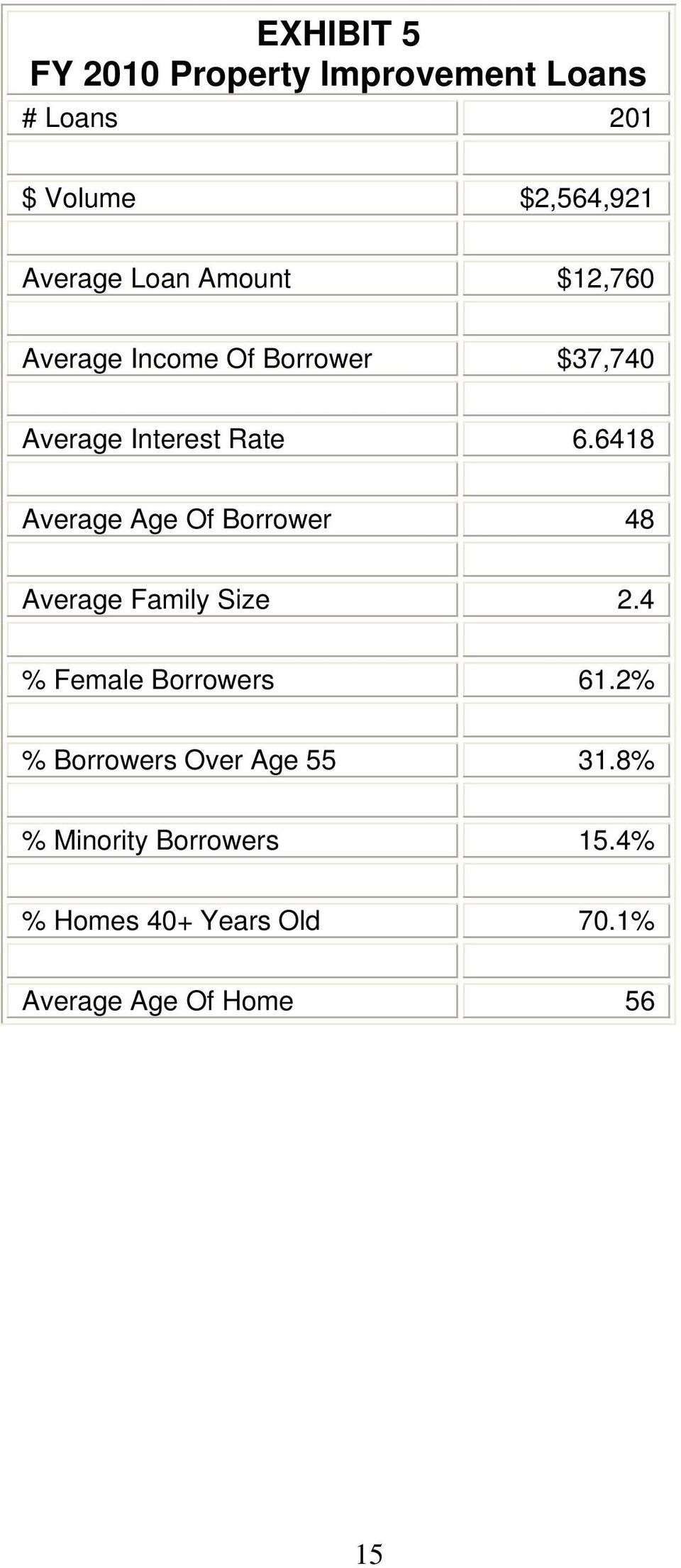
5 average family size was 1. The Authority missed its FY 2010 goal of producing 820 units and $77.9 million in loans due to the down turn in the economy. Property Improvement Loan Program This program helps preserve older, existing housing by offering loans to homeowners that meet income limits. In FY 2010, this program made 201 loans, totaling $2.6 million. Of these loans, 31.8% were made to borrowers over 55 years of age. Approximately 70.2% of the loans went to improve homes that were 40 years of age or older. The Authority met its goal of providing at least $2.5 million in PIP loans in FY 2010, and its goal of making at least 200 loans. Social and Economic Benefits Section 32(16)(b)(c)(d)(e) and (f) requires the Authority to report on the social and economic benefits of MSHDA s housing projects to the immediate neighborhoods and the cities in which they have been constructed, the extent of direct and indirect displacement of lower income persons, and the extent of additional reinvestment activities attributable to the Authority s financing of these projects. The obvious short-term benefits are the increased availability of quality, affordable housing for low and moderate income people, increased construction contracts and sales for builders and realtors, and increased Community Reinvestment Act production for local lenders. Further, the multifamily developments financed by the Authority employ people who receive salaries and expend dollars for vendor services. Developments also provide common space designed to enhance the community. Within these spaces many developments allow local senior citizen groups to provide meal service, medical examinations, and classes of various kinds. In other developments, there are police mini-stations, food cooperatives, book exchanges, craft shows, neighborhood watch programs, senior pal programs, and youth work programs. The Authority requires, as part of the underwriting process, that relocation planning be performed and implemented in any situation where a MSHDA loan would result in the displacement of lower income people. As a matter of policy, the Authority avoids approval of loans where such displacement cannot be adequately addressed. Demographic Information Section 32(16)(g) requires the Authority to report on the age, race, family size, and average income of the tenants in housing projects. EXHIBITS 3, 4, AND 5 DETAIL DEMOGRAPHIC INFORMATION FOR THE SINGLE FAMILY, MICHIGAN MORTGAGE CREDIT CERTIFICATE, AND PIP PROGRAMS IN FY The information for Multifamily projects closed in FY 2010 is unavailable because these developments are still under construction and not yet occupied. 5

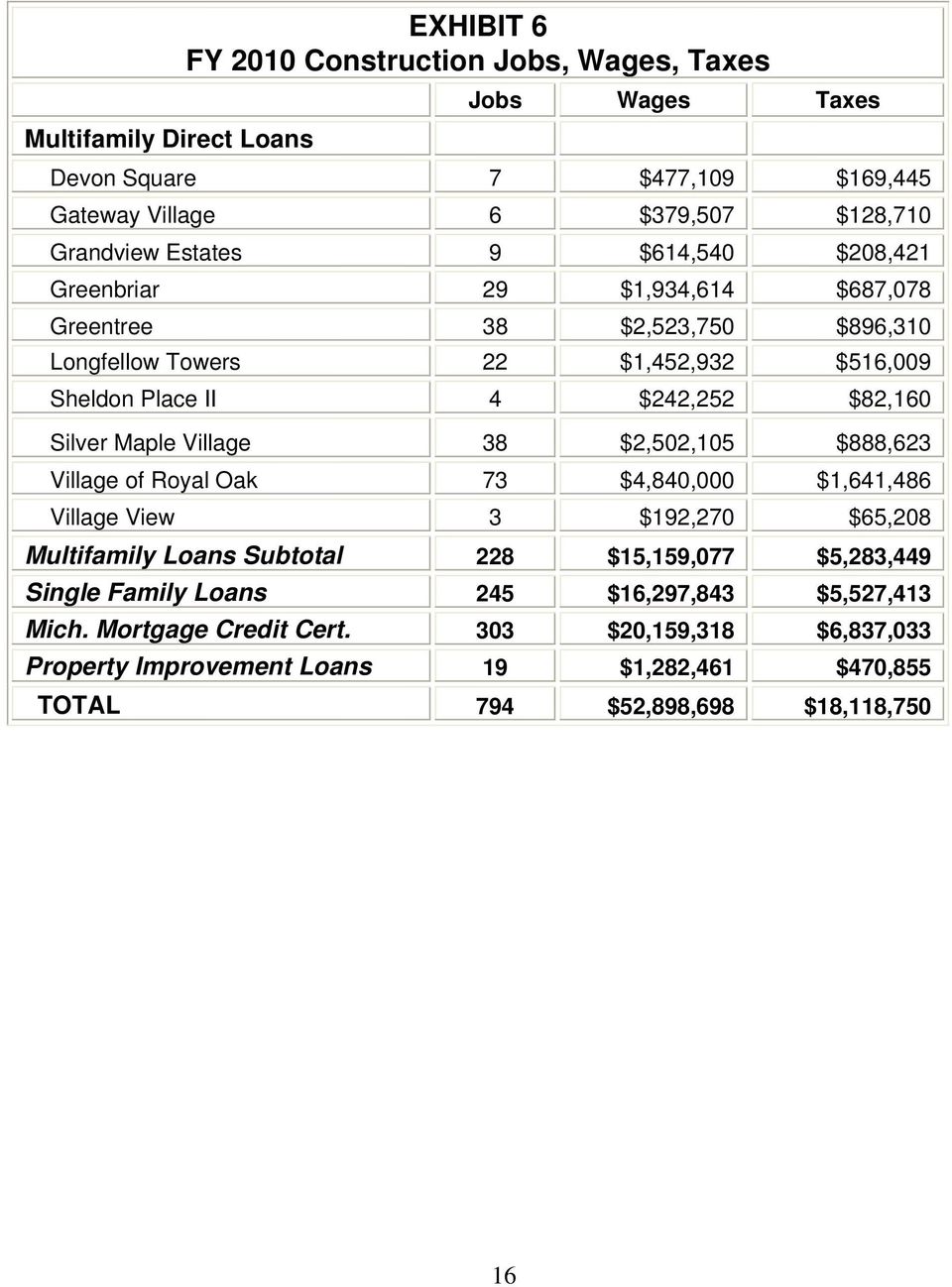
6 Construction Jobs Created, Wages and Taxes Paid Section 32(16)(h) requires the Authority to estimate economic impact of its development projects, including the number of construction jobs created, wages paid, and taxes and payments in lieu of taxes paid. Authority-financed housing created approximately 794 jobs, paid approximately $53.0 million in wages, and resulted in approximately $18.1 million in taxes being collected. EXHIBIT 6 ESTIMATES THE NUMBER OF CONSTRUCTION JOBS CREATED, WAGES PAID, AND TAXES PAID IN FY Grants Made to Local Units of Government and Non-Profit Housing Service Providers In FY 2010, 450 grants were made to local units of government and non-profit housing and service providers, for a total grant expenditure of $279.7 million. Of these, 112 grants valued at a total of $250.3 million were funded from federal stimulus funds. Federal Stimulus Funding The Housing and Economic Recovery Act of 2008 allocated funds for the Neighborhood Stabilization Program. The Neighborhood Stabilization Program ( NSP 1 ) provided emergency assistance to acquire and redevelop foreclosed properties that might otherwise become sources of abandonment and blight within their communities. In FY 2010, MSHDA awarded $14.1 million in NSP grant funds to nonprofits and local governments for the NSP program. The American Recovery and Reinvestment Act of 2009 allocated funds for a second round of Neighborhood Stabilization Program ( NSP 2 ) funds to be used for acquisition and rehabilitation of foreclosed or abandoned homes and structures. In FY 2010, MSHDA awarded $212.7 million in NSP2 grant funds to cities and land banks. EXHIBIT 7 DETAILS THE GRANTS MADE TO LOCAL UNITS OF GOVERNMENT AND NON-PROFIT HOUSING AND SERVICE PROVIDERS. Mobile Home Parks, Non-Profit Housing Projects, and Cooperative Programs Section 32(16)(i) requires the Authority to report on the progress in developing mobile home parks and mobile home condominium projects, constructing or rehabilitating consumer housing cooperative projects, and in financing construction or rehabilitation of non-profit housing projects. In FY 2010, no mobile home parks were financed under the Authority s Michigan Mortgage Credit Certificate Program or Single Family Program. Neighborhood Preservation Program Section 32(16)(j) requires the Authority to report on the progress in developing the Neighborhood Preservation Program. 6

7 The original Neighborhood Preservation Program began in 1989 and financed approximately 429 units of small-scale multi-family housing units. The program was evaluated, changed, and re-introduced in The goals of the program are to positively impact the image, physical conditions, and market and neighborhood management of the target neighborhoods. Since 1998, approximately $31.7 million in grants/loans has been made in 29 counties across the state. A total of 106 grants were given across the state, 23 grants have been made to the City of Detroit, with an additional 5 grants given in Wayne county; 48 to medium to large cities; 15 to UP communities, and the balance to small towns. Each NPP produces housing units either through new construction, rehabilitation of space for rental units (usually above businesses downtown), or purchase/rehab for resale. In addition, each project includes homeowner rehabilitation, beautification through banners, landscaping and/or neighborhood signs, and marketing activities to improve the image of the neighborhood. Prepayment of Federally and Authority Assisted Loans Section 32(16)(k) requires the Authority to report on the status of federal programs that assist low income tenants displaced as a result of prepayment of federally or Authority assisted loans. The Authority has preservation lending parameters for Section 236, Section 8, and all other federally assisted and MSHDA-financed rental housing. This housing stock, which currently serves Michigan s lowest income citizens and was typically built between 1974 and 1985, is in need of rehabilitation and preservation. The Authority offers tax-exempt and taxable preservation lending to extend the affordability, viability, and livability of this existing rental housing for a minimum of 35 years. A Preservation Fund loan may be available as additional gap financing for eligible developments in the event the Authority determines the transaction will not adequately address unmet physical needs. No tenants are displaced as a result of these transactions. Low Income Housing Tax Credit (LIHTC) Section 32(16)(l) requires the Authority to report on the status of the Low Income Housing Tax Credit (LIHTC) allocated under the Qualified Allocation Plan (QAP), including the amount of tax credits allocated, projects that have received tax credits, reasons why projects were denied tax credit, a geographical description of the distribution of tax credits, and a description of any amendments to the allocation plan made during the year. During FY 2010, the Authority allocated $16.7 million in tax credits to 28 developments helping create 2,041 units of affordable housing. Federal Stimulus Funding In FY 2010, MSHDA s LIHTC production was aided by the availability of recovery act resources that provided additional soft financing; a total of $10.0 million in TCAP funds 7
8 were used in conjunction with the LIHTC program to help finance 7 of the 28 properties that received 9% tax credits. EXHIBITS 8 AND 9 PROVIDE A GEOGRAPHIC DESCRIPTION OF CREDITS ALLOCATED AND A LIST OF PROJECTS DENIED CREDIT, WITH REASONS FOR DENIAL. EXHIBIT 10 PROVIDES DETAILS ON REVISIONS TO THE AUTHORITY S ALLOCATION PLAN. Education and Training Opportunities Section 32(16)(m) requires the Authority to report on education and training opportunities provided by the Authority including the types of education and training and the amount of funding committed to these activities. Education and training opportunities provided by the Authority primarily include the Contractor s Assistance Program and our Technical Assistance efforts. The Contractors Assistance Program is no longer in operation. The Authority provided Technical Assistance to nonprofit housing organizations throughout the state with 43 contracts made to 23 different Technical Assistance providers, at a total cost of $1.7 million. EXHIBIT 11 DETAILS GRANTS MADE TO TECHNICAL ASSISTANCE PROVIDERS FOR FY Housing Choice Voucher Program The Housing Choice Voucher (HCV) Program utilizes the private rental market to assist Michigan s extremely low income families to afford decent, safe, and sanitary housing. Residents live in single family or multifamily rental dwellings, paying between 30% and 40% of their gross income for rent. In FY 2010, a total of 23,507 families participated in this program; the average age for the head of household was 46 years, and the average adjusted household income was $10,080. MSHDA s HCV Program also has components for Family Self-Sufficiency (FSS) and for homeownership, called Key to Own. MSHDA administers the largest FSS program in the nation with 2,000 allocated slots. The FSS Program provides for coordination of local, community-based resources that promote economic independence for families living in assisted housing. The Key to Own Homeownership Program assists MSHDA HCV families with transferring their rental voucher into a homeownership voucher. Partnering with the FSS Program, the Key to Own Program provides pre/post purchase counseling and additional guidance throughout the homeownership process. In FY 2010 the FSS program graduated 105 program participants and the Key to Own Program closed on their 221 st home. Housing and Community Development Fund Section 58b(6) requires the Authority to issue an annual report to the Legislature summarizing the expenditure of the Fund for the prior fiscal year, including a description of the grant recipients, the number of housing units that were produced, the income levels of 8
9 the households that were served, the number of homeless persons served, and the number of downtown areas and adjacent neighborhoods that received financing. No funds were appropriated to or expended from the Housing and Community Development fund in FY Michigan Broadband Development Authority Section 32(17) requires the Authority to conduct an annual review of all loans and financial instruments that require repayment, or lines of credit with the Michigan Broadband Development Authority (MBDA). The review must contain an analysis of the MBDA s ability to repay all loans, financial instruments that require repayment, and lines of credit with the Authority and the amount and payment schedule of all current loans, financial instruments that require repayment, and lines of credit with the Authority. The review shall also contain an analysis of the number of Authority assisted or financed developments and homes purchasing high-speed Internet connections at substantially reduced rates as a direct result of loans from the MBDA. As of June 30, 2010 the Broadband portfolio had 3 outstanding loans, with a total outstanding principal balance of $6.4 million. All outstanding commitment amounts were either drawn down, or forfeited by the borrowers, so there are no longer any commitments outstanding. Executive Order No , approved in October of 2008, abolishes the Broadband Authority and transfers any remaining functions to MSHDA. Office of the State Archaeologist (OSA) The Office of the State Archaeologist (OSA) has been the State of Michigan s official source of archaeological expertise since OSA records, investigates, evaluates and interprets Michigan s archaeological sites ranging in size from a single artifact to entire abandoned towns. Beginning with the arrival of the first big game hunters 12,000 years ago, 97% of Michigan s human occupation has no written documentation. It is all hidden in the soil of 56,809 square miles of uplands or underwater on and in our 38,504 square miles of Great Lakes bottomlands. OSA works closely with the State Historic Preservation Office to protect and interpret sites that may be affected by federally funded, licensed or permitted projects. OSA has a special responsibility for sites on state-owned lands, particularly state forest, parks and recreation areas. It maintains approximately 2000 archaeological collections from state sites and to a lesser degree donated collections from privately-owned sites. It maintains the official list of Michigan s known archaeological sites, now numbering over 21,000 sites on land and 1500 shipwrecks, and assigns new site numbers as necessary. It advises the general public, tribes, local agencies, municipalities and police on archaeological matters. OSA staff members do publications and lectures on Michigan archaeology and sponsor Michigan Archaeology Day. All of this helps to document the progress of Michigan s Native American inhabitants from ice-age hunters of mastodons and caribou to superb hunters, fishers, wood-workers, incipient farmers and some of the earliest coppersmiths on the planet. Archaeological sites from the Historic period, that is, the time since first European contact in the 1600s, are being studied with increased interest because of their ability to support or correct the accuracy of written documents. 9
10 State Historic Preservation Office In 1966, in response to growing public interest in historic preservation, Congress passed the National Historic Preservation Act (NHPA of 1996, amended 1980, 1992 [USC Sec t]). The act required that each state establish a State Historic Preservation Office (SHPO) and that the governor of each state appoint an officer to oversee the preservation activities. Each year Michigan receives a Historic Preservation Fund grant from the National Park Service to operate its program. The Michigan SHPO identifies, evaluates, registers, interprets and protects the state's historic properties. Executive Order codified the role of the SHPO in Michigan. Michigan's SHPO was established in the late 1960s. Its main function is to provide technical assistance to local communities in their efforts to identify, evaluate, designate, and protect Michigan's historic resources. The SHPO also administers an incentives program that includes state and federal tax credits and pass-through grants available to Certified Local Governments. The SHPO works closely with the Office of the State Archaeologist to accomplish its goals. The SHPO is led by the state historic preservation officer, who is designated by the governor to carry out provisions of the Historic Preservation Act of 1966, as amended, and Executive Order The SHPO's programs are funded in part through a Historic Preservation Fund grant, an annual federal matching grant administered by the National Park Service 10

11 EXHIBIT 1 FY 2010 and FY 2011 Goals Program FY 2010 Goal FY 2010 Production FY 2011 Goal Multifamily Direct Loans $70,000,000 1,200 $36,245, $70,000,000 1,200 Modified Pass Through Loans $0 0 $0 0 $0 0 Single Family Loans $204,000,000 2,560 $32,897, $87,000,000 1,396 Michigan Credit Certificate Program $77,900, $40,318, $47,500, Property Improvement Program (PIP) $2,500, $2,564, $2,500, TOTAL $354,400,000 4,780 $112,026,284 2,131 $207,000,000 3,296 The Modified Pass-Through program is not expected to produce any loans in FY 2011 due to unfavorable conditions in the financial and Low-Income Housing Tax Credit equity markets. 11

12 EXHIBIT 2 FY 2010 Commitments/Allocations of Federal Stimulus Funds Program/Activity Type Multifamily Rental Housing Multifamily Rental Housing Homeless Prevention & Rapid Rehousing Program Federal Act Funding Source Purpose Amount ARRA ARRA ARRA NSP Acquisition Rehab and 80/20 Programs HERA NSP 1 Tax Credit Assistance Program ("TCAP") Tax Credit Exchange Program ("1602") Neighborworks HERA National Foreclosure Mitigation Counseling Funds Neighborhood Stabilization Program 1 HERA NSP 1 Neighborhood Stabilization Program 2 ARRA NSP 2 Construction and rehabilitation of multifamily housing $52,851,272 Construction and rehabilitation of multifamily housing $238,378,597 Homeless Prevention & Rapid Rehousing Program Homelessness prevention $23,513,532 Foreclosure mitigation/prevention $980,523 Foreclosure mitigation/prevention $2,451,750 Blight prevention/redevelopment $14,401,477 Blight prevention/redevelopment $213,101,680 Total $545,678,831 NOTES: "HERA" = Housing and Economic Recovery Act of "ARRA" = American Recovery and Reinvestment Act of "NFMC" = National Foreclosure Mitigation Counseling program. "NSP 1" - Neighborhood Stabilization Program implemented under HERA. "NSP 2" - Neighborhood Stabilization Program implemented under ARRA. 12

13 EXHIBIT 3 FY 2010 Single Family Loans New Homes Existing Homes # Loans $ Volume $419,910 $32,175,776 Average Loan $59,987 $62,477 Average Home Sale Price $63,704 $64,409 Average Income of Borrower $39,482 $38,503 Average Age of Borrower Average Family Size 1 1 % Minority Buyers 14.3% 15.7% % Female Headed Household 51% 49% % Below 55% of Median Income 57.1% 50.3% NOTE: The Average Family Size reflects the average for all loans. 13
14 EXHIBIT 4 FY 2010 Michigan Mortgage Credit Certificate New Homes Existing Homes # Loans $ Volume $2,130,946 $38,187,670. Average Loan $112, $94, Average Home Sale Price $120,310 $98,155 Average Income of Borrower $42, $37, Average Age of Borrower Average Family Size 1 1 % Minority Buyers 0% 16.8% % Female Headed Household 47.4% 44.1% % Below 55% of Median Income 21.1% 46.8% % First Time Homebuyer 84.2% 96.8% Total Mortgage Credit Certificate Production: 423 units, $40,318,
15 EXHIBIT 5 FY 2010 Property Improvement Loans # Loans 201 $ Volume $2,564,921 Average Loan Amount $12,760 Average Income Of Borrower $37,740 Average Interest Rate Average Age Of Borrower 48 Average Family Size 2.4 % Female Borrowers 61.2% % Borrowers Over Age % % Minority Borrowers 15.4% % Homes 40+ Years Old 70.1% Average Age Of Home 56 15
16 Multifamily Direct Loans EXHIBIT 6 FY 2010 Construction Jobs, Wages, Taxes Jobs Wages Taxes Devon Square 7 $477,109 $169,445 Gateway Village 6 $379,507 $128,710 Grandview Estates 9 $614,540 $208,421 Greenbriar 29 $1,934,614 $687,078 Greentree 38 $2,523,750 $896,310 Longfellow Towers 22 $1,452,932 $516,009 Sheldon Place II 4 $242,252 $82,160 Silver Maple Village 38 $2,502,105 $888,623 Village of Royal Oak 73 $4,840,000 $1,641,486 Village View 3 $192,270 $65,208 Multifamily Loans Subtotal 228 $15,159,077 $5,283,449 Single Family Loans 245 $16,297,843 $5,527,413 Mich. Mortgage Credit Cert. 303 $20,159,318 $6,837,033 Property Improvement Loans 19 $1,282,461 $470,855 TOTAL 794 $52,898,698 $18,118,750 16
17 EXHIBIT 7 FY 2010 Grants to Non-Profit Organizations and Local Governments GRANTS TO PREVENT HOMELESSNESS Emergency Solutions Grants (ESG) Grantee Name City County Grant Amount ACSET Grand Rapids Kent $20,000 Adult Comfort Living Housing Foundation Wayne Wayne $4,141 Advent House Ministries Lansing Ingham $12,413 Alliance Against Violence and Abuse, Inc. Escanaba Delta $11,757 American Red Cross Bay City Bay $19,700 Aware, Inc. Jackson Jackson $22,821 Baraga County Shelter Home L'Anse Baraga $11,244 Barbara Kettle Gundlach Shelter Home for Abused Women Calumet Houghton $8,580 Barry County United Way Hastings Barry $9,432 Battle Creek Community Foundation Battle Creek Calhoun $6,075 Bay Area Women's Center Bay City Bay $33,750 Bay Area Women's Center Bay City Bay $15,000 Bethany Housing Ministries, Inc. Muskegon Muskegon $10,866 Blue Water Center for Independent Living Port Huron St. Clair $46,000 Branch County Coalition Against Domestic Violence Coldwater Branch $21,200 Branch Interfaith Hospitality Network Coldwater Branch $17,500 Cadillac Area OASIS/Family Resource Center Cadillac Wexford $13,500 Capital Area Community Services Lansing Ingham $27,690 Capital Area Community Services Lansing Ingham $14,564 Capital Area Community Services Lansing Ingham $20,220 Capital Area Community Services Lansing Ingham $28,022 Caring House, Inc. Iron Mountain Dickinson $40,000 Cass Community Social Services Detroit Wayne $11,130 17

18 Catholic Family Services Kalamazoo Kalamazoo $5,100 Catholic Social Services of Washtenaw County Ann Arbor Washtenaw $10,255 Catholic Social Services of Wayne County Detroit Wayne $7,250 Catholic Social Services of Wayne County Detroit Wayne $9,275 Center for Women In Transition Holland Ottawa $37,680 Channel Housing Ministries, Inc./D.B.A. Oceana's Home Partnership Hart Oceana $30,792 Child and Family Services of SWMichigan Benton Harbor Berrien $7,500 Child and Family Services of Upper Peninsula, Inc. Marquette Marquette $23,037 Child and Family Services of Upper Peninsula, Inc. Marquette Marquette $4,150 Child and Family Services of Upper Peninsula, Inc. Marquette Marquette $20,354 Choices of Manistee County Inc Manistee Manistee $37,250 Christian Neighbors Plainwell Allegan $9,500 City Rescue Mission of Saginaw Inc. Saginaw Saginaw $15,000 City Rescue Mission of Saginaw Inc. Saginaw Saginaw $27,685 Coalition on Temporary Shelter Detroit Wayne $11,140 Common Ground Sanctuary Bloomfield Hills Oakland $14,099 Communities Overcoming Violent Encounters Ludington Mason $11,500 Community Action Battle Creek Calhoun $33,510 Community Action Agency Jackson Jackson $29,837 Community Action Agency Jackson Jackson $36,637 Community Action House Holland Ottawa $36,434 Community Healing Center Three Rivers St. Joseph $5,000 Community Housing Network Troy Oakland $8,850 Community Living Services, Inc. Wayne Wayne $9,725 Community Rebuilders, Inc. Grand Rapids Kent $56,500 Comprehensive Youth Services, Inc. Mt. Clemens Macomb $17,600 Comprehensive Youth Services, Inc. Mt. Clemens Macomb $2,250 Council on Domestic Violence and Sexual Assault Midland Midland $14,300 D.I.S.H., Inc. Battle Creek Calhoun $19,440 Detroit Central City CMH Detroit Wayne $8,755 18

19 Detroit Rescue Mission Ministries Detroit Wayne $9,725 Diane Peppler Resource Center Sault Ste. Marie Chippewa $17,596 Domestic and Sexual Abuse Services Three Rivers St. Joseph $10,000 Domestic Harmony Hillsdale Hillsdale $11,200 Domestic Violence Coalition, Inc. Paw Paw Van Buren $6,677 Domestic Violence Escape(DOVE) Ironwood Gogebic $7,922 Domestic Violence Project Inc./SAFEHouse Center Ann Arbor Washtenaw $30,990 East Michigan Conference FMCNA Clio Genesee $24,553 Eightcap, Incorporated Greenville Montcalm $23,026 Eightcap, Incorporated Greenville Montcalm $18,916 Emergency Shelter Services, Inc. Benton Harbor Berrien $47,050 EVE, Inc. (End Violent Encounters) Lansing Ingham $13,136 Every Woman's Place, Inc. Muskegon Muskegon $6,000 Every Woman's Place, Inc. Muskegon Muskegon $10,866 Every Woman's Place, Inc. Muskegon Muskegon $5,000 Family Counseling & Children's Services of Lenawee Co. Adrian Lenawee $26,641 Family Counseling & Shelter Services of Monroe County Monroe Monroe $38,802 Family Promise of Grand Rapids Grand Rapids Kent $15,411 Family Services, Inc Detroit Wayne $7,750 First Step Plymouth Wayne $22,502 Freedom House Detroit Wayne $9,275 Friendship Shelter Gaylord Otsego $42,383 Gateway Community Services East Lansing Ingham $8,783 Genesee County Community Action Resource Department Flint Genesee $7,790 Genesee County Youth Corporation Flint Genesee $23,545 Gogebic-Ontonagon Community Action Agency Bessemer Gogebic $21,803 Good Samaritan Ministries Holland Ottawa $23,560 Grand Goodwill Industries of Northern Michigan, Inc Traverse City Traverse $80,312 19

20 Goodwill Industries of West Michigan Muskegon Muskegon $16,670 Grand Rapids Housing Commission Grand Rapids Kent $27,189 Green Gables Haven Hastings Barry $12,867 HAVEN House East Lansing Ingham $16,010 Haven of Rest Ministries of Battle Creek Battle Creek Calhoun $4,500 HAVEN, Inc. Bingham Farms Oakland $21,830 Helping Unite Mothers And Children Detroit Wayne $7,250 Hispanic Service Center Imlay City Lapeer $12,683 Homeless Action Network of Detroit Highland Park Wayne $11,130 HOPE Hospitality & Warming Center, Inc. Bloomfield Hills Oakland $13,643 Housing Resource Center of Allegan County Allegan Allegan $66,223 Housing Resources, Inc. Kalamazoo Kalamazoo $95,273 Housing Services for Eaton Co. Charlotte Eaton $30,613 Interfaith Hospitality Network of Washtenaw County Ann Arbor Washtenaw $13,155 Jewish Vocational Service Detroit Wayne $8,250 Kalamazoo Community Mental Health and Substance Abuse Services Nazareth Kalamazoo $20,050 KeyStone Place, Inc. Centreville St. Joseph $50,696 Lapeer Area Citizens Against Domestic Assault Lapeer Lapeer $17,483 Legal Services of Eastern MI Flint Genesee $20,334 Lenawee Emergency and Affordable Housing Corp. Adrian Lenawee $34,575 Lighthouse of Oakland Co., Inc Pontiac Oakland $29,674 Livingston Area Council Against Spouse Abuse Howell Livingston $13,852 Livingston Family Center Pinckney Livingston $9,633 Loaves & Fishes Ministries Lansing Ingham $12,805 Local Initiatives Support Corporation Kalamazoo Kalamazoo $3,762 Looking For My Sister Detroit Wayne $9,275 Lutheran Social Services of Michigan Detroit Wayne $16,335 Lutheran Social Services of Wisconsin and Upper Michigan Milwaukee Marquette $5,223 Lutheran Social Services of Wisconsin & Upper MI Milwaukee Marquette $22,531 Macomb County Rotating Emergency Shelter Team Roseville Macomb $15,833 20

21 Macomb Homeless Coalition Clinton Twp Macomb $3,375 Manistique Housing Commission Manistique Schoolcraft $15,796 Mariners Inn Detroit Wayne $7,750 Matrix Human Services Detroit Wayne $9,275 Metro Community Development Inc. Flint Genesee $9,392 Michigan Ability Partners Ann Arbor Washtenaw $7,897 Mid Michigan Community Action Agency, Inc. Farwell Clare $45,834 Midland Area Homes, Inc Midland Midland $10,796 Monroe County Opportunity Program Monroe Monroe $41,606 Nat l Council on Alcoholism Lansing Regional Area Lansing Ingham $13,363 Neighborhood Legal Services of Michigan Detroit Wayne $8,250 Neighborhood Service Org. Detroit Wayne $9,725 New Center Community Mental Health Services Detroit Wayne $9,275 Newaygo County Community Services Fremont Newaygo $19,907 Newaygo County Community Services Fremont Newaygo $67,856 North Country Community Mental Health Petoskey Emmet $2,500 Northeast Michigan Community Service Agency, Inc. Alpena Alpena $78,925 Northwest Michigan Community Action Agency Northwest Michigan Community Action Agency Northwest Michigan Community Action Agency Traverse City Traverse City Traverse City Grand Traverse $22,595 Grand Traverse $52,766 Grand Traverse $16,669 Oakland Livingston Human Service Agency Howell Oakland $16,273 Oakland Livingston Human Service Agency Howell Oakland $50,601 Open Door and Next Door Shelters Kalamazoo Kalamazoo $4,765 Ottawa County Holland Ottawa $4,740 Ozone House, Inc. Ann Arbor Washtenaw $26,951 Pines Behavioral Health Coldwater Branch $12,500 Rainbow House Domestic Abuse Services, Inc. Marinette Menominee $10,688 Relief After Violent Encounter (R.A.V.E.) St. Johns Clinton $24,980 Relief After Violent Encounter (R.A.V.E.) St. Johns Clinton $16,598 21
22 Relief After Violent Encounter Ionia/Montcalm, Inc Ionia Ionia $51,240 River House, Inc. Grayling Crawford $31,000 S.A.F.E. Place Battle Creek Calhoun $4,500 Safe Horizons Port Huron St. Clair $62,758 Saginaw County Youth Protection Council Saginaw Saginaw $36,010 Sanilac Area Violence Elimination Council Sandusky Sanilac $12,000 Sault Ste. Marie Housing Commission Sault Ste. Marie Chippewa $44,800 Shelter Association of Washtenaw County Ann Arbor Washtenaw $28,694 Shelter of Flint, Inc. Flint Genesee $33,542 Shelter, Inc. Alpena Alpena $33,700 Simon House, Inc. Detroit Wayne $8,250 SIREN/Eaton Shelter, Inc. Charlotte Eaton $15,907 SOS Community Services Ypsilanti Washtenaw $71,362 South Oakland Shelter Royal Oak Oakland $23,031 Southwest Counseling Solutions, Inc. Detroit Wayne $8,755 Southwest Housing Solutions Corporation Detroit Wayne $8,000 Southwest Michigan Community Action Agency Benton Harbor Berrien $38,253 Southwest Michigan Community Action Agency Benton Harbor Berrien $35,022 Southwest Michigan Community Action Agency Benton Harbor Berrien $5,000 St. Clair County Community Mental Health Authority Port Huron St. Clair $3,250 St. Vincent Catholic Charities Lansing Ingham $10,000 Staircase Youth Services, Inc. Ludington Mason $10,000 Summit Pointe Battle Creek Calhoun $3,835 Sunrise Mission Alpena Alpena $19,000 Sylvia's Place Allegan Allegan $31,590 The Salvation Army Grand Rapids Kent $7,500 The Salvation Army Alma Gratiot $23,070 The Salvation Army Ludington Mason $7,200 The Salvation Army Big Rapids Mecosta $34,096 The Salvation Army Alpena Alpena $5,075 22
23 The Salvation Army Detroit Wayne $8,755 The Salvation Army Detroit Wayne $8,755 The Salvation Army Jackson Jackson $12,992 The Salvation Army Wauwatosa Dickinson $27,000 The Salvation Army Escanaba Delta $14,727 The Salvation Army Benton Harbor Berrien $7,000 The Salvation Army - MATTS Warren Macomb $13,942 The Salvation Army of Washtenaw County Ann Arbor Washtenaw $7,897 The Salvation Army-Grand Haven Grand Haven Ottawa $8,880 Training and Treatment Innovations, Inc. oxford Jackson $8,850 Training and Treatment Innovations, Inc. oxford Jackson $24,449 Travelers Aid Society of Detroit Detroit Wayne $8,755 Turning Point Inc. Mt. Clemens Macomb $9,450 U.P. Community Services Iron Mountain Dickinson $7,464 Underground Railroad, Inc. Saginaw Saginaw $37,755 United Community Housing Coalition Detroit Wayne $9,725 United Way of Eastern Upper Peninsula Sault Ste. Marie Chippewa $3,100 United Way of Lapeer County Lapeer Lapeer $24,584 United Way of Mason County Ludington Mason $6,500 United Way of Monroe County Monroe Monroe $4,358 United Way of Otsego County Gaylord Otsego $5,000 United Way of Saginaw County Saginaw Saginaw $3,750 Volunteers of America of Michigan Southfield Oakland $17,850 Washtenaw Housing Alliance Ann Arbor Washtenaw $3,750 Wayne Metropolitan Community Action Agency Wyandotte Wayne $36,622 West Michigan Therapy, Inc. Muskegon Muskegon $29,294 Women's Aid Service, Inc. Mt. Pleasant Isabella $12,700 Women's Center Marquette Marquette $21,800 Women's Information Service Big Rapids Mecosta $13,750 Women's Information Service Big Rapids Mecosta $7,000 23
24 Women's Resource Center Traverse City Grand Traverse $40,272 Women's Resource Center of Northern Michigan, Inc. Petoskey Emmet $21,800 Young Womens Christian Association of Kalamazoo Kalamazoo Kalamazoo $31,400 YWCA of Greater Flint Flint Genesee $18,744 YWCA West Central Michigan Grand Rapids Kent $38,000 Total ESG Grants $4,081,329 Tenant Based Rental Assistance (TBRA) Grantee Name City County Grant Amount Coalition on Temporary Shelter Detroit Wayne $500,000 Community Rebuilders, Inc. Grand Rapids Kent $230,000 Emergency Shelter Services, Inc. Benton Harbor Berrien $1,000,000 Human Development Commission Caro Tuscola $50,000 Southwest Counseling Solutions, Inc. Detroit Wayne $500,000 Southwest Michigan Community Action Agency Benton Harbor Berrien $288,000 Volunteers of America of Michigan Southfield Oakland $500,000 West Michigan Therapy, Inc. Muskegon Muskegon $200,000 Women's Center Marquette Marquette $400,000 Total TBRA Grants $3,668,000 Homeless Assistance Special Grant Grantee Name City County Grant Amount Corporation for Supportive Housing Brighton Livingston $168,000 Corporation for Supportive Housing Brighton Livingston $214,539 Corporation for Supportive Housing Brighton Livingston $46,000 Corporation for Supportive Housing Brighton Livingston $204,000 Department of Human Services Lansing Ingham $78,700 Michigan Coalition Against Homelessness Lansing Ingham $640,500 Michigan Coalition Against Homelessness Lansing Ingham $162,000 24
25 Michigan Coalition Against Homelessness Lansing Ingham $90,000 Total Homeless Assistance Special Grants $1,603,739 Homeless Prevention and Rapid Re-housing Program (HPRP) (Funded by the ARRA Federal Stimulus Package) Grantee Name City County Grant Amount American Red Cross Bay City Bay $166,743 Barry County United Way Hastings Barry $136,066 Blue Water Center for Independent Living Port Huron St. Clair $413,402 Capital Area Community Services Lansing Ingham $145,633 Capital Area Community Services Lansing Ingham $571,434 Capital Area Community Services Lansing Ingham $221,410 Channel Housing Ministries, Inc./D.B.A. Oceana's Hart Oceana Home Partnership $127,874 Child and Family Services of Upper Peninsula, Inc. Marquette Marquette $194,408 Child and Family Services of Upper Peninsula, Inc. Marquette Marquette $205,806 Child and Family Services of Upper Peninsula, Inc. Marquette Marquette $328,604 Community Action Battle Creek Calhoun $177,903 Community Action Agency Jackson Jackson $149,420 Community Action Agency Jackson Jackson $226,168 Community Housing Network Troy Oakland $537,709 Community Housing Network Troy Oakland $788,308 Dickinson-Iron Community Services Agency Iron Mountain Dickinson $99,501 Eightcap, Incorporated Greenville Montcalm $420,689 Emergency Shelter Services, Inc. Benton Harbor Berrien $723,653 Gogebic-Ontonagon Community Action Agency Bessemer Gogebic $212,247 Good Samaritan Ministries Holland Ottawa $476,656 Goodwill Industries of West Michigan Muskegon Muskegon $65,480 Housing Resource Center of Allegan County Allegan Allegan $326,877 Housing Resources, Inc. Kalamazoo Kalamazoo $392,770 25
26 Housing Services for Eaton Co. Charlotte Eaton $316,516 KeyStone Place, Inc. Centreville St. Joseph $378,638 Lenawee Emergency and Affordable Housing Corp. Adrian Lenawee $270,787 Listening Ear Crisis Center Mt. Pleasant Isabella $494,235 Metro Community Development Inc. Flint Genesee $608,266 Mid Michigan Community Action Agency, Inc. Farwell Clare $67,837 Mid Michigan Community Action Agency, Inc. Farwell Clare $126,788 Mid Michigan Community Action Agency, Inc. Farwell Clare $259,789 Midland Area Homes, Inc Midland Midland $250,932 Monroe County Opportunity Program Monroe Monroe $286,974 Neighborhood Legal Services of Michigan Detroit Wayne $1,905,112 Newaygo County Community Services Fremont Newaygo $142,980 Newaygo County Community Services Fremont Newaygo $107,528 Newaygo County Community Services Fremont Newaygo $215,742 Northeast Michigan Community Service Agency, Alpena Alpena Inc. $63,179 Northeast Michigan Community Service Agency, Alpena Alpena Inc. $215,308 Northeast Michigan Community Service Agency, Alpena Alpena Inc. $689,366 Northwest Michigan Community Action Agency Traverse City Grand Traverse $108,460 Northwest Michigan Community Action Agency Traverse City Grand Traverse $299,346 Northwest Michigan Community Action Agency Traverse City Grand Traverse $493,880 Oakland Livingston Human Service Agency Howell Oakland $254,043 Safe Horizons Port Huron St. Clair $565,756 Sault Ste. Marie Housing Commission Sault Ste. Marie Chippewa $136,515 Shelter Association of Washtenaw County Ann Arbor Washtenaw $1,723,082 Southwest Counseling Solutions, Inc. Detroit Wayne $318,051 Southwest Michigan Community Action Agency Benton Harbor Berrien $154,254 Southwest Michigan Community Action Agency Benton Harbor Berrien $277,071 26
27 Summit Pointe Battle Creek Calhoun $715,288 The Salvation Army Escanaba Delta $156,939 The Salvation Army Escanaba Delta $69,586 The Salvation Army Grand Rapids Kent $690,435 The Salvation Army Alma Gratiot $137,469 United Community Housing Coalition Detroit Wayne $750,320 United Way of Lapeer County Lapeer Lapeer $198,012 United Way of Otsego County Gaylord Otsego $73,279 United Way of Saginaw County Saginaw Saginaw $322,460 Wayne Metropolitan Community Action Agency Wyandotte Wayne $1,048,369 Wayne Metropolitan Community Action Agency Wyandotte Wayne $873,199 West Michigan Therapy, Inc. Muskegon Muskegon $638,980 Total HPRP Grants $23,513,532 Housing Case Management Grantee Name City County Grant Amount Emergency Shelter Services, Inc. Benton Harbor Berrien $18,466 HAVEN House East Lansing Ingham $43,250 Haven of Rest Ministries of Battle Creek Battle Creek Calhoun $15,075 Housing Resources, Inc. Kalamazoo Kalamazoo $30,129 Human Development Commission Caro Tuscola $11,431 Human Development Commission Caro Tuscola $6,044 Macomb Homeless Coalition Clinton Twp Macomb $41,256 Metro Community Development Inc. Flint Genesee $52,646 Mid Michigan Community Action Agency, Inc. Farwell Clare $9,904 Newaygo County Community Services Fremont Newaygo $3,582 Northeast Michigan Community Service Agency, Inc. Alpena Alpena $13,675 27
28 Northeast Michigan Community Service Agency, Alpena Alpena Inc. $3,878 Northwest Michigan Community Action Agency Traverse City Grand Traverse $14,393 Oakland Livingston Human Service Agency Howell Oakland $61,738 Shelter Association of Washtenaw County Ann Arbor Washtenaw $39,466 Southwest Counseling Solutions, Inc. Detroit Wayne $190,000 The Salvation Army Grand Rapids Kent $56,119 United Way of Saginaw County Saginaw Saginaw $24,623 Wayne Metropolitan Community Action Agency Wyandotte Wayne $55,000 Total Housing Case Management Grants $690,675 TOTAL HOMELESS GRANTS $33,557,275 COMMUNITY DEVELOPMENT (CD) GRANTS Community Development Block Grants (CDBG) Grantee Name City County Grant Amount City of Grand Ledge Grand Ledge Eaton $323,500 Emmet County Petoskey Emmet $200,000 Delta County Escanaba Delta $200,000 Lake Odessa Village Lake Odessa Ionia $338,400 City of Coldwater Coldwater Branch $341,400 City of Fremont Fremont Newaygo $130,400 Oceana County Hart Oceana $175,000 Cheboygan County Cheboygan Cheboygan $175,000 Alpena County Alpena Alpena $150,000 City of Alpena Alpena Alpena $341,400 City of Hastings Hastings Barry $384,100 City of Lapeer Lapeer Lapeer $250,400 Marquette County Marquette Marquette $426,800 Crawford County Grayling Crawford $243,900 28
29 Cass County Cassopolis Cass $250,000 Charlevoix County Charlevoix Charlevoix $175,000 St. James Township Beaver Island Charlevoix $472,000 City of Escanaba Escanaba Delta $583,400 City of Dowagiac Dowagiac Cass $180,000 Grand Traverse County Traverse City Grand Traverse $243,900 Lake Linden Village Lake Linden Houghton $272,200 Roscommon County Roscommon Roscommon $183,000 City of Owosso Owosso Shiawassee $183,000 Otsego County Housing Committee Gaylord Otsego $166,700 City of Ironwood Ironwood Gogebic $243,900 City of Iron Mountain Iron Mountain Dickinson $194,500 Marquette County Marquette Marquette $183,000 TOTAL CDBG Grants $7,010,900 HOME Funds Grantee Name City County Grant Amount City of Saginaw Saginaw Saginaw $330,000 Hometown Housing Partnership Inc. East Lansing Ingham $30,000 Northern Homes Community Development Corporation Boyne City Charlevoix $48,000 Bridging Communities, Inc. Detroit Wayne $600,000 Jackson Affordable Hsg. Corp. Jackson Jackson $15,000 Lighthouse Communities, Inc. Grand Rapids Kent $27,000 Detroit Catholic Pastoral Alliance Detroit Wayne $15,000 Jubilee Ministries, Inc. Holland Ottawa $30,000 Mid Michigan Community Action Agency, Inc. Farwell Clare $30,000 Monroe County Opportunity Program Monroe Monroe $36,000 Habitat for Humanity of Michigan Lansing Ingham $1,821,725 Sturgis Neighborhood Program Sturgis St. Joseph $30,000 City of Coldwater Coldwater Branch $150,000 Northwest Michigan Community Action Agency Traverse City Grand Traverse $30,000 Human Development Commission Caro Tuscola $120,000 29
30 Northeast Michigan Affordable Housing Alpena Alpena $54,000 Kalamazoo Neighborhood Housing Services, Inc. Chippewa-Luce-Mackinac Community Action Agency Gogebic-Ontonagon Community Action Agency Kalamazoo Kalamazoo $18,000 Sault Ste. Marie Chippewa $48,000 Bessemer Gogebic $48,000 U.P. Community Services Iron Mountain Dickinson $36,000 HomeStretch Traverse City Grand Traverse $48,000 Schoolcraft County Manistique Schoolcraft $160,000 Sturgis Neighborhood Program Sturgis St. Joseph $156,400 City of Benton Harbor Benton Harbor Berrien $388,800 Kalamazoo Neighborhood Housing Services, Inc. Kalamazoo Neighborhood Housing Services, Inc. Northwest Michigan Community Action Agency Northern Homes Community Development Corporation Kalamazoo Kalamazoo $181,500 Kalamazoo Kalamazoo $155,000 Traverse City Grand Traverse $187,500 Boyne City Charlevoix $326,000 Ingham County Mason Ingham $400,000 Bay Area Housing, Inc. Bay City Bay $280,000 Heartside Non-Profit Housing Corporation Grand Rapids Kent $225,000 Channel Housing Ministries, Inc./D.B.A. Oceana's Home Partnership Hart Oceana $100,000 Monroe County Opportunity Program Monroe Monroe $333,300 HOME of Mackinac County St. Ignace Mackinac $30,000 U-SNAP-BAC Non-Profit Housing Corporation Detroit Wayne $15,000 NCCS Center for Nonprofit Housing Fremont Newaygo $36,000 Channel Housing Ministries, Inc./D.B.A. Oceana's Home Partnership Hart Oceana $30,000 Bay Area Housing, Inc. Bay City Bay $45,000 Rural Michigan CDC Hillman Montmorency $30,000 Northeast Michigan Affordable Housing Alpena Alpena $316,600 Greater Lansing Housing Coalition Lansing Ingham $21,000 New Development Corporation Grand Rapids Kent $14,334 Neighborhood Investment Corp. Muskegon Muskegon $34,375 Franklin Street Community Housing Lansing Ingham $21,000 30
31 Corporation Lighthouse Community Development Pontiac Oakland $15,000 Franklin Street Community Housing Corporation Lansing Ingham $150,000 City of Flint Flint Genesee $300,000 Housing Development Corporation South Haven Van Buren $30,000 HomeStretch Traverse City Grand Traverse $240,750 City of Holland Holland Ottawa $150,000 Habitat for Humanity of Michigan Lansing Ingham $3,220,875 Northern Homes Community Development Corporation Boyne City Charlevoix $30,000 Hometown Housing Partnership Inc. East Lansing Ingham $30,000 City of Hamtramck Hamtramck Wayne $300,000 Total HOME Fund Grants $11,518,159 MSHDA Grant Grantee Name City County Congress for the New Urbanism Mich. Milford Oakland Incorporated Grant Amount $13,900 Neighborhood Stabilization Program 1 (NSP1) Grantee Name City County Grant Amount Bay Area Housing, Inc. Bay City Bay $110,000 Berrien County Land Bank Authority St Joseph Berrien $270,320 Bethany Housing Ministries, Inc. Muskegon Muskegon $225,000 Big Rapids Housing Commission Big Rapids Mecosta $143,411 City of Coldwater Coldwater Branch $47,424 City of Hancock Hancock Houghton $129,929 City of Holland Holland Ottawa $404,000 City of Ironwood Ironwood Gogebic $307,027 City of Livonia Livonia Wayne $1,450,000 City of Portage Portage Kalamazoo $30,643 City of Saginaw Saginaw Saginaw $1,600,000 City of Sturgis Sturgis St. Joseph $18,100 City of Three Rivers Three Rivers St. Joseph $233,475 31
32 Community Action Agency Jackson Jackson $105,000 Genesee County Land Bank Authority Flint Genesee $1,435,000 Greater Lansing Housing Coalition Lansing Ingham $657,793 Habitat for Humanity of Michigan Lansing Ingham $2,097,700 Henry Ford Health System Detroit Wayne $336,725 ICCF Non-Profit Housing Corporation Grand Rapids Kent $703,943 Ingham County Mason Ingham $300,000 Labor-Management Fund Advisors Ltd. Troy Newaygo $931,736 Lighthouse Communities, Inc. Grand Rapids Kent $819,544 Monroe County Opportunity Program Monroe Monroe $441,000 Shiawassee County Corunna Shiawassee $20,595 Southwest Housing Solutions Corporation Detroit Wayne $484,284 St. Clair County Port Huron St. Clair $790,000 Total NSP 1 Grants $14,092,649 Neighborhood Stabilization Program 2 (NSP2) Grantee Name City County Grant Amount Berrien County Land Bank Authority St Joseph Berrien $7,051,168 Calhoun County Land Bank Marshall Calhoun $3,326,134 City of Battle Creek Battle Creek Calhoun $4,822,585 City of Benton Harbor Benton Harbor Berrien $7,616,527 City of Detroit Detroit Wayne $23,986,152 City of Flint Flint Genesee $15,772,344 City of Grand Rapids Grand Rapids Kent $15,849,297 City of Hamtramck Hamtramck Wayne $12,551,938 City of Highland Park Highland Park Wayne $10,148,607 City of Kalamazoo Kalamazoo Kalamazoo $8,953,460 City of Lansing Lansing Ingham $5,605,698 City of Pontiac Pontiac Oakland $12,398,794 City of Saginaw Saginaw Saginaw $13,653,754 City of Wyandotte Wyandotte Wayne $6,438,045 Genesee County Land Bank Authority Flint Genesee $10,710,994 Ingham County Land Bank Lansing Ingham $12,728,920 Kalamazoo County Land Bank Kalamazoo Kalamazoo $6,121,671 32
33 Michigan Land Bank Fast Track Authority Lansing Eaton $19,079,829 Michigan Land Bank Fast Track Authority Lansing Eaton $570,363 Michigan Land Bank Fast Track Authority Lansing Eaton $2,115,757 Michigan Land Bank Fast Track Authority Lansing Eaton $4,519,088 Michigan Land Bank Fast Track Authority Lansing Eaton $2,268,901 Michigan Land Bank Fast Track Authority Lansing Eaton $1,710,674 Saginaw County Land Bank Saginaw Saginaw $4,680,864 TOTAL NSP 2 Grants $212,681,564 Cities Of Promise Grants Grantee Name City County Grant Amount City of Flint Flint Genesee $175,000 City of Flint Flint Genesee $49,235 City of Hamtramck Hamtramck Wayne $50,000 City of Highland Park Highland Park Wayne $60,000 City of Muskegon Heights Muskegon Heights Muskegon $95,000 City of Muskegon Heights Muskegon Heights Muskegon $120,000 City of Muskegon Heights Muskegon Heights Muskegon $29,087 City of Saginaw Saginaw Saginaw $15,000 City of Saginaw Saginaw Saginaw $32,000 City of Saginaw Saginaw Saginaw $10,000 City of Saginaw Saginaw Saginaw $50,000 Michigan Suburbs Alliance Ferndale Wayne $102,341 Michigan Works! Benton Harbor Berrien $30,844 Muskegon Heights Downtown Dev. Authority Muskegon Heights Muskegon $30,000 Neighborhood Renewal Services of Saginaw, Inc. Saginaw Saginaw $10,000 Total Cities of Promise Grants $858,507 TOTAL CD GRANTS $246,175,679 TOTAL, ALL FY 2010 GRANTS $279,732,954 33
34 EXHIBIT 8 FY 2010 Low Income Housing Tax Credits Allocated Project Name Location Type Units Credit Alpine Alten Zimmer II Gaylord Senior 48 $171,856 American House Hazel Park Hazel Park Senior 125 $319,970 American House Lakeside I Clinton Twp Senior 81 $248,007 American House Lakeside II Clinton Twp Senior 82 $244,625 American House Oakland Pontiac Senior 161 $412,498 Ballentine Apts Lansing SN/Family 18 $142,270 Bishop Moore Apartments Highland Park Elderly 103 $630,589 Comstock Village Kalamazoo Family 112 $780,704 Cornerstone Estates I Detroit Family 58 $943,787 Cutler View Spring Lake Senior 24 $313,980 Devon Square Apts Ferndale Family/Senior 60 $469,819 Emerald Springs I A Detroit Family 79 $1,491,026 Emerald Springs I B Detroit Family 79 $1,442,254 Clare Castle Senior Housing Clare Senior 24 $344,684 Gardenview Estates IIC Detroit Family 48 $933,764 Ginger Square Apts Owosso Family 108 $698,320 Goodrich Apts Grand Rapids Family 14 $190,504 Grand Traverse Commons Traverse City Family 38 $1,474,569 McCalla Greene Milan Family 32 $368,085 NSO Bell Housing Detroit SN/Family 155 $1,500,000 Quail Meadow Apts Muskegon Twp Family 120 $577,253 South Saginaw Homes II Saginaw Family 42 $1,100,695 Wildwood Apartment Homes Westland Family 229 $993,613 Wood Creek Apartments Sault Ste Marie Family 48 $280,095 Woodcliff Apartments Ishpeming Family 24 $137,187 Woodside Square Apts Romulus Family 85 $506,557 Hubbard Communities Detroit Family 24 $16, South Division Lofts Grand Rapids Family 20 $20,183 Total: 28 Developments 2,041 $16,752,894 Tax Exempt Projects Not Funded From Tax Credit Cap: Project Name Location Type Units Credit Gateway Village Frankfort Family 36 $242,435 Greenbriar Apartments Holland Family/Senior 126 $238,210 34
35 Greentree Apartments Kentwood Senior 152 $362,330 Longfellow Tower Ludington Senior 149 $269,083 Silver Maple Village Lapeer Family/Senior 175 $341,111 Village Of Royal Oak, The Royal Oak Senior 147 $361,466 Gateway Village Frankfort Family 36 $242,435 Total: 6 Developments 785 $1,814,635 35
36 EXHIBIT 9 FY 2010 Low Income Housing Tax Credits Denied Project City Reason 8900 Gratioit Detroit Low Score Alpine Village Kalamazoo Low Score Bella Vista Glen Highland Park Low Score Brookwood Gardens Apartments Clare Low Score Brush Estates Detroit Did not meet threshold Cass Community Detroit Low Score Century Lofts Grand Rapids Low Score Clairewood Apartments St. Clair Low Score Copper Hills Apartments Lake Linden/Houghton Low Score Cornerstone Estates I Detroit Low Score Cornerstone Estates II Detroit Low Score Cornerstone Estates III Detroit Low Score Coronado Apartments Detroit Did not meet threshold Coronado Square Detroit Low Score Courtyard Place South Haven Threshold Daystar Estates II Detroit Low Score Division Park Avenue Apartments Grand Rapids Low Score East Jefferson Affordable Assisted Living Detroit Did not meet threshold Ecclesia Homes Detroit Low Score Eliza Howell East Detroit Low Score Ephesus Homes II Detroit Did not meet threshold Gabrielle II Highland Park Low Score Gardenview Estates II C Detroit Low Score Gateway Village Frankfort Low Score Grand Fork Commons Beaverton Low Score Lakewood Apartments Stockbridge Low Score Lincoln Park Lofts Lincoln Park Low Score Main Street Apartments Berrien Springs Low Score Maple Heights Apartments Saline Low Score Maplewoods I Ypsilanti Twp Low Score Maplewoods II Ypsilanti Twp Low Score McNichols Place Detroit Did not meet threshold 36
37 Medical Center Village Detroit Low Score New Center Square Detroit Low Score Newport Apartments Mt. Clemens Low Score Northfield Center Saginaw Low Score Northwind/Hilltop Apartments Kalamazoo Low Score Park Plaza Commons Dearborn Heights Did not meet threshold Parkview Tower and Square Detroit Low Score Peace Estates Detroit Low Score Pike Street Square Pontiac Did not meet threshold Pine Bluff Apartments Kingsford Did not meet threshold Riordan Park Detroit Low Score Rolling Brook Apartments Algonac Did not meet threshold Saks Park Senior Village Detroit Did not meet threshold Sandy Pines Apartments Kalkaska Low Score Sarasota Square Detroit Low Score Sault Tribe of Chippewa Indians Sault Ste Marie Low Score Scotten Park Detroit Low Score Serrano Lofts Grand Rapids Low Score Smith Street Homes Detroit Low Score St. Joseph Senior Detroit Did not meet threshold Tamarack Apartments Holt Low Score Tappan Park Detroit Did not meet threshold Tappan Park Senior Detroit Did not meet threshold Village Estates Detroit Low Score Village Estates Elderly Detroit Low Score Whitney Young Village Kentwood Low Score Whittier Tower Detroit Did not meet threshold Wood Creek Apartments Sault Ste Marie Low Score Woodcliff Apartments Ishpeming Low Score Total: 61 Developments 37
38 Exhibit 10 Changes to Qualified Action Plan made During FY 2010 (QAP) The text below is taken from the Preamble to the revised 2011 QAP. It discusses the major changes to the QAP from the FY 2009 version. MSHDA 2011 Qualified Allocation Plan: Preamble Introduction LIHTC market correction In late 2008 and throughout 2009, the LIHTC market experienced the single biggest correction since the creation of the program. The macroeconomic and financial market conditions that converged to create the crisis have largely faded, but credit prices remain significantly lower. Credit prices that were once $0.90 per dollar of credit are now closer to $0.70 in areas of high investor demand and even lower in less attractive markets. Distinguishing features remain: sponsor capitalization and track record competition from CRA-motivated investors with overlapping footprints strength of local real estate market Properties that benefit from two or more of these features typically can sustain above-average pricing. Properties without any of them have great difficulty attracting investors. Allocation continues to adjust MSHDA is committed to making full and efficient use of its federal allocation of LIHTC, even during this disruption. In , we made substantial changes to the QAP to support that goal. The results have been positive: New and existing investors are supporting LIHTC in Michigan. The Reinvestment and Innovation Program, using LIHTC Exchange resources, is preserving properties in the existing portfolio, including renovations for energy efficiency and sustainability. A combination of a competitive round and a rolling round gave developers and investors flexibility to bring deals together. More than half of the 2009 allocations were made to properties that had hard equity commitments at time of application. The controlling feature of the pipeline remains equity investment. Properties are chasing equity rather than equity chasing properties, and the market is only beginning to clear. Prices are settling, but certainly at a lower level than previously. The market for LIHTC equity appears bifurcated: properties with strong sponsors, in stable real estate markets, and in the CRA footprint of one or more major investors draw much attention, but properties without these features draw little or none. The Exchange program (proposed for extension into 2010) remains a wild card contributing to the bifurcation in the market, as the less-attractive properties hold out for Exchange grant funding. MSHDA has designed the 2011 QAP based on the successful QAP to continue to adjust allocation to the disrupted market. Our aim is to make Michigan a desirable state for equity investors and to award credits to 38
39 projects in which those investors prefer to invest. Guiding principles The QAP and the allocation round are guided by a few principles: Fully utilize Michigan s federal LIHTC allocation, either through credit allocations or awards of gap-filler from exchanged LIHTC funds, particularly during this economic recession. Make Michigan desirable for equity investors, in terms of process and asset strength. Support Michigan s overall long-term policy goals. Among the concerns that motivate the distribution of LIHTC are: o o o o o o o o o Supporting MSHDA s work under its Consolidated Plan to expand the supply of affordable rental housing, improve neighborhoods, aid the homeless, and expand economic opportunity. Providing a common vision and voice for affordable housing through Michigan s 5-Year Affordable Housing Community Action Plan. Maintaining consistency with MSHDA s Public Housing Agency and Administrative Plans. Observing Michigan s Land Use Leadership Council Ten Growth Tenets. Encouraging the development of Michigan s Economy and Vibrant Communities. Supporting Michigan s Campaign to End Homelessness. Ameliorating poverty in Michigan. Preserving affordable housing in Michigan. Fulfilling the requirements of the federal statutes for the LIHTC program. Provide a process that is easier for participants. We continue to improve the process, drawing in part on the help of stakeholders who have participated in policy discussions and focus groups. Rely on competitive scoring as the ultimate basis for allocation. MSHDA will allocate credits to the properties that best meet the stated goals. This is deliberate. Competitive scoring encourages program participants to find ways to fulfill the social objectives articulated in the QAP, which results in better social outcomes. Encourage investment in Detroit-Hamtramck-Highland Park via a priority scoring Target Percentage. (Within DHHP, the Next Detroit Neighborhoods are also advantaged.) Maintain Permanent Supportive Housing as a central objective, but not a property cost. Continue Michigan s commitment to serving those who need supportive services as a permanent part of their housing. Particularly in the PSH units created as a threshold requirement, make it clear that services must have a dedicated funding source separate from the property, and that a safety valve exists to protect the property if service funding is unavailable. Mechanisms to encourage equity investment With this QAP, MSHDA has proposed several changes designed specifically to address the equity bottleneck by encouraging projects that appeal to equity investors. Allocations to projects that cannot attract investment have potentially negative value to the state of Michigan. Such credits will, eventually, be returned, and if unused, will be used by other states via the national pool. Therefore, the changes to the allocation mechanisms seek to specifically advantage projects that can demonstrably and quickly close on equity investments. 39
40 Rolling round changes In the allocation cycles, the rolling round proved to be an effective complement to the general competitive round. The rolling format provides a mechanism for applicants to assemble the many complex elements of a successful development in particular, a committed equity investor outside of the schedule of a competitive round as long as the property meets a minimum threshold score. Credits are made available on a first-come, firstserved basis. MSHDA has therefore chosen to slightly increase the amount of annual credit available under the rolling round from 25% to 30%. This increase reflects the proven utility of the rolling round format in the disrupted LIHTC market, but also the serious tradeoffs against mission objectives and Michigan s legal obligations: Rolling format privileges speed and completeness over other mission features. The competitive round distinguishes properties by a host of criteria, but the rolling format focuses specifically on awarding to the first complete application at a minimum threshold score. This reduces the competitive pressure to serve affordable housing policy goals. Michigan law requires fulfillment of statutory set-asides. The rolling format does not provide the necessary administrative flexibility to ensure that MSHDA meets the required statutory set-asides for nonprofits, elderly housing, rural housing, and eligible distressed areas. MSHDA has deliberately scheduled the rolling format first so that the competitive round can efficiently meet the set-asides relying in part on the rolling round results. However, the rolling round simply cannot expand very much further. MSHDA has also added a provision to allow it to reallocate credit between the rolling and competitive rounds and to reopen a rolling round after the competitive round, should such be needed to ensure full use of the available LIHTC. Improvements to hard equity incentives An application that brings with it a hard equity commitment earns advantages under the QAP. In the rolling round, a hard equity commitment is a minimum threshold requirement. In the competitive round, it is a 125-point (up from 100 in 2010) scoring item that can move an application much higher in priority. In the 2011 QAP, we have clarified and strengthened the requirements for a hard equity commitment. Specifically, we require: Completion of basic due diligence. Absent such, a commitment is not credible. Commitment to purchase the equity. This may be conditioned on an award of credit, but it must be a commitment to act, not simply an expression of interest. A cash deposit (unchanged from 2010). Evidence of a committed investor (not simply the syndicator or fund entity). This is an essential check that there is a committed investor to fund the project. This may be satisfied by indentifying the investor, or by providing alternative evidence acceptable to MSHDA that there is an investor committed to providing equity financing to the project, including, but not limited to, a certification by a certified public accountant or attorney with knowledge of the transaction. These requirements are intentionally stringent. Projects that can show a hard equity commitment will score much higher and be extremely likely to receive an allocation. Only those projects that really do have a hard equity commitment should, in effect, move to the front of the line. Projects that claim a hard equity commitment and receive an award based on that must then fulfill their commitment quickly, or else forfeit their award, lose nonrefundable fees, and risk negative points in future rounds. 40
41 We have extended the closing deadline to 75 days (up from 60) to adapt to the processing timeline of the investment community. Investor committees generally need at least two meetings to reach a conclusion on a project. Because these meetings typically take place monthly, an increase to 75 days should safely allow for these committees to have two cycles to review a project. Removed equity letter threshold requirement To further distinguish hard equity requirements from the past practices of a soft investor letter, we have removed the requirement for the soft letter entirely. This recognizes that the soft letter brought little distinguishing value and imposed costs on syndicators and developers. Projects may still apply and win credit without an equity commitment, of course, and applicants should still seek to assemble developments that will appeal to investors, even if not bringing a hard commitment at time of application. Capabilities of development and management team The investor community remains unanimous that the strength of a property s developer and manager are ever more critical both to the property s operational success and its attractiveness to equity investment. In recognition of the need to get credit to those who will be able to sell it, the 2011 QAP increases the total points available for Sponsor and Management Agent Characteristics to 30 points each (up from 20 in 2010). Applicants who have successfully developed multiple properties and managed them successfully for several years can earn up to 60 points. To achieve maximum points, a developer or manager must have experience specifically in Michigan, although large portfolios outside of Michigan can still achieve quite high scores. We have also rescaled the scoring to better differentiate based on length and breadth of experience. Properties of 6 units or more can count toward these point areas. Readiness to proceed In the current market, the true indicators of a project s readiness to proceed are its ability to secure debt and equity. Taking this into account, the 2011 QAP includes the complete Readiness to Proceed points as part of the Hard Equity Commitment points. Projects that do not have a Hard Equity Commitment will still be able to get some points for their ability to proceed (for local approval items), but will not be able to get the full Readiness to Proceed points. Doing this also puts more stringent requirements on projects that have indicated they have a Hard Equity Commitment because they will now also have to close on the property and disburse funds within 120 days of award. Income targeting focused on sustainability Particularly in a recession, providing affordable housing to very low-income residents of Michigan is a priority for the State of Michigan. Properties that commit to deep income targeting are advantaged in the 2011 QAP scoring, but in a new way that focuses on long-term sustainability of affordability commitments. The previous approach, which encouraged complex tiered commitments of units at various AMI levels was designed to encourage maximum commitment to mission goals. Over time, however, it encouraged applicants to impose too-strict requirements in pursuit of points. It also represented a false precision income tiering is neither as precise or sustainable as such commitments imply. As the recession has deepened, this problem has become apparent, as property owners are applying to MSHDA for flexibility on their income and rent targeting. It also reflects the basic constraint that rents targeted below 40% of AMI in most cases cannot support a property s operating cost, much less the capital needed initially. Crosssubsidy from higher-rent units to deep-targeted units is inherently unstable, particularly in markets like Michigan where market rents are below LIHTC caps. MSHDA wishes to ensure that the developments created by the 2011 LIHTC allocations are sustainable long term. 41
42 The revised low-income targeting scoring operates on a few key principles: Project-based rental assistance is the most sustainable means for achieving long-term affordability Unassisted low income targeting should be limited, to avoid encouraging unsustainable commitments to cross-subsidy. Underwriting should be realistic, to avoid false precision in income tiering. Thus, the 2011 QAP allows maximum points for low income targeting only to projects that have project-based rental assistance. Projects without rental assistance can and should earn points for income targeting, but the QAP deliberately does not encourage them to commit to unsustainable levels. Applicants should choose an income mix that provides for long-term sustainability. The 2011 QAP also maintains the safety valve (added in 2009), so that a commitment to deep income targeting is conditioned upon receipt of rental subsidy. To receive points for deep income targeting, the owner must commit to rent restrictions and obtain project-based rental assistance. If the project-based rental ends due to events outside the owner s control, the rent restriction reverts to the 50% or 60% level as selected by the owner. This preserves the ongoing sustainability of the property to serve low-income tenants even if the rental subsidy that allows deep income targeting ends. Allocation process improvements MSHDA has made several improvements to the allocation process based on our own observations and concerns raised by stakeholders. Milestones The allocation process should recognize that even carefully chosen allocations may not be able to attract equity interest markets move faster than allocation decisions and development plans. To encourage developers to assess realistically the likelihood of their project being able to move forward and adjust accordingly, MSHDA has added two new milestones to the allocation process for 2011: Return option. Recipients may voluntarily return the credit and receive refund of their fee, as long as they do so voluntarily before a 75-day deadline. Equity closing deadline. Even projects that did not claim a hard equity commitment should move expeditiously toward closing. In addition to submitting the needed items for a commitment within 120 days (i.e., the reservation period), projects that did not claim a hard equity commitment will need to demonstrate that they have closed on their equity within 180 days after receiving an award. This requirement is designed to create a decision point for projects that did not initially have an investor to have closed on their deal or, if the deal cannot move forward, to have the credit returned to MSHDA so that it can be used on another project. Developer fee Developer fee limits and policies have not changed for many years, even as costs have risen and markets have moved. To adapt to the many changes, MSHDA has changed two aspects of the developer fee policy: Raised the cap to $1,800,000 for 9% LIHTC, $2,500,00 for 4% LIHTC. The previous cap of $1,000,000 for 9% credits ($2,000,000 for 4% LIHTC) had been in place for many years. Over time, it came to affect more and more projects. To ensure fair compensation for developers and to support developer s ability to sustain their properties, Michigan has increased the cap. 42
43 Required reserves included in the calculation. To the extent that project reserves are required by MSHDA, the lender, or the investor for the project, these project reserves will be counted towards the calculation of the developer fee. Increased Developer Fee factor for larger Acquisition/Rehabilitation Developments. The revised version of the QAP being presented in August calculates fees based on 15% of all costs (acquisition and rehabilitation) regardless of project size. This is an increase from the 2009 QAP which limited the fee to 10% of acquisition costs for projects of 50 units or greater. Title insurance requirement In an effort to minimize some of the upfront costs to a developer for putting together an application, the requirement to supply title insurance has been moved so that it is now required prior to an award of credit, except for scattered site projects. This means that only those projects that actually receive an award of credit will need to incur this cost. Scattered site projects are the only exception to this change, clear title being such an important element of the project feasibility. Unified scoring Historically, the scoring for projects applying under the Permanent Supportive Housing (PSH) set-aside had been separate from what was available to projects applying in the general pool. This created a Which line do I get in? problem for developers. In an effort to eliminate this problem, PSH projects will now compete in the same pool with all of the other, non-psh project applications. PSH projects still have the same 25% set-aside, and will have some points available to them that non-psh projects will not have, but they will now not have to make a decision about which area to compete in. MSHDA does not expect this change to affect which projects receive awards it will serve only to simplify the process for all concerned. As part of the unification of scoring, points for visitability of new construction units have been added, available to all projects. This should encourage developers to create more units and community spaces that are navigable by wheelchairs without imposing undue costs. PSH is priority, not a property cost At the highest levels of government, Michigan has declared its desire to serve one of the neediest populations in the state those who need supportive services as a permanent part of their housing. LIHTC is a powerful resource that can provide permanent supportive housing (PSH) to aid individuals with different levels of need, as long as the LIHTC resource is coupled with funded service providers in a well-defined set of relationships. Particularly in this difficult LIHTC marketplace, we should be clear that PSH obligations are not a property cost. Properties providing PSH are obligated to provide housing and accept services, but funding for those services must be provided separately. Initial results from the cycles are encouraging, and MSHDA continues this approach in Two types of PSH: deconcentrated and service-enriched Some PSH residents will benefit from integration into a mainstream community via deconcentrated housing interspersed with market apartments. Other PSH residents require a comprehensive service environment and function best in a community that is predominantly service-enriched, which in turn implies a property that has a concentration of such residents to allow common facilities. Therefore, Michigan has chosen two mechanisms to create permanent supportive housing: 1. Broad-based inclusion of 10% PSH units as a threshold requirement for every (non-elderly) LIHTC development, with appropriate roles, responsibilities, and operational safety valves. 2. A set-aside for higher-density PSH developments. 43
44 For each, the QAP draws on Michigan s examples of successful PSH development, which has produced over 1,300 units of PSH housing, as well as North Carolina s model for PSH, which has functioned well for several years. Roles, responsibilities, and operational safety valves Roles and responsibilities. Core to making PSH work is a proper allocation of the 'new' roles (to a rental apartment) of the servicer provider and referring agency. Owners and managers must hold PSH units available for PSH applicants sent to them by servicer providers. (Details are provided below.) All PSH tenants must pay the same rent and abide by the same conditions of occupancy as other tenants. Subsidy, if not attached to the apartment and necessary for the resident to afford the apartment, must accompany the PSH tenant. Residents are, of course, free to choose other service providers and as much or as little service as they desire. Service provision (and funding for such services) is not the owner or manager's responsibility, it is that of the servicer provider. These roles require collaboration documented in a Memorandum of Understanding (MOU) among the applicant, management agent and service organization detailing the services that will be provided. Owners and management agents will partner with service organizations skilled in servicing Supportive Housing Tenants. MSHDA will coordinate and assist applicants in identifying quality service organizations and will also facilitate the execution of the MOU. This threshold requirement was new in 2008, which means that property managers and service providers are still developing working relationships to deliver services and subsidy resources to tenants within properties that serve a market beyond just supportive housing tenants. Developing those relationships and the ways of doing business is ongoing, and participants are learning from experience and from each other as they are developed. MSHDA has the authority to extend the deadlines for MOU between service providers and property owners, if extensions are needed to make the process work. Availability, rental, and re-rental. Allowing PSH units to remain vacant other than for normal turnover is not an acceptable result; hence the PSH threshold requirement is predicated on the service provider and referring agency providing qualified rental applicants. To protect operational viability, the 2011 QAP continues the policy of offering a safety valve for supportive housing units: Properties must make PSH units available to PSH tenants supplied by the service provider. If a lease-qualified PSH tenant is not available within a normal rental interval, the property may rent the unit to a non-psh tenant under the property s other applicable use restrictions. If at any time the property has fewer PSH tenants than its threshold, the next-available-vacancy must be made available to a PSH tenant. Overall impact of the safety valve. This safety valve works for all participants: Properties will receive rent for units, either occupied by PSH tenants or other low-income tenants, and thus will remain financially viable. Tenants will have access to PSH units throughout the property s affordability commitment. 44
45 Service providers will have time to assemble resources and deliver services, but also an incentive to do so quickly, as the sooner qualified tenants can be delivered, the sooner PSH tenants can be assisted. Rent levels, income targeting, and subsidy. To enable MSHDA's LIHTC to serve the maximum number of households, PSH units do not have intrinsic separate or lower income ceilings. Rents for PSH units are thus to be set by sponsors in the normal fashion. This is a deliberate choice designed to use complementary resources as they were designed, because: The LIHTC subsidy does not efficiently reach deep enough to target below 50% AMI; deeper income targeting requires income assistance such as Section 8. Even at very low income ceilings (e.g. 30% of Area Median Income), many PSH applicants cannot afford such rents without income subsidy. Tying deep income targeting to the LIHTC subsidy risks confusion about appropriate rent levels when subsidies overlap. Deep income targeting is not an intrinsic function of the LIHTC award for PSH units, but can be achieved through additional subsidy such as income supplement (e.g. Section 8 or Housing Choice Vouchers), or sinking funds established by additional local sources. MSHDA encourages applicants to seek awards of project-based vouchers to support PSH units. Preservation is a priority In general, the challenges facing Michigan require not more housing units in total, but higher-quality housing and the reinvestment in Michigan's cities. This QAP therefore encourages preservation in the general competition and the rolling round. This maintains a long-standing commitment to the preservation of existing affordable housing. Green Communities/New Urbanism remain point options Although energy conservation, green initiatives, and new urbanist design are important priorities for use of public investment capital, they are still relatively new to Michigan 2008 was their first introduction in Michigan. The initial experience with 2008 awards suggest many of the Green Communities/New Urbanism add value to properties without much, if any, added cost awards appear to be continuing this trend, though many are still in the early stages. MSHDA recognizes that the affordable housing industry has yet to settle on national standards for green affordable housing. Various options are in their early stages: Enterprise Green Communities, LEED, and various local and regional standards, among many. MSHDA has formed a working group to investigate these standards and their applicability to this state s development needs. The goal is to find a national standard that would allow clear, consistent understanding of requirements while still fitting Michigan s needs. Program participants who have remaining concerns about these streamlined green requirements are particularly invited to submit specific comments on particular elements, together with recommended alternatives. Further comments will be useful for this and subsequent rounds of LIHTC allocation. Conclusion: drawing equity investment to Michigan This QAP is, as before, an exercise in practicality, seeking mechanisms to attract equity investment to Michigan in service to the state s policy goals. MSDHA invites stakeholders to provide comments in the same spirit, focusing on rapid, full utilization of MSHDA's scarce and valuable resource. 45
46 As part of improving the 2011 QAP, MSHDA intends that: 1. MSHDA will be a leader in cooperative efforts to fully utilize Michigan s LIHTC allocation. Resources are finite and in this difficult environment all parties to a transaction must contribute to make the property succeed. MSHDA will use its available resources, pioneer new mechanisms such as the LIHTC exchange, be flexible in its policies, and encourage all other parties to cooperate in fully utilizing the tax credit resource. 2. Allocation will be transparent. MSHDA will make all scores and the methodology for making awards public and 2010 cycles have demonstrated this commitment already. 3. The process will adapt. The market is moving faster than annually-reviewed policies can react. As those shifts continue, MSHDA will use all the tools available to it to encourage the full use of the LIHTC resource and the development of affordable housing in Michigan. This will likely mean more waivers, quicker implementation, policy bulletins guiding new mechanisms, and an overall more flexible process focused on the end goal of creating sustainable affordable housing properties. 4. Improvements will be made in 2012 and thereafter. MSHDA anticipates an ongoing review and revision of the QAP to keep the LIHTC program in step with changing economic conditions and policy priorities. Active participation by stakeholders is essential to that process. 46
47 EXHIBIT 11 FY 2010 Technical Assistance Provision Consultant Organization Receiving TA Type of TA Abraham & Gaffney City of St. Johns CDBG - Capacity Bldg./Direct TA Bruce Johnston Eaton County CDBG - Capacity Bldg./Direct TA Bruce Johnston Enterprise City of Pontiac HOME - Capacity Building/Direct TA Capital Access, Inc. MSHDA (Land Bank) Capacity Building/Indirect TA Capital Access, Inc. People's Community Services HOME ADMIN - Capacity Bldg/Direct TA Capital Access, Inc. MSHDA (NSP1 2 Trainings) NSP Admin - Capacity Bldg/In-direct TA Capital Access, Inc. MSHDA (NSP Trainings) NSP Admin - Capacity Bldg/In-direct TA Capital Fundraising Associates MSHDA (COP - McGregor Library) Contract Amount $15,510 $7,907 $15,200 $92,817 $70,520 $15,000 $589,078 Cities of Promise $12,000 CoC Strategic Support, LLC MSHDA (Continuum of Care) Supportive Housing $54,952 Community Development Consultant Group Benton Harbor Development & Revitalization Corp CHDO Capacity Bldg/Direct TA $4,865 Community Development Consultant Group MEN Development Corporation CHDO Capacity Bldg/Direct TA $6,735 Community Development Strategies MSHDA (Sault St. Marie) Capacity Building/Indirect TA $3,730 Community Legal Resources MSHDA (NSP2 Continuum) NSP Admin - Capacity Bldg/In-direct TA $35,200 Community Revitalization Training Center MSHDA (Residential Rehab Construction Training) Capacity Building/Indirect TA $11,942 Community Revitalization Training Center MSHDA (Residential Rehab Construction Training) HOME - Capacity Building/In-direct TA $11,942 Corporate F.A.C.T.S. Next Detroit Neighborhood Initiatives Capacity Building/Direct TA $19,375 47
48 EXHIBIT 11 FY 2010 Technical Assistance Provision Consultant Organization Receiving TA Corporate F.A.C.T.S. MSHDA (COP Initiative - Detroit Partner) Environmental Testing & Consulting Franke Consulting MSHDA (NSP1 Lead Paint Training) MSHDA (HOME,CDBG Consulting) Type of TA Contract Amount Cities of Promise $39,974 NSP Admin - Capacity Bldg/In-direct TA Capacity Building/Indirect TA $19,806 $8,000 Gina M. Lanni-Hodnett Grandmont Rosedale Financial Management $5,250 Gina M. Lanni-Hodnett Creekside Community Development Corporation CHDO Capacity Bldg/Direct TA Hager Consulting Benzie Housing Council Capacity Building/Direct TA Hager Consulting City of Grand Haven Capacity Building/Direct TA Hager Consulting City of Benton Harbor Capacity Building/Direct TA Hager Consulting Hager Consulting Hager Consulting MSHDA (FLHB Applications) Court Street Village Non- Profit City of Farmington Hills (NSP1) Capacity Building/Indirect TA CHDO Capacity Bldg/Direct TA NSP Admin - Capacity Bldg/Direct TA Hager Consulting MSHDA (NSP1 Trainings) NSP Admin -Capacity Bldg/In-direct TA Hager Consulting City of Holland (NSP1) NSP Admin - Capacity Bldg/Direct TA Harold Mast Consulting, LLC MSHDA (FHLB Applications) Capacity Building/Indirect TA $2,500 $3,750 $7,601 $6,375 $17,699 $4,357 $10,147 $76,361 $2,824 $14,699 Harold Mast Consulting, LLC MSHDA (AAL Program) HOME ADMIN - Capacity Bldg/In-direct TA Kadushin Associates Architects Planning Kadushin Associates Architects Planning MSHDA (COP - McGregor Library) MSHDA (NSP1 Highland Park McGregor Library NSP1) $18,462 Cities of Promise $12,500 NSP Admin - Capacity Bldg/In-direct TA $180,000 48
49 Consultant Organizational Services, Inc. Protogenia Group EXHIBIT 11 FY 2010 Technical Assistance Provision Organization Receiving TA MSHDA (Housing Conference Organization) Hometown Housing Partnerships Inc. Type of TA HOME ADMIN - Capacity Bldg/In-direct TA Capacity Building/Direct TA Renaissance West City of Adrian CDBG - Capacity Bldg./Direct TA Shouldice Home Inspections, LLC St. Clair Rental Assistance MSHDA (HQS Trainings) MSHDA (Housing Choice Vouchers) Construction Management Housing Voucher Programs Contract Amount $104,500 $3,450 $3,231 $17,616 $3,958 Strategic Planning Services MSHDA (COP - Flint) Cities of Promise $17,400 Strategic Planning Services MSHDA (COP - Pontiac) Cities of Promise $21,000 Strategic Planning Services MSHDA (COP - Highland Park) Strategic Planning Services MSHDA (Idlewild Survey) CDBG - Capacity Bldg./Direct TA Strategic Planning Services MSHDA (NSP1 and NSP 2 Trainings) Cities of Promise $29,800 NSP Admin - Capacity Bldg/.Indirect TA Strategic Planning Services City of Pontiac (NSP2) NSP Admin - Capacity Bldg/Direct TA The Mi Association for Planning Timothy McIntyre Management Consulting Services Warehouse Enterprises MSHDA (COP - Flint, BH and Saginaw) $5,010 $6,530 $3,300 Cities of Promise $36,400 MSHDA (AAL Program) HOME ADMIN - Capacity Bldg/In-direct TA Grandmont Rosedale Development Corp Capacity Building/Direct TA Warehouse Enterprises Arenac County CDBG - Capacity Bldg./Direct TA Warehouse Enterprises Creekside Community Development Corporation CHDO Capacity Bldg/Direct TA $91,960 $1,130 $3,252 $2,703 TOTAL $1,748,318 49
Michigan Adoption and Foster Care Agencies by County
 Michigan Adoption and Foster Care Agencies by County indicates agencies located in this county A full listing of agencies that focus on Infant and International adoptions, along with Department of Human
Michigan Local Emergency Managers
 Michigan Local Emergency Managers Contact Information Alcona County Emergency Management 989-736-8185 [email protected] Alger County Emergency Management 906-387-4444 [email protected] Allegan
State Bar of Michigan
 State Bar of Michigan 2014 Economics of Law Practice Attorney Income and Billing Rate Summary Report July 2014 Contents Economics of Law Practice in Michigan 2014 Attorney Income and Billing Rate Summary
2010 Economics of Law Practice Attorney Income and Billing Rate Summary Report
 State Bar of Michigan 2010 Economics of Law Practice Attorney Income and Billing Rate Summary Report January 2011 Exhibit 1 Table of Exhibits I 2010 Attorney Income Exhibit 1 2010 Estimated Attorney Income
Committed to the Future of Rural Communities. Rural Development Loan & Grant Programs Available in Michigan
 Committed to the Future of Rural Communities Rural Development Loan & Programs Available in Michigan February 2009 Housing Program www.rurdev.usda.gov/rhs/index.html Single Family Home Ownership Loans
MEDICAID MENTAL HEALTH AND SUBSTANCE ABUSE SERVICES SPECIALTY SERVICES WAIVER
 MEDICAID MENTAL HEALTH AND SUBSTANCE ABUSE SERVICES SPECIALTY SERVICES WAIVER If you have mild or moderate mental health needs such as depression or anxiety, you will receive medically necessary mental
Election Cycle Campaign Finance Contribution Limits For State Level Office, Local Level Office, Judicial and Caucus Committee PACs
 Election Cycle Campaign Finance s For State Level Office, Local Level Office, Judicial and Caucus Committee PACs s The Michigan Campaign Finance Act (MCFA) establishes contribution limits for publicly
Health Insurance Exchanges:
 Health Insurance Exchanges: Implications for Hospitals and Health Systems Lansing, Michigan June 12, 2015 2015 2014 Kaufman, Hall & Associates, Inc. All rights reserved. Appendix: Michigan Public Exchange
Powering Michigan Agriculture with Renewable Energy Conference East Lansing, MI
 Powering Michigan Agriculture with Renewable Energy Conference East Lansing, MI 03-10-2016 Purpose Program is designed to promote renewable energy development and energy efficiency for Agricultural Producers
AN INTRODUCTION TO MEDICAID
 Originally printed in Michigan Connections March 2001, rev. January 2008 Center for Civil Justice AN INTRODUCTION TO MEDICAID What is Medicaid? Medicaid is a joint, federal-state program that provides
Michigan* Initiatives. Area. Seasonal monthly declines. ranks. ng changes in. consistent picture. rates. higher over Despite thesee.
 Jobless Rates Increase over Month as Employment Falls Seasonally January 24 th, 2013 Seasonal payroll job and employmentt reductions across most industries locally pushedd jobless rates higher over the
Medigap Outline of Coverage for Plans A, D, F, G and N
 Medigap Outline of Coverage for Plans A, D, F, G and N Contents Understanding your premiums... 3 Choosing a plan is easy... 11 Coverage that meets your needs... 12 Learning more about your choices... 20
UMHS participation in health insurance plans on the Michigan Individual Marketplace and Small Business SHOP
 UMHS participation in health insurance plans on the Michigan Individual Marketplace and Small Business SHOP Detailed view Definitions for acronyms are at the end of the document As of 1/13/14 Alliance
Highlights of MCIR version 7
 Highlights of MCIR version 7 MCIR Home Screen All users will notice newly organized menus. All types of reports (Reminder/Recall, Import/Export, Profile, Batch, etc.) are now accessed under the Reports
Program Guide. Michigan State Housing Development Authority
 Program Guide Michigan State Housing Development Authority MSHDA Programs The Michigan State Housing Development Authority (MSHDA) is dedicated to building a thriving and vibrant future for Michigan.
Healthy Youth & Healthy Seniors:
 As a result of a community foundation grant, the Delta County Tobacco An Update from the Council of Michigan Foundations Reduction Coalition has been able to develop and implement an effective and creative
Insurance Options Summary
 Insurance Options Summary For Public School Retirees Department of Technology, Management & Budget Your Health Plans The Office of Retirement Services strives to be good stewards of your pension and healthcare
DRAFT: 08/10/2015 Regional Substance Use Disorder Treatment Providers by County Mid- State Health Network
 Alpena Detox Arenac Sunrise Centre 630 Walnut St. Alpena MI 49707 877.205.5217 Case Management, Co- Occurring, Early Intervention,, Peer Recovery and Peer Support, Prevention 725 E. State St. Sterling
Best Practice Standard Reports and Enterprise Reporting
 Best Practice Standard Reports and Enterprise Reporting Enterprise Reporting Scott Baumann, Spectrum Health Scott Carter, LifePoint Hospitals CONFIDENTIAL PROPERTY OF MEDASSETS. MedAssets is a registered
2013 Rankings Michigan
 2013 Rankings Michigan Introduction Where we live matters to our health. The health of a community depends on many different factors, including the environment, education and jobs, access to and quality
Michigan Department of Licensing & Regulatory Affairs Bureau of Health Care Services Health Facilities Division
 Michigan Department of Licensing & Regulatory Affairs Bureau of Health Care Services Health Facilities Division LICENSED ACTIVE PSYCHIATRIC PROGRAMS INPATIENT & PARTIAL HOSPITALIZATION PROGRAMS October
MICHIGAN DEPARTMENT OF HEALTH AND HUMAN SERVIES Community Mental Health Services Programs
 Allegan County CMH Services Marianne Huff, Director 3283 122 nd Avenue PO Drawer 130 Allegan, Michigan 49010 [email protected] 269-673-6617 or 800-795-6617 Voice 269-673-6617 or 800-795-6617 24-Hour Crisis
PROGRAM DESCRIPTION FY 2007 ANNUAL PROGRAM PERFORMANCE MEASURES. APPROPRIATION UNIT: Michigan State Housing Development Authority Date:02/12/08
 PROGRAM DESCRIPTION FY 2007 ANNUAL PROGRAM PERFORMANCE MEASURES DEPARTMENT: Michigan Department of Labor & Economic Growth APPROPRIATION UNIT: Michigan State Housing Development Authority Date:02/12/08
Methamphetamine Reporting Act Michigan State Police Methamphetamine Investigation Team
 Methamphetamine Reporting Act Michigan State Police Methamphetamine Investigation Team Introduction This report is pursuant to MCL 28.193 which requires the Michigan State Police to report to the Michigan
Domestic Animals: Biting and Being Bitten
 Domestic Animals: Biting and Being Bitten Nancy Frank, DVM, MPH Michigan Department of Agriculture Animal Industry Division Michigan Rabies Conference April 24, 2006 Michigan Department of Agriculture
All Interested Parties Erik Jonasson, Fiscal Analyst Drug Treatment Courts and Swift and Sure Sanctions Programs
 MEMORANDUM DATE: September 18, 2012 TO: FROM: RE: All Interested Parties Erik Jonasson, Fiscal Analyst Drug Treatment Courts and Swift and Sure Sanctions Programs This memorandum summarizes the current
Broadband Infrastructure, Adoption, and Technology Usage in Michigan. First in a Series of Working Reports on the State of Broadband in Michigan
 Broadband Infrastructure, Adoption, and Technology Usage in Michigan First in a Series of Working Reports on the State of Broadband in Michigan June 2011 Table of Contents Executive Summary... 3 Overview
Auto Crash Statistics
 2003-2012 Michigan Traffic Crashes Year Crashes Fatal Crashes Persons Killed Injuries 2003 391,486 1,172 1,283 105,555 2004 373,028 1,055 1,159 99,680 2005 350,838 1,030 1,129 90,510 2006 315,322 1,002
Adecade into the 21st century, Michigan s longbruised
 Michigan League FOR Human Services December 2010 Michigan's Economy Continues to Cause Pain: Communities of Color Take a Harder Hit Adecade into the 21st century, Michigan s longbruised economy continues
Procurement for Managed Care in Publicly Funded Health Care Programs: A Primer
 Procurement for Managed Care in Publicly Funded Health Care Programs: A Primer PREPARED FOR MICHIGAN ASSOCIATION OF HEALTH PLANS Introduction The State of Michigan has long relied upon a Medicaid delivery
Making Medicare choices easier. 2016 Plan information
 Making Medicare choices easier 2016 Plan information 2 Call us toll-free at 877.475.8423, seven days a week from 8 a.m. 8 p.m. TTY users should call 711. A health plan that puts you first With today s
Bankruptcy 101 Manual for Michigan Municipalities
 Better Communities. Better Michigan. Bankruptcy 101 Manual for Michigan Municipalities Bankruptcy 101 Manual for Michigan Municipalities Purpose and limitations of this manual Contents 3 The Basics 6 The
HOUSING. State of Michigan HOME BUYING ASSISTANCE HOUSING AUTHORITIES. Wayne County
 HOUSING HOME BUYING ASSISTANCE Detroit Planning and Development Department Cadillac Tower 65 Cadillac Square, Suite 2300 Phone: (313) 224-6380 Fax: (313) 224-1629 Administers the program, which provides
AFFORDABLE HOUSNG RESOURCE GUIDE A DIRECTORY OF AFFORDABLE HOUSING RESOURCES FOR THE COLORADO SPRINGS AREA
 AFFORDABLE HOUSNG RESOURCE GUIDE A DIRECTORY OF AFFORDABLE HOUSING RESOURCES FOR THE COLORADO SPRINGS AREA AFFORDABLE HOUSING RESOURCE GUIDE A Directory of Affordable Housing Resources for the Colorado
- 1 - Neighborhood Stabilization Program Information Summary Sheet
 - 1 - Neighborhood Stabilization Program Information Summary Sheet Eligible Uses: Purchase and rehab abandoned or foreclosed homes and residential properties. Establishing financing mechanisms for purchase
STUDENT TRANSPORTATION BENCHMARKING SURVEY
 STUDENT TRANSPORTATION BENCHMARKING SURVEY Michigan School Business Officials in conjunction with Management Partnership Services, Inc. Table of Contents Introduction...1 Survey Results...1 Structure of
CITY OF TEMPE COMMUNITY DEVELOPMENT DEPARTMENT HOUSING SERVICES DIVISION www.tempe.gov
 CITY OF TEMPE COMMUNITY DEVELOPMENT DEPARTMENT AFFORDABLE HOUSING STRATEGY DOCUMENT 1 CITY OF TEMPE COMMUNITY DEVELOPMENT DEPARTMENT HOUSING SERVICES DIVISION www.tempe.gov P.O. BOX 5002 21 E. Sixth Street,
Michigan 2015. Home Heating. www.mifastfile.org. www.michigan.gov/taxes
 Michigan 2015 MI-1040CR-7 Home Heating Credit Claim aa E-file your Michigan Home Heating Credit Claim (MI-1040CR-7) with or without a Michigan Individual Income Tax Return (MI-1040) and get your home heating
Michigan State Housing Development Authority. Office of Community Development MSHDA MISSION
 Michigan State Housing Development Authority Office of Community Development MSHDA MISSION The Michigan State Housing Development Authority (MSHDA) provides financial and technical assistance through public
Individual Income Tax
 2008 Michigan 1040CR-7 Individual Income Tax Home Heating Credit Claim Forms and Instructions Jennifer M. Granholm, Governor Robert J. Kleine, State Treasurer w w w. m i c h i g a n. gov/ t a xe s FILING
Translation Services in Michigan
 Translation Services in Michigan Many different organizations provide language services that include translating written documents, interpreting speech, or both. There may be a fee for these services.
STATE OF MICHIGAN STATE 9-1-1 COMMITTEE LANSING
 RICK SNYDER GOVERNOR STATE OF MICHIGAN STATE 9-1-1 COMMITTEE LANSING SHERIFF DALE GRIBLER CHAIR March 19, 2012 Michigan House of Representatives Michigan Senate Lansing, Michigan Dear Michigan Legislators:
TAB C. MSHDA Guidelines for Market Studies
 TAB C MSHDA Guidelines for Market Studies Updated for 2013 Approved Market Analyst List For Conducting Market Studies for Affordable Housing Projects in Michigan, 2013: Vogt Santer Insights Baker Tilly
HARRIS COUNTY, TEXAS NEIGHBORHOOD STABILIZATION PROGRAM
 HARRIS COUNTY, TEXAS NEIGHBORHOOD STABILIZATION PROGRAM SUBSTANTIAL AMENDMENT TO THE 2008-2012 CONSOLIDATED PLAN FY 2008 ANNUAL ACTION PLAN AMENDMENT APPLICATION Prepared by the Community Services Department
Section V - CONSOLIDATED PLAN AND NEIGHBORHOOD REVITALIZATION
 Section V - CONSOLIDATED PLAN AND NEIGHBORHOOD REVITALIZATION Affordable Housing Needs The housing crisis, downturn in the economy, high unemployment and subsequent recession of 2009-10 are having an impact
MACOMB COUNTY NEIGHBORHOOD STABILIZATION PROGRAM HOMEBUYER ASSISTANCE FOR VACANT FORECLOSED PROPERTIES
 MACOMB COUNTY HOMEBUYER ASSISTANCE OVERVIEW and GUIDELINES OVERVIEW Macomb County s Homebuyer Program for Vacant Foreclosed Properties is part of the Neighborhood Stabilization Program (NSP) created by
TRANSLATORS RESOURCE LIST
 TRANSLATORS RESOURCE LIST Translators do not have to be on the Translators Resource List to be acceptable, but they must be a community or government agency, attorney, college, university, or translation-related
XFINITY HOME. XFINITY Home 41112 Concept Drive Plymouth, MI 48170 1-800-934-6489. We would like to welcome you as a new customer of XFINITY Home!
 XFINITY Home 41112 Concept Drive Plymouth, MI 48170 1-800-934-6489 We would like to welcome you as a new customer of XFINITY Home! Certain municipalities in Indiana and require home security system users
Federal Housing Assistance Programs
 National Coalition for the Homeless 2201 P. St. NW Washington, DC 20037 Phone: (202) 462-4822 Fax: (202) 462-4823 Email: [email protected] Website: http://www.nationalhomeless.org Federal Housing
By Mark Hendrickson and Jaimie Ross
 By Mark Hendrickson and Jaimie Ross he last edition of the Housing News Journal focused on the essential role that affordable housing plays in Florida s economic recovery. Our two priority issues for the
Agencies and Resources
 The following local, state and federal agencies administer programs or provide funds for housing programs and projects: Murray County EDA P.O. Box 57 Slayton, MN 56172 Contact: Amy Hoglin, Economic Development
Let me provide you a bit more detail of what we accomplished in 2009.
 New York State Housing Finance Agency State of New York Mortgage Agency New York State Affordable Housing Corporation 641 Lexington Avenue, New York, NY 10022 (212) 688-4000 www.nyhomes.org Testimony by
Behavioral Health and Developmental Disabilities Administration Fiscal Year 2014
 Behavioral Health and Developmental Disabilities Administration Fiscal Year 2014 Presentation to Senate Appropriations Subcommittee on Community Health February 28, 2013 James K. Haveman, MDCH Director
DEPARTMENT OF HOUSING AND URBAN DEVELOPMENT
 DEPARTMENT OF HOUSING AND URBAN DEVELOPMENT Funding Highlights: Provides $44.8 billion, an increase of 3.2 percent, or $1.4 billion, above the 2012 program funding level. Increases are made to protect
Vacant Properties Rehabilitation Program
 City of Columbus Department of Development Housing Division Vacant Properties Rehabilitation Program Redevelopment for Homeownership/ Lease-Purchase Guidelines Capital Bond Funds Home Funds NSP 1, 2, 3
Stabilizing Rural Communities Through Housing Partnerships
 Stabilizing Rural Communities Through Housing Partnerships SOUTHWEST MINNESOTA HOUSING PARTNERSHIP SLAYTON, MINNESOTA CASE STUDY Program Overview When municipalities in 30 southwest and southcentral Minnesota
Funding Programs: HUD Performance Funding System (operating subsidy for PHA) Private foundation operating grants
 Funding Programs by Funding Tools Federal Funding Programs 1. Owner or participant investment - An investment of funds from agency operation or fees paid by a participant to offset the cost of providing
Homeownership Division
 Michigan Credit Union League & Affiliates Annual Convention and Exposition Helping Credit Unions Serve, Grow and Remain Strong #mculace MSHDA s Homeownership Programs Delivering the Dream to Michigan Families
MICHIGAN STATE HOUSING DEVELOPMENT AUTHORITY COMMUNITY DEVELOPMENT DIVISION
 MICHIGAN STATE HOUSING DEVELOPMENT AUTHORITY COMMUNITY DEVELOPMENT DIVISION Subject: SUBSIDY LIMITS AND LIEN REQUIREMENTS Effective Date: September 1, 2015 (revised 10/15/15) This policy defines the subsidy
In this item MA includes MAGI-related and SSI-related beneficiaries.
 BAM 402 1 of 22 BENEFITS DEPARTMENT POLICY Medicaid () General lists of covered services are located at the end of this item; see EXHIBIT I. In this item includes GI-related and SSI-related beneficiaries.
PASS-THROUGH SHORT-TERM BOND PROGRAM. (Debt Financing Under Section 44c of the Authority's Act)
 PASS-THROUGH SHORT-TERM BOND PROGRAM (Debt Financing Under Section 44c of the Authority's Act) The Authority s Act permits the Michigan State Housing Development Authority (the Authority ) to participate
Affordable Housing Partnership Housing Counseling Program
 Affordable Housing Partnership Housing Counseling Program ORGANIZATION AND STAFF INFORMATION Name of Organization: Affordable Housing Partnership of the Capital Region Inc. 255 Orange Street Albany, New
Economic Development and Housing Challenge Program
 Economic Development and Housing Challenge Program 8/6/2015 Minnesota Housing does not discriminate on the basis of race, color, creed, national origin, sex, religion, marital status, status with regard
Summary of the Housing and Economic Recovery Act of 2008
 Summary of the Housing and Economic Recovery Act of 2008 On July 30, President Bush signed major housing legislation, HR 3221, the Housing and Economic Recovery Act of 2008. The bill restructures regulation
Evaluation of the Michigan Medical Professional Liability Insurance Market
 JENNIFER M. GRANHOLM GOVERNOR STATE OF MICHIGAN DEPARTMENT OF ENERGY, LABOR & ECONOMIC GROWTH STANLEY "SKIP" PRUSS, DIRECTOR OFFICE OF FINANCIAL AND INSURANCE REGULATION KEN ROSS COMMISSIONER Evaluation
MSCVPR INTERNSHIP OPPORTUNITIES NORTHERN REGION
 MSCVPR INTERNSHIP OPPORTUNITIES NORTHERN REGION INTERNSHIP SITE CONTACT and INFO PHONE or EMAIL Alpena Regional Medical Alpena, MI Shannon Woloszyk Typically 1 intern for rotation, cardiac rehab and stress
SHIP LOCAL HOUSING ASSISTANCE PLAN (LHAP)
 CITY OF OCALA SHIP LOCAL HOUSING ASSISTANCE PLAN (LHAP) FISCAL YEARS COVERED 2013/2014, 2014/2015 AND 2015/2016-1 - Table of Contents Title Page #. Section I. Program Description: 3 Section II. Strategies:
Michigan Department of Community Health
 Michigan Department of Community Health HIPAA 5010 EDI Companion Guide for ANSI ASC X12N 834 Benefit Enrollment and Maintenance Non-Emergency Medical Transportation (NEMT) Version Date November 30, 2011