
Topics. Relation System and Software Engineering Why (automotive) software engineering? Process models V-model Standards.
|
|
|
- Georgiana Parker
- 10 years ago
- Views:
Transcription
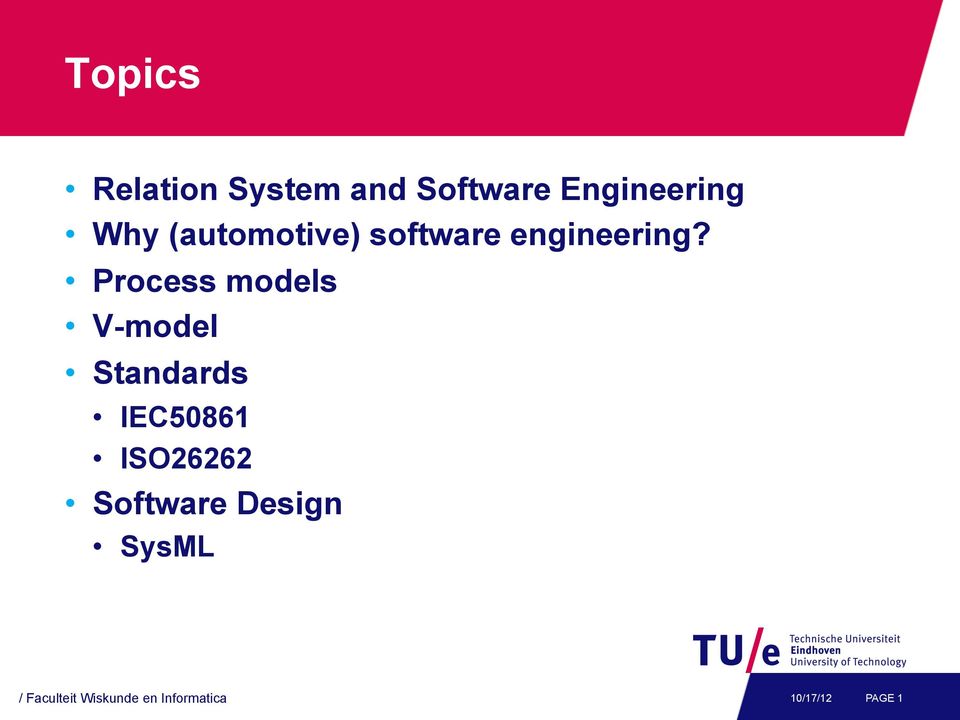
1 Topics Relation System and Software Engineering Why (automotive) software engineering? Process models V-model Standards IEC50861 ISO26262 Software Design SysML / Faculteit Wiskunde en Informatica 10/17/12 PAGE 1
2 Systems Engineering Systems engineering is the interdisciplinary field of engineering focusing on how complex engineering projects should be designed and managed over their life cycles / Faculteit Wiskunde en Informatica 10/17/12 PAGE 2

3 System Engineering (Embedded) software engineering is part of system engineering Functionality can be implemented in dedicated hardware and little software general purpose hardware with more software Consumer electronics moved form dedicated processors to general purpose processors from hardware to software / Faculteit Wiskunde en Informatica 10/17/12 PAGE 3

4 Why Software Engineering? The nature of software untrained people can hack something together quality problems are hard to notice software is easy to modify people make changes without fully understanding it software does not wear out it deteriorates by having its design changed: erroneously, or in ways that were not anticipated, thus making it complex / Faculteit Wiskunde en Informatica 10/17/12 PAGE 4

5 Why Automotive Software Engineering? Today cars have between 30 and 100 Electronic Control Units (ECU) connected by more than 5 different bus systems 10M-100M LOC more than 2000 functions are controlled by software Up to 40 % of the production costs of a car are due to electronics and software In 30 years the amount of software in cars went from 0 lines of code to more than 10,000,000 lines of code / Faculteit Wiskunde en Informatica 10/17/12 PAGE 5

6 Why Automotive Software Engineering? Embedded Software as Innovation Driver Software is today the most crucial innovation driver for technical systems, in general By software innovative functions are realized, new ways of implementing known functionality with reduced costs, less weight, less emission, or higher quality, energy and fuel is saved we combine functions and correlate them into multi-functional systems / Faculteit Wiskunde en Informatica 10/17/12 PAGE 6

7 What is Software Engineering? Large, high quality software systems software engineering techniques are needed because large systems cannot be completely understood by one person identification of missing quality aspects before building end-product must be of high quality teamwork and co-ordination are required key challenge: dividing up the work and ensuring that the parts of the system work properly together / Faculteit Wiskunde en Informatica 10/17/12 PAGE 7

8 What is Software Engineering? Cost, time and other constraints finite resources benefit must outweigh the cost Quality attributes: usability, efficiency, reliability, maintainability, reusability different qualities can conflict increasing efficiency can reduce maintainability increasing usability can reduce efficiency / Faculteit Wiskunde en Informatica 10/17/12 PAGE 8

9 Software Quality... Usability Users can learn it and fast and get their job done easily Efficiency It doesn t waste resources such as CPU time and memory Reliability It does what it is required to do without failing Maintainability It can be easily changed Reusability Its parts can be used in other projects, so reprogramming is not needed 9

10 What is Automotive Software Engineering? Today the engineering of software in cars is still in its infancy Lifecycle management of software in cars is in its early stage Many suppliers and even some OEMs are not even at Capability Maturity Model level 2 Reuse of solutions from one car to the next is insufficient and only done in a consequent way in some limited areas / Faculteit Wiskunde en Informatica 10/17/12 PAGE 10

11 What is Automotive Software Engineering? In many sub-domains the functionality from one car generation to the next is only changed and enhanced by 10% while more than 90% of the software is rewritten reason is a low level, hardware specific implementation, which makes it difficult to change, adopt, and port existing code amount of automation in software production for software in cars is quite low / Faculteit Wiskunde en Informatica 10/17/12 PAGE 11

12 What is Automotive Software Engineering? Process models: Capability Maturity Model Integration (CMMI) Software Process Improvement and Capability Determination (SPICE) V-Model Standards: IEC (Functional Safety standard) ISO26262 (Functional Safety standard) MISRA-C / Faculteit Wiskunde en Informatica 10/17/12 PAGE 12

13 Software process models Waterfall model Agile software development Prototyping Incremental development Rapid application development V-model / Faculteit Wiskunde en Informatica 10/22/12 PAGE 13

14 Software development models / Faculteit Wiskunde en Informatica 10/22/12 PAGE 14

15 Software development model Waterfall model requirements engineering V&V design V&V implementation V&V testing V&V maintenance V&V / Faculteit Wiskunde en Informatica 10/22/12 PAGE 15

16 Software development model Waterfall model Document oriented Suited for (very) large projects (> 50 people) Too many design activities during coding and testing / Faculteit Wiskunde en Informatica 10/22/12 PAGE 16

17 Software development model Comprehensive documentation ESA Life cycle: User Requirements Document Software Requirements Document Architectural Design Document Detailed Design Document Software Transfer Document Project History Document Software Project Management Plan Software Configuration Management Plan Software Validation and Verification Plan Software Quality Assurance Plan Meeting minutes Progress reports Feb

18 Software development model See Agile methods Individuals and interactions are more important than processes and tools Working software is more important than comprehensive documents Customer collaboration is more important than contract negotiation Responding to change is more important than following a plan / Faculteit Wiskunde en Informatica 10/22/12 PAGE 18

19 Software development model Processes and tools Fixed hierarchy, roles and team structure Many, many rules Management of process, not people Emphasis on process, not customer value / Faculteit Wiskunde en Informatica 10/22/12 PAGE 19

20 Software development model XP practices Co-location Self organizing teams Pair programming Collective code ownership / Faculteit Wiskunde en Informatica 10/22/12 PAGE 20

21 Software development model Working software User stories Unit testing Continuous build and integration / Faculteit Wiskunde en Informatica 10/22/12 PAGE 21
22 Software development model Customer collaboration Scrum: Prioritized backlog of user stories Must be accessible for questions Frequent delivery of working software Acceptance testing / Faculteit Wiskunde en Informatica 10/22/12 PAGE 22
23 Software development model / Faculteit Wiskunde en Informatica 10/22/12 PAGE 23
24 Software development model Agile methods No extensive architectural or design phase No energy spend on documentation / Faculteit Wiskunde en Informatica 10/22/12 PAGE 24
25 Software development model Extreme programming in practice: Planning game Small releases Metaphor Simple design Testing Refactoring Pair programming Collective ownership Continuous integration 40-hour week On-site customer Coding standards / Faculteit Wiskunde en Informatica 10/22/12 PAGE 25
26 Software development model requirements engineering Prototyping design design implementation implementation testing testing maintenance / Faculteit Wiskunde en Informatica 10/22/12 PAGE 26
27 Software development model Advantages of prototyping Resulting system is easier to use Resulting system has less features User needs are better accommodated Design is of higher quality Problems are detected earlier Resulting system is easier to maintain Development costs less effort / Faculteit Wiskunde en Informatica 10/22/12 PAGE 27
28 Software development model Disadvantages of prototyping Resulting system has more features Design is of lower quality Performance of resulting system is worse Resulting system is harder to maintain Team members should be more experienced / Faculteit Wiskunde en Informatica 10/22/12 PAGE 28
29 Software development model Prototyping Is useful in situations with unclear or ambiguous requirements Is useful in when emphasis is on user interface Users and designers must be aware of pitfalls Must planned and controlled / Faculteit Wiskunde en Informatica 10/22/12 PAGE 29
30 Software development model Incremental development / Faculteit Wiskunde en Informatica 10/22/12 PAGE 30
31 Software development model Incremental development First focusing on essential features Additional functionality is only included if needed Resulting systems are leaner but provide sufficient support to the user / Faculteit Wiskunde en Informatica 10/22/12 PAGE 31
32 Software development model Rapid application development (RAD) Similar to iterative development process models User involvement Prototyping Reuse Automated tools Small development teams Time boxing / Faculteit Wiskunde en Informatica 10/22/12 PAGE 32
33 Software development model RAD has four phases: Requirements planning Application design Construction Cutover (testing, training, installation) MoSCoW: Must haves Should haves Could haves Won t haves / Faculteit Wiskunde en Informatica 10/22/12 PAGE 33
34 Software development model V-model / Faculteit Wiskunde en Informatica 10/22/12 PAGE 34
35 Original V-model / Faculteit Wiskunde en Informatica 10/23/12 PAGE 35
36 V-model The Lifecycle Development V Model or V-model for short, is a framework or structure for undertaking the design, execution, and commissioning of a design project. It is called the V-model because of it s characteristic V shape. The left hand edge of the V is where the project is defined and specified in greater and greater detail. The bottom point of the V is the execution step of the project. The right-hand edge of the V is where the commissioning and qualification testing of the installed system is performed. The V-model provides a logical sequence that helps to organize the complex activities of defining a project scope, executing it, and qualifying it. The V-model creates a solid basis for testing the functionality of the system against the original design specs and proving that it does what it is supposed to do. / Faculteit Wiskunde en Informatica 10/23/12 PAGE 36
37 V-model V-Model is a systems development model designed to simplify the understanding of the complexity associated with developing systems In systems engineering it is used to define a uniform procedure for product or project development / Faculteit Wiskunde en Informatica 10/22/12 PAGE 37
38 V-model / Faculteit Wiskunde en Informatica 10/23/12 PAGE 38
39 V-model User Requirements Specification (URS) Meant to be a very high level view of the overall project drivers, in terms of the over-arching project objectives and the underlying business case. Should be phrased in strategic business terms. Should talk about total installed cost targets, resultant net capacity, it should discuss unit costs, cycle time, locations, raw materials, labor content. Should address all the critical issues that will ultimately influence whether or not the project is deemed a success or not. / Faculteit Wiskunde en Informatica 10/23/12 PAGE 39
40 V-model User Requirements Specification (URS) Functional Requirements Spec (FRS) is a subsection of the URS is reserved for the required functionality of the system. The FRS is also written from a very high level perspective, dealing more with overall capabilities rather than getting into specifics of how the system is to be operated. The URS/FRS should not contain specific design stipulations unless the client has already invested time money and/or resources toward achieving a very specific objective. / Faculteit Wiskunde en Informatica 10/23/12 PAGE 40
41 V-model Functional Design Specification (FDS) Prepared by a Vendor or Supplier in response to the URS. Should address all the elements of the URS, providing sufficient detail to indicate how vendor is planning on meeting all the user requirements. There are two flavors of FDS documents: One in which the project is being bid out competitively, and the other where the work has already been awarded or is being sole-sourced. The FDS provides a deeper layer of detail, so, in the first case, the FDS provides the client with the basis for comparing and evaluating the technical merit and cost parameters of the proposed solution. / Faculteit Wiskunde en Informatica 10/23/12 PAGE 41
42 V-model Functional Design Specification (FDS) In the second case, the FDS is intended to begin engaging the client in design details and decisions that will influence the final product. All major functionality aspects should be documented and agreed upon at the completion of the FDS. The completed, approved FDS will form the basis for design change control management. As functions and features are added or subtracted from the design scope, the URS / FRS and the FDS should be updated and re-issued to all involved members of the project team for impact analysis and possible re-costing of the job. / Faculteit Wiskunde en Informatica 10/23/12 PAGE 42
43 V-model Detailed Design Specification (DDS) Detailed Design Specs encompass all design documents produced by the Vendor or Supplier of services. DDS may be a single document or it may be the entire body of detailed design deliverables that are generated during the course of the design phase. At the time when the Detailed Design Specs are being prepared, the scope of work should be very clear and the detailed design is generated to fulfill and implement the features that were described in the Functional Design Spec. / Faculteit Wiskunde en Informatica 10/23/12 PAGE 43
44 V-model Design Qualification (DQ) The purpose of Design Qualification is to keep track of any changes that have occurred in the Design Specifications throughout the period of time that active design work has been going on. Specific items added to or deleted from the scope of the project must be picked up and carried backward through the appropriate design specs and requirements documents, as well as the appropriate qualification protocols. / Faculteit Wiskunde en Informatica 10/23/12 PAGE 44
45 V-model Design Qualification (DQ) A traceablity matrix is used for keeping track of all the design elements. It is appropriate to have at least one or more enhanced design reviews in which the traceability matrix is reviewed, along with drawings and/or other design documents, so that all involved parties are fully apprised of the status of the design. Other issues that should be addressed during the Enhanced Design Reviews include Constructability issues, Process Safety Management issues (PHA, HAZOP, FMEA, etc), Construction Safety Issues, Construction Coordination, Shutdown Management, and Commissioning Planning and Execution Strategy. / Faculteit Wiskunde en Informatica 10/23/12 PAGE 45
46 V-model Implementation Phase This is the phase of the project during which the actual physical work is performed. Construction of the equipment occurs during this phase, as does the programming of the software. Note that the Implementation Phase is the turning point of the V-model. At this point, all the tasks turn from specification of what is supposed to happen to verification of what actually happens. Very critical that any RFI and As-built information is recorded and worked back into the detailed design documents! / Faculteit Wiskunde en Informatica 10/23/12 PAGE 46
47 V-model Installation Qualification (IQ) This is the first of the qualification protocols that is executed during the start-up and commissioning phase of a project. The IQ ascertains and documents that the equipment that was ultimately installed is truly what was described by the design documents. It is often described as a hands in the pocket activity, in that no equipment is actually operated during IQ. Part numbers are verified off the original design drawings, parts lists, bills of materials, and the like. / Faculteit Wiskunde en Informatica 10/23/12 PAGE 47
48 V-model Installation Qualification (IQ) P&ID s are walked down in the field insuring that all piping runs match up with what is shown on the drawings. Note that the IQ protocol is directly across from the Detailed Design Spec, with an arrow between the two. This is meant to imply that the IQ Protocol is written directly from the Detailed Design Spec. Every element of the Detailed Design Spec should be listed and checked by the IQ. / Faculteit Wiskunde en Informatica 10/23/12 PAGE 48
49 V-model Operation Qualification (OQ) The OQ is the second qualification protocol that is executed in the start-up and commissioning phase of a project. During OQ, the equipment is operated to demonstrate that the performance parameters of the various pieces of equipment conform to the design parameters that were originally specified. Things like temperature, flow, and pressure ranges are checked and verified.. / Faculteit Wiskunde en Informatica 10/23/12 PAGE 49
50 V-model Operation Qualification (OQ) Accuracy and precision of these parameters and conformance to requirements are verified and documented. This can involve water batches, pilot runs, and not-forproduction runs. Note that the OQ protocol is directly across from the Functional Design Spec, with an arrow between the two. This is meant to imply that the OQ Protocol is written directly from the Functional Design Spec. Every element of the Functional Design Spec should be listed and checked by the OQ. / Faculteit Wiskunde en Informatica 10/23/12 PAGE 50
51 V-model Performance Qualification (PQ) The PQ is where the final functionality of the equipment is truly verified, in that product is actually made under production conditions, and the quality of the product is compared to the product specs. Generally, three consecutive batches are made as part of a Qualification run. All three batches must be within product specs in order for the Qualification to pass. Note that the PQ protocol is directly across from the User Requirements Doc, with an arrow between the two. This is meant to imply that the PQ Protocol is written directly from the User Requirements Doc. Every element of the User Requirements Doc should be listed and checked by the PQ. / Faculteit Wiskunde en Informatica 10/23/12 PAGE 51
52 V-model Underlying principles Independence of methods and tools Independence of organizations Separation into submodels Orientation to activities and products Adaptability of the model / Faculteit Wiskunde en Informatica 10/22/12 PAGE 52
53 V-model V-Model provides guidance for planning and realization of projects. Minimization of Project Risks: improves project transparency and project control by specifying standardized approaches and describing the corresponding results and responsible roles. permits an early recognition of planning deviations and risks and improves process management, thus reducing the project risk. Improvement and Guarantee of Quality: ensures that the results to be provided are complete and have the desired quality. defined interim results can be checked at an early stage. uniform product contents will improved readability, understandability and verifiability. / Faculteit Wiskunde en Informatica 10/22/12 PAGE 53
54 V-model V-Model provides guidance for planning and realization of projects. Reduction of Total Cost over the Entire Project and System Life Cycle: effort for the development, production, operation and maintenance of a system can be calculated, estimated and controlled in a transparent manner results obtained are uniform and easily retraced. Improvement of Communication between all Stakeholders: standardized and uniform description of all relevant elements and terms is the basis for the mutual understanding between all stakeholders / Faculteit Wiskunde en Informatica 10/22/12 PAGE 54
55 V-model The value of standardization Reduction of cost in the entire lifecycle Improvement of software quality Better communication between customer and contractor Regulations on 3 levels Procedure (what) Allocation of methods (how) Functional tool requirements (what) / Faculteit Wiskunde en Informatica 10/22/12 PAGE 55
56 V-model All levels of the regulations are structured according to activity areas Systems development Quality assurance Configuration management Project management Development standard developed for each area. / Faculteit Wiskunde en Informatica 10/22/12 PAGE 56
57 V-model Refines high-level system architectures, decomposes these into smaller components, finally leading to system realization Requires many design decisions, covering multiple disciplines and multiple concerns, such as: Performance Reliability Evolvability resource usage energy usage costs / Faculteit Wiskunde en Informatica 10/23/12 PAGE 57
58 V-model Testing & Integration = composition, i.e., combining and checking components T&I is expensive, timeconsuming (30-70%), with sub-optimal quality results / Faculteit Wiskunde en Informatica 10/23/12 PAGE 58
59 V-model Procedure What has to be done: Activities to be carried out Results that have to be produced Content of the results Roles Lifecycle process model / Faculteit Wiskunde en Informatica 10/22/12 PAGE 59
60 V-model Tailoring No important document is forgotten Tailoring relevant for tendering Selection of the necessary activities and products Deletion conditions The resulting subset of the Lifecycle is put together in the Project Manual Technical Tailoring Adapting to conditions during the course of the project / Faculteit Wiskunde en Informatica 10/22/12 PAGE 60
61 V-model / Faculteit Wiskunde en Informatica 10/22/12 PAGE 61
62 V-model Software development SD1-System Req. analysis Description of the requirements of the system and its environment, Risk Analysis, and User requirements SD2 System design Segmentation of the system into SW/HW SD3-SW/HW requirement analysis Detail Technical Requirements SD4-Preliminary SW design Structuring of the interfaces and interaction of SW components / Faculteit Wiskunde en Informatica 10/23/12 PAGE 62
63 V-model Software development SD5-Detailed SW design Description of functionality, Data administration and error handling of SWC SD6-SW implementation Coding in chosen programming language SD7-SW integration Integration of modules SD8-System integration Integration of SW and HW components SD9-Transition to utilization Activities for Deployment into Production / Faculteit Wiskunde en Informatica 10/23/12 PAGE 63
64 V-model System System Requirements System Design System Integration Plan SWD 1 System Requirements Analysis and Design SWD 9 System Integration DP Requirements DP Design DP Integration Plan SWD 2 DP Requirements Analysis and Desgin SWD 8 DP Integration Segment Manual Information SW Requirements SWD 3 SW Requirements Analysis SWCI Integration Program Documents (SWCI) SWD 7 SWCI SW Architecture Interface Design SWCI Integration Plan SWD 4 Preliminary Design SW Integration Component Integration Program Documents (Component) Component Data-Dictionary SW Design SWD 5 Detailed Design Program Documents (Module) SWD 6 Module Implementation / Faculteit Wiskunde en Informatica 10/23/12 PAGE 64 Legend: Proof activities (see QA) SWD Activity
65 V-model Quality assurance QA1-Initialization Generated the QA and Assessment Plan QA2-Assessment Preparation Generation of unambiguous Assessment specification and procedures & Req. of Assessment Environment QA3-Process Assessment of Activities Specified procedures were adhered to during the realization of an activity QA4-Product Assessment Assessment with respect to the formal criteria & the contents of the product. Assessment Report generated. QA5-Reporting Assessment Reports are assessed in regular intervals and the results submitted to PM. / Faculteit Wiskunde en Informatica 10/23/12 PAGE 65
66 V-model Configuration management CM1-CM Initialization Generation of the CM plan and setting of the CM resources CM2-Product and CM Administration of products, configurations and rights CM3-Change Management Controlled artifacts are recorded and administered CM4-CM Services General services (e.g Product Catalog) / Faculteit Wiskunde en Informatica 10/23/12 PAGE 66
67 V-model Project management PM1-Project Initialization PM2-Placement/Procurement PM3-Contractor Management PM4-Detailed Planning PM5-Cost/Benefit Analysis PM6-Phase Review PM7-Risk Management / Faculteit Wiskunde en Informatica 10/23/12 PAGE 67
68 V-model Project management PM8-Project Control PM9-Information Service/Reporting PM10-Training/Instruction PM11-Supplying Resources PM12-Allocation of Work Orders PM13-Staff Training PM14-Project Completion Final Project Report / Faculteit Wiskunde en Informatica 10/23/12 PAGE 68
69 V-model / Faculteit Wiskunde en Informatica 10/23/12 PAGE 69
70 V-model Tool requirements What is to be used to do something: Functional characteristics must the tools have Introduces the Software Development Environment User Interface Work flow management Security and integrity requirements Software development Quality assurance Configuration Management Project Management Use for: Selection of tools Evaluation Further development of tools / Faculteit Wiskunde en Informatica 10/23/12 PAGE 70
71 V-model and CMM / Faculteit Wiskunde en Informatica 10/23/12 PAGE 71
72 V-model What s it good for? The original mission of the V-model was to impart a high degree of quality assurance in the development efforts for the design of automated systems and the creation of the associated software programming. The primary goal of the guideline was to establish the roles and responsibilities of the involved parties, and to create strong links between the project specifications and the acceptance testing done at the end of the project. The basic elements and techniques of the V-model apply to virtually all engineering projects, not just automation and software! / Faculteit Wiskunde en Informatica 10/23/12 PAGE 72
73 V-model What are the Benefits? The V model creates a tight linkage between the design specifications and the subsequent test protocols and methods used during start up. Using the v-model virtually assures that the project, as installed, will fulfill the objectives that were intended for it. By using the v-model, the project design is documented thoroughly and fully capable of being validated. Lastly, the V model provides an excellent basis for design control and tracking design changes through the proceeding of the project. / Faculteit Wiskunde en Informatica 10/23/12 PAGE 73
74 Standards Most important requirement in Automotive: A vehicle should not harm its passengers or (people in) its environment IEC (Functional Safety standard) ISO26262 (Functional Safety standard) / Faculteit Wiskunde en Informatica 10/17/12 PAGE 74
75 Standards IEC (Functional Safety standard) Categories of likelihood of occurrence Category Definition Range (failures per year Frequent Many times in system lifetime > 10-3 Probable Several times in system lifetime 10-3 to 10-4 Occasional Once times in system lifetime 10-4 to 10-5 Remote Unlikely times in system lifetime 10-5 to 10-6 Improbable Very unlikely to occur 10-6 to 10-7 Incredible Cannot believe that it could occur < 10-7 / Faculteit Wiskunde en Informatica 10/17/12 PAGE 75
76 Standards IEC (Functional Safety standard) Consequence categories Category Catastrophic Critical Marginal Negligible Definition Multiple loss of life Loss of a single life Major injuries to one or more persons Minor injuries at worst / Faculteit Wiskunde en Informatica 10/17/12 PAGE 76
77 Standards IEC (Functional Safety standard) These are typically combined into a risk class matrix Consequence Likelihood Catastrophic Critical Marginal Negligible Frequent I I I II Probable I I II III Occasional I II III III Remote II III III IV Improbable III III IV IV Incredible IV IV IV IV / Faculteit Wiskunde en Informatica 10/17/12 PAGE 77
78 Standards IEC (Functional Safety standard) Categories in risk class matrix Class I: Unacceptable in any circumstance; Class II: Undesirable: tolerable only if risk reduction is impracticable or if the costs are grossly disproportionate to the improvement gained; Class III: Tolerable if the cost of risk reduction would exceed the improvement; Class IV: Acceptable as it stands, though it may need to be monitored. / Faculteit Wiskunde en Informatica 10/17/12 PAGE 78
79 Standards Safety Integrity Level is determined primarily from the assessment of three factors: 1. Improved reliability 2. Failure to safety 3. Management, Systematic Techniques, Verification and Validation SIL refers to a single method of reducing injury (as determined through risk analysis), not an entire system, nor an individual component / Faculteit Wiskunde en Informatica 10/17/12 PAGE 79
80 Standards Improved Reliability For systems that operate continuously (continuous mode) the allowable frequency of failure must be determined For systems that operate more than once a year (high demand) the allowable frequency of failure must be determined For systems that operate intermittently (less than once a year / low demand) the probability of failure is specified as the probability that the system will fail to respond on demand / Faculteit Wiskunde en Informatica 10/17/12 PAGE 80
81 Standards Failure to Safety Calculation of safe failure fraction (SFF) determines how Failsafe the system is Management, Systematic Techniques, Verification and Validation Specific techniques ensure that mistakes and errors are avoided across the entire life-cycle. Errors introduced anywhere from the initial concept, risk analysis, specification, design, installation, maintenance and through to disposal could undermine even the most reliable protection / Faculteit Wiskunde en Informatica 10/17/12 PAGE 81
82 Standards ISO is the adaptation of IEC to comply with needs specific to the application sector of E/E systems within road vehicles: Provides an automotive safety lifecycle (management, development, production, operation, service, decommissioning) and supports tailoring the necessary activities during these lifecycle phases. Provides an automotive-specific risk-based approach for determining risk classes (Automotive Safety Integrity Levels, ASILs). / Faculteit Wiskunde en Informatica 10/17/12 PAGE 82
83 Standards / Faculteit Wiskunde en Informatica 10/17/12 PAGE 83
84 Standards IEC ISO Part 1: General requirements Part 1: Vocabulary Part 2: Requirements for electrical/electronic/ programmable electronic safety-related systems Part 3: Software requirements Part 4: Definitions and abbreviations Part 5: Examples of methods for the determination of safety integrity levels Part 6: Guidelines on the application of parts 2 and 3 Part 7: Overview of techniques and measures Part 2: Management of functional safety Part 3: Concept phase Part 4: Product Development: System Level Part 5: Product Development: Hardware Level Part 6: Product Development: Software Level Part 7: Production and Operation Part 8: Supporting Processes Part 9: ASIL-orientated and safety-oriented analysis Part 10: Guideline / Faculteit Wiskunde en Informatica 10/17/12 PAGE 84
85 Standards ASIL ISO replaces SILs with ASILs (Automotive Safety Integrity Levels) ASILs designed to specify the measures required to avoid unreasonable residual risk ASIL levels A-D, with D being the most demanding Risk of each hazardous event is evaluated on the basis of: Frequency of the situation (or exposure ) Impact of possible damage (or severity ) Controllability / Faculteit Wiskunde en Informatica 10/17/12 PAGE 85
86 Standards ISO 26262: Uses ASILs for specifying the item's necessary safety requirements for achieving an acceptable residual risk. Provides requirements for validation and confirmation measures to ensure a sufficient and acceptable level of safety is being achieved. Covers functional safety aspects of the entire development process (including such activities as requirements specification, design, implementation, integration, verification, validation, and configuration). / Faculteit Wiskunde en Informatica 10/17/12 PAGE 86
87 Standards Specification of the Technical Safety Requirements in ISO26262 Objective is to develop the technical safety requirements, which refine the functional safety concept considering the preliminary architectural design. To verify through analysis that technical safety requirements comply to the functional safety requirements. To bring item-level functional safety requirements into system-level technical safety requirements, down to the allocation to hardware and software elements. Requirements Engineering of this nature requires additional initial effort but benefits will be obtained whenever changes are required. / Faculteit Wiskunde en Informatica 10/17/12 PAGE 87
88 Standards System Design To develop the system design and the technical safety concepts that comply with the functional requirements and the technical safety requirements specification. Verify the system design and technical safety concept comply with technical safety requirements specification. Need to have bidirectional traceability between system design and technical safety requirements specification. / Faculteit Wiskunde en Informatica 10/17/12 PAGE 88
89 Standards Item integration and testing To integrate the different parts that compose the system, included other technologies and/or external entities, and to test the obtained product to comply with each safety requirement and to verify that the design has been correctly implemented. The integration and testing is carried out from softwarehardware integration, and going through integration of systems up to vehicle integration, with specific tests performed at each integration phase. Each functional and technical safety requirements shall be tested at least once in the complete integration phase. / Faculteit Wiskunde en Informatica 10/17/12 PAGE 89
90 Standards Item integration and testing Each functional and technical safety requirements shall be tested at least once in the complete integration phase. / Faculteit Wiskunde en Informatica 10/17/12 PAGE 90
91 Standards Safety Validation To provide evidence of due compliance with the functional safety goals and that the safety concepts are appropriate for the functional safety of the item. To provide evidence that the safety goals are correct, complete and fully achieved at vehicle level. The validation plan shall include: 1. The configuration of the item 2. The specification of test cases and acceptance criteria 3. The required environmental conditions / Faculteit Wiskunde en Informatica 10/17/12 PAGE 91
92 Standards Functional safety assessment To assess the functional safety that is achieved by the item. / Faculteit Wiskunde en Informatica 10/17/12 PAGE 92
93 Standards Release for production To specify the criteria for the release for production at the completion of the item development. The release for production confirms that the item complies with the requirements for functional safety at vehicle level. The documentation shall include a) the name and signature of the person in charge of release b) the version/s of the released item c) the configuration of the released item d) references to associated documents e) the release date / Faculteit Wiskunde en Informatica 10/17/12 PAGE 93
94 Standards Product Development Software Level ISO (Part 6) refers more specifically to the development of software, particularly: Initiation of product development at the software level Derivation of software safety requirements from the system level (following from part 4) and their subsequent verification Software architectural design Software unit design and implementation Software unit testing, and Software integration and testing / Faculteit Wiskunde en Informatica 10/17/12 PAGE 94
95 Standards Initiation of Product Development at Software Level To plan and initiate the functional safety activities for the sub phases of the software development / Faculteit Wiskunde en Informatica 10/17/12 PAGE 95
96 Standards Modeling and Coding Guidelines To support the correctness of the design and implementation, the design and coding guidelines for the modeling, or programming languages, shall address following topics: / Faculteit Wiskunde en Informatica 10/17/12 PAGE 96
97 Standards Specification of Software Safety Requirements To specify the software safety requirements which are derived from technical safety concept and system design to detail hardware-software requirements and verify that the software safety requirements are consistent with the technical safety concept and the system design specification The technical safety requirements are divided into hardware and software safety requirements. The specification of the software safety requirements considers constraints of the hardware and the impact of these constraints on the software. / Faculteit Wiskunde en Informatica 10/17/12 PAGE 97
98 Standards Verification of Software Safety Requirements A verification activity shall be performed to demonstrate that the software safety requirements are traceable with the technical safety requirements, the system design and consistent with the relevant parts of the hardware safety requirements achieving complete traceability. / Faculteit Wiskunde en Informatica 10/17/12 PAGE 98
99 Standards Software Design To develop a software architectural design that realizes the software safety requirements and verify the software architectural design achieving bi-directional traceability The software architectural design represents all software components and their interactions with one another in a hierarchical structure. / Faculteit Wiskunde en Informatica 10/17/12 PAGE 99
100 Standards Software Design The software architectural design shall exhibit Modularity Encapsulation Minimum complexity / Faculteit Wiskunde en Informatica 10/17/12 PAGE 100
101 Standards Verification of Architectural Design The software architectural design shall be verified by using the following software architectural design verification methods: / Faculteit Wiskunde en Informatica 10/17/12 PAGE 101
102 Standards Software Unit design & implementation To specify the software units in accordance with the SW architectural design and the associated SW safety requirements, to implement the software units as specified and to verify the design of the SW units and implementation. The specification of the software units shall describe the functional behavior and the internal design. The design and implementation of software unit shall achieve Avoidance of unnecessary complexity Testability Maintainability / Faculteit Wiskunde en Informatica 10/17/12 PAGE 102
103 Standards Software Unit Design The design principles for software unit design and implementation shall be applied to follow below properties Correct execution order Interface consistency Correct data/control flow Simplicity Readability and comprehensibility Robustness Change suitability Testability / Faculteit Wiskunde en Informatica 10/17/12 PAGE 103
104 Standards Software Unit Design / Faculteit Wiskunde en Informatica 10/17/12 PAGE 104
105 Standards Verification of software unit design and implementation The software unit design and implementation shall be verified to demonstrate Compliance with the hardware software interface Completeness regarding the software safety requirements and the software architecture through traceability Compliance of the source code with its specification Compliance of the source code with the coding guidelines Compatibility of the software unit implementations with target hardware. / Faculteit Wiskunde en Informatica 10/17/12 PAGE 105
106 Standards Software Unit Testing Software units fulfill the software unit specifications and do not contain undesired functionality. The following testing methods can be used for proving compliance with specification and Hardware Software interface, correct implementation, absence of unintended functionality, robustness, and sufficiency of the resources / Faculteit Wiskunde en Informatica 10/17/12 PAGE 106
107 Standards SW integration & Testing To integrate the software components and demonstrate that the software architectural design is correctly realised by the embedded software. Integrated software tested against architectural design and interfaces between the software units and the software component. Software integration test shall demonstrate Compliance with the software architectural design Compliance with the specification of the hardware-software interface Correct implementation of the functionality Robustness Sufficiency of the resources to support the functionality. / Faculteit Wiskunde en Informatica 10/17/12 PAGE 107
108 Standards Verification of SW safety requirements To demonstrate that the embedded software fulfills the software safety requirements and embedded software satisfies its requirements in the target environment. The results of the verification of the software safety requirements shall be evaluated in accordance with: Compliance with the expected results Coverage of the software safety requirements Pass or fail criteria / Faculteit Wiskunde en Informatica 10/17/12 PAGE 108
109 Software Design V model for software development / Faculteit Wiskunde en Informatica 10/17/12 PAGE 109
110 Software Design Definition: Design is a problem-solving process whose objective is to find and describe a way: To implement the system s functional requirements... While respecting the constraints imposed by the quality, platform and process requirements... including the budget And while adhering to general principles of good quality / Faculteit Wiskunde en Informatica 10/17/12 PAGE 110
111 Software Design Design as a series of decisions A designer is faced with a series of design issues These are sub-problems of the overall design problem Each issue normally has several alternative solutions: design options: software vs hardware The designer makes a design decision to resolve each issue Process involves choosing best option from alternatives / Faculteit Wiskunde en Informatica 10/17/12 PAGE 111
112 Software Design To make each design decision, the software engineer uses knowledge of the requirements the design as created so far the technology available software design principles and best practices what has worked well in the past / Faculteit Wiskunde en Informatica 10/17/12 PAGE 112
113 Software Design / Faculteit Wiskunde en Informatica 10/23/12 PAGE 113
114 Software Design System: A logical entity, having a set of definable responsibilities or objectives, and consisting of hardware, software or both. A system can have a specification which is then implemented by a collection of components. A system continues to exist, even if its components are changed or replaced. The goal of requirements analysis is to determine the responsibilities of a system. Subsystem: A system that is part of a larger system, and which has a definite interface / Faculteit Wiskunde en Informatica 10/17/12 PAGE 114
115 Software Design Component: Any piece of software or hardware that has a clear role A component can be isolated, allowing you to replace it with a different component that has equivalent functionality Many components are designed to be reusable Conversely, others perform special-purpose functions Module: A component that is defined at the PL level For example: classes and packages are modules in Java Function: Unit at programming level with specific behaviour For example: methods in Java, functions in C / Faculteit Wiskunde en Informatica 10/17/12 PAGE 115
116 Software Design Top-down design First design the very high level structure of the system. Then gradually work down to detailed decisions about lowlevel constructs. Finally arrive at detailed decisions such as: the format of particular data items; the individual algorithms that will be used. / Faculteit Wiskunde en Informatica 10/17/12 PAGE 116
117 Software Design Bottom-up design Make decisions about reusable low-level utilities. Then decide how these will be put together to create highlevel constructs. A mix of top-down and bottom-up approaches are normally used: Top-down design is almost always needed to give the system a good structure. Bottom-up design is normally useful so that reusable components can be created. / Faculteit Wiskunde en Informatica 10/17/12 PAGE 117
118 Software Design Architecture design: The division into subsystems and components, How these will be connected How they will interact Their interfaces. Class design: The various features of classes User interface design Algorithm design: The design of computational mechanisms Protocol design: The design of communications protocol / Faculteit Wiskunde en Informatica 10/17/12 PAGE 118
119 Software Design System modeling / Faculteit Wiskunde en Informatica 10/17/12 PAGE 119
120 Software Design Model Based Systems Engineering benefits Shared understanding of system requirements and design Validation of requirements Common basis for analysis and design Facilitates identification of risks Assists in managing complex system development Separation of concerns via multiple views of integrated model Supports traceability through hierarchical system models Facilitates impact analysis of requirements and design changes Supports incremental development & evolutionary acquisition / Faculteit Wiskunde en Informatica 10/17/12 PAGE 120
121 Software Design Model Based Systems Engineering Benefits Improved design quality Reduced errors and ambiguity More complete representation Supports early and on-going verification & validation to reduce risk Provides value through life cycle (e.g., training) Enhances knowledge capture / Faculteit Wiskunde en Informatica 10/17/12 PAGE 121
122 Software Design What is SysML? A graphical modeling language in response to the UML for Systems Engineering developed by the a.o. OMG a UML Profile that represents a subset of UML 2 with extensions Supports the specification, analysis, design, verification, and validation of systems that include hardware, software, data, personnel, procedures, and facilities Supports model and data interchange via XML Metadata Interchange (XMI) SysML is an enabler for Model Driven SE / Faculteit Wiskunde en Informatica 10/17/12 PAGE 122
123 Software Design What is SysML? Is a visual modeling language that provides Semantics = meaning Notation = representation of meaning Is not a methodology or a tool SysML is methodology and tool independent / Faculteit Wiskunde en Informatica 10/17/12 PAGE 123
124 Software Design Reuse of UML 2.0 for SysML / Faculteit Wiskunde en Informatica 10/17/12 PAGE 124
125 Software Design SysML Taxonomy of Diagrams [1] Modified UML Class Diagram [2] Enhanced UML Composite Structure Diagram / Faculteit Wiskunde en Informatica 10/17/12 PAGE 125
126 Software Design Four pillars of SysML / Faculteit Wiskunde en Informatica 10/17/12 PAGE 126
127 V-model for system of systems / Faculteit Wiskunde en Informatica 10/23/12 PAGE 127
Vragen. Software development model. Software development model. Software development model
 Vragen Noem de belangrijkste activiteiten in een software engineeringsproject Welke vormen van onderhoud kan men onderscheiden? Karakteriseer het waterval model Waterfall model Document oriented Suited
Introduction of ISO/DIS 26262 (ISO 26262) Parts of ISO 26262 ASIL Levels Part 6 : Product Development Software Level
 ISO 26262 the Emerging Automotive Safety Standard Agenda Introduction of ISO/DIS 26262 (ISO 26262) Parts of ISO 26262 ASIL Levels Part 4 : Product Development System Level Part 6 : Product Development
1.1 The Nature of Software... Object-Oriented Software Engineering Practical Software Development using UML and Java. The Nature of Software...
 1.1 The Nature of Software... Object-Oriented Software Engineering Practical Software Development using UML and Java Chapter 1: Software and Software Engineering Software is intangible Hard to understand
Questions? Assignment. Techniques for Gathering Requirements. Gathering and Analysing Requirements
 Questions? Assignment Why is proper project management important? What is goal of domain analysis? What is the difference between functional and non- functional requirements? Why is it important for requirements
Software Development Life Cycle (SDLC)
 Software Development Life Cycle (SDLC) Supriyo Bhattacharjee MOF Capability Maturity Model (CMM) A bench-mark for measuring the maturity of an organization s software process CMM defines 5 levels of process
A Capability Maturity Model (CMM)
 Software Development Life Cycle (SDLC) and Development Methods There are some enterprises in which a careful disorderliness is the true method. Herman Melville Capability Maturity Model (CMM) A Capability
IEC 61508 Overview Report
 IEC 61508 Overview Report A Summary of the IEC 61508 Standard for Functional Safety of Electrical/Electronic/Programmable Electronic Safety-Related Systems exida Sellersville, PA 18960, USA +1-215-453-1720
What is Automotive Software Engineering? What is Automotive Software Engineering? What is Automotive Software Engineering?
 Process models: Capability Maturity Model Integration (CMMI) Software Process Improvement and Capability Determination (SPICE) V-Model Standards: MISRA-C standard AUTOSAR Configuration management Product
Establishing Great Software Development Process(es) for Your Organization. By Dale Mayes [email protected]
 Establishing Great Software Development Process(es) for Your Organization By Dale Mayes [email protected] Class: ETP-410 Embedded Systems Conference San Francisco 2005 Abstract: There are
Engineering Process Software Qualities Software Architectural Design
 Engineering Process We need to understand the steps that take us from an idea to a product. What do we do? In what order do we do it? How do we know when we re finished each step? Production process Typical
Reduce Medical Device Compliance Costs with Best Practices. [email protected]
 Reduce Medical Device Compliance Costs with Best Practices [email protected] 1 Agenda Medical Software Certification How new is Critical Software Certification? What do we need to do? What Best Practises
3SL. Requirements Definition and Management Using Cradle
 3SL Requirements Definition and Management Using Cradle November 2014 1 1 Introduction This white paper describes Requirements Definition and Management activities for system/product development and modification
ISO 26262 Functional Safety Draft International Standard for Road Vehicles: Background, Status, and Overview
 ISO 26262 Functional Safety Draft International Standard for Road Vehicles: Background, Status, and Overview Barbara J. Czerny, Joseph D Ambrosio, Rami Debouk, General Motors Research and Development Kelly
University of Paderborn Software Engineering Group II-25. Dr. Holger Giese. University of Paderborn Software Engineering Group. External facilities
 II.2 Life Cycle and Safety Safety Life Cycle: The necessary activities involving safety-related systems, occurring during a period of time that starts at the concept phase of a project and finishes when
Requirements-driven Verification Methodology for Standards Compliance
 Requirements-driven Verification Methodology for Standards Compliance Serrie-justine Chapman (TVS) [email protected] Mike Bartley (TVS) [email protected] Darren Galpin (Infineon)
2. Analysis, Design and Implementation
 2. Subject/Topic/Focus: Software Production Process Summary: Software Crisis Software as a Product: From Individual Programs to Complete Application Systems Software Development: Goals, Tasks, Actors,
ELECTROTECHNIQUE IEC INTERNATIONALE 61508-3 INTERNATIONAL ELECTROTECHNICAL
 61508-3 ª IEC: 1997 1 Version 12.0 05/12/97 COMMISSION CEI ELECTROTECHNIQUE IEC INTERNATIONALE 61508-3 INTERNATIONAL ELECTROTECHNICAL COMMISSION Functional safety of electrical/electronic/ programmable
Your Software Quality is Our Business. INDEPENDENT VERIFICATION AND VALIDATION (IV&V) WHITE PAPER Prepared by Adnet, Inc.
 INDEPENDENT VERIFICATION AND VALIDATION (IV&V) WHITE PAPER Prepared by Adnet, Inc. February 2013 1 Executive Summary Adnet is pleased to provide this white paper, describing our approach to performing
How to Upgrade SPICE-Compliant Processes for Functional Safety
 How to Upgrade SPICE-Compliant Processes for Functional Safety Dr. Erwin Petry KUGLER MAAG CIE GmbH Leibnizstraße 11 70806 Kornwestheim Germany Mobile: +49 173 67 87 337 Tel: +49 7154-1796-222 Fax: +49
Software Development Process
 Software Development Process A software development process, also known as software development lifecycle, is a structure imposed on the development of a software product. Similar terms include software
R214 SPECIFIC REQUIREMENTS: INFORMATION TECHNOLOGY TESTING LABORATORY ACCREDITATION PROGRAM
 The American Association for Laboratory Accreditation Document Revised: R214: Specific Requirements: Information Technology Testing Laboratory Accreditation July 13, 2010 Program Page 1 of 26 R214 SPECIFIC
SysML Modelling Language explained
 Date: 7 th October 2010 Author: Guillaume FINANCE, Objet Direct Analyst & Consultant UML, the standard modelling language used in the field of software engineering, has been tailored to define a modelling
Best-Practice Software Engineering: Software Processes to Support Project Success. Dietmar Winkler
 Best-Practice Software Engineering: Software Processes to Support Project Success Dietmar Winkler Vienna University of Technology Institute of Software Technology and Interactive Systems [email protected]
IEC 61508 Functional Safety Assessment. Project: K-TEK Corporation AT100, AT100S, AT200 Magnetostrictive Level Transmitter.
 61508 SIL 3 CAPABLE IEC 61508 Functional Safety Assessment Project: K-TEK Corporation AT100, AT100S, AT200 Magnetostrictive Level Transmitter Customer: K-TEK Corporation Prairieville, LA USA Contract No.:
Testing Automated Manufacturing Processes
 Testing Automated Manufacturing Processes (PLC based architecture) 1 ❶ Introduction. ❷ Regulations. ❸ CSV Automated Manufacturing Systems. ❹ PLCs Validation Methodology / Approach. ❺ Testing. ❻ Controls
CSE 435 Software Engineering. Sept 16, 2015
 CSE 435 Software Engineering Sept 16, 2015 2.1 The Meaning of Process A process: a series of steps involving activities, constraints, and resources that produce an intended output of some kind A process
The V-Model. Prepared for. Prepared by. Christian Bucanac [email protected] Software Engineering Student, University Of Karlskrona/Ronneby
 Course: Quality Management, DPT404 Teacher: Conny Johansson Department: IDE, University Of Karlskrona/Ronneby The V-Model Prepared for Conny Johansson [email protected] IDE, University Of Karlskrona/Ronneby
6. Software Lifecycle Models. A software lifecycle model is a standardised format for planning organising, and running a new development project.
 6. Software Lifecycle Models A software lifecycle model is a standardised format for planning organising, and running a new development project. Hundreds of different kinds of models are known and used.
Syllabus. REQB Certified Professional for Requirements Engineering. Advanced Level Requirements Manager
 Syllabus REQB Certified Professional for Requirements Engineering Requirements Manager Version 1.0 2011 The copyright to this edition of the syllabus in all languages is held by the Global Association
Using Simulation to teach project management skills. Dr. Alain April, ÉTS Montréal [email protected]
 Using Simulation to teach project management skills Dr. Alain April, ÉTS Montréal [email protected] Agenda of the workshop 1 The software project management theory overview (40 minutes) 2 Why use SDLC
The Software Process. The Unified Process (Cont.) The Unified Process (Cont.)
 The Software Process Xiaojun Qi 1 The Unified Process Until recently, three of the most successful object-oriented methodologies were Booch smethod Jacobson s Objectory Rumbaugh s OMT (Object Modeling
Agile Software Development Methodologies and Its Quality Assurance
 Agile Software Development Methodologies and Its Quality Assurance Aslin Jenila.P.S Assistant Professor, Hindustan University, Chennai Abstract: Agility, with regard to software development, can be expressed
Clinical Risk Management: Agile Development Implementation Guidance
 Document filename: Directorate / Programme Document Reference NPFIT-FNT-TO-TOCLNSA-1306.02 CRM Agile Development Implementation Guidance v1.0 Solution Design Standards and Assurance Project Clinical Risk
Fundamentals of Measurements
 Objective Software Project Measurements Slide 1 Fundamentals of Measurements Educational Objective: To review the fundamentals of software measurement, to illustrate that measurement plays a central role
Karunya University Dept. of Information Technology
 PART A Questions 1. Mention any two software process models. 2. Define risk management. 3. What is a module? 4. What do you mean by requirement process? 5. Define integration testing. 6. State the main
Development of AUTOSAR Software Components within Model-Based Design
 2008-01-0383 Development of AUTOSAR Software Components within Model-Based Design Copyright 2008 The MathWorks, Inc. Guido Sandmann Automotive Marketing Manager, EMEA The MathWorks Richard Thompson Senior
Introduction into IEC 62304 Software life cycle for medical devices
 Introduction into IEC 62304 Software life cycle for medical devices Christoph Gerber 4. September 2008 SPIQ 9/5/2008 1 Agenda Current Picture Regulatory requirements for medical device software IEC 62304
How To Write An Slcm Project Plan
 SLCM 2003.1 Artifacts in a Nutshell ( as of 01/21/2005) Project Development Phases Pension Benefit Guaranty Corporation s (PBGC) System Life Cycle Methodology (SLCM) is comprised of five project development
Rapid software development. Ian Sommerville 2004 Software Engineering, 7th edition. Chapter 17 Slide 1
 Rapid software development Ian Sommerville 2004 Software Engineering, 7th edition. Chapter 17 Slide 1 Objectives To explain how an iterative, incremental development process leads to faster delivery of
Component-based Development Process and Component Lifecycle Ivica Crnkovic 1, Stig Larsson 2, Michel Chaudron 3
 Component-based Development Process and Component Lifecycle Ivica Crnkovic 1, Stig Larsson 2, Michel Chaudron 3 1 Mälardalen University, Västerås, Sweden, [email protected] 2 ABB Corporate Research,
2. Analysis, Design and Implementation
 2. Analysis, Design and Implementation Subject/Topic/Focus: Software Production Process Summary: Software Crisis Software as a Product: From Programs to Application Systems Products Software Development:
Advanced Software Engineering. Software Development Processes
 Agent and Object Technology Lab Dipartimento di Ingegneria dell Informazione Università degli Studi di Parma Advanced Software Engineering Software Development Processes Prof. Agostino Poggi Software Development
Basic Trends of Modern Software Development
 DITF LDI Lietišķo datorsistēmu programmatūras profesora grupa e-business Solutions Basic Trends of Modern Software Development 2 3 Software Engineering FAQ What is software engineering? An engineering
Agile methods. Objectives
 Agile methods CMSC435-1 Objectives To explain how an iterative, incremental development process leads to faster delivery of more useful software To discuss the essence of agile development methods To explain
Lean and Agile in Safety-critical Software Development Research and Practice. Henrik Jonsson 21.05.2014
 Lean and Agile in Safety-critical Software Development Research and Practice Henrik Jonsson 21.05.2014 About me 2012 Henrik Jonsson Professional Software engineer +13 years Employed by Etteplan Part-time
An integrated approach to implement system engineering and safety engineering processes: SASHA Project
 An integrated approach to implement system engineering and safety engineering processes: SASHA Project Hycham Aboutaleb 1,2, Mohamed Bouali 1, Morayo Adedjouma 3, Emilia Suomalainen 1 1 Knowledge Inside,
Software Life Cycle. Main issues: Discussion of different life cycle models Maintenance or evolution
 Software Life Cycle Main issues: Discussion of different life cycle models Maintenance or evolution Not this life cycle SE, Software Lifecycle, Hans van Vliet, 2008 2 Introduction software development
Functional Safety Management: As Easy As (SIL) 1, 2, 3
 Functional Safety Management: As Easy As (SIL) 1, 2, 3 Abstract This paper outlines the need for planning in functional safety management. Recent events such as the Montara blowout and the Deepwater Horizon
The Role of the Software Architect
 IBM Software Group The Role of the Software Architect Peter Eeles [email protected] 2004 IBM Corporation Agenda Architecture Architect Architecting Requirements Analysis and design Implementation
Mastering increasing product complexity with Collaborative Systems Engineering and PLM
 Mastering increasing product complexity with Collaborative Systems Engineering and PLM Thierry Ambroisine Dassault Systèmes 10 rue Marcel Dassault, 78140 Vélizy Villacoublay, France [email protected]
WHITE PAPER DATA GOVERNANCE ENTERPRISE MODEL MANAGEMENT
 WHITE PAPER DATA GOVERNANCE ENTERPRISE MODEL MANAGEMENT CONTENTS 1. THE NEED FOR DATA GOVERNANCE... 2 2. DATA GOVERNANCE... 2 2.1. Definition... 2 2.2. Responsibilities... 3 3. ACTIVITIES... 6 4. THE
Value Paper Author: Edgar C. Ramirez. Diverse redundancy used in SIS technology to achieve higher safety integrity
 Value Paper Author: Edgar C. Ramirez Diverse redundancy used in SIS technology to achieve higher safety integrity Diverse redundancy used in SIS technology to achieve higher safety integrity Abstract SIS
SAFE SOFTWARE FOR SPACE APPLICATIONS: BUILDING ON THE DO-178 EXPERIENCE. Cheryl A. Dorsey Digital Flight / Solutions cadorsey@df-solutions.
 SAFE SOFTWARE FOR SPACE APPLICATIONS: BUILDING ON THE DO-178 EXPERIENCE Cheryl A. Dorsey Digital Flight / Solutions [email protected] DIGITAL FLIGHT / SOLUTIONS Presentation Outline DO-178 Overview
ASSESSMENT OF THE ISO 26262 STANDARD, ROAD VEHICLES FUNCTIONAL SAFETY
 ASSESSMENT OF THE ISO 26262 STANDARD, ROAD VEHICLES FUNCTIONAL SAFETY Dr. Qi Van Eikema Hommes SAE 2012 Government/Industry Meeting January 25, 2012 1 Outline ISO 26262 Overview Scope of the Assessment
Basic Testing Concepts and Terminology
 T-76.5613 Software Testing and Quality Assurance Lecture 2, 13.9.2006 Basic Testing Concepts and Terminology Juha Itkonen SoberIT Contents Realities and principles of Testing terminology and basic concepts
Acknowledgement. Software Engineering. CS 3141: Team Software Project Introduction
 CS 3141: Team Software Project Introduction Ali Ebnenasir Department of Computer Science Michigan Technological University Acknowledgement Betty H.C. Cheng Software Engineering Systematic approach for
What is a life cycle model?
 What is a life cycle model? Framework under which a software product is going to be developed. Defines the phases that the product under development will go through. Identifies activities involved in each
Safety and security related features in AUTOSAR
 Safety and security related features in Dr. Stefan Bunzel Spokesperson (Continental) Co-Authors: S. Fürst, Dr. J. Wagenhuber (BMW), Dr. F. Stappert (Continental) Automotive - Safety & Security 2010 22
Software Engineering Compiled By: Roshani Ghimire Page 1
 Unit 7: Metric for Process and Product 7.1 Software Measurement Measurement is the process by which numbers or symbols are assigned to the attributes of entities in the real world in such a way as to define
Testing of safety-critical software some principles
 1(60) Testing of safety-critical software some principles Emerging Trends in Software Testing: autumn 2012 Matti Vuori, Tampere University of Technology 27.11.2012 Contents 1/4 Topics of this lecture 6
Automotive System and Software Architecture
 Automotive System and Software Architecture Yanja Dajsuren 2IW80 Software specification and architecture March 25, 2014 Which one has more software? Chevrolet Volt, an example modern day car Boeing 787,
Benefits of Test Automation for Agile Testing
 Benefits of Test Automation for Agile Testing Manu GV 1, Namratha M 2, Pradeep 3 1 Technical Lead-Testing Calsoft Labs, Bangalore, India 2 Assistant Professor, BMSCE, Bangalore, India 3 Software Engineer,
Software Development Life Cycle Models - Process Models. Week 2, Session 1
 Software Development Life Cycle Models - Process Models Week 2, Session 1 PROCESS MODELS Many life cycle models have been proposed } Traditional Models (plan-driven) } Classical waterfall model } Iterative
Implementation of ANSI/AAMI/IEC 62304 Medical Device Software Lifecycle Processes.
 Implementation of ANSI/AAMI/IEC 62304 Medical Device Software Lifecycle Processes.. www.pharmout.net Page 1 of 15 Version-02 1. Scope 1.1. Purpose This paper reviews the implementation of the ANSI/AAMI/IEC
Instructional Design Framework CSE: Unit 1 Lesson 1
 Instructional Design Framework Stage 1 Stage 2 Stage 3 If the desired end result is for learners to then you need evidence of the learners ability to then the learning events need to. Stage 1 Desired Results
Elektrobit (EB) Automotive Consulting Manage challenging automotive software projects
 www.elektrobit.com Elektrobit (EB) Automotive Consulting Manage challenging automotive software projects EB Automotive Consulting Manage challenging automotive software projects The automotive industry
Software cost estimation
 Software cost estimation Ian Sommerville 2004 Software Engineering, 7th edition. Chapter 26 Slide 1 Objectives To introduce the fundamentals of software costing and pricing To describe three metrics for
Requirements engineering
 Learning Unit 2 Requirements engineering Contents Introduction............................................... 21 2.1 Important concepts........................................ 21 2.1.1 Stakeholders and
A Software Engineering Process for Operational Space Weather Systems. S. Dave Bouwer, W. Kent Tobiska Space Environment Technologies www.spacewx.
 A Software Engineering Process for Operational Space Weather Systems S. Dave Bouwer, W. Kent Tobiska Space Environment Technologies www.spacewx.com Transitioning Research Models into Operations Software
Agile So)ware Development
 Software Engineering Agile So)ware Development 1 Rapid software development Rapid development and delivery is now often the most important requirement for software systems Businesses operate in a fast
Foundations for Systems Development
 Foundations for Systems Development ASSIGNMENT 1 Read this assignment introduction. Then, read Chapter 1, The Systems Development Environment, on pages 2 25 in your textbook. What Is Systems Analysis and
Achieving ISO 9001 Certification for an XP Company
 Achieving ISO 9001 Certification for an XP Company Graham Wright Development Team Coach Workshare 20 Fashion Street London, E1 6PX (44) 020 7539 1361 [email protected] Abstract It is generally
P3M3 Portfolio Management Self-Assessment
 Procurement Programmes & Projects P3M3 v2.1 Self-Assessment Instructions and Questionnaire P3M3 Portfolio Management Self-Assessment P3M3 is a registered trade mark of AXELOS Limited Contents Introduction
Elite: A New Component-Based Software Development Model
 Elite: A New Component-Based Software Development Model Lata Nautiyal Umesh Kumar Tiwari Sushil Chandra Dimri Shivani Bahuguna Assistant Professor- Assistant Professor- Professor- Assistant Professor-
Selecting Sensors for Safety Instrumented Systems per IEC 61511 (ISA 84.00.01 2004)
 Selecting Sensors for Safety Instrumented Systems per IEC 61511 (ISA 84.00.01 2004) Dale Perry Worldwide Pressure Marketing Manager Emerson Process Management Rosemount Division Chanhassen, MN 55317 USA
Criteria for Flight Project Critical Milestone Reviews
 Criteria for Flight Project Critical Milestone Reviews GSFC-STD-1001 Baseline Release February 2005 Approved By: Original signed by Date: 2/19/05 Richard M. Day Director, Independent Technical Authority
How To Write Software
 Overview of Software Engineering Principles 1 Software Engineering in a Nutshell Development of software systems whose size/ complexity warrants a team or teams of engineers multi-person construction of
Procurement Programmes & Projects P3M3 v2.1 Self-Assessment Instructions and Questionnaire. P3M3 Project Management Self-Assessment
 Procurement Programmes & Projects P3M3 v2.1 Self-Assessment Instructions and Questionnaire P3M3 Project Management Self-Assessment Contents Introduction 3 User Guidance 4 P3M3 Self-Assessment Questionnaire
Software Project Models
 INTERNATIONAL JOURNAL OF TECHNOLOGY ENHANCEMENTS AND EMERGING ENGINEERING RESEARCH, VOL 1, ISSUE 4 135 Software Project Models Abhimanyu Chopra, Abhinav Prashar, Chandresh Saini [email protected],
SE464/CS446/ECE452 Software Life-Cycle and Process Models. Instructor: Krzysztof Czarnecki
 SE464/CS446/ECE452 Software Life-Cycle and Process Models Instructor: Krzysztof Czarnecki 1 Some of these slides are based on: Lecture slides by Ian Summerville accompanying his classic textbook software
Software Development Processes. Software Life-Cycle Models
 1 Software Development Processes Sequential, Prototype-based RAD, Phased, Risk-based Spiral (c) 1998 M Young CIS 422/522 4/3/98 1 Software Life-Cycle Models Breaking projects down into pieces for... Planning
Syllabus. REQB Certified Professional for Requirements Engineering. Foundation Level
 Syllabus REQB Certified Professional for Requirements Engineering Version 1.3 2011 The copyright to this edition of the syllabus in all languages is held by the Global Association for Software Quality,
Software Requirements Specification
 1 of 7 17.04.98 13:32 Software Requirements Specification The sub-sections : 1. What is a Software Requirements Specification 2. Why is a Software Requirement Specification Required 3. What is Contained
Digital Industries Trailblazer Apprenticeship. Software Developer - Occupational Brief
 Digital Industries Trailblazer Apprenticeship Software Developer - Occupational Brief Table of Contents Contents 1 Software Developer Trailblazer Apprenticeship Introduction... 1 2 Software Developer Trailblazer
How To Develop A Telelogic Harmony/Esw Project
 White paper October 2008 The Telelogic Harmony/ESW process for realtime and embedded development. Bruce Powel Douglass, IBM Page 2 Contents 3 Overview 4 Telelogic Harmony/ESW core principles 6 Harmony/ESW
JOURNAL OF OBJECT TECHNOLOGY
 JOURNAL OF OBJECT TECHNOLOGY Online at www.jot.fm. Published by ETH Zurich, Chair of Software Engineering JOT, 2006 Vol. 5. No. 8, November-December 2006 Requirements Engineering Tasks Donald Firesmith,
Software Engineering Introduction & Background. Complaints. General Problems. Department of Computer Science Kent State University
 Software Engineering Introduction & Background Department of Computer Science Kent State University Complaints Software production is often done by amateurs Software development is done by tinkering or
Software Development for Medical Devices
 Overcoming the Challenges of Compliance, Quality and Cost An MKS White Paper Introduction Software is fast becoming the differentiator for manufacturers of medical devices. The rewards available from software
Development Methodologies
 Slide 3.1 Development Methodologies Prof. Dr. Josef M. Joller [email protected] Development Methodologies Prof. Dr. Josef M. Joller 1 Session 3 Slide 3.2 SOFTWARE LIFE-CYCLE MODELS Development Methodologies
CDC UNIFIED PROCESS JOB AID
 CDC UNIFIED PROCESS JOB AID Independent Verification & Validation Activities Document Purpose This Job Aid is a brief document listing the items to be noted, checked, remembered, and delivered when completing
Agile Software Engineering Practice to Improve Project Success
 Agile Software Engineering Practice to Improve Project Success Dietmar Winkler Vienna University of Technology Institute of Software Technology and Interactive Systems [email protected]
IBM Rational systems and software solutions for the medical device industry
 IBM Software August 2011 IBM Rational systems and software solutions for the medical device industry Improve processes, manage IEC 61508 and IEC 62304 standards, develop quality products Highlights Manage
DEDICATED TO SOLUTIONS. Automotive System and Software Development
 DEDICATED TO SOLUTIONS Automotive System and Software Development ... PERFORMANCE ADVANTAGE BY KNOW-HOW AND INNOVATION ESG Partnership System Competence Progress For five decades, ESG has been one of the
AC 20-148 REUSABLE SOFTWARE COMPONENTS
 AC 20-148 REUSABLE SOFTWARE COMPONENTS December 7, 2004 12/7/04 AC 20-148 CONTENTS Paragraph Title Page 1. Purpose....1 2. Motivation for this Guidance....1 3. Document Overview...1 4. General Guidelines
VA ICJIS. Program Management Plan
 VA ICJIS Program Management Plan 1 08/29/01 Program Management Plan VA Integrated Criminal Justice Information System (ICJIS) Program 1. Introduction. The Commonwealth of Virginia Integrated Criminal Justice
Rapid Software Development
 Software Engineering Rapid Software Development Based on Software Engineering, 7 th Edition by Ian Sommerville Objectives To explain how an iterative, incremental development process leads to faster delivery
TRADITIONAL VS MODERN SOFTWARE ENGINEERING MODELS: A REVIEW
 Year 2014, Vol. 1, issue 1, pp. 49-56 Available online at: http://journal.iecuniversity.com TRADITIONAL VS MODERN SOFTWARE ENGINEERING MODELS: A REVIEW Singh RANDEEP a*, Rathee AMIT b a* Department of
Modellistica Medica. Maria Grazia Pia, INFN Genova. Scuola di Specializzazione in Fisica Sanitaria Genova Anno Accademico 2002-2003
 Modellistica Medica Maria Grazia Pia INFN Genova Scuola di Specializzazione in Fisica Sanitaria Genova Anno Accademico 2002-2003 Lezione 18-19 The Unified Process Static dimension Glossary UP (Unified