
CHAPTER 6: Interviews
|
|
|
- Nigel Arnold
- 9 years ago
- Views:
Transcription
1 CHAPTER 6: Interviews The employer has contacted you for an interview congratulations! This chapter will help you get organized before your interview, think about answers to common interview questions, and follow up with a thank-you letter after the interview. The Big Picture Step 1: Before Your Interview: Who and Where Step 2: Clothing and Appearance Step 3: Practice Interview Questions Step 4: The Day of the Interview Step 5: After the Interview Step 1: Before Your Interview: Who and Where First, make sure that you know the time the interview is scheduled for, where the interview will take place, the name of the person who is going to be interviewing you, and whether you need to bring anything (such as work samples) to the interview. Then gather as much information as you can about the company. Refer back to your Job Lead Worksheet on page 14, because you may have collected quite a bit of information about the company already. Helpful resources are the internet (check the company s website or look for news articles about the company), your local library, and your local chamber of commerce. Having this background information also makes it easier for you to think of questions to ask the employer during your interview. A couple of days before your interview, go to the place where the interview will be. If you re driving, park your car and walk into the building to see how many minutes it will take you to get there. If you are using public transportation, it also is a good idea to fi gure out approximately how long it will take you to get to the interview. Be sure you know bus or train schedules in advance so you re not late. Knowing in advance where the interview will take place increases your confi dence and decreases the possibility of arriving late, although it s a good idea to allow extra time for unexpected delays. Step 2: Clothing and Appearance As you know, your appearance says a lot about you. To make the best fi rst impression on your interviewer, be clean, well-groomed, and dressed nicely. A good rule of thumb is to dress one step above what you would wear on the job, or at minimum in good, clean dress clothing. For men, this means a suit or sport coat, dress shirt, tie, dress slacks, dress socks, and dress shoes. For women, this means a suit or dress with long sleeves and a conservative neckline and hemline, nylons, and dress shoes. Dark or neutral colors are generally wise. Avoid wearing perfume and aftershave. Clothing and Appearance Checklist i Use these checklists to help you prepare for your interview. Several days before the interview: Get a haircut Groom your hands and nails Shine your shoes If you have a beard or mustache, trim it so it looks neat Buy or borrow appropriate clothing Make sure your clothing is clean and pressed Lay your clothing out the night before so you re sure it s clean and all there Get a good night s sleep Morning of the interview: Take a shower or bath Wash your hair Shave Use extra deodorant Don t use perfume or aftershave (some people are allergic) Cover visible piercings or tattoos Eat a light meal or snack before the interview Brush and fl oss your teeth Use mouthwash or breath mints Light makeup (women) Bring with you: A small pad of paper and pen for taking notes Your handbag, briefcase, and/or portfolio A small mirror, brush, and/or comb Samples of your work Extra copies of your resume A copy of your application Your reference list For women, an extra pair of nylons 42

2 Step 3: Practice Interview Questions Your goal, through your answers to the interview questions, is to convince the employer that you are the best person for the job. A good way to do this is by referring to the transferable skills you identifi ed in Chapter 1. When you answer interview questions, Be honest and think quickly Speak clearly and maintain eye contact with the interviewer Explain what you can do for the employer and why you want the job Also avoid saying negative things about previous employers, regardless of how awful it was. Negative comments about jobs you ve had in the past will not impress interviewers. The following are some common interview questions and suggestions you could expect an employer to ask you. Several days before your interview, you may wish to have a friend or family member ask you each question (a mock interview ) so you can practice what you would say. Be sure your answers are truthful. Interview Questions Worksheet i Pretend you are on an interview and the interviewer is asking you these questions. How would you answer them? Write your answers in the blank area below each question. General interview questions about you and what you offer the company: 1. Tell me about yourself. The interviewer is asking you to explain the main skills or knowledge that you offer the company. He or she is not asking for your life s story or details about your private life. Think of three to fi ve things you would like to mention in your answer. 4. Why should I hire you? The interviewer wants to know why you re a better fi t for the position than the other applicants are. Think of how your skills and experience make you the best, and how you can use both to benefi t the company. Can you save them money and/or time? Why? 2. What do you know about our company? The interviewer wants to know if you did any research on the company, including its history, culture, products, and any recent (positive) news. If you haven t learned anything about the company before your interview, the interviewer is going to think that you really don t care about working there. What have you learned about the company that you d like to mention? 5. What are your strengths? Related questions are Tell me something you are extremely good at and why and What accomplishments are you most proud of? The interviewer wants to know what makes you unique. What can you do that other people can t? Or can you do something better than other people can? What strengths will you mention? Why? 3. Why do you want to work for this company? A related question is What do you hope to gain from this work experience and why? The interviewer wants to know what was appealing to you about the company and/or the job. This relates to the research you ve done on the company. 6. What are your weaknesses? A related question is Name something about yourself that you can improve on and how you would do it. This is a hard question, although interviewers like asking it to see what you ll say. Be ready for it by thinking of two examples of weaknesses (not character fl aws), and then explain how those weaknesses can be seen as strengths. 43

3 Interview Questions Worksheet continued 7. What is one mistake you ve made in your job and how did you correct it? Every person has made at least one mistake at his or her job, and the interviewer is probably more interested in how you corrected the mistake than what it was. Pick a mistake you made and then emphasize what you did to fi x the situation. 11. Are you able to perform the job duties of this position with or without an accommodation? The interviewer is asking in a legally acceptable way whether any disability that you may have would make you be unable to do the job. Ask for a copy of the job description before you answer this question to make sure that you are physically able to perform all job duties. 8. What hours are you available to work? The interviewer is checking on your time commitments. If you are unable to work on a certain day or at a certain time, tell the employer. It s not necessary to say why. If asked when you can start work, be sure to say you ll need to give two weeks notice to your current employer. Questions about your education and training: 12. Tell me about your education and training background. The interviewer is asking whether you have the education and training that the job requires. What in your education and training will you highlight? 9. Why did you leave your last job? Related questions are Are you eligible for rehire? and Will your former employer give you a good reference? The interviewer wants to know why you are looking to change jobs and/or whether you and your previous employer parted on good terms. When you answer this type of question, always try to stay positive about your current or former employer. If you had a confl ict with your supervisor, you could say that there were differences in personality or philosophy between you and your supervisor. If you are asked about something you don t like in your current or previous position, choose one job duty you don t like and briefl y and honestly explain why. If you were fi red from a job and you are asked about it, tell the truth but be brief. How will you answer this question? 13. Do you plan on continuing your education? The employer may be asking this to see if you are planning to go back to school at some point, if you are open to more training or education, or even to see your feelings about school. How will you answer this question? 14. What was your favorite subject or activity in school? Why? This question may be one for the interviewer to see what you think about school, or it may help the interviewer get a sense of you as a person. When you answer this question, think of school subjects you enjoyed, projects in school, extracurricular activities, or a class that you really liked because of the teacher. If your favorite subject or activity relates to the job, so much the better! 10. What do you expect as a starting salary? A related question is How much money would you like to earn? The interviewer wants to see if you ll eliminate yourself from the running by overpricing yourself, or if you ll work for a very low salary. Do not mention a salary! You may turn the question back to the interviewer by asking what salary they had in mind for the position. What other ways could you answer this question? 15. What is/was your least favorite subject or activity in school? Why? This question is similar to questions about your weaknesses. When you answer it, try to stay away from negativity about the teacher, because the interviewer may wonder if you have a problem with authority. 44

4 Interview Questions Worksheet continued Questions about how you get along with other people: 16. What s your formula, method, or philosophy for getting along successfully with other people? The interviewer wants to know how you handle confl ict. Think about a situation in which you ve been in confl ict with a co-worker and how you resolved the problem in a positive way. 19. What are your long-term career plans (fi ve years or more from now)? A related question is What are your top fi ve goals for the next two to three years? The interviewer may ask this question to see whether you re thinking about staying in your current line of work, or to see if you re interested in pursuing additional training in your fi eld. Review your responses to the questions about goals in Chapter 1 as you consider how you ll answer. 17. Is there a teacher at school or an employee you really don t like and why? A related question is Give me an example of how you handled a confl ict between you and a teacher or co-worker. This question is an insight into your personality for the interviewer, and not a way for you to get back at a teacher or co-worker. Handle this question very carefully and avoid naming the teacher or co-worker. How will you respond to this question? 20. How do you defi ne success? This too is a question about your values. What in life is important to you? Questions about your goals and dreams: 18. If you could be hired for any job in the world, what would it be and why? A related question is Describe your ideal job. The interviewer may ask this to get a sense of your work values and your goals. How would you answer this question? When you re not at work: 21. What do you enjoy doing in your spare time? The interviewer wants to get a more rounded picture of you as a person. What hobbies or leisure activities will you mention? Can they ask that?!? Interviewers can ask all kinds of strange things, but you are not necessarily required to answer. For example, interviewers are able to ask what your religion is, but they can t use that information in a hiring decision. If you are asked this question, you may say that you are able to do the job regardless of your religion. You may also ignore the question or politely refuse to answer it. Employers may ask for your driver s license number to check your driving record. Employers can also ask about your age in certain circumstances. If you will be driving a vehicle as part of your job duties or dealing with hot oil, grease, or hot liquids, they are required to ask your age. Otherwise it depends on how they intend to use the information. Refer to pages 54 and 55 for more information about illegal discrimination, or visit the websites of your state s Civil Rights Bureau, Equal Rights Commission, or the U.S. Equal Employment Opportunity Commission, at Step 4: The Day of the Interview On the day of the interview, Go alone. It is not appropriate to bring children, relatives or friends with you. Arrive 10 to 15 minutes early. Be very courteous to receptionists or assistants they often have enormous infl uence on hiring decisions. Review your resume and qualifi cations as you wait. Visualize the interview going well, take deep breaths, and relax. Expect that the interviewer will have a prepared list of questions and may take notes as you answer the questions. Don t be concerned if the interviewer is writing things down. He or she may be taking notes simply in order to remember what you said. 45
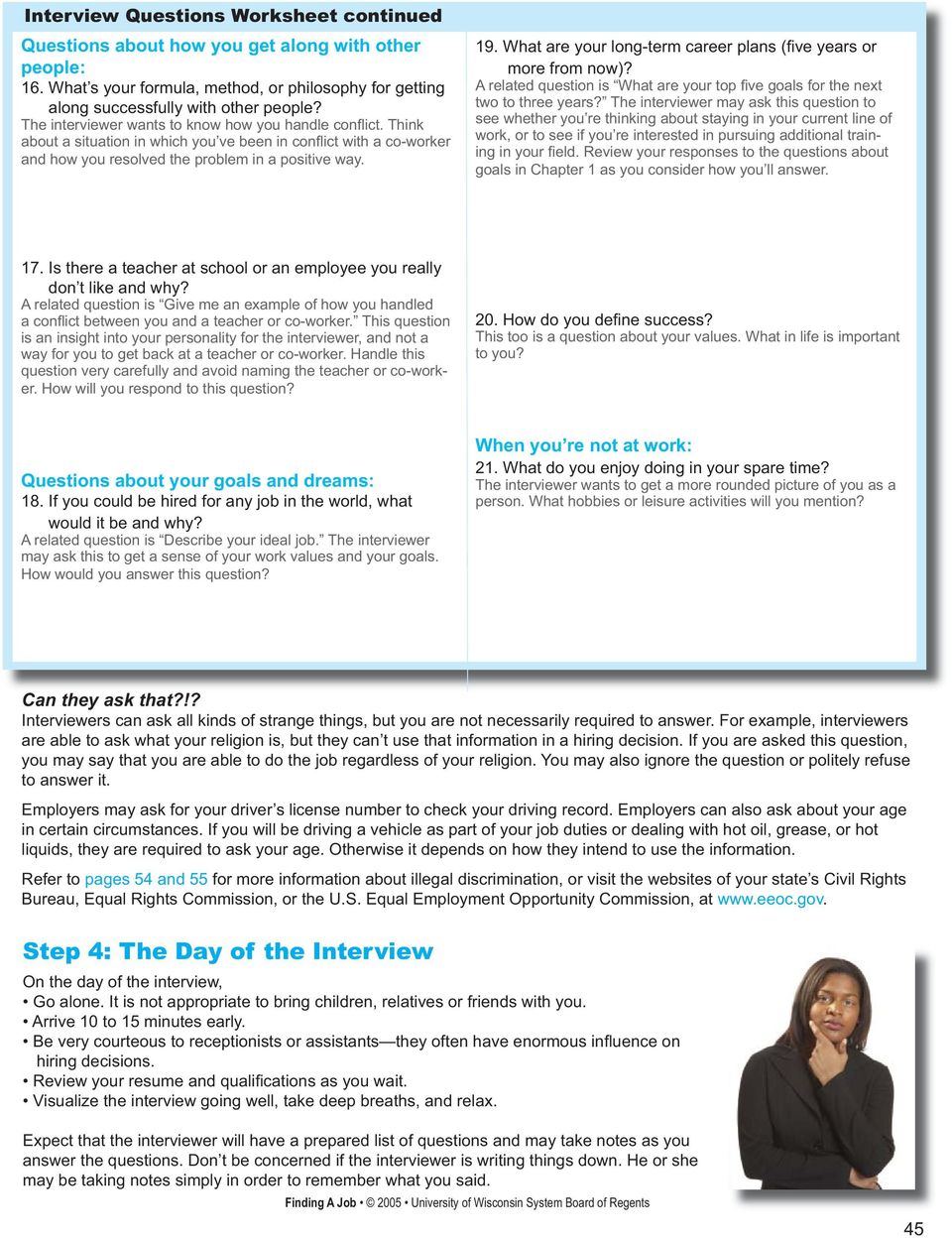
5 During the interview Most interviews start with introductions, handshakes, and casual conversation. Remember that the interviewer may be nervous too! This conversation helps everyone relax a bit. Be energetic and enthusiastic (after all, your hard work paid off and you got the interview), smile, and offer a fi rm handshake. It is fi ne for you to initiate the handshake. If you are meeting someone who is unable to shake hands due to not having a functional arm or hand or if he or she is wearing a cast, it s still polite for you to offer your right hand. Your handshake should be fi rm and solid, but not bone-crushing or too gentle. If the interviewer walks out of his/her offi ce to meet you, he/she will probably introduce himself/herself fi rst. If you walk in to the interviewer s offi ce to meet him/her, introduce yourself when you enter. Use your fi rst and last name when you introduce yourself. Do not chew gum during an interview. It s distracting to the interviewer and prevents you from speaking clearly when you answer questions. Also avoid swearing and using slang. The interviewer will most likely direct you to a chair. Sit up straight in the chair, leaning forward occasionally. Look the potential employer straight in the eye, because good eye contact means that you are interested and confi dent in yourself. It is okay to smile and laugh during the interview, as long as you re not laughing uncontrollably. The interviewer may give you a lot of detail about the job, or he/she may start by asking about you. Many times job interviews turn into conversations, and that s okay. Feel free to ask questions throughout the interview. Many interviewers will ask you questions from a structured list, because they want to make sure that all applicants are asked the same questions. Questions to Ask the Interviewer Near the end of the interview, the employer may ask directly if you have any questions about the job. It is very important that you have some questions to ask. It s helpful if you think of these questions in advance, using the information you learned when you researched the company. Keep in mind that while the interviewer is determining whether you re a good fi t for the job, you are determining whether the job is a good fi t for you. Your questions should relate to the company or the job duties, but it s not appropriate to ask how much the job pays. Use the following questions to help you think about what you may want to ask your interviewer. When do you expect to fi ll the position? What is the next step in the interview process? What education and training does the company provide? Will I work alone or with other people? How often will I meet with my supervisor? What opportunities are there for advancement? What types of problems will I need to solve in this position? What are the job responsibilities of this position? Does your company plan to grow or expand in the next few years? 46 May I see the area where I will be working? May I be introduced to one or two employees? Why is this a good place to work? Do you have any company literature I could take with me? Is there a probation period? How are the employees evaluated? What tools, safety gear, or uniforms are required? Do I purchase them, or does the company supply them? How much do they cost? Discussing Salary As mentioned in the practice interview questions, one question that employers use to screen out job applicants is How much money would you like to earn? If you are asked this question, keep your answer as general as possible, because employers won t consider you if your amount is too high. If you are pressed for a dollar amount, you could say, I d like to earn approximately the average salary for someone with my experience. End of Interview At the end of the interview, it is appropriate to shake the interviewer s hand again and thank him/her for taking the time to interview you, and say goodbye. It is also a good idea to tell the employer that you are interested in the position. Ask for the interviewer s business card if he or she hasn t given it to you yet. Other types of interviews Group interview The group interview is between you and two or more interviewers. Group interviews are a good way for several people at the company to get to know you in a short amount of time. The interview may take place in an offi ce or a conference room, depending on the number of interviewers.the interviewers may take turns asking questions, so as you answer, keep eye contact with the interviewer who asked the question.

6 Telephone interview A telephone interview is when one or more interviewers asks you questions over the phone. Employers like phone interviews because they re inexpensive and can be used to quickly screen out candidates. Because of this, your fi rst interview for a job may be over the phone. If you do well in the phone interview, you may be invited for an in-person interview. Just like a face-to-face interview, a phone interview will be scheduled for a specifi c day and time. Treat phone interviews the same as face-to-face interviews, although it may help you to stand rather than sit as you talk. Smiling while you answer questions is also a good idea. Use your voice to show your confi dence and enthusiasm for the job. Keep your resume and information about the job close at hand so you can refer to it, and also be sure that you have a quiet place to take the call. Use a good-quality phone, not one that could cut out or accidentally hang up on your interviewer. Be sure to thank the interviewer(s) for the interview and say goodbye at the end of the call. Step 5: After the Interview When you get home, write down the name and title of your interviewer and what happened during the interview, using the following after the interview worksheet. Then write and send a thank-you letter to your interviewer and anyone else you spoke with during your interview (receptionists and administrative assistants included). To get you started, use the worksheet on page 48. Type your thank-you letter on a computer or word processor. Be sure to spell correctly all names and titles. Thank the interviewer for the time he/she took to interview you, re-emphasize your skills, talents, and abilities, and include anything you may have forgotten to add during the interview or in your resume that might help get you the job. After the Interview Worksheet i You may photocopy this page if you d like and attach it to your Job Lead Worksheet on page 14. Company Name New information about the job? Possibilities for advancement? Job Title Interview Date / / Time AM PM Interviewer s Name List information you want to remember to include in your Interviewer s Phone # ( ) - - thank-you letter Names of other personnel you met (include titles) Were you comfortable with the Interview? Why? What went well during the interview? What questions were easy to answer? What could have gone better? What questions did the interviewer ask that you had diffi culty answering? _ What challenges is the company facing in the next year? Would you take the job if it were offered? Why? Benefi ts provided? Which? FOLLOW UP NEEDED Follow up Thank-You Letter, Date Sent / / Follow up phone call needed, Date / / Result of phone call 47
7 Thank-You Letter Worksheet i Fill in the blanks, type the letter, sign it, and mail. Your Street Address City, State, Zip, Typing: leave 1 blank lines Date 20 Typing: leave 3 blank lines Mr./Ms. (full name of person who interviewed you) That person s job title Name of company Street Address City, State Zip Typing: leave 1 blank line Dear Mr. / Ms. : Typing: leave 1 blank line Thank you for speaking with me on about the position. I believe my skills date position in would be a good fi t in this position. I am very interested in working list skills you talked about in the interview for and look forward to hearing from you. If you have any further questions, please name of company contact me at. Thank you again for your time and consideration. your phone number Typing: leave 1 blank line Sincerely, Sample Thank-You Letter 1221 Cedar Drive Weyauwega, WI Typing: leave 3 blank lines Your signature Your Typed Name December 21, 2005 Ms. Sophie Virtanen Service Manager Greater Metro Auto Dealer 7738 Brooks Street Washington Island, WI Thank you for speaking with me on December 18th about the Auto Technician position. I believe my skills in auto maintenance and repair would be a good fi t in this position. I am very interested in working for the Greater Metro Auto Dealer and look forward to hearing from you. If you have any futher questions, please contact me at (920) or me at crodriquez@ address.mail. Thank you again for your time and consideration. Sincerely, Christine L. Rodriguez Christine L. Rodriguez 48

8 If several weeks have passed and you haven t heard anything from the employer, you may wish to call the company s human resources department or your interviewer to see where they are in the hiring process. It could be slowed for a variety of reasons lack of funding, the hiring manager may be on vacation, or the company may still be looking for candidates. Politely ask if there is anything else the company may need from you, and when they expect to make a hiring decision. In the meantime, continue to apply for jobs and go on interviews. If you got the Job! Congratulations! Your job search journey is just about done. Refer to Chapter 7 for information on paperwork, procedures and polices, and more. If you didn t get the job... If you are told or receive a letter stating you didn t get the job, you may be feeling a lot of really negative emotions everything from anger, to shame, to guilt, to resignation. Try to remember that the employer is not rejecting you as a person, but that someone else was a better fi t for the position. It s even possible that an internal candidate (someone already working at the company but in a different position) was in line to get the job from the beginning. If you are comfortable contacting the company, you may call or send a letter or message. In a polite and friendly way, ask why you did not get the position. Was it because You need more experience You need more education The interview didn t go well Your cover letter needs improvement Your resume needs improvement You didn t pass the credit or background check Your reference(s) didn t give a good recommendation The company was looking for someone with more drive, ambition, or energy The company was looking for someone with more poise/polish The company needed someone right away and you were not available for 3-4 weeks Or was it due to some other reason? Regardless of the reason, do not argue with the employer about why you were not selected. You may state that you are disappointed that you didn t get the position, and that you are still interested in working for the company. Keep in mind that this company and the people you met there are now within your network, and they may be a source of job leads in the future. Don t burn bridges! Take the feedback you received from the employer and use it to improve your job-seeking skills. You may also rate yourself based on how the interview went and your interviewer s reactions to your resume and cover letter. If you believe you were not hired due to your gender, race, disability, or other type of prohibited discrimination, contact your state s Civil Rights Bureau, Equal Rights Commission, or the U.S. Equal Employment Opportunity Commission at The time will come when you are a better fi t for a job than everyone else is. Keep applying for jobs the right one for you is out there! 49

There are some easy steps that you can take that will increase your chances of success at interviews.
 Interview Skills There are some easy steps that you can take that will increase your chances of success at interviews. First, remember that job interviews should be a process of two-way communication.
Preparation is the key to solid performance in any interview. The time and energy you spend preparing will allow you to approach the interview with
 Preparation is the key to solid performance in any interview. The time and energy you spend preparing will allow you to approach the interview with confidence. At That s Good HR, we take our responsibility
The goal you want to accomplish during a telephone interview is to receive an invitation for an on-site interview.
 Telephone Interviewing Tips The goal you want to accomplish during a telephone interview is to receive an invitation for an on-site interview. Conduct your telephone interview in an area where you can
INTERVIEW TIPS. 1. Know the exact place and time for the interview, the interviewer's full name, correct pronunciation, and title.
 PREPARATION FOR THE INTERVIEW: INTERVIEW TIPS Preparation is the first essential step toward a successful interview. Company interviewers are continually amazed at the number of applicants who drift into
PREPARING FOR THE INTERVIEW
 U N I V E R S I T Y C A R E E R S E R V I C E S PREPARING FOR THE INTERVIEW THE INTERVIEW The interview is an opportunity to demonstrate to an employer why you are the best fit for the position. Essentially,
Successful Job Interview Techniques
 Professionally You Professionally You Successful Job Interview techniques Successful Job Interview Techniques Family Economics & Financial Education April 2008 Values, Needs vs. Wants & Goal Setting Unit
GUIDE TO PREPARING FOR AN INTERVIEW
 GUIDE TO PREPARING FOR AN INTERVIEW Brought to you by your Career Services Office Get to know your Career Advisor and to schedule a mock interview, please contact the Career Services Office. 2011 DeVry
Prepare, Prepare, Prepare for that Interview!
 Prepare, Prepare, Prepare for that Interview! This handout will provide you with information to prepare for your interview. It contains some of the following:! rules about the interview, how it will flow
TIPS TO HELP YOU PREPARE FOR A SUCCESSFUL INTERVIEW
 TIPS TO HELP YOU PREPARE FOR A SUCCESSFUL INTERVIEW Preparing for the Interview RESEARCH Don t forget to research the organization/company before the interview. Learn what you can about the workplace prior
Interview Information From ediscover Career Planning Program How do I prepare for an interview?
 Interview Information From ediscover Career Planning Program How do I prepare for an interview? The job interview is an opportunity to convince an employer that you have the skills and qualities needed
Advantages of the Phone Interview. Types of Telephone Interviews. What to Expect
 The Telephone Interview Telephone interviews are used by companies to screen candidates and narrow the pool of applicants who will be invited for in-person interviews. They minimize expenses associated
How to Make Job Expos/Career Fairs Work For You
 How to Make Job Expos/Career Fairs Work For You SUNY Potsdam Career Planning, Sisson Hall Phone: 315-267-2344 Fax: 315-267-2342 [email protected] www.potsdam.edu/offices/career THIS GUIDE CONTAINS INFORMATION
CHAPTER 2: Finding Job Leads
 CHAPTER 2: Finding Job Leads Using what you learned about yourself in the previous chapter, it s time to start your job search. The Big Picture Step 1: Identifying the Job You Would Like Step 2: Getting
GRADUATE SCHOOL INTERVIEWS
 Student Union Memorial Center, Suite 411 520.621.2588 www.career.arizona.edu GRADUATE SCHOOL INTERVIEWS Graduate schools conduct interviews to evaluate a candidate s academic preparation, related experience,
NURSING ADMISSIONS INTERVIEWS
 Student Union Memorial Center, Suite 411 (520) 621-2588 www.career.arizona.edu NURSING ADMISSIONS INTERVIEWS How you present yourself during your nursing school admissions interview will influence your
INTERVIEWING SKILLS. OBJECTIVE: Upon successful completion, students will be able to successfully participate in a mock interview.
 INTERVIEWING SKILLS OBJECTIVE: Upon successful completion, students will be able to successfully participate in a mock interview. CAREER PREPARATION LEARNING RESULTS MET OR PARTIALLY MET: B.2. Demonstrates
The Interview Process
 The Interview Process The job interview provides you and a prospective employer with the opportunity to discuss your qualifications and determine if you are a good match for a position. You should always
INTERVIEW TIPS AND ETIQUETTE
 INTERVIEW TIPS AND ETIQUETTE An employer decides whether or not to seriously consider you for a position within the first 4-9 minutes of your interview. Are you ready? Personal Factors Interviewers Seek:
Interviewing. Tips for Success
 Interviewing Tips for Success First Impressions The first words you speak count It is a pleasure meeting with you Thank you for for scheduling this time to meet Walk with vigor and show confidence People
Interviewing Tips for Apprenticeship Programs
 Interviewing Tips for Apprenticeship Programs It may seem hard to believe that your 5 to 10 minute interview will, in some cases, receive the same weight in the selection process as the test you have taken
BY GENE SPANNEUT. Reflect
 reflect prepare impress succeed reflect prepare reflect prepare impress succeed refl BY GENE SPANNEUT Gene Spanneut [email protected] Spanneut is an assistant professor of educational administration
TIPS FOR COLLEGE ADMISSIONS INTERVIEWS
 TIPS FOR COLLEGE ADMISSIONS INTERVIEWS The most important fact about college admissions interviews is that no two are alike. Much about the interview depends on the school and the particular person (alumni/admissions
The College Interview: the Basics
 The College Interview: the Basics A college interview is a chance to show that you're more than just test scores and grades. It's an exchange of information you learn about the college and the college
NURSING ADMISSIONS INTERVIEWS
 Student Union Memorial Center, Suite 411 (520) 621-2588 www.career.arizona.edu NURSING ADMISSIONS INTERVIEWS Nursing schools conduct interviews to evaluate a candidate s academic preparation, related experience,
PREPARING FOR A CAREER AS A PUBLIC SAFETY DISPATCHER
 PREPARING FOR A CAREER AS A PUBLIC SAFETY DISPATCHER Preparing for a job interview with a public safety agency rarely lasts longer than an hour, but its consequences can last for many years. In order for
The 1, 2, 3 s of Interviewing
 The 1, 2, 3 s of Interviewing A guide to interviewing WorkAbility IV Interviewing is a step in the employment process where the employer has the opportunity to meet with the candidate. At this point the
Interviewing. Structure/Format of an Interview The typical structure of an interview is as follows:
 Interviewing After you send your cover letter and resume to a number of companies, hopefully some of these companies will invite you to interview with them. Before the interview, it is important to prepare
Informational interviewing: Get the inside scoop on careers
 Informational interviewing: Get the inside scoop on careers Olivia Crosby (updated by Tamara Dillon) Olivia Crosby wrote this article for the Summer 2002 OOQ while working in the Office of Occupational
Tips for Interview Success
 Tips for Interview Success DO: Provide a firm handshake to all interviewers Make eye contact with everyone in the room when speaking Smile! Speak clearly and avoid saying things like, uh and like Dress
The Edge Career Center Presents
 The Edge Career Center Presents The Edge Career Center Presents Dress for Success Including: Types of Business Attire Choices for Business Professional Dress Choices for Business Casual Dress Items to
Resume Writing. Common Resume Writing Questions/Answers: Resume Writing Tips
 Resume Writing Common Resume Writing Questions/Answers: 1. What is a resume? A resume is your own personal marketing tool and advertisement. You should think of yourself as a product, your resume should
Interview Skills Guide
 Interview Skills Guide The main purpose of an interview is to sell yourself to a company/organization and convince them that they should hire you. As a candidate you are a salesperson, selling the most
JOB FAIRS AND INTERVIEWS: TIPS FOR SUCCESS. Why Attend a Job Fair?
 JOB FAIRS AND INTERVIEWS: TIPS FOR SUCCESS 1. You may land a job! Why Attend a Job Fair? 2. The Employers Want to Meet You: these employers will be prepared to conduct onthe-spot interviews with the candidates
Job Shadow What is a job shadow? Why is a job shadow important to me? How do I make a job shadow happen? What do I take to a job shadow?
 Job Shadow What is a job shadow? A job shadow is a learning experience that takes place at a business or your choice in your community and/or in surrounding communities. The experience is typically 2-4
Responding to Behavioral-based interview questions. How to interview well when they are asking Behavioral-based interview questions
 Responding to Behavioral-based interview questions How to interview well when they are asking Behavioral-based interview questions Theory: Past performance is the best predictor of future performance Employer
The Job Interview Before, During and After
 The Job Interview Before, During and After A job interview is an important part of the job search process. It is both an opportunity for an employer to assess your related skills and qualifications for
The College Visit and the Interview
 Chapter 8 The College Visit and the Interview College Representatives on Your High School Campus As you are determining which colleges and universities will be included on your final college application
Career Employment Services Guide to Career Fair Success
 Career Employment Services Guide to Career Fair Success Career Employment Services ICW 219 Phone: (417) 447-6964 Fax: (417) 447-6962 http://www.otc.edu/students/offices/employment/index.php 1 What is a
Telephone Tips and Techniques
 Telephone Tips and Techniques to help you conduct an efficient, productive job search. CONTENTS General tips for using your phone page 3 Responding to a newspaper ad page 4 Building a job search network
INTERVIEWING SUCCESSFUL INTERVIEWING: THE BASICS
 INTERVIEWING What is an interview? An interview is a structured conversation between you and an employer where you ask each other questions to determine if you would be a good fit for the job. What do
"There are two educations. One should teach us how to make a living and the other how to live." - John Adams
 Expectation Graduation s Graduation Game Plan TM "There are two educations. One should teach us how to make a living and the other how to live." John Adams This Game Plan belongs to: My mentor is: My Game
101 Characteristics of Americans/American Culture
 101 Characteristics of Americans/American Culture To help you compare and contrast what you observe of American culture and your own, mark the similarities and differences between your culture and what
Job Interview Tips Do's
 Job Interview Tips Do's Some job interview tips are given below; please go through it, it will help you a lot. 1. Preparation and confidence Preparation and confidence are very important tips. Good preparation
Sample Application and Interview Questions
 APPLICATION & INTERVIEW TIPS Completing a Job Application 1. Answer all questions prayerfully, completely and thoughtfully. Even if some of the answers may be found on your resume, for the employer s convenience
A-A A-B A-C C-A C-B C-C PS-A PS-B PS-C X X X X X
 Lesson Plan 7: Preparing for a Job Interview Core www.collegeincolorado.org Area: Job Search Total Time: Two 50-55 minute class periods Target Grades: Grades 10-12 Suggested Timeline: Any time during school
The Sales Mastery Series for Real Estate Professionals
 The Sales Mastery Series for Real Estate Professionals with Mike Ferry The Decision How many deals do you want to do per month, this year, next year, and the year after? How much money do you want to earn?
Counseling Center Informational Interviewing INFORMATION INTERVIEWING WHAT IS AN INFORMATIONAL INTERVIEW?
 Counseling Center Informational Interviewing INFORMATION INTERVIEWING WHAT IS AN INFORMATIONAL INTERVIEW? An informational interview is a conversation between a person (like you) who is interested in a
INTERVIEW TIPS PREPARING FOR INTERVIEWS
 INTERVIEW TIPS PREPARING FOR INTERVIEWS These pre-interview essentials could make the difference between your next career step or a career full stop! Make sure you know the exact address and time of the
Connectedness and the Emotional Bank Account
 Connectedness and the Emotional Bank Account Directions This is a self-guided activity that can be completed by parents, teens or both. It contains five parts and should take about 45 minutes to complete.
IN A SMALL PART OF THE CITY WEST OF
 p T h e L a s t L e a f IN A SMALL PART OF THE CITY WEST OF Washington Square, the streets have gone wild. They turn in different directions. They are broken into small pieces called places. One street
APPLYING FOR JOBS: YOUR GUIDE
 APPLYING FOR JOBS: YOUR GUIDE CONTENTS 1.0 INTRODUCTION 1.1. Introduction 2 2.0. APPLYING FOR JOBS 2.1 Application forms. 3 2.2 CV. 5 2.3 Cover letter. 6 2.4 Hints and tips. 7 3.0 INTERVIEWS 3.1 Before
Living Our Values. VALUES: Teamwork, Integrity, Diversity, Excellence, Safety. The sick never inconvenience the well. ~ Eugene Stead, MD
 Living Our Values Caring for Our Patients, Their Loved Ones and Each Other VALUES: Teamwork, Integrity, Diversity, Excellence, Safety Duke University Health System Patient Experience Oversight Team 2012
What do you need to know in the workplace?
 What do you need to know in the workplace? Your internship may be the first time you ve worked in a professional setting. People will expect you to act as a professional. The rules are different among
2012 PAULINE WRIGHT SCHOLARSHIP FOR THE CULINARY ARTS Due: March 31, 2012
 2012 PAULINE WRIGHT SCHOLARSHIP FOR THE CULINARY ARTS Due: March 31, 2012 Scholarship Guidelines and Application Procedures Who May Apply Applicants must meet the following criteria: Is a degree seeking
GUIDE TO INTERVIEWING
 GUIDE TO INTERVIEWING Contents A. Interviewing Guidelines 1. Always Be Interviewing 2. How to Spot a Good Candidate 3. Preparing for the Interview 4. The DO s and DON Ts of Interviewing. B. Interviewing
Develop your Job Interview Skills
 Develop your Job Interview Skills Inside You Will Find: Tips for preparing for a job interview How to answer behavioural interview questions Sample interview questions Tips and hints for job interview
BASIC INTERVIEWING PREPARATION
 BASIC INTERVIEWING PREPARATION Office of Career & Professional Development 2014, UC Hastings College of the Law Prepare for job interviews as carefully as you would prepare your oral argument for Moot
ONE DOLLAR AND EIGHTY-SEVEN CENTS.
 T h e G i f t o f t h e M a g i p T h e G i f t o f t h e M a g i ONE DOLLAR AND EIGHTY-SEVEN CENTS. That was all. She had put it aside, one cent and then another and then another, in her careful buying
INTERVIEWING TECHNIQUES
 INTERVIEWING TECHNIQUES LEARNING HOW TO COMMUNICATE WITH CONFIDENCE THE PURPOSE OF AN INTERVIEW Goal of Candidate: Goal of Interviewer: Gather information on position and employer. Evaluate position, job-setting,
SAMPLE INTERVIEW QUESTIONS TEACHER S MASTER
 C-12 INFORMATION SHEET SAMPLE INTERVIEW QUESTIONS TEACHER S MASTER QUESTIONS ABOUT YOU Tell Me a Little about Yourself. The interviewers want to know if you are well adjusted, work well with others, have
Example Interview Transcript
 Ms Bossy DeBoss Namey Mc Name Thank you for coming to see us for your interview today, Namey. How was your journey, did you have any trouble finding us? My journey was fine thank you, Ms DeBoss. The instructions
Media Training Quick Reference Guide
 Consider the following tips when you re preparing to represent your organization in media relations activities that involve pitching stories to reporters and conducting interviews about the Texting and
Scripts for Recruiters
 Scripts for Recruiters Companion Script Guide for The New Recruiters Tool Kit www.greatrecruitertraining.com Copyright 2010 Scott Love 1 How to Use This Guide Use this companion script guide while watching
Guidance on how to apply successfully for a teaching post
 Guidance on how to apply successfully for a teaching post Introduction Applying for a job takes time and concentration. You need to give yourself enough time to think clearly and be well organised so that
HOW DO I HANDLE AN INTERVIEW?
 Interview techniques Nivison House, 31 Prospect Hill, Douglas, Isle of Man. IM1 1QS Telephone: (01624)687014 Fax: (01624)686453 E-Mail: [email protected] Web Site: www.gov.im/ded/jobcentre HOW DO I HANDLE
Commitment to Customer Care Providing a high quality patient experience
 Commitment to Customer Care Providing a high quality patient experience Commitment to Customer Care Our promise: At Sheffield Teaching Hospitals, all receptions will The Commitment to Customer Care Guide
DOING YOUR BEST ON YOUR JOB INTERVIEW
 CHECKLIST FOR PREPARING FOR THE INTERVIEW Read this pamphlet carefully. Make a list of your good points and think of concrete examples that demonstrate them. Practice answering the questions on page 6.
INTERVIEW PREPARATION GUIDE
 INTERVIEW PREPARATION GUIDE Career Development Office Visit: Gund Commons, Lower Level Call: (740) 427-5165 Email: [email protected] Schedule an Appointment: http://cdo.kenyon.edu Facebook: https://www.facebook.com/kenyoncdo
SOPHOMORE JOB SHADOW HANDBOOK
 SOPHOMORE JOB SHADOW HANDBOOK NAME: ADVISOR: JOB SHADOW DATE: *Keep this handbook in your portfolio* This booklet is also available online. You will find it on your advisor s website. You may download
Professional Etiquette
 Professional Etiquette Etiquette is the fine art of behaving in front of others. It is more than just which fork you should use or how to act in certain situations; etiquette is about acting appropriately
INTERVIEW TIPS 1. PREPARING BEFORE THE INTERVIEW PRINT OFF YOUR JOB APPLICATION RESEARCH THE COMPANY PLAN YOUR JOURNEY
 INTERVIEW TIPS If you've been invited to interview, it means you've passed the first part of the screening process. Congratulations! Your CV must have demonstrated that you have relevant experience for
A Small Reference Guide Prepared by Mireille Trottier-Roy
 No more fear! Preparing for Your Interview A Small Reference Guide Prepared by Mireille Trottier-Roy What you need to know The Interview "Monster" Nothing to fear for the well prepared... 1 A Few Things
INTERVIEWING TECHNIQUES FOR COMPUTER SCIENCE MAJORS
 INTERVIEWING TECHNIQUES FOR COMPUTER SCIENCE MAJORS Ed Smallman, Ph.D. Coordinator of Career Development Gould-Simpson 901 [email protected] http://advising.cs.arizona.edu/ Why a Special Presentation
Onboarding Program. Supervisor s Guide
 Onboarding Program Supervisor s Guide Supervisor s Guide Introduction This guide has been developed for supervisors to support an effective and successful onboarding process for new employees. As a supervisor,
How can I improve my interviewing skills? MATERIALS
 Mock Interviews 6 Finding a job The BIG Idea How can I improve my interviewing skills? AGENDA Approx. 45 minutes I. Warm Up: Model an Interview (10 minutes) II. Interview Practice (30 minutes) III. Wrap
Georgia College & State University Career Center Professional Development Series Presents:
 Georgia College & State University Career Center Professional Development Series Presents: Contact Us: University Career Center 232 Lanier Hall, Milledgeville Campus 478-445-5384 www.gcsu.edu/career Contents
Interviewing Tips. Conduct Research. Know the Organization. Know Yourself. Know the Position
 Interviewing Tips The interview is a short, intense period of time that demands preparation. Finding a job is a process that takes time, commitment, and a lot of practice. And interviewing is a significant
Professional Etiquette. How to: Dress For Success. Career and Professional Readiness Center
 Professional Etiquette How to: Dress For Success Career and Professional Readiness Center What are the types of Professional Dress? Overview: Making an Impression Building your Professional Wardrobe Specifics
What are the most important elements that will lead to success at career fairs?
 2011-2012 Goals for Attending the Fair Why should you attend your local career or job fair? There are any number of goals for attending a career fair, depending on where you are in the job-search cycle:
Psychic Lotto Formula 3-Step Formula Secret Template To Lottery Secrets Module 3
 Page 1 Table of Content The Psychic Lotto Formula Jackpot to Success System... 4 Part 1 Channeling the Power of Your Mind to Success... 6 Part 2 Visualization... 12 Part 3 Integrating Luck and Making it
Interviewing Strategies & Tips. Career Center For Vocation & Development
 Interviewing Strategies & Tips Career Center For Vocation & Development Before the Interview A job interview is an opportunity to showcase your strengths, experience, and interest in the position for which
Effective Interviewing Skills. The Key to Maximizing Your Job Interview
 Effective Interviewing Skills The Key to Maximizing Your Job Interview Workshop Outcomes Knowledge of: Types of interviews Interview preparation steps and tips Stages of an interview Common and illegal
Hidden Job Market. Remember, you are in a worksite setting! Hello, trainees. Today we will cover the hidden job market.
 7 Finding the Hidden Job Market step Overview OBJECTIVES \ Locate the Hidden Job Market \ Network with the Hidden Job Market \ Telemarket Yourself It is said that more than 75 percent of all jobs are never
How to Sell Yourself in a Job Interview
 TOOLS Interview Tips Helpful Interview Hints How to prepare for the first important meeting What to expect Be prepared The Interview Interview Techniques Most frequently asked questions Facing the Interviewer
Buyer Expectations are Unique: What are Yours?
 2015 Buyer Expectations are Unique: What are Yours? By establishing what your expectations are, you lay the groundwork for a smoother home-buying process and help ensure you find the home that s just right
Buying a Car. A Car Means Convenience. Which Car is Right for You?
 Buying a Car A Car Means Convenience It s Wednesday morning and you are sleeping soundly, dreaming about that Hawaiian vacation you d like to take. Suddenly you hear, instead of ocean waves, a loud buzz.
Presented by: Heather J. Donnelly HDI Certified Instructor. Telephone Skills
 Presented by: Heather J. Donnelly HDI Certified Instructor Telephone Skills Objectives Recall the key principles for dealing with an irate caller Apply specific techniques effective in providing excellent
BUSINESS ETIQUETTE QUIZ
 BUSINESS ETIQUETTE QUIZ 1. What is one of the problems in business today that result from poor listening skills? a. Broken relationships b. Short term memory c. All of the above 2. You re attending a conference
How to Land and Prepare for the Interview. Presented by: Northrop Grumman Corporation
 How to Land and Prepare for the Interview Presented by: Northrop Grumman Corporation Updated: 3/4/2014 Topics The résumé Where to look What to wear The Interview Tough questions to consider Resources 2
Job Interview Questions About the New Job and the Company
 Job Interview Questions About the New Job and the Company Q. What interests you about this job? A. When you're asked what interests you about the job you are being interviewed for, the best way to answer
Why Be Aware of Professional Presence?
 Professional Presence: Managing Non-verbal Communications Topeka IIA Topeka, KS November 18, 2010 Lael Holloway, Director Risk Advisory Services Kansas City, MO Why Be Aware of Professional Presence? According
Six Tips for Getting Great Letters of Recommendation for College
 Six Tips for Getting Great Letters of Recommendation for College Written by: Mark A. Montgomery, Ph.D. One of the most important elements of your college application is the recommendation of a teacher.