
Analysis of Seizures From 11 Tiger Countries
|
|
|
- Tobias Johnson
- 5 years ago
- Views:
Transcription
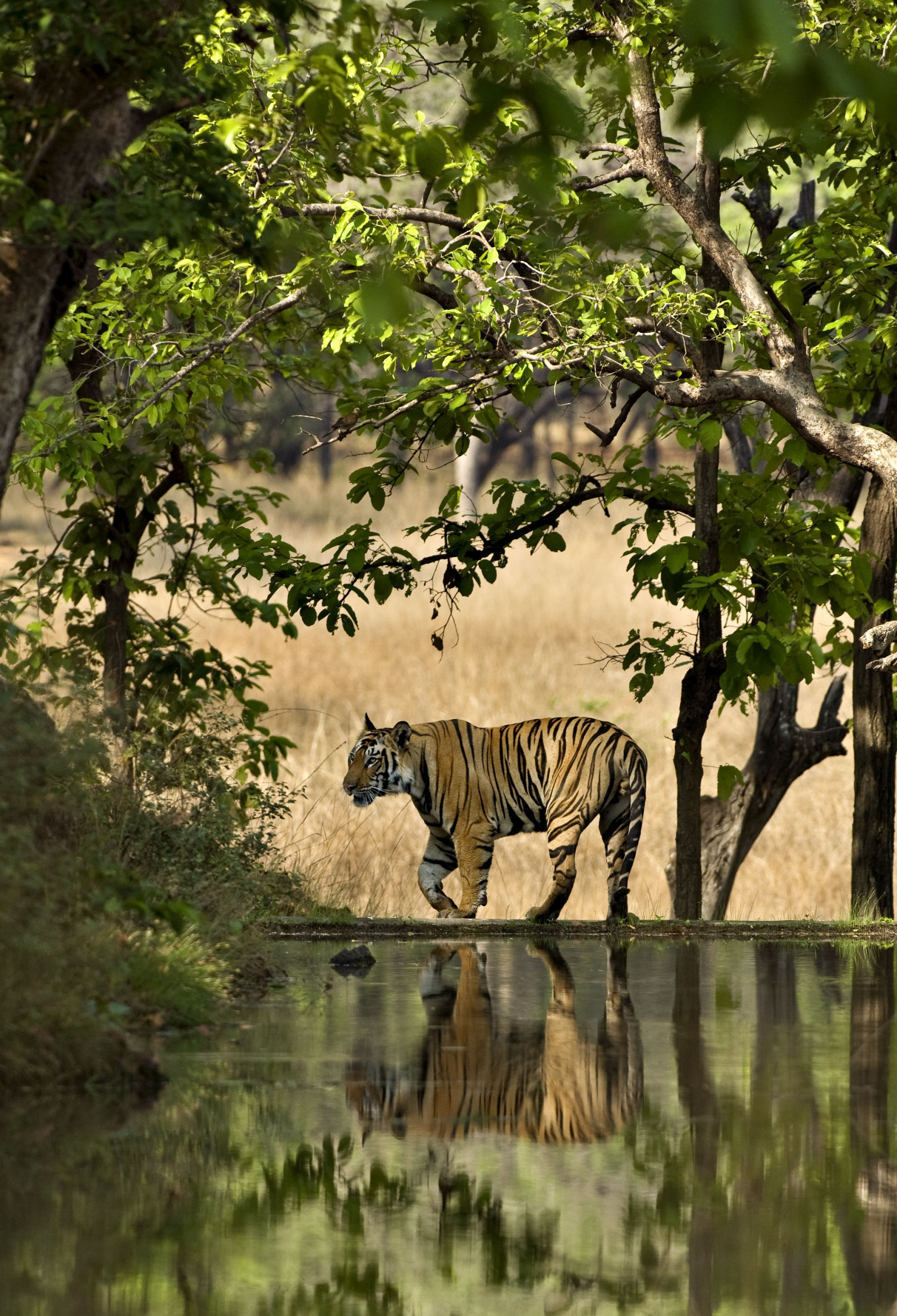

1 R REDUCED TO SKIN AND BONES: AN ANALYSIS OF TIGER SEIZURES FROM 11 TIGER RANGE COUNTRIES ( ) PAULINE VERHEIJ,KAITLYN-ELIZABETH FOLEY AND KATALINA ENGEL A TRAFFIC REPORT This report was published with the kind support of
2 Published by TRAFFIC International, Cambridge, UK TRAFFIC International. All rights reserved. All material appearing in this publication is copyrighted and may be reproduced with perrmission. Any reproduction in full or in part of this publication must credit TRAFFIC International as the copyright owner. The views of the authors expressed in this publication do not necessarily reflect those of the TRAFFIC network, WWF or IUCN. The designations of geographical entities in this publication, and the presentation of the material, do not imply the expression of any opinion whatsoever on the part of TRAFFIC or its supporting organizations concerning the legal status of any country, territory, or area, or of its authorities, or concerning the delimitation of its frontiers or boundaries. The TRAFFIC symbol copyright and Registered Trademark ownership is held by WWF. TRAFFIC is a joint programme of WWF and IUCN. Suggested citation: Verheij, P.M., Foley, K.E. and Engel, K. (2010). Reduced to Skin and Bones. An Analysis of Tiger Seizures from 11 Tiger Range Countries ( ). TRAFFIC International, Cambridge, UK. ISBN Front cover photograph: Male Bengal Tiger, Bandhavgarh National Park, Madhya Pradesh, India. Photograph credit: Andy Rouse/WWF. Printed on recycled paper.
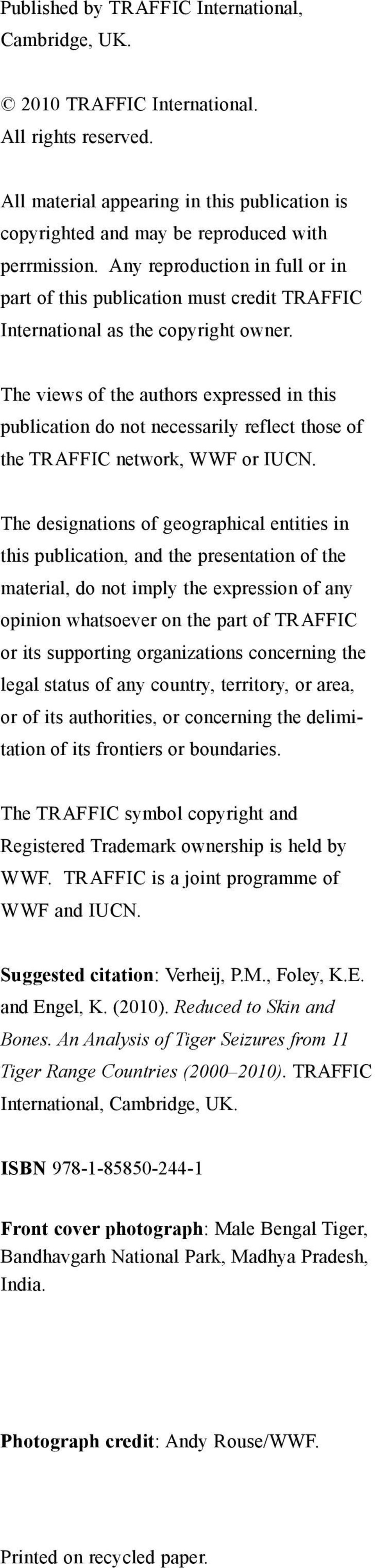
3 REDUCED TO SKIN AND BONES: AN ANALYSIS OF TIGER SEIZURES FROM 11 TIGER RANGE COUNTRIES ( ) Pauline Verheij, Kaitlyn-Elizabeth Foley and Katalina Engel Credit: David Lawson/WWF UK Young Siberian Tiger
4 CONTENTS Acknowledgements iv Executive summary v Introduction 1 Methods 3 Data acquisition 3 Analysis 4 Additional desk research 6 Results 6 Data quality 6 Illegal trade and seizures 6 Seizure sites mapped out 11 The origin of Tiger parts observed in trade 13 Enforcement effort 13 Additional seizure data from 1 May to 4 September Discussion 15 Caveats and exclusions 15 Captive-bred or wild-caught? 16 Increase in seizures 16 Trade hubs and routes 17 From Landscape to market 18 Law enforcement 19 Corruption 21 The importance of data 21 Conclusion 22 Recommendations 23 Improve understanding of Tiger trade dynamics 23 Improve law enforcement 24 References 26 Appendix 1. Seizure data for 11 Tiger range countries, 2000 April Appendix 2. Seizure data for eight Tiger range countries, 1 May September ii REDUCED TO SKIN AND BONES: An Analysis of Tiger Seizures from 11 Tiger Range Countries ( )
5 ABBREVIATIONS AND ACRONYMS ASEAN-WEN BD BT CoP CITES CN EIA ENV ICPO-INTERPOL ID IN IUCN KH LA MM MY MYCAT NGO NP NTCA RU SAWEN TH TR UNODC USD VN WCCB WCO WCS WPSI Association of Southeast Asian Nations Wildlife Enforcement Network Bangladesh Bhutan Conference of the Parties Convention on International Trade in Endangered Species of Wild Fauna and Flora China Environmental Investigation Agency Education for Nature Vietnam International Criminal Police Organization Indonesia India International Union for Conservation of Nature Cambodia Lao PDR Myanmar Malaysia Malaysian Conservation Alliance for Tiger Non-governmental Organization Nepal National Tiger Conservation Authority Russia South Asia Wildlife Enforcement Network Thailand Tiger Reserve United Nations Office on Drugs and Crime US dollar Viet Nam Wildlife Crime Control Bureau World Customs Organization Wildlife Conservation Society Wildlife Protection Society of India REDUCED TO SKIN AND BONES: An Analysis of Tiger Seizures from 11 Tiger Range Countries ( ) iii
6 ACKNOWLEDGEMENTS The authors would like to thank the Governments of India, Thailand, Bangladesh and Myanmar; TRAFFIC s programmes in India, China, the Russian Far East and South-east Asia; WWF s National Offices in Nepal and the USA; and the Wildlife Conservation Society (WCS) Indonesia for helping to compile the seizure data for this report. Thanks go to Jochen Stierberger for creating and Carrie Stengel for editing the GIS maps of Tiger seizures included in this report. Chris R. Shepherd, William Schaedla, James Compton, John Sellar, Kristin Nowell, Tom Milliken, Sabri Zain, Samir Sinha, Volker Homes and Claire Beastall are thanked for their useful comments on drafts of this report. WWF Germany is gratefully thanked for financial support of this study and the Rufford Foundation is gratefully acknowledged for its contribution towards the final stages of production of this report. iv REDUCED TO SKIN AND BONES: An Analysis of Tiger Seizures from 11 Tiger Range Countries ( )

7 EXECUTIVE SUMMARY Introduction Once abundant in the whole of Asia, wild Tiger Panthera tigris populations have dramatically declined during the last hundred years, from around individuals to a current estimated population of 3500 or less. The global population of is distributed in small, fragmented and often isolated landscapes in 13 range countries. In addition to habitat loss and degradation, human encroachment and excessive poaching of key prey species, the illegal trade in Tiger parts is greatly contributing to the rapid decline of in the wild. As with most illicit activities, the international dynamics of Tiger trade are poorly understood. To aid in addressing this lack of knowledge, this report presents a compilation and analysis of available data on Tiger seizures from 11 of the 13 Tiger range countries over the past 10 years. It is hoped that this will inform debate on interventions to control the trade in Tiger parts and derivatives. In order to understand the relationship between the number of seizures and the levels of trade or enforcement efforts, this report recognizes that it is necessary to measure the efficiency of wildlife law enforcement in those Tiger range countries whose seizure data have been analysed. Methods Information for this analysis was gathered from various sources, including: the Governments of India, Thailand, Bangladesh and Myanmar; WWF Nepal and WWF-US; TRAFFIC offices in India, China, the Russian Far East and South-east Asia; MYCAT Malaysia; WCS Indonesia Programme and open sources such as the Internet and other media. It included all seizure information available over the 10- year period January April 2010 from 11 of the 13 Tiger range countries: no data were recorded from Cambodia and Bhutan and these countries were therefore omitted from the analysis. Results and discussion A total of 481 seizures was analysed, suggesting a minimum of 1069 (annual average 104.2) and maximum of 1220 (annual average 118.9) killed for their parts and derivatives from January 2000 to April The vast majority of these seizures took place in India (276 seizures), followed by China (40 seizures), Nepal (39 seizures), Indonesia (36 seizures) and Viet Nam (28 seizures). Owing to the illicit nature of the trade, it must be assumed that the implicated in this analysis are fewer than the actual number of and Tiger parts and derivatives being trafficked around the world. Parts seized in range countries were most commonly in the form of skins (480), bones and skeletons ( kg), dead individuals (197) and claws (1313). Seizures of skins dominate in India and Nepal and are relatively frequent in China, Russia and Indonesia. Bones and skeletons are relatively often seen in seizures in China, Indonesia, India, Malaysia, Russia and Nepal. Claws are most often found REDUCED TO SKIN AND BONES: An Analysis of Tiger Seizures from 11 Tiger Range Countries ( ) v
8 in India and Malaysia. Seizures in Viet Nam and Thailand consist for a large part of whole dead, although China, Russia, Malaysia and Indonesia also show a relatively high amount of dead in trade. It is crucial to note several caveats with respect to the results, above all that they represent a fraction of actual trade and cannot be interpreted independently of enforcement contexts. That said, they inform discussion of key aspects of the trade in Tiger products, including the question of the origins of in trade, and reasons behind an apparent recent increase in seizures and the spatial distribution of seizures, as well as weaknesses in current law enforcement activities and the value of good data on the trade. Conclusion This study set out to compile and analyse data on Tiger seizures, , from 11 of the 13 Tiger range countries, to support conservation efforts to address the trade in Tiger parts and derivatives. It has succeeded in providing an unprecedented range of data on the trade in a single output, an important baseline to inform the understanding of this persistent yet illegal trade. While the caveats already noted must continually be borne in mind, conclusions and pointers emerge from the data set generated by this study. First, and most obviously, the data show that illegal Tiger trade continues unabated despite considerable and repeated efforts to curtail it on the part of Tiger range and consumer countries, inter-governmental organizations and NGOs. Less concretely, but notably, the data point to other findings, namely the quantities of implicated by trade in the 11 Tiger range countries during this period; an apparent increase in seizures in recent years, with a greater part now being played by Indonesia, Nepal, Thailand and Viet Nam and continuation of India's position as supplier of the largest quantities of Tiger products; steady demand for a variety of Tiger products; significant trade hubs and routes; the likelihood that the wild Tiger population may not be able to satisfy existing demand and that parts and derivatives from captive-bred entering illegal trade in response may well increase significantly; and the inadequacy of current law enforcement activities against illegal killing of and trade in, including the inability of penalties alone to deter would-be offenders, highlighting the importance of increasing the probability of detection, arrest, prosecution and conviction as a deterrent. In sum, these conclusions point to a lack of political will among those responsible at national and international levels for protecting from illegal killing and trade. A paradigm shift in terms of commitment is needed and all stakeholders will have to join forces to create an intelligence-driven, well-co-ordinated, trans-boundary and sustained push against forces driving one of the most legendary species on Earth to extinction. The following recommendations for fighting Tiger trade more effectively spring from the conclusions above and are centred around improving the understanding of the dynamics of Tiger trade and correspondingly enhanced enforcement. The recommendations do not include suggestions for reducing demand for Tiger products, as this was not researched as part of this study, though would obviously be part of any serious integrated conservation response to business as usual in the Tiger trade. vi REDUCED TO SKIN AND BONES: An Analysis of Tiger Seizures from 11 Tiger Range Countries ( )
9 Recommendations Improve understanding of Tiger trade dynamics Effective enforcement starts with a good understanding of crime patterns. In the case of Tiger trade, this means that source and consumer countries should compile data on Tiger poaching, trafficking and consumption systematically and analyse these, in order to understand the entire trade chain and determine trends in illegal killing and trade. This should encompass comprehensive mapping of where the poaching hotspots are, information on routes by which are smuggled, the location of end destinations, peak times for poaching and trade, actors involved, and on which groups are consuming the different types of Tiger parts and derivatives. TRAFFIC recommends that the governments of Tiger range countries establish systems at national and transnational level to compile these data. It is hoped that the compilation and analysis by CITES and INTERPOL of information relating to incidents of poaching and of illegal trade in from 2007 to 2010 will form an incentive for the Tiger range countries to do so. Data on poaching and illegal trade should be exchanged with other Tiger range and consumer countries, as well as inter-governmental (enforcement) organizations such as INTERPOL, UNODC, WCO and CITES, through the available mechanisms such as Ecomessage (the INTERPOL form for reporting wildlife crime incidents) and WCO s Customs Enforcement Network. To date, Tiger range countries have not made full and effective use of these mechanisms. Multilateral wildlife enforcement networks such as ASEAN-WEN and SAWEN should play an essential role in promoting the use of these mechanisms. Tiger range countries should improve their understanding of the sources of found in trade. It is recommended that seized Tiger parts and derivatives be analysed for DNA and other forensic evidence in order to establish the origin of the specimens and whether or not any have been captive-bred or farmed. A database should be established, for example by an organization such as ASEAN-WEN, SAWEN or CITES, for compiling the results of these analyses. Ideally this database should communicate with the database(s) for data on poaching and illegal trade recommended above and be managed at the level of afore-mentioned multilateral enforcement networks. Improve law enforcement In order to improve deterrents, Tiger range countries should increase the probability of detection, arrest, prosecution, conviction and the level of the penalties and enforcement efforts must become smarter and more focused. Enforcement agencies should conduct intelligence-led, multi-disciplinary criminal investigations. Systematic interrogation of suspects to extract all relevant intelligence should be pursued, and seizure not just of the illegal shipments, but of all possible vehicles for evidence trails, such as mobile phones and computers. Communications via the Internet should be investigated, financial research conducted to look for evidence of money-laundering, and full use should be made of forensic techniques such as DNA analysis and fingerprinting. Agencies should also make use of the REDUCED TO SKIN AND BONES: An Analysis of Tiger Seizures from 11 Tiger Range Countries ( ) vii
10 manuals on Controlled Delivery, Wildlife Smuggling Identification, and Wildlife Smuggling Interview Questioning that CITES, INTERPOL and the WCO have jointly prepared (see Lastly, law enforcement can only become optimized if accurate intelligence is exchanged in real time between agencies from the countries of origin, transit and/or destination authorized to act upon it. Law enforcement should focus on all parts of the trade chain, starting with poachers, processors, middlemen and traders. Enforcement efforts must be targeted at the Tiger Conservation Landscapes especially (the need for which is clearly illustrated by the large amount of seizures taking place in the Indian landscapes), key trafficking nodes, i.e. cities and border crossings (also illustrated in India), and the consumer markets in East and South-east Asia. Covert monitoring and infiltration of consumer markets is an important way to gather evidence of people and/or organizations involved in processing dead into meat, bones, skins and other parts, the illegal production of medicines, wine and tonics containing Tiger and the sale thereof. Tiger range (and consumer) countries should fully implement the provisions of CITES Resolution Conf (Rev. CoP15), as this would mean great progress to combat illicit activity could be made. This Resolution sets a minimum standard for effective wildlife law enforcement pertaining to the trade in Asian big cats. It calls for the establishment and effective resourcing of anti-poaching teams and enforcement units and the exchange of intelligence between relevant enforcement agencies. It recommends strengthened enforcement efforts in key border regions, the introduction of innovative enforcement methods and the development/improvement of regional enforcement networks. The Resolution also recommends Parties increase awareness of wildlife crime and illicit wildlife trade among enforcement, prosecution and judicial authorities. An international effort involving Tiger range countries and inter-governmental enforcement agencies such as INTERPOL, UNODC and WCO is needed to tackle the organized crime networks involved in Tiger trade. As such, an international Tiger trade taskforce should be established, consisting of a multidisciplinary team of criminal investigation experts, to be based in one of the Tiger range countries, tasked with co-ordinating intelligence exchange, analysing data and supporting enforcement authorities in criminal investigations. NGOs and other parts of civil society should also be engaged, as they can provide valuable expertise and experience. A possible option would be the revitalization of the CITES Tiger Enforcement Task Force established in As the criminal networks involved in Tiger trade are also involved in other types of wildlife crime, such a taskforce would greatly contribute to combating wildlife crime. The huge investment necessary to accomplish all this cannot be borne by Tiger range countries alone. Financial and technical support should be provided by consumer countries, interested donor countries and donor organizations. It must be stressed that these recommendations for tackling Tiger trade are not all Tiger-specific, and could benefit other wildlife species that are in danger of extinction as a result of poaching and illegal wildlife trade in Asia. viii REDUCED TO SKIN AND BONES: An Analysis of Tiger Seizures from 11 Tiger Range Countries ( )

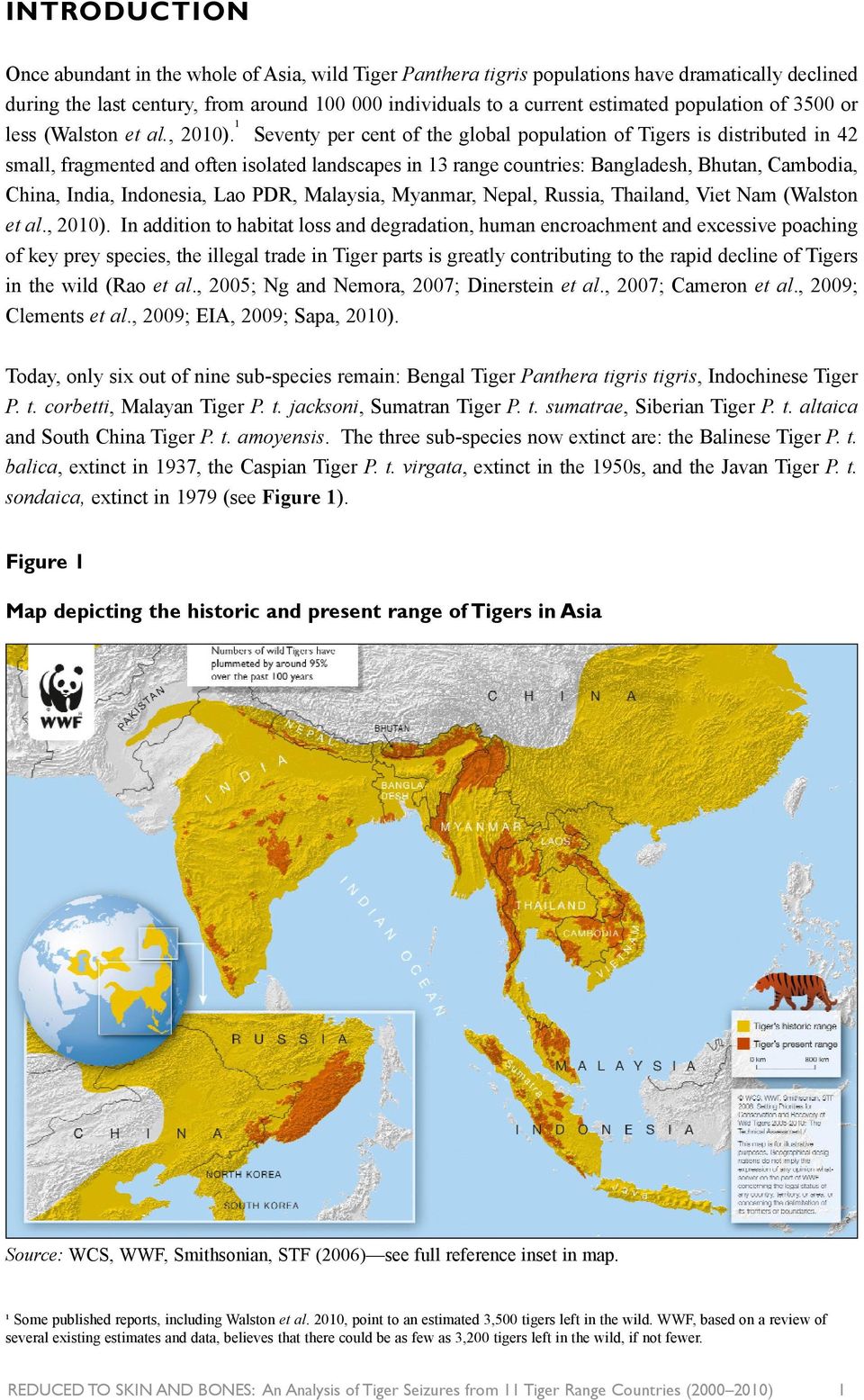
11 INTRODUCTION Once abundant in the whole of Asia, wild Tiger Panthera tigris populations have dramatically declined during the last century, from around individuals to a current estimated population of 3500 or less (Walston et al., 2010). 1 Seventy per cent of the global population of is distributed in 42 small, fragmented and often isolated landscapes in 13 range countries: Bangladesh, Bhutan, Cambodia, China, India, Indonesia, Lao PDR, Malaysia, Myanmar, Nepal, Russia, Thailand, Viet Nam (Walston et al., 2010). In addition to habitat loss and degradation, human encroachment and excessive poaching of key prey species, the illegal trade in Tiger parts is greatly contributing to the rapid decline of in the wild (Rao et al., 2005; Ng and Nemora, 2007; Dinerstein et al., 2007; Cameron et al., 2009; Clements et al., 2009; EIA, 2009; Sapa, 2010). Today, only six out of nine sub-species remain: Bengal Tiger Panthera tigris tigris, Indochinese Tiger P. t. corbetti, Malayan Tiger P. t. jacksoni, Sumatran Tiger P. t. sumatrae, Siberian Tiger P. t. altaica and South China Tiger P. t. amoyensis. The three sub-species now extinct are: the Balinese Tiger P. t. balica, extinct in 1937, the Caspian Tiger P. t. virgata, extinct in the 1950s, and the Javan Tiger P. t. sondaica, extinct in 1979 (see Figure 1). Figure 1 Map depicting the historic and present range of in Asia Source: WCS, WWF, Smithsonian, STF (2006) see full reference inset in map. 1 Some published reports, including Walston et al. 2010, point to an estimated 3,500 tigers left in the wild. WWF, based on a review of several existing estimates and data, believes that there could be as few as 3,200 tigers left in the wild, if not fewer. REDUCED TO SKIN AND BONES: An Analysis of Tiger Seizures from 11 Tiger Range Countries ( ) 1
12 All extant Tiger sub-species have been listed in Appendix I of the Convention on International Trade in Endangered Species of Wild Fauna and Flora (CITES) since 1975 (except for Panthera t. altaica, which was added to Appendix I in 1987), which means all international trade in, including their parts and derivatives, for commercial purposes is prohibited. Moreover, all Tiger sub-species are listed in the IUCN Red List of Threatened Species (IUCN, 2010) as Endangered, with the exception of the Sumatran and South China sub-species, both of which are listed as Critically Endangered. The South China Tiger is now possibly extinct in the wild (Tilson et al., 2004; IUCN, 2010). The illegal trade contributing to the decline of Tiger populations in Asia is lucrative and global in nature, but strongly centred in Asia (UNODC, 2010; CITES CoP15 Doc 43.1). Research shows that Tiger poaching is often done by professionals, and that demand is driven by middle-class and wealthy consumers (TRAFFIC, 2008). Credit: Soh Koon Chng / WWF-Canon Uses of Tiger parts and derivatives are varied and include use as trophies and garments (for skins); formalized medicinal use of bones (traditional Asian medicine); use as tonics and folk remedies; use for wild meat; and use as curios (Nowell, 2000; Broad and Damania, 2009). are symbolic of progress, strength, courage and luck with their parts believed by many to have powerful medicinal properties. Tiger parts and derivatives have been used in traditional Asian medicine for over 1500 years to treat a wide variety of ailments including: rheumatism, leprosy, cataracts, toothache, various skin diseases, muscle aches and malaria (Mills and Jackson, 1994; Seidensticker et al., 1999; Nowell, 2000; Shepherd and Magnus, 2004; Nowell and Xu, 2007; Wright, 2010). Despite a lack of scientific evidence confirming the medicinal value of Tiger parts, there remains a strong cultural confidence in their efficacy. Markets for Tiger parts and derivatives are found throughout Tiger range countries in East and South-east Asia, in some cases openly, such as in Indonesia and Myanmar, as well as in consumer countries such as the Republic of Korea, Singapore and the USA. Credit: Vivek R. Sinha/WWF-Canon Tiger parts (above), and close-up of a Bengal Tiger (below). As with most illicit activities, the international Tiger trade is poorly understood. To aid in addressing this lack of knowledge, TRAFFIC has compiled and analysed available data on Tiger seizures from 11 of the 13 Tiger range countries over the past 10 years. This report provides that analysis, aiming to inform the debate on interventions against the trade in Tiger parts and derivatives. 2 REDUCED TO SKIN AND BONES: An Analysis of Tiger Seizures from 11 Tiger Range Countries ( )

13 It is important to note, however, that the conclusions drawn here provide only indicative insights, as the available seizure data were not complete for all Tiger range countries. Moreover, seizures of illegal shipments of any commodity are generally considered to represent only a fraction of the actual extent of illegal trade and therefore Tiger numbers extrapolated from these seizure reports are likely to be lower than the actual number killed. Hence, this analysis should be seen as initial work, which can be augmented as more information becomes available. An analysis of seizure data is not complete without an analysis of the contextual enforcement situation, as seizures of Tiger parts and derivatives are dependent on law enforcement efforts made. High levels of seizures can either be an indicator of high levels of illegal trade or be associated with more effective enforcement. In order to understand the relationship between numbers of seizures and levels of trade or enforcement efforts, this study attempted to determine the efficiency of wildlife law enforcement in Tiger range countries whose seizure data have been analysed. METHODS Seizure data acquisition Only seizure data from Tiger range countries were analysed. Firstly, time constraints necessitated a focus on a specific group of countries rather than at global level. Secondly, it was decided to focus on the Tiger range countries as they are the sites of remaining Tiger populations and an analysis of seizures for these countries is most likely to encourage the actions required to curb illegal killing of and tackle illegal trade in these same countries and across the subsequent trade chains. Information was gathered from various sources, including: the Governments of India, Thailand, Bangladesh and Myanmar; WWF Nepal and WWF-US; TRAFFIC offices in India, China, the Russian Far East and South-east Asia; MYCAT Malaysia; WCS Indonesia Programme and open sources such as the Internet and other media. It included all seizure information available over the 10-year period January April 2010 from 11 of the 13 Tiger range countries: no data were recorded from Cambodia and Bhutan and these countries were therefore omitted from the analysis. Once gathered, the data were compiled from February 2010 to April Seizure details collected included information on: the date of seizure; the country where the seizure took place; the seized items; the location of the seizure; the known origin and destinations; the enforcement agency, and references. Information on prosecutions and sentences were also included where available. The seizure data are presented in Appendix 1 of this report. A record was kept of seizures reported by the media after the cut-off date for compilation of the seizure data, 30 April These additional seizure data (1 May 4 September) are not included in the analysis as they were not compiled in a systematic way. They are briefly mentioned in the Results section of this report, and included in Appendix 2. REDUCED TO SKIN AND BONES: An Analysis of Tiger Seizures from 11 Tiger Range Countries ( ) 3
14 Monetary values used in this report are reported in US dollars (USD), based on conversion rates sourced from Oanda Currency Converter ( in April Analysis To render seizure data comparable, records of seized items were tallied as units that could be used to calculate the number of involved in each seizure. These units included: 1) Quantities of body parts equivalent to one or more counted in seizure cases involving claws, canine teeth, heads, ribs, legs, penises, skulls and jaw bones. When seizure records were identified as involving teeth, these records were assumed to represent canine teeth, as these are the most common Tiger teeth observed in trade. 2) Complete pieces that represented whole counted in seizure cases involving tanned skins, full skeletons, complete carcasses, taxidermy mounts and live animals. 3) Quantities of Tiger derivatives counted in seizure cases of meat and bones. According to the above three categories, estimates were made of the minimum and maximum number of represented by each seizure analysed, based on methods used by Nowell and Xu (2007) and Shepherd and Nijman (2008). Minimum and maximum calculation methodologies for the three types of category above were as described below see 1), 2), 3) and Table 1. Table 1 Examples of calculations of Tiger numbers based upon items seized Seized Tiger part No./weight representing one Tiger Max. no. present in a single seizure in dataset Skin pieces any number 61 Parts any quantity 23 kg Bones 10 kg Bones any number 175 Meat any quantity 1.5 kg Canines 4 Claws 18 1) Minimum and maximum calculation methodologies for quantities of body parts equivalent to one or more Minimum Tiger counts: For each seizure, the minimum number of whole that could yield the items present was calculated. Calculations were always to yield whole numbers of. For example, between one and 18 claws in a seizure were deemed to equate to a single Tiger because have 18 claws. Likewise, four claws, one head, and two ribs were also deemed to equate to a single Tiger because the parts involved amounted to no more than those present in 4 REDUCED TO SKIN AND BONES: An Analysis of Tiger Seizures from 11 Tiger Range Countries ( )

15 one animal (see Table 2). Eight canine teeth, however, were deemed to represent two because a Tiger has only four canine teeth. Instances where the parts in question were less than the total number of such parts in a single Tiger were still calculated to represent a single Tiger. Maximum Tiger counts: Each item category (e.g. bones, skins, claws) within a seizure was considered to originate from individual. In order to avoid exorbitant numbers for the maximum amount of, a conservative estimate was applied (see Table 2). Table 2 Example of method used for calculating minimum and maximum per seizure Seized parts Min. no. of Max. no. of 5 skins } 5 14 canines } 4 3 claws } 1 10 jaw bones } 10 Total 10 minimum 20 maximum based on the number of jaw bones based on sum of above 2) Minimum and maximum calculation methodologies for complete pieces that represented whole Such instances required no minimum or maximum as the pieces, for example a skull or a whole skin, could not have represented anything but a single Tiger. 3) Minimum and maximum calculation methodologies for quantities of Tiger derivatives Minimum Tiger calculations: For the purposes of analysis, 10 kg of bones were determined to be equivalent to one Tiger. This extrapolation is based on interviews with representatives of the Chinese medicine industry who noted that the annual removal of from the wild peaked in the 1960s at approximately 300 animals, yielding in the region of three metric tonnes of Tiger bone (Jenkins, 2006; Nowell and Xu, 2007). In many cases, the exact dimensions of skin pieces and bone pieces were not recorded. Hence, seizures containing a number of skin or bone pieces (with or without addition of other parts) were conservatively considered to represent one Tiger. Maximum Tiger calculations: In order to avoid disproportionate Tiger numbers, no maximum calculations were made for weight specifications or pieces. Theoretically, 33 skin pieces could originate from one Tiger (minimum) or from 33 (maximum), and a kilogramme of parts could be derived from one Tiger to an unknown number of. The same methodology as for minimum numbers was applied in the case of item amounts given in kilogrammes or as numbers of pieces. Hence in the case of 33 skin pieces both calculations would yield one Tiger. REDUCED TO SKIN AND BONES: An Analysis of Tiger Seizures from 11 Tiger Range Countries ( ) 5

16 It cannot be ruled out that some of the Tiger parts reported in the seizure data compiled for this report may have been fakes or from other Asian or African big cats such as Lion or Leopard. Equally, it is often not possible to differentiate between wild and captive-bred specimens. Fakes and substitutes are common in consumer markets (Nowell, 2010), but all specimens were assumed to be real Tiger parts in the absence of any official communication to the contrary. In the case of data not being available by individual seizure case, each seizure record (even if reflecting seizures summarized over a period of time) was counted as one seizure. For map creation, co-ordinates in decimal degrees were determined using the BingMaps extension for ArcGIS and the online search engine Geody. Additional desk research Additional desk research was conducted to access information on enforcement of wildlife laws, including CITES-implementing laws, in Tiger range countries, as well as further information on prosecutions and sentencing in cases involving Tiger poaching or illegal trade in Tiger parts and derivatives. RESULTS Data quality Data coverage was exceptionally good for India and fairly good for all years for China, Nepal and Indonesia (see Table 3). For Russia, seizure data were available for all years except 2005, but only the volumes of seized items per year were available for most years, without specification of the number of seizures. Malaysian data also did not always specify individual seizure cases but frequently listed items from various seizures combined. For some countries, no data were obtainable for some years. Generally it can be said that data availability was low from 2000 to 2005 and increased each consecutive year. This is probably a function of the fact that more recent data are more readily available through open sources, especially media reports on the Internet. Illegal trade and seizures A total of 481 seizures was recorded from January 2000 to April 2010, suggesting a minimum of 1069 and maximum of 1220 individual killed for their parts and derivatives, with averages of minimum and maximum per year, excluding The vast majority of these seizures took place in India (276 seizures, representing 57.4% of all seizures), China (40 seizures, 8.3%), Nepal (39 seizures, 8.1%), Indonesia (36 seizures, 7.5%), and Viet Nam (28 seizures, 5.8%). On average, 46.6 seizures were made per year, but it should be noted that this average is based on recorded seizures per country ranging from one to 276 over the 10-year period (see Table 3). The total minimum and maximum numbers of seized per country were highly variable: minimums ranged 6 REDUCED TO SKIN AND BONES: An Analysis of Tiger Seizures from 11 Tiger Range Countries ( )
17 from one to 469 and maximums from one to 533 (Table 4). China, India and Nepal had the most seizures in this data set (Table 4), with the estimated numbers of seized in these three countries accounting for nearly 75% of the total estimated number of represented by the seizure data. Table 3 Reported seizures per country, per year Year IN CN NP ID VN TH MY RU LA BD MM KH 1 BT (Jan April) Total Notes: Data for Russia were only available as total seized items per year (except for 2007). Zeros may indicate either no data available, or no seizures. 1 No data were recorded from Cambodia and Bhutan Table 4 Total estimated minimum and maximum number of seized, and percentage of total seized by each country, January 2000 April 2010 Country Seizures % of seizures Min. # Max. # India China Nepal Indonesia Viet Nam Thailand Malaysia Russia Lao PDR Bangladesh Myanmar Bhutan Cambodia Total REDUCED TO SKIN AND BONES: An Analysis of Tiger Seizures from 11 Tiger Range Countries ( ) 7
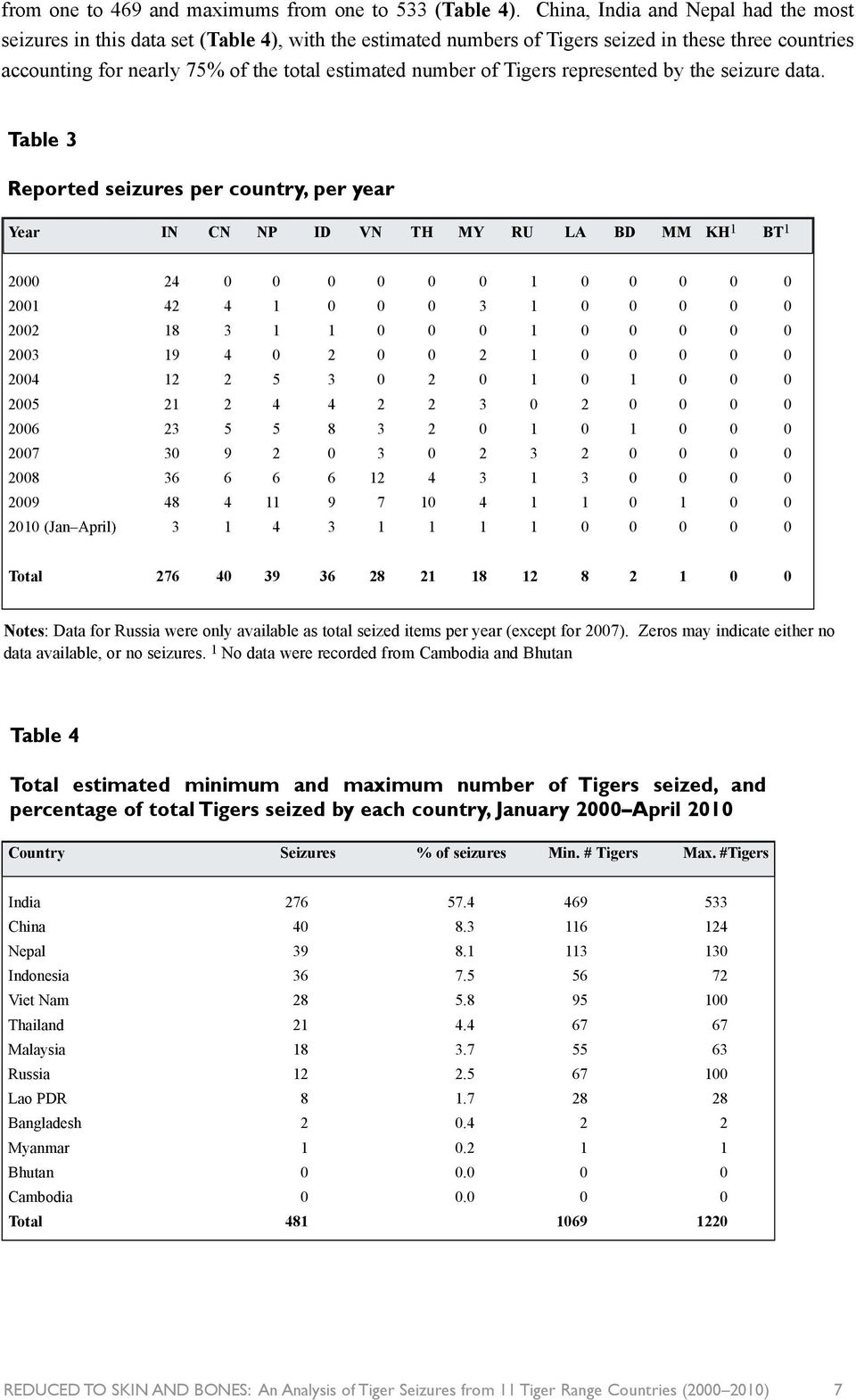

18 It must be stressed that there are serious gaps in the seizure data as compiled for Myanmar, Bangladesh and Lao PDR (Tables 3 and 4). Data are also incomplete for almost all countries in the first years of the last decade. Figure 2 Annual totals of seizures of Tiger reported for China, India, Nepal, Indonesia,Viet Nam and Thailand, Figure 3 Total number of seizures of Tiger reported and minimum and maximum numbers of represented by these for all 11 reporting countries, REDUCED TO SKIN AND BONES: An Analysis of Tiger Seizures from 11 Tiger Range Countries ( )
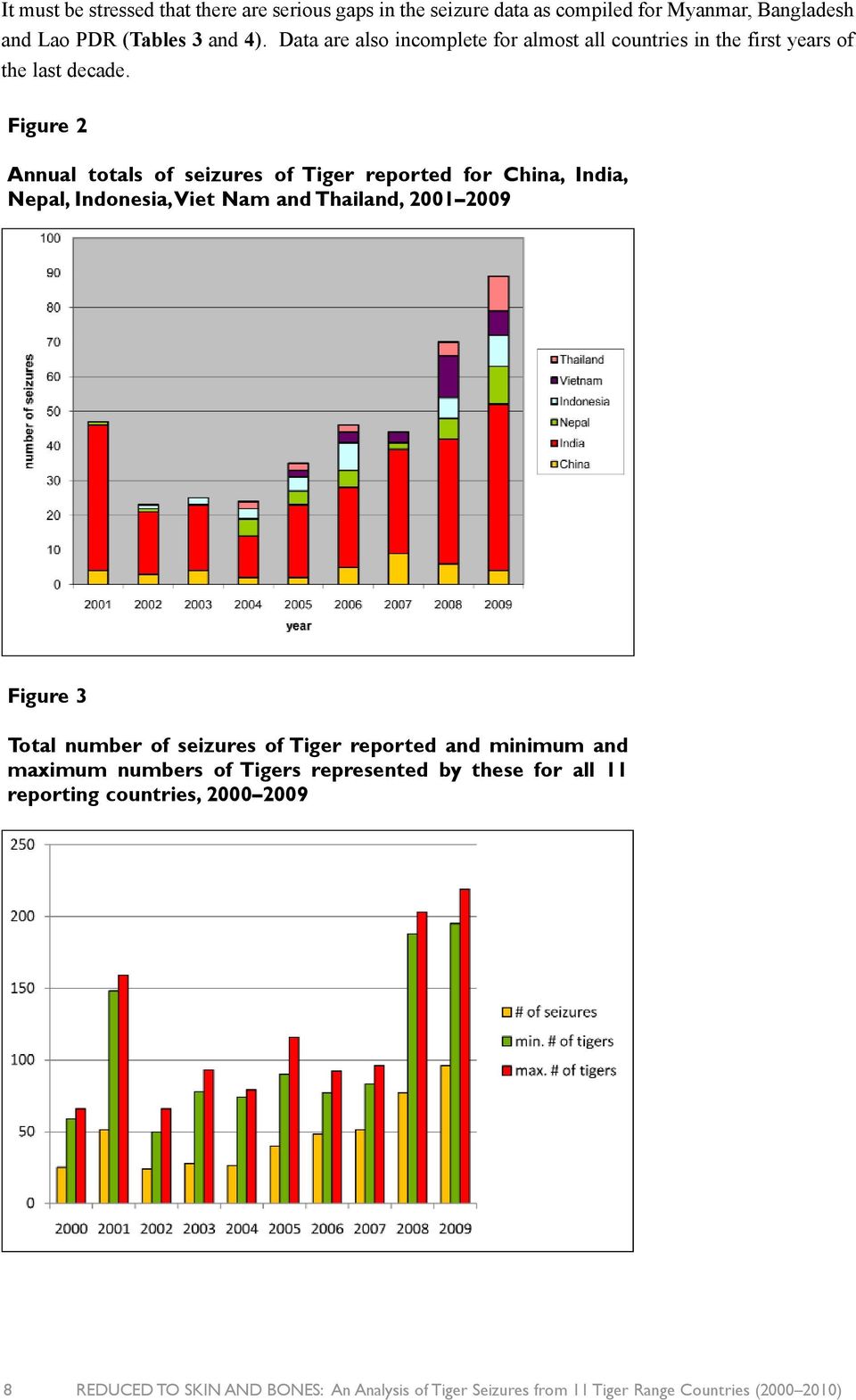
19 Figure 2 shows a notable increase in the reported seizures from Nepal, Viet Nam, Indonesia and Thailand since 2004 and a steady increase in reported seizures in India, leading to an overall increase in reported seizures (see Figure 3). Items seized in range countries were most commonly in the form of skins (480), bones ( kg), dead individuals (197) and claws (1313) (Table 5). In the case of dead individuals it was not possible to determine whether they were whole or cut up (something which could indicate destination market: if whole, for example, the may be destined for the skin market). The quantity of seized items varied between individual seizures of a single canine tooth to 42 live. Table 5 Totals of Tiger items reported seized by year (January 2000 April 2010) Seizures of Total Complete parts Skins Skeletons Dead Live Stuffed 1 1 Kilogrammes Bones Meat/parts Quantities Claws Canines Paws Heads Ribs 1 1 Legs 4 4 Tails 1 1 Penis 5 5 Skulls Jaw bones Skin pieces Looking at seized items per country (Figure 4), skins dominate in seizures in India and Nepal and are relatively frequent in China, Russia and Indonesia. Bones and skeletons are relatively frequent in seizures in China, Indonesia, India, Malaysia, Nepal and Russia. Claws are most often found in India and Malaysia. Seizures in Viet Nam and Thailand consist for a large part of whole dead, although seizures in China, Russia, Malaysia and Indonesia also show relatively high amounts of dead. A breakdown of items by year (Figure 5) reveals that the relative proportions of item type have not varied much over the years. Whole dead seem to have made up a larger part of total seizures in more recent years. REDUCED TO SKIN AND BONES: An Analysis of Tiger Seizures from 11 Tiger Range Countries ( ) 9

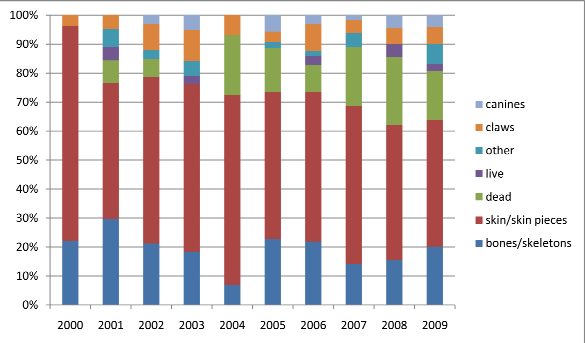
20 Figure 4 Reported Tiger items present (percentage) in seizures per country, Figure 5 Reported Tiger items present (percentage) in seizures per year, REDUCED TO SKIN AND BONES: An Analysis of Tiger Seizures from 11 Tiger Range Countries ( )


21 Figure 6 Seizure site map showing locations of seizures and Tiger Conservation Landscapes (2010) Seizures sites mapped out Source: map prepared and provided by Jochen Stierberger (WWF Germany) and Carrie Stengel (TRAFFIC Southeast Asia) (2010). Note for Figure 6: Owing to incorrect or missing location names, it was only possible to find exact co-ordinates for 463 seizures of the 481 for which data were compiled. Therefore, 18 seizures were not included in this map. Additionally, for 101 of the 463 seizures, only imprecise locations were available (e.g. Peninsular Malaysia ). These seizures are shown as orange dots, while seizures with precise locations (362) are depicted as red dots, sized according to the number of seizures in the same location. Of the 11 seizure data available for the Russian Far East region, none recorded precise locations and only six had imprecise locations (depicted in orange). Since seizures in India represent over half of the total seizures and clearly show the accumulation of seizures in and around Tiger Conservation Landscapes 2, a separate map with a special focus on India was prepared (Figure 7). 2 Tiger Conservation Landscapes indicate a geographical area that is viable to be occupied by five or more and has confirmed evidence of having occupied it within the last 10 years. Presently, there are 42 small fragmented Landscapes within 13 countries (Sanderson et al., 2010). REDUCED TO SKIN AND BONES: An Analysis of Tiger Seizures from 11 Tiger Range Countries ( ) 11

22 Figure 7 Seizure site map showing locations of seizures and Tiger Conservation Landscapes in India (2010) Source: map prepared and provided by Carrie Stengel (TRAFFIC Southeast Asia), REDUCED TO SKIN AND BONES: An Analysis of Tiger Seizures from 11 Tiger Range Countries ( )
23 The origin of Tiger parts observed in trade In all but one case, it was impossible to determine whether seizures involved captive-bred or wild. The exception was a 2009 seizure that involved genetic tests on 12 samples of Tiger meat seized in Thailand, which were suspected to have been sent from Malaysia. Of the 12 samples, five were determined to be from Malayan, with the remainder identified as Indo-Chinese and Siberian, possibly originating from Malaysian zoos, theme parks and/or private owners (Changtragoon and Singthong, 2009; Chiew, 2009). Credit: TRAFFIC/Chris R. Shepherd Enforcement effort No information was publicly available on the number of enforcement officials responsible for wildlife law enforcement in the Tiger range countries, nor on the resources allocated to wildlife law enforcement agencies. This is a very important consideration as, if real trends in Tiger trade seizures are to be tracked effectively, measures of law enforcement effort in individual Tiger range countries, transit countries and consuming markets need to be known so that seizure data can be contextualised accordingly: for this report, that has not been possible. Credit: TRAFFIC/Chris R. Shepherd In the report of the CITES Secretariat to the 15 th meeting of the Conference of the Parties on interpretation and implementation of the Convention related to Asian big cats (document CoP15 Doc. 43.1), the CITES Secretariat noted that good enforcement work was being conducted but obviously not enough, and that much of today s illegal trade in could be markedly reduced, if concerted efforts were made by the law enforcement community. Tiger parts in trade in South-east Asia, The seizure data used in this report show that, of the 481 seizure cases, only 207 (or 43%) were known to have been followed by arrest and/or prosecution: 151 (73% of all cases followed up by arrest and/or prosecution) in India. It must be noted, however, that for many of the seizures compiled for this report there is no information on arrests, prosecutions or sentencing and therefore it is not possible to draw quantitative conclusions from them about the incidence of prosecution. Excluding one case in Myanmar, the data set contains detailed information Credit: TRAFFIC/Chris R. Shepherd REDUCED TO SKIN AND BONES: An Analysis of Tiger Seizures from 11 Tiger Range Countries ( ) 13
24 on prosecution of individuals involved in seizure cases for China and Indonesia, only. Sentences in China are remarkably high: known jail sentences in seven seizure cases ranged from: five years (three cases), to seven years (one case), to 10 years (five cases), to 12 years (two cases), to 18 years (two cases), to lifelong imprisonment (one case). Within the scope of this research it was not possible to determine if seizures are routinely followed up in any meaningful way, such as by interrogation of suspects to extract all possible evidence or by the exchange of intelligence with enforcement counterparts in countries of origin, transit or destination, or with inter-governmental enforcement agencies, such as INTERPOL. Nor was it possible to determine if enforcement operations are generally intelligence-based and target key actors in the trafficking chain rather than mules or poachers commissioned by middlemen and other traders. The fact, however, that most of the seizures apparently result from interceptions of Tiger parts and derivatives being trafficked out of Landscapes, or in infrastructural nodes such as cities or border crossings (see Figure 6), suggests that most enforcement actions are not targeted at the persons controlling illegal trade, but rather at those engaged in the actual transportation of goods. From additional desk research activities (see Methods), further records of prosecution and sentencing of those involved in poaching of or illegal Tiger trade were found for Indonesia, India and Viet Nam, but not for other Tiger range countries. Overall, the available records show that prosecution rates are low and sentences compared to the maximum penalties allowed under relevant national laws are also low. In Indonesia, penalties imposed by judges are in stark contrast to the maximum penalties allowed by law. While the maximum fine for illegal Tiger trade is IDR100 million (USD10 804), this fine has yet to be imposed: according to a summary of 21 cases resulting in confiscation or arrest from January 2008 to February 2010 (Wildlife Crime Unit data, WCS-Indonesia Program, 2010), the highest fine imposed in that period was IDR5 million (USD540). The maximum imprisonment sentence for such cases in Indonesian legislation is five years, whereas the prison sentences imposed in the period mentioned rarely exceeded 1.5 years (although, in two of the 21 cases, sentences of two years and eight months and three years and eight months were imposed). In India, out of 691 court cases concerning Tiger poaching and trade from 1994 to 2009 recorded by the Wildlife Protection Society of India (WPSI), only 10 resulted in successful convictions. In these 10 cases, 30 people were convicted (WPSI staff member in litt., to P.M. Verheij, TRAFFIC, 9 July 2010). In Viet Nam, out of 27 arrests for Tiger trade crimes following seizures of and skins, only four individuals were imprisoned, with sentences ranging from 16 to 24 months, according to figures compiled by Education for Nature Vietnam (ENV). Records show that most Tiger traders that were arrested received suspended sentences (12 individuals) or probation (nine individuals). In two cases involving seized from private homes, the subjects received no punishment whatsoever (ENV, 2010). 14 REDUCED TO SKIN AND BONES: An Analysis of Tiger Seizures from 11 Tiger Range Countries ( )
25 Additional seizure data from May to September 2010 Since data collection for this report ended (30 April 2020), an additional 21 seizures of Tiger parts have been reported in the media (1 May to 4 September 2010). These seizures were not added to the exisiting data set for this study, as they were not compiled in a systematic way and comprise media reports only. They involved a minimum of 40 and a maximum of 50 from eight Tiger range countries. Ten of these seizures were from India, representing a minimum of 22 and maximum of 30. DISCUSSION Caveats and exclusions As noted in the Introduction, because of gaps in the data, the seizure totals presented for individual countries in this report are only indicative. In some cases, the patchiness of the data may be a reflection of lack of availability of accurate and reliable data, but in other cases it may represent a lack of enforcement (see discussion under Law enforcement). By the same token, high seizure rates in China, India, Nepal, Indonesia and Viet Nam can be explained either by relatively high enforcement efforts in these countries or by their significance in the Tiger trade chain, or both. Therefore, while seizure data can give indications of trade, they do not give a definitive picture of actual levels of trade, and may even be misleading. That said, whereas India, harbouring half of the world s wild Tiger populations, is a major source country and Nepal is a major transit country (as well as being a source), China certainly appears to be the largest consumer country of Tiger parts and derivatives, as well as being a significant exporter of wildlife products (UNODC, 2010). Indonesia, besides being a source country for, also has a well-developed domestic market for Tiger products (Nowell, 2000; Shepherd and Magnus, 2004). Viet Nam is another important consumer market for sourced from Lao PDR, Cambodia, Thailand and Malaysia (ENV, 2010; UNODC, 2010). It is also important to note that illegal Tiger trade occurs at geographic locations outside the 13 Tiger range countries, although these are not included in the scope of this report. As examples: In July 2005, over 140 kg of Tiger bones and 24 skulls that originated in Jakarta, Indonesia, were seized in Taiwan (TRAFFIC, 2005). In Canada, in 2009, a Chinese trading company was fined USD for possessing medicines claiming to contain Tiger parts intended for sale (TRAFFIC, 2009). In the USA, from 2003 to 2007, 152 shipments originating from 19 different countries were seized. [(TRAFFIC/WWF Wildlife Trade Tracker ( Most seizures in the USA concern traditional medicines claiming to contain Tiger, and often these are found to be fakes (TRAFFIC staff in North America, in litt., to P.M. Verheij, TRAFFIC, 6 October 2010). REDUCED TO SKIN AND BONES: An Analysis of Tiger Seizures from 11 Tiger Range Countries ( ) 15
26 Captive-bred or wild-caught? There are known Tiger farms in China, Cambodia, Lao PDR, Thailand and Viet Nam (Nowell and Xu, 2007; ENV, 2010). It is a concern that captive-bred are entering illegal trade (Plowden and Bowles, 1997; Bulte and Damania, 2005; Williamson and Henry, 2008; Nowell and Xu (2008); Irvine, 2010). The minimum number of dead indicated by the seizure data in this study (1069), especially since this represents only part of the Credit: Vivek R. Sinha/WWF-Canon actual volume traded over the last 10 years, strongly suggests that the wild Tiger population (3500 or fewer) may not be able to satisfy existing demand. To meet this demand, parts and derivatives from captive-bred entering the trade may well increase significantly. The determination of the origin of Tiger specimens in Bengal Tiger, India illegal trade is beyond the scope of this report, but merits attention in the future. Increase in seizures Figures 2 and 3 suggest an overall increase in trade from 2001 to However, seizure data are insufficient at this point to determine a real growth in Tiger trade, especially as measures of law enforcement effort are not yet available. Overall, however, Tiger seizures appear to have increased from 2007 to 2009 in particular (Figure 2), with annual averages for minimum (155.3) and maximum (172.7) numbers of in this period being markedly higher than for the 10-year period as a whole. This increase reflects a notable increase in the reported seizures from Indonesia, Nepal, Thailand and Viet Nam since 2004 and a steady increase in reported seizures in India. As mentioned, in the months following the collection of seizure data for this report, there has continued to be a large number of Tiger specimen seizures (Appendix 2), suggesting continued increase in Tiger trade. Reasons for the increase noted above could be growing wealth and therefore demand for luxury products, which might fuel poaching. Another possible explanation may be heightened enforcement effort and effectiveness. This is quite possibly the case with India, where the shock caused by the news in 2005 of the loss of all in Sariska National Park as a result of poaching led to a greater focus on enforcement, as testified to by the establishment of the National Tiger Conservation Authority (NTCA) and the Wildlife Crime Control Bureau (WCCB) (TRAFFIC staff in India, in litt., 6 September 2010 to P.M. Verheij, TRAFFIC). Lastly, an increase in Tiger seizures could simply be a function of better availability of more recent data. This would indicate that seizure data may also be available for earlier years and may be yielded upon more effort, in which case it would contribute to the building of a more reliable database for monitoring Tiger trade. 16 REDUCED TO SKIN AND BONES: An Analysis of Tiger Seizures from 11 Tiger Range Countries ( )
27 Trade hubs and routes The maps of seizure sites (Figures 6 and 7) give a good indication of the known Tiger trade hot spots, even though 101 of the seizures depicted do not relate to exact seizure sites, owing to the incomplete data set, and so present only an indicative spatial portrait of Tiger trade in the region. Nonetheless, the maps illustrate the importance of focusing enforcement efforts on the hot spots for poaching and trade. Most of the red dots on the maps are concentrated in and around the Tiger Conservation Landscapes, especially in India. In the Sundarbans 3, 11 seizures were made within a 50-km radius of the Landscape, while 21 were made in and around the Eastern Ghats 3, 44 in and around the Western Ghats 3 and 71 were recorded within 50 km of the Terai Arc Landscape 3. The high density of seizures in India surely reflects the fact that the country s relatively large remaining wild Tiger population (mid value 1411 at the last estimation) (Ministry of Environment and Forests, 2008), nearly half of the world s Tiger population, is under high poaching pressure. The 31 seizures in and around the Tiger Conservation Landscapes of Sumatra are also indicative of Sumatra as a major source for Tiger trade. Credit: WWF-Canon/Soh Koon Chng Tiger skin seized in Nepal Key trade hubs on the map are cities like Mumbai (nine seizures), New Delhi (nine seizures), Kolkata (eight seizures), Kathmandu (six seizures), Ho Chi Minh City (four seizures), Hanoi (12 seizures), Bangkok (two seizures) and border towns such as Ruili in Yunnan Province, China (four seizures), as they represent markets or infrastructural nodes. The concentrations of seizures at country borders, such as those highlighted at the borders of Myanmar China and India Nepal, illustrate the need for enforcement at country borders to intercept smugglers. Seizures in China are scattered, which might indicate a widespread market for Tiger parts and derivatives in that country. The map endorses knowledge of various international Tiger trade routes (Banks and Newman, 2004; Shepherd and Nijman, 2008; C.R. Shepherd, TRAFFIC, pers. comm.; TRAFFIC staff in Russia and India, in litt., 11 and 27 October 2010, respectively, to P.M. Verheij, TRAFFIC): India to China via Nepal through Bihar, a State in eastern India bordering Nepal, and Birganj, the border town in southern Nepal closest to Kathmandu; 3 Tiger Conservation Landscapes see footnote 1. REDUCED TO SKIN AND BONES: An Analysis of Tiger Seizures from 11 Tiger Range Countries ( ) 17
28 India to Myanmar via Moreh in Manipur; Malaysia to Thailand via the Thai border town of Sungai Golok; Myanmar to China through the Sino-Myanmar border and Ruili, a town on the south-west border of China in south-western Yunnan Province (Dehong Prefecture); and Russian Far East to China via Ussuriysk, Region of Primorsky. Russian data were not spatially explicit, so specific border crossings for poached cannot be highlighted. On the other hand, no seizures were reported from well-known wildlife markets in Myanmar, such as Mong La on the Myanmar China border or Tachilek on the Myanmar Thailand border (Shepherd and Nijman, 2008; Oswell, in press), nor from Betong, the border town between Thailand and Malaysia, which is a known smuggling route for Tiger and other wildlife from Malaysia s forests (C.R. Shepherd, TRAFFIC, pers. comm. to P.M. Verheij, 19 April 2010). Transport of illegal wildlife occurs via various modes including: sea, air, rail, road and post. Crossborder wilderness areas with low enforcement levels are frequently used by traffickers. Areas where there is a history of conflict and insurgency, such as in parts of Myanmar bordering China and in India bordering Nepal, also greatly facilitate illegal trade (UNODC, 2010; Oswell, in press). The maps in this report are a first attempt to illustrate spatial distribution of illegal Tiger trade incidents. They also illustrate how compilation and analysis of seizure data can greatly increase the understanding of trade patterns and how this understanding can enable governments to target their enforcement efforts better. From Landscape to market Figure 4 shows some interesting differences in items found in illegal trade in the 11 Tiger range countries. The fact that total seizures in India and Nepal are recorded as consisting of a large proportion of skins endorses reports by non-governmental organizations (NGOs) and international organizations of an ongoing skin trade from India and Nepal to Tibet Autonomous Region of China (Nowell and Xu, 2007; EIA, 2009; UNODC, 2010). Indonesia also reports seizing a relatively large number of skins, which supports the findings of Shepherd and Magnus (2004), who found a specialized market for skins and stuffed in Sumatra. The data for Viet Nam and Thailand comprise a high number of items labelled dead. These are often cut in pieces (see photographs opposite), which means that demand for whole skins is not driving this component of the Tiger trade. Rather, there is a likelihood that the are traded for their meat and, after processing, their bones. The high occurrence of dead in these countries and a relatively low occurrence of bones may either signify that processing takes place elsewhere or that the bones are disposed of after the meat has been traded. Given the high value of bones in trade this last option does not seem likely. 18 REDUCED TO SKIN AND BONES: An Analysis of Tiger Seizures from 11 Tiger Range Countries ( )
29 Seizures in China, Nepal and Russia comprise a large number of bones and skeletons. For China, which is an end market for bones destined for use in traditional medicines, this is not surprising. In the case of Russia (a source for destined for China) and Nepal (both a source and transit country for from India destined for China), the high occurrence of bones could signify that poached Tiger carcasses are processed into bones in these countries. A remarkably large number of canine teeth appear to have been seized by Malaysian authorities (see Figure 4). TRAFFIC has found no evidence suggesting that there is a substantial market for these teeth in Malaysia, however. It is possible that some of those seized were fakes. The breakdown by product type and year (Figure 5) reveals that the relative proportions of the main trade commodities (skins and bones) have not varied much over the years, indicating a steady demand for these items. cut into pieces, Nongkai Province,Thailand, 26 April 2009 Credit: Mekong Waterfront Guard & Natural Resources and Environmental Crime Suppression Division (NRECD) Thailand Law enforcement The analysis of the Tiger seizure data shows an increase in seizures but, owing to the lack of information on resources allocated to fighting wildlife crime, it was not possible to draw conclusions about the effectiveness of law enforcement efforts in the Tiger range countries. As such, it is impossible to determine if the increase in seizures is caused by an increase in trade or an increase in law enforcement. Nevertheless, the information available for this report suggests that law enforcement efforts in most Tiger range countries are an insufficient deterrent to Tiger trade. Myanmar provides a striking example of this. Myanmar has reported only one seizure over the past 10 years (four Tiger canine teeth in 2009), whereas in the past decade Tiger parts and derivatives have been observed openly for sale in the markets of Tachilek and Mong La: from 1991 to Tiger parts were found for sale, amounting to a minimum of 107 (Shepherd and Nijman, 2008), whereas from 2002 to 2009, 106 Tiger parts totalling a minimum of 94 were found (Oswell, in press). Furthermore, of the 40 seizures recorded in China, no fewer than 15 took place in the south-western province of Yunnan, which borders Myanmar. This leaves no doubt about the fact that Myanmar is a major gateway for illegal Tiger trade. Law enforcement efforts resulting in interception of illegal shipments and arrests of suspects involved in poaching, smuggling and illegal trade are crucial to tackle Tiger trade but remain ineffective if not followed up by good prosecution and sentencing. Available information shows that in many countries current prosecution and sentencing levels are insufficient to deter possible wildlife crime offenders (Akella and Cannon, 2004). REDUCED TO SKIN AND BONES: An Analysis of Tiger Seizures from 11 Tiger Range Countries ( ) 19
30 Unfortunately the solution to tackling wildlife (or any other) crime is not simply a case of increasing the maximum penalties or the sentences imposed. China, for example, is known for its high penalties and judges often impose harsh sentences upon offenders, yet people still risk conducting illegal Tiger trade because of the large profit it yields and the low probability of getting caught. When looking at ways to increase the deterrent value of enforcement on possible offenders, it must be recognized that this depends on a combination of factors, which include the perceived justness/legitimacy of the law; political certainty (i.e. the likelihood of changes in legislation); the effectiveness of preventative measures and the strength of visible implementation. This last factor is highly relevant in the case of illegal wildlife trade and illegal Tiger trade in particular. Research shows that the effectiveness and deterrent value of environmental laws depends on the effectiveness of the enforcement regime responsible for their implementation. When implementation (by enforcement agencies, prosecution and judicial authorities) is weak, the profits of criminal behaviour often exceed the expected penalty of the enforcement deterrent. The enforcement disincentive is thereby principally determined by the probability of detection, arrest, prosecution and conviction multiplied by the amount of the likely penalty. This means that enforcement regimes should be seen as holistic systems and only as strong as their weakest link (Akella and Cannon, 2004; Broad and Damania, 2010). Much would be improved if Parties to CITES fully implement the provisions of CITES Resolution Conf (Rev. CoP15). Among other things, this Resolution urges Tiger range countries to: introduce innovative enforcement methods and strengthen enforcement efforts in key border regions, and develop or improve implementation of regional enforcement networks; ensure enforcement units and personnel receive relevant and effective support in anti-poaching operations, the gathering and use of intelligence, targeting offenders, wildlife crime investigative techniques, collecting evidence, inter-agency liaison and co-operation and preparing cases for prosecution (considering the guidance provided in Annexes 1, 2 and 3 of the Resolution). The Resolution, among other things, recommends : increased awareness among enforcement, prosecution and judicial authorities; the establishement of anti-poaching teams and enforcement units and their effective resourcing, to counter the illegal killing of and trade in and other Asian big cat species; the sharing of intelligence between relevant enforcement agencies to counter illegal killing and trade; and that co-operative bilateral and multilateral arrangements be established in order to achieve more effective control of illegal international trade in specimens of Asian big cat species. Owing to insufficient reporting to CITES by some Tiger range countries on the implementation of Resolution Conf 12.5 since its first adoption in 2002, it is difficult to assess whether or not the provisions of Resolution Conf are implemented correctly. It is, however, telling that the CITES 20 REDUCED TO SKIN AND BONES: An Analysis of Tiger Seizures from 11 Tiger Range Countries ( )
31 Secretariat in its report to CoP15 on interpretation and implementation of the Convention related to Asian big cats, while noting the lack of reporting by Tiger range countries, pointed out that most of the findings of the CITES Tiger Missions Technical team reported in 1999 to the 42 nd Standing Committee were still valid and relevant today. It is also telling that the CITES Tiger Enforcement Taskforce, established in 2001 following the recommendation of the CITES Tiger Missions Technical team to help countries tackle the illegal killing of and illegal trade in their parts and derivatives, does not appear to have achieved its goal of conducting an analysis of poaching and illegal trade. The Taskforce convened twice and in 2002 a capacity-building workshop for enforcement officials of Tiger range countries was organized in India. At its second meeting, the Taskforce identified the need for obtaining an overview of poaching and illegal trade and called for Tiger range countries to supply data with the aim of undertaking a crime analysis. With one exception, those countries subsequently failed to submit any meaningful data, as a result of which no meaningful analysis could be undertaken. This was reported to the Standing Committee (John M. Sellar, CITES Secretariat in litt. to P.M. Verheij; CITES document SC54 Doc. 25.1). Despite repeated communications in the past decade by the CITES Secretariat about the urgency of the situation and the need for strengthened law enforcement, it may be concluded that until now there has not been enough political will to tackle the illegal killing of and illegal trade in their parts and derivatives. Corruption Corruption is an issue that has an impact on the effectiveness of wildlife law enforcement and therefore the level of seizures. Although little is known about the nature and magnitude of its effects on Tiger trade, it is reported as a relevant consideration (CITES document Doc. SC , report of the CITES Tiger Missions Technical Team for the 42 nd meeting of the CITES Standing Committee; Smith and Walpole, 2005; UNODC 2010). As it was not possible to measure the effect of corruption on seizure levels, this report refrains from discussing relative corruption levels in the Tiger range countries with respect to Tiger seizures. The importance of data The analysis presented in this report, based on the limited data available, illustrates the usefulness of systematic compilation and analysis of data on poaching incidents, seizures, arrests and prosecutions. It is of concern that up until now, most governments of Tiger range countries (with the exception of India, which established Tigernet in 2010) do not appear to have established systems for compilation of such data at a national level, and are not systematically sharing data nor any other kind of information or intelligence related to illegal trade in or other wildlife commodities. REDUCED TO SKIN AND BONES: An Analysis of Tiger Seizures from 11 Tiger Range Countries ( ) 21
32 The establishment of such systems would be in accordance with CITES Resolution Conf (Rev. CoP15), which urges all range States and other relevant Parties to implement systems for the recording of information relating to illegal trade in Asian big cats and to share this information as appropriate to ensure coordinated investigations and enforcement. This paragraph was adopted at CoP15 in response to the failure on the part of range States to report on their progress in implementing the actions agreed by CITES Parties (CITES document CoP15 Doc ). Moreover, Parties at CoP15 adopted Decision 15.46, which directed all Parties, but particularly Tiger range countries, to submit, by 30 June 2010, information relating to incidents of poaching of and illegal trade in that occurred within their territory since the beginning of The information should have been submitted to the CITES Secretariat or to the General Secretariat of ICPO-INTERPOL. The related Decision directs the Secretariat to collaborate with ICPO-INTERPOL to analyse the information received from the Parties, and to produce two reports, one for public consumption and the other for the law enforcement community. It is hoped that this initiative of the CITES Secretariat and INTERPOL will form an incentive for the Tiger range countries to establish robust reporting systems for compiling Tiger crime data, both at national and regional levels. Such systems might feed into the yet-to-be-established global illegal trade database, which will be designed and implemented by a working group established at CoP15 (Decision 15.42). CONCLUSION This study set out to compile and analyse data on Tiger seizures, , from 11 of the 13 Tiger range countries, to support conservation efforts to address the trade in Tiger parts and derivatives. It has succeeded in providing an unprecedented range of data on the trade in a single output, contributing important baseline information to inform the understanding of this persistent yet illegal trade. While the caveats often restated in this report (the data have gaps; they represent a fraction of actual trade; they cannot be interpreted independently of enforcement contexts; and they do not cover all Tiger range countries) must continually be borne in mind (and some are tantamount to conclusions in their own right), conclusions and pointers emerge from the data set generated by this study. First, and most obviously, the data show that illegal Tiger trade continues unabated despite considerable and repeated efforts to curtail it on the part of Tiger range and consumer countries, inter-governmental organizations and NGOs. Less concretely, but notably, the data point to other findings, most of which were expanded upon in Discussion, namely: the quantities of implicated by trade in the 11 Tiger range countries during this period (a minimum of 1069 and a maximum of 1220); an apparent increase in seizures in recent years, with a greater part now being played by Indonesia, Nepal, Thailand and Viet Nam relative to a decade ago and continuation of India's position as supplier of the largest quantities of Tiger products by far; 22 REDUCED TO SKIN AND BONES: An Analysis of Tiger Seizures from 11 Tiger Range Countries ( )
33 steady demand for a variety of Tiger products; significant trade hubs and routes, endorsing some previous findings; the likelihood that the wild Tiger population may not be able to satisfy existing demand and that parts and derivatives from captive-bred entering illegal trade in response may well increase significantly; and the inadequacy of current law enforcement activities against illegal killing of and trade in, including the inability of penalties alone, even when most severe, to deter would-be offenders, highlighting the importance of increasing the probability of detection, arrest, prosecution and conviction as a deterrent. In sum, these conclusions point to a lack of political will among those responsible at national and international levels for collecting, collating, using and sharing data on Tiger trade and for enforcement of laws designed to protect from illegal killing and trade. It can be concluded in turn, therefore, that such killing and trade can only be significantly reduced if there is a paradigm shift in terms of commitment. All stakeholders will have to join forces to create an intelligence-driven, well-coordinated, trans-boundary and sustained push against forces driving one of the most legendary species on Earth to extinction. The following recommendations for fighting Tiger trade more effectively spring from the conclusions above and are centred around improving the understanding of the dynamics of Tiger trade and correspondingly enhanced enforcement. The recommendations do not include suggestions for reducing demand for Tiger products, as this was not researched as part of this study, though would obviously be part of any serious integrated conservation response to business as usual in the Tiger trade. RECOMMENDATIONS Improve understanding of Tiger trade dynamics Effective enforcement starts with a good understanding of crime patterns. In the case of Tiger trade, this means that source and consumer countries should compile data on Tiger poaching, trafficking and consumption systematically and analyse these, in order to understand the entire trade chain and determine trends in illegal killing and trade. This should encompass comprehensive mapping of where the poaching hotspots are, information on routes by which are smuggled, the location of end destinations, peak times for poaching and trade, actors involved, and on which consumer groups are consuming the different types of Tiger parts and derivatives. TRAFFIC recommends that the governments of Tiger range countries establish systems at national and transnational level to compile these data. It is hoped that the compilation and analysis by CITES and INTERPOL of information relating to incidents of poaching of and illegal trade in from 2007 to 2010 will form an incentive for the Tiger range countries to do so. REDUCED TO SKIN AND BONES: An Analysis of Tiger Seizures from 11 Tiger Range Countries ( ) 23
34 Data on poaching and illegal trade should be exchanged with other Tiger range and consumer countries, as well as inter-governmental (enforcement) organizations such as INTERPOL, UNODC, WCO and CITES, through the available mechanisms such as Ecomessage (the INTERPOL form for reporting wildlife crime incidents) and WCO s Customs Enforcement Network. To date, Tiger range countries have not made full and effective use of these mechanisms. Multilateral wildlife enforcement networks such as ASEAN-WEN and SAWEN should play an essential role in promoting the use of these mechanisms. Tiger range countries should improve their understanding of the sources for found in trade. It is recommended that seized Tiger parts and derivatives be analysed for DNA and other forensic evidence in order to establish the origin of the specimens and whether or not any have been captivebred or farmed. A database should be established, for example by an organization such as ASEAN- WEN, SAWEN or CITES, for compiling the results of these analyses. Ideally this database should communicate with the database(s) for data on poaching and illegal trade recommended above and be managed at the level of afore-mentioned multilateral enforcement networks. Improve law enforcement In order to improve deterrents, Tiger range countries should increase the probability of detection, arrest, prosecution, conviction and the level of the penalties and enforcement efforts must become smarter and more focused. Enforcement agencies should conduct intelligence-led, multi-disciplinary criminal investigations. Systematic interrogation of suspects to extract all relevant intelligence should be pursued, and seizure not just of the illegal shipments, but of all possible vehicles for evidence trails, such as mobile phones and computers. Communications via the Internet should be investigated, financial research conducted to look for evidence of money-laundering, and full use should be made of forensic techniques such as DNA analysis and fingerprinting. Agencies should also make use of the manuals on Controlled Delivery, Wildlife Smuggling Identification, and Wildlife Smuggling Interview Questioning that CITES, INTERPOL and the WCO have jointly prepared (see Lastly, law enforcement can only become optimized if accurate intelligence is exchanged in real time between agencies from the countries of origin, transit and/or destination authorized to act upon it. Law enforcement should focus on all parts of the trade chain, starting with poachers, processors, middlemen and traders. Enforcement efforts must be targeted at the Tiger Conservation Landscapes especially (the need for which is clearly illustrated by the large amount of seizures taking place in the Indian landscapes), key trafficking nodes, i.e. cities and border crossings (also illustrated in India), and the consumer markets in East and South-east Asia. Covert monitoring and infiltration of consumer markets is an important way to gather evidence of people and/or organizations involved in processing dead into meat, bones, skins and other parts, the illegal production of medicines, wine and tonics containing Tiger and the sale thereof. 24 REDUCED TO SKIN AND BONES: An Analysis of Tiger Seizures from 11 Tiger Range Countries ( )
35 Tiger range (and consumer) countries should fully implement the provisions of CITES Resolution Conf (Rev. CoP15), as this would mean great progress to combat illicit activity could be made. This Resolution sets a minimum standard for effective wildlife law enforcement pertaining to the trade in Asian big cats. It calls for the establishment and effective resourcing of anti-poaching teams and enforcement units and the exchange of intelligence between relevant enforcement agencies. It recommends strengthened enforcement efforts in key border regions, the introduction of innovative enforcement methods and the development/improvement of regional enforcement networks. The Resolution also recommends Parties increase awareness of wildlife crime and illicit wildlife trade among enforcement, prosecution and judicial authorities. An international effort involving Tiger range countries and inter-governmental enforcement agencies such as INTERPOL, UNODC and WCO is needed to tackle the organized crime networks involved in Tiger trade. As such, an international Tiger trade taskforce should be established, consisting of a multidisciplinary team of criminal investigation experts, to be based in one of the Tiger range countries, tasked with co-ordinating intelligence exchange, analysing data and supporting enforcement authorities in criminal investigations. NGOs and other parts of civil society should also be engaged, as they can provide valuable expertise and experience. A possible option would be the revitalization of the CITES Tiger Enforcement Task Force established in As the criminal networks involved in Tiger trade are also involved in other types of wildlife crime, such a taskforce would greatly contribute to combating wildlife crime. The huge investment necessary to accomplish all this cannot be borne by Tiger range countries alone. Financial and technical support should be provided by consumer countries, interested donor countries and donor organizations. It must be stressed that these recommendations for tackling Tiger trade are not all Tiger-specific, and could benefit other wildlife species that are in danger of extinction as a result of poaching and illegal wildlife trade in Asia. REDUCED TO SKIN AND BONES: An Analysis of Tiger Seizures from 11 Tiger Range Countries ( ) 25
36 REFERENCES Akella, A.S. and Cannon, J. (2004). Strengthening the Weakest Links: Strategies for Improving the Enforcement of Environmental Laws globally. Conservation International, Washington D.C., USA Banks, B. and Newman, J. (2004). The Tiger Skin Trail. Environmental Investigation Agency, UK. Broad, S. and Damania, R. (2009). Competing demands: Understanding and addressing the socioeconomic forces that work for and against tiger conservation. A background paper from the Kathmandu Global Tiger Workshop. Global Tiger Initiative. Viewed 13 March Bulte, E.H. and Damania, R. (2005). An economic assessment of wildlife farming and conservation. Conservation Biology 19: Cameron, A., Banks, D. and Gosling, J. (2009). Saving the wild tiger: Enforcement, tiger trade and free market folly an EIA discussion document. Environmental Investigation Agency, UK. Care for the Wild International (2008). Exploiting the Tiger: Illegal Trade, Animal Cruelty and Tourists at Risk at the Tiger Temple An Investigation at Wat Pa Luangta Bua Yannasanpanno Forest Monastery Kanchaburi, Thailand. Care for the Wild International, UK. Changtragoon, S. and Singthong, K. (2009). The classification of species and subspecies of tiger from confiscated tiger samples by using mtdna sequencing. Viewed 10 May Chiew, H. (2010). Don t exploit tigers. The Star (Malaysia)/Asia News Network, 2 February. Chiew, H. (2009). Thai probe shows tiger parts came from Malaysia. The Star (Malaysia), July Clements, R., Rayan, D.M., Zafir, A.W.A., Venkataramam, A., Alfre, R., Payne, J., Ambu, L., Sharma, D.S.K. (2009). Trio under threat: can we secure the future of rhinos, elephants and tigers in Malaysia? Biodiversity Conservation: Dinerstein, E., Loucks, C., Wikramamamayake, E., Ginsberg, J., Sanderson, E., Seidensticker, J., Forrest, J., Bryja, G., Heydlauff, A., Klenzendorf, S., Leimgruber, P., Mills, J., O Brien, T., Shrestha, M., Simons, R., Songer, M. (2007). The fate of wild. BioScience 57(6): EIA (2009). A Deadly Game of Cat and Mouse: How Tiger Criminals give China the Run-around. Environmental Investigation Agency, UK. ENV (2010). Summary of Tiger Trade Investigation Findings. Education for Nature Viet Nam, Viet Nam. Galster, S., Schaedla, W., Redford, T. (2010). Partnering to stop poaching: developing cross-sector strategic responses to wildlife poaching. In: Tilson, R. and Nyhus, P. (2010). of the World: The Science, Politics, and Conservation of Panthera tigris, 2 nd edn. Elsevier Inc., San Diego, USA. Irvine, D. (2010). Tiger farms: A conservation idea red in tooth and claw? CNN. Viewed 23 February IUCN (2010). IUCN Red List of Threatened Species Version Viewed 12 May Jenkins, R.W.G. (2006). International Conservation of : a New Approach by China. Unpublished report. Creative Conservation Solutions, Belconnen, Australia. 26 REDUCED TO SKIN AND BONES: An Analysis of Tiger Seizures from 11 Tiger Range Countries ( )
37 Mills, J. and Jackson, P. (1994). Killed for a Cure: a Review of the Worldwide Trade in Tiger Bone. A TRAFFIC Network Report. TRAFFIC International, Cambridge, UK. Ministry of Environment and Forests (2008). Total country level population of tiger Press release, 12 February Viewed 22 October Mitra, B. (2007). Burning Bright: China tries to balance its Tiger breeding strategies and a thriving market in Tiger bones. In: IWMC World Conservation Trust (2007). Tiger Conservation: It s time to think outside the box. IWMC World Conservation Trust. Ng, J. and Nemora (2007). Tiger Trade Revisited in Sumatra, Indonesia. TRAFFIC Southeast Asia, Petaling Jaya, Malaysia. Nowell, K. (2000). Far From a Cure: The Tiger Trade Revisited. TRAFFIC International, Cambridge, UK. Nowell, K. and Xu, L. (2007). Taming the Tiger Trade: China s Markets for Wild and Captive Tiger Products since the 1993 Domestic Trade Ban. TRAFFIC East Asia, Hong Kong, China. Nowell, K. (2010) The Central Importance of China's Trade Policy for Tiger Conservation. In: Tilson, R. and Nyhus, P. (2010). of the World: The Science, Politics, and Conservation of Panthera tigris, 2nd edn. Elsevier Inc. San Diego, USA. Oswell, A H. (in press). Big Cat Trade in Myanmar and Thailand. TRAFFIC Southeast Asia, Petaling Jaya, Malaysia. Plowden C. and Bowles, D. (1997). The illegal market in tiger parts in northern Sumatra, Indonesia. Oryx 31(1): Rao, M., Myint, T., Zaw, T., and Htun, S. (2005). Hunting patterns in tropical forests adjoining the Hkakaborazi National Park, north Myanmar. Oryx 39(3): Riaño, J., Hodess, R., and Evans, A. (2009) Global Corruption Barometer. Transparency International. Viewed 9 April Sanderson, E., Forrest J., Loucks, C., Ginsberg, J., Dinnerstein, E., Seidensticker, J., Leimgruber, P., Songer, M., Heydlauff, A., O'Brien, T., Bryja, G., Klenzendorf, S. and Wikramanayake, E. (2010). Setting Priorities for Tiger Conservation: In: Tilson, R. and Nyhus, P. (2010). of the World: The Science, Politics, and Conservation of Panthera tigris, 2nd edn. Elsevier Inc., San Diego, USA. Sapa (2010). Fears for Sumatran tiger. NEWS24.com. Viewed 3 February. Seidensticker, J., Christie, S. and Jackson, P. (1999). Riding the Tiger: Tiger Conservation in Humandominated Landscapes. Cambridge University Press, Cambridge, UK. Shepherd, C. R. and Magnus, N. (2004). Nowhere to Hide: The Trade in Sumatran Tiger. TRAFFIC Southeast Asia, Petaling Jaya, Malaysia. Shepherd, C. R. and Nijman, V. (2008). The Wild Cat Trade in Myanmar. TRAFFIC Southeast Asia, Petaling Jaya, Malaysia. Smith, R.J. and Walpole, M.J. (2005). Should conservationists pay more attention to corruption? Oryx 39 (3): REDUCED TO SKIN AND BONES: An Analysis of Tiger Seizures from 11 Tiger Range Countries ( ) 27
38 Sorenson, J. (2010). Stamp out the tiger trade. The Globe and Mail (Canada). Viewed 2 February Tilson, R., H. Defu, J. Muntifering and Nyhus, P.J. (2004). Dramatic decline of wild South China tigers Panthera tigris amoyensis: field survey of priority tiger reserves. Oryx 38(1): TRAFFIC (2005). Seizures and prosecutions. TRAFFIC Bulletin 20(3). TRAFFIC (2009). Seizures and prosecutions. TRAFFIC Bulletin 22(2). TRAFFIC (2010). Understanding the Motivations: the First Step Towards Influencing China s Unsustainable Wildlife Consumption. TRAFFIC East Asia, China. TRAFFIC (2008). What s Driving the Wildlife Trade? A Review of Expert Opinion on Economic and Social Drivers of the Wildlife Trade and Trade Control Efforts in Cambodia, Indonesia, Lao PDR and Viet Nam. East Asia and Pacific Region Sustainable Development Discussion Papers. East Asia and Pacific Region Sustainable Development Department, World Bank, Washington DC, USA. TRAFFIC North America, Wildlife Trade Tracker ( UNODC (2010). The Globalization of Crime: A Transnational Organized Crime Threat Assessment. United Nations Office on Drugs and Crime, Vienna. Walston, J., Karanth, K.U. and Stokes, E.J. (2010). Avoiding the Unthinkable: What Will it Cost to Prevent Becoming Extinct in the Wild? Wildlife Conservation Society, New York, USA. Williamson, D. and Henry, L. (2008). Paper? The role of the U.S. Captive Tiger Population in the Trade in Tiger Parts. TRAFFIC North America, USA. Wright, B. (2010) Will the Tiger Survive in India? In: Tilson, R. and Nyhus, P. (2010) of the World: The Science, Politics, and Conservation of Panthera tigris, 2 nd Edition. Elsevier Inc. San Diego, USA. 28 REDUCED TO SKIN AND BONES: An Analysis of Tiger Seizures from 11 Tiger Range Countries ( )
39 APPENDIX 1 Seizure data for 11 Tiger range countries, 2000 April 2010 Countries of origin, transit and/or destination in between brackets are added by the authors, based on geographic location and known trade routes. Question marks were added for cases where the country of origin, transit and/or destination could not be determined. Year Country Seized Items Min # Max # Country of origin/ transit Destination Seizure Site 2004 BD skins (1) 1 1 (BD) (?) Shornkhola, Sundarban Reserved Forest 2006 BD skins (1) 1 1 (BD) (?) Shornkhola, Sundarban Reserved Forest 2001 CN skins (23) Myanmar (CN) Baoshan, Yunnan 2001 CN bones (62.4 kg) 7 7 Lhasa Lao PDR 2001 CN bones (13 kg) 2 2 (MM) (CN) Ruili, Dehong, Yunnan 2001 CN dead (1) 1 1 (RU) (CN) Naohe, Heilongjiang Province 2002 CN bones (22.1kg) skeletons (4) 7 7 (CN) Lao PDR Mohan port, Yunnan 2002 CN skins (1), bones (7 kg) 1 2 (MM) (CN) Ruili, Dehong, Yunnan 2002 CN dead (1) 1 1 (RU/CN) (CN) Hunchuan National Nature Reserve 2003 CN skins (1), bones (12 kg) 2 3 (MM) (CN) Ruili, Dehong, Yunnan 2003 CN skins (31) India China Lhasa, Tibet 2003 CN skins (5) 5 5 Myanmar (CN) Dehong, Yunnan 2003 CN skins (1), skeleton (1) 1 2 Russia China Changbaishan, Baishan, Jilin 2004 CN dead (1) 1 1 (RU/CN) (CN) Fushunxinbin of Liaoning Province Mudanjiang Dongning 2004 CN dead (1) 1 1 (RU) (CN) Heilongjiang NP 2005 CN skins (2) 2 2 Myanmar (CN) Yingjiang, Dehong, Yunnan 2005 CN bones (175) 1 1 (MM) (CN) Kunming, Yunnan province 2006 CN claws (4) 1 1 Myanmar China Nansan checkpoint, Yunnan province 2006 CN bones (1.75 kg) 1 1 Russia China Raohe checkpoint, Heilongjiang province 2006 CN skins (1) 1 1 Myanmar Myanmar lianghe County, Dehong, Yunnan 2006 CN dead (1) 1 1 (RU) (CN) Heilongjiang Province 2006 CN skins (1) 1 1 Myanmar China Lianghe, Yunnan province 2007 CN skins (1),bones (7 kg) 1 2 (?) (CN) a hotel in Shishi Region in Quanzhou, Fujian, 2007 CN skins (1), bones (7 kg) 1 2 (MM) (CN) Ruili, Dehong, Yunnan 2007 CN skins (2), bones (7.2 kg) 2 3 (MM) (CN) Kunming, Yunnan 2007 CN bones (7.2 kg) 1 1 (MM) (CN) Zhangfeng, Yunnan province 2007 CN dead (2) 2 2 (VN) (CN) Xin' an, Guangxi 2007 CN dead (2) 2 2 (?) (CN) Chongquing Province 2007 CN dead (1) 1 1 (?) (CN) Chongquing Province 29 REDUCED TO SKIN AND BONES: An Analysis of Tiger Seizures from 11 Tiger Range Countries ( )
40 Year Country Seized Items Min # Max # Country of origin/ transit Destination Seizure Site 2007 CN dead (1) 1 1 (?) (CN) Hubei Province 2007 CN skins (2) 2 2 (?) (CN) Qingdao, Shandong province 2008 CN skins (1), skeleton (1) 1 2 (?) (CN) Yichang Sanxia Safari Park, Yi Ling, Yichang, Hubei 2008 CN skins (1) 1 1 Mongolia Inner Mongolia 2008 CN skins(1) 1 1 Ulan Bator, Mongolia Erlian port, Hohhot, Inner Mongolia Manzhouli Manzhouli, Hohhot, Inner Mongolia 2008 CN skins (1), skeleton (1) 1 2 Myanmar Menghai Daluo border, Xishuangbanna, Yunnan 2008 CN skins (1) 1 1 (?) (CN) Shenyang forest police of Liaoning province 2008 CN dead (1) 1 1 (RU) (CN) Dongfanghong Forest Department of Heilongjiiang Province 2009 CN alive (1) 1 1 (?) (CN) Hangzhou, Zhenjiang province 2009 CN bones (2 kg) 1 1 (?) (CN) Luohu Port, Shenzhen, Shenzhen, Guangdong 2009 CN bones (17 pieces) 1 1 Malaysia (CN) Luohu Port, Shenzhen, Shenzhen, Guangdong 2009 CN bones (2.2. kg) 1 1 (?) (CN) Luohu Port, Shenzhen, Shenzhen, Guangdong 2010 CN canines (2) 1 1 (?) (CN) Hulin Port 2002 ID skins (1), skull (1) 1 2 (Sumatra) (?) Kerinci district, Sumatra 2003 ID skins (1) 1 1 (Sumatra) (?) Sumatra 2003 ID alive (1) 1 1 (Sumatra) (?) Sumatra 2004 ID skins (2) 2 2 (Sumatra) (?) Jambi, Sumatra 2004 ID dead (1) 1 1 (Sumatra) (?) Labuhan Batu District, North Sumatra 2004 ID skins (2) 2 2 (Sumatra) (?) Kerinci, Jambi 2005 ID dead (1) 1 1 (Sumatra) (?) Padang 2005 ID skeleton (1) 1 1 (Sumatra) (?) Labuhan Batu District, North Sumatra 2005 ID skins (1), skeletons (1) 1 2 (Sumatra) (?) North Bengkulu District, Bengkulu 2005 ID skins (1), skeleton (1) 1 2 (Sumatra) (?) Bangko, Jambi 2006 ID dead (1) 1 1 (Sumatra) (?) West Sumatra 2006 ID skins (2) 2 2 (Sumatra) (?) West Lampung District, Lampung 2006 ID skins (2),skulls (1) 2 3 (Sumatra) (?) Solok, West Sumatra 2006 ID skins (1) 1 1 (Sumatra) (?) Tanggamus District 2006 ID skins (1), skeletons (1), skulls (1) 1 3 (Sumatra) (?) North Bengkulu, Bengkulu 2006 ID skins (1), bones (5 kg) 1 2 (Sumatra) (?) Rejang Lebong District, Bengkulu 2006 ID skins (1), skeleton (1) 1 2 (Sumatra) (?) Merangin District, Jambi REDUCED TO SKIN AND BONES: An Analysis of Tiger Seizures from 11 Tiger Range Countries ( ) 30
41 Year Country Seized Items Min # Max # Country of origin/ transit Destination Seizure Site 2006 ID skins (2),skulls (2) 2 4 (Sumatra) (?) Merangin District, Jambi 2008 ID dead (1) 1 1 (Sumatra) (?) Sumatra 2008 ID skins (1) 1 1 (Sumatra) (?) Tiga Binanga, Sumut ID dead (2) 2 2 (Sumatra) (?) Medan, Sumut ID skins (1) 1 1 (Sumatra) (?) Medan, Sumut ID skins (5), canines (8) 5 7 (Sumatra) (?) Pancur Batu, Sumut ID skins (2) 2 2 (Sumatra) (?) Padangsidimpuan, Sumut 2009 ID skin pieces (33) 1 1 (Sumatra) (?) Sibolga, North Sumatra 2009 ID dead (1) 1 1 (Sumatra) (?) Purworejo, Java 2009 ID dead (1) 1 1 (Sumatra) (?) Jambi, Sumatra 2009 ID dead (1) 1 1 (Sumatra) (?) West Sumatra 2009 ID skins (2) 2 2 (Sumatra) (?) Jakarta 2009 ID alive (1) 1 1 (Sumatra) (?) Java 2009 ID skin pieces (61),skulls (1) 1 2 (Sumatra) (?) Rawabening, Jakarta 2009 ID skins (2) 2 2 (Sumatra) (?) Jakarta 2009 ID skin pieces (32) 1 1 Sidimpuan, Sumatra 2010 ID bones (8.3 kg), skull (1) skins (1) (?) Sibolga, North Sumatra 1 3 (Sumatra) (?) Kuala Cinaku, Sumatra 2010 ID skins (1) 1 1 (Sumatra) (?) Sibolga, North Sumatra 2010 ID alive (9) 9 9 (Sumatra) (?) Jakarta 2000 IN skin (1) 1 1 (IN) (NP/CN) Haridwar, UK 2000 IN skins (4), claws (132) 8 12 (IN) (NP/CN) Khaga, UP 2000 IN bones (175 kg) (IN) (NP/CN) Khaga, UP 2000 IN skin (1) 1 1 (IN) (NP/CN) Lajpat Nagar, Delhi 2000 IN skin (1) 1 1 (IN) (NP/CN) Anand Vihar, Delhi 2000 IN skin (1) 1 1 (IN) (NP/CN) Kolkata, WB 2000 IN bones (15.5 kg) 2 2 (IN) (NP/CN) Near Corbett N.P, Uttarakhand 2000 IN bones 1 1 (IN) (NP/CN) Katarnia Ghat WLS, UP 2000 IN skin (1) 1 1 (IN) (NP/CN) Kolkata Rly Stn, WB 2000 IN skin (1) 1 1 (IN) (NP/CN) Dehradun, UK 2000 IN skin (1) 1 1 (IN) (NP/CN) Kolkata south, WB 2000 IN skin (1) 1 1 (IN) (NP/CN) Sunderbans, W.B IN skin (1) 1 1 (IN) (?) Kawal WLS, A.P IN skin (1) 1 1 (IN) (?) Sunderbans, W.B. 31 REDUCED TO SKIN AND BONES: An Analysis of Tiger Seizures from 11 Tiger Range Countries ( )
42 Year Country Seized Items Min # Max # Country of origin/ transit Destination Seizure Site 2000 IN skin (1) 1 1 (IN) (?) Satara, M.P IN skin (1) 1 1 (IN) (?) Jabalpur, M.P IN bones (of 2 ) 2 2 (IN) (?) Jabalpur, M.P IN skin (1) 1 1 (IN) (?) Satna, M.P IN skeleton (1) 1 1 (IN) (?) Sunderbans, W.B IN skin (1) 1 1 (IN) (?) Mumbai, MH 2000 IN skins (2) 2 2 (IN) (?) Mumbai, MH 2000 IN skin (1) 1 1 (IN) (?) Warangal, AP 2000 IN skins (2) 2 2 (IN) (?) Balaghat, MP 2000 IN skin (1) 1 1 (IN) (?) Mahboobnagar, AP 2001 IN skin (1) 1 1 (IN) (CN) Mundiyam, Punjab 2001 IN bones (6.28 kg) 1 1 (IN/MM) (MM) Lawngtali, Mizoram 2001 IN skin (1) 1 1 (IN) (NP/CN) Near Lucknow, UP 2001 IN live (1) 1 1 (IN) (NP/CN) Pilibhit, UP 2001 IN skull (1), bones 1 2 (IN) (NP/CN) Katarnia Ghat WLS, UP 2001 IN skin (1), bones, skulls (7) 7 9 (IN) (NP/CN) Dudhwa TR, UP 2001 IN live (1) 1 1 (IN) (NP/CN) Katarnia Ghat WLS, UP 2001 IN dead (1) 1 1 (IN) (NP/CN) Near Dudhwa TR, UP 2001 IN skins (2) 2 2 (IN) (NP/CN) Tiljala, Near Kolkata 2001 IN skin (1) 1 1 (IN) (NP/CN) Palia, UP 2001 IN skin (1) 1 1 (IN) (NP/CN) Kanpur, UP 2001 IN skin (1) 1 1 (IN) (NP/CN) Pilibhit, UP 2001 IN skulls (8), bones (42 kg) (IN) (NP/CN) Pilibhit, UP 2001 IN skulls (3), bones (20 kg) 5 5 (IN) (NP/CN) Kheri, UP 2001 IN skulls (1), bones (8.5 kg) 2 2 (IN) (NP/CN) Palia, UP 2001 IN skin (1) 1 1 (IN) (NP/CN) Delhi 2001 IN skins (2) 2 2 (IN) (NP/CN) Palia, UP 2001 IN skin (1) 1 1 (IN) (NP/CN) Tanakpur, UK 2001 IN skin (1) 1 1 (IN) (NP/CN) Near Lakhimpur, UP 2001 IN live (1) 1 1 (IN) (?) Chandrapur, MH 2001 IN dead (1) 1 1 (IN) (?) Srisailasam TR, AP 2001 IN skin (1), skeleton (5) 5 6 (IN) (?) Near Nagpur, MH 2001 IN skins (2) 2 2 (IN) (?) Tirupur, TN 2001 IN skin (1) 1 1 (IN) (?) Bhandara, MH 2001 IN skin (1) 1 1 (IN) (?) Balaghat, MP REDUCED TO SKIN AND BONES: An Analysis of Tiger Seizures from 11 Tiger Range Countries ( ) 32
43 Year Country Seized Items Min # Max # Country of origin/ transit Destination Seizure Site 2001 IN skin (1) 1 1 (IN) (?) Adilabad, AP 2001 IN skin (1) 1 1 (IN) (?) Aurangabad, MH 2001 IN skin pieces 1 1 (IN) (?) Nagpur, MH 2001 IN head (1), paws 1 2 (IN) (?) Sindewahi, MH 2001 IN skin (1) 1 1 (IN) (?) Chamarajpet, KA 2001 IN dead (1) 1 1 (IN) (?) Sawli, MH 2001 IN skin (1) 1 1 (IN) (?) Chattarpur, MP 2001 IN bones, claws 1 2 (IN) (?) Balaghat, MP 2001 IN skin (1), bones, claws 1 3 (IN) (?) Mandla, MP 2001 IN skins (2) 2 2 (IN) (NP/CN) Uttar Pradesh (Corbett TR) 2001 IN skins (1) 1 1 (IN) (?) Kanha Tiger Reserve, Madhya Pradesh 2001 IN skins (1) 1 1 (IN) (NP/CN) Kashipur, Uddamsingh Nagar, Uttarakhand 2001 IN skins (1), skulls (5) 5 6 (IN) (?) Kanha Tiger Reserve, Madhya Pradesh 2001 IN skins (1), skulls (7) 7 8 (IN) (?) Kanha 2001 IN dead (1) 1 1 (IN) (?) Kalady Range, Malayyaltoor Division, Kerala 2001 IN skins (1) 1 1 (IN) (?) Jabalpur Area 2001 IN skins (1) 1 1 (IN) (NP/CN) Jahar Colony Lahiripur (W.B.) 2002 IN skin (2) 2 2 (IN) (NP/CN) Padrauna, Deoria, U.P IN skin (1) 1 1 (IN) (NP/CN) Canning Dockghat, W. Bengal 2002 IN skin (2) 2 2 (IN) (NP/CN) Ranikhet, Almora, Uttaranchal 2002 IN bones (10 kg) 1 1 (IN) (NP/CN) Haridwar, Uttaranchal 2002 IN claws (36) 2 2 (IN) (NP/CN) Near Har ki Pauri, Haridwar, Uttaranchal 2002 IN skin (1), bones (13 kg) 2 3 (IN) (NP/CN) Rudrapur, Uttaranchal 2002 IN skin (1) 1 1 (IN) (NP/CN) Haldwani,, Uttaranchal 2002 IN skin (1) 1 1 (IN) (NP/CN) Haridwar, Uttaranchal 2002 IN skin (1) 1 1 (IN) (NP/CN) Basanti 24, Parganas, W. Bengal 2002 IN skin (2) 2 2 (IN) (NP/CN) Munsi Line, Gairkata, Jalpaiguri, W. Bengal 2002 IN skin (1) 1 1 (IN) (?) Farm at Sihora, Katni road, Ramnagar range, Madhya Pradesh 2002 IN skin (2) 2 2 (IN) (?) Pali, Bilaspur, Chhattisgarh 2002 IN skin (1) 1 1 (IN) (?) Balaghat, Madhya Pradesh 2002 IN canines (12), claws (9), whiskers 3 5 (IN) (?) Bandhavgarh NP, Madhya Pradesh 2002 IN skin (1) 1 1 (IN) (?) Raipur, Chhattisgarh 2002 IN skin (1) 1 1 (IN) (?) Near Kanha NP, Madhya Pradesh 33 REDUCED TO SKIN AND BONES: An Analysis of Tiger Seizures from 11 Tiger Range Countries ( )
44 Year Country Seized Items Min # Max # Country of origin/ transit Destination Seizure Site 2002 IN skin (1) 1 1 (IN) (?) Kirnapur, alaghat, Madhya Pradesh 2002 IN skin (1) 1 1 (IN) (?) Rayagada forest div, Orissa 2003 IN claws (10) 1 1 (IN) (NP/CN) Lucknow, U.P IN skin (1) 1 1 (IN) (NP/CN) Sealdah Railway Station, W.Bengal 2003 IN skin (1), head (1) 1 2 (IN) (NP/CN) Nebsarai, Delhi 2003 IN skin (1) 1 1 (IN) (NP/CN) Raidighi Paschim Kulti-24, Paragana, W.Bengal 2003 IN skin (1) 1 1 (IN) (NP/CN) Pithoragarh near Khothila vill, Uttaranchal 2003 IN skin (2) 2 2 (IN) (NP/CN) Mathurapur, distt. 24, Paragaon, W.Bengal 2003 IN skin (2) 2 2 (IN) (NP/CN) 24 Pargana distt. Near Bangladesh Border, W.Bengal 2003 IN skin (1) 1 1 (IN) (?) Habibganj Gate,Bhopal railway Station, M.P IN skin (2) 2 2 (IN) (?) Kauthala, Kagaznagar,Adilabad, Andhra Pradesh 2003 IN skin (1) 1 1 (IN) (?) Shajapur, M.P IN skin (1) 1 1 (IN) (?) Bamhori, M.P IN skin (1), skeleton (1) 1 2 (IN) (?) Bamhori, M.P IN bones (14 kg) 2 2 (IN) (?) Alapalli & Sironcha of Gadchiroli, Maharashtra 2003 IN skin (1) 1 1 (IN) (?) Bina, M.P IN skin (1) 1 1 (IN) (?) Kunnur forest, Kerala 2003 IN claws (20) 2 2 (IN) (?) Seegur Range, North Div, T. Nadu 2003 IN skin (1) 1 1 (IN) (?) Asansol, Vardhman, W. Bengal 2003 IN skin (1) 1 1 (IN) (?) Chikkadpally, Hyderabad, Andhra Pradesh 2003 IN skin (1) 1 1 (IN) (?) Kasba 24, Pargana Distt, W. Bengal 2004 IN claws (456) (IN) (NP/CN) Kanpur, U.P IN skin (1) 1 1 (IN) (NP/CN) Banbasa, Indo-Nepal Border Uttaranchal 2004 IN skin (1) 1 1 (IN) (NP/CN) Sadebad, Mahamaya Nagar, U.P IN skin (1) 1 1 (IN) (?) Bhelvedere Road, Alipore, Kol IN claws 1 1 (IN) (?) Dy. C.F. Brahmapuri, Maharastra 2004 IN skin (1) 1 1 (IN) (?) Bengalore, 2004 IN skin (1) 1 1 (IN) (?) Dy. C.F. Allapalli, Maharastra 2004 IN skin (1) 1 1 (IN) (?) Dy. C.F. Allapalli, Maharastra 2004 IN skin (1) 1 1 (IN) (?) Segur Range, Nilgiri North Forest division Tamil Nadu 2004 IN skin (1) 1 1 (IN) (?) Sathyamangalam, Karnataka 2004 IN skin (2) 2 2 (IN) (?) A tea stall on national highway, Farsagaon Range, North Kondagao Div, Bargaon, Cchattisgarh 2004 IN skin (1) 1 1 (IN) (?) Bakulwahi Narayanpur, Cchattisgarh 2005 IN skins (2), skulls (2) 2 4 (IN) (CN) Jalandhar, Punjab REDUCED TO SKIN AND BONES: An Analysis of Tiger Seizures from 11 Tiger Range Countries ( ) 34
45 Year Country Seized Items Min # Max # Country of origin/ transit Destination Seizure Site 2005 IN skin 1 1 (IN) (CN) Tezpur, Assam 2005 IN skin (1), bones (4.5 kg) 1 2 (IN) (CN) Jonai, Assam 2005 IN bones (2 kg) 1 1 (IN) (NP/CN) Ramnagar, Uttarakhand 2005 IN skins (2) 2 2 (IN) (NP/CN) Patna, Bihar 2005 IN bone, skins 1 2 (IN) (NP/CN) Ghaziabad, Uttar Pradesh 2005 IN skin (1), bones (7 kg), canines (18) 5 7 (IN) (NP/CN) Bijnore, Uttar Pradesh 2005 IN skin (1) 1 1 (IN) (NP/CN) Near Dudhwa National Park, Uttar Pradesh 2005 IN skins (2) 2 2 (IN) (?) Kalyani Nagar, Pune, Maharastra 2005 IN skin (1) 1 1 (IN) (?) Coimbatore, Kerala 2005 IN skin (1) 1 1 (IN) (?) Wayanad, Muthanga Wildlife Sanctuary, Kerala 2005 IN skin (1) 1 1 (IN) (?) Mumbai, Maharastra 2005 IN skin (1), claws 1 2 (IN) (?) Periyar Tiger Reserve, Kerala 2005 IN skin (1) 1 1 (IN) (?) Warangal, Andhra Pradesh 2005 IN skin (1) 1 1 (IN) (?) Hyderabad, Andhra Pradesh 2005 IN skin (1) 1 1 (IN) (?) Nagpur, Maharashtra 2005 IN skin (1) 1 1 (IN) (?) Malda, West Bengal 2005 IN skin (1) 1 1 (IN) (?) Gundalpet Bandipur Tiger Reserve, Karnataka 2005 IN skins (2), jaw bones (10), canines (14), claws (3) (IN) (NP/CN) West Delhi 2005 IN skins (5) 5 5 (IN) (?) Rascuwa district 2005 IN dead (5) 5 5 (IN) (?) Panna tiger reserve 2006 IN bones 1 1 (IN) (CN) Hozai Town, Assam 2006 IN skins (3) 3 3 (IN) (NP/CN) Lucknow Uttar Pradesh 2006 IN claws (3) 1 1 (IN) (NP/CN) New Delhi 2006 IN claws (11), canines (2), head (1) 1 3 (IN) (NP/CN) New Delhi 2006 IN skin (1) 1 1 (IN) (NP/CN) Aksashdeep Plaza, Jamshedpur, Jharkhand 2006 IN skin (1) 1 1 (IN) (NP/CN) Balarampur district, Uttar Pradesh 2006 IN skin (1), claws (14) 1 2 (IN) (NP/CN) New Jalpaiguri Rly Station, Kolkata, West Bengal 2006 IN bones (30 kg), skeleton (1) 4 4 (IN) (NP/CN) Jaigaon, India Bhutan Border, West Bengal 2006 IN skin (1) 1 1 (IN) (NP/CN) Alipurduar, West Bengal 2006 IN skins (2), bones (1 kg) 2 3 (IN) (NP/CN) Rly. station, Pilbhit, Uttar Pradesh 2006 IN bones (9 kg) 1 1 (IN) (NP/CN) Katarniaghat WL Sanctuary, Uttar Pradesh 35 REDUCED TO SKIN AND BONES: An Analysis of Tiger Seizures from 11 Tiger Range Countries ( )
46 Year Country Seized Items Min # Max # Country of origin/ transit Destination Seizure Site 2006 IN skins (2), teeth (2) 2 3 (IN) (NP/CN) New Delhi 2006 IN skin (1) 1 1 (IN) (NP/CN) Jamshedpur, Jharkhand 2006 IN skins (2) 2 2 (IN) (?) Jabalpur, Madhya Pradesh 2006 IN skin (1) 1 1 (IN) (?) Bhanupratapur, Kanker, Cchattisgarh 2006 IN skins (2), skulls 2 3 (IN) (?) Kothagiri, Tamilnadu 2006 IN skins (2) 2 2 (IN) (?) Kothagiri, Tamilnadu 2006 IN claws 1 1 (IN) (?) Air Force Station, Singanallur, Coimbatore 2006 IN skin (1) 1 1 (IN) (?) Khandwa, Madhya Pradesh 2006 IN skin (1) 1 1 (IN) (?) Mulahole, Bandipur TR, Karnataka 2006 IN skins (4), claws (13) 4 5 (IN) (?) Adilabad, Hyderabad, Andhra Pradesh 2006 IN skins (2) 2 2 (IN) (?) Jabalpur, Madhya Pradesh 2006 IN skins (1) 1 1 (IN) (?) Jabalpur, Madhya 2007 IN skin (1) 1 1 (IN) (CN) Jonai, Assam 2007 IN meat (40 kg) 1 1 (IN) (NP/CN) Kishenpur, Dudhwa National Park, Uttar Pradesh 2007 IN claws 1 1 (IN) (NP/CN) Luxmi Nagar, Delhi 2007 IN skin (1) 1 1 (IN) (NP/CN) Jhauparsa, Udham Singh Nagar, Uttarakhand 2007 IN skin (1) 1 1 (IN) (NP/CN) Ghaziabad, Uttar Pradesh 2007 IN skin (1), canines (1) 1 2 (IN) (NP/CN) Gorakhapur Kantt area, Uttar Pradesh 2007 IN skins (3), bones (90 kg) 9 12 (IN) (NP/CN) Allahabad, Uttar Pradesh 2007 IN skin (1) 1 1 (IN) (?) Melghat Tiger Reserve, Maharashtra 2007 IN skin (1) 1 1 (IN) (?) Jarida Range, Melghat Reserve Madhya Pradesh 2007 IN skin (1) 1 1 (IN) (?) Mannar Tirumalai Naicker Palace, Madurai, Maharashtra 2007 IN skin (1) 1 1 (IN) (?) Kannur, Thiruvananthapuram, Kerala 2007 IN skin (1) 1 1 (IN) (?) Kannur, Kerala 2007 IN skin (1) 1 1 (IN) (?) Hanur, Kollegal, Chamarajanagar, Bengalore, Karnataka 2007 IN skins (2) 2 2 (IN) (?) Palakkad division, Kazikode, Kerala 2007 IN skin (1) 1 1 (IN) (?) Gopalnagar, Bhivandi, Maharashtra 2007 IN skin (1) 1 1 (IN) (?) Kochi, Kerala 2007 IN skin (1) 1 1 (IN) (?) Gundlepet taluk, Chamarajnagar, Karnataka 2007 IN skin (1) 1 1 (IN) (?) Bhuvaneshwar, Orissa 2007 IN skin (1) 1 1 (IN) (?) Johari Bajar, Ranganj, Jaipur, Rajasthan 2007 IN skin (1) 1 1 (IN) (?) Koraput, Nowarangpur, Orissa 2007 IN skins (2) 2 2 (IN) (?) Punchavayal, Mundakkayam, Kerala 2007 IN paws (2), claws 1 2 (IN) (?) Sion, Mumbai, Maharashtra 2007 IN claws 1 1 (IN) (?) Keregaon, Dhamtari district, Chhattisgarh REDUCED TO SKIN AND BONES: An Analysis of Tiger Seizures from 11 Tiger Range Countries ( ) 36
47 Year Country Seized Items Min # Max # Country of origin/ transit Destination Seizure Site 2007 IN skin (1) 1 1 (IN) (?) Mumbai-Ahemedabad Highway, Mumbai, Maharashtra 2007 IN skins (3) 3 3 (IN) (?) Panvel Bus depot, Navi Mumbai, Maharashtra 2007 IN skin (1) 1 1 (IN) (?) Pethikuttai, Coimbatore, Tamil Nadu 2007 IN skin (1) 1 1 (IN) (?) Haliyal village & Hubli, Karnataka 2007 IN skin (1) 1 1 (IN) (?) Mul-Nagpur Road, Chandrapur, Nagpur, Maharashtra 2007 IN skins (1) 1 1 (IN) (?) Karnataka 2007 IN dead (1) 1 1 (IN) (NP) Dudhwa Tiger Reserve, UP 2008 IN skins (2), skeleton (1) 2 3 (IN) (CN) Swarghat, Himachal Pradesh 2008 IN bones (3 pieces) 1 1 (IN) (NP/CN) Jaigaon, Alipuduar, West Bengal 2008 IN teeth (3), claws (3), bone 1 3 (IN) (NP/CN) Kalagarh Dam Colony, Uttarakhand 2008 IN skin (1) 1 1 (IN) (NP/CN) Bazpur, Udham Singh Nagar, Uttarakhand 2008 IN skin (1) 1 1 (IN) (NP/CN) Widupur Market, Hazipur, Bihar 2008 IN skins (2) 2 2 (IN) (NP/CN) Hathigawan, Sultanpur, Uttar Pradesh 2008 IN skin (1) 1 1 (IN) (NP/CN) Riohua rivulet, Valmiki Reserve, Bihar 2008 IN bones 1 1 (IN) (NP/CN) Bhinga Bus Stand, Baharaich, Uttar Pradesh 2008 IN skin 1 1 (IN) (NP/CN) Barsora Border Outpost, Meghalaya 2008 IN skin (1) 1 1 (IN) (NP/CN) Lucknow, Uttar Pradesh 2008 IN skin (1) 1 1 (IN) (NP/CN) Govind Nagar, Mathura, Uttar Pradesh 2008 IN skin (1) 1 1 (IN) (NP/CN) Sector-64, Noida, Uttar Pradesh 2008 IN skins (2) 2 2 (IN) (?) Manjeshwar, Mangalore, Karnataka 2008 IN skins (2) 2 2 (IN) (?) Mananthavady & Sulthan Bathery, Wayanad, Kerala 2008 IN claws (3) 1 1 (IN) (?) Kodagu, Maidikeri, Karnataka 2008 IN skin (1) 1 1 (IN) (?) Kochi, Kerala 2008 IN skin (1), claws (3) 1 2 (IN) (?) Srimangala, Madikeri, Karnataka 2008 IN skin (1) 1 1 (IN) (?) Chandrapur, Bus Stand, Nagpur, Maharashtra 2008 IN dead (1) 1 1 (IN) (?) Sindewahi, North Chandrapur Forest Circle, Maharashtra 2008 IN skins (2) 2 2 (IN) (?) Mangalapadavu junction, Puttur, Mangalore, Karnataka 2008 IN skins (2) 2 2 (IN) (?) Mahasamund, Cchattishgarh 2008 IN skin (1) 1 1 (IN) (?) Colaba, near Regal Cinema, Mumbai, Maharashtra 2008 IN skin (1) 1 1 (IN) (?) Srinidhi Traders, Shivarampet, Mysore, Karnataka 2008 IN skin (1) 1 1 (IN) (?) Kavungal, Mallapuram, Kerala 2008 IN skin, canines, claws 1 3 (IN) (?) Ampara, Udupi, Karnataka 2008 IN skin (1) 1 1 (IN) (?) Davangire, Chickmaglur, Karnataka 2008 IN skins, claws 1 2 (IN) (?) Gangulpara ghat, Balaghat, Madhya Paradesh 2008 IN skins (2) 2 2 (IN) (?) Mahasamund, Chhattisgarh 37 REDUCED TO SKIN AND BONES: An Analysis of Tiger Seizures from 11 Tiger Range Countries ( )
48 Year Country Seized Items Min # Max # Country of origin/ transit Destination Seizure Site 2008 IN skins (2) 2 2 (IN) (?) Bangalore 2008 IN bones (17.5 kg) 2 2 (IN) (?) Gurgaon 2008 IN skins (1) 1 1 (IN) (?) Uttarahalli 2008 IN skins (2) 2 2 (IN) (?) Upparpet 2008 IN dead (1) 1 1 (IN) (?) Kurchi village 2008 IN skins (1) 1 1 (IN) (?) Munnar, Kerala 2008 IN skins (1) 1 1 (IN) (?) Madhya Pradesh (Jabalpur) 2008 IN bones (3 kg) 1 1 (IN) (?) Madhya Pradesh (Kanha TR) 2009 IN canine 1 1 (IN) (CN) Barpeta Road and Pathsala, Barpeta, Manas, Assam 2009 IN bone (1 piece) 1 1 (IN) (CN) Ratna Kuber, Paltan Bazar, Guwahati, Assam 2009 IN skull pieces (4), paws (2), bones (16 kg) 2 4 (IN/MM) (MM) Vehicle Check Post, Bongyang, Manipur 2009 IN skin (1) 1 1 (IN) (NP/CN) Ramnagar, Uttarakhand 2009 IN skin (1), bone 1 2 (IN) (NP/CN) Biyaban, Nainital, Uttarakhand 2009 IN bone (4.5 kg) 1 1 (IN) (NP/CN) Bhutan Gate, Indo-Bhutan border, Jaigaon, West Bengal 2009 IN skin (1) 1 1 (IN) (NP/CN) Purba Gurguria, Kultali, South Pargana-24, West Bengal 2009 IN skin (1) 1 1 (IN) (NP/CN) Mohan Nagar checkpost, Ghaziabad, Uttar Pradesh 2009 IN skin (1) 1 1 (IN) (NP/CN) Italgacha, Kolkata airport, West Bengal 2009 IN skeleton (1) 1 1 (IN) (NP/CN) Agmalmari-3 forest, between Jharkhali and Sandeshkhali, Sunderbans, West Bengal 2009 IN skins (2), claws (5), bones 2 4 (IN) (NP/CN) Sonauli, Maharajganj, Uttar Pradesh 2009 IN claw (1), meat 1 2 (IN) (NP/CN) Sonauli, Maharajganj, Uttar Pradesh 2009 IN skin (1) 1 1 (IN) (NP/CN) Tulsipur, Balrampur, U.P IN skin (1) 1 1 (IN) (?) Katni, Madhya Pradesh 2009 IN skin (1), bone 1 2 (IN) (?) Dewada, TATR, Nagpur, Maharashtra 2009 IN claws (10), bones (2), canines (3) 1 3 (IN) (?) Ghot-Ghodpeth, Bhadravati, Karnataka 2009 IN skin (1) 1 1 (IN) (?) 21-pit area, Khammam, Andhra Pradesh 2009 IN skin (1) 1 1 (IN) (?) Kalyan, Mumbai, Maharashtra 2009 IN skin (1) 1 1 (IN) (?) Dindigul, Tamil Nadu 2009 IN skin (1), claws 1 2 (IN) (?) Kothaguda, Hyderabad, Andhra Pradesh 2009 IN skin (1) 1 1 (IN) (?) Dharmanakatte, Antharsanthe range, Nagarahole National Park, Karnataka 2009 IN skin (1) 1 1 (IN) (?) Keri village, Sattari taluka, Mhadei WLS, Goa 2009 IN skin (1) 1 1 (IN) (?) GBM Sanctuary, Andhra Pradesh REDUCED TO SKIN AND BONES: An Analysis of Tiger Seizures from 11 Tiger Range Countries ( ) 38
49 Year Country Seized Items Min # Max # Country of origin/ transit Destination Seizure Site 2009 IN skins (3) 3 3 (IN) (?) Tenkila, Puttur, Mangalore, Karnataka 2009 IN skin (1) 1 1 (IN) (?) Pension Mohalla, Hassan, Karnataka 2009 IN skin (1) 1 1 (IN) (?) Pandavapura railway station, Mandya, Bangalore, Karnataka 2009 IN skin (1) 1 1 (IN) (?) Chellampalayam, Sathyamangalam, Erode, Tamil Nadu 2009 IN skins (2) 2 2 (IN) (?) Bhavanisagar, Erode, T.N IN skin (1), bone (25 kg) 3 4 (IN) (?) Nagpur, Maharashtra 2009 IN bones 1 1 (IN) (?) Nagarhole, Karnataka 2009 IN skin (1) 1 1 (IN) (?) Hubli, Karnataka 2009 IN skins (1) 1 1 (IN) (?) Kanker, Bastar region 2009 IN dead (1) 1 1 (IN) (?) Bhanuskhindi 2009 IN dead (9) 9 9 (IN) (CN) Kaziranga NP 2009 IN skins (1) 1 1 (IN) (?) Tamil nadu 2009 IN dead (1) 1 1 (IN) (?) Kanha NP 2009 IN skins (1) 1 1 (IN) (?) Dindigul, Tamil Nadu 2009 IN skins (1) 1 1 (IN) (NP) Balrampur District 2009 IN dead (1) 1 1 (IN) (?) Nagarahole, Hunsur Karnataka 2009 IN skins (2) 2 2 (IN) (NP/CN) Murshidabad 2009 IN skins (1) 1 1 (IN) (?) Madyha Pradesh (Pench) 2009 IN skins (2) 2 2 (IN) (CN) Orang, Assam 2009 IN skins (1) 1 1 (IN) (?) Pandavapura Range, Mandya District Kartanaka 2009 IN skins (1) 1 1 (IN) (?) Panna 2009 IN skins (1), claws (156) 9 10 (IN) (?) Pench Tiger Reserve 2009 IN skins (1) 1 1 (IN) (?) Pench Tiger Reserve 2009 IN skins (1) 1 1 (IN) (NP) Pilibhit 2009 IN skins (1) 1 1 (IN) (NP/CN) West Bengal 2010 IN dead (1) 1 1 (IN) (?) Dewada 2010 IN dead (1) 1 1 (IN) (CN) Numuk district of Arumachal Pradesh 2010 IN skins (1) 1 1 (IN) (?) Dharmapuri 2005 LA dead (1) 1 1 (?) (?) Nam Phui 2005 LA dead (2) 2 2 (?) (?) Nam Kan 2007 LA dead (2) 2 2 (?) (CN) Phou Den Din 2007 LA dead (3) 3 3 (?) (CN) Nam Ha 2008 LA dead (1) 1 1 (?) (CN) Nam Xam 2008 LA dead (1) 1 1 (?) (?) Xe Bang Nouan 39 REDUCED TO SKIN AND BONES: An Analysis of Tiger Seizures from 11 Tiger Range Countries ( )
50 Year Country Seized Items Min # Max # Country of origin/ transit Destination Seizure Site 2008 LA dead (1) 1 1 (?) (?) Xe Sap 2009 LA dead (17) (?) (?) Nam Et-Phou Louey 2009 MM canines (4) 1 1 (?) (?) Mingalar Taung Nyunt Township, Yangon 2001 MY bones (15 kg) 2 2 (MY) (?) Peninsular Malaysia 2001 MY penis (5) 5 5 (MY) (?) Peninsular Malaysia 2001 MY meat (1.5 kg) 1 1 (MY) (?) Peninsular Malaysia 2003 MY bones (33.7 kg), claws (6), canine (4) 2003 MY skull (1), claws (31), canine (10) 4 6 (MY) (?) Peninsular Malaysia 3 6 (MY) (?) Peninsular Malaysia 2005 MY dead (1) 1 1 (MY) (?) Kampung Mentua 2005 MY canine (1) 1 1 (MY) (?) Peninsular Malaysia 2005 MY dead (1) 1 1 (MY) (?) Peninsular Malaysia 2007 MY bones (2 kg) 1 1 (MY) (?) Peninsular Malaysia 2007 MY bones (2 pieces) 1 1 (MY) (?) Peninsular Malaysia 2008 MY dead (19) (MY) (?) Johor 2008 MY alive (2) 2 2 (MY) (?) Peninsular Malaysia 2008 MY canine (1) 1 1 (MY) (?) Peninsular Malaysia 2009 MY skins (5) 5 5 (MY) (?) Changlun Bukit Kayu Hitam Expressway, Kedah 2009 MY dead (4) 4 4 (MY) China Peninsular Malaysia 2009 MY bones (71 pieces), skull (1), claws (6), canines (7) 2 5 (MY) (?) Peninsular Malaysia 2009 MY parts (3 kg) 1 1 (MY) (?) Jeli 2010 MY dead (1) 1 1 (MY) (?) Ipoh 2001 NP claws (359) (NP/IN) (?) Nepal International airport 2002 NP skins (1) 1 1 (NP/IN) (?) Mahendranagar, Kanchanpur 2004 NP skins (1) 1 1 (NP/IN) (?) Rupauliya VDC-2, Nawalparasi 2004 NP skins (2), skulls (1) 2 3 (NP/IN) (?) Kathmandu 2004 NP skins (1) 1 1 (NP/IN) (?) Nepalgunj 2004 NP skins (7) 7 7 (?) Daklang 2004 NP skins (2), bone pieces 2 2 (NP/IN) (?) 2005 NP skins (1) 1 1 (NP) (?) Chitwan NP 2005 NP skins (5), bones (113 kg) (NP) (?) Chitwan NP 2005 NP skins (1) 1 1 (NP) (?) Chitwan NP 2005 NP skins (5), bones (113 kg) (NP) (?) Langtang REDUCED TO SKIN AND BONES: An Analysis of Tiger Seizures from 11 Tiger Range Countries ( ) 40
51 Year Country Seized Items Min # Max # Country of origin/ transit Destination Seizure Site 2006 NP skins (1) 1 1 (NP/IN) (?) 2006 NP bones (25) 1 1 (NP/IN) (?) Kathmandu Baudda 2006 NP skins (7) 7 7 (NP/IN) (?) 2006 NP skins (1) 1 1 (NP/IN) (?) Kathmandu 2006 NP skins (2) 2 2 (NP/IN) (?) Birgunj 2007 NP bones (12 kg) 2 2 (NP) (?) Chitwan District 2007 NP skins (1) 1 1 (NP/IN) (?) Palung VDC Makwanpur District 2008 NP skins (1) 1 1 (NP/IN) (?) Sertung, Dhading 2008 NP skins (1) 1 1 (NP/IN) (?) Bhaidi, Dhading 2008 NP skins (1) 1 1 (NP/IN) (?) Gangabu, Kathmandu 2008 NP bones (41 kg) 5 5 (NP) (?) Sukla Phanta Wildlife Reserve 2008 NP skins (2), bones (70 kg) 7 9 (NP) (?) Dhangadi, Kailali 2008 NP skins (1), bones (34 kg) 4 5 (NP) (?) Attaria Kailali 2009 NP skins (1) 1 1 (NP) (?) Bharatpur, Chitwan 2009 NP bones (20 kg), skins (1) 2 3 (NP) (?) Chitwan, nawalparasi, gorkha, Gantok 2009 NP skulls (1) 1 1 (NP) (?) Bharatpur, Chitwan 2009 NP claws (16), skulls (1) 1 2 (NP) (?) Dahakhani, Chitwan 2009 NP skins (1) 1 1 (NP) (?) Ratnanagar, Chitwan 2009 NP skins (1) 1 1 (NP) (?) Chainpur, chitwan and Setung dhaging 2009 NP skins (2) 2 2 (NP/IN) (?) Kathmandu 2009 NP skins (1) 1 1 (NP/IN) (?) Bhaktapur 2009 NP skins (2) 2 2 (NP/IN) (?) Baudha, Kathmandu 2009 NP skins (1), bones (3kg) 1 2 (NP/IN) (?) Kalika village, Kanchanpur 2009 NP skins (1) 1 1 (NP/IN) (?) Kohalpur, Banke 2010 NP skins (1) 1 1 (NP/IN) (?) Samserganj, Banke 2010 NP skins (1) 1 1 (NP/IN) (?) Dhangadi, Kailali 2010 NP bones (3 kg), skulls (2) 2 3 (NP) (?) Khata, Bardia 2010 NP skins (1), bones (3 kg) 1 2 (NP/IN) (?) Laxmipur VDC, Kanchapur 2000 RU skeletons (3), skins (7) 7 10 (RU) (CN) 2001 RU skeletons (1), skins (4) 4 5 (RU) (CN) 2002 RU skeletons (10), claws (1), skins (11), dead (2) 2003 RU skeletons (6), skins (5), paws (4) (RU) (CN) 6 12 (RU) (CN) 41 REDUCED TO SKIN AND BONES: An Analysis of Tiger Seizures from 11 Tiger Range Countries ( )
52 Year Country Seized Items Min # 2004 RU skeletons (6), skins (10), dead (3) Max # Country of origin/ transit (RU) (CN) Destination Seizure Site 2006 RU skins (5), dead (2) 7 7 (RU) (CN) 2007 RU dead (1) 1 1 (CN) Primorskii Province 2007 RU skins (3) 3 3 (RU) (CN) Primorskii Province 2007 RU skeletons(3), skins (5), paws (8), dead (2) 7 12 (RU) (CN) 2008 RU skeletons (1), skins (1) 1 2 (RU) (CN) 2009 RU skeletons(2) 2 2 (RU) (CN) 2010 RU skins (3) 3 3 (RU) (CN) 2004 TH dead (1) 1 1 (TH) (MM) Chumphon Province 2004 TH dead(1) 1 1 (TH) Highway no TH dead (3) 3 3 (TH) (LA) Udon Thani 2005 TH dead (1) 1 1 (TH) Highway no. 4 Amphur Mueng Chumphorn 2006 TH dead(1) 1 1 (TH) (?) Khong Waterfront, Bah Thon Tai, Mob TH dead(1) 1 1 (TH) (?) Ban Kho Noi 2008 TH dead (6) 6 6 (TH) (LA) Nong Khai 2008 TH dead (6) 6 6 (TH) (LA) Nakhon Panom Province 2008 TH dead (1) 1 1 (TH) (?) Songkhla Province 2008 TH dead (2), bones (12 kg) 4 4 Malaysia Vietnam Bangkok 2009 TH dead (6) 6 6 (TH) (?) Khub Pung 2009 TH dead (2) 2 2 (TH) (LA) Nong Khai 2009 TH dead (6) 6 6 (TH) (?) Bangkok 2009 TH dead (4) 4 4 (TH) (?) Hua Hin, Prachuap Kiri Khan 2009 TH dead (2) 2 2 (TH) (?) Pattani 2009 TH dead (10) (TH) (?) Prachuab Kiri Khan Province 2009 TH dead (3) 3 3 (TH) (?) Pattani Province 2009 TH dead (3) 3 3 (TH) (LA) Udon Thani Province 2009 TH dead (4) 4 4 (TH) (LA) Nongkhai Province 2009 TH live (1) 1 1 (TH) (?) Suvarnabhumi Airport 2010 TH live (1) 1 1 Laos Thailand Chaiyaphums Ban Khwao district 2005 VN skeleton (1) 1 1 Zuoi com Nam Giang (?) Quang Nam 2005 VN skins (1) 1 1 (VN) (?) Thua Thien Hue 2006 VN dead (1) 1 1 (VN) (?) Treu son - Thanh Hoa REDUCED TO SKIN AND BONES: An Analysis of Tiger Seizures from 11 Tiger Range Countries ( ) 42
53 Year Country Seized Items Min # Max # Country of origin/ transit Destination Seizure Site 2006 VN alive (1) 1 1 (VN) (KH) Ben Cat, Binh Duong 2006 VN alive (1) 1 1 (VN) (?) Tien Giang 2007 VN dead (2), skins(2), stuffed (1) 5 5 (VN) (?) Ha Noi 2007 VN dead (1) 1 1 (VN) (?) Thu Le Animal Park Ha Noi 2007 VN dead (1) 1 1 Laos (?) Ho Chi Minh 2008 VN bones (36 kg) 4 4 (VN) (?) Nghe Am Ha Noi 2008 VN dead (1) 1 1 (VN) (?) Hanoi 2008 VN alive (2) 2 2 (VN) (?) Tan Treiu- Thanh Tri 2008 VN dead (2) 2 2 (VN) (?) Tho Xuan - Thanh Hoa 2008 VN dead (1) 1 1 (VN) (?) Gia Vien - Ninh Binh 2008 VN dead (1) 1 1 (VN) (?) Thanh Xuan - Ha Noi 2008 VN dead (1) 1 1 (VN) (CN) Quang Ninh 2008 VN dead (4) 4 4 (VN) (?) Hanoi 2008 VN alive (42) (VN) (?) Binh Duong 2008 VN alive (1) 1 1 (VN) (?) Ho Chi Minh 2008 VN dead (1) 1 1 (VN) (?) Ho Chi Minh 2008 VN dead (2) 2 2 (VN) (?) Gia Vien - Ninh Binh 2009 VN parts (23 kg) 1 1 (VN) (?) Hanoi 2009 VN bones (17 kg) 2 2 (VN) (?) Dong Da - Ha Noi 2009 VN head (1), legs (4), tail (1), rib (1) 1 4 (VN) (?) Ninh Binh-Hanoi 2009 VN dead (1) 1 1 (VN) (?) Dong Da - Ha Noi 2009 VN bones (46 kg) 5 5 (VN) (CN) Quang Ninh 2009 VN skins (2), canine (25) 7 9 (VN) (?) Ho Chi Minh 2009 VN dead (2) 2 2 (VN) (?) Hanoi 2010 VN dead (2) 2 2 (VN) (?) Ninh Binh Province 43 REDUCED TO SKIN AND BONES: An Analysis of Tiger Seizures from 11 Tiger Range Countries ( )
54 APPENDIX 2 Seizure data for eight Tiger range countries, 1 May 2010 to 4 September 2010 Year Country Seized items min.# of tigers max.# of tigers Origin Destination Seizure site 2010 CN bones (46 pieces) ID bones and skins from six tigers 6 6 Sumatra Riau province 2010 ID skin (1) 1 1 Taman Rimbo zoo, Jambi 2010 ID skin (1), skeleton (1) 1 1 Sumatra Kerinci Seblat National Park 2010 IN claw (1) 1 1 near Dudhwa forest reserve, 200 km from Lucknow Uttar Pradesh's Lakhimpur district 2010 IN skin (1) 1 1 Palar forests near Gopinatham on the Tamil Nadu border 2010 IN skull and bones (20 kg) 2 2 Kaziranga National Park China Guwahati airport 2010 IN paws (4) 1 1 Pench tiger reserve 2010 IN bones, skulls 2 2 China Guwahati 2010 IN skin (1) 1 1 Mandla forest circle in Madhya Pradesh close to the Chhattisgarh border 2010 IN skins (3), bones (75 kg) 8 11 Allahabad 2010 IN claws (3), bones (20) 1 2 Kolsa range under the 2010 IN claws (30) canines (15) paws (2), skins (1) protected reserve in Vidarbha region 4 8 Panchkula Chhattisgarh s Bilaspur town Tadoba-Andhari Tiger Reserve (TATR) 2010 IN skin (1) 1 1 Western Ghats Sigur forest area near Anaikatty 2010 MY claws (5) 1 1 a shop in Petaling Jaya 2010 MY skin (1) 1 1 a neighbouring country a house near Bakri 2010 NP skin (1) 1 1 IN Kathmandu 2010 NP skin (1) 1 1 Bhaktapur 2010 RU skins (2), bones 2 3 a tiger sanctuary near Kymen- Rybolov TOTAL China Chinese border REDUCED TO SKIN AND BONES: An Analysis of Tiger Seizures from 11 Tiger Range Countries ( ) 44
55
56 TRAFFIC, the wildlife trade monitoring network, works to ensure that trade in wild plants and animals is not a threat to the conservation of nature. For further information contact: The Executive Director TRAFFIC International 219a Huntingdon Road Cambridge CB3 0DL UK Telephone: (44) Fax: (44) [email protected] NOVEMBER 2010
Original language: English SC66 Doc. 44.2 CONVENTION ON INTERNATIONAL TRADE IN ENDANGERED SPECIES OF WILD FAUNA AND FLORA
 Original language: English SC66 Doc. 44.2 CONVENTION ON INTERNATIONAL TRADE IN ENDANGERED SPECIES OF WILD FAUNA AND FLORA Sixty-sixth meeting of the Standing Committee Geneva (Switzerland), 11-15 January
Did You Know? Neha Rao
 Did You Know? 1. Tigers now occupy 7 percent of their historical range, and in the past decade, the area occupied by tigers has decreased by as much as 41 percent, according to some estimates (Dinerstein
National Tiger Recovery Program INDONESIA
 MINISTRY OF FORESTRY OF REPUBLIC OF INDONESIA Global Tiger Initiative National Consultations the Road to the Tiger Summit National Tiger Recovery Program INDONESIA July, 10 Template to describe a Summary
Conf. 12.5. Conservation of and trade in tigers and other Appendix-I Asian big cat species. (Rev. CoP15)
 Conf. 12.5 (Rev. CoP15) Conservation of and trade in tigers and other Appendix-I Asian big cat species RECALLING Resolution Conf. 11.5, adopted by the Conference of the Parties at its 11th meeting (Gigiri,
OPERATION COBRA II EVALUATION REPORT
 2015 OPERATION COBRA II EVALUATION REPORT LUSAKA AGREEMENT TASK FORCE March 2015 i P a g e Table of contents SUMMARY... ii 1.0 INTRODUCTION... 1 1.1 Aims/Objectives of Operation COBRA:... 2 1.2 Overview...
THE ILLEGAL TRADE IN WILD ANIMALS AND PLANTS
 THE ILLEGAL TRADE IN WILD ANIMALS AND PLANTS Collaborative Actions with the Transport Logistics sector James Compton, Senior Director Asia, TRAFFIC FIATA World Congress 2015, Taipei From Here Now, Think
LONDON CONFERENCE ON THE ILLEGAL WILDLIFE TRADE Declaration
 DECLARATION LONDON CONFERENCE ON THE ILLEGAL WILDLIFE TRADE Declaration 1. We, the representatives of Governments and Regional Economic Integration Organisations, gathered in London on 13th February 2014,
ASEAN INTER-PARLIAMENTARY ASSEMBLY
 ASEAN INTER-PARLIAMENTARY ASSEMBLY THE 11 th MEETING OF THE AIPA FACT-FINDING COMMITTEE (AIFOCOM) TO COMBAT THE DRUG MENACE 12 th 16 th May 2014, Landmark Mekong Riverside Hotel Vientiane, Lao People s
GUIDELINES ON COMPLIANCE WITH AND ENFORCEMENT OF MULTILATERAL ENVIRONMENTAL AGREEMENTS
 GUIDELINES ON COMPLIANCE WITH AND ENFORCEMENT OF MULTILATERAL ENVIRONMENTAL AGREEMENTS 1. In its decision 21/27, dated 9 February 2001, the Governing Council of the United Nations Environment Programme
TIGERS: EXPLORING THE THREAT FROM ILLEGAL ONLINE TRADE
 NATUREPL.COM / EDWIN GIESBERS / WWF-CANON TIGERS: EXPLORING THE THREAT FROM ILLEGAL ONLINE TRADE Online auction sites continue to post advertisements offering jewellery purportedly made from Tiger parts
Recommendations to eliminate illegal killing and taking of birds. Legal perspective
 Recommendations to eliminate illegal killing and taking of birds. Legal perspective Workshop on Environmental Crime: Illegal killing and taking of birds 11th February 2015 Madrid The present document provides
Original language: English SC65 Doc. 42.1 CONVENTION ON INTERNATIONAL TRADE IN ENDANGERED SPECIES OF WILD FAUNA AND FLORA
 Original language: English SC65 Doc. 42.1 CONVENTION ON INTERNATIONAL TRADE IN ENDANGERED SPECIES OF WILD FAUNA AND FLORA Sixty-fifth meeting of the Standing Committee Geneva (Switzerland), 7-11 July 2014
KB KNOWLEDGE BRIEF. Sandisiwe Tsotetsi 18 September 2012. Sandisiwe Tsotetsi 09 July 2012. Introduction. Background and history
 KB KNOWLEDGE BRIEF South African young people and drug trafficking Sandisiwe Tsotetsi 18 September 2012 Sandisiwe Tsotetsi 09 July 2012 Introduction The recent increase in the number of young South Africans
Bangkok Declaration Synergies and Responses: Strategic Alliances in Crime Prevention and Criminal Justice
 Bangkok Declaration Synergies and Responses: Strategic Alliances in Crime Prevention and Criminal Justice We, the States Members of the United Nations, Having assembled at the Eleventh United Nations Congress
CITES SC66 NATIONAL IVORY ACTION PLAN PROGRESS REPORT. Parties of primary concern ---------- Party: [CHINA]
![CITES SC66 NATIONAL IVORY ACTION PLAN PROGRESS REPORT. Parties of primary concern ---------- Party: [CHINA]](/thumbs/27/10441121.jpg "CITES SC66 NATIONAL IVORY ACTION PLAN PROGRESS REPORT. Parties of primary concern ---------- Party: [CHINA]") CITES SC66 NATIONAL IVORY ACTION PLAN PROGRESS REPORT Parties of primary concern Prepared for the 66th meeting of the CITES Standing Committee ---------- SC66 Doc. 29 Annex 3 (English only / únicamente
CITES SC66 NATIONAL IVORY ACTION PLAN PROGRESS REPORT Parties of primary concern Prepared for the 66th meeting of the CITES Standing Committee ---------- SC66 Doc. 29 Annex 3 (English only / únicamente
Organized Crime, Transnational Criminal Networks and Environmental Crime. Ed McGarrell Director and Professor School of Criminal Justice
 Organized Crime, Transnational Criminal Networks and Environmental Crime Ed McGarrell Director and Professor School of Criminal Justice Michigan Click to edit State Master University, subtitle USA style
Support period and budget frame, expenditures to date:
 1) Project Leaf - Law Enforcement Assistance for Forests 2) Project summary: Project Leaf (Law Enforcement Assistance for Forests) is a consortium forests and climate initiative on combating illegal logging
SCREENING CHAPTER 24 JUSTICE, FREEDOM AND SECURITY AGENDA ITEM 7A: ORGANISED CRIME
 1 SCREENING CHAPTER 24 JUSTICE, FREEDOM AND SECURITY Country Session: Republic of TURKEY 13-15 February 2006 CONTENT -LEGAL BASIS -ORGANISATION -COMBATTING INSTRUMENTS -EXPERTISE AND TRAINING -INTERNATIONAL
COUNTRY PROGRESS REPORT OF VIETNAM
 ASEAN INTER-PARLIAMENTARY ASSEMBLY THE 12TH MEETING OF THE AIPA FACT-FINDING COMMITTEE (AIFOCOM) TO COMBAT THE DRUG MENACE Kuala Lumpur Malaysia, on 7-11 June 2015 COUNTRY PROGRESS REPORT OF VIETNAM 1
Subject: objections to Biodiversity Management Plan for the African Lion
 Department of Environmental Affairs Attention of: Ms Humbulani Mafumo Private Bag X447 Pretoria 0001 Netherlands, Etten-Leur, 12th of May 2015 Subject: objections to Biodiversity Management Plan for the
Lesson 4. Preventing and Policing White-Collar Crime
 Preventing and Policing ASSIGNMENT 11 Read this introduction and then read pages 260 294 in White- Collar Crime: The Essentials. White-collar crime is clearly complex and multifaceted. No single theory
WILDLIFE CONSERVATION THROUGH CULTURE AND HISTORY
 WILDLIFE CONSERVATION THROUGH CULTURE AND HISTORY Tradition of non-violence Animals revered in Indian culture Elephants- Lord Ganesha Lion/Tiger- associated with Goddess Durga Snake- associated with Lord
United Nations Study on Violence against Children. Response to the questionnaire received from the Government of the Republic of GUYANA
 United Nations Study on Violence against Children Response to the questionnaire received from the Government of the Republic of GUYANA 1 MINISTRY OF LABOUR, HUMAN SERVICES & SOCIAL SECURITY RESPONSE TO
J0MUN XIII INTRODUCTION KEY TERMS. JoMUN XIII General Assembly 3. Ending the illicit trafficking of drugs in Africa. President of General Assembly
 J0MUN XIII JoMUN XIII Forum: Issue: Student Officer: Position: Ending the illicit trafficking of drugs in Africa Aseem Kumar President of General Assembly INTRODUCTION Illicit trafficking is the illegal
12 th -16 th May 2013 ---------------------------------------------------------------------------------------------------- Country Progress Report
 ASEAN INTER-PARLIAMENTARY ASSEMBLY The Tenth Meeting of the AIPA Fact-Finding Committee (AIFOCOM) to Combat the Drug Menace Bandar Seri Begawan, Brunei Darussalam 12 th -16 th May 2013 ----------------------------------------------------------------------------------------------------
SPECIAL RECOMMENDATION IX: CASH COURIERS DETECTING AND PREVENTING THE CROSS-BORDER TRANSPORTATION OF CASH BY TERRORISTS AND OTHER CRIMINALS
 )LQDQFLDO$FWLRQ7DVN)RUFH RQ0RQH\/DXQGHULQJ *URXSHGDFWLRQILQDQFLqUH VXUOHEODQFKLPHQWGHFDSLWDX[ '(7(&7,1*$1'35(9(17,1*7+(&5266%25'(5 75$163257$7,212)&$6+%
EN 1 EN COMMUNICATION FROM THE COMMISSION. to the European Parliament and the Council on a EU Drugs Action Plan (2005-2008) Introduction
 MUNICATION FROM THE MISSION to the European Parliament and the Council on a EU Drugs Action Plan (2005-2008) Introduction The drugs phenomenon is one of the major concerns of the citizens of Europe and
CONVENTION ON INTERNATIONAL TRADE IN ENDANGERED SPECIES OF WILD FAUNA AND FLORA
 PC17 Doc. 16.2 CONVENTION ON INTERNATIONAL TRADE IN ENDANGERED SPECIES OF WILD FAUNA AND FLORA Seventeenth meeting of the Plants Committee Geneva (Switzerland), 15-19 April 2008 Timber Issues PROGRESS
Offices in the Rouse Group: Africa China Hong Kong India+ Indonesia Myanmar Philippines Russia Saudi Arabia+ Thailand UAE United Kingdom Vietnam +
 Offices in the Rouse Group: Africa China Hong Kong India+ Indonesia Myanmar Philippines Russia Saudi Arabia+ Thailand UAE United Kingdom Vietnam + Associated office [email protected] www.rouse.com Hong Kong
Ouagadougou Action Plan to Combat Trafficking In Human Beings, Especially Women and Children
 Ouagadougou Action Plan to Combat Trafficking In Human Beings, Especially Women and Children Introduction This booklet contains the Ouagadougou Action Plan to Combat Trafficking in Human Beings, Especially
THE ENVIRONMENTAL CRIMINAL JUSTICE IN CHINA
 1 THE ENVIRONMENTAL CRIMINAL JUSTICE IN CHINA WANG, SULI Director, Division of Legislation, Office of Policy and Legislation, the National Environmental Protection Agency of China, No. 115, Xizhimennei
Government of Nepal. Strengthening Regional Cooperation for Wildlife Protection in Asia Project. IDA Grant No.: H 6660. Terms of Reference
 Government of Nepal Strengthening Regional Cooperation for Wildlife Protection in Asia Project IDA Grant No.: H 6660 Terms of Reference Consulting Services for Website development of DNPWC and SAWEN (Contract
Global Tiger Recovery Program
 Global Tiger Recovery Program 2 Global Tiger Recovery Program: Conference Document for Endorsement GOVERNMENTS OF THE TIGER RANGE COUNTRIES People s Republic of Bangladesh Kingdom of Bhutan Kingdom of
DECLARATION AND PLAN OF ACTION ON DRUG CONTROL ABUSE AND ILLICIT DRUG TRAFFICKING IN AFRICA
 AHG/Decl.2 (XXXII) 32 nd OAU Summit DECLARATION AND PLAN OF ACTION ON DRUG CONTROL ABUSE AND ILLICIT DRUG TRAFFICKING IN AFRICA The features of the Plan of Action elaborated herewith comprise five sections
Legal Supplement Part A to the Trinidad and Tobago Gazette, Vol. 39, No. 193, 5th October, 2000
 Legal Supplement Part A to the Trinidad and Tobago Gazette, Vol. 39, No. 193, 5th October, 2000 Fifth Session Fifth Parliament Republic of Trinidad and Tobago REPUBLIC OF TRINIDAD AND TOBAGO Act No. 44
22nd INTERPOL Americas Regional Conference
 OPENING REMARKS by Ronald K. Noble INTERPOL Secretary General 22nd INTERPOL Americas Regional Conference 1 July 2013 Willemstad, Curaçao The Honorable Nelson Navarro, Minister of Justice of Curaçao, INTERPOL
Organization of American States OAS Inter-American Drug Abuse Control Commission CICAD
 1 9 9 9 2 0 0 0 M u l t i l a t e ra l E v a l u a t i o n M e c h a n i s m M E M G u a t e m a l a Organization of American States OAS Inter-American Drug Abuse Control Commission CICAD M EM 1 9 9 9
Minnesota County Attorneys Association Policy Positions on Drug Control and Enforcement
 T H E M I N N E S O T A C O U N T Y A T T O R N E Y S A S S O C I A T I O N Minnesota County Attorneys Association Policy Positions on Drug Control and Enforcement Adopted: September 17, 2004 Introduction
Strategic Project on. Environmental Crime. Report
 Strategic Project on Environmental Crime Report November 2014 Eurojust supports EU Member States in bringing cross-border criminals to swift justice Eurojust combats: terrorism cybercrime drug trafficking
ILO 2012 Global estimate of forced labour Executive summary
 ILO 2012 Global estimate of forced labour Executive summary UNDER EMBARGO UNTIL JUNE 1, 2012, 8:30 a.m. GMT RESULTS Using a new and improved statistical methodology, the ILO estimates that 20.9 million
Transnational Challenges and Approaches to Investigating Trafficking Offences. Ilias Chatzis, Chief, Human Trafficking and Migrant Smuggling Section
 Transnational Challenges and Approaches to Investigating Trafficking Offences Ilias Chatzis, Chief, Human Trafficking and Migrant Smuggling Section Trafficking in persons: a low risk / high profit crime
In an age where so many businesses and systems are reliant on computer systems,
 Cyber Security Laws and Policy Implications of these Laws In an age where so many businesses and systems are reliant on computer systems, there is a large incentive for maintaining the security of their
The Protocol to Eliminate Illicit Trade in Tobacco Products: an overview
 The Protocol to Eliminate Illicit Trade in Tobacco Products: an overview Background The Protocol to Eliminate Illicit Trade in Tobacco Products is an international treaty with the objective of eliminating
CONVENTION ON INTERNATIONAL TRADE IN ENDANGERED SPECIES OF WILD FAUNA AND FLORA
 PC21 Inf. 9 (English only / únicamente en inglés / seulement en anglais) CONVENTION ON INTERNATIONAL TRADE IN ENDANGERED SPECIES OF WILD FAUNA AND FLORA Twenty-first meeting of the Plants Committee Veracruz
Chatham House EUTR & CITES Assuring legal sourcing under CITES. CITES Secretariat
 Chatham House EUTR & CITES Assuring legal sourcing under CITES CITES Secretariat Outline 2 What is CITES? The scope of CITES? How does CITES work? What assurance does CITES provide? What safeguards are
Cyber crime: Police Roles and Responsibilities Within a Collaborative Framework
 Executive Report to the CACP Board of Directors from CACP Global 2015 Cyber crime: Police Roles and Responsibilities Within a Collaborative Framework In the fall of 2014, the CACP Board of Directors assigned
An Analysis of Global Trade in Terephthalic Acid and its Salts
 Page 1 12/22/2014 An Analysis of Global Trade in Terephthalic Acid and its Salts The paper summarises the results of an analysis of global trade in Terephthalic Acid. Global trade is obtained by collating
COMMISSION ON CRIME PREVENTION AND CRIMINAL JUSTICE
 2015 COMMISSION ON CRIME PREVENTION AND CRIMINAL JUSTICE Twenty-fourth session, 18 22 May 2015 PROGRAMME OF EVENTS Time Plenary Committee of the Whole MONDAY, 18 MAY 10-11 a.m. Opening of the session Item
Figure 1: Internet Users in the world. 1 http://www.internetlivestats.com/internet-users/ (accessed 1st July 2014)
 TRAFFIC B R I E F I N G Xiao Yu and Wang Jia MOVING TARGETS: TRACKING ONLINE SALES OF ILLEGAL WILDLIFE PRODUCTS IN CHINA February 2015 KEY POINTS: Regular online monitoring by TRAFFIC, particularly from
Forensic science in illegal trade on wildlife. Moses Otiende Molecular Biologist Kenya Wildlife Service
 Forensic science in illegal trade on wildlife Moses Otiende Molecular Biologist Kenya Wildlife Service Presentation outline Introduction Illegal trade in wildlife Wildlife crimes in Kenya Forensic in wildlife
Australia s position in global and bilateral foreign direct investment
 Australia s position in global and bilateral foreign direct investment At the end of 213, Australia was the destination for US$592 billion of global inwards foreign direct investment (FDI), representing
NOWHERE TO HIDE: THE TRADE IN SUMATRAN TIGER CHRIS R. SHEPHERD NOLAN MAGNUS A TRAFFIC SOUTHEAST ASIA REPORT
 NOWHERE TO HIDE: THE TRADE IN SUMATRAN TIGER CHRIS R. SHEPHERD NOLAN MAGNUS A TRAFFIC SOUTHEAST ASIA REPORT 2004 TRAFFIC Southeast Asia All rights reserved. All material appearing in this publication is
5. The Model Strategies and Practical Measures are aimed at providing de jure and de
 MODEL STRATEGIES AND PRACTICAL MEASURES ON THE ELIMINATION OF VIOLENCE AGAINST WOMEN IN THE FIELD OF CRIME PREVENTION AND CRIMINAL JUSTICE 1. The multifaceted nature of violence against women suggests
Law No. 80 for 2002 Promulgating the Anti-Money Laundering Law And its Amendments ١
 Law No. 80 for 2002 Promulgating the Anti-Money Laundering Law And its Amendments ١ In the Name of the People, The President of the Republic, The People's Assembly has passed the following Law, and we
Conference of the States Parties to the United Nations Convention against Corruption
 United Nations CAC/COSP/2015/L.7/Rev.2 Conference of the States Parties to the United Nations Convention against Corruption Distr.: Limited 5 November 2015 Original: English Sixth session St. Petersburg,
The Government's Drug Strategy
 Report by the Comptroller and Auditor General HC 297 SesSIon 2009 2010 march 2010 Tackling problem drug use Report by the Comptroller and Auditor General Tackling problem drug use HC 297 Session 2009-2010
As part of their course on law and/or sociology in this module, participants will be able to:
 Correctional Service Service correctionnel Service correctionnel Correctional Service Law Correctional Service : At the Heart of Criminal Justice Description The Correctional Service of : At the Heart
Wildlife Law Enforcement Briefing
 The EAGLE Network January 2015 Wildlife Law Enforcement Briefing 24 major traffickers arrested this month Cameroon arrest of the head of a local hunting association exposes links between legal hunting
Fisheries trade data analysis a tool in tackling illegal fishing and related trade Markus Bürgener TRAFFIC East Southern Africa
 Fisheries trade data analysis a tool in tackling illegal fishing and related trade Markus Bürgener TRAFFIC East Southern Africa Key Objectives of this session Explain how trade data analysis can assist
HANDLING JUVENILE OFFENDERS UNDER CRIMINAL LAW IN VIETNAM
 HANDLING JUVENILE OFFENDERS UNDER CRIMINAL LAW IN VIETNAM Chu Thanh Quang* I. INTRODUCTION In Vietnam, juveniles 1 committing crimes are not handled by a separate court system, but the general criminal
REPORT. FIGHTING ILLICIT WILDLIFE TRAFFICKING A consultation with governments. conducted by
 REPORT INT FIGHTING ILLICIT WILDLIFE TRAFFICKING A consultation with governments conducted by WWF Fighting illicit wildlife trafficking Page ii CONTENTS Call to action 3 Executive summary 5 Background
FAQs Organised Crime and Anti-corruption Legislation Bill
 FAQs Organised Crime and Anti-corruption Legislation Bill What is organised crime? Organised crime normally refers to an organisation of criminals who engage in illegal activity on a large, centralised
Law Enforcement Responses to Trafficking in Persons in South East Asia. Willem Pretorius
 Law Enforcement Responses to Trafficking in Persons in South East Asia Willem Pretorius 1 Law Enforcement Responses to Trafficking in Persons in South East Asia Willem Pretorius Abstract The extent and
Money Laundering Statistics
 1 Money Laundering Statistics At an individual country level. In 2000, illegal narcotics sales in the United States were estimated by the White House Office of National Drug Control Policy (ONDCP) Drug
STATUTORY INSTRUMENTS SUPPLEMENT No. 1 11th May, 2012.
 THE EAST AFRICAN COMMUNITY STATUTORY INSTRUMENTS SUPPLEMENT No. 1 11th May, 2012. to the East African Community Gazette No. 7 of 11th May, 2012. Printed by the Uganda Printing and Publishing Corporation,
Research Note RN 00/91 1 November 2000 DRUG COURTS
 Research Note RN 00/91 1 November 2000 DRUG COURTS There will be a Scottish National Party debate on Drug Courts on Thursday 2 November 2000. This brief research note gives information on the background
Thailand and ASEAN. 1. ASEAN: Forty Five Years of Achievements
 Thailand and ASEAN 1. ASEAN: Forty Five Years of Achievements Since its inception in 1967, the Association of Southeast Asian Nations (ASEAN) has made a number of achievements towards regional peace, stability,
Lacey Act Amendment: March 27, 2009 Complete List of Questions and Answers
 General Questions 1. When were the amendments effective? The Lacey Act amendments included in the 2008 Farm Bill were effective as of May 22, 2008. As a practical matter, this means that enforcement actions
STRATEGIC ACTION PLAN FOR TACKLING ILLEGAL BIRD TRAPPING IN CYPRUS
 STRATEGIC ACTION PLAN FOR TACKLING ILLEGAL BIRD TRAPPING IN CYPRUS 2-3 INTRODUCTION Large scale and non-selective illegal bird trapping, killing and trade of birds in Cyprus with the use of mist nets,
Environmental criminal law enforcement in The Netherlands: institutional aspects and experiences
 Environmental criminal law enforcement in The Netherlands: institutional aspects and experiences Gustaaf A. Biezeveld, co-ordinating environmental public prosecutor (The Hague) Mr. president, ladies and
CSCAP MEMORANDUM No. 15 The Security Implications of Climate Change
 CSCAP MEMORANDUM No. 15 The Security Implications of Climate Change A Memorandum from the Council for Security Cooperation in the Asia Pacific (CSCAP) June 2010 CSCAP Memorandum No. 15 The Security Implications
Remarks. 7th International DNA Users' Conference For Investigative Officers. Ronald K. Noble. INTERPOL Secretary General.
 Remarks by Ronald K. Noble INTERPOL Secretary General 7th International DNA Users' Conference For Investigative Officers 06 November 2013 Lyon, France Dr Simon Walsh, Chairman of the INTERPOL DNA Monitoring
Counter Piracy Programme
 Counter Piracy Programme November 2009 UNODC Counter Piracy Programme INTRODUCTION Somalia has been without an effective central government since 1991, and the absence of basic rule of law has provoked
Commonwealth Organised Crime Strategic Framework: Overview
 Commonwealth Organised Crime Strategic Framework: Overview Commonwealth Organised Crime Strategic Framework: Overview ISBN: 978-1-921241-94-9 Commonwealth of Australia 2009 This work is copyright. Apart
The Role of Emerging and New Markets in the Shrimp Trade & Value Addition. Fatima Ferdouse INFOFISH
 The Role of Emerging and New Markets in the Shrimp Trade & Value Addition Fatima Ferdouse INFOFISH Shrimp Trade : Domestic and International Shrimp is one of the most popular seafood traded and consumed
Anti-human trafficking manual for criminal justice practitioners. Module 11
 Anti-human trafficking manual for criminal justice practitioners Module 11 11 UNITED NATIONS OFFICE ON DRUGS AND CRIME Vienna Anti-human trafficking manual for criminal justice practitioners Module 11:
The global challenge
 The global challenge CYBERCRIME The global challenge Cybercrime has developed from an emerging crime to a serious manifestation of crime with great practical relevance With the emerging use of computer
Regional Anti-Corruption Action Plan for Armenia, Azerbaijan, Georgia, the Kyrgyz Republic, the Russian Federation, Tajikistan and Ukraine.
 Anti-Corruption Network for Transition Economies OECD Directorate for Financial, Fiscal and Enterprise Affairs 2, rue André Pascal F-75775 Paris Cedex 16 (France) phone: (+33-1) 45249106, fax: (+33-1)
Europol External Strategy. Business Case: Cooperation with Georgia
 A EX 3 The Hague, 4 April 2012 File no. 2641-127 Edoc # 595554v8 Europol External Strategy Business Case: Cooperation with Georgia 1. Aim The purpose of this Business Case is to provide additional information
Expert Group Meeting on the Technical and Legal Obstacles to the Use of Videoconferencing
 20 October 2010 Original: English Conference of the Parties to the United Nations Convention against Transnational Organized Crime Fifth session Vienna, 18-22 October 2010 Agenda item 6 * International
ASEAN Regional Forum Cyber Incident Response Workshop Republic of Singapore 6-7 September 2012. Co-Chair s Summary Report
 ASEAN Regional Forum Cyber Incident Response Workshop Republic of Singapore 6-7 September 2012 Co-Chair s Summary Report 1. Pursuant to the 18 th ASEAN Regional Forum (ARF) Ministerial meeting in Bali,
Have New South Wales criminal courts become more lenient in the past 20 years?
 NSW Bureau of Crime Statistics and Research Bureau Brief Have New South Wales criminal courts become more lenient in the past 20 years? Karen Freeman Issue paper no. 101 March 2015 Aim: To investigate
Twelfth United Nations Congress on Crime Prevention and Criminal Justice
 United Nations A/65/92 General Assembly Distr.: General 10 June 2010 Original: English Sixty-fifth session Item 107 of the preliminary list * Crime prevention and criminal justice Twelfth United Nations
First of all, taking opportunity of the conference, I feel pleased to come together with you in distinguished and historical city, Belgrade.
 SOUTHEAST EUROPE REGIONAL CONFERENCE ON COMBATING ORGANIZED CRIMES AND CORRUPTION (12 April 2013, Belgrad) Distinguished Participants; First of all, taking opportunity of the conference, I feel pleased
UN Security Council Resolution 1540: Monitoring and Detecting Breaches in Biosecurity & Illicit Trafficking of BW-Related Materials
 UN Security Council Resolution 1540: Monitoring and Detecting Breaches in Biosecurity & Illicit Trafficking of BW-Related Materials Dana Perkins, PhD 1540 Committee Expert Biological Weapons Convention
CHAPTER 124B COMPUTER MISUSE
 1 L.R.O. 2005 Computer Misuse CAP. 124B CHAPTER 124B COMPUTER MISUSE ARRANGEMENT OF SECTIONS SECTION PART I PRELIMINARY 1. Short title. 2. Application. 3. Interpretation. PART II PROHIBITED CONDUCT 4.