
ELEC3030 Computer Networks
|
|
|
- Nickolas O’Connor’
- 9 years ago
- Views:
Transcription
1 ELEC3030 Computer Networks Professor Sheng Chen: Building 86, Room Download lecture slides from: sqc/el336/ or get them from Course Office (ECS Student Services) Reading Text: A.S. Tanenbaum, Computer Networks, 4th edition, Prentice Hall, nd Reading Text: L. Chappell and E. Tittel, Guide to TCP/IP, 2nd edition, Thomson, I will cover half of the unit, including Introduction Data link layer Physical layer Network layer 1

2 Overview Two most important aspects of computer networks are hardware and software Hardware: as communication is a primary concern in a network, we are dealing with both computers and communication technologies In terms of scale, historically computer networks are classified as Local area networks (LAN): within room, building or campus, and size from 10 m up to a few km Metropolitan area networks (MAN): size in tens km and may cover a city Wide area networks (WAN): within a country or even whole continent, and size from 10 km to 100 km Internetworks: deal with how to connect different kinds of networks resulting the Internet which really covers the whole Planet Software: what actually makes computer networks is software. With software we are not talking computer codes, but design thinking, methodology and framework 2

3 Overview (continue) It is useful to view computer networks software as consisting of Protocols: describe how two communicating parties exchange information Services: describe what a network offers to parties that want to communicate Interfaces: define how the services offered by a network can be accessed Reference model is referred to as the way of organising network softwares Different people and organisations would like you to organise your network in their reference models, and some examples: OSI 7-layer reference model (OSI: open systems interconnection) TCP/IP model (TCP/IP: transmission control protocol/internet protocol) Hybrid 5-layer model we adopt: a compromise between OSI and TCP/IP Standardisation is critical in computer networks, and major players in standardisations include: ITU (international telecommunication union), ISO (international standards organisation) and IEEE 3

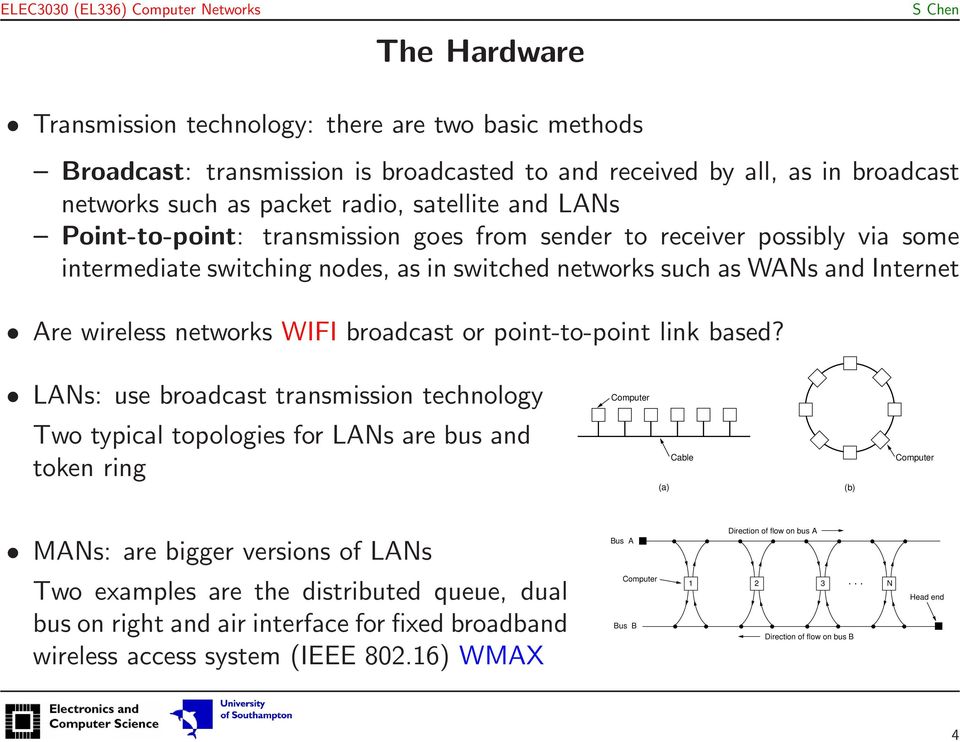
4 The Hardware Transmission technology: there are two basic methods Broadcast: transmission is broadcasted to and received by all, as in broadcast networks such as packet radio, satellite and LANs Point-to-point: transmission goes from sender to receiver possibly via some intermediate switching nodes, as in switched networks such as WANs and Internet Are wireless networks WIFI broadcast or point-to-point link based? LANs: use broadcast transmission technology Computer Two typical topologies for LANs are bus and token ring (a) Cable (b) Computer MANs: are bigger versions of LANs Two examples are the distributed queue, dual bus on right and air interface for fixed broadband wireless access system (IEEE ) WMAX Direction of flow on bus A Bus A Computer N Bus B Direction of flow on bus B Head end 4
5 The Hardware (continue) LANs and MANs do not have any switching nodes: the wire (or wireless) does all the work This makes them extremely efficient but harder to get bigger WANs: hosts are connected to a subnet, which contains routers (switching nodes) and trunks Routers generally adopt a store-and-forward (packet-switched) principle Subnet Router LAN Host Internetwork: many networks exist with very different hardware and software, and interconnecting different networks is called internetwork Connect a collection of different LANs within a department Connect different LANs through a WAN, with WAN acting as a subnet Connect different WANs to each other by means of gateways the Internet Subnet: collection of routers and trunks; Network: combination of a subnet and its hosts; Internetwork: distinct networks interconnected together 5

6 Layered Structure and Protocol A complete communication task across network is very complicated most network architectures or softwares are organised as a series of layers Each layer performs a related subset of the functions required to communicate with another system It relies on the next lower layer to perform more primitive functions and to conceal the details of how those functions are actually implemented interface layer interface N entity N-1 entity protocol connection service access point Logically, peer layers across the network talk to each other using protocols The communication is actually carried out using some services provided by lower layer Adjacent layers in the same machine communicate via an interface Interface is realised in one or more service access points, which function in the manner of ports 6

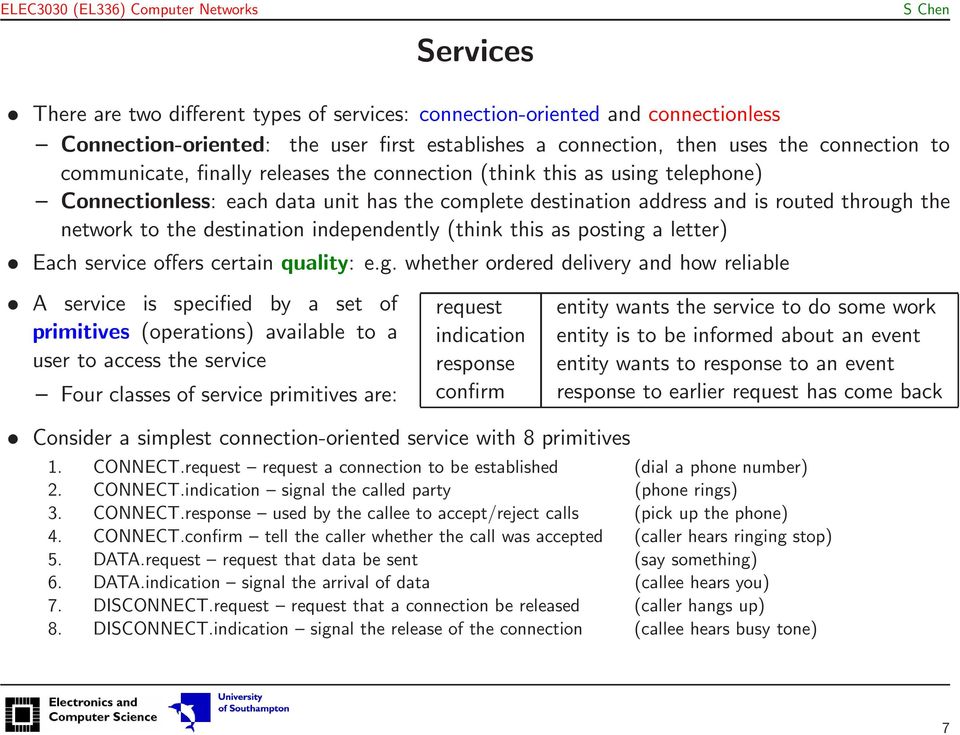
7 Services There are two different types of services: connection-oriented and connectionless Connection-oriented: the user first establishes a connection, then uses the connection to communicate, finally releases the connection (think this as using telephone) Connectionless: each data unit has the complete destination address and is routed through the network to the destination independently (think this as posting a letter) Each service offers certain quality: e.g. whether ordered delivery and how reliable A service is specified by a set of primitives (operations) available to a user to access the service Four classes of service primitives are: request indication response confirm Consider a simplest connection-oriented service with 8 primitives entity wants the service to do some work entity is to be informed about an event entity wants to response to an event response to earlier request has come back 1. CONNECT.request request a connection to be established (dial a phone number) 2. CONNECT.indication signal the called party (phone rings) 3. CONNECT.response used by the callee to accept/reject calls (pick up the phone) 4. CONNECT.confirm tell the caller whether the call was accepted (caller hears ringing stop) 5. DATA.request request that data be sent (say something) 6. DATA.indication signal the arrival of data (callee hears you) 7. DISCONNECT.request request that a connection be released (caller hangs up) 8. DISCONNECT.indication signal the release of the connection (callee hears busy tone) 7
8 OSI 7-layer Reference Model Recall that software makes computer networks and layered structure is a basic principle in organising computer network software In design, one would like to have a framework for dividing network software into several layers, defining what each layer does, and finally providing implementation specifications This kind of framework is called reference model Layer 7 Application Interface 6 Presentation Interface 5 Session 4 Transport 3 Network 2 Data link Application protocol Presentation protocol Session protocol Transport protocol Communication subnet boundary Internal subnet protocol Network Network Data link Data link Application Presentation Session Transport Network Data link Name of unit exchanged APDU PPDU SPDU TPDU Packet Frame A well known example is the OSI 7-layer reference model specified by ISO 1 Physical Host A Physical Router Physical Router Network layer host-router protocol Data link layer host-router protocol Physical layer host-router protocol Physical Host B Bit 8
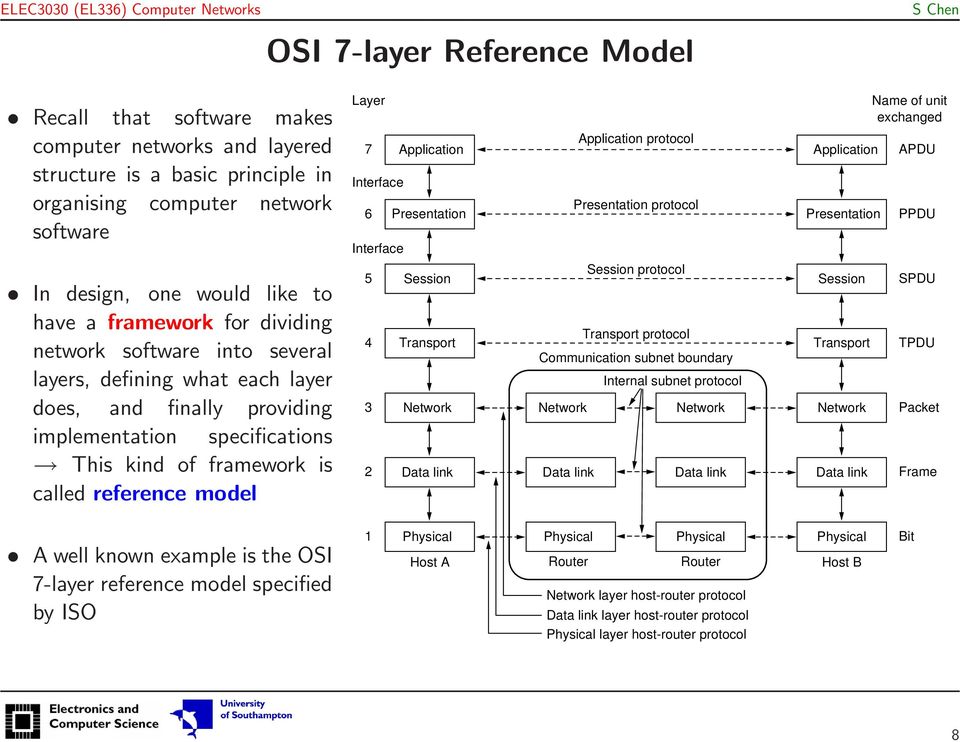
9 OSI 7-layer Model (continue) 1. Physical layer: is concerned with the transmission of raw bits, and deals with mechanical, electrical and procedural interfaces, and physical transmission medium 2. Data link layer: describes how a shared communication medium can be accessed, and how to make an unreliable noisy link reliable 3. Network layer: is concerned with controlling the operation of subnet, for example, how routing is done 4. Transport layer: provides the actual network interface to applications, jobs like making network connections, multiplexing, flow control. It is a true end-to-end layer, from source to destination 5. Session layer: tells how to set up long-lasting communications (sessions). This is the dumbest and ill-defined 6. Presentation layer: describes everything that is needed to exchange data in a platform-independent way. An example is data encoding 7. Application layer: contains the stuff that user can see, such as , file transfer, remote login, web s exchange protocols Note that the user-network interaction occurs at the bottom three-layer levels: the net is essentially unconcerned with higher layers 9
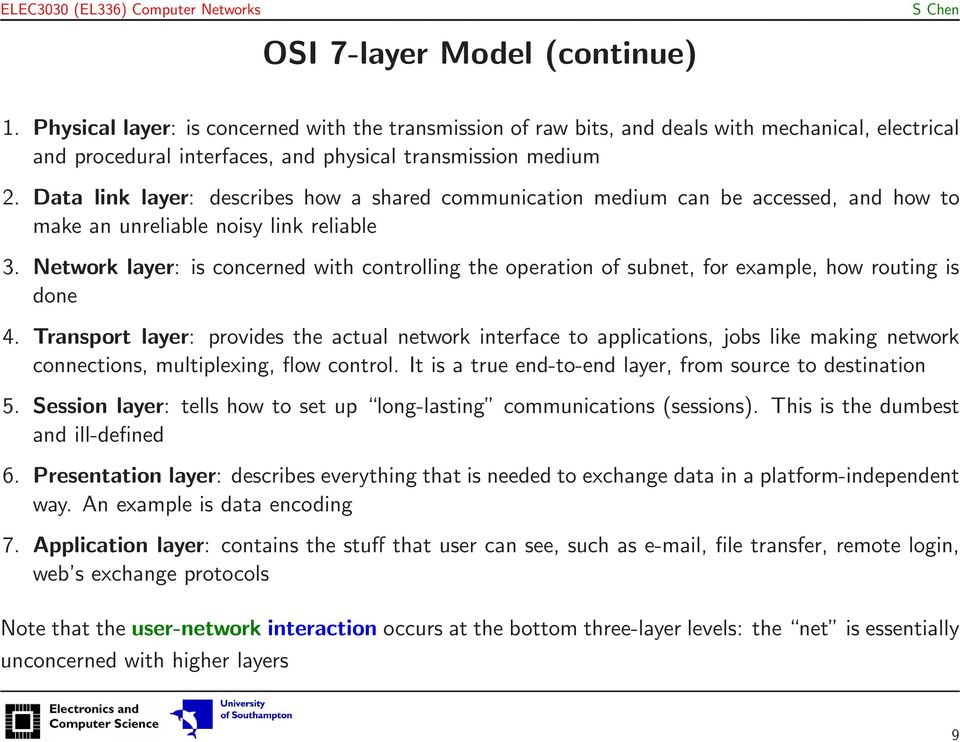
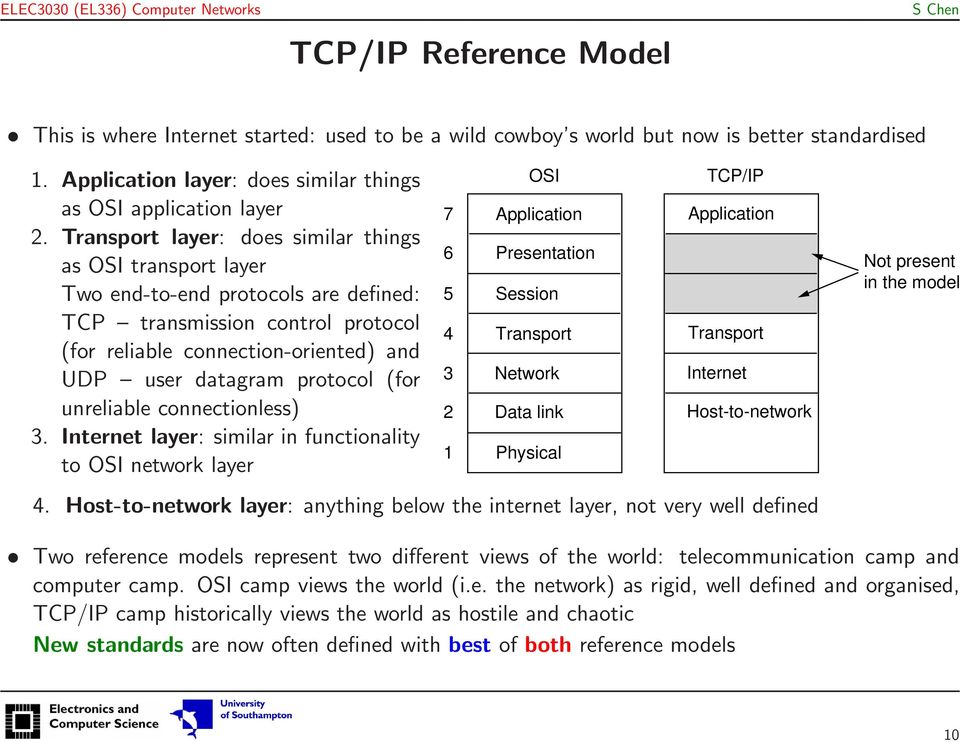
10 TCP/IP Reference Model This is where Internet started: used to be a wild cowboy s world but now is better standardised 1. Application layer: does similar things as OSI application layer 2. Transport layer: does similar things as OSI transport layer Two end-to-end protocols are defined: TCP transmission control protocol (for reliable connection-oriented) and UDP user datagram protocol (for unreliable connectionless) 3. Internet layer: similar in functionality to OSI network layer OSI Application Presentation Session Transport Network Data link Physical TCP/IP Application Transport Internet Host-to-network Not present in the model 4. Host-to-network layer: anything below the internet layer, not very well defined Two reference models represent two different views of the world: telecommunication camp and computer camp. OSI camp views the world (i.e. the network) as rigid, well defined and organised, TCP/IP camp historically views the world as hostile and chaotic New standards are now often defined with best of both reference models 10
11 Comparison of OSI and TCP/IP Models Three important concepts, services, interfaces and protocols, are well defined in OSI model, but not in original TCP/IP model Transport layer does the hardest job, dealing with end-to-end connection Data link layer is also very important: An end-to-end connection consists of many links, and each possibly noisy link need to be made reliable On the other hand, no one really knows precisely what session layer does It may also be argued that a separate presentation layer is not strictly necessary Based on comparison, we will adopt the hybrid 5-layer reference model: This is a good framework for discussion of computer networks 5 Application layer 4 Transport layer 3 Network layer 2 Data link layer 1 Physical layer 11

12 Summary Computer network hardware overview Two communication technologies: broadcast and point-to-point transmissions Networks in terms of scale: LAN, MAN, WAN, internetwork Computer network software overview: Layered structure, definitions of protocol, service and interface Connection-oriented and connectionless services, service quality, service primitives Reference models: OSI 7-layer, TCP/IP and hybrid 5-layer 12

Computer Networks Vs. Distributed Systems
 Computer Networks Vs. Distributed Systems Computer Networks: A computer network is an interconnected collection of autonomous computers able to exchange information. A computer network usually require
Chapter 1: Introduction
 Chapter 1: Introduction Professor of CIS Columbus, OH 43210 [email protected] http://www.cse.ohio-state.edu/~jain/cis677-98/ 1B-1 Data Communication vs Networking q Communication: Two Nodes. Mostly
Overview of Network Hardware and Software. CS158a Chris Pollett Jan 29, 2007.
 Overview of Network Hardware and Software CS158a Chris Pollett Jan 29, 2007. Outline Scales of Networks Protocol Hierarchies Scales of Networks Last day, we talked about broadcast versus point-to-point
EE4367 Telecom. Switching & Transmission. Prof. Murat Torlak
 Packet Switching and Computer Networks Switching As computer networks became more pervasive, more and more data and also less voice was transmitted over telephone lines. Circuit Switching The telephone
8/27/2014. What is a computer network? Introduction. Business Applications (1) Uses of Computer Networks. Business Applications (2)
 What is a computer network? Introduction Chapter 1 A number of separate but interconnected computers A collection of autonomous computers interconnected by a single technology COURSE FOCUS: design and
Computer Network. Interconnected collection of autonomous computers that are able to exchange information
 Introduction Computer Network. Interconnected collection of autonomous computers that are able to exchange information No master/slave relationship between the computers in the network Data Communications.
Topics. Computer Networks. Let s Get Started! Computer Networks: Our Definition. How are Networks Used by Computers? Computer Network Components
 Topics Use of networks Network structure Implementation of networks Computer Networks Introduction Let s Get Started! Networking today: Where are they? Powerful computers are cheap Networks are everywhere
Data Communication Networks Introduction
 Data Communication Networks Introduction M. R. Pakravan Department of Electrical Engineering Sharif University of Technology Data Networks 1 Introduction The course introduces the underlying concepts and
Communications and Computer Networks
 SFWR 4C03: Computer Networks and Computer Security January 5-8 2004 Lecturer: Kartik Krishnan Lectures 1-3 Communications and Computer Networks The fundamental purpose of a communication system is the
The TCP/IP Reference Model
 The TCP/IP Reference Model The TCP/IP Model Comparison to OSI Model Example Networks The TCP/IP Model Origins from ARPANET, DoD research network ARPA - Advanced Research Projects Agency Reliability was
CSCI 362 Computer and Network Security
 The Purpose of ing CSCI 362 Computer and Security Introduction to ing Goals: Remote exchange and remote process control. A few desirable properties: Interoperability, Flexibility, Geographical range, Scalability,
Data Communications and Networking Overview
 Data Communications and Networking Overview Raj Jain Washington University Saint Louis, MO 63131 [email protected] These slides are available on-line at: http://www.cse.wustl.edu/~jain/cse473-05/ 2-1
EITF25 Internet Techniques and Applications L5: Wide Area Networks (WAN) Stefan Höst
 EITF25 Internet Techniques and Applications L5: Wide Area Networks (WAN) Stefan Höst Data communication in reality In reality, the source and destination hosts are very seldom on the same network, for
Basic Networking Concepts. 1. Introduction 2. Protocols 3. Protocol Layers 4. Network Interconnection/Internet
 Basic Networking Concepts 1. Introduction 2. Protocols 3. Protocol Layers 4. Network Interconnection/Internet 1 1. Introduction -A network can be defined as a group of computers and other devices connected
The OSI and TCP/IP Models. Lesson 2
 The OSI and TCP/IP Models Lesson 2 Objectives Exam Objective Matrix Technology Skill Covered Exam Objective Exam Objective Number Introduction to the OSI Model Compare the layers of the OSI and TCP/IP
Computer Networks. Definition of LAN. Connection of Network. Key Points of LAN. Lecture 06 Connecting Networks
 Computer Networks Lecture 06 Connecting Networks Kuang-hua Chen Department of Library and Information Science National Taiwan University Local Area Networks (LAN) 5 kilometer IEEE 802.3 Ethernet IEEE 802.4
CSMC 417. Computer Networks Prof. Ashok K Agrawala. 2011 Ashok Agrawala. January 11 CMSC417 Set 1 1
 CSMC 417 Computer Networks Prof. Ashok K Agrawala 2011 Ashok Agrawala 1 General Instructor - Ashok K. Agrawala [email protected] 4149 AVW TA - Office Hours Class Meets Tu Th 8:00 9:30 CSIC 3117 2 Prerequisite
Chapter 7: Computer Networks, the Internet, and the World Wide Web. Invitation to Computer Science, C++ Version, Third Edition
 Chapter 7: Computer Networks, the Internet, and the World Wide Web Invitation to Computer Science, C++ Version, Third Edition Objectives In this chapter, you will learn about: Basic networking concepts
ICS 153 Introduction to Computer Networks. Inst: Chris Davison [email protected]
 ICS 153 Introduction to Computer Networks Inst: Chris Davison [email protected] 1 ICS 153 Introduction to Computer Networks Course Goals Understand the basic principles of computer networks Design Architecture
 Local Area Network By Bhupendra Ratha, Lecturer School of Library and Information Science Devi Ahilya University, Indore Email: [email protected] Local Area Network LANs connect computers and peripheral
SFWR 4C03: Computer Networks & Computer Security Jan 3-7, 2005. Lecturer: Kartik Krishnan Lecture 1-3
 SFWR 4C03: Computer Networks & Computer Security Jan 3-7, 2005 Lecturer: Kartik Krishnan Lecture 1-3 Communications and Computer Networks The fundamental purpose of a communication network is the exchange
Network Security 網 路 安 全. Lecture 1 February 20, 2012 洪 國 寶
 Network Security 網 路 安 全 Lecture 1 February 20, 2012 洪 國 寶 1 Outline Course information Motivation Introduction to security Basic network concepts Network security models Outline of the course 2 Course
The OSI model has seven layers. The principles that were applied to arrive at the seven layers can be briefly summarized as follows:
 1.4 Reference Models Now that we have discussed layered networks in the abstract, it is time to look at some examples. In the next two sections we will discuss two important network architectures, the
524 Computer Networks
 524 Computer Networks Section 1: Introduction to Course Dr. E.C. Kulasekere Sri Lanka Institute of Information Technology - 2005 Course Outline The Aim The course is design to establish the terminology
Chapter 8: Computer Networking. AIMS The aim of this chapter is to give a brief introduction to computer networking.
 Chapter 8: Computer Networking AIMS The aim of this chapter is to give a brief introduction to computer networking. OBJECTIVES At the end of this chapter you should be able to: Explain the following terms:
an interconnected collection of autonomous computers interconnected = able to exchange information
 Overview: Network Introduction what is a computer network? digital transmission components of a computer network network hardware network software What is a computer network? an interconnected collection
Introduction to computer networks and Cloud Computing
 Introduction to computer networks and Cloud Computing Aniel Nieves-González Fall 2015 Computer Netwoks A computer network is a set of independent computer systems that are connected by a communication
CSE 3461 / 5461: Computer Networking & Internet Technologies
 Autumn Semester 2014 CSE 3461 / 5461: Computer Networking & Internet Technologies Instructor: Prof. Kannan Srinivasan 08/28/2014 Announcement Drop before Friday evening! k. srinivasan Presentation A 2
Data Communication and Computer Network
 1 Data communication principles, types and working principles of modems, Network principles, OSI model, functions of data link layer and network layer, networking components, communication protocols- X
Communication Systems Internetworking (Bridges & Co)
 Communication Systems Internetworking (Bridges & Co) Prof. Dr.-Ing. Lars Wolf TU Braunschweig Institut für Betriebssysteme und Rechnerverbund Mühlenpfordtstraße 23, 38106 Braunschweig, Germany Email: [email protected]
The OSI Model and the TCP/IP Protocol Suite PROTOCOL LAYERS. Hierarchy. Services THE OSI MODEL
 The OSI Model and the TCP/IP Protocol Suite - the OSI model was never fully implemented. - The TCP/IP protocol suite became the dominant commercial architecture because it was used and tested extensively
Data Link Layer Overview
 Data Link Layer Overview Date link layer deals with two basic issues: Part I How data frames can be reliably transmitted, and Part II How a shared communication medium can be accessed In many networks,
CS335 Sample Questions for Exam #2
 CS335 Sample Questions for Exam #2.) Compare connection-oriented with connectionless protocols. What type of protocol is IP? How about TCP and UDP? Connection-oriented protocols Require a setup time to
Introduction Chapter 1. Uses of Computer Networks
 Introduction Chapter 1 Uses of Computer Networks Network Hardware Network Software Reference Models Example Networks Network Standardization Metric Units Revised: August 2011 Uses of Computer Networks
Internetworking and IP Address
 Lecture 8 Internetworking and IP Address Motivation of Internetworking Internet Architecture and Router Internet TCP/IP Reference Model and Protocols IP Addresses - Binary and Dotted Decimal IP Address
Wide Area Networks. Learning Objectives. LAN and WAN. School of Business Eastern Illinois University. (Week 11, Thursday 3/22/2007)
 School of Business Eastern Illinois University Wide Area Networks (Week 11, Thursday 3/22/2007) Abdou Illia, Spring 2007 Learning Objectives 2 Distinguish between LAN and WAN Distinguish between Circuit
Architecture and Performance of the Internet
 SC250 Computer Networking I Architecture and Performance of the Internet Prof. Matthias Grossglauser School of Computer and Communication Sciences EPFL http://lcawww.epfl.ch 1 Today's Objectives Understanding
The Network Layer Functions: Congestion Control
 The Network Layer Functions: Congestion Control Network Congestion: Characterized by presence of a large number of packets (load) being routed in all or portions of the subnet that exceeds its link and
Layered Architectures and Applications
 1 Layered Architectures and Applications Required reading: Garcia 2.1, 2.2, 2.3 CSE 3213, Fall 2010 Instructor: N. Vlajic 2 Why Layering?! 3 Montreal London Paris Alice wants to send a mail to Bob and
Overview of Computer Networks
 Overview of Computer Networks Client-Server Transaction Client process 4. Client processes response 1. Client sends request 3. Server sends response Server process 2. Server processes request Resource
Lecture 28: Internet Protocols
 Lecture 28: Internet Protocols 15-110 Principles of Computing, Spring 2016 Dilsun Kaynar, Margaret Reid-Miller, Stephanie Balzer Reminder: Exam 2 Exam 2 will take place next Monday, on April 4. Further
IP Networking. Overview. Networks Impact Daily Life. IP Networking - Part 1. How Networks Impact Daily Life. How Networks Impact Daily Life
 Overview Dipl.-Ing. Peter Schrotter Institute of Communication Networks and Satellite Communications Graz University of Technology, Austria Fundamentals of Communicating over the Network Application Layer
Communication Networks. MAP-TELE 2011/12 José Ruela
 Communication Networks MAP-TELE 2011/12 José Ruela Network basic mechanisms Introduction to Communications Networks Communications networks Communications networks are used to transport information (data)
Objectives of Lecture. Network Architecture. Protocols. Contents
 Objectives of Lecture Network Architecture Show how network architecture can be understood using a layered approach. Introduce the OSI seven layer reference model. Introduce the concepts of internetworking
Lecture 6 Types of Computer Networks and their Topologies Three important groups of computer networks: LAN, MAN, WAN
 Lecture 6 Types of Computer Networks and their Topologies Three important groups of computer networks: LAN, MAN, WAN LAN (Local Area Networks) 10/28/2008 Vasile Dadarlat - Computer Networks 1 MAN (Metropolitan
Local-Area Network -LAN
 Computer Networks A group of two or more computer systems linked together. There are many [types] of computer networks: Peer To Peer (workgroups) The computers are connected by a network, however, there
ELEC3030 (EL336) Computer Networks. How Networks Differ. Differences that can occur at network layer, which makes internetworking difficult:
 How Networks Differ Differences that can occur at network layer, which makes internetworking difficult: It is impossible to resolve all differences, and the solution is to take a simple approach (as in
Ethernet. Ethernet. Network Devices
 Ethernet Babak Kia Adjunct Professor Boston University College of Engineering ENG SC757 - Advanced Microprocessor Design Ethernet Ethernet is a term used to refer to a diverse set of frame based networking
Computer Networking: A Survey
 Computer Networking: A Survey M. Benaiah Deva Kumar and B. Deepa, 1 Scholar, 2 Assistant Professor, IT Department, Sri Krishna College of Arts and Science College, Coimbatore, India. Abstract- Computer
NZQA Expiring unit standard 6857 version 4 Page 1 of 5. Demonstrate an understanding of local and wide area computer networks
 Page 1 of 5 Title Demonstrate an understanding of local and wide area computer networks Level 7 Credits 10 Purpose People credited with this unit standard are able to: describe network types and standards;
Computer Networking Networks
 Page 1 of 8 Computer Networking Networks 9.1 Local area network A local area network (LAN) is a network that connects computers and devices in a limited geographical area such as a home, school, office
JOB READY ASSESSMENT BLUEPRINT COMPUTER NETWORKING FUNDAMENTALS - PILOT. Test Code: 4514 Version: 01
 JOB READY ASSESSMENT BLUEPRINT COMPUTER NETWORKING FUNDAMENTALS - PILOT Test Code: 4514 Version: 01 Specific Competencies and Skills Tested in this Assessment: PC Principles Identify physical and equipment
Protocols and Architecture. Protocol Architecture.
 Protocols and Architecture Protocol Architecture. Layered structure of hardware and software to support exchange of data between systems/distributed applications Set of rules for transmission of data between
Chapter 9A. Network Definition. The Uses of a Network. Network Basics
 Chapter 9A Network Basics 1 Network Definition Set of technologies that connects computers Allows communication and collaboration between users 2 The Uses of a Network Simultaneous access to data Data
IT4405 Computer Networks (Compulsory)
 IT4405 Computer Networks (Compulsory) INTRODUCTION This course provides a comprehensive insight into the fundamental concepts in data communications, computer network systems and protocols both fixed and
Module 1. Introduction. Version 2 CSE IIT, Kharagpur
 Module 1 Introduction Lesson 2 Layered Network Architecture Specific Functional Objectives On Completion of this lesson, the students will be able to: State the requirement for layered approach Explain
What is CSG150 about? Fundamentals of Computer Networking. Course Outline. Lecture 1 Outline. Guevara Noubir [email protected].
 What is CSG150 about? Fundamentals of Computer Networking Guevara Noubir [email protected] CSG150 Understand the basic principles of networking: Description of existing networks, and networking mechanisms
Computer Networks III
 Computer Networks III Wide Area Networks and Packet Switching Network Protocols and the OSI Layers The Internet Internet Infrastructure 1 Wide Area Networks (recap) 2 Page 1 Basic WAN structure Host Router
Introduction To Computer Networking
 Introduction To Computer Networking Alex S. 1 Introduction 1.1 Serial Lines Serial lines are generally the most basic and most common communication medium you can have between computers and/or equipment.
Mathatma Gandhi University
 Mathatma Gandhi University BSc Computer Science IV th semester BCS 402 Computer Network &Internet MULTIPLE CHOICE QUESTIONS 1. The computer network is A) Network computer with cable B) Network computer
How To Use A Network Over The Internet (Networking) With A Network (Netware) And A Network On A Computer (Network)
 1 TCP Transmission Control Protocol, is a connection based Internet protocol responsible for breaking data into packets to send over a network using IP (internet protocol) IP works at the TCP/IP Internet
Telecommunications, Networks, and Wireless Computing
 Objectives Telecommunications, Networks, and Wireless Computing 1. What are the features of a contemporary corporate telecommunications system? On what major technology developments are they based? 2.
The WestNet Advantage: -- Textbooks, ebooks, ecourses -- Instructor Resourse Center -- Student Resource Center
 The WestNet Advantage: -- Textbooks, ebooks, ecourses -- Instructor Resourse Center -- Student Resource Center The entire cost of the program is funded by the textbook, ebook or ecourse purchase by your
Lecture (02) Networking Model (TCP/IP) Networking Standard (OSI) (I)
 Lecture (02) Networking Model (TCP/IP) Networking Standard (OSI) (I) By: Dr. Ahmed ElShafee ١ Dr. Ahmed ElShafee, ACU : Fall 2015, Networks II Agenda Introduction to networking architecture Historical
Protocol Architecture
 Protocol Architecture ed Protocol Architectures OSI Reference Model TCP/IP Protocol Stack Need for Protocols The task of exchanging information between devices requires a high degree of cooperation between
The OSI Model: Understanding the Seven Layers of Computer Networks
 Expert Reference Series of White Papers The OSI Model: Understanding the Seven Layers of Computer Networks 1-800-COURSES www.globalknowledge.com The OSI Model: Understanding the Seven Layers of Computer
Indian Institute of Technology Kharagpur. TCP/IP Part I. Prof Indranil Sengupta Computer Science and Engineering Indian Institute of Technology
 Indian Institute of Technology Kharagpur TCP/IP Part I Prof Indranil Sengupta Computer Science and Engineering Indian Institute of Technology Kharagpur Lecture 3: TCP/IP Part I On completion, the student
Guide to TCP/IP, Third Edition. Chapter 3: Data Link and Network Layer TCP/IP Protocols
 Guide to TCP/IP, Third Edition Chapter 3: Data Link and Network Layer TCP/IP Protocols Objectives Understand the role that data link protocols, such as SLIP and PPP, play for TCP/IP Distinguish among various
Protocol Data Units and Encapsulation
 Chapter 2: Communicating over the 51 Protocol Units and Encapsulation For application data to travel uncorrupted from one host to another, header (or control data), which contains control and addressing
Access Control: Firewalls (1)
 Access Control: Firewalls (1) World is divided in good and bad guys ---> access control (security checks) at a single point of entry/exit: in medieval castles: drawbridge in corporate buildings: security/reception
How To Understand The Layered Architecture Of A Network
 COMPUTER NETWORKS NETWORK ARCHITECTURE AND PROTOCOLS The Need for Standards Computers have different architectures, store data in different formats and communicate at different rates Agreeing on a particular
Understanding TCP/IP. Introduction. What is an Architectural Model? APPENDIX
 APPENDIX A Introduction Understanding TCP/IP To fully understand the architecture of Cisco Centri Firewall, you need to understand the TCP/IP architecture on which the Internet is based. This appendix
DATA COMMUNICATION AND NETWORKS
 DATA COMMUNICATION AND NETWORKS 1. Define the term Computer Networks. A Computer network is a number if computers interconnected by one or more transmission paths. The transmission path often is the telephone
Computer Networks CS321
 Computer Networks CS321 Dr. Ramana I.I.T Jodhpur Dr. Ramana ( I.I.T Jodhpur ) Computer Networks CS321 1 / 22 Outline of the Lectures 1 Introduction OSI Reference Model Internet Protocol Performance Metrics
Introduction to Computer Networks and Data Communications
 Introduction to Computer Networks and Data Communications Chapter 1 Learning Objectives After reading this chapter, you should be able to: Define the basic terminology of computer networks Recognize the
Introduction to Networks
 www.eazynotes.com Maninder Kaur [Page No. 1] Introduction to Networks Short Answer Type Questions Q-1. Which Technologies of this age had led to the emergence of computer network? Ans: The technologies
Communication Networks. MAP-TELE 2011/12 José Ruela
 Communication Networks MAP-TELE 2011/12 José Ruela Network basic mechanisms Network Architectures Protocol Layering Network architecture concept A network architecture is an abstract model used to describe
Internet Concepts. What is a Network?
 Internet Concepts Network, Protocol Client/server model TCP/IP Internet Addressing Development of the Global Internet Autumn 2004 Trinity College, Dublin 1 What is a Network? A group of two or more devices,
Security (II) ISO 7498-2: Security Architecture of OSI Reference Model. Outline. Course Outline: Fundamental Topics. EE5723/EE4723 Spring 2012
 Course Outline: Fundamental Topics System View of Network Security Network Security Model Security Threat Model & Security Services Model Overview of Network Security Security Basis: Cryptography Secret
Chapter 2 - The TCP/IP and OSI Networking Models
 Chapter 2 - The TCP/IP and OSI Networking Models TCP/IP : Transmission Control Protocol/Internet Protocol OSI : Open System Interconnection RFC Request for Comments TCP/IP Architecture Layers Application
FIREWALLS & NETWORK SECURITY with Intrusion Detection and VPNs, 2 nd ed. Chapter 2 An Introduction to Networking
 FIREWALLS & NETWORK SECURITY with Intrusion Detection and VPNs, 2 nd ed. Chapter 2 An Introduction to Networking Learning Objectives Upon completion of this chapter, you should be able to: Describe the
Local Area Networks transmission system private speedy and secure kilometres shared transmission medium hardware & software
 Local Area What s a LAN? A transmission system, usually private owned, very speedy and secure, covering a geographical area in the range of kilometres, comprising a shared transmission medium and a set
Introduction To Computer Networks
 Introduction To Computer Networks 1. LAN s and WAN s 2. Some network and internetwork components 3. The communication process 4. Communication media 5. Topologies 6. Communication models and Standards
Computer Networks. By Hardeep Singh
 Computer Networks Contents Introduction Basic Elements of communication systemnetwork Topologies Network types Introduction A Computer network is a network of computers that are geographically distributed,
WAN Technology. Heng Sovannarith [email protected]
 WAN Technology Heng Sovannarith [email protected] Introduction A WAN is a data communications network that covers a relatively broad geographic area and often uses transmission facilities provided
Networking Test 4 Study Guide
 Networking Test 4 Study Guide True/False Indicate whether the statement is true or false. 1. IPX/SPX is considered the protocol suite of the Internet, and it is the most widely used protocol suite in LANs.
CSIS 3230. CSIS 3230 Spring 2012. Networking, its all about the apps! Apps on the Edge. Application Architectures. Pure P2P Architecture
 Networking, its all about the apps! CSIS 3230 Chapter 2: Layer Concepts Chapter 5.4: Link Layer Addressing Networks exist to support apps Web Social ing Multimedia Communications Email File transfer Remote
CPS221 Lecture: Layered Network Architecture
 CPS221 Lecture: Layered Network Architecture Objectives last revised 9/10/12 1. To discuss the OSI layered architecture model 2. To discuss the specific implementation of this model in TCP/IP Materials:
COMPUTER NETWORKS SECOND EDITION. ANDREW S.fjANENBAUM. Vrije Universiteit Amsterdam, The Netherlands. Nachrichtentechnische Bib'iothek THD Inv.
 COMPUTER NETWORKS SECOND EDITION ANDREW S.fjANENBAUM Vrije Universiteit Amsterdam, The Netherlands Nachrichtentechnische Bib'iothek THD Inv.-Ni,: tq(s ULB Darmstadt iiiiiir 17800787 =3JE Prentice-Hall
Internetworking and Internet-1. Global Addresses
 Internetworking and Internet Global Addresses IP servcie model has two parts Datagram (connectionless) packet delivery model Global addressing scheme awaytoidentifyall H in the internetwork Properties
COMMUNICATION NETWORKS WITH LAYERED ARCHITECTURES. Gene Robinson E.A.Robinsson Consulting 972 529-6395 [email protected]
 COMMUNICATION NETWORKS WITH LAYERED ARCHITECTURES Gene Robinson E.A.Robinsson Consulting 972 529-6395 [email protected] 9 March 1999 IEEE802 N-WEST STANDARDS MEETING FOR BROADBAND WIRELESS ACCESS SYSTEMS
WAN Data Link Protocols
 WAN Data Link Protocols In addition to Physical layer devices, WANs require Data Link layer protocols to establish the link across the communication line from the sending to the receiving device. 1 Data
2 Basic Concepts. Contents
 2. Basic Concepts Contents 2 Basic Concepts a. Link configuration b. Topology c. Transmission mode d. Classes of networks 1 a. Link Configuration Data links A direct data link is one that establishes a