
State of Connecticut. Notary Public Manual
|
|
|
- Alexia Cook
- 9 years ago
- Views:
Transcription
1 State of Connecticut Notary Public Manual Denise W. Merrill Secretary of the State Prepared by Office of the Secretary of the State Revised September 2013

2 Preface There are many reasons why someone would seek to be a notary public. You might be the owner of a small business; you may work in an office where clients and customers have frequent need of a notary s services; you may enjoy the official nature of the duties; or it may be a requirement of your job. No matter what the reason, appointment as a notary public is a serious undertaking. The notary is a public official, a person given a public trust, a person whose duties and responsibilities cannot be taken lightly. The notary serves a vital role in the execution of a wide range of documents. Whenever individuals see a document that has been notarized, they should be confident that the notarial act has been performed correctly. As a notary public it is your responsibility to use intelligence and judgment, and always perform your duties as required by Connecticut State law. You must remember that others are relying on your honesty and integrity. It is up to each and every notary public to provide quality service. By doing so, notaries earn the confidence and respect of those who use their services. This revised and expanded manual has been prepared by the Office of the Secretary of the State as a tool to assist you in the performance of your duties. It contains valuable information and should be the first place you look whenever you have a question. It has been designed to answer the most common questions asked by notaries and to provide concise, helpful explanations of the issues notaries deal with on a daily basis. Please keep the manual handy and use it. If you have comments or suggestions, please forward them to this office. If you find you have questions that are not addressed in the manual, feel free to contact this office at (860) Working together, we can provide quality public service that we can all point to with pride. Denise W. Merrill Secretary of the State

3 Connecticut Notary Public Manual Table of Contents 1.0 Introduction The Notary Public 1.1 A Public Official, History, Application for Appointment as a Notary Public 2.1 Application and Fee, Examination, Applications Returned for Additional Information, Denial of Appointment or Renewal of Appointment, Appointment as a Notary Public 3.1 Certificate of Appointment, Recording of Appointment and Oath of Office, Application for Renewal of Appointment, Late Renewal, Change of Name or Address and Replacement Certificates, Resignation or Death of a Notary Public, Duties and Responsibilities of the Notary Public 4.1 Powers of the Notary Public, Acknowledgments, Refusal of Service, Competence, Determining Identity, Credible Witness Acknowledgment, Performing Notarial Acts for Minors, Signature by Mark, Oaths and Affirmations, Affidavits, Depositions and Subpoenas to Deponents, Copy Certification, a Attestation Procedure as an Alternative to Copy Certification, b Suggested Certified Copy Statement, 12

4 4.11c Sample Written Statement for Attestation Procedure, d Sample Written Statement for Certification, The Notary s Signature, The Notary s Seal, Changes, Resignations, Lost or Stolen Seals and Stamps, Influence, Disqualification, Prohibited Acts, Notary Public Journals, Wills and Living Wills, Additional Useful Information for Notaries Public 5.1 Notaries Public Appointed in Other Jurisdictions, Certification of Corporate Facts, Translations, Foreign Language Documents, Authentication, Liability, Bonding and Insurance, Disciplinary Action, Notary Fees, The Office of the Secretary of the State, 19 Special Notes, 20 Appendix A Questions Commonly Asked by Notaries, 22 Appendix B Statutes Affecting Notaries Public, 24 Appendix C Additional Statutory References, 44 Appendix D Forms, 46 Appendix E Public Act No , An Act Concerning the Unauthorized Practice of Law by Notaries Public, 50

5 INTRODUCTION 1.0 The Notary Public 1.1 A Public Official The notary public is a public official appointed by the Secretary of the State through the power vested in the Secretary by state law. The notary has the power to administer oaths, take acknowledgments and perform other duties as permitted by law. It is very important that notaries remember the public nature of the office they hold. It is the duty of all notaries to serve the public, and they may not unreasonably refuse to perform a notarial act for any member of the public who tenders the statutory fee and meets all statutory requirements. However, the notary must also exercise equal care not to exceed the authority of the office by offering opinions or advice to persons requesting performance of notarial acts. Integrity and skill are required of all notaries when performing their duties. Mere mechanical performance of the duties and responsibilities of this office cannot ensure the high level of performance and reliability that must be the hallmarks of each notarial act. The notary must always comply with Connecticut state law and provide high quality service, while remembering that a notary public does not have the authority to prepare legal documents or recommend a course of action in legal transactions. Any person who is in need of such assistance should be advised to consult an attorney. 1.2 History The office of notary public has a proud and ancient heritage. As early as the days of the Roman Empire there is mention of its fore-runners: the "scriba", "notarii", "tabularii" and "tabelliones." Originally the "notarius" was a mere scribe taking notes and drafting instruments. Since few people could write, and commercial agreements were made orally, the services of the "notarius" were sought to reduce these agreements to a definite written record. With the growth of commerce and organized civil life, these services were needed for contracts, disposition of property, court records, etc. Practically all important documents since the early Roman Empire were drawn by notaries. The English notary is still an ecclesiastical officer, although his duties are mainly secular, having at one time been appointed by the Pope and subsequently by the Archbishop of Canterbury. On October 25, 1639, Thomas Fugill, a member of Connecticut's New Haven Colony, became the first notary public in America. In 1784, the governor of Connecticut was empowered to appoint as many notaries as commercial interests rendered necessary or convenient. During this time, notaries were used by merchants and shipmasters to attest writings and certify acts done by him or in his presence, proof of which might be required in distant places or in foreign countries. In chapter XXVII of the acts of 1833, notaries were given the power to administer oaths, take depositions, and acknowledge deeds. Statutes were passed providing that acknowledgments of foreign grants, deeds, and mortgages by notaries of foreign jurisdictions would be accepted as valid in this state. In 1800, there were fifteen notaries in Connecticut; in 1812, thirty-two; 1827, sixty-four; 1932, ten thousand seven hundred eighty-nine; and in 2010, approximately fifty-three thousand. 1

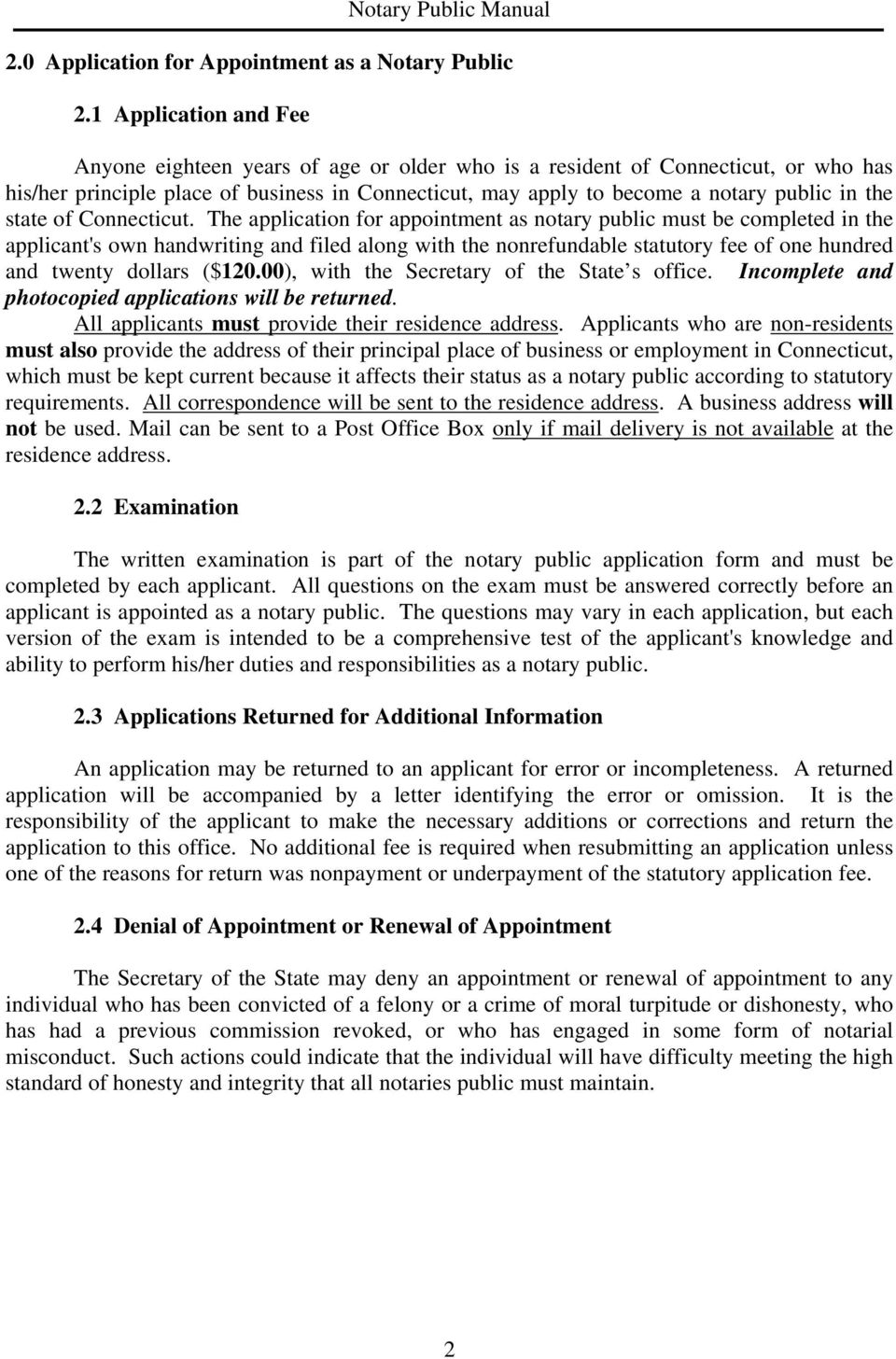
6 2.0 Application for Appointment as a Notary Public 2.1 Application and Fee Anyone eighteen years of age or older who is a resident of Connecticut, or who has his/her principle place of business in Connecticut, may apply to become a notary public in the state of Connecticut. The application for appointment as notary public must be completed in the applicant's own handwriting and filed along with the nonrefundable statutory fee of one hundred and twenty dollars ($120.00), with the Secretary of the State s office. Incomplete and photocopied applications will be returned. All applicants must provide their residence address. Applicants who are non-residents must also provide the address of their principal place of business or employment in Connecticut, which must be kept current because it affects their status as a notary public according to statutory requirements. All correspondence will be sent to the residence address. A business address will not be used. Mail can be sent to a Post Office Box only if mail delivery is not available at the residence address. 2.2 Examination The written examination is part of the notary public application form and must be completed by each applicant. All questions on the exam must be answered correctly before an applicant is appointed as a notary public. The questions may vary in each application, but each version of the exam is intended to be a comprehensive test of the applicant's knowledge and ability to perform his/her duties and responsibilities as a notary public. 2.3 Applications Returned for Additional Information An application may be returned to an applicant for error or incompleteness. A returned application will be accompanied by a letter identifying the error or omission. It is the responsibility of the applicant to make the necessary additions or corrections and return the application to this office. No additional fee is required when resubmitting an application unless one of the reasons for return was nonpayment or underpayment of the statutory application fee. 2.4 Denial of Appointment or Renewal of Appointment The Secretary of the State may deny an appointment or renewal of appointment to any individual who has been convicted of a felony or a crime of moral turpitude or dishonesty, who has had a previous commission revoked, or who has engaged in some form of notarial misconduct. Such actions could indicate that the individual will have difficulty meeting the high standard of honesty and integrity that all notaries public must maintain. 2
7 3.0 Appointment of the Notary Public Notary Public Manual 3.1 Certificate of Appointment Each notary public is appointed by the Secretary of the State for a term of five years, beginning on the date of appointment and ending on the last day of the anniversary month five years later. The appointment is evidenced by a certificate bearing the notary's name, the facsimile signature of the Secretary of the State, and the countersignature of the Secretary's executive assistant. The certificate is evidence of the public office that the notary holds and should be kept in a safe place. The Secretary of the State s office recommends that notaries display their certificates where they perform their notarial duties. If the certificate is lost or destroyed, a duplicate may be obtained through this office for the nonrefundable fee of five dollars ($5.00). Please refer to section 3.5 of this manual for further information. 3.2 Recording of Appointment and Oath of Office Upon receiving the Certificate of Appointment, and before performing any notarial act, the notary must take an oath of office. The appointment and oath of office must be recorded with the town clerk in the town in which the notary resides within thirty (30) days of having received the Certificate of Appointment. If the notary is a non-resident, the recording must be made with the town clerk of the town in which the notary's principal place of business is located. When taking the oath of office, the applicant who is now a notary public signs the Certificate of Appointment and the officer administering the oath of office completes the jurat section of the certificate. The recording of the oath and appointment must also be confirmed on the certificate by the town clerk. After completing the mandatory recording described above, notaries may also record their certificate with town clerks in other towns. Any secondary recording is optional. The filing fee for recording a notary's commission and oath is ten dollars ($10.00), set by Section 7-34a of the Connecticut General Statutes. The form of the oath prescribed in Section 1-25 of the Connecticut General Statutes is reproduced below, and Section 1-24 of the Connecticut General Statutes identifies who may administer an oath. Oath Taken by the Notary Public "You do solemnly swear (or affirm, as the case may be) that you will support the Constitution of the United States, and the Constitution of the State of Connecticut and that you will faithfully discharge, according to law, the duties of the office of notary public to the best of your abilities. So help you God." 3.3 Application for Renewal of Appointment Three months prior to the expiration date of a notary public appointment, an application for renewal is mailed to each notary to his/her last reported residence address on record with the Secretary of the State's Office. If an applicant wishes to continue to be a notary, the application must be completed in full and returned to this office with the nonrefundable statutory application fee of sixty dollars ($60.00). 3

8 A new Certificate of Appointment will be issued to the notary, and the notary must again take the oath of office and record his/her commission and oath of office with the town clerk. Each term of appointment of a notary public is separate and the same procedure must be followed for each term. Please refer to section 3.2 above for details. It is the notary public's responsibility to inform the Secretary of the State s office of any changes of name or address. Failure to do so may result in non-delivery of the renewal notice and eventual expiration of the notary's appointment. Please refer to section 3.4 for information on renewing an appointment after it has expired. 3.4 Late Renewal A notary public's appointment expires at midnight on the "commission expiration date" that appears on his/her Certificate of Appointment. An individual whose commission has expired is no longer a notary public and cannot perform notarial acts. When renewing, a notary should return his/her renewal application as soon as possible to the Secretary of the State's Office. Failure to return the renewal form in a timely manner could result in a lapse in the notary's term of appointment. If a notary's commission expires prior to the issuance and receipt of a new certificate, the notary is required to cease performing notarial acts until s/he has received the new Certificate of Appointment and has taken an oath of office for the new term. A notary may use the renewal application form when renewing late, as long as the form is filed within 90 days of his/her commission expiration date. After 90 days s/he will be required to complete a new application, including the exam, in order to be reappointed for another term. In either case, the notary retains his/her original account number. 3.5 Change of Name or Address and Replacement Certificates All notaries appointed under Connecticut law are required to report any changes of his/her name or residence address to the Secretary of the State s office within thirty (30) days. Non-resident notaries must maintain a principal place of business in Connecticut and must also report any change in his/her business address, as well any change in his/her residence address. Forms for reporting such changes are in Appendix D of this manual and may be photocopied for use by notaries. Forms may also be obtained from this office or from the Secretary of the State's website at When completed, the forms must be filed with the secretary's office together with the nonrefundable fee of fifteen dollars ($15.00). After the forms are processed, a new certificate will be issued. It is not necessary for the notary to take another oath of office upon receiving a replacement certificate, but if the notary has relocated to a new town of residence or principal place of business, the replacement certificate must be recorded with the town clerk of the new town. If a notary's Certificate of Appointment has been lost, damaged, or destroyed, a replacement certificate may be obtained by making a request in writing accompanied by a nonrefundable fee of five dollars ($5.00). 4

9 3.6 Resignation or Death of a Notary Public A notary may resign his/her commission at any time by advising the Secretary of the State s office, in writing, of his/her intention to resign and the effective date of that resignation. All notaries must maintain either a residence or a principal place of business in this state in order to continue as a Connecticut notary public. Notaries who no longer have a residence or principal place of business in this state are obligated to resign his/her commission at the time s/he ceases to meet the statutory requirements for appointment. As soon as possible after the death of a notary, the notary's personal representative shall notify the Secretary of the State s office in writing that the notary has died and the date of death. In either event, if the notary used a notarial seal, the notary or the notary's personal representative must destroy or deface it to prevent its unauthorized use. 4.0 Duties and Responsibilities of the Notary Public 4.1 Powers of the Notary Public A notary appointed under Connecticut law may perform his/her duties anywhere within the state. The notary has the power to administer oaths, take acknowledgments, take depositions in civil actions or probate proceedings, issue, upon request, subpoenas for the appearance of witnesses to give depositions in civil matters or probate proceedings, make certified copies of some documents, and issue subpoenas for an appearance before out-of-state commissioners. It is important for the notary to have a thorough understanding of how to perform each notarial act before attempting to do so because a notary may be liable for losses that result from improper performance of his/her duties. 4.2 Acknowledgments An acknowledgment is the most common notarial act that a notary will be called upon to perform. It is a formal declaration before an authorized official by a person who executed an instrument that such instrument is his/her free act and deed. A typical instrument requiring an acknowledgment is a conveyance of land, but virtually any document that is signed can also be acknowledged. The usual acknowledgment form states that the signer of the instrument personally appeared before the notary and acknowledged having signed the instrument for its stated purpose. For an acknowledgment to be properly taken, each of the following requirements must be fulfilled. The signer must: (1) personally appear before the notary; (2) acknowledge that s/he signed the instrument in question; and (3) state that it is his/her free act and deed. The acknowledgment form is one type of notarial certificate. Many documents requiring an acknowledgment will already have the appropriate form included in the text, which the notary need only complete. Whenever a notary public takes an acknowledgment, it is vitally important that s/he complete the appropriate acknowledgment form, samples of which appear below. If there is no such form, the notary may attach and complete an acknowledgment form on the document. This form may be a preprinted attachment, a rubber stamp, or may be printed or 5

10 typed on the document. The completed acknowledgment form clearly indicates which notarial act has been performed and provides information concerning the execution of the document to anyone who views the document at a later date. Notarization via video-conference is prohibited. The signer is not considered to have personally appeared before the notary, as required by statute. Additionally, a Connecticut notary does not have the authority to notarize within the state when the signer is out of state. Commissioners of the superior court from states other than Connecticut are not given full faith and credit in regard to acknowledgements. Therefore, in order to take acknowledgements in Connecticut, a commissioner of the superior court from another state must become a notary public in Connecticut. Please note that when signing the acknowledgment, a notary should print his or her name under the signature. This will assist the Secretary of the State s office in verifying the notary for authentication and apostille purposes. State of Connecticut FORM OF ACKNOWLEDGMENT FOR INDIVIDUAL: County of ss. (Town/City) On this the day of, 20, before me, (name of notary), the undersigned officer, personally appeared (name of individual or individuals), known to me (or satisfactorily proven) to be the person(s) whose name(s) (is or are) subscribed to the within instrument and acknowledged that (he, she or they) executed the same for the purposes therein contained. In witness whereof I hereunto set my hand. Signature of Notary Public Date Commission Expires: Printed Name of Notary 6

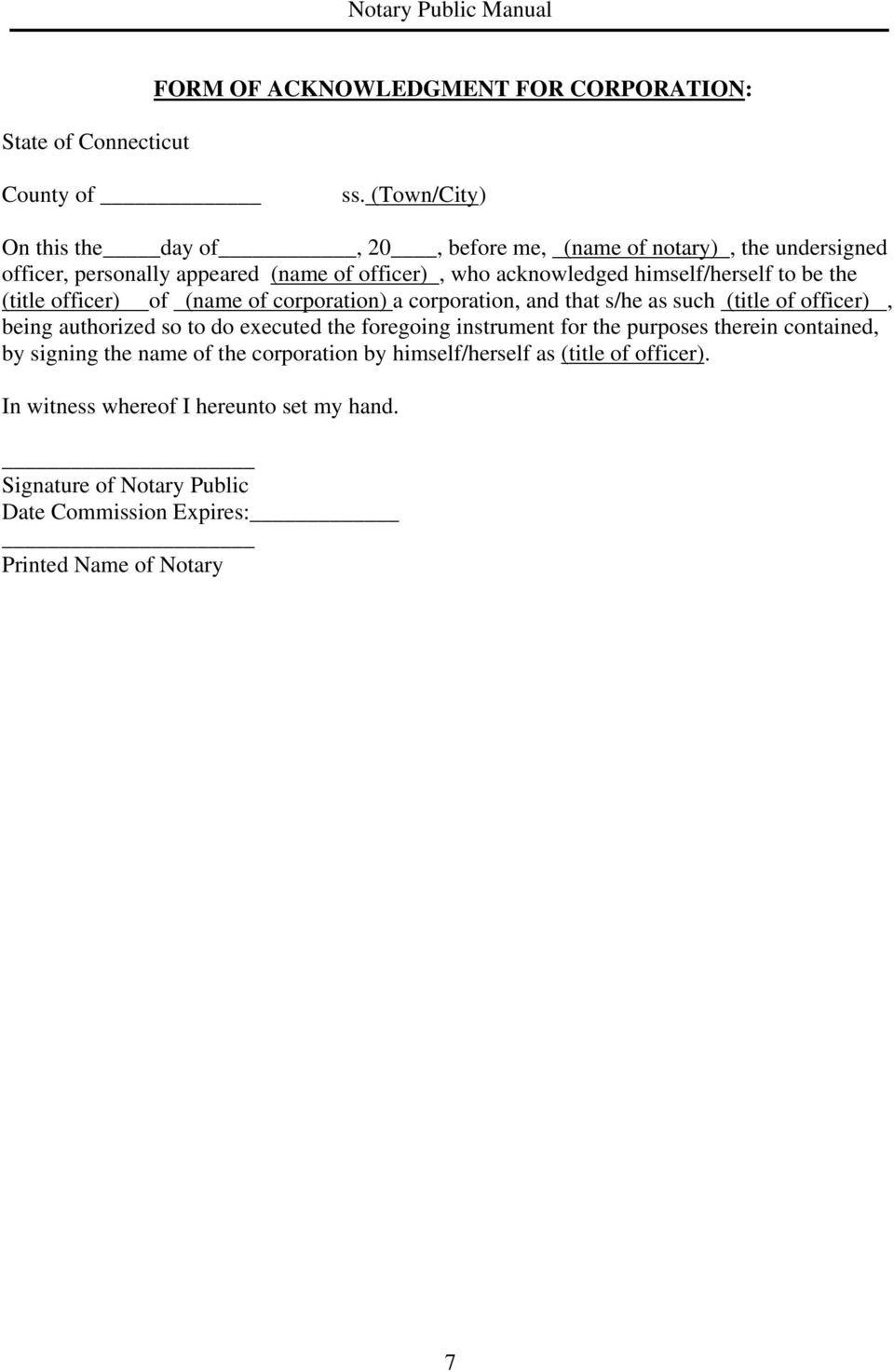
11 State of Connecticut FORM OF ACKNOWLEDGMENT FOR CORPORATION: County of ss. (Town/City) On this the day of, 20, before me, (name of notary), the undersigned officer, personally appeared (name of officer), who acknowledged himself/herself to be the (title officer) of (name of corporation) a corporation, and that s/he as such (title of officer), being authorized so to do executed the foregoing instrument for the purposes therein contained, by signing the name of the corporation by himself/herself as (title of officer). In witness whereof I hereunto set my hand. Signature of Notary Public Date Commission Expires: Printed Name of Notary 7
12 4.2.1 Refusal of Service A notary under Connecticut General Statute section 3-94f Prohibition re lawful transaction, shall not unreasonably refuse to perform notarial acts in lawful transactions for any requesting person who tenders payment of statutory fee. This office does not define the term unreasonable. There may be legal implications not covered by this manual of which your employer may be concerned. Please consult counsel on these matters. 4.3 Competence The notary must be confident that the individual requesting notarial services is competent. Competence means that the individual understands the meaning of his/her actions. The notary should refuse to perform any notarial act for a person who is clearly incompetent. If a question of an individual's competence arises, the notary may consult that person's physician or attorney. 4.4 Determining Identity Acknowledgment forms for individuals (see form on page 6) state that the notary either personally knows or has satisfactorily proven the identity of the signer on the basis of documents. If the notary does not know the signer personally, Connecticut law (see Section 3-94a(9) of the Connecticut General Statutes in Appendix B) requires that the signer provide the notary with at least two forms of identification containing the individual's signature, at least one of which also contains a photograph or a physical description of the signer. Neither a social security card nor a birth certificate is to be used as a form of identification. If an individual requesting notarial services does not have satisfactory forms of identification, identity can be established by the oath or affirmation of a credible witness. 4.5 Credible Witness Acknowledgment A credible witness is an individual who is personally known by the notary and who personally knows the signer. For example, a notary could rely on a co-worker known to the notary, to identify a third party who does not have the required forms of identification. It is essential that the credible witness be personally known to the notary. Like all witnesses, the credible-witness should be honest, competent, and disinterested in the transaction. The notary must administer an oath or affirmation to the credible witness and may use the following acknowledgment certificate: 8

13 State of Connecticut Notary Public Manual FORM OF ACKNOWLEDGMENT FOR CREDIBLE WITNESS: County of ss.(town/city) On this the day of, 20, before me, the undersigned notary public, personally appeared (signer), proved to me on the basis of satisfactory evidence, in the form of the oath/affirmation of credible witness, to be the person(s) whose name(s) (signer) subscribed to the within instrument, and acknowledged that (he, she, they) executed the same for the purposes therein contained. In witness whereof, I hereunto set my hand. Signature of Notary Public My Commission Expires: Printed name of Notary Public 4.6 Performing Notarial Acts for Minors Notaries will occasionally be asked to perform notarial acts for younger persons. Two issues arise in such cases that make these transactions different from the usual notarial act. Frequently, younger persons do not have adequate forms of identification to meet the requirement for satisfactory evidence of identification. One means of addressing this obstacle is to recommend that the notarial act be performed by a notary who personally knows the individual. Another option would be to obtain identification through the oath or affirmation of a credible witness (see Sec. 4.5 Credible Witness Acknowledgment). The second issue is that of competence. The notary must be confident that the younger person understands the nature of the document s/he is signing. 4.7 Signature by Mark If a person cannot sign his or her name because of a physical handicap or illiteracy, a mark may serve as a signature. A mark, usually an X, suffices. Two witnesses in addition to the notary should be present when a person signs by mark. The name of the person who signs by mark should be written near the mark by one of the witnesses. The witnesses should also subscribe their own names to the document and to the notary s journal as witnesses. The following form is a widely used signature by mark certificate: 9

14 State of Connecticut Notary Public Manual FORM OF ACKNOWLEDGMENT FOR SIGNATURE BY MARK: County of ss. (Town/City) On this the day of, 20, before me, the undersigned notary public, personally appeared (signer), known to me (or proved to me on the basis of satisfactory evidence) to be the person who made and acknowledged making (his, her) mark on the within instrument in my presence and in the presence of the two persons indicated below who have signed the within instrument as witnesses, one of whom, (name of witness), also wrote the name of the signer by mark near the mark. Signature of Notary Public Date Commission Expires: Printed of Notary Public (Witness s Name and Address) (Witness s Name and Address) 4.8 Oaths and Affirmations Oaths and Affirmations must be given in person. An oath is an affirmation of the truth of a statement, which renders any person who willfully makes untrue statements subject to the penalties for perjury or false statement. The term includes all forms of attestations by which a party signifies that he is bound in conscience to perform the act faithfully and truthfully. The following are the oaths and ceremony required when administering the oaths: OATHS ADMINISTERED BY NOTARY: "Do you solemnly swear that the statements contained herein are true to the best of your knowledge and belief, so help you God?" OR "You solemnly swear that you will faithfully discharge, according to law, your duties as...to the best of your ability, so help you God?" The person taking the oath shall hold up his/her right hand as the notary administers the oath and should answer "I do." If a person, by reason of scruples or conscience, objects to such a ceremony, or if the notary administering the oath has reason to believe that any other ceremony will be more binding upon the conscience of the person taking the oath, s/he may permit or require any other ceremony to be used. For example, instead of the usual form of an oath, a solemn affirmation may be administered to the person(s) as prescribed: the words "solemnly and sincerely affirm and declare" should replace the word "swear," and the words "upon the pains and penalties of perjury or false statement" should replace the words "so help me God,. 10

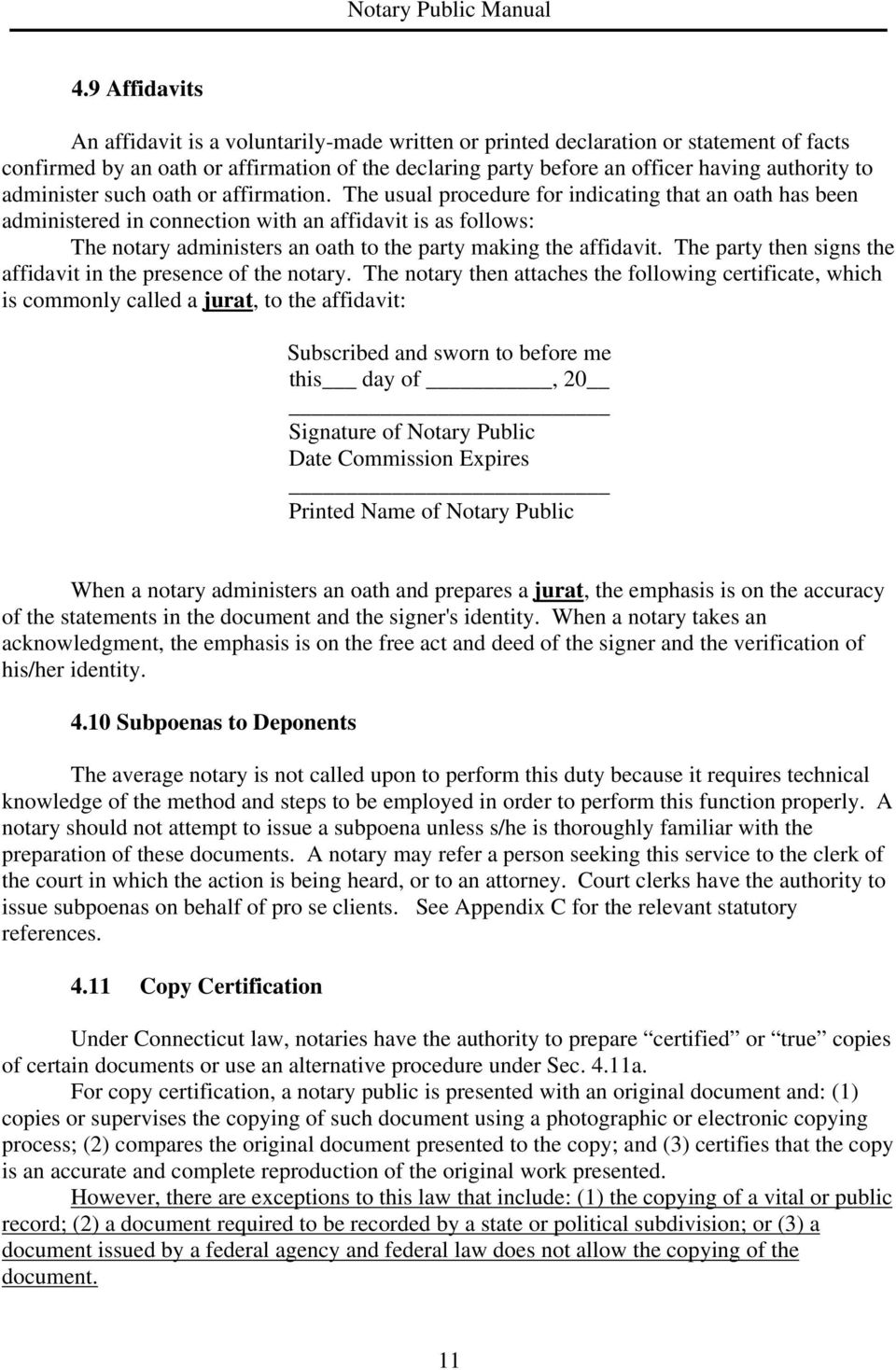
15 4.9 Affidavits An affidavit is a voluntarily-made written or printed declaration or statement of facts confirmed by an oath or affirmation of the declaring party before an officer having authority to administer such oath or affirmation. The usual procedure for indicating that an oath has been administered in connection with an affidavit is as follows: The notary administers an oath to the party making the affidavit. The party then signs the affidavit in the presence of the notary. The notary then attaches the following certificate, which is commonly called a jurat, to the affidavit: Subscribed and sworn to before me this day of, 20 Signature of Notary Public Date Commission Expires Printed Name of Notary Public When a notary administers an oath and prepares a jurat, the emphasis is on the accuracy of the statements in the document and the signer's identity. When a notary takes an acknowledgment, the emphasis is on the free act and deed of the signer and the verification of his/her identity Subpoenas to Deponents The average notary is not called upon to perform this duty because it requires technical knowledge of the method and steps to be employed in order to perform this function properly. A notary should not attempt to issue a subpoena unless s/he is thoroughly familiar with the preparation of these documents. A notary may refer a person seeking this service to the clerk of the court in which the action is being heard, or to an attorney. Court clerks have the authority to issue subpoenas on behalf of pro se clients. See Appendix C for the relevant statutory references Copy Certification Under Connecticut law, notaries have the authority to prepare certified or true copies of certain documents or use an alternative procedure under Sec. 4.11a. For copy certification, a notary public is presented with an original document and: (1) copies or supervises the copying of such document using a photographic or electronic copying process; (2) compares the original document presented to the copy; and (3) certifies that the copy is an accurate and complete reproduction of the original work presented. However, there are exceptions to this law that include: (1) the copying of a vital or public record; (2) a document required to be recorded by a state or political subdivision; or (3) a document issued by a federal agency and federal law does not allow the copying of the document. 11
16 Vital records include a certificate of birth, death, fetal death, or marriage. Public records include documents that are filed with and maintained by a public record keeper such as a town clerk, court clerk, or the Secretary of the State. Copies of public records may only be certified when the authority having custody of the records confirms that they are true and accurate copies of the originals. This may also include certain Immigration and Naturalization Service (INS), Internal Revenue Service (IRS), or Department of State documents. If a notary is asked to perform a notarial act in connection with a document that appears to be a public record, the notary should determine if the copy would be more appropriately prepared by the public record keeper who has custody of the original. 4.11a. Attestation Procedure as an Alternative to Copy Certification The notary may also request that the person presenting the document make a photocopy and prepare a written statement, that may be attached to or written on the photocopy itself, stating that it is a true copy of the original (See Section 4.11b). The requesting party signs the statement in the notary s presence. The form of jurat that appears under Sec. 4.9 is attached and completed by the notary. Sections 4.11c and 4.11d also apply to the attestation procedure. 4.11b. Suggested Certified Copy Statement State of Connecticut County of On this day of (year), I certify that the preceding or attached document, is a true, exact, complete, and unaltered copy made by me of (description of document), presented to me by the document s custodian,, and to the best of my knowledge, the photocopied document is neither a public record or vital record, not a publicly recordable document, certified copies of which are available from an official source other than a notary. Signature of Notary Public Date Commission Expires Printed name of Notary Public 12

17 4.11c Sample Written Statement for Attestation Procedure State of Connecticut County of I, (Name of Custodian of Original Document), hereby swear (or affirm) that the attached copy of (Description of attached document, title, or type of document) is a true and accurate copy of a document in my possession. Signature of Custodian of Original Document Subscribed and sworn (or affirmed) to before me on this day of, 20. Signature of Notary Public Date Commission Expires Printed name of Notary Public 4.11d Sample Written Statement for Certification State of Connecticut County of ss. (Town/City) On this the day of, 20, I certify that the (affixed or attached document) has been visually confirmed by me to be a true, exact, and complete copy of the image or text of (description of original document), presented to me by or held in my custody as a notorial record, and that, to the best of my knowledge, the copied document is neither a vital record, a public record, nor a publicly recordable document, certified copies of which may be available from an official source other than a notary public. Signature of Notary Public Date Commission Expires: 13

18 4.12 The Notary's Signature Whenever a notary's signature is required, it must be the original signature of the notary signed exactly as the name appears on the notary's certificate of appointment. If a seal and/or stamp is not used, the notary should type, stamp, or print legibly his/her name in close proximity to his/her signature. The notary cannot use a signature stamp in place of his/her signature, and no other person can sign on behalf of the notary The Notary's Seal Connecticut state law does not require that notaries obtain and use a seal or rubber stamp. Even though the use of a seal is optional, state law does prescribe the format of the seal to be used. The notary seal must include the notary's name as it appears on the certificate of appointment, the words "Notary Public" and "Connecticut" as shown in Fig. 1. State law does give the notary the option of having the words "My Commission Expires (commission expiration date)" appear on the seal. However, most notaries find that it is more practical to have their commission expiration date appear on a separate rubber stamp along with their name and title of notary public, as shown in Fig. 2. John Q. Notary Notary Public My Commission Expires Mon., Day, Year Fig. 1 Form of Notary s Seal Fig. 2 Form of Notary s Rubber Stamp All seals and stamps are obtained from private vendors at the notary's own expense and remain the property of the notary. This is true even if the notary s employer paid for these items. The only person who has the authority to possess and use a notary's seal and/or stamp is the notary whose name appears on the seal. When using the seal, the impression should be affixed near, but not over, the notary's signature. The stamp bearing the words "My Commission Expires" should be placed below the notary's signature, and the notary must write in the date on which their commission expires, unless the date appears on the stamp. It is important for the notary to remember that s/he must sign his/her name exactly as it appears on his/her certificate of appointment and notary seal. 14

19 4.14 Changes, Resignations, Lost or Stolen Seals and Stamps When a notary files a name change with the Secretary of the State s office, the name change becomes effective the date of the issuance of a new Certificate of Appointment. A notary who uses a seal or stamp will need to obtain a new seal or stamp reflecting the name change. See Sec. 3.5 for instructions and Appendix D for the change of name form. When a notary who uses a seal or stamp resigns his/her commission, or allows his/her commission to expire, s/he must destroy or deface his/her seal or stamp to prevent its unauthorized use. If a notary seal or stamp is lost or stolen, the notary should notify both the local police and the Office of the Secretary of the State. The notary should also notify the Department of Motor Vehicles, Dealers, Repairers & Emissions Division, in writing, at 60 State Street, Wethersfield, CT The Secretary's office will record the loss or theft to protect the notary. If the notary chooses to replace the seal, some distinguishing element may be introduced to differentiate the new seal Influence A notary must always remain impartial and cannot advise or influence a person to enter into or refrain from entering into a lawful transaction that involves a notarial act to be performed by the notary Disqualification A notary is disqualified from performing a notarial act if the notary is a signatory of the document to be notarized. Persons who only witness the signing of a document are not considered to be signatories and, therefore, may also perform notarial acts in connection with documents they have witnessed. It is important for the notary to remember that all notarial acts must be performed impartially. The Secretary of the State s office strongly recommends that notaries exercise great caution when performing notarial acts in transactions where the notary has some beneficial interest or involve family members. In certain instances, the notary may choose to voluntarily disqualify him/herself from performing notarial acts in connection with such transactions Prohibited Acts A notary is prohibited from performing any official act with the intent to deceive or defraud, and it is the responsibility of the notary to refuse to perform any such act. A notary shall not unreasonably refuse to perform notarial acts in lawful transactions for any requesting person who tenders payment of the statutory fee and meets all other requirements prescribed by statute. The notary is also prohibited from using his/her title or seal in an endorsement or to promote any product, service, contest, or other offering in any way. A notary is prohibited from assuming, using, or advertising the title of notario or notario public unless (1) s/he is a licensed attorney or (2) s/he indicates in an advertisement 15

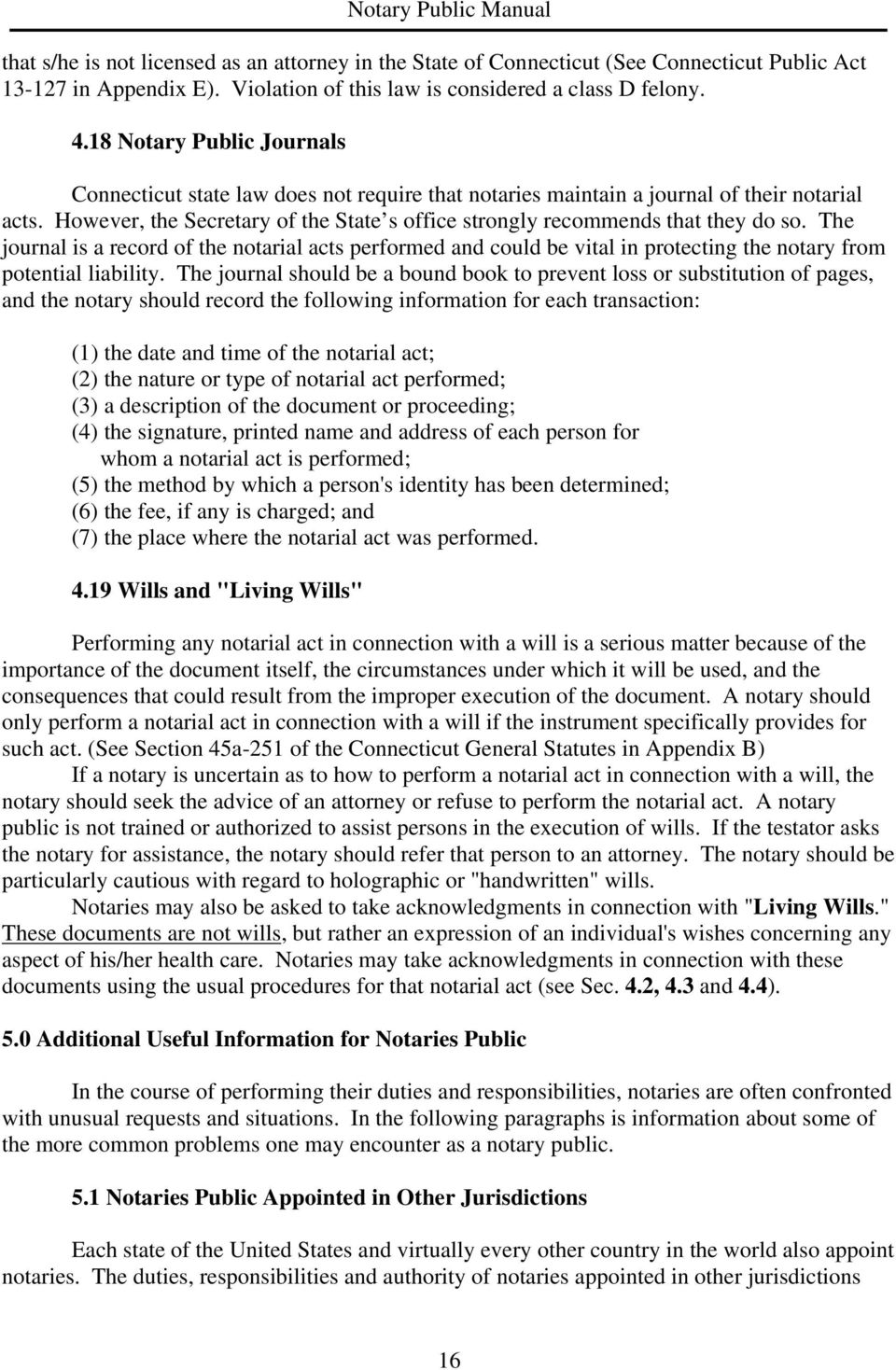
20 that s/he is not licensed as an attorney in the State of Connecticut (See Connecticut Public Act in Appendix E). Violation of this law is considered a class D felony Notary Public Journals Connecticut state law does not require that notaries maintain a journal of their notarial acts. However, the Secretary of the State s office strongly recommends that they do so. The journal is a record of the notarial acts performed and could be vital in protecting the notary from potential liability. The journal should be a bound book to prevent loss or substitution of pages, and the notary should record the following information for each transaction: (1) the date and time of the notarial act; (2) the nature or type of notarial act performed; (3) a description of the document or proceeding; (4) the signature, printed name and address of each person for whom a notarial act is performed; (5) the method by which a person's identity has been determined; (6) the fee, if any is charged; and (7) the place where the notarial act was performed Wills and "Living Wills" Performing any notarial act in connection with a will is a serious matter because of the importance of the document itself, the circumstances under which it will be used, and the consequences that could result from the improper execution of the document. A notary should only perform a notarial act in connection with a will if the instrument specifically provides for such act. (See Section 45a-251 of the Connecticut General Statutes in Appendix B) If a notary is uncertain as to how to perform a notarial act in connection with a will, the notary should seek the advice of an attorney or refuse to perform the notarial act. A notary public is not trained or authorized to assist persons in the execution of wills. If the testator asks the notary for assistance, the notary should refer that person to an attorney. The notary should be particularly cautious with regard to holographic or "handwritten" wills. Notaries may also be asked to take acknowledgments in connection with "Living Wills." These documents are not wills, but rather an expression of an individual's wishes concerning any aspect of his/her health care. Notaries may take acknowledgments in connection with these documents using the usual procedures for that notarial act (see Sec. 4.2, 4.3 and 4.4). 5.0 Additional Useful Information for Notaries Public In the course of performing their duties and responsibilities, notaries are often confronted with unusual requests and situations. In the following paragraphs is information about some of the more common problems one may encounter as a notary public. 5.1 Notaries Public Appointed in Other Jurisdictions Each state of the United States and virtually every other country in the world also appoint notaries. The duties, responsibilities and authority of notaries appointed in other jurisdictions 16
21 may vary considerably from Connecticut-appointed notaries. This is particularly true of notaries appointed in other countries. For example, in many Spanish-speaking countries, the "notario publico" is empowered to perform certain services that are reserved to the legal profession in the United States. Effective October 1, 2013, notaries public appointed by the State of Connecticut must never use a foreign language term to describe their office. For example, a notary shall not assume, use, or advertise the title of notario or notario publico unless (1) s/he is a licensed attorney or (2) s/he indicates in an advertisement or otherwise provides written notice that s/he is not licensed as an attorney in the State of Connecticut (See Public Act in Appendix E). Any use of such a term could mislead a person seeking notarial services into believing that the notary had the authority to provide services which are not permitted under Connecticut's notary law. 5.2 Certification of Corporate Facts Notaries in some foreign countries are empowered to prepare certificates stating facts about corporations. These certificates often confirm that a corporation exists, that certain individuals have been duly elected as officers, and that the notary's review of the corporate bylaws confirms that the corporation is authorized to act in certain transactions. Connecticut notaries have no authority to certify corporate facts. The usual procedure in the United States is for the president, secretary, or another officer of a corporation to certify the accuracy of corporate information, including the incumbency of officers. That certificate can then be acknowledged or sworn to before a Connecticut notary public. 5.3 Translations A notary public has no authority to certify translations. If a notary public has the ability to prepare translations of documents from one language to another, s/he cannot notarize that translation. The accuracy of the translation can be made under oath, but the oath and notarial certificate must be completed by another notary, or by another person authorized to administer oaths. The notary cannot perform both acts in connection with the same document. 5.4 Foreign Language Documents On occasion, notaries public will be asked to perform notarial acts in connection with documents prepared in a language that they do not understand. The notary should use his/her best judgment when deciding whether or not to perform a notarial act under these circumstances. If the notary decides to proceed with the notarial act, s/he should be able to determine the nature of the document(s). If the notary keeps a journal this notarial act should be noted in his/her journal. When performing a notarial act in connection with documents that s/he cannot understand, s/he should only sign a notarial certificate (the form of acknowledgment or jurat) in a language s/he can read and understand. 5.5 Authentication On occasion, particularly when documents are to be used outside of this country, the appointing authority will be asked to confirm the appointment and term of a notary public. This 17
22 process is often described as "authentication". The Secretary of the State s office will prepare and attach a certificate to the originally and properly executed document(s). This confirmation can only be to Connecticut public officials, whose term of office is on record with the Secretary of the State s office. The notary public who performed the notarial act on a particular document requiring an authentication should contact or refer the individuals to the Secretary of the State s office for additional information at (860) Liability, Bonding and Insurance A notary is liable to any person for damages that result from the misconduct of the notary. The notary may elect to partially protect themselves from parties seeking damages by purchasing a bond, or errors and omissions insurance. These products are available through insurance agents and notary organizations. The notary should discuss the nature and extent of the protection available through a bond with the provider. An employer of a notary is also liable to any person for damages that result from the misconduct of the notary if the employer ordered or approved of the notary's misconduct, either in the specific transaction or implicitly by previous actions in at least one prior transaction. If the notary's misconduct resulted from a threat of dismissal or demotion made by the employer in connection with a particular notarial act, or implicitly by previous actions in at least one prior transaction, the employer is liable to the notary for damages recovered from the notary. The employer is also liable to the notary for damages caused by dismissal, demotion, or other action taken against the notary resulting from the notary's refusal to commit official misconduct. 7.0 Disciplinary Action for: The Secretary of the State is empowered to (1)issue a written, official warning and reprimand to a notary or (2)temporarily suspend or permanently revoke a notary's commission (a) an act of official notarial misconduct, (b) any reason for which an application might be denied, or (c) a violation of any provision of the general statutes. The notary who is the subject of a charge or complaint will be given an opportunity to respond prior to any disciplinary action being taken, in accordance with the provisions of the Uniform Administrative Procedures Act, Sec through of the Connecticut General Statutes. In the event that a notary's commission is either suspended or revoked, the town clerk of each town in the state will be notified by the Secretary of the State's Office. 8.0 Notary Fees The fee for any act performed by a notary public, in accordance with the provisions of the general statutes, is five dollars ($5.00) plus an additional thirty-five cents ($.35) for each mile traveled. 18
23 9.0 The Office of the Secretary of the State Notary Public Manual As the appointing agent, the Secretary of the State has authority over notaries public in the State of Connecticut. Any individual who needs to communicate with this office regarding notaries and the duties and responsibilities of notaries in this state should write to Office of the Secretary of the State, PO Box , Hartford CT , Attention: Notary Public Unit, or call (860)
24 Special Notes: Paying close attention to details safeguards and eliminates the reason for rejection, delay and notarial errors of an improperly executed document. Examples: 1. Improper: Documents that do not have preprinted or handwritten notarial certificates attached to them. Proper: The notary should always place a notarial certificate on the document that requires notarization. 2. Improper: A notarial certificate not signed by the notary, or a notarial certificate with a seal and/or stamp, but not signed by the notary. Proper: In any circumstance when the notary signature is required, it must be the original signature of the notary signed exactly as the name appears on the notary s certificate of appointment. The notary cannot use a signature stamp. No other person can sign on behalf of the notary. If a seal and/or stamp is not used the notary s name should be typed, stamped or printed legibly in close proximity to the signature. 3. Improper: A notarial certificate signed by the notary without his/her date of commission expiration. Proper: The notary public must always sign and provide their commission expiration date, which indicates s/he is currently commissioned a notary public. 4. Improper: A document not signed by the intended signer. Proper: A notary must always witness a signature on a document. The signature cannot be a photocopy. The signer must always appear in person. 5. Improper: The notary public signs a public record and/or certifies a public record. Public records are: certificates of birth, death, fetal death, marriage, court certified documents such as judgments, certain town records and certain immigration and naturalization documents. Proper: Copies of public records can only be certified when the authority having custody of records confirms that they are true and accurate copies of the original. It is illegal for Connecticut notaries to perform notarial acts in connection with any such documents. 20
25 MY NOTES: 21
26 Appendix A Questions Commonly Asked by Notaries Q. How many witnesses are there to a deed? A. Usually, two; however, a notary must not advise on the form of a deed. This should be done in conjunction with an attorney. Q. Can a notary who is not an attorney assist in the completion of legal forms? A. No. The notary must always remain impartial and should not assist a client in the completion of any forms. If the form is a legal instrument, the notary's assistance could be determined to be unauthorized practice of the law. Q. How important is a notary journal? A. Very important. It is a record of the notary's acts and can be used to demonstrate that a notarial act was properly performed. Q. Can a notary acknowledge his/her own signature? A. Absolutely not. It is impossible for a notary to be a witness to his/her own act. It is strictly prohibited by Connecticut law. Q. Can a Connecticut notary perform a notarial act outside of the state? A. No. A Connecticut notary is appointed for the State of Connecticut only. S/he may perform notarial acts anywhere within the state, but at no time can s/he perform such acts outside of the state. Q. When is it proper to refuse to perform a notarial act? A. As a public official, a notary cannot unreasonably refuse to perform a notarial act for anyone who tenders the statutory fee and meets all other requirements prescribed by statute. However, if the notary seriously questions the identity or competence of the signer, or if the instrument in question is blank, contains a false statement, or is intended to deceive or defraud, the notary may and should refuse to perform the notarial act. Q. Does notarization mean that the document is true or legal? A. No, notaries are not responsible for the accuracy or legality of documents they notarize. Notaries verify the identity of signers. The signers are responsible for the content of their documents. Q. What does the ss., in the venue of a notarial certificate mean? A. The ss., is an abbreviation of the Latin word scilicet, meaning namely, or more particularly, the exact location or the designated particular place within a city and/or county where the official notarial act was performed. Q. Can a notary serve as both a notary and a witness on the same document? A. A notary is disqualified from performing a notarial act if the notary is a signatory of the document to be notarized. Persons who only witness the signing of a document are not 22
27 considered to be signatories and, therefore, may also perform notarial acts in connection with documents they have witnessed (see Sec. 4.16). Q. Can a notary be a beneficiary of a document that s/he is notarizing? A. No. A notary is disqualified from performing a notarial act if s/he is a signatory of the document to be notarized or if s/he has a direct material, financial, or personal interest in the document. Q. Can a notary notarize documents for family members? A. Yes. A notary can notarize documents for family members. However, a notary should refrain from performing a notarial act for a family member if the notary cannot perform his/her duties impartially, as this would constitute a conflict of interest. Additionally, a notary is disqualified from performing a notarial act for family members if s/he is also a signatory of the document or has a direct material, financial, or personal interest in the document to be signed. 23
28 Appendix B Statutes Affecting Notaries Public CHAPTER 4 OATHS Sec Ceremony. The ceremony to be used, by persons to whom an oath is administered, shall be the holding up of the right hand; but when any person, by reason of scruples of conscience, objects to such ceremony or when the court or authority by whom the oath is to be administered has reason to believe that any other ceremony will be more binding upon the conscience of the witness, such court or authority may permit or require any other ceremony to be used. (1949 Rev., S ) Sec When affirmation may be used. When any person, required to take an oath, from scruples of conscience declines to take it in the usual form or when the court is satisfied that any person called as a witness does not believe in the existence of a Supreme Being, a solemn affirmation may be administered to him in the form of the oath prescribed, except that instead of the word "swear" the words "solemnly and sincerely affirm and declare" shall be used and instead of the words "so help you God" the words "upon the pains and penalties of perjury or false statement" shall be used. (1949 Rev., S. 3574; 1971, P.A. 871, S. 57.) Sec Who may administer oaths. The following officers may administer oaths: (1) The clerks of the Senate, the clerks of the House of Representatives and the chairpersons of committees of the General Assembly or of either branch thereof, during its session; (2) state officers, as defined in subsection (t) of section 9-1, judges and clerks of any court, family support magistrates, judge trial referees, justices of the peace, commissioners of the Superior Court, notaries public, town clerks and assistant town clerks, in all cases where an oath may be administered, except in a case where the law otherwise requires; (3) commissioners on insolvent estates, auditors, arbitrators and committees, to parties and witnesses, in all cases tried before them; (4) assessors and boards of assessment appeals, in cases coming before them; (5) commissioners appointed by governors of other states to take the acknowledgment of deeds, in the discharge of their official duty; (6) the moderator of a school district meeting, in such meeting, to the clerk of such district, as required by law; (7) the first selectman, in any matter before the board of selectmen; (8) the Chief Medical Examiner, Deputy Medical Examiner and assistant medical examiners of the Office of the Medical Examiner, in any matter before them; (9) registrars of vital statistics, in any matter before them; (10) any chief inspector or inspector appointed pursuant to section ; (11) registrars of voters, deputy registrars, assistant registrars, and moderators, in any matter before them; (12) special assistant registrars, in matters provided for in subsections (b) and (c) of section 9-19b and section 9-19c; (13) the Commissioner of Public Safety and any sworn member of any local police department or the Division of State Police within the Department of Public Safety, in all affidavits, statements, 24
29 depositions, complaints or reports made to or by any member of any local police department or said Division of State Police or any constable who is under the supervision of said commissioner or any of such officers of said Division of State Police and who is certified under the provisions of sections 7-294a to 7-294e, inclusive, and performs criminal law enforcement duties; (14) judge advocates of the United States Army, Navy, Air Force and Marine Corps, law specialists of the United States Coast Guard, adjutants, assistant adjutants, acting adjutants and personnel adjutants, commanding officers, executive officers and officers whose rank is lieutenant commander or major, or above, of the armed forces, as defined in section , to persons serving with or in the armed forces, as defined in said section, or their spouses; (15) investigators, deputy investigators, investigative aides, secretaries, clerical assistants, social workers, social worker trainees, paralegals and certified legal interns employed by or assigned to the Public Defender Services Commission in the performance of their assigned duties; (16) bail commissioners employed by the Judicial Department in the performance of their assigned duties; (17) juvenile matter investigators employed by the Division of Criminal Justice in the performance of their assigned duties; (18) the chairperson of the Connecticut Siting Council or the chairperson's designee; (19) the presiding officer at an agency hearing under section 4-177b; (20) family relations counselors employed by the Judicial Department and support enforcement officers and investigators employed by the Department of Social Services Bureau of Child Support Enforcement and the Judicial Department, in the performance of their assigned duties; (21) the chairperson, vice-chairperson, members and employees of the Board of Pardons and Paroles, in the performance of their assigned duties; and (22) the Commissioner of Correction or the commissioner's designee. Note: See Sec of the Connecticut General Statutes for Form of Oaths. (1949 Rev., S. 3575; 1955, S. 1958d; 1959, P.A. 152, S. 2; 1961, P.A. 165; 1967, P.A. 66, S. 1; 1969, P.A. 699, S. 17; 1971, P.A. 412, S. 9; 752; P.A ; P.A ; , S. 3, 12; P.A , S. 19, 80; P.A , S. 2; P.A , S. 486, 587, 610; P.A , S. 85, 136; P.A , S. 3; ; P.A ; , S. 1; , S. 1, 31; P.A ; , S. 6; P.A ; , S. 1, 10; P.A , S. 1; P.A ; , S. 35, 107; P.A ; P.A , S. 1, 8; P.A , S. 1, 87; , S. 7; , S. 59, 95; P.A , S. 22, 68; P.A , S. 1, 2; P.A , S. 2; P.A. 01-7; 01-84, S. 1, 26; P.A , S. 1; , S. 1; P.A , S. 1; P.A , S. 2; , S. 113; P.A , S. 1.) CHAPTER 6 UNIFORM ACKNOWLEDGMENT ACT Sec Permissible forms of acknowledgment. Any instrument may be acknowledged in the manner and form now provided by other laws of this state, or as provided by this chapter. (1961, P.A. 65, S. 1.) Sec Acknowledgments within state. The acknowledgment of any instrument may be made in this state before: (1) A judge of a court of record or a family support magistrate; (2) a clerk or deputy clerk of a court having a seal; (3) a town clerk; (4) a notary public; (5) a justice of the peace; or (6) an attorney admitted to the bar of this state. (1961, P.A. 65, S. 2; P.A , S. 2; P.A , S. 2.) 25
30 Sec Acknowledgments in other states, territories or possessions. The acknowledgment of any instrument may be made without the state but within the United States or a territory or insular possession of the United States and within the jurisdiction of the officer, before: (1) A clerk or deputy clerk of any federal court; (2) a clerk or deputy clerk of any court of record of any state or other jurisdiction; (3) a notary public; (4) a commissioner of deeds; (5) any person authorized by the laws of such other jurisdiction to take acknowledgments; (6) any attorney admitted to the bar in this state as provided in section 1-31a. (1961, P.A. 65, S. 3; P.A , S. 6, 9.) Sec Acknowledgments without United States. The acknowledgment of any instrument may be made without the United States before: (1) An ambassador, minister, charge d'affaires, counselor to or secretary of a legation, consul general, consul, vice-consul, commercial attache, or consular agent of the United States accredited to the country where the acknowledgment is made; (2) a notary public of the country where the acknowledgment is made; (3) a judge or clerk of a court of record of the country where the acknowledgment is made; (4) any attorney admitted to the bar in this state as provided in section 1-31a. (1961, P.A. 65, S. 4; P.A , S. 7, 9.) Sec. 1-31a. Acknowledgments by attorney outside state. An acknowledgment of any instrument pertaining to real property located in this state or a power of attorney may be made outside the state before an attorney admitted to the bar in this state. (P.A , S. 8, 9.) Sec Identification of person making acknowledgment. The officer taking the acknowledgment shall know or have satisfactory evidence that the person making the acknowledgment is the person described in and who executed the instrument. (1961, P.A. 65, S. 5.) Sec Married women. An acknowledgment of a married woman may be made in the same form as though she were unmarried. (1961, P.A. 65, S. 6.) 26
31 Sec Certificate of officer. An officer taking the acknowledgment shall endorse thereon or attach thereto a certificate substantially in one of the following forms: (1) By individuals: State of... County of... On this the... day of..., 20.., before me,..., the undersigned officer, personally appeared..., known to me (or satisfactorily proven) to be the person whose name... subscribed to the within instrument and acknowledged that... he... executed the same for the purposes therein contained. In witness whereof I hereunto set my hand. (2) By a corporation: State of... County of Title of Officer. On this the... day of..., 20.., before me,..., the undersigned officer, personally appeared... who acknowledged himself to be the... of..., a corporation, and that he, as such..., being authorized so to do, executed the foregoing instrument for the purposes therein contained, by signing the name of the corporation by himself as... In witness whereof I hereunto set my hand Title of Officer 27
32 (3) By an attorney in fact: State of... County of... On this the... day of..., 20.., before me,..., the undersigned officer, personally appeared..., known to me (or satisfactorily proven) to be the person whose name is subscribed as attorney in fact for..., and acknowledged that he executed the same as the act of his principal for the purposes therein contained. In witness whereof I hereunto set my hand Title of Officer (4) By any public officer or deputy thereof, or by any trustee, administrator, guardian, or executor: State of... County of... On this the... day of..., 20.., before me,..., the undersigned officer, personally appeared..., of the State (County or City as the case may be) of..., known to me (or satisfactorily proven) to be the person described in the foregoing instrument, and acknowledged that he executed the same in the capacity therein stated and for the purposes therein contained. In witness whereof I hereunto set my hand Title of Officer 28
33 (5) By a limited liability company: State of... County of... On this the... day of..., 20.., before me,..., the undersigned officer, personally appeared... who acknowledged himself to be the... of..., a (member managed or manager managed) limited liability company, and that he, as such..., being authorized so to do, executed the foregoing instrument for the purposes therein contained, by signing the name of the limited liability company by himself as... In witness whereof I hereunto set my hand. (6) By a registered limited liability partnership: State of... County of Title of Officer On this the... day of..., 20.., before me,..., the undersigned officer, personally appeared... who acknowledged himself to be the... of..., a registered limited liability partnership, and that he, as such..., being authorized so to do, executed the foregoing instrument for the purposes therein contained, by signing the name of the registered limited liability partnership by himself as... In witness whereof I hereunto set my hand Title of Officer (1961, P.A. 65, S. 7; February, 1965, P.A. 226; P.A , S. 2.) Sec Identification of acknowledging officer. The certificate of the acknowledging officer shall be completed by his signature, his official seal if he has one, the title of his office and, if he is a notary public, the date his commission expires. (1961, P.A. 65, S. 8.) 29
34 Sec Authentication. (1) If the acknowledgment is taken within this state or is made without the United States by an officer of the United States no authentication shall be necessary. (2) If the acknowledgment is taken without this state, but in the United States, or a territory or insular possession of the United States, the certificate shall be authenticated by a certificate as to the official character of such officer, executed, if the acknowledgment is taken by a clerk or deputy clerk of a court, by the presiding judge of the court or, if the acknowledgment is taken by a notary public, or any other person authorized to take acknowledgments, by a clerk of a court of record of the county, parish or district, or the clerk of the town, in which the acknowledgment is taken. The signature to such authenticating certificate may be a facsimile printed, stamped, photographed or engraved thereon when the certificate bears the seal of the authenticating officer. A judge or clerk authenticating an acknowledgment shall endorse thereon or attach thereto a certificate in substantially the following form: State of... County of... I... (judge or clerk) of the... in and for said county, which court is a court of record, having a seal, (or I, clerk of the town of... in said county,) do hereby certify that... by and before whom the foregoing (or annexed) acknowledgment was taken, was at the time of taking the same a notary public (or other officer) residing (or authorized to act) in said county, and was authorized by the laws of said state to take and certify acknowledgments in said state, and, further, that I am acquainted with his handwriting and that I believe that the signature to the certificate of acknowledgment is genuine. In testimony whereof I have hereunto set my hand and affixed the seal of the court this... day of..., (3) If the acknowledgment is taken without the United States and by a notary public or a judge or clerk of a court of record of the country or the clerk of the town where the acknowledgment is taken, the certificate shall be authenticated by a certificate under the great seal of state of the country, affixed by the custodian of such seal, or by a certificate of a diplomatic, consular or commercial officer of the United States accredited to that country, certifying as to the official character of such officer. The officer authenticating an acknowledgment shall endorse thereon or attach thereto a certificate in substantially the form prescribed in subsection (2) of this section. (1961, P.A. 65, S. 9; 1971, P.A. 387, S. 2.) 30
35 Sec Acknowledgment in compliance with law of other jurisdiction. Notwithstanding any provision in this chapter, the acknowledgment of any instrument without this state in compliance with the manner and form prescribed by the laws of the place of its execution, if in a state, a territory or insular possession of the United States, or in the District of Columbia, verified by the official seal of the officer before whom it is acknowledged, and authenticated in the manner provided by subsection (2) of section 1-36, shall have the same effect as an acknowledgment in the manner and form prescribed by the laws of this state for instruments executed within the state. (1961, P.A. 65, S. 10.) Sec Acknowledgment of person in armed forces. In addition to the acknowledgment of instruments in the manner and form and as otherwise authorized by this chapter, persons serving in or with the armed forces of the United States or their dependents, wherever located, may acknowledge the same before any commissioned officer in active service of the armed forces of the United States with the rank of second lieutenant or higher in the Army, Air Force or Marine Corps, or ensign or higher in the Navy or Coast Guard. The instrument shall not be rendered invalid by the failure to state therein the place of execution or acknowledgment. No authentication of the officer's certificate of acknowledgment shall be required but the officer taking the acknowledgment shall endorse thereon or attach thereto a certificate substantially in the following form: On this the... day of..., 20.., before me,..., the undersigned officer, personally appeared... (Serial No.) (if any)..., known to me (or satisfactorily proven) to be (serving in or with the armed forces of the United States) (a dependent of..., (Serial No.) (if any)..., a person serving in or with the armed forces of the United States) and to be the person whose name is subscribed to the within instrument and acknowledged that... he... executed the same for the purposes therein contained. And the undersigned does further certify that he is at the date of this certificate a commissioned officer of the rank stated below and is in the active service of the armed forces of the United States.... Signature of the Officer... Rank and Serial No. of Officer and Command to which attached. (1961, P.A. 65, S. 11.) Sec Prior acknowledgments unaffected. No acknowledgment taken prior to October 1, 1961, shall be affected by anything contained in this chapter. (1961, P.A. 65, S. 12.) 31
36 Sec Interpretation of chapter. This chapter shall be so interpreted as to make uniform the laws of those states which enact it. (1961, P.A. 65, S. 13.) Sec Short title: Uniform Acknowledgment Act. This chapter may be cited as the "Uniform Acknowledgment Act". (1961, P.A. 65, S. 14.) CHAPTER 8 UNIFORM RECOGNITION OF ACKNOWLEDGMENTS ACT Sec Definitions. Authorized officers. For the purposes of this chapter, "notarial acts" means acts which the laws and regulations of this state authorize notaries public of this state to perform, including the administering of oaths and affirmations, taking proof of execution and acknowledgments of instruments, and attesting documents. Notarial acts may be performed outside this state for use in this state with the same effect as if performed by a notary public of this state by the following persons authorized pursuant to the laws and regulations of other governments in addition to any other person authorized by the laws and regulations of this state: (1) A notary public authorized to perform notarial acts in the place in which the act is performed; (2) a judge, clerk, or deputy clerk of any court of record in the place in which the notarial act is performed; (3) an officer of the foreign service of the United States, a consular agent, or any other person authorized by regulation of the United States Department of State to perform notarial acts in the place in which the act is performed; (4) a commissioned officer in active service with the armed forces of the United States and any other person authorized by regulation of the armed forces to perform notarial acts if the notarial act is performed for one of the following or his dependents: A merchant seaman of the United States, a member of the armed forces of the United States, or any other person serving with or accompanying the armed forces of the United States; or (5) any other person authorized to perform notarial acts in the place in which the act is performed. (1969, P.A. 270, S. 1.) Sec Proof of authority to perform notarial act. (a) If the notarial act is performed by any of the persons described in subdivisions (1) to (4), inclusive, of section 1-57, other than a person authorized to perform notarial acts by the laws or regulations of a foreign country, the signature, rank or title and serial number, if any, of the person are sufficient proof of the authority of a holder of that rank or title to perform the act. Further proof of his authority is not required. (b) If the notarial act is performed by a person authorized by the laws or regulations of a foreign country to perform the act, there is sufficient proof of the authority of that person to act if: (1) A foreign service officer of the United States resident in the country in which the act is performed or a diplomatic or consular officer of the foreign country resident in the United States certifies that a person holding that office is authorized to perform the act; or (2) the official seal of the person performing the notarial act is affixed to the document; or (3) the title and indication of authority to perform notarial acts of the person appears either in a digest of foreign law or in a 32
37 list customarily used as a source of such information. (c) If the notarial act is performed by a person other than one described in subsections (a) and (b) of this section, there is sufficient proof of the authority of that person to act if the clerk of a court of record in the place in which the notarial act is performed certifies to the official character of that person and to his authority to perform the notarial act. (d) The signature and title of the person performing the act are prima facie evidence that he is a person with the designated title and that the signature is genuine. (1969, P.A. 270, S. 2; P.A , S. 2.) Sec Certification by person taking acknowledgment. The person taking an acknowledgment shall certify that: (1) The person acknowledging appeared before him and acknowledged he executed the instrument; and (2) the person acknowledging was known to the person taking the acknowledgment or that the person taking the acknowledgment had satisfactory evidence that the person acknowledging was the person described in and who executed the instrument. (1969, P.A. 270, S. 3.) Sec Form of certificate. The form of a certificate of acknowledgment used by a person whose authority is recognized under section 1-57 shall be accepted in this state if: (1) The certificate is in a form prescribed by the laws or regulations of this state; (2) the certificate is in a form prescribed by the laws or regulations applicable in the place in which the acknowledgment is taken; or (3) the certificate contains the words "acknowledged before me", or their substantial equivalent. (1969, P.A. 270, S. 4.) Sec "Acknowledged before me" defined. The words "acknowledged before me" mean: (1) That the person acknowledging appeared before the person taking the acknowledgment; (2) that he acknowledged he executed the instrument; (3) that, in the case of: (A) A natural person, he executed the instrument for the purposes therein stated, (B) a corporation, the officer or agent acknowledged he held the position or title set forth in the instrument and certificate, he signed the instrument on behalf of the corporation by proper authority, and the instrument was the act of the corporation for the purpose therein stated, (C) a partnership, the partner or agent acknowledged he signed the instrument on behalf of the partnership by proper authority and he executed the instrument as the act of the partnership for the purposes therein stated, (D) a person acknowledging as principal by an attorney in fact, he executed the instrument by proper authority as the act of the principal for the purposes therein stated and (E) a person acknowledging as a public officer, trustee, administrator, guardian, or other representative, he signed the instrument by proper authority and he executed the instrument in the capacity and for the purposes therein stated; and (4) that the person taking the acknowledgment either knew or had satisfactory evidence that the person acknowledging was the person named in the instrument or certificate. (1969, P.A. 270, S. 5.) 33
38 Sec Statutory short forms of acknowledgment. The forms of acknowledgment set forth in this section may be used and are sufficient for their respective purposes under any law of this state. The forms shall be known as "Statutory Short Forms of Acknowledgment" and may be referred to by that name. The authorization of the forms in this section does not preclude the use of other forms. (1) For an individual acting in his own right: State of... County of... The foregoing instrument was acknowledged before me this (date) by (name of person acknowledged). (2) For a corporation: State of... County of... (Signature of person taking acknowledgment) (Title or rank) (Serial number, if any) The foregoing instrument was acknowledged before me this (date) by (name of officer or agent, title of officer or agent) of (name of corporation acknowledging) a (state or place of incorporation) corporation, on behalf of the corporation. (3) For a partnership: (Signature of person taking acknowledgment) (Title or rank) (Serial number, if any) State of... County of... The foregoing instrument was acknowledged before me this (date) by (name of acknowledging partner or agent), partner (or agent) on behalf of (name of partnership), a partnership. (Signature of person taking acknowledgment) (Title or rank) (Serial number, if any) 34
39 (4) For an individual acting as principal by an attorney in fact: State of... County of... The foregoing instrument was acknowledged before me this (date) by (name of attorney in fact) as attorney in fact on behalf of (name of principal). (5) By any public officer, trustee, or personal representative: State of... County of... (Signature of person taking acknowledgment) (Title or rank) (Serial number, if any) The foregoing instrument was acknowledged before me this (date) by (name and title of position). (6) For a limited liability company: State of... County of... (Signature of person taking acknowledgment) (Title or rank) (Serial number, if any) The foregoing instrument was acknowledged before me this (date) by (name and capacity of acknowledging member or manager) on behalf of (name of limited liability company) a (member managed or manager managed) (state of organization) limited liability company, on behalf of the company. (Signature of person taking acknowledgment) (Title or rank) (Serial number, if any) 35
40 (7) For a registered limited liability partnership: State of... County of... The foregoing instrument was acknowledged before me this (date) by (name of acknowledging partner), partner (or agent) on behalf of (name of registered limited liability partnership) a (state or place of filing of certificate of registered limited liability partnership) registered limited liability partnership, on behalf of the registered limited liability partnership. (1969, P.A. 270, S. 6; P.A , S. 3.) (Signature of person taking acknowledgment) (Title or rank) (Serial number, if any) Sec Prior acts unaffected. Method additional. A notarial act performed prior to October 1, 1969, is not affected by this chapter. This chapter provides an additional method of proving notarial acts. Nothing in this chapter diminishes or invalidates the recognition accorded to notarial acts by other laws or regulations of this state (1969, P.A. 270, S. 7.) Sec Uniform interpretation. This chapter shall be so interpreted as to make uniform the laws of those states which enact it. (1969, P.A. 270, S. 8.) Sec Short title: Uniform Recognition of Acknowledgments Act. This chapter may be cited as the "Uniform Recognition of Acknowledgments Act". (1969, P.A. 270, S. 9.) * * * Sec. 3-94a. Notaries public. Definitions. The following terms, when used in sections 3-94a to 3-95, inclusive, shall have the following meanings unless the context otherwise requires: (1) Acknowledgment means a notarial act in which a notary public certifies that a signatory, whose identity is personally known to the notary public or proven on the basis of satisfactory evidence, has admitted, in the notary public s presence, to having voluntarily signed a document for its stated purpose. (2) Copy certification means a notarial act in which a notary public: (A) Is presented with an original document, (B) copies or supervises the copying of such document using a photographic or electronic copying process, (C) compares the original document presented to the copy, and (D) certifies that the copy is an accurate and complete reproduction of the original document presented, except that a notary public may not complete a copy certification if the original 36
41 document presented is: (i) A vital record, as defined in section 7-36, (ii) a document that is required to be recorded by an agent or employee of the state or any political subdivision thereof, or (iii) issued by a federal agency and federal law prohibits the copying of such document. (3) Jurat means a notarial act in which a notary public certifies that a signatory, whose identity is personally known to the notary public or proven on the basis of satisfactory evidence, has made, in the notary public s presence, a voluntary signature and taken an oath or affirmation vouching for the truthfulness of the signed document. (4) Notarial act or notarization means any act that a notary public is empowered to perform under the general statutes and includes taking an acknowledgment, administering an oath or affirmation, witnessing or attesting a signature and completing a copy certification. (5) Notarial certificate or certificate means the part of, or attachment to, a notarized document to be completed and signed by the notary public. (6) Notary public or notary means any person appointed by the Secretary of the State to perform notarial acts. (7) Oath or affirmation means a notarial act or part thereof in which a notary public certifies that a person has made a vow in the presence of the notary public on penalty of perjury. In the case of an oath, the vow shall include reference to a Supreme Being unless an affirmation is administered as provided by section (8) Official misconduct means (A) a notary public s performance of an act prohibited by the general statutes or failure to perform an act mandated by the general statutes, or (B) a notary public s performance of a notarial act in a manner found to be negligent, illegal or against the public interest. (9) Personal knowledge of identity means familiarity with an individual resulting from interaction with that individual over a period of time sufficient to eliminate any reasonable doubt that the individual has the identity claimed. (10) Satisfactory evidence of identity means identification of an individual based on (A) at least two current documents, one issued by a federal or state government and containing the individual s signature and either a photograph or physical description, and the other by an institution, business entity or state government or the federal government and containing at least the individual s signature, or (B) the oath or affirmation of a credible person who is personally known to the notary public and who personally knows the individual. (11) Secretary means the Secretary of the State. (P.A , S. 1; P.A , S. 1, 9; P.A , S. 1.) Sec. 3-94b. Appointment and qualifications of notary. Application fee. Certificate of appointment. (a) Except as provided in subsection (c) of this section, the Secretary of the State may appoint as a notary public any qualified person who submits an application in accordance with this section. (b) In order to qualify for appointment as a notary public, a person shall: 37
42 (1) Be eighteen years of age or older at the time of application; (2) (A) Be a resident of the state of Connecticut at the time of application and appointment, or (B) have one's principal place of business in the state at the time of application and appointment; (3) Pass a written examination approved or administered by the Secretary; (4) Submit an application, on a form prescribed and provided by the Secretary, which the applicant shall complete in the applicant's handwriting without misstatement or omission of fact. The application shall be accompanied by (A) a nonrefundable application fee of one hundred twenty dollars, and (B) the recommendation of an individual who has personally known the applicant for at least one year and is not legally related to the applicant. (c) The Secretary may deny an application based on: (1) The applicant's conviction of a felony or a crime involving dishonesty or moral turpitude; (2) Revocation, suspension or restriction of a notary public appointment or professional license issued to the applicant by this state or any other state; or (3) The applicant's official misconduct, whether or not any disciplinary action has resulted. (d) Upon approval of an application for appointment as a notary public, the Secretary shall cause a certificate of appointment bearing a facsimile of the Secretary's signature and countersigned by the Secretary's executive assistant or an employee designated by the Secretary to be issued to such appointee. (e) A notary public may obtain a replacement certificate of appointment by filing a written request with the Secretary, accompanied by a nonrefundable fee of five dollars. (P.A , S. 2; P.A , S. 1; June Sp. Sess. P.A. 09-3, S. 142.) Sec. 3-94c. Term of office of notary. Recording of certificate and oath. (a) A person appointed as a notary public by the Secretary of the State may exercise the functions of the office of notary public at any place within the state beginning on the date of such person's appointment and ending five years later on the last day of the month of appointment, unless (1) such appointment as a notary is suspended or terminated by the Secretary before the end of such term, (2) the notary resigns such appointment, or (3) the notary ceases to either be a resident of the state or have one's principal place of business in the state. (b) The Secretary may, pursuant to regulations adopted in accordance with the provisions of chapter 54, extend or reduce, by not more than one year, the term of any person serving as a notary public on October 1, 1990, who seeks reappointment after such date, in order for the new term for each such notary to begin on the effective date of the notary's reappointment. (c) Within thirty days after receiving a certificate of appointment from the Secretary, a notary 38
43 public shall record, with the town clerk of the municipality in the state in which the notary resides, or, if the notary is not a resident of the state, with the town clerk of the municipality in the state in which the notary's principal place of business is located, such certificate and such notary's oath of office taken and subscribed to by the notary before some proper authority. Any notary public who is a resident of the state and whose principal place of business is in a municipality within the state other than the municipality in which the notary resides, may also record the notary's certificate of appointment and oath of office with the town clerk of such other municipality. Town clerks or assistant town clerks may certify to the authority and official acts of any notary public whose certificate of appointment and oath of office have been recorded in the books in their charge. The failure of a notary public to so record such certificate of appointment and oath of office shall not invalidate any notarial act performed by the notary after the date of such person's appointment as a notary public. (P.A , S. 3; P.A , S. 2.) Sec. 3-94d. Reappointment of notary. A notary public may apply for reappointment on a form prescribed and provided by the Secretary, accompanied by a nonrefundable application fee of sixty dollars, and shall otherwise comply with all requirements for being appointed and serving as a notary public. Not later than ninety days before the expiration of the term of a notary public, the Secretary shall send the notary a notice of the expiration and a reappointment application form. (P.A , S. 4.) Sec. 3-94e. Appointment of certain state police officers as notaries. (a) The Secretary of the State may appoint as notaries public, in accordance with the provisions of sections 3-94a to 3-95, inclusive, any number of state police majors, captains, lieutenants and sergeants. The Secretary shall not charge any such person an application fee. (b) A notary public appointed under this section shall exercise his authority as a notary public only in the administration of oaths and affirmations and the taking of acknowledgments as pertain to official police matters. In such cases the seal of the state police shall be the notarial seal and such notary public shall not charge a fee for such notary's services as a notary public. (c) Upon terminating employment with the state police, a notary public appointed under this section shall immediately resign as a notary public, in writing. Such resignation shall be effective on the date of such termination of employment. (P.A , S. 5; P.A , S. 2, 9.) Sec. 3-94f. Prohibitions re lawful transactions. A notary public shall not unreasonably refuse to perform notarial acts in lawful transactions for any requesting person who tenders payment of the statutory fee. (P.A , S. 6; P.A , S. 5, 9.) 39
44 Sec. 3-94g. Disqualification of notary. A notary public is disqualified from performing a notarial act if the notary is a signatory of the document that is to be notarized. (P.A , S. 7; P.A , S. 3, 9.) Sec. 3-94h. Prohibited acts. A notary public shall not (1) perform any official action with intent to deceive or defraud or (2) use the notary's title or seal in an endorsement or promotional statement for any product, service, contest or other offering. (P.A , S. 8; P.A , S. 4, 9.) Sec. 3-94i. Notary's signature. In completing a notarial act, a notary public shall sign on the notarial certificate only the notary's own name, as it appears on the notary's certificate of appointment. (P.A , S. 9.) Sec. 3-94j. Official notarial seal. (a) A notary public, except a state police major, captain, lieutenant or sergeant appointed as a notary public pursuant to section 3-94e, may keep and use an official notarial seal. Such seal shall not be used by any other person or surrendered to any employer upon termination of the notary's employment. (b) A notary shall immediately destroy the notary's notarial seal upon resigning as a notary or upon the revocation, lapse or expiration of such person's appointment as a notary. (P.A , S. 10.) Sec. 3-94k. Notarial certificate. Notarial seal. Stamp. If a notary public utilizes a notarial seal, the notary shall, near the notary's official signature on a notarial certificate, affix an impression of the notarial seal, which shall include: (1) The notary's name exactly as it appears on the notary's certificate of appointment, (2) the words "Notary Public" and "Connecticut" and (3) the words "My commission expires (commission expiration date)", provided the notary may elect to have the words in subdivision (3) appear on a stamp instead of such seal. If the notary does not utilize a notarial seal or stamp, the words "Notary Public" and "My commission expires (commission expiration date)" shall be typed or printed legibly by the notary near the notary's official signature on a notarial certificate. (P.A , S. 11.) Sec. 3-94l. Liability. (a) A notary public shall be liable to any person for all damages proximately caused to that person by the notary's official misconduct. (b) An employer of a notary shall be liable to any person for any damages proximately caused to that person by the notary's official misconduct related to the employer's business, if the employer directed, encouraged, consented to, ratified or approved the notary's official misconduct, either in the particular transaction or, implicitly, by previous actions in at least one similar transaction. (c) An employer of a notary shall be liable to the notary for all damages recovered from the 40
45 notary as a result of official misconduct that was coerced by threat of the employer, if the threat, such as a threat of demotion or dismissal, was made in reference to a particular notarial act, or, implicitly, by the employer's previous actions in at least one similar transaction. The employer shall also be liable to the notary for damages caused to the notary by demotion, dismissal or other action resulting from the notary's refusal to commit official misconduct. (P.A , S. 12.) Sec. 3-94m. Warning, reprimand, revocation, suspension, resignation. (a) The Secretary may deliver a written, official warning and reprimand to a notary, or may revoke or suspend a notary's appointment, as a result of such notary's official misconduct or on any ground for which an application for appointment as a notary may be denied, or for a violation of any provision of the general statutes. (b) The termination or lapse of an appointment as a notary, regardless of reason, shall not stop or preclude any investigation into such notary's conduct by the Secretary, who may pursue any such investigation to a conclusion and issue any finding. (c) Within thirty days after the resignation, revocation or suspension of a notary's certificate of appointment, the Secretary shall notify all town clerks within the state, in such manner as the Secretary shall determine, of such resignation, revocation or suspension. The town clerk of any municipality in which such notary's certificate of appointment or replacement certificate of appointment has been recorded shall note the resignation, revocation or suspension, and the effective date thereof, on the original record of such certificate or replacement certificate. (P.A , S. 13.) Sec. 3-94n. Change of address of notary. Fee. Within thirty days after a change of residence address, a notary public who is a resident of the state shall file with the Secretary a signed, written notice which shall include both the old and new addresses. Within thirty days after a change of address of one's principal place of business, a notary public who is not a resident of the state shall file with the Secretary a signed, written notice which shall include both the old and new addresses. Such notice shall be accompanied by a nonrefundable fee of fifteen dollars. If the change of address is to a different municipality, the notary shall, within thirty days after issuance of a replacement certificate of appointment by the Secretary, record such certificate with the town clerk of the municipality in which the new address is located. The failure of a notary to so record such replacement certificate shall not invalidate any notarial act performed by the notary. (P.A , S. 14; P.A , S. 3; June Sp. Sess. P.A. 09-3, S. 143.) Sec. 3-94o. Change of name of notary. Fees. (a) Within thirty days after a change in the name of a notary public, the notary shall file a notice of the change with the Secretary, on a form prescribed and provided by the Secretary. The notice shall state the notary's old and new names and the effective date of the new name, include such proof of the change of name as the Secretary shall require, be signed by the notary and be accompanied by a nonrefundable fee of fifteen dollars. The notary shall, within thirty days after the issuance of a replacement certificate of appointment by the Secretary, record such certificate with the town clerk of the municipality wherein the notary recorded the notary's original certificate of appointment and oath of office. 41
46 The failure of a notary to so record such replacement certificate shall not invalidate any notarial act performed by the notary. Any town clerk who is required by statute to make a record of the certificate of appointment and oath of office of a notary shall record the replacement certificate of appointment containing the change of name of the notary upon payment of a fee of fifteen dollars by such notary to the town clerk. (b) Beginning on the date of issuance of such replacement certificate of appointment by the Secretary, the notary public shall (1) sign the notary's new name on all notarial certificates, and (2) if the notary uses a notarial seal, use only a notarial seal that contains the notary's new name. (P.A , S. 15; June Sp. Sess. P.A. 09-3, S. 144.) Sec. 3-94p. Procedure for resignation of notary. (a) A notary public may resign as a notary by filing with the Secretary a signed, written notice of resignation which shall indicate the effective date of such resignation. (b) A notary public who ceases to either reside within the state or have one's principal place of business in the state shall immediately resign as a notary in the manner provided in subsection (a) of this section. (P.A , S. 16; P.A , S. 4.) Sec. 3-94q. Death of notary. As soon as possible after the death of a notary public, the notary's personal representative shall destroy the notary's official notarial seal, if any, and file a signed, written notice, with the Secretary of the State, indicating that the notary public has died and the date of death. (P.A , S. 17.) Sec Fees of notary. The fee for any act performed by a notary public in accordance with the provisions of the general statutes shall not exceed five dollars plus an additional thirty-five cents for each mile of travel. (1949 Rev., S. 3638; P.A ; P.A , S. 18; P.A , S. 1, 2.) * * * Sec. 7-62a. Illegal issuance of certificates. No person other than a registrar of vital statistics or the commissioner shall issue or cause to be issued any certificate or document which is, or purports to be, an original or certified copy of a certificate of birth, death, fetal death or marriage. No person other than such registrar or the commissioner shall certify or purport to certify as a true copy any certificate of birth, death, fetal death or marriage. No person other than a registrar of vital statistics or the commissioner shall issue or cause to be issued an uncertified copy of a certificate of birth, death, fetal death or marriage, in accordance with the provisions of subsection (a) of section 7-51a. Any person who violates this section shall be fined not more than one hundred fifty dollars or imprisoned not more than one year, or both. (1963, P.A. 285; P.A , S. 323, 610; P.A , S. 9, 39; P.A , S. 12, 21, 58; P.A , S. 21.) 42
47 * * * Sec. 45a-251. (Formerly Sec ). Making and execution of wills. Wills executed outside the state. A will or codicil shall not be valid to pass any property unless it is in writing, subscribed by the testator and attested by two witnesses, each of them subscribing in the testator's presence; but any will executed according to the laws of the state or country where it was executed may be admitted to probate in this state and shall be effectual to pass any property of the testator situated in this state. (1949 Rev., S. 6951; 1971, P.A. 240; P.A , S. 232.) * * * Sec Authority and powers of commissioners of the superior court. Each attorney-atlaw admitted to practice within the state, while in good standing, shall be a commissioner of the superior court and, in such capacity, may, within the state, sign writs and subpoenas, take recognizances, administer oaths and take depositions and acknowledgments of deeds. Each such attorney may also issue subpoenas to compel the attendance of witnesses and subpoenas duces tecum in administrative proceedings. If, in any administrative proceeding, any person disobeys such subpoena or, having appeared in obedience thereto, refuses to answer any proper and pertinent question or refuses to produce any books, papers or documents pursuant thereto, application may be made to the superior court or any judge thereof for an order compelling obedience. (1949 Rev., S. 7648; 1977, P.A , S. 1; 1978, P.A , S. 80.) 43
48 Appendix C ADDITIONAL STATUTORY REFERENCES General Statutes of Connecticut Sec. 7-33a; 7-34a Issuance of certificates of authority of justices of peace, notaries and Superior Court commissioners; Fees. (1971, P.A. 387, S. 1; P.A , S. 2, 127; P.A , S. 1, 9.); (1963, P.A. 528, S. 1, 2; 1971, P.A. 286; 1972, P.A. 150; P.A ; P.A ; P.A , S. 1; P.A , S. 4, 5; , S. 139, 587, 610; P.A , S. 85, 136; P.A , S. 8, 9; P.A , S. 1; P.A ; ; , S. 1; P.A , S. 1, 6; P.A , S. 1, 2; P.A , S. 2, 7; P.A , S. 2; , S. 1, 8; June Sp. Sess. P.A. 00-1, S. 25, 46; P.A , S. 2; P.A , S. 5; , S. 37; June Sp. Sess. P.A. 05-3, S. 113; P.A , S. 1; P.A , S. 1; , S. 13; , S. 54; P.A , S. 27.) Sec Trustees, officers or members may take acknowledgments. (1949 Rev., S ) Sec. 47-5a Persons before whom acknowledgment may be made. (P.A , S. 4; P.A , S. 646, 681; P.A , S. 2.) Sec a Taking of depositions. When court order necessary. (P.A , S. 1.) Sec b Notice of taking of deposition. (P.A , S. 2.) Sec c Before whom depositions may be taken. (P.A , S. 3.) Sec d Requirements for taking of depositions. Party subject to taking of deposition (P.A , S. 4; P.A , S. 70.) Sec e Issuance of subpoena for taking of deposition. Deposition to be used in federal court or court of other state or foreign country (P.A , S. 5; P.A , S. 32, 84; P.A , S. 4.) Sec Depositions before commissioner appointed by other jurisdiction. Compulsory process for witnesses (1949 Rev., S. 7878; 1959, P.A. 615, S. 13; P.A , S. 74.) Sec Fees for signing process, administering oaths, acknowledgments. 44
49 (1949 Rev., S. 3635; 1959, P.A. 473, S. 1; 1967, P.A. 628, S. 4; P.A , S. 134.) Sec Falsely certifying as to administration of oath. (1949 Rev., S ) Sec. 53a-156 Perjury: Class D felony. (1969, P.A. 828, S. 158; P.A , S. 9; , S. 7.) Sec. 53a-157a; 53a-157b False statement in the first degree: Class D felony. (Formerly Sec. 53a-157); False statement in the second degree: Class A misdemeanor. (P.A , S. 7.); (1969, P.A. 828, S. 159; P.A , S. 6.) 45
50 Appendix D Forms Under section 3-94n or 3-94o of the Connecticut General Statutes notaries are required to file his/her "change of name" or "change of address" with the Secretary of the State s office. Therefore, the following forms are provided for the convenience of the Notary Public. The appropriate form should be photocopied from the following pages, completed and mailed to the Secretary of the State s office, with the fee of $15.00 for processing. A replacement Certificate of Appointment will be issued and sent to the notary. If you have any additional questions, please refer to Sec. 3.5 of the manual. 46
51 Secretary of the State $15.00 Attn: Notary Public Division PO Box Hartford, CT (860) Notary Public Manual Notary Public Change of Name Form Filing Fee This form will also update a change of address in connection with this name change. DO NOT COMPLETE A SEPARATE FORM FOR AN ADDRESS CHANGE. Instructions: Complete this form legibly in ink and send the signed original to the above address, along with a nonrefundable statutory fee of $ Make check payable to Secretary of the State. Do not send cash. All questions (if applicable) must be answered completely before your request will be processed. Do you need a free copy of the Notary Public Manual? Yes No Do not tear-out pages from this booklet. Forms should be photocopied, so that they are available for future use. Date: Daytime telephone number: (Area code & number) Previous name of notary public: (Name that appears on your current notary public certificate) New name of notary public: Notary account number: Date commission expires: Name change by reason of (check one): Marriage Divorce Petition to change name Current residence address: (Must include street address) A PO Box may be given only if mail delivery is not available to resident address.) A business address will not be used. Is this a change of address? (check box): Yes No Previous residence address: Current residence address: Non-resident notaries must maintain and provide their principal place of business in the State of Connecticut for the term of their appointment. Current principal business address must include business name. This information is required by non-resident notaries. Previous business name & address: Current business name & address: NOTE: Before submitting this form, please have your signature notarized in front of a notary public, or other person empowered by law to administer oaths. 47
52 Signature of Notary Public (new name) Secretary of the State Filing Fee $15.00 Notary Public Unit PO Box Hartford CT (860) Notary Public Change of Address Form This form is for a change of address only. If you have a change of name, you will need to complete the change of name form. Instructions: Complete this form legibly in ink and send the signed original to the above address along with a nonrefundable statutory fee of $ Make check payable to Secretary of the State. Do not send cash. All questions (if applicable) must be answered completely before your request will be processed. Do you need a free copy of the Notary Public Manual? Yes No Do not tear-out pages from this booklet. Forms should be photocopied, so that they are available for future use. Date: Daytime telephone number: (Area code & number) Name of notary public: (Name that appears on your current notary public certificate) Notary account number: Date commission expires: Previous residence address: Current residence address (Must include street address. A PO box may be given only if mail delivery is not available to resident address. A business address will not be used). NON-RESIDENT NOTARIES must maintain and provide their principal place of business in the State of Connecticut for the term of their appointment (must include business name). This information is required by nonresident notaries. Previous business name & address: Current business name & address: 48
53 Signature of Notary Public Secretary of the State Filing Fee: $5.00 Attn: Notary Public Unit PO Box Hartford, CT (860) Duplicate Request Form for Notary Public Certificate of Appointment Request Form This form is for a duplicate certificate only. If you have a change of address, you will need to complete the change of address form. Instructions: Complete this form legibly in ink, and send the signed original to the above address, along with the nonrefundable statutory fee of $5.00. Make check payable to Secretary of the State. Do not send cash. All questions must be answered completely before your request will be processed. Do you need a free copy of the Notary Public Manual? Yes No Do not tear-out pages from this booklet. Forms should be photocopied, so that they are available for future use. Date: Daytime telephone number: (Area code & number) I,, (Name that appears on your current notary public certificate) request a duplicate copy of my notary public certificate of appointment. Notary account number: Date your commission expires: You must provide your address of record: Is this a new address? No Yes If yes, then you need to complete a change of address form. Signature of Notary 49
54 Appendix E Public Act No AN ACT CONCERNING THE UNAUTHORIZED PRACTICE OF LAW BY NOTARIES PUBLIC. Be it enacted by the Senate and House of Representatives in General Assembly convened: Section 1. (NEW) (Effective October 1, 2013) (a) A notary public shall not offer or provide legal advice to any person in immigration matters or represent any person in immigration proceedings unless such notary public (1) has been admitted as an attorney under the provisions of section of the general statutes, or (2) is authorized pursuant to 8 CFR to practice immigration law or represent persons in immigration proceedings. (b) A notary public shall not assume, use or advertise the title of notario or notario publico, unless such notary public (1) has been admitted as an attorney under the provisions of section of the general statutes, or (2) indicates in any advertisement or otherwise provides written notice that such notary public is not licensed as an attorney in this state. (c) Any notary public who violates any provision of this section shall have committed a violation of subsection (a) of section of the general statutes and be subject to the penalties set forth in subsection (b) of section of the general statutes. 50
55 51
56 Subject, Page No. A Acknowledgments, 5-10 Address Change, 4 Address Change, Form, 48 Affidavits, 11 Affirmations, 10 Application for Appointment, 2 Application for Renewal, 3-4 Appointment, Certificate and Recording, 3 Authentication, B Bonds, 18 C Credible Witness, 8-9 Certificate, Changes and Replacement, 4 Copy Certification, D Deceased Notary Public, 5 Disqualification, 15 Duties and Responsibilities, 5-16 Notarial Acts, 5-16 Recording Appointment Certificate, 3 Disciplinary Action, 18 E Examination, 2 F Fees for Notarial Acts, 18 Foreign Language, 17 Forms, 6-7; 9-13; I Identification, 8 Influence, 15 Insurance, 18 J Journals, 16 Jurat, 11 L Lost or Stolen Seals and Stamp, 15 M Minors, 9 N Name Change, 4 Name Change, Form, 47 Index Notario Publico, 15, 16, 50 P Prohibited Acts, 15,16 O Oaths, 3, 10 R Recording Appointment, 3 Renewal of Appointment, 3-4 Replacement Certificate, 4 Resignation, 5, 15 S Seals, 14 Secretary of the State, Signature by Mark, 9 Signature of Notary, 14 Special Notes, 20 Stamps, 14 Subpoenas, 11 T Translations, 17 W Wills, 16 Wills, Living, 16 52
2. Present residence address no. street town state zip code. Mailing address, only if mail delivery is not available to residence address
 Form # A-1 (Rev. 11/12/09) Notary Public Unit Office of the Secretary of the State State of Connecticut PO Box 150470 Hartford, CT 06115-0470 FOR OFFICE USE ONLY Trans. # Acct. # Date of Appt. APPLICATION
SEAL. Acknowledgment. Sample Acknowledgment Form: State of Maine County of. The foregoing instrument was acknowledged before me this day of
 Acknowledgment An acknowledgment is a formal admission made in person before a proper official by someone who has executed an instrument. The signer must personally appear before the Notary Public, the
MAINE NOTARY PUBLIC STATUTES
 MAINE NOTARY PUBLIC STATUTES Title 4: JUDICIARY Chapter 19: NOTARIES PUBLIC 951. Seal; authority to administer oaths A notary public may keep a seal of office, engraved with the notary public's name exactly
STATE OF UTAH LIEUTENANT GOVERNOR S OFFICE NOTARY PUBLIC STUDY GUIDE 2012
 STATE OF UTAH LIEUTENANT GOVERNOR S OFFICE NOTARY PUBLIC STUDY GUIDE 2012 ***For use before and during the test*** Note: The notary test has 35 questions totaling 65 points. A passing score is 61 or higher.
Arkansas Notary Public Handbook
 Arkansas Secretary of State Business and Commercial Services Division 1401 W. Capitol, Suite 250 Little Rock, Arkansas 72201-1094 501-682-3409; 888-233-0325 www.sos.arkansas.gov/bcs/ Revised February 2014
Notary Public Guide FUNCTION
 Notary Public Guide FUNCTION A notary public acts as an official witness to the identity of a person who comes before the notary. A notary is authorized to witness or attest a signature, administer an
Online Notary Course Curriculum
 ONLINE NOTARY INSTITUTE Online Notary Course Curriculum To Become a Notary Public in the State of Colorado ONLINE NOTARY INSTITUTE 1 Unit 1: Notary Public General Information 2 Lesson 1: Definition and
NC General Statutes - Chapter 10B 1
 Chapter 10B. Notaries. Article 1. Notary Public Act. Part 1. General Provisions. 10B-1. Short title. This Article is the "Notary Public Act" and may be cited by that name. (1991, c. 683, s. 2; 2005-391,
COMMONWEALTH OF KENTUCKY ALISON LUNDERGAN GRIMES SECRETARY OF STATE NOTARY PUBLIC HANDBOOK
 COMMONWEALTH OF KENTUCKY ALISON LUNDERGAN GRIMES SECRETARY OF STATE NOTARY PUBLIC HANDBOOK REVISED JANUARY 2012 TABLE OF CONTENTS Application for the Appointment to the Office of Notary Public-State at
FREQUENTLY ASKED QUESTIONS
 FREQUENTLY ASKED QUESTIONS What must a document contain to be notarized? For a document to be notarized, it must contain: 1) text committing the signer in some way, 2) an original signature of the signer,
Notary Public Frequently Asked Questions
 Notary Public Frequently Asked Questions 1. The application asks for a commission number, but I don t have or can t find one, what do I do? a. Any current notary who is applying for renewal probably will
State of Maine Office of the Secretary of State
 State of Maine Office of the Secretary of State Application for a Notary Public Commission This section is for office use only. Notary Public #: Commission issued: for a Maine Resident Please read these
SECRETARY OF STATE. Boise, Idaho FOREWORD
 SECRETARY OF STATE Boise, Idaho FOREWORD This handbook has been prepared to assist a new notary public and those currently serving as a notary public to perform the functions as described under the Idaho
Resources for Florida Notaries
 Resources for Florida Notaries GOVERNOR'S REFERENCE MANUAL FOR NOTARIES 1 Resources Contact the Governor's Notary Section: To obtain educational materials To ask a question about the notary law or proper
COLORADO REVISED STATUTES TITLE 12 PROFESSIONS AND OCCUPATIONS GENERAL ARTICLE 55 Notaries Public
 COLORADO REVISED STATUTES TITLE 12 PROFESSIONS AND OCCUPATIONS GENERAL ARTICLE 55 Notaries Public PART 1 GENERAL PROVISIONS 12-55-101. Short title. 12-55-102. Definitions. 12-55-102.5. Disposition of fees.
ARIZONA Notary Public. Reference Manual
 ARIZONA Notary Public New Web Application Available Reference Manual April 2015 Arizona Secretary of State s Office 1700 W. Washington St., 7th Floor Phoenix, Arizona 85007 About this publication >> This
CHAPTER 20. FLORIDA REGISTERED PARALEGAL PROGRAM 20-1. PREAMBLE. The purpose of this chapter is to set forth a definition that must be met in order to
 1103 1104 1105 1106 1107 1108 1109 1110 1111 1112 1113 1114 1115 1116 1117 1118 1119 1120 1121 1122 1123 1124 1125 1126 1127 CHAPTER 20. FLORIDA REGISTERED PARALEGAL PROGRAM 20-1. PREAMBLE Rule 20-1.1.
APPLICATION FOR NATIONAL EXAMINATION IN MARITAL & FAMILY THERAPY
 Minnesota Board of Marriage and Family Therapy 2829 University Avenue SE, Suite 400 Minneapolis, MN 55414-3222 Telephone: (612) 617-2220 Fax: (612) 617-2221 Email: [email protected] Website: www.bmft.state.mn.us
CALIFORNIA NOTARY PUBLIC STATUTES
 CALIFORNIA NOTARY PUBLIC STATUTES GOVERNMENT CODE Notaries Public (Chapter 3, Division 1, Title 2) 8200. Appointment and commission; number; jurisdiction The Secretary of State may appoint and commission
Title 4: JUDICIARY. Chapter 19: NOTARIES PUBLIC. Table of Contents
 Title 4: JUDICIARY Chapter 19: NOTARIES PUBLIC Table of Contents Section 951. SEAL; AUTHORITY TO ADMINISTER OATHS... 3 Section 951-A. COMMISSION SIGNATURE... 3 Section 952. PROTESTS OF LOSSES; RECORD AND
STATE OF NEBRASKA Secretary of State s Office Business Services & Licensing Divisions OFFICIAL NOTARY PUBLIC HANDBOOK
 STATE OF NEBRASKA Secretary of State s Office Business Services & Licensing Divisions OFFICIAL NOTARY PUBLIC HANDBOOK Revised January 2, 2008 John A. Gale Secretary of State 1445 K St. Room 1301 State
Proper Procedures to Make Business Permit Changes
 Proper Procedures to Make Business Permit Changes Board approval to make changes to a business permit depends upon: A properly completed Application to Make Business Permit Changes accompanied by the appropriate
Given under my hand and seal of office this day of, (year).
 Sample Forms in the following examples means a seal containing the words "Notary Public, " around a star of five points, the notary public's name, and the date the notary public's commission expires. ACKNOWLEDGMENTS
CHAPTER 20. FLORIDA REGISTERED PARALEGAL PROGRAM 20-1. PREAMBLE RULE 20-1.1 PURPOSE
 CHAPTER 20. FLORIDA REGISTERED PARALEGAL PROGRAM 20-1. PREAMBLE RULE 20-1.1 PURPOSE The purpose of this chapter is to set forth a definition that must be met in order to use the title paralegal, to establish
Proper acknowledgment verbiage
 CHAPTER 4 Completing the Notary Act Chapter Objective: This section will further elaborate several of the duties of a notary public and provide information as to how these duties may or must be performed.
SOUTH CAROLINA SECRETARY OF STATE S OFFICE. Notary Public Online Manual
 SOUTH CAROLINA SECRETARY OF STATE S OFFICE Notary Public Online Manual South Carolina Secretary of State s Office 1205 Pendleton Street, Suite 525 Columbia, SC 29201 Phone 803.734.2170 Fax 803.734.1661
Connecticut Attorney General's Office -- Attorney General Richard Blumenthal Your Rights to Make Health Care Decisions
 1 The Connecticut Attorney General offers a free living will form that you can print and complete. While it isn't pleasant to contemplate being unable to communicate your preferences to health care providers,
HANDBOOK FOR VIRGINIA NOTARIES PUBLIC. Published by the Office of the Secretary of the Commonwealth. July 1, 2011
 A HANDBOOK FOR VIRGINIA NOTARIES PUBLIC Published by the Office of the Secretary of the Commonwealth July 1, 2011 Notary Public Division Post Office Box 1795 Richmond, Virginia 23218 1795 E Mail: [email protected]
STATE OF CONNECTICUT INSURANCE DEPARTMENT
 STATE OF CONNECTICUT INSURANCE DEPARTMENT Fraud, Licensee Investigations and Compliance Unit P.O. Box 816 Hartford, CT 06142-0816 APPLICATION FOR LIFE SETTLEMENT PROVIDER LICENSE General Instructions:
ARIZONA. Title 10 - Corporations and Associations
 ARIZONA Title 10 - Corporations and Associations Chapter 24 GENERAL PROVISIONS-NONPROFIT CORPORATIONS Short Title 10-3101. Short title Chapters 24 through 40 shall be known and may be cited as the Arizona
INFORMATION AND INSTRUCTIONS For Commissioners for Oaths
 INFORMATION AND INSTRUCTIONS For Commissioners for Oaths This guide is prepared to assist Commissioners for Oaths. It is not legal advice. If you are in need of legal advice, please consult a lawyer. If
Sec. 90-27. Certificates of use.
 Sec. 90-27. Certificates of use. (1) It is hereby deemed unlawful for any person to open or operate any business and/or occupy any structure within the town limits for the privilege of engaging in any
Duties of a Notary Public
 Duties of a Notary Public GOVERNOR'S REFERENCE MANUAL FOR NOTARIES 11 Duties of a Notary Public Notaries are authorized by law to perform six basic duties: Administer oaths or affirmations Take acknowledgments
DUSTIN McDANIEL ATTORNEY GENERAL OFFICE OF THE ATTORNEY GENERAL 323 CENTER STREET, Suite 200 LITTLE ROCK, AR 72201-2610 (501) 682-2007
 DUSTIN McDANIEL ATTORNEY GENERAL OFFICE OF THE ATTORNEY GENERAL 323 CENTER STREET, Suite 200 LITTLE ROCK, AR 72201-2610 (501) 682-2007 PAID SOLICITOR APPLICATION FOR REGISTRATION Pursuant to Ark. Code
CORPORATE SURETY LICENSE APPLICATION
 CORPORATE SURETY LICENSE APPLICATION WILLIAMSON COUNTY BAIL BOND BOARD WILLIAMSON COUNTY DISTRICT ATTORNEY S OFFICE GEORGETOWN, TEXAS New Application Renewal Application NO APPLICATION SHALL BE DEEMED
NEW JERSEY NOTARY PUBLIC STATUTES
 THE OFFICE OF NOTARY PUBLIC NEW JERSEY NOTARY PUBLIC STATUTES from the NEW JERSEY NOTARY PUBLIC MANUAL WHAT IS A NOTARY PUBLIC? A Notary Public is a public officer who serves as an impartial witness to
An affidavit is a document containing a statement that the deponent swears to be true to the best of their knowledge.
 Affidavit An affidavit is a document containing a statement that the deponent swears to be true to the best of their knowledge. The commissioner then signs as confirmation that the oath or affirmation
INDIANA FALSE CLAIMS AND WHISTLEBLOWER PROTECTION ACT. IC 5-11-5.5 Chapter 5.5. False Claims and Whistleblower Protection
 As amended by P.L.79-2007. INDIANA FALSE CLAIMS AND WHISTLEBLOWER PROTECTION ACT IC 5-11-5.5 Chapter 5.5. False Claims and Whistleblower Protection IC 5-11-5.5-1 Definitions Sec. 1. The following definitions
NOTARY PUBLIC PRACTICE EXAM QUESTIONS
 NOTARY PUBLIC PRACTICE EXAM QUESTIONS Studying these questions will prepare you to pass the California Notary Exam. Learn the answers to each question and the reasoning behind the question. Answer the
Minnesota Appraisal Management Company License Application Required Forms
 MINNESOTA DEPARTMENT OF COMMERCE 85 7th PLACE EAST, SUITE 500 ST. PAUL, MINNESOTA 55101 (651) 539-1599 Appraisal Management Company Application Required Forms Minnesota Statute 82C Minnesota Appraisal
Rules and Regulations Relating to The Licensing And Regulation. of The Private Security Guard Business
 Rules and Regulations Relating to The Licensing And Regulation of The Private Security Guard Business Pursuant To The Private Security Guards Act of 1987 R.I.G.L. 5-5.1-1 et. seq. TABLE OF CONTENTS Section
30 Day Limited Permits for Professional Engineers and Land Surveyors
 THE STATE EDUCATION DEPARTMENT / THE UNIVERSITY OF THE STATE OF NEW YORK / ALBANY, NY 12234 Office of the Professions, State Board for Engineering and Land Surveying PHONE: 518-474-3817 ext. 140 FAX: 518-473-6282
DEPARTMENT OF COMMERCE DIVISION OF FINANCIAL INSTITUTIONS
 STATE OF MINNESOTA DEPARTMENT OF COMMERCE DIVISION OF FINANCIAL INSTITUTIONS RE: CONSUMER SMALL LOAN LENDER ACT Application may be made on the attached forms for a Consumer Small Loan Lending license pursuant
ALL LOAN BROKERS AND ORIGINATORS DOING BUSINESS IN INDIANA FROM: OFFICE OF SECRETARY OF STATE TODD ROKITA, SECURITIES DIVISION
 MEMORANDUM TO: ALL LOAN BROKERS AND ORIGINATORS DOING BUSINESS IN INDIANA FROM: OFFICE OF SECRETARY OF STATE TODD ROKITA, SECURITIES DIVISION RE: LICENSING AND REGISTRATION REQUIREMENTS FOR LOAN BROKERS
Utah Notary Public Commission Examination Study Materials
 Utah Notary Public Commission Examination Study Materials Copyright 2008 by PSI licensure:certification 062708 TABLE OF CONTENTS Cover Letter to Candidates... 1 Content Outline... 2 Utah Code Title 46,
Oaths of Office Frequently Asked Questions
 Oaths of Office Frequently Asked Questions 1) What is an Oath? An oath (from Anglo-Saxon āð, also called plight) is either a promise or a statement of fact calling upon something or someone that the oath
MINNESOTA BOARD OF PHYSICAL THERAPY
 Telephone 612-627-5406 Fax 612-627-5403 PHYSICAL THERAPY BOARD PHYSICAL THERAPIST ASSISTANT FACT SHEET The Physical Therapy Board is appointed by the Governor to act on issues regarding physical therapist
STATE OF CONNECTICUT REGULATION of the DEPARTMENT OF CONSUMER PROTECTION (NAME OF AGENCY)
 STATE OF CONNECTICUT REGULATION of the DEPARTMENT OF CONSUMER PROTECTION (NAME OF AGENCY) Concerning APPRAISAL MANAGEMENT COMPANIES (SUBJECT MATTER OF REGULATION) (NEW) Section 1. The Regulations of Connecticut
CHAPTER 1050 NOTARIAL ACTS S.F. 2265. AN ACT providing for notarial acts, providing for fees, and including effective date provisions.
 CHAPTER 1050 NOTARIAL ACTS S.F. 2265 AN ACT providing for notarial acts, providing for fees, and including effective date provisions. Be It Enacted by the General Assembly of the State of Iowa: DIVISION
ILLINOIS NOTARY PUBLIC HANDBOOK
 ILLINOIS NOTARY PUBLIC HANDBOOK Jesse White Secretary of State OFFICE OF THE SECRETARY OF STATE This handbook outlines the important duties of a notary public. The Illinois Notary Public Act, effective
TRANSFER OF HOSTING ACCOUNT AND/OR DOMAIN NAME RE: UNAVAILABILITY OF CURRENT REGISTRANT
 TRANSFER OF HOSTING ACCOUNT AND/OR DOMAIN NAME RE: UNAVAILABILITY OF CURRENT REGISTRANT If the Current Registrant refuses to sign the REGISTRANT/CUSTOMER TRANSFER AGREEMENT then your Domain Name or Hosting
RULE. Office of the Governor Real Estate Appraisers Board. Appraisal Management Companies (LAC 46:LXVII.Chapters 301-309)
 RULE Office of the Governor Real Estate Appraisers Board Appraisal Management Companies (LAC 46:LXVII.Chapters 301-309) Under the authority of the newly enacted Appraisal Management Company Licensing and
APPRAISAL MANAGEMENT COMPANY
 STATE OF ARKANSAS APPRAISER LICENSING AND CERTIFICATION BOARD APPRAISAL MANAGEMENT COMPANY STATUTES 1 ARKANSAS APPRAISER LICENSING AND CERTIFICATION BOARD APPRAISAL MANAGEMENT COMPANY STATUTES SUBCHAPTER
Synopsis of Nevada Probate Law. Don W. Ashworth Probate Commissioner Eighth Judicial District Court
 Synopsis of Nevada Probate Law Don W. Ashworth Probate Commissioner Eighth Judicial District Court SYNOPSIS OF NEVADA PROBATE LAW LETTER OF ENTITLEMENT 146.080 This section is only applicable to estates
2. List of ALL business names under which the corporation, LLC, or LLP provides services.
 State of Alaska Department of Commerce, Community, and Economic Development Division of Corporations, Business and Professional Licensing Board of Registration for Architects, Engineers and Land Surveyors
State of Tennessee Department of Commerce & Insurance Division of Consumer Affairs
 State of Tennessee Department of Commerce & Insurance Division of Consumer Affairs INITIAL APPLICATION Debt-Management Services Provider License Only applicants with complete applications are eligible
Foolish Mistakes That Cost Notaries Money
 Foolish Mistakes That Cost Notaries Money Common Reasons Why Notaries are Fined by the State Pennsylvania Association of Notaries One Gateway Center, Suite 401 420 Fort Duquesne Boulevard Pittsburgh, PA
SALE OF CHECKS,TRANSMISSION OF MONEY LICENSE APPLICATION (Chapter 23, Title 5, Del.C.)
 FOR OFFICE USE ONLY: Inv. Fee: Check No: Receipt No: STATE OF DELAWARE OFFICE OF THE STATE BANK COMMISSIONER 555 EAST LOOCKERMAN STREET SUITE 210 DOVER, DELAWARE 19901 SALE OF CHECKS,TRANSMISSION OF MONEY
APPLICATION FOR LICENSURE AS AN INSTALLMENT SELLER
 APPLICATION FOR LICENSURE AS AN INSTALLMENT SELLER PART 1 The Pennsylvania Department of Banking and Securities (the Department) welcomes your request for this Installment Seller application. It is the
3. The Check Writer must NOT have asked the acceptor to HOLD or DELAY DEPOSIT of the check, even for a very brief period of time.
 Procedures and Requirements for filing a Worthless Check Complaint with the Office of the State Attorney s Office, Broward County, Florida Phone 954-831-8444 1. The check must have been accepted in Broward
PART B - BROKER INFORMATION
 SASKATCHEWAN REAL ESTATE COMMISSION BROKERAGE / BROKER REGISTRATION APPLICATION INSTRUCTIONS NOTE: THE BROKERAGE / BROKER HAVE NO AUTHORITY TO TRADE IN REAL ESTATE UNTIL CONFIRMATION OR AUTHORIZATION HAS
Grandparent s Power of Attorney Information and Forms
 NOTICE AND DISCLAIMER Grandparent s Power of Attorney Information and Forms The forms in this packet have been provided to you as a public service by the Butler County Juvenile Court. Although you may
CALIFORNIA PROBATE CODE Jan. 1, 2012 - DO NOT FILE WITH THE COURT - Sections 13006, 13050-13051, 13100-13116
 13006. "Successor of the decedent" means: (a) If the decedent died leaving a will, the sole beneficiary or all of the beneficiaries who succeeded to a particular item of property of the decedent under
GEORGIA S STATUTORY FINANCIAL POWER OF ATTORNEY
 GEORGIA S STATUTORY FINANCIAL POWER OF ATTORNEY During the 1995 Georgia General Assembly, the Legislature voted to establish within the Official Code of Georgia Annotated, at 10-6-140, a statutory form
CAR DEALERS LICENSE - APPLICATION FORM
 Town of Berlin Board of Selectmen s Office 23 Linden Street, Room 206, Berlin, MA 01503 Email [email protected] Phone 978-838-2442 Fax 978-838-0014 CAR DEALERS LICENSE - APPLICATION FORM New Application
State of Oklahoma COUNCIL ON LAW ENFORCEMENT EDUCATION AND TRAINING Private Security Licensing Division
 State of Oklahoma COUNCIL ON LAW ENFORCEMENT EDUCATION AND TRAINING Private Security Licensing Division CLEET Private Security Division Ada, Oklahoma 74820-0669 (405) 239-5100 Dear Agency Applicant: Thank
Unauthorized Practice of Law
 Unauthorized Practice of Law Maryland, Virginia and the District of Columbia - Laws, Regulations and Procedures for how to file a complaint against a Notario Publico Overview Notary v. Notario Publico
Initial Application for Debt Management License Attachments and Instructions
 FIS 0506 (05/15) Department of Insurance and Financial Services Page 1 of 3 Initial Application for Debt Management License Initial Application for Debt Management License Attachments and Instructions
BUREAU OF INSURANCE STATE CORPORATION COMMISSION P.O. BOX 1157 RICHMOND, VA 23218
 BUREAU OF INSURANCE STATE CORPORATION COMMISSION P.O. BOX 1157 RICHMOND, VA 23218 INSTRUCTIONS FOR COMPLETING THE INITIAL REINSURANCE INTERMEDIARY LICENSE APPLICATION GENERAL l. All responses except for
APPLICATION FOR DOMESTIC RECIPROCITY LICENSE. The State Board of Cosmetology may grant license by reciprocity, without examination, if:
 2401 NW 23rd Street, Suite 84 Reciprocity Department 405.522.7620 Fax 405.521.2440 MARY FALLIN GOVERNOR SHERRY G. LEWELLING EXECUTIVE DIRECTOR APPLICATION FOR DOMESTIC RECIPROCITY LICENSE The State Board
GUARDIANSHIP LAW IN NORTH CAROLINA for General Guardians - Guardians of the Person-Guardians of the Estate
 GUARDIANSHIP LAW IN NORTH CAROLINA for General Guardians - Guardians of the Person-Guardians of the Estate IMPORTANT The Clerk of Superior Court in all 100 counties in North Carolina serves as the judge
Appendices. Change of Address Form. Glossary of Notary Terms. Florida Notary Laws GOVERNOR'S REFERENCE MANUAL FOR NOTARIES
 Appendices Change of Address Form Glossary of Notary Terms Florida Notary Laws GOVERNOR'S REFERENCE MANUAL FOR NOTARIES 69 70 GOVERNOR'S REFERENCE MANUAL FOR NOTARIES Change of Address Florida law requires
How to Notarize a Document When You Can t Tell What It Is Pennsylvania Association of Notaries
 How to Notarize a Document When You Can t Tell What It Is Pennsylvania Association of Notaries One Gateway Center, Suite 401 420 Fort Duquesne Boulevard Pittsburgh, PA 15222-1498 800-944-8790 www.notary.org
I/We enclose a fully executed copy of the Trustee Amendment for your records. I/We would also like to provide you with the information listed below.
 Dear Fidelity Personal Trust Company, FSB: I/We enclose a fully executed copy of the Trustee Amendment for your records. I/We would also like to provide you with the information listed below. 1. Choose
Application for Consumer Finance License
 NC Office of the Commissioner of Banks Location: 316 W. Edenton Street, Raleigh, NC 27603 Mail Address: 4309 Mail Service Center, Raleigh, NC 27699-4309 Telephone: 919/733-3016 Fax: 919/733-6918 Internet:
NOTICE TO GRANDPARENT
 A Power of Atrney may be created if the parent, guardian, or cusdian of the child is any of the following: 1. Seriously ill, incarcerated, or about be incarcerated 2. Temporarily unable provide financial
DEPARTMENT OF COMMERCE DIVISION OF FINANCIAL INSTITUTIONS TO THE DEBT SETTLEMENT SERVICES PROVIDER REGISTRANT:
 STATE OF MINNESOTA DEPARTMENT OF COMMERCE DIVISION OF FINANCIAL INSTITUTIONS TO THE DEBT SETTLEMENT SERVICES PROVIDER REGISTRANT: Registration as a Debt Settlement Services Provider pursuant to Minnesota
Sewage Sludge Utilization Performance Bond
 Sewage Sludge Utilization Performance Bond Total Sum of the Performance Bond (the Bond ) Bond. No. This Bond assures performance for Sewage Sludge Utilization Permit(s) ( Permit for Permits ) No(s). authorizing
APPLICATION FOR A TEACHER S LICENSE - DENTISTRY OR DENTAL HYGIENE
 Maryland State Board of Dental Examiners Spring Grove Hospital Center Benjamin Rush Building 55 Wade Avenue Catonsville, Maryland 21228 (410) 402-8510 APPLICATION FOR A TEACHER S LICENSE - DENTISTRY OR
SENATE BILL 1099 AN ACT
 Senate Engrossed State of Arizona Senate Forty-third Legislature First Regular Session SENATE BILL AN ACT amending sections -, -.0, -, -, -, -, -, -, -, - and -, Arizona revised statutes; repealing section
NC General Statutes - Chapter 93 1
 93-1. Definitions; practice of law. (a) Chapter 93. Certified Public Accountants. Definitions. As used in this Chapter certain terms are defined as follows: (1) An "accountant" is a person engaged in the
Instructions to Apply for Registration as a Health Care Services Firm (N.J.A.C. 13:45B-13.3)
 New Jersey Office of the Attorney General Division of Consumer Affairs Office of Consumer Protection Regulated Business Section 124 Halsey Street, 7th Floor, P.O. Box 45028 Newark, NJ 07101 (973) 504-6370
PHARMACY TECHNICIAN APPLICATION & INSTRUCTIONS
 PHARMACY TECHNICIAN APPLICATION & INSTRUCTIONS IMPORTANT INFORMATION: Complete this application if you are applying to the Board for a pharmacy technician registration. You must answer all questions on
M E M O R A N D U M. TO: ALL Interior Designer applicants FROM: JEAN WILLIAMS, EXECUTIVE DIRECTOR
 M E M O R A N D U M The Board of Governors of the Licensed Architects Landscape Architects and Registered Interior Designers of Oklahoma P. O. Box 53430 Oklahoma City, OK 73152 (405) 949-2383 TO: ALL Interior
(d) The initial members shall serve the following terms as designated by the governor:
 20-9-601. Short title Legislative findings and declarations. (a) This part shall be known and may be cited as the Tennessee Court Reporter Act of 2009. (b) The general assembly finds and declares that
RULES AND REGULATIONS FOR LICENSING DOCTORS OF ACUPUNCTURE AND ACUPUNCTURE ASSISTANTS (R5-37.2-ACU)
 RULES AND REGULATIONS FOR LICENSING DOCTORS OF ACUPUNCTURE AND ACUPUNCTURE ASSISTANTS (R5-37.2-ACU) STATE OF RHODE ISLAND AND PROVIDENCE PLANTATIONS Department of Health July 1980 As Amended: March 1988
Public Act No. 15-162
 Public Act No. 15-162 AN ACT CONCERNING A STUDENT LOAN BILL OF RIGHTS. Be it enacted by the Senate and House of Representatives in General Assembly convened: Section 1. (NEW) (Effective October 1, 2015)
BROKER LICENSE INDIVIDUAL REQUIREMENTS. The following are the basic requirements an applicant must satisfy to obtain a broker license:
 COMMONWEALTH OF PENNSYLVANIA INSURANCE DEPARTMENT BUREAU OF PRODUCER LICENSING 1300 Strawberry Square Phone (717) 787-3840 Harrisburg, PA 17120 Fax (717) 787-8553 BROKER LICENSE INDIVIDUAL REQUIREMENTS
Licensure as a Pharmacy Technician
 *** Submit this page with application *** ***FOR OFFICE USE ONLY*** Receipt # ID # Issue Date License # State of Rhode Island Board of Pharmacy Room 205 3 Capitol Hill Providence, RI 02908-5097 Instructions
State of Utah DEPARTMENT OF COMMERCE DIVISION OF CONSUMER PROTECTION
 State of Utah DEPARTMENT OF COMMERCE DIVISION OF CONSUMER PROTECTION CERTIFICATE OF POSTSECONDARY STATE AUTHORIZATION: PUBLIC NONPROFIT POSTSECONDARY SCHOOL APPLICATION (continuous operation for at least
Department of Commerce
 Department of Commerce COMMONWEALTH OF THE NORTHERN MARIANA ISLANDS Caller Box 10007 CK, Saipan, MP 96950 Telephone: (670) 664-3064/3000 Fax: (670) 664-3067 Email: [email protected] Website: www.commerce.gov.mp/
NORTH CAROLINA GENERAL ASSEMBLY 1979 SESSION CHAPTER 697 HOUSE BILL 1134
 NORTH CAROLINA GENERAL ASSEMBLY 1979 SESSION CHAPTER 697 HOUSE BILL 1134 AN ACT REQUIRING CERTIFICATION OF CERTAIN INDIVIDUALS WHO USE THE TITLE "CERTIFIED MARRIAGE AND FAMILY COUNSELOR/THERAPIST" AND
Application for New Louisiana Pharmacy Technician Candidate Registration
 Louisiana Board of Pharmacy 3388 Brentwood Drive Baton Rouge, Louisiana 70809-1700 Telephone 225.925.6496 ~ Facsimile 225.925.6499 www.pharmacy.la.gov ~ E-mail: [email protected] Application for New
POWER OF ATTORNEY NEW YORK STATUTORY SHORT FORM
 POWER OF ATTORNEY NEW YORK STATUTORY SHORT FORM (a) CAUTION TO THE PRINCIPAL: Your Power of Attorney is an important document. As the principal, you give the person whom you choose (your agent ) authority
RHODE ISLAND DEPARTMENT OF LABOR AND TRAINING DIVISION OF WORKFORCE REGULATION AND SAFETY PROFESSIONAL REGULTION UNIT
 RHODE ISLAND DEPARTMENT OF LABOR AND TRAINING DIVISION OF WORKFORCE REGULATION AND SAFETY PROFESSIONAL REGULTION UNIT NEW ALARM BUSNIESS LICENSE REQUIERMENTS: Application for Alarm Business License must
LICENSING PROCEDURES FOR MANAGING GENERAL AGENTS TO OBTAIN AUTHORITY IN VIRGINIA
 LICENSING PROCEDURES FOR MANAGING GENERAL AGENTS TO OBTAIN AUTHORITY IN VIRGINIA October 2005 GENERAL INFORMATION The 1992 Virginia General Assembly passed legislation requiring the licensing of managing
ASSOCIATED LICENSEE LOAN MODIFICATION CONSULTANT, FORECLOSURE CONSULTANT AND COVERED SERVICE PROVIDER APPLICATION FOR RENEWAL OF LICENSE AND CHECKLIST
 STATE OF NEVADA DEPARTMENT OF BUSINESS AND INDUSTRY DIVISION OF MORTGAGE LENDING 1830 College Parkway, Suite 100 Carson City, NV 89706 (775) 684-7060 Fax (775) 684-7061 www.mld.nv.gov ASSOCIATED LICENSEE
POWER OF ATTORNEY., the parent(s), the undersigned, residing at, in the county of, state of, hereby appoint the child s
 POWER OF ATTORNEY Case No. I/we,, the parent(s) of, the undersigned, residing at, in the county of, state of, hereby appoint the child s grandparent,, residing at, in the state of Ohio, with whom the child
INSTRUCTIONS FOR ANNUAL REPORT FOR A VIATICAL SETTLEMENT BROKER IN THE STATE OF LOUISIANA
 LOUISIANA DEPARTMENT OF INSURANCE JAMES J. DONELON COMMISSIONER INSTRUCTIONS FOR ANNUAL REPORT FOR A VIATICAL SETTLEMENT BROKER IN THE STATE OF LOUISIANA GENERAL INSTRUCTIONS This packet is designed to