
Chapter Five Insurance Participation and Input Usage
|
|
|
- Garey Fleming
- 10 years ago
- Views:
Transcription
1 Chapter Five Insurance Participation and Input Usage Empirical Evidence at Micro Level 5.1. Introduction In this chapter we have analyzed the effect of crop insurance on the three crops under study such as Aman Paddy, Boro Paddy and Potato. With this end in view required panel data have been collected by sample survey directly from the field with the help of suitable questionnaire. The panel data have been collected for different farm-sizes as follows. (i) Marginal farms: farms with land size less than one acre; (ii) Small farms: farms with land size in between one and two acres; (iii) Medium farms: farms with land size in between two and four acres; (iv) Semi-Medium farms: farms with land size in between four and ten acre; and (v) Large farms: farms with land size more than ten acres. The number of observations for each farm-size for the panel of five years ( ) is three hundred and fifty five (355). Thus for five farm-size classes the total number of observations for the panel of five year is We have collected panel data on (i) Area under production (in acres); (ii) Output (in quintal) and (iii) Yield (quintal per acre) and cost of five important factors of production such as (i) Seed cost (in rupees); (ii) Labour cost (in rupees) ; (iii) Irrigation cost (in rupees); 183
2 (iv) Fertilizers cost (in rupees) and (v) Pesticides cost (in rupees). We have considered per acre cost (in rupees) of all factors of production. It has been already pointed out in chapter three that cost of production for all years ( ) for all inputs has been considered at the input prices of the year This chapter is organized as follows. In section 5.2 the descriptive statistics on the cultivation of Aman Paddy, Boro Paddy and Potato have been discussed. Section 5.3 has presented the test of mean difference of insurance participation between different crops for farms of different sizes and the test of mean difference of insurance participation between different farm-size for different crops. We have discussed the panel regression result of Aman Paddy in section 5.4. The regression (panel) results of use of inputs for Aman Paddy on insurance participation have been discussed in the section 5.5. In section 5.6 we have presented the panel regression results of Boro Paddy. The regression results of use of inputs for Boro Paddy are discussed in section 5.7. We have discussed the panel regression result of Potato in section 5.8. The regression (panel) results of use of inputs for Potato on insurance participation have been discussed in the section 5.9. In section 5.10 the conclusion of this chapter is presented Descriptive Statistics of the Survey Data The primary survey of our study was carried out in the agricultural sector for three important crops such as Aman Paddy, Boro Paddy and important commercial crop Potato. The Aman Paddy is cultivated in rainy season and both Boro Paddy and Potato are cultivated in winter season. We have selected only loanee farms who have taken crop loan from different financial institutions to cultivate the specific crop and come under the umbrella of crop insurance. Now the different information for different farm-size such as area of land, total production and yield per acre and also five important inputs cost such as labour cost, seed cost, irrigation cost, fertilizers cost, pesticides cost and education level directly collected from the field survey. The farm-size differs on the basis of holding of land. In this section, we shall consider the descriptive statistics of survey data in the district of Hooghly. 184

3 Descriptive Statistics of Aman Paddy The overall descriptions are important about farms who cultivate Aman Paddy under the crop insurance umbrella in the district of Hooghly. Refer to table The average land size hold by the Marginal, Small, Medium, Semi-Medium and Large farms are 0.71 acre, 1.61 acre, 3.4 acre, 8.82 acre and acre respectively. The average production of Aman Paddy is found to be highest for large farms ( quintal) and lowest for Marginal farms (16.84 quintal). But the variability of production of Aman Paddy (CV=22.18%) is found to be highest for Marginal farms and lowest for Medium size farms (CV=11.44%). In this respect we have pointed out some intuitive logic such as after taking crop loan the marginal farms either use their total loan for production or use some part of money for family expenditure. Besides we may expect that the marginal farms also supply agricultural labour and may try to complete their own cultivation as early as possible. As average production of marginal farms is very low, they are unable to fullfill their own household demand and unable to create marketable surplus. In this respect they may give less effort and neglect their own cultivation and give some special intension on how they can earn extra large income by working as an agricultural labour on the field of other farms. Besides, they may use traditional production technique and ordinary seeds for cultivation. The average yield of the Marginal farms is found to be highest (23.85 quintal per acre) and lowest for large farms (18.11 quintal per acre). Actually the marginal farms cultivate by using own labour and they are economically very weak. They may obtain the required cash of money to meet the expense of cultivation by taking crop loan or credit from the different financial institutions and it requires them to be insured. We may think that they take some precautionary steps to cultivate carefully and to increase the production of their land. Therefore the variability of yield is lowest for marginal farms (CV=5.63%) and highest for large farms (9.58%). Our empirical findings also support the famous hypothesis of inverse relationship between farms size and productivity. Refer to table It is being seen that the variability of output (CV=10.40%) is lowest but variability of yield (9.58%) is highest for the large farms. Since most of the large farms are economically strong and obtain large amount crop loan from the banks. This is indicative of the 185
4 fact that more area of cultivable land of large farms comes under crop insurance scheme. They use modern technique and HYV technology in the production process. On an average the large farm is found to produce quintal. The variability of production is comparatively lower. The yield rate is low but the variability of yield is also very high. Table Descriptive Statistics on the Cultivation of Aman Paddy in the District of Hooghly Farm-Size Descriptive Statistic Area (Acre) Output (Quintal) Yield (Q/A) Seed Cost of Inputs per Acre Labour Irrigation Fertiliser Pesticide Education (Years) Large Semi- Medium Small Marginal Mean Median Maximum Minimum C.V Mean Median Maximum Minimum C.V Mean Median Maximum Minimum C.V Mean Median Maximum Minimum C.V Mean Median Maximum Minimum C.V Author s own calculation based on primary data for the period

5 We explain the descriptive statistics of cost of inputs per acre for different farm-size. Refer to table There is no significant difference between average yield and variability of yield of both small and marginal farms. This is due to the fact that the production technique and economic condition both are not much different. There is much more consistency in both area and production in the case of medium farms. The medium farms cultivate their land and harvest the crop themselves by their own labour or by hired labour or by a combination of the two. They may be encouraged to use HYV seeds and sophisticated production technique due to availability of sufficient crop loan and protection from crop insurance. Overall the economic condition of medium farms is better compared to both marginal and small farms. There is less difference of fluctuations of area under cultivation, production and yield rate of Aman Paddy, between semi-medium and large farms. Since both types of farms follow relatively similar production procedure of Aman Paddy. Both types of farms also get much more amount of loan for the cultivation of Aman Paddy. They cultivate and harvest agricultural land by hiring all inputs; as a result cost of production is also very high relatively to that of other farm-size. Refer to table We have explained the descriptive statistics of inputs cost of production per acre for Aman Paddy. All the agricultural activities of large farms are done by hired labour. Therefore the cost of production per acre of all factors is higher compared to that of other farmsize. As cultivation of Aman Paddy of large farms is done by wage labour, they (labours) may apply either excess inputs or fewer inputs simple misuse of inputs. They have advantage of getting of large amount of crop loan from different financial institutions and can easily manage the cost of production. The fluctuation of costs of different inputs is very low for large farms. On the other hand, the average inputs cost per acre of land is lowest for marginal farms and there is less consistency in the cost of inputs per acre. For the marginal farms, size of the cultivated land is very small. The agriculture activities are done by themselves and as they are economically weak, they also try to use traditional seeds and non-chemical fertilizers. As a result the cost of labour, seed, fertilizers, pesticides and even irrigation cost per acre is low. 187
6 The average cost of inputs per acre for marginal, small and medium farms are not much more different. The agricultural activities are done by themselves and also sometimes by wage labour. Similarly variability of inputs cost per acre for marginal, small and medium farms are more or less same. The fluctuation of inputs cost per acre such as seed cost, labour cost, fertilizer cost and pesticides cost both for semi-medium and large farms is not significantly different. Only the fluctuation of irrigation cost for large farms is higher than semi-medium farms, as large farms depend not only on the monsoon but also on artificial irrigation facilities such as deep tubewell, shallow, heavy deep tubewell etc. Average education level for all farm-size is same that is tenth standard; generally overall number of highly educated farms is very small. However, the variability of education level of marginal (CV=30.28%) and large (CV=31.21%) farms is not significantly different. On the other hand there is no difference on the variability (average CV=32%) of education among small, medium and semi-medium farms Descriptive Statistics of Boro Paddy Refer to table We observe that the average area of land holding by different farm-size is supported by our classification of farm-size on the basis of land size. Such as average area of land for marginal farms is less than one acre (0.70 acre) and for large farms is more than ten acre (15.45 acre). Besides, the maximum and minimum of land holding size is also in support of our classification of farm-size on the basis of area of cultivable land hold by five farm-sizes. On the other hand, another important point is visualized that the mean value and medium value of land size of both small (mean=median=1.59) and medium (mean=median=3.48) farms are equal. So we remark that there is normal distribution of farm-size of both small and medium farms. The variability of area of marginal farms is highest (CV=21.03%) and followed by small (CV=17.76%), large (CV=10.25), semi-medium (CV=9.68%) and medium (CV=8.67%) farms. Since for medium farms the area of land varies from two to four acre and major section of the farms lies in the groups of small and medium farms. 188
7 Table Descriptive Statistics on the Cultivation of Boro Paddy in the District of Hooghly Farm-Size Descriptive Statistic Area (Acre) Output (Quintal) Yield (Q/A) Seed Cost of Inputs per Acre Labour Irrigation Fertiliser Pesticide Education (Years) Large Semi- Medium Small Marginal Mean Median Maximum Minimum C.V Mean Median Maximum Minimum C.V Mean Median Maximum Minimum C.V Mean Median Maximum Minimum C.V Mean Median Maximum Minimum C.V Author s own calculation based on primary data for the period The average output of large farms is highest ( quintal) due to large farm-size. On the other side as the farm-size of small farms is low, average output is also very low (16.61 quintal). We have shown that as the farm-size increases, the average production also increases that is we may expect that there exists direct relation between average production and farm-size. The variability of output of the marginal farms is higher than the other farm-size, it is near about twenty two 189

8 percent (CV=21.85) and also the variability of production of the small farms is comparatively high, near about nineteen percent (CV=19.03%). The yield rate is highest (23.90 quintal per acre) for the marginal farms and lowest (22.13 quintal per acre) for the large farms. But the fluctuation of yield rate is highest (CV=9.43%) for large farms and lowest for marginal farms (CV=5.54%). Though the yield rate of marginal farms is higher than other farm-size but the yield rate of marginal, small, medium and semi-medium size varies within twenty three quintal per acre (near about twenty three quintal per acre). We observed that the maximum quantity of yield of marginal, small and medium farms is more or less the same and also the minimum quantity of yield of these three farm-sizes is also more or less same. The variability of yield rate of both marginal and small farms is near about five and half percent and for medium farms it changes marginally and it becomes just near about six and half percent (CV=6.56%). In this regard we may point-out some basic reasons that the marginal and small farms depend largely on the agriculture and they cultivate and even harvest the crop carefully and try to complete all agricultural activities by themselves as early as possible because they sometimes work as an agricultural labour on the field of other farms. From table-5.2.2; another important point is found that the maximum education level of both marginal and small farms is higher (college standard) compared to the other farm-size. As average production is very low, they are unable to maintain the total family expenses and they may attempt to learn higher education by which they try to engage to other non-agricultural activities or agro-based industries. The average production of the marginal farms is lowest as the farm-size is small (less than one acre) but both the seed cost and irrigation cost per acre are highest. This means that the marginal farms also use HYV seeds for cultivation and spend more money on HYV seeds because they try to increase the yield rate of the cultivable land. There are different types of irrigation facilities available in the district of Hooghly such as river, cannel, heavy deep tubewell, mini tubewell, shallow, etc. Where the cannel facilities are not available the farms totally depends on the artificial irrigation facilities consequently the cost of irrigation increases. The marginal farms are economically very weak and they are unable to set-up an artificial irrigation facilities (shallow, 190

9 mini-deep tubewell etc.) by own expenditure as a result they purchase water for irrigation from other farm-size. Therefore both the average irrigation cost as well the variability of irrigation cost (CV= 56.21%) per acre is highest for marginal farms. The seed cost per acre is lowest for medium farms (Rs /-). Though the average seed cost per acre is highest for marginal farms and lowest for medium farms, but it is generally observed that the quantity of seeds required for per acre of cultivable land more or less the same only the price per kilogram of HYV seeds varies on the basis of the quality. As a result the cost of seeds per acre of land varies for all farm-size from near about four hundred eighty five to four hundred sixty one respectively. All the agricultural activities of large farms are done by the hired labour that is from the preparation of seeds field to harvesting of the crop. Consequently more number of labours is required. Therefore the cost of labour per acre for the large farms is higher than other farm-size. Similarly for the semi-medium farms, we see that all the agricultural activities done by hiring labour so the cost of labour per acre of land of semi-medium farms more or less the same to the large farms. On the same point of view we may state that the variability of labour cost of large farms (CV=8.34%) as well as semi-medium farms (CV=9.42%) is relatively low. On the other side the cost of labour per acre of land for marginal farms is lowest which marginal increase for small and medium farms. The agricultural work of marginal farms are done by themselves and for the small and medium farms may be done by either own or by hiring few labours. Therefore, the variability of cost of labour per acre is higher for marginal farms (CV=17.93%) and marginally decreases for both small (CV=17.21%) and medium size farms (CV=16.18%). Generally the average irrigation cost of both the large and semi-medium farms is lower than other farm-size. Those two farm-sizes are economically stronger than other farm-size. They are able to set-up own artificial irrigation facility to secure the supply of water (heavy deep-tubewell, mini tubewell, shallow etc.) and for this purpose they have capability to collect large amount of credit or crop loan from different financial institutions. The education level of large and semimedium farms is better than other farm-size, so they always try to get the benefit of the crop 191

10 loan. Therefore on the basis of the above point of view, we may argue that the variability of the cost of irrigation for both large (CV=39.30) and semi-medium (CV=45.34%) farms are also lower. Another important point is that as the farm-size become lower and lower, the average cost of irrigation per acre increases and also the variability of irrigation cost per acre increases. Similar we observed from table-5.2.2, that the average cost of fertilizer is highest for large farms and lowest for marginal farms. The variability of fertilizer cost for large farms is lowest and highest for marginal farms. Also with the increases of the farm-size the average cost of fertilizer increases and also the variability of cost of fertilizer per acre decreases. We also observe that the pesticides cost per acre of land is higher for large farms and lowest for the marginal farms. In this regard we have already discussed some logic on the above paragraphs. It is also observed that the variability of the cost of pesticides per acre is also highest for marginal farms and lowest for large farms. There is no much different in the variability of pesticides cost of per acre among the marginal, small and medium farms in case of winter paddy, Boro Paddy Descriptive Statistics of Potato We know that potato is an important commercial crop and winter crop to the farms of Hooghly district. The farms of this district always try to use large portion of their cultivable land for Potato production compared to the other winter crops such as mustard seed, wheat etc. Generally, the farms use HYV seeds and HYV technology for the cultivation of Potato in a large scale. As a result the cost of production of Potato per acre of land is very high compare to the other winter crops. The large amount of cash money is required to complete the cultivation of Potato. In that situation they approach to the different financial institutions and take the crop loan to get the required cash money. That means they come under the crop insurance net. They take various risky steps to obtain high production. As they are insured they expect indemnity from insurer, the State and Central government after short of yield by any natural calamities. According to the information of the Agriculture Insurance company of India Limited (AICIL) 192

11 the large number of farms of different farm-size were affected by natural calamities such as pest, different types of dieses, fog, inferior quality of HYV seeds, shortage of irrigation facilities etc in the years of , , , and in the district of Hooghly. Table Descriptive Statistics on the Cultivation of Potato in the District of Hooghly Farm-Size Descriptive Statistic Area (Acre) Output (Quintal) Yield (Q/A) Seed Cost of Inputs per Acre Labour Irrigation Fertilizer Pesticide Education (Years) Large Semi- Medium Small Marginal Mean Median Maximum Minimum C.V Mean Median Maximum Minimum C.V Mean Median Maximum Minimum C.V Mean Median Maximum Minimum C.V Mean Median Maximum Minimum C.V Author s own calculation based on primary data for the period Refer to table The average of area of cultivable land of different farm-size supports our classification of farm-size on the basis of our collected primary data. The fluctuation of area of 193

12 cultivable land of Potato of marginal farms is higher than other farm-size. Generally, the farm of the marginal size is economically poor. Therefore, after taking crop loan if they are affected by natural calamities in any year they are unable to pay the crop loan to the respective financial institution on that year. Therefore, there is no capability of marginal farms to take the crop loan in the next year. Similarly, the average output ( quintal)of the large farms is highest as farm-size is larger than other farm-size and lowest for marginal farms (45.64 quintal) as farm-size is very small (less than one acre). The variability of output of marginal farms (CV=21.96%) is highest and lowest for medium farms (CV=11.32%). Though, the average output of large farms is more than twice than the average production of semi-medium farms but the variability of production of both farm-sizes is more than twelve percent. Since both farm-sizes may economically may be stronger than other farm-size farms. One important matter is that as all types of farm-size use HYV seeds and fertilizers, the yield rate for all farm-size is more or less same that is near about eighty quintal per acre but the variability of yield increases with the increase in farm-size. Even the variability of yield increases with the increase in farm-size, but the fluctuation of yield of both marginal and small farms is more or less the same near about six percent. Generally there is no basic difference between the characteristics of the marginal and small farms. The variability of yield is highest for large farms and lowest for Marginal farms. Since the cultivation of large farms is done totally by hiring labour. As they get large amount of crop loan from the different financial institutions sometimes they may use a large portion of their crop loan for non-agricultural activities and show the little interest for the cultivation of Potato. The cost of seeds per acre is more or less the same for all types of farm-size as all farms use HYV seeds for the cultivation of Potato. But the variability of seeds cost decreases with the increase in farm-size and it varies due to the variation of market price of different qualities of HYV seeds. It is highest for the marginal farms as the farm-size is small they get insufficient cash money through the crop loan from different financial institutions. Besides they also fear how they can repay the crop loan if individual crop is damaged by pests, dieses etc. However, 194
13 they actually receive crop loan at the last moment of cultivation of potato. In that time demand of the HYV seeds increases and market price also fluctuates highly (increases). They try to purchase HYV seeds at low price from the market but it is impossible. Therefore the variation of cost of seeds is highly fluctuating. The same condition may also happen in case of both small and medium farms. Therefore, we may also point out that due to the above reasons the variability of both fertilizer cost and pesticides cost per acre is higher for marginal, small and even medium farms than large and semi-medium farm size. The average labour cost is highest for large farms. Since all activities of agriculture that related to the cultivation of Potato of large farms are done by hiring labour. Such as cutting Potato seeds, breeding the seeds, cultivating, maintained and harvesting as well as storage are all managed by hiring labour. The large farms always employ a certain number of labours and this number marginally changes in every year but the cost of labour fluctuates due to increase in the wage rate of labour every year by the government. The irrigation cost of the Potato cultivation is also more or less the same for the large, marginal and small farms but the variation of the irrigation cost of marginal, small and medium farms is comparatively higher than other two farm-sizes. The marginal, small and medium farms are economically the same, they take water facility either from the different government organized river pump, heavy deep tubewell or mini tubewell or from different private organized heavy deep tubewell or mini tubewell. Therefore the cost of irrigation per acre continuously increases due to fluctuation of market price of diesel, electricity etc. The fertilizer cost and pesticide cost are higher for large farms due to the large-farm-size and also agriculture activities are completed by hire labour. On the other hand fluctuation of both fertilizer and pesticide costs is lower than other farm-size. The large farms are economically strong and their education level is relatively better than other farm-size. So they purchase and store different types of fertilizers and pesticides as early as possible. Generally it is observed that most of the large farms purchases both fertilizers and pesticides before getting crop loan from different financial institutions. Hence they may not face the problem of the shortage of fertilizers 195

14 and pesticides or also high price fluctuation of the market. Similar facts may also be observed in case of the semi-medium farms Descriptive Statistics on Insurance Participation The insurance participation is a key factor in case of crop insurance system. It increase with increase in the insured acre and there is a positive and significant trend in interest of the farms about the crop insurance scheme. The insurance participation for crop of a farm is defined by the ratio between insured acres to total acre. The marginal, small and medium farms are economically poor. They always demand sufficient amount of cash money at the moment of cultivation and try to collect such amount of money either from non-institutional sources or from the institutional sources. But if they collect money from non-institutional sources, there is no chance of receiving indemnity after crop damage. On the other hand if they collect such amount of required cash money from institutional sources, they receive indemnity after crop damage because they are included under the crop insurance net. We may think that all farm-size always give some special interest on the institutional loan that is on the crop loan. In this section we will analyze the descriptive statistics on insurance participation of different farm-size on the basis of our collected primary data directly from field survey for the period We have collected seven important informations about the insured farms for three important insured crops such as Aman Paddy, Boro Paddy and Potato. The seven important informations are total area of production, total insured area, total production, seed cost per acre, labour cost per acre, irrigation cost per acre, fertilizer cost per acre and pesticides cost per acre of a particular crop for a insured farm. Refer to table The average insurance participation is highest for marginal farms in case of all three crops such as Aman Paddy, Boro Paddy and Potato and it is followed by small farms. The insurance participation of Aman Paddy in average is seventy three percent (73%), for Boro is ninety one percent (91%) and for Potato it s increased and becomes ninety five percent (95%) in case of marginal farms. On other respect the average insurance participation of small farms is highest for Boro Paddy (89%) and followed by Potato (86%) and Aman Paddy (71%). Since 196
15 both marginal and small are economically very weak economically. They always try to enter into the cop insurance schemes and try to get the benefit of crop insurance. The large and semimedium farms are economically may be stronger; they always try to get extra benefit after taking crop loan through the crop insurance. Besides the numbers of large and semi-medium size farms are very little compared to marginal, small and medium farms for all crops. Therefore the average insurance participation of both large and semi-medium farms is approximately same for all the study crops. Table Descriptive Statistics on Insurance Participation in Agriculture in the District of Hooghly Farm-Size Descriptive Statistic Large Semi-Medium Medium Small Marginal Crop Aman Paddy Boro Paddy Mean Median Maximum Minimum Standard Deviation Coefficient of Variation Mean Median Maximum Minimum Standard Deviation Coefficient of Variation Potato Mean Median Maximum Minimum Standard Deviation Coefficient of Variation Author s own calculation based on primary data for the period
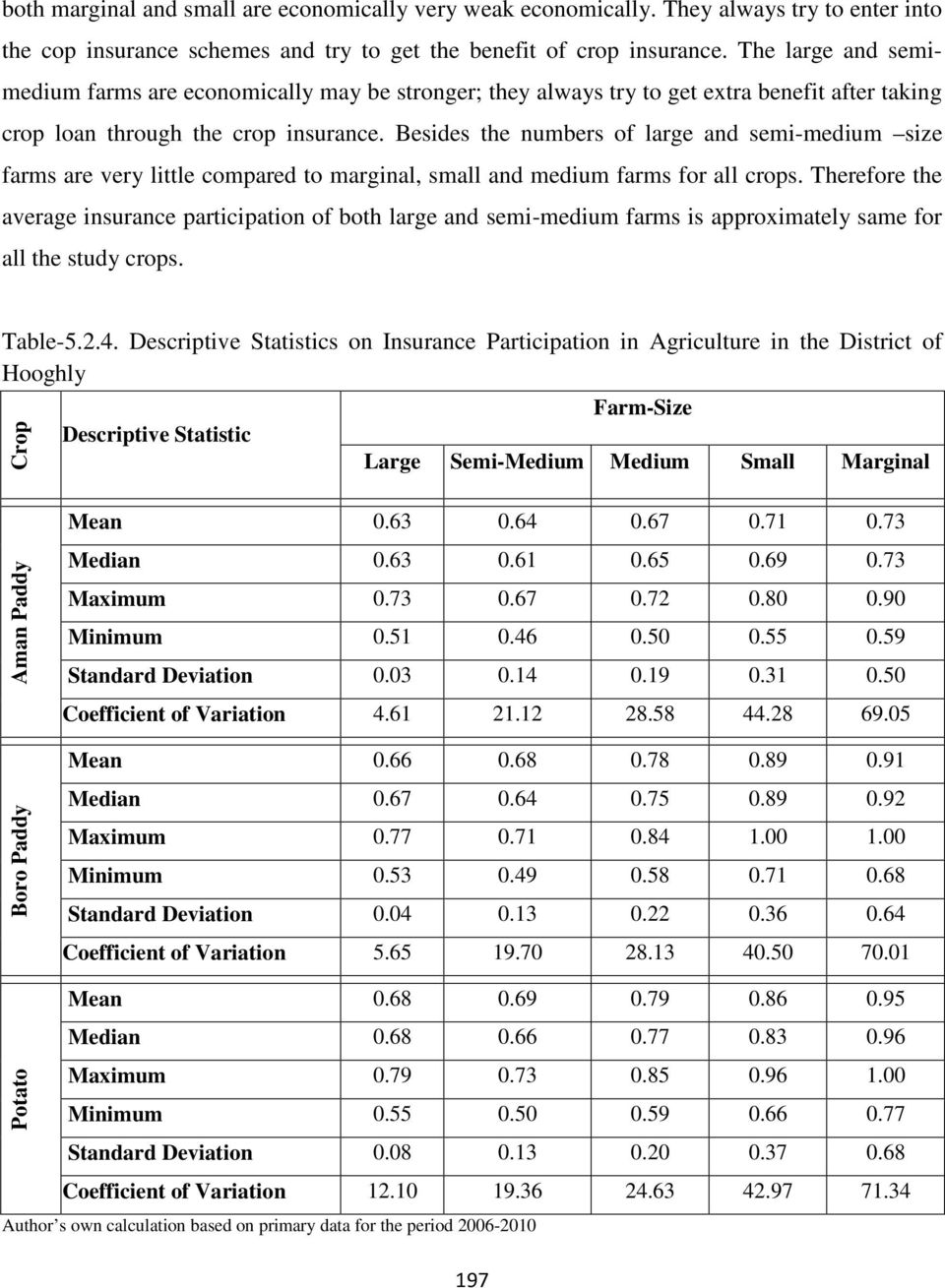
16 Such the insurance participation for Potato is sixty eight percent (68%) and sixty nine percent (69%) in case of large and semi-medium farms respectively. We have shown that the insurance participation for both winter crops such as Boro Paddy and Potato is higher than rainy season crop, Aman Paddy in favor of all five types of farm-size. Because both Boro paddy and Potato more risky crops and also production cost is higher. The average insurance participation for all types of farm-size (large= 68%, semi-medium= 69%, medium=79%, small= 71% and marginal= 95%) is greater than both Boro Paddy and Aman paddy. The Potato is an important commercial crop to the farms of the district of Hooghly and the cost of production per acre is very high than other crops. The farms of Potato producing face different types of high risk those already have been discussed in our previous section. From table-5.2.4, it is observed that the variability that is the fluctuation of insurance participation in case of Potato is higher than other crops (such as Aman Paddy and Boro Paddy). We have mentioned some crucial point such as if a marginal or a small or a medium size farm is affected by any type of natural calamities in a year and unable to repay the crop loan on that year, therefore there is no chance to get the crop loan in the next year. This type of fact is highly affected by market price. In case of Potato, the market price of the current year at the time of harvesting or the storage price of the current year highly affect the cultivation plan of all types of farms in the next year. Refer to table There exist normal type of distribution both for Aman Paddy and Potato to the large farms in case of insurance participation. Also for small farms, there exists normal type of distribution to the insurance participation for Boro Paddy. We observed that both for the marginal and small farms the maximum insurance participation is hundred percent both for Boro Paddy and Potato. That means insurance is highly acceptable to the marginal and small farms Test of Mean Difference of Insurance Participation We know that the insurance participation is a fundamental factor in the crop insurance system. The insurance participation influences the different farm-size of three crops on the basis of 198
17 different criterions. It influences the production decision and inputs use decision of a farm for a particular crop. We have presented a brief description about the descriptive statistics related to the different farm-size of different crops in the previous section. Therefore, we want to test whether there is any significant difference in the mean of insurance participation between different crops for farms of different sizes and difference in the mean of insurance participation between different farm-size for different crops Farm-Size-Specific Mean Difference of Insurance Participation between Different Crops So far we have considered only the descriptive features of different farm-size on the basis of our collected primary data during 2006 to 2010 in the district of Hooghly, West Bengal. In this section let us examine whether there is any significant difference in the mean of insurance participation between different crops for farms of different sizes. We have carried out t test (Fisher s t test ) for testing the significance in the difference in the mean of insurance participation between different crops for farms of different sizes. Refer to the table Overall picture of mean difference of insurance participation between different crops shows that there exists significant difference in the insurance participation between Boro and Aman Paddy and also that between Potato and Aman Paddy for farms of different sizes. We note that the inter-crop differences in the insurance participation for farms of different size are seen to be statistically significant at one percent (1%) level. We also observe that the mean difference of insurance participation between Boro Paddy and Potato among the different farm-size is not statistically significant. This may be due to the fact that insurance participation for Boro Paddy is closely similar to that for Potato for farms of different sizes. Further since both Boro Paddy and Potato are very risky crops and involve high cost for their cultivation, it is expected that farms of different sizes will be inclined to be protected under the umbrella of the crop insurance scheme. In this situation the insurance participation is likely to be higher for both crops for all farms irrespective of the sizes. 199

18 Table Test of Mean Difference # of Insurance Participation between Different Crops Farm-Size Large Semi-Medium Medium Small Marginal Between Crops Mean difference of Insurance Participation Standard Error t-statistic Boro and Aman * Potato and Boro Potato and Aman * Boro and Aman * Potato and Boro Potato and Aman * Boro and Aman * Potato and Boro Potato and Aman * Boro and Aman * Potato and Boro Potato and Aman * Boro and Aman * Potato and Boro Potato and Aman * Source: Author s own computation based on primary data collected during the period * stands for significant at 1% level of significance; ** stands for significant at 5% level of significance; *** stands for significant at 10% level of significance #Mean differences have been tested on the basis of the test statistic x x t = SE. x 1 2 n1 n2 ( x ) 1 2 t Crop-Specific Mean Difference of Insurance Participation between Different Farms We are going to test the mean difference of insurance participation between different farm-size for all crops. Refer to table There is no significant difference in insurance participation between large and semi-medium farm for all the three crops. Because of the basic natures such as the economic condition as well as production pattern of large and semi-medium farm are more or less same. In the previous section of analysis about descriptive statistics on the cultivation of three crops, we don t observe that there is significant difference between yield rate and pattern of cost structure. Further, the mean difference of insurance participation by Large and Medium farms, Large and Small farms, and Large and Marginal farms for Aman Paddy, Boro Paddy and Potato are seen to be statistically significant at five percent level. The mean difference of insurance participation between semi-medium and medium farms is seen to be statistically significant at one percent level for Boro Paddy and Potato. 200

19 Table Test of Mean Difference # of Insurance Participation between Different Farms Between Farms Mean Difference for the Crop Aman Paddy Boro Paddy Potato Large and Semi-Medium Standard Error t-statistic Large and Medium Standard Error t-statistic 2.056** 2.996* 3.074* Large and Small Standard Error t-statistic 4.589* 5.067* 3.649* Large and Marginal Standard Error t-statistic 6.574* 7.881* 8.142* Semi-Medium and Medium Standard Error t-statistic * 3.628* Semi-Medium and Small Standard Error t-statistic 5.843* 8.329* 4.711* Semi-Medium and Marginal Standard Error t-statistic 4.556* 3.219* Medium and Small Standard Error t-statistic ** Medium and Marginal Standard Error t-statistic 2.074** 2.217** 1.982** Small and Marginal Standard Error t-statistic ** Source: Author s own computation based on primary data collected during the period * stands for significant at 1% level of significance; ** stands for significant at 5% level of significance; *** stands for significant at 10% level of significance x1 x2 #Mean differences have been tested on the basis of the test statistict = tn + n 2 SE. x x. ( )
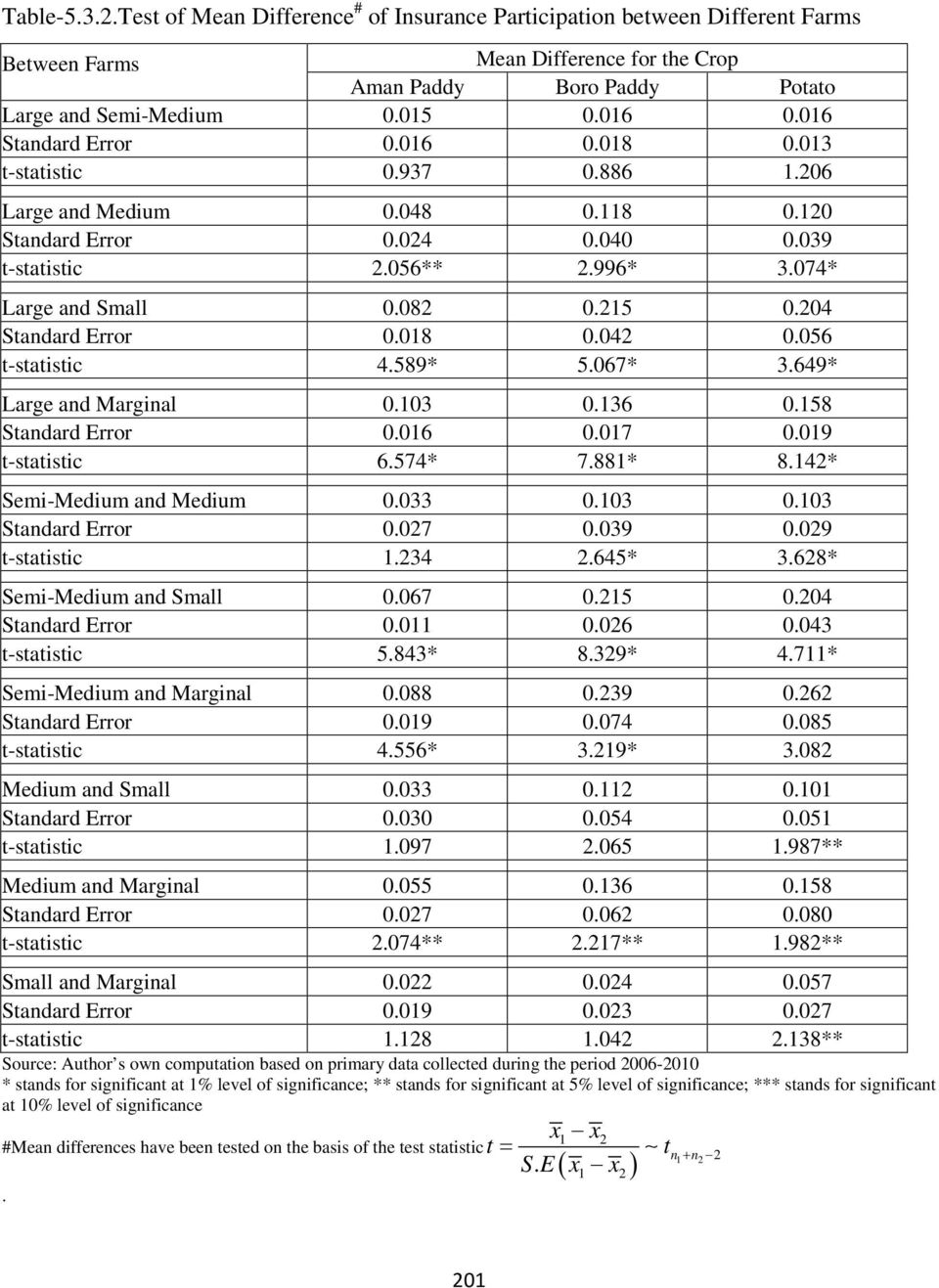
20 Refer to table The mean difference of insurance participation by Medium and Marginal farms for Aman Paddy, Boro Paddy and Potato are seen to be statistically significant at five percent level. Further, in the case of Potato the significant difference is noticed between medium and small farms at five percent (5%) level of significance. On the other hand, there exists significant difference only for Potato at five (5%) percent level of significant between small and marginal farms Panel Regression Result of Aman Paddy The insurance participation is a key factor of the crop insurance. It affects the decision about cultivation related issues of a farmer. At the same time education level of a farmer is also an important factor and it stimulates the farms whether they would come under crop insurance system or not. The Aman Paddy is a rainy season crop and consequently its production cost and risk are at the least level. In that situation we want to analyze how the insurance participation and education level of a farmer affect the production and the production related different matters of a crop Impact of Insurance Participation on Area under Cultivation of Aman Paddy Refer to table Considering the case of restricted model where all coefficients are constant across times and individuals, we observe that the relation between insurance participation and total area under cultivation, and the relation between total area under cultivation and time are negative but significant. Since Aman paddy is cultivated in the rainy season by all farms total area under cultivation remains unchanged. The area of cultivable land for Aman Paddy remains constant over time in all farms of different sizes. The growth rate of the Aman land is lowest and equal to 3.34%. Let us consider the unrestricted model. If we put zero for different farm-size which means that all dummies such as DMD, DSMD, DSML and DMRG are equal to zero, the restricted model is equal to unrestricted model and the intercept term (6.830) will be dummy coefficient of large farms. 202
21 Table Regression Results of Area under Cultivation of Aman Paddy on Insurance Participation Dependent Variable: LOG(AMANLAND); Sample: ; Cross-sections included: 355; Total panel (balanced) observations: 1775 Restricted Model Un-Restricted Model Explanatory Variables Coefficient Error t-statistic Explanatory Variables Coefficient Error t-statistic Constant * Constant * LOG(INSPART) * DMD * LOG(EDUCATION) DSMD * TIME *** DSML * R-squared: 0.77 Adjusted R-squared: 0.77 F-statistic: * Durbin-Watson statistic: DMRG * LOG(INSPART) LOG(EDUCATION) TIME DMD*LOG(INSPART) DSMD*LOG(INSPART) *** DSML*LOG(INSPART) ** DMRG*LOG(INSPART) * DMD*LOG(EDUCATION) DSMD*LOG(EDUCATION) DSML*LOG(EDUCATION) DMRG*LOG(EDUCATION) DMD*TIME DSMD*TIME DSML*TIME *** DMRG*TIME * Diagnostic Statistic R-squared: 0.98 Adjusted R-squared: 0.98 F-statistic: * Durbin-Watson statistic: F- statistic (19,1755) for testing the Restrictions: * Source: Author s own computation based on primary data collected during the period * stands for significant at 1% level of significance; ** stands for significant at 5% level of significance; *** stands for significant at 10% level of significance The growth rate of area under cultivation of Aman Paddy will be decreased ( %). Both the insurance effect (0.385) and education effect (0.012) are positive and insignificant. That means that due to crop insurance and certain education of large farms, the insured area under 203
22 cultivation may be increased but this effect is not significant as total area under cultivation of Aman Paddy for all types of farms always remains unchanged. We may expect that the moral hazards problem arises for large farms. Table-5.4.1A. Inter-Farm-Size Effects on Area under Cultivation of Aman Paddy Farm-Size Intercept Insurance Effect Education Effect Time Effect Growth Rate (%) Large Farm Medium Farm Semi-Medium Farm Small Farm Marginal Farm Source: Author s own computation based on former table We consider the case of medium farms. In that situation for the medium farms dummy is equal to one that is DMD = 1 if the farm-size belongs to medium farm, zero otherwise. In that situation the intercept term becomes and positive and also significant. The slope coefficient with respect to insurance participation will become 0.838; this is the insurance effect and it is insignificant. The trend line of both medium farms and large farms is upward rising but the trend line of medium farms is steeper than large farms which imply that the trend line of medium farms cuts the large farms from below. The effect of insurance participation is stronger for medium farms. The slope coefficient with respect to education is negative (-0.016) that means the effect of education on the area under cultivable land of Aman Paddy is negative and insignificant. The time effect on the area under cultivation of Aman Paddy is positive (0.004) and also insignificant. Let us consider the case of semi-medium farms. Both the intercept term (4.173) and the slope coefficient (0.953) with respect to insurance participation are positive and significant. The trend line of area under cultivation of Aman Paddy on insurance participation is steeper for semimedium farms than the trend line of area under cultivation of Aman Paddy on insurance participation for large farms. The effect of education is also positive and significant that is the farms in the group of semi-medium farms always try to get the benefit of crop insurance. On the other hand time effect on the area under cultivation of Aman Paddy on insurance participation is positive but insignificant. That means the insured area under semi-medium farms may remain 204
23 unchanged over time. Thus, we observe that the overall trend of time effect on both large farms and semi-medium farms are the same. The growth rate of area under cultivation of Aman Paddy is percent and higher than that of large farms and medium farms but it is insignificant. The intercept term (3.429) of small farms is also lower than that of the large farms, medium farms, and semi-medium farm and the result is significant. On the other hand, the slope coefficient with respect to insurance participation (1.059) is positive and significant for small farms. Therefore, it is stated that over time insurance participation of both large farms and small farms increases but after the intersection of the trend line of insurance participation the number of insured farms and insured area have increased at a higher rate than that of the large farms, since most of the farms belong to small farms group. The effect of education (0.37) is positive but insignificant. Due to some education, the small farms are interested to take crop loan but the technique of the utilization of the crop loan is not proper. We observe that the time effect (0.007) is positive and significant. That is, over time number of insured farms or insured area under small farms increase as most of the small farms are economically very weak. Therefore, the growth rate of area under cultivation of Aman Paddy on insurance participation is (0.702) positive and significant and also higher than that of other farm-sizes. At the time of our collection of primary data we observe that in the district of Hooghly under study, a large section of the farms belongs to marginal farms and small farms. The intercept term of marginal farms is (3.128) positive and lower than other farm-size. The slope coefficient of marginal farms with respect to insurance participation (1.289) is positive and significant and also large compared to the other farm-size. From the stand point of insurance participation the effect of crop insurance on the marginal farms is stronger than that on other farms. The effect of education (-0.036) is negative and not significant. The time effect (0.009) is positive and significant for marginal farms. The growth rate of area of marginal farms (0.904) is positive and significant and also higher than that of other farm-sizes. The inter-farm-size effect on yield rate of Aman Paddy is presented in the table-5.4.1a. 205
24 Thus over all insurance effect on area under cultivation of Aman paddy of different farm-size is easily cleared by the vertical bar diagram in figure This implies that the effect of insurance participation on area under cultivation of Aman Paddy varies inversely with farm-size Impact of Insurance Participation on Total Production of Aman Paddy Refer to table In the restricted model, we observe that (all coefficients constant across times and individuals) there exists an indirect and significant relation with respect to the total production of Aman Paddy and insurance participation and also with time. The education level affects insurance participation indirectly and insignificantly in case of total production of Aman Paddy. The growth rate of production is percent but insignificant. In this respect we point out that the farms basically may use ordinary seed and traditional production technique. Consider the case of the un-restricted model. If we put all dummies equal to zero (that is DMD=0, DSMD=0, DSML=0, and DMRG=0), the model will become un-restricted. The regression equation will also become the regression equation of large farms. The intercept term is positive and significant and also higher than that of other farm-sizes. The slope coefficient (0.459) with respect to insurance participation is positive and lower than that of other farm-sizes. The effect of education of large farms on total production of Aman Paddy is positive but not significant. However, the time effect (-0.045) of insurance participation on total production of Aman Paddy is negative and also insignificant. Therefore, the growth rate of total output is negative (-4.017%). The intercept term (5.396) of the medium farm of total production of Aman Paddy on insurance participation is positive and lower than the intercept term (5.838) of large farms. The slope coefficient (0.453) is positive and not significant. The effect of insurance participation on the total production is clear from the vertical bar diagram of insurance effect on total output of Aman Paddy in figure On the other hand, both education effect (-0.006) and time effect (-0.043) of insurance participation on total production of Aman Paddy are negative and insignificant. The growth rate (-4.208) of total production is also negative and insignificant. 206
25 Table Regression Results of Total Production of Aman Paddy on Insurance Participation Dependent Variable: LOG(TPRODUCT); Sample: ; Cross-sections included: 355; Total panel (balanced) observations: 1775 Restricted Model Un-Restricted Model Explanatory Variables Error t-statistic Explanatory Variables Coefficient Coefficient Error t-statistic Constant * Constant * LOG(INSPART) * DMD * LOG(EDUCATION) DSMD * TIME * DSML * DMRG * LOG(INSPART) LOG(EDUCATION) TIME * DMD*LOG(INSPART) DSMD*LOG(INSPART) * DSML*LOG(INSPART) * DMRG*LOG(INSPART) * DMD*LOG(EDUCATION) DSMD*LOG(EDUCATION) DSML*LOG(EDUCATION) DMRG*LOG(EDUCATION) DMD*TIME DSMD*TIME * DSML*TIME * DMRG*TIME * Diagnostic Statistic R-squared: 0.87 Adjusted R-squared: 0.87 F-statistic: * Durbin-Watson statistic: R-squared: 0.97 Adjusted R-squared: 0.97 F-statistic: * Durbin-Watson statistic: F-statistic (19,1755) for testing the Restrictions: Source: Author s own computation based on primary data collected during the period * stands for significant at 1% level of significance; ** stands for significant at 5% level of significance; *** stands for significant at 10% level of significance 207
26 The intercept term (4.273) of semi-medium farms is lower than large farms and medium farms but significant. On the other respect, the slope coefficient of semi-medium farms with respect to insurance participation is (1.045) positive and significant and also higher than those of large farms and medium farms. The education effect (0.016) of insurance participation on total production is positive and insignificant. The time effect of insurance participation on total production is positive and significant. The growth rate of total production (1.525%) is also positive and significant. Table-5.4.2A. Inter-Farm-Size Effects on Total Output of Aman Paddy Farm-Size Intercept Insurance Effect Education Effect Time Effect Growth Rate (%) Large Farm Medium Farm Semi-Medium Farm Small Farm Marginal Farm Source: Author s own computation based on former table The intercept term of small farms is (3.564) positive and significant and lower than the intercept of large farms, medium farms and semi-medium farms. The slope coefficient with respect to insurance participation is (1.166) positive and significant at one percent (1%) level of significance. The insurance effect on total output is grater for small farms than those of large farms, medium farms and semi-medium farms. The insurance effect on total output of Aman Paddy for small farms is clearly understood from the bar diagram of the figure There exists insignificant and positive education effect (0.054) on insurance participation of total output of Aman Paddy for small farms but the time effect (0.018) on insurance participation is positive and significant. Therefore, we may say that the crop insurance appears to have positive effect on small farms. The growth rate of the total production (1.816%) for small farms is significant and higher than those of large farms, medium farms and semi-medium farms. The inter-farm-size-effects on output is presented in the table-5.4.2a. 208
27 Insurance Effect Insurance Effect on Area under Cultivation of Aman Paddy Insurance Effect Insurance Effect on Total Output of Aman Paddy Large Medium Semi-Medium Small Marginal Large Medium Semi-Medium Small Marginal Farm-Size Farm-Size Insurance Effect on Yield Rate of Aman Paddy Insurance Effect Large Medium Semi-Medium Small Marginal Farm-Size Figure
28 We give stress on analysis of the effect of marginal farms on the total production of Aman Paddy. The physical value of the intercept term is (2.920) positive and significant at one percent (1%) level of significance. We notice that the numerical value of the intercept term decreases with farm-size. The physical value of the slope coefficient is also higher than the value of the slope coefficient of the other farm-size. Thus insurance participation of marginal farms is being found to increase at a greater rate and it positively affects the production. In our Sate (West Bengal), the number of marginal farms is higher than that of other farms and they are also economically poor and more interested about crop loan as well as crop insurance. The effect of crop insurance is easily understood from the bar diagram of the figure The educational effect on total output of Aman Paddy for marginal farms is negative and insignificant. Most of marginal farms may be either illiterate or their education level is very poor. Besides they are economically very weak. Therefore, they show interest on crop loan or crop insurance only to bear the cost of production. Over all time effect (0.023) on total output is positive and significant. The growth rate of output of Aman Paddy is (2.33%) highest, positive and significant Impact of Insurance Participation on Yield Rate of Aman Paddy Refer to table First we consider restricted model (all coefficients constant across times and individuals). In this case intercept value is positive and significant. The insurance effect (0.894) is positive and significant at one percent level. The time is negatively correlated with the yield rate which is significant. The growth rate (1.488%) is negative and significant. The constant value will give the value of intercept term of large farms. The insurance effect (0.074) is positively but insignificantly related with yield rate of Aman Paddy. The educational effect is positive and not significant. So we think that due to certain level of education, the large farms come under crop insurance that is they take more crop loan from insurer but they also use crop loan for non-agricultural activities. The time coefficient is negatively and insignificantly related with yield rate. The growth rate (-5.430) of yield rate is negative. The insurance effect on the yield rate of Aman Paddy is easily under stood from the figure
29 Table Regression Results of Yield Rate of Aman Paddy on Insurance Participation Dependent Variable: LOG(Yield); Sample: ; Cross-sections included: 355; Total panel (balanced) observations: 1775 Restricted Model Un-Restricted Model Explanatory Variables Coefficient Error t-statistic Explanatory Variables Coefficient Error t-statistic Constant * Constant * LOG(INSPART) * DMD LOG(EDUCATION) DSMD * TIME * DSML * DMRG * LOG(INSPART) LOG(EDUCATION) TIME * DMD*LOG(INSPART) * DSMD*LOG(INSPART) *** DSML*LOG(INSPART) * DMRG*LOG(INSPART) * DMD*LOG(EDUCATION) DSMD*LOG(EDUCATION) DSML*LOG(EDUCATION) DMRG*LOG(EDUCATION) DMD*TIME * DSMD*TIME * DSML*TIME * DMRG*TIME * R-squared: 0.56 Adjusted R-squared: 0.56 F-statistic: * Durbin-Watson stat: Diagnostic Statistic R-squared: 0.78 Adjusted R-squared: 0.77 F-statistic: * Durbin-Watson stat: F- statistic (19,1755) for testing the Restrictions: * Source: Author s own computation based on primary data collected during the period * stands for significant at 1% level of significance; ** stands for significant at 5% level of significance; *** stands for significant at 10% level of significance The intercept term (3.090) of medium farm is positive and significant and lower than that of the large farm. On the other hand, the insurance participation (-0.385) is negatively and significantly related to yield rate. The insurance effect on yield rate of Aman Paddy is easily understood from 211
30 the figure The educational effect is positive (0.011) and insignificantly interrelated with yield rate but higher than that of the large farm. On the other hand, like large farm, the time coefficient of medium farm is negatively and insignificantly connected with yield rate. The growth rate (-4.639%) of Aman paddy is also negative and this rate is significant. That means, the insured medium farm is unable to utilize crop loan in proper way. Table-5.4.3A. Inter-Farm-Size Effects on Yield Rate of Aman Paddy Farm-Size Intercept Insurance Effect Education Effect Time Effect Growth Rate Large Farm Medium Farm Semi-Medium Farm Small Farm Marginal Farm Source: Author s own computation based on former table Refer to table The intercept term of the semi-medium farm is (3.101) positive and also significant but higher than that of the large farm. On the other hand, slope coefficient is positive and significant (0.092). It is higher than that of the large farm. The insurance effect on yield rate of Aman Paddy is clearly under-stood from the bar diagram of figure We observe that the educational effect on yield rate is positive but insignificant compared to the large farm. On the other side time effect (0.010) is positively and significantly for semi-medium farm than that of the large farm. Therefore, the growth rate (1.026%) of yield rate is significantly increased for medium farms with respect to large farm. Refer to table The intercept term of small farm is positive and significance. The insurance effect (the value of insurance effect) is (0.107) positive and significance at one percent level. The insurance effect on yield rate of Aman Paddy for small farms is quietly better than large farms, medium farms and semi-medium farms. The insurance effect on yield rate is clearly understood from the bar diagram of figure The educational effect and time effect are positively related to yield rate of Aman Paddy. But the time effect is significant and educational effect is insignificant. The education level cannot influence the yield rate as an average education level is class tenth standard and they take crop loan only to fulfill the required demand of cash money for 212
31 cultivation and it may be used for other purpose. The growth rate (1.131%) of yield rate is higher than that of the large farm. The insurance effect on yield rate of marginal farm is higher than those of the other farm sizes. It is clearly understood from the bar diagram of the figure The average output and area under cultivation is lowest in standard for marginal farms. On the other respect, they are also economically weak, as a result they try to cultivate their own land carefully. Therefore yield rate of the marginal farms is in the highest level and the insurance effect is also the highest. The education effect of marginal farms (0.006) on yield rate is the modest of all levels. On the other side, the time effect is significant and quite better than other farm-sizes. The growth rate (1.354%) of yield is also highest for marginal farms (refer to table-5.4.3a) than those of other farm sizes Impact of Insurance Participation on Use of Inputs for Aman Paddy We consider five factors of production such as labour, seed, irrigation, fertilizer and pesticides cost. The measurement unit of cost of every factor is rupee. Refer to tables and In the restricted model, both the insurance participation and time are positively and significantly related with the cost of labour and seed inputs. On the other hand, both the growth rate of labour cost (6.72%) and seed cost (5.654%) are positive and significance at the one (1%) percent level. In the un-restricted model, both the cost of labour and seed inputs are positively related to the insurance participation for large farm. But the relation between the cost of seed and the insurance participation is insignificant. Both the insurance participation and the time coefficients are negatively and significantly connected with the cost of labour for medium, semi-medium, small and marginal farms. On the other hand, in the case of the seed cost, these relations are positive and significant. Refer to table and table It is observed that for the cost of both labour and seed, all the differential 213
32 intercept and differential slope coefficients are statistically significant in favour of medium, semi-medium, small and marginal farms. This implies that both the panel regression functions of the cost of labour and seed inputs of medium, semi-medium, small and marginal farms are different from that of the large farm. Refer to table-5.5.1a. Both the insurance effect and the rate of growth of labour cost are highest for large farm and lowest for marginal farm. These vary directly with farm-size. This is clearly understood from the figure We may point out that the average labour cost (per acre of land) is highest for both large and semi-medium farms. It is lowest for both marginal and small farms (refer to table-5.2.1). The marginal and small farms are economically poor. They always try to complete their cultivation without any hired labour. From table-5.5.2a we find that the insurance effect on the seed cost is highest for the marginal farm followed by the small farm. It is lowest for the medium farm and followed by the large farm. This difference arises due to the difference in the average seed costs and in the economic condition of different farm-size. It may arise due to difference in the choice of the quality of the seeds by the different farms. The insurance effect on the seed cost of the different farm-size is clearly understood from the figure On the other hand, the rate of growth of cost of the seed varies indirectly with the farm-size. In that situation we may point out that both the marginal and small farms are also using HYV seeds. In the same way we explain the regression result of use of irrigation cost for Aman Paddy on insurance participation. The coefficient of insurance participation and coefficient of time are positively as well as significantly related with the irrigation cost in the restricted model. But the education level is insignificant and negatively related with the irrigation cost. The growth rate of irrigation cost is 4.917% and this rate is higher than the growth rate of irrigation cost of different farm-size in the un-restricted model. 214
33 Table Regression Results of Use of Labour Input for Aman Paddy on Insurance Participation Dependent Variable: ); Sample: ; Cross-sections included: 355; Total panel (balanced) observations: 1775 Restricted Model Un-Restricted Model Explanatory Variables Coefficient Error t-statistic Explanatory Variables Coefficient Error t-statistic Constant * Constant * LOG(INSPART) * DMD ** LOG(EDUCATION) DSMD ** TIME * DSML * DMRG * LOG(INSPART) * LOG(EDUCATION) *** TIME * DMD*LOG(INSPART) DSMD*LOG(INSPART) * DSML*LOG(INSPART) * DMRG*LOG(INSPART) * DMD*LOG(EDUCATION) DSMD*LOG(EDUCATION) DSML*LOG(EDUCATION) DMRG*LOG(EDUCATION) DMD*TIME * DSMD*TIME * DSML*TIME * DMRG*TIME * R-squared: 0.62 Adjusted R-squared: 0.62 F-statistic: Durbin-Watson stat: Diagnostic Statistic R-squared: 0.80 Adjusted R-squared: 0.79 F-statistic: Durbin-Watson stat: F- statistic (19,1755) for testing the Restrictions: Source: Author s own computation based on primary data collected during the period for the period has been calculated at the market wage rate of 2006 * stands for significant at 1% level of significance; ** stands for significant at 5% level of significance; *** stands for significant at 10% level of significance 215
34 Table-5.5.1A. Inter-Farm-Size Effects on Use of Labour Input for Aman Paddy Farm-Size Intercept Insurance Effect Education Effect Time Effect Growth Rate Large Farm Medium Farm Semi-Medium Farm Small Farm Marginal Farm Source: Author s own computation based on former table Insurance Effect on Use of Labour Insurance Effect Large Medium Semi-Medium Small Marginal Farm-Size Figure
35 Table Regression Results of Use of Seed Input for Aman Paddy on Insurance Participation Dependent Variable: ); Sample: ; Cross-sections included: 355; Total panel (balanced) observations: 1775 Restricted Model Un-Restricted Model Explanatory Variables Coefficient Error t-statistic Explanatory Variables Coefficient Error t-statistic Constant * Constant * LOG(INSPART) * DMD * LOG(EDUCATION) DSMD * TIME * DSML * DMRG ** LOG(INSPART) LOG(EDUCATION) TIME * DMD*LOG(INSPART) DSMD*LOG(INSPART) * DSML*LOG(INSPART) * DMRG*LOG(INSPART) * DMD*LOG(EDUCATION) DSMD*LOG(EDUCATION) DSML*LOG(EDUCATION) DMRG*LOG(EDUCATION)) DMD*TIME ** DSMD*TIME * DSML*TIME * DMRG*TIME * R-squared: 0.63 Adjusted R-squared: 0.63 F-statistic: * Durbin-Watson statistic: Diagnostic Statistic R-squared: 0.81 Adjusted R-squared: 0.81 F-statistic: * Durbin-Watson statistic: F- statistic (19,1755) for testing the Restrictions: * Source: Author s own computation based on primary data collected during the period for the period has been calculated at the market seed price of 2006 * stands for significant at 1% level of significance; ** stands for significant at 5% level of significance; *** stands for significant at 10% level of significance 217
36 Table-5.5.2A. Inter-Farm-Size Effects on Use of Seed Input for Aman Paddy Farm-Size Intercept Insurance Effect Education Effect Time Effect Growth Rate Large Farm Medium Farm Semi-Medium Farm Small Farm Marginal Farm Source: Author s own computation based on former table Insurance Effect on Use of Seed Insurance Effect on Use of Irrigation Insurance Effect Insurance Effect Large Medium Semi-Medium Small Marginal Large Medium Semi-Medium Small Marginal Farm-Size Farm-Size Insurance Effect Insurance Effect on Use of Fertiliser Insurance Effect Insurance Effect on Use of Pesticide Large Medium Semi-Medium Small Marginal Large Medium Semi-Medium Small Marginal Farm-Size Farm-Size Figure
37 Refer to table In the un-restricted model, in the case of the large farm both the insurance participation and time coefficient are positively and significantly related to the irrigation cost of Aman Paddy. On the other hand, both the insurance participation and the education level are negatively as well as insignificantly related to the irrigation cost of the other farms such as the medium, semi-medium, small and marginal farms. Refer to table-5.5.3a. Both the insurance effect and education effect are directly related with the farm-size. The intercept values of the small and marginal farms are statistically different from that of the large farm. These differences in the intercepts may be due to unique features of the small and marginal farms, such as differences in the economic ability, sources of irrigation facilities, or use of the types of seeds. But all the differential slope coefficients are statistically insignificant. Therefore, we come to the conclusion that the panel regression functions of the irrigation cost of medium, semi-medium, small and marginal farms are not different from the large farm. From the table-5.5.3, we find that the time coefficients of medium, semi-medium, small and marginal farms are directly and insignificantly connected with the irrigation cost. Therefore, the growth rate of irrigation cost increases with the decrease of the farm-size. The main argument is that the marginal farms, small farms and medium farms are economically weak and they also get insufficient cash as a crop loan from the financial institution due to tiny and marginal land size. In this respect they are unable to arrange heavy deep-tubewell, mini-tubewell, shallow, etc. They get the irrigation facility either from government cannel, government organized, government undertaken deep tube well, or from private organized irrigation sources etc. We also point out that every year there is an uncertainty in the regular and equal rain fall in the monsoon. Besides, the irregularities in the rain-fall force the farms to depend on artificial irrigation facilities. At the same time the farms increase the use of the HYV seeds in the cultivation. Therefore the irrigation cost of marginal, small and medium farms increases due to increase in the use of artificial irrigation sources. 219
38 Table Regression Results of Use of Irrigation for Aman Paddy on Insurance Participation Dependent Variable: ); Sample: ; Cross-sections included: 355; Total panel (balanced) observations: 1775 Restricted Model Un-Restricted Model Explanatory Variables Coefficient Error t-statistic Explanatory Variables Coefficient Error t-statistic Constant * Constant * LOG(INSPART) ** DMD LOG(EDUCATION) DSMD TIME * DSML * DMRG *** LOG(INSPART) *** LOG(EDUCATION) TIME * DMD*LOG(INSPART) DSMD*LOG(INSPART) DSML*LOG(INSPART) DMRG*LOG(INSPART) DMD*LOG(EDUCATION) DSMD*LOG(EDUCATION) DSML*LOG(EDUCATION) DMRG*LOG(EDUCATION)) DMD*TIME DSMD*TIME DSML*TIME DMRG*TIME Diagnostic Statistic R-squared: 0.70 Adjusted R-squared: 0.70 F-statistic: Durbin-Watson statistic: R-squared: 0.89 Adjusted R-squared: 0.89 F-statistic: Durbin-Watson statistic: F-statistic (19,1755) for testing the Restrictions: Source: Author s own computation based on primary data collected during the period for the period has been calculated at the market price of 2006 * stands for significant at 1% level of significance; ** stands for significant at 5% level of significance; *** stands for significant at 10% level of significance 220
39 From the tables and we observed that in the restricted regression model of the cost of fertilizer and pesticides both the insurance participation and time coefficients are positively and statistically significant. Both the growth rate of fertilizer cost (8.112%) and pesticide (6.929%) consumptions are significant at the one percent (1%) level. Table-5.5.3A. Inter-Farm-Size Effects on Use Irrigation for Aman Paddy Farm-Size Intercept Insurance Effect Education Effect Time Effect Growth Rate (%) Large Farm Medium Farm Semi-Medium Farm Small Farm Marginal Farm Source: Author s own computation based on former table Refer to tables and 5.5.4A. The cost of fertilizer is positively related to the insurance participation for all farm-size except the medium farm. But all the estimated coefficients of the insurance participation are individually and highly significant. On the other hand, all the differential time coefficient values of the medium, semi-medium, small and marginal farms are positively related to the cost of fertilizer. This may happen mainly due to the high fluctuation in the quantity of the fertilizer consumption by the different farm-size during the period 2006 to 2010 (refer to table-5.2.1). The panel regression function of the large farm is different from the other four farm sizes, as all the differential intercept and all the differential slope coefficients are statistically significant. From table we find out that the cost of pesticide is positively and significantly related to the insurance participation of the five farm-sizes. The panel regression functions of the cost of pesticide of medium, semi-medium, small and marginal farms are different from that of large farm. 221
40 With reference to tables 5.5.4A and 5.5.5A we find that both the insurance effect and the time effect of the cost of fertilizer and pesticide are indirectly related to the farm-size. The insurance effect on use of fertilizer and pesticide can be easily understood from the bar diagram of the figure Both the insurance effect and growth rate of fertilizer and also pesticide consumptions are higher for marginal farms followed by small farms. We may point out some intuitive logic. Both the small and marginal farms are economically poor. They are unable to bear the cost of agricultural production in cash. As a result, both small and marginal farms are more interested to get crop insurance. They are able to collect required cash from the different financial institutions and purchase different types of chemical fertilizer. Besides, they are more interested to use the HYV seeds. Crops are affected by different types of disease and the farms are forced to use pesticides. The different pesticide and fertilizer producers give different advertisements about different pesticides and fertilizers. The farms are attracted with these types of advertisement. They purchase a specific pesticide or a specific type of fertilizer on the basis of advertisement. They have no common sense about the compositions of pesticides or fertilizers. In that situation the education level is insignificant. 222
41 Table Regression Results of Use of Fertilizer for Aman Paddy on Insurance Participation Dependent Variable: ); Sample: ; Cross-sections included: 355; Total panel (balanced) observations: 1775 Restricted Model Un-Restricted Model Explanatory Variables Coefficient Error t-statistic Explanatory Variables Coefficient Error t-statistic Constant * Constant * LOG(INSPART) * DMD * LOG(EDUCATION) DSMD *** TIME * DSML *** DMRG ** LOG(INSPART) * LOG(EDUCATION) TIME DMD*LOG(INSPART) * DSMD*LOG(INSPART) * DSML*LOG(INSPART) * DMRG*LOG(INSPART) DMD*LOG(EDUCATION) DSMD*LOG(EDUCATION) DSML*LOG(EDUCATION) DMRG*LOG(EDUCATION)) DMD*TIME *** DSMD*TIME ** DSML*TIME * DMRG*TIME * Diagnostic Statistic R-squared: 0.66 Adjusted R-squared: 0.66 F-statistic: * Durbin Watson statistic:: R-squared: 0.82 Adjusted R-squared: 0.82 F-statistic: * Durbin Watson statistic: F- statistic (19,1755) for testing the Restrictions: * Source: Author s own computation based on primary data collected during the period FERTILISERCOST for the period has been calculated at the market price of fertiliser in 2006 * stands for significant at 1% level of significance; ** stands for significant at 5% level of significance; *** stands for significant at 10% level of significance 223
42 Table Regression Results of Use of Pesticide for Aman Paddy on Insurance Participation Dependent Variable: ); Sample: ; Cross-sections included: 355; Total panel (balanced) observations: 1775 Restricted Model Un-Restricted Model Explanatory Variables Coeffi cient Error t-statistic Explanatory Variables Coeffic ient Error t-statistic Constant * Constant * LOG(INSPART) * DMD ** LOG(EDUCATION) DSMD ** TIME * DSML ** DMRG * LOG(INSPART) * LOG(EDUCATION) TIME * DMD*LOG(INSPART) *** DSMD*LOG(INSPART) * DSML*LOG(INSPART) ** DMRG*LOG(INSPART) * DMD*LOG(EDUCATION) DSMD*LOG(EDUCATION) DSML*LOG(EDUCATION) DMRG*LOG(EDUCATION)) DMD*TIME ** DSMD*TIME * DSML*TIME * DMRG*TIME ** Diagnostic Statistic R-squared: 0.67 Adjusted R-squared: 0.67 F-statistic: Durbin-Watson statistic: R-squared: 0.77 Adjusted R-squared: 0.76 F-statistic: Durbin-Watson statistic: F-statistic (19,1755) for testing the Restrictions: Source: Author s own computation based on primary data collected during the period for the period has been calculated at the market price of pesticide in 2006 * stands for significant at 1% level of significance; ** stands for significant at 5% level of significance; *** stands for significant at 10% level of significance 224
43 Table-5.5.4A. Inter-Farm-Size Effects on Use of Fertilizer for Aman Paddy Farm-Size Intercept Insurance Effect Education Effect Time Effect Growth Rate Large Farm (%) Medium Farm Semi-Medium Farm Small Farm Marginal Farm Source: Author s own computation based on former table Table-5.5.5A. Inter-Farm-Size Effects on Use of Pesticide for Aman Paddy Farm-Size Intercept Insurance Effect Education Effect Time Effect Growth Rate Large Farm (%) Medium Farm Semi-Medium Farm Small Farm Marginal Farm Source: Author s own computation based on former table Panel Regression Result of Boro Paddy The Boro Paddy is a winter season Paddy. Its cost of production, choice of seeds and harvesting are considered to be more risky factors compared to the other Paddy. We want to analyze how the insurance participation and education level of a farm affect the area under cultivation, the production, yield rate and the cost of factors of production of the Boro Paddy Impact of Insurance Participation on Area under Cultivation of Boro Paddy Refer to table We consider the case of restricted model. Both the insurance participation and the time coefficients are negatively connected to the area under cultivation of Boro Paddy. These relations are significant at one percent (1%) level. In our study district, the cultivation of 225
44 Boro Paddy demands highly intensive irrigation. The cultivation of Boro Paddy is possible in the Blocks which have the sufficient irrigation facility. During the study period ( ) the growth rate of cultivable area (-6.387%) under the Boro Paddy is negative which is significant. This implies that the average area under Boro Paddy decreases over time. The education level is also insignificant which is negatively correlated with the total Boro land. From table-5.6.1, in the un-restricted model, the total area under cultivation of Boro Paddy is positively related to the insurance participation which is significant for the large farm. The large farms are economically strong and they easily arrange the artificial irrigation facilities. But the rate of growth of area (1.055%) is lowest for the large farm. From table we find that the area under cultivation of Boro Paddy is positively and significantly related to the insurance participation of the other farm-sizes. As the Boro Paddy is a more risky Paddy, the farms try to include large section of area under crop insurance. It is also observed that all the differential intercepts and all the differential slope coefficients are statistically significant for all farm-sizes. Thus, the area functions of medium, semi-medium, small and marginal farms are different from that of the large farm. With reference to table-5.6.1a we observed that the insurance effect on the area under cultivation of Boro Paddy is in the highest level for marginal farms followed by the small farm. It varies inversely with the farm-sizes. The growth rate of area is highest for the marginal farm and varies inversely with the farm-sizes. Most of the farms belong to marginal, small and medium farms. They are economically weak and always try to come under crop insurance scheme. The overall picture of the insurance effect on the area under cultivation of Boro Paddy of different farm-sizes is clearly understood from the vertical bar diagram of the figure The education effect is irrelevant to influence the area under cultivation. 226
45 Table Regression Results of under Area of Cultivation of Boro Paddy on Insurance Participation Dependent Variable: LOG(BOROLAND); Sample: ; Cross-sections included: 355; Total panel (balanced) observations: 1775 Restricted Model Explanatory Variables Un-Restricted Model Explanatory Variables Constant * Constant * LOG(INSPART) * DMD * LOG(EDUCATION) DSMD * TIME * DSML * DMRG * LOG(INSPART) *** LOG(EDUCATION) TIME DMD*LOG(INSPART) *** DSMD*LOG(INSPART) * DSML*LOG(INSPART) * DMRG*LOG(INSPART) * DMD*LOG(EDUCATION) DSMD*LOG(EDUCATION) DSML*LOG(EDUCATION) DMRG*LOG(EDUCATION) *** DMD*TIME * DSMD*TIME * DSML*TIME * DMRG*TIME * Diagnostic Statistic R squared: 0.73 Adjusted R squared: 0.73 F statistic: Durbin Watson statistic: R squared: 0.93 Adjusted R squared: 0.93 F statistic: Durbin Watson Statistic:1.839 F-statistic (19,1755) for testing the Restrictions: Source: Author s own computation based on primary data collected during the period * stands for significant at 1% level of significance; ** stands for significant at 5% level of significance; *** stands for significant at 10% level of significance 227
46 Table-5.6.1A. Inter-Farm-Size Effects on Area of Cultivation of Boro Paddy Farm-Size Intercept Insurance Effect Education Effect Time Effect Growth Rate (%) Large Farm Medium Farm Semi-Medium Farm Small Farm Marginal Farm Source: Author s own computation based on former table Impact of Insurance Participation on Total Production of Boro Paddy With reference to table-5.6.2, in the restricted model we have shown that the coefficients of insurance participation and time are significantly correlated with the total output of Boro Paddy. But relation between the insurance participation and time with the total output of Boro Paddy is negative. In general we may expect that the problem of moral hazard will arise. The growth rate of total output (-9.153%) is negative and insignificant. Refer to table We consider the un-restricted model. The total output of Boro Paddy is positively and insignificantly related to the insurance participation for large farm. But the time coefficient is significant which is indirectly related to the total output of Boro Paddy. As the time effect is negative, the rate of growth of output (-3.265%) of large farms is also negative. The basic logic is that in the case of large farms the production is done by hiring labour. They take the crop loan and consequently the number of the insured large farms increases in the administrative paper of the insurer. But they do not cultivate Boro Paddy in the insured land. They hand over the insured land to the share cropper. They use the crop loan for non-agricultural activities from which they earn extra income. The insurance participation is positively and insignificantly related to the total output of the Boro Paddy of the medium farm. The medium farms are economically weak but after taking crop loan for production purpose, they may use it to maintain different family expenditures, education expenditure, rate of interest payment or debt payment of the old loan, marriage expenditure etc. On the other hand, the insurance participation of semi-medium, small and marginal farms is positively related to the total output. It is also observed that all the differential intercept 228
47 coefficient are statistically significant of the different farm-sizes. Therefore, we may point out that the total production functions of medium, semi-medium, small and marginal farms are different from that of large farm. Table Regression Results of Total Output of Boro Paddy on Insurance Participation Dependent Variable: LOG(TPRODUCT); Sample: ; Cross-sections included: 355; Total panel (balanced) observations: 1775 Restricted Model Un-Restricted Model Explanatory Variables Coeffi- t-statistic Explanatory Variables Coeffi- t-statistic Constant * Constant * LOG(INSPART) * DMD * LOG(EDUCATION) DSMD * TIME * DSML * DMRG * LOG(INSPART) LOG(EDUCATION) TIME * DMD*LOG(INSPART) DSMD*LOG(INSPART) * DSML*LOG(INSPART) * DMRG*LOG(INSPART) * DMD*LOG(EDUCATION) DSMD*LOG(EDUCATION) DSML*LOG(EDUCATION) DMRG*LOG(EDUCATION)) DMD*TIME * DSMD*TIME * DSML*TIME * DMRG*TIME * R squared: 0.83 Adjusted R squared: 0.83 F statistic: Durbin Watson statistic: Diagnostic Statistic R squared: 0.92 Adjusted R squared: 0.92 F statistic: Durbin Watson Statistic: F-statistic (19,1755) for testing the Restrictions: Source: Author s own computation based on primary data collected during the period * stands for significant at 1% level of significance; ** stands for significant at 5% level of significance; *** stands for significant at 10% level of significance 229
48 From table-5.6.2a we find that both the insurance effect and time effect on the total output vary inversely with the farm size. The insurance effect on total output of Boro Paddy is easily under stood from the bar diagram of the figure The rate of growth of total output of Boro Paddy also varies inversely with the farm-sizes. Both the insurance effect and the rate of growth of total production are highest for the marginal farm followed by the small farm. Table-5.6.2A. Inter-Farm-Size Effects on Total Output of Boro Paddy Farm-Size Intercept Insurance Effect Education Effect Time Effect Growth Rate Large Farm Medium Farm Semi-Medium Farm Small Farm Marginal Farm Source: Author s own computation based on former table Impact of Insurance Participation on Yield Rate of Boro Paddy Refer to table In the restricted model the insurance participation is positively and the time coefficient is negatively related to the yield rate of Boro Paddy. Both the insurance participation and time coefficients are significant and the level of significance is at one percent. On the other hand the growth rate (-2.858%) of yield is negative and significant. From table we find that in the case of the large farm the insurance participation is positively but insignificantly related to yield rate of Boro Paddy. The average yield rate of large farms is in the lowest level. The time coefficient is negatively but significantly connected with the yield rate. As a result the growth rate of the yield rate (-4.274%) is negative and also significant. Refer to table The yield rate is positively related to the insurance participation for semimedium, small and marginal farms and it is negatively connected to the insurance participation for medium farm. The intercept values of the five farm-sizes are statistically different. These differences in the intercept may be due to differences in the variability of yield rate or in the average yield rate. Moreover, as all the differential intercepts and all the differential slope 230
49 coefficients are statistically significant, the panel regression functions of the yield rate of medium, semi-medium, small and marginal farms are different from that of large farm. It is observed that all the education coefficients of the five farm-sizes are statistically insignificant but all the time coefficients are statistically significant at the one percent level of significance. Table Regression Results of Yield Rate of Boro Paddy on Insurance Participation Dependent Variable: LOG(YIELD); Sample: ; Cross-sections included: 355; Total panel (balanced) observations: 1775 Restricted Model Un-Restricted Model Explanatory Variables Coefficient Error t-statistic Explanatory Variables Coefficient 231 Error t-statistic Constant * Constant * LOG(INSPART) * DMD * LOG(EDUCATION) DSMD * TIME * DSML * DMRG * LOG(INSPART) LOG(EDUCATION) TIME * DMD*LOG(INSPART) ** DSMD*LOG(INSPART) * DSML*LOG(INSPART) * DMRG*LOG(INSPART) * DMD*LOG(EDUCATION) DSMD*LOG(EDUCATION) DSML*LOG(EDUCATION) DMRG*LOG(EDUCATION) DMD*TIME * DSMD*TIME * DSML*TIME * DMRG*TIME * R squared: 0.53 Adjusted R squared: 0.53 F statistic: Durbin Watson statistic: Diagnostic Statistic R squared: 0.74 Adjusted R squared: 0.74 F statistic: Durbin Watson Statistic: F-statistic (19,1755) for testing the Restrictions: Source: Author s own computation based on primary data collected during the period * stands for significant at 1% level of significance; ** stands for significant at 5% level of significance; *** stands for significant at 10% level of significance
50 With reference to table-5.6.3a, we find that both the insurance effect and time effect on the yield rate are inversely related to farm-sizes. Therefore, the rate of growth yield also is inversely related to the farm-sizes. This may happen as the average yield varies inversely with the farmsizes. Table-5.6.3A. Inter-Farm-Size Effects on Yield Rate of Boro Paddy Farm-Size Intercept Insurance Effect Education Effect Time Effect Growth Rate Large Farm Medium Farm Semi-Medium Farm Small Farm Marginal Farm Source: Author s own computation based on former table
51 Figure
52 5.7. Impact of Insurance Participation on Use of Inputs for Boro Paddy In the restricted model, the cost of all inputs is positively and significantly related to the insurance participation and to the time coefficients. But it is negatively and insignificantly related to the education level. The growth rate costing of all factors is statistically significant. In the un-restricted model, the insurance participation of large farm is positively associated to the cost of all the inputs. But this relation is insignificant in the case of the cost of irrigation and pesticide. From table-5.7.1, we find that both the insurance participation and time coefficient are negatively and insignificantly related to the cost of the labour for the medium, semi-medium, small and marginal farms. But the education effect is positive and insignificantly related to the cost of the labour. Refer to table-5.7.1a. The insurance effect is in the highest position for large farms. The rate of growth of labour cost is also in the highest level and significant for large farm. All agricultural activities of the large farms are done by hiring labour. The relation between the labour cost and insurance participation is that over time the number of required labour increases as the farms uses highly HYV seeds and modern technology to complete the cultivation of Boro Paddy as per scientific process. It is also observed that the rate of growth of labour cost varies directly with the farm- sizes. The panel regression function of the large farm is different from the other farmsizes. The insurance effect on the use of labour for Boro Paddy is clearly understood from the bar diagram in the figure
53 Table Regression Results of Use of Labour Input for Boro Paddy on Insurance Participation Dependent Variable: ); Sample: ; Cross-sections included: 355; Total panel (balanced) observations: 1775 Restricted Model Un-Restricted Model Explanatory Variables Coefficient Error t-statistic Explanatory Variables Coefficient Error t-statistic Constant * Constant * LOG(INSPART) * DMD * LOG(EDUCATION) DSMD * TIME * DSML * R squared: 0.58 Adjusted R squared: 0.58 F statistic: Durbin Watson statistic DMRG * LOG(INSPART) * LOG(EDUCATION) * TIME * DMD*LOG(INSPART) * DSMD*LOG(INSPART) * DSML*LOG(INSPART) * DMRG*LOG(INSPART) ** DMD*LOG(EDUCATION) DSMD*LOG(EDUCATION) DSML*LOG(EDUCATION) DMRG*LOG(EDUCATION) DMD*TIME ** DSMD*TIME * DSML*TIME * DMRG*TIME * Diagnostic Statistic R squared: 0.76 Adjusted R squared: 0.75 F statistic: Durbin Watson Statistic: F-stat(19,1755) for testing the Restrictions: Source: Author s own computation based on primary data collected during the period LABOURCOST for the period has been calculated at the market wage rate of 2006 * stands for significant at 1% level of significance; ** stands for significant at 5% level of significance; *** stands for significant at 10% level of significance 235
54 Table-5.7.1A. Inter-Farm-Size Effects on Use of Labour Input of Boro Paddy Farm-Size Intercept Insurance Effect Education Effect Time Effect Growth Rate Large Farm Medium Farm Semi-Medium Farm Small Farm Marginal Farm Source: Author s own computation based on former table Insurance Effect on Use of Labour for Boro Paddy Large Medium Semi-Medium Small Marginal Insurance Effect Farm-Size Figure With reference to table-5.7.2, we find that the insurance participation is negative and insignificantly related to the cost of the seed only in the case of the medium farm. It is positively and significantly related to the cost of the seed for all other farm-sizes. The seed functions of the semi-medium, small and marginal farms are different from the large farm. Refer to table-5.7.2a. The insurance effect on the cost of the seed varies inversely with the farm-size. Also the rate of growth of seed cost varies inversely with the farm-sizes. 236
55 Table Regression Results of Use of Seed Input for Boro Paddy on Insurance Participation Dependent Variable: ); Sample: ; Cross-sections included: 355; Total panel (balanced) observations: 1775 Restricted Model Un-Restricted Model Explanatory Variables Coefficient Error t-statistic Explanatory Variables Coefficient Error t-statistic Constant * Constant * LOG(INSPART) * DMD * LOG(EDUCATION) DSMD * TIME * DSML * R squared: 0.60 Adjusted R squared: 0.60 F statistic: Durbin Watson statistic DMRG * LOG(INSPART) *** LOG(EDUCATION) ** TIME * DMD*LOG(INSPART) DSMD*LOG(INSPART) * DSML*LOG(INSPART) * DMRG*LOG(INSPART) * DMD*LOG(EDUCATION) DSMD*LOG(EDUCATION) DSML*LOG(EDUCATION) DMRG*LOG(EDUCATION) DMD*TIME * DSMD*TIME * DSML*TIME * DMRG*TIME * Diagnostic Statistic R squared: 0.77 Adjusted R squared: 0.77 F statistic: Durbin Watson Statistic: F-stat(19,1755) for testing the Restrictions: Source: Author s own computation based on primary data collected during the period for the period has been calculated at the market seed price of 2006 * stands for significant at 1% level of significance; ** stands for significant at 5% level of significance; *** stands for significant at 10% level of significance 237
56 Table-5.7.2A. Inter-Farm-Size Effects on Use of Seed Input of Boro Paddy Farm-Size Intercept Insurance Effect Education Effect Time Effect Growth Rate Large Farm Medium Farm Semi-Medium Farm Small Farm Marginal Farm Source: Author s own computation based on formertable The irrigation is a vital factor for the cultivation of the Boro Paddy. The cultivation of Boro Paddy is possible in different parts of the Blocks of Hooghly district, where sufficient irrigation facility is available. In the most part of Hooghly the irrigation facility depends on the artificial irrigation facility. The rain fall has been continuously diminishing in respect of normal rain fall, as a result there is a lack of sufficient rain-harvesting irrigation facility. In that situation the irrigation of Boro Paddy mainly depends on the artificial irrigation facility. Besides due to change in climate, demand for artificial irrigation facility has been continuously increasing. Normal environmental stability is getting affected. Refer to tables 5.7.3, and The insurance participation of the large farm is positively related to the cost of irrigation, fertilizer and pesticide. But this relation is significant only for fertilizers. On the other hand the cost of irrigation, fertilizer and pesticide are positively related to the insurance participation for semi-medium, small and marginal farms. But the education effect is insignificantly related to the cost of irrigation, fertilizer and pesticides for all farm-sizes. It is also observed that all the differential slopes and differential intercept coefficients are statistically significant for the panel regression equations of the cost of fertilizer, irrigation and pesticide for medium, semi-medium, small and marginal farms. This implies that the panel regression functions of the cost of fertilizer, irrigation and pesticide for medium, semi-medium, small and marginal farms are different from that of the large farm. 238
57 Table Regression Results of Use of Irrigation for Boro Paddy on Insurance Participation Dependent Variable: ); Sample: ; Cross-sections included: 355; Total panel (balanced) observations: 1775 Restricted Model Explanatory Variables Coefficient Error Un-Restricted Model t-statistic Explanatory Variables Coefficient Error t-statistic Constant * Constant * LOG(INSPART) * DMD * LOG(EDUCATION) DSMD * TIME * DSML * DMRG * LOG(INSPART) LOG(EDUCATION) TIME * DMD*LOG(INSPART) DSMD*LOG(INSPART) *** DSML*LOG(INSPART) ** DMRG*LOG(INSPART) * DMD*LOG(EDUCATION) DSMD*LOG(EDUCATION) DSML*LOG(EDUCATION) DMRG*LOG(EDUCATION)) DMD*TIME * DSMD*TIME * DSML*TIME * DMRG*TIME * R squared: 0.67 Adjusted R squared: 0.67 F statistic: Durbin Watson statistic: Diagnostic Statistic R squared: 0.85 Adjusted R squared: 0.85 F statistic: Durbin Watson Statistic: F-statistic (19,1755) for testing the Restrictions: Source: Author s own computation based on primary data collected during the period for the period has been calculated at the market price of irrigation in 2006 * stands for significant at 1% level of significance; ** stands for significant at 5% level of significance; *** stands for significant at 10% level of significance From tables 5.7.3A, 5.7.4A and 5.7.5A we observed that both the insurance effect and the time effect of irrigation cost, fertilizer cost and pesticide cost vary inversely with the farm-sizes. The overall insurance effect on the cost of irrigation, fertilizer and pesticide for Boro Paddy is clearly understood from the bar diagram of the figure The growth rate of the cost of irrigation, 239
58 fertilizer and pesticide also vary indirectly with the farm-sizes. On the other hand, the values of the coefficient of education of the different farm-sizes are statistically insignificant. Table Regression Results of Use of Fertiliser for Boro Paddy on Insurance Participation Dependent Variable: ); Sample: ; Cross-sections included: 355; Total panel (balanced) observations: 1775 Restricted Model Un-Restricted Model Explanatory Variables Coefficient Error t-statistic Explanatory Variables Coefficient Error t-statistic Constant * Constant * LOG(INSPART) * DMD * LOG(EDUCATION) DSMD * TIME * DSML * DMRG * LOG(INSPART) * LOG(EDUCATION) TIME DMD*LOG(INSPART) * DSMD*LOG(INSPART) * DSML*LOG(INSPART) * DMRG*LOG(INSPART) * DMD*LOG(EDUCATION) DSMD*LOG(EDUCATION) DSML*LOG(EDUCATION) DMRG*LOG(EDUCATION)) DMD*TIME * DSMD*TIME * DSML*TIME * DMRG*TIME * R squared: 0.63 Adjusted R squared: 0.63 F statistic: Durbin Watson statistic: Diagnostic Statistic R squared: 0.78 Adjusted R squared: 0.77 F statistic: Durbin Watson Statistic: F-statistic (19,1755) for testing the Restrictions: Source: Author s own computation based on primary data collected during the period for the period has been calculated at the market price of fertiliser in 2006 * stands for significant at 1% level of significance; ** stands for significant at 5% level of significance; *** stands for significant at 10% level of significance 240
59 Table-5.7.3A. Inter-Farm-Size Effects on Use of Irrigation for Boro Paddy Farm-Size Intercept Insurance Effect Education Effect Time Effect Growth Rate (%) Large Farm Medium Farm Semi-Medium Farm Small Farm Marginal Farm Source: Author s own computation based on former table Table-5.7.4A. Inter-Farm-Size Effects on Use of Fertiliser for Boro Paddy Farm-Size Intercept Insurance Effect Education Effect Time Effect Growth Rate Large Farm Medium Farm Semi-Medium Farm Small Farm Marginal Farm Source: Author s own computation based on former table
60 Table Regression Results of Use of Pesticide for Boro Paddy on Insurance Participation Dependent Variable: ); Sample: ; Cross-sections included: 355; Total panel (balanced) observations: 1775 Restricted Model Un-Restricted Model Explanatory Variables Coefficient Error t-statistic Explanatory Variables Coefficient Error t-statistic Constant * Constant * LOG(INSPART) * DMD * LOG(EDUCATION) DSMD TIME * DSML * R squared: 0.64 Adjusted R squared: 0.64 F statistic: Durbin Watson statistic: DMRG * LOG(INSPART) LOG(EDUCATION) TIME * DMD*LOG(INSPART) * DSMD*LOG(INSPART) * DSML*LOG(INSPART) * DMRG*LOG(INSPART) * DMD*LOG(EDUCATION) DSMD*LOG(EDUCATION) DSML*LOG(EDUCATION) DMRG*LOG(EDUCATION) DMD*TIME * DSMD*TIME * DSML*TIME * DMRG*TIME * Diagnostic Statistic R squared: 0.73 Adjusted R squared: 0.73 F statistic: Durbin Watson Statistic: F-statistic (19,1755) for testing the Restrictions: Source: Author s own computation based on primary data collected during the period for the period has been calculated at the market seed price of 2006 * stands for significant at 1% level of significance; ** stands for significant at 5% level of significance; *** stands for significant at 10% level of significance 242
61 Table-5.7.5A. Inter-Farm-Size Effects on Use of Pesticide for Boro Paddy Farm-Size Intercept Insurance Effect Education Effect Time Effect Growth Rate Large Farm Medium Farm Semi-Medium Farm Small Farm Marginal Farm Source: Author s own computation based on former table Figure
62 5.8. Panel Regression Result of Potato The Potato is highly HYV seeds and technology intensive crop. Therefore, the cost of production of Potato per acre is very high comparatively to the others winter crops. They take various risky steps to obtain higher production. The loanee farms are insured. From the insurer they receive indemnity after shortage of yield caused by any natural calamities. According to the information of the Agriculture Insurance company of India Limited (AICIL) the large number of farmers of different Blocks of Hooghly district were affected by natural calamities such as pest, different types of diseases, fog, or even inferior quality of HYV seeds, shortage of irrigation facilities etc in the years of , , , and Impact of Insurance Participation on Area under Cultivation of Potato From table we find that both the insurance participation ( ) and the time coefficient (-0.060) are negatively related to the total area under cultivation of Potato in the restricted model. These relations are statistically significant at one percent level of significance. That means, due to crop insurance, the insured area increases but the total area under cultivation diminishes. We also remark that in this case the problem of moral hazards or as well as adverse selection problems will arise. Therefore, the growth rate (-5.823%) of area under cultivation of Potato is also negative and significant. Refer to table In the un-restricted model, both the insurance participation (0.443) and the time (0.001) coefficients are positively related to the cultivation of Potato. These relations are statistically insignificant. Therefore, the growth rate (1.116%) of area is also positive but insignificant. It is observed that the large farms generally misuse the crop loan to the nonagricultural activities. Thus, over time insured farms increases as well as insured area increases but the total area under cultivation of Potato does not increase. The education level is insignificant to increase the area under cultivation of Potato. 244
63 Table Regression Results of Area under Cultivation of Potato on Insurance Participation Dependent Variable: ); Sample: ; Cross-sections included: 355; Total panel (balanced) observations: 1775 Restricted Model Un-Restricted Model Explanatory Variables Coeffici ent t-statistic Explanatory Variables Coeffic Error ient Error t-statistic Constant * Constant * LOG(INSPART) * DMD * LOG(EDUCATION) DSMD * TIME * DSML * DMRG * LOG(INSPART) LOG(EDUCATION) TIME DMD*LOG(INSPART) * DSMD*LOG(INSPART) * DSML*LOG(INSPART) ** DMRG*LOG(INSPART) ** DMD*LOG(EDUCATION) DSMD*LOG(EDUCATION) DSML*LOG(EDUCATION) DMRG*LOG(EDUCATION) DMD*TIME * DSMD*TIME * DSML*TIME * DMRG*TIME * Diagnostic Statistic R-squared: 0.58 R-squared: 0.96 Adjusted R-squared: 0.58 Adjusted R-squared: 0.96 F-statistic: * F-statistic: * Durbin-Watson statistic: Durbin-Watson statistic: F-statistic (19,1755) for testing the Restrictions: * Source: Author s own computation based on primary data collected during the period * stands for significant at 1% level of significance; ** stands for significant at 5% level of significance; *** stands for significant at 10% level of significance Refer to table The insurance participation and time coefficients are positive as well as significantly related to the total area under cultivation of Potato for medium, semi-medium, small and marginal farms. This implies that over time more medium, semi-medium, small and marginal farms try to include large area under crop insurance scheme. It is also observed that all 245
64 the differential intercepts and all the differential slope coefficients are statistically significant for all farm-sizes. Thus, the LOG(POTATOLAND) functions of medium, semi-medium, small and marginal farms are different from that of the large farm. But the education level is less important to increase the area under cultivation of Potato for all farm-sizes. With reference to tables and 5.8.1A we observed that the insurance effect on the area under cultivation of Potato is in the highest level for the marginal farm followed by the small farm. It varies inversely with the farm-sizes. Also the growth rate of area is highest for the marginal farm and varies inversely with the farm-sizes. As the Potato is an important risky commercial crop, they always try to come under the net of crop insurance scheme. By the crop insurance scheme they get cash money to bear the cost of production. Table-5.8.1A. Inter-Farm-Size Effects on Use of Area under Cultivation of Potato Farm-Size Intercept Insurance Effect Education Effect Time Effect Growth Rate Large Farm Medium Farm Semi-Medium Farm Small Farm Marginal Farm Source: Author s own computation based on former table Impact of Insurance Participation on Total Production of Potato Refer to table Both the coefficients of insurance participation and time are significantly related to the total production of Potato. But the relations between the insurance participation and time with the total output of Potato are negative. That means though the insurance participation for Potato increases but the production decreases. In this case either the problem of moral hazards or the problem of the quality of the seeds is vital. The growth rate of total production is 246
65 negative (-8.24) and insignificant. The education level is insignificant to change the total production of Potato. From table we observed that in the unrestricted model, both the insurance participation and the education level are positively and insignificantly related to the total production of Potato for the large farm. But the time coefficient is significant which is indirectly related to the total production of Potato of the large farm. As the time coefficient is negative the growth rate of output (-0.207) of the large farm is also negative. In case of the Potato, the credit limit of the banks is very high compared to the other crops. The large farms take the maximum amount of loan. They use the crop loan for the non-agriculture activities. Besides they also cultivate the crop casually so we may expect the problem of moral hazards will arise. With reference to table we find that the total production of Potato is positively related to the insurance participation of the other farm-sizes. But this relation is significant only for small and marginal farms. Most of the farms belong to the small and marginal farms. They are also economically weak. Therefore, they are more interested to take crop insurance. On the other hand, the time coefficients are positive and significantly related to the total production of medium, semi-medium, small and marginal farms. Refer to table-5.8.2a. The insurance effect on the total production of Potato is in the highest level for marginal farm followed by the small farm. It varies inversely with the farm-sizes. Similarly the growth rate of total production is highest for the marginal farm and varies inversely with the farm-sizes. In this case the education level is insignificant to influence the total production of Potato for all farm-sizes. 247
66 Table Regression Results of Total Production of Potato on Insurance Participation Dependent Variable: ); Sample: ; Cross-sections included: 355; Total panel (balanced) observations: 1775 Restricted Model Un-Restricted Model Explanatory Variables Coefficient Error t-statistic Explanatory Variables Coefficient Error t-statistic Constant * Constant * LOG(INSPART) * DMD * LOG(EDUCATION) DSMD * TIME * DSML * R-squared: 0.65 Adjusted R-squared: 0.65 F-statistic: * Durbin-Watson statistic: DMRG * LOG(INSPART) LOG(EDUCATION) TIME *** DMD*LOG(INSPART) DSMD*LOG(INSPART) DSML*LOG(INSPART) *** DMRG*LOG(INSPART) *** DMD*LOG(EDUCATION) DSMD*LOG(EDUCATION) DSML*LOG(EDUCATION) DMRG*LOG(EDUCATION) DMD*TIME * DSMD*TIME * DSML*TIME * DMRG*TIME ** Diagnostic Statistic R-squared: 0.96 Adjusted R-squared: 0.96 F-statistic: * Durbin-Watson statistic: F-statistic (19,1755) for testing the Restrictions: * Source: Author s own computation based on primary data collected during the period * stands for significant at 1% level of significance; ** stands for significant at 5% level of significance; *** stands for significant at 10% level of significance 248
67 Table-5.8.2A. Inter-Farm-Size Effects on Total Production of Potato Farm-Size Intercept Insurance Effect Education Effect Time Effect Growth Rate Large Farm Medium Farm Semi-Medium Farm Small Farm Marginal Farm Source: Author s own computation based on former table Impact of Insurance Participation on Yield Rate of Potato Refer to the table In the restricted model, it is observed that the insurance participation is directly and also significantly related to the yield rate of Potato. On the other hand, the time coefficient is negatively and significantly connected to the yield rate. Therefore the growth rate of yield is also negative (-2.566%). From table we find that both the insurance participation and the time coefficient are negatively and insignificantly related to the yield rate for large farm. The education level is positively and insignificantly related to the yield rate. Therefore, the growth rate of yield is also negative (-1.308%). From the analysis of descriptive statistics, we have shown that the average yield rate is lowest for large farm. Refer to table The yield rate is positively related to the insurance participation for medium, semi-medium, small and marginal farms. But this relation is insignificant only for medium farm. It is shown that the time coefficients of medium, semi-medium, small and marginal farms are positively and significantly related with the yield rate of Potato. In general, the average yield rate varies inversely with the farm-sizes. Moreover, as all the differential intercepts and all the differential slope coefficients are statistically significant, the panel regression functions of the yield rate of medium, semi-medium, small and marginal farms are different from that of the large farm. 249
68 With reference to table-5.8.3a we observed that the insurance effect is indirectly related to the farm-size. The growth rate of yield is highest for the semi-medium farm followed by marginal farm. On the other hand, the education effect is negative only for the semi-medium farm. Table Regression Results of Yield Rate of Potato on Insurance Participation Dependent Variable: ); Sample: ; Cross-sections included: 355; Total panel (balanced) observations: 1775 Restricted Model Un-Restricted Model Explanatory Variables Coefficient Error t-statistic Explanatory Variables Coefficient Error t-statistic Constant * Constant * LOG(INSPART) * DMD ** LOG(EDUCATION) DSMD * TIME * DSML * DMRG * LOG(INSPART) LOG(EDUCATION) TIME DMD*LOG(INSPART) DSMD*LOG(INSPART) * DSML*LOG(INSPART) * DMRG*LOG(INSPART) * DMD*LOG(EDUCATION) DSMD*LOG(EDUCATION) DSML*LOG(EDUCATION) DMRG*LOG(EDUCATION)) DMD*TIME *** DSMD*TIME * DSML*TIME ** DMRG*TIME * R-squared: 0.42 Adjusted R-squared: 0.42 F-statistic: * Durbin-Watson statistic: Diagnostic Statistic R-squared: 0.77 Adjusted R-squared: 0.76 F-statistic: * Durbin-Watson statistic: F-statistic (19,1755) for testing the Restrictions: * Source: Author s own computation based on primary data collected during the period * stands for significant at 1% level of significance; ** stands for significant at 5% level of significance; *** stands for significant at 10% level of significance 250
69 Table-5.8.3A. Inter-Farm-Size Effects on Yield Rate of Potato Farm-Size Intercept Insurance Effect Education Effect Time Effect Growth Rate Large Farm Medium Farm Semi-Medium Farm Small Farm Marginal Farm Source: Author s own computation based on former table Figure
70 5.9. Impact of Insurance Participation on Use of Inputs for Potato Refer to tables 5.9.1, 5.9.2, 5.9.3, and In the restricted model, both the insurance participation and time coefficient are positively and significantly related to the cost of all inputs. The growth rate of labour cost is higher than those of the growth rate of other factors of production. With reference to tables 5.9.1, 5.9.2, 5.9.3, and we find that in the unrestricted model, both the insurance participation and time coefficient are positively and significantly related to the cost of all inputs for the large farm. On the other hand the growth rate of fertilizer cost is higher than those of the growth rate of other factors cost of production for large farm. As the average fertilizer consumption per acre is highest for the Potato compared to the other factors. Refer to table Both the insurance participation and time coefficient are negatively and significantly related to the labour cost for the medium, semi-medium, small and marginal farms. On the other hand the education is positively related to the labour cost. But this relation is irrelevant. From table-5.9.1a we observed that the insurance effect on the labour cost is highest for the large farm. The growth rate of labour cost is also in the highest level and significant for large farm. All the agricultural activities of the large farm are done by the hiring labour. It is also observed that the growth rate of labour cost varies directly with the farm-sizes. The insurance effect on the use of the labour input for Potato is clearly understood from the bar diagram in the figure
71 Table Regression Results of Use of Labour Input for Potato on Insurance Participation Dependent Variable: ); Sample: ; Cross-sections included: 355; Total panel (balanced) observations: 1775 Restricted Model Un-Restricted Model Explanatory Variables Coefficient Error t-statistic Explanatory Variables Coefficient Error t-statistic Constant * Constant * LOG(INSPART) * DMD * LOG(EDUCATION) DSMD * TIME * DSML * DMRG * LOG(INSPART) * LOG(EDUCATION) ** TIME * DMD*LOG(INSPART) DSMD*LOG(INSPART) * DSML*LOG(INSPART) * DMRG*LOG(INSPART) * DMD*LOG(EDUCATION) DSMD*LOG(EDUCATION) DSML*LOG(EDUCATION) DMRG*LOG(EDUCATION) DMD*TIME * DSMD*TIME * DSML*TIME * DMRG*TIME * Diagnostic Statistic R-squared: 0.46 Adjusted R-squared: 0.46 F-statistic: * Durbin-Watson statistic: R-squared: 0.78 Adjusted R-squared: 0.78 F-statistic: * Durbin-Watson statistic: F-statistic (19,1755) for testing the Restrictions: * Source: Author s own computation based on primary data collected during the period for the period has been calculated at the market wage rate of 2006 * stands for significant at 1% level of significance; ** stands for significant at 5% level of significance; *** stands for significant at 10% level of significance 253
72 Table-5.9.1A. Inter-Farm-Size Effects on Use of Labour Input for Potato Farm-Size Intercept Insurance Effect Education Effect Time Effect Growth Rate Large Farm Medium Farm Semi-Medium Farm Small Farm Marginal Farm Source: Author s own computation based on former table Insurance Effect Insurance Effect on Use of Labour for Potato Large Medium Semi-Medium Small Marginal Farm-Size Figure
73 Figure Regression Results of Use of Seed Input for Potato on Insurance Participation Dependent Variable: ); Sample: ; Cross-sections included: 355; Total panel (balanced) observations: 1775 Restricted Model Un-Restricted Model Explanatory Variables Coefficient Error t-statistic Explanatory Variables Coefficient Error t-statistic Constant * Constant * LOG(INSPART) * DMD * LOG(EDUCATION) DSMD * TIME * DSML * R-squared: 0.48 Adjusted R-squared: 0.48 F-statistic: * Durbin-Watson statistic: DMRG * LOG(INSPART) *** LOG(EDUCATION) *** TIME * DMD*LOG(INSPART) DSMD*LOG(INSPART) * DSML*LOG(INSPART) * DMRG*LOG(INSPART) * DMD*LOG(EDUCATION) DSMD*LOG(EDUCATION) DSML*LOG(EDUCATION) DMRG*LOG(EDUCATION) DMD*TIME * DSMD*TIME * DSML*TIME * DMRG*TIME * Diagnostic Statistic R-squared: 0.80 Adjusted R-squared: 0.80 F-statistic: * Durbin-Watson statistic: F-statistic (19,1755) for testing the Restrictions: * Source: Author s own computation based on primary data collected during the period for the period has been calculated at the market seed price of 2006 * stands for significant at 1% level of significance; ** stands for significant at 5% level of significance; *** stands for significant at 10% level of significance 255
74 Refer to tables and Both the seed cost and irrigation cost are positively and significantly related to the insurance participation for semi-medium, small and marginal farms. On the other hand, both the seed cost and irrigation cost are insignificantly related to the insurance participation for the medium farm. The time coefficients are positively and significantly related to both the seed cost and irrigation cost for medium, semi-medium, small and marginal farms. It is also observed that all the differential slopes and all the differential intercept coefficients are statistically significant for the panel regression equations of the seed cost and irrigation cost for semi-medium, small and marginal farms. This implies that the panel regression functions of the seed cost and irrigation cost for semi-medium, small and marginal farms are different from that of large farm. Figure-5.9.2A. Inter-Farm-Size Effects on Use of Seed Input for Potato Farm-Size Intercept Insurance Effect Education Effect Time Effect Growth Rate Large Farm Medium Farm Semi-Medium Farm Small Farm Marginal Farm Source: Author s own computation based on former figure From tables 5.9.2A and 5.9.3A we find that both the insurance effect and time effect of seed cost and irrigation costs vary inversely with the farm-sizes. Both the growth rate of seed cost and irrigation cost vary indirectly with the farm-sizes. Both the small and marginal farms are economically weak. They are able to take different types of risky steps after coming into the insurance group. They are able to purchase the high quality of seeds. The cost of the seeds increases due to increase in the use of the quantity of HYV seeds because the price is fixed. 256
75 Figure Regression Results of Use of Irrigation for Potato on Insurance Participation Dependent Variable: ); Sample: ; Cross-sections included: 355; Total panel (balanced) observations: 1775 Restricted Model Un-Restricted Model Explanatory Variables Coefficient Error t-statistic Explanatory Variables Coefficient Error t-statistic Constant * Constant * LOG(INSPART) * DMD * LOG(EDUCATION) DSMD * TIME * DSML * R-squared: 0.53 Adjusted R-squared: 0.53 F-statistic: * Durbin-Watson statistic: DMRG * LOG(INSPART) LOG(EDUCATION) TIME * DMD*LOG(INSPART) DSMD*LOG(INSPART) *** DSML*LOG(INSPART) * DMRG*LOG(INSPART) * DMD*LOG(EDUCATION) DSMD*LOG(EDUCATION) DSML*LOG(EDUCATION) DMRG*LOG(EDUCATION) DMD*TIME ** DSMD*TIME *** DSML*TIME *** DMRG*TIME *** Diagnostic Statistic R-squared: 0.88 Adjusted R-squared: 0.88 F-statistic: * Durbin-Watson statistic: F-statistic (19,1755) for testing the Restrictions: * Source: Author s own computation based on primary data collected during the period for the period has been calculated at the market price of 2006 * stands for significant at 1% level of significance; ** stands for significant at 5% level of significance; *** stands for significant at 10% level of significance 257
76 Potato is an important winter season crop which is also known as the commercial crop in Hooghly district. In winter season due to the following reasons the problems of the uncertain irrigation facility arises. So the cost of irrigation increases. Uncertainty of monsoon rain: every year due to uncertain regular and equal rain fall in the monsoon. Besides, irregularities in the rain-fall force the farms to take artificial irrigation facility. Shortage of the winter rain-fall: in the State of West Bengal a large section of the agricultural land depends on the rainfall of monsoon period (May to August). As a result in the dry season basically in the winter season for certain and sufficient irrigation facility, the farms depend on artificial irrigation process. Unequal distribution of rainfall: due to the unequal distribution of rain-fall it is necessary to stress on the artificial irrigation facility. Excess evaporation: due to the excess evaporation, the humidity of the land decreases and most of the rivers remain dry in the winter and summer season. Difference in the capacity of water holding of the different cultivable land. Increase in the use of land for the multi-cropping purpose in the winter season. To give the special importance on the production of the commercial crops. Increase in the HYV seeds in the cultivation of Potato. Figure-5.9.3A. Inter-Farm-Size Effects on Use of Irrigation for Potato Farm-Size Intercept Insurance Effect Education Effect Time Effect Growth Rate Large Farm Medium Farm Semi-Medium Farm Small Farm Marginal Farm Source: Author s own computation based on former figure
77 Table Regression Results of Use of Fertiliser for Potato on Insurance Participation Dependent Variable: ); Sample: ; Cross-sections included: 355; Total panel (balanced) observations: 1775 Restricted Model Un-Restricted Model Explanatory Variables Coefficient Error t-statistic Explanatory Variables Coefficient Error t-statistic Constant * Constant * LOG(INSPART) * DMD * LOG(EDUCATION) DSMD * TIME * DSML * R-squared: 0.50 Adjusted R-squared: 0.50 F-statistic: * Durbin-Watson statistic: DMRG * LOG(INSPART) * LOG(EDUCATION) TIME DMD*LOG(INSPART) * DSMD*LOG(INSPART) * DSML*LOG(INSPART) * DMRG*LOG(INSPART) * DMD*LOG(EDUCATION) DSMD*LOG(EDUCATION) DSML*LOG(EDUCATION) DMRG*LOG(EDUCATION) DMD*TIME * DSMD*TIME * DSML*TIME * DMRG*TIME * Diagnostic Statistic R-squared: 0.81 Adjusted R-squared: 0.80 F-statistic: * Durbin-Watson statistic: F-statistic (19,1755) for testing the Restrictions: * Source: Author s own computation based on primary data collected during the period for the period has been calculated at the market price of fertiliser in 2006 * stands for significant at 1% level of significance; ** stands for significant at 5% level of significance; *** stands for significant at 10% level of significance 259
78 With reference to table and table we observed that both the insurance participation and time coefficients are positively related to the fertilizer and pesticide cost for the medium, semi-medium, small and marginal farms. It is also observed that all the differential slope and all the differential intercept coefficients are statistically significant for the panel regression equations of fertilizer and pesticide cost for medium, semi-medium, small and marginal farms. This implies that the panel regression functions of both the fertilizer cost and pesticide cost for medium, semi-medium, small and marginal farms are different from that of large farm. The cost of fertilizer and pesticide increases due to the following important reasons. Such as: Increase in the use of cultivable land for the multi-cropping purpose in the winter season To give the special importance on the production of the commercial crops Increase in the HYV seeds in the cultivation of Potato Different types of seminar or meeting organized by the different fertilizer and pesticide companies with the help of different Co-Operative banks to the farms that finally stimulate the farms to increase the use of fertilizer and pesticide Refer to tables 5.9.4A and 5.9.5A. The insurance effects vary inversely with farm-sizes both for the fertilizer and pesticide cost. On the other hand the growth rate of fertilizer cost varies inversely with the farm-sizes but the growth rate of pesticide cost varies directly with the farmsizes. Table-5.9.4A. Inter-Farm-Size Effects on Use of Fertiliser for Potato Farm-Size Intercept Insurance Effect Education Effect Time Effect Growth Rate Large Farm Medium Farm Semi-Medium Farm Small Farm Marginal Farm Source: Author s own computation based on former Table
79 Table Regression Results of Use of Pesticide for Potato on Insurance Participation Dependent Variable: ); Sample: ; Cross-sections included: 355; Total panel (balanced) observations: 1775 Restricted Model Un-Restricted Model Explanatory Variables Coefficient Error t-statistic Explanatory Variables Coefficient Error t-statistic Constant * Constant * LOG(INSPART) * DMD * LOG(EDUCATION) DSMD * TIME * DSML * R-squared: 0.51 Adjusted R-squared: 0.50 F-statistic: * Durbin-Watson statistic: DMRG * LOG(INSPART) * LOG(EDUCATION) TIME * DMD*LOG(INSPART) ** DSMD*LOG(INSPART) * DSML*LOG(INSPART) * DMRG*LOG(INSPART) * DMD*LOG(EDUCATION) DSMD*LOG(EDUCATION) DSML*LOG(EDUCATION) DMRG*LOG(EDUCATION)) DMD*TIME ** DSMD*TIME * DSML*TIME * DMRG*TIME * Diagnostic Statistic R-squared: 0.75 Adjusted R-squared: 0.75 F-statistic: * Durbin-Watson statistic: F-statistic (19,1755) for testing the Restrictions: * Source: Author s own computation based on primary data collected during the period for the period has been calculated at the market price of pesticide in 2006 * stands for significant at 1% level of significance; ** stands for significant at 5% level of significance; *** stands for significant at 10% level of significance 261
80 Table-5.9.5A. Inter-Farm-Size Effects on Use of Pesticide for Potato Farm-Size Intercept Insurance Effect Education Effect Time Effect Growth Rate Large Farm Medium Farm Semi-Medium Farm Small Farm Marginal Farm Source: Author s own computation based on former table Figure
81 5.10. Conclusion We would like to conclude that the average production is highest for large farms and lowest for marginal farms for all crops. The variation or fluctuation of production is decreased with increase in the farm-size. Another important point is that the yield rate varies inversely with the farm-size but the fluctuation of yield varies directly with the farm-size. The variability of cost of input per acre is also highest in case of marginal farms and lowest for large farms that is variation is inversely related with the farm-size. On the whole, the insurance participation of a crop is also highest for both marginal and small farms as the numbers of both types of farm-size are very large in the district of Hooghly. In general among the different crops, the average trend of insurance participation is highest for Potato in the all types of farm-size in the district of Hooghly. We have observed that the significant statistical different exist between Boro Paddy and Aman Paddy at the one percent level of significance for all types of farms. The significant difference of insurance participation between Potato and Aman Paddy also exist for different farm-size. From the analysis of test of mean difference of insurance participation between different farms, the significant difference exists between large farms with medium, small and marginal farms for all crops. Furthermore statistically significant difference exists between semi-medium and small farms for all study crops, and also the mean difference for the crops between medium and marginal is statistically significant at five percent level of significance. The insurance effect on area, insurance effect on total output and insurance effects on yield rate continuously increase with the decrease of the farm-size for Aman Paddy, Boro Paddy and Potato. The growth rate of area, growth rate of output and growth rate of yield are increased with the decrease in the farm-sizes. The overall education effect is insignificant for all types of farms for all crops under study. We have found that in the case of Aman Paddy the insurance effect and the growth rate costing of the labour input is highest for large farm and lowest for marginal farm. The insurance effect on use of labour varies inversely with farm-size. The insurance effect as well as time effect of the 263
82 seed cost are indirectly related with the farm-size. Similarly the growth rate of seed cost and the farm-size are negatively related. Both the insurance effect and education effect are directly related with the farm-size for irrigation cost. The growth rate of irrigation cost varies inversely with farm-size. The insurance effect on fertilizer and pesticide for Aman Paddy reaches the highest level for marginal farm and it is in the lowest level for large farm. Both the growth rate of fertilizer and pesticides cost arrive at the highest extent in the case of small and marginal farms and the lowest level for large farm. We observed that the insurance effect on use of labour cost for Boro Paddy is the highest extent for large farms. The growth rate of labour cost reaches at the highest point for large farm. On the other hand the insurance effect on use of labour cost is in the lowest position for medium farms. The growth rate of labour cost is in the lowest level for marginal farms followed by small farms but both are significant. The insurance effect on seed cost and fertilizer cost is in the highest position for marginal farms and it is the lowest extent for medium farms. The growth rate of irrigation cost, fertilizer cost and pesticide cost for Boro Paddy vary indirectly with the farmsizes. The insurance effect on pesticide cost is in the highest position for the marginal farms and it is followed by the small farms. On the other hand the insurance effect and also the growth rate of pesticide cost are in the lowest position for the large farms. We also observe that the education effect on all inputs for all farm-sizes is insignificant. The labour cost for Potato is in the highest level for the large farm. Both the insurance effect and the growth rate of labour cost are highest for large farm. On the other hand both the insurance effect and the growth rate of the labour cost are lowest for the marginal farms and it is followed by the small farms. The education effect on the labor cost for the semi-medium farm size is zero and is negative for the large, medium and marginal farms. The seed cost for Potato is lowest for the medium farms and it is followed by the large farms. On the other hand, the insurance effect on the use of seeds cost is highest for the marginal farms and 264
83 it is followed by the small farms. The growth rate of the seeds cost of the marginal farms is highest and it is followed by the small farms. The education effect on the seed cost of the different farm-sizes is negative and insignificant. The education effect on the irrigation cost is negative for the marginal farm size and positive and insignificant for the remaining farm-sizes. The growth rate of irrigation cost is highest for the large farm and lowest for the medium farms for Potato. The growth rate of the fertilizers cost of the marginal farms is highest and it is lowest for the large farms in the case of Potato. But the growth rate of pesticide cost is highest for the large farm and it is followed by the medium farm. On the other hand, the insurance effect on fertilizer and pesticide cost is lowest for the large farm and it is highest for the marginal farm and followed by the small farm. The education effect on the pesticide cost due to the insurance participation is insignificant for all types of farms. 265
Concept Note on Farm Income Insurance: Issues and Way Forward
 Farm Income Insurance India, an agrarian economy with 1/3 rd population depending on the agriculture sector directly or indirectly has ~ 116 million farm holdings covering an area of 163 million hectares
AGRICULTURAL PROBLEMS OF JAPAN
 AGRICULTURAL PROBLEMS OF JAPAN Takeshi Kimura, Agricultural Counselor Embassy of Japan, Washington, D. C. I would like, first, to sketch the Japanese agricultural situation and, second, to review Japan's
Formal Insurance, Informal Risk Sharing, and Risk-Taking. A. Mushfiq Mobarak Mark Rosenzweig Yale University
 Formal Insurance, Informal Risk Sharing, and Risk-Taking A. Mushfiq Mobarak Mark Rosenzweig Yale University Background Formal insurance markets largely absent where they are needed 75% of the world s poor
D. Sarkar and R. C. Mondal
 Study No.168 Impact of emerging marketing channels in agricultural marketing: Benefit to producer-seller and marketing costs and margins of agricultural commodities A study in West Bengal Executive Summary
Impact Analysis of Commodity Futures on Spot Prices, and Risk Management in Essential Commodities
 Impact Analysis of Commodity Futures on Spot Prices, and Risk Management in Essential Commodities Dr. Purushottam Sharma Study Period 2007-08 and 2008-09 In any agriculture-dominated economy, like India,
COMPARISON BETWEEN NATIONAL AGRICULTURAL INSURANCE SCHEME (NAIS), MODIFIED NAIS AND WBCIS PARAMETER NAIS MNAIS WBCIS
 REVISED COMPARISON BETWEEN NATIONAL AGRICULTURAL INSURANCE SCHEME (NAIS), MODIFIED NAIS AND WBCIS S. No. PARAMETER NAIS MNAIS WBCIS 1 Insurance Unit Scheme provided for reduction of unit to Village Panchayat
National Agricultural Insurance Scheme (NAIS) (Rashtriya Krishi Bima Yojana - RKBY)
 National Agricultural Insurance Scheme (NAIS) (Rashtriya Krishi Bima Yojana - RKBY) Objectives The objectives of the NAIS are as under:- 1. To provide insurance coverage and financial support to the farmers
LANGUAGE IN INDIA Strength for Today and Bright Hope for Tomorrow Volume 12 : 2 February 2012 ISSN 1930-2940
 LANGUAGE IN INDIA Strength for Today and Bright Hope for Tomorrow Volume ISSN 1930-2940 Managing Editor: M. S. Thirumalai, Ph.D. Editors: B. Mallikarjun, Ph.D. Sam Mohanlal, Ph.D. B. A. Sharada, Ph.D.
ALTERNATIVE MODEL FOR CROP INSURANCE A CASE OF ONION CROP (ALLIUM CEPA) Abstract
 International Conference On Applied Economics ICOAE 2010 85 ALTERNATIVE MODEL FOR CROP INSURANCE A CASE OF ONION CROP (ALLIUM CEPA) SAIKUMAR C. BHARAMAPPANAVARA 1, MALLIKARJUN S. HASANABADI 2, DR. JAYASHREE
4. EVOLUTION OF CROP INSURANCE SCHEMES IN INDIA
 4. EVOLUTION OF CROP INSURANCE SCHEMES IN INDIA 4.1 GENESIS OF CROP INSURANCE SCHEMES IN INDIA What a great achievement for Crop Insurance in India i.e. 250 farmers covered in first ever scheme in 1972
Impact Assessment of Irrigation Infrastructure Development on Poverty Alleviation A Case Study from Pakistan
 Impact Assessment of Irrigation Infrastructure Development on Poverty Alleviation A Case Study from Pakistan Intizar Hussain Waqar Jehangir, Muhammad Mudasser, Aamir Nazir, and Mohammad Ashfaq International
CURRENT ISSUES ON CROP INSURANCE IN CAUVERY DELDA REGION-AN OVERVIEW
 CURRENT ISSUES ON CROP INSURANCE IN CAUVERY DELDA REGION-AN OVERVIEW Dr. FRANK RATHANA KUMAR Associate Professor and Research Advisor, Department of Cooperation, TBML College, Porayar -609 307, Tamilnadu
Credit Lectures 26 and 27
 Lectures 26 and 27 24 and 29 April 2014 Operation of the Market may not function smoothly 1. Costly/impossible to monitor exactly what s done with loan. Consumption? Production? Risky investment? Involuntary
Impact of Crop Insurance and Indemnity Payments on Cash Rent and Land Values. Michael Langemeier Center for Commercial Agriculture Purdue University
 Impact of Crop Insurance and Indemnity Payments on Cash Rent and Land Values Michael Langemeier Center for Commercial Agriculture Purdue University Background The magnitude of the impact of crop insurance
Factors Impacting Dairy Profitability: An Analysis of Kansas Farm Management Association Dairy Enterprise Data
 www.agmanager.info Factors Impacting Dairy Profitability: An Analysis of Kansas Farm Management Association Dairy Enterprise Data August 2011 (available at www.agmanager.info) Kevin Dhuyvetter, (785) 532-3527,
Sustainability and Trends in Profitability of Indian Agriculture
 Agricultural Economics Research Review Vol. 19 (Conference No.) 2006 pp 89-100 Sustainability and Trends in Profitability of Indian Agriculture M.S. Bhatia* Abstract The pattern of development and trends
A STUDY ON OWN FUND REVENUE GENERATION THROUGH COMMON PROPERTY RESOURCE MANAGEMENT IN MADANMOHANPUR GRAM PANCHAYAT, WEST BENGAL
 A STUDY ON OWN FUND REVENUE GENERATION THROUGH COMMON PROPERTY RESOURCE MANAGEMENT IN MADANMOHANPUR GRAM PANCHAYAT, WEST BENGAL INTRODUCTION:- Self-Governing Institutions are an integral part of the Indian
Dr. Pushpa Bhatt, Sumangala JK Department of Commerce, Bangalore University, India [email protected]; sumangalajkashok@gmail.
 Journal of Finance, Accounting and Management, 3(2), 1-14, July 2012 1 Impact of Earnings per share on Market Value of an equity share: An Empirical study in Indian Capital Market Dr. Pushpa Bhatt, Sumangala
A Primer on Forecasting Business Performance
 A Primer on Forecasting Business Performance There are two common approaches to forecasting: qualitative and quantitative. Qualitative forecasting methods are important when historical data is not available.
CHAPTER 13 SIMPLE LINEAR REGRESSION. Opening Example. Simple Regression. Linear Regression
 Opening Example CHAPTER 13 SIMPLE LINEAR REGREION SIMPLE LINEAR REGREION! Simple Regression! Linear Regression Simple Regression Definition A regression model is a mathematical equation that descries the
FINANCING OF AGRICULTURE BY COMMERCIAL BANKS PROBLEMS FACED BY FARMERS (An Empirical Study)
 FINANCING OF AGRICULTURE BY COMMERCIAL BANKS PROBLEMS FACED BY FARMERS (An Empirical Study) Dr. Kewal Kumar 1 and Atul Gambhir 2 1 Principal, Institute of Management and Technology, Kashipur, Uttarakhand
Index Insurance in India
 Index Insurance in India Kolli N Rao, PhD Aon Benfield, India Indian Agriculture & Risks What s Index Insurance? Why Index Insurance? The Outline Architecture of Indian Crop Insurance Coverage: The Numbers
Enterprise Budget User Guide
 Enterprise Budget User Guide An Accompanying Guide to the Southwest British Columbia Small-Scale Farm Enterprise Budgets Institute for Sustainable Food Systems Kwantlen Polytechnic University Technical
Section A. Index. Section A. Planning, Budgeting and Forecasting Section A.2 Forecasting techniques... 1. Page 1 of 11. EduPristine CMA - Part I
 Index Section A. Planning, Budgeting and Forecasting Section A.2 Forecasting techniques... 1 EduPristine CMA - Part I Page 1 of 11 Section A. Planning, Budgeting and Forecasting Section A.2 Forecasting
CHAPTER I INTRODUCTION
 CHAPTER I INTRODUCTION 1.1 Background With over one billion people in India, there is a need to increase food production to meet the demand of the burgeoning population. As rice is the staple food in most
Solar Irrigation in Bangladesh
 Solar Irrigation in Bangladesh Country Context Bangladesh is the one of the most densely populated countries in the world Land Area (~144,000 sq km) slightly smaller than the State of Iowa Population (156
Agriculture & Business Management Notes...
 Agriculture & Business Management Notes... Preparing and Analyzing a Cash Flow Statement Quick Notes... Cash Flow Statements summarize cash inflows and cash outflows over a period of time. Uses of a Cash
A Study on Farmers Awareness, Perception and Willing To Join and Pay for Crop Insurance
 International Journal of Business and Management Invention ISSN (Online): 2319 8028, ISSN (Print): 2319 801X Volume 2 Issue 1 ǁ January. 2013ǁ PP.48-54 A Study on Farmers Awareness, Perception and Willing
Working Capital Management and Firms Performance: An Analysis of Sri Lankan Manufacturing Companies
 Working Capital Management and Firms Performance: An Analysis of Sri Lankan Manufacturing Companies Lingesiya Y. Department of Financial Management, University of Jaffna, Sri Lanka [email protected]
MICRO IRRIGATION A technology to save water
 MICRO IRRIGATION A technology to save water 1. Introduction Efficient utilization of available water resources is crucial for a country like, India, which shares 17% of the global population with only
CHAPTER VI ON PRIORITY SECTOR LENDING
 CHAPTER VI IMPACT OF PRIORITY SECTOR LENDING 6.1 PRINCIPAL FACTORS THAT HAVE DIRECT IMPACT ON PRIORITY SECTOR LENDING 6.2 ASSOCIATION BETWEEN THE PROFILE VARIABLES AND IMPACT OF PRIORITY SECTOR CREDIT
Lesson 2. Cash Flow Budgets
 A Project Funded by USDA BFRDP Grant #10506276 Development Partners Include: Lesson 2. Cash Flow Budgets Introduction Cash flow budgets provide detail about periods when cash outflows exceed cash inflows.
PRODUCTIVITY OF LIFE INSURANCE COMPANIES IN INDIA
 CHAPTER V PRODUCTIVITY OF LIFE INSURANCE COMPANIES IN INDIA 5.1 INTRODUCTION An economic measured of output per unit of input. Inputs include labor and capital, while output is typically measured in revenues
Accuplacer Arithmetic Study Guide
 Accuplacer Arithmetic Study Guide Section One: Terms Numerator: The number on top of a fraction which tells how many parts you have. Denominator: The number on the bottom of a fraction which tells how
Piloting innovation led transformation in Indian agriculture insurance
 Piloting innovation led transformation in Indian agriculture insurance 13/11/2014 Agenda Indian Agriculture Landscape Indian Agriculture Insurance Schemes Implementation Stake Holders View Overall Challenges
SCALING UP AGRICULTURAL FINANCE
 SCALING UP AGRICULTURAL FINANCE Can Small Scale farmers be financed on commercial basis by a Financial Institution? The Case of KCB BANK RWANDA LTD Presentation profile 1. Rwanda s Agricultural scene 2.
U. Vellaiappan 1 * Sr. Project Executive DHAN Foundation Madurai -625 016,Tamilnadu, INDIA Email: [email protected] ABSTRACT
 FARMPOND WITH DRIP IRRIGATION AND OTHER CONVERGENCE SCHEMES SUPPORTS RAINFED AGRICULTURE AS VIABLE FARMING - AN EXPERIENCE OF ORIVAYAL WATERSHED IN RAMANATHAPURAM DISTRICT OF TAMINNADU IN INDIA U. Vellaiappan
Long-term Agricultural Growth in India, Pakistan, and Bangladesh from 1901/02 to 2001/02
 Long-term Agricultural Growth in India, Pakistan, and Bangladesh from 1901/02 to 2001/02 PIDE Seminar, Nov 28, 2011 Takashi Kurosaki (Hitotsubashi University) [email protected] 1 Background of
118 One hundred Eighteen
 1 2 3 4 5 6 7 8 9 10 ten 11 Eleven 12 Twelve 13 Thirteen 14 Fourteen 15 Fifteen 16 Sixteen 17 Seventeen 18 Eighteen 19 Nineteen 20 Twenty 21 Twenty 22 Twenty 23 Twenty 24 Twenty 25 Twenty 26 Twenty 27
Micro Crop Insurance and Protecting the Poor Lessons From the Field
 Micro Crop Insurance and Protecting the Poor Lessons From the Field Aaron Oxley CTO, Micro Insurance Agency [email protected] The Program Who are we an what do we do? Who are the poor?
March, 2016. Zimbabwe National Statistics Agency Telephone: 263-4-706681/8 or 263-4-703971/7 P. O. Box C. Y. 342 Fax: 263 4 792494
 March, 2016 Zimbabwe National Statistics Agency Telephone: 263-4-706681/8 or 263-4-703971/7 P. O. Box C. Y. 342 Fax: 263 4 792494 Causeway, Harare Email: [email protected] Zimbabwe Website: www.zimstat.co.zw
Corporate stewardship Partnering to Improve Agricultural practices. Mumbai Randhir Chauhan
 Corporate stewardship Partnering to Improve Agricultural practices Mumbai Randhir Chauhan Flow of Presentation Agriculture in India Overview Present Challenges Why Sustainability? The Way Out Ensuring
Schools Value-added Information System Technical Manual
 Schools Value-added Information System Technical Manual Quality Assurance & School-based Support Division Education Bureau 2015 Contents Unit 1 Overview... 1 Unit 2 The Concept of VA... 2 Unit 3 Control
Deficit Rainfall Insurance Payouts in Most Vulnerable Agro Climatic Zones of Tamil Nadu, India
 Deficit Rainfall Insurance Payouts in Most Vulnerable Agro Climatic Zones of Tamil Nadu, India S.Senthilnathan, K.Palanisami, C.R.Ranganathan and Chieko Umetsu 2 Tamil Nadu Agricultural University, Coimbatore,
2. Linear regression with multiple regressors
 2. Linear regression with multiple regressors Aim of this section: Introduction of the multiple regression model OLS estimation in multiple regression Measures-of-fit in multiple regression Assumptions
Determining Future Success of College Students
 Determining Future Success of College Students PAUL OEHRLEIN I. Introduction The years that students spend in college are perhaps the most influential years on the rest of their lives. College students
EU Milk Margin Estimate up to 2014
 Ref. Ares(215)2882499-9/7/215 EU Agricultural and Farm Economics Briefs No 7 June 215 EU Milk Margin Estimate up to 214 An overview of estimates of of production and gross margins of milk production in
Agricultural Machinery Custom Hiring Centres (CHC) Model Scheme
 Agricultural Machinery Custom Hiring Centres (CHC) Model Scheme 1. Indian agriculture is undergoing a gradual shift from dependence on human power and animal power to mechanical power because increasing
Module 5: Statistical Analysis
 Module 5: Statistical Analysis To answer more complex questions using your data, or in statistical terms, to test your hypothesis, you need to use more advanced statistical tests. This module reviews the
Cash Flow Analysis Worksheets
 Cash Flow Analysis Worksheets Trent Teegerstrom Introduction This article describes the cash budget and analysis worksheets available for downloading at the Department of Agricultural and Resource Economics
Agriculture Insurance Company of India Limited (AIC)
 Q1: What is Insurance? WEATHER BASED CROP INSURANCE SCHEME FREQUENTLY ASKED QUESTIONS (FAQS) Insurance is a tool to protect you against a small probability of a large unexpected loss. It is a technique
Impact of Firm Specific Factors on the Stock Prices: A Case Study on Listed Manufacturing Companies in Colombo Stock Exchange.
 Impact of Firm Specific Factors on the Stock Prices: A Case Study on Listed Manufacturing Companies in Colombo Stock Exchange. Abstract: Ms. Sujeewa Kodithuwakku Department of Business Finance, Faculty
Potential Savings due to economies of scale & efficiency Gains. october 2011
 Analysis by Analysis for New Jersey Association of REALTORS Governmental Research Foundation Local Government Consolidation: Potential Savings due to economies of scale & efficiency Gains Analysis of Public
Guidelines for Minimum Standards Property Management Planning. Financial Management Module
 Guidelines for Minimum Standards Property Management Planning Financial Management Module June 2011 June 2011 Acknowledgements All stakeholders who contributed to the development of the Financial Management
Highlights of Organic Issues within National Agric Policy (20013)
 Highlights of Organic Issues within National Agric Policy (20013) (Ministry of Agriculture Food Security and Cooperatives Tanzania By. Mibavu, G. M. 1 Outline i. Introduction ii. Opportunities on Organic
OUTCOME AND IMPACT LEVEL INDICATORS AGRICULTURE & RURAL DEVELOPMENT WORKING PAPER: OCTOBER 2009
 EC EXTERNAL SERVICES EVALUATION UNIT OUTCOME AND IMPACT LEVEL INDICATORS AGRICULTURE & RURAL DEVELOPMENT WORKING PAPER: OCTOBER 2009 This working paper outlines a set of indicators at the outcome and impact
Mortgage Loan Approvals and Government Intervention Policy
 Mortgage Loan Approvals and Government Intervention Policy Dr. William Chow 18 March, 214 Executive Summary This paper introduces an empirical framework to explore the impact of the government s various
Part 2: Analysis of Relationship Between Two Variables
 Part 2: Analysis of Relationship Between Two Variables Linear Regression Linear correlation Significance Tests Multiple regression Linear Regression Y = a X + b Dependent Variable Independent Variable
CHAPTER I INTRODUCTION AND DESIGN OF THE STUDY
 CHAPTER I INTRODUCTION AND DESIGN OF THE STUDY INTRODUCTION Working capital is the cash available for day to day functions of a business. It is the cash that can be used to foot expected and unplanned
Chapter 5 Estimating Demand Functions
 Chapter 5 Estimating Demand Functions 1 Why do you need statistics and regression analysis? Ability to read market research papers Analyze your own data in a simple way Assist you in pricing and marketing
IMPACT OF MINIMUM SUPPORT PRICES ON THE AGRICULTURAL ECONOMY OF MADHYA PRADESH
 Study No. 87 IMPACT OF MINIMUM SUPPORT PRICES ON THE AGRICULTURAL ECONOMY OF MADHYA PRADESH S.J. SINGH AGRO - ECONOMIC RESEARCH CENTRE FOR MADHYA PRADESH AND CHHATTISGARH J.N.K.V.V., JABALPUR (M.P.) September,
CROP BUDGETS, ILLINOIS, 2015
 CROP BUDGETS Department of Agricultural and Consumer Economics University of Illinois CROP BUDGETS, ILLINOIS, 2015 Department of Agricultural and Consumer Economics University of Illinois September 2015
Topic 7: Financial Performance
 Topic 7: Financial Performance One of the most important tasks in transition planning is analyzing the financial performance of the farm operation. Too many farms move ahead making decisions regarding
We have seen in the How
 : Examples Using Hedging, Forward Contracting, Crop Insurance, and Revenue Insurance To what extent can hedging, forward contracting, and crop and revenue insurance reduce uncertainty within the year (intrayear)
LOAN ANALYSIS. 1 This is drawn from the FAO-GTZ Aglend Toolkits 1 5 for the training purpose.
 LOAN ANALYSIS AGLEND1 is a financial institution that was founded in the early nineties as a microcredit NGO. In the beginning, its target clientele were micro- and small entrepreneurs in the urban area.
not to be republished NCERT A Shirt in the Market
 CHAPTER 9 A Shirt in the Market This chapter tells us the story of a shirt! It begins with the production of cotton and ends with the sale of the shirt. We shall see that a chain of markets links the producer
Effect of working capital and financial decision making management on profitability of listed companies in Tehran s securities exchange
 Effect of working capital and financial decision making management on profitability of listed companies in Tehran s securities exchange Masoomeh Shahnazi 2 ([email protected]) Keyhan Azadi 1 (Ka.cpa2012yahoo.com)
Premaster Statistics Tutorial 4 Full solutions
 Premaster Statistics Tutorial 4 Full solutions Regression analysis Q1 (based on Doane & Seward, 4/E, 12.7) a. Interpret the slope of the fitted regression = 125,000 + 150. b. What is the prediction for
EFFECT OF INVENTORY MANAGEMENT EFFICIENCY ON PROFITABILITY: CURRENT EVIDENCE FROM THE U.S. MANUFACTURING INDUSTRY
 EFFECT OF INVENTORY MANAGEMENT EFFICIENCY ON PROFITABILITY: CURRENT EVIDENCE FROM THE U.S. MANUFACTURING INDUSTRY Seungjae Shin, Mississippi State University Kevin L. Ennis, Mississippi State University
ENERGY IN FERTILIZER AND PESTICIDE PRODUCTION AND USE
 Farm Energy IQ Conserving Energy in Nutrient Use and Pest Control INTRODUCTION Fertilizers and pesticides are the most widely used sources of nutrients and pest control, respectively. Fertilizer and pesticides
Keynesian Economics I. The Keynesian System (I): The Role of Aggregate Demand
 Keynesian Economics I The Keynesian System (I): The Role of Aggregate Demand Labor Market Excess supply and excess demand are not equally strong forces in the labor market. The supply of workers is such
Agricultural outsourcing: A comparison between the Netherlands and Japan
 Applied Studies in Agribusiness and Commerce APSTRACT Agroinform Publishing House, Budapest SCIENTIFIC PAPERS Agricultural outsourcing: A comparison between the Netherlands and Japan * Masayo Igata, **
SOURCES OF FARM POWER
 SOURCES OF FARM POWER A farm power for various agricultural operations can be broadly classified as: (1) Tractive work such as seed bed preparation, cultivation, harvesting and transportation, and (2)
Weather Indexed Crop Insurance Jared Brown, Justin Falzone, Patrick Persons and Heekyung Youn* University of St. Thomas
 Weather Indexed Crop Insurance Jared Brown, Justin Falzone, Patrick Persons and Heekyung Youn* University of St. Thomas Corresponding author: [email protected] 1. Introduction There has been a growing
Farming at dairy farms (produktion på mælkelandbrug)
 Farming at dairy (produktion på mælkelandbrug) Process description The present data refer to production on eight typical Danish Dairy in 2000, which combines dairy and (cash) crop production in a mixed
WORKING CAPITAL MANAGEMENT
 CHAPTER 9 WORKING CAPITAL MANAGEMENT Working capital is the long term fund required to run the day to day operations of the business. The company starts with cash. It buys raw materials, employs staff
Course Objective This course is designed to give you a basic understanding of how to run regressions in SPSS.
 SPSS Regressions Social Science Research Lab American University, Washington, D.C. Web. www.american.edu/provost/ctrl/pclabs.cfm Tel. x3862 Email. [email protected] Course Objective This course is designed
Factors affecting online sales
 Factors affecting online sales Table of contents Summary... 1 Research questions... 1 The dataset... 2 Descriptive statistics: The exploratory stage... 3 Confidence intervals... 4 Hypothesis tests... 4
International Review of Business Research Papers Vol.3 No.1. March 2007, Pp.279-300
 International Review of Business Research Papers Vol.3 No.1. March 2007, Pp.279-300 Working Capital Management And Profitability Case Of Pakistani Firms Abdul Raheman* and Mohamed Nasr ** Working Capital
This work is licensed under a Creative Commons Attribution-NonCommercial- NoDerivs 3.0 Licence.
 This work is licensed under a Creative Commons Attribution-NonCommercial- NoDerivs 3.0 Licence. To view a copy of the licence please see: http://creativecommons.0rg/licenses/by-nc-nd/3.0/ IDS/DP 277 PROBLEM
Spatial Distribution of Precision Farming Technologies in Tennessee. Burton C. English Roland K. Roberts David E. Sleigh
 Spatial Distribution of Precision Farming Technologies in Tennessee Burton C. English Roland K. Roberts David E. Sleigh Research Report 00-08 February 2000 Department of Agricultural Economics and Rural
The Macrotheme Review A multidisciplinary journal of global macro trends
 The Macrotheme Review A multidisciplinary journal of global macro trends IMPACT OF GOVERNMENT EXPENDITURE ON NIGERIA S ECONOMIC GROWTH (1992 2011) Nwaeze Chinweoke* Njoku Ray** and Nwaeze Okeoma Paschal***
Agricultural Land Assessment. Valuation Procedure For Property Tax Purposes
 Agricultural Land Assessment Valuation Procedure For Property Tax Purposes 1 Basic Formula Average Annual Net Cash Rental Capitalization Rate Land Full Cash Value 2 Valuation Statute 42-13101. Valuation
Econometric Modelling for Revenue Projections
 Econometric Modelling for Revenue Projections Annex E 1. An econometric modelling exercise has been undertaken to calibrate the quantitative relationship between the five major items of government revenue
Paper No 19. FINALTERM EXAMINATION Fall 2009 MTH302- Business Mathematics & Statistics (Session - 2) Ref No: Time: 120 min Marks: 80
 Paper No 19 FINALTERM EXAMINATION Fall 2009 MTH302- Business Mathematics & Statistics (Session - 2) Ref No: Time: 120 min Marks: 80 Question No: 1 ( Marks: 1 ) - Please choose one Scatterplots are used
Preparing A Cash Flow Statement
 Preparing A Cash Flow Statement By: Norm Dalsted and Rod Sharp Colorado State University It is highly unlikely you would attempt to drive to Detroit, Michigan, without first consulting a road map. You
RISK MANAGEMENT IN THE INVESTMENT PROCESS
 I International Symposium Engineering Management And Competitiveness 2011 (EMC2011) June 24-25, 2011, Zrenjanin, Serbia RISK MANAGEMENT IN THE INVESTMENT PROCESS Bojana Vuković, MSc* Ekonomski fakultet
OBTAINING OPERATING CAPITAL FOR 2016 GRAIN OPERATIONS: NEEDS, RISKS, REWARDS & THE BOTTOM LINE
 OBTAINING OPERATING CAPITAL FOR 2016 GRAIN OPERATIONS: NEEDS, RISKS, REWARDS & THE BOTTOM LINE 02.03.16 JEFF RODIBAUGH FIRST FARMERS BANK & TRUST POLL: 2016 CORN BELT SEED CONFERENCE 1. You believe there
0 100 200 300 Real income (Y)
 Lecture 11-1 6.1 The open economy, the multiplier, and the IS curve Assume that the economy is either closed (no foreign trade) or open. Assume that the exchange rates are either fixed or flexible. Assume
Agricultural Mechanization Strategies in India
 050 India Agricultural Mechanization Strategies in India Dr. Champat Raj Mehta Project Coordinator, All India Co-ordinated Research Project (AICRP) on Farm Implements and Machinery (FIM), Central Institute
Evaluating the benefits of integrated rice-duck farming as organic system in Bangladesh
 Evaluating the benefits of integrated rice-duck farming as organic system in Bangladesh Shaikh Tanveer Hossain*, H Konagaya, T Furuno and H Sugimoto * E-mail : [email protected] Fact Sheet of Bangladesh
An Analytical Study on Production and Export of Fresh and Dry Fruits in Jammu and Kashmir
 International Journal of Scientific and Research Publications, Volume 3, Issue 2, February 213 1 An Analytical Study on Production and Export of Fresh and Dry Fruits in Jammu and Kashmir Naseer Ahmad Rather*,