
Navigating Recent Changes to the Official Bankruptcy Forms & the Bankruptcy Court Clerk s O ce
|
|
|
- Estella Holt
- 9 years ago
- Views:
Transcription
1 Navigating Recent Changes to the Official Bankruptcy Forms & the Bankruptcy Court Clerk s O ce 1) Official Bankruptcy Forms Conversion Chart 2) Instructions: Bankruptcy Forms for Individuals 3) Instructions: Bankruptcy Forms for Non-Individuals 4) Revised Official Bankruptcy Forms & Committee Notes Michael R. Rhodes, Esquire Clerk of Court U.S. Bankruptcy Court Western District of PA Joshua C. Lewis, Esquire Chief Deputy Clerk U.S. Bankruptcy Court Western District of PA Lois M. Vitti, Esquire Vitti & Vitti & Associates, P.C.
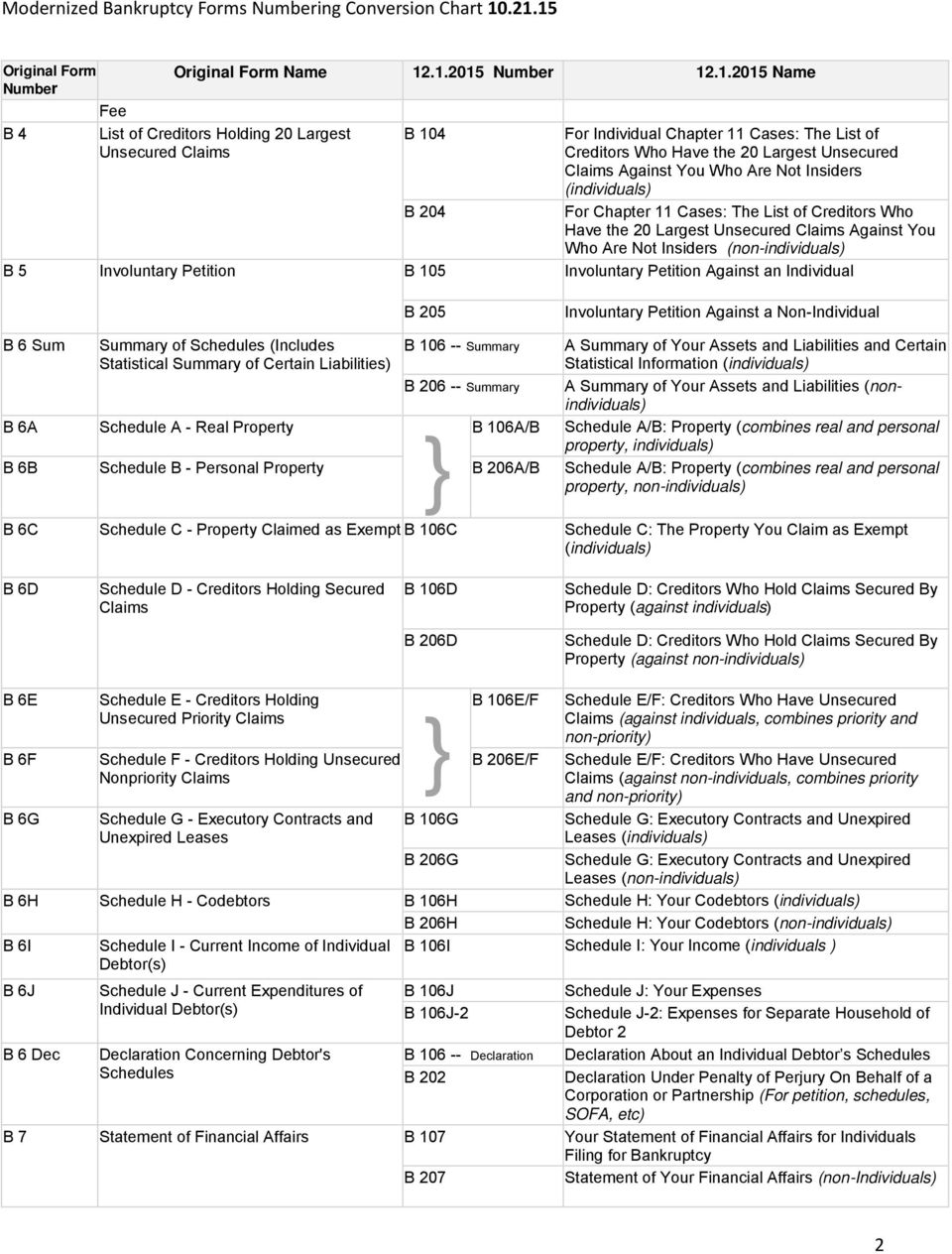
2 Modernized Bankruptcy Forms Numbering Conversion Chart Original Form Number Original Form Name Number Name Official Bankruptcy Forms 1 B 1 Voluntary Petition B 101 Voluntary Petition for Individuals Filing for Bankruptcy (incorporates exhibits carves out eviction judgment statement as new form B 101A and B) B 101A Initial Statement About an Eviction Judgment Against You B 101B B 201 Statement About Payment of an Eviction Judgment Against You Voluntary Petition for Non-Individuals Filing for Bankruptcy B 2 B 3A Exhibit A B 201A Attachment to Voluntary Petition for Non-Individuals Filing for Bankruptcy Under Chapter 11 Exhibit C B 101 B 201 Hazardous Property or Property That Needs Immediate Attention -- incorporated in Forms B 101 and B 201 Exhibit D B 101 Individual Debtor s Statement of Compliance with Credit Counseling Requirement Incorporated in Form B 101 [Chapter 15 questions from Petition] B 401 Petition for Recognition of Foreign Proceeding Declaration under Penalty of Perjury on Behalf of a Corporation or Partnership Application and Order to Pay Filing Fee in Installments B 202 B 103A Declaration Under Penalty of Perjury for Non- Individual Debtors (For petition, schedules, SOFA, etc). Application for Individuals to Pay the Filing Fee in Installments B 3B Application for Waiver of Chapter 7 Filing B 103B Application to Have the Chapter 7 Filing Fee Waived 1 About this chart: Because the modernized forms introduce the concept of one set of case-opening forms (petition and schedules and a few other forms) for individual (including married) debtors, and a different set of caseopening forms for non-individual debtors, such as corporations, it was necessary to renumber all the bankruptcy forms. This conversion chart lists the bankruptcy forms by pre-december 1, 2015 form number/name followed by the modernized form number/name. Official Bankruptcy Forms are approved by the Judicial Conference and are required to be used under Bankruptcy Rule These forms change from two- to three-digit numbers (sometimes followed by a letter), and generally follow this pattern: 1XX for individual debtor case-opening forms, 2XX for non-individual debtor case-opening forms, 3XX for court notices and orders, and 4XX for other official forms. In most case, the XX is identical to the original form number. Director s Bankruptcy Forms are issued under Rule 9009 by the Director of the Administrative Office of the U.S. Courts. The use of Director s Forms may be required by local court rules or general orders, but otherwise exist for the convenience of the parties. Director s bankruptcy forms have been changed from three- to four-digit numbers (sometimes followed by a letter); usually by adding a zero to the original form number.

3 Modernized Bankruptcy Forms Numbering Conversion Chart Original Form Original Form Name Number Name Number Fee B 4 List of Creditors Holding 20 Largest Unsecured Claims B 104 For Individual Chapter 11 Cases: The List of Creditors Who Have the 20 Largest Unsecured Claims Against You Who Are Not Insiders (individuals) B 204 For Chapter 11 Cases: The List of Creditors Who Have the 20 Largest Unsecured Claims Against You Who Are Not Insiders (non-individuals) B 5 Involuntary Petition B 105 Involuntary Petition Against an Individual B 205 Involuntary Petition Against a Non-Individual B 6 Sum Summary of Schedules (Includes Statistical Summary of Certain Liabilities) B Summary A Summary of Your Assets and Liabilities and Certain Statistical Information (individuals) B Summary A Summary of Your Assets and Liabilities (nonindividuals) 106A/B Schedule A/B: Property (combines real and personal property, individuals) B 6A Schedule A - Real Property B } B 6B Schedule B - Personal Property B 206A/B Schedule A/B: Property (combines real and personal property, non-individuals) B 6C Schedule C - Property Claimed as Exempt B 106C Schedule C: The Property You Claim as Exempt (individuals) B 6D Schedule D - Creditors Holding Secured Claims B 106D Schedule D: Creditors Who Hold Claims Secured By Property (against individuals) B 206D Schedule D: Creditors Who Hold Claims Secured By Property (against non-individuals) B 6E B 6F B 6G Schedule E - Creditors Holding Unsecured Priority Claims Schedule F - Creditors Holding Unsecured Nonpriority Claims Schedule G - Executory Contracts and Unexpired Leases } B B 106G B 206G 106E/F Schedule E/F: Creditors Who Have Unsecured Claims (against individuals, combines priority and non-priority) B 206E/F Schedule E/F: Creditors Who Have Unsecured Claims (against non-individuals, combines priority and non-priority) Schedule G: Executory Contracts and Unexpired Leases (individuals) Schedule G: Executory Contracts and Unexpired Leases (non-individuals) B 6H Schedule H - Codebtors B 106H Schedule H: Your Codebtors (individuals) B 206H Schedule H: Your Codebtors (non-individuals) B 6I Schedule I - Current Income of Individual Debtor(s) B 106I Schedule I: Your Income (individuals ) B 6J Schedule J - Current Expenditures of B 106J Schedule J: Your Expenses Individual Debtor(s) B 106J-2 Schedule J-2: Expenses for Separate Household of Debtor 2 B 6 Dec Declaration Concerning Debtor's B Declaration Declaration About an Individual Debtor s Schedules Schedules B 202 Declaration Under Penalty of Perjury On Behalf of a Corporation or Partnership (For petition, schedules, SOFA, etc) B 7 Statement of Financial Affairs B 107 Your Statement of Financial Affairs for Individuals Filing for Bankruptcy B 207 Statement of Your Financial Affairs (non-individuals) 2
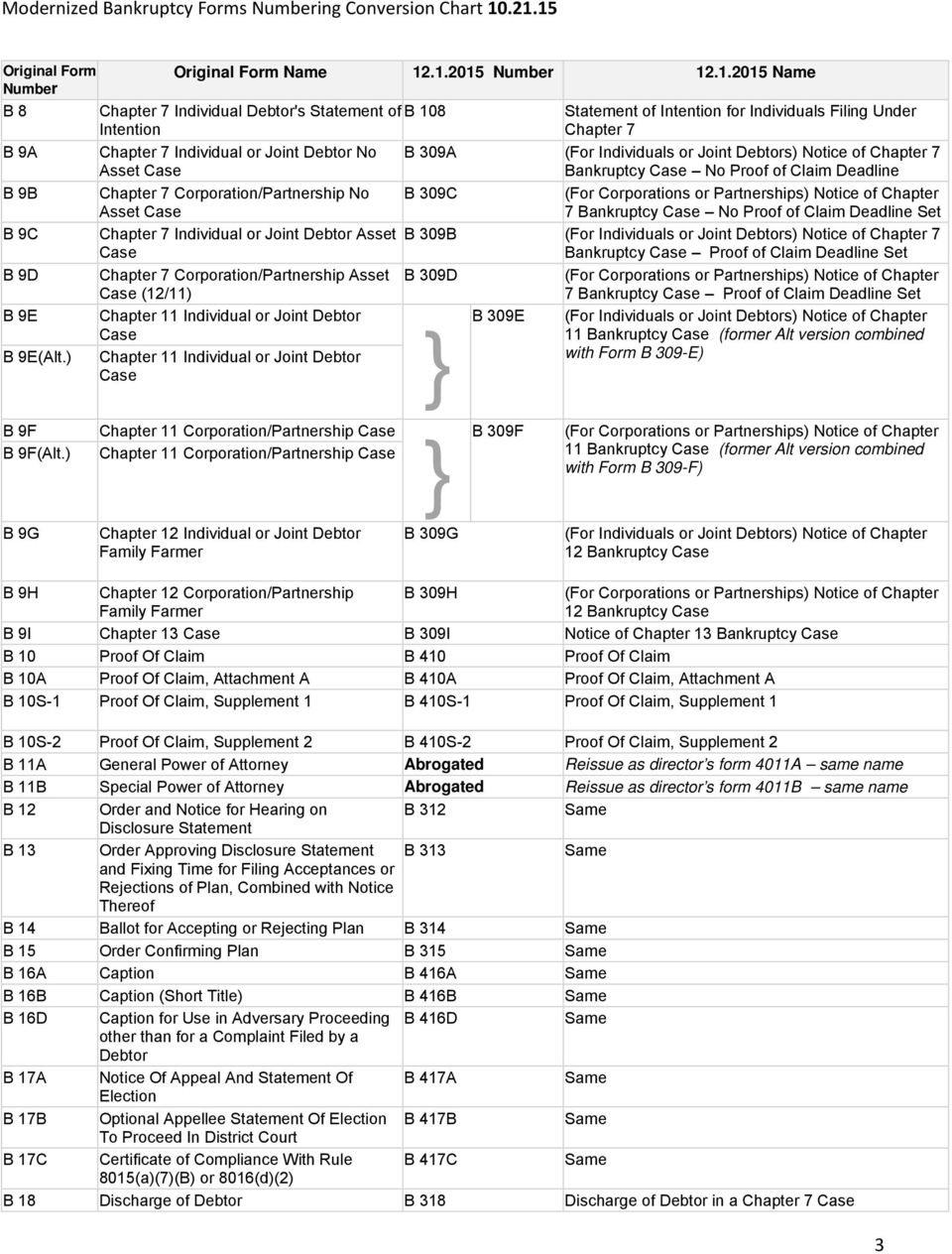
4 Modernized Bankruptcy Forms Numbering Conversion Chart Original Form Name Number Name Original Form Number B 8 Chapter 7 Individual Debtor's Statement of B 108 Intention B 9A B 9B B 9C B 9D B 9E B 9E(Alt.) Chapter 7 Individual or Joint Debtor No Asset Case Chapter 7 Corporation/Partnership No Asset Case Chapter 7 Individual or Joint Debtor Asset Case Chapter 7 Corporation/Partnership Asset Case (12/11) Chapter 11 Individual or Joint Debtor Case Chapter 11 Individual or Joint Debtor Case Statement of Intention for Individuals Filing Under Chapter 7 B 309A (For Individuals or Joint Debtors) Notice of Chapter 7 Bankruptcy Case No Proof of Claim Deadline B 309C (For Corporations or Partnerships) Notice of Chapter 7 Bankruptcy Case No Proof of Claim Deadline Set B 309B (For Individuals or Joint Debtors) Notice of Chapter 7 Bankruptcy Case Proof of Claim Deadline Set B 309D } B (For Corporations or Partnerships) Notice of Chapter 7 Bankruptcy Case Proof of Claim Deadline Set 309E (For Individuals or Joint Debtors) Notice of Chapter 11 Bankruptcy Case (former Alt version combined with Form B 309-E) B 9F B 9F(Alt.) Chapter 11 Corporation/Partnership Case Chapter 11 Corporation/Partnership Case } B 309F (For Corporations or Partnerships) Notice of Chapter 11 Bankruptcy Case (former Alt version combined with Form B 309-F) B 9G Chapter 12 Individual or Joint Debtor Family Farmer B 309G (For Individuals or Joint Debtors) Notice of Chapter 12 Bankruptcy Case B 9H Chapter 12 Corporation/Partnership Family Farmer B 309H (For Corporations or Partnerships) Notice of Chapter 12 Bankruptcy Case B 9I Chapter 13 Case B 309I Notice of Chapter 13 Bankruptcy Case B 10 Proof Of Claim B 410 Proof Of Claim B 10A Proof Of Claim, Attachment A B 410A Proof Of Claim, Attachment A B 10S-1 Proof Of Claim, Supplement 1 B 410S-1 Proof Of Claim, Supplement 1 B 10S-2 Proof Of Claim, Supplement 2 B 410S-2 Proof Of Claim, Supplement 2 B 11A General Power of Attorney Abrogated Reissue as director s form 4011A same name B 11B Special Power of Attorney Abrogated Reissue as director s form 4011B same name B 12 Order and Notice for Hearing on B 312 Same Disclosure Statement B 13 Order Approving Disclosure Statement B 313 Same and Fixing Time for Filing Acceptances or Rejections of Plan, Combined with Notice Thereof B 14 Ballot for Accepting or Rejecting Plan B 314 Same B 15 Order Confirming Plan B 315 Same B 16A Caption B 416A Same B 16B Caption (Short Title) B 416B Same B 16D Caption for Use in Adversary Proceeding B 416D Same other than for a Complaint Filed by a Debtor B 17A Notice Of Appeal And Statement Of B 417A Same Election B 17B Optional Appellee Statement Of Election B 417B Same To Proceed In District Court B 17C Certificate of Compliance With Rule B 417C Same 8015(a)(7)(B) or 8016(d)(2) B 18 Discharge of Debtor B 318 Discharge of Debtor in a Chapter 7 Case 3
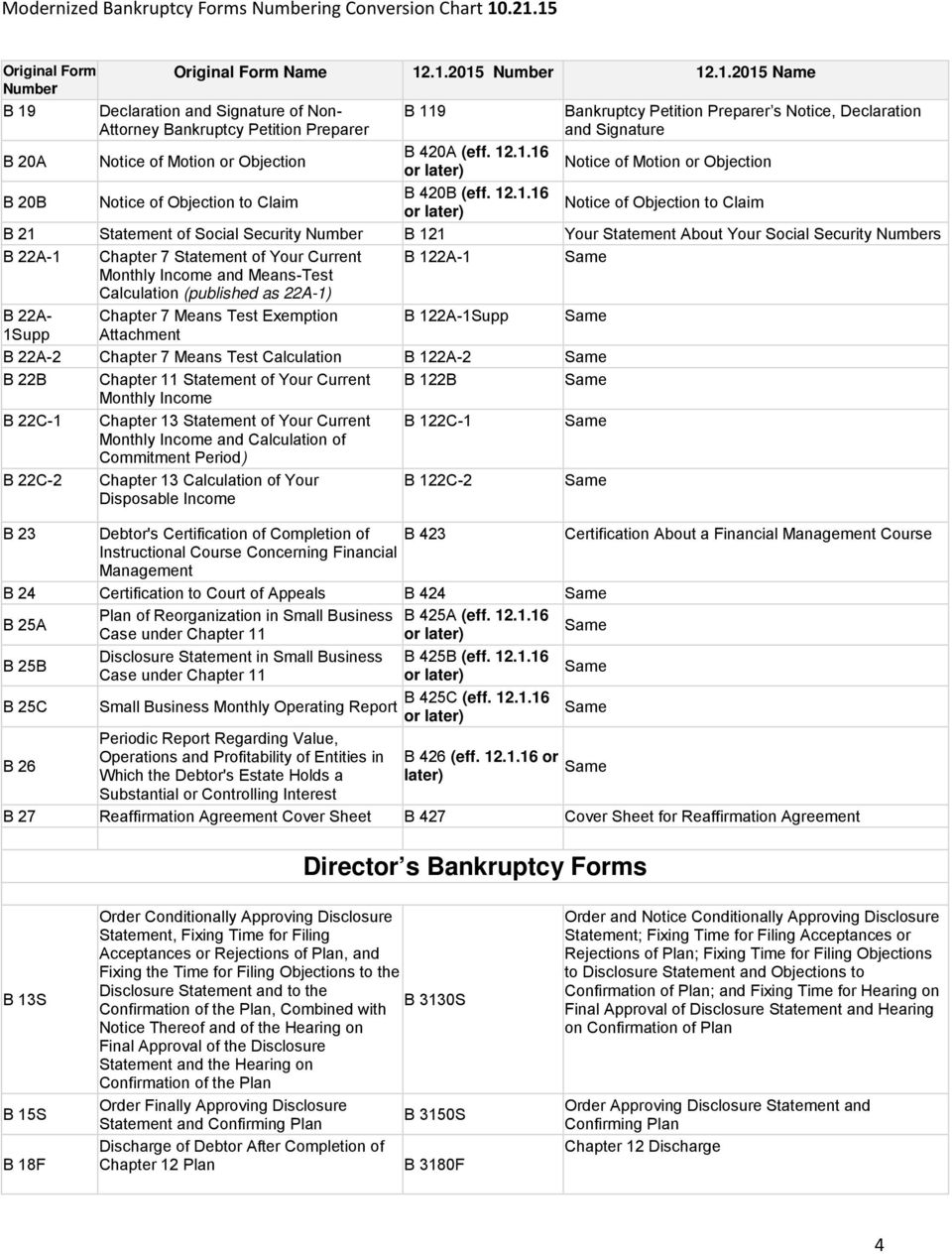
5 Modernized Bankruptcy Forms Numbering Conversion Chart Original Form Name Number Name Original Form Number B 19 Declaration and Signature of Non- Attorney Bankruptcy Petition Preparer B 119 Bankruptcy Petition Preparer s Notice, Declaration and Signature B 20A Notice of Motion or Objection B 420A (eff or later) Notice of Motion or Objection B 20B Notice of Objection to Claim B 420B (eff or later) Notice of Objection to Claim B 21 Statement of Social Security Number B 121 Your Statement About Your Social Security Numbers B 22A-1 Chapter 7 Statement of Your Current Monthly Income and Means-Test Calculation (published as 22A-1) B 122A-1 Same B 22A- 1Supp Chapter 7 Means Test Exemption Attachment B 122A-1Supp Same B 22A-2 Chapter 7 Means Test Calculation B 122A-2 Same B 22B Chapter 11 Statement of Your Current B 122B Same Monthly Income B 22C-1 Chapter 13 Statement of Your Current B 122C-1 Same Monthly Income and Calculation of Commitment Period) B 22C-2 Chapter 13 Calculation of Your Disposable Income B 122C-2 Same B 23 Debtor's Certification of Completion of B 423 Certification About a Financial Management Course Instructional Course Concerning Financial Management B 24 Certification to Court of Appeals B 424 Same B 25A Plan of Reorganization in Small Business B 425A (eff Case under Chapter 11 or later) Same B 25B Disclosure Statement in Small Business B 425B (eff Case under Chapter 11 or later) Same B 25C B 425C (eff Small Business Monthly Operating Report or later) Same B 26 Periodic Report Regarding Value, Operations and Profitability of Entities in Which the Debtor's Estate Holds a Substantial or Controlling Interest B 426 (eff or later) B 27 Reaffirmation Agreement Cover Sheet B 427 Cover Sheet for Reaffirmation Agreement Same Director s Bankruptcy Forms B 13S B 15S B 18F Order Conditionally Approving Disclosure Statement, Fixing Time for Filing Acceptances or Rejections of Plan, and Fixing the Time for Filing Objections to the Disclosure Statement and to the B 3130S Confirmation of the Plan, Combined with Notice Thereof and of the Hearing on Final Approval of the Disclosure Statement and the Hearing on Confirmation of the Plan Order Finally Approving Disclosure B 3150S Statement and Confirming Plan Discharge of Debtor After Completion of Chapter 12 Plan B 3180F Order and Notice Conditionally Approving Disclosure Statement; Fixing Time for Filing Acceptances or Rejections of Plan; Fixing Time for Filing Objections to Disclosure Statement and Objections to Confirmation of Plan; and Fixing Time for Hearing on Final Approval of Disclosure Statement and Hearing on Confirmation of Plan Order Approving Disclosure Statement and Confirming Plan Chapter 12 Discharge 4
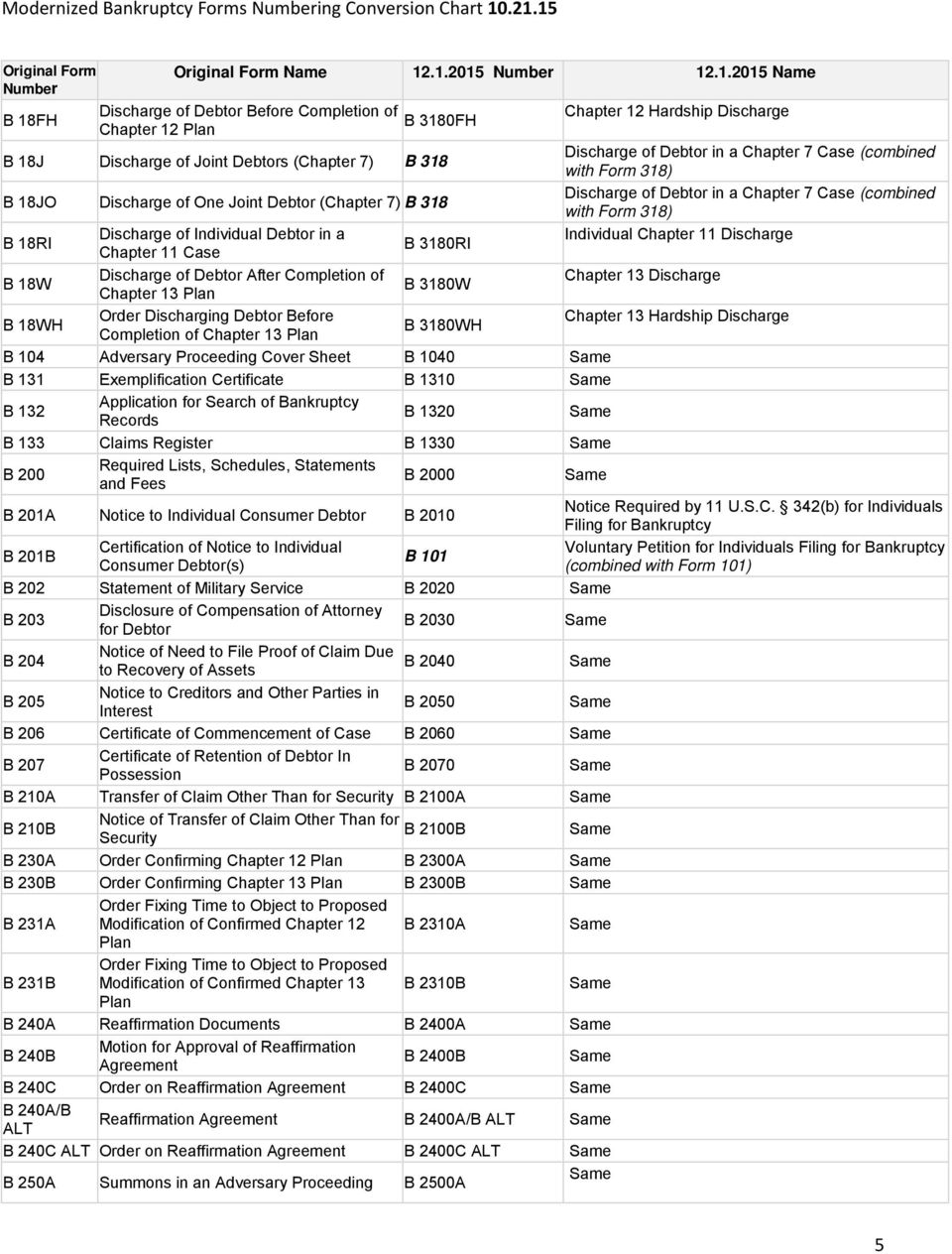
6 Modernized Bankruptcy Forms Numbering Conversion Chart Original Form Original Form Name Number Name Number B 18FH Discharge of Debtor Before Completion of Chapter 12 Hardship Discharge B 3180FH Chapter 12 Plan B 18J Discharge of Joint Debtors (Chapter 7) B 318 Discharge of Debtor in a Chapter 7 Case (combined with Form 318) B 18JO Discharge of One Joint Debtor (Chapter 7) B 318 Discharge of Debtor in a Chapter 7 Case (combined with Form 318) B 18RI Discharge of Individual Debtor in a Individual Chapter 11 Discharge B 3180RI Chapter 11 Case B 18W Discharge of Debtor After Completion of Chapter 13 Discharge B 3180W Chapter 13 Plan B 18WH Order Discharging Debtor Before Chapter 13 Hardship Discharge B 3180WH Completion of Chapter 13 Plan B 104 Adversary Proceeding Cover Sheet B 1040 Same B 131 Exemplification Certificate B 1310 Same B 132 Application for Search of Bankruptcy Records B 1320 Same B 133 Claims Register B 1330 Same B 200 Required Lists, Schedules, Statements and Fees B 2000 Same B 201A Notice to Individual Consumer Debtor B 2010 Notice Required by 11 U.S.C. 342(b) for Individuals Filing for Bankruptcy B 201B Certification of Notice to Individual Consumer Debtor(s) B 101 B 202 Statement of Military Service B 2020 Same B 203 Disclosure of Compensation of Attorney for Debtor B 2030 Same B 204 Notice of Need to File Proof of Claim Due B 2040 to Recovery of Assets Same B 205 Notice to Creditors and Other Parties in Interest B 2050 Same B 206 Certificate of Commencement of Case B 2060 Same B 207 Certificate of Retention of Debtor In Possession B 2070 Same B 210A Transfer of Claim Other Than for Security B 2100A Same B 210B Notice of Transfer of Claim Other Than for B 2100B Security Same B 230A Order Confirming Chapter 12 Plan B 2300A Same B 230B Order Confirming Chapter 13 Plan B 2300B Same B 231A Order Fixing Time to Object to Proposed Modification of Confirmed Chapter 12 B 2310A Same Plan B 231B Order Fixing Time to Object to Proposed Modification of Confirmed Chapter 13 B 2310B Same Plan B 240A Reaffirmation Documents B 2400A Same B 240B Motion for Approval of Reaffirmation Agreement B 2400B Same B 240C Order on Reaffirmation Agreement B 2400C Same B 240A/B ALT Reaffirmation Agreement B 2400A/B ALT Same B 240C ALT Order on Reaffirmation Agreement B 2400C ALT Same B 250A Summons in an Adversary Proceeding B 2500A Same Voluntary Petition for Individuals Filing for Bankruptcy (combined with Form 101) 5
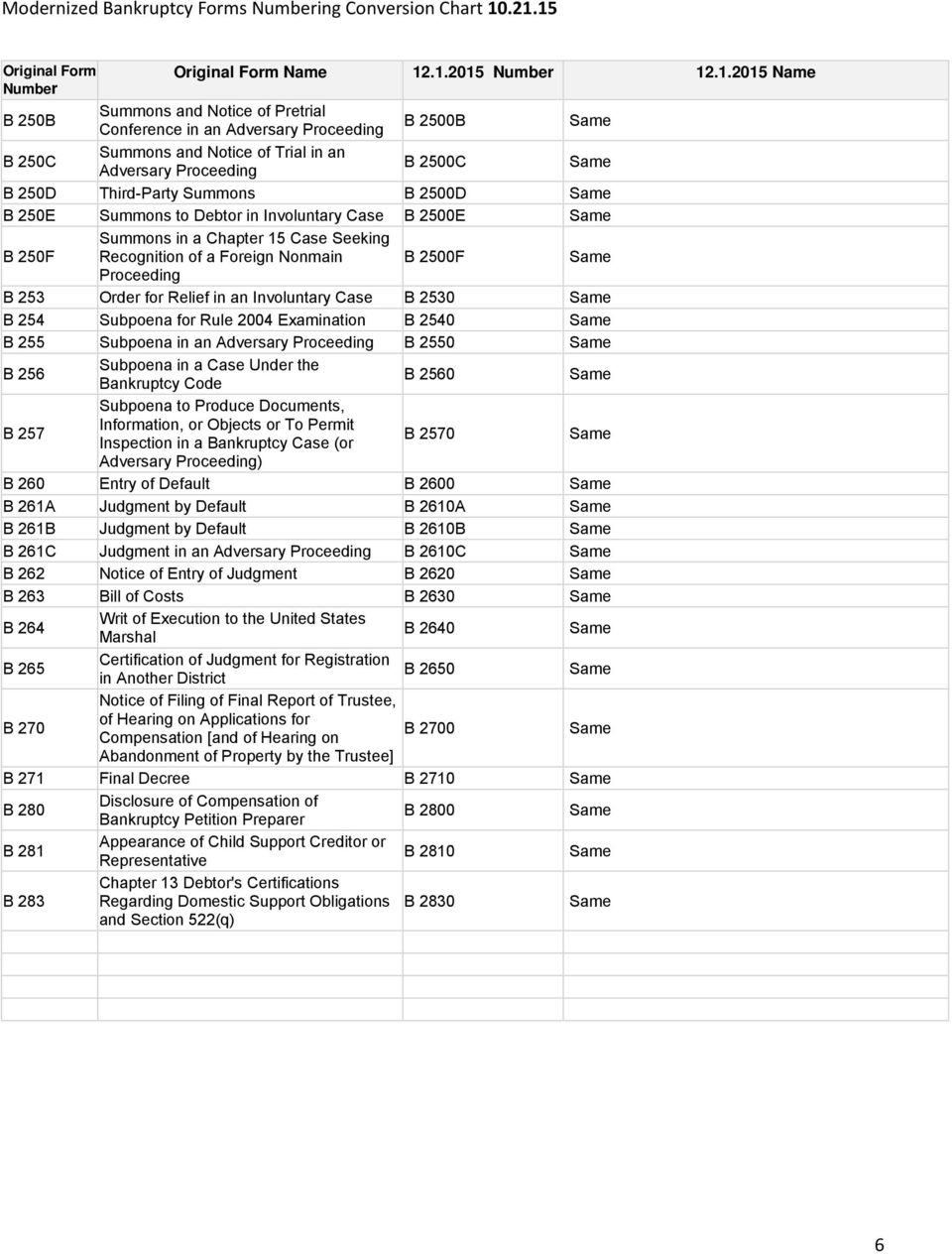
7 Modernized Bankruptcy Forms Numbering Conversion Chart Original Form Original Form Name Number Name Number B 250B Summons and Notice of Pretrial Conference in an Adversary Proceeding B 2500B Same B 250C Summons and Notice of Trial in an Adversary Proceeding B 2500C Same B 250D Third-Party Summons B 2500D Same B 250E Summons to Debtor in Involuntary Case B 2500E Same B 250F Summons in a Chapter 15 Case Seeking Recognition of a Foreign Nonmain B 2500F Same Proceeding B 253 Order for Relief in an Involuntary Case B 2530 Same B 254 Subpoena for Rule 2004 Examination B 2540 Same B 255 Subpoena in an Adversary Proceeding B 2550 Same B 256 Subpoena in a Case Under the Bankruptcy Code B 2560 Same B 257 Subpoena to Produce Documents, Information, or Objects or To Permit Inspection in a Bankruptcy Case (or B 2570 Same Adversary Proceeding) B 260 Entry of Default B 2600 Same B 261A Judgment by Default B 2610A Same B 261B Judgment by Default B 2610B Same B 261C Judgment in an Adversary Proceeding B 2610C Same B 262 Notice of Entry of Judgment B 2620 Same B 263 Bill of Costs B 2630 Same B 264 Writ of Execution to the United States Marshal B 2640 Same B 265 Certification of Judgment for Registration in Another District B 2650 Same B 270 Notice of Filing of Final Report of Trustee, of Hearing on Applications for Compensation [and of Hearing on B 2700 Same Abandonment of Property by the Trustee] B 271 Final Decree B 2710 Same B 280 Disclosure of Compensation of Bankruptcy Petition Preparer B 2800 Same B 281 Appearance of Child Support Creditor or Representative B 2810 Same B 283 Chapter 13 Debtor's Certifications Regarding Domestic Support Obligations and Section 522(q) B 2830 Same 6
8 Instructions Bankruptcy Forms for Individuals U.S. Bankruptcy Court December 2015
9 About this Booklet of Instructions... 1 About the bankruptcy forms and filing bankruptcy... 2 Understand the terms used in the forms... 2 Things to remember when filling out these forms... 3 On what date was a debt incurred?... 3 About the Process for Filing a Bankruptcy Case for Individuals... 4 Notice Required by 11 U.S.C. 342(b) for Individuals Filing for Bankruptcy (Form 2010)... 9 The types of bankruptcy that are available to individuals... 9 Bankruptcy crimes have serious consequences Make sure the court has your mailing address Understand which services you could receive from credit counseling agencies Instructions for Selected Forms Schedule A/B: Property (Official Form 106A/B) Schedule C: The Property You Claim as Exempt (Official Form 106C) Schedule D: Creditors Who Have Claims Secured by Property (Official Form 106D) Schedule E/F: Creditors Who Have Unsecured Claims (Official Form 106E/F) Schedule G: Executory Contracts and Unexpired Leases (Official Form 106G) Schedule H: Your Codebtors (Official Form 106H) Schedule I: Your Income (Official Form 106I) Schedule J: Your Expenses (Official Form 106J) Summary of Your Assets and Liabilities and Certain Statistical Information (Official Form 106Sum) Statement of Financial Affairs for Individuals Filing for Bankruptcy (Official Form 107) Chapter 7 Statement of Your Current Monthly Income and Means Test Calculation (Official Forms 122A 1, 122A-1Supp, and 122A 2) Chapter 11 Statement of Your Current Monthly Income (Official Form 122B) Chapter 13 Statement of Your Current Monthly Income, Calculation of Commitment Period and Chapter 13 Calculation of Your Disposable Income (Official Forms 122C 1 and 122C 2) Statement of Intention for Individuals Filing Under Chapter 7 (Official Form 108) Application for Individuals to Pay the Filing Fee in Installments (Official Form 103A) Application to Have the Chapter 7 Filing Fee Waived (Official Form 103B) For Individual Chapter 11 Cases: List of Creditors Who Have the 20 Largest Unsecured Claims Against You and Are Not Insiders (Official Form 104) Glossary Definitions of Some Terms Used in the Forms for Individuals Filing for Bankruptcy... 41

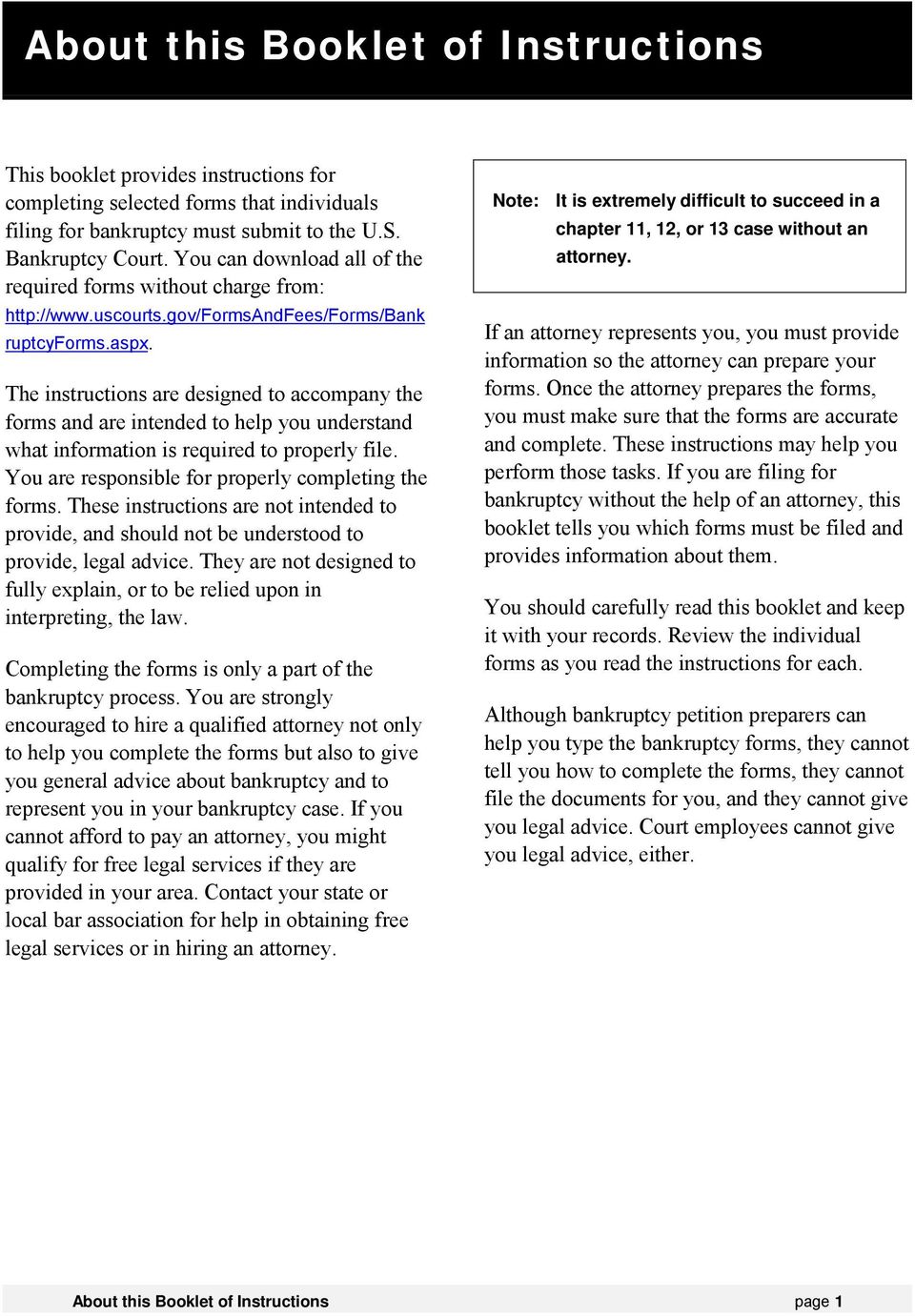
10 About this Booklet of Instructions This booklet provides instructions for completing selected forms that individuals filing for bankruptcy must submit to the U.S. Bankruptcy Court. You can download all of the required forms without charge from: ruptcyforms.aspx. The instructions are designed to accompany the forms and are intended to help you understand what information is required to properly file. You are responsible for properly completing the forms. These instructions are not intended to provide, and should not be understood to provide, legal advice. They are not designed to fully explain, or to be relied upon in interpreting, the law. Completing the forms is only a part of the bankruptcy process. You are strongly encouraged to hire a qualified attorney not only to help you complete the forms but also to give you general advice about bankruptcy and to represent you in your bankruptcy case. If you cannot afford to pay an attorney, you might qualify for free legal services if they are provided in your area. Contact your state or local bar association for help in obtaining free legal services or in hiring an attorney. Note: It is extremely difficult to succeed in a chapter 11, 12, or 13 case without an attorney. If an attorney represents you, you must provide information so the attorney can prepare your forms. Once the attorney prepares the forms, you must make sure that the forms are accurate and complete. These instructions may help you perform those tasks. If you are filing for bankruptcy without the help of an attorney, this booklet tells you which forms must be filed and provides information about them. You should carefully read this booklet and keep it with your records. Review the individual forms as you read the instructions for each. Although bankruptcy petition preparers can help you type the bankruptcy forms, they cannot tell you how to complete the forms, they cannot file the documents for you, and they cannot give you legal advice. Court employees cannot give you legal advice, either. About this Booklet of Instructions page 1
11 Read These Important Warnings Because bankruptcy can have serious long-term financial and legal consequences, including loss of your property, you should hire an attorney and carefully consider all of your options before you file. Only an attorney can give you legal advice about what can happen as a result of filing for bankruptcy and what your options are. If you do file for bankruptcy, an attorney can help you fill out the forms properly and protect you, your family, your home, and your possessions. Although the law allows you to represent yourself in bankruptcy court, you should understand that many people find it difficult to represent themselves successfully. The rules are technical, and a mistake or inaction may harm you. If you file without an attorney, you are still responsible for knowing and following all of the legal requirements. You should not file for bankruptcy if you are not eligible to file or if you do not intend to file the necessary documents. Bankruptcy fraud is a serious crime; you could be fined and imprisoned if you commit fraud in your bankruptcy case. Making a false statement, concealing property, or obtaining money or property by fraud in connection with a bankruptcy case can result in fines up to $250,000, or imprisonment for up to 20 years, or both. 18 U.S.C. 152, 1341, 1519, and About the bankruptcy forms and filing bankruptcy Use the forms that are numbered in the 100 series to file bankruptcy for individuals or married couples. Use the forms that are numbered in the 200 series if you are preparing a bankruptcy on behalf of a nonindividual, such as a corporation, partnership, or limited liability company (LLC). Sole proprietors must use the forms that are numbered in the 100 series. When a bankruptcy is filed, the U.S. Bankruptcy Court opens a case. It is important that the answers to the questions on the forms be complete and accurate so that the case proceeds smoothly. A person filing bankruptcy who gives false information could be charged with a federal crime or could lose all the benefits of filing for bankruptcy. You should understand that filing a bankruptcy case is not private. Anyone has a right to see your bankruptcy forms after you file them, unless the court orders otherwise under 11 U.S.C Certain information in court filings, however, must be protected from public disclosure under Bankruptcy Rule Understand the terms used in the forms The forms for individuals use you and Debtor 1 to refer to a debtor filing alone. A married couple may file a bankruptcy case together called a joint case and in joint cases, these forms use you to ask for information from both debtors. About this Booklet of Instructions page 2
12 For example, if a form asks, Do you own a car? the answer would be yes if either debtor owns a car. When information is needed about the spouses separately, the forms use Debtor 1 and Debtor 2 to distinguish between them. In joint cases, one of the spouses must report information as Debtor 1 and the other as Debtor 2. The same person must be Debtor 1 in all of the forms. To understand other terms used in the forms and the instructions, see the Glossary at the end of this booklet. Things to remember when filling out these forms Do not file these instructions with the bankruptcy forms that you file with the court. Be as complete and accurate as possible. If more space is needed, attach a separate sheet to the form. On the top of any additional pages, write your name and case number (if known). Also identify the form and line number to which the additional information applies. If two married people are filing together, both are equally responsible for supplying correct information. Do not list a minor child s full name. Instead, fill in only the child s initials and the full name and address of the child s parent or guardian. For example, write A.B., a minor child (John Doe, parent, 123 Main St., City, State). 11 U.S.C. 112; Bankruptcy Rule 1007(m) and For your records, be sure to keep a copy of your bankruptcy documents and all attachments that you file. On what date was a debt incurred? When a debt was incurred on a single date, fill in the actual date that the debt was incurred. When a debt was incurred on multiple dates, fill in the range of dates. For example, if the debt is from a credit card, fill in the month and year of the first and last transaction. About this Booklet of Instructions page 3
13 About the Process for Filing a Bankruptcy Case for Individuals Before you file your bankruptcy case Before you file for bankruptcy, you must do several things: Receive a briefing about credit counseling from an approved agency within 180 days before you file. (If you and your spouse are filing together, each of you must receive a briefing before you file. Failure to do so may result in the dismissal of your case.) You may have a briefing about credit counseling one-on-one or in a group, by telephone, or by internet. For a list of approved providers, go to: oved.htm In Alabama and North Carolina, go to: uptcy/bankruptcyresources/approvedcredita nddebtcounselors.aspx. After you finish the briefing, you will receive a certificate that you will need to file in your bankruptcy case. Find out in which bankruptcy court you must file your bankruptcy case. It is important that you file in the correct district within your state. To find out which district you are in, go to: Check the local court s website for any specific local requirements that you might have to meet. Go to: Find out which chapters of the Bankruptcy Code you are eligible for. For descriptions of each chapter, review the information contained in the notice, Notice Required by 11 U.S.C. 342(b) for Individuals Filing for Bankruptcy (Form B2010), which is included in this booklet. About the Process for Filing a Bankruptcy Case for Individuals page 4
14 When you file your bankruptcy case There are several forms and documents that you must give the court at the time you file. Additional forms and documents must be filed no later than 14 days after you file your bankruptcy case, although they may be filed at the same time you file your case. You must file the forms listed below on the date you open your bankruptcy case. For copies of the forms listed here, go to ptcyforms.aspx. (The list continues on the next page.): Voluntary Petition for Individuals Filing for Bankruptcy (Official Form 101). This form opens the case. Directions for filling it out are included in the form itself. Statement About Your Social Security Numbers (Official Form 121). This form gives the court your full Social Security number or federal Individual Taxpayer Identification number. To protect your privacy, the court will make only the last four digits of your number known to the general public. However, the court will make your full number available to your creditors, the U.S. trustee or bankruptcy administrator, and the trustee assigned to your case. This form has no separate instructions. Your filing fee. If you cannot pay the entire filing fee, you must also include: Application for Individuals to Pay the Filing Fee in Installments (Official Form 103A), or Application to Have the Chapter 7 Filing Fee Waived (Official Form 103B). Use this form only if you are filing under chapter 7 and you meet the criteria to have the chapter 7 filing fee waived. A list of names and addresses of all of your creditors, formatted as a mailing list according to instructions from the bankruptcy court in which you file. (Your court may call this a creditor matrix or mailing matrix.) Your credit counseling certificate from an approved credit counseling agency. (See Before you file your bankruptcy case, above). If you have received the briefing about credit counseling but have not yet received the certificate, file it no later than 14 days after you file for bankruptcy. If you have not already received the briefing and believe you are entitled to a temporary waiver from receiving it or that you are not required to receive the briefing, see line 15 of the Voluntary Petition for Individuals Filing for Bankruptcy (Official Form 101). For Individual Chapter 11 Cases: List of Creditors Who Have the 20 Largest Unsecured Claims Against You and Are Not Insiders (Official Form 104). Fill out this form only if you file under chapter 11. Initial Statement About an Eviction Judgment Against You (Official Form 101A) and Statement About Payment of an Eviction Judgment Against You (Official Form 101B). Use Form 101A if your landlord has an eviction judgment against you. If you complete Form 101A and you want to stay in your residence for the first 30 days after you file, you must indicate that on the form. Use Form 101B if you have completed Form 101A and you want to stay in your rented residence form more than 30 days after you file for bankruptcy. Bankruptcy Petition Preparer s Notice, Declaration, and Signature (Official Form 119) and Disclosure of Compensation of Bankruptcy Petition Preparer (Form 2800). Use these forms About the Process for Filing a Bankruptcy Case for Individuals page 5

15 if a bankruptcy petition preparer typed your forms. When you file your bankruptcy case or within 14 days after you file You must file the forms listed below either when you file your bankruptcy case or within 14 days after you file your Voluntary Petition for Individuals Filing for Bankruptcy (Official Form 101). If you do not do so, your case may be dismissed. Although it is possible to open your case by submitting only the documents that are listed under When you file your bankruptcy case, you should file the entire set of forms at one time to help your case proceed smoothly. Although some forms may ask you similar questions, you must fill out all of the forms completely to protect your legal rights. The list below shows the forms that all individuals must file as well as the forms that are specific to each chapter. For copies of the official forms listed here, go to All individuals who file for bankruptcy must file these forms and the forms for the specific chapter: Form 106J) Schedules of Assets and Liabilities (Official Form 106) which includes these forms: Schedule A/B: Property (Official Form 106A/B) Schedule C: The Property You Claim as Exempt (Official Form 106C) Schedule D: Creditors Who Have Claims Secured by Your Property (Official Form 106D) Schedule E/F: Creditors Who Have Unsecured Claims (Official Form 106E/F) Schedule G: Executory Contracts and Unexpired Leases (Official Form 106G) Schedule H: Your Codebtors (Official Form 106H) Schedule I: Your Income (Official Form 106I) Schedule J: Your Expenses (Official About the Process for Filing a Bankruptcy Case for Individuals page 6
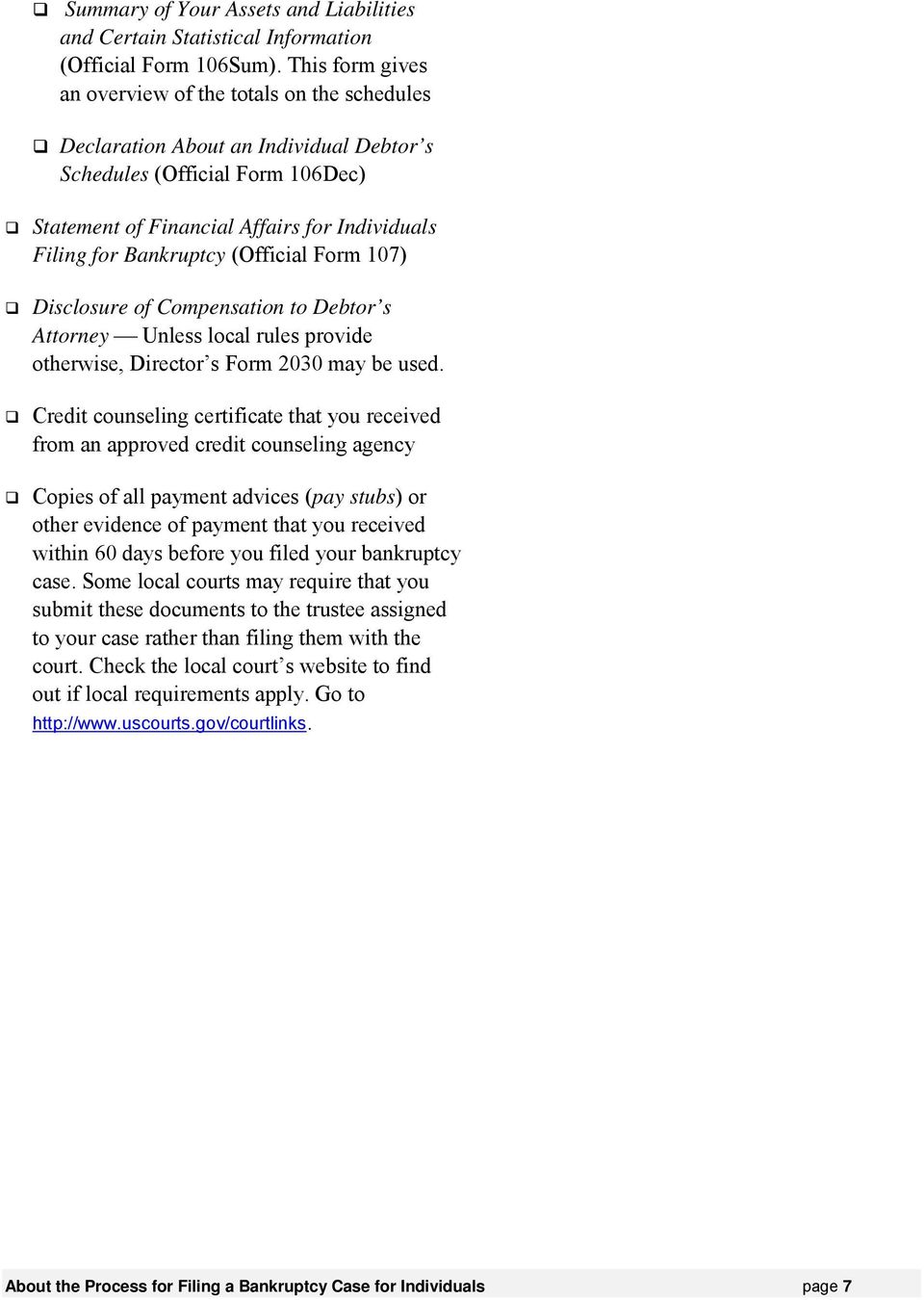
16 Summary of Your Assets and Liabilities and Certain Statistical Information (Official Form 106Sum). This form gives an overview of the totals on the schedules Declaration About an Individual Debtor s Schedules (Official Form 106Dec) Statement of Financial Affairs for Individuals Filing for Bankruptcy (Official Form 107) Disclosure of Compensation to Debtor s Attorney Unless local rules provide otherwise, Director s Form 2030 may be used. Credit counseling certificate that you received from an approved credit counseling agency Copies of all payment advices (pay stubs) or other evidence of payment that you received within 60 days before you filed your bankruptcy case. Some local courts may require that you submit these documents to the trustee assigned to your case rather than filing them with the court. Check the local court s website to find out if local requirements apply. Go to About the Process for Filing a Bankruptcy Case for Individuals page 7
17 If you file under chapter 7, you must also file: If you file under chapter 12, you must also file: Statement of Intention for Individuals Filing Under Chapter 7 (Official Form 108) Chapter 7 Statement of Your Current Monthly Income (Official Form 122A-1) If necessary, Chapter 7 Means Test Calculation (Official Form 122A-2) If necessary, Statement of Exemption from Presumption of Abuse Under 707(b)(2) (Official Form 122A-1Supp) If you file under chapter 11, you must also file: Chapter 11 Statement of Your Current Monthly Income (Official Form 122-B) If you file under chapter 11 and are a small business debtor (that is, if you are self-employed and your debts are less than $2,490,925*), within 7 days after you file your bankruptcy forms to open your case, you must also file your most recent: Balance sheet Statement of operations Cash-flow statement Federal income tax return Chapter 12 Plan (within 90 days after you file your bankruptcy forms to open your case) If you file under chapter 13, you must also file: Chapter 13 Statement of Your Current Monthly Income and Calculation of Commitment Period (Official Form 122C-1) If necessary, Chapter 13 Calculation of Your Disposable Income (Official Form 122C-2) Chapter 13 Plan (Official Form 113, if in effect). If Official Form 113 is not effective when you file, many bankruptcy courts require you to use a local form plan. Check the local court s website for any specific form that you might have to use. Go to If you do not have these documents, you must file a statement made under penalty of perjury that you have not prepared either a balance sheet, statement of operations, or cash-flow statement or you have not filed a federal tax return. If you file under chapter 11, you must file additional documents beyond the scope of these instructions. You should consult your attorney. * Subject to adjustment on 4/01/16, and every 3 years after that for cases begun on or after the date of adjustment. About the Process for Filing a Bankruptcy Case for Individuals page 8

18 Notice Required by 11 U.S.C. 342(b) for Individuals Filing for Bankruptcy (Form 2010) This notice is for you if: Chapter 7: Liquidation You are an individual filing for bankruptcy, and Your debts are primarily consumer debts. Consumer debts are defined in 11 U.S.C. 101(8) as incurred by an individual primarily for a personal, family, or household purpose. The types of bankruptcy that are available to individuals Individuals who meet the qualifications may file under one of four different chapters of the Bankruptcy Code: Chapter 7 Liquidation Chapter 11 Reorganization Chapter 12 Voluntary repayment plan for family farmers or fishermen Chapter 13 Voluntary repayment plan for individuals with regular income You should have an attorney review your decision to file for bankruptcy and the choice of chapter. $245 filing fee $75 administrative fee + $15 trustee surcharge $335 total fee Chapter 7 is for individuals who have financial difficulty preventing them from paying their debts and who are willing to allow their nonexempt property to be used to pay their creditors. The primary purpose of filing under chapter 7 is to have your debts discharged. The bankruptcy discharge relieves you after bankruptcy from having to pay many of your pre-bankruptcy debts. Exceptions exist for particular debts, and liens on property may still be enforced after discharge. For example, a creditor may have the right to foreclose a home mortgage or repossess an automobile. However, if the court finds that you have committed certain kinds of improper conduct described in the Bankruptcy Code, the court may deny your discharge. You should know that even if you file chapter 7 and you receive a discharge, some debts are not discharged under the law. Therefore, you may still be responsible to pay: most taxes; most student loans; domestic support and property settlement obligations; Notice Required by 11 U.S.C. U.S.C. 342(b) for Individuals Filing for Bankruptcy (Form 2010) page 9

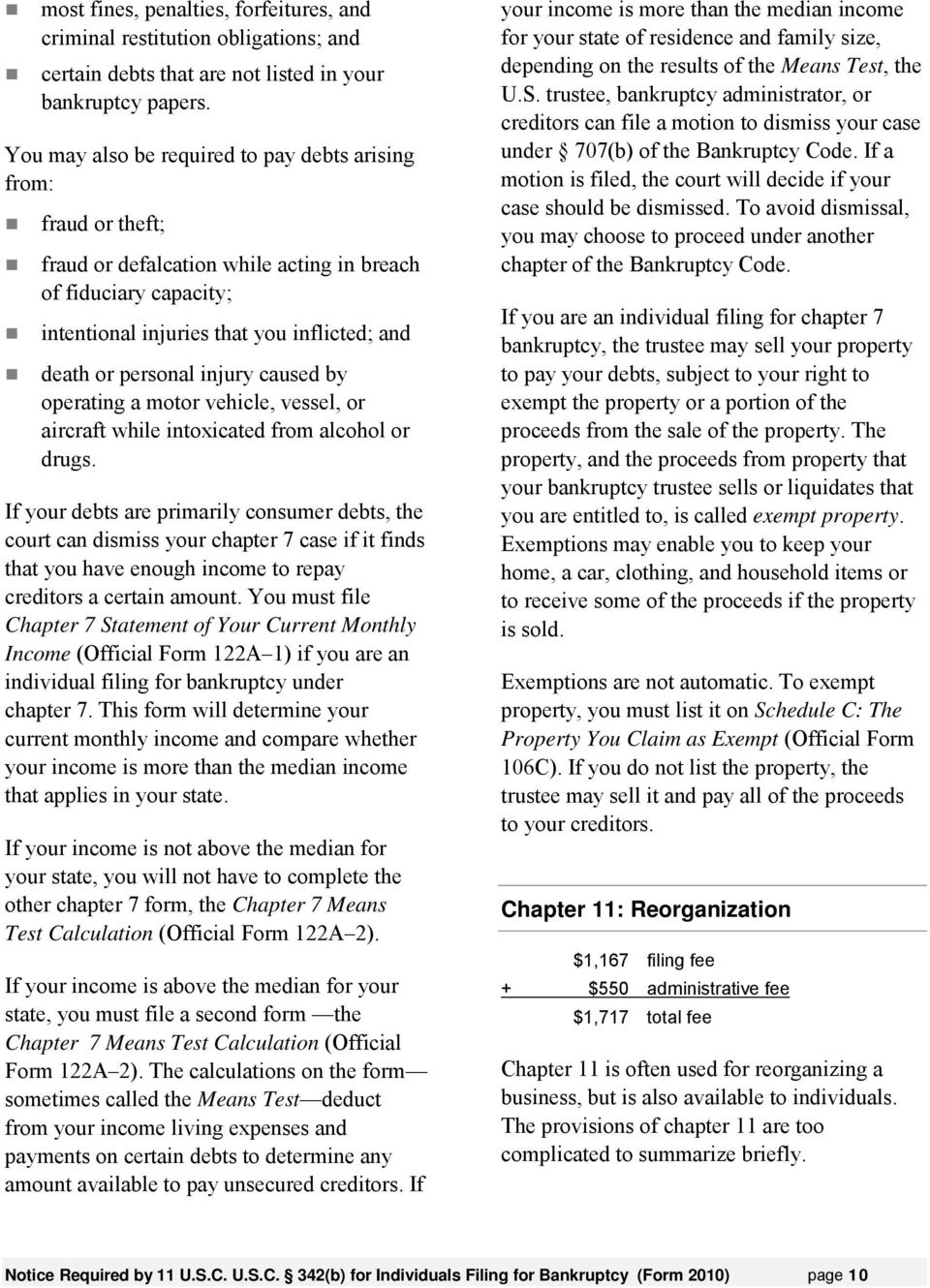
19 most fines, penalties, forfeitures, and criminal restitution obligations; and certain debts that are not listed in your bankruptcy papers. You may also be required to pay debts arising from: fraud or theft; fraud or defalcation while acting in breach of fiduciary capacity; intentional injuries that you inflicted; and death or personal injury caused by operating a motor vehicle, vessel, or aircraft while intoxicated from alcohol or drugs. If your debts are primarily consumer debts, the court can dismiss your chapter 7 case if it finds that you have enough income to repay creditors a certain amount. You must file Chapter 7 Statement of Your Current Monthly Income (Official Form 122A 1) if you are an individual filing for bankruptcy under chapter 7. This form will determine your current monthly income and compare whether your income is more than the median income that applies in your state. If your income is not above the median for your state, you will not have to complete the other chapter 7 form, the Chapter 7 Means Test Calculation (Official Form 122A 2). If your income is above the median for your state, you must file a second form the Chapter 7 Means Test Calculation (Official Form 122A 2). The calculations on the form sometimes called the Means Test deduct from your income living expenses and payments on certain debts to determine any amount available to pay unsecured creditors. If your income is more than the median income for your state of residence and family size, depending on the results of the Means Test, the U.S. trustee, bankruptcy administrator, or creditors can file a motion to dismiss your case under 707(b) of the Bankruptcy Code. If a motion is filed, the court will decide if your case should be dismissed. To avoid dismissal, you may choose to proceed under another chapter of the Bankruptcy Code. If you are an individual filing for chapter 7 bankruptcy, the trustee may sell your property to pay your debts, subject to your right to exempt the property or a portion of the proceeds from the sale of the property. The property, and the proceeds from property that your bankruptcy trustee sells or liquidates that you are entitled to, is called exempt property. Exemptions may enable you to keep your home, a car, clothing, and household items or to receive some of the proceeds if the property is sold. Exemptions are not automatic. To exempt property, you must list it on Schedule C: The Property You Claim as Exempt (Official Form 106C). If you do not list the property, the trustee may sell it and pay all of the proceeds to your creditors. Chapter 11: Reorganization $1,167 filing fee + $550 administrative fee $1,717 total fee Chapter 11 is often used for reorganizing a business, but is also available to individuals. The provisions of chapter 11 are too complicated to summarize briefly. Notice Required by 11 U.S.C. U.S.C. 342(b) for Individuals Filing for Bankruptcy (Form 2010) page 10
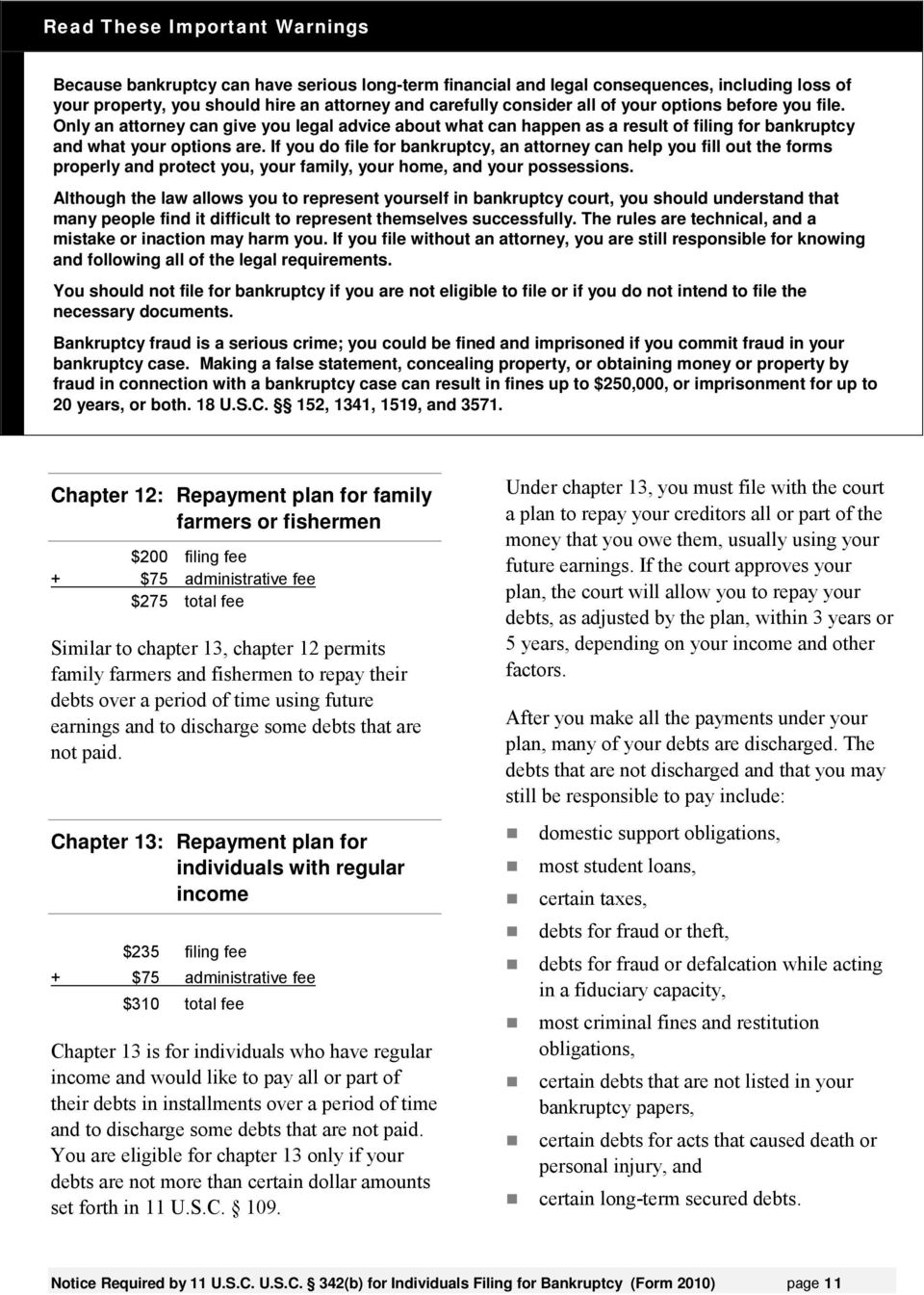
20 Read These Important Warnings Because bankruptcy can have serious long-term financial and legal consequences, including loss of your property, you should hire an attorney and carefully consider all of your options before you file. Only an attorney can give you legal advice about what can happen as a result of filing for bankruptcy and what your options are. If you do file for bankruptcy, an attorney can help you fill out the forms properly and protect you, your family, your home, and your possessions. Although the law allows you to represent yourself in bankruptcy court, you should understand that many people find it difficult to represent themselves successfully. The rules are technical, and a mistake or inaction may harm you. If you file without an attorney, you are still responsible for knowing and following all of the legal requirements. You should not file for bankruptcy if you are not eligible to file or if you do not intend to file the necessary documents. Bankruptcy fraud is a serious crime; you could be fined and imprisoned if you commit fraud in your bankruptcy case. Making a false statement, concealing property, or obtaining money or property by fraud in connection with a bankruptcy case can result in fines up to $250,000, or imprisonment for up to 20 years, or both. 18 U.S.C. 152, 1341, 1519, and Chapter 12: Repayment plan for family farmers or fishermen $200 filing fee + $75 administrative fee $275 total fee Similar to chapter 13, chapter 12 permits family farmers and fishermen to repay their debts over a period of time using future earnings and to discharge some debts that are not paid. Chapter 13: Repayment plan for individuals with regular income $235 filing fee + $75 administrative fee $310 total fee Chapter 13 is for individuals who have regular income and would like to pay all or part of their debts in installments over a period of time and to discharge some debts that are not paid. You are eligible for chapter 13 only if your debts are not more than certain dollar amounts set forth in 11 U.S.C Under chapter 13, you must file with the court a plan to repay your creditors all or part of the money that you owe them, usually using your future earnings. If the court approves your plan, the court will allow you to repay your debts, as adjusted by the plan, within 3 years or 5 years, depending on your income and other factors. After you make all the payments under your plan, many of your debts are discharged. The debts that are not discharged and that you may still be responsible to pay include: domestic support obligations, most student loans, certain taxes, debts for fraud or theft, debts for fraud or defalcation while acting in a fiduciary capacity, most criminal fines and restitution obligations, certain debts that are not listed in your bankruptcy papers, certain debts for acts that caused death or personal injury, and certain long-term secured debts. Notice Required by 11 U.S.C. U.S.C. 342(b) for Individuals Filing for Bankruptcy (Form 2010) page 11
21 Warning: File Your Forms on Time Section 521(a)(1) of the Bankruptcy Code requires that you promptly file detailed information about your creditors, assets, liabilities, income, expenses and general financial condition. The court may dismiss your bankruptcy case if you do not file this information within the deadlines set by the Bankruptcy Code, the Bankruptcy Rules, and the local rules of the court. For more information about the documents and their deadlines, go to: s.html#procedure. Bankruptcy crimes have serious consequences If you knowingly and fraudulently conceal assets or make a false oath or statement under penalty of perjury either orally or in writing in connection with a bankruptcy case, you may be fined, imprisoned, or both. All information you supply in connection with a bankruptcy case is subject to examination by the Attorney General acting through the Office of the U.S. Trustee, the Office of the U.S. Attorney, and other offices and employees of the U.S. Department of Justice. Make sure the court has your mailing address The bankruptcy court sends notices to the mailing address you list on Voluntary Petition for Individuals Filing for Bankruptcy (Official Form 101). To ensure that you receive information about your case, Bankruptcy Rule 4002 requires that you notify the court of any changes in your address. A married couple may file a bankruptcy case together called a joint case. If you file a joint case and each spouse lists the same mailing address on the bankruptcy petition, the bankruptcy court generally will mail you and your spouse one copy of each notice, unless you file a statement with the court asking that each spouse receive separate copies. Understand which services you could receive from credit counseling agencies The law generally requires that you receive a credit counseling briefing from an approved credit counseling agency. 11 U.S.C. 109(h). If you are filing a joint case, both spouses must receive the briefing. With limited exceptions, you must receive it within the 180 days before you file your bankruptcy petition. This briefing is usually conducted by telephone or on the Internet. In addition, after filing a bankruptcy case, you generally must complete a financial management instructional course before you can receive a discharge. If you are filing a joint case, both spouses must complete the course. You can obtain the list of agencies approved to provide both the briefing and the instructional course from: In Alabama and North Carolina, go to: BankruptcyResources/ApprovedCredit AndDebtCounselors.aspx. If you do not have access to a computer, the clerk of the bankruptcy court may be able to help you obtain the list. Notice Required by 11 U.S.C. U.S.C. 342(b) for Individuals Filing for Bankruptcy (Form 2010) page 12
22 Instructions for Selected Forms Instructions for Selected Forms page 13
23 Schedule A/B: Property (Official Form 106A/B) Schedule A/B: Property (Official Form 106A/B) lists property interests that are involved in a bankruptcy case. All individuals filing for bankruptcy must list everything they own or have a legal or equitable interest in. Legal or equitable interest is a broad term and includes all kinds of property interests in both tangible and intangible property, whether or not anyone else has an interest in that property. The information in this form is grouped by category and includes several examples for many items. Note that those examples are meant to give you an idea of what to include in the categories. They are not intended to be complete lists of everything within that category. Make sure you list everything you own or have an interest in. You must verify under penalty of perjury that the information you provide is complete and accurate. Making a false statement, concealing property, or obtaining money or property by fraud in connection with a bankruptcy case can result in fines up to $250,000, or imprisonment for up to 20 years, or both. 18 U.S.C. 152, 1341, 1519, and Understand the terms used in this form Community property Type of property ownership available in certain states for property owned by spouses and, in some instances, legal equivalents of spouses. Community property states and territories include Arizona, California, Idaho, Louisiana, Nevada, New Mexico, Puerto Rico, Texas, Washington, and Wisconsin. Current value In this form, report the current value of the property that you own in each category. Current value is sometimes called fair market value and, for this form, is the fair market value as of the date of the filing of the petition. Current value is how much the property is worth, which may be more or less than when you purchased the property. Property you own includes property you have purchased, even if you owe money on it, such as a home with a mortgage or an automobile with a lien. Report the current value of the portion you own For each question, report the current value of the portion of the property that you own. To do this, you would usually determine the current value of the entire property and the percentage of the property that you own. Multiply the current value of the property by the percentage that you own. Report the result where the form asks for Current value of the portion you own. For example: If you own a house by yourself, you own 100% of that house. Report the entire current value of the house. If you and a sister own the house equally, report 50% of the value of the house (or half of the value of the house). In certain categories, current value may be difficult to figure out. When you cannot find the value from a reputable source (such as a pricing guide for your car), estimate the value and be prepared to explain how you determined it. Schedule A/B: Property (Official Form 106A/B) page 14
24 List items once on this form List items only once on this form; do not list them in more than one category. List all real estate in Part 1 and other property in the other parts of the form. Where you list similar items of minimal value (such as clothing), add the value of the items and report a total. Match the values to the other schedules Make sure that the values you report on this form match the values you report on Schedule D: Creditors Who Have Claims Secured by Your Property (Official Form 106D) and Schedule C: The Property You Claim as Exempt (Official Form 106C). Be specific when you describe each item. If you have an item that you think could fit into more than one category, select the most suitable category and list the item there. Separately describe and list individual items worth more than $500. Schedule A/B: Property (Official Form 106A/B) page 15
25 Schedule C: The Property You Claim as Exempt (Official Form 106C) How exemptions work If you are an individual filing for bankruptcy, the law may allow you to keep some property, or it may entitle you to part of the proceeds if the property is sold after your case is filed. Property that the law permits you to keep is called exempt property. For example, exemptions may enable you to keep your home, a car, clothing, and household items. Exemptions are not automatic. For property to be considered exempt, you must list the property on Schedule C: The Property You Claim as Exempt (Official Form 106C). If you do not list the property, the trustee may sell it and pay all of the proceeds to your creditors. You may unnecessarily lose property if you do not claim exemptions to which you are entitled. You are strongly encouraged to hire a qualified attorney to advise you. Determine which set of exemptions you will use Before you fill out this form, you must learn which set of exemptions you can use. In general, exemptions are determined on a state-by-state basis. Some states permit you to use the exemptions provided by the Bankruptcy Code. 11 U.S.C The Bankruptcy Code provides that you use the exemptions in the law of the state where you had your legal home for 730 days before you file for bankruptcy. Special rules may apply if you did not have the same home state for 730 days before you file. You may lose property if you do not use the best set of exemptions for your situation. If your spouse is filing with you and you are filing in a state in which you may choose between state and federal sets of bankruptcy exemptions, you both must use the same set of exemptions. Claiming exemptions Using the property and values that you listed on Schedule A/B: Property (Official Form 106A/B) as your source, list on this form the property that you claim as exempt. Listing the amount of each exemption For each item of property you claim as exempt, you must specify the amount of the exemption you claim. Usually, a specific dollar amount is claimed as exempt, but in some circumstances, the amount of the exemption claimed might be indicated as 100% of fair market value. For example, a debtor might claim 100% of fair market value for an exemption that is unlimited in dollar amount, such as some exemptions for health aids. Listing which laws apply In the last column of the form, you must identify the laws that allow you to claim the property as exempt. If you have questions about exemptions, consult a qualified attorney. Schedule C: The Property You Claim as Exempt (Official Form 106C) page 16
26 Schedule D: Creditors Who Have Claims Secured by Property (Official Form 106D) The people or organizations to whom you owe money are called your creditors. A claim is a creditor s right to payment. When you file for bankruptcy, the court needs to know who all your creditors are and what types of claims they have against you. Typically in bankruptcy cases, there are more debts than assets to pay those debts. The court must know as much as possible about your creditors to make sure that their claims are properly treated according to the rules. Creditors may have different types of claims: Secured claims. Report these on Schedule D: Creditors Who Have Claims Secured by Property (Official Form 106D). Unsecured claims. Report these on Schedule E/F: Creditors Who Have Unsecured Claims (Official Form 106E/F). If your debts are not paid, a creditor with a secured claim may be able to get paid from specific property in which that creditor has an interest, such as a mortgage or a lien. That property is sometimes called collateral for your debt and could include items such as your house, your car, or your furniture. Creditors with unsecured claims do not have rights against specific property. Many creditors claims have a specific amount, which you do not dispute. However, some claims are uncertain when you file for bankruptcy, or they become due only after you file. You must list the claims of all your creditors in your schedules, even if the claims are contingent, unliquidated, or disputed. Claims may be contingent, unliquidated, or disputed Claims may be: Contingent claims, Unliquidated claims, or Disputed claims. A claim is contingent if you are not obligated to pay it unless a particular event occurs after you file for bankruptcy. For example, if you cosigned someone else s note, you may not have to pay unless that other person later fails to repay the loan. A claim is unliquidated if the amount of the debt cannot be readily determined, such as by referring to an agreement or by a simple computation. An unliquidated claim is one for which there may be a definite liability but where the value has not been set. For instance, if you were involved in a car accident, the victim may have an unliquidated claim against you because the amount of damages has not been determined. A claim is disputed if you disagree about whether you owe the debt. For instance, if a bill collector demands payment for a bill you believe you already fully paid, you may describe the claim as disputed. A single claim can have one, more than one, or none of these characteristics. On Schedule D: Creditors Who Have Claims Secured by Property (Official Form 106D), list all creditors who have a claim that is secured by your property. Schedule D: Creditors Who Have Claims Secured by Property (Official Form 106D) page 17
27 Do not leave out any secured creditors In alphabetical order (as much as possible), list anyone who has judgment liens, garnishments, statutory liens, mortgages, deeds of trust, and other security interests against your property. When listing creditors who have secured claims, be sure to include all of them. For example, include the following: Your relatives or friends who have a lien or security interest in your property; Car or truck lenders, stores, banks, credit unions, and others who made loans to enable you to finance the purchase of property and who have a lien against that property; Anyone who has a mortgage or deed of trust on real estate that you own; Contractors or mechanics who have liens on property you own because they did work on the property and were not paid; Someone who won a lawsuit against you and has a judgment lien; Another parent or a government agency that has a lien for unpaid child support; Doctors or attorneys who have liens on the outcome of a lawsuit; Federal, state, or local government agencies such as the IRS that have tax liens against property for unpaid taxes; and Anyone who is trying to collect a secured debt from you, such as collection agencies and attorneys. List the debt in Part 1 only once and list any others that should be notified about that debt in Part 2. For example, if a collection agency or an attorney is trying to collect from you for a debt you owe to someone else, list the person to whom you owe the debt in Part 1, and list the collection agency in Part 2. If you are not sure who the creditor is, list the person you are paying in Part 1 and list anyone else who has contacted you about this debt in Part 2. If a creditor s full claim is more than the value of your property securing that claim for instance, a car loan in an amount greater than the value of the car the creditor s claim may be partly secured and partly unsecured. In that situation, list the claim only once on Schedule D: Creditors Who Have Claims Secured by Property (Official Form 106D). Do not repeat it on Schedule E/F: Creditors Who Have Unsecured Claims (Official Form 106E/F). List a creditor in Schedule D even if it appears that there is no value to support that creditor s secured claim. Determine the unsecured portion of secured claims To determine the amount of a secured claim, compare the amount of the claim to the value of your portion of the property that supports the claim. If that value is greater than the amount of the claim, then the entire amount of the claim is secured. But if that value is less than the amount of the claim, the difference is an unsecured portion. For example, if the outstanding balance of a car loan is $10,000 and the car is worth $8,000, the car loan has a $2,000 unsecured portion. Schedule D: Creditors Who Have Claims Secured by Property (Official Form 106D) page 18
28 If there is more than one secured claim against the same property, the claim that is entitled to be paid first must be subtracted from the property value to determine how much value remains for the next claim. For example, if a home worth $300,000 has a first mortgage of $200,000 and a second mortgage of $150,000, the first mortgage would be fully secured, and there would be $100,000 of property value for the second mortgage, which would have an unsecured portion of $50,000. $300,000 value of a home - $200,000 first mortgage $100,000 remaining property value $150,000 second mortgage - $100,000 remaining property value $ 50,000 unsecured portion of second mortgage Schedule D: Creditors Who Have Claims Secured by Property (Official Form 106D) page 19
29 Schedule E/F: Creditors Who Have Unsecured Claims (Official Form 106E/F) The people or organizations to whom you owe money are called your creditors. A claim is a creditor s right to payment. When you file for bankruptcy, the court needs to know who all your creditors are and what types of claims they have against you. Typically in bankruptcy cases, there are more debts than assets to pay those debts. The court must know as much as possible about your creditors to make sure that their claims are properly treated according to the rules. Use Schedule E/F: Creditors Who Have Unsecured Claims (Official Form 106E/F) to identify everyone who has an unsecured claim against you when you file your bankruptcy petition, unless you have already listed them on Schedule D: Creditors Who Have Claims Secured by Your Property (Official Form 106D). Creditors may have different types of claims: Secured claims. Report these on Schedule D: Creditors Who Have Claims Secured by Property (Official Form 106D). Unsecured claims. Report these on Schedule E/F: Creditors Who Have Unsecured Claims (Official Form 106E/F). If your debts are not paid, creditors with secured claims may be able to get paid from specific property in which that creditor has an interest, such as a mortgage or a lien. That property is sometimes called collateral for your debt and could include items such as your house, your car, or your furniture. Creditors with unsecured claims do not have rights against specific property. Many creditors claims have a specific amount, which you do not dispute. However, some claims are uncertain when you file for bankruptcy, or they become due only after you file. You must list the claims of all your creditors in your schedules, even if the claims are contingent, unliquidated, or disputed. Claims may be contingent, unliquidated, or disputed Claims may be: Contingent claims, Unliquidated claims, or Disputed claims. A claim is contingent if you are not obligated to pay it unless a particular event occurs after you file for bankruptcy. For example, if you cosigned someone else s note, you may not have to pay unless that person later fails to repay the loan. A claim is unliquidated if the amount of the debt cannot be readily determined, such as by referring to an agreement or by a simple computation. An unliquidated claim is one for which there may be a definite liability but where the value has not been set. For instance, if you were involved in a car accident, the victim may have an unliquidated claim against you because the amount of damages has not been set. Schedule E/F: Creditors Who Have Unsecured Claims (Official Form 106E/F) page 20
30 A claim is disputed if you disagree about whether you owe the debt. For instance, if a bill collector demands payment for a bill you believe you already fully paid, you may describe the claim as disputed. A single claim can have one, more than one, or none of these characteristics. Creditors with unsecured claims do not have liens on or other security interests in your property. Secured creditors have a right to take property if you do not pay them. Common examples are lenders for your car, your home, or your furniture. Do not leave out any unsecured creditors List all unsecured creditors in each part of the form in alphabetical order as much as possible. Even if you plan to pay a creditor, you must list that creditor. When listing creditors who have unsecured claims, be sure to include all of them. For instance, include the following: Your relatives or friends to whom you owe money; Your ex-spouse, if you are still obligated under a divorce decree or settlement agreement to pay joint debts; A credit card company, even if you intend to fully pay your credit card bill; A lender, even if the loan is cosigned; Anyone who has a loan or promissory note that you cosigned for someone else; Anyone who has sued or may sue you because of an accident, dispute, or similar event that has occurred; or Anyone who is trying to collect a debt from you such as a bill collector or attorney. Unsecured claims could be priority or nonpriority claims What are priority unsecured claims? In bankruptcy cases, priority unsecured claims are those debts that the Bankruptcy Code requires to be paid before most other unsecured claims are paid. The most common priority unsecured claims are certain income tax debts and past due alimony or child support. Priority unsecured claims include those you owe for: Domestic support obligations If you owe domestic support to a spouse or former spouse; a child or the parent, legal guardian, or responsible relative of a child; or a governmental unit to whom such a domestic support claim has been assigned. 11 U.S.C. 507(a)(1). Taxes and certain other debts you owe the government If you owe certain federal, state, or local government taxes, customs duties, or penalties. 11 U.S.C. 507(a)(8). Claims for death or personal injury that you caused while you were intoxicated If you have a claim against you for death or personal injury that resulted from your unlawfully operating a motor vehicle or vessel while you were unlawfully intoxicated from alcohol, drugs, or another substance. This priority does not apply to claims for property damage. 11 U.S.C. 507(a)(10). Schedule E/F: Creditors Who Have Unsecured Claims (Official Form 106E/F) page 21
31 Other: What are nonpriority unsecured claims? Deposits by individuals If you received money from someone for the purchase, lease, or rental of your property or the use of your services but you never delivered or performed. For the debt to have priority, the property or services must have been intended for personal, family, or household use (only the first $2,775* per person is a priority debt). 11 U.S.C. 507(a)(7). Wages, salaries, and commissions If you owe wages, salaries, and commissions, including vacation, severance, and sick leave pay and those amounts were earned within 180 days before you filed your bankruptcy petition or ceased business. In either instance, only the first $12,475* per claim is a priority debt. 11 U.S.C. 507(a)(4). Contributions to employee benefit plans If you owe contributions to an employee benefit plan for services an employee rendered within 180 days before you file your bankruptcy petition, or within 180 days before your business ends. Count only the first $12,475* per employee, less any amounts owed for wages, salaries, and commissions. 11 U.S.C. 507(a)(5). Nonpriority unsecured claims are those debts that generally will be paid after priority unsecured claims are paid. The most common examples of nonpriority unsecured claims are credit card bills, medical bills, and educational loans. What if a claim has both priority and nonpriority amounts? If a claim has both priority and nonpriority amounts, list that claim in Part 2 and show both priority and nonpriority amounts. Do not list it again in Part 3. In Part 3, list all of the creditors you have not listed before. You must list every creditor that you owe, regardless of the amount you owe and even if you plan to pay a particular debt. If you do not list a debt, it may not be discharged. What is needed for statistical purposes? For statistical reasons, the court must collect information about some specific categories of unsecured claims. The categories for priority unsecured claims are: Domestic support obligations Taxes and certain other debts you owe the government Claims for death or personal injury that you caused while you were intoxicated Schedule E/F: Creditors Who Have Unsecured Claims (Official Form 106E/F) page 22
32 The categories for nonpriority unsecured claims are: Student loans If you owe money for any loans that you used to pay for your education; Obligations arising out of a separation agreement or divorce that you did not report as priority claims If you owe debts for separation or divorce agreements or for domestic support and you did not report those debts in Part 2; and Debts to pension or profit-sharing plans and other similar debts If you owe money to a pension or profit-sharing plan. Schedule E/F: Creditors Who Have Unsecured Claims (Official Form 106E/F) page 23
33 Schedule G: Executory Contracts and Unexpired Leases (Official Form 106G) Use Schedule G: Executory Contracts and Unexpired Leases (Official Form 106G) to identify your ongoing leases and certain contracts. List all of your executory contracts and unexpired leases. Executory contracts are contracts between you and someone else in which neither you nor the other party has performed all of the requirements by the time you file for bankruptcy. Unexpired leases are leases that are still in effect; the lease period has not yet ended. You must list all agreements that may be executory contracts or unexpired leases, even if they are listed on Schedule A/B: Property (Official Form 106A/B), including the following: Residential leases (for example, a rental agreement for a place where you live or vacation, even if it is only a verbal or month-to-month arrangement); Service provider agreements (for example, contracts for cell phones and personal electronic devices); Internet and cable contracts; Vehicle leases; Supplier or service contracts (for example, contracts for lawn care or home alarm or security systems); Timeshare contracts or leases; Rent-to-own contracts; Employment contracts; Real estate listing agreements; Contracts to sell a residence, building, land, or other real property; Equipment leases; Leases for business or investment property; Supplier and service contracts for your business; Copyright and patent license agreements; and Development contracts. Schedule G: Executory Contracts and Unexpired Leases (Official Form 106G) page 24
34 Schedule H: Your Codebtors (Official Form 106H) If you have any debts that someone else may also be responsible for paying, these people or entities are called codebtors. Use Schedule H: Your Codebtors (Official Form 106H) to list any codebtors who are responsible for any debts you have listed on the other schedules. To help fill out this form, use both Schedule D: Creditors Who Have Claims Secured by Property (Official Form 106D) and Schedule E/F: Creditors Who Have Unsecured Claims (Official Form 106E/F). List all of your codebtors and the creditors to whom you owe the debt. For example, if someone cosigned for the car loan that you owe, you must list that person on this form. If you are filing a joint case, do not list either spouse as a codebtor. Other codebtors could include the following: Cosigner; Guarantor; Former spouse; Unmarried partner; Joint contractor; or Nonfiling spouse even if the spouse is not a cosigner where the debt is for necessities (such as food or medical care) if state law makes the nonfiling spouse legally responsible for debts for necessities. Schedule H: Your Codebtors (Official Form 106H) page 25
35 Schedule I: Your Income (Official Form 106I) In Schedule I: Your Income (Official Form 106I), you will give the details about your employment and monthly income as of the date you file this form. If you are married and your spouse is living with you, include information about your spouse even if your spouse is not filing with you. If you are separated and your spouse is not filing with you, do not include information about your spouse. One easy way to calculate how much income per month is to total the payments earned in a year, then divide by 12 to get a monthly figure. For example, if you are paid seasonally, you would simply divide the amount you expect to earn in a year by 12 to get the monthly amount Below are other examples of how to calculate monthly amount. How to report employment and income If you have nothing to report for a line, write $0. In Part 1, line 1, fill in employment information for you and, if appropriate, for a non-filing spouse. If either person has more than one employer, attach a separate page with information about the additional employment. In Part 2, give details about the monthly income you currently expect to receive. Show all totals as monthly payments, even if income is not received in monthly payments. If your income is received in another time period, such as daily, weekly, quarterly, annually, or irregularly, calculate how much income would be by month, as described below. If either you or a non-filing spouse has more than one employer, calculate the monthly amount for each employer separately, and then combine the income information for all employers for that person on lines 2-7. Example for weekly payments: If you are paid $1,000 every week, figure your monthly income in this way: $1,000 income every week X 52 number of pay periods in the year $52,000 total income for the year $52,000 (income for year) = $4,333 monthly income 12 (number of months in year) Example for bi-weekly payments: If you are paid $2,500 every other week, figure your monthly income in this way: $2,500 income every other week X 26 number of pay periods in the year $65,000 total income for the year $65,000 (income for year) = $5,417 monthly income 12 (number of months in year) Schedule I: Your Income (Official Form 106I) page 26
36 Example for daily payments: If you are paid $75 a day and you work about 8 days a month, figure your monthly income in this way: $75 income a day X 96 days a year $7,200 total income for the year $7,200 (income for year) = $600 monthly income 12 (number of months in year) or this way: $75 income a day X 8 payments a month $600 income for the month Example for quarterly payments: If you are paid $15,000 every quarter, figure your monthly income in this way: $15,000 income every quarter X 4 pay periods in the year $60,000 total income for the year $60,000 (income for year) = $5,000 (number of months in year) 12 monthly income Example for irregular payments: In Part 2, line 11, fill in amounts that other people provide to pay the expenses you list on Schedule J: Your Expenses. For example, if you and a person to whom you are not married pay all household expenses together and you list all your joint household expenses on Schedule J, you must list the amounts that person contributes monthly to pay the household expenses on line 11. If you have a roommate and you divide the rent and utilities, do not list the amounts your roommate pays on line 11 if you have listed only your share of those expenses on Schedule J. Do not list on line 11 contributions that you already disclosed elsewhere on the form. Note that the income you report on Schedule I may be different from the income you report on other bankruptcy forms. For example, the Chapter 7 Statement of Your Current Monthly Income (Official Form 122A-1), Chapter 11 Statement of Your Current Monthly Income (Official Form 122B), and the Chapter 13 Statement of Your Current Monthly Income and Calculation of Commitment Period (Official Form 122C-1) all use a different definition of income and apply that definition to a different period of time. Schedule I asks about the income that you are now receiving, while the other forms ask about income you received in the applicable time period before filing. So the amount of income reported in any of those forms may be different from the amount reported here. If you are paid $4,000 8 times a year, figure your monthly income in this way: $4,000 income a payment X 8 payments a year $32,000 income for the year If, after filing Schedule I, you need to file an estimate of income in a chapter 13 case for a date after your bankruptcy, you may complete a supplemental Schedule I. To do so you must check the supplement box at the top of the form and fill in the date. $32,000 (income for year) = $2,667 monthly income 12 (number of months in year) Schedule I: Your Income (Official Form 106I) page 27
37 Schedule J: Your Expenses (Official Form 106J and 106J-2) Schedule J: Your Expenses (Official Form 106J) provides an estimate of the monthly expenses, as of the date you file for bankruptcy, for you, your dependents, and the other people in your household whose income is included on Schedule I: Your Income (Official Form 106I). If you are married and are filing individually, include your non-filing spouse s expenses unless you are separated. If you are filing jointly and Debtor 1 and Debtor 2 keep separate households, Debtor 2 must complete and include Schedule J-2: Expenses for Separate Household of Debtor 2 (Official Form 106J-2). Do not include expenses that other members of your household pay directly from their income if you did not include that income on Schedule I. For example, if you have a roommate and you divide the rent and utilities and you have not listed your roommate s contribution to household expenses in line 11 of Schedule I, you would list only your share of these expenses on Schedule J. Show all totals as monthly payments. If you have weekly, quarterly, or annual payments, calculate how much you would spend on those items every month. Do not list as expenses any payments on credit card debts incurred before filing bankruptcy. Do not include business expenses on this form. You have already accounted for those expenses as part of determining net business income on Schedule I. On line 20, do not include expenses for your residence or for any rental or business property. You have already listed expenses for your residence on lines 4 and 5 of this form. You listed the expenses for your rental and business property as part of the process of determining your net income from that property on Schedule I (line 8a). If you have nothing to report for a line, write $0. If, after filing Schedule J, you need to file an estimate of expenses in a chapter 13 case for a date after your bankruptcy, you may complete a supplemental Schedule J. To do so you must check the supplement box at the top of the form and fill in the date. Schedule J: Your Expenses (Official Form 106J) page 28
38 Summary of Your Assets and Liabilities and Certain Statistical Information (Official Form 106Sum) When you file for bankruptcy, you must summarize certain information from the following forms: Schedule A/B: Property (Official Form 106A/B) Schedule D: Creditors Who Have Claims Secured by Property (Official Form 106D) Schedule E/F: Creditors Who Have Unsecured Claims (Official Form 106E/F) After you fill out all of the forms, complete Summary of Your Assets and Liabilities and Certain Statistical Information (Official Form 106Sum) to report the totals of certain information that you listed in the forms. If you are filing an amended version of any of these forms at some time after you file your original forms, you must fill out a new Summary to ensure that your information is up to date and you must check the box at the top. Schedule I: Your Income (Official Form 106I) Schedule J: Your Expenses (Official Form 106J) Chapter 7 Statement of Your Current Monthly Income (Official Form 122A-1), Chapter 11 Statement of Your Current Monthly Income (Official Form 122B), or Chapter 13 Statement of Your Current Monthly Income and Calculation of Commitment Period (Official Form 122C-1) Summary of Your Assets and Liabilities and Certain Statistical Information (Official Form 106Sum) page 29
39 Statement of Financial Affairs for Individuals Filing for Bankruptcy (Official Form 107) Your Statement of Financial Affairs for Individuals Filing for Bankruptcy, provides a summary of your financial history over certain periods of time before you file for bankruptcy. If you are an individual in a bankruptcy case, you must fill out this statement. 11 U.S.C. 521(a) and Bankruptcy Rule 1007(b)(1). If you are married and your spouse is not filing this case with you, you need only provide information on this form about your spouse if you are filing under chapter 12 or chapter 13 and are not separated from your spouse. If you are in business as a sole proprietor, partner, family farmer, or self-employed professional, you must provide the information about all of your business and personal financial activities. Although this statement may ask you questions that are similar to some questions on the schedules, you must fill out all of the forms completely to protect your legal rights. Understand the terms used in this form Legal equivalent of a spouse A person whom applicable nonfederal law recognizes as having a relationship with the debtor that grants legal rights and responsibilities equivalent, in whole or in part, to those granted to a spouse. Statement of Financial Affairs for Individuals Filing for Bankruptcy (Official Form 107) page 30
40 Chapter 7 Statement of Your Current Monthly Income and Means Test Calculation (Official Forms 122A 1, 122A-1Supp, and 122A 2) If you are filing under chapter 11, 12, or 13, do not fill out this form. Official Forms 122A 1 and 122A 2 determine whether your income and expenses create a presumption of abuse that may prevent you from obtaining relief from your debts under chapter 7 of the Bankruptcy Code. Chapter 7 relief can be denied to a person who has primarily consumer debts if the court finds that the person has enough income to repay creditors an amount that, under the Bankruptcy Code, would be a sufficient portion of their claims. You must file Chapter 7 Statement of Your Current Monthly Income (Official Form122A 1) if you are an individual filing for bankruptcy under chapter 7. This form will determine your current monthly income and compare whether your income is more than the median income for households of the same size in your state. If your income is not above the median, there is no presumption of abuse and you will not have to fill out the second form. Similarly, Statement of Exemption from Presumption of Abuse Under 707(b)(2) (Official Form 122A-1Supp) determines whether you may be exempted from the presumption of abuse because you do not have primarily consumer debts or because you have provided certain military or homeland defense services. If one of these exemptions applies, you should file a supplement, Form 122A-1Supp, and verify the supplement by completing Part 3 of Form 122A-1. If you qualify for an exemption, you are not required to fill out any part of Form 122A-1 other than the verification. If the exemptions do not apply, you should complete all of the parts of Form 122A-1 and file it without the supplemental form. If you and your spouse are filing together, you and your spouse may file a single Form 122A-1. However, if an exemption on Form122A-1Supp applies to only one of you, separate forms may be required. 11 U.S.C. 707(b)(2)(C). If your completed Form 122A-1 shows income above the median, you must file the second form, Chapter 7 Means Test Calculation (Official Form 122A 2). The calculations on this form sometimes called the Means Test reduce your income by living expenses and payment of certain debts, resulting in an amount available to pay other debts. If this amount is high enough, it will give rise to a presumption of abuse. A presumption of abuse does not mean you are actually trying to abuse the bankruptcy system. Rather, the presumption simply means that you are presumed to have enough income that you should not be granted relief under chapter 7. You may overcome the presumption by showing special circumstances that reduce your income or increase your expenses. If you cannot obtain relief under chapter 7, you may be eligible to continue under another Chapter 7 Statement of Current Monthly Income; Means Test Calculation (Official Forms 122A-1, 122A-2) page 31
41 chapter of the Bankruptcy Code and pay creditors over a period of time. Read each question carefully. You may not be required to answer every question on this form. For example, your military status may determine whether you must fill out the entire form. The instructions will alert you if you may skip questions. If you have nothing to report for a line, write $0. Information for completing the forms To fill out several lines of the forms, you must look up information provided on websites or from other sources. For information to complete line 13 of Form 122A-1 and lines 6-15, 30, and 36 of Form 122A-2, go to: If your case is filed in Alabama or North Carolina, the administrative expense multiplier mentioned at line 36 can be found at: uptcyresources/administrativeexpensesmultiplier.a spx. For the Bankruptcy Basics information referred to on line 36 of Form 122A-2, go to: uptcybasics.aspx. If you do not have a computer with internet access, you may be able to use a public computer at the bankruptcy clerk s office or at a public library. Chapter 7 Statement of Current Monthly Income; Means Test Calculation (Official Forms 122A-1, 122A-2) page 32
42 Chapter 11 Statement of Your Current Monthly Income (Official Form 122B) If you are filing under chapter 7, 12, or 13, do not fill out this form. You must file the Chapter 11 Statement of Your Current Monthly Income (Official Form 122B) if you are an individual filing for bankruptcy under chapter 11. If you have nothing to report for a line, write $0. Chapter 11 Statement of Your Current Monthly Income (Official Form 122B) page 33
43 Chapter 13 Statement of Your Current Monthly Income, Calculation of Commitment Period and Chapter 13 Calculation of Your Disposable Income (Official Forms 122C 1 and 122C 2) If you are filing under chapter 7, 11, or 12, do not fill out this form. Official Forms 122C 1 and 122C 2 determine the commitment period for your payments to creditors, how the amount you may be required to pay to creditors is established, and, in some situations, how much you must pay. You must file the Chapter 13 Statement of Your Current Monthly Income and Calculation of Commitment Period (Official Form 122C 1) if you are an individual and you are filing under chapter 13. This form will report your current monthly income and determine whether your income is at or below the median income for households of the same size in your state. If your income is equal to or less than the median, you will not have to fill out the second form. Form 122C-1 also will determine your applicable commitment period the time period for making payments to your creditors, unless the court orders otherwise. If your income is above the median, you must file the second form, Chapter13 Calculation of Your Disposable Income (Official Form 122C 2). The calculations on this form sometimes called the Means Test reduce your income by living expenses and payment of certain debts, resulting in an amount available to pay unsecured debts. Your chapter 13 plan may be required to provide for payment of this amount toward unsecured debts. Read each question carefully. You may not be required to answer every question on this form. The instructions will alert you if you may skip questions. Some of the questions require you to go to other sources for information. In those cases, the form has instructions for where to find the information you need. Generally, if you and your spouse are filing together, you should file one statement together. Information for completing the forms To fill out several lines of the forms, you must look up information provided on websites or from other sources. For information to complete line 16c of Form 122C-1 and lines 6-15, 30, and 36 of Form 122C-2, go to: If your case is filed in Alabama or North Carolina, the administrative expense multiplier mentioned at line 36 can be found at: Resources/AdministrativeExpensesMultiplier.aspx. If you do not have a computer with internet access, you may be able to use a public computer at the bankruptcy clerk s office or at a public library. Chapter 13 Statement of Current Monthly Income, Calculation of Commitment Period and Chapter 13 Calculation of Your Disposable Income (Official Forms 122C-1, 122C-2) page 34
44 Statement of Intention for Individuals Filing Under Chapter 7 (Official Form 108) If you are filing under chapter 11, 12, or 13, do not fill out this form. If you are an individual filing under chapter 7, you must fill out the Statement of Intention for Individuals Filing Under Chapter 7 (Official Form 108) if: creditors have claims secured by your property, or you have leased personal property and the lease has not expired. The Bankruptcy Code requires you to state your intentions about such claims and provides for early termination of the automatic stay as to personal property if the statement is not timely filed. The same early termination of the automatic stay applies to any unexpired lease of personal property unless you state that you intend to assume the unexpired lease if the trustee does not do so. To help fill out this form, use the information you have already provided on the following forms: Schedule D: Creditors Who Have Claims Secured by Property (Official Form 106D), Schedule C: The Property You Claim as Exempt (Official Form 106C), and Schedule G: Executory Contracts and Unexpired Leases (Official Form 106G). Explain what you intend to do with your property that is collateral for a claim If you have property that is collateral (or security) for a claim, you must state what you intend to do with that property. You may choose either to surrender the property to the creditor, or retain the property. Below is more information about each of these options. You may surrender the property to the creditor. If you surrender the property to the creditor, your bankruptcy discharge will protect you from any claim for the difference between what you owe the creditor and what the creditor receives from a sale of the property, unless the court determines that the debt is nondischargeable. You may want to retain the property. If you want to retain your secured personal property, you may be able to reaffirm the debt, redeem the property, or take other action (for example, avoid a lien using 11 U.S.C. 522(f)). You may be able to reaffirm the debt. You may decide to remain legally obligated to pay a debt so that you can keep the property securing the debt. This is called reaffirming a debt. You may reaffirm the debt in full on its original terms or you and the creditor may agree to change the terms. For example, if you want to keep your car, you may reaffirm a car loan, stating that you will continue to make monthly payments for it. Only reaffirm those debts that you are confident you can repay. You may seek to reaffirm the debt if you sign a Reaffirmation Agreement, which is a contract between you and a creditor, and Statement of Intention for Individuals Filing Under Chapter 7 (Official Form 108) page 35
45 you follow the proper procedure for the Reaffirmation Agreement. 11 U.S.C The procedure is explained in greater detail in the Disclosures that are part of the reaffirmation documents. You may be able to redeem your property. 11 U.S.C You can redeem property only if all of the following apply: The property secures a debt that is a consumer debt you incurred the debt primarily for personal, family, or household use. The property is tangible personal property the property is physical, such as furniture, appliances, and cars. Explain what you intend to do with your leased personal property If you lease personal property such as your car, you may be able to continue your lease if the trustee does not assume the lease. To continue your lease, you can write to the lessor that you want to assume your lease. The creditor may, at its option, notify you that it is willing to have you assume the lease and may condition the assumption on cure of any outstanding default. If the lessor notifies you that it is willing to have you assume the lease, you must write to the lessor within 30 days stating that you assume the lease. 11 U.S.C. 365(p)(2). You are either claiming the property as exempt or the trustee has abandoned it. File the Statement of Intention before the deadline To obtain court authorization to redeem your property, you must file a motion with the court. If the court grants your motion, you pay the creditor the value of the property or the amount of the claim, whichever is less. The payment will be a single lump-sum payment. You must file this form either within 30 days after you file your bankruptcy petition or by the date set for the meeting of creditors, whichever is earlier. You must also deliver copies of this statement to the creditors and lessors you listed on the form. Bankruptcy Rule 1007(b)(2). If two married people are filing together in a joint case, both are equally responsible for supplying correct information. Both debtors must sign and date the form. Statement of Intention for Individuals Filing Under Chapter 7 (Official Form 108) page 36
46 Application for Individuals to Pay the Filing Fee in Installments (Official Form 103A) If you cannot afford to pay the full filing fee when you first file for bankruptcy, you may pay the fee in installments. However, in most cases, you must pay the entire fee within 120 days after you file, and the court must approve your payment timetable. Your debts will not be discharged until you pay your entire fee. Do not file this form if you can afford to pay your full fee when you file. See Application to Have Your Chapter 7 Filing Fee Waived (Official Form 103B). If a bankruptcy petition preparer helped you complete this form, make sure that person fills out the Bankruptcy Petition Preparer s Notice, Declaration, and Signature (Official Form 119); include a copy of it when you file this application. If you are filing under chapter 7 and cannot afford to pay the full filing fee at all, you may be qualified to ask the court to waive your filing fee. Application for Individuals to Pay the Filing Fee in Installments (Official Form 103A) page 37
47 Application to Have the Chapter 7 Filing Fee Waived (Official Form 103B) The fee for filing a bankruptcy case under chapter 7 is $335. If you cannot afford to pay the entire fee now in full or in installments within 120 days, use this form. If you can afford to pay your filing fee in installments, see Application for Individuals to Pay the Filing Fee in Installments (Official Form 103A). If you file this form, you are asking the court to waive your fee. After reviewing your application, the court may waive your fee, set a hearing for further investigation, or require you to pay the fee in installments or in full. For your fee to be waived, all of these statements must be true: You are filing for bankruptcy under chapter 7. You are an individual. The total combined monthly income for your family is less than 150% of the official poverty guideline last published by the U.S. Department of Health and Human Services (DHHS). (For more information about the guidelines, go to Your family includes you, your spouse, and any dependents listed on Schedule I. Your family may be different from your household, referenced on Schedules I and J. Your household may include your unmarried partner and others who live with you and with whom you share income and expenses. If a bankruptcy petition preparer helped you complete this form, make sure that person fills out Bankruptcy Petition Preparer s Notice, Declaration, and Signature (Official Form 119); include a copy of it when you file this application. If you have already completed the following forms, the information on them may help you when you fill out this application: Schedule A/B: Property (Official Form 106A/B) Schedule I: Your Income (Official Form 106I) Schedule J: Your Expenses (Official Form 106J) You cannot afford to pay the fee in installments. Application to Have the Chapter 7 Filing Fee Waived (Official Form 103B) page 38
48 For Individual Chapter 11 Cases: List of Creditors Who Have the 20 Largest Unsecured Claims Against You and Are Not Insiders (Official Form 104) If you are filing under chapter 7, 12, or 13, do not fill out this form. The people or organizations to whom you owe money are called your creditors. A claim is a creditor s right to payment. If you are an individual filing for bankruptcy under chapter 11, you must fill out For Individual Chapter 11 Cases: List of Creditors Who Have the 20 Largest Unsecured Claims Against You and Are Not Insiders (Official Form 104). Creditors may have different types of claims: Secured claims, or Unsecured claims. If your debts are not paid, creditors with secured claims may be able to get paid from specific property in which that creditor has an interest, such as a mortgage or a lien. If a creditor has security interest in your property, but the value of the property available to pay the creditor is less than the amount you owe the creditor, the creditor has both a secured and an unsecured claim against you. The amount of the unsecured claim is the total claim minus the value of the property that is available to pay the creditor. Generally, creditors with unsecured claims do not have rights against specific property, or the specific property in which the creditor has rights is not worth enough to pay the creditor in full. For example, if you owe a creditor $30,000 for your car and the creditor has a security interest in your car but the car is worth only $20,000, the creditor has a $20,000 secured claim and a $10,000 unsecured claim. $30,000 Total amount you owe creditor $20,000 Amount your car is worth (amount of secured claim) $10,000 Amount of unsecured claim Many claims have a specific amount, and you clearly owe them. However, some claims are uncertain when you file for bankruptcy, or they become due only after you file. You must include such claims when listing your 20 largest unsecured claims on this list. Claims may be contingent, unliquidated, or disputed. The form asks you to identify claims that are: Contingent claims, Unliquidated claims, or Disputed claims. A claim is contingent if you are not obligated to pay it unless a particular event occurs after you file for bankruptcy. You owe a contingent claim, for example, if you cosigned someone else s loan. You may not have to pay unless that person later fails to repay the loan. Individual Chapter 11 Cases: Creditors Who Have 20 Largest Unsecured Claims (Official Form 104) page 38
49 A claim is unliquidated if the amount of the debt cannot be readily determined, such as by referring to an agreement or by a simple computation. An unliquidated claim is one for which there may be a definite liability but where the amount has not been set. For instance, if you were involved in a car accident, the victim may have an unliquidated claim against you because the amount of damages has not been set. A claim is disputed if you do not agree that you owe the debt. For instance, your claim is disputed if a bill collector demands payment for a bill you believe you already fully paid. A single claim can have one, more than one, or none of these characteristics. On this form, list the creditors with the 20 largest unsecured claims who are not insiders You must file this form when you file your chapter 11 bankruptcy case with the court. When you list the 20 largest unsecured creditors, include all unsecured creditors, except for the following two types of creditors, even if you plan to pay them. Do not include: Anyone who is an insider. Insiders include relatives; general partners of you or your relatives; corporations of which you are an officer, director, or person in control; and any managing agent. 11 U.S.C. 101(31). Secured creditors, unless the unsecured claim resulting from inadequate collateral value places the creditor among the holders of the 20 largest unsecured claims. Make sure that all of the creditors listed on this form are also listed on either Schedule D: Creditors Who Have Claims Secured by Property (Official Form 106D) or Schedule E/F: Creditors Who Have Unsecured Claims (Official Form 106E/F). On the form, you will fill in what the claim is for. Examples include trade debts, bank loans, professional services, and government contracts. Individual Chapter 11 Cases: Creditors Who Have 20 Largest Unsecured Claims (Official Form 104) page 39
50 Glossary Glossary page 40
51 Definitions of Some Terms Used in the Forms for Individuals Filing for Bankruptcy Here are definitions of some of the important terms used in the forms for individuals who are filing for bankruptcy. See Bankruptcy Basics ( for more information about filing for bankruptcy and other important terms you should know. These definitions are intended only to provide guidance. They are not a substitute for legal advice. Annuity A contract for the periodic payment of money to you, either for life or for a number of years. Bankruptcy petition preparer A person or business, other than a lawyer or someone who works for a lawyer, that charges a fee to prepare bankruptcy documents. Under your direction and control, the bankruptcy petition preparer generates bankruptcy forms for you to file by typing them. Because they are not attorneys, they cannot give legal advice or represent you in bankruptcy court. Also called typing services. Business debt A debt that you incurred to obtain money for a business or investment or incurred through the operation of the business or investment. Claim A creditor s right to payment, even if contingent, disputed, unliquidated, or unmatured. Codebtor A person or entity that may also be responsible for paying a claim against the debtor. Collateral Specific property subject to a lien from which a creditor may be paid ahead of other creditors without liens on that property. Includes a mortgage, security interest, judgment lien, statutory lien, or other lien. Community property A type of property ownership available in certain states for property owned by spouses and, in some instances, legal equivalents of spouses. Community property states and territories include Arizona, California, Idaho, Louisiana, Nevada, New Mexico, Puerto Rico, Texas, Washington, and Wisconsin. Consumer debt A debt you incurred primarily for a personal, family, or household purpose. Contingent claim A debt you are not obligated to pay unless a particular event occurs after you file for bankruptcy. You owe a contingent claim, for example, if you cosigned someone else s loan. You may not have to pay unless that person later fails to repay the loan. Definitions Used in the Forms for Individuals Filing for Bankruptcy page 41
52 Creditor matrix or mailing matrix A list of names and addresses of all of your creditors, formatted as a mailing list according to instructions from the bankruptcy court in which you file. Creditor A person or organization to whom you owe money or who claims that you owe it money. Current value, fair market value, or value The amount property is worth, which may be more or less than when you purchased the property. Absent specific instruction, the value should be the price that could be realized from a cash sale or liquidation without duress within a reasonable time. See the instructions for specific forms regarding whether the value requested is as of the date of the filing of the petition, the date you complete the form, or some other date. Debtor 1 A debtor filing alone or one person in married couple who is filing a bankruptcy case with a spouse. The same person retains this designation in all of the forms. Debtor 2 A second person in a married couple who is filing a bankruptcy case with a spouse. Dependent A person who is economically dependent on you regardless of whether the person can be claimed as a dependent on your federal tax return. However, Chapter 7 Means Test Calculation (Official Form 122A-2) and Chapter 13 Calculation of Your Disposable Income (Official Form 122C-2) use the term in a more limited way. See the instructions on those forms. Discharge A discharge in bankruptcy relieves you after your bankruptcy case is over from having to pay debts that you owed before you filed your bankruptcy case. Most debts are covered by the discharge, but not all. (The instruction booklet explains more about common debts that are not discharged in bankruptcy.) Only your personal liability is removed by the discharge. Disputed claim A debt you do not agree that you owe. For instance, your claim is disputed if a bill collector demands payment for a bill you believe you already fully paid. Eviction judgment A judgment for possession that your landlord has obtained in an eviction, unlawful detainer action, or similar proceeding. Executory contract A contract between you and someone else in which both of you still have obligations to perform under the contract at the time you file for bankruptcy. Exempt property Property, or the value of a portion of it, that the law allows you to keep for your use rather than surrender it for the payment of your debts, provided that you follow the correct procedure to claim the exemption. Garnishment A procedure by which a creditor can reach money of yours that is in the hands of a third party to satisfy a debt. Garnishments are sometimes used by creditors to obtain money from your wages or bank account. Definitions Used in the Forms for Individuals Filing for Bankruptcy page 42
53 Individual debtor A human being who is filing for bankruptcy either alone or with a spouse, whether or not the individual owns a business. Joint case A single case filed by a married couple. Judgment lien A lien that arises as a result of a judgment against you. Legal equivalent of a spouse A person recognized by applicable nonfederal law as having a relationship with the debtor that grants legal rights and responsibilities equivalent, in whole or in part, to those granted to a spouse. Legal or equitable interest A broad term that includes all kinds of property interests in both tangible and intangible property, whether or not anyone else has an interest in that property. Negotiable instrument A financial instrument that you can transfer to someone by signing or delivering it, including personal checks, cashiers checks, promissory notes, and money orders. Non-individual debtor A debtor that is not a human being for example, an artificial entity such as a corporation, partnership, or limited liability company (LLC). Non-negotiable instrument A financial instrument that you cannot transfer to someone by signing or delivering it. Nonpriority unsecured claim A debt that generally will be paid after priority unsecured claims are paid. The most common examples are credit card bills, medical bills, and educational loans. Payment advice A statement such as a pay stub or earnings statement from your employer that shows all earnings and deductions from your pay. Presumption of abuse A rebuttable legal presumption that you have too much income after allowed expenses to be granted relief under chapter 7. Priority unsecured claim A debt that the Bankruptcy Code requires to be paid before most other unsecured claims are paid. The most common examples are certain income tax debts and past due alimony or child support. Property you own Includes property you have purchased, even if you owe money on it, such as a home with a mortgage or an automobile with a lien. Reaffirming a debt Agreeing to repay a debt that would otherwise be discharged by entering into a new written agreement with the creditor. A reaffirmation agreement may allow you to keep property that a creditor has the right to take from you because it secures the debt being reaffirmed. For a reaffirmation agreement to be effective, there are many procedural and legal requirements that must be satisfied during the bankruptcy case. Definitions Used in the Forms for Individuals Filing for Bankruptcy page 43
54 Secured claim A claim that may be satisfied in whole or in part either by a charge against or an interest in specific property of the debtor, or by a right of setoff. Common examples of creditors who have secured claims are lenders from your car, your home, or your furniture. Sole proprietorship A business you own as an individual that is not a separate legal entity such as a corporation, partnership, or LLC. Sole proprietors must use the bankruptcy forms that are numbered in the 100 series. Statutory lien A lien that arises as a result of a statute. Unliquidated claim A debt with an amount cannot be readily determined, such as by referring to an agreement or by a simple computation. An unliquidated claim is one for which there may be a definite liability but where the value has not been set. For instance, if you were involved in a car accident, the victim may have an unliquidated claim against you because the amount of damages has not been determined. Unsecured claim A claim held by a creditor who does not have security interest in or other lien on your property or a right of setoff. You A debtor filing alone or one person in married couple who is filing a bankruptcy case with a spouse. Unexpired lease A lease that is in effect at the time you filed for bankruptcy. Definitions Used in the Forms for Individuals Filing for Bankruptcy page 44
55 Official Form 410 Instructions for Proof of Claim United States Bankruptcy Court 12/15 These instructions and definitions generally explain the law. In certain circumstances, such as bankruptcy cases that debtors do not file voluntarily, exceptions to these general rules may apply. You should consider obtaining the advice of an attorney, especially if you are unfamiliar with the bankruptcy process and privacy regulations. A person who files a fraudulent claim could be fined up to $500,000, imprisoned for up to 5 years, or both. 18 U.S.C. 152, 157 and How to fill out this form Fill in all of the information about the claim as of the date the case was filed. Fill in the caption at the top of the form. If the claim has been acquired from someone else, then state the identity of the last party who owned the claim or was the holder of the claim and who transferred it to you before the initial claim was filed. A Proof of Claim form and any attached documents must show only the last 4 digits of any social security number, individual s tax identification number, or financial account number, and only the year of any person s date of birth. See Bankruptcy Rule For a minor child, fill in only the child s initials and the full name and address of the child s parent or guardian. For example, write A.B., a minor child (John Doe, parent, 123 Main St., City, State). See Bankruptcy Rule Attach any supporting documents to this form. Attach redacted copies of any documents that show that the debt exists, a lien secures the debt, or both. (See the definition of redaction on the next page.) Also attach redacted copies of any documents that show perfection of any security interest or any assignments or transfers of the debt. In addition to the documents, a summary may be added. Federal Rule of Bankruptcy Procedure (called Bankruptcy Rule ) 3001(c) and (d). Do not attach original documents because attachments may be destroyed after scanning. If the claim is based on delivering health care goods or services, do not disclose confidential health care information. Leave out or redact confidential information both in the claim and in the attached documents. Confirmation that the claim has been filed To receive confirmation that the claim has been filed, either enclose a stamped self-addressed envelope and a copy of this form or go to the court s PACER system ( to view the filed form. Understand the terms used in this form Administrative expense: Generally, an expense that arises after a bankruptcy case is filed in connection with operating, liquidating, or distributing the bankruptcy estate. 11 U.S.C Claim: A creditor s right to receive payment for a debt that the debtor owed on the date the debtor filed for bankruptcy. 11 U.S.C. 101 (5). A claim may be secured or unsecured.
56 Creditor: A person, corporation, or other entity to whom a debtor owes a debt that was incurred on or before the date the debtor filed for bankruptcy. 11 U.S.C. 101 (10). Debtor: A person, corporation, or other entity who is in bankruptcy. Use the debtor s name and case number as shown in the bankruptcy notice you received. 11 U.S.C. 101 (13). Evidence of perfection: Evidence of perfection of a security interest may include documents showing that a security interest has been filed or recorded, such as a mortgage, lien, certificate of title, or financing statement. Information that is entitled to privacy: A Proof of Claim form and any attached documents must show only the last 4 digits of any social security number, an individual s tax identification number, or a financial account number, only the initials of a minor s name, and only the year of any person s date of birth. If a claim is based on delivering health care goods or services, limit the disclosure of the goods or services to avoid embarrassment or disclosure of confidential health care information. You may later be required to give more information if the trustee or someone else in interest objects to the claim. Priority claim: A claim within a category of unsecured claims that is entitled to priority under 11 U.S.C. 507(a). These claims are paid from the available money or property in a bankruptcy case before other unsecured claims are paid. Common priority unsecured claims include alimony, child support, taxes, and certain unpaid wages. Proof of claim: A form that shows the amount of debt the debtor owed to a creditor on the date of the bankruptcy filing. The form must be filed in the district where the case is pending. Redaction of information: Masking, editing out, or deleting certain information to protect privacy. Filers must redact or leave out information entitled to privacy on the Proof of Claim form and any attached documents. Secured claim under 11 U.S.C. 506(a): A claim backed by a lien on particular property of the debtor. A claim is secured to the extent that a creditor has the right to be paid from the property before other creditors are paid. The amount of a secured claim usually cannot be more than the value of the particular property on which the creditor has a lien. Any amount owed to a creditor that is more than the value of the property normally may be an unsecured claim. But exceptions exist; for example, see 11 U.S.C. 1322(b) and the final sentence of 1325(a). Examples of liens on property include a mortgage on real estate or a security interest in a car. A lien may be voluntarily granted by a debtor or may be obtained through a court proceeding. In some states, a court judgment may be a lien. Setoff: Occurs when a creditor pays itself with money belonging to the debtor that it is holding, or by canceling a debt it owes to the debtor. Uniform claim identifier: An optional 24-character identifier that some creditors use to facilitate electronic payment. Unsecured claim: A claim that does not meet the requirements of a secured claim. A claim may be unsecured in part to the extent that the amount of the claim is more than the value of the property on which a creditor has a lien. Offers to purchase a claim Certain entities purchase claims for an amount that is less than the face value of the claims. These entities may contact creditors offering to purchase their claims. Some written communications from these entities may easily be confused with official court documentation or communications from the debtor. These entities do not represent the bankruptcy court, the bankruptcy trustee, or the debtor. A creditor has no obligation to sell its claim. However, if a creditor decides to sell its claim, any transfer of that claim is subject to Bankruptcy Rule 3001(e), any provisions of the Bankruptcy Code (11 U.S.C. 101 et seq.) that apply, and any orders of the bankruptcy court that apply. Do not file these instructions with your form.
57 Official Form 410A Instructions for Mortgage Proof of Claim Attachment United States Bankruptcy Court 12/15 Introduction This form is used only in individual debtor cases. When required to be filed, it must be attached to Proof of Claim (Official Form B410) with other documentation required under the Federal Rules of Bankruptcy Procedure. Applicable Law and Rules Rule 3001(c)(2)(A) of the Federal Rules of Bankruptcy Procedure requires for the bankruptcy case of an individual that any proof of claim be accompanied by a statement itemizing any interest, fees, expenses, and charges that are included in the claim. Rule 3001(c)(2)(B) requires that a statement of the amount necessary to cure any default be filed with the claim if a security interest is claimed in the debtor s property. If a security interest is claimed in property that is the debtor s principal residence, Rule 3001(c)(2)(C) requires this form to be filed with the proof of claim. The form implements the requirements of Rule 3001(c)(2)(A) and (B). If an escrow account has been established in connection with the claim, Rule 3001(c)(2)(C) also requires an escrow statement to be filed with the proof of claim. The statement must be prepared as of the date of the petition and in a form consistent with applicable nonbankruptcy law. Directions Definition This form must list all transactions on the claim from the first date of default to the petition date. The first date of default is the first date on which the borrower failed to make a payment in accordance with the terms of the note and mortgage, unless the note was subsequently brought current with no principal, interest, fees, escrow payments, or other charges immediately payable. Information required in Part 1: Mortgage and Case Information Insert on the appropriate lines: the case number; the names of Debtor 1 and Debtor 2; the last 4 digits of the loan account number or any other number used to identify the account; the creditor s name; the servicer s name, if applicable; and the method used to calculate interest on the debt (i.e., fixed accrual, daily simple interest, or other method). Official Form 410A Mortgage Proof of Claim Attachment page 1
58 Information required in Part 2: Total Debt Calculation Insert: the principal balance on the debt; the interest due and owing; any fees or costs owed under the note or mortgage and outstanding as of the date of the bankruptcy filing; and any Escrow deficiency for funds advanced that is, the amount of any prepetition payments for taxes and insurance that the servicer or mortgagee made out of its own funds and for which it has not been reimbursed. Also disclose the Total amount of funds on hand. This amount is the total of the following, if applicable: a positive escrow balance, unapplied funds, and amounts held in suspense accounts. Total the amounts owed subtracting total funds on hand to determine the total debt due. Insert this amount under Total debt. The amount should be the same as the claim amount that you report on line 7 of Official Form 410. Information required in the Part 3: Arrearage as of the Date of Petition Insert the amount of the principal and interest portion of all prepetition monthly installments that remain outstanding as of the petition date. The escrow portion of prepetition monthly installment payments should not be included in this figure. Insert any escrow deficiency for funds advanced. This amount should be the same as the amount of escrow deficiency stated in Part 2. Insert the Projected escrow shortage as of the date the bankruptcy petition was filed. The projected escrow shortage is the amount the claimant asserts should exist in the escrow account as of the petition date, less the amount actually held. The amount actually held should equal the amount of a positive escrow account balance as shown in the last entry in Part 5, Column O. This calculation should result in the amount necessary to cure any prepetition default on the note or mortgage that arises from the failure of the borrower to satisfy the amounts required under the Real Estate Settlement Practices Act (RESPA). The amount necessary to cure should include 1/6 of the anticipated annual charges against the escrow account or 2 months of the monthly pro rata installments due by the borrower as calculated under RESPA guidelines. The amount of the projected escrow shortage should be consistent with the escrow account statement attached to the Proof of Claim, as required by Rule 3001(c)(2)(C). Insert the amount of funds on hand that are unapplied or held in a suspense account as of the petition date. Total the amounts due listed in Part 3, subtracting the funds on hand, and insert the calculated amount in Total prepetition arrearage. This should be the same amount as Amount necessary to cure any default as of the date of the petition that your report on line 9 of Official Form 410. Insert the amount of fees and costs outstanding as of the petition date. This amount should equal the Fees/Charges balance as shown in the last entry in Part 5, Column P. Official Form 410A Mortgage Proof of Claim Attachment page 2
59 Information required in Part 4: Monthly Mortgage Payment Insert the principal and interest amount of the first postpetition payment. Insert the monthly escrow portion of the monthly payment. This amount should take into account the receipt of any amounts claimed in Part 3 as escrow deficiency and projected escrow shortage. Therefore, a claimant should assume that the escrow deficiency and shortage will be paid through a plan of reorganization and provide for a credit of a like amount when calculating postpetition escrow installment payments. Claimants should also add any monthly private mortgage insurance amount. Insert the sum of these amounts in Total monthly payment. Information required in Part 5: Loan Payment History from the First Date of Default For (1) all subsequently accruing installment payments; (2) any subsequent payment received; (3) any fee, charge, or amount incurred; and (4) any escrow charge satisfied since the date of first default, enter the information in date order, showing: the amount paid, accrued, or incurred; a description of the transaction; the contractual due date, if applicable; how the amount was applied or assessed; and the resulting principal balance, accrued interest balance, escrow balance, outstanding fees or charges balance, and the total unapplied funds held or in suspense. If more space is needed, fill out and attach as many copies of Mortgage Proof of Claim Attachment: Additional Page as necessary. Beginning with the First Date of Default, enter: the date of the default in Column A; amount incurred in Column D; description of the charge in Column E; principal balance, escrow balance, and unapplied or suspense funds balance as of that date in Columns M, O, and Q, respectively. Official Form 410A Mortgage Proof of Claim Attachment page 3
60 Instructions For Bankruptcy Forms for Non-Individuals U.S. Bankruptcy Court December 2015
61 General Instructions... 2 Overview of the bankruptcy forms and filing bankruptcy... 3 Follow these privacy restrictions... 3 Understand the terms used in the forms... 3 Things to remember when filling out and filing these forms... 3 Filing amended forms... 3 On what date was a debt incurred?... 3 About the Process for Filing a Bankruptcy Case for Non-Individuals... 4 Instructions for Selected Forms... 6 Schedule A/B: Real and Personal Property (Official Form 206A/B)... 7 Schedule D: Creditors Who Have Claims Secured by Property (Official Form 206D)... 9 Schedule E/F: Creditors Who Have Unsecured Claims (Official Form 206E/F) Schedule G: Executory Contracts and Unexpired Leases (Official Form 206G) Glossary Definitions Used in the Forms for Non-Individuals Filing for Bankruptcy page 1
62 General Instructions This document provides instructions for completing selected forms that entities other than individuals and municipalities filing for bankruptcy must submit to the U.S. Bankruptcy Court. All of the required forms can be downloaded without charge from: BankruptcyForms.aspx. The instructions are designed to accompany the forms and are intended to help in understanding what information is required to properly file. The representatives of the debtor working on the forms should review each form and any pertinent instructions before supplying the information for each form. Although the forms often parallel how businesses commonly keep their financial records, it is not always possible to do so because information needed in a bankruptcy case is often different from that prescribed under generally accepted accounting principles. These instructions highlight some of the differences between the bankruptcy documents and accounting records. Debtors should complete all of the information required to the best of their ability. These instructions are not a substitute for legal advice about bankruptcy and the required forms. Completing the forms is only a part of the bankruptcy process. Non-individual debtors must have an attorney to file for bankruptcy. Although the attorney may prepare the forms using information supplied by the debtor, representatives of the debtor must ensure that the forms are accurate and complete and must sign the forms under penalty of perjury. Read This Important Warning Non-individual debtors must be represented by an attorney. Bankruptcy can have serious long-term financial and legal consequences, including loss of property. Only an attorney can give legal advice regarding the possible consequences of filing for bankruptcy and the various options that are available. Entities may not file bankruptcy if they are not eligible to file or do not intend to file the documents necessary to complete the bankruptcy. Bankruptcy fraud is a serious crime. Making a false statement, concealing property, or obtaining money or property by fraud in connection with a bankruptcy case can result in fines up to $500,000 or imprisonment for up to 20 years, or both. 18 U.S.C. 152, 1341, 1519, and General Instructions page 2
63 Overview of the bankruptcy forms and filing bankruptcy Use the forms in the 200 series if the debtor is a non-individual, such as a corporation, partnership, or limited liability company (LLC). Forms in the 100 series are used by individuals or married couples. Sole proprietors must use the forms in the 100 series. When a bankruptcy petition is filed, the U.S. Bankruptcy Court opens a case. It is important that the answers to the questions on the forms be complete and accurate so that the case proceeds smoothly. A person who gives false information in connection with a bankruptcy case could be charged with a federal crime, and the debtor may lose the benefits of filing for bankruptcy. Filing a bankruptcy case is not private. Anyone has a right to see a debtor s bankruptcy forms after the debtor files them. In some circumstances, the bankruptcy court may issue a protective order to keep trade secrets or other confidential proprietary information from being disclosed to the public. 11 U.S.C. 107 and Bankruptcy Rule Follow these privacy restrictions Do not list a minor child s full name on any form. Instead, fill in only the child s initials and the full name and address of the child s parent or guardian. For example, write A.B., a minor child (John Doe, parent, 123 Main St., City, State). 11 U.S.C. 112; Bankruptcy Rules 1007(m) and Do not list a person s date of birth. Do not list anyone s full Social Security number on any form. Understand the terms used in the forms To understand terms used in the forms and the instructions, see the Glossary at the end of this document. Things to remember when filling out and filing these forms Be as complete and accurate as possible. If more space is needed, attach a separate sheet to the form. On the top of any pages added, write the debtor s name and case number, if known. Also identify the form and line number to which the additional information applies. Do not file these instructions with the bankruptcy forms that the debtor files with the court. For the debtor s records, be sure to keep a copy of the debtor s bankruptcy documents and all attachments that the debtor files. Filing amended forms Check the box on the top of the form to show that the debtor is submitting an amendment. On what date was a debt incurred? When a debt was incurred on a single date, fill in the actual date that the debt was incurred. When a debt was incurred on multiple dates, fill in the range of dates. For example, if the debt is from a credit card, fill in the month and year of the first and last transactions, if known. General Instructions page 3
64 About the Process for Filing a Bankruptcy Case for Non-Individuals To file for bankruptcy, the debtor must give the court several forms and documents. Some must be filed at the time the debtor files the case. Others may be filed up to 14 days later. When the debtor files its bankruptcy case The debtor must file the forms listed below on the date the debtor files its bankruptcy case. For copies of the forms listed here, go to Voluntary Petition for Non-Individuals Filing for Bankruptcy (Official Form 201). This form opens the case. Directions for completing it are included in the form itself. A list of names and addresses of all of the debtor s creditors, formatted as a mailing list according to instructions from the bankruptcy court in which the debtor files. (The bankruptcy court may call this a creditor matrix or mailing matrix.) Chapter 11 Cases: List of Creditors Who Have the 20 Largest Unsecured Claims Against Debtor and Are Not Insiders (Official Form 204). Fill out this form only if the debtor files under chapter 11. Attachment to Voluntary Petition for Non-Individuals Filing for Bankruptcy Under Chapter 11 (Official Form 201A). This form is filed only by non-individual debtors who file under chapter 11 and who are required to file periodic reports (for example, Forms 10K and 10Q) with the Securities and Exchange Commission pursuant to Section 13 or 15(d) of the Securities Exchange Act of When the debtor files its bankruptcy case or within 14 days after filing The debtor must file the forms listed below with its Voluntary Petition for Non-Individuals Filing for Bankruptcy (Official Form 201) or within 14 days, or such additional time as the court may order, after filing. If the debtor does not do so, the case may be dismissed. Although it is possible to open a case by submitting only the documents listed under When the debtor files its bankruptcy case, the debtor should file the entire set of forms at one time to help its case proceed smoothly. The debtor must fill out all of the forms completely even though some forms may ask similar questions. The list below identifies the documents that all non-individuals must file as well as those that are specific to each chapter. For copies of the official forms, go to About the Process for Filing a Bankruptcy Case for Non-Individuals page 4
65 All non-individuals who file for bankruptcy must file these forms and the forms for the specific chapter: Schedules of Assets and Liabilities (Official Form 206) which includes these forms: Schedule A/B: Real and Personal Property (Official Form 206A/B) Schedule D: Creditors Who Have Claims Secured by Property (Official Form 206D) Schedule E/F: Creditors Who Have Unsecured Claims (Official Form 206E/F) Schedule G: Executory Contracts and Unexpired Leases (Official Form 206G) Schedule H: Codebtors (Official Form 206H) Summary of Assets and Liabilities for Non-Individuals (Official Form 206Sum). This form gives an overview of the totals on the schedules. If a small business debtor files under chapter 11, the debtor must also file: If the debtor files under chapter 11 and meets the criteria and debt limits outlined in 11 U.S.C. 101(51D), the debtor qualifies as a small business debtor and must file with the petition its most recent balance sheet, statement of operations, cash-flow statement, and federal income tax return. If the debtor does not have these documents, the debtor must file a statement made under penalty of perjury that the debtor has not prepared either a balance sheet, statement of operations, or cashflow statement or the debtor has not filed a federal tax return. Declaration Under Penalty of Perjury for Non-Individual Debtors (Official Form 202 Declaration) Statement of Financial Affairs for Non-Individuals Filing for Bankruptcy (Official Form 207) Disclosure of Compensation to Debtor s Attorney Unless local rules provide otherwise, Director s Form 2030 may be used. Statement of current income and current expenditures Unless local rules provide otherwise, debtors may use Schedule I/J: Monthly Receipts and Disbursements of Non Individual Debtors Where Current Accounting Statements Are Unavailable (Form 2060 I/J) About the Process for Filing a Bankruptcy Case for Non-Individuals page 5
66 Instructions for Selected Forms Instructions for Selected Forms page 6
67 Schedule A/B: Real and Personal Property (Official Form 206A/B) Schedule A/B: Assets Real and Personal Property (Official Form 206A/B) requires debtors to list most of the property interests that are involved in a bankruptcy case. All debtors filing for bankruptcy must honestly list everything they own or in which they have a legal, equitable, or future interest. Legal, equitable, or future interest are broad terms and include all kinds of property interests in both tangible and intangible property, whether or not anyone else has an interest in that property. The information in this form is grouped by asset category and, in general, follows the layout and order of liquidity found in a balance sheet. Examples are included for some items and are meant to give debtors an idea of what to include in the categories. The examples are not intended to be complete lists of everything within that category. An authorized representative of the debtor must verify under penalty of perjury that the information provided is true and correct. Bankruptcy Rule If the debtor makes a false statement or conceals property, the debtor may be fined up to $500,000 or be imprisoned for up to 20 years or both. 18 U.S.C. 152, 1341, 1519, and Understand the terms used in this form Current value In this form, the debtor must report the current value of the debtor s interest in any property that it owns in each category. Current value is sometimes called fair market value and, for this form, it is the fair market value as of the date of filing the bankruptcy petition. Current value is how much the property is currently worth, which may be more or less than the amount the debtor paid for the property or the book value of the property. Valuation method used for current value In certain asset categories, the debtor must also provide the valuation method used to calculate the current value. Select a reasonable method that provides an accurate estimation of current value. Examples of valuation methods may include: Appraisal (provide the date the appraisal was conducted); Comparable sales (for example, blue-book values or comparable sales provided by a broker); Revenue-based (for example, present value of revenue streams calculated for a hotel or apartment complex based on rents and available rooms); Schedule A/B: Real and Personal Property (Official Form 206A/B) page 7
68 Liquidation value (for example, the price of the property when it is not allowed sufficient time to sell in the open market this figure is typically provided by a professional); Expert (for example, an accountant or advisor who has special expertise with regard to the property); Replacement value (the cost of replacing the property); Tax records (for example, the value assessed on the property by the county appraisal); Recent cost-based valuations (for example, first-in first-out inventory valuation method). Net book value of debtor s interest (where available) If the debtor does not prepare a balance sheet for its financial records or for its tax returns, then it does not need to provide information in this column. If the debtor prepares a balance sheet for its financial records or for its tax returns, then it must also provide the net book value of debtor s interest for certain types of property. For purposes of this form, use the book value reported on the most recent balance sheet prepared before filing this case. Net book value is the carrying value of an asset on the debtor s books or financial records and is generally calculated by taking the original cost of the property and subtracting depreciation or amortization expenses (if any). Depreciation and amortization expenses are calculated using accounting procedures that allocate the cost of certain property over its useful life. It represents the decline in value over time due to wear and tear, obsolescence, or other factors. How to list items on this form List items only once on this form; do not list an item in more than one category. If an item could fit into more than one category, select the category the debtor thinks is the most suitable and list the item there. For example, a car dealership may report vehicles under Part 4: Inventory instead of under Part 8: Machinery, equipment, and vehicles. List property held for resale in Part 4: Inventory. If the debtor separates manufactured items into raw materials, work in progress, and finished goods, report those items in the categories provided as appropriate. If the debtor only purchases items and holds them for resale and does not do any manufacturing, then report the items under finished goods, not as raw materials or work in progress. The values reported on this form must match the values reported on Schedule D: Creditors Who Have Claims Secured by Property (Official Form 206D). In Schedule A/B, list any executory contracts or unexpired leases (for example, an unexpired lease for a building, a real estate listing agreement, or leases for machinery or equipment). Also list them on Schedule G: Executory Contracts and Unexpired Leases (Official Form 206G). Schedule A/B: Real and Personal Property (Official Form 206A/B) page 8
69 Schedule D: Creditors Who Have Claims Secured by Property (Official Form 206D) The people or organizations to whom the debtor owes money are called its creditors. A claim is a creditor s right to payment. Creditors may have different types of claims: Secured claims. Report these on Schedule D: Creditors Who Have Claims Secured by Property (Official Form 206D). Unsecured claims. Report these on Schedule E/F: Creditors Who Have Unsecured Claims (Official Form 206E/F). Creditors with secured claims may be able to get paid from specific property in which that creditor has a security interest, such as a mortgage or a lien. That property is sometimes called collateral for the debt. Creditors with unsecured claims do not have rights against specific property, or the specific property in which the creditor has rights is not worth enough to pay the creditor in full. Claims may be contingent, unliquidated, or disputed Many claims have a specific amount which the debtor clearly owes. But some claims are uncertain or become due only after the bankruptcy petition is filed. All claims must be listed in the schedules, even if they are contingent, unliquidated, or disputed. A claim is contingent if the debtor is not obligated to pay it unless a particular event occurs after the bankruptcy petition is filed. A claim is unliquidated if the amount of the debt cannot be readily determined, such as by referring to an agreement or by a simple computation. An unliquidated claim is one for which there may be a definite liability but where the amount of the claim has not been determined. A claim is disputed if the debtor disagrees that it owes all or a portion of the debt. A single claim can have one, more than one, or none of these characteristics. Do not omit any secured creditors In alphabetical order, list all creditors that have judgment liens, garnishments, statutory liens, mortgages, deeds of trust, and purchase money security interests or other consensual liens against property of the debtor. These categories can be used to describe the lien. The form is divided into parts. List a debt in Part 1 only once and list any other entities that should be notified about that debt in Part 2. For example, if an attorney is trying to collect a debt that the debtor owes to someone else, list the person to whom the debtor owes the debt in Part 1 and list the attorney in Part 2. Schedule D: Creditors Who Have Claims Secured by Property (Official Form 206D) page 9
70 Determine the amount of each secured creditor s claim or claims To determine the amount of a secured claim, compare the amount of the claim to the value of the debtor s interest in the property that is collateral for the claim. If that value is greater than the amount of the claim, then the entire amount of the claim is secured. If the value of the property that is collateral for the claim is less than the amount of the claim, the difference is unsecured. For example, if the outstanding balance due on an equipment loan is $100,000 and the equipment is worth $80,000, the lender has a secured claim of $80,000 and an unsecured claim of $20,000. In that situation, list the creditor only once on Schedule D: Creditors Who Have Claims Secured by Property (Official Form 206D). Do not list the creditor again on Schedule E/F: Creditors Who Have Unsecured Claims (Official Form 206E/F). In addition, if the case is a chapter 11 case and the creditor s unsecured claim makes it one of the 20 largest unsecured creditors, the creditor must also be included on Chapter 11 or Chapter 9 Cases: List of Creditors Who Have the 20 Largest Unsecured Claims Who Are Not Insiders (Official Form 204). List a creditor in Schedule D even if it appears that no value exists to support that creditor s secured claim, as long as the creditor has a security interest in some property owned by the debtor. If the claim is secured only by property owned by a non-debtor, list the claim in Schedule E/F. If there is more than one secured claim against the same property, the amount of the claim that is entitled to be paid first must be subtracted from the property value to determine how much value remains for the next claim. For example, if a building worth $300,000 has a first mortgage of $200,000 and a second mortgage of $150,000, the first mortgage would be fully secured, and there would be $100,000 of property value for the second mortgage, and the claim secured by the second mortgage would have an unsecured portion of $50,000. $300,000 value of a building - $200,000 first mortgage $100,000 remaining property value $150,000 second mortgage - $100,000 remaining property value $ 50,000 unsecured portion of second mortgage claim Schedule D: Creditors Who Have Claims Secured by Property (Official Form 206D) page 10
71 Schedule E/F: Creditors Who Have Unsecured Claims (Official Form 206E/F) The people or organizations to whom the debtor owes money are called its creditors. A claim is a creditor s right to payment. Creditors may have different types of claims: Secured claims. Report these on Schedule D: Creditors Who Have Claims Secured by Property (Official Form 206D). Unsecured claims. Report these on Schedule E/F: Creditors Who Have Unsecured Claims (Official Form 206E/F). Creditors with unsecured claims do not have rights against specific property, or the specific property in which the creditor has rights is not worth enough to pay the creditor in full. Use Schedule E/F: Creditors Who Have Unsecured Claims (Official Form 206E/F) to identify everyone who holds an unsecured claim against the debtor as of the date the bankruptcy petition is filed unless that creditor is already listed on Schedule D: Creditors Who Have Claims Secured by Property (Official Form 206D). Creditors with secured claims have a right to take property from the debtor if the debtor does not pay them. They should be listed on Schedule D: Creditors Who Have Claims Secured by Property (Official Form 206D). If a secured creditor s full claim exceeds the value of the property securing that claim, the creditor may have a secured claim for the value of the property and an unsecured claim for the deficiency. In that situation, list the creditor only once on Schedule D: Creditors Who Have Claims Secured by Property (Official Form 206D). Do not list the creditor again on Schedule E/F: Creditors Who Have Unsecured Claims (Official Form 206E/F). List a creditor in Schedule D even if it appears that no value exists to support that creditor s secured claim. Claims may be contingent, unliquidated, or disputed Many claims have a specific amount which the debtor clearly owes. But some claims are uncertain or become due only after the date the bankruptcy petition is filed. All claims, whether they are certain or uncertain as of the date of the filing, must be listed in the schedules, even if the claims are contingent, unliquidated, or disputed. A claim is contingent if the debtor is not obligated to pay it unless a particular event occurs after the petition is filed. A claim is unliquidated if the amount of the debt cannot be readily determined, such as by referring to an agreement or by a simple computation. An unliquidated claim is one for which there may be a definite liability but where the amount of the claim has not been set. A claim is disputed if the debtor disagrees that it owes all or a portion of the debt. A single claim can have one, more than one, or none of these characteristics. Schedule E/F: Creditors Who Have Unsecured Claims (Official Form 206E/F) page 11
72 Unsecured claims may be either priority or nonpriority claims What are priority unsecured claims? In bankruptcy cases, priority unsecured claims are those debts that the Bankruptcy Code requires to be paid before most other unsecured claims are paid. The most common priority unsecured claims are certain tax debts. Priority unsecured claims include those the debtor owes for: Taxes and certain other debts owed to the government If the debtor owes certain federal, state, or local government taxes, customs duties, or penalties. 11 U.S.C. 507(a)(8). Wages, salaries, and commissions If the debtor owes wages, salaries, and commissions, including vacation, severance, and sick leave pay and those amounts were earned within 180 days before the bankruptcy petition was filed or the debtor ceased business. In either instance, only the first $12,475 per claim is a priority claim.* 11 U.S.C. 507(a)(4). Contributions to employee benefit plans If the debtor owes contributions to an employee benefit plan for services an employee rendered within 180 days before the bankruptcy petition was filed, or within 180 days before the debtor ceased business. Only the first $12,475 per employee, less any amounts owed for wages, salaries, and commissions, is a priority claim.* 11 U.S.C. 507(a)(5). Certain claims of farmers and fishermen Only the first $6,150 per farmer or fisherman is a priority claim.* 11 U.S.C. 507(a)(6). Deposits by individuals If the debtor obtained from an individual a deposit for the purchase, lease, or rental of property or services for the individual or the individual s family, the deposit may be a priority claim. Unredeemed gift certificates are deposits. The priority is limited to $2,775.* 11 U.S.C. 507(a)(7). Other categories exist. What are nonpriority unsecured claims? Nonpriority unsecured claims are those debts that generally will be paid after priority unsecured claims are paid. The most common examples of nonpriority unsecured claims are trade debts, bank loans, contract obligations, and fees for professional services. In Part 2, list every creditor owed money by the debtor not listed before, regardless of the amount and even if the debtor plans to pay a particular debt. What if a claim has both priority and nonpriority amounts? If a claim has both priority and nonpriority amounts, list that claim in Part 1 and show both priority and nonpriority amounts. Do not list it again in Part 2. On what date was a debt incurred? When a debt was incurred on a single date, fill in the actual date that the debt was incurred. When a debt was incurred on multiple dates, fill in the range of dates. For example, if the debtor has a line of credit with multiple draws, fill in the month and year of the first and last transactions, if known. * Subject to adjustment on 4/1/16, and every 3 years after that for cases begun on or after the date of adjustment. Schedule E/F: Creditors Who Have Unsecured Claims (Official Form 206E/F) page 12
73 Schedule G: Executory Contracts and Unexpired Leases (Official Form 206G) Use Schedule G: Executory Contracts and Unexpired Leases (Official Form 206G) to identify the debtor s ongoing leases and certain contracts. List all of the debtor s executory contracts and unexpired leases. Executory contracts are often described as contracts between the debtor and another party in which neither party has performed all of the requirements by the time the debtor files for bankruptcy. Unexpired leases are leases that are still in effect. The debtor must list all agreements that may be executory contracts or unexpired leases, even if they are listed on Schedule A/B: Property (Official Form 206A/B) or Schedule E/F: Creditors Who Have Unsecured Claims, (Official Form 206 E/F) including the following: Equipment leases; Vehicle leases; Leases for business or investment property (for example, office or warehouse space); real property; Service provider agreements (for example, maintenance contracts for office equipment, and contracts for cell phones, personal electronic devices, internet, and cable); Sales contracts; Supplier or service contracts; Leases or timeshare contracts; Employment contracts; Real estate listing agreements; Intellectual property license agreements (such as copyright, patent, trademark, and industrial rights); Development contracts; and Insurance contracts. State the contract number of any government contract. Contracts to sell a building, land, or other Schedule G: Executory Contracts and Unexpired Leases (Official Form 206G) page 13
74 Glossary Glossary page 14
75 Definitions Used in the Forms for Non-Individuals Filing for Bankruptcy Here are definitions for some of the important terms used in the forms for non-individuals who are filing for bankruptcy. See Bankruptcy Basics ( for more information about filing for bankruptcy and other important terms. Affiliate As used in the Bankruptcy Code and Rules, an affiliate of the debtor is: (a) an entity that directly or indirectly owns, controls, or holds with power to vote at least 20% of the outstanding voting securities of the debtor (excluding entities that hold such securities in a fiduciary or agency capacity without sole discretionary power to vote such securities or solely to secure a debt, if the entity has not in fact exercised such power to vote); (b) a corporation 20% or more of whose outstanding voting securities are directly or indirectly owned, controlled, or held with power to vote, by the debtor, or by an entity that directly or indirectly owns, controls, or holds with power to vote, 20% or more of the outstanding voting securities of the debtor (again excluding entities that hold such securities in a fiduciary or agency capacity without sole discretionary power to vote such securities or solely to secure a debt, if the entity has not in fact exercised such power to vote); (c) a person whose business is operated under a lease or operating agreement by a debtor, or person substantially all of whose property is operated under an operating agreement with the debtor; or (d) an entity that operates the business or substantially all of the property of the debtor under a lease or operating agreement. Amortization 1. A non-cash accounting method that allocates the cost of an intangible asset over its useful life. 2. Paying off a liability in regular installments over a period of time. Amortization schedule A report that contains a listing of intangible assets and the amount of amortization and accumulated amortization that has been allocated over the life of those assets. These reports are typically maintained for purposes of calculating tax deductions and preparing tax returns. Annuity A contract for the periodic payment of money, either for the life of the recipient or for a fixed number of years. Book value or net book value The carrying value of an asset on the debtor s books or financial records. This amount is generally calculated by taking the original cost of the property and subtracting depreciation or amortization expenses (if any). Causes of action Claims where the debtor asserts money or other relief from a third party or where a third party is entitled to money or other relief from the debtor. Definitions Used in the Forms for Non-Individuals page 15
76 Claim A creditor s right to payment, even if contingent, disputed, unliquidated, or unmatured. Codebtor A person or entity that may also be responsible for paying a claim against the debtor. Collateral Property that secures a debt. Contingent claim Debt that is only payable if certain events occur. Creditor matrix or mailing matrix A list of names and addresses of all of the debtor s creditors, formatted as a mailing list according to instructions from the bankruptcy court in which the debtor files the case. Creditor The person or organization to whom the debtor owes money. Current value or fair market value how much the property is worth, which may be more or less than the purchase price or the book value. See the instructions for specific forms regarding whether the value requested is as of the date of the filing of the petition, the date the debtor completes the form, or some other date. Debt Liability on a claim. Depreciation A non-cash accounting method that allocates the cost of a tangible asset over its useful life. Depreciation schedule A report that contains a listing of tangible assets and the amount of depreciation and accumulated depreciation that has been allocated over the life of those assets. These reports are typically maintained for purposes of calculating tax deductions and preparing tax returns. Discharge A discharge in bankruptcy relieves a debtor from having to pay certain debts. For non-individuals, it applies only in certain chapter 11 and chapter 12 cases. Disputed claim A claim about which there is a disagreement. A claim is disputed if the debtor disagrees that he or she owes all or a portion of the debt. Doubtful or uncollectible accounts Receivables that the debtor has little or no expectation of collecting. This amount is deducted from total receivables to calculate the amount that the debtor reasonably expects will be collected on its receivables. Executory contract Often described as a contract between the debtor and another party as to which neither the debtor nor the other party has performed all of the requirements by the time the bankruptcy case is filed. Goodwill Amount of a purchase price that exceeds the net tangible assets. It can also be the value of an intangible asset that has a quantifiable value in business. Examples include a strong brand or reputation or, in an acquisition, goodwill. Definitions Used in the Forms for Non-Individuals page 16
77 Gross income A company s gross revenue minus cost of goods sold. Gross revenue Amount generated by all of a company s operations before deductions for expenses. Insider Insiders include officers, directors, and anyone in control of a corporate debtor and their relatives; general partners of a partnership debtor and their relatives; affiliates of a debtor and insiders of such affiliates, and any managing agent of a debtor. 11 U.S.C Intangible assets Types of property that are not physical in nature and cannot be touched, seen, or held. Examples include intellectual property and name recognition. Intellectual property An intangible asset that consists of human knowledge and ideas. Examples include patents, copyrights, trademarks, and software. Legal or equitable interest Any interest of the debtor in property, whether tangible or intangible, and whether or not anyone other than the debtor also has an interest in that property. Lien A charge against or interest in property to secure a debt. Nature of claim The legal type of a claim, not the factual basis for it. Examples include breach of contract, personal injury, malpractice, and fraud. Negotiable instrument A written and signed unconditional promise or order to pay a specified sum of money on demand or at a definite time payable to order or bearer. Negotiable instruments include government bonds, corporate bonds, personal checks, cashiers checks, promissory notes, and money orders. Net operating loss (NOL) Occurs when allowable tax deductions exceed taxable income, resulting in negative taxable income. NOLs can generally be used to recover past tax payments (carry-back) or reduce future tax payments (carry-forward). Non-individual debtor A non-individual entity such as a corporation, partnership, or limited liability company (LLC), on whose behalf or against whom a bankruptcy case is filed. Non-negotiable instrument Financial instrument that cannot be transferred to another party by signing or delivering it. Nonpriority unsecured claim Debt that generally will be paid after priority unsecured claims are paid. Examples include amounts due for products purchased, professional services, and utilities. Priority unsecured claim Debt that the Bankruptcy Code requires to be paid before most other unsecured claims are paid. Examples include certain income tax debts and certain employee wage claims. Definitions Used in the Forms for Non-Individuals page 17
78 Secured claim A claim that may be satisfied in whole or in part either through collateral, through a charge against or an interest in the debtor s property, or through a right of setoff. Setoff Occurs when a creditor pays itself with money belonging to the debtor that it is holding, or by canceling a debt it owes to the debtor. Tangible asset Types of property that have physical form and can be seen, touched, or held. Examples include cash, machinery, buildings, and land. Unexpired lease Lease that is in effect at the time the bankruptcy petition is filed. Unliquidated claim A debt for which the amount cannot be readily determined, such as by referring to an agreement or by a simple computation. Sole proprietorship A business that a debtor owns as an individual, rather than a separate legal entity such as a corporation, partnership, or LLC. Sole proprietors must use the bankruptcy forms in the 100 series. Definitions Used in the Forms for Non-Individuals page 18
79 Official Form 410 Instructions for Proof of Claim United States Bankruptcy Court 12/15 These instructions and definitions generally explain the law. In certain circumstances, such as bankruptcy cases that debtors do not file voluntarily, exceptions to these general rules may apply. You should consider obtaining the advice of an attorney, especially if you are unfamiliar with the bankruptcy process and privacy regulations. A person who files a fraudulent claim could be fined up to $500,000, imprisoned for up to 5 years, or both. 18 U.S.C. 152, 157 and How to fill out this form Fill in all of the information about the claim as of the date the case was filed. Fill in the caption at the top of the form. If the claim has been acquired from someone else, then state the identity of the last party who owned the claim or was the holder of the claim and who transferred it to you before the initial claim was filed. A Proof of Claim form and any attached documents must show only the last 4 digits of any social security number, individual s tax identification number, or financial account number, and only the year of any person s date of birth. See Bankruptcy Rule For a minor child, fill in only the child s initials and the full name and address of the child s parent or guardian. For example, write A.B., a minor child (John Doe, parent, 123 Main St., City, State). See Bankruptcy Rule Attach any supporting documents to this form. Attach redacted copies of any documents that show that the debt exists, a lien secures the debt, or both. (See the definition of redaction on the next page.) Also attach redacted copies of any documents that show perfection of any security interest or any assignments or transfers of the debt. In addition to the documents, a summary may be added. Federal Rule of Bankruptcy Procedure (called Bankruptcy Rule ) 3001(c) and (d). Do not attach original documents because attachments may be destroyed after scanning. If the claim is based on delivering health care goods or services, do not disclose confidential health care information. Leave out or redact confidential information both in the claim and in the attached documents. Confirmation that the claim has been filed To receive confirmation that the claim has been filed, either enclose a stamped self-addressed envelope and a copy of this form or go to the court s PACER system ( to view the filed form. Understand the terms used in this form Administrative expense: Generally, an expense that arises after a bankruptcy case is filed in connection with operating, liquidating, or distributing the bankruptcy estate. 11 U.S.C Claim: A creditor s right to receive payment for a debt that the debtor owed on the date the debtor filed for bankruptcy. 11 U.S.C. 101 (5). A claim may be secured or unsecured.
80 Creditor: A person, corporation, or other entity to whom a debtor owes a debt that was incurred on or before the date the debtor filed for bankruptcy. 11 U.S.C. 101 (10). Debtor: A person, corporation, or other entity who is in bankruptcy. Use the debtor s name and case number as shown in the bankruptcy notice you received. 11 U.S.C. 101 (13). Evidence of perfection: Evidence of perfection of a security interest may include documents showing that a security interest has been filed or recorded, such as a mortgage, lien, certificate of title, or financing statement. Information that is entitled to privacy: A Proof of Claim form and any attached documents must show only the last 4 digits of any social security number, an individual s tax identification number, or a financial account number, only the initials of a minor s name, and only the year of any person s date of birth. If a claim is based on delivering health care goods or services, limit the disclosure of the goods or services to avoid embarrassment or disclosure of confidential health care information. You may later be required to give more information if the trustee or someone else in interest objects to the claim. Priority claim: A claim within a category of unsecured claims that is entitled to priority under 11 U.S.C. 507(a). These claims are paid from the available money or property in a bankruptcy case before other unsecured claims are paid. Common priority unsecured claims include alimony, child support, taxes, and certain unpaid wages. Proof of claim: A form that shows the amount of debt the debtor owed to a creditor on the date of the bankruptcy filing. The form must be filed in the district where the case is pending. Redaction of information: Masking, editing out, or deleting certain information to protect privacy. Filers must redact or leave out information entitled to privacy on the Proof of Claim form and any attached documents. Secured claim under 11 U.S.C. 506(a): A claim backed by a lien on particular property of the debtor. A claim is secured to the extent that a creditor has the right to be paid from the property before other creditors are paid. The amount of a secured claim usually cannot be more than the value of the particular property on which the creditor has a lien. Any amount owed to a creditor that is more than the value of the property normally may be an unsecured claim. But exceptions exist; for example, see 11 U.S.C. 1322(b) and the final sentence of 1325(a). Examples of liens on property include a mortgage on real estate or a security interest in a car. A lien may be voluntarily granted by a debtor or may be obtained through a court proceeding. In some states, a court judgment may be a lien. Setoff: Occurs when a creditor pays itself with money belonging to the debtor that it is holding, or by canceling a debt it owes to the debtor. Uniform claim identifier: An optional 24-character identifier that some creditors use to facilitate electronic payment. Unsecured claim: A claim that does not meet the requirements of a secured claim. A claim may be unsecured in part to the extent that the amount of the claim is more than the value of the property on which a creditor has a lien. Offers to purchase a claim Certain entities purchase claims for an amount that is less than the face value of the claims. These entities may contact creditors offering to purchase their claims. Some written communications from these entities may easily be confused with official court documentation or communications from the debtor. These entities do not represent the bankruptcy court, the bankruptcy trustee, or the debtor. A creditor has no obligation to sell its claim. However, if a creditor decides to sell its claim, any transfer of that claim is subject to Bankruptcy Rule 3001(e), any provisions of the Bankruptcy Code (11 U.S.C. 101 et seq.) that apply, and any orders of the bankruptcy court that apply. Do not file these instructions with your form.
81 Official Form 410A Instructions for Mortgage Proof of Claim Attachment United States Bankruptcy Court 12/15 Introduction This form is used only in individual debtor cases. When required to be filed, it must be attached to Proof of Claim (Official Form B410) with other documentation required under the Federal Rules of Bankruptcy Procedure. Applicable Law and Rules Rule 3001(c)(2)(A) of the Federal Rules of Bankruptcy Procedure requires for the bankruptcy case of an individual that any proof of claim be accompanied by a statement itemizing any interest, fees, expenses, and charges that are included in the claim. Rule 3001(c)(2)(B) requires that a statement of the amount necessary to cure any default be filed with the claim if a security interest is claimed in the debtor s property. If a security interest is claimed in property that is the debtor s principal residence, Rule 3001(c)(2)(C) requires this form to be filed with the proof of claim. The form implements the requirements of Rule 3001(c)(2)(A) and (B). If an escrow account has been established in connection with the claim, Rule 3001(c)(2)(C) also requires an escrow statement to be filed with the proof of claim. The statement must be prepared as of the date of the petition and in a form consistent with applicable nonbankruptcy law. Directions Definition This form must list all transactions on the claim from the first date of default to the petition date. The first date of default is the first date on which the borrower failed to make a payment in accordance with the terms of the note and mortgage, unless the note was subsequently brought current with no principal, interest, fees, escrow payments, or other charges immediately payable. Information required in Part 1: Mortgage and Case Information Insert on the appropriate lines: the case number; the names of Debtor 1 and Debtor 2; the last 4 digits of the loan account number or any other number used to identify the account; the creditor s name; the servicer s name, if applicable; and the method used to calculate interest on the debt (i.e., fixed accrual, daily simple interest, or other method). Official Form 410A Mortgage Proof of Claim Attachment page 1
82 Information required in Part 2: Total Debt Calculation Insert: the principal balance on the debt; the interest due and owing; any fees or costs owed under the note or mortgage and outstanding as of the date of the bankruptcy filing; and any Escrow deficiency for funds advanced that is, the amount of any prepetition payments for taxes and insurance that the servicer or mortgagee made out of its own funds and for which it has not been reimbursed. Also disclose the Total amount of funds on hand. This amount is the total of the following, if applicable: a positive escrow balance, unapplied funds, and amounts held in suspense accounts. Total the amounts owed subtracting total funds on hand to determine the total debt due. Insert this amount under Total debt. The amount should be the same as the claim amount that you report on line 7 of Official Form 410. Information required in the Part 3: Arrearage as of the Date of Petition Insert the amount of the principal and interest portion of all prepetition monthly installments that remain outstanding as of the petition date. The escrow portion of prepetition monthly installment payments should not be included in this figure. Insert any escrow deficiency for funds advanced. This amount should be the same as the amount of escrow deficiency stated in Part 2. Insert the Projected escrow shortage as of the date the bankruptcy petition was filed. The projected escrow shortage is the amount the claimant asserts should exist in the escrow account as of the petition date, less the amount actually held. The amount actually held should equal the amount of a positive escrow account balance as shown in the last entry in Part 5, Column O. This calculation should result in the amount necessary to cure any prepetition default on the note or mortgage that arises from the failure of the borrower to satisfy the amounts required under the Real Estate Settlement Practices Act (RESPA). The amount necessary to cure should include 1/6 of the anticipated annual charges against the escrow account or 2 months of the monthly pro rata installments due by the borrower as calculated under RESPA guidelines. The amount of the projected escrow shortage should be consistent with the escrow account statement attached to the Proof of Claim, as required by Rule 3001(c)(2)(C). Insert the amount of funds on hand that are unapplied or held in a suspense account as of the petition date. Total the amounts due listed in Part 3, subtracting the funds on hand, and insert the calculated amount in Total prepetition arrearage. This should be the same amount as Amount necessary to cure any default as of the date of the petition that your report on line 9 of Official Form 410. Insert the amount of fees and costs outstanding as of the petition date. This amount should equal the Fees/Charges balance as shown in the last entry in Part 5, Column P. Official Form 410A Mortgage Proof of Claim Attachment page 2
83 Information required in Part 4: Monthly Mortgage Payment Insert the principal and interest amount of the first postpetition payment. Insert the monthly escrow portion of the monthly payment. This amount should take into account the receipt of any amounts claimed in Part 3 as escrow deficiency and projected escrow shortage. Therefore, a claimant should assume that the escrow deficiency and shortage will be paid through a plan of reorganization and provide for a credit of a like amount when calculating postpetition escrow installment payments. Claimants should also add any monthly private mortgage insurance amount. Insert the sum of these amounts in Total monthly payment. Information required in Part 5: Loan Payment History from the First Date of Default For (1) all subsequently accruing installment payments; (2) any subsequent payment received; (3) any fee, charge, or amount incurred; and (4) any escrow charge satisfied since the date of first default, enter the information in date order, showing: the amount paid, accrued, or incurred; a description of the transaction; the contractual due date, if applicable; how the amount was applied or assessed; and the resulting principal balance, accrued interest balance, escrow balance, outstanding fees or charges balance, and the total unapplied funds held or in suspense. If more space is needed, fill out and attach as many copies of Mortgage Proof of Claim Attachment: Additional Page as necessary. Beginning with the First Date of Default, enter: the date of the default in Column A; amount incurred in Column D; description of the charge in Column E; principal balance, escrow balance, and unapplied or suspense funds balance as of that date in Columns M, O, and Q, respectively. Official Form 410A Mortgage Proof of Claim Attachment page 3
84 Fill in this information to identify your case: United States Bankruptcy Court for the: District of (State) Case number (If known): Chapter you are filing under: Chapter 7 Chapter 11 Chapter 12 Chapter 13 Check if this is an amended filing Official Form 101 Voluntary Petition for Individuals Filing for Bankruptcy 12/15 The bankruptcy forms use you and Debtor 1 to refer to a debtor filing alone. A married couple may file a bankruptcy case together called a joint case and in joint cases, these forms use you to ask for information from both debtors. For example, if a form asks, Do you own a car, the answer would be yes if either debtor owns a car. When information is needed about the spouses separately, the form uses Debtor 1 and Debtor 2 to distinguish between them. In joint cases, one of the spouses must report information as Debtor 1 and the other as Debtor 2. The same person must be Debtor 1 in all of the forms. Be as complete and accurate as possible. If two married people are filing together, both are equally responsible for supplying correct information. If more space is needed, attach a separate sheet to this form. On the top of any additional pages, write your name and case number (if known). Answer every question. Part 1: Identify Yourself 1. Your full name Write the name that is on your government-issued picture identification (for example, your driver s license or passport). Bring your picture identification to your meeting with the trustee. About Debtor 1: First name Middle name Last name Suffix (Sr., Jr., II, III) About Debtor 2 (Spouse Only in a Joint Case): First name Middle name Last name Suffix (Sr., Jr., II, III) 2. All other names you have used in the last 8 years Include your married or maiden names. First name Middle name Last name First name Middle name Last name First name Middle name Last name First name Middle name Last name 3. Only the last 4 digits of your Social Security number or federal Individual Taxpayer Identification number (ITIN) xxx xx OR 9 xx xx xxx xx OR 9 xx xx Official Form 101 Voluntary Petition for Individuals Filing for Bankruptcy page 5 1
85 Debtor 1 Case number (if known) First Name Middle Name Last Name About Debtor 1: About Debtor 2 (Spouse Only in a Joint Case): 4. Any business names and Employer Identification Numbers (EIN) you have used in the last 8 years Include trade names and doing business as names I have not used any business names or EINs. Business name Business name I have not used any business names or EINs. Business name Business name EIN EIN EIN EIN 5. Where you live If Debtor 2 lives at a different address: Number Street Number Street County If your mailing address is different from the one above, fill it in here. Note that the court will send any notices to you at this mailing address. County If Debtor 2 s mailing address is different from yours, fill it in here. Note that the court will send any notices to this mailing address. Number Street Number Street P.O. Box P.O. Box 6. Why you are choosing this district to file for bankruptcy Check one: Over the last 180 days before filing this petition, I have lived in this district longer than in any other district. I have another reason. Explain. (See 28 U.S.C ) Check one: Over the last 180 days before filing this petition, I have lived in this district longer than in any other district. I have another reason. Explain. (See 28 U.S.C ) Official Form 101 Voluntary Petition for Individuals Filing for Bankruptcy page 6 2
86 Debtor 1 Case number (if known) First Name Middle Name Last Name Part 2: Tell the Court About Your Bankruptcy Case 7. The chapter of the Bankruptcy Code you are choosing to file under Check one. (For a brief description of each, see Notice Required by 11 U.S.C. 342(b) for Individuals Filing for Bankruptcy (Form 2010)). Also, go to the top of page 1 and check the appropriate box. Chapter 7 Chapter 11 Chapter 12 Chapter How you will pay the fee I will pay the entire fee when I file my petition. Please check with the clerk s office in your local court for more details about how you may pay. Typically, if you are paying the fee yourself, you may pay with cash, cashier s check, or money order. If your attorney is submitting your payment on your behalf, your attorney may pay with a credit card or check with a pre-printed address. I need to pay the fee in installments. If you choose this option, sign and attach the Application for Individuals to Pay The Filing Fee in Installments (Official Form 103A). I request that my fee be waived (You may request this option only if you are filing for Chapter 7. By law, a judge may, but is not required to, waive your fee, and may do so only if your income is less than 150% of the official poverty line that applies to your family size and you are unable to pay the fee in installments). If you choose this option, you must fill out the Application to Have the Chapter 7 Filing Fee Waived (Official Form 103B) and file it with your petition. 9. Have you filed for bankruptcy within the last 8 years? Yes. District When District When District When Case number MM / DD / YYYY Case number MM / DD / YYYY Case number MM / DD / YYYY 10. Are any bankruptcy cases pending or being filed by a spouse who is not filing this case with you, or by a business partner, or by an affiliate? Yes. Debtor Relationship to you District When Case number, if known MM / DD / YYYY Debtor Relationship to you District When Case number, if known MM / DD / YYYY 11. Do you rent your residence?. Go to line 12. Yes. Has your landlord obtained an eviction judgment against you and do you want to stay in your residence?. Go to line 12. Yes. Fill out Initial Statement About an Eviction Judgment Against You (Form 101A) and file it with this bankruptcy petition. Official Form 101 Voluntary Petition for Individuals Filing for Bankruptcy page 7 3
87 Debtor 1 Case number (if known) First Name Middle Name Last Name Part 3: Report About Any Businesses You Own as a Sole Proprietor 12. Are you a sole proprietor of any full- or part-time business? A sole proprietorship is a business you operate as an individual, and is not a separate legal entity such as a corporation, partnership, or LLC. If you have more than one sole proprietorship, use a separate sheet and attach it to this petition.. Go to Part 4. Yes. Name and location of business Name of business, if any Number Street Check the appropriate box to describe your business: Health Care Business (as defined in 11 U.S.C. 101(27A)) Single Asset Real Estate (as defined in 11 U.S.C. 101(51B)) Stockbroker (as defined in 11 U.S.C. 101(53A)) Commodity Broker (as defined in 11 U.S.C. 101(6)) ne of the above 13. Are you filing under Chapter 11 of the Bankruptcy Code and are you a small business debtor? For a definition of small business debtor, see 11 U.S.C. 101(51D). If you are filing under Chapter 11, the court must know whether you are a small business debtor so that it can set appropriate deadlines. If you indicate that you are a small business debtor, you must attach your most recent balance sheet, statement of operations, cash-flow statement, and federal income tax return or if any of these documents do not exist, follow the procedure in 11 U.S.C. 1116(1)(B).. I am not filing under Chapter 11.. I am filing under Chapter 11, but I am NOT a small business debtor according to the definition in the Bankruptcy Code. Yes. I am filing under Chapter 11 and I am a small business debtor according to the definition in the Bankruptcy Code. Part 4: Report if You Own or Have Any Hazardous Property or Any Property That Needs Immediate Attention 14. Do you own or have any property that poses or is alleged to pose a threat of imminent and identifiable hazard to public health or safety? Or do you own any property that needs immediate attention? For example, do you own perishable goods, or livestock that must be fed, or a building that needs urgent repairs? Yes. What is the hazard? If immediate attention is needed, why is it needed? Where is the property? Number Street Official Form 101 Voluntary Petition for Individuals Filing for Bankruptcy page 8 4
88 Debtor 1 Case number (if known) First Name Middle Name Last Name Part 5: Explain Your Efforts to Receive a Briefing About Credit Counseling 15. Tell the court whether you have received a briefing about credit counseling. The law requires that you receive a briefing about credit counseling before you file for bankruptcy. You must truthfully check one of the following choices. If you cannot do so, you are not eligible to file. If you file anyway, the court can dismiss your case, you will lose whatever filing fee you paid, and your creditors can begin collection activities again. About Debtor 1: You must check one: I received a briefing from an approved credit counseling agency within the 180 days before I filed this bankruptcy petition, and I received a certificate of completion. Attach a copy of the certificate and the payment plan, if any, that you developed with the agency. I received a briefing from an approved credit counseling agency within the 180 days before I filed this bankruptcy petition, but I do not have a certificate of completion. Within 14 days after you file this bankruptcy petition, you MUST file a copy of the certificate and payment plan, if any. I certify that I asked for credit counseling services from an approved agency, but was unable to obtain those services during the 7 days after I made my request, and exigent circumstances merit a 30-day temporary waiver of the requirement. To ask for a 30-day temporary waiver of the requirement, attach a separate sheet explaining what efforts you made to obtain the briefing, why you were unable to obtain it before you filed for bankruptcy, and what exigent circumstances required you to file this case. Your case may be dismissed if the court is dissatisfied with your reasons for not receiving a briefing before you filed for bankruptcy. If the court is satisfied with your reasons, you must still receive a briefing within 30 days after you file. You must file a certificate from the approved agency, along with a copy of the payment plan you developed, if any. If you do not do so, your case may be dismissed. Any extension of the 30-day deadline is granted only for cause and is limited to a maximum of 15 days. I am not required to receive a briefing about credit counseling because of: Incapacity. I have a mental illness or a mental deficiency that makes me incapable of realizing or making rational decisions about finances. Disability. My physical disability causes me to be unable to participate in a briefing in person, by phone, or through the internet, even after I reasonably tried to do so. Active duty. I am currently on active military duty in a military combat zone. If you believe you are not required to receive a briefing about credit counseling, you must file a motion for waiver of credit counseling with the court. About Debtor 2 (Spouse Only in a Joint Case): You must check one: I received a briefing from an approved credit counseling agency within the 180 days before I filed this bankruptcy petition, and I received a certificate of completion. Attach a copy of the certificate and the payment plan, if any, that you developed with the agency. I received a briefing from an approved credit counseling agency within the 180 days before I filed this bankruptcy petition, but I do not have a certificate of completion. Within 14 days after you file this bankruptcy petition, you MUST file a copy of the certificate and payment plan, if any. I certify that I asked for credit counseling services from an approved agency, but was unable to obtain those services during the 7 days after I made my request, and exigent circumstances merit a 30-day temporary waiver of the requirement. To ask for a 30-day temporary waiver of the requirement, attach a separate sheet explaining what efforts you made to obtain the briefing, why you were unable to obtain it before you filed for bankruptcy, and what exigent circumstances required you to file this case. Your case may be dismissed if the court is dissatisfied with your reasons for not receiving a briefing before you filed for bankruptcy. If the court is satisfied with your reasons, you must still receive a briefing within 30 days after you file. You must file a certificate from the approved agency, along with a copy of the payment plan you developed, if any. If you do not do so, your case may be dismissed. Any extension of the 30-day deadline is granted only for cause and is limited to a maximum of 15 days. I am not required to receive a briefing about credit counseling because of: Incapacity. I have a mental illness or a mental deficiency that makes me incapable of realizing or making rational decisions about finances. Disability. My physical disability causes me to be unable to participate in a briefing in person, by phone, or through the internet, even after I reasonably tried to do so. Active duty. I am currently on active military duty in a military combat zone. If you believe you are not required to receive a briefing about credit counseling, you must file a motion for waiver of credit counseling with the court. Official Form 101 Voluntary Petition for Individuals Filing for Bankruptcy page 9 5
89 Debtor 1 Case number (if known) First Name Middle Name Last Name Part 6: Answer These Questions for Reporting Purposes 16. What kind of debts do you have? 16a. Are your debts primarily consumer debts? Consumer debts are defined in 11 U.S.C. 101(8) as incurred by an individual primarily for a personal, family, or household purpose.. Go to line 16b. Yes. Go to line b. Are your debts primarily business debts? Business debts are debts that you incurred to obtain money for a business or investment or through the operation of the business or investment.. Go to line 16c. Yes. Go to line c. State the type of debts you owe that are not consumer debts or business debts. 17. Are you filing under Chapter 7? Do you estimate that after any exempt property is excluded and administrative expenses are paid that funds will be available for distribution to unsecured creditors?. I am not filing under Chapter 7. Go to line 18. Yes. I am filing under Chapter 7. Do you estimate that after any exempt property is excluded and administrative expenses are paid that funds will be available to distribute to unsecured creditors? Yes 18. How many creditors do you estimate that you owe? ,000-5,000 5,001-10,000 10,001-25,000 25,001-50,000 50, ,000 More than 100, How much do you estimate your assets to be worth? $0-$50,000 $50,001-$100,000 $100,001-$500,000 $500,001-$1 million $1,000,001-$10 million $10,000,001-$50 million $50,000,001-$100 million $100,000,001-$500 million $500,000,001-$1 billion $1,000,000,001-$10 billion $10,000,000,001-$50 billion More than $50 billion 20. How much do you estimate your liabilities to be? Part 7: Sign Below $0-$50,000 $50,001-$100,000 $100,001-$500,000 $500,001-$1 million $1,000,001-$10 million $10,000,001-$50 million $50,000,001-$100 million $100,000,001-$500 million $500,000,001-$1 billion $1,000,000,001-$10 billion $10,000,000,001-$50 billion More than $50 billion For you I have examined this petition, and I declare under penalty of perjury that the information provided is true and correct. If I have chosen to file under Chapter 7, I am aware that I may proceed, if eligible, under Chapter 7, 11,12, or 13 of title 11, United States Code. I understand the relief available under each chapter, and I choose to proceed under Chapter 7. If no attorney represents me and I did not pay or agree to pay someone who is not an attorney to help me fill out this document, I have obtained and read the notice required by 11 U.S.C. 342(b). I request relief in accordance with the chapter of title 11, United States Code, specified in this petition. I understand making a false statement, concealing property, or obtaining money or property by fraud in connection with a bankruptcy case can result in fines up to $250,000, or imprisonment for up to 20 years, or both. 18 U.S.C. 152, 1341, 1519, and Signature of Debtor 1 Signature of Debtor 2 Executed on Executed on MM / DD / YYYY MM / DD / YYYY Official Form 101 Voluntary Petition for Individuals Filing for Bankruptcy page 10 6
90 Debtor 1 Case number (if known) First Name Middle Name Last Name For your attorney, if you are represented by one If you are not represented by an attorney, you do not need to file this page. I, the attorney for the debtor(s) named in this petition, declare that I have informed the debtor(s) about eligibility to proceed under Chapter 7, 11, 12, or 13 of title 11, United States Code, and have explained the relief available under each chapter for which the person is eligible. I also certify that I have delivered to the debtor(s) the notice required by 11 U.S.C. 342(b) and, in a case in which 707(b)(4)(D) applies, certify that I have no knowledge after an inquiry that the information in the schedules filed with the petition is incorrect. Date Signature of Attorney for Debtor MM / DD / YYYY Printed name Firm name Number Street Contact phone address Bar number State Official Form 101 Voluntary Petition for Individuals Filing for Bankruptcy page 11 7
91 Debtor 1 Case number (if known) First Name Middle Name Last Name For you if you are filing this bankruptcy without an attorney If you are represented by an attorney, you do not need to file this page. The law allows you, as an individual, to represent yourself in bankruptcy court, but you should understand that many people find it extremely difficult to represent themselves successfully. Because bankruptcy has long-term financial and legal consequences, you are strongly urged to hire a qualified attorney. To be successful, you must correctly file and handle your bankruptcy case. The rules are very technical, and a mistake or inaction may affect your rights. For example, your case may be dismissed because you did not file a required document, pay a fee on time, attend a meeting or hearing, or cooperate with the court, case trustee, U.S. trustee, bankruptcy administrator, or audit firm if your case is selected for audit. If that happens, you could lose your right to file another case, or you may lose protections, including the benefit of the automatic stay. You must list all your property and debts in the schedules that you are required to file with the court. Even if you plan to pay a particular debt outside of your bankruptcy, you must list that debt in your schedules. If you do not list a debt, the debt may not be discharged. If you do not list property or properly claim it as exempt, you may not be able to keep the property. The judge can also deny you a discharge of all your debts if you do something dishonest in your bankruptcy case, such as destroying or hiding property, falsifying records, or lying. Individual bankruptcy cases are randomly audited to determine if debtors have been accurate, truthful, and complete. Bankruptcy fraud is a serious crime; you could be fined and imprisoned. If you decide to file without an attorney, the court expects you to follow the rules as if you had hired an attorney. The court will not treat you differently because you are filing for yourself. To be successful, you must be familiar with the United States Bankruptcy Code, the Federal Rules of Bankruptcy Procedure, and the local rules of the court in which your case is filed. You must also be familiar with any state exemption laws that apply. Are you aware that filing for bankruptcy is a serious action with long-term financial and legal consequences? Yes Are you aware that bankruptcy fraud is a serious crime and that if your bankruptcy forms are inaccurate or incomplete, you could be fined or imprisoned? Yes Did you pay or agree to pay someone who is not an attorney to help you fill out your bankruptcy forms? Yes. Name of Person. Attach Bankruptcy Petition Preparer s Notice, Declaration, and Signature (Official Form 119). By signing here, I acknowledge that I understand the risks involved in filing without an attorney. I have read and understood this notice, and I am aware that filing a bankruptcy case without an attorney may cause me to lose my rights or property if I do not properly handle the case. Signature of Debtor 1 Signature of Debtor 2 Date Date MM / DD / YYYY MM / DD / YYYY Contact phone Contact phone Cell phone Cell phone address address Official Form 101 Voluntary Petition for Individuals Filing for Bankruptcy page 12 8
92 B 101 (Official Form 101) (Committee Note) (12/15) COMMITTEE NOTE Official Form 101, Voluntary Petition for Individuals Filing for Bankruptcy, applies only in cases of individual debtors. Form 101 replaces Official Form 1, Voluntary Petition. It is renumbered to distinguish it from the forms used by non-individual debtors, such as corporations, and includes stylistic changes throughout the form. It is revised as part of the Forms Modernization Project, making it easier to read and, as a result, likely to generate more complete and accurate responses. Because the goals of the Forms Modernization Project include improving the interface between technology and the forms so as to increase efficiency and reduce the need to produce the same information in multiple formats, many of the open-ended questions and multiple-part instructions have been replaced with more specific questions. Official Form 101 has been substantially reorganized. References to Exhibits A, B, C, and D, and the exhibits themselves, have been eliminated because the requested information is now asked in the form or is not applicable to individual debtors. Part 1, Identify Yourself, line 6, replaces the venue box from page 2 of Official Form 1 and deletes venue questions that pertain only to non-individuals. Part 2, Tell the Court About Your Bankruptcy Case, line 7, removes choices for chapters 9 and 15 filings because they do not pertain to individuals. The status of being filed is added to the question regarding bankruptcy cases pending or filed by a spouse, business partner, or affiliate (line 10). Lastly, the question Do you rent your residence? (line 11) and Official Forms 101A, Initial Statement About an Eviction Judgment Against You, and 101B, Statement About Payment of an Eviction Judgment Against You, replace certification by a debtor who resides as a tenant of residential property, on page 2 of Official Form 1. 13
93 B 101 (Official Form 101) (Committee Note) (12/15) Part 3, Report About Any Businesses You Own as a Sole Proprietor, line 12, incorporates options from the nature of business box from page 1 of Official Form 1 that would apply to individual debtors, thus eliminating checkboxes for railroads and clearing banks. Part 3, line 13, also eliminates a checkbox to report whether a plan was filed with the petition, or if plan acceptances were solicited prepetition. Additionally, line 13 rephrases the question relating to whether a debtor filing under Chapter 11 is a small business debtor. Part 4, Report if You Own or Have Any Hazardous Property or Any Property That Needs Immediate Attention, line 14, replaces Exhibit C from Official Form 1 and adds the category of property that needs immediate attention. Part 5, Explain Your Efforts to Receive a Briefing About Credit Counseling (line 15), replaces Exhibit D from Official Form 1. Additionally, this part describes incapacity and disability using a simplified definition, tells the debtor of the ability to file a motion for a waiver, and eliminates statutory reference about districts where credit counseling does not apply because such districts are rare. Part 6, Answer These Questions for Reporting Purposes (line 16c), provides a text field for the debtor to describe the type of debts owed if the debtor believes they are neither primarily consumer nor business debts. Part 7, Sign Below, deletes from the debtor s declaration the phrase to the best of my knowledge, information, and belief in order to conform to the language of 28 U.S.C See Rule This part combines the two attorney signature blocks into one certification and eliminates signature lines for corporations/partnerships and chapter 15 Foreign Representative. The declaration and signature section for a non-attorney bankruptcy petition preparer (BPP) has also been removed as unnecessary. The same declaration, required under 11 U.S.C. 110, is contained in Official 14
94 B 101 (Official Form 101) (Committee Note) (12/15) Form 119. That form must be completed and signed by the BPP and filed with each document prepared by a BPP. 15
95 Fill in this information to identify your case: Debtor 1 First Name Middle Name Last Name Debtor 2 (Spouse, if filing) First Name Middle Name Last Name United States Bankruptcy Court for the: District of (State) Case number (If known) _ Official Form 101A Initial Statement About an Eviction Judgment Against You 12/15 File this form with the court and serve a copy on your landlord when you first file bankruptcy only if: you rent your residence; and your landlord has obtained a judgment for possession in an eviction, unlawful detainer action, or similar proceeding (called eviction judgment) against you to possess your residence. Landlord s name Landlord s address Number Street If you want to stay in your rented residence after you file your case for bankruptcy, also complete the certification below. Certification About Applicable Law and Deposit of Rent I certify under penalty of perjury that: Under the state or other nonbankruptcy law that applies to the judgment for possession (eviction judgment), I have the right to stay in my residence by paying my landlord the entire delinquent amount. I have given the bankruptcy court clerk a deposit for the rent that would be due during the 30 days after I file the Voluntary Petition for Individuals Filing for Bankruptcy (Official Form 101). Signature of Debtor 1 Signature of Debtor 2 Date Date MM / DD / YYYY MM / DD / YYYY Stay of Eviction: (a) (b) First 30 days after bankruptcy. If you checked both boxes above, signed the form to certify that both apply, and served your landlord with a copy of this statement, the automatic stay under 11 U.S.C. 362(a)(3) will apply to the continuation of the eviction against you for 30 days after you file your Voluntary Petition for Individuals Filing for Bankruptcy (Official Form 101). Stay after the initial 30 days. If you wish to stay in your residence after that 30-day period and continue to receive the protection of the automatic stay under 11 U.S.C. 362(a)(3), you must pay the entire delinquent amount to your landlord as stated in the eviction judgment before the 30-day period ends. You must also fill out Statement About Payment of an Eviction Judgment Against You (Official Form 101B), file it with the bankruptcy court, and serve your landlord a copy of it before the 30-day period ends. Check the Bankruptcy Rules ( and the local court s website (to find your court's website go to for any specific requirements that you might have to meet to serve this statement. 11 U.S.C. 362(b)(22) and 362(l) Official Form 101A Initial Statement About an Eviction Judgment Against You 16
96 Fill in this information to identify your case: Debtor 1 First Name Middle Name Last Name Debtor 2 (Spouse, if filing) First Name Middle Name Last Name United States Bankruptcy Court for the: District of (State) Case number (If known) _ Official Form 101B Statement About Payment of an Eviction Judgment Against You 12/15 Fill out this form only if: you filed Initial Statement About an Eviction Judgment Against You (Official Form 101A); and you served a copy of Form 101A on your landlord; and you want to stay in your rented residence for more than 30 days after you file your Voluntary Petition for Individuals Filing for Bankruptcy (Official Form 101). File this form within 30 days after you file your Voluntary Petition for Individuals Filing for Bankruptcy (Official Form 101). Also serve a copy on your landlord within that same time period. Certification About Applicable Law and Payment of Eviction Judgment I certify under penalty of perjury that (Check all that apply): Under the state or other nonbankruptcy law that applies to the judgment for possession (eviction judgment), I have the right to stay in my residence by paying my landlord the entire delinquent amount. Within 30 days after I filed my Voluntary Petition for Individuals Filing for Bankruptcy (Official Form 101), I have paid my landlord the entire amount I owe as stated in the judgment for possession (eviction judgment). Signature of Debtor 1 Signature of Debtor 2 Date Date MM / DD / YYYY MM / DD / YYYY You must serve your landlord with a copy of this form. Check the Bankruptcy Rules ( and the court s local website (go to to find your court s website) for any specific requirements that you might have to meet to serve this statement. Official Form 101B Statement About Payment of an Eviction Judgment Against You 17
97 B 101AB (Official Form 101AB) (Committee Note) (12/15) COMMITTEE NOTE Official Form 101A, Initial Statement About an Eviction Judgment Against You, and Official Form 101B, Statement About Payment of an Eviction Judgment Against You, are new forms promulgated as part of the Forms Modernization Project. They replace the Certification by a Debtor Who Resides as a Tenant of Residential Property section on Official Form 1, Voluntary Petition. The forms apply only in cases of individual debtors. Official Form 101A explains that debtors need to complete and file the form only if their landlord has a judgment for possession or an eviction judgment against them and they rent their residence. The form further explains that if the debtor wishes to stay in their residence for 30 days after filing their bankruptcy petition, the certification must be completed. The form adds references to the provisions in the Bankruptcy Code that specify when debtor-tenants subject to eviction may remain in their residence after filing for bankruptcy. The form eliminates the checkboxes that the debtor has served the landlord with the certification and paid the court the rent that would be due during the 30 days after the filing of the bankruptcy petition. Instead, debtors are required to certify under penalty of perjury that the rent has been paid to the court, and the instructions direct debtors to serve a copy of the statement on the landlord. The form eliminates the checkbox that the debtor claims there are circumstances under applicable nonbankruptcy law under which the debtor would be permitted to cure the monetary default that gave rise to the judgment for possession (or eviction judgment) and remain in residence. Instead, debtors are required to certify under penalty of perjury that they have the right to stay in their residence under state law or other nonbankruptcy law by paying their landlord the entire delinquent amount. 18
98 B 101AB (Official Form 101AB) (Committee Note) (12/15) Official Form 101B is new. If debtors wish to stay in their residence for more than 30 days after filing the petition, they must complete, file, and serve the form within 30 days after the petition is filed. Under Official Form 101B, debtors certify under penalty of perjury that they have the right to stay in their residence under state law or other nonbankruptcy law by paying their landlord the entire delinquent amount and that they have paid their landlord the entire amount owed as stated in the judgment for possession or in the eviction judgment. 19
99 Fill in this information to identify your case: Debtor 1 First Name Middle Name Last Name Debtor 2 (Spouse, if filing) First Name Middle Name Last Name United States Bankruptcy Court for the: District of (State) Case number _ (If known) Check if this is an amended filing Official Form 103A Application for Individuals to Pay the Filing Fee in Installments 12/15 Be as complete and accurate as possible. If two married people are filing together, both are equally responsible for supplying correct information. Part 1: Specify Your Proposed Payment Timetable 1. Which chapter of the Bankruptcy Code are you choosing to file under? 2. You may apply to pay the filing fee in up to four installments. Fill in the amounts you propose to pay and the dates you plan to pay them. Be sure all dates are business days. Then add the payments you propose to pay. You must propose to pay the entire fee no later than 120 days after you file this bankruptcy case. If the court approves your application, the court will set your final payment timetable. Chapter 7 Chapter 11 Chapter 12 Chapter 13 You propose to pay $ With the filing of the petition On or before this date... MM / DD / YYYY $ On or before this date... MM / DD / YYYY $ On or before this date... MM / DD / YYYY + $ On or before this date... MM / DD / YYYY Total $ Your total must equal the entire fee for the chapter you checked in line 1. Part 2: Sign Below By signing here, you state that you are unable to pay the full filing fee at once, that you want to pay the fee in installments, and that you understand that: You must pay your entire filing fee before you make any more payments or transfer any more property to an attorney, bankruptcy petition preparer, or anyone else for services in connection with your bankruptcy case. You must pay the entire fee no later than 120 days after you first file for bankruptcy, unless the court later extends your deadline. Your debts will not be discharged until your entire fee is paid. If you do not make any payment when it is due, your bankruptcy case may be dismissed, and your rights in other bankruptcy proceedings may be affected. Signature of Debtor 1 Signature of Debtor 2 Your attorney s name and signature, if you used one Date Date Date MM / DD / YYYY MM / DD / YYYY MM / DD / YYYY Official Form 103A Application for Individuals to Pay the Filing Fee in Installments 20
100 Fill in this information to identify the case: Debtor 1 First Name Middle Name Last Name Debtor 2 (Spouse, if filing) First Name Middle Name Last Name United States Bankruptcy Court for the: District of (State) Case number _ (If known) Chapter filing under: Chapter 7 Chapter 11 Chapter 12 Chapter 13 Order Approving Payment of Filing Fee in Installments After considering the Application for Individuals to Pay the Filing Fee in Installments (Official Form 103A), the court orders that: [ ] The debtor(s) may pay the filing fee in installments on the terms proposed in the application. [ ] The debtor(s) must pay the filing fee according to the following terms: You must pay On or before this date $ $ $ Month / day / year Month / day / year Month / day / year + $ Month / day / year Total $ Until the filing fee is paid in full, the debtor(s) must not make any additional payment or transfer any additional property to an attorney or to anyone else for services in connection with this case. Month / day / year By the court: United States Bankruptcy Judge 21
101 B 103A (Official Form 103A) (Committee Note) (12/15) COMMITTEE NOTE The form number is updated to comport with the form numbering style developed as part of the Forms Modernization Project. Other stylistic changes were made throughout the form. 22
102 Fill in this information to identify your case: Debtor 1 First Name Middle Name Last Name Debtor 2 (Spouse, if filing) First Name Middle Name Last Name United States Bankruptcy Court for the: District of (State) Case number _ (If known) Check if this is an amended filing Official Form 103B Application to Have the Chapter 7 Filing Fee Waived 12/15 Be as complete and accurate as possible. If two married people are filing together, both are equally responsible for supplying correct information. If more space is needed, attach a separate sheet to this form. On the top of any additional pages, write your name and case number (if known). Part 1: Tell the Court About Your Family and Your Family s Income 1. What is the size of your family? Your family includes you, your spouse, and any dependents listed on Schedule J: Your Expenses (Official Form 106J). Check all that apply: You Your spouse Your dependents How many dependents? Total number of people 2. Fill in your family s average monthly income. Include your spouse s income if your spouse is living with you, even if your spouse is not filing. Do not include your spouse s income if you are separated and your spouse is not filing with you. Add your income and your spouse s income. Include the value (if known) of any non-cash governmental assistance that you receive, such as food stamps (benefits under the Supplemental Nutrition Assistance Program) or housing subsidies. If you have already filled out Schedule I: Your Income, see line 10 of that schedule. You... Your spouse... + That person s average monthly net income (take-home pay) $ $ Subtotal... $ Subtract any non-cash governmental assistance that you included above. $ Your family s average monthly net income Total... $ 3. Do you receive non-cash governmental assistance? Yes. Describe.... Type of assistance 4. Do you expect your family s average monthly net income to increase or decrease by more than 10% during the next 6 months? Yes. Explain Tell the court why you are unable to pay the filing fee in installments within 120 days. If you have some additional circumstances that cause you to not be able to pay your filing fee in installments, explain them. 23 Official Form 103B Application to Have the Chapter 7 Filing Fee Waived page 1
103 Debtor 1 Case number (if known) First Name Middle Name Last Name Part 2: Tell the Court About Your Monthly Expenses 6. Estimate your average monthly expenses. Include amounts paid by any government assistance that you reported on line 2. $ If you have already filled out Schedule J, Your Expenses, copy line 22 from that form. 7. Do these expenses cover anyone who is not included in your family as reported in line 1? 8. Does anyone other than you regularly pay any of these expenses? If you have already filled out Schedule I: Your Income, copy the total from line Do you expect your average monthly expenses to increase or decrease by more than 10% during the next 6 months? Yes. Identify who... Yes. How much do you regularly receive as contributions? $ monthly Yes. Explain... Part 3: Tell the Court About Your Property If you have already filled out Schedule A/B: Property (Official Form 106A/B) attach copies to this application and go to Part How much cash do you have? Examples: Money you have in your wallet, in your home, and on hand when you file this application Cash: $ 11. Bank accounts and other deposits of money? Examples: Checking, savings, money market, or other financial accounts; certificates of deposit; shares in banks, credit unions, brokerage houses, and other similar institutions. If you have more than one account with the same institution, list each. Do not include 401(k) and IRA accounts. Checking account: Savings account: Other financial accounts: Other financial accounts: Institution name: Amount: $ $ $ $ 12. Your home? (if you own it outright or are purchasing it) Examples: House, condominium, manufactured home, or mobile home Number Street Current value: Amount you owe on mortgage and liens: $ $ 13. Other real estate? Number Street Current value: Amount you owe on mortgage and liens: $ $ 14. The vehicles you own? Examples: Cars, vans, trucks, sports utility vehicles, motorcycles, tractors, boats Make: Model: Year: Mileage Current value: Amount you owe on liens: $ $ Make: Model: Current value: $ Year: Mileage Amount you owe on liens: $ 24 Official Form 103B Application to Have the Chapter 7 Filing Fee Waived page 2
104 Debtor 1 Case number (if known) First Name Middle Name Last Name 15. Other assets? Do not include household items and clothing. Describe the other assets: Current value: Amount you owe on liens: $ $ 16. Money or property due you? Examples: Tax refunds, past due or lump sum alimony, spousal support, child support, maintenance, divorce or property settlements, Social Security benefits, workers compensation, personal injury recovery Who owes you the money or property? How much is owed? $ $ Do you believe you will likely receive payment in the next 180 days? Yes. Explain: Part 4: Answer These Additional Questions 17. Have you paid anyone for services for this case, including filling out this application, the bankruptcy filing package, or the schedules? 18. Have you promised to pay or do you expect to pay someone for services for your bankruptcy case? Yes. Whom did you pay? Check all that apply: An attorney A bankruptcy petition preparer, paralegal, or typing service Someone else Yes. Whom do you expect to pay? Check all that apply: An attorney A bankruptcy petition preparer, paralegal, or typing service Someone else How much did you pay? $ How much do you expect to pay? $ 19. Has anyone paid someone on your behalf for services for this case? Yes. Who was paid on your behalf? Check all that apply: Who paid? Check all that apply: How much did someone else pay? An attorney A bankruptcy petition preparer, paralegal, or typing service Someone else Parent Brother or sister Friend Pastor or clergy Someone else $ 20. Have you filed for bankruptcy within the last 8 years? Yes. District When Case number MM/ DD/ YYYY District When Case number MM/ DD/ YYYY District When Case number MM/ DD/ YYYY Part 5: Sign Below By signing here under penalty of perjury, I declare that I cannot afford to pay the filing fee either in full or in installments. I also declare that the information I provided in this application is true and correct. Signature of Debtor 1 Signature of Debtor 2 Date Date MM / DD / YYYY MM / DD / YYYY 25 Official Form 103B Application to Have the Chapter 7 Filing Fee Waived page 3
105 Fill in this information to identify the case: Debtor 1 First Name Middle Name Last Name Debtor 2 (Spouse, if filing) First Name Middle Name Last Name United States Bankruptcy Court for the: District of (State) Case number (If known) Order on the Application to Have the Chapter 7 Filing Fee Waived After considering the debtor s Application to Have the Chapter 7 Filing Fee Waived (Official Form 103B), the court orders that the application is: [ ] Granted. However, the court may order the debtor to pay the fee in the future if developments in administering the bankruptcy case show that the waiver was unwarranted. [ ] Denied. The debtor must pay the filing fee according to the following terms: You must pay $ $ $ On or before this date Month / day / year Month / day / year Month / day / year Total + $ Month / day / year If the debtor would like to propose a different payment timetable, the debtor must file a motion promptly with a payment proposal. The debtor may use Application for Individuals to Pay the Filing Fee in Installments (Official Form 103A) for this purpose. The court will consider it. The debtor must pay the entire filing fee before making any more payments or transferring any more property to an attorney, bankruptcy petition preparer, or anyone else in connection with the bankruptcy case. The debtor must also pay the entire filing fee to receive a discharge. If the debtor does not make any payment when it is due, the bankruptcy case may be dismissed and the debtor s rights in future bankruptcy cases may be affected. [ ] Scheduled for hearing. A hearing to consider the debtor s application will be held on at AM / PM at. Month / day / year Address of courthouse If the debtor does not appear at this hearing, the court may deny the application. Month / day / year By the court: United States Bankruptcy Judge 26
106 B 103B (Official Form 103B) (Committee Note) (12/15) COMMITTEE NOTE The form number is updated to comport with the form numbering style developed as part of the Forms Modernization Project. Other stylistic changes were made throughout the form. 27
107 Fill in this information to identify your case: Debtor 1 First Name Middle Name Last Name Debtor 2 (Spouse, if filing) First Name Middle Name Last Name United States Bankruptcy Court for the: District of (State) Case number _ (If known) Check if this is an amended filing Official Form 104 For Individual Chapter 11 Cases: List of Creditors Who Have the 20 Largest Unsecured Claims Against You and Are Not Insiders 12/15 If you are an individual filing for bankruptcy under Chapter 11, you must fill out this form. If you are filing under Chapter 7, Chapter 12, or Chapter 13, do not fill out this form. Do not include claims by anyone who is an insider. Insiders include your relatives; any general partners; relatives of any general partners; partnerships of which you are a general partner; corporations of which you are an officer, director, person in control, or owner of 20 percent or more of their voting securities; and any managing agent, including one for a business you operate as a sole proprietor. 11 U.S.C Also, do not include claims by secured creditors unless the unsecured claim resulting from inadequate collateral value places the creditor among the holders of the 20 largest unsecured claims. Be as complete and accurate as possible. If two married people are filing together, both are equally responsible for supplying correct information. Part 1: List the 20 Unsecured Claims in Order from Largest to Smallest. Do Not Include Claims by Insiders. 1 Creditor s Name Number Street Contact Contact phone What is the nature of the claim? As of the date you file, the claim is: Check all that apply. Contingent Unliquidated Disputed ne of the above apply Does the creditor have a lien on your property? Yes. Total claim (secured and unsecured): $ Value of security: Unsecured claim - $ $ Unsecured claim $ 2 Creditor s Name Number Street Contact Contact phone What is the nature of the claim? As of the date you file, the claim is: Check all that apply. Contingent Unliquidated Disputed ne of the above apply Does the creditor have a lien on your property? Yes. Total claim (secured and unsecured): $ Value of security: Unsecured claim - $ $ $ 28 Official Form 104 For Individual Chapter 11 Cases: List of Creditors Who Have the 20 Largest Unsecured Claims page 1
108 Debtor 1 Case number (if known) First Name Middle Name Last Name Unsecured claim 3 Creditor s Name Number Street Contact Contact phone 4 Creditor s Name Number Street Contact Contact phone 5 Creditor s Name Number Street Contact Contact phone 6 Creditor s Name Number Street Contact Contact phone What is the nature of the claim? As of the date you file, the claim is: Check all that apply. Contingent Unliquidated Disputed ne of the above apply Does the creditor have a lien on your property? Yes. Total claim (secured and unsecured): $ Value of security: - $ Unsecured claim $ What is the nature of the claim? As of the date you file, the claim is: Check all that apply. Contingent Unliquidated Disputed ne of the above apply Does the creditor have a lien on your property? Yes. Total claim (secured and unsecured): $ Value of security: - $ Unsecured claim $ What is the nature of the claim? As of the date you file, the claim is: Check all that apply. Contingent Unliquidated Disputed ne of the above apply Does the creditor have a lien on your property? Yes. Total claim (secured and unsecured): $ Value of security: - $ Unsecured claim $ What is the nature of the claim? As of the date you file, the claim is: Check all that apply. Contingent Unliquidated Disputed ne of the above apply Does the creditor have a lien on your property? Yes. Total claim (secured and unsecured): $ Value of security: - $ Unsecured claim $ $ $ $ $ 7 Creditor s Name Number Street Contact Contact phone What is the nature of the claim? As of the date you file, the claim is: Check all that apply. Contingent Unliquidated Disputed ne of the above apply Does the creditor have a lien on your property? Yes. Total claim (secured and unsecured): $ Value of security: - $ Unsecured claim $ $ 29 Official Form 104 For Individual Chapter 11 Cases: List of Creditors Who Have the 20 Largest Unsecured Claims page 2
109 Debtor 1 Case number (if known) First Name Middle Name Last Name Unsecured claim 8 Creditor s Name Number Street Contact Contact phone 9 Creditor s Name Number Street Contact Contact phone 10 Creditor s Name Number Street Contact Contact phone What is the nature of the claim? As of the date you file, the claim is: Check all that apply. Contingent Unliquidated Disputed ne of the above apply Does the creditor have a lien on your property? Yes. Total claim (secured and unsecured): $ Value of security: - $ Unsecured claim $ What is the nature of the claim? As of the date you file, the claim is: Check all that apply. Contingent Unliquidated Disputed ne of the above apply Does the creditor have a lien on your property? Yes. Total claim (secured and unsecured): $ Value of security: - $ Unsecured claim $ What is the nature of the claim? As of the date you file, the claim is: Check all that apply. Contingent Unliquidated Disputed ne of the above apply Does the creditor have a lien on your property? Yes. Total claim (secured and unsecured): $ Value of security: - $ Unsecured claim $ $ $ $ 11 Creditor s Name 12 Number Street Contact Contact phone Creditor s Name Number Street Contact Contact phone What is the nature of the claim? As of the date you file, the claim is: Check all that apply. Contingent Unliquidated Disputed ne of the above apply Does the creditor have a lien on your property? Yes. Total claim (secured and unsecured): $ Value of security: - $ Unsecured claim $ What is the nature of the claim? As of the date you file, the claim is: Check all that apply. Contingent Unliquidated Disputed ne of the above apply Does the creditor have a lien on your property? Yes. Total claim (secured and unsecured): $ Value of security: - $ Unsecured claim $ $ $ 30 Official Form 104 For Individual Chapter 11 Cases: List of Creditors Who Have the 20 Largest Unsecured Claims page 3
110 Debtor 1 Case number (if known) First Name Middle Name Last Name Unsecured claim 13 Creditor s Name Number Street Contact Contact phone What is the nature of the claim? As of the date you file, the claim is: Check all that apply. Contingent Unliquidated Disputed ne of the above apply Does the creditor have a lien on your property? Yes. Total claim (secured and unsecured): $ Value of security: - $ Unsecured claim $ $ 14 Creditor s Name Number Street Contact Contact phone 15 Creditor s Name Number Street Contact Contact phone 16 Creditor s Name Number Street Contact Contact phone What is the nature of the claim? As of the date you file, the claim is: Check all that apply. Contingent Unliquidated Disputed ne of the above apply Does the creditor have a lien on your property? Yes. Total claim (secured and unsecured): $ Value of security: - $ Unsecured claim $ What is the nature of the claim? As of the date you file, the claim is: Check all that apply. Contingent Unliquidated Disputed ne of the above apply Does the creditor have a lien on your property? Yes. Total claim (secured and unsecured): $ Value of security: - $ Unsecured claim $ What is the nature of the claim? As of the date you file, the claim is: Check all that apply. Contingent Unliquidated Disputed ne of the above apply Does the creditor have a lien on your property? Yes. Total claim (secured and unsecured): $ Value of security: - $ Unsecured claim $ $ $ $ 17 Creditor s Name Number Street Contact Contact phone What is the nature of the claim? As of the date you file, the claim is: Check all that apply. Contingent Unliquidated Disputed ne of the above apply Does the creditor have a lien on your property? Yes. Total claim (secured and unsecured): $ Value of security: Unsecured claim - $ $ $ 31 Official Form 104 For Individual Chapter 11 Cases: List of Creditors Who Have the 20 Largest Unsecured Claims page 4
111 Debtor 1 Case number (if known) First Name Middle Name Last Name Unsecured claim 18 Creditor s Name Number Street Contact Contact phone What is the nature of the claim? As of the date you file, the claim is: Check all that apply. Contingent Unliquidated Disputed ne of the above apply Does the creditor have a lien on your property? Yes. Total claim (secured and unsecured): $ Value of security: - $ Unsecured claim $ $ 19 Creditor s Name Number Street Contact Contact phone What is the nature of the claim? As of the date you file, the claim is: Check all that apply. Contingent Unliquidated Disputed ne of the above apply Does the creditor have a lien on your property? Yes. Total claim (secured and unsecured): $ Value of security: - $ Unsecured claim $ $ 20 What is the nature of the claim? $ Creditor s Name Number Street As of the date you file, the claim is: Check all that apply. Contingent Unliquidated Disputed ne of the above apply Contact Does the creditor have a lien on your property? Yes. Total claim (secured and unsecured): $ Value of security: - $ Unsecured claim $ Contact phone Part 2: Sign Below Under penalty of perjury, I declare that the information provided in this form is true and correct. Signature of Debtor 1 Signature of Debtor 2 Date Date MM / DD / YYYY MM / DD / YYYY 32 Official Form 104 For Individual Chapter 11 Cases: List of Creditors Who Have the 20 Largest Unsecured Claims page 5
112 B 104 (Official Form 104) (Committee Note) (12/15) COMMITTEE NOTE Official Form 104, For Individual Chapter 11 Cases: List of Creditors Who Have the 20 Largest Unsecured Claims Against You and Are Not Insiders, is revised as part of the Forms Modernization Project. It replaces Official Form 4, List of Creditors Holding 20 Largest Unsecured Claims in chapter 11 cases filed by individuals or joint debtors. The form is renumbered to distinguish it from the version to be used in chapter 11 cases filed by non-individuals, such as corporations and partnerships, and in chapter 9 cases. Form 104 is reformatted to make it easier to complete and understand and to be more visually appealing. Blanks and checkboxes are provided for specific information about each claim, replacing columns for listing information. A separate, numbered section is provided for each of the 20 claims. The instruction not to include fully secured claims is restated in less technical terms. Debtors are instructed to include a secured creditor only if the creditor has an unsecured claim resulting from inadequate collateral value that is among the 20 largest unsecured claims. Blanks are provided to calculate the value of the unsecured portion of a partially secured claim. Examples of insiders are provided in addition to the statutory reference. The form adds an explicit instruction not to file the form in a chapter 7, chapter 12, or chapter 13 case. An instruction to be as complete and accurate as possible is added, along with a warning that, if two married people are filing jointly, both are equally responsible for supplying correct information. With respect to children who may be creditors, the direction to state only the initials of a minor child and the name and address of the child's parent or guardian, rather than the child s full name, is moved to the general 33
113 B 104 (Official Form 104) (Committee Note) (12/15) instruction booklet for the forms because it applies to all of the forms. 34
114 Fill in this information to identify the case: United States Bankruptcy Court for the: District of (State) Case number (If known): Chapter Official Form 105 Check if this is an amended filing Involuntary Petition Against an Individual 12/15 Use this form to begin a bankruptcy case against an individual you allege to be a debtor subject to an involuntary case. If you want to begin a case against a non-individual, use the Involuntary Petition Against a Non-individual (Official Form 205). Be as complete and accurate as possible. If more space is needed, attach a separate sheet to this form. On the top of any additional pages, write name and case number (if known). Part 1: Identify the Chapter of the Bankruptcy Code Under Which Petition Is Filed 1. Chapter of the Bankruptcy Code Check one: Chapter 7 Chapter 11 Part 2: Identify the Debtor 2. Debtor s full name First name Middle name Last name Suffix (Sr., Jr., II, III) 3. Other names you know the debtor has used in the last 8 years Include any assumed, married, maiden, or trade names, or doing business as names. 4. Only the last 4 digits of debtor s Social Security Number or federal Individual Taxpayer Identification Number (ITIN) 5. Any Employer Identification Numbers (EINs) used in the last 8 years Unknown xxx xx OR 9 xx xx Unknown EIN EIN Official Form 105 Involuntary Petition Against an Individual page 35 1
115 Debtor Case number (if known) 6. Debtor s address Principal residence Mailing address, if different from residence Number Street Number Street County Principal place of business Number Street County 7. Type of business Debtor does not operate a business Check one if the debtor operates a business: Health Care Business (as defined in 11 U.S.C. 101(27A)) Single Asset Real Estate (as defined in 11 U.S.C. 101(51B)) Stockbroker (as defined in 11 U.S.C. 101(53A)) Commodity Broker (as defined in 11 U.S.C. 101(6)) ne of the above 8. Type of debt Each petitioner believes: Debts are primarily consumer debts. Consumer debts are defined in 11 U.S.C. 101(8) as incurred by an individual primarily for a personal, family, or household purpose. Debts are primarily business debts. Business debts are debts that were incurred to obtain money for a business or investment or through the operation of the business or investment. 9. Do you know of any bankruptcy cases pending by or against any partner, spouse, or affiliate of this debtor? Yes. Debtor Relationship District Date filed Case number, if known MM / DD / YYYY Debtor Relationship District Date filed Case number, if known MM / DD / YYYY Official Form 105 Involuntary Petition Against an Individual page 36 2
116 Debtor Case number (if known) Part 3: Report About the Case 10. Venue Reason for filing in this court. Check one: Over the last 180 days before the filing of this bankruptcy, the debtor has resided, had the principal place of business, or had principal assets in this district longer than in any other district. A bankruptcy case concerning debtor s affiliates, general partner, or partnership is pending in this district. Other reason. Explain. (See 28 U.S.C ) 11. Allegations Each petitioner is eligible to file this petition under 11 U.S.C. 303(b). The debtor may be the subject of an involuntary case under 11 U.S.C. 303(a). At least one box must be checked: The debtor is generally not paying such debtor s debts as they become due, unless they are the subject of a bona fide dispute as to liability or amount. Within 120 days before the filing of this petition, a custodian, other than a trustee, receiver, or agent appointed or authorized to take charge of less than substantially all of the property of the debtor for the purpose of enforcing a lien against such property, was appointed or took possession. 12. Has there been a transfer of any claim against the debtor by or to any petitioner? Yes. Attach all documents that evidence the transfer and any statements required under Bankruptcy Rule 1003(a). 13. Each petitioner s claim Name of petitioner Nature of petitioner s claim Amount of the claim above the value of any lien $ $ $ Total $ If more than 3 petitioners, attach additional sheets with the statement under penalty of perjury, each petitioner s (or representative s) signature under the statement, along with the signature of the petitioner s attorney, and the information on the petitioning creditor, the petitioner s claim, the petitioner s representative, and the attorney following the format on this form. Official Form 105 Involuntary Petition Against an Individual page 37 3
117 Debtor Case number (if known) Part 4: Request for Relief Petitioners request that an order for relief be entered against the debtor under the chapter specified in Part 1 of this petition. If a petitioning creditor is a corporation, attach the corporate ownership statement required by Bankruptcy Rule 1010(b). If any petitioner is a foreign representative appointed in a foreign proceeding, a certified copy of the order of the court granting recognition is attached. Petitioners declare under penalty of perjury that the information provided in this petition is true and correct. Petitioners understand that if they make a false statement, they could be fined up to $250,000 or imprisoned for up to 5 years, or both. 18 U.S.C. 152 and If relief is not ordered, the court may award attorneys fees, costs, damages, and punitive damages. 11 U.S.C. 303(i). Petitioners or Petitioners Representative Attorneys Signature of petitioner or representative, including representative s title Signature of attorney Printed name of petitioner Printed name Date signed MM / DD / YYYY Firm name, if any Mailing address of petitioner Number Street Number Street Date signed Contact phone MM / DD / YYYY If petitioner is an individual and is not represented by an attorney: Contact phone Name and mailing address of petitioner s representative, if any Name Number Street Official Form 105 Involuntary Petition Against an Individual page 38 4
118 Debtor Case number (if known) Signature of petitioner or representative, including representative s title Signature of Attorney Printed name of petitioner Printed name Date signed MM / DD / YYYY Firm name, if any Mailing address of petitioner Number Street Number Street Date signed Contact phone MM / DD / YYYY Name and mailing address of petitioner s representative, if any Name Number Street City State ZIP Code Signature of petitioner or representative, including representative s title Signature of Attorney Printed name of petitioner Printed name Date signed MM / DD / YYYY Firm name, if any Mailing address of petitioner Number Street Number Street Date signed Contact phone MM / DD / YYYY Name and mailing address of petitioner s representative, if any Name Number Street City State ZIP Code Official Form 105 Involuntary Petition Against an Individual page 39 5
119 B 105 (Official Form 105) (Committee Note) (12/15) COMMITTEE NOTE Official Form 105, Involuntary Petition Against an Individual, which is used only in cases of individual debtors, is revised in its entirety as part of the Forms Modernization Project, making it easier to read and, as a result, likely to generate more complete and accurate responses. In addition, the form is renumbered to distinguish it from the version to be used in non-individual cases, and stylistic changes were made throughout the form. The form is derived from Official Form 5, Involuntary Petition. The new form separates questions into four parts likely to be more familiar to non-lawyers, groups questions of a similar nature together, and eliminates questions unrelated to individual debtors. Part 1, Identify the Chapter of the Bankruptcy Code Under Which Petition is Filed, moves to the beginning of the form the question regarding the chapter of the Bankruptcy Code under which the petition is filed. Part 2, Identify the Debtor, includes the questions regarding the debtor s name, prior names, Social Security Number, Individual Taxpayer Identification Number, and Employer Identification Number. Petitioners must list the address for the debtor s principal residence, mailing address (if different), and principal place of business. Petitioners must indicate whether the debtor operates a business, and, if so, use checkboxes to indicate whether the business falls into certain categories. The statutory definition of consumer debts is provided, as well as a definition of business debts. Part 3, Report About the Case, amends the question regarding venue to advise that venue is the reason for filing in this court and amends the choices for venue. The first option is revised to read: Over the last 180 days before the filing of this bankruptcy, the debtor has resided, had the principal place of business, or had principal assets in this district longer than in any other district. Also, the form adds an option for Other reason. Explain, with a statutory reference. In the question for Allegations, the exact citation to the Bankruptcy Code is provided for the second allegation, and checkboxes are provided for the last 40
120 B 105 (Official Form 105) (Committee Note) (12/15) allegation. Petitioners must check yes or no to answer whether there has been a transfer of any claim against the debtor by or to a petitioner. The information regarding the petitioner s claims is moved to this part of the form, and the portion listing the amount of the claim is amended to ask about the amount of the claim that exceeds the value of the lien, if any. Part 4, Request for Relief, amends the instructions to include a warning about making a false statement, and adds a separate requirement for each petitioner s mailing address. Also, petitioners attorneys must provide their addresses, or if a petitioner is an individual and not represented by an attorney, the contact phone and address of that petitioner must be provided. 41
121 Fill in this information to identify your case and this filing: Debtor 1 First Name Middle Name Last Name Debtor 2 (Spouse, if filing) First Name Middle Name Last Name United States Bankruptcy Court for the: District of (State) Case number _ Official Form 106A/B Check if this is an amended filing Schedule A/B: Property 12/15 In each category, separately list and describe items. List an asset only once. If an asset fits in more than one category, list the asset in the category where you think it fits best. Be as complete and accurate as possible. If two married people are filing together, both are equally responsible for supplying correct information. If more space is needed, attach a separate sheet to this form. On the top of any additional pages, write your name and case number (if known). Answer every question. Part 1: Describe Each Residence, Building, Land, or Other Real Estate You Own or Have an Interest In 1. Do you own or have any legal or equitable interest in any residence, building, land, or similar property?. Go to Part 2. Yes. Where is the property? 1.1. Street address, if available, or other description County If you own or have more than one, list here: 1.2. Street address, if available, or other description County What is the property? Check all that apply. Single-family home Duplex or multi-unit building Condominium or cooperative Manufactured or mobile home Land Investment property Timeshare Other Who has an interest in the property? Check one. Debtor 1 only Debtor 2 only Debtor 1 and Debtor 2 only At least one of the debtors and another Do not deduct secured claims or exemptions. Put the amount of any secured claims on Schedule D: Creditors Who Have Claims Secured by Property. Current value of the entire property? $ Current value of the portion you own? $ Describe the nature of your ownership interest (such as fee simple, tenancy by the entireties, or a life estate), if known. Check if this is community property (see instructions) Other information you wish to add about this item, such as local property identification number: What is the property? Check all that apply. Single-family home Duplex or multi-unit building Condominium or cooperative Manufactured or mobile home Land Investment property Timeshare Other Who has an interest in the property? Check one. Debtor 1 only Debtor 2 only Debtor 1 and Debtor 2 only At least one of the debtors and another Do not deduct secured claims or exemptions. Put the amount of any secured claims on Schedule D: Creditors Who Have Claims Secured by Property. Current value of the entire property? $ Other information you wish to add about this item, such as local property identification number: Current value of the portion you own? $ Describe the nature of your ownership interest (such as fee simple, tenancy by the entireties, or a life estate), if known. Check if this is community property (see instructions) 42 Official Form 106A/B Schedule A/B: Property page 1
122 Debtor 1 Case number (if known) First Name Middle Name Last Name 1.3. Street address, if available, or other description County What is the property? Check all that apply. Single-family home Duplex or multi-unit building Condominium or cooperative Manufactured or mobile home Land Investment property Timeshare Other Who has an interest in the property? Check one. Debtor 1 only Debtor 2 only Debtor 1 and Debtor 2 only At least one of the debtors and another Do not deduct secured claims or exemptions. Put the amount of any secured claims on Schedule D: Creditors Who Have Claims Secured by Property. Current value of the entire property? $ Other information you wish to add about this item, such as local property identification number: Current value of the portion you own? $ Describe the nature of your ownership interest (such as fee simple, tenancy by the entireties, or a life estate), if known. Check if this is community property (see instructions) 2. Add the dollar value of the portion you own for all of your entries from Part 1, including any entries for pages you have attached for Part 1. Write that number here.... $ Part 2: Describe Your Vehicles Do you own, lease, or have legal or equitable interest in any vehicles, whether they are registered or not? Include any vehicles you own that someone else drives. If you lease a vehicle, also report it on Schedule G: Executory Contracts and Unexpired Leases. 3. Cars, vans, trucks, tractors, sport utility vehicles, motorcycles Yes 3.1. Make: Model: Year: Approximate mileage: Other information: Who has an interest in the property? Check one. Debtor 1 only Debtor 2 only Debtor 1 and Debtor 2 only At least one of the debtors and another Check if this is community property (see instructions) Do not deduct secured claims or exemptions. Put the amount of any secured claims on Schedule D: Creditors Who Have Claims Secured by Property. Current value of the entire property? $ Current value of the portion you own? $ If you own or have more than one, describe here: 3.2. Make: Model: Year: Approximate mileage: Other information: Who has an interest in the property? Check one. Debtor 1 only Debtor 2 only Debtor 1 and Debtor 2 only At least one of the debtors and another Check if this is community property (see instructions) Do not deduct secured claims or exemptions. Put the amount of any secured claims on Schedule D: Creditors Who Have Claims Secured by Property. Current value of the entire property? $ Current value of the portion you own? $ 43 Official Form 106A/B Schedule A/B: Property page 2
123 Debtor 1 Case number (if known) First Name Middle Name Last Name 3.3. Make: Model: Year: Approximate mileage: Other information: Who has an interest in the property? Check one. Debtor 1 only Debtor 2 only Debtor 1 and Debtor 2 only At least one of the debtors and another Check if this is community property (see instructions) Do not deduct secured claims or exemptions. Put the amount of any secured claims on Schedule D: Creditors Who Have Claims Secured by Property. Current value of the entire property? $ Current value of the portion you own? $ 3.4. Make: Model: Year: Approximate mileage: Other information: Who has an interest in the property? Check one. Debtor 1 only Debtor 2 only Debtor 1 and Debtor 2 only At least one of the debtors and another Check if this is community property (see instructions) Do not deduct secured claims or exemptions. Put the amount of any secured claims on Schedule D: Creditors Who Have Claims Secured by Property. Current value of the entire property? $ Current value of the portion you own? $ 4. Watercraft, aircraft, motor homes, ATVs and other recreational vehicles, other vehicles, and accessories Examples: Boats, trailers, motors, personal watercraft, fishing vessels, snowmobiles, motorcycle accessories Yes 4.1. Make: Model: Year: Other information: Who has an interest in the property? Check one. Debtor 1 only Debtor 2 only Debtor 1 and Debtor 2 only At least one of the debtors and another Do not deduct secured claims or exemptions. Put the amount of any secured claims on Schedule D: Creditors Who Have Claims Secured by Property. Current value of the entire property? Current value of the portion you own? Check if this is community property (see instructions) $ $ If you own or have more than one, list here: 4.2. Make: Model: Year: Other information: Who has an interest in the property? Check one. Debtor 1 only Debtor 2 only Debtor 1 and Debtor 2 only At least one of the debtors and another Do not deduct secured claims or exemptions. Put the amount of any secured claims on Schedule D: Creditors Who Have Claims Secured by Property. Current value of the entire property? Current value of the portion you own? Check if this is community property (see instructions) $ $ 5. Add the dollar value of the portion you own for all of your entries from Part 2, including any entries for pages you have attached for Part 2. Write that number here... $ 44 Official Form 106A/B Schedule A/B: Property page 3
124 Debtor 1 Case number (if known) First Name Middle Name Last Name Part 3: Describe Your Personal and Household Items Do you own or have any legal or equitable interest in any of the following items? 6. Household goods and furnishings Examples: Major appliances, furniture, linens, china, kitchenware Yes. Describe Electronics Examples: Televisions and radios; audio, video, stereo, and digital equipment; computers, printers, scanners; music collections; electronic devices including cell phones, cameras, media players, games Yes. Describe Collectibles of value Examples: Antiques and figurines; paintings, prints, or other artwork; books, pictures, or other art objects; stamp, coin, or baseball card collections; other collections, memorabilia, collectibles Yes. Describe Equipment for sports and hobbies Examples: Sports, photographic, exercise, and other hobby equipment; bicycles, pool tables, golf clubs, skis; canoes and kayaks; carpentry tools; musical instruments Yes. Describe Firearms Examples: Pistols, rifles, shotguns, ammunition, and related equipment Yes. Describe Clothes Examples: Everyday clothes, furs, leather coats, designer wear, shoes, accessories Yes. Describe.... Current value of the portion you own? Do not deduct secured claims or exemptions. $ $ $ $ $ $ 12. Jewelry Examples: Everyday jewelry, costume jewelry, engagement rings, wedding rings, heirloom jewelry, watches, gems, gold, silver Yes. Describe.... $ 13. Non-farm animals Examples: Dogs, cats, birds, horses Yes. Describe.... $ 14. Any other personal and household items you did not already list, including any health aids you did not list Yes. Give specific information Add the dollar value of all of your entries from Part 3, including any entries for pages you have attached for Part 3. Write that number here... $ $ 45 Official Form 106A/B Schedule A/B: Property page 4
125 Debtor 1 Case number (if known) First Name Middle Name Last Name Part 4: Describe Your Financial Assets Do you own or have any legal or equitable interest in any of the following? Current value of the portion you own? Do not deduct secured claims or exemptions. 16. Cash Examples: Money you have in your wallet, in your home, in a safe deposit box, and on hand when you file your petition Yes... Cash:... $ 17. Deposits of money Examples: Checking, savings, or other financial accounts; certificates of deposit; shares in credit unions, brokerage houses, and other similar institutions. If you have multiple accounts with the same institution, list each. Yes... Institution name: Checking account: Checking account: Savings account: Savings account: Certificates of deposit: Other financial account: Other financial account: Other financial account: Other financial account: $ $ $ $ $ $ $ $ $ 18. Bonds, mutual funds, or publicly traded stocks Examples: Bond funds, investment accounts with brokerage firms, money market accounts Yes... Institution or issuer name: $ $ $ 19. Non-publicly traded stock and interests in incorporated and unincorporated businesses, including an interest in an LLC, partnership, and joint venture Yes. Give specific information about them.... Name of entity: % of ownership: % % $ $ % $ 46 Official Form 106A/B Schedule A/B: Property page 5
126 Debtor 1 Case number (if known) First Name Middle Name Last Name 20. Government and corporate bonds and other negotiable and non-negotiable instruments Negotiable instruments include personal checks, cashiers checks, promissory notes, and money orders. Non-negotiable instruments are those you cannot transfer to someone by signing or delivering them. Yes. Give specific information about them.... Issuer name: $ $ $ 21. Retirement or pension accounts Examples: Interests in IRA, ERISA, Keogh, 401(k), 403(b), thrift savings accounts, or other pension or profit-sharing plans Yes. List each account separately.. Type of account: 401(k) or similar plan: Pension plan: IRA: Retirement account: Keogh: Additional account: Additional account: Institution name: $ $ $ $ $ $ $ 22. Security deposits and prepayments Your share of all unused deposits you have made so that you may continue service or use from a company Examples: Agreements with landlords, prepaid rent, public utilities (electric, gas, water), telecommunications companies, or others Yes... Institution name or individual: Electric: Gas: Heating oil: Security deposit on rental unit: Prepaid rent: Telephone: Water: Rented furniture: Other: $ $ $ $ $ $ $ $ $ 23. Annuities (A contract for a periodic payment of money to you, either for life or for a number of years) Yes... Issuer name and description: $ $ $ 47 Official Form 106A/B Schedule A/B: Property page 6
127 Debtor 1 Case number (if known) First Name Middle Name Last Name 24. Interests in an education IRA, in an account in a qualified ABLE program, or under a qualified state tuition program. 26 U.S.C. 530(b)(1), 529A(b), and 529(b)(1). Yes... Institution name and description. Separately file the records of any interests.11 U.S.C. 521(c): $ $ $ 25. Trusts, equitable or future interests in property (other than anything listed in line 1), and rights or powers exercisable for your benefit Yes. Give specific information about them... $ 26. Patents, copyrights, trademarks, trade secrets, and other intellectual property Examples: Internet domain names, websites, proceeds from royalties and licensing agreements Yes. Give specific information about them... $ 27. Licenses, franchises, and other general intangibles Examples: Building permits, exclusive licenses, cooperative association holdings, liquor licenses, professional licenses Yes. Give specific information about them... $ Money or property owed to you? 28. Tax refunds owed to you Yes. Give specific information about them, including whether you already filed the returns and the tax years.... Federal: State: Local: Current value of the portion you own? Do not deduct secured claims or exemptions. $ $ $ 29. Family support Examples: Past due or lump sum alimony, spousal support, child support, maintenance, divorce settlement, property settlement Yes. Give specific information.... Alimony: Maintenance: Support: Divorce settlement: Property settlement: $ $ $ $ $ 30. Other amounts someone owes you Examples: Unpaid wages, disability insurance payments, disability benefits, sick pay, vacation pay, workers compensation, Social Security benefits; unpaid loans you made to someone else Yes. Give specific information.... $ 48 Official Form 106A/B Schedule A/B: Property page 7
128 Debtor 1 Case number (if known) First Name Middle Name Last Name 31. Interests in insurance policies Examples: Health, disability, or life insurance; health savings account (HSA); credit, homeowner s, or renter s insurance Yes. Name the insurance company Company name: of each policy and list its Beneficiary: value Any interest in property that is due you from someone who has died If you are the beneficiary of a living trust, expect proceeds from a life insurance policy, or are currently entitled to receive property because someone has died. Yes. Give specific information Claims against third parties, whether or not you have filed a lawsuit or made a demand for payment Examples: Accidents, employment disputes, insurance claims, or rights to sue Yes. Describe each claim Other contingent and unliquidated claims of every nature, including counterclaims of the debtor and rights to set off claims Yes. Describe each claim.... Surrender or refund value: $ $ $ $ $ $ 35. Any financial assets you did not already list Yes. Give specific information.... $ 36. Add the dollar value of all of your entries from Part 4, including any entries for pages you have attached for Part 4. Write that number here... $ Part 5: Describe Any Business-Related Property You Own or Have an Interest In. List any real estate in Part Do you own or have any legal or equitable interest in any business-related property?. Go to Part 6. Yes. Go to line Accounts receivable or commissions you already earned Yes. Describe... Current value of the portion you own? Do not deduct secured claims or exemptions. $ 39. Office equipment, furnishings, and supplies Examples: Business-related computers, software, modems, printers, copiers, fax machines, rugs, telephones, desks, chairs, electronic devices Yes. Describe... $ 49 Official Form 106A/B Schedule A/B: Property page 8
129 Debtor 1 Case number (if known) First Name Middle Name Last Name 40. Machinery, fixtures, equipment, supplies you use in business, and tools of your trade Yes. Describe... $ 41. Inventory Yes. Describe... $ 42. Interests in partnerships or joint ventures Yes. Describe... Name of entity: % of ownership: % % % $ $ $ 43. Customer lists, mailing lists, or other compilations Yes. Do your lists include personally identifiable information (as defined in 11 U.S.C. 101(41A))? Yes. Describe.... $ 44. Any business-related property you did not already list Yes. Give specific information Add the dollar value of all of your entries from Part 5, including any entries for pages you have attached for Part 5. Write that number here... $ $ $ $ $ $ $ Part 6: Describe Any Farm- and Commercial Fishing-Related Property You Own or Have an Interest In. If you own or have an interest in farmland, list it in Part Do you own or have any legal or equitable interest in any farm- or commercial fishing-related property?. Go to Part 7. Yes. Go to line Farm animals Examples: Livestock, poultry, farm-raised fish Yes... Current value of the portion you own? Do not deduct secured claims or exemptions. $ 50 Official Form 106A/B Schedule A/B: Property page 9
130 Debtor 1 Case number (if known) First Name Middle Name Last Name 48. Crops either growing or harvested Yes. Give specific information Farm and fishing equipment, implements, machinery, fixtures, and tools of trade Yes... $ $ 50. Farm and fishing supplies, chemicals, and feed Yes Any farm- and commercial fishing-related property you did not already list Yes. Give specific information Add the dollar value of all of your entries from Part 6, including any entries for pages you have attached for Part 6. Write that number here... $ $ $ Part 7: Describe All Property You Own or Have an Interest in That You Did Not List Above 53. Do you have other property of any kind you did not already list? Examples: Season tickets, country club membership Yes. Give specific information.... $ $ $ 54. Add the dollar value of all of your entries from Part 7. Write that number here... $ Part 8: List the Totals of Each Part of this Form 55. Part 1: Total real estate, line 2... $ 56. Part 2: Total vehicles, line 5 $ 57. Part 3: Total personal and household items, line 15 $ 58. Part 4: Total financial assets, line 36 $ 59. Part 5: Total business-related property, line 45 $ 60. Part 6: Total farm- and fishing-related property, line 52 $ 61. Part 7: Total other property not listed, line 54 + $ 62. Total personal property. Add lines 56 through $ Copy personal property total + $ 63. Total of all property on Schedule A/B. Add line 55 + line $ 51 Official Form 106A/B Schedule A/B: Property page 10
131 Fill in this information to identify your case: Debtor 1 First Name Middle Name Last Name Debtor 2 (Spouse, if filing) First Name Middle Name Last Name United States Bankruptcy Court for the: District of (State) Case number _ (If known) Check if this is an amended filing Official Form 106C Schedule C: The Property You Claim as Exempt 12/15 Be as complete and accurate as possible. If two married people are filing together, both are equally responsible for supplying correct information. Using the property you listed on Schedule A/B: Property (Official Form 106A/B) as your source, list the property that you claim as exempt. If more space is needed, fill out and attach to this page as many copies of Part 2: Additional Page as necessary. On the top of any additional pages, write your name and case number (if known). For each item of property you claim as exempt, you must specify the amount of the exemption you claim. One way of doing so is to state a specific dollar amount as exempt. Alternatively, you may claim the full fair market value of the property being exempted up to the amount of any applicable statutory limit. Some exemptions such as those for health aids, rights to receive certain benefits, and tax-exempt retirement funds may be unlimited in dollar amount. However, if you claim an exemption of 100% of fair market value under a law that limits the exemption to a particular dollar amount and the value of the property is determined to exceed that amount, your exemption would be limited to the applicable statutory amount. Part 1: Identify the Property You Claim as Exempt 1. Which set of exemptions are you claiming? Check one only, even if your spouse is filing with you. You are claiming state and federal nonbankruptcy exemptions. 11 U.S.C. 522(b)(3) You are claiming federal exemptions. 11 U.S.C. 522(b)(2) 2. For any property you list on Schedule A/B that you claim as exempt, fill in the information below. Brief description of the property and line on Schedule A/B that lists this property Current value of the portion you own Amount of the exemption you claim Specific laws that allow exemption Copy the value from Schedule A/B Check only one box for each exemption. Brief description: Line from Schedule A/B: Brief description: Line from Schedule A/B: $ $ 100% of fair market value, up to any applicable statutory limit $ $ 100% of fair market value, up to any applicable statutory limit Brief description: Line from Schedule A/B: $ $ 100% of fair market value, up to any applicable statutory limit 3. Are you claiming a homestead exemption of more than $155,675? (Subject to adjustment on 4/01/16 and every 3 years after that for cases filed on or after the date of adjustment.) Yes. Did you acquire the property covered by the exemption within 1,215 days before you filed this case? Yes 52 Official Form 106C Schedule C: The Property You Claim as Exempt page 1 of
132 Debtor 1 Case number (if known) First Name Middle Name Last Name Part 2: Additional Page Brief description of the property and line on Schedule A/B that lists this property Current value of the portion you own Copy the value from Schedule A/B Amount of the exemption you claim Check only one box for each exemption Specific laws that allow exemption Brief description: Line from Schedule A/B: Brief description: Line from Schedule A/B: Brief description: Line from Schedule A/B: Brief description: Line from Schedule A/B: Brief description: Line from Schedule A/B: Brief description: Line from Schedule A/B: Brief description: Line from Schedule A/B: Brief description: Line from Schedule A/B: $ $ 100% of fair market value, up to any applicable statutory limit $ $ 100% of fair market value, up to any applicable statutory limit $ $ 100% of fair market value, up to any applicable statutory limit $ $ 100% of fair market value, up to any applicable statutory limit $ $ 100% of fair market value, up to any applicable statutory limit $ $ 100% of fair market value, up to any applicable statutory limit $ $ 100% of fair market value, up to any applicable statutory limit $ $ 100% of fair market value, up to any applicable statutory limit Brief description: Line from Schedule A/B: Brief description: Line from Schedule A/B: Brief description: Line from Schedule A/B: $ $ 100% of fair market value, up to any applicable statutory limit $ $ 100% of fair market value, up to any applicable statutory limit $ $ 100% of fair market value, up to any applicable statutory limit Brief description: Line from Schedule A/B: $ $ 100% of fair market value, up to any applicable statutory limit 53 Official Form 106C Schedule C: The Property You Claim as Exempt page of
133 Fill in this information to identify your case: Debtor 1 First Name Middle Name Last Name Debtor 2 (Spouse, if filing) First Name Middle Name Last Name United States Bankruptcy Court for the: District of (State) Case number (If known) _ Check if this is an amended filing Official Form 106D Schedule D: Creditors Who Have Claims Secured by Property 12/15 Be as complete and accurate as possible. If two married people are filing together, both are equally responsible for supplying correct information. If more space is needed, copy the Additional Page, fill it out, number the entries, and attach it to this form. On the top of any additional pages, write your name and case number (if known). 1. Do any creditors have claims secured by your property?. Check this box and submit this form to the court with your other schedules. You have nothing else to report on this form. Yes. Fill in all of the information below. Part 1: List All Secured Claims 2. List all secured claims. If a creditor has more than one secured claim, list the creditor separately for each claim. If more than one creditor has a particular claim, list the other creditors in Part 2. As much as possible, list the claims in alphabetical order according to the creditor s name. 2.1 Creditor s Name Describe the property that secures the claim: Column A Amount of claim Do not deduct the value of collateral. Column B Value of collateral that supports this claim Column C Unsecured portion If any $ $ $ Number Street Who owes the debt? Check one. Debtor 1 only Debtor 2 only Debtor 1 and Debtor 2 only At least one of the debtors and another Check if this claim relates to a community debt Date debt was incurred 2.2 Creditor s Name As of the date you file, the claim is: Check all that apply. Contingent Unliquidated Disputed Nature of lien. Check all that apply. An agreement you made (such as mortgage or secured car loan) Statutory lien (such as tax lien, mechanic s lien) Judgment lien from a lawsuit Other (including a right to offset) Last 4 digits of account number Describe the property that secures the claim: $ $ $ Number Street Who owes the debt? Check one. Debtor 1 only Debtor 2 only Debtor 1 and Debtor 2 only At least one of the debtors and another Check if this claim relates to a community debt Date debt was incurred As of the date you file, the claim is: Check all that apply. Contingent Unliquidated Disputed Nature of lien. Check all that apply. An agreement you made (such as mortgage or secured car loan) Statutory lien (such as tax lien, mechanic s lien) Judgment lien from a lawsuit Other (including a right to offset) Last 4 digits of account number Add the dollar value of your entries in Column A on this page. Write that number here: $ Official Form 106D Schedule D: Creditors Who Have Claims Secured by Property page 1 of 54
134 Debtor 1 Case number (if known) First Name Middle Name Last Name Part 1: Additional Page After listing any entries on this page, number them beginning with 2.3, followed by 2.4, and so forth. Column A Amount of claim Do not deduct the value of collateral. Column B Value of collateral that supports this claim Column C Unsecured portion If any Creditor s Name Number Street Describe the property that secures the claim: $ $ $ As of the date you file, the claim is: Check all that apply. Contingent Unliquidated Disputed Who owes the debt? Check one. Debtor 1 only Debtor 2 only Debtor 1 and Debtor 2 only At least one of the debtors and another Check if this claim relates to a community debt Date debt was incurred Nature of lien. Check all that apply. An agreement you made (such as mortgage or secured car loan) Statutory lien (such as tax lien, mechanic s lien) Judgment lien from a lawsuit Other (including a right to offset) Last 4 digits of account number Creditor s Name Number Street Describe the property that secures the claim: $ $ $ Who owes the debt? Check one. Debtor 1 only Debtor 2 only Debtor 1 and Debtor 2 only At least one of the debtors and another Check if this claim relates to a community debt Date debt was incurred As of the date you file, the claim is: Check all that apply. Contingent Unliquidated Disputed Nature of lien. Check all that apply. An agreement you made (such as mortgage or secured car loan) Statutory lien (such as tax lien, mechanic s lien) Judgment lien from a lawsuit Other (including a right to offset) Last 4 digits of account number Creditor s Name Number Street Describe the property that secures the claim: $ $ $ As of the date you file, the claim is: Check all that apply. Contingent Unliquidated Disputed Who owes the debt? Check one. Debtor 1 only Debtor 2 only Debtor 1 and Debtor 2 only At least one of the debtors and another Check if this claim relates to a community debt Date debt was incurred Nature of lien. Check all that apply. An agreement you made (such as mortgage or secured car loan) Statutory lien (such as tax lien, mechanic s lien) Judgment lien from a lawsuit Other (including a right to offset) Last 4 digits of account number Add the dollar value of your entries in Column A on this page. Write that number here: $ If this is the last page of your form, add the dollar value totals from all pages. Write that number here: $ Official Form 106D Additional Page of Schedule D: Creditors Who Have Claims Secured by Property page of 55
135 Debtor 1 Case number (if known) First Name Middle Name Last Name Part 2: List Others to Be Notified for a Debt That You Already Listed Use this page only if you have others to be notified about your bankruptcy for a debt that you already listed in Part 1. For example, if a collection agency is trying to collect from you for a debt you owe to someone else, list the creditor in Part 1, and then list the collection agency here. Similarly, if you have more than one creditor for any of the debts that you listed in Part 1, list the additional creditors here. If you do not have additional persons to be notified for any debts in Part 1, do not fill out or submit this page. Name On which line in Part 1 did you enter the creditor? Last 4 digits of account number Number Street Name On which line in Part 1 did you enter the creditor? Last 4 digits of account number Number Street Name On which line in Part 1 did you enter the creditor? Last 4 digits of account number Number Street Name On which line in Part 1 did you enter the creditor? Last 4 digits of account number Number Street Name On which line in Part 1 did you enter the creditor? Last 4 digits of account number Number Street Name On which line in Part 1 did you enter the creditor? Last 4 digits of account number Number Street Official Form 106D Part 2 of Schedule D: Creditors Who Have Claims Secured by Property page of 56
136 Fill in this information to identify your case: Debtor 1 First Name Middle Name Last Name Debtor 2 (Spouse, if filing) First Name Middle Name Last Name United States Bankruptcy Court for the: District of (State) Case number (If known) _ Check if this is an amended filing Official Form 106E/F Schedule E/F: Creditors Who Have Unsecured Claims 12/15 Be as complete and accurate as possible. Use Part 1 for creditors with PRIORITY claims and Part 2 for creditors with NONPRIORITY claims. List the other party to any executory contracts or unexpired leases that could result in a claim. Also list executory contracts on Schedule A/B: Property (Official Form 106A/B) and on Schedule G: Executory Contracts and Unexpired Leases (Official Form 106G). Do not include any creditors with partially secured claims that are listed in Schedule D: Creditors Who Have Claims Secured by Property. If more space is needed, copy the Part you need, fill it out, number the entries in the boxes on the left. Attach the Continuation Page to this page. On the top of any additional pages, write your name and case number (if known). Part 1: List All of Your PRIORITY Unsecured Claims 1. Do any creditors have priority unsecured claims against you?. Go to Part 2. Yes. 2. List all of your priority unsecured claims. If a creditor has more than one priority unsecured claim, list the creditor separately for each claim. For each claim listed, identify what type of claim it is. If a claim has both priority and nonpriority amounts, list that claim here and show both priority and nonpriority amounts. As much as possible, list the claims in alphabetical order according to the creditor s name. If you have more than two priority unsecured claims, fill out the Continuation Page of Part 1. If more than one creditor holds a particular claim, list the other creditors in Part (For an explanation of each type of claim, see the instructions for this form in the instruction booklet.) Priority Creditor s Name Number Street Who incurred the debt? Check one. Debtor 1 only Debtor 2 only Debtor 1 and Debtor 2 only At least one of the debtors and another Check if this claim is for a community debt Is the claim subject to offset? Yes Priority Creditor s Name Number Street Who incurred the debt? Check one. Debtor 1 only Debtor 2 only Debtor 1 and Debtor 2 only At least one of the debtors and another Check if this claim is for a community debt Is the claim subject to offset? Yes Last 4 digits of account number When was the debt incurred? As of the date you file, the claim is: Check all that apply. Contingent Unliquidated Disputed Type of PRIORITY unsecured claim: Domestic support obligations Taxes and certain other debts you owe the government Claims for death or personal injury while you were intoxicated Other. Specify Last 4 digits of account number When was the debt incurred? As of the date you file, the claim is: Check all that apply. Contingent Unliquidated Disputed Type of PRIORITY unsecured claim: Domestic support obligations Taxes and certain other debts you owe the government Claims for death or personal injury while you were intoxicated Other. Specify Total claim Priority amount Nonpriority amount $ $ $ $ $ $ Official Form 106E/F Schedule E/F: Creditors Who Have Unsecured Claims page 1 of 57
137 Debtor 1 Case number (if known) First Name Middle Name Last Name Part 1: Your PRIORITY Unsecured Claims Continuation Page After listing any entries on this page, number them beginning with 2.3, followed by 2.4, and so forth. Total claim Priority amount Nonpriority amount Priority Creditor s Name Last 4 digits of account number $ $ $ Number Street When was the debt incurred? Who incurred the debt? Check one. Debtor 1 only Debtor 2 only Debtor 1 and Debtor 2 only At least one of the debtors and another Check if this claim is for a community debt As of the date you file, the claim is: Check all that apply. Contingent Unliquidated Disputed Type of PRIORITY unsecured claim: Domestic support obligations Taxes and certain other debts you owe the government Claims for death or personal injury while you were intoxicated Other. Specify Is the claim subject to offset? Yes Priority Creditor s Name Last 4 digits of account number $ $ $ Number Street When was the debt incurred? Who incurred the debt? Check one. Debtor 1 only Debtor 2 only Debtor 1 and Debtor 2 only At least one of the debtors and another Check if this claim is for a community debt As of the date you file, the claim is: Check all that apply. Contingent Unliquidated Disputed Type of PRIORITY unsecured claim: Domestic support obligations Taxes and certain other debts you owe the government Claims for death or personal injury while you were intoxicated Other. Specify Is the claim subject to offset? Yes Priority Creditor s Name Last 4 digits of account number $ $ $ Number Street When was the debt incurred? Who incurred the debt? Check one. Debtor 1 only Debtor 2 only Debtor 1 and Debtor 2 only At least one of the debtors and another Check if this claim is for a community debt As of the date you file, the claim is: Check all that apply. Contingent Unliquidated Disputed Type of PRIORITY unsecured claim: Domestic support obligations Taxes and certain other debts you owe the government Claims for death or personal injury while you were intoxicated Other. Specify Is the claim subject to offset? Yes 58 Official Form 106E/F Schedule E/F: Creditors Who Have Unsecured Claims page of
138 Debtor 1 Case number (if known) First Name Middle Name Last Name Part 2: List All of Your NONPRIORITY Unsecured Claims 3. Do any creditors have nonpriority unsecured claims against you?. You have nothing to report in this part. Submit this form to the court with your other schedules. Yes 4. List all of your nonpriority unsecured claims in the alphabetical order of the creditor who holds each claim. If a creditor has more than one nonpriority unsecured claim, list the creditor separately for each claim. For each claim listed, identify what type of claim it is. Do not list claims already included in Part 1. If more than one creditor holds a particular claim, list the other creditors in Part 3.If you have more than three nonpriority unsecured claims fill out the Continuation Page of Part 2. Total claim 4.1 Nonpriority Creditor s Name Number Street Last 4 digits of account number When was the debt incurred? $ As of the date you file, the claim is: Check all that apply. Who incurred the debt? Check one. Debtor 1 only Debtor 2 only Debtor 1 and Debtor 2 only At least one of the debtors and another Check if this claim is for a community debt Is the claim subject to offset? Yes Contingent Unliquidated Disputed Type of NONPRIORITY unsecured claim: Student loans Obligations arising out of a separation agreement or divorce that you did not report as priority claims Debts to pension or profit-sharing plans, and other similar debts Other. Specify 4.2 Nonpriority Creditor s Name Last 4 digits of account number When was the debt incurred? $ Number Street Who incurred the debt? Check one. Debtor 1 only Debtor 2 only Debtor 1 and Debtor 2 only At least one of the debtors and another Check if this claim is for a community debt Is the claim subject to offset? Yes As of the date you file, the claim is: Check all that apply. Contingent Unliquidated Disputed Type of NONPRIORITY unsecured claim: Student loans Obligations arising out of a separation agreement or divorce that you did not report as priority claims Debts to pension or profit-sharing plans, and other similar debts Other. Specify 4.3 Nonpriority Creditor s Name Number Street Last 4 digits of account number When was the debt incurred? $ As of the date you file, the claim is: Check all that apply. Who incurred the debt? Check one. Debtor 1 only Debtor 2 only Debtor 1 and Debtor 2 only At least one of the debtors and another Check if this claim is for a community debt Is the claim subject to offset? Yes Contingent Unliquidated Disputed Type of NONPRIORITY unsecured claim: Student loans Obligations arising out of a separation agreement or divorce that you did not report as priority claims Debts to pension or profit-sharing plans, and other similar debts Other. Specify 59 Official Form 106E/F Schedule E/F: Creditors Who Have Unsecured Claims page of
139 Debtor 1 Case number (if known) First Name Middle Name Last Name Part 2: Your NONPRIORITY Unsecured Claims Continuation Page After listing any entries on this page, number them beginning with 4.5, followed by 4.6, and so forth. Total claim Nonpriority Creditor s Name Number Street Who incurred the debt? Check one. Debtor 1 only Debtor 2 only Debtor 1 and Debtor 2 only At least one of the debtors and another Check if this claim is for a community debt Is the claim subject to offset? Yes Last 4 digits of account number When was the debt incurred? As of the date you file, the claim is: Check all that apply. Contingent Unliquidated Disputed Type of NONPRIORITY unsecured claim: Student loans Obligations arising out of a separation agreement or divorce that you did not report as priority claims Debts to pension or profit-sharing plans, and other similar debts Other. Specify $ Nonpriority Creditor s Name Number Street Who incurred the debt? Check one. Debtor 1 only Debtor 2 only Debtor 1 and Debtor 2 only At least one of the debtors and another Check if this claim is for a community debt Is the claim subject to offset? Yes Last 4 digits of account number When was the debt incurred? As of the date you file, the claim is: Check all that apply. Contingent Unliquidated Disputed Type of NONPRIORITY unsecured claim: Student loans Obligations arising out of a separation agreement or divorce that you did not report as priority claims Debts to pension or profit-sharing plans, and other similar debts Other. Specify $ Nonpriority Creditor s Name Number Street Who incurred the debt? Check one. Debtor 1 only Debtor 2 only Debtor 1 and Debtor 2 only At least one of the debtors and another Check if this claim is for a community debt Is the claim subject to offset? Yes Last 4 digits of account number When was the debt incurred? As of the date you file, the claim is: Check all that apply. Contingent Unliquidated Disputed Type of NONPRIORITY unsecured claim: Student loans Obligations arising out of a separation agreement or divorce that you did not report as priority claims Debts to pension or profit-sharing plans, and other similar debts Other. Specify $ 60 Official Form 106E/F Schedule E/F: Creditors Who Have Unsecured Claims page of
140 Debtor 1 Case number (if known) First Name Middle Name Last Name Part 3: List Others to Be Notified About a Debt That You Already Listed 5. Use this page only if you have others to be notified about your bankruptcy, for a debt that you already listed in Parts 1 or 2. For example, if a collection agency is trying to collect from you for a debt you owe to someone else, list the original creditor in Parts 1 or 2, then list the collection agency here. Similarly, if you have more than one creditor for any of the debts that you listed in Parts 1 or 2, list the additional creditors here. If you do not have additional persons to be notified for any debts in Parts 1 or 2, do not fill out or submit this page. Name Number Street Name Number Street On which entry in Part 1 or Part 2 did you list the original creditor? Line of (Check one): Part 1: Creditors with Priority Unsecured Claims Part 2: Creditors with Nonpriority Unsecured Claims Last 4 digits of account number On which entry in Part 1 or Part 2 did you list the original creditor? Line of (Check one): Part 1: Creditors with Priority Unsecured Claims Claims Last 4 digits of account number Part 2: Creditors with Nonpriority Unsecured Name Number Street Name Number Street Name Number Street Name Number Street On which entry in Part 1 or Part 2 did you list the original creditor? Line of (Check one): Part 1: Creditors with Priority Unsecured Claims Part 2: Creditors with Nonpriority Unsecured Claims Last 4 digits of account number On which entry in Part 1 or Part 2 did you list the original creditor? Line of (Check one): Part 1: Creditors with Priority Unsecured Claims Part 2: Creditors with Nonpriority Unsecured Claims Last 4 digits of account number On which entry in Part 1 or Part 2 did you list the original creditor? Line of (Check one): Part 1: Creditors with Priority Unsecured Claims Claims Last 4 digits of account number Part 2: Creditors with Nonpriority Unsecured On which entry in Part 1 or Part 2 did you list the original creditor? Line of (Check one): Part 1: Creditors with Priority Unsecured Claims Claims Last 4 digits of account number Part 2: Creditors with Nonpriority Unsecured Name Number Street On which entry in Part 1 or Part 2 did you list the original creditor? Line of (Check one): Part 1: Creditors with Priority Unsecured Claims Part 2: Creditors with Nonpriority Unsecured Claims Last 4 digits of account number Official Form 106E/F Schedule E/F: Creditors Who Have Unsecured Claims page of 61
141 Debtor 1 Case number (if known) First Name Middle Name Last Name Part 4: Add the Amounts for Each Type of Unsecured Claim 6. Total the amounts of certain types of unsecured claims. This information is for statistical reporting purposes only. 28 U.S.C Add the amounts for each type of unsecured claim. Total claim Total claims from Part 1 6a. Domestic support obligations 6a. 6b. Taxes and certain other debts you owe the government 6b. 6c. Claims for death or personal injury while you were intoxicated 6c. $ $ $ 6d. Other. Add all other priority unsecured claims. Write that amount here. 6d. + $ 6e. Total. Add lines 6a through 6d. 6e. $ Total claim Total claims from Part 2 6f. Student loans 6f. $ 6g. Obligations arising out of a separation agreement or divorce that you did not report as priority claims 6g. $ 6h. Debts to pension or profit-sharing plans, and other similar debts 6h. $ 6i. Other. Add all other nonpriority unsecured claims. Write that amount here. 6i. + $ 6j. Total. Add lines 6f through 6i. 6j. $ Official Form 106E/F Schedule E/F: Creditors Who Have Unsecured Claims page of 62
142 Fill in this information to identify your case: Debtor First Name Middle Name Last Name Debtor 2 (Spouse If filing) First Name Middle Name Last Name United States Bankruptcy Court for the: District of (State) Case number _ (If known) Check if this is an amended filing Official Form 106G Schedule G: Executory Contracts and Unexpired Leases 12/15 Be as complete and accurate as possible. If two married people are filing together, both are equally responsible for supplying correct information. If more space is needed, copy the additional page, fill it out, number the entries, and attach it to this page. On the top of any additional pages, write your name and case number (if known). 1. Do you have any executory contracts or unexpired leases?. Check this box and file this form with the court with your other schedules. You have nothing else to report on this form. Yes. Fill in all of the information below even if the contracts or leases are listed on Schedule A/B: Property (Official Form 106A/B). 2. List separately each person or company with whom you have the contract or lease. Then state what each contract or lease is for (for example, rent, vehicle lease, cell phone). See the instructions for this form in the instruction booklet for more examples of executory contracts and unexpired leases. Person or company with whom you have the contract or lease State what the contract or lease is for Name Number Street Name Number Street Name Number Street 2.4 Name 2.5 Number Street Name Number Street Official Form 106G Schedule G: Executory Contracts and Unexpired Leases page 1 of 63
143 Debtor 1 Case number (if known) First Name Middle Name Last Name Additional Page if You Have More Contracts or Leases Person or company with whom you have the contract or lease What the contract or lease is for 2. Name Number Street 2._ 2._ 2._ 2._ 2._ 2._ 2. Name Number Street Name Number Street Name Number Street Name Number Street Name Number Street Name Number Street Name Number Street Official Form 106G Schedule G: Executory Contracts and Unexpired Leases page of 64
144 Fill in this information to identify your case: Debtor 1 First Name Middle Name Last Name Debtor 2 (Spouse, if filing) First Name Middle Name Last Name United States Bankruptcy Court for the: District of (State) Case number (If known) Official Form 106H Schedule H: Your Codebtors 12/15 Codebtors are people or entities who are also liable for any debts you may have. Be as complete and accurate as possible. If two married people are filing together, both are equally responsible for supplying correct information. If more space is needed, copy the Additional Page, fill it out, and number the entries in the boxes on the left. Attach the Additional Page to this page. On the top of any Additional Pages, write your name and case number (if known). Answer every question. 1. Do you have any codebtors? (If you are filing a joint case, do not list either spouse as a codebtor.) Yes Check if this is an amended filing 2. Within the last 8 years, have you lived in a community property state or territory? (Community property states and territories include Arizona, California, Idaho, Louisiana, Nevada, New Mexico, Puerto Rico, Texas, Washington, and Wisconsin.). Go to line 3. Yes. Did your spouse, former spouse, or legal equivalent live with you at the time? Yes. In which community state or territory did you live?. Fill in the name and current address of that person. Name of your spouse, former spouse, or legal equivalent Number Street 3. In Column 1, list all of your codebtors. Do not include your spouse as a codebtor if your spouse is filing with you. List the person shown in line 2 again as a codebtor only if that person is a guarantor or cosigner. Make sure you have listed the creditor on Schedule D (Official Form 106D), Schedule E/F (Official Form 106E/F), or Schedule G (Official Form 106G). Use Schedule D, Schedule E/F, or Schedule G to fill out Column 2. Column 1: Your codebtor Column 2: The creditor to whom you owe the debt Name Number Street Name Number Street Name Number Street Check all schedules that apply: Schedule D, line Schedule E/F, line Schedule G, line Schedule D, line Schedule E/F, line Schedule G, line Schedule D, line Schedule E/F, line Schedule G, line Official Form 106H Schedule H: Your Codebtors page 1 of 65
145 Debtor 1 Case number (if known) First Name Middle Name Last Name Additional Page to List More Codebtors 3._ Column 1: Your codebtor Name Number Street Column 2: The creditor to whom you owe the debt Check all schedules that apply: Schedule D, line Schedule E/F, line Schedule G, line 3. Name Number Street Schedule D, line Schedule E/F, line Schedule G, line 3. Name Number Street Schedule D, line Schedule E/F, line Schedule G, line 3. Name Number Street Schedule D, line Schedule E/F, line Schedule G, line 3. Name Number Street Schedule D, line Schedule E/F, line Schedule G, line 3. Name Number Street Schedule D, line Schedule E/F, line Schedule G, line 3. Name Number Street Schedule D, line Schedule E/F, line Schedule G, line 3. Name Number Street Schedule D, line Schedule E/F, line Schedule G, line 66 Official Form 106H Schedule H: Your Codebtors page of
146 Fill in this information to identify your case: Debtor 1 First Name Middle Name Last Name Debtor 2 (Spouse, if filing) First Name Middle Name Last Name United States Bankruptcy Court for the: District of (State) Case number _ (If known) Official Form 106I Check if this is: An amended filing A supplement showing postpetition chapter 13 income as of the following date: MM / DD / YYYY Schedule I: Your Income 12/15 Be as complete and accurate as possible. If two married people are filing together (Debtor 1 and Debtor 2), both are equally responsible for supplying correct information. If you are married and not filing jointly, and your spouse is living with you, include information about your spouse. If you are separated and your spouse is not filing with you, do not include information about your spouse. If more space is needed, attach a separate sheet to this form. On the top of any additional pages, write your name and case number (if known). Answer every question. Part 1: Describe Employment 1. Fill in your employment information. Debtor 1 Debtor 2 or non-filing spouse If you have more than one job, attach a separate page with information about additional employers. Include part-time, seasonal, or self-employed work. Occupation may include student or homemaker, if it applies. Employment status Employed t employed Employed t employed Occupation Employer s name Employer s address Number Street Number Street How long employed there? Part 2: Give Details About Monthly Income Estimate monthly income as of the date you file this form. If you have nothing to report for any line, write $0 in the space. Include your non-filing spouse unless you are separated. If you or your non-filing spouse have more than one employer, combine the information for all employers for that person on the lines below. If you need more space, attach a separate sheet to this form. 2. List monthly gross wages, salary, and commissions (before all payroll deductions). If not paid monthly, calculate what the monthly wage would be. 2. For Debtor 1 $ For Debtor 2 or non-filing spouse $ 3. Estimate and list monthly overtime pay $ + $ 4. Calculate gross income. Add line 2 + line $ $ 67 Official Form 106I Schedule I: Your Income page 1
147 Debtor 1 Case number (if known) First Name Middle Name Last Name For Debtor 1 For Debtor 2 or non-filing spouse Copy line 4 here $ $ 5. List all payroll deductions: 5a. Tax, Medicare, and Social Security deductions 5a. $ $ 5b. Mandatory contributions for retirement plans 5b. $ $ 5c. Voluntary contributions for retirement plans 5c. $ $ 5d. Required repayments of retirement fund loans 5d. $ $ 5e. Insurance 5e. $ $ 5f. Domestic support obligations 5f. $ $ 5g. Union dues 5g. $ $ 5h. Other deductions. Specify: 5h. + $ + $ 6. Add the payroll deductions. Add lines 5a + 5b + 5c + 5d + 5e +5f + 5g + 5h. 6. $ $ 7. Calculate total monthly take-home pay. Subtract line 6 from line $ $ 8. List all other income regularly received: 8a. Net income from rental property and from operating a business, profession, or farm Attach a statement for each property and business showing gross receipts, ordinary and necessary business expenses, and the total monthly net income. 8a. $ $ 8b. Interest and dividends 8b. $ $ 8c. Family support payments that you, a non-filing spouse, or a dependent regularly receive Include alimony, spousal support, child support, maintenance, divorce settlement, and property settlement. 8c. $ $ 8d. Unemployment compensation 8d. $ $ 8e. Social Security 8e. $ $ 8f. Other government assistance that you regularly receive Include cash assistance and the value (if known) of any non-cash assistance that you receive, such as food stamps (benefits under the Supplemental Nutrition Assistance Program) or housing subsidies. Specify: 8f. $ $ 8g. Pension or retirement income 8g. $ $ 8h. Other monthly income. Specify: 8h. + $ + $ 9. Add all other income. Add lines 8a + 8b + 8c + 8d + 8e + 8f +8g + 8h. 9. $ $ 10. Calculate monthly income. Add line 7 + line 9. Add the entries in line 10 for Debtor 1 and Debtor 2 or non-filing spouse. 10. $ + $ = $ 11. State all other regular contributions to the expenses that you list in Schedule J. Include contributions from an unmarried partner, members of your household, your dependents, your roommates, and other friends or relatives. Do not include any amounts already included in lines 2-10 or amounts that are not available to pay expenses listed in Schedule J. Specify: $ 12. Add the amount in the last column of line 10 to the amount in line 11. The result is the combined monthly income. Write that amount on the Summary of Your Assets and Liabilities and Certain Statistical Information, if it applies 12. $ Combined monthly income 13. Do you expect an increase or decrease within the year after you file this form?. Yes. Explain: 68 Official Form 106I Schedule I: Your Income page 2
148 Fill in this information to identify your case: Debtor 1 First Name Middle Name Last Name Check if this is: Debtor 2 (Spouse, if filing) First Name Middle Name Last Name United States Bankruptcy Court for the: District of (State) Case number _ (If known) An amended filing A supplement showing postpetition chapter 13 expenses as of the following date: MM / DD / YYYY Official Form 106J Schedule J: Your Expenses 12/15 Be as complete and accurate as possible. If two married people are filing together, both are equally responsible for supplying correct information. If more space is needed, attach another sheet to this form. On the top of any additional pages, write your name and case number (if known). Answer every question. Part 1: Describe Your Household 1. Is this a joint case?. Go to line 2. Yes. Does Debtor 2 live in a separate household? Yes. Debtor 2 must file Official Form 106J-2, Expenses for Separate Household of Debtor Do you have dependents? Do not list Debtor 1 and Debtor 2. Do not state the dependents names. 3. Do your expenses include expenses of people other than yourself and your dependents? Dependent s relationship to Yes. Fill out this information for Debtor 1 or Debtor 2 each dependent... Yes Dependent s age Does dependent live with you? Yes Yes Yes Yes Yes Part 2: Estimate Your Ongoing Monthly Expenses Estimate your expenses as of your bankruptcy filing date unless you are using this form as a supplement in a Chapter 13 case to report expenses as of a date after the bankruptcy is filed. If this is a supplemental Schedule J, check the box at the top of the form and fill in the applicable date. Include expenses paid for with non-cash government assistance if you know the value of such assistance and have included it on Schedule I: Your Income (Official Form 106I.) 4. The rental or home ownership expenses for your residence. Include first mortgage payments and any rent for the ground or lot. 4. If not included in line 4: Your expenses $ 4a. Real estate taxes 4a. $ 4b. Property, homeowner s, or renter s insurance 4b. $ 4c. Home maintenance, repair, and upkeep expenses 4c. $ 4d. Homeowner s association or condominium dues 4d. $ 69 Official Form 106J Schedule J: Your Expenses page 1
149 Debtor 1 Case number (if known) First Name Middle Name Last Name Your expenses 5. Additional mortgage payments for your residence, such as home equity loans 5. $ 6. Utilities: 6a. Electricity, heat, natural gas 6a. $ 6b. Water, sewer, garbage collection 6b. $ 6c. Telephone, cell phone, Internet, satellite, and cable services 6c. $ 6d. Other. Specify: 6d. $ 7. Food and housekeeping supplies 7. $ 8. Childcare and children s education costs 8. $ 9. Clothing, laundry, and dry cleaning 9. $ 10. Personal care products and services 10. $ 11. Medical and dental expenses 11. $ 12. Transportation. Include gas, maintenance, bus or train fare. Do not include car payments. 12. $ 13. Entertainment, clubs, recreation, newspapers, magazines, and books 13. $ 14. Charitable contributions and religious donations 14. $ 15. Insurance. Do not include insurance deducted from your pay or included in lines 4 or a. Life insurance 15a. $ 15b. Health insurance 15b. $ 15c. Vehicle insurance 15c. $ 15d. Other insurance. Specify: 15d. $ 16. Taxes. Do not include taxes deducted from your pay or included in lines 4 or 20. Specify: 16. $ 17. Installment or lease payments: 17a. Car payments for Vehicle 1 17a. $ 17b. Car payments for Vehicle 2 17b. $ 17c. Other. Specify: 17c. $ 17d. Other. Specify: 17d. $ 18. Your payments of alimony, maintenance, and support that you did not report as deducted from your pay on line 5, Schedule I, Your Income (Official Form 106I). 18. $ 19. Other payments you make to support others who do not live with you. Specify: 19. $ 20. Other real property expenses not included in lines 4 or 5 of this form or on Schedule I: Your Income. 20a. Mortgages on other property 20a. $ 20b. Real estate taxes 20b. $ 20c. Property, homeowner s, or renter s insurance 20c. $ 20d. Maintenance, repair, and upkeep expenses 20d. $ 20e. Homeowner s association or condominium dues 20e. $ 70 Official Form 106J Schedule J: Your Expenses page 2
150 Debtor 1 Case number (if known) First Name Middle Name Last Name 21. Other. Specify: 21. +$ 22. Calculate your monthly expenses. 22a. Add lines 4 through a. 22b. Copy line 22 (monthly expenses for Debtor 2), if any, from Official Form 106J-2 22b. 22c. Add line 22a and 22b. The result is your monthly expenses. 22c. $ $ $ 23. Calculate your monthly net income. 23a. Copy line 12 (your combined monthly income) from Schedule I. 23a. $ 23b. Copy your monthly expenses from line 22c above. 23b. $ 23c. Subtract your monthly expenses from your monthly income. The result is your monthly net income. 23c. $ 24. Do you expect an increase or decrease in your expenses within the year after you file this form? For example, do you expect to finish paying for your car loan within the year or do you expect your mortgage payment to increase or decrease because of a modification to the terms of your mortgage?. Yes. Explain here: 71 Official Form 106J Schedule J: Your Expenses page 3
151 Fill in this information to identify your case: Debtor 1 First Name Middle Name Last Name Check if this is: Debtor 2 (Spouse, if filing) First Name Middle Name Last Name United States Bankruptcy Court for the: District of (State) Case number (If known) _ An amended filing A supplement showing postpetition chapter 13 expenses as of the following date: MM / DD / YYYY Official Form 106J-2 Schedule J-2: Expenses for Separate Household of Debtor 2 12/15 Use this form for Debtor 2 s separate household expenses ONLY IF Debtor 1 and Debtor 2 maintain separate households. If Debtor 1 and Debtor 2 have one or more dependents in common, list the dependents on both Schedule J and this form. Answer the questions on this form only with respect to expenses for Debtor 2 that are not reported on Schedule J. Be as complete and accurate as possible. If more space is needed, attach another sheet to this form. On the top of any additional pages, write your name and case number (if known). Answer every question. Part 1: Describe Your Household 1. Do you and Debtor 1 maintain separate households?. Do not complete this form. Yes 2. Do you have dependents? Do not list Debtor 1 but list all other dependents of Debtor 2 regardless of whether listed as a dependent of Debtor 1 on Schedule J. Do not state the dependents names. 3. Do your expenses include expenses of people other than yourself, your dependents, and Debtor 1? Dependent s relationship to Yes. Fill out this information for Debtor 2: each dependent... Yes Dependent s age Does dependent live with you? Yes Yes Yes Yes Yes Part 2: Estimate Your Ongoing Monthly Expenses Estimate your expenses as of your bankruptcy filing date unless you are using this form as a supplement in a Chapter 13 case to report expenses as of a date after the bankruptcy is filed. Include expenses paid for with non-cash government assistance if you know the value of such assistance and have included it on Schedule I: Your Income (Official Form 106I.) 4. The rental or home ownership expenses for your residence. Include first mortgage payments and any rent for the ground or lot. 4. Your expenses $ If not included in line 4: 4a. Real estate taxes 4a. $ 4b. Property, homeowner s, or renter s insurance 4b. $ 4c. Home maintenance, repair, and upkeep expenses 4c. $ 4d. Homeowner s association or condominium dues 4d. $ Official Form 106J-2 Schedule J-2: Expenses for Separate Household of Debtor 2 72 page 1
152 Debtor 1 Case number (if known) First Name Middle Name Last Name Your expenses 5. Additional mortgage payments for your residence, such as home equity loans 5. $ 6. Utilities: 6a. Electricity, heat, natural gas 6a. $ 6b. Water, sewer, garbage collection 6b. $ 6c. Telephone, cell phone, Internet, satellite, and cable services 6c. $ 6d. Other. Specify: 6d. $ 7. Food and housekeeping supplies 7. $ 8. Childcare and children s education costs 8. $ 9. Clothing, laundry, and dry cleaning 9. $ 10. Personal care products and services 10. $ 11. Medical and dental expenses 11. $ 12. Transportation. Include gas, maintenance, bus or train fare. Do not include car payments. 12. $ 13. Entertainment, clubs, recreation, newspapers, magazines, and books 13. $ 14. Charitable contributions and religious donations 14. $ 15. Insurance. Do not include insurance deducted from your pay or included in lines 4 or a. Life insurance 15a. $ 15b. Health insurance 15b. $ 15c. Vehicle insurance 15c. $ 15d. Other insurance. Specify: 15d. $ 16. Taxes. Do not include taxes deducted from your pay or included in lines 4 or 20. Specify: 16. $ 17. Installment or lease payments: 17a. Car payments for Vehicle 1 17a. $ 17b. Car payments for Vehicle 2 17b. $ 17c. Other. Specify: 17c. $ 17d. Other. Specify: 17d. $ 18. Your payments of alimony, maintenance, and support that you did not report as deducted from your pay on line 5, Schedule I, Your Income (Official Form 106I). 18. $ 19. Other payments you make to support others who do not live with you. Specify: 19. $ 20. Other real property expenses not included in lines 4 or 5 of this form or on Schedule I: Your Income. 20a. Mortgages on other property 20a. $ 20b. Real estate taxes 20b. $ 20c. Property, homeowner s, or renter s insurance 20c. $ 20d. Maintenance, repair, and upkeep expenses 20d. $ 20e. Homeowner s association or condominium dues 20e. $ 73 Official Form 106J-2 Schedule J-2: Expenses for Separate Household of Debtor 2 page 2
153 Debtor 1 Case number (if known) First Name Middle Name Last Name 21. Other. Specify: 21. +$ 22. Your monthly expenses. Add lines 5 through 21. The result is the monthly expenses of Debtor 2. Copy the result to line 22b of Schedule J to calculate the total expenses for Debtor 1 and Debtor $ 23. Line not used on this form. 24. Do you expect an increase or decrease in your expenses within the year after you file this form? For example, do you expect to finish paying for your car loan within the year or do you expect your mortgage payment to increase or decrease because of a modification to the terms of your mortgage?. Yes. Explain here: 74 Official Form 106J-2 Schedule J-2: Expenses for Separate Household of Debtor 2 page 3
154 Fill in this information to identify your case: Debtor 1 First Name Middle Name Last Name Debtor 2 (Spouse, if filing) First Name Middle Name Last Name United States Bankruptcy Court for the: District of (State) Case number _ (If known) Check if this is an amended filing Official Form 106Sum Summary of Your Assets and Liabilities and Certain Statistical Information 12/15 Be as complete and accurate as possible. If two married people are filing together, both are equally responsible for supplying correct information. Fill out all of your schedules first; then complete the information on this form. If you are filing amended schedules after you file your original forms, you must fill out a new Summary and check the box at the top of this page. Part 1: Summarize Your Assets 1. Schedule A/B: Property (Official Form 106A/B) 1a. Copy line 55, Total real estate, from Schedule A/B... Your assets Value of what you own $ 1b. Copy line 62, Total personal property, from Schedule A/B... $ 1c. Copy line 63, Total of all property on Schedule A/B... $ Part 2: Summarize Your Liabilities Your liabilities Amount you owe 2. Schedule D: Creditors Who Have Claims Secured by Property (Official Form 106D) 2a. Copy the total you listed in Column A, Amount of claim, at the bottom of the last page of Part 1 of Schedule D... $ 3. Schedule E/F: Creditors Who Have Unsecured Claims (Official Form 106E/F) 3a. Copy the total claims from Part 1 (priority unsecured claims) from line 6e of Schedule E/F... 3b. Copy the total claims from Part 2 (nonpriority unsecured claims) from line 6j of Schedule E/F... $ + $ Your total liabilities $ Part 3: Summarize Your Income and Expenses 4. Schedule I: Your Income (Official Form 106I) Copy your combined monthly income from line 12 of Schedule I Schedule J: Your Expenses (Official Form 106J) Copy your monthly expenses from line 22c of Schedule J... $ $ 75 Official Form 106Sum Summary of Your Assets and Liabilities and Certain Statistical Information page 1 of 2
155 Debtor 1 Case number (if known) First Name Middle Name Last Name Part 4: Answer These Questions for Administrative and Statistical Records 6. Are you filing for bankruptcy under Chapters 7, 11, or 13?. You have nothing to report on this part of the form. Check this box and submit this form to the court with your other schedules. Yes 7. What kind of debt do you have? Your debts are primarily consumer debts. Consumer debts are those incurred by an individual primarily for a personal, family, or household purpose. 11 U.S.C. 101(8). Fill out lines 8-9g for statistical purposes. 28 U.S.C Your debts are not primarily consumer debts. You have nothing to report on this part of the form. Check this box and submit this form to the court with your other schedules. 8. From the Statement of Your Current Monthly Income: Copy your total current monthly income from Official Form 122A-1 Line 11; OR, Form 122B Line 11; OR, Form 122C-1 Line 14. $ 9. Copy the following special categories of claims from Part 4, line 6 of Schedule E/F: Total claim From Part 4 on Schedule E/F, copy the following: 9a. Domestic support obligations (Copy line 6a.) $ 9b. Taxes and certain other debts you owe the government. (Copy line 6b.) $ 9c. Claims for death or personal injury while you were intoxicated. (Copy line 6c.) $ 9d. Student loans. (Copy line 6f.) $ 9e. Obligations arising out of a separation agreement or divorce that you did not report as priority claims. (Copy line 6g.) $ 9f. Debts to pension or profit-sharing plans, and other similar debts. (Copy line 6h.) + $ 9g. Total. Add lines 9a through 9f. $ 76 Official Form 106Sum Summary of Your Assets and Liabilities and Certain Statistical Information page 2 of 2
156 Fill in this information to identify your case: Debtor 1 First Name Middle Name Last Name Debtor 2 (Spouse, if filing) First Name Middle Name Last Name United States Bankruptcy Court for the: District of (State) Case number _ (If known) Check if this is an amended filing Official Form 106Dec Declaration About an Individual Debtor s Schedules 12/15 If two married people are filing together, both are equally responsible for supplying correct information. You must file this form whenever you file bankruptcy schedules or amended schedules. Making a false statement, concealing property, or obtaining money or property by fraud in connection with a bankruptcy case can result in fines up to $250,000, or imprisonment for up to 20 years, or both. 18 U.S.C. 152, 1341, 1519, and Sign Below Did you pay or agree to pay someone who is NOT an attorney to help you fill out bankruptcy forms? Yes. Name of person. Attach Bankruptcy Petition Preparer s Notice, Declaration, and Signature (Official Form 119). Under penalty of perjury, I declare that I have read the summary and schedules filed with this declaration and that they are true and correct. Signature of Debtor 1 Signature of Debtor 2 Date Date MM / DD / YYYY MM / DD / YYYY Official Form 106Dec Declaration About an Individual Debtor s Schedules 77
157 B 106 (Official Form 106) (Committee Note) (12/15) COMMITTEE NOTE The schedules to be used in cases of individual debtors are revised as part of the Forms Modernization Project, making them easier to read and, as a result, likely to generate more complete and accurate responses. The goals of the Forms Modernization Project include improving the interface between technology and the forms so as to increase efficiency and reduce the need to produce the same information in multiple formats. Therefore, many of the open-ended questions and multiple-part instructions have been replaced with more specific questions. The individual debtor schedules are also renumbered, starting with the number 106 and followed by the letter or name of the schedule to distinguish them from the versions to be used in non-individual cases. Official Form 106Sum, Summary of Your Assets and Liabilities and Certain Statistical Information, replaces Official Form 6, Summary of Schedules and Statistical Summary of Certain Liability and Related Data (28 U.S.C. 159), in cases of individual debtors. The form is reformatted and updated with crossreferences indicating the line numbers of specific schedules from which the summary information is to be gathered. In addition, because most filings are now done electronically, the form no longer requires the debtor to indicate which schedules are attached or to state the number of sheets of paper used for the schedules. Official Form 106A/B, Schedule A/B: Property, consolidates information about an individual debtor s real and personal property into a single form. It replaces Official Form 6A, Real Property, and Official Form 6B, Personal Property, in cases of individual debtors. In addition to specific questions about the assets, the form also includes open text fields for providing additional information regarding particular assets when appropriate. The layout and categories of property on Official Form 106A/B have changed. Instead of dividing property interests into two categories (real or personal property), the new form uses seven categories likely to be more familiar to non-lawyers: real estate, vehicles, personal household items, financial assets, business-related property, farm- and 78
158 B 106 (Official Form 106) (Committee Note) (12/15) commercial fishing-related property, and a catch-all category for property that was not listed elsewhere in the form. The new form categories and the examples provided in many of the categories are designed to prompt debtors to be thorough and list all of their interests in property. The debtor may describe generally items of minimal value (such as children s clothes) by adding the value of the items and reporting the total. Although a particular item of property may fit into more than one category, the instructions for the form explain that it should be listed only once. In addition, because property that falls within a particular category may not be specifically elicited by the particular line items on the form, the debtor is asked in Parts 3 6 (lines 14, 35, 44, and 51) to specifically identify and value any other property in the category. In Part 1, Describe Each Residence, Building, Land, or Other Real Estate You Own or Have an Interest In, the debtor is asked to state the current value of the portion you own, and to also state who has an interest in the property. In addition, the debtor is asked for the nature of the ownership interest, if known by the debtor. Furthermore, instead of asking for an open-ended description of the property, the form guides the debtor in answering the description question by providing eight options from which to choose: single-family home, duplex or multi-unit building, condominium or cooperative, manufactured or mobile home, land, investment property, timeshare, and other. Part 2, Describe Your Vehicles, also guides the debtor in answering the question, asking for the make, model, year, and mileage of the car or other vehicle. Because mileage is just a general indication of vehicle value, the debtor is not required to list the exact mileage, but instead is prompted to provide the approximate mileage. Part 3, Describe Your Personal and Household Items, simplifies wording, updates categories, and uses more common terms. For example, Wearing apparel is changed to Clothes and examples include furs, which were previously grouped with jewelry. Firearms, on the 79
159 B 106 (Official Form 106) (Committee Note) (12/15) other hand, which were previously grouped with sports and other hobbies, are now set out as a separate category. Additionally, because a new Part 6 has been added to separately describe-farm related property, Part 3 includes a category for Non-farm animals. Part 4, Describe Your Financial Assets, prompts a listing of the debtor s financial assets through several questions providing separate space, after each listed type of account or deposit, for the institution or issuer name and the value of the debtor s interest in the asset. Two new categories of financial assets are added: Bonds, mutual funds, or publicly traded stocks and Claims against third parties, whether or not you have filed a lawsuit or made a demand for payment. In addition, qualified ABLE accounts, as defined in 26 U.S.C. 529A(b), are added to the list of accounts in question 24. This change is made in response to the Tax Increase Prevention Act of 2014, Pub. Law No , which excludes ABLE account contributions meeting the specified requirements from property of the estate. Part 5, Describe Any Business-Related Property You Own or Have an Interest In, provides prompts for listing business-related property, such as accounts receivable, inventory, and machinery, and includes a direction to list business-related real estate in Part 1, to avoid listing real estate twice. Part 6, Describe Any Farm- and Commercial Fishing-Related Property You Own or Have an Interest In, provides prompts for listing farm- or commercial fishingrelated property, such as farm animals, crops, and feed. It also includes a direction to list any farm- or commercial fishing-related real estate in Part 1. Part 7, Describe All Property You Own or Have an Interest in That You Did Not List Above, is a catch-all provision that allows the debtor to report property that is difficult to categorize. Part 8, List the Totals of Each Part of this Form tabulates the total value of the debtor s interest in the listed property. The tabulation includes two subtotals, one for real estate, which corresponds to the real property total that was reported on former Official Form 6A. The second 80
160 B 106 (Official Form 106) (Committee Note) (12/15) subtotal is of Parts 2-7, which corresponds to the personal property total that was reported on former Official Form 6B. Official Form 106C, Schedule C: The Property You Claim as Exempt, replaces Official Form 6C, Property Claimed as Exempt, in cases of individual debtors. Part 1, Identify the Property You Claim as Exempt, includes a table to list the property the debtor seeks to exempt, the value of the property owned by the debtor, the amount of the claimed exemption, and the law that allows the exemption. The first column asks for a brief description of the exempt property, and it also asks for the line number where the property is listed on Schedule A/B. The second column asks for the value of the portion of the asset owned by the debtor, rather than the entire asset. The third column asks for the amount, rather than the value, of the exemption claim. The form has also been changed in light of the Supreme Court s ruling in Schwab v. Reilly, 560 U.S. 770 (2010). Entries in the amount of the exemption you claim column may now be listed as either a dollar limited amount or as 100% of fair market value, up to any applicable statutory limit. For example, a debtor might claim 100% of fair market value for a home covered by an exemption capped at $15,000, and that limit would be applicable. This choice would impose no dollar limit where the exemption is unlimited in dollar amount, such as some exemptions for health aids, certain governmental benefits, and tax-exempt retirement funds. Official Form 106D, Schedule D: Creditors Who Have Claims Secured by Property, replaces Official Form 6D, Creditors Holding Secured Claims, in cases of individual debtors. Part 1, List All Secured Claims, now directs the debtor to list only the last four digits of the account number. Part 1 also adds four checkboxes with which to describe the nature of the lien: an agreement the debtor made (such as mortgage or secured car loan); statutory lien (such as tax lien, mechanic s lien); judgment lien from a lawsuit; and other. 81
161 B 106 (Official Form 106) (Committee Note) (12/15) The form adds Part 2, List Others to Be Notified for a Debt That You Already Listed. The debtor is instructed to use Part 2 if there is a need to notify someone about the bankruptcy filing other than the creditor for a debt listed in Part 1. For example, if a collection agency is trying to collect for a creditor listed in Part 1, the collection agency would be listed in Part 2. Official Form 106E/F, Schedule E/F: Creditors Who Have Unsecured Claims, consolidates information about priority and nonpriority unsecured claims into a single form. It replaces Official Form 6E, Creditors Holding Unsecured Priority Claims, and Official Form 6F, Creditors Holding Unsecured Nonpriority Claims, in cases of individual debtors. Although both priority and nonpriority unsecured claims are reported in Official Form 106E/F, the two types of claims are separately grouped so that the total for each type can be reported for case administration and statistical purposes. The form eliminates the question consideration for claim and instructs debtors to list claims in the alphabetical order of creditors as much as possible. Part 1, List All of Your PRIORITY Unsecured Claims, includes four checkboxes for identifying the type of priority that applies to the claim: domestic support obligations; taxes and certain other debts owed to the government; claims for death or personal injury while intoxicated; and other. The first three categories are required to be separately reported for statistical purposes. If the debtor selects other, the debtor must specify the basis of the priority, e.g., wages or employee benefit plan contribution. Part 2, List All of Your NONPRIORITY Unsecured Claims, contains four checkboxes, including three for types of claims that must be separately reported for statistical purposes: student loans; obligations arising out of a separation agreement or divorce not listed as priority claims; and debts to pension or profit-sharing plans and other similar debts. The remaining other checkbox treats claims not subject to separate reporting. If the debtor selects other, the debtor must specify the basis of the claim. 82
162 B 106 (Official Form 106) (Committee Note) (12/15) Part 3, List Others to Be Notified About a Debt That You Already Listed, is new. The debtor is instructed to use Part 3 only if there is a need to give notice of the bankruptcy to someone other than a creditor listed in Parts 1 and 2. For example, if a collection agency is trying to collect for a creditor listed in Part 1, the collection agency would be listed in Part 3. Finally, Part 4, Add the Amounts for Each Type of Unsecured Claim, requires the debtor to provide the total amounts of particular types of unsecured claims for statistical reporting purposes and the overall totals of the priority and nonpriority unsecured claims reported in this form. Official Form 106G, Schedule G: Executory Contracts and Unexpired Leases, replaces Official Form 6G, Executory Contracts and Unexpired Leases, in cases of individual debtors. The form is simplified. Instead of requiring the debtor to make multiple assertions about each potential executory contract or unexpired lease, the form simply requires the debtor to identify the name and address of the other party to the contract or lease, and to state what the contract or lease deals with. Definitions and examples of executory contracts and unexpired leases are included in the separate instructions for the form. An additional page is provided in case the debtor has so many executory contracts and unexpired leases that the available page is not adequate. If the debtor needs to use the additional page, the debtor is required to fill in the entry number. Official Form 106H, Schedule H: Your Codebtors, replaces Official Form 6H, Codebtors, in cases of individual debtors. The form breaks out the questions about whether there are any codebters, and whether the debtor has lived with a spouse, former spouse, or legal equivalent in a community property state in the prior eight years. It also removes Alaska from the listed community property states. Finally, it asks the debtor to indicate where the debt is listed on Schedule D, Schedule E/F, or Schedule G, thereby 83
163 B 106 (Official Form 106) (Committee Note) (12/15) eliminating the need to list the name and address of the creditor. Official Form 106I, Schedule I: Your Income, replaces Official Form 6I, Your Income, in cases of individual debtors. The form is one of an initial set of forms that were published as part of the Forms Modernization Project in It is renumbered and internal cross references are updated to conform to the new numbering system now being introduced by the Forms Modernization Project. Official Form 106J, Schedule J: Your Expenses, replaces Official Form 6J, Your Expenses, in cases of individual debtors. The form is one of an initial set of forms that were published as part of the Forms Modernization Project in It is renumbered and internal cross references are updated to conform to the new numbering system now being introduced by the Forms Modernization Project. The form has been revised to include references to new Schedule J-2: Expenses for Separate Household of Debtor 2 (Official Form 106J-2) at line 1 and new line 22b. The revisions clarify how to calculate monthly net income in joint cases where Debtor 1 and Debtor 2 maintain separate households. Line 22b is added so Schedule J and Schedule J-2 are easily coordinated. Official Form 106J-2 is new. It is used to report the monthly expenses of Debtor 2 in a joint debtor case only if Debtor 1 and Debtor 2 maintain separate households. Official Form 106Dec, Declaration About an Individual Debtor s Schedules, replaces Official Form 6, Declaration Concerning Debtor s Schedules, in cases of individual debtors. The form, which is to be signed by the debtor and filed with the debtor s schedules, deletes the Declaration and Signature of Bankruptcy Petition Preparer (BPP). Instead, the debtor is directed to complete and file Official Form 119, Bankruptcy Petition Preparer s Notice, 84
164 B 106 (Official Form 106) (Committee Note) (12/15) Declaration, and Signature, if a BPP helped fill out the bankruptcy forms. Because the form applies only to individual debtors, it no longer contains the Declaration Under Penalty of Perjury on Behalf of a Corporation or Partnership. It also deletes from the declaration the phrase to the best of my knowledge, information, and belief in order to conform to the language of 28 U.S.C See Rule
165 Fill in this information to identify your case: Debtor 1 First Name Middle Name Last Name Debtor 2 (Spouse, if filing) First Name Middle Name Last Name United States Bankruptcy Court for the: District of (State) Case number _ (If known) Check if this is an amended filing Official Form 107 Statement of Financial Affairs for Individuals Filing for Bankruptcy 12/15 Be as complete and accurate as possible. If two married people are filing together, both are equally responsible for supplying correct information. If more space is needed, attach a separate sheet to this form. On the top of any additional pages, write your name and case number (if known). Answer every question. Part 1: Give Details About Your Marital Status and Where You Lived Before 1. What is your current marital status? Married t married 2. During the last 3 years, have you lived anywhere other than where you live now? Yes. List all of the places you lived in the last 3 years. Do not include where you live now. Debtor 1: Dates Debtor 1 lived there Debtor 2: Dates Debtor 2 lived there Same as Debtor 1 Same as Debtor 1 Number Street From To _ Number Street From To City State ZIP Code _ City State ZIP Code Same as Debtor 1 Same as Debtor 1 Number Street From To _ Number Street From To City State ZIP Code _ 3. Within the last 8 years, did you ever live with a spouse or legal equivalent in a community property state or territory? (Community property states and territories include Arizona, California, Idaho, Louisiana, Nevada, New Mexico, Puerto Rico, Texas, Washington, and Wisconsin.) Yes. Make sure you fill out Schedule H: Your Codebtors (Official Form 106H). Part 2: Explain the Sources of Your Income Official Form 107 Statement of Financial Affairs for Individuals Filing for Bankruptcy page 1 86
166 Debtor 1 Case number (if known) First Name Middle Name Last Name 4. Did you have any income from employment or from operating a business during this year or the two previous calendar years? Fill in the total amount of income you received from all jobs and all businesses, including part-time activities. If you are filing a joint case and you have income that you receive together, list it only once under Debtor 1. Yes. Fill in the details. Debtor 1 Debtor 2 Sources of income Check all that apply. Gross income (before deductions and exclusions) Sources of income Check all that apply. Gross income (before deductions and exclusions) From January 1 of current year until the date you filed for bankruptcy: Wages, commissions, bonuses, tips Operating a business $ Wages, commissions, bonuses, tips Operating a business $ For last calendar year: (January 1 to December 31, ) YYYY Wages, commissions, bonuses, tips Operating a business $ Wages, commissions, bonuses, tips Operating a business $ For the calendar year before that: (January 1 to December 31, ) YYYY Wages, commissions, bonuses, tips Operating a business $ Wages, commissions, bonuses, tips Operating a business $ 5. Did you receive any other income during this year or the two previous calendar years? Include income regardless of whether that income is taxable. Examples of other income are alimony; child support; Social Security, unemployment, and other public benefit payments; pensions; rental income; interest; dividends; money collected from lawsuits; royalties; and gambling and lottery winnings. If you are filing a joint case and you have income that you received together, list it only once under Debtor 1. List each source and the gross income from each source separately. Do not include income that you listed in line 4. Yes. Fill in the details. Debtor 1 Debtor 2 Sources of income Describe below. Gross income from each source (before deductions and exclusions) Sources of income Describe below. Gross income from each source (before deductions and exclusions) From January 1 of current year until the date you filed for bankruptcy: $ $ $ $ $ $ For last calendar year: (January 1 to December 31, ) YYYY $ $ $ $ $ $ For the calendar year before that: (January 1 to December 31, ) YYYY $ $ $ $ $ $ Official Form 107 Statement of Financial Affairs for Individuals Filing for Bankruptcy page 2 87
167 Debtor 1 Case number (if known) First Name Middle Name Last Name Part 3: List Certain Payments You Made Before You Filed for Bankruptcy 6. Are either Debtor 1 s or Debtor 2 s debts primarily consumer debts?. Neither Debtor 1 nor Debtor 2 has primarily consumer debts. Consumer debts are defined in 11 U.S.C. 101(8) as incurred by an individual primarily for a personal, family, or household purpose. During the 90 days before you filed for bankruptcy, did you pay any creditor a total of $6,225* or more?. Go to line 7. Yes. List below each creditor to whom you paid a total of $6,225* or more in one or more payments and the total amount you paid that creditor. Do not include payments for domestic support obligations, such as child support and alimony. Also, do not include payments to an attorney for this bankruptcy case. * Subject to adjustment on 4/01/16 and every 3 years after that for cases filed on or after the date of adjustment. Yes. Debtor 1 or Debtor 2 or both have primarily consumer debts. During the 90 days before you filed for bankruptcy, did you pay any creditor a total of $600 or more?. Go to line 7. Yes. List below each creditor to whom you paid a total of $600 or more and the total amount you paid that creditor. Do not include payments for domestic support obligations, such as child support and alimony. Also, do not include payments to an attorney for this bankruptcy case. Dates of payment Total amount paid Amount you still owe Was this payment for Creditor s Name Number Street $ $ Mortgage Car Credit card Loan repayment Suppliers or vendors Other Creditor s Name Number Street $ $ Mortgage Car Credit card Loan repayment Suppliers or vendors Other Creditor s Name Number Street $ $ Mortgage Car Credit card Loan repayment Suppliers or vendors Other Official Form 107 Statement of Financial Affairs for Individuals Filing for Bankruptcy page 3 88
168 Debtor 1 Case number (if known) First Name Middle Name Last Name 7. Within 1 year before you filed for bankruptcy, did you make a payment on a debt you owed anyone who was an insider? Insiders include your relatives; any general partners; relatives of any general partners; partnerships of which you are a general partner; corporations of which you are an officer, director, person in control, or owner of 20% or more of their voting securities; and any managing agent, including one for a business you operate as a sole proprietor. 11 U.S.C Include payments for domestic support obligations, such as child support and alimony. Yes. List all payments to an insider. Dates of payment Total amount paid Amount you still owe Reason for this payment Insider s Name $ $ Number Street Insider s Name Number Street $ $ 8. Within 1 year before you filed for bankruptcy, did you make any payments or transfer any property on account of a debt that benefited an insider? Include payments on debts guaranteed or cosigned by an insider. Yes. List all payments that benefited an insider. Dates of payment Total amount paid Amount you still owe Reason for this payment Include creditor s name Insider s Name $ $ Number Street Insider s Name $ $ Number Street Official Form 107 Statement of Financial Affairs for Individuals Filing for Bankruptcy page 4 89
169 Debtor 1 Case number (if known) First Name Middle Name Last Name Part 4: Identify Legal Actions, Repossessions, and Foreclosures 9. Within 1 year before you filed for bankruptcy, were you a party in any lawsuit, court action, or administrative proceeding? List all such matters, including personal injury cases, small claims actions, divorces, collection suits, paternity actions, support or custody modifications, and contract disputes. Yes. Fill in the details. Nature of the case Court or agency Status of the case Case title Case number Court Name Number Street Pending On appeal Concluded Case title Case number Court Name Number Street Pending On appeal Concluded 10. Within 1 year before you filed for bankruptcy, was any of your property repossessed, foreclosed, garnished, attached, seized, or levied? Check all that apply and fill in the details below.. Go to line 11. Yes. Fill in the information below. Describe the property Date Value of the property Creditor s Name $ Number Street Explain what happened Property was repossessed. Property was foreclosed. Property was garnished. Property was attached, seized, or levied. Describe the property Date Value of the property Creditor s Name $ Number Street Explain what happened Property was repossessed. Property was foreclosed. Property was garnished. Property was attached, seized, or levied. Official Form 107 Statement of Financial Affairs for Individuals Filing for Bankruptcy page 5 90
170 Debtor 1 Case number (if known) First Name Middle Name Last Name 11. Within 90 days before you filed for bankruptcy, did any creditor, including a bank or financial institution, set off any amounts from your accounts or refuse to make a payment because you owed a debt? Yes. Fill in the details. Creditor s Name Describe the action the creditor took Date action was taken Amount Number Street $ Last 4 digits of account number: XXXX 12. Within 1 year before you filed for bankruptcy, was any of your property in the possession of an assignee for the benefit of creditors, a court-appointed receiver, a custodian, or another official? Yes Part 5: List Certain Gifts and Contributions 13. Within 2 years before you filed for bankruptcy, did you give any gifts with a total value of more than $600 per person? Yes. Fill in the details for each gift. Gifts with a total value of more than $600 per person Describe the gifts Dates you gave the gifts Value Person to Whom You Gave the Gift $ $ Number Street Person s relationship to you Gifts with a total value of more than $600 per person Describe the gifts Dates you gave the gifts Value Person to Whom You Gave the Gift $ $ Number Street Person s relationship to you Official Form 107 Statement of Financial Affairs for Individuals Filing for Bankruptcy page 6 91
171 Debtor 1 Case number (if known) First Name Middle Name Last Name 14. Within 2 years before you filed for bankruptcy, did you give any gifts or contributions with a total value of more than $600 to any charity? Yes. Fill in the details for each gift or contribution. Gifts or contributions to charities that total more than $600 Describe what you contributed Date you contributed Value Charity s Name $ $ Number Street Part 6: List Certain Losses 15. Within 1 year before you filed for bankruptcy or since you filed for bankruptcy, did you lose anything because of theft, fire, other disaster, or gambling? Yes. Fill in the details. Describe the property you lost and how the loss occurred Describe any insurance coverage for the loss Include the amount that insurance has paid. List pending insurance claims on line 33 of Schedule A/B: Property. Date of your loss Value of property lost $ Part 7: List Certain Payments or Transfers 16. Within 1 year before you filed for bankruptcy, did you or anyone else acting on your behalf pay or transfer any property to anyone you consulted about seeking bankruptcy or preparing a bankruptcy petition? Include any attorneys, bankruptcy petition preparers, or credit counseling agencies for services required in your bankruptcy. Yes. Fill in the details. Person Who Was Paid Description and value of any property transferred Date payment or transfer was made Amount of payment Number Street $ $ or website address Person Who Made the Payment, if Not You Official Form 107 Statement of Financial Affairs for Individuals Filing for Bankruptcy page 7 92
172 Debtor 1 Case number (if known) First Name Middle Name Last Name Description and value of any property transferred Date payment or transfer was made Amount of payment Person Who Was Paid Number Street $ $ or website address Person Who Made the Payment, if Not You 17. Within 1 year before you filed for bankruptcy, did you or anyone else acting on your behalf pay or transfer any property to anyone who promised to help you deal with your creditors or to make payments to your creditors? Do not include any payment or transfer that you listed on line 16. Yes. Fill in the details. Person Who Was Paid Number Street Description and value of any property transferred Date payment or transfer was made Amount of payment $ $ 18. Within 2 years before you filed for bankruptcy, did you sell, trade, or otherwise transfer any property to anyone, other than property transferred in the ordinary course of your business or financial affairs? Include both outright transfers and transfers made as security (such as the granting of a security interest or mortgage on your property). Do not include gifts and transfers that you have already listed on this statement. Yes. Fill in the details. Person Who Received Transfer Description and value of property transferred Describe any property or payments received or debts paid in exchange Date transfer was made Number Street Person s relationship to you Person Who Received Transfer Number Street Person s relationship to you Official Form 107 Statement of Financial Affairs for Individuals Filing for Bankruptcy page 8 93
173 Debtor 1 Case number (if known) First Name Middle Name Last Name 19. Within 10 years before you filed for bankruptcy, did you transfer any property to a self-settled trust or similar device of which you are a beneficiary? (These are often called asset-protection devices.) Yes. Fill in the details. Description and value of the property transferred Date transfer was made Name of trust Part 8: List Certain Financial Accounts, Instruments, Safe Deposit Boxes, and Storage Units 20. Within 1 year before you filed for bankruptcy, were any financial accounts or instruments held in your name, or for your benefit, closed, sold, moved, or transferred? Include checking, savings, money market, or other financial accounts; certificates of deposit; shares in banks, credit unions, brokerage houses, pension funds, cooperatives, associations, and other financial institutions. Yes. Fill in the details. Last 4 digits of account number Type of account or instrument Date account was closed, sold, moved, or transferred Last balance before closing or transfer Name of Financial Institution Number Street XXXX Checking Savings Money market Brokerage Other $ Name of Financial Institution Number Street XXXX Checking Savings Money market Brokerage Other $ 21. Do you now have, or did you have within 1 year before you filed for bankruptcy, any safe deposit box or other depository for securities, cash, or other valuables? Yes. Fill in the details. Who else had access to it? Describe the contents Do you still have it? Name of Financial Institution Number Street Name Number Street Yes Official Form 107 Statement of Financial Affairs for Individuals Filing for Bankruptcy page 9 94
174 Debtor 1 Case number (if known) First Name Middle Name Last Name 22. Have you stored property in a storage unit or place other than your home within 1 year before you filed for bankruptcy? Yes. Fill in the details. Who else has or had access to it? Describe the contents Do you still have it? Name of Storage Facility Number Street Name Number Street Yes Part 9: Identify Property You Hold or Control for Someone Else 23. Do you hold or control any property that someone else owns? Include any property you borrowed from, are storing for, or hold in trust for someone. Yes. Fill in the details. Where is the property? Describe the property Value Owner s Name Number Street Number Street $ Part 10: Give Details About Environmental Information For the purpose of Part 10, the following definitions apply: Environmental law means any federal, state, or local statute or regulation concerning pollution, contamination, releases of hazardous or toxic substances, wastes, or material into the air, land, soil, surface water, groundwater, or other medium, including statutes or regulations controlling the cleanup of these substances, wastes, or material. Site means any location, facility, or property as defined under any environmental law, whether you now own, operate, or utilize it or used to own, operate, or utilize it, including disposal sites. Hazardous material means anything an environmental law defines as a hazardous waste, hazardous substance, toxic substance, hazardous material, pollutant, contaminant, or similar term. Report all notices, releases, and proceedings that you know about, regardless of when they occurred. 24. Has any governmental unit notified you that you may be liable or potentially liable under or in violation of an environmental law? Yes. Fill in the details. Governmental unit Environmental law, if you know it Date of notice Name of site Number Street Governmental unit Number Street Official Form 107 Statement of Financial Affairs for Individuals Filing for Bankruptcy page 10 95
175 Debtor 1 Case number (if known) First Name Middle Name Last Name 25. Have you notified any governmental unit of any release of hazardous material? Yes. Fill in the details. Governmental unit Environmental law, if you know it Date of notice Name of site Number Street Governmental unit Number Street 26. Have you been a party in any judicial or administrative proceeding under any environmental law? Include settlements and orders. Yes. Fill in the details. Court or agency Nature of the case Status of the case Case title Court Name Number Street Pending On appeal Concluded Case number Part 11: Give Details About Your Business or Connections to Any Business 27. Within 4 years before you filed for bankruptcy, did you own a business or have any of the following connections to any business? A sole proprietor or self-employed in a trade, profession, or other activity, either full-time or part-time A member of a limited liability company (LLC) or limited liability partnership (LLP) A partner in a partnership An officer, director, or managing executive of a corporation An owner of at least 5% of the voting or equity securities of a corporation. None of the above applies. Go to Part 12. Yes. Check all that apply above and fill in the details below for each business. Business Name Describe the nature of the business Employer Identification number Do not include Social Security number or ITIN. Number Street Business Name Number Street Name of accountant or bookkeeper Describe the nature of the business Name of accountant or bookkeeper EIN: Dates business existed From To Employer Identification number Do not include Social Security number or ITIN. EIN: Dates business existed From To Official Form 107 Statement of Financial Affairs for Individuals Filing for Bankruptcy page 11 96
176 Debtor 1 Case number (if known) First Name Middle Name Last Name Business Name Number Street Describe the nature of the business Name of accountant or bookkeeper Employer Identification number Do not include Social Security number or ITIN. EIN: Dates business existed From To 28. Within 2 years before you filed for bankruptcy, did you give a financial statement to anyone about your business? Include all financial institutions, creditors, or other parties. Yes. Fill in the details below. Date issued Name MM / DD / YYYY Number Street Part 12: Sign Below I have read the answers on this Statement of Financial Affairs and any attachments, and I declare under penalty of perjury that the answers are true and correct. I understand that making a false statement, concealing property, or obtaining money or property by fraud in connection with a bankruptcy case can result in fines up to $250,000, or imprisonment for up to 20 years, or both. 18 U.S.C. 152, 1341, 1519, and Signature of Debtor 1 Signature of Debtor 2 Date Date Did you attach additional pages to Your Statement of Financial Affairs for Individuals Filing for Bankruptcy (Official Form 107)? Yes Did you pay or agree to pay someone who is not an attorney to help you fill out bankruptcy forms? Yes. Name of person. Attach the Bankruptcy Petition Preparer s Notice, Declaration, and Signature (Official Form 119). Official Form 107 Statement of Financial Affairs for Individuals Filing for Bankruptcy page 12 97
177 B 107 (Official Form 107) (Committee Note) (12/15) COMMITTEE NOTE Official Form 107, Statement of Financial Affairs for Individuals Filing for Bankruptcy, which applies only in cases of individual debtors, is revised in its entirety as part of the Forms Modernization Project, making it easier to read and, as a result, likely to generate more complete and accurate responses. The goals of the Forms Modernization Project include improving the interface between technology and the forms so as to increase efficiency and reduce the need to produce the same information in multiple formats. Therefore, many of the open-ended questions and multiplepart instructions have been replaced with more specific questions. In addition, the form is renumbered to distinguish it from the version to be used in non-individual cases, and stylistic changes were made throughout the form. The form is derived from former Official Form 7, Statement of Financial Affairs. The new form uses eleven sections likely to be more understandable to non-lawyers, groups questions of a similar nature together, and eliminates questions unrelated to individual debtors. The new form deletes the instruction, previously found in many questions, that married debtors filing under chapter 12 or chapter 13 must include information applicable to their spouse, even if their spouse is not filing with them, unless the spouses are separated. This change was made because a non-filing spouse s general financial affairs are not relevant to the debtor s bankruptcy case. Part 1, Give Details About Your Marital Status and Where You Lived Before, moves the questions regarding the debtor s prior addresses, as well as residences in a community property state, to the beginning of the form. The form eliminates the name used question in reference to prior addresses. Also, the debtor is no longer required to list the name of a spouse or former spouse who lived with the debtor in a community property state since that information will be provided in Official Form 106H. 98
178 B 107 (Official Form 107) (Committee Note) (12/15) Part 2, Explain the Sources of Your Income, consolidates the questions regarding income, adding wages, commissions, bonuses, tips as a category for sources of income, and it eliminates the option to report income on a fiscal year basis. In addition, the form provides examples of types of other income. The time period is clarified to indicate that the prior two years means two calendar years, plus the portion of the calendar year in which the bankruptcy is filed. Part 3, List Certain Payments You Made Before You Filed for Bankruptcy, includes questions related to payments made in the 90 days prior to bankruptcy, with a separate question for payments made to insiders within one year before filing for bankruptcy. The statutory definition of consumer debt is provided. The question regarding the nature of the debtor s debts requires the debtor to use checkboxes to indicate whether or not they are primarily consumer debts. The form instructs debtors not to include payments for domestic support obligations in the section regarding insider payments. The form provides a separate question regarding payments or transfers on account of a debt that benefited an insider. For both questions regarding payments to insiders, the debtor is required to provide a reason for the payment. Partnerships of which the debtor is a general partner have been added to the examples of insiders. Part 4, Identify Legal Actions, Repossessions, and Foreclosures, consolidates questions regarding actions against the debtor s property. The form provides examples of types of legal actions, and requires the debtor to indicate the status of any action. The form adds the requirements that a debtor include any property levied on within a year of filing for bankruptcy and that the debtor provide the last four digits of any account number for any setoffs. Also, a debtor must list any assignment for the benefit of creditors made within one year of filing for bankruptcy. 99
179 B 107 (Official Form 107) (Committee Note) (12/15) Part 5, List Certain Gifts and Contributions, changes the reporting threshold to $600 per person or charity and increases the look-back period from one to two years. Part 6, List Certain Losses, clarifies how to report insurance coverage for losses. It provides that the debtor must include on this form amounts of insurance that have been paid, but must list pending insurance claims on Official Form 106A/B. Part 7, List Certain Payments or Transfers, includes questions regarding payments or transfers of property by the debtor. The question regarding payments or transfers to anyone who was consulted about seeking bankruptcy or preparing a bankruptcy petition requires the or website address of the person who was paid, as well as the name of the person who made the payment if it was not the debtor. There is a separate question asked about payments or transfers to anyone who promised to help the debtor deal with creditors or make payments to creditors, reminding the debtor not to include any payments or transfers already listed. Also, the debtor must list any transfers of property, outright or for security purposes, made within two years of filing for bankruptcy, unless the transfer was made in the ordinary course of the debtor s business. There is a reminder not to list gifts or other transfers already included elsewhere on the form. The question regarding self-settled trusts adds an explanation that such trusts are often referred to as asset-protection devices. Part 8, List Certain Financial Accounts, Safe Deposit Boxes, and Storage Units, adds money market accounts to the examples provided for the question regarding financial accounts or instruments and removes other instruments from the examples. Also, the form adds a question about whether the debtor has or had property stored in a storage unit within one year of filing for bankruptcy. The debtor must provide the name and address of the storage facility and anyone who has or had 100
180 B 107 (Official Form 107) (Committee Note) (12/15) access to the unit, as well as a description of the contents and whether the debtor still has access to the storage unit. Storage units that are part of the building in which the debtor resides are excluded. Part 9, Identify Property You Hold or Control for Someone Else, instructs that the debtor should include any property that the debtor borrowed from, is storing for, or is holding in trust for someone. Part 10, Give Details About Environmental Information, requires the debtor to list the case title and nature of the case for any judicial or administrative proceeding under any environmental law and to indicate the status of the case. Part 11, Give Details About Your Business or Connections to Any Business, eliminates instructions that apply only to corporations and partnerships. The debtor must indicate if, within four years (previously six years) before filing for bankruptcy, the debtor owned a business or had certain connections to a business, with five categories of businesses provided as checkboxes. If the debtor has a connection to a business, the debtor must list the name, address, nature, and Employer Identification number of the business, the dates the business existed, and the name of an accountant or bookkeeper for the business. Accounting information requested is truncated; the debtor is simply required to provide the name of the business bookkeeper or accountant. Part 12, Sign Below, eliminates the signature boxes for a partnership or corporation and a non-attorney bankruptcy petition preparer. Also, the debtor is asked to indicate through checkboxes whether additional pages are attached to the form. 101
181 Fill in this information to identify your case: Debtor 1 First Name Middle Name Last Name Debtor 2 (Spouse, if filing) First Name Middle Name Last Name United States Bankruptcy Court for the: District of (State) Case number _ (If known) Check if this is an amended filing Official Form 108 Statement of Intention for Individuals Filing Under Chapter 7 12/15 If you are an individual filing under chapter 7, you must fill out this form if: creditors have claims secured by your property, or you have leased personal property and the lease has not expired. You must file this form with the court within 30 days after you file your bankruptcy petition or by the date set for the meeting of creditors, whichever is earlier, unless the court extends the time for cause. You must also send copies to the creditors and lessors you list on the form. If two married people are filing together in a joint case, both are equally responsible for supplying correct information. Both debtors must sign and date the form. Be as complete and accurate as possible. If more space is needed, attach a separate sheet to this form. On the top of any additional pages, write your name and case number (if known). Part 1: List Your Creditors Who Have Secured Claims 1. For any creditors that you listed in Part 1 of Schedule D: Creditors Who Have Claims Secured by Property (Official Form 106D), fill in the information below. Identify the creditor and the property that is collateral Creditor s name: Description of property securing debt: What do you intend to do with the property that secures a debt? Surrender the property. Retain the property and redeem it. Retain the property and enter into a Reaffirmation Agreement. Retain the property and [explain]: Did you claim the property as exempt on Schedule C? Yes Creditor s name: Description of property securing debt: Creditor s name: Description of property securing debt: Surrender the property. Retain the property and redeem it. Retain the property and enter into a Reaffirmation Agreement. Retain the property and [explain]: Surrender the property. Retain the property and redeem it. Retain the property and enter into a Reaffirmation Agreement. Retain the property and [explain]: Yes Yes Creditor s name: Description of property securing debt: Surrender the property. Retain the property and redeem it. Retain the property and enter into a Reaffirmation Agreement. Retain the property and [explain]: Yes Official Form 108 Statement of Intention for Individuals Filing Under Chapter 7 page 1 102
182 Debtor 1 Case number (If known) First Name Middle Name Last Name Part 2: List Your Unexpired Personal Property Leases For any unexpired personal property lease that you listed in Schedule G: Executory Contracts and Unexpired Leases (Official Form 106G), fill in the information below. Do not list real estate leases. Unexpired leases are leases that are still in effect; the lease period has not yet ended. You may assume an unexpired personal property lease if the trustee does not assume it. 11 U.S.C. 365(p)(2). Describe your unexpired personal property leases Lessor s name: Description of leased property: Will the lease be assumed? Yes Lessor s name: Description of leased property: Yes Lessor s name: Description of leased property: Yes Lessor s name: Description of leased property: Yes Lessor s name: Description of leased property: Yes Lessor s name: Description of leased property: Yes Lessor s name: Description of leased property: Yes Part 3: Sign Below Under penalty of perjury, I declare that I have indicated my intention about any property of my estate that secures a debt and any personal property that is subject to an unexpired lease. _ _ Signature of Debtor 1 Signature of Debtor 2 Date Date MM / DD / YYYY MM / DD / YYYY 103 Official Form 108 Statement of Intention for Individuals Filing Under Chapter 7 page 2
183 B 108 (Official Form 108) (Committee Note) (12/15) COMMITTEE NOTE Official Form 108, Statement of Intention for Individuals Filing Under Chapter 7, is revised in its entirety as part of the Forms Modernization Project, making it easier to read and, as a result, likely to generate more complete and accurate responses. In addition, the form is renumbered, and stylistic changes are made throughout the form. The form is derived from former Official Form 8, Chapter 7 - Individual Debtor s Statement of Intention. The new form uses language likely to be understandable to non-lawyers. In addition, the instructions are more extensive, advising an individual Chapter 7 debtor that the form must be completed and filed within 30 days and that the debtor must deliver copies of the form to creditors and lessors listed on the form. Part 1, List Your Creditors Who Have Secured Claims, refers to entering into a Reaffirmation Agreement rather than asking whether the debtor intends to reaffirm the debt. In addition, the debtor is asked if the property is claimed as exempt on Schedule C (Official Form 106C). Part 2, List Your Unexpired Personal Property Leases, defines unexpired leases and explains that a debtor may assume an unexpired personal property lease if the trustee does not assume it. 104
184 Fill in this information to identify the case: Debtor 1 First Name Middle Name Last Name Debtor 2 (Spouse, if filing) First Name Middle Name Last Name United States Bankruptcy Court for the: District of (State) Case number _ Chapter (If known) Official Form 119 Bankruptcy Petition Preparer s Notice, Declaration, and Signature 12/15 Bankruptcy petition preparers as defined in 11 U.S.C. 110 must fill out this form every time they help prepare documents that are filed in the case. If more than one bankruptcy petition preparer helps with the documents, each must sign in Part 3. A bankruptcy petition preparer who does not comply with the provisions of title 11 of the United States Code and the Federal Rules of Bankruptcy Procedure may be fined, imprisoned, or both. 11 U.S.C. 110; 18 U.S.C Part 1: Notice to Debtor Bankruptcy petition preparers must give the debtor a copy of this form and have the debtor sign it before they prepare any documents for filing or accept any compensation. A signed copy of this form must be filed with any document prepared. Bankruptcy petition preparers are not attorneys and may not practice law or give you legal advice, including the following: whether to file a petition under the Bankruptcy Code (11 U.S.C. 101 et seq.); whether filing a case under chapter 7, 11, 12, or 13 is appropriate; whether your debts will be eliminated or discharged in a case under the Bankruptcy Code; whether you will be able to keep your home, car, or other property after filing a case under the Bankruptcy Code; what tax consequences may arise because a case is filed under the Bankruptcy Code; whether any tax claims may be discharged; whether you may or should promise to repay debts to a creditor or enter into a reaffirmation agreement; how to characterize the nature of your interests in property or your debts; or what procedures and rights apply in a bankruptcy case. The bankruptcy petition preparer has notified me of Name any maximum allowable fee before preparing any document for filing or accepting any fee. Signature of Debtor 1 acknowledging receipt of this notice Date MM / DD / YYYY Signature of Debtor 2 acknowledging receipt of this notice Date MM / DD / YYYY Official Form 119 Bankruptcy Petition Preparer s Notice, Declaration, and Signature 105 page 1
185 Debtor 1 Case number (if known) First Name Middle Name Last Name Part 2: Declaration and Signature of the Bankruptcy Petition Preparer Under penalty of perjury, I declare that: I am a bankruptcy petition preparer or the officer, principal, responsible person, or partner of a bankruptcy petition preparer; I or my firm prepared the documents listed below and gave the debtor a copy of them and the Notice to Debtor by Bankruptcy Petition Preparer as required by 11 U.S.C. 110(b), 110(h), and 342(b); and if rules or guidelines are established according to 11 U.S.C. 110(h) setting a maximum fee for services that bankruptcy petition preparers may charge, I or my firm notified the debtor of the maximum amount before preparing any document for filing or before accepting any fee from the debtor. Printed name Title, if any Firm name, if it applies Number Street Contact phone I or my firm prepared the documents checked below and the completed declaration is made a part of each document that I check: (Check all that apply.) Voluntary Petition (Form 101) Statement About Your Social Security Numbers (Form 121) Summary of Your Assets and Liabilities and Certain Statistical Information (Form 106Sum) Schedule A/B (Form 106A/B) Schedule C (Form 106C) Schedule D (Form 106D) Schedule E/F (Form 106E/F) Schedule G (Form 106G) Schedule H (Form 106H) Schedule I (Form 106I) Schedule J (Form 106J) Declaration About an Individual Debtor s Schedules (Form 106Dec) Statement of Financial Affairs (Form 107) Statement of Intention for Individuals Filing Under Chapter 7 (Form 108) Chapter 7 Statement of Your Current Monthly Income (Form 122A-1) Statement of Exemption from Presumption of Abuse Under 707(b)(2) (Form 122A-1Supp) Chapter 7 Means Test Calculation (Form 122A-2) Chapter 11 Statement of Your Current Monthly Income (Form 122B) Chapter 13 Statement of Your Current Monthly Income and Calculation of Commitment Period (Form 122C-1) Chapter 13 Calculation of Your Disposable Income (Form 122C-2) Application to Pay Filing Fee in Installments (Form 103A) Application to Have Chapter 7 Filing Fee Waived (Form 103B) A list of names and addresses of all creditors (creditor or mailing matrix) Other Bankruptcy petition preparers must sign and give their Social Security numbers. If more than one bankruptcy petition preparer prepared the documents to which this declaration applies, the signature and Social Security number of each preparer must be provided. 11 U.S.C Date Signature of bankruptcy petition preparer or officer, principal, responsible Social Security number of person who signed MM / DD / YYYY person, or partner Printed name Date Signature of bankruptcy petition preparer or officer, principal, responsible Social Security number of person who signed MM / DD / YYYY person, or partner Printed name Official Form 119 Bankruptcy Petition Preparer s Notice, Declaration, and Signature 106 page 2
186 B 119 (Official Form 119) (Committee Note) (12/15) COMMITTEE NOTE Official Form 119, Bankruptcy Petition Preparer s Notice, Declaration, and Signature, applies only in cases of individual debtors. It is revised as part of the Forms Modernization Project, making it easier to read and, as a result, likely to generate more complete and accurate responses. In addition, the form is renumbered, and stylistic changes are made throughout the form. The form is derived from former Official Form 19, Declaration and Signature of Non-Attorney Bankruptcy Petition Preparer. An instruction is added to the form that provides statutory citations. Filers are advised that if more than one bankruptcy petition preparer helped with the documents, each must sign the form. Part 1, Notice to Debtor, is moved to the beginning of the form and revised. An instruction is added that bankruptcy petition preparers must give the debtor a copy of the form and have the debtor sign it before they prepare any documents for filing or accept compensation, and that the form must be filed with any document prepared. It warns the debtor that bankruptcy petition preparers are not attorneys and may not practice law or give legal advice, with a list of examples of advice that may not be provided by a bankruptcy petition preparer. The signature line of this part includes a statement that the debtor acknowledges receipt of the notice. Part 2, Declaration and Signature of the Bankruptcy Petition Preparer, revises the declaration by the bankruptcy petition preparer to include an officer, principal, responsible person, or partner of a bankruptcy petition preparer. The bankruptcy petition preparer must provide a firm name, if applicable, as well as a contact phone, and must indicate which documents the bankruptcy petition preparer prepared from a list of documents. An other option is provided for any additional documents. The signature line includes spaces for the bankruptcy petition 107
187 B 119 (Official Form 119) (Committee Note) (12/15) preparer to enter a social security number, and language regarding an officer, principal, responsible person, or partner of the bankruptcy petition preparer. 108
188 Fill in this information to identify your case: United States Bankruptcy Court for the: District of State Case number (If known): Official Form 121 Statement About Your Social Security Numbers 12/15 Use this form to tell the court about any Social Security or federal Individual Taxpayer Identification numbers you have used. Do not file this form as part of the public case file. This form must be submitted separately and must not be included in the court s public electronic records. Please consult local court procedures for submission requirements. To protect your privacy, the court will not make this form available to the public. You should not include a full Social Security Number or Individual Taxpayer Number on any other document filed with the court. The court will make only the last four digits of your numbers known to the public. However, the full numbers will be available to your creditors, the U.S. Trustee or bankruptcy administrator, and the trustee assigned to your case. Making a false statement, concealing property, or obtaining money or property by fraud in connection with a bankruptcy case can result in fines up to $250,000, or imprisonment for up to 20 years, or both. 18 U.S.C. 152, 1341, 1519, and Part 1: Tell the Court About Yourself and Your spouse if Your Spouse is Filing With You For Debtor 1: For Debtor 2 (Only If Spouse Is Filing): 1. Your name First name Middle name Last name First name Middle name Last name Part 2: Tell the Court About all of Your Social Security or Federal Individual Taxpayer Identification Numbers 2. All Social Security Numbers you have used You do not have a Social Security number. You do not have a Social Security number. 3. All federal Individual Taxpayer Identification Numbers (ITIN) you have used Part 3: Sign Below You do not have an ITIN. You do not have an ITIN. Under penalty of perjury, I declare that the information I have provided in this form is true and correct. Under penalty of perjury, I declare that the information I have provided in this form is true and correct. Signature of Debtor 1 Signature of Debtor 2 Official Form 121 Date MM / DD / YYYY Statement About Your Social Security Numbers Date MM / DD / YYYY 109
189 B 121 (Official Form 121) (Committee Note) (12/15) COMMITTEE NOTE Official Form 121, Statement About Your Social Security Numbers, is revised as part of the Forms Modernization Project. The form, which applies only in cases of individual debtors, replaces former Official Form 21, Statement of Social Security Number(s). It is renumbered to distinguish it from the forms used by nonindividual debtors, such as corporations and partnerships. To make Form 121 easier to understand and complete, the form is divided into three sections, and directions on the form are simplified. The debtor s Employer Tax-Identification number (EIN) is eliminated from the form, and the debtor s name is moved from the caption to the body of the form. 110
190 Fill in this information to identify your case: Debtor 1 First Name Middle Name Last Name Debtor 2 (Spouse, if filing) First Name Middle Name Last Name United States Bankruptcy Court for the: Case number (If known) _ District of (State) Check one box only as directed in this form and in Form 122A-1Supp: 1. There is no presumption of abuse. 2. The calculation to determine if a presumption of abuse applies will be made under Chapter 7 Means Test Calculation (Official Form 122A 2). 3. The Means Test does not apply now because of qualified military service but it could apply later. Check if this is an amended filing Official Form 122A 1 Chapter 7 Statement of Your Current Monthly Income 12/15 Be as complete and accurate as possible. If two married people are filing together, both are equally responsible for being accurate. If more space is needed, attach a separate sheet to this form. Include the line number to which the additional information applies. On the top of any additional pages, write your name and case number (if known). If you believe that you are exempted from a presumption of abuse because you do not have primarily consumer debts or because of qualifying military service, complete and file Statement of Exemption from Presumption of Abuse Under 707(b)(2) (Official Form 122A-1Supp) with this form. Part 1: Calculate Your Current Monthly Income 1. What is your marital and filing status? Check one only. t married. Fill out Column A, lines Married and your spouse is filing with you. Fill out both Columns A and B, lines Married and your spouse is NOT filing with you. You and your spouse are: Living in the same household and are not legally separated. Fill out both Columns A and B, lines Living separately or are legally separated. Fill out Column A, lines 2-11; do not fill out Column B. By checking this box, you declare under penalty of perjury that you and your spouse are legally separated under nonbankruptcy law that applies or that you and your spouse are living apart for reasons that do not include evading the Means Test requirements. 11 U.S.C. 707(b)(7)(B). Fill in the average monthly income that you received from all sources, derived during the 6 full months before you file this bankruptcy case. 11 U.S.C. 101(10A). For example, if you are filing on September 15, the 6-month period would be March 1 through August 31. If the amount of your monthly income varied during the 6 months, add the income for all 6 months and divide the total by 6. Fill in the result. Do not include any income amount more than once. For example, if both spouses own the same rental property, put the income from that property in one column only. If you have nothing to report for any line, write $0 in the space. Column A Debtor 1 Column B Debtor 2 or non-filing spouse 2. Your gross wages, salary, tips, bonuses, overtime, and commissions (before all payroll deductions). $ $ 3. Alimony and maintenance payments. Do not include payments from a spouse if Column B is filled in. $ $ 4. All amounts from any source which are regularly paid for household expenses of you or your dependents, including child support. Include regular contributions from an unmarried partner, members of your household, your dependents, parents, and roommates. Include regular contributions from a spouse only if Column B is not filled in. Do not include payments you listed on line 3. $ $ 5. Net income from operating a business, profession, or farm Debtor 1 Debtor 2 Gross receipts (before all deductions) $ $ Ordinary and necessary operating expenses $ $ Net monthly income from a business, profession, or farm $ $ Copy here $ $ 6. Net income from rental and other real property Debtor 1 Debtor 2 Gross receipts (before all deductions) $ $ Ordinary and necessary operating expenses $ $ Copy Net monthly income from rental or other real property $ $ here $ $ 7. Interest, dividends, and royalties $ $ 111 Official Form 122A-1 Chapter 7 Statement of Your Current Monthly Income page 1
191 Debtor 1 Case number (if known) First Name Middle Name Last Name Column A Debtor 1 Column B Debtor 2 or non-filing spouse 8. Unemployment compensation $ $ Do not enter the amount if you contend that the amount received was a benefit under the Social Security Act. Instead, list it here:... For you... For your spouse... $ $ 9. Pension or retirement income. Do not include any amount received that was a benefit under the Social Security Act. $ $ 10. Income from all other sources not listed above. Specify the source and amount. Do not include any benefits received under the Social Security Act or payments received as a victim of a war crime, a crime against humanity, or international or domestic terrorism. If necessary, list other sources on a separate page and put the total below. $ $ $ $ Total amounts from separate pages, if any. + $ + $ 11. Calculate your total current monthly income. Add lines 2 through 10 for each column. Then add the total for Column A to the total for Column B. $ + Part 2: Determine Whether the Means Test Applies to You $ = $ Total current monthly income 12. Calculate your current monthly income for the year. Follow these steps: 12a. Copy your total current monthly income from line Copy line 11 here $ Multiply by 12 (the number of months in a year). x 12 12b. The result is your annual income for this part of the form. 12b. $ 13. Calculate the median family income that applies to you. Follow these steps: Fill in the state in which you live. Fill in the number of people in your household. Fill in the median family income for your state and size of household To find a list of applicable median income amounts, go online using the link specified in the separate instructions for this form. This list may also be available at the bankruptcy clerk s office. 14. How do the lines compare? $ 14a. Line 12b is less than or equal to line 13. On the top of page 1, check box 1, There is no presumption of abuse. Go to Part 3. 14b. Line 12b is more than line 13. On the top of page 1, check box 2, The presumption of abuse is determined by Form 122A-2. Go to Part 3 and fill out Form 122A 2. Part 3: Sign Below By signing here, I declare under penalty of perjury that the information on this statement and in any attachments is true and correct. Signature of Debtor 1 Signature of Debtor 2 Date Date MM / DD / YYYY MM / DD / YYYY If you checked line 14a, do NOT fill out or file Form 122A 2. If you checked line 14b, fill out Form 122A 2 and file it with this form. 112 Official Form 122A-1 Chapter 7 Statement of Your Current Monthly Income page 2
192 Fill in this information to identify your case: Debtor 1 First Name Middle Name Last Name Debtor 2 (Spouse, if filing) First Name Middle Name Last Name United States Bankruptcy Court for the: Case number _ (If known) District of (State) Check if this is an amended filing Official Form 122A 1Supp Statement of Exemption from Presumption of Abuse Under 707(b)(2) 12/15 File this supplement together with Chapter 7 Statement of Your Current Monthly Income (Official Form 122A-1), if you believe that you are exempted from a presumption of abuse. Be as complete and accurate as possible. If two married people are filing together, and any of the exclusions in this statement applies to only one of you, the other person should complete a separate Form 122A-1 if you believe that this is required by 11 U.S.C. 707(b)(2)(C). Part 1: Identify the Kind of Debts You Have 1. Are your debts primarily consumer debts? Consumer debts are defined in 11 U.S.C. 101(8) as incurred by an individual primarily for a personal, family, or household purpose. Make sure that your answer is consistent with the answer you gave at line 16 of the Voluntary Petition for Individuals Filing for Bankruptcy (Official Form 101).. Go to Form 122A-1; on the top of page 1 of that form, check box 1, There is no presumption of abuse, and sign Part 3. Then submit this supplement with the signed Form 122A-1. Yes. Go to Part 2. Part 2: Determine Whether Military Service Provisions Apply to You 2. Are you a disabled veteran (as defined in 38 U.S.C. 3741(1))?. Go to line 3. Yes. Did you incur debts mostly while you were on active duty or while you were performing a homeland defense activity? 10 U.S.C. 101(d)(1); 32 U.S.C. 901(1).. Go to line 3. Yes. Go to Form 122A-1; on the top of page 1 of that form, check box 1, There is no presumption of abuse, and sign Part 3. Then submit this supplement with the signed Form 122A Are you or have you been a Reservist or member of the National Guard?. Complete Form 122A-1. Do not submit this supplement. Yes. Were you called to active duty or did you perform a homeland defense activity? 10 U.S.C. 101(d)(1); 32 U.S.C. 901(1).. Complete Form 122A-1. Do not submit this supplement. Yes. Check any one of the following categories that applies: I was called to active duty after September 11, 2001, for at least 90 days and remain on active duty. I was called to active duty after September 11, 2001, for at least 90 days and was released from active duty on, which is fewer than 540 days before I file this bankruptcy case. I am performing a homeland defense activity for at least 90 days. I performed a homeland defense activity for at least 90 days, ending on, which is fewer than 540 days before I file this bankruptcy case. If you checked one of the categories to the left, go to Form 122A-1. On the top of page 1 of Form 122A-1, check box 3, The Means Test does not apply now, and sign Part 3. Then submit this supplement with the signed Form 122A-1. You are not required to fill out the rest of Official Form 122A-1 during the exclusion period. The exclusion period means the time you are on active duty or are performing a homeland defense activity, and for 540 days afterward. 11 U.S.C. 707(b)(2)(D)(ii). If your exclusion period ends before your case is closed, you may have to file an amended form later. Official Form 122A-1Supp Statement of Exemption from Presumption of Abuse Under 707(b)(2) 113
193 Fill in this information to identify your case: Debtor 1 First Name Middle Name Last Name Debtor 2 (Spouse, if filing) First Name Middle Name Last Name Check the appropriate box as directed in lines 40 or 42: According to the calculations required by this Statement: 1. There is no presumption of abuse. United States Bankruptcy Court for the: Case number _ (If known) District of (State) 2. There is a presumption of abuse. Check if this is an amended filing Official Form 122A 2 Chapter 7 Means Test Calculation 12/15 To fill out this form, you will need your completed copy of Chapter 7 Statement of Your Current Monthly Income (Official Form 122A-1). Be as complete and accurate as possible. If two married people are filing together, both are equally responsible for being accurate. If more space is needed, attach a separate sheet to this form. Include the line number to which the additional information applies. On the top of any additional pages, write your name and case number (if known). Part 1: Determine Your Adjusted Income 1. Copy your total current monthly income.... Copy line 11 from Official Form 122A-1 here... $ 2. Did you fill out Column B in Part 1 of Form 122A 1?. Fill in $0 for the total on line 3. Yes. Is your spouse filing with you?. Go to line 3. Yes. Fill in $0 for the total on line Adjust your current monthly income by subtracting any part of your spouse s income not used to pay for the household expenses of you or your dependents. Follow these steps: On line 11, Column B of Form 122A 1, was any amount of the income you reported for your spouse NOT regularly used for the household expenses of you or your dependents?. Fill in 0 for the total on line 3. Yes. Fill in the information below: State each purpose for which the income was used For example, the income is used to pay your spouse s tax debt or to support people other than you or your dependents Fill in the amount you are subtracting from your spouse s income $ $ + $ Total.... $ Copy total here... $ 4. Adjust your current monthly income. Subtract the total on line 3 from line 1. $ Official Form 122A 2 Chapter 7 Means Test Calculation 114page 1
194 Debtor 1 Case number (if known) First Name Middle Name Last Name Part 2: Calculate Your Deductions from Your Income The Internal Revenue Service (IRS) issues National and Local Standards for certain expense amounts. Use these amounts to answer the questions in lines To find the IRS standards, go online using the link specified in the separate instructions for this form. This information may also be available at the bankruptcy clerk s office. Deduct the expense amounts set out in lines 6-15 regardless of your actual expense. In later parts of the form, you will use some of your actual expenses if they are higher than the standards. Do not deduct any amounts that you subtracted from your spouse s income in line 3 and do not deduct any operating expenses that you subtracted from income in lines 5 and 6 of Form 122A 1. If your expenses differ from month to month, enter the average expense. Whenever this part of the form refers to you, it means both you and your spouse if Column B of Form 122A 1 is filled in. 5. The number of people used in determining your deductions from income Fill in the number of people who could be claimed as exemptions on your federal income tax return, plus the number of any additional dependents whom you support. This number may be different from the number of people in your household. National Standards You must use the IRS National Standards to answer the questions in lines Food, clothing, and other items: Using the number of people you entered in line 5 and the IRS National Standards, fill in the dollar amount for food, clothing, and other items. $ 7. Out-of-pocket health care allowance: Using the number of people you entered in line 5 and the IRS National Standards, fill in the dollar amount for out-of-pocket health care. The number of people is split into two categories people who are under 65 and people who are 65 or older because older people have a higher IRS allowance for health care costs. If your actual expenses are higher than this IRS amount, you may deduct the additional amount on line 22. People who are under 65 years of age 7a. Out-of-pocket health care allowance per person $ 7b. Number of people who are under 65 X 7c. Subtotal. Multiply line 7a by line 7b. $ Copy here $ People who are 65 years of age or older 7d. Out-of-pocket health care allowance per person $ 7e. Number of people who are 65 or older X 7f. Subtotal. Multiply line 7d by line 7e. $ Copy here + $ 7g. Total. Add lines 7c and 7f.... $ Copy total here $ Official Form 122A 2 Chapter 7 Means Test Calculation 115page 2
195 Debtor 1 Case number (if known) First Name Middle Name Last Name Local Standards You must use the IRS Local Standards to answer the questions in lines Based on information from the IRS, the U.S. Trustee Program has divided the IRS Local Standard for housing for bankruptcy purposes into two parts: Housing and utilities Insurance and operating expenses Housing and utilities Mortgage or rent expenses To answer the questions in lines 8-9, use the U.S. Trustee Program chart. To find the chart, go online using the link specified in the separate instructions for this form. This chart may also be available at the bankruptcy clerk s office. 8. Housing and utilities Insurance and operating expenses: Using the number of people you entered in line 5, fill in the dollar amount listed for your county for insurance and operating expenses.... $ 9. Housing and utilities Mortgage or rent expenses: 9a. Using the number of people you entered in line 5, fill in the dollar amount listed for your county for mortgage or rent expenses.... $ 9b. Total average monthly payment for all mortgages and other debts secured by your home. To calculate the total average monthly payment, add all amounts that are contractually due to each secured creditor in the 60 months after you file for bankruptcy. Then divide by 60. Name of the creditor Average monthly payment $ $ + $ Total average monthly payment $ Copy here $ Repeat this amount on line 33a. 9c. Net mortgage or rent expense. Subtract line 9b (total average monthly payment) from line 9a (mortgage or rent expense). If this amount is less than $0, enter $0.... $ Copy here $ 10. If you claim that the U.S. Trustee Program s division of the IRS Local Standard for housing is incorrect and affects the calculation of your monthly expenses, fill in any additional amount you claim. Explain why: $ 11. Local transportation expenses: Check the number of vehicles for which you claim an ownership or operating expense. 0. Go to line Go to line or more. Go to line Vehicle operation expense: Using the IRS Local Standards and the number of vehicles for which you claim the operating expenses, fill in the Operating Costs that apply for your Census region or metropolitan statistical area. $ Official Form 122A 2 Chapter 7 Means Test Calculation 116page 3
196 Debtor 1 Case number (if known) First Name Middle Name Last Name 13. Vehicle ownership or lease expense: Using the IRS Local Standards, calculate the net ownership or lease expense for each vehicle below. You may not claim the expense if you do not make any loan or lease payments on the vehicle. In addition, you may not claim the expense for more than two vehicles. Vehicle 1 Describe Vehicle 1: 13a. Ownership or leasing costs using IRS Local Standard.... $ 13b. Average monthly payment for all debts secured by Vehicle 1. Do not include costs for leased vehicles. To calculate the average monthly payment here and on line 13e, add all amounts that are contractually due to each secured creditor in the 60 months after you filed for bankruptcy. Then divide by 60. Name of each creditor for Vehicle 1 Average monthly payment $ + $ Total average monthly payment $ Copy here $ Repeat this amount on line 33b. 13c. Net Vehicle 1 ownership or lease expense Subtract line 13b from line 13a. If this amount is less than $0, enter $0.... $ Copy net Vehicle 1 expense here... $ Vehicle 2 Describe Vehicle 2: 13d. Ownership or leasing costs using IRS Local Standard.... $ 13e. Average monthly payment for all debts secured by Vehicle 2. Do not include costs for leased vehicles. Name of each creditor for Vehicle 2 Average monthly payment $ + $ Total average monthly payment $ Copy here $ Repeat this amount on line 33c. 13f. Net Vehicle 2 ownership or lease expense Subtract line 13e from 13d. If this amount is less than $0, enter $0.... $ Copy net Vehicle 2 expense here... $ 14. Public transportation expense: If you claimed 0 vehicles in line 11, using the IRS Local Standards, fill in the Public Transportation expense allowance regardless of whether you use public transportation. 15. Additional public transportation expense: If you claimed 1 or more vehicles in line 11 and if you claim that you may also deduct a public transportation expense, you may fill in what you believe is the appropriate expense, but you may not claim more than the IRS Local Standard for Public Transportation. $ $ Official Form 122A 2 Chapter 7 Means Test Calculation 117page 4
197 Debtor 1 Case number (if known) First Name Middle Name Last Name Other Necessary Expenses In addition to the expense deductions listed above, you are allowed your monthly expenses for the following IRS categories. 16. Taxes: The total monthly amount that you will actually owe for federal, state and local taxes, such as income taxes, selfemployment taxes, Social Security taxes, and Medicare taxes. You may include the monthly amount withheld from your pay for these taxes. However, if you expect to receive a tax refund, you must divide the expected refund by 12 and subtract that number from the total monthly amount that is withheld to pay for taxes. Do not include real estate, sales, or use taxes. $ 17. Involuntary deductions: The total monthly payroll deductions that your job requires, such as retirement contributions, union dues, and uniform costs. Do not include amounts that are not required by your job, such as voluntary 401(k) contributions or payroll savings. $ 18. Life insurance: The total monthly premiums that you pay for your own term life insurance. If two married people are filing together, include payments that you make for your spouse s term life insurance. Do not include premiums for life insurance on your dependents, for a non-filing spouse s life insurance, or for any form of life insurance other than term. $ 19. Court-ordered payments: The total monthly amount that you pay as required by the order of a court or administrative agency, such as spousal or child support payments. Do not include payments on past due obligations for spousal or child support. You will list these obligations in line Education: The total monthly amount that you pay for education that is either required: as a condition for your job, or for your physically or mentally challenged dependent child if no public education is available for similar services. $ $ 21. Childcare: The total monthly amount that you pay for childcare, such as babysitting, daycare, nursery, and preschool. Do not include payments for any elementary or secondary school education. 22. Additional health care expenses, excluding insurance costs: The monthly amount that you pay for health care that is required for the health and welfare of you or your dependents and that is not reimbursed by insurance or paid by a health savings account. Include only the amount that is more than the total entered in line 7. Payments for health insurance or health savings accounts should be listed only in line 25. $ $ 23. Optional telephones and telephone services: The total monthly amount that you pay for telecommunication services for you and your dependents, such as pagers, call waiting, caller identification, special long distance, or business cell phone service, to the extent necessary for your health and welfare or that of your dependents or for the production of income, if it is not reimbursed by your employer. Do not include payments for basic home telephone, internet and cell phone service. Do not include self-employment expenses, such as those reported on line 5 of Official Form 122A-1, or any amount you previously deducted. + $ 24. Add all of the expenses allowed under the IRS expense allowances. Add lines 6 through 23. $ Official Form 122A 2 Chapter 7 Means Test Calculation 118page 5
198 Debtor 1 Case number (if known) First Name Middle Name Last Name Additional Expense Deductions These are additional deductions allowed by the Means Test. Note: Do not include any expense allowances listed in lines Health insurance, disability insurance, and health savings account expenses. The monthly expenses for health insurance, disability insurance, and health savings accounts that are reasonably necessary for yourself, your spouse, or your dependents. Health insurance Disability insurance Health savings account $ $ + $ Total $ Copy total here... $ Do you actually spend this total amount?. How much do you actually spend? Yes $ 26. Continuing contributions to the care of household or family members. The actual monthly expenses that you will continue to pay for the reasonable and necessary care and support of an elderly, chronically ill, or disabled member of your household or member of your immediate family who is unable to pay for such expenses. These expenses may include contributions to an account of a qualified ABLE program. 26 U.S.C. 529A(b). $ 27. Protection against family violence. The reasonably necessary monthly expenses that you incur to maintain the safety of you and your family under the Family Violence Prevention and Services Act or other federal laws that apply. $ By law, the court must keep the nature of these expenses confidential. 28. Additional home energy costs. Your home energy costs are included in your insurance and operating expenses on line 8. If you believe that you have home energy costs that are more than the home energy costs included in expenses on line 8, then fill in the excess amount of home energy costs. You must give your case trustee documentation of your actual expenses, and you must show that the additional amount claimed is reasonable and necessary. $ 29. Education expenses for dependent children who are younger than 18. The monthly expenses (not more than $156.25* per child) that you pay for your dependent children who are younger than 18 years old to attend a private or public elementary or secondary school. You must give your case trustee documentation of your actual expenses, and you must explain why the amount claimed is reasonable and necessary and not already accounted for in lines * Subject to adjustment on 4/01/16, and every 3 years after that for cases begun on or after the date of adjustment. $ 30. Additional food and clothing expense. The monthly amount by which your actual food and clothing expenses are higher than the combined food and clothing allowances in the IRS National Standards. That amount cannot be more than 5% of the food and clothing allowances in the IRS National Standards. To find a chart showing the maximum additional allowance, go online using the link specified in the separate instructions for this form. This chart may also be available at the bankruptcy clerk s office. You must show that the additional amount claimed is reasonable and necessary. $ 31. Continuing charitable contributions. The amount that you will continue to contribute in the form of cash or financial instruments to a religious or charitable organization. 26 U.S.C. 170(c)(1)-(2). + $ 32. Add all of the additional expense deductions. Add lines 25 through 31. $ Official Form 122A 2 Chapter 7 Means Test Calculation 119page 6
199 Debtor 1 Case number (if known) First Name Middle Name Last Name Deductions for Debt Payment 33. For debts that are secured by an interest in property that you own, including home mortgages, vehicle loans, and other secured debt, fill in lines 33a through 33e. To calculate the total average monthly payment, add all amounts that are contractually due to each secured creditor in the 60 months after you file for bankruptcy. Then divide by 60. Mortgages on your home: Average monthly payment 33a. Copy line 9b here... $ Loans on your first two vehicles: 33b. Copy line 13b here.... $ 33c. Copy line 13e here..... $ 33d. List other secured debts: Name of each creditor for other secured debt Identify property that secures the debt Does payment include taxes or insurance? Yes $ Yes Yes $ + $ 33e. Total average monthly payment. Add lines 33a through 33d.... $ Copy total here $ 34. Are any debts that you listed in line 33 secured by your primary residence, a vehicle, or other property necessary for your support or the support of your dependents?. Go to line 35. Yes. State any amount that you must pay to a creditor, in addition to the payments listed in line 33, to keep possession of your property (called the cure amount). Next, divide by 60 and fill in the information below. Name of the creditor Identify property that secures the debt Total cure amount Monthly cure amount $ 60 = $ $ 60 = $ $ 60 = + $ Total $ Copy total here $ 35. Do you owe any priority claims such as a priority tax, child support, or alimony that are past due as of the filing date of your bankruptcy case? 11 U.S.C Go to line 36. Yes. Fill in the total amount of all of these priority claims. Do not include current or ongoing priority claims, such as those you listed in line 19. Total amount of all past-due priority claims... $ 60 = $ Official Form 122A 2 Chapter 7 Means Test Calculation 120page 7
200 Debtor 1 Case number (if known) First Name Middle Name Last Name 36. Are you eligible to file a case under Chapter 13? 11 U.S.C. 109(e). For more information, go online using the link for Bankruptcy Basics specified in the separate instructions for this form. Bankruptcy Basics may also be available at the bankruptcy clerk s office.. Go to line 37. Yes. Fill in the following information. Projected monthly plan payment if you were filing under Chapter 13 $ Current multiplier for your district as stated on the list issued by the Administrative Office of the United States Courts (for districts in Alabama and North Carolina) or by the Executive Office for United States Trustees (for all other districts). To find a list of district multipliers that includes your district, go online using the link specified in the separate instructions for this form. This list may also be available at the bankruptcy clerk s office. Average monthly administrative expense if you were filing under Chapter 13 x $ Copy total here $ 37. Add all of the deductions for debt payment. Add lines 33e through $ Total Deductions from Income 38. Add all of the allowed deductions. Copy line 24, All of the expenses allowed under IRS expense allowances... Copy line 32, All of the additional expense deductions... $ $ Copy line 37, All of the deductions for debt payment... + $ Total deductions $ Copy total here... $ Part 3: Determine Whether There Is a Presumption of Abuse 39. Calculate monthly disposable income for 60 months 39a. Copy line 4, adjusted current monthly income... $ 39b. Copy line 38, Total deductions.... $ 39c. Monthly disposable income. 11 U.S.C. 707(b)(2). Subtract line 39b from line 39a. $ Copy here $ For the next 60 months (5 years)... x 60 39d. Total. Multiply line 39c by $ Copy here $ 40. Find out whether there is a presumption of abuse. Check the box that applies: The line 39d is less than $7,475*. On the top of page 1 of this form, check box 1, There is no presumption of abuse. Go to Part 5. The line 39d is more than $12,475*. On the top of page 1 of this form, check box 2, There is a presumption of abuse. You may fill out Part 4 if you claim special circumstances. Then go to Part 5. The line 39d is at least $7,475*, but not more than $12,475*. Go to line 41. * Subject to adjustment on 4/01/16, and every 3 years after that for cases filed on or after the date of adjustment. Official Form 122A 2 Chapter 7 Means Test Calculation 121page 8
201 Debtor 1 Case number (if known) First Name Middle Name Last Name a. Fill in the amount of your total nonpriority unsecured debt. If you filled out A Summary of Your Assets and Liabilities and Certain Statistical Information Schedules (Official Form 106Sum), you may refer to line 3b on that form..... $ x.25 41b. 25% of your total nonpriority unsecured debt. 11 U.S.C. 707(b)(2)(A)(i)(I). Multiply line 41a by $ Copy here $ 42. Determine whether the income you have left over after subtracting all allowed deductions is enough to pay 25% of your unsecured, nonpriority debt. Check the box that applies: Line 39d is less than line 41b. On the top of page 1 of this form, check box 1, There is no presumption of abuse. Go to Part 5. Line 39d is equal to or more than line 41b. On the top of page 1 of this form, check box 2, There is a presumption of abuse. You may fill out Part 4 if you claim special circumstances. Then go to Part 5. Part 4: Give Details About Special Circumstances 43. Do you have any special circumstances that justify additional expenses or adjustments of current monthly income for which there is no reasonable alternative? 11 U.S.C. 707(b)(2)(B).. Go to Part 5. Yes. Fill in the following information. All figures should reflect your average monthly expense or income adjustment for each item. You may include expenses you listed in line 25. You must give a detailed explanation of the special circumstances that make the expenses or income adjustments necessary and reasonable. You must also give your case trustee documentation of your actual expenses or income adjustments. Give a detailed explanation of the special circumstances Average monthly expense or income adjustment $ $ $ $ Part 5: Sign Below By signing here, I declare under penalty of perjury that the information on this statement and in any attachments is true and correct. Signature of Debtor 1 Signature of Debtor 2 Date Date MM / DD / YYYY MM / DD / YYYY Official Form 122A 2 Chapter 7 Means Test Calculation 122page 9
202 Fill in this information to identify your case: Debtor 1 First Name Middle Name Last Name Debtor 2 (Spouse, if filing) First Name Middle Name Last Name United States Bankruptcy Court for the: District of (State) Case number _ (If known) Check if this is an amended filing Official Form 122B Chapter 11 Statement of Your Current Monthly Income 12/15 You must file this form if you are an individual and are filing for bankruptcy under Chapter 11. If more space is needed, attach a separate sheet to this form. Include the line number to which the additional information applies. On the top of any additional pages, write your name and case number (if known). Part 1: Calculate Your Current Monthly Income 1. What is your marital and filing status? Check one only. t married. Fill out Column A, lines Married and your spouse is filing with you. Fill out both Columns A and B, lines Married and your spouse is NOT filing with you. Fill out Column A, lines Fill in the average monthly income that you received from all sources, derived during the 6 full months before you file this bankruptcy case. 11 U.S.C. 101(10A). For example, if you are filing on September 15, the 6-month period would be March 1 through August 31. If the amount of your monthly income varied during the 6 months, add the income for all 6 months and divide the total by 6. Fill in the result. Do not include any income amount more than once. For example, if both spouses own the same rental property, put the income from that property in one column only. If you have nothing to report for any line, write $0 in the space. Column A Debtor 1 Column B Debtor 2 2. Your gross wages, salary, tips, bonuses, overtime, and commissions (before all payroll deductions). $ $ 3. Alimony and maintenance payments. Do not include payments from a spouse if Column B is filled in. $ $ 4. All amounts from any source which are regularly paid for household expenses of you or your dependents, including child support. Include regular contributions from an unmarried partner, members of your household, your dependents, parents, and roommates. Include regular contributions from a spouse only if Column B is not filled in. Do not include payments you listed on line 3. $ $ 5. Net income from operating a business, profession, or farm Debtor 1 Debtor 2 Gross receipts (before all deductions) $ $ Ordinary and necessary operating expenses $ $ Net monthly income from a business, profession, or farm $ $ Copy here $ 6. Net income from rental and other real property Debtor 1 Debtor 2 Gross receipts (before all deductions) $ $ Ordinary and necessary operating expenses Net monthly income from rental or other real property $ $ $ $ Copy here $ $ $ Official Form 122B Chapter 11 Statement of Your Current Monthly Income page 1 123
203 Debtor 1 Case number (if known) First Name Middle Name Last Name Column A Debtor 1 Column B Debtor 2 7. Interest, dividends, and royalties $ $ 8. Unemployment compensation $ $ Do not enter the amount if you contend that the amount received was a benefit under the Social Security Act. Instead, list it here:... For you... $ For your spouse... $ 9. Pension or retirement income. Do not include any amount received that was a benefit under the Social Security Act. $ $ 10. Income from all other sources not listed above. Specify the source and amount. Do not include any benefits received under the Social Security Act or payments received as a victim of a war crime, a crime against humanity, or international or domestic terrorism. If necessary, list other sources on a separate page and put the total below. $ $ $ $ Total amounts from separate pages, if any. + $ + $ 11. Calculate your total current monthly income. Add lines 2 through 10 for each column. Then add the total for Column A to the total for Column B. $ + $ = $ Total current monthly income Part 2: Sign Below By signing here, under penalty of perjury I declare that the information on this statement and in any attachments is true and correct. Signature of Debtor 1 Signature of Debtor 2 Date Date MM / DD / YYYY MM / DD / YYYY Official Form 122B Chapter 11 Statement of Your Current Monthly Income page 2 124
204 Fill in this information to identify your case: Debtor 1 First Name Middle Name Last Name Debtor 2 (Spouse, if filing) First Name Middle Name Last Name United States Bankruptcy Court for the: District of (State) Case number _ (If known) Check as directed in lines 17 and 21: According to the calculations required by this Statement: 1. Disposable income is not determined under 11 U.S.C. 1325(b)(3). 2. Disposable income is determined under 11 U.S.C. 1325(b)(3). 3. The commitment period is 3 years. 4. The commitment period is 5 years. Check if this is an amended filing Official Form 122C 1 Chapter 13 Statement of Your Current Monthly Income and Calculation of Commitment Period 12/15 Be as complete and accurate as possible. If two married people are filing together, both are equally responsible for being accurate. If more space is needed, attach a separate sheet to this form. Include the line number to which the additional information applies. On the top of any additional pages, write your name and case number (if known). Part 1: Calculate Your Average Monthly Income 1. What is your marital and filing status? Check one only. t married. Fill out Column A, lines Married. Fill out both Columns A and B, lines Fill in the average monthly income that you received from all sources, derived during the 6 full months before you file this bankruptcy case. 11 U.S.C. 101(10A). For example, if you are filing on September 15, the 6-month period would be March 1 through August 31. If the amount of your monthly income varied during the 6 months, add the income for all 6 months and divide the total by 6. Fill in the result. Do not include any income amount more than once. For example, if both spouses own the same rental property, put the income from that property in one column only. If you have nothing to report for any line, write $0 in the space. Column A Debtor 1 Column B Debtor 2 or non-filing spouse 2. Your gross wages, salary, tips, bonuses, overtime, and commissions (before all payroll deductions). $ $ 3. Alimony and maintenance payments. Do not include payments from a spouse. $ $ 4. All amounts from any source which are regularly paid for household expenses of you or your dependents, including child support. Include regular contributions from an unmarried partner, members of your household, your dependents, parents, and roommates. Do not include payments from a spouse. Do not include payments you listed on line 3. $ $ 5. Net income from operating a business, profession, or farm Gross receipts (before all deductions) Debtor 1 Debtor 2 $ $ Ordinary and necessary operating expenses $ $ Net monthly income from a business, profession, or farm $ $ Copy here $ $ 6. Net income from rental and other real property Debtor 1 Debtor 2 Gross receipts (before all deductions) $ $ Ordinary and necessary operating expenses $ $ Net monthly income from rental or other real property $ $ Copy here $ $ 125 Official Form 122C 1 Chapter 13 Statement of Your Current Monthly Income and Calculation of Commitment Period page 1
205 Debtor 1 Case number (if known) First Name Middle Name Last Name Column A Debtor 1 Column B Debtor 2 or non-filing spouse 7. Interest, dividends, and royalties $ $ 8. Unemployment compensation $ $ Do not enter the amount if you contend that the amount received was a benefit under the Social Security Act. Instead, list it here:... For you... For your spouse... $ $ 9. Pension or retirement income. Do not include any amount received that was a benefit under the Social Security Act. $ $ 10. Income from all other sources not listed above. Specify the source and amount. Do not include any benefits received under the Social Security Act or payments received as a victim of a war crime, a crime against humanity, or international or domestic terrorism. If necessary, list other sources on a separate page and put the total below. $ $ $ $ Total amounts from separate pages, if any. + $ + $ 11. Calculate your total average monthly income. Add lines 2 through 10 for each column. Then add the total for Column A to the total for Column B. $ + $ = $ Total average monthly income Part 2: Determine How to Measure Your Deductions from Income 12. Copy your total average monthly income from line Calculate the marital adjustment. Check one: $ You are not married. Fill in 0 below. You are married and your spouse is filing with you. Fill in 0 below. You are married and your spouse is not filing with you. Fill in the amount of the income listed in line 11, Column B, that was NOT regularly paid for the household expenses of you or your dependents, such as payment of the spouse s tax liability or the spouse s support of someone other than you or your dependents. Below, specify the basis for excluding this income and the amount of income devoted to each purpose. If necessary, list additional adjustments on a separate page. If this adjustment does not apply, enter 0 below. $ $ + $ Total... $ Copy here 14. Your current monthly income. Subtract the total in line 13 from line 12. $ 15. Calculate your current monthly income for the year. Follow these steps: 15a. Copy line 14 here $... Multiply line 15a by 12 (the number of months in a year). x 12 15b. The result is your current monthly income for the year for this part of the form.... $ 126 Official Form 122C 1 Chapter 13 Statement of Your Current Monthly Income and Calculation of Commitment Period page 2
206 Debtor 1 Case number (if known) First Name Middle Name Last Name 16. Calculate the median family income that applies to you. Follow these steps: 16a. Fill in the state in which you live. 16b. Fill in the number of people in your household. 16c. Fill in the median family income for your state and size of household.... To find a list of applicable median income amounts, go online using the link specified in the separate instructions for this form. This list may also be available at the bankruptcy clerk s office. $ 17. How do the lines compare? 17a. Line 15b is less than or equal to line 16c. On the top of page 1 of this form, check box 1, Disposable income is not determined under 11 U.S.C. 1325(b)(3). Go to Part 3. Do NOT fill out Calculation of Your Disposable Income (Official Form 122C 2). 17b. Line 15b is more than line 16c. On the top of page 1 of this form, check box 2, Disposable income is determined under 11 U.S.C. 1325(b)(3). Go to Part 3 and fill out Calculation of Your Disposable Income (Official Form 122C 2). On line 39 of that form, copy your current monthly income from line 14 above. Part 3: Calculate Your Commitment Period Under 11 U.S.C. 1325(b)(4) 18. Copy your total average monthly income from line Deduct the marital adjustment if it applies. If you are married, your spouse is not filing with you, and you contend that calculating the commitment period under 11 U.S.C. 1325(b)(4) allows you to deduct part of your spouse s income, copy the amount from line a. If the marital adjustment does not apply, fill in 0 on line 19a.... $ $ 19b. Subtract line 19a from line 18. $ 20. Calculate your current monthly income for the year. Follow these steps: 20a. Copy line 19b..... $ Multiply by 12 (the number of months in a year). x 12 20b. The result is your current monthly income for the year for this part of the form. $ 20c. Copy the median family income for your state and size of household from line 16c... $ 21. How do the lines compare? Line 20b is less than line 20c. Unless otherwise ordered by the court, on the top of page 1 of this form, check box 3, The commitment period is 3 years. Go to Part 4. Line 20b is more than or equal to line 20c. Unless otherwise ordered by the court, on the top of page 1 of this form, check box 4, The commitment period is 5 years. Go to Part 4. Part 4: Sign Below By signing here, under penalty of perjury I declare that the information on this statement and in any attachments is true and correct. Signature of Debtor 1 Signature of Debtor 2 Date Date MM / DD / YYYY MM / DD / YYYY If you checked 17a, do NOT fill out or file Form 122C 2. If you checked 17b, fill out Form 122C 2 and file it with this form. On line 39 of that form, copy your current monthly income from line 14 above. 127 Official Form 122C 1 Chapter 13 Statement of Your Current Monthly Income and Calculation of Commitment Period page 3
207 Fill in this information to identify your case: Debtor 1 First Name Middle Name Last Name Debtor 2 (Spouse, if filing) First Name Middle Name Last Name United States Bankruptcy Court for the: District of (State) Case number _ (If known) Check if this is an amended filing Official Form 122C 2 Chapter 13 Calculation of Your Disposable Income 12/15 To fill out this form, you will need your completed copy of Chapter 13 Statement of Your Current Monthly Income and Calculation of Commitment Period (Official Form 122C 1). Be as complete and accurate as possible. If two married people are filing together, both are equally responsible for being accurate. If more space is needed, attach a separate sheet to this form. Include the line number to which the additional information applies. On the top of any additional pages, write your name and case number (if known). Part 1: Calculate Your Deductions from Your Income The Internal Revenue Service (IRS) issues National and Local Standards for certain expense amounts. Use these amounts to answer the questions in lines To find the IRS standards, go online using the link specified in the separate instructions for this form. This information may also be available at the bankruptcy clerk s office. Deduct the expense amounts set out in lines 6-15 regardless of your actual expense. In later parts of the form, you will use some of your actual expenses if they are higher than the standards. Do not include any operating expenses that you subtracted from income in lines 5 and 6 of Form 122C 1, and do not deduct any amounts that you subtracted from your spouse s income in line 13 of Form 122C 1. If your expenses differ from month to month, enter the average expense. Note: Line numbers 1-4 are not used in this form. These numbers apply to information required by a similar form used in chapter 7 cases. 5. The number of people used in determining your deductions from income Fill in the number of people who could be claimed as exemptions on your federal income tax return, plus the number of any additional dependents whom you support. This number may be different from the number of people in your household. National Standards You must use the IRS National Standards to answer the questions in lines Food, clothing, and other items: Using the number of people you entered in line 5 and the IRS National Standards, fill in the dollar amount for food, clothing, and other items. $ 7. Out-of-pocket health care allowance: Using the number of people you entered in line 5 and the IRS National Standards, fill in the dollar amount for out-of-pocket health care. The number of people is split into two categories people who are under 65 and people who are 65 or older because older people have a higher IRS allowance for health care costs. If your actual expenses are higher than this IRS amount, you may deduct the additional amount on line 22. Official Form 122C 2 Chapter 13 Calculation of Your Disposable Income page 1 128
208 Debtor 1 Case number (if known) First Name Middle Name Last Name People who are under 65 years of age 7a. Out-of-pocket health care allowance per person $ 7b. Number of people who are under 65 X 7c. Subtotal. Multiply line 7a by line 7b. $ People who are 65 years of age or older 7d. Out-of-pocket health care allowance per person $ Copy here $ 7e. Number of people who are 65 or older X 7f. Subtotal. Multiply line 7d by line 7e. $ Copy here + $ 7g. Total. Add lines 7c and 7f.... $ Copy here... $ Local Standards You must use the IRS Local Standards to answer the questions in lines Based on information from the IRS, the U.S. Trustee Program has divided the IRS Local Standard for housing for bankruptcy purposes into two parts: Housing and utilities Insurance and operating expenses Housing and utilities Mortgage or rent expenses To answer the questions in lines 8-9, use the U.S. Trustee Program chart. To find the chart, go online using the link specified in the separate instructions for this form. This chart may also be available at the bankruptcy clerk s office. 8. Housing and utilities Insurance and operating expenses: Using the number of people you entered in line 5, fill in the dollar amount listed for your county for insurance and operating expenses. $ 9. Housing and utilities Mortgage or rent expenses: 9a. Using the number of people you entered in line 5, fill in the dollar amount listed for your county for mortgage or rent expenses. $ 9b. Total average monthly payment for all mortgages and other debts secured by your home. To calculate the total average monthly payment, add all amounts that are contractually due to each secured creditor in the 60 months after you file for bankruptcy. Next divide by 60. Name of the creditor Average monthly payment $ $ + $ 9b. Total average monthly payment $ Copy here Repeat this amount $ on line 33a. 9c. Net mortgage or rent expense. Subtract line 9b (total average monthly payment) from line 9a (mortgage or rent expense). If this number is less than $0, enter $0. $ Copy here... $ 10. If you claim that the U.S. Trustee Program s division of the IRS Local Standard for housing is incorrect and affects the calculation of your monthly expenses, fill in any additional amount you claim. Explain why: $ Official Form 122C 2 Chapter 13 Calculation of Your Disposable Income page 2 129
209 Debtor 1 Case number (if known) First Name Middle Name Last Name 11. Local transportation expenses: Check the number of vehicles for which you claim an ownership or operating expense. 0. Go to line Go to line or more. Go to line Vehicle operation expense: Using the IRS Local Standards and the number of vehicles for which you claim the operating expenses, fill in the Operating Costs that apply for your Census region or metropolitan statistical area. $ 13. Vehicle ownership or lease expense: Using the IRS Local Standards, calculate the net ownership or lease expense for each vehicle below. You may not claim the expense if you do not make any loan or lease payments on the vehicle. In addition, you may not claim the expense for more than two vehicles. Vehicle 1 Describe Vehicle 1: 13a. Ownership or leasing costs using IRS Local Standard... $ 13b. Average monthly payment for all debts secured by Vehicle 1. Do not include costs for leased vehicles. To calculate the average monthly payment here and on line 13e, add all amounts that are contractually due to each secured creditor in the 60 months after you file for bankruptcy. Then divide by 60. Name of each creditor for Vehicle 1 Average monthly payment $ Total average monthly payment + $ $ Copy here $ Repeat this amount on line 33b. 13c. Net Vehicle 1 ownership or lease expense Subtract line 13b from line 13a. If this number is less than $0, enter $0.... $ Copy net Vehicle 1 expense here $ Vehicle 2 Describe Vehicle 2: 13d. Ownership or leasing costs using IRS Local Standard... $ 13e. Average monthly payment for all debts secured by Vehicle 2. Do not include costs for leased vehicles. Name of each creditor for Vehicle 2 Total average monthly payment Average monthly payment $ + $ $ Copy here $ Repeat this amount on line 33c. 13f. Net Vehicle 2 ownership or lease expense Subtract line 13e from 13d. If this number is less than $0, enter $0.... $ Copy net Vehicle 2 expense here $ 14. Public transportation expense: If you claimed 0 vehicles in line 11, using the IRS Local Standards, fill in the Public Transportation expense allowance regardless of whether you use public transportation. 15. Additional public transportation expense: If you claimed 1 or more vehicles in line 11 and if you claim that you may also deduct a public transportation expense, you may fill in what you believe is the appropriate expense, but you may not claim more than the IRS Local Standard for Public Transportation. $ $ Official Form 122C 2 Chapter 13 Calculation of Your Disposable Income page 3 130
210 Debtor 1 Case number (if known) First Name Middle Name Last Name Other Necessary Expenses In addition to the expense deductions listed above, you are allowed your monthly expenses for the following IRS categories. 16. Taxes: The total monthly amount that you actually pay for federal, state and local taxes, such as income taxes, self-employment taxes, social security taxes, and Medicare taxes. You may include the monthly amount withheld from your pay for these taxes. However, if you expect to receive a tax refund, you must divide the expected refund by 12 and subtract that number from the total monthly amount that is withheld to pay for taxes. Do not include real estate, sales, or use taxes. 17. Involuntary deductions: The total monthly payroll deductions that your job requires, such as retirement contributions, union dues, and uniform costs. Do not include amounts that are not required by your job, such as voluntary 401(k) contributions or payroll savings. 18. Life insurance: The total monthly premiums that you pay for your own term life insurance. If two married people are filing together, include payments that you make for your spouse s term life insurance. Do not include premiums for life insurance on your dependents, for a non-filing spouse s life insurance, or for any form of life insurance other than term. 19. Court-ordered payments: The total monthly amount that you pay as required by the order of a court or administrative agency, such as spousal or child support payments. Do not include payments on past due obligations for spousal or child support. You will list these obligations in line Education: The total monthly amount that you pay for education that is either required: as a condition for your job, or for your physically or mentally challenged dependent child if no public education is available for similar services. 21. Childcare: The total monthly amount that you pay for childcare, such as babysitting, daycare, nursery, and preschool. Do not include payments for any elementary or secondary school education. 22. Additional health care expenses, excluding insurance costs: The monthly amount that you pay for health care that is required for the health and welfare of you or your dependents and that is not reimbursed by insurance or paid by a health savings account. Include only the amount that is more than the total entered in line 7. Payments for health insurance or health savings accounts should be listed only in line Optional telephones and telephone services: The total monthly amount that you pay for telecommunication services for you and your dependents, such as pagers, call waiting, caller identification, special long distance, or business cell phone service, to the extent necessary for your health and welfare or that of your dependents or for the production of income, if it is not reimbursed by your employer. Do not include payments for basic home telephone, internet or cell phone service. Do not include self-employment expenses, such as those reported on line 5 of Form 122C-1, or any amount you previously deducted. 24. Add all of the expenses allowed under the IRS expense allowances. Add lines 6 through 23. $ $ $ $ $ $ $ + $ $ Additional Expense Deductions These are additional deductions allowed by the Means Test. Note: Do not include any expense allowances listed in lines Health insurance, disability insurance, and health savings account expenses. The monthly expenses for health insurance, disability insurance, and health savings accounts that are reasonably necessary for yourself, your spouse, or your dependents. Health insurance $ Disability insurance $ Health savings account + $ Total $ Copy total here... $ Do you actually spend this total amount?. How much do you actually spend? Yes $ 26. Continuing contributions to the care of household or family members. The actual monthly expenses that you will continue to pay for the reasonable and necessary care and support of an elderly, chronically ill, or disabled member of your household or member of your immediate family who is unable to pay for such expenses. These expenses may include contributions to an account of a qualified ABLE program. 26 U.S.C. 529A(b). 27. Protection against family violence. The reasonably necessary monthly expenses that you incur to maintain the safety of you and your family under the Family Violence Prevention and Services Act or other federal laws that apply. By law, the court must keep the nature of these expenses confidential. $ $ Official Form 122C 2 Chapter 13 Calculation of Your Disposable Income page 4 131
211 Debtor 1 Case number (if known) First Name Middle Name Last Name 28. Additional home energy costs. Your home energy costs are included in your insurance and operating expenses on line 8. If you believe that you have home energy costs that are more than the home energy costs included in expenses on line 8, then fill in the excess amount of home energy costs. You must give your case trustee documentation of your actual expenses, and you must show that the additional amount claimed is reasonable and necessary. $ 29. Education expenses for dependent children who are younger than 18. The monthly expenses (not more than $156.25* per child) that you pay for your dependent children who are younger than 18 years old to attend a private or public elementary or secondary school. You must give your case trustee documentation of your actual expenses, and you must explain why the amount claimed is reasonable and necessary and not already accounted for in lines * Subject to adjustment on 4/01/16, and every 3 years after that for cases begun on or after the date of adjustment. $ 30. Additional food and clothing expense. The monthly amount by which your actual food and clothing expenses are higher than the combined food and clothing allowances in the IRS National Standards. That amount cannot be more than 5% of the food and clothing allowances in the IRS National Standards. To find a chart showing the maximum additional allowance, go online using the link specified in the separate instructions for this form. This chart may also be available at the bankruptcy clerk s office. You must show that the additional amount claimed is reasonable and necessary. 31. Continuing charitable contributions. The amount that you will continue to contribute in the form of cash or financial instruments to a religious or charitable organization. 11 U.S.C. 548(d)(3) and (4). Do not include any amount more than 15% of your gross monthly income. 32. Add all of the additional expense deductions. Add lines 25 through 31. $ + $ $ Deductions for Debt Payment 33. For debts that are secured by an interest in property that you own, including home mortgages, vehicle loans, and other secured debt, fill in lines 33a through 33e. To calculate the total average monthly payment, add all amounts that are contractually due to each secured creditor in the 60 months after you file for bankruptcy. Then divide by 60. Mortgages on your home Average monthly payment 33a. Copy line 9b here... $ Loans on your first two vehicles 33b. Copy line 13b here.... $ 33c. Copy line 13e here.... $ 33d. List other secured debts: Name of each creditor for other secured debt Identify property that secures the debt Does payment include taxes or insurance? Yes Yes Yes $ $ + $ 33e. Total average monthly payment. Add lines 33a through 33d.... $ Copy total here $ Official Form 122C 2 Chapter 13 Calculation of Your Disposable Income page 5 132
212 Debtor 1 Case number (if known) First Name Middle Name Last Name 34. Are any debts that you listed in line 33 secured by your primary residence, a vehicle, or other property necessary for your support or the support of your dependents?. Go to line 35. Yes. State any amount that you must pay to a creditor, in addition to the payments listed in line 33, to keep possession of your property (called the cure amount). Next, divide by 60 and fill in the information below. Name of the creditor Identify property that secures the debt Total cure amount Monthly cure amount $ 60 = $ $ 60 = $ $ 60 = + $ Total $ Copy total here $ 35. Do you owe any priority claims such as a priority tax, child support, or alimony that are past due as of the filing date of your bankruptcy case? 11 U.S.C Go to line 36. Yes. Fill in the total amount of all of these priority claims. Do not include current or ongoing priority claims, such as those you listed in line 19. Total amount of all past-due priority claims.... $ 60 $ 36. Projected monthly Chapter 13 plan payment $ Current multiplier for your district as stated on the list issued by the Administrative Office of the United States Courts (for districts in Alabama and North Carolina) or by the Executive Office for United States Trustees (for all other districts). To find a list of district multipliers that includes your district, go online using the link specified in the separate instructions for this form. This list may also be available at the bankruptcy clerk s office. Average monthly administrative expense x $ Copy total here $ 37. Add all of the deductions for debt payment. Add lines 33e through 36. $ Total Deductions from Income 38. Add all of the allowed deductions. Copy line 24, All of the expenses allowed under IRS expense allowances... $ Copy line 32, All of the additional expense deductions... $ Copy line 37, All of the deductions for debt payment... + $ Total deductions... $ Copy total here $ Official Form 122C 2 Chapter 13 Calculation of Your Disposable Income page 6 133
213 Debtor 1 Case number (if known) First Name Middle Name Last Name Part 2: Determine Your Disposable Income Under 11 U.S.C. 1325(b)(2) 39. Copy your total current monthly income from line 14 of Form 122C-1, Chapter 13 Statement of Your Current Monthly Income and Calculation of Commitment Period.... $ 40. Fill in any reasonably necessary income you receive for support for dependent children. The monthly average of any child support payments, foster care payments, or disability payments for a dependent child, reported in Part I of Form 122C-1, that you received in accordance with applicable nonbankruptcy law to the extent reasonably necessary to be expended for such child. 41. Fill in all qualified retirement deductions. The monthly total of all amounts that your employer withheld from wages as contributions for qualified retirement plans, as specified in 11 U.S.C. 541(b)(7) plus all required repayments of loans from retirement plans, as specified in 11 U.S.C. 362(b)(19). $ $ 42. Total of all deductions allowed under 11 U.S.C. 707(b)(2)(A). Copy line 38 here... $ 43. Deduction for special circumstances. If special circumstances justify additional expenses and you have no reasonable alternative, describe the special circumstances and their expenses. You must give your case trustee a detailed explanation of the special circumstances and documentation for the expenses. Describe the special circumstances Amount of expense $ $ + $ Total $ Copy here + $ 44. Total adjustments. Add lines 40 through $ Copy here $ 45. Calculate your monthly disposable income under 1325(b)(2). Subtract line 44 from line 39. $ Part 3: Change in Income or Expenses 46. Change in income or expenses. If the income in Form 122C-1 or the expenses you reported in this form have changed or are virtually certain to change after the date you filed your bankruptcy petition and during the time your case will be open, fill in the information below. For example, if the wages reported increased after you filed your petition, check 122C-1 in the first column, enter line 2 in the second column, explain why the wages increased, fill in when the increase occurred, and fill in the amount of the increase. Form Line Reason for change Date of change Increase or decrease? Amount of change 122C 1 122C 2 Increase Decrease $ 122C 1 122C 2 Increase Decrease $ 122C 1 122C 2 Increase Decrease $ 122C 1 122C 2 Increase Decrease $ Official Form 122C 2 Chapter 13 Calculation of Your Disposable Income page 7 134
214 Debtor 1 Case number (if known) First Name Middle Name Last Name Part 4: Sign Below By signing here, under penalty of perjury you declare that the information on this statement and in any attachments is true and correct. Signature of Debtor 1 Signature of Debtor 2 Date Date MM / DD / YYYY MM / DD / YYYY Official Form 122C 2 Chapter 13 Calculation of Your Disposable Income page 8 135
215 B 122 (Official Form 122) (Committee Note) (12/15) COMMITTEE NOTE Official Forms 122A-1, 122A-1Supp, 122A-2, 122B, 122C-1, and 122C-2 are updated to comport with the form numbering style developed as part of the Forms Modernization Project. The forms are derived from Official Forms 22A-1, 22A-1Supp, 22A-2, 22B, 122C-1, and 22C-2. A statement is added to line 26 of Forms 122A-2 and 122C-2 explaining that contributions to qualified ABLE accounts, as defined in 26 U.S.C. 529A(b), may be included in the deduction for contributions to the care of household or family members. Authorization of the deduction of such contributions was added to Bankruptcy Code 707(b)(2)(A)(ii)(II) by the Tax Increase Prevention Act of 2014, Pub. Law No Official Forms 122A-1, 122B, and 122C-1 are revised to add a workspace column for debtor 2 at questions 5 and 6 on the forms. Official Form 122B is also revised to remove former Part 2. This portion of the form provided for the exclusion of certain income of a debtor s non-filing spouse; since that income is not required to be reported, its exclusion is unnecessary. forms. Other stylistic changes were made throughout the 136
216 Fill in this information to identify the case: United States Bankruptcy Court for the: District of (State) Case number (If known): Chapter Check if this is an amended filing Official Form 201 Voluntary Petition for Non-Individuals Filing for Bankruptcy 12/15 If more space is needed, attach a separate sheet to this form. On the top of any additional pages, write the debtor s name and the case number (if known). For more information, a separate document, Instructions for Bankruptcy Forms for Non-Individuals, is available. 1. Debtor s name 2. All other names debtor used in the last 8 years Include any assumed names, trade names, and doing business as names 3. Debtor s federal Employer Identification Number (EIN) 4. Debtor s address Principal place of business Number Street County Mailing address, if different from principal place of business Number Street P.O. Box Location of principal assets, if different from principal place of business Number Street 5. Debtor s website (URL) 6. Type of debtor Corporation (including Limited Liability Company (LLC) and Limited Liability Partnership (LLP)) Partnership (excluding LLP) Other. Specify: Official Form 201 Voluntary Petition for Non-Individuals Filing for Bankruptcy page 137 1
217 Debtor Case number (if known) Name 7. Describe debtor s business A. Check one: Health Care Business (as defined in 11 U.S.C. 101(27A)) Single Asset Real Estate (as defined in 11 U.S.C. 101(51B)) Railroad (as defined in 11 U.S.C. 101(44)) Stockbroker (as defined in 11 U.S.C. 101(53A)) Commodity Broker (as defined in 11 U.S.C. 101(6)) Clearing Bank (as defined in 11 U.S.C. 781(3)) ne of the above B. Check all that apply: Tax-exempt entity (as described in 26 U.S.C. 501) Investment company, including hedge fund or pooled investment vehicle (as defined in 15 U.S.C. 80a-3) Investment advisor (as defined in 15 U.S.C. 80b-2(a)(11)) C. NAICS (North American Industry Classification System) 4-digit code that best describes debtor. See 8. Under which chapter of the Bankruptcy Code is the debtor filing? Check one: Chapter 7 Chapter 9 Chapter 11. Check all that apply: Debtor s aggregate noncontingent liquidated debts (excluding debts owed to insiders or affiliates) are less than $2,490,925 (amount subject to adjustment on 4/01/16 and every 3 years after that). The debtor is a small business debtor as defined in 11 U.S.C. 101(51D). If the debtor is a small business debtor, attach the most recent balance sheet, statement of operations, cash-flow statement, and federal income tax return or if all of these documents do not exist, follow the procedure in 11 U.S.C. 1116(1)(B). A plan is being filed with this petition. Acceptances of the plan were solicited prepetition from one or more classes of creditors, in accordance with 11 U.S.C. 1126(b). The debtor is required to file periodic reports (for example, 10K and 10Q) with the Securities and Exchange Commission according to 13 or 15(d) of the Securities Exchange Act of File the Attachment to Voluntary Petition for Non-Individuals Filing for Bankruptcy under Chapter 11 (Official Form 201A) with this form. Chapter 12 The debtor is a shell company as defined in the Securities Exchange Act of 1934 Rule 12b Were prior bankruptcy cases filed by or against the debtor within the last 8 years? If more than 2 cases, attach a separate list. 10. Are any bankruptcy cases pending or being filed by a business partner or an affiliate of the debtor? List all cases. If more than 1, attach a separate list. Yes. District When Case number MM / DD / YYYY District When Case number MM / DD / YYYY Yes. Debtor Relationship District When Case number, if known MM / DD / YYYY Official Form 201 Voluntary Petition for Non-Individuals Filing for Bankruptcy page 138 2
218 Debtor Case number (if known) Name 11. Why is the case filed in this district? Check all that apply: Debtor has had its domicile, principal place of business, or principal assets in this district for 180 days immediately preceding the date of this petition or for a longer part of such 180 days than in any other district. A bankruptcy case concerning debtor s affiliate, general partner, or partnership is pending in this district. 12. Does the debtor own or have possession of any real property or personal property that needs immediate attention? Yes. Answer below for each property that needs immediate attention. Attach additional sheets if needed. Why does the property need immediate attention? (Check all that apply.) It poses or is alleged to pose a threat of imminent and identifiable hazard to public health or safety. What is the hazard? It needs to be physically secured or protected from the weather. It includes perishable goods or assets that could quickly deteriorate or lose value without attention (for example, livestock, seasonal goods, meat, dairy, produce, or securities-related assets or other options). Other Where is the property? Number Street Is the property insured? Yes. Insurance agency Contact name Phone Statistical and administrative information 13. Debtor s estimation of available funds Check one: Funds will be available for distribution to unsecured creditors. After any administrative expenses are paid, no funds will be available for distribution to unsecured creditors. 14. Estimated number of creditors ,000-5,000 5,001-10,000 10,001-25,000 25,001-50,000 50, ,000 More than 100, Estimated assets $0-$50,000 $50,001-$100,000 $100,001-$500,000 $500,001-$1 million $1,000,001-$10 million $10,000,001-$50 million $50,000,001-$100 million $100,000,001-$500 million $500,000,001-$1 billion $1,000,000,001-$10 billion $10,000,000,001-$50 billion More than $50 billion Official Form 201 Voluntary Petition for Non-Individuals Filing for Bankruptcy page 139 3
219 Debtor Case number (if known) Name 16. Estimated liabilities $0-$50,000 $50,001-$100,000 $100,001-$500,000 $500,001-$1 million $1,000,001-$10 million $10,000,001-$50 million $50,000,001-$100 million $100,000,001-$500 million $500,000,001-$1 billion $1,000,000,001-$10 billion $10,000,000,001-$50 billion More than $50 billion Request for Relief, Declaration, and Signatures WARNING -- Bankruptcy fraud is a serious crime. Making a false statement in connection with a bankruptcy case can result in fines up to $500,000 or imprisonment for up to 20 years, or both. 18 U.S.C. 152, 1341, 1519, and Declaration and signature of authorized representative of debtor The debtor requests relief in accordance with the chapter of title 11, United States Code, specified in this petition. I have been authorized to file this petition on behalf of the debtor. I have examined the information in this petition and have a reasonable belief that the information is true and correct. I declare under penalty of perjury that the foregoing is true and correct. Executed on MM / DD / YYYY Signature of authorized representative of debtor Printed name Title 18. Signature of attorney Date Signature of attorney for debtor MM / DD / YYYY Printed name Firm name Number Street Contact phone address Bar number State Official Form 201 Voluntary Petition for Non-Individuals Filing for Bankruptcy page 140 4
220 B 201 (Official Form 201) (Committee Note) (12/15) COMMITTEE NOTE Official Form 201, Voluntary Petition for Non- Individuals Filing for Bankruptcy, replaces Official Form 1, Voluntary Petition, for non-individual debtors. It is renumbered to distinguish it from the forms used by individual debtors and includes formatting and stylistic changes throughout the form. Official Form 201 is revised as part of the Forms Modernization Project, making it easier to read and, as a result, likely to generate more complete and accurate responses. The goals of the Forms Modernization Project include improving the interface between technology and the forms so as to increase efficiency and reducing the need to produce the same information in multiple formats. The Forms Modernization Project made a preliminary decision that separate forms should be created for individual debtors and for non-individual debtors because separate areas of inquiry apply to each group. The forms for non-individuals do not include questions that pertain only to individuals and use a more open-ended response format. Also, where possible, the forms for nonindividuals parallel how businesses commonly keep their financial records. Official Form 201 has been substantially reformatted and reorganized. References to Exhibits B, C, and D, and the exhibits themselves, have been eliminated because the requested information is now asked in the form or is not applicable to non-individual debtors. Official Form 201A, Attachment to Voluntary Petition for Non- Individuals Filing for Bankruptcy Under Chapter 11, has replaced Exhibit A. The debtor is instructed to file Official Form 201A if the debtor is filing under chapter 11 and is required to file periodic reports with the Securities and Exchange Commission. A checkbox has been added to the form to indicate whether it is an amended filing. 141
221 B 201 (Official Form 201) (Committee Note) (12/15) In Question 2, All other names debtor used in the last 8 years, instructions pertaining only to individuals have been deleted, and an instruction to include doing business as names and assumed names has been added. In Question 3, Debtor s federal Employee Identification Number (EIN), references to social security numbers and individual taxpayer I.D. numbers have been deleted. In Question 4, Debtor s address, the order of listing the various addresses for the debtor has been rearranged, and an address for the location of principal assets is required if different from the principal place of business. Also, the form has been revised to include a space for listing the debtor s website in Question 5. In Question 6, Type of Debtor, options pertaining only to individual debtors have been deleted, and an instruction that the partnership option does not include LLPs has been added. Question 7, Describe debtor s business, is revised to include a statutory citation for each business type, to add an option for none of the above, and to delete the option for other. A new instruction requires the debtor to indicate if the debtor is an investment company, including a hedge fund or pooled investment vehicle; an investment advisor; or a tax exempt entity. The definition of tax exempt entity has been removed and replaced with a statutory citation. Additionally, an instruction has been added to require the debtor to list its North American Industry Classification System 4-digit code. A hyperlink is provided for information on finding the correct code. In Question 8, Under which chapter of the Bankruptcy Code is the debtor filing, several separate boxes have been combined, and the options for Chapter 13 and Chapter 15 have been deleted. More detailed options have been added for Chapter 11. The question regarding the nature of the debtor s debts has been removed. Question 9, Were prior bankruptcy cases filed by or against the debtor within the last 8 years, has been revised 142
222 B 201 (Official Form 201) (Committee Note) (12/15) to instruct the debtor to include prior bankruptcy cases filed against the debtor and to list the district rather than location of the prior filings. In Question 10, Are any bankruptcy cases pending or being filed by a business partner or an affiliate of the debtor, the reference to spouse and the requirement to list the judge in any other cases have been removed. Question 11, Why is this case filed in this district, has been revised to delete references that pertain only to individuals. Question 12, Does the debtor own or have possession of any real property or personal property that needs immediate attention, replaces Exhibit C from Official Form 1. The category of property that needs immediate attention has been added, as well as options to indicate why the property needs immediate attention. Additionally, the form has been revised to require the debtor to list the location of the property and whether or not the property is insured and, if so, the insurance details. Statistical and administrative information has been moved to immediately above the signature line, and the reference to exempt property has been removed. The maximum values for Estimated Assets and Estimated Liabilities have been increased from more than $1 billion to more than $50 billion. Request for Relief, Declaration, and Signatures has been reformatted and the signature lines for individual debtors and non-attorney bankruptcy petition preparers have been removed. 143
223 Official Form 201A (12/15) [If debtor is required to file periodic reports (e.g., forms 10K and 10Q) with the Securities and Exchange Commission pursuant to Section 13 or 15(d) of the Securities Exchange Act of 1934 and is requesting relief under chapter 11 of the Bankruptcy Code, this Exhibit shall be completed and attached to the petition.] [Caption as in Form 416B] Attachment to Voluntary Petition for Non-Individuals Filing for Bankruptcy under Chapter If any of the debtor=s securities are registered under Section 12 of the Securities Exchange Act of 1934, the SEC file number is. 2. The following financial data is the latest available information and refers to the debtor=s condition on. a. Total assets $ b. Total debts (including debts listed in 2.c., below) $ c. Debt securities held by more than 500 holders Approximate number of holders: secured G unsecured G subordinated G $ secured G unsecured G subordinated G $ secured G unsecured G subordinated G $ secured G unsecured G subordinated G $ secured G unsecured G subordinated G $ d. Number of shares of preferred stock e. Number of shares common stock Comments, if any: 3. Brief description of debtor=s business: 4. List the names of any person who directly or indirectly owns, controls, or holds, with power to vote, 5% or more of the voting securities of debtor: Official Form 201A Attachment to Voluntary Petition for Non-Individuals Filing for Bankruptcy under Chapter
224 Fill in this information to identify the case and this filing: Debtor Name United States Bankruptcy Court for the: District of (State) Case number (If known): Official Form 202 Declaration Under Penalty of Perjury for Non-Individual Debtors 12/15 An individual who is authorized to act on behalf of a non-individual debtor, such as a corporation or partnership, must sign and submit this form for the schedules of assets and liabilities, any other document that requires a declaration that is not included in the document, and any amendments of those documents. This form must state the individual s position or relationship to the debtor, the identity of the document, and the date. Bankruptcy Rules 1008 and WARNING -- Bankruptcy fraud is a serious crime. Making a false statement, concealing property, or obtaining money or property by fraud in connection with a bankruptcy case can result in fines up to $500,000 or imprisonment for up to 20 years, or both. 18 U.S.C. 152, 1341, 1519, and Declaration and signature I am the president, another officer, or an authorized agent of the corporation; a member or an authorized agent of the partnership; or another individual serving as a representative of the debtor in this case. I have examined the information in the documents checked below and I have a reasonable belief that the information is true and correct: Schedule A/B: Assets Real and Personal Property (Official Form 206A/B) Schedule D: Creditors Who Have Claims Secured by Property (Official Form 206D) Schedule E/F: Creditors Who Have Unsecured Claims (Official Form 206E/F) Schedule G: Executory Contracts and Unexpired Leases (Official Form 206G) Schedule H: Codebtors (Official Form 206H) Summary of Assets and Liabilities for Non-Individuals (Official Form 206Sum) Amended Schedule Chapter 11 or Chapter 9 Cases: List of Creditors Who Have the 20 Largest Unsecured Claims and Are Not Insiders (Official Form 204) Other document that requires a declaration I declare under penalty of perjury that the foregoing is true and correct. Executed on MM / DD / YYYY Signature of individual signing on behalf of debtor Printed name Position or relationship to debtor Official Form 202 Declaration Under Penalty of Perjury for Non-Individual Debtors 145
225 B 202 (Official Form 202) (Committee Note) (12/15) COMMITTEE NOTE Official Form 202, Declaration Under Penalty of Perjury for Non-Individual Debtors, replaces Official Form 2, Declaration Under Penalty of Perjury on Behalf of a Corporation or Partnership, and the section of Official Form 6 Declaration, Declaration Concerning Debtor's Schedules containing a corporation s or partnership s declaration. It is renumbered to distinguish it from the forms used by individual debtors and includes formatting and stylistic changes throughout the form. Official Form 202 is revised as part of the Forms Modernization Project, making it easier to read and, as a result, likely to generate more complete and accurate responses. The goals of the Forms Modernization Project include improving the interface between technology and the forms so as to increase efficiency and reducing the need to produce the same information in multiple formats. Official Form 202 has been substantially reformatted and reorganized with elements from both Official Form 2 and the section of Official Form 6 for a corporation or partnership. Instructions have been added, along with warning language regarding bankruptcy fraud. Checkboxes are provided so the declaration will indicate the documents included with the declaration, including the schedules and Official Form 204, Chapter 11 or Chapter 9 Cases: List of Creditors Who Have the 20 Largest Unsecured Claims and Are Not Insiders. If the declaration accompanies another document, a space is provided to include a description of the attached document. The phrase to the best of my information and belief has been deleted from the declaration in order to conform to the language of 28 U.S.C See Rule The form, however, includes a statement that the person signing the declaration has examined the information in the documents subject to the declaration and has a reasonable belief that the information is true and correct. Finally, the person signing the declaration must indicate his or her position or relationship to the debtor. 146
226 Fill in this information to identify the case: Debtor name United States Bankruptcy Court for the: District of (State) Case number (If known): Check if this is an amended filing Official Form 204 Chapter 11 or Chapter 9 Cases: List of Creditors Who Have the 20 Largest Unsecured Claims and Are Not Insiders 12/15 A list of creditors holding the 20 largest unsecured claims must be filed in a Chapter 11 or Chapter 9 case. Include claims which the debtor disputes. Do not include claims by any person or entity who is an insider, as defined in 11 U.S.C. 101(31). Also, do not include claims by secured creditors, unless the unsecured claim resulting from inadequate collateral value places the creditor among the holders of the 20 largest unsecured claims. Name of creditor and complete mailing address, including zip code Name, telephone number, and address of creditor contact Nature of the claim (for example, trade debts, bank loans, professional services, and government contracts) Indicate if claim is contingent, unliquidated, or disputed Amount of unsecured claim If the claim is fully unsecured, fill in only unsecured claim amount. If claim is partially secured, fill in total claim amount and deduction for value of collateral or setoff to calculate unsecured claim. Total claim, if partially secured Deduction for value of collateral or setoff Unsecured claim Official Form 204 Chapter 11 or Chapter 9 Cases: List of Creditors Who Have the 20 Largest Unsecured Claims page 1
227 Debtor Case number (if known) Name Name of creditor and complete mailing address, including zip code Name, telephone number, and address of creditor contact Nature of the claim (for example, trade debts, bank loans, professional services, and government contracts) Indicate if claim is contingent, unliquidated, or disputed Amount of unsecured claim If the claim is fully unsecured, fill in only unsecured claim amount. If claim is partially secured, fill in total claim amount and deduction for value of collateral or setoff to calculate unsecured claim. Total claim, if partially secured Deduction for value of collateral or setoff Unsecured claim Official Form 204 Chapter 11 or Chapter 9 Cases: List of Creditors Who Have the 20 Largest Unsecured Claims page 2
228 B 204 (Official Form 204) (Committee Note) (12/15) COMMITTEE NOTE Official Form 204, Chapter 11 or Chapter 9 Cases: List of Creditors Who Have the 20 Largest Unsecured Claims and Are Not Insiders, replaces Official Form 4, List of Creditors Holding 20 Largest Unsecured Claims, for non-individual debtors. It is renumbered to distinguish it from the forms used by individual debtors and includes formatting and stylistic changes throughout the form. Official Form 204 is revised as part of the Forms Modernization Project, making it easier to read and, as a result, likely to generate more complete and accurate responses. The goals of the Forms Modernization Project include improving the interface between technology and the forms so as to increase efficiency and reducing the need to produce the same information in multiple formats. The Forms Modernization Project made a preliminary decision that separate forms should be created for individual debtors and for non-individual debtors because separate areas of inquiry apply to each group. The forms for non-individuals do not include questions that pertain only to individuals and use a more open-ended response format. Also, where possible, the forms for nonindividuals parallel how businesses commonly keep their financial records. Official Form 204 has been reformatted and reorganized. The instructions have been shortened and revised to include a full cite to the definition of insider and a revised explanation of when to include a secured creditor s unsecured claim. The warning regarding the disclosure of a minor child s name has been deleted as a caution has been added to the general instructions for all forms regarding listing a minor child s name. The heading of the second column of the form has been revised to require the name, telephone number, and address of creditor contact, eliminating the need to provide a complete mailing address for the creditor contact. 149
229 B 204 (Official Form 204) (Committee Note) (12/15) Additional examples of nature of claim have been provided in the third column. In the fourth column, subject to setoff has been removed as an option. The fifth column has been revised to include three separate potential entries to be used to list the value of the unsecured claim: the total claim, if partially secured; the deduction for value of collateral or setoff; and unsecured claim. The new instructions for the fifth column contain an explanation that if a claim is a fully unsecured claim, only the final sub-column needs to be completed, and that all of the columns must be completed if a claim is partially secured. The signature line and the instruction to include a declaration have been deleted from the form. 150
230 Fill in this information to identify the case: United States Bankruptcy Court for the: District of (State) Case number (If known): Chapter Official Form 205 Check if this is an amended filing Involuntary Petition Against a Non-Individual 12/15 Use this form to begin a bankruptcy case against a non-individual you allege to be a debtor subject to an involuntary case. If you want to begin a case against an individual, use the Involuntary Petition Against an Individual (Official Form 105). Be as complete and accurate as possible. If more space is needed, attach any additional sheets to this form. On the top of any additional pages, write debtor s name and case number (if known). Part 1: Identify the Chapter of the Bankruptcy Code Under Which Petition Is Filed 1. Chapter of the Bankruptcy Code Check one: Chapter 7 Chapter 11 Part 2: Identify the Debtor 2. Debtor s name 3. Other names you know the debtor has used in the last 8 years Include any assumed names, trade names, or doing business as names. 4. Debtor s federal Employer Identification Number (EIN) 5. Debtor s address Unknown EIN Principal place of business Mailing address, if different Number Street Number Street P.O. Box Location of principal assets, if different from principal place of business County Number Street Official Form 205 Involuntary Petition Against a Non-Individual page 151 1
231 Debtor Case number (if known) Name 6. Debtor s website (URL) 7. Type of debtor Corporation (including Limited Liability Company (LLC) and Limited Liability Partnership (LLP)) Partnership (excluding LLP) Other type of debtor. Specify: 8. Type of debtor s business Check one: Health Care Business (as defined in 11 U.S.C. 101(27A)) Single Asset Real Estate (as defined in 11 U.S.C. 101(51B)) Railroad (as defined in 11 U.S.C. 101(44)) Stockbroker (as defined in 11 U.S.C. 101(53A)) Commodity Broker (as defined in 11 U.S.C. 101(6)) Clearing Bank (as defined in 11 U.S.C. 781(3)) ne of the types of business listed. Unknown type of business. 9. To the best of your knowledge, are any bankruptcy cases pending by or against any partner or affiliate of this debtor? Yes. Debtor Relationship District Date filed Case number, if known MM / DD / YYYY Debtor Relationship District Date filed Case number, if known MM / DD / YYYY Part 3: Report About the Case 10. Venue Check one: Over the last 180 days before the filing of this bankruptcy, the debtor had a domicile, principal place of business, or principal assets in this district longer than in any other district. A bankruptcy case concerning debtor s affiliates, general partner, or partnership is pending in this district. 11. Allegations Each petitioner is eligible to file this petition under 11 U.S.C. 303(b). The debtor may be the subject of an involuntary case under 11 U.S.C. 303(a). At least one box must be checked: The debtor is generally not paying its debts as they become due, unless they are the subject of a bona fide dispute as to liability or amount. Within 120 days before the filing of this petition, a custodian, other than a trustee, receiver, or an agent appointed or authorized to take charge of less than substantially all of the property of the debtor for the purpose of enforcing a lien against such property, was appointed or took possession. 12. Has there been a transfer of any claim against the debtor by or to any petitioner? Yes. Attach all documents that evidence the transfer and any statements required under Bankruptcy Rule 1003(a). Official Form 205 Involuntary Petition Against a Non-Individual page 152 2
232 Debtor Case number (if known) Name 13. Each petitioner s claim Name of petitioner Nature of petitioner s claim Amount of the claim above the value of any lien $ $ $ Total of petitioners claims $ If more space is needed to list petitioners, attach additional sheets. Write the alleged debtor s name and the case number, if known, at the top of each sheet. Following the format of this form, set out the information required in Parts 3 and 4 of the form for each additional petitioning creditor, the petitioner s claim, the petitioner s representative, and the petitioner s attorney. Include the statement under penalty of perjury set out in Part 4 of the form, followed by each additional petitioner s (or representative s) signature, along with the signature of the petitioner s attorney. Part 4: Request for Relief WARNING -- Bankruptcy fraud is a serious crime. Making a false statement in connection with a bankruptcy case can result in fines up to $500,000 or imprisonment for up to 20 years, or both. 18 U.S.C. 152, 1341, 1519, and Petitioners request that an order for relief be entered against the debtor under the chapter of 11 U.S.C. specified in this petition. If a petitioning creditor is a corporation, attach the corporate ownership statement required by Bankruptcy Rule 1010(b). If any petitioner is a foreign representative appointed in a foreign proceeding, attach a certified copy of the order of the court granting recognition. I have examined the information in this document and have a reasonable belief that the information is true and correct. Petitioners or Petitioners Representative Attorneys Name and mailing address of petitioner Name Number Street Name and mailing address of petitioner s representative, if any Printed name Firm name, if any Number Street Name Number Street Contact phone Bar number State I declare under penalty of perjury that the foregoing is true and correct. Executed on MM / DD / YYYY Signature of attorney Signature of petitioner or representative, including representative s title Date signed MM / DD / YYYY Official Form 205 Involuntary Petition Against a Non-Individual page 153 3
233 Debtor Case number (if known) Name Name and mailing address of petitioner Name Number Street Name and mailing address of petitioner s representative, if any Name Number Street Printed name Firm name, if any Number Street Contact phone Bar number State I declare under penalty of perjury that the foregoing is true and correct. Executed on MM / DD / YYYY Signature of attorney Signature of petitioner or representative, including representative s title Date signed MM / DD / YYYY Name and mailing address of petitioner Name Number Street Name and mailing address of petitioner s representative, if any Name Number Street Printed name Firm name, if any Number Street Contact phone Bar number State I declare under penalty of perjury that the foregoing is true and correct. Executed on MM / DD / YYYY Signature of attorney Signature of petitioner or representative, including representative s title Date signed MM / DD / YYYY Official Form 205 Involuntary Petition Against a Non-Individual page 154 4
234 B 205 (Official Form 205) (Committee Note) (12/15) COMMITTEE NOTE Official Form 205, Involuntary Petition Against a Non-Individual, replaces Official Form 5, Involuntary Petition, for non-individual debtors. It is renumbered to distinguish it from the forms used by individual debtors and includes formatting and stylistic changes throughout the form. Official Form 205 is revised as part of the Forms Modernization Project, making it easier to read and, as a result, likely to generate more complete and accurate responses. The goals of the Forms Modernization Project include improving the interface between technology and the forms so as to increase efficiency and reducing the need to produce the same information in multiple formats. The Forms Modernization Project made a preliminary decision that separate forms should be created for individual debtors and for non-individual debtors because separate areas of inquiry apply to each group. The forms for non-individuals do not include questions that pertain only to individuals and use a more open-ended response format. Also, where possible, the forms for nonindividuals parallel how businesses commonly keep their financial records. Part 1, Identify the Chapter of the Bankruptcy Code Under Which Petition is Filed, has been moved to the beginning of the form. In Part 2, Identify the Debtor, instructions pertaining only to individuals have been deleted, and an instruction to include doing-business-as names and assumed names has been added. The references to social security numbers and individual taxpayer I.D. numbers have been deleted. The order of listing the various addresses for the debtor have been rearranged in Line 5, and an address for the location of principal assets is required if different from the principal place of business. 155
235 B 205 (Official Form 205) (Committee Note) (12/15) The form has been revised to include a space for listing the debtor s website in Line 6. Also in Part 2, the options for type of debtor that pertained only to individuals have been deleted, and an instruction that the partnership option does not include LLPs has been added. The options regarding the type of debtor s business have been revised to include a statutory citation for each business type, to add an option for none of the above, and to delete the option for other. The question regarding pending bankruptcy cases has been revised to remove the reference to spouse and the requirement to list the judge in any other cases. In Part 3, Report About the Case, the question regarding venue has been revised in Line 10 to read [o]ver the last 180 days before the filing of this bankruptcy, the debtor had a domicile, principal place or business, or principal assets in this district longer than in any other district. In the question for Allegations, each has been added to the first allegation, the exact citation to the Bankruptcy Code has been provided for the second allegation, and checkboxes have been provided for the last allegation. Also, in Line 12, petitioners must check yes or no to answer whether there has been any transfer of any claim against the debtor by or to a petitioner. The information regarding the petitioner s claims has been moved to Part 3, and the portion listing the amount of the claim is amended to ask about the amount of the claim that exceeds the value of the lien, if any. Part 4, Request for Relief, has been amended to include a warning about making a false statement, and the declaration under penalty of perjury has been revised in order to conform to the language of 28 U.S.C See Rule A statement has been added that each petitioner, or the petitioner s representative, has reviewed the information in the petition and has a reasonable belief that the information is true and correct. A requirement has 156
236 B 205 (Official Form 205) (Committee Note) (12/15) been added for each petitioner s mailing address. Also, petitioners attorneys must provide their addresses, bar number, and state of bar membership. 157
237 Fill in this information to identify the case: Debtor name United States Bankruptcy Court for the: District of (State) Case number (If known): Check if this is an amended filing Official Form 206A/B Schedule A/B: Assets Real and Personal Property 12/15 Disclose all property, real and personal, which the debtor owns or in which the debtor has any other legal, equitable, or future interest. Include all property in which the debtor holds rights and powers exercisable for the debtor's own benefit. Also include assets and properties which have no book value, such as fully depreciated assets or assets that were not capitalized. In Schedule A/B, list any executory contracts or unexpired leases. Also list them on Schedule G: Executory Contracts and Unexpired Leases (Official Form 206G). Be as complete and accurate as possible. If more space is needed, attach a separate sheet to this form. At the top of any pages added, write the debtor s name and case number (if known). Also identify the form and line number to which the additional information applies. If an additional sheet is attached, include the amounts from the attachment in the total for the pertinent part. For Part 1 through Part 11, list each asset under the appropriate category or attach separate supporting schedules, such as a fixed asset schedule or depreciation schedule, that gives the details for each asset in a particular category. List each asset only once. In valuing the debtor s interest, do not deduct the value of secured claims. See the instructions to understand the terms used in this form. Part 1: Cash and cash equivalents 1. Does the debtor have any cash or cash equivalents?. Go to Part 2. Yes. Fill in the information below. All cash or cash equivalents owned or controlled by the debtor Current value of debtor s interest 2. Cash on hand $ 3. Checking, savings, money market, or financial brokerage accounts (Identify all) Name of institution (bank or brokerage firm) Type of account Last 4 digits of account number $ $ 4. Other cash equivalents (Identify all) 4.1. $ 4.2. $ 5. Total of Part 1 Add lines 2 through 4 (including amounts on any additional sheets). Copy the total to line 80. $ Part 2: Deposits and prepayments 6. Does the debtor have any deposits or prepayments?. Go to Part 3. Yes. Fill in the information below. 7. Deposits, including security deposits and utility deposits Current value of debtor s interest Description, including name of holder of deposit $ $ 158 Official Form 206A/B Schedule A/B: Assets Real and Personal Property page 1
238 Debtor Case number (if known) Name 8. Prepayments, including prepayments on executory contracts, leases, insurance, taxes, and rent Description, including name of holder of prepayment Total of Part 2. Add lines 7 through 8. Copy the total to line 81. $ $ $ Part 3: Accounts receivable 10. Does the debtor have any accounts receivable?. Go to Part 4. Yes. Fill in the information below. 11. Accounts receivable 11a. 90 days old or less: =... face amount doubtful or uncollectible accounts 11b. Over 90 days old: =... face amount doubtful or uncollectible accounts Current value of debtor s interest $ $ 12. Total of Part 3 Current value on lines 11a + 11b = line 12. Copy the total to line 82. $ Part 4: Investments 13. Does the debtor own any investments?. Go to Part 5. Yes. Fill in the information below. 14. Mutual funds or publicly traded stocks not included in Part 1 Name of fund or stock: Valuation method used for current value Current value of debtor s interest $ $ 15. Non-publicly traded stock and interests in incorporated and unincorporated businesses, including any interest in an LLC, partnership, or joint venture Name of entity: % of ownership: % % $ $ 16. Government bonds, corporate bonds, and other negotiable and non-negotiable instruments not included in Part 1 Describe: $ $ 17. Total of Part 4 Add lines 14 through 16. Copy the total to line 83. $ 159 Official Form 206A/B Schedule A/B: Assets Real and Personal Property page 2
239 Debtor Case number (if known) Name Part 5: Inventory, excluding agriculture assets 18. Does the debtor own any inventory (excluding agriculture assets)?. Go to Part 6. Yes. Fill in the information below. General description 19. Raw materials 20. Work in progress Date of the last physical inventory MM / DD / YYYY MM / DD / YYYY Net book value of debtor's interest (Where available) Valuation method used for current value Current value of debtor s interest $ $ $ $ 21. Finished goods, including goods held for resale 22. Other inventory or supplies MM / DD / YYYY MM / DD / YYYY $ $ $ $ 23. Total of Part 5 Add lines 19 through 22. Copy the total to line 84. $ 24. Is any of the property listed in Part 5 perishable? Yes 25. Has any of the property listed in Part 5 been purchased within 20 days before the bankruptcy was filed? Yes. Book value Valuation method Current value 26. Has any of the property listed in Part 5 been appraised by a professional within the last year? Yes Part 6: Farming and fishing-related assets (other than titled motor vehicles and land) 27. Does the debtor own or lease any farming and fishing-related assets (other than titled motor vehicles and land)?. Go to Part 7. Yes. Fill in the information below. General description Net book value of debtor's interest (Where available) Valuation method used for current value Current value of debtor s interest 28. Crops either planted or harvested $ $ 29. Farm animals Examples: Livestock, poultry, farm-raised fish $ $ 30. Farm machinery and equipment (Other than titled motor vehicles) $ $ 31. Farm and fishing supplies, chemicals, and feed $ $ 32. Other farming and fishing-related property not already listed in Part 6 $ $ 160 Official Form 206A/B Schedule A/B: Assets Real and Personal Property page 3
240 Debtor Case number (if known) Name 33. Total of Part 6. Add lines 28 through 32. Copy the total to line 85. $ 34. Is the debtor a member of an agricultural cooperative? Yes. Is any of the debtor s property stored at the cooperative? Yes 35. Has any of the property listed in Part 6 been purchased within 20 days before the bankruptcy was filed? Yes. Book value $ Valuation method Current value $ 36. Is a depreciation schedule available for any of the property listed in Part 6? Yes 37. Has any of the property listed in Part 6 been appraised by a professional within the last year? Yes Part 7: Office furniture, fixtures, and equipment; and collectibles 38. Does the debtor own or lease any office furniture, fixtures, equipment, or collectibles?. Go to Part 8. Yes. Fill in the information below. General description Net book value of debtor's interest Valuation method used for current value Current value of debtor s interest (Where available) 39. Office furniture $ $ 40. Office fixtures $ $ 41. Office equipment, including all computer equipment and communication systems equipment and software $ $ 42. Collectibles Examples: Antiques and figurines; paintings, prints, or other artwork; books, pictures, or other art objects; china and crystal; stamp, coin, or baseball card collections; other collections, memorabilia, or collectibles 42.1 $ $ 42.2 $ $ 42.3 $ $ 43. Total of Part 7. Add lines 39 through 42. Copy the total to line 86. $ 44. Is a depreciation schedule available for any of the property listed in Part 7? Yes 45. Has any of the property listed in Part 7 been appraised by a professional within the last year? Yes 161 Official Form 206A/B Schedule A/B: Assets Real and Personal Property page 4
241 Debtor Case number (if known) Name Part 8: Machinery, equipment, and vehicles 46. Does the debtor own or lease any machinery, equipment, or vehicles?. Go to Part 9. Yes. Fill in the information below. General description Include year, make, model, and identification numbers (i.e., VIN, HIN, or N-number) Net book value of debtor's interest (Where available) Valuation method used for current value Current value of debtor s interest 47. Automobiles, vans, trucks, motorcycles, trailers, and titled farm vehicles 47.1 $ $ 47.2 $ $ 47.3 $ $ 47.4 $ $ 48. Watercraft, trailers, motors, and related accessories Examples: Boats, trailers, motors, floating homes, personal watercraft, and fishing vessels 48.1 $ $ 48.2 $ $ 49. Aircraft and accessories 49.1 $ $ 49.2 $ $ 50. Other machinery, fixtures, and equipment (excluding farm machinery and equipment) $ $ 51. Total of Part 8. Add lines 47 through 50. Copy the total to line 87. $ 52. Is a depreciation schedule available for any of the property listed in Part 8? Yes 53. Has any of the property listed in Part 8 been appraised by a professional within the last year? Yes 162 Official Form 206A/B Schedule A/B: Assets Real and Personal Property page 5
242 Debtor Case number (if known) Name Part 9: Real property 54. Does the debtor own or lease any real property?. Go to Part 10. Yes. Fill in the information below. 55. Any building, other improved real estate, or land which the debtor owns or in which the debtor has an interest Description and location of property Include street address or other description such as Assessor Parcel Number (APN), and type of property (for example, acreage, factory, warehouse, apartment or office building), if available. Nature and extent of debtor s interest in property Net book value of debtor's interest (Where available) Valuation method used for current value Current value of debtor s interest 55.1 $ $ 55.2 $ $ 55.3 $ $ 55.4 $ $ 55.5 $ $ 55.6 $ $ 56. Total of Part 9. Add the current value on lines 55.1 through 55.6 and entries from any additional sheets. Copy the total to line 88. $ 57. Is a depreciation schedule available for any of the property listed in Part 9? Yes 58. Has any of the property listed in Part 9 been appraised by a professional within the last year? Yes Part 10: Intangibles and intellectual property 59. Does the debtor have any interests in intangibles or intellectual property?. Go to Part 11. Yes. Fill in the information below. General description 60. Patents, copyrights, trademarks, and trade secrets Net book value of debtor's interest (Where available) Valuation method used for current value Current value of debtor s interest $ $ 61. Internet domain names and websites $ $ 62. Licenses, franchises, and royalties $ $ 63. Customer lists, mailing lists, or other compilations $ $ 64. Other intangibles, or intellectual property $ $ 65. Goodwill $ $ 66. Total of Part 10. Add lines 60 through 65. Copy the total to line 89. $ 163 Official Form 206A/B Schedule A/B: Assets Real and Personal Property page 6
243 Debtor Case number (if known) Name 67. Do your lists or records include personally identifiable information of customers (as defined in 11 U.S.C. 101(41A) and 107)? No Yes 68. Is there an amortization or other similar schedule available for any of the property listed in Part 10? Yes 69. Has any of the property listed in Part 10 been appraised by a professional within the last year? Yes Part 11: All other assets 70. Does the debtor own any other assets that have not yet been reported on this form? Include all interests in executory contracts and unexpired leases not previously reported on this form.. Go to Part 12. Yes. Fill in the information below. 71. Notes receivable Description (include name of obligor) Total face amount = doubtful or uncollectible amount Current value of debtor s interest $ 72. Tax refunds and unused net operating losses (NOLs) Description (for example, federal, state, local) 73. Interests in insurance policies or annuities 74. Causes of action against third parties (whether or not a lawsuit has been filed) Nature of claim Amount requested $ 75. Other contingent and unliquidated claims or causes of action of every nature, including counterclaims of the debtor and rights to set off claims Nature of claim Amount requested $ 76. Trusts, equitable or future interests in property 77. Other property of any kind not already listed Examples: Season tickets, country club membership 78. Total of Part 11. Add lines 71 through 77. Copy the total to line 90. Tax year Tax year Tax year $ $ $ $ $ $ $ $ $ $ 79. Has any of the property listed in Part 11 been appraised by a professional within the last year? Yes 164 Official Form 206A/B Schedule A/B: Assets Real and Personal Property page 7
244 Debtor Case number (if known) Name Part 12: Summary In Part 12 copy all of the totals from the earlier parts of the form. Type of property Current value of personal property Current value of real property 80. Cash, cash equivalents, and financial assets. Copy line 5, Part 1. $ 81. Deposits and prepayments. Copy line 9, Part 2. $ 82. Accounts receivable. Copy line 12, Part 3. $ 83. Investments. Copy line 17, Part 4. $ 84. Inventory. Copy line 23, Part 5. $ 85. Farming and fishing-related assets. Copy line 33, Part 6. $ 86. Office furniture, fixtures, and equipment; and collectibles. Copy line 43, Part 7. $ 87. Machinery, equipment, and vehicles. Copy line 51, Part 8. $ 88. Real property. Copy line 56, Part $ 89. Intangibles and intellectual property. Copy line 66, Part 10. $ 90. All other assets. Copy line 78, Part $ 91. Total. Add lines 80 through 90 for each column a. $ + 91b. $ 92. Total of all property on Schedule A/B. Lines 91a + 91b = $ 165 Official Form 206A/B Schedule A/B: Assets Real and Personal Property page 8
245 Fill in this information to identify the case: Debtor name United States Bankruptcy Court for the: District of (State) Case number (If known): Official Form 206D Schedule D: Creditors Who Have Claims Secured by Property 12/15 Be as complete and accurate as possible. Check if this is an amended filing 1. Do any creditors have claims secured by debtor s property?. Check this box and submit page 1 of this form to the court with debtor s other schedules. Debtor has nothing else to report on this form. Yes. Fill in all of the information below. Part 1: List Creditors Who Have Secured Claims 2. List in alphabetical order all creditors who have secured claims. If a creditor has more than one secured claim, list the creditor separately for each claim. 2.1 Creditor s name Describe debtor s property that is subject to a lien Creditor s mailing address Column A Amount of claim Do not deduct the value of collateral. $ Column B Value of collateral that supports this claim $ Creditor s address, if known Date debt was incurred Last 4 digits of account number Do multiple creditors have an interest in the same property? Yes. Specify each creditor, including this creditor, and its relative priority. Describe the lien Is the creditor an insider or related party? Yes Is anyone else liable on this claim? Yes. Fill out Schedule H: Codebtors (Official Form 206H). As of the petition filing date, the claim is: Check all that apply. Contingent Unliquidated Disputed 2.2 Creditor s name Describe debtor s property that is subject to a lien $ Creditor s mailing address Creditor s address, if known Date debt was incurred Last 4 digits of account number Do multiple creditors have an interest in the same property? Yes. Have you already specified the relative priority?. Specify each creditor, including this creditor, and its relative priority. Yes. The relative priority of creditors is specified on lines Describe the lien Is the creditor an insider or related party? Yes Is anyone else liable on this claim? Yes. Fill out Schedule H: Codebtors (Official Form 206H). As of the petition filing date, the claim is: Check all that apply. Contingent Unliquidated Disputed $ 3. Total of the dollar amounts from Part 1, Column A, including the amounts from the Additional Page, if any. $ Official Form 206D Schedule D: Creditors Who Have Claims Secured by Property page 1 of 166
246 Debtor Case number (if known) Name Part 1: Additional Page Copy this page only if more space is needed. Continue numbering the lines sequentially from the previous page. Column A Amount of claim Do not deduct the value of collateral. Column B Value of collateral that supports this claim 2._ Creditor s name Creditor s mailing address Creditor s address, if known Describe debtor s property that is subject to a lien $ Describe the lien Is the creditor an insider or related party? Yes $ Date debt was incurred Last 4 digits of account number Is anyone else liable on this claim? Yes. Fill out Schedule H: Codebtors (Official Form 206H). Do multiple creditors have an interest in the same property? Yes. Have you already specified the relative priority?. Specify each creditor, including this creditor, and its relative priority. As of the petition filing date, the claim is: Check all that apply. Contingent Unliquidated Disputed Yes. The relative priority of creditors is specified on lines 2._ Creditor s name Describe debtor s property that is subject to a lien Creditor s mailing address $ $ Creditor s address, if known Date debt was incurred Last 4 digits of account number Do multiple creditors have an interest in the same property? Yes. Have you already specified the relative priority?. Specify each creditor, including this creditor, and its relative priority. Yes. The relative priority of creditors is specified on lines Describe the lien Is the creditor an insider or related party? Yes Is anyone else liable on this claim? Yes. Fill out Schedule H: Codebtors (Official Form 206H). As of the petition filing date, the claim is: Check all that apply. Contingent Unliquidated Disputed 167 Official Form 206D Additional Page of Schedule D: Creditors Who Have Claims Secured by Property page of
247 Debtor Case number (if known) Name Part 2: List Others to Be Notified for a Debt Already Listed in Part 1 List in alphabetical order any others who must be notified for a debt already listed in Part 1. Examples of entities that may be listed are collection agencies, assignees of claims listed above, and attorneys for secured creditors. If no others need to be notified for the debts listed in Part 1, do not fill out or submit this page. If additional pages are needed, copy this page. Name and address On which line in Part 1 did you enter the related creditor? Line 2. Last 4 digits of account number for this entity Line 2. Line 2. Line 2. Line 2. Line 2. Line 2. Line 2. Line 2. Line 2. Line 2. Line 2. Line 2. Line Form 206D Official Part 2 of Schedule D: Creditors Who Have Claims Secured by Property page of
248 Fill in this information to identify the case: Debtor United States Bankruptcy Court for the: District of (State) Case number (If known) _ Official Form 206E/F Check if this is an amended filing Schedule E/F: Creditors Who Have Unsecured Claims 12/15 Be as complete and accurate as possible. Use Part 1 for creditors with PRIORITY unsecured claims and Part 2 for creditors with NONPRIORITY unsecured claims. List the other party to any executory contracts or unexpired leases that could result in a claim. Also list executory contracts on Schedule A/B: Assets - Real and Personal Property (Official Form 206A/B) and on Schedule G: Executory Contracts and Unexpired Leases (Official Form 206G). Number the entries in Parts 1 and 2 in the boxes on the left. If more space is needed for Part 1 or Part 2, fill out and attach the Additional Page of that Part included in this form. Part 1: List All Creditors with PRIORITY Unsecured Claims 1. Do any creditors have priority unsecured claims? (See 11 U.S.C. 507).. Go to Part 2. Yes. Go to line List in alphabetical order all creditors who have unsecured claims that are entitled to priority in whole or in part. If the debtor has more than 3 creditors with priority unsecured claims, fill out and attach the Additional Page of Part Priority creditor s name and mailing address As of the petition filing date, the claim is: _ Date or dates debt was incurred Check all that apply. Contingent Unliquidated Disputed Basis for the claim: Total claim $ Priority amount $ Last 4 digits of account number Specify Code subsection of PRIORITY unsecured claim: 11 U.S.C. 507(a) ( ) Is the claim subject to offset? Yes 2.2 Priority creditor s name and mailing address As of the petition filing date, the claim is: _ Date or dates debt was incurred Check all that apply. Contingent Unliquidated Disputed Basis for the claim: $ $ Last 4 digits of account number Specify Code subsection of PRIORITY unsecured claim: 11 U.S.C. 507(a) ( ) Is the claim subject to offset? Yes 2.3 Priority creditor s name and mailing address As of the petition filing date, the claim is: _ Date or dates debt was incurred Check all that apply. Contingent Unliquidated Disputed Basis for the claim: $ $ Last 4 digits of account number Specify Code subsection of PRIORITY unsecured claim: 11 U.S.C. 507(a) ( ) Is the claim subject to offset? Yes Official Form 206E/F Schedule E/F: Creditors Who Have Unsecured Claims page 1 of 169
249 Debtor Case number (if known) Name Part 1. Additional Page Copy this page if more space is needed. Continue numbering the lines sequentially from the previous page. If no additional PRIORITY creditors exist, do not fill out or submit this page. Total claim Priority amount 2._ Priority creditor s name and mailing address _ As of the petition filing date, the claim is: Check all that apply. Contingent Unliquidated Disputed $ $ Date or dates debt was incurred Basis for the claim: Last 4 digits of account number Specify Code subsection of PRIORITY unsecured claim: 11 U.S.C. 507(a) ( ) Is the claim subject to offset? Yes 2._ Priority creditor s name and mailing address _ As of the petition filing date, the claim is: Check all that apply. Contingent Unliquidated Disputed $ $ Date or dates debt was incurred Basis for the claim: Last 4 digits of account number Specify Code subsection of PRIORITY unsecured claim: 11 U.S.C. 507(a) ( ) Is the claim subject to offset? Yes 2._ Priority creditor s name and mailing address _ As of the petition filing date, the claim is: Check all that apply. Contingent Unliquidated Disputed $ $ Date or dates debt was incurred Basis for the claim: Last 4 digits of account number Specify Code subsection of PRIORITY unsecured claim: 11 U.S.C. 507(a) ( ) Is the claim subject to offset? Yes 2._ Priority creditor s name and mailing address _ As of the petition filing date, the claim is: Check all that apply. Contingent Unliquidated Disputed $ $ Date or dates debt was incurred Basis for the claim: Last 4 digits of account number Specify Code subsection of PRIORITY unsecured claim: 11 U.S.C. 507(a) ( ) Is the claim subject to offset? Yes Official Form 206E/F Schedule E/F: Creditors Who Have Unsecured Claims page of 170
250 Debtor Case number (if known) Name Part 2: List All Creditors with NONPRIORITY Unsecured Claims 3. List in alphabetical order all of the creditors with nonpriority unsecured claims. If the debtor has more than 6 creditors with nonpriority unsecured claims, fill out and attach the Additional Page of Part Nonpriority creditor s name and mailing address As of the petition filing date, the claim is: Check all that apply. Contingent Unliquidated Disputed Basis for the claim: Amount of claim $ Date or dates debt was incurred Last 4 digits of account number Is the claim subject to offset? Yes 3.2 Nonpriority creditor s name and mailing address As of the petition filing date, the claim is: Check all that apply. Contingent Unliquidated Disputed Basis for the claim: $ Date or dates debt was incurred Last 4 digits of account number Is the claim subject to offset? Yes 3.3 Nonpriority creditor s name and mailing address As of the petition filing date, the claim is: Date or dates debt was incurred Last 4 digits of account number Check all that apply. Contingent Unliquidated Disputed Basis for the claim: Is the claim subject to offset? Yes 3.4 Nonpriority creditor s name and mailing address As of the petition filing date, the claim is: Check all that apply. Contingent Unliquidated Disputed Basis for the claim: $ $ Date or dates debt was incurred Last 4 digits of account number Is the claim subject to offset? Yes 3.5 Nonpriority creditor s name and mailing address As of the petition filing date, the claim is: Date or dates debt was incurred Last 4 digits of account number Check all that apply. Contingent Unliquidated Disputed Basis for the claim: Is the claim subject to offset? Yes 3.6 Nonpriority creditor s name and mailing address As of the petition filing date, the claim is: Date or dates debt was incurred Last 4 digits of account number Check all that apply. Contingent Unliquidated Disputed Basis for the claim: Is the claim subject to offset? Yes $ $ Official Form 206E/F Schedule E/F: Creditors Who Have Unsecured Claims page of 171
251 Debtor Case number (if known) Name Part 2: Additional Page Copy this page only if more space is needed. Continue numbering the lines sequentially from the previous page. If no additional NONPRIORITY creditors exist, do not fill out or submit this page. Amount of claim 3. Nonpriority creditor s name and mailing address As of the petition filing date, the claim is: Check all that apply. Contingent Unliquidated Disputed Liquidated and neither contingent nor disputed Basis for the claim: $ Date or dates debt was incurred Last 4 digits of account number Is the claim subject to offset? Yes 3. Nonpriority creditor s name and mailing address As of the petition filing date, the claim is: Check all that apply. Contingent Unliquidated Disputed $ Basis for the claim: Date or dates debt was incurred Last 4 digits of account number Is the claim subject to offset? Yes 3. Nonpriority creditor s name and mailing address As of the petition filing date, the claim is: Check all that apply. Contingent Unliquidated Disputed $ Basis for the claim: Date or dates debt was incurred Last 4 digits of account number Is the claim subject to offset? Yes 3. Nonpriority creditor s name and mailing address As of the petition filing date, the claim is: Check all that apply. Contingent Unliquidated Disputed $ Basis for the claim: Date or dates debt was incurred Last 4 digits of account number Is the claim subject to offset? Yes 3. Nonpriority creditor s name and mailing address As of the petition filing date, the claim is: Check all that apply. Contingent Unliquidated Disputed $ Basis for the claim: Date or dates debt was incurred Last 4 digits of account number Is the claim subject to offset? Yes Official Form 206E/F Schedule E/F: Creditors Who Have Unsecured Claims page of 172
252 Debtor Case number (if known) Name Part 3: List Others to Be Notified About Unsecured Claims 4. List in alphabetical order any others who must be notified for claims listed in Parts 1 and 2. Examples of entities that may be listed are collection agencies, assignees of claims listed above, and attorneys for unsecured creditors. If no others need to be notified for the debts listed in Parts 1 and 2, do not fill out or submit this page. If additional pages are needed, copy the next page. Name and mailing address On which line in Part 1 or Part 2 is the related creditor (if any) listed? Last 4 digits of account number, if any 4.1. Line Not listed. Explain 4.2. Line Not listed. Explain 4.3. Line Not listed. Explain 4.4. Line Not listed. Explain 41. Line Not listed. Explain 4.5. Line Not listed. Explain 4.6. Line Not listed. Explain 4.7. Line Not listed. Explain 4.8. Line Not listed. Explain 4.9. Line Not listed. Explain Line Not listed. Explain Line Not listed. Explain 173 Official Form 206E/F Schedule E/F: Creditors Who Have Unsecured Claims page of
253 Debtor Case number (if known) Name Part 3: Additional Page for Others to Be Notified About Unsecured Claims Name and mailing address On which line in Part 1 or Part 2 is the related creditor (if any) listed? Line Not listed. Explain Line Not listed. Explain Line Not listed. Explain Line Not listed. Explain Line Not listed. Explain Line Not listed. Explain Line Not listed. Explain Line Not listed. Explain Line Not listed. Explain Line Not listed. Explain Line Not listed. Explain Line Not listed. Explain Line Not listed. Explain Line Not listed. Explain Last 4 digits of account number, if any 174 Official Form 206E/F Schedule E/F: Creditors Who Have Unsecured Claims page of
254 Debtor Case number (if known) Name Part 4: Total Amounts of the Priority and Nonpriority Unsecured Claims 5. Add the amounts of priority and nonpriority unsecured claims. Total of claim amounts 5a. Total claims from Part 1 5a. $ 5b. Total claims from Part 2 5b. + $ 5c. Total of Parts 1 and 2 Lines 5a + 5b = 5c. 5c. $ Official Form 206E/F Schedule E/F: Creditors Who Have Unsecured Claims page of 175
255 Fill in this information to identify the case: Debtor name United States Bankruptcy Court for the: District of (State) Case number (If known): Chapter Official Form 206G Check if this is an amended filing Schedule G: Executory Contracts and Unexpired Leases 12/15 Be as complete and accurate as possible. If more space is needed, copy and attach the additional page, numbering the entries consecutively. 1. Does the debtor have any executory contracts or unexpired leases?. Check this box and file this form with the court with the debtor s other schedules. There is nothing else to report on this form. Yes. Fill in all of the information below even if the contracts or leases are listed on Schedule A/B: Assets - Real and Personal Property (Official Form 206A/B). 2. List all contracts and unexpired leases State the name and mailing address for all other parties with whom the debtor has an executory contract or unexpired lease 2.1 State what the contract or lease is for and the nature of the debtor s interest State the term remaining List the contract number of any government contract 2.2 State what the contract or lease is for and the nature of the debtor s interest State the term remaining List the contract number of any government contract 2.3 State what the contract or lease is for and the nature of the debtor s interest State the term remaining List the contract number of any government contract 2.4 State what the contract or lease is for and the nature of the debtor s interest State the term remaining List the contract number of any government contract 2.5 State what the contract or lease is for and the nature of the debtor s interest State the term remaining List the contract number of any government contract 176 Official Form 206G Schedule G: Executory Contracts and Unexpired Leases page 1 of
256 Debtor Case number (if known) Name Additional Page if Debtor Has More Executory Contracts or Unexpired Leases Copy this page only if more space is needed. Continue numbering the lines sequentially from the previous page. List all contracts and unexpired leases State the name and mailing address for all other parties with whom the debtor has an executory contract or unexpired lease 2._ State what the contract or lease is for and the nature of the debtor s interest State the term remaining List the contract number of any government contract 2._ State what the contract or lease is for and the nature of the debtor s interest State the term remaining List the contract number of any government contract 2._ State what the contract or lease is for and the nature of the debtor s interest State the term remaining List the contract number of any government contract 2._ State what the contract or lease is for and the nature of the debtor s interest State the term remaining List the contract number of any government contract 2._ State what the contract or lease is for and the nature of the debtor s interest State the term remaining List the contract number of any government contract 2._ State what the contract or lease is for and the nature of the debtor s interest State the term remaining List the contract number of any government contract 2._ State what the contract or lease is for and the nature of the debtor s interest State the term remaining List the contract number of any government contract Official Form 206G Schedule G: Executory Contracts and Unexpired Leases page of 177
257 Fill in this information to identify the case: Debtor name United States Bankruptcy Court for the: District of (State) Case number (If known): Official Form 206H Check if this is an amended filing Schedule H: Codebtors 12/15 Be as complete and accurate as possible. If more space is needed, copy the Additional Page, numbering the entries consecutively. Attach the Additional Page to this page. 1. Does the debtor have any codebtors?. Check this box and submit this form to the court with the debtor's other schedules. Nothing else needs to be reported on this form. Yes 2. In Column 1, list as codebtors all of the people or entities who are also liable for any debts listed by the debtor in the schedules of creditors, Schedules D-G. Include all guarantors and co-obligors. In Column 2, identify the creditor to whom the debt is owed and each schedule on which the creditor is listed. If the codebtor is liable on a debt to more than one creditor, list each creditor separately in Column 2. Column 1: Codebtor Column 2: Creditor Name Mailing address Name Check all schedules that apply: 2.1 Street D E/F G 2.2 Street D E/F G 2.3 Street D E/F G 2.4 Street D E/F G 2.5 Street D E/F G 2.6 Street D E/F G 178 Official Form 206H Schedule H: Codebtors page 1 of
258 Debtor Case number (if known) Name Additional Page if Debtor Has More Codebtors Copy this page only if more space is needed. Continue numbering the lines sequentially from the previous page. Column 1: Codebtor Column 2: Creditor Name Mailing address Name Check all schedules that apply: 2. Street D E/F G 2. Street D E/F G 2. Street D E/F G 2. Street D E/F G 2. Street D E/F G 2. Street D E/F G 2. Street D E/F G 2. Street D E/F G Official Form 206H Schedule H: Codebtors page of 179
259 Fill in this information to identify the case: Debtor name United States Bankruptcy Court for the: District of (State) Case number (If known): Check if this is an amended filing Official Form 206Sum Summary of Assets and Liabilities for Non-Individuals 12/15 Part 1: Summary of Assets 1. Schedule A/B: Assets Real and Personal Property (Official Form 206A/B) 1a. Real property: Copy line 88 from Schedule A/B... $ 1b. Total personal property: Copy line 91A from Schedule A/B... 1c. Total of all property: Copy line 92 from Schedule A/B... $ $ Part 2: Summary of Liabilities 2. Schedule D: Creditors Who Have Claims Secured by Property (Official Form 206D) Copy the total dollar amount listed in Column A, Amount of claim, from line 3 of Schedule D... $ 3. Schedule E/F: Creditors Who Have Unsecured Claims (Official Form 206E/F) 3a. Total claim amounts of priority unsecured claims: Copy the total claims from Part 1 from line 5a of Schedule E/F... $ 3b. Total amount of claims of nonpriority amount of unsecured claims: Copy the total of the amount of claims from Part 2 from line 5b of Schedule E/F... + $ 4. Total liabilities... Lines 2 + 3a + 3b $ Official Form 206Sum Summary of Assets and Liabilities for Non-Individuals page 1 180
260 B 206 (Official Form 206) (Committee Note) (12/15) COMMITTEE NOTE The schedules to be used in cases of non-individual debtors have been revised as part of the Forms Modernization Project, making them easier to read and, as a result, likely to generate more complete and accurate responses. The goals of the Forms Modernization Project include improving the interface between technology and the forms so as to increase efficiency and reduce the need to produce the same information in multiple formats. The Forms Modernization Project made a preliminary decision that separate forms should be created for individual debtors and for non-individual debtors because separate areas of inquiry apply to each group. The forms for non-individuals eliminate questions that pertain only to individuals and use a more open-ended response format. Also, where possible, the forms for nonindividuals parallel how businesses commonly keep their financial records. The non-individual debtor schedules are also renumbered, starting with the number 206 and followed by the letter or name of the schedule to distinguish them from the versions to be used in individual cases. Each form includes a checkbox to indicate whether it is an amended filing. Official Form 206Sum, Summary of Assets and Liabilities for Non-Individuals, replaces Official Form 6, Summary of Schedules and Statistical Summary of Certain Liability and Related Data (28 U.S.C. 159), in cases of non-individual debtors. The form is reformatted and updated with cross-references indicating the line numbers from specific schedules from which the summary information is to be gathered, and the Statistical Summary is deleted because it only applies to individual debtors. In addition, because most filings are now done electronically, the form no longer requires the debtor to indicate which schedules are attached or to state the number of sheets of paper used for the schedules. 181
261 B 206 (Official Form 206) (Committee Note) (12/15) Official Form 206A/B, Schedule A/B: Assets Real and Personal Property, consolidates information about a non-individual debtor s real and personal property into a single form and replaces Official Form 6A - Real Property and Official Form 6B - Personal Property, in cases of non-individual debtors. The layout and categories of property on Official Form 206A/B have changed. Instead of dividing property interests into two categories (real or personal property), the new form uses eleven categories of property types. For each part, the specific items are broken out and debtors are instructed to total the part and list the total on a specific line later in the form. Part 1: Cash and cash equivalents, includes cash and cash equivalents and a shortened list of examples. All financial assets other than cash or cash equivalents are moved to Part 4: Investments. In the section to list checking, savings, money market, or financial brokerage accounts, debtors are instructed to include the name of the institution and the last 4-digits of any account number. In Part 2: Deposits and prepayments, adds prepayments and examples. A requirement has been added to include the name of the holder of any deposit. Part 3: Accounts receivable, has been revised to divide accounts receivable into two categories depending on age and asks for separate values for the two categories. Part 4: Investments, has been expanded and includes more detail. Part 5: Inventory, excluding agricultural assets, has been amended to separate non-agricultural from agricultural assets, and has been expanded to include more detail. Categories of inventory are listed, and debtors must include the last date of physical inventory, the net book value of debtor s interest (if available), the valuation method used for current value, and the current value of debtor s interest. The form has been further amended to 182
262 B 206 (Official Form 206) (Committee Note) (12/15) require the debtor to indicate whether the properties listed are perishable, whether any of the property was purchased within 20 days of the bankruptcy filing, and whether any of the property was appraised by a professional within the year prior to the bankruptcy filing. In Part 6: Farming- and Fishing-Related Assets (other than titled motor vehicles and land), the form has been amended to require more detailed responses and to require the debtor to indicate the net book value of the debtor s interest, the valuation method used for current value, and the current value of debtor s interest. A requirement to list fishing supplies has been added. The form has been further amended to require the debtor to indicate whether the properties listed are perishable, whether any of the property was purchased within 20 days of the bankruptcy filing, whether a depreciation schedule is available for any of the property listed, and whether any of the property was appraised by a professional within the year prior to the bankruptcy filing. Part 7: Office furniture, fixtures, and equipment; and collectibles, has been amended to combine several categories of assets and to require more detail, including requiring the debtor to indicate the net book value of the debtor s interest, the valuation method used for current value, and the current value of debtor s interest. Examples of collectibles are provided. The form has been further amended to require the debtor to indicate whether a depreciation schedule is available for any property listed and whether any of the property listed was appraised by a professional within the year prior to the bankruptcy filing. Part 8: Machinery, equipment, and vehicles, has been amended to combine several categories of property and to require more detail, including requiring the debtor to indicate the net book value of the debtor s interest, the valuation method used for current value, and the current value of debtor s interest. More examples are provided for each property type. The form has been further amended to 183
263 B 206 (Official Form 206) (Committee Note) (12/15) indicate whether a depreciation schedule is available for any property listed and whether any of the property listed was appraised by a professional within the year prior to the bankruptcy filing. Part 9: Real property, includes the elements of Official Form 6A, Real Property, and has been amended to expand the required information to include the net book value of the debtor s interest and the valuation method used for current value. Also, an instruction has been added for the description and location of the property. The form has been further amended to indicate whether a depreciation schedule is available for any property listed and whether any of the property listed was appraised by a professional within the year prior to the bankruptcy filing. Part 10: Intangibles and intellectual property, includes amendments to combine several categories of property and to include more property types. The debtor is required to list the net book value of the debtor s interest and the valuation method used for current value. The question regarding personally identifiable information has been revised, and the form has been amended to require the debtor to indicate if there is an amortization schedule or similar schedule available for any property listed and whether any of the property listed was appraised by a professional within the year prior to the bankruptcy filing. Part 11: All other assets, includes a new category for notes receivable, which requires a description, including the name of the obligor, the face amount, and any uncollectible amount. In addition, the form has been amended to combine tax refunds and net operating losses into a single question and to require more detail, to delete the requirement to list the insurance company name for any interests in insurance policies, to expand the question regarding contingent and unliquidated claims, and to include examples of other property. The form has been further amended to include a question regarding whether 184
264 B 206 (Official Form 206) (Committee Note) (12/15) the property listed was appraised by a professional within the year prior to the bankruptcy filing. Part 12, Summary, has been amended to list relevant line numbers for each type of property. Official Form 206D, Schedule D: Creditors Who Have Claims Secured by Property, replaces Official Form 6D, Creditors Holding Secured Claims, for non-individual debtors and has been revised to eliminate instructions that pertain only to individuals. The form has been further amended to instruct debtors that if a creditor has more than one secured claim, to list the creditor separately for each claim; to list the creditor s address, if known; to indicate if multiple creditors have an interest in the same collateral; to list the order of each creditor s priority interest in the collateral; and to indicate whether the creditor is an insider or related party. The debtor is also instructed to describe the lien and to fill out Schedule H: Codebtors, if anyone else is liable on the claim. Finally, the form has been amended to require the debtor to list the value of the debtor s property that secures the claim. A new Part 2: List Others to be Notified for a Debt Already Listed in Part 1 has been added, with instructions to list any others who must be notified about the bankruptcy for a debt listed in Part 1 of the form. Examples are provided. The debtor must include the relevant line from Part 1 and the last 4 digits of the account number for the entity. A new Part 3: Total Amounts of Claims and the Unsecured Portion of Claims, has been added. Official Form 206E/F, Schedule E/F: Creditors Who Have Unsecured Claims, has been amended to combine Official Form 6E, Schedule E Creditors Holding Unsecured Priority Claims and Official Form 6F, Schedule F Creditors Holding Unsecured Nonpriority Claims for non-individual debtors. Priority unsecured claims are listed 185
265 B 206 (Official Form 206) (Committee Note) (12/15) in Part 1, and nonpriority unsecured claims are listed in Part 2. The instructions have been revised to require the debtor to list the other party to any executory contract or unexpired lease on this schedule and on Schedule A/B Real and Personal Property and Schedule G: Executory Contracts and Unexpired Leases (Official Forms 206A/B and 206G). Part 1, List All Creditors with PRIORITY Unsecured Claims, has been revised to delete the requirement to list the amount not entitled to priority and to add requirements to specify the Code section for the priority unsecured claim and whether the claim is subject to offset. A new requirement was added to Part 2, List All Creditor s with NONPRIORITY Unsecured Claims, to indicate if the claim is subject to offset. The instructions have also been significantly shortened. Part 3, List Others to be Notified About Unsecured Claims, has been added, with instructions to list any others who must be notified for claims listed in Parts 1 and 2. Examples are given. The debtor must include the relevant line from Part 1 or 2 and the last 4 digits of the account number for the entity. A new Part 4: Total Amounts of the Priority and Nonpriority Unsecured Claims has been added. Official Form 206G, Schedule G: Executory Contracts and Unexpired Leases, replaces Official Form 6G - Executory Contracts and Unexpired Leases for nonindividual debtors. The form has been amended to delete the instruction regarding the listing of a minor child s name from the form as a caution is included in the general instructions for all forms regarding listing a minor child s name. A new requirement has been added to state the remaining term for any contract or lease listed. Official Form 206H, Schedule H: Codebtors, replaces Official Form 6H Codebtors for non-individual debtors. The form has been amended to delete the instruction regarding the listing of a minor child s name from the form as a caution is included in the general 186
266 B 206 (Official Form 206) (Committee Note) (12/15) instructions for all forms regarding listing a minor child s name. A new requirement is added to indicate by checkbox what schedule applies to each codebtor. Schedules C, Exemptions, I, Income and J, Expenses. There are no Official Forms for Schedules C, I, and J in non-individual debtor cases. There is no need for an Official Form 206C for non-individual debtors because exemptions are inapplicable to non-individual debtors. And, although section 521(a) of the Bankruptcy Code requires all debtors, including non-individual debtors, to provide schedules of income and expenses, uncertainty about the state of the debtor s business on the petition date whether it is operating or not, for example makes it difficult to create standard income and expense forms for non-individual debtors. Some bankruptcy courts have adopted local rules and forms for reporting the income and expenses of non-individual debtors, and Director s Procedural Forms 2060I and 2060J, can be used and modified as appropriate if there are no applicable local rules and forms. Declaration. There is no Official Form 206, Declaration. The portion of Official Form 6 Declaration for a declaration on behalf of a corporation or partnership has been replaced by Official Form 202, Declaration Under Penalty of Perjury for Non-Individual Debtors. Official Form 202 includes checkboxes for the schedules included in Official Form
267 Fill in this information to identify the case: Debtor name United States Bankruptcy Court for the: District of (State) Case number (If known): Check if this is an amended filing Official Form 207 Statement of Financial Affairs for Non-Individuals Filing for Bankruptcy 12/15 The debtor must answer every question. If more space is needed, attach a separate sheet to this form. On the top of any additional pages, write the debtor s name and case number (if known). Part 1: Income 1. Gross revenue from business ne Identify the beginning and ending dates of the debtor s fiscal year, which may be a calendar year From the beginning of the fiscal year to filing date: From to Filing date MM / DD / YYYY Sources of revenue Check all that apply Operating a business Other Gross revenue (before deductions and exclusions) $ For prior year: From to MM / DD / YYYY MM / DD / YYYY For the year before that: From to MM / DD / YYYY MM / DD / YYYY Operating a business Other Operating a business Other $ $ 2. Non-business revenue Include revenue regardless of whether that revenue is taxable. Non-business income may include interest, dividends, money collected from lawsuits, and royalties. List each source and the gross revenue for each separately. Do not include revenue listed in line 1. ne From the beginning of the fiscal year to filing date: From to Filing date MM / DD / YYYY Description of sources of revenue Gross revenue from each source (before deductions and exclusions) $ For prior year: From to MM / DD / YYYY MM / DD / YYYY $ For the year before that: From to MM / DD / YYYY MM / DD / YYYY $ Official Form 207 Statement of Financial Affairs for Non-Individuals Filing for Bankruptcy page 1 188
268 Debtor Case number (if known) Name Part 2: List Certain Transfers Made Before Filing for Bankruptcy 3. Certain payments or transfers to creditors within 90 days before filing this case List payments or transfers including expense reimbursements to any creditor, other than regular employee compensation, within 90 days before filing this case unless the aggregate value of all property transferred to that creditor is less than $6,225. (This amount may be adjusted on 4/01/16 and every 3 years after that with respect to cases filed on or after the date of adjustment.) ne 3.1. Creditor s name and address Dates Total amount or value Reasons for payment or transfer Creditor s name Street Check all that apply $ Secured debt Unsecured loan repayments Suppliers or vendors Services Other 3.2. Creditor s name Street $ Secured debt Unsecured loan repayments Suppliers or vendors Services Other 4. Payments or other transfers of property made within 1 year before filing this case that benefited any insider List payments or transfers, including expense reimbursements, made within 1 year before filing this case on debts owed to an insider or guaranteed or cosigned by an insider unless the aggregate value of all property transferred to or for the benefit of the insider is less than $6,225. (This amount may be adjusted on 4/01/16 and every 3 years after that with respect to cases filed on or after the date of adjustment.) Do not include any payments listed in line 3. Insiders include officers, directors, and anyone in control of a corporate debtor and their relatives; general partners of a partnership debtor and their relatives; affiliates of the debtor and insiders of such affiliates; and any managing agent of the debtor. 11 U.S.C. 101(31). ne 4.1. Insider s name and address Dates Total amount or value Reasons for payment or transfer Insider s name Street $ Relationship to debtor 4.2. Insider s name $ Street Relationship to debtor Official Form 207 Statement of Financial Affairs for Non-Individuals Filing for Bankruptcy page 2 189
269 Debtor Case number (if known) Name 5. Repossessions, foreclosures, and returns List all property of the debtor that was obtained by a creditor within 1 year before filing this case, including property repossessed by a creditor, sold at a foreclosure sale, transferred by a deed in lieu of foreclosure, or returned to the seller. Do not include property listed in line 6. ne Creditor s name and address Description of the property Date Value of property Creditor s name Street Creditor s name Street $ $ 6. Setoffs List any creditor, including a bank or financial institution, that within 90 days before filing this case set off or otherwise took anything from an account of the debtor without permission or refused to make a payment at the debtor s direction from an account of the debtor because the debtor owed a debt. ne Creditor s name and address Description of the action creditor took Date action was taken Amount Creditor s name $ Street _ Last 4 digits of account number: XXXX Part 3: Legal Actions or Assignments 7. Legal actions, administrative proceedings, court actions, executions, attachments, or governmental audits List the legal actions, proceedings, investigations, arbitrations, mediations, and audits by federal or state agencies in which the debtor was involved in any capacity within 1 year before filing this case. ne Case title Nature of case Court or agency s name and address Status of case 7.1. Case number Name Street Pending On appeal Concluded 7.2. Case title Case number Court or agency s name and address Name Street Pending On appeal Concluded Official Form 207 Statement of Financial Affairs for Non-Individuals Filing for Bankruptcy page 3 190
270 Debtor Case number (if known) Name 8. Assignments and receivership List any property in the hands of an assignee for the benefit of creditors during the 120 days before filing this case and any property in the hands of a receiver, custodian, or other court-appointed officer within 1 year before filing this case. ne Custodian s name and address Description of the property Value Custodian s name Street Case title Case number Date of order or assignment $ Court name and address Name Street Part 4: Certain Gifts and Charitable Contributions 9. List all gifts or charitable contributions the debtor gave to a recipient within 2 years before filing this case unless the aggregate value of the gifts to that recipient is less than $1,000 ne Recipient s name and address Description of the gifts or contributions Dates given Value 9.1. Recipient s name $ Street _ Recipient s relationship to debtor 9.2. Recipient s name $ Street _ Recipient s relationship to debtor Part 5: Certain Losses 10. All losses from fire, theft, or other casualty within 1 year before filing this case. ne Description of the property lost and how the loss occurred Amount of payments received for the loss If you have received payments to cover the loss, for example, from insurance, government compensation, or tort liability, list the total received. List unpaid claims on Official Form 106A/B (Schedule A/B: Assets Real and Personal Property). Date of loss Value of property lost $ Official Form 207 Statement of Financial Affairs for Non-Individuals Filing for Bankruptcy page 4 191
271 Debtor Case number (if known) Name Part 6: Certain Payments or Transfers 11. Payments related to bankruptcy List any payments of money or other transfers of property made by the debtor or person acting on behalf of the debtor within 1 year before the filing of this case to another person or entity, including attorneys, that the debtor consulted about debt consolidation or restructuring, seeking bankruptcy relief, or filing a bankruptcy case. ne Who was paid or who received the transfer? If not money, describe any property transferred Dates Total amount or value Address $ Street or website address Who made the payment, if not debtor? Who was paid or who received the transfer? If not money, describe any property transferred Dates Total amount or value $ Address Street or website address _ Who made the payment, if not debtor? 12. Self-settled trusts of which the debtor is a beneficiary List any payments or transfers of property made by the debtor or a person acting on behalf of the debtor within 10 years before the filing of this case to a self-settled trust or similar device. Do not include transfers already listed on this statement. ne Name of trust or device Describe any property transferred Dates transfers were made Total amount or value $ Trustee _ Official Form 207 Statement of Financial Affairs for Non-Individuals Filing for Bankruptcy page 5 192
272 Debtor Case number (if known) Name 13. Transfers not already listed on this statement List any transfers of money or other property by sale, trade, or any other means made by the debtor or a person acting on behalf of the debtor within 2 years before the filing of this case to another person, other than property transferred in the ordinary course of business or financial affairs. Include both outright transfers and transfers made as security. Do not include gifts or transfers previously listed on this statement. ne Who received transfer? Description of property transferred or payments received or debts paid in exchange Date transfer was made Total amount or value $ Address Street _ Relationship to debtor Who received transfer? $ _ Address Street Relationship to debtor Part 7: Previous Locations 14. Previous addresses List all previous addresses used by the debtor within 3 years before filing this case and the dates the addresses were used. Does not apply Address Dates of occupancy Street Street From To From To Official Form 207 Statement of Financial Affairs for Non-Individuals Filing for Bankruptcy page 6 193
273 Debtor Case number (if known) Name Part 8: Health Care Bankruptcies 15. Health Care bankruptcies Is the debtor primarily engaged in offering services and facilities for: diagnosing or treating injury, deformity, or disease, or providing any surgical, psychiatric, drug treatment, or obstetric care?. Go to Part 9. Yes. Fill in the information below. Facility name and address Nature of the business operation, including type of services the debtor provides If debtor provides meals and housing, number of patients in debtor s care Facility name Street Facility name and address Location where patient records are maintained (if different from facility address). If electronic, identify any service provider. Nature of the business operation, including type of services the debtor provides How are records kept? Check all that apply: Electronically Paper If debtor provides meals and housing, number of patients in debtor s care Facility name Street Location where patient records are maintained (if different from facility address). If electronic, identify any service provider. How are records kept? Check all that apply: Electronically Paper Part 9: Personally Identifiable Information 16. Does the debtor collect and retain personally identifiable information of customers?. Yes. State the nature of the information collected and retained. Does the debtor have a privacy policy about that information? Yes 17. Within 6 years before filing this case, have any employees of the debtor been participants in any ERISA, 401(k), 403(b), or other pension or profit-sharing plan made available by the debtor as an employee benefit?. Go to Part 10. Yes. Does the debtor serve as plan administrator?. Go to Part 10. Yes. Fill in below: Name of plan Employer identification number of the plan EIN: Has the plan been terminated? Yes Official Form 207 Statement of Financial Affairs for Non-Individuals Filing for Bankruptcy page 7 194
274 Debtor Case number (if known) Name Part 10: Certain Financial Accounts, Safe Deposit Boxes, and Storage Units 18. Closed financial accounts Within 1 year before filing this case, were any financial accounts or instruments held in the debtor s name, or for the debtor s benefit, closed, sold, moved, or transferred? Include checking, savings, money market, or other financial accounts; certificates of deposit; and shares in banks, credit unions, brokerage houses, cooperatives, associations, and other financial institutions. ne Financial institution name and address Last 4 digits of account number Type of account Date account was closed, sold, moved, or transferred Last balance before closing or transfer Name Street XXXX Checking Savings Money market Brokerage Other $ Name Street XXXX Checking Savings Money market Brokerage Other $ 19. Safe deposit boxes List any safe deposit box or other depository for securities, cash, or other valuables the debtor now has or did have within 1 year before filing this case. ne Depository institution name and address Names of anyone with access to it Description of the contents Does debtor still have it? Name Street Address Yes 20. Off-premises storage List any property kept in storage units or warehouses within 1 year before filing this case. Do not include facilities that are in a part of a building in which the debtor does business. ne Facility name and address Names of anyone with access to it Description of the contents Name Street Address Does debtor still have it? Yes Official Form 207 Statement of Financial Affairs for Non-Individuals Filing for Bankruptcy page 8 195
275 Debtor Case number (if known) Name Part 11: Property the Debtor Holds or Controls That the Debtor Does Not Own 21. Property held for another List any property that the debtor holds or controls that another entity owns. Include any property borrowed from, being stored for, or held in trust. Do not list leased or rented property. ne Owner s name and address Location of the property Description of the property Value Name Street $ Part 12: Details About Environmental Information For the purpose of Part 12, the following definitions apply: Environmental law means any statute or governmental regulation that concerns pollution, contamination, or hazardous material, regardless of the medium affected (air, land, water, or any other medium). Site means any location, facility, or property, including disposal sites, that the debtor now owns, operates, or utilizes or that the debtor formerly owned, operated, or utilized. Hazardous material means anything that an environmental law defines as hazardous or toxic, or describes as a pollutant, contaminant, or a similarly harmful substance. Report all notices, releases, and proceedings known, regardless of when they occurred. 22. Has the debtor been a party in any judicial or administrative proceeding under any environmental law? Include settlements and orders. Yes. Provide details below. Case title Court or agency name and address Nature of the case Status of case Case number Name Street Pending On appeal Concluded 23. Has any governmental unit otherwise notified the debtor that the debtor may be liable or potentially liable under or in violation of an environmental law? Yes. Provide details below. Site name and address Governmental unit name and address Environmental law, if known Date of notice Name Street Name Street Official Form 207 Statement of Financial Affairs for Non-Individuals Filing for Bankruptcy page 9 196
276 Debtor Case number (if known) Name 24. Has the debtor notified any governmental unit of any release of hazardous material? Yes. Provide details below. Site name and address Governmental unit name and address Environmental law, if known Date of notice Name Street Name Street Part 13: Details About the Debtor s Business or Connections to Any Business 25. Other businesses in which the debtor has or has had an interest List any business for which the debtor was an owner, partner, member, or otherwise a person in control within 6 years before filing this case. Include this information even if already listed in the Schedules. ne Business name and address Describe the nature of the business Employer Identification number Do not include Social Security number or ITIN Name Street EIN: Dates business existed From To Business name and address Describe the nature of the business Employer Identification number Do not include Social Security number or ITIN. Name Street EIN: Dates business existed From To Business name and address Describe the nature of the business Employer Identification number Do not include Social Security number or ITIN Name Street EIN: Dates business existed From To Official Form 207 Statement of Financial Affairs for Non-Individuals Filing for Bankruptcy page
277 Debtor Case number (if known) Name 26. Books, records, and financial statements 26a. List all accountants and bookkeepers who maintained the debtor s books and records within 2 years before filing this case. ne Name and address Dates of service 26a.1. Name From To Street Name and address Dates of service 26a.2. Name From To Street 26b. List all firms or individuals who have audited, compiled, or reviewed debtor s books of account and records or prepared a financial statement within 2 years before filing this case. ne Name and address Dates of service 26b.1. Name From To Street Name and address Dates of service 26b.2. Name From To Street 26c. List all firms or individuals who were in possession of the debtor s books of account and records when this case is filed. ne Name and address If any books of account and records are unavailable, explain why 26c.1. Name Street Official Form 207 Statement of Financial Affairs for Non-Individuals Filing for Bankruptcy page
278 Debtor Case number (if known) Name Name and address If any books of account and records are unavailable, explain why 26c.2. Name Street 26d. List all financial institutions, creditors, and other parties, including mercantile and trade agencies, to whom the debtor issued a financial statement within 2 years before filing this case. ne Name and address 26d.1. Name Street Name and address 26d.2. Name Street 27. Inventories Have any inventories of the debtor s property been taken within 2 years before filing this case? Yes. Give the details about the two most recent inventories. Name of the person who supervised the taking of the inventory Date of inventory The dollar amount and basis (cost, market, or other basis) of each inventory $ Name and address of the person who has possession of inventory records Name Street Official Form 207 Statement of Financial Affairs for Non-Individuals Filing for Bankruptcy page
279 Debtor Case number (if known) Name Name of the person who supervised the taking of the inventory Date of inventory The dollar amount and basis (cost, market, or other basis) of each inventory $ Name and address of the person who has possession of inventory records Name Street 28. List the debtor s officers, directors, managing members, general partners, members in control, controlling shareholders, or other people in control of the debtor at the time of the filing of this case. Name Address Position and nature of any interest % of interest, if any 29. Within 1 year before the filing of this case, did the debtor have officers, directors, managing members, general partners, members in control of the debtor, or shareholders in control of the debtor who no longer hold these positions? Yes. Identify below. Name Address Position and nature of any interest Period during which position or interest was held From To From To From To From To 30. Payments, distributions, or withdrawals credited or given to insiders Within 1 year before filing this case, did the debtor provide an insider with value in any form, including salary, other compensation, draws, bonuses, loans, credits on loans, stock redemptions, and options exercised? Yes. Identify below. Name and address of recipient Amount of money or description and value of property Dates Reason for providing the value Name Street Relationship to debtor Official Form 207 Statement of Financial Affairs for Non-Individuals Filing for Bankruptcy page
280 Debtor Case number (if known) Name Name and address of recipient 30.2 Name Street Relationship to debtor 31. Within 6 years before filing this case, has the debtor been a member of any consolidated group for tax purposes? Yes. Identify below. Name of the parent corporation Employer Identification number of the parent corporation EIN: 32. Within 6 years before filing this case, has the debtor as an employer been responsible for contributing to a pension fund? Yes. Identify below. Name of the pension fund Employer Identification number of the pension fund EIN: Part 14: Signature and Declaration WARNING -- Bankruptcy fraud is a serious crime. Making a false statement, concealing property, or obtaining money or property by fraud in connection w or imprisonment for up to 20 years, or both. 18 U.S.C. 152, 1341, 1519, and I have examined the information in this Statement of Financial Affairs and any attachments and have a reasonable belief that the information is true and c I declare under penalty of perjury that the foregoing is true and correct. Executed on MM / DD / YYYY Signature of individual signing on behalf of the debtor Printed name Position or relationship to debtor Are additional pages to Statement of Financial Affairs for Non-Individuals Filing for Bankruptcy (Official Form 207) attached? Yes Official Form 207 Statement of Financial Affairs for Non-Individuals Filing for Bankruptcy page
281 B 207 (Official Form 207) (Committee Note) (12/15) COMMITTEE NOTE Official Form 207, Statement of Financial Affairs for Non-Individuals Filing for Bankruptcy, replaces Official Form 7, Statement of Financial Affairs, for nonindividual debtors. It is renumbered to distinguish it from the forms used by individual debtors and includes formatting and stylistic changes throughout the form. Official Form 207 is revised as part of the Forms Modernization Project, making it easier to read and, as a result, likely to generate more complete and accurate responses. The goals of the Forms Modernization Project include improving the interface between technology and the forms so as to increase efficiency and reducing the need to produce the same information in multiple formats. The Forms Modernization Project made a preliminary decision that separate forms should be created for individual debtors and for non-individual debtors because separate areas of inquiry apply to each group. The forms for non-individuals do not include questions that pertain only to individuals and use a more open-ended response format. Also, where possible, the forms for nonindividuals parallel how businesses commonly keep their financial records. The form is derived from Official Form 7, Statement of Financial Affairs, and has been substantially reorganized. The form is divided into 14 sections grouping similar questions together. Many of the instructions have been shortened, and questions and instructions pertaining to individual debtors have been deleted. The instructions at the beginning of the form have been shortened, and the definitions deleted or moved to other parts of the form. In Part 1, Income, the questions regarding gross revenue from business and non-business revenue have been consolidated, and checkboxes have been added to indicate the source of revenue. Also, the debtor is instructed to include revenue only once. 202
282 B 207 (Official Form 207) (Committee Note) (12/15) In Part 2, List Certain Transfers Made Before Filing for Bankruptcy, information that pertains only to individuals has been eliminated, and the questions related to payments made in the 90 days prior to bankruptcy, payments made to insiders within one year prior to bankruptcy, repossessions, and setoffs have been consolidated. Instructions have been added to include expense reimbursements in answer to the questions regarding payments and to exclude regular employee compensation from the question regarding payments within 90 days. A dollar limitation has been added to the instructions for the question regarding payments to insiders. Checkboxes have been added to both questions to provide a reason for the payment, and the explanation that the dollar limitation changes every three years has been moved to the instructions from the footnotes. Amount still owing has been removed, and a definition of insider has been added along with a statutory citation to the question regarding insiders. Partnerships have been added to examples of insiders. The question regarding setoffs includes a revised definition and has been revised to require that the debtor provide a description of the creditor s actions and the last four digits of any account number. In Part 3, Legal Actions or Assignments, several questions have been consolidated, instructions pertaining only to individuals have been removed, and additional examples have been added. Checkboxes have been added to indicate the status of the legal action. The requirement to list the terms of any assignment or settlement has been removed. In Part 4, Certain Gifts and Charitable Contributions, instructions pertaining only to individuals have been removed, and the reporting threshold has been changed to $1,000 per recipient. The look-back period has been increased from one to two years. Part 5, Certain Losses, has been revised to expand the types of payments for losses, and an instruction has 203
283 B 207 (Official Form 207) (Committee Note) (12/15) been added to list unpaid claims on Official Form 206A/B (Schedule A/B: Assets Real and Personal Property). Portions of the instructions that pertain only to individuals have been removed. Losses due to gambling have been excluded from this part. In Part 6, Certain Payments or Transfers, the questions regarding payments related to bankruptcy, payments to self-settled trusts, and other payments or transfers have been consolidated. Instructions and questions that relate only to individuals have been eliminated. An instruction has been added to include payments related to restructuring, and the or website of the person who received the money or transfer is added as a requirement. In response to the question regarding self-settled trusts and other transfers not already listed, debtors are instructed to include payments or transfers of property made by a person acting on behalf of the debtor. A requirement has been added to the question regarding self-settled trusts to list the name of the trustee. The relationship to the debtor must be included for all transfers not already listed, as well as any debts paid in exchange. There is a reminder added not to include transfers already listed. Part 7, Previous Locations, has been revised in the instructions, and information pertaining only to individuals has been deleted. Part 8, Health Care Bankruptcies, is new. Part 8 requires additional information if the debtor is primarily engaged in offering services and facilities for diagnosing or treating injury, deformity, or disease or providing any surgical, psychiatric, drug treatment, or obstetric care. This part has been added to comply with the special requirements imposed by the Bankruptcy Abuse Prevention and Consumer Protection Act of Part 9, Personally Identifiable Information, is also new and includes questions about pension and profit sharing plans and adds a question about whether the debtor 204
284 B 207 (Official Form 207) (Committee Note) (12/15) collects and retains personally identifiable information of customers. Questions are added about whether the debtor is the plan administrator of any pension or profit sharing plan and if any such plan is terminated. Similar to Part 8, this part has been added to comply with the special requirements imposed by the Bankruptcy Abuse Prevention and Consumer Protection Act of In Part 10, Certain Financial Accounts, Safe Deposit Boxes, and Storage Units, money market accounts have been added to the examples provided for the question regarding financial accounts, and checkboxes have been added to indicate the type of account. The requirement of the date of surrender of any safe deposit box has been removed. A question has been added about whether the debtor has property kept in storage units or warehouses within one year of filing, and the debtor must provide the facility name and address, the name and address of anyone with access to the facility, the description of the contents, and whether the debtor still has the storage unit or warehouse. Facilities that are in a part of a building in which the debtor does business are excluded. In Part 11, Property the Debtor Holds or Controls That the Debtor Does Not Own, an instruction has been added to include any property borrowed from, being stored for, or held in trust, and to exclude leased or rented property. Part 12, Details About Environmental Information, has been revised to include new definitions of Environmental law, Site, and Hazardous materials. An instruction to report all notices, releases, and proceedings known, regardless of when they occurred, has been added. In Part 13, Details About the Debtor s Business or Connections to Any Business, questions regarding various business issues have been consolidated, and instructions that pertain only to individuals have been eliminated. The 205
285 B 207 (Official Form 207) (Committee Note) (12/15) five-percent ownership limitation has been eliminated. The phrase kept or supervised the keeping of books or account and records has been replaced with maintained the debtor s books and records. The instructions for the question regarding auditing or preparation of financial records have been revised to add compiling and reviewing the debtor s books of account and records. A requirement has been added to explain if the debtor s books of account and records are unavailable. The questions regarding current and former officers, directors, managing members, general partners, members in control, or controlling shareholders have combined the formerly separate corporate and partnership questions. The question regarding former officers and partners has been changed to add the requirement of indicating the start and end dates for each listing. The instruction for withdrawals from a partnership or distribution by a corporation has been changed to add salary, other compensation, and draws to the list of examples. In Part 14, Signature and Declaration, the declaration under penalty of perjury has been revised in order to conform to the language of 28 U.S.C See Rule A statement has been added that the individual signing on behalf of the debtor has reviewed the information in the Statement of Financial Affairs and any attachments and has a reasonable belief that the information is true and correct. The signature boxes for bankruptcy petition preparers have been eliminated, and checkboxes for the debtor to indicate whether additional pages are attached to the form have been added. 206
286 Information to identify the case: Debtor 1 Last 4 digits of Social Security number or ITIN First Name Middle Name Last Name EIN Debtor 2 Last 4 digits of Social Security number or ITIN (Spouse, if filing) First Name Middle Name Last Name EIN United States Bankruptcy Court for the: District of (State) [Date case filed for chapter 7 MM / DD / YYYY OR Case number: [Date case filed in chapter MM / DD / YYYY Date case converted to chapter 7 ] MM / DD / YYYY Official Form 309A (For Individuals or Joint Debtors) Notice of Chapter 7 Bankruptcy Case No Proof of Claim Deadline 12/15 For the debtors listed above, a case has been filed under chapter 7 of the Bankruptcy Code. An order for relief has been entered. This notice has important information about the case for creditors, debtors, and trustees, including information about the meeting of creditors and deadlines. Read both pages carefully. The filing of the case imposed an automatic stay against most collection activities. This means that creditors generally may not take action to collect debts from the debtors or the debtors property. For example, while the stay is in effect, creditors cannot sue, garnish wages, assert a deficiency, repossess property, or otherwise try to collect from the debtors. Creditors cannot demand repayment from debtors by mail, phone, or otherwise. Creditors who violate the stay can be required to pay actual and punitive damages and attorney s fees. Under certain circumstances, the stay may be limited to 30 days or not exist at all, although debtors can ask the court to extend or impose a stay. The debtors are seeking a discharge. Creditors who assert that the debtors are not entitled to a discharge of any debts or who want to have a particular debt excepted from discharge may be required to file a complaint in the bankruptcy clerk s office within the deadlines specified in this notice. (See line 9 for more information.) To protect your rights, consult an attorney. All documents filed in the case may be inspected at the bankruptcy clerk s office at the address listed below or through PACER (Public Access to Court Electronic Records at The staff of the bankruptcy clerk s office cannot give legal advice. To help creditors correctly identify debtors, debtors submit full Social Security or Individual Taxpayer Identification Numbers, which may appear on a version of this notice. However, the full numbers must not appear on any document filed with the court. Do not file this notice with any proof of claim or other filing in the case. Do not include more than the last four digits of a Social Security or Individual Taxpayer Identification Number in any document, including attachments, that you file with the court. About Debtor 1: About Debtor 2: 1. Debtor s full name 2. All other names used in the last 8 years 3. Address If Debtor 2 lives at a different address: 4. Debtor s attorney Name and address 5. Bankruptcy trustee Name and address Contact phone Contact phone For more information, see page 2 Official Form 309A (For Individuals or Joint Debtors) Notice of Chapter 7 Bankruptcy Case No Proof of Claim Deadline page 207 1
287 Debtor Case number (if known) Name 6. Bankruptcy clerk s office Documents in this case may be filed at this address. You may inspect all records filed in this case at this office or online at Hours open Contact phone 7. Meeting of creditors Debtors must attend the meeting to be questioned under oath. In a joint case, both spouses must attend. Creditors may attend, but are not required to do so. at Date Time The meeting may be continued or adjourned to a later date. If so, the date will be on the court docket. Location: 8. Presumption of abuse If the presumption of abuse arises, you may have the right to file a motion to dismiss the case under 11 U.S.C. 707(b). Debtors may rebut the presumption by showing special circumstances. [The presumption of abuse does not arise.] [The presumption of abuse arises.] [Insufficient information has been filed to permit the clerk to determine whether the presumption of abuse arises. If more complete information is filed and shows that the presumption has arisen, the clerk will notify creditors.] 9. Deadlines The bankruptcy clerk s office must receive these documents and any required filing fee by the following deadlines. File by the deadline to object to discharge or to challenge whether certain debts are dischargeable: You must file a complaint: if you assert that the debtor is not entitled to receive a discharge of any debts under any of the subdivisions of 11 U.S.C. 727(a)(2) through (7), or Filing deadline: if you want to have a debt excepted from discharge under 11 U.S.C. 523(a)(2), (4), or (6). You must file a motion if you assert that the discharge should be denied under 727(a)(8) or (9). Deadline to object to exemptions: The law permits debtors to keep certain property as exempt. If you believe that the law does not authorize an exemption claimed, you may file an objection. Filing deadline: 30 days after the conclusion of the meeting of creditors 10. Proof of claim Please do not file a proof of claim unless you receive a notice to do so. 11. Creditors with a foreign address No property appears to be available to pay creditors. Therefore, please do not file a proof of claim now. If it later appears that assets are available to pay creditors, the clerk will send you another notice telling you that you may file a proof of claim and stating the deadline. If you are a creditor receiving a notice mailed to a foreign address, you may file a motion asking the court to extend the deadlines in this notice. Consult an attorney familiar with United States bankruptcy law if you have any questions about your rights in this case. 12. Exempt property The law allows debtors to keep certain property as exempt. Fully exempt property will not be sold and distributed to creditors. Debtors must file a list of property claimed as exempt. You may inspect that list at the bankruptcy clerk s office or online at If you believe that the law does not authorize an exemption that the debtors claim, you may file an objection. The bankruptcy clerk s office must receive the objection by the deadline to object to exemptions in line 9. Official Form 309A (For Individuals or Joint Debtors) Notice of Chapter 7 Bankruptcy Case No Proof of Claim Deadline page 208 2
288 Information to identify the case: Debtor 1 Last 4 digits of Social Security number or ITIN First Name Middle Name Last Name EIN Debtor 2 Last 4 digits of Social Security number or ITIN (Spouse, if filing) First Name Middle Name Last Name EIN United States Bankruptcy Court for the: District of (State) [Date case filed for chapter 7 MM / DD / YYYY OR Case number: [Date case filed in chapter MM / DD / YYYY Date case converted to chapter 7 ] MM / DD / YYYY Official Form 309B (For Individuals or Joint Debtors) Notice of Chapter 7 Bankruptcy Case Proof of Claim Deadline Set 12/15 For the debtors listed above, a case has been filed under chapter 7 of the Bankruptcy Code. An order for relief has been entered. This notice has important information about the case for creditors, debtors, and trustees, including information about the meeting of creditors and deadlines. Read both pages carefully. The filing of the case imposed an automatic stay against most collection activities. This means that creditors generally may not take action to collect debts from the debtors or the debtors property. For example, while the stay is in effect, creditors cannot sue, garnish wages, assert a deficiency, repossess property, or otherwise try to collect from the debtors. Creditors cannot demand repayment from debtors by mail, phone, or otherwise. Creditors who violate the stay can be required to pay actual and punitive damages and attorney s fees. Under certain circumstances, the stay may be limited to 30 days or not exist at all, although debtors can ask the court to extend or impose a stay. The debtors are seeking a discharge. Creditors who assert that the debtors are not entitled to a discharge of any debts or who want to have a particular debt excepted from discharge may be required to file a complaint in the bankruptcy clerk s office within the deadlines specified in this notice. (See line 9 for more information.) To protect your rights, consult an attorney. All documents filed in the case may be inspected at the bankruptcy clerk s office at the address listed below or through PACER (Public Access to Court Electronic Records at The staff of the bankruptcy clerk s office cannot give legal advice. To help creditors correctly identify debtors, debtors submit full Social Security or Individual Taxpayer Identification Numbers, which may appear on a version of this notice. However, the full numbers must not appear on any document filed with the court. Do not file this notice with any proof of claim or other filing in the case. Do not include more than the last four digits of a Social Security or Individual Taxpayer Identification Number in any document, including attachments, that you file with the court. About Debtor 1: About Debtor 2: 1. Debtor s full name 2. All other names used in the last 8 years 3. Address If Debtor 2 lives at a different address: 4. Debtor s attorney Name and address Contact phone 5. Bankruptcy trustee Name and address Contact phone For more information, see page 2 Official Form 309B (For Individuals or Joint Debtors) Notice of Chapter 7 Bankruptcy Case Proof of Claim Deadline Set page 2091
289 Debtor Case number (if known) Name 6. Bankruptcy clerk s office Documents in this case may be filed at this address. You may inspect all records filed in this case at this office or online at Hours open Contact phone 7. Meeting of creditors Debtors must attend the meeting to be questioned under oath. In a joint case, both spouses must attend. Creditors may attend, but are not required to do so. at Date Time The meeting may be continued or adjourned to a later date. If so, the date will be on the court docket. Location: 8. Presumption of abuse If the presumption of abuse arises, you may have the right to file a motion to dismiss the case under 11 U.S.C. 707(b). Debtors may rebut the presumption by showing special circumstances. 9. Deadlines The bankruptcy clerk s office must receive these documents and any required filing fee by the following deadlines. 10. Creditors with a foreign address 11. Liquidation of the debtor s property and payment of creditors claims 12. Exempt property [The presumption of abuse does not arise.] [The presumption of abuse arises.] [Insufficient information has been filed to permit the clerk to determine whether the presumption of abuse arises. If more complete information is filed and shows that the presumption has arisen, the clerk will notify creditors.] File by the deadline to object to discharge or to challenge whether certain debts are dischargeable: You must file a complaint: if you assert that the debtor is not entitled to receive a discharge of any debts under any of the subdivisions of 11 U.S.C. 727(a)(2) through (7), or if you want to have a debt excepted from discharge under 11 U.S.C. 523(a)(2), (4), or (6). You must file a motion: if you assert that the discharge should be denied under 727(a)(8) or (9). Deadline for all creditors to file a proof of claim (except governmental units): Deadline for governmental units to file a proof of claim: Filing deadline: Filing deadline: Filing deadline: Deadlines for filing proof of claim: A proof of claim is a signed statement describing a creditor s claim. A proof of claim form may be obtained at or any bankruptcy clerk s office. If you do not file a proof of claim by the deadline, you might not be paid on your claim. To be paid, you must file a proof of claim even if your claim is listed in the schedules that the debtor filed. Secured creditors retain rights in their collateral regardless of whether they file a proof of claim. Filing a proof of claim submits the creditor to the jurisdiction of the bankruptcy court, with consequences a lawyer can explain. For example, a secured creditor who files a proof of claim may surrender important nonmonetary rights, including the right to a jury trial. Deadline to object to exemptions: The law permits debtors to keep certain property as exempt. If you believe that the law does not authorize an exemption claimed, you may file an objection. Filing deadline: 30 days after the conclusion of the meeting of creditors If you are a creditor receiving a notice mailed to a foreign address, you may file a motion asking the court to extend the deadlines in this notice. Consult an attorney familiar with United States bankruptcy law if you have any questions about your rights in this case. The bankruptcy trustee listed on the front of this notice will collect and sell the debtor s property that is not exempt. If the trustee can collect enough money, creditors may be paid some or all of the debts owed to them in the order specified by the Bankruptcy Code. To ensure you receive any share of that money, you must file a proof of claim as described above. The law allows debtors to keep certain property as exempt. Fully exempt property will not be sold and distributed to creditors. Debtors must file a list of property claimed as exempt. You may inspect that list at the bankruptcy clerk s office or online at If you believe that the law does not authorize an exemption that the debtors claim, you may file an objection. The bankruptcy clerk s office must receive the objection by the deadline to object to exemptions in line 9. Official Form 309B (For Individuals or Joint Debtors) Notice of Chapter 7 Bankruptcy Case Proof of Claim Deadline Set page 2102
290 Information to identify the case: Debtor EIN Name United States Bankruptcy Court for the: District of (State) [Date case filed for chapter 7 MM / DD / YYYY OR Case number: [Date case filed in chapter MM / DD / YYYY Official Form 309C (For Corporations or Partnerships) Notice of Chapter 7 Bankruptcy Case No Proof of Claim Deadline 12/15 For the debtor listed above, a case has been filed under chapter 7 of the Bankruptcy Code. An order for relief has been entered. This notice has important information about the case for creditors, debtors, and trustees, including information about the meeting of creditors and deadlines. The filing of the case imposed an automatic stay against most collection activities. This means that creditors generally may not take action to collect debts from the debtor or the debtor s property. For example, while the stay is in effect, creditors cannot sue, assert a deficiency, repossess property, or otherwise try to collect from the debtor. Creditors cannot demand repayment from debtors by mail, phone, or otherwise. Creditors who violate the stay can be required to pay actual and punitive damages and attorney s fees. To protect your rights, consult an attorney. All documents filed in the case may be inspected at the bankruptcy clerk s office at the address listed below or through PACER (Public Access to Court Electronic Records at The staff of the bankruptcy clerk s office cannot give legal advice. Do not file this notice with any proof of claim or other filing in the case. Date case converted to chapter 7 ] MM / DD / YYYY 1. Debtor s full name 2. All other names used in the last 8 years 3. Address 4. Debtor s attorney Name and address Contact phone 5. Bankruptcy trustee Name and address Contact phone 6. Bankruptcy clerk s office Documents in this case may be filed at this address. You may inspect all records filed in this case at this office or online at Hours open Contact phone 7. Meeting of creditors The debtor s representative must attend the meeting to be questioned under oath. Creditors may attend, but are not required to do so. at Date Time The meeting may be continued or adjourned to a later date. If so, the date will be on the court docket. Location: 8. Proof of claim Please do not file a proof of claim unless you receive a notice to do so. No property appears to be available to pay creditors. Therefore, please do not file a proof of claim now. If it later appears that assets are available to pay creditors, the clerk will send you another notice telling you that you may file a proof of claim and stating the deadline. 9. Creditors with a foreign address If you are a creditor receiving a notice mailed to a foreign address, you may file a motion asking the court to extend the deadlines in this notice. Consult an attorney familiar with United States bankruptcy law if you have any questions about your rights in this case. Official Form 309C (For Corporations or Partnerships) Notice of Chapter 7 Bankruptcy Case No Proof of Claim Deadline 211
291 Information to identify the case: Debtor EIN Name United States Bankruptcy Court for the: District of (State) [Date case filed for chapter 7 MM / DD / YYYY OR Case number: [Date case filed in chapter MM / DD / YYYY Date case converted to chapter 7 ] MM / DD / YYYY Official Form 309D (For Corporations or Partnerships) Notice of Chapter 7 Bankruptcy Case Proof of Claim Deadline Set 12/15 For the debtor listed above, a case has been filed under chapter 7 of the Bankruptcy Code. An order for relief has been entered. This notice has important information about the case for creditors, debtors, and trustees, including information about the meeting of creditors and deadlines. Read both pages carefully. The filing of the case imposed an automatic stay against most collection activities. This means that creditors generally may not take action to collect debts from the debtor or the debtor s property. For example, while the stay is in effect, creditors cannot sue, assert a deficiency, repossess property, or otherwise try to collect from the debtor. Creditors cannot demand repayment from debtors by mail, phone, or otherwise. Creditors who violate the stay can be required to pay actual and punitive damages and attorney s fees. To protect your rights, consult an attorney. All documents filed in the case may be inspected at the bankruptcy clerk s office at the address listed below or through PACER (Public Access to Court Electronic Records at The staff of the bankruptcy clerk s office cannot give legal advice. Do not file this notice with any proof of claim or other filing in the case. 1. Debtor s full name 2. All other names used in the last 8 years 3. Address 4. Debtor s attorney Name and address Contact phone 5. Bankruptcy trustee Name and address Contact phone 6. Bankruptcy clerk s office Documents in this case may be filed at this address. You may inspect all records filed in this case at this office or online at Hours open Contact phone 7. Meeting of creditors The debtor s representative must attend the meeting to be questioned under oath. Creditors may attend, but are not required to do so. at Date Time The meeting may be continued or adjourned to a later date. If so, the date will be on the court docket. Location: For more information, see page 2 Official Form 309D (For Corporations or Partnerships) Notice of Chapter 7 Bankruptcy Case Proof of Claim Deadline Set page 212 1
292 Debtor Case number (if known) Name 8. Deadlines The bankruptcy clerk s office must receive proofs of claim by the following deadlines. Deadline for all creditors to file a proof of claim (except governmental units): Deadline for governmental units to file a proof of claim: Filing deadline: Filing deadline: A proof of claim is a signed statement describing a creditor s claim. A proof of claim form may be obtained at or any bankruptcy clerk s office. If you do not file a proof of claim by the deadline, you might not be paid on your claim. To be paid, you must file a proof of claim even if your claim is listed in the schedules that the debtor filed. Secured creditors retain rights in their collateral regardless of whether they file a proof of claim. Filing a proof of claim submits the creditor to the jurisdiction of the bankruptcy court, with consequences a lawyer can explain. For example, a secured creditor who files a proof of claim may surrender important nonmonetary rights, including the right to a jury trial. 9. Creditors with a foreign address 10. Liquidation of the debtor s property and payment of creditors claims If you are a creditor receiving a notice mailed to a foreign address, you may file a motion asking the court to extend the deadlines in this notice. Consult an attorney familiar with United States bankruptcy law if you have any questions about your rights in this case. The bankruptcy trustee listed on the front of this notice will collect and sell the debtor s property. If the trustee can collect enough money, creditors may be paid some or all of the debts owed to them, in the order specified by the Bankruptcy Code. To ensure you receive any share of that money, you must file a proof of claim, as described above. Official Form 309D (For Corporations or Partnerships) Notice of Chapter 7 Bankruptcy Case Proof of Claim Deadline Set page 213 2
293 Information to identify the case: Debtor 1 Last 4 digits of Social Security number or ITIN First Name Middle Name Last Name EIN Debtor 2 Last 4 digits of Social Security number or ITIN (Spouse, if filing) First Name Middle Name Last Name EIN United States Bankruptcy Court for the: District of (State) [Date case filed for chapter 11 MM / DD / YYYY] OR Case number: [Date case filed in chapter MM / DD / YYYY Date case converted to chapter 11 ] MM / DD / YYYY Official Form 309E (For Individuals or Joint Debtors) Notice of Chapter 11 Bankruptcy Case 12/15 For the debtors listed above, a case has been filed under chapter 11 of the Bankruptcy Code. An order for relief has been entered. This notice has important information about the case for creditors and debtors, including information about the meeting of creditors and deadlines. Read both pages carefully. The filing of the case imposed an automatic stay against most collection activities. This means that creditors generally may not take action to collect debts from the debtors or the debtors property. For example, while the stay is in effect, creditors cannot sue, garnish wages, assert a deficiency, repossess property, or otherwise try to collect from the debtors. Creditors cannot demand repayment from debtors by mail, phone, or otherwise. Creditors who violate the stay can be required to pay actual and punitive damages and attorney s fees. Under certain circumstances, the stay may be limited to 30 days or not exist at all, although debtors can ask the court to extend or impose a stay. Confirmation of a chapter 11 plan may result in a discharge of debt. Creditors who assert that the debtors are not entitled to a discharge of any debts or who want to have a particular debt excepted from discharge may be required to file a complaint in the bankruptcy clerk s office within the deadlines specified in this notice. (See line 10 below for more information.) To protect your rights, consult an attorney. All documents filed in the case may be inspected at the bankruptcy clerk s office at the address listed below or through PACER (Public Access to Court Electronic Records at The staff of the bankruptcy clerk s office cannot give legal advice. To help creditors correctly identify debtors, debtors submit full Social Security or Individual Taxpayer Identification Numbers, which may appear on a version of this notice. However, the full numbers must not appear on any document filed with the court. Do not file this notice with any proof of claim or other filing in the case. Do not include more than the last four digits of a Social Security or Individual Taxpayer Identification Number in any document, including attachments, that you file with the court. About Debtor 1: About Debtor 2: 1. Debtor s full name 2. All other names used in the last 8 years 3. Address If Debtor 2 lives at a different address: 4. Debtor s attorney Name and address Contact phone 5. Bankruptcy clerk s office Documents in this case may be filed at this address. You may inspect all records filed in this case at this office or online at Hours open Contact phone For more information, see page 2 Official Form 309E (For Individuals or Joint Debtors) Notice of Chapter 11 Bankruptcy Case page 2141
294 6. Meeting of creditors Debtors must attend the meeting to be questioned under oath. In a joint case, both spouses must attend. Creditors may attend, but are not required to do so. 7. Deadlines The bankruptcy clerk s office must receive these documents and any required filing fee by the following deadlines. at Date Time The meeting may be continued or adjourned to a later date. If so, the date will be on the court docket. File by the deadline to object to discharge or to challenge whether certain debts are dischargeable: You must file a complaint: if you assert that the debtor is not entitled to receive a discharge of any debts under 11 U.S.C. 1141(d)(3) or if you want to have a debt excepted from discharge under 11 U.S.C. 523(a)(2), (4), or (6). Location: First date set for hearing on confirmation of plan. The court will send you a notice of that date later. Filing deadline for dischargeability complaints: Deadline for filing proof of claim: [Not yet set. If a deadline is set, the court will send you another notice.] or [date, if set by the court)] A proof of claim is a signed statement describing a creditor s claim. A proof of claim form may be obtained at or any bankruptcy clerk s office. Your claim will be allowed in the amount scheduled unless: your claim is designated as disputed, contingent, or unliquidated; you file a proof of claim in a different amount; or you receive another notice. If your claim is not scheduled or if your claim is designated as disputed, contingent, or unliquidated, you must file a proof of claim or you might not be paid on your claim and you might be unable to vote on a plan. You may file a proof of claim even if your claim is scheduled. You may review the schedules at the bankruptcy clerk s office or online at Secured creditors retain rights in their collateral regardless of whether they file a proof of claim. Filing a proof of claim submits a creditor to the jurisdiction of the bankruptcy court, with consequences a lawyer can explain. For example, a secured creditor who files a proof of claim may surrender important nonmonetary rights, including the right to a jury trial. Deadline to object to exemptions: The law permits debtors to keep certain property as exempt. If you believe that the law does not authorize an exemption claimed, you may file an objection. Filing deadline: 30 days after the conclusion of the meeting of creditors 8. Creditors with a foreign address 9. Filing a Chapter 11 bankruptcy case 10. Discharge of debts 11. Exempt property If you are a creditor receiving mailed notice at a foreign address, you may file a motion asking the court to extend the deadlines in this notice. Consult an attorney familiar with United States bankruptcy law if you have any questions about your rights in this case. Chapter 11 allows debtors to reorganize or liquidate according to a plan. A plan is not effective unless the court confirms it. You may receive a copy of the plan and a disclosure statement telling you about the plan, and you may have the opportunity to vote on the plan. You will receive notice of the date of the confirmation hearing, and you may object to confirmation of the plan and attend the confirmation hearing. Unless a trustee is serving, the debtor will remain in possession of the property and may continue to operate the debtor s business. Confirmation of a chapter 11 plan may result in a discharge of debts, which may include all or part of a debt. See 11 U.S.C. 1141(d). However, unless the court orders otherwise, the debts will not be discharged until all payments under the plan are made. A discharge means that creditors may never try to collect the debt from the debtors personally except as provided in the plan. If you believe that a particular debt owed to you should be excepted from the discharge under 11 U.S.C. 523 (a)(2), (4), or (6), you must file a complaint and pay the filing fee in the bankruptcy clerk s office by the deadline. If you believe that the debtors are not entitled to a discharge of any of their debts under 11 U.S.C (d)(3), you must file a complaint and pay the filing fee in the clerk s office by the first date set for the hearing on confirmation of the plan. The court will send you another notice telling you of that date. The law allows debtors to keep certain property as exempt. Fully exempt property will not be sold and distributed to creditors, even if the case is converted to chapter 7. Debtors must file a list of property claimed as exempt. You may inspect that list at the bankruptcy clerk s office or online at If you believe that the law does not authorize an exemption that the debtors claim, you may file an objection. The bankruptcy clerk s office must receive the objection by the deadline to object to exemptions in line 7. Official Form 309E (For Individuals or Joint Debtors) Notice of Chapter 11 Bankruptcy Case page 2152
295 Information to identify the case: Debtor EIN Name United States Bankruptcy Court for the: District of (State) [Date case filed for chapter 11 MM / DD / YYYY OR Case number: [Date case filed in chapter MM / DD / YYYY Date case converted to chapter 11 ] MM / DD / YYYY Official Form 309F (For Corporations or Partnerships) Notice of Chapter 11 Bankruptcy Case 12/15 For the debtor listed above, a case has been filed under chapter 11 of the Bankruptcy Code. An order for relief has been entered. This notice has important information about the case for creditors, debtors, and trustees, including information about the meeting of creditors and deadlines. Read both pages carefully. The filing of the case imposed an automatic stay against most collection activities. This means that creditors generally may not take action to collect debts from the debtor or the debtor s property. For example, while the stay is in effect, creditors cannot sue, assert a deficiency, repossess property, or otherwise try to collect from the debtor. Creditors cannot demand repayment from the debtor by mail, phone, or otherwise. Creditors who violate the stay can be required to pay actual and punitive damages and attorney s fees. Confirmation of a chapter 11 plan may result in a discharge of debt. A creditor who wants to have a particular debt excepted from discharge may be required to file a complaint in the bankruptcy clerk s office within the deadline specified in this notice. (See line 11 below for more information.) To protect your rights, consult an attorney. All documents filed in the case may be inspected at the bankruptcy clerk s office at the address listed below or through PACER (Public Access to Court Electronic Records at The staff of the bankruptcy clerk s office cannot give legal advice. Do not file this notice with any proof of claim or other filing in the case. 1. Debtor s full name 2. All other names used in the last 8 years 3. Address 4. Debtor s attorney Name and address 5. Bankruptcy clerk s office Documents in this case may be filed at this address. You may inspect all records filed in this case at this office or online at Contact phone Hours open Contact phone 6. Meeting of creditors The debtor s representative must attend the meeting to be questioned under oath. Creditors may attend, but are not required to do so. at Date Time The meeting may be continued or adjourned to a later date. If so, the date will be on the court docket. Location: For more information, see page 2 Official Form 309F (For Corporations or Partnerships) Notice of Chapter 11 Bankruptcy Case page 216 1
296 Debtor Case number (if known) Name 7. Proof of claim deadline Deadline for filing proof of claim: [Not yet set. If a deadline is set, the court will send you another notice.] or [date, if set by the court)] A proof of claim is a signed statement describing a creditor s claim. A proof of claim form may be obtained at or any bankruptcy clerk s office. Your claim will be allowed in the amount scheduled unless: your claim is designated as disputed, contingent, or unliquidated; you file a proof of claim in a different amount; or you receive another notice. If your claim is not scheduled or if your claim is designated as disputed, contingent, or unliquidated, you must file a proof of claim or you might not be paid on your claim and you might be unable to vote on a plan. You may file a proof of claim even if your claim is scheduled. You may review the schedules at the bankruptcy clerk s office or online at Secured creditors retain rights in their collateral regardless of whether they file a proof of claim. Filing a proof of claim submits a creditor to the jurisdiction of the bankruptcy court, with consequences a lawyer can explain. For example, a secured creditor who files a proof of claim may surrender important nonmonetary rights, including the right to a jury trial. 8. Exception to discharge deadline The bankruptcy clerk s office must receive a complaint and any required filing fee by the following deadline. You must start a judicial proceeding by filing a complaint if you want to have a debt excepted from discharge under 11 U.S.C. 1141(d)(6)(A). Deadline for filing the complaint: 9. Creditors with a foreign address If you are a creditor receiving notice mailed to a foreign address, you may file a motion asking the court to extend the deadlines in this notice. Consult an attorney familiar with United States bankruptcy law if you have any questions about your rights in this case. 10. Filing a Chapter 11 bankruptcy case Chapter 11 allows debtors to reorganize or liquidate according to a plan. A plan is not effective unless the court confirms it. You may receive a copy of the plan and a disclosure statement telling you about the plan, and you may have the opportunity to vote on the plan. You will receive notice of the date of the confirmation hearing, and you may object to confirmation of the plan and attend the confirmation hearing. Unless a trustee is serving, the debtor will remain in possession of the property and may continue to operate its business. 11. Discharge of debts Confirmation of a chapter 11 plan may result in a discharge of debts, which may include all or part of your debt. See 11 U.S.C. 1141(d). A discharge means that creditors may never try to collect the debt from the debtor except as provided in the plan. If you want to have a particular debt owed to you excepted from the discharge under 11 U.S.C. 1141(d)(6)(A), you must start a judicial proceeding by filing a complaint and paying the filing fee in the bankruptcy clerk s office by the deadline. Official Form 309F (For Corporations or Partnerships) Notice of Chapter 11 Bankruptcy Case page 217 2
297 Information to identify the case: Debtor 1 Last 4 digits of Social Security number or ITIN First Name Middle Name Last Name EIN Debtor 2 Last 4 digits of Social Security number or ITIN (Spouse, if filing) First Name Middle Name Last Name EIN United States Bankruptcy Court for the: District of (State) [Date case filed for chapter 12 MM / DD / YYYY OR Case number: [Date case filed in chapter MM / DD / YYYY Date case converted to chapter 12 ] MM / DD / YYYY Official Form 309G (For Individuals or Joint Debtors) Notice of Chapter 12 Bankruptcy Case 12/15 For the debtors listed above, a case has been filed under chapter 12 of the Bankruptcy Code. An order for relief has been entered. This notice has important information about the case for creditors, debtors, and trustees, including information about the meeting of creditors and deadlines. Read both pages carefully. The filing of the case imposed an automatic stay against most collection activities. This means that creditors generally may not take action to collect debts from the debtors, from the debtors property, or from certain codebtors. For example, while the stay is in effect, creditors cannot sue, garnish wages, assert a deficiency, repossess property, or otherwise try to collect from the debtors. Creditors cannot demand repayment from debtors by mail, phone, or otherwise. Creditors who violate the stay can be required to pay actual and punitive damages and attorney s fees. Confirmation of a chapter 12 plan may result in a discharge of debt. Creditors who want to have a particular debt excepted from discharge may be required to file a complaint in the bankruptcy clerk s office within the deadline specified in this notice. (See line 13 below for more information.) To protect your rights, consult an attorney. All documents filed in the case may be inspected at the bankruptcy clerk s office at the address listed below or through PACER (Public Access to Court Electronic Records at The staff of the bankruptcy clerk s office cannot give legal advice. To help creditors correctly identify debtors, debtors submit full Social Security or Individual Taxpayer Identification Numbers, which may appear on a version of this notice. However, the full numbers must not appear on any document filed with the court. Do not file this notice with any proof of claim or other filing in the case. Do not include more than the last four digits of a Social Security or Individual Taxpayer Identification Number in any document, including attachments, that you file with the court. About Debtor 1: About Debtor 2: 1. Debtor s full name 2. All other names used in the last 8 years 3. Address If Debtor 2 lives at a different address: 4. Debtor s attorney Name and address 5. Bankruptcy trustee Name and address Contact phone Contact phone 6. Bankruptcy clerk s office Documents in this case may be filed at this address. You may inspect all records filed in this case at this office or online at Hours open Contact phone For more information, see page 2 Official Form 309G (For Individuals or Joint Debtors) Notice of Chapter 12 Bankruptcy Case page 218 1
298 Debtor Case number (if known) Name 7. Meeting of creditors Debtors must attend the meeting to be questioned under oath. In a joint case, both spouses must attend. Creditors may attend, but are not required to do so. 8. Deadlines The bankruptcy clerk s office must receive these documents and any required filing fee by the following deadlines. at Date Time The meeting may be continued or adjourned to a later date. If so, the date will be on the court docket. Deadline to file a complaint to challenge dischargeability of certain debts: You must start a judicial proceeding by filing a complaint if you want to have a debt excepted from discharge under 11 U.S.C. 523(a)(2), (4), or (6). Deadline for all creditors to file a proof of claim (except governmental units): Deadline for governmental units to file a proof of claim: Deadlines for filing proof of claim: Location: Filing deadline: Filing deadline: Filing deadline: A proof of claim is a signed statement describing a creditor s claim. A proof of claim form may be obtained at or any bankruptcy clerk s office. If you do not file a proof of claim by the deadline, you might not be paid on your claim. To be paid, you must file a proof of claim even if your claim is listed in the schedules that the debtor filed. Secured creditors retain rights in their collateral regardless of whether they file a proof of claim. Filing a proof of claim submits the creditor to the jurisdiction of the bankruptcy court, with consequences a lawyer can explain. For example, a secured creditor who files a proof of claim may surrender important nonmonetary rights, including the right to a jury trial. Deadline to object to exemptions: The law permits debtors to keep certain property as exempt. If you believe that the law does not authorize an exemption claimed, you may file an objection. Filing deadline: 30 days after the conclusion of the meeting of creditors 9. Filing of plan [The debtor has filed a plan. The plan or a summary of the plan is enclosed. The hearing on confirmation will be held on: at Location: Date Time ] Or [The debtor has filed a plan. The plan or a summary of the plan and notice of confirmation hearing will be sent separately.] Or [The debtor has not filed a plan as of this date. A copy of the plan or summary and a notice of the hearing on confirmation will be sent separately.] 10. Creditors with a foreign address 11. Filing a Chapter 12 bankruptcy case If you are a creditor receiving a notice mailed to a foreign address, you may file a motion asking the court to extend the deadlines in this notice. Consult an attorney familiar with United States bankruptcy law if you have any questions about your rights in this case. Chapter 12 allows family farmers and family fishermen to reorganize according to a plan. A plan is not effective unless the court confirms it. You may receive a copy of the plan. You may object to confirmation of the plan and attend the confirmation hearing. The debtor will remain in possession of the property and may continue to operate the business unless the court orders otherwise. 12. Discharge of debts Confirmation of a chapter 12 plan may result in a discharge of debts, which may include all or part of your debt. Unless the court orders otherwise, the discharge will not be effective until all payments under the plan are made. A discharge means that you may never try to collect the debt from the debtor except as provided in the plan. If you want to have a particular debt excepted under 11 U.S.C. 523(a)(2), (4), or (6), you must start a judicial proceeding by filing a complaint and paying the filing fee in the clerk s office by the deadline. 13. Exempt property The law allows debtors to keep certain property as exempt. Fully exempt property will not be sold and distributed to creditors, even if the case is converted to chapter 7. Debtors must file a list of property claimed as exempt. You may inspect that list at the bankruptcy clerk s office. If you believe that the law does not authorize an exemption that the debtors claim, you may file an objection. The bankruptcy clerk s office must receive the objection by the deadline to object to exemptions in line 8. Official Form 309G (For Individuals or Joint Debtors) Notice of Chapter 12 Bankruptcy Case page 219 2
299 Information to identify the case: Debtor EIN Name United States Bankruptcy Court for the: District of (State) [Date case filed for chapter 12 MM / DD / YYYY OR Case number: [Date case filed in chapter MM / DD / YYYY Date case converted to chapter 12 ] MM / DD / YYYY Official Form 309H (For Corporations or Partnerships) Notice of Chapter 12 Bankruptcy Case 12/15 For the debtor listed above, a case has been filed under chapter 12 of the Bankruptcy Code. An order for relief has been entered. This notice has important information about the case for creditors, debtors, and trustees, including information about the meeting of creditors and deadlines. Read both pages carefully. The filing of the case imposed an automatic stay against most collection activities. This means that creditors generally may not take action to collect debts from the debtor, the debtor s property, or certain codebtors. For example, while the stay is in effect, creditors cannot sue, assert a deficiency, repossess property, or otherwise try to collect from the debtor. Creditors cannot demand repayment from the debtor by mail, phone, or otherwise. Creditors who violate the stay can be required to pay actual and punitive damages and attorney s fees. Confirmation of a chapter 12 plan may result in the discharge of debt. Creditors who want to have a particular debt excepted from discharge may be required to file a complaint in the bankruptcy clerk s office within the deadline specified in this notice. (See line 13 below for more information.) To protect your rights, consult an attorney. All documents filed in the case may be inspected at the bankruptcy clerk s office at the address listed below or through PACER (Public Access to Court Electronic Records at The staff of the bankruptcy clerk s office cannot give legal advice. Do not file this notice with any proof of claim or other filing in the case. 1. Debtor s full name 2. All other names used in the last 8 years 3. Address 4. Debtor s attorney Name and address Contact phone 5. Bankruptcy clerk s office Documents in this case may be filed at this address. You may inspect all records filed in this case at this office or online at Hours open Contact phone 6. Bankruptcy trustee Name and address Contact phone For more information, see page 2 Official Form 309H (For Corporations or Partnerships) Notice of Chapter 12 Bankruptcy Case page 220 1
300 Debtor Case number (if known) Name 7. Meeting of creditors The debtor s representative must attend the meeting to be questioned under oath. Creditors may attend, but are not required to do so. 8. Exception to discharge deadline The bankruptcy clerk s office must receive a complaint and any required filing fee by the following deadline. at Date Time The meeting may be continued or adjourned to a later date. If so, the date will be on the court docket. You must start a judicial proceeding by filing a complaint if you want to have a debt excepted from discharge under 11 U.S.C. 523(a)(2), (4), or (6). Location: Deadline for filing the complaint: 9. Filing of plan [The debtor has filed a plan. The plan or a summary of the plan is enclosed. The hearing on confirmation will be held on: at Location: Date Time ] Or [The debtor has filed a plan. The plan or a summary of the plan and notice of confirmation hearing will be sent separately.] Or [The debtor has not filed a plan as of this date. A copy of the plan or summary and a notice of the hearing on confirmation will be sent separately.] 10. Deadlines Deadline for all creditors to file a proof of claim (except governmental units): Deadline for governmental units to file a proof of claim: Filing deadline: Filing deadline: A proof of claim is a signed statement describing a creditor s claim. A proof of claim form may be obtained at or any bankruptcy clerk s office. If you do not file a proof of claim by the deadline, you might not be paid on your claim. To be paid, you must file a proof of claim even if your claim is listed in the schedules that the debtor filed. Secured creditors retain rights in their collateral regardless of whether they file a proof of claim. Filing a proof of claim submits the creditor to the jurisdiction of the bankruptcy court, with consequences a lawyer can explain. For example, a secured creditor who files a proof of claim may surrender important nonmonetary rights, including the right to a jury trial. 11. Creditors with a foreign address If you are a creditor receiving a notice mailed to a foreign address, you may file a motion asking the court to extend the deadlines in this notice. Consult an attorney familiar with United States bankruptcy law if you have any questions about your rights in this case. 12. Filing a chapter 12 bankruptcy case Chapter 12 allows family farmers and family fishermen to reorganize according to a plan. A plan is not effective unless the court confirms it. You may receive a copy of the plan. You may object to confirmation of the plan and attend the confirmation hearing. The debtor will remain in possession of the property and may continue to operate the business. 13. Discharge of debts Confirmation of a chapter 12 plan may result in a discharge of debts, which may include all or part of your debt. Unless the court orders otherwise, the discharge will not be effective until all payments under the plan are made. A discharge means that you may never try to collect the debt from the debtor except as provided in the plan. If you want to have a particular debt excepted from discharge under 11 U.S.C. 523(a)(2), (4), or (6), you must start a judicial proceeding by filing a complaint and paying the filing fee in the bankruptcy clerk s office by the deadline. Official Form 309H (For Corporations or Partnerships) Notice of Chapter 12 Bankruptcy Case page 221 2
301 Information to identify the case: Debtor 1 Last 4 digits of Social Security number or ITIN First Name Middle Name Last Name EIN Debtor 2 Last 4 digits of Social Security number or ITIN (Spouse, if filing) First Name Middle Name Last Name EIN United States Bankruptcy Court for the: District of (State) [Date case filed for chapter 13 MM / DD / YYYY OR Case number: [Date case filed in chapter MM / DD / YYYY Official Form 309I Date case converted to chapter 13 ] MM / DD / YYYY Notice of Chapter 13 Bankruptcy Case 12/15 For the debtors listed above, a case has been filed under chapter 13 of the Bankruptcy Code. An order for relief has been entered. This notice has important information about the case for creditors, debtors, and trustees, including information about the meeting of creditors and deadlines. Read both pages carefully. The filing of the case imposed an automatic stay against most collection activities. This means that creditors generally may not take action to collect debts from the debtors, the debtors property, and certain codebtors. For example, while the stay is in effect, creditors cannot sue, garnish wages, assert a deficiency, repossess property, or otherwise try to collect from the debtors. Creditors cannot demand repayment from debtors by mail, phone, or otherwise. Creditors who violate the stay can be required to pay actual and punitive damages and attorney s fees. Under certain circumstances, the stay may be limited to 30 days or not exist at all, although debtors can ask the court to extend or impose a stay. Confirmation of a chapter 13 plan may result in a discharge. Creditors who assert that the debtors are not entitled to a discharge under 11 U.S.C. 1328(f) must file a motion objecting to discharge in the bankruptcy clerk s office within the deadline specified in this notice. Creditors who want to have their debt excepted from discharge may be required to file a complaint in the bankruptcy clerk s office by the same deadline. (See line 13 below for more information.) To protect your rights, consult an attorney. All documents filed in the case may be inspected at the bankruptcy clerk s office at the address listed below or through PACER (Public Access to Court Electronic Records at The staff of the bankruptcy clerk s office cannot give legal advice. To help creditors correctly identify debtors, debtors submit full Social Security or Individual Taxpayer Identification Numbers, which may appear on a version of this notice. However, the full numbers must not appear on any document filed with the court. Do not file this notice with any proof of claim or other filing in the case. Do not include more than the last four digits of a Social Security or Individual Taxpayer Identification Number in any document, including attachments, that you file with the court. 1. Debtor s full name 2. All other names used in the last 8 years About Debtor 1: About Debtor 2: 3. Address If Debtor 2 lives at a different address: 4. Debtor s attorney Name and address 5. Bankruptcy trustee Name and address Contact phone Contact phone 6. Bankruptcy clerk s office Documents in this case may be filed at this address. You may inspect all records filed in this case at this office or online at Hours open Contact phone For more information, see page 2 Official Form 309I Notice of Chapter 13 Bankruptcy Case page 222 1
302 Debtor Case number (if known) Name 7. Meeting of creditors Debtors must attend the meeting to be questioned under oath. In a joint case, both spouses must attend. Creditors may attend, but are not required to do so. at Date Time The meeting may be continued or adjourned to a later date. If so, the date will be on the court docket. Location: 8. Deadlines The bankruptcy clerk s office must receive these documents and any required filing fee by the following deadlines. Deadline to file a complaint to challenge dischargeability of certain debts: You must file: a motion if you assert that the debtors are not entitled to receive a discharge under U.S.C. 1328(f), or a complaint if you want to have a particular debt excepted from discharge under 11 U.S.C. 523(a)(2) or (4). Deadline for all creditors to file a proof of claim (except governmental units): Deadline for governmental units to file a proof of claim: Filing deadline: Filing deadline: Filing deadline: Deadlines for filing proof of claim: A proof of claim is a signed statement describing a creditor s claim. A proof of claim form may be obtained at or any bankruptcy clerk s office. If you do not file a proof of claim by the deadline, you might not be paid on your claim. To be paid, you must file a proof of claim even if your claim is listed in the schedules that the debtor filed. Secured creditors retain rights in their collateral regardless of whether they file a proof of claim. Filing a proof of claim submits the creditor to the jurisdiction of the bankruptcy court, with consequences a lawyer can explain. For example, a secured creditor who files a proof of claim may surrender important nonmonetary rights, including the right to a jury trial. Deadline to object to exemptions: The law permits debtors to keep certain property as exempt. If you believe that the law does not authorize an exemption claimed, you may file an objection. Filing deadline: 30 days after the conclusion of the meeting of creditors 9. Filing of plan [The debtor has filed a plan. The plan or a summary of the plan is enclosed. The hearing on confirmation will be held on: at Location: Date Time ] Or [The debtor has filed a plan. The plan or a summary of the plan and notice of confirmation hearing will be sent separately.] Or [The debtor has not filed a plan as of this date. A copy of the plan or summary and a notice of the hearing on confirmation will be sent separately.] 10. Creditors with a foreign address If you are a creditor receiving a notice mailed to a foreign address, you may file a motion asking the court to extend the deadline in this notice. Consult an attorney familiar with United States bankruptcy law if you have any questions about your rights in this case. 11. Filing a chapter 13 bankruptcy case 12. Exempt property 13. Discharge of debts Chapter 13 allows an individual with regular income and debts below a specified amount to adjust debts according to a plan. A plan is not effective unless the court confirms it. You may object to confirmation of the plan and appear at the confirmation hearing. A copy of the plan [is included with this notice] or [will be sent to you later], and [the confirmation hearing will be held on the date shown in line 9 of this notice] or [the court will send you a notice of the confirmation hearing]. The debtor will remain in possession of the property and may continue to operate the business, if any, unless the court orders otherwise. The law allows debtors to keep certain property as exempt. Fully exempt property will not be sold and distributed to creditors, even if the case is converted to chapter 7. Debtors must file a list of property claimed as exempt. You may inspect that list at the bankruptcy clerk s office or online at If you believe that the law does not authorize an exemption that debtors claimed, you may file an objection by the deadline. Confirmation of a chapter 13 plan may result in a discharge of debts, which may include all or part of a debt. However, unless the court orders otherwise, the debts will not be discharged until all payments under the plan are made. A discharge means that creditors may never try to collect the debt from the debtors personally except as provided in the plan. If you want to have a particular debt excepted from discharge under 11 U.S.C. 523(a)(2) or (4), you must file a complaint and pay the filing fee in the bankruptcy clerk s office by the deadline. If you believe that the debtors are not entitled to a discharge of any of their debts under 11 U.S.C. 1328(f), you must file a motion. The bankruptcy clerk s office must receive the objection by the deadline to object to exemptions in line 8. Official Form 309I Notice of Chapter 13 Bankruptcy Case page 223 2
303 B 309 (Official Form 309) (Committee Note) (12/15) COMMITTEE NOTE Official Forms 309A-I, collectively the Bankruptcy Case Commencement Notices, have been revised as part of the Forms Modernization Project to make them easier to read and understand. The notices, derived from Official Forms 9A-I are renumbered and stylistic changes have been made. References to the limitations on the automatic stay imposed by 11 U.S.C. 362(c)(3) and (4) in some repeat bankruptcy filings by individuals have been deleted from the three versions of the notice for cases filed by corporations and partnerships. addresses for the debtor s attorney and the trustee have been added to the form. The parties are informed that they may review papers filed in the case through the judiciary s PACER system (Public Access to Court Electronic Records) as well as at the bankruptcy clerk s office. The lettering scheme for the versions of Official Form 309 track the versions of Official Form 9 used in different types of bankruptcy cases with following exceptions. Official Forms 9E(Alt.) and 9F(Alt.) have been eliminated by including alternative language in Official Forms 309E and 309F to be used if the court sets a deadline for filing claims at the start of the chapter 11 case. In addition, the B and C versions have been reversed in order. That is, Official Form 9C has been designated 309B and Official Form 9B as 309C. This groups together the notices for chapter 7 individual debtors and for nonindividual debtors. Finally, as a result of the reformatting, Official Form 309C has been reduced to a single page. The four versions of the form for chapter 7 cases have been renamed to state whether the notice specifies a deadline for filing proofs of claim, rather than whether the case is an asset or no-asset case. 224
304 Official Form 312 (12/15) [Caption as in 416A] Order and Notice for Hearing on Disclosure Statement To the debtor, its creditors, and other parties in interest: A disclosure statement and a plan under chapter 11 [or chapter 9] of the Bankruptcy Code having been filed by on, IT IS ORDERED and notice is hereby given, that: 1. The hearing to consider the approval of the disclosure statement shall be held at:, on, at o clock.m. 2. is fixed as the last day for filing and serving in accordance with Fed. R. Bankr. P. 3017(a) written objections to the disclosure statement. 3. Within days after entry of this order, the disclosure statement and plan shall be distributed in accordance with Fed. R. Bankr. P. 3017(a). 4. Requests for copies of the disclosure statement and plan shall be mailed to the debtor in possession [or trustee or debtor or ] at the following mailing address: [ ]. MM / DD / YYYY By the court: United States Bankruptcy Judge 225
305 B 312 (Official Form 312) (Committee Note) (12/15) COMMITTEE NOTE Official Form 312, Order and Notice for Hearing on Disclosure Statement replaces Official Form 12, Order and Notice for Hearing on Disclosure Statement. It is renumbered as part of the Forms Modernization Project, and includes stylistic changes throughout the form. 226
306 Official Form 313 (12/15) [Caption as in 416A] Order Approving Disclosure Statement and Fixing Time for Filing Acceptances or Rejections of Plan, Combined with Notice Thereof A disclosure statement under chapter 11 of the Bankruptcy Code having been filed by on [if appropriate, and by, on ], referring to a plan under chapter 11 of the Code filed by, on [if appropriate, and by, on respectively] [if appropriate, as modified by a modification filed on ]; and It having been determined after hearing on notice that the disclosure statement [or statements] contain[s] adequate information: IT IS ORDERED, and notice is hereby given, that: A. The disclosure statement filed by dated [if appropriate, and by, dated ] is [are] approved. B. is fixed as the last day for filing written acceptances or rejections of the plan [or plans] referred to above. C. Within days after the entry of this order, the plan [or plans] or a summary or summaries thereof approved by the court, [and [if appropriate] a summary approved by the court of its opinion, if any, dated, approving the disclosure statement [or statements]], the disclosure statement [or statements], and a ballot conforming to Ballot for Accepting or Rejecting Plan of Reorganization (Official Form 314) shall be mailed to creditors, equity security holders, and other parties in interest, and shall be transmitted to the United States trustee, as provided in Fed. R. Bankr. P. 3017(d). D. If acceptances are filed for more than one plan, preferences among the plans so accepted may be indicated. E. [If appropriate] is fixed for the hearing on confirmation of the plan [or plans]. F. [If appropriate] is fixed as the last day for filing and serving pursuant to Fed. R. Bankr. P. 3020(b)(1) written objections to confirmation of the plan. MM / DD / YYYY By the court: United States Bankruptcy Judge [If the court directs that a copy of the opinion should be transmitted in lieu of or in addition to the summary thereof, the appropriate change should be made in paragraph C of this order.] 227
307 B 313 (Official Form 313) (Committee Note) (12/15) COMMITTEE NOTE Official Form 313, Order Approving Disclosure Statement and Fixing Time for Filing Acceptances or Rejections of Plan, Combined with Notice Thereof replaces Official Form 13, Order Approving Disclosure Statement and Fixing Time for Filing Acceptances or Rejections of Plan, Combined with Notice Thereof. It is renumbered as part of the Forms Modernization Project, and includes stylistic changes throughout the form. 228
308 Official Form 314 (12/15) [Caption as in 416A] Class [ ] Ballot for Accepting or Rejecting Plan of Reorganization [Proponent] filed a plan of reorganization dated [Date] (the Plan) for the Debtor in this case. The Court has [conditionally] approved a disclosure statement with respect to the Plan (the Disclosure Statement). The Disclosure Statement provides information to assist you in deciding how to vote your ballot. If you do not have a Disclosure Statement, you may obtain a copy from [name, address, telephone number and telecopy number of proponent/proponent s attorney.] Court approval of the disclosure statement does not indicate approval of the Plan by the Court. You should review the Disclosure Statement and the Plan before you vote. You may wish to seek legal advice concerning the Plan and your classification and treatment under the Plan. Your [claim] [equity interest] has been placed in class [ ] under the Plan. If you hold claims or equity interests in more than one class, you will receive a ballot for each class in which you are entitled to vote. If your ballot is not received by [name and address of proponent s attorney or other appropriate address] on or before [date], and such deadline is not extended, your vote will not count as either an acceptance or rejection of the Plan. If the Plan is confirmed by the Bankruptcy Court, it will be binding on you whether or not you vote. Acceptance or Rejection of the Plan [At this point the ballot should provide for voting by the particular class of creditors or equity holders receiving the ballot using one of the following alternatives;] [If the voter is the holder of a secured, priority, or unsecured nonpriority claim:] The undersigned, the holder of a Class [ ] claim against the Debtor in the unpaid amount of Dollars ($ ) [or, if the voter is the holder of a bond, debenture, or other debt security:] The undersigned, the holder of a Class [ ] claim against the Debtor, consisting of Dollars ($ ) principal amount of [describe bond, debenture, or other debt security] of the Debtor (For purposes of this Ballot, it is not necessary and you should not adjust the principal amount for any accrued or unmatured interest.) [or, if the voter is the holder of an equity interest:] The undersigned, the holder of Class [ ] equity interest in the Debtor, consisting of shares or other interests of [describe equity interest] in the Debtor 229
309 Official Form 314 (12/15) page 2 [In each case, the following language should be included:] Check one box only Accepts the plan Rejects the plan Dated: Print or type name: Signature: Title (if corporation or partnership) Address: Return this ballot to: [Name and address of proponent s attorney or other appropriate address] 230
310 B 314 (Official Form 314) (Committee Note) (12/15) COMMITTEE NOTE Official Form 314, Ballot for Accepting or Rejecting Plan replaces Official Form 14, Ballot for Accepting or Rejecting Plan. It is renumbered as part of the Forms Modernization Project, and includes stylistic changes throughout the form. 231
311 Official Form 315 (12/15) [Caption as in 416A] Order Confirming Plan The plan under chapter 11 of the Bankruptcy Code filed by, on [if applicable, as modified by a modification filed on,] or a summary thereof, having been transmitted to creditors and equity security holders; and It having been determined after hearing on notice that the requirements for confirmation set forth in 11 U.S.C. 1129(a) [or, if appropriate, 11 U.S.C. 1129(b)] have been satisfied; IT IS ORDERED that: The plan filed by, on, [If appropriate, include dates and any other pertinent details of modifications to the plan] is confirmed. [If the plan provides for an injunction against conduct not otherwise enjoined under the Code, include the information required by Rule 3020.] A copy of the confirmed plan is attached. MM / DD / YYYY By the court: United States Bankruptcy Judge 232
312 B 315 (Official Form 315) (Committee Note) (12/15) COMMITTEE NOTE Official Form 315, Order Confirming Plan replaces Official Form 15, Order Confirming Plan. It is renumbered as part of the Forms Modernization Project, and includes stylistic changes throughout the form. 233
313 Information to identify the case: Debtor 1 Last 4 digits of Social Security number or ITIN First Name Middle Name Last Name EIN - Debtor 2 Last 4 digits of Social Security number or ITIN (Spouse, if filing) First Name Middle Name Last Name EIN - United States Bankruptcy Court for the: District of (State) Case number: Order of Discharge IT IS ORDERED: A discharge under 11 U.S.C. 727 is granted to: [ ] [include all names used by each debtor, including trade names, within the 8 years prior to the filing of the petition] MM / DD / YYYY By the court: United States Bankruptcy Judge Explanation of Bankruptcy Discharge in a Chapter 7 Case This order does not close or dismiss the case, and it does not determine how much money, if any, the trustee will pay creditors. Creditors cannot collect discharged debts This order means that no one may make any attempt to collect a discharged debt from the debtors personally. For example, creditors cannot sue, garnish wages, assert a deficiency, or otherwise try to collect from the debtors personally on discharged debts. Creditors cannot contact the debtors by mail, phone, or otherwise in any attempt to collect the debt personally. Creditors who violate this order can be required to pay debtors damages and attorney s fees. However, a creditor with a lien may enforce a claim against the debtors property subject to that lien unless the lien was avoided or eliminated. For example, a creditor may have the right to foreclose a home mortgage or repossess an automobile. This order does not prevent debtors from paying any debt voluntarily or from paying reaffirmed debts according to the reaffirmation agreement. 11 U.S.C. 524(c), (f). Most debts are discharged Most debts are covered by the discharge, but not all. Generally, a discharge removes the debtors personal liability for debts owed before the debtors bankruptcy case was filed. Also, if this case began under a different chapter of the Bankruptcy Code and was later converted to chapter 7, debts owed before the conversion are discharged. In a case involving community property: Special rules protect certain community property owned by the debtor s spouse, even if that spouse did not file a bankruptcy case. For more information, see page 2 Official Form 318 Order of Discharge page 1 234
314 Some debts are not discharged Examples of debts that are not discharged are: debts that are domestic support obligations; debts for most student loans; debts for most taxes; Also, debts covered by a valid reaffirmation agreement are not discharged. In addition, this discharge does not stop creditors from collecting from anyone else who is also liable on the debt, such as an insurance company or a person who cosigned or guaranteed a loan. debts that the bankruptcy court has decided or will decide are not discharged in this bankruptcy case; debts for most fines, penalties, forfeitures, or criminal restitution obligations; some debts which the debtors did not properly list; debts for certain types of loans owed to pension, profit sharing, stock bonus, or retirement plans; and This information is only a general summary of the bankruptcy discharge; some exceptions exist. Because the law is complicated, you should consult an attorney to determine the exact effect of the discharge in this case. debts for death or personal injury caused by operating a vehicle while intoxicated. Official Form 318 Order of Discharge page 2 235
315 B 318 (Official Form 318) (Committee Note) (12/15) COMMITTEE NOTE Official Form 318, Order of Discharge, is revised and renumbered as part of the Forms Modernization Project. The form is used to issue a discharge in chapter 7 cases filed by individuals or joint debtors. It replaces former Official Form 18, Discharge of Debtor, Director s Procedural Form 18J, Discharge of Joint Debtors, and Director s Procedural Form 18JO, Discharge of One Joint Debtor. To make the discharge order and the explanation of it easier to read and understand, legal terms are explained more fully or replaced with commonly understood terms, and the form is reformatted. Reaffirmed debts are explained more fully, and readers are informed that a discharge will not stop creditors from collecting debts from any property in which they have a valid lien. In addition, readers are advised that the discharge does not stop creditors from collecting from anyone else who is liable on the debt, such as a cosigner on the loan or an insurance company. Director s Procedural Forms 18J and 18JO are no longer needed because Form 318 specifies the names of the debtors, or debtor, to whom the discharge is issued. Any alternate names of the debtor or debtors appear in the order not in the information box at the top of the form. 236
316 Fill in this information to identify the case: United States Bankruptcy Court for the: District of (State) Case number (If known): Chapter 15 Check if this is an amended filing Official Form 401 Chapter 15 Petition for Recognition of a Foreign Proceeding 12/15 If more space is needed, attach a separate sheet to this form. On the top of any additional pages, write debtor s name and case number (if known). 1. Debtor s name 2. Debtor s unique identifier For non-individual debtors: Federal Employer Identification Number (EIN) Other. Describe identifier. For individual debtors: Social Security number: xxx xx Individual Taxpayer Identification number (ITIN): 9 xx xx Other. Describe identifier. 3. Name of foreign representative(s) 4. Foreign proceeding in which appointment of the foreign representative(s) occurred 5. Nature of the foreign proceeding Check one: Foreign main proceeding Foreign nonmain proceeding Foreign main proceeding, or in the alternative foreign nonmain proceeding 6. Evidence of the foreign proceeding A certified copy, translated into English, of the decision commencing the foreign proceeding and appointing the foreign representative is attached. A certificate, translated into English, from the foreign court, affirming the existence of the foreign proceeding and of the appointment of the foreign representative, is attached. Other evidence of the existence of the foreign proceeding and of the appointment of the foreign representative is described below, and relevant documentation, translated into English, is attached. 7. Is this the only foreign proceeding with respect to the debtor known to the foreign representative(s)?. (Attach a statement identifying each country in which a foreign proceeding by, regarding, or against the debtor is pending.) Yes Official Form 401 Chapter 15 Petition for Recognition of a Foreign Proceeding page 2371
317 Debtor Case number (if known) Name 8. Others entitled to notice Attach a list containing the names and addresses of: (i) (ii) all persons or bodies authorized to administer foreign proceedings of the debtor, all parties to litigation pending in the United States in which the debtor is a party at the time of filing of this petition, and (iii) all entities against whom provisional relief is being sought under 1519 of the Bankruptcy Code. 9. Addresses Country where the debtor has the center of its main interests: Debtor s registered office: Number Street P.O. Box City State/Province/Region ZIP/Postal Code Country Individual debtor s habitual residence: Address of foreign representative(s): Number Street P.O. Box City State/Province/Region ZIP/Postal Code Number Street P.O. Box City State/Province/Region ZIP/Postal Code Country Country 10. Debtor s website (URL) 11. Type of debtor Check one: n-individual (check one): Corporation. Attach a corporate ownership statement containing the information described in Fed. R. Bankr. P Partnership Other. Specify: Individual Official Form 401 Chapter 15 Petition for Recognition of a Foreign Proceeding page 2382
318 Debtor Case number (if known) Name 12. Why is venue proper in this district? Check one: Debtor s principal place of business or principal assets in the United States are in this district. Debtor does not have a place of business or assets in the United States, but the following action or proceeding in a federal or state court is pending against the debtor in this district:. If neither box is checked, venue is consistent with the interests of justice and the convenience of the parties, having regard to the relief sought by the foreign representative, because:. 13. Signature of foreign representative(s) I request relief in accordance with chapter 15 of title 11, United States Code. I am the foreign representative of a debtor in a foreign proceeding, the debtor is eligible for the relief sought in this petition, and I am authorized to file this petition. I have examined the information in this petition and have a reasonable belief that the information is true and correct. I declare under penalty of perjury that the foregoing is true and correct, Signature of foreign representative Printed name Executed on MM / DD / YYYY Signature of foreign representative Printed name Executed on MM / DD / YYYY 14. Signature of attorney Date Signature of Attorney for foreign representative MM / DD / YYYY Printed name Firm name Number Street Contact phone address Bar number State Official Form 401 Chapter 15 Petition for Recognition of a Foreign Proceeding page 2393
319 B 401 (Official Form 401) (Committee Note) (12/15) COMMITTEE NOTE Official Form 401 is required for any petition seeking recognition of a foreign proceeding under chapter 15 of the Bankruptcy Code. The form, which applies to foreign proceedings involving individual and nonindividual debtors, consolidates information formerly included on Official Form 1 (Voluntary Petition). The petition must be signed by the foreign representative, under penalty of perjury, and by the foreign representative s attorney. The petition requires disclosure of the foreign proceeding in which the foreign representative has been appointed (Line 4) and whether it is a foreign main proceeding or foreign nonmain proceeding (Line 5). If the foreign representative seeks recognition of the foreign proceeding as a foreign main proceeding or, in the alternative, a foreign nonmain proceeding, that request should be indicated in Line 5. Each country where any additional foreign proceeding known to the foreign representative is pending must be disclosed on Line 7. See Bankruptcy Rule Evidence of the foreign proceeding and of the foreign representative s appointment must accompany the petition. See 11 U.S.C. 1515(b). These documents must be translated into English in accordance with 11 U.S.C. 1515(d). The foreign representative must also attach a list of persons or bodies entitled to notice. See Bankruptcy Rule 2002(q). The petition calls for information about the debtor, including the debtor s name (Line 1), other unique identifying information, if available (Line 2), and center of main interest (Line 9). The type of debtor is also requested (Line 11). The foreign representative must indicate the basis for venue in the district by selecting an appropriate checkbox and, if necessary, providing additional information, such as a statement explaining why venue in the district is appropriate (Line 12). See 28 U.S.C
320 Fill in this information to identify the case: Debtor 1 Debtor 2 (Spouse, if filing) United States Bankruptcy Court for the: District of (State) Case number _ Official Form 410 Proof of Claim 12/15 Read the instructions before filling out this form. This form is for making a claim for payment in a bankruptcy case. Do not use this form to make a request for payment of an administrative expense. Make such a request according to 11 U.S.C Filers must leave out or redact information that is entitled to privacy on this form or on any attached documents. Attach redacted copies of any documents that support the claim, such as promissory notes, purchase orders, invoices, itemized statements of running accounts, contracts, judgments, mortgages, and security agreements. Do not send original documents; they may be destroyed after scanning. If the documents are not available, explain in an attachment. A person who files a fraudulent claim could be fined up to $500,000, imprisoned for up to 5 years, or both. 18 U.S.C. 152, 157, and Fill in all the information about the claim as of the date the case was filed. That date is on the notice of bankruptcy (Form 309) that you received. Part 1: Identify the Claim 1. Who is the current creditor? Name of the current creditor (the person or entity to be paid for this claim) Other names the creditor used with the debtor 2. Has this claim been acquired from someone else? Yes. From whom? 3. Where should notices and payments to the creditor be sent? Federal Rule of Bankruptcy Procedure (FRBP) 2002(g) Where should notices to the creditor be sent? Name Number Street Contact phone Where should payments to the creditor be sent? (if different) Name Number Street Contact phone Contact Contact Uniform claim identifier for electronic payments in chapter 13 (if you use one): 4. Does this claim amend one already filed? Yes. Claim number on court claims registry (if known) Filed on MM / DD / YYYY 5. Do you know if anyone else has filed a proof of claim for this claim? Yes. Who made the earlier filing? 241 Official Form 410 Proof of Claim page 1
321 Part 2: Give Information About the Claim as of the Date the Case Was Filed 6. Do you have any number you use to identify the debtor? Yes. Last 4 digits of the debtor s account or any number you use to identify the debtor: 7. How much is the claim? $. Does this amount include interest or other charges? Yes. Attach statement itemizing interest, fees, expenses, or other charges required by Bankruptcy Rule 3001(c)(2)(A). 8. What is the basis of the claim? Examples: Goods sold, money loaned, lease, services performed, personal injury or wrongful death, or credit card. Attach redacted copies of any documents supporting the claim required by Bankruptcy Rule 3001(c). Limit disclosing information that is entitled to privacy, such as health care information. 9. Is all or part of the claim secured? Yes. The claim is secured by a lien on property. Nature of property: Real estate. If the claim is secured by the debtor s principal residence, file a Mortgage Proof of Claim Attachment (Official Form 410-A) with this Proof of Claim. Motor vehicle Other. Describe: Basis for perfection: Attach redacted copies of documents, if any, that show evidence of perfection of a security interest (for example, a mortgage, lien, certificate of title, financing statement, or other document that shows the lien has been filed or recorded.) Value of property: Amount of the claim that is secured: $ $ Amount of the claim that is unsecured: $ (The sum of the secured and unsecured amounts should match the amount in line 7.) Amount necessary to cure any default as of the date of the petition: $ Annual Interest Rate (when case was filed) % Fixed Variable 10. Is this claim based on a lease? Yes. Amount necessary to cure any default as of the date of the petition. $ 11. Is this claim subject to a right of setoff? Yes. Identify the property: Official Form 410 Proof of Claim page 2 242
322 12. Is all or part of the claim entitled to priority under 11 U.S.C. 507(a)? Yes. Check all that apply: Amount entitled to priority A claim may be partly priority and partly nonpriority. For example, in some categories, the law limits the amount entitled to priority. Domestic support obligations (including alimony and child support) under 11 U.S.C. 507(a)(1)(A) or (a)(1)(b). $ Up to $2,775* of deposits toward purchase, lease, or rental of property or services for personal, family, or household use. 11 U.S.C. 507(a)(7). Wages, salaries, or commissions (up to $12,475*) earned within 180 days before the bankruptcy petition is filed or the debtor s business ends, whichever is earlier. 11 U.S.C. 507(a)(4). Taxes or penalties owed to governmental units. 11 U.S.C. 507(a)(8). $ $ $ Contributions to an employee benefit plan. 11 U.S.C. 507(a)(5). Other. Specify subsection of 11 U.S.C. 507(a)( ) that applies. $ $ * Amounts are subject to adjustment on 4/01/16 and every 3 years after that for cases begun on or after the date of adjustment. Part 3: Sign Below The person completing this proof of claim must sign and date it. FRBP 9011(b). If you file this claim electronically, FRBP 5005(a)(2) authorizes courts to establish local rules specifying what a signature is. A person who files a fraudulent claim could be fined up to $500,000, imprisoned for up to 5 years, or both. 18 U.S.C. 152, 157, and Check the appropriate box: I am the creditor. I am the creditor s attorney or authorized agent. I am the trustee, or the debtor, or their authorized agent. Bankruptcy Rule I am a guarantor, surety, endorser, or other codebtor. Bankruptcy Rule I understand that an authorized signature on this Proof of Claim serves as an acknowledgment that when calculating the amount of the claim, the creditor gave the debtor credit for any payments received toward the debt. I have examined the information in this Proof of Claim and have a reasonable belief that the information is true and correct. I declare under penalty of perjury that the foregoing is true and correct. Executed on date MM / DD / YYYY Signature Print the name of the person who is completing and signing this claim: Name First name Middle name Last name Title Company Identify the corporate servicer as the company if the authorized agent is a servicer. Address Number Street Contact phone Official Form 410 Proof of Claim page 3 243
323 Mortgage Proof of Claim Attachment (12/15) If you file a claim secured by a security interest in the debtor s principal residence, you must use this form as an attachment to your proof of claim. See separate instructions. Part 1: Mortgage and Case Information Part 2: Total Debt Calculation Part 3: Arrearage as of Date of the Petition Part 4: Monthly Mortgage Payment Case number: Principal balance: Principal & interest due: Principal & interest: Debtor 1: Interest due: Prepetition fees due: Monthly escrow: Debtor 2: Last 4 digits to identify: Fees, costs due: Escrow deficiency for funds advanced: Escrow deficiency for funds advanced: Projected escrow shortage: Creditor: Less total funds on hand: Less funds on hand: Servicer: Total debt: Total prepetition arrearage: Private mortgage insurance: Total monthly payment: Fixed accrual/daily simple interest/other: Part 5 : Loan Payment History from First Date of Default Account Activity How Funds Were Applied/Amount Incurred Balance After Amount Received or Incurred A. B. C. D. E. F. G. H. I. J. K. L. M. N. O. P. Q. Date Contractual payment amount Funds received Amount incurred Description Contractual due date Prin, int & esc past due balance Amount to principal Amount to interest Amount to escrow Amount to fees or charges Unapplied funds Principal balance Accrued interest balance Escrow balance Fees / Charges balance Unapplied funds balance Official Form 410A Mortgage Proof of Claim Attachment page 1 of 244
324 Mortgage Proof of Claim Attachment: Additional Page (12/15) Case number: Debtor 1: Part 5 : Loan Payment History from First Date of Default Account Activity How Funds Were Applied/Amount Incurred Balance After Amount Received or Incurred A. B. C. D. E. F. G. H. I. J. K. L. M. N. O. P. Q. Date Contractual payment amount Funds received Amount incurred Description Contractual due date Prin, int & esc past due balance Amount to principal Amount to interest Amount to escrow Amount to fees or charges Unapplied funds Principal balance Accrued interest balance Escrow balance Fees / Charges balance Unapplied funds balance Official Form 410A Mortgage Proof of Claim Attachment page of 245
325 Fill in this information to identify the case: Debtor 1 Debtor 2 (Spouse, if filing) United States Bankruptcy Court for the: District of (State) Case number _ Official Form 410S1 Notice of Mortgage Payment Change 12/15 If the debtor s plan provides for payment of postpetition contractual installments on your claim secured by a security interest in the debtor s principal residence, you must use this form to give notice of any changes in the installment payment amount. File this form as a supplement to your proof of claim at least 21 days before the new payment amount is due. See Bankruptcy Rule Name of creditor: Court claim no. (if known): Last 4 digits of any number you use to identify the debtor s account: Date of payment change: Must be at least 21 days after date of this notice / / New total payment: Principal, interest, and escrow, if any $ Part 1: Escrow Account Payment Adjustment 1. Will there be a change in the debtor s escrow account payment? Yes. Attach a copy of the escrow account statement prepared in a form consistent with applicable nonbankruptcy law. Describe the basis for the change. If a statement is not attached, explain why: Current escrow payment: $ New escrow payment: $ Part 2: Mortgage Payment Adjustment 2. Will the debtor s principal and interest payment change based on an adjustment to the interest rate on the debtor's variable-rate account? Yes. Attach a copy of the rate change notice prepared in a form consistent with applicable nonbankruptcy law. If a notice is not attached, explain why: Current interest rate: % New interest rate: % Current principal and interest payment: $ New principal and interest payment: $ Part 3: Other Payment Change 3. Will there be a change in the debtor s mortgage payment for a reason not listed above? Yes. Attach a copy of any documents describing the basis for the change, such as a repayment plan or loan modification agreement. (Court approval may be required before the payment change can take effect.) Reason for change: Current mortgage payment: $ New mortgage payment: $ Official Form 410S1 Notice of Mortgage Payment Change page 1 246
326 Debtor 1 Case number (if known) First Name Middle Name Last Name Part 4: Sign Here The person completing this Notice must sign it. Sign and print your name and your title, if any, and state your address and telephone number. Check the appropriate box. I am the creditor. I am the creditor s authorized agent. I declare under penalty of perjury that the information provided in this claim is true and correct to the best of my knowledge, information, and reasonable belief. Date / / Signature Print: Title First Name Middle Name Last Name Company Address Number Street Contact phone ( ) Official Form 410S1 Notice of Mortgage Payment Change page 2 247
327 Fill in this information to identify the case: B 10 (Supplement 2) (12/11) (post publication draft) Debtor 1 Debtor 2 (Spouse, if filing) United States Bankruptcy Court for the: District of (State) Case number _ Official Form 410S2 Notice of Postpetition Mortgage Fees, Expenses, and Charges 12/15 If the debtor s plan provides for payment of postpetition contractual installments on your claim secured by a security interest in the debtor's principal residence, you must use this form to give notice of any fees, expenses, and charges incurred after the bankruptcy filing that you assert are recoverable against the debtor or against the debtor's principal residence. File this form as a supplement to your proof of claim. See Bankruptcy Rule Name of creditor: Court claim no. (if known): Last 4 digits of any number you use to identify the debtor s account: Does this notice supplement a prior notice of postpetition fees, expenses, and charges? Yes. Date of the last notice: / / Part 1: Itemize Postpetition Fees, Expenses, and Charges Itemize the fees, expenses, and charges incurred on the debtor s mortgage account after the petition was filed. Do not include any escrow account disbursements or any amounts previously itemized in a notice filed in this case or ruled on by the bankruptcy court. Description Dates incurred Amount 1. Late charges (1) $ 2. Non-sufficient funds (NSF) fees (2) $ 3. Attorney fees (3) $ 4. Filing fees and court costs (4) $ 5. Bankruptcy/Proof of claim fees (5) $ 6. Appraisal/Broker s price opinion fees (6) $ 7. Property inspection fees (7) $ 8. Tax advances (non-escrow) (8) $ 9. Insurance advances (non-escrow) (9) $ 10. Property preservation expenses. Specify: (10) $ 11. Other. Specify: (11) $ 12. Other. Specify: (12) $ 13. Other. Specify: (13) $ 14. Other. Specify: (14) $ The debtor or trustee may challenge whether the fees, expenses, and charges you listed are required to be paid. See 11 U.S.C. 1322(b)(5) and Bankruptcy Rule Official Form 410S2 Notice of Postpetition Mortgage Fees, Expenses, and Charges page 1 248
328 Debtor 1 Case number (if known) First Name Middle Name Last Name Part 2: Sign Here The person completing this Notice must sign it. Sign and print your name and your title, if any, and state your address and telephone number. Check the appropriate box. I am the creditor. I am the creditor s authorized agent. I declare under penalty of perjury that the information provided in this claim is true and correct to the best of my knowledge, information, and reasonable belief. Date / / Signature Print: Title First Name Middle Name Last Name Company Address Number Street Contact phone ( ) Official Form 410S2 Notice of Postpetition Mortgage Fees, Expenses, and Charges page 2 249
329 B 410 (Official Form 410) (Committee Note) (12/15) COMMITTEE NOTE Official Form 410, Proof of Claim, applies in all cases. Form 410 replaces Official Form 10, Proof of Claim. It is renumbered to distinguish it from the forms used by debtors for case opening, and includes stylistic changes throughout the form. It is revised as part of the Forms Modernization Project, making it easier to read and, as a result, likely to generate more complete and accurate responses. Because the goals of the Forms Modernization Project include improving the interface between technology and the forms so as to increase efficiency and reduce the need to produce the same information in multiple formats, many of the open-ended questions and multiple-part instructions have been replaced with more specific questions. Official Form 410 has been substantially reorganized. A new question has been added at line 10 that solicits information about claims based on leases. Official Form 410A, Mortgage Proof of Claim Attachment, is revised in its content and format. Rather than requiring a home mortgage claimant to fill in blanks with itemized information about the principal, interest, and fees due as of the petition date and the amount necessary to cure a prepetition default, the form now requires the claimant to provide a loan history that reveals when payments were received, how they were applied, when fees and charges were incurred, and when escrow charges were satisfied. Because completion of the revised form can be automated, it will permit claimants to comply with Rule 3001(c)(2)(C) with efficiency and accuracy. Attachment of a loan history with a home mortgage proof of claim will also provide transparency about the basis for the claimant s calculation of the claim and arrearage amount. The loan history should begin with the first date on which the borrower failed to make a payment in accordance with the terms of the note and mortgage, unless the note was subsequently brought current with no principal, 250
330 B 410 (Official Form 410) (Committee Note) (12/15) interest, fees, escrow payments, or other charges immediately payable. Official Forms 410S1 and 410S2, Notice of Mortgage Payment Change and Notice of Postpetition Mortgage Fees, Expenses, and Charges, are revised as part of the Forms Modernization Project. There are formatting changes throughout the forms. 251
331 Official Form 416A (12/15) Form 416A. CAPTION (FULL) United States Bankruptcy Court District Of In re Address, [Set forth here all names including married, maiden, and trade names used by debtor within the last 8 years.] Debtor Case No. Last four digits of Social-Security or Individual Tax- Payer-Identification (ITIN) No(s)., (if any): Chapter Employer's Tax Identification No(s). (if any): [Designation of Character of Paper] 252
332 B 416A (Official Form 416A) (Committee Note) (12/15) COMMITTEE NOTE Official Form 416A, Caption, applies on all forms where prescribed. Form 416A replaces Official Form 16A, Caption. It is renumbered as part of the Forms Modernization Project. 253
333 Official Form 416B (12/15) Form 416B CAPTION (Short Title) (May be used if 11 U.S.C. 342(c) is not applicable) United States Bankruptcy Court District Of In re, Debtor Case No. Chapter [Designation of Character of Paper] 254
334 B 416B (Official Form 416B) (Committee Note) (12/15) COMMITTEE NOTE Official Form 416B, Caption, applies on all forms where prescribed. Form 416B replaces Official Form 16B, Caption. It is renumbered as part of the Forms Modernization Project. 255
335 Official Form 416D (12/15) Form 416D Caption for Use in Adversary Proceeding United States Bankruptcy Court District Of In re, Debtor, Plaintiff, Defendant Case No. Chapter Adv. Proc. No. COMPLAINT [or other designation] [If in a Notice of Appeal and Statement of Election (see Form 417A) or other notice filed and served by the debtor, the caption must be altered to include the debtor s address and Employer s Tax Identification Numbers(s) or last four digits of Social Security Number(s) as in Form 416A] 256
336 B 416D (Official Form 416D) (Committee Note) (12/15) COMMITTEE NOTE Official Form 416D, Caption for Use in Adversary Proceeding Other Than for a Complaint Filed by a Debtor, applies on all forms where prescribed. Form 416D replaces Official Form 16D, Caption for Use in Adversary Proceeding Other Than for a Complaint Filed by a Debtor. It is renumbered as part of the Forms Modernization Project. 257
337 Official Form 417A (12/15) [Caption as in Form 416A, 416B, or 416D, as appropriate] NOTICE OF APPEAL AND STATEMENT OF ELECTION Part 1: Identify the appellant(s) 1. Name(s) of appellant(s): 2. Position of appellant(s) in the adversary proceeding or bankruptcy case that is the subject of this appeal: For appeals in an adversary proceeding. Plaintiff Defendant Other (describe) For appeals in a bankruptcy case and not in an adversary proceeding. Debtor Creditor Trustee Other (describe) Part 2: Identify the subject of this appeal 1. Describe the judgment, order, or decree appealed from: 2. State the date on which the judgment, order, or decree was entered: Part 3: Identify the other parties to the appeal List the names of all parties to the judgment, order, or decree appealed from and the names, addresses, and telephone numbers of their attorneys (attach additional pages if necessary): 1. Party: Attorney: 2. Party: Attorney: Official Form 417A Notice of Appeal and Statement of Election page 1 258
338 Part 4: Optional election to have appeal heard by District Court (applicable only in certain districts) If a Bankruptcy Appellate Panel is available in this judicial district, the Bankruptcy Appellate Panel will hear this appeal unless, pursuant to 28 U.S.C. 158(c)(1), a party elects to have the appeal heard by the United States District Court. If an appellant filing this notice wishes to have the appeal heard by the United States District Court, check below. Do not check the box if the appellant wishes the Bankruptcy Appellate Panel to hear the appeal. Appellant(s) elect to have the appeal heard by the United States District Court rather than by the Bankruptcy Appellate Panel. Part 5: Sign below Signature of attorney for appellant(s) (or appellant(s) if not represented by an attorney) Date: Name, address, and telephone number of attorney (or appellant(s) if not represented by an attorney): Fee waiver notice: If appellant is a child support creditor or its representative and appellant has filed the form specified in 304(g) of the Bankruptcy Reform Act of 1994, no fee is required. Official Form 417A Notice of Appeal and Statement of Election page 2 259
339 B 417A (Official Form 417A) (Committee Note) (12/15) COMMITTEE NOTE The form number is updated to comport with the form numbering style developed as part of the Forms Modernization Project. Other stylistic changes were made throughout the form. 260
340 Official Form 417B (12/15) [Caption as in Form 416A, 416B, or 416D, as appropriate] OPTIONAL APPELLEE STATEMENT OF ELECTION TO PROCEED IN DISTRICT COURT This form should be filed only if all of the following are true: this appeal is pending in a district served by a Bankruptcy Appellate Panel, the appellant(s) did not elect in the Notice of Appeal to proceed in the District Court rather than in the Bankruptcy Appellate Panel, no other appellee has filed a statement of election to proceed in the district court, and you elect to proceed in the District Court. Part 1: Identify the appellee(s) electing to proceed in the District Court 1. Name(s) of appellee(s): 2. Position of appellee(s) in the adversary proceeding or bankruptcy case that is the subject of this appeal: For appeals in an adversary proceeding. Plaintiff Defendant Other (describe) For appeals in a bankruptcy case and not in an adversary proceeding. Debtor Creditor Trustee Other (describe) Part 2: Election to have this appeal heard by the District Court (applicable only in certain districts) I (we) elect to have the appeal heard by the United States District Court rather than by the Bankruptcy Appellate Panel. Part 3: Sign below Signature of attorney for appellee(s) (or appellee(s) if not represented by an attorney) Date: Name, address, and telephone number of attorney (or appellee(s) if not represented by an attorney): Official Form 417B Optional Appellee Statement of Election to Proceed in District Court 261
341 B 417B (Official Form 417B) (Committee Note) (12/15) COMMITTEE NOTE The form number is updated to comport with the form numbering style developed as part of the Forms Modernization Project. Other stylistic changes were made throughout the form. 262
342 Official Form 417C (12/15) [This certification must be appended to your brief if the length of your brief is calculated by maximum number of words or lines of text rather than number of pages.] Certificate of Compliance With Rule 8015(a)(7)(B) or 8016(d)(2) This brief complies with the type-volume limitation of Rule 8015(a)(7)(B) or 8016(d)(2) because: this brief contains [state the number of] words, excluding the parts of the brief exempted by Rule 8015(a)(7)(B)(iii) or 8016(d)(2)(D), or this brief uses a monospaced typeface having no more than 10½ characters per inch and contains [state the number of] lines of text, excluding the parts of the brief exempted by Rule 8015(a)(7)(B)(iii) or 8016(d)(2)(D). Signature Date: Print name of person signing certificate of compliance: _ Official Form 417C Certificate of Compliance With Rule 8015(a)(7)(B) or 8016(d)(2) 263
343 B 417C (Official Form 417C) (Committee Note) (12/15) COMMITTEE NOTE The form number is updated to comport with the form numbering style developed as part of the Forms Modernization Project. Other stylistic changes were made throughout the form. 264
344 Fill in this information to identify the case: Debtor 1 First Name Middle Name Last Name Debtor 2 (Spouse, if filing) First Name Middle Name Last Name United States Bankruptcy Court for the: District of (State) Case number (If known) _ Official Form 423 Certification About a Financial Management Course 12/15 If you are an individual, you must take an approved course about personal financial management if: you filed for bankruptcy under chapter 7 or 13, or you filed for bankruptcy under chapter 11 and 1141 (d)(3) does not apply. In a joint case, each debtor must take the course. 11 U.S.C. 727(a)(11) and 1328(g). After you finish the course, the provider will give you a certificate. The provider may notify the court that you have completed the course. If the provider does notify the court, you need not file this form. If the provider does not notify the court, then Debtor 1 and Debtor 2 must each file this form with the certificate number before your debts will be discharged. If you filed under chapter 7 and you need to file this form, file it within 60 days after the first date set for the meeting of creditors under 341 of the Bankruptcy Code. If you filed under chapter 11 or 13 and you need to file this form, file it before you make the last payment that your plan requires or before you file a motion for a discharge under 1141(d)(5)(B) or 1328(b) of the Bankruptcy Code. Fed. R. Bankr. P. 1007(c). In some cases, the court can waive the requirement to take the financial management course. To have the requirement waived, you must file a motion with the court and obtain a court order. Part 1: Tell the Court About the Required Course You must check one: I completed an approved course in personal financial management: Date I took the course MM / DD / YYYY Name of approved provider Certificate number I am not required to complete a course in personal financial management because the court has granted my motion for a waiver of the requirement based on (check one): Incapacity. I have a mental illness or a mental deficiency that makes me incapable of realizing or making rational decisions about finances. Disability. My physical disability causes me to be unable to complete a course in personal financial management in person, by phone, or through the internet, even after I reasonably tried to do so. Active duty. I am currently on active military duty in a military combat zone. Residence. I live in a district in which the United States trustee (or bankruptcy administrator) has determined that the approved instructional courses cannot adequately meet my needs. Part 2: Sign Here I certify that the information I have provided is true and correct. Date Signature of debtor named on certificate Printed name of debtor MM / DD / YYYY Official Form 423 Certification About a Financial Management Course 265
345 B 423 (Official Form 423) (Committee Note) (12/15) COMMITTEE NOTE Official Form 423, Certification About a Financial Management Course, is revised as part of the Forms Modernization Project. The form replaces former Official Form 23, Debtor s Certification of Completion of Postpetition Instructional Course Concerning Personal Financial Management. Form 423 is renumbered to distinguish it from the forms used by non-individual debtors, such as corporations and partnerships. To make Form 423 easier to understand, legal terms are explained more fully or replaced with commonly understood terms, and the form is reformatted. Part 1, Tell the Court About the Required Course, provides definitions for incapacity and disability, rather than providing statutory citations. A statement is added that, in some cases, the court can waive the requirement to complete the financial management course. To have the requirement waived, the debtor must file a motion with the court and obtain a court order. 266
346 Official Form 424 (12/15) [Caption as described in Fed. R. Bankr. P or 9004(b), as applicable] Certification to Court of Appeals by All Parties A notice of appeal having been filed in the above-styled matter on [Date],,, and, [names of all the appellants and all the appellees, if any], who are all the appellants [and all the appellees] hereby certify to the court under 28 U.S.C. 158(d)(2)(A) that a circumstance specified in 28 U.S.C. 158(d)(2) exists as stated below. Leave to appeal in this matter: is required under 28 U.S.C. 158(a) is not required under 28 U.S.C. 158(a). [If from a final judgment, order, or decree] This certification arises in an appeal from a final judgment, order, or decree of the United States Bankruptcy Court for the District of entered on [Date]. [If from an interlocutory order or decree] This certification arises in an appeal from an interlocutory order or decree, and the parties hereby request leave to appeal as required by 28 U.S.C. 158(a). [The certification shall contain one or more of the following statements, as is appropriate to the circumstances.] The judgment, order, or decree involves a question of law as to which there is no controlling decision of the court of appeals for this circuit or of the Supreme Court of the United States, or involves a matter of public importance. Or The judgment, order, or decree involves a question of law requiring resolution of conflicting decisions. Or An immediate appeal from the judgment, order, or decree may materially advance the progress of the case or proceeding in which the appeal is taken. Official Form 424 Certification to Court of Appeals by All Parties page 1 267
347 Official Form 424 continued (12/15) [The parties may include or attach the information specified in Rule 8001.] Signed: [If there are more than two signatories, all must sign and provide the information requested below. Attach additional signed sheets if needed.] Attorneys for Appellant and Appellee (or Appellant and Appellee, if not represented by an attorney): Printed names of signers: Addresses: Telephone numbers: ( ) ( ) Date: / / MM / DD / YYYY / / MM / DD / YYYY Official Form 424 Certification to Court of Appeals by All Parties page 2 268
348 B 424 (Official Form 424 Committee Note) (12/15) COMMITTEE NOTE Official Form 424, Certification to Court of Appeal by All Parties replaces Official Form 24, Certification to Court of Appeal by All Parties. It is revised as part of the Forms Modernization Project, and includes stylistic changes throughout the form. 269
349 Fill in this information to identify your case: Debtor 1 First Name Middle Name Last Name Debtor 2 (Spouse, if filing) First Name Middle Name Last Name United States Bankruptcy Court for the: District of (State) Case number _ (If known) Official Form 427 Cover Sheet for Reaffirmation Agreement 12/15 Anyone who is a party to a reaffirmation agreement may fill out and file this form. Fill it out completely, attach it to the reaffirmation agreement, and file the documents within the time set under Bankruptcy Rule Part 1: Explain the Repayment Terms of the Reaffirmation Agreement 1. Who is the creditor? Name of the creditor 2. How much is the debt? On the date that the bankruptcy case is filed $ To be paid under the reaffirmation agreement $ $ per month for months (if fixed interest rate) 3. What is the Annual Percentage Rate (APR) of interest? (See Bankruptcy Code 524(k)(3)(E).) Before the bankruptcy case was filed % Under the reaffirmation agreement % Fixed rate Adjustable rate 4. Does collateral secure the debt? Yes. Describe the collateral. Current market value $ 5. Does the creditor assert that the debt is nondischargeable? Yes. Attach an explanation of the nature of the debt and the basis for contending that the debt is nondischargeable. 6. Using information from Schedule I: Your Income (Official Form 106I) and Schedule J: Your Expenses (Official Form 106J), fill in the amounts. Income and expenses reported on Schedules I and J 6a. Combined monthly income from line 12 of Schedule I Income and expenses stated on the reaffirmation agreement $ 6e. Monthly income from all sources after payroll deductions $ 6b. Monthly expenses from line 22c of $ Schedule J 6f. Monthly expenses $ 6c. Monthly payments on all reaffirmed debts not listed on Schedule J $ 6g. Monthly payments on all reaffirmed debts not included in monthly expenses $ 6d. Scheduled net monthly income Subtract lines 6b and 6c from 6a. If the total is less than 0, put the number in brackets. $ 6h. Present net monthly income Subtract lines 6f and 6g from 6e. If the total is less than 0, put the number in brackets. $ 270 Official Form 427 Cover Sheet for Reaffirmation Agreement page 1
350 Debtor 1 Case number (if known) First Name Middle Name Last Name 7. Are the income amounts on lines 6a and 6e different? Yes. Explain why they are different and complete line Are the expense amounts on lines 6b and 6f different? Yes. Explain why they are different and complete line Is the net monthly income in line 6h less than 0? Yes. A presumption of hardship arises (unless the creditor is a credit union). Explain how the debtor will make monthly payments on the reaffirmed debt and pay other living expenses. Complete line Debtor s certification about lines 7-9 I certify that each explanation on lines 7-9 is true and correct. If any answer on lines 7-9 is Yes, the debtor must sign here. If all the answers on lines 7-9 are No, go to line 11. Signature of Debtor 1 Signature of Debtor 2 (Spouse Only in a Joint Case) 11. Did an attorney represent the debtor in negotiating the reaffirmation agreement? Yes. Has the attorney executed a declaration or an affidavit to support the reaffirmation agreement? Yes Part 2: Sign Here Whoever fills out this form must sign here. I certify that the attached agreement is a true and correct copy of the reaffirmation agreement between the parties identified on this Cover Sheet for Reaffirmation Agreement. Date Signature MM / DD / YYYY Printed Name Check one: Debtor or Debtor s Attorney Creditor or Creditor s Attorney Official Form 427 Cover Sheet for Reaffirmation Agreement page 2712
351 B 427 (Official Form 427) (Committee Note) (12/15) COMMITTEE NOTE Official Form 427, Cover Sheet for Reaffirmation Agreement, is revised and renumbered as part of the Forms Modernization Project. The form replaces former Official Form 27, Reaffirmation Agreement Cover Sheet. To make it easier to understand, the form is reformatted, and legal terms are explained more fully or replaced with commonly understood terms. The calculation of the debtor s net monthly income is expanded to include the debtor s net monthly income at the time the bankruptcy petition is filed, as well as the debtor s net monthly income at the time of the reaffirmation agreement. Rather than requiring filers to state their relationship to the case, checkboxes are provided for the debtor or the debtor s attorney and for the creditor or the creditor s attorney. Line 3 of the form has been changed to clarify the requirement to disclose an annual percentage rate of interest. Section 524(k)(3)(E) of the Bankruptcy Code defines the Annual Percentage Rate to be disclosed in connection with a reaffirmation agreement. Line 3 of the form now includes a reference to that Code provision, which in appropriate circumstances permits disclosure of the simple interest rate as the Annual Percentage Rate. 272
Instructions Bankruptcy Forms for Individuals
 Instructions Bankruptcy Forms for Individuals U.S. Bankruptcy Court December 2015 (Rev. April 2016) About this Booklet of Instructions... 1 About the bankruptcy forms and filing bankruptcy... 2 Understand
CASEFILePRO TM. Modernized Bankruptcy Forms Numbering Conversion Chart. 2014 Form Name 2015 Number New Name. Official Bankruptcy Forms
 Modernized Bankruptcy Forms ing Conversion Chart Name 2015 New Name Official Bankruptcy Forms B 1 Voluntary Petition B101 Voluntary Petition for Individuals Filing for Bankruptcy (incorporates exhibits
UNITED STATES BANKRUPTCY COURT WESTERN DISTRICT OF MICHIGAN. NOTICE TO CONSUMER DEBTOR(S) UNDER 342(b) OF THE BANKRUPTCY CODE
 B 201A (Form 201A) (11/11) UNITED STATES BANKRUPTCY COURT WESTERN DISTRICT OF MICHIGAN NOTICE TO CONSUMER DEBTOR(S) UNDER 342(b) OF THE BANKRUPTCY CODE In accordance with 342(b) of the Bankruptcy Code,
DEBT RELIEF AGENCY CONTRACT
 DEBT RELIEF AGENCY CONTRACT Federal law requires that we enter into this Debt Relief Agency Contract within three business days after the first date on which we provide any bankruptcy assistance services.
Notice Required by 11 U.S.C. 342(b) and 527(a)
 1 P a g e Notice Required by 11 U.S.C. 342(b) and 527(a) In accordance with section 342(b) of the Bankruptcy Code, this notice: (1) Describes briefly the services available from credit counseling services;
Chapter 13: Repayment of All or Part of the Debts of an Individual with Regular Income ($235 filing fee, $39 administrative fee: Total fee $274)
 B 201A (Form 201A) (12/09) WARNING: Effective December 1, 2009, the 15-day deadline to file schedules and certain other documents under Bankruptcy Rule 1007(c) is shortened to 14 days. For further information,
NOTICE TO CONSUMER DEBTOR(S) UNDER 342(b) OF THE BANKRUPTCY CODE
 NOTICE TO CONSUMER DEBTOR(S) UNDER 342(b) OF THE BANKRUPTCY CODE In accordance with 342(b) of the Bankruptcy Code, this notice to individuals with primarily consumer debts: (1) Describes briefly the services
Initial Consultation Agreement and Acknowledgment of Receipt of Disclosures
 Initial Consultation Agreement and Acknowledgment of Receipt of Disclosures This agreement is entered into by and between the undersigned and David Gaffney, Attorney At Law, doing business as Gaffney Law
IMPORTANT INFORMATION ABOUT BANKRUPTCY ASSISTANCE SERVICES FROM AN ATTORNEY 1
 IMPORTANT INFORMATION ABOUT BANKRUPTCY ASSISTANCE SERVICES FROM AN ATTORNEY 1 If you decide to seek bankruptcy relief, you can represent yourself, you can hire an attorney to represent you, or you can
INITIAL CONSULTATION AGREEMENT AND ACKNOWLEDGMENT OF RECEIPT OF DISCLOSURES
 303 Williams Avenue, Park Plaza Suite 921 Huntsville, Alabama 35801 Phone:256.535.0817 Fax: 256.535.0818 Web: www.heardlaw.com INITIAL CONSULTATION AGREEMENT AND ACKNOWLEDGMENT OF RECEIPT OF DISCLOSURES
BANKRUPTCY INFORMATION SHEET
 BANKRUPTCY INFORMATION SHEET BANKRUPTCY LAW IS A FEDERAL LAW. THIS SHEET GIVES YOU SOME GENERAL INFORMATION ABOUT WHAT HAPPENS IN A BANKRUPTCY CASE. THE INFORMATIONHERE IS NOT COMPLETE. YOU MAY NEED LEGAL
INITIAL REQUIRED NOTICES FOR BANKRUPTCY CLIENTS
 INITIAL REQUIRED NOTICES FOR BANKRUPTCY CLIENTS You are hereby requesting the opportunity to consult with and obtain information and advice from Michael Jones and the Law Office of James P. Cronn ( Law
UNITED STATES BANKRUPTCY COURT NORTHERN DISTRICT OF ALABAMA SOUTHERN DIVISION
 UNITED STATES BANKRUPTCY COURT NORTHERN DISTRICT OF ALABAMA SOUTHERN DIVISION NOTICE TO INDIVIDUAL CONSUMER DEBTOR UNDER 342(b) OF THE BANKRUPTCY CODE In accordance with 342(b) of the Bankruptcy Code,
UNITED STATES BANKRUPTCY COURT DISTRICT OF MINNESOTA. NOTICE TO CONSUMER DEBTOR(S) UNDER 342(b) OF THE BANKRUPTCY CODE
 B 201 (12/08) UNITED STATES BANKRUPTCY COURT DISTRICT OF MINNESOTA NOTICE TO CONSUMER DEBTOR(S) UNDER 342(b) OF THE BANKRUPTCY CODE In accordance with 342(b) of the Bankruptcy Code, this notice to individuals
IMPORTANT INFORMATION ABOUT BANKRUPTCY ASSISTANCE SERVICES FROM AN ATTORNEY OR BANKRUPTCY PETITION PREPARER.
 IMPORTANT INFORMATION ABOUT BANKRUPTCY ASSISTANCE SERVICES FROM AN ATTORNEY OR BANKRUPTCY PETITION PREPARER. If you decide to seek bankruptcy relief, you can represent yourself, you can hire an attorney
Notice to Individual Consumer Debtor Under Section 342(b) and 527(a) of the Bankruptcy Code
 Notice to Individual Consumer Debtor Under Section 342(b) and 527(a) of the Bankruptcy Code In accordance with section 342(b) of the Bankruptcy Code, this notice: (1) Describes briefly the services available
230 West Monroe Suite 240 Chicago, IL 60606 312-372-4400
 230 West Monroe Suite 240 Chicago, IL 60606 312-372-4400 The Porter Law Network is owned by attorney Karen J. Porter. Ms. Porter is licensed in the State of Illinois. Ms Porter has more than 25 years of
CLIENT RESPONSIBILITY
 RETAINER AGREEMENT FOR Filing a Chapter 7 Bankruptcy BETWEEN FIRM NAME: Paul E. Kauffmann, Attorney at Law ADDRESS: 233 12 th Street, Suite 725 CITY/STATE Columbus, GA 31901 TEL. NO.: 706 566 3434 AND
INITIAL CONSULTATION AGREEMENT AND REQUIRED NOTICES
 Law Offices James Palmisano 417 Barre Street Telephone: (800) 585-3169 Montpelier, VT 05602 Facsimile: (802) 229-2733 e-mail: [email protected] INITIAL CONSULTATION AGREEMENT AND REQUIRED NOTICES
Disclosure Pursuant to 11 u.s.c. 527(a)(2)
 Disclosure Pursuant to 11 u.s.c. 527(a)(2) You are notified: 1. All information that you are required to provide with a petition and thereafter during a case under the Bankruptcy Code is required to be
2. The Four Chapters of the Bankruptcy Code Available to Individual Consumer Debtors
 UNITED STATES BANKRUPTCY COURT EASTERN DISTRICT OF MICHIGAN NOTICE TO CONSUMER DEBTOR(S) UNDER 342(b) OF THE BANKRUPTCY CODE In accordance with 342(b) of the Bankruptcy Code, this notice to individuals
Chapter 7 Liquidation Under the Bankruptcy Code
 From Administrative Office of the United States Courts, Bankruptcy Basics, Public Information Series. Chapter 7 Liquidation Under the Bankruptcy Code The chapter of the Bankruptcy Code providing for "liquidation,"
TurboLaw Bankruptcy Document List
 District of Massachusetts - Application to Pay Filing Fee in Installments - Local Form 1 - Matrix List of Creditors - Local Form 10 - Motion Brought under 11 U.S.C. s.521(f) - Local Form 11 - Motion Brought
SAMPLE BANKRUPTCY DISCHARGE FORM Page 1 of 2
 One Division Avenue Room 200 Grand Rapids, MI 49503-3132 Phone : (616) 456-2693 http://www.miwb.uscourts.gov/ WHAT IS CHAPTER 7 BANKRUPTCY? Chapter 7 bankruptcy, sometimes call a straight bankruptcy is
LAUREN ROSS Attorney at Law 2550 N. Hollywood Way Suite 404 Burbank, CA 91505-5046 Tel.(818) 847-0211 Facsimile (818) 847-0214
 LAUREN ROSS Attorney at Law 2550 N. Hollywood Way Suite 404 Burbank, CA 91505-5046 Tel.(818) 847-0211 Facsimile (818) 847-0214 INITIAL CONSULTATION AGREEMENT AND REQUIRED NOTICES Please Note: These documents
Chapter 12 is a reorganization for family farmers and fishing families, which is similar to Chapter 13.
 GENERAL INFORMATION ABOUT THE BANKRUPTCY SYSTEM INCLUDING THE RIGHTS AND DUTIES OF CHAPTER 13 DEBTORS (and other information necessary to assist a debtor in completion of the chapter 13 plan) WHAT IS BANKRUPTCY?
527(a)(2) Disclosure
 342(b) Disclosure UNITED STATES BANKRUPTCY COURT - District of Utah In accordance with 342(b) of the Bankruptcy Code, this notice: (1) Describes briefly the services available from credit counseling services;
Framme Law Firm, PC. Bankruptcy Consultation Agreement
 Framme Law Firm, PC Bankruptcy Consultation Agreement 1. Bankruptcy Telephone Consultation Agreement (signature required) 2. Notice Pursuant to 11 USC Section 342(b) (information only) 3. Notice Pursuant
Chapter 13 Bankruptcy
 Chapter 13 Bankruptcy Individual Debt Adjustment The chapter of the Bankruptcy Code providing for adjustment of debts of an individual with regular income. (Chapter 13 allows a debtor to keep property
Chapter 13 - Bankruptcy Basics. Background. Advantages of Chapter 13
 Chapter 13 - Bankruptcy Basics This chapter of the Bankruptcy Code provides for adjustment of debts of an individual with regular income. Chapter 13 allows a debtor to keep property and pay debts over
INTAKE PACKET SACRAMENTO LAW GROUP
 INTAKE PACKET SACRAMENTO LAW GROUP Contents: 1. Intake Sheet 2. Free Consultation Agreement 3. 527(a) Disclosure 4. 527(b) Disclosure 5. 342(b) Disclosure Please take a few moments to complete the intake
Frequently Asked Questions. for. Chapter 7 Debtors
 Frequently Asked Questions for Chapter 7 Debtors The information contained in this document is provided as a service to our clients, and does not constitute legal advice. We try to provide quality information,
EXHIBIT 5 1 Flow Chart for Chapter 7
 EXHIBIT 5 1 Flow Chart for Chapter 7 The Filing of the Chapter 7 Petition Within 180 days of filing a Chapter 7 petition, an individual debtor must be briefed (including by telephone and on the Internet)
UNITED STATES BANKRUPTCY COURT SOUTHERN DISTRICT OF FLORIDA www.flsb.uscourts.gov
 UNITED STATES BANKRUPTCY COURT SOUTHERN DISTRICT OF FLORIDA www.flsb.uscourts.gov CLERK'S FILING INSTRUCTIONS Please visit the court s website address above for additional information, including the web
IN THE UNITED STATES BANKRUPTCY COURT FOR THE SOUTHERN DISTRICT OF TEXAS HOUSTON DIVISION
 IN THE UNITED STATES BANKRUPTCY COURT FOR THE SOUTHERN DISTRICT OF TEXAS HOUSTON DIVISION DUTIES AND RESPONSIBILITIES OF A DEBTOR UNDER CHAPTER 7 AND ATTENDANCE AT THE 341 MEETING OF CREDITORS In either
Bankruptcy Law Firm Ursula Jones, Attorney
 ATTORNEY-CLIENT BANKRUPTCY RETAINER AGREEMENT The Client(s) hereby enter into this Attorney-Client Retainer Agreement with Ursula Jones ( Attorney ). 1. TOTAL FEES AND COSTS (a) Fixed Fee: A fixed fee
MANDATORY BANKRUPTCY DISCLOSURE
 2418 Main St. Vancouver, WA 98660 www.mcaleerlaw.net Telephone: (360) 334-6277 Facsimile: (360) 356-1920 MANDATORY BANKRUPTCY DISCLOSURE IMPORTANT INFORMATION ABOUT BANKRUPTCY ASSISTANCE SERVICES FROM
BANKRUPTCY THE BASICS
 Law Offices of Nakita R. Blocton A Limited Liability Company 950 22 nd Street North, Suite 715, Birmingham, Alabama 35203 - Post Office Box 2783, Birmingham, Alabama 35202 Telephone: (205) 251-8747 Fax:
Williams Bankruptcy A Debt Relief Agency helping people eliminate debt and obtain relief under Chapter 7 of the Bankruptcy Code
 A Publication of the Law Office of Richard L. Williams Williams Bankruptcy A Debt Relief Agency helping people eliminate debt and obtain relief under Chapter 7 of the Bankruptcy Code Tips for Questionnaire
DISCHARGE. The Discharge in Bankruptcy. From an individual. debtor s standpoint, one. of the primary goals of. filing a bankruptcy case
 The Discharge in Bankruptcy DISCHARGE The bankruptcy discharge varies depending on the type of case a debtor files: chapter 7, 11, 12, or 13. This Public Information Series pamphlet attempts to answer
adversary proceeding - A lawsuit arising in or related to a bankruptcy case that is commenced by filing a complaint with the court.
 Terminology adversary proceeding - A lawsuit arising in or related to a bankruptcy case that is commenced by filing a complaint with the court. assume - An agreement to continue performing duties under
CREDIT COUNSELING REQUIREMENT
 CREDIT COUNSELING REQUIREMENT In order to file bankruptcy, an individual must receive from an approved nonprofit budget and credit counseling agency... an individual or group briefing... that outlines
Requirements for a Bare Bone Petition Pro Se Chapter 7
 Requirements for a Bare Bone Petition Pro Se Chapter 7 U. S. Bankruptcy Court Northern District of Illinois Last Updated: Chapter 7 Individual Documents Required at Time of Filing Checklist When filing
CHARLES (CHUCK) JOHNSON ATTORNEY AT LAW
 CHARLES (CHUCK) JOHNSON ATTORNEY AT LAW CHERI KNIGHT SHELLY MUSTAIN 985 KK DRIVE, SUITE 104 PO BOX 1030, OSAGE BEACH, MO 65065 PHONE: 573-348-0503 TOLL FREE: 866-342-6063 FAX: 573-348-0537 E-MAIL: [email protected]
UNITED STATES BANKRUPTCY COURT. District of Arizona
 UNITED STATES BANKRUPTCY COURT District of Arizona Choosing Your Chapter or What can bankruptcy do for you? What will it do to you? June 2014 IMPORTANT WARNINGS Neither the Bankruptcy Court nor the Clerk
Individual Bankruptcy A Client's Guide to the Language and Procedure
 Individual Bankruptcy A Client's Guide to the Language and Procedure BAKKE NORMAN L A W O F F I C E S Welcome Thank you for considering Bakke Norman, S.C. to represent your interests. This booklet will
WHAT BANKRUPTCY CAN T DO
 A decision to file for bankruptcy should only be made after determining that bankruptcy is the best way to deal with your financial problems. This brochure cannot explain every aspect of the bankruptcy
CASE NO. I (We) hereby certify under penalty of perjury with regard to all secured consumer debts.
 IN THE UNITED STATES BANKRUPTCY COURT FOR THE DISTRICT OF ARIZONA In re: CHAPTER 7 Debtor(s) CASE NO. STATEMENT REGARDING SECURED CONSUMER DEBTS I (We) hereby certify under penalty of perjury with regard
BANKRUPTCY TERMINOLOGY
 ADVERSARY PROCEEDING BANKRUPTCY TERMINOLOGY A lawsuit arising in or related to a bankruptcy case that is commenced by filing a complaint with the bankruptcy court. ASSUME An agreement to continue performing
BANKRUPTCY. What is the difference between a Chapter 7 and a Chapter 13 bankruptcy?
 BANKRUPTCY Bankruptcy means you ask the court to excuse you from your duty to repay your creditors. A person or business you owe money to is called a creditor. Bankruptcy allows you to discharge (get rid
Official Form 22A 2 Chapter 7 Means Test Calculation 12/13
 Fill in this information to identify your case: Check one only as directed in lines 40 or 42: Debtor 1 Debtor 2 (Spouse, if filing) United States Bankruptcy Court for the: District of (State) Case number
DEBTOR EDUCATION CERTIFICATES: These must be filed with the Bankruptcy Court. Do NOT send a copy to me.
 DINA L. ANDERSON, CHAPTER 7 TRUSTEE MAILING ADDRESS: 21001 N. Tatum Blvd., #1630-608, Phoenix, AZ 85050 EMAIL: [email protected]* PHONE: 480-304-8312* Case No. I have been appointed as the Trustee
A Summary of Significant Amendments to the Bankruptcy Code Contained in BAPCPA 2005
 A Summary of Significant Amendments to the Bankruptcy Code Contained in BAPCPA 2005 Edward P. Jackson 2005 Summary of Significant Amendments to the Bankruptcy Code Contained in BAPCPA 2005 1. Mandatory
ADJUSTMENT OF DEBTS UNDER CHAPTER 13 QUESTIONS AND ANSWERS ABOUT CHAPTER 13 CASES
 ADJUSTMENT OF DEBTS UNDER CHAPTER 13 QUESTIONS AND ANSWERS ABOUT CHAPTER 13 CASES 1. What is a chapter 13 bankruptcy case and how does it work? A chapter 13 bankruptcy case is a proceeding under federal
BANKRUPTCY LAW MANUAL
 BANKRUPTCY LAW MANUAL FIFTH EDITION THE HONORABLE NANCY C. DREHER CHIEF UNITED STATES BANKRUPTCY JUDGE, DISTRICT OF MINNESOTA MEMBER, UNITED STATES EIGHTH CIRCUIT BANKRUPTCY APPELLATE PANEL (1997-2005)
NOTICE NO. 1 Notice Mandated by Section 342(b)(1) and 527(a)(1) Of The Bankruptcy Code:
 Mandatory Bankruptcy Disclosures The following mandatory disclosures are required under Section 527 and 342 of the Bankruptcy Abuse Prevention and Consumer Protection Act (BAPCPA) of 2005. NOTICE NO. 1
Bankruptcy Guide for Beginners
 Bankruptcy Guide for Beginners Answers to 20 common bankruptcy questions We hope you find this guide useful and informative. We look forward to helping you eliminate debt and get a fresh financial start.
CAMPBELL LAW FIRM, P.A. CLIENT INFORMATION SHEET
 CAMPBELL LAW FIRM, P.A. CLIENT INFORMATION SHEET Please provide us with the following information to help us serve you better (please print). Name: Social Security Number: Date: DOB: Address: City, State,
INSTRUCTIONS FOR COMPLETING OFFICIAL FORM 7. STATEMENT OF FINANCIAL AFFAIRS (Revised 2/01) I. INTRODUCTION
 INSTRUCTIONS FOR COMPLETING OFFICIAL FORM 7 STATEMENT OF FINANCIAL AFFAIRS (Revised 2/01) I. INTRODUCTION The Statement of Financial Affairs provides a summary of the debtor's financial history, transactions,
BANKRUPTCY QUESTIONNAIRE and DOCUMENT REQUEST. Documents due to your Trustee no later than TEN days prior to your Meeting of Creditors.
 TO: ALL DEBTOR(S) FROM: BANKRUPTCY TRUSTEE and/or UNITED STATES TRUSTEE RE: BANKRUPTCY QUESTIONNAIRE and DOCUMENT REQUEST Documents due to your Trustee no later than TEN days prior to your Meeting of Creditors.
Bankruptcy. Individuals and businesses use bankruptcy as a way to obtain relief from debts owed to creditors.
 Bankruptcy Document last updated 2/2/2012. Individuals and businesses use bankruptcy as a way to obtain relief from debts owed to creditors. The United States Constitution authorizes Congress to pass uniform
Creditors must stop attempting to collect on unpaid bills the debtor was released from.
 Bankruptcy You want to get your money back for a product or service you were not satisfied with, but the company has gone bankrupt. What can you do? How does bankruptcy work? Bankruptcy is a legal procedure
INSTRUCTIONS FOR COMPLETING OFFICIAL FORM 1, VOLUNTARY PETITION I. INTRODUCTION
 INSTRUCTIONS FOR COMPLETING OFFICIAL FORM 1, VOLUNTARY PETITION I. INTRODUCTION This form, known as a "voluntary petition," must be used by a debtor to begin a bankruptcy case. Filing this petition is
A GUIDE TO FILING FOR BANKRUPTCY PROTECTION UNDER CHAPTER 7 OF THE BANKRUPTCY CODE
 A GUIDE TO FILING FOR BANKRUPTCY PROTECTION UNDER CHAPTER 7 OF THE BANKRUPTCY CODE Michael R. Totaro Totaro & Shanahan P.O. Box 789 Pacific Palisades, CA 90272 310 573 0276 (v) 310 496 1260 (f) [email protected]
Bankruptcy: Is It the Right Choice for You?
 Bankruptcy: Is It the Right Choice for You? Find more easy-to-read legal information at www.ptla.org Introduction This is to help you to understand some basics about the bankruptcy laws and rules. This
NOTICE TO CLIENTS WHO CONTEMPLATE FILING BANKRUPTCY
 NOTICE TO CLIENTS WHO CONTEMPLATE FILING BANKRUPTCY The purpose of this Notice and The Statement Mandated by Section 527(b) of the Bankruptcy Code, which you have been provided as a separate document are
BANKRUPTCY SOME FREQUENTLY ASKED QUESTIONS AND ANSWERS
 BANKRUPTCY SOME FREQUENTLY ASKED QUESTIONS AND ANSWERS 1 You should file for bankruptcy only after carefully deciding that bankruptcy is the best way to deal with your financial problems. This pamphlet
Administrative Office of the United States Courts. Bankruptcy BASICS
 Administrative Office of the United States Courts Bankruptcy BASICS Bankruptcy BASICS Bankruptcy Judges Division Administrative Office of the United States Courts November 2011 Revised Third Edition While
UNITED STATES BANKRUPTCY COURT DISTRICT OF VIRGINIA Division CHAPTER 13 PLAN AND RELATED MOTIONS
 UNITED STATES BANKRUPTCY COURT DISTRICT OF VIRGINIA Division CHAPTER 13 PLAN AND RELATED MOTIONS Name of Debtor(s): Case No: This Plan, dated, is: the first Chapter 13 Plan filed in this case. a modified
Disclosure Pursuant to 11 U.S.C. 527(a)(2)
 Disclosure Pursuant to 11 U.S.C. 527(a)(2) You are notified: 1. All information that you are required to provide with a petition and thereafter during a case under the Bankruptcy Code is required to be
Filing Bankruptcy: General Information. Debts
 Filing Bankruptcy: General Information The Big Picture The Big Picture when it comes to Bankruptcy is this: the person or entity that owes money and needs relief from creditors (the debtor ) is making
COMMON QUESTIONS ABOUT BANKRUPTCY
 SCUDDER G. STEVENS, P.A. ATTORNEYS AT LAW A PROFESSIONAL ASSOCIATION 120 North Union Street P.O. Box 1156 Kennett Square, PA 19348 (610) 444-9840 (800) 294-4242 FAX (610) 444-9841 COMMON QUESTIONS ABOUT
Your Guide to Bankruptcy for Individuals
 Consumer Legal Guide Your Guide to Bankruptcy for Individuals ILLINOIS STATE BAR ASSOCIATION ASK A LAWYER WHAT IS BANKRUPTCY? Bankruptcy is a court proceeding that is governed by the federal law known
BANKRUPTCY CONSULTATION DISCLOSURES AND AGREEMENT
 DEMPSEY, ROBERTS & SMITH, LTD. ATTORNEYS AT LAW 1130 Wigwam Parkway, Henderson, Nevada 89074 702-388-4401 800-566-4775 (in Nevada only) Fax: 702-388-2519 BANKRUPTCY CONSULTATION DISCLOSURES AND AGREEMENT
IN THE UNITED STATES BANKRUPTCY COURT FOR THE WESTERN DISTRICT OF MISSOURI
 MOW 2016-1.4 (5/22/07) IN THE UNITED STATES BANKRUPTCY COURT FOR THE WESTERN DISTRICT OF MISSOURI IN RE: ) ) ) Case No. ) ) Debtors. ) RIGHTS AND RESPONSIBILITIES AGREEMENT BETWEEN CHAPTER 13 DEBTORS AND
LIQUIDATION UNDER CHAPTER 7 QUESTIONS AND ANSWERS ABOUT CHAPTER 7 BANKRUPTCIES 1
 LIQUIDATION UNDER CHAPTER 7 QUESTIONS AND ANSWERS ABOUT CHAPTER 7 BANKRUPTCIES What is a Chapter 7 bankruptcy case and how does it work? A Chapter 7 bankruptcy is a proceeding under federal law in which
NOTICE NO. 1. Notice Mandated By Section 342(b)(1) and 527(a)(1) of the Bankruptcy Code PURPOSES, BENEFITS AND COSTS OF BANKRUPTCY
 NOTICE NO. 1 Notice Mandated By Section 342(b)(1) and 527(a)(1) of the Bankruptcy Code PURPOSES, BENEFITS AND COSTS OF BANKRUPTCY The United States Constitution provides a method whereby individuals, burdened
Official Form B 22A2 Chapter 7 Means Test Calculation 12/14
 Fill in this information to identify your case: Debtor 1 Debtor 2 (Spouse, if filing) United States Bankruptcy Court for the: District District of of (State) Case number (If known) Check the appropriate
APPLICATION FOR WAIVER OF THE CHAPTER 7 FILING FEE FOR INDIVIDUALS WHO CANNOT PAY THE FILING FEE IN FULL OR IN INSTALLMENTS
 APPLICATION FOR WAIVER OF THE CHAPTER 7 FILING FEE FOR INDIVIDUALS WHO CANNOT PAY THE FILING FEE IN FULL OR IN INSTALLMENTS The court fee for filing a case under chapter 7 of the Bankruptcy Code is $274.
The individual or husband and wife must be engaged in a farming operation or a commercial fishing operation.
 Chapter 12 Background: Chapter 12 is designed for "family farmers" or "family fishermen" with "regular annual income." It enables financially distressed family farmers and fishermen to propose and carry
UNITED STATES BANKRUPTCY COURT DISTRICT OF MINNESOTA NOTICE OF RESPONSIBILITIES OF CHAPTER 7 DEBTORS AND THEIR ATTORNEYS
 UNITED STATES BANKRUPTCY COURT DISTRICT OF MINNESOTA In re: Case No. Debtors. NOTICE OF RESPONSIBILITIES OF CHAPTER 7 DEBTORS AND THEIR ATTORNEYS This Notice lists certain responsibilities of debtors and