
Ten years of integrated pest management at English Heritage
|
|
|
- Lee Hancock
- 9 years ago
- Views:
Transcription
1 Ten YEARS OF INTEGRATED pest management at English Heritage 2 Ten years of integrated pest management at English Heritage Amber Xavier-Rowe* and Dee Lauder English Heritage, London, UK *[email protected] [email protected] A b s t r a c t Integrated pest management at English Heritage covers 65 sites and has been established over the past 10 years. Managed centrally and delivered by site-based staff, the programme has been instrumental in preventing major insect pest infestations. Catch data recorded since 1997 indicates that webbing clothes moth activity is increasing. The main sources of insect pests and preventive and treatment approaches are outlined. K e y w o r d s Integrated pest management, IPM, insect pests, historic collections, insect monitoring, insect pest control Introduction Integrated pest management (IPM) at English Heritage (EH) has been instrumental in preventing damage to significant collections displayed and stored at 65 sites over the past 10 years. This is a remarkable achievement as these sites display and store vulnerable materials including wool, leather, natural history specimens, paper and wood. This paper describes how and why IPM at EH has been so successful. Background English Heritage is the United Kingdom government s statutory advisor on the historic environment for England. One of its key roles is the conservation and presentation of over 400 properties. There are 115 sites that display or store collections of which 65 sites house vulnerable collections including wool-based furnishings, natural history specimens, furniture, books and paper artefacts. Those collections on open display in historic buildings are the most at risk from insect pest attack. IPM commenced at EH in 1997 starting with a sticky-trap monitoring programme at Audley End House, a 42-roomed Jacobean property, which displays and stores 22,478 objects. The developing EH IPM strategy at the time was outlined in a paper published by Xavier-Rowe and Pinniger (2001) in Pest Odyssey Since 2003, the IPM programme has been centralised under the management of one person, our Collections Pest Control Manager, with great success. In the EH State of Collections Report (Xavier-Rowe and Fry 2010), the risk posed by insect pests was deemed to be low. The report was based on evidence provided from a collections condition audit and site-based risk assessment completed for 115 sites. This result confirms the effectiveness of IPM at EH as the 10

2 Ten years of integrated pest management at English Heritage overall risk of insect pest damage is increasing for historic house and museum collections. It is the opinion of the authors that insect pests should be considered as one of the highest potential risks for historic collections as the density of vulnerable materials on display or in store provides an ideal environment for insect pests to thrive. The IPM system at EH The key elements that work together to produce a sustainable and effective IPM programme at EH are described below: Insect pest trapping and interpretation The foundation for success at EH is a systematic monitoring system delivered by a range of people who have been coached and supported by the Collections Pest Control Manager. The monitoring system, based on sticky museum traps and pheromone lure traps, has been designed so that site staff, conservators, collections care assistants and curators can monitor the traps. Keeping the number of traps to a realistic number and checking them two to four times a year has proved to be achievable. Results are logged onto an Excel spreadsheet and house plans using a standardised key chart. These were created to enable staff to electronically send in the results by every quarter instead of posting paper returns (Lauder 2009). However, an element of quality control is required with 27 site-based staff completing the returns. All quarterly or bi-annual returns are checked by the Collections Pest Control Manager to remove errors and quickly spot any unusual insects or potential insect pest problems. High catch numbers are investigated either over the telephone or through a site visit. Annual insect trapping and monitoring reports are prepared for each property which highlights trends in terms of insect pest numbers and actions needed to reduce the likelihood of an infestation. The annual site report is circulated widely to both inform and raise awareness of insect pests and the ongoing actions being taken to control them. Annual results have been gathered and recorded in this manner since 1997, providing useful trend data which has directly informed collections care practices. At Audley End, for example, the data relating to the varied carpet beetle, Anthrenus verbasci, webbing clothes moth, Tineola bisselliella, and case-bearing clothes moth, Tinea pellionella, flagged up issues relating to housekeeping and chimney cleaning (Fig 1). Anthrenus verbasci numbers decreased over seven years until 2005 when numbers suddenly increased. Upon investigation, it turned out that housekeeping standards had dropped due to staff changes. Whilst the impression was given that all was well, the deep cleaning of vulnerable rooms and collections was not being targeted effectively. The monitoring results provoked a change to the housekeeping schedule and recognition by the conservator and collections care assistants that certain areas and collections in the house needed to be deep cleaned more frequently during the summer months. The new schedule was implemented during 2006 and the catch numbers started to decrease. However, in the last two years they have increased again, which is related to a Woolly bear larvae Webbing clothes moth Carpet beetle adults Fig 1 Audley End House insect pest catch results Case-Bearing clothes moth 11

3 Integrated Pest Management for Collections number of chimneys that require sweeping. The arrival of Tinea pellionella in the last two years in high numbers is also linked to debris in these chimneys. A programme of chimney cleaning has therefore been implemented. In order to keep the monitoring programme sustainable, properties have been divided into four categories. This has ensured that effort is focused on the important and vulnerable collections. Category A and B sites (33) are monitored four times a year. Category A sites hold the most important objects whilst B sites may have less important collections that are still vulnerable to attack. Category C sites (7) are monitored twice a year, during the spring and summer months, whilst D sites (23) are annually deep cleaned and visually checked. Category D sites do not have an annual site report written up as there are no monitoring records. Most of these sites are buildings related where, for example, there has been a history of wood borers in the structure or just a few vulnerable items on display such as pews and traceries in churches. Annual site reports are written up, based upon the quarterly trapping information over the past year, and are either ed to the individual sites and staff concerned or compiled together into a report (Lauder and Pinniger 2010). This is circulated to all the managers involved, including senior management, with the purpose of raising awareness of IPM as a long-term collection care activity. The annual site reports have been produced for the last eight years. Centralised management The sustainability and effectiveness of the EH IPM programme are due to the centralisation of management under one person supported by senior management. In many organisations, pest management duties are usually undertaken as an add-on to a job description. Until a dedicated post was created in EH in 2003, progress had been inconsistent and difficult to sustain. At EH the conservators and collections care assistants mainly assist with IPM, but they do not have the time to focus on monitoring, reporting and dealing with potential problems before they turn into an active infestation. The other main advantage of having a dedicated post is that this person can keep up-to-date with key developments in monitoring and control as well as health and safety regulations and other legislation, for example, treatments and protected species. Whilst the focus of the Collections Pest Control Manager is on insect pests, vertebrate bodies and the baits left by contractors are becoming an increasing problem to collections as they provide a food source for the insect pests. English Heritage IPM strategy The EH IPM Strategy was written in 2006 and last updated in 2011 (Lauder and Pinniger 2011). It is used widely by staff involved with monitoring as well as being used by the senior management as the formal set of standards for implementing IPM at our sites. Training At the heart of the influencing, coaching and training programme is the EH poster recently updated to include new pest species (Pinniger et al 2009). This simple publication has been very effective both at raising the awareness of IPM and as an insect pest identification tool. The training programme consists of four courses. The IPM training course taught over two days concentrates on insect pest identification and gives an understanding of how they become established in historic houses and collections. An important learning outcome is to correctly identify insect pests and the damage they cause. The EH monitoring and recording system is then introduced through practical sessions. This can then be set up and established with participants over the following year through one-to-one coaching at their sites by the Collections Pest Control Manager. Since 1998 we have trained 119 members of staff. The IPM master-class is a follow-up day course designed to provide EH house staff with updated information which advances the knowledge they have all previously gained by attending the IPM training course. It introduces new pest species and also any updates to our IPM procedures. Other topics covered include bats and legislation, and other insect pest trapping techniques currently available. The presenters provide instruction, practical sessions and advice. Since 2001 we have trained 39 members of staff and one person from the National Trust for Scotland. The pests master-class, co-presented with vertebrate consultant Ed Allan, is for EH conservators, IPM-trained staff, building 12
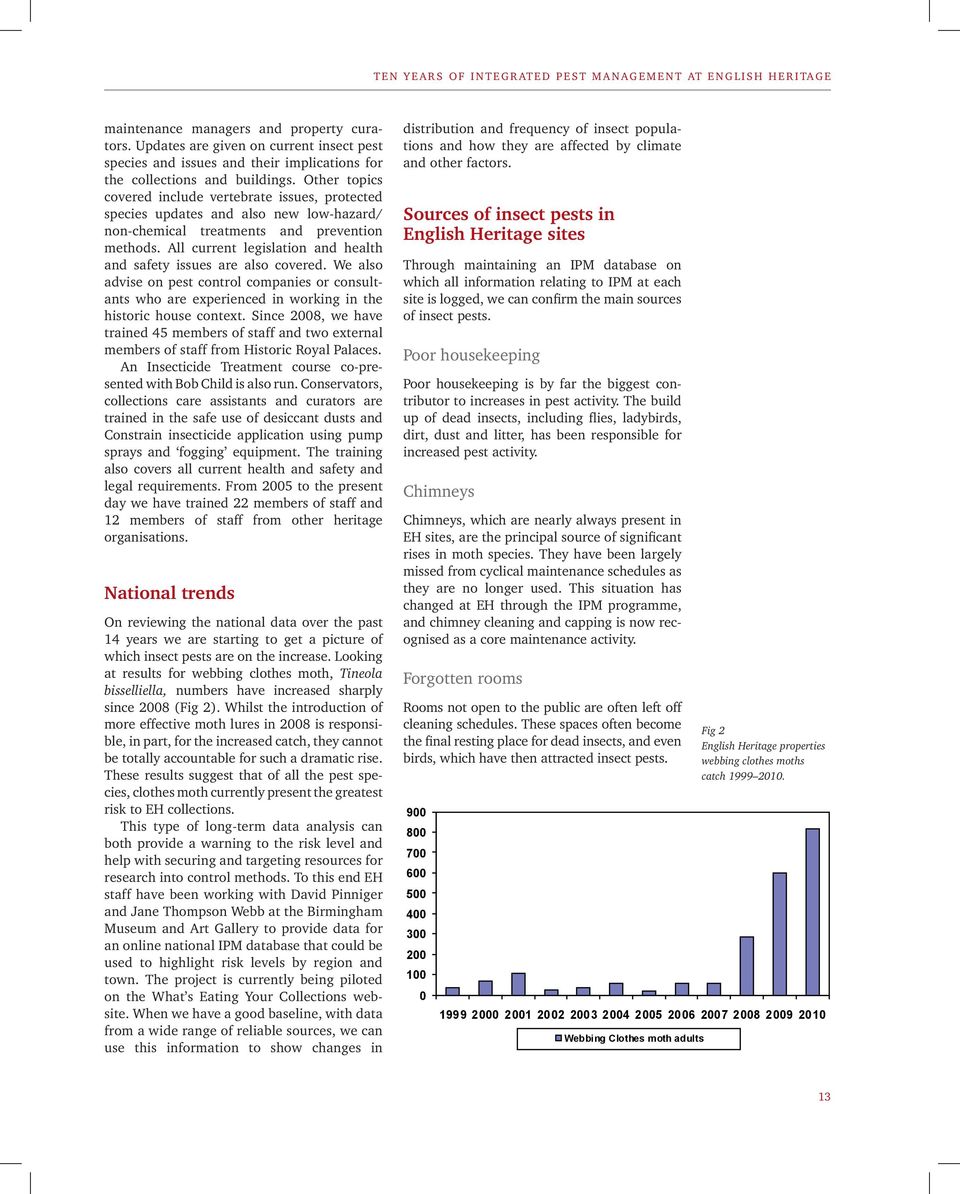
4 Ten years of integrated pest management at English Heritage maintenance managers and property curators. Updates are given on current insect pest species and issues and their implications for the collections and buildings. Other topics covered include vertebrate issues, protected species updates and also new low-hazard/ non-chemical treatments and prevention methods. All current legislation and health and safety issues are also covered. We also advise on pest control companies or consultants who are experienced in working in the historic house context. Since 2008, we have trained 45 members of staff and two external members of staff from Historic Royal Palaces. An Insecticide Treatment course co-presented with Bob Child is also run. Conservators, collections care assistants and curators are trained in the safe use of desiccant dusts and Constrain insecticide application using pump sprays and fogging equipment. The training also covers all current health and safety and legal requirements. From 2005 to the present day we have trained 22 members of staff and 12 members of staff from other heritage organisations. National trends On reviewing the national data over the past 14 years we are starting to get a picture of which insect pests are on the increase. Looking at results for webbing clothes moth, Tineola bisselliella, numbers have increased sharply since 2008 (Fig 2). Whilst the introduction of more effective moth lures in 2008 is responsible, in part, for the increased catch, they cannot be totally accountable for such a dramatic rise. These results suggest that of all the pest species, clothes moth currently present the greatest risk to EH collections. This type of long-term data analysis can both provide a warning to the risk level and help with securing and targeting resources for research into control methods. To this end EH staff have been working with David Pinniger and Jane Thompson Webb at the Birmingham Museum and Art Gallery to provide data for an online national IPM database that could be used to highlight risk levels by region and town. The project is currently being piloted on the What s Eating Your Collections website. When we have a good baseline, with data from a wide range of reliable sources, we can use this information to show changes in distribution and frequency of insect populations and how they are affected by climate and other factors. Sources of insect pests in English Heritage sites Through maintaining an IPM database on which all information relating to IPM at each site is logged, we can confirm the main sources of insect pests. Poor housekeeping Poor housekeeping is by far the biggest contributor to increases in pest activity. The build up of dead insects, including flies, ladybirds, dirt, dust and litter, has been responsible for increased pest activity. Chimneys Chimneys, which are nearly always present in EH sites, are the principal source of significant rises in moth species. They have been largely missed from cyclical maintenance schedules as they are no longer used. This situation has changed at EH through the IPM programme, and chimney cleaning and capping is now recognised as a core maintenance activity. Forgotten rooms Rooms not open to the public are often left off cleaning schedules. These spaces often become the final resting place for dead insects, and even birds, which have then attracted insect pests Fig 2 English Heritage properties webbing clothes moths catch Webbing Clothes moth adults 13
5 Integrated Pest Management for Collections Lack of building maintenance The lack of building maintenance related to downpipes, guttering, roof spaces, bird proofing, window- and door-proofing, and roof repairs have all been responsible for damp ingress resulting in death watch, Xestobium rufovillosum, and furniture beetle, Anobium punctatum, activity in the fabric of the building. Vertebrate pests Birds, rodents, bats and other protected species, squirrels, rabbits and moles have also been responsible for pest activity through nesting materials, droppings and dead bodies. Prevention and control Producing an annual report for each IPM site provides the key information for prioritising actions over the coming year and is fundamental to preventing damage. There are about 600 chimneys in the 23 Category A and B sites that require cyclical cleaning. Chimneys that are linked to rises in insect pests are prioritised for cleaning using a budget that has been ring-fenced for collections maintenance. Requests for chimney sweeping are logged on the building maintenance database system to ensure that jobs appear on cyclical schedules using agreed specifications. Establishing a close link with Estates teams through engaging with their system should mean that this relatively simple and cheap task which can have such a major impact on collections is dealt with in a methodical and timely manner. We also alert maintenance teams of a range of building maintenance issues noticed through insect monitoring. Housekeeping schedules are regularly reviewed and revised in response to annual results and targeted deep cleans are undertaken when required. Birds and rodents are becoming an increasing problem for collections often due to the increased consumption of food and frequency of functions at many sites. We are therefore aiming to influence EH practices relating to vertebrate control through a standard specification for the appointment of contractors and advocating a central cyclical contract carefully monitored to ensure effective control and value for money. Control treatments The insecticide Constrain, a pyrethroid microemulsion is used for the local treatment of textiles (carpets, curtains, upholstery), plant fibres and wood. Fogging using Constrain and the IP Mini Fogger is used to treat rooms both as a preventive measure and for control of moth outbreaks. This control measure is mainly used for large recreated interiors where wool has been used. Temperature treatments, freezing and heating, are the preferred methods. For the treatment of multiple objects we prefer heating using the Thermo Lignum (UK) Ltd mobile treatment chamber due to the short treatment time and proven efficacy, particularly for wood borers (Strang 2001). Following the successful trial of Exosect Ltd s Exosex CLM and CL moth confusion pheromone lures since July 2007, we can now consider deploying it at other sites to control webbing clothes moth numbers to acceptable levels. This is a non-chemical pest confusion treatment designed specifically to reduce the number of highly destructive larvae of the webbing clothes moth. It uses a synthetic female pheromone to attract male clothes moths into a dispenser where the Entostat powder combined with the pheromone is situated. Males are lured into the dispensers and upon entering the powder coats their bodies. The senses of the coated moths are overwhelmed and they cannot detect females as a result. As they leave the dispenser, they then attract other male clothes moths and so spread the confusion effect even further. Female moths do not get mated and lay very few fertile eggs and as a consequence there are far fewer larvae. The introduction of wool-based materials as part of new presentation schemes is carefully managed. Where possible wool is avoided, however, this can be challenging when authenticity, texture and drape of textiles are essential to the successful historic interior scheme. Where no acceptable material can be found to replace wool, the method of installation is controlled to ensure easy access for removal and cleaning. In some cases we have also implemented an annual fogging with Constrain insecticide to prevent a moth outbreak. A significant proportion of EH collections (87%) are in store (Xavier-Rowe and Fry 2010). We are in the process of developing new storage facilities on our estate. This is an excellent 14

6 T en years of integrated pest management at E nglish H eritage Fig 3 Dee Lauder and Ann Katrin Koester from English Heritage being interviewed for a BBC Radio 4 programme What s Eating The Museum? about pest control in museums and historic collections. (Photo English Heritage) opportunity to dispose of accumulated materials, check vulnerable collections as they are packed and to design the new stores so that relative humidity can be kept below 60% for most of the time. Quarantine areas and procedures for receiving goods and collections relating to insect pests are also being updated. Raising the public profile of IPM The insect pest story can be very successful in attracting public interest through the media. When we have given a press release relating to IPM the response has been strong. The most recent example is the in-depth interview with Dee Lauder by BBC Radio 4 as part of a programme called What s Eating The Museum? about pest control in museums and historic collections in 2011 (Fig 3). Conclusion With climate change and the cuts to funding in the UK, the risk of major damage to the nation s heritage from insect pests is increasing. IPM successfully mitigates this risk, which has been the experience at EH over the past 10 years. It is an efficient, manageable and effective strategy at EH because one staff member is responsible full-time for the programme. Acknowledgements We are indebted to David Pinniger who has inspired, trained and coached the authors and staff at EH for the past 10 years. References Lauder, D 2009 English Heritage insect ID monitoring sheet, web version. www. english-heritage.org.uk/professional/ research/heritage-science/collectionsconservation/collections-care-guidance/ (accessed 27 September 2011) Lauder, D and Pinniger, DB 2010 Pest Management in English Heritage Properties 2010: Summary. Unpublished internal report, English Heritage: London Lauder, D and Pinniger, DB 2011 English Heritage Integrated Pest Management Strategy. Unpublished internal paper. London: English Heritage Pinniger, DB, Xavier-Rowe, A and Lauder, D 2009 Insect Pests Found in Historic Houses and Museums [Poster]. London: English Heritage content/publications/docs/insect-pestshistoric-houses-poster.pdf (accessed 18 August 2011) Strang, TJK 2001 Principle of heat disinfestation, in Kingsley, H, Pinniger, D, Xavier-Rowe, A and Winsor, P (eds) Integrated Pest Management for Collections, Proceedings 2001: A Pest Odyssey, London: James and James, Xavier-Rowe, A and Pinniger, D 2001 No uninvited guests: Successful pest management in historic houses, in Kingsley, H, Pinniger, D, Xavier-Rowe, A and Winsor, P (eds) Integrated Pest Management for Collections, Proceedings 2001: A Pest Odyssey. London: James and James, Xavier-Rowe, A and Fry, C 2010 State of English Heritage Collections Report. Unpublished internal report. London: English Heritage What s Eating Your Collections? website, online database of pest information and recording. Project based at Birmingham Museum and Art Gallery funded by Renaissance programme of Museums, Libraries and Archives Council. (accessed 27 September 2011) 15

ENGLISH HERITAGE GUIDELINE FOR INSECT PEST MANAGEMENT IN ENGLISH HERITAGE
 ENGLISH HERITAGE GUIDELINE FOR INSECT PEST MANAGEMENT IN ENGLISH HERITAGE HISTORIC PROPERTIES. Contents 1/ English Heritage Guideline for Insect Pest Management 2/ Introduction to pest management 3/ What
INTEGRATED PEST MANAGEMENT POLICY FOR THE NATIONAL CULTURAL HISTORY MUSEUM
 INTEGRATED PEST MANAGEMENT POLICY FOR THE NATIONAL CULTURAL HISTORY MUSEUM INTRODUCTION A variety of insects and other pests can attack museum collections. Some insects are attracted to dark places for
INTEGRATED PEST MANAGEMENT
 Gerald R. Ford Conservation Center Nebraska State Historical Society 1326 S. 32 nd Street, Omaha, NE 68105 (402) 595-1180, Fax: (402) 595-1178 [email protected] www.nebraskahistory.org INTEGRATED
Preservation AdvisoryCentre. Pests
 Preservation AdvisoryCentre Pests The Preservation Advisory Centre has been awarded the CILIP Seal of Recognition based on an independent review of the content of its training courses and its engagement
INTEGRATED PEST MANAGEMENT GENERAL POLICY
 INTEGRATED PEST MANAGEMENT GENERAL POLICY The Baltimore Museum of Art adheres to the principles and practices of Integrated Pest Management (IPM) to prevent or control pests, as appropriate, in the museum
Carpet Beetles In Homes Phil Pellitteri/UW Insect Diagnostic Lab
 Carpet Beetles In Homes Phil Pellitteri/UW Insect Diagnostic Lab One can expect to find a few carpet beetles in any home. Larvae can feed on animal hair, dead insect, wool, horn, silk, plant seeds, feathers,
THE TINY MONSTERS THAT EAT YOUR HOME
 THE TINY MONSTERS THAT EAT YOUR HOME You ve put a lot of time and money into your home. You ve had the wall-to-wall carpets put in, upgraded the central heating, installed new wardrobes. But, just as you
Technical Guide Yellow Stem Borer (Scirpophaga incertulas)
 Toxicological information Exosex contains 3.2 mg Technical Grade Pheromone per gram of food grade wax powder and poses virtually no hazard to health. Ecotoxicological information Non hazardous to the environment.
Integrated Pest Management (IPM) Policy
 Integrated Pest Management (IPM) Policy What is Integrated Pest Management (IPM)? Integrated pest management (IPM) is an approach to pest control that utilizes regular monitoring and record keeping to
Structural Integrated Pest Management Program: Contract Specifications for INSERT YOUR FACILITY NAME HERE
 Model IPM Contract Structural Integrated Pest Management Program: Contract Specifications for INSERT YOUR FACILITY NAME HERE Premises covered by this specification: 1. 2. 3. 4. 5. (Attach additional list
Integrated pest management
 Integrated pest management A guide for museums, libraries and archives David Pinniger and Peter Winsor Museums, Libraries and Archives Council 16 Queen Anne s Gate London SW1H 9AA MLA 2004 MLA is the national
CHILTERN DISTRICT COUNCIL PEST CONTROL POLICY. April 2015
 CHILTERN DISTRICT COUNCIL PEST CONTROL POLICY April 2015 CHILTERN DISTRICT COUNCIL CUSTOMER SERVICE SPECIFICATION General Policy Chiltern District Council takes note that it has a statutory duty to ensure
Alaska Industrial, Institutional, Structural, and Health Related Pest Control Supplemental Information. Category Seven
 Alaska Industrial, Institutional, Structural, and Health Related Pest Control Supplemental Information Category Seven In general, applicators who apply pesticides to property other than their own, or act
Integrated Pest Management Program Contract Guide Specification - 1999 Revision -
 Integrated Pest Management Program Contract Guide Specification - 1999 Revision - This Document is Intended for General Guidance Only And Does Not Pertain to Any Actual Contract 1. GENERAL A. Description
Unit 4 Lesson 1: A Pest by Any Other Name
 Focus Areas: Pest Control: Biological; Environmental Science, Language Arts Focus Skills: critical thinking, conducting research, observing, graphing, interpreting data Objectives To explore human attitudes
Integrated Pest Management Program Contract Guide Specification - 2005 Revision -
 Public Buildings Service National Capital Region Integrated Pest Management Program Contract Guide Specification - 2005 Revision - (This Document is Intended for General Guidance Only And Does Not Pertain
Model Policy Statement for Integrated Pest Management in Schools and Child Care Facilities
 Model Policy Statement for Integrated Pest Management in Schools and Child Care Facilities School Pest Management Policy Statement Structural and landscape pests can pose significant problems in the urban
What is a pest? How Insects Become Pests. How do insects become pests? Problems with Pesticides. What is most commonly used to control insect pests?
 What is a pest? How Insects Become Pests How do insects become pests? Introduction outside of native range Becomes disease vector Plant or animal (inclu. human) disease vector Host shift in native insect
a white paper from Pete Trotman
 a white paper from Pete Trotman The effects of biocides legislation on pest management A white paper on the effects of biocides regulation (EU) 528/2012 (BPR) on controlling rodent population This paper
PROVISION OF PEST CONTROL AND FUMIGATION SERVICES IN SATS LEASED OFFICES/SPACES AT PASSENGER TERMINAL BUILDINGS 1, 2 AND 3, SINGAPORE CHANGI AIRPORT
 Page 1 of 8 PROVISION OF PEST CONTROL AND FUMIGATION SERVICES IN SATS LEASED OFFICES/SPACES AT PASSENGER TERMINAL BUILDINGS 1, 2 AND 3, SINGAPORE CHANGI AIRPORT WORK SPECIFICATIONS 1 SCOPE OF WORK The
PROPOSAL SPECIFICATIONS. for Integrated Pest Management (IPM) Pest Control Service Contract
 PROPOSAL SPECIFICATIONS for Integrated Pest Management (IPM) Pest Control Service Contract 1. Service to be provided. The Metropolitan Knoxville Airport Authority (MKAA) is seeking a pest control contractor
IPM Plan for Campus Landscape
 Created June 2014 IPM Plan for Campus Landscape Statement of Purpose The purpose of this integrated pest management (IPM) plan is to guide the use of environmentally sensitive pest management strategies
Company profile freephone 0800 0279 273 email US [email protected]
 Company Profile FREEPHONE 0800 0279 273 EMAIL US [email protected] ARK company profile ARK is a young company with big ambitions Our Mission At ARK, it is our mission to provide the highest
Interpreting Trap Capture Data. James F. Campbell USDA ARS GMPRC 1515 College Ave Manhattan, KS 66502 [email protected]
 Interpreting Trap Capture Data James F. Campbell USDA ARS GMPRC 1515 College Ave Manhattan, KS 66502 [email protected] Monitoring Questions What pests are present? Are numbers increasing? Where are
Acheta Consulting Ltd. Providers of independent pest control inspection, audit and consultancy services
 Acheta Consulting Ltd Providers of independent pest control inspection, audit and consultancy services Food Industry Standards; Are they adversely impacting on effective rodent control? Presenter: Ian
Pest Control Pricing Structure & Fees & Charges from 1st April 2016
 Treatments Tax Benefit Customer exc VAT inc VAT Exc VAT Inc VAT RATS (inside and outside) 75.68 90.82 Initial visit and assessment by qualified Pest Control Officer. remedial measures. If active rat infestation
Integrated Pest Management
 Integrated Pest Management Many people do not mind encountering bugs outdoors. However, bugs indoors are usually considered pests. Even one insect may be considered too many. People use pesticides to control
4. HOUSE RULES PEST CONTROL
 4. HOUSE RULES PEST CONTROL The House Rules Section contains 9 sub-sections each of which covers a particular subject of food safety management. Every House Rule sub-section begins with guidance and then
Managing Insect Pests In Food Storage Facilities
 Managing Insect Pests In Food Storage Facilities PREFACE Every dollar spent on insect pest prevention will, most likely, return additional dollars in reduced product losses. This fact quickly illustrates
PEST CONTROL PROCEDURES GENERAL GUIDELINES
 PEST CONTROL POLICY The Peabody Museum of Natural History strives to provide a good preservation environment for collections while ensuring a healthy environment for staff, volunteers and the public. Recognizing
ORIENTAL COCKROACH PREVENTION & CONTROL
 ORIENTAL COCKROACH PREVENTION & CONTROL DESCRIPTION Oriental cockroaches are dark brown to black in color and 1-1¼ inch in length. The females have only traces of wings, while males have short wings which
English Heritage Methodology and Guidance for Surveying Listed Buildings
 English Heritage Methodology and Guidance for Surveying Listed Buildings A listed building is a building (or structure) that has been designated as being of special architectural or historic significance.
School IPM Model Contract
 School IPM Model Contract Description of parties involved in this contract School/School District and IPM Coordinator Contractor Definitions: Integrated Pest Management (IPM) IPM is a process through which
Integrated Pest Control Management
 Integrated Pest Control Management Integrated Pest Management A. Integrated Pest Management is a system of controlling pest in which pests are identified, action thresholds are considered, all possible
Upscaling of locally proven IPM technologies for control of pest of economic importance i
 Technology Fact Sheet for Adaptation Upscaling of locally proven IPM technologies for control of pest of economic importance i Technology: Upscaling of locally proven IPM technologies for control of pest
Schedule 1 SERVICE SPECIFICATION PEST CONTROL SERVICE
 Schedule 1 SERVICE SPECIFICATION PEST CONTROL SERVICE This specification outlines the minimum requirement for the provision of a pest control service for North Dorset District Council and Weymouth & Portland
PEST CONTROL SYSTEMS
 HYGIENE MANAGEMENT PEST CONTROL SYSTEMS rodents birds Pest includes: numerous species of flying and crawling insects: cockroaches, flies, grain beetles, moths dogs, cats Pest control systems Pest pose
MONITORING THE MUSEUM M ENVIRONMENT
 MONITORING THE MUSEUM M ENVIRONMENT Temperature, humidity, light, pollutants and pests can cause severe damage to museum collections. The first step in preventing this is to find out what the actual levels
19/02/2014. Bed Bug Control in the United Kingdom. Contamination. Key UK Requirements -Why do we Need to Control Pests? Eradicate/control species that
 Bed Bug Control in the United Kingdom Richard Moseley Key UK Requirements -Why do we Need to Control Pests? Eradicate/control species that have a detrimental effect on the health of humans are the cause
Tree Management Policy
 Tree Management Policy This policy is designed to be a policy framework for the management of trees owned and managed by the Connect HA. It sets out the guiding principles for managing our stock, to assist
Integrated Pest Management Policy for Research Laboratories
 Integrated Pest Management Policy for Research Laboratories Environmental Health & Safety I. POLICY The University of South Carolina s Integrated Pest Management Policy is based on the CDC s Biosafety
Insects That Kill Trees. Diane G. Alston Extension Entomologist Utah State University 2004 Professional Tree Care Workshops
 Insects That Kill Trees Diane G. Alston Extension Entomologist Utah State University 2004 Professional Tree Care Workshops Topics Introduction websites, IPM strategies Ips bark beetles Tree borers flatheaded,
Sample Integrated Pest Management Plan. General Pest Control. Facility Name Address Telephone Number
 Sample Integrated Pest Management Plan General Pest Control Facility Name Address Telephone Number Pests to be Controlled Pest control services which can be performed in the General Pest Control category
Idaho Falls School District 91 Effective Date January 25, 2010
 PLN-4 CONTENTS 1. PURPOSE... 2 2. SCOPE AND APPLICABILITY... 2 3. SPIDERS... 2 4. COCKROACH CONTROL... 3 PLN-4 1. PURPOSE It is the policy of Idaho Falls School District #91 to provide a place of education
Policy for the Management of Asbestos in the Workplace
 Southwark Council Management of Asbestos in the Workplace November 2011 Page 1 of 15 CONTENTS 1. INTRODUCTION... 3 2. POLICY STATEMENT... 3 3. ASBESTOS RISK CLASSIFICATION SCHEME... 5 4. SAMPLING OF ASBESTOS
JEFFERSON COUNTY PUBLIC SCHOOLS (JCPS) PEST CONTROL PLAN
 JEFFERSON COUNTY PUBLIC SCHOOLS (JCPS) PEST CONTROL PLAN Each facility shall implement a pesticide registry program, as required by Kentucky Department of Agriculture 302 KAR 29 29.050 Section 12, JCPS
TEXOMA HOUSING PARTNERS (THP) INTEGRATED PEST MANAGEMENT BID SPECIFICATIONS
 TEXOMA HOUSING PARTNERS (THP) INTEGRATED PEST MANAGEMENT BID SPECIFICATIONS CONTRACT FOR COMMERCIAL PEST CONTROL SERVICES General Pest & Rodent Control 1. GENERAL a. Description of Service This contract
INTEGRATED PEST MANAGEMENT
 INTEGRATED PEST MANAGEMENT Definitions Biological Controls -- Use of a pest s natural enemies to control pest population. Conservation and augmentation are the biological control strategies most commonly
The Prevention and Treatment of Mould Outbreaks in Collections
 National Preservation Office The Prevention and Treatment of Mould Outbreaks in Collections NPO Preservation Guidance Preservation in Practice Series Author R.E. Child Head of Conservation National Museums
INTEGRATED PEST MANAGEMENT
 INTEGRATED PEST MANAGEMENT Pests, such as insects and rodents, can be a serious problem in a restaurant. They can contaminate food supplies as well as damage facilities. More importantly, they can also
Integrated Pest Management for School and Municipal Buildings, Part 2
 www.nysipm.cornell.edu/factsheets/buildings/municipal_ipm_step2.pdf 2012 Community Integrated Pest Management for School and Municipal Buildings, Part 2 J. Gangloff-Kaufmann, New York State Integrated
SAMPLE INTEGRATED PEST MANAGEMENT (IPM) BID SPECIFICATIONS FOR COMMERCIAL PEST CONTROL SERVICES
 1. GENERAL SAMPLE INTEGRATED PEST MANAGEMENT (IPM) BID SPECIFICATIONS FOR COMMERCIAL PEST CONTROL SERVICES Ornamental & Turf & Arborist (Tree Care) Full Service Contract Includes Pesticide Applications
Preservation AdvisoryCentre. Basic preservation
 Preservation AdvisoryCentre Basic preservation The Preservation Advisory Centre is supported by: The Pilgrim Trust The Marsh Christian Trust and the John Paul Getty Jnr Charitable Trust Author Alison Walker
What is Integrated Pest Management?
 SLIDE 1: This is Steve Johnson, University of Maine Cooperative Extension, bringing you information on Integrated Pest Management. It is possible to receive a Maine Board of Pesticides Control recertification
ITEM 634.90030011- RODENT AND VERMIN CONTROL - INITIAL SURVEY. BAITING AND SANITATION ITEM 634
 DESCRIPTION A. Under these items the Contractor shall perform and satisfy the rodent and vermin control (extermination) and site sanitation requirements within construction areas as designated by the engineer.
macenviro Pest and Vermin Control Telephone: 0116 276 9592 Leicester 0207 798 6751 London
 macenviro Pest and Vermin Control Telephone: 0116 276 9592 Leicester 0207 798 6751 London About Us With offices in Leicester and London, macenviro (maclean ENVIRONMENTAL) is a family run company supplying
WHY DO WE NEED TO ELIMINATE RODENTS FROM FOOD PREMISES?
 WHY DO WE NEED TO ELIMINATE RODENTS FROM FOOD PREMISES? There is specific legislation concerning rodent pests in any premises. The Prevention of Damage by Pests Act 1949 insists that you keep your premises
Why do Pest Infestations Occur? 3. Why is Pest Management Important? 4. Who is Responsible for Pest Control? 5. Types of Common Pests 6
 PEST M ANAGEMENT This publication provides a set of guidelines on good pest management practices for food operators and food handlers. To manage and reduce the risk of food-borne illnesses, a comprehensive
PART TWO 5. PEST CONTROL
 PRT TWO 5. PEST CONTROL Section Page 5. Contents 1 5.1 Why is pest control important? 2 5.2 What are the legal requirements for pest control? 5.2.1 Which operations does the law apply to? 3 5.2.2 What
Monitoring and evaluation plan example Protecting our Places
 Monitoring and evaluation plan example Protecting our Places This example is designed to show you the type of information expected in a plan. Your M&E Plan should relate to the objectives you have set
Pest Control Service. Scope of Work
 Pest Control Service Scope of Work Reviewed By: Approved By: Version 2.0 Date 08-08-07 Author K. Vandenbussche 1 BACKGROUND The Integrated Service Provider s program will provide superior on-site service,
BROOKFIELD LAGRANGE PARK SCHOOL DISTRICT #95 INTEGRATED PEST MANAGEMENT PLAN
 BROOKFIELD LAGRANGE PARK SCHOOL DISTRICT #95 INTEGRATED PEST MANAGEMENT PLAN Established 1/30/12 Revised 4/17/12 Revised 8/20/13 Revised 3/13/14 School District 95 believes the best way to control pest
LOS ANGELES UNIFIED SCHOOL DISTRICT. Integrated Pest Management Training Program
 LOS ANGELES UNIFIED SCHOOL DISTRICT Integrated Pest Management Training Program In March 1999, the Board of Education of the Los Angeles Unified School District adopted an integrated pest management policy
Author G Morton July 2015. Newcastle University Asbestos Management Plan 2015
 Newcastle University Asbestos Management Plan 2015 1 Contents 1.0 Introduction 2.0 Asbestos Management Duty Holder Responsibilities 2.1 Asbestos Manager (Head of Maintenance) 2.2 University Asbestos Survey
Yale University Request For Proposal (RFP) for Pest Control Operations Yale University Buildings and Properties
 Yale University Request For Proposal (RFP) for Pest Control Operations Yale University Buildings and Properties SECTION 1: Administrative and Contractual Information 1.1 RFP Purpose Yale University (henceforth
Introduction to Integrated Pest Management. John C. Wise, Ph.D. Michigan State University MSU Trevor Nichols Research Complex
 Introduction to Integrated Pest Management John C. Wise, Ph.D. Michigan State University MSU Trevor Nichols Research Complex What is Integrated Pest Management? Integrated Pest Management (IPM) New concept;
An Introduction to in-depth Pest Control Surveys: The Role and Responsibilities of the Pest Control Field Biologist
 An Introduction to in-depth Pest Control Surveys: BRC Global Standards. Trust in Quality Introduction to in depth Pest Control Surveys: Introduction to in depth Pest Control Surveys: In-depth pest control
Accreditation Scheme for Museums and Galleries in the United Kingdom: Accreditation Standard
 Accreditation Scheme for Museums and Galleries in the United Kingdom: Accreditation Standard October 2011 Contents Introduction 4 Eligibility 6 Requirements for Accreditation 7 1 Organisational health
SYSTEMS APPROACH FOR PEST RISK MANAGEMENT OF FRUIT FLIES (TEPHRITIDAE)
 ISPM 35 INTERNATIONAL STANDARDS FOR PHYTOSANITARY MEASURES ISPM 35 SYSTEMS APPROACH FOR PEST RISK MANAGEMENT OF FRUIT FLIES (TEPHRITIDAE) (2012) Produced by the Secretariat of the International Plant Protection
Conquer Pest Control Ltd. Mammal Control
 Mammal Control Effective Rodent Control to minimise risks and avoidable costs Rodents are the largest group of mammals with over 1500 representative species worldwide, but just 15 are known to reside in
Class Insecta - The insects
 A Introduction 1. Very species rich 2. Characteristics a. 3 pairs of legs b. 2 pairs of wings (most) except flies (1 pair of wings - Diptera) B. Distribution 1. All habitats except saltwater - replaced
Sample Outline (courtesy of City of Guelph Museums) Building Conservation Plan
 Sample Outline (courtesy of City of Guelph Museums) Building Conservation Plan 1. Introduction 2. Commemorative Integrity Statement/Statement of Purpose 3. Contacts Staff City Contacts Ambulance Cold Storage
Industrial and Institutional Pest Control Learning Objectives
 Category 7A and 7B: Industrial and Institutional Pest Control Industrial and Institutional Pest Control Learning Objectives After studying this section, you should be able to: Identify the different types
Advice Series. the maintenance and repair of historic buildings
 Advice Series the maintenance and repair of historic buildings Jacqui Donnelly - Architectural Conservation Advisor, Department of the Environment, Heritage & Local Government Current publications in the
Bridge Parish Council Community Emergency Plan
 BRIDGE Parish Council Caring for the village Bridge Parish Council Community Emergency Plan IF YOU ARE IN IMMEDIATE DANGER CALL 999 October 2014 All enquiries relating to this document should be sent to:
Energy Saving Fact Sheet Energy Management
 Energy Saving Fact Sheet Energy Management Energy it s much more manageable than you think Energy is not an unmanageable overhead it is one of the largest controllable costs in most organisations. Cutting
ABClean Frequently Asked Questions (FAQ)
 ABClean Frequently Asked Questions (FAQ) 1. How can I recognize asbestos containing products during cleaning, renovation, demolition or dismantling task? Considering construction date, which buildings
THE CLATTERBRIDGE CANCER CENTRE NHS FOUNDATION TRUST INFECTION CONTROL POLICY PEST CONTROL. DOCUMENT REF: PICGPESTC (Version No: 1.
 INFECTION CONTROL POLICY PEST CONTROL DOCUMENT REF: PICGPESTC (Version No: 1.1) Name and designation of policy author(s) Approved by (committee, group, manager) Date approved Deborah Kretzer Lead Nurse
Cleaning and Support Services / Cleaning Services Supervision National Occupational Standards
 Cleaning and Support Services / Cleaning Services Supervision National Occupational Standards Contents C1 02 Maintain Personal Hygiene Standards when Cleaning... 3 C1 03 Do your job in a customer friendly
Radford University. Indoor Air Quality Management Plan
 Radford University Indoor Air Quality Management Plan Spring 2015 Introduction Concerns with Indoor Air Quality (IAQ) have increased since energy conservation measures were instituted in office buildings
Integrated Pest Management How does this fit into the Maintenance Dept.
 Integrated Pest Management How does this fit into the Maintenance Dept. Janet Hurley, MPA School IPM Program Specialist Texas AgriLife Extension Service Southern Region School IPM Committee 1 It s s just
PEST INSPECTION REPORT for: SAMPLE PEST INSPECTION REPORT. Inspected Property: 90 Wentworth Street, SAMPLETON
 PEST INSPECTION REPORT for: SAMPLE PEST INSPECTION REPORT Inspected Property: 90 Wentworth Street, SAMPLETON Reference Number: sample Pest Inspection Report CLIENT & SITE INFORMATION: COMMISSIONED BY:
Guide to the identification of Wood-boring insects
 Guide to the identification of Wood-boring insects Safeguard Chemicals Ltd., Redkiln Close, Horsham, West Sussex, United Kingdom. RH13 5QL. Tel: 01403 210204 www.safeguardchem.com Introduction This guide
ASBESTOS CONTAINING MATERIALS POLICY
 ASBESTOS CONTAINING MATERIALS POLICY Document Control Version 3 Ratified by Risk Management Sub Group Date Ratified 19 December 2012 Name of Originator/Author Head of Estates and Facilities Name of Responsible
Developing an Integrated Pest Management Program. Presented by: Juliette A. Travous,, CHMM Parkway School District [email protected].
 Developing an Integrated Pest Management Program Presented by: Juliette A. Travous,, CHMM Parkway School District [email protected] Integrated Pest Management IPM is a pest control management system
RECOMMENDED COFFEE WAREHOUSE STORAGE PRACTICES
 45 Broadway, New York, NY 10006 (212) 766-5854 Fax (212) 766-5815 RECOMMENDED COFFEE WAREHOUSE STORAGE PRACTICES I. LOCATION AND PHYSICAL STRUCTURE OF WAREHOUSE Any location for the storage of coffee should
Surveying Historic Timber Framed Buildings
 Surveying Historic Timber Framed Buildings The survey, identification of defects and specification of remedial work in timber framed buildings is a specialised area and a trap for the unwary. Richard Oxley
Care and Conservation of Natural History Collections
 http://www.natsca.org Care and Conservation of Natural History Collections Title: Pest management, prevention and control Author(s): Pinniger, D. B. & Harmon, J. D. Source: Pinniger, D. B. & Harmon, J.
A DISCOVERY REGARDING THE DEATH OF ASH TREES IN THE PLYMOUTH AREA
 A DISCOVERY REGARDING THE DEATH OF ASH TREES IN THE PLYMOUTH AREA As you are probably aware, we have seen a significant amount of dying ash trees in the Plymouth, Canton, Northville area. This prompted
HAVEBURY HOUSING PARTNERSHIP
 HS028 HAVEBURY HOUSING PARTNERSHIP POLICY ASBESTOS MANAGEMENT Controlling Authority Director of Resources Policy No. HS028 Issue No. 3 Status Final Date November 2013 Review Date: November 2016 Equality
PREVENTING GETTING RID OF BED BUGS SAFELY AND. Preventing and Getting Rid of Bed Bugs
 Preventing and Getting Rid of Bed Bugs PREVENTING AND GETTING RID OF BED BUGS SAFELY Edward A. Diana, County Executive Michael R. Pillmeier, Chairman of the Legislature Page 12 Page 15 Using This Guide