
Pterygium and Pterygium Surgery
|
|
|
- Dennis Jordan
- 9 years ago
- Views:
Transcription
1 Pterygium and Pterygium Surgery Introduction This booklet is to give you information about pterygium and to help you make a decision about surgery, if needed. Some of the words used may seem confusing and scientific. At the end of this booklet you will find a list of explanations of commonly used medical words and phrases. Please ask if there are any issues that concern you. If you think that there is anything that this booklet does not explain well enough, please tell us. 1. PTERYGIUM AND PTERYGIUM SURGERY WHAT IS A PTERYGIUM? A pterygium is scar tissue on the surface of the white part of the eye that grows over the front of the cornea (the clear window at the front of the eye).

2 A pterygium usually grows very slowly, over many years. It is more common in people who have been exposed to a lot of sunlight during their lifetime. A pterygium may cause one or more of the following: Dissatisfaction with the cosmetic appearance of the eye Redness of the eye. Discomfort in the eye, which is usually a dry or gritty sensation, caused by drying of the normal tear film on the surface of the pterygium or adjacent to it. In extreme cases a pterygium can grow over the central part of the cornea and can cause blurred vision or the scarring may restrict the movement of the eye, causing double vision. PTERYGIUM SURGERY Pterygium surgery can be performed under local anaesthesia (awake) or general anaesthesia (asleep). The choice is based on the anticipated length and difficulty of the operation, your suitability for different sorts of anaesthesia, your own preferences and your surgeon s advice. A routine pterygium operation would be expected to last about 45 minutes and can usually be performed comfortably under local anaesthetic. Under local anaesthetic, the anaesthetic is put into the soft fatty tissue around the eyeball. It not only anaesthetises the eye but also reduces what you can see and stops the eye moving around. Conversely, a recurrent pterygium (that has re-grown after a previous operation) usually needs more extensive surgery and a general anaesthetic is recommended. You will usually be able to go home on the day of your operation, but you may be asked to return for an eye check on the following day 2

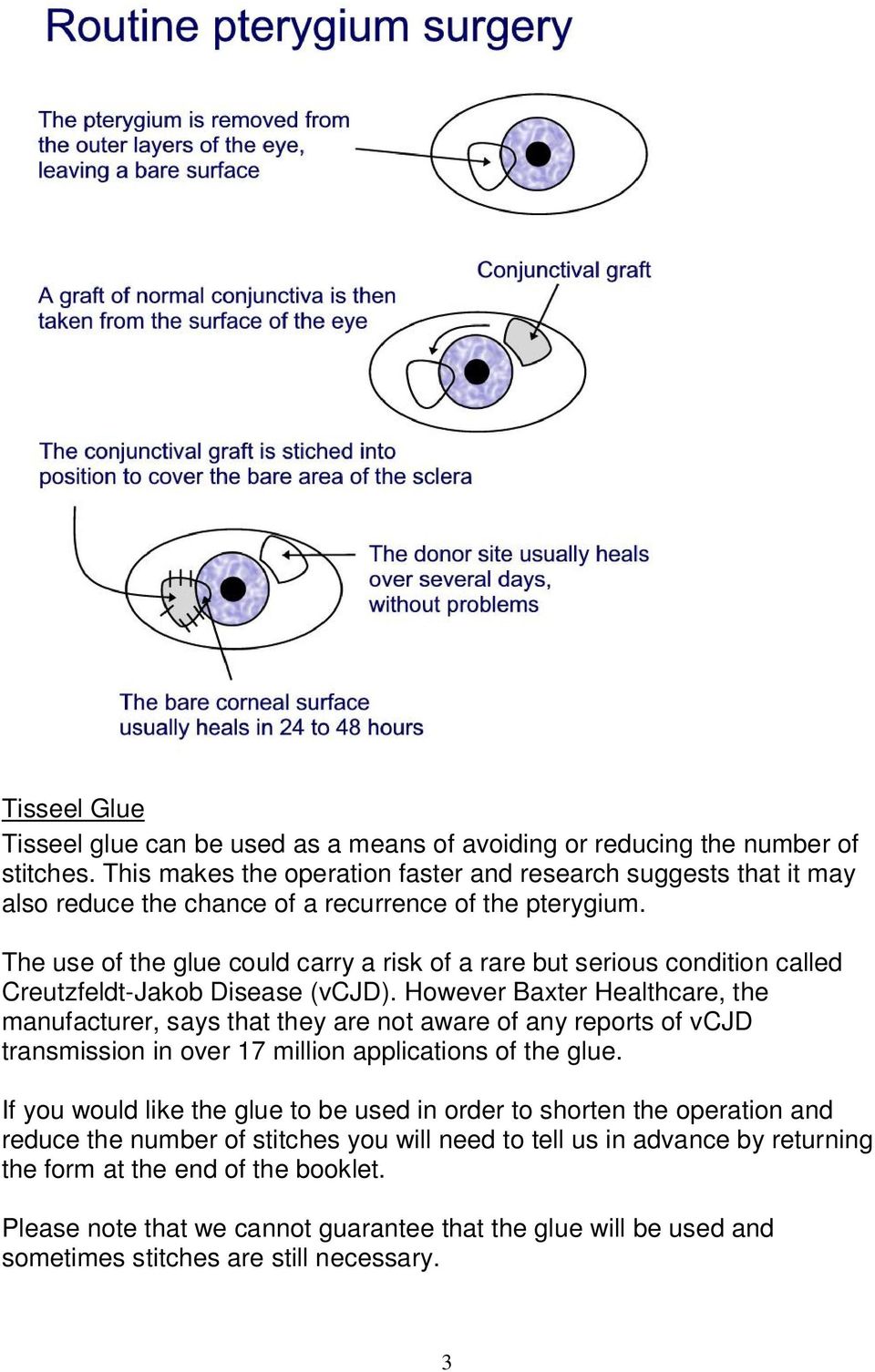
3 Tisseel Glue Tisseel glue can be used as a means of avoiding or reducing the number of stitches. This makes the operation faster and research suggests that it may also reduce the chance of a recurrence of the pterygium. The use of the glue could carry a risk of a rare but serious condition called Creutzfeldt-Jakob Disease (vcjd). However Baxter Healthcare, the manufacturer, says that they are not aware of any reports of vcjd transmission in over 17 million applications of the glue. If you would like the glue to be used in order to shorten the operation and reduce the number of stitches you will need to tell us in advance by returning the form at the end of the booklet. Please note that we cannot guarantee that the glue will be used and sometimes stitches are still necessary. 3
4 Surgery for recurrent pterygium A recurrent pterygium may require additional surgical techniques, which could include the use of other transplantation materials such as amniotic membrane or sclera and may also require the use of drugs on the eye such as mitomycin C, 5-fluorouracil or may require radiation treatment to try to prevent another recurrence. The choice of techniques depends on the details of each individual case. However, in general the risks of surgery for a recurrent pterygium tend to be higher and success rates lower. 2. CONSENTING TO YOUR OPERATION If you have decided that you wish to go ahead with surgery you will be asked to sign a consent form. You should only sign the form if you are satisfied with the explanations about the operation and you understand the anticipated benefits and risks. BENEFITS Chapter 1 described what the operation involves. The main reason for removing a pterygium is to prevent future loss of eyesight by stopping the pterygium from growing over the central area of the cornea. Other symptoms such as redness or discomfort are not as easily treated by surgery and are best treated, where the possible by more simple methods, such as the use of lubricant eye drops. RISKS As with every operation, pterygium surgery has risks Success cannot be guaranteed. All serious complications are rare. COMPLICATIONS DURING THE OPERATION Because the operation only involves the outer layers of the eye, pterygium surgery is relatively safe compared to many types of eye surgery. One of the eye muscles lies partly underneath the operation site. It is possible, though unlikely, that this muscle could be damaged during the operation, causing double vision and requiring further surgery. This particular complication is more of a concern when removing a pterygium that has regrown after a previous operation, when there is much more scarring and the muscle may be difficult to identify. Very rarely, the internal structures of the eye could be damaged, causing loss of eyesight. This is more of a concern when operating on an eye that has 4

5 already had surgery or where the eye has been damaged by previous injury or by other eye diseases. COMPLICATIONS AND SIDE-EFFECTS AFTER THE OPERATION Pain or discomfort Some pain is very common in the first 24 to 48 hours after surgery. This is because the corneal surface previously covered by the pterygium is left bare (see surgical diagram) and takes 24 to 48 hours to heal. If there are no medical reasons to the contrary, you may take simple painkillers such as paracetamol. The frequent use of eye lubricants may also help. Dissolving stitches may cause a gritty sensation for several weeks. The inflammation caused by surgery may take several weeks or sometimes months to settle fully, in which case the eye may still appear slightly red and the eye may feel mildly dry or gritty. After corneal surgery the eye surface is often slightly bumpy. The tear film, which keeps the eye moist, tends to dry out on the surface of the bumps. If the drying is severe, the eye can be prone to infection or ulceration. Lubricant eye drops are often needed in the first few months after surgery and possibly long-term in some cases. Cosmetic appearance The cosmetic appearance following surgery is usually very good although not absolutely perfect. Very close inspection may show differences in the normal patterns of the red blood vessels between the eyes. Removal of the pterygium usually leaves a faint scar on the cornea that may be visible. Poor eyesight After the operation the corneal surface previously covered by the pterygium is often slightly bumpy and also scarred. This means that in cases where the pterygium has grown over the central cornea, the vision may remain poor, even when the pterygium has been removed. Recurrence of the pterygium The chance of a pterygium recurring in the first year after the first operation is approximately 1:20 or less. Corneal ulceration or infection Severe problems such as corneal ulceration or infection are rare but may require intensive treatment such as antibiotics and can lead to scarring and opacity of the cornea or, very rarely, perforation of the eye. If the ulceration is severe a corneal transplant may be needed, sometimes as an emergency. 5
6 Further surgery Further surgery is unlikely, but patients who require further surgery, including surgery for recurrent pterygium may also have complications arising from the additional surgery or treatments required. These complications could include corneal or scleral thinning or ulceration, perforation of the eye, cataract, glaucoma, poor eyesight or complete loss of eyesight in the operated eye, loss of the operated eye or inflammation in the other eye (extremely rare). 3. YOUR PRE-ASSESSMENT APPOINTMENT Before your surgery is performed you will be asked to visit the preassessment clinic. Please follow the appointment letter instructions carefully. If you are unable to keep the date you have arranged with us, please let us know with as much notice as possible so another patient can use the appointment and yours can be rearranged. Our phone number can be found at the back of this booklet. Your appointment may last up to two hours. During this time you will see a number of people including an ophthalmic nurse. You will be asked questions about your eyesight, medical history and the drugs you are taking. We also need to know if you have any drug allergies. You will be asked about your personal circumstances to ensure that it is safe for you to have day case surgery, and ensure that you or somebody else will be able to put your drops in. Please bring with you the following: The drugs which you currently take The completed medical questionnaire inserted in the centre of this booklet An up-to date sight test from your optician Your most recent spectacles for distance and reading (or bifocals/varifocals) This booklet We may measure your weight and blood pressure and may also check your eyes. Some patients need to take antibiotics as eye drops or ointment, before the operation. These will be given to you at this visit. The drops should be stored in the fridge until needed and any other treatment kept safe until the time of your operation. 6

7 We cannot give a guarantee that a particular surgeon will perform the operation. The surgeon will, however, have appropriate experience. Sometimes your surgeon will be assisted by a trainee who will do part or all of your operation under supervision. You may, of course, ask questions during any stage of this visit. Please make sure that you have checked the following with us: Is any special treatment needed in the week before the operation? Will you be operated on as a day-case or will you be staying in hospital overnight? Do you have all the information that you need as regards admission to the hospital (if needed)? Do you have all the information that you need as regards the anaesthetic that will be used (e.g. when not to eat or drink)? 4. THE DAY OF YOUR OPERATION DATE AGREED If you cannot keep the date made please phone us immediately. If you have any unexpected eye or general health problems in the week before your operation, please inform us IMMEDIATELY. DO NOT WAIT UNTIL THE DAY OF YOUR OPERATION, because it may have to be cancelled due to the problem. If we are given sufficient notice of a problem or a likely cancellation, it may be possible to give the operating time to someone else. We will have given you information about the date of your operation and instructions about where to go and at what time. Please read the appointment information carefully. You must ensure you have transport arranged to bring you to the hospital and take you home again. The hospital car service is available if you have a specific medical need If you are having day-case surgery you will be with us for part of the day only. When you arrive we will be able to advise any companion who has accompanied you of the time you are likely to be ready to go home. If you have to stay overnight, you will go to a bed on one of the wards after your operation. Please wear comfortable clean shoes and clothes that button down the front. You may eat and drink on this day unless you have been told not to. 7

8 Take your normal tablets, inhalers and eye drops unless you have been told not to. The nurse may put eye drops into your eye to prepare you for surgery. The anaesthetist or surgeon will ask you some questions about your health and discuss the anaesthetic procedure. We will then take you through to the anaesthetic room in the operating theatre suite. Here you will meet the theatre staff. AFTER YOUR OPERATION We may ask you to remove the eye pad yourself. Otherwise it should stay in place until you see us the following day. It is common to feel slightly unsteady on your feet at first while you get used to the eye pad so please take care when moving around. We usually wish to check your eye 1 to 2 days after surgery and then again at 1 week after surgery. IMPORTANT ADVICE Although the eye can be painful initially, the pain and discomfort should rapidly improve in the first 24 to 48 hours after surgery. After the first 24 to 48 hours there is usually some mild remaining discomfort, which then improves slowly thereafter. The eyesight in the operated eye is often blurry initially but it improves steadily as the eye surface heals. If at any stage the eye discomfort or redness increases, or if the eyesight starts to become worse, please contact us. Eye-drops and ointment Make sure you know which eye drops or ointments you should be taking. Please either remember the names, or if you cannot remember the names, write them down or bring the drops with you to every appointment. This is so the doctor can discuss the treatment with you. If you are using any eye treatment pre-operatively in the eye to be operated on, please check with your eye specialist whether it will need to be continued post-operatively. In the first week, the eye treatment usually consists of an antibiotic such as chloramphenicol (drops or ointment) 4 times daily and an eye lubricant such as lacrilube or celluvisc to be used frequently, at least 4 times daily, in between the times when you use the antibiotic. This means that you will be using eye drops or ointment at least every 2 hours in the first week. 8
9 In the second week, provided that the eye surface is healing well, antiinflammatory drops will be started and these will need to be continued, with the lubricants for at least 3 months, unless directed otherwise. The antibiotics are usually stopped 2 weeks after the operation. If you run out of eye drops or ointment do not wait until your next appointment. Please obtain a repeat prescription from your GP. You should continue to use any other regular medication (including any treatment to the other eye) as usual. Hygiene Remember that your eye surface is vulnerable to infection until it has healed fully. This means that you must take every precaution to keep the eye clean. Grittiness or discomfort in bright light suggests that the eye has not fully healed. Do not do any activities that may introduce dirt or dirty water into the eye. Wash your hands before touching the eye. Do not swim until you have been cleared to do so. Keep the nozzles of your eye-drop bottles or ointment tubes clean by avoiding contact with the eye or fingers. Driving and safety Take care to avoid accidental injuries. This advice applies particularly to driving or doing any other dangerous activity such as operating machinery. Avoid driving for at least 48 hours. If you still meet the legal requirements for driving, which include the eyesight requirements for driving and if your insurers are informed and are providing insurance cover, you can drive after 48 hours. Do not drive if you have double vision or if the eyes are uncomfortable or watering. Other activities Please do not rub your eye or take part in any activities that carry an extra risk of eye injury (such as contact sports) for a month. Wear eye protection for activities such as grinding, hammering or chiselling. Avoid working with any chemicals that may irritate the eye until the eye surface has healed fully. If you are uncertain whether you can continue one of your normal activities please ask us. Work It is difficult to say exactly how much time you will need to take off work. This depends on individual eyes and individual jobs. Allow at least one week if you have a desk job. If you do a job that involves working in a dry, dusty or dirty environment you may need to take longer off work. 9
10 If you do a job where there is a safety risk to yourself or others please discuss with your employer and with your eye doctor. Holidays Remember to inform your insurers about any recent eye treatment and remember that insurance policies may not cover pre-existing eye problems or recent surgery. Eye slightly sticky It is usual for the lids to be sticky after the operation, however the stickiness should improve in the first 2 weeks after the operation. Use a clean piece of cotton wool and cooled previously boiled water to clean your eyelids. Wipe gently from the nose outwards then discard the cotton wool and repeat as necessary. Use separate cotton wool for each eye. Do not attempt to clean inside the lids. We hope you have found this booklet informative and useful and that it helps to make your experience of surgery as relaxed as possible. We regularly update the information and if there is anything we have omitted or could have done better please let us know. COMMONLY USED WORDS AND PHRASES Cornea: The clear window at the front of the eye. Conjunctiva: The thin semi-transparent tissue (membrane) that lines the inner surfaces of the eyelids and the outer surface of the sclera. Sclera: The tough opaque white outer coat that together with the clear cornea makes up the eyeball. CJD: Creutzfeldt-Jakob disease (CJD) is a rare neurological illness which is that is incurable and fatal. Most people had not heard of CJD before 1996, when it became the subject of media attention following discovery of a new form, now called variant CJD (vcjd). This is believed to come from meat from cattle infected with BSE (bovine spongiform encephalopathy / "mad cow disease"). 10

11 Notes 11

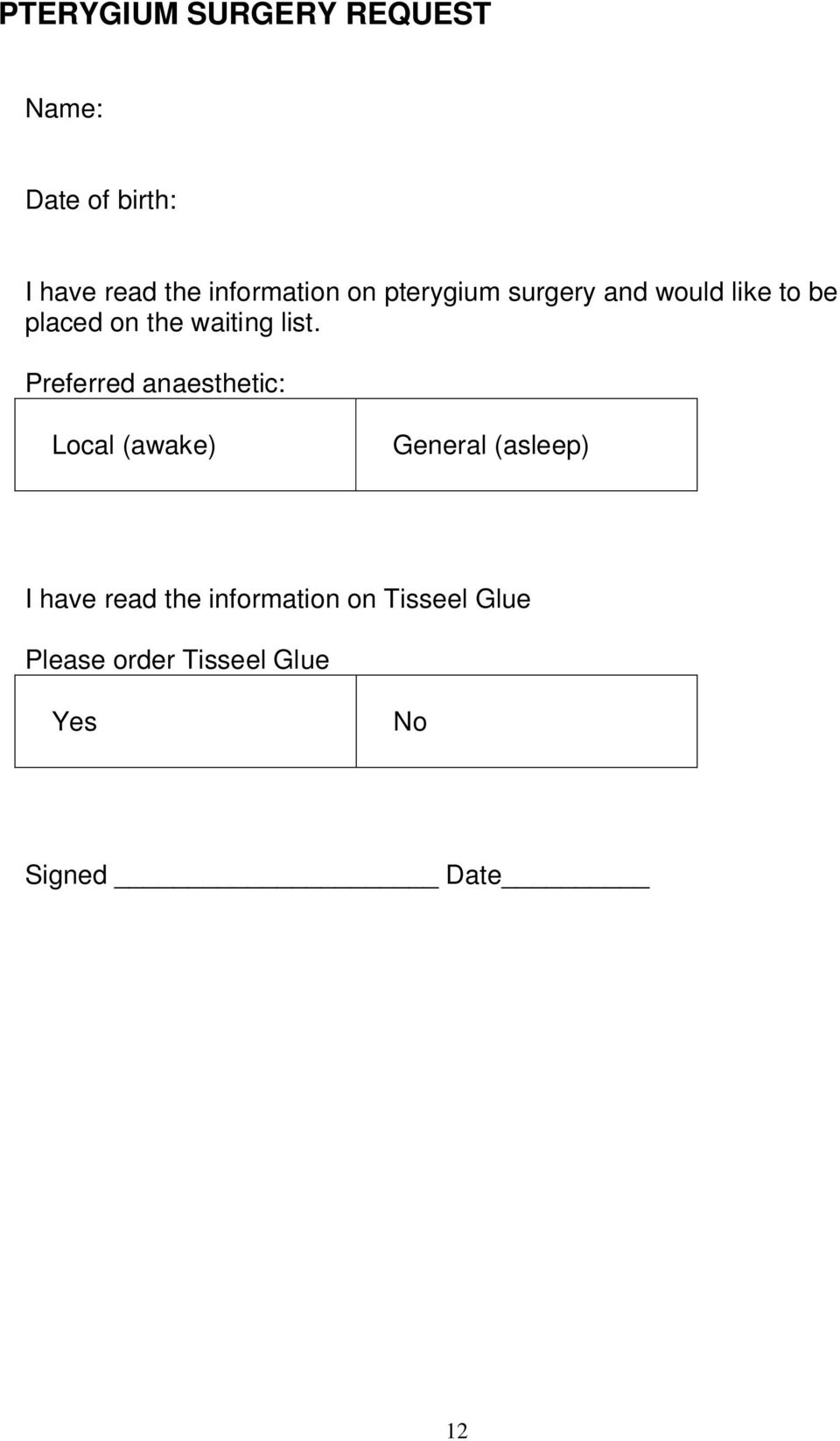
12 PTERYGIUM SURGERY REQUEST Name: Date of birth: I have read the information on pterygium surgery and would like to be placed on the waiting list. Preferred anaesthetic: Local (awake) General (asleep) I have read the information on Tisseel Glue Please order Tisseel Glue Yes No Signed Date 12
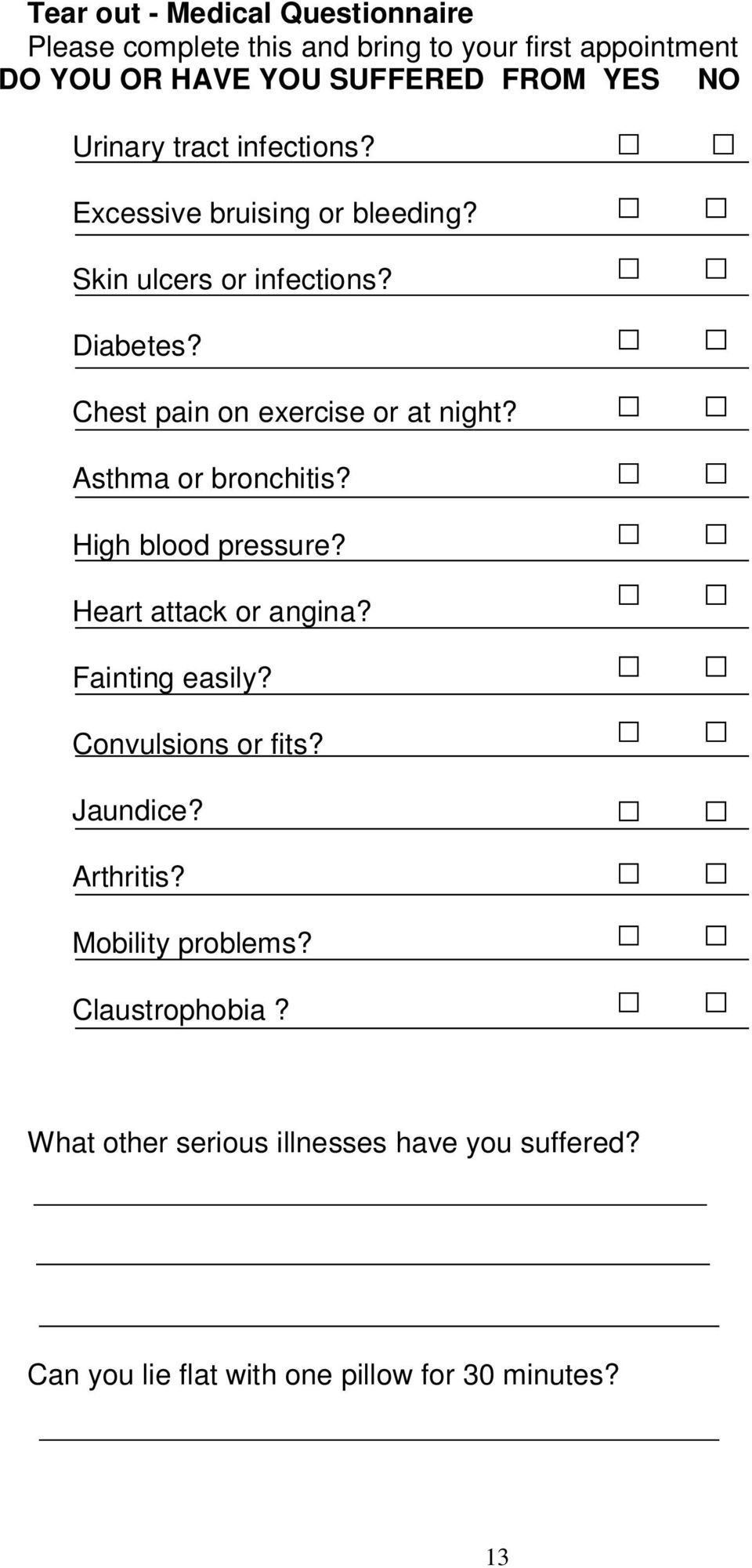
13 Tear out - Medical Questionnaire Please complete this and bring to your first appointment DO YOU OR HAVE YOU SUFFERED FROM YES NO Urinary tract infections? Excessive bruising or bleeding? Skin ulcers or infections? Diabetes? Chest pain on exercise or at night? Asthma or bronchitis? High blood pressure? Heart attack or angina? Fainting easily? Convulsions or fits? Jaundice? Arthritis? Mobility problems? Claustrophobia? What other serious illnesses have you suffered? Can you lie flat with one pillow for 30 minutes? 13
14 What drugs are you taking? What allergies do you have? Thank you for completing this Form. Please remember to bring it to your appointment V1/Ophthalmology/TSDFT/12.15/Review Date

Squints and squint surgery/ophthalmology/sdhcnhsft/ 06.13/Review date 06.15. Squints and Squint Surgery
 Squints and squint surgery/ophthalmology/sdhcnhsft/ 06.13/Review date 06.15 Squints and Squint Surgery Chapter 1 Chapter 2 Chapter 3 Chapter 4 Chapter 5 Chapter 6 Squints and squint surgery Your Outpatient
Squints and Squint Surgery
 Squints and Squint Surgery Chapter 1 Chapter 2 Chapter 3 Chapter 4 Chapter 5 Chapter 6 Squints and squint surgery Your Outpatient appointments Consenting for your operation The day of your operation After
Minor Lid Surgery. Information for patients
 Minor Lid Surgery Information for patients This leaflet has been produced to give you information about the problems you have been having with your eyelid. If you have any questions or require further
Squint surgery in adults
 Patient Information Strabismus service Squint surgery in adults This leaflet aims to answer some of the questions you may have about squint surgery. The leaflet does not cover everything as every patient
Patient Information Cataract surgery
 Patient Information Cataract surgery Introduction This leaflet has been written to help you understand more about surgery for a cataract. It explains what the operation involves, the benefits and risks
Squint Surgery in Children. Patient Information
 Squint Surgery in Children Patient Information Author ID: KW Leaflet Number: Orth 014 Version: 4 Name of Leaflet: Squint Surgery in Children Date Produced: August 2014 Review Date: August 2016 What is
Phaco-endoscopic cyclophotocoagulation (phaco-ecp)
 Ambulatory Care & Local Networks Phaco-endoscopic cyclophotocoagulation (phaco-ecp) Information for patients This leaflet answers some of the questions you may have about combined cataract and keyhole
Local anaesthesia for your eye operation
 Local anaesthesia for your eye operation Information for patients and families. www.anaesthesia.ie 1 This information leaflet is for anyone expecting to have an eye operation with a local anaesthetic.
How to care for your eye after surgery
 Ambulatory Care & Local Networks How to care for your eye after surgery Information for patients attending appointments at King s College Hospital only This leaflet explains what to expect after your eye
Glaucoma filtration surgery (Tube surgery)
 Oxford Eye Hospital Glaucoma filtration surgery (Tube surgery) Information for patients page 2 This leaflet gives you information that will help you decide whether to have glaucoma tube surgery. You might
ADJUSTABLE SQUINT SURGERY
 ADJUSTABLE SQUINT SURGERY Information Leaflet Your Health. Our Priority. Page 2 of 8 Introduction Adjustable squint surgery is an alternative to traditional squint surgery. It has a better success rate
Melbourne Children s Eye Clinic. Strabismus Surgery for Children
 Melbourne Children s Eye Clinic Strabismus Surgery for Children Why operate on turned eyes? Surgery for turned eyes aims to improve the alignment of the eyes, that is, to make the eyes look straight. The
Oxford Eye Hospital. Squint surgery. Information for Adult Patients
 Oxford Eye Hospital Squint surgery Information for Adult Patients This leaflet aims to give you some essential information about the surgery and your stay in hospital. What is a squint? Eye movement is
Understanding cataract. The Eye Service at Barts Health
 Understanding cataract The Eye Service at Barts Health What is a cataract? If your doctor or optometrist/optician has told you that you have a cataract, do not be alarmed. Many people develop cataracts
This booklet has been designed to give you all the information you need to undergo cataract surgery.
 Eye Unit Cataract Surgery: This booklet has been designed to give you all the information you need to undergo cataract surgery. University Hospitals Coventry and Warwickshire is a teaching hospital and
Local anaesthesia for your eye operation
 Local anaesthesia for your eye operation A short guide for patients and families. This is for anyone expecting to have an eye operation with a local anaesthetic. It does not give detailed information about
Cataract Information for Patients
 Cataract Information for Patients http://www.gov.pe.ca/health and click on Wait Times tab Page 1 What is a Cataract? A cataract is a clouding of the eye s naturally clear lens. When the lens becomes cloudy,
Patient information factsheet. Cataract surgery. Consent for cataract surgery
 Patient information factsheet Cataract surgery Consent for cataract surgery This leaflet gives you information that will help you decide whether to have cataract surgery. You might want to discuss it with
Advice for patients following Ocular Plaque Radiation Therapy Patient Information Leaflet
 Advice for patients following Ocular Plaque Radiation Therapy Patient Information Leaflet This leaflet provides you with relevant information regarding your aftercare following ocular plaque radiation
Cataract and Cataract Surgery
 What is a cataract? A cataract is a cloudy area in the lens of your eye. The lens is located just behind the iris (coloured part of the eye). The lens helps to focus light entering the eye to give a clear
Cheekbone (zygoma) and/or eye socket (orbit) fracture surgery
 Ambulatory Care & Local Networks Cheekbone (zygoma) and/or eye socket (orbit) fracture surgery Information for patients You have been treated in the Emergency Department for a broken (fractured) cheekbone
CATARACT SURGERY. Information Leaflet. Stockport NHS Foundation Trust. The Stockport Eye Centre. Your Health. Our Priority.
 CATARACT SURGERY Information Leaflet Stockport NHS Foundation Trust The Stockport Eye Centre Your Health. Our Priority. Page 2 of 11 Introduction You may have been told that you have a cataract and asked
CATARACT SURGERY. Information Leaflet. Your Health. Our Priority.
 CATARACT SURGERY Information Leaflet Your Health. Our Priority. Page 2 of 11 Introduction You are likely to have recently been told that you have a cataract and been referred to the Eye Department at Stockport
Name of procedure: Squint Surgery (Child)
 Eye Surgery Surgical procedure information leaflet Name of procedure: Squint Surgery (Child) This leaflet is for parents whose child has a squint that may be helped by an operation. In this leaflet we
A PATIENT GUIDE TO EYE SURGERY
 A PATIENT GUIDE TO EYE SURGERY RISKS ASSOCIATED WITH SURGERY There is a one in 1000 or less than one percent chance that a cataract surgery patient will experience complications that lead to blindness
Cataract Surgery. Patient Information. Ophthalmology Department
 Cataract Surgery Patient Information Ophthalmology Department Author ID: YL/LC Leaflet Number: Ophth 006 Version: 4.1 Name of Leaflet: Cataract Surgery Date Produced: May 2015 Review Date: May 2017 Cataract
Ptosis. Patient Information - Adnexal
 Patient Information - Adnexal Ptosis What is ptosis? Ptosis is the medical name for the drooping of the upper eyelid, which can happen in one or both eyes. A low upper lid can interfere with vision by
Corneal diseases and corneal transplantation
 Corneal diseases and corneal transplantation Chapter 1 Chapter 2 Chapter 3 Chapter 4 Chapter 5 Chapter 6 Chapter 7 The Cornea and corneal transplantation Consenting to your operation Your pre-assessment
Ruthenium Plaque Treatment
 Information for patients Department of Ophthalmology Royal Hallamshire Hospital Ruthenium Plaque Treatment What is Ruthenium Plaque treatment? This is a treatment whereby a plaque is surgically placed
Information about cataract surgery
 Information about cataract surgery Delivering the best in care UHB is a no smoking Trust To see all of our current patient information leaflets please visit www.uhb.nhs.uk/patient-information-leaflets.htm
Stapedectomy / Stapedotomy / Surgery for Otosclerosis
 Patient information Stapedectomy / Stapedotomy / Surgery for Otosclerosis Ear, Nose and Throat Directorate PIF 230 V6 Your Consultant / Doctor has advised you to have a Stapedectomy / Stapedotomy / Surgery
How To Know If You Can See Without Glasses Or Contact Lense After Lasik
 The LASIK experience I WHO CAN HAVE LASIK? To be eligible for LASIK you should be at least 21 years of age, have healthy eyes and be in good general health. Your vision should not have deteriorated significantly
Information About Your Retinal Detachment Operation
 Information for patients Information About Your Retinal Detachment Operation Please read this booklet carefully. It contains important information to help you plan for your forthcoming operation. Please
Glaucoma filtration surgery (Trabeculectomy)
 Oxford Eye Hospital Glaucoma filtration surgery (Trabeculectomy) Information for patients This leaflet gives you information that will help you decide whether to have glaucoma surgery. You might want to
What should I expect before the procedure?
 The British Association of Urological Surgeons 35-43 Lincoln s Inn Fields London WC2A 3PE Phone: Fax: Website: E- mail: +44 (0)20 7869 6950 +44 (0)20 7404 5048 www.baus.org.uk [email protected] PROCEDURE-
Having a vitrectomy- surgery to
 Having a vitrectomy- surgery to repair your retinal detachment If you need information on audiotape about having a vitrectomy or your hospital visit, please call 020 7188 8815. You have been given this
YOU AND YOUR ANAESTHETIC
 YOU AND YOUR ANAESTHETIC Information Leaflet Your Health. Our Priority. Page 2 of 8 This leaflet aims to answer some of the questions you may have about your anaesthetic and contains fasting instructions.
Descemet s Stripping Endothelial Keratoplasty (DSEK)
 Descemet s Stripping Endothelial Keratoplasty (DSEK) Your doctor has decided that you will benefit from a corneal transplant operation. This handout will explain your options to you. It explains the differences
Stanger Hospital Eye Care Centre.
 Stanger Hospital Eye Care Centre. CATARACT SURGERY YOUR QUESTIONS ANSWERED YOUR QUESTIONS ANSWERED AFTER CATARACT SURGERY You are soon to be admitted to hospital to have your cataract removed. This booklet
Blepharoplasty - Eyelid Surgery
 Blepharoplasty - Eyelid Surgery Introduction Eyelid surgery repairs sagging or drooping eyelids. The surgery is also known as blepharoplasty, or an eyelid lift. Sagging or drooping eyelids happen naturally
SUPRAPUBIC CATHETER INSERTION INFORMATION FOR PATIENTS
 The British Association of Urological Surgeons 35-43 Lincoln s Inn Fields London WC2A 3PE Phone: Fax: Website: E-mail: +44 (0)20 7869 6950 +44 (0)20 7404 5048 www.baus.org.uk [email protected] INFORMATION
Information About Your Day Care Cataract Operation
 Information for patients Information About Your Day Care Cataract Operation Please read this booklet carefully. It contains important information to help you plan for your forthcoming operation. Please
After Your Retina Surgery
 2011 After Your Retina Surgery Eye Care Centre Please bring this booklet to the hospital with you on the day of your operation. After Your Retina Surgery After Surgery... 2 Gas or air injection... 2 Managing
Keyhole (Laparoscopic) Surgery
 Patient Information leaflet Keyhole (Laparoscopic) Surgery Produced by: Department of Obstetrics & Gynaecology December 2002 Reviewed April 2010 1 What is keyhole (laparoscopic) surgery? Laparoscopic surgery
Cataract Surgery. Surgery & Critical Care
 Cataract Surgery Surgery & Critical Care This leaflet has been designed to give you important information about your condition / procedure, and to answer some common queries that you may have. Introduction
Tunnelled indwelling pleural catheter (TIPC)
 Tunnelled indwelling pleural catheter (TIPC) A patient s guide 1 What is a tunnelled indwelling pleural catheter? A tunnelled indwelling pleural catheter is a specially designed small tube to drain fluid
Skin biopsy. Delivering the best in care. UHB is a no smoking Trust
 Skin biopsy Delivering the best in care UHB is a no smoking Trust To see all of our current patient information leaflets please visit www.uhb.nhs.uk/patient-information-leaflets.htm A skin biopsy is a
PROCEDURE- SPECIFIC INFORMATION FOR PATIENTS
 The British Association of Urological Surgeons 35-43 Lincoln s Inn Fields London WC2A 3PE Phone: Fax: Website: E- mail: +44 (0)20 7869 6950 +44 (0)20 7404 5048 www.baus.org.uk [email protected] PROCEDURE-
AMPUTATION OF THE PENIS (PARTIAL OR COMPLETE) FOR CANCER INFORMATION FOR PATIENTS
 The British Association of Urological Surgeons 35-43 Lincoln s Inn Fields London WC2A 3PE Phone: Fax: Website: E-mail: +44 (0)20 7869 6950 +44 (0)20 7404 5048 www.baus.org.uk [email protected] AMPUTATION
Basal Cell Carcinoma Affecting the Eye Your Treatment Explained
 Basal Cell Carcinoma Affecting the Eye Your Treatment Explained Patient Information Introduction This booklet is designed to give you information about having a Basal Cell Carcinoma near your eye and the
St. Louis Eye Care Specialists, LLC Andrew N. Blatt, MD
 St. Louis Eye Care Specialists, LLC Andrew N. Blatt, MD 675 Old Ballas Rd. Suite 220 St. Louis, MO 63141 Phone:314-997-EYES Fax: 314-997-3911 Toll Free: 866-869-3937 STRABISMUS SURGERY (Post-Op Strabismus
NHS. Blackpool Teaching Hospitals. NHS Foundation Trust. What is a Squint? Patient Information Leaflet. Ophthalmic Day Surgical Unit 01253 957420
 Blackpool Teaching Hospitals NHS Foundation Trust NHS What is a Squint? Patient Information Leaflet Ophthalmic Day Surgical Unit 01253 957420 WHAT IS A SQUINT? Six muscles control the movement of the eye.
PROCEDURE- SPECIFIC INFORMATION FOR PATIENTS
 The British Association of Urological Surgeons 35-43 Lincoln s Inn Fields London WC2A 3PE Phone: Fax: Website: E- mail: +44 (0)20 7869 6950 +44 (0)20 7404 5048 www.baus.org.uk [email protected] PROCEDURE-
X-Plain Preparing For Surgery Reference Summary
 X-Plain Preparing For Surgery Reference Summary Introduction More than 25 million surgical procedures are performed each year in the US. This reference summary will help you prepare for surgery. By understanding
YOUR SURGERY SPECIFICS
 YOUR SURGERY SPECIFICS 1. SURGERY Date: Arrival Time: Surgery Time: Location: 8501 Golden Valley Road, Suite 100 763-416-7600 2. POST-OP APPOINTMENTS 1: 2: 3: 3. CONTACT LENS INSTRUCTIONS: Contact lenses
Total knee replacement
 Patient Information to be retained by patient What is a total knee replacement? In a total knee replacement the cartilage surfaces of the thigh bone (femur) and leg bone (tibia) are replaced. The cartilage
Headache after an epidural or spinal injection What you need to know. Patient information Leaflet
 Headache after an epidural or spinal injection What you need to know Patient information Leaflet April 2015 We have produced this leaflet to give you general information about the headache that may develop
Eye Diseases. 1995-2014, The Patient Education Institute, Inc. www.x-plain.com otf30101 Last reviewed: 05/21/2014 1
 Eye Diseases Introduction Some eye problems are minor and fleeting. But some lead to a permanent loss of vision. There are many diseases that can affect the eyes. The symptoms of eye diseases vary widely,
Varicose Veins Operation. Patient information Leaflet
 Varicose Veins Operation Patient information Leaflet 22 nd August 2014 WHAT IS VARICOSE VEIN SURGERY (HIGH LIGATION AND MULTIPLE AVULSIONS) The operation varies from case to case, depending on where the
Level 1, 131-135 Summer Street ORANGE NSW 2800 Ph: 02 63631688 Fax: 02 63631865
 Write questions or notes here: Level 1, 131-135 Summer Street ORANGE NSW 2800 Ph: 02 63631688 Fax: 02 63631865 Document Title: Total Knee Replacement Further Information and Feedback: Tell us how useful
Removal of the Submandibular Salivary Gland
 Department of Oral and Maxillofacial Surgery Removal of the Submandibular Salivary Gland Information for patients This leaflet will help you understand your treatment and should answer many of the questions
Umbilical or Paraumbilical Hernia Adults
 Umbilical or Paraumbilical Hernia Adults WHAT IS AN UMBILICAL OR PARAUMBILICAL HERNIA? 2 THE OPERATION? 2 ANY ALTERNATIVES 3 BEFORE THE OPERATION 3 AFTER YOUR SURGERY - IN HOSPITAL 4 POSSIBLE COMPLICATIONS?
CONSENT FORM. Procedure: Descemet s Stripping Automated Endothelial Keratoplasty (DSAEK)
 CONSENT FORM Procedure: Descemet s Stripping Automated Endothelial Keratoplasty (DSAEK) Surgeon: Jeffrey W. Liu, M.D. Peninsula Laser Eye Medical Group 1174 Castro Street, Ste. 100 Mountain View, CA 94040
Meatoplasty/Canalplasty
 Meatoplasty/Canalplasty What is a meatoplasty/canalplasty and why do I need this operation? This operation is performed to widen your ear canals so that they do not get blocked with wax and debris. It
Keeping Your Eyes Healthy after Treatment for Childhood Cancer
 Keeping Your Eyes Healthy after Treatment for Childhood Cancer High doses of radiation to the brain, eye, or eye socket (orbit) during treatment for childhood cancer can have a long-lasting affect on the
Ulnar Nerve Decompression/Transposition
 Department of Neurosurgery Ulnar Nerve Decompression/Transposition What happens when you are in hospital page 2 Ulnar Nerve Decompression/Transposition This leaflet explains what to expect when you are
Elbow Joint Replacement A guide for patients
 Elbow Joint Replacement A guide for patients GATESHEAD UPPER LIMB UNIT Mr Andreas Hinsche Mr John Harrison Mr Jagannath Chakravarthy Page 1 of 7 The elbow joint The elbow consists of three bones; the humerus
Tunnelled haemodialysis catheter
 Liver, Renal & Surgery Tunnelled haemodialysis catheter Information for patients and carers This leaflet explains what a tunnelled haemodialysis catheter is and how it is put in. It also covers the risks
St. Louis Eye Care Specialists, LLC Andrew N. Blatt, MD
 St. Louis Eye Care Specialists, LLC Andrew N. Blatt, MD 675 Old Ballas Rd. Suite 220 St. Louis, MO 63141 Phone: 314-997-3937 Fax: 314997-3911 Toll Free: 866-869-3937 PEDIACTRIC CATARACT SURGERY A cataract
Laparoscopic cholecystectomy. Golden Jubilee National Hospital NHS National Waiting Times Centre. Patient information guide
 Golden Jubilee National Hospital NHS National Waiting Times Centre Laparoscopic cholecystectomy Patient information guide Agamemnon Street Clydebank, G81 4DY (: 0141 951 5000 www.nhsgoldenjubilee.co.uk
Forefoot deformity correction
 Contact us Pharmacy Medicines Helpline If you have any questions or concerns about your medicines, please speak to the staff caring for you or call our helpline. t: 020 7188 8748 9am to 5pm, Monday to
Hopefully this information will be useful for people with dementia, their families, carers and medical professionals.
 et ision 2020 UK The right to sight ementia and Sight Loss Interest Group Cataracts and dementia Cataracts are a very common eye condition in older people. Most people with cataracts are over the age of
Further information You can get more information and share your experience at www.aboutmyhealth.org
 OS01 Total Hip Replacement Further information You can get more information and share your experience at www.aboutmyhealth.org Local information You can get information locally from: Taunton and Somerset
Total hip replacement
 Patient Information to be retained by patient What is a total hip replacement? In a total hip replacement both the ball (femoral or thigh bone) side of the hip joint and the socket (acetabular or pelvic
Information for people who have an increased risk of Creutzfeldt-Jakob disease (CJD)
 Information for people who have an increased risk of Creutzfeldt-Jakob disease (CJD) There are several types of Creutzfeldt-Jakob disease (CJD). In this leaflet the term CJD covers all types unless a particular
Your spinal Anaesthetic
 Your spinal Anaesthetic Information for patients Your spinal anaesthetic This information leaflet explains what to expect when you have an operation with a spinal anaesthetic. It has been written by patients,
Nick Strouthidis MBBS MD PhD FRCS FRCOphth FRANZCO CONSULTANT OPHTHALMIC SURGEON
 TUBES/SHUNTS TUBES/SHUNTS Implantation of a glaucoma drainage device (GDD - also known as a tube or aqueous shunt) works by diverting aqueous from the front of the eye via a tube to a drainage plate stitched
INFORMED CONSENT FOR LASER IN-SITU KERATOMILEUSIS (LASIK)
 Lasik Center 2445 Broadway Quincy, IL 62301 217-222-8800 INFORMED CONSENT FOR LASER IN-SITU KERATOMILEUSIS (LASIK) INTRODUCTION This information is being provided to you so that you can make an informed
Looking after your wound following skin surgery
 Looking after your wound following skin surgery Exceptional healthcare, personally delivered Introduction You have just undergone an operation, under local anaesthetic, for the removal of a skin lesion.
INFORMED CONSENT FOR PHOTOREFRACTIVE KERATECTOMY (PRK)
 INFORMED CONSENT FOR PHOTOREFRACTIVE KERATECTOMY (PRK) This information and the Patient Information booklet must be reviewed so you can make an informed decision regarding Photorefractive Keratectomy (PRK)
Thyroid Eye Disease. Anatomy: There are 6 muscles that move your eye.
 Thyroid Eye Disease Your doctor thinks you have thyroid orbitopathy. This is an autoimmune condition where your body's immune system is producing factors that stimulate enlargement of the muscles that
ALTERNATIVES TO LASIK
 EYE PHYSICIANS OF NORTH HOUSTON 845 FM 1960 WEST, SUITE 101, Houston, TX 77090 Office: 281 893 1760 Fax: 281 893 4037 INFORMED CONSENT FOR LASER IN-SITU KERATOMILEUSIS (LASIK) INTRODUCTION This information
Excision or Open Biopsy of a Breast Lump Your Operation Explained
 Excision or Open Biopsy of a Breast Lump Your Operation Explained Patient Information Introduction This leaflet tells you about the procedure known as excision or open biopsy of a breast lump. It explains
LASER TREATMENT FOR VARICOSE VEINS
 LASER TREATMENT FOR VARICOSE VEINS How can varicose veins be treated by laser? Laser treatment of varicose veins, Endovascular Laser Ablation (known as EVLA), is a minimally invasive procedure for treating
How To Treat Eye Problems With A Laser
 1550 Oak St., Suite 5 1515 Oak St., St Eugene, OR 97401 Eugene, OR 97401 (541) 687-2110 (541) 344-2010 INFORMED CONSENT FOR PHOTOREFRACTIVE KERATECTOMY (PRK) This information is to help you make an informed
Procedure Information Guide
 Procedure Information Guide Total hip replacement Brought to you in association with EIDO and endorsed by the The Royal College of Surgeons of England Discovery has made every effort to ensure that the
VARICOSE VEINS. Information Leaflet. Your Health. Our Priority. VTE Ambulatory Clinic Stepping Hill Hospital
 VARICOSE VEINS Information Leaflet Your Health. Our Priority. Page 2 of 7 Varicose Veins There are no accurate figures for the number of people with varicose veins. Some studies suggest that 3 in 100 people
Adult Squint Surgery. Information for patients. Orthoptic Department Tel: 01473 703663
 Information for patients Adult Squint Surgery Orthoptic Department Tel: 01473 703663 DPS ref: 00280-15(RP) Issue 6: February 2015 Review date: January 2018 The Ipswich Hospital NHS Trust, 2004-2015. All
The Children s Hospital Treatment for Hypospadias Information for parents
 The Children s Hospital Treatment for Hypospadias Information for parents What is hypospadias and what is the cause? Hypospadias is a congenital (since birth) abnormality of a boy s penis. Hypospadias
Secondary liver cancer Patient Information Booklet
 Secondary liver cancer Patient Information Booklet Delivering the best in care UHB is a no smoking Trust To see all of our current patient information leaflets please visit www.uhb.nhs.uk/patient-information-leaflets.htm
Flexible sigmoidoscopy the procedure explained Please bring this booklet with you
 Flexible sigmoidoscopy the procedure explained Please bring this booklet with you Exceptional healthcare, personally delivered Introduction You have been advised by your GP or hospital doctor to have an
Eye Injuries. The Eyes The eyes are sophisticated organs. They collect light and focus it on the back of the eye, allowing us to see.
 Eye Injuries Introduction The design of your face helps protect your eyes from injury. But injuries can still damage your eyes. Sometimes injuries are severe enough that you could lose your vision. Most
CATARACT SURGERY. Date of Surgery QHC# 63
 CATARACT SURGERY Date of Surgery QHC# 63 TABLE OF CONTENTS What is a Cataract?... 3 What Happens During Cataract Surgery?... 4 General Preoperative Instructions... 5 Instilling Eye Drops... 6 Preoperative
Colon Cancer Surgery and Recovery. A Guide for Patients and Families
 Colon Cancer Surgery and Recovery A Guide for Patients and Families This Booklet You are receiving this booklet because you will be having surgery shortly. This booklet tells you what to do before, during,
Your admission for day surgery
 Royal Berkshire NHS Foundation Trust London Road Reading Berkshire RG1 5AN 0118 322 5111 (switchboard) West Berkshire Community Hospital London Road, Benham Hill Thatcham Berkshire RG18 3AS 01635 273300
Ankle Stabilisation Procedure
 Ankle Stabilisation Procedure Exceptional healthcare, personally delivered Following your consultation with a member of the Foot and Ankle team you have been diagnosed with an unstable ankle. This leaflet