
A study of attitudes towards beer products in Bangkok
|
|
|
- Abraham Underwood
- 9 years ago
- Views:
Transcription
1 Master Thesis in Business Studies (EFO705, 15 Credits) Date June 2 nd, 2009 A study of attitudes towards beer products in Bangkok Tutor: Joakim Netz Authors: Group : Nattakarn Ramasut : Suteera Saranpattranon
2 Abstract Date: Program: International Marketing Authors: Nattakarn Ramasut & Suteera Saranpattranon Title: A study of attitudes towards beer products in Bangkok Problem: What are attitudes towards beer of Thai consumers at different demographic characteristics? Purpose: The authors study different in demographic features affect consumer s attitudes towards beer products. Due to attitudes are opinions or feeling and evaluation of knowledge towards the products. While demographic features play an important role in understanding the consumers need and influences to the consumers thinking. The result of this research will be truly helpful for marketer to adapt their strategy to response consumers need in different target group suitably. Method: The theories of demographic features and attitude components are chosen to study at different consumer groups towards beer products at 395 sample size in Bangkok. Conclusion: The diversifications of gender and income levels have different attitudes towards beer product. But at different age, occupation, and education have no different attitudes towards beer product. Recommendation: Manufacturers should focus on female as new target group and also adapt the product to the right requirement of consumer to persuade people to consume the product. Keywords: beer, demographic, attitude
3 Table of Contents 1. Introduction Background of beer market in Thailand The current situation and beer market in Thailand Problem statement and Research question Related researches Purpose Target audience Theoretical Reviews Demographic Attitude The conceptual framework model Methodology The choice of topic The chosen theories Collecting data Sample design Questionnaire design Scope of research Validity and Reliability Data analysis Analysis Research results Demographic data of the respondents Consuming habits of the respondents Attitudes of the respondents towards beer products Measure reliability Hypotheses test Discussion and Conclusion Recommendation References Appendixes...44 Appendix 1: Questionnaire in English...44 Appendix 2: Questionnaire in Thai...47 Appendix 3: Mean value of the respondents cognitive towards beer products with different background...50 Appendix 4: Mean value of the respondents affective towards beer products with different background...51 Appendix 5: Mean value of the respondents behavioral towards beer products with different background...52

4 Appendix 6: Reliability analysis (Cronbach s alpha) - Cognitive component...53 Appendix 7: Reliability analysis (Cronbach s alpha) - Affective component...53 Appendix 8: Reliability analysis (Cronbach s alpha) - Behavioral component...53 Appendix 9: T-test on mean difference between gender and three components of attitude...54 Appendix 10: ANOVA test on mean difference between each age and three components of attitude...54 Appendix 11: ANOVA test on mean difference between occupations and three components of attitude...54 Appendix 12: ANOVA test on mean difference between income and three components of attitude...55 Appendix 13: Comparison Mean Difference of the respondents attitudes at different income...55 Appendix 14: One-way ANOVA on mean difference between education and three components of attitude...56

5 List of Tables Table 1: Situation of Thai beer industry in Table 2: Summary the related researches on demographic features and consuming habits.6 Table 3: Five point Likert Scale Table 4: The structure of questionnaire Table 5: Personal data of the respondents in this survey Table 6: Beer consuming behavior of the respondents in this survey Table 7: Average scores of attitudes towards beer products with different background Table 8: Conbach s Alpha Test on three components of attitude towards beer products Table 9: Comparison between this research and others in the demographic data of respondents Table 10: Comparison between this research and other researches in the consuming habits data of respondents Table 11: Comparison between this research and other researches in overall attitudes towards beer products of the respondents Table 12: Comparison between different in demographic features and three components of attitude List of Figures Figure 1: Three components of attitude model (Wells & Prensky, 1996) Figure 2: A diagram of consistency of three components of attitude Figure 3: The conceptual model (The authors model)... 14
6 1. Introduction This part provides background and the current situation of beer market in Thailand. Also, the problem statement, research questions, purpose, and target audience. This aims to make the readers understand a comprehensive idea of this research. 1.1 Background of beer market in Thailand Since 1993 beer industry in Thailand was begun and has continually operated over 75 years ago. Before 1992, beer industry in Thailand was monopoly market characteristic which was occupied by only two beer manufacturers as Boon Rawd Brewery Co., Ltd. and Thai Amarit Brewery Co., Ltd. In addition, Thai government did not encourage in increasing of beer manufacturer because beer is a luxurious goods. Therefore, the tariff wall was set in order to protect the domestic beer manufacturers (Chumnanwej, 2001 and Wasrisrit, 2006). Theparwut (1998) said that at the beginning, the business in Thailand executed by Thai principle must be barely preserved for Thai citizenship as a holder. After Thai government campaigned on free market in 1992, the holder of the business was adapted to allow Thai corporation to be principle shareholder. Also, it is motivate foreign investors to invest in Thailand. At that time, there are two foreign beer companies interested in establishment beer plant in Thailand such as Thai Asia Pacific Brewery Co., Ltd. and Carlsberg Brewery (Thailand) Co., Ltd. Moreover, beer companies also get good opportunities to import its products easier (Thailand Development Research Institute, 2005). Since 1992, high competition in Thai beer market among the following large five domestic beer manufacturers group were happened; Boon Rawd Brewery Co., Ltd. produces Singha brand; Thai Amarit Brewery Co., Ltd. produces Kloster which was bought business by San Miguel in 2004; Carlsberg Brewery Co., Ltd. produces Carlsberg brand; Thai Beverage Public Co., Ltd. produces Chang brand and Thai Asia Pacific Brewery Co., Ltd. produces Heineken brand. Also, other brands were imported and brew pubs, for example, President Park Property Co., Ltd., Professional Food and Beverage Co., Ltd and so on (Thailand Development Research Institute, 2005). 1
7 In order to beat the competitor in the market, beer manufacturers were trying to differentiate their product. They had set pricing level different in each beer segment. According to Prasad (2004) and Pecotich & Shultz (2006) reported that Thai beer market has clearly segmented on the basis of pricing. It comprises of three consumption patterns: economy, standard and premium as follow; Premium refers to beer brands at the top end of the market with sales volume at approximately 6.8 percent of the total beer market (Positioning Magazine, 2007). The examples of the premium brands are Heineken, Asahi, San Miguel, and other imported brands. Premium beer is higher price than standard beer and economy beer at price baht per 640 ml. (Prachachart, 2009). They target the consumers who have high income and want to be accepted by society (Wasrisrit, 2006). Standard refers to beer is focused on selling to consumers with average income. Mostly, it has an alcohol level more than premium beer but lower than economy beer at price baht per 640 ml. (Wasrisrit 2006 and Prachachart 2009). Sale volume is only approximately 10 percent of the total Thai beer market. The examples of the standard brands are Singha, Tiger, and Chang lights (Positioning Magazine, 2007). Economy refers to beer is lowest price of all segments because it was produced by lower quality of material and higher an alcohol level than two segments above. It is focused on selling to consumers who want strongly alcohol level and have low income at price baht per 640 ml. (Wasrisrit 2006 and Prachachart 2009). This category of beer represents 83.2 percent of the total beer market in the country. The examples of economy brands are Chang, Leo, and Archa (Positioning Magazine, 2007). 1.2 The current situation and beer market in Thailand With the domestic beer market value in Thailand continually increased of since from 83,887 million baht to 115,000 million baht, which can attract more new comers enter to invest. As a result, Thai beer consumers have lots of choices and also it affects extremely competition in the market. The averages of beer production volume in Thailand were more than 2,000 million liters per year since which increased from 1,600 million liters during From the domestic demand for beer consumption increased and substituted for alcohol consumption because alcohol is higher 2

8 price (Chavasiri, 2008). Also, today Thai consumers prefer to drink low alcohol like beer (Pengsuwan, 2005). However, in found that Thai beer industry tends to slightly decelerate from the change rate of the domestic market value from 5.3% to 3% and the production volume from 7.5% to -0.1% as shown in Table 1 below. With the result from higher living cost and political unrest were happened. As a result, people reduced unnecessary expenses like beer is luxurious goods (National Food Institute Thailand, 2008). Table 1: Situation of Thai beer industry in Year Domestic Market Value 83,887 87, , , ,000 (Million baht) Chang Rate (%) Production Volume 1,632 1,695 2,011 2,161 2,160 (Million liters) Chang Rate (%) Source: National Food Institute Thailand (2008) In addition, Siamturakij (2008) reported that the overall beer market has grown only 6 percent in There is only economy segment was grown while the growths of premium and standard segment has shrink 10 percent and 5 percent respectively. Therefore, trend of beer industry is expected to continually slow down because of the domestic economic crisis of Thailand. Thai beer consumers have more aware of impact from economic slowdown so they are concern about making their shopping. It cause purchasing powers reduced. Also, Thai beer consumers were changed from drinking at the restaurant or pub to buying from minimart to stay at home. As a result, beer manufacturers are trying to adapt their market strategies in order to response the consumers need, also to increase sales and market share. This is challenge to beer manufacturers as how they can adapt their marketing plan in the different target groups (Thannews, 2008). 3

9 1.3 Problem statement and Research question As the problems mentioned above, beer is seen as a luxurious goods along with the period of economic crisis in Thailand which will be an obstacle for beer manufacturers to successfully increase sales in Thai market. As a result, Thai consumers purchasing powers decreased. Therefore, beer manufacturers should focus on Thais consuming habits and attitudes towards beer products. According to Chavasiri (2008) stated that individual factors affect drinking beer of consumers. Understanding the consumers needs is important, marketers have to investigate and analyze consumer backgrounds and behaviors since these factors are influenced on their way of thinking, emotion, and decision making (Thach & Olson, 2004). Blackwell, Miniard & Engel (2006) supported that the effect of individual variables are important to understanding consumer behavior and developing marketing plans. Therefore, changing in demographic features such as nationality, age, religion, gender, occupation, marital status, income, region, ethnicity and education will affect individuals attitudes, lifestyles, purchasing behavior and motivation (Mowen & Minor, 2001, p.286). Attitudes include three components (cognitive, affective, and behavioral) which are not easy to change, the consumers are likely to buy the product when they have positive attitude so attitudes is an importance factor to be accurate predictor of consumer behavior (Well & Prensky, 1996). In addition, Limrat (1998) studied consumers attitudes towards beer image because the relationship of beer image affects consumers purchasing decision. This study found that different in gender, age, education, and income affect consumers attitudes towards image of beer image. This study made deeper understanding the consumers thinking, feeling, and opinion. Therefore, the authors will study beer consumers attitude towards beer products at individual features in order to a better understanding about opinion and need towards beer product of Thai consumers. The research question and strategic question are formulated as follow; Research question: What are attitudes towards beer of Thai consumers at different demographic features? Strategic question is: How can marketers adapt the marketing plan to the right target group? 4
10 1.4 Related researches There are some previous researches carried out about beer products or related this research. This found that these researches will be basic of this research in order to give the clear idea about the topic that the authors have been concluded as Table 2. The studies from all researchers in Table 2 show the difference of demographic features of beer consumers were analyzed to study behaviors and attitudes towards beer products. Almost all consumers are male in Thai beer market. Main consumers are young (younger than 30). However, there some against result show that main consumers are older than 30. The consumers income in all researches is low at 5,000-10,000 baht (lower than 10,000 baht). These results show that main consumers are staff in private company. Lastly, the education of main consumers is high at bachelor s degree (higher than high school). The majority of consuming frequencies are once a week. The most popular place to drink is the restaurant and buy is at restaurant and department store with spending not more than 400 baht per time. The main reason for consuming is special events. The most popular brands are Singha, Leo and Heineken because they prefer the taste of beer. TV ads are the most popular. In addition, the results of these previous researches show that different in gender, age, income, education, and occupation affects consumers behavior and attitudes. However, there are some contradict results show that different in gender, education, and income not affects. From these studies below, it is the study of attitudes and behaviors of beer consumers by analysis the personal characteristics of personal and the general beer consuming behavior. Therefore, it can be concluded that difference in demographic features results in difference in attitudes and consuming behavior of beer consumers. 5
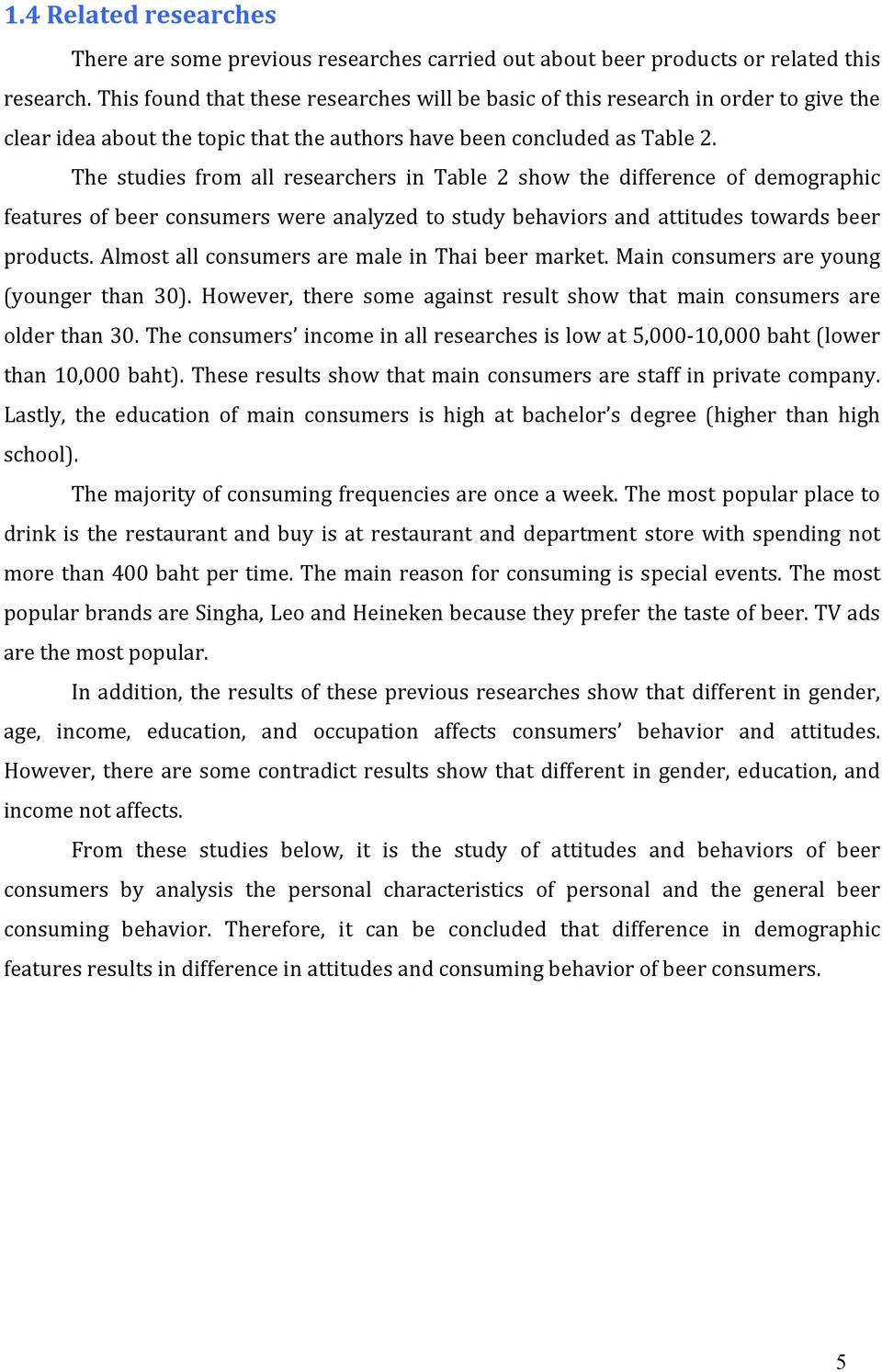
11 Table 2: Summary the related researches on demographic features and consuming habits Author/Theory Research Design/ Data Collection Sample size Results of the study Limrat D. (1998)/ Attitudes towards beer image of consumer in Bangkok Questionnaire Distribution, Sample Random Sampling 300 male and 100 female samples in department stores in Bangkok - Most of samples are male aged year old. - Graduated in bachelor s degree. - Most of them are staff in private company with income 10,001-20,000 baht per month. - Beer is popular drink of Thais in special occasions. - Consumers preferred to drink beer at restaurant after finished working. - TV ads is the most popular and success in advertising. - Most of them specific beer brands such as Singha and Heineken because of taste. -Different in gender, age, education, and income affect consumers attitudes towards image of Thai beer, Foreign beer produced and imported into Thailand. Puttitanasal W. (2000)/ Consumer Behavior of Beer Product in Bangkok Questionnaire Distribution, Convenience Sampling from Department Store 200 persons in Bangkok - Most of samples are male aged years. - Staff in private enterprises with salary 5,000-10,000 baht/month. - Graduated in bachelor s degree. - Most of sample consumed beer once a week. - The most important factor affecting beer drinking is its taste. - They preferred to consume beer at restaurant with average spending less than 200 baht per time per person. - Price discounting and television ads affect their purchasing decision. - Difference in gender and income influence on selection beer brands but age, occupation and education factors not influence. Maneenart A. (2003)/ Factors Influencing Beer Consumption Behavior of Women ages working in Bangkok Questionnaire Distribution, Simple Random Sampling 400 women ages working in Bangkok - Most of sample age years old. - Main occupation is staff in private company. - Graduated in bachelor s degree. - They consumed beer scarcely with spending lower than baht. - The reason for drinking beer is special event. - They preferred to buy and drink beer at pub. - The factors affecting their drinking are taste. - TV ads affect their decision making most. Chanapai A. (2003)/ Beer Buying Influence Factors of Consumer in Anphur Mueang, Suphanburi Province Questionnaire Distribution, Sample Random Sampling 300 persons in Suphanburi Province - Most of samples are single-male aged years. - Staff in private company with salary 5,001-10,000 baht/month. - Graduated in Bachelor s degree. - The most important factor affect on buying beer is taste of beer - At different income and education concerns different product factors. - At different gender and income concerns different price factors. - At different age concerns different promotion factors. 6
12 Boonkoum A. (2005) / Consumers Behaviors And Factors Affecting Beer Selections At Restaurants in Amphur Mueang, Suphanburi Choosil W., Nugdontree S., Dumri T., & Poonthong P. (2007)/ Consumption Behavior of Beer Consumer in Pitsanulok Area Sukklom P. (2007)/ Factors Influencing Beer Purchasing at Tesco Lotus in Bangkok Metropolitan Areas Chavasiri T. (2008)/ Factors Affecting Consumer Demand for Beer in Hat Yai, Songkha Province Source: Developed for the research Questionnaire Distribution, Descriptive method Questionnaire Distribution, Simple Random Sampling Questionnaire Distribution Questionnaire Distribution 400 samples in Suphanburi Province 397 respondents in Pisanulok Province 400 customers who shop in liquor department at Tesco Lotus in Bangkok 400 respondents live in Hat Yai - Most consumers are male aged years old. - Graduated from primary school. - Main occupation is public officer. - The most favorite beer brand is Leo. - They consumed 4-5 times per month. - The average is 3 bottles per time per person with spending baht. - The reason for choose the restaurant are reasonable price, serving car park area, and advertising on the TV. - Main consumers are male 73.3 %. - Most of sample age years old %. - Main education level at bachelor s degree % - Main occupation is student %. - Income is lower than 4,000 baht %. - Consumers preferred to buy Singha because of taste. - They bought beer once a month and 1-3 bottles per time. - They preferred to buy beer with large packaging because of easy to find at store. - The factors affecting their purchasing selection are; Strongly satisfaction i.e. price, quality, and famous; Satisfaction i.e. socialization, taste, the variety of channel, and advertisement; and Neutral i.e. sale service. - Consumer behavior of male and female are not different. - Majority of samples are single-male aged between years old. - Graduated in bachelor s degree. - They have occupation as private or public company employees - With monthly income of 10,000-20,000 baht. - Most of samples preferred drinking beer occasionally such as party and celebration. - Consumption frequency is once week. - They preferred to drink rely on taste and brand priority is Leo. - They often purchase beer at department store with a quantity of 2-3 cans or bottle per visit. - The genders of sample group are male more than female. - Most of them aged year old while the least of them aged 50 year old up. - Their educations are most in bachelor s degree level while the least are in master s degree or higher level. - Most of them have income 5,001-10,000 baht per month. - They preferred to consume beer at home or private place because they could drink in high volume. - Most of them drink 1 big size bottle at once time. - The factors of gender, age, and education level have relationship to quantity of beer demand. 7

13 1.5 Purpose From the related researches above, the authors found that demographic factors affect beer consumers behaviors. Therefore, the purpose of this study is to explore attitudes towards beer products in different demographic features i.e. gender, age, education, occupation, and income. As they play an important role in understanding the consumer need and influences to the consumers thinking and opinion (Well & Prensky, 1996). In addition, the authors aim to study attitudes consist of three components (cognitive, affective, and behavioral). The reason the authors emphasize consumer s attitudes because attitudes are opinions or feeling caused and evaluation of knowledge towards the products (Well & Prensky, 1996). Consumers attitude is easier to change than consumers belief. Besides, background characteristic is one of the factors which influence the behavioral process. Marketer must be interested in this process since they can launch marketing activity to cause the consumers to have positive cognitive (knowledge/beliefs), affective (feelings/emotions) toward their brand, and making decision to buy the product or behavioral (intention) (Wu, 2003, p. 37). This could provide deeper understanding of consumers need and opinion towards beer products in Thailand. The result of this research will be truly helpful for marketer to adapt their strategy in order to response consumers need in different target group suitably. 1.6 Target audience The outcome of this research can be beneficial for the exiting manufactures in beer market as well as new comers in the market, which are interested in understanding Thai beer consumers attitudes. This research will help them in adapting their marketing strategy to match with customers needs. In addition, the authors also believe that our Master thesis will be useful for academic audience such as scholars and marketing students who are interested in improving their knowledge about the chosen topic. This target group might find our work useful to deepen the familiarity with this issue, and use the paper as a starting point for further related studies. 8

14 2. Theoretical Reviews This part presents the relevant theories aimed to give a theoretical background of keywords; demographic and attitude. Therefore, the conceptual framework model uses to be research s analytical tools in the efficient way. 2.1 Demographic Demographics describe the characteristic of groups of people by studying their gender, age, marital status and so on (Evans, Jamal, & Foxall, 2006, p.106). Mowen & Minor (2oo1, p.286) stated that demographic features describe the characteristics of population which demographic variables have been used to identify by nationality, age, gender, occupation, marital status, income, region, ethnicity and education in order to study behavior patterns. However, the demographic is consumer s own personal variable which influences the decision making by assembling the choice to buy and to use the products and service (Blackwell, Miniard & Engal, 2006, p.236). In aspect of marketing view, change in these variables have influence consumers attitudes and buying patterns as the potential market segment possessing different needs for products and services (Mowen & Minor, 2001, p.286). Understanding the customers demographic is one of the efficient tools for marketer to response their specific requirement. Marketers can use demographic to build attitude toward their brand as new experiences, new sensations, and new satisfactions for customer in order to be different from other competitors in the market (Maxim, 1996, p.1). In accordance, Wells & Prensky (1996, p.130) claimed that demographic characteristic provide the stimulus toward the tangible and intangible change about the consumers way of think, feeling, and acting. Wells & Prensky (1996, p.187) stated that the background characteristic can influence attitude. Also, Wu (2003) supported that the demographics are consumer background characteristics, which is the way of individuals describe themselves. These characteristics are stable aspects of a consumer s life that can be not changed. Therefore, it is combined the influence factors of attitude. The demographics in this report can be categorized as the following: 9

15 1. Gender is an individual factor that affects consuming beer. It will be variable in order to predict alcohol consumption behaviour (Putthangguranon, 2001). Men and women have different needs and wants. Many studies show that women differ from men in behavioural process. Staring with reading and viewing of media, response to the message they get, evaluating of products and services, and decision making (Wells & Prensky, 1996, pp ). Midanik et al. (1994, p.1221) reported the correlation between demographic and attitude toward beer consumption by investigating Americans. They found that gender influence the frequency of beer drinking. Men drink more than women per week. Moreover, Suggs (1996) reported, in Botswana men and women have difference way of drinking attitude. Men believe that drinking is the right associated with their gender while women believe that drinking is privilege they must earn. Today women make or greatly influence most purchasing decisions. Many companies need to concern their attitudes, for instance, the Westin hotel chain has developed strong marketing relationship with women by conveying respectful attitude in the restaurants by asking the women to taste wine (Peter & Olson, 2005, p.335). It can be implied gender correlate and influence attitude toward products or services. 2. Age is an individual factor that affects consumers purchasing decision and beer consumption behaviour (Dowdall & Wechsler, 2002). If the consumer s age changes, the consumer s behavioural process and purchasing decision are change too. Age can also be used to segment the market for special product and service (Wells & Prensky, 1996, p. 136). According to Blackwell, Miniard & Engal (2006, p.238), understanding consumers needs in marketing analysis is related to age. For instance, group between ages 25 and 34 prefer to drink standard domestic beer drinkers whereas 35 to 44 yearold choose light beer (Bennett, 2002, p.31). Older people drink more than younger people (Midanik et al., 1994, p.1221). 3. Income, at different income levels tends to have quite different behaviors, attitudes, and lifestyles (Peter & Olson, 2005, p.336). This factor influences the willingness to pay. Consumers are primarily segmented by personal income since it affects the customers confident to pay for luxury products. Personal income divides the market as upper (premium) market and lower market. This factor also related to the place they buy the product. Wells & Prensky (1996, p.151) claimed that income affects the types and brands of products which consumers can afford and are purchased. Moreover, personal income can help the marketer to select the appropriate media to 10

16 reach the targeted consumers (Evans, Jamal, & Foxall, 2006, p.125). The upper market consumers buy products at upscale shopping centres. In contrast, lower income consumers emphasize on reasonable price and discounts. (Blackwell, Miniard & Engal, 2006, p.258). 4. Education affects drinking beer which at different occupation make different in using alcoholic beverage, cigarette and drug (Dowdall & Wechsler, 2002). It also affects the choice alternative to purchase the product which consumer gathering during prepurchasing process (Blackwell, Miniard & Engal, 2006, p.111). 5. Occupation affects beer buying decision of consumers (Putthangguranon, 2001). It can be predicted the nature of attitudes (McFayden, 1998). Besides, occupation and circumstances influence consumption patterns. For educational achievement is another variable that explain purchasing decisions and is closely associated with occupation and economic circumstance (Michman, Mazze & Greco 2003, p. 9). According to Wells & Prensky (1996, p.151) claimed that education and occupation might affect the consumer behavior process of evaluating and choosing of products. For instance, the working class will choose products based on function and comfort rather than what is trendy, also most of them will not take risks to try new products. These factors are related to personal income since both education and employment connected to one s social class. Wells & Prensky (1996) referred to social class as one s position in the social and economic structures of a society which is based on criteria of income, education and occupation. Level of education, occupation and income connected to social class that is useful to investigate consumers belief and behavior pattern (Peter & Olson, 2005, p.340). Michman, Mazze & Greco (2003, p. 9) mentioned it is better determinant to define social class than income, which should include education and occupation. Therefore, it can be implied in different social class (include income, education, and occupation) result in different consumers attitudes toward products or services. As mentioned above, gender, age, education, personal income, and employment status influence the attitude of drinking. These are the factors which consumers use to choose their beer preference to express their attitude in society (Bennett, 2002, p.31). Therefore, the more marketers understand the consumer demographics, the more they can build the attitude to their brand in order to response the specific requirements of consumers. In addition, Thach & Olson (2004) supported that it has made more sense to 11

17 target demographic population for starting of marketing plan to know the certain requirements. Mayers, Gore, & Liu (2008) cited that demographics of customer should be used to segment the market. Manufacturers can predict the different consumption and launch the new different products to serve the specific market niches. 2.2 Attitude What is attitude? According to Wells & Prensky (1996, p.313) attitude is an individual decision that is dependent on their feelings and opinions. In each day, consumers have hundred of decisions on activities such as what to wear, what to eat, where to study and so on. These decisions made based on feelings and opinions are called attitude. Individuals use attitude in many of ways to evaluate alternative base on their knowledge. Kotler et al. (1996, p.288) stated that attitudes are difficult to change so the marketer should try to offer its product fit to the exiting attitude rather than try to change attitude. In contrast, Blackwell, Miniard & E ngal (2006, p.397) mentioned that some attitude are keen to change but other are hard to change therefore, the marketer want the consumer stick to their brand in order to stand the competitive attack from the other rivals in the market. Consumer s attitudes are opinions or feelings caused an evaluation of knowledge towards the products or services, they are likely to buy the product when they have positive attitude so attitudes are importance (Wells & Prensky, 1996, pp ). Beside, Peter & Olson (2008, p.132) mention that consumers can have attitudes about physical and social objects (e.g. products, brands, model, people), and also about intangible objects (e.g. concepts, ideas, price). Some attitude concepts are defined in term of a particular behavior and situation context. According to Wells & Prensky (1996, pp ) an attitude consist of three components as follows; 12

18 Figure 1: Three components of attitude model (Wells & Prensky, 1996) Cognitive is an individual belief about special attributes or overall object. Typically, the belief of object s attributes and benefits its offers based on consumer s own experiences and information that were gathered from marketers and other consumers product (Wells & Prensky, 1996, pp ). Evans, Jamal, & Foxall (2006, p.67) mentioned that beliefs need not be correct or mismatch in reality. Many beliefs about attributes are evaluative in nature. The more positive each belief is easier for the individual to retrieve or recall the beliefs. The cognitive component would occur only in very high-involvement purchase situations as consumers have been deliberate evaluated through attitudes (Wells & Prensky, 1996, pp ). Affective is an individual s feelings or emotions towards an object as evaluation of the product in positive or negative way (Evans, Jamal, & Foxall, 2006, p.67). Since products are evaluated in the context of a specific situation as a consumer s affective response to a product may change as the situation changes. For example, a consumer may believe that Diet Coke had caffeine, which caffeine will keep them awake. It could be positive feeling if they need it, or, negative feeling if not. Individuals differ in their affective reactions to product characteristics. The same individuals will different react to the same attributes or outcomes in different situations due to unique motivation and personalities, past experience, and reference group (Wells & Prensky, 1996, pp ). Behavioral is one s of tendency to respond in a certain manner toward an object. The decisions to purchase or not purchase, to recommend to friends would occur in the behavioral component. An individual s intention to act in some way before buying the product to satisfy their needs. However, Evans, Jamal, & Foxall (2006, p.68) supported 13

19 that this process is consist of how individual response based on what they belief (cognitive) and how they feel (affective) about the product. Figure 2: A diagram of consistency of three components of attitude (Wells & Prensky, 1996) According to Figure 2, all three attitude components tend to be consistent with each other. It means change in one attitude component affect to changes in the other components. This tendency is the basic for a significant amount of marketing strategy. As discussion above, the key factors of this report are demographic and attitude in order to see how the individual factor influence the attitude toward beer products in Bangkok. Therefore, attitude component is needed to evaluate as the attitude process to see how well the product meet the consumers need and aspects. 2.3 The conceptual framework model Figure 3: The conceptual model (The authors model) The authors will adopt the relevant theories for the conceptual framework model to match with the problem and purpose of this research. As Figure 3 illustrates the theories review can be summarized as the model that will be used in the research and will describe the interrelation between five demographic characteristics on consumers attitude components which consist of cognitive, affective, and behavioral. 14

20 This research will focus on the individual elements which influence the customer s attitude. These influences came from inside individual consisting of demographic, which cause consumers to have different beliefs, preference, taste and the way of thinking (Orth et al., 2004). The authors will look into motivational factors that stimulate the consumers to get the information, think, and buy beers to satisfy their need. As discussed in literature review, demographic will focus on gender, age, personal income, education and occupation. Wells & Prensky (1996, p. 187) reported that demographics are influence attitude, therefore, understanding the factors which affect the consumers background and feeling toward the product may predict the consumers acting in pre-purchase process. Wu (2003, p. 37) stated that consumers attitude is easier to change than consumers belief. Besides, background characteristic is one of the factors which influence the behavioral process. Marketer must be interested in this process since they can launch marketing activity to cause the consumers to have positive cognitive (beliefs), affective (feelings/emotions) toward their brand, and making decision to buy the product or behavioral (intention). Changing in demographic characteristics will affect individual s attitudes, purchasing behavior and lifestyles. It could be said that the difference in demographics results the difference in attitudes and consuming behavior of beer drinkers towards beer (Mowen & Minor, 2001). The authors will analyze beer drinkers demographic in Bangkok to answer research questions by seeing how gender, age, personal income, education and employment affect each step of attitude (cognitive, affective, and behavioral), with the hypothesis as following; H 1 : Genders have mean difference with attitude components towards beer products. H 2 : Age has mean difference with attitude components towards beer products. H 3 : Occupations have mean difference with attitude components towards beer products. H 4 : Income has mean difference with attitude components towards beer products. H 5 : Education has mean difference with attitude components towards beer products. 15

21 3. Methodology This part is description of how the whole research will be conducted. Firstly, it start by giving a brief description of the topic followed the chosen theory and collecting data. Finally, the analysis of information will be provided to the reader. 3.1 The choice of topic Peter & Olson (2008) suggest that the marketer need to know what the consumers think, feel, and action as well as what causes them to act in order to response their need. So the authors realized that understanding to consumers attitude is importance. Since the authors are Thai students and interested in the research about Thai consumers attitudes which is familiar to us and easier for us to understand. Therefore, the authors agreed to work on three components of attitude along with demographic features that influence the consumer s purchasing and consuming of Thai consumers. At the later stage, the authors searched for more information about the problem in beer market and the rate of growth in Thailand. The authors found the literature researches have studied about the importance of demographic features that interrelates with consumer behaviors and attitudes beer products. Due to attitude is difficult to change and much influences the choice of consumer. If they have positive attitude toward the product thus they are likely to chose and purchase it (Wells & Prensky, 1996, pp ). Also, if the marketers can deeper insight of its consumers thus they are able to issue the right strategies and target group to catch and maintain market share in the market. At this point, the authors came up with an idea to do the research on the topic which is about attitudes towards beer of consumers at different demographic features. 3.2 The chosen theories There are two main theories that the authors have chosen to study. Firstly, demographic is one of our aimed to be main study because there is some researched mentioned that consumer s purchasing decision influenced by personal factors which are age, gender, occupation, personal income and education (Puttitanasal, 2000). 16
22 Moreover, demographic helps to locate and access to target market and different in demographic will affect to different attitudes (Peter & Olson, 2008). Secondly, attitude has been chosen to study to understand consumer s belief, feeling and intention. Kotler et al. (1996) stated that attitude directly influence decision making. Moreover, attitudes serve as the bridge between consumer background features and the consumption that satisfies their needs (Wu, 2003). Attitudes consist of three components; cognitive, affect, and conation (Wells & Prensky, 1996, pp ). At the later stage, the authors have created the conceptual framework model in order to develop the research and to answer the research question according to the relevant theories. 3.3 Collecting data In this research process, the data collection based on both primary and secondary data, with intent of gaining the most accurate information to fulfill the author s purpose. The detail are describes as follow; Primary Data In order to answer the research questions, the authors used the survey method so questionnaire would be the tool to collect data from samples group to provide us with quantitative data. The questionnaires were distributed and collected from May 1 st to May 8 th Self-administered survey has been used which questionnaire was left with the respondents and collected back once completed. Due to the authors are in Sweden so the authors will have our friends who live in Bangkok to distribute and collect questionnaire for us. The questionnaire was translated in Thai to facilitate respondent s understanding and pilot-test before sending . The result return 470 forms but only 395 forms were completed by beer drinkers. The rest of them were five uncompleted and 70 forms were completed by non-beer drinkers Secondary Data The authors gathered the information from many available sources in order to support the research from university database, reliable internet sources, journals, electronics newspaper and text books which will be sufficient to study and analysis. 17
23 The authors have been searched the relevant researches from the existing articles and data through the university databases (e.g. Emerald, and ABI/Inform), reliable internet sources (e.g. National Food Institute Thailand, and Thai Development Research Institute), and electronic newspapers (e.g. Thannews and Siamturakij) that related to the topic of researches. The authors need to use these sources because some information is more up-to-date, particularly electronic newspaper, which is beneficial and support for our researched information. This would help the authors to understand well about trend and information for beer market in Thailand. Although, Fisher defined that internet source is very useful source of material (Fisher 2007, p.81) but the authors will be careful of inaccuracy of information that presented on internet as well. 3.4 Sample design This part describes the steps involved in sampling design process includes 2 steps; to define sample size and sampling frame Sample Size According to National statistical office of Thailand (2009), the population in Bangkok as of April 2009 is 6.86 million persons. Fisher (2007, p.189) stated that the size of sample depends on the size of margin of error and the size of population. The authors applied the sampling technique by accept 5% of margin of error in order to make our report more reliable. Therefore, the estimating sample survey result for population from 1-10 million is 384 samples with 5% margin of error. However, the authors would distribute 500 questionnaires to target respondents in order to collect data as the expected result Sampling Frame According to Fisher (2007, p.190) stated that the sampling frame is a list of the name and address of all people in the appropriate population. This could be an obstacle for the authors because limited of time to send all questionnaires via mailing service. Moreover, this research conducted questionnaire in five public places where difficult to know everyone. The questionnaires were distributed to 500 habitants in Bangkok with 18
24 different background. The authors have chosen five public places where selling beer to conduct questionnaire as follow; 1. Restaurant 2. Pub and Restaurant 3. Night club 4. Minimart (e.g. 7-eleven, 108 shop, family mart) 5. Supermarket (e.g. Big C, TOPs, Lotus, Carreful) Those five public places are located in two areas; Ekamai and Ratchada where have all those places with difference demographic features so that the results will be returned in variety of aspects. 3.5 Questionnaire design The questionnaire will be in Thai to collect data from Thais and translated to English. Three types of questionnaire had been applied as Fisher suggested (2007, pp ); 1. Dichotomous question which is offer the respondent only two alternatives to choose between. This type has applied to the question of asking gender (Male/Female). 2. Multiple choice questions which is provide respondents with a choice of three to eight options and ask them to choose one. This type has applied to the questions of consuming habits and demographic data. 3. Likert scales which is a form of rating scale to measure respondents opinions and attitude. It is reliable and suitable for the study of attitudes which use rating scale with five choice answers as shown Table 3 below. This type has applied to the questions of three components of attitude. This question format will help respondents to issue their opinion: what do respondents think about beer products. Moreover, it is easy to compute this data in the SPSS which is widely used. Table 3: Five point Likert Scale Strongly Agree Agree Neutral Disagree Strongly Disagree Questions Source: Developed from Fisher (2007) 19
25 In addition, there is developed attitude score and attitude level from Fisher (2007, p.196) and Boonmee (2006) in order to be easier analyze. An average score got from statistic analysis will be used to compare with the defined meaning of the respondents attitudes level as below. The authors will be interested only high and very high. Scoring for each choice of Likert scale was defined the meaning as follow; means Very low level of attitudes or opinions means Low level of attitudes or opinions means Fair level of attitudes or opinions means High level of attitudes or opinions means Very high level of attitudes or opinions The questions in questionnaire have developed from the relevant previous dissertations from Limrat (1998), Puttitanasal (2000), and Chavasiri (2008) in order to increase validity and reliability. The questions would be developed to relate to the research question so the content in questionnaire is designed with aiming to study attitudes towards beer products in different demographic features. The authors divided to three parts based on consuming habits, demographic features, and three components of attitude as shown in Table 4. Table 4: The structure of questionnaire Questions Aiming Scale Technique Part 1: Consuming habit This part used multiple choices to investigate No.1-6 consuming habits such as where to drink, where Frequency, Nominal to buy, how much to spend, how often to drink, Mean which brand to buy. Part 2: Three components of attitude towards beer products This part used rating scales with five choices Cognitive answer to investigate consumer s knowledge or component belief towards beer products such as you drink No.7-13 beer because of.. Interval ANOVA 20
26 Affective component No This part used rating scales with five choices to investigate consumer s feeling or emotion about beer products such as in your opinion beer has... Interval ANOVA Behavioral This part used rating scales with five choices to component investigate consumer s intention towards beer Interval ANOVA No products such as you buy beer because of Part 3: Demographics Data This part used multiple choices and dichotomous No question to identify the personal data of respondents. Source: Developed for the research Nominal One-Way ANOVA, T-test In the table there is indicated type of variable that the authors have used in order to interpret the data that will be explained in detail more in data analysis part. For example, Categorical (nominal level data) e.g. gender: male/female, and Continuous (interval level data) e.g. age or scores on the optimism scale (Pallant, 2001). The authors have created demographic part at last as suggested by Fisher (2007, p. 192) that people are more likely to answer the personal question if they have already invested time and effort in completing the rest of the questionnaire. The questionnaires have only three pages as stated by Fisher (2007, p.192) that for the master s dissertation should keep as short as possible. 3.6 Scope of research Even though, beer markets widespread around the world but the authors will focuses on one country which is Thailand as our hometown. However, it needs far too much time to study the consumers attitudes in the whole country so the authors have scoped to study consumers attitude only in Bangkok, the capital city at five places from two areas as mentioned above. For the reason why the authors have chosen Bangkok because the previous research has studied that the urban area is the first place for company to introduce new product and campaign. Also urban area is concentration of income, consumption, prestige power, business and government activities (Onkvisit & Shaw, 1985). Therefore, there are many kinds of business have started here to response 21
27 the variety of consumer s need and demand which is easier for the authors to study consumer s attitudes to represent in the majority group in Thailand. With the limit of time, this research will be focused on the study of five demographic features such as gender, age, occupation, income and education. Moreover, it is not realistic to conduct interviews or administer questionnaires with a large number of the population so the sample group will be the representative of the whole population. The questions in questionnaire are adapted from other researches in the same field. In addition, the authors will analyze the difference of all demographic features but not analyze every relationship s strength and direction which only important data will be analyzed. Lastly, some secondary data which found from internet are provided in Thai. There is a small risk of translation accuracy in interpretation. 3.7 Validity and Reliability The authors aim to increase validity and reliability for this research as follows; There is searching data by using information from database and reliable sources such as university database and textbook. The designing questionnaire is adopted questions from other scholars in the related researches such as Limrat (1998), Puttitanasal (2000), and Chavasiri (2008) to use in the questionnaires. The questionnaire is translated in Thai to reduce language barrier. In addition, the authors have conducted a pilot-test of 20 respondents before distributing in order to avoid misunderstand in translation. Cronbach s Alpha test was used to verify the scale reliability of questionnaire in three components of attitude as well. The value of Cronbach s alpha coefficient was used to assess the internal consistency of the scales. If a coefficient is greater than 0.7 was considered satisfactory as stated by Nunnally and Berstein (cited by Labarere et al., 2004). Therefore, only questions which guarantee an alpha value of more than 0.70 were selected. The data has been collected from the five potential public places where selling beer. The authors considered that it is highly valid according to get the result from potential target respondents. The questionnaires have returned 395 samples completed as mentioned by Fisher (2007, p.190) that population over one million, the sample size should be 384 respondents to represent an attitude of consumers. 22
28 3.8 Data analysis Since our purpose focus on investigate attitudes of beer drinkers. Once, data has been collected from target respondents, the authors would have to checked and sorted out uncompleted data as well as form that answered by non-beer drinkers. The authors expected to get back 384 forms from 500 distributions. The fact that, the authors have got 470 returned. Five uncompleted and 70 filled by non-beer drinkers; therefore, only 395 respondents are applicable. For variables in this research consists of; Independence Variable refers to personal data of samples (i.e. gender, age, income, occupation and education). Dependent variable refers to consumer s attitudes of three components towards beer products. The research aims to study attitudes and demographic features towards beer products. Hence, data analysis was carried out using SPSS program, the effective program that would help to interpret data. SPSS, or, statistics package for social science, is the statistical program is used to analyzed and presented data in form of numbers, percentage and graph (Pallant, 2001). Therefore, SPSS analysis is applied using Independent Sample T-Test and One-Way analysis of variance (ANOVA) that would be suitable to analyze data for this research. T-test is suitable for testing quantitative data with quantitative data. It will be used to compare the mean scores of two different independent groups such as gender (male and female) (Pallant, 2001). In this research, T-test is used to test mean difference between gender and attitudes in (H 1 ). ANOVA measures the effects of independent variables on dependent variable. It is used to compare the mean scores of more than two groups such as age, occupation, income, and education (Pallant, 2001). In this research, ANOVA is used to test mean difference between ages and attitudes in (H 2 ), between occupations and attitudes in (H 3 ), between income and attitudes in (H 4 ), and between education and attitudes in (H 5 ). 23
29 4. Analysis This part consists of collected and analyzed data by dividing into four parts; demographic data of the respondents, consuming habits of the respondents, and attitudes of the respondents towards beer products. Lastly, hypotheses test. 4.1 Research results The questionnaires were distributed to 500 respondents from two areas at five places. The questionnaires were already returned 470 forms (94%) which there were 395 respondents (79%) who completed the questionnaire (beer consumers). The rest of 75 respondents (15%) are non beer consumers and uncompleted the questionnaire. According to, our purpose is to study only Thai beer drinkers so the questionnaires were screened and used for the further analysis in this research at 395 respondents. 4.2 Demographic data of the respondents This section consists of the personal data of the respondents are summarized in term of frequency and percentage in Table 5. Table 5: Personal data of the respondents in this survey Demographic data Frequency Percent Gender Male Female Age Occupation Income Education 20 and younger years old 31 and older Self-employment Student Staff in Private company Government Officer Blue collar Unemployment Others Lower 10,000&10,000baht 10,001-20,000 baht 20,001-30,000 baht Up 30,000 baht Lower than High School High School Bachelor Degree Master Degree or higher Source: Data analysis for the research
30 From the surveyed results, the respondents were mostly a female. The portions of gender are male 41.5% and female 58.5%. The majority of respondents answered were aged around year-old (46.8%), and 20 and younger (42.8%). The smallest groups of respondents are in 31 and older at 10.4%. Most of the respondents occupation is an employee in private company (47.3%), following by student (26.6%), self-employment (10.1%), government officer (6.1%), unemployment (4.3%), blue collar (3.5%), and others (2%). The majority of respondents income is at 10,001-20,000 baht (36.2%), 20,001-30,000 baht (24.1%), 30,000 baht up (23.8%) and lower 10,000&10,000 baht (15.9%) consequently. Most of the respondents education in this survey is at master degree or higher (59.7%), following by bachelor degree (37.5%), high school (1.5%), and lower than high school (1.3%). 4.3 Consuming habits of the respondents This section consists of the respondents consuming habits characteristics are summarized in term of frequency and percentage in Table 6. Table 6: Beer consuming behavior of the respondents in this survey Consuming behavior Frequency Percent Frequency of drinking Everyday A few times per week Once a week Once a month A few times a month Scarcely Place to drink Home Restaurant Pub & Restaurant Night Club Place to buy Restaurant Pub & Restaurant Night Club Minimart Supermarket Spending of drinking Less than 500 baht 500-1,000 baht More than 1,
31 Brand choices Sources of information Singha Leo Chang Heineken Other Newspaper/Magazine Direct mail Radio broadcast Outdoor billboard Internet TV In store Friend/Family Others Source: Data analysis for the research From the surveyed results in Table 6, it can be summarized that most of the respondents often drink beer a few times a month (31.1%). Usually, they will both drink and buy beer at the same place at pub & restaurant (48.6%) and (42.5%) consequently. For their spending of drinking at once time, more than a half of the respondents are willing to pay less than 500 baht (70.1%). Beer brands were mostly a Heineken (48.1%). The majority of respondents were known beer products through TV (34.7%). 4.4 Attitudes of the respondents towards beer products This section describes the respondents with different demographic features who have different attitudes components towards beer products as shown in Table 7. Also, there is presents the mean value of three attitude components (cognitive, affective and behavioral) towards beer products as shown in Appendix 3, Appendix 4, and Appendix 5. The score were rated on five Likert scale and the meaning of average score was defined in the methodology part. 26
32 Table 7: Average scores of attitudes towards beer products with different background Three components of attitude Table Total Source: Data analysis for the research 20 & younger year-old 31 & older Selfemploy ment Student Staff in Private Company Govern ment Officer Blue Collar Unemploy ment Cognitive Affective Behavioral Three components of attitude Male Female Lower 10,000& 10,000 baht 10,001-20,000 baht 20,001-30,000 baht Up 30,000 baht Lower than High school High school Bachelor Degree Master Degree or higher Cognitive Affective Behavioral Others According to Table 7, the highlighted boxes have high average scores of attitudes towards beer products. Most of the respondents have high affective component (feeling/emotion) and behavioral component (intention) but fair cognitive component (knowledge/belief) towards beer products. Except, the group of others occupation have fair affective component. Males have higher affective component and behavioral component towards beer products but have lower cognitive component than females. The respondents at 20& younger has the lowest cognitive component, at year-old has the highest behavioral component, and at 31 and older has the highest affective component towards beer products among others. Student has the lowest cognitive component towards beer products among others. The other occupations of respondents have the lowest affective component but have the highest behavioral component towards beer products among others. The respondents with income lower 10,000&10,000 baht have the lowest cognitive component and behavioral towards beer products among others, while one with 10,001-20,000 baht has the highest affective component among others. The respondents education with lower than high school have the lowest cognitive component but have the highest affective component and behavioral component towards beer products among others. 27
33 According to Appendix 3, the respondents were asked for why they drink beer. There are seven reasons for them to give their knowledge or belief towards beer products. The mean value of questions; I drink beer because of Social Activity/Special Event (4.14), and.taste (3.71) are agree. The mean value of questions; I drink beer because of Brand (3.49),.Availability (3.45),. Reasonable Price (3.11),.Advertising (2.91), and.slogan (2.52) are neutral. The reason is the lowest at slogan. They do not agree that the reason for drinking beer is slogan. But they agree more that the reasons for drinking beer are social activity/special event and taste. The reason of social activity/special event is agreed most. Males have more agree with the reason of social activity/special event but lower agree with the reason of brand, taste, reasonable price, availability, advertising, and slogan than females. Aging year-old has more agree with the reason of social activity/special event, brand, taste, and availability than at 20&younger and 31&older. At 20&younger has more agreeable with the reason of reasonable price than older ones. At 31&older has more agree with the reason of advertising and slogan than lower ones. Others occupation is agreed most with the reason of social activity/special event and availability among others. Unemployment is agreed most with the reason of brand among others. Blue collar is agreed most with the reason of taste, advertising, and slogan among others. Government officer is agreed most with the reason of reasonable price among others. At income 30,000 up baht has more agree with the reason of social activity/special event and taste than lower ones. At income 10,001-20,000 baht is agreed most with the reason of advertising and slogan among others. At income 20,001-30,000 baht is agree most with the reason of brand, reasonable price, and availability among others. At education lower than high school has more agree with the reason of availability, advertising, and slogan than higher ones. Education in master degree or higher has more agree with the reason of social activity/special event and brand than lower ones. Education in high school is agreed most with the reason of taste among others. Bachelor degree is agreed most with the reason of reasonable price among others. 28
34 According to Appendix 4, the respondents were asked for what do you think about beer. There are seven reasons for them to give their feeling or emotion toward beer products. The mean value of questions; In my opinion beer has interesting promotion (3.78),.good taste (3.76),.available anywhere (3.71),.available in the shop close to where I live (3.69),.attractive packaging (3.61),.a reasonable price (3.54), and.variety kind of products (3.52) are agree. The respondents affective towards beer is high level. They agree that beer has an attractive packaging, variety kind of products, a reasonable price, and available in the shop close to they live but agree less that beer has a good taste, interesting promotion, and available anywhere. They have agreed most with the interesting promotion. Males have more agree that beer has a good taste, an attractive package, variety kinds of products, a reasonable price, available in the shop close to where I live, available anywhere, and interesting promotion than females. Aging 20&younger has more agree that beer has interesting promotion that older ones. At year-old is agreed most that beer has a good taste and available in the shop close to where I live among others. At 31&older has more agree that beer has an attractive package, variety kinds of products, reasonable price, available anywhere than younger ones. Unemployment is agreed most that beer has a good taste, available in the shop close to where I live, and interesting promotion among others. Self-employment is agreed most that beer has an attractive package among others. Government officer is agreed most that beer has variety kinds of products, and a reasonable price among others. Blue collar is agreed most that beer has available anywhere among others. At income lower 10,000&10,000 baht has more agree that beer has variety kinds of products and interesting promotion than higher ones. At income 10,001-20,000 baht is agreed most that beer has a good taste, an attractive package, a reasonable price, and available in the shop close to where I live among others. At 30,000 baht up has more agree that beer available anywhere than lower ones. At education lower than high school has more agree that beer has a good taste, an attractive package, a reasonable price, available in the shop close to where I live and anywhere, and interesting promotion than higher ones. Education in high school is agreed most that beer has variety kinds of products among others. 29
35 According to Appendix 5, the respondents were asked for why they buy beer. There are six reasons fro them to give their intention toward beer products. The mean value of questions; I buy beer because of Taste (4.21),.Easy to find (4.01),.Brand (3.97),.Special Promotion (3.92),.Cheap Price (3.88), and.advertisement (3.86) are agree. The respondents behavioral towards beer is high. They agree more that the reasons for buying beer are Taste, Brand, and Easy to find rather than cheap price, sale promotion, and advertisement. They have the highest agreed with taste of beer. Males have more agree with the reason of buying because of taste, brand, cheap price, special promotion, advertising, and easy to find than females. Aging year-old is agreed most with the reason of buying because of taste, brand, cheap price, special promotion, advertising, and easy to find among others. Unemployment is agreed most with the reason of buying because of taste, and easy to find among others. Blue collar is agreed most with the reason of buying because of brand among others. Others occupation is agreed most with the reason of buying because of cheap price, special promotion, and advertising among others. At income 10,001-20,000 baht is agreed most with the reason of buying because of easy to find among others. At 30,000 baht up has more agree with the reason of buying because of cheap price, special promotion, and advertising than lower ones. However, both income 10,001-20,000 baht and 30,000 baht up are agreed most with the reason of buying because of brand among others. At income 20,001-30,000 baht is agrees most with the reason of taste among others. At education lower than high school has more agree with the reason of buying because of brand, cheap price, special promotion, advertising, and easy to find than higher ones. Education in high school is agreed most with the reason of buying beer because of taste among others. 4.5 Measure reliability The authors used Cronbach s alpha to test the internal consistency reliable of the variables in each questions. Cronbach s alpha coefficient above 0.7 is considered satisfactory as mentioned in the methodology part. According to Table 8, the value of Cronbach s alpha of each question is above 0.7 which represents high internal 30
36 consistency of the scale used for measuring variables in each question. The detail of reliable test for each question is shown in Appendix 6, Appendix 7, and Appendix 8. Table 8: Conbach s Alpha Test on three components of attitude towards beer products Questions of an attitude components Number of items Cronbach's alpha coefficient Cognitive (knowledge/belief) Affect (feeling/emotion) Behavioral (intention) Source: Data analysis for the research 4.6 Hypotheses test This section presents the hypotheses testing (H 1 - H 5 ) of different demographic data and three components of an attitude towards beer products in order to answer the research questions. Therefore, the authors aimed to analyze the differences of an attitude component with demographics features. One-Way ANOVA is used to test differences between in each variable. Except gender will be tested by Independent sample T-Test. If the results are different, to see which groups are different and how they are different, the ANOVA multiple comparison test is determined which the mean difference between different groups will indicate the significant difference. Also, the mean difference of Independent Sample T-Test will be provided as shown table in appendix. H 1 = Genders have mean difference with three components of an attitude towards beer products. According to Appendix 9, the significance (2-tailed) of cognitive (0.002), affective (0.000), and behavioral (0.009) on beer products is less than 0.05.The hypothesis (H 1 ) is accepted. It means Genders have mean difference with three components of an attitude towards beer products. According to Table 7, the result shows that females (3.40) have higher cognitive components towards beer products than males (3.24). But males have higher affective component (3.76) and behavioral component (4.06) towards beer products than females (3.58) and (3.91) respectively. Therefore, it can be implied that males and females have different attitudes towards beer products. 31
37 H 2 = Age has mean difference with three components of an attitude towards beer products. According to Appendix 10, the significance (2-tailed) of cognitive (0.606), affective (0.867), and behavioral (0.146) on beer products between each age group is larger than The hypothesis is rejected. There are no mean difference between age and three components of an attitude towards beer products. Therefore, it can be implied that the respondents at age group of year-old have no different attitudes towards beer products. H 3 = Occupations have mean difference with three components of an attitude towards beer products. According to Appendix 11, the significance (2-tailed) of cognitive (0.539), affective (0.145), and conation (0.502) on beer products is higher than The hypothesis is rejected. It means Occupation has no mean difference with three components of an attitude towards beer products. Therefore, it can be implied that the respondents occupation have no different attitudes towards beer products. H 4 = Income has mean difference with three components of an attitude towards beer products. According to Appendix 12, the significance (2-tailed) of cognitive (0.000), affective (0.004), and conation (0.011) on beer products is lower than The hypothesis is accepted. It means Income has mean difference with three components of an attitude towards beer products. Therefore, it can be implied that between each income period of the respondents have no different attitudes towards beer products. According to Appendix 13, the authors will analyze only the data that have different. At income level of the respondent between lower 10,000&10,000 baht and the group of 10,001-20,000 baht, 20,001-30,000 baht, and 30,000 baht up have different in cognitive component towards beer products at sig lower than This mean difference of cognitive components between income lower 10,000&10,000 baht and the group of 10,001-20,000 baht, 20,001-30,000 baht, and 30,000 baht up is , , and respectively. It means the respondents with income lower 10,000&10,000 baht have negative in cognitive components towards beer products more than higher ones. 32
38 At income level of the respondents between 10,001-20,000 baht and 20,001-30,000 baht have different in affective component towards beer product at sig. lower than This mean difference of affective components between 10,001-20,000 baht and 20,001-30,000 baht up is It means the respondents with income 10,001-20,000 baht have positive in affective components towards beer products more than 20,001-30,000 baht. The respondents with income lower 10,000&10,000 baht and the group of 10,001-20,000 baht and 30,000 baht up have different in behavioral component towards beer product at sig. lower than This mean difference of behavioral component between lower 10,000&10,000 baht and the group of 10,001-20,000 baht and 30,000 baht up is and respectively. It means the respondents with income lower 10,000&10,000 baht have negative in behavioral components towards beer products more than the group of 10,001-20,000 baht and 30,000 baht up. H 5 = Education has mean difference with three components of an attitude towards beer products. According to Appendix 14, the significance (2-tailed) of cognitive (0.607), affective (0.324), and conation (0.091) on beer products is more than The hypothesis is rejected. It means Education has no mean difference with three components of an attitude towards beer products. Therefore, it can be implied that the education level of respondents have no different attitudes towards beer products. 33
39 5. Discussion and Conclusion Discussion and conclusion divided into four parts; the demographic of respondents, the consuming habits of respondents, the attitudes of respondents towards beer products, and the demographic features and attitude components towards beer products. Part 1: The demographic of respondents Total respondents are 395. The majority of respondents in this research are female and young. Most of them are staff in private company with high income at 10,001-20,000 baht. Most of them are graduated with high education at master degree or higher. The majority of respondents in other researches are male and young. Most of them are staff in private company with low income at 5,000-10,000 baht. Most of them are graduated with high education at bachelor degree. Therefore, the demographic results from this research only match with other researches in age and occupation. Gender, income, and education are different. The conclusion of similarities and differences in demographic results between this research and others are shown Table 9 below. Table 9: Comparison between this research and others in the demographic data of respondents Gender Age Occupation Income Education This research Limrat (1998) Puttitanasal (2000) Maneenart (2003) Female Male Male Female (Young) (Young) (Young) (Young) Chanpai (2003) Male Boonkoum (2005) Choosil, Nugdontree, Dumri, & Poonthong (2007) Sukklom (2007) Chavasiri (2008) Male Male Male Male Source: Developed for the research (Old) (Young) (Old) (Young) Staff in private company Staff in private company Staff in private enterprises Staff in private company Staff in private company High High Low High High High - High Low High Public officer - Low Student Low High Private or Public employees High High - Low High 34
40 Part 2: The consuming habits of respondents In this research, the majority of respondents consuming frequency is a few times a month. Most of them are preferred to drink beer and buy beer at pub & restaurant with spending at less than 500 baht. The most popular brand is Heineken. TV is the most popular media. In other researches, the majority of respondents consuming frequency is once a week or 4-5 times per month. Most of them are preferred to drink beer at restaurant. The most popular place to buy is restaurant, pub and department store. Most of them have spending less than 400 baht per time. Most of them preferred to drink beer from three brands such as Singha, Leo, and Heineken. The most popular media is TV. Therefore, the consuming habits results from this research only match with other researches in spending, brand, and media. Frequencies, place to drink and buy are different. The conclusion of similarities and differences in consuming habits results between this research and others are shown Table 10 below. Table 10: Comparison between this research and other researches in the consuming habits data of respondents This research Frequency A few times a month Place to drink Pub & Restaurant Place to buy Pub & Restaurant Spending Brand Media Less than 500 Limrat (1998) - Restaurant - - Heineken Singha & Heineken Puttitanasal (2000) Once a Less than Restaurant - week TV Lower Maneenart (2003) Scarcely Pub Pub than - TV Chanpai (2003) Boonkoum (2005) 4-5 times per month Restaurant Restaurant Leo TV Choosil, Nugdontree, Dumri, & Poonthong (2007) Once a month Singha - Once a Department Sukklom (2007) - - Leo - week store Chavasiri (2008) - Home Source: Developed for the research TV TV 35
41 Part 3: Overall attitudes towards beer products This research aims to study beer consumers attitudes towards beer products. Even though many researchers investigated the attitude related to beer products. Cognitive, affective, and behavioral are the attitudes components which are less mentioned in other researches. Therefore, the authors will summarize the results by using attitude components as a tool as overall attitudes towards beer products. The conclusion of similarities and differences in overall attitudes towards beer products results between this research and others are shown Table 11 below. The majority of respondents in this research have high attitude agree towards the reason of drinking beer because of social activity/special event and taste of beer. The respondents in all other researches agree more that the most popular reason to drink beer is taste of beer. However, in the study of Limrat(1998), Maneenart(2003), and Sukklom(2007) have another reason of drinking beer which agree more that the most popular to drink beer is special occasion. The attitudes results from this research match with others in taste and special event are the reason for drinking beer. Most of them in this research have the highest attitude agree that beer has interesting promotion in their opinion. However, there are no mentioned this results from other researches. In this research, taste of beer is the highest attitudes agree with the reasons for buying beer of respondents. In the study of Chanpai(2003) agree that the most popular reason to buy beer is taste. Therefore, the attitudes result from this research match with other in taste of beer is the reason for buying beer. Table 11: Comparison between this research and other researches in overall attitudes towards beer products of the respondents Ovaerall attitudes towards beer products This research Limrat (1998) Puttitanasal (2000) Maneenart (2003) Chanpai (2003) Choosil, Nugdontree, Dumri, & Poonthong (2007) Sukklom (2007) Source: Developed for the research - The reason for drinking beer because of social activity/special event and taste. - Most of respondents think that beer product has interesting and a good taste. - The reason for buying beer because of taste and easy to find. - The reason for drinking beer because of special occasions. - They will specific brand when they drink beer because of taste. - The reason for drinking beer because of taste. - The reason for drinking beer because of special event and taste. - The reason for buying beer because of taste. - The reason for drinking beer because of taste. - The reason for buying beer with large packaging because of easy to find at store, also the other factors i.e. price, quality, and famous. - The reason for drinking beer because of occasionally and taste. 36
42 Part 4: The demographic features and attitude components towards beer products Men and Women have different attitude components towards beer products. Men have high positive affective component (feeling/emotion) and behavioral component (intention) towards beer products. Men feel or evaluate more than women towards beer products from a good taste, an attractive package, variety kinds of products, a reasonable price, available in the shop close to where I live, available anywhere, and interesting promotion. In addition, men agree more than women that they decide to buy beer from taste, brand, cheap price, special promotion, advertising, and easy to find. However, women have high positive cognitive component (knowledge/belief) towards beer products. Women agree more than men that they chose to drink beer from brand, taste, reasonable price, availability, advertising, and slogan. The respondents at different ages have no different attitude components towards beer products. The respondents with different occupations have no different attitude components towards beer products. The respondents with different incomes have different attitude components towards beer products. The respondents with income higher than 10,000 baht have high positive cognitive component (knowledge/belief) towards beer products. They agree more than income lower one that they drink beer because of social activity/special event, taste, brand, availability, advertising, and slogan. The respondents with income 10,001-20,000 baht have high positive affective component (feeling/emotion) towards beer products. They feel or evaluate more than income lower than 10,000 and higher than 20,000 baht towards beer products from a good taste, an attractive package, a reasonable price, and available in the shop close to where I live. In addition, the respondents with income 10,001-20,000 baht and 30,000 baht up have high positive behavioral component (intention) towards beer products. Both these income level agree same that they decide to buy beer from brand. The respondents with different educations have no different attitude components towards beer products. Therefore, the result from this study shows that at different gender and income have different attitudes towards beer products. According to the study of Limrat (1998), the respondents also have different gender and income affect consumers attitudes towards beer image. The study of Puttitanasal (2000), the respondents have different 37
43 gender and income influence consumers beer brand selection. In addition, the study of Chanapai (2003), the respondents have different gender and income influence consumers attitudes towards price of beer. Results from this study in different gender and income have different attitudes towards beer that is similar to other researches. In conclusion, the respondents mean difference of attitudes towards beer of Thai consumers at different demographic features can be seen in Table 12 below. Table 12: Comparison between different in demographic features and three components of attitude Three components of attitude Demographic Features Cognitive Affective Behavioral Gender Age Occupation Income Male Female * years old years old years old Self-employment Student Staff in Private company Government Officer Blue collar Unemployment Others Lower 10,000&10,000baht 10,001-20,000 baht 20,001-30,000 baht 30,000 baht up Education Lower than High School High School Bachelor Degree Master Degree and higher * mean there is mean difference with attitudes at sig 0.05 Source: Developed for the research * * * * * * * * 38
44 6. Recommendation From the result of our study Table 9 in discussion part has shown that the number of female respondents more than male if compare with the past. What makes female turn to drink more beer than ever? The result shows that most of respondents drink beer because social activity, special event and taste. And the most of respondents that the authors have mentioned in this study are FEMALE. Then the authors have an idea why beer producer not focusing on female group more. But to make it modernize beer should be the product for both sexes. Refer to our result, the authors would recommend beer producer to focus more on female as a new target group. Since nowadays women have more roles in the society. They have right and confident to think, decide or do more things. Beer producer should have not ignored this target group. Anyway, this study can not refer to the whole population in the country if in the future beer producer going to conduct the research with more amount of respondent it might cause the result to change from our recommendation here. Since most of respondents are age at year-old, beer producer should have understood what this age group like or dislike so that beer producer can adapt their product to the right requirement of consumers. So far this age group seems to have a lot social activities and special event so the producer should have concerned more about design of package how to make it nice and cool to attract consumers. Moreover, organize social activities or special event between beer producer and consumers also build a good relationship and to be well known among them. Taste also one main choice for them to purchasing then producer should study in depth to find out how does this consumer s group like to taste. Anyhow, we would suggest producer not to ignore the rest group of consumers as well. As from the news, people trend has changed because of the economics crisis in the country that makes consumers consume less outside and preferred to buy a cheap one and drink at home. Hence, the further research should study more about which individual factor that really effect to their purchasing behavior. 39
45 7. References Bennett, S. (2002). C-store issues: Who needs one?. NPN, National Petroleum News. Chicago: Volume 94, Issue: 10; pg. 30, 4 pgs. Retrieved May 18, 2009 from ABI/INFORM Global database. Blackwell, R.D., Miniard, P.W, & Engel, J.F. (2006). Consumer Behavior. USA: Thomson South-Western. Boonkoum, A. (2005). Consumers behaviors and factors affecting beer selections at restaurants in Amphur Mueang, Suphanburi. Master Thesis. Kasetsart University. Retrieved July 28, 2009 from library of Faculty of Business Administration, Kasetsart University. Boonmee, S. (2006). Beer buying influence factors of retailers in Ratchaburi province. Master Thesis. Kasetsart University. Retrieved August 01, 2009 from library of Faculty of Business Administration, Kasetsart University. Chanapai, A. (2003). Beer buying influence factors of consumer in Amphur Mueang, Suphanburi province. Master Thesis. Kasetsart University. Retrieved July 28, 2009 from library of Faculty of Economics, Kasetsart University. Chavasiri, T. (2008). Factors affecting consumer demand for beer in Hat Yai, Songkhla province. Master Thesis. Kasetsart University. Retrieved July 28, 2009 from library of Faculty of Economics, Kasetsart University. Choosil, W., Nugdontree, S., Dumri T., & Poonthong, P. (2007). Consumption Behavior of Beer Consumer in Pitsanulok Area. Bachelor Thesis. Retrieved July 30, 2009 from Chumnanwej, W. (2001). Factors influencing female consumers purchasing beer decisions in Bangkok metropolitan areas. Master Thesis. Kasetsart University. Retrieved July 28, 2009 from library of Faculty of Economics, Kasetsart University. Dowdall, G. & Wechsler, H. (2002). Studying college alcohol use: widening the lens, sharpening the focus. Journal of studies on Alcohol/supplement no.14. Retrieved July 31, 2009 from Evans, M. & Jamal, A. & Foxall, G. (2006). Consumer Behaviour. Prentice Hall, New Jersey. Fisher, C. (2007). Researching and Writing a Dissertation- a guide book for business students. Essex: Pearson Education Limited. 40
46 Food Intelligence Center (2008). Situation of Thai beer industry in , translated from National Food Institute Thailand Retrieved July 25, 2009 from Kotler, P., Armstrong, G., Saunders, J. & Wong, V. (1996). Principles of Marketing. European edition, Prentice Hall European, Hertfordshire. Kasikorn Research Center (2007). Two beer brands launched marketing campaigns to complete in 2007, translated from Positioning Magazine Retrieved May 08, 2009 from Labarere, J., Fourny, M., Jean-Phillippe, V., & Marin-Pache, S. (2004). Refinement and validation of a French on-patient experience questionnaire. International Journal of Health Care Quality Assurance. Retrieved May 03, 2009 from ABI/INFORM Global database. Limrat, D. (1998). Attitudes towards beer image of consumer in Bangkok. Master Thesis. Dhurakij Pundit University. Retrieved July 20, 2009 from library of Faculty of Communication Atrs, Dhurakij Pundit University. Maneenart, A. (2003). Factors influencing beer consumption behavior of women ages working in Bangkok. Master Thesis. Kasetsart University. Retrieved July 28, 2009 from library of Faculty of Economics, Kasetsart University. Maxim, L. (1996). In your face: You want attitude? Bad Frog & Skeleteens drip with it. Beverage World. Issue: Retrieved May 18, 2009 from Emerald database. McFayden, R. (1998). Attitudes toward the unemployed. Human Relations. New York: Volume 51, Issue: 2; pg. 179, 21 pgs. Retrieved May 18, 2009 from Emerald database. Michman, A., Mazze, E., & Greco, A. (2003). Lifestyle marketing: reaching the new American consumer. Greenwood Publishing Group: ISBN , Retrieved April 11, 2009 from ABI/INFORM Global database. Midanik, L., Lorraine, T., Clark, A. & Walter, B. (1994). The demographic distribution of US drinking patterns in 1990: Description and trends from American Journal of Public Health. Washington. Volume 84, Issue: 8, p Retrieved April 11, 2009 from ABI/INFORM Global database. Mowen, J. & Minor, M. (2001). Consumer Behavior: A Framework. Prentice Hall, New Jersey. Myers, H. Gore, J. & Liu, K. (2008). European shopping centre developments; an industry perspective. Journal of place management and development. Volume 1, 41
47 Issue: 1, p.112. Retrieved May 14, 2009 from Emerald database. (Document ID: ) National Statistical office of Thailand (2009). Population Statistic. Retrieved April 18, 2009 from Onkvisit, S. & Shaw, J. (1985). A view of marketing and advertising practices in Asia and its meaning for marketing managers. Journal of consumer marketing. Volume 2, pp Retrieved April 11, 2009 from ABI/INFORM Global database. Orth, U., McDaniel, M., Shellhammer, T. & Lopetcharat, K. (2004). Promoting brand benefits: the role of consumer psychographics and lifestyle. Journal of Consumer Marketing. Volume 21, no.2, p.97. Retrieved April 25, 2009 from Pallant, J 2001, SPSS Survival Manual: A step by step guide to data analysis using SPSS for Windows (Version 10), St. Edmundsbury Press, Australia. Pecotich, A., Shultz, C. (2006), Handbook of Markets and Economies: East Asia, Southeast Asia, Australia, and New Zealand. M.E. Sharpe, Inc., Armonk. Pengsuwan, P. (2000). Marketing factor affecting beer purchasing decision in Pra Nakorn Sri Ayutthaya province. Master Thesis. Kasetsart University. Retrieved July 28, 2009 from library of Faculty of Business Administration, Kasetsart University. Peter, J. & Olson, J. (2008). Consumer Behavior and Marketing Strategy. 8 th Ed, McGraw-Hill Companies, New York. Prachachatturakij (2009). Singha launch new strategy to maintain market share, translated from Prachachatturakij online newspaper. Retrieved July 20, 2009 from Prasad, G. (2004). Beer wars spill over in Thailand. Retrieved April 11, 2009 from Emerald database. Putthangguranon, R. (2001). Alcoholic beverage consumption behavior in Bangkok. Master Thesis. Kasetsart University. Retrieved July 28, 2009 from library of Faculty of Economics, Kasetsart University. Puttitanasal, W. (2000). Consumer behavior of beer product in Bangkok. Master Thesis. Kasetsart University. Retrieved July 28, 2009 from library of Faculty of Economics, Kasetsart University. 42
48 Siamturakij (2008). Beer Cheer penetrate into economy beer segment in 2008, translated from Siamturakij online newspaper. Retrieved May 08, 2009 from Sukklom, P. (2007). Factors influencing beer purchasing at Tesco Lotus in Bangkok metropolitan. Master Thesis. Kasetsart University. Retrieved July 28, 2009 from library of Faculty of Economics, Kasetsart University. Suggs, D. (1996). The Construction of Gender and the Consumption of Alcohol in Botswana. American Ethnologist. Volume 23, no. 3, pp Retrieved May 22, 2009 from Thach, E.C. & Olsen, J.E. (2004). The search for new wine consumers: Marketing focus on consumer lifestyle or lifecycle. International Journal of Wine Marketing. Volume 16, no.3, pp Retrieved May 02, 2009 from Emerald database. Thailand Development Research Institute. (2005). Protection development research of alcoholic beverage. Bangkok: Thailand Development Research Institute. Thannews (2008). Singha brand penetrate international market 2008, translated from Thannews online newspaper. Retrieved May 08, 2009 from Theparwut, J. (1998). Market structure and competition behavior of Thai beer industry. Self -research. Kasetsart University. Retrieved July 28, 2009 from Kasetsart University Library Center, Kasetsart University. Warisrit, P. (2006). Market structure and factor affecting demand for beer in Thailand. Master Thesis. Kasetsart University. Retrieved July 28, 2009 from library of Faculty of Economics, Kasetsart University. Wells, W. & Prensky, D. (1996). Consumer Behavior. John Wiley & Sons, Inc, USA. Wu, S. (2003). The relationship between consumer characteristics and attitude toward online shopping. Marketing Intelligence & Planning: ISSN , P Retrieved April 28, 2009 from 43
49 8. Appendixes Appendix 1: Questionnaire in English This questionnaire is used for a research entitled Thai consumers attitude towards beer product in different demographic features. It is done within a study program for Master s Degree in International Marketing at Mälardalen University, Västerås, Sweden. The information provided by the consumer will be used for academic purposes only and will not be given to any other person, your answer are anonymous. Please mark in front of the item of your choice. Part 1: Consuming habits 1. How often do you drink? 1) Everyday 2) A few times per week 3) Once a week 4) Once a month 5) A few times a month 6) Scarcely 2. Where do you usually drink? 1) Home 2) Restaurant 3) Pub & restaurant 4) Night Club 5) Other 3. Where do you usually buy? 1) Minimart 2) Night club 3) Restaurant 4) Pub & Restaurant 5) Supermarket 6) Other 4. How much do you usually spend on drinking beer at once? 1) Less than 500 Baht 2) 501-1,000 Baht 3) More than 1,000 Baht 5. Which brand do you normally buy? 1) Singha 2) Leo 3) Chang 4) Heineken 5) Other (Please specific) 6. Which media do you know beer products? 1) News paper / Magazine 2) Direct mail 3) Radio broadcasts 4) Outdoor billboard 5) Internet 6) TV 7) In store 8) Friend/family 44
50 Part 2: Attitudes towards beer products Please rate how much do you agree or disagree with the statements below by circle your choice on the following scale. Cognitive component (Knowledge/Belief) I drink beer because of.. Strongly Strongly Agree Neutral Disagree Agree Disagree 7. Social activity/special event Brand Taste Reasonable Price Availability Advertising Slogan Affect component (Feeling/Emotion) In my opinion beer.. Strongly Strongly Agree Neutral Disagree Agree Disagree 14. has a good taste has an attractive packaging has variety kind of products (e.g. packaging, degree, categories) has a reasonable price available in the shop close to where I live available anywhere (e.g. restaurant, entertainment place) has interesting in promotion
51 Conation component (Intention) I buy beer because of. Strongly Strongly Agree Neutral Disagree Agree Disagree 21. Taste Brand Cheap Special promotion Advertisement Easy to find Part 3: Demographic Data 27. Age 1) 20 and younger 2) year-old 3) 31 and older 28. Gender 1) Male 2) Female 29. Occupation 1) Self-employment 2) Student 3) Staff in Private Company 4) Government Officer 5) Blue collar 6) Unemployment 7) Other 30. Personal Income 1) Lower 10,000&10,000 Baht 2) 10,001-20,000 Baht 3) 20,001-30,000 Baht 4) 30,000 Baht up 31. Education 1) Lower than high school 2) High school 3) Bachelor degree 4) Master Degree or higher End of Questionnaire Thank you very much for your cooperation 46
52 Appendix 2: Questionnaire in Thai แบบสอบถามน จ ดท าข นเพ อศ กษา ท ศนคต ของผ บร โภคไทยเก ยวก บผล ตภ ณฑ เบ ยร ข อม ลในแบบสอบถามน จะใช เพ อเป นประโยชน ในการศ กษาเท าน นม ได เผยแพร แต อย างใด งานว จ ยน เป นส วนหน งของการศ กษาในระด บปร ญญา โทในโปรแกรมอ นเตอร เนช นแนล มาร เกตต ง ของมหาว ทยาล ย แมแลดอแลน ประเทศสว เดน กร ณาท าเคร องหมายถ ก ในช องส เหล ยมในข อท ตรงก บความค ดของค ณ Part 1: น ส ยการด ม 1. ท านด มเบ ยร บ อยแค ไหน? 1) ท กว น 2) 2-3 คร งต อส ปดาห 3) 1 คร งต อส ปดาห 4) 1 คร งต อเด อน 5) 2-3 คร งต อเด อน 6) แทบจะไม ด ม 2. ท านม กจะด มท ไหน? 1) บ าน 2) ร านอาหาร (เช น ร านอาหารตามส ง) 3) ร านอาหารก งผ บ (เช น ม เล นดนตร สด น งสบายๆ) 4) ไนท คล บ (เช น สถานบ นเท งท เต นได ) 5) อ นๆ (กร ณาระบ ) 3. ท านม กจะซ อเบ ยร จากท ไหน? 1) ม น มาร ท (เช น 7-11, family mart, 108 shop) 2) ไนท คล บ (เช น สถานบ นเท งท เต นได ) 3) ร านอาหาร (เช น ร านอาหารตามส ง) 4) ร านอาหารก งผ บ (เช น ม เล นดนตร สด สบายๆ) 5) ซ ปเปอร มาเก ต (เช น Big c, Lotus, Tops) 6) อ นๆ (กร ณาระบ ) 4. ท านใช จ ายเท าใดต อคร ง? 1) น อยกว า 500 บาท 2) บาท 3) 1000 บาทข นไป 5. ท านซ อย ห อใด? 1) ส งห 2) ล โอ 3) ช าง 4) ไฮนาเก น 5) อ นๆ (กร ณาระบ ) 6. ท านร จ กผล ตภ ณฑ เบ ยร จากส อแหล งไหน? 1) หน งส อพ มพ /น ตยสาร 2) ไปรษณ ย 3) ว ทย 4) ป ายโฆษณา 5) อ นเตอร เน 6) โทรท ศน 7) ในร านค า 8) เพ อนและครอบคร ว 47
53 Part 2: ท ศนคต ท ม ต อผล ตภ ณฑ เบ ยร ในประเทศไทย กร ณาอ านข อความด านล างและเล อกค าตอบในช องระด บความค ดเห นหร อความเช อของค ณ 5 = เห นด วยอย างย ง, 4 = เห นด วย, 3 = เฉยๆ, 2 = ไม เห นด วย, 1 = ไม เห นด วยอย างย ง ฉ นด มเบ ยร เพราะ... เห นด วยอย างย ง เห นด วย เฉยๆ ไม เห นด วย ไม เห นด วยอย างย ง 7. ส งสรร/ว นพ เศษ ย ห อ รสชาต ราคาสมเหต สมผล ม วางขาย โฆษณา สโลแกน ตามความค ดเห นของฉ นเบ ยร... เห นด วยอย างย ง เห นด วย เฉยๆ ไม เห นด วย ไม เห นด วยอย างย ง 14. ม รสชาต ด ม การออกแบบบรรจ ภ ณฑ ท น าด งด ด ม หลากหลายชน ดให เล อก (เช น ด กร, ประเภทของเบ ยร ) ราคาท เหมาะสม ม วางจ าหน ายใกล บ าน ม วางจ าหน ายท วไป (เช น สถานท บ นเท ง) ม โปรโมช นท น าสนใจ ฉ นซ อเบ ยร เพราะว า.. เห นด วยอย างย ง เห นด วย เฉยๆ ไม เห นด วย ไม เห นด วยอย างย ง 21. รสชาต ย ห อ ราคาถ ก ม โปรโมช นพ เศษ โฆษณา หาซ อง าย
54 Part 3: ข อม ลส วนต ว 27. อาย 1) ต ากว า 20 ป 2) ป 3) ส งกว า 30 ป 28. เพศ 1) ชาย 2) หญ ง 29. อาช พ 1) ธ รก จส วนต ว 2) น กเร ยน/น กศ กษา 3) พน กงานบร ษ ทเอกชน 4) ข าราชการ 5) ร บจ างท วไป 6) ว างงาน 7) อ นๆ (กร ณาระบ ) รายได 1) ต ากว า 10,000 และ 10,000 บาท 2) 10,001-20,000 บาท 3) 20,001-30,000 บาท 4) 30,000 บาทข นไป 31. การศ กษา 1) ต ากว าม ธยมปลาย 2) ม ธยมปลาย 3) ปร ญญาตร 4) ปร ญญาโท หร อ ส งกว า ขอขอบพระค ณส าหร บความร วมม อในการตอบแบบสอบถามคะ 49
55 Appendix 3: Mean value of the respondents cognitive towards beer products with different background Cognitive (Knowledge/ Belief) I drink beer because of.. Social activity/ Special event Brand Taste Reasonable price Availability Advertising Slogan Gender Male Female Age 20 & younger year old 31 & older Occupation Self-employment Student Staff in private company Government Officer Blue collar Unemployment Others Income Lower 10,000 & 10,000 BHT 10,001-20,000 BHT 20,001-30,000 BHT 30,000 BHT Up Education Lower than high school High school Bachelor degree Master degree or higher Total Source: Data analysis for the research 50
56 Appendix 4: Mean value of the respondents affective towards beer products with different background Affective (feeling/emotion) In my opinion beer has.. Gender a good taste an attractive package variety kinds of products a reasonable price available in the shop close to where I live available anywhere interesting promotion Male Female Age 20 & younger year old 31 & older Occupation Self-employment Student Staff in private company Government Officer Blue collar Unemployment Others Income Lower 10,000 & 10,000 BHT 10,001-20,000 BHT 20,001-30,000 BHT 30,000 BHT Up Education Lower than high school High school Bachelor degree Master degree or higher Total Source: Data analysis for the research 51
57 Appendix 5: Mean value of the respondents behavioral towards beer products with different background Behavioral (intention) I buy beer because of.. Taste Brand Gender Cheap price Special promotion Advertising Easy to find Male Female Age 20 & younger year old 31 & older Occupation Self-employment Student Staff in private company Government Officer Blue collar Unemployment Others Income Lower 10,000 & 10,000 BHT 10,001-20,000 BHT 20,001-30,000 BHT 30,000 BHT Up Education Lower than high school High school Bachelor degree Master degree or higher Total Source: Data analysis for the research 52
58 Appendix 6: Reliability analysis (Cronbach s alpha) - Cognitive component Question No. Items Scale Mean if Item Deleted Scale Variance if Item Deleted Corrected Item-Total Correlation Cronbach's Alpha if Item Deleted 7 I drink beer because of Brand I drink beer because of Taste I drink beer because of Reasonable Price I drink beer because of Advertisings I drink beer because of Availability I drink beer because of Slogan I drink beer because of Social activity Source: Data analysis for the research Appendix 7: Reliability analysis (Cronbach s alpha) - Affective component Scale Scale Mean if Variance Items Item if Item Deleted Deleted Question No. Corrected Item-Total Correlation Cronbach's Alpha if Item Deleted 14 I my opinion beer have a good taste I my opinion beer have an attractive package I my opinion beer have variety kinds of products (e.g. packaging, degree, categories) I my opinion beer have a reasonable price I my opinion beer have available in the shop close to where I live I my opinion beer have available anywhere (e.g. restaurant, entrainment place) I my opinion beer have interesting promotion Source: Data analysis for the research Appendix 8: Reliability analysis (Cronbach s alpha) - Behavioral component Scale Scale Corrected Question Mean if Variance Items Item-Total No. Item if Item Correlation Deleted Deleted Cronbach's Alpha if Item Deleted 21 I buy beer because of taste I buy beer because of brand I buy beer because of cheap price I buy beer because of special promotion I buy beer because of advertisement I buy beer because of easy to find Source: Data analysis for the research 53
59 Cognitive (knowledge /belief) Affective (feeling/ emotion) Behavioral (intention) Appendix 9: T-test on mean difference between gender and three components of attitude Equal variances assumed Equal variances not assumed Equal variances assumed Equal variances not assumed Equal variances assumed Equal variances not assumed Levene's Test for Equality of Variances Source: Data analysis for the research F Sig. t df t-test for Equality of Means Sig. (2- tailed) Mean Dif. Std. Error 95% Confidence Interval of the Dif. Dif. Lower Upper Appendix 10: ANOVA test on mean difference between each age and three components of attitude Sum of Mean df F Sig. Squares Square Cognitive (knowledge/belief) Affective (feeling/emotion) Conation (intention) Source: Data analysis for the research Between Groups Within Groups Total Between Groups Within Groups Total Between Groups Within Groups Total Appendix 11: ANOVA test on mean difference between occupations and three components of attitude Cognitive (knowledge/belief) Affective (feeling/emotion) Conation (intention) Sum of Squares df Mean Square F Sig. Between Groups Within Groups Total Between Groups Within Groups Total Between Groups Within Groups Total Source: Data analysis for the research 54
60 Appendix 12: ANOVA test on mean difference between income and three components of attitude Sum of Squares df Mean Square Between Groups Cognitive (knowledge/belief) Within Groups Total Between Groups Affective (feeling/emotion) Within Groups Total Between Groups Conation (intention) Within Groups Total Source: Data analysis for the research F Sig. Appendix 13: Comparison Mean Difference of the respondents attitudes at different income Dependent Variable Cognitive (knowledge /belief) Affective (feeling/ emotion) Behavioral (intention) (I) Income Lower 10,000 &10,000 BHT 10,001-20,000 BHT (J) Income Mean Dif.(I-J) Std. Error 95% Confidence Interval 20,001-30,000 BHT 30,000 BHT Up Source: Data analysis for the research Sig. Lower Bound Upper Bound 10,001-20,000 BHT * ,001-30,000 BHT * ,000 BHT Up * ,001-30,000 BHT ,000 BHT Up ,001-30,000 BHT 30,000 BHT Up Lower 10,000 &10,000 BHT 10,001-20,000 BHT 10,001-20,000 BHT ,001-30,000 BHT ,000 BHT Up ,001-30,000 BHT * ,000 BHT Up ,001-30,000 BHT 30,000 BHT Up Lower 10,000 &10,000 BHT 10,001-20,000 BHT 10,001-20,000 BHT * ,001-30,000 BHT ,000 BHT Up * ,001-30,000 BHT ,000 BHT Up
61 Appendix 14: One-way ANOVA on mean difference between education and three components of attitude Sum of Squares df Mean Square Between Groups Cognitive (knowledge/belief) Within Groups Total Between Groups Affective (feeling/emotion) Within Groups Total Between Groups Conation (intention) Within Groups Total Source: Data analysis for the research F Sig. 56
Industry Research Alcoholic Beverage Producers
 Alcoholic Beverage Producers Industry Outlook: Stable Tax Hike and Weaker Economy Reduce Consumption of Alcoholic Beverages Executive Summary 19 September 2013 Ruangwud Jarurungsipong [email protected]
Factors Influencing Gold Consumption for Savings and Investments by People in the Bangkok Metropolitan Area
 3(7): 58-52 (21) Factors Influencing Gold Consumption for Savings and Investments by People in the Bangkok Metropolitan Area Kulkanya Napompech, King Mongkut s Institute of Technology, Ladkrabang, Thailand
Satisfaction Toward on Agricultural Extension by Social Media of Phokaruna Co., Ltd. in Chiang Mai Province
 Journal of Agricultural Technology 2015 Vol. 11(5):1033-1046 Available online http://www.ijat-aatsea.com ISSN 1686-9141 Satisfaction Toward on Agricultural Extension by Social Media of Phokaruna Co., Ltd.
CHAPTER FIVE CONCLUSIONS, DISCUSSIONS AND RECOMMENDATIONS
 CHAPTER FIVE CONCLUSIONS, DISCUSSIONS AND RECOMMENDATIONS This chapter presents (1) summary of the study, (2) summary of the findings, (3) discussions of the results, (4) conclusions, and (5) recommendations
A STUDY ON INFLUENCE OF ADVERTISEMENT IN CONSUMER BRAND PREFERENCE (Special Reference to Soft Drinks Market in Hosur Town)
 A STUDY ON INFLUENCE OF ADVERTISEMENT IN CONSUMER BRAND PREFERENCE (Special Reference to Soft Drinks Market in Hosur Town) Dr.A. VinayagaMoorthy Professor, Department of Commerce, Periyar University,Salem-11.
Research of Female Consumer Behavior in Cosmetics Market Case Study of Female Consumers in Hsinchu Area Taiwan
 usiness, 2010, 2, 348-353 doi:10.4236/ib.2010.24045 Published Online December 2010 (http://www.scirp.org/journal/ib) Research of Female Consumer Behavior in Cosmetics Market Case Study of Female Consumers
Using Choice-Based Market Segmentation to Improve Your Marketing Strategy
 Using Choice-Based Market Segmentation to Improve Your Marketing Strategy Dr. Bruce Isaacson, President of MMR Strategy Group Dominique Romanowski, Vice President of MMR Strategy Group 16501 Ventura Boulevard,
Customer Relationship Strategies: The Study on Customer Perspectives
 International Journal of Business and Social Science Vol. 3 No. 15; August 2012 Customer Relationship Strategies: The Study on Customer Perspectives ML. Saviga Unhanandana Associate Professor Chulalongkorn
Alcoholic Beverages Drinking among Female Students in a Tourist Province, Thailand
 Alcoholic Beverages Drinking among Female Students in a Tourist Province, Thailand Wirin Kittipichai Faculty of Public Health, Mahidol University Bangkok, Thailand E-mail: [email protected] Hatairat
Impact of Rationality in Creating Consumer Motivation (A Study of State Life Insurance Corporation Peshawar - Pakistan) Shahzad Khan
 (A Study of State Life Insurance Corporation Peshawar - Pakistan) Shahzad Khan Abstract This study primarily attempts to investigate the relationship among the variable to create rational motivation in
Trier 5. Segmentation and positioning
 Trier 5 Segmentation and positioning Previewing concepts (1) Define the steps in designing a customerdriven marketing strategy: market segmentation, market targeting, differentiation, and positioning (STP)
Technological Acceptance and Consumer's Behavior on Buying Online Insurance
 International Conference on ebusiness, ecommerce, emanagement, elearning and egovernance [IC5E] 112 International Conference on ebusiness, ecommerce, emanagement, elearning and egovernance 2015 [IC5E 2015]
Quitline Tax Increase. Survey NEW ZEALAND POLICE CITIZENS SATISFACTION RESEARCH (TN/10/19) Six Month Follow Up. Contents
 Market Research Proposal Proposal Prepared For New Zealand Police Quitline Tax Increase Research Report Prepared for The Quit Group January 2011 Survey Six Month Follow Up NEW ZEALAND POLICE CITIZENS SATISFACTION
Potentiality of Online Sales and Customer Relationships
 Potentiality of Online Sales and Customer Relationships P. Raja, R. Arasu, and Mujeebur Salahudeen Abstract Today Internet is not only a networking media, but also as a means of transaction for consumers
1 Compiled by: Deep Banerjee, Marketingpundit.com (Market Segmentation)
 MARKET SEGMENTATION (Compiled by Deep Banerjee, Marketingpundit.com) Definition : The division of a market into different homogenous groups of consumers is known as Market Segmentation. Market segmentation
Procedia - Social and Behavioral Sciences 197 ( 2015 ) 2080 2085
 Available online at www.sciencedirect.com ScienceDirect Procedia - Social and Behavioral Sciences 197 ( 2015 ) 2080 2085 7th World Conference on Educational Sciences, (WCES-2015), 05-07 February 2015,
Consumers attitude towards online shopping: Factors influencing employees of crazy domains to shop online
 Journal of Management and Marketing Research Consumers attitude towards online shopping: Factors influencing employees of crazy domains to shop online ABSTRACT Saad Akbar Bangkok University, Thailand Paul
Customer relationship management MB-104. By Mayank Kumar Pandey Assistant Professor at Noida Institute of Engineering and Technology
 Customer relationship management MB-104 By Mayank Kumar Pandey Assistant Professor at Noida Institute of Engineering and Technology University Syllabus UNIT-1 Customer Relationship Management- Introduction
How to Get More Value from Your Survey Data
 Technical report How to Get More Value from Your Survey Data Discover four advanced analysis techniques that make survey research more effective Table of contents Introduction..............................................................2
International Journal of Business, Economics and Management
 International Journal of Business, Economics and Management journal homepage: http://pakinsight.com/?ic=aimandscope&journal=62 EFFECTS OF ADVERTISING ON CONSUMER BEHAVIOR IN LOW DENSITY HOUSES: THE CASE
BUSINESS-GENERATED SOCIAL MEDIA 1
 BUSINESS-GENERATED SOCIAL MEDIA 1 Business-Generated Social Media: The Effect on Young Adults Deanna Etzold Spring Hill College This paper was prepared for Communication Research 335, Section 01, taught
What this topic is about. The purpose of marketing Different approaches to marketing Segmentation Niche &mass markets B2C & B2B marketing
 Effective Marketing What this topic is about The purpose of marketing Different approaches to marketing Segmentation Niche &mass markets B2C & B2B marketing What is Marketing? The process of identifying,
The impact of relationship marketing on customer loyalty enhancement (Case study: Kerman Iran insurance company)
 Marketing and Branding Research 3(2016) 41-49 MARKETING AND BRANDING RESEARCH WWW.AIMIJOURNAL.COM INDUSTRIAL MANAGEMENT INSTITUTE The impact of relationship marketing on customer loyalty enhancement (Case
Prediction Of Market Situation For Studying Elder Consumers Health Care Product Usage Behaviors In Medical Clinics In Thailand
 The Asian Conference on Society, Education, and Technology 2013 Official Conference Proceedings Osaka, Japan Prediction Of Market Situation For Studying Elder Consumers Health Care Product Usage Behaviors
in nigerian companies.
 Information Management 167 in nigerian companies. Idris, Adekunle. A. Abstract: Keywords: Relationship Marketing, Customer loyalty, Customer Service, Relationship Marketing Strategy and Nigeria. Introduction
YOUTH AND ALCOHOL SURVEY
 YOUTH AND ALCOHOL SURVEY OVERVIEW Based on a survey conducted by the Business Research Centre for the Alcohol Advisory Council of New Zealand ALAC Occasional Publication: No. 1 ALCOHOL ADVISORY COUNCIL
EFL LEARNERS PERCEPTIONS OF USING LMS
 EFL LEARNERS PERCEPTIONS OF USING LMS Assist. Prof. Napaporn Srichanyachon Language Institute, Bangkok University [email protected] ABSTRACT The purpose of this study is to present the views, attitudes,
Segmentation, Targeting, and Positioning
 Segmentation, Targeting, and Positioning What We Learn? Learn the three steps of target marketing, market segmentation, target marketing, and market positioning Understand the major bases for segmenting
Marketing Management
 Marketing Management Theocharis Katranis Fall Semester 2014 1 Today s Lecture 1. We will discuss the competitive forces in a market 2. We will identify and analyse competitors 3. We will elaborate different
THE INFLUENCE OF MARKETING INTELLIGENCE ON PERFORMANCES OF ROMANIAN RETAILERS. Adrian MICU 1 Angela-Eliza MICU 2 Nicoleta CRISTACHE 3 Edit LUKACS 4
 THE INFLUENCE OF MARKETING INTELLIGENCE ON PERFORMANCES OF ROMANIAN RETAILERS Adrian MICU 1 Angela-Eliza MICU 2 Nicoleta CRISTACHE 3 Edit LUKACS 4 ABSTRACT The paper was dedicated to the assessment of
Consumer Buying and Decision Making Behavior of a Digital Camera in Thailand
 Consumer Buying and Decision Making Behavior of a Digital Camera in Thailand Kawee Boonlertvanich Institute of International Studides, Ramkhamhaeng University Bangkok, Thailand E-mail: [email protected]
Sport Celebrity Influence on Young Adult Consumers. Keywords: Advertising, Execution, Strategy, Celebrity
 Page 1 of 9 ANZMAC 2009 Sport Celebrity Influence on Young Adult Consumers Steve Dix, Curtin University of Technology Email: [email protected] The paper investigates how sports celebrities can
Electronic Ticketing in Airline Industries among Malaysians: the Determinants
 Electronic Ticketing in Airline Industries among ns: the Determinants Tee Poh Kiong Faculty of Business and Management Behrooz Gharleghi Benjamin Chan Yin-Fah Faculty of Business and Management Centre
CONSUMERS' BUYING BEHAVIOR TOWARDS GREEN PRODUCTS: AN EXPLORATORY STUDY
 Int. J. Mgmt Res. & Bus. Strat. 2014 Collins Marfo Agyeman, 2014 ISSN 2319-345X www.ijmrbs.com Vol. 3, No. 1, January 2014 2014 IJMRBS. All Rights Reserved CONSUMERS' BUYING BEHAVIOR TOWARDS GREEN PRODUCTS:
Better connections: What makes Australians stay with or switch providers? March 2015
 Better connections: What makes Australians stay with or switch providers? March 2015 Contents p2 Methodology p3 Audience segments p4 Executive summary p6 Which companies do Australians commonly interact
Impact of Customer Relationship Management of Hotel (A Case study Umaid Bhwan)
 Impact of Customer Relationship Management of Hotel (A Case study Umaid Bhwan) Dr. Tauseef Ahmad Jai Narain Vays University Department of accounting Dr. Omar A.A. Jawabreh Department of Tourism and Hotels
Marketing Strategy Competition among Beer Companies before Liquor Liberalization
 Marketing Strategy Competition among Beer Companies before Liquor Liberalization Sinee Sankrusme Ramkhamhaeng University This is a case study analysis of companies dealing domestic and imported beers in
Marketing Planning How to Identify a Target Market and Prepare a Customer Profile
 Marketing Planning How to Identify a Target Market and Prepare a Customer Profile 1. What You Should Know Before Getting Started In order to market your product or service, it is imperative that you tailor
For example: The market for music could be segmented in various ways, including: Age ie teenagers will have different tastes to 40 year olds
 Market Segmentation Most businesses will not treat a market as a single entity Instead they break the market into small pieces, or segments, where the consumers in each segment have similar characteristics
FACTORS AFFECTING SUCCESSFUL IMPLEMENTATION OF NICHE MARKETING IN TEHRAN METROPOLIS
 Revista Empresarial Inter Metro / Inter Metro Business Journal Spring 2012 / Vol. 8 No. 1 / p. 33 FACTORS AFFECTING SUCCESSFUL IMPLEMENTATION OF NICHE MARKETING IN TEHRAN METROPOLIS By Mehdi Noursina Management
Comparing Brand Equity of Digital Single Lens Reflex (DSLR) Camera. Abstract. Pramote Suppapanya 1 * Santi Boonkert 2
 768 วารสารว จ ย มข. 15 (8) : ส งหาคม 2553 (DSLR) Camera Pramote Suppapanya 1 * Santi Boonkert 2 Abstract The objective of this study is to compare brand equity of Digital Single Lens Reflex (DSLR) cameras
Consumer Behaviour. Customer is profit, all else is overload...
 Consumer Behaviour 1 1 Consumer Behaviour Customer is profit, all else is overload... This chapter provides an introduction to consumer behaviour. Consumer is the most important person. The business revolves
65% of internet users have paid for online content
 65% of internet users have paid for online content Jim Jansen, Senior Fellow 12/30/2010 http:///reports/2010/paying for online content.aspx Pew Research Center s Internet & American Life Project 1615 L
Culinary Graduates Career Decisions and Expectations
 Culinary Graduates Career Decisions and Expectations Chih-Lun (Alan) Yen Department of Hospitality and Tourism Management Pamplin College of Business Virginia Polytechnic Institute and State University
9-1 CASE STUDY. Wine Horizons. Case Study 1
 Case Study 1 CASE STUDY was a medium-sized New York State winery that emphasized sparkling wines. The company was not known to the public as a producer of good-quality domestic champagne because all of
A STUDY ON FACTORS AFFECTING CUSTOMERS INVESTMENT TOWARDS LIFE INSURANCE POLICIES
 106 A STUDY ON FACTORS AFFECTING CUSTOMERS INVESTMENT TOWARDS LIFE INSURANCE POLICIES ABSTRACT MS. BABITA YADAV*; DR. ANSHUJA TIWARI** *Research Scholar, Faculty of Commerce, R.D.V.V, Jabalpur. **Assistant
Summary A Contemporary Study of Factors Influencing Urban and Rural Consumers for Buying Different Life Insurance Policies in Haryana.
 Summary The topic of research was A Contemporary Study of Factors Influencing Urban and Rural Consumers for Buying Different Life Insurance Policies in Haryana. Summary of the thesis presents an overview
Marketing Plan Development 101: The Importance of Developing a Marketing Plan for Public Transit Agencies & Commuter Assistance Programs
 Marketing Plan Development 101: The Importance of Developing a Marketing Plan for Public Transit Agencies & Commuter Assistance Programs Mark Glein, PhD, Marketing Florida State University Marketing Plan
THE BARRIERS AND NEEDS OF ONLINE LEARNERS
 Turkish Online Journal of Distance Education-TOJDE July 2014 ISSN 1302-6488 Volume: 15 Number: 3 Article 5 THE BARRIERS AND NEEDS OF ONLINE LEARNERS ABSTRACT Asst. Prof. Napaporn SRICHANYACHON Language
Chapter 4: Methodology of the Conducted Research. and state the research purpose, hypothesis and main research objectives. 4.1.
 Chapter 4: Methodology of the Conducted Research This chapter has the objective of describing the methodology of the conducted research in detail so that each step of the process can be understood and
THE FACTORS THAT INFLUENCES REVENUE MANAGEMENT POLICY. Cătălin PETRUŞ 1 Livia TOANCĂ 2
 THE FACTORS THAT INFLUENCES REVENUE MANAGEMENT POLICY Cătălin PETRUŞ 1 Livia TOANCĂ 2 ABSTRACT The main objective of this article is to determine the typology of TAROM passengers and to determine what
05/10/2015. Chapter 3 - Marketing Research. Marketing Project Plan
 Chapter 3 - Marketing Research Copyright 2013 Pearson Canada Inc. Marketing Project Plan How do we begin the project? Identify product What do we need? We need to gather information We also need to do
Exploring the Antecedents of Electronic Service Acceptance: Evidence from Internet Securities Trading
 Exploring the Antecedents of Electronic Service Acceptance: Evidence from Internet Securities Trading Siriluck Rotchanakitumnuai Department of Management Information Systems Faculty of Commerce and Accountancy
Proceedings of the 7th International Conference on Innovation & Management
 846 An Empirical Research on Influencing Factors of Customer Experience of Retail Industry Aiming to Improve Customer Satisfaction: Taking Supermarket as an Example Tang Wenwei, Zheng Tongtong School of
How do I: Conduct Market Research?
 How do I: Conduct Market Research? Think the business needs some market research and not sure how to go about it? This guide will help you quickly answer these, understand the task ahead, its key elements
Market Research Methodology
 Market Research Methodology JANUARY 12, 2008 MARKET RESEARCH ANALYST Market Research Basics Market research is the process of systematic gathering, recording and analyzing of data about customers, competitors
3.1 CONDUCTING MARKET RESEARCH; DRAWING THE RIGHT CONCLUSIONS. Doing Market Research. Market Research; Examples Of Information Needed
 31 MARKET RESEARCH 3 CONDUCTING MARKET RESEARCH; DRAWING THE RIGHT CONCLUSIONS Doing Market Research Market Research; Examples Of Information Needed Market Research 1 Market Research 2 Some Market Research
Consumer Behaviour and Brand Preference of Titan Watches An empirical study with reference to Haveri District, Karnataka.
 IOSR Journal of Business and Management (IOSR-JBM) ISSN: 2278-487X. Volume 7, Issue 1 (Jan. - Feb. 13), PP 1-7 Consumer Behaviour and Brand Preference of Titan Watches An empirical study with reference
Assessing CRM indicators effects on creating brand image at health care services
 Available online at www.behaviorsciences.com Reef Resources Assessment and Management Technical Paper ISSN: 16077393 RRAMT 2013 Vol. 38(2), 2013, 5 Assessing CRM indicators effects on creating brand image
Scholars Journal of Economics, Business and Management e-issn 2348-5302
 Scholars Journal of Economics, Business and Management e-issn 2348-5302 Chandoriya KR.; Sch J Econ Bus Manag, 2014; 1(3):93-97 p-issn 2348-8875 SAS Publishers (Scholars Academic and Scientific Publishers)
Technology Complexity, Personal Innovativeness And Intention To Use Wireless Internet Using Mobile Devices In Malaysia
 International Review of Business Research Papers Vol.4 No.5. October-November 2008. PP.1-10 Technology Complexity, Personal Innovativeness And Intention To Use Wireless Internet Using Mobile Devices In
Financial Knowledge and Capability in Hong Kong: A Foundation Study
 Financial Knowledge and Capability in Hong Kong: A Foundation Study June 2013 A research report commissioned by the Securities and Futures Commission and conducted by the Nielsen Company for the foundation
THE IMPACT OF CORPORATE SOCIAL RESPONSIBILITY ON CONSUMER SATISFACTION (A CASE STUDY: CAR INDUSTRY IN SHIRAZ)
 ISSN: 0976-2876 (Print) ISSN: 2250-0138(Online) THE IMPACT OF CORPORATE SOCIAL RESPONSIBILITY ON CONSUMER SATISFACTION (A CASE STUDY: CAR INDUSTRY IN SHIRAZ) IMAN AZIZI a1, FATEMEH SAAGHI b AND SALIMEH
Exploring the Consumer Behavior That Influences. Student College Choice
 11(2004),53-72 Exploring the Consumer Behavior That Influences Student College Choice Cheng-Chuan Shen 1 Abstract This study examined consumer behavior influencing student college choice. The study focused
Barriers & Incentives to Obtaining a Bachelor of Science Degree in Nursing
 Southern Adventist Univeristy KnowledgeExchange@Southern Graduate Research Projects Nursing 4-2011 Barriers & Incentives to Obtaining a Bachelor of Science Degree in Nursing Tiffany Boring Brianna Burnette
Motivators for Obtaining Advanced Degrees in Today s Society. Caroline Mulhall and Cassandra Rehmel. Hanover College
 Motivators for Obtaining Advanced Degrees in Today s Society Caroline Mulhall and Cassandra Rehmel Hanover College 2 Abstract 2 Graduate school involves a significant commitment of time and money and often
Scope of Internet and Mobile Marketing in Selling Insurance
 Scope of Internet and Mobile Marketing in Selling Insurance Yogesh Bhandari PGDM No.: 13076 Student PGDM 2013-15, SDMIMD, Mysore [email protected] Srilakshminarayana, G. Assistant Professor-Quantitative
The Effect of Perceived Value on Customer Loyalty in a Low-Priced Cosmetic Brand of South Korea: The Moderating Effect of Gender
 , pp.40-44 http://dx.doi.org/10.14257/astl.2015.114.08 The Effect of Perceived Value on Customer Loyalty in a Low-Priced Cosmetic Brand of South Korea: The Moderating Effect of Gender Ki-Han Chung 1, Ji-Eun
Demographic and Environment Factors Influence on Training and Development Effectiveness in Hotel Industry: A Case Study of Selected Hotels in Chennai
 Journal of Human Resources Management and Labor Studies March 2014, Vol. 2, No. 1, pp. 83-95 ISSN: 2333-6390 (Print), 2333-6404 (Online) Copyright The Author(s). 2014. All Rights Reserved. American Research
Personal Financial Knowledge and Attitude towards Credit Card Practices among Working Adults in Malaysia
 International Journal of Business and Social Science Vol. 3 No. 7; April 2012 Personal Financial Knowledge and Attitude towards Credit Card Practices among Working Adults in Malaysia Zuroni Md Jusoh Lim
Impact Factor 0.348 E- ISSN - 2349-6746 ISSN -2349-6738
 BUYING BEHAVIOUR OF INVESTORS OF SMALL TOWNS WITH RESPECT TO INSURANCE POLICIES: A STUDY ON BARPETA DISTRICT OF ASSAM Dr. Bidyut Jyoti Bhattacharjee Assistant Professor, Department of Commerce, B.H.College,
Study into the Sales of Add-on General Insurance Products
 Study into the Sales of Add-on General Insurance Quantitative Consumer Research Report Prepared For: Financial Conduct Authority (FCA) March, 2014 Authorised Contact Persons Frances Green Research Director
A Profile of Farmers Market Consumers and the Perceived Advantages of Produce Sold at Farmers Markets
 A Profile of Farmers Market Consumers and the Perceived Advantages of Produce Sold at Farmers Markets Marianne McGarry Wolf, Arianne Spittler, and James Ahern This study examines responses of 336 produce
Quantitative and Qualitative Research to Assess the Impact of the Alcohol Self Help Leaflet
 Quantitative and Qualitative Research to Assess the Impact of the Alcohol Self Help Leaflet Liz Ambler Regional Alcohol Programme Manager East Midlands Background DHEM, building on the work of a pilot
Brand Loyalty in Insurance Companies
 Journal of Economic Development, Management, IT, Finance and Marketing, 4(1), 12-26, March 2012 12 Brand Loyalty in Insurance Companies Sancharan Roy, (B.E., MBA) Assistant Professor, St. Joseph's College
KEYWORDS: Value chain, Accounting, Information, System, Decision Making
 THE EFFECT OF USING ACCOUNTING INFORMATION SYSTEMS TO IMPROVE THE VALUE CHAIN IN BUSINESS ORGANIZATIONS - EMPIRICAL STUDY Dr. Khaled M. Qatanani Accounting & Finance Dept. Applied Science University Bahrain
Understanding Drivers and Barriers to Consumption of South East Queensland Local and Regional Foods
 Understanding Drivers and Barriers to Consumption of South East Queensland Local and Regional Foods 1 Prepared for: Queensland Government Regional Services Level 1, 60 Wises Road PO Box 5395 Maroochydore
Written Example for Research Question: How is caffeine consumption associated with memory?
 Guide to Writing Your Primary Research Paper Your Research Report should be divided into sections with these headings: Abstract, Introduction, Methods, Results, Discussion, and References. Introduction:
Policyholder s Satisfaction of Private Life Insurance Companies With Reference To Tirupur District, Tamilnadu
 International Journal of Computational Engineering Research Vol, 03 Issue, 9 Policyholder s Satisfaction of Private Life Insurance Companies With Reference To Tirupur District, Tamilnadu Dr.N.Kathirvel*
Market research. Chapter 4 Market research. The objectives of market research
 Market research Businesses regard having an understanding of the market place as a major priority. This is because of the following factors: the expense of launching new products; the importance of maintaining
Society of Actuaries Middle Market Life Insurance Segmentation Program (Phase 1: Young Families)
 Society of Actuaries Middle Market Life Insurance Segmentation Program (Phase 1: Young Families) September 2012 Sponsored By: SOA Marketing and Distribution Section SOA Product Development Section SOA
factor The Quality of the Advertising impact in Premium and Luxury Campaigns
 factor The Quality of the Advertising impact in Premium and Luxury Campaigns Consumers are now engaged in the era of new communications: they have access to more channels, more devices and more voices
Chapter 3 Local Marketing in Practice
 Chapter 3 Local Marketing in Practice 3.1 Introduction In this chapter, we examine how local marketing is applied in Dutch supermarkets. We describe the research design in Section 3.1 and present the results
GENERATION Y EXPECTATIONS OF QUALITY IN MASTER OF BUSINESS ADMINISTRATION PROGRAMS. for the. Christian Business Faculty Association.
 GENERATION Y EXPECTATIONS OF QUALITY IN MASTER OF BUSINESS ADMINISTRATION PROGRAMS for the Christian Business Faculty Association 2006 Conference by Vicken A. Bezjian, DBA Adjunct Professor, Center for
CHAPTER 5: CONSUMERS ATTITUDE TOWARDS ONLINE MARKETING OF INDIAN RAILWAYS
 CHAPTER 5: CONSUMERS ATTITUDE TOWARDS ONLINE MARKETING OF INDIAN RAILWAYS 5.1 Introduction This chapter presents the findings of research objectives dealing, with consumers attitude towards online marketing
Exposure to alcohol advertisements and alcohol consumption: Control (IAC) study for a total ban on alcohol advertising
 Exposure to alcohol advertisements and alcohol consumption: Implications of findings of the South Africa International Alcohol Control (IAC) study for a total ban on alcohol advertising Neo K. Morojele
Chapter 2 Market Structure, Types and Segmentation
 Market Structure There are a variety of differing market structures which are separated by the levels of competition that exist within each market and the market conditions in which the businesses operate.
DETERMINANTS OF CUSTOMER SATISFACTION IN FAST FOOD INDUSTRY
 DETERMINANTS OF CUSTOMER SATISFACTION IN FAST FOOD INDUSTRY Shahzad Khan, Lecturer City University of Science & I-T, Peshawar Pakistan Syed Majid Hussain, BBA (Hons) student, City University of Science
Hansani Chathurika Dassanayake a a University of Peradeniya, Sri Lanka. [email protected]. Abstract
 Reshaping Management and Economic Thinking through Integrating Eco-Friendly and Ethical Practices Proceedings of the 3 rd International Conference on Management and Economics 26-27 February 2014 Faculty
THE IMPORTANCE OF BRAND AWARENESS IN CONSUMERS BUYING DECISION AND PERCEIVED RISK ASSESSMENT
 THE IMPORTANCE OF BRAND AWARENESS IN CONSUMERS BUYING DECISION AND PERCEIVED RISK ASSESSMENT Lecturer PhD Ovidiu I. MOISESCU Babeş-Bolyai University of Cluj-Napoca Abstract: Brand awareness, as one of
Chapter 2: Research Methodology
 Chapter 2: Research Methodology 1. Type of Research 2. Sources of Data 3. Instruments for Data Collection 4. Research Methods 5. Sampling 6. Limitations of the Study 6 Chapter 2: Research Methodology Research
RETAIL FINANCIAL SERVICES
 Special Eurobarometer 373 RETAIL FINANCIAL SERVICES REPORT Fieldwork: September 211 Publication: April 212 This survey has been requested by the European Commission, Directorate-General Internal Market
Market Analysis Guide
 Market Analysis Guide Toll Free: 1.800.713.3558 Page 1 www.awebusiness.com Table of Contents Demonstration of Your Knowledge of the Industry...3 General Approaches to Market Research...4 Types of Market
ijcrb.webs.com INTERDISCIPLINARY JOURNAL OF CONTEMPORARY RESEARCH IN BUSINESS OCTOBER 2013 VOL 5, NO 6 Abstract 1. Introduction:
 Impact of Management Information Systems to Improve Performance in Municipalities in North of Jordan Fawzi Hasan Altaany Management Information Systems Department, Faculty of Administrative Sciences, Irbid
How consumers want Charities to communicate with them
 How consumers want Charities to communicate with them A summary of the latest research findings 2 Listening to consumers Supporters of not-for-profit organisations range from individual donors who make
RETAIL FINANCIAL SERVICES
 Special Eurobarometer 373 RETAIL FINANCIAL SERVICES REPORT Fieldwork: September 211 Publication: March 212 This survey has been requested by Directorate-General Internal Market and Services and co-ordinated
Title of paper: ROLE OF SOCIAL MEDIA MARKETING IN AUTOMOBILE SECTOR
 Title of paper: ROLE OF SOCIAL MEDIA MARKETING IN AUTOMOBILE SECTOR Authors: 1. Prof. Priyanka Shah Asst. Prof. Shri Chimanbhai Patel Institute of Management & Research 2. Prof. Anu Gupta Asst. Prof. Shri