
THE UNIVERSITY OF NORTH CAROLINA AT CHARLOTTE COUNSELING PROGRAM CLINICAL EXPERIENCE HANDBOOK
|
|
|
- Carmel Griffith
- 10 years ago
- Views:
Transcription
1 THE UNIVERSITY OF NORTH CAROLINA AT CHARLOTTE COUNSELING PROGRAM CLINICAL EXPERIENCE HANDBOOK Department of Counseling February, 2006 [revised: March, 2007; September, 2009]
2 2 Table of Contents INTRODUCTION...5 How to Use this Handbook...5 The Counseling Clinical Experience...5 Procedures for Progression to Clinical Placement...6 Procedures for Registering for Clinical Courses 6 Required Learning Modules...7 General Expectations for the Clinical Experience...7 Comments to Students...8 STUDENT RESPONSIBILITIES...8 Expectations of Students...8 Professional Behavior. 10 Supervision..10 Licensing & Supervision Requirements...11 School or Agency Trip Chaperone Policy...11 Reports...11 Log of Hours...11 Weekly Reflection...12 Evaluation Process and Evaluation Forms...12 THE CLINICAL EXPERIENCE...13 Getting Started...13 Choosing a Practicum or Internship Site...13 What the Clinical Site Looks for in Students...14 Using Your Current Job as a Site...15 Orienting...15 Working...16 Terminating...16 Early Termination.16 A Final Word...16 RESPONSIBILITIES OF THE SITE SUPERVISOR...17 Developing the Practicum or Internship Agreement...17 Orientation...17 Supervision...17 Role modeling...17 Taping...18 Site Visits...18 Evaluation...18 COURSE EVALUATIONS...18 Page

3 3 SPECIFICS FOR SCHOOL COUNSELING...20 School Counseling is...20 School Counseling Practicum and Internship...20 Play Therapy in Schools...21 School Sites...22 Liability Insurance through ASCA...22 Certificate Program Internship..22 SPECIFICS FOR CLINICAL MENTAL HEALTH COUNSELING...23 Community Counseling Knowledge and Skill Areas...23 Community/Agency Sites.24 Liability Insurance 24 APPENDIX A...25 PRACTICUM AND INTERNSHIP FORMS AND REPORT FORMATS Student Clinical Contract...26 Practicum/Internship Information Sheet 27 Practicum/Internship Agreement...28 Site Supervisor Contract...30 Practicum/Internship Goal Statement Format...32 Counseling Practicum/Internship Weekly Reflection Format..33 Practicum/Internship Weekly Log...34 Informed Consent Agreement.. 36 Client Release Form...37 Play Therapy Client Release Form.38 Supervisor s Final Evaluation of Counselor Trainee...39 Student Evaluation of Site Supervisor...42 Student Evaluation of Practicum/Internship Site...44 Directions for Final Client Evaluations for Internship..45 Student Evaluation by Individual Client (Internship only). 46 Student Evaluation by Group (Internship only)..47 Student Evaluation for Play Therapy (Internship only). 48 Student Evaluation for Counseling Children (Internship only). 49 Final Student Competency Evaluation (Internship only) 50 Clinical Information & Data Record..52 APPENDIX B...53 SUPPLEMENTAL FORMS AND REPORT FORMATS Individual Counseling Case Note Form...54 Group Counseling Case Note Form...55 Classroom Guidance Reflection Form 56 Play Therapy Skills Checklist.57 Play Therapy Interview Rating Form.59

4 Case Presentation Format...60 Consultation Report Guidelines...62 Professional Development Activity 63 Mid-Semester Self-Evaluation Format...64 End of Semester Self-Evaluation Format

5 5 Introduction Welcome to the challenges and excitement of your practicum and internship experience. You have successfully completed the required course work and acquired the necessary number of credits making you eligible to begin your clinical field experience. Your efforts, professional interests, and continued openness to learning will largely determine the quality of your internship experiences. The counseling faculty will assist you through this period of professional and personal growth. The practicum and internship experience bridge the gap between the skills acquired in the classroom and the world of professional practice. Entering into a clinical placement signals that you have attained sufficient competencies in the practice of counseling and are ready to function as a beginning professional under the supervision of faculty and site supervisors. How to Use this Handbook All practicum and internship requirements are your responsibility. You want to spend some time acquainting yourself with the expectations and requirements of the clinical experience. Your faculty advisor can guide you through this process. The handbook contains specific information about and a brief overview of the clinical training portion of the counseling program. The handbook also contains specific formats and forms for use throughout your clinical training. The Counseling Clinical Experience Students in the Counseling Program participate in three semesters of field experience. Students are expected to obtain experience in a broad range of skill areas, including: individual counseling; group counseling; psycho-educational groups and/or classroom guidance; parent and/or family counseling; program development, implementation and evaluation; staff development and training; and appropriate administrative functions and processes relative to their clinical placement. The practicum experience consists of 150 hours of on-site work, during one semester, with 60 hours expected in direct contact with clients. The internship experience consists of 600 hours of on-site work, across two consecutive semesters, with 240 hours expected in direct contact with clients. Concurrent with the student's practicum or internship experience, the student will attend a university supervision seminar. The seminar will integrate the students' field learning experiences with discussion of the theory and practice of counseling, as well as provide an opportunity for the student to receive university-based clinical supervision (both individual and peer). The clinical experience is one component of a comprehensive preparation program for counseling professionals. It is an essential component, as it provides an opportunity for each counseling student to integrate the information and skills gained from courses, workshops, seminars, and readings into a personal philosophy of counseling work. It also provides the student with an opportunity to explore areas of interest within the field and test out possible career options.

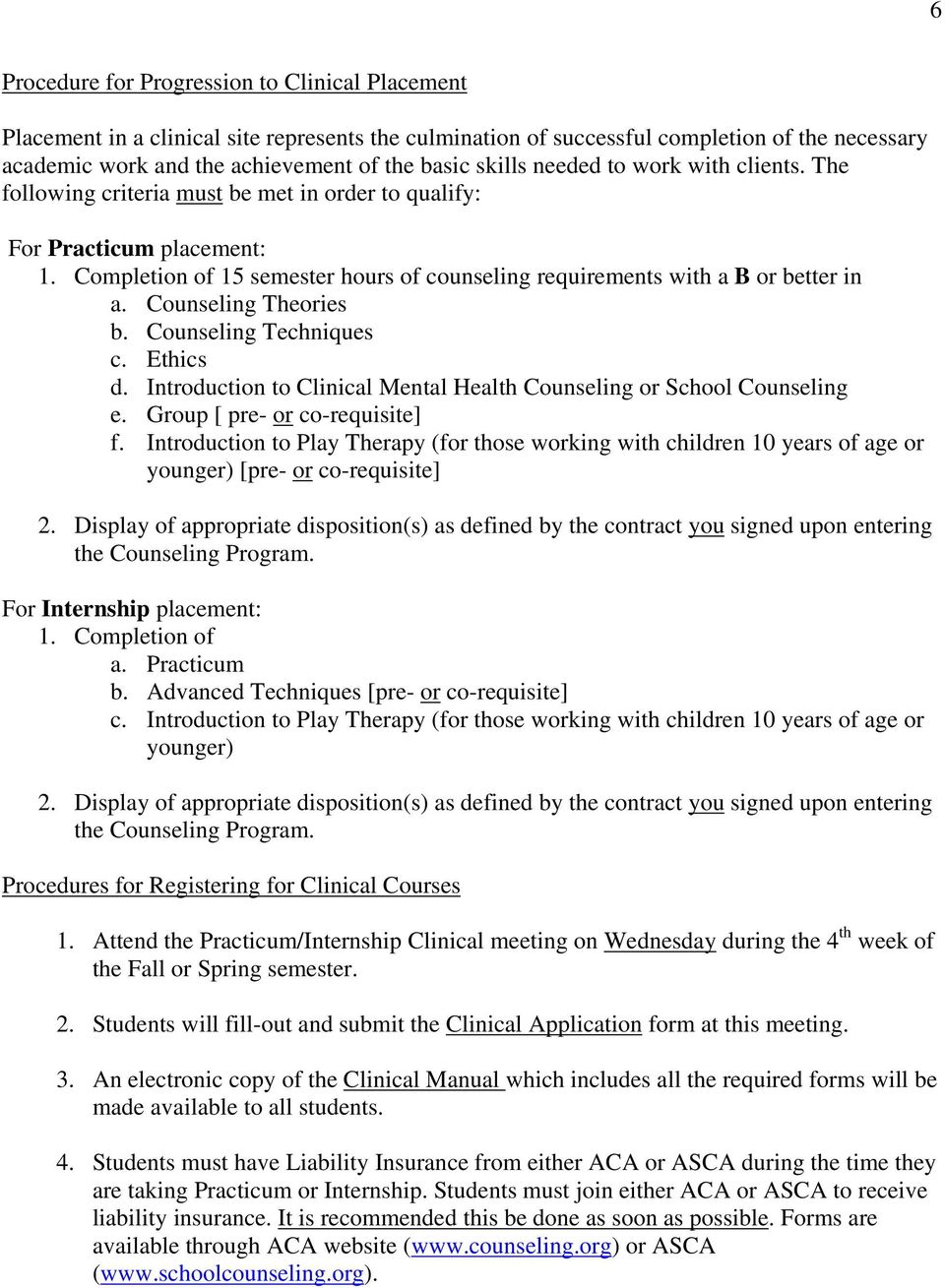
6 6 Procedure for Progression to Clinical Placement Placement in a clinical site represents the culmination of successful completion of the necessary academic work and the achievement of the basic skills needed to work with clients. The following criteria must be met in order to qualify: For Practicum placement: 1. Completion of 15 semester hours of counseling requirements with a B or better in a. Counseling Theories b. Counseling Techniques c. Ethics d. Introduction to Clinical Mental Health Counseling or School Counseling e. Group [ pre- or co-requisite] f. Introduction to Play Therapy (for those working with children 10 years of age or younger) [pre- or co-requisite] 2. Display of appropriate disposition(s) as defined by the contract you signed upon entering the Counseling Program. For Internship placement: 1. Completion of a. Practicum b. Advanced Techniques [pre- or co-requisite] c. Introduction to Play Therapy (for those working with children 10 years of age or younger) 2. Display of appropriate disposition(s) as defined by the contract you signed upon entering the Counseling Program. Procedures for Registering for Clinical Courses 1. Attend the Practicum/Internship Clinical meeting on Wednesday during the 4 th week of the Fall or Spring semester. 2. Students will fill-out and submit the Clinical Application form at this meeting. 3. An electronic copy of the Clinical Manual which includes all the required forms will be made available to all students. 4. Students must have Liability Insurance from either ACA or ASCA during the time they are taking Practicum or Internship. Students must join either ACA or ASCA to receive liability insurance. It is recommended this be done as soon as possible. Forms are available through ACA website ( or ASCA (
7 7 5. A current list of community sites will be distributed at the clinical meeting for clinical mental health counseling. 6. Forms for school counseling placements as well as applications for specific counties [Cabarrus, Gaston] will be distributed at the school counseling clinical meeting. 7. Once a site has been determined, a student must arrange to contact and meet with the designated site supervisor. At this meeting, the final Clinical Agreement and Supervisor Contract must be completed. (contact and arrangements with some sites, in particular schools, may vary. Please check with the clinical coordinators) 8. To work at a site which has not been used before by UNCC students; provide the name of the agency or school, phone number, and the contact person to the appropriate Clinical Coordinator (Clinical Mental Health/School). The Clinical Coordinator will contact the site and make sure it meets all program requirements. The Clinical Coordinator will then inform you if the site has been approved. If so, follow procedure above (#7). 9. At sign-up for Practicum or Internship class sections, students must submit a copy of the signed site agreement [with completed outline of hours], signed supervisor contract, signed student clinical contract, signed acknowledgement regarding handbook, and their current liability insurance. Lack of any of these documents will prevent sign-up. 10. Students who fail to show up for the initial sign-up or lack the completed documents will have two weeks (2) to meet with the respective clinical coordinator to complete the sign-up process. 11. A demonstration of professional behavior throughout this process is stressed. Should circumstances arise that might prevent you from fulfilling a clinical placement after an agreement has been signed, it is the students responsibility to inform the site and site supervisor directly. Also, inform the appropriate Clinical Coordinator. Required Learning Modules Each clinical course has a required learning module to be completed online by students. Practicum students must complete and pass the Child/Adult Abuse & Neglect module within the first 2 weeks of the semester; Internship I students must complete and pass the Disaster/Mental Health & Psychopharmacology modules within the first 4 weeks of the semester. Please check your course syllabus for the exact dates. NOTE: Internship II and Advanced Internship students who have not yet completed the required learning modules must during that semester they are regsitered. General Expectations for the Clinical Experience Three semesters of part-time work experience cannot be expected to provide complete specialized training for a career in counseling. What it does do is provide exposure to the field

8 8 and allows students to apply and test newly acquired knowledge within a clinical setting. It enables students to organize, synthesize, process, and apply their classroom information in a manner combining the cognitive, affective, and behavioral domains of learning. Many learners require a period of time and concrete experience to acquire both knowledge and skills. The clinical experience facilitates that process. In addition to gaining an understanding of the operation of an agency or school counseling setting, the practicum or internship student should also gain a view of the interrelationship of personnel. Target populations, human service delivery systems, and organizational structure connect many offices. The professional counselor must be aware of such relationships in order to understand the nature of helping systems, as well as the overall counseling field. Finally, the practicum and internship should serve to generate, develop, and refine skills in counseling, programming, administration, supervision, research and other aspects of professional counseling work. Through actual involvement in the design, implementation, and evaluation of counseling programs and services, students learn such strategies and methodology. Comments to the Student You should apply appropriate general principles of counseling in order to insure an optimal clinical experience. Remember that you are a student and are learning. The practicum and internship are an opportunity to blend your knowledge, skills, attitudes, and counseling philosophy and further their development. You should understand the counseling site (agency or school) for which you are working within its organizational context. The "why and how" of a particular counseling site can be more important than the "what", particularly as you develop your own philosophy. As you develop your own philosophy and compare it to the site for which you are working, you may discover that the two philosophies differ. Remember that different counselors work from different counseling philosophical perspectives. Despite emerging or perceived inconsistencies between you and other staff members with whom you are working, it is imperative that your behavior remain professional, ethical, and supportive of the site in which you are working. Expectations of Students Student Responsibilities You are responsible for knowing and following practicum and internship guidelines. You risk complicating the practicum or internship process, which may affect your progression through the program. If you are unsure how to proceed, consult your faculty advisor and the school or clinical mental health counseling clinical coordinator. Since these guidelines cover your on-site actions as well, check with your site supervisor to make sure that you are acting according to the institution or school policies and procedures. For example, know and follow the procedures for requesting a professional day or taking sick leave. As noted earlier, practicum and internship students, even unpaid ones, must adhere to professional, institutional, and ethical standards. The following guidelines apply.

9 9 The minimum number of on-site hours for the practicum is 150, with a minimum of 60 hours of direct client contact. For one semester of internship, the minimum number of on-site hours is 300, with a minimum of 120 hours of direct client contact. This results in a total of 600 on-site hours, with 240 direct client contact hours for the complete internship experience. Typically, direct client contact comes in four different forms, (a) individual counseling, (b) group counseling, (c) psycho-educational or classroom guidance groups, and (d) parent or family meetings. All other activities are considered non-direct hours. Counseling practicum and internship students will adhere to the following guidelines. 1. Complete the duties assigned to them at the practicum or internship site in accordance with University, departmental, and cooperating agency or school policies and procedures, as well as the ethics, statutes, and laws governing the professional practice for counseling. 2. Early separation or leave of absence from the practicum and internship requires written approval of the school or clinical mental health counseling program coordinator, the site supervisor, and the university instructor. Other programmatic and university leave policies and procedures may apply. 3. Know and meet practicum and internship expectations, guidelines, and procedures as outlined in the Clinical Handbook for the Counseling Department, and other programmatic resources, e.g., the Graduate Student Handbook. 4. Know and meet all practicum and internship deadlines. 5. Ensure that the practicum and internship documentation is accurate, current, and complete. 6. Meet with the site supervisor weekly for an average of one 1 hour of individual supervision. 7. Practicum students will meet for 1 hour of individual supervision per week with the university supervisor and participate in a minimum of 1.5 hours of group supervision per week. All practicum students are required to be registered for CSLG 7430 for the semester in which they are working in a practicum setting. 9. Internship students will participate in group supervision for a minimum of 3 hours per week, on a regular schedule throughout the internship. All internship students are required to be registered for CSLG 7435 for the semester in which they are working in a clinical setting. NOTE: Certificate students are required to register for CSLG 7436 Advanced Internship.

10 Practicum and internship students will provide either audio or video taped counseling sessions for review in group supervision and individual supervision with the university supervisor. 11. When obtaining taping permission from client s or the parents of clients, the UNCC Department of Counseling client release form provided in this manual will be used in addition to any release form from the agency or school. 12. The clinical experience will commence at the beginning of the semester when students have completed and submitted all required documentation and have registered for the practicum (CSLG 7430) or internship (CSLG 7435/7436) course. 13. Understand that specific certification and licensing requirements may differ from programmatic requirements. Interns are responsible for knowing and meeting the specific requirements for certification and licensure they wish to pursue. 14. Accept responsibility for knowing and understanding that failure to act within these guidelines may result in one or more of the following: a disciplinary letter placed in the student s practicum/internship file, receive an unsatisfactory grade for practicum/internship, removal from the site, and possible termination from the program. Professional Behavior Students are expected to conduct themselves as professionals at all times when at their sites. They should familiarize themselves with the expectations of staff at their site and adhere to these expectations. Practicum and internship students are expected to set their daily and semester schedule to coincide with the calendar of their host site, including daily work schedule, holidays, vacation days, etc. At all times, students are expected to maintain appropriate confidentiality regarding activities at the site and to adhere to the ethical guidelines set forth by the American Counseling Association and the American School Counselor Association. Students should carry out the duties and responsibilities of their practicum or internship agreement to the best of their ability and meet with their supervisor to modify any aspect of the agreement which may become problematic. Students are expected to keep their supervisor informed of their activities, needs, concerns, and accomplishments with regard to the practicum or internship. Supervision Supervision is a key component of both the practicum and internship. To support your professional development and learning during this time, you will receive at least two kinds of supervision: on-site supervision and university-based supervision. Practicum students must meet weekly for on-campus individual and group clinical supervision with a faculty supervisor and weekly for on-site individual clinical supervision with a site supervisor. Internship students must meet weekly for university-based group supervision [peer] and weekly for on-site individual clinical supervision. During individual and group supervision, both on-campus and on-site, you will receive assistance with skill development and guidance on client-related and professional
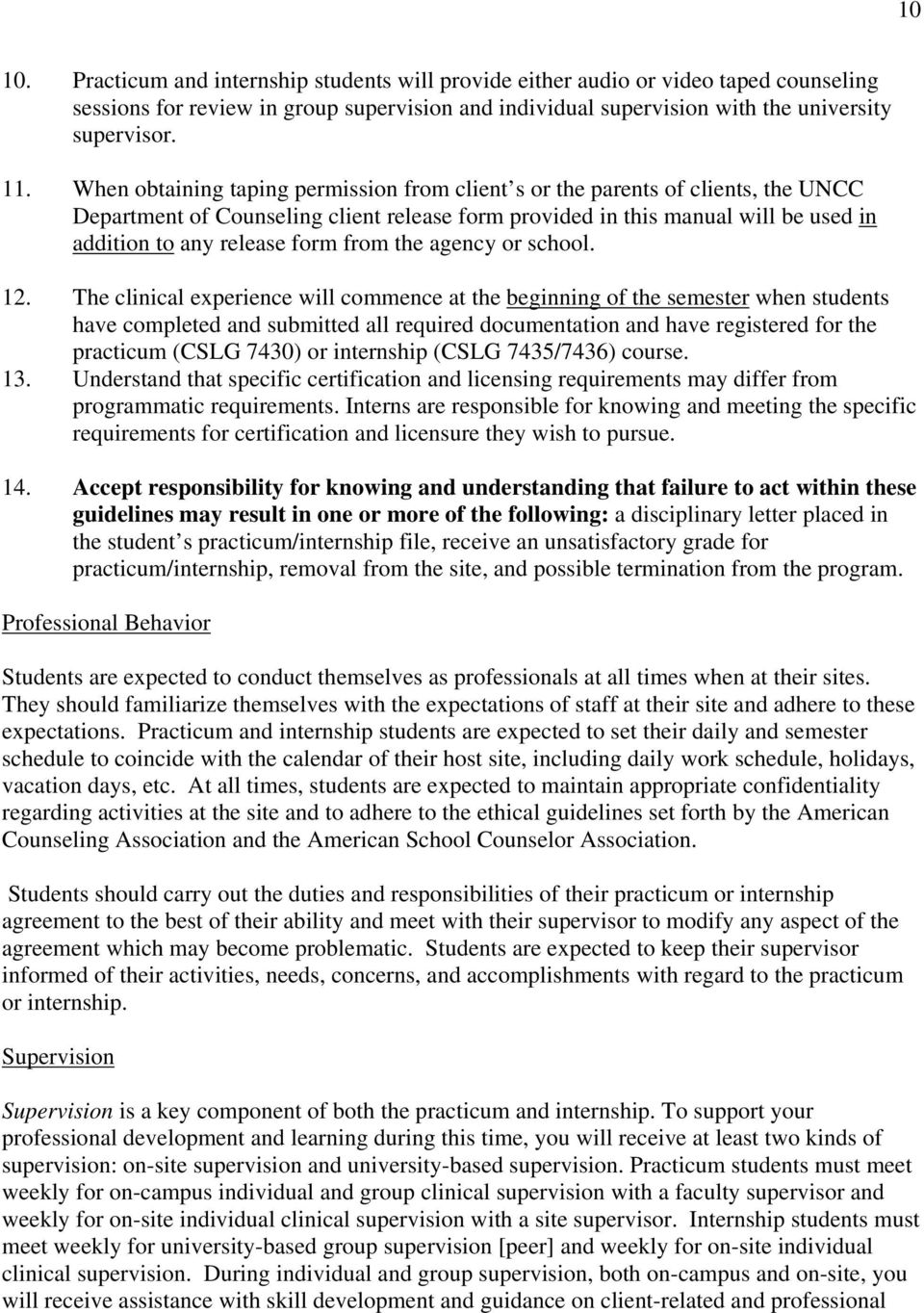
11 11 development matters. In addition, your university supervisor, who also leads the group supervision, can discuss and develop solutions with you for the complex problems that occasionally arise in a placement. The site supervisor must be a qualified professional. The counseling program defines a qualified site supervisor as a person holding a master s degree in a recognized helping profession, preferably counseling, for at least two years prior to being a supervisor. Related professions with counseling equivalent qualifications such as psychology or social work may qualify with prior approval from the clinical coordinators. [NOTE: school counseling interns should seek supervision primarily from a licensed school counselor]. Licensing & Supervision Requirements Supervision requirements may vary among licensing and certification agencies and boards. Various state licensing and certification organizations may have specific requirements for supervision. If you are pursuing a license as a counselor or other certification such as a chemical dependency counselor or marriage and family therapist, consult the specific responsible agency or board. In some cases, interns pursuing multiple licenses and/or certifications may find it necessary to have more than one supervisor. You are responsible for knowing and meeting these requirements. School or Agency Trip Chaperone Policy As a practicum or internship student, you are not an employee of the school system or agency. Students work in a professional training capacity as part of their graduate program. Therefore, it is not acceptable for students to take on the role of chaperone for an off-site activity. Due to not being a school or agency employee, practicum and internship students are not covered by any type of insurance or administrative policies and procedures should anything happen during the event. Therefore, no student will assume primary responsibility for a group of clients or students in any type of event or trip. Practicum or internship students may assist or accompany other school or agency officials with events or trips as long as it is understood that the practicum or internship student is not to be placed in a position of primary responsibility for students or clients. Reports Interns are responsible for seeing that all required forms, evaluations, and reports are submitted to the practicum or internship course instructor. Failure to meet these requirements will result in an unsatisfactory grade. Log of Hours Each student will complete an on-going log of accumulated hours attained through the practicum or internship experience (see Appendix A). The log sheet requires students to provide a detailed list of hours accumulated in various activities during the clinical experience. All students completing a practicum must accumulate a minimum of 150 hours, with 60 hours of direct client
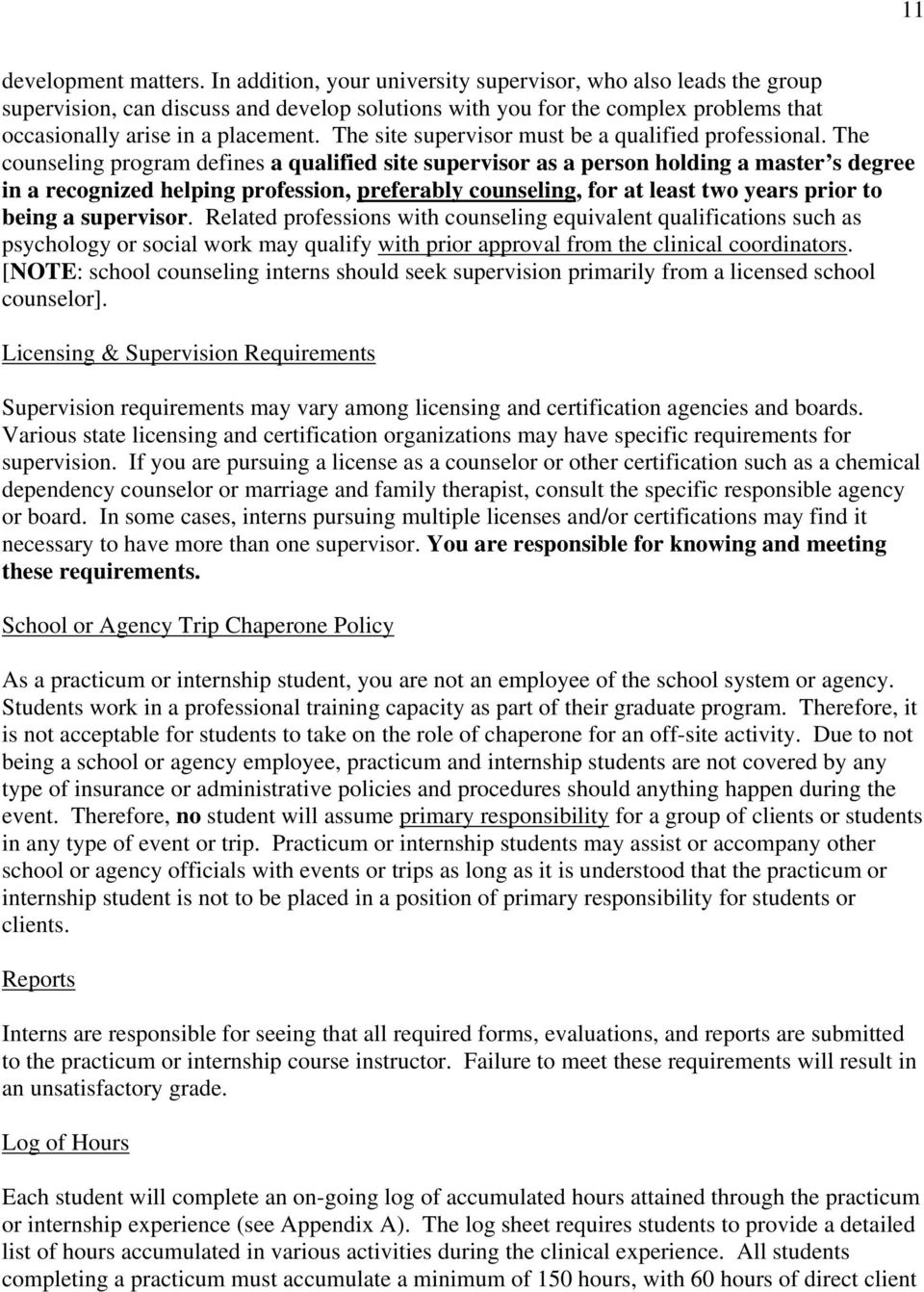
12 12 contact. Internship students must accumulate a minimum of 600 total hours over two consecutive semesters, with 240 hours of direct client contact. In the clinical setting, direct client contact hours are gained through individual counseling, small group counseling, psycho-educational group or classroom group guidance, and family or parent meetings. All other hours can include duties appropriate to the clinical setting or supervision (either on-site or university) as listed on the log sheets. The log of hours will become part of the student's permanent practicum and internship record indicating successful completion of the clinical experience, and will be kept on file in the Counseling Department. Weekly Reflection Each week practicum or internship students will submit a weekly reflection of their thoughts, feelings, activities, and experiences for the preceding week at their site (see Appendix A and follow specific syllabus instructions). This reflection is intended to provide students with an opportunity to reflect on the activities that they participated in at their sites and any thoughts and feelings associated with these experiences. In addition, the reflection is an opportunity to express any concerns to the course instructor. The weekly reflection format also allows students to record their accumulated hours. NOTE: These reflections will not be included in the final practicum or internship completion file. Evaluation Process and Evaluation Forms A mid-semester self-evaluation will be conducted by the student. This self-evaluation will include a written statement (format included in the supplemental forms Appendix, B) and a conference with the site supervisor to assess work toward goals that were established at the beginning of the semester. The written portion of the self-evaluation should be submitted to the internship course instructor. A formal evaluation from the site supervisor will be conducted at the end of the semester. During the final week of the internship experience (the end of each semester), students will complete an evaluation of their internship site and an evaluation of their internship site supervisor. These forms should be submitted to the School or Clinical Mental Health Counseling Clinical Coordinators. Copies of all evaluation forms are provided in Appendix A of this manual.
13 13 The Clinical Experience The practicum and internship experience is more than a clinical exercise in the counseling program they represent a significant opportunity for career and personal development. As such, the more time, effort, and resources you commit to this process, the more likely you will be to place your feet firmly on the career path that suits your interests, talents, experiences, and training. The experiences and the skills you hone and develop through the practicum and internship compose not only key elements of your resume but of your professional identity as well. You can think of your clinical experience developmentally. You will proceed through four phases as you work through the clinical placement process: Pre-placement, Initiation, Working, and Termination. Getting Started Begin with the end in mind. You have probably heard this before, but the clearer idea you have of where you want to go, the more likely you are to get there. To do this takes time, effort, and planning. Talk with your faculty advisor and/or the school or community counseling program coordinator. Your faculty advisor is one of your most useful resources during the pre-placement phase. Talk to her or him about your career interests and goals. This process will help you to clarify your practicum, internship, and career plans, as well as let your faculty advisor serve as a resource person for you. There are other resources, too. The Career Counseling Center can help you craft a resume that conveys to others your experiences and career-related attributes in a way that is clear and concise. You may find it useful to make an appointment for an individual career counseling session as you near the end of your training. Informational interviewing may be useful. Many students find informational interviewing provides them with a clearer picture of what professionals at schools and counseling agencies do in actual work settings. Through these interviews you may also get leads to potential practicum or internship sites through networking. You may find it helpful to have a professional resume to leave with the interviewer(s) as a reminder of what you have to offer a potential practicum or internship placement. Choosing a Practicum or Internship Site A practicum or internship experience that prepares you to work with diverse clients allows you to fit into a larger range of positions, quite possibly the one you desire in the future. You can strive to experience opportunities that will provide exposure to a variety of client populations and settings, (e.g., in geriatric counseling, play therapy, substance abuse counseling, higher education, hospice care, etc.), through volunteer work or through some other aspect of your practicum or internship. Look for a site that offers a balance of experiential and didactic opportunities. Not all your learning will come from direct contact with clients. A clinical site can provide you with a variety of experiential and didactic learning opportunities, such as welcoming you as a participant in a case staffing or by offering you valuable in-service training. Look for a site that welcomes you as a valuable team member. Since much of what you gain

14 14 from a clinical placement comes from your relationship with others, seek placements where you are welcomed and viewed as an important contributor. Many sites utilize practicum and internship students because they value their contributions. In addition, sites appreciate the fresh perspective and current knowledge that counseling students bring to their placement. There are a few points to consider when looking for a practicum or internship site and when potential sites are looking at you. Look for a qualified supervisor. The site supervisor has many responsibilities. The site supervisor s willingness to supervise you represents an investment of time and resources and the responsibility to ensure that you practice counseling in a therapeutic, legal, and ethical manner. Your weekly supervisory meetings are key to your professional development. These weekly (and any additional supervisory moments) assure you and your supervisor that you are carrying out counseling activities ethically and in accordance with the principles of best practice. A site supervisor also has the responsibility to assist the School or Clinical Mental Health Counseling Program Coordinator and the university supervisors in evaluating the quality of your practicum or internship performance. Interview your potential supervisor. Below are some suggested questions to consider asking a supervisor in an interview: What is the supervisor s approach to counseling and supervision? How much direction will she/he be able to provide? How does he/she provide feedback? Will this site provide opportunities to develop general counseling skills with diverse clients? Will there be adequate opportunity for direct student/client contact, group facilitation, as well as any associated duties? What the Clinical Site Looks for in Students When you choose a practicum or internship site, you are not the only one who gets to choose. The site and the program also have a say related to this match. Clinical sites look for students with strong communication skills. If utilized, your resume, cover letter, and interview convey early and important evidence of your communication skills. Take time to present yourself in a professional manner. Practicum and internship sites look for evidence that a student is responsible and has a positive work ethic. Your work and academic histories are evidence of your willingness to take personal responsibility for your choices and your willingness to follow through. Be sure to let the interviewer know specific incidents where you have accepted responsibility for and worked persistently to finish challenging assignments. Let the interviewer know that you respond positively to supervision and appreciate constructive feedback. Offer examples of times when you have received feedback and incorporated it into your training and clinical work. Clinical sites look for students that are flexible and open to new challenges. One way to express flexibility and openness is to ask for challenging assignments (with appropriate supervision!). A caveat here: take care to balance your needs with those of the prospective site. You will want to avoid sites that expect you to change your schedule frequently and dramatically to suit their needs. Remember: be a part of the team, participate appropriately but keep in mind you are an intern not an employee.

15 15 A few questions to consider before accepting the practicum or internship position: What hours will I work? When will I begin seeing clients? What are the procedures for ensuring client safety? What is expected of me when I am ill? What roles are practicum and internship students expected to fill? Using Your Current Job as a Site Some students are currently employed in schools or agencies. The question arises as to whether their current position can serve as a practicum or internship site. There is no clear answer to this question since so many variables come into play. There are several ifs connected to a workplace practicum or internship. Your workplace may serve as a clinical site if it meets the guidelines for a practicum or internship site and if your clinical activities [counseling-related experiences] meet the requirements for practicum or internship training. For example, you must engage in counseling and counseling-related activities with clients, keep appropriate records, and receive supervision from a qualified professional. Furthermore, if your duties as a practicum or internship student incorporate substantially new or redesigned activities and responsibilities, then the placement may be appropriate. In other words, you will need to talk with your faculty advisor and the School or Clinical Mental Health Counseling Program Coordinator to see if a workplace practicum or internship site is in your best interest and provides opportunity for sound clinical training. Once your site has been approved, you are ready to put your efforts into getting the most out of your experiences. Before starting to work, take some time to plan how you will become acquainted with the organization (orienting), how you will meet your goals through your clinical experiences (working), and consider the tasks involved in completing (terminating) your placement. Orienting Ask questions. People, and your relationships with them, are your greatest resources. When starting your placement, take time to build relationships, ask questions, and learn how the organization operates. The orienting phase is a time for you and the organization to become familiar with each other. Most sites have an orientation period before assigning clients to you. Read. Most sites have written materials that will prove useful. For example, they most likely have a mission statement informing policies, procedures, and scope of services. Ask for any relevant written materials such as policy and procedures manuals. Be sure to find out the procedures for responding to critical incidences, such as a suicide threat, abuse, or threat of violence.
16 16 Observe. You may find it useful to shadow a counselor for a time to see how he or she works through the complexities of professional decision-making and action. This is also the time, early on, to fine-tune your working agreement with the site and your supervisor. Working After a period of settling in, you begin the work of practicum or internship. As the routine becomes more familiar, you will likely feel more relaxed, confident, and understand first hand the scope of experiences available to you. You may wish to discuss with your site supervisor possibilities for taking on new challenges. Some students may begin to work too independently as they grow in confidence and experience and supervisors may spend less time supervising and teaching. Periodically, if this should occur, you may wish to discuss the issue with your site supervisor as a check in for both of you. Terminating Terminating the practicum or internship generally signals the start of a new beginning. Completing assignments, transferring clients, and saying good-bye to supervisors and colleagues mark this period. It is a busy time that requires you to stay focused and energized. This is a good time to gather recommendations from supervisors. Begin to finalize all paperwork; case notes, site and supervisor evaluations, client evaluations, etc. Appropriate termination with the site puts you on solid footing for your next career move. Early Termination There are rare incidents when a practicum or internship ends early. Early separation may be site or intern initiated, or a combination of both. The goal of an early separation is to make it a positive learning experience for the student and to maintain positive programmatic working relationships with the site. Permission for early separations is granted only after other efforts to address the situation have been unsatisfactory. In the event an early separation is appropriate, it will occur with the mutual consent of all parties (see policies and guidelines) and requires active consultation and participation of the School or Clinical Mental Health Counseling Program Coordinator. Should problems arise, we strive to maintain positive working environments for the student and a positive working relationship with the site. A Final Word Termination is a period of reflection, evaluation, preparation, and action a complex juxtaposition of activities. In this way, terminating from an practicum or internship is not unlike closure with clients. During this transitional period, you can misplace time for reflection as you move toward new beginnings. The ending of your clinical placement can be an invitation to sort through and find meaning for your feelings, thoughts, and experiences.
17 17 Responsibilities of the Site Supervisor The cooperating counseling professional who will have direct responsibility for the practicum or internship student at the workplace will be designated the site supervisor. Although practicum or internship students potentially perform a number of tasks and frequently work with different staff members, for purposes of continuity, overall supervision and final evaluation is done by one site supervisor designated for each student's entire practicum or internship. Developing the Practicum or Internship Agreement The site supervisor should meet with the practicum or internship student to discuss and complete the practicum/internship agreement. During this meeting, the student shares with the site supervisor their goals for the clinical experience (i.e. what they want to develop, strengthen, gain, etc). The supervisor should provide suggestions and guidance in terms of realistic goals and activities that can be completed within the time constraints of the clinical experience. Orientation The site supervisor is responsible for providing an orientation to the practicum or internship position. This orientation should include general information about the site, an overview of the administrative structure, and the role of the counseling office within the overall helping community. The site supervisor should also make sure that the practicum or internship student is formally introduced to other staff in the site and individuals in other areas with whom the student will interact. Supervision The site supervisor is expected to spend a minimum of one hour a week in direct supervision of the practicum or internship student. Initially, sessions may cover such topics as review of the practicum or internship agreement, orientation to the workplace, and start-up work on outlined activities. As the clinical experience progresses, this time should be spent reviewing the student's progress in meeting the specific requirements of the agreement, consultation concerning on-going caseload, discussion of professional concerns as they affect the workings of the site, or other relevant topics. This time is designed to provide the practicum or internship student with feedback on his or her performance and clinical skills, and for the practicing professional to share insights and experience with the student. Role Modeling The site supervisor is expected to serve as a professional role model for the practicum or internship student in job performance, personal growth, and professional and ethical behavior. As such, the site supervisor is expected to possess appropriate training, knowledge, and experience in a recognized helping profession, preferably counseling. Site supervisors are expected to hold at least a masters degree in their field, with appropriate licenses from the state pertaining to the clinical setting, and at least two years (2) of work experience in the field of counseling or other mental health profession.
18 18 Taping All practicum or internship sites must allow for a taped supervision review process of students. This further facilitates the professional development of students and assists in quality control of services delivered to clients. If audio or video taping is not allowed at a site, students will have to be re-assigned to an alternative site. Site supervisors should help students identify clients that will be amenable to audio or video taping of sessions for university supervision purposes. Practicum and internship students will be instructed to use a site s permission to tape form along with the UNC Charlotte Department of Counseling approved permission to tape form. The permission to tape form is only required when students are audio or video taping clients for supervision purposes. This form is not to be consider a general permission form for students to counsel clients. Site Visits A site visit by the university course instructor is required for all internship students. These visits are required for each semester that a student is enrolled in an internship. The instructor will contact the site supervisor to arrange this meeting. [NOTE: If for any reason site visits cannot be made, the university instructor will be in contact with site supervisors via phone and/or ]. Evaluation The site supervisor is expected to provide on-going feedback to the student concerning his or her overall performance and behavior at the practicum or internship site. The practicum or internship student will write a mid-semester self-evaluation. This selfevaluation will also include a conference with the site supervisor to assess work toward goals that were established at the beginning of the semester. A formal evaluation from the site supervisor will be conducted at the end of the semester. This form should be given to the School or Clinical Mental Health Counseling Clinical Coordinators in a sealed envelope with the supervisor s signature on the flap. Copies of all evaluation forms are provided in the forms Appendix A of this manual. Course Evaluations Final evaluation and successful completion of the practicum or internship course will be based on the student s work at the site and in the academic component of the practicum or internship class. Each component will count 50% toward the final evaluation. Detailed evaluation of the clinical experience is an important part of the student's learning. The student's practicum or internship agreement should serve as the basis for this evaluation. In addition to progress toward achieving established goals on assigned projects, the evaluation will address development of skills needed to complete assignments, attitude toward work in the site, working knowledge of site operations, interactions with co-workers in the site, and appropriate use of supervision.

19 19 Site supervisors are encouraged to conduct a mid-semester evaluation conference with each student. It is at this point any modification to the practicum or internship agreement should be made if necessary, and should occur after consultation and approval with the practicum or internship course instructor. The university practicum or internship course instructor should also be notified of any concerns the site supervisor may have at this time about the student s general performance. The final evaluation should be completed during the final week of the clinical placement. This evaluation should be forwarded to the School or Clinical Mental Health Counseling Coordinator. If there is disagreement over the evaluation, the university practicum or internship course instructor will be responsible for contacting those involved and determining the final resolution of the disagreement. If the site supervisor or university practicum or internship course instructor identifies deficiencies in a student s performance (professional behavior, skill demonstration, or other expectations of the student) and these are not addressed by the student after appropriate and timely notification, then the student may be asked to leave the placement based on the site supervisor recommendation after consultation with the practicum or internship course instructor and the School or Clinical Mental Health Clinical Coordinator. If this occurs, the student will not be placed at a different site to complete the practicum or internship experience during that academic semester. A remediation plan to address the problem areas will be developed by the School or Community Counseling Clinical Coordinator, the course instructor, and the student s faculty advisor, and a placement will be attempted for the next semester in which new clinical placements are made. No adjustments to the practicum or internship requirements will be made to accommodate this remediation process. A student repeating the practicum or internship in a subsequent semester will be expected to complete all requirements of the course, with no carry over of completed hours from the previous failed attempt. Students will also be evaluated on the academic component of the course. This evaluation will be based on attendance and participation in the seminar, active utilization of group and individual supervision, positive utilization of feedback, timely and thorough completion of weekly reports, performance on all required assignments, and evaluations from the site supervisor.

20 20 Specifics for School Counseling School Counseling is a profession that focuses on the relations and interactions between students and their school environment with the expressed purpose of reducing the effect of environmental and institutional barriers that impede student academic success. The profession fosters conditions that ensure educational equity, access, and academic success for all students K-12. To accomplish this function, the trained school counselor must be an assertive advocate creating opportunities for all students to nurture dreams of high aspirations. The counselor assists students in their academic, social, emotional and personal development and helps them define the best pathways to successfully achieve their dreams. The school counselor serves as a leader as well as an effective team member working with teachers, administrators and other school personnel to make sure that each student succeeds. The school counselor as consultant empowers families to act on behalf of their children by helping parents/guardians identify student needs and shared interests, as well as access available resources (The Education Trust, 2000). School Counseling Practicum and Internship Through the formative clinical experiences provided in practicum and internship, the school counseling intern will become familiar with a wide gamut of essential school counseling services while working with students, parents, and educators. The student will become familiar with a variety of professional activities and resources in addition to direct service intervention strategies. Professional resources may include assessment instruments, toys, games, books, computerized guidance programs, print and non-print media, professional literature, research, and referral data, as well as, persons. The practicum and internship experience are a critical component of preparing to be a professional school counselor. It is our hope that through classroom learning and field experiences, school counseling interns will be able to effectively serve the K-12 student population. Successful completion of a school-based practicum and internship will prepare students to: 1. apply the knowledge base of counseling to develop, implement, and evaluate data-based, comprehensive developmental school counseling programs; 2. assume professional roles and functions of the professional school counselor as described by CACREP, the ASCA National Standards, the ASCA National Model, and the NC Department of Public Instructions Guidelines for School Counselors; 3. translate personality theory, learning theory, and normal and abnormal behavior into effective research-based interventions for individuals, groups, and families; 4. describe and adjust to societal changes and trends in a multicultural society;

21 21 5. demonstrate the ability to form effective helping relationships with diverse individuals and groups; 6. understand the facilitative factors that influence the helping process, including effective counselor and client characteristics; collaboration and consultation skills; and theoretical frameworks that support the process; 7. translate group development, dynamics, leadership styles, and counseling methods and skills into effective interventions with students, parents, faculty, staff, and community initiatives; 8. integrate an understanding of instruction and classroom management into effective classroom guidance interventions; 9. demonstrate the capability to apply educational planning, career development and decision theory, and knowledge of sources of career information to student development and aspirations; 10. use formal and informal assessment procedures to identify needs, focus interventions, and assess counseling intervention and programmatic outcomes and effectiveness; 11. understand and use counseling research and evaluation results to guide counseling practice; 12. exhibit professional and personal behaviors, skills, and attitudes associated with competence in the core areas specified by CACREP standards; 13. demonstrate ethical behavior based on the ethical standards for ACA and ASCA, and understand the legal issues relevant to school counseling; and 14. exhibit the professional leadership and social advocacy skills necessary to serve as an effective change agent, and advance the cause of oppressed or underrepresented groups, parents, and students. Play Therapy in Schools Play therapy is a theoretically based counseling approach which permits children ages two to ten to express themselves through a developmentally natural form of communication, play. Play therapy has been used to treat children presenting with self harming behaviors, aggressiveness towards others, parental divorce, crying spells, trauma reactions and a host of other concerns. Using Play Therapy in schools with younger children can help them express themselves, cope with whatever troubles them, and demonstrate adaptive behaviors. Children are able to enhance their self esteem, exercise self-control and responsibility, and become more creative and resourceful in confronting problems and therefore more successful at learning.
22 22 School Sites Site selection for practicum and internship is a critical step in completing the school counseling field experience. Students are strongly encouraged to get to know the district, school, site supervisor, and the overall culture of the school and community prior to beginning practicum or internship. It is extremely important that the school site be a good match for students as changing school sites once practicum or internship has started is strongly discouraged NOTE: Other private or charter schools may also serve as possible sites. Students must check with the Clinical Coordinator for school site approval. Liability Insurance through ASCA All practicum and internship students must have liability insurance in effect while in their clinical experience. School counseling interns can acquire this insurance through their student membership in the American School Counselor Association [ASCA] It is essential students preparing for their clinical assignments apply for liability insurance prior to clinical sign-ups and maintain their coverage throughout practicum and internship. Certificate Program Internship All students enrolled in the Post-Masters Certificate Program for School Counseling are required to attend the clinical meeting the fourth week of the semester in which they plan on completing the required internship for the certificate. Their clinical experience is determined by the program coordinator in collaboration with School Counseling Clinical Coordinator.
23 23 Specifics for Clinical Mental Health Counseling The purpose of the community counseling clinical experience is to provide students with an entry-level professional clinical training opportunity, under supervision, in a clinical setting appropriate to the clinical mental health counseling specialty of interest to the student. This training opportunity is intended to provide students the chance to perform a number of counseling activities and duties performed by practicing community counselors. During the course of the clinical experience, students will learn additional practical skills, as well as practice skills that have been taught in the didactic portion of their training program. Many counseling and non-clinical learning opportunities are available through work in a real agency setting. Students are provided with the opportunity to see real clients, develop and implement clinical intervention plans, determine which strategies are most effective with specific clients and client situations, experience the diversity of clients and their unique challenges, and, finally, to work in the environment as practicing clinicians with fellow clinicians. Community Counseling Knowledge and Skill Areas As you can see, the clinical training portion of the Counseling Program is a critical element in the overall preparation of competent and effective community counselors. As such, it is important that community counseling practicum and internship students are trained adequately in the following knowledge and skill areas. 1. Student will understand and recognize the typical characteristics of individuals and communities served by a variety of institutions and agencies that offer community counseling services. 2. Students will be able to implement models, methods, and principles of program development and service delivery for a clientele based on assumptions of human and organizational development, including prevention, implementation of support groups, peer facilitation, parent education, career/occupational information and counseling, and encouragement of self-help. 3. Students will utilize effective strategies for promoting client understanding of and access to community resources. 4. Students will integrate and utilize principles and models of biopsychosocial assessment, case conceptualization, theories of human development and concepts of normalcy and psychopathology leading to diagnosis and appropriate counseling plans. 5. Students understand and use appropriate principles of diagnosis and current diagnostic tools, including the current edition of the Diagnostic and Statistical Manual. 6. Students will use effective strategies for client advocacy in public policy and other matters of equity and accessibility.
24 24 7. Students understand and know how to apply appropriate individual, couple, family, group, and systems modalities for initiating, maintaining, and terminating counseling, including the use of crisis intervention, and brief, intermediate, and long-term approaches. Community/Agency Sites There is a list of approved clinical sites that students will be given at the Clinical Meeting the semester prior to Practicum and Internship I. It is the students responsibility to treat this process like a job interview. The student is responsible for contacting the identified site supervisor and providing them with current copies of the student's resume. If a student is interested in utilizing a site that is not on the site list the following factors need to be in place and Dr. Balog has to formally approve the site for a possible placement. Liability Insurance Students are responsible for having professional liability insurance prior to beginning their placement. Currently student membership in the American Counseling Association includes professional liability insurance.
25 25 APPENDIX A Practicum and Internship Forms & Report Formats
26 26 Department of Counseling Student Clinical Contract I,, agree to adhere to the following guidelines during my Practicum/Internship. 1. Confidentiality. I will at all times make every effort to protect the identity of my clients/students and their information. As an intern, I will never discuss client/student cases in public settings outside of class nor will ever discuss cases with persons who are not authorized and associated with my clinical training. 2. Recognition of Qualifications. I will recognize the limitations of my training and abilities and will consult and seek assistance from my supervisor and university instructor in such cases where a clinical situation is beyond my level of knowledge and ability. 3. Record Keeping. I will accurately and reliably maintain written records [case notes, hourly logs, etc] as required by my university program. I will also accurately and reliably maintain any written records as required by my site and by state and federal law. 4. Dual Relationships and Sexual Misconduct. I will follow the ethical guidelines as set forth by the American Counseling Association [ACA] and the American School Counseling Association [ASCA] regarding multiple relationships with persons with whom I am working as a counselor. Under no circumstances will I ever form a sexual or romantic relationship with clients/students or their family members. I will refrain from sexual harassment and be sensitive of others regarding sexual matters. 5. Clinical Recordings. I verify by my signature that any recordings [CD, video, digital] that I submit as part of my clinical course requirements have been completed during the semester that I am registered for Practicum or Internship with clients/students I am currently working with at my site. These recordings are submitted solely for this course and will be erased upon completion. 6. Self-awareness and Monitoring. I will monitor my emotional and physical status during my clinical experience and be aware of any conditions that might adversely impact my ability to serve my clients/students or placement site. If such conditions arise, I will inform my placement supervisor and university instructor. By signing below, I agree to adhere to these guidelines listed above as well as those of the Counseling Profession, state and federal laws, and my specific placement site. Intern signature: Date: Site Supervisor: Date: University Instructor: Date: [adapted from Baird, B.N. (2008) The internship, practicum, and field placement handbook: A guide for helping professionals [5 th ed.] 9/2009
27 27 THE UNIVERSITY OF NORTH CAROLINA AT CHARLOTTE Department of Counseling Practicum/Internship Site Information Sheet Name: Address: address: Phone (Home): Practicum/Internship Site: If school: Elementary Middle High District: CMS Cabarrus Gaston Union Iredell/Statesville Rowan/Salisbury Other Site Address: Phone: Supervisor: Supervisor Agency Director/ School Principal: Internship schedule: M T W TR F Time:
28 28 THE UNIVERSITY OF NORTH CAROLINA AT CHARLOTTE Department of Counseling Practicum/Internship Site Agreement Student Name Phone Address Semester/Year Practicum/Internship location Site supervisor Title Phone address Address Degree: Field: Years of Counseling Experience: Practicum/Internship Experience Summary On the next page concisely outline the proposed practicum or internship experience. The agreement should make clear the chief responsibilities of the student. You may take advantage, however, of new opportunities when they arise, after consulting with your instructor and your site supervisor. The agreement should cover the duties that you will perform. List each of the duties and indicate an approximate time that will be devoted to each. A practicum or internship student should have the opportunity to engage in the activities that are performed by a staff member of the site. After the practicum or internship agreement is completed and signed by the student, site supervisor, and practicum or internship supervisor, copies for the site supervisor and student should be made. The original is to be given to the university supervisor. When developing the practicum or internship agreement, the student and site supervisor should keep in mind the basic clinical requirements for the program. If this is a practicum, the total experience should equal 150 hours, with a minimum of 60 hours of direct client contact. For an internship, the total experience for each semester should equal 300 hours, with a minimum of 120 hours of direct client contact. Typically, direct client contact comes in four different forms, (a) individual counseling, (b) group counseling, (c) psycho-educational groups or classroom guidance, and (d) parent or family meetings. All other activities are considered non-direct hours.
29 29 Practicum or Internship Agreement Outline: [NOTE: It is essential that this page detail specific activities student will be engaged in to accomplish required experiences and hours] Student Date Site Supervisor Date University Supervisor Date
30 30 The University of North Carolina at Charlotte Department of Counseling Supervisor Contract As the cooperating counseling professional who will have direct responsibility for this practicum or internship student, I will be responsible for: Assistance in Developing the Practicum or Internship Agreement I will meet with the practicum or internship student to discuss and complete the practicum or internship agreement. During this meeting, I will collaborate with the student in developing their goals for the clinical experience (i.e. what they want to learn, strengthen, gain, etc). I will provide suggestions and guidance in terms of realistic goals and activities that can be completed within the time constraints of this clinical experience. Orientation I will provide an orientation to the practicum or internship site/position. This orientation will include general information about the site, an overview of the administrative structure, and the role of the counseling office within the overall helping community. I will also make sure to introduce the practicum or internship student to other staff at the site and individuals in other areas with whom the student will interact. Supervision I will spend a minimum of one hour a week in direct supervision of the practicum or internship student. Initially, sessions may cover such topics as review of the practicum or internship agreement, orientation to the workplace, and start-up work on outlined activities. As the clinical experience progresses, I will spend time reviewing the student's progress in meeting the specific requirements of the agreement, consultation concerning on-going caseload, discussion of professional concerns as they affect the workings of the site, or other relevant topics. I will provide the practicum or internship student with constructive feedback on his or her performance and share insights and experience with the student for the practicing professional. Role Modeling I will serve as a professional role model for the practicum or internship student in job performance, personal growth, and professional and ethical behavior. As a site supervisor it is expected that I possess appropriate training, knowledge, and experience in a recognized helping profession, preferably counseling.
31 31 Taping I will assist in facilitating the practicum or internship students need to tape as part of their clinical training. I understand that this process facilitates the professional development of students and assists in quality control of services delivered to clients. I will help students identify clients that will be amenable to audio or video taping of sessions for training and university supervision purposes. I will review audio or video tapes as is appropriate and needed during our weekly one hour supervision sessions. Site Visits I recognize that site visits are required for all internship students by the university course instructor. I will meet with the instructor to review student performance and any concerns. As a practicum site, I realize contact may be by phone or a site visit, to be determined, based on need, by the university course instructor. Evaluation I will provide on-going feedback to the student concerning his or her performance of agreed upon duties, as well as his or her overall performance and behavior at the practicum or internship site. I will participate in the practicum or internship student s mid-semester self-evaluation. I will setup a conference with the student to assess his or her work toward goals that were established at the beginning of the semester. I will conduct a formal final evaluation with the student at the end of the semester and submit to the practicum/internship instructor at UNCC a copy of this final evaluation after reviewing it with the student. Supervisor Date
32 32 THE UNIVERSITY OF NORTH CAROLINA AT CHARLOTTE Department of Counseling Practicum/Internship Goal Statement Name: Date: Site: Self-evaluation of counseling skills: Strengths: Weaknesses: Which particular counseling skills are you developing and looking to refine at this time? Goals for this clinical experience: How will you know whether or not you have accomplished these goals? Signature Date
33 33 THE UNIVERSITY OF NORTH CAROLINA AT CHARLOTTE Counseling Practicum/Internship Weekly Reflection Name: Week of: Internship site: Total internship hours: Total client contact hours: General description of your activities: General impressions, inferences from these activities: Areas of concern, areas needing clarification, questions:
34 THE UNIVERSITY OF NORTH CAROLINA AT CHARLOTTE Department of Counseling Practicum/Internship Weekly Log 34 Student Name: Name of School/Agency: Supervisor Name: Course: Practicum CSLG 7430 Internship CSLG 7435 Week Dates DCC Individual DCC Small Group DCC Parent or Family Meetings DCC Classroom Guidance or Psy.Ed. Groups Other Duties (consulting, program development, assessment, IEP, staffing) On-Site Sprvsn UNCC Individual or Group Sprvsn Weekly Totals DCC-Direct Client Contact; All DCC columns must total 60 hours per 150 hours of practicum, or 120 hours per 300 hours of internship. Classroom group supervision hours are not included in the total number of on-site hours for practicum (150) or internship (300). However, they are to be included on this log. Thus, the total number of hours accrued should be at least for practicum and 345 for internship per semester.
35 Weekly Log Page 2 35 Week Dates DCC Individual DCC Small Group DCC Parent or Family Meetings DCC Classroom Guidance or Psy.Ed. Groups Other Duties (consulting, program development, assessment, IEP, staffing) On-Site Sprvsn UNCC Individual and/or Group Sprvsn Weekly Totals Semester Totals DCC-Direct Client Contact; All DCC columns must total 60 hours per 150 hours of practicum, or 120 hours per 300 hours of internship. Classroom group supervision hours are not included in the total number of on-site hours for practicum (150) or internship (300). However, they are to be included on this log. Thus, the total number of hours accrued should be at least for practicum and 345 for internship per semester. University Supervisor Signature Date Site Supervisor Signature Date Student Signature Date
36 36 UNIVERSITY OF NORTH CAROLINA AT CHARLOTTE Department of Counseling Informed Consent Agreement The Department of Counseling at the University of North Carolina at Charlotte focuses on growth in meeting life's personal, family and social demands, and on educational or vocational choices. Emphasis is on improving personal-social skills and adjustment to life situations, the development of improved problem solving and decision making capabilities, and working through personal, relational, or career concerns. In using the services of a counseling intern from the Department of Counseling, the student/client must understand that for training purposes it may require videotapes/audiotapes of counseling sessions. These recordings enable the counseling faculty to assess the skills of the counselor-trainee. It should be clearly understood that the information obtained from or divulged by the client is treated with the strictest confidence in accordance with the ethical and professional standards provided by the American Counseling Association and the American School Counselor Association. Furthermore, information will not be transmitted to any person or agency without the written consent of the client and/or the parent/guardian of the client (if client is a minor). The EXCEPTIONS to CONFIDENTIALITY are: Subpoena or court ordered by a judge Suspicion of child/elderly abuse/neglect Client threatens/commits harm to self or a third party. I have read the above and understand its contents. I hereby agree to the following: Taping of all counseling sessions. Tapes will be erased at the termination of counseling. The counseling faculty and counseling peer supervision group will listen to or view the tape to assess counselor trainee skills. What is said or done by the student or client will be kept in confidence and not be transmitted outside of the counseling supervision class or supervision process. Only the client or parent/guardian may elect to release this information to persons or agencies outside the counseling program. Testing may be determined to be helpful for the client and, if deemed necessary by the client and counselor-trainee, will be conducted to provide additional case information. The case records maintained concerning these counseling sessions will be kept in a confidential file and always under the protection of the counselor-trainee and faculty. Client or Parent/Guardian Signature Date
37 THE UNIVERSITY OF NORTH CAROLINA AT CHARLOTTE Department of Counseling Client Release Form 37 I agree to be counseled by a Practicum or Internship student from the Department of Counseling at The University of North Carolina at Charlotte. I understand that my identity will remain anonymous and all information will be kept in strictest confidence. I realize that the counselor is a graduate student being trained in counseling skills and that he or she is receiving supervision from a faculty member in the Department of Counseling. I understand that my counselor will be recording our sessions for his or her educational purposes only. I give permission for interviews to be recorded and for other counselors-in-training to listen to those counseling sessions only when used as a part of the counselor training program. Client signature: Date: Parent or Guardian signature: (if client is under 18 years of age) Date: Counselor signature: Date:
38 38 Play Therapy Client Release Form Department of Counseling University of North Carolina at Charlotte How can my child benefit from play therapy? Benefits of individual play therapy includes one-on-one attention from an adult and improvement in the child s self control and self-esteem. In addition, play therapy helps children to handle stress and feelings of anger. Most importantly, play therapy helps children to become more selfreliant and independent. ************************************************************************ I,, the legal guardian of agree for my child to be counseled by an internship student in the Department of Counseling at University of North Carolina at Charlotte. I understand that my child s identity will remain anonymous and all information will be kept in strictest confidence. I understand that the counselor is a graduate student being trained in counseling skills and that he/she is receiving supervision from a faculty member in the Department of Counseling. I give permission for sessions to be recorded and for my clinical supervisors and other counselorsin-training to listen to those counseling sessions as a part of my counselor training program. Parent or Guardian's signature Date Counselor's signature Date:
39 THE UNIVERSITY OF NORTH CAROLINA AT CHARLOTTE Department of Counseling Supervisor's Final Evaluation of Counselor Trainee 39 Student Name: Name of School/Agency: Supervisor Name: Course: Practicum CSLG 7430 Internship CSLG 7435 The purpose of this evaluation is to provide meaningful feedback to the counselor trainee. Rate the student using the following scale: N/O Not Below Meets Exceeds Observed Expectations Expectations Expectations 1. DISPOSITION Prompt Dependable Responsible Shows initiative Cooperative Appropriate appearance Good rapport with staff members Actively seeks opportunity for new learning experiences Maintains composure in difficult situations 2. PROFESSIONAL BEHAVIOR Completes paperwork in a concise and timely manner Communicates orally and in writing in a clear and effective manner Adheres to the ethical standards of the profession Seeks consultation regarding complex ethical situations Makes an effort to improve counseling knowledge and skills Makes appropriate referrals to other persons or agencies Seeks consultation with other professionals Exhibits willingness to work on personal/professional issues N/O N/O WORKING IN THE COUNSELING ENVIRONMENT Becomes integrated into placement site Arranges counseling sessions appropriately Maintains contact with the on-site supervisor Demonstrates appropriate case management skills Strives to increase professional competence N/O COUNSELING PROCESS/SKILLS N/O 1 2 3
40 Counseling Process: Opens session appropriately Clarifies the presenting issues accurately Facilitates exploration of issues appropriately Facilitates goal-setting appropriately Exhibits control of session Closes session appropriately Terminates counseling relationship appropriately Counseling Skills: Summarizes session content accurately Demonstrates a variety of facilitative responses Uses culturally sensitive techniques Uses theory-specific skills appropriately Facilitates goal-setting appropriately Provides information/advice appropriately CONCEPTUALIZATION SKILLS Recognizes relevant client themes and patterns Uses client information to develop working hypotheses Uses client cultural background appropriately in assessment, diagnosis, and treatment Adapts theory and techniques to meet client s reality Develops appropriate strategies and interventions based on established counseling theories and techniques 6. PERSONALIZATION SKILLS Recognizes personal assets and liabilities Directly addresses the relationship process Understands differences between clients and self Perceives and understands boundaries in the client-counselor relationship Sets and maintains appropriate boundaries Works effectively with clients who are culturally different from self Aware of own feelings and uses them in assisting clients Manages personal values appropriately 7. SUPERVISION CONDUCT Prompt and prepared Uses supervision time effectively Identifies questions, concerns, and issues Shows interest in learning Seeks help and direction Takes risks to learn and identify challenging situations Understands and incorporates supervisors suggestions Accepts encouragement and constructive criticism Actively participates in the supervisory process N/O N/O N/O SCHOOL RELATED EXPERIENCES AND OUTCOMES Demonstrates an understanding of the school, curriculum, N/O 1 2 3
41 student records, and appraisal processes Understands the role of the school counselor as a community liaison and school counseling advocate Demonstrates competencies in individual and group counseling through a rotating case load of at least two individual students and at least two groups Utilizes a variety of counseling tools, resources, and strategies facilitate the growth of students Observes and participates in consultation/collaboration with teachers or other school personnel Observes and participates in consultation/collaboration with parents Can apply referral procedures for students with special needs Facilitates appreciation for the cultural, lifestyle, and gender diversity of the school population Reviews and participates in school related activities, i.e., IEP, peer helper programs, peer mediation, program planning that supplements the scheduling process Designs goals that are consistent with the National Standards for School Counseling Programs, the state and local educational agency goals, and local school goals Adheres to appropriate ethical standards for working with minors 41 Any additional comments/recommendations: (e.g., strengths and areas for continued improvement) Site Supervisor Date Student Date University Supervisor/Instructor Date NOTE: Please place this form in a sealed envelope, your signature over the flap, and give to student to submit to the university instructor.
42 42 THE UNIVERSITY OF NORTH CAROLINA AT CHARLOTTE Department of Counseling Student Evaluation of Site Supervisor Student Name: Name of School/Agency: Supervisor Name: Course: Practicum CSLG 7430 Internship CSLG 7435 Please circle the appropriate response for each statement. For each item please use the following scale: 1 = Poor 2 = Average 3 = Strong 4 = Excellent N/A = Not applicable My Supervisor explained his/her role as a supervisor N/A 2. helped me to feel at ease with the N/A supervisory process 3. gave me feedback about my role as a N/A counselor which was accurate and usable 4. helped me clarify issues which my client N/A brought to the session 5. assisted me in understanding my own N/A feelings about the client and his/her issues 6. encouraged me to develop a plan to work N/A with specific clients 7. modeled appropriate counseling techniques N/A when necessary My supervisor helped promote my professional identity by encouraging N/A membership in professional organizations
43 9. legal and ethical practice by discussing N/A and by modeling appropriate ethical behaviors 43 I felt confident of my supervisor s skills N/A 11. my supervisor respected me and was N/A concerned with my professional growth 12. my supervisor was committed to his/her N/A role as a supervisor 13. my supervisor motivated and encouraged N/A me 14. my supervisor served as an appropriate N/A professional role model 15. my supervision sessions allowed for both N/A personal and professional growth 16. my supervisor recognizes his/her own N/A limitations 17. my supervisor was genuine, congruent, N/A empathetic, and honest My supervisor helped me to clarify my own ideas about counseling N/A theory 19. to focus on specific counseling strategies N/A to assist the client 20. to develop techniques to resolve conflict N/A Please use this space and the back of this page for additional comments.
44 THE UNIVERSITY OF NORTH CAROLINA AT CHARLOTTE Department of Counseling Student Evaluation of Practicum/Internship Site 44 Student Name: Practicum or Internship Site: University Supervisor: Course: Practicum CSLG 7430 Internship CSLG 7435 Semester/Year: Please rate your experiences at your practicum or internship site in the following areas. Use the scale provided Very Moderately Moderately Very Satisfactory Satisfactory Unsatisfactory Unsatisfactory Amount of on-site supervision. Quality and usefulness of on-site supervision. Ability to obtain overall hours. Ability to obtain direct client contact hours. Usefulness and helpfulness of course. Relevance of experience to career goals. Exposure to and communication of school/ agency goals. Exposure to and communication of school/agency procedures. Exposure to professional roles and functions within the school/agency. Exposure to information about community resources. Rate all applicable experiences that you had at your site. Report writing Intake interviewing Administration and interpretation of tests Staff presentations/case conferences Individual counseling Group counseling Family/couple counseling Psycho-educational activities Consultation Career counseling Other In the space below, or on the back of this form, please comment on any items that you considered moderately or very unsatisfactory. Provide solutions if possible.
45 45 Directions for Final Client Evaluation for Internship To Student: Make sure the client/student knows that their evaluation of you is anonymous and confidential. Explain that their feedback is being used for training purposes only [to help you improve your counseling skills]. 1. Please give an evaluation form to all clients/students [those older than 10] that you have seen this semester for a minimum of 3 sessions. 2. Do not give the evaluation form until counseling is completed to avoid impacting the process. 3. Depending on the situation [clinical/school setting] it is preferred that the student/client fill out the evaluation without you present. 4. Plan to ask someone [supervisor, clerical staff, etc] to accept completed evaluation. 5. Two copies will be made of the completed original evaluation. The original evaluation is given to your university instructor, a copy goes to your site supervisor, and you retain a copy. 6. If evaluating a group, follow the same process as above. Evaluate only those groups you facilitated or co-facilitated for a minimum of 3 sessions. 7. If you have been working with children under the age of 10 and have been utilizing Play Therapy with them, then please use the Play Therapy evaluation form and have a teacher and/or parent fill it out. Follow the procedures as stated in # If you have worked with children 10 years of age and younger and utilized Talk Therapy with them use the Counseling Children evaluation form and have a teacher and/or parent fill it out. Follow the procedures as stated in #1-5. 9/2009
46 46 Counseling Outcome Evaluation for Internship [How did I do?] Individual Counseling Counselor s name: Sessions: Date: Number of We would appreciate you taking a moment to offer us feedback on your experience receiving counseling from the Intern at your school [agency]: Please circle the number at the right that best describes your counseling experience. Circle N/A if it does not apply. Not Applicable N/A Strongly Agree 5 Agree 4 Neither Agree or Disagree 3 Disagree 2 Strongly Disagree 1 1. My relationship with my counselor was good N/A I would recommend my counselor to friends N/A Counseling has helped me N/A I can better talk about my thoughts and feelings N/A I felt my counselor understood me fully N/A I can better identify my feelings N/A I can better understand things that bother me N/A I feel I can better handle my feelings and behaviors N/A I feel less stressed and/or overwhelmed N/A Counseling has helped me improve my relationships with others N/A I have a more positive view of myself N/A Counseling helped me to stay in school N/A I am satisfied with my counseling experience N/A If needed, I am more likely to seek counseling in the future N/A Comments: What did you like most about your counselor? How could your counselor do better to help you and others? Any additional comments: 9/2009
47 47 Counseling Outcome Evaluation for Internship [How did I do?] Group Counseling Counselor s name: Date: Number of Sessions: We would appreciate you taking a moment to offer us feedback on your experience participating in group counseling at your school [agency]: Please circle the number at the right that best describes your counseling experience. Circle N/A if it does not apply. Not Applicable N/A Strongly Agree 5 Agree 4 Neither Agree or Disagree 3 Disagree 2 Strongly Disagree 1 1. I made progress in group counseling N/A I would recommend group counseling to friends N/A Group counseling has helped me N/A The counselor was a good leader for this group N/A I am more sensitive to and accepting of differences in others N/A I can better talk about my thoughts and feelings N/A Now I can have healthier relationships with others N/A I have learned how to work more effectively on my personal N/A problems 9. I feel I can better handle my feelings and behaviors N/A I feel less stressed and/or overwhelmed N/A I have a more positive view of myself N/A Group counseling helped me to stay in school N/A I am satisfied with my group counseling experience N/A Comments: What did you like most about your group experience? How could your counselor do better in leading a group? Any additional comments: 9/2009
48 48 Counseling Outcome Evaluation for Internship [How did I do?] Play Therapy Counselor s name: Date: Number of Sessions: We understand that one of your students or your child has been participating in Play Therapy with the counselor named above. We would appreciate you taking a moment to offer us feedback about that experience by responding to the questions below. In advance, thank you for helping us to evaluate the effectiveness of the services our students provide. Please circle the number at the right that best describes the child s counseling experience. Circle N/A if it does not apply. Not Applicable N/A Strongly Agree 5 Agree 4 Neither Agree or Disagree 3 Disagree 2 Strongly Disagree 1 From your perspective, the [your] child 15. Has made progress toward goals N/A Can better communicate feelings N/A Can control inappropriate behaviors more effectively N/A Feels less stressed and/or overwhelmed N/A Has a more positive view of them self N/A Feels more comfortable in school N/A From your perspective: 1. The child s relationship with the counselor was good N/A I would recommend this counselor to work with other children N/A Counseling has helped the [my] child N/A Comments: Has Play therapy been helpful for the [your] child? How can the counselor do better using Play Therapy in helping children? Any additional comments: 9/2009
49 49 Counseling Outcome Evaluation for Internship [How did I do?] Counseling Children Counselor s name: Date: Number of Sessions: We understand that one of your students or your child has been participating in counseling with the counselor named above. We would appreciate you taking a moment to offer us feedback about that experience by responding to the questions below. In advance, thank you for helping us to evaluate the effectiveness of the services our students provide. Please circle the number at the right that best describes the child s counseling experience. Circle N/A if it does not apply. Not Applicable N/A Strongly Agree 5 Agree 4 Neither Agree or Disagree 3 Disagree 2 Strongly Disagree 1 From your perspective, the [your] child 21. Has made progress toward goals N/A Can better communicate feelings N/A Can control inappropriate behaviors more effectively N/A Feels less stressed and/or overwhelmed N/A Has a more positive view of them self N/A Feels more comfortable in school N/A From your perspective: 4. The child s relationship with the counselor was good N/A I would recommend this counselor to work with other children N/A Counseling has helped the [my] child N/A Comments: Has counseling been helpful for the [your] child? How can the counselor do better in helping children? Any additional comments: 9/2009
50 50 Final Student Competency Evaluation Each student in Internship will choose one (1) client/student with whom they have had an ongoing (at least 5 sessions) counseling relationship and will complete an evaluation of this relationship in terms of the counselor s effectiveness. This assessment will include: overview of the client/student, objectives and goals, theoretical and treatment strategies, and a final outcome evaluation. Guidelines: a. Title: Final Competency Evaluation b. Identifying Information Provide background/demographic information of the client/student (be precise and concise) Use client s initials and not his or her full name c. Precipitating event for counseling What brought him or her to counseling? (be precise and concise) d. Presenting problem What is the issue/problem focused on? (be precise and concise) Symptoms (symptomatic behaviors related to the presenting problem- emotional, cognitive, behavioral, familial, etc.) that gave you insight e. History of presenting issue/problem How did the problem/issue/concern develop over time? f. Bio-psychosocial history of the client (be precise and concise; include only information you believe is essential to understanding the client/student s problem/concern) Developmental history and dynamics Social history and cultural dynamics Health history & health behaviors Mental health history (client/student & family) g. Support system and strengths of client/student h. Vulnerabilities of the client/student i. Clinical formulation: working hypothesis name the theory you might use to support your clinical formulation any specific technique(s), activities, etc. j. Therapeutic relationship assessment
51 Describe briefly and concretely your perception of the relational dynamics between you and the client/student m. Client/student evaluation - use the Individual Client/Student Evaluation form provided - follow guidelines for obtaining client/student final evaluation NOTE: Remember that counseling progress or success is not entirely dependent on your performance as a counselor. 51
52 52 Clinical Information Record Final Data Sheet Counselor Name: Semester: Practicum Internship Location: Agency School Please complete the following information: Site: Urban Suburban Rural School: Elementary Middle Secondary Describe Agency Focus: Describe Client/School Population: Describe Degree of Diversity at Agency/School: Total # of clients/students seen during semester: Break-down of # clients/student sessions: or more times Total # of hours of supervision during semester [including site and university]: NOTE: Throughout the semester keep records and running totals of the above information to assist you in completing this form.
53 53 APPENDIX B Supplemental Forms & Report Formats
54 54 Case Notes: Individual Clients Student's Name: Client ID Session # Date of Session: Type of activity: Your goal(s) for the session: Summary of content: Counselor's conceptualization of the problem/issues: Comments on positive counseling behaviors: Comments on counseling behaviors needing improvement: Plans for future: Did you tape the session? YES NO If yes, have you listened to the tape? YES NO If yes, what did you learn from listening? Your evaluation of your work: 5 (great) to 1 (poor):
55 55 Case Notes- Groups Student s Name: Group: Session# Date of Session: Type of Group Activity: Your goal for the activity: Summary of group: Comments on Positive Counseling Behaviors: Comments on Counseling Behaviors Needing Improvement: Plans for Future: Your Evaluation of Your Work: 5(great) to 1 (poor):
56 56 Classroom Guidance Lesson Reflection Counselor: Lesson Title/Topic: Date/s Taught: Grade: General Description of Lesson: Strengths of the Guidance Lesson: Challenges of the Guidance Lesson: Other Observations, Questions, Concerns, Impressions:
57 57 Play Therapy Skills Checklist (Complete form only about the 10 minute segment presented in class; Bring this form to class with a copy for each person in your supervision group) Therapist Verbal Behavior 1. Tracking Behavior Too Much Just right Need More Missing Examples and/or Corrected Responses 2. Responding to Content 3. Reflecting Feelings 4. Facilitated Decision- Making/Responsibility 5. Esteem Building/ Encouraging 6. Enlarged the Meaning/ Facilitated Understanding (Personalizing) 7. Succinct/Interactive 8. Rate of Responses Therapist Non-Verbal Behavior 9. Lean Forward/Open 10. Relaxed/Comfortable 11. Appeared Interested 12. Tone/Expression Congruent with Child s Affect 13. Tone/Expression Congruent with Therapist s Response Limit Setting: Immediacy/Spontaneity:
58 58 Child Made Contact/Connectedness: Participation: introspective productive unmotivated superficial withdrawn Feelings Expressed by child: Play Themes: anger anxiety guilt lack of feeling sadness conflicted controlling power confusion dependency good vs. bad protection revenge limit testing aggression nurturing exploratory conflicted cleansing/washing Toys/Play sequences: (change list to reflect the toys that you are using; underline all toys that child played with during the session, indicate meaningful/sustained play with # - note under Assessment/Progress first happenings, discontinued play, disruption in play, other meaningful happenings): art/easel crafts/clay bottle/dolls/blanket kitchen/cooking feeding vehicle/planes knife/sword/gun handcuffs/rope handcuffs/rope soldiers bop bag masks telephone puppets/theater doll house dress up cash register/money sandbox/water blocks/barricade hammer/log domestic/zoo animals snakes/shark/alligator dinosaurs medical kit musical instruments Assessment/Progress: (your general impressions/clinical understanding/conceptualization based on theoretical orientation) Therapist s Strengths: Areas for Growth:
59 59 Interview Rating Form Name: Date of session: Rating (best to least) Opening: Unstructured, friendly? Any introduction needed? Rapport: Was stage set for productive session? Interview responsibility: Counselor or client initiative? Appropriate? Interaction: Meaningful? Acceptance/permissiveness: Were you accepting of client's emotions, feelings, thoughts? Reflection of feelings: Counselor responses: Meaningful or trivial? Value management: Attempt to impose your values? Duration: Was session too long or too short? Vocabulary level: Appropriate? Mannerisms displayed: Verbosity: Did you dominate session, interrupt or override? Silences: Broken to meet counselor needs or dealt with effectively? Closing: Who initiated? Abrupt?
60 60 THE UNIVERSITY OF NORTH CAROLINA AT CHARLOTTE Department of Counseling Case Presentation Conducting counseling sessions with the support and feedback of others is an important part of a trainee's professional development. In most training programs sessions are recorded on either audio or video tape. Once a session is completed, the trainee listens to the recording, providing him/herself with feedback that can lead to ideas for future sessions and recognition of areas in which one's work can be improved. Advanced counselors, as well as trainees, listen to develop a full picture of what happened in the session: important client emotions, beliefs, and personality characteristics not fully seen during the actual session, significant moments or turning points, and significant things the counselor did or did not do. Receiving organized feedback from the supervisor and giving organized feedback to oneself are major vehicles both for improving one's work with a given client and for building one's professional skills. The following outline is offered as an aid to producing a written analysis of a counseling session, especially one that has been recorded. Used carefully, the outline can help the trainee organize thoughts about the client, the session, and the quality of one's work. Background information Demographic information, such as age, grade in school, employment, family unit, and history that seems relevant to the presenting problem. Presenting problem: Why did the client approach you, from the client's perspective? Or why did you approach the client? Was there a precipitating set of circumstances? How long has the problem(s) persisted? If third parties are involved, what were their observations and concerns? Overview of the session What did you talk about? What were the dominant issues and themes for this session? If this was a session beyond the initial meeting, what were your process and outcome goals going into the session? Observations and assessment: Conceptualization of Problem Describe your observations and impressions of the client? What is your view of the problem? What are the common themes?
61 61 What are the client's barriers to growth and coping skills? What is the etiology of the client's present psychological capacity or incapacity? What is she/he trying to accomplish by various behaviors? What are your counseling goals? Observations about self Describe significant themes and patterns you observed in your own behavior, noting what you did that you considered especially effective and areas that were troublesome for you. Describe your own internal experiencing during the session, with special focus on times or places where you felt confused, tense, angry, or at a loss. Plans for the next session How do you hope to follow up in subsequent sessions? What issues and concerns do you think worthwhile to explore? What process goals will you try to accomplish? Help Specifically what kind of help would you like, either from your university instructor and from fellow students, about this client, this session, and your counseling efforts?
62 62 THE UNIVERSITY OF NORTH CAROLINA AT CHARLOTTE Consultation Report Guidelines When a practicum or internship student conducts a consultation, a written consultation report will be prepared. The consultation consists of the student intern consulting with other professionals i.e. teachers, administrators, social workers, psychologists, etc. regarding one of the intern's clients/students or other appropriate matters. The report should address (a) the reasons for the consultation, (b) the results of the consultation, and (c) the intern's application of these results.
63 63 THE UNIVERSITY OF NORTH CAROLINA AT CHARLOTTE Professional Development Activity Student Name: Practicum or Internship Site: University Supervisor: Course: Practicum CSLG 7430 Internship CSLG 7435 Semester/Year: Description of professional development activity (e.g., attending a national conference, etc) student would like to use for indirect service hours: Number of hours acquired from activity: The hours a student proposes to exchange for indirect Practicum or Internship hours must be discussed with the University professor and the on-site supervisor prior to engaging in the professional development activity. Both supervisors need to approve of this use of time. Site Supervisor Date University Supervisor/Instructor Date
64 64 THE UNIVERSITY OF NORTH CAROLINA AT CHARLOTTE Department of Counseling Mid-Semester Self-Evaluation 1. How have you progressed toward meeting your goals as stated at the beginning of the semester? Please be specific and provide examples. 2. What you have learned about a. counseling in general b. supervision in counseling c. yourself as a counselor 3. Evaluate your skills and effectiveness as a counselor based on: a. feedback from peers b. feedback from supervisors c. self-assessment
65 65 THE UNIVERSITY OF NORTH CAROLINA AT CHARLOTTE Department of Counseling End of Semester Self-Evaluation 1. Have you fulfilled your goals as stated at the beginning of the semester? Please be specific and describe how you have or have not achieved these goals. 2. Evaluate your skills and effectiveness as a counselor based on your level as a graduate student at the end of this semester. 3. How could this seminar be improved? Please be specific.
PreK 12 Practicum and Internship. School Counseling. Overview
 PreK 12 Practicum and Internship School Counseling Overview Counseling and Development Program Mission Statement The Counseling and Development program is committed to prepare counselors who promote the
SCHOOL COUNSELING CONCENTRATION PRACTICUM/INTERNSHIP HANDBOOK
 WILLIAM PATERSON UNIVERSITY COLLEGE OF EDUCATION DEPARTMENT OF SPECIAL EDUCATION AND COUNSELING PROFESSIONAL COUNSELING PROGRAM SCHOOL COUNSELING CONCENTRATION PRACTICUM/INTERNSHIP HANDBOOK Prepared April,
Student Handbook For Practicum and Internship. Master of Science in Education With a Major in School Counseling
 Student Handbook For Practicum and Internship Master of Science in Education With a Major in School Counseling Counselor Education Program University of Tennessee at Martin Department of Educational Studies
SCHOOL COUNSELING CONCENTRATION SITE SUPERVISOR PRACTICUM/INTERNSHIP HANDBOOK
 WILLIAM PATERSON UNIVERSITY COLLEGE OF EDUCATION DEPARTMENT OF SPECIAL EDUCATION AND COUNSELING SCHOOL COUNSELING CONCENTRATION SITE SUPERVISOR PRACTICUM/INTERNSHIP HANDBOOK Prepared April, 2000 by Paula
MENTAL HEALTH COUNSELING CONCENTRATION PRACTICUM/INTERNSHIP HANDBOOK
 WILLIAM PATERSON UNIVERSITY COLLEGE OF EDUCATION DEPARTMENT OF SPECIAL EDUCATION AND COUNSELING MENTAL HEALTH COUNSELING CONCENTRATION PRACTICUM/INTERNSHIP HANDBOOK Prepared April, 2000 by Paula Danzinger,
Western Kentucky University Department of Counseling and Student Affairs P-12 School Counseling Program Practicum and Internship Manual.
 1 Western Kentucky University Department of Counseling and Student Affairs P-12 School Counseling Program Practicum and Internship Manual Introduction Practicum and Internship provide for the application
Counseling. PRACTICUM and INTERNSHIP. Manual
 Counseling Internship Manual 1 Montclair State University Counselor Education Program Counseling PRACTICUM and INTERNSHIP Manual 2015 2016 Updated August 2015 Counseling Internship Manual 2 TABLE OF CONTENTS
Supervisor Handbook for School Counseling Practicum/Internships
 Virginia State University Professional Educational Programs Unit (College of Education, projected October 2012) Department of School and Community Counseling Supervisor Handbook for School Counseling Practicum/Internships
School Counseling Internship Manual 1. Internship Manual. Master s Degree in School Counseling. Professional Counseling Program
 School Counseling Internship Manual 1 Internship Manual Master s Degree in School Counseling Professional Counseling Program Revised August, 2012 School Counseling Internship Manual 2 GRADUATE INTERNSHIP
THE GEORGE WASHINGTON UNIVERSITY GRADUATE SCHOOL OF EDUCATION AND HUMAN DEVELOPMENT SCHOOL COUNSELING PROGRAM The Alexandria Center
 THE GEORGE WASHINGTON UNIVERSITY GRADUATE SCHOOL OF EDUCATION AND HUMAN DEVELOPMENT SCHOOL COUNSELING PROGRAM The Alexandria Center COUNSELING PRACTICUM and INTERNSHIP STUDENT and SCHOOL SITE SUPERVISOR
COUNSELING PRACTICUM HANDBOOK
 COUNSELING PRACTICUM HANDBOOK Educational Leadership and Counseling Whitlowe R. Green College of Education Prairie View A&M University P.O. Box 519; MS 2430 Prairie View, TX 77446-0519 936-261- 3645 936-261-
SCHOOL COUNSELING PRACTICUM AND INTERNSHIP MANUAL
 College of Education, Health, & Human Services Counseling and Human Development Services Program SCHOOL COUNSELING PRACTICUM AND INTERNSHIP MANUAL CHDS WEBSITE: http://www.kent.edu/ehhs/chds Clinical Experience
MENTAL HEALTH COUNSELING CONCENTRATION SITE SUPERVISOR PRACTICUM/INTERNSHIP HANDBOOK
 WILLIAM PATERSON UNIVERSITY COLLEGE OF EDUCATION DEPARTMENT OF SPECIAL EDUCATION AND COUNSELING MENTAL HEALTH COUNSELING CONCENTRATION SITE SUPERVISOR PRACTICUM/INTERNSHIP HANDBOOK Prepared April, 2000
FREQUENTLY ASKED QUESTIONS (FAQ) ABOUT PRACTICUM AND INTERNSHIP
 FREQUENTLY ASKED QUESTIONS (FAQ) ABOUT PRACTICUM AND INTERNSHIP These questions are intended to assist students in understanding the expectations and opportunities offered in their internship experiences.
School Counseling Manual
 1 School Counseling Manual for CSD 5630 Practicum CSD 6920 Supervised School Experience (Internship) CSD 6921 Supervised School Experience (Internship) CSD 6922 Supervised School Experience (Internship)
University of Wisconsin-Stout. Masters of Science In Clinical Mental Health Counseling. COUN 794: internship Handbook
 University of Wisconsin-Stout Masters of Science In Clinical Mental Health Counseling COUN 794: internship Handbook Table of Contents 1 Internship Overview...3 Course Pre-requisites...3 Course Objectives...4
Practicum and Internship Manual
 "One of America s Great Metropolitan Research Universities" DEPARTMENT OF COUNSELING, EDUCATIONAL PSYCHOLOGY AND RESEARCH The College of Education The University of Memphis Memphis, TN 38152 (901) 678-2841
School Counselor Preparation: A Guide for On- Site Supervisors
 LEADERSHIP DIVERSITY CARING EXCELLENCE School Counselor Preparation: A Guide for On- Site Supervisors SUMMER 2015 Master of Science, Educational Counseling Pupil Personnel Services Credential UNIVERSITY
PRACTICUM HANDBOOK. 2008 Community and College Student Development. The College of Education & Human Development UNIVERSITY OF MINNESOTA
 2008 Community and College Student Development 2009 PRACTICUM HANDBOOK The College of Education & Human Development UNIVERSITY OF MINNESOTA Department of Educational Psychology Counseling and Student Personnel
TENNESSEE TECHNOLOGICAL UNIVERSITY. Department Of Counseling and Psychology. School Counseling Handbook
 TENNESSEE TECHNOLOGICAL UNIVERSITY Department Of Counseling and Psychology School Counseling Handbook Revised May, 2009 1 TABLE OF CONTENTS CONCEPTUAL FRAMEWORK... 2 PURPOSE OF THIS HANDBOOK... 3 PURPOSE
Clinical Mental Health Counseling
 Clinical Mental Health Counseling University of North Georgia Clinical Handbook INTRODUCTION The purpose of the Clinical Mental Health Counseling Practicum & Internship Handbook is to provide you with
UTAH STATE UNIVERSITY. Professional School Guidance Counselor Education Program Mapping
 UTAH STATE UNIVERSITY Professional School Guidance Counselor Education Program Mapping Course Key: PSY 6130 Evidence-Based Practice: School Intervention PSY 6240 Comprehensive School Counseling Programs
School Counseling Practicum/lnternship Supervisor's Handbook
 School Counseling Practicum/lnternship Supervisor's Handbook Introduction: The Department of Counseling, Foundations, and Leadership at Columbus State University provides this handbook to supervisors of
Practicum Handbook for School Counseling (COUN 583) (Updated 9/29/14)
 Practicum Handbook for School Counseling (COUN 583) (Updated 9/29/14) PRACTICUM OVERVIEW Practicum is a planned field-based clinical experience in which the student learns to develop basic counseling skills
Department of Counselor Education Clinical Counseling - Internship Manual
 Department of Counselor Education Clinical Counseling - Internship Manual 1 Department of Counselor Education To: Internship Site Supervisors or Potential Site Supervisors From: Russell Fulmer, Ph.D.,
Counseling Internship Manual. Guidelines and Contract for the COAD 6991, 6992: Counseling Internship
 INTERNSHIP MANUAL, P. 1 Counseling Internship Manual Guidelines and Contract for the COAD 6991, 6992: Counseling Internship Department of Higher, Adult and Counselor Education College of Education East
Clinical Mental Health Counseling
 Clinical Mental Health Counseling University of North Georgia Practicum & Internship Handbook If you need this document in another format, please call Shanta Ghimire at 706-867-2791 or email [email protected].
GRADUATE COUNSELING PROGRAM INTERNSHIP MANUAL (Policies and Procedures) DEPARTMENT OF HUMAN RESOURCES EAST CENTRAL UNIVERSITY
 GRADUATE COUNSELING PROGRAM INTERNSHIP MANUAL (Policies and Procedures) DEPARTMENT OF HUMAN RESOURCES EAST CENTRAL UNIVERSITY Empowering clients to meet their potential... Paige N. Williams, Ph.D, LPC
COUN 659 SYLLABUS Internship in Counselor Education Fall 2013 Thursdays 2:10-3:25 Claxton 210. Course Description
 THE UNIVERSITYofTENNESSEE College of Education, Health & Human Sciences Educational Psychology & Counseling 525 Jane and David Bailey Education Complex 1122 Volunteer Blvd Knoxville, Tennessee 37996-3452
THE UNIVERSITY OF TENNESSEE AT MARTIN DEPARTMENT OF EDUCATIONAL STUDIES
 THE UNIVERSITY OF TENNESSEE AT MARTIN DEPARTMENT OF EDUCATIONAL STUDIES Instructor: David Dietrich, Ph.D. Office: 219 McWherter, Jackson State Community College, Jackson, TN 38301 Phone: 731.267.2949 or
CPSY 585 School Psychology Practicum, 2
 CPSY 585 School Psychology Practicum, 1 COURSE SYLLABUS COVER SHEET Lewis & Clark College Graduate School of Education and Counseling Course Name Practicum in School Psychology Course Number CPSY 585 Term
REHC 5990 Internship Manual. Master of Rehabilitation Counseling
 The University of Texas at El Paso REHC 5990 Internship Manual Master of Rehabilitation Counseling Department of Rehabilitation Sciences College of Health Sciences El Paso, TX 79901 Revised June 1, 2010
Widener Center for Social Work Education
 Widener Center for Social Work Education MSW FIELD EDUCATION INFORMATION The Council for Social Work Education has identified the field experience as the signature pedagogy in social work education. The
Counselor Education CAREER COUNSELING, CLINICAL MENTAL HEALTH COUNSELING, AND SCHOOL COUNSELING
 Counselor Education CAREER COUNSELING, CLINICAL MENTAL HEALTH COUNSELING, AND SCHOOL COUNSELING Dr. Peggy Whiting, Coordinator Counselor Education Program Program Telephone: (919) 530-6182 Fax: (919) 530-5328
1. PROFESSIONAL SCHOOL COUNSELOR IDENTITY:
 Utah State University Professional School Counselor Education Program Learning Objectives (Adapted from the Standards for Utah School Counselor Education Programs and the Council for Accreditation of Counseling
Practicum and Internship Manual COUN 505 and COUN 588 Master of Science Program in Rehabilitation Counseling. Updated 3/21/2011
 Practicum and Internship Manual COUN 505 and COUN 588 Master of Science Program in Rehabilitation Counseling The mission of the Rehabilitation Counselor Education Program is to recruit and train individuals
Site Supervisor Handbook For Practicum and Internship. Master of Science in Education With a Major in Clinical Mental Health Counseling
 1 Site Supervisor Handbook For Practicum and Internship Master of Science in Education With a Major in Clinical Mental Health Counseling Counselor Education Program University of Tennessee at Martin Department
Standards for the School Counselor [23.110]
![Standards for the School Counselor [23.110]](/thumbs/25/6617639.jpg "Standards for the School Counselor [23.110]") II. STANDARDS FOR THE SCHOOL SERVICE PERSONNEL CERTIFICATE Standards for the School Counselor [23.110] STANDARD 1 - Academic Development Domain The competent school counselor understands the learning process
II. STANDARDS FOR THE SCHOOL SERVICE PERSONNEL CERTIFICATE Standards for the School Counselor [23.110] STANDARD 1 - Academic Development Domain The competent school counselor understands the learning process
Master of Counselling. Practicum & Supervision Handbook
 Master of Counselling Practicum & Supervision Handbook 2 Master of Counselling Practicum & Supervision Handbook Copyright Wesley Institute 2012 Wesley Institute 5 Mary Street Drummoyne PO Box 534 Drummoyne
DEPARTMENT OF EDUCATIONAL LEADERSHIP, COUNSELING, AND POSTSECONDARY EDUCATION STUDENT OUTCOMES, COMPETENCIES, AND METHODS OF ASSESSMENT
 DEPARTMENT OF EDUCATIONAL LEADERSHIP, COUNSELING, AND POSTSECONDARY EDUCATION STUDENT OUTCOMES, COMPETENCIES, AND METHODS OF ASSESSMENT SCHOOL AND MENTAL HEALTH COUNSELING I. Departmental Philosophy The
M.A. Counseling Psychology 2015 2016 Program Guidebook
 M.A. Counseling Psychology 2015 2016 Program Guidebook NOTE: 1) This guidebook is subject to change. If it does, students will be notified via email and will be provided with the revised version. 2) Policies
INTERNSHIP COUN 595 CLINICAL MENTAL HEALTH COUNSELING
 INTERNSHIP COUN 595 CLINICAL MENTAL HEALTH COUNSELING DEPARTMENT OF COUNSELING AND HUMAN SERVICES UNIVERSITY OF SCRANTON - THE GRADUATE SCHOOL J.A. PANUSKA COLLEGE OF PROFESSIONAL STUDIES SCRANTON, PA
Supervision Manual SCHOOL COUNSELING INTERNSHIP
 Supervision Manual SCHOOL COUNSELING INTERNSHIP SCOUN-789/790 School of Education UW-Stout Rev. 9/2009 TABLE OF CONTENTS INTRODUCTION...1 RESPONSIBILITIES AND COMMITMENTS Site Supervisor Responsibilities...2
Counseling Psychology Program. CNP 4751 Counseling Psychology M.A. Internship. CNP 4762 School Counseling Internship 2
 Counseling Psychology Program CNP 4751 Counseling Psychology M.A. Internship CNP 4762 School Counseling Internship 2 M.A. INTERNSHIP PACKET 2014-2015 1. Introduction to Master s Internship 2. Field Supervisor
UNIVERSITY COUNSELING SERVICES SOUTHERN CONNECTICUT STATE UNIVERSITY EN 219-B NEW HAVEN, CT 06515
 UNIVERSITY COUNSELING SERVICES SOUTHERN CONNECTICUT STATE UNIVERSITY EN 219-B NEW HAVEN, CT 06515 Dear Applicant: Thank you for your interest in our graduate internship program. The University Counseling
inchester Public Schools
 inchester Public Schools SCHOOL PSYCHOLOGIST EVALUATION School Psychologist Evaluation SCHOOL PSYCHOLOGIST EVALUATION Introduction The licensed personnel who staff our classrooms who provide related services
Master of Science in Nursing Program. Nurse Educator PRECEPTOR / FACULTY / STUDENT ORIENTATION HANDBOOK. Angelo State University
 Master of Science in Nursing Program Nurse Educator PRECEPTOR / FACULTY / STUDENT ORIENTATION HANDBOOK Angelo State University Revised Fall 2014 1 TABLE OF CONTENTS Master of Science in Nursing Program
School Counseling Program. Practicum Handbook
 University of Massachusetts Boston College of Education and Human Development Department of Counseling and School Psychology School Counseling Program Practicum Handbook PRACTICUM IN SCHOOL COUNSELING
Graduate Student HANDBOOK. Rehabilitation Counseling Program
 Graduate Student HANDBOOK Rehabilitation Counseling Program 2014-2015 Dear Rehabilitation Counseling Students, On behalf of the Rehabilitation Counseling faculty, staff, and second year students, I would
SCHOOL COUNSELING PROGRAM FIELD EXPERIENCE MANUAL Practicum & Internship
 1 SCHOOL COUNSELING PROGRAM FIELD EXPERIENCE MANUAL Practicum & Internship College of Continuing and Professional Studies Department of Counseling and Human Sciences 2 Table of Contents INTRODUCTION.3
Practicum & Internship Handbook. Counseling and School Psychology School Counseling
 Practicum & Internship Handbook Counseling and School Psychology School Counseling Last Revised: 10/8/2014 School Counseling Practicum and Internship Handbook Counseling and School Psychology Southern
Education and Counseling (M.A.Ed.)
 III: Influencing Literacy Instruction and Leadership RDG 5320 Diversity and Multicultural Education RDG 5330 Leadership in Reading RDG 5610 Diagnosis, Assessment, Instruction, and Practicum in Reading
Masters of Science (M.S.) in Rehabilitation Counseling Program (RCP)
 GRADUATE PROGRAM IN REHABILITATION COUNSELING Practicum Manual Masters of Science (M.S.) in Rehabilitation Counseling Program (RCP) Langston University Revised: 03/2015 Dr. Corey L. Moore Department Chair
SYLLABUS. Course and Instructor
 SYLLABUS Course and Instructor Course Number: Coun 501 Course Title: Course Time: Foundations of Counseling Monday, 6:00 p.m. 9:00 p.m. Course Location: Education Building Room 106 Semester: Fall 2009
Criminal Justice Internship Handbook CRJU 3398
 Criminal Justice Internship Handbook CRJU 3398 Department of Sociology and Criminal Justice Contact: Prof. Peter Fenton Office Phone 470 578-2292 [email protected] PREPARING FOR YOUR INTERNSHIP Read
Counseling (MA) Degrees. Program Description. Learning Outcomes. Counseling (MA)
 This program offered by College of Arts & Sciences Program Description The mission of the Webster University graduate professional counseling degree program is to provide high-quality learning experiences
Stephen F. Austin State University
 Stephen F. Austin State University Department of Human Services School Counselor Education Program Information Packet Revised January 2016 1 THE DEPARTMENT OF HUMAN SERVICES Stephen F. Austin State University,
Ph.D. Counselor Education and Supervision 2014 2015 Program Guidebook
 Ph.D. Counselor Education and Supervision 2014 2015 Program Guidebook NOTE: 1) This guidebook is subject to change. If it does, students will be notified via email and will be provided with the revised
Department of School Psychology Field Placement Manual
 I. INTRODUCTION his manual includes pertinent information regarding requirements for practicum/field experience/internship in the School Psychology program. Be sure to read it over carefully as you are
Marriage and Family Therapy/Counseling
 http://www.uakron.edu/education/academic-programs/counseling/doctoral/mft-doctoral/currentstudents.dot Department of Counseling Marriage and Family Therapy/Counseling INTERN & SITE SUPERVISOR HANDBOOK
#4 SCHOOL COUNSELING INTERNSHIP AGREEMENT COUN 555, 556, and 557 School Counseling Internship
 #4 SCHOOL COUNSELING INTERNSHIP AGREEMENT COUN 555, 556, and 557 School Counseling Internship Between Seattle University College of Education Department of Counseling and School Psychology and the Below
CNL 8670 GRADUATE INTERNSHIP MANUAL FOR SCHOOL COUNSELING DEPARTMENT OF HUMAN SERVICES
 CNL 8670 GRADUATE INTERNSHIP MANUAL FOR SCHOOL COUNSELING DEPARTMENT OF HUMAN SERVICES COLLEGE OF EDUCATION AND HUMAN SERVICES Wright State University 108 Allyn Hall 3640 Colonel Glenn Highway Dayton,
Mental Health Counseling Internship Competency Checklist Updated Spring 2012
 Mental Health Counseling Internship Competency Checklist Updated Spring 2012 Form #3 Intern Name: Semester/Year: Internship #: Site: University Supervising Faculty: Site Supervisor: Rating scale: 1 inadequate
Internship Guide. M.Ed. in Special Education
 Internship Guide M.Ed. in Special Education Together We Shape the Future College of Education Qatar University Draft - December 2007 The conceptual framework of the College of Education at Qatar University
#2 SCHOOL COUNSELING PRACTICUM AGREEMENT COUN 554 School Counseling Practicum
 #2 SCHOOL COUNSELING PRACTICUM AGREEMENT COUN 554 School Counseling Practicum Between Seattle University College of Education Department of Counseling and School Psychology and the Below Named School and
GUID 5950 School Counseling Internship Application and Information
 GUID 5950 School Counseling Internship Application and Information Dear Student: The information is designed to facilitate the Internship application process and to enhance the quality of the Internship
UW-MADISON CRIMINAL JUSTICE CERTIFICATE PROGRAM CRIMINAL JUSTICE FIELD OBSERVATION HANDBOOK
 UW-MADISON CRIMINAL JUSTICE CERTIFICATE PROGRAM CRIMINAL JUSTICE FIELD OBSERVATION HANDBOOK The Criminal Justice Field Observation is an internship opportunity that combines community engagement with classroom
2015-16 Rubric for Evaluating Colorado s Specialized Service Professionals: School Psychologists
 2015-16 Rubric for Evaluating Colorado s Specialized Service Professionals: School Psychologists Definition of an Effective School Psychologist Effective school psychologists are vital members of the education
Northern Arizona University College of Education Educational Psychology Master of Arts in Counseling EPS 694: Counseling Internship-Masters Guidelines
 Northern Arizona University College of Education Educational Psychology Master of Arts in Counseling EPS 694: Counseling Internship-Masters Guidelines The purpose of these guidelines is to clarify the
Department of School Counseling Field Placement Manual I. INTRODUCTION
 I. INTRODUCTION his manual includes pertinent information regarding requirements for practicum/field experience in the School Counseling program. Be sure to read it over carefully as you are responsible
HIGHER EDUCATION DOCTORATE PROGRAMS INTERNSHIP HANDBOOK
 1 HIGHER EDUCATION DOCTORATE PROGRAMS INTERNSHIP HANDBOOK A Guide for the Intern, Supervisor, and Advisor in the Internship Education Doctorate (Ed.D.) Doctorate of Philosophy (Ph.D.) Higher Education
How To Be A Field Supervisor At Metro Diana Human Services
 Department of Human Services Manual for Field Supervisors Updated Spring 2015 Table of Contents What Field Supervisors Need to Know about Supervising Students... 3 Contact information for the Field Coordinator:...
Mental Health Counselor Practicum Training Brochure
 The Mental Health Center Mental Health Counselor Practicum Training Brochure 1 Updated 02/05/13 Mission Statement The Mental Health Center's (MHC's) mission of service, training, and advocacy focuses on
GUIDELINES FOR SUPERVISED PRACTICE IN REHABILITATION COUNSELING
 GUIDELINES FOR SUPERVISED PRACTICE IN REHABILITATION COUNSELING Department of Rehabilitation Psychology & Special Education University of Wisconsin-Madison Revised in 1983 as a joint project of the Rehabilitation
DEPARTMENT OF COUNSELOR EDUCATION. 2014-2015 Site Supervisor Implementation Manual
 DEPARTMENT OF COUNSELOR EDUCATION 2014-2015 Site Supervisor Implementation Manual 350 New Campus Drive Brockport, NY 14420 (585) 395-2258 www.brockport.edu/edc Implementation Manual for Site Supervisors
PRACTICUM/INTERNSHIP SITE
 PRACTICUM/INTERNSHIP SITE SUPERVISOR MANUAL Counseling & Development Graduate Studies in Education 1 Dear Prospective Supervisor: Thank you for considering one of our counselors-in-training for a practicum/internship
Department of Counselor Education. Radford University. School Counseling Internship Manual. Department of Counselor Education
 2012 Department of Counselor Education Radford University School Counseling Internship Manual Department of Counselor Education College of Education and Human Development B158 Peters Hall P.O. Box 6994
School Counseling Practicum & Internship Handbook
 St. John s University Department of Human Services & Counseling School Counseling Practicum & Internship Handbook Revised 2013 Counselor Education Faculty St. John s University School of Education Department
Counselor Education School Counseling
 School Counseling Field Experience Manual Counselor Education School Counseling FIELD EXPERIENCE HANDBOOK (Revised August 2015) Department of Education and Human Development Clemson University 322 Tillman
Counselor Education. Clinical Mental Health Counseling Practicum & Internship Manual
 Counselor Education Clinical Mental Health Counseling Practicum & Internship Manual Updated Spring 2014 The Ohio State University Counselor Education Program Clinical Counseling Practicum & Internship
Practicum & Internship Handbook
 Practicum & Internship Handbook Counseling and School Psychology Department Clinical Mental Health Counseling Program Counseling and School Psychology, Southern Connecticut State University Davis Hall
COURSE SYLLABUS COVER SHEET Lewis & Clark College Graduate School of Education and Counseling
 SPSY 580 School Psychology Practicum, 1 Course Name COURSE SYLLABUS COVER SHEET Lewis & Clark College Graduate School of Education and Counseling Practicum in School Psychology Course Number SPSY 580 Term
Ph.D. PRACTICUM AND INTERNSHIP HANDBOOK DOCTORAL PROGRAM IN COUNSELING OLD DOMINION UNIVERSITY. Effective January 2014
 Ph.D. PRACTICUM AND INTERNSHIP HANDBOOK DOCTORAL PROGRAM IN COUNSELING OLD DOMINION UNIVERSITY Effective January 2014 TABLE OF CONTENTS I. Doctoral Practicum Goals, Objectives, and Requirements II. Practicum
Practicum & Internship HANDBOOK FOR SOAR STUDENTS & SITE SUPERVISORS
 1 Practicum & Internship HANDBOOK FOR SOAR STUDENTS & SITE SUPERVISORS SUPPORTERS OF ACADEMIC RIGOR (SOAR) School Counseling Program COUNSELOR EDUCATION 2013-2014 UNIVERSITY OF NORTH FLORIDA COLLEGE OF
School Psychology Program Goals, Objectives, & Competencies
 RUTGERS SCHOOL PSYCHOLOGY PROGRAM PRACTICUM HANDBOOK Introduction School Psychology is a general practice and health service provider specialty of professional psychology that is concerned with the science
P R A C T I C U M E X P E R E I N C E M A N U A L F O R M P H A N D M H A D E G R E E P R O G R A M S EFFECTIVE SPRING 2015
 P R A C T I C U M E X P E R E I N C E M A N U A L F O R M P H A N D M H A D E G R E E P R O G R A M S EFFECTIVE SPRING 2015 TABLE OF CONTENTS Practicum Experience Policies and Procedures... 4 Objectives...
COURSE SYLLABUS COVER SHEET Lewis & Clark College Graduate School of Education and Counseling
 COURSE SYLLABUS COVER SHEET Lewis & Clark College Graduate School of Education and Counseling Course Name and School Psychology Internship Number CPSY 586 Term Fall, 2008; Spring and Summer, 2009 Department
STANDARDS FOR GUIDANCE COUNSELING PROGRAMS
 STANDARDS FOR GUIDANCE COUNSELING PROGRAMS These standards were approved January 2005 by the Kentucky Education Professional Standards Board. The Kentucky Standards for Guidance Counselor Programs are
Comprehensive Product of Learning COLLEGE STUDENT DEVELOPMENT PROGRAM. Appalachian State University
 Comprehensive Product of Learning COLLEGE STUDENT DEVELOPMENT PROGRAM Appalachian State University 1 Table of Contents I. Introduction.3 II. Mission Statement..3 III. Learning Outcomes and Point System.4
The University of Alabama Rehabilitation Counselor Education. Information for Prospective Students
 The University of Alabama Rehabilitation Counselor Education Information for Prospective Students Thank you for your interest in the Rehabilitation Counselor Education (RCE) program at The University of
Standards for School Counseling
 Standards for School Counseling Page 1 Standards for School Counseling WAC Standards... 1 CACREP Standards... 7 Conceptual Framework Standards... 12 WAC Standards The items below indicate the candidate
MASTER S IN PROFESSIONAL COUNSELING 2007-2008
 MASTER S IN PROFESSIONAL COUNSELING 2007-2008 THE COUNSELING PROFESSION Professional mental health counselors facilitate the growth and development of individuals, families, and groups. The helping relationship