
Accelerating Development and Approval of Targeted Cancer Therapies
|
|
|
- Clare Lang
- 9 years ago
- Views:
Transcription
1 Accelerating Development and Approval of Targeted Cancer Therapies Anna Barker, NCI David Epstein, Novartis Oncology Stephen Friend, Sage Bionetworks Cindy Geoghegan, Patient and Partners David Kessler, UCSF School of Medicine Mark McClellan, The Brookings Institution Richard Schilsky, University of Chicago David Sidransky, Johns Hopkins University Ray Woosley, Critical Path Institute
2 Fulfilling the Promise of Targeted Cancer Therapies Context: Targeted therapies represent a significant opportunity to improve the care of cancer patients To get there we need to accelerate approval of innovative medicines for specific molecular pathways molecular diagnostics to identify cancer patients who will optimally benefit More routine co-development may lead to more individualized cancer care Barriers exist to the efficient development, regulatory review, and post-approval evaluation of targeted cancer therapies with companion diagnostics 2
3 Barriers and Opportunities for Targeted Therapy Development and Approval Flexibility and transparency regarding trial design and selection of endpoints Coordination and synchronization within FDA (CDER and CDRH) to manage review of targeted therapies and companion diagnostics. Incentives for sponsors to encourage development of targeted therapies in for use in potentially small subpopulations Patient recruitment and study enrollment in targeted therapy trials 3
4 Proposed Policy for Targeted Approval Policy objective: To facilitate the accelerated development and approval for a cancer therapy used in a population defined by a specific diagnostic test Criteria for targeted approval of a drug and device: Drug must be indicated for cancer Diagnostic assay must be analytically valid Drug must demonstrate, in a subpopulation defined by the diagnostic assay, a pre-specified statistically significant change in the endpoint reasonable likely to predict clinical benefit 4

5 Proposed Policy for Targeted Approval, continued Potential regulatory processes: CDER would approve the drug for the intended use in the subpopulation defined by the test CDRH would approve the device for the claim of identifying patients studied in the drug trial, with the caveat that the test has not been shown useful in identifying patients with expected lack of effect in the off-label population Potential coverage policy: CMS and other payers should not reimburse for any off-label use of drugs approved through this mechanism until post-marketing studies are completed. However, coverage in the context of further clinical study should be permitted. 5
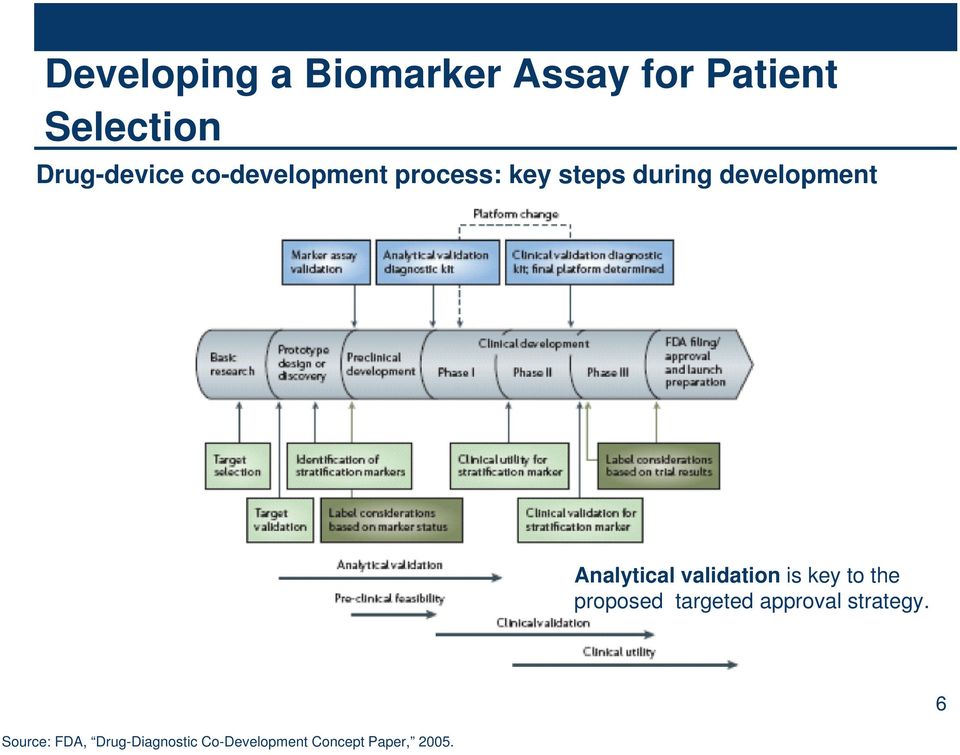
6 Developing a Biomarker Assay for Patient Selection Drug-device co-development process: key steps during development Analytical validation is key to the proposed targeted approval strategy. 6 Source: FDA, Drug-Diagnostic Co-Development Concept Paper, 2005.
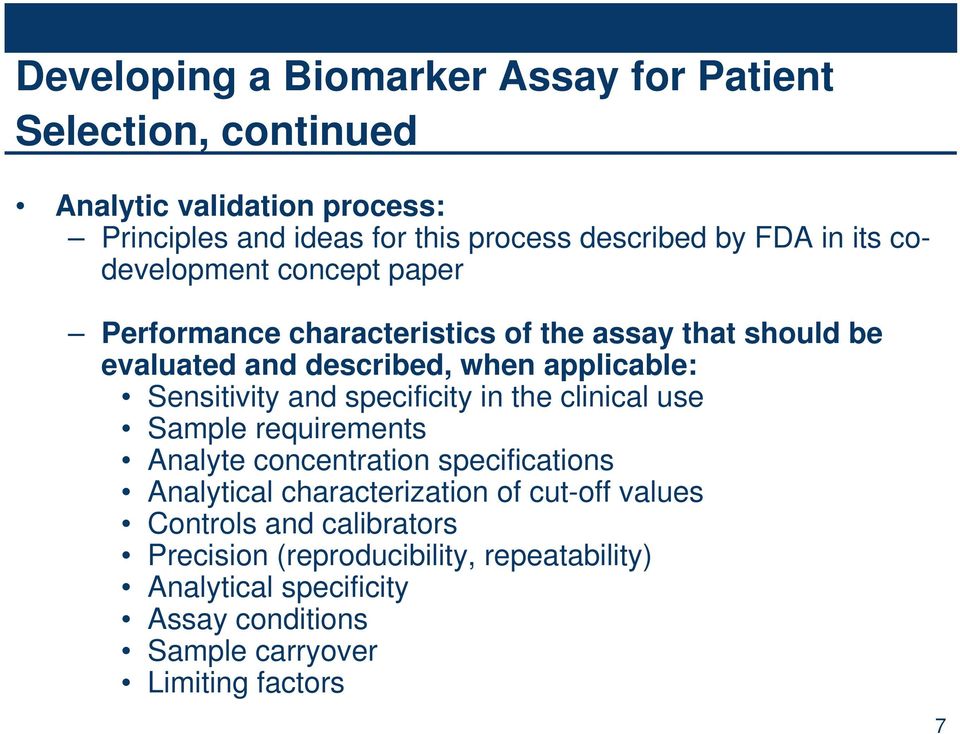
7 Developing a Biomarker Assay for Patient Selection, continued Analytic validation process: Principles and ideas for this process described by FDA in its codevelopment concept paper Performance characteristics of the assay that should be evaluated and described, when applicable: Sensitivity and specificity in the clinical use Sample requirements Analyte concentration specifications Analytical characterization of cut-off values Controls and calibrators Precision (reproducibility, repeatability) Analytical specificity Assay conditions Sample carryover Limiting factors 7
8 Principles for Designing Pivotal Trials of a Diagnostic-Drug Strategy (1) The design should consider the specific cancer/stage for which the sponsor seeks indication, and whether there is an available standard of care. If no standard of care exists, a new biomarker-targeted therapy for a cancer/stage may receive targeted approval on the basis of a single-arm trial that shows tumor regression, long-term stable disease, or effect on another endpoint that is reasonably likely to produce clinical benefit that can be presumed to be attributed to the tested drug in the marker-positive subpopulation. Marker-negative patients not required to be included in this study 8

9 Principles for Designing Pivotal Trials of a Diagnostic-Drug Strategy (2) The trial upon which targeted approval is given for a new drug and new companion diagnostic tests should employ a prospective design in which the drug is evaluated in the subpopulation identified by the test. In the case of a previously studied drug and a new diagnostic test, retrospective analyses of biomarker status as a treatment effect modifier are insufficient for full approval but should be sufficient for targeted approval under carefully specified circumstances, such as if the test applied Is analytically validated Can be applied in a significant proportion of the study population The treatment effect is robust in marker-positive patients. 9

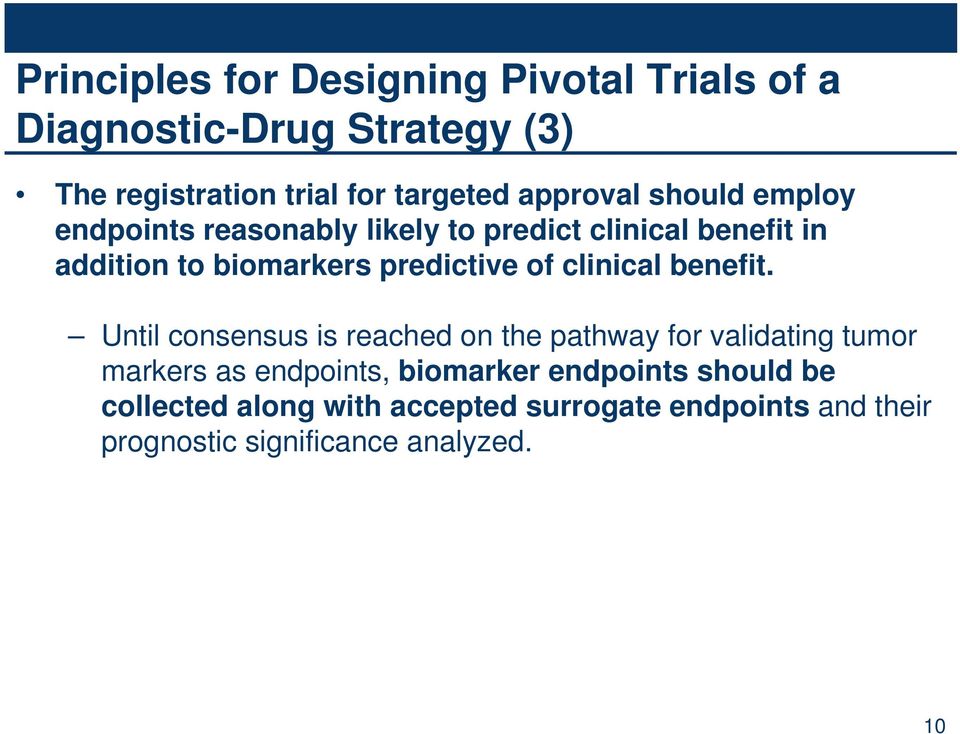
10 Principles for Designing Pivotal Trials of a Diagnostic-Drug Strategy (3) The registration trial for targeted approval should employ endpoints reasonably likely to predict clinical benefit in addition to biomarkers predictive of clinical benefit. Until consensus is reached on the pathway for validating tumor markers as endpoints, biomarker endpoints should be collected along with accepted surrogate endpoints and their prognostic significance analyzed. 10
11 Specific Designs and Considerations in Selection All comers ( randomize all ) design: To increase efficiency the treatment could be evaluated in the marker-positive subgroup before it is studied in all trial enrollees. If there is no effectiveness in marker-positive patients, the treatment fails. If the drug demonstrates effectiveness in marker-positive patients, targeted approval would be granted and the remainder of randomized patients would be evaluated for full approval if it s ethical to do so in light of the degree to which benefit may be possible in marker-negative patients. Enriched design: More efficient than a randomize all design if it is known with high confidence that the new treatment does not help all patients, if the subgroup expected to benefit is relatively small, and if the cut-off value for the test is well-established. Adaptive design: Potentially the most efficient in achieving the targeted approval threshold because uses pre-specified decision points to determine how a trial will progress 11

12 I-SPY 2 Trial: An Innovative Design for Targeted Therapy Development An adaptive trial to address the challenges of accelerating clinical development of targeted therapies in Phase II Will evaluate treatment effectiveness in biomarker-defined subsets Will allow for retrospective analysis to define the populations that benefit the most from particular treatments Patients are randomized to one of multiple treatment arms based on their biomarker profiles and the accumulating evidence of efficacy of the various treatments in patients with their biomarker profiles. As regimens show high Bayesian predictive probability (>85%) of being more effective than standard therapy, they will graduate from the trial with the corresponding biomarker signatures. Specific signatures from I-SPY 2 will allow companies to design focused, more efficient Phase III trials in targeted populations In the proposed paradigm from Panel 3, these signature-drug combinations might also be considered in terms of the Panel s recommended level of evidence model to trigger targeted approval 12

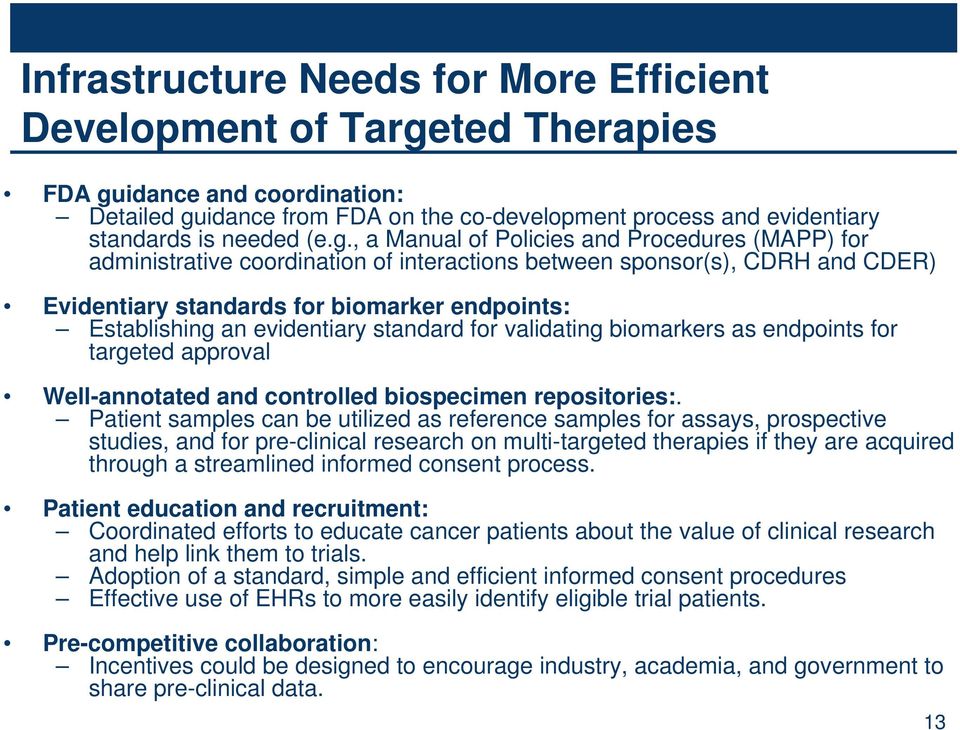
13 Infrastructure Needs for More Efficient Development of Targeted Therapies FDA guidance and coordination: Detailed guidance from FDA on the co-development process and evidentiary standards is needed (e.g., a Manual of Policies and Procedures (MAPP) for administrative coordination of interactions between sponsor(s), CDRH and CDER) Evidentiary standards for biomarker endpoints: Establishing an evidentiary standard for validating biomarkers as endpoints for targeted approval Well-annotated and controlled biospecimen repositories:. Patient samples can be utilized as reference samples for assays, prospective studies, and for pre-clinical research on multi-targeted therapies if they are acquired through a streamlined informed consent process. Patient education and recruitment: Coordinated efforts to educate cancer patients about the value of clinical research and help link them to trials. Adoption of a standard, simple and efficient informed consent procedures Effective use of EHRs to more easily identify eligible trial patients. Pre-competitive collaboration: Incentives could be designed to encourage industry, academia, and government to share pre-clinical data. 13
THE FUTURE OF CLINICAL TRIALS: NEW MODEL TO ENHANCE EFFICIENCY. Jeff Allen, PhD Executive Director Friends of Cancer Research
 THE FUTURE OF CLINICAL TRIALS: NEW MODEL TO ENHANCE EFFICIENCY Jeff Allen, PhD Executive Director Friends of Cancer Research Current Challenges Each potential new therapy is typically tested independently
Clinical Trials: The Crux of Cancer Innovation
 Clinical Trials: The Crux of Cancer Innovation Even as medical science is transforming cancer care, major deficiencies in the way cancer clinical trials are designed, carried out, regulated and funded
Regulatory Pathways for Licensure and Use of Ebola Virus Vaccines During the Current Outbreak FDA Perspective
 Regulatory Pathways for Licensure and Use of Ebola Virus Vaccines During the Current Outbreak FDA Perspective Office of Vaccines Research and Review Center for Biologics Evaluation and Research U.S. Food
Guidance for Industry
 Guidance for Industry Cancer Drug and Biological Products Clinical Data in Marketing Applications U.S. Department of Health and Human Services Food and Drug Administration Center for Drug Evaluation and
Ovarian Cancer and Modern Immunotherapy: Regulatory Strategies for Drug Development
 Ovarian Cancer and Modern Immunotherapy: Regulatory Strategies for Drug Development Sanjeeve Bala, MD, MPH Ovarian Cancer Endpoints Workshop FDA White Oak September 3, 2015 Overview Immune agents from
Personalized Predictive Medicine and Genomic Clinical Trials
 Personalized Predictive Medicine and Genomic Clinical Trials Richard Simon, D.Sc. Chief, Biometric Research Branch National Cancer Institute http://brb.nci.nih.gov brb.nci.nih.gov Powerpoint presentations
The Clinical Trials Process an educated patient s guide
 The Clinical Trials Process an educated patient s guide Gwen L. Nichols, MD Site Head, Oncology Roche TCRC, Translational and Clinical Research Center New York DISCLAIMER I am an employee of Hoffmann-
Clinical Trial Designs for Incorporating Multiple Biomarkers in Combination Studies with Targeted Agents
 Clinical Trial Designs for Incorporating Multiple Biomarkers in Combination Studies with Targeted Agents J. Jack Lee, Ph.D. Department of Biostatistics 3 Primary Goals for Clinical Trials Test safety and
Genomic Medicine The Future of Cancer Care. Shayma Master Kazmi, M.D. Medical Oncology/Hematology Cancer Treatment Centers of America
 Genomic Medicine The Future of Cancer Care Shayma Master Kazmi, M.D. Medical Oncology/Hematology Cancer Treatment Centers of America Personalized Medicine Personalized health care is a broad term for interventions
Guidance for Industry FDA Approval of New Cancer Treatment Uses for Marketed Drug and Biological Products
 Guidance for Industry FDA Approval of New Cancer Treatment Uses for Marketed Drug and Biological Products U.S. Department of Health and Human Services Food and Drug Administration Center for Drug Evaluation
CLINICAL TRIALS SHOULD YOU PARTICIPATE? by Gwen L. Nichols, MD
 CLINICAL TRIALS SHOULD YOU PARTICIPATE? by Gwen L. Nichols, MD Gwen L. Nichols, M.D., is currently the Oncology Site Head of the Roche Translational Clinical Research Center at Hoffman- LaRoche. In this
Regulatory Issues in Genetic Testing and Targeted Drug Development
 Regulatory Issues in Genetic Testing and Targeted Drug Development Janet Woodcock, M.D. Deputy Commissioner for Operations Food and Drug Administration October 12, 2006 Genetic and Genomic Tests are Types
Avastin in Metastatic Breast Cancer
 Non-interventional study Avastin in Metastatic Breast Cancer ML 21165 / 2007 Clinical Study Report Synopsis ROCHE ML21165 / WiSP Project RH09 / V. 1.0 / 24.06.2013 ROCHE ML21165-2 - Name of Sponsor Roche
How To Be A Guinea Pig
 Fusing RCTs with EHR Big Data Derek C. Angus, MD, MPH, FRCP CRISMA Center, Department of Critical Care Medicine Department of Health Policy and Management McGowan Institute for Regenerative Medicine Clinical
First In Human Pediatric Trials and Safety Assessment for Rare and Orphan Diseases
 First In Human Pediatric Trials and Safety Assessment for Rare and Orphan Diseases Andrew E. Mulberg, MD, FAAP Division Deputy Director OND/ODE3/DGIEP FDA Partnership is the Key Coming together is a beginning;
Targeting Cancer: Innovation in the Treatment of Chronic Myelogenous Leukemia EXECUTIVE SUMMARY. New England Healthcare Institute
 Targeting Cancer: Innovation in the Treatment of Chronic Myelogenous Leukemia New England Healthcare Institute NEHI Innovation Series March 2004 Executive Summary From drugs and medical devices, to information
ALCHEMIST (Adjuvant Lung Cancer Enrichment Marker Identification and Sequencing Trials)
 ALCHEMIST (Adjuvant Lung Cancer Enrichment Marker Identification and Sequencing Trials) 3 Integrated Trials Testing Targeted Therapy in Early Stage Lung Cancer Part of NCI s Precision Medicine Effort in
FAST TRACK DEVELOPMENT OF EBOLA VACCINES: FDA REGULATORY PERSPECTIVE
 FAST TRACK DEVELOPMENT OF EBOLA VACCINES: FDA REGULATORY PERSPECTIVE Marion Gruber, Ph.D. Director Office of Vaccines Research & Review Center for Biologics Evaluation and Research US Food and Drug Administration
Cancer Clinical Trials: In-Depth Information
 Cancer Clinical Trials: In-Depth Information The Drug Development and Approval Process 1. Early research and preclinical testing 2. IND application filed with FDA 3. Clinical trials (phases 1, 2, and 3)
The Product Review Life Cycle A Brief Overview
 Stat & Quant Mthds Pharm Reg (Spring 2, 2014) Lecture 2,Week 1 1 The review process developed over a 40 year period and has been influenced by 5 Prescription User Fee Act renewals Time frames for review
through advances in risk-based
 Insight brief Quintiles is a market leader with >100 risk-based monitoring studies Quintiles developed solutions that bring as much as 25% cost reduction over traditional trial execution approaches Transform
The Role of the Patient/Consumer in Establishing a Dynamic Clinical Research Continuum:
 The National Working Group on Evidence-Based Health Care The Role of the Patient/Consumer in Establishing a Dynamic Clinical Research Continuum: Models of Patient/Consumer Inclusion August 2008 The Working
A Cost Effective Way to De Risk Biomarker Clinical Trials: Early Development Considerations
 A Cost Effective Way to De Risk Biomarker Clinical Trials: Early Development Considerations Ce3, Inc. and Insight Genetics, Inc. Oncology Forum July 15, 2015 Agenda Introductions Definitions Regulations
FDA Fast Track and Priority Review Programs
 Order Code RS22814 February 21, 2008 FDA Fast Track and Priority Review Programs Summary Susan Thaul Specialist in Drug Safety and Effectiveness Domestic Social Policy Division By statutory requirements
Bayesian Phase I/II clinical trials in Oncology
 Bayesian Phase I/II clinical trials in Oncology Pierre Mancini, Sandrine Micallef, Pierre Colin Séminaire JEM-SFES - 26 Janvier 2012 Outline Oncology phase I trials Limitations of traditional phase I designs
What Lies Ahead? Trends to Watch: Health Care Product Development in North America
 What Lies Ahead? Trends to Watch: Health Care Product Development in North America What Lies Ahead? for 2015 DIA has released its third annual What Lies Ahead? report, providing experts insights into the
Early Detection Research Network: Validation Infrastructure. Jo Ann Rinaudo, Ph.D. Division of Cancer Prevention
 Early Detection Research Network: Validation Infrastructure Jo Ann Rinaudo, Ph.D. Division of Cancer Prevention 15 October 2015 Mission The NCI Early Detection Research Network s (EDRN) mission is to implement
Achieving Regulatory Success: Areas of focus for biotechnology companies. Michael J. Schlosser, PhD, DABT April 21, 2013
 Achieving Regulatory Success: Areas of focus for biotechnology companies Michael J. Schlosser, PhD, DABT April 21, 2013 Regulatory Success Outline Regulatory Initiatives Regulatory Science Pre-Regulatory
Clinical Trial Design. Sponsored by Center for Cancer Research National Cancer Institute
 Clinical Trial Design Sponsored by Center for Cancer Research National Cancer Institute Overview Clinical research is research conducted on human beings (or on material of human origin such as tissues,
Big Data An Opportunity or a Distraction? Signal or Noise?
 Big Data An Opportunity or a Distraction? Signal or Noise? Maya R. Said, Sc.D. SVP & Global Head, Oncology Policy & Market Access, Novartis 3rd International Systems Biomedicine Symposium Luxembourg, 28
Overview of Phase 1 Oncology Trials of Biologic Therapeutics
 Overview of Phase 1 Oncology Trials of Biologic Therapeutics Susan Jerian, MD ONCORD, Inc. February 28, 2008 February 28, 2008 Phase 1 1 Assumptions and Ground Rules The goal is regulatory approval of
EHR4CR ENABLING PROACTIVE RESEARCH
 EHR4CR ENABLING PROACTIVE RESEARCH Neelam Patel Neelam Consulting Electronic Health Records for Clinical Research 76 Why change how I currently operate? To more visible to the clinical trial community
Guidance for Industry Expedited Programs for Serious Conditions Drugs and Biologics
 Guidance for Industry Expedited Programs for Serious Conditions Drugs and Biologics U.S. Department of Health and Human Services Food and Drug Administration Center for Drug Evaluation and Research (CDER)
A leader in the development and application of information technology to prevent and treat disease.
 A leader in the development and application of information technology to prevent and treat disease. About MOLECULAR HEALTH Molecular Health was founded in 2004 with the vision of changing healthcare. Today
STATE OF MICHIGAN DEPARTMENT OF INSURANCE AND FINANCIAL SERVICES Before the Director of Insurance and Financial Services
 STATE OF MICHIGAN DEPARTMENT OF INSURANCE AND FINANCIAL SERVICES Before the Director of Insurance and Financial Services In the matter of: Petitioner, v Blue Care Network of Michigan, Respondent. File
Groundbreaking Collaborative Clinical Trial Launched
 Groundbreaking Collaborative Clinical Trial Launched For immediate release Media Contacts: June 16, 2014 Richard Folkers Alison Hendrie 9:00 a.m., EDT Foundation for the NIH Rubenstein Communications (301)
2019 Healthcare That Works for All
 2019 Healthcare That Works for All This paper is one of a series describing what a decade of successful change in healthcare could look like in 2019. Each paper focuses on one aspect of healthcare. To
Molecular markers and clinical trial design parallels between oncology and rare diseases?
 Molecular markers and clinical trial design parallels between oncology and rare diseases?, Harriet Sommer Institute for Medical Biometry and Statistics, University of Freiburg Medical Center 6. Forum Patientennahe
Quality by Design Concept
 3rd Jerusalem Conference on Quality and Pharma Sciences 6-7 June, 2012 QbD in Clinical Research - Where Can QbD Impact Clinical Research Practices? Dr. Yafit Stark Vice President, TEVA Pharmaceutical Industries,
Guidance for Industry Determining the Extent of Safety Data Collection Needed in Late Stage Premarket and Postapproval Clinical Investigations
 Guidance for Industry Determining the Extent of Safety Data Collection Needed in Late Stage Premarket and Postapproval Clinical Investigations DRAFT GUIDANCE This guidance document is being distributed
TUTORIAL on ICH E9 and Other Statistical Regulatory Guidance. Session 1: ICH E9 and E10. PSI Conference, May 2011
 TUTORIAL on ICH E9 and Other Statistical Regulatory Guidance Session 1: PSI Conference, May 2011 Kerry Gordon, Quintiles 1 E9, and how to locate it 2 ICH E9 Statistical Principles for Clinical Trials (Issued
Breakthrough Therapy Program U.S. Food and Drug Administration (FDA)
 Breakthrough Therapy Program U.S. Food and Drug Administration (FDA) Presentation before the European Commission Expert Group on Safe and Timely Access to Medicines for Patients (STAMP) Jarilyn Dupont,
Big Data and Oncology Care Quality Improvement in the United States
 Big Data and Oncology Care Quality Improvement in the United States Peter P. Yu, MD, FACP, FASCO President, American Society of Clinical Oncology Director of Cancer Research, Palo Alto Medical Foundation
Guidance for Industry
 Guidance for Industry Codevelopment of Two or More New Investigational Drugs for Use in Combination U.S. Department of Health and Human Services Food and Drug Administration Center for Drug Evaluation
Glossary of Clinical Trial Terms
 Glossary of Clinical Trial Terms ADVERSE REACTION: (Adverse Event): Also known as side effects, adverse reactions include any undesired actions or effects of the experimental drug or treatment. Experimental
Voluntary Genomic Data Submissions at the U.S. FDA
 Voluntary Genomic Data Submissions at the U.S. FDA International Conference on Harmonization Chicago, IL November 9-10, 9 2005 Felix W. Frueh, PhD Associate Director for Genomics Office of Clinical Pharmacology
Cancer Drug Reimbursement within the Context of Clinical Trials. (Draft for consultation purposes) Version 8.0
 Cancer Drug Reimbursement within the Context of Clinical Trials (Draft for consultation purposes) Version 8.0 May 17, 2013 Introduction Clinical and cost-effectiveness factors have led most public payers
CMS Issues Proposal to Revise Clinical Trial Policy National Coverage Determination
 Covington & Burling llp Brussels London New York San Francisco Washington Health Care E-Alert May 3, 2007 CMS Issues Proposal to Revise Clinical Trial Policy National Coverage Determination Recently, the
Guidance for Industry Expedited Programs for Serious Conditions Drugs and Biologics
 Guidance for Industry Expedited Programs for Serious Conditions Drugs and Biologics DRAFT GUIDANCE This guidance document is being distributed for comment purposes only. Comments and suggestions regarding
How To Weigh Data From A Study
 PRINCIPLES ON RESPONSIBLE SHARING OF TRUTHFUL AND NON-MISLEADING INFORMATION ABOUT MEDICINES WITH HEALTH CARE PROFESSIONALS AND PAYERS INTRODUCTION In the era of data-driven medicine, where all parties
Expanded Access Programs. Richard Klein Office of Special Health issues Food and Drug Administration
 Expanded Access Programs Richard Klein Office of Special Health issues Food and Drug Administration Expanded Access Programs (EAPs) What is expanded access? History Legislative background General principles
The Promise and Challenge of Adaptive Design in Oncology Trials
 THE POWER OFx Experts. Experience. Execution. The Promise and Challenge of Adaptive Design in Oncology Trials Clinical oncology trials are more complex and time consuming than those in any other therapeutic
Patient Search in Clinical Trials history, current trends and technological advances
 Patient Search in Clinical Trials history, current trends and technological advances Author Ömer Şeker, Clinerion Abstract A brief overview of the historical development of the clinical trial industry
Coverage Analysis: The Cornerstone of Clinical Research Billing Presented by: Mary L. Veazie, CPA, MBA, CHC, CHRC Executive Director, Clinical
 Coverage Analysis: The Cornerstone of Clinical Research Billing Presented by: Mary L. Veazie, CPA, MBA, CHC, CHRC Executive Director, Clinical Research Finance The University of Texas MD Anderson Cancer
The Retrospective Approach To Companion Diagnostics
 Portfolio Media. Inc. 860 Broadway, 6th Floor New York, NY 10003 www.law360.com Phone: +1 646 783 7100 Fax: +1 646 783 7161 [email protected] The Retrospective Approach To Companion Diagnostics
ORACLE HEALTH SCIENCES INFORM ADVANCED MOLECULAR ANALYTICS
 ORACLE HEALTH SCIENCES INFORM ADVANCED MOLECULAR ANALYTICS INCORPORATE GENOMIC DATA INTO CLINICAL R&D KEY BENEFITS Enable more targeted, biomarker-driven clinical trials Improves efficiencies, compressing
Diagnostic Tests. Brad Spring Director, Regulatory Affairs
 Regulatory Challenges in the Development of Diagnostic Tests Industry Perspective Brad Spring Director, Regulatory Affairs September 28, 2011 Balancing Evidence of Safety & Effectiveness and Time to Market
Therapeutic Goods Administration Orphan Drugs Program: Discussion paper
 Therapeutic Goods Administration Orphan Drugs Program: Discussion paper Submission from the Clinical Oncology Society of Australia and Cancer Council Australia March 2015 The Clinical Oncology Society
Guidance for Industry Clinical Trial Endpoints for the Approval of Cancer Drugs and Biologics
 Guidance for Industry Clinical Trial Endpoints for the Approval of Cancer Drugs and Biologics U.S. Department of Health and Human Services Food and Drug Administration Center for Drug Evaluation and Research
PERSPECTIVE Drug Discovery Today Volume 17, Numbers 13/14 July 2012
 drug development: an economically viable strategy for biopharma R&D feature Kiran N. Meekings 1, [email protected], Cory S.M. Williams 2 and John E. Arrowsmith 1 drug incentives have stimulated
Elements for optimising Orphan drug development industry perspective
 Elements for optimising Orphan drug development industry perspective IRDiRC Conference, Dublin, 17 April 2013 Wills Hughes-Wilson, Vice President External Affairs, Chief Patient Access Officer, Sobi With
Cancer Clinical Trials: The Basics
 Cancer Clinical Trials: The Basics What Are Cancer Clinical Trials? Research studies involving people Try to answer scientific questions and find better ways to prevent, diagnose, or treat cancer 2 Why
There are 2 types of clinical trials that are of interest to the. The Clinical Trials Network of the Society of Nuclear Medicine
 The Clinical Trials Network of the Society of Nuclear Medicine Michael M. Graham, PhD, MD The Clinical Trials Network of the Society of Nuclear Medicine was formed to provide quality assurance of both
Using genetic biomarkers to pre-identify oncology patients for clinical trials
 White paper Quintiles Vantage Point Quintiles helped develop or commercialize all of the Top 30 bestselling oncology products of 2014 Oncology pre-profiling: Using genetic biomarkers to pre-identify oncology
Not All Clinical Trials Are Created Equal Understanding the Different Phases
 Not All Clinical Trials Are Created Equal Understanding the Different Phases This chapter will help you understand the differences between the various clinical trial phases and how these differences impact
Clinical Trial Protocol Development. Developed by Center for Cancer Research, National Cancer Institute Endorsed by the CTN SIG Leadership Group
 Clinical Trial Protocol Development Developed by Center for Cancer Research, National Cancer Institute Endorsed by the CTN SIG Leadership Group Objectives The clinical trial protocol is the heart of any
Guidance for Industry Information Program on Clinical Trials for Serious or Life-Threatening Diseases and Conditions
 Guidance for Industry Information Program on Clinical Trials for Serious or Life-Threatening Diseases and Conditions U.S. Department of Health and Human Services Food and Drug Administration Center for
Overview of FDA Expedited Programs with a Focus on Breakthrough Therapy
 Overview of FDA Expedited Programs with a Focus on Breakthrough Therapy Miranda Raggio, RN, BSN, MA CDER Breakthrough Therapy Program Manager Regulatory Affairs Team Office of New Drugs, CDER Overview
TABLE OF CONTENTS. Introduction...1. Chapter1 AdvancesinTreatment...2. Chapter2 MedicinesinDevelopment...11. Chapter3 ValueandSpending...
 CANCER TABLE OF CONTENTS Introduction...1 Chapter1 AdvancesinTreatment...2 Chapter2 MedicinesinDevelopment......11 Chapter3 ValueandSpending......15 Chapter4 Conclusion...22 INTRODUCTION Researchers and
Rare Diseases: Common Issues in Drug Development Guidance for Industry
 Rare Diseases: Common Issues in Drug Development Guidance for Industry DRAFT GUIDANCE This guidance document is being distributed for comment purposes only. Comments and suggestions regarding this draft
HTA Position Paper. The International Network of Agencies for Health Technology Assessment (INAHTA) defines HTA as:
 HTA Position Paper The Global Medical Technology Alliance (GMTA) represents medical technology associations whose members supply over 85 percent of the medical devices and diagnostics purchased annually
POLICY AND PROCEDURES OFFICE OF NEW DRUGS. Good Review Practice: Management of Breakthrough Therapy-Designated Drugs and Biologics.
 POLICY AND PROCEDURES OFFICE OF NEW DRUGS Good Review Practice: Management of Breakthrough Therapy-Designated Drugs and Biologics Table of Contents PURPOSE...1 BACKGROUND...2 POLICY...3 ROLES AND RESPONSIBILITIES...4
Use of Electronic Health Record Data in Clinical Investigations
 Use of Electronic Health Record Data in Clinical Investigations Guidance for Industry DRAFT GUIDANCE This guidance document is being distributed for comment purposes only. Comments and suggestions regarding
Strategic Consulting Services
 Services 1 Leadership Team Mark Levonyak President [email protected] Mobile: 214.460.5051 Martin W. Lee, MD EVP, Clinical Trial Services [email protected] Mobile: 952.373.1405 John Eckardt, MD Chief
LUNG CANCER CLINICAL TRIALS
 UNDERSTANDING LUNG CANCER CLINICAL TRIALS 1-800-298-2436 LungCancerAlliance.org A GUIDE FOR THE PATIENT 1 TABLE OF CONTENTS INTRODUCTION TO CLINICAL TRIALS What Is a Clinical Trial?...4 Types of Clinical
MOLOGEN AG. Q1 Results 2015 Conference Call Dr. Matthias Schroff Chief Executive Officer. Berlin, 12 May 2015
 Q1 Results 2015 Conference Call Dr. Matthias Schroff Chief Executive Officer Berlin, 12 May 2015 V1-6 Disclaimer Certain statements in this presentation contain formulations or terms referring to the future
Endpoint Selection in Phase II Oncology trials
 Endpoint Selection in Phase II Oncology trials Anastasia Ivanova Department of Biostatistics UNC at Chapel Hill [email protected] Primary endpoints in Phase II trials Recently looked at journal articles