
Master of Science in Counseling & Educational Psychology
|
|
|
- Ferdinand Carr
- 10 years ago
- Views:
Transcription
1 Master of Science in Counseling & Educational Psychology MASTER S STUDENT HANDBOOK DEPARTMENT OF COUNSELING & EDUCATIONAL PSYCHOLOGY Texas A & M University Corpus Christi 6300 Ocean Drive Corpus Christi, Texas Office (361) (361) (361) Revised August 2015

2 TABLE OF CONTENTS SECTION PAGE INTRODUCTION 1 PROGRAM FACULTY 1 PROGRAM INFORMATION 2 Mission Statement 2 Overview 2 Overall Program Objectives 3 Specific Program Objectives 3 PROGRAMS IN COUNSELING AND EDUCATIONAL PSYCHOLOGY 7 Clinical Mental Health Counseling Track 7 Marriage and Family Counseling Track 8 School Counseling Track 8 Addictions Counseling Track 8 Course Sequencing 9 Limited Enrollment Courses 10 PRACTICUM AND INTERNSHIP 11 Practicum 11 Internship 12 Requirements for Marriage, Couple, and Family Counseling Program 13 Requirements for School Counseling Program 13 Requirements for Addictions Counseling Program 13 Site Selection 16 Department Counseling and Training Clinic 16 POLICIES AND PROCEDURES 16 Admissions Procedures 16 Degree Plans and Advisement 17 Individual Development Plan (IDP) 18 Notification of Intent to Graduate 18 Comprehensive Examination 18 Counseling Student Listserv and 19 Grading Policies 19 Grades of Incomplete 19 Grade Appeals Process 20 PROFESSIONAL DUTIES AND RESPONSIBILITIES 20 Student Responsibility 21 Faculty Review 21 Personal Counseling 22 STUDENT REVIEW, REMEDIATION, RETENTION, AND DISMISSAL POLICY 22 OTHER INFORMATION 25 Orientation Meetings 25 Professional Liability Insurance 25 Financial Aid 26 Graduate Assistantship 26
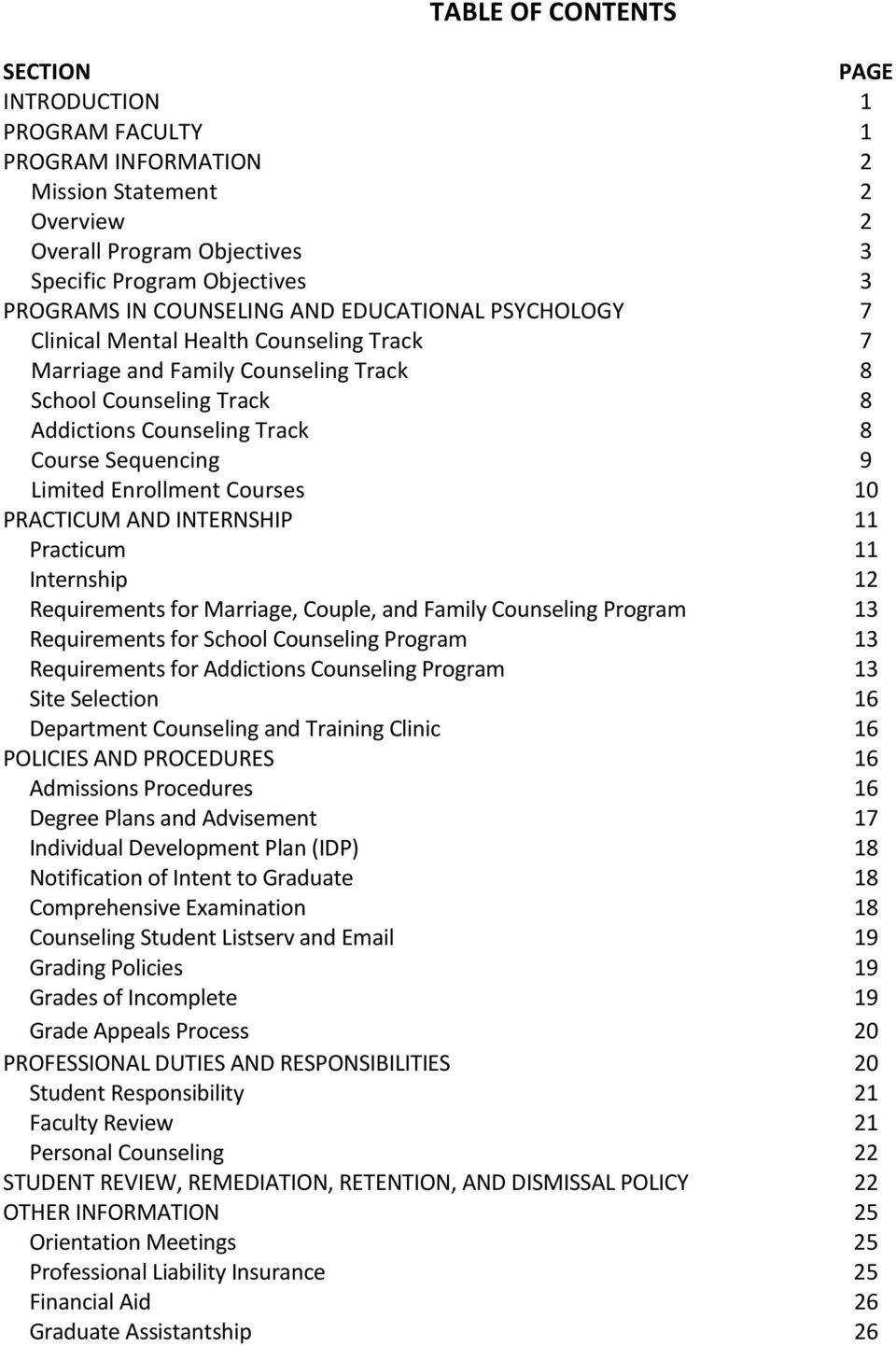
3 Professional Licensure and Certification 27 Endorsement and Certification 28 PROFESSIONAL IDENTITY AND AFFILIATIONS 28 Recommended National Organizations 28 Recommended State Organizations 29 Chi Sigma Iota 29 WORKSHOPS SPONSORED BY CNEP DEPARTMENT 30 FOLLOW-UP STUDIES 30 OTHER SOURCES OF INFORMATION 30 APPENDIX A: CNEP STUDENT COMPETENCY EVALUATION 31 APPENDIX B: MASTERS STUDENT ADVISING AND COMPREHENSIVE 33 MONITORING PROCESS APPENDIX C: PROFESSIONAL ISSUES AND BEHAVIOR RATING SCALE APPENDIX D: STATEMENT OF UNDERSTANDING 35 37

4 INTRODUCTION The purpose of this handbook is to provide students with information concerning the Department of Counseling and Educational Psychology (CNEP) at Texas A&M University-Corpus Christi. Programs are accredited by the Council for Accreditation of Counseling and Related Educational Programs (CACREP). The handbook provides prospective and current students with relevant information, departmental policies, requirements, duties, and expectations set forth by the Department. Students admitted into the CNEP program are provided with a copy of the handbook at either the fall or spring student orientations, during their matriculation in the Introduction to Counseling course, or by downloading it from the CNEP Department website. It is the responsibility of the student to read and become familiar with the information in the handbook. Students must confirm acceptance of the duties, expectations, and responsibilities outlined in this handbook by signing the Statement of Understanding (see Appendix D). Submission of the signed Statement of Understanding is mandatory during the first semester of enrollment. The signed Statement of Understanding will generally be submitted to the CNEP 5304 Introduction to Counseling instructor for inclusion in your departmental file. PROGRAM FACULTY Robert L. Smith, Ph.D. University of Michigan Department Chair and Professor ECDC 224 (361) Yvonne Castillo, Ph.D. Texas A&M University-Corpus Christi Professional Assistant Professor NRC 2700 (361) Kimberly N. Frazier, Ph.D. University of New Orleans Assistant Professor ECDC 148 (361) A. Stephen Lenz, Ph.D. Texas A&M University-Corpus Christi Assistant Professor ECDC 152 (361) Richard J. Ricard, Ph.D. Harvard University Professor ECDC 223 (361) Mary Alice Fernandez, Ph.D. Texas A&M University-Corpus Christi Assistant Professor ECDC 232A (361) K. Michelle Hunnicutt-Hollenbaugh, Ph.D. The Ohio State University Assistant Professor ECDC 232 (361) Marvarene Oliver, Ed.D. Texas A&M University-Commerce Professor ECDC 149 (361) Joshua Watson, Ph.D. University of North Carolina at Greensboro Associate Professor ECDC 151 (361) ADMINISTRATIVE ASSISTANT Rachel G. Perez ECDC 242A (361)

5 Fax: (361) ADJUNCT FACULTY Adjunct faculty members who teach courses as needed in the department. The adjunct faculty teaching in any specific semester will change according to need, and the list below is not exhaustive. To reach adjunct faculty members, please contact them either through your BlackBoard courseroom or contact the CNEP office. Cathy Abernethy, Ph.D. Fred Capps, Ph.D. Sallie Freeman, Ph.D. B. Joseph Biberstein, Ph.D. Catherine Cueva, Ph.D. Stephen Simmons, Ed.D. AFFILIATE FACULTY Affiliate faculty members are TAMU-CC full-time faculty members who regularly teach research courses required for the master s degree in Counseling. Kamiar Kouzekanani, Ph.D. Guang Zeng, Ph.D. FC 223 (361) FC 222 (361) PROGRAM INFORMATION Mission Statement The Department of Counseling and Educational Psychology at Texas A&M University-Corpus Christi, devoted to excellence in instruction, research, and service, prepares counselors representing diverse backgrounds and experiences to serve the educational and mental health needs in the global community. Students from the South Texas region and beyond are trained in core counseling courses to successfully work in school, community, and mental health settings. Graduates demonstrate a comprehensive in-depth knowledge base in counseling as well as the clinical skills necessary to be effective counselors. At the doctoral level, the Ph.D. program prepares future professors in Counselor Education. Overview Texas A & M University-Corpus Christi, through the College of Education, offers Master of Science (M.S.) programs preparing top level counselors to work in clinical mental health settings; hospitals; school systems; marriage, couple, and family counseling centers; and private practice. The programs in Marriage, Couple, and Family Counseling, Clinical Mental Health Counseling, Addictions Counseling, and School Counseling are accredited by the Council for Accreditation of Counseling and Related Educational Programs (CACREP). The Ph.D. Program in Counselor Education is also fully accredited by CACREP. The overall philosophy of the CNEP Department is to prepare master's level counselors with academic, professional, and personal credentials to 2
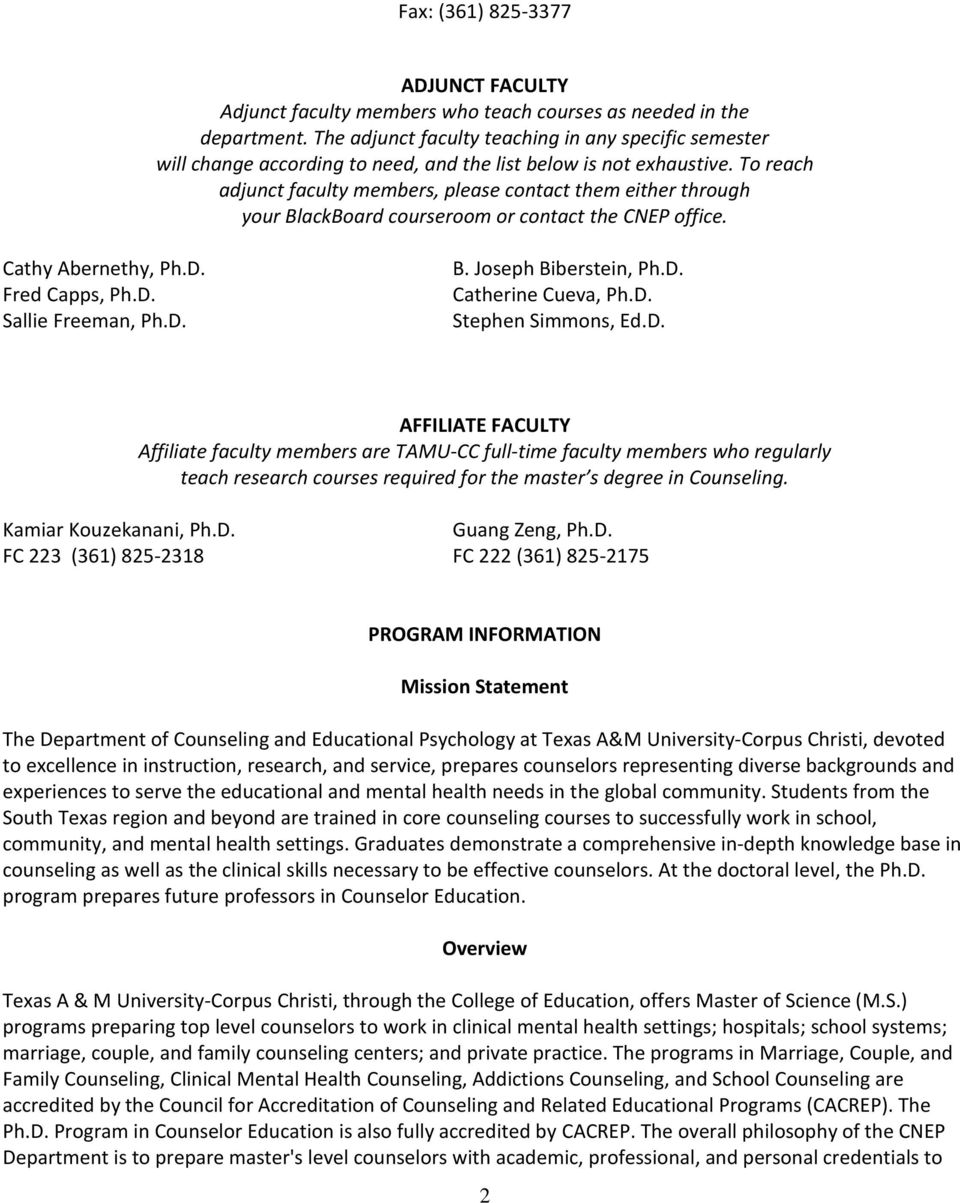
6 perform at a high level of effectiveness in their anticipated work settings. Individual, systems, and integrated training are emphasized with a focus on understanding and applying evidence-based research findings that demonstrate effectiveness in counseling. Current objectives and student learning outcomes of the CNEP programs are reflected in the core course requirements as mandated by national accreditation standards and licensure boards. Objectives are drawn from CACREP Standards, the professional literature, and input from faculty, students, graduates, and community members. Through coursework, practicum, internship, research, and successful completion of the comprehensive examination, students are expected to meet all overall program objectives and learning outcomes, as well as specific course objectives and coursework learning outcomes. Students should be prepared to demonstrate success in accomplishing learning outcomes. In addition, students must be familiar with and have access to computer technology in order to participate in on-line course activities and communicate with faculty and other students. Overall Program Objectives, Student Learning Outcomes Graduates of the masters programs in Counseling will: Develop a theoretical and psychological base of counseling. Demonstrate individual and group counseling skills. Demonstrate research, measurement, and evaluation expertise. Demonstrate personal growth and professional development. Demonstrate knowledge and understanding of cultural differences. Demonstrate understanding of advocacy and social justice. Specific Program Objectives and Student Learning Outcomes Professional Orientation and Ethical Practice: studies that provide an understanding of all of the following aspects of professional functioning. Graduates of the masters programs in Counseling will: Demonstrate understanding of the history and philosophy of the counseling profession. Demonstrate understanding of professional roles, functions, and relationships with other human service providers, including strategies for interagency/interorganization collaboration and communication. Demonstrate understanding of counselors roles and responsibilities as members of an interdisciplinary emergency management response team during a local, regional, or national crisis, disaster or other trauma-causing event. Demonstrate self-care strategies appropriate to the counselor role. Demonstrate understanding of counseling supervision models, practices, and processes. Demonstrate knowledge of professional organizations, including membership benefits, activities, services to members, and current issues. Demonstrate knowledge of professional credentialing, including certification, licensure, and accreditation practices and standards, and the effects of public policy on these issues. Demonstrate understanding of the role and process of the professional counselor advocating on behalf of the profession. 3

7 Demonstrate understanding of advocacy processes needed to address institutional and social barriers that impede access, equity, and success for clients. Demonstrate understanding of ethical standards of professional organizations and credentialing bodies, and applications of ethical and legal considerations in professional counseling. Social and Cultural Diversity: studies that provide an understanding of the cultural context of relationships, issues, and trends in a multicultural society. Graduates of the masters programs in Counseling will: Demonstrate understanding of multicultural and pluralistic trends, including characteristics and concerns within and among diverse groups nationally and internationally. Demonstrate synthesis of attitudes, beliefs, understandings, and acculturative experiences, including specific experiential learning activities designed to foster students understanding of self and culturally diverse clients. Demonstrate understanding of theories of multicultural counseling, identity development, and social justice. Demonstrate competencies in individual, couple, family, group, and community strategies for working with and advocating for diverse populations, including multicultural competencies. Demonstrate understanding of counselors roles in developing cultural self-awareness, promoting cultural social justice, advocacy and conflict resolution, and other culturally supported behaviors that promote optimal wellness and growth of the human spirit, mind, or body. Demonstrate understanding of counselors roles in eliminating biases, prejudices, and processes of intentional and unintentional oppression and discrimination. Human Growth and Development: studies that provide an understanding of the nature and needs of persons at all developmental levels and in multicultural contexts. Graduates of the masters programs in Counseling will: Demonstrate understanding of theories of individual and family development and transitions across the life span. Demonstrate understanding of theories of learning and personality development, including current understandings about neurobiological behavior. Demonstrate understanding of the effects of crises, disasters, and other trauma-causing events on persons of all ages. Demonstrate understanding of theories and models of individual, cultural, couple, family, and community resilience. Develop a general framework for understanding exceptional abilities and strategies for differentiated interventions. Demonstrate understanding of human behavior, including an understanding of developmental crises, disability, psychopathology, and situational and environmental factors that affect both normal and abnormal behavior. Demonstrate understanding of theories and etiology of addictions and addictive behaviors, including strategies for prevention, intervention, and treatment. 4

8 Demonstrate understanding of theories for facilitating optimal development and wellness over the life span. Career Development: studies that provide an understanding of career development and related life factors. Graduates of the masters programs in Counseling will: Demonstrate understanding of career development theories and decision-making models. Demonstrate understanding of career, avocational, educational, occupational and labor market information resources, and career information systems. Demonstrate knowledge of career development program planning, organization, implementation, administration, and evaluation. Demonstrate knowledge of the interrelationships among and between work, family, and other life roles and factors, including the role of multicultural issues in career development. Demonstrate knowledge of and skills in career and educational planning, placement, follow-up, and evaluation. Demonstrate knowledge of and skills in use of assessment instruments and techniques relevant to career planning and decision making. Demonstrate knowledge of and ability to utilize career counseling processes, techniques, and resources, including those applicable to specific populations in a global economy. Helping Relationships: studies that provide an understanding of the counseling process in a multicultural society. Graduates of the masters programs in Counseling will: Demonstrate an orientation to wellness and prevention as desired counseling goals. Demonstrate counselor characteristics and behaviors that influence helping processes. Demonstrate essential interviewing and counseling skills. Demonstrate understanding of counseling theories that provide the student with models to conceptualize client presentation and that help the student select appropriate counseling interventions as well as begin to develop a personal model of counseling. Demonstrate understanding of a systems perspective that provides understanding of family and other systems theories and major models of family and related interventions. Demonstrate understanding and ability to utilize a general framework for understanding and practicing consultation. Demonstrate understanding of crisis intervention and suicide prevention models, including use of psychological first aid strategies. Group Work: studies that provide both theoretical and experiential understandings of group purpose, development, dynamics, theories, methods, skills, and other group approaches in a multicultural society. Graduates of the masters programs in Counseling will: Demonstrate understanding of the principles of group dynamics, including group process components, developmental stage theories, group members roles and behaviors, and therapeutic factors of group work. 5
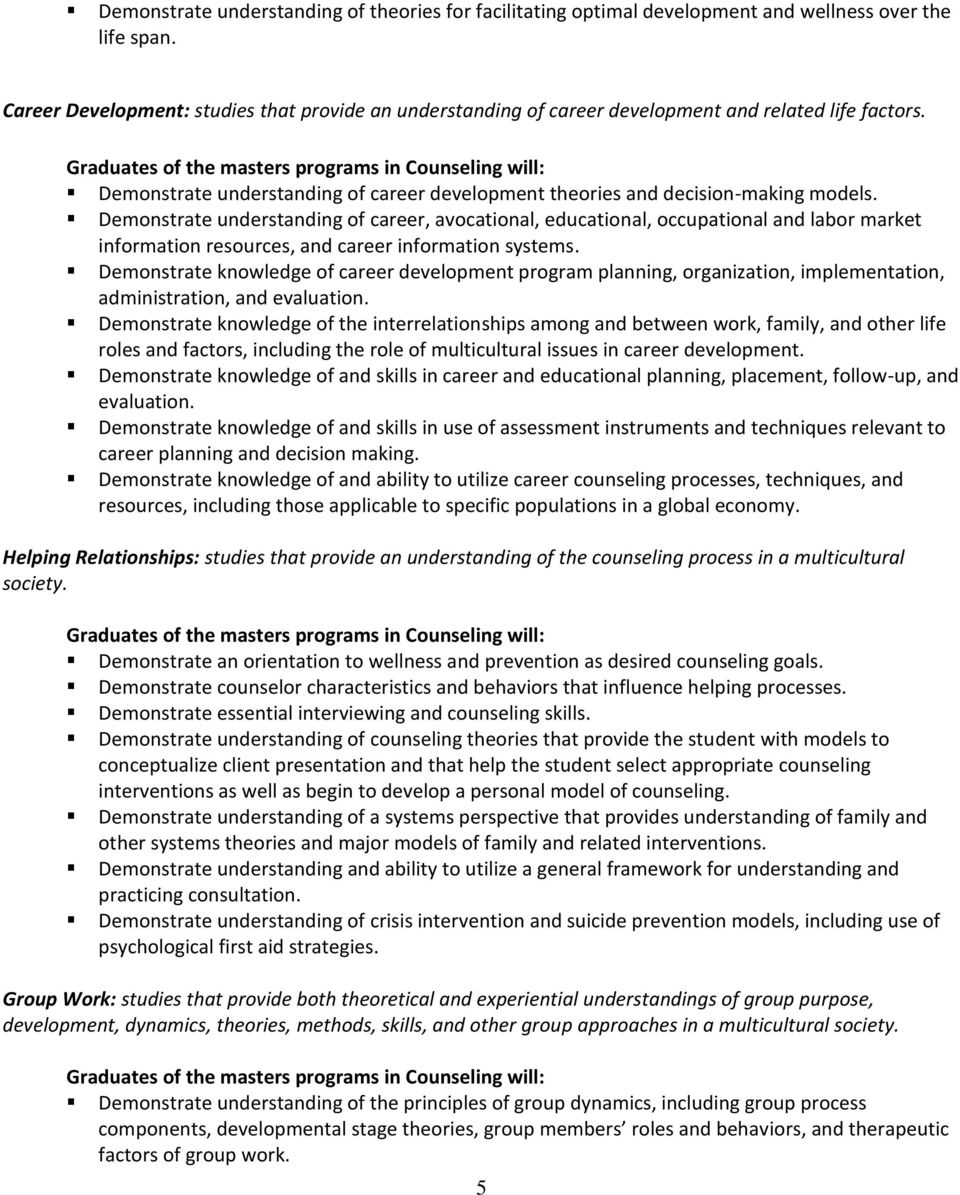
9 Demonstrate understanding of group leadership or facilitation styles and approaches, including characteristics of various types of group leaders and leadership styles. Demonstrate understanding of theories of group counseling, including commonalities, distinguishing characteristics, and pertinent research and literature. Demonstrate understanding of group counseling methods, including group counselor orientations and behaviors, appropriate selection criteria and methods, and methods of evaluation of effectiveness. Demonstrate accumulation of direct experiences in which students participate as group members in a small group activity, approved by the program, for a minimum of 10 clock hours over the course of one academic term. Assessment: studies that provide an understanding of individual and group approaches to assessment and evaluation in a multicultural society. Graduates of the masters programs in Counseling will: Demonstrate understanding of historical perspectives concerning the nature and meaning of assessment. Demonstrate understanding of basic concepts of standardized and nonstandardized testing and other assessment techniques, including norm-referenced and criterion-referenced assessment, environmental assessment, performance assessment, individual and group test and inventory methods, psychological testing, and behavioral observations. Demonstrate understanding of statistical concepts, including scales of measurement, measures of central tendency, indices of variability, shapes and types of distributions, and correlations. Demonstrate understanding of reliability. Demonstrate understanding of validity. Demonstrate understanding of social and cultural factors related to the assessment and evaluation of individuals, groups, and specific populations. Demonstrate understanding of ethical strategies for selecting, administering, and interpreting assessment and evaluation instruments and techniques in counseling. Research and Program Evaluation: studies that provide an understanding of research methods, statistical analysis, needs assessment, and program evaluation. Graduates of the masters programs in Counseling will: Demonstrate the importance of research in advancing the counseling profession. Demonstrate understanding of research methods such as qualitative, quantitative, single-case designs, action research, and outcome-based research. Demonstrate understanding of statistical methods used in conducting research and program evaluation. Demonstrate understanding of principles, models, and applications of needs assessment, program evaluation, and the use of findings to effect program modifications. Demonstrate understanding of how to use research to inform evidence-based practice. Demonstrate understanding of and ability to utilize ethical and culturally relevant strategies for interpreting and reporting the results of research and/or program evaluation studies. 6
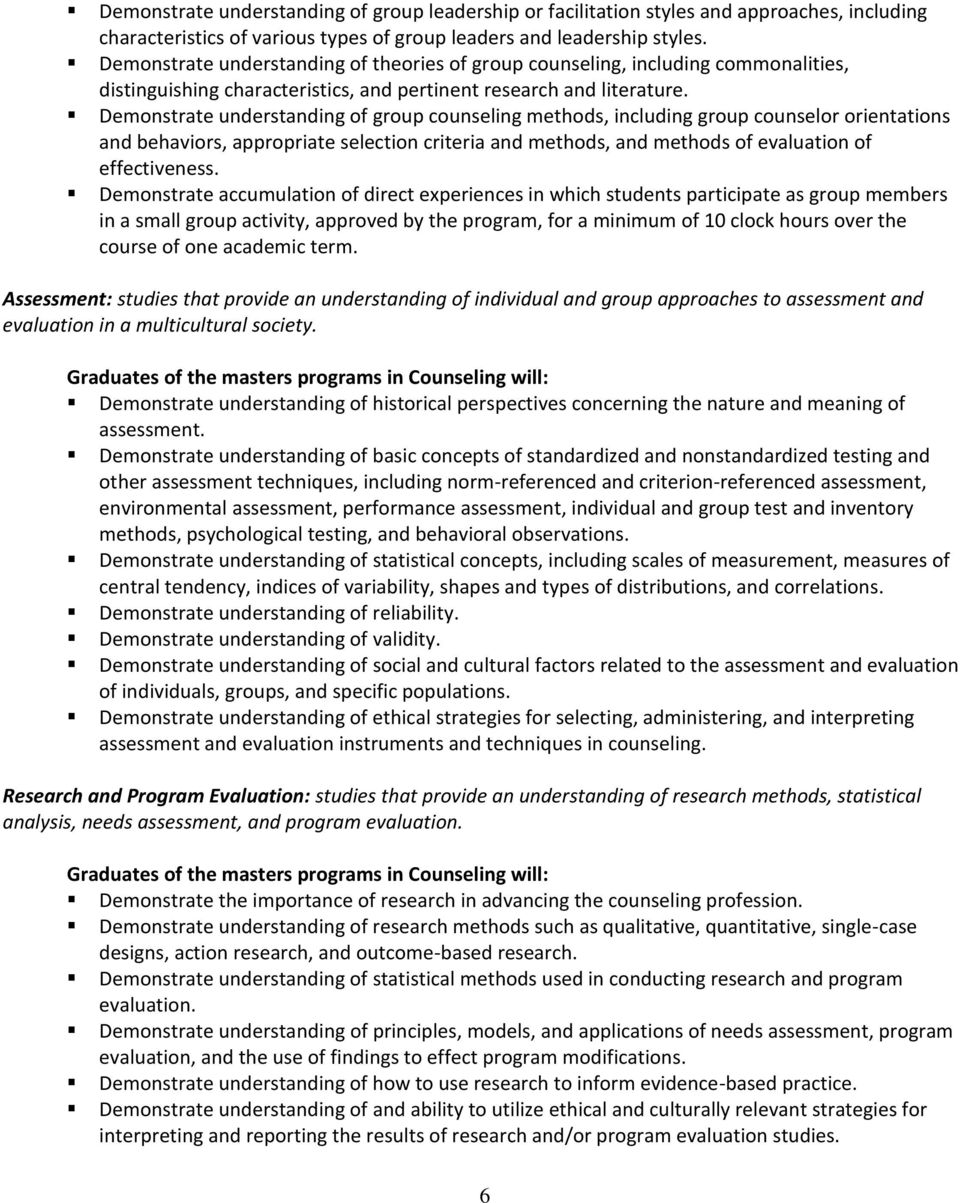
10 In addition to the outcomes listed above, each program requires students to meet learning objectives in knowledge-based and skills and practice domains. Those learning objectives are outlined in syllabi for coursework. Programs in Counseling and Educational Psychology The Counseling and Educational Psychology Department currently offers four master s-level programs, all accredited by CACREP. Those include Clinical Mental Health Counseling; Marriage, Couple, and Family Counseling; Addictions Counseling; and School Counseling. A doctoral program, Ph.D. in Counselor Education, is also available. All master s programs are 60 hours. Effective in Fall 2014, all programs share 45 semester hours of core courses and one 3-hour institutional research requirement course which are taken by all students. Those include: INSTITUTIONAL RESEARCH COURSE (3 semester hours) EDFN 5301 Introduction to Research CORE COURSES (45 semester hours) CNEP 5304 Introduction to Counseling* CNEP 5306 Career Counseling CNEP 5308 Counseling Theories* CNEP 5312 Addictions Counseling CNEP 5314 Theory and Practice of Multicultural Counseling CNEP 5327 Ethics* CNEP 5328 Abnormal Human Development* CNEP 5354 Dev Issues in Human Personality and Behavior CNEP 5361 Group Counseling CNEP 5371 Psychometrics CNEP 5381 Psychodiagnosis* CNEP 5384 The Counseling Process* CNEP 5397 Practicum** CNEP 5698 Internship I CNEP 5698 Internship II In addition to core courses, each specific program has special emphasis courses, as follows: Clinical Mental Health Counseling SPECIAL EMPHASIS COURSES (12 semester hours) CNEP 5319 Introduction to Clinical Mental Health Counseling** CNEP 5320 Intro to Marriage, Couple, & Family Counseling CNEP 5322 Strategies in Family Counseling or CNEP 5324 Counseling Couples 7

11 CNEP 5375 Clinical Mental Health Counseling Strategies Marriage, Couple, and Family Counseling SPECIAL EMPHASIS COURSES (12 semester hours) CNEP 5320 Introduction to Marriage, Couple, and Family Counseling** CNEP 5322 Strategies in Family Counseling** CNEP 5324 Counseling Couples CNEP 5326 Family Counseling with Children and Adolescents Addictions Counseling REQUIRED SPECIAL EMPHASIS COURSES (9 semester hours) CNEP 5313 Theories and Techniques in Substance Abuse Counseling** CNEP 5321 Advanced Strategies in Process Addictions and Substance Abuse Counseling CNEP 5323 Counseling and Holistic Wellness ELECTIVE (3 semester hours to be chosen in consultation with faculty advisor) School Counseling REQUIRED SPECIAL EMPHASIS COURSES (12 semester hours) CNEP 5316 Developmental School Counseling** CNEP 5315 Responsive Services in Schools (effective Fall, 2011) CNEP 5318 Consultation in School Settings CNEP 5326 Family Counseling w/children & Adolescents * These courses are required for admission to practicum. Please note that four core courses (including 5304 and 5308) are required for admission to 5381 and **These additional courses are required for admission to internship, and may be taken before or currently with practicum. Students who enrolled prior to Fall 2014 but who will graduate after August 2016 are strongly advised to take the CNEP 5327 Ethical and Legal Issues in Counseling and CNEP 5328 Abnormal Human Development and behavior in addition to their regular course of study. Those who apply for licensure after January 1, 2017, will not be eligible to be licensed as an LPC without these courses. 8
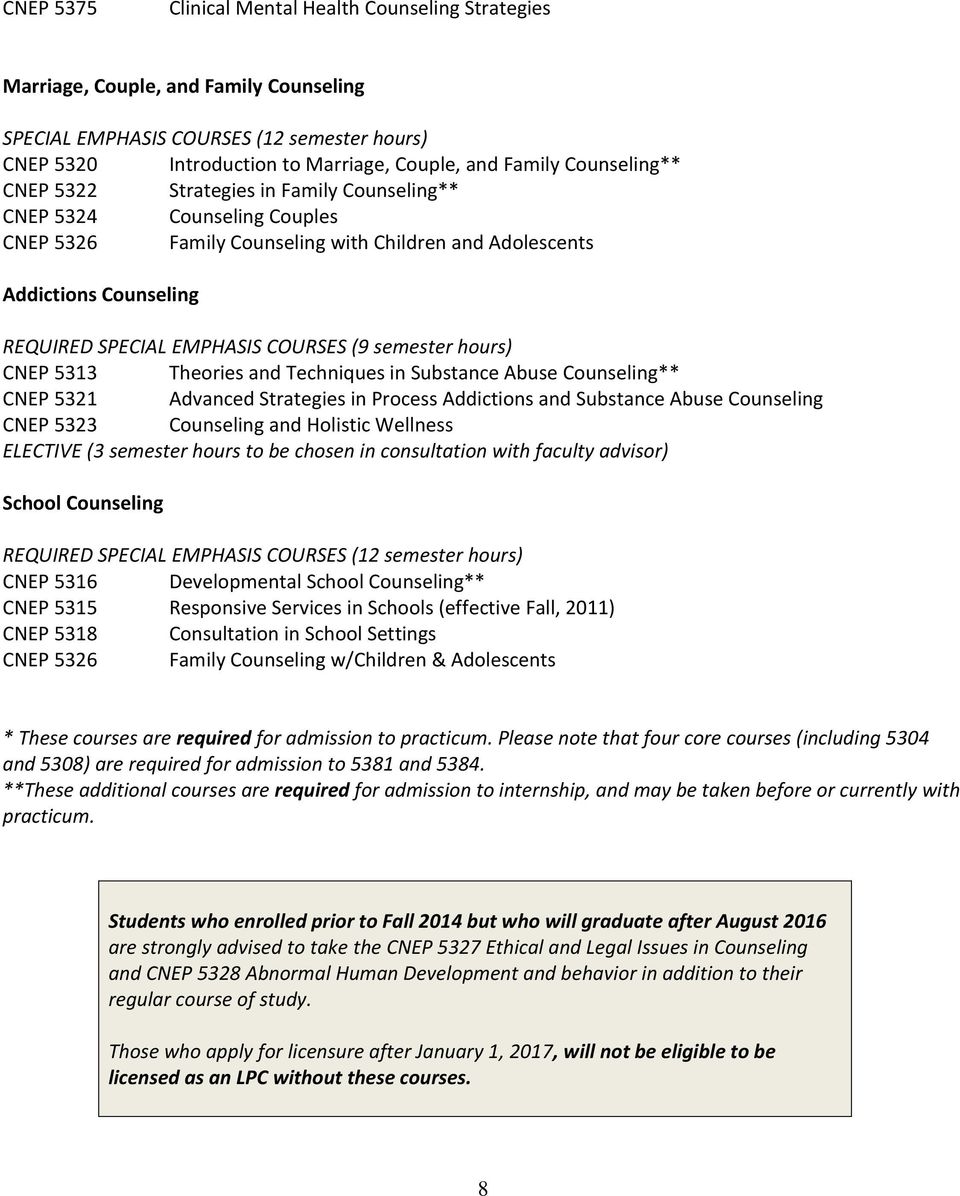
12 Course Sequencing Courses in the graduate program in the Counseling & Educational Psychology Department at Texas A & M University-Corpus Christi are designed to provide a gradual skill-building experience, beginning with the introductory course CNEP 5304, and culminating with the internship experience. Course sequencing is utilized to maximize the student learning process. Students are responsible for reviewing the catalog and schedule to be certain that all prerequisites are met before they enroll in courses. Some courses are offered once per year or every other semester. It is not recommended that you start at the top of the degree plan and work down if you want to sequence effectively. Consult with your faculty advisor regarding your course selection. A minimum of 18 semester hours of core counseling courses must be completed, including CNEP 5304, CNEP 5308, CNEP 5327, and CNEP 5328 before students may register for CNEP 5381 or Students must request permission to enroll in CNEP 5381 and 5384 from the course instructor, who will then provide the permit to register. An unofficial transcript must be attached and sent via . All core courses must be completed prior to enrolling in practicum. In addition, some specialty courses plus practicum must be completed prior to admission to internship. These specialty courses are CNEP 5316 (Developmental School Counseling) for school counseling students, CNEP 5319 (Introduction to Clinical Mental Health Counseling) for clinical mental health counseling students, CNEP 5320 (Introduction to Marriage, Couple and Family Counseling) and CNEP 5322 (Strategies in Family Counseling) for marriage, couple, and family counseling students, and CNEP 5312 (Addictions Counseling) and CNEP 5313 (Theories and Techniques in Substance Abuse Counseling) for addictions counseling students. Sample Sequencing EDFN 5301 Introduction to Research Before moving CNEP 5304 Introduction to Counseling* ahead: CNEP 5306 Career Counseling CNEP 5308 Counseling Theories* at least CNEP 5314 Theory and Practice of 5304, 5308, 5327, Multicultural Counseling two additional CNEP 5327 Ethical and Legal Issues in Counseling* courses CNEP 5328 Abnormal Human Development and Behavior* required CNEP 5354 Dev Issues in Human Personality and Behavior CNEP 5361 Group Counseling CNEP 5371 Psychometrics 9 Recommended before

13 CNEP 5381 Psychodiagnosis* practicum: CNEP 5384 The Counseling Process* 5319 or 5316 or 5320 and 5322 or 5313 CNEP 5397 Practicum** CNEP 5319 Introduction to Clinical Mental Health Required before internship (CMH counseling) OR CNEP 5316 Developmental School Counseling (school counseling) OR CNEP 5320 Introduction to Marriage, Couple, and Family Counseling AND CNEP 5322 Strategies in Family Counseling (MFC counseling) OR CNEP 5312 Addictions Counseling AND CNEP 5313 Theories and Techniques in Substance Abuse Counseling (addictions counseling May take CNEP 5698 Internship I an additional specialty course not yet completed while enrolled in CNEP 5698 Internship II internships Limited Enrollment Courses CACREP accreditation standards are rigorous, and include limits on student to faculty ratios. Thus, courses have maximum student limits. There are several courses in the CNEP curriculum which are limited to even fewer students in order to offer a high quality learning experience for students. Those courses include CNEP 5361 Group Counseling (limited enrollment) CNEP 5384 Counseling Process (limited enrollment) CNEP 5397 Practicum (no more than 12 students per section) CNEP 5698 Internship (no more than 12 students per section) Students are expected to plan and register early in order to secure a place in these classes. 10

14 Practicum and Internship Students must apply for Practicum and Internship by the last regular class day of the semester preceding the one in which they wish to take the course. During the semester preceding enrollment in Practicum, students are required to complete a practicum/internship application which is to be turned in to the departmental administrative assistant. Applications are available in both department secretary areas. In addition, applications may be found on-line in the Practicum/Internship Handbook. Applications for practicum must be accompanied by a copy of current DegreeWorks documentation, which includes all courses on the degree plan, grades for completed courses, and courses in process. Alternatively, students may submit the application with a copy the degree plan (available from the Academic Advising Office) and an unofficial copy of the graduate transcript (available online). All submissions must be in hard copy. Applications for internship must be accompanied by the current DegreeWorks documentation. Alternatively, an unofficial copy of the transcript must be submitted. If the degree plan has been changed since the last clinical course, the new degree plan must also be submitted. When the completed application is received, Dr. Marvarene Oliver, Practicum/Internship Coordinator, or Dr. Michelle Hollenbaugh, Practicum/Internship Co-Coordinator, will verify eligibility and approve each student meeting the criteria. The Departmental Administrative Assistant or Secretary will then enter permits which allow enrollment in courses requested. Students must apply for each semester they wish to enroll. PRIOR TO ENROLLING IN PRACTICUM, SPECIFIC COUNSELING COURSEWORK MUST BE COMPLETED. Please see the Graduate Catalog as well as earlier sections of this Handbook for specific information about prerequisites. In addition, students are required to attend a practicum/internship orientation meeting during the semester prior to beginning each course. The meeting date will be announced early in the semester via the listserv, and will be announced in classes. This meeting is mandatory. Practicum Practicum for graduate students in counseling is one of the most important professional preparation activities. The practicum experience is designed to allow students to apply and synthesize the knowledge and skills from previous learning. Students are also given opportunities to develop and practice new skills in a supervised environment. Practicum requires weekly group supervision in addition to individual site supervision and individual or triadic university supervision. Thus, practicum students receive an average of 1.5 hours of group supervision a week as well as 2 hours of individual/triadic supervision each week. Students enrolled in practicum must obtain a copy of the Practicum/Internship Manual, which is available electronically on the Department website as well as from the practicum instructor. Students must complete a total of 100 clock hours, at least 40 of which are required to be direct client contact hours. Neither group nor individual/triadic university supervision count as a part of the 100 hours required for practicum. Practicum Objectives/Student Learning Outcomes: Practicum is designed to refine counseling and interviewing skills and to develop new skills, including individual, couple, family, and group counseling skills. Through effective use of individual/triadic and group supervision, the student is expected to expand his or her repertoire of counseling techniques and interpersonal relationship skills. In the Practicum, students must: 11
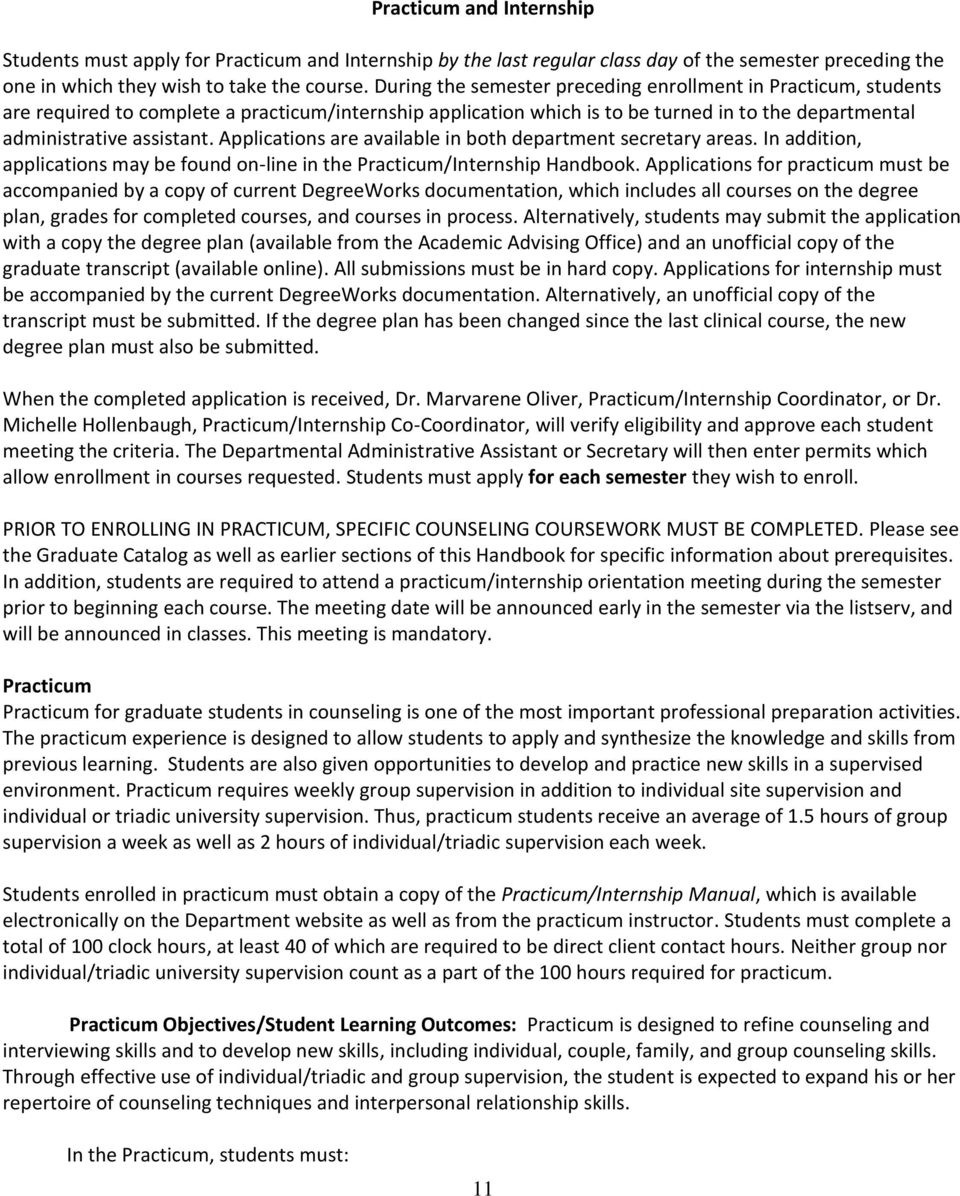
15 Internship Demonstrate the ability to establish and maintain a helpful and supportive counseling relationship. Demonstrate the effective use of clinical skills in counseling, including emergency and crisis counseling. Demonstrate the ability to apply appropriate individual, couple, family, and group counseling interventions. Demonstrate the ability to maintain records and client schedules/appointments, and an awareness and usage of community resources. Demonstrate the ability to work effectively with supervisors and colleagues, including appropriate analysis and presentation of counseling sessions and case studies. Demonstrate personal and professional ethics. Demonstrate an enthusiasm for and commitment to the counseling profession. Demonstrate a willingness to learn and commitment to continued learning. Demonstrate a continued development of personal traits and wellness principles which are conducive to effective counseling, learning, and professional development. Demonstrate a continued development of multicultural counseling competencies and advocacy strategies. The internship for graduate students in counseling is considered the most important and comprehensive professional experience in a counseling program. Internship is designed to allow students to apply skills and knowledge previously gained in a supervised setting compatible with their ultimate choice for an introductory professional work setting. To ensure that the student's individualized career goals are met during the internship experience, arrangements for the internship are planned in collaboration involving the student, the on-site supervisor, the Practicum/Internship Coordinator, and the student's supervising professor at Texas A&M University-Corpus Christi. Students are required to apply for internship in the semester prior to enrollment in this course. Students should have an internship site selected and have contact with the site prior to enrollment in the internship course. The internship site may be the same site at which the student completed practicum hours; however, a new site agreement is required for each semester. Experiences are expected to be broader in scope and moving toward the level of work expected of an entry-level counselor. The Practicum/Internship Manual, which can be found on the Department website or obtained from the internship instructor, is required. 12

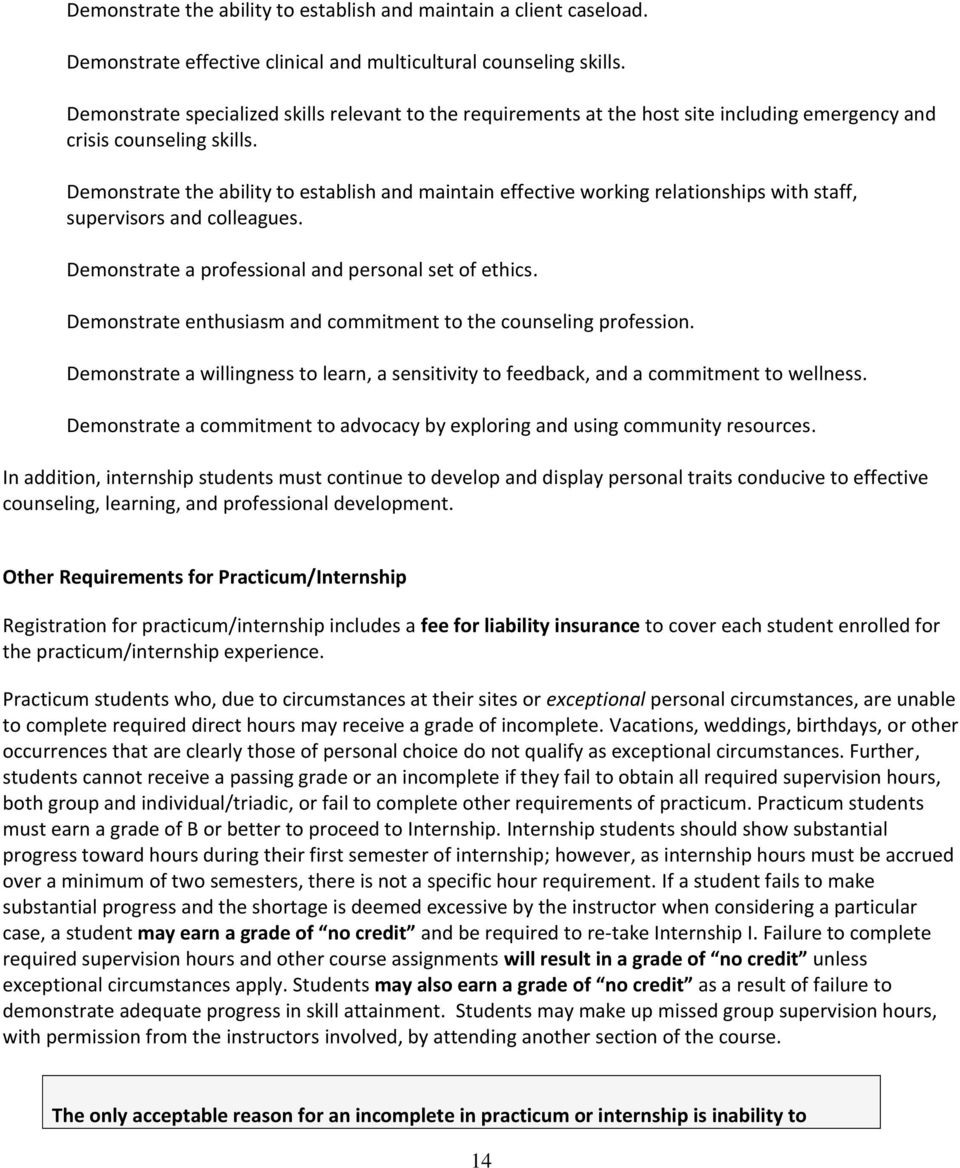
16 Prior to enrolling in the Internship, students must have successfully completed Practicum (CNEP 5397). Additional prerequisites include CNEP 5316 for the School Counseling Program, CNEP 5319 for the Clinical Mental Health Counseling Program, CNEP 5320 and CNEP 5322 for the Marriage, Couple, and Family Counseling Program, or CNEP 5312 and CNEP 5313 for the Addictions Program. Texas A & M University Corpus Christi s Counseling Program follows the internship requirements set forth in CACREP standards and is in compliance with Texas Licensed Professional Counselor law. Internship students are required to perform a minimum of 600 clock hours (generally approximately 300 per semester) to satisfy the internship requirement. Students fulfill this requirement by enrolling for two semesters of internship. Students should plan to take the courses sequentially, as enrollment in two internships in the same semester is not allowed. Over the course of the two internships, at least 240 hours of the 600 required hours must be direct client contact hours. Unlike practicum, both group and individual supervision hours count as part of the 600 total indirect hours. Specific Requirements for the School Counseling Program. Students enrolled in the school counseling program must fulfill internship requirements in a school setting offering a comprehensive school guidance program, and must enroll in an internship designated for school counseling program students. Specific Requirements for the Marriage, Couple, and Family Counseling Program. Students enrolled in the marriage, couple, and family counseling program must obtain at least 80 of the overall 240 internship direct hours with couples and families. Students enrolled in the addictions program must obtain at least half of their internship hours working with addictions issues. Students should consult the course syllabi as well as the Practicum/Internship Manual for additional information. For the purpose of the marriage, couple, and family internship, couple and family contact is generally defined as working with more than one client in the counseling session. This means the counselor is working with, for example, a parent and a child, husband and wife, parents and children, two adults in a relationship, etc. Working systemically with an individual may not constitute couples and family contact. Students will consult with their individual instructors about specifics of this requirement. Specific Requirements for the Addictions Counseling Program. In order to qualify for the LCDC, 160 hours of documented practice specific to addictions counseling should occur in the following areas with a minimum of 20 hours per area: clinical evaluation; treatment planning; referral; service coordination; counseling; client, family, and community education; documentation; and, professional and ethical responsibilities. The department requires at least half of direct hours in internship to be obtained working with individuals and/or families concerning substance abuse. In order to be certain that both LCDC and departmental requirements are met, students must pay particular attention to documentation of direct/indirect and LCDC area requirements. Internship Objectives/Student Learning Outcomes. Internship is designed to provide students with an opportunity to practice and expand their counseling skills. On-site supervisors closely monitor student activities, provide effective and appropriate feedback, work cooperatively with university supervisors, and encourage student participation in a variety of professional activities. In the internship students must: 13

17 Demonstrate the ability to establish and maintain a client caseload. Demonstrate effective clinical and multicultural counseling skills. Demonstrate specialized skills relevant to the requirements at the host site including emergency and crisis counseling skills. Demonstrate the ability to establish and maintain effective working relationships with staff, supervisors and colleagues. Demonstrate a professional and personal set of ethics. Demonstrate enthusiasm and commitment to the counseling profession. Demonstrate a willingness to learn, a sensitivity to feedback, and a commitment to wellness. Demonstrate a commitment to advocacy by exploring and using community resources. In addition, internship students must continue to develop and display personal traits conducive to effective counseling, learning, and professional development. Other Requirements for Practicum/Internship Registration for practicum/internship includes a fee for liability insurance to cover each student enrolled for the practicum/internship experience. Practicum students who, due to circumstances at their sites or exceptional personal circumstances, are unable to complete required direct hours may receive a grade of incomplete. Vacations, weddings, birthdays, or other occurrences that are clearly those of personal choice do not qualify as exceptional circumstances. Further, students cannot receive a passing grade or an incomplete if they fail to obtain all required supervision hours, both group and individual/triadic, or fail to complete other requirements of practicum. Practicum students must earn a grade of B or better to proceed to Internship. Internship students should show substantial progress toward hours during their first semester of internship; however, as internship hours must be accrued over a minimum of two semesters, there is not a specific hour requirement. If a student fails to make substantial progress and the shortage is deemed excessive by the instructor when considering a particular case, a student may earn a grade of no credit and be required to re-take Internship I. Failure to complete required supervision hours and other course assignments will result in a grade of no credit unless exceptional circumstances apply. Students may also earn a grade of no credit as a result of failure to demonstrate adequate progress in skill attainment. Students may make up missed group supervision hours, with permission from the instructors involved, by attending another section of the course. The only acceptable reason for an incomplete in practicum or internship is inability to 14
18 complete direct hours due to circumstances beyond the student s control. Students who are asked to leave their practicum or internship sites for cause may receive an F or No Credit for the course. In addition, a Student Competency Evaluation will be triggered. Policies for review of students during Practicum and Internship include the criteria discussed in the Student Review and Retention Policy and as noted on the Professional Issues and Behavior Rating Scale, as well as additional criteria appropriate to clinical practice. Specific criteria used for evaluation in practicum and internship are outlined in the Practicum/Internship Manual. Site Selection We do not approve sites. The department approves site supervisors. However, some sites would clearly be inappropriate because the services provided do not fit the requirements of the program. With that in mind, students should select their practicum and internship sites based on the following guidelines: Appropriateness of the site with one s specific counseling program and needs Availability of appropriate supervision (master's degree or higher in counseling or a related field [e.g. social work, psychology], appropriate credentials, two years of experience, and training in supervision or commitment to participate in on-going training provided by the department) Availability of a variety of professional experiences Availability of opportunities to audio- or video-tape sessions Availability of opportunity to provide individual, couple, and/or family counseling over a period of time Almost always, students should choose sites different from their place of current employment. With permission from one s current employer and the university instructor in collaboration with the Practicum/Internship Coordinator, a student may complete practicum/internship at an employment site if professional activities are qualitatively different than what is normally required and are consistent with the activities of a master s-prepared counselor. Information on previous sites used by students may be obtained from the Department of Counseling and Educational Psychology. It is strongly recommended that, in addition to visiting more than one site, prospective internship students also contact students who performed their internships at those sites in order to get useful feedback on the quality of supervision, receptiveness of staff, and types of clients typically served by the site. In addition, the Department of Counseling and Educational Psychology hosts a Site Fair during the fall and spring semesters. Students are encouraged to attend and to meet representatives from available sites in the area. If a student chooses to complete an internship at a site not previously used by the Department of Counseling and Educational Psychology, the student must consult with the Coordinator of Practicum/Internship. It may be necessary for the student to arrange a meeting between the prospective on-site supervisor and the 15

19 Practicum/Internship Coordinator to determine the appropriateness of the placement. Students MAY NOT count previous work experiences to satisfy internship requirements. Students should be aware that some sites require criminal background checks and/or verification of certain health information such as a record of vaccinations. The procedures for some sites include the student going through the site for these checks; however, those of others require that the student arrange for the checks. The Counseling and Educational Psychology Department has arrangements with a firm that will conduct a criminal background check. Students should check with Rachel Perez, the department s administrative assistant, for details the semester prior to practicum if a background check is required. The Department Counseling and Training Clinic Some students may be able to gain hours at the CNEP Department s Counseling and Training Clinic, including supervision. However, students must sign up with and be approved by Dr. Yvonne Castillo, the Clinic Director, to see clients in this setting. A formal site agreement and commitment to the clinic is required. Students may not see clients in the clinic unless Dr. Castillo or another faculty member is on site. Questions may be addressed to Dr. Castillo. The Counseling and Training Clinic (hereafter referred to as "the Clinic") exists for three purposes. First, the Clinic provides a setting for supervised counselor training for Practicum and Internship students. Second, it offers counseling services for individuals, couples, and families from the surrounding community as well as for Early Childhood Development School students and parents. Third, the Clinic may be used for certain kinds of research, conducted either by doctoral students or by faculty. The Clinic's facilities are designed to allow monitoring and recording of all counseling sessions. These facilities allow for direct observation, supervision, and feedback from supervisors to CNEP students. All students who wish to complete practicum or internship should expect every session to be recorded and monitored. Admissions Procedures Policies and Procedures See the TAMUCC Office of Graduate Studies and Research website for information on the application process: Applications for the program must be submitted via the Apply Texas website: 16

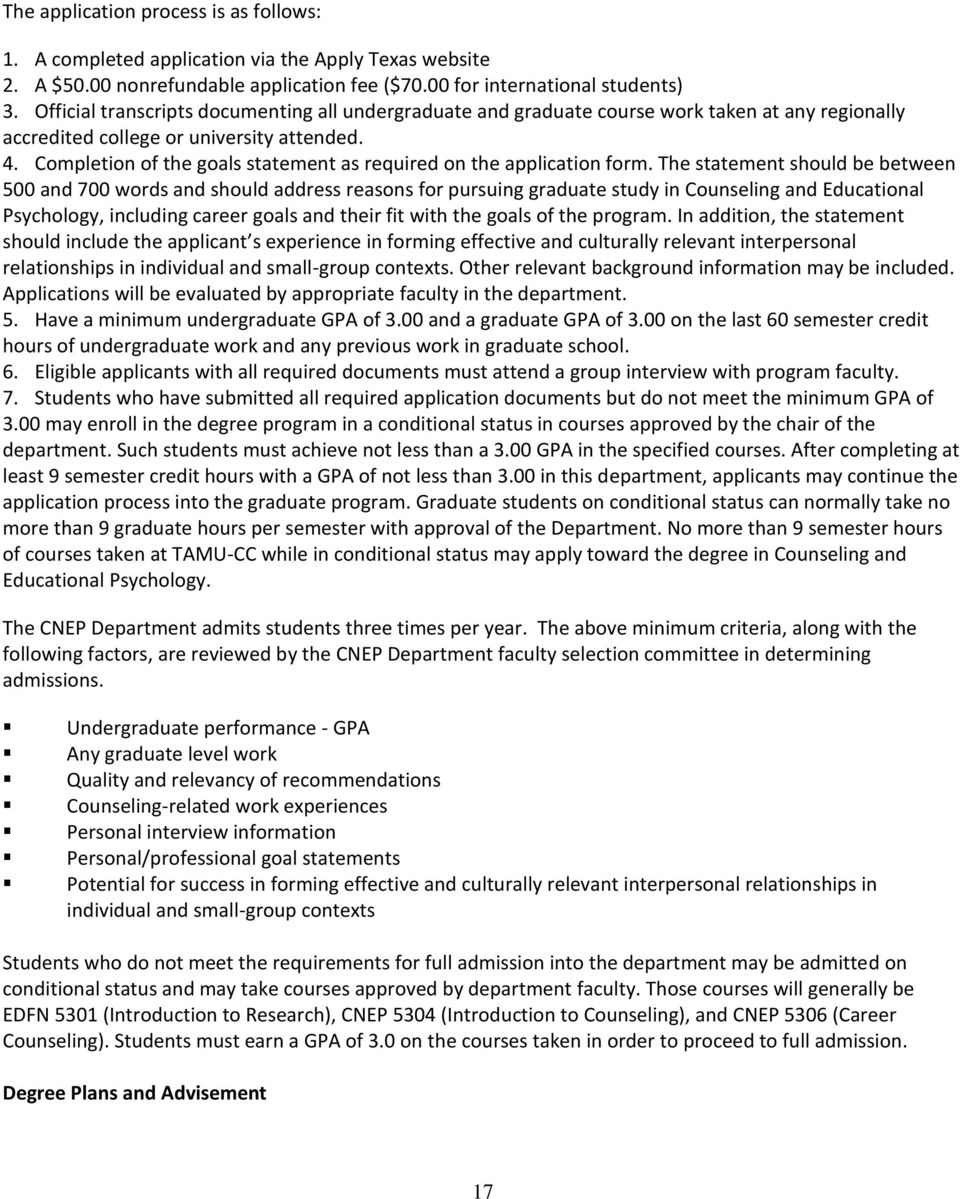
20 The application process is as follows: 1. A completed application via the Apply Texas website 2. A $50.00 nonrefundable application fee ($70.00 for international students) 3. Official transcripts documenting all undergraduate and graduate course work taken at any regionally accredited college or university attended. 4. Completion of the goals statement as required on the application form. The statement should be between 500 and 700 words and should address reasons for pursuing graduate study in Counseling and Educational Psychology, including career goals and their fit with the goals of the program. In addition, the statement should include the applicant s experience in forming effective and culturally relevant interpersonal relationships in individual and small-group contexts. Other relevant background information may be included. Applications will be evaluated by appropriate faculty in the department. 5. Have a minimum undergraduate GPA of 3.00 and a graduate GPA of 3.00 on the last 60 semester credit hours of undergraduate work and any previous work in graduate school. 6. Eligible applicants with all required documents must attend a group interview with program faculty. 7. Students who have submitted all required application documents but do not meet the minimum GPA of 3.00 may enroll in the degree program in a conditional status in courses approved by the chair of the department. Such students must achieve not less than a 3.00 GPA in the specified courses. After completing at least 9 semester credit hours with a GPA of not less than 3.00 in this department, applicants may continue the application process into the graduate program. Graduate students on conditional status can normally take no more than 9 graduate hours per semester with approval of the Department. No more than 9 semester hours of courses taken at TAMU-CC while in conditional status may apply toward the degree in Counseling and Educational Psychology. The CNEP Department admits students three times per year. The above minimum criteria, along with the following factors, are reviewed by the CNEP Department faculty selection committee in determining admissions. Undergraduate performance - GPA Any graduate level work Quality and relevancy of recommendations Counseling-related work experiences Personal interview information Personal/professional goal statements Potential for success in forming effective and culturally relevant interpersonal relationships in individual and small-group contexts Students who do not meet the requirements for full admission into the department may be admitted on conditional status and may take courses approved by department faculty. Those courses will generally be EDFN 5301 (Introduction to Research), CNEP 5304 (Introduction to Counseling), and CNEP 5306 (Career Counseling). Students must earn a GPA of 3.0 on the courses taken in order to proceed to full admission. Degree Plans and Advisement 17
21 Each applicant admitted into the graduate program in Counseling and Educational Psychology is assigned an advisor from the faculty in the department. Students, who are notified via letter that the advisor has been assigned soon after being admitted to the program, then contact the advisor. The advisor reviews the student's goals and works with the student to complete a degree plan by the end of the second semester. Students are sent one copy of the degree plan, one is placed in the CNEP file, and one is kept in the Graduate School files. If a student wants to change advisors, a request should be made to the Department Chair. If students wish to change specific programs, they must meet with their advisor to discuss the implications of such a change and to file a new degree plan. Because each program has specific requirements, failure to make formal changes can jeopardize both entry into practicum/internship and graduation. Individual Development Plan (IDP) Students are expected to initiate and maintain an on-line individual development plan with details about their goals and strategies for accomplishing both holistic personal and professional growth and counselor identity throughout their time in the CNEP program. The IDP is used as a part of student academic advising as well as a part of the student monitoring process (Appendix C). Notification of Intent to Graduate Graduation upon completion of the course requirements is NOT automatic. The semester before graduation is anticipated, students should obtain an application from the Office of Admissions and Records by the deadline date indicated in the University Class Schedule. Deadline dates are also available on the Texas A&M University-Corpus Christi website. Comprehensive Examination All students are required to pass a comprehensive exam for the completion of their program. The comprehensive examination is scheduled during the semester practicum is taken, and covers core curriculum areas in counseling. Faculty members contribute questions for the master's comprehensive examination. The exam is administered during the spring, summer and fall semesters. Contact the Department Office for further information. The following content areas are included on the comprehensive examination: Professional Orientation and Ethics Social and Cultural Diversity Human Growth and Development Career Development Helping Relationships Group Work Assessment Research and Program Evaluation Marriage, Couple, and Family Studies The comprehensive examination is multiple choice. The Counseling Student Listserv and 18
22 Students are required to set up and utilize their islander account. This address is the one the University requires faculty and staff to use when communication originates from the University. The islander account can be set to forward automatically to the student s preferred address so that communication from the department and the university is not overlooked. The Counseling and Educational Psychology Department maintains a listserv for graduate students. All master s students are required to subscribe to the listserv since many announcements and reminders are sent out to students using this venue. In addition, the listserv may be used by students to seek support, advice, knowledge, and expertise from other counseling students. For instance, students may use the listserv to share upcoming meeting dates and times, to seek sources for a project, to locate and buy used books, or to dialogue about an issue related to counseling. Students should remember that when posting to a listserv, they are sending a message to all who subscribe to the list. Thus, private information or information intended for a particular recipient should not be posted to the listserv. In addition, students should remember that the listserv is a professional venue and is to be used as such. To subscribe, send an to [email protected] with subscribe in the subject line. Students must use the islander account to subscribe. This account can be forwarded to the personal account preferred by each student. To send mail to all who are subscribed to the list, send to [email protected]. To unsubscribe, send an message to [email protected] with the word unsubscribe in the subject line. Please be aware that failure to receive information from the university or department because the listserv and islander accounts are not maintained is not a valid reason to miss deadlines or other information critical to student success in the program. We make significant efforts to keep you informed, and the islander and listserv accounts are a major part of that effort. Grading Policies The standard letter grade policy is used in the CNEP Department for most courses. Internship (5698) uses a credit/no credit policy. Only two Cs may be counted toward the degree, and may not be in practicum. If a student believes a grade has been awarded in error, the student should follow the Grade Appeal Process outlined below, and must start with meeting with the instructor. Grades of Incomplete Grades of incomplete are only given in exceptional or unusual circumstances. Generally, students must be making satisfactory progress in a course and must have a substantial portion of work completed in order to qualify for an incomplete. It is the responsibility of the student to request a grade of incomplete from the instructor, and if it is determined by the instructor that such a grade is appropriate, a Request for Incomplete Grade Notation is filled out and submitted. The Request must be approved by the Department Chair and the Dean. If a student receives a grade of I (incomplete), he or she is responsible for completing work by the last class day of the next regular (fall or spring) semester unless an earlier date is specified in writing on the Request for Incomplete Grade Notation. If work is not completed and submitted by the date indicated on the Request, the student s grade will turn into an F or into the grade specified on the Request. It is the 19
23 responsibility of the student to ensure that work is completed and submitted to the appropriate instructor in a timely manner. Once work is submitted, a Change of Grade form is filed and the student s academic record will be changed. Students receiving financial aid should consult with a financial aid advisor before making the decision to take an incomplete, as this may affect Financial Aid eligibility status. Grade Appeals Process As a matter of departmental policy, students who have a complaint about a grade should discuss the matter with the instructor. If the problem cannot be resolved, then the student should follow the steps outlined in University Procedure C2.01, Student Grade Appeal Procedures. The document is available through the University Rules website at Briefly, the process is as follows: 1. Written appeal to the department chair or area coordinator (must occur within 15 business days after the start of the next term. 2. If no satisfactory resolution can be found, the department chair will refer the matter to the Associate Dean for a hearing by the College Grade Appeal Committee (CGAC). 3. The Associate Dean will schedule a hearing before the CGAC, normally within 20 business days. The Committee will hear all parties and review the evidence presented. 4. The CGAC will determine the facts of the case and attempt to provide a fair and appropriate resolution. 5. The chair of the CGAC will present the committee s findings and recommendations, in writing, to the associate dean. 6. The Associate Dean will send written notification of the decision to the student and faculty member, normally within five business days after receiving the CGAC s findings and recommendations. The decision is final. Student Responsibility Professional Duties and Personal Expectations In accordance with the Graduate Catalog, the Counseling and Educational Psychology Department faculty assists students in progressing toward the degrees they are seeking. However, ultimate responsibility for understanding and following the degree requirements rests with the students themselves. Students are responsible for understanding degree requirements, enrolling in courses that fit into degree programs, and taking courses in the proper sequence to ensure appropriate progression of work. Students must seek advice from faculty about degree requirements and other university policies when necessary. Students are responsible for understanding and complying with the provisions of this handbook, the university Student Handbook, and all applicable policies, rules, regulations, and procedures of the Texas A&M System and Texas A&M University-Corpus Christi, including those pertaining to academic standards and student conduct. The Student Handbook and Student Code of Conduct may be found at Academic misconduct, as well as other violations, may result in serious consequences outlined in the Student Handbook, including dismissal from the University. 20
24 Students are expected to conduct themselves in an ethical, responsible, and professional manner. Students must be knowledgeable about and adhere to the Code of Ethics of the American Counseling Association (ACA), as well as the International Association of Marriage and Family Counselors or the American School Counselor Association (ASCA). In addition, students, depending on their degree plans and professional goals, must be familiar with and adhere to the Codes of Ethics of the Texas State Board of Examiners of Professional Counselors, the Texas State Board of Examiners of Marriage and Family Therapists, and/or the State Board of Education. The codes include both mandatory and aspirational considerations for students and professionals in the field of counseling. Mandatory guidelines must be adhered to at all times. The codes of ethics are located on the web pages of the respective organizations. Faculty Monitoring of Students As trainers of student counselors, the faculty of CNEP expects prospective counselors to be concerned about other people, stable and psychologically well-adjusted, effective in interpersonal relationships, and able to receive and give constructive feedback. In addition, the expectation is that students be committed to personal growth and professional development through opportunities such as those provided in course work, group labs, supervision, self-selected readings, personal counseling, and personal wellness activities. The CNEP faculty believes that counselors have an ethical responsibility to be willing to do in their own lives what they ask their clients to do. Further, the faculty supports research that indicates that the person of the counselor is as important as the skills and knowledge possessed by the counselor. The CNEP faculty members acknowledge that a component of their responsibility to the student, the profession, and the eventual consumers of counseling services provided by CNEP graduates is the necessity to monitor not only academic progress but also the personal attitudes and conduct of students which will affect their performance in the field. Student behavior and attitudes should be of a quality as to NOT interfere with the professionalism or helping capacity of the student. Examples of attitudes and conduct that are likely to impact performance in the field can be found in the Professional Issues and Behavior Rating Scale (Appendix C). In addition, guidance regarding professional attitudes and conduct can be found in the ACA Code of Ethics and the Codes of Ethics of the Texas State Board of Examiners of Professional Counselors (TSBEPC) and other applicable regulatory bodies. Adherence to the ACA Code of Ethics, including the core professional values of counseling and ethical principles enumerated in the Preamble of the Code, as well as the Codes of Ethics of the Texas State Board of Examiners of Professional Counselors (TSBEPC) and other applicable regulatory bodies, is expected. Students in training are reviewed each semester by all faculty members. This regular and on-going monitoring allows faculty members to identify problems students may be experiencing in the program as early as possible in their academic careers and assist students in developing solutions before such problems lead to concerns which merit formal remediation procedures. Students are reviewed based on student professional and ethical behavior as outlined in this document and in the professional codes of ethics referenced, clinical performance, and academic performance. If a student s professional integrity, skill level, professional development, academic performance or conduct is found lacking, the faculty member who notes the concern will meet individually with the student to review and document those concerns and responses thereto following the Student Review and Retention Policy (see next section) and utilizing the Student Competency Evaluation Form (SCEF; Appendix A) and/or the Professional Issues and Behavior Rating Scale (PIBRS; Appendix C). Concerns may include but are not limited to unresolved personal problems, lack of relationship building skills, questionable ethical behavior, inability to accept feedback, academic misconduct, failure to achieve student learning objectives, or other issues which interfere with a student s ability to function effectively as a 21
25 counselor. Other issues as identified on the Individual Development Plan (IDP) may also be considered. Note: While the Professional Issues and Behavior Rating Scale is also completed in specified courses and is not necessarily an indication of problem behavior, the Student Competency Evaluation Form is used exclusively to identify problematic behaviors that are expected to change. In any meeting triggered by a faculty concern that results in documentation to the SCEF and/or PIBRS, the student will be presented with a copy of the relevant evaluation form (SCEF and/or PIBRS). A copy of the form will be maintained in the student s departmental file. If a student receives more than one form in the student departmental file, whether the SCAF or PIBRS, the student will be required to meet with the Review, Remediation, Retention, and Dismissal Committee. (See Student Review and Retention Policy in this handbook for more information.) In addition, students should be aware that all such evaluations are discussed by the full faculty during regular faculty meetings as an ongoing part of student monitoring. Continuing issues that are not adequately addressed as part of the remediation process are grounds for suspension or dismissal from the program. Departmental policies for review of students during Practicum and Internship include the above criteria as well as additional criteria appropriate to the clinical experience. These additional criteria can be found in the Practicum/Internship Manual (see syllabi, evaluation forms, and tape rating sheets). Personal Counseling The CNEP faculty believes that participating as a client in individual or group counseling can be both a growth experience for the graduate student and a significant educational aspect of a program to prepare mental health professionals. Experience as a client in personal counseling is, therefore, strongly recommended for CNEP program students. Individual or group counseling should be conducted by a licensed professional counselor, a licensed marriage and family therapist, a licensed social worker, a licensed psychologist, or an equivalently trained professional. The University Counseling Center and the Career Center are available for students at no charge. Personal counseling may at any time be required by the Department for the student to continue in the program. Commencement of counseling and recommendation of additional counseling may be a stipulation or condition at the time of the student's screening or at any time during his/her program. The student has the right to choose his/her own counselor. Student Review, Remediation, Retention, and Dismissal In accordance with CACREP accreditation recommendations, students are reviewed and monitored by departmental faculty during their matriculation in the CNEP programs. When a student fails to exhibit behaviors consistent with the duties, responsibilities, and expectations of professionals being prepared as counselors or demonstrates behaviors or attitudes that are inconsistent with recognized legal and ethical standards, the Counseling Student Competency Evaluation Form (SCEF; Appendix A) is utilized as the initial step in the student review, remediation, retention, and dismissal policy. The SCEF is used by faculty when a concern is raised about a student s behavior within a class or during an activity sponsored by the TAMUCC College of Education. This form may be used when the student engages in conduct, irrespective of its time or location, which raises substantial questions about the student s ability to perform his or her role as a professional counselor. The Professional Issues and Behavior Rati ng Scale (Appendix C) may also be used as 22
26 part of the process if the concerns identified by the faculty member are consistent with the PIBRS items. The purpose of the process is twofold: to provide opportunities for students to address problematic behaviors and to provide gatekeeping for the profession, including reducing the risk of harm to future clients and the public. If, in the professional judgment of the program faculty a student s behavior is deemed substandard, unethical, illegal, and/or professionally questionable at any time during the course of training (including course work, practica, and internships), the following actions may be taken: 1. Initial consultation with faculty member: This is the first step in the process. When a faculty member identifies an issue related to student performance, the faculty member may initiate a Student Competency Evaluation and consult with the student. If no corrective actions are required or the instructor and student agree on corrective steps to be taken, no further action is required, and the instructor will submit documentation of the consultation using the SCEF to be placed in the student s departmental student file. The student will receive a copy of the SCEF. If agreed-upon steps are to be taken, the faculty member will follow up with the student and will make a notation on the SCEF when the steps have been completed. However, in some cases (e.g., occurrence of a clear ethics violation), the faculty member may also contact the Department Chair to establish a Review and Retention Committee to consider the case. A decision by the faculty member to forward the SCEF to the Department Chair for addition review by committee will be provided to the student and noted on the SCEF. 2. Consideration by Committee: When the student does not agree with corrective actions discussed during the consultation meeting, the faculty member will notify the Department Chair. The Department Chair will appoint members to the CNEP Review and Retention Committee, which will be charged with reviewing the SCEF to determine what further action should be taken. The CNEP Review and Retention Committee is an ad-hoc committee composed of three faculty members from the department. The referring faculty member may not serve on this committee. The committee may meet with the student, the faculty member, and other individuals who may have pertinent information. The student will have the opportunity to present issues and concerns to the Review and Retention Committee. The committee will determine whether probation and remediation, recommendation for voluntary resignation from the program, or a recommendation for dismissal is warranted. 3. Probation and Remediation: If the Review and Retention Committee determine that probation and remediation are appropriate, the student will be placed on departmental probation and the student and the Committee will develop a remediation plan This plan will (a) behaviorally define the deficiencies to be addressed, (b) identify the expected outcomes of remediation, (c) identify possible methods that could be used to reach these goals, which could include personal counseling, group growth experiences, self-structured behavioral change, and/or additional academic course work or field experiences, or other appropriate methods, (d) define acceptable methods for demonstration of outcomes identified in (b) above, and (e) designate a date for goal attainment or reevaluation. The plan will be in writing and will be signed by both the student and the chair of the committee. A copy of the plan will be provided to the student and a copy will be placed in the student s departmental file. The student s advisor or other faculty member designated by the Department Chair will monitor student compliance. 23
27 If there is disagreement between the student and the Department of Counseling and Education Psychology Review and Retention Committee, the committee will forward the recommendation to the Department Chair. The student will have a right to appeal the decision with the Department Chair within 10 business days. If the Department Chair agrees with the committee recommendations, the remediation plan will go into effect. If a student continues to refuse participation in the remediation once the Department Chair has rendered a decision, the Department will forward an immediate dismissal recommendation to the Graduate School. 4. Upon completion of the remediation plan or on expiration of the remediation plan deadline (whichever comes first), the student will request an evaluation of his or her progress. This request should be made to the faculty with whom the student has been working. The student will provide a report documenting the actions taken to address the remediation plan. After discussion with the student, the faculty member will provide the Committee with the report, along with any observations he/she may have about student progress. If the student does not request evaluation by the deadline, the remediation plan will be considered incomplete and the student will be subject to recommendation for dismissal. 5. The Review and Retention Committee will review progress made towards completing the remediation plan and will recommend one of the following options: a. Continuation in the program: The specified concerns no longer present a significant problem and the student is allowed to continue in the program. b. Continued probation and remediation: If progress toward achieving the objectives is documented on the first evaluation but further remediation activities are warranted, an updated behavioral plan is prepared, and a date is set for another reevaluation at the program faculty s discretion. c. Voluntary resignation: If satisfactory progress has not been demonstrated and there is little or no expectation that the student can reasonably attain them in the near future, the Committee may recommend that the student voluntarily withdraw from the program. d. Dismissal from the program: If the student has failed to attain the objectives and there is no expectation that he or she can reasonably attain them in the near future and the student does not voluntarily withdraw from the program, the Department will recommend dismissal from the program to Graduates Studies. 6. If the recommendation from the committee is 5.a or 5.b, the student will be notified in writing, by the Chair of the Committee, of the reevaluation decision. If continued probation and remediation is recommended, the committee will establish a new remediation plan (see 3 above for details). 7. If the recommendation from the committee is 5.c or 5.d, the committee will bring the issues to the departmental faculty meeting. Upon faculty agreement, the chair of the committee will meet with the student to discuss voluntary withdrawal. The student will have 10 business days to appeal the decision of the committee to the department chair. If the department chair concurs with the decision of the committee, the student will have the opportunity to voluntarily resign from the program. If the student chooses not to resign, the student will be dismissed from the counseling program. The chair of the committee and the department 24
28 chair will send notification to the Office of Graduate Studies with a recommendation that the student be dismissed from the university. Should a recommendation for dismissal to the university be made to the College of Graduate studies, the department will cooperate with the Office of Graduate Studies and will follow the TAMUCC policy and procedures for dismissal from the university outlined in the graduate catalog. Orientation Meetings Other Information Student orientation meetings are held each semester in conjunction with the Chi Sigma Iota meetings and in each of the Introduction to Counseling classes. The meetings are scheduled during the first few weeks of the semester in order to reach all students. Orientation goals include: Providing new and second semester students with information about the respective programs. Discussing the importance of seeing an advisor and completing a degree plan. Informing students about departmental functions, workshops, honor society, etc. Gathering information from students. Distributing and reviewing the Handbook. In addition, mandatory practicum and internship orientation meetings are held each semester for those students who will be enrolling in practicum, internship I, or internship II the following semester. Because of class scheduling, these meetings are held on Friday evenings. Professional Liability Insurance Litigation involving practitioners in the mental health professions has increased dramatically. Clearly, the best way to avoid involvement in litigation is to adhere to professional ethical standards, as well as to demonstrate high standards of personal and professional conduct. However, there are no guarantees, and ethical practice does not ensure that a mental health professional will not be sued. As a result, the vast majority of professionals now consider professional liability insurance a necessity. In addition, most insurers who cover mental health services require that providers of services who receive reimbursement from the insurer carry professional liability. The university and some schools have professional liability insurance policies that cover students who are providing services to clients as part of the practicum or internship. Practicum and internship students in the Counseling and Educational Psychology Department at Texas A&M University-Corpus Christi pay a fee each semester which is used, in part, to cover the cost of that liability insurance. However, there may be some restrictions on coverage, which make it advisable for students to have their own insurance. All students who provide services and accrue hours between semesters must carry their own professional liability insurance in addition to the insurance provided by the University. Student membership in ACA or TCA includes as a part of the membership fee professional liability insurance. Students should check time limits on membership-related insurance to be sure that it will cover them throughout the practicum and internship experiences. 25
29 Financial Aid A number of students receive financial aid through grants, loans, work-study programs, assistantships, and scholarships. The Office of Student Financial Assistance is located on the first floor of the Student Services Center (SSC) and the contact number is (361) General Eligibility Requirements. Eligibility for the majority of financial aid programs is determined through a financial needs analysis. This analysis is made after the student completes and submits a Free Application for Federal Student Aid (FAFSA). Before a graduate student can be considered for financial aid, he or she must: 1. be officially admitted to the university. 2. be working toward a degree and classified by the Office of Research and Graduate Studies as degreeseeking; 3. be enrolled at least half-time (5 semester hours during long semester, 3 semester hours during summer term); *See exceptions for graduate students in cooperative education or minimester courses. 4. meet the deadlines set by the Office of Student Financial Assistance; 5. not be in default or owe a refund on any Title IV grant(s) or loan(s); 6. provide proof of eligibility if not a citizen of the United States; 7. provide documents that support information reported on applications for financial aid; 8. meet minimum GPA requirements of a 3.0 and maintain satisfactory academic progress as required for financial aid eligibility to fulfill federal requirements. Most financial aid programs have a limited amount of funds which must be granted on a first-completed, firstawarded basis. Therefore, students are strongly encouraged to have their financial aid files completed by February 15 for summer, by April 1 if applying for assistance for both fall and spring, or by November 1 if applying for assistance for spring only. Students should also keep abreast of any changes that may be made in deadline dates by checking the website. More information may be found in the Graduate Catalog. Application forms, deadline dates, and detailed instructions on applying for financial aid are available through the Office of Student Financial Assistance and on the following website: Graduate Assistantships The CNEP Department has a limited number of graduate assistantships available, mainly at the doctoral level. Applicants must submit a resume to the CNEP Department Office and meet with the Department Chair or a faculty member. Faculty members make recommendations to the Department Chair. Selection decisions are made by the Department Chair in collaboration with faculty. In addition, a number of CNEP students are often employed as graduate assistants in other Departments within and outside of the College of Education. Research assistants are also employed on funded research projects within the Department and University. Professional Licensure and Certification 26
30 Individuals in the counseling profession who practice in the state of Texas may seek licensure as a Licensed Professional Counselor (LPC) and/or as a Licensed Marriage and Family Therapist (LMFT). To aid students in planning their professional careers, the requirements of the Master s of Science in Counseling correlate with the educational and clinical requirements for licensure in Texas.* If a student adequately completes the courses required for graduation in the CNEP program, he or she will be well prepared to seek licensure in the state of Texas. After graduation, students must still obtain additional clinical supervised experience. They must also take the licensure examination and the jurisprudence examination for either license desired. The examinations must be taken and passed before obtaining the LPC-Intern or LMFT-Associate. Accumulation of clinical hours may not begin until the license has been granted. Details of licensure procedures, including testing information, may be found on the websites for the regulatory boards. For LPC information, students may visit For LMFT information, the website is *Note: Recent changes proposed to the TSBEMFT rules specify new, additional coursework. Please be aware that the timelines for changing the Graduate Catalog and the consideration and publication of rules for licensure do not coincide; thus, you may be required to take additional or alternative coursework from that appearing on your degree plan if you wish to pursue licensure as an LMFT. You will receive information via the departmental listserv as we receive it. We will inform you of changes as soon as changes are finalized by that Board. Individuals seeking school counseling certification must apply to the College of Education Certification office. Approval to take the TExES examination for school counseling certification is obtained by submitting an application online through the State Board for Educator Certification website for certification to the Certification Office in the COE. Application fees are required. Once application is made, a request for approval is automatically generated and sent to Dr. Mary Alice Fernandez, the coordinator of the school counseling program. Dr. Fernandez will review the student s record and provide approval if requirements have been met. Once approval or disapproval to test has been entered into the system, the student will receive an automatically generated notification and may proceed, if approved, with scheduling the exam. Students must pass this exam, obtain a master s degree in the school counseling program, and have two years of successful teaching experience to qualify for a school counseling position in the State of Texas. Students are encouraged to read and familiarize themselves with the information available at The National Board of Certified Counselors (NBCC) certifies individuals as National Certified Counselors if they have met the minimum academic and experiential preparation standards appropriate for all persons who refer to themselves as counselors. Beyond successful completion of an appropriate master's degree program, NBCC's National Counselor Examination must be successfully completed. Information can be obtained by contacting Students may also be eligible for a national certification in marriage and family therapy (Certified Family Therapist) through The National Credentialing Academy (NCA) for Certified Family Therapists. Contact NCA at either the website, or via , [email protected] 27
31 Endorsement and Certification If a student is applying for school endorsement or certification, professional counselor licensure, or marriage and family therapy licensure, apart from a degree program, the following criteria apply: Students who have already completed a master s degree are not required to take the MAT or GRE. All students must complete the application materials. All students complete the full CNEP master s requirements. Endorsement is approved by the College of Education Dean s office and checked by department faculty. This includes graduation checks. ALL REGULAR ADMISSION DEADLINE DATES APPLY. Professional Identity In order to assist students in developing a strong professional identity, the Department of Counseling and Educational Psychology has instituted an Individual Development Plan system which covers professional orientation, ethical practice, advocacy, social and cultural diversity, human growth and development, helping relationships, and theoretical orientation. A student s IDP should address goals for professional growth and counselor identity. Students are required to initiate an on-line individual development plan with details about their goals and strategies for accomplishing both holistic personal development and professional growth and counselor identity throughout their time in the CNEP program. Professional Affiliation To enhance graduate education and set the foundation for full participation in the counseling profession, it is strongly recommended that all graduate students become members of the professional organizations or associations that represent their area(s) of special interest. Most professional organizations offer reduced membership rates to students as well as the following benefits: Receipt of professional publications (journals and newsletters) published by the organization and divisions in which membership is held. Reduced registration fees for professional meetings (seminars, conventions, workshops) sponsored by the organization. Eligibility for member services (library resource use, legal defense funds and services, group liability insurance). Involvement with activities and issues which are directly or indirectly pertinent to their profession (legislation and professional credentialing, including licensure, certification and program accreditation). Affiliation with other professionals having interests and areas of expertise similar to their own. Liability insurance coverage included in the cost of student membership. Most professional organizations have both state and national affiliations. Students may join one without joining the other. Divisions within the professional organizations serve specific areas of interest (i.e., marriage 28
32 and family counseling, mental health counseling, or school counseling). These divisions can be joined if one already belongs to the parent organization (usually at a small additional cost) or as a division member only. Students are often given applications to join the American Counseling Association (ACA) and the Texas Counseling Association (TCA) at orientation sessions. Applications are also available in the Early Childhood Development Center. Most of the faculty members are members of ACA and TCA. Some hold offices in the professional organizations or are on boards and committees of these organizations. Typically, students are required to obtain a faculty signature verifying student status in order to receive a student rate when joining any of these organizations. Recommended National Organizations AMERICAN COUNSELING ASSOCIATION (ACA) Divisions and affiliates of ACA: American Mental Health Counselors Association (AMHCA) American School Counselor Association (ASCA) International Association of Marriage and Family Counselors (IAMFC) Association for Specialists in Group Work (ASGW) National Career Development Association (NCDA) Association for Counselor Education and Supervision (ACES) Association for Multicultural Counseling and Development (AMCD) National Employment Counseling Association (NECA) International Association of Addictions and Offender Counselors (IAAOC) American College Counseling Association (ACCA) Association for Adult Development and Aging (AADA) American Rehabilitation Counseling Association (ARCA) Counseling Association for Humanistic Education and Development (C-AHEAD) Association for Assessment in Counseling (AAC) Association for Spiritual, Ethical and Religious Values in Counseling (ASERVIC) Association for Counselors and Educators in Government (ACEG) Association for Gay, Lesbian and Bisexual Issues in Counseling (AGLBIC) Counselors for Social Justice (CSJ) Recommended State Organizations TEXAS COUNSELING ASSOCIATION (TCA) Divisions and interest groups of TCA: Texas Mental Health Counselor Association (TMHCA) Texas Association of Marriage and Family Counselors (TAMFC) Texas School Counselor Association (TSCA) Texas Association for Adult Development and Aging (TAADA) Texas Association for Counselor Education and Supervision (TACES) Texas Association for Multicultural Counseling and Development (TAMCD) Texas Association for Religious and Value Issues in Counseling (TARVIC) 29
33 Texas Association for Specialists in Group Work (TASGW) Texas Career Development Association (TCDA) Texas College Counseling Association (TCCA) Because we realize that financial resources are limited, students are not required to become a member of one or more professional organizations. However, membership in a professional organization is an important aspect of professionalism, and therefore, students are strongly encouraged to join one or more of the above professional organizations. Chi Sigma Iota Texas A & M University-Corpus Christi has a chapter of Chi Sigma Iota (Theta Alpha Mu), the International Counseling Honor Society. The Theta Alpha Mu Chapter in the CNEP Department at Texas A & M University- Corpus Christi is active in conducting seminars and workshops and holding special events for CNEP students. The chapter president, who is a CNEP student, may attend the National ACA Conference and represents the Theta Alpha Mu Chapter. Eligibility criteria include the completion of 9 to 12 semester hours in the counseling program with a GPA of 3.5. Workshops Sponsored by the CNEP Department The CNEP Department regularly offers workshops for students and professionals in the community to further enhance knowledge and skills in counseling. The workshops are announced in classes and posted on the CNEP bulletin board, and are often sponsored by Chi Sigma Iota. Students are encouraged to attend. Follow-Up Studies The Counseling Psychology and Counselor Education Department conducts follow-up studies and provides results to students, faculty, administrators, and advisory board members. Follow-up study results are summarized and available in the Departmental office. Other Sources of Information Information about Texas A & M University-Corpus Christi, the College of Education, and the Counseling and Educational Psychology Department is available online at You can also visit the website of the Office of Graduate Studies ( You will find information about policies and rules governing master s degree programs at this University, application information and forms, important deadline information, and information about financial aid. The Graduate Catalog is also available for download via the Office of Graduate Studies website. You can also use the online format to request information be mailed to you. 30
34 Appendix A CNEP Student Competency Evaluation Students enrolled in the Counseling and Educational Psychology Department must maintain high scholastic standards and develop skills necessary to work with people with diverse needs. Students are expected to demonstrate emotional and mental fitness in their professional fields and to conform to the current ACA Code of Ethics and any other codes of ethics of relevant professional associations as well as the State of Texas. A student s acceptance in the Counseling and Educational Psychology Department does not guarantee professional fitness, which is required to remain in the program. At any time, if a student does not seem professionally fit, he/she may be referred to a faculty review committee to discuss the student s needs. In accordance with departmental goals and standards, students are expected to exhibit: an attitude that respects individual uniqueness and potential growth and development of all individuals; personal stability as well as professional and ethical behaviors according to the ACA Code of Ethics and Texas law; awareness of, knowledge about, and skills in working with diverse populations in a pluralistic society; productive and cooperative working relationships that display motivation, independence, maturity, adaptability, and respect for others; a commitment to continuing personal and professional growth characterized both by participation in experiential and diverse learning opportunities and professional organizations that promote counselor identity; and a commitment to participation in professional organizations and production and presentation of scholarly papers and publications (Doctoral Students Only). Name of student: Name of Faculty: Nature of concern: 31
35 Recommendations: Student Signature Faculty Signature Date Date 32
36 Appendix B Masters Student Advising and Comprehensive Monitoring Process The program faculty conducts a systematic developmental assessment of each student s progress throughout the program, including consideration of the student s academic performance, professional development, and personal development. Consistent with the established institutional due process policy, the American Counseling Association s (ACA) code of ethics, and other relevant codes of ethics and standards of practice, if evaluations indicate that a student is not appropriate for the program, faculty members will facilitate the student s transition out of the program and, if possible, into a more appropriate area of study. The Student Advising and Monitoring process is based on adopting an umbrella advising approach in which the program faculty provides structured guidance for each student as he or she progresses through the program. Students will normally be expected to meet with their faculty advisor on a minimum of three occasions. 1. At initial enrollment a. For completion of an academic degree plan b. For development and review of an individual development plan (IDP) i. Students will be directed in their admissions letter to complete a draft of a development plan to be discussed and reviewed with their faculty advisor. 2. Immediately prior to applying for practicum/internship a. For review/revision of development plan 3. When applying for graduation a. This may also allow students to review with advisor comprehensive examination results and discuss plans for taking the NCE and pursuing certification/licensure. In addition, students are expected to meet with the faculty advisory upon receipt of any academic deficiency letter (see below) in order to review the IDP and discuss intervention referrals that may be required to assist with academic difficulties. Documentation of advising contacts will be kept in a cumulative folder, along with a copy of the IDP and a copy of the degree plan. Remediation and retention plans may be developed as a part of the intervention designed to assist students experiencing difficulties. Academic progress monitoring Monitoring which specifically reviews academic performance in all CNEP courses occurs each semester. Students receiving a C or below will be flagged and sent an requiring that they meet with their faculty advisor before or soon after the beginning of the next academic semester in which they plan to enroll. This advisory meeting is an addition to the three required advisory meetings outlined above. Individual Development Plans (IDP) 33
37 At admission or soon after beginning the first semester, students are expected to initiate an on-line individual development plan with details about their goals and strategies for accomplishing holistic personal development, professional growth, and establishment of a strong counselor identity throughout their time in the CNEP program. Holistic personal development is defined in the context of personal growth and holistic wellness consistent with ACA Code of Ethics, which encourages professional counselors to actively engage in self care and maintenance of personal wellness. Students are expected to address goals for personal holistic development as part of the CNEP portfolio. Students will also complete the IDP as part of the practicum application process as well as during the final internship. Our program supports professional growth and development of counselor identity through an interactive process of informational, experiential, and professional advising opportunities. Students are expected to address goals for professional growth and counselor identity as part of a CNEP departmental portfolio to be maintained securely by CNEP administrative staff. The portfolio is designed as a record of ongoing monitoring of student progress throughout their curricular experience in CNEP. Students begin this process by initiating the IDP process as described below. An electronic template, is linked to acceptance letters in which each student is asked to complete an IDP before visiting with the faculty advisor. The plans are downloaded to a student file which is securely maintained by program support staff. Student files are made available to faculty advisors for use during advising meetings with students. In this way, advisors can help student complete or revise IDP plans throughout the student s curricular experience. Professional Issues and Behavior Rating Scale Professional counseling is a process that requires high levels of ethical behavior, professionalism, integrity, and self knowledge in addition to skills and academic knowledge. Faculty members will complete the Professional Issues and Behavior Rating Scale on all students in their Introduction to Counseling, Practicum, and Internship I and II courses. In addition, faculty members who have concerns about a student who exhibits the kinds of potential problems identified on this rating scale may complete this scale at any other time during the program. The originating faculty member will review the scale with the student, and the original document will be placed in the student s departmental file. The student will receive a copy. The scale, as well as further detail about its use, can be found in Appendix C. 34
38 Appendix C Professional Issues and Behavior Rating Scale Department of Counseling and Educational Psychology Student Name: Course (if applicable): Date: Other: In addition to counseling skills, professional counselors should demonstrate appropriate professional behavior as well as the ability to manage themselves effectively and appropriately. Items below are representative of the kinds of behavior practicum and internship instructors and supervisors will consider as part of their overall evaluation of students in practicum/internship. Faculty members may indicate other specific items as needed. Depending on severity, number of issues, and response to faculty/supervisor feedback, results on this evaluation may impact grade in the course, ability to proceed to the next course in the practicum/internship sequence, and/or the departmental remediation process. *N/O denotes Not Observed Unsatisfactory: Adequate: Good: Professional Often behaves in a Evidence of behavior generally way that is professional demonstrated unacceptable or behavior at a level inconsistent with consistent with professional the counselor-intraining s behavior; however, there is development; some evidence of however, there is growth inconsistency Poor: Consistently or usually performs in a way that is unacceptable or inconsistent with professional behavior Excellent: Professional behavior consistently demonstrated to a high degree Is open and receptive to supervision N/O* Is prepared for supervision N/O Willingly makes changes in response to supervision N/O Actively solicits feedback about their work N/O Receptive to feedback from peers N/O Is actively attentive when peers present their work N/O Provides appropriate and useful feedback to peers N/O 35
39 Demonstrates ability to be self-reflective about work with clients N/O Demonstrates ability to be self-reflective about personal attitudes, behaviors, and beliefs N/O Demonstrates good interpersonal skills with peers N/O Demonstrates a collaborative stance with peers N/O Adheres to general standards of professional ethics and practice (e.g., ACA, IAMFC) N/O Demonstrates knowledge of and adheres to state regulatory rules and regulations (e.g., TSBEPC, TSBEMFT, TEA) N/O Demonstrates sound judgment in matters related to the profession and practice of counseling N/O Demonstrates commitment to personal growth and professional development N/O Demonstrates openness to new ideas N/O Demonstrates ability to accept personal responsibility N/O Demonstrates ability to regulate and express emotions effectively and appropriately N/O Demonstrates awareness of own impact on others N/O Demonstrates openness to issues of multiculturalism and diversity, including willingness to enhance skills and competence in these areas N/O Faculty Signature Student Signature Date Date 36
40 Appendix D Statement of Understanding (to be signed and submitted to Instructor for Introduction to Counseling) Students enrolled in the Counseling and Educational Psychology Department must maintain high scholastic standards and develop skills necessary to work with people with diverse needs. Students are expected to demonstrate fitness in their professional fields as discussed in the Professional Duties and Personal Expectations and the Review, Remediation, Retention, and Dismissal sections of this Handbook. In addition, students are expected to conform to the current ACA Code of Ethics and any other codes of ethics of relevant professional associations as well as the State of Texas. A student's acceptance in the Counseling and Educational Psychology Department does not guarantee professional fitness, which is required to remain in the program. At any time, if a faculty member determines that a student s behaviors or attitudes are of concern as outlined in the policies indicated above, he/she may be referred to a faculty review committee to discuss the student s needs. In accordance with departmental goals and standards, students must exhibit: an attitude that respects individual uniqueness and potential growth and development of all individuals; personal stability as well as professional and ethical behaviors according to the ACA Code of Ethics and Texas law; awareness of, knowledge about, and skills in working with diverse populations in a pluralistic society; productive and cooperative working relationships that display motivation, independence, maturity, adaptability, and respect for others; and a commitment to continuing personal and professional growth characterized both by participation in experiential and diverse learning opportunities and professional organizations that promote counselor identity. I, (student name), have received and read the Student Handbook from Texas A & M University-Corpus Christi Counseling and Educational Psychology Department. I understand the policies and procedures as stated in the Handbook, including the Student Review and Retention Policy. I agree to fulfill the requirements as stated and to abide by the policies set forth herein as well as to comply with all applicable state and federal laws and policies, rules, regulations, and procedures of Texs A&M University System and Texas A&M University Corpus Christi. I understand that a program in counseling involves activities and learning experiences that require a certain amount of selfdisclosure and personal reflection that may cause some personal discomfort. I also recognize that I am obligated to treat selfdisclosure of others with respect and maintain confidentiality of peers who participate with me in class activities. I further agree that the faculty of the Counseling and Educational Psychology Department program at Texas A & M University-Corpus Christi has the right and responsibility to monitor my academic progress, my professional ethical behavior, and my personal characteristics. If in the opinion of the faculty, any or all of these are in question, I agree to abide by the faculty s decision as to whether or not I will continue in the program. Student Signature Instructor Signature Date Date 37
PROGRAM OBJECTIVES. To acquire a theoretical knowledge base from which individual counseling styles can be derived.
 PROGRAM OBJECTIVES The Counseling and Educational Psychology Department (CEPY) offers Masters Degrees in School Counseling (SC), Mental Health Counseling (MHC), and Human Services with an emphasis in Student
STANDARDS FOR GUIDANCE COUNSELING PROGRAMS
 STANDARDS FOR GUIDANCE COUNSELING PROGRAMS These standards were approved January 2005 by the Kentucky Education Professional Standards Board. The Kentucky Standards for Guidance Counselor Programs are
UTAH STATE UNIVERSITY. Professional School Guidance Counselor Education Program Mapping
 UTAH STATE UNIVERSITY Professional School Guidance Counselor Education Program Mapping Course Key: PSY 6130 Evidence-Based Practice: School Intervention PSY 6240 Comprehensive School Counseling Programs
1. PROFESSIONAL SCHOOL COUNSELOR IDENTITY:
 Utah State University Professional School Counselor Education Program Learning Objectives (Adapted from the Standards for Utah School Counselor Education Programs and the Council for Accreditation of Counseling
Education and Counseling (M.A.Ed.)
 III: Influencing Literacy Instruction and Leadership RDG 5320 Diversity and Multicultural Education RDG 5330 Leadership in Reading RDG 5610 Diagnosis, Assessment, Instruction, and Practicum in Reading
Counselor Education Program Mission and Objectives
 Counselor Education Program Mission and Objectives Our Mission The LSU Counselor Education program prepares students to function as professional counselors in a variety of human service settings such as
SECTION I THE LEARNING ENVIRONMENT: STRUCTURE AND EVALUATION
 INTRODUCTION When a program applies for CACREP accreditation, it is evidence of an attitude and philosophy that program excellence is a fundamental goal. Accreditation entails assessing a program s quality
Master of Science in Counseling Psychology
 Emphasis Options Addictions Counseling Psychology Child and Family Counseling Psychology Providing training in professional psychology at the graduate level, the program is designed for those pursuing
STUDENT HANDBOOK. Valdosta State University School Counseling Program M.Ed/Ed.S www.valdosta.edu/schc 2012-2013
 STUDENT HANDBOOK Valdosta State University School Counseling Program M.Ed/Ed.S www.valdosta.edu/schc 2012-2013 Department of Psychology and Counseling Valdosta State University Valdosta, GA 31698 The Official
How To Become A Clinical Mental Health Counselor
 CMHC Student Handbook 1 APPALACHIAN STATE UNIVERSITY REICH COLLEGE OF EDUCATION DEPARTMENT OF HUMAN DEVELOPMENT AND PSYCHOLOGICAL COUNSELING (HPC) CLINICAL MENTAL HEALTH COUNSELING STUDENT HANDBOOK Revised
Counselor Education COLLEGE OF EDUCATION AND HUMAN SERVICES. Master of Science in Education. 136 / Graduate Catalog 2015-2016 Chapter 2
 136 / Graduate Catalog 2015-2016 Chapter 2 Counselor Education http://epse.ehs.siu.edu/ COLLEGE OF EDUCATION AND HUMAN SERVICES Graduate Faculty: Asner-Self, Kimberly K., Associate Professor, Ed.D., George
Counselor Education CAREER COUNSELING, CLINICAL MENTAL HEALTH COUNSELING, AND SCHOOL COUNSELING
 Counselor Education CAREER COUNSELING, CLINICAL MENTAL HEALTH COUNSELING, AND SCHOOL COUNSELING Dr. Peggy Whiting, Coordinator Counselor Education Program Program Telephone: (919) 530-6182 Fax: (919) 530-5328
Master of Science in Counseling Psychology
 Certificates Addictions Counseling Psychology Child and Family Counseling Psychology Providing training in professional psychology at the graduate level, the program is designed for those pursuing further
Counselor Education Courses (COUNSED)
 Counselor Education Courses (COUNSED) COUNSED 690 Workshop 1-3 u COUNSED 691 Travel Study 1-3 u COUNSED 696 Special Studies 1-3 u COUNSED 712 Foundations of Clinical Mental Health Counseling 3 u This course
Stephen F. Austin State University Department of Human Services. Clinical Mental Health Counselor Education Program
 Stephen F. Austin State University Department of Human Services Clinical Mental Health Counselor Education Program Information Packet Revised January 2016 THE DEPARTMENT OF HUMAN SERVICES Stephen F. Austin
Counseling (MA) Degrees. Program Description. Learning Outcomes. Counseling (MA)
 This program offered by College of Arts & Sciences Program Description The mission of the Webster University graduate professional counseling degree program is to provide high-quality learning experiences
The University of Alabama Rehabilitation Counselor Education. Information for Prospective Students
 The University of Alabama Rehabilitation Counselor Education Information for Prospective Students Thank you for your interest in the Rehabilitation Counselor Education (RCE) program at The University of
Doctorate of Education (Ed.D.) in Counselor Education and Supervision. Admission to the Program
 Minnesota State University, Mankato Department of Counseling and Student Personnel Doctorate of Education (Ed.D.) in Counselor Education and Supervision ADMISSIONS INFORMATION AND FORMS The Doctorate of
M.A. Clinical Mental Health Counseling 2014-2015 Program Guidebook
 M.A. Clinical Mental Health Counseling 2014-2015 Program Guidebook NOTE: 1) This guidebook is subject to change. If it does, students will be notified via email and will be provided with the revised version.
Ph.D. Counselor Education and Supervision 2014 2015 Program Guidebook
 Ph.D. Counselor Education and Supervision 2014 2015 Program Guidebook NOTE: 1) This guidebook is subject to change. If it does, students will be notified via email and will be provided with the revised
Goal II: To Develop a Scholar/Practitioner Identity. Understand and apply measurement and evaluation concepts within the counseling process.
 DEPARTMENT OF COUNSELOR EDUCATION STUDENT HANDBOOK 2012-2013 DEPARTMENT OF COUNSELOR EDUCATION The mission of the Department of Counselor Education is to prepare and mentor scholar practitioners, with
Draft #2 of the 2016 CACREP Standards
 Draft #2 of the 2016 CACREP Standards 1 SECTION I: THE LEARNING ENVIRONMENT The following Standards apply to all entry-level and doctoral level programs for which accreditation is being sought unless otherwise
Master of Science in Education Counseling
 Program Director Matthew Paylo 3312 Beeghly Hall (330) 941-3264 [email protected] Program Description Master of Science in Education Counseling The counseling program prepares individuals as professional
How To Learn To Be A Counselor
 Counselor Education Courses (COUNSED) COUNSED 690 Workshop 1-3 u COUNSED 691 COUNSED 696 Special Studies 1-3 u COUNSED 718 Principles Of Counseling 3 u Principles of the roles and functions of professional
2016 CACREP Standards
 2016 CACREP Standards This document includes the final version of the 2016 CACREP Standards that were adopted by the CACREP Board. CACREP is providing this document so that counseling program faculty,
Western Kentucky University Department of Counseling and Student Affairs P-12 School Counseling Program Practicum and Internship Manual.
 1 Western Kentucky University Department of Counseling and Student Affairs P-12 School Counseling Program Practicum and Internship Manual Introduction Practicum and Internship provide for the application
American International College PSYCHOLOGY. Doctor of Education in Educational
 American International College 1 PSYCHOLOGY Doctor of Education in Educational cognition Doctor of Education in Educational Psychology The Doctor of Education in Educational Psychology (EdD) program provides
PROGRAM OUTCOME ASSESSMENT PLAN DEPARTMENT OF BEHAVIORAL SCIENCES SOUTHEASTERN OKLAHOMA STATE UNIVERSITY FALL 2011
 PROGRAM OUTCOME ASSESSMENT PLAN MASTER OF ARTS IN CLINICAL MENTAL HEALTH COUNSELING DEPARTMENT OF BEHAVIORAL SCIENCES SOUTHEASTERN OKLAHOMA STATE UNIVERSITY FALL 2011 Southeastern Oklahoma State University,
M.A. Counseling Psychology 2015 2016 Program Guidebook
 M.A. Counseling Psychology 2015 2016 Program Guidebook NOTE: 1) This guidebook is subject to change. If it does, students will be notified via email and will be provided with the revised version. 2) Policies
2015-2016. University of Houston Victoria. Counseling Psychology Graduate Student Handbook D E P A R T M E N T O F A R T S & S C I E N C E S
 2015-2016 University of Houston Victoria Counseling Psychology Graduate Student Handbook D E P A R T M E N T O F A R T S & S C I E N C E S Welcome and Overview Welcome to the UHV Masters Program in Counseling
Virginia Tech Counselor Education Program ADVISING MANUAL
 Virginia Tech Counselor Education Program ADVISING MANUAL Revised April, 2014 1 Table of Contents VISION AND MISSION STATEMENT 5 DEGREE AUTHORIZATION 10 ADMISSION POLICIES 11 Master s Degree Admission
MASTER OF ARTS IN SCHOOL COUNSELING & MASTER OF SCIENCE IN CLINICAL MENTAL HEALTH COUNSELING PROGRAM HANDBOOK
 DEPARTMENT OF COUNSELOR EDUCATION AND COUNSELING PSYCHOLOGY MASTER OF ARTS IN SCHOOL COUNSELING & MASTER OF SCIENCE IN CLINICAL MENTAL HEALTH COUNSELING PROGRAM HANDBOOK 2015 2016 2 TABLE OF CONTENTS SECTION
STUDENT HANDBOOK Department of Counselor Education 2014-2015
 STUDENT HANDBOOK Department of Counselor Education 2014-2015 STUDENT HANDBOOK Department of Counselor Education Northeastern Illinois University 2014-2015 Table of Contents Mission Statement 1 Accreditation
Objectives In keeping with the mission statement and as a result of matriculation through the program, students will be able to:
 Master s of Education Degree in School Counseling, Community/Clinical Mental Health Counseling, and Student Affairs & College Counseling: A Handbook for Students Full-time Faculty Linda Autry, Ph.D., LPC-S,
Counseling Student Handbook
 Counseling Student Handbook Auburn Montgomery School of Education Department of Counselor, Leadership and Special Education September 16, 2014 TABLE OF CONTENTS Area Description... 3 Master of Education
Counselor Education Program
 Counselor Education Program Graduate Student Handbook Department of Educational & Clinical Studies 7th Edition UNLV Counselor Education Program Graduate Student Handbook 2 This handbook contains information
M.Ed. COUNSELING AND GUIDANCE School Counseling and Community Counseling
 College of Education M.Ed. COUNSELING AND GUIDANCE School Counseling and Community Counseling The Counseling and Guidance Program prepares qualified counselors who can work with diverse populations and
Standards for the School Counselor [23.110]
![Standards for the School Counselor [23.110]](/thumbs/25/6617639.jpg "Standards for the School Counselor [23.110]") II. STANDARDS FOR THE SCHOOL SERVICE PERSONNEL CERTIFICATE Standards for the School Counselor [23.110] STANDARD 1 - Academic Development Domain The competent school counselor understands the learning process
II. STANDARDS FOR THE SCHOOL SERVICE PERSONNEL CERTIFICATE Standards for the School Counselor [23.110] STANDARD 1 - Academic Development Domain The competent school counselor understands the learning process
1. List proposed program changes related to merging, splitting, renaming or modifying a program. Community Counseling and School Counseling.
 Proposal to Modify the MA in School Counseling Department of Counseling Prepared and Submitted by Department of Counseling DATE: November, 2013 SEHS COI Approved: December 3, 2013 1. List proposed program
MASTER S DEGREE IN PROFESSIONAL COUNSELING 2009-2010 http://pc.ed.utah.edu/
 MASTER S DEGREE IN PROFESSIONAL COUNSELING 2009-2010 http://pc.ed.utah.edu/ UPDATED: JUNE 1, 2009 Professional mental health counselors facilitate the growth and development of individuals, families, and
DEPARTMENT OF EDUCATIONAL LEADERSHIP, COUNSELING, AND POSTSECONDARY EDUCATION STUDENT OUTCOMES, COMPETENCIES, AND METHODS OF ASSESSMENT
 DEPARTMENT OF EDUCATIONAL LEADERSHIP, COUNSELING, AND POSTSECONDARY EDUCATION STUDENT OUTCOMES, COMPETENCIES, AND METHODS OF ASSESSMENT SCHOOL AND MENTAL HEALTH COUNSELING I. Departmental Philosophy The
Online CMHC Program Course Descriptions
 Online CMHC Program Course Descriptions Students must meet with their advisor prior to registering for courses. If a student wishes to take a course outside the suggested schedule of study, they must first
University of Wisconsin-Stout Master of Science In. Clinical Mental Health Counseling. Student Handbook
 ` University of Wisconsin-Stout Master of Science In Clinical Mental Health Counseling Student Handbook 1 INTRODUCTION This handbook is designed to provide students in the UW-Stout M.S. Clinical Mental
Practicum and Internship Manual
 "One of America s Great Metropolitan Research Universities" DEPARTMENT OF COUNSELING, EDUCATIONAL PSYCHOLOGY AND RESEARCH The College of Education The University of Memphis Memphis, TN 38152 (901) 678-2841
Iowa Mental Health Counselor (MHC)
 Iowa Mental Health Counselor (MHC) 2015 Application for Education Review This application form is interactive. Download the form to your computer to fill it out. 3 TERRACE WAY GREENSBORO, NORTH CAROLINA
MASTER OF ARTS IN CLINICAL MENTAL HEALTH COUNSELING
 MASTER OF ARTS IN CLINICAL MENTAL HEALTH COUNSELING Department Chair & Professor: Nancy G. Calleja, Ph.D., LPC Office: 234 Reno Hall Telephone: (313) 578-0436 Email: [email protected] Assistant Professor:
Master of Arts in Counseling and Educational Psychology with emphasis in: Clinical Mental Health
 Master of Arts in Counseling and Educational Psychology with emphasis in: Clinical Mental Health College of Education Mailstop 0281 Reno, NV 89557-0281 Office (775) 682-5517 Fax (775) 784-1990 1 College
M.A. in School Counseling / 2015 2016
 M.A. in School Counseling / 2015 2016 Course of Study for the Master of Arts in School Counseling Initial License (Pre K 8 or 5 12) Candidates for the degree of Master of Arts in School Counseling are
Master of Science in Mental Health Counseling Advanced Certificate in Mental Health Counseling
 Advanced Certificate in Mental Health Counseling Program Overview The program at St. John Fisher College educates students to provide therapeutic mental health interventions in the community. This program
2014-15 Spring 2015. Master of Arts in counseling degree programs Handbook. And Certificates of Graduate Study
 2014-15 Spring 2015 Master of Arts in counseling degree programs Handbook And Certificates of Graduate Study School of Psychology & Counseling 1000 Regent University Drive Virginia Beach, VA 23464 regent.edu/acad/schcou
2014-15 Revised September 2014
 2014-15 Revised September 2014 Master of Arts in Counseling Degree Program Handbook And Certificates of Graduate Study School of Psychology & Counseling 1000 Regent University Drive Virginia Beach, VA
GRADUATE PROGRAM CURRICULUM
 GRADUATE PROGRAM CURRICULUM COLLEGE OF EDUCATION & HUMAN SERVICES Dr. Hank Weddington, Dean Dr. Neal Grey, Chair SCHOOL OF COUNSELING & HUMAN SERVICES MASTER OF ARTS IN COUNSELING OFFERED IN HICKORY, ASHEVILLE
JACKSON STATE UNIVERSITY DEPARTMENT OF SCHOOL, COMMUNITY AND REHABILITATION REHABILITATION COUNSELING PROGRAM
 JACKSON STATE UNIVERSITY DEPARTMENT OF SCHOOL, COMMUNITY AND REHABILITATION REHABILITATION COUNSELING PROGRAM NATURE AND SCOPE Jackson State University in cooperation with the U.S. Department of Education,
National Standards. Council for Standards in Human Service Education. http://www.cshse.org 2013 (2010, 1980, 2005, 2009)
 Council for Standards in Human Service Education National Standards ASSOCIATE DEGREE IN HUMAN SERVICES http://www.cshse.org 2013 (2010, 1980, 2005, 2009) I. GENERAL PROGRAM CHARACTERISTICS A. Institutional
Stephen F. Austin State University
 Stephen F. Austin State University Department of Human Services School Counselor Education Program Information Packet Revised January 2016 1 THE DEPARTMENT OF HUMAN SERVICES Stephen F. Austin State University,
JACKSON STATE UNIVERSITY DEPARTMENT OF SCHOOL, COMMUNITY AND REHABILITATION REHABILITATION COUNSELING PROGRAM
 JACKSON STATE UNIVERSITY DEPARTMENT OF SCHOOL, COMMUNITY AND REHABILITATION REHABILITATION COUNSELING PROGRAM NATURE AND SCOPE Jackson State University in cooperation with the U.S. Department of Education,
MASTER S IN PROFESSIONAL COUNSELING 2007-2008
 MASTER S IN PROFESSIONAL COUNSELING 2007-2008 THE COUNSELING PROFESSION Professional mental health counselors facilitate the growth and development of individuals, families, and groups. The helping relationship
Georgia Regents University M.Ed. Counselor Education Program
 Georgia Regents University M.Ed. Counselor Education Program Information for Prospective Students The Counselor Education Master of Education (M.Ed.) degree graduate program at Georgia Regents University
2015 2016 Forensic Psychology Handbook
 University of Houston Victoria College of Arts & Sciences Competence Theory Justice 2015 2016 Forensic Psychology Handbook Knowledge Skill Welcome and Overview Welcome to the UHV Masters Program in Forensic
Augusta University Counselor Education Program. Information for Prospective Student (M.Ed.)
 Augusta University Counselor Education Program Information for Prospective Student (M.Ed.) The Counselor Education Master of Education (M.Ed.) degree graduate program at Augusta University prepares students
MASTER S IN SCHOOL COUNSELING 2008-2009
 MASTER S IN SCHOOL COUNSELING 2008-2009 PROFESSIONAL SCHOOL COUNSELOR The professional school counselor is a licensed educator who assists students, teachers, parents, and administrators in helping students
How To Become A Counselor At Walter Wilson College
 shaping compassionate professionals CHD Counseling and Human Development CHD 1 WALSH UNIVERSITY MASTER OF ARTS IN COUNSELING AND HUMAN DEVELOPMENT Walsh University Master s program in Counseling and Human
Human Development Counseling
 University of Illinois Springfield 1 Human Development Counseling Master of Arts www.uis.edu/hdc/ Email: [email protected] Office Phone: (217) 206-6504 Office Location: BRK 332 The Master s Degree The Department
Requirements for Grandparented Licensure as Licensed Professional Clinical Counselors (LPCCs)
 Requirements for Grandparented Licensure as Licensed Professional Clinical Counselors (LPCCs) by Mary Riemersma, Former Executive Director The Therapist November/December 2009 Revised August 2011 The following
CURRICULAR STANDARDS CURRICULAR EXPERIENCES EVALUATION METHODS FOUNDATIONS OF SCHOOL COUNSELING
 STANDARDS FOR SCHOOL COUNSELING PROGRAMS Courses are designated that meet each of the standards. The course objectives found within each of the syllabi indicate standards being met. CURRICULAR STANDARDS
IAC 12/10/14 Professional Licensure[645] Ch 31, p.1
![IAC 12/10/14 Professional Licensure[645] Ch 31, p.1](/thumbs/18/737114.jpg "IAC 12/10/14 Professional Licensure[645] Ch 31, p.1") IAC 12/10/14 Professional Licensure[645] Ch 31, p.1 BEHAVIORAL SCIENTISTS CHAPTER 31 CHAPTER 32 CHAPTER 33 LICENSURE OF MARITAL AND FAMILY THERAPISTS AND MENTAL HEALTH COUNSELORS CONTINUING EDUCATION FOR
IAC 12/10/14 Professional Licensure[645] Ch 31, p.1 BEHAVIORAL SCIENTISTS CHAPTER 31 CHAPTER 32 CHAPTER 33 LICENSURE OF MARITAL AND FAMILY THERAPISTS AND MENTAL HEALTH COUNSELORS CONTINUING EDUCATION FOR
Vision, Mission, and Process
 The Counselor Education and School Psychology Department regularly and systematically evaluates its programs for the purposes of ensuring student success, alignment with licensure and certification standards,
PRACTICUM HANDBOOK. 2008 Community and College Student Development. The College of Education & Human Development UNIVERSITY OF MINNESOTA
 2008 Community and College Student Development 2009 PRACTICUM HANDBOOK The College of Education & Human Development UNIVERSITY OF MINNESOTA Department of Educational Psychology Counseling and Student Personnel
INFORMATION PACKET FOR PROSPECTIVE STUDENTS
 SPECIALIST-LEVEL PROGRAM IN SCHOOL PSYCHOLOGY INFORMATION PACKET FOR PROSPECTIVE STUDENTS Updated: October 2013 College of Social Justice and Human Service Department of School Psychology, Higher Education
Graduate Catalog School Counseling
 Page 1 of 6 Graduate Catalog School Counseling Introduction Professional school counselors support teachers, other professional personnel, and parents in addressing the needs of students related to academic
Education Standards For Education Programs Providing Post Master s Art Therapy Master s Degrees Effective Date: January 1, 2008
 Education Standards For Education Programs Providing Post Master s Art Therapy Master s Degrees Effective Date: January 1, 2008 MISSION STATEMENT The, Inc. (AATA) is an organization of professionals dedicated
The University of Tennessee at Chattanooga 615 McCallie Avenue, Dept. 5305 Chattanooga, TN 37403 Counseling Program Application Checklist:
 The University of Tennessee at Chattanooga Counselor Education Program Clinical Mental Health Counseling M.Ed. and School Counseling M.Ed. Thank you for your interest in the Counseling program at the University
Counseling, Educational Psychology, and Foundations
 Mississippi State University 1 Counseling, Educational Psychology, and Foundations Department Head: Dr. David Morse Graduate Coordinator (COE): Dr. Charles Palmer Graduate Coordinator (EPY): Dr. Carlen
College of Social Justice and Human Service
 College of Social Justice and Human Service Graduate Programs The College of Social Justice and Human Service offers flexible programs leading to a range of master s, educational specialist, and doctoral
SCHOOL COUNSELING MARRIAGE AND FAMILY THERAPY PROFESSIONAL COUNSELING STUDENT DEVELOPMENT IN HIGHER EDUCATION
 M-1 SCHOOL COUNSELING MARRIAGE AND FAMILY THERAPY PROFESSIONAL COUNSELING STUDENT DEVELOPMENT IN HIGHER EDUCATION DEPARTMENT OF COUNSELING & FAMILY THERAPY CENTRAL CONNECTICUT STATE UNIVERSITY Telephone
SOCIAL WORK, MASTER OF (M.S.W.) WITH A CONCENTRATION IN CLINICAL PRACTICE
 VCU 1 SOCIAL WORK, MASTER OF (M.S.W.) WITH A CONCENTRATION IN CLINICAL PRACTICE Program accreditation Council on Social Work Education Program goal The VCU School of Social Work offers a graduate professional
Masters of Science in Clinical Psychology: MFT & LPCC Program Information Packet
 Masters of Science in Clinical Psychology: MFT & LPCC Program Information Packet Department of Psychology One Washington Square San Jose CA 95192-0120 psych.sjsu.edu/grad/clinical Dear Prospective Student,
School Counseling Internship Manual 1. Internship Manual. Master s Degree in School Counseling. Professional Counseling Program
 School Counseling Internship Manual 1 Internship Manual Master s Degree in School Counseling Professional Counseling Program Revised August, 2012 School Counseling Internship Manual 2 GRADUATE INTERNSHIP
Master s in Educational Psychology. School Counseling Track
 Master s in Educational Psychology School Counseling Track Student Handbook Summer 2013 Table of Contents Introduction 3 TAMU School Counseling Mission 3 Student Contract 4 School Counseling Track Faculty
Graduate Student HANDBOOK. Rehabilitation Counseling Program
 Graduate Student HANDBOOK Rehabilitation Counseling Program 2014-2015 Dear Rehabilitation Counseling Students, On behalf of the Rehabilitation Counseling faculty, staff, and second year students, I would
M.Ed. Program in Professional Counseling. Student Handbook
 M.Ed. Program in Professional Counseling Student Handbook Department of Leadership and Counselor Education 120 Guyton Hall The University of Mississippi University, MS 38677 662.915.7069 Updated Fall 2015
College of Counseling Program Assessment Report
 College of Counseling Program Assessment Report Master of Arts in Counseling Assessment Cycle Year #1 2014 2015 Assessment Team Members: Mark Bolte, Leah Herod, Larry Wagner, Cathy Warn Date of Report:
MASTER OF SCIENCE IN PASTORAL CARE AND COUNSELING
 MASTER OF SCIENCE IN PASTORAL CARE AND COUNSELING Recognizing that the field of pastoral care and counseling requires both general common course work, as well as a concentration in one s particular area
Counseling. PRACTICUM and INTERNSHIP. Manual
 Counseling Internship Manual 1 Montclair State University Counselor Education Program Counseling PRACTICUM and INTERNSHIP Manual 2015 2016 Updated August 2015 Counseling Internship Manual 2 TABLE OF CONTENTS
GRADUATE and POST-GRADUATE SCHOOL COUNSELING PROGRAMS
 GRADUATE and POST-GRADUATE SCHOOL COUNSELING PROGRAMS Department Chair & Professor: Nancy G. Calleja, Ph.D., LPC Office: 234 Reno Hall Telephone: (313) 578-0436 Email: [email protected] Assistant Professor
National Standards. Council for Standards in Human Service Education. http://www.cshse.org 2013 (2010, 1980, 2005, 2009)
 Council for Standards in Human Service Education National Standards BACCALAUREATE DEGREE IN HUMAN SERVICES http://www.cshse.org 2013 (2010, 1980, 2005, 2009) I. GENERAL PROGRAM CHARACTERISTICS A. Institutional
FREQUENTLY ASKED QUESTIONS (FAQ) ABOUT PRACTICUM AND INTERNSHIP
 FREQUENTLY ASKED QUESTIONS (FAQ) ABOUT PRACTICUM AND INTERNSHIP These questions are intended to assist students in understanding the expectations and opportunities offered in their internship experiences.