
Rail Accident Report. Freight train derailment near Gloucester 15 October 2013
|
|
|
- Noel Morgan
- 9 years ago
- Views:
Transcription
1 Rail Accident Report Freight train derailment near 15 October 2013 October 2014

2 This investigation was carried out in accordance with: the Railway Safety Directive 2004/49/EC; the Railways and Transport Safety Act 2003; and the Railways (Accident Investigation and Reporting) Regulations Crown copyright 2014 You may re-use this document/publication (not including departmental or agency logos) free of charge in any format or medium. You must re-use it accurately and not in a misleading context. The material must be acknowledged as Crown copyright and you must give the title of the source publication. Where we have identified any third party copyright material you will need to obtain permission from the copyright holders concerned. This document/publication is also available at Any enquiries about this publication should be sent to: RAIB [email protected] The Wharf Telephone: Stores Road Fax: Derby UK Website: DE21 4BA This report is published by the Rail Accident Investigation Branch, Department for Transport.
3 Freight train derailment near 15 October 2013 Contents Summary 5 Introduction 6 Preface 6 Key definitions 6 The accident 7 Summary of the accident 7 Context 9 Events preceding the accident 11 Events during the accident 12 Events following the accident 13 The investigation 15 Sources of evidence 15 Key facts and analysis 16 Background information (track) 16 Timeline (track) 20 Background information (IDA wagon) 21 Timeline (IDA wagon) 23 Identification of the immediate cause 24 Identification of causal factors 26 Factors affecting the severity of consequences 58 Observations 61 Previous occurrences of a similar character 64 Summary of conclusions 65 Immediate cause 65 Causal factors 65 Underlying factors 66 Additional observations 66 Previous RAIB recommendations relevant to this investigation 67 Recommendations that are currently being implemented 67 3 October 2014

4 Actions reported as already taken or in progress relevant to this report 69 Actions reported that address factors which otherwise would have resulted in a RAIB recommendation 69 Other reported actions 70 Learning points 72 Recommendations 73 Appendices 76 Appendix A - Glossary of abbreviations and acronyms 76 Appendix B - Glossary of terms 77 4 October 2014

5 Summary At about 20:15 hrs on 15 October 2013, a freight train operated by Direct Rail Services, which was carrying containers, derailed about 4 miles (6.4 km) south west of station on the railway line from Newport via Lydney. It was travelling at 69 mph (111 km/h) when the rear wheelset of the last wagon in the train derailed on track with regularly spaced dips in both rails, a phenomenon known as cyclic top. The train continued to station where it was stopped by the signaller, who had become aware of a possible problem with the train through damage to the signalling system. By the time the train stopped, the rear wagon was severely damaged, the empty container it was carrying had fallen off, and there was damage to four miles of track, signalling cables, four level crossings and two bridges. The immediate cause of the accident was a cyclic top track defect which caused a wagon that was susceptible to this type of track defect to derail. The dips in the track had formed due to water flowing underneath the track and although the local Network Rail track maintenance team had identified the cyclic top track defect, the repairs it carried out were ineffective. The severity of the dips required immediate action by Network Rail, including the imposition of a speed restriction for the trains passing over it, but no such restriction had been put in place. Speed restrictions had repeatedly been imposed since December 2011 but were removed each time repair work was completed; on each occasion, such work subsequently proved to be ineffective. The type of wagon that derailed was found to be susceptible to wheel unloading when responding to these dips in the track, especially when loaded with the type of empty container it was carrying. This susceptibility was not identified when the wagon was tested or approved for use on Network Rail s infrastructure. The RAIB also observes: the local Network Rail track maintenance team had a shortfall in its manpower resources; and design guidance for the distance between the wheelsets on two-axle wagons could also be applied to the distance between the centres of the bogies on bogie wagons. The RAIB has made seven recommendations. Four are directed to Network Rail and cover reviewing the drainage in the area where the train derailed, revising processes for managing emergency speed restrictions for cyclic top track defects, providing track maintenance staff with a way of measuring cyclic top after completing repairs, and investigating how cyclic top on steel sleeper track can be effectively repaired. Two are directed to RSSB and cover reviewing how a vehicle s response to cyclic top is assessed and amending guidance on the design of freight wagons. One is directed to Direct Rail Services and covers mitigating the susceptibility of this type of wagon to cyclic top. Summary 5 October 2014
6 Introduction Introduction Preface 1 The purpose of a Rail Accident Investigation Branch (RAIB) investigation is to improve railway safety by preventing future railway accidents or by mitigating their consequences. It is not the purpose of such an investigation to establish blame or liability. 2 Accordingly, it is inappropriate that RAIB reports should be used to assign fault or blame, or determine liability, since neither the investigation nor the reporting process has been undertaken for that purpose. 3 The RAIB s investigation (including its scope, methods, conclusions and recommendations) is independent of all other investigations, including those carried out by the safety authority or railway industry. Key definitions 4 All dimensions in this report are given in metric units, except speed and location which are given in imperial units, in accordance with normal railway practice. Where appropriate the equivalent metric value is also given. 5 The report contains abbreviations and technical terms (shown in italics the first time they appear in the report). These are explained in appendices A and B. 6 October 2014
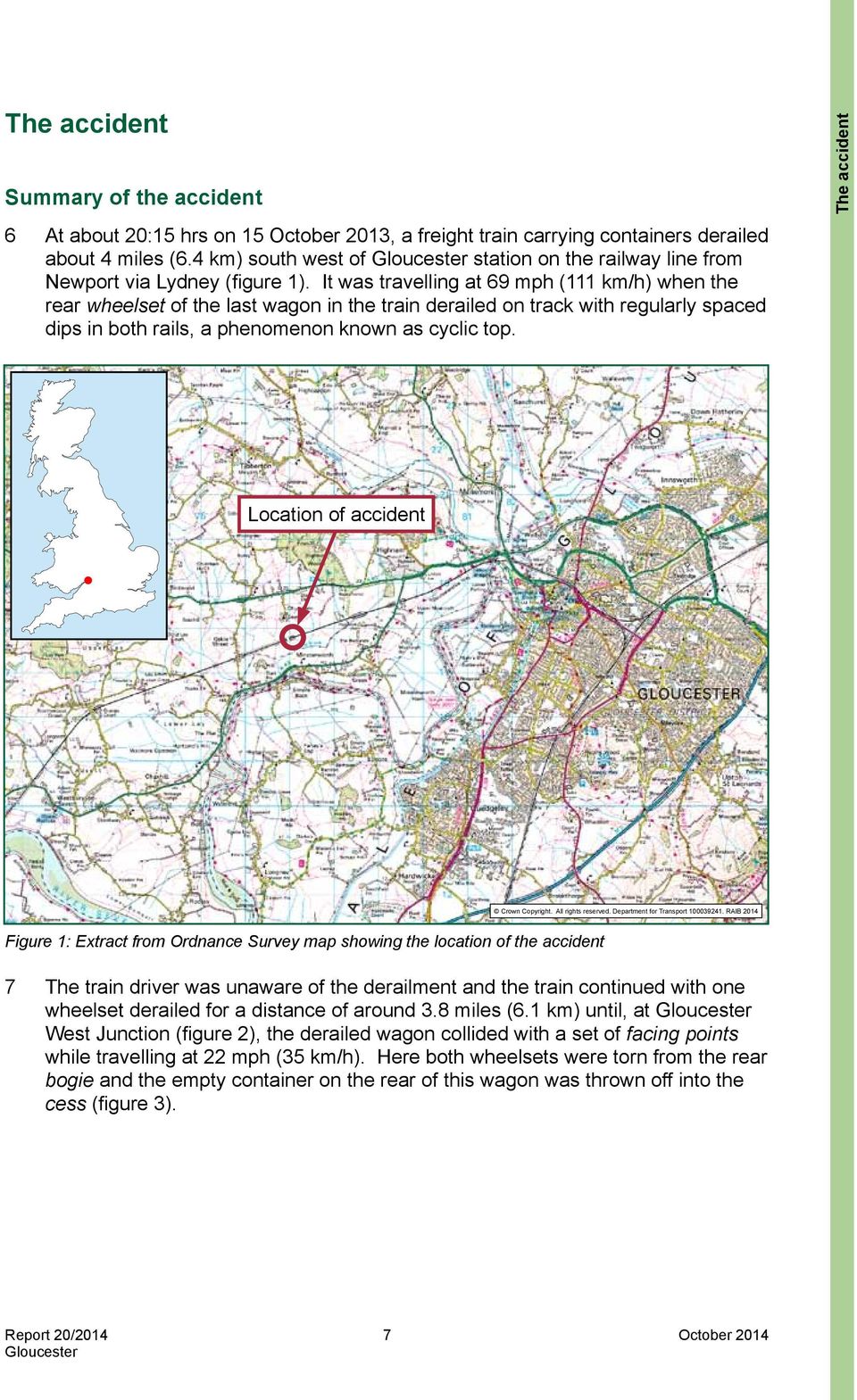
7 The accident Summary of the accident 6 At about 20:15 hrs on 15 October 2013, a freight train carrying containers derailed about 4 miles (6.4 km) south west of station on the railway line from Newport via Lydney (figure 1). It was travelling at 69 mph (111 km/h) when the rear wheelset of the last wagon in the train derailed on track with regularly spaced dips in both rails, a phenomenon known as cyclic top. The accident Location of accident Crown Copyright. All rights reserved. Department for Transport RAIB 2014 Figure 1: Extract from Ordnance Survey map showing the location of the accident 7 The train driver was unaware of the derailment and the train continued with one wheelset derailed for a distance of around 3.8 miles (6.1 km) until, at West Junction (figure 2), the derailed wagon collided with a set of facing points while travelling at 22 mph (35 km/h). Here both wheelsets were torn from the rear bogie and the empty container on the rear of this wagon was thrown off into the cess (figure 3). 7 October 2014
8 The accident Point of derailment 118 miles 46 chains on up main line Keens level crossing* 116 miles 03 chains West Junction 114 miles 40 chains Stopping point for rear wagon 114 miles 20 chains Footpath crossing 117 miles 41 chains 114 miles 04 chains Over Junction 115 miles 43 chains Direction of travel Pooles level crossing* 116 miles 46 chains Lower Barn level crossing* 118 miles 17 chains Not to scale * Level crossing where the barriers or gates are operated by the user Figure 2: Track layout from the point of derailment through to the train s stopping point Direction of travel Figure 3: The debris and dislodged container at West Junction 8 As the train continued towards, it caused further damage to the track and wagon, damaging two bridges and throwing debris onto a road below. As the train entered station, the driver saw the next signal was unexpectedly displaying a red aspect and he brought the train to a stand in response. At the same time, he received an emergency call over the radio system in the cab, calling for all trains in the area to stop. The signaller working on the signaller s panel at signal box had become aware of a possible problem with the train through damage to the signalling system and had taken action to stop it. The train had run derailed for about 5 minutes 30 seconds, covering a distance of 4.1 miles (6.6 km). 8 October 2014

9 9 No one was hurt in the accident and there were no other trains passing at the time. The railway line remained closed until the early hours of 19 October for recovery of the derailed wagon and its container, temporary repairs to the track and repairs to the damaged infrastructure. The line was reopened with a 30 mph (48 km/h) speed restriction from the point of derailment to station. The accident Context Location 10 The derailment occurred on the up main line between Lydney and, at 118 miles and chains (from a zero reference at London Paddington station), which is part of Network Rail s Western Route. 11 At this location, the two track railway comprises the up main and down main lines (figure 4). The permitted speed for trains on both lines is 90 mph (145 km/h), although the maximum speed for the train that derailed was 75 mph (121 km/h). The derailment happened in a cutting, where the track is straight and on a gradient of about 1 in 370 (0.27%), rising in the train s direction of travel. Point of derailment Direction of travel Up main line Down main line Figure 4: Location of the derailment 12 The track on the up main line consists of continuous welded rail on steel sleepers. Signalling in the area is by the track circuit block system with three aspect colour light signals, and is controlled from the signal box. 9 October 2014

10 The accident Organisations involved 13 Network Rail owns, operates and maintains the infrastructure, including the track where the derailment occurred. 14 The freight train was operated by Direct Rail Services, which also owns the wagon and employs the driver. W H Davis manufactured the wagon and Wabtec supplied the wagon s bogies and wheelsets. Network Rail Vehicle Conformance Group (now called Network Certification Body) and Lloyd s Register Rail carried out the approval work for the wagon to operate on Network Rail s infrastructure. 15 All of these organisations freely co-operated with the investigation. Train involved 16 The freight train that derailed was the 18:58 hrs service from Wentloog, near Cardiff, to Daventry (reporting number 4M36). It consisted of a class 66 dieselelectric locomotive, 66421, hauling 14 twin-set container flat wagons. Each twin-set wagon comprises two semi-permanently coupled vehicles, with a rigid connector between them. In train 4M36, 9 twin-sets were type IDA wagons (18 vehicles) and 5 twin-sets were type IKA wagons (10 vehicles), giving a total of 28 vehicles. The vehicle that derailed was the rear vehicle of an IDA wagon (figure 5) and the last vehicle in the train. Figure 5: An IDA wagon (image courtesy of W H Davis) 10 October 2014

11 17 All the vehicles were loaded with 45 foot (13.7 metre) long, 8 foot 6 inch (2.6 metre) high, curtain-sided containers which were either empty or partially loaded. The leading vehicle of the wagon at the rear of the train was carrying a partially loaded container weighing tonnes and the trailing vehicle was carrying an empty container weighing 5.99 tonnes. The containers were retained on the IDA wagons by fixed spigots of standard International Union of Railways (UIC) design No trains passed on the down main line while train 4M36 ran derailed. The only other train in the vicinity was train 1V15, a passenger train from Nottingham to Cardiff, which arrived at station from the opposite direction very shortly after train 4M36 was brought to a stand. It stopped alongside the front of train 4M36. Staff involved 19 The driver signed on for duty at Daventry earlier that day and travelled to Wentloog, from where he was due to drive train 4M36 to Daventry. 20 Staff based at Network Rail s maintenance depot were responsible for maintaining the track where the derailment happened. The Section Manager had worked for 39 years on track maintenance in the area, including the last 9 years as Section Manager. The Track Maintenance Engineer for had 22 years of experience working on track maintenance, including 4 years in this post. 21 Staff working for Network Rail Vehicle Conformance Group were responsible for carrying out the approval work for the prototype IDA wagon and first batch of IDA wagons that entered service. The assessor had over 35 years of experience as a railway engineer and the certifier over 38 years of experience, including 13 on vehicle approvals. Staff working for Lloyd s Register Rail, some of whom had over 15 years of experience on vehicle approvals, were responsible for carrying out the approval work for the second batch of IDA wagons that entered service. External circumstances 22 It was dark at the time of the accident. The local weather conditions were dry, with a temperature of about 7 C (this is based on an assessment of records at the nearest weather station 3.8 miles (6.1 km) away). There were no external circumstances which directly affected the accident although water, from rainfall over a long period of time, had affected the condition of the track (paragraphs 68 to 76). The accident Events preceding the accident 23 The wagons that formed train 4M36 had earlier travelled from Daventry to Wentloog carrying laden 45 foot curtain-sided containers. At Wentloog, these containers were unloaded and replaced with empty or partially laden containers. 1 Further information about spigots can be found in RAIB report 12/2009, Detachment of containers from freight wagons near Cheddington and Hardendale, 1 March October 2014
12 The accident 24 When the driver arrived at Wentloog, he moved the locomotive so it could be coupled onto the front of the train. After its pre-departure checks 2 were completed, the train departed the sidings at Wentloog at 19:20 hrs, 22 minutes late. 25 At 19:43 hrs, train 4M36 passed Severn Tunnel Junction and took the line towards via Lydney. The train was now on time due to a combination of running under green signals and allowances in its timetable. At 20:06 hrs it passed Awre Junction, running 5 minutes early. At 20:15 hrs, it arrived at 118 miles 56 chains on the up main line, which is where the cyclic top started and continued through to 118 miles 43 chains (a distance of 286 yards (262 metres)). Events during the accident 26 The train passed over the section of track containing cyclic top while travelling at 69 mph (111 km/h). The locomotive and following 27 vehicles did not derail but the rear wheelset of the 28 th vehicle, at the rear of the train, lifted clear of the rail. Marks found on the head of the six foot rail show the flange of its right-hand wheel landed on top of this rail at 118 miles chains (figure 6). Direction of travel Figure 6: The flange mark on the head of the six foot rail 2 The pre-departure check is a physical examination of the train to ensure that the train is safe to depart and includes checks for the brakes, couplings and loads of the wagons. Full details are provided in Working Manual for Rail Staff Freight Train Operations, Section C - Principles of Safe Freight Train Operation, reference GO/RT3056/C. 12 October 2014

13 27 The flange ran along the head of the rail for 3.75 metres before the wheelset derailed to the right. At this point the left-hand wheel derailed into the four foot. 28 The train continued with the rear wheelset running derailed for the next 3 miles. There was no indication to the driver of a problem with the train as there was no damage to the train s brake pipe so its brakes did not unexpectedly apply (the braking system of rail vehicles is such that if the air pressure in the brake pipe reduces, the train s brakes will apply). The rear wheelset was kept roughly in line by the leading wheelset of the rear bogie and ran on top of the clips that hold the rail in place (evidenced by damage to the clips and sleepers). The derailed wheelset ran over four level crossings, damaging the wooden decking (figure 7). As the train approached, it began to slow down as the permitted speed on the up main line reduces to 60 mph (97 km/h) at 115 miles 70 chains. The accident Figure 7: Examples of the damage caused by the derailed wheelset to level crossing surfaces Events following the accident 29 After about 3 miles (4.8 km), while travelling at 45 mph (72 km/h), the derailed wheelset struck a check rail at Over Junction which is located at 115 miles 43 chains. No other wheels derailed as a result of this impact and the train continued for just over a mile to West Junction, which is located at 114 miles 40 chains. Here, the permitted speed on the up main lines further reduces to 40 mph (64 km/h) and while travelling at 22 mph (35 km/h), the derailed wheelset again struck a check rail. This time the impact caused both wheelsets from the rear bogie and various suspension components to be ejected. The impact also dislodged the container on the rear vehicle, which landed in the cess at the top of an embankment (figure 3). 30 The train travelled for a further 0.25 miles (0.4 km) before stopping. During this time, the derailed vehicle collided with Worcester Road bridge causing both wheelsets on its leading bogie to derail and debris to fall onto the road below. The debris included a suspension spring 3 from the derailed vehicle that landed on top of an unoccupied parked car. The derailed vehicle also collided with London Road bridge just as the train stopped. By the time the train stopped, the rear vehicle was severely damaged (figure 8) although the brake pipe remained intact so there was no automatic application of the train s brakes. 3 The suspension spring weighed either 3.5 kg or 6.0 kg. 13 October 2014

14 The accident Figure 8: The severely damaged vehicle at the rear of train 4M36 31 The driver stopped his train in response to a red signal in station and at about the same time, he received an emergency call on the radio system in the locomotive s cab requiring all trains in the area to stop. The signaller had noticed unusual indications on the panel at signal box after the passage of train 4M36, consistent with signalling equipment being damaged. Consequently, the signaller had put the signal in front of train 4M36 back to red and initiated the emergency call to stop all trains in the area. 32 Once stopped, the driver called the signaller. The signaller explained that his panel appeared to show that signalling equipment had been damaged after the passage of this train and asked the driver to examine his train. The signaller stopped all train movements in the station area to allow the driver to do this. The driver walked alongside his train and when he reached the rear he found the damaged vehicle. He reported what he had found to the signaller. 33 Staff from Network Rail, Direct Rail Services and the RAIB attended the site. On 16 October, the rear wagon was uncoupled, allowing the rest of the train to go forward. The RAIB concluded its site activities by 21:00 hrs on 16 October. The damaged wagon was recovered by crane early on 18 October. By 19 October, Network Rail had completed temporary repairs to 4 miles of damaged track, repaired the points at Over and West Junctions, replaced the damaged decking at the level crossings, examined all of the bridges between the point of derailment and, and repaired the Worcester Road and London Road bridges. The up main line reopened at 03:14 hrs on 19 October, with a 30 mph (48 km/h) speed restriction in place from the start of the cyclic top site (due to its track geometry) through to station (due to the track not being fully repaired). 14 October 2014

15 The investigation Sources of evidence 34 The following sources of evidence were used: witness statements; the train s on-train data recorder (OTDR) data; site photographs, surveys and measurements; track geometry recording data and ground penetrating radar data recorded by Network Rail s infrastructure measuring trains; Network Rail s records for track inspection and maintenance activities; information related to Network Rail s track renewals carried out in 2002 and 2014; Network Rail documents for examinations of cuttings; data recorded by Network Rail s WheelChex system; Network Rail s control logs; information for the wagon that derailed including its pre-delivery inspection record and what load it was carrying on 15 October; design information for the IDA wagon including its dimensions and suspension components; the vehicle approval records for the IDA wagon including static and ride performance test reports; a computer simulation commissioned by the RAIB which enabled analysis of the interaction between the train and the track; weather reports from a nearby weather station; Network Rail company standards, Railway Group Standards, Technical Specifications for Interoperability (TSIs) and British standards; and a review of previous RAIB investigations that had relevance to this accident. The investigation 15 October 2014
16 Key facts and analysis Key facts and analysis Background information (track) Track inspection regime 35 The up main line where the derailment happened was classified by Network Rail as a category 2 track. This category, which is based on the permitted speed and tonnage passing over the line (ie the number of trains and their weight), is used to define the track inspection regime. In accordance with Network Rail s standards for track maintenance, NR/L2/TRK/001/mod02 Track Inspection and NR/L2/TRK/001/mod11 Track geometry - Inspections and minimum actions, the up main line was subject to the following inspection regime: a visual inspection to identify any immediate or short term actions that are required, which is carried out by maintenance staff on foot once every two weeks (often referred to as a track patrol ); an inspection by the Section Manager on foot once every 16 weeks; an inspection by the Track Maintenance Engineer on foot once every two years; an inspection by the Section Manager from the cab of a train once every 13 weeks; an inspection by the Track Maintenance Engineer from the cab of a train once every 26 weeks; and track geometry recording by a track geometry recording train once every 12 weeks. Cyclic top 36 Cyclic top is a regular series of alternate high and low spots in a track. At certain speeds, this can cause resonance in the suspension of some types of rail vehicles. In extreme cases, the resulting bouncing or pitching motion can cause the vehicle to derail when one of the wheels becomes unloaded allowing its flange to either climb or jump onto and over the rail head. 37 The severity of the high and low spots in the track which combine to make up cyclic top may not be identified during a visual inspection because of voids under the sleepers. As a train passes over voids, its weight pushes the track down into the space under the sleepers and the track recovers to its former geometry afterwards. This may cause the track geometry to appear visually better than it is, but exhibit more severe cyclic top under load. The only reliable means to identify and measure the severity of cyclic top is by running a track geometry recording train over the section of line. Network Rail s records show these trains were running over the up main line about every 12 weeks as required by its track inspection regime. 16 October 2014

17 Management of track geometry 38 Network Rail has a fleet of track geometry recording trains. On-board systems analyse the track geometry data as it is captured to identify discrete faults and generate reports which list information such as the type of fault, its size and its location. These are sent to the part of Network Rail responsible for maintaining that section of line so that the Section Manager can implement the action required by NR/L2/TRK/001/mod Vertical track geometry faults are reported as either top or cyclic top defects, where top is the term commonly used in track maintenance when referring to a rail s vertical profile. A top defect report relates to the size of a single dip in the height of a rail and its location, whereas a cyclic top track defect report relates to a series of regularly spaced dips in one or both rails. 40 The reports for cyclic top defects provide a value that is calculated by an algorithm. The data for the vertical geometry of each rail is filtered at defined wavelengths and then input into this algorithm. The chosen wavelengths are based on divisions of 18.3 metres which equates to a 60 foot length of rail 4. For each wavelength, the algorithm looks for a peak in the filtered data which is above a defined threshold. It then looks for the next peak above the threshold within a distance which is set by the particular wavelength. If another peak is found, the algorithm adds the peak values together. This process continues until no further peaks above the threshold are found within the distance for that particular wavelength. The algorithm then outputs summed peak values for the left rail, right rail and both rails, along with the number of peaks found and the start and end locations of the defect. 41 The cyclic top value is then used by Network Rail to determine what action needs to be taken by the local maintenance team. The intervention limits and actions to be taken are stated in NR/TRK/L2/001/mod11 and reproduced in table 1. If the cyclic top value requires an immediate action, which will be the imposition of a 30 mph (48 km/h) emergency speed restriction, staff on the track geometry recording train will verify that it is a defect and report it to the control centre responsible for that location (NR/TRK/L2/001/mod11 requires this to happen within 60 minutes of the defect being discovered). Staff at the control centre will then inform the signaller who controls that section of line (NR/TRK/L2/001/mod11 requires this to happen within 90 minutes of the defect being discovered). The signaller will stop each train on the affected line and instruct its driver to pass over the section of track at a speed of no greater than 20 mph (32 km/h). This will continue until track maintenance staff either carry out a repair, or place indications and warning equipment for the speed restriction alongside the track to warn trains to slow down. The choice of a 30 mph (48 km/h) speed restriction is based on it being low enough for all types of vehicle to pass over the cyclic top track defect safely, including two-axle wagons, which historically were known to be susceptible to derailment on cyclic top track defects. Key facts and analysis 4 Historically jointed track was constructed using 60 foot ( metres) lengths of rail and dips at the joints between the sections of rail would lead to the formation of cyclic top track defects. Therefore the wavelengths analysed for cyclic top track defects are all divisions of metres. These are metres ( ), metres ( ), metres ( ), metres ( ) and metres ( ). 17 October 2014

18 Key facts and analysis Cyclic top category Immediate A Permitted speed Above 30 mph (48 km/h) Above 30 mph (48 km/h) Intervention limits for cyclic top values 30 mm or greater on one rail or 50 mm or greater on both rails 26 mm to less than 30 mm on one rail or 46 mm to less than 50 mm on both rails Action required Immediately impose a 30 mph (48 km/h) emergency speed restriction and correct the defect within 36 hours Impose a 30 mph (48 km/h) emergency speed restriction within 36 hours and correct the defect within 14 days B Above 30 mph (48 km/h) 23 mm to less than 26 mm on one rail or 43 mm to less than 46 mm on both rails Impose a 30 mph (48 km/h) emergency speed restriction within 36 hours and correct the defect within 30 days C Above 30 mph (48 km/h) 20 mm to less than 23 mm on one rail or 40 mm to less than 43 mm on both rails Correct the defect within 60 days D All speeds 18 mm to less than 20 mm on one rail or 38 mm to less than 40 mm on both rails No prescribed timescale for action to be taken. Correct the defect during planned maintenance. Table 1: Intervention levels for cyclic top track defects in Network Rail standard NR/TRK/L2/001/mod11 42 Network Rail also uses the data captured by its track geometry recording trains to understand the overall quality of its track with respect to its vertical profile and alignment. Values for each are expressed as a standard deviation (SD) value for every eighth of a mile. Network Rail specifies maximum and target SD values in standard NR/L2/TRK/001/mod Network Rail uses the data from the last ten track geometry recording runs to produce a chart which shows how the SD values have changed over time. Each SD value on the chart is colour coded according to which band it falls into to assist with the identification of trends. There are five bands which are good, satisfactory, poor, very poor and super-red. The super-red band represents an eighth of mile section whose SD falls in the maximum band, ie the overall quality of its vertical profile or alignment has deteriorated to the point where it now exceeds the upper limit of the very poor band. NR/L2/TRK/001/mod11 defines the actions that the responsible Track Maintenance needs to take when a super red SD is reported, such as carrying out additional inspections. This can also include the imposition of a speed restriction. 44 For track with poor vertical track geometry, including discrete top or cyclic top track defects, a standard manual repair method used by track maintenance teams is known as measured shovel packing. This method involves lifting up the track with jacks and putting a measured amount of small stones or chippings under the sleepers in the dip. The sleepers are then supported by this new material thereby removing the dip. However, this type of repair takes longer (than other methods described in the next paragraph) because any voids need to be measured first. To do this, void meters must be installed. These devices measure the vertical deflection of the track under a passing train, and hence the size of the voids under the sleepers. The void meter readings allow the amount of stone needed under each sleeper to be determined. 18 October 2014

19 45 Shovel packing is a quicker way of lifting and packing the track to improve the vertical geometry. This method entails the track maintenance team lifting the track with jacks and then using shovels to put new ballast under the sleepers. Alternatively, the track maintenance team can pack the existing ballast under the track. This manual method involves lifting up the track and then using mechanical tools to vibrate the existing ballast to consolidate it under the sleeper. Neither of these repair methods will effect a long lasting repair as the ballast cannot be sufficiently compacted under the sleeper to prevent it from being pushed down over time under the weight of passing trains. However, these methods can be used to maintain the track geometry until a longer lasting repair can be planned and made. 46 Network Rail issues guidance to staff on the different lifting and packing methods that can be used in Track Work Information Sheets 5. These include the information that shovel packing is the least preferred option. The same information sheets state that lifting and packing with mechanical tools is the preferred method where the ballast is in good condition, but is unsuitable for use where the ballast is contaminated. One of these information sheets, which explains how to maintain steel sleepered track, states that packing a steel sleeper using hand held mechanical tools is almost impossible. This is because the sleeper s hollow shape prevents any ballast, small stones or chippings placed under the sleeper from being consolidated; hand-held mechanical tools are not powerful enough to get material under the sleeper and compact it. This information sheet explains that for this reason, track maintenance teams cannot carry out quick manual adjustments on steel sleepered track. 47 On-track machines are used to make a longer lasting repair. Network Rail can use an on-track machine called a stoneblower to correct top or cyclic top track defects. The stoneblower lifts up the track and injects a measured amount of stone chippings under the sleeper to support it. The sleepers are then lowered onto the chippings, which consolidate under passing trains. If a stoneblower cannot be used, the only other option available to Network Rail for improving the track s vertical geometry is to use an on-track machine called a tamper. A tamper lifts up the track and at the same time compacts the existing ballast beneath the sleepers using tines, which are spade ended tools. The tines are pushed down into the ballast and vibrated, which shakes the ballast and compacts it under the sleeper. 48 If the manual and on-track machine repairs are proving to be ineffective, and the track condition continues to deteriorate, the Track Maintenance Engineer can seek investment to carry out major works such as a track renewal. The Track Maintenance Engineer should write a problem statement that describes the issue and what work is needed. This will then be entered into the Track Renewal System (TRS), which is used by Network Rail to scope, plan and deliver its track renewals. Once senior management within maintenance agree that the work is required, the problem statement passes through TRS to the track team who work for the relevant Route Asset Manager (RAM). The RAM (track) team will review the problem statement, visit the site and if accepted, include the work in the renewal programme. The renewal will then be progressed, with its timescale for delivery dependent on how urgent the RAM (track) team considers it to be in comparison to all of the other planned renewal work. Key facts and analysis 5 These are listed in Network Rail guidance note NR/GN/TRK/ October 2014

20 Key facts and analysis Timeline (track) 49 Table 2 shows the history of events relevant to the track on the up main line, between 119 miles 0 chains and 118 miles 40 chains, where the train derailed. The information in table 2 is extracted from track geometry recording train reports, track inspection records and track maintenance records. Date Event In 2002 The track on the up main line was renewed and included the installation of steel sleepers. This was in accordance with Railtrack s policy at the time, that all track renewals on secondary lines should install steel sleepers. 17/03/2011 Network Rail s track geometry recording train ran over the up main line but did not measure a cyclic top track defect on the up main line that needed to be reported. 16/06/2011 Network Rail s track geometry recording train found a cyclic top track defect, which required the track to be repaired within 60 days. The SD recorded for the vertical track geometry between 118 miles 40 chains and 118 miles 50 chains was now in the very poor band (the cyclic top track defect was affecting the overall quality of the vertical track geometry). The defect was signed off as repaired on 12/07/ /12/2011 Network Rail s track geometry recording train found a cyclic top track defect, which required a 30 mph (48 km/h) emergency speed restriction to be imposed within 36 hours and the track to be repaired within 30 days. The defect was signed off as repaired on 04/01/ /03/2012 Network Rail s track geometry recording train found a cyclic top track defect, which required a 30 mph (48 km/h) emergency speed restriction to be imposed immediately and the track to be repaired within 36 hours. The defect was signed off as repaired on 16/03/ /09/2012 Network Rail s track geometry recording train found a cyclic top track defect, which required a 30 mph (48 km/h) emergency speed restriction to be imposed immediately and the track to be repaired within 36 hours. The defect was signed off as repaired on 13/09/ /09/2012 Maintenance staff used mechanical tools to lift the track and pack the ballast under the sleepers over a length of 3 chains (60 metres) at this site. This was additional work that was planned after the last track geometry recording run. 13/12/2012 Network Rail s track geometry recording train found a cyclic top track defect, which required a 30 mph (48 km/h) emergency speed restriction to be imposed immediately and the track to be repaired within 36 hours. The defect was signed off as repaired on 13/12/ /02/2013 The Track Maintenance Engineer s inspection noted the track s vertical geometry and the drainage at this location were both poor. 15/03/2013 Network Rail s track geometry recording train found a cyclic top track defect, which required a 30 mph (48 km/h) emergency speed restriction to be imposed immediately and the track to be repaired within 36 hours. The defect was signed off as repaired on 15/03/ /03/2013 The Section Manager s inspection noted Very poor top on steel sleepers and Cyclic faults that are becoming perennial 36 hrs ESR [emergency speed restriction] faults on TRC [track geometry recording train] runs. 11/04/2013 Maintenance staff lifted the track and used mechanical tools to pack the ballast under the sleepers over a length of 4 chains (80 metres). 31/05/2013 The Section Manager s inspection noted poor vertical track geometry over 3 chains (60 metres), which needed to be lifted and packed to repair it. 13/06/2013 Network Rail s track geometry recording train found a cyclic top track defect, which required a 30 mph (48 km/h) emergency speed restriction to be imposed immediately and the track to be repaired within 36 hours. The SD recorded for the vertical track geometry between 118 miles 40 chains and 118 miles 50 chains was now in the super-red band (the worsening cyclic top track defect caused the overall quality of the vertical track geometry to worsen and fall into the maximum band). The defect was signed off as repaired on 13/06/ October 2014

21 Date Event 12/07/2013 The Section Manager s inspection noted poor vertical track geometry and wet beds throughout the area, due to historic drainage problems at this location. 24/08/2013 The Track Maintenance Engineer s team raised a problem statement which proposed the installation of track drainage along the up main line. 28/08/2013 The Section Manager s inspection noted cyclic top and wet beds at this location. 12/09/2013 Network Rail s track geometry recording train found a cyclic top track defect, which required a 30 mph (48 km/h) emergency speed restriction to be imposed immediately and the track to be repaired within 36 hours. The SD recorded for the vertical track geometry between 118 miles 40 chains and 118 miles 50 chains was still in the super-red band. The defect was signed off as repaired on 12/09/ /09/2013 Maintenance staff used mechanical tools to lift the track and pack ballast under the sleepers over a length of 1 chain (20 metres) at this site. Staff also dug out ballast contaminated with mud from between 15 sleepers. This was additional work that was planned after the last track geometry recording run. 02/10/2013 An on-track machine was used to tamp the track on the up main line between 118 miles 67 chains and 118 miles 0 chains (paragraph 86). 04/10/2013 The Section Manager carried out an additional inspection, which was triggered by the recorded SD at this location still being in the super-red band (following the track geometry recording train run on 12/09/2013). The Section Manager noted that further work was needed (such as tamping by hand using mechanical tools) and that a permanent repair required the installation of track drainage. 15/10/2013 The Track Maintenance Engineer s team raised a second problem statement which proposed the installation of track drainage along the down main line. 15/10/2103 Train 4M36 derailed on the up main line at 118 miles 46 chains. Table 2: Timeline of events relevant to the track where the train derailed Key facts and analysis Background information (IDA wagon) Approval regime 50 The prototype IDA wagon was built in 2008 and had to comply with the requirements in the TSI for freight wagons 6. A TSI is a European technical standard. Each TSI is prepared by the European Railway Agency (ERA) under a mandate from the European Commission, with input from the national safety authority from each member state and bodies representing the rail industry. The TSI for freight wagons that applied to the IDA wagons was released by ERA in 2006 (a revised version has since been issued in ). Since this time, any organisation manufacturing or purchasing new wagons and placing them into service in a country that is a member of the European Union, must ensure that the requirements of the TSI for freight wagons are met. 51 While TSIs define requirements some also contain open points. Open points are issues within a TSI where member states must apply their own national rule. In Great Britain, these rules are documented in National Technical Rules (NTRs). RSSB produces a list of NTRs, which apply to Network Rail s infrastructure in Great Britain, to supplement the TSIs. This list of NTRs is then notified to ERA by the Department for Transport. 6 Technical Specification for Interoperability relating to the subsystem Rolling Stock - Freight Wagons, 2006/861/EC, Commission decision of 28 July A revised version of the TSI for freight wagons was issued in 2013, reference Commission Regulation (EU) No 321/2013, dated 13 March The mandate given to the ERA for revising the TSI for freight wagons was to extend its scope beyond trans European high-speed and conventional rail systems, to cover the European Union s entire rail system. 21 October 2014
22 Key facts and analysis 52 The requirements in the listed NTRs are mandatory. However, in specific circumstances, a manufacturer or operator can apply for a deviation. A deviation gives permission to comply with a specified alternative to a requirement in an NTR. The process of applying for and granting deviations is managed by RSSB. It also maintains a register that records all of the deviations that have been granted. 53 The NTR which covers the requirements for a vehicle s ride performance is Railway Group Standard GM/RT2141 Resistance of Railway Vehicles to Derailment and Roll-Over. GM/RT2141 details how compliance with its requirements can be demonstrated through either a combination of static measurements and on-track tests, or a combination of computer simulations and on-track tests. As an NTR it addresses open points in the TSIs. GM/RT2141 is also notified as an NTR as it defines the minimum requirements which vehicles must meet so that they can be allowed to run on Network Rail s infrastructure. When a TSI compliant vehicle is required to operate over Network Rail routes, GM/RT2141 is used to demonstrate the vehicle s compatibility with Network Rail s infrastructure, particularly on infrastructure which does not conform to the requirements in the relevant TSIs. 54 European standard EN 14363: also applies to a vehicle s ride performance. It regulates the testing needed to demonstrate that a railway vehicle has an acceptable ride performance. In other TSIs, such as the TSI for passenger vehicles, the requirements for ride performance make reference to demonstrating compliance to the requirements in EN 14363:2005, hence those clauses in EN 14363:2005 become part of the TSI. However, the first (2006) version of the TSI for freight wagons did not include any references to EN 14363:2005 and the ride performance requirements were treated as an open point. This has changed in the revised (2013) version of TSI for freight wagons, which now makes specific reference to EN 14363:2005. Guidance on applying EN 14363:2005 to freight vehicles in Great Britain is provided in GM/GN2688, issue 2, Guidance on Designing Rail Freight Wagons for use on the GB Mainline Railway. 55 When the prototype IDA wagon was built in 2008 and the first batch of IDA wagons was built in 2011 (referred to as the IDA-P wagon), the approvals regime 9 required an assessment by a Notified Body. This regime required the Notified Body to conduct a clause by clause assessment of the wagon s compliance against the requirements in the TSI for freight vehicles. For clauses in the TSI that were open points, the wagon was assessed against the rules documented in the relevant notified NTR. This approval work for the IDA-P wagon was carried out by Network Rail Vehicle Conformance Group. 8 Railway applications Testing for the acceptance of running characteristics of railway vehicles Testing of running behaviour and stationary tests, EN 14363:2005. The English language version of this European standard has the status of a British Standard, reference BS EN 14363: The approvals regime is defined by the Railways (Interoperability) Regulations 2006 and Railways and Other Transport Systems (Safety) Regulations October 2014
23 56 When a second batch of IDA wagons was built in 2013 (referred to as the IDA-Q wagon), the approvals regime again required an assessment by a Notified Body against the TSI for freight wagons. In addition, its scope included an assessment by a Designated Body against the requirements in the notified NTRs that were also applicable to this wagon. Both assessments were carried out by Lloyd s Register Rail (who in effect acted as both the Notified Body and Designated Body). Key facts and analysis Timeline (IDA wagon) 57 Table 3 shows the history of events relevant to the IDA wagon. The information in table 3 is extracted from witness interviews, vehicle approvals records, Network Rail logs and records for the wagon that derailed. Date In 2008 July 2008 to September 2008 Event Wagon manufacturer W H Davis, in cooperation with Wabtec, built a prototype container flat wagon with a low deck. The prototype wagon was referred to as the Super Low 45. Its low deck height meant it could carry 9 foot 6 inch (2.9 metre) high, 45 foot (13.7 metres) long containers, over routes on which these containers would otherwise be too high if carried on other types of wagon. Static and on-track dynamic ride performance tests were carried out using the prototype wagon as part of the work for it to gain approval to operate on Network Rail s infrastructure (paragraph 137). The approvals work for the prototype wagon was led by Network Rail Vehicle Conformance Group. 18/12/2008 Some of the on-track ride performance test results, specifically those when running on jointed track, did not comply with the requirements of NTR GM/RT2141 issue 2 so a deviation was sought from and granted by Rolling Stock Standards Committee which is the lead committee for this standard (paragraph 139). From 2009 to 2010 The prototype wagon was given to different freight operating companies to evaluate (this included Direct Rail Services). In 2010 Direct Rail Services placed an order with W H Davis to purchase 25 IDA wagons (50 vehicles). This batch of wagons was referred to as the IDA-P build. From 2010 to 2011 The approvals work for the IDA-P wagon build was carried out by Network Rail Vehicle Conformance Group as the Notified Body. At the end of this work, a technical file was produced to support a declaration by W H Davis (in its role as Project Entity ) that all of the required assessment work had been carried out. By the time the IDA-P wagon gained approval, the on-track ride performance test results for the prototype IDA wagon complied with issue 3 of NTR GM/RT2141 that had been published in June 2009 (paragraphs 139 and 140). 18/08/2011 In response to the declaration by W H Davis, the Office of Rail Regulation (ORR) issued a letter (under the Railways (Interoperability) Regulations 2006) authorising the IDA-P wagons entry into service. In 2013 Direct Rail Services placed a follow-on order with W H Davis to purchase 51 IDA wagons (102 vehicles). This batch of wagons was referred to as the IDA-Q build. 23 October 2014
24 Key facts and analysis Date Event 14/06/2013 The approvals work for the IDA-Q wagon build was carried out by a Notified Body (for TSIs) and Designated Body (for notified NTRs) both roles were performed by Lloyd s Register Rail. At the end of this work, a technical file was produced to support a declaration by the Project Entity, W H Davis, that all of the required assessment work had been carried out. 10/07/2013 In response to the declaration by W H Davis, the ORR issued a letter (under the Railways (Interoperability) Regulations 2006) authorising the IDA-Q wagons entry into service. 18/07/2013 Direct Rail Services carried out a pre-delivery inspection at W H Davis premises on the IDA-Q wagon that derailed in this accident. This was primarily a visual inspection to check the wagon was complete prior to leaving the manufacturer s premises. It included checks of the vehicle underframe fixtures and fittings, bogies and a functional brake test. 13/09/2013 The IDA-Q wagon that derailed in this accident entered service with Direct Rail Services. 11/10/2013 Another IDA wagon at the rear of a train lost its tail lamp in the vicinity of 118 miles 40 chains on the up main line, near to. 15/10/2013 The IDA-Q wagon at the rear of train 4M36 derailed on the up main line at 118 miles 46 chains. Table 3: Timeline of events relevant to the IDA wagon Identification of the immediate cause The rear wheelset of the last wagon in the train derailed on plain line when it passed over a cyclic top track defect. 59 The point of derailment was located on the up main line. A visual examination and survey of the track at this location identified regularly spaced variations in the vertical height of both rails, consistent with cyclic top (figures 9 and 10). Analysis of the survey data found the cyclic top fell into the track defect category requiring immediate action according to NR/L2/TRK/001/mod11 (table 1). 60 The derailment marks on the head of the six foot rail (figure 6) showed a wheel flange had lifted clear of the rail and landed back down on the head of the rail. An examination of the wheelsets that were ejected from the rear bogie at West Junction (paragraph 29) found that one of the wheelsets was relatively undamaged, while the other had sustained severe damage to its tread and flange (figure 11). This damage was consistent with it having run derailed for a long distance. The serial numbers of the wheelset axles and the wheelset data marked on the wagon s frame, identified that the severely damaged wheelset was from the rearmost position. 10 The condition, event or behaviour that directly resulted in the occurrence. 24 October 2014
25 Key facts and analysis Direction of travel Dips visible in both rails Point of derailment Figure 9: The cyclic top track defect on the up main line Rail height survey results Right rail Left rail Average gradient of 1 in 370 over 150 sleepers before point of derailment Relative height (metres) Sleeper number (on approach to point of derailment) Point of derailment at sleeper 0 Figure 10: Graph showing the changes in vertical height of the rails 25 October 2014
26 Key facts and analysis Wheel with damaged tread from running derailed Wheel with less damage to its tread Figure 11: The treads of wheels from the rear bogie 61 When the RAIB examined and surveyed the track geometry on the up main line, from 400 sleepers before the point of derailment to 50 sleepers after it, the RAIB found no evidence of: a track twist leading to a flange climb derailment there were no changes in the height difference between the two rails and no signs that the flange had previously climbed up the running edge of the rail and onto the railhead; a problem with the track s gauge the track survey results showed that the distance between the two rails was within Network Rail s acceptable limits throughout the derailment site (nominally 1438 mm for the type of rail fitted at this location); and broken track components there was no damage found to any track components until after the wheel had left the rail head and begun running derailed. Identification of causal factors The computer software package VAMPIRE, which allows a virtual model of any rail vehicle to be run over a model of measured track geometry, was used to simulate the derailment mechanism. This work found that when a model of a partially laden IDA wagon was run at 69 mph (111 km/h) over the model of the track geometry as recorded at the derailment site, a derailment was predicted which matched the marks as found on site (paragraphs 26 to 27). Further modelling was carried out to understand how factors, such as the size of cyclic top track defect, wagon loading and speed, affected the propensity to derail (paragraphs 118 to 123). Based on the results of this work and other supporting evidence, the RAIB has identified that the accident occurred due to a combination of the following causal factors: The mandated inspection frequency (paragraph 35) for the track on the up main line between 118 miles 50 chains and 118 miles 40 chains was being complied with but it had a vertical track geometry defect that required immediate action and there was no speed restriction in place for trains passing over it (paragraph 63). 11 Any condition, event or behaviour that was necessary for the occurrence. Avoiding or eliminating any one of these factors would have prevented it happening. 26 October 2014
27 The IDA wagon is susceptible to wheel unloading at its rear bogie when responding to cyclic changes in vertical track geometry ( cyclic top ), especially when loaded with a partial load, such as an empty 45 foot long curtain-sided container. This was not identified when the wagon was approved for use on Network Rail s infrastructure (paragraph 114). These factors are now considered in turn. Vertical track geometry at the point of derailment 63 The track on the up main line between 118 miles 50 chains and 118 miles 40 chains had a vertical track geometry defect that required immediate action but there was no speed restriction in place for trains passing over it. 64 Regularly spaced dips in the height of both rails, at a wavelength of about 13 metres, could be seen by eye on the approach to the point of derailment. In addition to the track geometry survey (paragraph 61), the RAIB also surveyed the height of the rails over 150 sleepers before the point of derailment (figure 10) to measure the size of these regular dips. Voiding under the sleepers was measured over 46 sleepers before the point of derailment to obtain data to understand the effect of the weight of a passing train. The highest void measurements coincided with locations of dips, whereas no voiding was found elsewhere (figure 12), indicating that the dips were bigger when the track was loaded by a passing train. Key facts and analysis Rail height survey including void measurements Right rail with voids Left rail with voids Right rail Left rail Relative height (meters) Sleeper number Point of derailment at sleeper 0 Figure 12: Graph showing the changes in vertical height of the rails with the void measurements included 27 October 2014
28 Key facts and analysis 65 Network Rail staff based at maintenance depot were aware that the condition of the track at this location had worsened in the previous two to three years and that it had a history of cyclic top track defects (table 2). The last such defect had been reported on 12 September 2013 when a track geometry recording train had passed over the up main line. It had reported a cyclic top track defect, with a value of 107 mm for both rails, which required the immediate imposition of a 30 mph (48 km/h) emergency speed restriction. Immediately afterwards, trains were restricted by the signaller to a speed of 20 mph (32 km/h) over this section of track until Network Rail maintenance staff attended and carried out maintenance work, after which this speed restriction was removed (paragraph 101). 66 About a month later, the track survey undertaken after the accident found a cyclic top track defect that was of a very similar magnitude to that recorded by the last track geometry recording train. However, trains had been passing over this cyclic top track defect without any speed restriction in place. 67 This causal factor arose due to a combination of the following: the cyclic top track defects had formed as a result of water flowing in the formation under the track (paragraph 68). no part of Network Rail s organisation took responsibility for the track drainage deficiencies at this location during the two years that the cyclic top track defect worsened (paragraph 77). the local Network Rail maintenance team was identifying the cyclic top track defect through its track inspection regime but its short and medium term repairs were ineffective and the long term solution had not been progressed (paragraph 80). the Network Rail maintenance team had no manual way of measuring the level of cyclic top still present after completing short term repairs or measuring the rate at which the cyclic top worsened once trains began running over it (paragraph 93). train 4M36 was permitted to run at speeds up to its maximum speed of 75 mph (121 km/h) over the cyclic top on the up main line (paragraph 98). there was an absence of management challenge to the repeated ineffective repair of the cyclic top and removal of emergency speed restrictions (paragraph 110). Each of these factors is now considered in turn. Water flowing underneath the up main line 68 The cyclic top track defects had formed as a result of water flowing in the formation under the track. 69 The track where the cyclic top track defect was found was in a cutting (figure 4). Water was draining into the adjacent land, flowing under the cutting and beneath the track (figure 13). There was no track drainage installed along the cess to intercept the water flowing under the cutting before it reached the up main line. 28 October 2014
29 Height of land above sea level (meters) Churcham village Brook Distance from railway (metres) Key facts and analysis Up main line Down main line Water table is likely to be close to the bottom of the up main line 400 mm Figure 13: Profile of the land perpendicular to the railway and side view of the cutting 70 After the accident, Network Rail investigated the condition of the track bed as part of its work to renew the track on the up main line in order to remove the cyclic top track defect. This work involved taking soil samples at various places along the up main line. The sample taken closest to the point of derailment found water 400 mm below the level of the rails. Similar work took place back in 2002 when the track had last been renewed. Soil samples taken prior to this track renewal also found water 400 mm below the level of the rails. The RAIB found no evidence that the presence of water under the track was perceived as a risk at that time. 29 October 2014
30 Key facts and analysis 71 The profile of the land perpendicular to the railway line on which the train derailed is shown in figure 13. This shows the height of the land falls steadily over a distance of about 800 metres, from 26 metres above sea level near to Churcham village, to 7 metres above sea level, where a brook flows from east to west before reaching the River Severn. The railway is located about 500 metres from the high point, about 13 metres above sea level. When the railway was built, it was cut through the side of this slope, with the deepest point cut into the slope coincident with the bottom of the cutting slope on the up main line. It is likely that following periods of heavy rainfall, water permeated into the ground above the railway and flowed downhill through the ground towards the brook, causing the local water table to rise. This meant the raised water table was close to the bottom of the track bed on the up main line as shown in figure This is supported by water being found in the soil samples taken here for the track renewals in 2002 and in The track through the cutting was renewed in March 2014 and this work included the replacement of the track bed. When the old track bed was dug out down to the formation beneath it, Network Rail staff reported seeing water flowing from the bottom of the cutting towards the exposed formation on the up main line. 73 The only drainage present was a drain running along the top of the cutting which might have intercepted some surface water from the adjacent field (figure 14). This drain was partially blocked by vegetation (paragraph 180). However, even if it had been fully functional, due to its position at the top of the cutting, it would not have intercepted the water in the local water table that was flowing downhill under the cutting and beneath the up main line. 118 miles 40 chains Path of partially blocked drain Point of derailment Culvert at 118 miles 25 chains Cutting 118 miles 50 chains Direction of travel Figure 14: Location of the drain running along the top of the cutting 30 October 2014
31 74 The RAIB examined the track in the cutting and noted mud from the formation on the surface of the track throughout the cutting (figure 15). When the top 100 mm of ballast was removed to measure the amount of voiding (paragraph 64), contaminated ballast and mud was found just below the surface (figure 15). The places where the ballast was the most contaminated coincided with the location of the dips in the track. Key facts and analysis Figure 15: Mud on the surface and contaminated ballast just below the surface 75 To understand the extent of the ballast contamination, the RAIB obtained data from one of Network Rail s trains that is fitted with ground penetrating radar. The data recorded when the train last ran over the up main line on 25 July 2013 showed that the ballast was contaminated with mud in a number of places near to where the train derailed (figure 16). The depth of clean ballast is very shallow; it was as shallow as 100 mm in places, which again coincided with the location of the dips in the track. 118 miles 50 chains Point of derailment Ballast layer Trackbed layer 118 miles 40 chains Depth below rail bottom (mm) ,000 1,250 1,500 Direction of travel Figure 16: Ground penetrating radar data processed to show the ballast depth where the train derailed 31 October 2014
32 Key facts and analysis 76 Over time, water flowing under track had softened the soil in the formation. The softened soil then mixed with water to create mud. The weight of passing trains had caused this mud to seep up through the ballast, forming a feature commonly known as a wet spot. The wet spot coincided with a loss of support under the sleepers due to the softened formation, resulting in a dip in the track. One dip can then be the trigger for the formation of a cyclic top track defect. Figure 17 shows that when a wheelset passes through the dip, its suspension responds to the change in rail height, so after the wheelset exits the dip the load on its wheels is decreased. Further along the track the suspension will respond again and the load on the wheels will increase, exerting a downward force on the track. If the speed of each passing train is similar, these repeated downward forces will be in the same place and will eventually cause the support under the sleepers in that location to deteriorate. This deterioration leads to voiding and the formation of a new dip. Trains passing over this new dip cause another dip to form and so on. Therefore as trains continued to pass over the up main line, more and more dips had formed at regular intervals, resulting in a cyclic top track defect. Data from Network Rail s track geometry recording train shows that the cyclic top grew in size from 2010 onwards (paragraph 82). Direction of travel 1 Support under the sleepers deteriorates under passing trains leading to voids. Voids lead to the formation of a dip. Size of the dip increases over time if the voiding is not repaired effectively. As trains pass through the dip, the load on each wheel increases when it reaches bottom of the dip. The load decreases on each wheel as it climbs out of the dip. A short distance after the dip, depending on speed, the load on each wheel increases as the suspension responds. Repeated downward forces lead to the support under the sleepers deteriorating over time, leading to voids. Another dip forms in the track if the voiding is not repaired effectively. Again a short distance after the dip, the suspension responds, leading to the formation of another dip. The process continues and results in evenly spaced dips along the track - a cyclic top track defect Figure 17: Formation of a cyclic top track defect 32 October 2014
33 Drainage 77 The track drainage deficiencies at this location were not addressed during the two years that the cyclic top track defect worsened. This was an underlying factor Table 2 shows the cyclic top was first reported as a defect in June 2011 and data from subsequent runs by track geometry recording trains shows the cyclic top worsened during the next two years. The actions taken by the local Network Rail track maintenance team during this time were focused on repairing the track geometry but these repairs were ineffective (paragraph 80). No work took place to prevent water from flowing under the track, despite the track maintenance team knowing it was a site that had poor drainage. 79 In July 2013, the Section Manager noted during his inspection that there were multiple wet beds throughout the site due to historic drainage issues. As a result of the increasing problems in maintaining the track geometry here, in August 2013 the Track Maintenance Engineer wrote a problem statement to implement a longer term solution. This called for the installation of track drainage along the up main line. However, the realisation that track drainage was needed at this location came too late and its installation had not been progressed by the time of the accident (paragraphs 91 to 92). Maintenance actions 80 The local Network Rail maintenance team was identifying the cyclic top track defect through its track inspection regime but its short and medium term repairs were ineffective and the long term solution had not been progressed. 81 Table 2 records the history of events relevant to the track between 119 miles 0 chains and 118 miles 40 chains where the train derailed. It shows that from June 2011 onwards, each time a Network Rail track geometry recording train ran, it reported a cyclic top track defect. Also throughout this time, poor vertical track geometry was noted during Section Manager and Track Maintenance Engineer inspections. A Track Maintenance Engineer inspection as far back as January 2009 reported wet beds at this mileage. Numerous Section Manager s inspections during 2012 and 2013 included reports of poor vertical track geometry, wet beds and poor drainage. 82 Following each inspection, work orders were raised for the defects that were found and each work order was given a time within which the work was required to take place. Records show that the local Network Rail maintenance team were responding to these faults by carrying out short term repairs. However, none of this work was effective or long lasting as the cyclic top, and therefore track quality too, continued to worsen. This can be seen from the data recorded by track geometry recording trains since September 2010 (figure 18). At the same time, medium term work to repair these defects was planned and carried out in October 2013 and a longer term solution was planned from August The short, medium and long term activities are now considered in turn. Key facts and analysis 12 Any factors associated with the overall management systems, organisational arrangements or the regulatory structure. 33 October 2014
34 Key facts and analysis Direction of travel Point of derailment Relative height of rails (mm) Relative distance along up main line (metres) Figure 18: Track geometry recording data from 2010 to 2013 Short term repairs 83 For track with poor vertical track geometry, the standard repair method used by track maintenance teams is measured shovel packing (paragraph 44) using small stones or chippings. However, Railtrack had installed steel sleepers on the up main line at this location in and their hollow shape (figure 19) meant that measured shovel packing could not be used (paragraph 46). Side view Cross section view Examples of installed steel sleepers Figure 19: Steel sleeper profile 13 In 2002, Railtrack had a policy that required all track renewals on secondary lines to install steel sleepers. This policy was suitable for many secondary lines that had low amounts of tonnage passing over them, with the majority of trains comprising light weight passenger vehicles. However, this policy did not take into account those secondary lines, such as the up main line at this location, where the amount of tonnage passing over it was much higher, including a significant number of freight trains. 34 October 2014
35 84 Instead, the local track maintenance teams lifted and packed ballast under the sleepers over short distances of up to 4 chains (80 metres). This work was aimed at breaking up the cyclic top track defect into either a length of track interspersed with discrete top defects (paragraph 39) or into several cyclic top track defects which fell into a lesser category, so could be repaired within a longer timescale (see table 1). By doing this, the maintenance team was able to meet the timescales for repairing and signing off the immediate action cyclic top track defects reported by track geometry recording trains (paragraph 109). Witnesses knew this practice was taking place across Western Route. Network Rail was asked if this happened on a national basis but was unable to provide evidence to show whether or not it did. 85 However, this repeated lifting and packing of the track using mechanical tools was ineffective because the ballast was contaminated with mud and it could not be consolidated under the steel sleepers due to their hollow shape. The dips soon reformed once trains began running again. It is also possible that the repeated use of mechanical tools made the track condition worse as it created dust and rounded the corners of the ballast, clogging up the drainage through the track bed and further contaminating the ballast. Medium term repairs 86 For its medium term repair strategy, Network Rail arranged for an on-track machine to tamp the up main line in an attempt to improve the vertical track geometry and remove the cyclic top fault. This tamping took place in the early hours of 2 October The preferred on-track machine repair method used by Network Rail at sites with cyclic top and poor ballast conditions would be stoneblowing (paragraph 47). However, this method cannot be used on steel sleeper track due to the sleepers hollow shape (in the same way that measured shovel packing cannot be carried out). The track was therefore tamped instead (paragraph 47). 88 The tamping that took place was not carried out to a design that had been prepared in advance, where the amount that the tamper will lift up and move the track is specified. Instead a maintenance tamp took place as the work was planned at short notice. For this type of tamping, the tamper runs over the site to record the track geometry. From this data, a computer on the tamper calculates how much the track should be lifted (but for a maintenance tamp like this, it is usual practice to limit the amount of lift to 30 mm). The tamping then takes place and afterwards the tamper runs over the site again to record the revised track geometry. Records for this tamping show that the maximum amount of lift was limited to 30 mm and variations in the vertical track geometry were still present afterwards but were less severe. Key facts and analysis 35 October 2014
36 Key facts and analysis 89 By limiting the tamper s maximum amount of lift to 30 mm, there was insufficient lift to remove a cyclic top track defect of the magnitude found at this site. Network Rail indicated that tamping sites with cyclic top track defects on steel sleeper track will deliver a longer lasting repair if a significant amount of new ballast is laid down first and the tamping takes place with a very large amount of lift of between 100 and 150 mm. Tamping then compacts the new ballast under the sleepers. This could have been done at this location as there were no limitations on the height of the track. However, witness evidence indicates that tamping in this way is rarely done as it takes longer to do and requires a lot more planning (eg delivery of the new ballast by train must be co-ordinated alongside the tamping). There is no evidence that anyone in the local track maintenance team considered doing this or asking for the tamper to lift the track by more than 30 mm. 90 The improvements to the vertical track geometry on 2 October were short lived and it is possible that tamping made the condition of the up main line worse. The ground penetrating radar data shown in figure 16 indicates that in July 2013 the clean ballast depth was shallow; it was only 100 mm in places. After the derailment, the RAIB s site examination identified places where the tamping had brought mud up to the surface, further contaminating the ballast. The effect of the tamping was to stir up the mud with the ballast so once trains began running again the track geometry soon settled back to its pre-tamping state. The Section Manager inspected the site on 4 October and his notes for this inspection record that he was very disappointed with the result and that further work to tamp the track using mechanical tools was needed. Longer term work 91 The Track Maintenance Engineer and Section Manager had recognised that longer term work was needed at this location to improve the track geometry on the up main line. As poor drainage was cited as the cause of the poor track geometry, the Track Maintenance Engineer proposed that track drainage should be installed along the cess of the up and down main lines. This drainage would dry out the track bed allowing a long lasting repair to be made to the cyclic top track defect. 92 On 14 August 2013, the Track Maintenance Engineer s team created a problem statement for the installation of track drainage alongside the up main line (paragraph 48). This was followed by another problem statement on 15 October for the installation of track drainage alongside the down main line. At the time of the accident, while both problem statements had been created on TRS, they still had a status of With TME which is the first stage of the process. The Track Maintenance Engineer still needed to check the information that had been entered onto TRS before the problem statements were submitted to the next stage. Consequently neither problem statement had reached the RAM (track) team for review. Even if the first problem statement had been progressed soon after it was created in August 2013, so that it was included in the renewal programme, installation of this new drainage was still a long way off. 36 October 2014
37 Measuring cyclic top 93 The Network Rail maintenance team had no manual way of measuring the level of cyclic top still present after completing short term repairs or measuring the rate at which the cyclic top worsened once trains began running over it. 94 Network Rail track geometry recording trains generate reports for discrete track geometry faults. These reports include cyclic top track defects and provide a value to indicate the severity of the cyclic top, the number of cycles, the cyclic top wavelength, its start and end locations and the actions that need to be taken (paragraphs 38 to 41). 95 When a track geometry recording train ran over the up main line on 12 September 2013, it reported a cyclic top track defect where the train derailed. This defect had a value of 107 mm, over 11 cycles, at a wavelength of 13 metres, over a distance of 92 yards. Network Rail maintenance responded that day and lifted and packed the track (paragraph 101). 96 The records for this repair work document details such as the method used and the distance over which it took place, but they do not record a value for the cyclic top after the repairs were completed. Ideally, the cyclic top would be measured upon completion of the repair work and measured again once trains have run over it in order to check the track s vertical geometry has not deteriorated. However, Network Rail track maintenance teams do not have a way of effectively measuring the track s vertical geometry after they have repaired it or to monitor it afterwards. A series of boards mounted on the rail, which are used for measured shovel packing, could be used to check the vertical alignment of a rail. However, as this repair method could not be used on steel sleeper track (paragraph 83), these boards were not used. Otherwise the track geometry can be inspected by eye. 97 As Network Rail track maintenance teams do not measure the track s vertical geometry, either after a repair is completed or to monitor it afterwards, it is never compared against the reported cyclic top defect. The effectiveness of the repair in terms of removing or reducing the level of cyclic top can only be measured when the track geometry recording train runs again. For the up main line, this would be about three months later. Application of speed restriction 98 Train 4M36 was permitted to run at speeds up to its maximum speed of 75 mph (121 km/h) over the cyclic top on the up main line. 99 While the permissible speed on the up main line at this location is 90 mph (145 km/h), train 4M36 was a class 4 freight train which was permitted to travel at speeds of up to 75 mph (121 km/h). Train 4M36 was travelling at 69 mph (111 km/h) when it derailed. 100 If a track geometry recording train had passed over the up main line on the day of the accident, it would have reported a cyclic top track defect which would have required the immediate imposition of a 30 mph (48 km/h) emergency speed restriction. The previous six track geometry recording train runs between March 2012 and September 2013 had all required the immediate imposition of a 30 mph (48 km/h) emergency speed restriction (see table 2). Key facts and analysis 37 October 2014
38 Key facts and analysis 101 After the passage of the last track geometry recording train on 12 September, the signaller at signal box stopped each train on the up main line and instructed its driver to pass over this section of track at a speed of no greater than 20 mph (32 km/h). This continued until a track maintenance team responded and arrived at the site. The team had access to the track from 20:22 hrs to 21:38 hrs, by which time it was dark. Records for the work state that the team lifted and packed the track over a length of 44 yards. After completing this work, they gave permission for the 30 mph (48 km/h) emergency speed restriction to be removed so trains could once again run over this track up to their maximum permitted speed. 102 It is not feasible that the track maintenance team could have made an effective repair to a cyclic top track defect of this magnitude (paragraph 95), using manual methods, in this amount of time and in darkness. Instead they did work in accordance with a known practice which aimed to break up the cyclic top track defect into a number of discrete top defects (paragraph 84). The local track maintenance team did plan follow-up repair work which took place on 24 September. This was also followed by planned tamping (paragraph 86) on 2 October. All of this work proved to be ineffective and trains continued to run at up to their maximum permitted speed over the cyclic top track defect. 103 When a cyclic top track defect is found that falls into the immediate action category, NR/L2/TRK/001/Mod11 not only requires the imposition of a 30 mph (48 km/h) emergency speed restriction, but also requires the Section Manager to sign off the defect as repaired within 36 hours. Once the fault is signed off as repaired, the speed restriction can also be removed. 104 If a cyclic top track defect has reached the point where it falls into the immediate action category, then it can only be effectively repaired using a stoneblower or possibly a tamper provided the ballast is not contaminated. It is not feasible for a Section Manager to arrange for the track to be stoneblown or tamped within 36 hours. This leaves the Section Manager with little option other than to use maintenance staff to carry out repairs using manual methods. This work will not effect a lasting repair as it will be limited to breaking up the cyclic top track defect into a number of discrete top defects as discussed earlier. However, it does allow the Section Manager to meet the 36 hour repair deadline, followed by the removal of the speed restriction. 105 Network Rail has acknowledged that it is very unlikely that an effective repair using an on track machine can be completed within 36 hours. Its interpretation of this requirement is that it has a short timescale to highlight the importance of the defect. If an on-track machine repair cannot be completed within 36 hours, maintenance staff should carry out manual repairs to reduce the severity of the defect in the short term, but the emergency speed restriction should remain in place until the more effective on-track machine repair can be carried out. This interpretation is not explained in NR/L2/TRK/001/Mod11 and there is no evidence that this was happening at. Here, only short term manual repairs took place in order to meet the 36 hour deadline before the emergency speed restriction was then removed. 38 October 2014
39 106 The overall poor quality of the vertical track geometry also meant that Network Rail should have imposed a speed restriction to comply with NR/L2/TRK/001/mod11. Figure 20 shows the SD chart (paragraphs 42 to 43) covering the point of the derailment after the last ten track geometry recording runs up until June It shows how the eighth of a mile section where the derailment happened had worsened over time. Eighth mile section on which train derailed Key facts and analysis 13-Jun Key: 15-Mar No data 13-Dec Good 13-Sep Satisfactory 15-Mar Poor 15-Dec Very poor 15-Sep Super-red 16-Jun Work record 17-Mar Dec Track history 118 miles 0 chains 118 miles 10 chains 118 miles 20 chains 118 miles 30 chains 118 miles 40 chains 118 miles 50 chains 118 miles 60 chains 118 miles 70 chains 119 miles 0 chains Figure 20: SD chart for the up main line 107 By June 2013, its SD value was in the maximum band, the super-red category. Once it became a super-red site, NR/L2/TRK/001/mod11 required the Track Maintenance Engineer to take action to improve its quality. NR/L2/TRK/001/mod11 also states that if the action undertaken is not sufficient to move the SD value out of the maximum band then a speed restriction must be imposed. 108 When the next track geometry recording run took place in September, the SD recorded for this eighth of a mile section was again in the super-red category. At that point, due to its continuing poor quality, the Track Maintenance Engineer should have reduced the permitted speed over that eighth mile section of the up main line to 60 mph (97 km/h) in accordance with the requirements of NR/L2/TRK/001/mod11. The Track Maintenance Engineer did not identify that this needed to be done because the meeting to review the output from the September track recording run did not take place due to staff attending to other activities. Witnesses stated that the imposition of necessary speed restrictions would have been supported by Network Rail management. 39 October 2014
40 Key facts and analysis 109 Witnesses stated that cyclic top track defects are seen as a derailment risk, to freight trains in particular, and they knew that the primary risk mitigation is a reduction in speed. However, as soon as Network Rail maintenance staff completed short term repair work to comply with the 36 hour deadline for signing off the defect, they removed the speed restrictions, even though they knew from their experience that a cyclic top track defect requiring a 30 mph (48 km/h) speed restriction would be found the next time the track geometry recording train ran. It is possible that because derailments caused by this type of track defect are now much less frequent than in the past (paragraph 190), Network Rail s track maintenance staff have become less aware of the importance of keeping these speed restrictions in place. Rather than leaving the speed restriction in place until it could be shown that the cyclic top had been effectively repaired, instead maintenance staff were focused on complying with the deadline set in NR/L2/TRK/001/Mod11 for doing the repair. After the cyclic top track defect had been signed off, further repairs were sometimes planned. However, there is no evidence that any additional inspections, beyond those required by the track inspection regime, were planned to check the effectiveness of any repair work. Absence of challenge 110 There was an absence of management challenge to the repeated ineffective repair of the cyclic top and removal of emergency speed restrictions. This was an underlying factor. 111 The Track Maintenance Engineer and other staff based at maintenance depot were all aware of the cyclic top track defect at this location. For over 18 months, cyclic top track defects requiring a 30 mph (48 km/h) emergency speed restriction were being reported each time the track geometry recording train ran as the repair work they planned and carried out was ineffective. During this time the track geometry quality also fell into the superred category. However, no one outside the local maintenance organisation was aware of the ongoing problem site. 112 The cyclic top track defect and poor track geometry quality were not highlighted by any of Network Rail s reporting processes. On the railway line from Severn Tunnel Junction to, the Track Maintenance Engineer at is responsible for the section from 128 miles 0 chains through to station at 114 miles 4 chains. On this section of railway, there was just one half mile long section, from 119 miles 0 chains to 118 miles 40 chains, which had poor quality vertical track geometry due to the cyclic top. The overall quality of the track geometry on the 14 miles of railway that the Track Maintenance Engineer was responsible for was good. Therefore neither the Infrastructure Maintenance Engineer (who the Track Maintenance Engineer reports to) nor the Route Asset Manager responsible for track assets knew about it. 113 There was no senior management oversight to question why this fault was being repeatedly found, there was no support provided by the RAM (track) team to help resolve the problem, and there was no challenge to the repeated removal of the 30 mph (48 km/h) emergency speed restrictions which were imposed to mitigate the derailment risk from the cyclic top track defect. 40 October 2014
41 IDA wagon vertical ride performance 114 The IDA wagon is susceptible to wheel unloading at its rear bogie when responding to cyclic changes in vertical track geometry ( cyclic top ), especially with a partial load, such as an empty 45 foot long curtain-sided container. This was not identified when the wagon was approved for use on Network Rail s infrastructure. 115 In order to reach a more definite understanding of the key factors that led to this derailment and their significance, dynamic modelling was undertaken using the VAMPIRE computer software simulation package. 116 Wabtec provided a vehicle model for the IDA wagon which it had used when the prototype wagon was being designed. However, Wabtec had not updated or validated the model and it had not been used as a source of evidence for any of the wagon s approval work. Data from this model, design information for the production IDA wagon and measurements from the wagon that derailed were used to create a new vehicle model. This new model was validated against practical test results recorded when the prototype IDA wagon underwent its vehicle approval. The results from the model and practical tests closely matched. Further models were then created to represent the production IDA wagon that derailed in different load conditions: tare, fully laden and partially laden as at the time it derailed (paragraph 17). As the wagon that derailed was new, having only been in service for about four weeks, it was not necessary for the vehicle models to account for wear to components. 117 To model the derailment mechanism, a track model which included the cyclic top track defect was created using data from track surveys and data recorded by the track geometry recording train that ran on 12 September When the partially laden vehicle model was run over the track model at 69 mph (111 km/h), the right wheel of the rear wheelset lifted up and landed on the rail head, and then derailed to the right about 5 metres later. This matched the derailment marks as found on site, with the predicted point of derailment in the simulation within 20 metres of the actual point of derailment. 118 To understand how the propensity to derail changed when the amplitude of the cyclic top track defect was varied, further track models were created. The data for the vertical track geometry was scaled by factors of 90, 80, 70, 60 and 50% to create a further five track models. To understand the level of cyclic top in each of these track models, the data was filtered at a wavelength of 13 metres and the algorithm referred to in paragraph 40 was then applied to give a cyclic top value. The results are shown in table 4. The cyclic top values that would trigger the most significant track maintenance action are shown in red, along with the corresponding track maintenance action that it would require. Key facts and analysis 41 October 2014
42 Key facts and analysis Vertical track geometry data scaling factor Cyclic top (mm) Left rail Right rail Both 100% % % % Action to be taken by track maintenance Immediate 30 mph (48 km/h) emergency speed restriction. Correct within 36 hours Immediate 30 mph (48 km/h) emergency speed restriction. Correct within 36 hours Immediate 30 mph (48 km/h) emergency speed restriction. Correct within 36 hours 30 mph (48 km/h) emergency speed restriction applied within 36 hours. Correct within 30 days 60% Correct within 60 days 50% None Table 4: Track model cyclic top values 119 Simulations were carried out running the tare, fully laden and partially loaded vehicle models over each track model, at a range of speeds from 30 mph (48 km/h) to 70 mph (113 km/h) in 5 mph (8 km/h) increments. The results are shown in figure Figure 21 shows that in its fully laden condition, the IDA wagon is not at risk of derailing at any speed on any of the track models. This is because the predicted amount of wheel unloading is low and there is no wheel lift. 121 Figure 21 shows that in its tare condition, at least one of the IDA wagon s wheels is predicted to completely unload when passing over the cyclic top in the 60% track model at a speed of 65 mph (105 km/h) or greater. Table 4 shows that cyclic top level of this magnitude would not require a speed restriction to be imposed, and could remain un-corrected for up to 60 days. However, the predicted wheel lift is 5 mm, so the risk of derailment is relatively small. As the level of cyclic top increases, the predicted amount of wheel lift increases with a corresponding increase in the risk of a derailment 14. For the 80, 90 and 100% track models, at the higher speeds, the wheel lift becomes great enough for a flange to pass over the rail head (for these track models, a 30 mph (48 km/h) speed restriction should be in place and at this low speed the predicted amount of wheel unloading is low with no wheel lift). The greatest predicted wheel lift is 44 mm on the 100% track model at 70 mph (113 km/h). Although derailment is not predicted by this simulation, the amount of predicted wheel lift means that only a small lateral force is needed for a derailment to occur. 14 The study commissioned by the RAIB reported that once the predicted wheel lift reaches 5 mm or more, the margin of safety against derailment begins to reduce significantly. This 5 mm threshold is not formally specified, it was chosen based on the experience of the vehicle dynamics consultant. The risk of derailment is significant once the wheel flange is lifted higher than the rail head, which for the wheels fitted to IDA wagons, will be when the predicted wheel lift is greater than 30 mm. Only a small amount of lateral force is then needed to derail the wheel (eg such as from going around a curve). 42 October 2014
43 Degree of cyclic top (track maintenance action required) No intervention Track models (see table 4) 60 day repair 30 mph ESR within 36 hours and repair within 30 days Immediate 30 mph ESR and repair within 36 hours Key facts and analysis Speed (mph) Wagon 50% 60% 70% 80% 90% 100% IDA laden IDA tare IDA part laden 70 X X Wheel unloaded by less than 80% Wheel fully unloaded (100%) Wheel unloaded by 80% or more but less than 100% X Derailment predicted Figure 21: Simulation results for IDA wagons 43 October 2014
44 Key facts and analysis 122 When the wagon is partially loaded, as at the time it derailed, figure 21 shows that the simulations predict complete wheel unloading at 70 mph (113 km/h), even on the 50% track model; table 4 shows this track model requires no maintenance intervention so an IDA wagon would be permitted to run over it at this speed. However, the amount of wheel lift is not sufficient to allow a flange to pass over the rail until the size of the cyclic top track defect reaches the level found in the 80% track model. The amount of wheel lift predicted is greater when partially loaded; the greatest amount is 82 mm on the 100% track model at 70 mph (113 km/h). The simulations also predicted the rear bogie at the rear of the wagon derailing on both the 90% and 100% track models at 70 mph (113 km/h). 123 These simulation results show that when an IDA wagon is in tare or is carrying a partial load of about 10 tonnes or less, it is susceptible to wheel unloading when passing over changes in vertical track geometry. For the majority of the simulations, the greatest amounts of wheel lift were recorded at the rear bogie of each vehicle. The worst ride performance was at the trailing vehicle s rear bogie, which was also the only bogie that was predicted to derail. This bogie is unrestrained by any following vehicles so all of its damping is provided through its suspension, whereas the rear bogie on the leading vehicle of the twin-set wagon is further damped to some extent by the rigid coupling between the leading and trailing vehicles. 124 Video footage of a train comprising IDA wagons passing Moreton on Lugg, Herefordshire, on 9 March 2014 demonstrates how this type of wagon rides over changes in vertical track geometry (figure 22). The wagons were either tare or partially loaded and passed over a cyclic top track defect at 67 mph (108 km/h). A track geometry recording train had passed over this line on 14 February and found a cyclic top track defect that required repair within 60 days. The size of the reported defect was 21 mm, at a wavelength of 13 metres, on the right-hand rail, over a distance of 2 chains (40 metres). 125 Direct Rail Services had found during maintenance examinations on the IDA wagons that some components mounted on and around the bogie were breaking in a way that suggested they had been subject to large vertical movements (such as a valve mounted between the bogie frame and axlebox). Direct Rail Services had already begun discussions with W H Davis about the cause of the breakages that were being found. However, the RAIB considers it likely that these breakages were due to the way that the wagon s suspension was responding to changes in vertical track geometry. 126 Another indication of large vertical movements by an IDA wagon took place on 11 October 2013, when a freight train from Wentloog to Daventry was stopped at Cheltenham Spa after a report of it having no tail lamp. The tail lamp had become detached from the IDA wagon at the train s rear and was later found lying in the middle of the up main line at 118 miles 40 chains, which is where the cyclic top track defect was. 44 October 2014
45 Key facts and analysis Handbrake wheels on adjacent wagons level Leading wagon now higher Leading wagon now lower Leading wagon now higher again Figure 22: IDA wagons passing Moreton on Lugg (images courtesy of MrThrash37 YouTube) 45 October 2014
46 Key facts and analysis 127 The suspension on the IDA wagon uses friction to provide its damping. The primary suspension at the end of each axle has four sets of springs, each comprising an inner and an outer spring (figure 23). With no load other than the weight of the wagon itself (ie tare), only the outer spring is in contact between the axlebox and the bogie frame. As the load on the wagon is increased, the inner spring also comes into contact and this increases the vertical stiffness of the suspension. Figure 24 shows that the inner spring comes into contact with a load of 5.76 tonnes on the wagon (2.88 tonnes on each bogie). When the wagon has a partial load on it, such as an empty curtain-sided container which weighs 5.99 tonnes, the inner spring is just in contact but with a comparatively light load. This is generally the worst condition for vertical ride performance as vertical inputs from the track then cause the inner springs to move into and out of contact leading to rapid changes in the suspension stiffness. These changes in stiffness, combined with the light load and the commensurately small amount of friction damping, give rise to a bigger response to vertical track inputs than is seen for either the tare or fully laden wagon. Inner spring (green) Outer spring (yellow) Wedges (red) Friction surfaces (blue/cyan) Figure 23: The primary suspension on an IDA wagon 46 October 2014
47 Wagon load (tonnes) Graph showing wagon load against spring deflection from tare to laden tonnes load / spring deflection Fully laden Point where stiffness changes Key facts and analysis Spring deflection (mm) Figure 24: Wagon load versus spring deflection graph 128 The response to vertical track inputs seen with both a tare and a partially loaded wagon can result in large amounts of wheel lift (paragraphs 121 to 122). The IDA wagon has a very low profile so it can carry 9 foot 6 inch (2.9 metre) high containers over routes which these containers would otherwise be prohibited from. With no load on it, the wagon s deck is just 730 mm above rail level (figure 25), which is achieved by using small wheels measuring 577 mm in diameter and a compact bogie design. The bogie design is also constrained by the maximum height limit for the wagon when loaded. The maximum amount of upward vertical movement within the suspension is 25 mm. For any further vertical movement after this distance, the suspension becomes very stiff with no damping, as the end of the vehicle, including its bogie and wheels, is lifted up. This behaviour is evidenced by damage found during maintenance examinations. It would also result in large vertical accelerations at the bogie pivots, as found during the actual and simulated on track testing (see paragraphs 134 to 149). 730 mm deck height above rail level at tare 1800 mm wheelbase 9248 mm bogie centres mm over headstocks Figure 25: Dimensions of an IDA wagon (courtesy of W H Davis) 47 October 2014
48 Key facts and analysis 129 To understand how the ride performance of the IDA compared to other widely used types of container flat wagon, the simulations were repeated for: a 60 foot (18.3 metres) long container flat wagon, fitted with a Y25 series bogie which has a coil spring primary suspension; and a 60 foot (18.3 metres) long type FFA container flat wagon, which has a three-piece bogie with coil spring and rubber secondary suspension. 130 Vehicle models in tare, part laden and fully laden were used for both. The part laden condition that was chosen placed the suspension just in contact with the inner springs. The results of simulations in their part laden condition are summarised in figure The simulations for both of these wagons showed their overall ride performance was good over all of the track models and derailment risk was comparatively small. The predicted amounts of wheel lift were no greater than 8 mm for both wagons, even on the 90 and 100% track model at the higher speeds. 132 For completeness, the simulations were also repeated using a generic model of a laden two axle tank wagon, which is a type of wagon that has a history of derailments on cyclic top track defects. The simulations predicted high levels of wheel unloading on all of the track models, at all speeds from 30 mph (48 km/h) to 70 mph (113 km/h). Wheels became completely unloaded at speeds above 55 mph (89 km/h) on the 80, 90 and 100% track models, with predicted amounts of wheel lift up to 98 mm. Derailment was predicted at either 65 mph (105 km/h) or 70 mph (121 km/h) on the 70, 80, 90 and 100% track models, albeit these wagons have a maximum speed of 60 mph (97 km/h). 133 The dynamics modelling showed that the ride performance of the IDA wagon over cyclic top track defects is worse in comparison to other container flat wagons. However, this behaviour was not identified during the work that gained approval for these wagons to be used on Network Rail s infrastructure. This arose due to a combination of the following: The IDA wagon s ride performance was not tested with a partial load such as an empty 45 foot long curtain-sided container. If it had been tested, it is probable that the IDA wagon would not have met the ride performance criteria in Railway Group Standard GM/RT2141 issue 3 (paragraph 134). The approval process for the IDA wagon did not assess the wagon s ride performance when loaded with a partial load such as an empty 45 foot long curtain-sided container (paragraph 150). The approval process for the IDA wagon did not specifically assess the wagon s ride performance in response to changes in vertical track geometry (paragraph 158). Each of these factors is now considered in turn. 48 October 2014
49 Degree of cyclic top (track maintenance action required) No intervention Track models (see table 4) 60 day repair 30 mph ESR within 36 hours and repair within 30 days Immediate 30 mph ESR and repair within 36 hours Key facts and analysis Speed (mph) Wagon 50% 60% 70% 80% 90% 100% IDA part laden 70 X X Y25 series 50 bogie part 55 laden piece bogie part laden Wheel unloaded by less than 80% Wheel fully unloaded (100%) Wheel unloaded by 80% or more but less than 100% X Derailment predicted Figure 26: Simulation results for different wagons in their part laden condition 49 October 2014
50 Key facts and analysis Testing ride performance with a partial load 134 The IDA wagon s ride performance was not tested with a partial load such as an empty 45 foot long curtain-sided container. If it had been tested, it is probable that the IDA wagon would not have met the ride performance criteria in Railway Group Standard GM/RT2141 issue The IDA wagon was tested to demonstrate that its ride performance met the requirements of the TSI for freight wagons that was issued in To ensure acceptable resistance against derailment, this TSI included a section named safety against derailment and running stability. This stated the mandatory limits for the lateral and vertical forces between the wheel and rail, which were based on factors related to the track infrastructure, such as curvature. 136 Instrumented wheelsets are needed to measure the lateral and vertical forces between the wheel and the rail. In Great Britain, these are not generally used because historically ride performance has been assessed by following a different approach, which is described in GM/RT2141. As the IDA wagons were only to be used in Great Britain, the assessors applied GM/RT2141, using it as an NTR to address the ride performance requirements in the 2006 TSI for freight wagons (which is an open point). Witness evidence stated that the tests in GM/RT2141, which apply to running on track in Great Britain, were deemed to be more onerous than those in the TSI and so by demonstrating compliance with the requirements in GM/RT2141, the ride performance required by the TSI would be met. 137 In 2008, testing took place using the prototype IDA wagon which followed the requirements in issue 2 of GM/RT2141, specifically Appendix D (issue 2 was the version that was current at that time). Static tests took place first, which included wheel unloading tests (these show how the suspension reacts to track twist). Following these, the wagon was instrumented and the vertical and lateral accelerations of the body over the centre of each bogie were measured while the wagon was hauled over a circular route comprising a number of representative track conditions. These test runs took place with the wagon in its tare condition and also fully laden. 138 The measurements for each on-track test run were analysed, looking for the number of peak accelerations above defined values. The results were then plotted on a graph and compared with an acceptance curve as defined in issue 2 of GM/RT2141. The results showed ride performance was marginally non compliant to the acceptance curve at times, both in its tare and fully laden conditions. On sections of jointed track between Crewe and Derby at speeds above 50 mph (80 km/h), the distribution of vertical accelerations peaks exceeded the acceptance curve at the trailing bogie of the leading vehicle and the trailing bogie of the rear vehicle. An example of one of the recorded non-compliances is shown in figure October 2014
51 Percentage exeedence Cumulative peak accelerations as a % of total vs. acceleration Acceptable Unacceptable Acceptance curve Recorded plot Plot for rear bogie of leading vehicle exceeds issue 2 acceptance curve Key facts and analysis Body vertical acceleration (g) Figure 27: Peak counting plot for tare IDA wagon at 54 mph (87 km/h) on jointed track (from actual ontrack tests) 139 The test report for the on-track testing noted these failures and at the end of 2008, a deviation to GM/RT2141 for ride performance was obtained from Rolling Stock Standards Committee (deviation reference 08/240/NC). This allowed W H Davis to loan the prototype IDA wagon to a number of freight operating companies so they could evaluate the prototype IDA by using it in their trains. The argument made for a deviation was that changes were being proposed to GM/RT2141 which included the introduction of a new acceptance curve for bogie freight wagons on jointed track. The IDA wagon test results complied with this new curve, so once it was issued the deviation would no longer be needed. 140 In 2007, RSSB had commissioned a study to review the acceptance curve in GM/ RT2141 as a number of bogie freight wagons had not met its requirements when tested on jointed track, but had subsequently been seen to operate satisfactorily. This work led to RSSB introducing a new acceptance curve specifically for bogie freight wagons on jointed track as shown in figure 28. RSSB based the new acceptance curve on the existing curve and changed the margin of safety only in areas where it considered it had existing experience, such as where the ride performance of wagons with derogations against the existing curve had been shown to be acceptable for some time. The new acceptance curve for bogie freight wagons on jointed track was published in issue 3 of GM/RT2141 in June The test report for the on-track testing also recommended that the wagons ride performance be investigated, including testing with a partial load at the point where the primary suspension stiffness changes (paragraphs 137 to 139). GM/RT2141 issue 2 did not specifically require testing in a partially loaded condition but it did state that testing should be sufficient to allow all representative conditions to be assessed. 51 October 2014
52 Key facts and analysis New curve Existing curve Figure 28: New acceptance curve for bogie freight vehicles on jointed track 142 One of the other differences between issue 2 (dated October 2000) and issue 3 (dated June 2009) of GM/RT2141 was the inclusion of a new section detailing how different loading conditions need to be considered when assessing resistance to derailment. This change had been made in response to a RAIB recommendation that was made after a container-carrying wagon had derailed at Duddeston, near Birmingham 15. GM/RT2141 issue 3 notes that vehicle condition and load can affect the resistance to derailment. It lists the test conditions that should be considered and includes vehicle weight distribution (for example tare, laden, partially laden). While there are numerous loading conditions that can apply to a container-carrying wagon, a key partial load test condition for the IDA wagon would have been one that tested the suspension at its stiffness change point (figure 24). An empty 45 foot curtain sided container is just the right weight to place the suspension at its stiffness change point, and as the IDA wagon was primarily designed to carry 45 foot long containers, this would have been a representative test condition. 143 The IDA wagon was approved without any testing being carried out with a partial load (paragraph 150). Since this time there have been a number of changes to the standards for testing ride performance which means testing with a partial load is more likely to take place. The latest version of the TSI for freight wagons which was issued in 2013 (paragraph 50) makes specific reference to EN 14363:2005 (paragraph 54). Section of EN 14363:2005 describes the loading conditions required for the on-track testing and explains that testing with a partial load should be undertaken if this is found to be an unfavourable condition. 15 RAIB report 16/2008, Derailment at Duddeston Junction, Birmingham, 10 August October 2014
53 144 RSSB provides guidance on applying EN 14363:2005 to freight vehicles in document GM/GN2688, issue 2, Guidance on Designing Rail Freight Wagons for use on the GB Mainline Railway. It explains that a partial load test is required if a wagon has a non-linear suspension, as this is likely to be the worst case loading condition. It also states that for wagons with springs that only come into contact when laden (like the IDA wagon), the worst-case can be when the vehicle is partially laden, just sufficient to contact these springs (ie at its stiffness change point). However, the IDA wagon was designed, tested and approved before this guidance was added to issue 2 and published in As the ride performance of a partially laden IDA wagon had never been tested, the RAIB simulated it as part of the study it commissioned. The study included an assessment of the IDA wagon against all of the ride performance requirements in GM/RT2141 issue 3. Resistance to derailment was assessed over a series of track twists as defined in the standard. The wagon passed all of the simulations and demonstrated a very good resistance to low speed flange climb derailment. 146 The study also included a series of simulated on-track tests over five routes that represented a mixture of track types. These were equivalent to the on-track tests that took place in They repeated the tare and fully laden tests, and also included partially laden tests. For the partially laden tests, the wagon model was loaded the same as the wagon that derailed, ie the trailing vehicle was loaded with 5.99 tonnes (the same weight as an empty 45 foot curtain-sided container). The simulations were carried out over a range of speeds from 35 mph (56 km/h) to 75 mph (121 km/h) in 5 mph (8 km/h) increments. 147 The results for the tare and fully laden simulations were very similar to the actual on-track test results. During the simulated tests, the ride performance of the IDA wagon did not meet the GM/RT2141 issue 2 acceptance curve on four occasions in tare and once when fully laden. Each exceedance was recorded at the rearmost bogie, while running on jointed track, at a range of speeds between 60 mph (97 km/h) and 70 mph (113 km/h). When the results were compared against the issue 3 acceptance curve, there was only one exceedance. This was the rearmost bogie of a tare vehicle, running at 70 mph (113 km/h) over jointed track, whereas the actual on-track tests over jointed track were at 54 mph (87 km/h). 148 The results for the partially laden simulations found that the ride performance did not meet the GM/RT2141 issue 2 acceptance curve on twelve occasions. Each exceedance was recorded while running on jointed track, at a range of speeds between 50 mph (80 km/h) and 70 mph (113 km/h). Seven exceedances were at the rear bogie of the trailing vehicle and five at the rear bogie of the leading vehicle. When the results were compared against the issue 3 acceptance curve, there were still four exceedances at the rear bogie of the trailing vehicle, at a range of speeds between 60 mph (97 km/h) and 70 mph (113 km/h). One of the exceedances recorded at 60 mph (97 km/h) is shown in figure 29. Therefore these test results did not meet the revised ride performance criteria in issue 3 of GM/RT2141. Similar to the simulation results for the track geometry at (paragraph 123), the worst ride performance was recorded at the unrestrained rear bogie of the trailing vehicle. Key facts and analysis 53 October 2014
54 Key facts and analysis Percentage exeedence Acceptable Unacceptable Leading vehicle front bogie Leading vehicle rear bogie Trailing vehicle front bogie Trailing vehicle rear bogie Acceptance curve Plot for rear bogie of trailing vehicle exceeds issue 3 acceptance curve Body vertical acceleration (g) Figure 29: Peak counting plot for a part laden IDA wagon at 60 mph (97 km/h) on jointed track (from simulated on-track tests) 149 The study concluded that if the actual on-track testing had included a test with a wagon partially loaded so the suspension was at its stiffness change point, it is probable that the wagon would not have passed the acceptance tests. Assessing ride performance with a partial load 150 The approval process for the IDA wagon did not assess the wagon s ride performance when loaded with a partial load such as an empty 45 foot long curtain-sided container. 151 In 2010, the work to approve the first batch of IDA wagons (IDA-P) took place. When the Network Rail Vehicle Conformance Group assessor approving the IDA-P wagon looked at ride performance, he found that the ride performance test results did not comply with the curve in GM/RT2141 issue 2 and noted the recommendation in the on-track test report that called for further testing with a partial load (paragraph 141). The assessor recorded in the documentation for the approval work his view that the test results now met a new curve for bogie freight wagons on jointed track that had been published in issue 3 of GM/RT2141 in 2009 (paragraph 140). 152 The assessor also stated in the documentation for the approval work that the static test results for wheel unloading and resistance to flange climbing showed that ride performance should be acceptable with a partial load, and concluded that the requirements for ride performance had been met. The RAIB found no evidence to support the statement that a wagon s resistance to flange climbing can be used to show that its vertical ride performance will be acceptable. The dynamic modelling of the IDA wagon has shown this argument has no basis, as the IDA wagon has a very good resistance to flange climbing (paragraph 145) but its ride performance is susceptible to changes in vertical track geometry (paragraphs 121 to 123). 54 October 2014
55 153 The assessor did raise concerns about whether on-track testing to the requirements in GM/RT2141 demonstrated compliance with the TSI for freight wagons. In 2011, after seeking guidance from RSSB, the assessor called for the data from the tare and fully laden on-track tests (recorded in 2008) to be analysed to check compliance with the safety and ride requirements of EN 14363:2005. The track that was used was first categorised into either zone 1 or zone 2 track 16. The recorded data was analysed and the results showed the IDA wagon generally complied with the advisory ride acceleration limits within EN 14363:2005 for zones 1 and 2. However, there were some small exceedances of the vertical limits in tare condition, the majority of which were attributed to the track geometry at a number of locations. Overall the results were similar to the results from the analysis against GM/RT2141. Consequently, the assessor was satisfied that the on-track testing demonstrated compliance to the TSI, albeit the testing was only for the wagon in its tare and fully laden conditions. 154 Issue 3 of GM/RT2141 also includes consideration of loading conditions when assessing resistance to derailment (paragraph 142). The assessor chose to adopt the new curve from GM/RT2141 issue 3 but he did not assess compliance against any of the other revised parts of issue 3. Consequently, the assessor did not fully consider the loading conditions that needed to be assessed and did not call for any further testing with a partial load to be done. The IDA-P wagon build was approved for entry into service on this basis. 155 When the second batch of IDA wagons (IDA-Q) were approved in 2013, they too were assessed against the TSI for freight wagons by a Notified Body. Lloyd s Register Rail did this work. 156 At the start of this work, Lloyd s Register Rail defined a list of standards, including notified NTRs, which needed to be met to gain approval against the TSI. This list was agreed with the ORR and included issue 3 of GM/RT2141 for the assessment of ride performance. When compliance against this standard was checked, the assessor at Lloyd s Register Rail completed a section by section checklist for issue 3 of GM/RT2141 which stated the wagon complied with the new section detailing the loading conditions that needed to be assessed. Key facts and analysis 16 EN 14363:2005 defines zone 1 as straight track and curves with very large radii. It defines zone 2 as track with large-radius curves. There was insufficient data from the on-track tests for any of the other track zones as defined in EN 14363:2005 (these are small and very small radius curves which are generally not found on Network Rail infrastructure). 55 October 2014
56 Key facts and analysis 157 However, RAIB found no evidence that an assessment against GM/RT2141 issue 3 took place. Evidence of compliance referred to the work carried out for the approval of the IDA-P wagon, which was based on the testing to issue 2 in 2008, when the specific references to assessing the effect of loading condition did not exist. This was because Lloyd s Register Rail had looked at the engineering differences between the IDA-P and IDA-Q wagons and found only very minor differences, none of which affected the wagon s design characteristics. Lloyd s Register Rail had also compared the proposed list of notified NTRs for the IDA-Q build against the list of notified NTRs that were in force at the time the IDA-P build had gained its approval in This showed that issue 3 of GM/RT2141 was the notified NTR at this time, so it had not been updated since. As a result of this, Lloyd s Register Rail did no additional work to assess the wagon s design and instead its Notified Body assessment work was concentrated on quality assurance for the production of the IDA-Q wagons. Compliance to the loading conditions defined in the new section of GM/RT2141 issue 3 was never checked, so again ride performance with a partial load was not assessed. The IDA-Q wagon build was approved for entry into service on this basis. Vertical ride performance testing and assessment 158 The ride performance of the IDA wagon in response to regular changes in vertical track geometry ( cyclic top ) was not specifically tested or assessed as part of the approval process, because the standards it was approved against did not require it. This was an underlying factor. 159 GM/RT2141 does not include a specific test or assessment of ride performance in response to changes in vertical track geometry. The on-track testing regime described in Appendix D of GM/RT2141 will only test the vertical ride performance if the wagon under test happens to pass over track that has changes in its vertical track geometry. Therefore this testing is reliant on the track condition at the time of the test and it is not repeatable, as track condition changes over time. 160 Appendix C of GM/RT2141 describes how computer based simulations can be carried out to demonstrate a vehicle s susceptibility to a flange climb derailment at low speed. These simulations include specific tests at low speed over varying degrees of track twist where the height of one rail changes. GM/RT2141 does not require any simulations to be carried out that are relevant to cyclic top, ie at higher speeds over changes in vertical track geometry in both rails. 161 When vehicle ride performance is assessed, there is no quantified and repeatable test of response to vertical inputs from the track. In 2004, RSSB drafted a revised version of GM/RT2141 which included among many changes, a new appendix which described an evaluation of a vehicle s response on cyclic top track geometry. In 2005, the Rolling Stock Standards Committee decided not to include any of the proposed changes in GM/RT2141. This was in response to consultation comments from rail industry stakeholders which indicated that as a group, the changes were considered too onerous. The key concern raised by stakeholders was that each vehicle would require its own computer model to be developed and validated. At this time, such models did not generally exist for freight vehicle designs. Therefore the cyclic top evaluation was never adopted. 56 October 2014
57 162 The test that was proposed in the draft GM/RT2141 was a computer simulation to evaluate a vehicle s response to defined cyclic top input from the track. The track input was 405 metres long and the wavelength of its vertical geometry altered throughout, from 5 metres at the start to 31 metres at the end (figure 30). The amplitude of input is adjusted as the wavelength changes over the length of the track to maintain a constant amount of energy from the track into the vehicle. The track input is also scaled depending on the speed of the vehicle being run over it. Key facts and analysis Vertical profile scaled for a simulation at 70 mph (113 km/h) 30 Vertical track geometry (mm) Distance (m) Figure 30: The vertical track geometry used to evaluate a vehicle s response to a defined cyclic top input 163 Each vehicle is run over this track at speeds ranging from 40 mph (64 km/h) to 10 mph (16 km/h) above its maximum operating speed, in 5 mph (8 km/h) increments. The amount of wheel unloading is predicted at each wheel and to pass it must not be greater than 80%. The RAIB s study carried out this evaluation on the IDA wagon vehicle model in its tare, partially laden and fully laden conditions. 164 The results found that the fully laden vehicle passed this test but wheels on the tare wagon were completely unloaded at 50 mph (80 km/h) and above. Wheels on the partially laden vehicle were completely unloaded at 35 mph (56 km/h) and above. The maximum amount of wheel lift found was 33 mm during the test at 65 mph (105 km/h). 165 For comparison, the simulations were repeated with a container flat wagon fitted with a Y25 series bogie and an FFA wagon (the same vehicles as described in paragraph 129). The results of these tests are provided in table 5. They show that the predicted ride performance of the IDA wagon is significantly worse than the other wagons. 57 October 2014
58 Key facts and analysis Wagon type IDA Y25 series bogie FFA Speeds at which wheel unloading > 80% (maximum % unloading and speed it occurs at) Fully laden Tare Part laden None (69% at 60 mph (97 km/h)) None (61% at 45 mph (72 km/h)) 55 to 75 mph (93% at 60 mph (97 km/h)) 50 to 85 mph (80 to 137 km/h) (100% for all) 70 to 85 mph (90% at 80 mph (129 km/h)) None (73% at 75 mph (121 km/h)) 35 to 85 mph (56 to 137 km/h) (100% for all) 65 to 75 mph (88% at 70 mph (121 km/h)) 65 to 85 mph (86% at 85 mph (137 km/h)) Table 5: Cyclic top simulation test results 166 In addition, the test was also repeated with a generic vehicle model of a fully laden two axle tank wagon. As expected, this vehicle failed the assessment with 95% wheel unloading measured at speeds from 40 mph (64 km/h) to 85 mph (137 km/h). However, complete wheel unloading was not predicted. A generic vehicle model for a passenger coaching stock vehicle passed the tests at speeds of up to 135 mph (217 km/h), with a maximum wheel unloading of 45%. 167 Although the track input used by the test is highly unlikely to ever be encountered on a railway, it provides a repeatable method which the study concluded was effective in highlighting the susceptibility of vehicles to cyclic top. If the IDA wagon had been subjected to this test as part of its approval process, its undesirable response to vertical inputs from the track would have been identified. Factors affecting the severity of consequences Loss of the container during derailment 168 The container on the rear vehicle was dislodged during the derailment (paragraph 29). It had been held on the wagon s deck by fixed spigots which are not designed to provide vertical retention. When the derailed rear wheelset collided with a check rail at West Junction, the vertical force from this impact was sufficient to lift the container up and over the spigots. It then fell into the cess on its side but did not fall down the embankment slope (figure 3). 169 The RAIB checked the design information for the spigots used on the IDA wagon and their location on the deck. These were all to the dimensions defined in the TSI for freight wagons. The RAIB was unable to fully measure the distance between the spigots on the rear vehicle after the derailment due to damage caused by the accident. Documentation for the vehicle s pre-delivery inspection, which took place in July, showed a check of the spigots had taken place and had been passed. 58 October 2014
59 170 The loss of containers from wagons is a feature the RAIB has seen in a number of previous derailments. Spigots, even those which comply with the dimensions defined in the TSI, do not provide complete vertical retention. They are designed to hold containers on the wagon without any form of locking mechanism while also allowing the containers to be simply lifted onto and off the wagon. If a wagon is subject to a large vertical force during a derailment, the containers it is carrying can be dislodged. Distance run while derailed 171 Train 4M36 ran for over four miles with the rear wheelset derailed towards the adjacent line before it stopped. During this time, the rear of the wagon may have been foul of the adjacent line but no trains were passed. 172 If the wheelset had derailed to the cess side instead, it is possible that the collisions with the bridges near to station may have had more severe consequences as the wagon would have struck brick structures above areas used by the public. Actions of the driver 173 It is not uncommon for train drivers to be unaware that part of their train is running derailed, particularly if the derailed vehicle is towards the rear. There are no engineered indications in the driving cab so the driver will only become aware of the derailment if there is an unsolicited brake application, there is an unusual noise or the drive can feel a problem with how the train is handling, such as it snatching or unexpectedly slowing down. Signaller indications and actions taken 174 The signaller s actions to stop train 4M36 were reasonably prompt based on the information shown on the signal box panel as the train ran derailed. The first sign of a problem was after about 1 minute 35 seconds. The track circuit on which the train derailed was shown on the panel as occupied by a train but the next track circuit was shown as unoccupied. This was due to the derailed wheelset damaging the cabling for the first track circuit but not the second one. At this point, it could have been concluded that this was an isolated track circuit failure. 175 After about 3 minutes 45 seconds, the panel showed train 4M36 was now occupying 5 track circuits due to further damage to track circuit cabling. The indications shown were by now unusual, but the signaller might not have had sufficient information to decide if this was due to the passage of train 4M36 or the signalling failing to a safe state for some other reason. 176 The first indication on the panel of a definite problem was after about 4 minutes 45 seconds when the derailed wheelset damaged the points at West Junction. This caused the points indication for this junction to flash on the panel, as the points were commanded to be in one position but were no longer detected in that position. Within 50 seconds of this indication being shown, the signaller put a signal in front of train 4M36 back to red and arranged for an emergency message to be sent out calling for all trains in the area to stop. Key facts and analysis 59 October 2014
60 Key facts and analysis Train-based derailment detection 177 There was no on-train means of detecting and indicating the derailment to the driver, which meant the train ran for a long distance before the derailment was identified (paragraph 8). The RAIB looked at derailment detection technology that can be fitted to trains and its usage. A number of suppliers have developed mechanical devices that are attached to the ends of a vehicle. These monitor the vertical accelerations of the vehicle s body and if a set limit is exceeded, the device vents the train s brake pipe, which applies the brakes and stops the train. These devices are used in a limited number of European countries including Switzerland. 178 The use of derailment detectors has been considered by ERA. In 2007, a working group which reported to the RID 17 Committee of Experts recommended that the 2009 version of the regulations should include requirements for the fitment of derailment detectors to tank wagons and battery wagons. The RID Committee of Experts passed this recommendation to ERA. In 2009 ERA decided not to adopt it and cited a number of reasons which included no significant contribution to reduction in overall human risk level, and a preference for prevention instead of mitigation. 179 ERA then commissioned a series of studies to look at short and medium term derailment prevention and mitigation measures. The mitigation measures included fitment of derailment detectors on rolling stock, as well as detectors along the side of the railway and operational measures. The studies were completed in 2011 and concluded that the decision made by ERA in 2009 not to mandate fitment of derailment detectors to certain freight wagons was correct. The studies reported that the cost of fitting and maintaining derailment detectors could not be justified on safety grounds alone. There was a better case for fitment based on economic grounds, in terms of less infrastructure damage to repair after a derailment, although there was some uncertainty that not all of the costs were included, such as those due to disruption from false alarms. On this basis, ERA confirmed its decision not to adopt the recommendation made by the RID Committee of Experts. 17 RID refers to the Regulations concerning the International Carriage of Dangerous Goods by Rail. RID is one of the functions of an intergovernmental organisation called COTIF, the Convention concerning International Carriage by Rail. The United Kingdom is a member state of COTIF. 60 October 2014
61 Observations 18 Cutting drainage 180 The only drainage near to the point of derailment was a drain running along the top of the cutting on the up main line side (paragraph 73). It was blocked by vegetation (figure 31). During an examination of the cutting in 2009, the examiner noted that this drain was partially blocked. However, the examiner did not record that the drain was affecting the stability of the cutting, so the Network Rail team responsible for managing this cutting did not initiate any maintenance action to clear the drain out. Based on the examiner s findings, the team classified the cutting s condition as marginal 19. This classification meant Network Rail did not consider including the cutting in a program of works to rectify drains at the top of cuttings before they caused a problem. This work had started in 2010, after a number of cutting failures due to blocked drains, but only included cuttings which were classified as poor 19. Key facts and analysis Figure 31: The drain along the top of the cutting (as recorded on 14 January 2014) 18 An element discovered as part of the investigation that did not have a direct or indirect effect on the outcome of the accident but does deserve scrutiny. 19 A cutting can be classified as serviceable, marginal or poor. The data gathered by the examiner during an examination is input by Network Rail into an algorithm that quantifies the cutting s stability. Network Rail uses the output from the algorithm to determine the cutting s classification, which also defines its examination regime. A cutting which is classified as marginal will be examined every 5 years whereas a cutting which is classified as poor is less stable so will be examined every year. 61 October 2014
62 Key facts and analysis 181 The RAIB found no evidence that Network Rail was inspecting or maintaining this drain. Network Rail s Railway Drainage Systems Manual, NR/L3/CIV/005, defines which part of Network Rail s organisation is responsible for each type of drainage asset. It also requires each Route to survey and record all of its drainage assets. Network Rail Western Route had surveyed its drainage assets in 2006 and used this information to populate the Route s drainage asset register. While the survey had recorded the drain running along the top of the cutting to an outfall at 118 miles 25 chains, the drain was not included on the drainage asset list. Consequently, it had not been entered onto Network Rail s system for managing the inspection and maintenance of its assets, so had never been subject to any planned inspections or maintenance. The RAIB has been unable to establish why this drain was not included on the list, but it is likely that the focus in 2006 was on just recording track related drainage. Network Rail Western Route is now surveying its drainage again to ensure its asset list is complete (paragraph 202). Resources at track maintenance depot 182 At the time of this accident, Network Rail s track maintenance depot had five vacancies within the team that carries out all of its track inspection and maintenance activities. There was also another person who was off work due to a long term illness. That left twelve staff to carry out all of the inspection and maintenance work. 183 One week out of two was dedicated to carrying out inspection activities in order to comply with the track inspection regime. The track inspection regime required a minimum of ten staff to deliver it, so very few staff were available to carry out any unplanned work that week. Therefore all maintenance activities, along with staff training, took place during the second week. The available resource levels meant there was limited resilience to react to unplanned increases in workload, such as repairs to defects reported by track geometry recording trains. 184 Witness evidence indicates that management within the Route was reluctant to recruit new staff due to forthcoming changes within Network Rail to reduce manpower levels. Network Rail is planning to use train based equipment to regularly inspect the track instead of staff walking along it to carry out a visual inspection. It is also considering changes to its track inspection regime by adopting a risk based approach instead of the prescriptive regime currently defined in its standards. Therefore recruitment was deferred in the expectation that the number of staff needed in the future would be less. 185 The resource levels at the depot limited the amount of the unplanned repair work that could be carried out on the cyclic top track defect. However, even if there had been more staff available to do repair work, there was still no available method for making an effective manual repair (paragraphs 83 to 85). 62 October 2014
63 Bogie centre spacing 186 The dimensions of the IDA wagon are shown in figure 25. The distance from the centre of one bogie to the other on a vehicle is 9.25 metres. The wavelengths of cyclic top track defects are commonly derived from 60 foot (18.29 metres) rail lengths (paragraph 40). One of these wavelengths is about 9.14 metres, and being very close to the bogie centre spacing, cyclic top at this wavelength will cause the wagon to bounce. Other common wavelengths for cyclic top are metres, metres and 6.10 metres, which will cause a wagon with this bogie centre spacing to pitch (figure 32). Therefore the likelihood of the IDA wagon being excited by cyclic top track defects is greater than most other wagons, because the cyclic top wavelengths it will encounter match those which tend to stimulate pitching or bouncing due to its bogie centre spacing. Key facts and analysis Joint Joint 60 foot (18.29 metres) metres At this wavelength the wagon is susceptible to pitching 9.14 metres At this wavelength the wagon is susceptible to bouncing 6.10 metres At this wavelength the wagon is susceptible to pitching Figure 32: Cyclic top wavelengths derived from 60 foot (18.29 metres) rail lengths that cause the IDA wagon to bounce or pitch 187 The report for the on-track ride performance testing (paragraphs 137 to 141) also noted that the wagon s bogie centre spacing was about half the length of rails used on jointed track and that wagons with dimensions which are exact divisions of rail lengths are susceptible to resonance when running over jointed track. 63 October 2014
64 Key facts and analysis 188 In section G2.10 of GM/GN2688 issue 2, headed Running dynamic behaviour, it explains that two-axle wagons with a wheelset spacing of metres (15 feet) have been found to be susceptible to riding problems on jointed track and cyclic top. It states that careful selection of the suspension is important for a wagon which is designed with a wheelbase that is a sub-multiple of a rail length (which is normally 60 feet (18.29 metres)). 189 The same guidance was provided in issue 1 of GM/GN2688 and its predecessor GM/GN2589 which dates back to April The way that this guidance is written implies that it is only applicable to two-axle wagons, but the findings of this investigation show that it should equally be applied to the distance between the centres of the bogies on a bogie wagon. Previous occurrences of a similar character 190 Derailments on cyclic top track defects were reasonably commonplace in the past but primarily involved two-axle vehicles with a short wheelbase (up to about 6 metres), which were known to be susceptible to this type of track geometry defect. However, over the past 10 to 15 years, the number of short wheelbase wagons has significantly decreased. Long wheelbase bogie wagons are less susceptible to cyclic top track defects but derailments are not unknown. Changes to track maintenance, such as improved track geometry recording and the use of stoneblowing, have also contributed to a reduction in the number of derailments on cyclic top. 191 The RAIB has investigated two previous derailments that were caused by cyclic top. One was of an ultrasonic test vehicle, a two-axle vehicle with a short wheelbase, which occurred at Cromore in Northern Ireland (report 42/2007). The other was a two-axle wagon, which occurred at Castle Donington (report 02/2014). The RAIB has also investigated a freight train derailment at Marks Tey (report 01/2010) where a part-laden bogie container flat wagon, type FSA, derailed on a series of dips in the track while travelling at 77 mph (124 km/h). 192 The RAIB carried out a search of the Safety Management Information System 20 for derailments involving freight trains on cyclic top track defects. The search found sixteen derailments between 1997 and 2013 as a result of cyclic top track defects, of which just two involved wagons fitted with bogies. These derailments involved the same type of container flat wagon as derailed at Marks Tey; types FSA and FTA. One derailment happened at Hunsbury Hill, near Northampton, in 1997 and the other at Uffington, near Swindon, in In both derailments, train speed was 50 mph (80 km/h) or greater, the wagons that derailed were part-laden and significant cyclic top track defects were found, along with excessive track twist at Uffington. 20 The Safety Management Information System (SMIS) is the rail industry s national database for recording safetyrelated events that occur on the United Kingdom rail network. It is facilitated by RSSB on behalf of the rail industry. 64 October 2014
65 Summary of conclusions Immediate cause 193 The rear wheelset of the last wagon in the train derailed on plain line when it passed over a cyclic top track defect (paragraph 58). Causal factors 194 The causal factors were: a. The track on the up main line between 118 miles 50 chains and 118 miles 40 chains had a vertical track geometry defect that required immediate action but there was no speed restriction in place for trains passing over it (paragraph 63, Recommendation 2). i. The cyclic top track defects had formed as a result of water flowing in the formation under the track (paragraph 68, Recommendation 1). ii. The local Network Rail maintenance team was identifying the cyclic top track defect through its track inspection regime but its short and medium term repairs were ineffective and the long term solution had not been progressed (paragraph 80, Recommendation 4). iii. The Network Rail maintenance team had no manual way of measuring the level of cyclic top still present after completing short term repairs or measuring the rate at which the cyclic top worsened once trains began running over it (paragraph 93, Recommendation 3). iv. Train 4M36 was permitted to run at speeds up to its maximum speed of 75 mph (121 km/h) over the cyclic top on the up main line (paragraph 98, Learning Point 1 and Recommendation 2). b. The IDA wagon is susceptible to wheel unloading at its rear bogie when responding to cyclic changes in vertical track geometry ( cyclic top ), especially with a partial load, such as an empty 45 foot long curtain-sided container. This was not identified when the wagon was approved for use on Network Rail s infrastructure (paragraph 114, Recommendation 6). i. The IDA wagon s ride performance was not tested with a partial load such as an empty 45 foot long curtain-sided container. If it had been tested, it is probable that the IDA wagon would not have met the ride performance criteria in Railway Group Standard GM/RT2141 issue 3 (paragraph 134, Recommendation 5). ii. The approval process for the IDA wagon did not assess the wagon s ride performance when loaded with a partial load such as an empty 45 foot long curtain-sided container (paragraph 150, Learning Point 2 and Recommendation 5). Summary of conclusions 65 October 2014
66 Summary of conclusions Underlying factors 195 The underlying factors were: a. The track drainage deficiencies at this location were not addressed during the two years that the cyclic top track defect worsened (paragraph 77, Recommendation 1). b. There was an absence of management challenge to the repeated ineffectve repair of the cyclic top and removal of emergency speed restrictions (paragraph 110, Recommendation 2). c. The ride performance of the IDA wagon in response to regular changes in vertical track geometry ( cyclic top ) was not specifically tested or assessed as part of the approval process, because the standards it was approved against did not require it (paragraph 158, Recommendation 5). Additional observations 196 Although not linked to the cause of the accident, the RAIB observes that: a. The drain at the top of the cutting had been partially blocked by vegetation since at least 2009 because it was not on Network Rail s system for managing the inspection and maintenance of its drainage assets (paragraph 181, no recommendation, see paragraph 202). b. At the time of the accident, Network Rail s track maintenance depot had a shortfall in its resources due to vacancies and long term illness, which meant there was limited resilience to react to unplanned increases in workload (paragraph 185, no recommendation, see paragraph 203). c. Guidance in document GM/GN2688 on the design of two-axle freight wagons which have a wheelbase that is a sub-multiple of a 60 foot (18.29 metres) rail length could also be applied to the spacing between the centres of the bogies on a bogie wagon (paragraph 189, Recommendation 7). 66 October 2014
67 Previous RAIB recommendations relevant to this investigation Recommendations that are currently being implemented 197 The following recommendation was made by the RAIB as a result of previous investigations, which address factors identified in this investigation. It is therefore not remade so as to avoid duplication: Accident at Santon, near Foreign Ore Branch Junction, Scunthorpe, 28 January 2008, RAIB report 10/2009 published April Recommendation 7 read as follows: Network Rail should implement processes to investigate and monitor the effectiveness of repairs to repetitive track geometry faults, so that when a track geometry fault recurs, the reason for it coming back can be established, an appropriate repair method can be chosen and monitoring can be carried out to determine whether the second attempt to repair it has been successful. This recommendation was also reiterated by the RAIB s investigation of a freight train derailment at Bordesley Junction, Birmingham, 26 August 2011, RAIB report 19/2012 published September The ORR has reported that the following actions are planned/have been taken in response to the above recommendation: The ORR reported to the RAIB in August 2009 that Network Rail considered its track geometry report system already contained an operational repeat faults report and that more use should be made of it. The ORR also reported that Network Rail was reviewing the processes and expectations for using this system, with a timescale for completion by the end of March In April 2010 the ORR requested Network Rail to provide further information and advised that it would write again to the RAIB once a response was received. In July 2012, the ORR informed the RAIB that Network Rail was now developing a new system that uses current technology to support the identification and investigation of repetitive track geometry faults. Network Rail trialled this system, known as LADS (Linear Asset Decision Support) between August and December 2012 and implemented it nationally in 2013 and It was not rolled out on Western Route at the time of this accident; roll out happened here in January The ORR reported in January 2014 that in the interim, Network Rail had established a team to develop and promote the use of defined repair methods for specific types of defect to improve the quality and reliability of a range of maintenance work. This work was focused on track geometry repairs. The team had produced guidance in NR/GN/TRK/7001 (paragraph 46) and videos which have been briefed out to Track Maintenance Engineers and Section Managers, and used to train and support staff at maintenance depots. Previous RAIB recommendations relevant to this investigation 67 October 2014
68 Previous RAIB recommendations relevant to this investigation The ORR reported in March 2014 that in November 2013, it had served an improvement notice on Network Rail Scotland Route in relation to repeat track geometry faults, in particular track twist. The ORR reported that work by Network Rail to repair a significant number of track twists was not effective in preventing a re-occurrence. The ORR did not consider Network Rail had appropriate arrangements in place to ensure the control of risk arising from these track geometry faults. The ORR advised that Network Rail needed to take action to address the improvement notice and comply with it before the intent of this recommendation can be met. The recommendation also calls for Network Rail to monitor the effectiveness of repairs to repeat track geometry faults. The ORR reported in September 2014 that Network Rail had not introduced any additional monitoring. Faults were being monitored as part of the Section Manager s inspection regime as defined in the standards for track maintenance (paragraph 35). However, in response to the improvement notice served on it by the ORR, Network Rail Scotland Route had developed an action plan which included tasking Section Managers to go to site and check the quality of repair work and assess if it was effective. It is also introducing additional monitoring arrangements for repeat faults, initially for all faults that have repeated twice. The ORR reported it is monitoring Network Rail s plans to roll out this action plan across its other Routes. Relevance to this investigation This investigation found that repeat track geometry faults were being identified but no action was being taken to investigate why the previous repair work was ineffective or to monitor the track condition after the repairs were undertaken. Consequently trains were permitted to run at their maximum speed over a significant cyclic top track defect (paragraph 98). The findings of this investigation are very similar to those in RAIB reports 10/2009 and 12/2012. The ORR has not yet accepted Network Rail s response, so this recommendation is not remade in this report. The ORR plans to monitor the progress of actions taken by Network Rail before being able to confirm that recommendation 7 of RAIB report 10/2009 has been implemented. 68 October 2014
69 Actions reported as already taken or in progress relevant to this report Actions reported that address factors which otherwise would have resulted in a RAIB recommendation Track renewal and drainage 199 In March 2014, Network Rail renewed the track on the up main line where the derailment occurred. This work has removed the cyclic top defect. Network Rail replaced the steel sleepers with concrete sleepers through the cutting, so a wider range of track repair methods, including measured shovel packing and stoneblowing, can now be used by the maintenance team to correct any track geometry defects that might form in the future. 200 This work also included measures which will improve the track drainage through the cutting. When the track bed was removed, the formation was repaired and a geotextile membrane (which is a synthetic filter material) was installed with a layer of sand on top of it. The track bed was then built up on top of this. The geotextile membrane and layer of sand will reduce contamination from the soil formation beneath while also allowing water to drain out of the track bed. 201 The amount of ballast on the up main line was increased during the renewal to raise the height of the up main line. At the same time, the cess on the up main line was lowered and a ditch drain (about 400 to 500 mm deep) was installed throughout the length of the cutting to intercept water flowing from the bottom of the cutting towards the track bed (paragraph 71). Drainage asset knowledge 202 At the end of March 2014, Network Rail Western Route recognised that it had insufficient knowledge of all its drainage assets, such as the cutting drain which was not being inspected or maintained. Therefore the Route was not compliant with Network Rail standard NR/L3/CIV/005 (paragraph 181). On 7 April 2014, Network Rail recorded this non-compliance. To address this, Network Rail Western Route is now implementing a programme of works to survey all of its off-track drainage, with a completion date set for April Network Rail will use this list to add missing drainage assets onto its system for managing the inspection and maintenance of its assets. These drainage assets will then be subject to planned inspections and maintenance activities. Resources at track maintenance depot 203 After the accident, Network Rail recruited staff to fill the five vacancies in the track maintenance team based at. The management team within the Bristol delivery unit that falls within has also carried out a review of its resources across all of its teams. This review aims to ensure sufficient staff are in place at each depot, based on the anticipated future maintenance needs in each area. In June 2014, the ORR served an improvement notice on the Bristol delivery unit in relation to track maintenance. Part of the improvement notice called for the delivery unit to identify any shortfalls in its resources for track maintenance and produce a plan to manage these shortfalls. The ORR reported that Network Rail is taking action to comply with the improvement notice. Actions reported as already taken or in progress relevant to this report 69 October 2014
70 Actions reported as already taken or in progress relevant to this report 204 The RAIB has written to Network Rail about staffing levels because as well as this investigation, there have been a number of other RAIB investigations in which staffing levels and associated high workload have featured in some way. Network Rail has been asked to give this issue some serious consideration. Other reported actions Urgent Safety Advice 205 In April 2014 the RAIB issued an Urgent Safety Advice (USA) 21 to Network Rail and Direct Rail Services. The USA was issued to provide preliminary advice about the risk of derailment of IDA freight wagons on cyclic top track geometry defects: For the track, the USA highlighted that Network Rail was removing emergency speed restrictions for cyclic top track geometry defects when the steps taken to correct the defect had not been effective. The USA advised Network Rail to consider additional measures to ensure its processes for managing track geometry defects were being applied as intended. For the IDA wagon, the USA disseminated the preliminary results from the study the RAIB had commissioned, which identified the potential risks associated with the vertical ride performance of the wagon. It advised Direct Rail Services to instrument two or more IDA wagons to determine the number and size of vertical accelerations at their bogie pivots while running in service with a partial load, both within, and at the rear of, a train. It also advised Direct Rail Services to consider the need for additional operational and/or technical measures to manage the risk of derailment of its IDA wagons. Removal of speed restrictions for track geometry defects 206 After the derailment, Network Rail clarified a requirement in NR/L2/TRK/001/mod11 for Section Managers to identify repeat cyclic top track defects within their area. This aimed to make the Section Managers aware that previous repair work was ineffective and act as a prompt that a speed restriction may still be required. To reinforce this, Network Rail briefed maintenance staff that 30 mph (48 km/h) speed restrictions which are imposed for repeat cyclic top faults must remain in place until a long lasting repair has been carried out (the briefing defined a long lasting repair as one that would last for at least two years). ORR improvement notice 207 In June 2014, the ORR served an improvement notice on Network Rail (reference IN/ARL ). Part of the notice called for Network Rail to develop an effective means of monitoring and review to identify persistent non-compliances with safety related track maintenance standards. It also called for Network Rail to ensure that these non-compliances are brought to the attention of the appropriate level of management with responsibility for addressing the underlying cause. The ORR reported that Network Rail is expected to comply with this notice by 27 February This is relevant to RAIB recommendation 2 part d (paragraph 211). 21 If at any time during an investigation the RAIB becomes aware of any safety matter that it believes requires urgent consideration, it will formally alert the industry and safety authority by issuing an Urgent Safety Advice. 70 October 2014
71 Use of steel sleepers 208 Network Rail is reviewing its use of steel sleepers and is considering prohibiting the installation of steel sleepers on any future track renewals. Restrictions on the IDA wagon fleet 209 In March 2014, Direct Rail Services placed operating restrictions on its fleet of IDA wagons in response to the video footage of one of its trains passing Moreton on Lugg (paragraph 124). Direct Rail Services restricted the IDA fleet of wagons from being used on any secondary lines due to the possibility of them encountering vertical track geometry faults. Direct Rail Services also prohibited IDA wagons from being marshalled at the rear of a train when part laden. Actions reported as already taken or in progress relevant to this report 71 October 2014
72 Learning points Learning points 210 The RAIB has identified key learning points 22 for the railway industry: 1 Network Rail should remind its staff responsible for managing the maintenance of its track (such as Track Maintenance Engineers and Section Managers) of the requirements in Network Rail standard NR/L2/TRK/001/mod11 relating to the imposition of a speed restriction due to poor track quality. If the vertical track geometry of an eighth mile long section of track is recorded in the maximum band (ie its SD value places it in the super-red category) and the remedial work undertaken is not sufficient to move the track quality SD out of the maximum band, then a speed restriction must be imposed. This speed restriction should remain in place until a further repair is made and it is confirmed that the repair work has improved the vertical track geometry (paragraph 194a. iv). 2 Designated bodies responsible for assessing a vehicle against notified NTR GM/RT2141, as part of the work to gain approval for that vehicle to be used on Network Rail s infrastructure, should be reminded that they are required to assess vehicle conditions and loads that can affect a vehicle s resistance to derailment. Section 2.2 of GM/RT2141 issue 3 describes the range of test conditions that an assessor must take account of, including the range and effect of possible in-service loading configurations. For a vehicle which has a suspension with a change point in its stiffness, assessors are reminded to consider testing with a partial load that places the suspension at the change point, particularly if the vehicle is designed to carry a variable load such as containers (paragraph 194b.ii). 22 A learning point is an issue which the RAIB wishes to draw to the attention of industry bodies and railway staff to disseminate safety learning that is not covered by a recommendation. They are included when the RAIB wishes to reinforce the importance of compliance with existing safety arrangements (where the RAIB has not identified management issues that justify a recommendation) and the consequences of failing to do so. 72 October 2014
73 Recommendations 211 The following recommendations are made 23 : 1 The intent of the recommendation is to reduce the possibility of new track defects developing due to the installed drainage not preventing water ingress from the local water table, which could give rise to a risk of derailment. Network Rail should review the effectiveness of the drainage in the area where the train derailed (between 118 miles 60 chains and 118 miles 40 chains on the up main line between Lydney and ) to confirm if the work that was undertaken to improve the drainage, when the track was renewed in March 2014, will control the risk of water from the local water table affecting the track s vertical geometry and the recurrence of a cyclic top track defect (paragraphs 194a.i and 195a). Recommendations continued 23 Those identified in the recommendations, have a general and ongoing obligation to comply with health and safety legislation and need to take these recommendations into account in ensuring the safety of their employees and others. Additionally, for the purposes of regulation 12(1) of the Railways (Accident Investigation and Reporting) Regulations 2005, these recommendations are addressed to the Office of Rail Regulation to enable it to carry out its duties under regulation 12(2) to: (a) ensure that recommendations are duly considered and where appropriate acted upon; and (b) report back to RAIB details of any implementation measures, or the reasons why no implementation measures are being taken. Copies of both the regulations and the accompanying guidance notes (paragraphs 200 to 203) can be found on RAIB s website 73 October 2014
74 Recommendations 2 The intent of the recommendation is to reduce the risk of derailment from cyclic top track defects. Network Rail should revise its processes for the management of cyclic top track defects. It should: a) review the requirement that immediate action cyclic top track defects must be repaired within 36 hours to understand if it is feasible for an effective repair to be made in this timescale, and if not, mandate the actions that must be taken to mitigate the risk due to the cyclic top track defect until an effective repair can be planned and made (paragraph 194a.iv); b) provide guidance, which is briefed out to its track maintenance staff, on how to make effective repairs to cyclic top track defects. This guidance should tell track maintenance staff not to carry out manual repair work that is only aimed at breaking the cyclic top track defect into sections of track with poor vertical track geometry, unless the risk presented by the residual poor vertical track geometry is assessed and mitigating actions taken (such as the imposition of a speed restriction) (paragraph 194a.iv); c) review the adequacy of its processes for imposing and removing emergency speed restrictions applied for cyclic top track defects. This is to assure itself that there are adequate controls in place for the removal of cyclic top related speed restrictions. Such controls could include an assessment of the track s vertical geometry, carried out after trains have run over the repaired track, but before line speed is restored (paragraphs 194a.iv and 195b); and d) have a process in place that raises the visibility of repetitive cyclic top track defects, so that senior management responsible for the local maintenance team are made aware of it and can monitor the actions being taken to address the cyclic top (paragraphs 195b and 207). 3 The intent of the recommendation is to enable maintenance staff to know if their repair work has been sufficiently effective to correct the reported track geometry defect. Network Rail should provide its maintenance staff with a method of measuring repairs to vertical track geometry which provides early confirmation that the repairs undertaken have been effective (paragraph 194a.iii). continued 74 October 2014
75 4 The intent of the recommendation is to provide maintenance staff with a way of making effective repairs to vertical track geometry faults on steel sleeper track. Network Rail should investigate methods of making more effective repairs to vertical track geometry faults on steel sleeper track, especially if the underlying formation is poor or the ballast is contaminated. Any methods that are identified by this work should then be incorporated into procedures and Track Work Information Sheets, and briefed out to its track maintenance staff (paragraph 194a.ii) Recommendations 5 The intent of the recommendation is to ensure that when a vehicle s dynamic behaviour is assessed to identify whether its ride performance is compatible with the railway infrastructure in Great Britain (this may include infrastructure that does not comply with Technical Specifications for Interoperability), the susceptibility of its ride performance to track geometry with cyclic top is included in this assessment. RSSB, in conjunction with Rolling Stock Standards Committee, should carry out a review to identify how a vehicle s response to regular changes in vertical track geometry should be assessed (ie a cyclic top assessment). RSSB should then propose changes to the standards which are used assess the compatibility of vehicle s ride performance with the railway infrastructure in Great Britain (at present this is Railway Group Standard GM/RT2141), which will implement the cyclic top assessment identified by the review. The proposed changes to the standards, as agreed by Rolling Stock Standards Committee, should then be implemented by RSSB by means of a time bound programme (paragraphs 194b.i, 194b.ii and 195c). 6 The intent of the recommendation is to remove or reduce the susceptibility of the IDA wagon s ride performance to dips in the track when in its tare or a partially laden condition. Direct Rail Services should implement measures to reduce the susceptibility of the IDA wagon s ride performance to changes in vertical track geometry when in tare or a partially laden condition. This could be by means of either the introduction of operating restrictions or modifications to the wagon s suspension (paragraph 194b). 7 The intent of the recommendation is to highlight the risk that a wagon may be susceptible to riding problems if it is designed with a bogie centre spacing distance that is the same as a wavelength commonly associated with cyclic top track defects. RSSB, in conjunction with Rolling Stock Standards Committee, should propose that guidance on the design of freight wagons in document GM/GN2688 is amended, to explain that as well as two-axle wagons, if a wagon is designed with a bogie centre spacing that matches a wavelength commonly associated with cyclic top, it may be susceptible to poor ride on jointed track and cyclic top (paragraph 196c). 75 October 2014
76 Appendices Appendices Appendix A - Glossary of abbreviations and acronyms ERA European Railway Agency LADS NTR ORR OTDR RAIB RAM RID SD TRS TSI UIC USA Linear Asset Decision Support National Technical Rule Office of Rail Regulation On-train data recorder Rail Accident Investigation Branch Route Asset Manager Regulations concerning the International Carriage of Dangerous Goods by Rail Standard deviation Track renewal system Technical Specification for Interoperability International Union of Railways (Union Internationale des Chemins de Fer) Urgent Safety Advice 76 October 2014
77 Appendix B - Glossary of terms All definitions marked with an asterisk, thus (*), have been taken from Ellis s British Railway Engineering Encyclopaedia Iain Ellis. Bogie An assembly of two or more wheelsets in a frame which is pivoted at the end of a long vehicle to enable the vehicle to go round curves. Appendices Brake pipe Cess Chain Check rail Continuous welded rail Curtain-sided container Designated Body Down main Emergency call Emergency speed restriction Facing points Formation Four foot A pipe running the length of a train that controls, and sometimes supplies, the train s air brakes. A reduction in brake pipe air pressure applies the brakes. The part of the track bed outside the ballast at the ends of the sleepers that should be maintained lower than the sleeper bottom.* A unit of length equal to 66 feet or 22 yards ( metres). There are 80 chains in one standard mile. A rail or other special section provided alongside a running rail to give guidance to flanged wheels by restricting lateral movement of the wheels.* A rail of length greater than metres (120 ), or metres (180 ) in certain tunnels, produced by welding together standard rails or track constructed from such rails.* A freight container, sometimes referred to as a swap body, with the floor, roof and ends of a standard container but with a removable tarpaulin along its sides. This provides access for cargo to be loaded from either side. An organisation with the delegated responsibility to verify the correct application of notified national technical rules for railway schemes. The name in the report given to the line used by trains travelling in the direction away from London. A direct call, which is given a high priority, that can be made by a network controller to the driver of a specific train over a dedicated radio network operated and maintained by Network Rail. A speed restriction imposed for a short time, at short notice, generally for safety reasons.* A section of track with moveable rails that can divert a train from one track to another, positioned so that routes for trains passing over them diverge in the normal direction of travel. The prepared surface of the ground, on which any filter or structural materials, the ballast and the track is laid.* The space between the rails of a track. 77 October 2014
78 Appendices Ground penetrating radar International Union of Railways (also known as Union Internationale des Chemins de Fer) Interoperability Jointed track Notified Body On-track machine On-train data recorder Panel (Signal box panel) Primary suspension Problem statement Project Entity Railtrack A microwave based scanning system producing a sectional image of the ground, based on reflections from changes in materials. The results produced allow different areas of formation to be compared and judgements made on construction and condition.* An international organisation formed in 1922 comprising a union of various railway companies and administrations. It agrees common standards and practices.* The harmonisation of systems and standards for high speed railways and for conventional railways. Track constructed from lengths of rail shorter than 36.6 metres (120 feet) and connected together with fishplated joints. An organisation with the delegated responsibility to audit the correct application of national standards under the Technical Specifications for Interoperability (TSI) regulations for railway schemes.* Any piece of specialist railway plant which moves only on the rails and is normally self-propelled. Equipment fitted on-board the train which records the train s speed and the status of various controls and systems relating to its operation. This data is recorded to a crash-proof memory and is used to analyse driver performance and train behaviour during normal operations or following an incident or accident. A control panel within a signal box containing the push buttons, selectors and electrical switches used by the signaller to operate the signalling system in a particular area. This panel may also contain indicators to display the identities of the trains in the area. Those components of a suspension system connected to the axles.* A Network Rail document which justifies the need to make an investment in its infrastructure, such as renew a section of track. A body that commissions, or is a manufacturer for, a project to introduce new, upgraded or renewed subsystems onto the rail system. Railtrack was a group of companies that owned the track, signalling, tunnels, bridges, level crossings and stations of the railway system from its formation in April 1994 until It was the predecessor to Network Rail. 78 October 2014
79 Railway group standard Resonance Rolling Stock Standards Committee RSSB Secondary line Secondary suspension Section Manager Six foot Sleeper Spigot Standard deviation Stoneblower A document mandating the technical or operating standards required of a particular system, process or procedure to ensure that it interfaces correctly with other systems, process and procedures.* Railway group standards are published and maintained by RSSB. The oscillation of a system when the excitation frequency is close to its natural frequency. A committee formed of rail industry stakeholders that considers a wide range of aspects relating to rolling stock vehicle design, construction and maintenance. This includes considering changes to Railway Group Standards that apply to rolling stock. It has members who represent a wide range of rail industry stakeholders including train operators, infrastructure managers, rolling stock owners, infrastructure contractors and suppliers. A not-for-profit company owned and funded by major stakeholders in the railway industry, and which provides support and facilitation for a wide range of cross-industry activities. The company is registered as Rail Safety and Standards Board, but trades as RSSB. A line of lower status than a main line (ie those lines seen as being of national importance, eg the West Coast Main Line (WCML)), but higher than a siding.* The part of a suspension system that is not connected to the axles.* The local Network Rail manager directly responsible for managing teams of track maintenance staff. The colloquial term for the space between two adjacent tracks, irrespective of the distance involved.* A beam made of wood, pre- or post-tensioned reinforced concrete or steel placed at regular intervals at right angles to and under the rails. Their purpose is to support the rails and to ensure that the correct distance is maintained between the rails.* A peg, shaped to retain containers on the wagon deck. The statistical measure used for quantitative analysis of track geometry recording data, normally calculated per eighth of a mile.* An on-track machine that pneumatically injects ballast or chippings to automatically restore the vertical and lateral alignment of the track. Appendices 79 October 2014
80 Appendices Super-red Tamper Technical Specification for Interoperability Three aspect colour light signal Three-piece bogie Track circuit Track circuit block Track geometry recording data Track geometry recording train A length of track (usually an eighth of a mile) whose recorded standard deviation (SD) value falls in the maximum band, ie the overall quality of its vertical profile or lateral alignment has deteriorated to the point where it now exceeds the upper limit of the very poor band. The SD values for each band are set by the permitted speed over that length of track. An on track machine that can (generally) lift and slue the track and simultaneously compact the ballast under the sleepers. Most machines employ some system to smooth out and average track faults, and apply predetermined lifts and slues to the track. The most advanced add some degree of computing power to further increase the effective measurement baseline (thus averaging the errors all the better). The machine s full title is more properly tamping and lining machine.* European legislation which mandates a certain (minimum) common standard across the European Union, allowing Interoperation without the need for territory specific modifications to vehicles.* Railway signal which uses three coloured lights to indicate whether the driver has to stop, needs to be prepared to stop or can proceed without restriction. The lights may show: Green proceed, the next signal may be displaying green or yellow. Yellow caution, the next signal may be displaying a stop signal. Red stop. A bogie, used on freight wagons, made up of three main frame components: two side frames, to which the axle ends are connected; and a horizontal beam on which the body pivots. The beam is supported off the side frames by suspension springs. An electrical or electronic device using the rails in an electric circuit that detects the absence of a train on a defined section of line. A signalling system where the line beyond each signal is automatically proved clear to the next signal, and sometimes beyond it, using track circuits. Track circuit block can also be implemented using any automatic train absence detector system.* Quantitative data about the geometry of a track. This is normally recorded by means of a specially equipped vehicle (a track recording train). Typically the data recorded is lateral alignment, vertical alignment, the difference in height between the rails (referred to as cross-level), the curvature, the distance between the rails (referred to as track gauge) and track twist. A specially equipped train that automatically measures and stores track geometry information for the lines that it runs over. 80 October 2014
81 Track Maintenance Engineer Track twist Twin-set container flat wagon Up main VAMPIRE Voids Western Route Wet bed WheelChex Wheelset Y25 series bogie The Network Rail manager responsible for the delivery of track maintenance, and the line management of the Section Managers, within a defined area. A rapid change in the level of the two rails relative to one another. Twist is calculated by measuring the level between the rails at two points a short distance apart (usually 3 metres), and then expressing the difference as a 1 in x gradient over the interval. Two vehicles operated as a pair, with a semi-permanent rigid coupling between them and raised at the outer ends with conventional coupling equipment and buffers. Each vehicle has a long low ladder chassis fitted with bogies and equipment to secure standard shipping containers. The name in the report given to the line used by trains travelling in the direction of London. Vehicle Dynamic Modelling Package in a Railway Environment. Trade name for a dynamic modelling system for rail vehicles which allows a virtual model of any rail vehicle to be run over real measured track geometry. Produced by Delta Rail (formerly AEA Technology).* The spaces under sleepers or bearers in the packing area, often caused by inadequate packing or differential settlement between sleepers. It is voiding that is responsible for dynamic track faults, such as twist faults, that appear or worsen when the track is loaded.* A name for the part of Network Rail s organisation which manages, operates and maintains the railway from London Paddington to Bristol (via both Swindon and Westbury) and through to the South West of England, including a number of secondary routes that branch off the main line to Oxford, Worcester and. An area of ballast, usually between sleepers, contaminated with mud. A track-mounted monitoring system designed to measure the vertical wheel loads of passing trains and identify those with the potential to cause excessive damage to the infrastructure. Two rail wheels mounted on their joining axle. A design of bogie, commonly used on freight wagons across Europe. It has a primary suspension consisting of nested pairs of coil springs, in which the outer spring of the pair is in contact through all loading conditions and the inner spring engages when the load on the wagon reaches a set point, making the suspension of the vehicle stiffer. In addition, part of the vertical force is applied to a friction face via an inclined link to provide vertical and lateral damping. Appendices 81 October 2014
82 This page is intentionally left blank 82 October 2014
83 This report is published by the Rail Accident Investigation Branch, Department for Transport. Crown copyright 2014 Any enquiries about this publication should be sent to: RAIB Telephone: The Wharf Fax: Stores Road Derby UK Website: DE21 4BA
Rail Accident Report. Passenger train collision with a road vehicle at Swainsthorpe level crossing, Norfolk 13 November 2005
 Rail Accident Report Passenger train collision with a road vehicle at Swainsthorpe level crossing, Norfolk 13 November 2005 Report 03/2006 This investigation was carried out in accordance with: The Railway
Rail Accident Report. Incident at Wellesley Road on Croydon Tramlink 15 June 2007
 Rail Accident Report Incident at Wellesley Road on Croydon Tramlink 15 June 2007 Report 40/2007 This investigation was carried out in accordance with: the Railway Safety Directive 2004/49/EC; the Railways
Rail Accident Report. Fire on prototype tram 611 at Blackpool 24 January 2007
 Rail Accident Report Fire on prototype tram 611 at Blackpool 24 January 2007 Report 41/2007 This investigation was carried out in accordance with: the Railway Safety Directive 2004/49/EC; the Railways
Rail Accident Report. Fatal accident at Frampton level crossing 11 May 2014
 Rail Accident Report Fatal accident at Frampton level crossing 11 May 2014 May 2015 This investigation was carried out in accordance with: the Railway Safety Directive 2004/49/EC; the Railways and Transport
Module M3. Managing incidents, floods and snow. GE/RT8000/M3 Rule Book. Issue 2. September 2015
 GE/RT8000/M3 Rule Book Module M3 Managing incidents, floods and snow Issue 2 September 2015 Comes into force 5 December 2015 Published by: RSSB The authoritative version of this document is available at
Rail Accident Report. Accident to a track worker near Redhill 24 June 2014
 Rail Accident Report Accident to a track worker near 24 June 2014 June 2015 This investigation was carried out in accordance with: the Railway Safety Directive 2004/49/EC; the Railways and Transport Safety
Lineside Signal Spacing and Speed Signage
 Document comes into force on 05/12/15 Supersedes GKRT0075 Iss 3 on 05/12/15 Date September 15 Lineside Signal Spacing and Speed Synopsis This document specifies the minimum distances that must be provided
JCB Fastrac in Heavy Goods Vehicle Applications
 JCB Fastrac in Heavy Goods Vehicle Applications Agricultural or General Haulage? Alan Mendelson JCB Consultant Introduction The JCB Fastrac is an instantly recognisable modern agricultural tractor. It
SYDNEY TRAMWAY MUSEUM HEALTH RISK ASSESSMENT
 HEALTH RISK ASSESSMENT DECEMBER 2006JULY 2013 Document Control Record 1. Document Details: Name: Health Risk Assessment Number STM 6016 Version Number: 1.43 Document Status: Working Draft X Approved for
Applicable standards in CR Rolling stock - Freight wagons TSI (2006/861/EC)
 Applicable standards in CR Rolling stock - Freight wagons TSI (2006/861/EC) Click here to enter text. ERA 1.0 Page 1/13 Standards or other documents referred to in the rolling stock- freight wagons TSI
The risk of derailment and collision, and safety systems to prevent the risk
 The risk of derailment and collision, and safety systems to prevent the risk Tomohisa NAKAMURA Transport safety department East Japan Railway Company Introduction Since our establishment in 1987, we have
Lineside Signal Spacing and Speed Signage
 Document to be withdrawn as of 03/12/11 To be superseded by GKRT0075 Iss 2 published on 03/09/11 Date March 11 Lineside Signal Spacing and Speed Synopsis This document specifies the minimum distances that
Integration of PTC and Ride Quality Data. Presented by: Wabtec Railway Electronics, I-ETMS PTC Supplier. and
 Integration of PTC and Ride Quality Data Presented by: Wabtec Railway Electronics, I-ETMS PTC Supplier and dfuzion, Inc., rmetrix Ride Performance Assessment System Supplier The FRA mandate to implement
Briefing Note. Use of standard gauges for non-passenger rail vehicles. March 2013
 Briefing Note The Use of Standard Gauges for New Non-Passenger Rail Vehicles March 2013 1. Purpose This briefing note is written to guide the manufacturers and introducers of non-passenger rail vehicles
Chapter 3. Track and Wheel Load Testing
 Chapter 3 Track and Wheel Load Testing This chapter describes the track, truck, and testing equipment that were used by the Transportation Technology Center, Inc. (TTCI) for collecting the data that was
SBB Infrastructure, Measurement and Diagnostic Technology.
 SBB Infrastructure, Measurement and Diagnostic Technology. Your partner for testing railway technology. Contents. Measurement and Diagnostic Technology 4 3 Infrastructure diagnostics 6 Running gear technology
Railroad Accident Brief
 National Transportation Safety Board Railroad Accident Brief Collision of Two Chicago Transit Authority Trains Accident No.: DCA13FR014 Location: Forest Park, Illinois Date: September 30, 2013 Time: 7:42
Engineering Inspection Plans For Entity in Charge of Maintenance Certificates. May 2012
 Engineering Inspection Plans For Entity in Charge of Maintenance Certificates May 2012 Contents 1. Introduction 4 Engineering Inspection Plans 4 The Assessment Process 5 Proportionality 5 Assessment Timescale
Note. Disclaimer. Prevention of Bridge Strikes - A Good Practice Guide for Professional Drivers
 Note This guide has been produced for the benefit of the freight transport industry and construction plant hire sector and it is Network Rail s intention to permit free copy and distribution. No action
GO/GN3677. Guidance on Operational Criteria for the Provision of Lineside Telephony. Following GSM-R Introduction. Rail Industry Guidance Note
 GN Published by: Block 2 Angel Square 1 Torrens Street London EC1V 1NY Copyright 2010 Rail Safety and Standards Board Limited GO/GN3677 Guidance on Operational Criteria for the Provision of Lineside Telephony
Asset Management Policy March 2014
 Asset Management Policy March 2014 In February 2011, we published our current Asset Management Policy. This is the first update incorporating further developments in our thinking on capacity planning and
Construction Traffic Management Plan
 Introduction This (CTMP) has been prepared in order to discharge Condition 20 of planning permission ref 07/02879/EFUL for the enabling site works associated with the wider Bath Western Riverside development.
INTERACTION BETWEEN MOVING VEHICLES AND RAILWAY TRACK AT HIGH SPEED
 INTERACTION BETWEEN MOVING VEHICLES AND RAILWAY TRACK AT HIGH SPEED Prof.Dr.Ir. C. Esveld Professor of Railway Engineering TU Delft, The Netherlands Dr.Ir. A.W.M. Kok Associate Professor of Railway Engineering
RAILWAY INVESTIGATION REPORT R08W0219 EMPLOYEE INJURY
 RAILWAY INVESTIGATION REPORT R08W0219 EMPLOYEE INJURY CANADIAN NATIONAL MILE 150.70, SPRAGUE SUBDIVISION SYMINGTON YARD, WINNIPEG, MANITOBA 22 OCTOBER 2008 The Transportation Safety Board of Canada (TSB)
TECHNICAL BULLETIN. Meritor WABCO Cab Leveling Valves and Chassis Leveling Valves. How the Cab Leveling and Chassis Leveling Valves Work
 Revised 02-00 TECHNICAL BULLETIN Meritor WABCO Cab Leveling Valves and Chassis Leveling Valves This technical bulletin covers both cab and chassis leveling valves manufactured by Meritor WABCO. While the
Level Crossings: A guide for managers, designers and operators
 Level Crossings: A guide for managers, designers and operators Railway Safety Publication 7 December 2011 Contents Foreword 4 What is the purpose of this guide? 4 Who is this guide for? 4 Introduction
SYSTEMWIDE REQUIREMENTS
 SYSTEMWIDE REQUIREMENTS for the Peninsula Rail Program San Francisco to San Jose on the Caltrain Corridor Description of the Systemwide Context for the High Speed Train Project This document provides a
COMMISSION REGULATION (EU)
 L 122/22 Official Journal of the European Union 11.5.2011 COMMISSION REGULATION (EU) No 445/2011 of 10 May 2011 on a system of certification of entities in charge of maintenance for freight wagons and
Network Certification Body
 Network Certification Body Scheme rules for assessment of railway projects to requirements of the Railways Interoperability Regulations as a Notified and Designated Body 1 NCB_MS_56 Contents 1 Normative
Report of Investigation. into the Crew Fatality Caused. by a Deck Lifter Onboard. M.V. Dyvi Adriatic
 Report of Investigation into the Crew Fatality Caused by a Deck Lifter Onboard M.V. Dyvi Adriatic on 30 June 2005 Purpose of Investigation This incident is investigated, and published in accordance with
Routers and machining centres
 Routers and machining centres Safe working practices HSE information sheet Introduction This information sheet gives practical guidance on safe working practices when using CNC routers and machining centres,
Your Power. Traction energy
 Your Power Traction energy Table of content 1. What is traction energy? 3 1.1 From producer to train 1.2 Advantages 1.3 Energy, voltage or current 1.4 Transport and distribution 1.5 Supply of traction
COMMISSION REGULATION. of 5.5.2011
 EN EN EN EUROPEAN COMMISSION Brussels, 5.5.2011 C(2011) 2962 final COMMISSION REGULATION of 5.5.2011 on the technical specification for interoperability relating to the subsystem 'telematics applications
Loss Prevention Standard
 Loss Prevention Standard : ISSUE 3.0 Requirements for the LPCB Approval and Listing of Companies Undertaking the Maintenance and Repair of Doorsets, Shutters, and Active Smoke/Fire Barriers This standard
Guideline. Date: 12.06.2013
 Guideline Detailed definition and clarification of open points in the aerodynamic requirements of TSI HS RST 2008 and TSI CR LOC&PAS 2011 in 4.2.6.2.1 passengers on platform, 4.2.6.2.2 workers at the track
The complete provider for. Gauging Products and Measurement Systems
 The complete provider for Gauging Products and Measurement Systems The Gauging Requirement Effective clearance assessment is something that concerns all railways and demands for significantly increased
HIGH-TECH INNOVATIONS FOR RAILWAYS
 HIGH-TECH INNOVATIONS FOR RAILWAYS ENTERPRISE Tikhvin Freight Car Building Plant is a full technological cycle present-day production of the new generation freight cars with enhanced operational characteristics.
E/ECE/324/Rev.2/Add.116/Rev.2/Amend.2 E/ECE/TRANS/505/Rev.2/Add.116/Rev.2/Amend.2
 6 August 2013 Agreement Concerning the Adoption of Uniform Technical Prescriptions for Wheeled Vehicles, Equipment and Parts which can be Fitted and/or be Used on Wheeled Vehicles and the Conditions for
RAILROAD ACCIDENT INVESTIGATION REPORT NO. 4129 THE PENNSYLVANIA RAILROAD COMPANY WEST JEFFERSON, O. AUGUST 4, 1967 DEPARTMENT OF TRANSPORTATION
 RAILROAD ACCIDENT INVESTIGATION REPORT NO. 4129 THE PENNSYLVANIA RAILROAD COMPANY WEST JEFFERSON, O. AUGUST 4, 1967 DEPARTMENT OF TRANSPORTATION FEDERAL RAILROAD ADMINISTRATION Washington Summary DATE:
Please direct requests for further information or authorisation to: Principal Information Governance Advisor
 Major Rail Incident Interim Report Serious Injury Collision Draper Street level crossing, Cairns 15 June 2015 Published by: Department of Transport and Main Roads Postal address: PO Box 673 Fortitude Valley
Industry Track Inspection
 Industry Track Inspection Track Supervisor Phone Number 1 TABLE OF CONTENTS INTRODUCTION 3 GAUGE 4 ALINEMENT 6 TRACK SURFACE 8 BALLAST 11 CROSSTIES 13 DEFECTIVE RAILS 16 RAIL JOINTS 17 TURNOUTS 18 OTHER
Site inspection: Workplace transport checklist
 Site inspection: Workplace transport checklist The following checklist is a guide to what employers should consider when assessing the risk from vehicles in the workplace. It may not be comprehensive for
Relevant parameters for a reference test track Deliverable D1.7
 RIVAS Railway Induced Vibration Abatement Solutions Collaborative project Relevant parameters for a reference test track Deliverable D1.7 Submission date: 20/08/2012 Project Coordinator: Bernd Asmussen
Guidelines for the Application of Asset Management in Railway Infrastructure Organisations
 Guidelines for the Application of Asset Management in Railway Infrastructure Organisations INTERNATIONAL UNION OF RAILWAYS (UIC) 16 rue Jean Rey - F-75015 PARIS Tel: +33 (0)1 44 49 20 20 Fax: +33 (0)1
Railway Track Design
 Chapter Railway Track Design Basic considerations and guidelines to be used in the establishment of railway horizontal and vertical alignments. The route upon which a train travels and the track is constructed
Common Safety Method for risk evaluation and assessment
 Common Safety Method for risk evaluation and assessment Guidance on the application of Commission Regulation (EU) 402/2013 March 2015 Contents 1. Introduction 4 Background 4 Purpose of this guidance 5
ARGUS GR RFHQ\ VWDQX WHFKQLF]QHJR
![ARGUS GR RFHQ\ VWDQX WHFKQLF]QHJR](/thumbs/24/2835480.jpg "ARGUS GR RFHQ\ VWDQX WHFKQLF]QHJR") ARGUS 2 - - - - - - #1 #0 #2 #3 #4 ARGUS #5 3 4 - - - - > - - - - - - Fh, Fth, Cross dim. qr, Fh, Fth Cross dim. QR, 5 Description of the modules Vehicle Identification It must be possible to assign the
ARGUS 2 - - - - - - #1 #0 #2 #3 #4 ARGUS #5 3 4 - - - - > - - - - - - Fh, Fth, Cross dim. qr, Fh, Fth Cross dim. QR, 5 Description of the modules Vehicle Identification It must be possible to assign the
Assessment of freight train derailment risk reduction measures: A1 Existing measures
 Det Norske Veritas Assessment of freight train derailment risk reduction measures: A1 Existing measures Report for Report No: BA000777/02 Rev: 02 18 April 2011 Assessment of derailment risk reduction measures:
SUPPORTING THE RAIL INDUSTRY UNIQUE SOLUTIONS FOR UNIQUE SITUATIONS WWW.SGS.COM/RAIL
 SUPPORTING THE RAIL INDUSTRY UNIQUE SOLUTIONS FOR UNIQUE SITUATIONS WWW.SGS.COM/RAIL OUR UNIQUE SOLUTION TO YOUR UNIQUE SITUATION SGS is recognised as the global benchmark for quality and integrity. We
Trade Measurement (Weighbridges) Regulations
 AUSTRALIAN CAPITAL TERRITORY Regulations 1991 No. 30 Trade Measurement (Weighbridges) Regulations Regulation TABLE OF PROVISIONS PART I PRELIMINARY 1. Citation 2. Commencement 3. Interpretation 4. Application
Risk Assessment for visits by schools and other groups including children.
 Perrygrove Railway Risk Assessment for visits by schools and other groups including children. Page 1 Risk Assessment for visits by schools and other groups including children. Introduction Perrygrove Railway
Electronically Controlled Air Suspension (ECAS) for Trucks
 $2.50 Electronically Controlled Air Suspension (ECAS) for Trucks Maintenance Manual No. 36 Issued 7-99 ECAS System for 6 x 2 and 6 x 4 Vehicles with Rear Air Suspensions Service Notes Service Notes This
RCAR Low-speed structural crash test protocol
 RCAR Low-speed structural crash test protocol Issue 2.2 July 2011 1 / 15 INDEX 1.0 INTRODUCTION 2.0 SCOPE 3.0 DEFINITIONS 4.0 TEST FACILITY AND TEST VEHICLE PREPARATION - FRONT IMPACT 5.0 TEST FACILITY
Guide for the application of the CR LOC&PAS TSI
 European Railway Agency According to Framework Mandate C(2007)3371 final of 13/07/2007 Reference in ERA: ERA/GUI/07-2011/INT Version in ERA: 1.00 Date: 26 August 2011 Document prepared by Document type:
SOME HELP WITH BRITISH STANDARD BS EN 1570:1999 Safety requirements for lifting tables
 SOME HELP WITH BRITISH STANDARD BS EN 1570:1999 Safety requirements for lifting tables This is intended to help as a brief guide / overview through some selected parts of the current Scissor Lift Table
Tyre Awareness Training
 Tyre Awareness Training Tyre Law Tread depth Tyres on cars, light vans (not exceeding 3,500kg gross weight) and light trailers must have a tread depth of at least 1.6mm across the central three-quarters
ARA Digital Train Radio System Functional Requirements For Australian Metropolitan Railway Operators. 19 September 2005
 ARA Digital Train Radio System Functional Requirements For Australian Metropolitan Railway Operators 19 September 2005 1. General 1.1 General 1.1.1 Scope and Standard The Australian Metropolitan Railway
Tram-train in the UK?
 Tram-train in the UK? INCOSE 25 th February 2009 By Giles Thomas What is a tram train? a light rail vehicle capable of operating on a street tramway and a conventional railway What is tram train? A combination
Rail Accident Report. Penetration and obstruction of a tunnel between Old Street and Essex Road stations, London 8 March 2013
 Rail Accident Report Penetration and obstruction of a tunnel between and Essex Road stations, London 8 March 2013 February 2014 This investigation was carried out in accordance with: the Railway Safety
Economic and Social Council
 UNITED NATIONS Economic and Social Council Distr. GENERAL E Informal document No. 14 20 September 2002 ENGLISH ONLY ECONOMIC COMMISSION FOR EUROPE INLAND TRANSPORT COMMITTEE Ad hoc Meeting of the Multidisciplinary
Handbook 16. Handbook 16. AC electrified lines. GE/RT8000/HB16 Rule Book
 GE/RT8000/HB16 Rule Book Uncontrolled When Printed Handbook 16 AC electrified lines Handbook 16 Issue 3 September 2015 Comes into force 05 December 2015 This handbook is for those personnel who need to
Spatially Enabling an Asset Management Database
 Spatially Enabling an Asset Management Database John Woollett, GIS Manager (Operations) Tube Lines Ralph Diment Intergraph UK Helen Neaves Intergraph UK Bruce Aquila Intergraph Introduction Background
KEYPOINTS PERSONAL TRACK SAFETY (PTS)
 KEYPOINTS PERSONAL TRACK SAFETY (PTS) Issue eight valid from December 2011 Certification required: Current Sentinel Card endorsed with PTS competency Keypoint Cards have been produced for many of the track
BS5839 Part 1:2002 Overview
 BS5839 Part 1:2002 Overview 1 Contents Introduction So why is the current standard being revised? The brief for the new standard Changes to structure of current Standard Enhanced certification of Fire
RAIB Report: Derailment in Summit tunnel, near Todmorden, West Yorkshire
 Oliver Stewart Senior Executive, RAIB Relationship and Recommendation Handling Telephone 020 7282 3864 E-mail [email protected] 28 August 2015 Mr Andrew Hall Deputy Chief Inspector of Rail
Trade Measurement (Weighbridges) Regulations 1997
 New South Wales Trade Measurement (Weighbridges) Regulations 1997 under the Trade Measurement Act 1989 His Excellency the Lieutenant-Governor, with the advice of the Executive Council, has made the following
CONTENTS 1. INTRODUCTION...1 2. METHODOLOGY...2 3. RESULTS & FINDINGS...9 APPENDIX
 Load Testing of Balustrade Systems Test Report No. S365 CONTENTS 1. INTRODUCTION...1 2. METHODOLOGY...2 2.1 BALUSTRADE LOAD ASSESSMENTS... 2 2.2 TEST SYSTEMS... 3 2.3 TEST PROCEDURE... 8 3. RESULTS & FINDINGS...9
THE BASICS OF SCHEDULING S & T MAINTENANCE FOR MINOR RAILWAYS
 Ref No: PO 03 Issue No: 1.0 Issue date March 2013 INSTITUTION OF RAILWAY SIGNAL ENGINEERS MINOR RAILWAYS SECTION GUIDELINE ON THE BASICS OF SCHEDULING S & T MAINTENANCE FOR MINOR RAILWAYS March 2013 Page
User Manual. Studio Rail. Size 60. www.doughty-engineering.co.uk. Version 11.0. www.doughty-engineering.co.uk
 User Manual Studio Rail Size 60 Version 11.0 Contents Contents: Introduction... 2 Exclusion of Liability... 2 Safety Instructions... 2 Rail Loading Charts...3-4 Operating Data...5-10 1. Selecting the correct
Certificate of Acceptance
 Critical Rail Temperature Monitor 3000 Product Description Product Image The CRTM 3000 (Critical Rail Temperature Monitor) monitoring system enables people to monitor rail temperature in real time. The
GUIDELINES. for oversize and overmass vehicles and loads MAY 2006. Government of South Australia. Department for Transport, Energy and Infrastructure
 ESCORTING GUIDELINES ESCORTING GUIDELINES SCORTING GUIDELINES ESCORTING GUIDELINES ESCORTING ESCORTING GUIDELINES for oversize and overmass vehicles and loads Government of South Australia Department for
Railway Freight Car Inspection and Safety Rules
 Railway Freight Car Inspection and Safety Rules December 24, 2012 PART I GENERAL... 3 1. SHORT TITLE... 3 2. SCOPE... 3 3. DEFINITIONS... 3 4. SAFETY INSPECTIONS... 5 5. PRE-DEPARTURE INSPECTION... 6 6.
21ST CENTURY RAILROADS: SAFETY THROUGH TECHNOLOGY
 MONITORING ASSET HEALTH THROUGH ADVANCED TECHNOLOGY With 28,000 locomotives, more than 1.4 million rail cars and enough rail to circle the earth more than thirteen times, railroads rely on advanced technologies
ACCESS AUDIT OF WESTPORT HOUSE
 ACCESS AUDIT OF WESTPORT HOUSE Large sign on the highway to indicate the entrance to Purbeck District Council Large and wide entrance Entrance showing sign for opening times Entrance sign Main entrance
This section deals with mandatory and optional equipment for your vehicle as well as suggestions for safer road use.
 3. EQUIPMENT This section deals with mandatory and optional equipment for your vehicle as well as suggestions for safer road use. 3.1 Lights No person shall drive a vehicle on a highway at nighttime or
QUESTIONS AND ANSWERS ON NEW FALL PROTECTION LEGISLATION
 QUESTIONS AND ANSWERS ON NEW FALL PROTECTION LEGISLATION 50.4(1) An owner of a place of employment, an employer and a contractor shall each ensure that each component of a fall-protection system is inspected
E/ECE/324/Rev.1/Add.12/Rev.7/Amend.4 E/ECE/TRANS/505/Rev.1/Add.12/Rev.7/Amend.4
 6 December 2012 Agreement Concerning the adoption of uniform technical prescriptions for wheeled vehicles, equipment and parts which can be fitted and/or be used on wheeled vehicles and the conditions
YOUR GUIDE TO INTRA-TOWN CYCLING
 YOUR GUIDE TO INTRA-TOWN CYCLING Content 04 Introduction 05 Attire Before you set off 06 Safety Checklist for Bicycle 07 Maintenance 08 Preventing Bicycle Theft What to look out for on the way 10 Signs
Rail Accident Report. Derailment at Trooperslane near Carrickfergus, Northern Ireland 23 April 2006
 Rail Accident Report Derailment at Trooperslane near Carrickfergus, Northern Ireland 23 April 2006 Report 25/2007 This investigation was carried out in accordance with: the Railway Safety Directive 2004/49/EC;
Thorough examination and testing of lifts
 Thorough examination and testing of lifts Simple guidance for lift owners Thorough examination and testing of lifts Simple guidance for lift owners Health and Safety Introduction The Lifting Operations
A comprehensive information system for railway networks
 A comprehensive information system for railway networks Bin Ning', Xuewei Li2 'Department of Control Engineering, School of Electronics and Information Engineering, Northern Jiaotong University 2School
EVBIKE LCD Display Control User Guide. EVBIKE LCD Display Control User Guide WWW.EVBIKE.CZ - 1 -
 EVBIKE LCD Display Control User Guide WWW.EVBIKE.CZ - 1 - Table of Contents: 1) Description of the individual components and installation 2) Description of the measured quantities and user control display
GENERAL GUIDE FOR WORKPLACE TRAFFIC MANAGEMENT
 1 This General Guide provides information on how to manage traffic risks at a workplace. It is supported by specific guidance material on traffic management for shopping centres, construction workplaces,
Ministerial Declaration (Loaded Silage Trailer) Order 2013
 Ministerial Declaration (Loaded Silage Trailer) Order 2013 Under the ROAD TRANSPORT (GENERAL) ACT 2005 I, Duncan Gay, Minister for Roads and Ports, pursuant to section 16 of the Road Transport (General)
Ministry of the Environment Decree. on housing design
 G1 THE NATIONAL BUILDING CODE OF FINLAND Housing Design Regulations and Guidelines 2005 Ministry of the Environment Decree on housing design adopted in Helsinki on the 1 st of October 2004 In accordance
Logo here. TRAFFIC MANAGEMENT PLAN Ref : xxxx Dated xxxxxx. Enter details. Delivery Address: Enter details
 Logo here Ref : xxxx Dated xxxxxx Mandatory H&S 905 Rev 1: xxxxx Page 1 of 1 Project: Project No: Date: Prepared by: Enter details Enter details Enter details Enter details Delivery Address: Enter details
High Visibility Clothing
 GORT3279 Iss 7 on 07/12/2013 Railway Group Standard Date December 2013 High Visibility Clothing Synopsis This document sets out the minimum specification for high visibility clothing. Copyright in the
Technical Specifications For Shunting Vehicles
 Technical Specifications For Shunting Vehicles 1 Contents Section Title Page No. 2 Introduction 3 3 Technical Requirements 4 3.1 Vehicle concept 4 3.2 Dimensions 4 3.3 Track compatibility 4 3.4 Climate
How To Prevent Accidents At Work
 2 Preventing vehicle accidents Construction work is considered to be one of the most hazardous industrial activities in the EU. The rate of injury in the construction industry is higher than in other industries.
Group TRAFFIC MANAGEMENT SPECIALIST ACCESS WAY SOLUTIONS CREATIVE SOLUTIONS TO COMMON CHALLENGES. Products
 Group Incorporating: Egmont Doors & totaldoors SPECIALIST ACCESS WAY SOLUTIONS TRAFFIC MANAGEMENT CREATIVE SOLUTIONS TO COMMON CHALLENGES 0800 807 753 [email protected] www.ultigroup.co.nz