
Coverage Effects of Limiting the Tax Exclusion for Employment-Based Health Insurance
|
|
|
- Zoe Carroll
- 10 years ago
- Views:
Transcription
1 Congressional Budget Office June 23, 2014 Coverage Effects of Limiting the Tax Exclusion for Employment-Based Health Insurance Presentation at the Fifth Biennial Conference of the American Society of Health Economists Allison Percy, Health, Retirement, and Long-Term Analysis Division
2 About This Presentation The estimates in this presentation are preliminary and are being circulated to stimulate discussion and critical comment as developmental work for analysis of interest to Members of the Congress. The underlying analysis was conducted by Allison Percy, Alexandra Minicozzi, and Jessica Banthin of the Congressional Budget Office and Pamela Moomau of the staff of the Joint Committee on Taxation. That research embodies work undertaken for the staff of the Joint Committee on Taxation, but as members of both parties and both houses of Congress compose the Joint Committee on Taxation, this work should not be construed to represent the position of any member of the Committee. 1
3 About This Presentation (Continued) The results in this presentation expand on those published in Congressional Budget Office, Options for Reducing the Deficit: 2014 to 2023 (November 2013), budget-options/2013/44903, using the most recent CBO baseline. For health insurance coverage estimates under that baseline, see Congressional Budget Office, Updated Estimates of the Effects of the Coverage Provisions of the Affordable Care Act (April 2014), For more information about CBO s HISIM microsimulation model, see Jessica Banthin, Deputy Assistant Director, Congressional Budget Office, Microsimulation of Demand for Health Insurance: A Method Based on Elasticities (presentation to the AcademyHealth Annual Research Meetings, San Diego, CA, June 9, 2014), 2

4 Tax Exclusion for Employment-Based Health Insurance Premiums paid by employers for health insurance are excluded from employees taxable wage income and are thus exempt from federal income and payroll taxes. Most employees can also pay their share of premiums with pretax earnings. Self-employed people can deduct their health insurance premiums from their federal income taxes (but not from their self-employment payroll taxes). 3
5 Effects of the Tax Exclusion Reduces the cost of health insurance for employees whose employers offer such coverage Reduces the cost of employment-based coverage relative to nongroup insurance (holding benefits constant) Encourages workers to take up coverage Encourages employment-based coverage, which pools risks and spreads out fixed costs 4

6 Effects of the Tax Exclusion (Continued) Encourages choice of more generous insurance plans Spurs health care cost growth Reduces tax revenues Subsidizes high-income groups more than low-income groups 5

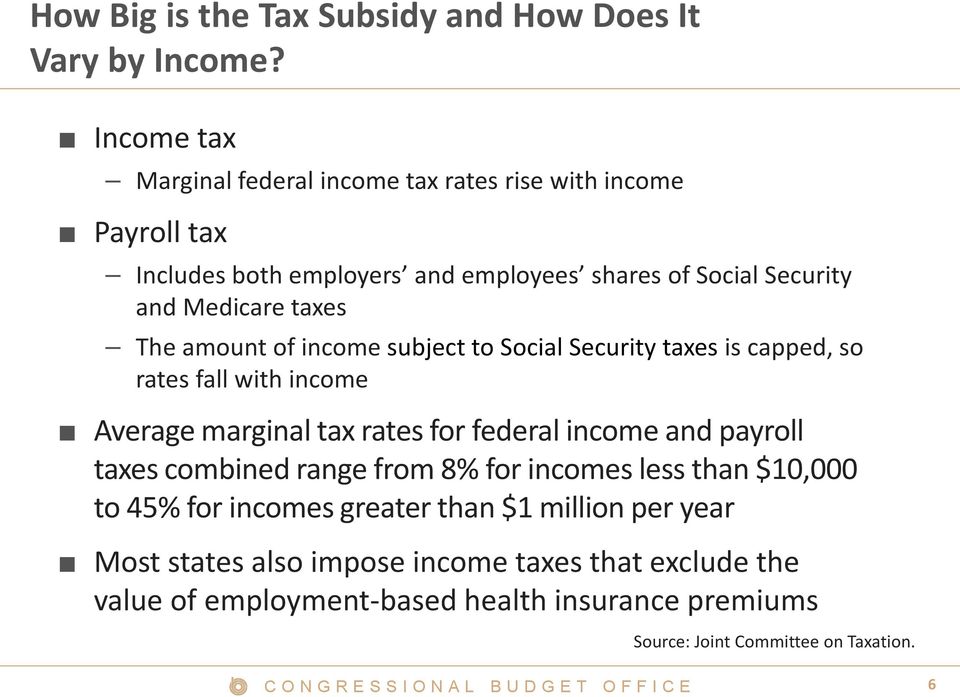
7 How Big is the Tax Subsidy and How Does It Vary by Income? Income tax Marginal federal income tax rates rise with income Payroll tax Includes both employers and employees shares of Social Security and Medicare taxes The amount of income subject to Social Security taxes is capped, so rates fall with income Average marginal tax rates for federal income and payroll taxes combined range from 8% for incomes less than $10,000 to 45% for incomes greater than $1 million per year Most states also impose income taxes that exclude the value of employment-based health insurance premiums Source: Joint Committee on Taxation. 6
8 Coverage Effects of Limiting the Tax Exclusion for Employment-Based Health Insurance, 2008 (Millions of nonelderly people covered) Pre-Policy Levels Completely Eliminate Income and Payroll Tax Exclusion Eliminate Income Tax Exclusion Only Cap Tax Exclusion for Income and Payroll Tax at Median Premium Employmentbased coverage Nongroup / public n.a. Uninsured Source: Jonathan Gruber. Note: n.a. = not available. 7

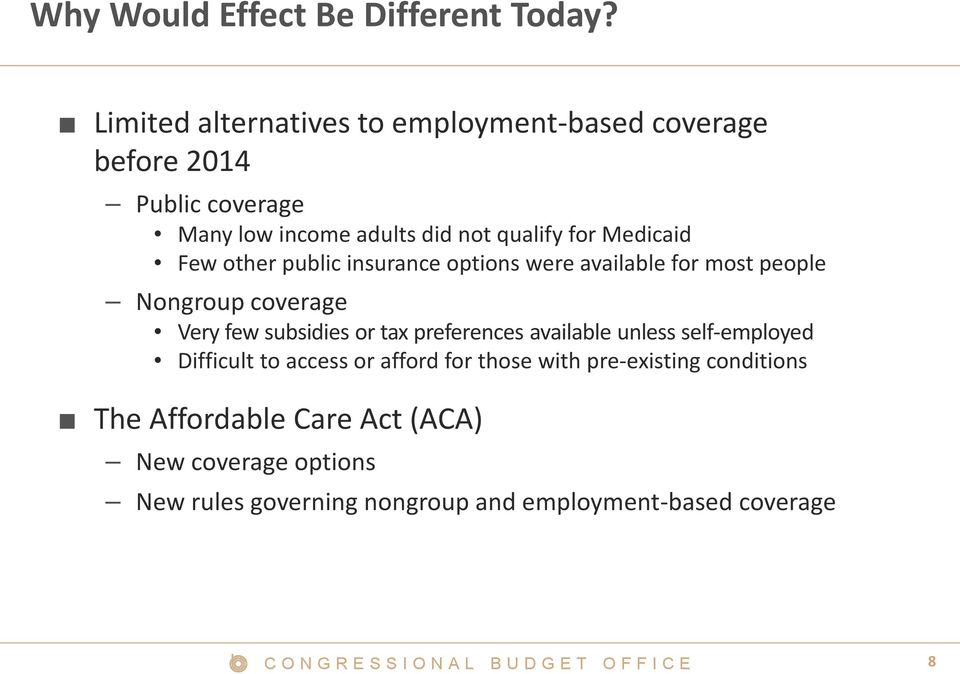
9 Why Would Effect Be Different Today? Limited alternatives to employment-based coverage before 2014 Public coverage Many low income adults did not qualify for Medicaid Few other public insurance options were available for most people Nongroup coverage Very few subsidies or tax preferences available unless self-employed Difficult to access or afford for those with pre-existing conditions The Affordable Care Act (ACA) New coverage options New rules governing nongroup and employment-based coverage 8
10 Coverage Provisions of the Affordable Care Act Many individuals and families between 100 and 400 percent of the federal poverty line are able to purchase subsidized insurance through exchanges (or marketplaces). Insurers may not deny coverage to people on the basis of their health status or charge enrollees in poor health higher insurance premiums. States are permitted to significantly expand eligibility for Medicaid but may decline to do so. Most legal residents of the United States must either obtain health insurance or pay a penalty. 9

11 Coverage Provisions of the Affordable Care Act (Continued) Most employers with more than 50 full-time employees that decline to offer minimum health insurance coverage to their employees will be assessed penalties. A federal excise tax will be imposed on some health insurance plans with high premiums starting in Health insurance rules are changed in other ways 10

12 Projected Health Insurance Coverage in the U.S., 2024 (Millions of nonelderly people) 11

13 How CBO and JCT Model Health Insurance Coverage CBO and JCT estimate health insurance coverage effects of proposals, such as the ACA and proposed changes to the tax exclusion, using a microsimulation model (HISIM) and other models. HISIM is based on individual and family information from the Survey of Income and Program Participation (SIPP). HISIM calculates changes in the price of health insurance and uses a price elasticity of demand for health insurance to measure change in take-up of different types of coverage. 12

14 How CBO and JCT Model Health Insurance Coverage (Continued) Coverage t+1 = f(coverage t, %Δ Price * Elasticity, X) X = health status, income, family status, etc. Equations for each possible status change, including addition or subtraction of new options Availability of options depends on eligibility (for public programs) and offer status (for employment-based plans) 13

15 How CBO and JCT Model Firms Offers of Employment-Based Coverage Δpr(offer i ) = ε f * %Δp i f is the size of firm i ε f is the elasticity of the change in probability of a firm offering, Δpr, with respect to a percent change in price, %Δp i Separable and additive probabilities of changing offer status based on various after-tax prices Changes in the price of employment-based coverage Changes in the price of alternative sources of coverage (nongroup, Medicaid, exchange plans) available to firm s employees Incorporates any available subsidies and the perceived substitutability of alternative coverage types 14

16 Illustrative Policies to Limit the Tax Exclusion Totally eliminate the tax exclusion for federal income tax and payroll tax purposes Eliminate the tax exclusion for federal income tax but not for payroll tax purposes Cap income and payroll tax exclusions at the median premium for employment-based plans 15

17 Comparing Estimates of the Coverage Effects of Eliminating the Income and Payroll Tax Exclusion (Change in percentage of nonelderly population covered) Gruber CBO/JCT CBO/JCT Pre-ACA Pre-ACA Under the ACA Employment-based coverage -6% -9% -26% Nongroup / public +2% +4% +21% Uninsured +5% +5% +5% Source: Jonathan Gruber, Congressional Budget Office, and staff of the Joint Committee on Taxation. 16

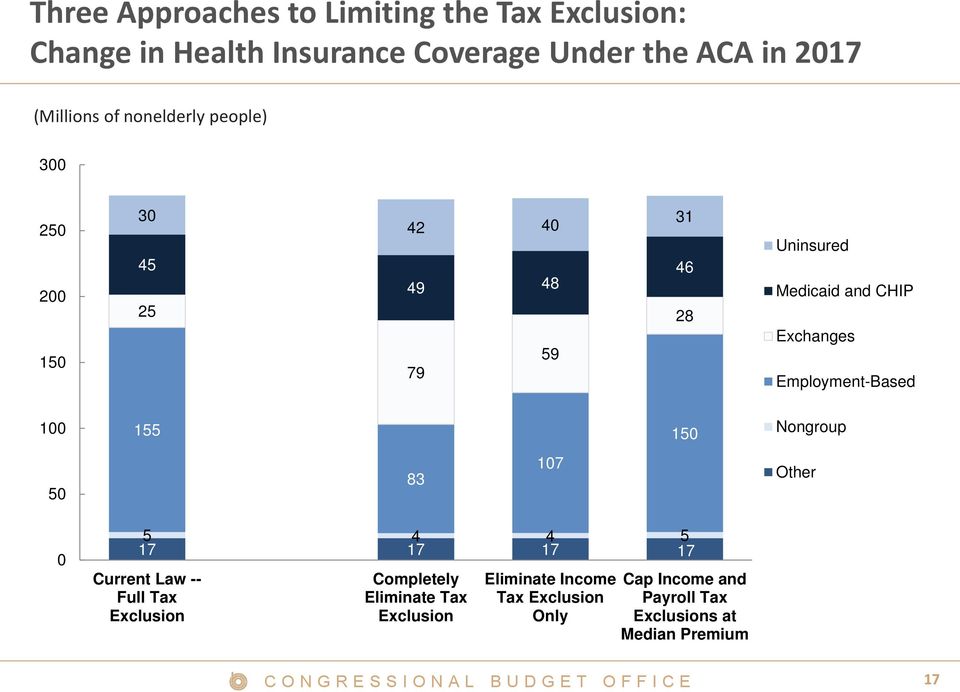
18 Three Approaches to Limiting the Tax Exclusion: Change in Health Insurance Coverage Under the ACA in 2017 (Millions of nonelderly people) Uninsured Medicaid and CHIP Exchanges Employment-Based Nongroup Other Current Law -- Full Tax Exclusion Completely Eliminate Tax Exclusion Eliminate Income Tax Exclusion Only Cap Income and Payroll Tax Exclusions at Median Premium 17
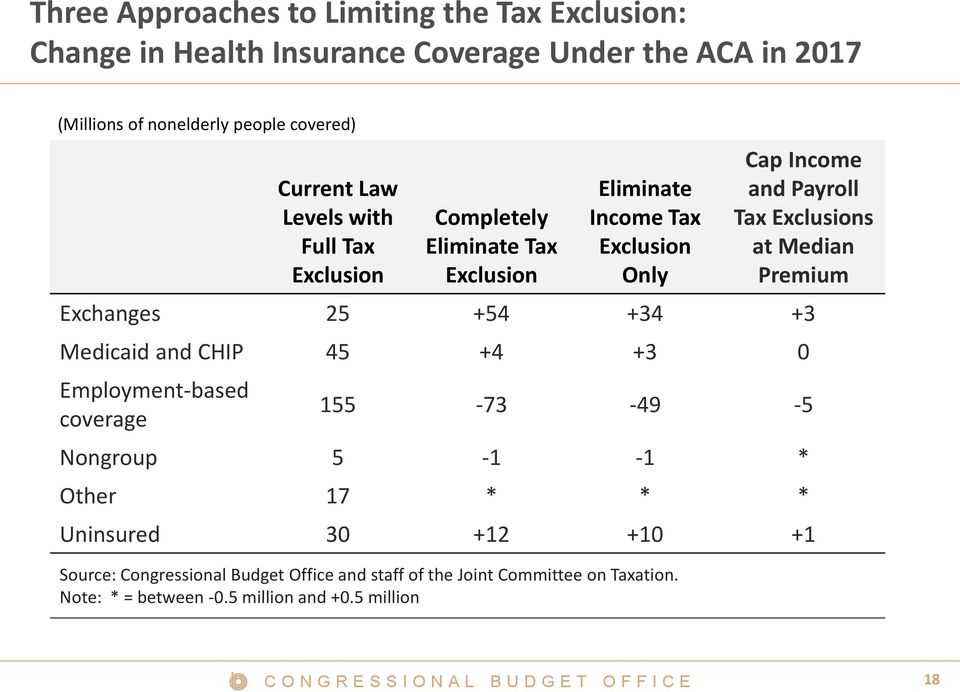
19 Three Approaches to Limiting the Tax Exclusion: Change in Health Insurance Coverage Under the ACA in 2017 (Millions of nonelderly people covered) Current Law Levels with Full Tax Exclusion Completely Eliminate Tax Exclusion Eliminate Income Tax Exclusion Only Cap Income and Payroll Tax Exclusions at Median Premium Exchanges Medicaid and CHIP Employment-based coverage Nongroup * Other 17 * * * Uninsured Source: Congressional Budget Office and staff of the Joint Committee on Taxation. Note: * = between -0.5 million and +0.5 million 18
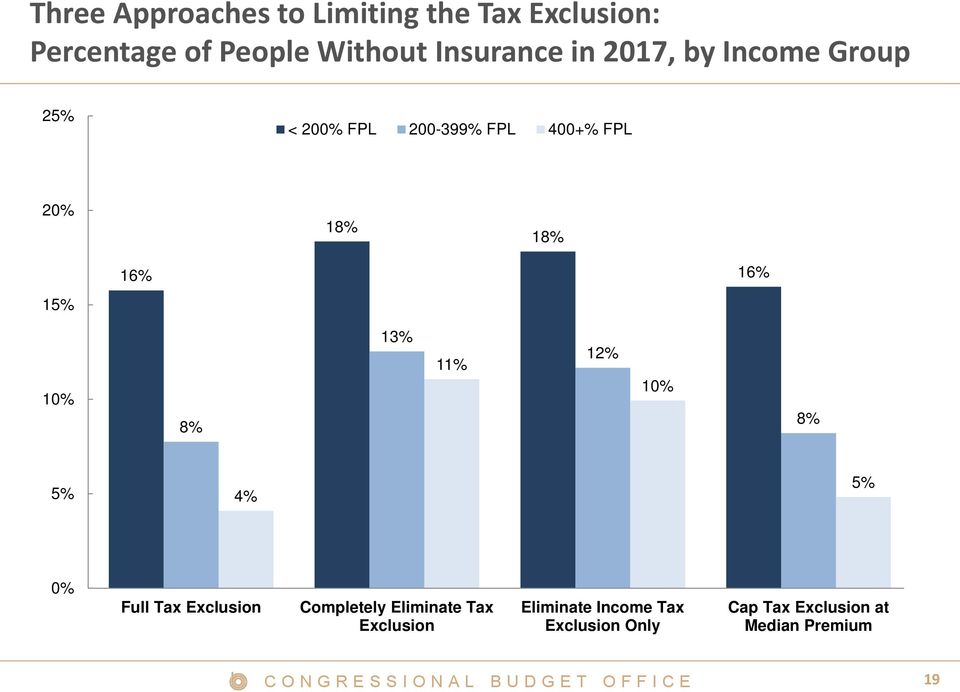
20 Three Approaches to Limiting the Tax Exclusion: Percentage of People Without Insurance in 2017, by Income Group 25% < 200% FPL % FPL 400+% FPL 20% 18% 18% 15% 16% 16% 10% 8% 13% 11% 12% 10% 8% 5% 4% 5% 0% Full Tax Exclusion Completely Eliminate Tax Exclusion Eliminate Income Tax Exclusion Only Cap Tax Exclusion at Median Premium 19
21 Three Approaches to Limiting the Tax Exclusion: Percentage of People with Employment-Based Coverage in 2017, by Income Group 100% < 200% FPL % FPL 400+% FPL 90% 86% 83% 80% 70% 60% 70% 62% 68% 50% 50% 49% 40% 37% 30% 27% 27% 20% 10% 12% 16% 0% Full Tax Exclusion Completely Eliminate Tax Exclusion Eliminate Income Tax Exclusion Only Cap Tax Exclusion at Median Premium 20
22 Sources Slide 5: Joint Committee on Taxation, Overview of the Federal Tax System As In Effect for 2014 (March 28, 2014), Slide 6: Jonathan Gruber, The Tax Exclusion for Employer- Sponsored Health Insurance, National Tax Journal (June 2011), Tables 2 and 5; Jonathan Gruber, The Tax Exclusion for Employer- Sponsored Health Insurance, Working Paper (National Bureau of Economic Research February 2010), Table 4; and Jonathan Gruber, personal communication (June 17, 2014). Slide 10: Congressional Budget Office, Updated Estimates of the Effects of the Insurance Coverage Provisions of the Affordable Care Act, April 2014, 21
Congressional Budget Office
 Congressional Budget Office June 9, 2014 Microsimulation of Demand for Health Insurance: A Method Based on Elasticities Methods Workshop Presentation AcademyHealth Annual Research Meetings San Diego, California
Insurance Coverage Provisions of the Affordable Care Act CBO s March 2015 Baseline
 Insurance Coverage Provisions of the Affordable Care Act CBO s March 2015 Baseline Table 1. Direct Spending and Revenue Effects of the Insurance Coverage Provisions of the Affordable Care Act Table 2.
Updated Estimates for the Insurance Coverage Provisions of the Affordable Care Act
 MARCH 2012 Updated Estimates for the Insurance Coverage Provisions of the Affordable Care Act In preparing the March 2012 baseline budget projections, the Congressional Budget Office (CBO) and the staff
In preparing the February 2014 baseline budget
 APPENDIX B Updated Estimates of the Insurance Coverage Provisions of the Affordable Care Act In preparing the February 2014 baseline budget projections, the Congressional Budget Office () and the staff
Estimates for the Insurance Coverage Provisions of the Affordable Care Act Updated for the Recent Supreme Court Decision
 JULY 2012 Estimates for the Insurance Coverage Provisions of the Affordable Care Act Updated for the Recent Supreme Court Decision The Congressional Budget Office (CBO) and the staff of the Joint Committee
November 30, 2009. Sincerely,
 CONGRESSIONAL BUDGET OFFICE U.S. Congress Washington, DC 20515 Douglas W. Elmendorf, Director November 30, 2009 Honorable Evan Bayh United States Senate Washington, DC 20510 Dear Senator: The attachment
THE FUTURE OF EMPLOYER BASED HEALTH INSURANCE FOLLOWING HEALTH REFORM
 THE FUTURE OF EMPLOYER BASED HEALTH INSURANCE FOLLOWING HEALTH REFORM National Congress on Health Insurance Reform Washington, D.C., January 20, 2011 Elise Gould, PhD Health Policy Research Director Economic
PPACA Subsidy Model Description
 PPACA Subsidy Model Description John A. Graves Vanderbilt University November 2011 This draft paper is intended for review and comments only. It is not intended for citation, quotation, or other use in
President Bush s Health Care Tax Deduction Proposal: Coverage, Cost and Distributional Impacts. John Sheils and Randy Haught
 www.lewin.com President Bush s Health Care Tax Deduction Proposal: Coverage, Cost and Distributional Impacts John Sheils and Randy Haught President Bush proposes to replace the existing tax exemption for
Private Health Insurance: Changes Made by the Reconciliation Act of 2010 to Senate-Passed H.R. 3590
 Private Health Insurance: Changes Made by the Reconciliation Act of 2010 to Senate-Passed H.R. 3590 Hinda Chaikind Specialist in Health Care Financing Bernadette Fernandez Analyst in Health Care Financing
Tax Subsidies for Health Insurance An Issue Brief
 Tax Subsidies for Health Insurance An Issue Brief Prepared by the Kaiser Family Foundation July 2008 Tax Subsidies for Health Insurance Most workers pay both federal and state taxes for wages paid to them
How To Calculate The Cost Of A Health Insurance Tax Credit In Oregona
 Oregon Health Fund Board INITIAL ECONOMETRIC MODELING FOR THE OREGON HEALTH FUND BOARD Final Report February 2009 SUMMARY The Oregon Health Fund Board worked with consultants from the Massachusetts Institute
CBO and JCT s Estimates of the Effects of the Affordable Care Act on the Number of People Obtaining Employment-Based Health Insurance
 MARCH 2012 CBO and JCT s Estimates of the Effects of the Affordable Care Act on the Number of People Obtaining Employment-Based Health Insurance This document responds to questions that the Congressional
Potential Penalties for Employers under the Pay or Play Rules
 The Affordable Care Act (ACA) brings many changes to employers and health plans. One such change essentially amounts to a requirement for some employers to offer a certain level health care to their employees
Prepared for Minnesota Department of Commerce. April, 2012
 The Impact of the ACA and Exchange on Minnesota Prepared for Minnesota Department of Commerce April, 2012 Dr. Jonathan Gruber MIT Department of Economics 50 Memorial Drive Cambridge, MA 02142 Gorman Actuarial,
How To Calculate A Health Care Reform Employer Number
 Health Care Reform Key Points Contact Us 855.220.8634 [email protected] Individual Implications Individual mandate to have health insurance Penalties applies if NO health insurance 2014 -
ACA Implementation Timeline
 ACA Implementation Timeline Published: March 5, 2013 Updated: July 5, 2013 Producer: Sophie Novack Director: Jessica Guzik National Journal Presentation Credits Most ACA Reforms Implemented 2013-2014 Jan.
Affordable Care Act 101: What The Health Care Law Means for Small Businesses
 Affordable Care Act 101: What The Health Care Law Means for Small Businesses July 2013 These materials are provided for informational purposes only and are not intended as legal or tax advice. Readers
Tax Subsidies for Private Health Insurance
 Tax Subsidies for Private Health Insurance Matthew Rae, Gary Claxton, Nirmita Panchal, Larry Levitt The federal and state tax systems provide significant financial benefits for people with private health
Fiscal Policy Project
 Fiscal Policy Project The Tax Revenue Benefits of Health Care Reform in New Mexico Executive Summary by Kelly O Donnell, Ph.D. for New Mexico Voices for Children August 2011 Updated August 2012* The Patient
How To Get A Small Business Health Insurance Plan For Free
 Statement of Linda J. Blumberg, Ph.D. Senior Fellow The Urban Institute Committee on Energy and Commerce Subcommittee on Oversight and Investigations United States House of Representatives Hearing: The
THE COST AND COVERAGE IMPACT OF THE PRESIDENT S HEALTH INSURANCE BUDGET PROPOSALS By Jonathan Gruber, MIT
 820 First Street NE, Suite 510 Washington, DC 20002 Tel: 202-408-1080 Fax: 202-408-1056 [email protected] www.cbpp.org February 15, 2006 THE COST AND COVERAGE IMPACT OF THE PRESIDENT S HEALTH INSURANCE BUDGET
Children s Health Coverage Under the ACA Part III: Issue Diagnosis Evolutionary Challenges
 Children s Health Coverage Under the ACA Part III: Issue Diagnosis Evolutionary Challenges Prepared by Carolina Coleman Funded by the Lucile Packard Foundation for Children s Health January 2014 This brief
medicaid and the uninsured June 2011 Health Coverage for the Unemployed By Karyn Schwartz and Sonya Streeter
 I S S U E kaiser commission on medicaid and the uninsured June 2011 P A P E R Health Coverage for the Unemployed By Karyn Schwartz and Sonya Streeter In May 2011, 13.9 million people in the U.S. were unemployed,
Affordable Care Act 101: What The Health Care Law Means for Small Businesses February 2013
 Affordable Care Act 101: What The Health Care Law Means for Small Businesses February 2013 These materials are provided for informational purposes only and are not intended as legal or tax advice. Readers
Romneycare Versus Obamacare
 Romneycare Versus Obamacare Two Names; Same Model Maura Calsyn July 2012 Introduction Mitt Romney, the Republican Party candidate for president, says he abhors Obamacare. The Center for American Progress
ESTIMATED PREMIUM IMPACTS OF ANNUAL FEES ASSESSED ON HEALTH INSURANCE PLANS OCTOBER 31, 2011 CHRIS CARLSON, FSA, MAAA
 ESTIMATED PREMIUM IMPACTS OF ANNUAL FEES ASSESSED ON HEALTH INSURANCE PLANS OCTOBER 31, 2011 CHRIS CARLSON, FSA, MAAA CONTENTS 1. Executive summary... 1 2. Background... 2 3. Data... 4 Base premiums...
Eligibility for Medi-Cal and the Health Insurance Exchange in California under the Affordable Care Act
 UNIVERSITY OF CALIFORNIA, BERKELEY CENTER FOR LABOR RESEARCH AND EDUCATION ISSUE BRIEF Eligibility for Medi-Cal and the Health Insurance Exchange in California under the Affordable Care Act by Ken Jacobs,
Summary of Potential Employer Penalties Under the Patient Protection and Affordable Care Act (PPACA)
 Summary of Potential Employer Penalties Under the Patient Protection and Affordable Care Act (PPACA) Hinda Chaikind Specialist in Health Care Financing Chris L. Peterson Acting Section Research Manager
Health insurance Marketplace. What to expect in 2014
 Health insurance Marketplace What to expect in 2014 Overview The Affordable Care Act (ACA) includes several provisions geared to extend greater access to health insurance benefits to more people. Beginning
HEALTH CARE REFORM FREQUENTLY ASKED QUESTIONS
 HEALTH CARE REFORM FREQUENTLY ASKED QUESTIONS Consumers When will the health care reform law take effect? The health insurance reforms adopted as part of the Patient Protection and Affordable Care Act
The Affordable Care Act
 The Affordable Care Act What does it mean for internists? Joshua Becker MD 10/14/2015 VII. 2015 Reforms and Beyond Payment Penalties under Medicare s Pay-for-Reporting Program Value-Based Payment Modifier
How To Determine If The Employer Mandate Is A Negative For Low And Middle Income People
 Economics Thesis Employer Vs. Individual Health Insurance Under The Affordable Care Act May 2015 Olivia Johnson Department of Economics Stanford University [email protected] Under the Direction of Professor
GAO PATIENT PROTECTION AND AFFORDABLE CARE ACT. Effect on Long-Term Federal Budget Outlook Largely Depends on Whether Cost Containment Sustained
 GAO United States Government Accountability Office Report to the Ranking Member, Committee on the Budget, U.S. Senate January 2013 PATIENT PROTECTION AND AFFORDABLE CARE ACT Effect on Long-Term Federal
The Affordable Care Act: Health Coverage Options & Considerations in 2014
 The Affordable Care Act: Health Coverage Options & Considerations in 2014 J A C K S O N V I L L E A R E A C H A M B E R O F C O M M E R C E A U G U S T 2 7, 2 0 1 3 L A U R A M I N Z E R E X E C U T I
ASSESSING THE RESULTS
 HEALTH REFORM IN MASSACHUSETTS EXPANDING TO HEALTH INSURANCE ASSESSING THE RESULTS March 2014 Health Reform in Massachusetts, Expanding Access to Health Insurance Coverage: Assessing the Results pulls
Tax subsidies for private health insurance: who currently benefits and what are the implications for new policies?
 Also see the report on this topic available at www.taxpolicycenter.org This policy primer is available at www.policysynthesis.org THE SYNTHESIS PROJECT NEW INSIGHTS FROM RESEARCH RESULTS Tax subsidies
March 19, 2009. 820 First Street NE, Suite 510 Washington, DC 20002. Tel: 202-408-1080 Fax: 202-408-1056. [email protected] www.cbpp.
 820 First Street NE, Suite 510 Washington, DC 20002 Tel: 202-408-1080 Fax: 202-408-1056 [email protected] www.cbpp.org March 19, 2009 HEALTH REFORM PACKAGE REPRESENTS HISTORIC CHANCE TO EXPAND COVERAGE,
Lynn A. Blewett, Ph.D. Professor, University of Minnesota
 Lynn A. Blewett, Ph.D. Professor, University of Minnesota Westlake Forum III Healthcare Reform in China and the US: Similarities, Differences and Challenges Emory University, Atlanta, GA April 10-12, 2011
PENALTIES Employer Shared Responsibility under the Affordable Care Act (ACA)
 PENALTIES Employer Shared Responsibility under the Affordable Care Act (ACA) What employers need to know to make informed decisions about ACA compliance. Employer Shared Responsibility Under the employer
Timeline of New Health Care Law and Its Impact on American Businesses
 Timeline of New Health Care Law and Its Impact on American Businesses Summaries of the Patient Protection and Affordable Health Care Act (Public Law 111-148) Health Care and Education Reconciliation Act
Health Insurance Coverage in Texas
 Health Insurance Coverage in Texas U.S. Census Current Population Survey 2012 Data March 2014 Fast Facts: Texans & Health Insurance (2012) 6.4 million uninsured Texans, 24.6% of all ages Highest rate in
Health Insurance Reform at a Glance Implementation Timeline
 Health Insurance Reform at a Glance Implementation Timeline 2010 Access to Insurance for Uninsured Americans with a Pre-Existing Condition. Provides uninsured Americans with pre-existing conditions access
Affordable Care Act and You 2015
 Affordable Care Act and You 2015 The Affordable Care Act (also called ACA, federal health care reform or sometimes Obamacare ) expands health coverage to millions of previously uninsured Americans and
Your Bottom Line: What the Affordable Care Act Means For Your Illinois Small Business. Small Business Majority November 2013
 Your Bottom Line: What the Affordable Care Act Means For Your Illinois Small Business Small Business Majority November 2013 About Small Business Majority Small business advocacy organization founded and
Private Health Insurance Provisions in the Patient Protection and Affordable Care Act (PPACA)
 Private Health Insurance Provisions in the Patient Protection and Affordable Care Act (PPACA) Hinda Chaikind Specialist in Health Care Financing Bernadette Fernandez Analyst in Health Care Financing Mark
How Non-Group Health Coverage Varies with Income
 How Non-Group Health Coverage Varies with Income February 2008 Policy makers at the state and federal levels are considering proposals to subsidize the direct purchase of health insurance as a way to reduce
Health Care Reform Update. Spring 2014
 Health Care Reform Update Spring 2014 Quincy Quinlan Texas Association of Counties 512 478 8753 [email protected] http://www.county.org Today s Agenda Timeline Fees/Taxes Individual Mandate Marketplace
ACAP Guide to ACA Fees and Taxes for Health Insurers
 Introduction ACAP Guide to ACA Fees and Taxes for Health Insurers Since being signed into law in March of 2010, the Patient Protection and Affordable Care Act (ACA) has introduced a wide range of health
Health Policy Essentials: Private Health Insurance. Bernadette Fernandez, Annie Mach, & Namrata Uberoi February 13, 2015
 Health Policy Essentials: Private Health Insurance Bernadette Fernandez, Annie Mach, & Namrata Uberoi February 13, 2015 Briefing Agenda What is the purpose of private health insurance (PHI)? How is PHI