
Visit UMUC on the Web at
|
|
|
- Job Phillips
- 10 years ago
- Views:
Transcription
1 University of Maryland University College ABOUT UMUC The university is proud to offer highly acclaimed faculty and world-class student services to educate students online, throughout Maryland, across the United States, and in more than 20 countries and territories around the world. UMUC serves its students through undergraduate and graduate programs, noncredit leadership development, and customized programs. For more information regarding UMUC and its programs, visit Graduate CATALOG University of Maryland University College (UMUC) is the largest public university in the United States. As one of the 11 degree-granting institutions of the University System of Maryland, this global university specializes in high-quality academic programs tailored to working adults. UMUC has earned a worldwide reputation for excellence as a comprehensive virtual university and, through a combination of classroom and distance-learning formats, provides educational opportunities to more than 92,000 students. The Graduate School 3501 University Boulevard East Adelphi, MD USA Using forest-friendly papers during the production of this catalog saved NET ENERGY: 1,000,000 BTUs GREENHOUSE GASES: 99 LBS CO2 WASTEWATER: 477 GALLONS SOLID WASTE: 29 LBS Estimates were made using the Environmental Defense Fund Paper Calculator. For more information, visit 13-GRAD-011 (7/13)

2 ACCREDITATION University of Maryland University College is accredited by the Commission on Higher Education of the Middle States Association of Colleges and Schools, 3624 Market Street, Philadelphia, PA ( ), one of six regional accrediting agencies recognized by the U.S. Department of Education. UMUC is governed by the University System of Maryland Board of Regents and certified by the State Council of Higher Education for Virginia. UMUC is a constituent institution of the University System of Maryland. NONDISCRIMINATION UMUC is committed to ensuring that all individuals have equal access to programs, facilities, admission, and employment without regard to personal characteristics not related to ability, performance, or qualifications as determined by UMUC and/or University System of Maryland policy or by federal, state, or local authorities, in accordance with UMUC Policy Policy and Procedures on Affirmative Action, Equal Opportunity, and Sexual Harassment ( UMUC prohibits discrimination or harassment of any individual due to race, religion, color, creed, gender, gender identy or expression, marital status, age, national origin, ancestry, political affiliation, mental or physical disability, sexual orientation, or veteran status (including Vietnam-era veterans). All inquiries regarding UMUC s Nondiscrimination Statement or compliance with applicable statutes and regulations should be directed to the director of Diversity Initiatives, Office of the President, UMUC, 3501 University Boulevard East, Adelphi, MD (phone or [email protected]). annual information report UMUC in Maryland and Around the World At University of Maryland University College (UMUC), a high-quality education is always within reach. UMUC is dedicated to offering on-site and online courses and resources to adult students in Maryland and around the world. Under contract to the U.S. Department of Defense, UMUC is one of the largest providers of education to the U.S. military worldwide and serves 55,000 active-duty military servicemembers, reservists, veterans, and their families. With more than 100 worldwide locations in more than 20 countries and territories and nearly 100 undergraduate and graduate degree and certificate programs offered entirely online, UMUC makes it possible to earn a widely respected degree from just about anywhere. UMUC s commitment to students around the globe extends far beyond providing access to excellent degree programs. An online academic and administrative services portal, MyUMUC, makes it simple for students to register for courses, pay tuition, and order textbooks and other supplies when it s convenient for them. Students can also access academic and career advising, financial aid counseling, library services, and much more online via the university s Web site or by phone or . All over the world, UMUC gives its students what they need to succeed, putting goals within their reach. This catalog provides the degree requirements and recommended curriculum for students who begin continuous study on or after August 1, (Details are listed on p. 6.) Students should keep their catalog available for easy reference throughout their degree program. UMUC is committed to assisting all members of the UMUC community in providing for their own safety and security. UMUC provides this Annual Information Report to current and prospective students, faculty, and staff pursuant to U.S. Department of Education regulations. The report is organized into five sections: campus crime and security, notification of rights under FERPA for postsecondary institutions, drug prevention program, campus law enforcement, and peer-to-peer notification. It is available on the Office of Legal and Government Affairs Web page at If you have any questions or if you would like to request a printed copy of the report, please contact Security at Visit UMUC on the Web at To speak with an advisor, call UMUC (8682) or send an to [email protected].

3 From the Dean Welcome to the Graduate School at University of Maryland University College (UMUC). I hope you are as excited as I am to become a part of an institution with such an illustrious reputation in distance education and history of service to adult learners. I too am new and share your enthusiasm and determination to succeed. My goal is to make sure you achieve your educational objectives. At UMUC, our mission to serve adult students results in an emphasis on workforce-relevant programs, such as our new program in data analytics. I am committed to empowering our students through our high-quality degree programs. This catalog will serve as a guide to individual program requirements, administrative requirements, policies, and resources and services. Information is also available via our Web site at Together we can work toward the successful achievement of your educational and professional objectives. I look forward to meeting these challenges with you. b y c execu entrepren r e a n a l y s t engineer commissioner mathematician political analyst Sincerely, Aric Krause, PhD Vice Provost and Dean The Graduate School [email protected] POLICY STATEMENT This publication and its provisions do not constitute, and should not be regarded as, a contract between UMUC and any party or parties. At the time of publication, reasonable effort was made to ensure the factual accuracy of the information. However, this publication is not a complete statement of all policies, procedures, rules, regulations, academic requirements, and tuition and fees applicable to UMUC, its students, or its programs. In addition, changes or additions may be made to the policies, procedures, rules, regulations, and academic requirements set out in this publication. UMUC reserves the right to make these changes and additions to the information in this publication without prior notice. When a curriculum or graduation requirement is changed, it is not made retroactive unless the change is to the student s advantage and can be accommodated within the span of years normally required for graduation. See additional policies on inside back cover. 1

4 Table of Contents Introduction 4 Welcome to UMUC 5 About the Graduate School 6 Preparing for Graduate Study 8 Program Overview DOCTORAL DEGREE PROGRAMs 10 Doctor of Management 12 Doctor of Management in Community College Policy and Administration MASTER S DEGREE AND CERTIFICATE PROGRAMS 14 Master of Arts in Teaching 16 Master of Business Administration 18 Master of Business Administration One-Year Program 20 Master of Distance Education and E-Learning 24 Master of Education in Instructional Technology 26 Master of International Management 30 Master of Science in Accounting and Financial Management 32 Master of Science in Accounting and Information Systems 34 Master of Science in Biotechnology 38 Master of Science in Cybersecurity 40 Master of Science in Cybersecurity Policy 42 Master of Science in Data Analytics 44 Master of Science in Digital Forensics and Cyber Investigation Master of Science in Environmental Management 48 Master of Science in Financial Management and Information Systems 50 Master of Science in Health Administration Informatics 52 Master of Science in Health Care Administration 54 Master of Science in Information Technology 62 Master of Science in Management 75 Master of Science in Technology Management EXECUTIVE CERTIFICATE PROGRAM DUAL DEGREE PROGRAMS NONDEGREE TEACHER EDUCATION PROGRAM COURSE DESCRIPTIONS ADMINISTRATION CONTACT INFORMATION GRADUATE CATALOG

5 IMPORTANT DATES ACADEMIC AND ADMINISTRATIVE REQUIREMENTS 151 University Policies 171 ADMISSION AND ENROLLMENT 157 General Information and Orientation 157 Admission 158 Registration 157 Appendix Index Financial Information SERVICES AND RESOURCES 162 Availability of Services 163 General Information 163 Admission Assistance 163 Automated Services 163 Advising 164 Accessibility Services 164 Transcript Services Graduation Clearance and Services 165 Verification Services 165 Golden ID Program 165 Student Advisory Council 166 Financial Aid 168 Veterans Benefits 169 Other Resources 3

6 Welcome to UMUC A UNIQUE INSTITUTION University of Maryland University College (UMUC) is unique among institutions of higher education. From its founding in 1947, UMUC was designed to meet the educational needs of adult students students who must balance study with the demands of work and family life. Today UMUC has grown to be the largest public university in the nation, serving students throughout the state, the nation, and the world. Yet its focus on providing open access to high-quality educational programs and services eliminating the barriers that can keep students from achieving their educational goals remains unchanged. CARRYING OUT THE MISSION Students First At UMUC, student success is of paramount importance. The university seeks not only to help students fulfill their current education goals but also to create an educational partnership that will last throughout their lives. To that end, the university looks first for ways to ensure that students can easily access programs and services. Admission policies are designed to simplify the process (standardized tests are not generally required), making it possible for students to apply and register at the same time. As a global university, UMUC makes it possible for students to take classes any time, any place, by offering the largest selection of online programs available in addition to classes at sites throughout Maryland and the Washington, D.C., metropolitan area and at military sites in Europe and Asia. Student services can also be accessed online and by phone, as well as on-site. Convenience and flexibility are not the only concerns, however. UMUC seeks to create a learning environment that students will find respectful of their diverse backgrounds inclusive, responsive, and relevant. Recognizing that financial concerns are often the biggest obstacle to higher education, UMUC also strives to keep tuition costs low and provides numerous financial aid opportunities, including scholarships for military or community college students. Excellence A regionally accredited university, UMUC is dedicated to providing the highest quality programs and services to its students and ensuring excellence in its online and on-site courses. In providing these programs, UMUC relies on a renowned faculty of scholarpractitioners teachers who bring real-world experience to courses and the use of the latest technologies. UMUC also is able to provide a wealth of resources to its students because of its place within the University System of Maryland. The success of UMUC s efforts is evident. Year after year, UMUC continues to garner awards from such notable organizations as the University Continuing Education Association, the Sloan Consortium, and the Maryland Distance Learning Association. Innovation UMUC has always looked for new and better ways to serve students. Long before the online revolution, UMUC was delivering courses to students at distant locations, using any and all available technologies from interactive television to voice mail. Today, students access both courses and services online, using the university s learning management system and MyUMUC, its online gateway to services and information. UMUC s faculty members also strive to find new ways to best use these technologies to assist their students learning. FACILITIES AND PROGRAMS UMUC offers degree programs from the associate s level to the doctorate. Most undergraduate and graduate programs are available online. These academic programs are administered by the Undergraduate School and the Graduate School, which includes the Institute for Global Management. UMUC also offers noncredit leadership development training through its National Leadership Institute. The university s headquarters are located in Adelphi, Maryland, and also serve as home to a prestigious art collection and a conference facility, the Inn and Conference Center, operated by Marriott. Most classes and services, however, are provided at more than 150 sites worldwide, as well as through cutting-edge technology online via the university Web site, the learning management system, and MyUMUC. FOR ASSISTANCE Assistance is available by at [email protected] or by phone at UMUC (8682). 4 GRADUATE CATALOG

7 About the Graduate School Mission Statement UMUC s Graduate School prepares students for effective leadership and citizenship in a global environment characterized by workforce diversity, increasing competition, and technological innovation. Programs are designed to extend educational access to adult students through multiple formats. The Graduate School strives for excellence in the quality of programs offered and innovative delivery formats. The curriculum provides knowledge of the disciplines with emphasis on leadership, communication, technology, globalization, diversity, systems thinking, critical thinking, information literacy, research competency, and ethical practices. The Graduate School challenges students and faculty to continuously demonstrate effective leadership as they apply what they study to their professions and their daily lives. Academic Programs UMUC s graduate degrees are designed to provide a career-focused curriculum. Many of the programs offer an opportunity for further specialization within the general field. The Graduate School currently offers 22 graduate degree programs, including two doctor of management programs, more than 35 specializations, and more than 40 certificate programs. Students can also enroll in one of 21 dual degree programs. Most of these programs are available online, so students can pursue their degrees from anywhere in the world. Through Executive Programs, the Graduate School also offers the Chief Information Officer certificate program in a format geared to mid- and seniorlevel IT professionals. A complete list of graduate programs can be found on pp Over the years, many of these programs have won awards for excellence. Most recently, the MBA program won the silver Best Practices Award for Distance Learning Programming from the U.S. Distance Learning Association for online technology in higher education in UMUC offers courses on-site at Maryland-area locations, online, and in a hybrid format that combines onsite attendance with online study. For more information, students should [email protected] or call UMUC. special Program Institute for Global Management The Institute for Global Management conducts research and provides educational and training services on topics central to the management of international enterprises. The institute offers customized seminars and consulting services and engages in applied research on topics that prepare managers for the effective conduct of international business. Further information may be obtained by contacting the director of the Institute for Global Management at UMUC (8682), ext , or [email protected]. Academic Relationships The Graduate School has established academic relationships with a number of academic and government institutions, some of which are listed below. The Undergraduate School Articulation agreements between the Graduate School and UMUC s Undergraduate School allow students who completed their undergraduate degree at UMUC with majors in accounting, computer science, criminal justice cybersecurity, English, history, and social science and minors in emergency management and homeland security to reduce their total coursework for certain related graduate degrees. Details on each of these agreements are provided under the individual program descriptions. Military Relationships UMUC has established special relationships with a number of the military s institutions of higher education: Air War College, Air University, Defense Acquisition University, Defense Information School, Naval War College, National Defense University Information Resources Management College (icollege), and Marine Corps College of Distance Education and Training. In most of these academic relationships, students complete military specializations at the partner school as part of a master s degree program at UMUC. More information on these academic relationships is available online at military.umuc.edu. Oldenburg University The Master of Distance Education and E-Learning (MDE) program is offered in partnership with Oldenburg University, Germany, a leading German institution with extensive experience in distance education. The participation of Oldenburg University helps ensure that the program has a broad, global perspective that is critical for distance educators in today s world. Oldenburg University contributes a certificate and several courses to the program, as well as a series of books that include important reflective research on the program (including historical analysis of the program development and detailed cost analysis). More information about certificates, including gainful employment disclosures, is available at 5

8 Preparing for Graduate Study As most students know, more is expected at the graduate level than what is normally required at the undergraduate level. In addition, there are usually special requirements that must be completed at the end of the student s program. UMUC requires students to complete comprehensive exams and a dissertation only at the doctoral level. UMUC s master s degree programs require completion of an integrative end-of-program capstone course in which students must demonstrate mastery of content covered throughout the program. Students who remain in continuous enrollment should refer to the catalog of the year in which they began graduate study for the specific requirements related to their program of study. Continuous enrollment is defined on p All graduate students must maintain a cumulative grade point average (GPA) of 3.0 and receive no grade of F to remain in good academic standing. Academic progress is assessed at the end of each term. Other requirements such as time limits to degree completion and minimum GPA also apply; details are provided on p While UMUC s course formats offer considerable flexibility, students entering graduate-level programs should know that graduate study requires a significant time commitment. Most courses involve group projects. Each week, graduate students should expect to devote at least 3 hours of outside study for every credit in which they are enrolled. According to that calculation, graduate students need to devote to outside study, research, and reading a minimum of 9 to 12 hours per week per 3-credit course. Nonprogram Courses Because UMUC graduate students often enter graduate study with academic backgrounds in very different fields and return to study after a gap of many years, UMUC offers a number of courses outside the usual required program courses that are designed to help students succeed in their graduate studies. Most of these courses are noncredit and optional; the orientation and library research skills course, however, is required for all students entering graduate study at UMUC. Complete course descriptions are provided on pp Required Graduate Study and Library Research Skills Course UCSP 615 Orientation to Graduate Studies at UMUC is designed to help students develop the skills and techniques needed to understand and manage the challenges involved in successfully completing a graduate program at UMUC and to familiarize students with research strategies and online library resources material that is critical for 21st-century professionals. In addition to providing key tools necessary to succeed in graduate school (detailed in the course description), the course enables students to evaluate their current skills in grammar, language conventions, written expression, and reading comprehension by completing the online Assessment in Writing and English. This noncredit course is required for all new graduate students. The grading method is pass/fail. UCSP 615 must be completed within the first 6 credits of graduate study. It is recommended that students take this as their first course before beginning program coursework. Optional Credit Course in Writing Students who have been out of academia for a period of time or who do not write often in their professions are encouraged to enroll in COMM 600 Academic Writing for Graduate Students in their first term. COMM 600 is specially designed to reinforce and strengthen the writing skills necessary for success in UMUC s graduate degree programs. Although the COMM 600 is a 3-credit course, those credits do not apply to any individual program requirements. Optional Noncredit Courses Noncredit courses (designated UCSP) are available in economics, financial accounting, and research methods and generally last eight weeks. Although these courses carry no UMUC credit, they appear on the students official academic transcript. At the successful conclusion of the course, a grade of P (Pass) is posted. UMUC graduate students must be admitted or have an application on file before registering for noncredit courses. Current information about fees for noncredit courses is available at edu/tuition. Course Formats UMUC offers courses online, on-site at a number of Maryland locations, and in a hybrid format that combines on-site and online instruction. Hybrid classes meet on-site at a UMUC location for about half the class sessions; the remainder of the course material is covered in the online classroom. The schedule of on-site sessions is provided by the faculty member at the beginning of the term. Hybrid courses are identified in the most current graduate schedule of classes. 6 GRADUATE CATALOG

9 Online courses maintain the same academic standards as on-site courses. Course content, texts, requirements, assignments, and class participation are comparable for online and on-site courses; for example, students need to adhere to a course schedule for assignment deadlines. Computer and Internet Access UMUC is committed to ensuring that students acquire the level of technological fluency needed for active participation in contemporary society and have access to up-to-date resources. All UMUC students must be prepared to participate in asynchronous, computerbased class discussions, study groups, online database searches, course evaluations, and other online activities. This policy applies to students in both classroom-based and online courses. All UMUC students must therefore ensure that they have some type of Internet access. Barring individual course requirements, this access may be through use of a UMUC computer lab, university or public library, or other readily available, reliable source if the student does not have home access. However, it should be regularly available, and the student must have a current address. Some academic programs may have specific technical requirements. Taking Online Classes Before registering for an online course, students may want to consider the following: 1. Online students need to be prepared to write extensively, because nearly all communication is written. Online students need strong reading and writing skills in English. 2. Online students need to be competent in the use of computers and commonly used software programs. 3. Since the online classroom is asynchronous and students are expected to be active participants, students are encouraged to log in frequently to check what has transpired in their online classroom (in lieu of classroom meetings). 4. Online students need disciplined work habits, effective time management skills, and the ability to work both alone and collaboratively. Technical Requirements Minimum technical requirements are subject to change. Current information about technical requirements is available online at Students are responsible for their own phone line and Internet access costs. Technical requirements for students taking graduate courses include A PC running Windows XP or higher or a Macintosh running OS X* or higher A compatible Web browser (Internet Explorer 7.0, Firefox 3.6, or Safari 5 or higher) An account A connection to the Internet, preferably high-speed A sound card and speakers or headphones Sun Java VM (can be downloaded for free) Some academic programs may have additional technical requirements, such as requiring the student to download and install computer programs. To determine whether such requirements apply to an individual program, students should consult the program director (listed under Contact Information). Mandatory Course Evaluations UMUC uses student feedback to make decisions about future courses. The evaluation is required to ensure complete information from every student. Individual responses are kept confidential. For online and hybrid classes, the notice appears in the online classroom when three-quarters of the class has been completed. * Certain project management courses require the use of a PC. 7

10 Program Overview Doctoral ProgramS Doctor of Management Doctor of Management in Community College Policy and Administration master s degree programs Master of Arts in Teaching ** Master of Business Administration Master of Business Administration One-Year Program Master of Distance Education and E-Learning Distance education policy and management Distance education teaching and training Distance education technology Master of Education in instructional technology Master of International Management International emergency management International enterprise management International financial management International marketing management Master of Science in accounting and financial management Master of Science in accounting and information systems Master of Science in biotechnology Bioinformatics Biosecurity and biodefense Biotechnology management Regulatory affairs Master of Science in cybersecurity Master of Science in cybersecurity policy Master of Science in data analytics Master of Science in digital forensics and cyber investigation Master of Science in environmental management Master of Science in financial management and information systems Master of Science in health administration informatics Master of Science in health care administration Master of Science in information technology Database systems technology Homeland security management Informatics Information assurance Project management Software engineering Systems engineering Telecommunications management Master of Science in management Accounting Acquisition and supply chain management Criminal justice management Emergency management Financial management Health care administration Homeland security management Human resource management Information systems and services Intelligence management Interdisciplinary studies in management Marketing Nonprofit and association management Project management Public relations Master of Science in technology management Emergency management Homeland security management Information systems and services Project management Systems engineering nondegree teacher education program Teacher Education Reading Strand: Reading Courses in Elementary and Secondary Education dual degree programs Either degree may be earned first: Master of Business Administration with Master of Distance Education and E-Learning Master of International Management Master of Science in biotechnology Master of Science in cybersecurity policy Master of Science in environmental management Master of Science in financial management and information systems Master of Science in health care administration Master of Science in information technology Master of Science in management Master of Science in technology management Offered online with mandatory residencies or course meetings at UMUC headquarters in Adelphi, Maryland. Not available to Maryland residents. Offered online with mandatory residencies or course meetings at UMUC headquarters in Adelphi, Maryland. On-site teaching practicum required. 8 GRADUATE CATALOG

11 Other Dual Degree Combinations Master of Distance Education and E-Learning/Master of Science in management Master of Distance Education and E-Learning/Master of Science in technology management Master of Education in instructional technology/master of Distance Education and E-Learning Master of Science in accounting and financial management/ Master of Science in accounting and information systems Master of Science in accounting and financial management/ Master of Science in financial management and information systems Master of Science in accounting and information systems/ Master of Science in financial management and information systems Degrees must be earned in order listed: Master of Arts in Teaching/Master of Education in instructional technology Master of Science in cybersecurity/ Master of Business Administration Master of Science in data analytics/ Master of Business Administration Master of Science in digital forensics and cyber investigation/master of Business Administration Master of Science in information technology/master of Science in cybersecurity policy certificate programs Accounting Accounting and Information Systems Acquisition and Supply Chain Management Bioinformatics Biosecurity and Biodefense Biotechnology Management Criminal Justice Management Cybersecurity Policy Cybersecurity Technology Database Systems Technology Digital Forensics and Cyber Investigation Distance Education, Globalization, and Development Distance Education Leadership Emergency Management Environmental Management Financial Management in Organizations Foundations in Business Analytics Foundations of Cybersecurity Foundations of Distance Education and E-Learning Foundations of Human Resource Management Foundations of Information Technology Health Administration Informatics Health Care Administration Homeland Security Management Informatics Information Assurance Instructional Design for E-Learning Instructional Technology Integration Integrated Direct Marketing Intelligence Management International Marketing International Trade Leadership and Management Library and Intellectual Property in Distance Education and E-Learning Nonprofit and Association Financial Management The following pages provide descriptions of the degree and certificate programs available through the UMUC Graduate School, including all course requirements and any academic or professional preparation required or recommended beyond general graduate admission requirements. Most degree and certificate programs follow a very specific curriculum with little or no choice. However, in some cases students may substitute a single 6-credit course that covers the same content as two required 3-credit courses. These options are listed in the course requirements. Policy and Management in Distance Education and E-Learning Predictive Analytics Project Management Public Relations Regulatory Affairs (in biotechnology) Software Engineering Systems Analysis Systems Engineering Teaching and Training at a Distance Technology in Distance Education and E-Learning Telecommunications Management executive certificate program Chief Information Officer A joint program with University of Maryland, Baltimore County. Pending approval. More information about certificate programs, including gainful employment disclosures, is available at 9

12 DOCTORAL DEGREE PROGRAMS DOCTOR OF MANAGEMENT Program Description Today s leaders require a sophisticated level of knowledge and analysis to guide their organizations through the complexities of a rapidly changing global environment. The Doctor of Management (DM) program is a practitioner-scholar doctoral program designed for experienced professionals. Focus is on developing skills in critical thinking, conceptual and logical fluency, and information literacy, as well as integrating scholarly work with a practitioner perspective to translate management concepts into effective strategies in organizations. The curriculum covers the principles of evidence-based management and applied secondary research methods. Program Objectives The program is designed to help students Function as organizational leaders to translate explanations of management concepts into practice. Understand management research methods and assess the quality and reliability of published research. Interpret critically and express management theories in both scholarly and professional practice communities. Understand the nature and influence of key trends, such as globalization, sustainability, and technology, as they shape management activities in public- and private-sector organizations. Program Overview The DM program requires the completion of 48 credits of coursework, including 36 credits in academic content coursework and 12 credits of dissertation coursework, comprehensive examinations, and a scholar-practitioner dissertation. Attendance at a two-day residency on-site in Maryland each term is mandatory. DMGT 600 (described on p. 113) is prerequisite to the program. Application Procedures In addition to a completed doctoral program admission application and payment of the $100 application fee, DM applicants must submit An official transcript indicating completion of a master s degree or higher from a regionally accredited university or college (students educated abroad should see for additional requirements) An up-to-date résumé indicating professional management experience Two letters of reference one professional and one academic A personal statement that outlines the applicant s interest in doctoral study (guidelines for statement are available at Five reviews of scholarly research articles Details on the supplemental documents listed above are available online at The complete admission file must be reviewed before the applicant can enroll in DMGT 600. Applicants must earn a grade of B or higher in DMGT 600 for official admission to the program. Admission criteria are provided online and on p Career Paths Management/expertise consultant Management analyst Higher education faculty member or administrator Senior-level manager Course descriptions are found on pp GRADUATE CATALOG

13 REQUIRED COURSES: DOCTOR OF MANAGEMENT Initial Requirements to be taken within the first 6 credits of study UCSP 815 Introduction to Library Research Skills for Doctoral Studies (0) DMGT 600 Foundations of Doctoral Study (3) Required Main Courses DMGT 800 Foundations of Management Theory (6) DMGT 830 Research Methods I (6) DMGT 835 Research Methods II (6) DMGT 890 Dissertation Part I (4) DMGT 810 Leadership and Change (6) DMGT 845 Organizational Environments in a Global Context (6) DMGT 891 Dissertation Part II (4) DMGT 850 Innovation Process and Strategy (6) DMGT 892 Dissertation Part III (4) Course descriptions are found on pp

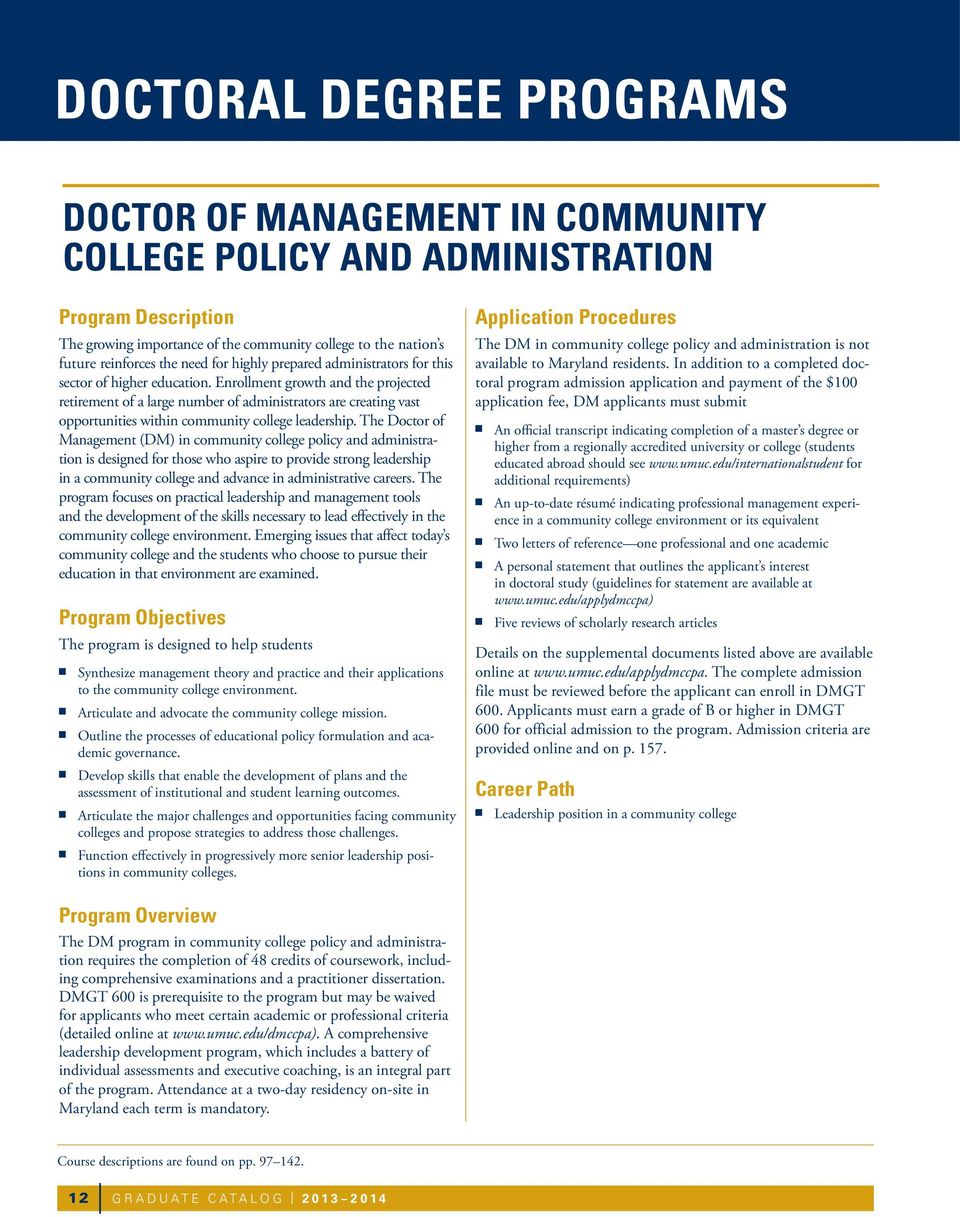
14 DOCTORAL DEGREE PROGRAMS DOCTOR OF MANAGEMENT in Community College POlicy and Administration Program Description The growing importance of the community college to the nation s future reinforces the need for highly prepared administrators for this sector of higher education. Enrollment growth and the projected retirement of a large number of administrators are creating vast opportunities within community college leadership. The Doctor of Management (DM) in community college policy and administration is designed for those who aspire to provide strong leadership in a community college and advance in administrative careers. The program focuses on practical leadership and management tools and the development of the skills necessary to lead effectively in the community college environment. Emerging issues that affect today s community college and the students who choose to pursue their education in that environment are examined. Program Objectives The program is designed to help students Synthesize management theory and practice and their applications to the community college environment. Articulate and advocate the community college mission. Outline the processes of educational policy formulation and academic governance. Develop skills that enable the development of plans and the assessment of institutional and student learning outcomes. Articulate the major challenges and opportunities facing community colleges and propose strategies to address those challenges. Function effectively in progressively more senior leadership positions in community colleges. Application Procedures The DM in community college policy and administration is not available to Maryland residents. In addition to a completed doctoral program admission application and payment of the $100 application fee, DM applicants must submit An official transcript indicating completion of a master s degree or higher from a regionally accredited university or college (students educated abroad should see for additional requirements) An up-to-date résumé indicating professional management experience in a community college environment or its equivalent Two letters of reference one professional and one academic A personal statement that outlines the applicant s interest in doctoral study (guidelines for statement are available at Five reviews of scholarly research articles Details on the supplemental documents listed above are available online at The complete admission file must be reviewed before the applicant can enroll in DMGT 600. Applicants must earn a grade of B or higher in DMGT 600 for official admission to the program. Admission criteria are provided online and on p Career Path Leadership position in a community college Program Overview The DM program in community college policy and administration requires the completion of 48 credits of coursework, including comprehensive examinations and a practitioner dissertation. DMGT 600 is prerequisite to the program but may be waived for applicants who meet certain academic or professional criteria (detailed online at A comprehensive leadership development program, which includes a battery of individual assessments and executive coaching, is an integral part of the program. Attendance at a two-day residency on-site in Maryland each term is mandatory. Course descriptions are found on pp GRADUATE CATALOG
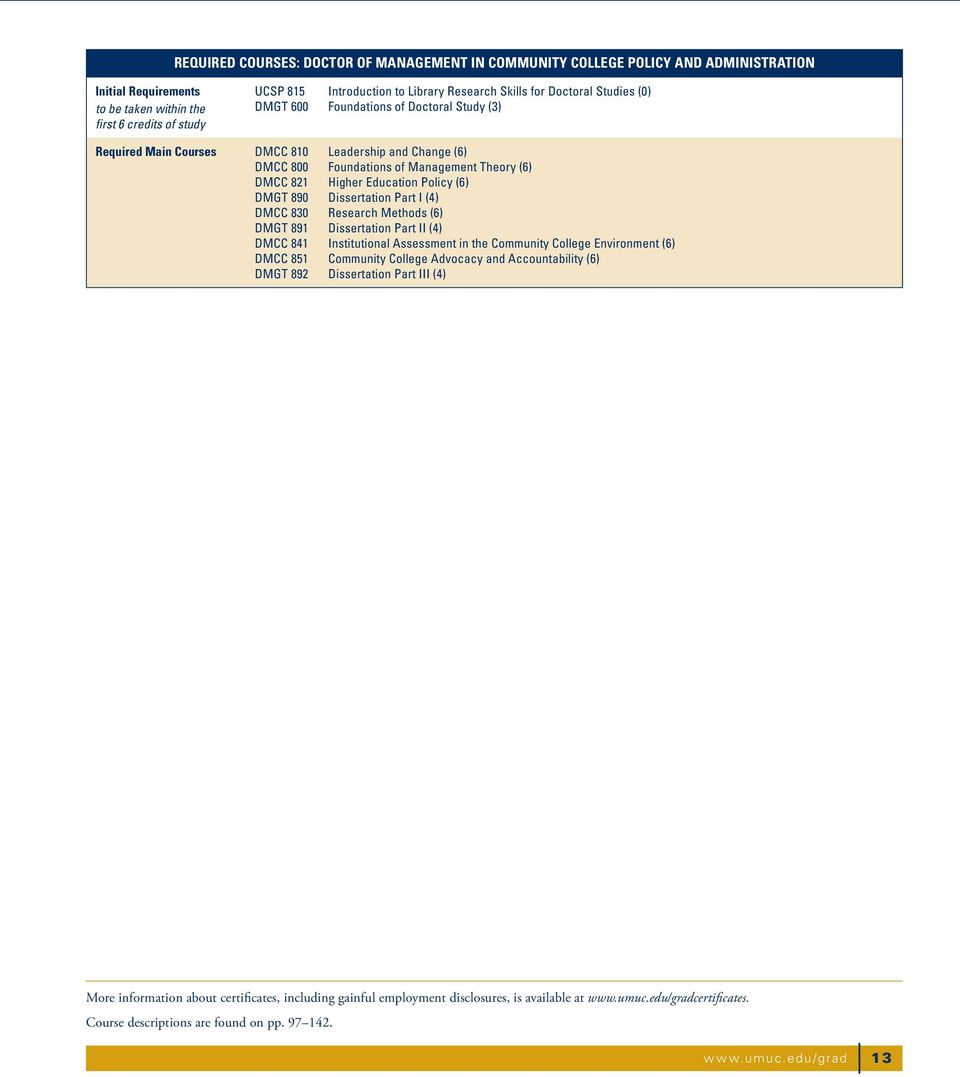
15 REQUIRED COURSES: DOCTOR OF MANAGEMENT in community college policy and administration Initial Requirements to be taken within the first 6 credits of study UCSP 815 Introduction to Library Research Skills for Doctoral Studies (0) DMGT 600 Foundations of Doctoral Study (3) Required Main Courses DMCC 810 Leadership and Change (6) DMCC 800 Foundations of Management Theory (6) DMCC 821 Higher Education Policy (6) DMGT 890 Dissertation Part I (4) DMCC 830 Research Methods (6) DMGT 891 Dissertation Part II (4) DMCC 841 Institutional Assessment in the Community College Environment (6) DMCC 851 Community College Advocacy and Accountability (6) DMGT 892 Dissertation Part III (4) More information about certificates, including gainful employment disclosures, is available at Course descriptions are found on pp
16 MASTER S DEGREE AND CERTIFICATE PROGRAMS MASTER OF arts in teaching Program Description For those who want to make a mark on the future, teaching today s young people is a sure route. The Master of Arts in Teaching (MAT) program is designed for individuals with a bachelor s (or higher) degree with sufficient content discipline preparation who seek to become outstanding teachers and leaders in today s and tomorrow s classrooms. The program is approved by the Maryland State Department of Education; it leads to eligibility for initial teacher certification in Maryland and provides enhanced opportunities for interstate reciprocity. Students can prepare to teach in secondary schools (grades 7 12) in a specific subject discipline (biology, chemistry, computer science, earth/ space science, English, foreign languages*, history, mathematics, physics, and social studies). Program Objectives The program is designed to help students Develop, implement, and evaluate a variety of instructional methods, strategies, and technologies. Demonstrate knowledge of diverse learners and learning theories through personalized instruction. Demonstrate mastery of content knowledge and apply instructional theory, research, and practice to facilitate students understanding of content and integration of higher-order thinking skills. Design and implement formative and summative assessments and interpret and apply data for instructional decision making. Collaborate with and advocate for students; staff; families; and the local, global, and professional communities to strengthen teaching and learning based on critical application of legal, ethical, and professional standards. Develop and continually refine skills of reflective practice through thoughtful analysis, self-assessment, and iterative cycles of research. Program Overview The degree program requires 30 credits of coursework, including a 6-credit professional internship that requires full-time presence at an approved secondary school site. Before beginning the professional internship, students must pass a content assessment. To graduate, students must also complete a performance-based teaching portfolio and action research project and register for the Praxis II pedagogy exam. Academic Preparation All students including those entering the program from an articulated undergraduate program at UMUC must have completed a major in the content area for which certification will be sought; earned a GPA of 2.75 in the major; and presented Maryland-specified passing scores on the ACT, GRE, SAT, or Praxis I exam. Alternatively, and subject to faculty approval, students must have completed 30 credits in contentrelated coursework and maintained a GPA of 2.75 in these courses. Qualifying scores for the aforementioned exams can be found on the Maryland State Department of Education Web site. Technology Requirements MAT students are required to purchase a one-time $100 subscription to Tk20 HigherEd before their first class. The subscription is good for seven years. Tk20 is a comprehensive assessment and management system that supports all education students at UMUC. Students may also need to access a webcam/microphone for certain assignments. More information is available online at Field Experience/Student Teaching Each student is responsible for arranging field experience and classroom observations with the school district of his or her choice. While UMUC is able to provide support and assistance in securing field experience, the university cannot guarantee that all school districts will grant MAT students permission to enter the classroom. Also, states and local school districts have varying regulations and policies regarding student teaching. Students are advised to remain informed about the student teaching requirements for their state, locality, and/or the Department of Defense. Professional Certification Fulfilling the requirements of the MAT provides eligibility for the Maryland Standard Professional Certificate I (SPC I), which is granted by the Maryland State Department of Education. The * Foreign languages include Spanish, French, German, Chinese, Japanese, Russian, Italian, and Arabic. More information about certificates, including gainful employment disclosures, is available at Course descriptions are found on pp GRADUATE CATALOG

17 Maryland certification enables the graduate to teach in the state of Maryland and provides enhanced opportunities for interstate reciprocity. Please note that while Maryland state certification to teach world languages is valid for grades pre-k through 12, the MAT program focuses on teaching at the secondary school level. Teacher certification requirements are constantly evolving in many states. Students are responsible for remaining informed about the teacher certification requirements of the state in which they seek to become certified. They should also confirm requirements and any reciprocity arrangements with the state s certifying agency. State-specific information is available through the National Association of State Directors of Teacher Education and Certification s Web site at Career Path Secondary school teacher in the state of Maryland Academic Relationship An articulation agreement between the Graduate School and UMUC s Undergraduate School allows students who completed their undergraduate degree at UMUC with an appropriate major (i.e., computer science, English, history, or social science) or who have appropriate coursework in biology, mathematics, or a foreign language to reduce their total coursework for the MAT by 12 credits (two courses) and complete both degrees with a total of 138 credits. Dual Degree Option Students who complete the Master of Arts in Teaching may then complete the following degree as part of a dual degree option: Master of Education in instructional technology More information on dual degree programs is available on p. 81. required courses: Master of arts in teaching Initial Requirement to be taken within the first 6 credits of study Course Sequencing UCSP 615 Orientation to Graduate Studies at UMUC (0) Courses should be taken in order. EDTP 600 and 635 must be taken before EDTP 639 and may be taken together. EDTP 639 and EDTP 645 must be completed before EDTP 650 and may be taken together. Required Main Courses EDTP 600 Foundations of Teaching for Learning (6) EDTP 635 Adolescent Development and Learning Needs (6) EDTP 639 Reading and Multiple Literacies (6) EDTP 645 Subject Methods and Assessment (6) Required Internship EDTP 650 Professional Internship and Seminar (6) More information about certificates, including gainful employment disclosures, is available at Course descriptions are found on pp

18 MASTER S DEGREE AND CERTIFICATE PROGRAMS MASTER OF BUSINESS ADMINISTRATION Program Description Management responsibilities in today s complex multinational business organizations transcend a single functional specialty and require a broad array of specialized knowledge. The Master of Business Administration (MBA) is designed for midcareer professionals whose careers and management responsibilities extends beyond a single functional specialty and require a broad array of specialized knowledge and skills. The emphasis of this interdisciplinary, integrated, and applied degree program is on the significant organizational and management processes that take place in the context of large public or private institutions doing business on a global scale. The goal is to prepare students for upper management and executive-level positions by developing key managerial competencies including critical thinking, systems thinking, team building, decision making, and ethical leadership that can be applied in any type of business enterprise. Students who already have a graduate degree or who meet certain academic or professional certification qualifications may want to consider the one-year program for the MBA, described on p. 18. Program Objectives The program is designed to help students Make effective management decisions that exhibit high ethical standards in a global and culturally diverse environment. Use oral and written communication skills to express ideas effectively and persuasively with all organizational stakeholders using a variety of tools, including synchronous and asynchronous technologies. Develop comprehensive solutions to business problems by synthesizing and evaluating information using qualitative and quantitative analytical reasoning. Manage the effective use of technology in an organization to achieve superior performance and operational effectiveness. Apply proven management theories and practices to resolve a wide range of organizational issues. Program Overview The MBA degree program requires 42 credits of coursework, including 24 credits of common core courses and 18 credits in either standard or global focus core courses. Courses must be taken sequentially and are offered in four 10-week terms as opposed to the standard term. An introductory course (AMBA 600) is prerequisite to the program but may be waived for students who already have a graduate degree or who present GMAT scores in the 70th percentile or higher. Students are assigned to cohorts of approximately 25 students who progress through the program together. Global Focus Option UMUC offers students the option to focus their business studies on emerging economies and current issues in global business management. Students who choose this option may be required to take a study trip abroad and pay associated fees. More information on this option may be obtained from Business and Executive Programs at [email protected]. Program Recognition/Accreditation In 2011, the UMUC MBA program won the Best Practices Award (Silver) in Distance Learning Programming Higher Education from the U.S. Distance Learning Association. The MBA program has also received specialized accreditation through the International Assembly for Collegiate Business Education (IACBE). Career Paths Mid- to upper-level manager in corporate, government, or nonprofit organizations Business/organizational consultant Corporate planner Business owner/entrepreneur More information about certificates, including gainful employment disclosures, is available at Course descriptions are found on pp GRADUATE CATALOG

19 Academic Relationships UMUC has established academic relationships with universities in Canada, Mexico, and China. The participation of students from these universities in MBA classes provides an international perspective and contributes to class diversity. Students who complete their undergraduate degree at UMUC with a major in business administration and a grade point average of 3.0, overall and in the major, may waive the prerequisite course, AMBA 600. Admission requirements apply to all applicants. Master of Science in health care administration Master of Science in information technology Master of Science in management Master of Science in technology management More information on dual degree programs is available on p. 81. Dual Degree Options Students who complete the MBA may then complete one of the following degrees as part of a dual degree option: Master of Distance Education and E-Learning Master of International Management Master of Science in biotechnology Master of Science in cybersecurity policy Master of Science in environmental management Master of Science in financial management and information systems REQUIRED COURSES: MASTER OF BUSINESS ADMINISTRATION Initial Requirements to be taken within the first 6 credits of study Course Sequencing UCSPA 615 Orientation to Graduate Studies at UMUC (0) AMBA 600 MBA Fundamentals (3) All courses must be taken in the order listed. Required Common Courses AMBA 610 The Manager in Organizations and Society (6) AMBA 620 Managing People and Groups in the Global Workplace (6) AMBA 630 The Economics of Management Decisions (6) AMBA 640 Managing Projects, Operations, and Information Systems (6) FOCUS Required Standard Focus Courses Required Global Focus Courses AMBA 650 Marketing Management and Innovation (6) AMBA 660 Managing Global Business (6) AMBA 670 Managing Strategy in the Global Marketplace (6) RMBA 650 Environment of Global Business (6) RMBA 660 Marketing in the Global Business Environment (6) RMBA 670 Formulating and Implementing Global Strategy (6) More information about certificates, including gainful employment disclosures, is available at Course descriptions are found on pp

20 MASTER S DEGREE AND CERTIFICATE PROGRAMS MASTER OF BUSINESS ADMINISTRATION One-Year Program Program Description People entering the world of business, as well as those assuming greater management responsibilities in their organizations, require a broad array of specialized knowledge. The one-year Master of Business Administration (MBA) offers an accelerated format that provides this knowledge in a highly concentrated curriculum. The one-year format offers an interdisciplinary, integrated, and applied degree program that is designed to prepare graduates for greater management and executive-level positions by developing key managerial competencies including critical thinking, systems thinking, team building, decision making, and ethical leadership that can be applied in any type of organization. Program Objectives The program is designed to help students to Make effective management decisions that exhibit high ethical standards in a global and culturally diverse environment. Use oral and written communication skills to express ideas effectively and persuasively with all organizational stakeholders by using a variety of tools, including synchronous and asynchronous technologies. Develop comprehensive solutions to business problems by synthesizing and evaluating information using qualitative and quantitative analytical reasoning. Manage the effective use of technology in an organization to achieve superior performance and operational effectiveness. Apply proven management theories and practices to resolve a wide range of organizational issues. Program Overview The one-year program for the Master of Business Administration degree requires 42 credits of coursework. Academic content courses are offered in 5-week sessions; practicum courses, designed to be taken concurrently with the content courses, are offered in three 11-week sessions. To complete the program in one year, students who start in the fall must complete 15 credits in the fall and spring terms and 12 credits in the summer term; students who start in the spring must complete 15 credits in the spring, 11 in the summer, and 16 in the fall. Students are assigned to cohorts that progress through the program together. Cohorts begin in the fall and spring. Career Paths Mid- to upper-level manager in corporate, government, or nonprofit organizations Business/organizational consultant Corporate planner Business owner/entrepreneur Admission Requirements Admission to this program is competitive and is granted to students who meet one of the following criteria: Possess a graduate degree from a regionally accredited university Possess an undergraduate degree from a regionally accredited university or college and certain professional certifications (qualifying certifications are listed online at Have an undergraduate GPA of 3.5 or above from a regionally accredited university and a GMAT score in the 75th percentile or higher Dual Degree Options Students who complete the MBA may then complete one of the following degrees as part of a dual degree option: Master of Distance Education and E-Learning Master of International Management Master of Science in biotechnology Master of Science in cybersecurity policy Master of Science in environmental management Master of Science in financial management and information systems Master of Science in health care administration Master of Science in information technology Master of Science in management Master of Science in technology management More information on dual degree programs is available on p. 81. More information about certificates, including gainful employment disclosures, is available at Course descriptions are found on pp GRADUATE CATALOG

21 REQUIRED COURSES: MASTER OF BUSINESS ADMINISTRATION One-Year Program Initial Requirement to be taken within the first 6 credits of study Course Sequencing Required Content and Practicum Courses UCSP 615 Orientation to Graduate Studies at UMUC (0) Students who start in the fall take CMBA 615, 625, 635, and 695 in the first term; CMBA 645, 655, 665, and 696 in the second (spring); and CMBA 675, 685, and 697 in the third (summer). Students who start in the spring take CMBA 615, 625, 635, and 695 in the first term; CMBA 645, 655, and 696 in the second (summer); and CMBA 665, 675, 685, and 697 in the third (fall). Practicum courses are taken concurrently with content courses. CMBA 615 is prerequisite to CMBA 695. CMBA 635 is prerequisite to CMBA 696. CMBA 665 is prerequisite to CMBA 697. CMBA 615 The Role of Managers in Organizations (4) CMBA 625 Legal and Ethical Issues in Business (4) CMBA 635 Leading People and Groups in the Workplace (4) CMBA 695 Business Practicum Part 1 (3) CMBA 645 Measuring Financial Performance (4) CMBA 655 Financial Decision Making (4) CMBA 665 Marketing Management (4) CMBA 696 Business Practicum Part 2 (3) CMBA 675 Managing Projects and Operations (4) CMBA 685 Business Strategy in the Global Marketplace (5) CMBA 697 Business Practicum Part 3 (3) More information about certificates, including gainful employment disclosures, is available at Course descriptions are found on pp
22 MASTER S DEGREE AND CERTIFICATE PROGRAMS MASTER OF DISTANCE EDUCATION and e-learning MDE ALL SPECIALIZATIONS SHARE CORE REQUIREMENTS Distance Education Policy and Management Distance Education Teaching and Training Distance Education Technology Design, implement, and assess the necessary support services for a distance education or e-learning program. Demonstrate competency in organizational and management processes, leadership and change management, information technology, business development, strategic action planning, problem solving, ethics, and social responsibility. Program Overview The degree program requires 36 credits of coursework, including 15 credits of core courses, 18 credits of specialization courses, and a 3-credit capstone course. Program Description Distance education and e-learning have expanded rapidly in the past few years, not just in the public and private education sectors, but also in the training sectors of the government, the military, and for-profit and nonprofit businesses. The demand for qualified managers and leaders in the field is likely to continue for many years to come. The Master of Distance Education and E-Learning (MDE) is designed to develop general knowledge and competencies in all aspects of both the business and technical issues related to distance education. The goal of the program is to produce individuals who are capable of managing distance education and e-learning enterprises within a wide variety of organizational structures. Program Objectives The program is designed to help students Develop and communicate a mission and vision for the implementation of distance education and e-learning within an organization. Function effectively as leaders, managers, and team members within a distance education or training organization. Develop strategic goals and business plans for distance education and e-learning within an organization. Analyze and recommend an organizational distance education technology plan and manage the implementation of that technology in distance delivery. Program Accreditation UMUC s MDE program is accredited by the European Foundation for Management Development Technology-Enhanced Learning (EFMD CEL). EFMD CEL is the highest international standard of technology-enhanced learning programs in the field of management education. Specializations The MDE offers three specializations, each covering subject areas relevant to today s career fields. Each specialization helps prepare students for one of several possible career paths, depending on the student s background and employment criteria. Distance Education Policy and Management The policy and management specialization focuses on the reasons why investment in education is so highly valued by governments and individuals and how distance education programs are budgeted and their costs evaluated. The core of this specialization examines the technology costs and economics of distance learning and other management competencies. Career PATHS Director of distance learning, director of extended education, access director, or director of continuing education Project/program manager/director More information about certificates, including gainful employment disclosures, is available at Course descriptions are found on pp GRADUATE CATALOG
23 Coordinator of online instruction Financial advisor/account manager or financial analyst/financial manager Distance learning librarian Distance Education Teaching and Training The objective of the teaching and training specialization is to educate managers about the demands placed on teaching personnel and trainers by emerging information and communications technologies. To deal with the specific teaching-related aspects of distance education, this specialization examines the instructional design process, as well as the integration of the appropriate selection of media. The specialization also explores the technologyrelated aspects of distance learning and specific managementrelated issues such as intellectual property, accreditation, and quality assurance. Career PATHS Manager of online teaching/tutoring/training Online pedagogy expert Coordinator of online instruction Online librarian/resource manager Program evaluator/educational consultant Subject matter expert for distance education Distance Education Technology The distance education technology specialization is designed to train managers in the technology-related aspects of distance education program development, including setting up appropriate technology configurations, selecting tools, and managing the aspects of media integration and course design and development affected by technology. Managers are also made critically aware of the relationship of globalization and communication technologies, which influence distance education. The specialization provides a foundation in the history of media and technology in distance education, sets a framework for guiding appropriate technology choices, and provides an in-depth understanding of both asynchronous and synchronous technologies. Career PATHS Technical director Production manager Technical expert/advisor/consultant Coordinator of online instruction Online course support specialist Academic Relationship The MDE program is offered in partnership with Carl von Ossietzky University of Oldenburg, Germany, a leading German institution with extensive experience in distance education. More information is available on p. 5. Dual Degree Option Students who complete the MDE may then complete one of the following degrees as part of a dual degree option: Master of Business Administration Master of Education in instructional technology Master of Science in management Master of Science in technology management More information on dual degree programs is available on p. 81. Certificate Options Students may complete coursework toward one or more of eight certificates within the MDE program, depending on their specialization: Distance Education, Globalization, and Development Distance Education Leadership Foundations of Distance Education and E-Learning Instructional Design for E-Learning Library and Intellectual Property in Distance Education and E- Learning Policy and Management in Distance Education and E-Learning Teaching and Training at a Distance Technology in Distance Education and E-Learning These certificates may also be earned independently of the degree program. Students who decide to complete the degree program after completing a certificate program must complete remaining requirements in the order specified. More information about certificates, including gainful employment disclosures, is available at Course descriptions are found on pp
24 MASTER S DEGREE AND CERTIFICATE PROGRAMS required courses: master of Distance Education and e-learning Initial Requirement to be taken within the first 6 credits of study UCSP 615 Orientation to Graduate Studies at UMUC (0) Course Sequencing OMDE 601 must be taken as the first course. Required Core Courses OMDE 601 Foundations of Distance Education and E-Learning (3) OMDE 603 Technology in Distance Education and E-Learning (3) OMDE 610 Teaching and Learning in Online Distance Education (3) OMDE 606 Costs and Economics of Distance Education and E-Learning (3) OMDE 608 Learner Support in Distance Education and Training (3) Required Capstone Course OMDE 670 Portfolio and Project in Distance Education and E-Learning (3) Distance Education Policy and Management Required Specialization Courses DEPM 604 Management and Leadership in Distance Education and E-Learning (3) DEPM 609 Distance Education and E-Learning Systems (3) DETT 611 Library and Intellectual Property Issues in Distance Education and E-Learning (3) DEPM 650 Practitioner Research in Distance Education and E-Learning (3) DEPM 622 The Business of Distance Education and E-Learning (3) DEPM 625 Distance Education, Globalization, and Development (3) Distance Education Teaching and Training specializations Course Sequencing DETT 607 or EDTC 640 is prerequisite to EDTC 650. Required Specialization Courses DETT 607 Instructional Design and Course Development in Distance Education and E-Learning (3) DETC 620 Training and Learning with Multimedia (3) DETT 611 Library and Intellectual Property Issues in Distance Education and E-Learning (3) EDTC 650 Teaching and Learning in K 12 Virtual Schools (3) DETT 621 Online Learning and Development in the Workplace (3) DEPM 604 Management and Leadership in Distance Education and E-Learning (3) Distance Education Technology Required Specialization Courses DETT 607 Instructional Design and Course Development in Distance Education and E-Learning (3) DETC 630 Emerging Technology Trends and Issues in Distance Education and E-Learning (3) DETC 620 Training and Learning with Multimedia (3) DEPM 604 Management and Leadership in Distance Education and E-Learning (3) DEPM 625 Distance Education, Globalization, and Development (3) IMAT 639 Internet Multimedia Applications (3) RElated certificate programs Initial Requirements to be taken within the first 6 credits of study UCSP 615 Orientation to Graduate Studies at UMUC (0) Distance Education, Globalization, and Development Required Courses OMDE 601 Foundations of Distance Education and E-Learning (3) OMDE 606 Costs and Economics of Distance Education and E-Learning (3) DEPM 625 Distance Education, Globalization, and Development (3) DETC 630 Emerging Technology Trends and Issues in Distance Education and E-Learning (3) More information about certificates, including gainful employment disclosures, is available at Course descriptions are found on pp GRADUATE CATALOG
25 RElated certificate programs Distance Education Leadership Required Courses OMDE 601 Foundations of Distance Education and E-Learning (3) OMDE 603 Technology in Distance Education and E-Learning (3) OMDE 610 Teaching and Learning in Online Distance Education (3) DEPM 604 Management and Leadership in Distance Education and E-Learning (3) Foundations of Distance Education and E-Learning Required Courses OMDE 601 Foundations of Distance Education and E-Learning (3) OMDE 603 Technology in Distance Education and E-Learning (3) OMDE 606 Costs and Economics of Distance Education and E-Learning (3) OMDE 608 Learner Support in Distance Education and Training (3) Instructional Design for E-Learning Required Courses EDUC 602 Instructional Systems Development I (3) EDUC 603 Instructional Systems Development II (3) OMDE 603 Technology in Distance Education and E-Learning (3) DETT 621 Online Learning and Development in the Workplace (3) Library and Intellectual Property in Distance Education and E-Learning Required Courses OMDE 601 Foundations of Distance Education and E-Learning (3) OMDE 603 Technology in Distance Education and E-Learning (3) OMDE 610 Teaching and Learning in Online Distance Education (3) DETT 611 Library and Intellectual Property Issues in Distance Education and E-Learning (3) Policy and Management in Distance Education and E-Learning Required Courses OMDE 601 Foundations of Distance Education and E-Learning (3) OMDE 606 Costs and Economics of Distance Education and E-Learning (3) DEPM 622 The Business of Distance Education and E-Learning (3) DEPM 604 Management and Leadership in Distance Education and E-Learning (3) Teaching and Training at a Distance Academic Preparation Knowledge and experience in distance education Required Courses OMDE 610 Teaching and Learning in Online Distance Education (3) DETT 607 Instructional Design and Course Development in Distance Education and E-Learning (3) DETC 620 Training and Learning with Multimedia (3) DETT 621 Online Learning and Development in the Workplace (3) Technology in Distance Education and E-Learning Required Courses OMDE 601 Foundations of Distance Education and E-Learning (3) OMDE 603 Technology in Distance Education and E-Learning (3) DETC 630 Emerging Technology Trends and Issues in Distance Education and E-Learning (3) DETC 620 Training and Learning with Multimedia (3) This certificate is offered in partnership with University of Maryland, Baltimore County (UMBC). EDUC 602 and 603 are UMBC courses; UMUC students must register for these courses through UMBC as visiting students. More information about certificates, including gainful employment disclosures, is available at Course descriptions are found on pp
26 MASTER S DEGREE AND CERTIFICATE PROGRAMS Master of Education in Instructional Technology Program Description As technology advances more quickly than ever before, increasing numbers of pre-k 12 educators are looking for ways to strengthen teaching and learning through technology integration. The Master of Education (MEd) in instructional technology is designed for pre-k 12 teachers, technology integration specialists, staff developers, and administrators. The curriculum focuses on three interrelated areas of study: curriculum and instruction, instructional technology integration, and leadership. The program seeks to produce graduates who have the knowledge and skills needed to incorporate technology effectively into pre-k 12 curricula, instruction, and assessment; demonstrate expertise in current and emerging instructional technologies; understand the role of technology in the contemporary school; and lead change efforts at the classroom, school, and district levels. Note: The MEd is not an initial teacher preparation program. Graduates who wish to become K 12 teachers in public schools and who do not yet have state licensure to teach may need to pursue an initial teacher certification program, based on state or national requirements. Students interested in coursework related to teacher certification should refer to UMUC s Master of Arts in Teaching (p. 14) and Teacher Education Reading Strand (p. 96). Program Objectives The program is designed to help students Integrate current and emerging technologies into curricula, instruction, and assessment to strengthen and transform teaching and student learning. Use a range of technologies to communicate and collaborate with students, colleagues, parents, and other audiences. Apply technology to meet the needs of a diverse school population. Create multimedia and Web-based products that support instruction. Develop standards-based, technology-supported lessons that promote global perspectives. Provide professional development for teachers and other educators in topics such as the integration of technology to promote student learning. Lead and work with others to develop a vision for technology integration in schools, including designing technology plans and budgets, ensuring access, and acquiring resources. Apply classroom and school-based data, research, and reflection to make sound instructional decisions, advocate for change, and build program support. Professional Preparation The MEd in instructional technology is designed for students with professional experience teaching in pre-k 12 schools. Students who lack teaching experience may want to choose another of UMUC s education-related graduate programs. Program Overview The MEd degree program requires 33 credits of coursework, including 30 credits of core courses and a 3-credit integrative capstone project. Technology Requirements Students in the MEd degree and the Instructional Technology Integration certificate programs are required to purchase a one-time $100 subscription to Tk20 HigherEd before their first class. The subscription is good for seven years. Tk20 is a comprehensive assessment and management system that supports all education students at UMUC. Students may also need to access a webcam/microphone for certain assignments. More information is available online at Career Paths Teacher leader in a school, especially related to technology integration Staff developer or technology integration specialist at the school, district, or state level Developer of multimedia for education or training Distance education teacher for virtual K 12 schools More information about certificates, including gainful employment disclosures, is available at Course descriptions are found on pp GRADUATE CATALOG
27 Academic Relationships UMUC has formed an educational alliance with the American Council on Teaching of Foreign Language (ACTFL). As part of this alliance, UMUC offers special sections of the first four courses in the program (those required for the certificate in Instructional Technology Integration) tailored specifically to teaching world languages. More information is available online at or from UMUC Corporate Learning Solutions at 855-CLS-5300 or Dual Degree Option Students who complete the MEd in instructional technology may then complete the Master of Distance Education and E-Learning as part of a dual degree option. More information on dual degree programs is available on p. 81. Certificate Option Students may complete a certificate in Instructional Technology Integration within the MEd program: This certificate may also be earned independently of the degree program. Students who decide to complete the degree program after completing a certificate program must complete remaining requirements in the order specified. required courses: Master of Education in Instructional Technology Initial Requirement to be taken within the first 6 credits of study Course Sequencing UCSP 615 Orientation to Graduate Studies at UMUC (0) The first eight courses must be taken in the order listed; sequential courses may be taken concurrently. Students are advised to take EDTC 670 as the last course. Required Main Courses EDTC 600 Foundations of Technology in Teaching and Learning (3) EDTC 605 Teaching Information and Media Literacies in the Digital World (3) EDTC 610 Web-Based Teaching and Learning: Design and Pedagogy (3) EDTC 615 Using Technology for Instructional Improvement: Research, Data, and Best Practices (3) EDTC 620 Technology in K 12 Education: Synchronous, Asynchronous, and Multimedia Technologies (3) EDTC 625 Hardware and Software in Instructional Development (3) EDTC 630 Administration of Technology Initiatives: Planning, Budgeting, and Evaluation (3) EDTC 640 Leading Technology Change in Schools (3) EDTC 645 Integration of Technology: Global Perspectives (3) EDTC 650 Teaching and Learning in K 12 Virtual Schools (3) Required Capstone Course EDTC 670 Integrative Capstone Project (3) related certificate program Initial Requirements to be taken within the first 6 credits of study UCSP 615 Orientation to Graduate Studies at UMUC (0) Instructional Technology Integration Course Sequencing Special Option Courses must be taken in the order listed; sequential courses may be taken at the same time. Course sections tailored to teaching world languages are available; students should consult an advisor. More information is available online at Required Courses EDTC 600 Foundations of Technology in Teaching and Learning (3) EDTC 605 Teaching Information and Media Literacies in the Digital World (3) EDTC 610 Web-Based Teaching and Learning: Design and Pedagogy (3) EDTC 615 Using Technology for Instructional Improvement: Research, Data, and Best Practices (3) More information about certificates, including gainful employment disclosures, is available at Course descriptions are found on pp
28 MASTER S DEGREE AND CERTIFICATE PROGRAMS Master of international management Program Description In our increasingly globalized world, business leaders cannot ignore what occurs beyond U.S. borders. The Master of International Management (MIM) is designed for midcareer professionals who want to delve more deeply into international business and commerce and learn how to overcome obstacles to succeed in the field. The curriculum emphasizes developing skills for assessing the international competitive structure of industries, building marketing and business plans, formulating marketentry strategies, and managing country and global business risk. The goal is to help students develop a working knowledge of transnational business operations and the global environment and an understanding of how both affect their own organization and management. Program Objectives The program is designed to help students MIM ALL SPECIALIZATIONS SHARE CORE REQUIREMENTS Demonstrate a global perspective in business operations/ processes. Increase the competitiveness of their organizations. Program Overview International Emergency Management International Enterprise Management International Financial Management International Marketing Management The degree program requires 36 credits of coursework and consists of 12 credits of core courses, 21 credits of specialization courses, and a 3-credit capstone course. Specializations The MIM degree program offers four specializations, each covering subject areas relevant to today s career fields. Each specialization prepares students for one of several possible career paths, depending on the student s background and an employer's criteria. International Emergency Management The international emergency management specialization is designed for individuals who intend to assume greater management responsibility in both private and public settings in helping global communities reduce vulnerability to hazards and cope with international disasters. The aim is for students to gain an essential understanding of the entire vision, mission, and principles of emergency management. Emphasis is on leadership, management, use of technology, and cross-agency collaboration. The curriculum covers management theories and their application, emergency management related research (including data and literature on hazards, vulnerabilities, and risks), and major principles of this cross-disciplinary field. Academic Relationship An articulation agreement between the Graduate School and UMUC s Undergraduate School allows students who completed their undergraduate degree at UMUC with a major or minor in emergency management to reduce their total coursework for the graduate degree by up to 6 credits (two courses) and complete both degrees with a total of 150 credits of coursework. The Graduate School will accept the following courses toward the completion of a specialization in emergency management within the MIM or the MS in management or in technology management for a maximum of 6 credits: EMGT 302 Concepts in Emergency Management in lieu of EMAN 600 Comprehensive Crisis and Emergency Management EMGT 310 Continuity of Operations Planning and Implementation in lieu of HSMN 630 Resilience Planning and Preparedness for Disaster Response and Recovery The substitutions listed above are the only ones possible. Credits eligible for sharing must have been completed no earlier than four years before the beginning of graduate studies. A minimum More information about certificates, including gainful employment disclosures, is available at Course descriptions are found on pp GRADUATE CATALOG
29 grade of B must have been earned in the undergraduate class for the credits to be accepted at the graduate level. Admission requirements apply to all applicants. Career PATHS Disaster response/recovery specialist Emergency management director Emergency management coordinating officer Emergency management program analyst Emergency planner Emergency response manager Emergency services coordinator Hazard or risk management specialist Humanitarian assistance specialist International Enterprise Management The international enterprise management specialization helps prepare managers to plan and execute strategies in a global environment, as well as to identify and take advantage of global business opportunities. The specialization covers international trade and economic policy, strategic investment and partnering, issues and practices in human resource management, financial management in organizations, multinational financial management, information systems for managers, and international marketing management. Career paths Senior-level manager in a multinational enterprise International business generalist International business consultant Director of an international business unit Senior policy analyst for a multinational enterprise International Financial Management The international financial management specialization helps prepare managers to deal with an organization s financial operations in a global context. The specialization covers international trade and economic policy; strategic investment and partnering; financial management in organizations; capital markets, institutions, and long-term financing; investment valuation; strategic financial management; and multinational financial management. The program emphasizes development of management skills and the use of financial analysis in decision making and performance management in global organizations. Career paths Controller or treasurer for an international company/organization International financial manager Capital investment analyst Financial liaison with international business units Credit or cash manager International financial consultant or advisor International financial, budget, or management analyst International Marketing Management The international marketing management specialization helps create a solid foundation for marketing management, with a particular focus on marketing in a global environment. It is designed for managers in the public, private, or nonprofit sectors who need to market their organization s products and services to consumers or other businesses domestically and internationally. The specialization focuses on the knowledge and skills that managers need to attract customers. Coursework covers defining the scope of 21st-century marketing, developing and executing effective marketing strategies, adapting to rapidly changing technologies, building customer satisfaction and retention, and facilitating communications successfully (from the international organization to the customer as well as from the international customer to the organization). Career PATHS International marketing manager Internet marketing manager Direct marketing manager International product/brand manager International manufacturer s representative International account executive (business or consumer products) International market research analyst International promotions manager More information about certificates, including gainful employment disclosures, is available at Course descriptions are found on pp
30 MASTER S DEGREE AND CERTIFICATE PROGRAMS Dual Degree Option Students who complete the MIM may then complete the Master of Business Administration as part of a dual degree option. More information on dual degree programs is available on p. 81. These certificates may also be earned independently of the degree program. Students who decide to complete the degree program after completing a certificate program must complete remaining requirements in the order specified. Certificate Options Students may complete coursework toward one or more of three certificates within the MIM program, depending on their specialization: Emergency Management International Marketing International Trade required courses: Master of International Management Initial Requirement to be taken within the first 6 credits of study Course Sequencing UCSP 615 Orientation to Graduate Studies at UMUC (0) IMAN 601 must be completed during the first term of enrollment. Students must complete 30 credits of program coursework, including all core courses, before enrolling in IMAN 670. Required Core Courses IMAN 601 Strategic Management in a Global Environment (3) MGMT 615 Intercultural Communication and Leadership (3) MGMT 640 Financial Decision Making (3) IMAN 635 Managing Country Risk (3) Required Capstone Course IMAN 670 Managing Overseas Operations (3) International Emergency Management Course Sequencing EMAN 600 must be taken as one of the first two specialization courses. EMAN 670 must be taken after all courses except IMAN 670. specializations Required Specialization Courses International Enterprise Management EMAN 600 Comprehensive Crisis and Emergency Management (3) EMAN 610 Hazard Risk and Vulnerability Assessment (3) EMAN 620 Information Technology in Emergency Management (3) HSMN 610 Concepts in Homeland Security (3) HSMN 630 Resilience Planning and Preparedness for Disaster Response and Recovery (3) EMAN 630 Crisis Communication for Emergency Managers (3) EMAN 670 Seminar in Emergency Management Leadership (3) Course Sequencing MGMT 640 (core course) is prerequisite to FIN 610. FIN 610 is prerequisite to FIN 640. Required Specialization Courses IMAN 615 Strategic Investment and Partnering (3) IMAN 625 International Trade and Economic Policy (3) HRMD 610 Issues and Practices in Human Resource Management (3) FIN 610 Financial Management in Organizations (3) FIN 640 Multinational Financial Management (3) ISAS 600 Information Systems for Managers (3) MRKT 605 International Marketing Management (3) More information about certificates, including gainful employment disclosures, is available at Course descriptions are found on pp GRADUATE CATALOG
31 International Financial Management required courses: Master of International Management Course Sequencing MGMT 640 (core course) is prerequisite to FIN 610. FIN 610 is prerequisite to all other FIN courses. FIN 620 and 630 are prerequisite to FIN 660. specializations Required Specialization Courses International Marketing Management IMAN 615 Strategic Investment and Partnering (3) IMAN 625 International Trade and Economic Policy (3) FIN 610 Financial Management in Organizations (3) FIN 620 Long-Term Financial Management (3) FIN 630 Investment Valuation (3) FIN 640 Multinational Financial Management (3) FIN 660 Strategic Financial Management (3) Course Sequencing MGMT 650 must be completed before MRKT 604. Required Specialization Courses IMAN 615 Strategic Investment and Partnering (3) IMAN 625 International Trade and Economic Policy (3) MRKT 605 International Marketing Management (3) MRKT 601 Legal and Ethical Issues in Global Communications (3) MRKT 602 Consumer Behavior (3) MGMT 650 Statistics for Managerial Decision Making (3) MRKT 604 Marketing Intelligence and Research Systems (3) related certificate programs Initial Requirement to be taken within the first 6 credits of study UCSP 615 Orientation to Graduate Studies at UMUC (0) Emergency Management Course Sequencing EMAN 600 must be taken as one of the first two specialization courses. Required Courses EMAN 600 Comprehensive Crisis and Emergency Management (3) EMAN 610 Hazard Risk and Vulnerability Assessment (3) EMAN 620 Information Technology in Emergency Management (3) HSMN 610 Concepts in Homeland Security (3) HSMN 630 Resilience Planning and Preparedness for Disaster Response and Recovery (3) EMAN 630 Crisis Communication for Emergency Managers (3) International Marketing Course Sequencing MRKT 605 must be taken first. Required Courses MRKT 605 International Marketing Management (3) IMAN 625 International Trade and Economic Policy (3) MRKT 601 Legal and Ethical Issues in Global Communications (3) MRKT 602 Consumer Behavior (3) International Trade Course Sequencing Students must take IMAN 601 as the first course, followed by IMAN 615. The remaining courses can be taken in any order. Required Courses IMAN 601 Strategic Management in a Global Environment (3) IMAN 615 Strategic Investment and Partnering (3) IMAN 625 International Trade and Economic Policy (3) MRKT 605 International Marketing Management (3) More information about certificates, including gainful employment disclosures, is available at Course descriptions are found on pp
32 MASTER S DEGREE AND CERTIFICATE PROGRAMS Master of Science in Accounting and Financial Management Program Description According to the Bureau of Labor Statistics, demand will continue to grow for professionals and managers who possess specialized skills, knowledge, and abilities in both the accounting and financial management disciplines. The Master of Science (MS) in accounting and financial management is designed to help those individuals who want to increase their knowledge base in these areas, rather than seek a general management or general business-related degree, to move either into a position in the chief financial officer (CFO) career path or simply to move into another career field without becoming so specialized that they lose flexibility. The program emphasizes understanding the financial reporting process and its effect on financial markets, as well as using and analyzing financial information to make informed management decisions. Subject matter from the accounting and finance disciplines is integrated in a capstone course that focuses on the application of principles, theories, and techniques previously covered in the curriculum. The goal is to prepare students to assume positions of increasing responsibility within the financial operations of an organization. Program Objectives The program is designed to help students Apply accounting and financial management concepts and principles in the analysis and resolution of strategic and operational problems. Utilize technology in the accounting and financial management of their organizations to share access to information for the purpose of improving the quality of decision making enterprise-wide. Apply finance and accounting principles in evaluating the costs and benefits of strategic investments. Evaluate issues and innovations in accounting and financial management and their effects on managerial decision making. Evaluate the effects of international standards and international diversification on accounting and financial management decision making. Demonstrate understanding of the ethical problems facing accounting and financial management professionals. Assess and evaluate the state of corporate governance and internal controls. Program Overview The degree program requires 36 credits, including 9 credits in required accounting courses, 6 credits in other accounting courses, 18 credits in required financial management courses, and a 3-credit capstone course. Academic Preparation Students must have completed 15 credits of undergraduate accounting coursework, with a grade of C or better in each course, before enrolling in any graduate accounting course. Students without recent coursework in accounting or economics are strongly advised to complete UCSP 620 and 621 before enrolling in MGMT 640 or ACCT 610. Professional Certification Successful completion of the program may satisfy the educational requirement for candidacy for the Certified Public Accountant (CPA) exam. Educational requirements to sit for the CPA exam vary among states. Students are responsible for staying abreast of the current requirements for the state in which they will sit for the exam or practice professionally. Career Paths Chief financial officer Accounting or financial manager Fraud examiner Financial, budget, or management analyst Government accountant or auditor Internal auditor Financial liaison with business units Financial consultant or advisor More information about certificates, including gainful employment disclosures, is available at Course descriptions are found on pp GRADUATE CATALOG
33 Academic Relationship An articulation agreement between the Graduate School and UMUC s Undergraduate School allows students who completed their undergraduate degree at UMUC with a major in accounting to reduce their total coursework for the graduate degree by up to 6 credits (two courses) and complete both degrees with a total of 150 credits of coursework. The Graduate School will accept up to two of the following toward the completion of the MS in accounting and financial management, accounting and information systems, or management with a specialization in accounting for a maximum of 6 credits: ACCT 438 Fraud and Forensic Accouting and ACCT 440 Forensic and Investigative Accounting in lieu of ACCT 630 Fraud Examination ACCT 427 Advanced Auditing and ACCT 433 Audit and Control of Information in lieu of ACCT 612 Auditing Process ACCT 323 Federal Income Tax I and ACCT 417 Federal Income Tax II in lieu of ACCT 613 Federal Income Taxation The substitutions listed above are the only ones possible. Credits eligible for sharing must have been completed no earlier than four years before the beginning of graduate studies. A minimum grade of B must have been earned in each of the undergraduate classes for the credits to be accepted at the graduate level. Admission requirements apply to all applicants. Dual Degree Options Students who complete the MS in accounting and financial management may then complete one of the following degrees as part of a dual degree option: Master of Science in accounting and information systems Master of Science in financial management and information systems More information on dual degree programs is available on p. 81. required courses: Master of Science in Accounting and Financial Management Initial Requirement to be taken within the first 6 credits of study UCSP 615 Orientation to Graduate Studies at UMUC (0) Initial Recommendation Students without a background in finance or accounting should take UCSP 620 and 621. Course Sequencing Accounting Courses Students must complete all Accounting Courses Students must choose two, for a total of 6 credits Finance Courses Students must complete all ACCT 610 is prerequisite to all graduate accounting courses. Students are strongly encouraged to take ACCT 612 before ACCT 630. MGMT 640 is prerequisite to FIN 610. FIN 610 is prerequisite to all other FIN courses. FIN 620 and 630 are prerequisite to FIN 660. FIN 630 is prerequisite to FIN 645. Students must complete all program coursework except FIN 645 before enrolling in MSAF 670. ACCT 610 Financial Accounting (3) ACCT 612 Auditing (3) ACCT 613 Federal Income Taxation (3) ACCT 625 Government and Nonprofit Accounting (3) ACCT 630 Fraud Examination (3) ACCT 635 Accounting Ethics (3) ACCT 640 International Accounting (3) MGMT 640 Financial Decision Making for Managers (3) FIN 610 Financial Management in Organizations (3) FIN 620 Long-Term Financial Management (3) FIN 630 Investment Valuation (3) FIN 645 Behavioral Finance (3) FIN 660 Strategic Financial Management (3) Capstone Course MSAF 670 Accounting and Financial Management Capstone (3) More information about certificates, including gainful employment disclosures, is available at Course descriptions are found on pp
34 MASTER S DEGREE AND CERTIFICATE PROGRAMS Master of Science in Accounting and Information systems Program Description Information systems have become ubiquitous in the world of accounting, and expertise in both areas sets employees apart from their peers. The Master of Science (MS) in accounting and information systems is designed for students who have a background in finance or accounting and want to expand their knowledge of accounting and information systems to advance their careers to either chief financial officer or chief information officer or to serve as liaisons between their organization s information technology department and executive leadership. The program is also an appropriate track for professionals not currently in accounting or information technology who want to develop the skills they need to make a career change. The curriculum focuses on business processes with a broad business outlook and includes fraud examination, federal income taxation, accounting ethics, auditing, systems analysis and design, computer security, and more. The goal of the program is to help students acquire the tools they need to bridge the gap between accounting and information systems in their organization and to develop ways to enhance that relationship. Program Objectives The program is designed to help students Apply accounting and information systems concepts, principles, and techniques in the analysis of opportunities and resolution of accounting systems problems within their organizations. Communicate accounting and information systems ideas, concepts, and solutions. Evaluate the effects of technology on an organization s accounting system. Evaluate issues and innovations in accounting and in information systems and their effects on managerial decision making. Evaluate and design accounting and information systems to meet organizational goals. Develop and evaluate alternative solutions to organizational problems. accounting courses, 15 credits in required information systems courses, and one 3-credit program capstone course. Academic Preparation Students must have completed 15 credits of undergraduate accounting coursework, with a grade of C or better in each course, before enrolling in any graduate accounting course. Students without recent coursework in accounting are strongly advised to complete UCSP 620 before enrolling in ACCT 610. Professional Certification Successful completion of the program may satisfy the educational requirement for candidacy for the Certified Public Accountant (CPA) exam. Educational requirements to sit for the CPA exam vary among states. Students are responsible for staying abreast of the current requirements of the state in which they will sit for the exam or practice professionally. Career Paths Liaison between the chief financial officer and chief information officer Public accountant or auditor Government accountant or auditor Management or systems analyst Fraud examiner or internal auditor Recognition/Professional Certification The curriculum for the MS in accounting and information systems is in alignment with the Information Systems Audit and Control Association's Model Curriculum for IT Audit and Control, 2nd Edition. Graduates of the program qualify for one year of work experience toward the Certified Information Systems Auditor designation. Program Overview The degree program requires 36 credits of coursework, including 12 credits in required accounting courses, 6 credits in other Academic Relationship An articulation agreement between the Graduate School and UMUC s Undergraduate School allows students who completed More information about certificates, including gainful employment disclosures, is available at Course descriptions are found on pp GRADUATE CATALOG
35 their undergraduate degree at UMUC with a major in accounting to reduce their total coursework for the graduate degree by up to 6 credits (two courses). Details are on p. 31. Dual Degree Option Students who complete the MS in accounting and information systems may then complete one of the following degrees as part of a dual degree option: Master of Science in accounting and financial management Master of Science in financial management and accounting systems Certificate Options Students may complete a certificate in Accounting and Information Systems within the MS in accounting and information systems program. These certificates may also be earned independently of the degree program. Students who decide to complete the degree program after completing a certificate program must complete remaining requirements in the order specified. More information on dual degree programs is available on p. 81. required courses: Master of Science in Accounting and Information systems Initial Requirement to be taken within the first 6 credits of study Course Sequencing Accounting Courses Students must complete all Accounting Courses Students must choose two, for a total of 6 credits Information Systems Courses Students must complete all UCSP 615 Orientation to Graduate Studies at UMUC (0) ACCT 610 is prerequisite to all graduate accounting courses. Students are advised to take ACCT 612 before ACCT 630. Students must complete all program coursework except INFA 610 before enrolling in MSAS 670. ACCT 610 Financial Accounting (3) ACCT 612 Auditing (3) ACCT 614 Accounting Information Systems (3) ACCT 613 Federal Income Taxation (3) ACCT 625 Government and Nonprofit Accounting (3) ACCT 630 Fraud Examination (3) ACCT 635 Accounting Ethics (3) ACCT 640 International Accounting (3) ISAS 610 Information Systems Management and Integration (3) ISAS 630 Systems Analysis and Design (3) ISAS 650 Information Technology, the CIO, and Organizational Transformation (3) INFA 610 Foundations of Information Security and Assurance (3) IMAT 637 IT Acquisitions Management (3) Capstone Course MSAS 670 Accounting and Information Systems Capstone (3) related certificate program Initial Requirements to be taken within the first 6 credits of study UCSP 615 Orientation to Graduate Studies at UMUC (0) Accounting and Information Systems Course Sequencing ACCT 610 is prerequisite to all graduate accounting courses. Required Courses ACCT 610 Financial Accounting (3) ACCT 614 Accounting Information Systems (3) IMAT 637 IT Acquisitions Management (3) INFA 610 Foundations of Information Security and Assurance (3) More information about certificates, including gainful employment disclosures, is available at Course descriptions are found on pp
36 MASTER S DEGREE AND CERTIFICATE PROGRAMS Master of Science in Biotechnology Program Overview MS IN BIOTECHNOLOGY ALL SPECIALIZATIONS SHARE CORE REQUIREMENTS Bioinformatics Biosecurity and Biodefense Biotechnology Management Regulatory Affairs The degree program requires 36 credits of coursework, including 15 credits of core courses, 18 credits of specialization courses, and a 3-credit capstone course. Academic Preparation Students without a molecular biology background are required to take a college-level molecular biology course before taking the required program core courses. Program Description Biotechnology explores the delicate and complex relationship between technology and life. The Master of Science (MS) in biotechnology is designed for students with backgrounds in molecular biology who want to explore the ever-increasing role that technology plays in biological studies and research and in bio-businesses. The curriculum covers bioinformatics and societal and business issues in biotechnology. The goal is to provide graduates with the specific knowledge and expertise needed to take on more prominent roles, such as laboratory supervisor, production manager, research scientist, bioinformatics analyst, or computational biologist, at their organizations. Program Objectives The program is designed to help students to Explore and apply the technologies currently in use in the biotechnology industry. Evaluate and understand the regulatory role of federal and state governmental agencies as well as international bodies and professional groups. Examine the business of biotechnology, including financial, strategic, and human resource management in the industry. Utilize molecular biology concepts and software tools to increase their knowledge of bioinformatics. Recognition UMUC s Master of Science in biotechnology has been designated a Professional Science Master s degree program through the Council of Graduate Schools. Academic Relationship Students certified as Project Management Professionals by the Project Management Institute may receive credit for PMAN 634 Foundations of Project Management if they begin study for the master s degree within five years of earning certification. Graduate advisors can provide more information. Specializations The MS in biotechnology degree program offers four specializations, each covering subject areas relevant to today s career fields. Each specialization helps prepare students for one of several possible career paths, depending on the student s background and the employer's criteria. Bioinformatics The bioinformatics specialization helps provide students with a comprehensive and deep understanding of the many aspects of molecular biology and computational science. The curriculum covers a broad range of subjects, including biostatistics, databases and data structures, algorithms, gene expression data analysis, and Perl and Java programming. Students specializing in bioinformatics are expected to have experience in C+, Perl, or another programming language and More information about certificates, including gainful employment disclosures, is available at Course descriptions are found on pp GRADUATE CATALOG
37 have completed a statistics class (with a grade of C for undergraduate coursework or a grade of B for graduate coursework). Career PATHS Bioinformatics analyst Bioinformatics specialist Computational biologist Biological database specialist Instructor Biosecurity and Biodefense Biosecurity and biodefense are emerging as integral subject areas in the 21st century, and students who choose this specialization have the opportunity to hone their skills in researching, analyzing, and/or writing about the most recent developments in these areas. The curriculum covers agents of bioterrorism, threat analysis and response, and information technology as it relates to biodefense. Career PATHS Biodefense policy writer Research scientist Biotechnology Management The biotechnology management specialization explores the biotechnology field as a commercial enterprise. The curriculum covers the commercialization of biotechnology, project selection and evaluation processes, and biomanufacturing. Career PATHS Laboratory supervisor Manufacturing and production manager Project manager Instructor Regulatory affairs officer Public relations officer Sales representative Bioethicist Regulatory Affairs The regulatory affairs specialization assists students with understanding the regulatory and policy issues that face the field of biotechnology. The curriculum covers the impact of regulatory and policy issues on domestic and international affairs, clinical trials and various aspects of a product s life cycle, good laboratory and manufacturing practices, quality control and assurance, bioethics, and the business of global biotechnology. Career PATHS Senior managers in regulatory affairs Specialists in regulatory affairs Quality assurance specialists Clinical specialists Other health care and biotechnology professionals Dual Degree Option Students who complete the MS in biotechnology may then complete the following degree as part of a dual degree option: Master of Business Administration More information on dual degree programs is available on p. 81. Certificate Options Students may complete coursework toward one or more of four certificates within the MS program in biotechnology, depending on their specialization: Bioinformatics Biosecurtity and Biodefense Biotechnology Management Regulatory Affairs in Biotechnology These certificates may also be earned independently of the degree program. Students who decide to complete the degree program after completing a certificate program must complete remaining requirements in the order specified. More information about certificates, including gainful employment disclosures, is available at Course descriptions are found on pp
38 MASTER S DEGREE AND CERTIFICATE PROGRAMS required courses: master of science in Biotechnology Initial Requirement to be taken within the first 6 credits of study UCSP 615 Orientation to Graduate Studies at UMUC (0) Course Sequencing BIOT 640 must be taken as the first program course. All core courses with the BIOT designator must be completed in order before starting any specialization. Students without coursework in molecular biology must take BIOT 601 (described on p. 102); BIOT 601 may be taken along with BIOT 640. BTMN 670 must be taken after completion of 30 credits of program coursework; availability of the capstone course is provided online at Required Core Courses BIOT 640 Societal Issues in Biotechnology (3) BIOT 630 Introduction to Bioinformatics (3) BIOT 645 The Business of Biotechnology (3) BIOT 643 Techniques of Biotechnology (3) PMAN 634 Foundations of Project Management (3) Required Capstone Course BTMN 670 Capstone in Biotechnology (3) Bioinformatics Course Sequencing STAT 200 or an equivalent undergraduate statistics course is prerequisite to BIFS 613. CMIS 102 (or an equivalent undergraduate programming course) is prerequisite to BIFS 617. BIFS 617 is prerequisite to BIFS 618 and 619. Required Specialization Courses BIFS 613 Statistical Processes for Biotechnology (3) BIFS 617 Advanced Bioinformatics (3) DBST 651 Relational Database Systems (3) BIFS 618 Java for Biotechnology Applications (3) BIFS 619 Gene Expression Data Analysis (3) BIFS 614 Data Structures and Algorithms (3) Biosecurity and Biodefense specializations Course Sequencing Required Specialization Courses Biotechnology Management Courses must be taken in the order listed. BSBD 640 Agents of Bioterrorism (3) BSBD 641 Biosecurity and Bioterrorism (3) HSMN 630 Resilience Planning and Preparedness for Disaster Response and Recovery (3) BSBD 642 Advanced Biosecurity and Bioterrorism (3) BSBD 643 Strategies for Interagency Cooperation, Verification, and Global Countermeasures in Biodefense (6) Required Specialization Courses BTMN 632 Commercializing Biotechnology in Early-Stage Ventures (3) BTMN 634 Selection and Evaluation of Biotechnology Projects (3) BTMN 636 Biotechnology and the Regulatory Environment (3) TMAN 611 Principles of Technology Management (3) MRKT 600 Marketing Management (3) TMAN 625 Economics and Financial Analysis for Technology Managers (3) Regulatory Affairs Required Specialization Courses BTMN 636 Biotechnology and the Regulatory Environment (3) BTRA 640 Preclinical and Clinical Research Design (3) BTRA 641 Product Life Cycle Approval, Production, and Marketing for Devices and Drugs (3) BTRA 642 Global Biotechnology Business Issues (3) BTRA 643 Practical Applications of Biotech Regulatory Affairs (6) More information about certificates, including gainful employment disclosures, is available at Course descriptions are found on pp GRADUATE CATALOG
39 related certificate programs Initial Requirement to be taken within the first 6 credits of study UCSP 615 Orientation to Graduate Studies at UMUC (0) Bioinformatics Required Courses BIOT 630 Introduction to Bioinformatics (3) BIFS 613 Statistical Processes for Biotechnology (3) BIFS 617 Advanced Bioinformatics (3) DBST 651 Relational Database Systems (3) BIFS 614 Data Structures and Algorithms (3) Biosecurity and Biodefense Required Courses BSBD 640 Agents of Bioterrorism (3) BSBD 641 Biosecurity and Bioterrorism (3) BSBD 642 Advanced Biosecurity and Bioterrorism (3) BSBD 643 Strategies for Interagency Cooperation, Verification, and Global Countermeasures in Biodefense (6) Biotechnology Management Required Courses BIOT 640 Societal Issues in Biotechnology (3) BIOT 630 Introduction to Bioinformatics (3) BIOT 643 Techniques of Biotechnology (3) BTMN 636 Biotechnology and the Regulatory Environment (3) BTMN 632 Commercializing Biotechnology in Early-Stage Ventures (3) Regulatory Affairs in Biotechnology Required Courses BTMN 636 Biotechnology and the Regulatory Environment (3) BTRA 640 Preclinical and Clinical Research Design (3) BTRA 641 Product Life Cycle Approval, Production, and Marketing for Devices and Drugs (3) BTRA 642 Global Biotechnology Business Issues (3) BTRA 643 Practical Applications of Biotech Regulatory Affairs (6) More information about certificates, including gainful employment disclosures, is available at Course descriptions are found on pp
40 MASTER S DEGREE AND CERTIFICATE PROGRAMS Master of Science in cybersecurity Program Description Society has become increasingly reliant on information and communications technologies and increasingly vulnerable to cyberspace threats. The Master of Science (MS) in cybersecurity is designed for midcareer professionals who wish to help meet the challenges posed by increasing cyber threats. The program uses a multidisciplinary approach drawing from fields such as management, law, ethics, science, technology, business, psychology, and sociology to help students gain a broad analytical framework for evaluating and solving cybersecurity problems. The goal of the program is to provide students with the knowledge and skills to combat cyber threats at enterprise, national, and global levels. Program Objectives The program is designed to help students to Analyze cybersecurity issues from different perspectives. Identify the root causes of cybersecurity problems. Propose effective countermeasures and preventive methods in cybersecurity. Lead teams of cybersecurity professionals. Work in concert with leaders in related fields. Make strategic decisions to protect entities from cyber threats. Program Overview The degree program requires 36 credits of coursework, including a 6-credit capstone course. Technology Requirements The cybersecurity curriculum makes extensive use of online multimedia learning objects and interactive exercises. A minimum Internet connection speed of 512 KB per second is recommended. Career Paths Chief security officer Cybersecurity manager or administrator Cybersecurity architect Cybersecurity operations analyst Cybersecurity or secure software assurance engineer Cyber operations planner Academic Relationship An articulation agreement between the Graduate School and UMUC s Undergraduate School allows students who completed their undergraduate degree at UMUC with a major in cybersecurity to reduce their total coursework for the graduate degree by up to 18 credits (three courses). The Graduate School will accept the following courses toward the completion of the MS in cybersecurity for a maximum of 18 credits: Both CSIA 413 Security Policy Implementation and CSIA 485 Practical Applications in Cybersecurity Management in lieu of CSEC 610 Cyberspace and Cybersecurity CSIA 520 Human Aspects in Cybersecurity: Ethics, Legal Issues, and Psychology in lieu of CSEC 620 Human Aspects in Cybersecurity: Ethics, Legal Issues, and Psychology CSIA 530 Prevention and Protection Strategies in Cybersecurity in lieu of CSEC 630 Prevention and Protection Strategies in Cybersecurity The substitutions listed above are the only ones possible. Credits eligible for sharing must have been completed no earlier than four years before the beginning of graduate studies. A minimum grade of B must have been earned in the undergraduate class for the credits to be accepted at the graduate level. Admission requirements apply to all applicants. Dual Degree Option Students who complete the MS in cybersecurity may then complete the Master of Business Administration as part of a dual degree option. More information on dual degree programs is available on p. 81. More information about certificates, including gainful employment disclosures, is available at Course descriptions are found on pp GRADUATE CATALOG
41 Certificate Options Students may complete two certificates within the MS in cybersecurity program: Foundations of Cybersecurity Cybersecurity Technology These certificates may also be earned independently of the degree program. Students who decide to complete the degree program after completing a certificate program must complete remaining requirements in the order specified. required courses: Master of science in cybersecurity Initial Requirement to be taken within the first 6 credits of study Course Sequencing UCSP 615 Orientation to Graduate Studies at UMUC (0) Courses should be taken in the order listed. CSEC 610 must be taken as the first course. Students must complete all other program coursework before taking CSEC 670. Courses may not be taken concurrently. Required Main Courses CSEC 610 Cyberspace and Cybersecurity (6) CSEC 620 Human Aspects in Cybersecurity: Ethics, Legal Issues, and Psychology (6) CSEC 630 Prevention and Protection Strategies in Cybersecurity (6) CSEC 640 Monitoring, Auditing, Intrusion Detection, Intrusion Prevention, and Penetration Testing (6) CSEC 650 Cyber Crime Investigation and Digital Forensics (6) Required Capstone Course CSEC 670 Cybersecurity Capstone (6) related certificate programs Initial Requirement to be taken within the first 6 credits of study UCSP 615 Orientation to Graduate Studies at UMUC (0) Foundations of Cybersecurity Course Sequencing Courses must be taken in the order listed; courses may not be taken concurrently. Required Courses CSEC 610 Cyberspace and Cybersecurity (6) CSEC 620 Human Aspects in Cybersecurity: Ethics, Legal Issues, and Psychology (6) Cybersecurity Technology Course Sequencing CSEC 610 must be taken as the first course. Courses may not be taken concurrently. Required Courses CSEC 610 Cyberspace and Cybersecurity (6) CSEC 630 Prevention and Protection Strategies in Cybersecurity (6) CSEC 640 Monitoring, Auditing, Intrusion Detection, Intrusion Prevention, and Penetration Testing (6) More information about certificates, including gainful employment disclosures, is available at Course descriptions are found on pp
42 MASTER S DEGREE AND CERTIFICATE PROGRAMS Master of Science in cybersecurity policy Program Description Our physical world is increasingly supported by a cyberspace infrastructure. The Master of Science (MS) in cybersecurity policy is designed for midcareer professionals who wish to help meet the challenges posed by increasing cyber threats at the policy level. The cybersecurity policy program examines strategies for societal responses to cybersecurity threats at enterprise, national, and global levels. The roles of government, interorganizational alliances, and international cooperatives are explored, as are legal concepts such as privacy, intellectual property, and civil liberties. Program Objectives The program is designed to help students Assess the scope of the risk of potential cyber threats at enterprise, national, and global levels. Evaluate measures to prevent anticipated cyber intrusions and to ensure business continuity. Assess organizational controls that can detect cyber intrusions as quickly as possible. Analyze responses to cyber intrusions to restore the operations of an organization as quickly as possible. Work with others to secure access to cyberspace and to design effective policies to counter specific cyber intrusions launched from anywhere in the world. Use the experiences from past cyber intrusions to mitigate future cyber threats. Formulate and implement policies on organizational, national, and international levels to help organizations successfully prevent, detect, and recover from cyber intrusions. Identify the requisite technical components of responses to help organizations successfully prevent, detect, and recover from cyber intrusions. Program Overview The degree program requires 36 credits of coursework, including a 6-credit capstone course. Technology Requirements The cybersecurity curriculum makes extensive use of online multimedia learning objects and interactive exercises. A minimum Internet connection speed of 512 KB per second is recommended. Career Paths Cyber policy analyst Cyber intelligence analyst Federal, state, and local government manager Legislative aide Academic Relationship An articulation agreement between the Graduate School and UMUC s Undergraduate School allows students who completed their undergraduate degree at UMUC with a major in cybersecurity to reduce their total coursework for the graduate degree by up to 18 credits (three courses). The Graduate School will accept the following courses toward the completion of the MS in cybersecurity policy for a maximum of 18 credits: Both CSIA 413 Security Policy Implementation and CSIA 485 Practical Applications in Cybersecurity Management in lieu of CSEC 610 Cyberspace and Cybersecurity CSIA 520 Human Aspects in Cybersecurity: Ethics, Legal Issues, and Psychology in lieu of CSEC 620 Human Aspects in Cybersecurity: Ethics, Legal Issues, and Psychology CSIA 535 National Cybersecurity Policy and Law in lieu of CSEC 635 National Cybersecurity Policy and Law The substitutions listed above are the only ones possible. Credits eligible for sharing must have been completed no earlier than four years before the beginning of graduate studies. A minimum grade of B must be earned in the undergraduate class for the credits to be accepted at the graduate level. Admission requirements apply to all applicants. Dual Degree Option Students who complete the MS in cybersecurity policy may then complete the Master of Business Administration as part of a dual degree option. More information on dual degree programs is available on p. 81. More information about certificates, including gainful employment disclosures, is available at Course descriptions are found on pp GRADUATE CATALOG
43 Certificate Options Students may complete two certificates within the MS in cybersecurity policy program: Foundations of Cybersecurity Cybersecurity Policy These certificates may also be earned independently of the degree program. Students who decide to complete the degree program after completing a certificate program must complete remaining requirements in the order specified. required courses: Master of science in cybersecurity policy Initial Requirement to be taken within the first 6 credits of study Course Sequencing UCSP 615 Orientation to Graduate Studies at UMUC (0) Courses should be taken in the order listed. CSEC 610 must be taken as the first course. Students must complete all other program coursework before taking CSEC 670. Courses may not be taken concurrently. Required Main Courses CSEC 610 Cyberspace and Cybersecurity (6) CSEC 620 Human Aspects in Cybersecurity: Ethics, Legal Issues, and Psychology (6) CSEC 635 National Cybersecurity Policy and Law (6) CSEC 645 Enterprise Cybersecurity Policy (6) CSEC 655 Global Cybersecurity (6) Required Capstone Course CSEC 670 Cybersecurity Capstone (6) related certificate programs Initial Requirement to be taken within the first 6 credits of study UCSP 615 Orientation to Graduate Studies at UMUC (0) Foundations of Cybersecurity Details are provided on p. 39. Cybersecurity Policy Course Sequencing CSEC 610 must be taken as the first course. Courses may not be taken concurrently. Required Courses CSEC 610 Cyberspace and Cybersecurity (6) CSEC 635 National Cybersecurity Policy and Law (6) CSEC 645 Enterprise Cybersecurity Policy (6) More information about certificates, including gainful employment disclosures, is available at Course descriptions are found on pp
44 MASTER S DEGREE AND CERTIFICATE PROGRAMS Master of Science in data analytics Program Description In today s increasingly competitive marketplace, organizations need individuals with the requisite skills to transform the growing amount of industry, product, and customer (behavior) data into actionable information to support strategic and tactical decision making. The Master of Science (MS) in data analytics is designed to meet the rising need for highly skilled professionals who can transform the growing amount of data confronting all organizations into usable information for use by their decision makers. Students have the opportunity to gain hands-on experience with a variety of analytical tools available for the purpose of structuring large data sets to unearth hidden information to allow their organizations to build and sustain a long-term competitive advantage. The curriculum covers sophisticated software tools and functions such as data mining, predictive modeling, and visual analytics using large data sets. Program Objectives The program is designed to help students Design and implement databases, dimensional models, and data warehousing strategies. Transform large data sets into actionable information in an easyto-understand format to support organizational decision making through the use of advanced analytical tools. Manage the quality, security, and privacy of data relevant to an organization to enhance its value. Manage data analytics projects to ensure delivery of a successful data analytics initiative throughout its life cycle. Apply advanced methods of data warehousing and data mining in a variety of organizational environments. Assess alternative approaches and infrastructures for implementing big data analytics. Evaluate the appropriate methods and tools for data analysis in specific organizational contexts, including selecting a modeling approach, building a model using appropriate tools, validating the model, and deploying the model for prediction and analysis. Develop experience tackling industry- and organization-specific problems and challenges using advanced analytics and computational methods. Program Overview The MS in data analytics requires completion of 39 credits in program coursework, including a 6-credit practicum. Academic Preparation To be admitted to the program, students must provide one of the following: A score in the 75th percentile on the quantitative section of the Graduate Record Exam (GRE) or the Graduate Management Aptitude Test (GMAT) One of the following industry certifications: IBM certification in Cognos, Risk Analytics, or SPSS SAS certification in Foundation, Analytics, Administration, Data Management, or Enterprise Business Intelligence Microsoft certification (e.g., MCITP, MCSA, MCSE, MCSM, MCDBA) Certified Business Intelligence Professional Certified Analytics Professional Certified Data Management Professional Certified Health Data Analyst Coursework in linear algebra, calculus, discrete mathematics, probability, hypothesis testing, estimation, computer programming, data structures, database development, or data mining from a regionally accredited college or university (official transcript required) with a minimum grade of B Career Paths Data analytics specialist Data analyst Data scientist Business intelligence analyst Business analyst Marketing analyst Dual Degree Option Students who complete the MS in data analytics may then complete the Master of Business Administration as part of a dual degree option. More information about certificates, including gainful employment disclosures, is available at Course descriptions are found on pp GRADUATE CATALOG
45 More information on dual degree programs is available on p. 81. Certificate Options Students may complete two certificates within the MS in data analytics program: These certificates may also be earned independently of the degree program. Students who decide to complete the degree program after completing a certificate program must complete remaining requirements in the order specified. Foundations in Business Analytics Predictive Analytics required courses: Master of science in data analytics Initial Requirements to be taken within the first 6 credits of study Course Sequencing UCSP 615 Orientation to Graduate Studies at UMUC (0) Courses must be taken in the order listed. Required Main Courses DATA 600 Foundations in Data Analytics (3) DATA 610 Decision Management Systems (6) DATA 620 Data Management and Visualization (6) DATA 630 Data Mining (6) DATA 640 Predictive Modeling (6) DATA 650 Big Data Analytics (6) Required Practicum Course DATA 670 Data Analytics Practicum (6) related certificate programs Initial Requirement to be taken within the first 6 credits of study UCSP 615 Orientation to Graduate Studies at UMUC (0) Foundations in Business Analytics Academic Preparation Course Sequencing Students must meet the same admission requirements as those pursuing the degree in data analytics. Courses must be taken in the order listed Required Courses. DATA 600 Foundations in Data Analytics (3) DATA 610 Decision Management Systems (6) DATA 620 Data Management and Visualization (6) Predictive Analytics Academic Preparation Course Sequencing Students must meet the same admission requirements as those pursuing the degree in data analytics. Courses must be taken in the order listed Required Courses DATA 600 Foundations in Data Analytics (3) DATA 630 Data Mining (6) DATA 640 Predictive Modeling (6) Pending state approval. More information about certificates, including gainful employment disclosures, is available at Course descriptions are found on pp
46 MASTER S DEGREE AND CERTIFICATE PROGRAMS Master of Science in digital forensics and cyber investigation Program Description While technology is changing at a rapid pace, the rules governing the application of digital forensics to the fields of auditing, homeland security, and law enforcement are evolving as well. The Master of Science (MS) in digital forensics and cyber investigation is designed for midcareer professionals who wish to help meet the challenges posed in uncovering digital evidence. Using a multidisciplinary approach, the program helps provide students with a broad analytical framework for becoming cyber investigators. Program Objectives The program is designed to help students Apply basic procedures and technologies for conducting successful forensic examinations of digital media storage devices and computer networks. Design procedures at a suspected crime scene to ensure that the digital evidence obtained is not corrupted. Conduct hands-on forensic searches to identify how digital media and digital networks were compromised and the method(s) of intrusion employed. Employ the rigorous procedures necessary to enable forensic results to withstand to scrutiny in a court of law. Understand the operation of digital components (storage media, networks, etc.) so that all necessary forensic evidence can be extracted and validated. Seize, image, deconstruct, and analyze digital media; analyze logs; decipher network traffic; and report this information in a suitable format. Present digital forensics results in a court of law as an expert witness. Apply a strong ethical foundation to ensure that their results are above reproach. Program Overview The degree program requires 36 credits of coursework, including a 6-credit capstone course. Technology Requirements The cybersecurity curriculum makes extensive use of online multimedia learning objects and interactive exercises. A minimum Internet connection speed of 512 KB per second is recommended. Career Paths Computer forensic specialist Computer forensic examiner Academic Preparation for Certificate Program Since certificate students do not take the usual prerequisite coursework, they must demonstrate a strong technical foundation in computing to be admitted to the program. Only students who are pursuing the MS in digital forensics and cyber investigation; are pursuing or have completed the MS in cybersecurity or information technology at UMUC; or have a bachelor's degree in computer science, computer engineering, computer security, cybersecurity, or information technology are eligible. Academic Relationship An articulation agreement between the Graduate School and UMUC s Undergraduate School allows students who completed their undergraduate degree at UMUC with a major in cybersecurity to reduce their total coursework for the graduate degree by up to 12 credits (two courses). The Graduate School will accept the following courses toward the completion of the MS in digital forensics and cyber investigation for a maximum of 12 credits: Both CSIA 413 Security Policy Implementation and CSIA 485 Practical Applications in Cybersecurity Management in lieu of CSEC 610 Cyberspace and Cybersecurity CSIA 520 Human Aspects in Cybersecurity: Ethics, Legal Issues, and Psychology in lieu of CSEC 620 Human Aspects in Cybersecurity: Ethics, Legal Issues, and Psychology More information about certificates, including gainful employment disclosures, is available at Course descriptions are found on pp GRADUATE CATALOG
47 The substitutions listed above are the only ones possible. Credits eligible for sharing must have been completed no earlier than four years before the beginning of graduate studies. A minimum grade of B must have been earned in the undergraduate class for the credits to be accepted at the graduate level. Admission requirements apply to all applicants. Dual Degree Option Students who complete the MS in digital forensics and cyber investigation may then complete the Master of Business Administration as part of a dual degree option. More information on dual degree programs is available on p. 81. Certificate Option Students may complete a certificate in Digital Forensics and Cyber Investigation within the MS in digital forensics and cyber investigation program. This certificate may also be earned independently of the degree program. Students who decide to complete the degree program after completing a certificate program must complete remaining requirements in the order specified. required courses: Master of science in digital forensics and cyber investigation Initial Requirement to be taken within the first 6 credits of study Course Sequencing UCSP 615 Orientation to Graduate Studies at UMUC (0) Courses should be taken in the order listed. CSEC 610 must be taken as the first course. Students must complete all other program coursework before taking CSEC 670. Courses may not be taken concurrently. Required Main Courses CSEC 610 Cyberspace and Cybersecurity (6) CSEC 620 Human Aspects in Cybersecurity: Ethics, Legal Issues, and Psychology (6) CSEC 650 Cyber Crime Investigation and Digital Forensics (6) CSEC 661 Digital Forensics Investigation (6) CSEC 662 Cyber Incident Analysis and Response (6) Required Capstone Course CSEC 670 Cybersecurity Capstone (6) related certificate program Initial Requirements to be taken within the first 6 credits of study UCSP 615 Orientation to Graduate Studies at UMUC (0) Digital Forensics and Cyber Investigation Course Sequencing CSEC 610 must be taken as the first course. Courses may not be taken concurrently. Required Courses CSEC 650 Cyber Crime Investigation and Digital Forensics CSEC 661 Digital Forensics Investigation CSEC 662 Cyber Incident Analysis and Response Pending approval. More information about certificates, including gainful employment disclosures, is available at Course descriptions are found on pp
48 MASTER S DEGREE AND CERTIFICATE PROGRAMS Master of Science in Environmental Management Program Description Employment of environmental scientists is expected to grow almost 20 percent by 2020, according to the U.S. Department of Labor s Occupational Outlook Handbook. Employers will need more management-level professionals for positions created to meet this growth. The Master of Science (MS) in environmental management is designed for professionals with several years of experience in the environmental field who want a clear path to those management positions. The curriculum helps provide a solid conceptual and applied foundation in environmental management and includes waste management techniques; pollution prevention for water, air, and soil; environmental management systems; and options for effectively managing land and water resources. The goal is for students to acquire the skills, knowledge, and expertise to deftly evaluate various environmental issues and challenges and manage teams to respond to them effectively. Program Objectives The program is designed to help students Describe the institutions and processes that have an impact on the development of environmental and energy laws and policy issues. Analyze, monitor, and mitigate impacts from an organization s operations. Analyze and communicate health, safety, and environmental risks. Manage, plan, and conduct comprehensive environmental compliance, managerial, and liability audits for various industrial and commercial facilities. Develop teams and manage environmental projects/programs for an organization or a government agency. Program Overview The degree program requires 36 credits of coursework, including a 3-credit capstone course. Academic Preparation Students should have completed at least one undergraduate course each in chemistry and biology. Recognition UMUC s MS in environmental management has been designated a Professional Science Master s degree program through the Council of Graduate Schools. Career Paths Environmental program/project specialist Environmental program/project manager Industrial compliance manager Environmental auditor Health and safety manager Dual Degree Option Students who complete the MS in environmental management may then complete the Master of Business Administration as part of a dual degree option. More information on dual degree programs is available on p. 81. Certificate Option Students may complete a certificate in Environmental Management within the MS in environmental management program. This certificate may also be earned independently of the degree program. Students who decide to complete the degree program after completing a certificate program must complete remaining requirements in the order specified. More information about certificates, including gainful employment disclosures, is available at Course descriptions are found on pp GRADUATE CATALOG
49 required courses: master of science in Environmental Management Initial Requirement to be taken within the first 6 credits of study Course Sequencing UCSP 615 Orientation to Graduate Studies at UMUC (0) ENVM 646 and 648 must be taken within the first 9 credits of study. Students must complete 27 credits of program coursework before enrolling in ENVM 670. Required Main Courses ENVM 646 Environmental/Energy Law and Policy Development (3) ENVM 648 Fundamentals of Environmental Systems (3) ENVM 641 Environmental Auditing (3) ENVM 643 Environmental Communications and Reporting (3) ENVM 647 Environmental Risk Assessment (3) ENVM 649 Principles of Waste Management and Pollution Control (3) ENVM 644 New Technologies in Environmental Management (3) ENVM 650 Land and Water Resource Management (3) ENVM 651 Watershed Planning Management (3) ENVM 652 Principles of Air Quality Management (3) ENVM 653 Land Use Management (3) Required Capstone Course ENVM 670 Seminar in Environmental Management (3) related certificate program Initial Requirement to be taken within the first 6 credits of study UCSP 615 Orientation to Graduate Studies at UMUC (0) Environmental Management Course Sequencing ENVM 646 must be taken first. Required Courses ENVM 646 Environmental/Energy Law and Policy Development (3) ENVM 641 Environmental Auditing (3) ENVM 643 Environmental Communications and Reporting (3) ENVM 647 Environmental Risk Assessment (3) ENVM 649 Principles of Waste Management and Pollution Control (3) More information about certificates, including gainful employment disclosures, is available at Course descriptions are found on pp
50 MASTER S DEGREE AND CERTIFICATE PROGRAMS Master of Science in Financial Management and Information Systems Program Description Today s financial managers are expected to have the knowledge and skills necessary to play an active role in the information systems operations of their organizations. The Master of Science (MS) in financial management and information systems is designed for midcareer financial professionals who want to learn to effectively manage information systems within their organization and to lead or integrate the specification, design, and implementation of financial systems within the organization. The program is ideal for information systems professionals, chief information officers, and chief financial officers who would like to learn more about the integration of these two fields. It is also appropriate for those not currently working in either field but who have some academic background in business and want to transition into a position that focuses on financial management and information systems. The curriculum covers behavioral finance, investment valuation, financial decision making, capital markets, institutions, long-term financing, and more. The goal of the program is to help graduates develop, implement, and manage effective information systems within a financial organization. Program Objectives The program is designed to help students Apply financial management and information systems concepts, principles, and analysis techniques in the strategic and operational decision-making processes within their organizations. Communicate financial management and information systems ideas, concepts, and solutions. Evaluate issues and emerging trends in financial management and information systems technology and their potential impact on managerial decision making. Apply financial principles in evaluating the costs and benefits of information systems/technology investment. Assess and design financial information systems to meet organizational needs and objectives. Program Overview The degree program requires 36 credits of coursework, including 18 credits of financial management core courses, 15 credits of information systems core courses, and a 3-credit program capstone course. Academic Preparation Students without recent coursework in accounting or economics are strongly advised to complete UCSP 620 and 621 before enrolling in MGMT 640. Career Paths Chief financial officer Chief information officer Financial manager Liaison between the chief financial officer and the chief information officer or from those offices to the business units Financial, budget, or management analyst Dual Degree Options Students who complete the MS in financial management and information systems may then complete one of the following degrees as part of a dual degree option: Master of Business Administration Master of Science in accounting and financial management Master of Science in accounting and information systems More information on dual degree programs is available on p. 81. More information about certificates, including gainful employment disclosures, is available at Course descriptions are found on pp GRADUATE CATALOG
51 Certificate Option Students may complete a certificate in Financial Management in Organizations within the MS in financial management and information systems program. Students who decide to complete the degree program after completing a certificate program must complete remaining requirements in the order specified. This certificates may also be earned independently of the degree program. required courses: Master of Science in Financial Management and Information Systems Initial Requirement to be taken within the first 6 credits of study UCSP 615 Orientation to Graduate Studies at UMUC (0) Course Sequencing MGMT 640 is prerequisite to FIN 610. FIN 610 is prerequisite to all other financial management courses. FIN 630 is prerequisite to FIN 645. Students must complete all program coursework (except FIN 645 or INFA 610) before enrolling in MSFS 670. Required Financial Management Courses Required Information Systems Courses MGMT 640 Financial Decision Making for Managers (3) FIN 610 Financial Management in Organizations (3) FIN 615 Financial Analysis and Modeling (3) FIN 620 Long-Term Financial Management (3) FIN 630 Investment Valuation (3) FIN 645 Behavioral Finance (3) ISAS 610 Information Systems Management and Integration (3) ISAS 630 Systems Analysis and Design (3) ISAS 650 Information Technology, the CIO, and Organizational Transformation (3) INFA 610 Foundations of Information Security and Assurance (3) IMAT 637 IT Acquisitions Management (3) Required Capstone Course MSFS 670 Financial Management and Information Systems Capstone (3) related certificate programs Initial Requirement to be taken within the first 6 credits of study UCSP 615 Orientation to Graduate Studies at UMUC (0) Financial Management in Organizations Course Sequencing MGMT 640 is prerequisite to FIN 610. FIN 610 is prerequisite to all other financial management courses. Required Courses MGMT 640 Financial Decision Making for Managers (3) FIN 610 Financial Management in Organizations (3) FIN 615 Financial Analysis and Modeling (3) FIN 620 Long-Term Financial Management (3) FIN 630 Investment Valuation (3) More information about certificates, including gainful employment disclosures, is available at Course descriptions are found on pp
52 MASTER S DEGREE AND CERTIFICATE PROGRAMS Master of Science in Health Administration Informatics Program Description The U.S. health care industry s move to electronic medical records and the meaningful use of health data makes health informatics one of the fastest-growing career fields in the country. The Master of Science (MS) in health administration informatics is designed for health care professionals who want to gain a deeper understanding of the information technology systems on which their job executions rely and for information technology professionals who work in health care settings. The curriculum combines competencies in information technology, health, and management as they apply to health care administration. It covers computer security, software systems, hardware assurance, project management, data terminologies and analysis, legal and resource issues, and strategic planning. The goal of the program is to prepare students to undertake additional professional responsibilities in health informatics by broadening their understanding of the role that information science plays in the health care industry. Career Paths Health administration informatics consultant Health administration informatics products vendor Health informatics/data analyst Health care information services specialist Certificate Option Students may complete a certificates in Health Administration Informatics within the MS in health administration informatics program. This certificate may also be earned independently of the degree program. Students who decide to complete the degree program after completing a certificate program must complete remaining requirements in the order specified. Program Objectives The program is designed to help students Develop management and technical competencies that are critical for overseeing the complex coordination and planning necessary to meet health administration informatics needs. Plan, implement, and evaluate information systems in a health care setting. Apply knowledge of legal, ethical, and quality management issues related to information technology in health care settings. Program Overview The degree program requires 36 credits of coursework, including 33 credits of core courses and a 3-credit integrative capstone course. Program Accreditation UMUC s MS degree program in health administration informatics is accredited by the Commission for Health Informatics and Information Management. More information about certificates, including gainful employment disclosures, is available at Course descriptions are found on pp GRADUATE CATALOG
53 required courses: Master of Science in Health Administration Informatics Initial Requirement to be taken within the first 6 credits of study Course Sequencing UCSP 615 Orientation to Graduate Studies at UMUC (0) Students are advised to take HCAD 600 and ITEC 610 first. Students will benefit most by taking the courses in the order listed. Students should have successfully completed a 3-credit course in financial decision making (with a minimum grade of C for an undergraduate course, B for a graduate course) before enrolling in HCAD 640. Students must complete HAIN 650 before taking HAIN 655. Students must have successfully completed 30 credits, including HAIN 661, before enrolling in HAIN 670. Required Main Courses HCAD 600 Introduction to Health Care Administration (3) ITEC 610 Information Technology Foundations (3) HAIN 650 Research Methods for Health Care Managers (3) INFA 610 Foundations of Information Security and Assurance (3) HAIN 655 Health Data Management (3) HCAD 640 Financial Management for Health Care Organizations (3) HCAD 650 Legal Aspects of Health Care Administration (3) HAIN 661 Health Administration Informatics (3) ITEC 640 Information Technology Project Management (3) DBST 651 Relational Database Systems (3) IMAT 637 IT Acquisitions Management (3) Required Capstone Course HAIN 670 Health Administration Informatics Capstone (3) related certificate program Initial Requirement to be taken within the first 6 credits of study UCSP 615 Orientation to Graduate Studies at UMUC (0) Health Administration Informatics Course Sequencing Students are advised to take HCAD 600 and ITEC 610 first. Students will benefit most by taking the courses in the order listed. Required Courses HCAD 600 Introduction to Health Care Administration (3) ITEC 610 Information Technology Foundations (3) INFA 610 Foundations of Information Security and Assurance (3) HAIN 655 Health Data Management (3) DBST 651 Relational Database Systems (3) HAIN 661 Health Administration Informatics (3) More information about certificates, including gainful employment disclosures, is available at Course descriptions are found on pp
54 MASTER S DEGREE AND CERTIFICATE PROGRAMS Master of Science in Health Care Administration Program Description The need for health care services and professionals with expertise in health care administration is expected to grow quickly as the U.S. population ages. In fact, the U.S. Department of Labor predicts that the need for medical and health services managers will grow 22 percent between 2010 and The Master of Science (MS) in health care administration is designed to give midcareer professionals the specialized skills they need to fill those positions. The program is also appropriate for those who have an undergraduate degree in health care but have not worked in the field. The curriculum covers financial decision making, research methods, information technology, long-term care, public health, legal issues, and more. The goal of the program is for students to garner a deeper understanding of the challenges the health care industry faces and apply their extensive knowledge of both the industry and management techniques to overcome those challenges. Program Objectives The program is designed to help students Solve health care industry management challenges. Produce effective health care industry outcomes. Effect ethical decision making for managers in health care settings. Program Overview The degree program requires 36 credits of coursework, including 6 credits in management foundation courses, 27 credits in health care administration courses, and a 3-credit capstone course. Honor Society Information on eligibility for membership in the UMUC chapter of Upsilon Phi Delta, the national academic honor society of the Association of University Programs in Health Administration, is available on p Career Paths Health services manager Health care business operator Health service project administrator Managed care manager Dual Degree Option Students who complete the MS in health care administration may then complete the Master of Business Administration as part of a dual degree option. More information on dual degree programs is available on p. 81. Certificate Option Students may complete a certificate in Health Care Administration within the MS in health care administration program. This certificate may also be earned independently of the degree program. Students who decide to complete the degree program after completing a certificate program must complete remaining requirements in the order specified. Academic or Professional Preparation The MS in health care administration is designed for students with educational and/or professional work experience in the health care field. Students who do not have an undergraduate degree in health care administration or a related field or who do not have professional health care industry work experience should choose the MS in management with a health care administration specialization. More information about certificates, including gainful employment disclosures, is available at Course descriptions are found on pp GRADUATE CATALOG
55 required courses: Master of Science in Health Care Administration Initial Requirements to be taken within the first 6 credits of study Course Sequencing Required Management Foundation Courses Required Health Care Administration Courses UCSP 615 Orientation to Graduate Studies at UMUC (0) Students are strongly encouraged to take HCAD 600 and MGMT 615 as the first courses in the program. MGMT 615 is prerequisite to HCAD 660. MGMT 640 is prerequisite to HCAD 640. MGMT 640 and HAIN 650 should not be taken at the same time. Students must complete 30 credits before enrolling in HCAD 670. MGMT 615 Intercultural Communication and Leadership (3) MGMT 640 Financial Decision Making for Managers (3) HCAD 600 Introduction to Health Care Administration (3) HCAD 610 Information Technology for Health Care Administration (3) HCAD 620 The U.S. Health Care System (3) HCAD 630 Public Health Administration (3) HCAD 635 Long-Term Care Administration (3) HCAD 640 Financial Management for Health Care Organizations (3) HAIN 650 Research Methods for Health Care Managers (3) HCAD 650 Legal Aspects of Health Care Administration (3) HCAD 660 Health Care Institutional Organization and Management (3) Required Capstone Course HCAD 670 Health Care Administration Capstone (3) related certificate program Initial Requirements to be taken within the first 6 credits of study UCSP 615 Orientation to Graduate Studies at UMUC (0) Health Care Administration Course Sequencing MGMT 615 is prerequisite to HCAD 660. MGMT 640 is prerequisite to HCAD 640. Note: Students who have not met course prerequisites may need to complete more than 18 credits to satisfy certificate requirements. Required Courses HCAD 610 Information Technology for Health Care Administration (3) HCAD 620 The U.S. Health Care System (3) HCAD 630 Public Health Administration (3) HCAD 640 Financial Management for Health Care Organizations (3) HCAD 650 Legal Aspects of Health Care Administration (3) HCAD 660 Health Care Institutional Organization and Management (3) More information about certificates, including gainful employment disclosures, is available at Course descriptions are found on pp
56 MASTER S DEGREE AND CERTIFICATE PROGRAMS Master of Science in Information technology MS IN INFORMATION TECHNOLOGY ALL SPECIALIZATIONS SHARE CORE REQUIREMENTS Program Description Database Systems Technology Homeland Security Management Informatics Information Assurance Project Management Software Engineering Systems Engineering Telecommunications Management Information technology (IT) is a broad term for a career field that includes Web site designers, network administrators, telecommunications managers, and dozens of other occupations related to the development, implementation, and management of information systems. The Master of Science (MS) in information technology is designed for students with a variety of educational backgrounds and work experiences who want to pursue careers in IT development, find themselves taking on IT-related roles in their current job, want to serve as IT liaisons, or wish to better understand how their organization s IT systems function and make use of them in the business realm. Depending on the specialization, the curriculum can include the study of systems engineering, relational database systems, software maintenance, satellite communication systems, network and Internet security, and more. The goal of the program is to give students a broad technical understanding of current and evolving technologies in the IT field with an emphasis on moving technology from the laboratory into business development. Program Objectives The program is designed to help students Utilize the principles and theories underlying applied information technology. Demonstrate an understanding of the technical and regulatory issues surrounding the Internet. Apply IT best practices to improve productivity and competitive advantage. Display an awareness of developments in the convergence of computer and telecommunications technologies. Discuss the role of information awareness and literacy in organizational decision making. Grasp the central role of software and hardware life cycles. Program Overview The degree program requires 36 credits of coursework, including 15 credits of core coursework and 21 credits of specialization coursework. Specializations The MS in information technology degree program offers eight specializations, each covering subject areas relevant to today s career fields. Each specialization helps prepare students for one of several possible career paths, depending on the student s background and the employer's criteria. Database Systems Technology Database technology is pervasive in our society and is considered a core component of most businesses. The database systems technology specialization focuses on the design, development, and management of database technology. Emphasis is on relational databases. The curriculum also covers distributed databases, data mining, database administration, and data warehousing. The goal is to provide a practical understanding of More information about certificates, including gainful employment disclosures, is available at Course descriptions are found on pp GRADUATE CATALOG
57 the principles of database security, database administration, and emerging tools and methods. Laboratory experiences are included in most courses. Career PATHS Technical leader Manager of data management systems Data warehouse developer Database administrator Homeland Security Management The homeland security management specialization is designed to provide managers and practitioners with the background to prepare for and deal with a wide range of human-made and natural threats and vulnerabilities at community and organizational levels. The curriculum helps prepare students to perform security risk assessments and develop strategies to mitigate threats to people, physical facilities, and information-dependent critical infrastructure, as well as plan for and manage operational recovery. Courses also explore the evolving roles within various first-responder communities regarding pre-event planning and postevent response. Academic Relationship An articulation agreement between the Graduate School and UMUC s Undergraduate School allows students who completed their undergraduate degree at UMUC with a major or minor in homeland security to reduce their total coursework for the graduate degree by up to 6 credits (two courses) and complete both degrees with a total of 150 credits of coursework. The Graduate School will accept the following toward the completion of a specialization in homeland security management within the MS in information technology, management, or technology management for a maximum of 6 credits: HMLS 302 Introduction to Homeland Security in lieu of HSMN 610 Concepts in Homeland Security HMLS 408 Infrastructure Security Issues in lieu of HSMN 625 Critical Infrastructures The substitutions listed above are the only ones possible. Credits eligible for sharing must have been completed no earlier than four years before the beginning of graduate studies. A minimum grade of B must have been earned in the undergraduate class for the credits to be accepted at the graduate level. Admission requirements apply to all applicants. Career PATHS Chief operation officer Facility or plant manager Facility security officer Military planner Federal, state, or local government emergency planner or policy maker Law enforcement, emergency, or medical practitioner or administrator Informatics The informatics specialization has a decidedly technical slant and is oriented toward students seeking a generalist s view of IT. It offers a broadly based and strongly quantitative grounding in the various facets of information theory and best practices for developing a variety of systems and program products. Students are introduced to the major categories of IT endeavors, including networking, security, software development, databases, Web design, and IT acquisitions to be well prepared for the challenges of the workplace in the 21st century. The specialization also serves as a logical extension of coursework begun in programs offered at military institutions with which UMUC has alliance agreements (listed on p. 5). Career PATHS Programming and applications software developer and acquisitions manager Software tester Network designer Customer service training/support manager Hardware acquisition and integration manager Interface designer Publications and systems documentation manager Software quality assurance administrator Internet site designer/developer Information Assurance The information assurance specialization is designed to provide a thorough knowledge base for managers and technology professionals concerned with the design, development, imple- More information about certificates, including gainful employment disclosures, is available at Course descriptions are found on pp
58 MASTER S DEGREE AND CERTIFICATE PROGRAMS mentation, operation, and management of secure information systems and with the protection of an organization s information assets. The goal of the specialization is to provide students with a practical understanding of the principles of data protection, network security, and computer forensics. The specialization also introduces students to the ethical, legal, and policy issues associated with information security. Laboratory exercises are included in some courses to enhance the learning experience. Career PATHS Chief security officer Network administrator Network professional Security administrator Security architect Security manager Security professional Security officer System administrator System professional recognition UMUC s MS in information technology with a specialization in information assurance has been designated a Professional Science Master s degree program through the Council of Graduate Schools. Project Management The project management specialization offers a strong theoretical and practical foundation in project management. This specialization is designed to serve managers and other professionals who wish to acquire, enhance, and certify their knowledge and skills to successfully design, integrate, develop, and manage projects. Students have the opportunity to gain hands-on experience in using various project management tools and techniques to successfully manage real-world projects of varying sizes and degrees of complexity. Focus is on applying emerging principles and methods in the project management field. recognition/professional certification UMUC master s degree programs with project management specializations are accredited by the Global Accreditation Center (GAC) of the Project Management Institute (PMI). Graduates of these programs receive 1,500 hours of project management experience toward earning the PMI Project Management Professional credential. UMUC is also a PMI-registered educational provider. Successful completion of each 3-credit PMAN course qualifies for 45 professional development units (PDUs). The 6-credit course PMAN 600 earns 90 PDUs. Students may claim their PDUs at Academic Relationship Students certified as Project Management Professionals by PMI may receive credit for PMAN 634 Foundations of Project Management if they begin study for the master s degree within five years of earning certification. Graduate advisors can provide more information. Software Engineering The software engineering specialization offers a foundation in technical concepts and design techniques, as well as management and teamwork approaches, for building software systems. The emphasis of this specialization is on implementing software engineering projects within cost and schedule by applying proven and innovative practices that overcome the shortcomings of an undisciplined approach. Academic preparation The software engineering specialization is designed for students with a degree and/or professional experience in software development and programming languages. Career PATHS Leader of a software development team Head of a development department Chief technical officer Career PATHS Program manager Project/product manager Government contractor More information about certificates, including gainful employment disclosures, is available at Course descriptions are found on pp GRADUATE CATALOG
59 recognition UMUC s MS in information technology with a specialization in software engineering has been designated a Professional Science Master s degree program through the Council of Graduate Schools. Systems Engineering The systems engineering specialization helps provide students with the ability to apply traditional and modern life cycle models, techniques, and tools to the specification, design, development, and deployment of complex systems. This specialization is designed for students with an academic or professional background in a technical discipline who wish to enhance their knowledge and skills in systems engineering theory and practice. A variety of cases across different application domains are used to illustrate the wide scope of systems concepts. Career PATHS Lead project engineer Process designer Engineering manager Telecommunications Management The telecommunications management specialization is designed to provide the technical knowledge and management skills needed to plan, acquire, operate, and evaluate telecommunication systems. It emphasizes critical management concepts, such as the structure and environment of the telecommunications industry, strategic planning, financial management, and quality improvement. Career PATHS Telecommunication system development and deployment specialist Network security manager Network manager and designer for local- and wide-area, wired, and wireless systems Information systems development and deployment specialist Telecommunication system business manager Federal, state, or local government telecommunication manager or contractor recognition UMUC s MS in information technology with a specialization in telecommunications management has been designated a Professional Science Master s degree program through the Council of Graduate Schools. Dual Degree Options Students who complete the MS in information technology may then complete one of the following degrees as part of a dual degree option: Master of Business Administration Master of Science in cybersecurity policy More information on dual degree programs is available on p. 81. Certificate Options Students may complete coursework toward one or more of nine certificates within the MS program in information technology, depending on their specialization: Database Systems Technology Foundations of Information Technology Homeland Security Management Informatics Information Assurance Project Management Software Engineering Systems Engineering Telecommunications Management These certificates may also be earned independently of the degree program. Students who decide to complete the degree program after completing a certificate program must complete remaining requirements in the order specified. More information about certificates, including gainful employment disclosures, is available at Course descriptions are found on pp
60 MASTER S DEGREE AND CERTIFICATE PROGRAMS required courses: master of science in Information Technology Initial Requirement to be taken within the first 6 credits of study Course Sequencing UCSP 615 Orientation to Graduate Studies at UMUC (0) ITEC 610 must be taken in the first term of coursework. Required Core Courses ITEC 610 Information Technology Foundations (3) ITEC 620 Information Technology Infrastructure (3) ITEC 630 Information Systems Analysis, Modeling, and Design (3) ITEC 640 Information Technology Project Management (3) TMAN 625 Economics and Financial Analysis for Technology Managers (3) Database Systems Technology Course Sequencing Required Specialization Courses Students must complete 6 credits of core coursework before beginning specialization coursework. DBST 651 is prerequisite for all other specialization coursework and may not be taken concurrently with other specialization coursework. All other specialization coursework must be completed before taking DBST 670. DBST 651 Relational Database Systems (3) DBST 652 Advanced Relational/Object-Relational Database Systems (3) DBST 663 Distributed Database Management Systems (3) DBST 665 Data Warehouse Technologies (3) DBST 667 Data Mining (3) DBST 668 Database Security (3) DBST 670 Database Systems Administration (3) specializations Homeland Security Management Course Sequencing Required Specialization Courses HSMN 610 must be taken as one of the first two specialization courses. HSMN 670 must be taken after all other specialization courses. HSMN 610 Concepts in Homeland Security (3) HSMN 625 Critical Infrastructures (3) HSMN 630 Resilience Planning and Preparedness for Disaster Response and Recovery (3) INFA 660 Security Policy, Ethics, and the Legal Environment (3) BSBD 641 Biosecurity and Bioterrorism (3) HSMN 640 Energy Infrastructure Security (3) HSMN 670 Seminar in Homeland Security (3) Informatics Course Sequencing Required Specialization Courses Students must complete 6 credits of core coursework before taking the first specialization course. SWEN 603 Systems Engineering (3) DBST 651 Relational Database Systems (3) SWEN 645 System and Software Standards and Requirements (3) INFA 610 Foundations of Information Security and Assurance (3) IMAT 637 IT Acquisitions Management (3) IMAT 639 Internet Multimedia Applications (3) IMAT 670 Contemporary Topics in Informatics (3) More information about certificates, including gainful employment disclosures, is available at Course descriptions are found on pp GRADUATE CATALOG
61 Information Assurance required courses: master of science in Information Technology (continued) Course Sequencing Required Specialization Courses INFA 610 must be taken as the first specialization course. Students must complete all other specialization coursework before taking INFA 670. INFA 610 Foundations of Information Security and Assurance (3) INFA 620 Network and Internet Security (3) INFA 630 Intrusion Detection and Intrusion Prevention (3) INFA 640 Cryptology and Data Protection (3) INFA 650 Computer Forensics (3) INFA 660 Security Policy, Ethics, and the Legal Environment (3) INFA 670 Information Assurance Capstone (3) Project Management Course Sequencing PMAN 634 (or PMAN 600) must be taken as the first course. specializations Required Specialization Courses PMAN 634 Foundations of Project Management (3) PMAN 635 Advanced Project Methods (3) PMAN 637 Project Risk Management (3) PMAN 638 Project Communication Management (3) PMAN 639 Project Quality Management (3) PMAN 641 Project Procurement Management (3) PMAN 650 Financial and Strategic Management of Projects (3) Alternate Course PMAN 600 Project Management: Foundations and Advanced Methods (6) may be taken instead of PMAN 634 and 635. Software Engineering Course Sequencing SWEN 670 must be taken in the last term of enrollment. Required Specialization Courses SWEN 603 Systems Engineering (3) SWEN 645 System and Software Standards and Requirements (3) SWEN 651 Usability Engineering (3) SWEN 646 Software Design and Implementation (3) SWEN 647 Software Verification and Validation (3) SWEN 648 Software Maintenance (3) SWEN 670 Software Engineering Project (3) Systems Engineering Course Sequencing Required Specialization Courses Specialization courses must be taken in the order listed. Students must take SYSE 670 in their final term. SYSE 610 Systems Engineering Overview (3) SYSE 620 Requirements Engineering (3) SYSE 630 Systems Design and Development (3) SYSE 640 Systems Integration and Test (3) SYSE 650 Design Considerations (3) SYSE 660 Systems Engineering Management (3) SYSE 670 Systems Engineering Capstone (3) More information about certificates, including gainful employment disclosures, is available at Course descriptions are found on pp
62 MASTER S DEGREE AND CERTIFICATE PROGRAMS Telecommunications Management required courses: master of science in Information Technology (continued) specializations Course Sequencing Required Specialization Courses ITEC 620 should be taken before any specialization courses. Students must complete 27 credits of program coursework before taking TLMN 670; availability of the capstone course is provided online at TLMN 602 Telecommunications Industry: Structure and Environment (3) TLMN 623 Telecommunications Networks (3) TLMN 630 Satellite Communication Systems (3) TLMN 641 Network Management and Design (3) TLMN 645 Wireless Telecommunications Systems (3) INFA 620 Network and Internet Security (3) TLMN 670 Capstone Course in Telecommunications Management (3) related certificate programs Initial Requirements to be taken within the first 6 credits of study Chief Information Officer Details are provided on p. 80. Database Systems Technology UCSP 615 Orientation to Graduate Studies at UMUC (0) Required Courses DBST 651 Relational Database Systems (3) DBST 652 Advanced Relational/Object-Relational Database Systems (3) DBST 663 Distributed Database Management Systems (3) DBST 665 Data Warehouse Technologies (3) DBST 670 Database Systems Administration (3) Foundations of Information Technology Required Courses ITEC 610 Information Technology Foundations (3) ITEC 620 Information Technology Infrastructure (3) ITEC 630 Information Systems Analysis, Modeling, and Design (3) ITEC 640 Information Technology Project Management (3) TMAN 625 Economics and Financial Analysis for Technology Managers (3) Homeland Security Management Course Sequencing HSMN 610 must be taken as one of the first two courses in the program. Required Courses HSMN 610 Concepts in Homeland Security (3) HSMN 625 Critical Infrastructures (3) HSMN 630 Resilience Planning and Preparedness for Disaster Response and Recovery (3) INFA 660 Security Policy, Ethics, and the Legal Environment (3) HSMN 670 Seminar in Homeland Security (3) More information about certificates, including gainful employment disclosures, is available at Course descriptions are found on pp GRADUATE CATALOG
63 related certificate programs (continued) Informatics Course Sequencing ITEC 610 must be taken in the first term of coursework. Required Courses ITEC 610 Information Technology Foundations (3) ITEC 620 Information Technology Infrastructure (3) DBST 651 Relational Database Systems (3) INFA 610 Foundations of Information Security and Assurance (3) IMAT 637 IT Acquisitions Management (3) Information Assurance Required Courses INFA 610 Foundations of Information Security and Assurance (3) INFA 620 Network and Internet Security (3) INFA 630 Intrusion Detection and Intrusion Prevention (3) INFA 640 Cryptology and Data Protection (3) INFA 650 Computer Forensics (3) Project Management Course Sequencing PMAN 634 (or PMAN 600) must be taken as the first course. Required Courses PMAN 634 Foundations of Project Management (3) PMAN 635 Advanced Project Methods (3) PMAN 637 Project Risk Management (3) PMAN 638 Project Communication Management (3) PMAN 639 Project Quality Management (3) Alternate Course PMAN 600 Project Management: Foundations and Advanced Methods (6) may be taken instead of PMAN 634 and 635. Software Engineering Required Courses SWEN 603 Systems Engineering (3) SWEN 645 System and Software Standards and Requirements (3) SWEN 651 Usability Engineering (3) SWEN 646 Software Design and Implementation (3) SWEN 647 Software Verification and Validation (3) Systems Engineering Course Sequencing SYSE 610 must be taken as one of the first two courses Required Courses SYSE 610 Systems Engineering Overview (3) SYSE 620 Requirements Engineering (3) SYSE 630 Systems Design and Development (3) SYSE 640 Systems Integration and Test (3) SYSE 660 Systems Engineering Management (3) Telecommunications Management Required Courses ITEC 620 Information Technology Infrastructure (3) TLMN 602 Telecommunications Industry: Structure and Environment (3) TLMN 641 Network Management and Design (3) TLMN 645 Wireless Telecommunications Systems (3) TLMN 623 Telecommunications Networks (3) More information about certificates, including gainful employment disclosures, is available at Course descriptions are found on pp
64 MASTER S DEGREE AND CERTIFICATE PROGRAMS Master of Science in Management MS IN MANAGEMENT ALL SPECIALIZATIONS SHARE CORE REQUIREMENTS Accounting Acquisition and Supply Chain Management Criminal Justice Management Emergency Management Financial Management Health Care Administration Homeland Security Management Human Resource Management Information Systems and Services Intelligence Management Interdisciplinary Studies in Management Marketing Nonprofit and Association Management Project Management Public Relations Program Description The Master of Science (MS) in management is designed for professionals who are assuming or want to assume greater management responsibilities within their organizations or are planning to pursue management positions at new organizations. Throughout the curriculum, emphasis is on the effects rapid technological change has on organizations and administrative processes and the consequent ethical and moral responsibilities of managers to society at large. The goal of the program is to provide students with the skills and technical expertise that are the basis for success in modern organizations. Program Objectives The program is designed to help students Utilize methods of and conduct organizational assessments. Evaluate the organization/environment relationship. Direct strategic planning. Demonstrate organizational communication and leadership. Budget and allocate resources. Manage organizational decision making. Program Overview The degree program requires 36 credits of coursework, including 9 credits in core courses, 21 credits in specialization courses, a 3-credit research methods core course, and a 3-credit capstone course. Specializations The MS in management degree program offers 15 specializations, each covering subject areas relevant to today s career fields. Each specialization helps prepare students for one of several possible career paths, depending on the student s background and the employer's criteria. Accounting The accounting specialization covers a broad range of accountingrelated studies, especially in the areas of financial accounting; fraud examination; accounting; ethics; management accounting; More information about certificates, including gainful employment disclosures, is available at Course descriptions are found on pp GRADUATE CATALOG
65 auditing process; income taxation; accounting information systems; and international, government, and nonprofit accounting. Professional Certification Successful completion of the accounting specialization may satisfy the education requirements for candidacy for the Certified Public Accountant (CPA) examination. Educational requirements to sit for the CPA exam vary among states. Students are responsible for staying abreast of the current requirements of the state in which they will sit for the exam or practice professionally. Academic Preparation Students interested in the accounting specialization must have completed 15 credits of undergraduate accounting coursework, with a grade of C or better in each course, before enrolling in any graduate-level accounting course. Career PATHS Public accountant or auditor Accounting manager Internal control/forensics accounting specialist Management accountant Government accountant or auditor Internal auditor Financial, budget, or management analyst Fraud examiner Academic Relationship An articulation agreement between the Graduate School and UMUC s Undergraduate School allows students who completed their undergraduate degree at UMUC with a major in accounting to reduce their total coursework for the graduate degree by up to 6 credits (two courses). Details are on p. 31. Acquisition and Supply Chain Management The acquisition and supply chain management specialization is designed for individuals who are involved in contract administration or procurement activities in the private, public, and not-for-profit sectors. The courses in this program help provide a foundation for understanding both the strategic and operational aspects of the procurement function. Career PATHS Contract specialist Contract officer Contract manager/administrator Procurement specialist Procurement manager/administrator Purchaser/buyer Logistics specialist Logistics analyst Logistics manager/administrator Criminal Justice Management The criminal justice management specialization helps provide the foundation necessary for graduates to assume roles of increasing responsibility within the criminal justice system in both private and public settings, as well as to continue studies at the doctoral or professional level. The curriculum covers the entire criminal justice system and the management of organizations within that system and emphasizes leadership, cross-agency collaboration, research, data analysis, policy development, and operational decision making. Coursework explores crime and criminal justice issues and examines topics such as law enforcement leadership, physical security, corrections, and legal and judicial perspectives. Career PATHS Police administrator Correctional administrator Security manager Intelligence analyst supervisor Federal, state, or local government manager Court/law-related practitioner or administrator Juvenile corrections manager Parole or probations supervisor Private corrections administrator Border patrol supervisor Academic Relationship An articulation agreement between the Graduate School and UMUC s Undergraduate School allows students who completed their undergraduate degree at UMUC with a major in criminal justice to reduce their total coursework for the graduate degree More information about certificates, including gainful employment disclosures, is available at Course descriptions are found on pp
66 MASTER S DEGREE AND CERTIFICATE PROGRAMS by up to 6 credits (two courses) and complete both degrees with a total of 150 credits of coursework. The Graduate School will accept the following toward the completion of a specialization in criminal justice management within the MS in management for a maximum of 6 credits: CCJS 495 Issues in Criminal Justice in lieu of CJMS 600 Critical Analysis of the Criminal Justice System CCJS 497 Correctional Administration in lieu of CJMS 620 Issues in Correctional Administration The substitutions listed above are the only ones possible. Students pursuing a graduate certificate in Criminal Justice Management may substitute CCJS 495 for CJMS 600 for 3 credits only. Credits eligible for sharing must have been completed no earlier than four years before the beginning of graduate studies. A minimum grade of B must have been earned in the undergraduate class for the credits to be accepted at the graduate level. Admission requirements apply to all applicants. Emergency Management The emergency management specialization is designed for individuals who intend to assume greater management responsibility in both private and public settings in helping global communities reduce vulnerability to hazards and cope with international disasters. The aim is for students to gain an essential understanding of the entire vision, mission, and principles of emergency management. Emphasis is on leadership, management, use of technology, and cross-agency collaboration. The curriculum covers management theories and their application, emergency management related research (including data and literature on hazards, vulnerabilities, and risks), and major principles of this cross-disciplinary field. Career PATHS Director of emergency management Business continuity specialist Disaster or emergency management specialist Emergency operations manager or planner Emergency management program analyst Hazard/risk management specialist Disaster recovery specialist Emergency management training specialist Academic Relationship An articulation agreement between the Graduate School and UMUC s Undergraduate School allows students who completed their undergraduate degree at UMUC with a major or minor in emergency management to reduce their total coursework for the graduate degree by up to 6 credits (two courses). Details are on p. 26. Financial Management The financial management specialization covers financial management in organizations, financial analysis and modeling, capital markets, institutions and long-term financial management, investment valuation and multinational financial management, behavioral finance and cost management, and strategic financial management. The specialization emphasizes development of management skills and the use of financial analyses in decision making and performance management. Career PATHS Controller or treasurer Financial manager Capital investment analyst Financial liaison with business units Credit or cash manager Financial consultant or advisor Financial, budget, or management analyst Cost analyst or program analyst Health Care Administration The health care administration specialization helps provide an introduction to the health care industry and is designed for students who have little or no educational or work experience in the field. The curriculum examines the U.S. health care system and the legal, information technology, and financial aspects of management in the health care field. Career PATHS Health services manager Health care business planner More information about certificates, including gainful employment disclosures, is available at Course descriptions are found on pp GRADUATE CATALOG
67 Homeland Security Management The homeland security management specialization is designed to provide managers and practitioners with the background to prepare for and deal with a wide range of human-made and natural threats and vulnerabilities at community and organizational levels. The curriculum helps prepare students to perform security risk assessments and develop strategies to mitigate threats to people, physical facilities, and information-dependent critical infrastructure, as well as plan for and manage operational recovery. Courses also explore the evolving roles within various first-responder communities regarding pre-event planning and postevent response. Career PATHS Enterprise chief operation officer Facility and plant manager Facility security officer Military planner Federal, state, or local government emergency planner and policy maker Law enforcement, emergency, or medical practitioner or administrator Academic Relationship An articulation agreement between the Graduate School and UMUC s Undergraduate School allows students who completed their undergraduate degree at UMUC with a major or minor in homeland security to reduce their total coursework for the graduate degree by up to 6 credits (two courses). Details are on p. 55. Human Resource Management The human resource management specialization is designed for individuals who intend to become human resource professionals, as well as for managers who plan to supervise staff and need to comprehend the issues, policies, and procedures involved in effectively managing people. Courses cover the theory, research, knowledge, and procedures used by human resource executives, generalists, and specialists. They examine traditional functions, such as staffing, compensation, training, and change management, as well as investigate emerging disciplines. Career PATHS Human resources executive Human resources generalist Employee relations manager Staffing director Compensation manager Director of human resource training and development Organizational development and change consultant Information Systems and Services The information systems and services specialization explores the ways a manager can procure and use computer-based information systems to enhance decision making and organizational effectiveness. The specialization is structured to accommodate the needs of students who have little or no experience with computers as well as those with advanced computer skills. In addition to offering a technological foundation, the curriculum explores the interaction of technology, organizational behavior, strategic planning, project management, and systems analysis used to support an organization through its information systems. Career PATHS Systems or business analyst Systems development manager Information security project or program manager Information security consultant Chief information officer Information security aware general manager Intelligence Management The intelligence management specialization is meant for earlyto midcareer intelligence professionals who want to assume management roles of increasing responsibility within the intelligence community in both private and public settings. The specialization offers students opportunities to apply solid management theories while helping them acquire the knowledge and skills necessary to engage in basic intelligence-related research and interpret intelligence-related data and literature. The curriculum is designed to provide an essential understanding of the entire intelligence community, with an emphasis on leadership, management, and cross-agency collaboration. The aim is for students to gain an analytical understanding of the legal and ethical principles that guide the intelligence community as well as an understanding of how to manage the intelligence process, using technological advances and human resources, to prevent crime and enhance national security. More information about certificates, including gainful employment disclosures, is available at Course descriptions are found on pp
68 MASTER S DEGREE AND CERTIFICATE PROGRAMS Career PATHS Intelligence operations officer Collections management supervisor Personnel, facility, or information security manager Intelligence analyst supervisor Signals intelligence manager Human intelligence analyst Imagery analyst supervisor Technical intelligence supervisor Federal, state, or local law enforcement intelligence analyst Business manager of competitive intelligence analysis Correctional administrator Security manager Interdisciplinary Studies in Management The interdisciplinary studies in management specialization is intended for students who want a broad exposure to major areas of study that are essential for managers in every organization. The curriculum covers fundamentals in human resources, project management, marketing, and information systems. Career PATHS Human resource manager Marketing manager Board director General or regional manager Marketing The marketing specialization is designed for managers in the public, private, or nonprofit sectors who need to acquire customers for their products and services either internally or externally (business-to-business or business-to-consumer). The specialization focuses on the theories and skills managers need to know to attract customers: defining the scope of 21stcentury marketing, developing and executing effective marketing strategies, adapting to rapidly changing technologies, building customer satisfaction and retention, and facilitating communication successfully from the organization to the customer as well as from the customer to the organization. Career PATHS Marketing manager (business-to-business or business-to-consumer) Internet marketing manager Direct marketing manager Product/brand manager Manufacturer s representative Retail manager Account executive (business or consumer products) Market research analyst Promotions manager Nonprofit and Association Management The nonprofit and association management specialization is designed for current and potential managers of organizations in the nonprofit sector, including associations, development organizations, foundations, and political organizations. The curriculum helps provide a thorough understanding of the sector. Emphasis is on management of nonprofit organizations; financial management; revenue generation and cost control issues; legal foundations and governance; recruitment and management of volunteers; approaches to promotion, marketing, and fundraising; and outcome and process evaluation of nonprofits. Contemporary concerns such as organizational quality, diversity, and ethics are also examined. Career PATHS Board member or director Executive director Executive vice president Chief executive officer Policy analyst Government liaison Director of marketing and development Program director Membership director Technical expert Social entrepreneur/nonprofit founder Volunteer More information about certificates, including gainful employment disclosures, is available at Course descriptions are found on pp GRADUATE CATALOG
69 Project Management The project management specialization offers a strong theoretical and practical foundation in project management. This specialization is designed to serve managers and other professionals who wish to acquire, enhance, and certify their knowledge and skills to design, integrate, develop, and manage projects. Students have the opportunity to gain hands-on experience in using various project management tools and techniques to successfully manage real-world projects of varying sizes and degrees of complexity. Focus is on applying emerging principles and methods in the project management field. Career PATHS Program manager Director Chief executive officer recognition/professional certification UMUC master s degree programs with project management specializations are accredited by the Global Accreditation Center (GAC) of the Project Management Institute (PMI). Graduates of these programs receive 1,500 hours of project management experience toward earning the PMI Project Management Professional credential. UMUC is also a PMI registered educational provider. Successful completion of each 3-credit PMAN course qualifies for 45 professional development units (PDUs). The 6-credit course PMAN 600 earns 90 PDUs. Students may claim their PDUs at Academic Relationship Students certified as Project Management Professionals by the PMI may receive credit for PMAN 634 Foundations of Project Management if they begin study for the master s degree within five years of earning certification. Graduate advisors can provide more information. Public Relations The public relations specialization is designed to meet the needs of both entry-level employees and working professionals who seek a more formal grounding in the field. The specialization emphasizes public relations theory, legal and ethical issues, and the analytical and creative skills necessary to excel in the profession. The capstone experience provides an opportunity to observe and participate in the production and assessment of a public relations campaign in which students analyze the effects of various strategies and practices in the workplace. Career PATHS Director of public relations Corporate communications manager Director of media relations Account manager Communications writer Director of public affairs Promotion director Internal communications manager Dual Degree Options Students who complete the MS in management may then complete one of the following degrees as part of a dual degree option: Master of Business Administration Master of Distance Education and E-Learning More information on dual degree programs is available on p. 81. Certificate Options Students may complete coursework toward one or more of 15 certificates within the MS program in management, depending on their specialization: Accounting Acquisition and Supply Chain Management Criminal Justice Management Emergency Management Financial Management in Organizations Foundations of Human Resource Management Health Care Administration Homeland Security Management Integrated Direct Marketing Intelligence Management Leadership and Management Nonprofit and Association Management Project Management Public Relations Systems Analysis More information about certificates, including gainful employment disclosures, is available at Course descriptions are found on pp
70 MASTER S DEGREE AND CERTIFICATE PROGRAMS These certificates may also be earned independently of the degree program. Students who decide to complete the degree program after completing a certificate program must complete remaining requirements in the order specified. Initial Requirement to be taken within the first 6 credits of study required courses: Master of Science in Management UCSP 615 Orientation to Graduate Studies at UMUC (0) Course Sequencing MGMT 610 (or MGMT 630) must be taken within the first 6 credits. MGMT 640 should not be attempted simultaneously with MGMT 650 or HAIN 650. Students must complete 24 credits of program coursework, including all core and research methods courses, before enrolling in MGMT 670. Required Core Courses MGMT 610 Organizational Theory (3) MGMT 615 Intercultural Communication and Leadership (3) MGMT 640 Financial Decision Making for Managers (3) Required Research Methods Core Course (students take one depending on specialization) MGMT 650 HAIN 650 Statistics for Managerial Decision Making (3) (for most specializations) OR Research Methods for Health Care Managers (3) (for the health care administration specialization) Required Capstone Course MGMT 670 Strategic Management Capstone Alternate Course MGMT 630 Organizational Theory and Behavior in a Global Environment (6) may be taken instead of MGMT 610 and 615. Accounting Course Sequencing Specialization Courses Students must complete all ACCT 610 is prerequisite to all other accounting courses. Students are strongly advised to take ACCT 612 before ACCT 630. ACCT 610 Financial Accounting (3) ACCT 611 Management Accounting (3) ACCT 612 Auditing (3) ACCT 614 Accounting Information Systems (3) ACCT 613 Federal Income Taxation (3) specializations Specialization Courses Students must choose two, for a total of 6 credits Acquisition and Supply Chain Management Course Sequencing ACCT 625 Government and Nonprofit Accounting (3) ACCT 630 Fraud Examination (3) ACCT 635 Accounting Ethics (3) ACCT 640 International Accounting (3) Courses should be taken in the order listed. Required Specialization Courses ASCM 626 Purchasing and Materials Management (3) ASCM 627 Legal Aspects of Contracting (3) ASCM 628 Contract Pricing and Negotiations (3) ASCM 629 Strategic Purchasing and Logistics (3) ASCM 630 Commercial Transactions in a Technological Environment: Law, Management, and Technology (3) ASCM 631 Integrative Supply Chain Management (3) ASCM 632 Contemporary Logistics (3) Alternate Course ASCM 650 Legal Aspects of Contracting and Commercial Transactions (6) may be taken instead of ACSM 627 and 630. More information about certificates, including gainful employment disclosures, is available at Course descriptions are found on pp GRADUATE CATALOG
71 Criminal Justice Management required courses: Master of Science in Management (continued) Course Sequencing Required Specialization Courses Courses should be taken in the order listed. CJMS 600 must be taken as the first specialization course. Students must complete 30 credits of program coursework, including all core courses, before taking CJMS 660. CJMS 600 Critical Analysis of the Criminal Justice System (3) CJMS 610 Perspectives in Law Enforcement Management (3) CJMS 620 Issues in Correctional Administration (3) CJMS 630 Seminar in Security Management (3) CJMS 640 Criminal Justice Intelligence Systems and Approaches (3) CJMS 650 Legal Aspects Within the Criminal Justice System (3) CJMS 660 Issues in Criminal Justice Leadership (3) Emergency Management Course Sequencing EMAN 600 must be taken as one of the first two specialization courses. EMAN 670 must be taken after all program coursework except MGMT 670. specializations Required Specialization Courses Financial Management EMAN 600 Comprehensive Crisis and Emergency Management (3) EMAN 610 Hazard Risk and Vulnerability Assessment (3) EMAN 620 Information Technology in Emergency Management (3) HSMN 610 Concepts in Homeland Security (3) HSMN 630 Resilience Planning and Preparedness for Disaster Response and Recovery (3) EMAN 630 Crisis Communication for Emergency Managers (3) EMAN 670 Seminar in Emergency Management Leadership (3) Course Sequencing MGMT 640 is prerequisite to FIN 610. FIN 610 is prerequisite to all other FIN courses. FIN 630 is prerequisite to FIN 645. FIN 620 and 630 are prerequisite to FIN 660. Required Specialization Courses FIN 610 Financial Management in Organizations (3) FIN 615 Financial Analysis and Modeling (3) FIN 620 Long-Term Financial Management (3) FIN 630 Investment Valuation (3) FIN 645 Behavioral Finance (3) FIN 660 Strategic Financial Management (3) FIN 640 Multinational Financial Management (3) Health Care Administration Course Sequencing Students must take MGMT 640 before HCAD 640. MGMT 615 is prerequisite to HCAD 660. Reminder: Health care administration students take HAIN 650 as the research methods core course (see p. 68). Required Specialization Courses HCAD 610 Information Technology for Health Care Administration (3) HCAD 620 The U.S. Health Care System (3) HCAD 630 Public Health Administration (3) HCAD 640 Financial Management for Health Care Organizations (3) HCAD 650 Legal Aspects of Health Care Administration (3) HCAD 660 Health Care Institutional Organization and Management (3) TMAN 632 Organizational Performance Management (3) More information about certificates, including gainful employment disclosures, is available at Course descriptions are found on pp
72 MASTER S DEGREE AND CERTIFICATE PROGRAMS Homeland Security Management Course Sequencing required courses: Master of Science in Management (continued) HSMN 610 must be taken as one of the first two specialization courses. HSMN 670 must be taken after all other specialization courses. Required Specialization Courses HSMN 610 Concepts in Homeland Security (3) HSMN 625 Critical Infrastructures (3) HSMN 630 Resilience Planning and Preparedness for Disaster Response and Recovery (3) INFA 660 Security Policy, Ethics, and the Legal Environment (3) BSBD 641 Biosecurity and Bioterrorism (3) HSMN 640 Energy Infrastructure Security (3) HSMN 670 Seminar in Homeland Security (3) Human Resource Management Course Sequencing Required Specialization Courses Courses should be taken in the order listed. HRMD 610 Issues and Practices in Human Resource Management (3) HRMD 620 Employee and Labor Relations (3) HRMD 630 Recruitment and Selection (3) HRMD 640 Job Analysis, Assessment, and Compensation (3) HRMD 650 Organizational Development and Change (3) HRMD 651 Current Perspectives in Training and Development (3) HRMD 665 Managing Virtual and Global Teams (3) Information Systems and Services specializations Course Sequencing Required Specialization Courses ISAS 600 should be taken before any other ISAS courses. ISAS 600 Information Systems for Managers (3) ISAS 610 Information Systems Management and Integration (3) ISAS 620 Information Systems Sourcing Management (3) ISAS 630 Systems Analysis and Design (3) ISAS 640 Decision Support Systems and Expert Systems (3) ISAS 650 Information Technology, the CIO, and Organizational Transformation (3) IMAT 639 Internet Multimedia Applications (3) Intelligence Management Course Sequencing Required Specialization Courses INMS 600 and 610 must be taken as the first two specialization courses. INMS 660 must be taken after all core and specialization courses. INMS 600 Managing Intelligence Activities (3) INMS 610 Intelligence Collection: Sources and Challenges (3) INMS 620 Intelligence Analysis: Consumers, Uses, and Issues (3) INMS 630 Espionage and Counterintelligence (3) INMS 640 Intelligence-Led Enforcement (3) INMS 650 Intelligence Management and Oversight (3) INMS 660 Leadership Seminar (3) Interdisciplinary Studies in Management Required Specialization Courses HRMD 620 Employee and Labor Relations (3) MRKT 600 Marketing Management (3) ISAS 600 Information Systems for Managers (3) HRMD 610 Issues and Practices in Human Resource Management (3) HRMD 650 Organizational Development and Change (3) MRKT 601 Legal and Ethical Issues in Global Communications (3) PMAN 634 Foundations of Project Management (3) Alternate Course MRKT 620 Marketing Principles, Regulation, and Ethical Issues (6) may be taken instead of MRKT 600 and 601. More information about certificates, including gainful employment disclosures, is available at Course descriptions are found on pp GRADUATE CATALOG
73 required courses: Master of Science in Management (continued) Marketing Course Sequencing Required Specialization Courses Students must complete MRKT 600 and 601 (or MRKT 620) as their first specialization course(s). MGMT 650 must be completed before MRKT 604 and 606. MRKT 600 Marketing Management (3) MRKT 601 Legal and Ethical Issues in Global Communications (3) MRKT 602 Consumer Behavior (3) MRKT 603 Brand Management (3) MRKT 604 Marketing Intelligence and Research Systems (3) MRKT 605 International Marketing Management (3) MRKT 606 Integrated Direct Marketing (3) Alternate Course MRKT 620 Marketing Principles, Regulation, and Ethical Issues (6) may be taken instead of MRKT 600 and 601. Nonprofit and Association Management Course Sequencing NPMN 600 must be taken as the first specialization course. Students are strongly advised to take NPMN 650 before NPMN 655. specializations Required Specialization Courses Project Management Course Sequencing Required Specialization Courses NPMN 600 Nonprofit and Association Organizations and Issues (3) NPMN 610 Nonprofit and Association Law and Governance (3) NPMN 620 Nonprofit and Association Financial Management (3) NPMN 640 Marketing, Development, and Public Relations in Nonprofit Organizations and Associations (3) NPMN 650 Fundamentals of Association Management (3) NPMN 655 Outcome and Process Evaluation Management (3) NPMN 660 Strategic Management in Nonprofit Organizations and Associations (3) PMAN 634 (or PMAN 600) must be taken as the first course. PMAN 634 Foundations of Project Management (3) PMAN 635 Advanced Project Methods (3) PMAN 637 Project Risk Management (3) PMAN 638 Project Communications Management (3) PMAN 639 Project Quality Management (3) PMAN 641 Project Procurement Management (3) PMAN 650 Financial and Strategic Management of Projects (3) Alternate Course PMAN 600 Project Management: Foundations and Advanced Methods (6) may be taken instead of PMAN 634 and 635. Public Relations Course Sequencing Required Specialization Courses PRPA 600 is prerequisite to all other specialization courses and must be taken first. PRPA 601 is prerequisite to PRPA 602. PRPA 602 is prerequisite to PRPA 610 and 620. All program coursework (except MGMT 670) must be completed before PRPA 650. PRPA 600 Public Relations Writing (3) MRKT 600 Marketing Management (3) PRPA 601 Public Relations Theory and Practice (3) PRPA 602 Public Relations Techniques (3) PRPA 610 Crisis Communication Management (3) PRPA 620 Global Public Relations (3) PRPA 650 Public Relations Campaigns (3) More information about certificates, including gainful employment disclosures, is available at Course descriptions are found on pp
74 MASTER S DEGREE AND CERTIFICATE PROGRAMS related certificate programs Initial Requirement to be taken within the first 6 credits of study UCSP 615 Orientation to Graduate Studies at UMUC (0) Accounting Academic Preparation Students must have 15 credits in undergraduate accounting with a minimum grade of C in each course to enroll in this certificate program. Course Sequencing ACCT 610 is prerequisite to all required accounting courses. Required Courses ACCT 610 Financial Accounting (3) ACCT 611 Management Accounting (3) ACCT 612 Auditing (3) ACCT 614 Accounting Information Systems (3) Acquisition and Supply Chain Management Required Courses ASCM 626 Purchasing and Materials Management (3) ASCM 627 Legal Aspects of Contracting (3) ASCM 628 Contract Pricing and Negotiations (3) ASCM 629 Strategic Purchasing and Logistics (3) ASCM 630 Commercial Transactions in a Technological Environment: Law, Management, and Technology (3) Criminal Justice Management Course Sequencing CJMS 600 must be taken first. Required Courses CJMS 600 Critical Analysis of the Criminal Justice System (3) CJMS 610 Perspectives in Law Enforcement Management (3) CJMS 620 Issues in Correctional Administration (3) CJMS 630 Seminar in Security Management (3) Emergency Management Details are provided on p. 29. Financial Management in Organizations Details are provided on p. 49. Foundations of Human Resource Management Course Sequencing Courses should be taken in the order listed. Required Courses MGMT 615 Intercultural Communication and Leadership (3) HRMD 610 Issues and Practices in Human Resource Management (3) HRMD 620 Employee and Labor Relations (3) HRMD 650 Organizational Development and Change (3) Health Care Administration Details are provided on p. 53. Homeland Security Management Details are provided on p. 60. More information about certificates, including gainful employment disclosures, is available at Course descriptions are found on pp GRADUATE CATALOG
75 related certificate programs (continued) Integrated Direct Marketing Course Sequencing MGMT 650 and MRKT 600 must be taken as the first courses. Required Courses MGMT 650 Statistics for Managerial Decision Making (3) MRKT 600 Marketing Management (3) MRKT 604 Marketing Intelligence and Research Systems (3) MRKT 606 Integrated Direct Marketing (3) Intelligence Management Course Sequencing INMS 600 and 610 should be taken first. Required Courses INMS 600 Managing Intelligence Activities (3) INMS 610 Intelligence Collection: Sources and Challenges (3) INMS 620 Intelligence Analysis: Consumers, Uses, and Issues (3) INMS 630 Espionage and Counterintelligence (3) Leadership and Management Required Courses MGMT 610 Organizational Theory (3) MGMT 615 Intercultural Communication and Leadership (3) HRMD 610 Issues and Practices in Human Resource Management (3) HRMD 650 Organizational Development and Change (3) Nonprofit and Association Financial Management Course Sequencing Students without recent coursework in accounting or economics are strongly advised to complete UCSP 620 and 621 before enrolling in MGMT 640 and FIN 610. MGMT 640 is prerequisite to FIN 610. Students are encouraged to take NPMN 660 as the last course. Required Courses MGMT 640 Financial Decision Making for Managers (3) FIN 610 Financial Management in Organizations (3) NPMN 620 Nonprofit and Association Financial Management (3) NPMN 660 Strategic Management in Nonprofit Organizations and Associations (3) Project Management Details are on p. 61. More information about certificates, including gainful employment disclosures, is available at Course descriptions are found on pp
76 MASTER S DEGREE AND CERTIFICATE PROGRAMS related certificate programs (continued) Public Relations Course Sequencing PRPA 600 is prerequisite to all other certificate courses and must be taken first. PRPA 601 is prerequisite to PRPA 602. PRPA 602 is prerequisite to PRPA 610. Required Courses PRPA 600 Public Relations Writing (3) MRKT 600 Marketing Management (3) PRPA 601 Public Relations Theory and Practice (3) PRPA 602 Public Relations Techniques (3) PRPA 610 Crisis Communication Management (3) Systems Analysis Course Sequencing ISAS 600 must be taken first. Required Courses ISAS 600 Information Systems for Managers (3) ISAS 610 Information Systems Management and Integration (3) ISAS 620 Information Systems Sourcing Management (3) ISAS 630 Systems Analysis and Design (3) ISAS 650 Information Technology, the CIO, and Organizational Transformation (3) More information about certificates, including gainful employment disclosures, is available at Course descriptions are found on pp GRADUATE CATALOG
77 Master of Science in technology management Program Description Technology management is a versatile field of study that helps prepare students to work in a wide range of careers, from e-business and homeland security to information systems and services and beyond. The Master of Science (MS) in technology management program is designed for students who wish to focus on the successful management and leadership of technology within organizations. Core courses in subjects such as economics, organizational performance, and strategic management focus on a common management competency while specializations allow students to customize depth in technology toward their long-term career goals. The goal is for students to gain a broadbased core of management competency in central business functions and a deep understanding of the technologies that enable specific business capabilities. Program Objectives The program is designed to help students to MS IN TECHNOLOGY MANAGEMENT ALL SPECIALIZATIONS SHARE CORE REQUIREMENTS Emergency Management Homeland Security Management Information Systems and Services Project Management Systems Engineering Manage the fast pace of technological change that is vitally important to both private- and public-sector organizations. Manage businesses and public organizations through technology. Evaluate the technological basis of management activities that are essential for modern management. Program Overview The degree program requires 36 credits of coursework, including 15 credits of core coursework and 21 credits of specialization coursework. Specializations The MS in technology management degree program offers four specializations, each covering subject areas relevant to today s career fields. Each specialization prepares students for one of several possible career paths, depending on the student s background and employer criteria. Emergency Management The emergency management specialization is designed for individuals who intend to assume greater management responsibility in both private and public settings in helping global communities reduce vulnerability to hazards and cope with international disasters. The aim is for students to gain an essential understanding of the entire vision, mission, and principles of emergency management. Emphasis is on leadership, management, use of technology, and cross-agency collaboration. The curriculum covers management theories and their application, emergency management related research (including data and literature on hazards, vulnerabilities, and risks), and major principles of this cross-disciplinary field. Career PATHS Director of emergency management Business continuity specialist Disaster or emergency management specialist Emergency operations manager or planner Emergency management program analyst Hazard/risk management specialist Disaster recovery specialist Emergency management training specialist More information about certificates, including gainful employment disclosures, is available at Course descriptions are found on pp
78 MASTER S DEGREE AND CERTIFICATE PROGRAMS Academic Relationship An articulation agreement between the Graduate School and UMUC s Undergraduate School allows students who completed their undergraduate degree at UMUC with a major or minor in emergency management to reduce their total coursework for the graduate degree by up to 6 credits (two courses). Details are on p. 26. Homeland Security Management The homeland security management specialization is designed to provide managers and practitioners with the background to prepare for and deal with a wide range of human-made and natural threats and vulnerabilities at community and organizational levels. The curriculum helps prepare students to perform security risk assessments and develop strategies to mitigate threats to people, physical facilities, and information-dependent critical infrastructure, as well as plan for and manage operational recovery. Courses also explore the evolving roles within various first-responder communities regarding pre-event planning and postevent response. Career PATHS Chief operation officer Facility or plant manager Facility security officer Federal, state, or local government emergency planner or policy maker Military planner Law enforcement, emergency, or medical practitioner or administrator Academic Relationship An articulation agreement between the Graduate School and UMUC s Undergraduate School allows students who completed their undergraduate degree at UMUC with a major or minor in homeland security to reduce their total coursework for the graduate degree by up to 6 credits (two courses). Details are on p. 55. Information Systems and Services The information systems and services specialization explores the ways a manager can procure and use computer-based information systems to enhance decision making and organizational effectiveness. The specialization is structured to accommodate the needs of students who have little or no experience with computers as well as those with advanced computer skills. In addition to offering a technological foundation, the curriculum explores the interaction of technology, organizational behavior, strategic planning, project management, and systems analysis used to support an organization through its information systems. Career PATHS Systems or business analyst Systems development manager Information security project or program manager Information security consultant Chief information officer Information security aware general manager Project Management The project management specialization offers a strong theoretical and practical foundation in project management. This specialization is designed to serve managers and other professionals who wish to acquire, enhance, and certify their knowledge and skills to successfully design, integrate, develop, and manage projects. Students have the opportunity to gain hands-on experience in using various project management tools and techniques to successfully manage real-world projects of varying sizes and degrees of complexity. Focus is on applying emerging principles and methods in the project management field. Career PATHS Program manager Director Chief executive officer recognition/professional certification UMUC master s degree programs with project management specializations are accredited by the Global Accreditation Center (GAC) of the Project Management Institute (PMI). Graduates of these programs receive 1,500 hours of project management experience toward earning the PMI Project Management Professional (PMP) credential. UMUC is also a PMI registered educational provider. Successful completion of each 3-credit PMAN course qualifies for 45 professional development units (PDUs). The 6-credit course PMAN 600 earns 90 PDUs. Students may claim their PDUs at More information about certificates, including gainful employment disclosures, is available at Course descriptions are found on pp GRADUATE CATALOG
79 Academic Relationship Students certified as Project Management Professionals by the PMI may receive credit for PMAN 634 Foundations of Project Management if they begin study for the master s degree within five years of earning certification. Graduate advisors can provide more information. These certificates may also be earned independently of the degree program. Students who decide to complete the degree program after completing a certificate program must complete remaining requirements in the order specified. Systems Engineering The systems engineering specialization helps provide students with the ability to apply traditional and modern life cycle models, techniques, and tools to the specification, design, development, and deployment of complex systems. This specialization is designed for students with an academic or professional background in a technical discipline who wish to enhance their knowledge and skills in systems engineering theory and practice. A variety of cases across different application domains are used to illustrate the wide scope of systems concepts. Career PATHS Lead project engineer Process designer Engineering manager Dual Degree Options Students who complete the MS in technology management may then complete one of the following degrees as part of a dual degree option: Master of Business Administration Master of Distance Education and E-Learning More information on dual degree programs is available on p. 81. Certificate Options Students may complete coursework toward one or more of five certificates within the MS program in technology management, depending on their specialization: Emergency Management Homeland Security Management Project Management Systems Analysis Systems Engineering More information about certificates, including gainful employment disclosures, is available at Course descriptions are found on pp
80 MASTER S DEGREE AND CERTIFICATE PROGRAMS required courses: master of science in Technology Management Initial Requirements to be taken within the first 6 credits of study UCSP 615 Orientation to Graduate Studies at UMUC (0) Required Core Courses TMAN 611 Principles of Technology Management (3) TMAN 614 Strategic Management of Technology and Innovation (3) TMAN 625 Economics and Financial Analysis for Technology Managers (3) TMAN 632 Organizational Performance Management (3) TMAN 633 Managing People in Technology-Based Organizations (3) Alternate Courses TMAN 600 Foundations of Management and Technology (6) may be taken instead of TMAN 611 and 633. TMAN 680 Managing Strategy and Performance in Technology-Based Organizations (6) may be taken instead of TMAN 614 and 632. Emergency Management Course Sequencing Required Specialization Courses EMAN 600 must be taken as one of the first two specialization courses. EMAN 670 must be taken after all other core and specialization courses. EMAN 600 Comprehensive Crisis and Emergency Management (3) EMAN 610 Hazard Risk and Vulnerability Assessment (3) EMAN 620 Information Technology in Emergency Management (3) HSMN 610 Concepts in Homeland Security (3) HSMN 630 Resilience Planning and Preparedness for Disaster Recovery and Response (3) EMAN 630 Crisis Communication for Emergency Managers (3) EMAN 670 Seminar in Emergency Management Leadership (3) Homeland Security Management specializations Course Sequencing Required Specialization Courses HSMN 610 must be taken as one of the first two specialization courses. HSMN 670 must be taken after all other specialization courses. HSMN 610 Concepts in Homeland Security (3) HSMN 625 Critical Infrastructures (3) HSMN 630 Resilience Planning and Preparedness for Disaster Response and Recovery (3) INFA 660 Security Policy, Ethics, and the Legal Environment (3) BSBD 641 Biosecurity and Bioterrorism (3) HSMN 640 Energy Infrastructure Security (3) HSMN 670 Seminar in Homeland Security (3) Information Systems and Services Course Sequencing Required Specialization Courses ISAS 600 should be taken before any other ISAS courses. ISAS 600 Information Systems for Managers (3) ISAS 610 Information Systems Management and Integration (3) ISAS 620 Information Systems Sourcing Management (3) ISAS 630 Systems Analysis and Design (3) ISAS 640 Decision Support Systems and Expert Systems (3) ISAS 650 Information Technology, the CIO, and Organizational Transformation (3) IMAT 639 Internet Multimedia Applications (3) More information about certificates, including gainful employment disclosures, is available at Course descriptions are found on pp GRADUATE CATALOG
81 required courses: master of science in Technology Management (cont'd) Project Management Course Sequencing Required Specialization Courses PMAN 634 (or PMAN 600) must be taken as the first course. PMAN 634 Foundations of Project Management (3) PMAN 637 Project Risk Management (3) PMAN 638 Project Communications Management (3) PMAN 639 Project Quality Management (3) PMAN 641 Project Procurement Management (3) PMAN 650 Financial and Strategic Management of Projects (3) PMAN 635 Advanced Project Methods (3) Alternate Course PMAN 600 Project Management: Foundations and Advanced Methods (6) may be taken instead of PMAN 634 and 635. Systems Engineering Course Sequencing Required Specialization Courses Specialization courses must be taken in the order listed. Students must take SYSE 670 in their final term. SYSE 610 Systems Engineering Overview (3) SYSE 620 Requirements Engineering (3) SYSE 630 Systems Design and Development (3) SYSE 640 Systems Integration and Test (3) SYSE 650 Design Considerations (3) SYSE 660 Systems Engineering Management (3) SYSE 670 Systems Engineering Capstone (3) related certificate programs Initial Requirement to be taken within the first 6 credits of study UCSP 615 Orientation to Graduate Studies at UMUC (0) Emergency Management Details are provided on p. 29. Homeland Security Management Details are provided on p. 60. Project Management Details are provided on p. 61. Systems Analysis Details are provided on p. 74. Systems Engineering Details are provided on p. 61. * Pending state approval. More information about certificates, including gainful employment disclosures, is available at Course descriptions are found on pp
82 EXECUTIVE CERTIFICATE PROGRAM Chief Information Officer (CIO) Program Description The 12-month Chief Information Officer (CIO) certificate program has been designed in partnership with the U.S. General Services Administration s CIO University to meet the needs of midcareer and senior-level government and private-sector information technology (IT) professionals. The curriculum offers a senior-level executive focus on the management and leadership challenges faced by 21st-century leaders in the rapidly changing IT industry. Encompassing all the competencies cited in the Information Technology Management and Reform Act (Clinger- Cohen) and identified by the Federal CIO Council, the program covers all areas of management required to effectively lead the design, development, acquisition, implementation, planning, and maintenance of an organization s information technology structure. Clinger-Cohen guidelines hold that CIOs must move beyond management to leadership. Therefore, the CIO certificate program incorporates the expertise of the National Leadership Institute to provide comprehensive leadership assessments and executive team coaching to support individual leadership, team building, and decision-making capabilities. Graduates receive both a federal government and UMUC CIO certificate. In addition, all credits earned in the program may be applied toward a master s degree program in the Graduate School. Program Objectives The program will help graduates to Understand the dimensions of Clinger-Cohen and how to employ them effectively in the operation of an organization. Lead organizational change by fostering innovation and integrating emerging technologies. Build effective partnerships and high-performing information technology teams. Lead the design, development, acquisition, implementation, planning, and maintenance of an organization s information technology structure. Program Overview This program requires the completion of 24 credits of specified coursework. Courses are offered in four 10-week terms as opposed to the standard term. Participants who successfully complete the program receive both a federal government and UMUC CIO certificate. Academic Relationship The CIO certificate is offered in partnership with the U.S. General Services Administration s CIO University. Career Paths Chief information officer Chief technology officer Senior information technology staff members and planners Consultants in the field of information technology Degree Option Graduates of the CIO certificate program may earn an MS in either information technology or technology management by completing another 12 credits of coursework. Details are available online at required courses: chief Information Officer (CIO) certificate Initial Requirement to be taken within the first 6 credits of study UCSP 615 Orientation to Graduate Studies at UMUC (0) (or UCSP 615E) Required Courses CIOC 610 The Strategic Management of Technology (6) CIOC 620 Leading Change and Innovation in Technology (6) CIOC 630 Information Security and Finance (6) CIOC 640 Program Management (6) More information about certificates, including gainful employment disclosures, is available at Course descriptions are found on pp GRADUATE CATALOG
83 DUAL DEGREE PROGRAMS The Graduate School offers many dual degree options, which enable students to acquire two graduate degrees for substantially fewer credits than would be required if each degree were earned individually. Because the two programs share and build upon core content, students generally need take no more than 18 credits of coursework in the second degree. However, both degrees must be earned within the established time limit. (Information on time limits is on p. 153.) Students interested in pursuing a second degree as part of a dual degree option must complete a dual degree application. Students will be notified upon eligibility. No application fee is charged for the dual degree application. Before students may submit the application for the second degree, they must complete all requirements and coursework for the first degree and be cleared for graduation for that first degree. They may not take courses in two programs in the same term but must wait until the next eligible term (summer, fall, spring) to begin the second program. While some specializations (such as homeland security management) are available within two or three different programs when earned as part of a first degree, they are only available within the MS in technology management when earned as part of a second degree. The requirements for the second degree listed in this chapter apply to students who begin continuous study for the second degree during or after fall Students should always consult the current catalog for relevant updates and options before beginning a second degree program. Note: Students should refer to the individual program pages for requirements for completing a first graduate degree, as well as for recommendations related to course sequencing. Graduate Advising is available to answer questions related to degree requirements, the application process, and the procedures or policies outlined. PLEASE NOTE: STUDENTS MUST COMPLETE ALL REQUIREMENTS FOR ONE DEGREE PRIOR TO BEGINNING THE SECOND DEGREE. MASTER OF ARTS IN TEACHING Students who have completed the MAT (described under Master s Degree and Certificate Programs) may earn the following degree by completing the coursework indicated: MASTER OF EDUCATION IN INSTRUCTIONAL TECHNOLOGY Required Courses EDTC 610 Web-Based Teaching and Learning: Design and Pedagogy (3) EDTC 620 Technology in K 12 Education: Synchronous, Asynchronous, and Multimedia Technologies (3) EDTC 630 Administration of Technology Initiatives: Planning, Budgeting, and Evaluation (3) EDTC 640 Leading Technology Change in Schools (3) EDTC 645 Integration of Technology: Global Perspectives (3) EDTC 670 Integrative Capstone Project (3) Course Sequencing EDTC 610 is prerequisite to EDTC 620; may be taken concurrently with EDTC 630. Course descriptions are found on pp Requirements for a first graduate degree are on pp
84 DUAL DEGREE PROGRAMS MASTER OF business administration Students who have completed the MBA in either format (described under Master s Degree and Certificate Programs) may earn one of the following degrees by completing the coursework indicated: MASTER OF DISTANCE EDUCATION AND E-LEARNING Required Courses OMDE 601 Foundations of Distance Education and E-Learning (3) OMDE 603 Technology in Distance Education and E-Learning (3) OMDE 610 Teaching and Learning in Online Distance Education (3) OMDE 606 Costs and Economics of Distance Education and E-Learning (3) OMDE 608 Learner Support in Distance Education and Training (3) DEPM 622 The Business of Distance Education and E-Learning (3) MASTER OF INTERNATIONAL MANAGEMENT Required Courses IMAN 601 Strategic Management in a Global Environment (3) IMAN 615 Strategic Investment and Partnering (3) IMAN 625 International Trade and Economic Policy (3) IMAN 635 Managing Country Risk (3) FIN 640 Multinational Financial Management (3) MRKT 605 International Marketing Management (3) Course Sequencing IMAN 601 must be completed during the first term of enrollment. MASTER OF SCIENCE IN BIOTECHNOLOGY Required Courses BIOT 640 Societal Issues in Biotechnology (3) BIOT 630 Introduction to Bioinformatics (3) BIOT 645 The Business of Biotechnology (3) BIOT 601 Introduction to Molecular Biology (3) BTMN 636 Biotechnology and the Regulatory Environment (3) BTMN 670 Capstone in Biotechnology (3) MASTER OF SCIENCE IN CYBERSECURITY POLICY Required Courses CSEC 610 Cybersecurity and Cyberspace (6) CSEC 635 National Cybersecurity Policy and Law (6) CSEC 645 Enterprise Cybersecurity Policy (6) MASTER OF SCIENCE IN ENVIRONMENTAL MANAGEMENT Required Courses ENVM 646 Environmental/Energy Law and Policy Development (3) ENVM 641 Environmental Auditing (3) ENVM 643 Environmental Communications and Reporting (3) ENVM 647 Environmental Risk Assessment (3) ENVM 649 Principles of Waste Management and Pollution Control (3) ENVM 650 Land and Water Resource Management (3) Course descriptions are found on pp Requirements for a first graduate degree are on pp GRADUATE CATALOG
85 MASTER OF business administration (Continued from previous page.) MASTER OF SCIENCE IN FINANCIAL MANAGEMENT AND INFORMATION SYSTEMS Required Courses FIN 620 Long-Term Financial Management (3) FIN 630 Investment Valuation (3) ISAS 610 Information Systems Management and Integration (3) IMAT 637 IT Acquisitions Management (3) INFA 610 Foundations of Information Security and Assurance (3) MSFS 670 Financial Management and Information Systems Capstone (3) Course Sequencing Students must complete all program coursework (except INFA 610) before taking MSFS 670. MASTER OF SCIENCE IN HEALTH CARE ADMINISTRATION Required Courses HCAD 600 Introduction to Health Care Administration (3) HCAD 620 The U.S. Health Care System (3) HCAD 630 Public Health Administration (3) HCAD 650 Legal Aspects of Health Care Administration (3) HCAD 660 Health Care Institutional Organization and Management (3) HCAD 670 Health Care Administration Capstone (3) Academic/Professional Preparation Course Sequencing Students should have educational or work experience in the health care industry. HCAD 600 should be completed as the first course. Students must complete at least 12 credits of HCAD coursework before taking HCAD 670. MASTER OF SCIENCE IN INFORMATION TECHNOLOGY Required Courses ITEC 610 Information Technology Foundations (3) ITEC 620 Information Technology Infrastructure (3) ITEC 630 Information Systems Analysis, Modeling, and Design (3) ITEC 640 Information Technology Project Management (3) TMAN 625 Economics and Financial Analysis for Technology Managers (3) INFA 610 Foundations of Information Security and Assurance (3) Course descriptions are found on pp Requirements for a first graduate degree are on pp
86 DUAL DEGREE PROGRAMS MASTER OF business administration (Continued from previous page.) MASTER OF SCIENCE IN MANAGEMENT Accounting Specialization Accounting Courses Students must complete all Accounting Course Students must choose one Academic Preparation Course Sequencing ACCT 610 Financial Accounting (3) ACCT 611 Management Accounting (3) ACCT 612 Auditing (3) ACCT 614 Accounting Information Systems (3) ACCT 613 Federal Income Taxation (3) ACCT 630 Fraud Examination (3) ACCT 635 Accounting Ethics (3) Students must have 15 undergraduate credits in accounting with a minimum grade of C in each course. ACCT 610 is prerequisite to all other required accounting courses. Acquisition and Supply Chain Management Specialization Required Courses ASCM 626 Purchasing and Materials Management (3) ASCM 627 Legal Aspects of Contracting (3) ASCM 628 Contract Pricing and Negotiations (3) ASCM 629 Strategic Purchasing and Logistics (3) ASCM 630 Commercial Transactions in a Technological Environment: Law, Management, and Technology (3) ASCM 631 Integrative Supply Chain Management (3) Alternate Course ASCM 650 Legal Aspects of Contracting and Commercial Transactions (6) may be taken instead of ACSM 627 and 630. Criminal Justice Management Specialization Required Courses CJMS 600 Critical Analysis of the Criminal Justice System (3) CJMS 610 Perspectives in Law Enforcement Management (3) CJMS 620 Issues in Correctional Administration (3) CJMS 630 Seminar in Security Management (3) CJMS 640 Criminal Justice Intelligence Systems and Approaches (3) CJMS 650 Legal Aspects Within the Criminal Justice System (3) Course Sequencing CJMS 600 must be taken as the first specialization course. Financial Management Specialization Required Courses FIN 615 Financial Analysis and Modeling (3) FIN 620 Long-Term Financial Management (3) FIN 630 Investment Valuation (3) FIN 645 Behavioral Finance (3) FIN 660 Strategic Financial Management (3) FIN 640 Multinational Financial Management (3) Course Sequencing FIN 630 is prerequisite to FIN 645. FIN 620 and 630 are prerequisite to FIN 660 Recommendation Students without recent coursework in finance should consider taking UCSP 620 and 621 before enrolling in FIN courses. Course descriptions are found on pp Requirements for a first graduate degree are on pp GRADUATE CATALOG
87 MASTER OF business administration (Continued from previous page.) MASTER OF SCIENCE IN MANAGEMENT (continued from previous page) Health Care Administration Specialization Required Courses HCAD 610 Information Technology for Health Care Administration (3) HCAD 620 The U.S. Health Care System (3) HCAD 630 Public Health Administration (3) HCAD 640 Financial Management for Health Care Organizations (3) HCAD 650 Legal Aspects of Health Care Administration (3) HCAD 660 Health Care Institutional Organization and Management (3) Human Resource Management Specialization Required Courses HRMD 610 Issues and Practices in Human Resource Management (3) HRMD 620 Employee and Labor Relations (3) HRMD 630 Recruitment and Selection (3) HRMD 640 Job Analysis, Assessment, and Compensation (3) HRMD 650 Organizational Development and Change (3) HRMD 651 Current Perspectives in Training and Development (3) Course Sequencing HRMD 610 should be taken as the first course. Intelligence Management Specialization Required Courses INMS 600 Managing Intelligence Activities (3) INMS 610 Intelligence Collection: Sources and Challenges (3) INMS 620 Intelligence Analysis: Consumers, Uses, and Issues (3) INMS 630 Espionage and Counterintelligence (3) INMS 640 Intelligence-Led Enforcement (3) INMS 650 Intelligence Management and Oversight (3) Course Sequencing INMS 600 and 610 must be taken as the first two specialization courses. Marketing Specialization Required Courses MRKT 601 Legal and Ethical Issues in Global Communications (3) MRKT 602 Consumer Behavior (3) MRKT 603 Brand Management (3) MRKT 604 Marketing Intelligence and Research Systems (3) MRKT 605 International Marketing Management (3) MRKT 606 Integrated Direct Marketing (3) Nonprofit and Association Management Specialization Required Courses NPMN 600 Nonprofit and Association Organizations and Issues (3) NPMN 610 Nonprofit and Association Law and Governance (3) NPMN 620 Nonprofit and Association Financial Management (3) NPMN 650 Fundamentals of Association Management (3) NPMN 655 Outcome and Process Evaluation Management (3) NPMN 660 Strategic Management in Nonprofit Organizations and Associations (3) Course descriptions are found on pp Requirements for a first graduate degree are on pp
88 DUAL DEGREE PROGRAMS MASTER OF business administration (Continued from previous page.) MASTER OF SCIENCE IN MANAGEMENT (continued from previous page) Public Relations Specialization Required Courses PRPA 600 Public Relations Writing (3) PRPA 601 Public Relations Theory and Practice (3) PRPA 602 Public Relations Techniques (3) PRPA 610 Crisis Communication Management (3) PRPA 620 Global Public Relations (3) PRPA 650 Public Relations Campaigns (3) Course Sequencing PRPA 600 is prerequisite to all other specialization courses and must be taken first. PRPA 601 is prerequisite to PRPA 602. PRPA 602 is prerequisite to PRPA 610 and 620. Students must complete all other specialization courses before taking PRPA 650. MASTER OF SCIENCE IN TECHNOLOGY MANAGEMENT Emergency Management Specialization Required Courses EMAN 600 Comprehensive Crisis and Emergency Management (3) EMAN 610 Hazard Risk and Vulnerability Assessment (3) EMAN 620 Information Technology in Emergency Management (3) HSMN 610 Concepts in Homeland Security (3) HSMN 630 Resilience Planning and Preparedness for Disaster Response and Recovery (3) EMAN 630 Crisis Communication for Emergency Managers (3) Homeland Security Management Specialization Required Courses HSMN 610 Concepts in Homeland Security (3) HSMN 625 Critical Infrastructures (3) HSMN 630 Resilience Planning and Preparedness for Disaster Response and Recovery (3) INFA 660 Security Policy, Ethics, and the Legal Environment (3) BSBD 641 Biosecurity and Bioterrorism (3) HSMN 670 Seminar in Homeland Security (3) Information Systems and Services Specialization Required Courses ISAS 600 Information Systems for Managers (3) ISAS 610 Information Systems Management and Integration (3) ISAS 620 Information Systems Sourcing Management (3) ISAS 630 Systems Analysis and Design (3) ISAS 640 Decision Support Systems and Expert Systems (3) ISAS 650 Information Technology, the CIO, and Organizational Transformation (3) Project Management Specialization Required Courses PMAN 634 Foundations of Project Management (3) PMAN 635 Advanced Project Methods (3 ) PMAN 637 Project Risk Management (3) PMAN 638 Project Communications Management (3) PMAN 639 Project Quality Management (3) PMAN 641 Project Procurement Management (3) Alternate Course Students may take PMAN 600 Project Management: Foundations and Advanced Methods (6) instead of PMAN 634 and 635. Course descriptions are found on pp Requirements for a first graduate degree are on pp GRADUATE CATALOG
89 MASTER OF distance education and e-learning Students who have completed the MDE (described under Master s Degree and Certificate Programs) may earn one of the following degrees by completing the coursework indicated: MASTER OF BUSINESS ADMINISTRATION Required Courses DMBA 610 Ethical Leadership in Organizations and Society (6) DMBA 620 Effective Financial and Operational Decision Making (6) DMBA 630 Marketing and Strategy Management in the Global Marketplace (6) MASTER OF EDUCATION IN INSTRUCTIONAL TECHNOLOGY Required Courses EDTC 600 Foundations of Technology in Teaching and Learning (3) EDTC 605 Digital Information Literacy for K 12 Educators (3) EDTC 615 Using Technology for Instructional Improvement: Research, Data, and Best Practices (3) EDTC 640 Technology Change Management in Schools (3) EDTC 645 Integration of Technology: Global Perspectives (3) EDTC 670 Integrative Capstone Project (3) MASTER OF SCIENCE IN MANAGEMENT Required Courses MGMT 610 Organizational Theory (3) MGMT 615 Intercultural Communication and Leadership (3) MGMT 640 Financial Decision Making for Managers (3) MGMT 650 Statistics for Managerial Decision Making (3) HRMD 651 Current Perspectives in Training and Development (3) MGMT 670 Strategic Management Capstone (3) Course Sequencing MGMT 640 and 650 should not be attempted simultaneously. All other MGMT classes must be completed before taking MGMT 670. MASTER OF SCIENCE IN TECHNOLOGY MANAGEMENT Required Courses TMAN 611 Principles of Technology Management (3) TMAN 614 Strategic Management of Technology and Innovation (3) TMAN 632 Organizational Performance Management (3) TMAN 633 Managing People in Technology-Based Organizations (3) TMAN 625 Economics and Financial Analysis for Technology Managers (3) PMAN 634 Foundations of Project Management (3) Alternate Course Choice TMAN 600 Foundations of Management and Technology (6) may be taken instead of TMAN 611 and 633. TMAN 680 Managing Strategy and Performance in Technology-Based Organizations (6) may be taken instead of TMAN 614 and 632. Course descriptions are found on pp Requirements for a first graduate degree are on pp
90 DUAL DEGREE PROGRAMS MASTER OF education in instructional technology Students who have completed the MEd in instructional technology (described under Master s Degree and Certificate Programs) may earn the following degree by completing the coursework indicated: MASTER OF DISTANCE EDUCATION AND E-LEARNING Required Courses OMDE 601 Foundations of Distance Education and E-Learning (3) OMDE 603 Technology in Distance Education and E-Learning (3) OMDE 610 Teaching and Learning in Online Distance Education (3) OMDE 606 Costs and Economics of Distance Education and E-Learning (3) OMDE 608 Learner Support in Distance Education and Training (3) DETT 621 Online Learning and Development in the Workplace (3) MASTER OF international management Students who have completed the MIM (described under Master s Degree and Certificate Programs) may earn the following degree by completing the coursework indicated: MASTER OF BUSINESS ADMINISTRATION Required Courses DMBA 610 Ethical Leadership in Organizations and Society (6) DMBA 620 Effective Financial and Operational Decision Making (6) DMBA 630 Marketing and Strategy Management in the Global Marketplace (6) Course descriptions are found on pp Requirements for a first graduate degree are on pp GRADUATE CATALOG
91 MASTER OF science in accounting and financial management Students who have completed the MS in accounting and financial management (described under Master s Degree and Certificate Programs) may earn one of the following degrees by completing the coursework indicated: MASTER OF SCIENCE IN ACCOUNTING AND INFORMATION SYSTEMS Required Courses ISAS 610 Information Systems Management and Integration (3) ISAS 630 Systems Analysis and Design (3) ISAS 650 Information Technology, the CIO, and Organizational Transformation (3) IMAT 637 IT Acquisitions Management (3) INFA 610 Foundations of Information Security and Assurance (3) MSAS 670 Accounting and Information Systems Capstone (3) Course Sequencing Students must complete all coursework (except INFA 610) before taking MSAS 670. MASTER OF SCIENCE IN FINANCIAL MANAGEMENT AND INFORMATION SYSTEMS Required Courses ISAS 610 Information Systems Management and Integration (3) ISAS 630 Systems Analysis and Design (3) ISAS 650 Information Technology, the CIO, and Organizational Transformation (3) IMAT 637 IT Acquisitions Management (3) INFA 610 Foundations of Information Security and Assurance (3) MSFS 670 Financial Management and Information Systems Capstone (3) Course Sequencing Students must complete all coursework (except INFA 610) before taking MSFS 670. Course descriptions are found on pp Requirements for a first graduate degree are on pp
92 DUAL DEGREE PROGRAMS MASTER OF science in accounting and information systems Students who have completed the MS in accounting and information systems (described under Master s Degree and Certificate Programs) may earn one of the following degrees by completing the coursework indicated: MASTER OF SCIENCE IN ACCOUNTING AND FINANCIAL MANAGEMENT Required Courses MGMT 640 Financial Decision Making for Managers (3) FIN 610 Financial Management in Organizations (3) FIN 620 Long-Term Financial Management (3) FIN 630 Investment Valuation (3) FIN 645 Behavioral Finance (3) MSAF 670 Accounting and Financial Management Capstone (3) Course Sequencing MGMT 640 is prerequisite to FIN 610. FIN 610 is prerequisite to all other FIN courses. FIN 630 is prerequisite to FIN 645. Students must complete all coursework (except FIN 645) before taking MSAF 670 MASTER OF SCIENCE IN FINANCIAL MANAGEMENT AND INFORMATION SYSTEMS Required Courses MGMT 640 Financial Decision Making for Managers (3) FIN 610 Financial Management in Organizations (3) FIN 620 Long-Term Financial Management (3) FIN 630 Investment Valuation (3) FIN 645 Behavioral Finance (3) MSFS 670 Financial Management and Information Systems Capstone (3) Course Sequencing MGMT 640 is prerequisite to FIN 610. FIN 610 is prerequisite to all other FIN courses. FIN 630 is prerequisite to FIN 645. Students must complete all coursework (except FIN 645) before taking MSFS 670. MASTER OF science in biotechnology Students who have completed the MS in biotechnology (described under Master s Degree and Certificate Programs) may earn the following degree by completing the coursework indicated: MASTER OF BUSINESS ADMINISTRATION Required Courses DMBA 610 Ethical Leadership in Organizations and Society (6) DMBA 620 Effective Financial and Operational Decision Making (6) DMBA 630 Marketing and Strategy Management in the Global Marketplace (6) Course descriptions are found on pp Requirements for a first graduate degree are on pp GRADUATE CATALOG
93 MASTER OF science in cybersecurity Students who have completed the MS in cybersecurity (described under Master s Degree and Certificate Programs) may earn the following degree by completing the coursework indicated: MASTER OF BUSINESS ADMINISTRATION Required Courses DMBA 610 Ethical Leadership in Organizations and Society (6) DMBA 620 Effective Financial and Operational Decision Making (6) DMBA 630 Marketing and Strategy Management in the Global Marketplace (6) MASTER OF science in cybersecurity policy Students who have completed the MS in cybersecurity policy (described under Master s Degree and Certificate Programs) may earn the following degree by completing the coursework indicated: MASTER OF BUSINESS ADMINISTRATION Required Courses DMBA 610 Ethical Leadership in Organizations and Society (6) DMBA 620 Effective Financial and Operational Decision Making (6) DMBA 630 Marketing and Strategy Management in the Global Marketplace (6) MASTER OF science in Data analytics Students who have completed the MS in data analytics (described under Master s Degree and Certificate Programs) may earn the following degree by completing the coursework indicated: MASTER OF BUSINESS ADMINISTRATION Required Courses DMBA 610 Ethical Leadership in Organizations and Society (6) DMBA 620 Effective Financial and Operational Decision Making (6) DMBA 630 Marketing and Strategy Management in the Global Marketplace (6) Course descriptions are found on pp Requirements for a first graduate degree are on pp
94 DUAL DEGREE PROGRAMS MASTER OF science in digital forensics and cyber investigation Students who have completed the MS in digital forensics and cyber investigation (described under Master s Degree and Certificate Programs) may earn the following degree by completing the coursework indicated: MASTER OF BUSINESS ADMINISTRATION Required Courses DMBA 610 Ethical Leadership in Organizations and Society (6) DMBA 620 Effective Financial and Operational Decision Making (6) DMBA 630 Marketing and Strategy Management in the Global Marketplace (6) MASTER OF science in environmental management Students who have completed the MS in environmental management (described under Master s Degree and Certificate Programs) may earn the following degree by completing the coursework indicated: MASTER OF BUSINESS ADMINISTRATION Required Courses DMBA 610 Ethical Leadership in Organizations and Society (6) DMBA 620 Effective Financial and Operational Decision Making (6) DMBA 630 Marketing and Strategy Management in the Global Marketplace (6) Course descriptions are found on pp Requirements for a first graduate degree are on pp GRADUATE CATALOG
95 MASTER OF science in financial management and information systems Students who have completed the MS in financial management and information systems (described under Master s Degree and Certificate Programs) may earn one of the following degrees by completing the coursework indicated: MASTER OF BUSINESS ADMINISTRATION Required Courses DMBA 610 Ethical Leadership in Organizations and Society (6) DMBA 620 Effective Financial and Operational Decision Making (6) DMBA 630 Marketing and Strategy Management in the Global Marketplace (6) MASTER OF SCIENCE IN ACCOUNTING AND FINANCIAL MANAGEMENT Accounting Courses Students must complete all Accounting Courses Students must choose two, for a total of 6 credits Course Sequencing ACCT 610 Financial Accounting (3) ACCT 612 Auditing Process (3) ACCT 613 Federal Income Taxation (3) MSAF 670 Accounting and Financial Management Capstone (3) ACCT 625 Government and Nonprofit Accounting (3) ACCT 630 Fraud Examination (3) ACCT 635 Accounting Ethics (3) ACCT 640 International Accounting (3) ACCT 610 is prerequisite to all other required accounting courses. Students must complete all coursework (except ACCT 630 or ACCT 635, if chosen) before taking MSAF 670. MASTER OF SCIENCE IN ACCOUNTING AND INFORMATION SYSTEMS Accounting Courses Students must complete all Accounting Course Students must choose one, for a total of 3 credits Course Sequencing ACCT 610 Financial Accounting (3) ACCT 612 Auditing Process (3) ACCT 613 Federal Income Taxation (3) ACCT 614 Accounting Information Systems (3) MSAS 670 Accounting and Financial Management Capstone (3) ACCT 630 Fraud Examination (3) ACCT 635 Accounting Ethics (3) ACCT 610 is prerequisite to all other required accounting courses. Students are strongly advised to take ACCT 612 before ACCT 630 or ACCT 635. Students must complete all coursework (except ACCT 630 or ACCT 635) before taking MSAS 670. Course descriptions are found on pp Requirements for a first graduate degree are on pp
96 DUAL DEGREE PROGRAMS MASTER OF science in health care administration Students who have completed the MS in health care administration (described under Master s Degree and Certificate Programs) may earn the following degree by completing the coursework indicated: MASTER OF BUSINESS ADMINISTRATION Required Courses DMBA 610 Ethical Leadership in Organizations and Society (6) DMBA 620 Effective Financial and Operational Decision Making (6) DMBA 630 Marketing and Strategy Management in the Global Marketplace (6) MASTER OF science in information technology Students who have completed the MS in information technology (described under Master s Degree and Certificate Programs) may earn the following degree by completing the coursework indicated: MASTER OF BUSINESS ADMINISTRATION Required Courses DMBA 610 Ethical Leadership in Organizations and Society (6) DMBA 620 Effective Financial and Operational Decision Making (6) DMBA 630 Marketing and Strategy Management in the Global Marketplace (6) Students who have completed the information assurance specialization in the MS in information technology (described under Master s Degree and Certificate Programs) may earn the following degree by completing the coursework indicated: MASTER OF SCIENCE IN CYBERSECURITY POLICY Required Courses CSEC 635 National Cybersecurity Policy and Law (6) CSEC 645 Enterprise Cybersecurity Policy (6) CSEC 655 Global Cybersecurity (6) Students who have completed any specialization other than information assurance in the MS in information technology (described under Master s Degree and Certificate Programs) may earn the following degree by completing the coursework indicated: MASTER OF SCIENCE IN CYBERSECURITY POLICY Required Courses CSEC 610 Cyberspace and Cybersecurity (6) CSEC 635 National Cybersecurity Policy and Law (6) CSEC 645 Enterprise Cybersecurity Policy (6) Course descriptions are found on pp Requirements for a first graduate degree are on pp GRADUATE CATALOG
97 MASTER OF science in management Students who have completed the MS in management (described under Master s Degree and Certificate Programs) may earn one of the following degrees by completing the coursework indicated: MASTER OF BUSINESS ADMINISTRATION Required Courses DMBA 610 Ethical Leadership in Organizations and Society (6) DMBA 620 Effective Financial and Operational Decision Making (6) DMBA 630 Marketing and Strategy Management in the Global Marketplace (6) MASTER OF DISTANCE EDUCATION AND E-LEARNING Required Courses OMDE 601 Foundations of Distance Education and E-Learning (3) OMDE 603 Technology in Distance Education and E-Learning (3) OMDE 610 Teaching and Learning in Online Distance Education (3) OMDE 606 Costs and Economics of Distance Education and E-Learning (3) OMDE 608 Learner Support in Distance Education and Training (3) DETT 621 Online Learning and Development in the Workplace (3) MASTER OF science in technology management Students who have completed the MS in technology management (described under Master s Degree and Certificate Programs) may earn one of the following degrees by completing the coursework indicated: MASTER OF BUSINESS ADMINISTRATION Required Courses DMBA 610 Ethical Leadership in Organizations and Society (6) DMBA 620 Effective Financial and Operational Decision Making (6) DMBA 630 Marketing and Strategy Management in the Global Marketplace (6) MASTER OF DISTANCE EDUCATION AND E-LEARNING Required Courses OMDE 601 Foundations of Distance Education and E-Learning (3) OMDE 603 Technology in Distance Education and E-Learning (3) OMDE 610 Teaching and Learning in Online Distance Education (3) OMDE 606 Costs and Economics of Distance Education and E-Learning (3) OMDE 608 Learner Support in Distance Education and Training (3) DETT 621 Online Learning and Development in the Workplace (3) Course descriptions are found on pp Requirements for a first graduate degree are on pp
98 NONDEGREE TEACHER EDUCATION PROGRAM Teacher Education Reading Strand: Reading Courses in Elementary and Secondary Education Program Description The reading courses in elementary education (four courses) and secondary education (two courses) are designed for teachers seeking to meet Maryland certification and recertification requirements. They help provide a thorough foundation in the theories, processes, and acquisition of reading needed for the teaching of reading to elementary and secondary students. All reading courses have been approved by the Maryland State Department of Education to meet the state s reading requirements for certification and recertification. Program Objectives The reading courses in elementary and secondary education will help students Utilize effective instructional and assessment methods and materials in the design of reading programs to meet the needs of diverse learners. Apply the cognitive, linguistic, social, and physiological factors involved in oral and written language development and associated strategies to support content area learning and literacy development. Explore a variety of techniques for integrating reading and writing across the curriculum and enhancing understanding of text and other media. Identify intervention strategies and ways to modify instruction that best support content area instruction and literacy development for students with exceptional learning needs. Implement technology and multimedia resources for effective reading instruction that facilitates the reading process. Use reflection, critical thinking, and research to make sound decisions with regard to evaluating and modifying materials, resources, and strategies for the effective teaching of reading. Program Overview The reading courses for elementary education consist of 12 credits of coursework; the reading courses for secondary education consist of 6 credits of coursework. Career Paths Elementary or secondary school teacher Reading specialist Reading tutor required courses: Reading Courses In Elementary Education Required Courses EDRS 620 Processes and Acquisitions of Reading (3) EDRS 625 Instruction of Reading (3) EDRS 630 Assessment for Reading Instruction (3) EDRS 635 Materials for Reading (3) required courses: Reading Courses In Secondary Education Course Sequencing Secondary education reading courses must be taken in the order listed. Required Courses EDRS 600 Reading in the Secondary Content Areas I (3) EDRS 605 Reading in the Secondary Content Areas II (3) 96 GRADUATE CATALOG
99 COURSE DESCRIPTIONS index to course descriptions ACCT (Accounting) AMBA (Business Administration) ASCM (Acquisition and Supply Chain Management) BIFS (Bioinformatics) BIOT (Biotechnology Studies) BSBD (Biosecurity and Biodefense) BTMN (Biotechnology Management) BTRA (Biotechnology Regulatory Affairs) CIOC (Information Technology Leadership) CJMS (Criminal Justice Management) CMBA (Business Administration One Year) COMM (Communication Studies) CSEC (Cybersecurity) DATA (Data Analytics) DBST (Database Systems Technology) DEPM (Distance Education Policy and Management) DETC (Distance Education Technology) DETT (Distance Education Teaching and Training) DMBA (Business Administration Dual Degree) DMCC (Community College Policy and Administration) DMGT (Doctoral Studies in Management) EDRS (Education: Reading) EDTC (Education: Instructional Technology) EDTP (Education: Teacher Preparation) EMAN (Emergency Management) HAIN (Health Administration Informatics) HCAD (Health Care Administration) HRMD (Human Resource Management and Development) HSMN (Homeland Security Management) IMAN (International Management) IMAT (Informatics) INFA (Information Assurance) INMS (Intelligence Management) ISAS (Information Systems and Services) ITEC (Information Technology) MGMT (Management) MRKT (Marketing) MSAF (Accounting and Financial Management) MSAS (Accounting and Information Systems) MSFS (Financial Management and Information Systems) NPMN (Nonprofit Management) OMDE (Distance Education and E-Learning) PMAN (Project Management) PRPA (Public Relations) RMBA (Business Administration Global Focus) SWEN (Software Engineering) SYSE (Systems Engineering) TLMN (Telecommunications Management) TMAN (Technology Management) UCSP (Special Topics) ENVM (Environmental and Waste Management) FIN (Financial Management)
100 COURSE DESCRIPTIONS Accounting (ACCT) ACCT 610 Financial Accounting (3) Prerequisite: 15 credits of undergraduate accounting. A study of accounting theory in a strategic framework. An overview of relevant theory provides a foundation for further study. Focus is on developing skills in critical thinking and applying accounting concepts and principles. Topics include the preparation and interpretation of corporate financial statements in accordance with generally accepted accounting practices (GAAP); accounting standards and the standard-setting process; the use of electronic technology in financial accounting; effective communication; professional ethics; and current issues, debates, and research in accounting. ACCT 611 Management Accounting (3) Prerequisite: ACCT 610. An examination of the control and decision-making methodologies used by management accountants in solving strategic problems for business. Methodologies covered include break-even analysis, regression analysis, the balanced scorecard, activity-based costing/management, value chain analysis, total quality management, and performance evaluation/ assessment. Business problems examined range from ethical issues to product costing. ACCT 612 Auditing (3) Prerequisite: ACCT 610. An in-depth examination of generally accepted auditing standards (GAAS), as well as standards for attestation and other services. Alternative audit models are evaluated for both their practical relevance and their theoretical justification as informed by current research and emerging information technology. The use of computer-assisted auditing techniques (CAAT) and other computer-related technology for obtaining evidence is evaluated in terms of its effectiveness and suitability in diverse audit environments. Methods of evaluating internal control are considered in light of the risks encountered in new ways of conducting business, such as e-commerce. Professional ethical and legal responsibilities, as shaped by the contemporary professional, legal, and regulatory environments, are examined as they relate to audit risk, risk assessment, and audit program planning. The use of audit reports and other services as tools to support management control and decision making are considered. THE UNIT OF CREDIT The unit of credit defines the amount of university-level credit to be awarded for course completion. One credit is awarded on the basis of either of two sets of criteria, as follows: At least 15 hours (50 minutes each) of actual class meeting or the equivalent in guided learning activity (exclusive of registration and study days, holidays, and final examinations); At least 30 hours (50 minutes each) of supervised laboratory or studio work (exclusive of registration and study days, holidays, and final examinations). PREREQUISITES Prerequisites, normally stated in terms of numbered courses, represent the level of knowledge a student should have acquired before enrolling in a given course. Students will not be able to register for courses for which prerequisites have not been met. ACCT 613 Federal Income Taxation (3) Prerequisite: ACCT 610. A case study based, problem-oriented examination of fundamental federal tax concepts. Tax issues and controversies are explored in depth. Emphasis is on applying tax laws, as opposed to learning individual tax rules. Methods of case analysis and research that are typically involved in tax planning and litigation are covered. Important definitions, judicially created rules, and other tax conventions are explored in great detail through the study of each one s genesis and purpose. Topics include tax issues that concern gross income, identification of the proper taxpayer, deductions, timing, income and deduction characterization, and deferral and capital gains and losses. 98 GRADUATE CATALOG
101 ACCT 614 Accounting Information Systems (3) Prerequisite: ACCT 610. A study of the use of information systems in the accounting process, with an emphasis on computer systems and internal controls. Focus is on the analytical tools necessary to evaluate users accounting information needs and to design, implement, and maintain an accounting information system to support business processes and cycles. Topics include the components of contemporary accounting information systems; security and internal controls, particularly within Internet and e-commerce environments; traditional flow charts and data-flow diagrams; computer networks; theory and application of relational databases; and relational database management systems. Assignments include designing an accounting information system using a commercial database software package. ACCT 625 Government and Nonprofit Accounting (3) Prerequisite: ACCT 610. A study of the financial accounting standards applicable to public-sector and not-for-profit organizations in the United States and their unique reporting requirements. Emphasis is on similarities and differences among accounting rules for different types of entities and the rationale for the accounting standards governing each type. Students may receive credit for only one of the following courses: ACCT 625 or ACCT 665. ACCT 630 Fraud Examination (3) Prerequisite: ACCT 610. A study of the nature and elements of fraud. Topics include fraud prevention, fraud detection, fraud investigation, use of controls to prevent fraud, and methods of fraud resolution. Emphasis is on the use of forensic accounting techniques to analyze what is behind the data being generated by the accounting system, detect internal control weaknesses, and map out a fraud investigation program. Students may receive credit for only one of the following courses: ACCT 630 or ACCT 608. ACCT 635 Accounting Ethics (3) Prerequisite: ACCT 610. A study of ethics as a critical foundation for the accounting professional. Topics include the theories and bases of ethical reasoning, development of ethical standards, codes of professional conduct, professional responsibilities and judgment calls in accounting, and the evolution of ethics in the accounting profession. Students may receive credit for only one of the following courses: ACCT 635 or ACCT 608. ACCT 640 International Accounting (3) Prerequisite: ACCT 610. An exploration of international accounting and financial reporting. Focus is on evolving reporting requirements under International Financial Reporting Standards (IFRS). Accounting practices, as influenced by business operations, culture, and the inherent risk in international accounting environments, are compared. Students may receive credit for only one of the following courses: ACCT 640 or ACCT 665. AMBA (Business Administration) AMBA 600 MBA Fundamentals (3) An overview of fundamental management concepts across a broad spectrum of subject areas. Topics include the online environment and technologies used in the MBA program; academic requirements; research, writing, and analytical skills; plagiarism issues; and basic management concepts. Assignments focus on statistics and the theory of constraints. Exercises improve skills in the areas of research, writing, critical thinking, and teamwork. AMBA 610 The Manager in Organizations and Society (6) (Formerly AMBA 601.) Prerequisite: AMBA 600. An exploration of the responsibilities and influence that 21st-century managers have within their organizations and the global society. Essential concepts and theories that provide a foundation for the study of business administration and management including systems thinking, critical thinking, ethical decision making and leadership, legal concepts, corporate social responsibility, organizational theory and organizations, and holistic approaches to marketing management are examined. AMBA 630 The Economics of Management Decisions (6) (Formerly AMBA 605.) Prerequisite: AMBA 620. An examination of economic decision making in a wide variety of managerial situations. Topics include financial statement analysis; asset valuation; budgeting; cost management; and performance evaluation of organizations, organizational units, products, and managers. Critical thinking is applied to make connections among concepts from the disciplines of microeconomics, finance, managerial accounting, and financial accounting. Discussion covers the current legal and ethical issues surrounding financial accounting; the valuation of tangible, financial, and intangible assets in a domestic and global context; and activity-based costing. Performance measurement techniques covered include the balanced scorecard. 99
102 COURSE DESCRIPTIONS AMBA 640 Managing Projects, Operations, and Information Systems (6) (Formerly AMBA 604.) Prerequisite: AMBA 630. A study of project management, operations management, and information technology management three key areas of modern business functional management. A guide to the project management body of knowledge is provided. Topics include the dos and don ts of managing a project, several world-class operations management techniques (such as Six Sigma), and industry best practices in operational efficiency and effectiveness. The mission, goals, and importance of information systems management are assessed, using one s own work organization as a model. Assignments include the development of an international information systems management plan. AMBA 650 Marketing Management and Innovation (6) (Formerly AMBA 603.) Prerequisite: AMBA 640. An exploration of the essentials of marketing management: setting marketing goals for an organization with consideration of internal resources and marketing opportunities, planning and executing activities to meet these goals, and measuring progress toward their achievement. Focus is on the concept of innovation in business, including the introduction of new market offerings and the use of new technologies, strategies, and tactics for achieving marketing objectives. An integrative approach combines discussions on theory of marketing management with industry analysis and practical implications. Assignments include the design and marketing of innovative products, analysis of the application of modern marketing strategies and tactics using examples from participants organizations, and practicing a holistic approach to marketing management. AMBA 660 Managing Global Business (6) Prerequisite: AMBA 650. A global overview of various types of business organizations and environments that shape organizational decisions. Emphasis is on the regulatory structures, legal systems, governance models, and policy making that define the internal and external functions of business at the confluence of local, state, national, and international affairs. Topics include critical thinking, international ethics, business sustainability, social responsibility, and the impact of economics and technology. AMBA 670 Managing Strategy in the Global Marketplace (6) (Formerly AMBA 607.) Prerequisite: AMBA 660. An investigation of strategy, value creation, and value capture in different business contexts. Focus is on developing frameworks and models for understanding the structural characteristics of industries and how companies can achieve sustainable competitive advantage, taking appropriate action in these different, but concurrent, business contexts. An explicitly integrative approach is adopted, building on knowledge of the different functional areas of management gained through previous study. ASCM (Acquisition and Supply Chain Management) ASCM 626 Purchasing and Materials Management (3) (Formerly ADMN 626 and PCMS 626.) An overview of the procurement and contracting cycle, along with other organizational functions. Discussion covers methods of purchasing and source selection, with a focus on receipt, inspection, and quality assurance. Documentation and reporting specifics are examined, as are surplus, salvage, and disposal issues. Inventory, physical distribution, and logistics are considered. ASCM 627 Legal Aspects of Contracting (3) (Formerly ADMN 627, PMAN 636, and PCMS 627.) A study of the law of commercial purchasing, including the law of agency, contracts, sales, torts, and antitrust. The Federal Acquisition Regulation and American Bar Association model procurement codes for state and local governments are examined. Topics include the authority of purchasing, unauthorized purchases, rights and duties of sellers and buyers under a contract, buyer rights upon receipt of nonconforming goods, ability to terminate a sales contract, formation of government contracts, and formal dispute resolution. Students may receive credit for only one of the following courses: ASCM 627, ASCM 650, PCMS 627, or PCMS 650. ASCM 628 Contract Pricing and Negotiations (3) (Formerly ADMN 628 and PCMS 628.) A study of techniques for planning, conducting, and managing negotiated procurement. Focus is on analytical techniques for conducting price and cost analysis in preparation for negotiations. Techniques for critically examining all categories of costs, including profit, are examined. The theory and practice of negotiations are studied, and opportunities to practice negotiation techniques to achieve a fair and reasonable contract price are given. Emphasis is on practice in preparing negotiation positions through analysis of cases containing detailed cost and pricing data. Ethical decision making throughout these processes is addressed. 100 GRADUATE CATALOG
103 ASCM 629 Strategic Purchasing and Logistics (3) (Formerly ADMN 629 and PCMS 629.) An investigation of issues and methodologies related to strategic purchasing and logistics. Topics include the ethics, social responsibility, and accountability considerations in procurement, logistics, and contract management. Discussion also covers the professional development of staff, just-in-time management, electronic data interchange, vendor assessment and development, pricing and negotiation, and international procurement issues. ASCM 630 Commercial Transactions in a Technological Environment: Law, Management, and Technology (3) (Formerly ADMN 660 and PCMS 630.) Recommended: ASCM 627, PCMS 627, or ADMN 627. A presentation of the legal issues and management methodologies related to commercial transactions in a technological environment. Topics include the law, ethics, accountability, and contract management considerations in the procurement of technology products and services. Discussion also covers commercial sales transactions, government commercial item acquisition, private and government contracts for services, assignment and protection of proprietary rights in technology products, technology transfers, and international contractual issues in the procurement of products and services. Students may receive credit for only one of the following courses: ASCM 630, ASCM 650, PCMS 630, or PCMS 650. ASCM 631 Integrative Supply Chain Management (3) (Formerly ADMN 622 and PCMS 631.) A study of supply chain issues, techniques, methodologies, and strategies designed to enhance organizational procurement efficiency. Integrated supply chain management, as a core competitive strategy that affects the organization s bottom line, is explored. Topics include the integration of information, supplies and materials flows across multiple supply chain channels, and how these flows can be streamlined and optimized for more efficient procurement. Discussion also covers the role of information systems and technology in supply chain management, e-commerce strategies, managing the flow of materials across the supply chain, developing and maintaining supply chain partnerships and other relationships, and future challenges in integrative supply chain management. ASCM 632 Contemporary Logistics (3) (Formerly ADMN 623 and PCMS 632.) A study of logistical issues, techniques, methodologies, and strategies designed to enhance organizational efficiency. Topics include the total cost approach to logistics; logistical planning and implementation; logistical concepts; systems relationships and integration; demand forecasting; interplant movement; inventory management and control; order management and processing; packaging; plant and warehouse selection; production scheduling; traffic and transportation management; warehouse and distribution management; recycling; and other logistical strategies, techniques, and methodologies. ASCM 650 Legal Aspects of Contracting and Commercial Transactions (6) (Formerly PCMS 650.) A study of the law relevant to commercial, governmental, and international purchasing, contracting, and other legal transactions. Focus is on agency law, contracts, sales, torts, antitrust, ethics, and accountability. Discussion covers contract management considerations in the procurement of products and services. Topics include commercial sales transactions, government commercial item acquisition, private and government contracts for services, assigning and protecting propriety rights in technology products, technology transfers, and international contractual issues in the procurement of products and services. The Federal Acquisition Regulation (FAR) and American Bar Association Model Procurement Code for state and local government are investigated. The authority of purchasing, unauthorized purchases, rights and duties of sellers and buyers under a contract, buyer rights upon receipt of nonconforming goods, ability to terminate a sales contract, formation of government contracts, and formal dispute resolution are also addressed. Students may receive credit for only one of the following courses: ASCM 627, ASCM 630, ASCM 650, PCMS 627, PCMS 630, or PCMS 650. BIFS (Bioinformatics) BIFS 613 Statistical Processes for Biotechnology (3) (Formerly BIOT 613.) Prerequisite: STAT 200. A study of statistical tools such as Bayesian statistics, Markov processes, and information theoric indices and how they can be used to analyze sequence homology, the presence of motifs in sequences, gene expression, and gene regulation. Topics include information content, mutual information, long-range correlation, repeats, Fourier analysis, and linguistic methods
104 COURSE DESCRIPTIONS BIFS 614 Data Structures and Algorithms (3) An introduction to the definitions, implementations, and applications of the most basic data structures used in bioinformatics. Basic formalism and concepts used in algorithm design and the analysis of algorithms are also introduced. The relative efficiency of the algorithms is estimated by application of these concepts to biological data analysis. Algorithms and data structures discussed include those for database searches, motif finding, sequence alignment, gene prediction, and microarray analysis. BIFS 617 Advanced Bioinformatics (3) (Formerly BIOT 617.) Prerequisite: CMIS 102. An overview of the basic programming tools for performing bioinformatic analyses in both the UNIX and MS DOS/Window environments. Focus is on the use of Perl and BioPerl as the basic programming tools. Basic programming skills are developed and practiced on such problems as codon usage/bias, open reading frame, CpG islands detection, and gene identification. BIFS 618 Java for Biotechnology Applications (3) Prerequisite: BIFS 617. A study of basic concepts in Java and object-oriented programming in bioinformatics application development. Emphasis is on Web-based, graphical, and database-driven application design. Review covers the function and design of some Java-based bioinformatics tools. Some commonly used libraries in the BioJava project are introduced, and developments of reusable modular application objects are examined. Basic problem-solving skills in the field of biotechnology using Java programming are developed through practical projects. BIFS 619 Gene Expression Data Analysis (3) Prerequisite: BIFS 617. A study of high-throughput technologies for transcriptome and genomic aberration profiling. Topics include statistical theories, algorithms and data analysis tools for microarray experiments, array comparative genome hybridization, SNP array experiments, and supervised and unsupervised machine learning technologies for class discovery and classifier identifications. Practice is provided in the pre-process of empirical gene expression profiling and the post-process of microarray data analysis for identifying differentially regulated genes related to biological functions. Several legacy databases and data integration strategies in gene expression profiling are explored through data mining and functional annotation of interesting genes; statistical principles and theories are illustrated. BIOT (Biotechnology Studies) BIOT 601 Introduction to Molecular Biology (3) A thorough grounding in the fundamentals of biology, including a broad review of the life sciences with emphasis on molecular biology. Topics include the basic concepts and processes of cell biology, molecular biology, and immunology. The components of a cell, the processes occurring in a single cell, and the functioning of a multicellular organism are explained. Discussion also covers the use of model organisms to understand basic and applied biology. BIOT 630 Introduction to Bioinformatics (3) (Formerly BIOT 610.) An introduction to bioinformatics. Emphasis is on the interpretation of data. Topics include new, sophisticated DNA, RNA, and protein sequence analyses and pattern recognition and DNA computing, as well as more traditional mathematical modeling (using Bayesian probability and basic algorithms, machine learning and neural networks, and Markov models and dynamic programming). Discussion also covers the analysis of tridimensional structures, phylogenic relationships, and genomic and proteomic data. BIOT 640 Societal Issues in Biotechnology (3) An examination of current societal issues in biotechnology from several perspectives. Topics include the commercialization of biotechnology; biohazards; managerial views of legal issues and bioethics; the need for public scrutiny; environmental and cultural issues; and the role of governmental regulatory agencies in researching, developing, and commercializing biotechnology. An overview of the early history and modern developments of biotechnology is provided. BIOT 643 Techniques of Biotechnology (3) (Formerly BTMN 643.) A comprehensive review of current techniques in biotechnology research and applications. The development and use of some of the techniques are placed in historical context. Discussion covers techniques used in genomics, transcriptomics, and proteomics and the applications of these techniques. Current plant and animal transformation methods are explained. High-throughput technologies, including sequencing, real-time RT-PCR, SAGE, and microarrays, are also explored. Topics also include therapeutic applications of biotechnology, such as gene therapy, stem cell technology, and RNA interference. Emerging technologies in this field are introduced. 102 GRADUATE CATALOG
105 BIOT 645 Bioprocessing and the Business of Biotechnology (3) A detailed exploration of the business of biotechnology, its structure and operation, and the science on which this relatively new global industry sector was founded. Discussion covers a wide range of biotechnology applications, from biopharmaceuticals to biofuels, and the technical advances behind them. Focus is on methods and economics of bioprocessing and unique aspects of the funding, alliances, and global models used in the business of biotechnology. BSBD (Biosecurity and Biodefense) BSBD 640 Agents of Bioterrorism (3) An examination of the probable weapons of biowarfare, including biological, chemical, and nuclear weapons, from several perspectives. Topics include their mechanism of action, biological impact, detection and recognition, epidemiology, and treatment. Their potential dangers and effectiveness are evaluated, and strategies for defense against attacks by such weapons are investigated. Discussion covers the bioethical challenges of anti-bioterror research. BSBD 641 Biosecurity and Bioterrorism (3) (Formerly BIOT 681.) A review of bioterrorism, biosecurity, and government biodefense strategy, including the history and science of biological agents in agriculture and society. Discussion covers surveillance; public health preparedness; response; and recovery at the community, state, and federal government levels. Various aspects of the law, including the Posse Comitatus Act and federal and state quarantine powers, are introduced. The mental health consequences of bioterrorism are also discussed. A case study of a hypothetical biological attack is analyzed in detail. BSBD 642 Advanced Biosecurity and Bioterrorism (3) (Formerly BIOT 683.) Prerequisite: BIOT 681 or BSBD 641. A thorough examination of special and advanced topics in bioterroism and biosecurity issues. Topics include the hidden biological warfare programs of the 20th century; advances in biotechnology and molecular microbiology and the dilemma of dual-use research; domestic and foreign terrorist groups, including rogue states; state-of-the-art microbial forensics; ethics and civil rights; and current trends in policy development, consequence management, and public health responses to new threats to homeland security. Discussion also addresses special topics of the students choice. Future challenges in biosecurity are also discussed as part of a comprehensive bioterrorism exercise and the analysis of case studies of hypothetical threats. BSBD 643 Strategies for Interagency Cooperation, Verification, and Global Countermeasures in Biodefense (6) An in-depth study of the verification procedures used in global countermeasures and strategies. Global biosecurity and oversight is examined using real-world examples. Discussion covers the epidemiology of emerging infectious diseases as they relate to defense against threats from nonconventional sources. Topics also include the evolution and current status of the Biological Weapons Convention; the integration of responses from local, state, and multiple federal agencies; and other challenges facing public health departments, including the potential economic, political, and social impacts of bioterrorism. BTMN (Biotechnology Management) BTMN 632 Commercializing Biotechnology in Early-Stage Ventures (3) (Formerly BIOT 641.) An overview of the methods for planning and organizing biotechnology ventures. The elements of a business plan are considered, as are methods for assessing various needs, such as capital, personnel, technology, and marketing. Emphasis is on approaches to marketing technology and developing joint ventures. The advantages and disadvantages of forming international ventures are weighed. Discussion also covers the importance of maintaining relations with external constituents and the need for managing public awareness. BTMN 634 Selection and Evaluation of Biotechnology Projects (3) (Formerly BIOT 642.) A study of the applications of methodologies of technology forecasting, technology assessment, project management, and data auditing to the selection and evaluation of biotechnology projects. The underlying rationale, principles, procedures, and cost effectiveness of data auditing are examined. A systems approach to performance evaluation is presented. BTMN 636 Biotechnology and the Regulatory Environment (3) (Formerly BIOT 644.) A comprehensive review of the role of regulation in biotechnology products and services development and commercialization. Emphasis is on the roles of the federal government, state government agencies, international bodies, and professional groups, especially the regulatory roles of the U.S. Environmental Protection Agency, the U.S. Department of Agriculture, and the Food and Drug Administration. Discussion covers human subject protection, good laboratory practices, and good manufacturing practices
106 COURSE DESCRIPTIONS BTMN 670 Capstone in Biotechnology (3) (Formerly BIOT 671.) Prerequisite: Completion of 30 credits, including all other core courses. The application of knowledge gained from previous study to real-world business, technical, and ethical issues. Topics include entrepreneurship and new venture creation, progress in biotechnology and prediction of future trends, and ethical development and management. Discussion also covers professional goals and an action plan to put knowledge and experience gained in the program to use. Focus is on demonstrating analytical, communication, and leadership skills through case analysis of promising technologies and teamwork through group development of a strategic product development plan for a start-up biotechnology venture. BTRA (Biotechnology Regulatory Affairs) BTRA 640 Preclinical and Clinical Research Design (3) An examination of preclinical and clinical research designs. Emphasis is on identifying and addressing challenges associated with elements of good laboratory and clinical practice and qualifying and managing a laboratory for a clinical trial. Discussion covers best practices for planning research and collecting, analyzing, and reporting data from drug/device development studies. BTRA 641 Product Life Cycle Approval, Production, and Marketing for Drugs and Devices (3) An in-depth study of the product life cycle for medical devices and implants and pharmaceuticals. Focus is on the various stages within the life cycle from conceptualization of a product pipeline in research and development through postmarket surveillance and production. Topics include regulatory submission, approval, production, and the postmarket environment for both drugs and devices. Challenges surrounding the approval and naming of follow-on biologics are addressed. Discussion also covers combination medicines, the stages of a drug pipeline and risk assessment at each stage, and the decreasing productivity of the drug pipeline. The role of a contract research organization in testing and approval is explained, and the nature of the support services they provide to the biotechnology and devices industry is explored. BTRA 642 Global Biotechnology Business Issues (3) An exploration of different aspects of international pharmaceutical regulation, as outlined in the International Conference on Harmonization of Technical Requirements for Registration of Pharmaceuticals for Human Use. Topics include international biotechnology issues, global harmonization efforts, and the cultural impact of biotechnologies. Discussion also covers domestic and International business considerations and international regulatory requirements. BTRA 643 Practical Applications of Biotech Regulatory Affairs (6) A capstone study of regulatory affairs related to the biotechnology industry that integrates knowledge and skills gained from previous study. Emphasis is on completion of a group project simulating the development of a drug or device through the product life cycle. The project is designed to demonstrate knowledge of international biotech business, ethics, and production issues and skills in making decisions regarding a wide range of regulatory issues and to provide a transition for applying these skills to applications in the biotechnology environment. CIOC (Information Technology Leadership) CIOC 610 The Strategic Management of Technology (6) A study of how technology, especially information technology, can be used as an essential component of the global strategy of an enterprise. Emphasis is on linking technology policy with corporate strategy and identifying technology options that will ensure the most effective execution of organizational strategy. Electronic commerce is examined as a strategic technology application. Topics also include external and internal strategic analysis, technology forecasting, benchmarking, corporate intelligence, knowledge management, and planning and control strategies. Strategic technology planning is examined from a historical perspective; concepts essential to technology security and information assurance are introduced. 104 GRADUATE CATALOG
107 CIOC 620 Leading Change and Innovation in Technology (6) Prerequisite: CIOC 610. Analysis of the role the chief information or technology officer in leading the new fast-paced, information-age organization. Practical study of leadership provides the foundation for the application of decision-making strategies, systems thinking, teamwork, and knowledge management and the allocation of human capital within an intercultural framework. Readings, conferences, exercises, case studies, and simulations provide an introduction to research in cognitive weaknesses and bias in management and decision making. Leading-edge thought in innovation and the process of change is explored. Characteristics of the high-performing organization within the technology function are appraised. The interaction of people, processes, and technology is a cross-cutting theme. CIOC 630 Information Security and Finance (6) Prerequisite: CIOC 620. A critical analysis of risk assessment and security within cyberspace and technology. Focus is on the people, processes, and technology used in securing an information infrastructure. A risk-based framework involving threats, vulnerabilities, and countermeasures for the evaluation of information security needs is highlighted. Discussion covers the Sarbanes-Oxley and Federal Information Security Management Acts and their costs, as well as the practical financial management skills of the technology officer: general accounting, capital planning, asset and contract management, and activity-based costing. Exercises and assignments address the practical implications of an integrative strategy focus on concepts of total cost of ownership, balanced scorecard, and performance measurement. CIOC 640 Program Management (6) Prerequisite: CIOC 630. A study of the concepts, processes, and theory of program and project management (including the coordinated strategic management of interdependent projects and the tactical application of knowledge, skills, tools, and techniques to project activities to meet project requirements), as well as their organizational application within program management offices. Various programs, program offices, projects, and executive roles within an organization are assessed. Discussion covers the ability of the executive to analyze program and program office issues and the relationship of the program to the strategic goals of the organization. Both the legal and ethical ramifications of program and project management are also examined. Emphasis is on acquiring skills in developing effective outcome measures for programs and projects and understanding the implications of program and project management on the information needs of internal managers. Topics also include the mechanisms necessary to effectively manage both internal and external stakeholders and forces. Assignments include developing a management analysis of the impact of the products/services within a functional organization and the effect of programs and projects on human resources in the selection and establishment of effective teams. CJMS (Criminal Justice Management) CJMS 600 Critical Analysis of the Criminal Justice System (3) An analysis of the U.S. criminal justice system. Topics include the role of criminal justice agencies and personnel in the prevention and response to crime, as well as interagency cooperation and coalition building from a manager s perspective. CJMS 610 Perspectives in Law Enforcement Management (3) A study of law enforcement philosophies and techniques to reduce crime commonly applied at the organizational level. Topics include the politics of policing, police/community relations, police research, professionalization of personnel, and emerging problems in policing from a domestic and international perspective. CJMS 620 Issues in Correctional Administration (3) An in-depth study of current challenges for managers in correctional environments. Topics include the privatization of corrections, intelligence sharing, re-entry and community corrections, security threat groups, assessment techniques and empirical evaluations of treatment methods, special populations, growth rates, the political environment, and interagency and community cooperation
108 COURSE DESCRIPTIONS CJMS 630 Seminar in Security Management (3) A study of the management of security operations within a private setting. Discussion covers vulnerability assessment; emergency planning; interagency cooperation; threat assessment; use of technology; and information gathering, sharing, and storing. Topics also include personnel management, budgeting, reporting requirements, and current trends. CJMS 640 Criminal Justice Intelligence Systems and Approaches (3) An in-depth examination of the principles that guide the gathering and sharing of intelligence in the United States. Emphasis is on the interoperability between crime-fighting agencies within the criminal justice system. Topics include analytic methodologies, interview and interrogation techniques, open-source and proprietary data sources, criminal organization analysis, criminal conspiracy, enterprise theory, trial testimony, and witness protection. CJMS 650 Legal Aspects within the Criminal Justice System (3) An introduction to the impact of constitutional and criminal law on managerial responsibilities within the criminal justice system. Topics include pivotal historic and current legal cases and their application to methods of prevention, as well as reaction to crime in the United States. CJMS 660 Issues in Criminal Justice Leadership (3) Prerequisite: 30 credits of coursework, including all core and criminal justice management specialization courses except MGMT 670. A discussion of case studies involving successful leaders in the criminal justice system. Analysis covers the various characteristics and leadership styles that have proven most effective in the profession. Various theories, models, historical examples, and practical applications are reviewed. Senior criminal justice leaders discuss issues via videoconferencing. Topics include ethics and virtue in criminal justice; navigating the political environment (e.g., being politically savvy without being political); staff development; and labor relations, media relations, and working effectively with various advocacy groups. CMBA (Business Administration One Year Program) CMBA 615 The Role of Managers in Organizations (4) An exploration of the responsibilities that 21st-century managers fulfill within their organizations. Essential concepts and theories that provide a foundation in business administration and management, including systems thinking, critical thinking, management theory, and organizational design, are examined. CMBA 625 Legal and Ethical Issues in Business (4) Prerequisite: CMBA 615. An examination of legal and ethical issues that affect the practice of management in business firms. Discussion covers business formation, ethical decision making, and corporate social responsibility from a global perspective. CMBA 635 Leading People and Groups in the Workplace (4) Prerequisite: CMBA 625. An analysis of the challenges and opportunities associated with leading business firms in today s complex global marketplace. Lessons from research and practice on building a high-performing workforce are examined. CMBA 645 Measuring Financial Performance (4) Prerequisite: CMBA 635. An exploration of the measurement of the financial performance of business firms. The analysis of financial information to evaluate the economic performance of companies, products, and managers is addressed. Review covers performance measurement techniques that supplement financial information with nonfinancial information to effectively analyze organizational performance. CMBA 655 Financial Decision Making (4) Prerequisite: CMBA 645. An exploration of the fundamentals of effective financial decision making. Focus is on the valuation of both individual assets and new business ventures and acquisitions. Critical thinking is used to make connections among concepts in microeconomics, accounting, and finance. CMBA 665 Marketing Management (4) Prerequisite: CMBA 655. An exploration of the essentials of marketing management. Topics include setting marketing goals for an organization (taking internal resources and marketing opportunities into consideration), planning and executing activities to meet these goals, and measuring progress toward their achievement. Emphasis is on a holistic approach to marketing and the global environment of modern business. 106 GRADUATE CATALOG
109 CMBA 675 Managing Projects and Operations (4) Prerequisite: CMBA 665. A study of project management, operations management, and information systems in a global context. Topics include Six Sigma principles and industry best practices in operational and information efficiency and effectiveness. A guide to the project management body of knowledge is provided. The goal is to understand and apply the principles and techniques of effective management planning, control, and decision making in the global environment. CMBA 685 Business Strategy in the Global Marketplace (5) Prerequisite: CMBA 675. An investigation of strategy, value creation, and value capture in different business contexts. Focus is on frameworks and models for understanding the structural characteristics of industries and how companies can achieve sustainable competitive advantage by taking appropriate action in the global environment. CMBA 695 Business Practicum Part 1 (3) Prerequisite: CMBA 615. The first segment of a practicum experience focusing on applying academic content to the workplace and developing effective personal leadership practices. CMBA 696 Business Practicum Part 2 (3) Prerequisites: CMBA 635 and 695. The second segment of a practicum experience focusing on continued application of academic content to the workplace. CMBA 697 Business Practicum Part 3 (3) Prerequisites: CMBA 665 and 696. The third and final segment of a practicum experience focusing on continued application of academic content to the workplace. COMM (Communication Studies) COMM 600 Academic Writing for Graduate Students (3) The development of the writing and critical-thinking skills needed for effective academic writing. Skills addressed include applying accurate grammar and punctuation; using critical thinking to summarize and evaluate texts; developing wellorganized, well-supported, and clear arguments; integrating sources into writing and formatting academic papers using APA guidelines; and revising writing to produce a clear, concise style appropriate to audience, context, and purpose. CSEC (Cybersecurity) CSEC 610 Cyberspace and Cybersecurity (6) A study of the fundamentals of cyberspace and cybersecurity. Topics include cyber architecture, cyber services, protocols, algorithms, hardware components, software components, programming languages, various cybersecurity mechanisms, business continuity planning, security management practices, security architecture, operations security, physical security, cyberterrorism, and national security. CSEC 620 Human Aspects in Cybersecurity: Ethics, Legal Issues, and Psychology (6) Prerequisite: CSEC 610. An examination of the human aspects in cybersecurity. Topics include ethics, relevant laws, regulations, policies, standards, psychology, and hacker culture. Emphasis is on the human element and the motivations for cyber crimes. Analysis covers techniques to prevent intrusions and attacks that threaten organizational data. CSEC 630 Prevention and Protection Strategies in Cybersecurity (6) Prerequisite: CSEC 610. An in-depth study of the theories and practices for prevention of cyber attacks. Countermeasures discussed include training, encryption, virtual private networks, policies, practices, access controls, secure systems development, software assurance arguments, verification and validation; firewall architectures, anti-virus, patching practices, personnel security practices, and physical security practices. Business continuity plans (BCPs)and disaster recovery plans (DRPs) are also discussed. Strategies for large-scale prevention, such as critical infrastructure protection, international collaboration, and law enforcement are examined. CSEC 635 National Cybersecurity Policy and Law (6) An exploration of the role of government in securing cyberspace. Topics include federal, state, and local entities involved in cybersecurity; relevant laws and regulations; concepts of civil liberties, intellectual property, and privacy; policy formulation and analysis; law enforcement; development and diffusion of standards; and national security. Discussion also covers public/private engagement models and opportunities and tools for government to encourage cybersecurity education, awareness, and research
110 COURSE DESCRIPTIONS CSEC 640 Monitoring, Auditing, Intrusion Detection, Intrusion Prevention, and Penetration Testing (6) Prerequisite: CSEC 610. An in-depth study of the theory and practice of intrusion detection and prevention in cyberspace. Topics include network security, monitoring, auditing, intrusion detection, intrusion prevention, and ethical penetration testing. Emphasis is on methods to identify system vulnerabilities and threats and prevent attacks. CSEC 645 Enterprise Cybersecurity Policy (6) An exploration of organizational policies to respond to cybersecurity threats. Topics include strategic cybersecurity initiatives, cybersecurity in interorganizational relationships, increasing cybersecurity awareness in the organization, compliance issues, liability, and promoting a culture of sensitivity to cybersecurity issues. CSEC 650 Cyber Crime Investigation and Digital Forensics (6) Prerequisite: CSEC 610. An in-depth study of the theory and practice of digital forensics. Topics include computer forensics, network forensics, cell phone forensics, and other types of digital forensics. Discussion also covers identification, collection, acquisition, authentication, preservation, examination, analysis, and presentation of evidence for prosecution purposes. CSEC 655 Global Cybersecurity (6) Prerequisite: CSEC 610. An in-depth study of cybersecurity from a global perspective. Topics include cyberterrorism, cyber crime, and cyber warfare; the international legal environment; nation- and region-specific norms regarding privacy and intellectual property; international standard setting; effects on trade (including offshore outsourcing); and opportunities for international cooperation. CSEC 661 Digital Forensic Investigations (6) Prerequisite: CSEC 610. A study of the processes and technologies used in the collection, preservation, and analysis of digital evidence in local, networked, and cloud environments. Discussion covers validating data, reporting evidence, and preparing depositions, as well as recovering information from encrypted, obscured, or deleted sources. Topics also include emerging forensic issues in computer, peripheral, and mobile environments and their global implications. CSEC 662 Cyber Incident Analysis and Response (6) An examination of policies and procedures related to security incidents, exposures, and risks and technologies used to respond to such threats. Topics include dynamic vulnerability analysis, intrusion detection, attack response, evidence protection, and business continuity. Discussion also covers types and modes of computer-facilitated attacks, readiness, and evidence scope, as well as the role of computer emergency response teams. CSEC 670 Cybersecurity Capstone (6) Prerequisite: Completion of all other program coursework. A study of and an exercise in developing, leading, and implementing effective enterprise- and national-level cybersecurity programs. Focus is on establishing programs that combine technological, policy, training, auditing, personnel, and physical elements. Challenges within specific industries (such as health, banking, finance, and manufacturing) are discussed. Topics include enterprise architecture, risk management, vulnerability assessment, threat analysis, crisis management, security architecture, security models, security policy development and implementation, security compliance, information privacy, identity management, incident response, disaster recovery, and business continuity planning. A project reflecting integration and application of learning of cybersecurity is included. DATA (Data Analytics) DATA 600 Foundations in Data Analytics (3) An introduction to the key business, computational, and data competencies needed by business analysts to fulfill the information needs of decision makers at all levels of an organization. Focus is on how big data can be used to help decision makers improve organizational competitiveness. Experience with different software tools used for data analysis and reporting is provided. DATA 610 Decision Management Systems (6) Prerequisite: DATA 600. An examination of the process of decision making in large organizations and the technologies that can be used to enhance data-driven decision making. Focus is on the underlying framework of good decision making. Operational decisions are examined as reusable assets that can be automated through the creation of business rules. Discussion covers how data can add analytic insight to improve decisions. Best practices for long-term success of an analytics project (in terms of project management and communications) are also explored with an emphasis on the Cross-Industry Standard Process for Data Mining (CRISP-DM) methodology. 108 GRADUATE CATALOG
111 DATA 620 Data Management and Visualization (6) Prerequisite: DATA 610. A presentation of the fundamental concepts and techniques in managing and presenting data for effective data-driven decision making. Topics in data management and design include data modeling, such as entity-relationship and relational/object-oriented database design approaches; design approaches for performance and availability, such as data storage and indexing strategies; data warehousing, such as requirement analysis, dimensional modeling, and ETL (extract, transform, load) processing; and metadata management. Topics in data visualization include understanding data types; data dimensionalities, such as time-series and geospatial data; forms of data visualization to include heat maps and infographs; and best practices for usable, consumable, and actionable data/results presentation. DATA 630 Data Mining (6) Prerequisite: DATA 600. A study of standard exploratory data analysis techniques using advanced quantitative statistical and graphical methods for data mining. Major software tools are utilized to perform business analysis. Topics include association rules, k-nn (k-nearest neighbor) classifier, cluster analysis, discriminant analysis, classification and regression trees, logistic regression, and neural networks. DATA 640 Predictive Modeling (6) Prerequisite: DATA 630. An introduction to fundamental concepts and techniques to discover patterns in data, identify variables with most predictive power, and develop predictive models. Discussion covers data mining and machine learning concepts and methods. Topics include data selection, representation, cleansing and preprocessing; algorithms, such as artificial neural networks, classification, clustering, and association rules; and advanced techniques, such as text mining and Web mining. Best practices in the selection of methods and tools to build predictive models is also covered. DATA 650 Big Data Analytics (6) Prerequisite: DATA 620 and 640. An introduction to concepts in and techniques for managing and analyzing large data sets for data discovery and modeling. Topics include unstructured data sets, distributed file systems, and map-reduce technology (e.g., Hadoop). Focus is on leveraging the power of untapped institutional data. DATA 670 Data Analytics Practicum (6) Prerequisite: DATA 650. A hands-on, project-based study of data analysis that uses the latest techniques and tools and integrates knowledge gained through previous study and experience. Focus is on putting theory into practice. Commercial and open-source tools are employed to conduct analyses and build prototypes using real-world case studies and data sets. Case studies cover building predictive models in selected industries (e.g., health care, medicine, defense, finance, banking, or energy). DBST (Database Systems Technology) DBST 651 Relational Database Systems (3) (Formerly CSMN 661.) An introduction to relational databases, one of the most pervasive technologies today. Presentation covers fundamental concepts necessary for the design, use, and implementation of relational database systems. Focus is on basic concepts of database modeling and design, the languages and facilities provided by database management systems, and techniques for implementing relational database systems. Topics include implementation concepts and techniques for database design, query optimization, concurrency control, recovery, and integrity. A foundation for managing databases in important environments is provided. Assignments require use of a remote access laboratory. DBST 652 Advanced Relational/Object-Relational Database Systems (3) (Formerly CSMN 662.) Prerequisite: CSMN 661 or DBST 651. A continuation of the study of relational database systems, exploring advanced concepts. Topics include logical design, physical design, performance, architecture, data distribution, and data sharing in relational databases. The concepts of objectrelational design and implementation are introduced and developed. Assignments require the use of a remote access laboratory. DBST 663 Distributed Database Management Systems (3) (Formerly CSMN 663.) Prerequisite: CSMN 661 or DBST 651. An introduction to the development of distributed database management, focusing on concepts and technical issues. Survey covers distributed database management systems, including architecture, distributed database design, query processing and optimization, distributed transaction management and concurrency control, distributed and heterogeneous object management systems, and database inoperability
112 COURSE DESCRIPTIONS DBST 665 Data Warehouse Technologies (3) (Formerly CSMN 665.) Prerequisite: CSMN 661 or DBST 651. An introduction to the technological approaches for successfully designing and implementing a data warehouse for structured and unstructured data. Topics include data modeling techniques; extraction, transformation, and loading of data; performance challenges; and system tradeoffs in the develop ment of the warehouse environment. Assignments require use of a remote access laboratory. DBST 667 Data Mining (3) (Formerly CSMN 667.) Prerequisite: CSMN 661 or DBST 651. An overview of the data mining component of the knowledge discovery process. Data mining applications are introduced, and algorithms and techniques useful for solving different problems are identified. Topics include the application of well-known statistical, machine learning, and database algorithms, including decision trees, similarity measures, regression, Bayes theorem, nearest neighbor, neural networks and genetic algorithms. Discussion also covers researching data mining applications and integrating data mining with data warehouses. DBST 668 Database Security (3) (Formerly: CSMN 668.) Prerequisite: CSMN 661 or DBST 651. An overview of both the theory of and applications for providing effective security in database management systems. Topics include conceptual frameworks for discretionary and mandatory access control, data integrity, availability and performance, secure database design, data aggregation, data inference, secure concurrency control, and secure transactions processing. Models for multilevel secure databases for both relational and objectrelational databases are analyzed. Assignments focus on database security concepts and require use of a remote access laboratory. DBST 670 Database Systems Administration (3) (Formerly CSMN 666.) Prerequisites: DBST 651, 652, 663, 665, 667, and 668. An introduction to the knowledge, skills, and tools needed to successfully administer operational database systems. The conceptual and operational tools for analysis and resolution of problems such as performance, recovery, design, and technical issues are provided. Tools used to assist in the administration process are also included. DEPM (Distance Education Policy and Management) DEPM 604 Management and Leadership in Distance Education and E-Learning (3) (Formerly OMDE 604.) An introduction to the organization, management, and administration of distance education and e-learning training programs and systems. Topics include management theory and practice, organizational behavior and change, leadership roles and styles, and planning and policy. Discussion covers education and training in academic and corporate settings and the knowledge and skills necessary for a distance education practitioner to function effectively in either type of organizational environment. Assignments include individual and group case-study analyses, brief essays, and literature searches related to distance education and e-learning leadership. DEPM 609 Distance Education and E-Learning Systems (3) (Formerly OMDE 609.) Prerequisites: OMDE 601, 603, and 608. An introduction to frameworks for analyzing the nature of distance education from a functionalist, interpretive, or emancipatory systems approach. Appropriate diagramming techniques are used as a means to examine the organization and management of distance education systems. DEPM 622 The Business of Distance Education and E-Learning (3) (Formerly OMDE 622.) An examination of the highly competitive global business environment for distance education and training. Topics include the supply and demand of education services in emerging and existing markets, the competitive positioning of organizations, and the increasing reliance on collaborations. Emphasis is on the skills distance education managers need in planning and developing programs, products, and services that are targeted to specific markets and cost-effective. 110 GRADUATE CATALOG
113 DEPM 625 Distance Education, Globalization, and Development (3) (Formerly OMDE 625.) A study of distance education from an international perspective, highlighting developing countries. Processes are explored through concrete case studies in the areas of higher education and internationalization; teacher education, school networks, and mobile learning; alternative routes to schooling; nonformal education, community radio, telecenters, and radio browsing; and vocational education and training. Topics also cover national and international policies on distance education, including the role of the state; international organizations (such as the World Bank or UNESCO) and their policies (e.g. the Millennium Development Goals); telecommunication infrastructure; transnational corporations and the commercialization of education; and the World Trade Organization (WTO) and the General Agreement on Trade in Services (GATS). DEPM 650 Practitioner Research in Distance Education and E-Learning (3) Prerequisites: OMDE 601, 603, and 608. An introduction to a variety of quantitative and qualitative research methods used in the social sciences as applied in distance education and e-learning. Emphasis is on planning and designing research and evaluation projects, including choosing appropriate methods of investigation and learning the practical aspects of quantitative and qualitative data collection and analysis. Major research paradigms are explored, and an overview of the various research fields in distance education and e-learning is provided. The Statistical Package for the Social Sciences (SPSS) is used to manage and analyze data. Skills in collecting quantitative and qualitative data and in analyzing, interpreting, and reporting the results of empirical investigations are developed. DETC (Distance Education Technology) DETC 620 Training and Learning with Multimedia (3) (Formerly OMDE 620. Developed by Joachim Hasebrook of Germany.) An examination of the use of digital media in a variety of educational settings to identify properties, strengths, and weaknesses of multimedia in different learning contexts. Basic psychological processes of perception, understanding, and learning are introduced. Focus is on multimedia and instructional design for online learning systems, such as Web-based training. Hands-on experiences with several multimedia and online learning and information systems are provided. Topics also include groupware and collaborative learning technologies, intelligent systems, instructional simulations, and virtual reality systems. DETC 630 Emerging Technology Trends and Issues in Distance Education and E-Learning (3) An examination of emerging and advanced technologies that affect teaching and learning, as well as areas of support and management, in the field of distance education. Topics include emerging synchronous and asynchronous technological functions, mobile technologies, and social media tools for development and delivery, as well as technologies used in providing learner, faculty, and managerial support to distance education. Technologies are explored critically in both theoretical and applied contexts. Analysis covers trends and critical issues associated with the adoption of such technologies. DETT (Distance Education in Teaching and Training) DETT 607 Instructional Design and Course Development in Distance Education and E-Learning (3) (Formerly OMDE 607.) An examination of the instructional design process, its history and place in today s course development efforts, and the use of instructional design components in practice. Emphasis is on the nature of learning and the requirements for effective instruction. The theoretical underpinnings of learning are explored and applied to the design of a prototype classroom. Management issues surrounding course and curriculum development efforts are discussed, and a comprehensive curriculum management plan is developed. DETT 611 Library and Intellectual Property Issues in Distance Education and E-Learning (3) (Formerly OMDE 611.) An overview of the development and delivery of digital resources for distance education. Discussion covers the intellectual property issues affecting the use of copyrighted works in distance education, developing and delivering library resources online to a faculty and student population, and the future of digital information delivery and the impact of digital rights management (DRM) technologies and social networking
114 COURSE DESCRIPTIONS DETT 621 Online Learning and Development in the Workplace (3) (Formerly OMDE 621.) Prerequisite: OMDE 603 or OMDE 610. An examination of the role of distance training in business, nonprofit, and government organizations. A wide variety of issues, problems, and solutions in Web-based training are explored. Topics include the economics of distance training, distance technology in the business organization, synchronous versus asynchronous interactive tools, collaborative and problem-solving tools, authoring tools, insourcing versus outsourcing, and the role of multimedia in distance training. Emphasis is on the concept of the design and operation of the corporate virtual university. DMBA (Business Administration Dual Degree Program) DMBA 610 Ethical Leadership in Organizations and Society (6) Prerequisite: Completion of all requirements for the first degree of an approved dual-degree program. An examination and application of core knowledge and skills for managerial and organizational success in the competitive global marketplace. Emphasis is on effective ethical decision making for optimal organizational performance. A foundation in systems and critical thinking is provided. Topics include the legal environment of business, forms of business and nonprofit organizations, employment issues and practices, workforce recruitment and retention, conflict management and alternative dispute resolution, management of diverse virtual teams, ethical and legal conduct of domestic and international business, and corporate social responsibility. DMBA 620 Effective Financial and Operational Decision Making (6) Prerequisite: DMBA 610. A study of sound decision making in business, focusing on financial analysis and operational issues found in every enterprise. Discussion covers economics, financial reporting and analysis, information systems, and project management in an international context. The goal is to understand and apply the principles and techniques of effective management planning, control, and decision making in the global environment. DMBA 630 Marketing and Strategy Management in the Global Marketplace (6) Prerequisite: DMBA 620. An investigation of marketing and strategy and how they lead to value creation and value capture in different business contexts. Discussion covers marketing strategy and customer orientation in the context of strategic frameworks for industry analysis and achievement of sustainable competitive advantage. Global business and technology environments are assessed to determine strategic options for growth and profitability, leading to specific marketing plans and strategic decisions. Examples from personal work situations are applied to the concepts of both marketing and strategy management. DMCC (Doctoral Studies in Community College Policy and Administration) DMCC 800 Foundations of Management Theory (6) A comprehensive foundation in the history of management and the structure and function of organizations. A new way of understanding and managing operational and strategic issues in public and private organizations in the face of accelerating social, economic, and technological changes is provided. Topics include organizational theory, strategic thinking and strategic management, theories of decision making, leadership, organizational culture, and management in a postindustrial society. Problemsolving, application, and evaluation skills are used to analyze the theories and practices of current and emerging organizational challenges and opportunities. The goal is to be able to critically assess the ideas of others and defend one s own ideas through the application of scholarship. Students who complete DMCC 800 cannot receive credit for DMGT 800. DMCC 810 Leadership and Change (6) A study of leadership not just for survival but for sustainability in environments where external pressure for change is the dominant feature. Discussion examines change and leadership issues in varied industries, as well as one s own organization, by identifying and analyzing theories and concepts, assessing the applicability of classic works and current perspectives, testing ideas using case studies, and developing various scenarios and strategies. Topics include the knowledge and abilities needed for managing change, such as improvisation and reinvention; the roles and skills needed at all levels for leading in new organizational models involving virtual teams; and the impact of change (particularly frequent change) on individuals and organizations. The goal is to recognize the link between leadership, change, and organizational resilience and apply the lessons. Students who complete DMCC 810 cannot receive credit for DMGT GRADUATE CATALOG
115 DMCC 821 Higher Education Policy (6) An examination of national, state, and local education policy formation, as well as an analysis of the educational policy process, including antecedents, framing of problems and solutions within policies, policy implementation, and policy consequences in the context of the community college environment. Topics include issues of financial stewardship, enrollment management, external stakeholder relationships, educational outcomes, market-driven innovation and change, organizational development, student-centric culture, and technology leadership. Key leadership competencies, including strategic planning, decision making, resource management, communication, collaboration, and advocacy, are considered as they support effective policy development. DMCC 830 Research Methods (6) An applied study of how to design, interpret, and critique both quantitative and qualitative research. Methods are grounded in the philosophy of science to provide a solid foundation that will support the identification and analysis of researchable questions. At least one qualitative methodology and one quantitative methodology are studied. Assignments include short analyses representative of the different methodological traditions. Students who complete DMCC 830 cannot receive credit for DMGT 830. DMCC 841 Institutional Assessment in the Community College Environment (6) An exploration of the criteria, indicators, and processes by which institutions define and evaluate their effectiveness and use data to improve the quality of programs and services. Special emphasis is placed on the assessment of student learning outcomes, measuring student success (e.g., progress through developmental courses, persistence, transfer, and graduation), program evaluations, and the role of regional accreditation. Ways in which community college leaders can engage in a broad array of organizational and administrative activities to build cultures of evidence are also examined. DMCC 851 Community College Advocacy and Accountability (6) An exploration of the process that creates effective leaders who are enthusiastic advocates for the mission, vision, and goals of the community college. Discussion covers promoting equity, open access, teaching, learning, and innovation as primary goals for the college; understanding how these change over time; and facilitating discussion with all stakeholders. Focus is on advancing lifelong learning and supporting a learner- and learningcentered environment. Skills needed to represent the community college in the local community, in the broader educational community, at various levels of government, and as a model of higher education that can be replicated in international settings are developed. DMGT (Doctoral Studies in Management) DMGT 600 Foundations of Doctoral Study (3) An introduction to doctoral studies in management at UMUC. Topics include the purpose and context of the DM program; research methods used in the review of scholarship on evidencebased management; and management, leadership, change, and organizational theory. Focus is on demonstrating skills in critical thinking and writing at a doctoral level. Degree requirements and the dissertation process are also discussed. DMGT 800 Foundations of Management Theory (6) A comprehensive foundation in the history of management and the structure and function of organizations. A new way of understanding and managing operational and strategic issues in public and private organizations in the face of accelerating social, economic, and technological changes is provided. Topics include organizational theory, strategic thinking and strategic management, theories of decision making, leadership, organizational culture, and management in a postindustrial society. Problemsolving, application, and evaluation skills are used to analyze the theories and practices of current and emerging organizational challenges and opportunities. The goal is to be able to critically assess the ideas of others and defend one s own ideas through the application of scholarship
116 COURSE DESCRIPTIONS DMGT 810 Leadership and Change (6) A study of leadership not just for survival but for sustainability in environments where external pressure for change is the dominant feature. Discussion examines change and leadership issues in varied industries, as well as one s own organization, by identifying and analyzing theories and concepts, assessing the applicability of classic works and current perspectives, testing ideas using case studies, and developing various scenarios and strategies. Topics include the knowledge and abilities needed for managing change, such as improvisation and reinvention; the roles and skills needed at all levels for leading in new organizational models involving virtual teams; and the impact of change (particularly frequent change) on individuals and organizations. The goal is to recognize the link between leadership, change, and organizational resilience and apply the lessons. DMGT 820 International Finance and Global Operation (6) An examination of four perspectives on strategic management within an international and global context: strategy and the competencies that are required for managers to function effectively, trade and financial issues, the political and legal context of decision making when many nation states are in play, and issues arising from cultural differences and their effect on the management of firms operating transnationally. Topics include the economic and financial forces affecting the organization in its internal and external environment and appropriate responses to these forces in a global context. Discussion also covers the forces and values shaping these four perspectives in terms of the firm and its industry and how these forces and values may shape the working strategy of a particular firm viewed globally and within the context of an assigned country. DMGT 830 Research Methods I (6) An introduction to doctoral-level research methods. Emphasis is on understanding the collection and the reporting of statistics, both of which are necessary for the appropriate conduct of evidence-based research. Topics include hypothesis testing for mean differences and relationships, analysis of variance, measures of association, regression, and decision analysis. Qualitative research approaches, such as narrative analysis, are also discussed. Assignments include statistical problem sets and short methodological analyses of published research studies. DMGT 835 Research Methods II (6) A study of systematic review (i.e., research synthesis) as an evidence-based research method. Study is based on the premise that evidence-based decision making is an effective management practice. The steps of systematic review are explored. Discussion covers search strategies, information management, inclusion/ exclusion, data extraction and coding, synthesis models, and discussion. Practice in systematic review is provided via smallscale article analyses and syntheses. Assignments also include a written description of research methods similar to that found in dissertations. DMGT 845 Organizational Environments in a Global Context (6) An examination of how theoretical explanations of an organization s environment clarify its external relationships, strategies, and management practices. Topics include cultural dimensions, technological factors, and governmental and regulatory influences on the organization. Interorganizational relationships, networks and signals in organizational environments, and global management strategies are examined from a theoretical perspective. Discussion also covers emerging markets and global entrepreneurship, alliances, sustainability, and management competencies for global organizations. Assignments include the development of a journal-quality paper. DMGT 850 Innovation Process and Strategy (6) An exploration of theories and applications of innovation in areas such as corporate strategy, new product development, management process improvement, and corporate entrepreneurship. Innovation diffusion and adoption, creative roles and process stages of innovation implementation, and ways in which business models are shaped by innovation opportunity are examined from a theoretical perspective. Discussion covers how innovation serves strategy, corporate entrepreneurship, and best management practices. Assignments include the development of a journal-quality paper. DMGT 890 Dissertation Part I (4) The identification and refinement of the dissertation topic. Focus is on identifying research questions relevant to the chosen topic, conducting a review of the literature on that topic, and developing a conceptual model and associated hypotheses. DMGT 891 Dissertation Part II (4) The selection of the dissertation s research methodology to evaluate the conceptual model and hypotheses. Focus is on identifying appropriate sources of data, collecting and analyzing the data in the context of the chosen methodology, and drawing conclusions regarding the conceptual model and associated hypotheses. 114 GRADUATE CATALOG
117 DMGT 892 Dissertation Part III (4) A discussion of the future impact of the dissertation research on the management of organizations. The chosen area of specialty is examined more broadly in the context of such organizational issues as innovation, sustainable development, information assurance, and enterprise continuity. DMGT 899 Continuing Registration (1) Continuing refinement of the dissertation to prepare for final submission and defense. EDRS (Education Reading) EDRS 600 Reading in the Secondary Content Areas I (3) (Formerly OMAT 607.) A study of the selection and evaluation of materials and resources for the effective teaching of reading. Emphasis is on the effective use of text and other media to best meet diverse reader needs. Discussion also covers the role of the parent and community in fulfilling the goals of literacy programs. EDRS 605 Reading in the Secondary Content Areas II (3) (Formerly OMAT 608.) Prerequisite: EDRS 600 or stateapproved equivalent. An examination of how to implement a coherent literacy program that supports content area learning as well as literacy. Focus is on the use of effective instructional methods and materials in designing reading programs to meet the diverse needs and backgrounds of students. EDRS 620 Processes and Acquisitions of Reading (3) (Formerly OMAT 620. For elementary, special education, and pre-k 12 teachers.) A study of the theories, processes, and acquisition of reading and language arts skills in the elementary school. Emphasis is on the cognitive, linguistic, social, and physiological factors involved in oral and written language development. Concepts central to emergent literacy and the relationship between language and reading acquisition are explored. EDRS 625 Instruction of Reading (3) (Formerly OMAT 621. For elementary, special education, and pre-k 12 teachers.) An examination of the selection and application of strategies for developing oral reading, comprehension, and literacy skills. A variety of techniques for building word recognition, integrating reading and writing, and enhancing understanding of text are addressed. Emphasis is on the development of a balanced literacy program that is attentive to early identification of reading difficulties and meeting diverse reader needs. EDRS 630 Assessment for Reading Instruction (3) (Formerly OMAT 622. For elementary, special education, and pre-k 12 teachers.) An examination of the techniques, processes, and instruments for assessment of reading performance. Topics include the administration of assessment tools, interpretation of assessment data, and diagnosis of reading deficiencies. Discussion also covers the appropriate use of national, state, local, and classroom data for selecting instructional methods, facilitating instructional decisions, and monitoring student performance. EDRS 635 Materials for Reading (3) (Formerly OMAT 623. For elementary, special education, and pre-k 12 teachers.) An examination of the selection and evaluation of materials and resources for the effective teaching of reading. Discussion covers the effective use of text and other media to best meet diverse reader needs. The roles of the parent and community in fulfilling the goals of the literacy program are also explored. EDTC (Education: Instructional Technology) EDTC 600 Foundations of Technology in Teaching and Learning (3) (Formerly OMED 600.) An introduction to the integration of technology in schools, focusing on how instructional technology affects and advances K 12 learning. Topics include principles of integrating technology to strengthen standards-based curricula, instruction, and assessment; selection of software and other technological materials; uses of technology for collaboration with school-related audiences; issues of digital equity and ethics; and strategies for using digital technology with special needs populations. EDTC 605 Teaching Information and Media Literacies in the Digital World (3) (Formerly OMED 610.) Corequisite: EDTC 600 (or OMED 600). A study of the expanding types of literacies required for teaching and learning in the K 12 schools, with a concentration on digital information and media literacies. Analysis of core information literacy skills serves as the foundation for a discussion of the effects of current and emerging media on the evaluation and creation of knowledge. Topics include the effective use of online databases and search engines to access information and media resources; application of the research process; information and media literacy skills needed for reading and navigating the Web environment and creating new content; options for age-appropriate, subject-specific research assignments that involve K 12 students in project-based learning; and issues related to ethical uses of information and digital citizenship across literacies
118 COURSE DESCRIPTIONS EDTC 610 Web-Based Teaching and Learning: Design and Pedagogy (3) (Formerly OMED 620.) Prerequisite: EDTC 600. Prerequisite or corequisite: EDTC 605 (or OMED 610). An examination of the theory that informs Web-based education and the implementation of best pedagogical practices. Challenges related to the original design and/or adaptation of effective Web-based instruction are explored. Focus is on developing the knowledge and skills to create multiple types of Web-based assignments and units for K 12 students using Web authoring software. Topics also include constructing evaluation tools to assess K 12 student learning outcomes across different content areas and grade levels. Strategies for effective online group collaboration are discussed and implemented. EDTC 615 Using Technology for Instructional Improvement: Research, Data, and Best Practices (3) (Formerly OMED 640.) Prerequisite: EDTC 605. Prerequisite or corequisite: EDTC 610. Overview of systematic planning, development, and evaluation of media-rich classroom instruction. Research and assessment data are analyzed for their use in promoting student learning and technology integration. Collecting, summarizing, analyzing, and applying assessment data to classroom improvement with techniques for organization and participation in a grade-level or school-wide collaborative team are included. EDTC 620 Technology in K 12 Education: Synchronous, Asynchronous, and Multimedia Technologies (3) (Formerly OMED 630.) Prerequisite: EDTC 610. Prerequisite or corequisite: EDTC 615 (or OMED 640). A study of various technologies to assist teachers in strengthening content delivery and K 12 student learning. Focus is on designing and developing instructionally effective visual materials and multimedia for incorporation into the classroom. Examples include presentations, graphics, and a classroom Web site with instructional and administrative components. Knowledge and skills are also developed in the educational applications of real-time technologies that enable video- and audio-conferencing in classroom and schools. EDTC 625 Hardware and Software in Instructional Development (3) (Formerly OMED 650.) Prerequisite: EDTC 615. Prerequisite or corequisite: EDTC 620 (or OMED 630). A study of the application of hardware and software programs in K 12 classroom and school settings. Various operating systems and network issues commonly found in schools are examined. Topics include a wide range of instructional software packages related to specific subjects and grade levels, assistive technologies appropriate for different student needs, and free Web 2.0 tools for classroom instruction and professional growth. Discussion also covers hardware and software choices compatible with curricular goals and troubleshooting strategies both technical and instructional for teachers and students. Research on specific hardware and software is analyzed. Emerging technology-enabled curricular innovations are also examined. EDTC 630 Administration of Technology Initiatives: Planning, Budgeting, and Evaluation (3) (Formerly OMED 660.) Prerequisite: EDTC 620. Prerequisite or corequisite: EDTC 625. An overview of the administration of technology in K 12 school systems. The impact of technology in schools is explored from a variety of perspectives, including access, planning, budgeting, maintenance, and life cycle management at the classroom, school, and district levels. Criteria for making financial and instructional decisions about technology are developed and evaluated. A particular emphasis is placed on knowledge and skills teachers can use to acquire classroom technology, including grant writing and public-private sector partnerships. EDTC 640 Leading Technology Change in Schools (3) (Formerly OMED 670.) Prerequisite: EDTC 625. Prerequisite or corequisite: EDTC 630. An overview of the theories, approaches, and strategies that help teachers assume leadership roles in implementing technology change in K 12 schools. Specific topics include the role of change agents in K 12 schools, strategies to meet the needs of technologically unskilled teachers, tools and techniques to respond to diverse competency levels, and various training models and approaches for adult learners. Structured observation is employed to critically assess the effectiveness of various technology training formats. In a guided project, a technology-training seminar is designed, developed, and implemented for delivery to colleagues. 116 GRADUATE CATALOG
119 EDTC 645 Integration of Technology: Global Perspectives (3) (Formerly OMED 690.) Prerequisite: EDTC 630. Prerequisite or corequisite: EDTC 640. Exploration of global perspectives on advancing K 12 student learning through technology. Investigation covers how schools design innovative units and programs that take full advantage of technology s ability to reach beyond national borders and promote global understanding and how various nations approach the challenge of technology integration in schools. Focus is on evaluating best practices in the United States and other nations and on analyzing the role of policy in shaping the way resources are deployed to advance effective technology integration. Major projects include designing models for integrating global understanding into curriculum and instruction, developing case studies of technology integration in various countries, and evaluating relevant research. EDTC 650 Teaching and Learning in K 12 Virtual Schools (3) Prerequisite: EDTC 640 or DETC 620. An introduction to K 12 distance education, including the policies and structures of K 12 virtual schools, teaching and course development strategies appropriate for K 12 online courses, and current issues involved in the K 12 virtual enterprise. Emphasis is on K 12 schools that offer courses over the Internet. Discussion covers principles that apply to other forms of K 12 distance education, such as television and correspondence courses. Topics include different models of current K 12 virtual schools; district, state, and national regulations governing these schools; the role of parental involvement and student support systems; social and collaborative aspects of learning at a distance; and training and mentoring of online K 12 teachers. Trends in international K 12 virtual schools are compared with those in the United States. The effectiveness of virtual schools and courses at the elementary and secondary school level will be explored. EDTC 670 Integrative Capstone Project (3) (Formerly OMED 680.) Prerequisites: The first eight courses in the program. A self-directed project, in which teachers collaborate with colleagues within or across grade levels or departments to incorporate innovations into their curricula. Throughout the seminar, a portfolio is built to demonstrate the development, implementation, and outcomes of the project. This is designed as a capstone experience that provides teachers the opportunity to apply previous knowledge and skills gained from other courses in the program. EDTP (Education Teacher Preparation) EDTP 600 Foundations of Teaching for Learning (6) Preparation for effective entry into the classroom as a teacher. Topics include teaching in the contemporary school; human development; approaches to learning, diversity, and collaboration beyond the classroom; learners with exceptional needs; curriculum, instruction, and assessment; teaching in the content area; and synthesis and application. Course materials and assignments focus on documents created and/or typically utilized by school systems and incorporate current school district initiatives. School district personnel may participate as guests. EDTP 635 Adolescent Development and Learning Needs (6) Preparation to support the unique development of adolescents from various backgrounds, with varying beliefs, and with varied abilities. Learners are examined from the standpoint of developmental characteristics; social, cultural, racial, and gender affiliation; socioeconomic status; religious influences; learning styles; special needs; and exceptionality. Adolescents are also examined from biological, psychological, cognitive, and social perspectives; within the tapestry of their family and community; and through the influences of societal and cultural norms. Discussion covers theories and concepts associated with human growth and development across the lifespan, focusing on typical and atypical development of the adolescent. EDTP 639 Reading and Multiple Literacies (6) (Formerly EDRS 610.) A study of the essentials of literacy for middle and high school classrooms, including design principles for guided inquiry, self-directed learning, collaboration, and effective use of media to meet the needs of diverse learners in the 21st century. Discussion covers purposes and types of reading, assessment, cognitive strategies in reading, reading strategy instruction for constructing meaning from text, and intrinsic and extrinsic motivational strategies. Topics include essential competencies for teaching and learning content area reading and the new literacies and for applying and adapting them to diverse learners and learners with exceptionalities. Competencies developed include use of evidence-based instructional strategies, formative and summative assessment, critical thinking, technology as a tool for learning, and literate environments. Focus is on the importance of research, collaboration, and self-assessment for the professional development of teachers
120 COURSE DESCRIPTIONS EDTP 645 Subject Methods and Assessment (6) An introduction to instructional strategies and curriculum for teaching secondary content that emphasizes effective instruction based on understanding assessment and how assessment informs effective instruction. Topics include development of comprehensive assessment strategies and their interrelationships with creation of learning objectives, selection of instructional techniques, and preparation of instructional plans. Current trends in secondary school structures, issues of traditional and authentic assessments, and teacher effect on student achievement are explored. Focus is on meeting individual needs and using content knowledge to inform instructional practice by drawing on knowledge gained through previous study and knowledge bases that reflect current research and best practices in secondary content areas. EDTP 650 Professional Internship and Seminar (6) Prerequisites: EDTP 600, 635, and 645 and EDRS 610 or EDTP 639. An opportunity to apply the concepts, techniques, methods, and theories learned in previous coursework and fieldbased experiences through a professional internship. Internship activities require completing observations, activities, and clinical practice in an approved secondary classroom appropriate for the selected content area certification, under the supervision of a school-based mentor teacher and university field supervisor. An ongoing seminar establishes a learning community that assures a continuing support system and provides a forum for feedback and discussion of common readings, experiences, questions, and issues. An electronic portfolio is completed. EMAN (Emergency Management) EMAN 610 Hazard Risk and Vulnerability Assessment (3) An examination of risk, hazard, and vulnerability. Topics include systematic hazard risk assessment, risk mitigation (reduction), risk transfer, and risk analysis. Discussion covers contemporary approaches to risk assessment and management of naturally or technologically induced hazards. Environmental hazard assessment is also examined. Seminal works published in the area are reviewed. EMAN 620 Information Technology in Emergency Management (3) An overview of the role of information in crisis and response management. Discussion covers disaster and crisis information requirements; information technologies and decision support tools applied to crisis, disaster, and emergency management; and information problems encountered during emergencies. Tools used include the global positioning system (GPS), geographical information systems (GIS), computer hardware, and hazard and emergency management related software packages, as well as decision analysis methods. Assignments include practical case studies. EMAN 630 Crisis Communication for Emergency Managers (3) An exploration of current strategies and tactics for managing the range of communication responsibilities and issues that arise during a variety of crisis situations. Traditional and new media methods for analyzing crisis and communications management issues (including the use of current technologies) are applied using relevant public relations research, theory, and case examples. A strategic approach is used to better identify issues, goals, stakeholders, messaging, and other aspects involved in developing community-specific public responses to crisis situations. EMAN 600 Comprehensive Crisis and Emergency Management (3) An analysis of all hazards, phases (mitigation, preparedness, response, and recovery), and actors involved in crisis and emergency management. Discussion covers the definition of crises, emergencies, and disasters and concepts and issues in crisis and emergency management. Focus is on developing crisis, contingency, and incident management plans. Current frameworks, management systems, and command systems for organizing a response, deploying resources, managing the response organization, supporting crisis communication, and making decisions in a turbulent environment are examined. Topics are discussed from U.S. and international perspectives. 118 GRADUATE CATALOG
121 EMAN 670 Seminar in Emergency Management Leadership (3) An examination of the role, mission, and functional skills of the emergency manager that compares and contrasts current aspects with evolving trends. Factors that affect successful leadership in emergency management such as managing crises, disasters, and emergencies through discussion of key issues and analysis of selected case studies are explored. Discussion covers the evolving multidisciplinary nature of the emergency manager s job and characteristics and leadership styles most effective in emergency management. Summary reviews of various theories, models, historical examples, and practical applications are used to reflect the central activities of emergency managers and gain a better perspective on the emergency manager's job. Topics include planning, risk assessment, crisis communications, organizational and operational issues, problem solving, overcoming bureaucratic barriers to effective performance, promoting a culture of disaster prevention and preparedness, advising on business continuity strategies, acquiring resources, staff training, and emergency exercises. Ethics and legal issues in emergency management, the procurement of facilities, staff management, and controversies are also examined. ENVM (Environmental and Waste Management) ENVM 641 Environmental Auditing (3) An examination of methods for attaining statutory, regulatory, and permitting compliance. The protection of workers and other stakeholders is also examined in the context of organizational, budgetary, and other constraints. Emphasis is on methods of defining auditing objectives to meet organizational goals and of designing auditing programs for effective compliance under each of the 12 major environmental statutes including air, water, solid, and hazardous waste management laws and pollution prevention initiatives. ENVM 643 Environmental Communications and Reporting (3) An overview of the range of communication practices required for environmental managers in the fulfillment of legal, regulatory, ethical, and organizational responsibilities. The various populations with whom environmental managers must communicate and interact including plant supervisors, corporate executives, regulators, the legal community, civic groups, labor unions, and the media are identified and examined. Discussion covers various types of communication, from decision memoranda to environmental impact statements, presentations of corporate environmental policies before affected communities, and development/conveyance of technical evidence for obtaining permit variances. ENVM 644 New Technologies in Environmental Management (3) An overview of new waste management and waste minimization technologies, including treatment technologies such as physical and chemical treatment of hazardous wastes, bioreactors and bioremediation, and reverse osmosis and ultrafiltration. Review covers disposal technologies, such as landfill design and operation, incineration, and encapsulation methods. Pollution prevention technologies, including process redesign and computer-aided process control, as well as the substitution of toxic materials, are also presented. ENVM 646 Environmental/Energy Law and Policy Development (3) An examination of U.S. environmental and energy law and policy, including its development, implementation, and enforcement; legislative, executive, and judicial perspectives; and the roles and impact these government institutions have made on environmental and energy law and policy. Leading laws and their ensuing policies, such as the National Environmental Policy Act, the Clean Air Act, the Clean Water Act, the Resource Conservation and Recovery Act, the 1992 National Energy Policy Act, the FDR-era Federal Policy Act, the Public Utility Holding Company Act, and the Carter-era Public Utility Regulatory Policy Act, are examined. ENVM 647 Environmental Risk Assessment (3) An overview of the basic concepts of risk assessment. Topics include the four core parts of a risk assessment, as denoted by the National Academy of Sciences: hazard assessment, doseresponse assessment, exposure assessment, and risk characterization. Methods of measurement and modeling are discussed, along with key questions concerning uncertainty. Differences in the risk characterizations of substances under different use conditions and legal requirements are studied. Significant case studies serve to illustrate the assessment process. ENVM 648 Fundamentals of Environmental Systems (3) (For students lacking a strong science background or experience in the environmental field.) An introduction to the basic concepts of environmental chemistry, physics, geology, and risk. Topics include the gaseous, liquid, and solid effluents from various industrial activities, as well as management methods and the statutory and regulatory requirements of major federal environmental laws affecting this management. Discussion also covers fundamental principles relating to the transport and fate of contaminants and industrial wastes and the basic vocabulary of the field
122 COURSE DESCRIPTIONS ENVM 649 Principles of Waste Management and Pollution Control (3) An introduction to various methods of waste management, including waste collection, transportation, recycling, treatment, and disposal and environmental monitoring. Focus is on hazardous and municipal solid waste, pollution prevention techniques, and waste minimization. An introduction to the process of disposal-facility site selection, design, and operation is also provided. ENVM 650 Land and Water Resource Management (3) An introduction to the development of multiple-use resource management strategies and the role of public policy in land and water resource management. Topics include free markets, market failure, and distributional equity issues; The Public Trust Doctrine; Native American Trust responsibilities; land use regulations; and enforcement of land and water restrictions, ex post liability schemes, and public purchase of private land and water rights. ENVM 651 Watershed Planning Management (3) An introduction to the concepts of watershed management and the development of watershed-related management planning documents. The physical characteristics of watersheds and their role in maintaining healthy environments and providing a natural resource to society are examined. Focus is on examining management techniques for the conservation and maintenance of watersheds. ENVM 652 Principles of Air Quality Management (3) An overview of management techniques for addressing air quality issues and managing air quality programs. Topics include air pollution law; air pollutants and their sources; effects of air pollution on health and welfare; sampling and analysis of air pollutants; standards, regulations, and enforcement systems; and quality assurance principles. ENVM 653 Land Use Management (3) An introduction to the powers, process, and practice of managing the patterns and land use implications of human settlement and the built environment. Topics include where to build, where not to build, how to build, and when to build. Discussion also covers the settlement history of the United States, as well as the constitutional and legislative mandates for government, privatesector participants, and institutions that shape land use policy. Emphasis is on the role of local government. Land use and environmental community planning, as well as best practices in land use management, are examined. ENVM 670 Seminar in Environmental Management (3) Prerequisite: Completion of 27 credits of program coursework. A capstone study of environmental management that integrates knowledge gained in previous study for the solution of environmental management problems encountered in industrial, commercial, institutional, and military organizations. Focus is on management guidelines, such as ISO 14001, that provide an organizational framework for developing an environmental management system that can be integrated with other management requirements to help organizations support environmental protection in balance with socioeconomic goals. Case studies are used to illustrate applications of environmental management systems to various types of organizations. The capstone project requires assessment of the efficiency and effectiveness of an environmental management system at an organization and the development of recommendations for improvement. FIN (Financial Management) FIN 610 Financial Management in Organizations (3) (Formerly ADMN 631. For students in an accounting or financial management specialization or program.) Prerequisite: MGMT 640. An investigation of financial management theory and applications in organizations. Discounted cash flow and rate-of-return analysis are used to evaluate projects and financial instruments. Discussion covers the role of the cost of capital and the Capital Asset Pricing Model (CAPM) in capital investment analysis and selection. Capital budgeting, stock and bond valuation, break-even analysis, capital market efficiency, real options, short-term financial management, and international finance are introduced. FIN 615 Financial Analysis and Modeling (3) (Formerly ADMN 632.) Prerequisite: FIN 610. An exploration of how financial managers use financial modeling, analysis, and research to build forecasts and projections, evaluate financial alternatives, and support financial decision making in both operational and strategic contexts. Models are developed using Microsoft Excel; exercises and extended case studies are utilized to interpret and employ results. Topics include financial statements and ratio analysis, cash flow forecasting, operations budgeting, break-even and leverage analysis, time value of money applications, and capital budgeting and risk assessment. 120 GRADUATE CATALOG
123 FIN 620 Long-Term Financial Management (3) (Formerly ADMN 633.) Prerequisite: FIN 610. An exploration of the long-term financial needs of an organization and the roles of the capital markets. Topics include the financial environment of organizations, options and futures instruments, long-term financing, the capital budgeting decision process, capital structure management, dividend and share repurchase policy, and investment banking and restructuring. Various types of longterm funding sources including term loans, derivatives, debt and equity securities, and leasing are analyzed. Alternate policies with regard to financial leverage, capital structure, dividends, and the issuance of preferred stock are evaluated. Mergers, leveraged buyouts, and divestitures are examined as special situations to create value. FIN 630 Investment Valuation (3) (Formerly ADMN 634.) Prerequisite: FIN 610. An in-depth exploration and application of valuation models to support managerial decision making in a strategic framework. The theory, concepts, and principles underlying the valuation of firms, business/product lines, and mergers and acquisitions are addressed using extended exercises and applications. The discounted cash flow model is used as a tool. Discussion covers the financial drivers of value, including assessing and determining risk, competitive advantage period, and sales and earnings growth estimates. Other valuation techniques using earnings, revenues, and price/earnings multiples are also discussed and applied in selected examples. FIN 640 Multinational Financial Management (3) (Formerly ADMN 639.) Prerequisite: FIN 610. A study of financial management issues in multinational organizations. Topics include the environment of international financial management, foreign exchange markets, risk management, multinational working capital management, and foreign investment analysis. The financing of foreign operations, international banking, and the role of financial management in maintaining global competitiveness are also considered. FIN 645 Behavioral Finance (3) Prerequisite: FIN 630. A study of the key psychological obstacles to value-maximizing behavior and steps that managers can take to mitigate their effects, using the traditional tools of corporate finance. Focus is on understanding the underlying factors and processes that result in nonoptimal decision making by financial managers. Topics include perceptions about risk and reward and financial decision making in the areas of investing, trading, valuation, capital budgeting, capital structure, dividend policy, agency conflicts, corporate governance, and mergers and acquisitions. The key role played by emotions and recent findings from neuroscience are explored. FIN 660 Strategic Financial Management (3) (Formerly FIN 670.) Prerequisites: FIN 610, 620, and 630. An integrative study of financial management through applied problems and case studies. Topics reflect the changing environment of financial management in organizations and include capital investment decision making, the role of intangibles in value creation, financial performance metrics, strategic financial planning and control, strategic valuation decisions, growth strategies for increasing value, the restructuring of financial processes, corporate governance and ethics, value-based management, strategic cost management, and the impact of information technology on the organization s financial systems. A finance simulation is used as an integrating mechanism. HAIN (Health Administration Informatics) HAIN 650 Research Methods for Health Care Managers (3) An examination of how managers organize, analyze, and interpret health data for decision making. Focus is on developing skills in using statistical tools to make effective business decisions in all areas of public- and private-sector health care decision making, including accounting, finance, clinical practice, public health, marketing, production management, and human resource management. Topics include collecting data; describing, sampling, and presenting data; probability; statistical inference; regression analysis; forecasting; and risk analysis. Microsoft Excel is used extensively for organizing, analyzing, and presenting data
124 COURSE DESCRIPTIONS HAIN 655 Health Data Management (3) An examination of how data helps in attaining organizational goals by optimizing the effectiveness and quality of health care. Topics include the challenges and opportunities for applying health informatics to different health care services, the analysis of relevant data sources, the mapping of data terminologies and data structures, data architecture, and the development of related policies and procedures. Discussion also covers the importance of data stewardship, knowledge management, and analysis of data for evidence-based practices. Technology and management principles are applied to health informatics issues and the administration of health informatics projects. HAIN 661 The Application of Information Technology in Health Care Administration (3) Prerequisite: HAIN 655. An integrative study of the information technology (IT) used in all facets of health care administration. Emphasis is on the management, synthesis, and transformation of information for tactical and strategic decision making throughout the health care enterprise. Topics include strategic information for systems planning, grant and contract development, e-health and electronic medical records, IT deployment and adoption, data security and data interoperability, privacy, confidentiality, information management planning, and legal and ethical issues related to IT and their implications on practice for the health care administrator. Evolving industry, government, and global initiatives and policies are applied in the practice of health care administration. HAIN 670 Health Administration Informatics Capstone (3) Prerequisite: Completion of 30 credits of program coursework. Creation of a written capstone project that integrates the fields of health care administration and informatics and applies them to the delivery of health care services. Key elements are examined from the perspectives of both health care administration and informatics. These include informatics issues and challenges in U.S. and global health care systems, potential new health care delivery models, approaches to strategically shaping local and national informatics policy, and the role of information technology (IT) in supporting the full continuum of care in health organizations. Tools and methods for strategic planning, implementing, using, and evaluating the efficacy of IT systems are explored. HCAD (Health Care Administration) HCAD 600 Introduction to Health Care Administration (3) An introduction to the principles of management and leadership as the foundations for the administration of health care products and service delivery. The evolution of management principles and practices are traced and the bases for health care administration are analyzed. Emphasis is on the management of global health care systems in technological societies and the need for innovation and creativity in health care administration. Focus is on mastering graduate-level critical thinking, writing, and ethical decision-making skills. HCAD 610 Information Technology for Health Care Administration (3) (Formerly ADMN 669.) An overview of the management perspective of information technology (IT) and how health care administrators can use IT to maximize organizational performance. Fundamental principles of IT and data management and their implications for health care administrators are reviewed. Discussion explores the use of technology, databases, and other analytical tools to structure, analyze, and present information related to health care management and problem solving. Topics also include strategic information systems planning, systems analysis, system design, evaluation, and selection. Current applications, such as patient care, administrative and strategic decision support, managed health, health information networks, and the Internet are examined to determine how they may be used to meet the challenges facing health care administrators today and in the future. Focus is on the legal and ethical issues related to IT and their practical implications for the health care administrator. HCAD 620 The U.S. Health Care System (3) (Formerly ADMN 670.) A comprehensive examination of the complex, dynamic, and rapidly changing health care system in the United States. The health care system s major components and their characteristics are identified. Emphasis is on current problems in health care financing and delivery. Social, economic, and political forces that have shaped and continue to influence the system are traced. The health care system in the United States is compared with systems in industrialized and developing nations. Analysis covers current trends in health care and prospects for the future. 122 GRADUATE CATALOG
125 HCAD 630 Public Health Administration (3) (Formerly ADMN 671.) An in-depth study of the field of public health, emphasizing leadership and management. The current U.S. public health system is analyzed, focusing on federal, state, and local public health entities and their management issues. Connections and relationships between the system of public health and the private personal health services market are also analyzed. Topics include the history and current status of public health, core functions, legislation, ethics, accountability (including assessment and evaluation), and the politics and financing of public health, particularly in light of the increased utilization of evidence-based budgeting. Contact with a public health agency in order to analyze a public health program or policy may augment text and lecture presentation. HCAD 635 Long-Term Care Administration (3) (Formerly HCAD 670 and ADMN 675.) A study of the different components of the long-term-care service delivery system. Topics include residential settings (such as skilled nursing facilities, assisted living facilities, and continuing care retirement communities), home care services, community-based service programs, and hospice care. The goal is to apply contemporary management theory, concepts, and models to the entities that make up the long-term-care service delivery system. Specialized case studies are used to supplement course materials and examine best practices for fostering performance excellence. HCAD 640 Financial Management for Health Care Organizations (3) (Formerly ADMN 672.) Prerequisite: MGMT 640. An in-depth study of health care economics and the financial management of health care organizations. The economic principles underlying the American health care market and the financial management of health services organizations within that market are examined. Analysis covers free market and mixed market economies; barriers to free market economies; health care industry regulation, licensure, and certification; and various coverage and health care payment mechanisms. Topics also include reimbursement mechanisms and their effect on health care provider organizations, managed care, capitation, and per case or per diagnosis payment, as well as how these financial strategies are utilized by third-party payers. Focus is on financial challenges such as uncompensated care, cost increases, increased competition, and increased regulation and how health care providers should respond to them. Ratio analysis, cost analysis, working capital, capital budgeting and investment in relation to net present value and value added to the organization, and other financial management techniques are also discussed. HCAD 650 Legal Aspects of Health Care Administration (3) A comprehensive analysis of the more significant legal issues encountered by health care administrators and the ramifications of those issues. Both theoretical and practical applications of law are addressed with an analytical focus on the prompt identification of legal and bioethical issues arising from and affecting various health care employment settings. The intersection of law, ethics, and bioethics is scrutinized in various contexts. The principles of health care law in a complex constitutional system are examined in relation to current proposals and policy developments in areas such as privacy, contracts, tort reform, and the regulation of the health care marketplace. Topics include legal and regulatory constraints imposed on the health care industry, the liability of health care providers, the rights of patients, employment law and labor relations, and administrative law for health care organizations. HCAD 660 Health Care Institutional Organization and Management (3) (Formerly ADMN 674.) A study of the nature of management and how it is applied in various health care settings. Contemporary theories, critical perspectives, models, and best practices designed to foster performance excellence in the highly competitive health care environment are examined. Discussion also addresses the complexities and challenges of health systems. HCAD 670 Health Care Administration Capstone (3) (Formerly HCAD 690.) Prerequisite: Completion of 30 credits of program coursework. A capstone study of health care administration that integrates knowledge and skills gained from previous study in the development of a systems approach to health care administration. Focus is on public and private health care delivery systems, alliances with internal and external environments, and strategic decision making and implementation in the rapidly evolving global arena of health care administration
126 COURSE DESCRIPTIONS HRMD (Human Resource Management and Development) HRMD 610 Issues and Practices in Human Resource Management (3) (Formerly ADMN 662.) Strongly recommended as the first course in the human resources management specialization. An overview of the human resource management profession, including the theories, research, and issues related to human resource management within modern organizations. The roles, responsibilities, relationships, functions, and processes of human resource management are discussed from a systems perspective. Expectations of various stakeholders, such as government, employees, labor organizations, staff/line management, and executive management, are explored. Particular attention is given to the general legal principles and provisions that govern human resource activities. The specialty areas of employee relations, staffing, human resource development, compensation, and organizational development are described. Current topics, such as human resource information systems and globalization, are addressed. HRMD 620 Employee and Labor Relations (3) (Formerly ADMN 661.) An investigation of the rights and responsibilities of employees and organizations in union and nonunion environments in the United States. The federal legal framework for collective bargaining is reviewed. Topics include common employment contract trends, topics, and issues, as well as all phases of unionization, from organizing through contract maintenance. Emphasis is on conflict management, negotiation, and alternate dispute resolution. HRMD 630 Recruitment and Selection (3) (Formerly ADMN 666.) An examination of the initial phases of staffing, focusing on the hiring process. The contemporary roles, relationships, and processes of recruitment and selection in the human resource management system are investigated. Emphasis is on productivity factors (such as the use of technology) and quality factors (such as legal, ethical, and validity issues). Topics include international as well as domestic concerns and consideration of multiple staffing levels (such as executive managers and temporary employees). Current issues in private, not-for-profit, and public sectors are discussed. HRMD 640 Job Analysis, Assessment, and Compensation (3) (Formerly ADMN 663.) A study of the interrelated aspects of human resource management, including job design, job analysis, job evaluation, employee compensation, incentives to productivity, employee motivation, and performance appraisal. A variety of approaches for analyzing, weighing, and specifying the detailed elements of positions within modern organizations are presented. Discussion covers techniques for identifying and classifying the critical components of a job, defining the observable standards and measures, preparing and determining the job description and job worth, establishing equitable compensation for job performance, and developing an executive compensation program. The interaction of compensation, worker motivation, performance appraisal, and level of worker performance within the organization is examined. HRMD 650 Organizational Development and Change (3) (Formerly ADMN 664.) A study of the issues, theories, and methodologies associated with organizational development and the management of change, with a major emphasis on organizational culture and organizational change processes. Topics include the diagnostic process, intervention strategies, and overcoming resistance to change. Techniques such as goal setting, team-development procedures, productivity and strategy interventions, and interpersonal-change models are examined. HRMD 651 Current Perspectives in Training and Development (3) (Formerly ADMN 665.) An examination of the theories, research, skills, and issues related to one major aspect of human resource development, the management of organizational training services. The role of training in the workplace and adult learning models are investigated. Topics include curriculum management, program development, and operation management with an emphasis on design and delivery issues. The impact of technology, the global environment, and modern organizational structures are considered. Ethical issues are also discussed. Assignments include the development of training proposals or programs. 124 GRADUATE CATALOG
127 HRMD 665 Managing Virtual and Global Teams (3) (Not open to students who have completed HRMD 621, HRMD 652, or HRMD 660.) An investigation of the foundations of team development and performance from a human resource management and organizational behavior perspective. Focus is on maximizing the effectiveness and efficiency of global and virtual teams in organizations. Topics include the impact of global diversity and use of technology on intergroup development, communication, and outcomes. Scholarly research and field literature are examined, and the implications of the findings for applied management are discussed. HSMN (Homeland Security Management) HSMN 610 Concepts in Homeland Security (3) (Formerly ITSM 620.) An overview of the basic concepts of homeland security, including infrastructure protection, jurisdiction, and issues in technical areas such as interconnectivity and interoperability. The nation s telecommunications and information technology networks are examined as both vulnerable assets and critical solutions. HSMN 620 Physical Security (3) (Formerly ITSM 624.) A comprehensive study of the many interdependent elements involved in protecting man-made structures from direct or indirect physical and cyber attacks. Various factors that affect physical security (including construction materials, architectural design, location, function, occupancy, and life cycle management) are examined. Accessibility, access control, traffic patterns, and internal and external communications are analyzed. Review covers methods for protecting critical infrastructure support systems, such as electric power, water supply, airflow, and information systems. Typical security policies and procedures for various categories of physical facilities (such as those involved in power generation, finance, and telecommunications) are also evaluated. HSMN 625 Critical Infrastructures (3) Prerequisite: HSMN 610. An introduction to critical infrastructure assurance as a policy field. Review covers the concept of critical infrastructures and their interdependencies. Topics include the development of modern critical infrastructures, the reasons they have become central elements of 21st-century societies, efforts being made to safeguard them, and potential threats to their continued effective operation. HSMN 630 Resilience Planning and Preparedness for Disaster Response and Recovery (3) (Formerly ITSM 626.) An in-depth examination of managerial strategies for developing and maintaining resilience in communities, the private sector, and the nation in the face of man-made, natural, and technological disruptions or catastrophes. Emphasis is on the importance of advanced planning. Techniques for performing risk assessment and potential impact analysis and for selecting appropriate risk treatments are explored. Discussion covers preparing to handle adverse events, responding to them, and recovering from them. Resilience management is explored within the context of a life cycle that includes programmatic review and continuous improvement planning. Actual and hypothetical cases are analyzed. HSMN 640 Energy Infrastructure Security (3) (Formerly ENER 603.) Prerequisite: HSMN 610. An in-depth exploration of the energy sector and homeland security, including resources, critical infrastructure protection, and vulnerabilities. Specific topics such as pipeline security, security of the electrical grid, cyber-dependence and SCADA systems are examined. The objective is to understand risk methodologies as applied to the energy industry. Energy is evaluated as a national security issue. HSMN 670 Seminar in Homeland Security (3) (Formerly ITSM 622.) Prerequisites: 24 credits including HSMN 610, 620, 630, and 640; INFA 660; and BSBD 641. An up-to-date evaluation of vulnerabilities and protective countermeasures regarding various aspects of the nation s critical infrastructure, with particular emphasis on the food and water supply. Topics include various threat profiles and actions by government, industry, independent institutions, and private citizens that might prevent attack from domestic or foreign sources and mitigate harmful consequences should such an attack occur. Discussion reviews the federal government s organization and management of food and water security and explores what further efforts might be made, building on the nation s health system and engaging government at all levels. The singularly important roles of first responders are also analyzed
128 COURSE DESCRIPTIONS IMAN (International Management) IMAN 601 Strategic Management in a Global Environment (3) A study of global strategic management that establishes a framework for analyzing the competitive structure of industries and country environments, ascertaining the direction of industry change, and formulating strategy within an international context. Theories of competition and competitive strategy, as well as methodologies for formulating strategy relevant to major commercial environments, are examined. Discussion covers organizational and functional issues, including transnational company structures; the roles of marketing, finance, trade, and technology innovation; and the public-private interface in the formulation of firm strategy. IMAN 615 Strategic Investment and Partnering (3) An in-depth examination of major entry strategies for international markets. Case-intensive analysis is used to gain insight into how to formulate strategy, negotiate and select partners, structure and manage business transactions, and identify legal implications over a range of market-entry vehicles. These vehicles include various types of strategic alliances such as outsourcing; distributorship; greenfield investment and acquisitions; technology transfer; and licensing, franchising, and joint ventures between companies based in different countries. IMAN 625 International Trade and Economic Policy (3) An examination of the theory and conduct of international trade and international economic policy and their effect on multinational enterprises. Focus is on the knowledge and skills needed by enterprises of all sizes to function effectively within trading rules. Discussion covers trade and international economic theory, especially how national trade policies affect the trading system. Topics include changes in the Bretton Woods system, the General Agreement on Tariffs and Trade (GATT), and the World Trade Organization (WTO) as they evolved and the effects of those changes on national policy and international business. The effects of various multilateral and regional trade agreements and national systems of trade laws and remedies are analyzed. IMAN 635 Managing Country Risk (3) An overview of the tools needed to analyze the economic, political, and cultural risks of doing business in various international environments and to develop strategies for thriving in the midst of social change. Topics include stakeholder analysis, varying rules of market competition and intellectual property protection, ethical conflicts, corporate social responsibility, and the conduct of government relations. IMAN 670 Managing Overseas Operations (3) Prerequisite: 30 credits of program coursework (3 credits may be taken concurrently). An examination of a wide range of management problems facing both large and midsized enterprises as they manage overseas operations. The development of a full-scale business plan for operating in a foreign market enhances skills (such as analyzing markets, designing business functions, solving staffing and control issues, and developing a supportive financial plan and organizational structure) for integrating entry strategy with strategy implementation. Special attention is paid to identifying the major challenges to implementing a global supply chain strategy and the approaches to overcome these challenges. IMAT (Informatics) IMAT 637 IT Acquisitions Management (3) (Formerly ITSM 637.) A study of management practices related to the acquisition of information technology (IT) systems, components, and services. Emphasis is on the importance of enterprise strategic planning and the concomitant IT strategic planning. Issues related to the development of the IT acquisition plan, financial planning and budgeting, integration of the proposed acquisition within the overall goals of the enterprise, and related IT program management are examined in the context of overarching management challenges. Federal IT systems and contract and procurement policies and procedures provide examples for analysis of concepts with wider relevance. IMAT 639 Internet Multimedia Applications (3) (Formerly CSMN 639.) A study of multimedia presentations as essential, strategic components of an organization s competitive Web presence. Established principles of software development, aesthetics of typography and layout, benchmarking, and usability engineering are used to analyze Web sites and write successful site development plans. Emphasis is on basic Web page design techniques. Topics include standards for representing common media formats, compression algorithms, file format translation tools, hardware requirements and standards, system constraints, Java, CGI scripts, and virtual reality. Assignments require building a portfolio of rich media content. 126 GRADUATE CATALOG
129 IMAT 670 Contemporary Topics in Informatics (3) A capstone study of emerging and current technologies, as well as some eternal verities in information technology (IT) management, that integrates and augments concepts previously studied. Topics vary and may include aligning IT with the strategic goals of the enterprise, leadership in IT, software psychology in the design of user interfaces, geographical information systems, building and managing Internet communities, technology to ameliorate the digital divide, managing an enterprise s IT portfolio, and the social impact of information policy decisions. INFA (Information Assurance) INFA 610 Foundations of Information Security and Assurance (3) An overview of techniques for ensuring and managing information security. Topics include administrative and technical security controls to prevent, detect, respond to, and recover from cyber attacks; risk and vulnerability analysis to select security controls; security planning; security architecture; security evaluation and assessment; and legal, ethical, and privacy aspects of information assurance. Discussion also covers information security fundamentals, such as cryptography, authentication, and access control techniques, and their use in network, operating system, database, and application layers. Security issues of current importance are stressed. INFA 620 Network and Internet Security (3) (Formerly TLMN 672.) An introduction to the security concepts needed for the design, use, and implementation of secure voice and data communications networks, including the Internet. A brief review of networking technology and standards (including an introduction to Internet communication protocols) is provided. Security subjects addressed include defense models, security policy development, authentication and authorization controls, firewalls, packet filtering, virtual private networks (VPNs), and wireless network security. A specific project on network security in a hypothetical scenario based on the inputs from government agencies and commercial organizations is assessed by a team of experts who are working in the field. INFA 630 Intrusion Detection and Intrusion Prevention (3) (Formerly CSMN 683.) An exploration of the theory and implementation of intrusion detection and intrusion prevention. Topics include network-based, host-based, and hybrid intrusion detection; intrusion prevention; attack pattern identification; deployment; response; surveillance; damage assessment; data forensics; data mining; attack tracing; system recovery; and continuity of operation. A specific project on intrusion detection and intrusion prevention in a hypothetical scenario based on the inputs from government agencies and commercial organizations is assessed by a team of experts who are working in the field. INFA 640 Cryptology and Data Protection (3) (Formerly CSMN 681.) An overview of the theory of encryption using symmetric and asymmetric keys, current protocols for exchanging secure data (including the Data Encryption Standard and the Advanced Encryption Standard), and secure communication techniques. A review of the historical development of cryptographic methods and cryptanalysis tools is provided. Public Key Infrastructure and the use of digital signatures and certificates for protecting and validating data are examined. Strategies for the physical protection of information assets are explored. INFA 650 Computer Forensics (3) An introduction to the fundamental concepts behind the collection and analysis of the digital evidence left behind in a digital crime scene. Topics include the identification, preservation, collection, examination, analysis, and presentation of evidence for prosecution purposes. Discussion also covers the laws and ethics related to computer forensics and challenges in computer forensics. Network forensics is briefly explored. A specific project on computer forensics or network forensics in a hypothetical scenario based on the inputs from government agencies and commercial organizations is assessed by a team of experts who are working in the field. INFA 660 Security Policy, Ethics, and the Legal Environment (3) (Formerly CSMN 685.) An overview of laws and ethics related to information assurance. The information security responsibilities of major domestic and international agencies (such as the Federal Bureau of Investigation, National Security Agency, and National Institute of Standards and Technology) are reviewed. Topics include issues involving information security management within an enterprise, such as suitable organizational policy, plans, and implementation strategies. Discussion also covers ethical issues, such as monitoring employee computer use and proper limitations on the use of customer data
130 COURSE DESCRIPTIONS INFA 670 Information Assurance Capstone (3) Prerequisites: Completion of all other specialization coursework (3 credits may be taken concurrently). A study of information assurance that integrates and applies concepts previously studied. Best practices and appropriate technologies to design, implement, manage, evaluate, and further improve information security are explored. Emerging trends are analyzed to understand their potential effect on information security and assurance. INMS (Intelligence Management) INMS 600 Managing Intelligence Activities (3) An introduction to management issues associated with intelligence activities in national and homeland security, law enforcement, and the private sector. Intelligence is evaluated from the perspectives of its consumers in government and business. Topics include the historical issues that led to extensive oversight of intelligence agencies and laws restricting their activities. Discussion also covers recent changes in national intelligence and current issues, such as the debate over security versus civil liberties and how to protect the United States from foreign espionage and exploitation. INMS 610 Intelligence Collection: Sources and Challenges (3) A study of the management challenges related to collecting intelligence for national security, law enforcement, and business purposes through case study analysis and planning exercises. Various problems with human source intelligence; open source intelligence; signals intelligence; imagery; technical intelligence; and the military s intelligence, surveillance, and reconnaissance (ISR) approach are assessed. Discussion covers law enforcement and correctional sources and the integration of multisourced intelligence. Topics include how requirements drive collection efforts, the relationship between collection and analysis, and the costs associated with collection of intelligence. INMS 620 Intelligence Analysis: Consumers, Uses, and Issues (3) An examination of the intelligence requirements of various clients in government and the private sector. The various purposes of analysis such as warning, policy planning, research and development, systems or product planning, support for law enforcement and correctional agencies, support for operational activities, and investment are examined. Discussion covers managing analytical methodologies and techniques, as well as dissent in analyses and understanding the reasons for failures. Case studies illustrate issues in analysis management. The conflict between intelligence analysts and decision makers at national and local levels is explored. INMS 630 Espionage and Counterintelligence (3) An examination of the vulnerabilities of the United States, allied countries, and private businesses to espionage. Discussion covers case studies of espionage against America, including economic espionage against U.S. technology and business. Topics include the roles, missions, and espionage activities of foreign intelligence services. Major threat groups are assessed, and management issues related to countering these threats are evaluated. U.S. policy issues and the management challenges of interagency cooperation among local, state, and international sources and public-private partnerships are explored. INMS 640 Intelligence-Led Enforcement (3) An evaluation of management approaches and assessment of issues associated with intelligence support for crime prevention and law and regulation enforcement. Topics include intelligence support for protective missions, domestic counterterrorism, drug law enforcement, and actions to counter financial crimes. Discussion covers business intelligence activities aimed at protecting intellectual property. Interagency cooperation and intelligence sharing with state, local, and tribal agencies and private-sector professionals are explored. Various laws and executive orders related to intelligence promulgated since 9/11 are examined. Assignments include case study analysis and original research. INMS 650 Intelligence Management and Oversight (3) An examination of the relationships among intelligence organizations at the federal, state, and local levels, as well as with private corporations. Strategies for the management and control of intelligence activities establishing policies, setting budgets, and conducting reviews are examined. Discussion covers how intelligence oversight (including the roles and responsibilities of the executive, legislative, and judicial branches of government) works and how business intelligence activities are managed and overseen in the private sector. INMS 660 Leadership Seminar (3) Prerequisite: 30 credits, including all core and specialization courses for the intelligence management specialization (except MGMT 670). An analysis and assessment of leadership challenges within intelligence environments. Topics include ethical dilemmas of managing intelligence operations, analysis, and delivery of judgments. Case studies are evaluated. Assignments include a scholarly study of a problem or issue related to intelligence that comprises purposeful research, a literature review, writing, analysis, and the defense of conclusions and proposals. 128 GRADUATE CATALOG
131 ISAS (Information Systems and Services) ISAS 600 Information Systems for Managers (3) (Formerly ADMN 640. Designed for managers without a technical background in computers and information systems.) Prerequisite: Basic microcomputer skills. An investigation of different types of hardware and software and their application in organizations from a systems perspective. Case studies are used to reveal technical and organizational issues, along with operational considerations. Emphasis is on determining managers needs for information and procuring and using appropriate computer systems. ISAS 610 Information Systems Management and Integration (3) (Formerly ADMN 641.) A study of the life cycle of the information system, from inception, through systems development and integration, to system operation and maintenance. Emphasis is on the integration of information systems with management systems of an organization. Major phases, procedures, policies, and techniques in the information system life cycle are discussed in detail. ISAS 620 Information Systems Sourcing Management (3) A study of how best to make and implement appropriate decisions in providing information systems to an organization. Focus is on the frameworks, tools, and techniques for making such decisions. Topics include the make or buy sourcing decision and various models of outsourcing, from the contracting of finite technical services, through the use of off-the-shelf package software (including enterprise resource planning software), to the outsourcing of entire business processes. Processes and metrics used in the procurement and managing of outsourced services are also examined. Discussion also covers the phenomenon of offshoring (i.e., outsourcing business processes and functions to other countries) and its ramifications. ISAS 630 Systems Analysis and Design (3) (Formerly ADMN 643.) A study of current techniques and practices in requirements specification, software application selection, project management, and analysis and design of information system applications. Emphasis is on a management perspective in the specification of the information system s logical and physical analysis and design. ISAS 640 Decision Support Systems and Expert Systems (3) (Formerly ADMN 644.) An investigation of computer applications for management support. The technologies of decision support systems and expert systems and the organizational factors leading to the success or failure of such systems are introduced. Topics also include group decision support systems, integration and implementation issues, and related advanced technologies such as neural networks. ISAS 650 Information Technology, the CIO, and Organizational Transformation (3) (Formerly ADMN 645.) An examination of how information technology (IT) can affect the strategic direction of an organization, how IT enables new ways of operating, and how the Chief Information Officer can serve as a trusted member of the organization s top management team to help it exploit IT effectively. ITEC (Information Technology) ITEC 610 Information Technology Foundations (3) A fundamental study of technology and its applications, as well as the economic and social issues they have raised. Topics include computers, peripherals, databases, and networks; operations (of business, government, and other enterprises), decision support systems, and acquisition of information technology resources; and information security, productivity, equitable access by users, intellectual property rights, and global reach. Discussion also covers current and future developments in the field and their implications. ITEC 620 Information Technology Infrastructure (3) An introduction to the broad variety in information technology infrastructure from the perspectives of systems architecture, data communications, and networks. Topics include enterprise information infrastructure, multinational enterprise, servers and Web services, layered network architecture, convergence and Internet protocols, global WAN services, enterprise network design, wireless technologies, network security, network management, server architectures, storage management and networks, and content management networks
132 COURSE DESCRIPTIONS ITEC 630 Information Systems Analysis, Modeling, and Design (3) (Formerly CSMN 635.) A study of systems analysis and design, using selected engineering and management science techniques and practices. Topics include requirements determination, modeling, decision making, and proposal development. The System Development Life Cycle Model, including system implementation and postimplementation activities, is examined. Emphasis is on the specification of the information system s logical and physical analysis and design from a management perspective. Research and project assignments related to information systems analysis, design, implementation, and project planning and control require individual and group work. ITEC 640 Information Technology Project Management (3) An examination of the fundamental principles and practice of managing programs and projects in an information processing and high-tech environment. The dynamic nature of information technology (IT) and the effect of life cycles are explored. The fundamental building blocks of high-tech management styles (including project planning, organizational structure, team building, and effective control mechanisms) are addressed. Discussion covers the effect of product and project life cycles in delivering a successful IT project, considering the obsolescence factors in procurement/stakeholder contracts. The goal is to gain a solid foundation to successfully manage each phase of the project life cycle, work within organizational and cost constraints, set goals linked directly to stakeholder needs, and utilize proven management tools to execute a dynamic project on time and within budget. Emphasis is on how to apply essential concepts, processes, and techniques in the management of large-scale governmental or commercial programs. Topics also include the need for global vision, strong planning techniques, appropriate training before introducing any IT product into the market, and discipline in executing tasks. MGMT (Management) MGMT 610 Organizational Theory (3) (Formerly ADMN 601.) An overview of the fundamental concepts of organizational theory and design in the context of a postindustrial and increasingly global society. The study of organizations encompasses several key knowledge areas essential to today s manager: the impact of technological and workforce changes on society, organizational ethics and social responsibility, global issues, the history of management thought and its relevance for managers today, and systems thinking and the challenges of managing in today s complex and rapidly changing environment. Discussion addresses essential concepts in organizational theory and design, including measuring effectiveness, managing organizational life cycles, evaluating options for organizational structure, and becoming the learning organization. MGMT 615 Intercultural Communication and Leadership (3) (Formerly IMAN 605. Not open to students who have completed MGMT 620, MGMT 625, ADMN 620, ADMN 625, ADMN 625C, or ADMN 635C.) A study of organizational communication, leadership, and decision-making skills essential for all managers in intercultural environments. Theories of culture are examined and applied in relation to leadership style and practices, as well as to organizational communication across cultural groups. Team development and leadership are explored in an intercultural environment. MGMT 630 Organizational Theory and Behavior (6) (Not open to students who have completed MGMT 610, MGMT 615, MGMT 620, MGMT 625, MGMT 635, ADMN 601, ADMN 620, ADMN 625, ADMN 635, ADMN 625C, or ADMN 635C.) An overview of the fundamental concepts of organizational theory and organizational behavior in the context of a postindustrial and increasingly global society. Topics include the impact of technological and workforce changes on society, organizational ethics and social responsibility, organizational communication, leadership and decision-making skills in intercultural environments, the history of management thought and its relevance for managers today, and systems thinking and the challenges of managing in today s complex and rapidly changing environment. 130 GRADUATE CATALOG
133 MGMT 640 Financial Decision Making for Managers (3) (Formerly ADMN 630.) Prerequisite: Knowledge of the fundamental concepts of financial accounting and economics, including opportunity cost, the time value of money, and financial analysis. An investigation of financial decision making in business, government, and not-for-profit organizations. Emphasis is on the application of financial and nonfinancial information to a wide range of management decisions, from product pricing and budgeting to project analysis and performance measurement. A variety of decision-making tools (such as break-even analysis, activity-based costing procedures, and discounted cash flow techniques) are studied. Contemporary managerial practices are explored. MGMT 650 Statistics for Managerial Decision Making (3) (Formerly ADMN 638.) Prerequisite: Knowledge of the fundamentals of statistical methods, techniques, and tools. An examination of how managers organize, analyze, and interpret data for decision making. Focus is on developing skills in using statistical tools to make effective business decisions in all areas of public and private-sector decision making, including accounting, finance, marketing, production management, and human resource management. Topics include collecting data; describing, sampling, and presenting data; probability; statistical inference; regression analysis; forecasting; and risk analysis. Microsoft Excel is used extensively for organizing, analyzing, and presenting data. MGMT 670 Strategic Management Capstone (3) (Formerly ADMN 651.) Prerequisite: Completion of 24 credits including all other core courses. A capstone investigation of how strategy interacts with and guides an organization within its internal and external environments. Focus is on corporateand business unit level strategy, strategy development, strategy implementation, and the overall strategic management process. Topics include organizational mission, vision, goal setting, environmental assessment, and strategic decision making. Techniques such as industry analysis, competitive analysis, and portfolio analysis are presented. Discussion covers strategic implementation as it relates to organizational structure, policy, leadership, and evaluation issues. The ability to think strategically and to weigh things from the perspective of the total enterprise operating in an increasingly global market environment is emphasized. Case analyses and text material are used to integrate knowledge and skills gained through previous study. Problems and issues of strategy formulation are investigated through participation in the Business Strategy Game simulation. MRKT (Marketing) MRKT 600 Marketing Management (3) (Formerly ADMN 686.) A study of the theory and practices related to the management of the marketing function as applied by managers and administrators in organizations. Analyses of case studies are used to demonstrate the necessity of incorporating marketing with other business functions. Emphasis is on the planning and implementation activities required to attain the organization s marketing goals. Topics include the product/service mix, pricing, marketing communications such as advertising and sales promotion, and channels of distribution. Control techniques for the overall marketing mix are also introduced. MRKT 601 Legal and Ethical Issues in Global Communications (3) (Formerly PRPA 604.) A survey of the ethical and legal constraints on marketing and public relations practitioners. Topics include ethical models, First Amendment issues, libel, privacy, and confidentiality. The integration of public relations with advertising and marketing efforts is discussed, with emphasis on the ethical and legal issues inherent in this integration. MRKT 602 Consumer Behavior (3) A study of the cognitive and behavioral bases underlying consumers buying preferences and decision processes, intended for managers and administrators who have to evaluate the efficacy of the firm s marketing plan. Emphasis is on the role of the communications strategy (for example, advertising, promotion, and public relations) in achieving the overall marketing objectives. MRKT 603 Brand Management (3) (Formerly ADMN 685.) A presentation of the concepts and techniques for creating and selecting marketing strategies for an organizational unit that survives on its ability to provide products and services to other organizations. Discussion covers trends toward a marketing culture in both public and private institutions and the implications that this change has for all managers and administrators. Emphasis is on the role of brand equity in achieving a sustainable competitive advantage
134 COURSE DESCRIPTIONS MRKT 604 Marketing Intelligence and Research Systems (3) (Formerly ADMN 688.) Prerequisite: MGMT 650. A study of marketing research methods and techniques useful to managers and administrators with responsibility for assessing or increasing the demand for their organization s product, programs, and services. Methodologies and issues related to the design and completion of marketing research projects (including the survey, observational, and experimental methods used in assessing and segmenting markets) are presented. Discussion covers data analysis that is especially useful for marketing research (i.e., focus groups, customer visits, conjoint analysis, and multidimensional scaling). MRKT 605 International Marketing Management (3) (Formerly IMAN 640.) An overview of the fundamentals of marketing and marketing management, presented in the context of competitive global environments and diverse national economies. Topics include demand analysis, product development, product pricing, marketing organization, foreign representation and distribution systems, promotion, advertising, and sales and service. Review also covers regulatory issues as they relate to international marketing. MRKT 606 Integrated Direct Marketing (3) (Formerly ADMN 689.) Prerequisite: MGMT 650. A systematic approach to integrated direct marketing the process of precision deployment of multiple media and sales channels to maintain contact with the customer. Traditional direct marketing techniques such as database marketing, direct mail, and telemarketing as well as digital techniques including and Web sites are explored. Topics include lifetime value, performance measurement, cost per million (CPM), and cost per response. MRKT 620 Marketing Principles, Regulation, and Ethical Issues (6) An examination of the pivotal role of marketing in organizations and the ethical and legal constraints on marketing practitioners. Topics include competitive strategy, market segmentation, e-commerce issues, the product/service mix, pricing strategies, channels of distribution, customer service, and marketing communications (e.g., advertising, public relations, and sales promotions). Ethical and legal issues surrounding the practices of marketing, advertising, and public relations are examined in depth. The practical aspects of marketing management are analyzed through discussion of current marketing activities, emerging trends, problems, and cases. Students who receive credit for MRKT 620 may not receive credit for ADMN 686, MRKT 600, MRKT 601, or PRPA 604. MSAF (Accounting and Financial Management) MSAF 670 Accounting and Financial Management Capstone (3) (Formerly ADMN 619.) Prerequisite: Completion of all program courses except FIN 645. A capstone study of accounting and financial management that integrates subject matter from previous study in both areas. Advanced principles, techniques, and theories are applied through the analysis and presentation of case studies by student teams. Assignments include a research paper that comprehensively assesses an important current issue or emerging trend in the fields of financial management and accounting. MSAS (Accounting and Information Systems) MSAS 670 Accounting and Information Systems Capstone (3) (Formerly ADMN 618 and MSAT 670) Prerequisite: Completion of all program courses except INFA 610. A capstone study of accounting and information systems that integrates subject matter from a previous study in both areas. Advanced principles, techniques, and theories are applied through the analysis and presentation of case studies by student teams. Assignments include a research paper that comprehensively assesses an important current issue or emerging trend in the fields of accounting and information systems. MSFS (Financial Management and Information Systems) MSFS 670 Financial Management and Information Systems Capstone (3) (Formerly ADMN 617). Prerequisite: Completion of all program courses except either FIN 645 or INFA 610. A synthesis of material from all previous study in financial management and information systems that reflects the importance of information systems in modern organizations and the role of the CFO/CIO in managing this resource to maximize value. Simulations provide the opportunity to apply theory to practice. Topics include the acquisition, installation, and management of information systems. Important current issues and emerging trends in the fields of financial management and information systems are emphasized through special readings, briefing papers, and discussion. 132 GRADUATE CATALOG
135 NPMN (Nonprofit Management) NPMN 600 Nonprofit and Association Organizations and Issues (3) (Formerly ADMN 656.) A presentation of a framework outlining the roles and functions of the principal types of nonprofit organizations. Characteristics that distinguish nonprofit organizations from their counterparts in the private and public sectors are introduced. The challenges, opportunities, and common issues facing managers of nonprofit organizations are explored. These issues include administrative cost control, preserving the organization s legal status and revenue base, staffing and organizing in response to client needs, and ethical considerations. Specific laws, regulations, policies, and court rulings that affect the nonprofit sector are examined. NPMN 610 Nonprofit and Association Law and Governance (3) (Formerly ADMN 657.) A study of current ideas and approaches related to nonprofit law, governance, and mission. Discussion covers distinctions between nonprofit, educational, charitable, social action, membership, cultural, scientific, environmental, and trade associations as they relate to incorporation, legal standing, tax-exempt status, and governance. Topics include nonprofit governance and trustee issues, as well as lobbying and advocacy, nonprofit liability, personnel, and unrelated business income tax. Special attention is paid to the relationship of governance and ethics in nonprofit management. NPMN 620 Nonprofit and Association Financial Management (3) (Formerly ADMN 654.) A detailed study of theories and practices of nonprofit financial management and decision making, including budgeting, reporting requirements, nonprofit accounting, and financial standards. Focus is on the role of financial management in maintaining the fiscal health and legal status of the nonprofit organization. Topics include budgeting, fund accounting, cash flow analysis, expenditure control, long-range financial planning, audits, and grant and contract management. Discussion also covers compliance with nonprofit accounting and financial management principles in reference to maintaining public access and ethical standards. NPMN 640 Marketing, Development, and Public Relations in Nonprofit Organizations and Associations (3) (Formerly ADMN 658.) A study of the principles and practices required to develop and promote the products, services, positions, and images of nonprofit organizations. Focus is on fundraising and membership recruitment issues. Topics include the design of a marketing strategy and marketing mix, pricing issues, alternative revenue-generating mechanisms, and customer service. Discussion also explores use of the media; advertising and promotion methods; and relationships with business, government, and the community. The integration of sponsors, members, and chapters in the total marketing effort is examined. NPMN 650 Fundamentals of Association Management (3) A study of the unique and important niche of associations within the nonprofit sector. Analysis covers the history of associations, political groups, trade lobbying groups, and foundations in relation to their varying missions, internal capacity, shifting environments, and legal status. Associations also are assessed in terms of their wider environment, including the extent of their labor force and command of capital resources. Discussion also covers the wider influence of associations on U.S. economy and policy. NPMN 655 Process and Outcome Evaluation for Nonprofit Organizations (3) An examination of the growing importance of process and outcome evaluation to nonprofit organizations in supporting their missions. Various quantitative and qualitative evaluation strategies, as well as quality and process-improvement methodologies, are explored. Topics include important evaluation concepts such as validity and reliability of various data collection tools, various approaches to sampling, and precision of results. NPMN 660 Strategic Management in Nonprofit Organizations and Associations (3) (Formerly NPMN 670.) A study of the integration and application of strategic management principles, concepts, and practices in nonprofit organizations. Topics include the development of mission statements, goal-setting concepts, and strategy formulation and implementation approaches. Assignments focus on designing organizational plans and strategies relevant to the specific needs of organizations
136 COURSE DESCRIPTIONS OMDE (Distance Education) OMDE 601 Foundations of Distance Education and E-Learning (3) A study of the history and evolution of distance education. Social, political, and economic factors; theories; learning and teaching models; technology and media innovations; institutions and systems; and major writers that have shaped the development of the field are critically examined. Various technologies are used to support the development of foundational skills that are integral to current practice. OMDE 603 Technology in Distance Education and E-Learning (3) A review of the history and the terminology of technology used in distance education. The basic technology building blocks of hardware, networks, and software are identified. Analysis covers the characteristics of asynchronous and synchronous technologies and tools used in the teaching and learning, as well as the administration of distance education. The relationship between technology and the goals of the educational/training organization are critically examined. The relationship between information technology (especially online technology) and distance education is explored. Topics include the criteria and guidelines for selecting technologies for distance education and the future directions of technology in distance education. OMDE 610 Teaching and Learning in Online Distance Education (3) An exploration of the online teaching and learning dynamic, including its theoretical foundation and best practices. The themes that shape the online teaching/learning relationship are addressed through individual and collaborative projects. Topics include philosophical frameworks; instructional, social, and cognitive presence; interaction, collaboration, and participation; community and engagement; and administration and management. OMDE 670 Portfolio and Research Project in Distance Education and E-Learning (3) (Formerly OMDE 690.) A capstone study of distance education and training designed to demonstrate cumulative knowledge and skills through two major projects: an electronic portfolio and a case study. The personal e-portfolio documents credentials and accomplishments to date and also serves as an ongoing resource and record of continuing professional development. The case study, which focuses on a distance education/training program or organization, involves in-depth analysis of the setting and application of concepts and strategies to enhance practice and performance in distance education and training. OMDE 606 Costs and Economics of Distance Education and E-Learning (3) (Developed by Thomas Huelsmann of Germany.) A study of the economics of distance education in the larger context of the economics of education. A variety of methodological approaches (including cost/benefit and cost/effectiveness analysis) are applied to the distance education context. A variety of costing techniques and economic models are explored and applied to different institutional forms and levels of distance education. OMDE 608 Learner Support in Distance Education and Training (3) An introduction to the theories and concepts of support for learners in distance education and training. The various types of learner support including tutoring and teaching; advising and counseling; and library, registrarial, and other administrative services are examined. Discussion addresses management issues, such as planning, organizational models, staffing and staff development, designing services to meet learner needs, serving special groups, and evaluation and applied research. Assignments include designing a learner support model for a particular context (e.g., public or private educational institution or corporate or military training). 134 GRADUATE CATALOG
137 PMAN (Project Management) PMAN 600 Project Management: Foundations and Advanced Methods (6) (Access to a PC and the ability to install and use the required course software required. Course software does not run on a Mac.) An overview of the theory and practice of managing projects in organizations, as well as the application of widely used software tools for project management and risk analysis. Emphasis is on demonstrating leadership by managing projects or tasks in a team environment; building teams; and using communication, organization, and conflict management skills. Discussion covers project management process groups and how these process groups interact throughout the life cycle of the project: initiating, planning, executing, monitoring and controlling, and closing the project or project phase. Topics include analytical approaches and quantitative methods in project management, such as earned value management and techniques for estimating project duration and cost, optimizing allocation of resources, expediting projects, and scheduling algorithms. Simulation tools and statistical techniques are used to analyze uncertainty in project selection, budget allocation, and time estimation. Project management knowledge areas are examined and linked to industry practices. The goal is to gain a solid understanding of how to successfully manage multiphase projects, work within organizational constraints, set goals linked directly to stakeholder needs, and utilize proven project management tools to complete projects on time and within budget while meeting specifications. Project portfolio management and how multiple projects and programs fit into the strategic direction of an organization are also discussed. Essential concepts, processes, and techniques are applied through a team project that emphasizes quantitative and analytical methods and requires regular progress reports and reviews. Students who receive credit for PMAN 600 may not receive credit for PMAN 634, PMAN 635, or PMAN 670. PMAN 634 Foundations of Project Management (3) An overview of the theory and practice of managing projects in any organization. Emphasis is on leadership in project management: managing projects or tasks in a team environment; building teams; and utilizing communication, organization, and conflict management skills. Discussion covers project management process groups and how these process groups (initiating, planning, executing, monitoring and controlling, and closing the project or project phase) interact throughout the life cycle of the project. Project management knowledge areas are examined and linked to industry practices for successful management of projects. The goal is to gain a solid understanding of how to successfully manage multiphase projects, work within organizational constraints, set goals linked directly to stakeholder needs, and utilize proven project management tools to complete projects on time and within budget while meeting specifications. Essential concepts, processes, and techniques are applied through management of a team project, which requires regular progress reports and reviews. Note: students taking this course must have access to a PC to install and use the required course software. This software does not run on a Mac. PMAN 635 Advanced Project Methods (3) (Formerly PMAN 670. Access to a PC and the ability to install and use the required course software required. Course software does not run on a Mac.) Prerequisite: PMAN 634. An overview of advanced methods of managing projects applying widely used software tools for project management and risk analysis. Topics include analytical approaches and quantitative methods in project management, such as earned value management and techniques for estimating project duration and cost, optimizing allocation of resources, expediting projects, and scheduling algorithms. Simulation tools and statistical techniques are used to analyze uncertainty in project selection, budget allocation, and time estimation. Discussion covers project portfolio management and how multiple projects and programs fit into the strategic direction of an organization. The processes, tools, and techniques of project management are applied to a team project with emphasis on quantitative and analytical methods
138 COURSE DESCRIPTIONS PMAN 637 Project Risk Management (3) Prerequisite: PMAN 600 or PMAN 634. An in-depth analysis of risk management methods and cases and project management risk monitoring from strategic, applied perspectives. State-of-the art tools and techniques for identifying, ranking, and monitoring risks in the project management environment are examined and utilized. Both qualitative and quantitative risk analyses are conducted, and strategies for proactive risk mitigation are developed. Focus is on how a comprehensive risk management approach can enable a project team to proactively manage issues that adversely affect the successful scope, scheduling, control, and completion of a project. PMAN 638 Project Communications Management (3) Prerequisite: PMAN 600 or PMAN 634. An overview of conflict resolution processes and methods and the skills needed to manage the human elements within project management a task as challenging as managing the technical aspects. Topics include critical communication and conflict resolution issues faced by project workers in today s global corporate environment. Innovative approaches to successfully negotiating and resolving conflicts among team members, colleagues, managers, and stakeholders are introduced and practiced. Proven techniques to make conflict a constructive rather than a destructive experience are analyzed. Emphasis is on case study analysis, effective communication behaviors, negotiation skills, and virtual team processes to successfully lead both domestic and global projects. PMAN 639 Project Quality Management (3) Prerequisite: MGMT 650 or approved course in statistics. A study of the policies, processes, and procedures involved in assuring that projects will satisfy the objectives for which they were undertaken. Emphasis is on quality planning, quality assurance, quality control, and process improvement. Discussion covers all the activities that determine quality objectives, policies, and responsibilities. The importance of customer satisfaction, prevention over inspection, management responsibility, and continuous improvement is recognized. Topics include control charts, cause and effect diagrams, Pareto charts, failure mode and effect analysis, design reviews, and cost of quality. Course content and approach are compatible with the International Organization for Standardization. PMAN 641 Project Procurement Management (3) Prerequisite: PMAN 600 or PMAN 634. An examination of the tools needed for project procurement management. Focus is on determining what needs to be purchased or acquired and determining when and how to acquire it. Topics include planning the contracting efforts (documenting products and services and identifying potential sellers); requesting sellers responses (obtaining information, quotation, bids, offers, or proposals); selecting the seller (receiving and reviewing offers, selecting among those potential offers, and negotiating a contract); administering contracts (managing the relationship between buyers and sellers, including documentation, corrective actions, and contract changes); and closing contracts (completing the contract and settling all open issues). PMAN 650 Financial and Strategic Management of Projects (3) Prerequisite: MGMT 640, TMAN 625, or approved course in finance An investigation of financial and strategic decision making in the management of projects. Topics include estimating project costs from work breakdown structure; formulating, monitoring, and controlling project budgets; monitoring, evaluating, and forecasting project costs, schedule, results, and performance using earned value management; and deriving project cash flows. Discussion also covers the impact of project scope, schedule, and changes; management reserves to cover risks and contingencies; top-down and bottom-up budgeting; investment project analysis; discounted cash flow, internal rate of return, and net present value methodologies; cost of capital; and capital budgeting. Broader issues (such as links between project and corporate financial performance, business ethics, corporate social responsibility, project and organizational culture, information flow, and project sustainability) are also examined. PRPA (Public Relations) PRPA 600 Public Relations Writing (3) Writing-intensive practice of the fundamental skills expected of public relations professionals. Topics include the essentials of effective writing; persuasive, informative, and educational writing; and the adaptation of writing styles for specific media and targeted publics. Emphasis is on the use of Associated Press (AP) style. 136 GRADUATE CATALOG
139 PRPA 601 Public Relations Theory and Practice (3) Prerequisite: PRPA 600. A study of the relationship between the management function of policy formulation and the communication process of disseminating ideas and information to the organization s public. The process of planning and executing public information and public relations programs to address the concerns of the organization s various publics are examined. Topics include message formation, media selection and audience differentiation. The impact of the Internet on public relations practices is explored in depth. PRPA 602 Public Relations Techniques (3) Prerequisites: PRPA 601. A presentation of advanced writing techniques designed to improve skills in the writing of specialized public relations materials. Emphasis is on audience, message, and channel identification. Topics include special communication techniques necessary for broadcast and electronic media. PRPA 610 Crisis Communication Management (3) Prerequisites: PRPA 602. An examination of current approaches to crisis definition, issue management, and crisis communications management. Traditional and Web-based approaches to analyzing crisis and communications management issues are applied using appropriate public relations research, theory, and case examples to better identify issues and audience segmentation requirements and develop strategic public responses to crisis situations. PRPA 620 Global Public Relations (3) Prerequisite: PRPA 602. A study of the role, function, and influence of public relations in a global environment. Topics include global trends, multicultural communication knowledge and skills, multiple cultures and diversity within nations, national media structures and public policy, and international legal and ethical codes in public relations. Global case studies are used to develop and implement strategic and creative communications plans. PRPA 650 Public Relations Campaigns (3) (Formerly PRPA 670.) Prerequisite: 30 credits of program coursework, including all core and specialization courses (except MGMT 670); approval of program director required for internship option. A study of public relations campaigns that integrates content from previous coursework. Focus is on creating a public relations strategy and a plan to execute that strategy for an existing organization. Critical principles of public relations are reviewed and applied in real-world settings. RMBA (Business Administration Global) RMBA 650 Environment of Global Business (6) Prerequisite: AMBA 640. An examination of the external environments and frameworks that shape the organizational decisions of businesses operating in emerging economies and current issues in global business management. Readings and case studies focus on a specific country and illuminate lessons learned and best practices from different industries operating in that country and region. Discussion covers business challenges rooted in cultural environments, political and legal systems, international and national regulatory structures, financial and capital markets, and human resource management issues. Topics include globalization, corporate responsibility, ethics, industry analysis, supply chain management, and country risk assessments. RMBA 660 Marketing in the Global Business Environment (6) Prerequisite: RMBA 650. An examination of the complexities of marketing management in the global environment. Discussion covers fundamental marketing principles and marketing challenges in a specific country and region. Topics include consumer and business market behavior, market research and analysis, segmentation, positioning, brand management, marketing mix (product, price, distribution, and promotion), and marketing in the digital global environment. Readings and case studies focus on marketing best practices and lessons learned. Emphasis is on developing a strategic marketing plan for a company operating in a specific country. RMBA 670 Formulating and Implementing Global Strategy (6) Prerequisite: RMBA 660. A capstone consultancy practicum designed to develop the management skills needed to formulate and develop business strategies. The consultancy project is focused on providing a firsthand experience in solving an existing business challenge in a real company from a specific country. Teams work closely with companies with strategic business interests in a certain country and present recommendations for solutions to the company leadership (virtually or face-to-face)
140 COURSE DESCRIPTIONS SWEN (Software Engineering) SWEN 603 Systems Engineering (3) (Formerly MSWE 603.) An examination of the systems engineering process, with special emphasis on software engineering as a discipline within systems engineering. Topics include an overview of system theory and structures, elements of the system life cycle (including systems design and development), risk and trade-off analyses, modeling and simulation, and the tools needed to analyze and support the systems process. SWEN 645 System and Software Standards and Requirements (3) (Formerly MSWE 645.) An examination of major models of software requirements and specifications (sequential and concurrent systems), existing software standards and practices, and formal methods of software development. A comparative survey of various languages and methods serves to emphasize similarities and significant differences. Topics also include writing system and software requirements, formal specification analysis, formal description reasoning, models of standard paradigms, and translations of such models into formal notations. SWEN 646 Software Design and Implementation (3) (Formerly MSWE 646.) A guide for the transition from programming-in-the-small to programming-in-the-large. Software development processes and the role of design as applied in those processes are discussed. Review covers major design methods and available computer-aided software engineering (CASE) tools, the proper application of design methods, and techniques for estimating the magnitude of the development effort. Strengths and weaknesses of the development methods, along with traceability to requirements and code, are examined. SWEN 647 Software Verification and Validation (3) (Formerly MSWE 647.) A study of the evaluation of software for correctness, efficiency, performance, and reliability. Skills covered include program proving, code inspection, unit-level testing, and system-level analysis. The difficulty and cost of some types of analysis and the need for automation of tedious tasks are examined. Problem-solving skills are stressed, especially in analysis of code. The textbook world is contrasted with the real world using case studies and personal experiences. Industry attitudes toward reliability and performance are also discussed. SWEN 648 Software Maintenance (3) (Formerly MSWE 648.) A guide for the transition from programming for the short term to programming for the long term. The role of creation and maintenance in the software development process, as well as analysis and implementation of a software design, is reviewed. Topics also include the need for software maintenance and evolution, software maintenance process and performance issues, planning for extended software life, and effective mechanisms to control software change. SWEN 651 Usability Engineering (3) A study of the theory and practice of designing user interfaces for interactive systems. Topics include the principles of usability engineering and basic rules for usable design. User interfaces are evaluated using techniques such as contextual inquiry, task analysis, and usability testing. Discussion also covers when these techniques are most appropriate. SWEN 670 Software Engineering Project (3) (Formerly MSWE 617.) Prerequisite: SWEN 603, 645, 651, 646, 647, and 648 and ITEC 610 and 620. A comprehensive examination of the tools, skills, and techniques of software engineering and their application. Completion of a major team project is designed to integrate knowledge and skills gained through previous study and provide experience of the constraints commonly experienced in industry (scheduling, vagueness of clients). Project requires forming teams (organization) and scheduling work to meet the deadlines imposed by the contract (syllabus). SYSE (Systems Engineering) SYSE 610 Systems Engineering Overview (3) An introduction to systems engineering using examples of manufacturing, information, and mechanical systems that involve the integration of different technologies. Emphasis is on the role of the systems engineer. Systems thinking principles and complex systems and system-of-systems theory are reviewed. Discussion covers various approaches to system dynamics modeling. An overview of the system life cycle through conception, design and development, integration and testing, and deployment and support is provided. 138 GRADUATE CATALOG
141 SYSE 620 Requirements Engineering (3) An in-depth examination of the various techniques used in establishing and specifying system requirements, both physical and functional. Topics include system decomposition, requirements traceability, configuration management, and requirements validation. Several U.S. and international standards are examined as examples of requirements specification. SYSE 630 System Design and Development (3) A detailed exploration of the design and development phases of the system life cycle. Discussion covers several tools used for systems simulation and computer-aided design. Topics also include methods and policies for change control and the principles of quality assurance as an underlying concept in systems design. SYSE 640 System Integration and Test (3) A review of various strategies used to integrate system components and verify satisfaction of requirements at both subsystem and overall system levels. The concept of formal verification, validation, and accreditation (VV&A) is discussed. Examples of automated software testing tools are also examined. SYSE 650 Design Considerations (3) An introduction to system engineering subdisciplines that are critical in system design and deployment. Discussion covers reliability, availability, and maintainability (RAM) factors. Concepts in human factors engineering, system safety, and quality assurance are also reviewed. SYSE 660 Systems Engineering Management (3) An examination of the role played by the systems engineer as a liaison between technical specialists, business managers, and internal users or external customers. Discussion covers the traditional systems development life cycle, domestic and internal standards, and the evolving emphasis on agile methods and adaptive processes. Topics also include risk management and organizational considerations in outsourcing. TLMN (Telecommunications Management) TLMN 602 Telecommunications Industry: Structure and Environment (3) A study of major technological, legal, and regulatory developments (national and international) that have molded the structure of the current telecommunications industry. Topics include early legislation, the regulated monopoly, antitrust, divestiture, and recent legislation that has led to the current industry environment of competition and incipient integration of different industry segments. The roles of various national and international institutions in shaping the telecommunications industry are discussed. TLMN 623 Telecommunications Networks (3) A study of computer networks and telecommunications functionality, characteristics, and configurations. Recent advances in standardization, internetworking, and deployment of LANs (local area networks), MANs (metropolitan area networks), and WANs (wide area networks) are examined. Topics include network topologies; protocols; architectures; and current and emerging protocols such as asynchronous transfer mode (ATM), 10 gigabit Ethernet, and the Open Systems Interconnect (OSI) Reference Model. Emphasis is on emerging trends in telecommunications, network technologies, and services. Discussion also covers strategies for network planning, implementation, management, and security. TLMN 630 Satellite Communication Systems (3) An analysis of issues surrounding the design and use of satellite communications systems. Topics include satellite system characteristics such as type, class (bandwidth, standards, and availability), applications, interfaces, traffic patterns, network installation, performance criteria, hardware, and cost. Current and planned satellite communications are examined and compared to future needs and technologies. SYSE 670 Systems Engineering Capstone (3) A project-based capstone study of systems engineering designed to integrate knowledge and skills gained in previous study. Both individual projects and a group project focus on demonstrating the ability to construct a system design and develop a plan for a system s development and support
142 COURSE DESCRIPTIONS TLMN 641 Network Management and Design (3) A study of techniques that network managers can utilize to maintain and improve the performance of a telecommunications network. Network management systems are defined and explained. A description of how software package programs can monitor real-time performance of a network to identify problems is provided. Emphasis is on the five tasks traditionally involved with network management (fault management, configuration management, performance management, security management, and accounting management). Examples of current specific network management products are reviewed. Discussion also covers how the performance data gathered from monitoring can be archived and used later as an input when decisions are made on changes in the network architecture. Network design is studied for the development of a new network architecture when only user requirements are known. TLMN 645 Wireless Telecommunications Systems (3) A review of wireless telecommunications systems from microcell to global infrastructures. Emphasis is on the technology, applications, and limitations of these systems, which have become an essential element of the global information infrastructure. Topics include cellular communication principles, coding, antenna and propagation effects, channel access schemes, traffic engineering, and wireless network design, as well as terrestrial systems such as cellular, personal communication services (PCS), dispatch, wireless local-area networks (LANs), and wireless data systems. Discussion also covers market trends, regulations, and standards. Students assess the role of wireless systems in comparison with other telecommunications alternatives available to organizations. TLMN 670 Capstone Course in Telecommunications (3) Prerequisite: Completion of 27 credits of program coursework. The application of knowledge and skills gained from previous study in telecommunications to real-world projects and to related business, technical, and ethical issues. Topics include entrepreneurship and venture creation, emerging telecommunications technologies and their applications, future trends, ethical development, and management. Focus is on demonstrating analytical, entrepreneurial, leadership, planning, managerial, and communication skills through a strategic research and development project for a telecommunications company. TMAN (Technology Management) TMAN 600 Foundations of Management and Technology (6) A one-semester study of the foundations of management and the principles of managing technology in organizations. Topics include various organizational factors that affect efficiency, effectiveness, and global competitiveness, such as group behavior, organization structure, environmental factors, international competitiveness, organization culture, change management, decision making, team effectiveness, values, conflict, power, and politics. Ethics and the socially responsible environment within which mangers must operate are stressed through readings and practical applications. Discussion also covers key concepts of technology management and the role of technology managers in all sectors of the workforce. Focus is on examining technological innovation from a historical perspective, including its impact on the economy; public policy; global competitiveness; and organizational strategy, effectiveness, and efficiency. Students who receive credit for TMAN 600 may not receive credit for TMAN 611 or TMAN 633. TMAN 611 Principles of Technology Management (3) (Formerly TMAN 601.) An introduction to key concepts in technology management and the role of technology managers in both private- and public-sector organizations. How organizational entities can be structured and managed to respond effectively to dynamic changes caused by technology and international competition is examined. The key cycles in the development of technology, including their impact on the economy, industrial sectors, and organizational strategy and survival, are covered from a historical perspective. Management is examined from both a process and system perspective. The major technical, social, legal, and ethical issues in innovating and implementing technology are presented. TMAN 614 Strategic Management of Technology and Innovation (3) A study of the effective management of technical organizations in an increasingly competitive, rapidly changing, global environment. A coherent process for the formulation, implementation, and assessment of business strategy is provided. A historical framework for the birth, growth, maturation, and decline of business innovation is presented. Findings and recommendations on contemporary businesses and industrial sectors are reported. Technology management is examined within a strategic framework that integrates strategy setting, implementation, and assessment process; historical analogies/cases of business innovation through maturation life cycle; and application of lessons learned in contemporary business cases in business, government, and nonprofit organizations. 140 GRADUATE CATALOG
143 TMAN 625 Economics and Financial Analysis for Technology Managers (3) A study of the financial tools managers use to find answers to four important questions: What is the financial condition of the firm? What long-term investment should the firm make? How can the money be raised for the investments? And how will the firm meet its daily financial requirements? Topics include accounting statements, tax implications, types of costs, profit recognition, financial markets, investment decision tools, net present value, free cash flows, project financing, valuation of firms, risk-return, cost of capital, long-term financing, shortterm financing, and equity financing for entrepreneurs. Discussion also covers mergers and acquisition activities, governance and ethics, and international aspects. Business cases from contemporary firms and readings relevant to technology management are used to illustrate the application of financial concepts. TMAN 632 Organizational Performance Management (3) An overview of the most successful strategies and approaches for achieving a high-performing organization, based on the latest research findings and the examples of successful global organizations. Topics include organizational capabilities in managing costs, ensuring quality in products and services, and enhancing customer satisfaction, as well as performance capabilities (such as organizational values, adaptability, flexibility, agility, responsiveness, and decisiveness) that enable organizations to anticipate and respond to change. The Baldrige Criteria for Performance Excellence are examined as assessment tools for achieving desired organizational capabilities. Discussion also covers specific approaches that contribute to high performance and organizational effectiveness, such as customer relationship management, supply chain management, Six Sigma methodology, and other process improvement tools. Successful applications of these strategies and approaches are illustrated. TMAN 633 Managing People in Technology-Based Organizations (3) An overview of the management of three levels of behavior in organizations: individual employee behavior, group behavior, and organizational behavior. Topics include emerging organizational behavior issues such as knowledge management, work design, virtual organizations and teams, contingent workforce management, creativity/innovation, sociotechnical systems, the development of learning and boundary-less organizations, emotional intelligence, the global workforce, and the formulation of pay/retention strategies. Contemporary organizational behavior theories are linked to their applications in technology-based organizations through the use of real-life examples, case studies, and current events. TMAN 680 Managing Strategy and Performance in Technology-Based Organizations (6) An investigation of strategy and organizational performance in the context of managing technological innovations. Discussion covers the strategic management process in technology-based organizations: assessing the competitive dynamics of a strategic situation, formulating strategy, implementing strategy, and evaluating and controlling strategy. An integrative performance management approach, based on the latest research and case studies of successful high-tech organizations, is adopted. The need for a clear alignment between strategy and organizational performance management to achieve sustainable competitive advantage in the global corporate environment is examined. Students who receive credit for TMAN 680 cannot receive credit for TMAN 614 or TMAN 632. UCSP (Special Topics) UCSP 615 Orientation to Graduate Studies at UMUC (0) (Required within the first 6 credits of graduate study for all new graduate students, including those in the one-year MBA program.) An introduction to the skills and techniques needed to successfully complete a graduate program at UMUC and handle the scholarly challenges encountered in graduate school and beyond. Focus is on developing a skills toolbox that includes learner-readiness assessments, tools for studying in the online environment, and techniques for using library and information resources to effectively conduct and present research. Strategies for taking ownership of academic and professional success, goal setting, time management, critical thinking, and ethics and integrity are also covered. UCSP 615A Orientation to Graduate Studies at UMUC (0) (For students in the two-year MBA program only. Required within the first 6 credits of graduate study for all new graduate students.) An introduction to the skills and techniques needed to successfully complete a graduate program at UMUC and handle the scholarly challenges encountered in graduate school and beyond. Focus is on developing a skills toolbox that includes learner-readiness assessments, tools for studying in the online environment, and techniques for using library and information resources to effectively conduct and present research. Strategies for taking ownership of academic and professional success, goal setting, time management, critical thinking, and ethics and integrity are also covered
144 COURSE DESCRIPTIONS UCSP 620 Financial Accounting (0) (Recommended as preparation for MGMT 640 or ACCT 610 for students who lack a background in accounting and finance.) A basic study of financial accounting, encompassing basic financial concepts and their use in analyzing financial statements. The financial statements of actual companies are analyzed and the process by which accounting principles are developed is explored. Emphasis is on gaining an appreciation for how financial accounting information can be used to evaluate the economic performance of companies. UCSP 621 Economics (0) (Recommended as preparation for MGMT 640 for students who lack a background in economics.) An overview of both the microeconomic issues of supply and demand for individual companies and products and macroeconomic issues concerning inflation, unemployment, and recession for the economy as a whole. Basic economic concepts such as opportunities cost, comparative advantage, economic efficiency, and the time value of money are explored in the context of business, government, and personal situations. UCSP 630 Introduction to Research Methods (0) (Recommended as preparation for MGMT 650 or HAIN 650 for students who lack a background in statistics.) A presentation of basic research techniques and methodologies used in organizational research and evaluation studies to make business decisions. Focus is on applying basic research techniques to assess the performance of individuals, work groups, and organizations. Topics include principles of good data collection, presentation of data in tables and charts, summary and description of numerical data, basic probability and discrete estimation, the fundamentals of hypothesis testing, and the use of existing research-based materials to solve business problems. Discussion emphasizes basic approaches and beginning skills necessary to evaluate research materials and their use in decision making. UCSP 815 Introduction to Library Research Skills for Doctoral Studies (0) (Required within the first 6 credits of study for all new doctoral students.) An introduction to the research skills needed to be successful in undertaking doctoral-level study at UMUC. Emphasis is on critical thinking and academic integrity. Topics include key UMUC policies, support services, and tools for succeeding in an online learning environment. 142 GRADUATE CATALOG
145 ADMINISTRATION University System of Maryland Board of Regents ( ) James L. Shea Chairman Barry P. Gossett Vice Chairman Gary L. Attman Treasurer John L. Young Assistant Treasurer C. Thomas McMillen Secretary Thomas G. Slater Assistant Secretary Norman R. Augustine Louise Michaux Gonzales Linda R. Gooden Earl F. Hance Ex Officio Francis X. Kelly Jr. David Kinkopf Robert Rauch Frank M. Reid III Tracye Turner Paul L. Vance Steven Hershkowitz Student Regent Officers William E. Kirwan Chancellor Joann Boughman Senior Vice Chancellor for Academic Affairs Leonard Raley Vice Chancellor for Advancement Joseph F. Vivona Chief Operating Officer and Vice Chancellor for Administration and Finance Anne Moultrie Vice Chancellor for Communications Donald F. Boesch Vice Chancellor for Environmental Sustainability Patrick J. Hogan Vice Chancellor for Government Relations David Mosca Director of Auditing Presidents of the Institutions Mickey L. Burnim Bowie State University Mortimer H. Neufville (Interim) Coppin State University Jonathan C. Gibralter Frostburg State University Janet Dudley-Eshbach Salisbury University Maravene Loeschke Towson University Robert L. Bogomolny University of Baltimore Jay A. Perman University of Maryland, Baltimore Freeman A. Hrabowski III University of Maryland, Baltimore County Wallace D. Loh University of Maryland, College Park Juliette H. Bell University of Maryland Eastern Shore Javier Miyares University of Maryland University College Donald F. Boesch University of Maryland Center for Environmental Science Executive Directors of the Regional Higher Education Centers Stewart Edelstein Universities at Shady Grove Mark Halsey University System of Maryland at Hagerstown UMUC President s Cabinet Javier Miyares President Joseph K. Adams Vice President and Chief Marketing Officer Allan J. Berg Senior Vice President, Overseas Operations Dennis Blumer Senior Advisor to the President Sean Chung Vice President, Enrollment Management Marie A. Cini Provost and Senior Vice President, Academic Affairs Cynthia Davis Acting Vice Provost and Dean, The Undergraduate School Sarah Dufendach Vice President, Federal Government Relations Michael Freedman Senior Vice President, Communications Richard Fry Chair, University Advisory Council Ex-Officio Member Nathan Greeno Vice President, Strategic Initiatives Blair H. Hayes Associate Vice President, Diversity Initiatives Aric Krause Vice Provost and Dean The Graduate School 143
146 ADMINISTRATION Eugene D. Lockett Jr. Vice President and Chief Financial Officer Susan O'Brien Associate Vice President, State Government Affairs Nadine Porter Vice President and Chief Human Resources Officer James H. Selbe Senior Vice President, Partnerships, Marketing, and Enrollment Management Joyce T. Shirazi Senior Vice President and Chief of Staff George A. Shoenberger Senior Vice President and Chief Business Officer Cathy Sweet Vice President, Institutional Advancement Nancy Williamson Senior Vice President and General Counsel Peter C. Young Senior Vice President, Analytics, Planning, and Technology Nicholas H. Allen Provost Emeritus Board of Visitors Mark Gerencser (Chair) Executive Vice President, Booz Allen Hamilton, Inc. Evelyn J. Bata Collegiate Professor, UMUC Richard F. Blewitt President and Chief Executive Officer, The Blewitt Foundation Joseph V. Bowen Jr. Vice President of Administration, McKissack & McKissack, Inc. David W. Bower President and Chief Executive Officer, Data Computer Corporation of America John M. Derrick Chairman and Chief Executive Officer (Ret.), Pepco Holdings, Inc. Israel Feldman President, Feldman and Associates Karl R. Gumtow Founder and Chief Executive Officer, CyberPoint International Michèle E. Jacobs Managing Director, Special Events at Union Station Donald S. Orkand (Former Chair) Founding Partner, DC Ventures and Associates, LLC Lt. Gen. Emmett Paige Jr. (U.S. Army, Ret.) Vice President of Operations (Ret.), Department of Defense Intelligence Systems, Lockheed Martin Information Technology Charles E. (Ted) Peck Chairman and Chief Executive Officer (Ret.), The Ryland Group, Inc. Sharon R. Pinder Founder and CEO, The Pinder Group Brig. Gen. Velma L. Richardson (U.S. Army, Ret.) Vice President, DoD IT Programs, Lockheed Martin Corporation Gen. John Vessey Jr. (U.S. Army, Ret.) Former Chairman, U.S. Joint Chiefs of Staff Member Emeritus William T. (Bill) Wood Attorney at Law, Wood Law Offices, LLC Joyce M. Wright Chief Claims Officer, People s Trust Homeowners Insurance The Graduate School Graduate Council The Graduate Council serves in an advisory capacity to the dean of the Graduate School. The council is responsible for advisement on academic affairs, including curriculum development, program initiatives, policies, and standards. The council meets monthly or more frequently, at the dean s request, and comprises the following members: Aric Krause Vice Provost and Dean John O. Aje Associate Dean Michael A. Evanchik Associate Dean Betsy Alperin Assistant Dean Alexis Hill White Assistant Dean Jennifer Thompson Assistant Dean Robert C. Goodwin Chair, Business and Executive Programs Alan Carswell Chair, Cybersecurity and Information Assurance Virginia H. Pilato Chair, Education Alfred S. Raider Chair, Management, Accounting, and Finance Rana Khan Chair, Information and Technology Systems Richard Pauli Program Director, Business and Executive Programs 144 GRADUATE CATALOG
147 Faculty The Graduate School has a large and distinguished faculty. UMUC faculty consistently win awards, publish scholarly works, and contribute to the intellectual understanding of their fields. They are well respected by both practitioner and academic peers. In keeping with UMUC s mission, UMUC faculty are as nontraditional as their students, bringing practical as well as academic experience in their fields of expertise. Because of this, they are uniquely qualified to teach and guide students toward a richer and more robust understanding of how their academic learning translates into practice. The full list of graduate faculty, including their academic rank and credentials as well as any administrative title, is available online at Graduate Advisory Boards Graduate School Advisory Board Gail Davis Bourdon Personnel Director, Calvert County Government Art Fritzson Vice President, Booz Allen Hamilton, Inc. Ruth C. Kiselewich Director, Special Projects and Supplier Services, Baltimore Gas and Electric James G. Melonas Vice President, International Development, Mobile Satellite Ventures Isabelle de Montagu LLC Patricia Toregas Past President, UMUC Alumni Board Barry West Chief Information Officer, U.S. Department of Commerce, and Adjunct Assistant Professor, UMUC Thomas Zoretich President and Chief Executive Officer, Opinion One, Inc. Business and Executive Programs Advisory board Lorraine Creely Manager, Corporate Business Performance, Pepco Holdings, Inc. William Heflin Managing Director, Kinetic Ventures Jerry Henderson Assistant Vice President, Perioperative Services, LifeBridge Health Sinai Hospital of Baltimore Barry Ingram Vice President (Ret.), U.S. Government Solutions, EDS Theresa Poussaint Associate Vice President, Alumni Relations, Institutional Advancement, UMUC George Ripol President, CEO, and Chairman, Georator Corporation Jon Waldrop Director, International Operations, Lockheed Martin Corporation Education advisory Board Kathy Andrews Principal, Academy of Health Sciences, Prince George s Community College/ Prince George s County Public Schools Ani Seker Ba UMUC Graduate (MAT) English Teacher, Green Valley Academy, Prince George s County Public Schools Jennifer Craft National Board Certified Teacher, Staff Development Teacher, Reading Resource Teacher, Montgomery County Public Schools Russ Fazio Program Coordinator, University Partnership Programs, Montgomery County Public Schools Judy Flood Executive Director, Maryland Society for Educational Technology Michelle Lipson K 12 Content Specialist, Division of Curriculum and Instruction, Montgomery County Public Schools Peggy O Brien Principal, If Not Now When, LLC Elizabeth Neal Teacher Education Specialist, Program Approval and Assessment Branch, Maryland State Department of Education Tanaga Rodgers National Board Certified Teacher, Carole Highlands Elementary School, Prince George s County Public Schools Dawn Rodrigues Adjunct Professor, UMUC 145
148 ADMINISTRATION Paul Sandrock Director of Education, American Council on the Teaching of Foreign Languages Stacey Smith Vice Principal, Old Mill High School, Anne Arundel County Public Schools Inger Swimpson Director, Department of Certification and Continuing Education, Montgomery County Public Schools Selena Ward UMUC Graduate (MEd) International Society for Technology in Education Award Winner, Prince George s County Public Schools Eric Wood Instructional Specialist, Talent Development, Prince George s County Public Schools Andrea Zamora Director, Division of Professional Growth and Development Anne Arundel County Public Schools Linda Kostic Director, Enterprise Risk Management, E*Trade Financial Kimberly Palmisano Partner, Mister, Burton, Palmisano & French, LLC Michael Syracuse Chief Financial Officer, Technology Service Corporation Angela Walter Senior Manager, Ernst & Young, LLP health care administration advisory board Cornelius McKelvey Senior Vice President, Project Executive, Holy Cross Hospital Frances B. Phillips Deputy Secretary of Public Health, Maryland Department of Health Marjorie E. Vincent Principal, Director of Clinical Services, Woodrum/Ambulatory System Development financial management and accounting program advisory board Sarah Abedin Cotton & Company, LLP O. Anthony Avans President, Interim Business Solutions, LLC Scot Browning President, Capital Bank James Demarest Jr. Director of Strategy, Pepco Holdings, Inc. Jason Howell President and Chief Executive Officer, Jason Howell Company Najma Khan Senior Financial Accountant, American Capital Strategies, Ltd. 146 GRADUATE CATALOG
149 CONTACT INFORMATION The Graduate School University of Maryland University College 3501 University Boulevard East Adelphi, MD UMUC (8682), ext , or Graduate School Personnel Administration Vice provost and Dean Aric Krause, PhD Associate DeanS John O. Aje, DSc Michael Evanchik, PhD Assistant Deans Betsy Alperin Alexis Hill White Jennifer Thompson Orkand Endowed Chair of Management and Technology Jay Liebowitz, DSc Director, Student Relations Laurie Hulcher Director, Learning Outcomes Assessment Yan Cooksey Program Staff Business and Executive Programs Chair Robert C. Goodwin, JD Associate chairs Anna Seferian, PhD Rosemary Hartigan, JD executive director, institute for global management Clarence J. Mann, JD executive director, doctoral programs Bryan Booth, PhD Program directors, doctoral programs Leslie Dinauer, PhD James Gelatt, PhD Ronald Head, PhD Patricia Keir, DEd Thomas Mierzwa, DPA Claudine SchWeber, PhD program Director, CIO certificate Steve Knode, PhD Program Directors, Master of business ADMINISTRATION Anita Baker, PhD Christina Hannah, PhD John (Les) Livingstone, PhD Charles Newman, PhD Sandeep Patnaik, PhD Richard A. Pauli, JD Monica Sava, PhD Mary Ann Spilman, PhD James Stewart, DSc cybersecurity and information systems chair Alan Carswell, PhD Associate chair Amjad Ali, PhD 147
150 CONTACT INFORMATION Program Directors, Master of Science in Cybersecurity Paul Wang, PhD Ping Wang, PhD Program Directors, Master of Science in Cybersecurity Policy Martin Stytz, PhD Clay Wilson, PhD Program Director, Master of Science in digital forensics and cyber INVESTIGATION Rosemary Shumba, PhD Program Director, master of science in information technology Information Assurance Balakrishnan Dasarathy, PhD education chair Virginia H. Pilato, PhD Director, Education assessment Datta Kaur Khalsa, PhD DIRECTORS, MASTER OF ARTS IN TEACHING Certification Programs Barbara Schwartz-Bechet, PhD MAT Field and Clinical Experiences Theodore E. Stone, PhD Assistant DIRECTOR, MASTER OF ARTS IN TEACHING MAT Student Success Initiatives Kristin Kubik Program Director, Master of Distance Education and E-Learning Stella Porto, DSc Program Director, Master of education in instructional technology Katherine S. Woodward, PhD Information and Technology Systems chair Rana Khan, PhD Associate Chairs Garth MacKenzie, DM Rudy Watson, PhD Program Directors, Master of science in biotechnology James Coker, Phd Rana Khan, PhD Program Director, master of science in ENVIRONMENTAL management Robert G. Ouellette, PhD Program Directors, master of science in information technology Database Systems Technology Elena Gortcheva, PhD Homeland Security Management Irmak Renda-Tanali, DSc Informatics Les Pang, PhD Project Management Theresa Marron-Grodsky, PhD Moe Shahdad, PhD Software Engineering Michael S. Brown, PhD Telecommunications Management Irena Bojanova, PhD Program Directors, Master of science in Technology management Rudy Watson, PhD Emergency Management/ Homeland Security Management Irmak Renda-Tanali, DSc Information Systems and Services Les Pang, PhD Project Management Theresa Marron-Grodsky, PhD Moe Shahdad, PhD 148 GRADUATE CATALOG
151 management, accounting, and finance chair Alfred S. Raider, JD, LLM Associate chairs Kathryn Klose, PhD Diane Bartoo, PhD Program Director, Master of INTERNATIONAL management Robert Jerome, PhD Program Directors, master of science in accounting and financial management James Howard, PhD Bruce Lubich, PhD Program Director, Master of science in accounting and information systems Kathryn Klose, PhD Program Director, Master of science in financial management and information systems Jayanta Sen, PhD Program Director, Master of science in health administration informatics Katherine Marconi, PhD Program Directors, Master of science in health care administration Diane Bartoo, PhD Katherine Marconi, PhD Don Zimmerman, PhD Program Directors, master of science in management Phillip Ross, PhD Accounting Bruce Lubich, PhD Acquisition and Supply Chain Management Freda Powell-Bell, PhD Criminal Justice Management William W. Sondervan, EdD Emergency Management Irmak Renda-Tanali, DSc Financial Management James Howard, PhD Health Care Administration Diane Bartoo, PhD Katherine Marconi, PhD Don Zimmerman, PhD Homeland Security Management Irmak Renda-Tanali, DSc Human Resource Management Glenda Barrett, PhD Donna Drake-Clark, PhD Information Systems and Services Les Pang, PhD Intelligence Management William W. Sondervan, EdD Interdisciplinary Studies in Management Harriet Smith, PhD Marketing Alfred S. Raider, JD, LLM Nonprofit and Association Management Margaret Elgin, PhD Project Management Theresa Marron-Grodsky, PhD Moe Shahdad, PhD Public Relations Julia E. Hill, PhD 149
152 CONTACT INFORMATION Graduate School General Contact Information Students who need assistance or information should call UMUC (8682) for all their student needs. Graduate academic advisors are available to help students make decisions about courses and programs. Students may also call a number of UMUC locations (listed on p. 162) to schedule in-person academic advising. Graduate Orientation and Writing Courses Students taking COMM 600 Academic Writing for Graduate Students or the noncredit course UCSP 615 Orientation to Graduate Studies at UMUC may reach one of the following individuals for assistance and information. Graduate writing course Acting Director, graduate Academic Writing and Student Support John O. Aje, DSc [email protected] Orientation and Research Skills Courses Instructional Sites Adelphi (UMUC Headquarters) and UMCP Campus 3501 University Boulevard East Adelphi, MD UMUC (8682) Dorsey Station 6865 Deerpath Road Elkridge, MD Shady Grove 9640 Gudelsky Drive Rockville, MD UMUC at Quantico 525 Corporate Drive Stafford, VA Waldorf Center for Higher Education 3261 Old Washington Road Waldorf, MD Course Manager Julie Harding, MLS [email protected] 150 GRADUATE CATALOG
153 ACADEMIC AND ADMINISTRATIVE REQUIREMENTS Grading Methods There are four grading methods at UMUC. The most commonly used is the standard method. The pass/fail alternative is available only under limited conditions. The satisfactory/ incomplete/fail method is restricted to certain specified courses. Any course may be audited. Regulations for each are given in the following paragraphs. GRADE OR MArk INTERPRETATION QUALITY POINTS A Excellent 4 B Good 3 C Below standards 2 F Failure 0 FN Failure for nonattendance 0 G Grade pending 0 P Passing 0 S Satisfactory 0 I Incomplete 0 AU Audit 0 U Unsatisfactory 0 W Withdrawal 0 Standard Unless students choose the audit option at the time of registration, they will be given a letter grade according to the standard method. Under the standard grading method, students are given a grade of A, B, C, or F on the basis of their performance in meeting the requirements of each course. Audit Students who do not wish to receive credit may register for courses as auditors after they have been admitted. Students must indicate this intention when they register. Students may request a change from credit to audit status anytime before the end of the second week of classes. Audited courses are listed on the permanent record, with the notation AU. No letter grade is given for audited courses, nor are credits earned. Students receiving financial aid should check with a financial aid advisor before selecting audit as a grading option as this may affect financial aid. Grades and Marks The Grade of A: Excellent Only students who demonstrate exceptional comprehension and application of the course subject matter merit an A. The Grade of B: Good The grade of B represents the benchmark for the Graduate School. It indicates that the student has demonstrated competency in the subject matter of the course. For example, the student has fulfilled all course requirements on time, has a clear grasp of the full range of course materials and concepts, and is able to present and apply these materials and concepts in clear, reasoned, well-organized, and grammatically correct responses, whether written or oral. Pass/Fail Noncredit courses, such as the required graduate library skills course, are graded on a pass/fail basis. Students may not choose to take other graduate courses on a pass/fail basis. Satisfactory/Incomplete/Fail This grading method is available only on a limited basis. Although a grade of satisfactory (S) earns credit toward graduation, it is not included in calculating grade point averages. The mark of incomplete (I) earns no credit and is not included in computing grade point averages, but is included in computing the course completion rate (explained on p. 176). While a failing grade (F) earns no credit, it is included in computing grade point averages. The Grade of C: Below Standards The grade of C indicates that the student has passed the course. However, the grade of C is not considered to meet overall standards for graduate work. Students should refer to Academic Standards (p. 153) for further information on the implications of a grade of C. The Grade of F: Failure The grade of F means a failure to satisfy the minimum requirements of a course. Although it carries no credit, it is included in calculating the grade point average. If applicable, a student assigned the grade of F must register again for the course, pay the applicable fees, repeat the course, and earn a passing grade in order to receive credit for that course
154 ACADEMIC AND ADMINISTRATIVE REQUIREMENTS The Grade of FN: Failure for Nonattendance The grade of FN means a failure in the course because the student has not attended or participated in course assignments and activities. It is assigned when the student ceases to attend class but has not officially withdrawn. If applicable, a student assigned the grade of FN must register again for the course, pay the applicable fees, repeat the course, and earn a passing grade to receive credit for that course. The Grade of P: Passing Since the grade of P is awarded only for noncredit graduate courses, it is not included in calculating the grade point average. It does, however, appear on the permanent record. The Grade of S: Satisfactory The grade of S is awarded only for select courses. Although the grade of S confers credit and appears on the permanent record, courses graded S are not used in determining grade point averages. The Mark of G: Grade Pending The mark of G is an exceptional and temporary administrative mark given only when the final grade in the course is under review. It is not the same as a mark of Incomplete. The Mark of I: Incomplete The mark of I (Incomplete) is an exception and is given only to students whose completed coursework has been qualitatively satisfactory, but who have been unable to complete all course requirements because of illness or other extenuating circumstances beyond their control. To be eligible for an I, students must have completed 60 percent or more of the course requirements with a grade of B or better. Students must request an I from their faculty member before the end of the session. Faculty, however, are not required to grant the request. Students with a mark of I must arrange fulfillment of course responsibilities with their teachers to receive credit. The teacher must set a deadline within four months of the last day for the term in which the course occurred. Marks of I are automatically converted to F after four months. The Mark of W: Withdrawal Students who officially withdraw from a course receive a mark of W. This mark appears on the permanent record unless withdrawal is completed before a course begins. For purposes of financial aid, the mark of W is counted as attempted hours. It is not used in determining grade point averages. The withdrawal process is described on p Computing the GPA The grade point average is calculated using the quality points assigned to each grade or mark (chart on p. 151). First, the quality-point value of each grade or mark is multiplied by the number of credits; then the sum of these quality points is divided by the total number of credits attempted for which a grade of A, B, C, or F was received. Changes in Grade In accordance with relevant policies, faculty members may revise a grade previously assigned if a student s grade has been miscalculated or a mark of I has been submitted and must be changed. Any revision must be made no later than four months after the original grade was awarded. Grading Repeated Courses When a course is repeated, only the higher grade earned in the two attempts is included in the calculation of the GPA. For purposes of financial aid, both attempts are counted. Both grades are entered on the permanent record, with a notation indicating that the course was repeated. Students cannot increase the total hours earned toward a degree by repeating a course for which a passing grade was conferred previously. To establish credit in a course previously failed or withdrawn from, students must register, pay the full tuition and fees, and repeat the entire course successfully. Scholastic Recognition Academic Honor Societies Phi kappa phi As the nation s oldest, largest, and most selective collegiate honor society for all academic disciplines, Phi Kappa Phi promotes the pursuit of excellence in all fields of higher education. It recognizes the outstanding achievements of students, faculty, and others through election to membership and through awards for distinguished scholarly achievement. To qualify, graduate students must be in the final term of their degree coursework and in the upper 10 percent of their graduating class. Additional More information about certificates, including gainful employment disclosures, is available at GRADUATE CATALOG
155 information on the Phi Kappa Phi chapter can be found at polaris.umuc.edu/phikappaphi. upsilon phi delta Upsilon Phi Delta is a national academic honor society founded by the Association of University Programs in Health Administration for students in health care management and policy designed to recognize, reward, and encourage academic excellence in the study of health administration. To be eligible for membership, UMUC students must be pursuing the MS in health care administration, maintain a GPA of 3.5 or higher, and provide evidence of outstanding scholarship. More information on the UMUC chapter, including membership criteria, may be obtained by sending an to [email protected]. Presidential Management Fellows Program The Graduate School participates in the Presidential Management Fellows Program, a prestigious leadership development program that is a pathway to a senior-level career with an agency of the federal government. This highly selective program seeks master s or doctoral degree candidates who demonstrate a strong commitment to a career in public service. Those selected participate in a fellowship working with federal agencies in locations throughout the country. The Presidential Management Fellows Program operates under the auspices of the federal Office of Personnel Management. To learn about the application process, students should contact Student Relations at UMUC, ext , or graduateschool@ umuc.edu. More information is available at Academic Standards Grade Point Average Graduate students are expected to maintain a 3.0 or higher GPA at all times. Academic Levels of Progress An assessment of academic standing is made for each student at the end of every term. Each student s GPA is computed for all UMUC graduate-level graded coursework to make a determination of academic standing as described below. Good Academic Standing A student with a cumulative GPA of 3.0 or higher with no grade of F is in good academic standing. Students must be in good academic standing to be considered for graduation. Academic Probation A student with a cumulative graduate GPA below 3.0 or with a grade of F is placed on academic probation. Academic probation is a temporary status. Students placed on academic probation must restore their GPA to 3.0 or higher by the end of their next term of enrollment. Any course in which a grade of F is earned, or one in which a grade of C puts the student below a 3.0 GPA, must be repeated in the student s next term of enrollment. Failure to restore the GPA to 3.0 or higher in the next term of enrollment will result in academic dismissal. A student who successfully restores his or her GPA to 3.0 or higher will be in good academic standing. Students on academic probation should seek guidance and advice from an academic advisor. Dismissal A student on academic probation who fails to raise the GPA to 3.0 or higher by the end of his or her next term of enrollment is dismissed. A student who is dismissed is ineligible to enroll in UMUC graduate courses and may be readmitted to the Graduate School only under the conditions listed below. Reinstatement After Dismissal A student who was academically dismissed from UMUC and who has not attended the university for a period of at least seven consecutive years may request a one-time reinstatement. Grades and credits previously earned will not apply toward the new program of a reinstated student. Program Completion Requirements Students are responsible for applying for graduation (for degrees and/or certificates) by completing and submitting the appropriate diploma application and fees by the deadlines published on the UMUC Web site. The award of degrees and certificates is conditional upon satisfactory completion of all program requirements and compliance with all UMUC policies. Graduation clearance will not be granted for a student with outstanding debt to UMUC or any outstanding misconduct charges or unsatisfied sanction terms. Regardless of GPA, no grade of F can remain on the graduate record at the time a student applies for graduation. Individual programs may have additional requirements that must be met before graduation clearance can be granted. Time Limit for Degrees and Certificates All requirements established for the completion of a graduate degree or certificate program including prerequisite courses and UCSP 615 must be fulfilled within seven consecutive years, More information about certificates, including gainful employment disclosures, is available at
156 ACADEMIC AND ADMINISTRATIVE REQUIREMENTS except for the Master of Business Administration, which must be completed within five years. For dual degree programs, both degrees must be completed within seven years. This regulation includes courses transferred from other institutions. Any transfer of credit must be completed within the seven-year time frame to be applied toward the degree or certificate program. Doctoral Program Standards The Doctor of Management (DM) program has requirements in addition to those listed at left for academic standing. In addition to a minimum GPA of 3.0, a DM student who receives a grade of C in a course must repeat that course in the next term of enrollment and earn a grade of B or better. The option to repeat a course may be exercised only once; DMGT 600 may not be repeated. A DM student who receives a grade of F or FN or a second grade of C is dismissed from the DM program, regardless of GPA. DM students must also successfully complete a comprehensive examination at the end of each doctoral content course (i.e., all nondissertation courses). A DM student who fails the first comprehensive examination for a given course has one opportunity to repeat the exam. A DM student who fails the second comprehensive exam for the same content course is dismissed from the DM program. A DM student who receives a grade of U (unsatisfactory) in a dissertation course (DMGT 890, 891, and 892) must repeat that dissertation course in the next term of enrollment and earn a grade of S (satisfactory) to continue in the program. Students may repeat a dissertation course only once. A DM student who receives a second grade of U will be dismissed from the program. Further information is available in section IV of UMUC policy Academic Levels of Progress ( academicpolicies/aa15800.cfm). Degree Requirements and Continuous Enrollment In general, the UMUC degree and certificate requirements that apply to a student are those that were in effect when the student began continuous enrollment in the program. If a student has not been continuously enrolled, the requirements that apply are those in effect at UMUC when the student resumes continuous enrollment. To be considered continuously enrolled, students must be or have been enrolled at UMUC and have had no more than two years of nonenrollment. When a continuously enrolled student chooses to change his or her program, the student may be subject to the requirements in effect at the time of the change. Responsibilities of the Student Attendance Students are expected to attend all on-site or online classes and any related activities regularly and punctually. Students who are absent from class retain responsibility for completing any missed coursework, as indicated in the course outline. Students are also responsible for obtaining information about each class session, including any announcements and assignments they missed. Failure of the student to complete any required coursework as scheduled may adversely affect the grade earned. Faculty are not expected to repeat material that a student missed because of absence. Students who are not officially registered for classes are not permitted to sit in on classes. Academic Integrity Integrity in teaching and learning is a fundamental principle of a university. UMUC believes that all members of the university community share the responsibility for academic integrity, as expressed in the University System of Maryland (USM) policy Faculty, Student, and Institutional Rights and Responsibilities for Academic Integrity. At UMUC, faculty members are expected to establish classroom environments conducive to the maintenance of academic integrity by giving students a complete syllabus describing the course and its requirements, by grading submitted work promptly and adequately, and by arranging appropriate testing conditions, including having faculty members monitor examinations given in class. Students at UMUC are expected to conduct themselves in a manner that will contribute to the maintenance of academic integrity. The USM policy is located at Academic dishonesty is the failure to maintain academic integrity. Academic dishonesty includes but is not limited to cheating; fabrication; bribery offered for grades, transcripts, or diplomas; obtaining or giving aid on an examination; having unauthorized prior knowledge of an examination; doing work for another student; presenting another student s work as one s own; and plagiarism. The UMUC policy on religious holidays is stated in the chapter on University Policies. More information about certificates, including gainful employment disclosures, is available at GRADUATE CATALOG
157 Plagiarism is the presentation of another person s idea or product as one s own. Plagiarism includes but is not limited to the following: copying verbatim all or part of another s written work without quotation marks and citation of the source in the text and in reference lists; using phrases, charts, figures, illustrations, or mathematical or scientific solutions without citing the source; paraphrasing ideas, conclusions, or research without citing the source in the text and in reference lists; or using all or part of a literary plot, poem, film, musical score, or other artistic product without attributing the work to its creator. Students can avoid unintentional plagiarism by carefully following accepted scholarly practices. Notes taken for papers and research projects should accurately record sources of material to be appropriately cited, quoted, paraphrased, or summarized. All coursework submitted by students should acknowledge these sources both in text and in a reference list, in accordance with accepted citation practices. Additional information on UMUC s policy on Academic Dishonesty and Plagiarism may be viewed at academicpolicies/aa15025.cfm. Academic Load Generally, graduate students are considered full-time if they are registered for at least 9 credits per term. Graduate students who are enrolled in 6 credits per term are considered half-time. Doctoral and MBA students are considered full-time when they register for at least 6 credits per term in their degree program, half-time if they register for 3 credits per term. UMUC s policy on Student Academic Load and Enrollment Status is provided at academicpolicies/aa cfm. Students are advised to limit their academic loads to conform with the demands of their employment and the time they have to prepare for class. The academic load for students who work more than 20 hours a week is limited to 6 credits per term. Students who work no more than 20 hours a week may take 9 credits per term. Students (except those in the MBA; MS in cybersecurity, cybersecurity policy, data analytics, or digital forensics and cyber investigation; or DM programs) who have a compelling need to take a course overload may submit to Graduate Advising a written request to take one additional course. Requests for exceptions to the standard course load must be made at least one month before the beginning of a session. To be considered for a course overload, a student must Be a degree- or certificate-seeking student. Have no previous grades of C or F. Have no current marks of I. Have never been on academic probation. Students pursuing the DM; MBA; or MS in cybersecurity, cybersecurity policy, data analytics, or digital forensics and cyber investigation cannot take course overloads. Grievance/Appeal Procedure Students who have legitimate complaints about Graduate School faculty, staff members, academic departments, or administrative units should contact their program director. For information on the procedure to file a formal appeal or grievance about the actions of a faculty or administrative staff member, students should contact Student Relations, Graduate School, at UMUC, ext , or [email protected]. More information is available online at academicpolicies/aa13070.cfm and academicpolicies/aa13080.cfm. Connectivity and Computer Literacy To take full advantage of the Graduate School s educational offerings, students must own or have access to a personal computer and have access to the Internet. All graduate students must be able to reach their fellow students, faculty, and the university via . It is imperative that students update their address through MyUMUC at Students who do not have a personal account may create one by following the directions provided on the Web at In some classes, students may be required to participate in synchronous computer-based class discussions and study group activities. All graduate students are expected to have a working knowledge of, and access to, a basic word processing program such as Microsoft Word, a spreadsheet program such as Microsoft Excel, and Internet electronic mail services. Knowledge of Microsoft Windows and Internet information services such as the World Wide Web is also necessary. Applicants and students who require further training in the use of Internet services and basic software packages may wish to consult the UMUC undergraduate schedule of classes or speak to an undergraduate advisor regarding appropriate classes. The schedule More information about certificates, including gainful employment disclosures, is available at
158 ACADEMIC AND ADMINISTRATIVE REQUIREMENTS may be obtained by calling UMUC, and advisors may be reached at UMUC, ext Schedules and catalogs are also available for download on the UMUC Web site. the responsibility of the person accused by a preponderance of evidence. In cases where the complainant wishes to remain anonymous, the burden of proof rests with the administrator. Electronic File Sharing Peer-to-peer programs permit computers to share data in the form of music, movies, games, computer files, and software. Additional information on the UMUC Code of Student Conduct may be found at stud15100.cfm. All users of the UMUC network are required to comply with federal copyright laws. UMUC network users are not permitted to share unauthorized copyrighted material over the UMUC network, whether on personally owned or university computers. Any unauthorized distribution of copyrighted materials on the university network, including peer-to-peer file sharing, is a violation of federal law and UMUC policies. Violations may lead to disciplinary proceedings and, in some cases, civil and criminal legal action. UMUC s computing resources policies can be found online at UMUC s Computer Use Policy can be found at More information on how to legally download music is provided on the Recording Industry Association of America Web site at Information on how to legally download movies and television programs is available on the Motion Picture Association of America Web site at Code of Student Conduct UMUC policy Code of Student Conduct outlines prohibited conduct and the procedures by which such conduct is addressed. The university reserves the right to take appropriate action to protect the safety and well-being of the UMUC community. Students may be accountable to both civil authorities and to UMUC for acts that constitute violations of law and of this code. Disciplinary action at UMUC will normally go forward pending criminal proceedings and will not be subject to challenge on the grounds that criminal charges involving the same incident have been dismissed or reduced. To encourage the development and growth of a supportive and respectful academic environment for all students, faculty, and staff, UMUC has created the Code of Civility, which is available at and in UMUC publications. In every case of alleged Code of Conduct violation, the burden of proof rests with the complainant who must establish More information about certificates, including gainful employment disclosures, is available at GRADUATE CATALOG
159 ADMISSION AND ENROLLMENT General Information Before the beginning of each academic session, UMUC holds various events online, as well as open houses in the Maryland area, for new and prospective students. These events offer an opportunity to learn about UMUC and its programs, student services, academic and career options, faculty members, and fellow students. Prospective students can apply for admission and enroll in courses during the on-site open houses. For general information or to be directed to specific offices, students may call UMUC (8682). Phone representatives are available for general information from 6 a.m. to 10 p.m., Monday through Saturday. Most UMUC offices are open weekdays from 8:30 a.m. to 5 p.m. eastern time. Admission Admission Requirements For master s degree and certificate programs, most applicants who have graduated from a regionally accredited degree-granting university or college are eligible for admission. Transcripts are required, but Graduate Record Examination (GRE) or Graduate Management Admission Test (GMAT) scores are not. (Information on optional submission of GMAT scores for enrollment in the one-year MBA program is provided on p. 18.) Some graduate programs such as the one-year program for the MBA and all accounting programs also require the submission of additional information before an admission decision can be made (more details are provided under individual program descriptions). Applicants to the Master of Arts in Teaching program must submit standardized text scores, usually Praxis I scores. (More information on MAT admission criteria may be found on p. 14.) To be eligible for the doctoral programs, students must have a master s degree from a regionally accredited college or university and must apply before the application deadline (or with permission of the department). Students must receive notice of elegibility to enroll in DMGT 600 before registering. Applicants must successfully complete DMGT 600 with a grade of A or B for full admission to the program (the course may not be repeated). Students who earn a grade of C or lower in DMGT 600 may not continue in the program and are not eligible for readmission; DMGT 600 may not be repeated. The prerequisite requirement may be waived for applicants who submit a GRE verbal and quantitative score or GMAT score in the 75th percentile or higher or (for the DM in community college administration and policy) with permission of the program director. Test scores must be no more than five years old at the time of application. Application procedures are detailed on pp. 10 and 12. Readmission of students who were dismissed Students who were academically dismissed from the Graduate School may be considered for a one-time readmission after a period of seven years. Grades and credits earned seven or more years before readmission will not apply toward the student s new program or academic progress status. readmission of students on academic probation Students on academic probation who cease study and wait seven years before reapplying for admission are eligible to have grades and credits earned seven or more years before waived from the student s new program and academic progress status. Admission Procedures Applicants for graduate certificate and master s degree programs must complete and submit the graduate admission application, pay the nonrefundable fee, and provide an official transcript indicating completion of a bachelor s (or higher) degree from a regionally accredited degree-granting university or college. Applications for admission are accepted throughout the year. Information on documentation required for admission to the doctoral programs is provided on pp. 10 and 12. Doctoral applicants should also visit for further details and application deadlines. The doctoral program office may be contacted at UMUC, ext Students may apply to all UMUC graduate programs online via MyUMUC at Determination of Residency for Tuition Purposes An initial determination of in-state or out-of-state status for tuition purposes is made when a student applies for admission. The determination made at that time remains in effect thereafter unless it is successfully challenged. The student is responsible for providing the information necessary to establish eligibility for in-state status. Official criteria for determining residency are in the chapter on University Policies on p Information on tuition and fees may be found on p Reenrollment Students who have not enrolled in graduate classes at UMUC for a period of two years (six semesters) or more must complete a new application for admission but are not required to pay the More information about certificates, including gainful employment disclosures, is available at
160 ADMISSION AND ENROLLMENT application fee. Information on how an extended break from study may affect degree requirements is on p Changing Degree Programs Students who are considering a change from one degree program or specialization to another whether they are switching programs in a first degree or starting a second degree in a dual degree program must first consult an advisor. The advisor can determine whether another application is required and when the student may begin to take classes in the second program. International Applicants To be considered for admission, international students must present Official documents indicating successful completion of the equivalent of a regionally accredited U.S. bachelor s degree. Applicants educated in countries other than the United States must have their official transcripts evaluated by an independent evaluation service. The evaluating organization will send a copy of the evaluation both to the applicant and to the Graduate School. UMUC accepts credit evaluations from any National Association of Credential Evaluation Services (NACES) approved organization, including World Education Services (WES) and the American Association of Collegiate Registrars and Admissions Officers (AACRAO). A list of NACES-approved agencies is available at members.htm. Applicants may access AACRAO request forms online at or may contact the organization by phone at or by at [email protected]. Proof of English language proficiency. Applicants who have not received a baccalaureate degree from an English-speaking country must demonstrate English language proficiency to be eligible for admission. (A complete list of countries recognized as English-speaking is available online at The following are accepted as proof of English proficiency: A minimum TOEFL (Test of English as a Foreign Language) score of 550 on the paper-based version or 79 on the Internet version and a minimum Test of Written English (TWE) score of 4 (unless the Internet-based TOEFL is submitted then no TWE is required) A minimum score of 6.5 on the IELTS (International English Language Testing System), including the academic writing and academic reading modules A passing grade of Pre-1 on the Eiken Test in Practical English Proficiency A transcript indicating completion of at least 12 credits of graduate coursework at a regionally accredited U.S. degree-granting institution. Credits must have been earned in the past two years with a grade of B or higher. All credit is subject to review before being accepted as evidence of English proficiency. Applicants must arrange to have official score reports sent directly from the testing agency to the Graduate School. The TOEFL score recovery code for UMUC is Test scores must be less than two years old. Documentation of residency status. Applicants must provide a photocopy (front and back) of a permanent residency card or the visa page of a valid passport. Merely providing these documents does not ensure admission. An interview may also be required. The official transcript evaluation must be submitted and evaluated before admission is considered. Note: UMUC no longer issues Form I-20 A-B Certificate of Eligibility for F-1 student status. Restrictions Students may be admitted to only one institution in the University System of Maryland at any one time. Students may be admitted as either graduates or undergraduates, but no one may hold both classifications simultaneously. A student s most recent application for admission invalidates any previous admission. Students may be admitted to only one graduate program at any time. Application for admission to a second graduate program is not permitted until notification of resignation has been presented to the first program. Students admitted to any other graduate program in the University System of Maryland must notify UMUC. Students retain active status for two years (six consecutive terms) even without being registered in the program. However, after two years without a completed graduate course, students must submit a new application. Registration Ways to Register Registration begins each term as soon as the class schedule becomes available on the Web and continues until the deadline listed. Students should check the current graduate schedule of classes or the online academic calendar ( for registration deadlines. Students in some programs (Executive Programs and the Master of Business Administration) must register through the program office for most courses. 158 GRADUATE CATALOG
161 UMUC offers four ways to register for most courses: online via MyUMUC, by mail, by fax, and on-site. Online via MyUMUC Students may register online at If a student has questions regarding confirmation of the registration, he or she should contact Graduate Advising. By Mail Students may mail their registration to Graduate Advising, University of Maryland University College, 3501 University Boulevard East, Adelphi, MD Forms are available online at and in the graduate schedule of classes. By Fax Students may fax their registration to Forms are available in the graduate schedule of classes and online at Students who have employer-provided tuition must be sure to fax their registration and employer contract at the same time. Any fees not covered by the contract must be charged to American Express, Discover, MasterCard, or Visa. On-Site Walk-in registration is available in the Academic Center at Largo, in Largo, Maryland, and at a number of other locations in the Baltimore-Washington metropolitan area. Students may register for any course offered (regardless of location or format) during regular office hours. Waiting List If a class is already full at the time of registration, the student has the option of placing his or her name on a waiting list for that class. Students can check on class availability by visiting MyUMUC at If a space becomes available, the first student on the waiting list will automatically be registered for it, and the charge will appear on his or her account. An notification of the enrollment from the waiting list will be sent. If a space becomes available but the first student is ineligible to enroll in the class (for reasons such as failing to meet the prerequisites, being enrolled in another section of the same class, or being enrolled in a class that conflicts in time), the space will go to the next person on the waiting list. Students who no longer want a class should remove their name from the waiting list to prevent the possibility of an automatic enrollment. Students who are already enrolled in the maximum number of allowable credits (6 credits) and who are on a waiting list for a third course will not be registered in the third course even if space becomes available in the class. Students who are already enrolled in a different section of the same class for which they are waitlisted will not be enrolled in the waitlisted section even if space becomes available. Faculty members and academic advisors are not authorized to add students to a full class. Withdrawals or Dropped Courses Stopping payment on checks for registration fees, or not paying at registration, does not constitute an official withdrawal or relieve the student of his or her financial obligation to UMUC. Never attending or ceasing to attend class(es) does not constitute a withdrawal. Students who officially withdraw from a course receive a mark of W (described on p. 152). Graduate students must officially withdraw before 65 percent of the class has expired. Specific deadlines are provided online at Students may withdraw from a course by three methods: Students may access MyUMUC online at edu and follow the directions for dropping a course. The use of student and personal identification numbers is considered official authorization for the withdrawal, which is effective immediately. Students may complete a withdrawal form request to be processed by an advisor. The withdrawal becomes effective the date the form is filed with UMUC. Students may request in writing to withdraw from a course or courses. The letter should specify the course, course number, and section, and include the student s full name, student ID number, and signature. The request should be addressed to Graduate Advising, University of Maryland University College, 3501 University Boulevard East, Adelphi, MD The postmark on the envelope becomes the official date of withdrawal. Note: Because the Graduate School can only honor withdrawal requests actually received, UMUC recommends that students ask for a return receipt from the post office to ensure that delivery of the withdrawal will be acknowledged. In all cases, the student should maintain a copy of the transaction for his or her records. UMUC cannot accept withdrawals verbally over the telephone. Failure to withdraw in the required manner results in the forfeiture of any refund and may result in a failing grade. For financial aid recipients, failure to withdraw in the required manner may 159
162 ADMISSION AND ENROLLMENT result in cancellation/reversal of financial aid rewards. Students should contact a financial aid advisor before withdrawing to determine whether or how this will affect his or her financial aid. Enrollment Across Programs In general, students are not allowed to enroll in coursework that does not fulfill prerequisites or requirements for their specified program. Students who wish to change their degree program or specialization should first contact a graduate advisor and must wait until the next standard term (fall, spring, summer) before enrolling in classes. Those who plan to pursue a dual degree option must complete the first degree and apply for the second program and must also wait until the next standard term before beginning the second program. In no case may students take coursework for different programs in the same session or term or in overlapping sessions or terms (e.g., where the MBA or executive winter term overlaps the standard spring term). Students who are interested in taking courses outside their academic program should first consult Graduate Advising. Information on advising is provided on p The complete text of UMUC policy on cross-enrollment is available at Financial Information Tuition and Fees UMUC students are expected to make payment at the time of registration. If a student s payment is not received by the due date, he or she may be penalized by being disenrolled from courses or having his or her account balance transferred to the State Central Collections Unit. Several payment options are available to UMUC students who are unable to make payment at the time of registration. To find out more about payment options, students should visit www. umuc.edu/payoptions. Payment may be made by cash, check, money order, or American Express, Discover, MasterCard, or Visa credit cards. Checks should be payable to University of Maryland University College. Students who qualify for tuition assistance, financial aid, or veterans benefits should consult the appropriate sections of this catalog. Students interested in the monthly payment plan, administered by Sallie Mae, should visit umuc or call Current Tuition and Fees Tuition rates and fees are published each term in the graduate schedule of classes and are available on the Web at edu/tuition. Students should review the fee schedule carefully to see which ones apply. Fees are commonly charged for admission and graduation applications, makeup testing, technology, and transcripts. There is also a service charge for dishonored checks. Refunds A student who drops a course during the official drop period receives a full tuition refund. A student who withdraws after the drop period is refunded a portion of the tuition, the amount to be determined by the date of the withdrawal. The schedule for partial refunds is provided online at The official date used to determine a refund is the date of the drop or withdrawal transaction. The official date for federal financial aid recipients is the last date of class attendance as determined by federal regulations. refunds for course cancellations The university refunds 100 percent of tuition, technology, and registration fees for courses canceled by the university. The admission application fee is nonrefundable, even when a course is canceled. Refunds and financial aid If the tuition for a student who withdraws was paid by employer contract, the refund is returned to the employer. If the tuition assistance was a partial payment, it is returned to the employer, and excess payments are refunded to the student. Financial aid awards may be canceled or reduced for financial aid recipients who withdraw from classes. Financial aid recipients should check with a financial aid advisor when withdrawing from a course to determine the impact on their awards. No offer of financial aid is considered an active, final award until the refund period has ended. Students who withdraw before the end of that period are liable for all costs incurred and are billed accordingly. Note: Students in their first enrollment period at UMUC who are receiving financial aid (grants, work-study, or loans) and withdraw from the institution (not merely from a course) before completing 60 percent of the enrollment period for which they have been charged are subject to a federal pro-rata refund policy. Financial aid advisors can provide further information. 160 GRADUATE CATALOG
163 Dishonored Checks For each paper or electronic check returned to UMUC by the payer s bank (whether because of insufficient funds, stopped payment, postdating, or drawing against uncollected items), UMUC assesses a service charge of $30 (over and above any service charges levied by the financial institution). A student who stops payment on a check for tuition is thereby neither disenrolled nor relieved of responsibility for paying tuition and fees. Anyone whose checks for tuition or fees remain dishonored may be barred from classes. Monthly Tuition Payment Plan UMUC offers a cost-effective alternative for students who are budgeting for college tuition: an interest-free, monthly tuitionpayment plan. This plan allows students to spread all or part of their tuition bills into monthly installments on an academic session basis. All UMUC students are eligible to participate in the payment plan, regardless of financial need. More complete information is available online at Indebtedness to the University Students who incur debts to UMUC must clear them to be permitted to register. Requests for transcripts and diplomas are denied until all debts have been paid. Outstanding debts are collected against refunds due the student. After a reasonable period, uncollected debts are forwarded to the Central Collection Unit of the State Attorney General s Office. The Board of Regents has authorized UMUC to charge students delinquent accounts for all collection costs incurred by UMUC. The normal collection fee is 17 percent plus attorney and/or court costs. Delinquent accounts are reported to a credit bureau. Employer-Provided Tuition Assistance If an employer is going to pay for part or all of a student s tuition, at the time of registration the student must submit two copies of a document (purchase order, tuition assistance form, or contract on company letterhead) containing the following information: A specific description of types of fees and charges (such as tuition, application fee, or books) and the amount to be assumed by the employer The student s name and student identification number The session covered by the document The billing address The signature and phone number of the authorizing official A student who does not have an authorizing document at the time of registration must pay the bill in full and arrange for direct reimbursement from the employer. UMUC cannot issue refunds for authorizing documents submitted after registration. Documents that restrict payment or are in any way conditional will not be accepted. If the employer does not pay UMUC, the student is responsible for payment
164 SERVICES AND RESOURCES Availability of Services UMUC provides services and resources to help students all over the world complete their educational programs through automated systems and resources available online or by telephone, by and telephone communication, and in person at sites throughout the Maryland area. A number of offices are responsible for the delivery of these services, including Career Services, the UMUC Library, and the offices of Enrollment Management, Financial Aid, and Information Technology. Among these, the Office of the Registrar and the Office of Enrollment Management (which includes Graduate Advising) respond to most of the student s academic needs throughout his or her college career, providing general information; admission assistance; academic advising; registration, graduation, and transcript services; and veterans benefits assistance. All regional sites offer graduate services. In the Maryland area, services are available at the following locations: Aberdeen Proving Ground Phone Arundel Mills Phone Dorsey Station Phone Fort Belvoir Phone Fort Detrick Phone Fort Meade Phone or Joint Base Anacostia-Bolling Phone Joint Base Andrews Naval Air Facility Washington Phone Joint Base Myer-Henderson Hall Phone Largo (UMUC Academic Center) Phone UMUC (8682) [email protected] Laurel College Center Phone Northeast Maryland Higher Education Center Phone Patuxent River Naval Air Station Phone Quantico Phone (Marine Corps Base) (UMUC at Quantico) Shady Grove Phone Southern Maryland Higher Education Center Phone , ext. 215 University System of Maryland at Hagerstown Phone Waldorf Center for Higher Education Phone Walter Reed National Military Medical Center (Bethesda) Phone More information about certificates, including gainful employment disclosures, is available at GRADUATE CATALOG
165 General Information UMUC phone representatives are available 24 hours a day, seven days a week, at UMUC (8682) to provide answers to general questions and help navigating UMUC s Web site. Representatives can also make sure that callers are on the UMUC mailing list to receive upcoming class schedules and other important announcements. Admission Assistance Academic advisors serve individuals who are inquiring about becoming UMUC students at some future time or are admitted but have not yet registered. They can help prospective students apply for admission, identify financial aid opportunities, plan their curriculum, and register for their first term of classes. Advisors can also help qualified senior citizens apply for Golden Identification benefits. More information is on p Prospective and new students may contact an academic advisor by phone at UMUC or by at [email protected]. More detailed information on admission is available on p Automated Services Through MyUMUC (available online at students have access to many of their personal UMUC records. MyUMUC enables them to change personal information (such as home address, address, or phone numbers); register; pay bills; check grades, financial aid, and student account status; apply for graduation; request certification for VA educational benefits and check the status of the request; and view and print reports (such as their class schedule, grade report, statement of account, and unofficial transcript). Advising All students are assigned an advisor, who will help guide them through all of the steps that lead to a graduate-level degree or certificate. Advisors will also recommend ways for the student to complete academic requirements quickly and efficiently. It is up to the student to seek advising and to keep track of his or her program requirements. Students should retain and refer to the catalog of the year they entered their program as it contains all degree requirements for which they will be held accountable. as long as they maintain continuous enrollment. Students who have not attended UMUC for a year or more should also contact an advisor for assistance in getting back on track. If it has been more than two years since the student s last enrollment, he or she must first reapply for admission. Once readmitted, such students must fulfill the degree requirements detailed in the catalog of the year in which they resume study. More information on continuous enrollment is provided on p Whenever possible, students should get advising information in writing. Students who fail to meet all degree requirements will not be cleared for graduation. Students may contact advisors by phone at UMUC, fax at , or at [email protected]. In the Washington, D.C., metropolitan area, students also have the option of scheduling an appointment with an advisor in person at the sites listed on the previous page. Evaluation of Transfer Credit Up to 6 credits of graduate coursework may be considered for transfer to most graduate degree programs at UMUC if earned at an approved institution and if applicable to the student s program of study. The Graduate School may accept up to 3 graduate transfer credits for a certificate program. UMUC may accept more than the usual maximum credit (3 credits for certificates or 6 credits for degree programs) under approved articulation agreements. Decisions regarding the eligibility of students to enter a graduate program under an existing articulation agreement are made at the time of admission and may not be made retroactive after enrollment. The DM; MBA; MS in cybersecurity, cybersecurity policy, data analytics, and digital forensics and cyber investigation; and CIO certificate programs do not accept transfer credit. Students should contact their advisors for details. All graduate credits offered for transfer credit must meet the following criteria: The credits must have been earned as graduate credit. The credits must not have been used to meet the requirements for any degree the student previously earned or is expected to earn. The credits must have been awarded within the time limit for the degree or certificate. The student must have earned a grade of B or better in the courses considered for transfer. (However, these grades are not included in the calculation of the student s grade point average.) The department advisor and the program director must have determined that the transfer courses are relevant to the student s program of study. More information about certificates, including gainful employment disclosures, is available at
166 SERVICES AND RESOURCES The credits must have been earned at an approved institution (defined below) and be equivalent to graduate-level coursework or recommended for graduate-level credit by the American Council on Education (ACE) or other nationally recognized bodies or as part of an approved articulation agreement. Approved Institutions Approved institutions include those accredited by the following regional associations: Middle States Association of Colleges and Schools Commission on Higher Education Northwest Commission of Colleges and Universities North Central Association of Colleges and Schools, The Higher Learning Commission New England Association of Schools and Colleges Commission on Institutions of Higher Education Southern Association of Colleges and Schools Commission on Colleges Western Association of Schools and Colleges Accrediting Commission for Senior Colleges and Universities Other institutions may be approved based on agreements and/or joint programs with UMUC. Accessibility Services Reasonable accommodations are available for students who have disabilities and are enrolled in any program offered at UMUC. Requests for accommodations should be made as early as possible to allow sufficient time to review requests and documentation and make proper arrangements. Such requests must be made every semester. Students with disabilities who wish to receive accommodations must officially register with Accessibility Services. To do so, students must first submit documentation of their disability. Depending on the disability, documentation may include secondary school records; medical, psychiatric, or psychological reports and diagnoses; or a psychoeducational evaluation. The documentation must provide clear and specific evidence of a disability and recommended accommodations from a qualified licensed professional. Once documentation is received, Accessibility Services will notify the student of the status of his or her file and schedule an intake appointment, which may be held by phone, , or in person. During the appointment, an intake form is completed and services and procedures are discussed. Note: All UMUC students are required to comply with university policies and procedures and meet the academic requirements of all graduate certificate and degree programs. Students with disabilities should review the requirements listed in this catalog. Students should not apply to a UMUC certificate or degree program with the expectation that any academic requirement will be waived or that substitutions will be allowed. For more information, students should visit accessibility. Accessibility Services may be contacted by phone at UMUC, ext , or (TTY) or by at [email protected]. Transcript Services Official transcripts are maintained by the Office of the Registrar. These transcripts show all coursework taken at UMUC; if graduate credit from another university has been accepted in transfer, that also is noted. Students records are considered confidential. Therefore, UMUC releases transcripts only upon receipt of a signed request from the student and payment of the appropriate fee. (With online requests, the student and personal identification numbers are considered an official signature.) Procedures and forms for requesting transcripts are provided online at A fee is charged for each UMUC transcript issued; additional fees are charged for rush and overnight processing. Students should allow at least two weeks for transcript requests to be processed. All financial obligations to the university must be satisfied before a transcript may be released. Graduation Clearance and Services UMUC holds a graduation ceremony in Adelphi each year in May. Students who completed degree requirements the previous August and December (or in the previous September, December, or March for the MBA), as well as those MBA students who are enrolled in their final courses and will complete their requirements by the end of the MBA spring term, are invited to participate. Students who expect to complete the requirements for a degree or certificate are responsible for filing an application for a diploma (available online at with Student Affairs and paying the appropriate fee (currently $50). For students in most graduate degree and certificate programs, applications for diploma may be submitted at the time of the final term s registration or up to the following deadlines: More information about certificates, including gainful employment disclosures, is available at GRADUATE CATALOG
167 December graduation October 15 May graduation February 15 August graduation June 15 For students in the regular (two-year) MBA program and the CIO certificate program, applications for diploma may be submitted at the time of the final term s registration or up to the following deadlines: December graduation October 15 March graduation February 15 June graduation April 1 September graduation July 15 Students whose applications for a diploma are received after the deadlines will be considered for receiving degrees at the next graduation. Students who do not complete degree requirements in the session in which they first applied for graduation must complete a new application for diploma and pay the fee for the session in which they will graduate. Students pursuing certificates must apply for certificates by the same deadlines. The application form is available online at Advisors are available to answer any questions about requirements for graduation and the application for diploma or certificate at UMUC, ext , or [email protected]. Verification Services Enrollment Verification UMUC participates in the National Student Clearinghouse which, in turn, supplies verification of enrollment to lending agencies. UMUC reports enrollment data on students to the clearinghouse two times each month. Enrollment data is provided for all students who are enrolled in classes, whether they are attending full-time, half-time, or less than half-time, as well as for students who are considered to have withdrawn from the university. UMUC also reports degree information, including graduation date, for students who have completed an academic program. Current students may request enrollment verification through MyUMUC for free. Students who are no longer enrolled at UMUC may request a transcript of their academic record to verify past enrollment. All enrollment verifications requested via MyUMUC are mailed out next business day. Loan Deferment Form Certification UMUC does not grant or deny deferment requests; any deferments are at the sole discretion of the lender. UMUC processes deferment forms, certifying the student s official dates of enrollment. Students who are not enrolled in the current term (fall, spring, or summer) are reported as having withdrawn, regardless of whether they plan to enroll or have already enrolled in a future term. Students with William D. Ford Federal Direct Loans who wish to apply for a deferment must complete the In-School Deferment Request (available at and submit it to the Registrar s Office by fax at or for certification. Students should be aware both of their lender s deadlines for receiving deferment requests and UMUC s reporting schedule to avoid having deferment forms processed and forwarded to the lenders before enrollment data has been reported. Degree Verification UMUC has authorized the National Student Clearinghouse to provide degree verification. Employers and background screening firms must contact the clearinghouse directly for this information, for which a fee is charged. Information on this service may be found at Golden ID Program Senior citizens may qualify for participation in the Golden Identification program, which allows them to register for up to 6 credits per semester without paying tuition. Students must be Maryland residents, U.S. citizens, or documented permanent residents; 60 years old by the beginning date of the term for which they are applying; and not employed more than 20 hours per week to qualify for this program. Golden ID students may only register the week before classes begin on a space-available basis. Benefits do not apply to MBA, MS in cybersecurity, MS in cybersecurity policy, MS in data analytics, MS in digital forensics and cyber investigation, CIO certificate program, or 800- level courses. To request an application, students should contact Graduate Advising at UMUC. More information on this program is available online at Student Advisory Council The purpose of the Student Advisory Council is to provide a means for UMUC students to provide input on and be informed about significant institutional decisions. The council consists More information about certificates, including gainful employment disclosures, is available at
168 SERVICES AND RESOURCES of 12 members, elected by their fellow students, who act in an advisory capacity to the university president, provost, deans, and other officials on behalf of all students. Students who would like to provide input on policy issues or who have questions should contact their council representative by at More information on shared governance is available in the chapter on University Policies in this catalog and online at Financial Aid UMUC s Financial Aid Office administers a variety of financial assistance programs including grants, scholarships, federal work-study, and loans to help students meet the costs of their educational goals. Aid is available for students who can demonstrate financial need, academic merit, or both. Regardless of income level, all students are encouraged to apply for assistance; many financing alternatives are available. General Eligibility Requirements An eligible applicant for UMUC need-based assistance must Be admitted to UMUC as a degree-seeking or eligible certificate-seeking student. Be a U.S. citizen or an eligible noncitizen. Be enrolled half-time for federal loan programs; institutional aid requires enrollment for at least 3 credits. (Note: Audited courses do not count.) Demonstrate satisfactory academic progress toward a degree or certificate according to UMUC policy. Have a high school diploma or GED. Possess a valid Social Security number. Register with Selective Service, if required to do so. Not be in default on any federal student loans, nor have borrowed in excess of loan limits, nor owe a refund on any grant under Title IV federal student aid programs. Not be ineligible based on a drug conviction. Financial Aid Programs Most aid programs are available to both full- and part-time students. UMUC may offer the following types of financial aid: grants, scholarships, work-study, and loans. In most cases, at least half-time enrollment is required. (Full- and part-time status is explained on p. 155.) Amounts and eligibility for financial aid vary from year to year. Following is a description of programs available for the upcoming award year. Grants and Scholarships Gift assistance, for which no repayment is required, is offered by the state of Maryland and UMUC. The UMUC Financial Aid Office administers several types of gift assistance: UMUC scholarships and grants and Maryland state scholarships and grants. The UMUC President s Grant program offers grants to students who demonstrate financial need. Typical awards range from $300 to $700 per semester, based on need. UMUC scholarship programs, which include the UMUC President s Scholarship, offer a number of institutional scholarships as well as scholarships from corporate donors and foundations. A separate scholarship application (available online at must be completed for consideration. Requirements vary according to the individual scholarship programs. Typical awards range from $200 to $1,500 per semester. Most scholarships require a minimum GPA and completion of a minimum number of credits at UMUC for consideration. Scholarships are awarded for the academic year on a first-come, first-served basis, so it is essential that students submit scholarship applications as early as possible. More information is available online at Maryland state grant and scholarship programs provide financial assistance to Maryland residents based primarily on financial need. Awards to graduate students typically require enrollment of at least 6 credits per semester. Award amounts range from $200 to $5,700 annually. Senatorial and Delegate Scholarship awards are based on criteria established by the elected official. For more information, students should contact the Maryland Higher Education Office of Student Financial Assistance at or or visit Many UMUC students receive private scholarships offered by corporations, associations, foundations, and other organizations. These private scholarships offer awards on a competitive basis to students who meet specific criteria. Scholarship links and search tools are available online at Loans Loan programs are available to students enrolled at least halftime per semester. Students who take loans to pay for college expenses must repay the principal and interest in accordance with the terms of the promissory note. More information about certificates, including gainful employment disclosures, is available at GRADUATE CATALOG
169 The Federal Perkins Loan program provides need-based lowinterest loans to help students finance their costs at UMUC. Award amounts typically range between $500 and $2,000 per semester. The current interest rate is 5 percent. Repayment is made to UMUC and begins nine months after the borrower leaves school or attendance drops below half-time. The William D. Ford Federal Direct Loan program offers lowinterest federal loans to students. Repayment begins six months after the student leaves school or attendance drops below halftime. For annual award amounts and general repayment terms, students should visit Graduate PLUS and other alternative student loan programs are also options for UMUC students. Students whose financial aid awards do not meet their financial need may be able to borrow up to their cost of attendance through the graduate PLUS program offered by the U.S. Department of Education. Students may also borrow additional funds through alternative loan programs offered by many banks and other lenders. Both programs require applicants to be credit-worthy. More information on graduate PLUS loans and alternative loan programs is available online at federal work-study program The Federal Work-Study program is a need-based program that provides jobs to help students meet college costs. Award amounts vary according to financial need and availability of funds. Funds are paid biweekly, based on hours worked. Students must apply and be hired for employment at a UMUC location. More information may be obtained by visiting UMUC Financial Aid Standards for Satisfactory Academic Progress Federal regulations require students receiving financial aid to maintain satisfactory academic progress toward their degree or certificate. Students who fail to meet the minimum academic standard are not eligible to receive financial aid. Details of the appeal process are provided in the complete Satisfactory Academic Progress policy for financial aid students, located in the chapter on University Policies. The Financial Aid Application Process Students must complete the Free Application for Federal Student Aid (FAFSA) to be considered for any type of federal, state, or institutional financial aid at UMUC. The FAFSA (which may be completed online at must also be completed for a student to be considered for need-based Maryland state scholarships. UMUC s school code is UMUC Financial Aid Priority Deadlines One of the most important aspects of the financial aid process is applying for assistance as early as possible. Priority deadlines are listed below. Students who apply by the priority deadlines may be considered for additional grant and scholarship programs with limited funds. Students who apply late may still receive aid, depending on their eligibility and the availability of funds. Late applications are still processed and considered. Students are always encouraged to apply for financial aid. Program or Period Being Applied for Maryland State Scholarships March 1 Full Academic Year or Fall Semester Only June 1 Winter and Spring Semesters November 1 Summer Semester April 1 Priority Deadline for Filing Financial Aid Forms Federal Return of Funds Policy Federal student financial aid is awarded under the assumption that the student will be enrolled for a specified period of time, such as a semester. When a student receives these funds but does not enroll as expected, the Financial Aid Office is required to determine whether the student has been enrolled long enough to keep all of the financial aid paid to him or her. Therefore, UMUC s Financial Aid Office must perform a return of Title IV funds calculation any time a student stops his or her enrollment (i.e., withdraws, drops, or stops participating in classes and receives an FN grade) before the end of the semester and does not certify his or her intent to return in another session before the end of the semester. For further information, students should visit titleivfunds. For Further Information Students with additional questions should visit the Financial Aid Online Support Center at to More information about certificates, including gainful employment disclosures, is available at
170 SERVICES AND RESOURCES , chat, request a call, or view the extensive list of frequently asked questions. Veterans Benefits Veterans Benefits Programs The following educational assistance programs administered by the U.S. Department of Veterans Affairs are available for active-duty military personnel, reservists, veterans, and their dependents who are attending UMUC: Montgomery GI Bill Active Duty Educational Assistance Program (Chapter 30) Vocational Rehabilitation (Chapter 31) Post Vietnam Era Educational Assistance Program (Chapter 32) Survivors and Dependents Educational Assistance Programs (Chapter 35) Montgomery GI Bill Selected Reserve Educational Assistance Program (Chapter 1606) Educational Assistance for Reserve Component Members Supporting Contingency Operations and Certain Other Operations (Chapter 1607) Post-9/11 Veterans Educational Assistance Program (Chapter 33) Transfer of Post-9/11 GI Bill Benefits to Dependents Yellow Ribbon Program Marine Gunnery Sergeant John David Fry Scholarship Detailed information on these programs is available online at and Application Procedures Every educational assistance program requires different paperwork and documentation to process a claim. Initial applications for benefits may be submitted online directly to the U.S. Department of Veterans Affairs. Students must also complete a UMUC Veterans Certification form (available online via MyUMUC) each session they wish to receive benefits. The U.S. Department of Veterans Affairs processes claims and issues payment six to eight weeks after receiving completed paperwork. Amounts and Methods of Payment The amount of money a student may receive from the U.S. Department of Veterans Affairs depends on the educational assistance program for which the student is eligible, the number of credits for which the student is registered, the length of the session, and (for certain programs) the number of dependents the student has. The current monthly payment for each educational assistance program is available online at The U.S. Department of Veterans Affairs offers an accelerated payment program to students eligible for Montgomery GI Bill (MGIB) benefits. The program provides a lump-sum payment of 60 percent of a student s tuition and fees for certain high-cost, high-tech programs. To receive accelerated payment, the tuition and fees for a session must be more than double the MGIB benefits that a student would receive otherwise for the session. More information on the accelerated payment program is available on the U.S. Department of Veterans Affairs Web site at Evaluation of Prior Training When a student files a claim for educational benefits, the U.S. Department of Veterans Affairs requires previous training to be evaluated so that the student receives correct transfer credit. Students who have graduate credit earned from a regionally accredited institution must have an evaluation completed during the first session of attendance. Students who do not comply may find future benefits delayed. After their first registration, eligible students are provided with information on the necessary procedure. Students Responsibilities Students receiving benefits are expected to follow all regulations and procedures of the U.S. Department of Veterans Affairs while attending UMUC. At UMUC, all regulations of the U.S. Department of Veterans Affairs are enforced. Students should be aware of the following requirements and consequences: Students are expected to make satisfactory progress toward a degree or certificate; everyone must comply with the academic standards of UMUC. Students must report all changes in enrollment including drops, adds, withdrawals, changes to audit, and changes in degree objective. Registering for a course and then not attending, or ceasing to attend without officially withdrawing, is a misuse of federal funds that is punishable by law. More information about certificates, including gainful employment disclosures, is available at GRADUATE CATALOG
171 Payment of benefits will be disallowed for any course in which a grade of FN is assigned. Payment of benefits will be disallowed for repeating a course for which transfer credit has been granted or for which a passing grade of A, B, C, D, P, or S was assigned. Payment of benefits will be disallowed for any course that is not a requirement in a student s degree or certificate program. Payment of tuition and fees is required at time of registration, unless the student is applying for Chapter 31, Vocational Rehabilitation, or Chapter 33, Post-9/11 benefits. Students are responsible for paying the balance of any tuition fees remaining after payment of Post-9/11 benefits. Noncredit Graduate Courses The U.S. Department of Veterans Affairs does not pay benefits for noncredit graduate courses. Tutorial Assistance Veterans, active-duty military personnel, and reservists receiving funding assistance from the U.S. Department of Veterans Affairs may qualify for tutorial assistance. Students enrolled at least half-time may qualify. Payments are allowed when students demonstrate deficiency in courses that are required for their degree programs. For Further Information Information and applications are available from the student s advisor or at on the UMUC Web site. Other Resources Bookstores Students can order books from MBS Direct online through the UMUC Virtual Bookstore. In conjunction with MBS Direct, UMUC offers convenient online and mail-order shipping for required textbooks and software for courses in classroom and distance education formats. MBS guarantees availability of new and used inventory, shopping discounts if books are ordered online, no sales tax, and an easy return and buyback program. Orders are shipped via UPS, Monday through Friday, within 24 hours of receipt. Overnight and two-day delivery is available for an additional fee. Payment by personal check, American Express, Discover, MasterCard, and Visa is accepted. Some employer contracts may be accepted. University Book Center/Barnes & Noble in College Park also carries materials for UMUC classes held on the College Park campus. Walk-in customers should inquire at the customer service desk. Most major credit cards and some employer-provided assistance documents are accepted. Students should call for additional information and store hours. Career Services Career Services provides resources and services to assist UMUC students and alumni worldwide with their career and job search needs. For additional information, students should call UMUC, ext , or visit Career Development and Planning Career Services professionals are available to provide personalized attention to help students clarify their skills, interests, and workrelated values; make career/life-related decisions; research career options; plan for further study; and search for employment. Job-Search Services Services designed to assist the employment needs of UMUC students and alumni include job fairs; employability skills workshops, such as résumé writing and interview preparation; job-search tutorials; and CareerQuest, UMUC s online job and internship database, which enables students to search job listings and post résumés for prospective employers. Resource Library Career Services offers a variety of print and online materials that can be useful in the career planning and job search process. Resources include occupational information, employer and graduate school directories, job hunting guides, and career resource literature. Services are available on a walk-in basis, by appointment, or online via . For more information, students should call or queries to [email protected]. Computer Labs and Services Computer labs are available at many UMUC sites (including Dorsey Station, Largo, Shady Grove, and Waldorf). These labs are available primarily for the use of students completing coursework but are also open to faculty members, staff, and alumni on a first-come, first-served basis on presentation of a valid library bar code. Students must bring a disk or flash drive to save data or documents. More information about certificates, including gainful employment disclosures, is available at
172 SERVICES AND RESOURCES Lab assistants are available during scheduled hours to help users with resident software programs but cannot provide tutoring. Students may also access host computers at UMUC via the Internet using Telnet. Two host systems are accessible: Nova and Polaris. Students must have an account for the particular system they wish to use. For most students taking courses in computing, accounts are set up automatically as part of the coursework and are valid for the duration of the class. Technical support for MyUMUC, the learning management system, and other learning applications is available 24 hours a day, seven days a week, through Help@UMUC online at umuc. edu/help or by phone at UMUC (8682). The UMUC Library The UMUC Library ( serves to educate students, faculty, and staff in the use of library and information services, emphasizing the critical importance of information literacy knowledge and skills for success in today s informationrich world. The office also develops and manages extensive online research resources and user-centered services for UMUC students, faculty, and staff worldwide. Library Resources The UMUC Library provides access to a rich collection of research materials on a wide variety of topics (business, social science, science, arts and humanities, computer and information systems). Students can access an extensive array of subscription research databases containing tens of thousands of fulltext articles, as well as thousands of electronic books, through the UMUC Library home page at or through the learning management system. UMUC Library OneSearch allows users to search for scholarly articles, books, and other research resources via a single search engine in most of the databases to which the UMUC Library subscribes, either directly or as additional resources. The UMUC Library has also created subject-specific resource guides to serve as a starting point for research. Each guide includes subject-relevant research databases, books, Web sites, and (where applicable) other Web 2.0 technologies. library catalog, available via the library home page. All UMUC students may use the DocumentExpress service to request that journal articles or book chapters not available online in full text be sent to them electronically. Library Instruction and Research Assistance To help students gain the in-depth research skills needed to locate, evaluate, and use the rich research resources available to them, the UMUC Library offers library instruction both in person and via the learning management system. This instruction serves to complement and reinforce the skills and information gained through UCSP 615 Orientation to Graduate Studies at UMUC. Faculty members may contact the UMUC Library to request an on-site or online library instruction session. In addition, students can obtain individualized research assistance by contacting the UMUC Library or by visiting the Peck Virtual Library Classroom (VLIB 101) within the learning management system, which serves as an additional free resource to help students improve their research skills. Reference and research assistance is available 24 hours a day, seven days a week, through the office s Web page under Ask a Librarian. For a complete list of library services, students should visit or call the UMUC Library at or UMUC, ext , during regularly scheduled office hours. Library Services Currently enrolled students in the continental United States have borrowing privileges at the 16 University System of Maryland and affiliated institutions libraries. The library collections can be searched and books can be requested through the online More information about certificates, including gainful employment disclosures, is available at GRADUATE CATALOG
173 UNIVERSITY POLICIES Student Classification for Admission and Tuition Purposes (University System of Maryland Policy VIII-2.70, Approved by the Board of Regents August 28, 1990; Amended July 10, 1998; Amended November 27, 2000; Amended April 11, 2003; Amended June 23, 2006; Amended February 15, 2008; Amended September 18, 2009) I. POLICY A. Purpose To extend the benefits of its system of higher education while encouraging the economical use of the state s resources, it is the policy of the Board of Regents of the University System of Maryland (USM) to recognize the tuition categories of in-state and out-of-state students for the purpose of admission and assessing tuition at USM institutions. B. Burden of Proof The person seeking in-state status shall have the burden of proving by clear and convincing evidence that he or she satisfies the requirements and standards set forth in this policy. Assignment of in-state or out-of-state status will be made by the applicable USM institution upon a review of the totality of facts known or presented to it. C. In-State Status To qualify for in-state tuition, a student must demonstrate that, for at least twelve (12) consecutive months immediately prior to and including the last date available to register for courses in the semester/term for which the student seeks in-state tuition status, the student had the continuous intent to 1. Make Maryland his or her permanent home; 2. Abandon his or her former home state; 3. Reside in Maryland indefinitely; and 4. Reside in Maryland primarily for a purpose other than that of attending an educational institution in Maryland. Satisfying all of the requirements in Section II (and Section III, when applicable) of this policy demonstrates continuous intent and qualifies a student for in-state tuition. Students not entitled to in-state status under this policy shall be assigned out-of-state status for admission and tuition purposes. II. D. Presumption Either of the following circumstances raises a presumption that the student is residing in the state of Maryland primarily for the purpose of attending an educational institution and, therefore, does not qualify for in-state status under this policy: 1. A student is attending school or living outside Maryland at the time of application for admission to a USM institution; or 2. A student is financially dependent on a person who is not a resident of Maryland. This presumption may be rebutted. The student bears the burden of rebutting the presumption. See III. Rebuttal Evidence. requirements Before a request for classification to in-state status will be considered, a student must comply with all of the following requirements for a period of at least twelve (12) consecutive months immediately prior to and including the last date available to register for courses in the semester/term for which the student seeks in-state tuition status. The student must demonstrate that he or she A. Owns or possesses, and has continuously occupied, including during weekends, breaks, and vacations, living quarters in Maryland. The student must provide evidence of a genuine deed or lease and documentation of rent payments made. In lieu of a deed or lease, a notarized affidavit from a landlord showing the address, name of the student as occupant, term of residence, and history of rent payments made will be considered. As an alternative, a student may demonstrate that he or she shares living quarters in Maryland that are owned or rented and occupied by a parent, legal guardian, or spouse. B. Has substantially all of his or her personal property, such as household effects, furniture, and pets, in Maryland. C. Has paid Maryland income tax on all taxable income, including all taxable income earned outside the state, and has filed a Maryland tax return. D. Has registered all owned or leased motor vehicles in Maryland. E. Possesses a valid Maryland driver s license, if licensed. F. Is registered to vote in Maryland, if registered to vote. G. Receives no public assistance from a state other than the state of Maryland or from a city, county, or municipal agency other than one in Maryland
174 UNIVERSITY POLICIES H. Has a legal ability under federal and Maryland law to live permanently without interruption in Maryland. C. Registration as a Maryland resident with the Selective Service, if male. III. I. Has rebutted the presumption that he or she is in Maryland primarily to attend an educational institution, if the student s circumstances have raised the presumption. rebuttal EVIDENCE Satisfying the requirements listed in paragraphs A through I of Section II does not rebut the presumption that a student is in Maryland primarily to attend an educational institution. To overcome the presumption, a student must present additional evidence. To determine a student s intent, the university will evaluate evidence of a student s objectively verifiable conduct. Evidence that does not document a period of at least twelve (12) consecutive months immediately prior to and including the last date available to register for courses in the semester/ term for which the student seeks in-state tuition status is generally considered an unfavorable factor under this policy. Evidence of intent must be clear and convincing and will be evaluated not only by the amount presented but also based upon the reliability, authenticity, credibility, and relevance of the evidence. IV. D. Evidence showing the student uses his or her Maryland address as his or her sole address of record for all purposes, including on health and auto insurance records, bank accounts, tax records, loan and scholarship records, school records, military records, leases, etc. E. An affidavit from a person unrelated to the student that provides objective, relevant evidence of a student s conduct demonstrating the student s intent to live permanently in Maryland. NONRESIDENTS WHO MAY TEMPORARILY QUALIFY FOR IN-STATE STATUS In addition, persons with the following status shall be accorded the benefits of in-state status for the period in which they hold such status: A. A full-time or part-time (at least 50 percent time) regular employee of USM or a USM institution. B. The spouse or financially dependent child of a full-time or part-time (at least 50 percent time) regular employee of USM or a USM institution. The absence of objective, relevant evidence is generally considered an unfavorable factor. A student s statement of intent to remain in Maryland in the future is generally not considered to be objective evidence under this policy. Additional evidence that will be considered includes, but is not limited to, the following: A. Source of financial support: 1. Maryland employment and earnings history through sources beyond those incident to enrollment as a student in an educational institution, e.g., beyond support provided by work study, scholarships, grants, stipends, aid, student loans, etc. (Tuition costs will be considered as a student expense only to the extent tuition exceeds the amount of any educational scholarships, grants, student loans, etc.); or 2. Evidence that the student is financially dependent on a person who is a resident of Maryland. B. Substantial participation as a member of a professional, social, community, civic, political, athletic, or religious organization in Maryland, including professionally related school activities that demonstrate a commitment to the student s community or to the state of Maryland. C. A full-time active member of the Armed Forces of the United States whose home of residency is Maryland or one who resides or is stationed in Maryland, or the spouse or a financially dependent child of such a person. Students that qualify under this provision will retain in-state status for tuition purposes as long as they are continuously enrolled, regardless of a change in military assignment or status of the active member of the military. D. A veteran of the U.S. Armed Forces with an honorable discharge who, within one year of discharge, presents documentation that he or she attended a secondary school in the state for at least three years and graduated or received the equivalent of a high school diploma from a secondary school in the state. The veteran must present documentation and register at a USM institution within one year of discharge for this provision to apply. E. A member of the Maryland National Guard, as defined in the Public Safety Article of the Maryland Annotated Code, who joined or subsequently serves in the Maryland National Guard to 1. Provide a critical military occupational skill; or 2. Be a member of the Air Force Critical Specialty Code as determined by the National Guard. 172 GRADUATE CATALOG
175 F. For UMUC, a full-time active member of the Armed Forces of the United States on active duty or the spouse of a member of the Armed Forces of the United States on active duty. G. A graduate assistant appointed through a USM institution for the semester/term of the appointment. Except through prior arrangement, this benefit is available only for enrollment at the institution awarding the assistantship. V. PROCEDURES A. An initial determination of in-state status will be made at the time of admission. The determination made at that time, and any determination made thereafter, shall prevail for each semester/term until the determination is successfully challenged in a timely manner. B. A change in status must be requested by submitting a USM institution s Petition for Change in Classification for Tuition. A student applying for a change to in-state status must furnish all evidence that the student wishes the USM institution to consider at the time the petition is due. The due date is based on the deadline set forth by the USM institution at which the student seeks to enroll. If the applicable USM institution has no such deadline, the due date is the last published date to register for the forthcoming semester/term for which the change in classification is sought. C. The student shall notify the USM institution in writing within fifteen (15) days of any change in circumstances that may alter in-state status. D. In the event incomplete, false, or misleading information is presented, the USM institution may, at its discretion, revoke in-state status and take disciplinary action provided for by the institution s policy. Such action may include suspension or expulsion. If in-state status is gained because of false or misleading information, the institution reserves the right to retroactively assess all out-of-state charges for each semester/term affected. E. Each USM institution shall develop and publish additional procedures to implement this policy. Procedures shall provide that on request the institution president or designee has the authority to waive any requirement set forth in Section II if it is determined that the application of the requirements creates an unjust result. These procedures shall be filed with the Office of the Chancellor. VI. VII. DEFINITIONS A. Financially Dependent: For the purposes of this policy, a financially dependent student is one who is claimed as a dependent for tax purposes. B. Parent: A parent may be a natural parent, or, if established by a court order recognized under the law of the state of Maryland, an adoptive parent. C. Guardian: A guardian is a person so appointed by a court order recognized under the law of the state of Maryland. D. Spouse: A spouse is a partner in a legally contracted marriage. E. Child: A child is a natural child or a child legally adopted pursuant to a court order recognized under the law of Maryland. F. Regular Employee: A regular employee is a person employed by USM or a USM institution who is assigned to a state budget line or who is otherwise eligible to enroll in a state retirement system. Examples of categories NOT considered regular employees are graduate students, contingent employees, and independent contractors. G. Continuous Enrollment 1. Undergraduate Student: An undergraduate student who is enrolled at a USM institution for consecutive fall and spring semesters, until completion of the student s current degree program or unless on an approved leave of absence or participating in an approved program off-campus. 2. Graduate and Professional: Continuous enrollment for a graduate or professional student is defined by the institution in accordance with program requirements. IMPLEMENTATION This policy as amended by the Board of Regents on September 18, 2009, shall be applied to all student tuition classification decisions made on or after July 1, UMUC students should also consult UMUC Policy Procedures for Student Residency Classification for Admission, Tuition and Charge-Differential Purposes, which implements USM Policy VIII
176 UNIVERSITY POLICIES Religious Observances (UMUC Policy 51.00) I. UMUC conforms to the Board of Regents Policy III-5.10 Concerning the Scheduling of Academic Assignments on Dates of Religious Observance, approved on January 11, II. So that the academic programs and services of UMUC shall be available to all qualified students who have been admitted to its programs, regardless of their religious beliefs, students shall not be penalized because of observances of their religious holidays. Students who miss a course session because of an observance of their religious beliefs must be allowed To make up any examinations, other written tests, or class work; To have access to any handouts or other material distributed in class; and To have the opportunity to obtain or review any duplicated lecture notes or slides presented in class. III. UMUC prohibits scheduling examinations on the following religious holidays: Rosh Hashanah, Yom Kippur, and Good Friday. Shared Governance (UMUC Policy 20.20) I. Introduction A. University of Maryland University College (UMUC) is one of eleven degree-granting institutions within the University System of Maryland (USM). Governance is vested in the Board of Regents and by the board delegated to the chancellor of the USM and to the presidents of the constituent institutions of the USM. B. The president of UMUC is the senior officer of the university and is responsible for the overall implementation and continued management of UMUC s mission and vision. The provost and chief academic officer (or provost ) is UMUC s senior academic officer and the senior vice president for policy and administration (or senior vice president ) is UMUC s senior administrative officer. The Executive Committee and the Cabinet serve as the senior advisory councils to the president. C. The provost heads the governance structure for all academic affairs at UMUC. Academic affairs include, but are not limited to, the following: academic policies and procedures, research and training, faculty and student II. III. services, and academic programs and courses. The major contributors to the academic governance system are the Academic Affairs Council, the Undergraduate Programs Advisory Council, the Graduate Council, responsible vice provosts, and the provost. D. The senior vice president heads the governance structure for all administrative matters at UMUC. These matters include, but are not limited to, the following: legal counsel, human resources management, financial management, government and external outreach, institutional advancement, communications and marketing, planning and accountability, information technology, and facilities management. The major contributors to the administrative governance system are the Administrative Council, the responsible vice presidents, and the senior vice president. E. To facilitate the decision-making process in UMUC, individual units are encouraged to have standing or ad hoc committees, task forces, or working groups to provide the unit leader the best possible information for sound decision making. Shared Governance In accordance with University System of Maryland Policy I-6.00 Policy on Shared Governance in the University System of Maryland, approved on August 25, 2000, by the Board of Regents, UMUC has developed a shared governance structure that allows stakeholders to provide input to and be informed about significant institutional decisions. Each shared governance body within this structure acts in an advisory capacity to the president and other university officers. Stakeholders UMUC s internal stakeholder groups are students, faculty, and staff. A. Students: UMUC admits full-time and part-time students on the ground and online through UMUC stateside, UMUC Europe, and UMUC Asia. B. Faculty: UMUC has four types of faculty worldwide, as defined in UMUC Policy Faculty Appointment, Rank, and Promotion. C. Staff: UMUC employs full-time and part-time staff at its main locations in Maryland (Adelphi, Largo, Shady Grove, and Waldorf) as well as in UMUC Asia and UMUC Europe. 174 GRADUATE CATALOG
177 IV. Shared Governance Structure A. Because of its unique structure and geographically dispersed stakeholder population, UMUC provides separate governance bodies for each stakeholder group as well as an institution-wide shared governance body. Each of the three stakeholder groups has an Advisory Council. The Advisory Councils consist of a minimum of 12 representatives, all duly elected by the stakeholders themselves. Each Advisory Council may also have one or more ex officio members selected from the university s senior leadership. The charter and constitution of each group outline the representation, mission, and purpose of the council. It is the responsibility of each council to comply with its charter and constitution. With the approval of the president, councils may modify their charters and constitutions as needed. Four representatives are chosen from each stakeholder Advisory Council to sit on the University Advisory Council, the institution-wide governance body. The Advisory Councils are B. Student Advisory Council: The Student Advisory Council serves as an information network for its constituents. The Student Advisory Council will meet periodically with the university s senior academic officers to address issues of concern to UMUC students. C. Faculty Advisory Council: This council is structured to ensure representation of all faculty in a common, university-wide advisory body. The Faculty Advisory Council advises the provost, vice provosts, and any others designated by the provost on faculty issues and UMUC s research agenda. D. Global Staff Advisory Council: The Global Staff Advisory Council serves as a worldwide communication link between the staff and the president on matters of concern to UMUC staff. The council will meet periodically with the vice president for human resources to advise on issues of concern to UMUC employees. E. University Advisory Council: The University Advisory Council consists of four representatives from each of the above stakeholder councils. They meet with the president, the provost, the senior vice president, and other senior administrators as the president shall designate on a regular basis to review the broad direction of the university in the following areas: mission/budget; curriculum/instruction; research; appointment, rank, and promotion of faculty; human resource policies; student issues; and other areas of interest or concern. In addition, the council shall, upon request of the president, provost, or senior vice president, provide appropriate representatives to serve on search committees for the selection of senior university officers and administrators. V. Processes VI. To ensure representation by all stakeholder subgroups, each of the councils will use appropriate telecommunications technology to canvass for nominations to its offices, disseminate information to stakeholders, and conduct other business. The University Advisory Council will hold its meetings with the president, provost, and senior vice president at UMUC Adelphi or other location as the president shall designate. Funds will be provided for council members travel where necessary. Accountability The president will submit an annual report to the chancellor describing the activities of the various advisory councils during the previous year. Student Advisory Council The Student Advisory Council consists of 12 student representatives from UMUC locations worldwide and includes both undergraduate and graduate students. Student Advisory Council representatives serve on the overall University Advisory Council. Members act in an advisory capacity to the university president, provost, deans, and other officials on behalf of all students. To learn more about the Student Advisory Council or contact a representative, students should visit or [email protected]. Student Drug and Alcohol Use UMUC complies with all federal, state, and local laws that regulate or prohibit the possession, use, or distribution of alcohol or illicit drugs. Violations of such laws that come to the attention of UMUC officials will be addressed through UMUC procedures, through prosecution in the courts, or both. All UMUC students are prohibited by UMUC from unlawfully possessing, using, manufacturing, distributing, or dispensing alcohol or any controlled substance on UMUC premises or at UMUC-sponsored activities. UMUC expects all students to comply with applicable federal, state, and local laws and regulations pertaining to possession, use, manufacture, distribution, or dispensation of alcohol and/or controlled substances. Any student who violates any of the applicable standards of conduct is subject to corrective disciplinary actions and penalties up to and including expulsion from UMUC academic programs and referral to the appropriate federal, state, and/or local authorities for prosecution in the courts. Students should see section III of the most current annual information report (www. umuc.edu/inform) for additional information
178 UNIVERSITY POLICIES Financial Aid Satisfactory Academic Progress, Graduate (UMUC Policy ) Students who have graduated from one program at UMUC and then enroll in a second eligible program should contact the Financial Aid Office to determine their SAP status under their new program of study I. Introduction Financial aid is intended to meet the financial needs of the student who otherwise could not or would not consider continuing their education. Students who receive financial aid must not only demonstrate financial need but must also make satisfactory progress toward the completion of their programs of study as determined by University of Maryland University College (UMUC) in accordance with federal regulations. Satisfactory academic progress (SAP), as described below, is evaluated each year following the posting of all spring grades for students enrolled in degree programs. Students who are enrolled in eligible postbaccalaureate programs of one academic year or less will have their SAP evaluated at the end of the fall and spring semesters. Failure to maintain satisfactory progress, as described below, will result in cancellation of financial aid awards, and the student may have to repay any funds already received. III. Treatment of W, I, AU, F, FN, S, P, U, and G Grades; No Grade Reported; Repeated Coursework; and Transfer Credits A. Course withdrawals (W) after the drop/add period are not included in the GPA calculation but are considered a noncompletion of attempted coursework. B. Incomplete (I) grades are not included in the GPA calculation but are considered a noncompletion of attempted coursework until the grade is replaced with a permanent grade and academic progress can be reevaluated. C. Audit (AU) grades are not considered attempted coursework and are not included in completion rate determinations. D. Satisfactory (S) grades and passing (P) grades are treated as attempted credits, which are earned but not included in calculation of the GPA. II. Minimum Standards for Graduate Students A. UMUC s institutional requirements for minimum satisfactory performance for graduate financial aid recipients are defined as follows: 1. Minimum cumulative grade point average (GPA). Graduate students must maintain a minimum cumulative GPA of Maximum timeframe to completion. Graduate students are required to complete their programs of study within seven consecutive years, except for the Master of Business Administration, which must be completed within five years. Graduate students who are enrolled in dual degree programs must complete both degrees within seven years. E. Failure (F) and failure for nonattendance (FN) grades will be treated as attempted credits that were not earned, and will be included both in the calculation of the GPA and minimum completion rate. F. If a grade pending (G) or no grade is assigned, for any reason, the credits will not be included in the GPA calculation and will be considered a noncompletion of attempted coursework until a grade is assigned and academic progress can be reevaluated. G. Transfer credits will be counted as attempted and completed credits for the calculation of completion rate and maximum timeframe but will not affect the student s GPA calculation. H. The highest grade earned in a course that is repeated will count in the GPA computation. Federal regulations require that UMUC track the academic progress of financial aid recipients from the first date of enrollment at UMUC, whether or not financial aid was received. Students who do not earn their degree within the maximum timeframe to completion, outlined above, will be placed in Financial Aid Denied status. No financial aid will be disbursed for the student during subsequent semesters of enrollment unless the student has made an appeal of the Financial Aid Denied and the appeal is granted. Please note that readmission to the graduate program does not guarantee reinstatement of federal student financial aid. IV. Financial Aid Denied Status A. Graduate students who fail to maintain a minimum cumulative GPA of 3.0 or better will be placed in Financial Aid Denied status for subsequent semesters of enrollment. No financial aid will be disbursed during subsequent semesters of enrollment until the student is removed from Financial Aid Denied status (See Reinstatement of Aid after Financial Aid Denied Status). 176 GRADUATE CATALOG
179 B. Graduate students who do not earn their degree within the maximum timeframe to completion will be placed in Financial Aid Denied status. No aid will be disbursed during subsequent semesters of enrollment unless the student has made an appeal and the appeal is granted for that semester. C. Students placed in Financial Aid Denied status will be notified via . V. reinstatement of Aid After Financial Aid Denied Status A. Reinstatement of financial aid after a student is placed in Financial Aid Denied status is achieved in one of the following ways: 1. The student submits a written letter of appeal and the Financial Aid Appeals Committee grants the appeal. The student is placed on Financial Aid Probation for the next semester of enrollment. Financial aid probation means that the student who failed to make satisfactory academic progress and who has appealed has had eligibility for aid reinstated. At the end of that probationary semester his or her SAP status will be reevaluated. The student must meet all SAP requirements at the end of that semester or he or she will return to Financial Aid Denied status and must reestablish eligibility as described in item The student attends UMUC, pays for tuition and fees without the help of student financial aid, and does well enough in the coursework to satisfy all the satisfactory academic progress standards. Students who are in Financial Aid Denied status for failure to graduate within the maximum timeframe to completion cannot regain eligibility this way. Students who are beyond the maximum timeframe to completion cannot regain financial aid eligibility except on a semester-by-semester basis through the appeal process. B. Appeal Process 1. The student must submit a written appeal of Financial Aid Denied status before the deadline to the Financial Aid Office. The appeal must include documentation of the circumstances that led to his or her not meeting SAP standards as well as a description as to how he or she will be able to meet SAP at the end of the next enrollment period. Circumstances that may be considered include death of a family member, unexpected injury or illness of the student, or other special circumstances as supported with documentation. VI. 2. The Financial Aid Appeals Committee will review the appeal and notify the student in writing of its decision via . Appeals will not be granted unless the student would be able to reestablish his or her progress under these standards in the upcoming semester. 3. All decisions of the Financial Aid Committee are final. 4. Deadlines: Fall November 1, Spring April 1, Summer July 1 Effective Date This policy is effective 7/1/2011 and will be first calculated for students on probation under the prior policy at the conclusion of the fall 2011 semester. Note: Students who fail to enroll after an appeal has been granted may be suspended again and may be required to submit a new appeal before they will be eligible to receive financial aid. Disclosure of Student Records (UMUC Policy ) I. Introduction II. UMUC complies with the Family Educational Rights and Privacy Act (FERPA) of 1974 (also known as the Buckley Amendment), which protects the education records of students. In accordance with FERPA, this policy informs students of their rights to A. Inspect and review their education records; B. Seek an amendment of their education records, where appropriate; C. Limit disclosure to others of personally identifiable information from education records without the student s prior written consent; and D. File formal complaints alleging a violation of FERPA with the Department of Education. definitions A. Student is an individual who is attending or who has attended UMUC. A student does not include any applicant for admission to UMUC who does not matriculate, even if he or she previously attended UMUC. B. Education records are records that contain information directly related to a student that are maintained by UMUC or by a third party on behalf of UMUC. The following records are not education records: 177
180 UNIVERSITY POLICIES III. 1. Campus police or security ( law enforcement unit ) records maintained solely for law enforcement purposes and maintained by that law enforcement unit. 2. Employment records, except where a currently enrolled student is employed as a result of his or her status as a student. 3. Records of a physician, psychologist, or other recognized professional or paraprofessional if made or used only for treatment purposes and available only to persons providing treatment. 4. Records that contain only information relating to a person s activities after that person is no longer a student at UMUC. Inspection and Review of Education Records by Students A. Right of Access 1. Each student has a right of access to his or her education records, except financial records of the student s parents and confidential letters of recommendation received prior to January 1, A student may, by a signed writing, waive his or her right of access to confidential recommendations in three areas: admission to any educational institution, job placement, and receipt of honors and awards. UMUC will not require such waivers as a condition for admission or receipt of any service or benefit normally provided to students. If the student chooses to waive his or her right of access, he or she will be notified, upon written request, of the names of all persons making confidential recommendations. Such recommendations will be used only for the purpose for which they were specifically intended. A waiver may be revoked in writing at any time; the revocation will apply to all subsequent recommendations but not to recommendations received while the waiver was in effect. B. Custodians of Education Records The custodian of education records is 1. For UMUC Adelphi: the registrar located in Adelphi, Maryland. 2. For UMUC Asia: the registrar located in Tokyo, Japan. 3. For UMUC Europe: the registrar located in Heidelberg, Germany. 4. For Mannheim: the registrar located in Heidelberg, Germany. IV. 5. For Schwäbisch Gmünd: the registrar located in Adelphi, Maryland. C. Procedure to Request Review and/or Inspection of Education Records Requests for review and/or inspection of education records should be made in writing to the appropriate custodian of records, as defined above. The custodian of records or designee will comply with a request for access within a reasonable time by arranging for the student to review his or her records in the presence of a staff member. If facilities permit, a student may obtain copies of his or her records by paying reproduction costs. The fee for copies is 50 cents per page. UMUC will not provide copies of any transcripts in the student s records other than the student s current UMUC transcript. Official transcripts (with the seal of UMUC) will be provided for a separate fee. Amendment of Education Records Students may request an amendment of their education records in accordance with this procedure. A. Request to Amend Education Records A student who believes that his or her education records are inaccurate, misleading, or in violation of the student s rights of privacy may ask the custodian of the education records to amend the record. The custodian of the education records or designee will decide whether to amend the record within a reasonable time after the request. If the custodian of the education records or designee decides not to amend the record, he or she will inform the student of the right to a hearing. B. Hearings 1. A student may submit a written request for a hearing to challenge the content of his or her education records to the university registrar. The written request must state what records the student believes are inaccurate, misleading, or in violation of the privacy rights of the student. 2. A hearing will be conducted by the university registrar or designee. The hearing may take place via telephone or video conferencing. The student will be given an opportunity to present evidence relevant to the issues raised and may be assisted or represented by individuals of his or her choice at his or her own expense, including an attorney. 3. Within a reasonable period of time after the conclusion of a hearing, the university registrar will notify the student in writing of his or her decision. The written decision will include a summary of the evidence and the reasons for the decision. 178 GRADUATE CATALOG
181 V. disclosures a. If the university registrar determines that the education record is inaccurate, misleading, or in violation of the privacy of the student, the education records will be amended. The university registrar will inform the student of the amendment in writing. b. If, as a result of the hearing, the university registrar decides that the education record is not inaccurate, misleading, or otherwise in violation of the privacy rights of the student, he will inform the student of the right to place a statement in the record commenting on the contested information in the record or stating why he or she disagrees with the decision of the agency or institution, or both. Any such explanation will be kept as part of the student s record as long as the contested portion of the record is kept and will be disclosed whenever the contested portion of the record is disclosed. UMUC will not disclose education records or the personally identifiable information contained therein unless permitted by FERPA and under the following circumstances: A. Prior Written Consent The custodian of the records will provide the education records or personally identifiable information contained therein if the student provides prior written consent that the information may be disclosed. The consent must 1. Specify the records that may be disclosed; 2. State the purpose for the disclosure; 3. Identify to whom the disclosure is to be made; and 4. Be signed and dated by the student. At the student s request and expense, a copy of the records disclosed will be provided to the student. B. Directory Information 1. UMUC designates the following categories of information as directory information: a. Name; b. Major field of study; c. Dates of attendance; d. Degrees and awards received; e. Previous educational institution most recently attended; and f. Birth date. 2. Directory information may be disclosed in the absence of consent unless the student files a written notice, within three weeks of the first day in which the student is enrolled, informing UMUC not to disclose any or all of the categories. To prevent automatic disclosure of directory information, this notice must be filed annually within the time allotted above with the appropriate custodian of the education records, as defined in this policy. C. Additional Disclosures Without Prior Consent Prior consent is not required for disclosure of education records or the personally identifiable information contained therein in the following circumstances: 1. The disclosure is to other school officials generally within the University System of Maryland (USM) or UMUC who have legitimate educational interests. a. School officials includes internal and external instructional or administrative personnel who are or may be in a position to use the information in furtherance of a legitimate educational objective, such as to provide student services. This includes, but is not limited to, faculty, staff members, and security personnel. b. Legitimate educational interests include interests directly related to the academic environment. 2. The disclosure is to officials of other schools in which a student seeks to enroll or is enrolled for purposes related to the student s enrollment transfer. Upon his or her request and at his or her expense, the student is provided with a copy of the records that have been transferred. 3. The disclosure is to authorized representatives of the comptroller general of the United States, the secretary of the U.S. Department of Education, and state or local educational authorities. 4. The disclosure is to authorized persons and organizations in connection with a student s application for, or receipt of, financial aid but only to the extent necessary for such purposes as determining eligibility, amount, conditions, and enforcement of terms and conditions. 5. The disclosure is to state and local officials to whom, according to effective state law adopted prior to November 19, 1974, such information is specifically required to be reported
182 UNIVERSITY POLICIES 6. The disclosure is to organizations conducting educational studies for the purpose of developing, validating, or administering predictive tests, administering student aid programs, and improving instruction, pursuant to a written agreement. The studies shall be conducted so as not to permit personal identification of students or parents to individuals other than the representatives of the organization conducting the study who have legitimate interests in the information and so that the information is destroyed or returned to UMUC when it is no longer needed for those purposes. 7. The disclosure is to accrediting organizations for purposes necessary to carry out their functions. 8. The disclosure is to the parent of a student who is dependent for income tax purposes. (Note: UMUC may require documentation of dependent status, such as copies of income tax forms.) 9. The disclosure is to comply with a judicial order or lawfully issued subpoena. Unless expressly prohibited by the subpoena, UMUC will make a reasonable effort to notify the student or parent of the order or subpoena in advance of compliance in order to give them time to seek protective action, unless a. The subpoena is issued by a federal grand jury and the court ordered that the existence or contents of the subpoena or the information furnished in response to the subpoena not be disclosed, or b. The subpoena is issued for a law enforcement purpose and the court or other issuing agency has ordered that the existence or contents of the subpoena or the information furnished in response to the subpoena not be disclosed. 10. The disclosure is to comply with an ex parte order obtained by the U.S. attorney general (or designee not lower than an assistant attorney general) concerning investigations or prosecutions of an offense listed in 18 U.S.C. 2332b(g)(5)(B) or an act of domestic or international terrorism as defined in 18 U.S.C The disclosure is in connection with a health or safety emergency. 12. The disclosure is to an alleged victim of any crime of violence or nonforcible sex offense of the results of any disciplinary proceeding conducted by UMUC against the alleged perpetrator of that crime or offense with respect to that crime or offense. VI. 13. The disclosure is to an alleged victim of any crime of violence of the results of any disciplinary proceeding conducted by UMUC against the alleged perpetrator of that crime with respect to that crime. 14. The disclosure concerns sex offenders and other individuals required to register under 42 U.S.C and the information was provided to UMUC under that federal law or applicable federal regulations. D. Record of Disclosures 1. UMUC maintains with the student s education records a record of each request and each disclosure, except for a. Disclosures to the student himself or herself. b. Disclosures made pursuant to the written consent of the student (the written consent itself suffices as a record). c. Disclosures to USM instructional or administrative officials. d. Disclosures of directory information. This record of disclosures may be inspected by the student, the official custodian of the records, and other officials of UMUC and governmental officials. 2. When information from an education record is disclosed pursuant to a health or safety emergency, UMUC will maintain a record with the following additional information: a. The articulable and significant threat to the health or safety of a student or other individuals that formed the basis for this disclosure, and b. The parties to whom UMUC disclosed the information. right to File Complaint A student alleging that UMUC has not complied with the Family Educational Rights and Privacy Act (FERPA) may file a student grievance in accordance with UMUC s Student Grievance Procedures (Policy ) or submit a written complaint to Family Policy Compliance Office U.S. Department of Education 400 Maryland Avenue, SW Washington, DC GRADUATE CATALOG
183 Intellectual Property (UMUC Policy 190.0) The primary mission of universities is to create, preserve, and disseminate knowledge. When that knowledge takes the form of intellectual property, a university must establish a clear and explicit policy that will protect the interests of the creators and the university while ensuring that society benefits from the fair and full dissemination of that knowledge. More information about UMUC s policy on intellectual property is available on the Web at Cross Enrollment (UMUC Policy ) I. Introduction A. Cross enrollment is defined as when UMUC students enroll in courses outside of their degree program. Specifically, it is when a UMUC student 1. Who is enrolled in an undergraduate degree program enrolls in a graduate course, 2. Students enrolled in other graduate program courses (courses in any program other than the MBA) are not eligible to enroll in any MBA program courses during that term. Graduate students who change their degree program to the MBA program may not enroll in courses in the MBA program until the next term. Students enrolled in a dual MBA/master s degree program must complete all requirements for the first degree and be cleared for graduation for that first degree before beginning the second degree. Students may not take courses for their second degree until the next term. UMUC Peer-to-Peer Notification Unauthorized use of copyrighted materials may bring civil and criminal penalties to the user. UMUC is committed to combating the unauthorized use of copyrighted materials on UMUC s network, and, therefore, has established a written plan to achieve this goal. The intent of this plan is to inform UMUC students, faculty, and staff members of the appropriate use of copyrighted material on the network and to deter, detect, and discipline prohibited use while reasonably maintaining the educational use of UMUC s network. II. 2. Who is enrolled in a graduate degree program enrolls in an undergraduate course or a Master of Business Administration program course, or 3. Who is enrolled in the MBA program enrolls in any course outside of the MBA program. B. The word term as used in this policy is defined as the period of enrollment and generally means the fall, spring, or summer semester. Cross-Enrollment Eligibility A. Between undergraduate and graduate programs generally, students are not eligible to enroll in courses outside of their degree programs. However, if UMUC has developed an articulation agreement between both a graduate and an undergraduate school program, specific courses may apply to both of the degree programs. In such cases, students are eligible to cross enroll and shall be charged the undergraduate rate for undergraduate courses and the graduate rate for graduate courses. B. Between MBA and Other Graduate Programs 1. Students enrolled in a course in the MBA program are not eligible to enroll in any courses outside of the MBA program during that term. MBA students who change their degree program to another graduate program may not enroll in courses in the other program until the next term. Summary of Civil and Criminal Penalties for Violation of Federal Copyright Laws Copyright infringement is the act of exercising, without permission or legal authority, one or more of the exclusive rights granted to the copyright owner under section 106 of the Copyright Act (Title 17 of the United States Code). These rights include the right to reproduce or distribute a copyrighted work. In the file-sharing context, downloading or uploading substantial parts of a copyrighted work without authority constitutes an infringement. Penalties for copyright infringement include civil and criminal penalties. In general, anyone found liable for civil copyright infringement may be ordered to pay either actual damages or statutory damages affixed at not less than $750 and not more than $30,000 per work infringed. For willful infringement, a court may award up to $150,000 per work infringed. A court can, in its discretion, also assess costs and attorneys fees. For details, students should see Title 17, United States Code, Sections 504, 505. Willful copyright infringement can also result in criminal penalties, including imprisonment of up to five years and fines of up to $250,000 per offense. More information is available on the U.S. Copyright Office Web site at
184 UNIVERSITY POLICIES UMUC Procedures for Handling Unauthorized Distribution UMUC implements an active protocol to respond to copyright infringement allegations. In accordance with the Digital Millennium Copyright Act (DMCA), UMUC has designated the following individual to receive and respond to reports of alleged copyright infringement on UMUC s Web site: Nancy Williamson Senior Vice President and General Counsel University of Maryland University College 3501 University Boulevard East Adelphi, MD [email protected] To be effective under the DMCA, a notification of claimed infringement must be in writing and include the following information: 1. A physical or electronic signature of a person authorized to act on behalf of the owner of an exclusive right that is allegedly infringed; 2. Identification of the copyrighted work claimed to have been infringed, or, if multiple copyrighted works at a single online site are covered by a single notification, a representative list of such works at that site; 3. Identification of the material that is claimed to be infringing or to be the subject of infringing activity and that is to be removed or access to which is to be disabled, and information reasonably sufficient to permit the service provider to locate the material; 4. Information reasonably sufficient to permit the service provider to contact the complaining party, such as an address, telephone number, and, if available, an electronic mail address at which the complaining party may be contacted; 5. A statement that the complaining party has a good faith belief that use of the material in the manner complained of is not authorized by the copyright owner, its agent, or the law; and 6. A statement that the information in the notification is accurate, and, under penalty of perjury, that the complaining party is authorized to act on behalf of the owner of an exclusive right that is allegedly infringed. Once an effective DMCA takedown request is submitted, UMUC will act expeditiously to remove or block access to the infringing material. 182 GRADUATE CATALOG
185 APPENDIX State Registrations As an online university, UMUC courses and services are available worldwide. Within the United States, individual states may require some form of registration. The following information is designed to meet such state requirements: Iowa UMUC is registered by the College Student Aid Commission on behalf of the state of Iowa. UMUC complies with Iowa refund requirements found at Iowa Code section 261.9(1)(g), which require institutions to offer not less than the following options to a student who is a member, or the spouse of a member if the member has a dependent child, of the Iowa National Guard or reserve forces of the United States and who is ordered to state military service or federal service or duty: i. Withdraw from the student s entire registration and receive a full refund of tuition and mandatory fees. ii. iii. Make arrangements with the student s instructors for course grades, or for incompletes that shall be completed by the student at a later date. If such arrangements are made, the student s registration shall remain intact and tuition and mandatory fees shall be assessed for the courses in full. Make arrangements with only some of the student s instructors for grades, or for incompletes that shall be completed by the student at a later date. If such arrangements are made, the registration for those courses shall remain intact and tuition and mandatory fees shall be assessed for those courses. Any course for which arrangements cannot be made for grades or incompletes shall be considered dropped and the tuition and mandatory fees for the course refunded. Minnesota students should refer to the Minnesota Baccalaureate Degree Standards for the general education requirements of that state. Virginia UMUC is certified by the State Council of Higher Education for Virginia. The university s main site in Virginia is UMUC at Quantico 525 Corporate Dr. Stafford, VA Washington University of Maryland University College is authorized by the Washington Student Achievement Council and meets the requirements and minimum educational standards established for degree-granting institutions under the Degree-Granting Institutions Act. This authorization is subject to periodic review and authorizes University of Maryland University College to offer field placement components for specific degree programs. The Council may be contacted for a list of currently authorized programs. Authorization by the Council does not carry with it an endorsement by the Council of the institution or its programs. Any person desiring information about the requirements of the act or the applicability of those requirements to the institution may contact the Council at P.O. Box 43430, Olympia, WA Qualified students seeking accommodation should fully complete and submit a Request for Exception Form to the Office of the Registrar and make reference to Iowa Code section 261.9(1)(g). Minnesota University of Maryland University College is registered as a Private Institution with the Minnesota Office of Higher Education pursuant to sections 136A.61 to 136A.71. Registration is not an endorsement of the institution. Credits earned at the institution may not transfer to all other institutions
186 INDEX A AACRAO. See American Association of Collegiate Registrars and Admission Officers Academic advising, 163 Academic and administrative requirements academic standards, 153 changes in grade, 152 computing the GPA, 152 degree requirements, 154 grades and marks, 151 grading methods, 151 grading repeated courses, 152 responsibilities of the student, 154 scholastic recognition, 152 Academic dishonesty, 154 Academic honor societies, 152 Academic integrity, 154 Academic probation academic standards, 153 financial aid and, 167, 176 Academic relationships, 5 Academic standards, 153 Academic Writing for Graduate Students, 6, 107, 150 Accessibility Services, 164 Accounting certificate program, 72 course descriptions, 98 specialization in, 62, 68 Accounting and financial management course description, 132 dual degree with Master of Science in accounting and information systems, 89 dual degree with Master of Science in financial management and information systems, 89 Master of Science in, 30 Accounting and information systems certificate program, 33 course description, 132 dual degree with Master of Science in accounting and financial management, 90 financial management and information systems, 90 Master of Science in, 32 Accreditation of the university, inside back cover Acquisition and supply chain management certificate program, 72 course descriptions, 100 specialization in, 63, 68 ACTFL. See American Council on the Teaching of Foreign Languages Adelphi headquarters, 4, 147, 150 Administration Graduate School, 144 UMUC, 143 University System of Maryland, 143 Admission and enrollment academic advisors, 163 application for, 157 assistance, 157 general requirements, 7, 157 international applicants, 158 policy on student classification for, 171 readmission, 157 registration, 158 restrictions, 158 Advising, academic, 163 Advisory board and panels, 145 Advisory Council, Student, 165, 175 Alcohol use. See Drug and alcohol use Alternative student loans, 167 Amendment of education records, 178 American Association of Collegiate Registrars and Admissions Officers (AACRAO), 158 American Council on the Teaching of Foreign Languages (ACTFL), 25 Appeals procedures Financial Aid Denied status, 177 grievance against the Graduate School, 155, 180 Applications for admission, 157 for diploma or certificate, 153, 164 for financial aid, 166 Golden Identification program, 165 for veterans benefits, 168 Arts in Teaching, Master of, 14 Attendance policy, 154 Audited courses, 151 Automated services, 163 B Bioinformatics certificate program, 37 course descriptions, 101 specialization in, 34, 36 Biosecurity and biodefense certificate program, 37 course descriptions, 103 specialization in, 35, 36 Biotechnology dual degree with Master of Business Administration, 90 Master of Science in, 34 Biotechnology management certificate program, 37 course descriptions, 103 specialization in, 35, 36 Biotechnology regulatory affairs. See Regulatory Affairs (in biotechnology) Biotechnology studies, course descriptions, 102 Board of Regents, 143 Board of Visitors, 144 Bookstores, GRADUATE CATALOG
187 Business administration course descriptions, 99 dual degree with Master of Distance Education and E-Learning, 82 dual degree with Master of International Management, 82 dual degree with Master of Science in biotechnology, 82 dual degree with Master of Science in cybersecurity policy, 82 dual degree with Master of Science in environmental management, 82 dual degree with Master of Science in financial management and information systems, 83 dual degree with Master of Science in health care administration, 83 dual degree with Master of Science in information technology, 83 dual degree with Master of Science in management, dual degree with Master of Science in technology management, 86 Master of, 16, 18 time limits for completion of coursework, 153 transfer credit acceptance, 163 Business administration dual degree, course descriptions, 112 Business administration global focus, course descriptions, 137 Business administration one year, course descriptions, 106 Business and executive programs advisory board, 145 C Career services, 169 Certificate programs Accounting, 72 Accounting and information systems, 33 Acquisition and supply chain management, 72 application for diploma, 164 Bioinformatics, 37 Biosecurity and biodefense, 37 Biotechnology management, 37 Chief information officer, 80 Criminal justice management, 72 Cybersecurity policy, 41 Cybersecurity technology, 39 Database systems technology, 60 Digital forensics and cyber investigation, 45 Distance education, globalization, and development, 22 Distance education leadership, 23 Emergency management, 29 Environmental management, 47 Executive program, 80 Financial management in organizations, 49 Foundations in business analytics, 43 Foundations of cybersecurity, 39 Foundations of distance education and e-learning, 23 Foundations of human resource management, 72 Foundations of information technology, 60 Health administration informatics, 51 Health care administration, 53 Homeland security management, 60 Informatics, 61 Information assurance, 61 Instructional design for e-learning, 23 Instructional technology integration, 25 Integrated direct marketing, 73 Intelligence management, 73 International marketing, 29 International trade, 29 Leadership and management, 73 Library and intellectual property in distance education and e-learning, 23 Nonprofit and association financial management, 73 Policy and management in distance education and e-learning, 23 Predictive analytics, 43 Project management, 61 Public relations, 74 Regulatory affairs (in biotechnology), 37 Software engineering, 61 Systems analysis, 74 Systems engineering, 61 Teaching and training at a distance, 23 Technology in distance education and e-learning, 23 Telecommunications management, 61 time limits for completion of coursework, 153 Certification, state teaching, 14 Changes in grade, 152 Chief information officer, certificate program, 80 CIO. See Chief information officer Code of Student Conduct, 156 Communication studies, course description, 107 Community college policy and administration course descriptions, 112 Doctor of Management in, 12 Comprehensive examinations, 6, 10, 12, 154 Computer labs, 7, 169 Computing connectivity and literacy requirements, 155 technical requirements for online study, 7 Contact information, 147 Continuous enrollment, 154 Course cancellations, refund of fees for, 160 Course evaluations, mandatory, 7 Course load, 155 Course prerequisites, 98 Credit. See also Noncredit courses evaluation of transfer credit, 163 unit of, 98 Criminal justice management certificate program, 72 course descriptions, 105 specialization in, 63,
188 INDEX Cybersecurity certificate programs, 39 course descriptions, 107 dual degree with Master of Business Administration, 91 Master of Science in, 38 transfer credit acceptance, 163 Cybersecurity policy certificates in, 41 dual degree with Master of Business Administration, 91 Master of Science in, 40 transfer credit acceptance, 163 Cybersecurity technology, certificate program, 39 D Data analytics certificates in, 43 course descriptions, 108 dual degree with Master of Business Administration, 91 Master of Science in, 42 transfer credit acceptance, 163 Database systems technology certificate program, 60 course descriptions, 109 specialization in, 54, 58 Deadlines for financial aid, 167 Dean s letter, 1 Degree requirements, 154 Denied status, financial aid and, 176 Digital forensics and cyber investigation certificate program, 45 dual degree with Master of Business Administration, 92 Master of Science in, 44 Diploma, application for, 153, 164 Direct Loan program, 167 Disabilities, students with, 164 Disclosure of student records, 177 Dishonesty, academic, 154 Dishonored check fee, 161 Dismissal academic, 153 readmission after, 153 Distance education and e-learning certificates in, course descriptions, 134 dual degree with Master of Business Administration, 87 dual degree with Master of Education in instructional technology, 87 dual degree with Master of Science in management, 87 dual degree with Master of Science in technology management, 87 Master of, 20 Oldenburg University Academic Relationship, 5, 21 Distance education leadership, certificate program, 23 Distance education policy and management course descriptions, 110 specialization in, 20, 22 Distance education teaching and training course descriptions, 111 specialization in, 21, 22 Distance education technology course descriptions, 111 specialization in, 21, 22 Doctor of Management academic standards, 154 admission requirements, 157 comprehensive examinations, 10, 12 in community college policy and administration, 12 programs, 10, 12 transfer credit acceptance, 163 Doctoral studies in management, course descriptions, 113 Dorsey Station location, 150, 162, 169 Dropped courses, 159 Drug and alcohol use, policies and regulations, 175 Dual degree programs, 81 E accounts, 7, 155 Education. See also Teacher education and Distance education and e-learning dual degree with Master of Distance Education and E-Learning, 88 Master of, 24 Education: Instructional technology, course descriptions, 115 Education: Reading, course descriptions, 115 Education: Teacher preparation, course descriptions, 117 Eiken Test in Practical English Proficiency, 158 Emergency management certificate program, 29 course descriptions, 118 specialization in, 26, 28, 64, 69, 75, 78 Employer-provided tuition assistance, 161 Employment programs for students, 167 English language proficiency, 158 Enrollment. See also Admission and enrollment; Registration verification of, 165 Environmental and waste management, course descriptions, 119 Environmental management certificate program, 47 dual degree with Master of Business Administration, 92 Master of Science in, 46 Examinations comprehensive examinations, 6, 10, 12, 154 student responsibilities, 154 Executive program, 80 Expenses. See Tuition and fees 186 GRADUATE CATALOG
189 F Faculty, 145 FAFSA. See Free Application for Federal Student Aid Failing grades, 151 Federal Direct Loan program, 167 Federal Perkins Loan program, 167 Federal return of funds policy, 167 Federal Work-Study program, 167 Fees. See Tuition and fees Financial aid. See also Veterans benefits; Golden Identification benefits appeal process, 177 application for, 167 contact information, 167 Denied status, 176 employer-provided tuition assistance, 161 employment programs for students, 167 federal return of funds policy, 167 general eligibility requirements, 166 grants, 166 loans, 166 priority deadlines, 167 programs available, 166 reinstatement after Denied status, 177 repeated courses, 176 return of funds, 167 satisfactory academic progress, 167, 176 scholarships, 166 withdrawals and, , 167 Financial information employer-provided tuition assistance, 161 indebtedness to the university, 161 monthly tuition payment plan, 161 refunds, 160 tuition and fees, 160 Financial management. See also Accounting and financial management course descriptions, 120 specialization in, 59 Financial management and accounting program advisory board, 146 Financial management and information systems course description, 132 dual degree with Master of Business Administration, 93 dual degree with Master of Science in accounting and financial management, 93 dual degree with Master of Science in accounting and information systems, 93 Master of Science in, 48 Financial management in organizations certificate program, 49 Form I-20 for international students, 158 Foundations in business analytics, certificate program, 43 Foundations of cybersecurity, certificate program, 39 Foundations of distance education and e-learning certificate program, 23 Foundations of human resource management, certificate program, 72 Foundations of information technology, certificate program, 60 Free Application for Federal Student Aid (FAFSA), 167 G GMAT. See Graduate Management Admission Test Golden Identification program, 165 Grade pending, 152 Grade point average computing, 152 financial aid and, 166, 176 minimum requirement, 6, 153 Grades and marks, 151 Grading audited courses, 151 changes in grade, 152 grades and marks, 151 methods of, 151 minimum grades for students receiving financial aid, 167, 176 Graduate Council, 144 Graduate Management Admission Test (GMAT), 157 for the doctoral program, 157 for the MBA, 16 Graduate Record Examination (GRE), 157 Graduate School academic relationships, 5 advisory boards and panels, 145 contact information, 147, 150 description, 5 instructional sites, 150 personnel, 147 preparing for graduate study, 6 programs, 8 transfer credit acceptance, 163 Graduation program completion requirements, 153 services, 164 Grants, 166 GRE. See Graduate Record Examination Grievance procedures, 155 H Health administration informatics certificate program, 51 course descriptions, 121 Master of Science in, 50 Health care administration advisory board, 146 certificate program, 53 course descriptions, 122 dual degree with Master of Business Administration, 94 Master of Science in, 52 specialization in,
190 INDEX Homeland security management certificate program, 60 course descriptions, 125 specialization in, 55, 58, 65, 70, 76, 78 Honor societies, 152 Human resource management certificate program in, 72 course descriptions, 124 specialization in, 65, 70 I Immigration status, 158 Incomplete grade, 152 Indebtedness to the university, 161 Informatics certificate program, 61 course descriptions, 126 specialization in, 55, 58 Information, general, 163 Information assurance certificate program, 61 course descriptions, 127 specialization in, 55, 59 Information systems. See Accounting and information systems Information systems and services course descriptions, 129 specialization in, 65, 70, 76, 78 Information technology certificates in, course descriptions, 129 dual degree with Master of Business Administration, 94 dual degree with Master of Science in cybersecurity policy, 94 Master of Science in, 54 Information technology leadership, course descriptions, 104 Institute for Global Management, 5 Instructional design for e-learning, certificate program, 23 Instructional sites, 4, 150 Instructional technology certificate in, 25 course descriptions, 115 dual degree with Master of Distance Education and E-Learning, 88 Master of Education in, 24 Integrated direct marketing, certificate program, 73 Integrity, academic, 154 Intellectual property policy, 181 Intelligence management certificate program, 73 course descriptions, 128 specialization in, 65, 70 Interdisciplinary studies in management, specialization in, 66, 70 International emergency management, specialization in, 26, 28 International enterprise management, specialization in, 27, 28 International financial management, specialization in, 27, 29 International management course descriptions, 126 dual degree with Master of Business Administration, 88 Master of, 26 International marketing management certificate program, 29 specialization in, 27, 29 International students, admission requirements, 158 International trade, certificate program in, 29 Internet connectivity and computer literacy requirements, 155 J Job-search services, 169 L Largo, 159, 162, 169 Leadership and management, certificate program, 73 Library and intellectual property in distance education and e-learning, certificate program, 23 Library research skills, course in, 6, 142 Library services. See UMUC Library Loans, 166 M Management certificates in, course descriptions, 130 Doctor of, 10, 12 dual degree with Master of Business Administration, 95 dual degree with Master of Distance Education and E-Learning, 95 Master of Science in, 62 Marketing. See also International marketing management certificate program, 73 course descriptions, 131 specialization in, 66, 71 Maryland state grant and scholarship programs, 166 Maryland state teaching certification, 14 Master s degrees. See also Graduate School academic standards, 153 dual degree programs, 81 program overview, 8 9 programs, Military academic relationships, 5 Military benefits. See Veterans benefits Mission of the university, 4, inside front cover MyUMUC, 155, 157, 158, 159, 163, 170 N NACES approved agencies, 158 National Leadership Institute (NLI), 4, 80 NLI. See National Leadership Institute Nonattendance, failing grade for, GRADUATE CATALOG
191 Noncredit courses, 6, 150, 151, 169 Nondegree teacher education program, 96 Nondiscrimination policy, inside back cover Nonprofit and association management certificate program, 73 course descriptions, 133 specialization in, 66, 71 O Oldenburg University, 5, 21 Online study, 4, 6 Orientation to Graduate Studies at UMUC, 6, 141, 142, 150 P Pass/fail grading, 151 Passing grade, 152 Payment. See Tuition and fees Perkins Loan program, 166 Phi Kappa Phi honor society, 152 Plagiarism, Policies disclosure of student records, 177 financial aid, 176 intellectual property, 181 religious observances, 174 shared governance, 174 student drug and alcohol use, 175 student residency classification for admission, tuition, and charge differential purposes, 171 Policy and management in distance education and e-learning, certificate program, 23 Praxis tests, 14, 157 Predictive analytics, certificate program, 43 Prerequisites, 98 Presidential Management Fellows, 153 President s Grant, 166 Privacy. See Disclosure of student records Probation, academic, 153 Program completion requirements, 153 Program overview, 8 9 Program staff, 147 Project management certificate program, 61 course descriptions, 135 specialization in, 56, 59, 67, 71, 76, 79 Public relations certificate program, 74 course descriptions, 136 specialization in, 67, 71 R Readmission, 157 Records, student, 177 Refunds course cancellations, 160 federal return of funds policy, 167 withdrawal from courses, 160 Registration dropped courses, 159 Golden Identification program, 165 methods, 158 waiting list, 159 withdrawal, 159 Regulatory affairs (in biotechnology) certificate program, 37 course descriptions, 104 specialization in, 35, 36 Religious observances, policies on, 174 Repeated courses failing grade and, 152 financial aid and, 176 grading method, 152 Residency determination, 157, 171 Residency status of international students, 158 Resources. See Student services Responsibilities of students, 154, 163 Return of funds policy, federal financial aid, 167 S Satisfactory academic progress financial aid and, 167, 176 Satisfactory grade, 152 Satisfactory/incomplete/fail grading method, 151 Scholarships, 166 Scholastic recognition academic honor society, 152 Presidential Management Fellows, 153 Science, Master of in accounting and financial management, 30 in accounting and information systems, 32 in biotechnology, 34 in cybersecurity, 38 in cybersecurity policy, 40 in data analytics, 42 in digital forensics and cyber investigation, 44 in environmental management, 46 in financial management and information systems, 48 in health administration informatics, 50 in health care administration, 52 in information technology, 54 in management, 62 in technology management, 75 Senior citizen benefits, 165 Services. See Student services 189
192 INDEX Shady Grove location, 150, 162, 169 Shared governance, policy on, 174 Software engineering certificate program, 61 course descriptions, 138 specialization in, Special topics, course descriptions, 141 Student Advisory Council, 165, 175 Student Conduct, Code of, 156 Student employment programs, 167 Student records, disclosure of, 177 Student responsibilities, 154, 163 Student services academic advising, 163 accessibility services, 164 admission assistance, 163 automated services, 163 availability of, 162 bookstores, 169 career services, 169 computer labs and services, 7, 169 financial aid, 166 general information, 163 Golden Identification program, 165 graduation services, 164 library services, 178 Student Advisory Council, 165 transcript services, 164 verification services, 165 veterans benefits, 168 Students with disabilities, services for, 164 Systems analysis, certificate program, 74 Systems engineering certificate program, 61 course descriptions, 138 specialization in, 57, 59, 77, 79 T Teacher education. See also Education Master of Arts in Teaching, 14 Master of Education in instructional technology, 34 reading courses in elementary and secondary education, 96 Teaching and training in distance education and e-learning, certificate in, 23 Technology fee, 160 Technology in distance education and e-learning, certificate program, 23 Technology management course descriptions, 140 dual degree with Master of Business Administration, 95 dual degree with Master of Distance Education and E-Learning, 95 Master of Science in, 75 Technology requirements connectivity and computer literacy, 155 for education programs, 14, 24 for online courses, 7 Telecommunications management certificate program, 61 course descriptions, 139 specialization in, 57, 60 Test of English as a Foreign Language (TOEFL), 158 Test of Written English (TWE), 158 Time limit for degrees and certificates, 153 TOEFL. See Test of English as a Foreign Language (TOEFL) Transcripts admission requirements, 10, 12, 157 fees for, 160 international student, 158 requests for, 164 Transfer credit, evaluation of, 163 Tuition and fees. See also Financial aid application fee, 10, 12, 157 collection fee, 161 dishonored checks, 161 employer-provided tuition assistance, 161 monthly tuition payment plan, 161 procedures for student residency classification, 171 publication of, 160 refunds, 160 residency determination, 157, 171 Tuition payment plan, 161 Tutorial assistance for veterans, 169 TWE. See Test of Written English (TWE) U UMUC. See University of Maryland University College UMUC Library, 170 UMUC President s Grant program, 166 UMUC scholarship programs, 166 Unit of credit, 98 University Book Center/Barnes & Noble, 169 University of Maryland University College accreditation, inside back cover administration, 143 indebtedness to, 161 military academic relationships, 5 overview, 4 policies, 1, 171 sites, 4, 150, 162 University System of Maryland administration, 143 library services, 170 Upsilon Phi Delta, GRADUATE CATALOG
193 V Verification services, 165 Veterans benefits amounts and methods of payment, 168 application procedures, 168 evaluation of prior training, 168 noncredit graduate courses, 169 programs, 168 students responsibilities, 168 tutorial assistance, 169 Virtual Bookstore, 169 W Waiting list policies, 159 Waldorf Center for Higher Education location, 150, 162, 169 Web pages admission, 10, 12, 157 financial aid forms, 167 Golden ID program, 165 Phi Kappa Phi, 153 registration, 159 technology requirements, 7, 14, 24 tuition and fees, 160 UMUC Library, 170 UMUC policies, 171 WES. See World Education Services William D. Ford Federal Direct Loan program, 167 Withdrawal from courses financial aid and, , 167 mark for, 152 methods, 159 refunds, 159 Work-study program, 167 World Education Services (WES),
194 NOTES 192 GRADUATE CATALOG
CATALOG. GRADUATE SCHOOL of Management and Technology. www.umuc.edu
 2011 2012 CATALOG GRADUATE SCHOOL of Management and Technology www.umuc.edu UMUC in Maryland and Around the World At University of Maryland University College (UMUC), a high-quality education is always
Graduate School of Management & Technology CATALOG. www.umuc.edu
 Graduate School of Management & Technology CATALOG 2008 2009 www.umuc.edu UMUC in Maryland and Around the World At University of Maryland University College (UMUC), a high-quality education is always within
CATALOG THE GRADUATE SCHOOL CREATING NEW FUTURES... ONE MOMENT AT A TIME. www.umuc.edu/graduateprograms
 2015 2016 CATALOG THE GRADUATE SCHOOL CREATING NEW FUTURES... ONE MOMENT AT A TIME www.umuc.edu/graduateprograms UMUC IN MARYLAND AND AROUND THE WORLD At University of Maryland University College (UMUC),
Graduate Programs in Education and Human Development
 Graduate Programs in Education and Human Development Department of Curriculum and Instruction Two master s degree options and a doctorate degree are offered in Curriculum and Instruction. The Master of
UMUC FED Program. Online Open House July 22, 2015
 UMUC FED Program Online Open House July 22, 2015 Corporate Learning Solutions Shelby Byrd Senior Account Manager Danielle Haynes Account Manager 1-855-CLS-5300 or [email protected] www.umuc.edu/fedgov 2 UMUC
FINANCING YOUR EDUCATION 2014-2015. Your Guide to Financial Aid www.umuc.edu/finaid APPLY. ATTEND. ACHIEVE.
 FINANCING YOUR EDUCATION 2014-2015 Your Guide to Financial Aid www.umuc.edu/finaid APPLY. ATTEND. ACHIEVE. Introduction to Aid The Financial Aid Office Welcomes You. Returning to school as an undergraduate
Assessment Coordinator: Bill Freese 214 Reid Hall 994 3072
 MSU Departmental Assessment Plan 2009 2010 Department: Education Department Head: Dr. Joanne Erickson Assessment Coordinator: Bill Freese 214 Reid Hall 994 3072 Degrees/Majors/Options Offered by Department
2006 2007 GRADUATE CATALOG UNIVERSITY OF MARYLAND UNIVERSITY COLLEGE GRADUATE SCHOOL OF MANAGEMENT & TECHNOLOGY CATALOG. www.umuc.
 2006 2007 GRADUATE CATALOG UNIVERSITY OF MARYLAND UNIVERSITY COLLEGE GRADUATE SCHOOL OF MANAGEMENT & TECHNOLOGY CATALOG www.umuc.edu 2006 2007 UMUC IN MARYLAND AND AROUND THE WORLD At University of Maryland
Master of Library and Information Science (MLIS)
 St. Catherine University 1 Master of Library and Information Science (MLIS) Mission The Master of Library and Information Science (MLIS) program at St. Catherine educates students in the principles, practices
MASTER OF ARTS IN TEACHING PURPOSE
 MASTER OF ARTS IN TEACHING PURPOSE The purpose of the Master of Arts in Teaching (MAT) is to offer an alternative teacher certification pathway. REQUIREMENTS FOR ADMISSIONS Students accepted for admission
MASTER OF EDUCATION IN INSTRUCTIONAL TECHNOLOGY Student Handbook
 MASTER OF EDUCATION IN INSTRUCTIONAL TECHNOLOGY Student Handbook Overview The Graduate School Department of Education Online Student Handbook is intended to serve as a general guide for current and prospective
GRADUATE SCHOOL OF EDUCATION AND HUMAN DEVELOPMENT
 GRADUATE SCHOOL OF EDUCATION AND HUMAN DEVELOPMENT Dean M.J. Feuer Senior Associate Dean C.A. Kochhar-Bryant Associate Dean for Research and External Relations M.B. Freund Administrative Dean and Chief
Master of Arts in Higher Education (both concentrations)
 Higher Education Dickinson Hall, Room 419 (501) 569-3267 Master of Arts and Doctor of Education The Master of Arts in Higher Education is designed for those individuals who are interested in entering or
COURSE OF STUDY. Building Family-School Partnerships for Youth Success (3 hours) Field: 32 hours EDPS 6151
 Urban Institute for Teacher Education uite.utah.edu Secondary Advisor: Rebecca Owen 801-581-6818 [email protected] WORLD LANGUAGES MASTER S OF ARTS WITH SECONDARY LICENSURE Department of Languages & Literature
www.umuc.edu about umuc university of Maryland university College 2013 2014 undergraduate CataLOG
 UNIVERSITY OF MARYLAND UNIVERSITY COLLEGE about umuc University of Maryland University College (UMUC) is the largest public university in the United States. As one of the 11 degree-granting institutions
This program is offered entirely ONLINE throughout the United States and in approved international locations.
 West Virginia University 1 Special Education Degrees Offered Master of Arts in Special Education Doctor of Education with a major in Special Education MASTER OF ARTS IN SPECIAL EDUCATION OVERVIEW The graduate
Appendix A. Educational Policy and Accreditation Standards
 Appendix A Educational Policy and Accreditation Standards A new Educational Policy and Accreditation Standards has been approved by the CSWE Board of Directors in April 2008. Preamble Social work practice
Master of Education in Educational Psychology With Elementary Licensure through the Urban Institute for Teacher Education 2015-2016
 University of Utah, College of Education Master of Education in Educational Psychology With Elementary Licensure through the Urban Institute for Teacher Education 2015-2016 Program Information is subject
Department of Teaching & Learning
 Department of Teaching & Learning 757-68-28, 757 68-284 KaaVonia Hinton-Johnson, Chair The Department of Teaching and Learning offers programs leading to the Master of Science in Education Degree with
Will apply content knowledge, decision-making skills and sound judgments inherent in the learning and teaching process.
 TEACHER INTERN PROGRAM DESIGN The Teacher Intern Program focuses on a way of thinking about teaching that includes planning and preparation, classroom management, instruction and professional responsibilities.
2. Educational Policy and Accreditation Standards
 2. Educational Policy and Accreditation Standards Preamble Social work practice promotes human well-being by strengthening opportunities, resources, and capacities of people in their environments and by
Graduate Study in History
 Graduate Study in History Degrees and Options The History Program in the Department of History and Social Sciences at Pittsburg State University offers a graduate program leading to the MASTER OF ARTS
Founded 1889. Doctor of Business Administration
 Founded 1889 Doctor of Business Administration ONLINE and CLASSROOM (800) 707-8846 WWW.SAINTLEO.EDU 2 Saint Leo: A Portrait Founded in 1889, Saint Leo University is one of the nation s premier Catholic,
Educational Policy and Accreditation Standards
 Educational Policy and Accreditation Standards Copyright 2001, Council on Social Work Education, Inc. All rights reserved. Sections renumbered December 2001, released April 2002, corrected May 2002, July
SCHOOL OF EDUCATIONAL STUDIES GRADUATE PROGRAMS
 SCHOOL OF EDUCATIONAL STUDIES GRADUATE PROGRAMS Master of Education (M.Ed) Leadership Development for Educators (LEDE) Expanding Capacity for Special Education Leadership (ECSEL) GRADUATE PROGRAMS THE
Master of Education in Special Education with Elementary Licensure through the Urban Institute for Teacher Education 2015-2016
 University of Utah, College of Education Master of Education in Special Education with Elementary Licensure through the Urban Institute for Teacher Education 2015-2016 Program information is subject to
Discuss DIVERSITY AND PROFESSIONAL DISPOSITIONS 1 SECTION I CONTEXT
 Discuss DIVERSITY AND PROFESSIONAL DISPOSITIONS 1 SECTION I CONTEXT Provide the following contextual information: 1. Description of any state or institutional policies that may influence the application
WATSON SCHOOL OF EDUCATION UNIVERSITY OF NORTH CAROLINA WILMINGTON. BACHELOR OF ARTS DEGREE IN SPECIAL EDUCATION Adapted Curriculum
 WATSON SCHOOL OF EDUCATION UNIVERSITY OF NORTH CAROLINA WILMINGTON BACHELOR OF ARTS DEGREE IN SPECIAL EDUCATION Adapted Curriculum Program Goals and Objectives The goals and objectives of the Special Education
2015-2016 Articulation Manual
 2015-2016 Articulation Manual Ringling College of Art and Design For more information please visit: www.ringling.edu Mission Ringling College of Art and Design recognizes that artists and designers play
Master of Public Administration Student Handbook
 Master of Public Administration Student Handbook TABLE OF CONTENTS Introduction 1 Mission 2 What is a Master of Public Administration Degree? 2 Why Public Administration? 3 The Core Foundations of Public
Doctor of Architecture and Master of Architecture
 Michael Speaks, Ph.D., is Dean of the. David Biagi, M.Arch., is Director of the School of Architecture. Ann Whiteside-Dickson, M.S., is Director of the. The strives to be a leading force in the world of
General Advisement Guide and Policies and Procedures Manual The Master of Arts in Teaching (M.A.T.) Degree Program http://www.ed.sc.edu/sa/matgen.
 General Advisement Guide and Policies and Procedures Manual The Master of Arts in Teaching (M.A.T.) Degree Program http://www.ed.sc.edu/sa/matgen.pdf I. Description of the Program The Master of Arts in
Master of Public Administration Program. Department of Political Science Idaho State University
 Master of Public Administration Program Idaho State University REVISED 06/10/2015 MPA Frequently Asked Questions (F.A.Q.S) 1. What is the history of the MPA program at ISU? The M.P.A program was developed
WATSON COLLEGE OF EDUCATION UNIVERSITY OF NORTH CAROLINA WILMINGTON MASTER OF ARTS IN TEACHING IN SECONDARY EDUCATION
 WATSON COLLEGE OF EDUCATION UNIVERSITY OF NORTH CAROLINA WILMINGTON MASTER OF ARTS IN TEACHING IN SECONDARY EDUCATION The M.A.T. in Secondary Education addresses the North Professional Teaching Standards,
The UNIVERSITY. of VERMONT
 The UNIVERSITY of VERMONT Licensure Master of Arts in Teaching in Curriculum and Instruction Secondary Education Teacher Preparation Program College of Education and Social Services Department of Education
Draft Policy on Graduate Education
 Draft Policy on Graduate Education Preface/Introduction Over the past two decades, the number and types of graduate programs have increased dramatically. In particular, the development of clinical master
Maryland Program for Excellence in Leadership (MPEL)
 THE DEPARTMENT OF EDUCATION LEADERSHIP, HIGHER EDUCATION AND INTERNATIONAL EDUCATION, UNIVERSITY OF MARYLAND, COLLEGE PARK FROSTBURG STATE UNIVERSITY, COLLEGE OF EDUCATION THE UNIVERSITY SYSTEM OF MARYLAND
OPM-UMUC Alliance Online Open House. for Federal Government Employees
 OPM-UMUC Alliance Online Open House for Federal Government Employees Fall 2014 Corporate Learning Solutions 2 Shelby Sours Senior Account Manager Danielle Haynes Account Manager 1-855-CLS-5300 or [email protected]
9. ACADEMIC QUALITY PLANNING PROCESS AND OUTCOME ASSESSMENT
 Page 1 of 32 STANDARDS AND CRITERIA FOR ACCREDITATION OF POSTSECONDARY CONSTRUCTION EDUCATION DEGREE PROGRAMS TABLE OF CONTENTS 1. INTRODUCTION 2. GOVERNANCE AND ADMINISTRATION 3. CURRICULUM 4. FACULTY
Post-Baccalaureate Certificate Program
 Post-Baccalaureate Certificate Program ACT PROGRAM 47 Accelerated Certification for Teaching (ACT) Program ACT is an online certificate program designed for individuals who hold a bachelor s degree and
Graduate Programs. Curriculum and Instruction ONLINE. Meeting teachers continuing education needs through online learning.
 Curriculum and Instruction ONLINE Graduate Programs Meeting teachers continuing education needs through online learning. global.k-state.edu/education/curriculum-instruction If you are an educator who is
Coastal Carolina University Catalog 2004/2005 ADMISSIONS
 ADMISSIONS 25 ADMISSION INFORMATION The Office of Admissions is committed to marketing the University and attracting students who seek to attend a comprehensive liberal arts institution. As a team, we
Benefits of a Bachelor's Degree
 1 Benefits of a Bachelor's Degree Increase your qualifications for higher pay Gain the knowledge and skills you need for career advancement Build a financially secure future Benefit from the respect of
ONLINE Graduate Programs How to Apply
 Kansas State University Curriculum and Instruction Online Graduate Programs Global Campus Curriculum and Instruction ONLINE Graduate Programs How to Apply Begin your study as a nondegree distance education
The UNIVERSITY. of VERMONT
 The UNIVERSITY of VERMONT Licensure Master of Arts in Teaching in Curriculum and Instruction Secondary Education Teacher Preparation Program Grades 7-12 College of Education and Social Services Department
Still Scholars & Early Decision programs
 Still Scholars & Early Decision programs Osteopathic Medicine (DO degree) A.T. Still University Kirksville College of Osteopathic Medicine Location: Kirksville, Mo. Still Scholars - DO Get admitted early
American University of Leadership
 DOCTORATE OF BUSINESS ADMINISTRATION, DBA The Doctorate of Business Administration (DBA) program at AUL is a professional doctoral program intended for executives and senior managers who want to expand
MASTERS DEGREES. Master's Degree Programs at Missouri S&T. Master of Science Degree With Thesis. Time Limits for Earning a Master s Degree
 Missouri University of Science and Technology 1 MASTERS DEGREES Master's Programs at Missouri S&T Missouri S&T offers three programs leading to master of science degrees: the master of science with thesis
California State University Dominguez Hills. College of Business Administration & Public Policy 2014-2015. Program website: http://mpa.csudh.
 California State University Dominguez Hills College of Business Administration & Public Policy 2014-2015 Program website: http://mpa.csudh.edu Master of Public Administration Student Handbook Program policies
METROPOLITAN COLLEGE. Goals and Student Assessment Outcomes Measures. Graduate Degree Programs
 METROPOLITAN COLLEGE Goals and Student Assessment Outcomes Measures for Graduate Degree Programs TABLE OF CONTENTS Overview... 3 Degrees Master of Arts in Human Resource Management. 4-10 Human Resource
PENN STATE ONLINE. worldcampus.psu.edu. Master of Education in Higher Education
 PENN STATE ONLINE worldcampus.psu.edu Master of Education in TA B L E O F C O N T E N T S Master of Education in Higher Education...3 Career Opportunities for Graduates...4 Graduate Certificate in Institutional
First-Time Licensure. SECONDARY EDUCATION Master s Degree Program M.Ed.
 SECONDARY EDUCATION Master s Degree Program M.Ed. First-Time Licensure College of Education Secondary Ed. Program University of Nevada, Reno 1664 N. Virginia St. Mailstop 280 Reno, NV 89557 The M.Ed. program
Accessible Innovative Accredited. Achieve more with a graduate degree from
 Accessible Innovative Accredited Achieve more with a graduate degree from Achieve More Niagara University, recognized nationally for its academic excellence and commitment to the community, is also a
CAN YOU DO THIS. Master of Science in Human Resources and Organization Development. About UofL Online Learning. uonline Program Info
 Organizational Leadership and Learning Master of Science in Human Resources and Organization Development Quick Links u About UofL Online Learning YOU CAN DO THIS uonline Program Info uonline Curriculum
Bachelor s Degrees. You may earn a maximum of 30 college credits by examination. See page 22 for further information.
 Bachelor s Degrees Maintaining Good Standing You must maintain a minimum cumulative grade-point average of 2.0 for the Bachelor of Applied Science, the Bachelor of Science in Nursing, and the Bachelor
Reading Specialist Certification
 Reading Specialist Certification About Concordia University Texas Welcome Message from Online Center Dean Program Details Admissions / How to Apply Tuition Information Financial Aid Military Information
Doctorate Degree Program (DBA) Objectives. Doctoral Program Committee. Applicant Qualifications. Application Material
 Doctorate Degree Program (DBA) The School of Business and Information Technology offers one professionally-oriented doctorate degree program: Doctor of Business Administration (DBA) The doctorate degree
THE GRADUATE SCHOOL. CAreer Forward Advance with a respected graduate degree from UMUC. www.umuc.edu/moveforward
 THE GRADUATE SCHOOL CAreer Forward Advance with a respected graduate degree from UMUC. www.umuc.edu/moveforward An advanced degree opens the door to CAreer advancement Professional credentials can help
Specialist in Education & Doctor of Education Programs
 Specialist in Education & Doctor of Education Programs CMU's Global Campus Saginaw Center Central Michigan University's Global Campus is offering the Specialist in Education (EdS) and Doctor of Education
Doctor of Education Higher Education with Concentration in Community College Administration Program Handbook
 Doctor of Education Higher Education with Concentration in Community College Administration Program Handbook College of Education Graduate Education and Research Texas Tech University Box 41071 Lubbock,
The College of Saint Elizabeth Report Narrative
 Program Overview and Mission The College of Saint Elizabeth Report Narrative The College of Saint Elizabeth has been recognized as a leader in teacher education since its founding over 100 years ago. In
Curriculum, Instruction, and Special Education
 Mississippi State University 1 Curriculum, Instruction, and Special Education Department Head: Dr. Janice Nicholson, Interim Graduate Coordinator: Dr. Dana Franz 310 Allen Hall Box 9705 Mississippi State,
Department of Computer Science Academic Policies
 Department of Computer Science Academic Policies January 2012 This manual describes the academic policies for the Master of Science Degree in Computer Science, Master of Science Degree in Computer Information
SECONDARY EDUCATION. College of Education and Public Policy Bachelor of Science in Education (B.S. Ed.) with Initial Teacher Licensure.
 SECONDARY EDUCATION College of Education and Public Policy Bachelor of Science in Education (B.S. Ed.) with Initial Teacher Licensure and College of Arts and Sciences Bachelor of Arts (B.A.) / Bachelor
Higher Education Partnership Programs
 A Guide to Higher Education Partnership Programs with Local Colleges and Universities for Teacher Preparation, Career Enhancement, and Leadership Development Montgomery County Public Schools Rockville,
EDUCATIONAL ADMINISTRATION AND FOUNDATIONS (EAF)
 Educational Administration and Foundations 155 EDUCATIONAL ADMINISTRATION AND FOUNDATIONS (EAF) 331 DeGarmo Hall, (309) 438-5422 Education.IllinoisState.edu/EAF Chairperson: Wendy Troxel. Office: 331 DeGarmo
Bachelor of Bachelor of Education (Honours)
 Bachelor of Bachelor of Education (Honours) Detailed Course Requirements The 2016 Monash University Handbook will be available from October 2015. This document contains interim 2016 course requirements
Graduate Program Application for Admission
 Graduate Program Application for Admission Graduate Program Division of Education, Supervision and Instruction Tougaloo College Tougaloo, MS 39174 601-977-7744 [email protected] SOCIAL SECURITY NUMBER:
Walden University Catalog
 Walden University Catalog 2005 2006 vii School of Education M.S. in Education The M.S. in Education program is designed to develop educators serving students in K 12 classrooms as scholar-practitioners
Master of Business Administration
 Master of Business Administration Designed to meet the needs of working professionals and full time students in the Gulf South region Southern Miss MBA Hattiesburg A full-time program delivered in traditional,
COPPIN STATE COLLEGE REHABILITATION COUNSELING PROGRAM STUDENT HANDBOOK
 COPPIN STATE COLLEGE REHABILITATION COUNSELING PROGRAM STUDENT HANDBOOK Available in Alternative Formats 2500 West North Avenue, Baltimore, Maryland 21216-9978 (410) 951-3510 (Voice/TTY) * (410) 951-3511
GRADUATE PROGRAM CURRICULUM
 GRADUATE PROGRAM CURRICULUM COLLEGE OF EDUCATION & HUMAN SERVICES Dr. Hank Weddington, Dean Dr. Kim Matthews, Chair SCHOOL OF EDUCATION MASTER OF ARTS IN COMMUNITY COLLEGE ADMINISTRATION OFFERED IN ASHEVILLE
DEPARTMENT OF MATHEMATICS AND STATISTICS GRADUATE STUDENT HANDBOOK. April 2015
 DEPARTMENT OF MATHEMATICS AND STATISTICS GRADUATE STUDENT HANDBOOK April 2015 Postal address: Department of Mathematics and Statistics, Washington State University, Pullman, WA 99164-3113 Voice: 509-335-8645
SCHOOL PSYCHOLOGY PROGRAM
 SCHOOL PSYCHOLOGY PROGRAM THE UNIVERSITY OF ALABAMA Handbook of General Program Policies and Procedures ON-CAMPUS PROGRAM ONLY * For new students entering the on-campus program in 2015 School Psychology
DOCTOR OF EDUCATION IN EDUCATIONAL LEADERSHIP AND CERTIFICATION OPTIONS FOR PRINCIPAL K 12 AND SUPERINTENDENT S LETTER OF ELIGIBILITY
 DOCTOR OF EDUCATION IN EDUCATIONAL LEADERSHIP AND CERTIFICATION OPTIONS FOR PRINCIPAL K 12 AND SUPERINTENDENT S LETTER OF ELIGIBILITY Overview The Doctor of Education (Ed.D.) in Educational Leadership
Doctor of Education (Ed.D.) EDUCATIONAL LEADERSHIP
 Wilkes University s Doctor of Education (Ed.D.) in Educational Leadership with a concentration in Leadership Studies is a 60-credit post-master s program comprised of coursework in curriculum and instruction,
August 2014. Doctor of Education Educational Leadership
 August 2014 Doctor of Education Educational Leadership Doctor of Education in Educational Leadership Kansas State University College of Education Department of Educational Leadership Preparing Knowledgeable,
College of Education. Undergraduate Program Information. Teacher Education Majors. Admission to the College. Accreditation and Approvals
 Table of Contents College of Education... 2 Counselor Education and Counseling Psychology - MEd, MS, PhD... 7 Curriculum and Teaching - MEd, MS, EdS, PhD... 9 Educational Foundations, Leadership and Technology
Master of Professional Accountancy
 Master of Professional Accountancy Administrative Unit This degree is administered by the Office of Graduate Studies and Research through the faculty of the School of Business. Objectives The Master of
How To Get A Ph.D. In Sport Management At Trotson University
 Addendum 2014-2015 Graduate Catalog DOCTOR OF PHILOSOPHY (PH.D.) IN SPORT MANAGEMENT NOTE: All applicants to the inaugural class of August 2015 must meet the program requirements listed in the Addendum
B.A. in Education Specialization: Early Childhood Education (P-3) Student Handbook
 B.A. in Education Specialization: Early Childhood Education (P-3) Student Handbook Rowan University College of Education Teacher Education Department 1 Table of Contents Program Description 3 ECED Program
Combined Degrees. Undergraduate Catalog. Program Description. BA/MA OR BS/MA Combinations. Acceptance and Advancement to Candidacy
 Program Description The combined degrees program enables the student with an outstanding academic record to complete both a bachelor s degree and a master s degree through an accelerated program. Upper-level
University Of North Dakota SBHE Policy 403.1. & 404.1
 University Of North Dakota SBHE Policy 403.1. & 404.1 In accordance with SBHE Policy 403.1, Program Approval; and 404.1, Distance Learning Credit activities, UND seeks on-going approval for on-campus and
CHANGING THE EDUCATIONAL LANDSCAPE
 CHANGING THE EDUCATIONAL LANDSCAPE COLLEGE OF EDUCATION We are interested in creating new knowledge, but we don t conduct research just to collect data. We apply those findings directly in the schools.
Educational Administration
 Graduate School of Education Educational Administration Education Specialist Degree The Education Specialist Degree (Ed.S.) in Educational Administration program is designed for students who already have
COLLEGE OF HEALTH & HUMAN SERVICES
 COLLEGE OF HEALTH AND HUMAN SERVICES 195 COLLEGE OF HEALTH & HUMAN SERVICES The College of Health and Human Services provides quality education for professional practice in a variety of areas associated
Department of Computer Science Academic Policies
 Department of Computer Science Academic Policies Version 4 August 2008 This manual describes the academic policies for the Master of Science Degree in Computer Science, Master of Science Degree in Computer
SORRELL COLLEGE OF BUSINESS
 61 The Sorrell College of Business supports the Troy University mission by preparing our diverse student body to become ethical professionals equipped to compete in the global business environment. To
WASHBURN UNIVERSITY DUAL DEGREE PROGRAM School of Law (J.D.) & School of Business (M.B.A.)
 WASHBURN UNIVERSITY DUAL DEGREE PROGRAM School of Law (J.D.) & School of Business (M.B.A.) Recognizing that legal and business studies complement each other and that real-world problems often require solutions
Southwest Baptist University
 Doctoral Program in Educational Leadership Application Packet Southwest Baptist University College of Education and Social Sciences Department of Graduate Studies in Education Page 1 Overview of Program
Teacher Education Certification Program
 167 U.T. Dallas offers a rigorous university-based teacher certification curriculum and has built an outstanding reputation for producing excellent teachers. Coursework and field experiences leading to
University of Toledo Catalog 2013 2014 COLLEGE OF ADULT AND LIFELONG LEARNING Rocket Hall 1300/Dean s Office Rocket Hall 1060, Main Campus
 COLLEGE OF ADULT AND LIFELONG LEARNING Rocket Hall 1300/Dean s Office Rocket Hall 1060, Main Campus Administration Dennis Lettman, Dean 419.530.3072 [email protected] Beth Gerasimiak, Senior Director