
Integrated Multi-Echelon Supply Chain Design with Inventories under Uncertainty: MINLP Models, Computational Strategies
|
|
|
- Blake Franklin
- 9 years ago
- Views:
Transcription
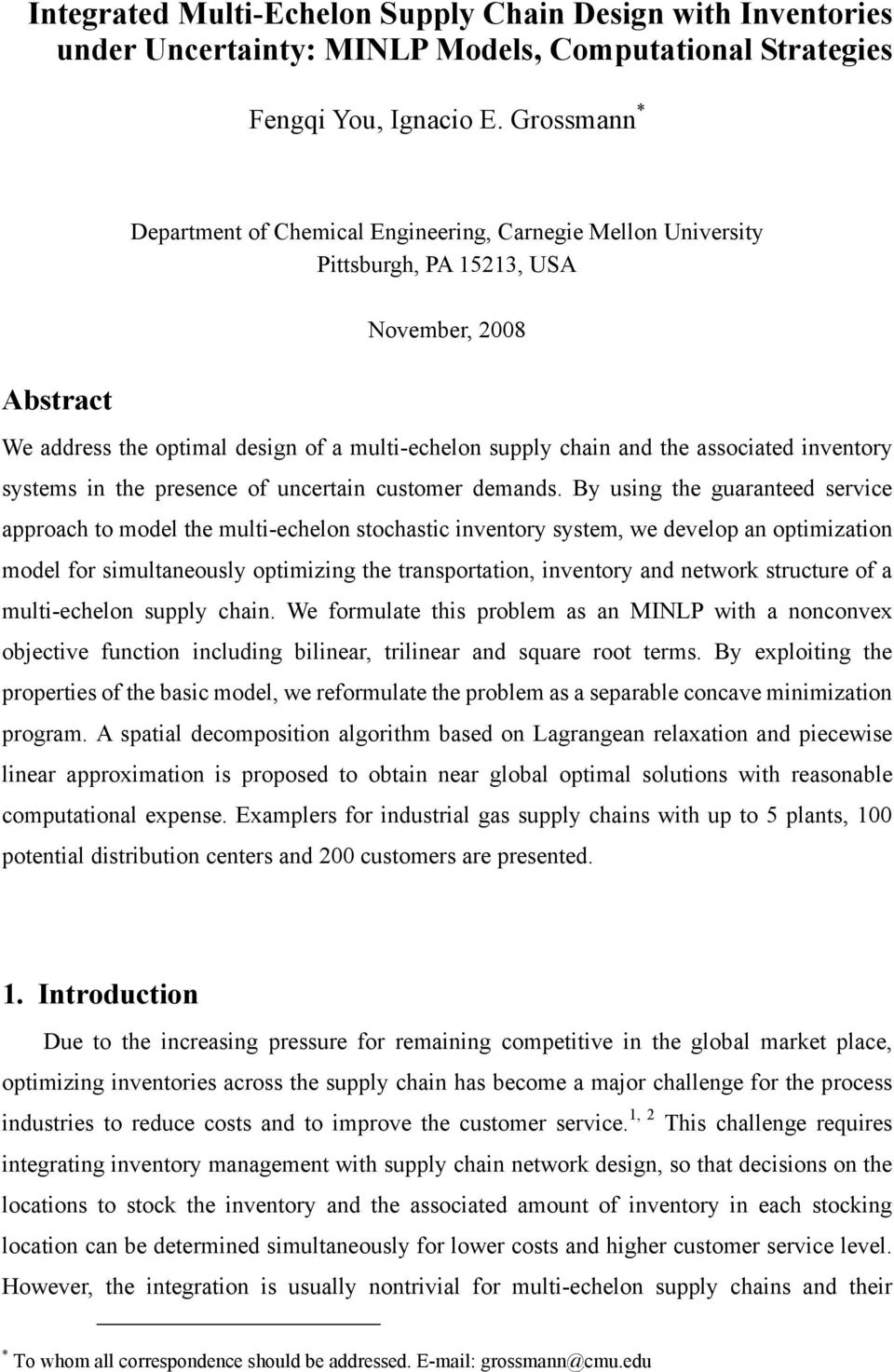
1 Integrated Multi-Echelon Supply Chain Design with Inventories under Uncertainty: MINLP Models, Computational Strategies Fengqi You, Ignacio E. Grossmann * Department of Chemical Engineering, Carnegie Mellon University Pittsburgh, PA 15213, USA Abstract November, 2008 We address the optimal design of a multi-echelon supply chain and the associated inventory systems in the presence of uncertain customer demands. By using the guaranteed service approach to model the multi-echelon stochastic inventory system, we develop an optimization model for simultaneously optimizing the transportation, inventory and networ structure of a multi-echelon supply chain. We formulate this problem as an MINLP with a nonconvex obective function including bilinear, trilinear and square root terms. By exploiting the properties of the basic model, we reformulate the problem as a separable concave minimization program. A spatial decomposition algorithm based on Lagrangean relaxation and piecewise linear approximation is proposed to obtain near global optimal solutions with reasonable computational expense. Examplers for industrial gas supply chains with up to 5 plants, 100 potential distribution centers and 200 customers are presented. 1. Introduction Due to the increasing pressure for remaining competitive in the global maret place, optimizing inventories across the supply chain has become a maor challenge for the process industries to reduce costs and to improve the customer service. 1, 2 This challenge requires integrating inventory management with supply chain networ design, so that decisions on the locations to stoc the inventory and the associated amount of inventory in each stocing location can be determined simultaneously for lower costs and higher customer service level. However, the integration is usually nontrivial for multi-echelon supply chains and their * To whom all correspondence should be addressed. [email protected]
2 associated inventory systems in the presence of uncertain customer demands. 3 The multi-echelon inventory management problem has been extensively studied in the past several decades. However, most of the inventory literature only considers the optimization of inventory decisions without integrating them with supply chain design and planning decisions. Simpson 4 first studied the control of multi-echelon inventory system for a serial supply chain. In that paper, Simpson proposes the guaranteed service approach to describe the mechanics of the serial inventory system, in which each stage operates a base-stoc policy in the face of random but bounded demand. Simpson s results showed that the optimal inventory policy for the serial system is an all or nothing policy, i.e. each stage either has no safety stoc, or carries enough stocs to decouple the downstream stages form the upstream stages. Almost at the same time, Clar and Scarf 5 also studied the optimal control policy of the multi-echelon inventory system with each stage operating with a base-stoc policy. In contrast to Simpson s wor, Clar and Scarf consider that the uncertain demand at each stage to be unbounded, and thus the service level and replenishment lead time of each stage depend on the upstream adacent supply stages stoc level. To solve the problem, they proposed a dynamic programming approach based on the calculation of recursions for stage inventory and replenishment amount. Later, Federgruen and Zipin 6 extended the result of Clar and Scarf 5 to infinite horizon, and showed that a stationary order-up-to level echelon policy is optimal. Some recent extensions of the wor by Clar and Scarf 5 include the wor by Lee and Billington, 7 which presents a supply chain operation model with multi-echelon inventory system operating under a periodic-review base-stoc system at Hewlett Pacard, the wor by Glasserman and Tayur, 8 which considers capacitated limits in the multi-echelon inventory model, and the wor by Ettl et al., 9 which analyzed the relationship between stochastic lead time and the inventory level for a multi-echelon system. Meanwhile, the guaranteed service approach, which is based on the idea of maximum service time allowance in each inventory location, has drawn more attention due to its ease for computation for large scale inventory systems. Graves 10 proposed that the problem by Simpson 4 could be solved as a dynamic program. Later, different extensions of Simpson s wor 11, 12 for assembly networs, distribution networs and spanning trees were given by Inderfurth, Inderfurth and Minner, 13 Graves and Willems, 14 all of whom use dynamic programming to solve the inventory optimization problem. Recently, Minner 15 used a similar approach to investigate the safety stoc placement problem for reverse supply chains. Graves and Willems 16, 17 extended the guaranteed service model for general supply chain configuration problem with safety stoc optimization. Further extensions of the guaranteed service approach -2-

3 are given by Humair and Willems 18 that accounts for supply chain networ with clusters of commonality, and Bossert and Willems 19 that allows the multi-echelon inventory system to be reviewed and replenished for an arbitrary review period at each stage. Inventory placement problem for general acyclic supply chain networ has recently been addressed by Magnanti et al., 20 who present an efficient mathematical programming approach to solve the guaranteed service multi-echelon inventory model instead of using the traditional dynamic programming approach. Jung et al. 21 considered the safety stoc optimization for a chemical supply chain by using a simulation-optimization framewor, but the supply chain design decisions are not ointly optimized. Research on integrated supply chain networ design and inventory management is relatively new. Most of the literature in this area tends to approximate the inventory cost coarsely without detailed inventory management policy, and most of it does not optimize the safety stocs, but ust considers the safety stoc level as a given parameter that is treated as the lower bound of the total inventory level, 22 or the safety stoc level is considered as the inventory targets that would lead to some penalty costs if violated. 23 There are, however, several related wors that offer relevant insights. Erlebacher and Meller 24 developed a nonlinear integer programming model for the oint location-inventory model. To solve the highly nonlinear nonconvex problem efficiently, they use a continuous approximation and a number of other heuristic methods. Dasin et al. 25 and Shen et al. 26 present a oint location-inventory model, which extends the classical uncapacitated facility location model to include nonlinear woring inventory and safety stoc costs for a two-stage networ, so that decisions on the installation of distribution centers (DCs) and the detailed inventory replenishment decisions are ointly optimized. To simplify the problem, inventories in the retailers are neglected, and they also assume that all the DCs have the same constant replenishment lead time, and the demand at each customer has the same variance-to-mean ratio. With the same assumptions, Ozsen et al. 27 have extended the model to consider capacitated limits in the DCs. Their wor is further extended by Ozsen et al. 28 to compare with the cases where customers restrict to single sourcing and the case which customers allow multi-sourcing. Another extension is given by Souriraan et al., 29 in which the assumption on identical replenishment lead time is relaxed while the assumption on demand uncertainty is still enforced. Recently, You and Grossmann 30 proposed a mixed-integer nonlinear programming (MINLP) approach to study a more general model based on the one developed by Dasin et al. 25 and Shen et al., 26 relaxing the assumption on the identical variance-to-mean ratio for customer demands. -3-

4 The obective of this wor is to develop optimization models and solution algorithms to address the problem of oint multi-echelon supply chain networ design and inventory management. By using the guaranteed service approach to model the multi-echelon inventory system, 4, we capture the stochastic nature of the problem and develop an equivalent deterministic optimization model. The model determines the supply chain design decisions such as the locations of distribution centers (DCs), assignments of customer demand zones to DCs, assignments of DCs to plants, shipment levels from plants to the DCs and from DCs to customers, and inventory decisions such as pipeline inventory and safety stoc in each node of the supply chain networ. The model also captures ris-pooling effects 31 by consolidating the safety stoc inventory of downstream nodes to the upstream nodes in the multi-echelon supply chain. The model is first formulated as a mixed-integer nonlinear program (MINLP) with a nonconvex obective function, and then reformulated as a separable concave minimization program after exploiting the properties of the basic model. To solve the problem efficiently, a tailored hierarchical decomposition algorithm based on Lagrangean relaxation and piece-wise linear approximation is developed to obtain near global optimal solutions within 1% optimality gap with modest CPU times. Several computational examples for industrial gases supply chains and performance chemical supply chains are presented to illustrate the application of the model and the performance of the proposed algorithm. The outline of this paper is as follows. Some basic concepts of inventory management with ris pooling and the guaranteed service model for multi-echelon inventory system are presented in Section 2. The problem statement is given in Section 3. In Section 4, we introduce the oint multi-echelon supply chain design and inventory management model. Two small illustrative examples are given in Section 5. To solve the large scale problem, an efficient decomposition algorithm based on Lagrangean relaxation, piecewise linear approximation and model property is presented in Section 6. In Section 7 we present our computational results and analysis. We conclude the paper with some conclusions and future directions in Section Multi-Echelon Inventory Model In this section, we briefly review some inventory management models that are related to the problem addressed in this wor. Detailed discussion about single stage and multi-echelon inventory management models are given by Zipin 3 and Graves and Willem, 16 respectively. -4-

5 2.1. Single Stage Inventory Model under Base-Stoc Policy There are many control policies for single stage inventory systems, such as base stoc policy, (s,s) policy, (r, Q) policy, etc. 3 Among these policies, the periodic review base stoc policy is most widely used in the inventory control practice. The reason is based on two facts. As shown by Federgruen and Zipin, 6 the base stoc policy is optimal for single stage inventory system facing stationary demand. For multi-echelon inventory system, the base stoc policy, though not necessarily optimal, has the advantage of being simple to implement and close to the optimum. 32 Before introducing the multi-echelon inventory model, we first review the single stage base stoc policy, which is the common building bloc for most of the multi-echelon inventory models. Figure 1 shows the inventory profile for a given product in a stocing facility operated under the periodic review base stoc policy. As can be seen, the inventory level decreases due to the customer demand and increases when replenishments arrive. Under the periodic review base stoc policy, inventory is reviewed at the beginning of each review period and the amount of the difference between a specified base stoc level and the actual inventory position (on-hand inventory plus in-process inventory minus bacorders) is ordered for replenishment. It is interesting to note that the well-nown continuous review (r, Q) policy can be treated as a special case of base stoc policy with base stoc level equal to r [Figure 1, (a), (b)] + Q. Since under the base stoc policy the lengths of the review period and the replenishment lead time are determined exogenously, the only control variable is the base stoc level. To determine the optimal base stoc level for a single stage inventory system, let us denote the review period as p, the replenishment lead time as l and the average demand at each unit of time is μ. Recall that the inventory position is the total material in the system (on-hand plus on-order), and we start each review period with the same inventory position S, which is the base stoc level. We must wait p units of time to review the inventory position again and place an order for replenishment, and then the order will tae another l units of time to arrive (Figure 1). Therefore, the inventory in the system at the beginning of a review period should be large enough to cover the demand over review period p plus the replenishment lead time l, i.e. the optimal base stoc level should be μ ( p + l) if demand is constant. [Figure 2] However, under demand uncertainty the demand process is not constant and we need more -5-

6 inventory (safety stoc) to hedge against stocout before we get a chance to reorder (Figure 2). The acceptable practice in this field is to assume a normal distribution of the demand, although of course other distribution functions can be specified. If the demand at each unit of time is normally distributed with mean μ and standard deviation σ, the demand over review period p and the replenishment lead time l is also normally distributed with mean μ ( p + l) and standard deviation σ p + l. It is convenient to measure safety stoc in terms of the number of standard deviations of demand, denoted as safety stoc factor, λ. Then the optimal base stoc level is given by, S = μ( p+ l) + λσ p+ l We should note that if α is the Type I service level (the probability that the total inventory on hand is more than the demand) used to measure of service level, the safety stoc factor λ corresponds to the α -quantile of the standard normal distribution, i.e. Pr( x λ) = α Ris Pooling Effect For single echelon inventory system with multiple stocing locations, Eppen 31 proposed the ris pooling effect, which states that significant safety stoc cost can be saved by grouping the demand of multiple stocing locations. In particular, Eppen considers a single period problem with N retailers and one supplier. Each retailer i has uncorrelated normally distributed demand with mean μ i and standard deviation σ i. The replenishment lead times for all these retailers are the same and given as L and all the retailers guarantee the same Type I service level with the same safety stoc factor λ. Eppen compared two operational modes of the N-retailer system: decentralized mode and centralized mode. In the decentralized mode, each retailer orders independently to minimize its cost. Since in this mode the optimal safety stoc in retailer i corresponding to the safety stoc factor λ is stoc in the system is given by, λ Lσ, 31 the total safety i λ L N i = σ 1 i. In the centralized mode, all the retailers are considered as a whole and a single quantity is ordered for replenishment, so as to minimize the total expected cost of the entire system. Since in the centralized mode all the retailers are grouped, and the demand at each retailer follows a normal distribution N μ σ 2 ( i, i ), the total uncertain demand of the entire system during the order -6-

7 lead time will also follow a normal distribution with mean L N μ i= 1 i and standard deviation L N i = 1 σ 2 i mode is given by, λ L. Therefore, the total safety stoc of the distribution centers in the centralized N i = 1 σ 2 i which is less than λ L N i = 1 σ. Eppen s simple model illustrates the potential saving in safety i stoc costs due to ris pooling. For example, consider a single echelon inventory system with 100 retailers. Each retailer has uncorrelated normal distributed demand with identical mean μ and standard deviation σ. Thus, the total safety stoc of this system is 100zσ L under decentralized mode, and 10zσ L under centralized mode, i.e. 90% safety stocs in this system can be saved by ris pooling Guaranteed Service Model for Multi-Echelon Inventory One of the most significant differences between single stage inventory system and multi-echelon inventory system is the lead time. For single stage inventory system, lead time, which may include material handling time and transportation time, is exogenous and generally can be treated as a constant. However, for a multi-echelon inventory system, lead time of a downstream node depends on the upstream node s inventory level and demand uncertainty, and thus the lead time and internal service level are stochastic. Based on this fact, simply propagating the single stage inventory model to multi-echelon system will lead to a suboptimal solution, since the optimization of a multi-echelon inventory system is usually nontrivial. 3 There are two maor approaches to model the multi-echelon inventory system, the stochastic service approach and the guaranteed service approach. 16 For a detailed comparison of these two approaches, see Graves and Willems, 16 and Humair and Willems. 18 Briefly, the stochastic service approach employs a more complicated model that allows for a more exact and detailed understanding of the system. However, the model as well as the solution technique, are not easy to develop and is computationally hard. The guaranteed service approach models the entire system in an approximate fashion and allows a planner to mae strategic and tactical decisions without the need to approximate portions of the system that are not captured by a simplified topological representation. Thus, the stochastic service model may be too complicated to be employed for supply chain design problem. Based on this reason, we choose the guaranteed service approach to model the multi-echelon inventory system in this wor. -7-

8 The main idea of the guaranteed service approach is that each node in the multi-echelon inventory system quotes a guaranteed service time T, by which this node will satisfy the demands from its downstream customers. That is, the customer demand at time t must be ready to be shipped by time t+ T. For instance, if a chemical supplier s guaranteed service time is 3 days, it means that once the customer places an order, the total amount of chemicals ordered by the customer will be available in at most 3 days. The guaranteed service times for internal customers are decision variables to be optimized, while the guaranteed service time for the nodes at the last echelon (facing external customers) is an exogenous input, presumably set by the maretplace. Besides the guarantee service time, we consider that each node has a given deterministic order processing time, t, which is independent of the order size. The order processing time, including material handling time, transportation time and review period, represents the time from all the inputs that are available until the outputs are available to serve the demand. Therefore, the replenishment lead time, which represents the time from when we place an order to when all the goods are received, can be determined by the guaranteed service time of direct predecessor T 1 (the time that predecessor requires to have the chemicals ready to be shipped) plus the order processing time t (transportation time, handling time and review period). As we can see from Figure 3, the net lead time of node, NLT, which is the time span over which safety stoc coverage against demand variations is necessary, is defined as the difference between the replenishment lead time of this node and its guaranteed service time to its successor. 15 The reason is that not all the customer demand at time t for node should be satisfied immediately, but only needs to be ready by time t+ T. Thus, the safety stoc does not need to cover demand variations over the whole replenishment lead time, but ust the difference between the replenishment lead time and the guaranteed service time to the successors that is defined as the net lead time. Therefore, we can calculate the net lead time with the following formula: NLT = T + t T 1 where node -1 is the direct predecessor of node (Figure 4). Note that this formula suggests that if the service time quoted by node to its successor nodes equals the replenishment lead time T 1 + t, no safety stoc is required in node because all products are received from the predecessors and processed within the guaranteed service time, i.e. this node is operating in pull mode. If the guaranteed service time T is 0, the node holds the most safety stoc -8-
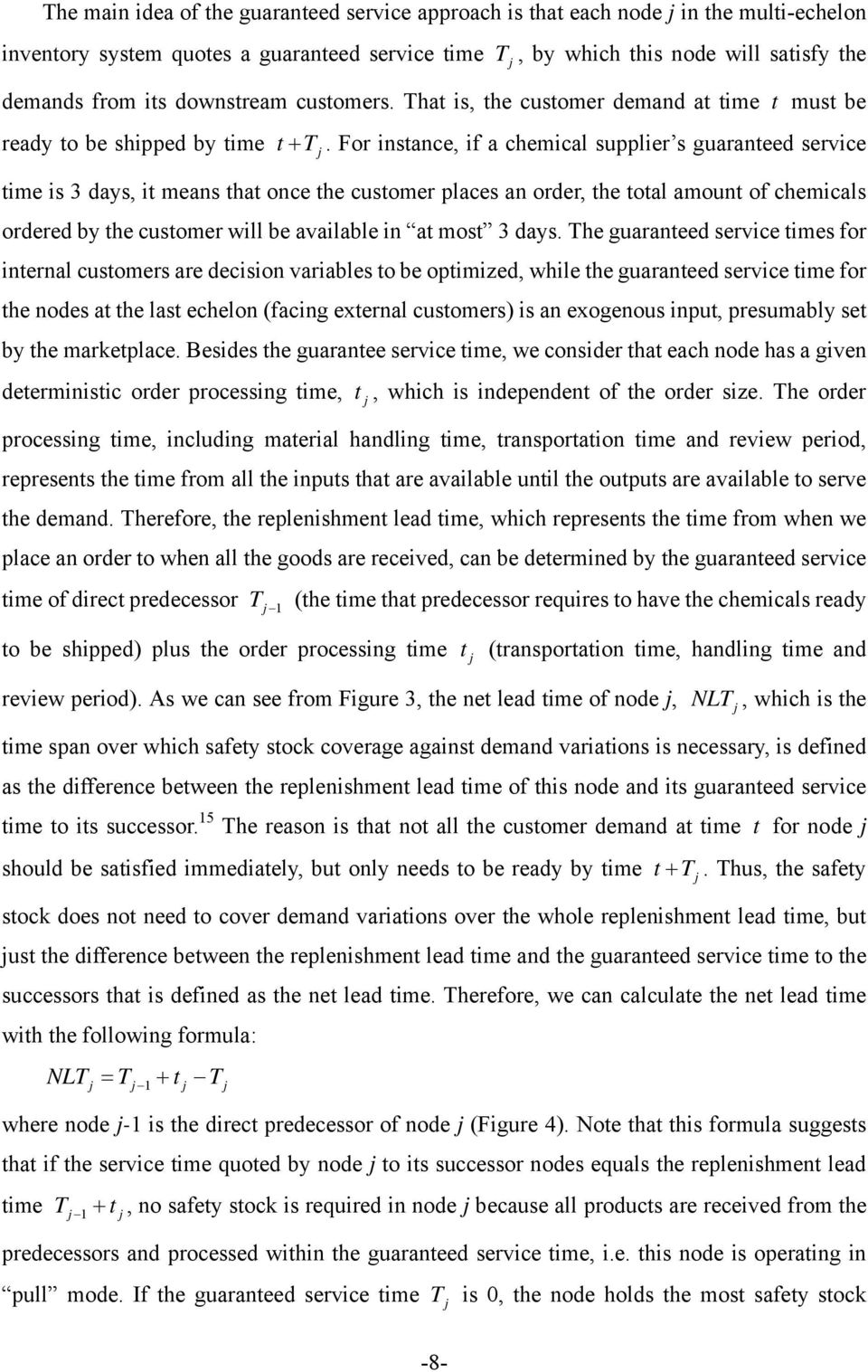
9 because all the orders, once they are placed, are fulfilled immediately, i.e. this node is operating in push mode. [Figure 3] [Figure 4] In the guaranteed service approach, each node in the multi-echelon inventory system is assumed to operate under a periodic review base stoc policy with a common review period. Furthermore, demand over any time interval is also assumed to be normally distributed (mean μ and standard deviation σ for node ), and bounded. This does not imply that demand can never exceed the bound, but this bound reflects the maximum amount of demand that a company wants to satisfy from safety stoc. This interpretation is consistent with most practical applications that safety stocs are used to cope with regular demand variations that do not exceed a maximum reasonable bound. Larger demand variations are handled with extraordinary measures, such as spot-maret purchases, rescheduling or expediting orders, other than using safety stocs. Thus, under these assumptions, each node sets its base stoc so as to meet all the orders from its downstream customers within the guaranteed service time. That is, for node, there is an associated safety stoc factor λ, which is given and corresponds to the maximum amount of demand that company wants to satisfy from safety stoc. This yields the base stoc level at node : S = μ NLT + λ σ NLT This formula is similar but slightly different from the single stage inventory model in terms of the expression for the lead time. Note that the review period has been taen into account as part of the order processing time and considered in the net lead time. With the guaranteed service approach, the total inventory cost consists of safety stoc cost and pipeline inventory cost. The safety stoc of node ( SS ) is given by the following formula as discussed above, SS = λσ NLT The expected pipeline inventory is the sum of expected on hand and on-order inventories. Based on Little s law, 33 the expected pipeline inventory demand over the order processing time, and is given by, PI = t μ PI of node equals to the mean which is not affected by the coverage and guaranteed service time decisions. -9-

10 3. Problem Statement We are given a potential supply chain (Figure 5) consisting of a set of plants (or suppliers) i I, a number of candidate sites for distribution centers J, and a set of customer demand zones K whose inventory costs should be taen into account. The customer demand zone can represent a local distributor, a regional warehouse, a dealer, a retailer, or a wholesaler, which is usually a necessary component of the supply chain for specialty chemicals 19, 34 or advanced materials. Alternatively, one might view the customer demand as the aggregation of a group of customers operated with vendor managed inventory (vendor taes care of customers inventory), which is a common business model in the industrial gases 35, 36 industry and some chemical companies. [Figure 5] In the given potential supply chain, the locations of the plants, potential distribution centers and customer demand zones are nown and the distances between them are given. The investment costs for installing DCs are expressed by a cost function with fixed charges. Each retailer i has an uncorrelated normally distributed demand with mean μ i and variance in each unit of time. Single sourcing restriction, which is common in the specialty chemicals supply chain, 37 is employed for the distribution from plants to DCs and from DCs to customer demand zones. That is, each DC is only served by one plant, and each customer demand zone is only assigned to one DC to satisfy the demand. Linear transportation costs are incurred for shipments from plant i to distribution center with unit cost c 1 i center to customer demand zone with unit cost c 2 2 σ i, and from distribution. The corresponding deterministic order processing times of DCs and customer demand zone that includes the material handling time, transportation time and inventory review period, are given by t 1 i and t 2. The service time of each plant, and the maximum service time of each customer demand zones are nown. We are also given the safety stoc factor for DCs and customer demand zones, λ 1 and λ 2, which correspond to the standard normal deviate of the maximum amount of demand that the node will satisfy from its safety stoc. A common review period is used for the control of inventory in each node. Inventory costs are incurred at distribution centers and customers, and consist of pipeline inventory and safety stoc, of which the unit costs are given. The obective is to determine how many distribution centers (DCs) to install, where to -10-

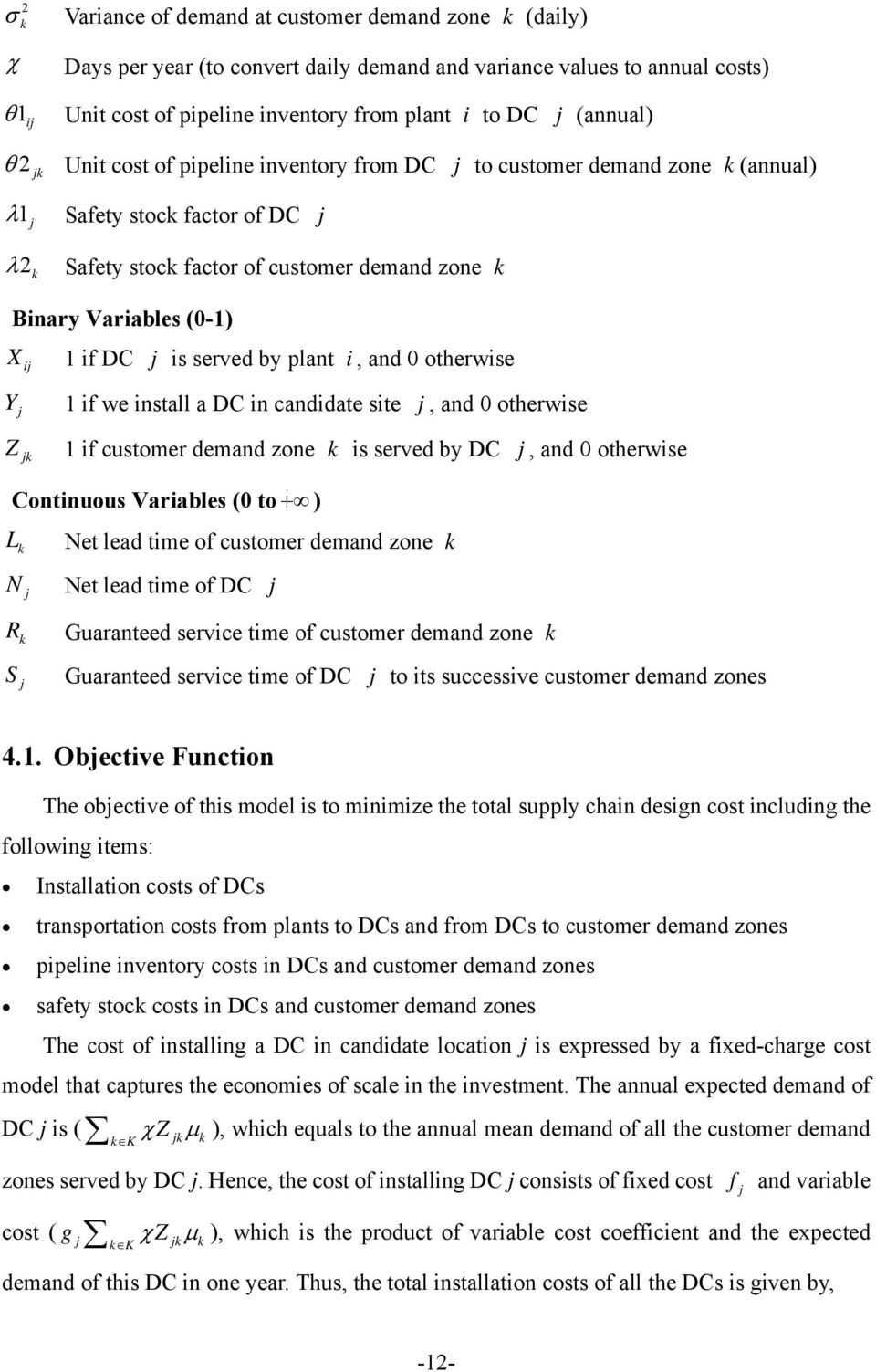
11 locate them, which plants to serve each DC and which DCs to serve each customer demand zone, how long should each DC quote its service time, and what level of safety stoc to maintain at each DC and customer demand zone so as to minimize the total installation, transportation, and inventory costs. 4. Model Formulation The oint multiechelon supply chain design and inventory management model is a mixed-integer nonlinear program (MINLP) that deals with the supply chain networ design for a given product, and considers its multi-echelon inventory management. The definition of sets, parameters, and variables of the model is given below: Sets/Indices I Set of plants (suppliers) indexed by i J K Parameters Set of candidate DC locations indexed by Set of customer demand zones (wholesaler, regional distributor, dealer, retailer, or customers with vendor managed inventory) indexed by c 1 i Unit transportation cost from plant i to DC c 2 Unit transportation cost from DC to customer demand zone f g Fixed cost of installing a DC at candidate location (annually) Variable cost coefficient of installing candidate DC (annually) h 1 Unit inventory holding cost at DC (annually) h 2 Unit inventory holding cost at customer demand zone (annually) R SI i t 1 i t 2 μ Maximum guaranteed service time to customers at customer demand zone Guaranteed service time of plant i Order processing time of DC if it is served by plant i, including material handling time of DC, transportation time from plant i to DC, and inventory review period Order processing time of customer demand zone if it is served by DC, including material handling time of DC, transportation time from DC to customer demand zone, and inventory review period Mean demand at customer demand zone (daily) -11-

12 2 σ χ Variance of demand at customer demand zone (daily) Days per year (to convert daily demand and variance values to annual costs) θ 1 i Unit cost of pipeline inventory from plant i to DC (annual) θ 2 Unit cost of pipeline inventory from DC to customer demand zone (annual) λ 1 Safety stoc factor of DC λ 2 Safety stoc factor of customer demand zone Binary Variables (0-1) X i 1 if DC is served by plant i, and 0 otherwise Y 1 if we install a DC in candidate site, and 0 otherwise Z 1 if customer demand zone is served by DC, and 0 otherwise Continuous Variables (0 to + ) L N R S Net lead time of customer demand zone Net lead time of DC Guaranteed service time of customer demand zone Guaranteed service time of DC to its successive customer demand zones 4.1. Obective Function The obective of this model is to minimize the total supply chain design cost including the following items: Installation costs of DCs transportation costs from plants to DCs and from DCs to customer demand zones pipeline inventory costs in DCs and customer demand zones safety stoc costs in DCs and customer demand zones The cost of installing a DC in candidate location is expressed by a fixed-charge cost model that captures the economies of scale in the investment. The annual expected demand of DC is ( χz μ ), which equals to the annual mean demand of all the customer demand K zones served by DC. Hence, the cost of installing DC consists of fixed cost f and variable cost ( g χz μ ), which is the product of variable cost coefficient and the expected K demand of this DC in one year. Thus, the total installation costs of all the DCs is given by, -12-
13 fy + g χz μ (1) J J K The product of the annual mean demand of DC ( χz μ ) and the unit transportation cost ( 1 X i i ) between DC and the plant that serves it yields the annual c i I plant to DC transportation cost. Similarly, the product of yearly expected mean demand of customer demand zone ( χμ ) (2) c1 i X i Z μ i I J K and the unit transportation cost ( 2 Z ) between customer demand zone and the DC c J that serves it, leads to the annual DC to customer demand zone transportation cost. c2 χ Z μ (3) J K Based on Little s law, 33 the pipeline inventory PI of DC equals to the product of its daily mean demand ( Z μ K ) and its order processing time ( t 1 X i I i i ), which is in terms of days. Thus, the annual total pipeline inventory cost of all the DCs is given by, θ1t1ixi Z μ i I J K where θ 1 is the annual unit pipeline inventory holding cost of DC. (4) Similarly, the total annual pipeline inventory cost of all the customer demand zones is given by, θ 2t2Z μ (5) J K where θ 2 is the annual unit pipeline inventory holding cost of customer demand zone, and is the pipeline inventory of customer demand zone. t 2 Z μ K The demand at customer demand zone follows a given normal distribution with mean μ and variance σ. Due to the ris-pooling effect, 31 the demand over the net lead time ( N ) 2 K at DC is also normally distributed with a mean of N μ J and a variance of N 2 σ J, where J is the set of customer demand zones assigned to DC. Thus, the safety stoc required in the DC at candidate location with a safety stoc factor λ 1 is -13-

14 λ. Considering the annual inventory holding cost at DC is h 1, we have 2 1 N σ Z K the annual total safety stoc cost at all the DCs equals to λ1 h1 N σ Z (6) J 2 K Similarly, the demand over the net lead time of customer demand zones ( L ) is normally distributed with a mean of Lμ and a variance of all the customer demand zones is given by, L σ. Thus, the annual safety stoc cost at 2 λ2h2 σ L (7) K Therefore, the obective function of this model (the total supply chain design cost) is given by min : fy + g χz μ J J K + c1i Xi χz μ + c2 χz μ i I J K J K (8) + θ1t1ixi Z μ + θ2t2 Z μ i I J K J K 2 λ1h1 N σz λ2h2 σ L J K K + + where each term accounts for the DC installation cost, transportation costs of plants-dcs and DCs-customer demand zones, pipeline inventory costs of DCs and customer demand zones, and safety stoc costs of DCs and customer demand zones Constraints Three constraints are used to define the networ structure. The first one is that if DC is installed, it should be served by only one plant. If it is not installed, it is not assigned to any plant. This can be modeled by, X i = Y, i I (9) The second constraint states that each customer demand zone is served by only one DC, Z = 1, (10) J The third constraint is that if a customer demand zone is served by the DC in candidate location, the DC must exist, Z Y,, (11) -14-

15 Two constraints are used to define the net lead time of DCs and customer demand zones. The replenishment lead time of DC should be equal to the guaranteed service time ( SI ) of plant i, which serves DC, plus the order processing time ( t i ). Since each DC is served by only one plant, the replenishment lead time of DC is calculated by ( SI + t ) X i I i i i. Thus, the net lead time of DC should be greater than its replenishment lead time minus its guaranteed service time to its successor customer demand zones, and is given by the linear inequality, N ( SI + t ) X S, (12) i i i i I Similarly, the net lead time of a customer demand zone is greater than its replenishment lead time minus its maximum guaranteed service time, inequalitiy R, which is given by the nonlinear L ( S + t ) Z R, (13) J Finally, all the decision variables for networ structure are binary variables, and the variables for guaranteed service time and net lead time are non-negative variables. Xi, Y, Z {0,1}, i,, (14) S 0, N 0, (15) L 0, (16) 4.3. MINLP Model Grouping the parameters, we can rearrange the obective function and formulate the problem as the following mixed-integer nonlinear program (P0): (17) 2 Min: f Y + A X Z + B Z + q1 N σ Z + q2 L i i J i I J K J K J K K s.t. X i = Y, (9) i I Z = 1, (10) J Z Y,, (11) N S X S, (12) i i i I L ( S + t ) Z R, (13) J Xi, Y, Z {0,1}, i,, (14) i -15-

16 where S 0, N 0, (15) L 0, (16) Si = SIi + t i ( ) A = c χ + θ t μ i i i ( ) B = g χ + c χ + θ t μ q1 = λ1 h1 q2 = λ2 h2 σ 4.4. Reformulated MINLP Model The MINLP model (P0) has nonconvex terms, including bilinear and square root terms, in its obective function (17) and constraint (13). Because the bilinear terms are the products of two binary variables (such as X i Z ), or the product of a binary variable and a continuous variable (such as N Z and S Z ), they can be linearized by introducing additional variables. To linearize the term ( X i Z ) in the obective function (17), we first introduce a new continuous non-negative variable XZ i. Then the product of X i and Z can be replaced by this term XZ i with the following constraints, 38 XZ X, i,, (19) i i XZ Z, i,, (20) i XZi X i + Z 1, i,, (21) XZ 0, i,, (22) i where constraints (19), (20) and (22) ensure that if X i or Z is zero, XZ i should be zero, and constraint (21) ensures that if X i and Z are both equal to one, XZ i should be one. The linearization of ( S Z ) in constraint (13) requires two new continuous non-negative variable SZ and SZ 1, and the following constraints, 38 SZ + SZ1 = S,, (23) U SZ Z S,, (24) -16-

17 U SZ1 (1 Z ) S,, (25) SZ 0, SZ 1 0,, (26.1) where constraints (24), (25) and (26.1) ensure that if Z is zero, SZ should be zero; if Z is one, SZ 1 should be zero. Combining with constraint (23), we can have SZ equivalent to the product of S and Z. Similarly, the product of N and Z in the obective function (17) can be linearized as follows, NZ + NZ1 = N,, (27) U NZ Z N,, (28) U NZ1 (1 Z ) N,, (29) NZ 0, NZ 1 0,, (26.2) where NZ and NZ 1 are two new continuous variables, and NZ is equivalent to ( N Z ). The above linearizations introduce more constraints and variables, but significantly reduces the number of nonlinear terms in the model (P0) and potentially reduce the computational effort. To further reduce the nonlinear terms in the obective function (17), the term ( N σ Z ) is replaced by a new nonnegative continuous variable NZV with 2 K the following constraint, NZV NZ, (30) 2 = σ K NZV 0, (31) Therefore, incorporating the above linearizations we have the following reformulated MINLP model (P1). (17) Min: f Y + A XZ + B Z + q1 NZV + q2 L i i J i I J K J K J K s.t. X i = Y, (9) i I Z = 1, (10) J Z Y,, (11) -17-

18 N S X S, (18) i i i I L SZ + t Z R, (32) J J XZ X, i,, (19) i i XZ Z, i,, (20) i XZi X i + Z 1, i,, (21) SZ + SZ1 = S,, (23) U SZ Z S,, (24) U SZ1 (1 Z ) S,, (25) NZ + NZ1 = N,, (27) U NZ Z N,, (28) U NZ1 (1 Z ) N,, (29) NZV NZ, (30) 2 = σ K Xi, Y, Z {0,1}, i,, (14) S 0, N 0, (15) L 0, (16) XZ 0, i,, (22) i NZV 0, (31) SZ 0, SZ 1 0, NZ 0, NZ 1 0,, (26) Compared with model (P0), model (P1) is computationally more tractable, because all the constraints in (P1) are linear and the only nonlinear terms are univariate concave terms in the obective function Variable Bounds and Initialization The bounds of variables are quite important for nonlinear optimization problems. The upper bounds of the ey continuous variables are derived below (denoted with the superscript U). The maximum net lead time ( N ) of DC is the maximum value of the sum of service U time of plant i and the order processing time from plant i to DC. It means that when the -18-

19 guaranteed service time of DC is zero and it is served by plant i that has the maximum ( SIi ti + ), the net lead time N equals to the maximum value, { } max{ } U N = max SI + t = S, (33.1) i i i i I i I The maximum value of guaranteed service time of DC is equal to the maximum value of its net lead time. It means that when the net lead time of DC is zero and it is assigned to plant i that has the maximum ( SIi + ti), the net lead time S equals to the maximum value, U U S = N = max{ Si}, (33.2) i I From constraints (13) and (16), it is easy to see that the maximum net lead time of customer demand zone is as follows, U U L = max 0,max{ S + t} R, (33.3) J The upper bounds of the auxiliary variables are easy to derive, U U U U SZ = S, SZ1 = S,, (33.4) U U U U NZ = N, NZ1 = N,, (33.5) U 2 U = σ K NZV N, (33.6) Besides variable bounds, the initial point is another ey issue for numerical optimization of MINLP problems. Since model (P1) has some special structure (linear constraints, univariate concave terms in the obective function), we can use a similar approach as in You and Grossmann 30 to obtain a good starting point by solving a mixed-integer linear program (MILP) problem for initialization purposes. [Figure 6] As introduced by Fal and Soland, 39 for a univariate square root term x, where the variable x has lower bound 0 and upper bound U U x, its secant x / x represents the convex envelope and provides a valid lower bound of the square root term as shown in Figure 6. Since model (P1) is a minimization problem and all the constraints are linear, replacing all the univariate square root terms with their secants in the obective function (17) will lead to the MILP problem (P2) with a linear obective function, Min: q1 NZV q2 L fy + Ai XZi + BZ + + U U NZV L (34) J i I J K J K J K -19-

20 s.t. all the constraints of (P1) Since (P1) and (P2) have the same constraints, a feasible solution of (P2) is also a feasible solution of (P1). Furthermore, the optimal obective function value of (P2) is a valid lower bound of the optimal obective function value of (P1). Therefore, by solving the initialization MILP problem (P2), we can obtain a good starting point of solving problem (P1). Note that based on this initialization procedure, a heuristic algorithm is to first solve problem (P2), then using its optimal solution as an initial point to solve problem (P1) with an MINLP solver that relies on convexity assumption (e.g. DICOPT, SBB, etc.). This algorithm can obtain good solutions quicly, although global optimality cannot be guaranteed. 5. Illustrative Example To illustrate the application of this model, we consider two small illustrative examples, an industrial liquid oxygen (LOX) supply chain example and an acetic acid supply chain example Example A: Industrial LOX Supply Chain The first example is for an industrial LOX supply chain with two plants, three potential DCs and six customers as given in Figure 7. In this supply chain, customer inventories are managed by the vendor, i.e. vendor-management-inventory (VMI), which is a common business model in the gas industry Thus, in this example inventory costs from DCs and customers should be taen into account into the total supply chain cost, and the oint multiechelon supply chain design and inventory management model can be used to minimize total networ design, transportation and inventory costs. [Figure 7] In this instance, the annual fixed costs to install the DCs ( f ) are $10,000/year, $8,000/year and $12,000/year, respectively. The variable cost coefficient of installing a DC ( g ) at all the candidate locations is $0.01/(liter year). The safety stoc factors for DCs ( λ 1 ) and customers ( λ 2 ) are the same and equal to 1.96, which corresponds to 97.5% service level if demand is normally distributed. We consider 365 days in a year ( χ ). The guaranteed service times of the two plants ( SI ) are 2 days and 3 days, respectively. Since the last echelon i represents the customers, the guaranteed service time of customers ( R ) are set to 0. The data -20-

21 for demand uncertainty, order processing times and transportation costs are given in Tables 1-5. [Table 1] [Table 2] [Table 3] [Table 4] [Table 5] We consider two instances of this example. In the first instance, we consider zero holding cost for both pipeline inventory and safety stocs, i.e. the problem reduces to a supply chain networ design problem without considering inventory cost. In the second instance, the pipeline inventory holding cost of LOX is $6/(liter year) for all the DCs ( θ 1 i ( θ 2 ( h 2 ). ), and the safety stoc holding cost is $8/(liter year) for all the DCs ( h 1 ) and customers ) and customers Both the initialization MILP model (P2) and the MINLP model (P1) include 27 binary variables, 124 continuous variables and 256 constraints. Since the problem sizes are relatively small, we solve model (P1) directly to obtain the global optimum with 0% optimality margin by using the BARON solver 40 with GAMS, 41 and the initialization MILP model (P2) is solved with GAMS/CPLEX. The resulting optimal supply chain networs with a minimum annual cost of $108,329/year and the flow rate of each transportation lin are given in Figure 8. We can see that for the instance without considering inventory costs, all the three DCs are installed, and each of them serves two customers. The maor trade-off is between DC installation costs and the transportation costs. For the instance that taes into account the inventory costs, only two DCs are installed and each serves three customers. The maor trade-off is between DC installation costs, transportation costs and inventory costs. The minimum annual cost in this instance is $152,107/year with the components given in Figure 9. A comparison between these two instances suggests the importance of integrating inventory costs in the supply chain networ design. Although the inventory costs might only mae up a small portion of the total costs, the optimal networ structure could be quite different with and without considering inventory in the supply chain design. [Figure 8] [Figure 9] -21-
22 5.2. Example B: Acetic Acid Supply Chain The second example is for an acetic acid supply chain with three plants, three potential DCs and four customer demand zones, each of which has a wholesaler (Figure 10). Based on the conclusion of the previous example, we need to tae into account the inventory costs from DCs and wholesalers when designing this supply chain, so as to obtain a more accurate optimal supply chain. [Figure 10] In this instance, the annual fixed DC installation cost ( f ) is $50,000/year for all the DCs. The variable cost coefficient of installing a DC ( g ) at all the candidate locations is $0.5/(ton year). The safety stoc factors for DCs ( λ 1 ) and wholesalers ( λ 2 ) are the same and equal to We consider 365 days in a year ( χ ). The guaranteed service times of the three vendors ( SI i ) are 3 days, 3 days and 4 days, respectively. The pipeline inventory holding cost is $1/(ton day) for all the DCs ( θ1 i / χ ) and wholesalers ( θ 2 / $1.5/(ton day) for all the DCs ( h1 / χ ) and wholesalers ( h2 / χ ), and the safety stoc holding cost is χ ). Since the guaranteed service time of wholesalers to end customers ( R ) are set to be 8 days. The data for demand uncertainty, order processing times and transportation costs are given in Tables [Table 6] [Table 7] [Table 8] [Table 9] [Table 10] The computational study is carried out on an IBM T40 laptop with Intel 1.50GHz CPU and 512 MB RAM. The original model (P0) has 12 discrete variables, 22 continuous variables and 27 constraints. Both the initialization MILP model (P2) and the MINLP model (P1) include 24 binary variables, 185 continuous variables and 210 constraints. We solve the original model (P0) by using GAMS/BARON with 0% optimality margin, and it taes a total of CPU seconds. We then solve the reformulated model (P1) with the aforementioned initialization process, the CPU time reduces to only 7.6 seconds and the optimal solutions are the same as we obtained by solving model (P0). The possible reason is that initialization process helps BARON to find a good feasible solution during the preprocessing step. This feasible solution provides a tighter upper bound that reduces the searching space and speeds up the computation. -22-
23 The resulting optimal supply chain networs with a minimum annual cost of $ 1,986,148/year and the flow rate of each transportation lin are given in Figure 11. We can see that two DCs are selected to install and one of them serves three wholesalers while the other one only serves one wholesaler. The maor trade-off is between DC installation costs, transportation costs and inventory costs. A detailed breadown of the total cost is given in Figure 12. [Figure 11] [Figure 12] 6. Solution Algorithm Although small scale problems can be solved to global optimality effectively by using a global optimizer and the aforementioned initialization method, medium and large-scale oint multi-echelon supply chain design and inventory management problems are often computationally intractable with direct solution approaches due to the combinatorial nature and nonlinear nonconvex terms. In this section, we present an effective solution algorithm based on Lagrangean relaxation and piecewise linear approximation to obtain solutions within 1% of global optimality gap with reasonable computational expense Piecewise Linear Approximation Instead of using the secants in the obective function of model (P1), a tighter lower convex envelope of the univariate square root terms is the piecewise linear function, which employs a few more continuous and discrete variables. Although this may require longer computational times to solve the initialization MILP problem, with the significant progress of MILP solvers, piecewise linear approximations have recently been increasingly used for approximating 42, 43 different types of nonconvex nonlinear functions, especially for univariate concave 20, functions. There are several different approaches to model the piecewise linear function for a concave term. 20, 43, 47 In this wor, we use the well-nown multiple-choice formulation 20 to approximate the square root term x. Let P { 1, 2, 3,, p} = denote the set of intervals in the piecewise linear function ϕ ( x), and M 1, M 2, M p, p 1 M + be the upper and lower bounds of x for each interval p. The multiple choice formulation of ϕ ( x) is then given by, ϕ ( x) = min ( Fv + Cu ) p s.t. v = 1 p p p p p p -23-
24 p u p = x M v u M v, p P p p p p p+ 1 p { 0,1} v, p P where C p = M M p+ 1 p+ 1 M M p p and F p = M p C p M p, p P. [Figure 13] As can be seen in Figure 13, the more intervals are used, the better is the approximation of the nonlinear function, but more additional variables and constraints are required. Using this multiple choice formulation to approximate the univariate concave terms NZV and L in the obective function of problem (P1), yields the following piecewise linear MILP problem (P3), which provides a tighter lower bounding problem of (P1). (P3): Min: fy + Ai XZi + BZ J i I J K J K q1 ( F1, pv1 ) ( ) 1, p C1 1, pu1 1, p q F, pv2 2, p C2 2, pu2 2, p J p1 K p2 (35) s.t. v 1, p1 = 1, p1 (36.1) u1, p = NZV 1, p1, p1, p1, p1, p1+ 1, p1 (36.2) M1 v1 u1 M1 v1,, p1 (36.3), p1 { } v1 0,1, u1 0,, p1 (36.4), p1 v 2, p2 = 1, p2 u2, p = L 2, p2, p2, p2, p2, p2+ 1, p2 (37.1) (37.2) M2 v2 u2 M2 v2,, p2 (37.3), p2 { } v2 0,1, u2 0,, p2 (37.4), p2 All the constraints of (P1). Note that any feasible solution obtained from the problem (P3) is also a feasible solution of (P1), and for each feasible solution the obective function value of (P3) is always less than or -24-
25 equal to the obective function value of (P1). In summary, the solution obtained by solving (P3) can provide a good initial point of solving problem (P1). On the other hand, by substituting the solution of (P3) into the obective function of problem (P1), i.e. function evaluation, or using that solution as an initial point to solve (P1) with a nonlinear programming (NLP) solver with fixed integer variables that are solution of (P3) or MINLP solver. In addition, we can obtain a valid upper bound of the global optimal obective function value of (P1). In order to obtain an initial point close enough to the global solution, we can in principle use piecewise linear functions with sufficient large number of intervals to approximate the univariate concave terms in (P1). However, it is a nontrivial tas to solve large-scale instances of (P3). To solve the problem effectively, we first exploit some properties of problem (P1) Alternative Formulation Let us first consider an alternative model formulation (AP) of problem (P1), in which (23) (25) are excluded and represent the inequality (13) by a disaggregated disunction (39), (38) Min: f Y + A XZ + B Z + q1 NZV + q2 L i i J i I J K J K J J K s.t. X i = Y, (9) i I Z = 1, (10) J Z Y,, (11) N S X S, (18) i i i I Z Z + 0 L S t R L,, (39) XZ X, i,, (19) i i XZ Z, i,, (20) i XZi X i + Z 1, i,, (21) NZ + NZ1 = N,, (27) U NZ Z N,, (28) U NZ1 (1 Z ) N,, (29) -25-
26 NZV NZ, (30) 2 = σ K Xi, Y, Z {0,1}, i,, (14) S 0, N 0, (15) L 0,, (40) XZ 0, i,, (22) i NZV 0, (31) Note that the set of disunction in (39) is written in terms of the disaggregated variable L, which is then substituted in the last term of the obective function (38). Applying the convex hull reformulation 48, 49 to the above disunctive constraint (39) in (AP) leads to: U L Z L,, (41.1) L S1 + t Z R Z,, (41.2) S = S1 + S 2,, (41.3) U S1 Z S,, (41.4) U S2 (1 Z ) S,, (41.5) S 1 0, S 2 0,, (41.6) where S 1 and S 2 are two new auxiliary variables. The value of the new continuous variable L in (AP) is defined through two new constraints (39) and (40). It means that if customer demand zone is assigned to DC, i.e., Z = 1, then the new variable L represents the net lead time of customer demand zone, otherwise L = 0. Thus, an important proposition is that any feasible solution of problem (AP) is also a feasible solution of problem (P1), and vice versa. * * * * * * Proposition 1. If ( X, Y, Z, S, N, L ) is a feasible solution of problem (P1) with obective i function value * W, then ( X, Y, Z, S, N, L ), where * * * * * * i L = 0 if * Z = 0 and L * = L * if * Z * = 1, is a feasible solution of problem (AP) and the associated obective function value of (AP) is * * * * * * * W. If ( X, Y, Z, S, N, L ) is a feasible solution of problem (AP) with obective i -26-
27 function value * W, then ( X, Y, Z, S, N, L ), where * * * * * * i L = L, is a feasible solution * * J of problem (P1) and the associated obective function value of (P1) is * W The proof of this proposition is given in the appendix. Proposition 1 shows the equivalence between (P1) and (AP). We can solve one of these two problems to obtain a feasible or optimal solution and then obtain the solution of another problem with the same obective function value after some algebraic derivations. Compared to model (P1), model (AP) has more square root terms in the obective function due to the introduction of variable L, although the linearization constraints (23), (24), (25) for the product of S and Z are not included in (AP). It might not be a wise idea to solve (AP) with direct solution approach to obtain an optimal solution of (P1) since there are more nonlinear terms in (AP). However, (AP) can be decomposed into DCs with which a Lagrangean relaxation algorithm as will be shown in the next section can be used to speed up the computation. Further, because of the equivalence of (P1) and (AP), we can solve (P1) instead of (AP) in the full or reduced variable space during the solution procedure of the Lagrangean algorithm. In the next section, we describe how to incorporate model (AP) and the piecewise linear approximation into a Lagrangean relaxation algorithm Lagrangean Relaxation Algorithm In order to obtain near global optimal solutions to problems (P1) and (AP) with modest computational effort, we propose a decomposition algorithm based on Lagrangean relaxation The Decomposition Procedure In this solution procedure, we use a decomposition scheme by dualizing the assignment constraints (10) in (AP) using the Lagrangean multipliers following relaxed problem (APL), -27- λ. As a result, we obtain the W= Min: f Y + A XZ + ( B λ ) Z + q1 NZV + q2 L J i I K K K + λ K i i s.t. X i = Y, (9) i I (42)
28 Z Y,, (11) N S X S, (18) i i i I XZ X, i,, (19) i i XZ Z, i,, (20) i XZi X i + Z 1, i,, (21) NZ + NZ1 = N,, (27) U NZ Z N,, (28) U NZ1 (1 Z ) N,, (29) NZV NZ, (30) 2 = σ K U L Z L,, (41.1) L S1 + t Z R Z,, (41.2) S = S1 + S 2,, (41.3) U S1 Z S,, (41.4) U S2 (1 Z ) S,, (41.5) S 1 0, S 2 0,, (41.6) Xi, Y, Z {0,1}, i,, (14) S 0, N 0, (15) L 0,, (16) XZ 0, i,, (22) i NZV 0, (31) where W is the obective function value. Note that ( P(λ) ) can be decomposed into J subproblems, one for each candidate DC site J, where each one is denoted by (APL ) and is shown for a specific subproblem for candidate DC site as follows: ( λ ) (43) W = Min: f Y + A XZ + B Z + q1 NZV + q2 L i i i I K K K s.t. X i = Y, i I -28-
29 Z Y, N S X S, i i i I XZ X, i, i i XZ Z, i, i XZi X i + Z 1, i, NZ + NZ1 = N, U NZ Z N, U NZ1 (1 Z ) N, NZV NZ, 2 = σ K U L Z L, L S1 + t Z R Z, S = S1 + S 2, U S1 Z S, U S2 (1 Z ) S, S 1 0, S 2 0, Xi, Y, Z {0,1}, i, S 0, N 0, L 0, XZ 0, i, i NZV 0, Hence, (APL) can be decomposed into J subproblems (APL ), and one for each candidate DC site J. Let W denote the globally optimal obective function value of problem (APL ). As a result of the decomposition procedure, the global minimum of (APL), which corresponds to a lower bound of the global optimum of problem (AP), can be calculated by: -29-
30 . (44) J K W = W + λ For each fixed value of the Lagrangean multipliers λ, we solve problem (APL ) for each candidate DC location. Then, based on (44), the optimal obective function value of problem (APL) can be calculated for each fixed value of λ. Using a standard subgradient method 50, 51 to update the Lagrangean multiplier λ, the algorithm iterates until a preset optimality tolerance is reached Lagrangean Relaxation Subproblems In each iteration with fixed values of the Lagrangean multipliers λ, the binary variables for installing a DC ( Y ) are optimized separately in each subproblem (APL ) in the aforementioned decomposition procedure. For each subproblem (APL ), we can observe that the obective function value of (APL ) is 0 if and only if Y = 0 (i.e. we do not install DC ). In other words, there is a feasible solution that leads to the obective of subproblem (APL ) equal to 0. Therefore, the global minimum of subproblem (APL ) should be less than or equal to zero. Given this observation, it is possible that for some value of λ (such as λ = 0, K ) the optimal obective function values for all the subproblem (APL ) are 0 (i.e., Y = 0, J, we do not select any DC). However, the original assignment constraint (8) implies that at least one DC should be selected to meet the demands, i.e. Y 1. (45) J Once constraint (10) is relaxed, constraint (45) becomes not redundant and should be taen into account in the algorithm. 30, 52 To satisfy the constraint (45) in the Lagrangean relaxation procedure, we mae the following modifications to the aforementioned step of solving problem (APL ) for each candidate DC location. First, consider the problem (APLR ), which is actually a special case of (APL ) when Y = 1. The formulation for a specific is given as: ( λ ) (46) W = Min: f + A XZ + B Z + q1 NZV + q2 L i i i I K K K s.t. the same constraints as (APL ) with Y = 1. where W is denoted as the optimal obective function value of the problem (APLR ). With a similar scheme as introduced in our previous wor, 30 we use the following solution -30-
31 procedure to deal with the implied constraint (45): for each fixed value of λ, we solve (APLR ) for every candidate DC location. Then select the DCs in candidate location (i.e. let Y = 1), for which W 0. For all the remaining DCs for which W > 0, we do not select them and set Y = 0. If all the W > 0, J, we select only one DC with the minimum W, i.e. Y * = 1 for the * such that W * = min{ W }. By doing this at each iteration of the J Lagrangean relaxation (for each value of the multiplier λ i ), we ensure that the optimal solution always satisfies Y 1. Thus, the globally optimal obective function of (APL ) can be recalculated as: J. (57) J, Y = 1 K W = W + λ Since (APLR ) includes + 1 univariate concave terms in the obective function solving it to global optimality might be computationally expensive if is large. To improve the computational efficiency, piecewise linear approximations can be used. Similarly as in (P3), we use the multiple choice formulation to approximate the concave terms in (APLR ), and obtain the following MILP model (APLP ), + + (, ) 1, + 1, 1, 1 i I K p1 ( B λ) Z q2( F3,, p v3 ) 3,, p C3 3,, pu3 3,, p3 W = Min: f A XZ q1 F1 v1 C1 u1 i i p p p p K K p3 (48) s.t. v 1, p1 = 1, (36.1) p1 u1, p = NZV 1, (36.2) p1 M1 v1 u1 M1 v1, p1 (36.3), p1, p1, p1, p1+ 1, p1, p1 { } v1 0,1, u1 0, p1 (36.4), p1 v 3,, p3 = 1, p3 u3,, p = L 3, p3 (49.1) (49.2) M3 v3 u3 M3 v3,, p3 (49.3),, p3,, p3,, p3,, p3+ 1,, p3,, p3 { } v3 0,1, u3 0,, p3 (49.4),, p3 All the constraints of (APLR ). -31-
32 where W is the optimal obective function value of problem (APLP ). As discussed in Section 6.1., W provides a valid global lower bound of W. Thus, the globally optimal obective function value of problem (AP) has a globally lower bound W, which can be calculated by:. (50) J, Y = 1 K W = W + λ Based on this result, instead of solving each (APLR ) to globally optimality, we can use the optimal solution of (APLP ) as an initial point to solve (APLR ) with an MINLP solver that relies on convexity assumptions, such as DICOPT, SBB, etc., so as to improve the computational efficiency. In this way, the optimal obective function of (APL ), calculated by, is no longer a valid global lower bound of the optimal obective W = W + λ J, Y = 1 K function value of problem (AP). However, the lower bound W, obtained from piecewise linear lower bounding problem (APLP ), still provides a globally lower bound of the optimal obective function value of problem (AP) Upper Bounding A feasible solution of problem (AP) naturally provides a valid upper bound of its global optimal obective function value. To obtain a feasible solution, a common approach is to fix the values of the binary variables ( X i, Y and Z ) and solve (AP) in the reduced variable space with an NLP solver. However, solving a large-scale NLP problem could be computationally expensive. Based on Proposition 1, to obtain a valid upper bound, we can solve problem (P1) instead of (AP) with fixed values of binary variables ( X i, -32- Y and Z ) to reduce the computational effort, because (P1) has fewer nonlinear terms than (AP). To avoid solving the large scale NLP problem, we first solve the piecewise linear lower bounding MILP problem (P3) with fixed binary variables, and then substitute the optimal solution into the obective function of problem (P1) to calculate the associated obective function value. As discussed in Section 6.1., the optimal solution of (P3) is a feasible solution of (P1). Thus, the obective function value of (P1) obtained by function evaluation yields an upper bound of the global minimum of problem (AP). By using this approach, we avoid using an NLP solver and improve the computational efficiency and robustness without sacrificing the solution quality.
33 The Solution Algorithm To summarize, the solution algorithm is as follows: Step 1: (Initialization) Use an arbitrary guess as the initial vector of Lagrange multipliers 1 λ, or else the dual of constraint (10) of a local optimum of the NLP relaxation of model (P1). Let the incumbent upper bound be UB = +, incumbent lower bound be LB =, global lower bound be GLB =, and iteration number be t = 1. Set the step length parameter θ = 2. Step 2: With fixed Lagrange multipliers λ t, first solve the piecewise linear lower bounding problem of the modified Lagrangean relaxation subproblem (APLP ) with an MILP solver. Then fix the value of binary variables X i and Z, use the optimal solution as the initial point and solve the modified Lagrangean relaxation subproblem (APLR ) with an NLP solver (not necessary global optimizer), or calculate the obective function value of (APLR ) directly using the optimal solution of (APLP ). Denote the optimal obective function value of (APLP ) as function value of (APLR ) as t ( ) t ( ) If all W λ > 0, J, let Y λ =, t ( ) W λ, the optimal obective W λ, and the optimal solutions of (APLR ) as ( X ( t ) * 1 X ( λt ) ( λ t ) i, Z ). ( ) ( ) t t i* X λ t t ( λ ) ( λ ) λ = i*, for * with W * = min J{ W }. Else, let Y λ = 1, ( t ) X ( ) ( λ ) t t i X λ i = for all with t ( ) W λ 0, and Y λ = 0, ( t ) X λ = 0 for all ( t ) i such that t ( ) W λ > 0. Calculate W t ( λ ) = W + λ, ( λ ) J, Y t = 1 K W t ( λ ) = W + λ. ( λ ) J, Y t = 1 K If W t ( λ ) > LB, update lower bound by setting ( ) LB = W λt. If more than 2 iterations of the subgradient procedure 50 are performed without an increment of LB, then halve the step length θ parameter by setting θ =. 2 If W( λ t ) > GLB, update lower bound by setting GLB = W ( λ t ). -33-
34 Note that the strictly global lower bound is given by GLB instead of LB, if (APLR ) is not solved with a global optimizer. Step 3: Fixing the design variable values as X i =, ( t ) X λ i Y = and using ( t ) Y λ ( t ) Z λ as the initial values of the binary variables the reduced space with fixed Z, solve the piecewise linear lower bounding problem (P3) in X i, Y and λ t using an MILP solver. Denote the optimal solution as ( Z λ, ( t ) S λ, ( t ) N λ, ( t ) L λ ). Substitute the optimal solution ( t ) ( ) ( X λ t ( ), Y λ t ( ), Z λ t ( ), S λ t ( ), N λ t, i which is denoted as t ( ) W λ. ( t ) L λ ) into problem (P1) and calculate its obective function value, If W t ( λ ) < UB, update the upper bound by setting ( ) UB W λt =. Step 4: Calculate the subgradient ( G ) using G t ( t ) Z λ = 1,. J Compute the step size T, 50, 51 t θ ( UB LB) T =. t 2 ( G ) K Update the multipliers, t 1 t t t λ + = λ + T G. Step 5: UB LB If gap = < tol (e.g t 1 2 ), or λ + t λ < tol (e.g ) or the maximum UB number of iterations has been reached, set UB as the optimal obective function value, and set ( ) ( X λ t ( ), Y λ t ( ), Z λ t ( ), S λ t ( ), N λ t, i ( t ) L λ Else, increment t as t + 1, go to Step 2. ) as the optimal solution. We should note that the entire procedure requires at least an MILP solver. An NLP solver can be used to solve problem (APLR ) in the reduced variable space in Step 2, but the NLP solver is not required. The reason is that the solution of the nonlinear optimization problem (APLR ), which reduces to an NLP from MINLP after X i and Z are fixed, can be -34-
35 substituted by simple function evaluation as stated in Step 2, although the solution quality may be sacrificed. Also, the above algorithm is guaranteed to provide rigorous global lower bounds by GLB as discussed in Step 2. Thus, the gap for global optimum is given by Ggap = ( UB GLB)/ GLB. Due to the duality gap, this algorithm stops after a finite number of iterations. As will be shown in the computational results, the global gaps are quite small. 7. Computational Results In order to illustrate the application of the proposed solution strategies, we present computational experiments for five medium and large scale instances on an IBM T40 laptop with Intel 1.50GHz CPU and 512 MB RAM. The proposed solution procedure is coded in GAMS The MILP problems are solved using CPLEX , the NLP problems in Step 2 of the Lagrangean solution approach are solved with solver CONOPT 3.3, and the global optimizer used in the computational experiments is BARON Input Parameters Since we consider large size problems, most of the input data are generated randomly. The safety stoc factors for DCs ( λ 1 ) and customers ( λ 2 ) are the same and equal to 1.96, which corresponds to 97.5% service level is demand is normally distrubted. We consider 365 days in a year ( χ ). The guaranteed service time of the last echelon customer demand zones ( R ) are set to 0. The annual fixed costs ($/year) to install the DCs ( U[150,000, 160,000] and the variable cost coefficient ( f ) are generated uniformly on g, $/ ton year) are generated uniformly on U[0.01, 0.1]. The guaranteed service times of the plants ( SI, days) are set as integers uniformly on U[1, 5]. The order processing time ( t 1 i i, days) between plants and DCs are generated as integers uniformly on U[1, 7], and the order processing time ( t 2, days) between DCs and customer demand zones are generated as integers uniformly on U[1, 3]. The unit transportation cost from plants to DCs ( c 1 i zones ( c 2, $/ton) are set to c1 = t1 U[0.05, 0.1] i i c2 = t2 U[0.05, 0.1], $/ton) and from DCs to customer demand -35-
36 The expected demand ( μ,ton/day) is generated uniformly on U[75, 150] and its standard i deviation ( σ, ton/day) is generated uniformly on U[0, 50]. The daily unit pipeline and safety i stoc inventory holding costs ( θ1 i / χ, θ 2 / χ, h1 / χ and h2 / uniformly on U[0.1, 1]. χ ) are generated In this instance, the annual fixed DC installation cost ( f ) is $50,000/year for all the DCs. The variable cost coefficient of installing a DC ( g ) at all the candidate locations is $0.5/(ton year). The safety stoc factors for DCs ( λ 1 ) and wholesalers ( λ 2 ) are the same and equal to We consider 365 days in a year ( χ ). The guaranteed service times of the three vendors ( SI i ) are 3 days, 3 days and 4 days, respectively. The pipeline inventory holding cost is $1/(ton day) for all the DCs ( θ1 i / χ ) and wholesalers ( θ 2 / $1.5/(ton day) for all the DCs ( h1 / χ ) and wholesalers ( h2 / χ ). χ ), and the safety stoc holding cost is The number of intervals P 1, P 2, P 3, which are required to approximate each of the univariate concave terms NZV, L and L in (P3) and (APLP ), are all set to twenty. All the breapoints of the piecewise linear function are evenly distributed between the lower and upper bound of the variables to be approximated. We perform the testing on 5 problem instances of the model by varying the parameter settings Performance The problem sizes for the five instances we considered in this example are given in Table 11. The numbers in i,, columns stand for the number of plants, potential DCs and customer demand zones of each instance. The computational results of the five instances are given in Table 12. We solve each instance with three solution approaches. The first approach is solving the original MINLP problem (P0) directly with the global optimizer BARON. The second approach is to first solve the initialization MILP problem (P2) with at most one hour computational time, then use the best solution obtained from (P2) as the initial point to solve the MINLP problem (P1) with DICOPT and SBB solvers. The third approach is the Lagrangean relaxation algorithm as presented in Section In the Lagrangean relaxation algorithm, we solve the NLP relaxation of model (P1) to obtain the initial vector of Lagrangean multipliers in Step 1, and solve the modified Lagrangean relaxation subproblem (APLR ) with CONOPT 3.3 in Step 2. As we can see, global optimal solutions could not be obtained for
37 hours by solving these problems directly with BARON, or solving the reformulated problem (P1) with the initialization scheme. However, optimal solutions within 1% global optimality are obtained for the instances by using the proposed algorithm. [Figure 14, (a), (b)] Furthermore, we can see from Table 12 that only the medium size instance with 2 plants, 20 potential DCs and 20 customer demand zones, can be solved directly with BARON to obtain a feasible solution. For all the other instances, BARON fails to return any bounds or feasible solutions due to the large size of these problems. By solving the reformulated problem (P1) of the medium scale instance with convex MINLP solvers DICOPT and SBB after the initialization scheme, we can see that a better feasible solution can be obtained with smaller global optimality gap and much shorter computational times (140.3 and CPU seconds, respectively). However, the proposed Lagrangean relaxation and decomposition algorithm can obtain much better solution ($1,776,969 vs. $1,889,577 and $1,820,174) within 0.06% of global optimality in much shorter time CPU seconds. For the other large scale instances, BARON cannot finish preprocessing after 10 hours if solving the reformulated problem (P1). In contrast the proposed Lagrangean relaxation algorithm can solve all the instances with 1% optimality in less than 10 hours of computational time as shown in Table 12. Therefore, we can see the significant advantage of using the proposed Lagrangean relaxation algorithm for solving medium and large scale instances. The change of bounds during the Lagrangean relaxation and decomposition algorithm for a large scale instance with 3 plants, 50 potential DCs and 150 customer demand zones are given in Figure 14. We can see that as iterations proceed, the upper bound, which is the obective function value of a feasible solution, eeps decreasing, and both the incumbent lower bound and the global lower bound eep increasing, until the termination criterion is satisfied. We should note that the global optimality gap is given by the upper bound and the global lower bound instead of the incumbent lower bound. The reason is that the incumbent lower bound comes from the MILP subproblems (APLR ), which are not solved with BARON but CPLEX, but the global lower bounds come from the piecewise linear lower bounding MILP problem (APLP ), which is solved to global optimal using CPLEX, and thus provides a valid lower bound of the global optimal obective function value of the full problem. [Table 11] [Table 12] -37-
38 8. Conclusion In this paper, we present an MINLP model that determines the optimal networ structure, transportation and inventory levels of a multi-echelon supply chain with the presence of customer demand uncertainty. The well-nown guaranteed service approach is used to model the multi-echelon inventory system. The ris pooling effect is also taen into account in the model by consolidating the demands in the downstream nodes to their upstream nodes. Examples on supply chains for industrial gases and performance chemicals are presented to illustrate the applicability of the proposed model. To solve the resulting MINLP problem efficiently for large scale instances, a decomposition algorithm, based on Lagrangean relaxation and piecewise linear approximation was proposed. Computational experiments on large scale problems show that the proposed algorithm can obtain global or near-global optimal solutions (typically within 1% of the global optimum) in modest computational expense without the need of a global optimizer. This research can be extended to address the responsiveness issue 53, 54 of supply chains and will be given in a further paper. Acnowledgment The authors acnowledge the financial supports from the National Science Foundation under Grant No. DMI and No. OCI , and Pennsylvania Infrastructure Technology Alliance (PITA). Fengqi You is grateful to Prof. S. Willems (Boston University) and Prof. S. C. Graves (MIT) for helpful discussions. Appendix: * * * * * * Proposition 1. If ( X, Y, Z, S, N, L ) is a feasible solution of problem (P1) with obective i function value * W, then ( X, Y, Z, S, N, L ), where * * * * * * i L = 0 if * Z = 0 and L * = L * if * Z * = 1, is a feasible solution of problem (AP) and the associated obective function value of (AP) is * W. If ( X, Y, Z, S, N, L ) is a feasible solution of problem (AP) with obective * * * * * * i function value * W, then ( X, Y, Z, S, N, L ), where * * * * * * i L = L, is a feasible solution * * J of problem (P1) and the associated obective function value of (P1) is Proof: -38- * W
39 * * * * * * If ( X, Y, Z, S, N, L ) is a feasible solution of problem (P1), it is easy to see that this i solution satisfies all the constraints of (AP) except (39) and (40). Constraints (39) and (40) imply that the variable L = 0 if Z = 0, and if Z = 1, and that we should have L S + t R, which is the equivalent to constraint (32) for Z = 1. Thus, by setting L = 0 if * Z = 0 and L * = L * if * * * * * * * Z = 1, we have the solution ( X, Y, Z, S, N, L ) that * i satisfies all the constraints of (AP), and thus it is a feasible solution of (AP). Because L = 0 if * Z = 0 and * L = L if * * Z = 1, and the following constraint * included in both (P1) and (AP), Z = 1, (10) J which means for each, there is only one Z * = 1. So we can have L = L, * * J (A1) Because * W is the obective function value of (P1) corresponding to the solution * * * * * * ( X, Y, Z, S, N, L ), we have i (A2) W = f Y + A XZ + B Z + q1 NZV + q2 L * * * * * * i i J i I J K J K J K Given (A1) and (A2), we can have (A3) W = f Y + A XZ + B Z + q1 NZV + q2 L * * * * * * i i J i I J K J K J J K which is the obective function value of (AP) corresponding to the solution * * * * * * ( X, Y, Z, S, N, L ). i * * * * * * Similarly, it is easy to show that if ( X, Y, Z, S, N, L ) is a solution of (AP), by i setting L * * * * * * = L, we can have ( X, Y, Z, S, N, L ) satisfying all the constraints of * * J i (P1), and thus it is a feasible solution of (P1). On the other hand, given (A1) and (A3), we can easily derive (A2). Reference (1) Chopra, S.; Meindl, P., Supply Chain Management: Strategy, Planning and Operation. Prentice Hall: Saddle River, NJ, (2) Grossmann, I. E., Enterprise-wide Optimization: A New Frontier in Process Systems Engineering. AIChE Journal 2005, 51, (3) Zipin, P. H., Foundations of Inventory Management. McGraw-Hill: Boston, MA,
40 (4) Simpson, K. F., In-process inventories. Operations Research 1958, 6, 863. (5) Clar, A.; Scarf, S., Optimal policies for a multi-echelon inventory problem. Management Science 1960, 6, 475. (6) Federgruen, A.; Zipin, P. H., Computational Issues in an Infinite-Horizon, Multiechelon Inventory Model. Operations Research 1984, 32, (4), 818. (7) Lee, H. L.; Billington, C., Material management in decentralized supply chains. Operations Research 1993, 41, (5), 835. (8) Glasserman, P.; Tayur, S., Sensitivity analysis for base-stoc levels in multiechelon production-inventory systems. Management Science 1995, 41, (2), 263. (9) Ettl, M.; Feigin, G. E.; Lin, G. Y.; Yao, D. D., A supply networ model with base-stoc control and service requirements. Operations Research 2000, 49, (2), 216. (10) Graves, S. C., Safety Stocs in Manufacturing Systems. Journal of Manufacturing and Operations Management 1988, 1, 67. (11) Inderfurth, K., Safety Stoc Optimization in Multi-Stage Inventory Systems. International Journal of Production Economics 1991, 24, 103. (12) Inderfurth, K., Safety stoc optimization in multi-stage inventory systems. International Journal of Production Economics 1993, 24, 103. (13) Inderfurth, K.; Minner, S., Safety stocs in multi-stage inventory systems under different service measures. European Journal of Operations Research 1998, 106, 57. (14) Graves, S. C.; Willems, S. P., Optimizing strategic safety stoc placement in supply chains. Manufacturing & Service Operations Management 2000, 2, (1), 68. (15) Minner, S., Strategic safety stocs in reverse logistics supply chains. International Journal of Production Economics 2001, 71, 417. (16) Graves, S. C.; Willems, S. P., Supply chain design: safety stoc placement and supply chain configuration. In Handboos in Operations Research and Management Science, de Ko, A. G.; Graves, S. C., Eds. Elsevier: North-Holland, Amsterdam, 2003; Vol. 11, pp 95. (17) Graves, S. C.; Willems, S. P., Optimizing the supply chain configuration for new products. Management Science 2005, 51, (8), (18) Humair, S.; Willems, S. P., Optimizing strategic safety stoc placement in supply chains with clusters of commonality. Operations Research 2006, 54, (4), 725. (19) Bossert, J. M.; Willems, S. P., A periodic-review modeling approach for guaranteed service supply chains. Interfaces 2007, 37, (5), 420. (20) Magnanti, T. L.; Shen, Z.-J. M.; Shu, J.; Simchi-Levi, D.; Teo, C.-P., Inventory placement in acyclic supply chain networs. Operations Research Letters 2006, 34, 228. (21) Jung, J. Y.; Blau, G.; Peny, J. F.; Relaitis, G. V.; Eversdy, D., Integrated safety stoc management for multi-stage supply chains under production capacity constraints. In Computers & Chemical Engineering, Accepted: (22) Bo, J.-K.; Grossmann, I. E.; Par, S., Supply Chain Optimization in Continuous Flexible Process Networs. Industrial & Engineering Chemistry Research 2000, 39, (5), (23) Jacson, J. R.; Grossmann, I. E., Temporal decomposition scheme for nonlinear multisite production -40-
41 planning and distribution models. Industrial & Engineering Chemistry Research 2003, 42, (13), (24) Erlebacher, S. J.; Meller, R. D., The interaction of location and inventory in designing distribution systems. IIE Transactions 2000, 32, 155. (25) Dasin, M. S.; Coullard, C.; Shen, Z.-J. M., An inventory-location model: formulation, solution algorithm and computational results. Annals of Operations Research 2002, 110, 83. (26) Shen, Z.-J. M.; Coullard, C.; Dasin, M. S., A oint location-inventory model. Transportation Science 2003, 37, 40. (27) Ozsen, L.; Dasin, M. S.; Coullard, C. R., Capacitated warehouse location model with ris pooling. In Naval Research Logistics, Accepted: (28) Ozsen, L.; Dasin, M. S.; Coullard, C. R., Location-inventory planning with ris pooling and multi-sourcing. In Transportation Science, Submitted: (29) Souriraan, K.; Ozsen, L.; Uzsoy, R., A single-product networ design model with lead time and safety stoc considerations. IIE Transactions 2007, 39, 411. (30) You, F.; Grossmann, I. E., Mixed-Integer Nonlinear Programming Models and Algorithms for Large-Scale Supply Chain Design with Stochastic Inventory Management. Industrial & Engineering Chemistry Research 2008, 47, (20), (31) Eppen, G., Effects of centralization on expected costs in a multi-echelon newsboy problem. Management Science 1979, 25, (5), 498. (32) Rao, U.; Scheller-Wolf, A.; Tayur, S., Development of A Rapid-Response Supply Chain at Caterpillar. Operations Research 1999, 48, (2), 189. (33) Little, J. D. C., A Proof of the Queueing Formula L = λ W. Operations Research 1961, 9, 383. (34) (35) Campbell, A. M.; Clare, L. W.; Savelsbergh, M. W. P., Inventory Routing in Practice. In The Vehicle Routing Problem, Toth, P.; Vigo, D., Eds. SIAM: Philadelphia, PA, USA, 2001; pp 309. (36) Savelsbergh, M.; Song, J.-H., Inventory routing with continuous moves Computers & Operations Research 2007, 34, (6), (37) Hübner, R., Strategic Supply Chain Management in Process Industries: An Application to Specialty Chemicals Production Networ Design. Springer-Verlag: Heidelberg, (38) Glover, F., Improved Linear Integer Programming Formulations of Nonlinear Integer Problems. Management Science 1975, 22, (4), 455. (39) Fal, J. E.; Soland, R. M., An Algorithm for separable nonconvex programming problems. Management Science 1969, 15, 550. (40) Sahinidis, N. V., BARON: A general purpose global optimization software pacage. Journal of Global Optimization 1996, 8, (2), 201. (41) Brooe, A.; Kendric, D.; Meeraus, A.; Raman, R., GAMS- A User s Manual. In GAMS Development Corp.: (42) Croxton, K. L.; Gendron, B.; Magnanti, T. L., A Comparison of Mixed-Integer Programming Models for Nonconvex Piecewise Linear Cost Minimization Problems. Management Science 2003, 49, (9), (43) Wicasono, D. S.; Karimi, I. A., Piecewise MILP under- and overestimators for global optimization of bilinear programs. AIChE Journal 2008, 54, (4),
42 (44) Bergamini, M. L.; Grossmann, I. E.; Scenna, N.; Aguirre, P., An improved piecewise outer-approximation algorithm for the global optimization of MINLP models involving concave and bilinear terms. Computers & Chemical Engineering 2008, 32, 477. (45) Lin, X.; Floudas, C. A.; Kallrath, J., Global solution approach for a nonconvex MINLP problem in product portfolio optimization. Journal of Global Optimization 2005, 32, 417. (46) Vidyarthi, N.; Celebi, E.; Elhedhli, S.; Jewes, E., Integrated Production-Inventory-Distribution System Design with Ris Pooling: Model Formulation and Heuristic Solution. Transportation Science 2007, 41, (3), 392. (47) Padberg, M. W., Approximating separable nonlinear functions via mixed zero-one programs. Operations Research Letters 2000, 27, 1. (48) Raman, R.; Grossmann, I. E., Modeling and Computational Techniques for Logic-Based Integer Programming. Computers & Chemical Engineering 1994, 18, (7), 563. (49) Balas, E., Disunctive Programming and a Hierarchy of Relaxations for Discrete Continuous Optimization Problems. SIAM Journal on Algebraic and Discrete Methods 1985, 6, (3), 466. (50) Fisher, M. L., The Lagrangean relaxation method for solving integer programming problems. Management Science 1981, 27, (1), 18. (51) Fisher, M. L., An application oriented guide to Lagrangian relaxation. Interfaces 1985, 15, (2), 2. (52) Beasley, J. E., Lagrangean heuristics for location problems. European Journal of Operations Research 1993, 65, (3), 383. (53) You, F.; Grossmann, I. E., Optimal Design and Operational Planning of Responsive Process Supply Chains. In Process System Engineering: Volume 3: Supply Chain Optimization, Papageorgiou; Georgiadis, Eds. Wiley-VCH: Weinheim, 2007; pp 107. (54) You, F.; Grossmann, I. E., Design of Responsive Process Supply Chains under Demand Uncertainty. Computers & Chemical Engineering 2008, 32, (12),
43 List of Figure Captions Figure 1 Periodical review base stoc inventory policy Figure 1 (a) Review period greater than replenishment lead time Figure 1 (b) Review period less than replenishment lead time Figure 2 Figure 3 Figure 4 Figure 5 Figure 6 Figure 7 Figure 8 Safety stoc level for normally distributed demand Timing Relationship in guaranteed service approach Times in guaranteed service approach for in a three-stage serial inventory system Supply chain networ structure (three echelons) Secant of a univariate square root term LOX supply chain networ superstructure for Example A Optimal networ structure for the LOX supply chain in Example A Figure 8 (a) Without considering inventory costs, total cost = $108,329 Figure 8 (b) Considering inventory costs, total cost = $152,107 Figure 9 Figure 10 Cost component of the LOX supply chain in Example A Acetic acid supply chain networ superstructure for Example B Figure 11 Optimal networ structure for the acetic acid supply chain (Example B) Figure 12 Figure 13 Figure 14 Cost component of the acetic acid supply chain in Example B Piecewise linear function to approximate square root term Bounds of each iteration of the Lagrangean relaxation algorithm for instance with 3 plants, 50 potential DCs and 150 customer demand zones Figure 14 (a) Bounds for Iteration 1 to Iteration 33 (the last iteration) Figure 14 (b) Bounds for Iteration 13 to Iteration 33 (the last iteration) -43-
44 Inventory Inventory position Place order Receive order Base-Stoc Level S Inventory on hand Safety Stoc Level Review period p Lead time l Time a) Review period greater than replenishment lead time Inventory Place order Inventory position Receive order Base-Stoc Level S Inventory on hand Safety Stoc Level Review period p Lead time l Time b) Review period less than replenishment lead time Figure 1 Periodical review base stoc inventory policy -44-
45 Safety Stoc Figure 2 Safety stoc level for normally distributed demand -45-
46 NLT T -1 t Figure 3 T Timing Relationship in guaranteed service approach -46-
47 T 1 T 2 T t 1 t 2 t 3 Figure 4 Times in guaranteed service approach in a three-stage serial inventory system -47-
48 Figure 5 Supply chain networ structure (three echelons) -48-
49 y x secant x x U Figure 6 Secant of a univariate square root term x -49-
50 Figure 7 LOX supply chain networ superstructure for Example A -50-
51 (a) Without considering inventory costs, total cost = $108,329 Figure 8 (b) Considering inventory costs, total cost = $152,107 Optimal networ structure for the LOX supply chain in Example A -51-
52 $90,000 $80,000 $70,000 without Inventory Costs with Inventory Costs $60,000 $50,000 $40,000 $30,000 $20,000 $10,000 $- DC installation Transportation Pipeline inventory Safety stocs Figure 9 Cost component of the LOX supply chain in Example A -52-
53 Figure 10 Acetic acid supply chain networ superstructure for Example B -53-
54 Figure 11 Optimal networ structure for the acetic acid supply chain (Example B) -54-
55 5% 21% 37% DC installation Transportation Pipeline inventory Safety stocs 37% Figure 12 Cost component of the acetic acid supply chain in Example B -55-
56 C 3 C 2 F 3 F 2 C 1 F 1 M 2 M 1 M 3 M 4 Figure 13 Piecewise linear function to approximate square root term -56-
57 Incumbent Lower Bound Global Lower Bound Upper Bound Iterations (a) Bounds for Iteration 1 to Iteration 33 (the last iteration) Incumbent Lower Bound Global Lower Bound Upper Bound Iterations (b) Bounds for Iteration 13 to Iteration 33 (the last iteration) Figure 14 Bounds of each iteration of the Lagrangean relaxation algorithm for instance with 3 plants, 50 potential DCs and 150 customer demand zones -57-
58 Table 1 Parameters for demand uncertainty for Example A Mean demand μ i (liters/day) Standard Deviationσ i (liters/day) Customer Customer Customer Customer Customer Customer Table 2 Order processing time ( t 1 i ) between plants and DCs (days) for Example A DC1 DC2 DC3 Plant Plant Table 3 Order processing time ( t 2 ) between DCs and customers (days) Cust. 1 Cust. 2 Cust. 3 Cust. 4 Cust. 5 Cust. 6 DC DC DC Table 4 Unit transportation Cost ( c 1 i ) from plants to DCs ($/liter) DC1 DC2 DC3 Plant Plant Table 5 Unit transportation Cost ( c 2 ) from DCs to customers ($/liter) Cust. 1 Cust. 2 Cust. 3 Cust. 4 Cust. 5 Cust. 6 DC DC DC
59 Table 6 Parameters for demand uncertainty for Example B Mean demand μ i (ton/day) Standard Deviationσ i (ton/day) Wholesaler Wholesaler Wholesaler Wholesaler Table 7 Order processing time ( t 1 i ) between vendors and DCs (days) for Example B DC1 DC2 DC3 Vendor Vendor Vendor Table 8 Order processing time ( t 2 ) between DCs and wholesalers (days) Wholesaler 1 Wholesaler 2 Wholesaler 3 Wholesaler 4 DC DC DC Table 9 Unit transportation Cost ( c 1 i ) from vendors to DCs ($/ton) DC1 DC2 DC3 Vendor Vendor Vendor Table 10 Unit transportation Cost ( c 2 ) from DCs to wholesalers ($/ton) Wholesaler 1 Wholesaler 2 Wholesaler 3 Wholesaler 4 DC DC DC
60 i Table 11 Problem sizes for the medium and large scale instances MINLP (P0) MINLP (P1) and MILP (P2) MILP (APLP ), 20 intervals NLP (APLR ), X and Z fixed Dis. Var. Con. Var. Const. Dis. Var. Con. Var. Const. Dis. Var. Con. Var. Const. Con. Var. Const. NL-NZ ,480 5, , , ,660 1,680 13,640 33,190 1,105 2,658 3, , , ,300 5,550 70, ,350 2,210 5,814 8,205 1,504 3, , ,300 6, , ,350 2,220 6,824 11,205 2, , ,900 7,700 52, ,450 3,303 4,352 9,155 1,204 2, Dis. Var. = discrete variables; Con. Var. = continuos variable; Const. = constraints; NL-NZ = nonlinear nonzeros Table 12 Comparison of the performance of the algorithms for medium and large scale instances * No solution or bounds were returned due to solver failure. i Solve (P0) directly with BARON Solution LB Gap Solve (P2) with CPLEX for at most 1 hour, then solve (P1) with DICOPT or SBB Time DICOPT SBB (s) Solution Time(s) Solution Time(s) Solution Lagrangean Relaxation Algorithm Global LB Global Gap Time (s) Iter ,889,577 1,159, % 36,000 1,820, ,813, ,776,969 1,775, % * ---* ---* 36, ** 36, ** 36,000 4,417,353 4,403, % 3, * ---* ---* 36, ** 36, ** 36,000 7,512,609 7,477, % 27, * ---* ---* 36, ** 36, ** 36,000 5,620,045 5,576, % 27, * ---* ---* 36, ** 36, ** 36,000 12,291,296 12,276, % 16, ** No solution was returned after 10 hours -60-
Optimizing Strategic Safety Stock Placement in Supply Chains. Stephen C. Graves Sean P. Willems
 Optimizing Strategic Safety Stock Placement in Supply Chains Stephen C. Graves Sean P. Willems Leaders for Manufacturing Program and A. P. Sloan School of Management Massachusetts Institute of Technology
The life cycle of new products is becoming shorter and shorter in all markets. For electronic products, life
 MANUFACTURING & SERVICE OPERATIONS MANAGEMENT Vol. 10, No. 2, Spring 2008, pp. 278 287 issn 1523-4614 eissn 1526-5498 08 1002 0278 informs doi 10.1287/msom.1070.0175 2008 INFORMS Strategic Inventory Placement
Operations and Supply Chain Management Prof. G. Srinivasan Department of Management Studies Indian Institute of Technology, Madras
 Operations and Supply Chain Management Prof. G. Srinivasan Department of Management Studies Indian Institute of Technology, Madras Lecture - 36 Location Problems In this lecture, we continue the discussion
Companies often face nonstationary demand due to product life cycles and seasonality, and nonstationary
 MANUFACTURING & SERVICE OPERATIONS MANAGEMENT Vol. 14, No. 3, Summer 2012, pp. 414 422 ISSN 1523-4614 (print) ISSN 1526-5498 (online) http://dx.doi.org/10.1287/msom.1110.0373 2012 INFORMS Single-Stage
Agenda. Real System, Transactional IT, Analytic IT. What s the Supply Chain. Levels of Decision Making. Supply Chain Optimization
 Agenda Supply Chain Optimization KUBO Mikio Definition of the Supply Chain (SC) and Logistics Decision Levels of the SC Classification of Basic Models in the SC Logistics Network Design Production Planning
Information Sharing in Supply Chain Management: A Literature Review on Analytical Research
 Information Sharing in Supply Chain Management: A Literature Review on Analytical Research Hyun-cheol Paul Choi California State University, Fullerton, CA In this paper, we reviewed the area of upstream
Optimizing Replenishment Intervals for Two-Echelon Distribution Systems with Fixed Order Costs
 Optimizing Replenishment Intervals for Two-Echelon Distribution Systems with Fixed Order Costs Kevin H. Shang Sean X. Zhou Fuqua School of Business, Duke University, Durham, North Carolina 27708, USA Systems
Simulation-based Optimization Approach to Clinical Trial Supply Chain Management
 20 th European Symposium on Computer Aided Process Engineering ESCAPE20 S. Pierucci and G. Buzzi Ferraris (Editors) 2010 Elsevier B.V. All rights reserved. Simulation-based Optimization Approach to Clinical
Inventory Management and Risk Pooling. Xiaohong Pang Automation Department Shanghai Jiaotong University
 Inventory Management and Risk Pooling Xiaohong Pang Automation Department Shanghai Jiaotong University Key Insights from this Model The optimal order quantity is not necessarily equal to average forecast
A Programme Implementation of Several Inventory Control Algorithms
 BULGARIAN ACADEMY OF SCIENCES CYBERNETICS AND INFORMATION TECHNOLOGIES Volume, No Sofia 20 A Programme Implementation of Several Inventory Control Algorithms Vladimir Monov, Tasho Tashev Institute of Information
Joint Location-Two-Echelon-Inventory Supply chain Model with Stochastic Demand
 Joint Location-Two-Echelon-Inventory Supply chain Model with Stochastic Demand Malek Abu Alhaj, Ali Diabat Department of Engineering Systems and Management, Masdar Institute, Abu Dhabi, UAE P.O. Box: 54224.
INTEGRATED OPTIMIZATION OF SAFETY STOCK
 INTEGRATED OPTIMIZATION OF SAFETY STOCK AND TRANSPORTATION CAPACITY Horst Tempelmeier Department of Production Management University of Cologne Albertus-Magnus-Platz D-50932 Koeln, Germany http://www.spw.uni-koeln.de/
Modeling Multi-Echelon Multi-Supplier Repairable Inventory Systems with Backorders
 J. Service Science & Management, 2010, 3, 440-448 doi:10.4236/jssm.2010.34050 Published Online December 2010 (http://www.scirp.org/journal/jssm) Modeling Multi-Echelon Multi-Supplier Repairable Inventory
Integer Programming Model for Inventory Optimization for a Multi Echelon System
 Journal of Advanced Management Science Vol, No, January 06 Integer Programming Model for Inventory Optimization for a Multi Echelon System Bassem H Roushdy Basic and Applied Science, Arab Academy for Science
Single item inventory control under periodic review and a minimum order quantity
 Single item inventory control under periodic review and a minimum order quantity G. P. Kiesmüller, A.G. de Kok, S. Dabia Faculty of Technology Management, Technische Universiteit Eindhoven, P.O. Box 513,
Abstract. 1. Introduction. Caparica, Portugal b CEG, IST-UTL, Av. Rovisco Pais, 1049-001 Lisboa, Portugal
 Ian David Lockhart Bogle and Michael Fairweather (Editors), Proceedings of the 22nd European Symposium on Computer Aided Process Engineering, 17-20 June 2012, London. 2012 Elsevier B.V. All rights reserved.
A Robust Optimization Approach to Supply Chain Management
 A Robust Optimization Approach to Supply Chain Management Dimitris Bertsimas and Aurélie Thiele Massachusetts Institute of Technology, Cambridge MA 0139, [email protected], [email protected] Abstract. We
Analysis of Various Forecasting Approaches for Linear Supply Chains based on Different Demand Data Transformations
 Institute of Information Systems University of Bern Working Paper No 196 source: https://doi.org/10.7892/boris.58047 downloaded: 16.11.2015 Analysis of Various Forecasting Approaches for Linear Supply
An integrated Single Vendor-Single Buyer Production Inventory System Incorporating Warehouse Sizing Decisions 창고 크기의사결정을 포함한 단일 공급자구매자 생산재고 통합관리 시스템
 Journal of the Korean Institute of Industrial Engineers Vol. 40, No. 1, pp. 108-117, February 2014. ISSN 1225-0988 EISSN 2234-6457 http://dx.doi.org/10.7232/jkiie.2014.40.1.108 2014 KIIE
THE CONTROL OF AN INTEGRATED PRODUCTION-INVENTORY SYSTEM WITH JOB SHOP ROUTINGS AND STOCHASTIC ARRIVAL AND PROCESSING TIMES
 THE ONTROL OF AN INTEGRATED RODUTION-INVENTORY SYSTEM WITH JOB SHO ROUTINGS AND STOHASTI ARRIVAL AND ROESSING TIMES LM Van Nyen 1 * JWM Bertrand 1 HG Van Ooijen 1 NJ Vandaele 2 1 2 Technische Universiteit
We consider the optimal production and inventory control of an assemble-to-order system with m components,
 MANAGEMENT SCIENCE Vol. 52, No. 12, December 2006, pp. 1896 1912 issn 0025-1909 eissn 1526-5501 06 5212 1896 informs doi 10.1287/mnsc.1060.0588 2006 INFORMS Production and Inventory Control of a Single
A joint control framework for supply chain planning
 17 th European Symposium on Computer Aided Process Engineering ESCAPE17 V. Plesu and P.S. Agachi (Editors) 2007 Elsevier B.V. All rights reserved. 1 A joint control framework for supply chain planning
FIXED CHARGE UNBALANCED TRANSPORTATION PROBLEM IN INVENTORY POOLING WITH MULTIPLE RETAILERS
 FIXED CHARGE UNBALANCED TRANSPORTATION PROBLEM IN INVENTORY POOLING WITH MULTIPLE RETAILERS Ramidayu Yousuk Faculty of Engineering, Kasetsart University, Bangkok, Thailand [email protected] Huynh Trung
Locating and sizing bank-branches by opening, closing or maintaining facilities
 Locating and sizing bank-branches by opening, closing or maintaining facilities Marta S. Rodrigues Monteiro 1,2 and Dalila B. M. M. Fontes 2 1 DMCT - Universidade do Minho Campus de Azurém, 4800 Guimarães,
Chapter 13: Binary and Mixed-Integer Programming
 Chapter 3: Binary and Mixed-Integer Programming The general branch and bound approach described in the previous chapter can be customized for special situations. This chapter addresses two special situations:
Strategy. Don Rosenfield
 Issues in Supply Chain Strategy Don Rosenfield Supply chain strategy involves a number of issues Understanding inputs and outputs Strategies for a dispersed network Dealing with some trends in globalization
Motivated by a problem faced by a large manufacturer of a consumer product, we
 A Coordinated Production Planning Model with Capacity Expansion and Inventory Management Sampath Rajagopalan Jayashankar M. Swaminathan Marshall School of Business, University of Southern California, Los
Transportation. Transportation decisions. The role of transportation in the SC. A key decision area within the logistics mix
 Transportation A key decision area within the logistics mix Chapter 14 Transportation in the Supply Chain Inventory Strategy Forecasting Storage decisions Inventory decisions Purchasing & supply planning
A Synchronized Supply Chain for Reducing Decoupling Stock
 A Synchronized Supply Chain for Reducing Decoupling Stock Jian Wang Shanghai University, China, [email protected] Hiroaki Matsukawa Keio University, Japan, [email protected] Shane J. Schvaneveldt
Agenda. Managing Uncertainty in the Supply Chain. The Economic Order Quantity. Classic inventory theory
 Agenda Managing Uncertainty in the Supply Chain TIØ485 Produkjons- og nettverksøkonomi Lecture 3 Classic Inventory models Economic Order Quantity (aka Economic Lot Size) The (s,s) Inventory Policy Managing
Solving convex MINLP problems with AIMMS
 Solving convex MINLP problems with AIMMS By Marcel Hunting Paragon Decision Technology BV An AIMMS White Paper August, 2012 Abstract This document describes the Quesada and Grossman algorithm that is implemented
INTEGER PROGRAMMING. Integer Programming. Prototype example. BIP model. BIP models
 Integer Programming INTEGER PROGRAMMING In many problems the decision variables must have integer values. Example: assign people, machines, and vehicles to activities in integer quantities. If this is
In this paper we study how the time-series structure of the demand process affects the value of information
 MANAGEMENT SCIENCE Vol. 51, No. 6, June 25, pp. 961 969 issn 25-199 eissn 1526-551 5 516 961 informs doi 1.1287/mnsc.15.385 25 INFORMS Information Sharing in a Supply Chain Under ARMA Demand Vishal Gaur
A Combined Inventory-Location Model for Distribution Network Design
 A Combined Inventory-Location Model for Distribution Network Design Tammy Jo Hodgdon Research Thesis submitted to the Faculty of Virginia Polytechnic Institute and State University in partial fulfillment
A joint chance-constrained programming approach for call center workforce scheduling under uncertain call arrival forecasts
 *Manuscript Click here to view linked References A joint chance-constrained programming approach for call center workforce scheduling under uncertain call arrival forecasts Abstract We consider a workforce
Strategic Framework to Analyze Supply Chains
 Strategic Framework to Analyze Supply Chains 1 Andy Guo A Strategic Framework for Supply Chain Design, Planning, and Operation Part I: Understand the supply chain Part II: Supply chain performance Part
Supply Chain Analysis Tools
 Supply Chain Analysis Tools MS&E 262 Supply Chain Management April 14, 2004 Inventory/Service Trade-off Curve Motivation High Inventory Low Poor Service Good Analytical tools help lower the curve! 1 Outline
A Branch and Bound Algorithm for Solving the Binary Bi-level Linear Programming Problem
 A Branch and Bound Algorithm for Solving the Binary Bi-level Linear Programming Problem John Karlof and Peter Hocking Mathematics and Statistics Department University of North Carolina Wilmington Wilmington,
Branch-and-Price Approach to the Vehicle Routing Problem with Time Windows
 TECHNISCHE UNIVERSITEIT EINDHOVEN Branch-and-Price Approach to the Vehicle Routing Problem with Time Windows Lloyd A. Fasting May 2014 Supervisors: dr. M. Firat dr.ir. M.A.A. Boon J. van Twist MSc. Contents
Supply Chain Planning Considering the Production of Defective Products
 Supply Chain Planning Considering the Production of Defective Products Ferrara Miguel, Corsano Gabriela, Montagna Marcelo INGAR Instituto de Desarrollo y Diseño CONICET-UTN Avellaneda 3657, Santa Fe, Argentina
Discrete Optimization
 Discrete Optimization [Chen, Batson, Dang: Applied integer Programming] Chapter 3 and 4.1-4.3 by Johan Högdahl and Victoria Svedberg Seminar 2, 2015-03-31 Todays presentation Chapter 3 Transforms using
Project procurement and disposal decisions: An inventory management model
 Int. J. Production Economics 71 (2001) 467}472 Project procurement and disposal decisions: An inventory management model Keith A. Willoughby* Department of Management, Bucknell University, Lewisburg, PA
Multi-Echelon Inventory Optimization
 Multi-Echelon Inventory Optimization By Calvin B. Lee, Ph.D. Vice President and Chief Scientist, Evant Inc. Multi-Echelon Inventory Optimization By Calvin B. Lee, Ph.D. Vice President and Chief Scientist,
Stochastic Inventory Control
 Chapter 3 Stochastic Inventory Control 1 In this chapter, we consider in much greater details certain dynamic inventory control problems of the type already encountered in section 1.3. In addition to the
Two-Stage Stochastic Linear Programs
 Two-Stage Stochastic Linear Programs Operations Research Anthony Papavasiliou 1 / 27 Two-Stage Stochastic Linear Programs 1 Short Reviews Probability Spaces and Random Variables Convex Analysis 2 Deterministic
1 The EOQ and Extensions
 IEOR4000: Production Management Lecture 2 Professor Guillermo Gallego September 9, 2004 Lecture Plan 1. The EOQ and Extensions 2. Multi-Item EOQ Model 1 The EOQ and Extensions This section is devoted to
Transportation Management
 Transportation Management Network & Hubs Chris Caplice ESD.260/15.770/1.260 Logistics Systems Dec 2006 Distribution System Approach Distribution System Number and location of transshipment points Routes
STRATEGIC CAPACITY PLANNING USING STOCK CONTROL MODEL
 Session 6. Applications of Mathematical Methods to Logistics and Business Proceedings of the 9th International Conference Reliability and Statistics in Transportation and Communication (RelStat 09), 21
Spreadsheet Heuristic for Stochastic Demand Environments to Solve the Joint Replenishment Problem
 , July 3-5, 2013, London, U.K. Spreadsheet Heuristic for Stochastic Demand Environments to Solve the Joint Replenishment Problem Buket Türkay, S. Emre Alptekin Abstract In this paper, a new adaptation
Nan Kong, Andrew J. Schaefer. Department of Industrial Engineering, Univeristy of Pittsburgh, PA 15261, USA
 A Factor 1 2 Approximation Algorithm for Two-Stage Stochastic Matching Problems Nan Kong, Andrew J. Schaefer Department of Industrial Engineering, Univeristy of Pittsburgh, PA 15261, USA Abstract We introduce
Moral Hazard. Itay Goldstein. Wharton School, University of Pennsylvania
 Moral Hazard Itay Goldstein Wharton School, University of Pennsylvania 1 Principal-Agent Problem Basic problem in corporate finance: separation of ownership and control: o The owners of the firm are typically
Summary of specified general model for CHP system
 Fakulteta za Elektrotehniko Eva Thorin, Heike Brand, Christoph Weber Summary of specified general model for CHP system OSCOGEN Deliverable D1.4 Contract No. ENK5-CT-2000-00094 Project co-funded by the
A Production Planning Problem
 A Production Planning Problem Suppose a production manager is responsible for scheduling the monthly production levels of a certain product for a planning horizon of twelve months. For planning purposes,
Supply Chain Inventory Management Chapter 9. Copyright 2013 Pearson Education, Inc. publishing as Prentice Hall 09-01
 Supply Chain Inventory Management Chapter 9 09-01 What is a Inventory Management? Inventory Management The planning and controlling of inventories in order to meet the competitive priorities of the organization.
Optimal Scheduling for Dependent Details Processing Using MS Excel Solver
 BULGARIAN ACADEMY OF SCIENCES CYBERNETICS AND INFORMATION TECHNOLOGIES Volume 8, No 2 Sofia 2008 Optimal Scheduling for Dependent Details Processing Using MS Excel Solver Daniela Borissova Institute of
Design, synthesis and scheduling of multipurpose batch plants via an effective continuous-time formulation
 Computers and Chemical Engineering 25 (2001) 665 674 www.elsevier.com/locate/compchemeng Design, synthesis and scheduling of multipurpose batch plants via an effective continuous-time formulation X. Lin,
Model, Analyze and Optimize the Supply Chain
 Model, Analyze and Optimize the Supply Chain Optimize networks Improve product flow Right-size inventory Simulate service Balance production Optimize routes The Leading Supply Chain Design and Analysis
A Constraint Programming based Column Generation Approach to Nurse Rostering Problems
 Abstract A Constraint Programming based Column Generation Approach to Nurse Rostering Problems Fang He and Rong Qu The Automated Scheduling, Optimisation and Planning (ASAP) Group School of Computer Science,
Refinery Planning & Scheduling - Plan the Act. Act the Plan.
 Refinery Planning & Scheduling - Plan the Act. Act the Plan. By Sowmya Santhanam EXECUTIVE SUMMARY Due to the record high and fluctuating crude prices, refineries are under extreme pressure to cut down
D Lab: Supply Chains
 D Lab: Supply Chains Inventory Management Class outline: Roles of inventory Inventory related costs Types of inventory models Focus on EOQ model today (Newsvender model next class) Stephen C. Graves 2013
A MILP Scheduling Model for Multi-stage Batch Plants
 A MILP Scheduling Model for Multi-stage Batch Plants Georgios M. Kopanos, Luis Puigjaner Universitat Politècnica de Catalunya - ETSEIB, Diagonal, 647, E-08028, Barcelona, Spain, E-mail: [email protected]
An Improved Dynamic Programming Decomposition Approach for Network Revenue Management
 An Improved Dynamic Programming Decomposition Approach for Network Revenue Management Dan Zhang Leeds School of Business University of Colorado at Boulder May 21, 2012 Outline Background Network revenue
Supplement to Call Centers with Delay Information: Models and Insights
 Supplement to Call Centers with Delay Information: Models and Insights Oualid Jouini 1 Zeynep Akşin 2 Yves Dallery 1 1 Laboratoire Genie Industriel, Ecole Centrale Paris, Grande Voie des Vignes, 92290
Effective Multi-echelon Inventory Systems for Supplier Selection and Order Allocation
 University of Tennessee, Knoxville Trace: Tennessee Research and Creative Exchange Doctoral Dissertations Graduate School 12-2014 Effective Multi-echelon Inventory Systems for Supplier Selection and Order
Inventory management in distribution systems case of an Indian FMCG company
 Asia Pacific Management Review (2004) 9(1), 1-22 Inventory management in distribution systems case of an Indian FMCG company Subrata Mitra and A. K. Chatterjee (received April 2003; revision received October
Augmenting Network Design with Inventory Optimization. Dr. John Bell Dr. Sean Willems
 Augmenting Network Design with Inventory Optimization Dr. John Bell Dr. Sean Willems Supply Chain Network Design Building a supply chain includes network decisions about the geographic location and size
Approximation Algorithms for Stochastic Inventory Control Models
 Approximation Algorithms for Stochastic Inventory Control Models (Abstract) Retsef Levi Martin Pál Robin O. Roundy David B. Shmoys School of ORIE, Cornell University, Ithaca, NY 14853, USA DIMACS Center,
Computing the Electricity Market Equilibrium: Uses of market equilibrium models
 Computing the Electricity Market Equilibrium: Uses of market equilibrium models Ross Baldick Department of Electrical and Computer Engineering The University of Texas at Austin April 2007 Abstract We discuss
EVERYTHING YOU NEED TO KNOW ABOUT INVENTORY
 EVERYTHING YOU NEED TO KNOW ABOUT INVENTORY Introduction Inventory is considered the necessary evil of the supply chain. In fact, there has been a whole movement; lean manufacturing that has tried to reduce
Chapter 7. Production, Capacity and Material Planning
 Chapter 7 Production, Capacity and Material Planning Production, Capacity and Material Planning Production plan quantities of final product, subassemblies, parts needed at distinct points in time To generate
MODELS AND ALGORITHMS FOR WORKFORCE ALLOCATION AND UTILIZATION
 MODELS AND ALGORITHMS FOR WORKFORCE ALLOCATION AND UTILIZATION by Ada Yetunde Barlatt A dissertation submitted in partial fulfillment of the requirements for the degree of Doctor of Philosophy (Industrial
Minimizing costs for transport buyers using integer programming and column generation. Eser Esirgen
 MASTER STHESIS Minimizing costs for transport buyers using integer programming and column generation Eser Esirgen DepartmentofMathematicalSciences CHALMERS UNIVERSITY OF TECHNOLOGY UNIVERSITY OF GOTHENBURG
Offline sorting buffers on Line
 Offline sorting buffers on Line Rohit Khandekar 1 and Vinayaka Pandit 2 1 University of Waterloo, ON, Canada. email: [email protected] 2 IBM India Research Lab, New Delhi. email: [email protected]
Min/Max Inventory Planning for Military Logistics
 21st International Congress on Modelling and Simulation, Gold Coast, Australia, 29 Nov to 4 Dec 2015 www.mssanz.org.au/modsim2015 Min/Max Inventory Planning for Military Logistics S. Shekh Defence Science
A Centralized Model Predictive Control Strategy for Dynamic Supply Chain Management
 Preprints of the 2013 IFAC Conference on Manufacturing Modelling, Management, and Control, Saint Petersburg State University and Saint Petersburg National Research University of Information Technologies,
Batch Production Scheduling in the Process Industries. By Prashanthi Ravi
 Batch Production Scheduling in the Process Industries By Prashanthi Ravi INTRODUCTION Batch production - where a batch means a task together with the quantity produced. The processing of a batch is called
BIG DATA PROBLEMS AND LARGE-SCALE OPTIMIZATION: A DISTRIBUTED ALGORITHM FOR MATRIX FACTORIZATION
 BIG DATA PROBLEMS AND LARGE-SCALE OPTIMIZATION: A DISTRIBUTED ALGORITHM FOR MATRIX FACTORIZATION Ş. İlker Birbil Sabancı University Ali Taylan Cemgil 1, Hazal Koptagel 1, Figen Öztoprak 2, Umut Şimşekli
Chapter 11 Monte Carlo Simulation
 Chapter 11 Monte Carlo Simulation 11.1 Introduction The basic idea of simulation is to build an experimental device, or simulator, that will act like (simulate) the system of interest in certain important
2.1 Model Development: Economic Order Quantity (EOQ) Model
 _ EOQ Model The first model we will present is called the economic order quantity (EOQ) model. This model is studied first owing to its simplicity. Simplicity and restrictive modeling assumptions usually