
EXAMINATION. 6 April 2005 (pm) Subject CT5 Contingencies Core Technical. Time allowed: Three hours INSTRUCTIONS TO THE CANDIDATE
|
|
|
- Isaac Freeman
- 9 years ago
- Views:
Transcription
1 Faculty of Actuaries Institute of Actuaries EXAMINATION 6 April 2005 (pm) Subject CT5 Contingencies Core Technical Time allowed: Three hours INSTRUCTIONS TO THE CANDIDATE 1. Enter all the candidate and examination details as requested on the front of your answer booklet. 2. You must not start writing your answers in the booklet until instructed to do so by the supervisor. 3. Mark allocations are shown in brackets. 4. Attempt all 14 questions, beginning your answer to each question on a separate sheet. 5. Candidates should show calculations where this is appropriate. Graph paper is not required for this paper. AT THE END OF THE EXAMINATION Hand in BOTH your answer booklet, with any additional sheets firmly attached, and this question paper. In addition to this paper you should have available the 2002 edition of the Formulae and Tables and your own electronic calculator. CT5 A2005 Faculty of Actuaries Institute of Actuaries

2 1 Explain the difference between a profit vector and a profit signature. [2] 2 A 20-year temporary annuity-due of 1 per annum is issued to a life aged 50 exact. (a) Express the expected present value of the annuity in terms of an assurance function. (b) Hence calculate the value using the mortality table AM92 Ultimate with 4% interest. [3] 3 A life insurance company sells an annual premium whole life assurance policy where the sum assured is payable at the end of the year of death. Expenses are incurred at the start of each policy year, and claim expenses are nil. (a) Write down a recursive relationship between the gross premium provisions at successive durations, with provisions calculated on the premium basis. Define all the symbols that you use. (b) Explain in words the meaning of the relationship. [4] 4 A life insurance company issues an annuity to a life aged 60 exact. The purchase price is 200,000. The annuity is payable monthly in advance and is guaranteed to be paid for a period of 10 years and for the whole of life thereafter. Calculate the annual annuity payment. Basis: Mortality Interest AM92 Ultimate 6% per annum [4] CT5 A2005 2
![[3] 3 A life insurance company sells an annual premium whole life assurance policy where the sum assured is payable at the end of the year of death.](/docs-images/42/15978981/images/page_2.jpg "Expenses are incurred at the start of each policy year, and claim expenses are nil.")
3 5 A three-state transition model is shown in the following diagram: Alive Sick Dead Assume that the transition probabilities are constant at all ages with = 2%, = 4%, = 1% and = 5%. Calculate the present value of a sickness benefit of 2,000 p.a. paid continuously to a life now aged 40 exact and sick, during this period of sickness, discounted at 4% p.a. and payable to a maximum age of 60 exact. [4] 6 Calculate the probability of survival to age 60 exact using ELT15 (Males) for a life aged 45½ exact using two approximate methods. State any assumptions you make. [5] 7 A joint life annuity of 1 per annum is payable continuously to lives currently aged x and y while both lives are alive. The present value of the annuity payments is expressed as a random variable, in terms of the joint future lifetime of x and y. Derive and simplify as far as possible expressions for the expected present value and the variance of the present value of the annuity. [5] 8 A pension scheme provides a pension on ill-health retirement of 1/80 th of Final Pensionable Salary for each year of pensionable service subject to a minimum pension of 20/80 ths of Final Pensionable Salary. Final Pensionable Salary is defined as the average salary earned in the three years before retirement. Normal retirement age is 65 exact. Derive a formula for the present value of the ill-health retirement benefit for a member currently aged 35 exact with exactly 10 years past service and salary for the year before the calculation date of 20,000. [5] 9 Explain how an insurance company uses risk classification to control the profitability of its life insurance business. [5] CT5 A PLEASE TURN OVER
![[4] 6 Calculate the probability of survival to age 60 exact using ELT15 (Males) for a life aged 45½ exact using two approximate methods. State any assumptions you make.](/docs-images/42/15978981/images/page_3.jpg "[5] 7 A joint life annuity of 1 per annum is payable continuously to lives currently aged x and y while both lives are alive.")
4 10 You are given the following statistics in respect of the population of Urbania: Males Females Age band Exposed to risk Observed Mortality rate Exposed to risk Observed Mortality rate , , , , , , , , Calculate the directly and indirectly standardised mortality rates for the female lives, using the combined population as the standard population. [6] 11 A life insurance company issues a 25-year with profits endowment assurance policy to a male life aged 40 exact. The sum assured of 100,000 plus declared reversionary bonuses are payable on survival to the end of the term or immediately on death, if earlier. Calculate the monthly premium payable in advance throughout the term of the policy if the company assumes that future reversionary bonuses will be declared at a rate of % of the sum assured, compounded and vesting at the end of each policy year. Basis: Interest Mortality Initial commission Initial expenses Renewal commission Renewal expenses 6% per annum AM92 Select 87.5% of the total annual premium 175 paid at policy commencement date 2.5% of each monthly premium from the start of the second policy year 65 at the start of the second and subsequent policy years Claim expense 2.5% of the claim amount [10] CT5 A2005 4

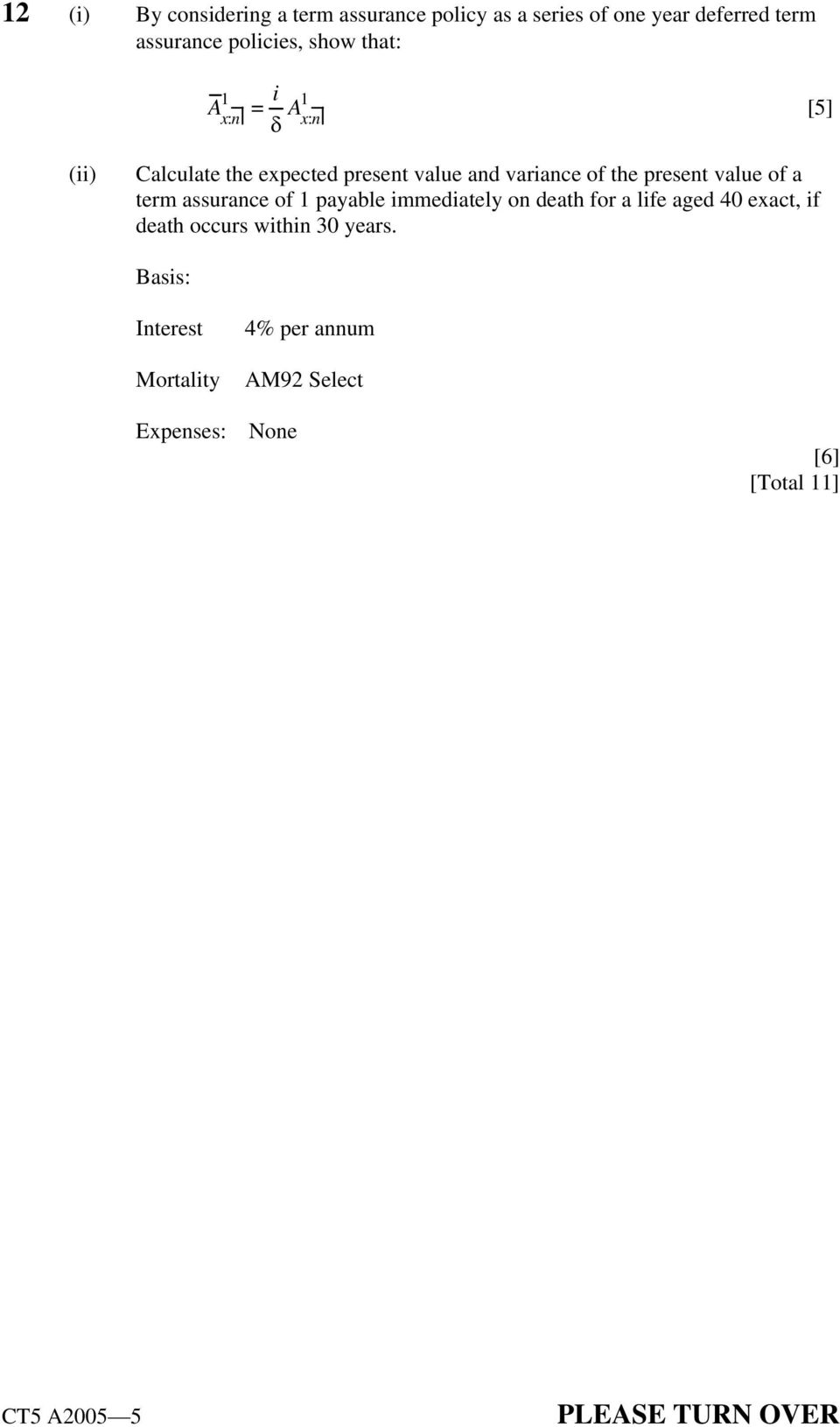
5 12 (i) By considering a term assurance policy as a series of one year deferred term assurance policies, show that: i A A [5] 1 1 = x: n x: n (ii) Calculate the expected present value and variance of the present value of a term assurance of 1 payable immediately on death for a life aged 40 exact, if death occurs within 30 years. Basis: Interest Mortality Expenses: 4% per annum AM92 Select None [6] [Total 11] CT5 A PLEASE TURN OVER
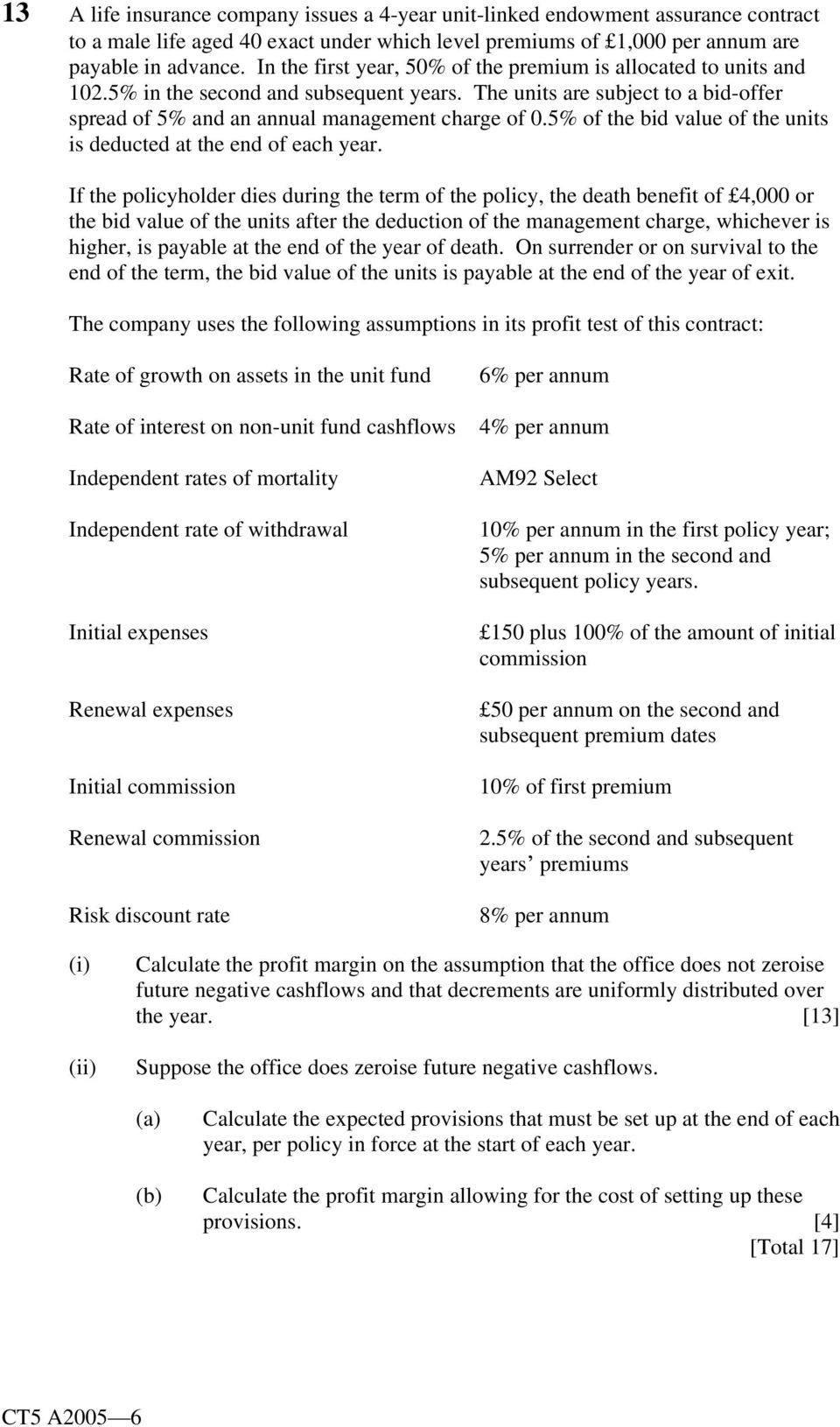
6 13 A life insurance company issues a 4-year unit-linked endowment assurance contract to a male life aged 40 exact under which level premiums of 1,000 per annum are payable in advance. In the first year, 50% of the premium is allocated to units and 102.5% in the second and subsequent years. The units are subject to a bid-offer spread of 5% and an annual management charge of 0.5% of the bid value of the units is deducted at the end of each year. If the policyholder dies during the term of the policy, the death benefit of 4,000 or the bid value of the units after the deduction of the management charge, whichever is higher, is payable at the end of the year of death. On surrender or on survival to the end of the term, the bid value of the units is payable at the end of the year of exit. The company uses the following assumptions in its profit test of this contract: Rate of growth on assets in the unit fund Rate of interest on non-unit fund cashflows Independent rates of mortality Independent rate of withdrawal Initial expenses Renewal expenses Initial commission Renewal commission Risk discount rate 6% per annum 4% per annum AM92 Select 10% per annum in the first policy year; 5% per annum in the second and subsequent policy years. 150 plus 100% of the amount of initial commission 50 per annum on the second and subsequent premium dates 10% of first premium 2.5% of the second and subsequent years premiums 8% per annum (i) (ii) Calculate the profit margin on the assumption that the office does not zeroise future negative cashflows and that decrements are uniformly distributed over the year. [13] Suppose the office does zeroise future negative cashflows. (a) (b) Calculate the expected provisions that must be set up at the end of each year, per policy in force at the start of each year. Calculate the profit margin allowing for the cost of setting up these provisions. [4] [Total 17] CT5 A2005 6
7 14 (i) Write down in the form of symbols, and also explain in words, the expressions death strain at risk, expected death strain and actual death strain. [6] (ii) A life insurance company issues the following policies: 15-year term assurances with a sum assured of 150,000 where the death benefit is payable at the end of the year of death 15-year pure endowment assurances with a sum assured of 75,000 5-year single premium temporary immediate annuities with an annual benefit payable in arrear of 25,000 On 1 January 2002, the company sold 5,000 term assurance policies and 2,000 pure endowment policies to male lives aged 45 exact and 1,000 temporary immediate annuity policies to male lives aged 55 exact. For the term assurance and pure endowment policies, premiums are payable annually in advance. During the first two years, there were fifteen actual deaths from the term assurance policies written and five actual deaths from each of the other two types of policy written. (a) Calculate the death strain at risk for each type of policy during (b) During 2004, there were eight actual deaths from the term assurance policies written and one actual death from each of the other two types of policy written. Calculate the total mortality profit or loss to the office in the year Basis: Interest Mortality 4% per annum AM92 Ultimate for term assurances and pure endowments PMA92C20 for annuities [13] [Total 19] END OF PAPER CT5 A2005 7

8 Faculty of Actuaries Institute of Actuaries EXAMINATION April 2005 Subject CT5 Contingencies Core Technical EXAMINERS REPORT Introduction The attached subject report has been written by the Principal Examiner with the aim of helping candidates. The questions and comments are based around Core Reading as the interpretation of the syllabus to which the examiners are working. They have however given credit for any alternative approach or interpretation which they consider to be reasonable. M Flaherty Chairman of the Board of Examiners 15 June 2005 Faculty of Actuaries Institute of Actuaries

9 Subject CT5 (Contingencies Core Technical) April 2005 Examiners Report 1 The profit vector is the vector of expected end-year profits for policies which are still in force at the start of each year. The profit signature is the vector of expected end-year profits allowing for survivorship from the start of the contract. 1 A 50:20 2 (a) ä 50:20 d (b) 50: A A v p (1 A ) ( ) ä 50: d 3 (a) ' t t x t x t t 1 ( V OP e )(1 i) q ( S) p ( V ) ' where ' t V gross premium provision at time t OP = office premium et expenses incurred at time t i = interest rate in premium/valuation basis S = sum assured p x t is the probability that a life aged x + t survives one year on the premium/valuation mortality basis x t q is the probability that a life aged x + t dies within one year on the premium/valuation mortality basis Page 2

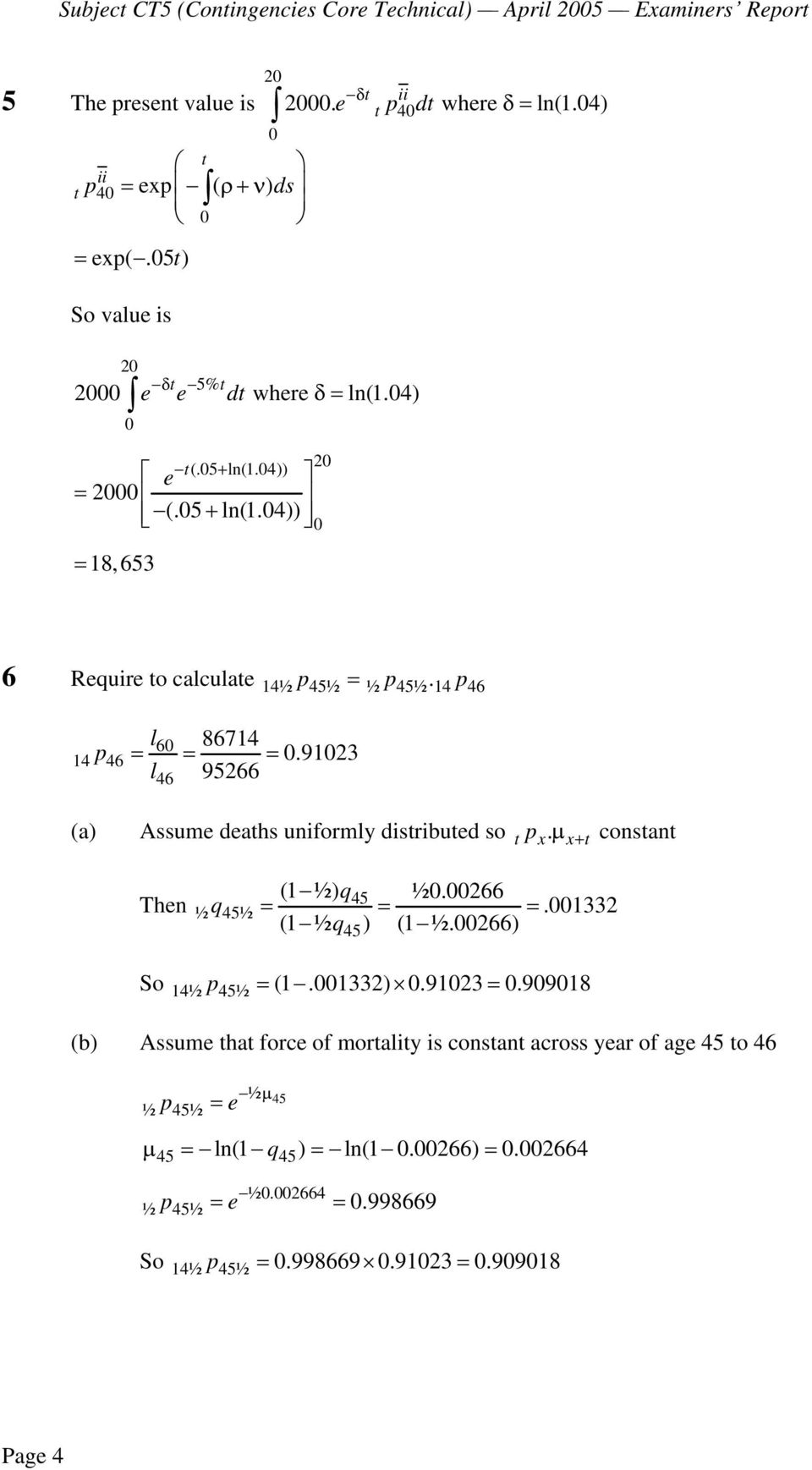
10 Subject CT5 (Contingencies Core Technical) April 2005 Examiners Report (b) Income (opening provision plus interest on excess of premium over expense, and provision) equals outgo (death claims and closing provision for survivors) if assumptions are borne out. 4 The value of a pension of 1 p.a. is (12) (12) ä ä where first term is an annuity certain (12) 10 ä 10 1 v (12) d (12) (12) (12) 10 (12) 10 ä60 ä60 ä v 60:10 10 p60ä70 p ä (12) 70 ä 70 11/ / So value of a pension of 1 p.a. is v = So annuity purchased by 200,000 is / = 16,948 Page 3
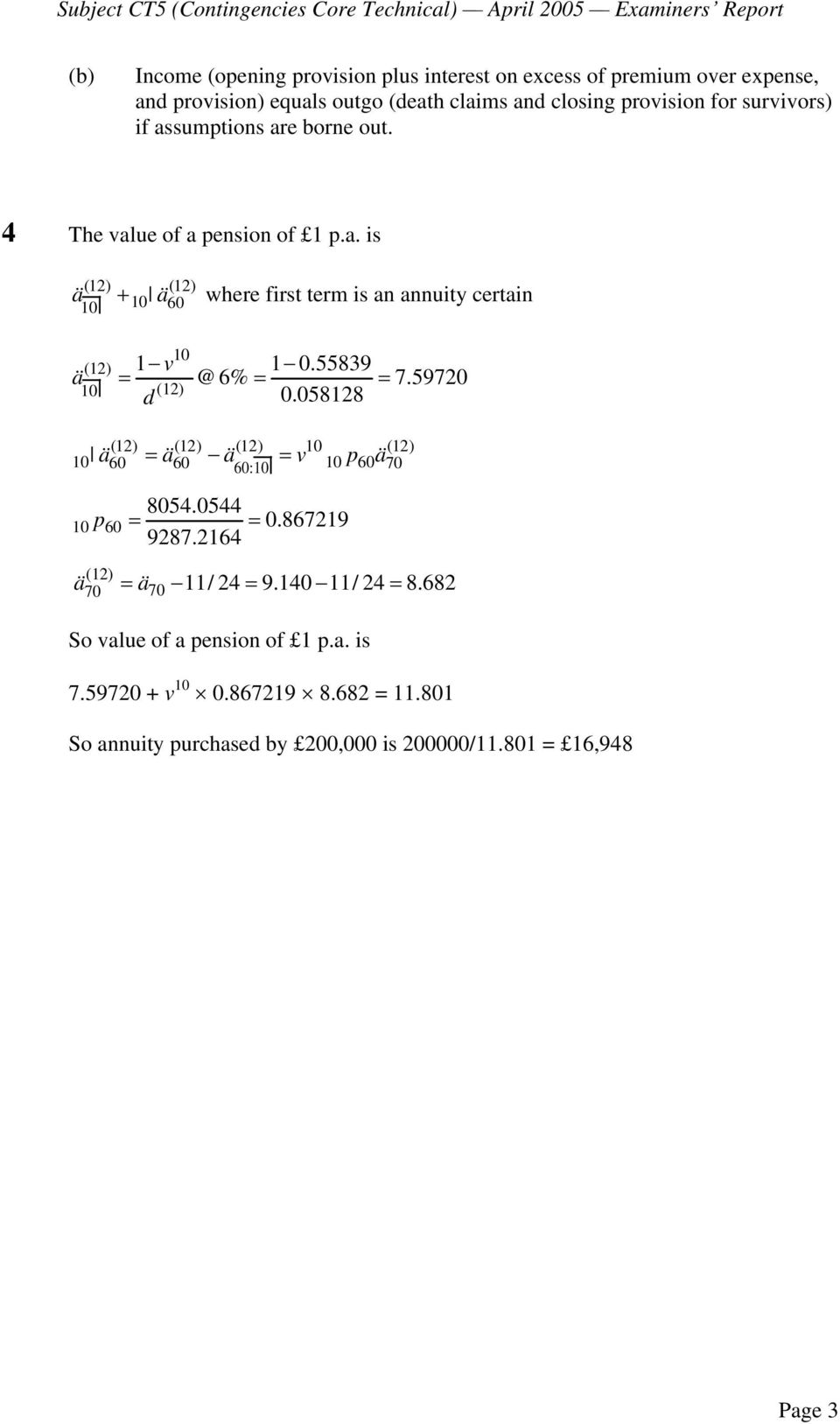
11 Subject CT5 (Contingencies Core Technical) April 2005 Examiners Report 5 The present value is ii t p 40 exp(.05 t) So value is 20 0 t exp ( ) ds 0 t t ii e p dt where ln(1.04) 20 0 t 5% t 2000 e e dt where ln(1.04) , 653 t(.05 ln(1.04)) e (.05 ln(1.04)) Require to calculate 14½ p 45½ ½ p 45½. 14 p 46 p l l (a) Assume deaths uniformly distributed so t p x. x t constant (1 ½) q45 ½ Then ½ q45½ (1 ½ q ) (1 ½.00266) So 14½ p 45½ ( ) (b) Assume that force of mortality is constant across year of age 45 to 46 ½ p 45½ e ½ 45 ln(1 q ) ln( ) ½ p 45½ e ½ So 14½ p 45½ Page 4
12 Subject CT5 (Contingencies Core Technical) April 2005 Examiners Report 7 Define a random variable T xy, the lifetime of the joint life status The expected value at a rate of interest i is a xy E( a ) T xy E 1 v T xy T xy 1 E( v ) 1 A xy The variance is var 1 v Txy 1 T var( xy v ) ( Axy ( Axy ) ) 2 2 Axy i where is at (1 ) 1 8 Past Service or t ½ i35 t v z35 t ½ a t ½ t 0 l35 v s z s M D ia Page 5

13 Subject CT5 (Contingencies Core Technical) April 2005 Examiners Report Future Service z ia M35 z ia R45 s D35 s D Insurance works on the basis of pooling independent homogeneous risks The central limit theorem then implies that profit can be defined as a random variable having a normal distribution. Life insurance risks are usually independent Risk classification ensures that the risks are homogeneous Lives are divided by risk factors More factors implies better homogeneity But the collection of more factors is restricted by The cost of obtaining data Problems with accuracy of information The significance of the factors The desires of the marketing department Age band 10 Males Females Male Female Total Total Female Total Exposed Exposed Actual Actual Actual Exposed to risk to risk deaths deaths deaths to risk Observed Mortality rate Observed Mortality rate Expected deaths using total mortality rates Expected deaths using female rates Direct Indirect Page 6

14 Subject CT5 (Contingencies Core Technical) April 2005 Examiners Report 11 Let P be the monthly premium. Then: EPV of premiums: (12) [40]:25 12Pa P (12) a a [40]:25 [40]:25 (1 25 p[40] v ) (1.06) EPV of benefits: 100,000 (1.06) { (1 ) (1 ) (1 b) 1/ q[40] b v 1 q[40] b v q[40] b v 25 p[40] b v... (1 ) } 100,000 (1 ) where b = ,000 D (1 b) 1/ 2 1 ' 65 ' A i i [40]:25 D[40] 100, / 2 (1.06) ( ) 100, where ' 1.06 i b EPV of expenses: (12) (12) [40]:25 [40]: P P ( a a ) 65[ a 1] P [40]:25 (12) a a (1 p [40]:1 [40]:1 [40] v ) 1 1 (1.06) EPV of claim expense: = Page 7
![06) { (1 ) (1 ) (1 b) 1/ 2 2 2 q[40] b v 1 q[40] b v 25 25 25 25 24 q[40] b v 25 p[40] b v... (1 ) } 100,000 (1 ) where b = 0.0192308 100,000 D (1.](/docs-images/42/15978981/images/page_14.jpg "06) @ 100,000 @ (1 b) 1/ 2 1 ' 65 ' A i i [40]:25 D[40] 100, 000 1.0192308 1/ 2 (1.06) (.38896.33579) 100, 000.33579 38949.90 where ' 1.06 i 1 0.04 1 b EPV of expenses: (12) (12) [40]:25 [40]:1.")
15 Subject CT5 (Contingencies Core Technical) April 2005 Examiners Report Equation of value gives P = P and P = (i) A n : t A x n x:1 t 0 n t 1 0 v 1 x t:1 t 1 t p x A x t:1 1 0 s s x t x t s A v p ds Assuming a uniform distribution of deaths, then s p x t x t s q x t 1 x t:1 x t 1 1 s x t x t 0 0 A v q ds q v ds q iv s 1 x: n n 1 t iv A v. t p x. q x t t 0 i n 1 t 0 v t 1. t px. qx t i A 1 x: n Page 8
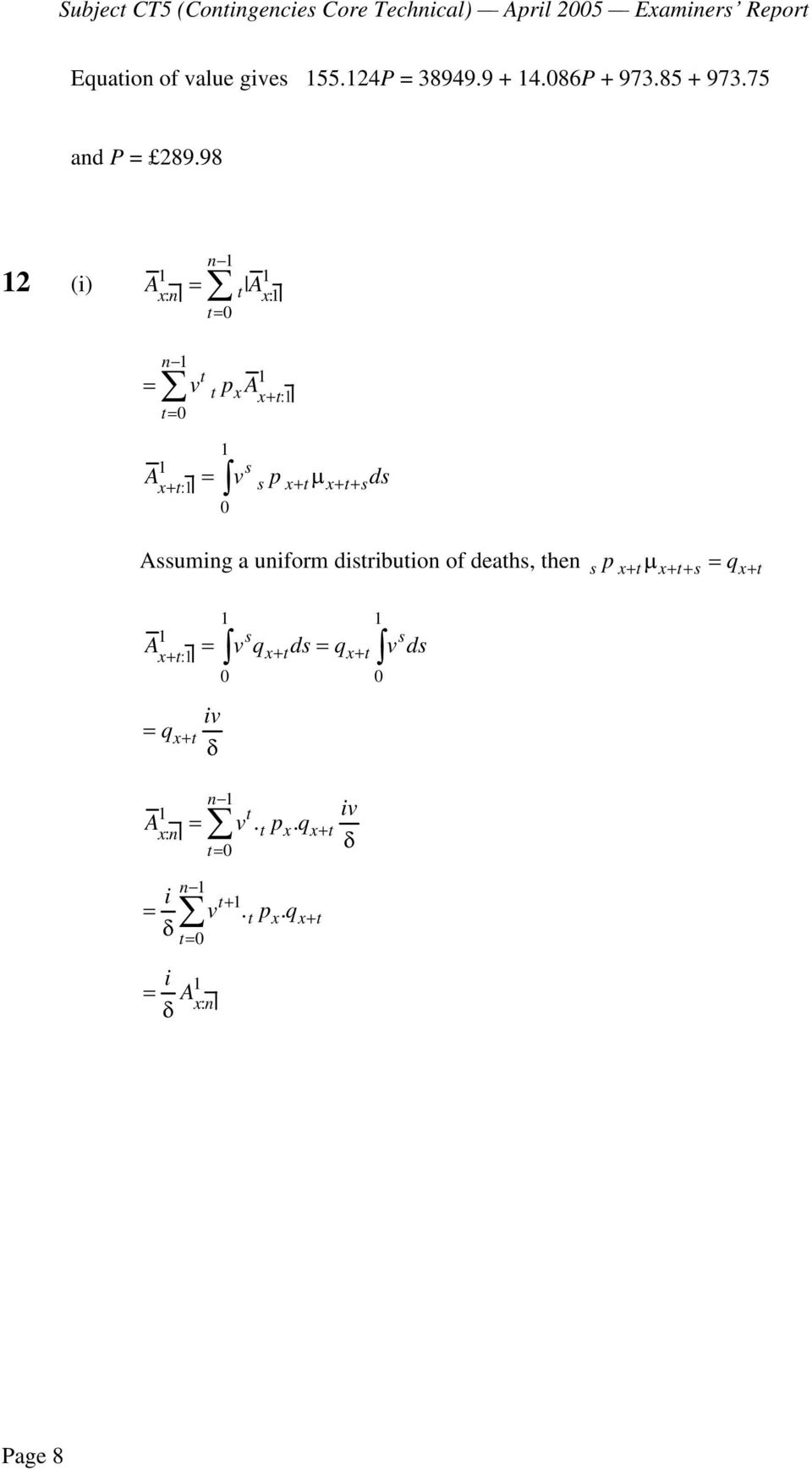
16 Subject CT5 (Contingencies Core Technical) April 2005 Examiners Report (ii) 1 i 1 i 2 1 x: n x: n x: n var( A ) var( A ) var( A ) i 2 2 A 1 A 1 2 x: n x: n ( ( ) ) : A A v p A v A A 40 v. 40 :30 30 p 40. A v where v = 1/ x: n var( A ) ( ( ) ) ln(1.04) Expected value = i A 1 [40]: ln(1.04) 13 Annual premium Allocation % (1st yr) Risk discount rate 8.0% Allocation % (2nd yr +) Interest on investments 6.0% Man charge Interest on sterling provisions 4.0% B/O spread Minimum death benefit % % 0.50% 5.0% % prm Total Initial expense % 350 Renewal expense % 75 Page 9
![04 2 x: n var( A ) (0.037469 (0.078970) ) 0.032486 ln(1.04) Expected value = i A 1 [40]:30 0.04 0.078970 0.080539 ln(1.04) 13 Annual premium 1000.00 Allocation % (1st yr) Risk discount rate 8.](/docs-images/42/15978981/images/page_16.jpg "0% Allocation % (2nd yr +) Interest on investments 6.0% Man charge Interest on sterling provisions 4.0% B/O spread Minimum death benefit 4000.00 50.0% 102.50% 0.50% 5.")
17 Subject CT5 (Contingencies Core Technical) April 2005 Examiners Report (i) Multiple decrement table x d q x s q x x ( aq ) d x ( aq ) s x ( ap) t 1 ( ap ) Unit fund (per policy at start of year) yr 1 yr 2 yr 3 yr 4 value of units at start of year alloc B/O interest management charge value of units at year end Page 10
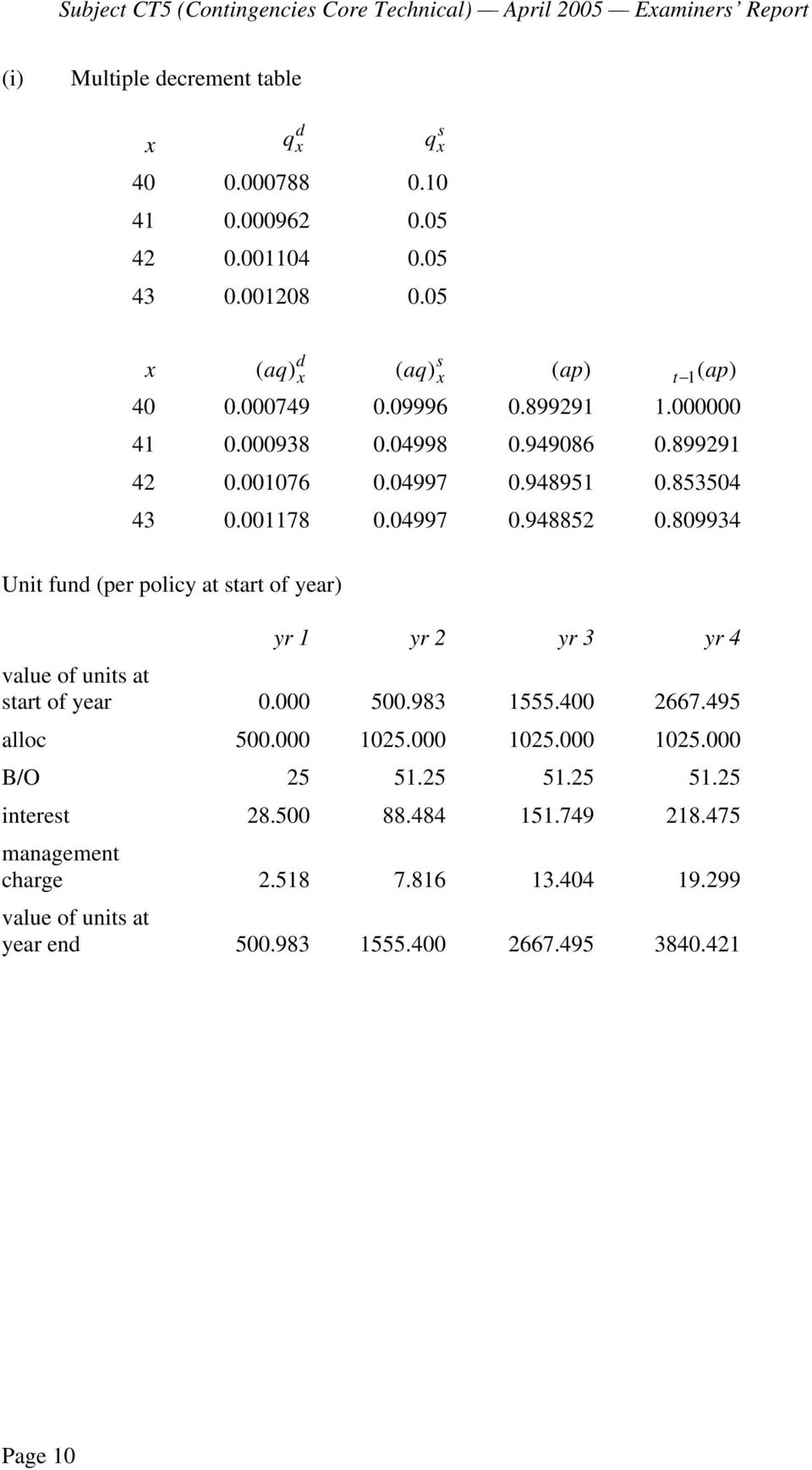
18 Subject CT5 (Contingencies Core Technical) April 2005 Examiners Report Cash flows (per policy at start of year) yr 1 yr 2 yr 3 yr 4 unallocated premium B/O spread expenses interest man charge extra death benefit end of year cashflow probability in force discount factor expected p.v. of profit premium signature expected p.v. of premiums profit margin 2.76% (ii) (a) To calculate the expected provisions at the end of each year we have (utilising the end of year cashflow figures and decrement tables in (i) above): V V (1.04) ( ap) V V V (1.04) ( ap) V V Page 11
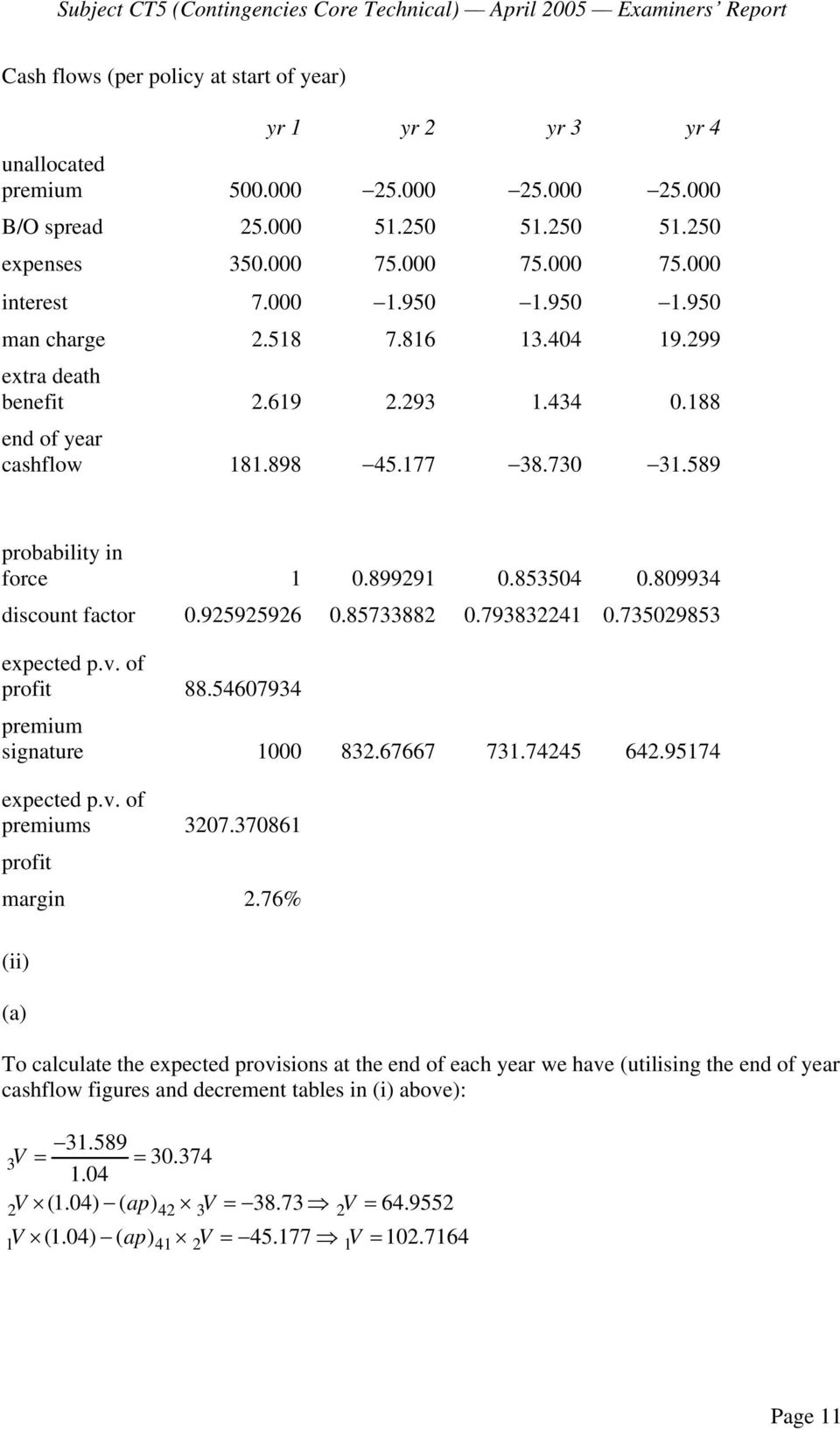
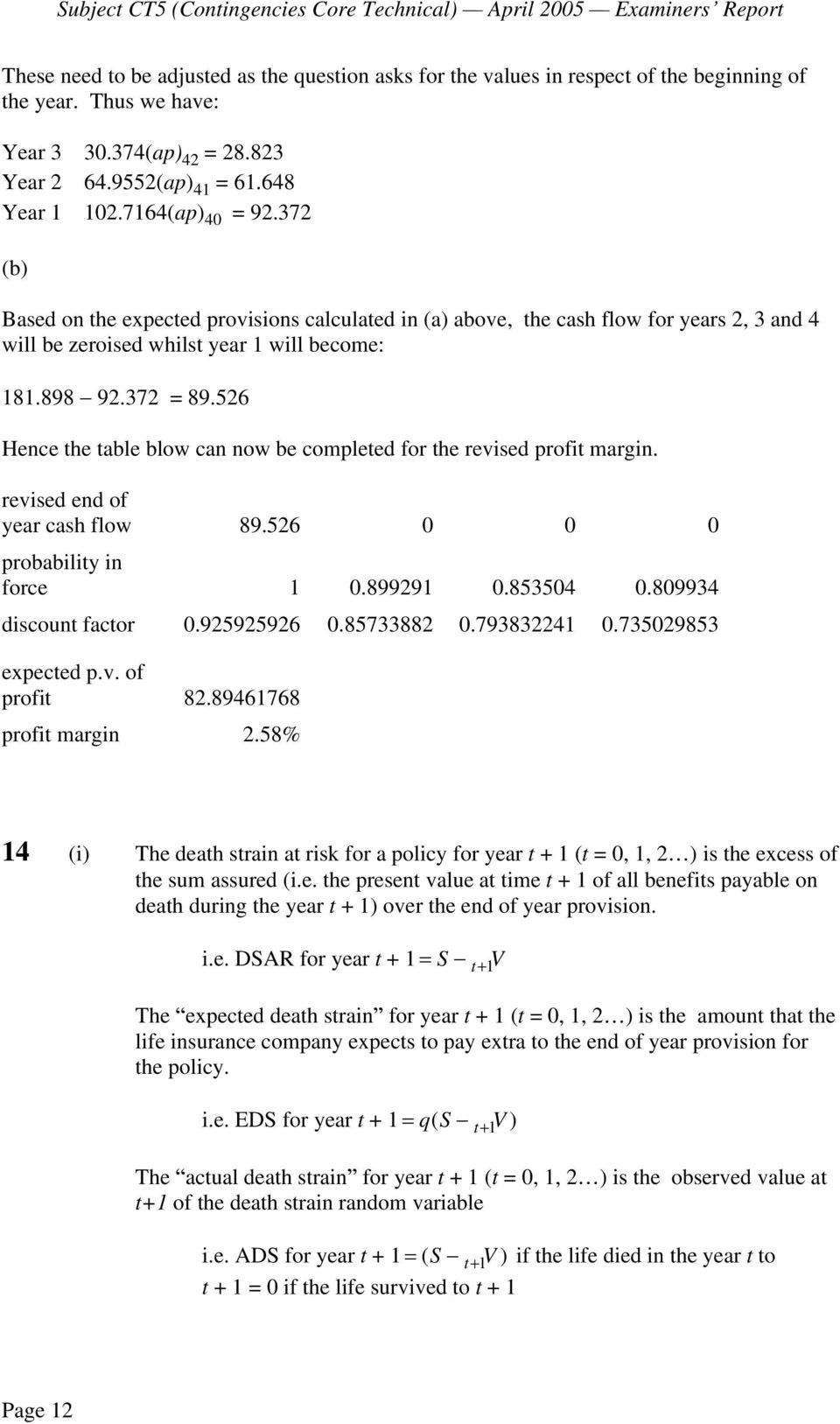
19 Subject CT5 (Contingencies Core Technical) April 2005 Examiners Report These need to be adjusted as the question asks for the values in respect of the beginning of the year. Thus we have: Year (ap) 42 = Year (ap) 41 = Year (ap) 40 = (b) Based on the expected provisions calculated in (a) above, the cash flow for years 2, 3 and 4 will be zeroised whilst year 1 will become: = Hence the table blow can now be completed for the revised profit margin. revised end of year cash flow probability in force discount factor expected p.v. of profit profit margin 2.58% 14 (i) The death strain at risk for a policy for year t + 1 (t = 0, 1, 2 ) is the excess of the sum assured (i.e. the present value at time t + 1 of all benefits payable on death during the year t + 1) over the end of year provision. i.e. DSAR for year t + 1 S t 1V The expected death strain for year t + 1 (t = 0, 1, 2 ) is the amount that the life insurance company expects to pay extra to the end of year provision for the policy. i.e. EDS for year t + 1 q( S t 1V ) The actual death strain for year t + 1 (t = 0, 1, 2 t+1 of the death strain random variable ) is the observed value at i.e. ADS for year t + 1 ( S t 1V ) if the life died in the year t to t + 1 = 0 if the life survived to t + 1 Page 12
20 Subject CT5 (Contingencies Core Technical) April 2005 Examiners Report (ii) Annual premium for pure endowment with 75,000 sum assured given by: P PE 75, 000 D60 75, a D : Annual premium for term assurance with 150,000 sum assured given by: 150, 000A P P 2P 2P a TA EA PE 45:15 PE 45:15 150, Provisions at the end of the third year: for pure endowment with 75,000 sum assured given by: D PE 60 PE 3V 75, 000 P a D 48: , for term assurance with 150,000 sum assured given by: TA EA PE 3V 3V 3V 150, 000 A ( ) a :12 48:12 150, , , for temporary immediate annuity paying an annual benefit of 25,000 given by: IA 3V 25, 000a 58:2 25, 000( a 1) 58: , 000( a v p a 1) , (1.04) , Page 13

21 Subject CT5 (Contingencies Core Technical) April 2005 Examiners Report Sums at risk: Pure endowment: DSAR = 0 11, = 11, Term assurance: DSAR = 150, = 149, Immediate annuity: DSAR = (47, ,000) = 72, Mortality profit = EDS ADS For term assurance EDS ADS 4985 q 149, , ,340, , ,193, mortality profit = 146, For pure endowment EDS ADS 1995 q 11, , , , , mortality profit = 29, For immediate annuity EDS ADS 995 q 72, , , , , mortality profit = 39, Hence, total mortality profit = 77, END OF EXAMINERS REPORT Page 14
22 Faculty of Actuaries Institute of Actuaries EXAMINATION 7 September 2005 (pm) Subject CT5 Contingencies Core Technical Time allowed: Three hours INSTRUCTIONS TO THE CANDIDATE 1. Enter all the candidate and examination details as requested on the front of your answer booklet. 2. You must not start writing your answers in the booklet until instructed to do so by the supervisor. 3. Mark allocations are shown in brackets. 4. Attempt all 13 questions, beginning your answer to each question on a separate sheet. 5. Candidates should show calculations where this is appropriate. Graph paper is not required for this paper. AT THE END OF THE EXAMINATION Hand in BOTH your answer booklet, with any additional sheets firmly attached, and this question paper. In addition to this paper you should have available the 2002 edition of the Formulae and Tables and your own electronic calculator. CT5 S2005 Faculty of Actuaries Institute of Actuaries
23 1 Describe what is meant by adverse selection in the context of a life insurance company s underwriting process and give an example. [2] 2 Describe how occupation affects morbidity and mortality. [3] 3 A graph of f 0 (t), the probability density function for the random future lifetime, T 0, is plotted on the vertical axis, with t plotted on the horizontal axis, for data taken from the English Life Table No. 15 (Males). You are given that f 0 (t) = t p 0 t 80 and then falls. t. You observe that the graph rises to a peak at around Explain why the graph falls at around t 80. [3] 4 Calculate the value of 1.75 p 45.5 on the basis of mortality of AM92 Ultimate and assuming that deaths are uniformly distributed between integral ages. [3] 5 A population is subject to a constant force of mortality of Calculate: (a) (b) The probability that a life aged 20 exact will die before age exact. The curtate expectation of a life aged 20 exact. [4] (12) 6 Define ä fully in words and calculate its value using PMA92C20 and 60:50:20 PFA92C20 tables for the two lives respectively at 4% interest. [5] CT5 S2005 2
24 7 A life insurance company prices its long-term sickness policies using the following three-state continuous-time Markov model, in which the forces of transition,, and are assumed to be constant: Healthy Sick Dead The company issues a particular long-term sickness policy with a benefit of 10,000 per annum payable continuously while sick, provided that the life has been sick continuously for at least one year. Benefit payments under this policy cease at age 65 exact. Write down an expression for the expected present value of the sickness benefit for a healthy life aged 20 exact. Define the symbols that you use. [5] 8 A life insurance company issues an annuity contract to a man aged 65 exact and his wife aged 62 exact. Under the contract, an annuity of 20,000 per annum is guaranteed payable for a period of 5 years and thereafter during the lifetime of the man. On the man s death, an annuity of 10,000 per annum is payable to his wife, if she is then alive. This annuity commences on the monthly payment date next following, or coincident with, the date of his death or from the 5 th policy anniversary, if later and is payable for the lifetime of his wife. Annuities are payable monthly in advance. Calculate the single premium required for the contract. Basis: Mortality PMA92C20 for the male and PFA92C20 for the female Interest 4% per annum Expenses none [9] CT5 S PLEASE TURN OVER
25 9 A life insurance company issues an annuity policy to two lives each aged 60 exact in return for a single premium. Under the policy, an annuity of 10,000 per annum is payable annually in advance while at least one of the lives is alive. (i) (ii) Write down an expression for the net future loss random variable at the outset for this policy. [2] Calculate the single premium, using the equivalence principle. Basis: Mortality PMA92C20 for the first life, PFA92C20 for the second life Interest 4% per annum Expenses ignored [3] (iii) Calculate the standard deviation of the net future loss random variable at the outset for this policy, using the basis in part (ii). You are given that a 60:60 = at a rate of interest 8.16% per annum. [4] [Total 9] CT5 S2005 4
26 10 A life insurance company issued a with profits whole life policy to a life aged 20 exact, on 1 July Under the policy, the basic sum assured of 100,000 and attaching bonuses are payable immediately on death. The company declares simple reversionary bonuses at the start of each year. Level premiums are payable annually in advance under the policy. (i) (ii) Give an expression for the gross future loss random variable under the policy at the outset. Define symbols where necessary. [3] Calculate the annual premium, using the equivalence principle. Basis: Mortality Interest Bonus loading AM92 Select 6% per annum 3% simple per annum Expenses Initial 200 Renewal 5% of each premium payable in the second and subsequent years Assume bonus entitlement earned immediately on payment of premium. [4] (iii) On 30 June 2005 the policy is still in force. A total of 10,000 has been declared as a simple bonus to date on the policy. The company calculates provisions for the policy using a gross premium prospective basis, with the following assumptions: Mortality AM92 Ultimate Interest 4% Bonus loading 4% per annum simple Renewal expenses 5% of each premium Calculate the provision for the policy as at 30 June [4] [Total 11] CT5 S PLEASE TURN OVER
27 11 A life insurance company issues a three-year unit-linked endowment assurance contract to a male life aged 62 exact under which level annual premiums of 10,000 are payable in advance throughout the term of the policy or until earlier death. 85% of each year s premium is invested in units at the offer price. There is a bid-offer spread in unit values, with the bid price being 95% of the offer price. There is an annual management charge of 1.25% of the bid value of units. Management charges are deducted at the end of each year, before death or maturity benefits are paid. On the death of the policyholder during the term of the policy, there is a benefit payable at the end of the year of death of 20,000, or the bid value of the units allocated to the policy, if greater. On maturity, 115% of the full bid value of the units is payable. The company holds unit provisions equal to the full bid value of the units. It sets up non-unit provisions to zeroise any negative non-unit fund cashflows, other than those occurring in the first year. The life insurance company uses the following assumptions in carrying out profit tests of this contract: Mortality AM92 Ultimate Expenses Initial 600 Renewal 100 at the start of each of the second and third policy years Unit fund growth rate Non-unit fund interest rate Non-unit fund provision basis Risk discount rate 8% per annum 4% per annum AM92 Ultimate mortality, interest 4% per annum 15% per annum Calculate the profit margin on the contract. [14] CT5 S2005 6
28 12 On 1 January 2000, a life insurance company issued joint life whole life assurance policies to couples. Each couple comprised one male and one female life and both were aged 50 exact on 1 January Under each policy, a sum assured of 200,000 is payable immediately on the death of the second of the lives to die. Premiums under each policy are payable annually in advance while at least one of the lives is alive. (i) Calculate the annual premium payable under each policy. Basis: Mortality Interest PMA92C20 for the male PFA92C20 for the female 4% per annum Expenses Initial 1,000 Renewal 5% of each premium payment [5] (ii) On I January 2004, 5,000 of these policies were still in force. Under 100 of these policies only the female life was alive. Both lives were alive under the other 4,900 policies. The company calculates provisions for the policies on a net premium basis, using PMA92C20 and PFA92C20 mortality for the male and female lives respectively and 4% per annum interest. During the calendar year 2004, there was one claim for death benefit, in respect of a policy where the female life only was alive at the start of the year. In addition, one male life died during the year under a policy where both lives were alive at the start of the year. 4,999 of the policies were in force at the end of the year. Calculate the mortality profit or loss for the group of 5,000 policies for the calendar year [9] [Total 14] CT5 S PLEASE TURN OVER
29 13 Under the rules of a pension scheme, a member may retire due to age at any age from exact age 60 to exact age 65. On age retirement, the scheme provides a pension of 1/60 th of Final Pensionable Salary for each year of scheme service, subject to a maximum of 40/60 ths of Final Pensionable Salary. Only complete years of service are taken into account. Final Pensionable Salary is defined as the average salary over the three-year period before the date of retirement. The pension scheme also provides a lump sum benefit of four times Pensionable Salary on death before retirement. The benefit is payable immediately on death and Pensionable Salary is defined as the annual rate of salary at the date of death. You are given the following data in respect of a member: Date of birth 1 January 1979 Date of joining the scheme 1 January 2000 Annual rate of salary at 1 January ,000 Date of last salary increase 1 April 2004 (i) (ii) Derive commutation functions to value the past service and future service pension liability on age retirement for this member as at 1 January State any assumptions that you make and define all the symbols that you use. [12] Derive commutation functions to value the liability in respect of the lump sum payable on death before retirement for this member as at 1 January State any assumptions that you make and define all the symbols that you use. [6] [Total 18] END OF PAPER CT5 S2005 8
30 Faculty of Actuaries Institute of Actuaries EXAMINATION September 2005 Subject CT5 Contingencies Core Technical EXAMINERS REPORT Faculty of Actuaries Institute of Actuaries
31 Subject CT5 (Contingencies Core Technical) September 2005 Examiners Report In general, this examination was done well by students who were well prepared. Several questions gave difficulties particularly Question 7 and 12(ii) the latter one being very challenging. To help students comments are attached to those questions where particular points are of relevance. Absence of comments can be indicate that the particular question was generally done well. 1 Adverse selection is the manner in which lives form part of a group, which acts against a controlled process of selecting the lives with respect to some characteristic that affects mortality or morbidity. An example is where a life insurance company does not distinguish between smokers and non-smokers in proposals for term assurance cover. A greater proportion of smokers are likely to select this company in preference to a company that charges different rates to smokers and non-smokers. This would be adverse to the company s selection process, if the company had assumed that its proportion of smokers was similar to that in the general population. Other examples were credited. 2 Occupation can have several direct effects on mortality and morbidity. Occupation determines a person s environment for 40 or more hours each week. The environment may be rural or urban, the occupation may involve exposure to harmful substances e.g. chemicals, or to potentially dangerous situations e.g. working at heights. Much of this is moderated by health and safety at work regulations. Some occupations are more healthy by their very nature e.g. bus drivers have a sedentary and stressful occupation while bus conductors are more active and less stressed. Some work environments e.g. pubs, give exposure to a less healthy lifestyle. Some occupations by their very nature attract more healthy workers. This may be accentuated by health checks made on appointment or by the need to pass regular health checks e.g. airline pilots. Some occupations can attract less healthy workers, for example, former miners who have left the mining industry as a result of ill health and then chosen to sell newspapers. This will inflate the mortality rates of newspaper sellers. A person s occupation largely determines their income, which permits them to adopt a particular lifestyle e.g. content and pattern of diet, quality of housing. This effect can be positive or negative e.g. over-indulgence. Other appropriate examples were credited. 3 As t increases, t increases, but t p 0 decreases. At t = 80 approximately, the decrease in t p 0 is greater than the increase in t, hence f0 t t p 0 t decreases. A deceptively straightforward answer which many students struggled to find. The key point is to compare the 2 parameters as shown. Page 2
32 Subject CT5 (Contingencies Core Technical) September 2005 Examiners Report p p45.5 * p46 * 0.25 p47 1 q q 45 *(1 q )*( q ) *( )*(1 0.25* ) 1 0.5* * * (a) The required probability is dt e 1 e (b) The curtate expectation is k dt k e k p20 e e k 1 k 1 k 1 1 e (12) ä is the present value of 1 p.a. payable monthly in advance while two lives 60:50:20 aged 60 and 50 are both still alive, for a maximum period of 20 years. (12) (12) 20 (12) 60:50:20 60: :50 80:70 ä ä v p ä 20 ( a 11 60:50 ) v p60:50 ( a80:70 ) ( ) v ( ) Page 3
33 Subject CT5 (Contingencies Core Technical) September 2005 Examiners Report t 1 0 t t 1 20 t 0 u 21 t hh ss t u ss 7 EPV = 10,000 p * * p * e p du dt where is the force of interest t 20 hh p is the probability of a healthy life aged 20 being healthy at age 20 t 1 p20 ss t is the probability that a life who is sick at age 20 t is sick continuously for one year thereafter u 21 ss t p is the probability that a life who is sick at age 21 t is still sick at age 21 t u This question was not done well and few students obtained the whole result. Partial credits were given for correct portions. There were other potentially correct approaches which were credited provided proper definitions of symbols given. 8 Premium = 20, 000 D 10, l D l D a a a a D65 l65 D62 l65 D62 a 12 5 D D v a l l a D D v ) 67 70:67 a a a ( ) ( ) Premium = 265, , = 300,308 to nearer Page 4
34 Subject CT5 (Contingencies Core Technical) September 2005 Examiners Report 9 (i) 10, 000a A B max K60 1, K60 1 and P is the single premium. P, where A and B refer to the first and second lives A B A B (ii) P 10, 000 a60 a60 a60 * a 60 10,000* ,940 Variance = 10 d A 2 A B A A B 60 :60 60 : * * * standard deviation = 22, (i) The gross future loss random variable is 100,000 1 T20 T K20 1 K20 1 bk v I ea fv Ga where b is the annual rate of bonus I is the initial expense e is the annual renewal expense and f is the claim expense G is the gross annual premium (ii) The premium is given by Ga 20,000A 20 3,000 IA Ga G * ,000 *1.06 * ,000 *1.06 * G *( ) 1] G G Page 5
35 Subject CT5 (Contingencies Core Technical) September 2005 Examiners Report (iii) The required provision is 110,000A a 23 4,000 IA * * ,000 *1.04 * *684.49* ,000* * , , , , Unit fund Year Fund at the start of the year Premium Allocation to units Interest Management charge Fund at the end of the year Non-unit fund before provisions Year Premium margin Expenses Interest Death cost Maturity cost Management charge Profit Provision required at the start of year 3 = ( (1 p 64 )) / 1.04 = Reduced profit at the end of year 2 = *p 63 = Page 6
36 Subject CT5 (Contingencies Core Technical) September 2005 Examiners Report Revised profit vector: , ,0 p p * p62 Net Present Value = p62 2 p62 Present value of premiums = 10000* Profit margin = % Most students completed the tables satisfactorily in this question but struggled to get the revised profit vectors. Very few produced a complete result. 12 (i) Let P be the annual premium. 0.95* P* a * A m f m f 50 :50 50 :50 a a a a m f 50 :50 m f m f : m f m f m f 50 :50 50 :50 50 :50 A 1.04 * A 1.04 *(1 d * a ) *( *20.694) * P* * P 2, (ii) From part (i) the net premium is: * (1.04) * a 1 m f 50 :50 d at 4% = * (1.04) * = We require 3 provisions at end of 5 th policy year Page 7
37 Subject CT5 (Contingencies Core Technical) September 2005 Examiners Report Both lives alive * (1.04) * 1 a 0.5 m f 55 :55 a m f 50 :50 = * (1.04) = Male only alive A a m m = * (1.04) * 1 * * = Female only alive A a f f = * (1.04) * 1 * * = Mortality Profit Loss = Expected Death Strain Actual Death Strain In this case there are 4 components: (a) Both lives die during 2004 no actual claims Result = 0.5 (4900 * q m * q f 0)( * ) = (4900 * * ) ( ) = (b) Female alive at begin 2004, death during actual claim Result = 0.5 (100 * q f 1)( * ) 54 Page 8
38 Subject CT5 (Contingencies Core Technical) September 2005 Examiners Report = (100 * ) ( ) = (c) Both lives alive beginning 2004, males only die during actual claim. Here the claim cost is the change in provision from joint lives to female only surviving i.e. Result = (4900 * q * q 1)( ) m f = (4900 * * ) ( ) = (d) Both lives alive beginning 2004, females only die during 2004 no actual claims. Claim cost change in provision from joint lives to male only surviving Result = (4900 * p * q 0)( ) m f = (4900 * * ) ( ) = Hence overall total = = i.e. a mortality loss of when rounded. For part (i) assuming renewal expenses did not include the first premium (answer ) was also fully acceptable. Part (ii) was very challenging and very few students realised the extension of mortality profit/loss extended to joint life contracts involved reserve change costs on first death. Most just considered the first 2 components of the answer and in many cases failed to correctly cost this part. A few exceptional students did manage to reach the final result. 13 (i) Define a service table: l 26 t = no. of members aged 26 + t last birthday r 26 t = no. of members who retire age 26 + t last birthday sx t / s x = ratio of earnings in the year of age x + t to x + t + 1 to the earnings in the year of age x to x + 1 Page 9
39 Subject CT5 (Contingencies Core Technical) September 2005 Examiners Report 1 r Define z26 t s26 t 3 s26 t 2 s26 t 1 ; a 26 t = value of annuity of 1 p.a. 3 to a retiree aged exactly 26 + t. Past service: Assume that retirements take place uniformly over the year of age between 60 and 65. Retirement for those who attain age 65 takes place at exact age 65. Consider retirement between ages 26 + t and 26 + t + 1, 34 t 38. The present value of the retirement benefits related to past service: 50000*5 z r 50000*5 C t 2 z ra 26 t v 26 t r 26 t a t s 2 s v l26 D26 where z ra 26 t 1 2 r C26 t z26 t 1 v r26 ta t 2 and s 26 D26 s25.25v l 26 For retirement at age 65, the present value of the benefits is: z 65 z ra 65 v r 65 r 65 a C s v l26 D * *5 60 s 60 where z ra 65 r C65 z65v r65 a 65 Summing over all ages, the value is: 50000*5 60 z s M D ra where 39 z ra z ra M60 C26 t t 34 Future service: Assume that retirements take place uniformly over the year of age, between ages 60 and 65. Retirement at 65 takes place at exactly age 65. If retirement takes place between ages 60 and 61, the number of future years service to count is 34. If retirement takes place at age 61 or after, the number of future years service to count is 35. For retirement between ages 60 and 61, the present value of the retirement benefits is: Page 10
40 Subject CT5 (Contingencies Core Technical) September 2005 Examiners Report 34*50000 z r 34*50000 C 60 s z ra 60 v 60 i 60 a s v l26 D26 For retirement at later years, the formula is similar to the above, with 35 in place of 34. Adding all these together gives: z ra 60 35( z ra z ra C C C s 65 ) 60 D z ra = M s D 26 where z 5 M60 ra 35* z C60 ra t z C60 ra t 0 (ii) Define a service table, with l 26 t and sx t / s x defined as in part (i). In addition, define d 26 t as the number of members dying age 26 t last birthday. Assume that deaths take place on average in the middle of the year of age. The present value of the death benefit, for death between ages t 1, is t and 26 t t v 26 t s 26 d t s 26 s v l26 D * 4* s d 50000* 4* C where s d 26 t 1 C 2 26 t s26.25 t v d26 t Adding the present value of benefits for all possible years of death gives 38 s C26 d t s M 26 d s s t 0 D26 D * 4* * where 38 s d s d M 26 C26 t t 0 Examiners felt that this question was quite simple provided students constructed proper definitions and followed them through logically allowing of course for the adjusted salary scale. The above answer is one of a number possible and full credit was given for credible alternatives. Page 11
41 Subject CT5 (Contingencies Core Technical) September 2005 Examiners Report Many students, however struggled with this question despite these remarks. END OF EXAMINERS REPORT Page 12
42 Faculty of Actuaries Institute of Actuaries EXAMINATION 5 April 2006 (pm) Subject CT5 Contingencies Core Technical Time allowed: Three hours INSTRUCTIONS TO THE CANDIDATE 1. Enter all the candidate and examination details as requested on the front of your answer booklet. 2. You must not start writing your answers in the booklet until instructed to do so by the supervisor. 3. Mark allocations are shown in brackets. 4. Attempt all 14 questions, beginning your answer to each question on a separate sheet. 5. Candidates should show calculations where this is appropriate. Graph paper is not required for this paper. AT THE END OF THE EXAMINATION Hand in BOTH your answer booklet, with any additional sheets firmly attached, and this question paper. In addition to this paper you should have available the 2002 edition of the Formulae and Tables and your own electronic calculator. CT5 A2006 Faculty of Actuaries Institute of Actuaries
43 1 It is possible to model the mortality of current active members of a pension scheme using the following three-state continuous-time Markov model, with age-dependent forces of transition x, x and x : x Active Retired x x Dead A pension scheme provides a benefit of 10,000 payable on death regardless of whether death occurs before or after retirement. Give an expression to value this benefit for an active life currently aged x. [2] 2 (i) In the context of with-profit policies, describe the super compound method of adding bonuses. [2] (ii) Suggest a reason why a life insurance company might use the super compound method of adding bonuses as opposed to the compound method. [1] [Total 3] 3 Using the PMA92C20 table for both lives calculate: (a) 65:60 (b) 5 p 65:60 (c) 1 2q 65:65 [4] 4 State the main difference between an overhead expense and a direct expense incurred in writing a life insurance policy and give an example of each. [4] CT5 A2006 2
44 5 A life office issues term assurance policies to 500 lives all aged 30 exact with a term of 25 years. The benefit of 10,000 is payable at the end of the year of death of any of the lives into a special fund. Calculate the expected share of this fund for each survivor after 25 years. Basis: Mortality Interest AM92 Select 4% per annum [4] 6 A life office has issued for a number of years whole-life regular premium policies to a group of lives through direct advertising. Assured lives are only required to complete an application form with no further evidence of health. Outline the forms of selection that the insurer should expect to find in the mortality experience of the lives. [5] 7 (i) Show that: t p p ( ) s x t s x t x t x t s [2] (ii) Prove Thiele s differential equation for a whole-life assurance issued to a life aged x to be as follows: t V (1 V ) V Px t x t x x t t x [4] [Total 6] 8 (i) Calculate the expected present value of an annuity-due of 1 per annum payable annually in advance until the death of the last survivor of two lives using the following basis: First life: male aged 70, mortality table PMA92C20 Second life: female aged 67, mortality table PFA92C20 Rate of interest: 4% per annum [2] (ii) Give an expression for the variance of the annuity-due in terms of annuity functions. [5] [Total 7] CT5 A PLEASE TURN OVER
45 9 (i) Express fully in words: a [3] xy: n (ii) Express a as the expected value of random variables and hence show that xy: n a xy: n 1 A xy: n [4] [Total 7] 10 A 20-year special endowment assurance policy is issued to a group of lives aged 45 exact. Each policy provides a sum assured of 10,000 payable at the end of the year of death or 20,000 payable if the life survives until the maturity date. Premiums on the policy are payable annually in advance for 15 years or until earlier death. You are given the following information: Number of deaths during the 13 th policy year 4 Number of policies in force at the end of the 13 th policy year 195 (i) Calculate the profit or loss arising from mortality in the 13 th policy year. [7] (ii) Comment on your results. [2] Basis: Mortality Interest Expenses AM92 Ultimate 4% per annum none [Total 9] 11 An employer wishes to introduce a lump-sum retirement benefit payable immediately on retirement at 65 or earlier other than on the grounds of ill-health. The amount of the benefit is 1,000 for each year of an employee s service, with proportionate parts of a year counting. (i) (ii) (iii) Give a formula to value this benefit for an employee currently aged x with n years of past service, defining all terms used. [5] Using the Pension Scheme Tables from the Actuarial Formulae and Tables, calculate the value for an employee currently aged 30 exact with exactly 10 years past service. [2] Calculate the level annual contribution payable continuously throughout this employee s service to fund the future retirement benefit. [3] [Total 10] CT5 A2006 4
46 12 (i) Define the following terms without giving detailed formulae: (a) (b) (c) Crude Mortality Rate Directly Standardised Mortality Rate Indirectly Standardised Mortality Rate [3] (ii) The data in the following table are taken from data published by the Office of National Statistics in England and Wales Population Number of births Tyne and Wear Population Number of births Under 25 3,149, ,000 71,000 4, ,769, ,000 74,000 6, ,927, ,000 82,000 1,000 (a) (b) Using the population for England and Wales as the standard population calculate crude birth rates and the directly and indirectly standardised birth rates for Tyne and Wear. State an advantage of using the Indirectly Standardised Birth Rate and comment briefly on the answers you have obtained. [8] [Total 11] CT5 A PLEASE TURN OVER
47 13 A life aged 35 exact purchases a 30-year with-profit endowment assurance policy. Level premiums are payable monthly in advance throughout the duration of the contract. The sum assured of 250,000 plus declared reversionary bonuses are payable at maturity or at the end of the year of death if earlier. (i) Show that the monthly premium is if the life insurance company assumes that future simple reversionary bonuses will be declared at the rate of 2% per annum and vesting at the end of each policy year (i.e. the death benefit does not include any bonus relating to the policy year of death). Basis: mortality interest initial expenses renewal expenses claims expenses AM92 Select 4% per annum 250 plus 50% of the gross annual premium 3% of the second and subsequent monthly premiums 300 on death; 150 on maturity [7] (ii) At age 60 exact, immediately before the premium then due, the life wishes to surrender the policy. The life insurance company calculates a surrender value equal to the gross retrospective policy value, assuming the same basis as in (i) above. Calculate the surrender value using the retrospective policy value at the end of the 25 th policy year immediately before the premium then due and just after the declared bonus has increased the sum assured plus reversionary bonuses to 375,000. Assume that the life insurance company has declared a simple bonus throughout the duration of the policy consistent with the bonus loading assumption used to derive the premium in (i) above. [6] (iii) State with a reason whether the surrender value would have been larger, the same or smaller than in (ii) above if the office had used the prospective gross premium policy value, on the same basis. [1] [Total 14] CT5 A2006 6
48 14 A life insurance company issues a 3-year unit linked endowment policy to a life aged 45 exact under which level premiums are payable yearly in advance. In the 1st year, 35% of the premium is allocated to units and 105% in the 2nd and 3rd years. The units are subject to a bid-offer spread of 5% and an annual management charge of 0.5% of the bid value of units is deducted at the end of each policy year. Management charges are deducted from the unit fund before death and surrender benefits are paid. If the policyholder dies during the term of the policy, the death benefit of the bid value of the units is payable at the end of the year of death. The policyholder may surrender the policy only at the end of each year. On surrender or on survival to the end of the term, the bid value of the units is payable at the end of the year of exit. The company uses the following assumptions in its profit test of this contract: Rate of growth on assets in the unit fund 5% per annum Rate of interest on non-unit fund cash flows 4% per annum Independent rates of mortality AM92 Ultimate Independent rates of withdrawal 5% per annum Initial expenses 250 Renewal expenses 50 per annum on the 2nd and 3rd premium dates Initial commission 20% of 1st premium Renewal commission 2.5% of the 2nd and 3rd years premiums The company sets premiums so that the net present value of the profit on the policy is 15% of the annual premium. (i) (ii) Using a risk discount rate of 8% per annum, calculate the premium for the policy on the assumption that the company does not zeroise future expected negative cash flows. [12] Explain why the company might need to zeroise future expected negative cash flows on the policy. [2] [Total 14] END OF PAPER CT5 A2006 7
49 Faculty of Actuaries Institute of Actuaries EXAMINATION April 2006 Subject CT5 Contingencies Core Technical Introduction The attached subject report has been written by the Principal Examiner with the aim of helping candidates. The questions and comments are based around Core Reading as the interpretation of the syllabus to which the examiners are working. They have however given credit for any alternative approach or interpretation which they consider to be reasonable. M Flaherty Chairman of the Board of Examiners June 2006 Comments No comments are given. Faculty of Actuaries Institute of Actuaries
50 Subject CT5 (Contingencies Core Technical) April 2006 Examiners Report 1 10,000 e ( p p ) dt 0 t aa ar t x x t t x x t 2 (i) The super compound bonus method is a method of allocating bonuses (mostly these days on an annual basis) under which two bonus rates are declared each year. The first rate, usually the lower, is applied to the basic sum assured and the second rate is applied to the bonuses already declared. (ii) The sum assured and bonuses increase more slowly than under other methods for the same ultimate benefit, enabling the office to retain surplus for longer and thereby providing greater investment freedom. 3 (a) 65: (b) 5 p65:60 l65 l60 l l (c) 1 2q65:65 2q65:65 2 p65:65 ½. ½.(1 ) ½(1 2 p65. 2 p65) ½ Overhead expenses are those that in the short term do not vary with the amount of business. An example of an overhead expense is the cost of the company s premises (as the sale of an extra policy now will have no impact on these costs). Direct expenses are those that do vary with the amount of business. An example of a direct expense is commission payment to a direct salesman (as the sale of an extra policy now will have an impact on these costs). Page 2
51 Subject CT5 (Contingencies Core Technical) April 2006 Examiners Report 5 The expected share of the fund is 10, 000(1.04).. p 25 [30] 25 1 A [30]: A[30] v 25 p[30] A55 10,000(1.04 (.. )) p 25 [30] 10, ( x x ) The insurer should expect to find: Time selection the experience would be different in different time periods; in developed economies mortality has tended to improve with time. Class selection The insurer may price policies differently depending on fixed factors such as age/sex. Also different groups of recipients may have different mortality based on factors such as occupation. Temporary Initial Selection if there is no evidence of health required then there is an expectation that poor lives would be likely to take out the insurance and in the short term the experience would be adverse. This effect should reduce with duration. Conversely, if there are medical questions on the application form then we would expect to see some form of self selection and mortality experience would be better in the short term. This is also evidence of adverse selection as highlighted above. Spurious selection If there is no evidence of health required then the duration effect would be confounded by the differential mortality experience of withdrawals, as those lives withdrawing would be expected to have lighter mortality. Page 3
52 Subject CT5 (Contingencies Core Technical) April 2006 Examiners Report 7 (i) s 1 s px t ln( s px t ) (ln lx t s ln lx t ) p t t t x t x t s x t Multiplying through by s p x t gives the required result. (ii) Now V A P a t x x t x x t a a 1 x t x s s x t s x t s x t 0 0 a e p ds e p ds t t t 0 s e s p x t ( x t x t s ) ds x t a x t A x t ( x tax t Ax t ) (1 ax t ) tvx x t (1 tvx) t a a x x ax t (1 V ) 1 a x t t x x 1 a x 1 ax (1 tvx) x t tvx a (1 tvx) x t tvx Px x Page 4
53 Subject CT5 (Contingencies Core Technical) April 2006 Examiners Report 8 (i) Expected present value: ä ä ä ä 70: : (ii) Variance: d A ( A ) (1 (1 v ). ä ) (1 d. ä ) 2 xy xy 2 xy xy d where normal functions are at a rate of interest i and functions with a left superscript are at a rate of interest i 2 +2i. The expression (1-v 2 ) in the right hand side of the above equation can also be expressed as 2 d. 9 (i) The expected present value of 1 per annum payable continuously until the second death of 2 lives currently age x and y for a maximum n years (ii) a E( a ) xy: n min(max( Tx, Ty ), n) T x and T y are random variables which measures the complete lifetime of two lives aged x and y E( a ) min(max( Tx, Ty ), n) E 1 v min(max( Tx, Ty ), n) min(max( T, T ), n) x y 1 E( v ) 1 A xy: n Page 5
54 Subject CT5 (Contingencies Core Technical) April 2006 Examiners Report 10 (i) Let P be the net premium for the policy payable annually in advance. Then, equation of value becomes: 45:15 45: Pa 10,000( A v p ) P 10, 000( ) P Net premium reserve at the end of the 13 th policy year is 7 13V 10,000( A v 58:7 7 p58) Pa 58:2 10, 000( ) , , , Death strain at risk per policy = 10,000 13, = 3, EDS ADS 199q57 3, , , , , mortality profit = 3, , = 9, (ii) The death strain at risk is negative. Hence, the life insurance company makes money on early deaths. More people die than expected during the year considered so the company makes a mortality profit. M x R 11 (i) 1, 000. n. 1, 000. D D r x r x x Where D x x x v l r x ½ x x r C v r for x < 65 C v r M r x 65 x t 0 C r x t r r r x x x M M ½C for x < 65 Page 6
55 Subject CT5 (Contingencies Core Technical) April 2006 Examiners Report R r x 64 x t 0 M r x t (ii) (iii) ,502 1, , ,874 7,874 Given contribution of C then N x C. 4, D N x 90684, D Therefore C Definitions: (i) (a) Crude Mortality Rate the ratio of the total number of deaths in a category to the total exposed to risk in the same category. (b) Directly Standardised Mortality Rate the mortality rate of a category weighted according to a standard population. (c) Indirectly Standardised Mortality Rate an approximation to the directly standardised mortality rate being the crude rate for the standard population multiplied by the ratio of actual to expected deaths for the region. This is the same as the crude rate for the local population multiplied by the Area Comparability Factor. Page 7
56 Subject CT5 (Contingencies Core Technical) April 2006 Examiners Report (ii) (a) Calculations. England and Wales Tyne and Wear Population Number of births Population Number of births Total 10,845, , ,000 11,000 Crude birth rate: England and Wales 595,000/10,845,000 = 5.49% Tyne and Wear: 11,000/227,000 = 4.85% England and Wales Population Fertility rate Tyne and Wear Expected number of births Under 25 3,149, , ,769, , ,927, ,890 Total 10,845, ,893 Directly standardised rate: 530,893/10,845,000 = 4.90% England and Wales Tyne and Wear Fertility rate Population Expected Births Under ,000 3, ,000 6, ,000 2,151 Total 227,000 12,256 Indirectly standardised rate: 5.49%/(12,256/11,000) = 4.93% (b) The indirectly standardised rate does not require local records of births to be analysed by age grouping. The standardised rates are similar so the approximation is acceptable. Both standardised rates are higher than the crude rate, showing that the reason for the low cruder rate compared to the national population is due to population distribution by age. Both standardised rates are below the crude rate for England and Wales so the birth rate of Tyne and Wear is lower, even allowing for the age distribution. Page 8
57 Subject CT5 (Contingencies Core Technical) April 2006 Examiners Report 13 (i) Let P denote the monthly premium for the contract. Then EPV of premiums = (12) 11 12Pa 12 a (1 [35]:30 [35]: v 30 p [35] ) P P EPV of benefits and expenses = 1 30 [35]:30 [35]:30 30 [35] (245, ) A 5000 IA (155, ) v p (12) [35]: Pa 0.03P P where [35] ( ) [35]:30 [35] IA IA v p IA A EPV of benefits and expenses = , , , P P P Equating EPV of premiums with EPV of benefits and expenses gives P 78, , , P 0.03P 250 6P P 126, Page 9
58 Subject CT5 (Contingencies Core Technical) April 2006 Examiners Report (ii) (a) 25 retrospective (1 i) (12) [35]:25 [35]:25 [35]:25 25 p[35] V Pa 245,300A 5, 000 IA 0.03P P where [35] 25 [35]:25 [35] IA IA v p IA A [35]:25 [35]:25 25 [35] A A v p (12) a a [35]:25 [35]:25 (1 v 25 p [35]) retrospective 25V (11.64 P , P P) ( P ) 295, (b) retrospective prospective Surrender value would be the same i.e. 25V 25V at 4% per annum rate of interest as the equality of bases ensures that the prospective and retrospective reserves of any policy at any given time t should be equal. Page 10
59 Subject CT5 (Contingencies Core Technical) April 2006 Examiners Report 14 (i) Let P be the annual premium required to meet the company s profit criteria. Then: (a) Multiple decrement table x d q x Here not all decrements are uniform as whilst deaths can be assumed to be uniformly distributed over the year, surrenders occur only at the year end. Hence: ( aq) d q d and ( aq) w q w (1 q d ) x x w q x x x w aq d x aq w x ap 1 ( ap ) x t x (b) Unit fund cashflows (per policy at start of year) Year 1 Year 2 Year 3 Value of units P P at start of year Allocation 0.35P 1.05P 1.05P Bid/offer P P P Interest P P P Management P P P charge Value of units at start of year P P P Page 11
60 Subject CT5 (Contingencies Core Technical) April 2006 Examiners Report (c) Non-unit fund cashflows Year 1 Year 2 Year 3 Unallocated 0.65P -0.05P -0.05P premium Bid/offer P P P Expenses 0.2P P P+50 Interest P P P-2 Management P P P charge End of year cashflows P P P-52 Probability in force Discount factor Expected present value of profit P NPV =.15P = P => P = (ii) Later expected future negative cashflows should be reduced to zero by establishing reserves in the non-unit fund at earlier durations so that the company does not expect to have to input further money in the future. The expected non-unit fund cashflows derived in (i) are negative in years 2and 3 so need to be eliminated. END OF EXAMINERS REPORT Page 12
61 Faculty of Actuaries Institute of Actuaries EXAMINATION 12 September 2006 (pm) Subject CT5 Contingencies Core Technical Time allowed: Three hours INSTRUCTIONS TO THE CANDIDATE 1. Enter all the candidate and examination details as requested on the front of your answer booklet. 2. You must not start writing your answers in the booklet until instructed to do so by the supervisor. 3. Mark allocations are shown in brackets. 4. Attempt all 12 questions, beginning your answer to each question on a separate sheet. 5. Candidates should show calculations where this is appropriate. Graph paper is not required for this paper. AT THE END OF THE EXAMINATION Hand in BOTH your answer booklet, with any additional sheets firmly attached, and this question paper. In addition to this paper you should have available the 2002 edition of the Formulae and Tables and your own electronic calculator. CT5 S2006 Faculty of Actuaries Institute of Actuaries
62 1 In a certain country, pension funds always provide pensions to retiring employees. At the point of retirement, the fund can choose to buy an annuity from a life insurance company, or pay the pension directly themselves on an ongoing basis. A mortality study of pensioners has established that the experience of those whose pension is received through annuities paid by insurance companies is lighter than the experience of those being paid directly by pension funds. Explain why the mortality experiences of the two groups differ. Your answer should include reference to some form of selection. [4] 2 A life insurance company uses the following three-state continuous-time Markov model, with constant forces of transition, to price its stand-alone critical illness policies: Healthy Critically ill Dead Under these policies, a lump sum benefit is payable on the occasion that a life becomes critically ill during a specified policy term. No other benefits are payable. A 20-year policy with sum assured 200,000 is issued to a healthy life aged 40 exact. (i) (ii) Write down a formula, in integral terms, for the expected present value of benefits under this policy. [2] Calculate the expected present value at outset for this policy. Basis: : 0.01 : 0.02 : 3 Interest: 8% per annum [3] [Total 5] 3 Calculate the exact value of 1 A assuming the force of mortality is constant 70:1 between consecutive integer ages. Basis: Mortality: ELT15 (Males) Interest: 7.5% per annum [5] CT5 S2006 2
63 4 A life insurance company issues a reversionary annuity contract. Under the contract an annuity of 20,000 per annum is payable monthly for life, to a female life now aged 60 exact, on the death of a male life now aged 65 exact. Annuity payments are always on monthly anniversaries of the date of issue of the contract. Premiums are to be paid monthly until the annuity commences or the risk ceases. Calculate the monthly premium required for the contract. Basis: Mortality: PFA92C20 for the female PMA92C20 for the male Interest: 4% per annum Expenses: 5% of each premium payment 1.5% of each annuity payment [6] 5 T x and T y are the complete future lifetimes of two lives aged x and y respectively: Let the random variable g(t) take the following values g(t) = a if T T T x a if T T T y x x y y (i) Describe the benefit which has present value equal to g(t). [2] (ii) Express E[g(T)] as an integral. [2] (iii) Write down an expression for the variance of g(t) using assurance functions. [2] [Total 6] CT5 S PLEASE TURN OVER
64 6 A member of a pension scheme is aged 55 exact, and joined the scheme at age 35 exact. She earned a salary of 40,000 in the 12 months preceding the scheme valuation date. The scheme provides a pension on retirement for any reason of 1/80 th of final pensionable salary for each year of service, with fractions counting proportionately. Final pensionable salary is defined as the average salary over the three years prior to retirement. Using the functions and symbols defined in, and assumptions underlying, the Example Pension Scheme Table in the Actuarial Tables: (i) Calculate the expected present value now of this member s total pension. [4] (ii) Calculate the contribution rate required, as a percentage of salary, to fund the future service element of the pension. [2] [Total 6] 7 The following data relate to a certain country and its biggest province: Country Province Age-group Population Deaths Population ,900, , ,500,000 2,450 1,000, ,900,000 20, , and over 700,000 49, ,000 Total 10,000,000 72,330 3,000,000 The population figures are from a mid-year census along with the deaths that occurred in that year. There were 25,344 deaths in the province in total. Calculate the Area Comparability Factor and a standardised mortality rate for the province. [6] 8 A pure endowment policy for a term of n years payable by single premium is issued to lives aged x at entry. (i) Derive Thiele s differential equation for t V, the reserve for this policy at time t (0 < t < n). [5] (ii) Explain the effect of each term in your answer in (i). [2] (iii) State the boundary condition needed to solve the equation in (i). [2] [Total 9] CT5 S2006 4
65 9 A life insurance company issues a 3-year unit-linked endowment assurance contract to a female life aged 60 exact under which level premiums of 5,000 per annum are payable in advance. In the first year, 85% of the premium is allocated to units and 104% in the second and third years. The units are subject to a bid-offer spread of 5% and an annual management charge of 0.75% of the bid value of the units is deducted at the end of each year. If the policyholder dies during the term of the policy, the death benefit of 20,000 or the bid value of the units after the deduction of the management charge, whichever is higher, is payable at the end of the year of death. On survival to the end of the term, the bid value of the units is payable. The company holds unit reserves equal to the full bid value of the units but does not set up non-unit reserves. It uses the following assumptions in carrying out profit tests of this contract: Mortality: AM92 Ultimate Surrenders: None Expenses: Initial: 600 Renewal: 100 at the start of each of the second and third policy years Unit fund growth rate: 6% per annum Non-unit fund interest rate: 4% per annum Risk discount rate: 10% per annum (i) Calculate the expected net present value of the profit on this contract. [10] (ii) State, with a reason, what the effect would be on the profit if the insurance company did hold non-unit reserves to zeroise negative cashflows, assuming it used a discount rate of 4% per annum for calculating those reserves. (You do not need to perform any further calculations.) [2] [Total 12] CT5 S PLEASE TURN OVER
66 10 A life insurance company is reviewing the 2005 mortality experience of its portfolio of whole life assurances. You are given the following information: Age exact on 1 Jan 2005 Sum assured in force on 1 Jan 2005 Reserves at 31 Dec 2005 of policies in force on 31 Dec , , , ,000 There were 2 death claims during 2005 arising from these policies as follows: Date of issue of policy Age exact at issue of policy Sum assured 1 Jan ,000 1 Jan ,000 All premiums are payable annually on 1 st January throughout life. Sums assured are payable at the end of the year of death. Net premium reserves are held, based on mortality of AM92 Ultimate and interest of 4% per annum. (i) Calculate the mortality profit or loss for 2005 in respect of this group of policies. [8] (ii) (a) Calculate the amount of expected death claims for 2005 and compare it with the amount of actual claims. (b) Suggest a reason for this result compared with that obtained in (i). [4] [Total 12] CT5 S2006 6
67 11 A life insurance company issues identical deferred annuities to each of 100 women aged 63 exact. The benefit is 5,000 per annum payable continuously from a woman s 65 th birthday, if still alive at that time, and for life thereafter. (i) (ii) Write down an expression for the random variable for the present value of future benefits for one policy at outset. [3] Calculate the total expected present value at outset of these annuities. Basis: Mortality: PFA92C20 Interest: 4% per annum [2] (iii) Calculate the total variance of the present value at outset of these annuities, using the same basis as in part (ii). [8] [Total 13] 12 A life insurance company issues a 10-year decreasing term assurance to a man aged 50 exact. The death benefit is 100,000 in the first year, 90,000 in the 2 nd year, and decreases by 10,000 each year so that the benefit in the 10 th year is 10,000. The death benefit is payable at the end of the year of death. Level premiums are payable annually in advance for the term of the policy, ceasing on earlier death. (i) Calculate the annual premium. Basis: Interest: Mortality: Initial expenses: 6% per annum AM92 Select 200 and 25% of the total annual premium (all incurred on policy commencement) Renewal expenses: 2% of each premium from the start of the 2 nd policy year and 50 per annum, inflating at 1.923% per annum, at the start of the second and subsequent policy years Claim expenses: Inflation: 200 inflating at 1.923% per annum For renewal and claim expenses, the amounts quoted are at outset, and the increases due to inflation start immediately. [8] (ii) (iii) Write down an expression for the gross future loss random variable at the end of the ninth year, using whatever elements of the basis in (i) that are relevant. [3] Calculate the gross premium reserve at the end of the ninth year, using the premium basis. [3] (iv) Comment on any unusual aspect of your answer. [2] [Total 16] END OF PAPER CT5 S2006 7
68 Faculty of Actuaries Institute of Actuaries EXAMINATION September 2006 Subject CT5 Contingencies Core Technical EXAMINERS REPORT Introduction The attached subject report has been written by the Principal Examiner with the aim of helping candidates. The questions and comments are based around Core Reading as the interpretation of the syllabus to which the examiners are working. They have however given credit for any alternative approach or interpretation which they consider to be reasonable. M A Stocker Chairman of the Board of Examiners November 2006 Comments No comments are given Faculty of Actuaries Institute of Actuaries
69 Subject CT5 (Contingencies Core Technical) September 2006 Examiners Report 1 If funds chose at random which annuities to insure and which to self-insure, we would expect approximately the same mortality experience in both groups. The self-insured experience is heavier, meaning their lives are somehow below standard on average. The most likely explanation is that the pension funds make informed decisions based on the health or reason for retirement of the pensioners. Those retiring early due to ill-health or those known to have poor health are retained for payment directly by the fund. That should be cheaper than paying a premium to the insurer based on normal mortality for these lives. The remainder of the lives, known to be on reasonable health are insured. This is adverse selection. Sensible comments regarding other forms of selection are also acceptable. 2 (i) δt HH δt HH t t t t 0 0 EPV = 200, 000 e p σ dt = 200, 000 e p σ dt 20 ( μ +σ ) dr = 200, 000 σ 0 t 40+ r 40+ r δt e e 0 dt 40+ t where: t 40 HH p is the probability that the healthy life aged 40is healthy at age 40+t (ii) t p 40 HH is the probability that the healthy life aged 40 is healthy at all points up to age 40+t (These 2 probabilities are the same for this model) δ = ln(1.08) = t 20 ( μ 40+ r+σ40+ r) dr δt 0 From EPV = 200,000 e e σ dt t t 20 {(0.01) + (0.02)} dr 200,000 ( ) t 0 (0.02) 0 EPV = e e dt ( ) t (0.03) t ( ) t = 200,000 e e (0.02) dt = 200,000 e (0.02) dt (200,000)(0. = ) ( ) t 20 e 0 = 37,396.79[ ] = 32, Page 2
70 Subject CT5 (Contingencies Core Technical) September 2006 Examiners Report 1 3 δ :1 1 t t t in the general case. 0 A = e p μ dt Here, assuming μ is constant for 0 < t < 1, we get μ = -ln(p 70 ) = -ln( ) = t p 70 = exp(-μt) = exp( t) δ.075 = ln(1.075) = t t = 70:1 0 A e e ( ) dt ( ) = e ( ) ( ) t = ( )( ) = EPV of benefits: (12) (12) (12) :60 20, 000 a = 20, 000( a a ) = 20, 000( a a ) = 20, 000( ) EPV premiums: = 79, :60 (The premium term will be the joint lifetime of the two lives because if his death is first the annuity commences or if her death is first, there will never be any annuity.) Let P be the monthly premium (12) 11 65:60 65: Pa = 12 P( a ) = 12 P( ) = P Equation of value allowing for expenses: 1.015(79,400) = (1-0.05)( P) 80,591 = P P = per month 5 (i) This is the present value of a joint life annuity of amount 1 per annum payable continuously until the first death of 2 lives (x) and (y). (ii) EgT [ ( )] = t pxyμx+ t: y+ tadtor t 0 δt EgT [ ( )] = pxye dt t 0 Page 3
71 Subject CT5 (Contingencies Core Technical) September 2006 Examiners Report (iii) 2 2 Axy ( Axy ) 2 Var[ g( T )] = where 2 A δ evaluated at force of interest 2δ. xy indicates that the function is to be 6 (i) EPV past service benefits: z ia z ra M55 M55 20 ( + ) 20 (34, , 026) 40, 000 = 40, 000 = 119, s D 80 (9.745)(1,389) EPV future service benefits: z ia z ra R55 R55 40, 000 ( + ) 40, 000 (163, ,869) = = 41, s D 80 (9.745)(1,389) EPV total pension benefits = 119, ,628 = 161,365 (ii) s N 55 88, 615 ( k)(40, 000) 41, 628 ( k)(40, 000) 41, 628 k.159 s D = (9.745)(1,389) = = i.e. 15.9% salary per annum 7 ACF = x s c s c s Ex, t mx, t Ex, t mx, t x s c c Ext, Ext, x x Here s c s c s E x, t E x, t mx, t c E leading to x, t s c s m x,t E x, t mx, t Age-group Population Deaths Population ,900, , ,500,000 2,450 1,000, ,900,000 20, , , and over 700,000 49, , ,000 Total 10,000,000 72,330 3,000,000 28,160 Page 4
72 Subject CT5 (Contingencies Core Technical) September 2006 Examiners Report 72,330 28,160 ACF = = ( ) = ,000,000 3,000,000 Indirectly standardised mortality rate = (ACF)*(Province crude rate) 25,344 = ( ) = ( )( ) = ,000,000 8 (i) V = p e t n t x+ t δ( n t) δ( n t) δ( n t) δ( n t) tv = ( n tpx+ te ) = { e ( n tpx+ t)} + { n tpx+ t ( e )} t t t t 1 lx+ n ( p ) = ln( p ) = ln = {ln( l n tpx+ t t t t lx+ t t ) ln( l )} =μ ( n tpx+ t) = ( μx+ t)( n tpx+ t ) t n t x+ t n t x+ t x+ n x+ t x+ t ( e ) =δe t δ( n t) δ( n t) δ( n t) δ( n t) δ( n t) tv = { e ( μ x+ t)( n tpx+ t)} + { n tpx+ tδ e } = n tpx+ te ( μ x+ t+δ) t tv = ( μ x+ t+δ) tv t (ii) The change in reserve at time t consists of the interest earned and the release of reserves from the deaths. (The release may be more easily seen if the last line of (i) is rewritten as: tv=δ tv μ x+t (0 tv ) where the pure endowment has zero death t benefit.) (iii) V = 1 n. Page 5
73 Subject CT5 (Contingencies Core Technical) September 2006 Examiners Report 9 (i) Survival table Unit fund x q x p x t-1p x Value of units at start of year Allocation Bid/offer Interest Management charge Value of units at end of year Year , , Year 2 4, , , Year 3 9, , , Non-unit fund Unallocated premium Bid/offer Expenses Interest Management charge Extra death benefit End of year cashflows Year Year Year Non-unit fund cash flow (profit vector) Probability in force at start of year Profit signature Discount factor Expected present value of profit Year Year Year Total NPV Expected NPV = (ii) The NPV would decrease. Holding reserves would delay the emergence of some of the Year 1 cash flow, and as the non-unit fund earns 4%, well below the risk discount rate, the NPV would reduce. Page 6
74 Subject CT5 (Contingencies Core Technical) September 2006 Examiners Report 10 (i) The 2 deaths were 70 and 69 respectively at 1/1/2005. The reserves for these policies at 31/12/2005 were V V a = 12,000 1 = 12,000 1 = 5, and a a = 10,000 1 = 10,000 1 = 4, a Total death strain at risk, sorted by age at 1/1/2005: Age 69: 500,000 - (175, ,410.92) = 320, Age 70: 400,000 - (150, ,626.10) = 244, Expected death strain: (q 69 )(320,589.08) + (q 70 )(244,373.90) = ( )(320,589.08) + ( )(244,373.90) = 7, , = 13, Actual death strain: (12,000-5,626.10)+(10,000-4,410.92) = 6, , = 11, Mortality profit = EDS ADS = 13, , = 1, profit (ii) (a) Expected claims: (q 69 )(500,000)+(q 70 )(400,000) = ( )(500,000) + ( )(400,000) = 11, ,913.2 = 21, Actual claims: 12, ,000 = 22,000 (b) Actual claims were higher than expected claims but the company still made a mortality profit. This can only have occurred because the deaths were disproportionately concentrated on lower DSAR lives (policies more mature on average). (This can be seen by comparing the ratio of reserves to sum assured for the death claim policies with the corresponding ratio for the full portfolio.) Page 7
75 Subject CT5 (Contingencies Core Technical) September 2006 Examiners Report 2 5,000 va if T 2 (or 5,000( a a ) T (i) g(t) = 63 T if T < 2 63 (ii) EgT [ ( )] = (100)(5,000) v p a = (500,000)( )( )( ) = (500,000)( ) = 6,594,350 (iii) 2 2 Var[ g( T )] = E[ g( T ) ] E[ g( T )] For 1 of annuity: = t 63μ63+ t t 2 2 EgT [ ( ) ] p [ va ] dt Let t = r = r+ 2 63μ63+ r+ 2 r r 1 v = r μ65+ r 0 δ 4 2p63v r 2 r r δ 0 4 2p63v 2 = [1 2 A A65] EgT [ ( ) ] p [ va ] dr where A p p v dr 2r = p μ [1 2 v + v ] dr δ 0.04 = (1.04) (1 ) = {1 (14.871)} = da 65 and 2 2 A = (1.04)( A ) = (1.04)( ) = ( )( ) EgT [ ( ) ] = [1 (2)( ) + ( )] = ( ) 2 Var[ g( T )] = ( ) = Page 8
76 Subject CT5 (Contingencies Core Technical) September 2006 Examiners Report For annuity of 5,000 we need to increase by 5,000 2 and for 100 (independent) lives we need to multiply by 100. Total variance = (15.680)(5,000 2 )(100) = 39,200,000,000 = (197,999) 2 12 EPV benefits: 1 1 IA [50]:10 [50]:10 110,000A 10,000( ) 6% p.a.) [50] 10 [50] 60 [50] 10 [50] = 110,000{ A v p A } 10,000{( IA) v p (10 A + ( IA) )} 10 [50] [50] 10 [50] = 110,000A 10,000( IA) + v p {10,000(( IA) A )} = (110, 000)( ) (10, 000)( ) + ( )( ){10, 000( )} = 22, , , = 1, EPV gross premiums Let P be annual premium Pa 6% [50]:10 = 7.698P EPV expenses 6% 4% 1 4% [50]:9 [50]:9 [50]: P+ 0.02Pa + 50a + 200A 6% 4% 10 4% [50]:10 [50]:10 [50] ( 4% ) 10 [50] 60 = P+ 0.02Pa + 50a + 200( A v p A ) = P P(7.698) + (50)(8.318) + 200( ( )( )( ) ) = P( ) = P Equation of value: 7.698P = 1, P P = 2, so P = p.a. (ii) If K GFLRV = 50( ) 0.98(281.53) else (i.e. K 59 = 0) GFLRV = 10, 000v + 200( ) v + 50( ) 0.98(281.53) or GFLRV = 10, 000v + 200( ) v + 50( ) 0.98(281.53) Page 9
77 Subject CT5 (Contingencies Core Technical) September 2006 Examiners Report (iii) (iv) 9 9V = 10,000q59 v ( ) q59 v ( ) 0.98(281.53) = (10, 000)( )( ) + (237.40)(( )( ) = = The reserve is negative. The expected future income exceeds expected future outgo, because past outgo exceeded past income, meaning the office needs a net inflow in the last year to recoup previous losses. However, it is at risk of the policy lapsing, and never getting this net inflow. END OF EXAMINERS REPORT Page 10
78 Faculty of Actuaries Institute of Actuaries EXAMINATION 17 April 2007 (am) Subject CT5 Contingencies Core Technical Time allowed: Three hours INSTRUCTIONS TO THE CANDIDATE 1. Enter all the candidate and examination details as requested on the front of your answer booklet. 2. You must not start writing your answers in the booklet until instructed to do so by the supervisor. 3. Mark allocations are shown in brackets. 4. Attempt all 14 questions, beginning your answer to each question on a separate sheet. 5. Candidates should show calculations where this is appropriate. Graph paper is not required for this paper. AT THE END OF THE EXAMINATION Hand in BOTH your answer booklet, with any additional sheets firmly attached, and this question paper. In addition to this paper you should have available the 2002 edition of the Formulae and Tables and your own electronic calculator. CT5 A2007 Faculty of Actuaries Institute of Actuaries
79 1 Calculate (i) 5 10 q [52] (ii) p [50]:[60] for two independent lives Basis: Mortality: AM92 Select [3] 2 State, with examples, three distinct types of selection in the membership of a pension scheme. [3] 3 A three-state transition model is shown in the following diagram: a =able μ x σ x ρ x d = dead i = ill ν x Assume that the transition probabilities are constant at all ages with σ = 2%, ν = 6%, ρ = 1% and μ = 3%. An able life age 55 exact takes out a 10-year sickness contract that provides a noclaim bonus of 100 if the insured remains able for the full duration of the contract. Calculate the expected present value of the bonus at the beginning of the contract with a force of interest of [4] 4 (i) In the context of net premiums and reserves, state the conditions necessary for equality of prospective and retrospective reserves. [2] (ii) Give two reasons why, in practice, these conditions may not hold. [2] [Total 4] CT5 A2007 2
80 5 An assurance contract provides a death benefit of 1,000 payable immediately on death, with a savings benefit of 500 payable on every fifth anniversary of the inception of the policy. The following basis is used: Force of mortality: μ x = 0.05 for all x Force of interest: δ = 0.04 Expenses: None Calculate the level premium payable annually in advance for life. [5] 6 A pension scheme provides a benefit on death in service of 4 times the member s salary at the date of death. Normal Pension Age is 65. State a formula, without using commutation functions, for the present value of this benefit to a life aged 35 exact with salary of 25,000 who has just received a salary increase. Define all symbols used. [5] 7 A term assurance contract for a life aged 50 exact for a term of 10 years provides a benefit of 10,000 payable at the end of the year of death. Calculate the expected present value and variance of benefits payable under this contract. Basis: Mortality: AM92 Select Interest: 4% per annum [6] 8 You are given the following statistics in relation to the mortality experience of Actuaria and its province Giro: Actuaria Giro Age Exposed to risk Number of deaths Exposed to risk Number of deaths , , , , , , , , (i) (ii) Explain, giving a formula, the term Standardised Mortality Ratio (SMR). Define all the symbols that you use. [2] Comment on the relative mortality of the province, by calculating the SMR for Giro. [4] [Total 6] CT5 A PLEASE TURN OVER
81 9 A life insurance company issues an annuity to a life aged 60 exact to provide an annual income of 15,000. The annuity is payable monthly in advance and is guaranteed to be paid for a period of 5 years and for the whole of life thereafter. On the annuitant s death a survivor s pension is paid at the rate 7,500 per annum for the remainder of life for the spouse of the annuitant who is currently aged 55 exact under the following circumstances: (a) (b) If the life dies within the guarantee period then the survivor s pension commences with the first payment immediately after the end of the guarantee period. If the life dies after the guarantee period has expired then the survivor s pension commences with the first payment immediately after the death of the first life. Calculate the single premium: Basis: Annuitant mortality: PMA92C20 Spouse mortality: PFA92C20 Interest: 4% per annum [6] 10 Let X be a random variable representing the present value of the benefits of a whole of life assurance, and Y be a random variable representing the present value of the benefits of a temporary assurance with a term of n years. Both assurances have a sum assured of 1 payable at the end of the year of death and were issued to the same life aged x. (i) (ii) Describe the benefits provided by the contract which has a present value represented by the random variable X - Y. [1] Show that Cov[ X, Y ] = 2 A 1 A * A 1 and hence or otherwise that x: n x xn : x n x x: n Var( X Y) = A ( A ) A where the functions A are determined using an interest rate of i, and functions 2 A are determined using an interest rate of i 2 + 2i. [7] [Total 8] CT5 A2007 4
82 11 A five-year unit-linked policy issued to a life aged 50 exact has the following pattern of end of year cashflows per policy in force at the start of each year: (-95.21, , , 77.15, ) (i) (ii) (iii) Explain why a life office might need to set up non-unit reserves in respect of a unit-linked life assurance policy. [2] Calculate the non-unit reserves required for the policy in order to zeroise negative cashflows assuming AM92 Ultimate mortality and that reserves earn interest at the rate of 5% per annum. [2] Determine the net present value of the profits before and after zeroisation assuming the risk discount rate used is 8% per annum and state with reasons which of these figures you would expect to be higher. [6] [Total 10] 12 A life office issued 750 identical 25-year temporary assurance policies to lives aged 30 exact each with a sum assured of 75,000 payable at the end of year of death. Premiums are payable annually in advance for 20 years or until earlier death. (i) (ii) (iii) Show that the annual net premium for each policy is approximately equal to 104 using the basis given below. [2] Calculate the net premium reserve per policy at the start and at the end of the 20 th year of the policy. [4] Calculate the mortality profit or loss to the life office during the 20 th year if twelve policyholders die during the first nineteen years of the policies and two policyholders die during the 20 th year. [4] Basis: Mortality: Interest: AM92 Ultimate 4% per annum [Total 10] CT5 A PLEASE TURN OVER
83 13 A life office issues with-profit whole of life contracts, with the sum assured payable immediately on death of the life assured. Level premiums are payable monthly in advance to age 65 or until earlier death. The life office markets two versions of this policy, one assumed to provide simple bonuses of 4% per annum of the sum assured vesting at the end of each policy year and the other assumed to provide compound bonuses of 4% of the sum assured, again vesting at the end of each policy year. The death benefit under each version does not include any bonus relating to the policy year of death. The following basis is assumed to price these contracts: Mortality AM92 Select Interest 4% per annum Initial expenses 300 Renewal expenses 2.5% of the second and subsequent monthly premiums Initial commission 50% of the gross annual premium Renewal commission 2.5% of the second and subsequent monthly premiums Claims expenses 250 at termination of the contract Calculate the level monthly premium required for each version of this policy issued to a life aged 30 exact at outset for an initial sum assured of 50,000. [12] 14 A life office issues a 4-year non profit endowment assurance policy to a male life aged 61 exact for a sum assured of 100,000 payable on survival to the end of the term or at the end of the year of death if earlier. Premiums are payable annually in advance throughout the term of the policy. There is a surrender benefit payable equal to a return of premiums paid, with no interest. This benefit is payable at the end of the year of surrender. The life office uses the following assumptions to price this contract: Mortality AM92 Select Surrenders None Interest 4% per annum Initial expenses 500 Renewal expenses (on the second and subsequent premium dates) 50 per annum plus 2.5% of the premium In addition, the company holds net premium reserves, calculated using AM92 Ultimate mortality and interest of 4% per annum. In order to profit test this contract, the life office assumes the same mortality and expense assumptions as per the pricing basis above. In addition, it assumes it earns 5% per annum on funds and that 5% of all policies still in force at the end of 1, 2, and 3 years then surrender. Calculate, using a risk discount rate of 8% per annum, the expected profit margin on this contract. [18] END OF PAPER CT5 A2007 6
84 Faculty of Actuaries Institute of Actuaries EXAMINATION April 2007 Subject CT5 Contingencies Core Technical EXAMINERS REPORT Introduction The attached subject report has been written by the Principal Examiner with the aim of helping candidates. The questions and comments are based around Core Reading as the interpretation of the syllabus to which the examiners are working. They have however given credit for any alternative approach or interpretation which they consider to be reasonable. M A Stocker Chairman of the Board of Examiners June 2007 Comments Comments, where applicable, are given in the solutions that follow. Faculty of Actuaries Institute of Actuaries
85 Subject CT5 (Contingencies Core Technical) April 2007 Examiners Report 1 (i) 5 10 q[52] = ( l57 l67 ) / l[52] = ( ) / = (ii) p[50]:[60] = p[50] p[60] = ( ) ( ) = Class selection different classes of members experience different mortality rates. e.g. works versus staff. Alternatively ill-health retirements, other early retirement and normal retirements experience different mortality Temporary Initial selection employee turnover rates vary with duration of employment, recent joiners are most likely to leave. Time selection turnover rates vary with economic conditions. Other answers given credit if properly defined with pension fund specific examples. 3 EPV = 100e 55 = 100e = = e ( ) dx 0.09*[65 55] 4 (i) The conditions are: The retrospective and prospective reserves are calculated on the same basis. The basis is the same as the basis used to calculate the premiums used in the reserve calculation. (ii) Two reasons are: The assumptions used for the retrospective calculation (for which the experienced conditions over the duration of the contract up to the valuation date are used) are not generally appropriate for the prospective calculation (for which the assumptions considered suitable for the remainder of the policy term are used). The assumptions considered appropriate at the time the premium was calculated may not be appropriate for the retrospective or prospective reserve some years later. Page 2
86 Subject CT5 (Contingencies Core Technical) April 2007 Examiners Report 5 Value of death benefit: t * 0.05*exp( 0.09 ds) dt = 0 e 0.09 t 1000* 0.05* dt = 1000*0.05/ 0.09 = Value of survival benefit every 5th year: 500*(e e e ) = 500*e /(1 - e ) = 500* / = Value of premiums: P*(1 + e e e ) = P*(1/1 - e -.09 ) = *P Hence *P = P = , t= 0 s d v 35++ t t s l v t 0.5 definitions: s x salary in year to age x d number of deaths in year of age x to x + 1 x x l number of lives alive at age x exact Other schemes given credit if properly defined. Page 3
87 Subject CT5 (Contingencies Core Technical) April 2007 Examiners Report 7 Present value l 10000A 10000( A v A ) [50]:10 = [50] l 60 [50] 10 = 10000( v ) = Variance A[50]:10 A[50]:10 = ( ( ) ) l = (( ) ( /10000) ) A[50] v A l 60 [50] = (( v ) ) = The function with the 2 suffix is calculated at rate i 2 +2i i.e 8.16% in this case. 8 (i) The standardised mortality ratio is the ratio of the indirectly standardised mortality rate to the crude mortality rate in the standard population. SMR = x x E E c x,t mx, t c s x,t mx, t c Ext, = central exposed to risk in population being studied between age x and age x+ t mxt, = central mortality rate in population being studied for ages x to x+ t s mxt, = central mortality rate in standard population for ages x to x+ t (ii) SMR = ( ) / (25 12/ / / / 175) = As the SMR is greater than 1, Giro experiences heavier mortality than Actuaria Page 4
88 Subject CT5 (Contingencies Core Technical) April 2007 Examiners Report 9 Equation of present value: (12) (12) (12) :55 Purchase price = 15,000a a a v (1 ) p v (1 ) p 5 (12) 5 (12) 5p a 60 5p a 65 l = 15, 000(1 v ) / d v ( a 11/ 24) v l l (12) l l l ( a + a a 11/ 24) : v [(1 l65 / l60) l60 / l55)( a60 11/ 24) (1 l60 / l55) l65 / l60)( a65 11/ 24)] = ( ) / ( / 24) ( / 24) ( / ) / ( / 24) ( / ) / ( / 24) = = to nearest The following is an alternative derivation of the formula for the purchase price above. 15, 000a + 15, 000 v p (1 p ) a + 7,500 v p (1 p ) a (12) 5 (12) 5 (12) v p p (15,000a + 7,500[ a a ]) 5 (12) (12) (12) :60 10 (i) X Y is the present value of a deferred whole of life assurance with a sum assured of 1 payable at the end of the year of death of a life now aged x provided the life dies after age x + n. (ii) X = v k+1 all k Y = k+ 1 0 < v k n 0 k n Cov(X, Y) = E[XY] E[X] E[Y] Page 5
89 Subject CT5 (Contingencies Core Technical) April 2007 Examiners Report Now E[XY] = = k= n 1 k= k+ 1 2 k+ 1 x k= 0 k= n k= n 1 k= 0 ( v ) P[ K = k] + v 0 P[ K = k] 2 k+ 1 ( v ) P[ K = k] x x = 2 A 1 x: n Where 2 A is determined using a discount function v 2, i.e. using an interest rate i* = (1 + i) 2 1 = 2i + i 2 Then: Cov(X, Y) = 2 A 1 A. A 1 x: n x xn : Now: Var(X Y) = Var(X) + Var(Y) 2 Cov(X, Y) = 2 A x Ax + A A 2 2 A 1 A 1 x: n xn : xn : x A xn : ( ( ) ) ( ( ) ) 2(. ) = 2 A x + A 2 1 xn : A xn : A x + A A xn : xn : A x ( 2 ) (( ) ( ) ) 2 ) = 2 A x 2 A 1 ( 1 ) 2 xn : A x A xn : = 2 Ax 2 A 1 ( ) 2 xn : n Ax The Examiners regret that two typographical errors occurred in the question wording set in the Examination: In line 2 of 10(ii) the symbol shown as 2 A 1 x should have been 2 A 1. x: n In the same line the function on the left hand side of the equation should have read Cov(X,Y) and not have included in the brackets 2 assurance functions (which as erroneously stated would have equated to zero). In the event this question was done well despite the errors. The majority of students attempting the question noticed the first error as obvious and adjusted accordingly. The second error was rarely noticed by students who often went on to produce an otherwise good proof. The question has been corrected for publication. The Examiners wish to sincerely apologise for these errors and wish to assure students that the marking system was sympathetically adjusted to meet the circumstances. Page 6
90 Subject CT5 (Contingencies Core Technical) April 2007 Examiners Report 11 (i) It is a principle of prudent financial management that once sold and funded at outset a product should be self-supporting. Many products produce profit signatures that usually have a single financing phase. However, some products, particularly those with substantial expected outgo at later policy durations, can give profit signatures which have more than one financing phase. In such cases these later negative cashflows should be reduced to zero by establishing reserves in the non-unit fund at earlier durations. These reserves are funded by reducing earlier positive cashflows. (ii) The reserves required at the end of year 2 and year 1 are: V = = V = ( p ) = ( ) = (iii) Before zeroisation, the net present value (based on a risk discount rate of 8%) is: NPV p p p p = = = = After zeroisation, the profit in year 1 becomes: Profit in year 1 = p50 1V = = So profit vector will become ( , 0, 0, 77.15, ) And NPV after zeroisation will be: NPV p p = = = = Page 7
91 Subject CT5 (Contingencies Core Technical) April 2007 Examiners Report As expected, the NPV after zeroisation is smaller because the emergence of the profits has been deferred and the risk discount rate is greater than the accumulation rate. 12 (i) Net premium per policy is P where (ii) 25 ( A30 v 25 p30a55 ) ( ) ( ) Pa 1 = 75,000A 30:20 30:25 75, 000 P = 20 a 30 v 20 p30a , = = 75, 000 = Net premium reserve per policy at the end of the 20 th year ( ) :5 = 75,000A 0 = 75,000 A v p A = 75, = 75, = Net premium reserve per policy at the start of the 20 th year Sq Vp49 = P 1+ i 75, 000q p49 = , = = (iii) Death strain at risk = 75, = 73,949 EDS = 738q 49 73,949 = 122,301 ADS = 2 73,949 = 147,898 Mortality profit = 122, ,898 = - 25,597 (i.e. a loss) Page 8
92 Subject CT5 (Contingencies Core Technical) April 2007 Examiners Report 13 (i) Let P be the monthly premium for the contract with simple bonus. Then equation of value (at 4% p.a. interest) is: (12) [30]:35 12 P(.95 a ) 5.95 P= (48, ) A + 2,000( IA) where a a [30]:35 ( v 35 p[30] ) [30] [30] (12) = 1 = [30]:35 = Therefore: P( ) 5.95 P= (48, ) , i.e P = 7, , , P = = (ii) Let P be the monthly premium for the contract with compound bonus. Then equation of value (at 4% p.a. interest) is: (12) P (.95 a ) 5.95P = 50,000 v q [30]:35 [ x] + v p[ x] q[ x] + 1 (1.04) A[30] , = v 1.04q[ x] + v 1.04 p[ x] q[ x] A[30] ,000 2 = v 1.04q 0.5 [ x] + v 1.04 p[ x] q[ x] A[30] ( 1.04) 50,000 = A ( 1.04) where 0.5 [30] [30] A[30] 50, P ( ) 5.95P = ( 1.04) P = 49, , P = = Page 9
93 Subject CT5 (Contingencies Core Technical) April 2007 Examiners Report 14 Multiple decrement table: X q ( aq) d d s [ x ] = [ x] [ x ] d ( x ) s q ( aq) = q 1 ( aq) T ( )[61] t 1 ap + t 1 ( ap) [61] Let P be the annual premium payable. Then equation value is: Pa = 100, 000 A + ( P)( a 1) [61]:4 [61]:4 [61]:4 P(0.975a ) = 100, 000A + 50( a 1) [61]:4 [61]:4 [61]:4 P( ) = 100, , P = = 23, Reserves required on the policy per unit sum assured are: s [ x] [ x ] [ ] V 1 61:4 V 2 61:4 V 3 61:4 = 62: a a = = 61:4 = 63: a a = = 61:4 = 64: a a = = 61:4 Page 10
94 Subject CT5 (Contingencies Core Technical) April 2007 Examiners Report Year t Prem Expense Opening reserve Interest Death Claim Surr Claim Mat Claim Closing reserve Profit vector Year t Profit signature Discount factor NPV of profit signature NPV of profit signature = 1,796.8 Year t Premium t 1 p[61] Discount factor NPV of premium NPV of premiums = 77,703.7 Profit margin = 1, i.e. 2.31% 77,703.7 = END OF EXAMINERS REPORT Page 11
95 Faculty of Actuaries Institute of Actuaries EXAMINATION 28 September 2007 (am) Subject CT5 Contingencies Core Technical Time allowed: Three hours INSTRUCTIONS TO THE CANDIDATE 1. Enter all the candidate and examination details as requested on the front of your answer booklet. 2. You must not start writing your answers in the booklet until instructed to do so by the supervisor. 3. Mark allocations are shown in brackets. 4. Attempt all 14 questions, beginning your answer to each question on a separate sheet. 5. Candidates should show calculations where this is appropriate. Graph paper is not required for this paper. AT THE END OF THE EXAMINATION Hand in BOTH your answer booklet, with any additional sheets firmly attached, and this question paper. In addition to this paper you should have available the 2002 edition of the Formulae and Tables and your own electronic calculator. CT5 S2007 Faculty of Actuaries Institute of Actuaries
96 1 Calculate t+1 V x given the following: P x = t V x = i = 0.03 q x+t = [2] 2 In a special mortality table with a select period of one year, the following relationships are true for all ages: q 0.5 [ x] q 0.5 [ x] = (0.33) q x = (0.5) q x Express p[ x] in terms of p x. [3] 3 A twelve-year life insurance contract has the following profit signature before any non-unit reserves are created: (+1, -1, +1, +1, +1, -1, 0, -1, +1, -1, +1, +1) Non-unit reserves are to be set up to zeroise the negative cash flows. Write down the revised profit signature, ignoring interest. [3] 4 An annuity makes monthly payments in arrear to a life aged 65 exact where each payment is times greater than the one immediately preceding. The first monthly amount is 1,000. Calculate the expected present value of the annuity using the following basis: Mortality: PFA92C20 Interest: 9% per annum [4] 5 (i) Write down the formula for a directly standardised mortality rate. [2] (ii) State the main disadvantage of this rate and outline how is it overcome in practice. [2] [Total 4] CT5 S2007 2
97 6 For a certain group of pensioners, q 75 = 0.05 and q 76 = Calculate the probability that a pensioner aged 75 exact will die between ages 75.5 and 76.5 assuming: (a) a uniform distribution of deaths between consecutive birthdays (b) a constant force of mortality between consecutive birthdays. [5] 7 A life insurance company sells two whole life contracts to lives aged 40 exact at entry. Level monthly premiums are payable in advance until the death of the life assured. Death benefits are paid at the end of the year of death. Under policy A, the sum assured is 100,000 during the first year and it increases by 5,000 at the end of each year for surviving policyholders. Policy B is a with profit policy with initial sum assured of 100,000. The company intends to declare simple annual reversionary bonuses of 5% of the original sum assured each year, vesting at the end of each policy year. After ten years, the total declared bonuses under the with profit policy amount to 50,000. Calculate the net premium reserve required for each policy after ten years. Basis: Mortality: AM92 Select Interest: 4% per annum [6] 8 Explain the following terms and give an example of each: (a) class selection (b) spurious selection (c) time selection. [6] CT5 S PLEASE TURN OVER
98 9 A life office issues an annuity to a woman aged 65 exact and a man aged 68 exact. The annuity of 20,000 per annum is payable annually in arrears for as long as either of the lives is alive. The office values this benefit using the following basis: Interest: 4% per annum Mortality: Female: PFA92C20 Males: PMA92C20 (i) Calculate the expected present value of this benefit. [2] (ii) Calculate the probability that the life office makes a profit in this case if it charges a single premium of 320,000. [4] [Total 6] 10 A policy provides a benefit of 500,000 immediately on the death of (y) if she dies after (x). (i) (ii) (iii) Write down an expression in terms of T x and T y (random variables denoting the complete future lifetimes of (x) and (y) respectively) for the present value of the benefit under this policy. [2] Write down an expression for the expected present value of the benefit in terms of an integral. [2] Suggest, with a reason, the most appropriate term for regular premiums to be payable under this policy. [2] [Total 6] 11 Let X be a random variable representing the present value of the benefits of a pure endowment contract and Y be a random variable representing the present value of the benefits of a term assurance contract which pays the death benefit at the end of the year of death. Both contracts have unit sum assured, a term of n years and were issued to the same life aged x. (i) (ii) Derive and simplify as far as possible using standard actuarial notation an expression for the covariance of X and Y. [4] Hence or otherwise, derive an expression for the variance of (X+Y) and simplify it as far as possible using standard actuarial notation. [4] [Total 8] CT5 S2007 4
99 12 On 1 January 1992 a life insurance company issued a number of 20-year pure endowment policies to a group of lives aged 40 exact. In each case, the sum assured was 75,000 and premiums were payable annually in advance. On 1 January 2006, 500 policies were still in force. During 2006, 3 policyholders died, and no policy lapsed for any other reason. The office calculates net premiums and net premium reserves on the following basis: Interest: Mortality: 4% per annum AM92 Select (i) Calculate the profit or loss from mortality for this group for the year ending 31 December [7] (ii) Explain why the mortality profit or loss has arisen. [2] [Total 9] 13 A life insurance company issues a 35-year endowment assurance contract to a life aged 30 exact. The sum assured of 200,000 is payable at maturity or at the end of the year of death if earlier. Level premiums are payable annually in advance for the duration of the contract. (i) Show that the annual premium is approximately 2,007, using the following basis: Interest: 6% p.a. Mortality: AM92 Ultimate Expenses: Initial: 300 plus 50% of the annual premium Renewal: 2% of the second and subsequent annual premiums Claim: 600 on death; 200 on maturity [6] (ii) (iii) (iv) Write down the gross premium future loss random variable after 25 years, immediately before the premium then due is paid. [3] Calculate the retrospective policy reserve after 25 years, using the same basis as in (i), but with 4% p.a. interest. [6] Explain whether the reserve in (iii) would have been smaller, the same or greater than in (iii) if the office had used the prospective gross premium reserve, on the same basis. [3] [Total 18] CT5 S PLEASE TURN OVER
100 14 A life office uses the following three-state model to calculate premiums for a 2-year accelerated critical illness policy issued to healthy policyholders aged 63 exact at entry. H: Healthy C: Critically ill D: Dead In return for a single premium payable at entry, the office will pay benefits of: 100,000 if the policyholder dies from the healthy state; 60,000 if he is diagnosed as having a critical illness; 40,000 if he dies from the critically ill state. All benefits are payable at the end of the relevant policy year. Let S t represent the state of the policyholder at age 63 + t, so that S 0 = H and for t = 1, 2, S t = H, C or D. The transition probabilities are defined as follows: ij 63 t p + = Pr(S t+1 = j S t = i ). Their values are: t p 63 HC + t p 63 HD + t p 63 CD + t (i) Identify all 6 possible outcomes under this policy. [3] (ii) Calculate the net present value at entry of the benefits assuming a rate of interest of 10% per annum for each of the outcomes in (i). [3] (iii) Calculate the probability that each outcome occurs. [3] (iv) (v) Calculate the mean and variance of the present value at entry of the total benefits per policy. [5] The office expects to sell 10,000 of these policies. The single premium is set at a level which will ensure that the probability that the office makes a profit is Calculate the amount of the single premium, assuming the profit is normally distributed. [6] [Total 20] END OF PAPER CT5 S2007 6
101 Faculty of Actuaries Institute of Actuaries EXAMINATION September 2007 Subject CT5 Contingencies Core Technical EXAMINERS REPORT Introduction The attached subject report has been written by the Principal Examiner with the aim of helping candidates. The questions and comments are based around Core Reading as the interpretation of the syllabus to which the examiners are working. They have however given credit for any alternative approach or interpretation which they consider to be reasonable. M A Stocker Chairman of the Board of Examiners December 2007 Faculty of Actuaries Institute of Actuaries
102 Subject CT5 (Contingencies Core Technical) September 2007 Examiners Report 1 tvx + Px + i = qx+ t + px+ t t+ 1Vx ( )(1 ) ( ) ( )(1.03) = (0.976)( V ) V = ( ) / = t+ 1 x t+ 1 x 2 p[ x] = 0.5 p[ x] 0.5 p[ x] = 0.5 q[ x] 0.5 q[ x] ( )( ) (1 )(1 ) = ( q )(1 0.5 q ) = (1 0.33(1 p ))(1 0.5(1 p )) x x x x = ( p )( p ) = p p x x x 2 x 3 (+1, -1, +1, +1, +1, -1, 0, -1, +1, -1, +1, +1) (+1, -1, +1, +1, +1, -1, 0, -1, 0, 0, +1, +1) (+1, -1, +1, +1, +1, -1, -1, 0, 0, 0, +1, +1) (+1, -1, +1, +1, +1, -2, 0, 0, 0, 0, +1, +1) (+1, -1, +1, +1, -1, 0, 0, 0, 0, 0, +1, +1) (+1, -1, +1, 0, 0, 0, 0, 0, 0, 0, +1, +1) (0, 0, +1, 0, 0, 0, 0, 0, 0, 0, +1, +1) (Following not necessary for marks but to help explain) All positives after last negative remain unchanged. Consider last negative in year 10. The underlying cash flow that year, per policy in force at start of year 10, is 1 9 p x = ( NUCF) 10. The reserve needed at t = 9 to counter this is ( NUCF ) i = ( NUCF) since i = This is funded from year 9 cash flows at a cost of = ( p )( ( NUCF) ) x per policy in force at the start of year 9. The change in year 9 cash flow is ( NUCF) = ( p )( ( NUCF) ) = p ( NUCF) 9 x x Page 2
103 Subject CT5 (Contingencies Core Technical) September 2007 Examiners Report and the change in year 9 profit signature becomes * 9 8 x x x 10 ( PS) = p p ( NUCF) = p ( NUCF) = 1 resulting in a revised year 9 profit signature of +1-1=0. The other results follow by repeating this step from year 9 towards year 1 wherever there are negative values in the profit signature / /12 2/ /12 3/ / EPV = 1,000( p + p + p But = and = leading to 1,000 ( / / / EPV = p + p + p ++ = 12,000 (12) a /12 2/12 3/12 EPV = 11, * ( (11/24)) = 11, * = 171,276 5 (i) Directly standardised mortality rate = Where: x s c E x, t m x, t x s E c x, t. s E c x, t : Central exposed to risk in standard population between ages x and x+t m x, t : central rate of mortality either observed or from a life table in population being studied for ages x to x+t (ii) The main disadvantage is that it requires age-specific mortality rates, m x, t, for the group / population in question, and these are often not available conveniently. To overcome this, indirect standardisation, which relies on easily available data, can be used. Page 3
104 Subject CT5 (Contingencies Core Technical) September 2007 Examiners Report q75 = 0.5 p75 q75.5 = 0.5 p75 0.5q p q76 ( ) [ ( )( )] = [( p )( q ) + ( p )( q )] (a) UDD q = ( t) q, 0 t 1 t x x q = p ( q ) = p (1 p ) = p [1 ( p )( p )] = p ( p )( p ) = (1 q ) (1 q )(1 q ) = (1 (0.5)(.05) (1 0.05)(1 (0.5)(.06)) = (0.95)(0.97) = or using q = [( p )( q ) + ( p )( q )] = [(1 q )( q ) + (1 q )( q )] (0.5)(.05) 1 (0.5)(.05) = [((1 (0.5)(.05))( ) + (1.05)(0.5)(.06)] = = (b) μt μ t t Constant force of mortality t px+ r = e = ( e ) = ( px),0 r+ t 1 q = p [1 ( p )( p )] = (0.95) [1 (0.95) (0.94) ] = ( )[ ] = Policy A: (12) 10V 145,000A50 5,000( IA) 50 ( NP) a50 = + where NP from 95,000A + 5,000( IA) = ( NP) a [40] [40] (12) [40] NP = {(95,000)( ) + (5,000)( )}/( ) = 3, and 10V = {(145,000)( ) + (5,000)( )}- (3,154.86)( ) = 36, Policy B: (12) 10V 150,000 A50 ( NP) a50 = where NP from 100,000 A = ( NP) a [40] (12) [40] NP = (100,000)( )/( ) = 1, Page 4
105 Subject CT5 (Contingencies Core Technical) September 2007 Examiners Report and 10V = (150,000)( ) - (1,178.51)( ) = 29, (a) Class selection: groups with different permanent attributes having different mortality e.g. sex, male and female rates differ at all ages (b) Spurious selection: ascribing mortality differences to groups formed by factors which are not the true causes of these differences. The influence of some confounding factor has been ignored. e.g. Regional mortality differences actually explained by the different composition of occupations in the different regions. (c) Time selection: within a population, mortality varies over calendar time. The effect is usually noticed at all ages and usually rates become lighter over time e.g. ELT12 male mortality vs. ELT15male 9 (i) 20, , 000( m f EPV = a = a + a a 68: :65 = 20, 000( ) = 20, 000(15.171) = 303, 420 (ii) The office loses money if PV of payments > 320,000 i.e. if 20,000 a n >320,000 or a >16. n At 4% p.a., a 26 = and a 27 = so if the office makes the 27 th payment under this annuity, it incurs a loss. It therefore makes a profit so long as both lives have died before this time, with probability 27 q 68: :65 27 m f l l 1, , , , m f 95 l92 m f 68 l65 q = ( q )( q ) = (1 )(1 ) = (1 )(1 ) = ( )( ) = Page 5
106 Subject CT5 (Contingencies Core Technical) September 2007 Examiners Report 10 (i) (ii) (iii) T 500, 000 y v Ty > T gt ( ) = 0 Ty T EgT [ ( )] = 500,000 v(1 p) pμ dt 0 t x x t x t y y+ t Lifetime of (y). If (y) dies first, no benefit is possible and if (y) dies second, SA becomes payable immediately. (x) s lifetime is irrelevant in this context. Premium could be payable for joint lifetime of (x) and (y) but this is shorter than (y) and therefore we use (y) s lifetime. 11 (i) X n v Kx n = 0 Kx < n Y 0 Kx n = Kx + 1 v Kx < n XY = 0 for all K x 1 1 x: n xn : COV ( X, Y ) = E[ XY ] E[ X ] E[ Y ] = 0 ( A )( A ) (ii) VAR( X + Y ) = VAR( X ) + VAR( Y ) + 2 COV ( X, Y ) A ( A ) A ( A ) 2( A )( A ) xn : xn : xn : xn : xn : xn : A A A A A A xn : xn : xn : xn : xn : xn : A A A A xn : xn : xn : xn : 2 2 A ( A ) xn : xn : = + = { + } {( ) + ( ) + 2( )( )} = { + } {( ) + ( )} = 12 (i) 1 20 = 75, 000 = 75, 000 [40]:20 [40]:20 20 [40] Pa A v p P(13.930) = (75, 000)( )( ) P = 32, /13.93 = 2, Mortality profit = Expected Death Strain Actual Death Strain :5 55:5 5 v 5 p 55 Pa 55:5 DSAR = 0 V = (75, 000 A Pa ) = (75, 000 ) = {(75, 000)( )( ) (2,315.83)(4.585)} = 49, EDS = (q 54 )(500)(-49,281.51) = ( )(500)(-49,281.51) = -97, ADS = (3)(-49,281.51) = -147, Page 6
107 Subject CT5 (Contingencies Core Technical) September 2007 Examiners Report Mortality Profit = -97, (-147,844.53) = 49, profit. (ii) We expected 500q 54 = deaths. Actual deaths were 3. With pure endowments, the death strain is negative because no death claim is paid and there is a release of reserves to the company on death. In this case, more deaths than expected means this release of reserves is greater than required by the equation of equilibrium and the company therefore makes a profit. 13 (i) 1 30:35 30:35 30:35 30:35 Pa = 200, 600A 400 A + (0.02) Pa 0.02P (0.5)( P) Expected present value of premiums: Pa 30:35 = P EPV of benefit and claim expenses: A = : : A = v p = ( )( ) = EPV of benefits and claim expenses = (200,600)( ) - (400)( ) = 28, = 28, EPV of remaining expenses: [(0.02)(15.150P)] P + 0.5P = 0.783P Equation of value: P = 28, P P = 28, P = 2, per annum = 2,007 p.a. (ii) GFLRV = < , 200 v (0.98)(2,007)( a ) K K ,600 v (0.98)(2,007)( a ) K55 10 K55+ 1 Page 7
108 Subject CT5 (Contingencies Core Technical) September 2007 Examiners Report (iii) V retro 1 = 1 25 {0.98 Pa 0.48 P , 600 A } v p 30:25 30: p a a 30:25 30 v 25 p30a A A 30:25 30 v 25 p30a55 v = ( )( ) = = = ( )(15.873) = = = ( )( ) = retro V = {[2,007][(0.98)(16.100) (0.48)] 300 (200,600)( )} = {30, ,917.72} = 73, (iv) It would have been larger. At 6% both would be the same but retro retro pro V V V V since retrospective reserves are accumulating premiums in excess of claims and expenses and lower interest leads to lower reserves but prospective reserves are meeting the excess of future benefits claims over future premiums and lower interest leads to higher reserves. 14 (i), (ii) and (iii) Transition probabilities not given explicitly are t p 63 HH + t p 63 CC + t p 63 DD + t (not needed) (not needed) Outcome PV of Cash flow (000's) PV Ben (PV Ben) 2 Prob. Prob. E[PVB] E[PVB 2 ] HH * HC 60v * HD 100v * CC 60v * CD 60v+40v * DD 100v Total Page 8
109 Subject CT5 (Contingencies Core Technical) September 2007 Examiners Report (iv) Mean = (1,000)( ) = 9, Var. = (1,000) 2 {( ( ) 2 } = 586,151,710 = (24,210.57) 2 (v) Var.(profit) = Var.(SP - EPV(bens)) = Var.(EPV(bens)) EPV(profit) = (10,000)(SP - 9,563.64) = 10,000SP - 95,636,400 Var.(profit) = Var.(SP - EPV(bens)) = Var.(EPV(bens)) For 10,000 independent policies, Var.(profit) = (10,000)(586,151,710) = (2,421,057) 2 St. Dev.(profit) = 2,421,057 We need SP so Prob.(profit > 0) = 0.95 profit ( EPV (profit) 0 (10, 000SP 95, 636, 400) Pr. > = 0.95 StDev(profit) 2,421,057 Assuming profit is normally distributed 95,636,400 10,000SP 95,636, ,000SP Pr. z > ,421,057 = Φ 2, 421,057 = 95,636,400 10,000SP 1 (0.05) ,421,057 =Φ = 95,636,400 + (1.6449)(2, 421,057) SP = = 9, = 9,962 10,000 END OF EXAMINERS REPORT Page 9
110 Faculty of Actuaries Institute of Actuaries EXAMINATION 14 April 2008 (am) Subject CT5 Contingencies Core Technical Time allowed: Three hours INSTRUCTIONS TO THE CANDIDATE 1. Enter all the candidate and examination details as requested on the front of your answer booklet. 2. You must not start writing your answers in the booklet until instructed to do so by the supervisor. 3. Mark allocations are shown in brackets. 4. Attempt all 13 questions, beginning your answer to each question on a separate sheet. 5. Candidates should show calculations where this is appropriate. Graph paper is not required for this paper. AT THE END OF THE EXAMINATION Hand in BOTH your answer booklet, with any additional sheets firmly attached, and this question paper. In addition to this paper you should have available the 2002 edition of the Formulae and Tables and your own electronic calculator from the approved list. CT5 A2008 Faculty of Actuaries Institute of Actuaries
111 1 (a) Express 5 10 q 40 in words. (b) Calculate its value using AM92 mortality. [2] 2 Describe three types of reversionary bonus that may be given to a with-profits contract. [4] 3 Explain why a life insurance company will need to set up reserves for the endowment assurance contracts it has sold. [4] 4 A life insurance company sells a term assurance and critical illness policy with a 20 year term to a life aged 40 exact. The policy provides a benefit of 50,000 payable immediately on death or earlier diagnosis of critical illness. No further benefit is paid in the event of death within the term after a prior critical illness claim has been paid. The company prices the policy using the following multiple state model: Healthy (h) σ x Critically Ill (i) µ x Dead (d) ν x Calculate the expected present value of the benefits under the policy. Basis: i = 5% per annum μ x = at all ages ν x = at all ages σ x = at all ages [5] 5 A reversionary annuity is payable continuously beginning on the death of a life aged x to an annuitant aged y. (a) Derive an expression for the present value of the reversionary annuity using random variables for the future lifetimes. (b) Derive an expression for the expected present value of the reversionary annuity in terms of assurance functions. [5] CT5 A2008 2
112 6 A parent who has just died left a bond in their will that provides a single payment of 15,000 in 10 years time. The payment of 15,000 will be shared equally between the local cats home and such of the parent s two sons (currently aged 25 and 30 exact) who are then still alive. Calculate the expected present value of the share due to the cats home. Basis: Mortality AM92 Ultimate Interest 3% per annum [5] 7 A defined benefit pension scheme provides a pension on retirement for any reason of one-sixtieth of final pensionable salary for each year of service (with proportion for part years of service). Final pensionable salary is average salary over the three years immediately preceding retirement. Calculate the cost of providing future service benefits for a new member aged 40 exact as a percentage of salary. Basis: Example Pension Scheme Table in the Formulae and Tables for Examinations Handbook [6] 8 (i) Show that ( t s) qx qx s =, 0 s< t 1 (1 sq ) t s + x ( ) using an assumption of a uniform distribution of deaths. [4] (ii) Calculate the value of 0.5 q using assumptions of: (a) (b) a uniform distribution of deaths a constant force of mortality Basis: Mortality PMA92C20 [3] [Total 7] CT5 A PLEASE TURN OVER
113 9 A life insurance company prices annuities using a basis which incorporates the location of the proposing annuitants as an additional rating factor. (i) (ii) Identify three factors that influence mortality and would cause the insurance company to adopt location as a rating factor. State which form of selection is demonstrated by the use of location as a rating factor. [4] The company has produced the following data in respect of two locations. Calculate the standardised mortality ratio for each location based on the standard mortality table ELT15(Males). Location A Location B Age Initial exposed to risk Number of deaths Initial exposed to risk Number of deaths [4] [Total 8] 10 A male life aged 60 exact wants to buy the following benefits within one policy: (a) (b) an annuity of 5,000 per annum payable monthly in arrear to his wife currently aged 55 exact commencing on his death and for the rest of her life, and an annuity of 2,000 per annum payable monthly in arrear to his grandson currently aged 13 exact commencing on the death of either grandparent and ceasing when the grandson reaches age 21 Calculate the overall single premium. Basis: Mortality Interest Male life PMA92C20 Wife PFA92C20 Grandson ignore 4% per annum [10] CT5 A2008 4
114 11 A life insurance company issues a 10-year with-profits endowment policy to a life then aged 50 exact. Under the policy, the basic sum assured of 75,000 and attaching bonuses are payable at maturity or immediately on death, if earlier. The company declares compound reversionary bonuses vesting at the end of each policy year (i.e. the death benefit does not include any bonus relating to the policy year of death). Level premiums are payable annually in advance under the policy. (i) Show that the annual premium, using the equivalence principle, is approximately 7,487. Basis: Mortality Interest Bonus loading AM92 Select 6% per annum % of the sum assured, compounded and vesting at the end of each policy year Expenses Initial 350 plus 50% of the annual premium Renewal 5% of each premium payable in the second and subsequent years [7] At aged 55 exact, immediately before the premium then due and just after the declared bonus relating to the 5 th policy year has been added to the policy, the policy is still in force. (ii) Calculate the reserve for the policy at this point in time using a gross premium prospective basis assuming the same basis as in (i) above. You should also assume that the life insurance company has declared a compound bonus throughout the duration of the policy consistent with the bonus loading assumption used to derive the premium in (i) above. [5] [Total 12] CT5 A PLEASE TURN OVER
115 12 A life assurance company issues the following policies: 10-year term assurances with a sum assured of 50,000 where the death benefit is payable at the end of the policy year of death 10-year pure endowment assurances with a sum assured of 50,000 payable on maturity For the term assurance and pure endowment policies, premiums are paid annually in advance. The company sold 5,000 policies of each type to lives then aged 50 exact. During the first policy year, there were five actual deaths from each of the two types of policies written. (i) Assuming each type of policy was sold to a distinct set of lives (i.e. no life buys more than one type of policy). (a) (b) Calculate the death strain at risk for each type of policy at the end of the second policy year of the policies. During the second policy year, there were ten deaths from each of the two types of policy written. Calculate the total mortality profit or loss to the company during the second policy year. Basis: Interest Mortality Expenses 4% per annum AM92 Ultimate for term assurance and pure endowment Nil [11] (ii) The company now discovers that 5,000 lives had bought one of each type of policy. (a) (b) State whether the mortality profit or loss calculated would now be higher, lower or unchanged to that calculated in (i)(b). State whether the variance of the benefits paid out by the company in future years would be higher, lower or unchanged to that in (i). Explain your answer by general reasoning. [3] [Total 14] CT5 A2008 6
116 13 A life insurance company issues a 4-year unit-linked endowment policy to a life aged 50 exact under which level premiums of 750 are payable yearly in advance throughout the term of the policy or until earlier death. In the first policy year, 25% of the premium is allocated to units and 102.5% in the second and subsequent years. The units are subject to a bid-offer spread of 5% and an annual management charge of 1% of the bid value of units is deducted at the end of each policy year. Management charges are deducted from the unit fund before death, surrender and maturity benefits are paid. If the policyholder dies during the term of the policy, the death benefit of 3,000 or the bid value of the units, whichever is higher, is payable at the end of the policy year of death. The policyholder may surrender the policy only at the end of each policy year. On surrender, the bid value of the units is payable at the end of the policy year of exit. On maturity, 110% of the bid value of the units is payable. The company uses the following assumptions in carrying out profit tests of this contract: Rate of growth on assets in the unit fund 6.5% per annum Rate of interest on non-unit fund cash flows 5.5% per annum Mortality AM92 Select Initial expenses 150 Renewal expenses 65 per annum on the second and subsequent premium dates Initial commission 10% of first premium Renewal commission 2.5% of the second and subsequent years premiums Risk discount rate 8.5% per annum In addition assume that at the end of each of the first 3 years, 10% of all policies still in force then surrender. (i) (ii) Calculate the profit margin for the policy on the assumption that the company does not zeroise future expected negative cash flows. [13] Suppose the company sets up reserves in order to zeroise future expected negative cash flows. (a) (b) Calculate the expected reserve that must be set up at the end of each policy year, per policy in force at the start of each policy year. Calculate the profit margin allowing for the cost of setting up these reserves. [5] [Total 18] END OF PAPER CT5 A2008 7
117 Faculty of Actuaries Institute of Actuaries Subject CT5 Contingencies Core Technical EXAMINERS REPORT April 2008 Introduction The attached subject report has been written by the Principal Examiner with the aim of helping candidates. The questions and comments are based around Core Reading as the interpretation of the syllabus to which the examiners are working. They have however given credit for any alternative approach or interpretation which they consider to be reasonable. M A Stocker Chairman of the Board of Examiners June 2008 Faculty of Actuaries Institute of Actuaries
118 Subject CT5 Contingencies Core Technical April 2008 Examiners Report 1 The probability that an ultimate life age 40 dies between 45 and 55 (all exact) q ( l45 l55) ( ) = = = l The following are three types of guaranteed reversionary bonuses. The bonuses are usually allocated annually in arrears, following a valuation. Simple the rate of bonus each year is a percentage of the initial (basic) sum assured under the policy. The effect is that the sum assured increases linearly over the term of the policy. Compound the rate of bonus each year is a percentage of the initial (basic) sum assured and the bonuses previously added. The effect is that the sum assured increases exponentially over the term of the policy. Super compound two compound bonus rates are declared each year. The first rate (usually the lower) is applied to the initial (basic) sum assured. The second rate is applied to bonuses previously added. The effect is that the sum assured increases exponentially over the term of the policy. The sum assured usually increases more slowly than under a compound allocation in the earlier years and faster in the later years. (Note: credit given if special reversionary bonus mentioned) 3 The expected cost of paying benefits usually increases as the life ages and the probability of a claim by death increases. In the final year the probability of payment is large, since the payment will be made if the life survives the term, and for most contracts the probability of survival is large. Level premiums received in the early years of a contract are more than enough to pay the benefits that fall due in those early years, but in the later years, and in particular in the last year of an endowment assurance policy, the premiums are too small to pay for the benefits. It is therefore prudent for the premiums that are not required in the early years of the contract to be set aside, or reserved, to fund the shortfall in the later years of the contract. If premiums received that were not required to pay benefits were spent by the company, perhaps by distributing to shareholders, then later in the contract the company may not be able to find the money to pay for the excess of the cost of benefits over the premiums received. (Credit given for other valid points) Page 2
119 Subject CT5 Contingencies Core Technical April 2008 Examiners Report 4 Value = 20 t hh 50, t 40 ( μ 40+ t +σ40+ t) 20 ln(1.05) t hh = 50, t t t hh hh 40 = t 40 = 40 μ s +σs 40+ t p p exp( ( ) ds) = exp( ds) = e t Therefore, value = 20 0 ln(1.05) t 0.008t 50, 000*0.008 e. e dt = v p dt e p dt t.05679t 20 = 400*[ e /.05679] 0 = 400*( ) = e dt 5 (a) Define random variables T x and T y for the complete duration of life for the lives aged x and y. Define a random variable Z for the value of the reversionary annuity, which has the following definition: Z a a = T T if Ty Tx y x > = 0 otherwise Z = aty atxy where T xy is a random variable for the duration to the first death Ty Txy Txy Ty (1 v ) (1 v ) ( v v ) Z = = δ δ δ (b) T xy y ( Ev [ ] Ev [ ]) ( Axy Ay) EZ [ ] = = δ δ T Page 3
120 Subject CT5 Contingencies Core Technical April 2008 Examiners Report 6 The probability that the life age 25 survives 10 years = / = The probability that the life age 30 survives 10 years = / = There are four possible outcomes: Outcome Expression for value value Both survive V / Only 25 survives V ( ) 15000/ Only 30 survives V 10 ( ) / Neither survive V 10 ( ) ( ) Total value is Value of future service benefits z ra z ia R40 R40 s D40 1 ( + ) 1 ( ). S. =. S. = 2.5S Value of contributions of k% of future salary s k N40 k (363573). S.. S. k/100*14.5s 100 s D = = 40 Equating these values give k = 17.3 Page 4
121 Subject CT5 Contingencies Core Technical April 2008 Examiners Report 8 (i) The uniform distribution of deaths is consistent with an assumption that q sq x = s.q x = (1 p ) t px = (1 ) s px (1 tqx) = (1 ) (1 s qx) (1 tqx) = (1 ) (1 sqx) ( t s). qx = (1 sq. ) t s x+ s t s x+ s x (ii) (a) 0.5q = 0.5q 62 /(1-0.25q 62 ) = /(1-0.25* ) = (b) The assumption of a constant force of mortality requires μ to be derived from the expression p = e -μ. p 62 = => μ 62 = ( t s) μ 0.5x p = e = e = t s x+ s q t s x+ s = (i) Occupation as some occupations have a regional distribution Housing as quality of housing will be impacted by occupationally influenced income levels Climate different locations having different climates Using location is a spurious form of class selection as it disguises the underlying causes Page 5
122 Subject CT5 Contingencies Core Technical April 2008 Examiners Report (ii) Actual deaths (location A) = 9 Actual deaths (location B) = 11 The calculation of the expected deaths is Age Standard Mortality Rate Initial Exposed to risk Location A Number of deaths Initial Exposed to risk Location B Number of deaths Total The SMRs are therefore Location A = 9/11.5 = 0.78 Location B = 11/10.1 = (a) wife (12) (12) value = 5000( a55 a60:55) = 5000( ) = 17, 270 Note no effect of monthly payments (b) grandson value = (12) (12) 2000( a a ) 8 60:55:8 8 (12) (1 v ) a = = x0.04 = (12) i a a v p p a (12) (12) 8 (12) = 60: :55: :63 8 a60:55 v 8 p60 8 p55 a68:63 = + 11/ 24. ( + 11/ 24) = ( ) + 11/ 24 v ( / 24) = Therefore value = 2000( ) = 268 Total value = = 17,538 Page 6
123 Subject CT5 Contingencies Core Technical April 2008 Examiners Report 11 (i) Let P be the annual premium. Then: EPV of premiums: Pa [50]:10 = 7.698P EPV of benefits: 75,000 (1.06) { (1 + ) + (1 + ) (1 + b) 1/2 2 2 q[50] b v 1 q[50] b v q[50] b v 10 p[50] b v (1 + ) } + 75,000 (1 + ) where b = , = + 75, 000 (1 + b) (1 + i ) 1/2 1 ' A i [50]:10 10 p[50] '10 75, 000 1/2 = (1.06) ( ) + 75, = 2, , = 51, where ' 1.06 i = b = EPV of other expenses:.5 P P( a 1) = P+ 350 [50]:10 Equation of value gives 7.698P = 51, P and P = 7, (ii) Gross premium prospective reserve (calculated at 6%) is given by: EPV of benefits and expenses less EPV of premiums EPV of benefits and expenses: 82, = + 82, (1 + b) (1 + i ) 1/2 1 ' A i 55:5 5p55 Pa ' 5 55:5 82, /2 ' = (1.06) ( )@ i + 82, = 2, , , = 69, Page 7
124 Subject CT5 Contingencies Core Technical April 2008 Examiners Report EPV of premiums: Pa 55:5 = 4.423P = 33, => Gross premium prospective reserve = 36, (i) (a) Annual premium for pure endowment with 50,000 sum assured given by: PE 50, , a :10 P = p v = = Annual premium for term assurance with 50,000 sum assured given by: 50,000A P = P P = P a TA EA PE 50:10 PE 50:10 50, = = Reserves at the end of the second year: for pure endowment with 50,000 sum assured given by: PE 8 PE 2V = 50, 000 8p52 v P a 52:8 = 50, = = for term assurance with 50,000 sum assured given by: TA EA PE 2V = 2V 2V = 50,000 A ( ) a :8 52:8 = 50, = Sums at risk: Pure endowment: DSAR = 0 8, = 8, Term assurance: DSAR = 50, = 49, Page 8
125 Subject CT5 Contingencies Core Technical April 2008 Examiners Report (b) Mortality profit = EDS ADS For term assurance EDS = 4995 q 49, = , = 699, ADS = 10 49, = 498, mortality profit = 200, For pure endowment EDS = 4995 q 8, = , = 116, ADS = 10 8, = 82, mortality profit = 33, Hence, total mortality profit = 167, (ii) (a) The actual mortality profit would remain as that calculated in (i) (b). (b) The variance of the benefits would be lower than that calculated in (i). In this case, the company would not pay out benefits under both the PE and the TA but will definitely pay out one of the benefits. Under the scenario in (i), the company could pay out all the benefits (if all the TA policyholders die and the PE policyholders survive). Alternatively, they could pay out no benefits at all (if all the TA policyholders survive and the PE policyholders immediately die). Page 9
126 Subject CT5 Contingencies Core Technical April 2008 Examiners Report 13 Annual premium Allocation % (1st yr) Risk discount rate 8.5% Allocation % (2nd yr +) Interest on investments 6.5% Man charge Interest on sterling provisions 5.5% B/O spread Minimum death benefit % % 1.0% 5.0% % prm Total Initial expense % 225 Renewal expense % (i) Multiple decrement table d q x s q x x x ( aq ) d x ( aq ) s x ( ap) t 1 ( ap ) Page 10
127 Subject CT5 Contingencies Core Technical April 2008 Examiners Report Unit fund (per policy at start of year) yr 1 yr 2 yr 3 yr 4 value of units at start of year alloc B/O interest management charge value of units at year end Cash flows (per policy at start of year) yr 1 yr 2 yr 3 yr 4 unallocated premium B/O spread expenses interest man charge extra death benefit Extra maturity benefit end of year cashflow Page 11
128 Subject CT5 Contingencies Core Technical April 2008 Examiners Report probability in force discount factor expected p.v. of profit premium signature expected p.v. of premiums profit margin 3.98% (ii) (a) To calculate the expected provisions at the end of each year we have (utilising the end of year cashflow figures and decrement tables in (i) above): V = = V ( ap) 52 3V = V = V ( ap) V = V = These need to be adjusted as the question asks for the values in respect of the beginning of the year. Thus we have: Year (ap) 52 = Year (ap) 51 = Year (ap) 50 = (b) Based on the expected provisions calculated in (a) above, the cash flow for years 2, 3 and 4 will be zeroised whilst year 1 will become: = Page 12
129 Subject CT5 Contingencies Core Technical April 2008 Examiners Report Hence the table below can now be completed for the revised profit margin. revised end of year cash flow probability in force discount factor expected p.v. of profit profit margin 3.22% END OF EXAMINERS REPORT Page 13
130 Faculty of Actuaries Institute of Actuaries EXAMINATION 22 September 2008 (am) Subject CT5 Contingencies Core Technical Time allowed: Three hours INSTRUCTIONS TO THE CANDIDATE 1. Enter all the candidate and examination details as requested on the front of your answer booklet. 2. You must not start writing your answers in the booklet until instructed to do so by the supervisor. 3. Mark allocations are shown in brackets. 4. Attempt all 14 questions, beginning your answer to each question on a separate sheet. 5. Candidates should show calculations where this is appropriate. Graph paper is not required for this paper. AT THE END OF THE EXAMINATION Hand in BOTH your answer booklet, with any additional sheets firmly attached, and this question paper. In addition to this paper you should have available the 2002 edition of the Formulae and Tables and your own electronic calculator from the approved list. CT5 S2008 Faculty of Actuaries Institute of Actuaries
131 1 Calculate (to the nearest integer) the lower quartile of the complete future lifetime of a person aged 25 exact who is subject to mortality according to ELT15 (Females). [3] 2 The profit signature of a 3-year assurance contract issued to a life aged 57 exact, with a premium payable at the start of each year of 500 is ( 250, 150, 200). Calculate the profit margin of the contract. Basis: Mortality AM92 Ultimate Lapses None Risk discount rate 12% per annum [3] 3 In order to value the benefits in a final salary pension scheme as at 1 January 2008, a sx+ t salary scale, s x, has been defined so that is the ratio of a member s total sx earnings between ages x + t and x + t + 1 to the member s total earnings between ages x and x + 1. Salary increases take place on 1 July every year. One member, whose date of birth is 1 April 1961, has an annual salary rate of 75,000 on the valuation date. Write down an expression for the member s expected earnings during [3] 4 Write down an alternative expression for each of the following statements. Use notation as set out in the International Actuarial Notation section of the Formulae and Tables for Examinations where appropriate and express your answer as concisely as possible. (i) Probability[maximum{T x, T y } n] [1] (ii) K x + 1 x x x x E[ g( K )]where g( K ) = v for K < n and 0 for K n [1] (iii) Probability{n < T x m} [1] 1 (iv) Limit dt 0 Probability[minimum{ Tx, Ty } t+ dt Tx > t, Ty > t ] [1] dt (v) Ea [ + 1] [1] minimum( n 1, K x ) [Total 5] CT5 S2008 2
132 5 (i) Explain what is meant by s [2] x: n (ii) Calculate s. [3] 50:20 Basis: Mortality: Interest: AM92 Ultimate 4% per annum [Total 5] 6 A select life aged 62 exact purchases a 3-year endowment assurance with sum assured 100,000. Premiums of 30,000 are payable annually in advance throughout the term of the policy or until earlier death. The death benefit is payable at the end of the policy year of death. Calculate the expected value of the present value of the profit or loss to the office on the contract, using the following basis: Interest 7.5% per annum Expenses Ignore Mortality 1 q[ x t] + t qx 4 t for all x and for t = 0, 1 or 2. q 62 = 0.018, q 63 = 0.02 and q 64 = [6] 7 A certain population is subject to three modes of decrement: α, β and γ. (i) Write down an expression for ( aq) α x in terms of the single decrement table α β probabilities qx, qx, and qx γ, assuming each of the three modes of decrement is uniformly distributed over the year of age x to x + 1 in the corresponding single decrement table. [2] (ii) Suppose now that in the single decrement table α, t px = 1 t qx (0 t 1), while decrements β and γ remain uniformly distributed. Derive a revised expression for ( aq) α x in terms of the single decrement table probabilities α β qx, qx, and qx γ. [4] [Total 6] α 2 α CT5 S PLEASE TURN OVER
133 8 A life insurance company sells 1,000 whole life annuities on 1 January 2007 to policyholders aged 65 exact. Each annuity is for 25,000 payable annually in arrear. 5 annuitants die during The office holds reserves using the following basis: Mortality Interest PFA92C20 4% per annum (i) Calculate the profit or loss from mortality for this group for the year ending 31 December [4] (ii) Explain why the mortality profit or loss has arisen. [2] [Total 6] 9 A new member aged 35 exact, expecting to earn 40,000 in the next 12 months, has just joined a pension scheme. The scheme provides a pension on retirement for any reason of 1/60th of final pensionable salary for each year of service, with fractions counting proportionately. Final pensionable salary is defined as the average salary over the three years prior to retirement. Members contribute a percentage of salary, the rate depending on age. Those under age 50 contribute 4% and those age 50 exact and over contribute 5%. The employer contributes a constant multiple of members contributions to meet exactly the expected cost of pension benefits. Calculate the multiple needed to meet this new member s benefits. All elements of the valuation basis are contained in the Example Pension Scheme Table in the Formulae and Tables for Examinations. [6] 10 Calculate the variance of the present value of benefits under an annuity payable to a life aged 35 exact. The annuity has payments of 1 per annum payable continuously for life. Basis: Mortality μ = 0.02 throughout Interest δ = 0.05 [7] 11 A life insurance company has reviewed its mortality experience. For each age, it has pooled all the deaths and corresponding exposures from its entire portfolio over the previous ten years, and derived a single mortality table. List three types of selection which might be likely to produce heterogeneity in this particular investigation. In each case, explain the nature of the heterogeneity and how it could be caused, and state how the heterogeneity could be reduced. [9] CT5 S2008 4
134 12 A life insurance company is considering selling with-profit endowment policies with a term of twenty years and initial sum assured of 100,000. Death benefits are payable at the end of the policy year of death. Bonuses will vest at the end of each policy year. The company is considering three different bonus structures: (1) Simple reversionary bonuses of 4.5% per annum. (2) Compound reversionary bonuses of % per annum. (3) Super compound bonuses where the original sum assured receives a bonus of 3% each year and all previous bonuses receive an additional bonus of 6% each year. (i) Calculate the amount payable at maturity under the three structures. [4] (ii) Calculate the expected value of benefits under structure (2) for an individual aged 45 exact at the start, using the following basis: Interest Mortality Expenses 8% per annum AM92 Select ignore [4] (iii) Calculate the expected value of benefits, using the same policy and basis as in (ii) but reflecting the following changes: (a) (b) (c) Bonuses vest at the start of each policy year (the death benefit is payable at the end of the policy year of death). The death benefit is payable immediately on death (bonuses vest at the end of each policy year). The death benefit is payable immediately on death, and bonuses vest continuously. [3] [Total 11] CT5 S PLEASE TURN OVER
135 13 Two lives, a female aged 60 exact and a male aged 65 exact, purchase a policy with the following benefits: (i) (ii) an annuity deferred ten years, with 20,000 payable annually in advance for as long as either of them is alive a lump sum of 100,000 payable at the end of the policy year of the first death, should this occur during the deferred period Level premiums are payable monthly in advance throughout the deferred period or until earlier payment of the death benefit. Calculate the monthly premium. Basis: Mortality Female PFA92C20 Male PMA92C20 Interest 4% per annum Expenses Initial 350 Renewal 2.5% of each monthly premium excluding the first. [14] 14 A life insurance company issues a decreasing term assurance policy to a life aged 55 exact. The death benefit, which is payable immediately on death, is 100,000 in the first policy year, 90,000 in the second year thereafter reducing by 10,000 each year until the benefit is 10,000 in the 10th year, with cover ceasing at age 65. The policy is paid for by level annual premiums payable in advance for 10 years, ceasing on earlier death. The life office uses the following basis for calculating premiums and reserves: Basis: Mortality Interest AM92 Select 4% per annum Expenses Initial 300 plus 25% of the first premium Renewal Claim 5% of all premiums excluding the first and 50*(1.04) t on each policy anniversary where t is the exact duration of the policy on the anniversary 200*(1.04) u where u is the exact duration of the policy at death, measured in years with fractions counting CT5 S2008 6
136 (i) Write down the gross premium future loss random variable at the start of the policy. Use P for the annual premium. [4] (ii) Calculate the premium, using the equivalence principle. [10] (iii) Calculate the gross premium prospective reserve after 9 years. [2] [Total 16] END OF PAPER CT5 S2008 7
137 Faculty of Actuaries Institute of Actuaries Subject CT5 Contingencies Core Technical EXAMINERS REPORT September 2008 Introduction The attached subject report has been written by the Principal Examiner with the aim of helping candidates. The questions and comments are based around Core Reading as the interpretation of the syllabus to which the examiners are working. They have however given credit for any alternative approach or interpretation which they consider to be reasonable. R D Muckart Chairman of the Board of Examiners November 2008 Faculty of Actuaries Institute of Actuaries
138 Subject CT5 (Contingencies Core Technical) September 2008 Examiners Report 1 Let t equal future lifetime. Lower quartile means that 25% of people have future lifetime less than t. t l q l l = 0.25 = 0.75 = 0.75 = 74, t 25+ t 25 l25+ t l25 98, 797 = 74, 287 l = 72, 048, So = 48 is lower quartile future lifetime to nearest integer. 2 Profit margin = (EPV profit / EPV premiums) EPV profit = -250v + 150v v 3 = EPV premiums = 500(1 + 1 p 57 v + 2 p 57 v 2 ) = 500( ) = 1, Profit margin = 38.72/1, = 2.89% 3 75,000 represents earnings from 1/7/2007 to 1/7/2008 i.e. from age to is the period from age to expected earnings = ,000 s s (s s 47 ) is a satisfactory alternative to the numerator above and (3s 46 + s 47 ) a satisfactory alternative for the denominator Alternative: 75, 000{ ( s + s )} Page 2
139 Subject CT5 (Contingencies Core Technical) September 2008 Examiners Report 4 (i) nq xy (ii) A 1 x: n (iii) nm n q x (iv) μ x+ ty : + t or μ x+ t +μ y+ t (v) a x: n 5 It is the accumulation of an n-year annuity due i.e. the expected fund per survivor after n years, from a group of people, initially aged x, who each put 1 at the start of each of the n years, if they are still alive, into a fund earning interest at rate i per annum. a = 50:20 50:20 20 v 20 p 50 s 1 20 = ( a v 20 p50a 70) v 20 p 50 1 = (17.444) = ( )( ) 6 x q [x] q [x-1]+1 q [x-2]+2 q [x-3]+3 q x EPV premiums = 30,000{1 + v*p [62] + v 2 * p [62] *p [62]+1 } = 30,000{1 + v*( ) + v 2 *( )*( )} = (30,000)( ) = 83, EPV benefits = 100,000{v*q [62] + v 2 *p [62] *q [62]+1 + v 3 *p [62] *p [62]+1 *(q [62]+2 + p [62]+2 )} = 80, EPV profit = 83, , = 2, Page 3
140 Subject CT5 (Contingencies Core Technical) September 2008 Examiners Report Cash flow approach: Year Premium Interest Death Cost Maturity Cost Profit Vector Profit Signature NPV 1 30, , , , , , , , , , , , , , , , , , α α 7 (i) ( ) {1 1 β γ aq q ( q q ) 1 β γ = + + ( q q )} x x 2 x x 3 x x (ii) 1 α α β γ α = μ + ( aq) x t p x t p x t p x x t dt 0 d dt 2 t px α = 1 t qx α t px α μ α x+ t = t px α = 2tqx α With β and γ uniformly distributed, then 1 1 α α β γ α α β γ x = t x t x t xμ x+ t = x x x α 2 β γ 3 β γ = qx {2t 2 t ( qx + qx) + 2 t ( qxqx)}1 dt 0 ( aq) p p p dt 2 tq (1 tq )(1 tq ) dt α 2 β γ 2 β γ = qx{1 ( qx + qx) + ( qxqx)} (i) The Death Strain at risk per policy is [0 (payment due ] = - 25,000a 66 Expected DS = q *1, 000* 25, 000 a = ( )(25, 000, 000)(14.494) = 1, 696, Actual DS = 5* 25, 000a 66 = 1,811, 750 Profit = EDS ADS = -1,696, ,811,750 = 115,590 profit (ii) We expected deaths and had more than this with 5. There is no death benefit, just a release of reserves on death, so more deaths than expected leads to profit. Page 4
141 Subject CT5 (Contingencies Core Technical) September 2008 Examiners Report 9 EPV of benefits: z ra z ia R35 R35 s D35 40, ,000 3,524, ,187,407 = = 98, ,816 PV of contribution: s s 35 N50 s D35 (0.04) N + (0.01) (0.04)502,836 + (0.01)163,638 40,000 = 40,000 = 27,345 31,816 Employer s proportion = (98, )/27,345 = 2.61 times employee s contribution. 10 Variance of a Tx = 2 2 Ax ( Ax) 2 δ δt δt μt t( δ+μ) μ t x t x x+ t μ+δ μ A = e p μ dt = e e μ dt =μ e dt = ( e ) = (0 1) μ+δ μ 0.02 = = μ+δ 0.07 Similarly, 2 2δt δt μt μ 0.02 Ax = e t pxμ x+ tdt = e e μ dt = = μ+ 2δ Variance of a T x ( ) = = Alternatively Variance of Here X= 2 2 X = E[ X ] { E[ X]} a Tx = δt 1 e x δ δt δt 1 e 1 e μt 1 μt ( δ+μ) t t x x+ t δ δ δ μt μ ( δ+μ) t 1 μ e e δ 0 δ+μ 0 δ δ+μ E[ X ] = p μ dt = e μ dt = ( e μ) ( e μ) dt = {( ) ( )( )} = {(0 ( 1)) ( )(0 ( 1))} 1 μ 1 δ+μ μ 1 1 = {1 ( )} = { } = = = δ δ+μ δ δ+μ δ+μ 0.07 Page 5
142 Subject CT5 (Contingencies Core Technical) September 2008 Examiners Report δt δt 2δt 2 1 e 2 1 2e + e μt = t xμ x+ t = μ δ 2 δ μt ( δ+μ) t (2 δ+μ) t = ( e μ) (2 e μ ) + ( e μ) dt 2 δ 0 μt μ ( δ+μ) t μ (2 δ+μ) t = e e + e EX [ ] ( ) p dt ( ) e dt 1 {( ) (2)( )( ) ( )( )} δ δ+μ 2δ+μ 1 μ μ = 2 {(0 ( 1)) 2( )(0 ( 1)) + ( )(0 ( 1))} δ δ+μ 2δ+μ 1 2μ μ = {1 ( ) + ( )} = {1 + } = δ δ+μ δ+μ Variance = ( ) 2 = Class selection People with same age definition will have different underlying mortality due to particular permanent attributes, e.g. sex. The existence of such classes would be certainly found in these data: e.g. male / female smoker / non-smoker, people having different occupational and/or social backgrounds, etc. Solution would be to subdivide the data according to the nature of the attribute. Time selection Where mortality is changing over calendar time, people of the same age could experience different levels of mortality at different times. This might well be a problem here, as data from as much as ten years apart are being combined. Solution would be to subdivide the data into shorter time periods. Temporary initial selection Mortality changes with policy duration and the combination of subgroups of policyholders with different durations into a single sample will cause heterogeneity. Lives accepted for insurance have passed a medical screening process. The longer that has elapsed since screening (i.e. since entry) the greater the proportion of lives who may have developed impairments since the screening date and hence the higher the mortality. Mortality rates would then be expected to rise with policy duration, and hence result in heterogeneous data. The solution would be to perform a select mortality investigation, that is one in which the data are subdivided by policy duration as well as by age. Page 6
143 Subject CT5 (Contingencies Core Technical) September 2008 Examiners Report Self selection By purchasing a particular product type, policyholders are putting themselves in a particular group. People expecting lighter than normal mortality might purchase annuities and experience better mortality rates than, for example, term assurance buyers. The solution would be to subdivide the data by product type. 12 (i) (a) 100,000{1 + (20)(0.045)) = 190,000 (b) 100,000( ) 20 = 212,720 (c) 100,000{ s 6% } = 210, (ii) EPV maturity benefits: , 000A = 100, 000 v [45]:20 20 p 1 = 4% = 100,000*( )(8, /9, ) = *100,000 = 41,089 EPV death benefits: 100, = 100, 000 ( A A ) [45]: [45]:20 [45]:20 100,000 = ( ) = (100,000)( / ) = *100,000 = 5,675 EPV total benefits = 41, ,675 = 46,764 (iii) Making appropriate adjustments to (ii) (a) *5,675+41,089 = 46,982 (b) (1.08) 0.5 *5,675+41,089 = 46,987 (c) = (1.04) 0.5 * *5, ,089 = 47,099 Page 7
144 Subject CT5 (Contingencies Core Technical) September 2008 Examiners Report Alternatively, just starting a fresh for each condition: (a) A at 4% [45]:20 (c) A at 4% = [45]: = {(1.04) } + [45]:20 [45]:20 [45]:20 [45]:20 A A A A 13 Let P be the monthly premium (12) = + (12) :60:10 65:60:10 65:60: :60 12Pa P(12a 1) 100,000A 20,000 a : 65:60: : :70 a = a v p p a = ( )( )( )(8.357) = ( )8.357 = (12) a = a 65:60:10 65:60:10 (1 v 10 p p 60) 24 = (0.458)( ) = = = = 1 65:60:10 65:60:10 65:60: A A v p p da v p p 0.04 = 1 (7.991) = = 65: :70 = 65:60 65: :70 A A v p p A 1 da v p p (1 da ) or = 1 (12.682) ( )( )( )( = = a = v 10p6510p60a + v 65:60 75:70 10p65(1 10p60) a 75+ v (1 10p65) 10p60a ( :70) 10 65( ) 75 ( ) = v p p a + a a + v p p a + v p p a = ( )( )( )( ) + ( )( )( )(9.456) + ( )( )( )(12.934) = = Page 8
145 Subject CT5 (Contingencies Core Technical) September 2008 Examiners Report or a = a a = ( a + a a ) ( a + a a ) 10 65:60 65:60 65:60: :60 65:10 60:10 65:60: : : :60 75:70 = ( a + a a ) ( a v p a + a v p a a v p a = { ( )( )(9.456)} { ( )( )(12.934)} + { ( )( )( )(8.357) = = = P(7.790) = P(12* ) + 100, 000( ) + 20, 000*9.208 P( ) = , ,160 P(91.168) = 197, 644 P = 2,168 per month 14 (i) GFLRV= 4% 0% 4% min(,9) min(,9) min( 1,10) P P* a + 50* a P* a K[55] K[55] K[55] + T[55] ( 10 ) (100,000 10,000* ) if K < only v K + [55] [55] (ii) 4% 4% 0% = [55]:10 [55]:10 [55]: A IA [55]:10 [55]:10 10 q[55] P* a P 0.05 P* a 50a + 110, , 000( ) + 200* 4% [55]:10 a = % [55]:10 a = (1 + e ) p (1 + e ) [55] 10 [55] 65 8, = , = ( ) = = [55]:10 [55]10 10 [55] A (1.04) ( A v p ) 0.5 = (1.04) ( * ) = Page 9
146 Subject CT5 (Contingencies Core Technical) September 2008 Examiners Report = [55] [55]:10 10 [55] ( IA) (1.04) [( IA) v p (10 A ( IA) ] 0.5 = (1.04) [ * (10* )] = P*8.228 = P P* * , 000* , 000* *( ) P* = , , P = 3, / = (iii) V = q64 v [10, *(1.04) ] [0.95P 50*(1.04) ] = ( )( )[10, ] [0.95* ] = END OF EXAMINERS REPORT Page 10
147 Faculty of Actuaries Institute of Actuaries EXAMINATION 24 April 2009 (am) Subject CT5 Contingencies Core Technical Time allowed: Three hours INSTRUCTIONS TO THE CANDIDATE 1. Enter all the candidate and examination details as requested on the front of your answer booklet. 2. You must not start writing your answers in the booklet until instructed to do so by the supervisor. 3. Mark allocations are shown in brackets. 4. Attempt all 14 questions, beginning your answer to each question on a separate sheet. 5. Candidates should show calculations where this is appropriate. Graph paper is not required for this paper. AT THE END OF THE EXAMINATION Hand in BOTH your answer booklet, with any additional sheets firmly attached, and this question paper. In addition to this paper you should have available the 2002 edition of the Formulae and Tables and your own electronic calculator from the approved list. CT5 A2009 Faculty of Actuaries Institute of Actuaries
148 1 Define and calculate 5 10 q [40]+1. Basis: AM92 Select [4] 2 Calculate the following functions: (i) (ii) 1 A [3] 40:20 A [1] 40:20 Basis: l x = 110 x (for x 110). Interest 4% per annum. [Total 4] 3 Employee contributions to a pension fund are paid continuously at the rate of 4% of salary per annum after a fixed deduction from salary of 5,000 per annum paid continuously. Determine an expression using commutation functions for the present value of the future contributions by a member aged x with salary S in the previous 12 months. [4] 4 Explain, in the context of the lapse rates of life insurance policies, what is meant by: (a) (b) (c) class selection temporary initial selection time selection Give an example in each case. [5] 5 A population is subject to two modes of decrement α and β where Derive from first principles ( aq β. ) x q β x 1 1 α = + qx. 3 4 State clearly any assumptions you make. [5] 6 The random variable T xy represents the time to failure of the joint-life status (x y). (x) is subject to a constant force of mortality of 0.02 and (y) is subject to a constant force of mortality of (x) and (y) are independent with respect to mortality. Calculate the value of E[T xy ]. [5] CT5 A2009 2
149 7 A life insurance company issues a special annuity contract to a male life aged 70 exact and a female life aged 60 exact. Annuity payments are due on the first day of the month. Under the contract an annuity of 50,000 per annum is payable monthly to the female life, provided that she survives at least 5 years longer than the male life. The annuity commences on the monthly policy anniversary next following the fifth anniversary of the death of the male life and is payable for the balance of the female's lifetime. Calculate the single premium required for the contract. Basis: Mortality: PMA92C20 for males, PFA92C20 for females Interest: 4% per annum Expenses: Nil [5] 8 (i) Describe three distinct methods of averaging salary that might be defined in the scheme rules of a pension fund. [3] (ii) Define s x and z x in the context of a pension fund. [2] [Total 5] 9 A life insurance company sells a policy with a 10 year term to a healthy life aged 55 exact. The policy provides the following benefits: 25,000 payable immediately on death 1,000 per annum payable continuously during illness The company prices the policy using the following multiple state model: Able (a) σ x ρ x Ill (i) µ x ν x Dead (d) Give a formula for the expected present value of the benefits under the policy. [5] CT5 A PLEASE TURN OVER
150 10 A life insurance company issues a term assurance policy for a term of 10 years to two lives whose ages are x and y, in return for the payment of a single premium. The following benefits are payable under the contract: In the event of either of the lives dying within 10 years, a sum assured of 100,000 is payable immediately on the first death if it is the life aged x or 50,000 if the life aged y. In the event of the second death within the remainder of the 10 year term, a further sum assured of twice the original claim previously paid is payable immediately on the second death. Calculate the single premium. Basis: Mortality: μ x = 0.02 constant throughout life and μ y = 0.03 constant throughout life Interest: δ = 4% per annum Expenses: Nil [8] 11 A life insurance company issues the following policies: 20-year endowment assurance with a sum assured of 75,000 payable at maturity or at the end of the policy year of death if earlier. Level premiums for this contract are paid annually in advance. 20-year single premium temporary immediate annuity with an annual benefit payable in advance of 18,000. On 1 January 2001, the company sold 5,000 endowment assurance policies and 2,500 temporary immediate annuity policies, all to lives aged 45 exact. (i) Calculate the death strain at risk for each type of policy during Basis: Mortality: AM92 Select Interest: 4% per annum Expenses: Nil [4] During the first seven policy years, there were 65 deaths from the endowment assurance policies and 30 deaths from the temporary immediate annuity policies. During 2008, there were 10 deaths from the endowment assurance policies and 5 deaths from the temporary immediate annuity policies. (ii) Calculate the total mortality profit or loss to the company during 2008 using the basis in (i) above. [5] [Total 9] CT5 A2009 4
151 12 (i) Explain the terms unit fund and non-unit fund in the context of a unitlinked life assurance contract. [4] (ii) (iii) Explain why a life insurance company might need to set up reserves in order to zeroise future expected negative cashflows in respect of a unit-linked life assurance contract. [2] A life insurance company issues 4-year unit-linked contracts to a male lives aged 50 exact. The following non-unit fund cash flows, NUCF t, (t = 1, 2, 3, 4) are obtained at the end of each year t per contract in force at the start of the year t: Year t NUCF t The rate of interest earned on non-unit reserves is 5.5% per annum and mortality follows the AM92 Select table. Calculate the reserves required at times t = 1, 2 and 3 in order to zeroise future negative cash flows. [4] [Total 10] 13 A life insurance company issues a 3-year savings contract to unmarried male lives that offers the following benefits: On death during the 3 years, a sum of 15,000 payable immediately on death. On surrender during the 3 years, a return of premiums paid, payable immediately on surrender. On marriage during the 3 years, a return of premiums paid accumulated with compound interest at 4% per annum, payable immediately on marriage. On survival to the end of the 3 years, a sum of 5,000. The contract ceases on payment of any benefit. Calculate the level premium payable annually in advance for this contract for a life aged 40 exact. Basis: Independent rate of mortality Independent rate of surrender Independent rate of marriage Interest Expenses AM92 Ultimate 10% per annum 5% per annum 5% per annum 0.5% of each premium [12] CT5 A PLEASE TURN OVER
152 14 A life insurance company issues a 5-year with profits endowment assurance policy to a life aged 60 exact. The policy has a basic sum assured of 10,000. Simple reversionary bonuses are added at the start of each year, including the first. The sum assured (together with any bonuses attaching) is payable at maturity or at the end of year of death, if earlier. Level premiums are payable annually in advance throughout the term of the policy. (i) Show that the annual premium is approximately 2,476. Basis: Mortality: AM92 Select Interest: 6% per annum Initial expenses: 60% of the first premium Renewal expenses: 5% of the second and subsequent premiums Bonus Rates: A simple reversionary bonus will declared each year at a rate of 4% per annum [5] The office holds net premium reserves using a rate of interest of 4% per annum and AM92 Ultimate mortality. In order to profit test this policy, the company assumes that it will earn interest at 7% per annum on its funds, mortality follows the AM92 Ultimate table and expenses and bonuses will follow the premium basis. (ii) Calculate the expected profit margin on this policy using a risk discount rate of 9% per annum. [14] [Total 19] END OF PAPER CT5 A2009 6
153 Faculty of Actuaries Institute of Actuaries Subject CT5 Contingencies Core Technical EXAMINERS REPORT April 2009 Introduction The attached subject report has been written by the Principal Examiner with the aim of helping candidates. The questions and comments are based around Core Reading as the interpretation of the syllabus to which the examiners are working. They have however given credit for any alternative approach or interpretation which they consider to be reasonable. R D Muckart Chairman of the Board of Examiners June 2009 Comments Where relevant, comments for individual questions are given after each of the solutions that follow. Faculty of Actuaries Institute of Actuaries
154 Subject CT5 (Contingencies Core Technical) April 2009 Examiners Report) 1 510q [40] + 1 is the probability that a life now aged 41 exact and at the beginning of the second year of selection will die between the ages of 46 and 56 both exact. Value is: ( l46 l56 )/ l [40] + 1 = ( ) / = l x = 110 x d = l l x x x + 1 = (110 x) (110 x 1) = 1 for all x (i) 19 1 t+ 1 A = v * d / l 40: t+ 1 = v / l 0 = a / l t = / (110 40) = :20 40:20 (ii) A = A + v * l60 / l40 = *(110 60) / (110 40) = Assuming contributions are payable continuously we make the approximation that they are payable on average half-way through the year. The present value of contributions in the year t to t + 1 is: x++ t 0.5 x+ t v lx+ t+ 0.5 x x 1 v lx s (0.04). S s Page 2
155 Subject CT5 (Contingencies Core Technical) April 2009 Examiners Report) Define the following parameters and commutation functions: sx+ t represents the ratio of a member s earnings in the year of age x+ t to x+t+1 to sx their earnings in the year x to x+1. x+ t Dx+ t= v lx+ t x++ t 0.5 Dx+ t= v lx++ t 0.5 s x Dx = sx 1v lx s x++ t 0.5 Dx+ t= sx+ tv lx+ t+ 0.5 t= NRA x 1 N s x N x = = D x+ t t= 0 t= NRA x 1 s Dx+ t t= 0 Then the present value of all future contributions is: s Nx N (0.04). S 5000 s Dx D x x 4 (a) Different groups or classes of policyholders may have higher or lower lapse rates for all major risk factors (age, duration, gender etc.) than other classes. An example would be where a class of policyholders is defined as those who purchased their policies through a particular sales outlet (e.g. broker versus newspaper advertising). (b) (c) Lapse rates may vary by policy duration as well as age for shorter durations. At shorter durations lapse rates may be the result of misguided purchase by policyholder whereas at longer durations the policy has become more stable. Lapse rates vary with calendar time for all major risk factors, e.g. economic prosperity varies over time and this results in a similar variation in lapse rates. Other valid comments were credited. Many students ignored lapses altogether attempting to answer the question from a mortality standpoint only. No credit was given for this. Page 3
156 Subject CT5 (Contingencies Core Technical) April 2009 Examiners Report) 5 Assumptions Equal forces in the multiple and single decrement tables Uniform distribution of all decrements across year of age Then 1 β 1 β β t px β β t( ap) x x = t x μ x+ t = β t x x+ t 0 t p μ β x 0 t px ( aq) ( ap)... dt ( p ).. dt Our assumptions give us: β β β t x x t x t p μ + = q ( ap) x α = p = 1 tq. β p t x Therefore: α t x x 1 β β α x = x x β t α β 1 α = qx t qx = qx 1 qx ( aq) q.(1 t. q ). dt ( ) = + q 1 q = + q q α α α α x x x x Alternatively the solution can be expressed in terms of β 1 β 1 = qx 1 *4* qx 2 3 β 5 qx 2 β = qx 3 This question was essentially course bookwork plus a substitution. To gain good credit it was necessary to work though the solution as above. 2 β q x : Page 4
157 Subject CT5 (Contingencies Core Technical) April 2009 Examiners Report) 6 xy = t xt y x + t y + t μ +μ 0 E [ T ] t. p. p ( ) dt 0.02 t.03t = te. e ( ) dt = 0.05 te. 0.05t dt Integrating by parts: = 20 Alternatively:.05 t.05t 0 0 = 0.05([ te. /.05] + 1/.05* e dt).05t 0 = 0.05(0 20 /.05[ e ] ) E[ Txy] = tpxt. pydt = = 0.02 t.03t t.05t 0 = [ 1/.05* e ] = 20 e e dt e dt The alternative solution above in essence belongs to the Course CT4 but students who used this were given full credit. The first solution is that which applies to the CT5 Course. 7 Consider the continuous version This would be t + 5 m f 0 t 70 t v (1 p ) p dt 5 f t m f t 70 t 65 = v p v (1 p ) p dt 5 f f m f : 65 = v p ( a a ) Page 5
158 Subject CT5 (Contingencies Core Technical) April 2009 Examiners Report) The monthly annuity equivalent SP is: 5 5 f (12) f (12) m f : f f m f :65 = v p ( a a ) = v p ( a a ) (note the monthly adjustment cancels out) = 50000* * / *( ) = Other methods were credited. Students who developed the formulae without recourse to continuous functions were given full credit. 8 (i) Final salary rate of salary at retirement Final average salary salary averaged over a fixed period (usually 3 to 5 years) before retirement Career average salary salary averaged over total service (ii). sx+ t represents the ratio of a member s earnings in the year of age x+ t to sx x+t+1 to their earnings in the year x to x+1. z x sx 1+ sx sx y = is defined as a y-year final average salary scale. y Other versions credited. Strictly speaking Final Salary is not an average but this caused no confusion and was fully credited δt aa ai t 55μ 55+ t + t 55ν55+ t e ( p p ) dt δt aa ai t 55 t 55 + e (0. p p ) dt where: δ= the force of interest aa t p55 = the probability that an able life age 55 is able at age 55 + t ai p = the probability that an able life age 55 is ill at age 55 + t t 55 Page 6
159 Subject CT5 (Contingencies Core Technical) April 2009 Examiners Report) 10 This is the same as: If y dies in 10 years, then is paid if x is alive, if x is dead, If x dies in 10 years, then is paid So the expected present value = 10 p μ (50000 p q ). e dt t y y+ t t x t x 0 10 δt t px. μx+ t. e dt 0 t 0.02dr 0.02t t px = e = e t 0.03dr 0.03t t py = e = e δt Therefore value = t.02 t.02 t.04t e 0.03(50000e (1 e )). e dt 10.02t 0.4t e e dt t.06 t.09t = 6000 e dt e dt 4500 e dt = e 1 + e 1 e = 28,518 Page 7
160 Subject CT5 (Contingencies Core Technical) April 2009 Examiners Report) 11 (i) Annual premium for endowment with 75,000 sum assured given by: P 75, 000A [45]:20 75, = = = a [45]:20 Reserves at the end of the eighth year: for endowment with 75,000 sum assured is given by: V = 75, 000 A a 8 53:12 53:12 = 75, = 23, for temporary annuity paying an annual benefit of 18,000 is given by: V = 18,000a = 18, = 171, :12 Death strain at risk: Endowment: DSAR = 75,000 23, = 51, Immediate annuity DSAR = 171, (ii) Mortality profit = EDS ADS For endowment assurance EDS = ( ) q52 51, = , = 804, ADS = 10 51, = 516, mortality profit = 287, For immediate annuity EDS = ( ) q52 171, = , = 1,331, ADS = 5 171, = 855, mortality profit = 476, Hence, total mortality profit = 287, , = 189, (i.e. a mortality loss) Page 8
161 Subject CT5 (Contingencies Core Technical) April 2009 Examiners Report) 12 (i) For a unit-linked life assurance contract, we have: the unit fund that belongs to the policyholder. This fund keeps track of the premiums allocated to units and benefits payable from this fund to policyholders are denominated in these units. This fund is normally subject to unit fund charges. the non-unit fund that belongs to the company. This fund keeps track of the premiums paid by the policyholder which are not allocated to units together with unit fund charges from the unit-fund. Company expenses will be charged to this fund together with any non-unit benefits payable to policyholders. (ii) (iii) It is a principle of prudent financial management that once sold and funded at outset, a product should be self-supporting. However, some products can give profit signatures which have more than one financing phase. In such cases, reserves are required at earlier durations to eliminate future negative cash flows, so that the office does not expect to have to input further money in the future. Year t q [50]+t 1 p [50]+t V = = V p V = V = V p V = V = [50] Page 9
162 Subject CT5 (Contingencies Core Technical) April 2009 Examiners Report) 13 Multiple decrement table constructed using ( aq) d x = q d x 2( qx s + qx m ) + s m 3qx q x etc. which assumes that the decrements in each single decrement table are uniformly distributed over each year of age x d q x s q x m q x ( aq ) d x ( aq ) s x ( aq ) m x Using an arbitrary radix of 1,000,000, we can construct the following multiple decrement table X ( al ) x ( ad ) d x ( ad ) s x ( ad ) m x 40 1,000, , , , , , , , , ,119.0 Let P be the annual premium for the contract. Then equation of value gives: PV of premiums = PV of death benefits + PV of surrender benefits + PV of survival benefits + PV of expenses PV of premiums 854, ,599.6 = P 1+ v + v 1,000,000 1,000,000 = P = P ( ) PV of expenses = P = P PV of death benefits = 15,000 (1.05) ,000,000 1,000,000 1,000,000 = 15, = PV of withdrawal benefits = ( ) v0.05 v0.05 v , , , = P 1 v v v ,000,000 1,000,000 1,000,000 = P = P ( ) 1 2 Page 10
163 Subject CT5 (Contingencies Core Technical) April 2009 Examiners Report) PV of marriage benefits = 47, , , = P s v s v s v , 000, 000 1, 000, 000 1, 000, ( ) = P = P PV of survival benefits = 623, ,000,000 v = Equation of value becomes P = P P + 2, P => P = / = (i) Let P be the annual premium payable. Then equation of value gives: PV of premiums = PV of benefits + PV of expenses i.e. Pa = 10, 000A + 400( IA) Pa P at 6% [60]:5 [60]:5 60:5 [60]:5 l l where ( IA) = ( IA) v 5 A + ( IA) + 5 v [60]:5 ( ) [60] l[60] l[60] = ( ) = and l l 65 [60] = P(0.95a 0.55) = 10, 000A + 400( IA) [60]:5 [60]:5 60:5 P( ) = 10, P = = Page 11
164 Subject CT5 (Contingencies Core Technical) April 2009 Examiners Report) (ii) Reserves required on the policy at 4% interest are: V = 10, 400A NPa 1 60:5 61:4 61:4 a 61: = 10, A = 10, = a 61: :5 a 62: V = 10, A = 10, = :5 a 62: :5 a 63: V = 10, A = 10, = :5 a 63: :5 a 64: V = 10, A = 10, = :5 a 64: :5 Year t Prem Expense Opening reserve Interest Death Claim Mat Claim Closing reserve Profit vector Year t t 1 p Profit signature Discount NPV of profit factor signature NPV of profit signature = Year t Premium t 1 p Discount NPV of premium factor NPV of premiums = 10, Profit margin = = ie % 10, END OF EXAMINERS REPORT Page 12
165 Faculty of Actuaries Institute of Actuaries EXAMINATION 5 October 2009 (am) Subject CT5 Contingencies Core Technical Time allowed: Three hours INSTRUCTIONS TO THE CANDIDATE 1. Enter all the candidate and examination details as requested on the front of your answer booklet. 2. You must not start writing your answers in the booklet until instructed to do so by the supervisor. 3. Mark allocations are shown in brackets. 4. Attempt all 14 questions, beginning your answer to each question on a separate sheet. 5. Candidates should show calculations where this is appropriate. Graph paper is not required for this paper. AT THE END OF THE EXAMINATION Hand in BOTH your answer booklet, with any additional sheets firmly attached, and this question paper. In addition to this paper you should have available the 2002 edition of the Formulae and Tables and your own electronic calculator from the approved list. CT5 S2009 Faculty of Actuaries Institute of Actuaries
166 1 Evaluate 2 20 q [45]:[45] Basis: AM92 Select for both lives. [3] 2 Give an expression for the expected present value of a benefit of 1 under a critical illness assurance contract for a healthy life aged x for term of n years. [3] 3 Calculate 0.5 q using the assumption of a constant force of mortality. Basis: PMA92Base [3] 4 Using the following data: Age Population Number of deaths , , , (i) Calculate the crude mortality rate for the total population. [1] (ii) Calculate the standardised mortality ratio for this population using AM92 Ultimate. [3] [Total 4] 5 Derive an expression for the variance of the present value of a temporary annuitydue in terms of assurance functions for a life aged x with a term of n years. [4] 6 A life insurance company sells annual premium whole life assurance policies with benefits payable at the end of the year of death. Renewal expenses are incurred at the start of each year, and claim expenses are nil. (a) Write down a recursive relationship between the gross premium reserves at successive durations, calculated on the premium basis. Define all symbols used. (b) Explain the meaning of this formula in words. [4] CT5 S2009 2
167 7 (a) State what is meant by direct expenses incurred by a life insurance company in respect of a life insurance contract. (b) Describe three different categories of direct expenses and give an example of each. [5] 8 (i) Identify three classes of pensioner in receipt of a benefit from a pension fund. [3] (ii) Give two examples of selection that might be exhibited by these pensioners.[2] [Total 5] 9 (i) Describe how insurance companies use responses to questions from prospective policyholders to ensure the probability of a profit is set at an acceptable level. [5] (ii) Explain why an insurance company might not use questions requesting genetic information from prospective policyholders? [3] [Total 8] 10 A pension fund provides a pension from normal retirement age of 1,000 per annum for each complete year of service. The pension is payable monthly in advance for 5 years certain and for the whole of life thereafter and is only paid if the life remains in service to normal retirement age of 65. Calculate the expected present value of the pension for a new entrant aged 62 exact. Basis: Interest: 4% per annum Mortality after retirement: PMA92C20 Independent decrement rates before retirement Age x d q x w q x [8] CT5 S PLEASE TURN OVER
168 11 A life insurance company offers special endowment contracts that mature at age 65. Premiums are payable annually in advance on 1 January each year. The sum assured payable at the end of year of death during the term is one half of the sum assured that will be paid if the policyholder survives until maturity. Details of these contracts in force on 31 December 2007 are: Exact age Total sums assured Total annual premiums ( ) payable on maturity ( ) 60 12,250, ,000 The claims in 2008 were on policies with the following total sums assured and annual premiums: Total sums assured Total annual premiums ( ) payable on maturity ( ) 200,000 7,000 Calculate the mortality profit or loss in 2008 given that the company calculates reserves for these contracts using the gross prospective method. Basis: Mortality: AM92 Ultimate Interest: 4% per annum Expenses: Nil [9] 2 12 (i) Define in words 1000A x: y. [3] (ii) Calculate: (a) (b) A 30:40 The annual premium payable continuously until the 2 nd death for the above assurance in (a) with a sum assured of 1,000. Basis: μ =.02 for a life aged 30 exact at entry level throughout their life μ =.03 for a life aged 40 exact at entry level throughout their life δ =.05 throughout Expenses: Nil [7] (iii) Outline the main deficiency of the above premium paying scheme and suggest an alternative. [3] [Total 13] CT5 S2009 4
169 13 A life insurance company issues a 35-year non profit endowment assurance policy to a life aged 30 exact. Level premiums are payable monthly in advance throughout the term of the policy. The sum assured of 75,000 is payable at maturity or at the end of year of death of the life insured, if earlier. (i) Show that the monthly premium is approximately 74. Basis: Mortality: AM92 Select Interest: 6% per annum Initial expenses: 250 plus 50% of the gross annual premium Renewal expenses: 75 per annum, inflating at % per annum, at the start of the second and subsequent policy years and 2.5% of the second and subsequent monthly premiums Claims expense: 300 inflating at % per annum Inflation: For renewal and claim expenses, the amounts quoted are at outset, and the increases due to inflation start immediately. [7] (ii) The insurance company calculates a surrender values equal to the gross retrospective policy value, assuming the same basis as in (i) above. Calculate the surrender value at the end of the 30 th policy year immediately before the premium then due. [7] [Total 14] CT5 S PLEASE TURN OVER
170 14 A life insurance company issues a special term assurance policy for a 3-year term. Under the policy, a sum assured of 10,000 is paid at the end of the year of death. In addition on survival to the end of the term 50% of total premiums paid are returned. Basis: Initial expenses: Renewal expenses: Reserves: Mortality experience: Withdrawals: Surrender Value: Interest earned: Risk discount rate: 20% of the first year s premium 5% of 2 nd and 3 rd years premiums Net Premium using AM92 Ultimate at 4% interest (allowing for return of 50% of net premiums paid on survival) 80% AM92 Select 20% in year 1, 10% in year 2 (with all withdrawals assumed to occur at end of year) Nil 6% per annum 10% per annum (i) (ii) On the basis of the above information, calculate the level annual premium payable in advance for a life aged 57 exact to achieve the required rate of return. [12] Discuss the effect of increased withdrawal rates on the rate of return to the company from this policy. [2] Following comments from the marketing department, it has been decided to allow a surrender value at the end of years 1 and 2 equal to 25% of total premiums paid. (iii) Calculate the revised annual premium using the basis above. [3] [Total 17] END OF PAPER CT5 S2009 6
171 Faculty of Actuaries Institute of Actuaries Subject CT5 Contingencies. Core Technical September 2009 Examinations EXAMINERS REPORT Introduction The attached subject report has been written by the Principal Examiner with the aim of helping candidates. The questions and comments are based around Core Reading as the interpretation of the syllabus to which the examiners are working. They have however given credit for any alternative approach or interpretation which they consider to be reasonable. R D Muckart Chairman of the Board of Examiners December 2009 Comments for individual questions are given with the solutions that follow. Faculty of Actuaries Institute of Actuaries
172 Subject CT5 Contingencies Core Technical - September 2009 Examiners Report q[45]:[45] 1/ 2* 20 q[45]:[45] 1/ 2*(1 p ) 20 [45] / 2*(1 ) l[45] 1/ 2*( / ) l 2 2 In general well this question was well done. 2 Define k( ap ) x= the probability that a life aged x is alive and not diagnosed as critically ill at time k ( aq ) t x k= the probability that a life aged x + k is diagnosed as critically ill in the following year Then the value is n k 1 0 k 1 t k ( ) x.( ) x k v ap aq Where the benefit is payable at the end of the year of diagnosis Students often failed to define symbols adequately. The continuous alternative was also fully acceptable 3 For contant force of mortality at age 72: 1 dt p (1 q ) e 0 e Hence ln( ) dt p e 0.25 e q Page 2
173 Subject CT5 Contingencies Core Technical - September 2009 Examiners Report Generally well done. The alternative very quick answer of acceptable 1 ( p ) was fully 1/ (i) Crude rate = ( )/( )= (ii) Age Population q x Expected Number of deaths , , , SMR = actual deaths / expected deaths = ( ) / ( ) = Generally well done. 5 var a min( Kx 1, n) var 1 v min( Kx 1, n) d 1 2 var d 1 d 2 v min( Kx 1, n) A A A i x: n x: n x: n ( ) where is at rate (1 ) 1 Straightforward bookwork where considerable information was given in Handbook. The Examiners were looking to see students knew how to derive the relationship. Generally well done. 6 a. ' t t x t x t t 1 ( V GP- e )(1 i) q S p ( V ) ' Page 3
174 Subject CT5 Contingencies Core Technical - September 2009 Examiners Report where t V t ' GP e i S gross premium reserve at time t office premium renewal expenses incurred at time t interest rate in premium/valuation basis Sum Assured q probability life aged x t dies within one year on premium/valuation basis x t p probability life aged x t survives one year on premium/valuation basis x t b. Income (opening reserve and excess of premium over renewal expenses) plus interest equals outgo (death claims and closing reserve for survivors) if assumptions are borne out. Generally well done. 7 8 Direct expenses are those that vary with the amount of business written. Direct expenses are divided into: Initial expenses Renewal expenses Termination expenses Examples of each: Initial expenses those arising when the policy is issued e.g. initial commission Renewal expenses those arising regularly during the policy term e.g. renewal commission Termination expenses those arising when the policy terminates as a result of an insured contingency (e.g. death claim for a temporary life insurance policy) Generally well done and other valid comments and examples were credited. (i) Pensioners retiring at normal retirement age Pensioners retiring before normal retirement age Pensioners retiring before normal retirement age on the grounds of ill-health (ii) Class selection ill-health pensioners will have different mortality to other retirements. Temporary initial selection the difference between these classes will diminish with duration since retirement Page 4
175 Subject CT5 Contingencies Core Technical - September 2009 Examiners Report Anti-Selection and Time Selection were credited provided they were properly justified. Generally well done. 9 (i) To set premium rates to ensure the probability of a profit is set at an acceptable level then the insurer takes advantage of the Central Limit Theorem while pooling risks which are independent and homogeneous. Independence of risk usually follows naturally. Homogeneity is ensured by careful underwriting. Risk groups are separated by the use of risk factors, such as age and sex. The life assurance company uses responses to questions to allocate prospective customers to the appropriate risk group. Enough questions should be asked to ensure that the variation between categories is smaller than the random variation that remains but in practice there will be limits on the number and type of questions that can be asked. (ii) Equity insurance is about pooling of risks and the use of genetic information reduces that pooling. Ethics use of genetic information could create an underclass of lives who are not able to obtain insurance products at an affordable price, given the results of their genetic tests. In some countries legislation may prohibit genetic testing or there might be political or social reasons why it is avoided. Generally part (i) was done poorly with students failing to appreciate the key points. Part (ii) was done better but in this case also most students failed to obtain all the main valid points. 10 Pension at retirement = = 3000 Annuity at retirement (12) 5 (12) ä v p ä i 5 (12) a. v. 5 (12) 5 p 65 ä 70 d * Multiple decrement table Use the formula Page 5
176 Subject CT5 Contingencies Core Technical - September 2009 Examiners Report ( aq) x qx qx qx. q x To derive the following (aq) 62 = , (aq) 63 = , (aq) 64 = And 3 (ap) 62 = ( ).( ).( )= So value = (1.04) 3 = A large proportion of students whilst understanding how to approach this question failed to calculate some or all of it correctly. In some cases certain parts were omitted or calculated wrongly. Credit was given where parts of the solution were correct. 11 Let EDS and ADS denote the expected and actual death strain in Then l EDS q S S A v Pa i i i ( ) 61:4 i l 61:4 61 where S i is the death benefit per policy and the summation is over all policies in force at start of the year i.e. (where figures are in 000 s) EDS q S S A l v P a i i ( ) 61:4 i l 61: The actual death strain is obtained by summation of the death strains at risk over the policies that become claims. Therefore l ADS S S A v Pa claims 65 4 i i ( ) 61:4 i l 61: Si Si ( A v ) P 61:4 i a 61:4 claims claims l61 claims l Therefore, mortality profit = = (i.e. a profit of 21,434). Page 6
177 Subject CT5 Contingencies Core Technical - September 2009 Examiners Report This question was very poorly done. Students failed to properly identify the data and the subtleties of a Pure Endowment contract. 12 (i) The expected present value of a continuous assurance for a sum assured of 1000 calculated at a force of interest on 2 lives aged x and y whereby the sum is paid on the death of x only if life aged x dies after life aged y. (ii) For both parts (a) and (b): for the life aged 30 t t rdr dr 0.02t tp30 e e e Similarly for the life 40 t p 40 e 0.03t _ 2 t (a) 1000 A 30 : v tp30(1 tp40) t dt t.02 t.03t 1000 e * e *(1 e )*.02dt.07 t.1t *( e e ) dt.07 t.1t e [.02 /.07* e.02 /.1* ] 1000(.02 / /.1) (b) To calculate premium we need a 30: :40 t *(1 (1 t 30)(1 t 40)) a v p p dt.05 t.02 t.03 t.05t e ( e e e ) dt.07 t.08t 1. t ( e e e ) dt.07 t.08 t.1t [ e /.07 e /.08 e /.1] (1/.07 1/.08 1/.1) So the required premium = / (iii)if the life age 30 dies first the policy ceases without benefit yet the premium is expected to be maintained by the life aged 40 so long as they survive. There is no incentive to continue. The sensible option would be to establish the premium paying period as ceasing on the death of the life aged Page 7
178 Subject CT5 Contingencies Core Technical - September 2009 Examiners Report A single premium is possible as an alternative if affordable. In general terms this question was reasonably well done although a large number of students failed to obtain all of the required numerical solutions (the main error being failure to calculate the joint life last survivor annuity). In part (iii) a student who suggested a joint life first death approach was given credit although this is an expensive option. 13 (i) Let P be the monthly premium for the contract. Then: EPV of premiums valued at rate i where i = 0.06 is: 11 l 12Pa 12 P( a (1 v )) where v (12) [30]:35 [30]:35 24 l[30] l l [30] P( ( )) 12P P 24 EPV of benefits valued at rate i where i = 0.06 is: 75, 000A 75, , [30]:35 EPV of expenses not subject to inflation and therefore valued at rate i where i = 0.06 is: (12) [30]: Pa 0.025P P P EPV of expenses subject to inflation and therefore valued at rate j where j 1.04 is: ( a 1) 300A [30]:35 [30]:35 Equating EPV of premiums and EPV of benefits and expenses gives: P = 10, P + 1, => P = 12, / = (ii) Gross retrospective policy value is given by: retrospective V Page 8
179 Subject CT5 Contingencies Core Technical - September 2009 Examiners Report (1 i) 30 (12) 1 [30] [30]:30 [30]:30 j% ( a 1) 300 j% [30]:30 [30]:30 l 12P i% 0.025P P , 000 i% where, l [30] l and at rate i = l 11 a a 1 v ( ) (12) [30]:30 [30]:30 l[30] [30]:30 [30]:30 l[30] A A v and at rate j = 0.04 l ( ) a [30]: [30]:30 [30]:30 l[30] A A v l retrospective V , , , , Generally part (i) was done well. Students did however often struggle to reproduce part (ii) which is often the case with retrospective reserves. In this case because the reserve basis matched the premium basis the retrospective reserve equalled the prospective reserve. If the student realised this, fully stated the fact and then calculated the prospective reserve full credit was given. Minimal credit was however given if just a prospective reserve method was attempted without proper explanation. 14 (i) First calculate net premium NP and reserve V for t = 1 and 2 t 57:3 Page 9
180 Subject CT5 Contingencies Core Technical - September 2009 Examiners Report l NPa 10000( A v ) NP v 57:3 57:3 l 1 57: NP / NP / NP NP V q q 2 57:3 ( (1.04) ) /(1 57) ( ) / V q q (( ) (1.04) ) /(1 58) ( ) / l l The end 3 rd year reserve needs to be 1.5 times the office premium to be calculated so as to meet the return guarantee. We can complete the following table (denoting the office premium by P). Note as withdrawals are assumed at the end of the year the decrements of mortality and withdrawal are not dependent. Year 1 Age 57 Year 2 Age 58 Year 3 Age 59 80% AM92 q select Withdrawal In force factor begin year Premium P P P Expenses 0.2P 0.05P 0.05P Death Claims Opening Reserve Closing Reserve P Interest.048P.057P P Profit vector.848p P P Profit signature.848p P P Alternatively the Closing Reserve at End Year 3 can be taken as zero and an additional item termed Maturity Value can be shown in Year 3 only equal to P. To obtain 10% return the equation is: P [.848/(1.1) /(1.1) /(1.1) /(1.1) 3 ] = /(1.1) 3 ] [81.702/(1/1) Page 10
181 Subject CT5 Contingencies Core Technical - September 2009 Examiners Report (ii) (iii) P = 0 P = say 83 The impact of increasing withdrawal rates depends primarily on the relationship between expenses, reserves and any surrender value. In this case there is no surrender value, a substantial reserve for a maturity benefit and low expenses. In that scenario, increasing the lapse rates actually improves the return to the company as it retains a substantial premium and reserve with low expected death costs and returns nothing to the policyholder. This return comes earlier also and benefits from the high risk discount rate. A revised office premium is now required say P. In this case a life who surrenders obtains 0.25P at the end of year1 and 0.5P at the end of year 2. On the same parameters the present value of these 2 cash flow items are: P [ /(1.1) /(1.1) 2 ] = P Hence from above with adjustment: P P = 0 P = say 89 Most students found this a very daunting question and overall performance was lower than expected. Certain comments are appropriate: Because of the stated fact that withdrawals happened at the end of the year calculating dependent decrements was not necessary. Many students wasted much time attempting to perform this. Many students did not know how to calculate a net premium for this contract. The reserve process was very straightforward if done on a recursive basis (see question 6) Once these facts were realised the question was then a relatively simple manipulation of cash flows. Credit was given to students who gave some reasonable verbal explanation of what needed to be done even if calculations were incomplete. END OF EXAMINERS REPORT Page 11
INSTITUTE AND FACULTY OF ACTUARIES EXAMINATION
 INSTITUTE AND FACULTY OF ACTUARIES EXAMINATION 27 April 2015 (pm) Subject CT5 Contingencies Core Technical Time allowed: Three hours INSTRUCTIONS TO THE CANDIDATE 1. Enter all the candidate and examination
INSTITUTE AND FACULTY OF ACTUARIES EXAMINATION
 1 2 3 4 5 6 7 8 9 10 11 12 13 14 15 16 17 18 19 20 21 22 23 24 25 26 27 28 29 30 31 32 33 34 35 INSTITUTE AND FACULTY OF ACTUARIES EXAMINATION 8 October 2015 (pm) Subject CT5 Contingencies Core Technical
INSTITUTE OF ACTUARIES OF INDIA
 INSTITUTE OF ACTUARIES OF INDIA EXAMINATIONS 17 th November 2011 Subject CT5 General Insurance, Life and Health Contingencies Time allowed: Three Hours (10.00 13.00 Hrs) Total Marks: 100 INSTRUCTIONS TO
INSTITUTE OF ACTUARIES OF INDIA
 INSTITUTE OF ACTUARIES OF INDIA EXAMINATIONS 13 th May 2015 Subject CT5 General Insurance, Life and Health Contingencies Time allowed: Three Hours (10.30 13.30 Hrs) Total Marks: 100 INSTRUCTIONS TO THE
Heriot-Watt University. BSc in Actuarial Mathematics and Statistics. Life Insurance Mathematics I. Extra Problems: Multiple Choice
 Heriot-Watt University BSc in Actuarial Mathematics and Statistics Life Insurance Mathematics I Extra Problems: Multiple Choice These problems have been taken from Faculty and Institute of Actuaries exams.
O MIA-009 (F2F) : GENERAL INSURANCE, LIFE AND
 No. of Printed Pages : 11 MIA-009 (F2F) kr) ki) M.Sc. ACTUARIAL SCIENCE (MSCAS) N December, 2012 0 O MIA-009 (F2F) : GENERAL INSURANCE, LIFE AND HEALTH CONTINGENCIES Time : 3 hours Maximum Marks : 100
EXAMINATIONS. 18 April 2000 (am) Subject 105 Actuarial Mathematics 1. Time allowed: Three hours INSTRUCTIONS TO THE CANDIDATE
 Faculty of Actuaries Institute of Actuaries EXAMINATIONS 18 April 2000 (am) Subject 105 Actuarial Mathematics 1 Time allowed: Three hours INSTRUCTIONS TO THE CANDIDATE 1. Write your surname in full, the
INSTRUCTIONS TO CANDIDATES
 Society of Actuaries Canadian Institute of Actuaries Exam MLC Models for Life Contingencies Friday, October 31, 2014 8:30 a.m. 12:45 p.m. MLC General Instructions 1. Write your candidate number here. Your
JANUARY 2016 EXAMINATIONS. Life Insurance I
 PAPER CODE NO. MATH 273 EXAMINER: Dr. C. Boado-Penas TEL.NO. 44026 DEPARTMENT: Mathematical Sciences JANUARY 2016 EXAMINATIONS Life Insurance I Time allowed: Two and a half hours INSTRUCTIONS TO CANDIDATES:
SOCIETY OF ACTUARIES. EXAM MLC Models for Life Contingencies EXAM MLC SAMPLE QUESTIONS
 SOCIETY OF ACTUARIES EXAM MLC Models for Life Contingencies EXAM MLC SAMPLE QUESTIONS The following questions or solutions have been modified since this document was prepared to use with the syllabus effective
Solution. Let us write s for the policy year. Then the mortality rate during year s is q 30+s 1. q 30+s 1
 Solutions to the May 213 Course MLC Examination by Krzysztof Ostaszewski, http://wwwkrzysionet, krzysio@krzysionet Copyright 213 by Krzysztof Ostaszewski All rights reserved No reproduction in any form
November 2012 Course MLC Examination, Problem No. 1 For two lives, (80) and (90), with independent future lifetimes, you are given: k p 80+k
 Solutions to the November 202 Course MLC Examination by Krzysztof Ostaszewski, http://www.krzysio.net, [email protected] Copyright 202 by Krzysztof Ostaszewski All rights reserved. No reproduction in
SOCIETY OF ACTUARIES. EXAM MLC Models for Life Contingencies EXAM MLC SAMPLE WRITTEN-ANSWER QUESTIONS AND SOLUTIONS
 SOCIETY OF ACTUARIES EXAM MLC Models for Life Contingencies EXAM MLC SAMPLE WRITTEN-ANSWER QUESTIONS AND SOLUTIONS Questions February 12, 2015 In Questions 12, 13, and 19, the wording was changed slightly
May 2012 Course MLC Examination, Problem No. 1 For a 2-year select and ultimate mortality model, you are given:
 Solutions to the May 2012 Course MLC Examination by Krzysztof Ostaszewski, http://www.krzysio.net, [email protected] Copyright 2012 by Krzysztof Ostaszewski All rights reserved. No reproduction in any
Chapter 2. 1. You are given: 1 t. Calculate: f. Pr[ T0
 Chapter 2 1. You are given: 1 5 t F0 ( t) 1 1,0 t 125 125 Calculate: a. S () t 0 b. Pr[ T0 t] c. Pr[ T0 t] d. S () t e. Probability that a newborn will live to age 25. f. Probability that a person age
SOCIETY OF ACTUARIES. EXAM MLC Models for Life Contingencies EXAM MLC SAMPLE QUESTIONS
 SOCIETY OF ACTUARIES EXAM MLC Models for Life Contingencies EXAM MLC SAMPLE QUESTIONS The following questions or solutions have been modified since this document was prepared to use with the syllabus effective
Some Observations on Variance and Risk
 Some Observations on Variance and Risk 1 Introduction By K.K.Dharni Pradip Kumar 1.1 In most actuarial contexts some or all of the cash flows in a contract are uncertain and depend on the death or survival
TABLE OF CONTENTS. GENERAL AND HISTORICAL PREFACE iii SIXTH EDITION PREFACE v PART ONE: REVIEW AND BACKGROUND MATERIAL
 TABLE OF CONTENTS GENERAL AND HISTORICAL PREFACE iii SIXTH EDITION PREFACE v PART ONE: REVIEW AND BACKGROUND MATERIAL CHAPTER ONE: REVIEW OF INTEREST THEORY 3 1.1 Interest Measures 3 1.2 Level Annuity
1 Cash-flows, discounting, interest rate models
 Assignment 1 BS4a Actuarial Science Oxford MT 2014 1 1 Cash-flows, discounting, interest rate models Please hand in your answers to questions 3, 4, 5 and 8 for marking. The rest are for further practice.
EXAMINATION. 22 April 2010 (pm) Subject ST2 Life Insurance Specialist Technical. Time allowed: Three hours INSTRUCTIONS TO THE CANDIDATE
 Faculty of Actuaries Institute of Actuaries EXAMINATION 22 April 2010 (pm) Subject ST2 Life Insurance Specialist Technical Time allowed: Three hours INSTRUCTIONS TO THE CANDIDATE 1. Enter all the candidate
MINIMUM SURRENDER VALUES AND PAID-UP VALUES
 MARCH 2002 Actuarial Standard 4.02 MINIMUM SURRENDER VALUES AND PAID-UP VALUES Life Insurance Actuarial Standards Board TABLE OF CONTENTS INTRODUCTION PAGE The Standard 2 Application of the Surrender Value
Abbey Life Assurance Company Limited Participating Business Fund
 Abbey Life Assurance Company Limited Participating Business Fund Principles and of Financial Management (PPFM) 1 General... 2 1.1 Introduction... 2 1.2 The With-Profits Policies... 2 2 Structure of these
PREMIUM AND BONUS. MODULE - 3 Practice of Life Insurance. Notes
 4 PREMIUM AND BONUS 4.0 INTRODUCTION A insurance policy needs to be bought. This comes at a price which is known as premium. Premium is the consideration for covering of the risk of the insured. The insured
Actuarial Society of India
 Actuarial Society of India EXAMINATION 30 th October 2006 Subject ST1 Health and Care Insurance Specialist Technical Time allowed: Three hours (14.15* pm 17.30 pm) INSTRUCTIONS TO THE CANDIDATE 1. Enter
Broker Guide to Canada Life Products Version 42
 This document is intended for Financial Advisors only and not consumers. Broker Guide to Canada Life Products Version 42 SOURCE: Marketing Information valid as per April 2013 This Guide does not form part
LIFE INSURANCE. and INVESTMENT
 INVESTMENT SAVINGS & INSURANCE ASSOCIATION OF NZ INC GLOSSARY OF LIFE INSURANCE and INVESTMENT TERMS 2 Accident Benefit A benefit payable should death occur as the result of an accident. It may be a stand-alone
Note: The paid up value would be payable only on due maturity of the policy.
 Section II Question 6 The earning member of a family aged 35 years expects to earn till next 25 years. He expects an annual growth of 8% in his existing net income of Rs. 5 lakh p.a. If he considers an
Valuation Report on Prudential Annuities Limited as at 31 December 2003. The investigation relates to 31 December 2003.
 PRUDENTIAL ANNUITIES LIMITED Returns for the year ended 31 December 2003 SCHEDULE 4 Valuation Report on Prudential Annuities Limited as at 31 December 2003 1. Date of investigation The investigation relates
Glossary of insurance terms
 Glossary of insurance terms I. Insurance Products Annuity is a life insurance policy where an insurance company pays an income stream to an individual, usually until death, in exchange for the payment
Premium calculation. summer semester 2013/2014. Technical University of Ostrava Faculty of Economics department of Finance
 Technical University of Ostrava Faculty of Economics department of Finance summer semester 2013/2014 Content 1 Fundamentals Insurer s expenses 2 Equivalence principles Calculation principles 3 Equivalence
2 Policy Values and Reserves
 2 Policy Values and Reserves [Handout to accompany this section: reprint of Life Insurance, from The Encyclopaedia of Actuarial Science, John Wiley, Chichester, 2004.] 2.1 The Life Office s Balance Sheet
INSTITUTE AND FACULTY OF ACTUARIES EXAMINATION
 INSTITUTE AND FACULTY OF ACTUARIES EXAMINATION 30 April 2015 (am) Subject SA2 Life Insurance Specialist Applications Time allowed: Three hours INSTRUCTIONS TO THE CANDIDATE 1. Enter all the candidate and
Life Assurance (Provision of Information) Regulations, 2001
 ACTUARIAL STANDARD OF PRACTICE LA-8 LIFE ASSURANCE PRODUCT INFORMATION Classification Mandatory MEMBERS ARE REMINDED THAT THEY MUST ALWAYS COMPLY WITH THE CODE OF PROFESSIONAL CONDUCT AND THAT ACTUARIAL
Premium Calculation. Lecture: Weeks 12-14. Lecture: Weeks 12-14 (Math 3630) Annuities Fall 2015 - Valdez 1 / 32
 Premium Calculation Lecture: Weeks 12-14 Lecture: Weeks 12-14 (Math 3630) Annuities Fall 2015 - Valdez 1 / 32 Preliminaries Preliminaries An insurance policy (life insurance or life annuity) is funded
Windsor Life Assurance Company Limited. Windsor Life With-Profit Fund. Principles and Practices of Financial Management
 Windsor Life Assurance Company Limited Windsor Life With-Profit Fund Principles and Practices of Financial Management July 2011 Registered in England No. 754167. Registered Office: Windsor House, Telford
Annuities and decumulation phase of retirement. Chris Daykin UK Government Actuary Chairman, PBSS Section of IAA
 Annuities and decumulation phase of retirement Chris Daykin UK Government Actuary Chairman, PBSS Section of IAA CASH LUMP SUM AT RETIREMENT CASH INSTEAD OF PENSION > popular with pension scheme members
GROUP INCOME PROTECTION
 GROUP INCOME PROTECTION PROACTIVE PROTECTION PROVIDED BY METLIFE POLICY technical guide This document is a guide to the features, benefits, risks and limitations of the policy, including how the policy
Heriot-Watt University. M.Sc. in Actuarial Science. Life Insurance Mathematics I. Tutorial 5
 1 Heriot-Watt University M.Sc. in Actuarial Science Life Insurance Mathematics I Tutorial 5 1. Consider the illness-death model in Figure 1. A life age takes out a policy with a term of n years that pays
MONEY BACK PLANS. For the year 2004-05 the two rates of investment return declared by the Life Insurance Council are 6% and 10% per annum.
 MONEY BACK PLANS 1. Money Back with Profit Unlike ordinary endowment insurance plans where the survival benefits are payable only at the end of the endowment period, this scheme provides for periodic payments
Further Topics in Actuarial Mathematics: Premium Reserves. Matthew Mikola
 Further Topics in Actuarial Mathematics: Premium Reserves Matthew Mikola April 26, 2007 Contents 1 Introduction 1 1.1 Expected Loss...................................... 2 1.2 An Overview of the Project...............................
Unit-Linked Insurance Policies in the Indian Market- A Consumer Perspective
 Unit-Linked Insurance Policies in the Indian Market- A Consumer Perspective R. Rajagopalan 1 Dean (Academic Affairs) T.A. Pai Management Institute Manipal-576 104 Email: [email protected] 1 The author
Scottish Friendly Assurance Society Limited
 Scottish Friendly Assurance Society Limited Principles and Practices of Financial Management for With-Profits Business Transferred from Scottish Legal Life Scottish Friendly Assurance Society Limited Principles
Premium Calculation. Lecture: Weeks 12-14. Lecture: Weeks 12-14 (STT 455) Premium Calculation Fall 2014 - Valdez 1 / 31
 Premium Calculation Lecture: Weeks 12-14 Lecture: Weeks 12-14 (STT 455) Premium Calculation Fall 2014 - Valdez 1 / 31 Preliminaries Preliminaries An insurance policy (life insurance or life annuity) is
POLICE MUTUAL ASSURANCE SOCIETY. Principles and Practices of Financial Management July 2015. PPFM v16.4
 PPFM v16.4 1. INTRODUCTION... 1 1.1. Purpose and History... 1 1.2. Fair and effective management... 2 1.2. Overview... 3 1.3. Principles of Financial Management... 4 1.4. Practices of Financial Management...
INSTITUTE OF ACTUARIES OF INDIA
 INSTITUTE OF ACTUARIES OF INDIA EXAMINATIONS 15 th November 2010 Subject CT1 Financial Mathematics Time allowed: Three Hours (15.00 18.00 Hrs) Total Marks: 100 INSTRUCTIONS TO THE CANDIDATES 1. Please
ACTUARIAL MATHEMATICS FOR LIFE CONTINGENT RISKS
 ACTUARIAL MATHEMATICS FOR LIFE CONTINGENT RISKS DAVID C. M. DICKSON University of Melbourne MARY R. HARDY University of Waterloo, Ontario V HOWARD R. WATERS Heriot-Watt University, Edinburgh CAMBRIDGE
THE XYZ Pension and Life Assurance Scheme. Members Booklet January 2014 Edition. For Employees of the XYZ Company
 THE XYZ Pension and Life Assurance Scheme Members Booklet January 2014 Edition For Employees of the XYZ Company Reviewed January 2014 CONTENTS Page 3 INTRODUCTION 4 TERMS USED IN THIS BOOKLET 7 GENERAL
A chapter on Valuation basis covering the following minimum criteria should also be displayed on the web-site of the Insurers.
 L-42 42- Valuation Basis (Life Insurance) A chapter on Valuation basis covering the following minimum criteria should also be displayed on the web-site of the Insurers. Data The company maintains the Policy
National specific template Log NS.09 best estimate assumptions for life insurance risks
 National specific template Log NS.09 best estimate assumptions for life insurance risks CELL(S) ITEM INSTRUCTIONS N/A General Comment This template is applicable to life insurers and life reinsurers. The
The Lafayette Life Insurance Company Agents Products Quiz The Marquis Series of Products and Other Annuities
 There are different types of annuity products that can serve different needs. Even within a particular type of annuity product category, for example a fixed indexed annuity, the benefits and features can
NORTH CAROLINA GENERAL ASSEMBLY 1981 SESSION CHAPTER 761 SENATE BILL 623
 NORTH CAROLINA GENERAL ASSEMBLY 1981 SESSION CHAPTER 761 SENATE BILL 623 AN ACT TO AMEND CHAPTER 58, ARTICLE 22, OF THE GENERAL STATUTES RELATING TO NONFORFEITURE BENEFITS OF LIFE INSURANCE POLICIES AND
Practice Exam 1. x l x d x 50 1000 20 51 52 35 53 37
 Practice Eam. You are given: (i) The following life table. (ii) 2q 52.758. l d 5 2 5 52 35 53 37 Determine d 5. (A) 2 (B) 2 (C) 22 (D) 24 (E) 26 2. For a Continuing Care Retirement Community, you are given
An Adviser s Guide to Pensions
 An Adviser s Guide to Pensions 1 An Adviser s Guide to Pensions Contents: Section 1: Personal Pensions 1.1 Eligibility 1.2 Maximum Benefits 1.3 Contributions & Tax Relief 1.4 Death Benefits 1.5 Retirement
Income Protection. Karen Gallagher Business Development Manager
 Karen Gallagher Business Development Manager THE NEED FOR INCOME PROTECTION Worker s confusion over sick pay 30% of workers believe their employer will provide sick pay indefinitely Over- optimism re:
How To Perform The Mathematician'S Test On The Mathematically Based Test
 MATH 3630 Actuarial Mathematics I Final Examination - sec 001 Monday, 10 December 2012 Time Allowed: 2 hours (6:00-8:00 pm) Room: MSB 411 Total Marks: 120 points Please write your name and student number
International Accounting Standard 19 Employee Benefits
 International Accounting Standard 19 Employee Benefits Objective The objective of this Standard is to prescribe the accounting and disclosure for employee benefits. The Standard requires an entity to recognise:
58-58-50. Standard Valuation Law.
 58-58-50. Standard Valuation Law. (a) This section shall be known as the Standard Valuation Law. (b) Each year the Commissioner shall value or cause to be valued the reserve liabilities ("reserves") for
THE MATHEMATICS OF LIFE INSURANCE THE NET SINGLE PREMIUM. - Investigate the component parts of the life insurance premium.
 THE MATHEMATICS OF LIFE INSURANCE THE NET SINGLE PREMIUM CHAPTER OBJECTIVES - Discuss the importance of life insurance mathematics. - Investigate the component parts of the life insurance premium. - Demonstrate
INSURANCE DEPARTMENT OF THE STATE OF NEW YORK REGULATION NO. 147 (11 NYCRR 98) VALUATION OF LIFE INSURANCE RESERVES
 INSURANCE DEPARTMENT OF THE STATE OF NEW YORK REGULATION NO. 147 (11 NYCRR 98) VALUATION OF LIFE INSURANCE RESERVES I, Gregory V. Serio, Superintendent of Insurance of the State of New York, pursuant to
6 Insurances on Joint Lives
 6 Insurances on Joint Lives 6.1 Introduction Itiscommonforlifeinsurancepoliciesandannuitiestodependonthedeathorsurvivalof more than one life. For example: (i) Apolicywhichpaysamonthlybenefittoawifeorotherdependentsafterthedeathof
Termination Values, Minimum Surrender Values and Paid-up Values
 Prudential Standard LPS 360 Termination Values, Minimum Surrender Values and Paid-up Values Objective and key requirements of this Prudential Standard This Prudential Standard sets out the requirements
Buying a pension annuity
 Buying a pension annuity Why do I need to think about buying a pension annuity? When you come to retire, you will have some important decisions to make. Probably most important of all is how you will generate
B1.03: TERM ASSURANCE
 B1.03: TERM ASSURANCE SYLLABUS Term assurance Increasing term assurance Decreasing term assurance Mortgage protection Renewable and convertible term assurance Pension term assurance Tax treatment Family
Group Income Protection Technical Guide
 For commercial customers and their advisers only Group Income Protection Technical Guide Reference BGR/4019/OCT12 Contents Page Its aims Employers your commitment Risk factors How does the policy work?
Finance 160:163 Sample Exam Questions Spring 2003
 Finance 160:163 Sample Exam Questions Spring 2003 These questions are designed to test your understanding of insurance operations within the context of life and health insurance. Each question is given
Manual for SOA Exam MLC.
 Chapter 6. Benefit premiums Extract from: Arcones Fall 2010 Edition, available at http://www.actexmadriver.com/ 1/90 (#4, Exam M, Spring 2005) For a fully discrete whole life insurance of 100,000 on (35)
No. 63 Page 1 of 71 2015
 No. 63 Page 1 of 71 No. 63. An act relating to principle-based valuation for life insurance reserves and a standard nonforfeiture law for life insurance policies. (H.482) It is hereby enacted by the General
GN8: Additional Guidance on valuation of long-term insurance business
 GN8: Additional Guidance on valuation of long-term insurance business Classification Practice Standard MEMBERS ARE REMINDED THAT THEY MUST ALWAYS COMPLY WITH THE PROFESSIONAL CONDUCT STANDARDS (PCS) AND
- LIFE INSURANCE CORPORATION OF INDIA CENTRAL OFFICE. Dept.: Product Development Jeevan Bima Marg, Mumbai 400 021
 - LIFE INSURANCE CORPORATION OF INDIA CENTRAL OFFICE Dept.: Product Development Yogakshema, Jeevan Bima Marg, Mumbai 400 021 Ref: CO/PD/66 3 rd March, 2015 All HODs of Central Office All Zonal Offices
Agenda. Session 3: GAAP for Traditional Non-Par Products SFAS 60 and SFAS 97 Limited Pay. Amsterdam 2007 Tom Herget PolySystems, Inc.
 Session 3: GAAP for Traditional Non-Par Products SFAS 60 and SFAS 97 Limited Pay Amsterdam 2007 Tom Herget PolySystems, Inc. Agenda Overview Long Duration Contracts Benefit Reserves Deferred Policy Acquisition
FACTS AND FEATURES SIDE BY SIDE.
 INCOME PROTECTION BENEFIT PLAN (IPB) AND FACTS AND FEATURES SIDE BY SIDE. It s our aim to make selling income protection as simple as possible. Here, we ve compared the features of our Income Protection
THE HALIFAX RETIREMENT FUND MEMBERS' GUIDE
 THE HALIFAX RETIREMENT FUND MEMBERS' GUIDE CONTENTS 1 Definitions 2 Membership 3 Contributions 4 Additional voluntary contributions (AVCs) 5 Tax relief 6 Retirement Benefits (including taking benefits
Institute of Actuaries of India
 Institute of Actuaries of India GUIDANCE NOTE (GN) 6: Management of participating life insurance business with reference to distribution of surplus Classification: Recommended Practice Compliance: Members
SECTION 99.1 Purposes. The purposes of this Part are:
 INSURANCE DEPARTMENT OF THE STATE OF NEW YORK REGULATION NO. 151 (11 NYCRR 99) VALUATION OF ANNUITY, SINGLE PREMIUM LIFE INSURANCE, GUARANTEED INTEREST CONTRACT AND OTHER DEPOSIT RESERVES I, Neil D. Levin,
HOW WE MANAGE THE PHOENIX LIFE LIMITED PHOENIX WITH-PROFITS FUND
 HOW WE MANAGE THE PHOENIX LIFE LIMITED PHOENIX WITH-PROFITS FUND A guide for policyholders with unitised with-profits policies (except for Profit Plus Fund policies) invested in this fund The aims of this
A chapter on Valuation basis covering the following minimum criteria should also be displayed on the web-site of the Insurers.
 L-42 42- Valuation Basis (Life Insurance) A chapter on Valuation basis covering the following minimum criteria should also be displayed on the web-site of the Insurers. Data The company maintains the Policy
International Bond Key features
 International Bond Key features This is an important document. Please read it and keep for future reference. Helping you decide This key features document contains important information about the main
WHAT IS LIFE INSURANCE?
 UNDERSTANDING LIFE INSURANCE Presented by The Kansas Insurance Department WHAT IS LIFE INSURANCE? a. Insurance Contract issued by an Insurance Company. b. Premiums paid under the contract provide for a
VERMONT DEPARTMENT OF BANKING AND INSURANCE REVISED REGULATION 77-2 VERMONT LIFE INSURANCE SOLICITATION REGULATION
 VERMONT DEPARTMENT OF BANKING AND INSURANCE REVISED REGULATION 77-2 VERMONT LIFE INSURANCE SOLICITATION REGULATION Section 1. AUTHORITY This rule is adopted and promulgated by the Commissioner of Banking
THE XYZ Pension and Life Assurance Scheme. Members Booklet April 2015 Edition. For Employees of the XYZ Company
 THE XYZ Pension and Life Assurance Scheme Members Booklet April 2015 Edition For Employees of the XYZ Company Reviewed May 2015 1 CONTENTS Page 3 INTRODUCTION 4 TERMS USED IN THIS BOOKLET 8 GENERAL 9 CONTRIBUTIONS
How To Pay Out Of Pocket On A Unit Linked Life Insurance Plan
 Birla Sun Life Insurance Dream Endowment Plan Copyright 2008 Investment risk in the investment portfolio is borne by the policy holder. The premiums paid in Unit Linked Life Insurance policies are subject
OBJECTIVE SCOPE Paragraphs 1 6 DEFINITIONS 7 SHORT-TERM EMPLOYEE BENEFITS 8 23 Recognition and Measurement 10 22
 160 Accounting Standard (AS) 15 Employee Benefits Contents OBJECTIVE SCOPE Paragraphs 1 6 DEFINITIONS 7 SHORT-TERM EMPLOYEE BENEFITS 8 23 Recognition and Measurement 10 22 All Short-term Employee Benefits
1. Introduction. 1.1 Objective
 Second International Comparative Study of Mortality Tables for Pension Fund Retirees T.Z.Sithole (Kingston University London), S.Haberman (Cass Business School, City University London) and R.J.Verrall
Annuities. Lecture: Weeks 9-11. Lecture: Weeks 9-11 (STT 455) Annuities Fall 2014 - Valdez 1 / 43
 Annuities Lecture: Weeks 9-11 Lecture: Weeks 9-11 (STT 455) Annuities Fall 2014 - Valdez 1 / 43 What are annuities? What are annuities? An annuity is a series of payments that could vary according to:
TRANSACTIONS OF SOCIETY OF ACTUARIES 1952 VOL. 4 NO. 10 COMPLETE ANNUITIES. EUGENE A. RASOR* Ann T. N. E. GREVILLE
 TRANSACTIONS OF SOCIETY OF ACTUARIES 1952 VOL. 4 NO. 10 COMPLETE ANNUITIES EUGENE A. RASOR* Ann T. N. E. GREVILLE INTRODUCTION I N GENERAL, a complete annuity of one per annum may be defined as a curtate
SURRENDER VALUE AND PAID-UP VALUE STANDARD FOR LIFE INSURANCE
 Actuarial Society of Malaysia (ASM) SURRENDER VALUE AND PAID-UP VALUE STANDARD FOR LIFE INSURANCE Prepared by: Life Insurance Sub-Committee of Actuarial Society of Malaysia TABLE OF CONTENTS CONTENTS PAGE
FINANCIAL ANALYSIS ****** UPDATED FOR 55% BENEFIT ****** ****** FOR ALL SURVIVORS ******
 FINANCIAL ANALYSIS ****** UPDATED FOR 55% BENEFIT ****** ****** FOR ALL SURVIVORS ****** This fact sheet is designed to supplement the Department of Defense brochure: SBP SURVIVOR BENEFIT PLAN FOR THE
This guide is for you, if you have a traditional with-profits pension policy with either
 This guide is for you, if you have a traditional with-profits pension policy with either Guardian Assurance Ltd or Countrywide Assured 1 of 15 CONTENTS 1 What is this guide for? 2 Background to Guardian
Immediate Annuities. Reno J. Frazzitta Investment Advisor Representative 877-909-7233 www.thesmartmoneyguy.com
 Reno J. Frazzitta Investment Advisor Representative 877-909-7233 www.thesmartmoneyguy.com Immediate Annuities Page 1 of 7, see disclaimer on final page Immediate Annuities What is an immediate annuity?
International Accounting Standard 19 Employee Benefits. Objective. Scope IAS 19
 International Accounting Standard 19 Employee Benefits Objective 1 The objective of this Standard is to prescribe the accounting and disclosure for employee benefits. The Standard requires an entity to
METLIFE EXCEPTED GROUP LIFE POLICY TECHNICAL GUIDE
 METLIFE EXCEPTED GROUP LIFE POLICY TECHNICAL GUIDE This document is a guide to the features, benefits, risks and limitations of the MetLife Excepted Group Life policy, including how the policy works and
County of Santa Clara Physicians Faculty & Staff
 LONG TERM DISABILITY INCOME PLAN UNDERWRITTEN BY: LIFE INSURANCE COMPANY OF NORTH AMERICA a CIGNA company CLASS 1 1/2004 County of Santa Clara Physicians Faculty & Staff FOREWORD Long Term Disability
How To Become A Life Insurance Specialist
 Institute of Actuaries of India Subject ST2 Life Insurance For 2015 Examinations Aim The aim of the Life Insurance Specialist Technical subject is to instil in successful candidates principles of actuarial
Minimum Entry Age Maximum Entry Age. The minimum and maximum sum assured are $50,000 and $200,000* respectively.
 PRODUCT SUMMARY DIRECT Whole Life (DWRA) 1. Policy Description DIRECT Whole Life is a participating, regular premium whole life insurance plan that provides financial protection against Death, Total &
Yanyun Zhu. Actuarial Model: Life Insurance & Annuity. Series in Actuarial Science. Volume I. ir* International Press. www.intlpress.
 Yanyun Zhu Actuarial Model: Life Insurance & Annuity Series in Actuarial Science Volume I ir* International Press www.intlpress.com Contents Preface v 1 Interest and Annuity-Certain 1 1.1 Introduction