
Evading IDS, Firewalls, and Honeypots. M o d u l e 1 7
|
|
|
- Rafe Gallagher
- 9 years ago
- Views:
Transcription
1 Evading IDS, Firewalls, and Honeypots M o d u l e 1 7

2 Ethical Hacking and C ounterm easures Evading IDS, Firewalls, and H oneypots E v a d i n g I D S, F i r e w a l l s, a n d H o n e y p o t s M odule 17 Engineered by Hackers. Presented by Professionals. C E H י י י - Ethical Hacking and Countermeasures v8 M o d u le 17: Evading IDS, F irew alls, and H o n eyp o ts Exam M odule 17 Page 2550 Ethical Hacking and C ounterm easures Copyright by EC-C0UnCil All Rights Reserved. R eproduction is Strictly Prohibited.

3 Russian Service Rents Access To Hacked Corporate PCs October 23, :30 PM S ervice p ro v id es sto le n re m o te d e s k to p p ro to c o l cred e n tia ls, lettin g buyers rem o te ly log in to corporate servers and PCs, bypassing num erous security defenses. W ant to infiltrate a b usiness? An online service sells access cred e n tia ls for so m e of th e w orld's biggest en te rp rise s, enabling buyers to b y p ass secu rity d e fe n s e s and rem o tely log on to a server or PC located inside a corporate firewall. T hat finding co m es by w ay of a new re p o rt from inform ation security re p o rte r Brian Krebs, w h o 's discovered a R ussian-language service th a t traffics in stolen R em ote D esktop Protocol (RDP) cred entials. RDP is a p ro p rietary M icrosoft stan d a rd th a t allow s for a re m o te c o m p u te r to be controlled via a graphical user interface. The RD P-renting service, d u b b ed D edicatexpress.com, u ses th e tagline "The w hole w orld in o n e service" an d is advertised on m ultiple underg ro u n d cybercrim e forum s. It serv es as an online m ark etp lace, linking R D P-credential buyers and sellers, and it currently offers ac cess to 17,000 PCs and servers worldw ide. ationweek.com Copyright by EG -G *ancil. Security News Russian Service Rents Access To Hacked Corporate PCs Source: Service provides stolen remote desktop protocol credentials, letting buyers remotely log in to corporate servers and PCs, bypassing numerous security defenses. Want to infiltrate a business? An online service sells access credentials for some of the world's biggest enterprises, enabling buyers to bypass security defenses and remotely log on to a server or PC located inside a corporate firewall. That finding comes by way of a new report from information security reporter Brian Krebs, who's discovered a Russian-language service that traffics in stolen Remote Desktop Protocol (RDP) credentials. RDP is a proprietary Microsoft standard that allows for a remote computer to be controlled via a graphical user interface. The RDP-renting service, dubbed Dedicatexpress.com, uses the tagline "The whole world in one service" and is advertised on multiple underground cybercrime forums. It serves as an online marketplace, linking RDP-credential buyers and sellers, and it currently offers access to 17,000 PCs and servers worldwide. M o d u le 17 P a g e Ethical Hacking and C ounterm easures Copyright by EC-C0UnCil All Rights Reserved. R eproduction is Strictly Prohibited.

4 Ethical Hacking and C ounterm easures Evading IDS, Firewalls, and H oneypots Here's how Dedicatexpress.com works: Hackers submit their stolen RDP credentials to the service, which pays them a commission for every rental. According to a screen grab published by Krebs, the top submitters are "lopster," with 12,254 rentals, followed by "_sz_", with 6,645 rentals. Interestingly, submitters can restrict what the machines may be used for-for example, specifying that machines aren't to be used to run online gambling operations or PayPal scams, or that they can't be run with administrator-level credentials. New users pay $20 to join the site, after which they can search for available PC and server RDP credentials. Rental prices begin at just a few dollars and vary based on the machine's processor speed, upload and download bandwidth, and the length of time that the machine has been consistently available online. According to Krebs, the site's managers have said they won't traffic in Russian RDP credentials, suggesting that the site's owners are based in Russia and don't wish to antagonize Russian authorities. According to security experts, Russian law enforcement agencies typically turn a blind eye to cybercrime gangs operating inside their borders, providing they don't target Russians, and that these gangs in fact occasionally assist authorities. When reviewing the Dedicatexpress.com service, Krebs said he quickly discovered that access was being rented, for $4.55, to a system that was listed in the Internet address space assigned to Cisco, and that several machines in the IP address range assigned to Microsoft's managed hosting network were also available for rent. In the case of Cisco, the RDP credentials-- username and password-were both "Cisco." Krebs reported that a Cisco source told him the machine in question was a "bad lab machine." As the Cisco case highlights, poor username and password combinations, combined with remote-control applications, give attackers easy access to corporate networks. Still, even complex usernames and passwords may not stop attackers. Since Dedicatexpress.com was founded in 2010, it's offered access to about 300,000 different systems in total, according to Krebs. Interestingly, 2010 was the same year that security researchers first discovered the Georbot Trojan application, which scans PCs for signs that remote-control software has been installed and then captures and transmits related credentials to attackers. Earlier this year, security researchers at ESET found that when a Georbot-infected PC was unable to contact its designated command-and-control server to receive instructions or transmit stolen data, it instead contacted a server based in the country of Georgia. When it comes to built-in remote access to Windows machines, RDP technology was first included in the Windows XP Professional-but not Home-version of the operating system, and it has been included in every edition of Windows released since then. The current software is dubbed Remote Desktop Services (for servers) and Remote Desktop Connection (for clients). Might Windows 8 security improvements help prevent unauthorized people from logging onto PCs using stolen remote desktop protocol credentials? That's not likely, since Microsoft's new operating system-set to debut later this week-includes the latest version, Remote Desktop Protocol 8.0, built in. M odule 17 Page 2552 Ethical Hacking and C ounterm easures Copyright by EC-C0UnCil All Rights Reserved. R eproduction is Strictly Prohibited.

5 Ethical Hacking and C ounterm easures Evading IDS, Firewalls, and H oneypots Microsoft has also released a free Windows 8 Remote Desktop application, filed in the "productivity" section of Windows Store. According to Microsoft, "the new Metro-style Remote Desktop app enables you to conveniently access your PC and all of your corporate resources from anywhere." "As many of you already know, a salient feature of Windows Server 2012 and Windows 8 is the ability to deliver a rich user experience for remote desktop users on corporate LAN and WAN networks," read a recent blog post from Shanmugam Kulandaivel, a senior program manager in Microsoft's Remote Desktop Virtualization team. Despite such capabilities now being built into numerous operating systems-including Linux and Mac OS X-many security experts recommend deactivating or removing such tools when they're not needed. "Personally, I am a big fan of uninstalling unnecessary software, and it is always sound advice to minimize one's software footprint and related attack surface," said Wolfgang Kandek, CTO of Qualys. He made those comments earlier this year, after the source code for Symantec's pcanywhere Windows remote-access software was leaked to the Internet by hacktivists. Security experts were concerned that attackers might discover an exploitable zeroday vulnerability in the remote-access code, which would allow them to remotely access any machine that had the software installed. C opyright 2012 U BM Tech By Mathew J.Schwartz M odule 17 Page 2553 Ethical Hacking and C ounterm easures Copyright by EC-C0UnCil All Rights Reserved. R eproduction is Strictly Prohibited.

6 Ethical Hacking and C ounterm easures Evading IDS, Firewalls, and H oneypots M o d u l e O b j e c t i v e s C E H J W ays to D e te c t an In tru s io n J F ire w a lls J Types o f In tru s io n D e te c tio n S ystem s J H o n e y p o t Tools J G eneral In d ications o f In trusion s J Evading IDS J F ire w a ll A rc h ite c tu re J E vading F ire w a lls J Types o f F ire w a ll J D e te c tin g H o n e v o o ts J F ire w a ll Id e n tific a tio n J F ire w a ll Evasion Tools J H o w to Set U p a H o n e y p o t J P acket F ra g m e n t G e n e ra to rs J In tru s io n D e te c tio n Tools J C o u n te rm e a s u re s J H o w S n o rt W o rks J F ire w a ll/id S P e n e tra tio n Testing Copyright by EG-G(IIIICil. Module Objectives Today, hacking and computer system attacks are common, making the importance of * intrusion detection and active protection all the more relevant. Intrusion detection systems (IDSes), intrusion prevention systems (IPSes), firewalls, and honeypots are the security mechanisms implemented to secure networks or systems. But attackers are able to manage even these security mechanisms and trying to break into the legitimate system or network with the help of various evasion techniques. This module will familiarize you with: e Ways to Detect an Intrusion Firewalls e Types of Intrusion Detection e Honeypot Tools Systems Evading IDSes e General Indications of Intrusions Evading Firewalls Firewall Architecture Detecting Honeypots Types of Firewalls Firewall Evasion Tools e Firewall Identification Packet Fragment Generators e How to Set Up a Honeypot Countermeasures Intrusion Detection Tools Firewall/IDS Penetration Testing ^1 dff0wp^10rl4w0rks E th ic a l H a c k in g a n d C o u n te rm e a s u re s C o p y rig h t b y A ll Rights Reserved. R epro duction is S trictly
7 Ethical Hacking and C ounterm easures Evading IDS, Firewalls, and H oneypots M o d u l e F l o w C E H Copyright by EG-G*nncil. ^ = Module Flow (3 = To understand IDSes, firewalls, and honeypots, evasion techniques used by the attackers to break into the target network or system, it is necessary to understand these mechanisms and how they prevent intrusions and offer protection. So, let us begin with basic IDS, firewall, and honeypot concepts. IDS, Firewall and Honeypot Concepts Detecting Honeypots IDS, Firewall and Honeypot System Firewall Evading Tools Evading IDS Countermeasure Evading Firewall Penetration Testing This section introduces you with the basic IDS, firewall, and honeypot concepts. M odule 17 Page 2555 Ethical Hacking and C ounterm easures Copyright by EC-C0UnCil All Rights Reserved. R eproduction is Strictly Prohibited.
8 Ethical Hacking and C ounterm easures Evading IDS, Firewalls, and H oneypots In tru s io n D e te c tio n S ystem s (ID S ) a n d th e ir P la c e m e n t C E H U 1 U s e r I n t r a n e t j A n in tr u s io n d e te c tio n s y s te m (ID S ) g a th e r s a n d a n a ly z e s in f o r m a t io n f r o m w it h in a c o m p u te r o r a n e tw o r k, t o id e n t if y th e p o s s ib le v io la tio n s o f s e c u r ity p o lic y, in c lu d in g u n a u th o r iz e d a c c e s s, as w e ll as m is u s e J J _J A n IDS is a ls o r e fe r r e d t o a s a " p a c k e t - s n if f e r, " w h ic h in te r c e p ts p a c k e ts tra v e lin g a lo n g v a rio u s c o m m u n ic a tio n m e d iu m s a n d p ro to c o ls, u s u a lly T C P /IP The packets are analyzed a fte r th e y are ca p tu re d The IDS filte rs tra ffic fo r signatures th a t m atch in tru sio n s, and signals an a la rm w h e n a m atch is found Copyright by EG -C *ancil. ^ Intrusion Detection Systems (IDSes) and their Placement An intrusion detection system is used to monitor and protect networks or systems for malicious activities. To alert security personnel about intrusions, intrusion detection systems are highly useful. IDSes are used to monitor network traffic. An IDS checks for suspicious activities. It notifies the administrator about intrusions immediately. Q An intrusion detection system (IDS) gathers and analyzes information from within a computer or a network, to identify the possible violations of security policy, including unauthorized access, as well as misuse 0 An IDS is also referred to as a "packet-sniffer," which intercepts packets traveling along various communication mediums and protocols, usually TCP/IP The packets are analyzed after they are captured Q An IDS evaluates a suspected intrusion once it has taken place and signals an alarm M odule 17 Page 2556 Ethical Hacking and C ounterm easures Copyright by EC-C0UnCil All Rights Reserved. R eproduction is Strictly Prohibited.

9 Ethical Hacking and C ounterm easures Evading IDS, Firewalls, and H oneypots U s e r I n t r a n e t FIGURE 17.1: Intrusion D etection Systems (IDSes) and th e ir Placem ent M odule 17 Page 2557 Ethical Hacking and C ounterm easures Copyright by EC-C0UnCil All Rights Reserved. R eproduction is Strictly Prohibited.

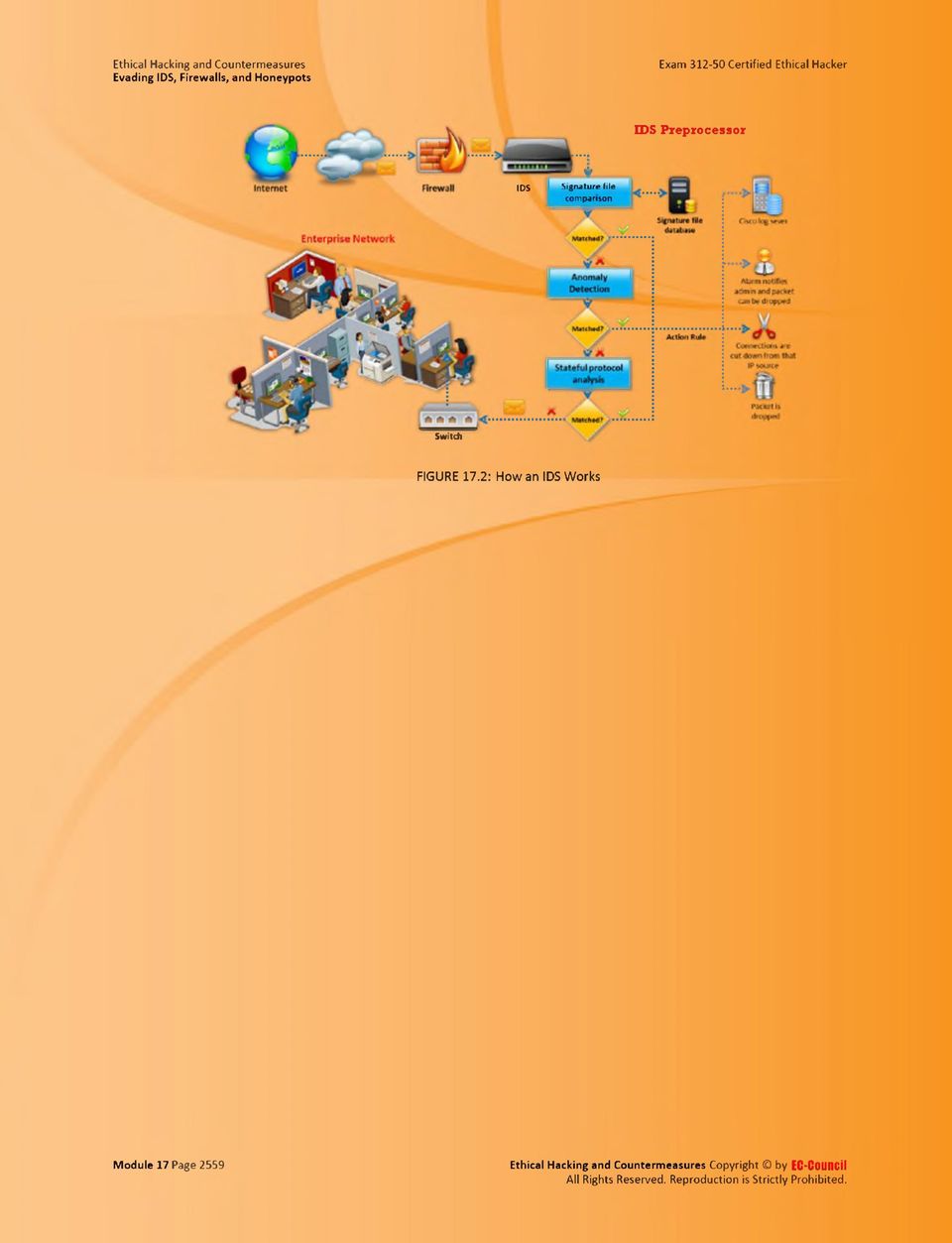
10 Ethical Hacking and C ounterm easures Evading IDS, Firewalls, and H oneypots H o w ID S W o r k s UrtifM C E H tux*l luckm S ig n a tu r e file c o m p a r is o n v * A n o m a ly D e te c tio n x» - Alarm notifies admin and packet can be dropped S ta te fu l p r o t o c o l a n a ly s is Action Rule V b Connections are cut down from that IP source < Packet is dropped S w itc h Copyright by EG-CtUIICil. How an IDS Works The main purposes of IDSes are that they not only prevent intrusions but also alert the administrator immediately when the attack is still going on. The administrator could identify methods and techniques being used by the intruder and also the source of attack. An IDS works in the following way: IDSes have sensors to detect signatures and some advanced IDSes have behavioral activity detection to determine malicious behavior. Even if signatures don't match this activity detection system can alert administrators about possible attacks. If the signature matches, then it moves to the next step or the connections are cut down from that IP source, the packet is dropped, and the alarm notifies the admin and the packet can be dropped. Once the signature is matched, then sensors pass on anomaly detection, whether the received packet or request matches or not. Q If the packet passes the anomaly stage, then stateful protocol analysis is done. After that through switch the packets are passed on to the network. If anything mismatches again, the connections are cut down from that IP source, the packet is dropped, and the alarm notifies the admin and packet can be dropped. M odule 17 Page 2558 Ethical Hacking and C ounterm easures Copyright by EC-C0UnCil All Rights Reserved. R eproduction is Strictly Prohibited.

11 Ethical Hacking and C ounterm easures Evading IDS, Firewalls, and H oneypots ID S P r e p r o c e s s o r IDS 1 V Signature file comparison Switch FIGURE 17.2: H ow an IDS W orks M odule 17 Page 2559 Ethical Hacking and C ounterm easures Copyright by EC-C0UnCil All Rights Reserved. R eproduction is Strictly Prohibited.
12 Ethical Hacking and C ounterm easures Evading IDS, Firewalls, and H oneypots W a y s to D e t e c t a n In t r u s io n CEH S ign atu re R ecognition It is also known as misuse detection. Signature recognition tries to identify events that misuse a system / A nom aly D etection L Tl nr It detects the intrusion based on the fixed behavioral characteristics of the users and components in a computer system P rotocol A nom aly D etection In this type of detection, models are built to explore anomalies in the way vendors deploy the TCP/IP specification Copyright by EG -G *ancil. ^ Ways to Detect an Intrusion An intrusion is detected in three ways. S ig n a tu r e D e te c tio n Signature recognition is also known as misuse detection. It tries to identify events * יי that indicate an abuse of a system. It is achieved by creating models of intrusions. Incoming events are compared with intrusion models to make a detection decision. While creating signatures, the model must detect an attack without disturbing the normal traffic on the system. Attacks, and only attacks, should match the model or else false alarms can be generated. Q Q The simplest form of signature recognition uses simple pattern matching to compare the network packets against binary signatures of known attacks. A binary signature may be defined for a specific portion of the packet, such as the TCP flags. Signature recognition can detect known attacks. However, there is a possibility that other packets that match might represent the signature, triggering bogus signals. Signatures can be customized so that even well-informed users can create them. Signatures that are formed improperly may trigger bogus signals. In order to detect misuse, the number of signatures required is huge. The more the signatures, the more M odule 17 Page 2560 Ethical Hacking and C ounterm easures Copyright by EC-C0UnCil All Rights Reserved. R eproduction is Strictly Prohibited.
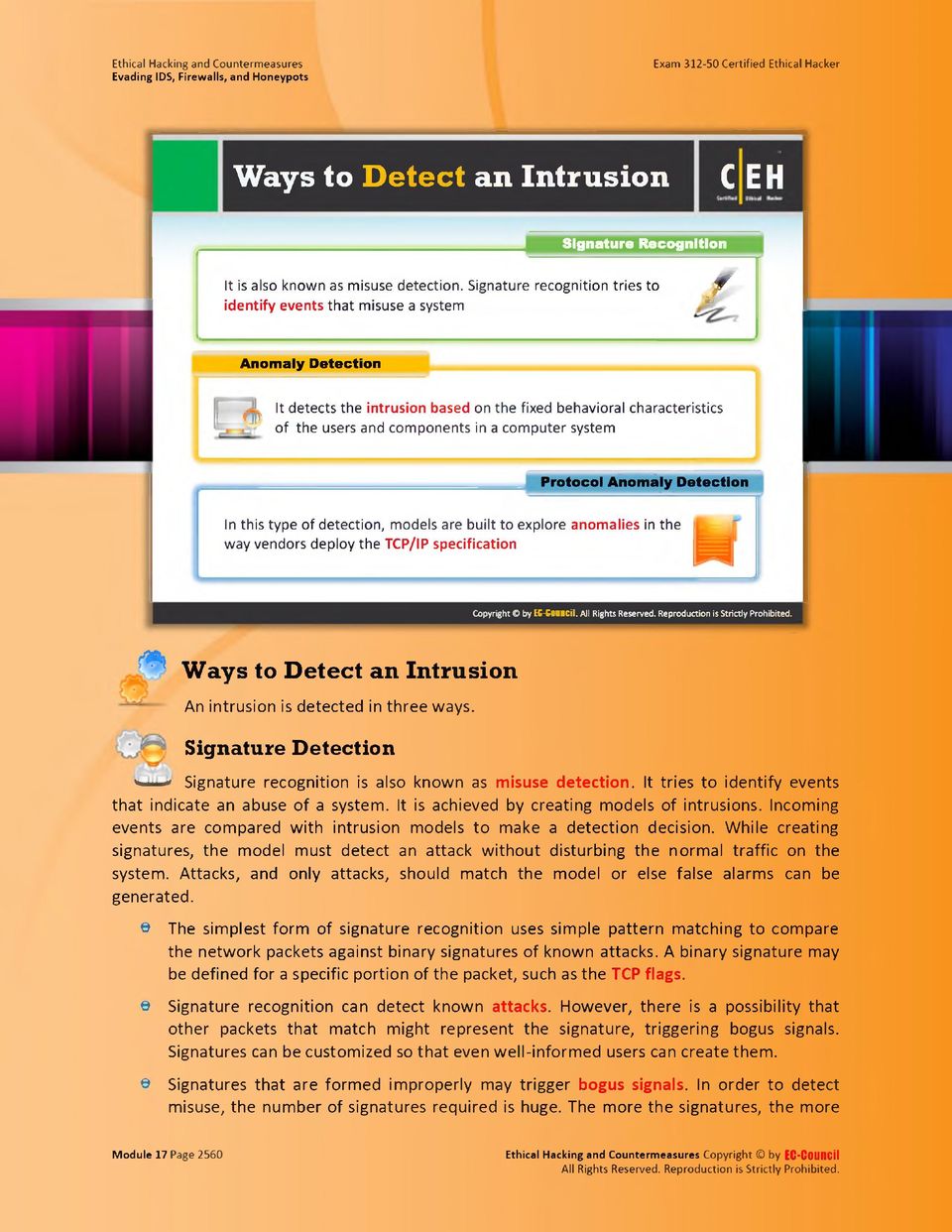
13 Ethical Hacking and C ounterm easures Evading IDS, Firewalls, and H oneypots attacks can be detected, though traffic may incorrectly match with the signatures, reducing the performance of the system. The bandwidth of the network is consumed with the increase in the signature database. As the signatures are compared against those in the database, there is a probability that the maximum number of comparisons cannot be made, resulting in certain packets being dropped. New virus attacks such as ADMutate and Nimda create the need for multiple signatures for a single attack. Changing a single bit in some attack strings can invalidate a signature and create the need for an entirely new signature. Despite problems with signature-based intrusion detection, such systems are popular and work well when configured correctly and monitored closely A n o m a ly D e te c tio n Anomaly detection is otherwise called "not-use. detection Anomaly detection differs from the signature recognition model. The model consists of a database of anomalies. Any event that is identified with the database in considered an anomaly. Any deviation from normal use is labeled an attack. Creating a model of normal use is the most difficult task in creating an anomaly detector. In the traditional method of anomaly detection, important data is kept for checking variations in network traffic for the model. However, in reality, there is less variation in network traffic and too many statistical variations making these models imprecise; some events labeled as anomalies might only be irregularities in network usage. In this type of approach, the inability to instruct a model thoroughly on the normal network is of grave concern. These models should be trained on the specific network that is to be policed. 2 P r o to c o l A n o m a ly D e te c tio n Protocol anomaly detection is based on the anomalies specific to a protocol. This model is integrated into the IDS model recently. It identifies the TCP/IP protocol specific flaws in the network. Protocols are created with specifications, known as RFCs, for dictating proper use and communication. The protocol anomaly detector can identify new attacks. There are new attack methods and exploits that violate protocol standards being discovered frequently. The pace at which the malicious signature attacker is growing is incredibly fast. But the network protocol, in comparison, is well defined and changing slowly. Therefore, the signature database must be updated frequently to detect attacks. Protocol anomaly detection systems are easier to use because they require no signature updates M odule 17 Page 2561 Ethical Hacking and C ounterm easures Copyright by EC-C0UnCil All Rights Reserved. R eproduction is Strictly Prohibited.
14 Ethical Hacking and C ounterm easures Evading IDS, Firewalls, and H oneypots 6 Protocol anomaly detectors are different from the traditional IDS in how they present alarms. The best way to present alarms is to explain which part of the state system was compromised. For this, the IDS operators have to have a thorough knowledge of the protocol design; the best way is the documentation provided by the IDS. M odule 17 Page 2562 Ethical Hacking and C ounterm easures Copyright by EC-C0UnCil All Rights Reserved. R eproduction is Strictly Prohibited.

15 Ethical Hacking and C ounterm easures Evading IDS, Firewalls, and H oneypots T y p e s o f In tru s io n D e te c tio n S ystem s C E H Network-Based Intrusion D etection T h e s e m e c h a n is m s ty p ic a lly c o n s is t o f a b la ck b o x t h a t is p la c e d o n t h e n e tw o r k in t h e p r o m is c u o u s m o d e, lis te n in g fo r p a t te r n s in d ic a tiv e o f a n in tru s io n IT. Host-Based Intrusion D etection T h e s e m e c h a n is m s u s u a lly in c lu d e a u d itin g fo r e v e n ts t h a t o c c u r o n a s p e c ific h o s t T h e s e a r e n o t a s c o m m o n, d u e t o t h e o v e r h e a d th e y in c u r by h a v in g to m o n ito r e a c h s y s te m e v e n t n w n 3 Log File Monitoring File Integrity Checking Q T h e s e m e c h a n is m s a r e ty p ic a lly p ro g ra m s t h a t p a r s e log files a f te r a n e v e n t h a s a lre a d y o c c u rre d, s u c h a s fa ile d log in a t te m p ts f / V T h e s e m e c h a n is m s c h e c k fo r T ro ja n h o r s e s, o r file s t h a t h a v e o th e r w is e b e e n m o d ifie d, in d ic a tin g a n in t r u d e r h a s a lr e a d y b e e n th e r e, fo r e x a m p le, T rip w ire Copyright by E G -G tlin cil. Types of Intrusion Detection Systems Basically there are four types of intrusion detection systems are available. They are: N e tw o r k -b a s e d In t r u s io n D e te c tio n The NIDS checks every packet entering the network for the presence of anomalies and incorrect data. Unlike the firewalls that are confined to the filtering of data packets with vivid malicious content, the NIDS checks every packet thoroughly. An NIDS captures and inspects all traffic, regardless of whether it is permitted. Based on the content, at either the IP or application-level, an alert is generated. Network-based intrusion detection systems tend to be more distributed than host-based IDSes. The NIDS is basically designed to identify the anomalies at the router- and host-level. The NIDS audits the information contained in the data packets, logging information of malicious packets. A threat level is assigned to each risk after the data packets are received. The threat level enables the security team to be on alert. These mechanisms typically consist of a black box that is placed on the network in the promiscuous mode, listening for patterns indicative of an intrusion. H o s t-b a s e d In t r u s io n D e te c tio n In the host-based system, the IDS analyzes each system's behavior. The HIDS can be installed on any system ranging from a desktop PC to a server. The HIDS is more versatile than M odule 17 Page 2563 Ethical Hacking and C ounterm easures Copyright by EC-C0UnCil All Rights Reserved. R eproduction is Strictly Prohibited.
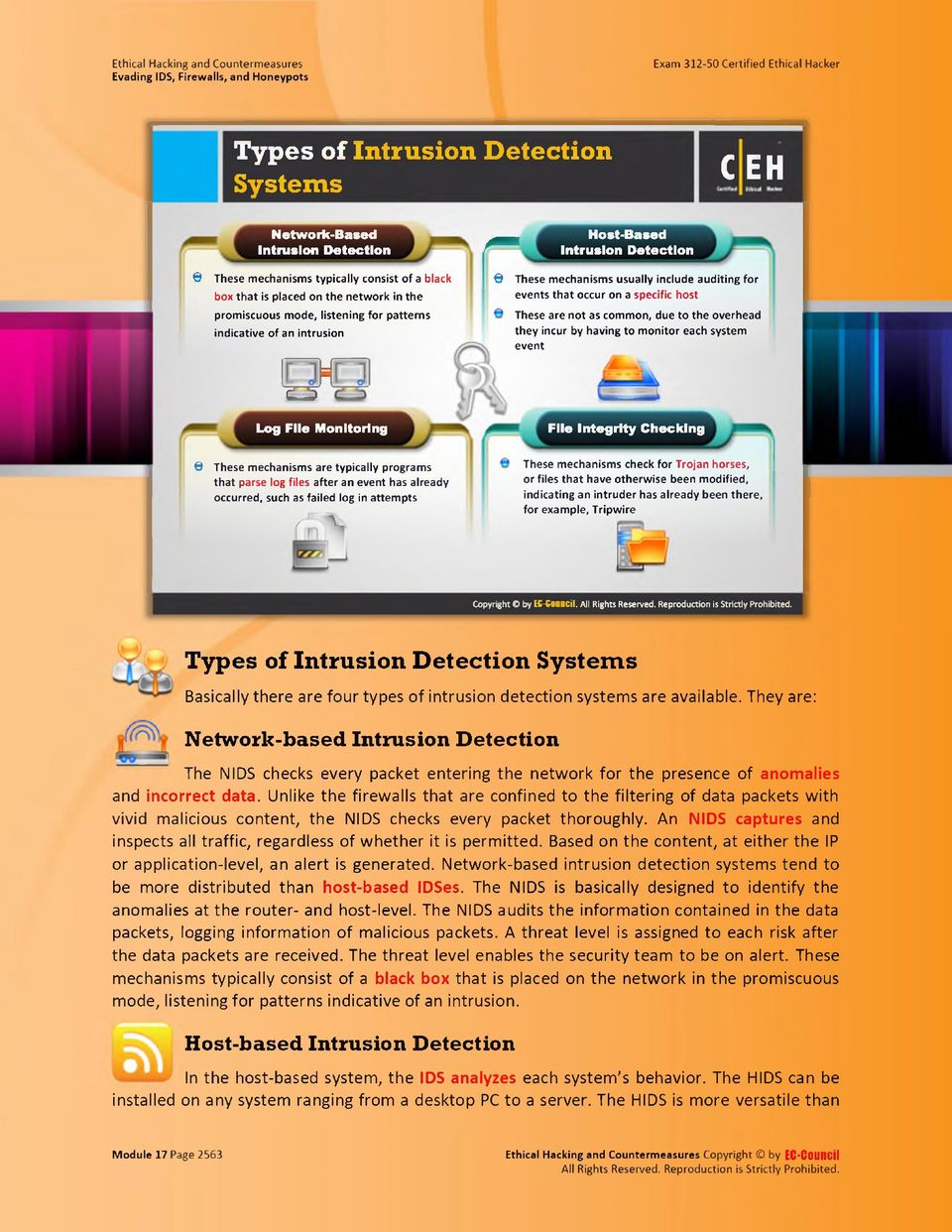
16 Ethical Hacking and C ounterm easures Evading IDS, Firewalls, and H oneypots the NIDS. One example of a host-based system is a program that operates on a system and receives application or operating system audit logs. These programs are highly effective for detecting insider abuses. Residing on the trusted network systems themselves, they are close to the network's authenticated users. If one of these users attempts unauthorized activity, hostbased systems usually detect and collect the most pertinent information promptly. In addition to detecting unauthorized insider activity, host-based systems are also effective at detecting unauthorized file modification. HIDSes are more focused on changing aspects of the local systems. HIDS is also more platform-centric, with more focus on the Windows OS, but there are other HIDSes for UNIX platforms. These mechanisms usually include auditing for events that occur on a specific host. These are not as common, due to the overhead they incur by having to monitor each system event L o g F ile M o n it o r in g A Log File Monitor (LFM) monitors log files created by network services. The LFT IDS searches through the logs and identifies malicious events. In a similar manner to NIDS, these systems look for patterns in the log files that suggest an intrusion. A typical example would be parsers for HTTP server log files that look for intruders who try well-known security holes, such as the "phf" attack. An example is swatch. These mechanisms are typically programs that parse log files after an event has already occurred, such as failed log in attempts. F i le In t e g r i t y C h e c k in g PH These mechanisms check for Trojan horses, or files that have otherwise been modified, indicating an intruder has already been there, for example, Tripwire. M odule 17 Page 2564 Ethical Hacking and C ounterm easures Copyright by EC-C0UnCil All Rights Reserved. R eproduction is Strictly Prohibited.
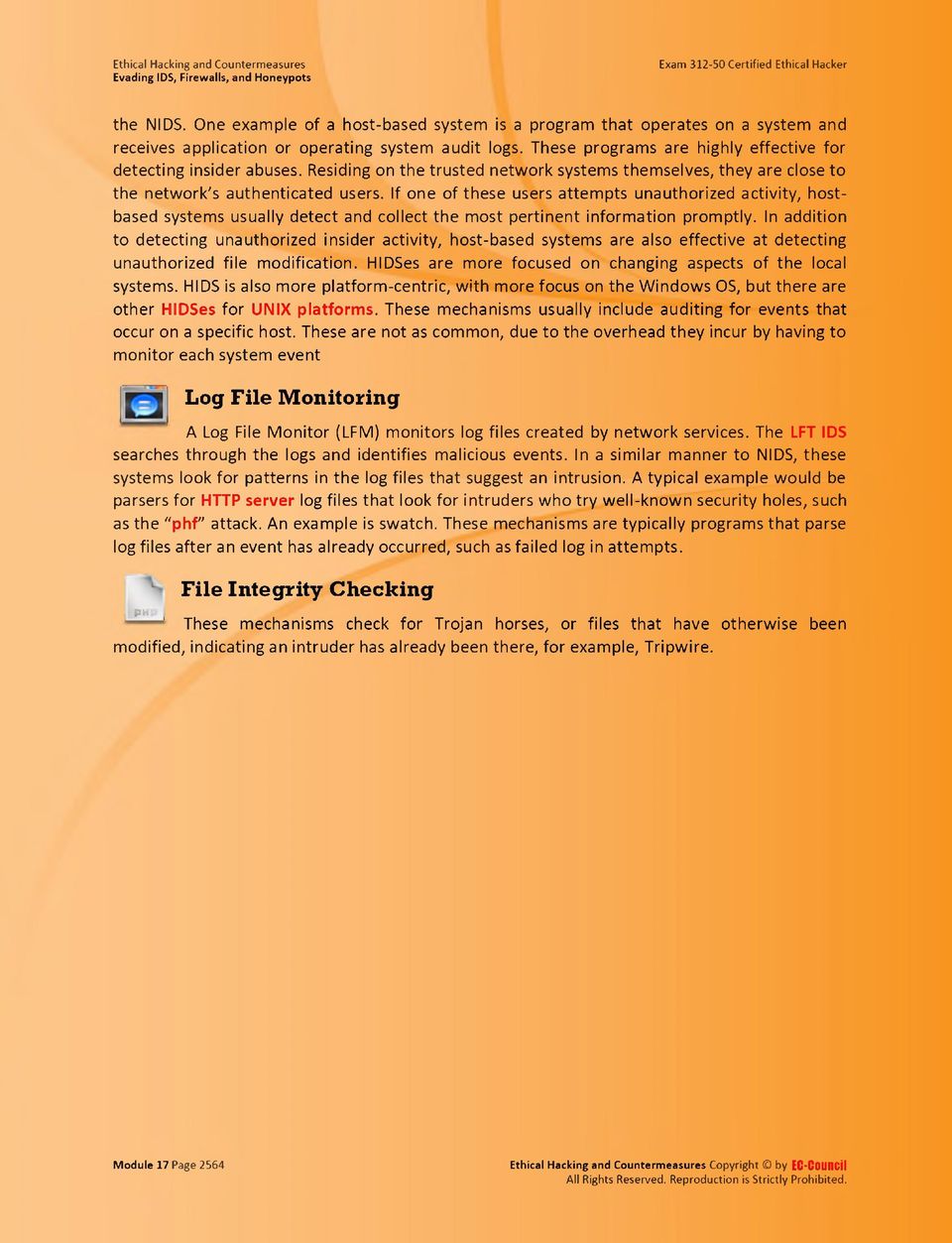
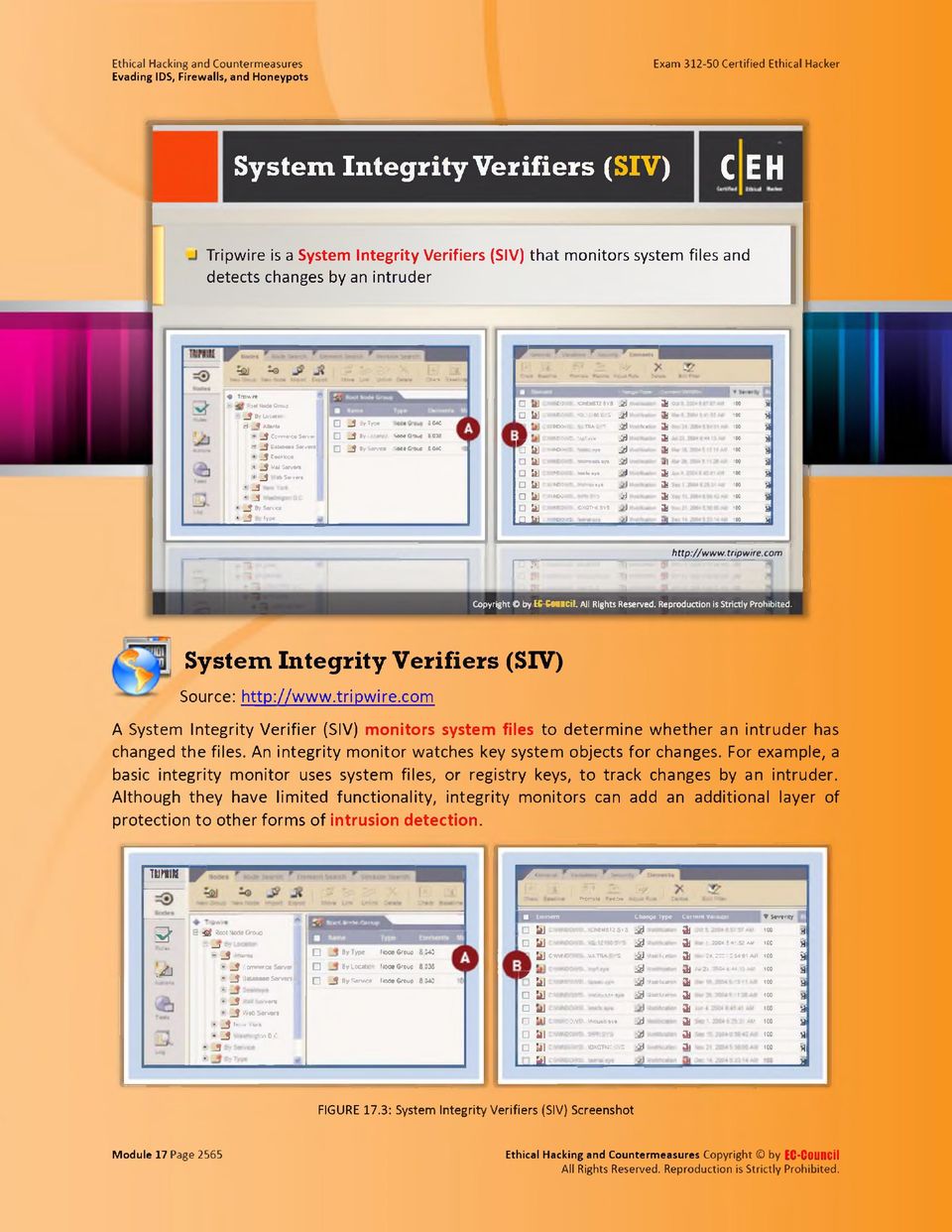
17 Ethical Hacking and C ounterm easures Evading IDS, Firewalls, and H oneypots System Integrity Verifiers (SIV) CEH J Tripwire is a System Integrity Verifiers (SIV) that monitors system files and detects changes by an intruder + Trjjwre Roo< Node Group - Loc4to J 3y 1 rj ^ Atlanta Hi J Commerce S«rv*r W J Datatoaeo Serveri Hi _ $ CaftMopt *HI J w Servar *W J W*6 S4rv#f J - * J_ J By Sarvico, '* ypo' $_ D J5 0yTyo* 3.04c jjbvlc on» HOC*G evc 60M 0 j j By Serve ' oc» oe G0 5C4e I aij co. \ONEM5T2-SYS j J ' H &U CWWOWV >01.160? ז SYS jkj e a ewmoowsi MJLTRASVS * r 10 A CWlfOOWS V«faya Lfil a aeo l ^ h i CWMN00W9 Vpaacay l* > * 1 fc J l 10 A Al UJ 'mdmxadkavv ם i l l MfWeOUVSl Vaaf* lys J 31 10c a ם iii CWWDOWSV VMMOtya A ם J - i*j cwwoowsv $VS ם 3 j 10 A A hj CW»f OWSV 'CXGTHKSYS 3 j ם C WMNDOWSt ill r>] 10 "H n r h ttp ://w w w. tripw ire, com Copyright by EC-CMHCil. System Integrity Verifiers (SIV) Source: A System Integrity Verifier (SIV) monitors system files to determine whether an intruder has changed the files. An integrity monitor watches key system objects for changes. For example, a basic integrity monitor uses system files, or registry keys, to track changes by an intruder. Although they have limited functionality, integrity monitors can add an additional layer of protection to other forms of intrusion detection. hmm Prorwata Rhsm E element Change lypc Current Verwor T Seventy I.Zj S 5 ( 300t icde Grouo _ j S J a m S J :omnerce Server I SI J Dataoese Server* I a S J i י Server* ffl J Vet) Server! S J f ew Vortj * J WMhntfonDC * -J 5, By Type fiode Group 0 3*3 By Locatr»»0eGr uc js By S*rvc* fjode Group 8&*0 1 JfcJ r<tmst2s'15 JtJ 31 ICO f 1 fc ] - - J l 3 j ers 200 S41 52 *v ICO A JfcJ C\V*rfNOOWS\ UA.TRASVS Jgl I'cc.fcahoo Qj ov» SS401 Ai 1C0 9 fg,, A» «.. «ICO 3J w b l Jgl Modtfcabcn 31 1C0 A 31 ICO A -זיו י u Jgl llcdil ם j J 31 too A ICO A - : < «a WMDOMXVhdu»6»v«_j.J 1 ' ח 11* ill WPNSVS & -.-, co - 31 ICO A JlJ VMNOOWSV 'OXGTVKSYS & l ' ו,. וי 31 ICO J U Jl FIGURE : S y s te m In te g rity V e rifie rs (SIV) S c r e e n s h o t M odule 17 Page 2565 Ethical Hacking and C ounterm easures Copyright by EC-C0UnCil All Rights Reserved. R eproduction is Strictly Prohibited.
18 Ethical Hacking and C ounterm easures Evading IDS, Firewalls, and H oneypots G e n e r a l In d ic a tio n s o f C E H In tr u s io n s - General Indications of Intrusions Following are the general indications of intrusions: F ile S y s te m In tr u s io n s By observing the system files, you can identify the presence of an intruder. The system files record the activities of the system. Any modification or deletion in the file attributes or the file itself is a sign that the system was a target of attack: If you find new, unknown files/programs on your system, then there is a possibility that your system has been intruded. The system can be compromised to the point that it can in turn compromise other systems in your network. When an intruder gains access to a system, he or she tries to escalate privileges to gain administrative access. When the intruder obtains the Administrator privilege, he or she changes the file permissions, for example, from Read-Only to Write. Q Q Unexplained modifications in file size are also an indication of an attack. Make sure you analyze all of your system files. Presence of rogue suid and sgid files on your Linux system that do not match your master list of suid and sgid files could indicate an attack. M odule 17 Page 2566 Ethical Hacking and C ounterm easures Copyright by EC-C0UnCil All Rights Reserved. R eproduction is Strictly Prohibited.

19 Ethical Hacking and C ounterm easures Evading IDS, Firewalls, and H oneypots 6 You can identify unfamiliar file names in directories, including executable files with strange extensions and double extensions. Missing files are also sign of a probable intrusion/attack. LJ i g N e t w o r k In tr u s io n s 6 Sudden increase in bandwidth consumption is an indication of intrusion. Repeated probes of the available services on your machines. Connection requests from IPs other than those in the network range are an indication that an unauthenticated user (intruder) is attempting to connect to the network. You can identify repeated attempts to log in from remote machines. Arbitrary log data in log files indicates attempts of denial-of-service attacks, bandwidth consumption, and distributed denial-of-service attacks. M odule 17 Page 2567 Ethical Hacking and C ounterm easures Copyright by EC-C0UnCil All Rights Reserved. R eproduction is Strictly Prohibited.

20 Ethical Hacking and C ounterm easures Evading IDS, Firewalls, and H oneypots General Indications of System Intrusions C E H Short or incomplete logs Unusual graphic displays or text messages Unusually slow system performance Modifications to system software and configuration files Missing logs or logs with incorrect permissions or ownership System crashes or reboots Gaps in the system accounting Unfamiliar processes Copyright by EG-G(IIIICil. General Indications of System Intrusions To check whether the system is attacked, you need to check certain parameters that clearly indicate the presence of an intruder on the system. When an intruder attempts to break into the system, he or she attempts to hide his or her presence by modifying certain system files and configurations that indicate intrusion. Certain signs of intrusion include: System's failure in identifying valid user Active access to unused logins Logins during non-working hours New user accounts other than the accounts created Modifications to system software and configuration files using Administrator access and the presence of hidden files Gaps in system audit files, which indicate that the system was idle for that particular time; he gaps actually indicate that the intruder has attempted to erase the audit tracks The system's performance decreases drastically, consuming CPU time System crashes suddenly and reboots without user intervention M odule 17 Page 2568 Ethical Hacking and C ounterm easures Copyright by EC-C0UnCil All Rights Reserved. R eproduction is Strictly Prohibited.
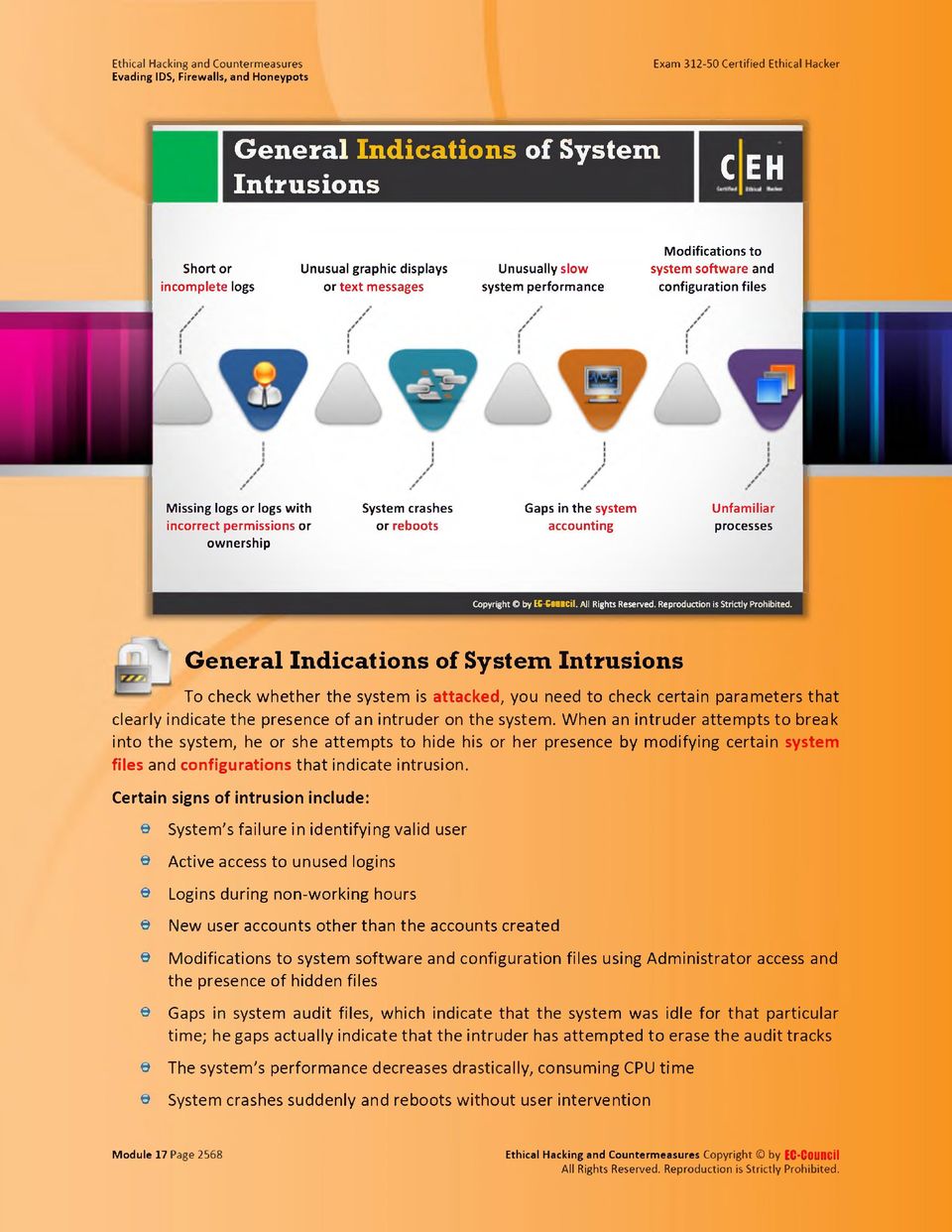
21 Ethical Hacking and C ounterm easures Evading IDS, Firewalls, and H oneypots 0 The system logs are too short and incomplete 0 Timestamps of system logs are modified to include strange inputs 0 Permissions on the logs are changed, including the ownership of the logs System logs are deleted 0 Systems performance is abnormal, the system responds in unfamiliar ways 0 Unknown processes are identified on the system Q Unusual display of graphics, pop-ups, and text messages observed on the system M odule 17 Page 2569 Ethical Hacking and C ounterm easures Copyright by EC-C0UnCil All Rights Reserved. R eproduction is Strictly Prohibited.
22 Ethical Hacking and C ounterm easures Evading IDS, Firewalls, and H oneypots F i r e w a l l C E H UftMM ilk,<41 NMhM F ire w a lls a r e h a r d w a r e a n d / o r s o f t w a r e d e s i g n e d t o p r e v e n t u n a u t h o r i z e d a c c e s s t o o r f r o m a p r iv a te n e t w o r k F ire w a lls e x a m i n e a ll m e s s a g e s e n t e r i n g o r le a v in g t h e I n t r a n e t a n d b lo c k s t h o s e t h a t d o n o t m e e t t h e s p e c i f ie d s e c u r i ty c r i te r ia T h e y a r e p la c e d a t t h e j u n c tio n o r g a t e w a y b e t w e e n t h e t w o n e t w o r k s, w h ic h is u s u a lly a p r iv a te n e t w o r k a n d a p u b lic n e t w o r k s u c h a s t h e I n t e r n e t F ire w a lls m a y b e c o n c e r n e d w ith t h e t y p e o f tr a f fic o r w ith t h e s o u r c e o r d e s t i n a t i o n a d d r e s s e s a n d p o r ts S e c u re P riv a te L ocal A re a N e tw o rk r v? = S p e c ifie d tra ffic allo w e d * = R estricted unknow n traffic Copyright by EG-G(IIIICil. All Rights Reserved. Reproduction Is Strictly Prohibited. Firewalls A firewall is a set of related programs located at the network gateway server that protects the resources of a private network from users on other networks. Firewalls are a set of tools that monitor the flow of traffic between networks. A firewall, placed at the network level and working closely with a router, filters all network packets to determine whether or not to forward them toward their destinations. A firewall is often installed away from the rest of the network so that no incoming request can get directly to a private network resource. If configured properly, systems on one side of the firewall are protected from systems on the other side of the firewall. A firewall is an intrusion detection mechanism. Firewalls are specific to an organization's security policy. The settings of the firewalls can be changed to make appropriate changes to the firewall functionality. 0 Firewalls can be configured to restrict incoming traffic to POP and SNMP and to enable access. Certain firewalls block the services to secure against spam. Q / point Firewalls can be configured to check inbound traffic at a point called the "choke where security audit is performed. The firewall can also act as an active "phone tap" tool in identifying the intruder's attempt to dial into the modems within the network M odule 17 Page 2570 Ethical Hacking and C ounterm easures Copyright by EC-C0UnCil All Rights Reserved. R eproduction is Strictly Prohibited.
23 Ethical Hacking and C ounterm easures Evading IDS, Firewalls, and H oneypots that is secured by firewall. The firewall logs consist of logging information that reports to the administrator on all the attempts of various incoming services. Q The firewall verifies the incoming and outgoing traffic against firewall rules. It acts as a router to move data between networks. Firewalls manage access of private networks to host applications. 0 All the attempts to log in to the network are identified for auditing. Unauthorized attempts can be identified by embedding an alarm that is triggered when an unauthorized user attempts to login. Firewalls can filter packets based on address and types of traffic. They identify the source, destination addresses, and port numbers while address filtering, and they identify types of network traffic when protocol filtering. Firewalls can identify the state and attributes of the data packets. Secure Private Local Area N etw ork Public Netw ork / = S p e c ifie d tra ffic a llo w e d JOt = R estricted unkn ow n tra ffic FIGURE 17.4: W orking o f Firew all M odule 17 Page 2571 Ethical Hacking and C ounterm easures Copyright by EC-C0UnCil All Rights Reserved. R eproduction is Strictly Prohibited.
24 Ethical Hacking and C ounterm easures Evading IDS, Firewalls, and H oneypots F i r e w a l l A r c h i t e c t u r e C E H Bastion Host: S S Bastion host is a com puter system designed and configured to protect netw o rk resources from attack Traffic entering or leaving the netw ork passes through the firewall, it has tw o interfaces: 6 public interface directly connected to the Internet 6 private interface connected to the Intranet Screened Subnet: S The screened subnet or DMZ (additional zone) contains hosts th a t offer public services 2 The DMZ zone responds to public requests, and has no hosts accessed by the private netw ork 2 Private zone can not be accessed by Internet users Multi-homed Firewall: S In th is case, a fire w a ll w ith th re e o r m ore interfaces is present th a t allow s fo r fu rth e r subdividin g th e systems based on th e specific security objectives o f the organization C opyright by EG -G *ancil. All Rights Reserved. R eproduction is Strictly Prohibited Firewall Architecture Firewall architecture consists of the following elements: B a s tio n h o s t The bastion host is designed for the purpose of defending against attacks. It acts as a mediator between inside and outside networks. A bastion host is a computer system designed and configured to protect network resources from attack. Traffic entering or leaving the network passes through the firewall, it has tw o interfaces: Public interface directly connected to the Internet 0 Private interface connected to the intranet Intranet FIGURE : B a s tio n H o s t A rc h ite c tu re M odule 17 Page 2572 Ethical Hacking and C ounterm easures Copyright by EC-C0UnCil All Rights Reserved. R eproduction is Strictly Prohibited.
25 Ethical Hacking and C ounterm easures Evading IDS, Firewalls, and H oneypots I U T > I ll 'll S c re e n e d s u b n e t A screened subnet is a network architecture that uses a single firewall with three network interfaces. The first interface is used to connect the Internet, the second interface is used to connect the DMZ, the third interface is used to connect the intranet. The main advantage with the screened subnet is it separates the DMZ and Internet from the intranet so that when the firewall is compromised access to the intranet won't be possible. 6 The screened subnet or DMZ (additional zone) contains hosts that offer public services Public zone is directly connected to the Internet and has no hosts controlled by the organization Private zone has systems that Internet users have no business accessing FIGURE 17.6: Screened S ubnet A rch ite ctu re J M u l t i - h o m e d f i r e w a l l [ J A multi-homed firewall generally refers to two are more networks. Each interface is connected to the separate network segments logically and physically. A multi-homed firewall is used to increase efficiency and reliability of an IP network. In this case, more than three interfaces are present that allow for further subdividing the systems based on the specific security objectives of the organization. Intranet In te rn e t FIGURE 17.7: M u lti-h o m e d F ire w a ll A rc h ite c tu re M odule 17 Page 2573 Ethical Hacking and C ounterm easures Copyright by EC-C0UnCil All Rights Reserved. R eproduction is Strictly Prohibited.
26 Ethical Hacking and C ounterm easures Evading IDS, Firewalls, and H oneypots D e M i l i t a r i z e d Z o n e ( D M Z ) C E H DMZ is a ne tw ork th a t serves as a buffer betw een the internal secure netw ork and insecure Internet It can be created using firewall with three or more network interfaces assigned w ith specific roles such as Internal trusted network, DMZ network, and external un-trusted netw ork (Internet) Firewall Intranet D M Z Copyright by EG -C *ancil. Demilitarized Zone (DMZ) The DMZ is a host computer or a network placed as a neutral network between a particular firm's internal, or private, network and outside, or public, network to prevent the outside user from accessing the company's private data. DMZ is a network that serves as a buffer between the internal secure network and insecure internet It is created using a firewall with three or more network interfaces assigned with specific roles such as Internal trusted network, DMZ network, and External un-trusted network (Internet). M odule 17 Page 2574 Ethical Hacking and C ounterm easures Copyright by EC-C0UnCil All Rights Reserved. R eproduction is Strictly Prohibited.
27 Ethical Hacking and C ounterm easures Evading IDS, Firewalls, and H oneypots FIGURE 17.8: D em ilitarized Zone (DMZ) M odule 17 Page 2575 Ethical Hacking and C ounterm easures Copyright by EC-C0UnCil All Rights Reserved. R eproduction is Strictly Prohibited.
28 Ethical Hacking and C ounterm easures Evading IDS, Firewalls, and H oneypots T y p e s o f F i r e w a l l C E H Packet Filters Circuit Level Gateways Application Level Gateways Stateful M ultilayer Inspection Firewalls Copyright by EG -G *ancil. Types of Firewalls A firewall refers to a hardware device or a software program used in a system to prevent malicious information from passing through and allowing only the approved information. Firewalls are mainly categorized into four types: Packet filters Circuit-level gateways Q Application-level gateways 6 Stateful multilayer inspection firewalls M odule 17 Page 2576 Ethical Hacking and C ounterm easures Copyright by EC-C0UnCil All Rights Reserved. R eproduction is Strictly Prohibited.
29 Ethical Hacking and C ounterm easures Evading IDS, Firewalls, and H oneypots P a c k e t F i l t e r i n g F i r e w a l l C E H Urti*W itkm l luckw Packet filte rin g fire w a lls w o rk a t the n e tw o rk le vel o f th e OSI m odel (o r th e IP layer o f TCP/IP), th e y are usually a p a rt o f a ro u te r Depending on th e packe t and th e c rite ria, th e fire w a ll can d rop th e packet and fo rw a rd it, or send a message to the originator In a packet filte rin g fire w a ll, each packe t is com pared to a set o f crite ria before it is forw arded Rules can include th e source and th e d estin ation IP address, th e source and th e d estin ation p o rt num b er, and th e p ro to c o l used = Traffic a llo w e d b a s e d o n s o u r c e a n d d e s tin a tio n IP a d d r e s s, p a c k e t ty p e, a n d p o r t n u m b e r X = D isallow ed Traffic Copyright by EG -C *ancil. Packet Filtering Firewall A packet filtering firewall investigates each individual packet passing through it and makes a decision whether to pass the packet or drop it. As you can tell from their name, packet filter-based firewalls concentrate on individual packets and analyze their header information and which way they are directed. Traditional packet filters make the decision based on the following information: Source IP address: This is used to check if the packet is coming from a valid source or not. The information about the source IP address can be found from the IP header of the packet, which indicates the source system address. 9 Destination IP address: This is used to check if the packet is going to the correct destination and to check if the destination accepts these types of packets. The information about the destination IP address can be found from the IP header of the packet, which has the destination address. Source TCP/UDP port: This is used to check the source port for the packet. 9 Destination TCP/UDP port: This is used to check the destination port for the services to be allowed and the services to be denied. M odule 17 Page 2577 Ethical Hacking and C ounterm easures Copyright by EC-C0UnCil All Rights Reserved. R eproduction is Strictly Prohibited.
30 Ethical Hacking and C ounterm easures Evading IDS, Firewalls, and H oneypots Q TCP code bits: Used to check whether the packet has a SYN, ACK, or other bits set for the connection to be made. Q Protocol in use: Used to check whether the protocol that the packet is carrying should be allowed. This is because some networks do not allow the UDP protocol. Direction: Used to check whether the packet is coming from the packet filter firewall or leaving it. 6 Interface: Used to check whether or not the packet is coming from an unreliable site. 5 Application 4 TCP Firewall N e tw o r k 3 Internet Protocol (IP} 2 Data Link 1 Physical... xi if FIGURE 17.9: Packet Filtering Firew all = Traffic allowed based on source and destination IP address, packet type, and port num ber = Disallowed Traffic M odule 17 Page 2578 Ethical Hacking and C ounterm easures Copyright by EC-C0UnCil All Rights Reserved. R eproduction is Strictly Prohibited.

31 Ethical Hacking and C ounterm easures Evading IDS, Firewalls, and H oneypots Circuit-Level Gateway Firewall C E H - Traffic allowed based on session rules, such as when a session is initiated by a recognized computer ^ = Disallowed Traffic Copyright by EG -C *ancil. Circuit-level Gateway Firewall Circuit-level gateways work at the session layer of the OSI model or the TCP layer of TCP/IP. A circuit-level gateway forwards data between the networks without verifying it. It blocks incoming packets into the host, but allows the traffic to pass through itself. Information passed to remote computers through a circuit-level gateway appears to have originated from the gateway, as the incoming traffic carries the IP address of the proxy (circuit-level gateway). A circuit-level gateway gives the controlled network connection to the network between the system, internal and external to it. For detecting whether or not a requested session is valid, it checks the TCP handshaking between the packets. Circuit-level gateways do not filter individual packets. Circuit-level gateways are relatively inexpensive and hide the information about the private network that they protect. M odule 17 Page 2579 Ethical Hacking and C ounterm easures Copyright by EC-C0UnCil All Rights Reserved. R eproduction is Strictly Prohibited.
32 Ethical Hacking and C ounterm easures Evading IDS, Firewalls, and H oneypots 5 Application 4 TCP 3 Internet Protocol (IP) 2 Data Link 1 Physical Firewall ז *... FIGURE 17.10: C ircuit-level G atew ay Firew all = Traffic allowed based on session rules, such as when a session is initiated by a recognized computer = Disallowed Traffic M odule 17 Page 2580 Ethical Hacking and C ounterm easures Copyright by EC-C0UnCil All Rights Reserved. R eproduction is Strictly Prohibited.
33 Ethical Hacking and C ounterm easures Evading IDS, Firewalls, and H oneypots A p p lic a t io n - L e v e l F i r e w a l l C E H J A p p lica tio n -le ve l gatew ays (proxies) can filte r packets a t th e a p p lic a tio n la ye r o f th e OSI m o d e l J Incom ing and outg o in g tra ffic is re stricte d to services su p p o rte d by proxy; all o th e r service requests are denied J A pplicatio n-leve l gateways configure d as a w eb proxy p ro h ib it FTP, gopher, te ln e t, o r o th e r tra ffic J A p p lica tio n -le ve l gateways exam ine tra ffic and filte r on a p p lic a tio n -s p e c ific co m m a n d s such as h ttp :p o s t and get 5 Application 4 TCP 3 Internet Protocol (IP) 2 Data Link 1 Physical = Traffic allowed based on specified applications (such as a browser) or a protocol, such as FTP, or com binations = Disallowed Traffic Copyright by EG -G *ancil. the Application-level Firewall Proxy/application-based firewalls concentrate on the Application layer rather than just packets. These firewalls analyze the application information to make decisions about whether or not to transmit the packets. Q A proxy-based firewall asks for authentication to pass the packets as it works at the Application layer. 9 A content caching proxy optimizes performance by caching frequently accessed information instead of sending new requests for the same old data to the servers. M odule 17 Page 2581 Ethical Hacking and C ounterm easures Copyright by EC-C0UnCil All Rights Reserved. R eproduction is Strictly Prohibited.
34 Ethical Hacking and C ounterm easures Evading IDS, Firewalls, and H oneypots Internet 5 Application Network 4 TCP Firewall 3 Internet Protocol (IP) 2 Data Link 1 Physical FIGURE 17.11: A p p licatio n -leve l Firew all M odule 17 Page 2582 Ethical Hacking and C ounterm easures Copyright by EC-C0UnCil All Rights Reserved. R eproduction is Strictly Prohibited.
35 Ethical Hacking and C ounterm easures Evading IDS, Firewalls, and H oneypots Stateful Multilayer Inspection Firewall C E H J S ta te fu l m u ltila y e r in s p e c tio n fire w a lls c o m b in e th e a s p e c ts o f th e o th e r th r e e ty p e s o f fire w a lls J T h e y f ilt e r p a c k e ts a t th e n e tw o r k la y e r, to d e te rm in e w h e th e r session pa ckets are le g itim a te, a n d th e y e v a lu a te th e c o n te n ts o f packe ts a t th e a p p lic a tio n la ye r 5 Application 4 TCP 3 Internet Protocol (IP) 2 Data Link 1 Physical = T raffic is filte re d a t th re e layers based on a w id e range o f th e s p e c ifie d a p p lic a tio n, session, a n d p a c k e t filte r in g rule s X = D isallow ed Traffic Copyright by EG -G *ancil. Stateful Multilayer Inspection Firewall Stateful multilayer inspection firewalls combine the aspects of the other three types of firewalls. They filter packets at the network layer, to determine whether session packets are legitimate, and they evaluate the contents of packets at the application layer. The inability of the packet filter firewall to check the header of the packets to allow the passing of packets is overcome by stateful packet filtering. Q This type of firewall can remember the packets that passed through it earlier and make decisions about future packets based on memory These firewalls provide the best of both packet filtering and application-based filtering Cisco PIX firewalls are stateful 9 These firewalls tracks and log slots or translations M odule 17 Page 2583 Ethical Hacking and C ounterm easures Copyright by EC-C0UnCil All Rights Reserved. R eproduction is Strictly Prohibited.
36 Ethical Hacking and C ounterm easures Evading IDS, Firewalls, and H oneypots Firew all N e tw o rk FIGURE 17.12: S tateful M u ltila y e r Inspection Firew all ^ = Traffic is filtered at three layers based on a wide range o f the specified application, session, and packet filte rin g rules - Disallowed Traffic M odule 17 Page 2584 Ethical Hacking and C ounterm easures Copyright by EC-C0UnCil All Rights Reserved. R eproduction is Strictly Prohibited.
37 Ethical Hacking and C ounterm easures Evading IDS, Firewalls, and H oneypots Firewall Identification: Port r Pftl Scanning - P ort scanning is used to id e n tify op e n p o rts and services running on these ports O p e n p o rts can be fu r th e r p ro b e d to id e n tify th e v e rs io n o f s e rv ic e s, w h ic h h e lp s in fin d in g v u ln e ra b ilitie s in th e s e service s Some fire w a lls w ill u n iq u e ly id e n tify th e m se lve s in response to sim ple p o rt scans F or e x a m p le : C h eck P o in t's F irew all-1 liste n s o n TCP p o rts 2 5 6, 2 5 7, 2 5 8, a n d 2 5 9, N e tg u a rd G u a rd ia n P ro firew all listens on TCP 1500 an d UD P 1501 Copyright by EG -G *ancil. Firewall Identification: Port Scanning Systematically scanning the ports of a computer is known as port scanning. Attackers use such methods to identify the possible vulnerabilities in order to compromise a network. It is one of the most popular methods that attackers use for investigating the ports used by the victims. A tool that can be used for port scanning is Nmap. A port scan helps the attacker find which ports are available (i.e., what service might be listening to a port); it consists of sending a message to each port, one at a time. The kind of response received indicates whether the port is used and can therefore be probed further for weakness. Some firewalls will uniquely identify themselves using simple port scans. For example: Check Point's FireWall-1 listens on TCP ports 256, 257, 258, and 259 and Microsoft's Proxy Server usually listens on TCP ports 1080 and M odule 17 Page 2585 Ethical Hacking and C ounterm easures Copyright by EC-C0UnCil All Rights Reserved. R eproduction is Strictly Prohibited.
38 Ethical Hacking and C ounterm easures Evading IDS, Firewalls, and H oneypots Firewall Identification: Firewalking C E H J A te c h n iq u e t h a t u s e s TTL v a lu e s to d e t e r m i n e g a te w a y ACL filte rs a n d m a p n e tw o r k s b y a n a ly z in g IP p a c k e t re s p o n s e s J A tta c k e rs s e n d a TCP o r U DP p a c k e t to t h e ta r g e te d fire w a ll w ith a TTL s e t to o n e h o p g r e a t e r t h a n t h a t o f t h e fire w a ll J If t h e p a c k e t m a k e s it th r o u g h t h e g a te w a y, it is fo r w a r d e d to t h e n e x t h o p w h e r e t h e TTL e q u a ls o n e a n d e lic its a n ICM P "TTL e x c e e d e d in tr a n s it" to b e r e t u r n e d, a s th e o rig in a l p a c k e t is d is c a rd e d J T his m e th o d h e lp s lo c a te a fire w a ll, a d d itio n a l p ro b in g p e r m its f in g e rp rin tin g a n d id e n tific a tio n o f v u ln e ra b ilitie s Copyright by EG -G *ancil. Firewall Identification: Firewalking Firewalking is a method used to collect information about remote networks that are behind firewalls. It probes ACLs on packet filtering routers/firewalls. It is same as that of tracerouting and works by sending TCP or UDP packets into the firewall that have a TTL set at one hop greater than the targeted firewall. If the packet makes it through the gateway, it is forwarded to the next hop where the TTL equals zero and elicits a TTL "exceeded in transit" message, at which point the packet is discarded. Using this method, access information on the firewall can be determined if successive probe packets are sent. Firewalk is the most well-known software used for firewalking. It has two phases: a network discovery phase and a scanning phase. It requires three hosts: Firewalking host: The firewalking host is the system, outside the target network, from which the data packets are sent, to the destination host, in order to gain more information about the target network. Gateway host: The gateway host is the system on the target network that is connected to the Internet, through which the data packet passes on its way to the target network. Destination host: The destination host is the target system on the target network that the data packets are addressed to. M odule 17 Page 2586 Ethical Hacking and C ounterm easures Copyright by EC-C0UnCil All Rights Reserved. R eproduction is Strictly Prohibited.
39 Ethical Hacking and C ounterm easures Evading IDS, Firewalls, and H oneypots Firewall Identification: Banner Grabbing c (citifwd EH ItkKJl NMkw w M ic r o s o f t Copyright by EG -G *ancil. 511 Firewall Identification: Banner Grabbing Banners are messages sent out by network services during the connection to the service. Banners announce which service is running on the system. Banner grabbing is a technique generally used by the attacker for OS detection. The attacker uses banner grabbing to discover services run by firewalls. The three main services that send out banners are FTP, Telnet, and web servers. Ports of services such as FTP, Telnet, and web servers should not be kept open, as they are vulnerable to banner grabbing. A firewall does not block banner grabbing because the connection between the attacker's system and the target system looks legitimate. An example of SMTP banner grabbing is: telnet mail.targetcompany.org 25. The syntax is: " < s e r v ic e name > < s e r v ic e ru n n in g > < p o rt number>" Banner grabbing is a mechanism that is tried and true for specifying banners and application information. For example, when the user opens a telnet connection to a known port on the target server and presses Enter a few times, if required, the following result is displayed: C:\>telnet 80 HTTP/ Bad Request Server: Netscape - Commerce/1.12 M odule 17 Page 2587 Ethical Hacking and C ounterm easures Copyright by EC-C0UnCil All Rights Reserved. R eproduction is Strictly Prohibited.
40 Ethical Hacking and C ounterm easures Evading IDS, Firewalls, and H oneypots This system works with many other common applications that respond on a set port. The information generated through banner grabbing can enhance the attacker's efforts to further compromise the system. With information about the version and the vendor of the web server, the attacker can further concentrate on employing platform-specific exploit techniques. M odule 17 Page 2588 Ethical Hacking and C ounterm easures Copyright by EC-C0UnCil All Rights Reserved. R eproduction is Strictly Prohibited.
41 Ethical Hacking and C ounterm easures Evading IDS, Firewalls, and H oneypots H o n e y p o t C E H A honeypot is an information system resource that is expressly set up to attract and trap people who attempt to penetrate an organization's network It has no authorized activity, does not have any production value, and any traffic to it is likely a probe, attack, or compromise A honeypot can log port access attempts, or monitor an attacker's keystrokes. These could be early warnings of a more concerted attack D M Z H o n e y p o t # ם 1 F ire w a ll Packet F ilte r Internet Attacker W e b S e rv e r Copyright by EG -G *ancil. All Rights Reserved. Reproduction is Strictly Prohibited H o n e y p o t A honeypot is a system that is intended to attract and trap people who try unauthorized or illicit utilization of the host system. Whenever there is any interaction with a honeypot, it is most likely to be a malicious activity. Honeypots are unique; they do not solve a specific problem. Instead, they are a highly flexible tool with many different security applications. Some honeypots can be used to help prevent attacks; others can be used to detect attacks; while a few honeypots can be used for information gathering and research. Examples: Installing a system on the network with no particular purpose other than to log all attempted access. Q Installing an older unpatched operating system on a network. For example, the default installation of WinNT 4 with IIS 4 can be hacked using several different techniques. A standard intrusion detection system can then be used to log hacks directed against the system and further track what the intruder attempts to do with the system once it is compromised. Install special software designed for this purpose. It has the advantage of making it look like the intruder is successful without really allowing him/her access to the network. M odule 17 Page 2589 Ethical Hacking and C ounterm easures Copyright by EC-C0UnCil All Rights Reserved. R eproduction is Strictly Prohibited.
42 Ethical Hacking and C ounterm easures Evading IDS, Firewalls, and H oneypots Any existing system can be "honeypot-ized." For example, on WinNT, it is possible to rename the default administrator account and then create a dummy account called "administrator" with no password. WinNT allows extensive logging of a person's activities, so this honeypot tracks users who are attempting to gain administrator access and exploit that access. Web Server FIGURE 17.13: Working of Honeypot M odule 17 Page 2590 Ethical Hacking and C ounterm easures Copyright by EC-C0UnCil All Rights Reserved. R eproduction is Strictly Prohibited.
43 Ethical Hacking and C ounterm easures Evading IDS, Firewalls, and H oneypots T y p e s o f H o n e y p o t s Low-interaction Honeypots These honeyp ots sim ula te o n ly a lim ite d n u m b e r o f services and a p p licatio n s o f a ta rg e t system o r netw ork - Can n o t be com pro m ised com pletely Generally, set to co lle ct higher level in fo rm a tio n a b o u t attack vectors such as n e tw o rk probes and w orm activities Ex: Specter, H oneyd, and High-interaction Honeypots These h oneyp ots sim ula te s all services and applications Can be c o m p le te ly c o m p ro m ised by attackers to get fu ll access to th e system in a controlled area C apture c o m p le te in fo rm a tio n a b o u t an attack ve cto r such attack techniques, to o ls and in te n t o f th e attack r Ex: Sym antec Decoy Server and H oneynets Copyright by EG-G(nncil. Types of Honeypots Honeypots are mainly divided into two types: L o w - in t e r a c t io n H o n e y p o t They work by emulating services and programs that would be found on an individual's system. If the attacker does something that the emulation does not expect, the honeypot will simply generate an error. They capture limited amounts of information, mainly transactional data and some limited interaction Ex: Specter, Honeyd, and KFSensor Honeyd is a low-interaction honeypot. It is open source and designed to run primarily on UNIX systems. Honeyd works on the concept of monitoring unused IP space. Anytime it sees a connection attempt to an unused IP, it intercepts the connection and then interacts with the attacker, pretending to be the victim. By default, Honeyd detects and logs connections to any UDP or TCP port. In addition, the user can configure emulated services to monitor specific ports, such as an emulated FTP server monitoring port 21 (TCP). When an attacker connects to the emulated service, not only does the honeypot detect and log the activity, but also it captures all of the attacker's interaction with the emulated service. M odule 17 Page 2591 Ethical Hacking and C ounterm easures Copyright by EC-C0UnCil All Rights Reserved. R eproduction is Strictly Prohibited.
44 Ethical Hacking and C ounterm easures Evading IDS, Firewalls, and H oneypots In the case of the emulated FTP server, an attacker's login and password can be potentially captured; the commands that were issued, what they were looking for, or their identity can be tracked. Most emulated services work the same way. They expect a specific type of behavior, and then are programmed to react in a predetermined way. H ig h - in t e r a c t io n H o n e y p o t - Honeynets are a prime example of a high-interaction honeypot. A honeynet is neither a product nor a software solution that the user installs. Instead, it is architecture, an entire network of computers designed to attack. The idea is to have an architecture that creates a highly controlled network, one where all activity is controlled and captured. Within this network, intended victims are placed and the network has real computers running real applications. The "bad guys" find, attack, and break into these systems on their own initiative. When they do, they do not realize they are within a honeynet. All of their activity, from encrypted SSH sessions to and file uploads, is captured without them knowing it by inserting kernel modules on the victim's systems, capturing all of the attacker's actions. At the same time, the honeynet controls the attacker's activity. Honeynets do this by using a honeywall gateway. This gateway allows inbound traffic to the victim's systems, but controls the outbound traffic using intrusion prevention technologies. This gives the attacker the flexibility to interact with the victim's systems, but prevents the attacker from harming other non-honeynet computers. How to Set Up a Honeypot Follow the steps here to set up a honeypot: Q Step 1: Download or purchase honeypot software. Tiny Honeypot, LaBrea, and Honeyd are some of the programs available for Linux systems. KFSensor is software that works with Windows. Q Step 2: Log in as an administrator on the computer to install a honeypot onto the computer. Q Step 3: Install the software on your computer. Choose the "Full Version" to make sure every feature of the program is installed. Step 4: Place the honeypot software in the Program Files folder. Once you have chosen the folder, click"ok and the program will install. Q Step 5: Restart your computer for the honeypot to work. 9 Step 6: Configure the honeypot to check the items that you want the honeypot to watch for, including services, applications, and Trojans, and name your domain. M odule 17 Page 2592 Ethical Hacking and C ounterm easures Copyright by EC-C0UnCil All Rights Reserved. R eproduction is Strictly Prohibited.
45 Ethical Hacking and C ounterm easures Evading IDS, Firewalls, and H oneypots M o d u l e F l o w C E H Copyright by EG-GoililCil. Module Flow Previously, we discussed the basic concepts of three security mechanisms: IDSes, firewalls, and honeypots. Now we will move on to detailed descriptions and functionalities of these security mechanisms. IDS, Firewall and Honeypot Concepts Detecting Honeypots * IDS, Firewall and Honeypot System Firewall Evading Tools 1 י? Evading IDS Countermeasure Evading Firewall V Penetration Testing This section describes the intrusion detection system Snort. M odule 17 Page 2593 Ethical Hacking and C ounterm easures Copyright by EC-C0UnCil All Rights Reserved. R eproduction is Strictly Prohibited.
46 Ethical Hacking and C ounterm easures Evading IDS, Firewalls, and H oneypots Intrusion Detection Tool: Snort C E H B Snort is an open source netw ork intrusion detection system, capable o f perform ing realtim e traffic analysis and packet logging on IP netw orks It can perform protocol analysis and content searching/m atching, and is used to detect a variety o f attacks and probes, such as buffer overflow s, stealth port scans, CGI attacks, SM B probes, and OS fingerprinting attempts C o m m a n d P ro m p t c : \ S o o r t \ b 1n >» n o r t - c c :\S o o x f c \e f c c \s n o x f c.c o n f - 1 c : \ S n o r t \ l o g - i 2 = I n i t i a l i i a t i o n C o a p le te = - * > S n o r t! < * - o - V e r s io n ODBC-KySQL-Fle*RBSP-WIH32 GRB ( B u ild 92) * By K a r t i n B o e jc h T he S n o r t Team : h t t f : / / m n r. s n o r t. o r y / s n o r t / s n o r t - t e a C o p y r ig h t (C) S o a r c e f i r e, I n c., e t a l. d s i n f PCRH v e r s i o n : U s in g ZLTB v e r s i o n : R u le s H n fin e : SFSHORTDBTBCTIONHNGINB V e r s io n < B o! ld 18> P r e p r o c e s s o r b j e c t : S F S S L P P V e r s io n 1.1 < B u ild 4> P r e p r o c e s s o r b j e c t: S F S S B V e r s io n 1.1 <B a x Id 3> C c a e n c i n f p a c k e t p r o c e s s i n g (p id = ) 8 5 : S e s s io n e i c e e d e d c o n f ig u r e d h i b y t e s t o q u e u e u s in g b y t e s ( c l i e n t q a e a e ) > (0 ) :!.* s ta te 0*1 U T Plags B Q It uses a flexible rules language to describe traffic that it should collect or pass, as w ell as a detection engine that utilizes a m odular plug-in architecture Uses of Snort:» Straight packet sniffer like tcpdump» Packet logger (useful for network traffic debugging, etc.)» Network intrusion prevention system Ban H f for packet processing was seconds Inort processed packets. Snort ran for 0 days 1 boars 39!nates 45 seconds Pkta/hr: Fkts/min: 118 Pkts/»«c: 1 SS: Pruned 1*1110 fromcache that was using bytes (purge whole cad 1* > S (0) : Instate 0>1 LWPlags ( 7.983%) 13S707 ( %) 0 ( 0.000%) ( %) http ://w ww.snort.org Copyright by EG -G *ancil. %. Intrusion Detection Tool: Snort Source: Snort is an open source network intrusion detection and prevention system capable of performing real-time traffic analysis and packet logging on IP networks. It can perform protocol analysis and content searching/matching. It can be used to detect a variety of attacks and probes, such as buffer overflows, stealth port scans, CGI attacks, SMB probes, OS fingerprinting, attempts etc. Snort uses a flexible rules language to describe traffic that it should collect or pass, as well as a detection engine that utilizes a modular plug-in architecture. Snort has a real-time alerting capability as well, incorporating alerting mechanisms for syslog, a user specified file, a UNIX socket, or WinPopup messages to Windows clients. Snort has three primary uses: a straight packet sniffer like tcpdump, a packet logger (useful for network traffic debugging, etc.), or a full-blown network intrusion prevention system. M odule 17 Page 2594 Ethical Hacking and C ounterm easures Copyright by EC-C0UnCil All Rights Reserved. R eproduction is Strictly Prohibited.
47 Ethical Hacking and C ounterm easures Evading IDS, Firewalls, and H oneypots Command Prompt ם S n o r t. C o m m a n d s c : \ S n o r t \ b i n > s n o r t - c c : \ S n o r t \ e t c \ s n o r t. c o n f - 1 c : \ S n o r t \ l o g - i 2 I n i t i a l i z a t i o n C o m p l e t e * <! t > S n o r *, o " ) * V e r s i o n O D B C M y S Q L F l e x R E S P W I N 3 2 G R E ( B u i l d 9 2 ) B y M a r t i n R o e s c h & T h e S n o r t T e a m : h t t p : / / w w w. s n o r t. o r g / s n o r t / s n o r t ~ t e a m י,, י C o p y r i g h t ( C ) S o u r c e f i r e, I n c., e t a l. U s i n g P C R E v e r s i o n : U s i n g Z L I B v e r s i o n : R u l e s E n g i n e : S F S N O R T D E T E C T I O N E K O I N E V e r s i o n < B u i l d 1 8 > P r e p r o c e s s o r O b j e c t : S F _ S S L P P V e r s i o n 1. 1 < B u i l d 4 > P r e p r o c e s s o r O b j e c t : S F _ S S H V e r s i o n 1. 1 < B u i l d 3 > C o m m e n c i n g p a c k e t p r o c e s s i n g ( p i d = ) S 5 : S e s s i o n e x c e e d e d c o n f i g u r e d m a x b y t e s t o q u e u e u s i n g b y t e s ( c l i e n t q u e u e ) > ( 0 ) : L W s t a t e 0 x 1 L W F l a g s 0 x * * * C a u g h t I n t - S i g n a l H u n t i m e f o r p a c k e t p r o c e s s i n g w a s s e c o n d s S n o r t p r o c e s s e d p a c k e t s. S n o r t r a n f o r 0 d a y s 1 h o u r s 3 9 m i n u t e s 4 5 s e c o n d s P k t s / h r : P k t s / m i n : P k t s / s e c : 1 P r u n e d s o m c S 5 : e s s i o n f r a c h e t h a t w a s u s i n g b y t e s ( p u r g e w h o l e c a c h e ) > ( 0 ) : L W s t a t e 0 x 1 L W F l a g s 0 x P a c k e t I / O T o t a l s : R e c e i v e d : A n a l y z e d : D r o p p e d : F i l t e r e d : O u t s t a n d i n g : I n j e c t e d : ( % ) 0 ( 0.000%) ( % ) ( % ) FIGURE 17.14: W o rk in g o f S n o rt in C o m m and P ro m t M odule 17 Page 2595 Ethical Hacking and C ounterm easures Copyright by EC-C0UnCil All Rights Reserved. R eproduction is Strictly Prohibited.
48 Ethical Hacking and C ounterm easures Evading IDS, Firewalls, and H oneypots נ H o w S n o r t W o r k s C E H Urt1fw4 ilhiul lutbm Decoder: Saves the captured packets into a heap, identifies link level protocols, and decodes IP D etection Engine: It matches packets against rules previously saved in memory Rules Files: These are plain text files which contain a list o f rules w ith a known syntax O u tp u t Plug-ins: These modules form at notifications so operators can access in a variety o f ways (console, extern flies, databases, etc.) Copyright by EG-G(IIIICil. ft A Q How Snort Works The following are the three essential elements of the Snort tool: Decoder: Saves the captured packets into heap, identifies link level protocols, and decodes IP. Detection Engine: Matches packets against rules previously charged into memory since Snort initialization. Q Output Plug-ins: These modules format the notifications for the user to access them in different ways (console, extern files, databases, etc.). M odule 17 Page 2596 Ethical Hacking and C ounterm easures Copyright by EC-C0UnCil All Rights Reserved. R eproduction is Strictly Prohibited.
49 Ethical Hacking and C ounterm easures Evading IDS, Firewalls, and H oneypots R e p o rtin g a n d A le rtin g E ngine (ACID) A V *י V.. > m - oocj D a ta b a s e s A W e b s e r v e r s D e c o d e r P rim a r y NIC Administrator B a s e D e te c tio n E n g in e NIC in P r o m ic u o u s m o d e sn iffin g n e t w o r k tra ffic D ynam ic L oad ed L ibraries O u tp u t P lu g in s R u le S e t R u le s Files: T h e s e a r e p la in te x t file s w h ic h c o n ta in a list o f ru le s w ith a k n o w n s y n ta x FIGURE 17.15: H ow S nort W orks M odule 17 Page 2597 Ethical Hacking and C ounterm easures Copyright by EC-C0UnCil All Rights Reserved. R eproduction is Strictly Prohibited.
50 Ethical Hacking and C ounterm easures Evading IDS, Firewalls, and H oneypots S n o r t R u l e s C E H B Snort's rule engine enables custom rules to m eet the needs o f the netw ork B Snort rules help in differentiating between norm al In te rn e t activities and m alicious activities B S n o rt rules m ust be conta in e d on a single lin e, th e S n o rt ru le parser does n o t h a n d le rules on m u ltip le lines B Snort rules com e w ith tw o logical parts: S S Rule header: Identifies rule's actions such as alerts, log, pass, activate, dynamic, etc. Rule options: Identifies rule's alert messages Exam ple: Rule Protocol Rule Port v y :: j a l e r t ijtc p a n y! - > : / 2 4 : : l l l j ( c o n t e n t "m o u n td a c c e s s " :;) A A A A Rule Action Rule Format Direction Rule IP address Alert message Copyright by E G -G tlin cil. Snort Rules Snort uses the popular libpcap library (for UNIX/Linux) or Winpcap (for Windows), the same library that tcpdump uses to perform its packet sniffing. Snort decodes all the packets passing through the network media to which it is attached by entering promiscuous mode. Based on the content of the individual packets and rules defined in the configuration file, an alert is generated. There are a number of rules that Snort allows the user to write. In addition, each of these Snort rules must describe the following: e Any violation of the security policy of the company that might be a threat to the security of the company's network and other valuable information All the well-known and common attempts to exploit the vulnerabilities in the company's network 0 The conditions in which a user thinks that a network packet(s) is unusual, i.e., if the identity of the packet is not authentic Snort rules, written for both protocol analysis and content searching and matching, should be robust and flexible. The rules should be "robust"; it means the system should keep a rigid check on the activities taking place on the network and notify the administrator of any potential intrusion attempt. The rules should be "flexible"; it means that the system must be compatible M odule 17 Page 2598 Ethical Hacking and C ounterm easures Copyright by EC-C0UnCil All Rights Reserved. R eproduction is Strictly Prohibited.
51 Ethical Hacking and C ounterm easures Evading IDS, Firewalls, and H oneypots enough to act immediately and take necessary remedial measures, according to the nature of the intrusion. Both flexibility and robustness can be achieved using an easy-to-understand and lightweight rule-description language that aids in writing simple Snort rules. There are two basic principles that must be kept in mind while writing Snort rules. They are as follows: No written rule must extend beyond a single line, so rules should be short, precise, and easy-to-understand. Each rule should be divided into two logical sections: The rule header The rule options The rule header contains the rule's action, the protocol, the source and destination IP addresses the source and destination port information, and the CIDR (Classless Inter-Domain Routing) block. The rule option section includes alert messages, in addition to information about which part of the packet should be inspected in order to determine whether the rule action should be taken. The following illustrates a sample example of a Snort rule: Rule Protocol Rule Port y y a l e r t j itc p :a n y : - > : / 2 4 j : l l l { c o n t e n t a 5 "; m s g : 1,m o u n t d a c c e s s "? ) '1 ; M odule 17 Page 2599 Ethical Hacking and C ounterm easures Copyright by EC-C0UnCil All Rights Reserved. R eproduction is Strictly Prohibited.
52 Ethical Hacking and C ounterm easures Evading IDS, Firewalls, and H oneypots Rule Actions Snort Rules: Rule Actions and IP Protocols J The ru le header stores th e com p le te set o f rules to id e n tify a packet, and d e te rm in e s th e action to be perform ed or w hat rule to be applied J The ru le a ctio n a le rts S n o rt w hen it fin ds a packet th a t m atches th e ru le crite ria J Three available actions in Snort: 6 A le rt - Generate an alert using the selected alert m ethod, and then log the packet «Log - Log the packet 6 Pass - Drop (ignore) the packet IP Protocols T h re e a v a ila b le IP p ro to c o ls th a t S n o rt s u p p o rts fo r suspicious b eh a vior: TCP II UDP I I I ICMP Copyright by EG -G *ancil. All Rights Reserved. Reproduction is Strictly Prohibited I Snort Rules: Rule Actions and IP Protocols Source: The rule header contains the information that defines the who, where, and what of a packet, as well as what to do in the event that a packet with all the attributes indicated in the rule should show up. The first item in a rule is the rule action. The rule action tells Snort "what to do" when it finds a packet that matches the rule criteria. There are five available default actions in Snort: alert, log, pass, activate, and dynamic. In addition, if you are running Snort in inline mode, you have additional options which include drop, reject, and drop. 6 Alert - generate an alert using the selected alert method, and then log the packet Q Q Log - log the packet Pass ignore the packet 0 Activate - alert and then turn on another dynamic rule Dynamic - remain idle until activated by an activate rule, then act as a log rule Q Drop - block and log the packet Reject - block the packet, log it, and then send a TCP reset if the protocol is TCP or an ICMP port unreachable message if the protocol is UDP M odule 17 Page 2600 Ethical Hacking and C ounterm easures Copyright by EC-C0UnCil All Rights Reserved. R eproduction is Strictly Prohibited.
53 Ethical Hacking and C ounterm easures Evading IDS, Firewalls, and H oneypots 6 Sdrop - block the packet but do not log it The Internet protocol (IP) is used to send data from one system to another via the Internet. The IP supports unique addressing for every computer on a network. Data on the Internet protocol network is organized into packets. Each packet contains message data, source, destination, etc. Three available IP protocols that Snort supports for suspicious behavior: 6 TCP: TCP (transmission control protocol) is a part of the Internet Protocol. TCP is used to connect two different hosts and exchanges data between them. UDP: UDP, the acronym of User Datagram Protocol, is for broadcasting messages over a network. ICMP: The Internet Control Message protocol (ICMP) is a part of the Internet protocol. It is used by the operating systems in a network to send error messages, etc. M odule 17 Page 2601 Ethical Hacking and C ounterm easures Copyright by EC-C0UnCil All Rights Reserved. R eproduction is Strictly Prohibited.
54 Ethical Hacking and Countermeasures Snort Rules: The Direction O perator and IP Addresses CEH The Direction Operator J This o p e ra to r in d ic a te s th e d ire c tio n o f in te re s t fo r th e tra ffic ; tra ffic can flo w in e ith e r single direction or bi-dire ctionally J Example o f a Snort rule using the B idirectional O perator: l o g > / 2 4 a n y < > / I I I I I I I I I I I I I I I I I I I I IP Addresses J Id e n tifie s IP address a n d p o rt th a t th e ru le a p p lie s to J Use k e y w o rd any " to d e fin e a n y IP address J Use n u m e ric IP addresses q u a lifie d w ith a CIDR n e tm a s k J Example IP Address Negation Rule: a l e r t t c p! /24 a n y - > / ( c o n t e n t : " a 5 ; m sg : " e x t e r n a l m o u n td a c c e s s 1' ; ) C opyright by EG-G(IIIICil. All Rights Reserved. R eproduction is Strictly Prohibited. M l Snort Rules: The Direction Operator and IP Addresses The direction operator $<$ indicates the orientation, or direction, of the traffic that the rule applies to. The IP address and port numbers on the left side of the direction operator is considered to be the traffic coming from the source host, and the address and port information on the right side of the operator is the destination host. There is also a bidirectional operator, which is indicated with a $<>$ symbol. This tells Snort to consider the address/port pairs in either the source or destination orientation. This is handy for recording/analyzing both sides of a conversation, such as telnet or POP3 sessions. Also, note that there is no $<$- operator. In Snort versions before 1.8.7, the direction operator $>$ did not have proper error checking and many people used an invalid token. The reason the does not exist is so that rules always read consistently. The next fields in a Snort rule are used to specify the source and destination IP addresses and ports of the packet, as well as the direction in which the packet is traveling. Snort can accept a single IP address or a list of addresses. When specifying a list of IP address, you should separate each one with a comma and then enclose the list within square brackets, like this: [ , , ] Module 17 Page 2602 Ethical Hacking and Countermeasures Copyright by EC-C0UnCil
55 Ethical Hacking and Countermeasures When doing this, be careful not to use any whitespace. You can also specify ranges of IP addresses using CIDR notation, or even include CIDR ranges within lists. Snort also allows you to apply the logical NOT operator (!) to an IP address or CIDR range to specify that the rule should match all but that address or range of addresses. Module 17 Page 2603 Ethical Hacking and Countermeasures Copyright by EC-C0UnCil
56 Ethical Hacking and Countermeasures Snort Rules: Port Numbers Port numbers can be listed in different ways, including "any" ports, static port definitions, port ranges, and by negation Port ranges are indicated with the range operator Example of a Port Negation l o g t c p a n y a n y - > /24! 6000:6010 P ro to co ls a n ya n yudplog > IP address /2 4 1:1024 L og U D P t r a f f ic c o m in g f r o m a n y p o r t a n d d e s tin a tio n po rts ranging fro m 1 to 1024 a n ya n ytcplog -< L og TCP t r a f f ic fro m a n y p o r t g o in g t o p o rts /2 4 :5000 le ss th a n o r e q u a l t o a n ytcplog :1024 -< L og TCP t r a f f ic f r o m th e w e ll k n o w n p o r ts a n d g o in g / : t o p o r ts g r e a te r th a n o r e q u a l t o C opyright by EG -G *ancil. All Rights Reserved. R eproduction is Strictly Prohibited. Snort Rules: Port Numbers Port numbers may be specified in a number of ways, including any ports, static port definitions, ranges, and by negation. Any ports are a wildcard value, meaning literally any port. Static ports are indicated by a single port number, such as 111 for portmapper, 23 for telnet, or 80 for http, etc. Port ranges are indicated with the range operator The range operator may be applied in a number of ways to take on different meanings. Exam ple of Port Negation: l o g t c p a n y a n y - > / 2 4! : P r o t o c o l s IP a d d r e s s A c t i o n Log U D P a n y a n y -> / : Log UDP tra ffic co m in g fro m a n y p o r t a n d d e s tin a tio n p o rts ra n g in g fro m 1 to 1024 Log TCP a n y a n y -> / 2 4 : Log TCP tra ffic fro m an y p o r t g o in g to p o rts le ss th a n o r e q u a l to 5000 Log TCP a n y : > / : Log TCP tra ffic f ro m p riv ileg e d p o rts le ss th a n o r e q u a l to 1024 g o in g to p o rts g r e a te r th a n o r e q u a l to 400 TABLE 17.1: Port Numbers Module 17 Page 2604 Ethical Hacking and Countermeasures Copyright by EC-C0UnCil
57 Ethical Hacking and Countermeasures Intrusion Detection System: Tipping Point CEH e T ip pin g P oin t IPS is inserte d seam lessly and tra n s p a re n tly in to th e n e tw o rk, it is an in -line device 9 Each packet is th o ro u g h ly inspected to d e te rm in e w h e th e r it is m a licio u s o r legitim ate e It provides p e rfo rm a n c e, a p p lic a tio n, and in fra s tru c tu re p ro te c tio n at gigabit speeds through total packet inspection IA כ c ^, 30 k k 20 XXXXX X X X - /i t t a c k s ו P e r A c t i o 10 k 5 Hon 16:00 Mon 20:00 Tue 00:00 Tue 04:00 Tue 08:00 Tue 12:00 Fro 2009/09/21 12:22:52 To 2009/09/22 12:22:52 H Permitted Last: 27.39k Avg: 13.79k Blocked Last: 0.00 Avg: 0.00 Discarded Invalid Last: Avg: Graph Last Updated: Tue 22 Sep 12:20:02 CEST 2009 Max: Max: Max: k k X X X XXXXX - A t t a c k s P e r P r o t o c o l 30 k 20 k 10 k Hor 16:00 Mon 20:00 Tue 00:00 Tue 04:00 Tue 08:00 Tue 12:00 כ 12:22:2 To 2009/09/22 כ 12:22:2 rro 2009/09/21 Max: Max: Max: Max: ICMP Last: 3.67 k Avg: 3.90 k UDP Last: Avg: 1.04 k TCP Last: k Avg: 8.94 k IP-Other Last: 0.00 Avg: 0.00 Graph Last Updated: Tue 22 Sep 12:20:02 CEST k 6.61 k k Intrusion Detection System: Tipping Point Source: TippingPoint IPS is inserted seamlessly and transparently into the network; it is an in-line device. Each packet is thoroughly inspected to determine whether it is malicious or legitimate. It provides performance, application, and infrastructure protection at gigabit speeds through total packet inspection. Module 17 Page 2605 Ethical Hacking and Countermeasures Copyright by EC-C0l1nCil
58 Ethical Hacking and Countermeasures X X X X X X X X A t t a c k s P e r A c t i o n 40 k 30 k 20 k 10 k 0 Mon 1 6:00 Mon 2 0:0 0 Tue 0 0:0 0 Tue 0 4:0 0 Tue 0 8:0 0 Tue 12:00 Fron 2009/09/21 12:2 2 :5 2 To 2 009/0 9 / :22:52 8 Permitted Last: k Avg: k Max: k Blocked Last: Avg: Max: Discarded In v a lid Last; Avg: Max: Graph Last Updated: Tue 22 Sep 1 2 :2 0 :0 2 CEST k 30 k 20 k 10 k 0 J X X X X X X X X A t t a c k s P e r P r o t o c o l W1A111.1 wl^ f H.hr J ^_1_^ * % Mon 1 6:0 0 Mon 2 0:0 0 Tue 0 0:00 Tue 0 4:0 0 Tue 0 8:0 0 Tue 1 2:00 Fron 2009/09/21 12:2 2 :5 2 To 2 009/0 9 / :22:52 ICMP L a s t: k Avg: k Max: 6.06 k UDP L a s t: Avg: 1.04 k Max: 6.61 k TCP L a s t: k Avg: k Max: k IP -Other L a s t: 0.00 Avg: 0.00 Max: 0.00 Graph Last Updated: Tue 22 Sep 1 2 :2 0 :0 2 CEST 2009 FIGURE 17.17: Tipping Point Screenshot Module 17 Page 2606 Ethical Hacking and Countermeasures Copyright by EC-C0UnCil
59 Ethical Hacking and Countermeasures I n t r u s i o n D e t e c t i o n T o o ls C EH IBM Security Netw ork Intrusion Prevention System com Peek & Spy M Cisco Intrusion Prevention Systems י י INTOUCH INSA-Network Security Agent ttinet. com AIDE (Advanced Intrusion D etection Environm ent) sourceforge.net Strata Guard s tillsecure.com Q Q Q U C SNARE (S y s te m in tr u s io n A n a ly s is & R e p o rtin g E n v iro n m e n t) ww. intersectalliance. com IDP8200 Intrusion Detection and Prevention Appliances https : // net ח ח BH] Vanguard Enforcer C opyright by EG -G *ancil. All Rights Reserved. R eproduction is Strictly Prohibited. Intrusion Detection Tools ^ Intrusion detection tools detect anomalies. These tools, when run on a dedicated workstation, read all network packets, reconstruct user sessions, and scan for possible intrusions by looking for attack signatures and network traffic statistical anomalies. In addition, these tools give real-time, zero-day protection from network attacks and malicious traffic, and prevent malware, spyware, port scans, viruses, and DoS and DDoS from compromising hosts. A few of intrusion detection tools are listed as follows: IBM Security Network Intrusion Prevention System available at Peek & Spy available at INTOUCH INSA-Network Security Agent available at Strata Guard available at IDP8200 Intrusion Detection and Prevention Appliances available at OSSEC available at Cisco Intrusion Prevention Systems available at Module 17 Page 2607 Ethical Hacking and Countermeasures Copyright by EC-C0UnCil
60 Ethical Hacking and Countermeasures Q AIDE (Advanced Intrusion Detection Environment) available at SNARE (System intrusion Analysis & Reporting Environment) available at Vanguard Enforcer available at Module 17 Page 2608 Ethical Hacking and Countermeasures Copyright by EC-C0UnCil
61 Ethical Hacking and Countermeasures I n t r u s i o n D e t e c t i o n T o o ls (C ont d) CEH Check Point Threat Prevention Appliance M checkpoint, com 3 - S FortiGate com V S ן י י ן ן ^ fragroute http ://www. monkey, org &. Enterasys Intrusion Prevention System 1 if i Next-Generation Intrusion Prevention System (NGIPS) sourcefire.com Outpost Network Security Check PointIPS-1 checkpoint, com f eם StoneGate Virtual IPS Appliance Cyberoam Intrusion Prevention System McAfee Host Intrusion Prevention for Desktops V4 com C opyright by EG -G *ancil. All Rights Reserved. R eproduction is S trictly Prohibited. Intrusion Detection Tools (Cont d) In addition, to the previously mentioned intrusion detection tools, there are few more tools that can be used for detecting intrusions: Check Point Threat Prevention Appliance available at Q Fragroute available at Next-Generation Intrusion Prevention System (NGIPS) available at Q Q Outpost Network Security available at Check Point IPS-1 available at FortiGate available at Enterasys Intrusion Prevention System available at 6 StoneGate Virtual IPS Appliance available at Q Cyberoam Intrusion Prevention System available at 9 McAfee Host Intrusion Prevention for Desktops available at Module 17 Page 2609 Ethical Hacking and Countermeasures Copyright by EC-C0UnCil
62 Ethical Hacking and Countermeasures Z onea larm PRO Rrewall Firew all: ZoneAlarm PRO Firew all AYOURCOMHUIERISSECURE Hi IDENTITY A UATA lil l Scan Update unc<4> Tod 3 C E H Applicntion Control Blocks dangerous betavlcre and inajthoiued Irtwnst Uar«n>l«br*!,prq-g-w wr»»d., PC Tunc Up ^ S'.iv^n I1««you computer fo Imwoved perform!*:. Q l C h e ck Point Het Log Everts Vj V Bkxked NetGIOSbroadcasts * Bfcxhed aigang NetBtos nans request* V Bfcckfd oackau fa racwl connaaioni V0 vt Blocked x r SYN TCP pkfceti vf Blocked routed packers V, Becked loopback packets jd Sleeked nonjp pack ( ~ % V Blocked fragmerted IP packets r* Y Other blocked IP packets *1 Mail Safe violations V * Lock violator! V * Bfcckad 1ppltr*en«y! y! Anuvrus/Artnpywr* vert# Antivrus.'Arti-cpywr earning rort * Artivrus/Arti-spywar* protection not v ]! Omkft 1 OtmH QIC If Cano* ] http ://ww w. zone alarm, com C opyright by EG -G *ancil. All Rights Reserved. R eproduction is S trictly Prohibited. / m i Firewall: ZoneAlarm PRO Firewall Source: ZoneAlarm PRO Firewall blocks attackers and intruders from accessing your system. It monitors programs for suspicious behavior, spotting and stopping new attacks that bypass traditional antivirus protection. It prevents identity theft by guarding your personal data. It even erases your tracks allowing you to surf the web in complete privacy. Furthermore, it locks out attackers, blocks intrusions, and makes your PC invisible online. In addition, it filters out annoying and potentially dangerous . Module 17 Page 2610 Ethical Hacking and Countermeasures Copyright by EC-C0UnCil
63 Ethical Hacking and Countermeasures Z one A l a r m P R O F ire w a ll j Q Y O U K C O M P U IL H IS S L C U R t ) M COMPUTER Q A d v a n c e d F irew all Bocks rvmont and hackar acfevey Antivirus & Anti spyw are Detect! and *move* xr* are and vtusee rrtrirt *wmrat 11 t INtERNCT Q IOCNIITY t DATA Q Alerts and Logs i A p p lic a tio n C ontrol Bocka dangaroue behavm and irtsulhaued frtemei tr Alert Log Evwta /s V y Stocked NetBIOS broadcasts y V* Booked outgong Net&oe name requests y V Bocfced packets for recent connections V V Socked non-syn TCP packets V V Stocked routed packets V V Bocked toocbsck packets י V V Stocked non-jp packets V V Stocked fr»gmerted IP packets V V Other blocked IP packets V V M tfm e vtolabona V V lock violations V y Bocked appkabons y y Artrvw*/Art 1-spyware verts Ar*vr*/Art1 spyware cam n g errors י V Artrwus Art! spyware protector not lo ^ d RmmCMjui כ ו כ ר * י FIGURE 17.18: ZoneAlarm PRO Firewall Screenshot Module 17 Page 2611 Ethical Hacking and Countermeasures Copyright by EC-C0UnCil
64 Ethical Hacking and Countermeasures F i r e w a l l s C E H Check Point Firewall Software Blade checkpoint, com Firewall UTM com % escan Enterprise Edition http ://www. escanav. com " Sonicwall ww. tribecaexpress.com Jetico Personal Firewall com Comodo Firewall comodo. com O utpost Security Suite http ://free, agnitum. com Online Armor Novell B orderm anager novell.com (III ^ m j - FortiGate-5101C com C opyright by EG -C *ancil. All Rights Reserved. R eproduction is Strictly Prohibited. w Firewalls Firewalls provide essential protection to the computers against viruses, privacy threats, objectionable content, hackers, and malicious software when networked or connected to the Internet. A firewall monitors running applications that access the network. It analyzes downloads and warns you if downloading a malicious file, stops it from infecting your PC. A few of the firewalls that provide system protection are listed as follows: Check Point Firewall Software Blade available at 9 escan Enterprise available at Jetico Personal Firewall available at 0 Outpost Security Suite available at Q Novell BorderManager available at Firewall UTM available at Sonicwall available at Q Comodo Firewall available at 9 Online Armor available at Q FortiGate-5101C available at Module 17 Page 2612 Ethical Hacking and Countermeasures Copyright by EC-C0UnCil
65 Ethical Hacking and Countermeasures H o n e y p o t T o o l: K F S e n s o r C E H UrtifW itkm l luikw File View Scenario Signatures Settings Help KFSensor Professional Evaluation Trial א * fcg ש מ a! Q a d uxu"11 1 i g j 4 X, Tt]U. k fw m o r locjlho... a B O TCP if 0 Closed T FTP 25 SMTP J 53 ONS J 68 DHCP 80 US w JS 110 POP3 ^ 119 NNTP j j j H i M t R P... g 139 NBTSe... J 389 LDAP ili ulwi.. 1g.1,15 NBT t... I 593 CIS 3 10» Mi Cl- ^ 1080 SOCKS J 1433 SOI S.. g 2234 Direct... j 3128 IIS Projo J 3268 Globa Ternii... E ID Start Dura... Pr... Sens... Name Visitor Received bdj <? /22/ :44:32 PM UDP UOP Packet ( A C /22/ :44:31 PM UDP UDP Packet [ ]9[DA <?127 10/22/ :44:31 PM UDP UOP Packet ( E2 EF E /22/ :43:57 PM^OO UDP UOP Packet ( E2 EF E5 >125 10/22/ :43:56 PM UDP UDP Packet (00 01 OOOOBOKIDI /22/201212:43:55 PM UDP UDP Packet ( )1(01 OC <5' /22/ :43:44 PM UDP UDP Packet ADMIN-PC (E5 A C /22/ :43:43 PM UDP 138 NBT Datag... ADMIN-PC NBT DGRAM Packet < /22/ :43:14 PM UDP UOP Packet ( M010C /22/ :43:14 PM UDP UDP Packet ( FE /22/ :43:13 PM UDP UOP Packet [ D2])(81) /22/ :42:32 PM UDP UOP Packet [ ])[S1) <S> /22/ :42:32 PM UOP UOP Packet [ BC 9j < /22/ :42:32 PM UOP UOP Packet ( B9]\[E7 8 KFSensor is a host-based Intrusion Detection System (IDS) 8 It acts as a honeypot to attract and detect hackers and worms by sim ulating vulnerable system services and Trojans g /22/ :40:38 PM UDP 138 NBTDatag... WIN-ETIR... NBT DGRAM Packet, <1 I > Server Running Visitors: 4 Events: 28/28 h ttp ://w w w. key fo cu s, n e t C opyright by EG -G *ancil. All Rights Reserved. R eproduction is S trictly Prohibited. ^ Honeypot Tool: KFSensor Source: KFSensor is a Windows-based honeypot intrusion detection system (IDS). It acts as a honeypot to attract and detect hackers and worms by simulating vulnerable system services and Trojans. By acting as a decoy server, it can divert attacks from critical systems and provide a higher level of information than can be achieved by using firewalls and NIDS alone. KFSensor is designed for use in a Windows-based corporate environment and contains many innovative and unique features such as remote management, a Snort-compatible signature engine, and emulations of Windows networking protocols. Features: GUI-based management console Remote management Q Snort compatible signature engine Emulations of Windows networking protocols Q Export logs in multiple formats Module 17 Page 2613 Ethical Hacking and Countermeasures Copyright by EC-C0UnCil
66 Ethical Hacking and Countermeasures Denial-of-service (DOS) attack protection File View Scenario Signature* Settings H elp KFSensor Professional - Evaluation Trial L=1h I i 8 2 A A?1 1; 1! 5 rז i g g a r i t f a * * \ - j kf$«wor kxalho- - _ j TCP s j 0 Closed T... M 21FTP 25 SMTP j 53 ONS 3 68 OHCP J 10 IIS [w e t POP3 j g 119 NNTP 1» Ui RP... g 139 NBT Se... ^ 389 LDAP 441 UU fii.. J 44>.MW -t - ^ 593 CIS MS Cl SOCKS SQLS... נ Direct... j S 3128 IIS Pro*; J 3268 Glob*... J 3389 T trm i... 0 C/W> C W > I1 K 1 ( II > 10 Start...* Du Pr... Sens... N *m < Visitor Received O /22/ :44:32 PM UDP UDP Packet [ AC. O ' /22/ :44:31 PM UDP UOP Packet ( ]9[CA C M 27 10/22/ :44:31 PM UOP UDP Packet ( E2 EF E5 <? /22/ :57 PM UDP UDP Packet ( EF E5 <? /22/ :43:56 PM.451 OJDOO UOP UDP Packet [ BD]((01 (S' /22/ :43:55 PM UDP UDP Packet [ M01 OC O /22/ :43:44 PM.14S OJXO UDP UDP Packet ADMIN-PC [E5 A C /22/ :43:43 PM.737 oaoo UDP 138 NBT Datag... ADMIN-PC NBT DGRAM Packet /22/ :43:14 PM UDP UDP Packet [ ]t(01 OC O /22/ :43:14 PM.285 OJXO UDP UDP Packet [ FE < /22/ :43:13 PM.704 OJXO UDP UDP Packet [ D2])[81) O /22/ :42:32 PM.749 OJXO UDP UDP Packet [ D2])[81) O /22/ :42:32 PM.519 OJXO UDP UDP Packet [ SBC 9/ /22/ :42:32 PM.288 OJXO UDP UDP Packet [ B9J\[E7 O /22/ :41:49 PM.172 OJXO UDP UDP Packet [ ME7 O /22/ :41:48 PM.944 OJXO UOP UDP Packet [ ]q[F9 EF O /22/ :41:48 PM.714 OJXO UDP UDP Packet [ FF 92])[( O /22/ :41:03 PM.652 OJXO UDP UDP Packet [ FF 92])[( iנ 01 ג/גג 4 1 «j p m.416 OJXX) UOP S1047 UOP Packet 1S7.S (OOOI OO DB /1 O /22/ :41:03 PM.186 OJXO UDP UDP Packet [ ]c -[AFF: /22/ :40:38 PM.322 OJXO UDP 138 NBT Datag... WIN-ETLR... NBT DGRAM Packet < T m I Server. Running Visitors; 4 Events: 28/28 FIGURE 17.19: KFSensor Screenshot Module 17 Page 2614 Ethical Hacking and Countermeasures Copyright by EC-C0UnCil
67 Ethical Hacking and Countermeasures H o n e y p o t T o o l: S P E C T E R CEH SPECTER is a s m a rt h o n e y p o t-b a s e d in tru s io n d e te c tio n system th a t o ffe rs co m m o n In te rn e t services such as SMTP, FTP, POP3, HTTP, and TELNET which appear perfectly norm al to the attackers but in fact are traps SPECTER p rovid es m assive a m o u n ts o f d e c o y c o n te n t in clu d in g im ages, M P 3 files, e m a il messages, passw ord files, docum ents, and all kinds o f softw are &ns קן ע_ 2 \ P vawoc קן וב &ns 21 r? imapfl 2 \ P 2 i P 1 UN-RPC 2J P S h jtrd j 2J P SSH 2 \ F 21 2J P SUB? 21 P Evyt W ב JJ ק BOJK 2 \ r 21 P BENERC 21 C MalScMrlPAdtott j* IU.' 2\ com 21&IrsW* ntforg in mail 21 2! 5wu1M«1p«isi h]r ז ר ן j j SdPw.iwd 21 lpadd1.net 2J 7 SrndPw r _ J EAM.liW 2J.11 h ttp://w w w.specte r. com C opyright by EG -G *ancil. All Rights Reserved. R eproduction is Strictly Prohibited. ^ Honeypot Tool: SPECTER Source SPECTER is a honeypot or deception system. It simulates a complete system, providing an interesting target to lure hackers away from production systems. It offers common Internet services such as SMTP, FTP, POP3, HTTP, and TELNET, which appear perfectly normal to attackers. However, they are traps so that traces are left without the attacker knowing that they are connected to a decoy system that does none of the things it appears to do; but instead, it logs everything and notifies the appropriate people. Furthermore, SPECTER automatically investigates attackers while they are still trying to break in. It provides massive amounts of decoy content and it generates decoy programs that can't leave hidden marks on the attacker's computer. Automated weekly online updates of the honeypot's content and vulnerability databases allow the honeypot to change constantly without user interaction. Advantages: Q Q Suspicious interest in the network, and computers, can be detected immediately. Administrators are notified of hostile activity when it happens, so that they can immediately look at the problem and take action. Module 17 Page 2615 Ethical Hacking and Countermeasures Copyright by EC-C0UnCil
68 Ethical Hacking and Countermeasures 6 The system is very easy to set up and configure while providing sophisticated features. Fully automated online updates of the honeypot's content and vulnerability databases allow the honeypot to change constantly without user interaction. Q There cannot be false alerts, as a legitimate user cannot connect to the honeypot. 0 Specter simulates in 14 different operating systems: Windows 98, Windows NT, Windows 2000, Windows XP, Linux, Solaris, Tru64, NeXTStep, Irix, Unisys Unix, AIX, MacOS, MacOS X, and FreeBSD. S Opetaing Sytfem r Random r W ndom 98 Wn dowi NT C W rd om 2003 ^ W ndom X P r MacOS r MacOS X r u u r Sdam r NeXTStep r TruS4 r 1w r UfwytUrw r AK r FreeBSD Character r Random r Faing C S e c u e ^ Open ^ A gpenrve r Shampe C Enjjne Vonon TNeadt Coroecbom 1014 Servcei Lap. N otfca on P FTP 21 p DMS 2J P IradartO e P TELNET 21 p IMAP4 2J P A M m al [ נ P SMTP 2 1 p SUN RPC 21 P Short mad ע. mad P FINGER 2J P SSH 21 P Siafcjt maj P HTTP 21 P SUB 7 21 P Em m log J P NETBUS 21 P B02t 21 T Srrt B 2J P POP3 21 p GENERIC 21 C o rtvns yriog p Provide mai«p f «g «P Tiece Fngei P Port Scan P DNS lookup p Whoa p Tetoet Banner j j P FipBame* p Srrtp B am a P Http Header _^J 21 p HttpDocimeni _7J P Trace Rouie Hop. 30 Pam*or<j Type C Easy f? Norma( r Hard r Mean Fufi C Chetvact C Warning p SandPWMe _ J p Sfc c «2 i Stoncar Conhp^ahonl p Mart, an 2 1 P Legal m esiage P M n e u x M e i _>J QadilOiioMei T U»HTTPP»0«)1 PicairuaH! יו 06 8 ועו Pro * Port W «ch»s«m > Q p Error P CoMwoaora S l i t tn g w e R oconliqure j Load SlopEnqww Log Anatyxcr J Save Syttem Name ConhguabcnVerwon art!enantf edu _2J U w Corftguabon j?1 0 U T F W ft0 MjJ S w vm IP A M *. ISC : 50 MadAdAeit com Short MadAdder. com P Remore Management Port J P E«ped fnenc^conneobom P U tecutfom m ai m enage t o POP3 P U te curiom **emng m enage ffou acftons are hogged» -11 Nafrw*CortqjaKr, _7J ^ W ebscrvkxc0rf1gu4mn 71 2J ' p Inckjde sekrqt rtmafc 21 ל_ _7J Statu*Mai Penod[h f!7 _?J J2J J21 A FIGURE 17.20: SPECTER Screenshot Module 17 Page 2616 Ethical Hacking and Countermeasures Copyright by EC-C0UnCil
69 Ethical Hacking and Countermeasures H o n e y p o t T o o ls CEH LaBrea Tarpit sou reef or ge. net WinHoneyd PatriotBox http ://www. alkasis. com HIHAT y, Kojoney sourceforge. net * Argos vu.nl - HoneyBOT H I ^ Glastopf ^ m w Google Hack Honeypot m!n1e Send-Safe H oneypot Hunter C opyright by EG-G(IIIICil. All Rights Reserved. R eproduction is Strictly Prohibited. Honeypot Tools Honeypots are the security tools that give the security community an opportunity to monitor attackers' tricks and exploits by logging their every activity, so that they can respond to these exploits quickly without attackers actually misusing and compromising systems. A few honeypot tools are listed as follows: LaBrea Tarpit available at PatriotBox available at Koionev available at HoneyBOT available at Google Hack Honeypot available at WinHoneyd available at Q HIHAT available at Q Argos available at 9 Glastopf available at Q Send-Safe Honeypot Hunter available at Module 17 Page 2617 Ethical Hacking and Countermeasures Copyright by EC-C0UnCil
70 Ethical Hacking and Countermeasures M o d u l e F l o w CEH C opyright by EG -G *nncil. All Rights Reserved. R eproduction is Strictly Prohibited. ft; Module Flow An IDS is the critical security mechanism implemented in order to prevent intrusions and at the same time, to alert the security personnel when an attacker attempts to intrude into the network. An IDS can detect the attacker's attempts of breaking into the network. In order to avoid being detected by the IDS, attackers try to evade IDSes. IDS, Firewall and Honeypot Concepts Detecting Honeypots IDS, Firewall and Honeypot System Firewall Evading Tools Evading IDS > Countermeasure ' "- Evading Firewall cl Penetration Testing This section describes the ways in which attackers try to evade IDSes. Module 17 Page 2618 Ethical Hacking and Countermeasures Copyright by EC-C0UnCil
71 Ethical Hacking and Countermeasures I n s e r t i o n A t t a c k C E H UrtifM tux*l luckm An attacker exploits this conditio n and inserts data into the IDS Attacker obscures extra tra ffic and IDS concludes traffic is harmless S e e s " A tta ck " S e e s " A txack " N e tw o r k M o n ito r l o i m i o i ם ו 1 IB M B I B I i n i Rejected by End System A * Q D A tta c k e r's D a ta S tre a m Figure: Insertion o f the le tte r 'X A c c e p te d M o n ito r An attacker sends one-character packets to the target system via the IDS with varying TTL such that som e packets reach to the IDS but not the target system This will result in the IDS and the target system having tw o different character strings C opyright by EG -G *ancil. All Rights Reserved. R eproduction is Strictly Prohibited. Insertion Attack The process where the attacker confuses the IDS by forcing it to read the invalid packets is known as insertion, that is, the packet would not be accepted by the system to which it is addressed. If a packet is malformed or if it does not reach its actual destination, the packet is invalid. Ifthe IDS read an invalid packet, the IDS will become confused. To understand how insertion becomes a problem for a network IDS, it is important to understand how IDSes detect attacks. The IDS employs pattern-matching algorithms to look for specific patterns of data in a packet or stream of packets. For example, IDSes might look for the string "phf" in an HTTP request to discover a PHF Common Gateway Interface (CGI) attack. An attacker who can insert packets into the IDS can prevent pattern matching from working. For instance, an attacker can send the string "phf" to a web server, attempting to exploit the CGI vulnerability, but force the IDS to read "phoneyf" (by inserting " the string "oney") instead. One simple insertion attack involves intentionally corrupting the IP checksum. Every packet transmitted on an IP network has a checksum that is used to verify whether the packet was corrupted in transit. IP checksums are 16-bit numbers that are computed by examining information in the packet. If the checksum on an IP packet does not match the actual packet, the host to which it is addressed will not accept it, while the IDS might consider it as part of the effective stream. Module 17 Page 2619 Ethical Hacking and Countermeasures Copyright by EC-C0UnCil
72 Ethical Hacking and Countermeasures For example, the attacker can send packets whose Time to live fields have been crafted to reach the IDS but not the target computers. An attacker confronts the IDS with a stream of onecharacter packets (the attacker-originated data stream), in which one of the characters (the letter 'X') will be accepted only by the IDS. As a result, the IDS and the end system reconstruct two different strings. " Accepted Monitor E E Rejected by End System Attacker's Data Stream A... F ig u r e : I n s e r t i o n o f t h e l e t t e r 'X FIGURE 17.21: Insertion Attack Module 17 Page 2620 Ethical Hacking and Countermeasures Copyright by EC-C0UnCil
73 Ethical Hacking and Countermeasures E v a s i o n CEH In this evasion technique, an end system accepts a packet that an IDS rejects Using this technique, an attacker exploits the host computer A tta c k e r sends p o rtio n s o f th e re q u e s t in packets th a t th e IDS m ista ke n ly rejects, a llo w in g th e rem o val o f p a rts o f th e stre a m fro m th e IDS For exam ple, if th e m a licio us sequence is sent b y te -b y -b y te, and one b yte is re je c te d by th e IDS, th e IDS ca n n o t detect the attack Evasion An "evasion" attack occurs when the IDS discards a packet that the host to which it is addressed accepts. Evasion attacks are devastating to the accuracy of the IDS. An evasion attack at the IP layer allows an attacker to attempt arbitrary attacks against hosts on a network, without the IDS ever realizing it. The attacker sends portions of the request in packets that the IDS mistakenly rejects, allowing the removal of parts of the stream from the ID system's view. For example, if the malicious sequence is sent byte-by-byte, and one byte is rejected by the IDS, the IDS cannot detect the attack. Here, the IDS gets fewer packets than the destination. One example of an evasion attack occurs when an attacker opens a TCP connection with a data packet. Before any TCP connection can be used, it must be "opened" with a handshake between the two endpoints of the connection. A fairly obscure fact about TCP is that the handshake packets can themselves bear data. IDSes that do not accept the data in these packets are vulnerable to an evasion attack. Module 17 Page 2621 Ethical Hacking and Countermeasures Copyright by EC-C0UnCil
74 Ethical Hacking and Countermeasures End System Sees " A tta c k " 0 D 0 0 D 0 Sees " A tta c k " N e tw o rk M o n ito r in n i n i i n Accepted M onitor Rejected by End System 0 ש ו ש ם ש A t ta c k e r 's Data Stream A %... Figure: Insertion of the letter 'A' FIGURE 17.22: Evasion Module 17 Page 2622 Ethical Hacking and Countermeasures Copyright by EC-C0UnCil
75 Ethical Hacking and Countermeasures D en ial of Service Attack (DoS) CEH B Many IDSs use a centralized server for logging alerts B If attackers know the IP address of the centralized server they can perform DoS or other hacks to slow down or crash the server B As a result, attackers' intrusion attem pts will not be logged [ W \ Consumes the device's processing p o w er and allows attacks to sneak by Causes the device to lock up Fills up disk space causing attacks to not be logged t e c h n iq u e, a n a t t a c k e r : Causes personnel to be unable to investigate all the alarms Causes m ore alarm s than can be handled by m anagement systems (such as databases, ticketing systems, etc.) C opyright by EG -G *ancil. All Rights Reserved. R eproduction is Strictly Prohibited. Denial of Service Attack (DoS) Multiple types of denial-of-service attacks are valid against IDS systems. The attacker identifies a point of network processing that requires the allocation of a resource, causing a condition to occur that consumes all of that resource. The resources that can be affected by the attacker are CPU cycles, memory, disk space, and network bandwidth. The CPU capabilities of the IDS can be monitored and affected. This is because IDS needs half of the CPU cycle to read the packets, detecting what the purpose of their existence is, and then comparing them with some location in the saved network state. An attacker can verify the most computationally expensive network processing operations and then compel the IDS to spend all its time carrying out useless work. An IDS requires memory for a variety of things. For generating a match for the patterns, the TCP connections should be saved, the reassembly queues should be maintained, and the buffers of the data should be generated. In the initial phase, the system requires memory so that it can read the packets. Memory is allocated by the system. It is needed for network processing operations. An attacker can verify the processing operations that require the ID system to allocate memory and force the IDS to allocate all of its memory for meaningless information. In certain circumstances, the ID systems store activity logs on the disk. The stored events occupy most of the disk space. Most computers have limited disk space. The attackers can Module 17 Page 2623 Ethical Hacking and Countermeasures Copyright by EC-C0UnCil
76 Ethical Hacking and Countermeasures occupy a major part of the disk space on the IDS by creating and storing a large number of useless events. This renders the IDS useless in terms of storing real events. Network IDS systems record the activity on the networks they monitor. They are competent because networks are hardly ever used to their full capacity; few monitoring systems can cope with an extremely busy network. The IDS system, unlike an end system, must read everyone's packets, not just those sent specifically to it. An attacker can overload the network with meaningless information and prevent the IDS system from keeping up with what is actually happening on the network. Many IDSes today employ central logging servers that are used exclusively to store IDS alert logs. The central server's function is to centralize alert data so it can be viewed as a whole rather than on a system-by-system basis. However, if attackers know the central log server's IP address, they could slow it down or even crash it using a DoS attack. After the server is shut down, attacks could go unnoticed because the alert data is no longer being logged. Using this evasion technique, an attacker: Q Consumes the device's processing power and allows attacks to sneak by 6 Fills up disk space causing attacks to not be logged Causes more alarms than can be handled by management systems (such as databases, ticketing systems, etc.) Causes personnel to be unable to investigate all the alarms Causes the device to lock up Module 17 Page 2624 Ethical Hacking and Countermeasures Copyright by EC-C0UnCil
77 Ethical Hacking and Countermeasures O b f u s c a t i n g CEH A n IDS c a n b e e v a d e d b y o b fu s c a tin g o r e n c o d in g th e a tta c k p a y lo a d in a w a y t h a t th e t a r g e t c o m p u te r u n d e rs ta n d s b u t th e IDS w ill n o t A tta c k e rs c a n e n c o d e a tta c k p a tte rn s in U n ic o d e t o b y p a s s IDS f ilte r s, b u t b e u n d e rs to o d b y an IIS w e b s e rv e r P o ly m o rp h ic c o d e is a n o t h e r m e a n s to c irc u m v e n t s ig n a tu r e - b a s e d IDSs b y c r e a tin g u n iq u e a tta c k p a t te r n s, s o t h a t t h e a tta c k d o e s n o t h a v e a s in g le d e t e c ta b le s ig n a tu r e A tta c k e rs m a n ip u la te t h e p a th r e f e r e n c e d in t h e s ig n a tu r e to fo o l t h e HIDS A tta c k s o n e n c r y p te d p r o to c o ls s u c h as HTTPS a re o b fu s c a te d if t h e a tta c k is e n c r y p te d C opyright by EG -Gtlincil. All Rights Reserved. R eproduction is Strictly Prohibited. Obfuscating Obfuscation means to make code harder to understand or read, generally for privacy or security purposes. A tool called an obfuscator is sometimes used to convert a straightforward program into one that works the same way but is much harder to understand. An IDS can be evaded by obfuscating or encoding the attack payload in a way that the target computer will reverse but the IDS will not. An attacker manipulates the path referenced in the signature to fool the HIDS. Using the Unicode character, an attacker could encode attack packets that the IDS would not recognize but that an IIS web server would decode and become attacked. Polymorphic code is another means to circumvent signature-based IDSes by creating unique attack patterns, so that the attack does not have a single detectable signature. Attacks on encrypted protocols such as HTTPS are obfuscated if the attack is encrypted. Polymorphic code is another means to circumvent signature-based IDSes by creating unique attack patterns, so that the attack does not have a single detectable signature. Module 17 Page 2625 Ethical Hacking and Countermeasures Copyright by EC-C0UnCil
78 False Positive Generation This mode does not attack the target, but instead, it does something relatively normal. In this mode, an alarm is generated when no condition is present to warrant one. However, many IDSes falsely trigger on this. Another attack similar to the DoS method is to generate a large amount of alert data that must be logged. Attackers craft packets known to trigger alerts within the IDS, forcing it to generate a large number of false reports. This type of attack is designed to create a great deal of log "noise" in an attempt to blend real attacks with the false. Attackers know all too well that when looking at log data, it can be very difficult to differentiate between legitimate attacks and false positives. If attackers have knowledge of the IDS system, they can even generate false positives specific to that IDS. M o d u le 17 Page Ethical Hacking and Countermeasures Copyright by EC-C0UnCil
79 Ethical Hacking and Countermeasures S e s s io n S p l i c i n g CEH A te c h n iq u e u s e d to b y p a s s IDS w h e r e a n a t ta c k e r s p lits t h e a t ta c k tra ffic in t o m a n y p a c k e ts su c h t h a t n o sin g le p a c k e t trig g e r s t h e IDS M a n y IDSs s to p s re a s s e m b ly if th e y d o n o t re c e iv e p a c k e ts w ith in a c e rta in tim e It is e ffe c tiv e a g a in s t IDSs t h a t d o n o t re c o n s tru c t p a c k e ts b e f o r e c h e c k in g th e m a g a in s t in tru s io n s ig n a tu r e s IDS w ill s to p w o rk in g if t h e t a r g e t h o s t k e e p s s e s s io n a c tiv e fo r a tim e lo n g e r th a n t h e IDS re a s s e m b ly tim e If a t ta c k e r s a r e a w a r e o f d e la y in p a c k e t re a s s e m b ly a t t h e IDS, th e y c a n a d d d e la y s b e t w e e n p a c k e t tr a n s m is s io n s to b y p a s s th e re a s s e m b ly A ny a tta c k a t t e m p t a f t e r a s u c c e s s fu l sp lic in g a t ta c k w ill n o t b e logged by th e IDS C opyright by EG -G *ancil. All Rights Reserved. R eproduction is Strictly Prohibited. Session Splicing Session splicing is an IDS evasion technique that exploits how some IDSes do not reconstruct sessions before performing pattern matching on the data. It is a network-level evasion method that divides the string across several packets. The data in the packets is divided into small portions of bytes and while delivering the string match is evaded. It is used by an attacker to deliver the data into several small sized packets. IDS can't handle too many small sized packets and fails to detect the attack signatures. If attackers know what IDS system is in use, they could add delays between packets to bypass reassembly checking. Many IDSes reassemble communication streams, so if a packet is not received within a reasonable amount of time, many IDSes stop reassembling and handling that stream. If the application under attack keeps a session active longer than an IDS will spend on reassembling it, the IDS will stop. As a result, any session after the IDS stops reassembling the sessions will be susceptible to malicious data theft by the attacker. Different tools such as Nessus, Whisker, etc. are used for session splicing attacks. Module 17 Page 2627 Ethical Hacking and Countermeasures Copyright by EC-C0UnCil
80 Ethical Hacking and Countermeasures U n ic o d e E v a s io n T e c h n iq u e CEH Unicode is a character coding system to support the worldwide interchange, processing, and display of the w ritten texts < %u2215, e < / Example, For % u00e9 (UTF-16) and %c2%a9, * -> %e2%89%a0 (UTF- 8) Attackers can convert attack strings to Unicode characters to avoid pattern and signature matching at the IDS Attackers can encode URLs in HTTP requests using Unicode characters to bypass HTTP-based attack detection at the IDS C opyright by EG -G *ancil. All Rights Reserved. R eproduction is S trictly Prohibited. Unicode Evasion Technique Unicode is a character representation that gives each character a unique identifier for each written language to facilitate the uniform computer representation of each language. This is problematic for IDS technology because it is possible to have multiple representations of a single character. For example, '\' can be represented as 5C, C19C and E0819C, which makes writing pattern matching signatures very difficult. Example for how Unicode affects IDS: Q Microsoft IIS 4.0/5.0 Directory Traversal vulnerability released in October 2000 by Rain Forrest Puppy This IIS vulnerability improperly restricts directory listings that were Unicode encoded within the URL request This allowed remote attackers to view files on the IIS server that they normally would not be permitted to see Module 17 Page 2628 Ethical Hacking and Countermeasures Copyright by EC-C0UnCil
81 Ethical Hacking and Countermeasures F r a g m e n ta tio n A tta c k CEH F ra g m e n ta tio n ca n b e u se d as an a tta c k v e c to r w h e n f r a g m e n ta tio n tim e o u ts v a ry b e tw e e n IDS a n d h o s t S If fragm ent reassem bly tim eout is 10 seconds at the IDS and 20 seconds at the target system, attackers will send the second fragm ent after 15 seconds of sending th e first fragm ent 9 In this scenario, the IDS will drop th e fragm ent as the second fragm ent is received after its reassem bly tim e but the target system will reassem ble the fragm ents 9 Attackers will keep sending the fragm ents with 15 second delays until all the attack payload is reassem bled at the target system C opyright by EG -G *ancil. All Rights Reserved. R eproduction is Strictly Prohibited. x Fragmentation Attack Attackers break the single Internet protocol datagram into multiple packets of smaller size. IDS fragmentation reassembly timeout is less than fragmentation reassembly timeout of the victim. Attack Scenario: Assume the IDS fragmentation reassembly timeout is 15 seconds and the system is monitoring Linux hosts that have default fragmentation reassembly timeout of 30 seconds. After sending the first fragment, the attacker can send the second fragment with a delay of 15 seconds but still within 30 seconds. Now, the victim reassembles the fragments whereas at the IDS the fragmentation reassembly timeout parameter kicks in and the time out occurs. The second fragment received by the IDS will be dropped as the IDS has already lost the first fragment, due to time out. Thus, the victim will reassemble the fragments and will receive the attack whereas the IDS will not make any noise or generate alerts. Module 17 Page 2629 Ethical Hacking and Countermeasures Copyright by EC-C0UnCil
82 Ethical Hacking and Countermeasures F r a g m e n ta tio n A tta c k (C ont d) CEH I f * י" 4 # A tta c k e r NIDS F ra g _ tim e o u t = lo sec V ictim F ra g _ tim e o u t = 2 0 se c T im e = o Sec F rag 1 F rag 1 F rag 1 S e nding T im e = 15 Sec 10 Sec <Tim e < 20 Sec F rag 2 S e nding F rag 2 F rag 2 F rag 1 V Attack C opyright by EG-G*ancil. All Rights Reserved. R eproduction is Strictly Prohibited. Fragmentation Attack (Cont d) The following figure illustrates the attack where the NIDS fragmentation re-assembly timeout is less than the victim's fragmentation reassembly timeout. A tta c k e r Victim Tim e = O Sec Frag 1 Frag 1 Frag 1 Sending Tim e = 15 Sec 15 Sec <Timo < 30 Sec FIGURE 17.23: NIDS Fragmentation Re-assembly Part 1 Module 17 Page 2630 Ethical Hacking and Countermeasures Copyright by EC-C0UnCil
83 Ethical Hacking and Countermeasures F r a g m e n ta tio n A tta c k (C ont d) CEH A similar fragm entation attack works when the IDS tim eout exceeds the victim 's V ictim and IDS receive frag 2 and 4 o u t o f 4 fragments, both carry a false payload IDS reassembles 4 received fragm ents, but com puted net checksum is invalid, so packet is dropped V ictim drops these tw o frag m en ts a fte r 30 sec, and does n o t send ICMP since frag 1 never received V ictim and IDS receive real frag 2 and 4 o u t o f 4 fragm ents V ictim and IDS receive frag 1 and 3 o u t of 4 fragments V ictim reassembles 4 received fragm ents and is attacked; IDS tim es o u t frag 2 and 4 and drops C opyright by EG -G *ancil. All Rights Reserved. R eproduction is Strictly Prohibited c כ Fragmentation Attack (Cont d) <H An attacker has fragmented the attack packet into four segments: 1, 2, 3, and 4, and sends frag2 and frag4 with a false payload (referred as 2', 4'), which are received by both the victim and the IDS. The victim waits until the fragments' reassembly timeout occurs at the victim's end and it drops the initial fragments (30 seconds in this case). The victim still has not received fragment 1, so it will quietly drop the fragments and no ICMP error message will be thrown by the victim. The attacker then sends packets (1, 3) with legitimate payloads. At this stage, the victim has only fragments (1, 3), whereas the IDS has fragments (1, 2', 3, 4') in that 2, 4 fragments sent by attacker have a false payload. Since the IDS has all the four fragments it will do a TCP reassembly. Also, since fragments 2 and 4 have false payloads, the net checksum computed will be invalid. So, the IDS will drop the packet. If the attacker now sends fragments 2, 4 again with valid payload, the IDS will have only these two fragments, whereas the victim will have all (1, 3, 2, 4) fragments all with a valid payload, and it will do a reassembly and read the packet as an attack. Module 17 Page 2631 Ethical Hacking and Countermeasures Copyright by EC-C0UnCil
84 Ethical Hacking and Countermeasures F r a g m e n ta tio n A tta c k (C onttt) A tta c k e r N ID S F r a g _ tim e o u t= 60sec V ic tim F ra g _ tim e o u t= 3 0se c T im e = o Sec F rag 2 F rag 4 F ra g 2 F rag 4 F ra g 2 F ra g 4 S ending T im e = 3 0 Sec W a itin g F ra g 2 F rag 4 F ra g m e n ts d ro p p e d Frag w a itin g Sec < T < 6 0 Sec F rag 1 ף> Frag 3 Frag 4 F rag 3 F rag 2 F rag 1 F rag 1 Frag 3 1. S ending R eceived False Reassembly 3 0 Sec < T < 6 0 Sec F rag 2 Frag 4 F ra g 2 F ra g 4...,j Frag 4 F rag 3 Frag 2 F rag 1 S ending R eceived 1 Correct reassem bly j v A tta c k C opyright by EG -G *ancil. All Rights Reserved. R eproduction is Strictly Prohibited. Fragmentation Attack (Cont d) The following figure illustrates an attack where the NIDS fragmentation reassembly timeout is more than the victim's fragmentation reassembly timeout. <3 A tta c k e r N ID S F ra g _ tim e o u t= 60sec V ic tim F r a g t im e o u t s e c T im e = o S ee Frag 2 ' Frag 4 ' Frag 2 Frag 4 ' Frag 2 ' Frag 4 ' T im e = 3 0 S e c W a itin g Frag 2 Frag 4 ' F ra g m e n ts d ro p p e d 3 0 S e c < T < b o S ee Frag 1 Frag 3 Frag 4 Frag 3 Frag 2' Frag 1 Frag 1 Frag 3 False Reassembly 3 0 S ee < T < 6 0 S ee Frag 2 Frag 4 Frag 2 Frag 4 Frag 4 Frag 3 Frag 2 Frag 1 Correct reassem bly! y A tta c k FIGURE 17.24: NIDS Fragmentation Re-assembly Part 2 Module 17 Page 2632 Ethical Hacking and Countermeasures Copyright by EC-C0UnCil
85 Ethical Hacking and Countermeasures O v e r l a p p i n g F r a g m e n t s C E H An IDS evasion technique is to cra ft a series o f packets w ith TCP sequence num bers configured to overlap E l W hen th e ta rg e t c o m p u ter reassem bles the TCP stream, it m ust decide how to handle th e four overlapping bytes For exam ple, th e firs t packet w ill include 80 bytes o f payload, b u t th e second packet's sequence num b e r w ill be 76 bytes a fte r the start o f the first packet 0, Some operating systems w ill take the original '» «-"' י י 1 * 'י*!.arc li 1c 1uu3n uc1u iia g m cii yviui a given offset (e.g., Cisco IOS) C opyright by EG -G *ancil. All Rights Reserved. R eproduction is Strictly Prohibited. Overlapping Fragments Source: 0 An IDS evasion technique is to craft a series of packets with TCP sequence numbers configured to overlap. In an overlapping fragment attack, the packets start in the middle of another packet. For example, the first packet can include 80 bytes of payload, but the second packet's sequence number can be 76 bytes after the start of the first packet. When the target computer reassembles the TCP stream, it must decide how to handle the four overlapping bytes. Some operating systems can take the original fragments with a given offset (e.g., Windows W2K/XP/2003) and some operating systems can take the subsequent fragments with a given offset (e.g., Cisco IOS). Module 17 Page 2633 Ethical Hacking and Countermeasures Copyright by EC-C0UnCil

86 Ethical Hacking and Countermeasures : ם A ttacker W indow s XP C i s c o l O S F r a g 3 Frag 2 Frag 1 Frag 3 Frag 2 Frag 1 Frag 3 Frag 2 Frag 1 Sending Received Received Frag 4 Frag 3 Frag 2 Frag 4 Frag 3 Frag 2 Frag 1 Frag 4 Frag 3 Frag 2 Frag 1 Sending Reassembled Reassembled FIGURE 17.25: Working of Overlapping Fragments Module 17 Page 2634 Ethical Hacking and Countermeasures Copyright by EC-C0UnCil
87 Ethical Hacking and Countermeasures T i m e - T o - L i v e A t t a c k s C E H fertmm IthKJi luckm T h e s e a tta c k s re q u ire th e a tta c k e r to h a ve a p r io r k n o w le d g e o f th e to p o lo g y o f th e v ic tim 's n e tw o rk T h is in fo r m a tio n ca n be o b ta in e d u s in g to o ls su c h as tra c e ro u te w h ic h g ive s in fo r m a tio n o n th e n u m b e r o f r o u te rs b e tw e e n th e a tta c k e r a n d th e v ic tim Attacker breaks malicious traffic into 3 fragments A ttacker sends frag 1 w ith high TTL, false frag 2 w ith lo w TTL IDS receives both fragments, victim receives first fragm ent only A ttacker sends frag 3 w ith high TTL IDS reassembles 3 fragments into meaningless packet and drops Victim receives real frag 2, and suffers attack, w hile no log entry created C opyright by EG -G *ancil. All Rights Reserved. R eproduction is Strictly Prohibited. Time-To-Live Attacks Source: Each IP packet has a field called Time to Live (TTL), which indicates how many more hops the packet should be allowed to make before being discarded or returned. Each router along a data path decrements this value, by one. When a router decrements this value to zero, it drops the packet and sends an ICMP alert notification. Typically, when a host sends a packet, it sets the TTL to a value high enough that the packet can reach its destination under normal circumstances. Different operating systems use different default initial values for the TTL. Because of this an attacker can guess the number of routers between itself and a sending machine, and make assumptions on what the initial TTL was, thereby guessing which OS a host is running, as prelude to an attack. In order to prevent such detection, SmartDefense can change the TTL field of all packets (or all outgoing packets) to a given number. A router is present between the IDS and a victim - and the attacker is assumed to have this prior information and carries out the attack by breaking it into three fragments. Attacker sends fragment 1 with a large TTL value, which is received by both the IDS and the victim and then sends second fragment (frag2') with the TTL value of 1 and false payload. This fragment is received by the IDS, whereas the router (which is situated between the IDS and the victim) discards it as the TTL value is now reduced to zero. At this stage, the IDS has only fragment 2 as Module 17 Page 2635 Ethical Hacking and Countermeasures Copyright by EC-C0UnCil
88 Ethical Hacking and Countermeasures it has already performed a reassembly and the stream has been flushed. The attacker finally sends the second fragment with a valid payload and the victim performs a reassembly on fragments (1, 2, 3) and gets the attack. The attacker then sends fragment 3 with a valid TTL. This makes the IDS perform a TCP-reassembly on fragments (1, 2 ', 3), whereas the victim still waits for the second fragment. Module 17 Page 2636 Ethical Hacking and Countermeasures Copyright by EC-C0UnCil
89 Ethical Hacking and Countermeasures T i m e - T o - L i v e A t t a c k s (C ont d) C E H TTL-based Evasion A ttack C opyright by EG -G *ancil. All Rights Reserved. R eproduction is Strictly Prohibited. Time-To-Live Attacks (Cont d) The following figure illustrates the Time-to-Live attack, a TTL-based evasion attack: A Attackor... N ID S R o u te r f J ) V ictim Sending T ra g 2 ' T T L = 1 Sending Frag 2' TTL=1 F ra g 1 F ra g d r o p p e d a t r o u t e r F ra g 1 Waiting F ra g 3 Frag 3 F ra g 2 ' F ra g 1 F ra g 3 F ra g 1 Sending False Reassembly Sending F ra g 3 F ra g 2 F ra g 1 Correct Reassembly TTL-based evasion attack FIGURE 17.26: Time-To-Live Attacks Module 17 Page 2637 Ethical Hacking and Countermeasures Copyright by EC-C0l1nCil
90 Ethical Hacking and Countermeasures I n v a l i d R S T P a c k e t s C E H TCP use s b it c h e c k s u m fie ld f o r e r ro r- c h e c k in g o f th e h e a d e r a n d d a ta R e set (RST) fla g in a TCP h e a d e r is u s e d t o c lo s e a TCP c o n n e c tio n In in v a lid re s e t a tta c k, a tta c k e rs s e n d RST p a c k e t t o th e IDS w ith a n in v a lid c h e c k s u m IDS s to p p ro c e s s in g th e p a c k e t th in k in g t h a t th e e n d e d b u t th e ta r g e t s y s te m w ill re c e iv e th e p a c k e t The ta rg e t system checks th e RST p acke t's checksum and d ro p s it T h e a tta c k e n a b le s a tta c k e rs t o c o m m u n ic a te w it h th e ta r g e t s y s te m w h ile th e IDS th in k s t h a t th e c o m m u n ic a tio n h a s e n d e d C opyright by EG -G *ancil. All Rights Reserved. R eproduction is Strictly Prohibited. Invalid RST Packets The TCP protocol uses checksums to ensure that communication is reliable. A checksum is added to every transmitted segment and it is checked at the receiving end. When a checksum differs from the checksum expected by the receiving host, the packet is dropped at the receiver's end. The TCP protocol also uses an RST packet to end two-way communications. Attackers can use this feature to elude detection by sending RST packets with an invalid checksum, which causes the IDS to stop processing the stream because the IDS thinks the communication session has ended. However, the end host sees this packet and verifies the checksum value, then drops the packet if it is invalid Some IDS systems might interpret this packet as an actual termination of the communication and stop reassembling the communication. Such instances allow attackers to continue to communicate with the end host while confusing the IDS because the end host accepts the packets that follow the RST packet with an invalid checksum value. Module 17 Page 2638 Ethical Hacking and Countermeasures Copyright by EC-C0UnCil
91 Ethical Hacking and Countermeasures U r g e n c y F l a g CEH Urgent (URG) flag in the TCP header is used to m ark the data th a t require urgent processing at the receiving end If th e URG fla g it set, th e TCP p ro to c o l sets th e U rg e n t P o in te r fie ld to a 1 6 -b it offset value th a t points to the last byte o f urgent data in the segm ent M a n y IDSs d o n o t c o n s id e r th e u rg e n t p o in te r and process all th e packets in the traffic whereas the target system process only the urgent data This re su lts in th e IDS and th e ta rg e t system s having d iffe re n t se t o f packe ts, w hich can be exploited by attackers to pass the attack traffic I U rg e n c y 1 fla g a tta c k I e x a m p le "1 B y te d a t a, n e x t t o U r g e n t d a t a, w i l l b e l o s t, w hen U r g e n t d a t a a n d n o rm a l d a t a a r e c o m b in e d." P a c k e t 1 : ABC P a c k e t 2 : D E F U r g e n c y P o i n t e r : 3 P a c k e t 3 : GHI E n d r e s u l t : A B C D E F H I This exam ple illustrates how th e urgency flag w orks in conjunction w ith the urgency pointer According to th e RFC 1122, th e urgency p o in te r causes :a u s e s I one byte o f data next to th e urgent data to be lost when urgent data is combined w ith norm al data I C opyright by EG -G *ancil. All Rights Reserved. R eproduction is Strictly Prohibited. m Urgency Flag The urgency flag is used within the TCP protocol to mark data as urgent. TCP uses an urgency pointer. That points to the beginning of urgent data within a packet. When the urgency flag is set, all data before the urgency pointer is ignored, and the data to which the urgency pointer points is processed. Some IDSes do not take into account the TCP protocol's urgency feature, which could allow attackers to evade the IDS, as seen in other evasion techniques. Attackers can place garbage data before the urgency. The pointer and the IDS read that data without consideration for the end host's urgency flag handling. This means the IDSes have more data than the end host actually processed. Urgency flag attack example: "1 Byte data, next to Urgent data, can be lost, when Urgent data and normal data are combined." Packet 1: ABC Packet 2: DEF Urgency Pointer: 3 Packet 3: GHI End result: ABCDEFHI Module 17 Page 2639 Ethical Hacking and Countermeasures Copyright by EC-C0UnCil
92 Ethical Hacking and Countermeasures This example illustrates how the urgency flag works in conjunction with the urgency pointer. According to the 1122 RFC, the urgency pointer causes one byte of data next to the urgent data to be lost when urgent data is combined with normal data. Module 17 Page 2640 Ethical Hacking and Countermeasures Copyright by EC-C0UnCil
93 Ethical Hacking and Countermeasures P o l y m o r p h i c S h e l l c o d e C E H < / / M ost IDSs contain signatures for com m only used strings w ith in shellcode V > w This is easily bypassed by using enco ded shellcode co n ta in in g a stu b th a t decodes th e shellcode th a t fo llo w s This m e th o d also hides th e This m eans th a t shellcode can c o m m o n ly used strings Mcode' 0 be com pletely different each shellcod e, m a king shellcod e signatures useless t m It is d iffic u lt fo r IDSs to identify this data as shellcode P o lym o rp h ic shellcod e allo w s ץ~ attacke rs to hide th e ir shellcod e by e n c ry p tin g it in a sim p lis tic fo rm C opyright by EG -C *ancil. All Rights Reserved. R eproduction is Strictly Prohibited. Iprgy Polymorphic Shellcode Most IDSes contain signatures for commonly used strings within shellcode. This is easily bypassed by using encoded shellcode containing a stub that decodes the shellcode that follows. This means that shellcode can be completely different each time it is sent. Polymorphic shellcode allows attackers to hide their shellcode by encrypting it in a simplistic form. It is difficult for IDSs to identify this data as shellcode. This method also hides the commonly used strings within shellcode, making shellcode signatures useless. Module 17 Page 2641 Ethical Hacking and Countermeasures Copyright by EC-C0UnCil
94 Ethical Hacking and Countermeasures A S C I I S h e l l c o d e CEH a ASCII shellcode includes characters which are present only in ASCII standard Attackers can use ASCII shellcode to bypass th e IDS signature as th e pattern matching does not work effectively with the ASCII values Scope of ASCII shellcode is limited as all assem bly instructions cannot be converted to ASCII values directly This limitation can be overcom e by using o ther sets of instructions for converting to ASCII values properly The following is an ASCII shellcode example: c h a r s h e l l c o d e [ ] = "LLLLYhb0pLX5b 0pLHSSPPWQPPaPWSUTBRDJfh5 td S" "RajYX0D ka0t k afh N 9fY fil k b O T k d j fyolkfotk g f h " " 6r f Y f l L k i0t k k h 95h 8Y llkm jpy0l kq0t k r h 2wn ux l" "D kso tkw j fx ODkxOtkxOtkyCj nyolkzcotkzccj txo "D kzc O tkzc j3x0dkz0tkzc0tk z C h jg 3IY llkzc C CCO" "tkzchpfcm XlDkzCCCC0tk z C h 4pC ny ll kzltkzc CCC" "fhjg fx fld kzfltkzc C jh X O D kzc C C C jvy O LkzC C C jd " "XODkzCOTkzCjWXODkzOTkzCjdXODkzCjXYOLkz O tk" " z M d g w n9f l r 8F55h 8pG9w n u v jrn f rv x2lgkg3i Dpf " "cm2kgmnjg gbiny shdvd9d " ; " h W h e n e x e c u te d, th e s h e llc o d e a b o v e e x e c u te s a " /b in /s ך s h e ll,,b in ' a n d,sh' a re c o n ta in e d in th e la st fe w b y te s o f th e shellcode. C opyright by EG -G *ancil. All Rights Reserved. R eproduction is S trictly Prohibited. ASCII Shellcode ASCII shellcode contains only characters contained within the ASCII standard. This form of shellcode allows attackers to bypass commonly enforced character restrictions within string input code. It also helps attackers bypass IDS pattern matching signatures because strings are hidden within the shellcode in a similar fashion to polymorphic shellcode. Using ASCII for shellcode is very restrictive in that it limits what the shellcode can do under some circumstances because not all assembly instructions convert directly to ASCII values. This restriction can be bypassed using other instructions or a combination of instructions that convert to ASCII character representation, which serves the same purpose of the instructions that improperly convert. The following is an ASCII shellcode example: c h a r s h e l l c o d e [ ] = "L L L L Y h b 0 p L X 5 b 0 p L H S S P P W Q P P ap W S U T B R D Jfh 5 td S " " R a j Y X 0 D k a 0 T k a f h N 9 f Y f I L k b O T k d j f Y O L k f O T k g f h " " 6 r f Y f I L k i O t k k h 9 5 h 8 Y l L k m j p Y 0 L k q 0 t k r h 2 w n u X l " " D k s O tk w j fx O D k x O tk x O tk y C jn Y O L k z C O T k z C C jtx O " " D k z C 0 tk z C j3 X 0 D k z 0 T k z C 0 tk z C h jg 3 I Y ll k z C C C C 0 " Module 17 Page 2642 Ethical Hacking and Countermeasures Copyright by EC-C0UnCil
95 Ethical Hacking and Countermeasures " C tk z C h p f c M X ld k z C C C C 0 tk z C h 4 p C n Y ll k z lt k z C C C " jd f h J G f X f ld k z f ltk z C C jh X O D k z C C C C jv Y O L k z C C C "X O D k zc O T k zc jw X O D k zo T k zc jd X O D k zc jx Y O L k zo tk " 11z M d g w n 9 F l r 8 F 5 5 h 8 p G 9 w n u v j r N f rv x 2 L G k G 3 ID p f ",Ic M 2 K g m n J G g b in Y s h d v D 9 d " ; When executed, the shellcode above executes a "/bin/sh" shell, bin ' and 'sh' are contained in the last few bytes of the shellcode. Module 17 Page 2643 Ethical Hacking and Countermeasures Copyright by EC-C0UnCil
96 Ethical Hacking and Countermeasures A p p lic a tio n -L a y e r A tta c k s C UrtifM EH ItkKJl Nm Im B A p p lic a tio n s a c c e s s in g m e d ia file s (a u d io, v id e o a n d im a g e s ) c o m p re s s th e m to s m a lle r size fo r m a x im iz in g d a ta tr a n s f e r r a te IDS c a n n o t v e rify t h e s ig n a tu r e o f c o m p r e s s e d file f o r m a t T his e n a b le s a n a tta c k e r t o e x p lo it t h e v u ln e ra b ilitie s in c o m p r e s s e d d a ta IDS c a n re c o g n iz e p a r tic u la r c o n d itio n s fa v o ra b le fo r a tta c k b u t o th e r a lte r n a tiv e fo rm s o f a tta c k a r e a ls o p o s s ib le, fo r e x a m p le, v a rio u s in te g e r v a lu e s c a n b e u s e d to e x p lo it in te g e r o v e rflo w v u ln e ra b ilitie s T his m a k e s t h e d e te c tio n o f a tta c k tra ffic e x tr e m e ly d iffic u lt a t t h e IDS C opyright by EG -C *ancil. All Rights Reserved. R eproduction is Strictly Prohibited. Application-layer Attacks In order to transfer media files speedily, such as images, audios, videos, the files can be compressed and transferred in smaller parts. Attackers find flaws in this compressed data and perform attacks and even IDSes cannot identify the signatures within the compressed data. Many applications that deal with media such as images, video, and, audio employ some form of compression to be sent in a form much smaller than the original, which increases data transfer speeds. When a flaw is found in these applications, the entire attack can occur within compressed data, and the IDS can have no way to check the compressed file format for signatures. Many IDSes look for specific conditions that allow for an attack. However, there are times when the attack can take many different forms. For example, integer overflow vulnerabilities could be exploited using several different integer values. This fact combined with compressed data makes signature detection extremely difficult. Module 17 Page 2644 Ethical Hacking and Countermeasures Copyright by EC-C0UnCil
97 Ethical Hacking and Countermeasures Desynchronization Pre Connection CEH If a SYN packet is received after th e TCP control block is opened, the IDS resets the appropriate sequence num ber to match that of the newly received SYN packet m - m Attackers send fake SYN packets with a completely invalid sequence num ber to desynchronize the IDS This stops IDS from monitoring all, legitimate and attack, traffic C opyright by EG -G *ancil. All Rights Reserved. R eproduction is Strictly Prohibited. Desynchronization Pre Connection SYN This attack calls bind to get the kernel to assign a local port to the socket before calling connect. This is another attack that an attacker performs and sends an initial SYN before the real connection is established, but with an invalid TCP checksum. The sniffer can ignore or accept subsequent SYNs in a connection. If the sniffer is smart, it does not check the TCP checksum; otherwise it checks the TCP checksum. If the sniffer checks the checksum, then the attack is synchronized and a bogus sequence number is sent to the sniffer/ids before the real connection occurs. Module 17 Page 2645 Ethical Hacking and Countermeasures Copyright by EC-C0UnCil
98 Ethical Hacking and Countermeasures Desynchronization - Post Connection SYN r m Once succeeded in resynchronizing the י t IDS w ith a SYN packe t, send an RST p a c k e w ith th e n e w sequence n u m b e r and close dow n its notion o f the connection The in te n t o f th is a tta ck is to get th e IDS to resyn ch ro n ize its n o tio n o f th e sequence num b e rs to the new SYN packet Send a post connectio n SYN packe t in th e data stream, which w ill have divergent sequence num bers, b u t o th e rw ise m e e t all o f the necessary crite ria to be accepted by the target host It w ill th e n ig n o re a ny data th a t is a le g itim a te p a rt o f th e o rig in a l s tre a m, because it w ill be a w a itin g a d iffe re n t sequence num ber H o w ever, th e ta rg e t host w ill ig nore th is SYN packe t, as it re fe re n ces an a lre a d y esta b lish e d c o n n e c tio n For this technique, atte m p t to desynchronize v «the IDS from the actual sequence num bers th a t the kernel is honoring C opyright by EG -C *ancil. All Rights Reserved. R eproduction is Strictly Prohibited. Desynchronization Post Connection SYN To deceive an intelligent sniffer or an ID system, attackers do not directly try to deceive it, for it keeps track of the TCP sequence numbers. For this technique to work efficiently, attackers first desynchronize the sniffer or IDS. The attack on the sniffer or IDS can be implemented by sending a post connection SYN packet in the data stream. The data stream can have all the necessary sequence numbers (all different) and meet the criteria so that the stream is accepted by the target. After transmitting the data stream, the host ignores the SYN packet, because the reference of the SYN packet has already established connection. The motive behind this attack is to resynchronize the sniffer/ids. If the attacker succeeds in resynchronizing the IDS with a SYN packet, attacker then sends an RST packet with the new sequence number. Module 17 Page 2646 Ethical Hacking and Countermeasures Copyright by EC-C0UnCil
99 Ethical Hacking and Countermeasures O t h e r T y p e s o f E v a s i o n C E H ( rtifwd itkitjl E n c ry p tio n When the attacker has already established an encrypted session with the victim, it results in the most effective evasion attack The attacker sends loads of unnecessary traffic to produce noise, and if IDS does not analyze the noise traffic well, then the true attack traffic may go undetected C opyright by EG -C *ancil. All Rights Reserved. R eproduction is Strictly Prohibited. Encryption Other Types of Evasion There are two more types of evasion: When the attacker has already established an encrypted session with the victim, it results in the most effective evasion attack. Flooding The attacker sends loads of unnecessary traffic to produce noise, and if the IDS do not analyze the noise traffic, the true attack traffic may go undetected. Module 17 Page 2647 Ethical Hacking and Countermeasures Copyright by EC-C0UnCil
100 Ethical Hacking and Countermeasures M o d u l e F l o w CEH C opyright by EG -G *nncil. All Rights Reserved. R eproduction is Strictly Prohibited. Module Flow Firewalls are the security mechanisms implemented by a network or a system to protect itself from being attacked. Attackers try to bypass firewalls so that they can break the security mechanisms and gain access to the legitimate system or network. IDS, Firewall and Honeypot Concepts Detecting Honeypots IDS, Firewall and Honeypot System Firewall Evading Tools? Evading IDS י 1 Countermeasure Evading Firewall Penetration Testing ץ V This section describes various ways in which an attacker can evade the firewall. Module 17 Page 2648 Ethical Hacking and Countermeasures Copyright by EC-C0UnCil
101 Ethical Hacking and Countermeasures I P A d d r e s s S p o o f i n g C E H IP address spoofing is a hijacking technique in which an attacker m asquerades as a trusted host to conceal his identity, spoof a W eb site, hijack browsers, or gain unauthorized access to a network Attackers modify the addressing inform ation in the IP packet header and the source address bits field in order to bypass the firewall For example, let's consider three hosts: A, B and C Flost C is a trusted machine of host B Flost A masquerades to be as host C by modifying the IP address of the malicious packets that he intends to send to the host B When the packets are received, host B thinks that they are from host C, but are actually from host A Destination Address: sss: I!... w ib10; י 1: Source Address l v f l u H o st C: T ru s te d M a c h in e C opyright by EG -G *ancil. All Rights Reserved. R eproduction is S trictly Prohibited. IP Address Spoofing IP address spoofing or IP spoofing is one of the ways that an attacker tries to evade firewall restrictions. IP spoofing is a technique where the attacker creates Internet protocol packets by using a forged IP address and gains access over the system or network without any authorization. The attacker spoofs the messages and they appear to be sent from a reliable source. Thus, the attacker succeeds in impersonating others identities with help of IP spoofing. Hackers generally use this technique for not getting caught while spamming and various other activities. The following scenario shows how an attacker bypasses a firewall by impersonating a different identity with the help of th IP spoofing technique: Let's consider three hosts: A, B, and C 0 Host C is a trusted machine of host B Host A wants to send some packets to host B and A impersonates itself to be C by changing the IP address of these packets 0 When these packets are received, B thinks that these packets are from C, but actually they are from A Module 17 Page 2649 Ethical Hacking and Countermeasures Copyright by EC-C0UnCil
102 Ethical Hacking and Countermeasures FIGURE 17.27: Working of IP Address Spoofing Module 17 Page 2650 Ethical Hacking and Countermeasures Copyright by EC-C0UnCil
103 Ethical Hacking and Countermeasures S o u r c e R o u t i n g (citifwd c EH ItkKJl NmIm V. Source routing allows the sender of a packet to partially or completely specify the route, the packet takes through the network J As the packet travels through the nodes in the network, each router examines the destination IP address and chooses the next hop to direct the packet to the destination In source routing, the sender makes some or all of these decisions on the router The figure shows source routing, where the originator dictates eventual route of traffic C opyright by EG -G *ancil. All Rights Reserved. R eproduction is Strictly Prohibited. m Source Routing Using this technique, the sender of the packet designates the route that a packet should take through the network in such a way that the designated route should bypass the firewall node. Using this technique the attacker can evade the firewall restrictions. When these packets travel through the nodes in the network, each router will check the IP address of the destination and choose the next node to forward them. In source routing, the sender makes some or all of these decisions on the router. The figure shows the principle of the source routing but it is an optimal way, which makes the decision of the next hop. * 1* 1 Sender ±L A Destination c» D FIGURE 17.28: Module 17 Page 2651 Ethical Hacking and Countermeasures Copyright by EC-C0UnCil
104 Ethical Hacking and Countermeasures T i n y F r a g m e n t s C (crtifwd EH itkkjl Attackers create tiny fragments of outgoing packets forcing some of the TCP packet's header information into the next fragment The attack will succeed if the filtering router examines only the first fragment and allow all the other fragments to pass through The IDS filter rules that specify patterns will not match with the fragmented packets due to broken header information This a tta ck is used to avoid user d e fin e d filte r in g rule s and w o rks w h e n th e fire w a ll checks o n ly fo r th e TCP he a d e r in fo rm a tio n IP-3ar0JI0B0K Source Port MK=1, Fragment 0ffset=0 Destination Port Sequence Number Acknowledgement Sequence Number Data Offset Reserved ACK - - Window Checksum Urgent Pointer=0 0 C opyright by EG -G *ancil. All Rights Reserved. R eproduction is S trictly Prohibited. Tiny Fragments The attacker uses the IP fragmentation technique to create extremely small fragments and force the TCP header information into the next fragment. This may result in a case whereby the TCP flags field is forced into the second fragment, and filters will be unable to check these flags in the first octet thus ignoring them in subsequent fragments. Attackers hope that only the first fragment is examined by the filtering router (firewall) and the remaining fragments are passed through. This attack is used to avoid user defined filtering rules and works when the firewall checks only for the TCP header information. Module 17 Page 2652 Ethical Hacking and Countermeasures Copyright by EC-C0UnCil
105 Ethical Hacking and Countermeasures IP-3ar0JI0B0K Source Port MK=1, Fragment 0ffset=0 Destination Port Sequence Number Acknowledgement Sequence Number Data Offset Reserved A C K Window Checksum Urgent Pointer=0 FIGURE 17.29: Tiny Fragments Diagram Module 17 Page 2653 Ethical Hacking and Countermeasures Copyright by EC-C0UnCil
106 Ethical Hacking and Countermeasures Bypass Blocked Sites Using IP Address in Place of URL C E H This m e th o d in volves ty p in g th e IP address d ire c tly in b ro w se r's address bar in place o f typing the blocked website's dom ain name Use services such as H o st2 ip to fin d th e IP address o f th e blocked w ebsite For e x a m p le, to access O rk u t, ty p e its IP address in s te a d o f ty p in g d o m a in n a m e This m e th o d fa ils if th e blocking s o ftw a re tracks the IP address sent to the web server H H E Q ^ k _ J [...1 ' w w w.o rk u t.c o m %*mm 111 r\rv _ ~ I. ^ ] !! O rk u t Login Page 1 C opyright by EG -G *ancil. All Rights Reserved. R eproduction is Strictly Prohibited. Bypass Blocked Sites Using IP Address in Place of URL You can also evade firewall restrictions by typing the IP address of the blocked site instead of its domain names. This allows you to access the restricted or blocked sites. You need to use some tools to convert the target domain name into its IP address. For example: 0 Instead of typing type its IP address to access Orkut 0 Host2ip can help you to find the IP address of that blocked website 0 If the blocking software can track the IP address sent to the web server, the website could not be unblocked or accessed by using this method ^ ב:::::::::::::::::::::: L J w w w.o r k u t.c o m A tta c k e r O rk u t Login Page FIGURE 17.30: Bypass Blocked Sites Using IP Address in Place of URL Module 17 Page 2654 Ethical Hacking and Countermeasures Copyright by EC-C0UnCil
107 Ethical Hacking and Countermeasures Bypass Blocked Sites Using Anonymous Website Surfing Sites C E H J Many websites around the net enable surfing the Internet anonymously J Some websites provide options to encrypt the URL's of the websites J These proxy websites will hide the actual IP address and will show another IP address, which could prevent the website from being blocked thus allowing access to them h t t p ; //WWVN an nymizer Proxy servers can - " ' bp-oxv block help you to D://a h I blocked websites ^ ^ 2 r xy.com C opyright by EG -C *ancil. All Rights Reserved. R eproduction is Strictly Prohibited. Bypass Blocked Sites Using Anonymous Website Surfing Sites Anonymous website surfing sites help you to surf the Internet anonymously and to unblock blocked sites. i.e., evade firewall restrictions. By using these sites, you can surf restricted sites anonymously, i.e., without using your IP address on the Internet. There are a number of anonymous website surfing sites available on the Internet. Some websites provide options to encrypt the URLs of websites. Here is a list of some of the proxy servers that can help you to unblock blocked websites: Module 17 Page 2655 Ethical Hacking and Countermeasures Copyright by EC-C0UnCil
108 Ethical Hacking and Countermeasures Bypass a Firew all Using Proxy Server (citifwd c EH ItkKJl luckm Find an appropriate proxy server In th e Port box, ty p e the p o rt num ber th a t is used by th e proxy server fo r client connections (by default, 8080) O n th e Tools m e n u o f a ny In te rn e t b ro w se r, go to LAN o f N e tw o rk C o n n e c tio n s ta b, and then click LA N /N etw ork Settings Click to select the bypass proxy server fo r local addresses check box if you do n o t w a n t th e proxy server com puter to be used w hen connected to a computer on the local network U n d e r P ro x y s e rv e r s e ttin g s, s e le c t th e u se a p ro x y s e rv e r fo r LAN C lick OK to clo se th e LAN S e ttin g s d ia lo g b o x In th e A d d re s s b o x, ty p e th e IP a d d re s s o f t h e p r o x y s e rv e r C lick OK a g a in to clo se th e In te rn e t O p tio n s d ia lo g b o x C opyright by EG -G *ancil. All Rights Reserved. R eproduction is Strictly Prohibited. Bypass a Firewall Using a Proxy Server By using a proxy server, you can also bypass the firewall restriction imposed by a particular organization. To evade the firewall restrictions using a proxy server, follow these steps: 1. Find an appropriate proxy server. 2. On the Tools menu of any Internet browser, go to LAN of Network Connections tab, and then click LAN/Network Settings. 3. Under Proxy server settings, select the use a proxy server for the LAN. 4. In the Address text box, type the IP address of the proxy server. 5. In the Port text box, type the port number that is used by the proxy server for client connections (by default, 8080). 6. Click to select the bypass proxy server for local addresses check box if you do not want the proxy server computer to be used when connected to a computer on the local network. 7. Click OK to close the LAN Settings dialog box. 8. Click OK again to close the Internet Options dialog box. Module 17 Page 2656 Ethical Hacking and Countermeasures Copyright by EC-C0UnCil
109 Ethical Hacking and Countermeasures B K It a llo w s tu n n e lin g a b a c k d o o r sh e ll in th e d a ta p o rtio n o f ICM P Echo p a cke ts RFC 792, w hich delineates ICMP operation, does n ot define w h a t should go in th e data p o rtion The p a y lo a d p o rtio n is a rb itra ry and is n o t e x a m in e d b y m o s t o f th e fire w a lls, th u s any d a ta can be inserted in th e payload p o rtio n o f the ICMP packet, including a backdoor application S om e a d m in is tra to rs ke e p ICM P o p e n o n th e ir fire w a ll beca use it is u s e fu l fo r to o ls lik e p in g a n d tra c e ro u te Assu m ing th a t ICM P is a llo w e d th ro u g h a fire w a ll, use Loki ICM P tu n n e lin g to e xecute com m a n d s o f choice by tunneling th e m inside th e payload o f ICMP echo packets I C opyright by EG -G *ancil. All Rights Reserved. R eproduction is Strictly Prohibited. G O - < S» U -Q & a - Bypassing a Firewall through the ICMP Tunneling Method ICMP tunneling allows tunneling a backdoor shell in the data portion of ICMP Echo packets. RFC 792, which delineates ICMP operation, does not define what should go in the data portion. The payload portion is arbitrary and is not examined by most of the firewalls, thus any data can be inserted in the payload portion of the ICMP packet, including a backdoor application. Some administrators keep ICMP open on their firewall because it is useful for tools like ping and traceroute. Assuming that ICMP is allowed through a firewall, use Loki ICMP tunneling to execute commands of choice by tunneling them inside the payload of ICMP echo packets W ra p s evil c lie n t c o m m a n d in ICM P Echo pa cke t ^ A t t a c k e r <... F i r e w a l l <... U n w ra p s c o m m a n d, e x e c u te s it, lo c a lly w ra p s o u tp u t in ICMP Echo P a c k e t, a n d r e s e n d s b a c k to a tta c k e r I n t e r n e t C l i e n t FIGURE 17.31: Bypassing a Firewall through the ICMP Tunneling Method Module 17 Page 2657 Ethical Hacking and Countermeasures Copyright by EC-C0UnCil
110 Ethical Hacking and Countermeasures Bypassing Firew all through ACK Tunneling M ethod CEH It a llo w s t u n n e lin g a b a c k d o o r a p p lic a tio n w it h TCP p a c k e ts w ith th e ACK b it s e t * ACK b it is u s e d t o a c k n o w le d g e r e c e ip t o f a p a c k e t Som e fire w a lls d o n o t check p a cke ts w ith th e ACK b it set because ACK b its are supposed to be used in response to legitim ate tra ffic th a t is already being allow ed through T o o ls s u c h as A c k C m d (h t t p : / / n t s e c u r it y. n u ) ca n b e u s e d to im p le m e n t ACK tu n n e lin g W ra p s e v il c lie n t 9 A tta c k e r c o m m a n d in TCP p a c k e t m י?? F ire w a ll z z ::::=! 1 U n w ra p s c o m m a n d, e x e c u te s it, lo c a lly w ra p s o u tp u t in TCP Packet, and resends back to attacker In te rn e t C lien t C opyright by EG -G *ancil. All Rights Reserved. R eproduction is Strictly Prohibited. Bypassing a Firewall through the ACK Tunneling Method ACK tunneling allows tunneling a backdoor application with TCP packets with the ACK bit set. The ACK bit is used to acknowledge receipt of a packet. Some firewalls do not check packets with the ACK bit set because ACK bits are supposed to be used in response to legitimate traffic that is already being allowed through. Attackers use this as an advantage to perform ACK tunneling. Tools such as AckCmd ( can be used to implement ACK tunneling. 5 A tta c k e r W ra p s evil c lie n t com m and in TCP packet w m ד ד F ire w a ll U n w ra p s c o m m a n d, e x e c u te s it, lo c a lly w ra p s o u tp u t in TCP Packet, and resends back to attacker ] 8 2 In te r n e t C lie n t FIGURE 17.32: Bypassing a Firewall through the ACK Tunneling Method Module 17 Page 2658 Ethical Hacking and Countermeasures Copyright by EC-C0UnCil
111 Ethical Hacking and Countermeasures Bypassing Firew all through HTTP Tunneling M ethod C E H ( rtifwtf ilk K41 UthM This m e th o d can be im p le m e n te d if th e ta rg e t com p a n y has a p u b lic w e b se rv e r w ith p o rt 80 used fo r HTTP tra ffic, that is unfiltered on its firew all M a n y fire w a lls d o n o t e x a m in e th e pay lo a d o f a n HTTP p a c k e t to co n firm th a t it is le g itim a te HTTP tra ffic, th u s it is possible to tunnel traffic inside TCP p o rt 80 because it is already allow ed Tools such as H T TPTunnel (h ttp ://w w w.n o c re w.o rg ) use th is te c h n iq u e o f tu n n e lin g tra ffic across TCP p o r t 80 HTTPTunnel is a client/se rver application, the client application is called htc, and the server is hts Upload the server onto th e targ et system and tell it w hich port is to be redirected through TCP p o rt 80 U n w ra p s c o m m a n d, e x e c u te s it A tta c k e r F ire w a ll lo c a lly w ra p s o u tp u t in p a y lo a d o f HTTP packet and resends back to attacker I n te r n e t C lie n t C opyright by EG -C *ancil. All Rights Reserved. R eproduction is Strictly Prohibited. Bypassing a Firewall through the HTTP Tunneling Method This method can be implemented if the target company has a public web server with port 80 used for HTTP traffic, that is unfiltered on its firewall. Many firewalls do not examine the payload of an HTTP packet to confirm that it is legitimate HTTP traffic, thus it is possible to tunnel traffic inside TCP port 80 because it is already allowed. Tools such as HTTPTunnel ( use this technique of tunneling traffic across TCP port 80. HTTPTunnel is a client/server application, the client application is called htc, and the server is hts. Upload the server onto the target system and tell it which port is to be redirected through TCP port 80. Wraps evil client command in payload of HTTP packet ^ Unwraps command, executes it locally wraps output in payload of HTTP A t ta c k e r F ir e w a ll packet and resends back to attacker FIGURE 17.33: Bypassing a Firewall through the HTTP Tunneling Method Module 17 Page 2659 Ethical Hacking and Countermeasures Copyright by EC-C0UnCil
112 Ethical Hacking and Countermeasures Exam Certified Ethical Hacker Bypassing F irew all through External Systems r c u J L e g itim a te u s e r w o rk s w ith s o m e e x te r n a l s y s te m to access th e c o rp o ra te n e tw o rk J A tta c k e r th e n issu es an o p e n U R L () c o m m a n d to th e fo u n d w in d o w J A tta c k e r s n iffs th e u s e r tr a f fic, s te a ls th e s e s s io n ID a n d c o o k ie s J U s e r's w e b b ro w s e r is re d ire c te d to th e a tta c k e r's W e b s e rv e r J A tta c k e r accesse s th e c o r p o r a te n e tw o r k b y p a s s in g th e fir e w a ll a n d g e ts W in d o w s ID o f th e ru n n in g N etscape 4.x / M ozilla process on user's system J T h e m a lic io u s c o d e s e m b e d d e d in th e a tta c k e r's w e b p a g e a re d o w n lo a d e d a n d e x e c u te d o n th e u s e r's m a c h in e Corporate Network 1 I- i i t User C User B L e g itim a te U ser C opyright by EG -G *ancil. All Rights Reserved. R eproduction is Strictly Prohibited. _J Bypassing a Firewall through External Systems Attackers can bypass firewall restrictions through external systems as follows: 1. Legitimate user works with some external system to access the corporate network. 2. Attacker sniffs the user traffic, and steals the session ID and cookies. 3. Attacker accesses the corporate network bypassing the firewall and gets Windows ID of the running Netscape 4.x/ Mozilla process on user's system. 4. Attacker then issues an openurl() command to the found window. 5. User's web browser connects with the attacker's WWW server. 6. Attacker inserts malicious payload into the requested web page (Java applet) and thus the attacker's code gets executed on the user's machine. Module 17 Page 2660 Ethical Hacking and Countermeasures Copyright by EC-C0UnCil
113 Ethical Hacking and Countermeasures C o rp o ra te N e tw o rk. e g Legitim ate User UserC User B User A M alicious Server A tta cker FIGURE 17.34: Bypassing a Firewall through External Systems Module 17 Page 2661 Ethical Hacking and Countermeasures Copyright by EC-C0UnCil
114 Ethical Hacking and Countermeasures B yp assing F ire w a ll th ro u g h M I T M A tta ck C E H 6 Attacker perform s DNS server poisoning 6 User A requests fo r W W W.ju g gyboy.co m to th e corporate DNS server 9 C o rp o ra te DNS server sends th e IP address ( ) o f the attacker e U se r A accesses th e a tta c k e r's m a lic io u s s e rv e r» A tta c k e r c o n n e c ts w ith th e re a l h o s t a n d tu n n e ls th e user's HHTP tra ffic S T h e m a lic io u s co d e s e m b e d d e d in th e a tta c k e r's w e b page are d o w n lo a d e d a n d e x e c u te d o n th e u s e r's m a c h in e Corporate Network 6 I S 1 r i U serc U serb User A J u g g y b o y S e rv e r M a lic io u s s e rv e r A tta c k e r C opyright by EG -G *ancil. All Rights Reserved. R eproduction is Strictly Prohibited. Bypassing a Firewall through a MITM Attack The following steps illustrate an example scenario of how an attacker bypasses firewall through an MITM attack: a 1. Attacker performs DNS server poisoning. 2. User A requests to the corporate DNS server. 3. Corporate DNS server sends the IP address ( ) of the attacker. 4. User A accesses the attacker's malicious server. 5. Attacker connects with the real host and tunnels the user's HHTP traffic. 6. Attacker inserts malicious payload into the requested web page (Java applet), and thus the attacker's code is executed on the user's machine. Module 17 Page 2662 Ethical Hacking and Countermeasures Copyright by EC-C0UnCil
115 Ethical Hacking and Countermeasures C o r p o r a t e N e t w o r k 1 ן. ן 4 a User C User B User A Juggyboy Server Mallclous server A ttacker FIGURE 17.35: Bypassing a Firewall through a MITM Attack Module 17 Page 2663 Ethical Hacking and Countermeasures Copyright by EC-C0UnCil
116 Ethical Hacking and Counterm easures Exam C ertified Ethical Hacker M o d u le Flow C E H Copyright by EG-GtDOCil. M o d u l e F l o w H oneypots are th e m echanism s in te n d e d to tra ck o r d ive rt attackers fro m e n te rin g in to a gen u in e n e tw o rk w ith o u t a d e q u a te perm issions. A ttackers in an a tte m p t to break in to th e ta rg e t n e tw o rk first check fo r h o neypots, if any a re installed on th e ta rg e t n e tw o rk. A ttackers p e rfo rm h o n e y p o t d e te c tio n to check w h e th e r th e ta rg e t n e tw o rk has a h o n e y p o t or not. IDS, Firewall and Honeypot Concepts D e te c tin g H o n e y p o ts a IDS, Firewall and H oneypot System Firewall Evading Tools Evading IDS Counterm easure Evading Firew all P enetration Testing M odule 17 Page 2664 Ethical Hacking and Counterm easures C opyright by EC-C0UnCil
117 Ethical Hacking and Counterm easures Exam C ertified Ethical Hacker This section provides insight in to h o n e y p o t d e te c tio n and th e to o ls th a t can be used fo r d e te ctin g honeypots. M odule 17 Page 2665 Ethical Hacking and Counterm easures C opyright by EC-C0UnCil
118 Ethical Hacking and Counterm easures Exam C ertified Ethical Hacker D etectin g Honeypots CEH A ttackers can d e te rm in e th e presence o f h o n e y p o ts by p ro b in g th e services ru n n in g on th e system Attackers craft m alicious probe packets to scan fo r services such as HTTP over SSL (HTTPS), SMTP over SSL (SMPTS), and IMAP over SSL (IMAPS) Tools to probe honeypots: Send-safe Honeypot «Hunter Nessus Hping Ports th a t show a p a rtic u la r service ru n n in g b u t deny a th re e -w a y handsha ke c o n n e c tio n indica te th e presence o f a h o n e ypo t Note: Attackers can also defeat the purpose of honeypots by using m ulti-proxies (TORs) and hiding their conversation using encryption and steganography techniques Copyright by EG-G*ancil. D e t e c t i n g H o n e y p o t s A h o n e y p o t is a system used on th e In te rn e t de sig ned especially fo r dive rtin g th e attacke r by tricking or a ttra c tin g him or her w h e n he or she a tte m p ts to gain u n a u th o riz e d access to th e in fo rm a tio n system in an organization. Just as h o n e yp o ts are in te n d e d to d ive rt th e attackers fro m actual n e tw o rk, attackers use h o n e y p o t d e te c tio n system s or m e th o d s to id e n tify th e h o n e yp o ts installed on th e ta rg e t n e tw o rk. O nce th e y d e te ct honeypo ts, attackers try to bypass th e m so th a t th e y can focus on ta rg e tin g th e actu a l n e tw o rk. D etecting h o n e yp o ts involves th re e basic steps: 0 A ttackers can d e te rm in e th e presence o f h o n e yp o ts by p robing th e services ru n n in g on th e system. Q A ttackers cra ft m alicious p ro b e packets to scan fo r services such as HTTP ove r SSL (HTTPS), SMTP ove r SSL (SMPTS), and IM AP over SSL (IMAPS). Ports th a t sh o w a p a rticu la r service ru nning b ut de ny a th re e -w a y handshake conn e ctio n indicate th e presence o f a h o n e yp o t. D iffe re n t to o ls such as Send-safe H o n e ypo t, H u n te r, Nessus, and H ping can be used fo r pro bing honeypots. Note: A ttacke rs can also d e fe a t th e purp ose o f h o n e yp o ts by using m u lti-p ro x ie s (TORs) and hiding th e ir co nversation using e n c ry p tio n and ste gan ograph y te chnique s. M odule 17 Page 2666 Ethical Hacking and Counterm easures C opyright by EC-C0UnCil
119 Ethical Hacking and Counterm easures Exam C ertified Ethical Hacker H o n e y p o t D e t e c t i n g T o o l : S e n d S a f e H o n e y p o t H u n t e r C E H Send-Safe H o n e y p o t H unter is a to o l desig ned fo r ch ecking lists o f HTTPS and SO CKS proxies fo r "h o n e y pots" F e a tu re s : Send-Safe Honeypot Hunter DEMO Sstinos? atu: Aboii Fioalteslodieck Mlp://tQQa1SA>jpio»i6c.l»t http: // /nnorepedS.ixl g Checks lists o f HTTPS, SOCKS4, and SOCKS5 proxies w ith any ports Checks several remote or local proxylists at once Output 0 Vabc Fdlcd pojiej: R i AI <cp* horcypoti: 0p fa w L J U te proxies CAProcram Files (x85)ksendsafe HcneyDtf Hinter DEMOVooc C \P 10gOT Fibs (x85)\scndsafe Honeypot Hunter DEMO Vale... CAProgam Files (x9s)ksend-safe Hcneyncf H infer DEMOVw C \Progatn Fifes (x06)\scnd-safe Honeypot H inter DEHl ^ u p lo a d "Valid proxies honeypots' files to FTP and N u io o gf '.h cadi, jq Ccrv*c(10r trn*0.1t 15 Nunbcr of retries Ltslerer IP OiontIP: SMTP Pat: 25 rerrote Can process ^ ^ ^ ^ H a u to m a tic a lly every specified period of time RBI Ch*ck: ןat H b n Save *vorkira woxes Ibefae HdL checkl la : Check F B. irsi Write log to file Log level. i5 '- DetaMed Lc^ Check pckjtos! every נ 3 mirutes Q Rested afiei check F»a<yl>pe. AUTO May be used for validating as well Elaosedtme: U.UU.UU Staited: N/A htp:/ w.send-safe. com Copyright by EG-G*ancil. H o n e y p o t D e t e c t i n g T o o l : S e n d - S a f e H o n e y p o t H u n t e r Source: h ttp ://w w w.s e n d -s a fe.c o m Send-Safe H o n e y p o t H u n te r is a h o n e y p o t d e te c tio n to o l designed fo r checking lists o f HTTPS and SOCKS pro xie s fo r h o ne yp ots. Som e o f th e Send-Safe H o n e y p o t H u n te r fea ture s include: Checks lists o f HTTPS, SOCKS4, and SOCKS5 proxies w ith any ports Can check several re m o te or local proxylists at once 0 Can upload "Valid proxies" and "All e xe pt h o n e yp o ts " files to FTP 0 Can process proxylists a u to m a tic a lly every specified period o f tim e M a y be used fo r usual proxylist valid a tin g as w ell M odule 17 Page 2667 Ethical Hacking and Counterm easures C opyright by EC-C0UnCil
120 Ethical Hacking and Counterm easures Exam C ertified Ethical Hacker Send-Safe Honeypot Hunter DEMO Settings Status About Proxyliststocheck: txt G/morepeas. txt Output Failedproxies: 0 Honeypots: C:^Program Files(x86)\S end-s afe H oneypot H unterd E M 0 \goc. C:\Program Files(x86)\Send-S afe H oneypot H unterd E M 0 \faile. C:^Program Files(x86)\Send-S afe H oneypot H unterd E M 0 \hor. 0 Allexept honeypots: Options ח Use proxies: C:\Program Files(x86)\Send-S afehoneypot Hunter DEM I g Number ofthreads: 50 ListenerIP: v Connection timeout: 15 ClientIP: v Number ofretries: 1 SMTP Port: 25 remote remote R B L Check: list.dsbl.org _Save working proxies(beforerbl check) to: Check RBL first I IWrite logtofile Log level:!5-detailed Log j v ^ Check proxylistevery 30 minutes _Restartaftercheck Proxy type: AUTO v Elapsed time: Started: N/A Stop Start FIGURE 17.36: H oneypot D etecting Tool: Send-Safe H one ypot H unter Screenshot M odule 17 Page 2668 Ethical Hacking and Counterm easures C opyright by EC-C0UnCil
121 Ethical Hacking and Counterm easures Exam C ertified Ethical Hacker M o d u le Flow C E H Copyright by EG-GlOOCil. M o d u l e F l o w Firew all evasion can be accom plished w ith th e help o f tools. These to o ls help an attacker in evading th e fire w a ll and thus breaking in to th e n e tw o rk. W ith th e help o f tools, an atta cke r can evade a fire w a ll easily and also in less tim e. IDS, Firewall and Honeypot Concepts Detecting Honeypots IDS, Firewall and Honeypot System Firewall Evading Tools 1 י? Evading IDS S g jp < Counterm easure Evading Firew all ^ P enetration Testing This section is dedicated to fire w a ll evasion tools. M odule 17 Page 2669 Ethical Hacking and Counterm easures C opyright by EC-C0UnCil
122 Ethical Hacking and Counterm easures Exam C ertified Ethical Hacker F i r e w a l l E v a s i o n T o o l : T r a f f i c I Q P r o f e s s i o n a l C E H Traffic IQ Pro fessio n al enables se cu rity pro fessio n als to a u d it and v a lid a te th e b e h a v io r o f se cu rity d evices by generating the standard application traffic or attack traffic betw een tw o virtual m achines Traffic IQ Pro fessio n al can be used to assess, a u d it, and te st th e behavio ra l ch a ra cte ristics o f any non-proxy p acke t-filterin g d evice including: S Application layer firewalls Intrusion detection systems e Intrusion prevention systems Routers and switches ט Kjappcom - Traffic IQ Professional Free Licence: 15 days remaining J * Traffic 0 * lfp Scan Prompt -Tlj ^itor ^ Script ^ Reports Settings o -C Ptev»rFJ«<fl6J _ hojntf* CJwctPort 0 _J CUM. F #» I Ccnwton Fomhnrtfwladi ר o "v5* *Sl <jlr:%»iaronhv<yro Kr Q '«* -Q IntornHzt&crti 1J*v«י Karalo ר Q CCrmtFte! O TrafteiGltoaiy זז TrVSclOPwם Q /*! HolpFte י 0 ם i ם O! Scx*» _J Xutc Ffet. r vo 1! w : Sen I HTTP IE DHTMl «HTTP IE Fort &>S$k HTTPIE HRAignbiJei oyrttows kai «HTTP IE Object date!* note *soctinn S k * HTTPIE Ob*dlag ovoltowsk * H TTP IE Poouo Btocke* Bypaet s k H TIP IE SWuibai Spool Ska «HTTPIE T«eD» Spool S.k * * HTTP lta<$k * HTTP IIS 40 HTR Oval tow(wnk.bndl $ k «HTTP IIS 40 HTR OvwDow (vwr32 txnd S I IK 40 HTR Ovaftow (^52IbWl«0l S kat H TIP IIS 40 HIR «> ) Overflowl*rX)_b**l_»»0_1X * x:) S k HTTP IIS 40HTR *גו*«Qvallow txnd vnc«*c») S.k 2 * HTTP IIS 40HTROvnHow(wn32 **clsk HTTP IIS 40 Souc«Cod# Owctotu (Gxkerw a*p) S Mr HTTP IIS SO ISAPI POST Ovwflow w*32 bnd) S kai «HTTP IIS 50 ISAPI POST Ovwftow ( w.32 U..J me* p«t«sk «HTTP ItS 50 ISAPI POST Ovwltaw (w*t32-bnd"rta] S k», nw-.1v-.u ru«vf HTTP1K<;n K4npost \=11 [thmdracknt F 19? 168?100 P<*0 " htp:/w.idapcom.com Copyright by EG-G*ancil. F i r e w a l l E v a s i o n T o o l : T r a f f i c I Q P r o f e s s i o n a l Source: w.idappcom.com T raffic IQ Professional enable s s e cu rity profe ssio n a ls to a u d it and va lid a te th e b e h a vio r of security devices by ge n e ra tin g th e standard ap p lica tio n tra ffic or atta ck tra ffic b e tw e e n tw o virtu a l m achines. The u n iq u e fe a tu re s and packet transm ission capabilities o f T raffic IQ Professional m ake th e task o f reliably auditing, va lid a tin g, and proving se cu rity co m p lia n ce easy and quick to c o m p le te. It can be used to assess, audit, and test th e beha vioral characteristics of any n o n -p ro x y p a c k e t-filte rin g device including A p p lic a tio n la y e r fire w a lls, in tru sio n d e te ctio n system s, in tru sio n p re ve n tio n system s, and ro u te rs and sw itches. M odule 17 Page 2670 Ethical Hacking and Counterm easures C opyright by EC-C0UnCil
123 Ethical Hacking and Counterm easures Exam C ertified Ethical Hacker idappcom - Traffic IQ Professional - Free Licence: 15 days remaining. c x ile Help S i Traffic Groups Scan Prompt Editor ^ Script ^ Reports Settings j ) Import ^ Play (J) Pause Q Stop Tiaific Replay - C l Program Files (x86) Acunetix ר*/ Checkpoint כ O CMAK C - ] Common Files ~p Foundstone Ftee Tools InstallShield Installation Infoimalion ר~) O ln*el P! Internet Explorer C ] Java f p Karalon Q Common Files O Traffic IQ Library Q Traffic IQ Pro Help Files O Scripts ^ 3 T raflic Files KevFocus [ 3 Internal machrte 1 (IP Port * 5 Direction a External machine IP ! f, PottO HTTP IE DHTML Set** Ir^cfrw S kar HTTP IE Fort DoS Skat HTTP IE HRAign bufer overflow S kar HTTP IE Obiect data remote execution S kat HTTP IE Object tag overflow S kar HTTP IE Popup Blockei Bypass S.kar HT TP IE Statusbai Spoof S k» HTTP IE Titlebar SpoofS kar HTTP 1e5HexS kar HT TP IIS 4 0 HTR Overflow (wn32_bmd S kar HT TP IIS 4 OHTR Overflow (Win32 bind metetpietei) Skat HTTP IIS 4 0 HTR Overflow (wn32.bmd.stg) S kat HT TP IIS 4 OHTR Overflow (wn32 bind stg_upexec)s,kar HT TP IIS 4 0 HTR Overflow (wm32_und_vncmjec») S kat HTTP IIS 4 OHTR Overflow (win32_exec) S kar HTTP IIS 4 0 Source Code Disclosure (CodeGrws asp) S kat HTTP IIS 50 ISAPI POST Overflow (w«n32jxnd) S.kai HTTP IIS 50 ISAPI POST Overflow (Win32 bind metetpietei) S kat HTTP IIS 50 ISAPI POST Overflow (wn32 bmd stg)s.kar * I <!n לוי- ו!(.. ח K4P1 p o s t ח;> nc: h t t p Adapter Status T taffc Status Packet Status Internal Machine External Machne Ethernet Ethernet Q i Packets sent 72 Packets sent 71 & FIGURE 17.37: T ra ffic IQ P rofessional Screenshot M odule 17 Page 2671 Ethical Hacking and Counterm easures C opyright by EC-C0UnCil
124 Ethical Hacking and Counterm easures Exam C ertified Ethical Hacker F i r e w a l l E v a s i o n T o o l : t c p - o v e r - d n s C E H tcp-over-dns -dns W J L j tcp-o ve r-d n s contains a special dns server and a special dns client The c lie n t and server w o rk in ta n d e m to pro vid e a TCP (and UDP!) tu n n e l th ro u g h th e standard DNS p ro to co l 0T Command Prompt - java - jar tcp-over-dns-server.jar - -domain ip B E D C : \ U t i l i t i e s \ t c p - o v e r d n s - l. 0 > j a v a - j a r t c p - o v e r - d n s - s e r v e r. j a r f o r w a r d - p o r t n a i n : t c p - o v e r - d n s - s e r v e r s t a r t i n g u p י * * : in n a i n : H o s t in g d o n a n a i n : DNS l i s t e n i n g o n : / : n a i n : F o r w a r d in g t o : / : n a i n : h T U : 1 S n a i n : Log l e v e l : 3 Ld htp:/analogbit.com Copyright by EG-G*ancil. F i r e w a l l E v a s i o n T o o l : t c p - o v e r - d n s Source: h ttp ://a n a lo g b it.c o m tcp-over-dns contains a special dns server and a special dns clie n t. The clie n t and server w o rk in ta n d e m to provide a TCP (and UDP!) tu n n e l th ro u g h th e standard DNS p ro to col. It is sim ilar to th e d e fu n ct NSTX dns tu n n e lin g s o ftw a re. The purpose o f this so ftw a re is to succeed w here NSTX fa ile d. All NSTX tu n n e ls disconnect w ith in tens o f seconds in re a l-w o rld situations, tcp - over-dns is w ritte n to be q u ite ro bust w h ile at th e same tim e providing acceptable b a n d w id th speeds. It fe a tu re s include: 9 W indow s, Linux, Solaris c o m p a tib ility Sliding w in d o w packet tra n sfe rs fo r increased speed and re lia b ility R untim e selective LZMA com pression Q TCP and UDP tra ffic tu n n e lin g M odule 17 Page 2672 Ethical Hacking and Counterm easures C opyright by EC-C0UnCil
125 Ethical Hacking and Counterm easures Exam C ertified Ethical Hacker FIGURE 17.38: tcp-over-dns in com m and p ro m t M odule 17 Page 2673 Ethical Hacking and Counterm easures C opyright by EC-C0UnCil
126 Ethical Hacking and Counterm easures Exam C ertified Ethical Hacker F ire w a ll Evasion Tools CEH UrtifW itkm l luckw J ן S nare A g e n t fo r W in d o w s * S m F re e n e t Y o u r F re e d o m h t t p : / / w w w.your-freedom.net P ro x ifie r L a \ A te lie r W e b F ire w a ll T e ste r h t t p : / / w w w. a t e l i e r w e b. c o m Copyright by EG-G*ancil. F i r e w a l l E v a s i o n T o o l s F ire w a ll e v a s io n t o o ls h e lp s in b r e a c h in g a f ir e w a l l f r o m in s id e as w e ll as e x p o r t in g d a ta w i t h in n o c e n t - lo o k in g p a c k e ts t h a t c o n t a in in s u ffic ie n t d a ta f o r s n iffe rs o r f ir e w a lls t o a n a ly z e. A f e w f ir e w a ll e v a s io n t o o ls a re lis te d as f o llo w s : Q S n a re A g e n t f o r W in d o w s a v a ila b le a t h t t p : / / w w w. i n t e r s e c t a ll ia n c e. c o m Q A c k C m d a v a ila b le a t h t t p : / / n t s e c u r it y. n u 9 T o m a h a w k a v a ila b le a t h t t p : / / t o m a h a w k. s o u r c e f o r g e. n e t Q Y o u r F r e e d o m a v a ila b le a t h t t p : / / w w w. y o u r - f r e e d o m. n e t e A t e lie r W e b F ire w a ll T e s te r a v a ila b le a t h t t p : / / w w w. a t e l i e r w e b. c o m Q F re e n e t a v a ila b le a t h t t p s : / / f r e e n e t p r o j e c t. o r g G T u n n e l a v a ila b le a t h t t p : / / g a r d e n n e t w o r k s. o r g Q H o t s p o t S h ie ld a v a ila b le a t h t t p : / / w w w. a n c h o r f r e e. c o m Q P r o x ifie r a v a ila b le a t h t t p : / / w w w. p r o x i f i e r. c o m 9 V p n O n e C lic k a v a ila b le a t h t t p : / / w w w. v p n o n e c lic k. c o m M odule 17 Page 2674 Ethical Hacking and Counterm easures C opyright by EC-C0UnCil
127 Ethical Hacking and Counterm easures Exam C ertified Ethical Hacker P a c k e t F r a g m e n t G e n e r a t o r s C E H C o la s o ft P a cket B u ild e r o colasoft. c o m ן N C o n v e rt w w w.x n vie w. c o m C o m m V ie w http : / / w w w. t a m o s. c o m g g % fp in g 3 h p in g 3 h t t p : / / org L *2 «a ] N ets cantools Pro M u lti- G e n e ra to r (M G E N ) nrl.navy. mil p k tg e n N e t-ln s p e c t P a c k e tm a k e r M a a a A h t t p : / / w w w. j d s u. c o m Copyright by EG-C*ancil. י P a c k e t F r a g m e n t G e n e r a t o r s P a c k e t f r a g m e n t g e n e r a t o r s a llo w y o u t o e d it a n d s e n d p a c k e ts v ia y o u r w ir e le s s n e t w o r k a d a p te r. T h e y a llo w y o u t o h id e y o u r n e t w o r k file t r a n s fe r s a c ro s s t h e I n t e r n e t. B y u tiliz in g p a c k e t fo r g e r y, t h e s e t o o ls h id e y o u r f ile t r a n s f e r b y c lo a k in g it in s e e m in g ly h a rm le s s d a ta. A f e w p a c k e t f r a g m e n t g e n e r a t o r s a re lis te d as fo llo w s : e C o la s o ft P a c k e t B u ild e r a v a ila b le a t h t t p : / / w w w. c o l a s o f t. c o m e C o m m V ie w a v a ila b le a t h t t p : / / w w w. t a m o s. c o m e h p in g 3 a v a ila b le a t h t t p : / / w w w. h p i n g. o r g e M u l t i - G e n e r a t o r (M G E N ) a v a ila b le a t h t t p : / / c s. it d. n r l. n a v v. m il e N e t- ln s p e c t a v a ila b le a t h t t p : / / s e a r c h. c p a n. o r g e N C o n v e r t a v a ila b le a t h t t p : / / w w w. x n v i e w. c o m f p in g 3 a v a ila b le a t h t t p : / / f p i n g. o r g Q N e ts c a n T o o ls P ro a v a ila b le a t h t t p : / / w w w. n e t s c a n t o o ls. c o m e P k tg e n a v a ila b le a t h t t p : / / w w w. l i n u x f o u n d a t i o n. o r g e P a c k e tm a k e r a v a ila b le a t h t t p : / / w w w. i d s u. c o m M odule 17 Page 2675 Ethical Hacking and Counterm easures C opyright by EC-C0UnCil
128 Ethical Hacking and Counterm easures Exam C ertified Ethical Hacker M o d u le Flow C E H Copyright by EG-G*nncil. M o d u l e F l o w So far, w e have discussed various concepts and to p ics related to in tru d in g in to o r bypassing security m echanism s such as IDSes, firew alls, and h o n e yp o ts. N o w w e w ill discuss th e w ays to p ro te c t th e m, i.e., co u n te rm e a su re s. C o unterm ea sure s help in enhancing security. IDS, Firewall and Honeypot Concepts Detecting Honeypots IDS, Firewall and H oneypot System Firewall Evading Tools? Evading IDS י 1 Sgp C o u n te rm e a s u re Evading Firew all ^ P enetration Testing 4 ' This section highlights various co u n te rm e a su re s against IDSes, fire w alls, and h o n e y p o t attacks. M odule 17 Page 2676 Ethical Hacking and C ounterm easures C opyright by EC-C0l1nCil
129 Ethical Hacking and Counterm easures Exam C ertified Ethical Hacker C ounter m easure s C E H o Shut down switch ports associated w ith the known attack hosts Look fo r the nop opcode other than 0x90 to defend against the polym orphic shellcode problem Perform an in-depth analysis o f ambiguous network traffic for all possible threats Train users to identify attack patterns and regularly update/patch all the systems and network devices M Reset (RST) malicious TCP sessions Deploy IDS after a m thorough analysis of network topology, nature o f netw ork traffic, and the number of host to m onitor Copyright by EG-G*ancil. C o u n t e r m e a s u r e s T h e f o llo w in g a re f e w c o u n te r m e a s u r e s t h a t p r o v id e p r o t e c t i o n a g a in s t e v a d in g ID S e s, f ir e w a lls, a n d h o n e y p o t s : A d m in is t r a t iv e ly s h u t d o w n a s w itc h p o r t in te r fa c e a s s o c ia te d w it h a s y s te m f r o m w h ic h a tta c k s a re b e in g la u n c h e d. L o o k f o r t h e n o p o p c o d e o t h e r t h a n 0 x 9 0 t o d e f e n d a g a in s t t h e p o ly m o r p h ic s h e llc o d e p r o b le m. P e r fo r m " b if u r c a t in g a n a ly s is," in w h ic h t h e m o n i t o r d e a ls w it h a m b ig u o u s t r a f f ic s tr e a m s b y in s t a n tia t in g s e p a r a te a n a ly s is t h r e a d s f o r e a c h p o s s ib le in t e r p r e t a t io n o f t h e a m b ig u o u s t r a ffic. M a in t a in s e c u r ity v u ln e r a b ilit y a w a re n e s s, p a tc h v u ln e r a b ilit ie s as s o o n as p o s s ib le, a n d w is e ly c h o o s e t h e IDS b a s e d o n t h e n e t w o r k t o p o l o g y a n d n e t w o r k t r a f f ic re c e iv e d. G e n e r a te TCP RST p a c k e ts t o t e a r d o w n m a lic io u s TCP s e s s io n s, a n y is s u e s o f s e v e ra l a v a ila b le IC M P e r r o r c o d e p a c k e ts in r e s p o n s e t o m a lic io u s U D P tr a ffic. In t e r a c t w it h t h e e x te r n a l f ir e w a ll o r r o u t e r t o a d d a g e n e r a l r u le t o b lo c k all c o m m u n ic a t io n f r o m in d iv id u a l IP a d d re s s e s o r e n tir e n e t w o r k s. M odule 17 Page 2677 Ethical Hacking and Counterm easures C opyright by EC-C0UnCil
130 Ethical Hacking and Counterm easures Exam C ertified Ethical Hacker C ounterm easures (C ont d) C E H U se a tra ffic n o rm a lize r to rem ove p otential am b ig u ity fro m th e packet stream before it reaches to the IDS i Ensure th a t IDSs n o rm a lize fra g m e n te d packe ts and a llo w th o se packets to be reassem bled in the proper order ] י י # D efine DNS server fo r client ~r resolver in routers o r sim ila r netw ork devices H arden th e se cu rity o f all co m m u n icatio n d evices such as m odem s, routers, switches, etc. If possible, block IC M P TTL expire d packets at the external interface level and change th e TTL field to a large value, ensuring that the end host always receives the packets Copyright by EG-G*ancil. C o u n t e r m e a s u r e s ( C o n t d ) S The fo llo w in g are a d d itio n a l co u n te rm e a su re s against evading IDSes, firew a lls, and ho neypots: Im p le m e n t a "tra ffic n o rm a liz e r": a n e tw o rk fo rw a rd in g e le m e n t th a t a tte m p ts to e lim in a te a m b igu ous n e tw o rk tra ffic and reduce th e a m o u n t o f co n n e ctio n state th a t th e m o n ito r m ust m aintain. Q Ensure th a t IDSss n o rm a liz e fra g m e n te d packets and a llo w those packets to be reassem bled in th e p ro p e r order, w h ich enables th e IDS to look at th e in fo rm a tio n just as th e end host can see it. Q Keep u p dating th e IDS system and fire w a ll s o ftw a re re g u la rly. M a in ta in security v u ln e ra b ility aw areness, patch vu ln e ra b ilitie s as soon as possible, and w isely choose th e IDS based on th e n e tw o rk to p o lo g y and n e tw o rk tra ffic received. Change th e TTL fie ld to a large value, ensuring th a t th e end host alw ays receives th e packets. In such case, attackers can n o t slip in fo rm a tio n to th e IDS. As a result, th a t data never reaches th e end host, leaving th e end host w ith th e m a licio u s p a y lo a d. M odule 17 Page 2678 Ethical Hacking and Counterm easures C opyright by EC-C0UnCil
131 Ethical Hacking and Counterm easures Exam C ertified Ethical Hacker M o d u le Flow C E H Copyright by EG-G*nncil. M o d u l e F l o w You need to co n d u ct p e n e tra tio n te st on firew a lls, IDSes, and h o n e yp o ts in o rd e r to ensure th a t th e y can w ith s ta n d against d iffe re n t types attacks carried o u t by attackers. As a pen tester, you should c o n d u ct p e n e tra tio n te stin g on firew a lls, IDSes, and h o n e yp o ts to d e te rm in e th e vu ln e ra b ilitie s present in th e m b e fo re th e a tta cke r d e te rm in e s and exploits th e m. IDS, Firewall and Honeypot Concepts IDS, Firewall and Honeypot System Evading IDS Evading Firewalls a ל Detecting Honeypots Firew all Evading Tools Couterm easures V P enetration Testing This section show s th e im p o rta n c e o f fire w a ll/id S pen te stin g and also describes th e steps involved in it. M odule 17 Page 2679 Ethical Hacking and Counterm easures C opyright by EC-C0UnCil
132 Ethical Hacking and Counterm easures Exam C ertified Ethical Hacker F i r e w a l l / I D S P e n e t r a t i o n T e s t i n g C E H J F ire w a ll/id S p e n e tra tio n te s tin g is to e v a lu a te th e F ire w a ll a n d IDS fo r in g re s s a n d e g ress tra ffic filte r in g c a p a b ilitie s & W h y F ire w a ll/id S p e n te s tin g? r A To check if firewall/ids properly enforces an organization's firewall/ids policy N To check th e a m o u n t o f n e tw o rk inform ation accessible to an intruder To check if th e IDS and fire w a lls enforces organization's netw ork security policies f t To check th e fire w a ll/id S for p o te n tia l breaches of security that can be exploited To check if th e fire w a ll/id S is good enough to prevent the external attacks To e valu a te the corre sp on den ce of fire w a ll/id S rules w ith respect to the actions perform ed by them To check th e e ffe ctive n ess o f th e ne tw o rk 's security perim eter ן* J To v e rify w h e th e r th e secu rity p o lic y is corre ctly enforced by a sequence o f fire w a ll/id S rules or not Copyright by EG-G*ancil. F i r e w a l l / I D S P e n e t r a t i o n T e s t i n g Firew all/id S p e n e tra tio n te sting is co n d u cte d to id e n tify if th e re is any se cu rity v u ln e ra b ility related to hardw a re, so ftw a re and its co n fig u ra tio n, and h o w to p ro te c t th e n e tw o rk fro m outside attackers. It helps in e v a lu a tin g s e cu rity by te stin g fo r ingress and egress v u ln e ra b ilitie s and p ro p e r rule sets o f th e e n tire n e tw o rk w ith respect to th e possibility o f e n try fro m an external location W h y fire w a ll/id S pen te stin g? Firew all/id S pen te stin g is re qu ired to: 0 Check if fire w a ll/id S p ro p e rly enforces an org anization 's fire w a ll/id S policy 0 Check if fire w a ll/id S and co m p o n e n ts w ith in n e tw o rk p ro p e rly e n fo rce an organ iza tion's n e tw o rk se curity policy 0 Check th e stre n g th o f fire w a ll/id S p ro te c tio n against exte rn a lly in itia te d attacks 0 Check th e effectiveness o f th e n e tw o rk 's se curity p e rim e te r 0 Check h o w m uch in fo rm a tio n a b o u t a n e tw o rk is available fro m o u tsid e a n e tw o rk 0 Check th e fire w a ll/id S fo r p o te n tia l breaches o f s e cu rity th a t can be exploited 0 Evaluate th e co rre sp o nd e n ce o f fire w a ll/id S rules w ith respect to th e actions p e rfo rm e d by th e m 0 V e rify w h e th e r th e se cu rity policy is co rre ctly e n forced by a sequence o f fire w a ll/id S rules o r n o t M odule 17 Page 2680 Ethical Hacking and Counterm easures C opyright by EC-C0UnCil
133 Ethical Hacking and Counterm easures Exam C ertified Ethical Hacker F i r e w a l l P e n e t r a t i o n T e s t i n g A >:n^ 5 Perform port scanning technique to know the available ports that uniquely identify the firewalls S Perform banner grabbing technique to detect the services run by the firewall S Perform firewalking technique to determine access information on the firewall when probe packets are sent Perform p o rt scanning to detect firewall Firewall detected? Perform banner grabbing to detect firew all Firewall detected /Copyright by EG-CMICil. All Rights Resen/eiReproduction is Strictly Probfbited. K? F i r e w a l l P e n e t r a t i o n T e s t i n g As a pen tester, you should im p le m e n t th e fo llo w in g steps to c o n d u ct p e n e tra tio n te sting on a fire w a ll. S te p l: F ootprint the target You should fo o tp rin t th e ta rg e t by using va rio u s to o ls such as Sam Spade, nslookup, tra c e ro u te, N m ap, and neo trace to learn a b o u t a system, its re m o te access ca p a b ilitie s, its ports and services, and th e o th e r aspects o f its security. Step2: Perform port scanning You should p e rfo rm p o rt scanning to d e te c t th e fire w a ll to d e te rm in e th e available ports th a t un iq ue ly id e n tify th e firew alls. If th e fire w a ll is d e te cte d, th e n disable a tru s te d host or p e rfo rm banne r g ra bb ing to d e te c t th e fire w a ll. Step3: P erform banner grabbing You should p e rfo rm th e banner grabbing technique to d e te ct th e services run by th e fire w a ll. If th e fire w a ll is de te cte d, th e n disable a tru s te d host o r p e rfo rm fire w a lk in g to d e te c t th e fire w a ll. Step4: Perform firew alking You should use th e fire w a lk in g te c h n iq u e to d e te rm in e access in fo rm a tio n on th e fire w a ll w h e n p ro b e packets are sent. If a fire w a ll is d e te cte d, th e n disable a tru s te d host. M odule 17 Page 2681 Ethical Hacking and Counterm easures C opyright by EC-C0UnCil
134 Ethical Hacking and Counterm easures Exam C ertified Ethical Hacker F i r e w a l l P e n e t r a t i o n T e s t i n g C E H tttx ji NMhM (C ont d) P erform IP Address S p o o fin g V P erform Source R outing V Use IP address in place o f URL y P erform IP Fragm entation P erform ACK T u n n e lin g A P erform ICMP Tunneling A Use Proxy Servers Use Anonymous W ebsite Surfing Sites Perform IP address spoofing to gain unauthorized access to a computer or a network Perform fragmentation attack to force the TCP header information into the next fragment in order to bypass the firewall Use proxy servers that block the actual IP address and display another thereby allowing access to the blocked website Perform ICMP tunneling to tunnel a backdoor application in the data portion of ICMP Echo packets Perform ACK tunneling using tools such as AckCmd to tunnel backdoor application with TCP packets with the ACK bit set Probfbited. Cbpyright. by EC-ClUCM. All Rights Resen/ed. R^production is Strictly Jjjg F i r e w a l l P e n e t r a t i o n T e s t i n g ( C o n t d ) Step 5: Disable the trusted host Step6: P erform IP address spoofing You should p e rfo rm IP address spoofin g to gain u n a u th o riz e d access to a c o m p u te r o r a n e tw o rk. Step 7: Perform source routing Step8: Use an IP address in place of URL Step 9: Perform a fra gm entatio n attack You should p e rfo rm an IP fra g m e n ta tio n attack to fo rce th e TCP h e a d e r in fo rm a tio n in to th e next fra g m e n t in o rd e r to bypass th e fire w a ll. Step 10: Use anonym ous w ebsite surfing sites You should use a n o n ym o u s w e b site surfing sites to hid e y o u r id e n tity fro m th e In tern et. S te p ll: Use proxy servers You should use proxy servers th a t block th e actual IP address and display a n o th e r, th e re b y a llo w in g access to th e blocked w e b site. M odule 17 Page 2682 Ethical Hacking and Counterm easures C opyright by EC-C0UnCil
135 Ethical Hacking and Counterm easures Exam C ertified Ethical Hacker S te p l2 : Perform ICMP tunneling You should p e rfo rm ICMP tu n n e lin g to tu n n e l a backdo or a p plication in th e data p o rtio n o f ICMP Echo packets. S te p l3 : Perform ACK tunneling You should p e rfo rm ACK tu n n e lin g using to o ls such as A ckcm d to tu n n e l backdo or a pp lica tion w ith TCP packets w ith th e ACK b it set. M odule 17 Page 2683 Ethical Hacking and Counterm easures C opyright by EC-C0UnCil
136 Ethical Hacking and Counterm easures Exam C ertified Ethical Hacker F i r e w a l l P e n e t r a t i o n T e s t i n g (Cont d) P e rfo rm HTTP T u nnelin g Use E xtern al System s P e rfo rm M IT M A tta ck Perform HTTP tunneling using tools such as HTTPTunnel to tunnel the traffic across TCP port 80 Gain access to the corporate netw ork by sniffing the user's traffic and stealing the session ID and cookies Perform M ITM attack in order to ow n corporate DNS server or to spoof DNS replies to it /Copyright by EC-CliacM. All Rights Resen/ed. R^production is Strictly Probfbited. F i r e w a l l P e n e t r a t i o n T e s t i n g ( C o n t d ) S te p l4 : Perform HTTP tunneling Y o u s h o u ld p e r f o r m H TTP t u n n e lin g u s in g t o o ls s u c h as H T T P T u n n e l t o tu n n e l t h e t r a f f ic a c ro s s TC P p o r t 8 0. S te p l5 : Use external systems S te p l6 : Perform M ITM A ttack Y o u s h o u ld p e r f o r m a n M I T M a tta c k in o r d e r t o o w n c o r p o r a t e t h e D N S s e r v e r o r t o s p o o f D N S re p lie s t o it. Step 17: Docum ent all the findings M odule 17 Page 2684 Ethical Hacking and Counterm easures C opyright by EC-C0UnCil
137 Ethical Hacking and Counterm easures Exam C ertified Ethical Hacker P e rfo rm In s e rtio n A tta ck V Im p le m e n t Evasion Technique V P erfo rm D enialof-service A ttack P e rfo rm Fragm entation A ttack A P e rfo rm U nicode Evasion Technique A P e rfo rm Session Splicing Technique Perform obfuscating technique to encode attack packets that IDS w ould not detect but an IIS web server would decode and becom e attacked Try to bypass IDS by hiding attack traffic in a large volum e of false positive alerts (false positive generation attack) Use session splicing technique to bypass IDS by keeping the session active for a longer time than the IDS reassembly time Try Unicode representations of characters to evade the IDS signature Perform fragm entation attack w ith IDS fragm entation reassembly tim eout less and more than that of the Victim V O bfuscate o r Encode th e A ttack Payload P e rfo rm False P ositive G eneration Technique /Copyright by EC-CliacM. All Rights ReSen/ed. Reproduction is Strictly Probfbited. g g j j I D S P e n e t r a t i o n T e s t i n g You should carry o u t fo llo w in g steps to con d u ct IDS p e n e tra tio n testing. S te p l: Disable a trusted host You should try to find and disable th e tru s te d h o st so th a t th e ta rg e te d host thinks th a t th e tra ffic th a t th e a tta cke r w ill generate em anates fro m th e re. Step2: P erform an in se rtion attack Step3: Im plem ent the evasion technique Step4: P erform a denial-of-service attack Step5: Obfuscate or encode the attack payload You should im p le m e n t th e o b fu sca tin g te c h n iq u e to encode attack packets th a t th e IDS w o u ld not d e te ct b u t an IIS w e b server w o u ld decode and be attacked. Step6: P erform the false positive generation technique You should use th e false p o sitive g e n e ra tio n te c h n iq u e to create a great deal o f log "noise" in an a tte m p t to blend real attacks w ith th e false. Step7: P erform the Session Splicing Technique M odule 17 Page 2685 Ethical Hacking and Counterm easures C opyright by EC-C0UnCil
138 Ethical Hacking and Counterm easures Exam C ertified Ethical Hacker You should im p le m e n t th e session splicing te c h n iq u e to stop th e IDS by keeping th e session active lo nger th a n IDS w ill spend on reassem bling it. Step8: Perform the Unicode evasion technique You should im p le m e n t th e U n ico d e evasion te c h n iq u e to evade IDSes as it is possible to have m u ltip le re p re se nta tio n s o f a single chara cter. Step 9: Perform a fra gm entatio n attack You should p e rfo rm a fra g m e n ta tio n atta ck w ith IDS fra gm entatio n re assem bly tim e o u t less and m o re th a n th a t o f th e victim. M odule 17 Page 2686 Ethical Hacking and Counterm easures C opyright by EC-C0UnCil
139 Ethical Hacking and Counterm easures Exam C ertified Ethical Hacker I D S P e n e t r a t i o n T e s t i n g : C / / rtifw* (C ont d) E H P e rfo rm O v e rla p p in g Fragm ents Technique V P e rfo rm Tim e-to- Live Attack y P e rfo rm Invalid RST Packets Technique P e rfo rm U rgency Flag Technique V P e rfo rm P o ly m o rp h ic S h e llco d e T echnique P e rfo rm Pre C o n n e c tio n SYN A tta ck P e rfo rm Post C o n n e c tio n SYN A tta ck P e rfo rm E n c ry p tio n and F lo o d in g Techniques P e rfo rm A p p lic a tio n - Layer Attack P e rfo rm ASCII S h e llco d e Technique g p Perform overlapping fragment technique to craft a series of packets with TCP sequence numbers configured to overlap Try invalid RST packets technique to bypass IDS as it prevents IDS from processing the stream Perform urgency flag evasion technique to evade IDS as some IDSs do not consider the TCP protocol's urgency feature Try to bypass IDS by encrypting the shellcode to make it undetectable to IDS (polymorphic shellcode technique) Try to evade IDS pattern matching signatures by hiding the shellcode content using ASCII codes (ASCII shellcode technique) Perform application layer attacks as many IDSs fail to check the compressed file formats for signatures Establish an encrypted session with the victim or send loads of unnecessary traffic to produce noise that cannot be analyzed by the IDS /Copyright by EC-CliacM. All Rights ReSen/ed.Reproduction is Strictly Probfbited. CD I D S P e n e t r a t i o n T e s t i n g ( C o n t d ) SteplO: Perform the overlapping fragm ents technique You should use o th e v e rla p p in g fra g m e n ts te c h n iq u e to cra ft a series o f packets w ith TCP sequence n u m b e rs co n fig u re d to overlap. Step 11: P erform a Tim e-to-live attack Step 12: Perform the invalid RST packets technique You should use th e invalid RST packets te c h n iq u e to evade d e te c tio n by sending RST packets w ith an invalid checksum th a t causes th e IDS to sto p processing th e stream. S te p l3 : Perform the urgency flag technique You should use th e urgency flag te ch n iq u e to evade IDSrd as som e IDSrds do not consider the TCP p ro to c o l's u rg e n cy fe a tu re. S te p l4 : Perform the polym orphic shellcode technique You should use th e p o ly m o rp h ic shellcode te c h n iq u e to hide th e shellcode by e n cryp tin g it in a sim plistic fo rm th a t is d iffic u lt fo r IDS to id e n tify th a t data as a shellcode. S te p l5 : Perform the ASCII shellcode technique M odule 17 Page 2687 Ethical Hacking and Counterm easures C opyright by EC-C0UnCil
140 Ethical Hacking and Counterm easures Exam C ertified Ethical Hacker You should p e rfo rm th e ASCII sh e llco de te ch n iq u e to bypass IDS p a tte rn m atch in g signatures because strings are hid d en w ith in th e shellcode as in a p o ly m o rp h ic shellcode. S te p l6 : Perform an A pplication-layer attacks You should try to p e rfo rm A pplica tio n -le ve l attacks as m a ny IDSes w ill have no w a y to check th e com pressed file fo rm a t fo r signatures. S te p l7 : Perform encryption and flooding techniques You should tr y encryption and flo o d in g a tta cks w ith th e v ic tim o r send loads o f unnecessary tra ffic to pro d u ce noise th a t ca n 't be analyzed by th e IDS. S te p l8 : Perform a post-connection SYN attack S te p l9 : Perform a pre-connection SYN attack Step 20: Docum ent all the results obtained fro m this test M odule 17 Page 2688 Ethical Hacking and Counterm easures C opyright by EC-C0UnCil
141 Ethical Hacking and Counterm easures Exam C ertified Ethical Hacker M o d u le S um m ary C E H ב Intrusion Detection Systems (IDS) m onitor packets on the network wire and attem pt to discover if an attacker is trying to break into a system System Integrity Verifiers (SIV) m onitor the system files to find when an intruder changes. Tripwire is one of the popular SIVs Intrusion detection happens either by anomaly detection or signature recognition or Protocol Anomaly Detection Firewall is a hardware, software or a com bination o f both that is designed to prevent unauthorized access to or from a private network Firewall is identified by three techniques namely port scanning, banner grabbing, and firewalking Honeypots are programs that simulate one or more netw ork services that are designated on a computer's ports In order to effectively detect intrusions that use invalid protocol behavior, IDS must re-im plem ent a wide variety of application-layer protocols to detect suspicious or invalid behavior One o f the easiest and most com mon ways fo r an attacker to slip by a firewall is by installing netw ork software on an internal system that uses a port address perm itted by the firewall's configuration W m m - r n g m m * * * ' > Copyright by EG-G*ancil. M o d u l e S u m m a r y Intrusion d e te c tio n system s (IDSes) m o n ito r packets on th e n e tw o rk w ire and a tte m p t to discover if an a tta cke r is try in g to break in to a system. System in te g rity verifiers (SIVs) m o n ito r th e system files to fin d w h e n an in tru d e r changes. T rip w ire is one o f th e p o p u la r SIVs. Intrusion d e te c tio n happens e ith e r by a n o m a ly d e te c tio n or signature reco g n itio n or p ro to co l a n o m a ly d e te ctio n. A fire w a ll is ha rdw are, so ftw a re, o r a c o m b in a tio n o f b o th th a t is designed to pre ve n t u n a u th o rize d access to or fro m a private n e tw o rk. A fire w a ll is id e n tifie d by th re e te ch n iq u e s: p o rt scanning, b a n n e r grabbing, and fire w a lkin g. H one ypots are program s th a t sim u la te one or m o re n e tw o rk services th a t are designated on a c o m p u te r's ports. In o rd e r to effe ctive ly d e te c t intrusions th a t use invalid p ro to c o l behavior, an IDS m ust re -im p le m e n t a w id e v a rie ty o f A p p lica tio n -la ye r p ro to co ls to d e te ct suspicious or invalid behavior. M odule 17 Page 2689 Ethical Hacking and Counterm easures C opyright by EC-C0UnCil
142 Ethical Hacking and Counterm easures Exam C ertified Ethical Hacker Q O n e o f t h e e a s ie s t a n d m o s t c o m m o n w a y s f o r a n a t t a c k e r t o s lip b y a f ir e w a ll is b y in s ta llin g n e t w o r k s o f t w a r e o n a n in te r n a l s y s te m t h a t u se s a p o r t a d d re s s p e r m it t e d b y t h e f ir e w a ll's c o n f ig u r a t io n. M odule 17 Page 2690 Ethical Hacking and Counterm easures C opyright by EC-C0UnCil
EM EA. D is trib u te d D e n ia l O f S e rv ic e
 EM EA S e c u rity D e p lo y m e n t F o ru m D e n ia l o f S e rv ic e U p d a te P e te r P ro v a rt C o n s u ltin g S E p p ro v a rt@ c is c o.c o m 1 A g e n d a T h re a t U p d a te IO S Es
A host-based firewall can be used in addition to a network-based firewall to provide multiple layers of protection.
 A firewall is a software- or hardware-based network security system that allows or denies network traffic according to a set of rules. Firewalls can be categorized by their location on the network: A network-based
W h a t is m e tro e th e rn e t
 110 tv c h a n n e ls to 10 0 0 0 0 u s e rs U lf V in n e ra s C is c o S y s te m s 2 0 0 2, C is c o S y s te m s, In c. A ll rig h ts re s e rv e d. 1 W h a t is m e tro e th e rn e t O b je c tiv
Security+ Guide to Network Security Fundamentals, Fourth Edition. Chapter 6 Network Security
 Security+ Guide to Network Security Fundamentals, Fourth Edition Chapter 6 Network Security Objectives List the different types of network security devices and explain how they can be used Define network
How To Protect Your Firewall From Attack From A Malicious Computer Or Network Device
 Ch.9 Firewalls and Intrusion Prevention Systems Firewalls: effective means of protecting LANs Internet connectivity is essential for every organization and individuals introduces threats from the Internet
Chapter 9 Firewalls and Intrusion Prevention Systems
 Chapter 9 Firewalls and Intrusion Prevention Systems connectivity is essential However it creates a threat Effective means of protecting LANs Inserted between the premises network and the to establish
INTRUSION DETECTION SYSTEMS and Network Security
 INTRUSION DETECTION SYSTEMS and Network Security Intrusion Detection System IDS A layered network security approach starts with : A well secured system which starts with: Up-to-date application and OS
Computer Security CS 426 Lecture 36. CS426 Fall 2010/Lecture 36 1
 Computer Security CS 426 Lecture 36 Perimeter Defense and Firewalls CS426 Fall 2010/Lecture 36 1 Announcements There will be a quiz on Wed There will be a guest lecture on Friday, by Prof. Chris Clifton
CMPT 471 Networking II
 CMPT 471 Networking II Firewalls Janice Regan, 2006-2013 1 Security When is a computer secure When the data and software on the computer are available on demand only to those people who should have access
M P L S /V P N S e c u rity. 2 0 0 1, C is c o S y s te m s, In c. A ll rig h ts re s e rv e d.
 M P L S /V P N S e c u rity M ic h a e l B e h rin g e r < m b e h rin g @ c is c o.c o m > M b e h rin g - M P L S S e c u rity 2 0 0 1, C is c o S y s te m s, In c. A ll rig h ts re s e rv e d. 1 W h
CS 356 Lecture 19 and 20 Firewalls and Intrusion Prevention. Spring 2013
 CS 356 Lecture 19 and 20 Firewalls and Intrusion Prevention Spring 2013 Review Chapter 1: Basic Concepts and Terminology Chapter 2: Basic Cryptographic Tools Chapter 3 User Authentication Chapter 4 Access
Firewall Introduction Several Types of Firewall. Cisco PIX Firewall
 Firewall Introduction Several Types of Firewall. Cisco PIX Firewall What is a Firewall? Non-computer industries: a wall that controls the spreading of a fire. Networks: a designed device that controls
FIREWALLS & NETWORK SECURITY with Intrusion Detection and VPNs, 2 nd ed. Chapter 5 Firewall Planning and Design
 FIREWALLS & NETWORK SECURITY with Intrusion Detection and VPNs, 2 nd ed. Chapter 5 Firewall Planning and Design Learning Objectives Identify common misconceptions about firewalls Explain why a firewall
CS 356 Lecture 17 and 18 Intrusion Detection. Spring 2013
 CS 356 Lecture 17 and 18 Intrusion Detection Spring 2013 Review Chapter 1: Basic Concepts and Terminology Chapter 2: Basic Cryptographic Tools Chapter 3 User Authentication Chapter 4 Access Control Lists
Firewalls. Ola Flygt Växjö University, Sweden http://w3.msi.vxu.se/users/ofl/ [email protected] +46 470 70 86 49. Firewall Design Principles
 Firewalls Ola Flygt Växjö University, Sweden http://w3.msi.vxu.se/users/ofl/ [email protected] +46 470 70 86 49 1 Firewall Design Principles Firewall Characteristics Types of Firewalls Firewall Configurations
Introduction... Error! Bookmark not defined. Intrusion detection & prevention principles... Error! Bookmark not defined.
 Contents Introduction... Error! Bookmark not defined. Intrusion detection & prevention principles... Error! Bookmark not defined. Technical OverView... Error! Bookmark not defined. Network Intrusion Detection
We will give some overview of firewalls. Figure 1 explains the position of a firewall. Figure 1: A Firewall
 Chapter 10 Firewall Firewalls are devices used to protect a local network from network based security threats while at the same time affording access to the wide area network and the internet. Basically,
Lehrstuhl für Informatik 4 Kommunikation und verteilte Systeme. Firewall
 Chapter 2: Security Techniques Background Chapter 3: Security on Network and Transport Layer Chapter 4: Security on the Application Layer Chapter 5: Security Concepts for Networks Firewalls Intrusion Detection
Architecture Overview
 Architecture Overview Design Fundamentals The networks discussed in this paper have some common design fundamentals, including segmentation into modules, which enables network traffic to be isolated and
Computer Security: Principles and Practice
 Computer Security: Principles and Practice Chapter 9 Firewalls and Intrusion Prevention Systems First Edition by William Stallings and Lawrie Brown Lecture slides by Lawrie Brown Firewalls and Intrusion
Computer Security DD2395 http://www.csc.kth.se/utbildning/kth/kurser/dd2395/dasakh10/
 Computer Security DD2395 http://www.csc.kth.se/utbildning/kth/kurser/dd2395/dasakh10/ Fall 2010 Sonja Buchegger [email protected] Lecture 6, Nov. 10, 2010 Firewalls, Intrusion Prevention, Intrusion Detection
Cryptography and Network Security Prof. D. Mukhopadhyay Department of Computer Science and Engineering Indian Institute of Technology, Kharagpur
 Cryptography and Network Security Prof. D. Mukhopadhyay Department of Computer Science and Engineering Indian Institute of Technology, Kharagpur Module No. # 01 Lecture No. # 40 Firewalls and Intrusion
Network Based Intrusion Detection Using Honey pot Deception
 Network Based Intrusion Detection Using Honey pot Deception Dr.K.V.Kulhalli, S.R.Khot Department of Electronics and Communication Engineering D.Y.Patil College of Engg.& technology, Kolhapur,Maharashtra,India.
Firewalls. Test your Firewall knowledge. Test your Firewall knowledge (cont) (March 4, 2015)
 s (March 4, 2015) Abdou Illia Spring 2015 Test your knowledge Which of the following is true about firewalls? a) A firewall is a hardware device b) A firewall is a software program c) s could be hardware
Network Defense Tools
 Network Defense Tools Prepared by Vanjara Ravikant Thakkarbhai Engineering College, Godhra-Tuwa +91-94291-77234 www.cebirds.in, www.facebook.com/cebirds [email protected] What is Firewall? A firewall
Proxy Server, Network Address Translator, Firewall. Proxy Server
 Proxy Server, Network Address Translator, Firewall 1 Proxy Server 2 1 Introduction What is a proxy server? Acts on behalf of other clients, and presents requests from other clients to a server. Acts as
What is Firewall? A system designed to prevent unauthorized access to or from a private network.
 What is Firewall? A system designed to prevent unauthorized access to or from a private network. What is Firewall? (cont d) Firewall is a set of related programs, located at a network gateway server. Firewalls
1 hours, 30 minutes, 38 seconds Heavy scan. All scanned network resources. Copyright 2001, FTP access obtained
 home Network Vulnerabilities Detail Report Grouped by Vulnerability Report Generated by: Symantec NetRecon 3.5 Licensed to: X Serial Number: 0182037567 Machine Scanned from: ZEUS (192.168.1.100) Scan Date:
THE ROLE OF IDS & ADS IN NETWORK SECURITY
 THE ROLE OF IDS & ADS IN NETWORK SECURITY The Role of IDS & ADS in Network Security When it comes to security, most networks today are like an egg: hard on the outside, gooey in the middle. Once a hacker
Intrusion Detection. Tianen Liu. May 22, 2003. paper will look at different kinds of intrusion detection systems, different ways of
 Intrusion Detection Tianen Liu May 22, 2003 I. Abstract Computers are vulnerable to many threats. Hackers and unauthorized users can compromise systems. Viruses, worms, and other kinds of harmful code
ΕΠΛ 674: Εργαστήριο 5 Firewalls
 ΕΠΛ 674: Εργαστήριο 5 Firewalls Παύλος Αντωνίου Εαρινό Εξάμηνο 2011 Department of Computer Science Firewalls A firewall is hardware, software, or a combination of both that is used to prevent unauthorized
Introduction of Intrusion Detection Systems
 Introduction of Intrusion Detection Systems Why IDS? Inspects all inbound and outbound network activity and identifies a network or system attack from someone attempting to compromise a system. Detection:
Firewalls. Firewalls. Idea: separate local network from the Internet 2/24/15. Intranet DMZ. Trusted hosts and networks. Firewall.
 Firewalls 1 Firewalls Idea: separate local network from the Internet Trusted hosts and networks Firewall Intranet Router DMZ Demilitarized Zone: publicly accessible servers and networks 2 1 Castle and
Firewalls. Securing Networks. Chapter 3 Part 1 of 4 CA M S Mehta, FCA
 Firewalls Securing Networks Chapter 3 Part 1 of 4 CA M S Mehta, FCA 1 Firewalls Learning Objectives Task Statements 1.3 Recognise function of Telecommunications and Network security including firewalls,..
JK0 015 CompTIA E2C Security+ (2008 Edition) Exam
 JK0 015 CompTIA E2C Security+ (2008 Edition) Exam Version 4.1 QUESTION NO: 1 Which of the following devices would be used to gain access to a secure network without affecting network connectivity? A. Router
IMPLEMENTATION OF INTELLIGENT FIREWALL TO CHECK INTERNET HACKERS THREAT
 IMPLEMENTATION OF INTELLIGENT FIREWALL TO CHECK INTERNET HACKERS THREAT Roopa K. Panduranga Rao MV Dept of CS and Engg., Dept of IS and Engg., J.N.N College of Engineering, J.N.N College of Engineering,
What is a Firewall? Computer Security. Firewalls. What is a Firewall? What is a Firewall?
 What is a Firewall? Computer Security Firewalls fire wall 1 : a wall constructed to prevent the spread of fire 2 usually firewall : a computer or computer software that prevents unauthorized access to
IntruPro TM IPS. Inline Intrusion Prevention. White Paper
 IntruPro TM IPS Inline Intrusion Prevention White Paper White Paper Inline Intrusion Prevention Introduction Enterprises are increasingly looking at tools that detect network security breaches and alert
SE 4C03 Winter 2005 Firewall Design Principles. By: Kirk Crane
 SE 4C03 Winter 2005 Firewall Design Principles By: Kirk Crane Firewall Design Principles By: Kirk Crane 9810533 Introduction Every network has a security policy that will specify what traffic is allowed
Firewalls, IDS and IPS
 Session 9 Firewalls, IDS and IPS Prepared By: Dr. Mohamed Abd-Eldayem Ref.: Corporate Computer and Network Security By: Raymond Panko Basic Firewall Operation 2. Internet Border Firewall 1. Internet (Not
Network Security. Tampere Seminar 23rd October 2008. Overview Switch Security Firewalls Conclusion
 Network Security Tampere Seminar 23rd October 2008 1 Copyright 2008 Hirschmann 2008 Hirschmann Automation and and Control GmbH. Contents Overview Switch Security Firewalls Conclusion 2 Copyright 2008 Hirschmann
Computer Security DD2395
 Computer Security DD2395 http://www.csc.kth.se/utbildning/kth/kurser/dd2395/dasak12/ Fall 2012 Sonja Buchegger [email protected] Lecture 9 Firewalls (maybe start on Multilevel Security) DD2395 Sonja Buchegger
A n d r e w S P o m e r a n tz, M D
 T e le h e a lth in V A : B r in g in g h e a lth c a r e to th e u n d e r s e r v e d in c lin ic a n d h o m e A n d r e w S P o m e r a n tz, M D N a tio n a l M e n ta l H e a lth D ir e c to r f
B a rn e y W a r f. U r b a n S tu d ie s, V o l. 3 2, N o. 2, 1 9 9 5 3 6 1 ±3 7 8
 U r b a n S tu d ie s, V o l. 3 2, N o. 2, 1 9 9 5 3 6 1 ±3 7 8 T e le c o m m u n ic a t io n s a n d th e C h a n g in g G e o g r a p h ie s o f K n o w le d g e T r a n s m is s io n in th e L a te
INTRODUCTION TO FIREWALL SECURITY
 INTRODUCTION TO FIREWALL SECURITY SESSION 1 Agenda Introduction to Firewalls Types of Firewalls Modes and Deployments Key Features in a Firewall Emerging Trends 2 Printed in USA. What Is a Firewall DMZ
Firewall Architecture
 NEXTEP Broadband White Paper Firewall Architecture Understanding the purpose of a firewall when connecting to ADSL network services. A Nextep Broadband White Paper June 2001 Firewall Architecture WHAT
SFWR ENG 4C03 Class Project Firewall Design Principals Arash Kamyab 9940313 March 04, 2004
 SFWR ENG 4C03 Class Project Firewall Design Principals Arash Kamyab 9940313 March 04, 2004 Introduction: A computer firewall protects computer networks from unwanted intrusions which could compromise confidentiality
Lecture slides by Lawrie Brown for Cryptography and Network Security, 5/e, by William Stallings, Chapter 22 Firewalls.
 Lecture slides by Lawrie Brown for Cryptography and Network Security, 5/e, by William Stallings, Chapter 22 Firewalls. 1 Information systems in corporations,government agencies,and other organizations
How To Protect Your Network From Attack From Outside From Inside And Outside
 IT 4823 Information Security Administration Firewalls and Intrusion Prevention October 7 Notice: This session is being recorded. Lecture slides prepared by Dr Lawrie Brown for Computer Security: Principles
Firewalls. Chapter 3
 Firewalls Chapter 3 1 Border Firewall Passed Packet (Ingress) Passed Packet (Egress) Attack Packet Hardened Client PC Internet (Not Trusted) Hardened Server Dropped Packet (Ingress) Log File Internet Border
Global Partner Management Notice
 Global Partner Management Notice Subject: Critical Vulnerabilities Identified to Alert Payment System Participants of Data Compromise Trends Dated: May 4, 2009 Announcement: To support compliance with
Firewalls. CEN 448 Security and Internet Protocols Chapter 20 Firewalls
 CEN 448 Security and Internet Protocols Chapter 20 Firewalls Dr. Mostafa Hassan Dahshan Computer Engineering Department College of Computer and Information Sciences King Saud University [email protected]
Firewalls. Ahmad Almulhem March 10, 2012
 Firewalls Ahmad Almulhem March 10, 2012 1 Outline Firewalls The Need for Firewalls Firewall Characteristics Types of Firewalls Firewall Basing Firewall Configurations Firewall Policies and Anomalies 2
ΕΠΛ 475: Εργαστήριο 9 Firewalls Τοίχοι πυρασφάλειας. University of Cyprus Department of Computer Science
 ΕΠΛ 475: Εργαστήριο 9 Firewalls Τοίχοι πυρασφάλειας Department of Computer Science Firewalls A firewall is hardware, software, or a combination of both that is used to prevent unauthorized Internet users
JK0-022 CompTIA Academic/E2C Security+ Certification Exam CompTIA
 JK0-022 CompTIA Academic/E2C Security+ Certification Exam CompTIA To purchase Full version of Practice exam click below; http://www.certshome.com/jk0-022-practice-test.html FOR CompTIA JK0-022 Exam Candidates
Security Technology: Firewalls and VPNs
 Security Technology: Firewalls and VPNs 1 Learning Objectives Understand firewall technology and the various approaches to firewall implementation Identify the various approaches to remote and dial-up
Training Course on Network Administration
 Training Course on Network Administration 03-07, March 2014 National Centre for Physics 1 Network Security and Monitoring 2008 Cisco Systems, Inc. All rights reserved. Cisco Confidential 2 Crafting a Secure
INTERNET SECURITY: THE ROLE OF FIREWALL SYSTEM
 INTERNET SECURITY: THE ROLE OF FIREWALL SYSTEM Okumoku-Evroro Oniovosa Lecturer, Department of Computer Science Delta State University, Abraka, Nigeria Email: [email protected] ABSTRACT Internet security
Network Access Security. Lesson 10
 Network Access Security Lesson 10 Objectives Exam Objective Matrix Technology Skill Covered Exam Objective Exam Objective Number Firewalls Given a scenario, install and configure routers and switches.
Lecture 23: Firewalls
 Lecture 23: Firewalls Introduce several types of firewalls Discuss their advantages and disadvantages Compare their performances Demonstrate their applications C. Ding -- COMP581 -- L23 What is a Digital
PROFESSIONAL SECURITY SYSTEMS
 PROFESSIONAL SECURITY SYSTEMS Security policy, active protection against network attacks and management of IDP Introduction Intrusion Detection and Prevention (IDP ) is a new generation of network security
Firewalls and Intrusion Detection
 Firewalls and Intrusion Detection What is a Firewall? A computer system between the internal network and the rest of the Internet A single computer or a set of computers that cooperate to perform the firewall
Network and Host-based Vulnerability Assessment
 Network and Host-based Vulnerability Assessment A guide for information systems and network security professionals 6600 Peachtree-Dunwoody Road 300 Embassy Row Atlanta, GA 30348 Tel: 678.443.6000 Toll-free:
Taxonomy of Intrusion Detection System
 Taxonomy of Intrusion Detection System Monika Sharma, Sumit Sharma Abstract During the past years, security of computer networks has become main stream in most of everyone's lives. Nowadays as the use
Linux Network Security
 Linux Network Security Course ID SEC220 Course Description This extremely popular class focuses on network security, and makes an excellent companion class to the GL550: Host Security course. Protocols
Firewall Design Principles Firewall Characteristics Types of Firewalls
 Firewall Design Principles Firewall Characteristics Types of Firewalls Special Thanks to our friends at The Blekinge Institute of Technology, Sweden for providing the basis for these slides. Fall 2008
Firewalls, Tunnels, and Network Intrusion Detection
 Firewalls, Tunnels, and Network Intrusion Detection 1 Part 1: Firewall as a Technique to create a virtual security wall separating your organization from the wild west of the public internet 2 1 Firewalls
Chapter 20. Firewalls
 Chapter 20. Firewalls [Page 621] 20.1 Firewall Design Principles Firewall Characteristics Types of Firewalls Firewall Configurations 20.2 Trusted Systems Data Access Control The Concept of Trusted Systems
What would you like to protect?
 Network Security What would you like to protect? Your data The information stored in your computer Your resources The computers themselves Your reputation You risk to be blamed for intrusions or cyber
8. Firewall Design & Implementation
 DMZ Networks The most common firewall environment implementation is known as a DMZ, or DeMilitarized Zone network. A DMZ network is created out of a network connecting two firewalls; i.e., when two or
CIS CO S Y S T E M S. G u ille rm o A g u irre, Cis c o Ch ile. 2 0 0 1, C is c o S y s te m s, In c. A ll rig h ts re s e rv e d.
 CIS CO S Y S T E M S A c c e s s T e c h n o lo g y T e le c o m /IT Co n n e c tiv ity W o rk s h o p G u ille rm o A g u irre, Cis c o Ch ile g m o.a g u irre @ c is c o.c o m S e s s io n N u m b e
Overview of Network Security The need for network security Desirable security properties Common vulnerabilities Security policy designs
 Overview of Network Security The need for network security Desirable security properties Common vulnerabilities Security policy designs Why Network Security? Keep the bad guys out. (1) Closed networks
Cyber Security In High-Performance Computing Environment Prakashan Korambath Institute for Digital Research and Education, UCLA July 17, 2014
 Cyber Security In High-Performance Computing Environment Prakashan Korambath Institute for Digital Research and Education, UCLA July 17, 2014 Introduction: Cyber attack is an unauthorized access to a computer
Network- vs. Host-based Intrusion Detection
 Network- vs. Host-based Intrusion Detection A Guide to Intrusion Detection Technology 6600 Peachtree-Dunwoody Road 300 Embassy Row Atlanta, GA 30348 Tel: 678.443.6000 Toll-free: 800.776.2362 Fax: 678.443.6477
CSCI 4250/6250 Fall 2015 Computer and Networks Security
 CSCI 4250/6250 Fall 2015 Computer and Networks Security Network Security Goodrich, Chapter 5-6 Tunnels } The contents of TCP packets are not normally encrypted, so if someone is eavesdropping on a TCP
Network Security: 30 Questions Every Manager Should Ask. Author: Dr. Eric Cole Chief Security Strategist Secure Anchor Consulting
 Network Security: 30 Questions Every Manager Should Ask Author: Dr. Eric Cole Chief Security Strategist Secure Anchor Consulting Network Security: 30 Questions Every Manager/Executive Must Answer in Order
Firewall VPN Router. Quick Installation Guide M73-APO09-380
 Firewall VPN Router Quick Installation Guide M73-APO09-380 Firewall VPN Router Overview The Firewall VPN Router provides three 10/100Mbit Ethernet network interface ports which are the Internal/LAN, External/WAN,
OLD DOMINION UNIVERSITY 4.3.4.2 - Router-Switch Best Practices. (last updated : 20080305 )
 OLD DOMINION UNIVERSITY 4.3.4.2 - Router-Switch Best Practices (last updated: 20080303) Introduction One of the information techlogy priorities for Old Dominion University (ODU) is to provide and maintain
Firewalls and VPNs. Principles of Information Security, 5th Edition 1
 Firewalls and VPNs Principles of Information Security, 5th Edition 1 Learning Objectives Upon completion of this material, you should be able to: Understand firewall technology and the various approaches
Comparison of Firewall, Intrusion Prevention and Antivirus Technologies
 White Paper Comparison of Firewall, Intrusion Prevention and Antivirus Technologies How each protects the network Juan Pablo Pereira Technical Marketing Manager Juniper Networks, Inc. 1194 North Mathilda
GFI White Paper PCI-DSS compliance and GFI Software products
 White Paper PCI-DSS compliance and Software products The Payment Card Industry Data Standard () compliance is a set of specific security standards developed by the payment brands* to help promote the adoption
Fig. 4.2.1: Packet Filtering
 4.2 Types of Firewalls /DKo98/ FIREWALL CHARACTERISTICS 1. All traffic from inside to outside, and vice versa, must pass through the firewall. This is achieved by physically blocking all access to the
Firewalls, Tunnels, and Network Intrusion Detection. Firewalls
 Firewalls, Tunnels, and Network Intrusion Detection 1 Firewalls A firewall is an integrated collection of security measures designed to prevent unauthorized electronic access to a networked computer system.
NETWORK SECURITY (W/LAB) Course Syllabus
 6111 E. Skelly Drive P. O. Box 477200 Tulsa, OK 74147-7200 NETWORK SECURITY (W/LAB) Course Syllabus Course Number: NTWK-0008 OHLAP Credit: Yes OCAS Code: 8131 Course Length: 130 Hours Career Cluster: Information
FIREWALLS & CBAC. [email protected]
 FIREWALLS & CBAC [email protected] Implementing a Firewall Personal software firewall a software that is installed on a single PC to protect only that PC All-in-one firewall can be a single device that
Chapter 5. Figure 5-1: Border Firewall. Firewalls. Figure 5-1: Border Firewall. Figure 5-1: Border Firewall. Figure 5-1: Border Firewall
 Figure 5-1: Border s Chapter 5 Revised March 2004 Panko, Corporate Computer and Network Security Copyright 2004 Prentice-Hall Border 1. (Not Trusted) Attacker 1 1. Corporate Network (Trusted) 2 Figure
Architecture. The DMZ is a portion of a network that separates a purely internal network from an external network.
 Architecture The policy discussed suggests that the network be partitioned into several parts with guards between the various parts to prevent information from leaking from one part to another. One part
Chapter 8 Security Pt 2
 Chapter 8 Security Pt 2 IC322 Fall 2014 Computer Networking: A Top Down Approach 6 th edition Jim Kurose, Keith Ross Addison-Wesley March 2012 All material copyright 1996-2012 J.F Kurose and K.W. Ross,
Evading Infrastructure Security Mohamed Bedewi Penetration Testing Consultant
 Evading Infrastructure Security Mohamed Bedewi Penetration Testing Consultant What infrastructure security really means? Infrastructure Security is Making sure that your system services are always running
Intrusion Detection Systems
 Intrusion Detection Systems Assessment of the operation and usefulness of informatics tools for the detection of on-going computer attacks André Matos Luís Machado Work Topics 1. Definition 2. Characteristics
Information Technology Cyber Security Policy
 Information Technology Cyber Security Policy (Insert Name of Organization) SAMPLE TEMPLATE Organizations are encouraged to develop their own policy and procedures from the information enclosed. Please
Multi-Homing Dual WAN Firewall Router
 Multi-Homing Dual WAN Firewall Router Quick Installation Guide M73-APO09-400 Multi-Homing Dual WAN Firewall Router Overview The Multi-Homing Dual WAN Firewall Router provides three 10/100Mbit Ethernet
J a re k G a w o r, J o e B e s te r, M a th e m a tic s & C o m p u te r. C o m p u ta tio n In s titu te,
 1 4 th IE E E In te r n a tio n a l S y m p o s iu m o n H ig h P e r fo r m a n c e D is tr ib u te d C o m p u tin g (H P D C -1 4 ), R e s e a rc h T ria n g le P a rk, N C, 2 4-2 7 J u ly 2 0 0 5.
Firewall Security. Presented by: Daminda Perera
 Firewall Security Presented by: Daminda Perera 1 Firewalls Improve network security Cannot completely eliminate threats and a=acks Responsible for screening traffic entering and/or leaving a computer network
IDS : Intrusion Detection System the Survey of Information Security
 IDS : Intrusion Detection System the Survey of Information Security Sheetal Thakare 1, Pankaj Ingle 2, Dr. B.B. Meshram 3 1,2 Computer Technology Department, VJTI, Matunga,Mumbai 3 Head Of Computer TechnologyDepartment,
On the Deficiencies of Active Network Discovery Systems
 On the Deficiencies of Active Network Discovery Systems Ofir Arkin Chief Technology Officer Insightix Copyright 2012 - All Rights Reserved. This material is proprietary of Insightix. Any unauthorized