
Pattern-based J2EE Application Deployment with Cost Analysis
|
|
|
- Damian Watkins
- 9 years ago
- Views:
Transcription
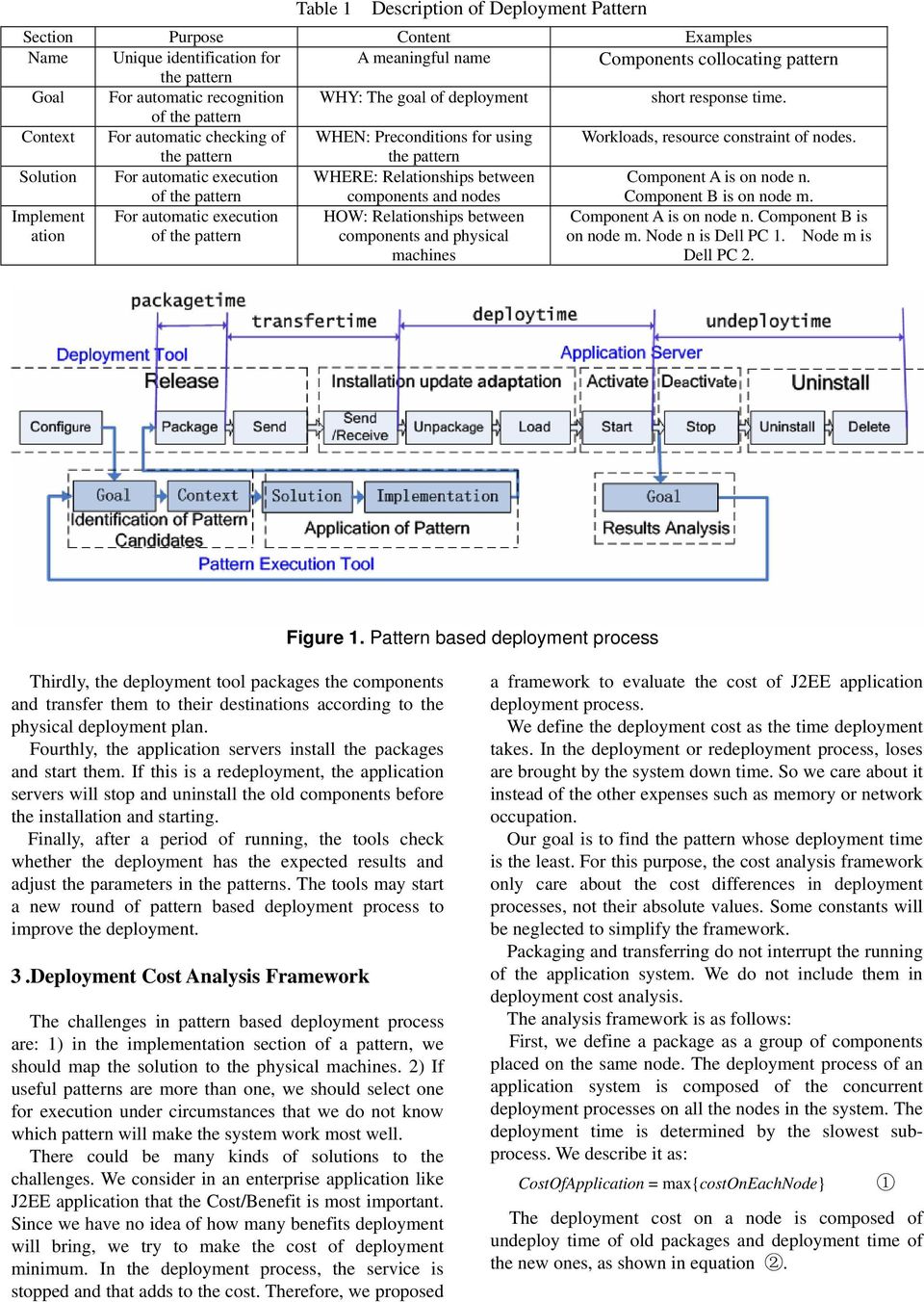
1 Pattern-based J2EE Application Deployment with Cost Analysis Nuyun ZHANG, Gang HUANG, Ling LAN, Hong MEI Institute of Software, School of Electronics Engineering and Computer Science, Peking University, Key laboratory of High Confidence Software Technologies (Peking University),Ministry of Education, Beijing, , China Abstract 1 The most challenging problem of J2EE application deployment is to determine which components should be deployed onto which servers in terms of non-functional properties. This paper proposes an empirical approach with some mathematic enhancement. It does two contributions to J2EE application deployment: 1) patterns are adopted to specify why, when, where and how to deploy so that the empirical approach becomes more comprehensible and operational; 2) a mathematic framework to analyze the deployment cost is defined for helping the selection of the best-of-breed pattern. We experiment several patterns on a J2EE benchmark application and evaluate the cost analysis framework. 1. Introduction Deployment of J2EE application is the process to deploy application clients, applets, web components and Enterprise JavaBeans components into specific operational environments [6]. The most challenging problem of deployment is component arrangement, namely which components should be deployed onto which servers in terms of performance, reliability, cost and other non-functional properties. Existing approaches for the problem can be summarized as: mathematics, artificial intelligence (AI) and empirical methods. The mathematics methods build delicate models about the system and solving it to find the optimal deployment plan [4]. They require precise parameters, such as memory consumption of each component and reliability of each node. The AI methods use AI technology to reduce the complexity of the search space that is involved in finding an optimal plan [5]. They need a number of parameters, too. The empirical methods try to conclude some guidelines from experiences or best practices for deployments. The math and AI methods neglect some details of the running of the application system. In addition, some of the parameters they need are difficult to measure or their precision cannot be guaranteed. Totally depending on 1 This work has been supported by the National Grand Fundamental Research 973 Program of China under Grant No.2005CB321805, the National Natural Science Foundation of China under Grant No , , them is usually impractical. On the other hand, when turning to the empirical methods, we find their carrying out is seriously depend on the deployers understanding and manual operations. This paper proposes a pattern based approach for J2EE application deployment. It is an empirical method but more formal and specific than the traditional ones. It includes clear operational steps and can be carried out automatically. However, there are 2 problems in the approach: how to choose a pattern to execute from several useful patterns and how to map the deployment solutions onto physical machines. We again propose a deployment cost analysis framework to meet the problems. The contribution of this paper is: it not only brings forward a pattern based approach to J2EE application deployment but also makes it practical. It makes use of patterns to describe deployment guideline and gives a quantitative cost analysis framework to support the execution of patterns. It implements based deployment process and validates the effectiveness of the approach and the framework by experiments. 2. Approach Overview 2.1 Description of Deployment Pattern The description of deployment patterns contains several sections which are shown in Table Pattern based Deployment Process We divide J2EE deployment process into seven stages that are release, installation, update, adaptation, activation, deactivation, and uninstallation. The pattern based J2EE deployment adds some steps between the stages as shown in Figure 1.The execution of pattern starts after the configuration step. Then it goes on as follows: Firstly, execution tool identifies candidates by checking the goal sections and context sections of all patterns. Secondly, execution tool picks out one of candidates to execute. It follows the solution section to make a deployment plan, the implementation section to make a physical deployment plan.

2 Table 1 Description of Deployment Pattern Section Purpose Content Examples Name Unique identification for A meaningful name Components collocating pattern Goal For automatic recognition WHY: The goal of deployment short response time. of Context For automatic checking of WHEN: Preconditions for using Workloads, resource constraint of nodes. Solution For automatic execution WHERE: Relationships between Component A is on node n. of components and nodes Component B is on node m. Implement For automatic execution ation of HOW: Relationships between components and physical machines Component A is on node n. Component B is on node m. Node n is Dell PC 1. Node m is Dell PC 2. Figure 1. Pattern based deployment process Thirdly, the deployment tool packages the components and transfer them to their destinations according to the physical deployment plan. Fourthly, the application servers install the packages and start them. If this is a redeployment, the application servers will stop and uninstall the old components before the installation and starting. Finally, after a period of running, the tools check whether the deployment has the expected results and adjust the parameters in s. The tools may start a new round of pattern based deployment process to improve the deployment. 3.Deployment Cost Analysis Framework The challenges in pattern based deployment process are: 1) in the implementation section of a pattern, we should map the solution to the physical machines. 2) If useful patterns are more than one, we should select one for execution under circumstances that we do not know which pattern will make the system work most well. There could be many kinds of solutions to the challenges. We consider in an enterprise application like J2EE application that the Cost/Benefit is most important. Since we have no idea of how many benefits deployment will bring, we try to make the cost of deployment minimum. In the deployment process, the service is stopped and that adds to the cost. Therefore, we proposed a framework to evaluate the cost of J2EE application deployment process. We define the deployment cost as the time deployment takes. In the deployment or redeployment process, loses are brought by the system down time. So we care about it instead of the other expenses such as memory or network occupation. Our goal is to find whose deployment time is the least. For this purpose, the cost analysis framework only care about the cost differences in deployment processes, not their absolute values. Some constants will be neglected to simplify the framework. Packaging and transferring do not interrupt the running of the application system. We do not include them in deployment cost analysis. The analysis framework is as follows: First, we define a package as a group of components placed on the same node. The deployment process of an application system is composed of the concurrent deployment processes on all the nodes in the system. The deployment time is determined by the slowest subprocess. We describe it as: CostOfApplication = max{costoneachnode} 1 The deployment cost on a node is composed of undeploy time of old packages and deployment time of the new ones, as shown in equation 2.
3 costoneachnode = deploymenttime + undeploymenttime 1. The deployment time is closely related with the implementation of application server. We have done some experiments on Peking University Application Server (PKUAS) [3] try to find some rules in deployment time. The deployment time is composed of installation time and starting time. The following hot color map is a contour figure showing the installation time of JAR packages. The 20 colors evenly ranged from 3396 to ms. The darkest red in the upper right area of the map represents the longest time that is ms. The darkest blue in the lower left represents the shortest time that is 3396 ms. There is a blank area in the right lower part of the figure, because when package number is small, the package size can hardly be very large We do the same kind of experiments to figure out the installation time of WAR packages. In our experiments, the installation time of WAR differs from 282 to ms as the package size ranges from 41 to kb. The installation time of WAR is about ten times less than that of JAR of the same size. We find that no matter how many html, JSP, and images are in the package, the installation time is the same if the whole package size is the same and the Java class number is the same. Figure 3 shows the installation time of WAR when there are a fix number of Java classes. We can see that the installation time has a linear relationship with the size of WAR package. installationtimewar = c*warsize where c is a constant that has something to do with the implementation of the application server and the Java classes in the package. Figure 2. Contour map of installation time of JAR Figure 3. Installation time of WAR From figure 4 we can see the installation time has something to do with package size and number of JARs. The more JARs are, the longer the time is. The larger the size is, the longer the time is. Because the contour lines are almost vertical, we know the size of package plays a more important role in the installation time and their relationship can be approximately described by linear equation. In our cost analysis problem, what we want is only a comparable result, not the absolute number. To simplify the comparison, we give each installation time a reasonable value instead of its real value. The given value can reflect its real value in proportion. The simplified expression of installation time of EJB package should be in a linear form, and we omit the constant to get the following expression: ejbpackagesize( kb) installationtimeejb = 3 If necessary, by curve fitting and further analysis of the sub deployment time,we can get the exact relationship of installation time, the JAR number and the package size. We can give a set of test packages. In another specific environment, by deploy the test packages, we can figure out the relationship of installation time, the JAR number and the package size automatically. For the purpose of comparison, consulting the experiment results of the installation time of EJB package, we give a simplified expression for WAR installation time: WARsize installationtimewar = 0.1* 4 JARsize where JARsize represents the size of all the JARs in the system. Integrating the expression 3 and 4 we get the installation time of a package as: ejbpackagesize WARsize installationtime = + 0.1* JARsize 3. By experiments we know the starting time is really small and can be neglect. 4. The undeployment time is composed of the uninstallation time and the stopping time. By experiments we know the stopping time is very small and can be neglected. 5. In our experiments, the uninstallation time of WAR varies from 188 to 781 ms as the package size ranges from 41 to kb. It plays a so trifling part in the whole deployment time that we neglect it. 5

4 4.1 Redeployment of RUBiS Initial Deployment of RUBiS 3 In the given environment, there are 18 = 2592 deployment plan of RUBiS, where 18 is the component number and 3 is the node number. We make an initial deployment randomly, as shown in Table 3. We assume the number of concurrent clients is 500. Table 3. An initial deployment plan Figure 4. Uninstallation time of JAR 6. Figure 4 is the contour map of uninstallation time of JAR packages by experiments. Because the contour line is almost horizontal, we know the number of JAR is the most important factor in uninstallation time. Using the same analysis method of the installation time, we get the following expression: uninstallationtimejar = 0.2* JARnumber 6 In conclusion, applying the expression 5 and 6 to 2, we obtain the deployment cost on each node. Applying the expression 2 to 1, we obtain the cost of the whole deployment process. In different implementations of J2EE deployment process, the cost analysis methods may need adjustment in detail, but the framework is still applicable and it is our future direction of research. 4.Case study In this section, we use cost analysis based deployment patterns to redeploy RUBiS [7], which is an auction site prototype modeled after ebay.com that is used to evaluate application design patterns and application server performance scalability. First, we give an entire redeployment process of RUBiS. Then, we verify our cost analysis framework by comparing experimental deployment time and its estimated values. The process is aided by CADTool, which is a J2EE deployment tool [2]. The environment of experiments is shown in Table 2: Table 2. Deployment environment Node Software Database CPU Memory none 2.79G 504M MySQL G 504M none 2.79G 512M Client none 2.79G 512M Node Deploys WAR(241kB), 4 JARs(262kB) MySQL DB, 7 JARs(569kB) 6 JARs(369kB) Identification of Pattern Candidates 1. Deployment goal recognition. The deployment goal is to achieve a good performance in average client session time, as mentioned in section 2.We find out 5 patterns have the goal. They are in Table 4. Table 4. Pattern Candidates ID Key elements in Main idea of Solution context 1 Client Number<1000 Collocating WAR and JARs 2 Client Number<1000 Centralized deployment of EJB 3 Client Number>1000 Separate WAR and JARs 4 Client Number>1000 Distributed deployment of EJB 5 Separate Resource consuming servers 2. Initial context verification. In the experiment environment, the logic expressions in the contexts of Pattern 1 and 2 are true. Pattern 1 and 2 are useful Cost Analysis Aided Pattern Execution 1. Selecting an implementation for each pattern candidate. We use the cost analysis framework to estimate the every possible implementation of the candidate pattern1 and 2. We use the following formulae mentioned in section 3 to make the estimation: CostOfApplication = max{ costoneachnode } ejbpackagesize WARsize installationtime = + 0.1* JARsize undeploytimejar = 0.2* JARnumber

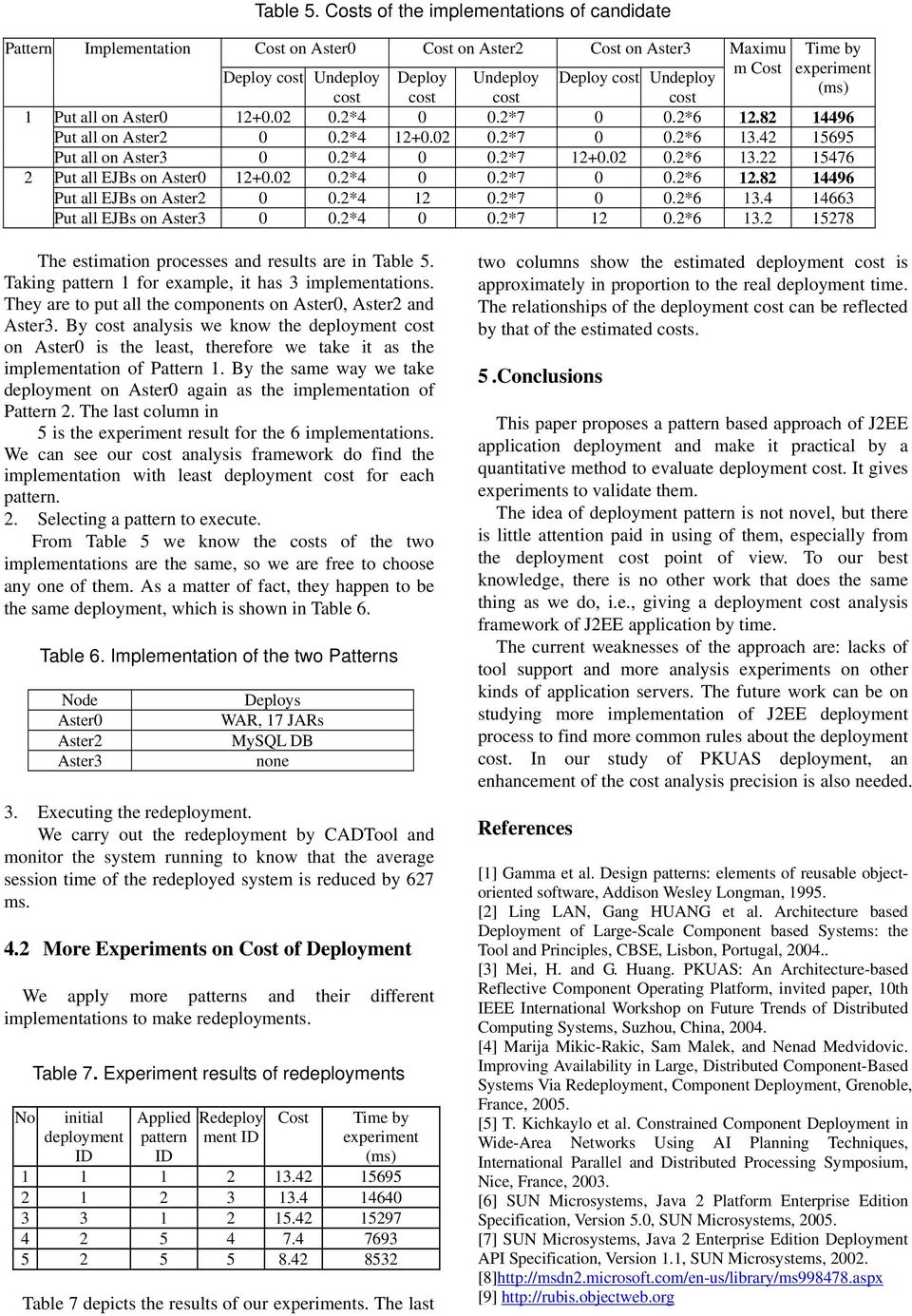
5 Table 5. Costs of the implementations of candidate Pattern Implementation Cost on Cost on Cost on Maximu Time by m Cost experiment Deploy cost Undeploy Deploy Undeploy Deploy cost Undeploy (ms) cost cost cost cost 1 Put all on * * * Put all on 0 0.2* * * Put all on 0 0.2* * * Put all EJBs on * * * Put all EJBs on 0 0.2* * * Put all EJBs on 0 0.2* * * The estimation processes and results are in Table 5. Taking pattern 1 for example, it has 3 implementations. They are to put all the components on, and. By cost analysis we know the deployment cost on is the least, therefore we take it as the implementation of Pattern 1. By the same way we take deployment on again as the implementation of Pattern 2. The last column in 5 is the experiment result for the 6 implementations. We can see our cost analysis framework do find the implementation with least deployment cost for each pattern. 2. Selecting a pattern to execute. From Table 5 we know the costs of the two implementations are the same, so we are free to choose any one of them. As a matter of fact, they happen to be the same deployment, which is shown in Table 6. Table 6. Implementation of the two Patterns Node Deploys WAR, 17 JARs MySQL DB none 3. Executing the redeployment. We carry out the redeployment by CADTool and monitor the system running to know that the average session time of the redeployed system is reduced by 627 ms. 4.2 More Experiments on Cost of Deployment We apply more patterns and their different implementations to make redeployments. No Table 7. Experiment results of redeployments initial deployment ID Applied pattern ID Redeploy ment ID Cost Time by experiment (ms) Table 7 depicts the results of our experiments. The last two columns show the estimated deployment cost is approximately in proportion to the real deployment time. The relationships of the deployment cost can be reflected by that of the estimated costs. 5.Conclusions This paper proposes a pattern based approach of J2EE application deployment and make it practical by a quantitative method to evaluate deployment cost. It gives experiments to validate them. The idea of deployment pattern is not novel, but there is little attention paid in using of them, especially from the deployment cost point of view. To our best knowledge, there is no other work that does the same thing as we do, i.e., giving a deployment cost analysis framework of J2EE application by time. The current weaknesses of the approach are: lacks of tool support and more analysis experiments on other kinds of application servers. The future work can be on studying more implementation of J2EE deployment process to find more common rules about the deployment cost. In our study of PKUAS deployment, an enhancement of the cost analysis precision is also needed. References [1] Gamma et al. Design patterns: elements of reusable objectoriented software, Addison Wesley Longman, [2] Ling LAN, Gang HUANG et al. Architecture based Deployment of Large-Scale Component based Systems: the Tool and Principles, CBSE, Lisbon, Portugal, [3] Mei, H. and G. Huang. PKUAS: An Architecture-based Reflective Component Operating Platform, invited paper, 10th IEEE International Workshop on Future Trends of Distributed Computing Systems, Suzhou, China, [4] Marija Mikic-Rakic, Sam Malek, and Nenad Medvidovic. Improving Availability in Large, Distributed Component-Based Systems Via Redeployment, Component Deployment, Grenoble, France, [5] T. Kichkaylo et al. Constrained Component Deployment in Wide-Area Networks Using AI Planning Techniques, International Parallel and Distributed Processing Symposium, Nice, France, [6] SUN Microsystems, Java 2 Platform Enterprise Edition Specification, Version 5.0, SUN Microsystems, [7] SUN Microsystems, Java 2 Enterprise Edition Deployment API Specification, Version 1.1, SUN Microsystems, [8] [9]
Performance Prediction, Sizing and Capacity Planning for Distributed E-Commerce Applications
 Performance Prediction, Sizing and Capacity Planning for Distributed E-Commerce Applications by Samuel D. Kounev ([email protected]) Information Technology Transfer Office Abstract Modern e-commerce
Test Run Analysis Interpretation (AI) Made Easy with OpenLoad
 Test Run Analysis Interpretation (AI) Made Easy with OpenLoad OpenDemand Systems, Inc. Abstract / Executive Summary As Web applications and services become more complex, it becomes increasingly difficult
What Is the Java TM 2 Platform, Enterprise Edition?
 Page 1 de 9 What Is the Java TM 2 Platform, Enterprise Edition? This document provides an introduction to the features and benefits of the Java 2 platform, Enterprise Edition. Overview Enterprises today
The Key Technology Research of Virtual Laboratory based On Cloud Computing Ling Zhang
 International Conference on Advances in Mechanical Engineering and Industrial Informatics (AMEII 2015) The Key Technology Research of Virtual Laboratory based On Cloud Computing Ling Zhang Nanjing Communications
Case Studies of Running the Platform. NetBeans UML Servlet JSP GlassFish EJB
 September Case Studies of Running the Platform NetBeans UML Servlet JSP GlassFish EJB In this project we display in the browser the Hello World, Everyone! message created in the session bean with servlets
How to Build an E-Commerce Application using J2EE. Carol McDonald Code Camp Engineer
 How to Build an E-Commerce Application using J2EE Carol McDonald Code Camp Engineer Code Camp Agenda J2EE & Blueprints Application Architecture and J2EE Blueprints E-Commerce Application Design Enterprise
A Middleware Strategy to Survive Compute Peak Loads in Cloud
 A Middleware Strategy to Survive Compute Peak Loads in Cloud Sasko Ristov Ss. Cyril and Methodius University Faculty of Information Sciences and Computer Engineering Skopje, Macedonia Email: [email protected]
Figure 1. The cloud scales: Amazon EC2 growth [2].
![Figure 1. The cloud scales: Amazon EC2 growth [2].](/thumbs/26/9133435.jpg "Figure 1. The cloud scales: Amazon EC2 growth [2].") - Chung-Cheng Li and Kuochen Wang Department of Computer Science National Chiao Tung University Hsinchu, Taiwan 300 [email protected], [email protected] Abstract One of the most important issues
- Chung-Cheng Li and Kuochen Wang Department of Computer Science National Chiao Tung University Hsinchu, Taiwan 300 [email protected], [email protected] Abstract One of the most important issues
Introducing Performance Engineering by means of Tools and Practical Exercises
 Introducing Performance Engineering by means of Tools and Practical Exercises Alexander Ufimtsev, Trevor Parsons, Lucian M. Patcas, John Murphy and Liam Murphy Performance Engineering Laboratory, School
Monitoring Pramati EJB Server
 Monitoring Pramati EJB Server 17 Overview The EJB Server manages the execution of enterprise applications that run on the J2EE server. The JAR modules deployed on the Server are supported by the EJB container.
ANALYSIS OF GRID COMPUTING AS IT APPLIES TO HIGH VOLUME DOCUMENT PROCESSING AND OCR
 ANALYSIS OF GRID COMPUTING AS IT APPLIES TO HIGH VOLUME DOCUMENT PROCESSING AND OCR By: Dmitri Ilkaev, Stephen Pearson Abstract: In this paper we analyze the concept of grid programming as it applies to
Cloud Storage Solution for WSN Based on Internet Innovation Union
 Cloud Storage Solution for WSN Based on Internet Innovation Union Tongrang Fan 1, Xuan Zhang 1, Feng Gao 1 1 School of Information Science and Technology, Shijiazhuang Tiedao University, Shijiazhuang,
Distributed Objects and Components
 Distributed Objects and Components Introduction This essay will identify the differences between objects and components and what it means for a component to be distributed. It will also examine the Java
Implementation of an Enterprise-level Groupware System Based on J2EE Platform and WebDAV Protocol
 Changtao Qu, Thomas Engel, Christoph Meinel: Implementation of an Enterprise-level Groupware System Based on J2EE Platform and WebDAV Protocol in Proceedings of the 4th InternationalEnterprise Distributed
Glassfish, JAVA EE, Servlets, JSP, EJB
 Glassfish, JAVA EE, Servlets, JSP, EJB Java platform A Java platform comprises the JVM together with supporting class libraries. Java 2 Standard Edition (J2SE) (1999) provides core libraries for data structures,
WASv6_Scheduler.ppt Page 1 of 18
 This presentation will discuss the Scheduler Service available in IBM WebSphere Application Server V6. This service allows you to schedule time-dependent actions. WASv6_Scheduler.ppt Page 1 of 18 The goals
Modeling Web Applications Using Java And XML Related Technologies
 Modeling Web Applications Using Java And XML Related Technologies Sam Chung Computing & Stware Systems Institute Technology University Washington Tacoma Tacoma, WA 98402. USA [email protected] Yun-Sik
MagDiSoft Web Solutions Office No. 102, Bramha Majestic, NIBM Road Kondhwa, Pune -411048 Tel: 808-769-4605 / 814-921-0979 www.magdisoft.
 WebLogic Server Course Following is the list of topics that will be covered during the course: Introduction to WebLogic What is Java? What is Java EE? The Java EE Architecture Enterprise JavaBeans Application
Excerpts from Chapter 4, Architectural Modeling -- UML for Mere Mortals by Eric J. Naiburg and Robert A. Maksimchuk
 Excerpts from Chapter 4, Architectural Modeling -- UML for Mere Mortals by Eric J. Naiburg and Robert A. Maksimchuk Physical Architecture As stated earlier, architecture can be defined at both a logical
Configuration Management of Massively Scalable Systems
 1 KKIO 2005 Configuration Management of Massively Scalable Systems Configuration Management of Massively Scalable Systems Marcin Jarząb, Krzysztof Zieliński, Jacek Kosiński SUN Center of Excelence Department
Dynamic Adaptability of Services in Enterprise JavaBeans Architecture
 1. Introduction Dynamic Adaptability of Services in Enterprise JavaBeans Architecture Zahi Jarir *, Pierre-Charles David **, Thomas Ledoux ** [email protected], {pcdavid, ledoux}@emn.fr (*) Faculté
25 May 11.30 Code 3C3 Peeling the Layers of the 'Performance Onion John Murphy, Andrew Lee and Liam Murphy
 UK CMG Presentation 25 May 11.30 Code 3C3 Peeling the Layers of the 'Performance Onion John Murphy, Andrew Lee and Liam Murphy Is Performance a Problem? Not using appropriate performance tools will cause
NetBeans IDE Field Guide
 NetBeans IDE Field Guide Copyright 2005 Sun Microsystems, Inc. All rights reserved. Table of Contents Introduction to J2EE Development in NetBeans IDE...1 Configuring the IDE for J2EE Development...2 Getting
Software Engineering. Software Engineering. Component-Based. Based on Software Engineering, 7 th Edition by Ian Sommerville
 Software Engineering Component-Based Software Engineering Based on Software Engineering, 7 th Edition by Ian Sommerville Objectives To explain that CBSE is concerned with developing standardised components
A Performance Comparison of Web Development Technologies to Distribute Multimedia across an Intranet
 A Performance Comparison of Web Development Technologies to Distribute Multimedia across an Intranet D. Swales, D. Sewry, A. Terzoli Computer Science Department Rhodes University Grahamstown, 6140 Email:
Java Technology in the Design and Implementation of Web Applications
 Java Technology in the Design and Implementation of Web Applications Kavindra Kumar Singh School of Computer and Systems Sciences Jaipur National University Jaipur Abstract: This paper reviews the development
Chapter 1 Introduction to Enterprise Software
 Chapter 1 Introduction to Enterprise Software What Is Enterprise Software? Evolution of Enterprise Software Enterprise Software and Component-Based Software Summary If you have heard of terms such as
CMotion: A Framework for Migration of Applications into and between Clouds
 Institute of Architecture of Application Systems CMotion: A Framework for Migration of Applications into and between Clouds Tobias Binz, Frank Leymann, David Schumm Institute of Architecture of Application
A framework for web-based product data management using J2EE
 Int J Adv Manuf Technol (2004) 24: 847 852 DOI 10.1007/s00170-003-1697-8 ORIGINAL ARTICLE M.Y. Huang Y.J. Lin Hu Xu A framework for web-based product data management using J2EE Received: 8 October 2002
Improve Business Productivity and User Experience with a SanDisk Powered SQL Server 2014 In-Memory OLTP Database
 WHITE PAPER Improve Business Productivity and User Experience with a SanDisk Powered SQL Server 2014 In-Memory OLTP Database 951 SanDisk Drive, Milpitas, CA 95035 www.sandisk.com Table of Contents Executive
Distributed Database Design
 Distributed Databases Distributed Database Design Distributed Database System MS MS Web Web data mm xml mm dvanced Database Systems, mod1-1, 2004 1 Advanced Database Systems, mod1-1, 2004 2 Advantages
What Is Specific in Load Testing?
 What Is Specific in Load Testing? Testing of multi-user applications under realistic and stress loads is really the only way to ensure appropriate performance and reliability in production. Load testing
Scalable Multiple NameNodes Hadoop Cloud Storage System
 Vol.8, No.1 (2015), pp.105-110 http://dx.doi.org/10.14257/ijdta.2015.8.1.12 Scalable Multiple NameNodes Hadoop Cloud Storage System Kun Bi 1 and Dezhi Han 1,2 1 College of Information Engineering, Shanghai
Enterprise Applications
 Module 11 At the end of this module you will be able to: 9 Describe the differences between EJB types 9 Deploy EJBs 9 Define an Enterprise Application 9 Dxplain the directory structure of an Enterprise
Evaluation Methodology of Converged Cloud Environments
 Krzysztof Zieliński Marcin Jarząb Sławomir Zieliński Karol Grzegorczyk Maciej Malawski Mariusz Zyśk Evaluation Methodology of Converged Cloud Environments Cloud Computing Cloud Computing enables convenient,
Recommendations for Performance Benchmarking
 Recommendations for Performance Benchmarking Shikhar Puri Abstract Performance benchmarking of applications is increasingly becoming essential before deployment. This paper covers recommendations and best
WITH A FUSION POWERED SQL SERVER 2014 IN-MEMORY OLTP DATABASE
 WITH A FUSION POWERED SQL SERVER 2014 IN-MEMORY OLTP DATABASE 1 W W W. F U S I ON I O.COM Table of Contents Table of Contents... 2 Executive Summary... 3 Introduction: In-Memory Meets iomemory... 4 What
3-Tier Architecture. 3-Tier Architecture. Prepared By. Channu Kambalyal. Page 1 of 19
 3-Tier Architecture Prepared By Channu Kambalyal Page 1 of 19 Table of Contents 1.0 Traditional Host Systems... 3 2.0 Distributed Systems... 4 3.0 Client/Server Model... 5 4.0 Distributed Client/Server
Managing Java EE Performance with Embarcadero s J Optimizer Request Analyzer
 Tech Notes Managing Java EE Performance with Embarcadero s J Optimizer Request Analyzer Al F. Mannarino, Embarcadero Technologies June 2008 Corporate Headquarters EMEA Headquarters Asia-Pacific Headquarters
Oracle WebLogic Foundation of Oracle Fusion Middleware. Lawrence Manickam Toyork Systems Inc www.toyork.com http://ca.linkedin.
 Oracle WebLogic Foundation of Oracle Fusion Middleware Lawrence Manickam Toyork Systems Inc www.toyork.com http://ca.linkedin.com/in/lawrence143 History of WebLogic WebLogic Inc started in 1995 was a company
Chapter 1 - Web Server Management and Cluster Topology
 Objectives At the end of this chapter, participants will be able to understand: Web server management options provided by Network Deployment Clustered Application Servers Cluster creation and management
Load Balancing in Cluster
 8 Chapter 8 33 Pramati Cluster provides a pluggable load balancer architecture. Different load balancing algorithms can be used by the cluster. By default, Pramati Server ships with a Weighted Round Robin
Software Configuration Management Related to Management of Distributed Systems and Services and Advanced Service Creation
 Software Configuration Management Related to Management of Distributed Systems and Services and Advanced Service Creation Vladimir Tosic 1, David Mennie 2, Bernard Pagurek 1 1 Network Management and Artificial
Relational Database Basics Review
 Relational Database Basics Review IT 4153 Advanced Database J.G. Zheng Spring 2012 Overview Database approach Database system Relational model Database development 2 File Processing Approaches Based on
SAP NetWeaver BRM 7.3
 SAP NetWeaver BRM 7.3 New Features Overview Arti Gopalan Solution Specialist SAP NetWeaver BRM NetWeaver Orchestration SAP Labs India Agenda Technical Components of NW BRM Rules Composer Rules Manager
Case Study - I. Industry: Social Networking Website Technology : J2EE AJAX, Spring, MySQL, Weblogic, Windows Server 2008.
 Case Study - I Industry: Social Networking Website Technology : J2EE AJAX, Spring, MySQL, Weblogic, Windows Server 2008 Challenges The scalability of the database servers to execute batch processes under
2012 LABVANTAGE Solutions, Inc. All Rights Reserved.
 LABVANTAGE Architecture 2012 LABVANTAGE Solutions, Inc. All Rights Reserved. DOCUMENT PURPOSE AND SCOPE This document provides an overview of the LABVANTAGE hardware and software architecture. It is written
Developing modular Java applications
 Developing modular Java applications Julien Dubois France Regional Director SpringSource Julien Dubois France Regional Director, SpringSource Book author :«Spring par la pratique» (Eyrolles, 2006) new
enterprise^ IBM WebSphere Application Server v7.0 Security "publishing Secure your WebSphere applications with Java EE and JAAS security standards
 IBM WebSphere Application Server v7.0 Security Secure your WebSphere applications with Java EE and JAAS security standards Omar Siliceo "publishing enterprise^ birmingham - mumbai Preface 1 Chapter 1:
BSPCloud: A Hybrid Programming Library for Cloud Computing *
 BSPCloud: A Hybrid Programming Library for Cloud Computing * Xiaodong Liu, Weiqin Tong and Yan Hou Department of Computer Engineering and Science Shanghai University, Shanghai, China [email protected],
White Paper: 1) Architecture Objectives: The primary objective of this architecture is to meet the. 2) Architecture Explanation
 White Paper: 1) Architecture Objectives: The primary objective of this architecture is to meet the following requirements (SLAs). Scalability and High Availability Modularity and Maintainability Extensibility
Titolo del paragrafo. Titolo del documento - Sottotitolo documento The Benefits of Pushing Real-Time Market Data via a Web Infrastructure
 1 Alessandro Alinone Agenda Introduction Push Technology: definition, typology, history, early failures Lightstreamer: 3rd Generation architecture, true-push Client-side push technology (Browser client,
Techniques for Scaling Components of Web Application
 , March 12-14, 2014, Hong Kong Techniques for Scaling Components of Web Application Ademola Adenubi, Olanrewaju Lewis, Bolanle Abimbola Abstract Every organisation is exploring the enormous benefits of
Shared Parallel File System
 Shared Parallel File System Fangbin Liu [email protected] System and Network Engineering University of Amsterdam Shared Parallel File System Introduction of the project The PVFS2 parallel file system
A STUDY OF THE BEHAVIOUR OF THE MOBILE AGENT IN THE NETWORK MANAGEMENT SYSTEMS
 A STUDY OF THE BEHAVIOUR OF THE MOBILE AGENT IN THE NETWORK MANAGEMENT SYSTEMS Tarag Fahad, Sufian Yousef & Caroline Strange School of Design and Communication Systems, Anglia Polytechnic University Victoria
JReport Server Deployment Scenarios
 JReport Server Deployment Scenarios Contents Introduction... 3 JReport Architecture... 4 JReport Server Integrated with a Web Application... 5 Scenario 1: Single Java EE Server with a Single Instance of
Principles and Software Realization of a Multimedia Course on Theoretical Electrical Engineering Based on Enterprise Technology
 SERBIAN JOURNAL OF ELECTRICAL ENGINEERING Vol. 1, No. 1, November 2003, 81-87 Principles and Software Realization of a Multimedia Course on Theoretical Electrical Engineering Based on Enterprise Technology
Chapter 3 Technology adapted
 Chapter 3 Technology adapted 3.1 Introduction In developing a web enabled solution for laboratory data and document management, there are several options available for system analysis and designing, documentation
Analysis and Research of Cloud Computing System to Comparison of Several Cloud Computing Platforms
 Volume 1, Issue 1 ISSN: 2320-5288 International Journal of Engineering Technology & Management Research Journal homepage: www.ijetmr.org Analysis and Research of Cloud Computing System to Comparison of
InfiniteGraph: The Distributed Graph Database
 A Performance and Distributed Performance Benchmark of InfiniteGraph and a Leading Open Source Graph Database Using Synthetic Data Objectivity, Inc. 640 West California Ave. Suite 240 Sunnyvale, CA 94086
Performance Modeling for Web based J2EE and.net Applications
 Performance Modeling for Web based J2EE and.net Applications Shankar Kambhampaty, and Venkata Srinivas Modali Abstract When architecting an application, key nonfunctional requirements such as performance,
Final Project Proposal. CSCI.6500 Distributed Computing over the Internet
 Final Project Proposal CSCI.6500 Distributed Computing over the Internet Qingling Wang 660795696 1. Purpose Implement an application layer on Hybrid Grid Cloud Infrastructure to automatically or at least
OUR COURSES 19 November 2015. All prices are per person in Swedish Krona. Solid Beans AB Kungsgatan 32 411 19 Göteborg Sweden
 OUR COURSES 19 November 2015 Solid Beans AB Kungsgatan 32 411 19 Göteborg Sweden Java for beginners JavaEE EJB 3.1 JSF (Java Server Faces) PrimeFaces Spring Core Spring Advanced Maven One day intensive
Variations in Performance and Scalability when Migrating n-tier Applications to Different Clouds
 Variations in Performance and Scalability when Migrating n-tier Applications to Different Clouds Deepal Jayasinghe, Simon Malkowski, Qingyang Wang, Jack Li, Pengcheng Xiong, Calton Pu Outline Motivation
IBM Rational Asset Manager
 Providing business intelligence for your software assets IBM Rational Asset Manager Highlights A collaborative software development asset management solution, IBM Enabling effective asset management Rational
Capacity Management for Oracle Database Machine Exadata v2
 Capacity Management for Oracle Database Machine Exadata v2 Dr. Boris Zibitsker, BEZ Systems NOCOUG 21 Boris Zibitsker Predictive Analytics for IT 1 About Author Dr. Boris Zibitsker, Chairman, CTO, BEZ
Clustering Versus Shared Nothing: A Case Study
 2009 33rd Annual IEEE International Computer Software and Applications Conference Clustering Versus Shared Nothing: A Case Study Jonathan Lifflander, Adam McDonald, Orest Pilskalns School of Engineering
CS 487. Week 8. Reference: 1. Software engineering, roger s. pressman. Reading: 1. Ian Sommerville, Chapter 3. Objective:
 CS 487 Week 8 Reading: 1. Ian Sommerville, Chapter 3. Objective: 1. To check the understandibility of the students in life cycle and process model for development of a software product. 2. To check if
Flauncher and DVMS Deploying and Scheduling Thousands of Virtual Machines on Hundreds of Nodes Distributed Geographically
 Flauncher and Deploying and Scheduling Thousands of Virtual Machines on Hundreds of Nodes Distributed Geographically Daniel Balouek, Adrien Lèbre, Flavien Quesnel To cite this version: Daniel Balouek,
Customer Bank Account Management System Technical Specification Document
 Customer Bank Account Management System Technical Specification Document Technical Specification Document Page 1 of 15 Table of Contents Contents 1 Introduction 3 2 Design Overview 4 3 Topology Diagram.6
Umbrella: A New Component-Based Software Development Model
 2009 International Conference on Computer Engineering and Applications IPCSIT vol.2 (2011) (2011) IACSIT Press, Singapore Umbrella: A New Component-Based Software Development Model Anurag Dixit and P.C.
Performance Best Practices Guide for SAP NetWeaver Portal 7.3
 SAP NetWeaver Best Practices Guide Performance Best Practices Guide for SAP NetWeaver Portal 7.3 Applicable Releases: SAP NetWeaver 7.3 Document Version 1.0 June 2012 Copyright 2012 SAP AG. All rights
[Rokadiya,5(4): October-December 2015] ISSN 2277 5528 Impact Factor- 3.145
![[Rokadiya,5(4): October-December 2015] ISSN 2277 5528 Impact Factor- 3.145](/thumbs/29/13161576.jpg "[Rokadiya,5(4): October-December 2015] ISSN 2277 5528 Impact Factor- 3.145") INTERNATIONALJOURNALOFENGINEERING SCIENCES&MANAGEMENT A MODEL FOR WEB BASED APPLICATION USING MANUAL AND AUTOMATED TESTING TECHNIQUES AND ALSO STUDY FAULTS, THEIR EFFECTS AND TESTING CHALLENGES IN WEB
INTERNATIONALJOURNALOFENGINEERING SCIENCES&MANAGEMENT A MODEL FOR WEB BASED APPLICATION USING MANUAL AND AUTOMATED TESTING TECHNIQUES AND ALSO STUDY FAULTS, THEIR EFFECTS AND TESTING CHALLENGES IN WEB
Chapter 10: Scalability
 Chapter 10: Scalability Contents Clustering, Load balancing, DNS round robin Introduction Enterprise web portal applications must provide scalability and high availability (HA) for web services in order
Installation Guide of the Change Management API Reference Implementation
 Installation Guide of the Change Management API Reference Implementation Cm Expert Group CM-API-RI_USERS_GUIDE.0.1.doc Copyright 2008 Vodafone. All Rights Reserved. Use is subject to license terms. CM-API-RI_USERS_GUIDE.0.1.doc
A Systematic Method for Big Data Technology Selection
 A Systematic Method for Big Data Technology Selection John Klein Software Solutions Conference 2015 November 16 18, 2015 Copyright 2015 Carnegie Mellon University This material is based upon work funded
Design and Implementation of Supermarket Management System Yongchang Rena, Mengyao Chenb
 4th International Conference on Mechatronics, Materials, Chemistry and Computer Engineering (ICMMCCE 2015) Design and Implementation of Supermarket Management System Yongchang Rena, Mengyao Chenb College
Software Performance and Scalability
 Software Performance and Scalability A Quantitative Approach Henry H. Liu ^ IEEE )computer society WILEY A JOHN WILEY & SONS, INC., PUBLICATION Contents PREFACE ACKNOWLEDGMENTS xv xxi Introduction 1 Performance
Architectural Overview
 Architectural Overview Version 7 Part Number 817-2167-10 March 2003 A Sun ONE Application Server 7 deployment consists of a number of application server instances, an administrative server and, optionally,
Deploying to WebSphere Process Server and WebSphere Enterprise Service Bus
 Deploying to WebSphere Process Server and WebSphere Enterprise Service Bus Course materials may not be reproduced in whole or in part without the prior written permission of IBM. 4.0.3 Unit objectives
Affinity Aware VM Colocation Mechanism for Cloud
 Affinity Aware VM Colocation Mechanism for Cloud Nilesh Pachorkar 1* and Rajesh Ingle 2 Received: 24-December-2014; Revised: 12-January-2015; Accepted: 12-January-2015 2014 ACCENTS Abstract The most of
JSLEE and SIP-Servlets Interoperability with Mobicents Communication Platform
 JSLEE and SIP-Servlets Interoperability with Mobicents Communication Platform Jean Deruelle Jboss R&D, a division of Red Hat [email protected] Abstract JSLEE is a more complex specification than SIP
WEBSPHERE APPLICATION SERVER ADMIN V8.5 (on Linux and Windows) WITH REAL-TIME CONCEPTS & REAL-TIME PROJECT
 WEBSPHERE APPLICATION SERVER ADMIN V8.5 (on Linux and Windows) WITH REAL-TIME CONCEPTS & REAL-TIME PROJECT Faculty Name Experience Course Duration Madhav (Certified Middleware Professional) Certified on