
Training Guidelines for Parent-Child Interaction Therapy
|
|
|
- Posy Dixon
- 9 years ago
- Views:
Transcription
1 Training Guidelines for Parent-Child Interaction Therapy These guidelines were developed by the PCIT Training Committee, a subcommittee of the National PCIT Advisory Board made up of expert PCIT trainers. The PCIT Guidelines is a living document that will evolve as new research arises in intervention, training and dissemination. At this time, the Guidelines reflect what is considered to be the minimum training necessary to develop competence as a PCIT therapist. What is PCIT? PCIT is a behavioral family intervention for children 2-7 years of age with disruptive behavior disorders. It has been identified as a best practice for physically abusive parents. Developed by Sheila Eyberg at the University of Florida, PCIT integrates concepts from social learning theory, traditional play therapy, and attachment theory to enhance the parent-child relationship, increase children s pro-social behaviors, and increase parents behavior management skills. The program is implemented in two phases: The first phase is the Child Directed Interaction (CDI) phase during which parents develop child-centered interaction skills. The second phase is the Parent-Directed Interaction (PDI) phase during which effective discipline skills are the focus. PCIT gives equal attention to the development of the parent-child relationship and the development of parents behavior management skills. Because parent-child interactions in families with conduct-disordered children are frequently negative and coercive in nature, a critical goal of PCIT is to increase positive, nurturing interactions. PCIT includes the child in treatment, both in session and during daily homework assignments. In contrast to the traditional approach to parent training that focuses on didactic and role play, parents in PCIT rehearse new skills weekly in session through live interactions with their children. This active practice facilitates skill development and allows therapists to conduct ongoing assessments of parents' progress. In addition, it provides the opportunity for live-coaching by the therapist. During parent-child interactions, immediate feedback is given by the therapist from an observation room, while the parent wears a radio frequency earphone. Therapists use behavioral principles such as modeling, reinforcement, and selective attending in their coaching to shape the parents' behaviors. The use of live coaching and immediate feedback is key to PCIT. Therapists directly observe parents behaviors and can modify them as they occur. To understand the PCIT training guidelines, one should first be aware of the core components that define Parent-Child Interaction Therapy. Core components of PCIT include Use of standardized assessment instruments to guide treatment (e.g., Eyberg Child Behavior Inventory, Dyadic Parent-Child Interaction Coding System-III) Inclusion of both the Child Directed Interaction and Parent Directed Interaction phases of treatment 1

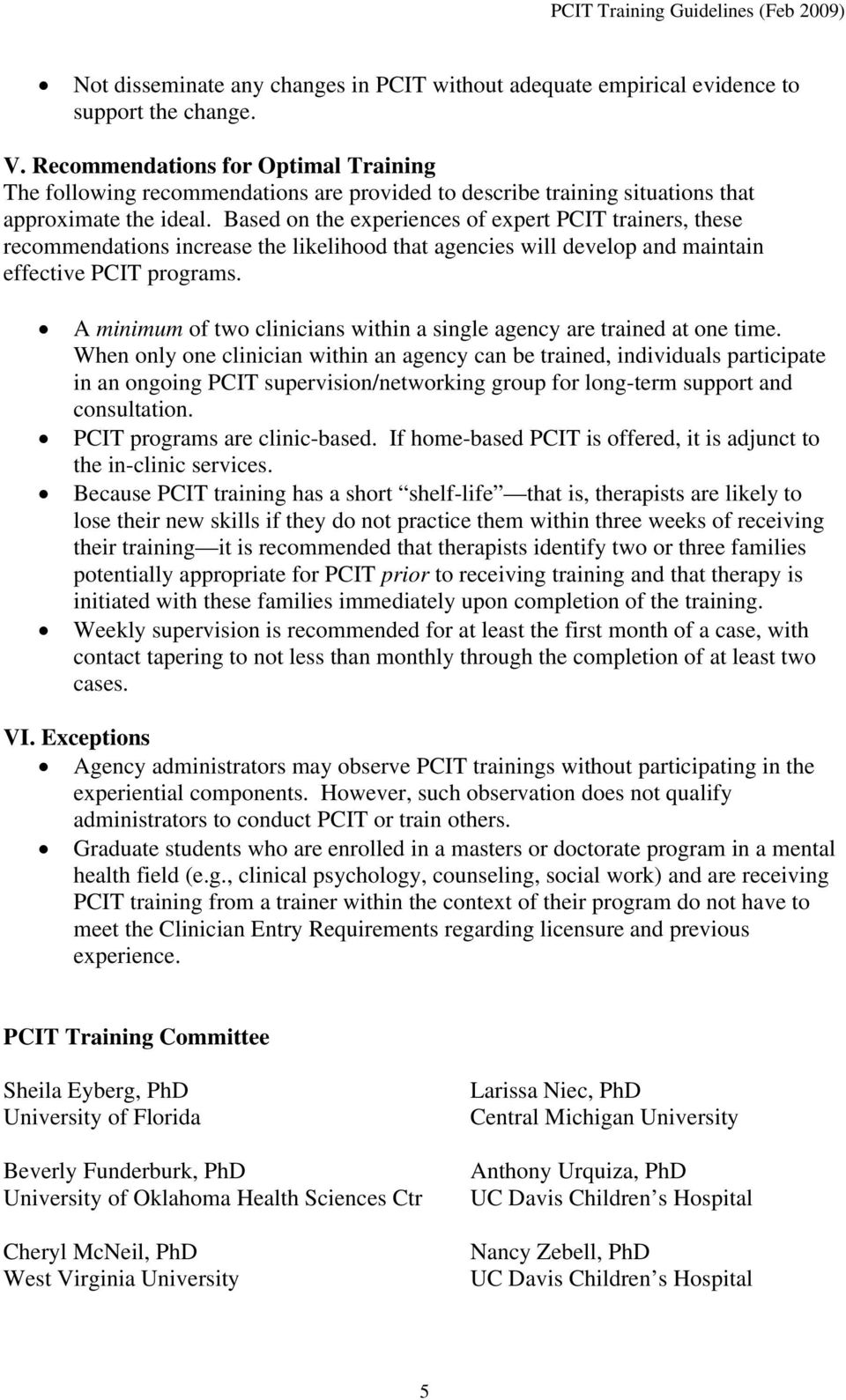
2 Coaching of parents in live interactions with their children for the majority of non-didactic sessions Coding of parent-child interactions almost every coaching session Assignment of homework between sessions I. Workshop training for practitioners A. Agency and clinician entry requirements Trainee must have a master s degree or higher in the mental health field and must be actively working with children and families.* Trainee must be licensed in his or her field or receive supervision from a licensed individual trained in PCIT. Trainee s agency must provide appropriate space and equipment for conducting PCIT. Appropriate space includes a stripped therapy room, a separate observation room with either two-way mirror or video monitoring, and a communication system that allows the therapist to speak in real time to the parent during parentchild interaction. Trainee s agency must serve a population of clients within the age range for PCIT services; and must allow time for trainees to participate in ongoing training and consultation. (See V. Recommendations for Optimal Training below for further discussion.) B. Training requirements 40-hours of face-to-face contact with a PCIT trainer that includes an overview of the theoretical foundations of PCIT, coding practice, case observations, and guided coaching with families, with a focus on mastery of CDI and PDI skills and coaching. Advanced live training with real cases approximately 2-6 months after the initial training that focuses on refining coaching skills, addressing complex treatment issues, and a check-off on coaching criteria (See criteria below). Case Experience: The trainee must treat a minimum of two PCIT cases to completion as primary therapist or co-therapist. Until the two PCIT cases are completed, trainees must remain in regular contact (i.e., recommended weekly, but no less than monthly) via telephone, live observation, or tape review with a PCIT trainer. This tends to be a year. Skill review Trainees must have their treatment reviewed by a PCIT trainer. Review can be conducted through videotapes, live observation, or online/telemedicine system. To check skill development, trainers must review the following sessions conducted by the trainee: 1) CDI Didactic, 2) PDI Didactic, 3) CDI coaching (ideally the first CDI coaching session), and 4) PDI coaching (ideally the first PDI coaching session). 2
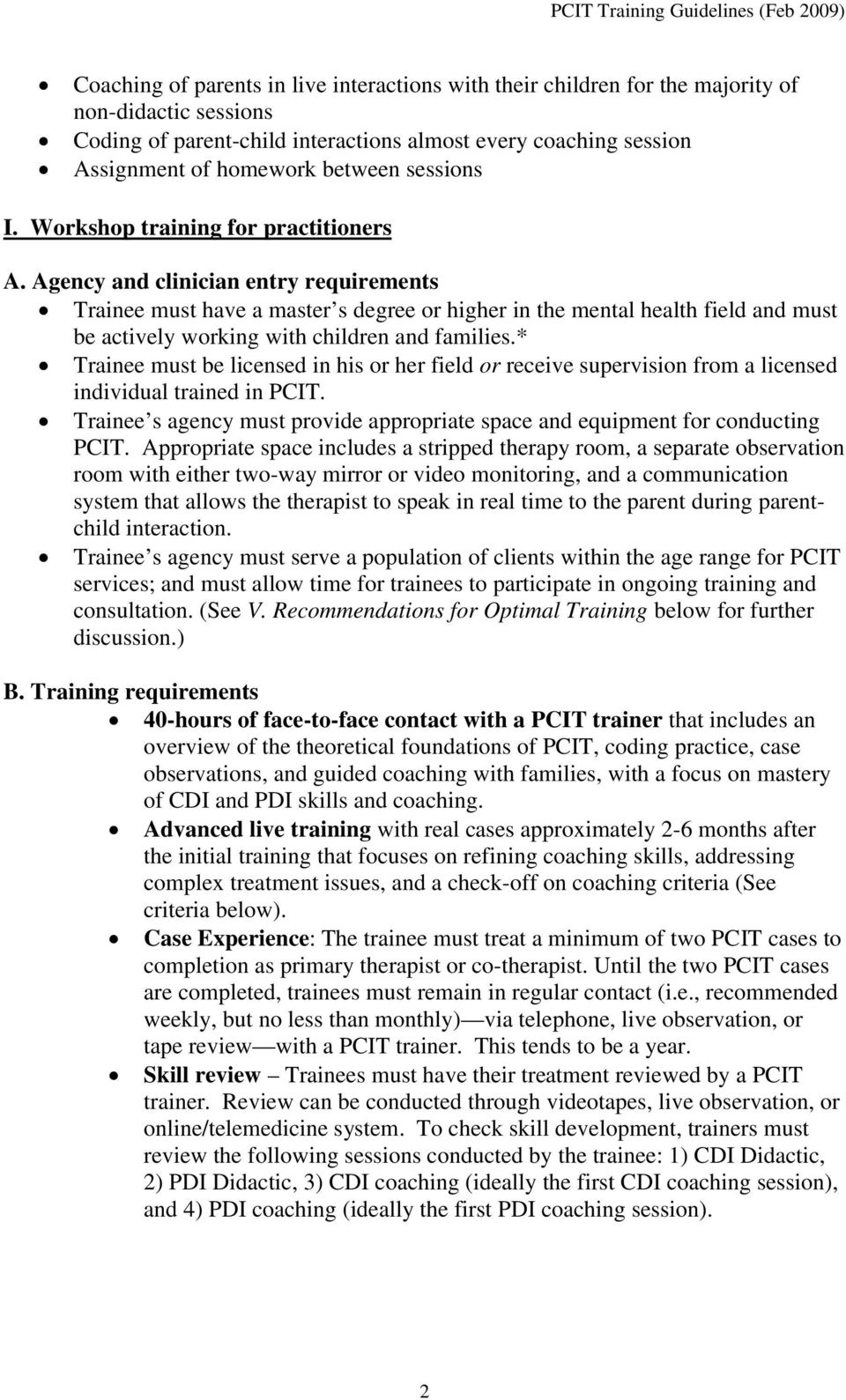
3 C. Skill Requirements Assessment (Pretreatment, Posttreatment, Weekly) Administer, score, and interpret the required standardized measures for use in assessment and treatment planning (Required measures: ECBI, DPICS-III; Recommended measures: PSI-SF, BASC or CBCL, SESBI). Administer and reliably code DPICS-III Abridged behavioral observations. DPICS-III Abridged Coding Achieve a minimum of 80% reliability with a PCIT trainer in five minutes of live coding or in continuous coding with a criteria tape. Reliability checks of live coding will be conducted, with additional training scheduled as needed. CDI-Related Therapist Skills Present the CDI didactic, adequately explaining all non-optional items on the treatment integrity checklist in the PCIT manual by Eyberg as observed by the trainer. Meet the parent criteria for CDI skills (10 labeled praise, 10 behavioral descriptions, 10 reflections; 3 or fewer negative talk, questions, and commands) in a 5-minute interaction with child or 5-minute role play. Use the session by session CDI coded information (i.e., DPICS) to guide the coaching session. PDI-Related Therapist Skills Present the PDI didactic, adequately explaining all non-optional items on the treatment integrity checklist in the PCIT manual by Eyberg as observed by the trainer. Effectively manage a PDI discipline session and accurately demonstrate the discipline sequence with a client. In the rare case when a full timeout procedure does not occur or cannot be taped, the therapist should demonstrate the skills through a role play. Accurately explain the House Rules procedure as described in the PCIT manual by Eyberg. Accuracy can be assessed through role play and does not require observation of a session with an actual client. However, the trainer must observe the role play either live or via tape. Accurately explain the Public Behaviors procedure as described in the PCIT manual by Eyberg. Accuracy can be assessed through role play and does not require observation of the session with an actual client. However, the trainer must observe the role play either live or via tape. 3
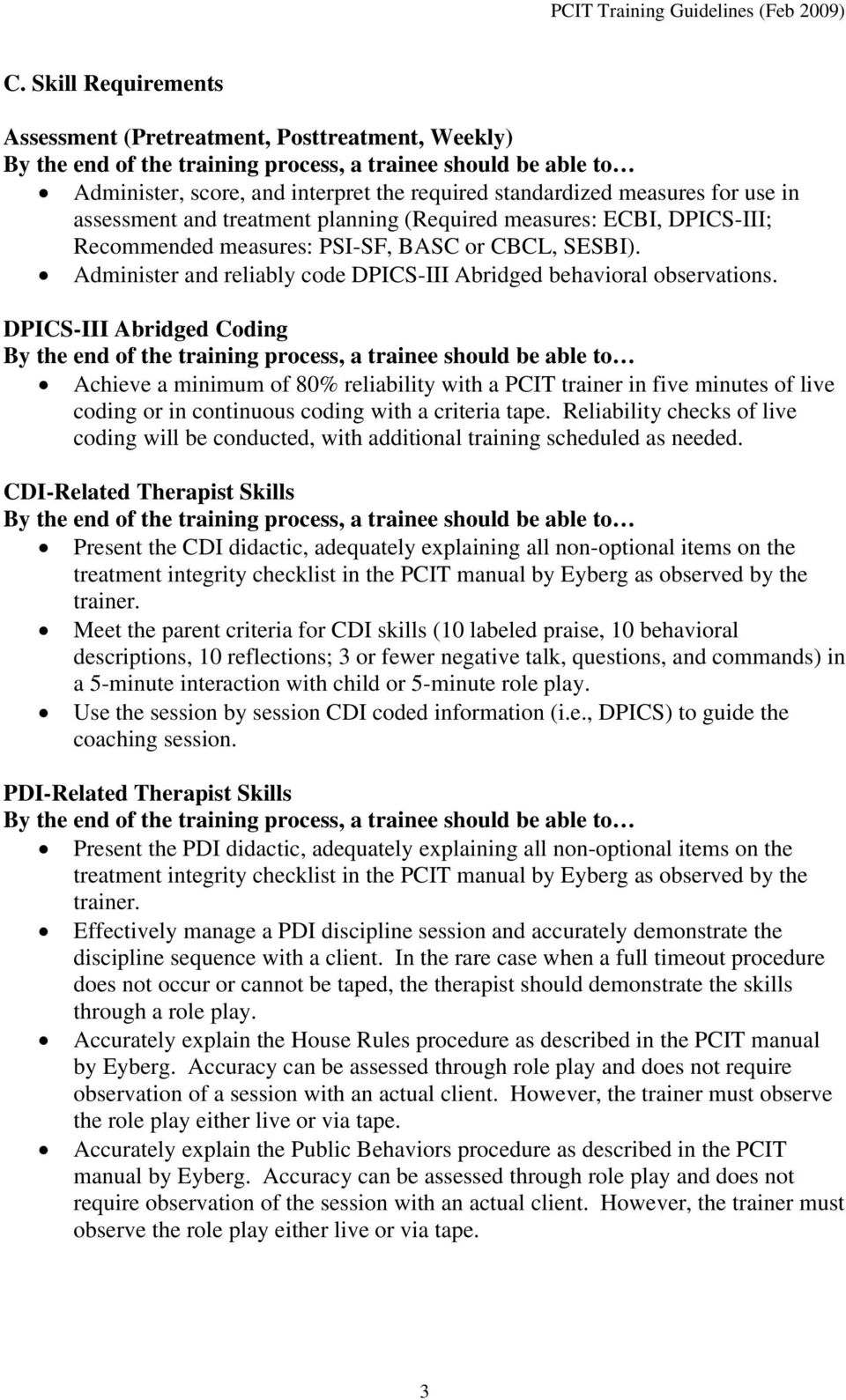
4 Coaching Skills Demonstrate adequate and sensitive coaching as observed by the trainer. General Model CDI skills during all interactions with parents and children throughout the course of therapy. Demonstrate the ability to structure the opening and closing of sessions (including homework review and assignment; feedback on skills; and general session management and timing). II. Standards for In-house Trainers of PCIT Therapists In-house trainers are individuals who have received such PCIT training as to be qualified to teach and supervise staff within their own program or agency. In-house trainers at this level are not considered to have the experience or expertise to conduct large-scale trainings or the training of individuals not under their direct supervision. A trainer of PCIT should have a demonstrated history of expertise in provision of PCIT, PCIT supervision, and PCIT training. Before being considered competent to train others in PCIT, trainers will Meet all therapist-skills criteria above Maintain a relationship with their Master Trainer for consultation for a minimum of one year from the time they begin training as trainers. Thereafter, it is recommended that trainers attend at least annual training (e.g., national or regional conference or workshop) to keep their skills and knowledge of PCIT current. Complete of at least 4 PCIT cases in consultation with a PCIT Master Trainer Be observed in the provision of supervision by a PCIT Master Trainer for a minimum of one CDI session and one PDI session. The Master Trainer will provide feedback on the content and style of the novice trainer s supervision. Remain active in PCIT service delivery either through a clinical caseload or live supervision of PCIT therapists. III. Standards for Master Trainers of PCIT Master Trainers are individuals responsible for maintaining fidelity of in-house trainers and providing broader dissemination of the PCIT protocol (e.g., nationally and internationally). To be considered a PCIT Master Trainer, individuals must be approved through a process defined by the developer of PCIT, Sheila Eyberg. Contact Dr. Eyberg for more information. IV. Principles for In-house Trainers of PCIT Therapists for Special Populations Trainers of PCIT for special populations should Meet all standards for PCIT trainers (section above) Provide evidence of extensive experience with the cultural group of interest. 4
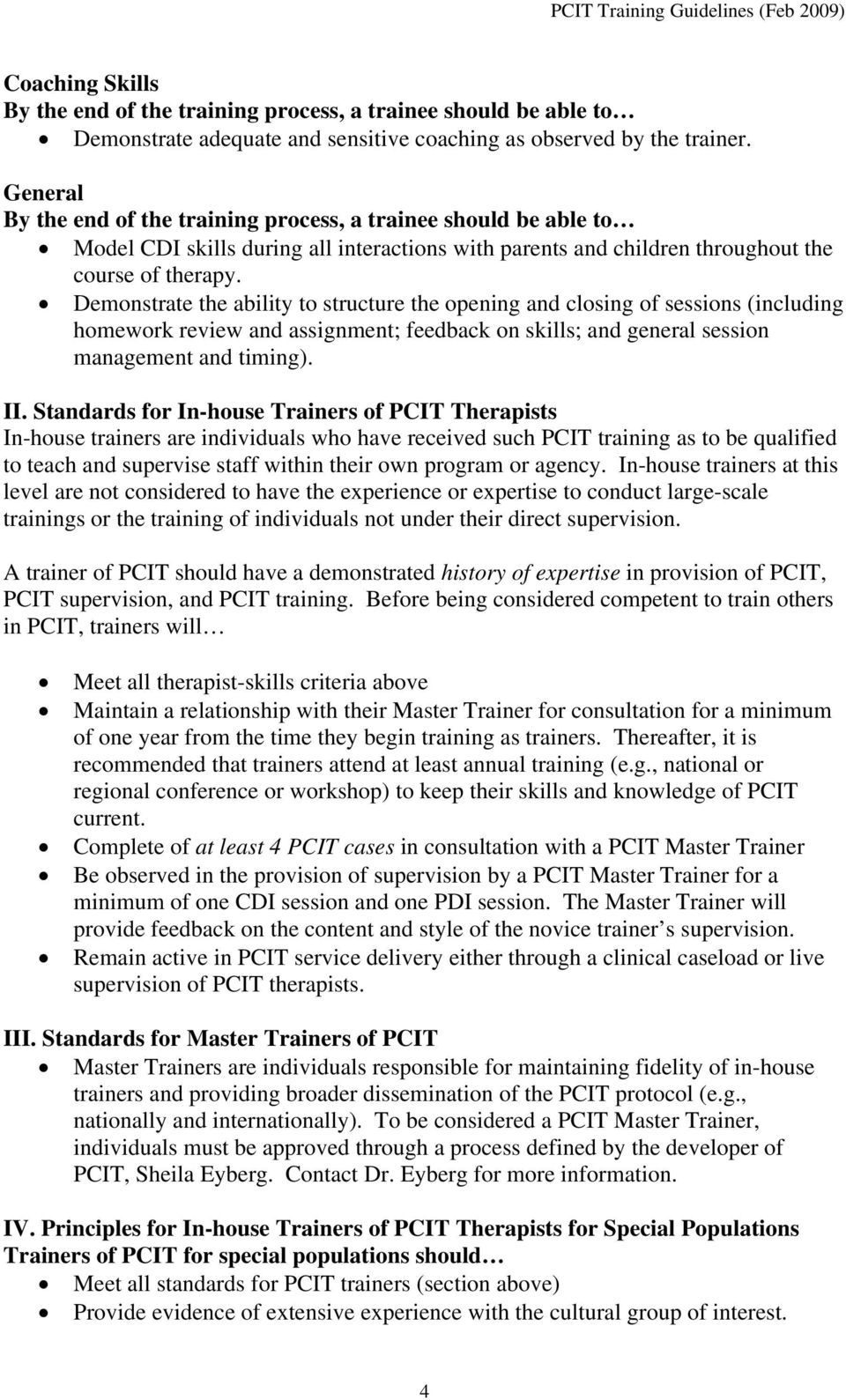
5 Not disseminate any changes in PCIT without adequate empirical evidence to support the change. V. Recommendations for Optimal Training The following recommendations are provided to describe training situations that approximate the ideal. Based on the experiences of expert PCIT trainers, these recommendations increase the likelihood that agencies will develop and maintain effective PCIT programs. A minimum of two clinicians within a single agency are trained at one time. When only one clinician within an agency can be trained, individuals participate in an ongoing PCIT supervision/networking group for long-term support and consultation. PCIT programs are clinic-based. If home-based PCIT is offered, it is adjunct to the in-clinic services. Because PCIT training has a short shelf-life that is, therapists are likely to lose their new skills if they do not practice them within three weeks of receiving their training it is recommended that therapists identify two or three families potentially appropriate for PCIT prior to receiving training and that therapy is initiated with these families immediately upon completion of the training. Weekly supervision is recommended for at least the first month of a case, with contact tapering to not less than monthly through the completion of at least two cases. VI. Exceptions Agency administrators may observe PCIT trainings without participating in the experiential components. However, such observation does not qualify administrators to conduct PCIT or train others. Graduate students who are enrolled in a masters or doctorate program in a mental health field (e.g., clinical psychology, counseling, social work) and are receiving PCIT training from a trainer within the context of their program do not have to meet the Clinician Entry Requirements regarding licensure and previous experience. PCIT Training Committee Sheila Eyberg, PhD University of Florida Beverly Funderburk, PhD University of Oklahoma Health Sciences Ctr Cheryl McNeil, PhD West Virginia University Larissa Niec, PhD Central Michigan University Anthony Urquiza, PhD UC Davis Children s Hospital Nancy Zebell, PhD UC Davis Children s Hospital 5
USF Psychiatry Grand Rounds Morsani Center
 USF Psychiatry Grand Rounds Morsani Center Define target population with best evidence for Parent-Child Interaction Therapy (PCIT) implementation Describe assessment/progress monitoring tools, and phases
PARENT-CHILD INTERACTION THERAPY
 1 PARENT-CHILD INTERACTION THERAPY Lori Day, Ph.D. & Elizabeth Adams, Ph.D. *A special thanks to PCIT International for some of the content on the following slides. Disruptive Behavior Disorders 2 Most
Parent Child Interaction Therapy and Chronic Illness: A Case Study
 Journal of Clinical Psychology in Medical Settings, Vol. 11, No. 1, March 2004 ( C 2004) Parent Child Interaction Therapy and Chronic Illness: A Case Study Daniel M. Bagner, 1,2 Melanie A. Fernandez, 1
2014-2015 ISST Minimum Certification Training Requirements (To understand this chart, please be sure to read the explanations below the table.
 2014-2015 ISST CERTIFICATION REQUIREMENTS AS AN INDIVIDUAL SCHEMA THERAPIST Qualifications to apply for Certification for those completing training after December 31, 2013: To qualify for certification
Rachel A. Klein, Psy.D Licensed Clinical Psychologist (610) 368-4041 [email protected]
 Rachel A. Klein, Psy.D Licensed Clinical Psychologist (610) 368-4041 [email protected] EDUCATION Widener University, Institute of Graduate Clinical Psychology, Doctor of Psychology, 5/2012 Widener
How To Treat A Substance Abuse Problem
 SAMHSA Model Programs Brief Strategic Family Therapy Brief Description Recognition Program IOM Intervention Type Content Focus Interventions by Domain Key Program Approaches Outcomes Evaluation Design
INTERNSHIP TRAINING PROGRAM IN PROFESSIONAL PSYCHOLOGY BROCHURE 2013-2014
 INTERNSHIP TRAINING PROGRAM IN PROFESSIONAL PSYCHOLOGY BROCHURE 2013-2014 CONTACT: JESSICA ESPINOZA, PSY.D. Rappahannock Area Community Service Board 600 Jackson Street Fredericksburg, VA 22401 (540) 373
ADVANCED CERTIFICATE IN PLAY THERAPY PROGRAM AT BROOKLYN COLLEGE
 ADVANCED CERTIFICATE IN PLAY THERAPY PROGRAM AT BROOKLYN COLLEGE NEW 16-credit Graduate Program in Culturally Competent Dynamic Play Therapy with Children and Families 1 Prepares Interdisciplinary Practitioners
Handbook for Postdoctoral Fellows at The Menninger Clinic 2016-2017
 Handbook for Postdoctoral Fellows at The Menninger Clinic 2016-2017 Thomas Ellis, PsyD, director of Psychology Patricia Daza, PhD, director of Psychology Training 1 Overview The psychology discipline became
Division of Behavioral Health. Requirements for Program Staff
 Division of Behavioral Health Requirements for Program Staff Integrated BH Regulations Training 1 Program Staff Program Staff are professionals who render behavioral health services directly to a recipient.
CURRENT POSITION OPENINGS 1/09/2015
 CURRENT POSITION OPENINGS 1/09/2015 POSITION: Recruitment Specialist Neighborhood Center QUALIFICATIONS: Bachelor s Degree from an accredited university in the human services field. Familiar with and experienced
Louisiana requires a degree that meets one of the following standards:
 State Licensure Statutes, Regulations, Forms, and Policies not only change on a regular basis, but may contain contradictory information. It is the responsibility of any individual who may review this
Counselor Education CAREER COUNSELING, CLINICAL MENTAL HEALTH COUNSELING, AND SCHOOL COUNSELING
 Counselor Education CAREER COUNSELING, CLINICAL MENTAL HEALTH COUNSELING, AND SCHOOL COUNSELING Dr. Peggy Whiting, Coordinator Counselor Education Program Program Telephone: (919) 530-6182 Fax: (919) 530-5328
: Mark Chenven, MD Lynn Eldred, EdD Robyn Igelman, PhD
 : Mark Chenven, MD Lynn Eldred, EdD Robyn Igelman, PhD What is a System of Care (SOC)? Basic Principles & Core Values What is an Early Childhood Mental Health System of Care? San Diego s ECMH SOC Developmental
YALE CLINICAL PSYCHOLOGY: TRAINING MISSION AND PROGRAM STRUCTURE RESEARCH TRAINING
 YALE CLINICAL PSYCHOLOGY: TRAINING MISSION AND PROGRAM STRUCTURE The Clinical Psychology Program at Yale University aspires to educate the next generation of leading academic and research psychologists
M.S. & Ed.S. in School Psychology Assessment in the Major Report 2013-14. By Dr. Christine Peterson, Program Director Submitted: October 2014
 M.S. & Ed.S. in School Psychology Assessment in the Major Report 2013-14 By Dr. Christine Peterson, Program Director Submitted: October 2014 Table of Contents Description of Methods... 2 Program Disposition
UCLA TIES for Families is an interdisciplinary program dedicated to optimizing the growth and development of foster/adoptive children, from birth to
 UCLA TIES for Families is an interdisciplinary program dedicated to optimizing the growth and development of foster/adoptive children, from birth to age 21, and their families. 1 Introduction: UCLA TIES
INSTRUCTIONS AND PROTOCOLS FOR THE IMPLEMENTATION OF CASE MANAGEMENT SERVICES FOR INDIVIDUALS AND FAMILIES WITH SUBSTANCE USE DISORDERS
 201 Mulholland Bay City, MI 48708 P 989-497-1344 F 989-497-1348 www.riverhaven-ca.org Title: Case Management Protocol Original Date: March 30, 2009 Latest Revision Date: August 6, 2013 Approval/Release
McGill School/Applied Child Psychology Program Standards for Non-Accredited (CPA or APA) Pre- Doctoral Internship Sites
 McGill School/Applied Child Psychology Program Standards for Non-Accredited (CPA or APA) Pre- Doctoral Internship Sites Organization of the Internship 1. The selection of candidates for an internship program
Postdoctoral Psychology Fellowship Training Program
 Postdoctoral Psychology Fellowship Training Program Center for Development and Disability 2015-2016 Program Description Postdoctoral Psychology Fellowship Center for Development and Disability University
PSYD CURRICULUM AND COURSE DESCRIPTIONS
 PSYD CURRICULUM AND COURSE DESCRIPTIONS 0999A D The Evolving Professional This sequence begins with practice in the acquisition of the growth oriented counseling skills necessary for working with individuals,
MFT Educational Guidelines
 1. Standard Curriculum MFT Educational Guidelines 1.01 The program will document that all students have completed, or will complete while in the program, all coursework and clinical requirements of the
NASP Position Statement on Supervision in School Psychology
 NASP Position Statement on Supervision in School Psychology Supervision of educators is essential to school improvement and student success. Through professional supervision, the practices of administrators,
Marriage and Family Therapy/Counseling
 http://www.uakron.edu/education/academic-programs/counseling/doctoral/mft-doctoral/currentstudents.dot Department of Counseling Marriage and Family Therapy/Counseling INTERN & SITE SUPERVISOR HANDBOOK
Mental Health Counselor Practicum Training Brochure
 The Mental Health Center Mental Health Counselor Practicum Training Brochure 1 Updated 02/05/13 Mission Statement The Mental Health Center's (MHC's) mission of service, training, and advocacy focuses on
Practice Notes: But How Do I Know If I m Competent? Issues to Consider
 Reprinted as a supplement from the Fall 2013 issue of Perspective, a semi-annual publication of the Ontario College of Social Workers and Social Service Workers Practice Notes: But How Do I Know If I m
Carolyn Webster-Stratton, Ph.D.
 Coaching Teachers to Coach Student s Social, Emotional & Academic Competence Incredible Years Teachers Classroom Management Programs Carolyn Webster-Stratton, Ph.D. Underlying Theories for Incredible Years
CONSULTATIVE BEHAVIORAL INTERVENTION (CBI) SERVICES SPC 512.10. Applies to CLTS (SED, DD only)
 CONSULTATIVE BEHAVIORAL INTERVENTION (CBI) SERVICES DEFINITION SPC 512.10 Applies to CLTS (SED, DD only) Consultative Behavioral Intervention (CBI) Services use behavioral treatment methods to change socially
D.Min. in Pastoral Care and Counseling
 D.Min. in Pastoral Care and Counseling Guidelines and Strategies for Completing the Program Revised 1/11 Index Section I Curriculum 3 Constructing a Course of Study 3 Areas of Study 3 Core D.Min. Seminars
Survey to Identify Infant and Early Childhood Mental Health TRAINING PROGRAMS
 Survey to Identify Infant and Early Childhood Mental Health TRAINING PROGRAMS 1. What is the name of the training program? Infant-Preschooler Mental Health Certificates Program Fresno Cohort 2. What agency
The NCCTS Learning Collaborative Model for the Adoption & Implementation of Evidence-Based Mental Health Treatment
 The NCCTS Learning Collaborative Model for the Adoption & Implementation of Evidence-Based Mental Health Treatment NCCTS GUIDELINES FOR CONDUCTING A LEARNING COLLABORATIVE A large gap exists between best
STATE OF NEVADA Department of Administration Division of Human Resource Management CLASS SPECIFICATION
 STATE OF NEVADA Department of Administration Division of Human Resource Management CLASS SPECIFICATION TITLE GRADE EEO-4 CODE MENTAL HEALTH COUNSELOR V 43* B 10.135 MENTAL HEALTH COUNSELOR IV 41* B 10.137
Coaching Strategies in CDI & PDI to Match Caregiver Style: The Many PCIT Adventures in Hundred Acre Wood
 Coaching Strategies in CDI & PDI to Match Caregiver Style: The Many PCIT Adventures in Hundred Acre Wood EMMA G IRARD, PSY.D. PRESCHOOL 0-5 PROGRAMS RIVERSIDE COUNTY DEPT OF MENTAL HEALTH 15 TH A N N U
PROFESSIONAL TRAINING IN TRANSACTIONAL ANALYTIC PSYCHOTHERAPY (TA-202) BROCHURE OF THE TRAINING
 PROFESSIONAL TRAINING IN TRANSACTIONAL ANALYTIC PSYCHOTHERAPY (TA-202) BROCHURE OF THE TRAINING The training meets requirements of European Association for Transactional Analysis (EATA), International
Review Of Practicum Site: Toronto General Hospital - Eating Disorders Program
 Review Of Practicum Site: Toronto General Hospital - Eating Disorders Program Name of Site: Eating Disorders Program, Toronto General Hospital Duration of practicum: Full-time, May to September, 2007 Process
BRIAN ALLEN, PSY.D. Charvat, M., & Allen, B. (2007). The business of building a career in trauma research. Traumatic Stresspoints, 21(4), 14-16.
 Brian Allen Curriculum Vitae 1 Address: Department of Psychology Sam Houston State University Box 2447 Huntsville, TX 77341 BRIAN ALLEN, PSY.D. Phone: (936) 294-1177 (office) (530) 219-5670 (cell) E-mail:
Intensive Outpatient Psychotherapy - Adult
 Intensive Outpatient Psychotherapy - Adult Definition Intensive Outpatient Psychotherapy services provide group based, non-residential, intensive, structured interventions consisting primarily of counseling
Post-Doctoral Fellowship in Clinical Psychology
 SULLIVAN CENTER FOR CHILDREN 2015-2016 Post-Doctoral Fellowship in Clinical Psychology 3443 W. Shaw Fresno, California 93711 Phone: 559-271-1186 Phone: 559-271-1186 Fax: 559-271-8041 E-mail: [email protected]
Program Assessment Report. Unit Psychology Program name: Clinical Psychology MA Completed by David Grilly May 2007
 Program Assessment Report Unit Psychology Program name: Clinical Psychology MA Completed by David Grilly May 2007 This is a two year M.A. professional program in clinical psychology, which consists of
Carlos F. Albizu-García, Ph.D. 1061 Lattimore Drive Clermont, FL 34711 Mobile: 321-217-0049 Home Phone: 352-404-8002 Email: carlosfalbizu@gmail.
 Carlos Albizu García 1 Carlos F. Albizu-García, Ph.D. 1061 Lattimore Drive Clermont, FL 34711 Mobile: 321-217-0049 Home Phone: 352-404-8002 Email: [email protected] Education Caribbean Center for
Community Outreach Program-Esperanza (COPE)
 Community Outreach Program-Esperanza (COPE) Treatment Description Target Population Essential Components Acronym (abbreviation) for intervention: COPE Average length/number of sessions: Generally there
Counseling and Psychological Services. Training Program
 Counseling and Psychological Services Training Program Updated 10/2014 Training, Mission & Model The mission of Counseling and Psychological Services (CAPS) at Gallaudet University is to train mental health
UMASS Department of Psychiatry Central Massachusetts Communities of Care Jessica L. Griffin, Psy.D. Eugene Thompson, MSW, MSP
 Sustaining Evidence-Informed Practice in System of Care Using Trauma-Focused Cognitive Behavioral Therapy: Training, Coaching, and Evaluation Workshop Session #3 UMASS Central Massachusetts Communities
Counseling And Psychological Services (CAPS) Practicum Placement in Psychology
 Counseling And Psychological Services (CAPS) Practicum Placement in Psychology IUPUI: Indiana University-Purdue University, Indianapolis is an urban research university created in 1969 as a partnership
A brief review of approaches to oral language development Summary 2015
 A brief review of approaches to oral language development Summary 2015 context Introduction Speech and language skills are fundamental to learning, development and communication and predict educational
Saybrook University. School of Clinical Psychology. LIOS MA Counseling Program in Seattle 2014/2015 - Course Descriptions
 Saybrook University School of Clinical Psychology LIOS MA Counseling Program in Seattle 2014/2015 - Course Descriptions PSYCHOLOGY COUNSELING COURSES RES 1026L Information Competency and Library Use This
Sport Psychology in Intercollegiate Athletics
 Sport Psychology in Intercollegiate Athletics Arial S. Treankler, Psy.D. Clinical Sport Psychologist University of Georgia, CAPS Objectives What is a Sport Psychologist? What roles can Sport Psychologists
How To Write A Clinical Psychology Course
 APS COLLEGE OF CLINICAL PSYCHOLOGISTS COURSE APPROVAL GUIDELINES Updated, November 2006 1. General Introduction and Principles The College of Clinical Psychologists of the Australian Psychological Society
Professional Programs
 Counseling (COU) Graduate Faculty: Roger Beach, Ed.D. (Chair); Jeffrey Lewis, Ph.D.; Linda Lytle, Ph.D.; Kendra Smith, Ph.D.; LaShaun Williams, Psy.D.; Cheryl Wu, Psy.D.; Frank R. Zieziula, Ph.D. Adjunct
MST and Drug Court. Family Services Research Center Medical University of South Carolina Funded by NIDA and NIAAA
 MST and Drug Court Family Services Research Center Medical University of South Carolina Funded by NIDA and NIAAA Project Staff Scott Henggeler Jeff Randall Phillippe Cunningham Colleen Halliday-Boykins
Title 10 DEPARTMENT OF HEALTH AND MENTAL HYGIENE
 FINAL Maryland Register Issue Date: November 1, 2013 Volume 40 Issue 22 Page 1878 Title 10 DEPARTMENT OF HEALTH AND MENTAL HYGIENE Subtitle 58 BOARD OF PROFESSIONAL COUNSELORS AND THERAPISTS 10.58.14 Supervision
Answers to Most Frequently Asked Questions Relating to Marriage and Family Therapist Trainees and Interns
 Answers to Most Frequently Asked Questions Relating to Marriage and Family Therapist Trainees and Interns Board of Behavioral Sciences 1625 N Market Blvd Suite S-200 Sacramento CA 95834 (916) 574-7830
Postgraduate Diploma/Certificate in Evidence-based Psychological Treatment For students entering in 2007-08
 Postgraduate Diploma/Certificate in Evidence-based Psychological Treatment For students entering in 2007-08 Awarding Institution: The University of Reading Teaching Institution: University of Reading Relevant
ASSISTANT PSYCHOLOGIST JOB DESCRIPTION & PERSON SPECIFICATION
 JOB DESCRIPTION ASSISTANT PSYCHOLOGIST Salary Grade: Scale S02 points 32-34 Accountable to: Head of Integrated Working Responsible for: 3 members of the Behaviour Support Team 1. JOB SUMMARY The post holder
Roseann Myers, J.D., R.N. County of San Diego Health and Human Services Agency Child Welfare Services
 Roseann Myers, J.D., R.N. County of San Diego Health and Human Services Agency Child Welfare Services 1 San Diego County Demographics Ethnicity 2010 % Hispanic 991,348 32% Non-Hispanic 2,103,965 68% White
Psychological Services as Related Services
 TECHNICAL ASSISTANCE PAPER 10827 Psychological Services as Related Services RATIONALE The purpose of this technical assistance paper is to clarify the nature of psychological services as a related service
Medicaid Behavioral Health Clinic Rehabilitation Services Manual
 Medicaid Behavioral Health Clinic Rehabilitation Services Manual WV DHHR BUREAU FOR MEDICAL SERVICES JUNE 16, 2014 Charleston, WV Clinic/Rehab Collaboration Over the past year, BMS, BHHF, behavioral health
3. Dr. Carl Maresh, chair of the department of Human Sciences, is supportive of the specialization.
 Department of Human Sciences College of Education and Human Ecology Human Development & Family Science 135 Campbell Hall 1787 Neil Avenue Columbus, OH 43210 614-688-2290 Phone 614-292-4365 Fax EHE College
Does the state require the program to have COAMFTE or CACREP Accreditation? No, California does not require these accreditations.
 State Licensure Statutes, Regulations, Forms, and Policies not only change on a regular basis, but may contain contradictory information. It is the responsibility of any individual who may review this
UAF-UAA Joint PhD Program in Clinical-Community Psychology with Rural, Indigenous Emphasis Outcomes Assessment Goals, Objectives, and Benchmarks
 Page 1 of 16 UAF-UAA Joint PhD Program in Clinical-Community Psychology with Rural, Indigenous Emphasis Outcomes Assessment Goals,, and Benchmarks Mission The PhD Program in Clinical-Community Psychology
Postdoctoral Fellowship in Clinical Psychology 2016 2017. Advanced training in cognitive behavioral treatment and applied behavior analysis
 Postdoctoral Fellowship in Clinical Psychology 2016 2017 Advanced training in cognitive behavioral treatment and applied behavior analysis Excellence in service, training, and research is a critical element
JOHNS HOPKINS HEALTHCARE
 Page 1 of 9 ACTION: New : Effective Date: 03/01/2013 Revising : Review Dates: 12/4/2015 Superseding : Archiving : Retiring : Johns Hopkins HealthCare (JHHC) provides a full spectrum of health care products
School of Clinical Psychology LIOS Masters in Psychology: Counseling Specialization Course Descriptions 2013-2014
 School of Clinical Psychology LIOS Masters in Psychology: Counseling Specialization Course Descriptions 2013-2014 Courses for: Fall 2013 Entry Cohort Spring 2014 Entry Cohort Counseling professional courses:
ABAI Autism Special Interest Group Consumer Guidelines Revised October, 2013
 ABAI Autism Special Interest Group Consumer Guidelines Revised October, 2013 The Autism Special Interest Group (SIG) of the Association for Behavior Analysis International (ABAI) first developed guidelines
Charles Swenson, M.D. Smith College Conference Center, Northampton, MA 01060 October 26-30, 2015 & April 4-8, 2016
 Description COMPREHENSIVE TEN-DAY WORKSHOP IN DIALECTICAL BEHAVIOR THERAPY Charles Swenson, M.D. Smith College Conference Center, Northampton, MA 01060 October 26-30, 2015 & April 4-8, 2016 Jointly sponsored
CLINICAL AND TRANSLATIONAL SCIENCES, DOCTOR OF PHILOSOPHY (PH.D.) WITH A CONCENTRATION IN PSYCHIATRIC, BEHAVIORAL AND STATISTICAL GENETICS
 VCU 1 CLINICAL AND TRANSLATIONAL SCIENCES, DOCTOR OF PHILOSOPHY (PH.D.) WITH A CONCENTRATION IN PSYCHIATRIC, BEHAVIORAL AND STATISTICAL GENETICS Program goal The doctoral program in clinical and translational
Master of Arts, Counseling Psychology Course Descriptions
 Master of Arts, Counseling Psychology Course Descriptions Advanced Theories of Counseling & Intervention (3 credits) This course addresses the theoretical approaches used in counseling, therapy and intervention.
R156. Commerce, Occupational and Professional Licensing. R156-61. Psychologist Licensing Act Rule. R156-61-101. Title. R156-61-102. Definitions.
 R156. Commerce, Occupational and Professional Licensing. R156-61. Psychologist Licensing Act Rule. R156-61-101. Title. This rule is known as the "Psychologist Licensing Act Rule." R156-61-102. Definitions.
1. Programme title(s): Postgraduate Certificate in Professional Studies (Supervision)
 Programme Specification (Postgraduate) Date created/amended: March 5 2015 1. Programme title(s): Postgraduate Certificate in Professional Studies (Supervision) 2. Awarding body or institution: University
Family Law Toolkit for Survivors The Domestic Violence & Mental Health Collaboration Project
 Family Law Toolkit for Survivors The Domestic Violence & Mental Health Collaboration Project Family Law Evaluations If you will be seeking custody of your child or children, or are already involved in
A Parent Management Training Program for Parents of Very Young Children with a Developmental Disability
 A Parent Management Training Program for Parents of Very Young Children with a Developmental Disability Marcia Huipe April 25 th, 2008 Description of Project The purpose of this project was to determine
AAMFT MEMBERSHIP GUIDELINES POLICIES, STANDARDS, REQUIREMENTS AND APPLICATION PROCESSES. Last Revised: January 2012
 AAMFT MEMBERSHIP GUIDELINES POLICIES, STANDARDS, REQUIREMENTS AND APPLICATION PROCESSES Last Revised: January 2012 1 TABLE OF CONTENTS Standards at a Glance 3 Clinical Fellow Definition and Process 4 Member
B2aiii. Acquiring knowledge and practicing principles of ethical professional practice.
 PhD Degrees in the Clinical and Social Sciences Department Program Learning Objectives, Curriculum Elements and Assessment Plan Degree title: PhD in Clinical Psychology This degree in the Department of
The Certificate Program in Play Therapy
 The Certificate Program in Play Therapy Advanced training (live, in person) for licensed therapists, therapist interns, and allied health professionals who work with children, adolescents, and their families.
Rubric for Evaluating Colorado s Specialized Service Professionals: School Psychologists Definition of an Effective School Psychologist
 Rubric for Evaluating Colorado s Specialized Service Professionals: School Psychologists Definition of an Effective School Psychologist Effective school psychologists are vital members of the education
Palm Beach County Youth Services Department
 Palm Beach County Youth Services Department Brochure Doctoral Internship in Psychology 2016-2017 APPIC Program Code 142811 Training Director: Shayna Ginsburg, Psy.D. 100 Australian Avenue, Suite 210 West
RESTORATIVE TECHNIQUES IN COGNITIVE REHABILITATION: PROGRAM DESIGN AND CLINICAL BENEFITS
 RESTORATIVE TECHNIQUES IN COGNITIVE REHABILITATION: PROGRAM DESIGN AND CLINICAL BENEFITS In the treatment of traumatic brain injury, cognitive rehabilitation is an intervention that seeks to improve cognitive
Post-Doctoral Fellowship in Clinical Psychology
 SULLIVAN CENTER FOR CHILDREN 2013-2014 Post-Doctoral Fellowship in Clinical Psychology Introduction The Sullivan Center for Children is an intensive outpatient treatment center that specializes in providing
A. The master of arts, educational studies program will allow students to do the following.
 PROGRAM OBJECTIVES DEPARTMENT OF EDUCATION DEGREES OFFERED MASTER OF ARTS, EDUCATIONAL STUDIES (M.A.); MASTER OF ARTS, SCIENCE EDUCATION (M.S.); MASTER OF ARTS IN GERMAN WITH TEACHING LICENSURE (M.A.);