
Object-Oriented Software Development with UML
|
|
|
- Francis Burke
- 9 years ago
- Views:
Transcription
1 UNU/IIST International Institute for Software Technology Object-Oriented Software Development with UML Zhiming Liu July 2002 UNU/IIST Report No. 259

2 UNU/IIST and UNU/IIST Reports UNU/IIST (United Nations University International Institute for Software Technology) is a Research and Training Centre of the United Nations University (UNU). It is based in Macau, and was founded in 99. It started operations in July 992. UNU/IIST is jointly funded by the Governor of Macau and the governments of the People s Republic of China and Portugal through a contribution to the UNU Endownment Fund. As well as providing two-thirds of the endownment fund, the Macau authorities also supply UNU/IIST with its office premises and furniture and subsidise fellow accommodation. The mission of UNU/IIST is to assist developing countries in the application and development of software technology. UNU/IIST contributes through its programmatic activities:. Advanced development projects, in which software techniques supported by tools are applied, 2. Research projects, in which new techniques for software development are investigated, 3. Curriculum development projects, in which courses of software technology for universities in developing countries are developed, 4. University development projects, which complement the curriculum development projects by aiming to strengthen all aspects of computer science teaching in universities in developing countries, 5. Courses, which typically teach advanced software development techniques, 6. Events, in which conferences and workshops are organised or supported by UNU/IIST, and 7. Dissemination, in which UNU/IIST regularly distributes to developing countries information on international progress of software technology. Fellows, who are young scientists and engineers from developing countries, are invited to actively participate in all these projects. By doing the projects they are trained. At present, the technical focus of UNU/IIST is on formal methods for software development. UNU/IIST is an internationally recognised center in the area of formal methods. However, no software technique is universally applicable. We are prepared to choose complementary techniques for our projects, if necessary. UNU/IIST produces a report series. Reports are either Research R, Technical T, Compendia C or Administrative A. They are records of UNU/IIST activities and research and development achievements. Many of the reports are also published in conference proceedings and journals. Please write to UNU/IIST at P.O. Box 3058, Macau or visit UNU/IIST home page: if you would like to know more about UNU/IIST and its report series. Zhou Chaochen, Director

3 UNU/IIST International Institute for Software Technology P.O. Box 3058 Macau Object-Oriented Software Development with UML Zhiming Liu Abstract These notes present the basic engineering principles, methods and practice of how a large system can be specified, desigined and implemented using object-oriented techniques. The overall purpose of the notes is to give a understanding of problems of large-scale software development and how this can be solved using object-oriented techniques. The main focus is about the use of objectorientation to analyse, specify, design and implement software systems. UML will be used as the modelling language for the specification of a system at different stages in its development.

4 Zhiming Liu is a research fellow at UNU/IIST, on leave from the Department of Mathematics and Computer Science at the University of Leicester, England, where he is a lecturer in computer science. His research interests include formal theories and methods of computing systems in general and formal semantics, specification and verification of fault-tolerant, real-time and concurrent systems; and formal techniques for object-oriented system development. He had taught OO with UML for 4 years during at the University of Leicester. Z. [email protected]. Copyright c 2002 by UNU/IIST, Zhiming Liu
5 Contents i Contents Introduction. Reading List Introduction to Software Engineering Questions Software Development Process 5 2. Software Development Process Requirement capture and analysis System design Implementation and unit testing Integration and system testing Operation and maintenance The Waterfall Model Evolutionary Development Questions Introduction to OO Development 5 3. The Inherent Complexity of Software Mastering Complex Systems Examples of complex systems The five attributes of a complex system The generalization-specialization hierarchy Function-oriented and object-oriented methods The Rest of The course Questions Requirement Capture and Analysis Use Cases Understanding requirements Introduction Case study: Point-of-sale Requirements specification Use Cases: Describing Processes Use cases Identifying use cases Writing use cases Essential and real use cases Use-case diagrams and use-case model Use cases within a development process Actors and use cases of the POST system Summing up Questions Requirement Capture and Analysis Conceptual Model Conceptual Model Concepts and Classes Conceptual Models Defining terms and modelling notation for a concept
6 ii Contents 5..3 Identifying Concepts Conceptual modelling guidelines Conceptual Model Associations Strategies for identifying associations The aggregation association Conceptual Model Attributes Adding attributes to classes Attributes for the Point-of-Sale System Steps to Create a Conceptual Model Recording Terms in the Glossary Questions System Behaviour: System Sequence Diagrams and Operations System Sequence Diagram System input events and system operations System sequence diagram Recording system operations Contracts for System Operations Documenting Contracts Contracts for some operations in POST system How to make a contract Contracts and other Documents Analysis Phase Conclusion Design Phase: Collaboration Diagrams Object Sequence Diagrams Collaboration Diagrams Examples of collaboration diagrams More notational issues Creating Collaboration Diagrams Overview of Design Phase Real Use Cases GRASP: Patterns for Assigning Responsibilities GRASP: Patterns of General Principles in Assigning Responsibilities A Design of POST Connecting User Interface Objects to Domain Objects Design Class Diagrams Questions Implementing a Design Notation for Class Interface Details Mapping a Design to Code Defining a class with methods and simple attributes Add reference attributes Defining a method from a collaboration diagram Container/collection classes in code Exceptions and error handling Order of implementation

7 Contents iii 8.3 Questions Advanced Modelling Concepts and Design Techniques Iterative Development Process Use case and iterative development Development cycle 2 of POST Extending the conceptual model Generalisation The notion of generalization The meaning of the generalization-specialization relationship Abstract classes Type hierarchies in the POST application More about Associations Associative types Qualified associations Packages: Organizing Elements POST conceptual model packages Modelling Behaviour in State Diagrams Summing Up 63 Coursework 67. Bvis Car Hire Company: The Problem Description

8

9 Contents v Contents

10

11 Chapter Introduction Topics for Chapter Reading List. Introduction to Software Engineering. Reading List Recommended Reading. I. Jacobson, G. Booch, and J. Rumbaugh, The Unified Software Development Process, Addison- Wesley, R. Pooley and P. Stevens, Using UML: Software Engineering with Objects and Components, Addison- Wesley, 999. Background Reading. G. Booch, J. Runbaugh and I. Jacobson, The Unified Modelling Language User Guide, Addison- Wesley, J. Runbaugh, I. Jacobson and G. Booch, The Unified Modelling Language Reference Manual, Addison- Wesley, M. Fowler, UML Distilled Applying the Standard Object Modeling Language, Addison-Wesley, B. Meyer, Object-oriented Software Construction (2nd Edition), Prentice Hall PTR, O. Nierstrasz and D. Tsichritzis, Object-Oriented Software Composition, Prentice Hall, 995.

12 2 Introduction to Software Engineering 6. R. Pressman, Software Engineering A Practitioner s Approach (4th Edition), McGraw Hill, M. Priestley, Practical Object-Oriented Design, McGraw-Hill, J. Runbaugh, I. Jacobson and G. Booch,The Unified Modelling Language Reference Manual, Addison- Wesley, S.R. Schach, Classical and Object-Oriented Software Engineering (3rd Edition), IRWIN, I. Sommerville, Software Engineering (5th Edition), Addison-Wesley, Introduction to Software Engineering The notion of software engineering was proposed in the late 960s at a conference held to discuss what was then called the software crisis. This software crisis resulted directly from the introduction of the third-generation computer hardware. Compared with software systems developed for the second-generation computers, software systems nowadays often have among the others the following features: they model parts of the real world; they are large and complex; they are abstract; they must be highly dependable; they need to be better maintainable: as the real world changes, so too must the software to meet the changing requirements; they must be user friendly, and thus the user interface in a software system is an important part. Software development was in crisis because the methods (if there were any) used were not good enough: techniques applicable to small systems could not be scaled up; major projects were sometimes years late, they cost much more than originally predicted; software developed were unreliable, performed poorly, and were difficult to maintain. The fact that hardware costs were tumbling while software costs were rising rapidly, as well as the above required features, called for new theories, techniques, methods and tools to control the development process of software systems. Therefore, Software engineering is concerned with the theories, methods and tools which are needed to develop software. Its aim is the production of dependable software, delivered on time and within budget, that meets the user s requirement. NATO Software Engineering Conference, Garmisch, Germany, 968.
13 Introduction to Software Engineering 3 A Software engineering is not to produce a working software system only, but also documents such as system design, user manual, and so on. Software products The objective of software engineering is to produce software products with high-quality. Software products are software systems delivered to a customer with the documentation which describes how to install and use the system. The quality of a software product is judged by, apart from the services provided by the product, the characteristics displayed by the product once it is installed and put into use. The critical characteristics of a software product include Usability: It must be useful and usable to make people s lives easier and better. For this, the software should have an appropriate user interface and adequate documentation. Maintainability: It should be possible to evolve software to meet the changing needs of customers. In other words the product should be flexible to changes that need to make. Dependability: Software dependability includes a range of characteristics, such as reliability, security and safety. Dependable software should not cause physical or economic damage in the event of system failure. Efficiency: Software should not make wasteful use of system resources such as memory and processor cycles. It should be noted that the relative importance of these characteristics obviously varies from system to system, and that optimizing all these characteristics is difficult as some are exclusive. Also the relationship between the cost and improvements in each characteristic is not a linear one. To build good systems, we need a well defined development process with clear phases of activities, each of which has an end-product, methods and techniques for conducting the phases of activities and for modelling their products, tools for generating the products. In this course, we shall concentrate on methods, strategies and tools in the object-oriented framework which lead to dependable, maintainable, and user friendly software. Returning to the issue of maintainability, a software product as a model of the real world has to be maintained constantly in order to remain an accurate reflection of changes in the real world. Therefore, software engineering must be also concerned with evolving software systems to meet changing needs and requirements.

14 4 Questions For instance, if the sales tax rate in the USA changes from to, almost every software product that deals with buying or selling has to be changed. Suppose the product contain the C or C++ statement const float sales_tax 6.0; declaring that sales tax is a floating-point constant, and initialized to. In this case maintenance is relatively simple. With the aid of a text editor the value is replaced by, and the code is recompiled. However, if instead of using the constant declaration, the actual has been used in the product wherever the value of the sale tax is involved, then such a product will be extremely difficult to maintain..3 Questions. Consider a piece of software that you enjoy/hate using. In what respects is it a high/low quality system? 2. Do you know some infamous examples of failures of the desirable attributes of software that have dramatic effects? Which of the attributes failed in your example?
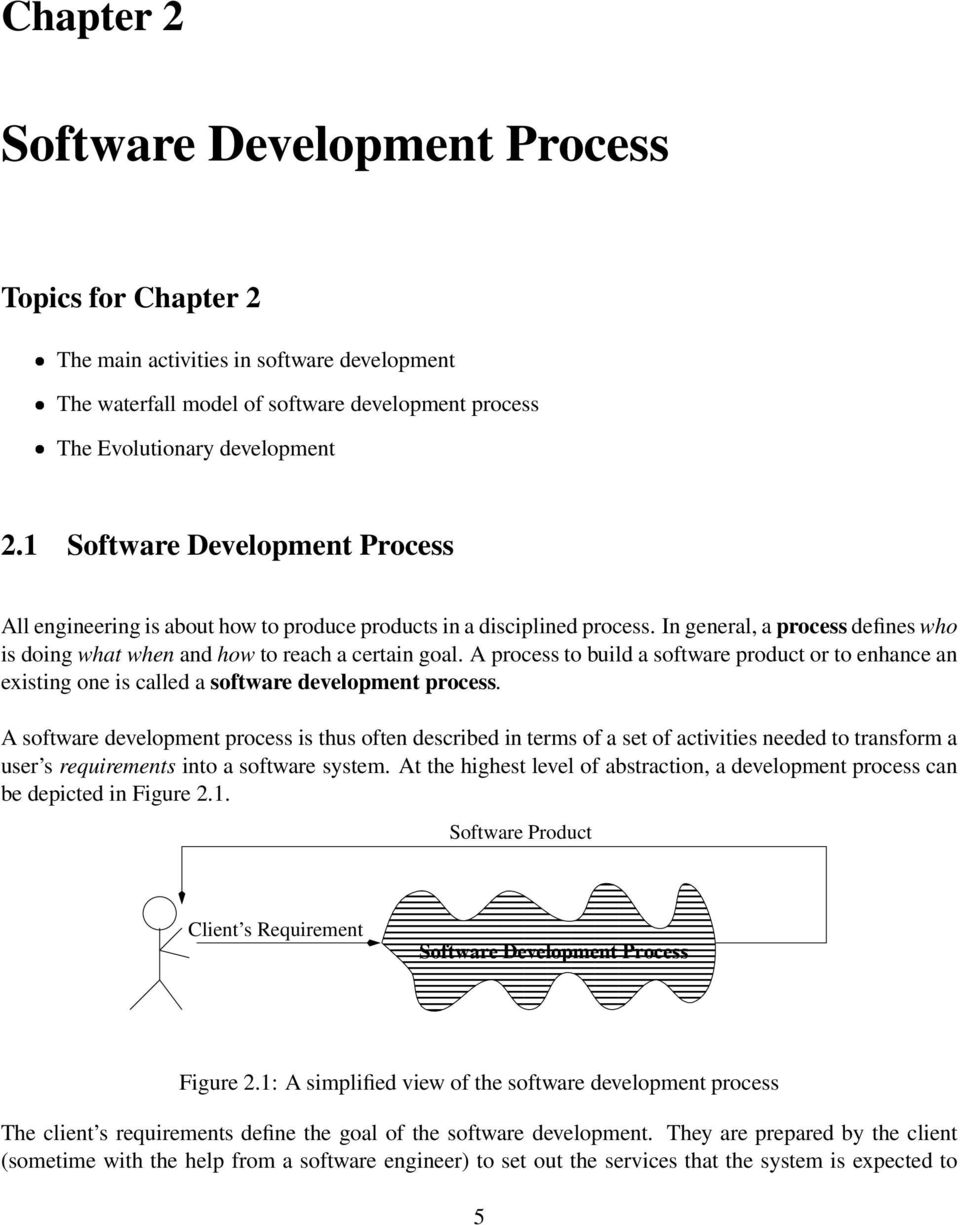
15 Chapter 2 Software Development Process Topics for Chapter 2 The main activities in software development The waterfall model of software development process The Evolutionary development 2. Software Development Process All engineering is about how to produce products in a disciplined process. In general, a process defines who is doing what when and how to reach a certain goal. A process to build a software product or to enhance an existing one is called a software development process. A software development process is thus often described in terms of a set of activities needed to transform a user s requirements into a software system. At the highest level of abstraction, a development process can be depicted in Figure 2.. Client s Requirement Software Product Software Development Process Figure 2.: A simplified view of the software development process The client s requirements define the goal of the software development. They are prepared by the client (sometime with the help from a software engineer) to set out the services that the system is expected to 5
16 6 Software Development Process provide, i.e. functional requirements. The functional requirements should state what the system should do rather than how it is done. Apart from functional requirements, a client may also have non-functional constraints that s/he would like to place on the system, such as the required response time or the use of a specific language standard. This course is mainly concerned with the functional requirements. We must bear in mind about the following facts which make the requirement capture and analysis very difficult: The requirements are often incomplete. The client s requirements are usually described in terms of concepts, objects and terminology that may not be directly understandable to software engineers. The client s requirements are usually unstructured and they are not rigorous, with repetitions, redundancy, vagueness, and inconsistency. The requirements may not be feasible. Therefore, any development process must start with the activities of capturing and analyzing the client s requirements. These activities and the associated results form the first phase (or sub-process) of the process called requirement analysis. 2.. Requirement capture and analysis The purpose of the requirement capture analysis is to aim the development toward the right system. Its goal is to produce a document called requirement specification. The whole scope of requirement capture and analysis forms the so-called requirement engineering. In this chapter, we discuss the main activities needed and the essential attributes of products of the activities, and later we will focus on the study of OO techniques for requirement capture and analysis in chapters 4-6. The document of the requirement specification will be used as. the agreed contract between the client and the system development organization on what the system should do (and what the system should not do); 2. the basis used by the development team to develop the system; 3. a fairly full model of what is required of the system. To fulfill these purposes, the requirement analysis process, depicted in Figure 2.2, should include the following highly iterative activities: Domain understanding Analysts must develop their understanding of the application domain. Therefore, the concepts are explored and the client s requirements are elicited.
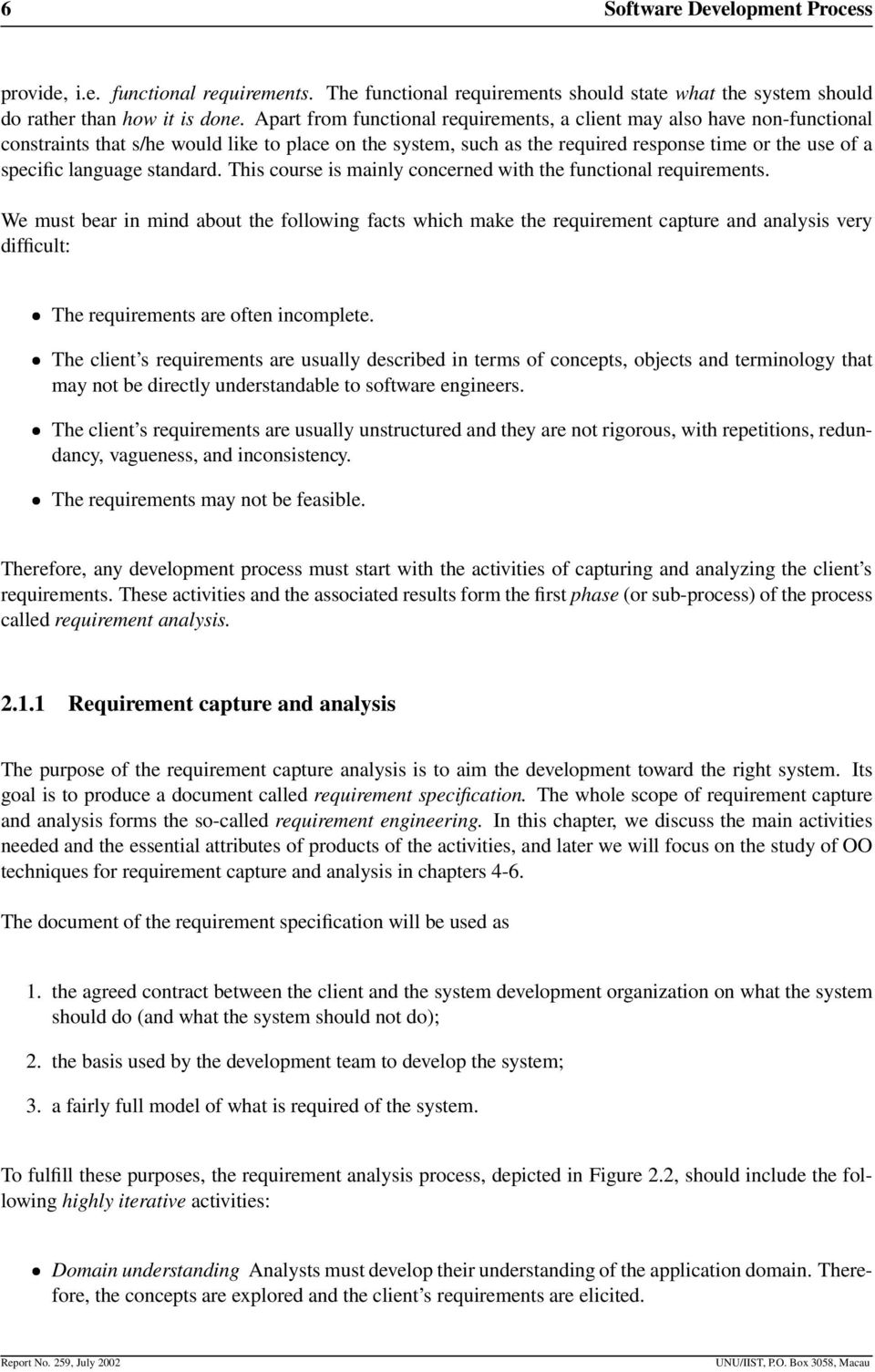
17 Software Development Process 7 Developer Feasibilitystudy Under- Standing Requirement Capture Client Domain expert Requirement statements Validation Classification User Specification document Figure 2.2: A view of the requirement analysis process Requirements capture The analyst must have a way of capturing the client s needs so that they can be clearly communicated to everyone involved in the project. They must interact with the client, and the application domain experts, and the potential system users to discover and capture their requirements. The skills of abstraction is important to capture the essences and ignore the non-essences. Classification This activity takes the unstructured collection of requirements captured in the earlier phase and organizes them into coherent clusters, and then prioritizes the requirements according to their importance to the client and the users. Validation This is to check if the requirements are consistent and complete, and to resolve conflicts between requirements. Feasibility study This is to estimate whether the identified requirements may be satisfied using the software and hardware technologies, and to decide if the proposed system will be cost-effective. There is no hard rules on when requirement analysis is completed and the development process proceeds into the next phase. The following questions must be asked before the development progresses into the next phase: Has the system required been fully understood by the client, end-users, and the developers? Has a fairly complete model of what is required built? This is a model of the system about what must be done by the system in terms of what functions (or services) are available; what the input & output are; what data are necessary;

18 8 Software Development Process but no implementation decisions should be described in this model. Of course, the requirement specification and the model of the system at this level must be adjusted and improved once this is found necessary during a later stage of the development. An important side effect of requirement analysis is testing the final system: test plan must be made according to the requirement specification; test cases should be designed to cover all the crucial services required. In summary, the requirement specification is the official statement of what is required of the system to be developed. It is not a design document and it must state what to be done rather than how it is done. It must be in a form which can be taken as the starting point for the software development. A specification language is often used. Graphical notations are often also used to describe the requirement specification. The requirement capture and analysis phase is important, as an error which is not discovered at the requirement analysis phase is likely to remain undiscovered, and the later it is discovered, the more difficult and more expensive is it to fix System design After the specification is produced through requirement analysis, the requirement specification undergoes two consecutive design processes. The first comes architectural (or logical) design in which the requirements are partitioned into components. This results in an architectural design document which describes what each component must do and how they interact with each other to provide the over all required services. Then each component in turn is designed; this process is termed detailed (or physical) design. The detailed design document describes how each component does what it is required to do, and it thus how the whole system does what it is required to do. The activities of the design process and the associated results are depicted in Figure 2.3 Model of the System Requirement Specification Concrete, implementation dependent detailed architectural: skeletal system Logical Dessign: Partition, What does a component do? Relate Components Abstract, implem. independent, general Architecture Detailed Design: Refinement, How does a component do it? Design of the relationships. Figure 2.3: A view of the design process

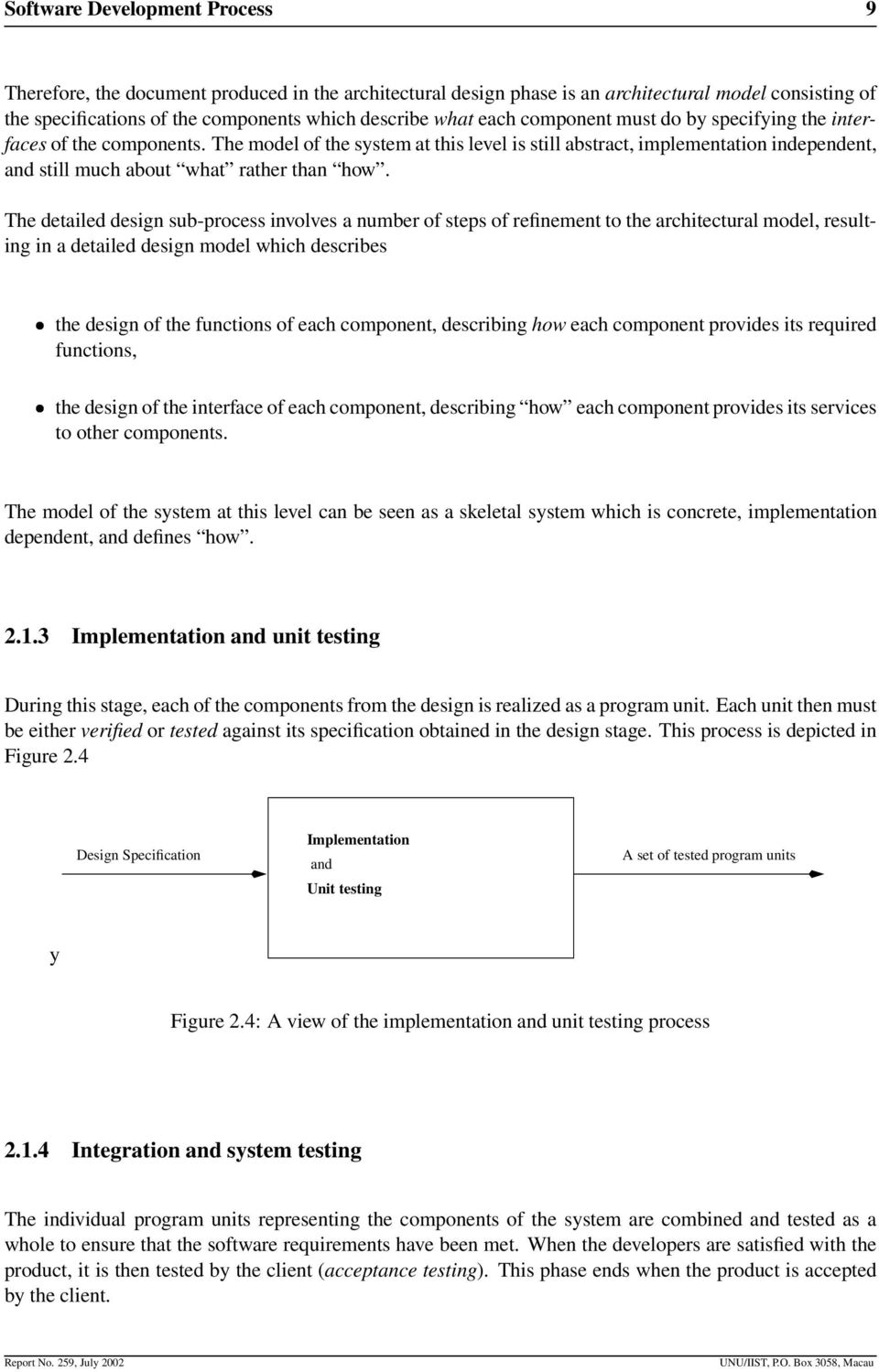
19 Software Development Process 9 Therefore, the document produced in the architectural design phase is an architectural model consisting of the specifications of the components which describe what each component must do by specifying the interfaces of the components. The model of the system at this level is still abstract, implementation independent, and still much about what rather than how. The detailed design sub-process involves a number of steps of refinement to the architectural model, resulting in a detailed design model which describes the design of the functions of each component, describing how each component provides its required functions, the design of the interface of each component, describing how each component provides its services to other components. The model of the system at this level can be seen as a skeletal system which is concrete, implementation dependent, and defines how Implementation and unit testing During this stage, each of the components from the design is realized as a program unit. Each unit then must be either verified or tested against its specification obtained in the design stage. This process is depicted in Figure 2.4 Design Specification Implementation and Unit testing A set of tested program units y Figure 2.4: A view of the implementation and unit testing process 2..4 Integration and system testing The individual program units representing the components of the system are combined and tested as a whole to ensure that the software requirements have been met. When the developers are satisfied with the product, it is then tested by the client (acceptance testing). This phase ends when the product is accepted by the client.
20 0 The Waterfall Model 2..5 Operation and maintenance This phase starts with the system being installed for practical use, after the product is delivered to the client. It lasts till the beginning of system s retirement phase, which we are not concerned in this course. Maintenance includes all changes to the product once the client has agreed that it satisfied the specification document. Maintenance includes corrective Maintenance (or software repair) as well as enhancement (or software update). Corrective Maintenance involves correcting errors which were not discovered in earlier stages of the development process while leaving the specification unchanged. There are, in turn, two types of enhancement: Perfective maintenance involves changes that the client thinks will improve the effectiveness of the product, such as additional functionality or decreased response time. Adaptive maintenance are about changes made in response to changes in the environment in which the product operates, such as new government regulations. Studies has indicated that, on average, maintainers spend approximately of their time on corrective maintenance, on perfective maintenance, and on adaptive maintenance. 2.2 The Waterfall Model According to the software development activities discussed in the earlier sections, the whole development process is often described by the so-called waterfall model depicted in Figure 2.5 The development process of a software product is also called the life cycle of the software. We must note that In practice, the stages in the waterfall model overlap and feed information to each other: during design, problems in requirements are identified; during coding, design problems are found and so on. Therefore, the development process is not a simple linear model but involves a sequence of iterations of the development activities. During the final life cycle phase, perfective maintenance activities may involve repeating some or all previous process stages. A development process which includes frequent iterations makes it difficult to identify management checkpoints for planning and reporting. Therefore, after a small number of iterations, it is normal to freeze parts of the development such as the specification, and to continue to the later development stages. Problems are left for later resolution, ignored or are programmed around. Sometimes it is quite difficult to partition the development activities in a project into these distinct stages.

21 Evolutionary Development Requirement Analysis Design Implementation and Unit Testing Integrating and System Testing Operation and Maintenance Figure 2.5: The Waterfall Model The waterfall model can be used for some statistic studies about the software development. Figure 2.6 and Figure 2.7 illustrate why high quality software is difficult to produce and to maintain, and why the development activities must be conducted in a good engineering manner. 2.3 Evolutionary Development A problem with the waterfall model is that some software development project is difficult to be partitioned into the distinct stages of requirement analysis, design and so on. Sometimes, it is also difficult (or impossible) to establish a detailed requirement specification. Evolutionary development is based on the idea of developing an initial implementation, exposing this to user comment and refine through many versions until an adequate system has been developed (Figure 2.8). The development process starts with an outline description of the system. Rather than having separate specification, development (design, implementation) and validation (testing and/or verification and/or prototyping) activities, these are carried out concurrently with rapid feedback across these activities. The techniques used in an evolutionary development include Exploratory programming where the objective of the process is to work with the client to explore their requirements and deliver a final system. The development starts with the parts of the system which are understood. The system evolves by adding new features as they are proposed by the client. Prototyping where the objective of the development is to understand the customer s requirements
22 2 Evolutionary Development Cost 67% Maintain 2% Ø 8% Requirement 7% Design Implement 6% Integrate Figure 2.6: Approximate relative costs of software process phases (from Schach 990) and hence develop a better requirements definition for the system. The prototype concentrates on experimenting with those parts of the client requirements which are poorly understood. Obviously, this model with the iterations of try-see-change activities suffers from the following problems The process is not visible It is difficult and expensive to produce documents which reflect every version of the system. System are poorly structured Continual change tends to corrupt the software structure. It is not always feasible For large systems, changes in later versions are very much difficult and sometimes impossible. New understanding and new requirements sometimes force the developer to start the whole project all over again. Software evolution is therefore likely to be difficult and costly. Frequent prototyping is also very expensive. These problems directly lead to the problems that the system is difficult to understand and maintain. Therefore it is suggested that this model should be used in the following circumstances: The development of relatively small systems. The development of systems with a short lifetime. Here, the system is developed to support some activity with is bounded in time, and hence the maintenance problem is not an important issue. The development of systems or parts of large systems where it is impossible to express the detailed specification in advance (e.g. AI systems and Interfaces). The ideas, principles and techniques of the evolutionary development process are always useful and should be used in different stages of a wider development process, such as the requirements understanding and validating in the waterfall process.
23 Questions 3 Source of error Incomplete requirements Effort to correct Incomplete requirements Design Coding Others Design Coding Others (a) (b) Figure 2.7: Software errors (a) their source and (b) their correction effort (from Finkelstein, 989) 2.4 Questions. Why do we need a software development process. 2. Find more about software development process, especially the requirements that a good software development process must meet.
24 4 Questions Concurrent activities Specification Initail version Outline description Development Intermediate version Validation Final version Figure 2.8: Evolutionary development model
25 Chapter 3 Introduction to OO Development Topics for Chapter 3 The inherent complexity of software Mastering complex systems The hierarchy of complex systems Motivation to OO The outline of the rest of the course 3. The Inherent Complexity of Software Within the scope of software engineering, the models for software development process and their associated principles and techniques have provided much better understanding of the activities in the process and have led to great improvements in productivity and quality of software. On the other hand, we are still in the software crisis. Now we understand that this is because of the inherent complexity of software. The following three observations show why the complexity of software is an essential property. The complexity of the problem domain This, in turn, derives from the following elements:. Difficulties in capturing requirements This usually comes from the impedance mismatch that exists between the users of the system and its developers: Users generally find it very hard to give precise expression to their needs in a form that developers can understand. Users may only have vague ideas of what they want in a system. 5
26 &% $$## 6 The Inherent Complexity of Software 2. Competing and contradictory requirements Consider the requirements for the electronic system of a multi-engine aircraft, or an autonomous robot. The raw functionality of such systems is difficult enough to comprehend, but now add all of the (often implicit) nonfunctional requirements such as usability, performance, cost, and reliability. 3. Changing requirements Requirements of a software system often change during its development, largely because Seeing early products, such as design documents and prototypes, and then using a system once it is installed and operational, lead the users to better understand and articulate their real needs. At the same time, the development process itself helps the developers master the problem domain, enabling them to ask better questions that illuminate the dark corners of the system s desired behaviour. Elements &2 imply the problems and difficulties that are involved during the requirement analysis phase, while element 3 implies that a software development is an evolving process and iterations are inescapable, and that evolution and maintenance are inherently difficult. The difficulty of managing the development process The fundamental task of the software development team is to engineer the illusion of simplicity - to shield users from the vast and often arbitrary complexity (See Figure 3.) of the system. Press '' ((!! "" Figure 3.: To Engineer the illusion of simplicity However, the sheer volume of a system requirements often requires us to write a large amount of new software or to reuse existing software in novel ways. No one can ever completely understand a system containing hundreds of thousands, or even millions of lines of code. The amount of work demands that we use a team of developers. More developers means more complex communication and hence more difficult coordination.
27 Mastering Complex Systems 7 The problems of characterizing the behaviour of system In a software system for a large application, there may be hundreds or even thousands of variables as well as more than one thread of control. The behaviour of the system is how it changes from one state to another. Although a system can in practice have only finite number of states, in a large system, there is a combinatorial explosion that makes this number very large; each event external to the system may change the state of the system; the system may react to an external event nondeterministically, i.e. it may not be predictable which of a number of states the system will enter after a certain event. This observation indicates the importance and difficulty of the decomposition in the design phase. 3.2 Mastering Complex Systems Having said what make software inherently complex, an essential problem of software engineering is how we can master this complexity during the software development process Examples of complex systems A personal computer A personal computer is a device of moderate complexity. Most of them can be decomposed into the same major elements: a central processing unit (CPU), a monitor, a keyboard, and some sort secondary storage device, either a floppy disk or a hard disk drive. Each of these parts can be further decomposed into subparts. For example, a CPU is composed of a primary memory unit, an arithmetic/logic unit (ALU), and a bus to which peripheral devices are attached. Each of these parts may be in turn decomposed: an ALU may be divided into registers, and random control logic
28 8 Mastering Complex Systems which themselves are constructed from even more primitive elements, such as NAND gates, and inverters, and so on. Here we see the hierarchic nature of a complex system. A personal computer functions properly only because of the collaborative activity of each of its parts. We can reason about how a computer works only because we can decompose it into parts that we can study separately. The important observations that we can make about a hierarchic system are: The layers of this hierarchy represents different levels of abstractions, each built upon the other, and each understandable by itself. At each level of abstraction, we find a collection of parts that collaborate to provide services to the higher layers. The layer we choose to investigate depends on our current needs. The structure of plants To understand the similarities and differences among plants, a plant can be seen as a complex system which can be decomposed into the hierarchy of subsystems illustrated in Figure 3.2 Plants roots stems leaves branch roots root hairs root apex root cap epidermis mesophyll vascular tissue cells chloroplasts nucleus Figure 3.2: The hierarchy of plants All parts at the same level of abstraction interact in well-defined ways. For instance, at the highest level of abstraction:
29 Mastering Complex Systems 9 roots are responsible for absorbing water and minerals from the soil; roots interact with stems, which transport these raw materials up to the leaves; the leaves in turn use the water and minerals provided by the stems to produce food through photosynthesis. There are always clear boundaries between the outside and inside of a given level. For example, we can imagine that the parts of a leaf work together to provide the functionality of the leaf as whole, and yet have little or no direct interaction with the elementary parts of the roots. In other words, there is clear separation of concerns among the parts at different level of abstractions. Social Institutions As a final example of complex systems, we turn to the structure of social institutions, which are groups of people that join together to accomplish tasks that cannot be done by individuals. The structure of a large organisation is clearly hierarchical. Multinational corporations, for example, contain companies, which in turn are made up of divisions, which in turn contain branches, which in turn encompass local offices, and so on (see Figure 3.3) Multinational corporations Company Company 2 Company n Division Division 2 Division n Branch Branch 2 Branch n Figure 3.3: The hierarchy of multinational corporations The relationship among the various parts of a corporation are just like those found among the components of a computer or a plant. For instance, the degree of interactions among employees within an individual branch is greater than that between employees of different branches.
30 20 Mastering Complex Systems The five attributes of a complex system From the examples, we have five attributes common to all complex systems. The fact that many complex system have a decomposable hierarchic structure is a major facilitating factor enabling us to understand, describe, and even see such systems and their parts. This is summarised as the following attribute.. Complexity takes the form of a hierarchy, whereby a complex system is composed of interrelated subsystems that have in turn their own subsystems, an so on, until some lowest level of elementary components is reached Regarding to the nature of the primitive components of a complex system, we have that: 2. The choice of what components in a system are primitive is relatively arbitrary and is largely up to the discretion of the observer of the system The components in a system are not completely independent. The understanding of the linkages between the parts of the system is also important. The nature of these linkages is another attribute common to all complex systems: 3. Intracomponent linkages are generally stronger than intercomponent linkages. This fact has the effect to separating the high-frequency dynamics of the components - involving the internal structure of the components - from the low-frequency dynamics - involving interaction among components The following attribute says that complex systems have common patterns in their construction and implementation: 4. Hierarchic systems are usually composed of only a few different kinds of subsystems in various combinations and arrangements In other words, a considerable amount of commonality cuts across all parts in the structural hierarchy of a system. For example, we find, in a computer, NAND gates used in the design of the CPU as well as in the hard disk drive. Likewise, cells serve as the basic building blocks in all structures of a plant. Complex systems tend to evolve over time. As systems evolve, objects that were once considered complex become the primitive objects upon which more complex systems built. This fact is stated as another attribute of complex systems:
31 Mastering Complex Systems 2 5. A complex system that works is invariably found to have evolved from a simple system that worked. A complex system designed from scratch never works and cannot be patched up to make it work. You have to start over, beginning with a working simple system Furthermore, we can never craft the primitive objects correctly the first time: we must use them in context first, and then improve them over time as we learn more about the real behaviour of the system The generalization-specialization hierarchy Having that complex system can generally be decomposed into components which are combined and arranged into layers representing different levels of abstraction, such a decomposition represents a structural (or part-of ) hierarchy. More interesting systems embody another hierarchy. For example, with a few minutes of orientation, an experienced pilot can step into a multi-engine jet s/he has never flown before and safely fly the vehicle. In general, if a pilot already knows how to fly a given aircraft, it is far easier to know how to fly a similar one. Therefore, the concept of aircraft represents an abstraction which generalizes the properties common to every kind of aircraft. In other words, a particular plane is a special kind of aircraft, which has the properties that are common to all aircraft and properties which are special to its kind. We shall see this secondary hierarchy is also essential to understand a complex system. In the OO framework, this is a ( or kind of) hierarchy is called the class structure and the part-of hierarchy is called the object structure. This is illustrated in Figure 3.4 )-/ Classes )0 is a ) Objects 2 / 2. part-of )+* )-, )-3 2 * 2, belongs to Figure 3.4: A canonical form of a complex system This figure represents the two hierarchies: any instance (object) of class )-3 is a kind of instances of class )-. ;
32 22 Mastering Complex Systems objects 2 / and 2 / are parts of object 2 0 ; object 2 / is an instance of class )-3, and so on OO software engineering is about how to engineering the class and object structures which have the five attributes of complex systems. And in the context of OO software engineering, the structure of a system means the class and object structures of the system Function-oriented and object-oriented methods Having said decomposition of a system into components is essential in mastering complex systems, what is the role of decomposition in the development of a software system? Function oriented methods Until the middle of the 990s, most of software engineers are used to the top-down functional design method (or structured design), that has the following defining aspects: It is strongly influenced by the programming languages such as ALGOL, Pascal and C, all of which offer routines as their highest-level abstractions. The functions of a software system are considered as the primary criterion for its decomposition. It separates the functions and data, where functions, in principle, are active and have behaviour, and data are passive holders of information, which are affected by functions. The top-down decomposition typically breaks the system down into functions, whereas data are sent between those functions. The functions are broken down further and eventually converted into source code (see Figure 3.5). People have found the following problems with the functional technology: Products developed with this approach are difficult to maintain. This is mainly because that all functions share a large amount of data, and they must know how the data are stored. To change a data structure, we must modify all the functions relating to the structure. The development process is not stable as changes in the requirements will be mainly reflected in its functionality. Therefore, it is difficult to retain the original design stricture when the system evolves. The development process gets into the how business too soon, as when we decompose a function into subfunctions, we cannot avoid from talking in a way like first do this and then do that, and so on. This approach only captures the part-of abstraction. Obviously, this approach does not support programming in object-oriented languages, such as Smalltalk, Eiffel, C++, and Java, very well.
33 The Rest of The course 23 Main function F F2 F3 F4 F5 Figure 3.5: Functional, top-down decomposition Object-oriented technology The strategy in the OO software development is to view the world as a set of objects. They interact with and collaborate with each other to provide some higher level behaviour. Objects have the following characteristics (see Figure 3.4): An object is simply a tangible entity in the real world (at the requirement analysis phase) or represents a system entity (at the design stage). Objects are responsible for managing their own private states, and for offering services to other objects when is it requested. Thus, data and functions are encapsulated within an object. The system s functionality is observed by looking at how services are requested and provided among the objects, without the need to get into the internal state changes of the objects. Objects are classified into classes, and objects belonging to the same class have common properties, such as attributes and operations. It seems that the OO approach reflects the is a abstraction as well as the part of abstraction better, and can overcome some of the problems in the function approach (notice that I do not want to make stronger claims). In this module, we shall learn the concepts, techniques, and notations that have developed and found useful in the OO framework. One thing will become clear to us, OO design helps in developing good software written in C++ and Java. 3.3 The Rest of The course The rest of course is to discuss the object-oriented software methodology. The methodology includes the following
34 24 Questions Notation The language for expression each model of the system at a level of abstraction. For this purpose, we shall use UML, standing for Unified Modelling Language, which is widely used as a standard modelling language. Process The activities leading to the orderly construction of the system s models. We shall focus on the activities of object-oriented analysis (OOA), object-oriented design (OOD), and object-oriented implementation strategies (OOI). Tools The artifacts that eliminate the tedium of the model building and enforce rules about the models themselves, so that errors and inconsistencies can be exposed. The tool that we use for the practicals will be the Rational Rose 3.4 Questions. Discuss the complexities apparent in the following software development: A group of developers in a small start-up located in Los Angeles have been contracted to build a chemical analysis system for an industrial chemical lab in Santa Fe. The lab works with several thousand chemicals, and wants an exploratory tool for predicting the interactions of chemicals in novel combinations. The software house won the contract by under-bidding the competition, so they have little money available for travel. Only the team leader is able to make trips to Santa Fe and all contact between the chemists and the design team takes place through the team leader. She takes detailed notes on her discussion with the chemists who will use the tool, then briefs the team as a group when she returns. Requirements are established and a high level design developed as a group. At this point, individual designers take on separate modules (e.g., the chemical database, the graph computation, the user interface). The developers are a close-knit group, and often discuss the detailed design of their modules with each other. This enables them to coordinate their designs from the beginning for example, as the organization of the chemical database develops, the author of the graphing module directly incorporates the chemical grouping information embedded in the database and uses this information as an organizing rubric for his analysis options. Unfortunately, when the first prototype is shown to the clients, the clients are unhappy with the chemical combination options. Both the database and the analysis modules must undergo substantial redesign. 2. The library at East-West University is a large building with over 4000 square feet of stacks, and a spacious reading/periodicals room overlooking the main quad. The library has holds over 0K volumes, and subscribes to about 200 periodicals; most of these are archival and the has bound journal volumes dating back as far as 90. Books can be checked out for two weeks, periodicals for three days. A wide selection of reference aids are also available, but these must be used in the library. The material is heavily biased towards sciences, with engineering, life sciences, and mathematics the major topic areas. A smaller set of holdings in the liberal arts (literature, social sciences, and history also exists. the staff consists of a head librarian, six students who take turns working at the desk and shelving returns, and two reference librarians. Characterize the East-West library system described above in terms of the five attributes of complex systems. For information about National Rose, a thorough treatment of raw UML notation, the complete specification is available at Ration Corporation s web site:
35 Questions Fred is a Dodge dealer his dealership maintains an sells a vehicle inventory typically numbering over 00 at any given time. It also services cars of all makes. While it stocks a variety of parts for Dodge models, it purchases parts for vehicles of other brands on an as-needed basis. What kind-of hierarchies might be useful in organizing Fred s dealership? Part-of hierarchies? 4. Figure 3.6 depicts a possible object structure for a simple blackjack game, listing some of the important elements connected in a part-of hierarchy. In analyzing complex systems, understanding the relationship(s) between hierarchical components is just as important as identifying the components themselves. For each connection among notes in the blackjack graph, specify the relationship(s) between the connected objects. Blackjack game Player dealer card deck winnings bet card hand card card2... card hand Ø card card2... bank card card2... Figure 3.6: Object structure for a Blackjack Game 5. Describe one or more extensions to the blackjack game depicted above that would have little impact on the complexity of the system. Then describe an extension that would make the system noticeably more complex.
36 26 Questions
37 Chapter 4 Requirement Capture and Analysis Use Cases Topics of Chapter 4 Understanding requirements specification, such as functional specification, and nonfunctional attributes of systems Understanding use cases, use case diagrams, and use-case model for describing the functional requirements Use-case diagrams and their use for describing a use-case model 4. Understanding requirements 4.. Introduction The creation of a correct and thorough requirements specification is essential to a successful project. However, the treatment of the whole host skills necessary to elucidate meaningful requirements is simply too much to cover in this course. Instead of going into every aspect of every skill, we use a case study to illustrate the following three problems. What should be produced in the requirements capture and analysis? How to identify the elements of these artifacts? How are artifacts expressed? 27
38 28 Understanding requirements 4..2 Case study: Point-of-sale A point-of-sale terminal (POST) is a computerized system used to record sales and handle payments; it is typically used in a retail store. It includes hardware components such as a computer and a bar code scanner, and software to run the system (See Figure 4.). Assume that we have been requested to create the software to run a point-of-sale terminal. Using an object-oriented development strategy, we are going to proceed through the requirement analysis, design, and implementation. Figure 4.: A point-of-sale terminal 4..3 Requirements specification The requirements specification is a description of needs or desires for a product. The requirements must be described unambiguously, and in a form that clearly communicates to the client and to the development team members. It is recommended that the requirements specification at least includes the following parts: an overview of the project goals system functions system attributes (non-functional requirements) Glossary definitions of all relevant terms
39 Understanding requirements 29 Use cases narrative descriptions of the domain processes Conceptual model a model of important concepts and their relationships in the application domain. These are typically produced through gathering and digesting many kinds of documents such as the client s statements about their needs, preliminary investigation report, and electronic documents, interview results, requirements definition meetings, and so on This section only discusses the first four parts of a requirements specification, and the others are left for subsequent sections. Overview of the project This should describe the need for the system. For a large system, it should also briefly describe the system s functions and explain how it will work with other systems. The overview of the POST case study project can be simply written as the following statement: The purpose of this project is to create a point-of-sale terminal system to be used in retail sales. Goals This is to describe how the system fits into the overall business or strategic objectives of the organization commissioning the software. The goals of the POST system can be stated as In general the goal is increased checkout automation, to support faster, better and cheaper services and business processes. More specifically, these include: quick checkout for the customer, fast and accurate sales analysis, automatic inventory control. The overview and the goals can be combined into an introduction section in the document.
40 30 Understanding requirements System functions System functions are what a system is supposed to do. To verify that some X is indeed a system function, it should make sense in the following sentence: The system should do 4 X 5 For example, ease-of-use does not fit in the verification sentence. Thus, system qualities of this kind should not be part of the functional requirements specification. The system s functions should be categorized in order to priorities them or to avoid from missing them. Categories include Evident functions such function should be performed, and user should be cognizant that it is performed. Hidden functions should be performed, but not visible to users. This is true of many underlying technical services, such as save information in a persistent storage mechanism. Hidden functions are often incorrectly missed during the requirements gathering process. Frill functions are optional; adding them does not significantly affect cost or other functions. In the presentation of the functions, they should be divided into logical cohesive groups, each function should be given a reference number that can be used in other documents of the development, the category that a function belongs to should be indicated. For the POST application, we present two groups of the system functions, the basic functions and the functions related to payment. These functions serve as a set of representative sample, rather than a complete list. Basic functions of the POST system
41 Understanding requirements 3 Ref # Function Category R. Record the underway (current) sale - the items purchased. evident R.2 Calculate current sale total. evident R.3 Capture purchase item information from a bar code using a bar code scanner, or manual entry of a product code, such as a universal product code (UPC). evident R.4 Reduce inventory quantities when a sale is committed. hidden R.5 Log completed sales. hidden R.6 Cashier must log in with an ID and password in order to use the system. evident R.7 Provide a persistent storage mechanism. hidden R.8 Provide inter-process and inter-system communication mechanisms. hidden R.9 Display description and price of item recorded. evident Payment functions Ref # Function Category R2. Handle cash payments, capturing amount tendered and calculating balance due. R2.2 Handle credit payments, capturing credit information from a card reader or by manual entry, and authorizing payment with the store s (external) credit authorization service via a modem connection. R2.3 Handle cheque payments, capturing drivers license by manual entry, and authorizing payment with the store s (external) cheque authorization service via a modem connection. R2.4 Log credit payments to the accounts receivable system, since the credit authorization services owes the store the payment amount. evident evident evident hidden
42 32 Use Cases: Describing Processes System attributes System attributes are also called non-functional requirements. They are constraints imposed on the system and restrictions on the freedom of the designer. These may include response time and memory requirements, ease of use, operating systems platforms, interface metaphor, retail cost, fault-tolerance, and so on Some attributes may cut across all functions, such as the operating system platform, or be related to a particular function or a group of functions. Here are examples of attributes for the POST system: Attribute response time interface metaphor fault-tolerance operating system platform Constraints When recording a sold item, the description and price will appear within 5 seconds Forms-metaphor windows and dialog boxes Must log authorized credit payments to accounts receivable within 24 hours, even if power or device fails Microsoft Window 95 and NT 4.2 Use Cases: Describing Processes One of the major aims in OOA is to decompose the requirements into concepts and objects in the application domain and produce a conceptual model. An important technique to help in this decomposition is to consider use cases narrative description of domain processes in terms of interactions between the system and its users. This section introduces the notion of use cases.
43 Use Cases: Describing Processes Use cases Informally speaking, a use case is a story or a case of using a system by some users to carry out a process. A bit more precisely speaking, a use case describes the sequence of events of some types of users, called actors, using some part of the system functionality to complete a process. For example, to carry out the process of buying things at a store when a POST is used two actors must be involved: Customer and Cashier, the following sequence of events must be performed: The Customer arrives at a checkout with items to purchase. The Cashier records the purchase items and collect payment. On completion, the Customer leaves with the items Therefore, to a user, a use case is a way of using the system. A use case is described in terms of a sequence of interactions between some actors and the system by which the system provides a service to the actors. Each use case then captures a piece of functional requirements for some users. All the use cases together describe the overall functional requirements of the system. The first step in requirements capture is to capture requirements as use cases. All the use cases allow software developers and the client/customer to agree on the requirements, that is, the conditions or capabilities to which the system must conform. Actors An actor represents a coherent set of roles that are entities external to the system can play in using the system, rather than representing a particular individual. An actor represents a type of users of the system or external systems that the system interacts with. Note that An actor typically stimulates the system with input events, or receives something from the system. An actors communicates with the system by sending messages to and receiving messages from the system as it performs a use case. An actors may model anything that needs to interact with the system to exchange information: a human user, a computer system, an electrical or a mechanical device such as a timer. A physical user may act as one or several actors as they interact with the system; and several individual users may act as different occurrences of the same actor. If there are more than one actor in a use case, the one who generates the starting stimulus is called the initiator actor and the other participating actors. The actors that directly interacts the system are primary/direct actors, the others are called secondary actors.
44 34 Use Cases: Describing Processes Thus, actors represent parties outside the system that collaborate with the system. Once we have identified all the actors of a system, we have identified the external environment of the system Identifying use cases Each of the following steps for identifying use cases involves brainstorming and reviewing existing documents of requirements specification:. One method to identify use case is actor-based: (a) Identify the actors related to a system or organization, i.e. find and specify all the actors by looking at which users will use the system and which other systems must interact with it. (b) For each actor, identifying the processes they initiate or participate in by looking at how the actor communicates/interacts with (or use) the system to do his work. 2. A second method to identify use cases is event-based. (a) Identify the external events that a system must respond to. (b) Relate the events to actors and use cases. To identify use cases, read the existing requirements from an actor s perspective and carry on discussions with those who will act as actors. It will help to ask and answer a number of questions, such as What are the main tasks of the actor? Will the actor have to read/write/change any of the system information? Will the actor have to inform the system about outside changes? Does the actor wish to be informed about changes? For the POST application the following potential use actors and use cases can be identified: Actor Cashier Customer Log In Log Out Processes to Initiate Buy Items Refund Items
45 Use Cases: Describing Processes Writing use cases When we use the methods given in the above subsection to identify a use case, we first create a high-level use case to obtain some understanding of the overall process, and then expand it by adding to it with more details. A high-level use case describe a process very briefly, usually in two or three sentences. They are often only concerned with the events that the actors perform. It is described in the following format: Use case: Actors: Purpose: Overview: Cross References: Name of use case (use a phrase starting with a verb). List of actors (external agents), indicating who initiates the use case. Intention of the use case. A brief description of the process. Related use cases and system functions. For example, the high-level description of the Buy Items with Cash process can be described as follows. Use case: Actors: Purpose: Overview: Cross References: Buy Items with Cash Customer (initiator), Cashier. Capture a sale and its cash payment. A Customer arrives at a checkout with items to purchase. The Cashier records the purchase items and collects a cash payment. On completion, the Customer leaves with the items. Functions: R., R.2, R.3, R.7, R.9, R2.. The references to the system functions indicate that the use case is created through further understanding of these functions, these required functions are allocated to this use case, This is useful that it is possible to verify that all system functions have been allocated to use cases,
46 36 Use Cases: Describing Processes it provides a link in terms of tractability between the products produced at different stages in the development, all system functions and use cases can be traceable through implementation and testing. An expanded use case shows more details than a high-level one, and is often done in a conversational style between the actors and the system. Typically, an expanded use case extends a high-level one with two sections typical course of events and alternative courses of events (or exceptions): Use case: Actors: Purpose: Overview: Cross References: Name of use case (use a phrase starting with a verb). List of actors (external agents), indicating who initiates the use case. Intention of the use case. A brief description of the process. Related use cases and system functions. Typical Course of Events Actor Action Numbered actions of the actors. System Response Numbered descriptions of system responses. Alternative Courses Alternatives that may arise at line number. Description of exception. For example, the high-level Buy Items with Cash use case can be expanded with the two sections in the following way. Typical Course of Events Actor Action System Response
47 Use Cases: Describing Processes 37. This use case begins when a Customer arrives at a POST checkout with items to purchase. 2. The Cashier records the identifier from each item. If there is more than one same item, the Cashier can enter the quantity as well. 4. On completion of the item entry, the Cashier indicates to the POST that item entry is completed. 3. Determines the item price and adds the item information to the running sales transaction. The description and price of the current item are presented. 5 Calculates and presents the sale total. 6. The Cashier tells the Customer the total. 7. The Customer gives a cash payment, possibly greater than the sale total. 8. The Cashier records the cash received amount. 0. The Cashier deposits the cash received and extracts the balance owing. 9. Shows the balance due back to the Customer. Generate a receipt.. Logs the completed sale. The Cashier gives the balance owing and the printed receipt to the Customer. 2. The Customer leaves with the items purchased. Alternative Courses Line 2: Invalid identifier entered. Indicate error. Line 7: Customer didn t have enough cash. Cancel sales transaction. We must note, the use case Buy Items with Cash is a simplified description of the full buy item process. It assumes the following: Cash payments only. No inventory maintenance. It is a stand-alone store, not part of a larger organization. Manual entry of UPCs; no bar code reader.
48 38 Use Cases: Describing Processes No tax calculations. No coupons. Cashier does not have to log in; no access control. There is no record maintained of the individual customers and their buying habits. There is no control of the cash drawer. Name and address of store, and date and time of sale, are not shown on the receipt. Cashier ID and POST ID are not shown on the receipt. Completed sales are recorded in an historical log. It is important to remember the 5th attribute of complex and we always begin the development with building a simple system and then enhance and improve it over time as we learn more about the behaviour Essential and real use cases At the requirement level, the use cases are relatively free of technology and implementation details; design decisions are deferred and abstracted, especially those related to the user interface. A use cases of this kind is said essential as it describes the process in terms of the essential activities and motivation. In contrast, a real use case concretely describes the process in terms of its real current design, committed to the specific input and output technologies, and so on. For example, consider an ATM Withdraw Cash use case. The Typical Course of Events sections in an essential form and in a real form can be used for illustration: Essential Actor Action System Response. The Customer identifies him/herself 2. Present options. 3. and so on 4. and so on Real Actor Action System Response. The customer inserts his/her card. 2. Prompts for PIN. 3. Enter PIN on keypad. 4. Display options menu. 5. and so on. 6. and son.
49 Use Cases: Describing Processes Use-case diagrams and use-case model A use case diagram illustrates a set of use cases for a system, the actors of these use cases, the relations between the actors and these use cases, and the relations among the use cases. The UML notation for a use case diagram is shown in Figure 4.2, in which an oval represents a use case, a stick figure represents an actor, a line between an actor and a use case represents that the actor initiates and/or participates in the process. Buy Items Login Cashier Refound Items Customer Figure 4.2: A sample use case diagram All the actors, use cases and use-case diagrams of a system make up a use-case model which describes the use cases, the actors, how the use cases relate to each other and to the actors. It thus specifies the system functional requirements. Making up a big use case from simpler ones It is not difficult to see that the sequence of actions from 7 to 0 in use case Buy Items with Cash can be treated as a use case, which can called Pay by Cash. It can be refined by adding more details such as:
50 40 Use Cases: Describing Processes Pay by Cash Typical Course of Events Actor Action System Response. The Customer gives a cash payment, possibly greater than the sale total. 2. The Cashier records the cash tendered. 3. Show the balance due back to the Customer. 4. The Cashier deposits the cash received and extracts the balance owing. The Cashier gives the balance owing and the printed receipt to the Customer. Alternative Courses Line 3. If cash the amount tendered is not enough, exception handling Line 4: Insufficient cash in drawer to pay balance. Ask for cash from supervisor. Using exactly the same techniques in the description of Pay by Cash, we can fefine two use cases Pay by Credit and Pay by Cheque. Now it is not difficult to define the general use case Buy Items that can be written as follows.
51 Use Cases: Describing Processes 4 Buy Items Typical Course of Events Actor Action System Response. This use case begins when a Customer arrives at a POST checkout with items to purchase. 2. The Cashier records the identifier from each item. 3. Determines the item price and adds the item information to the running sales transaction. If there is more than one of the same item, the Cashier can enter the quantity as well. 4. On completion of the item entry, the Cashier indicates to the POST that item entry is completed. The description and price of the current item are presented. 5 Calculates and presents the sale total. 6. The Cashier tells the Customer the total 7. The Customer chooses payment method: (a) If cash payment, initiate Pay by Cash. (b) If credit payment, initiate Pay by Credit. (c) If cheque payment, Cheque. initiate Pay by 8. Logs the completed sale. 9. Prints a receipt. 0. The Cashier gives the printed receipt to the Customer.. The Customer leaves with the items purchased. Alternative Courses Line 2: Invalid identifier entered. Indicate error. Line 7: Customer didn t have enough cash. Cancel sales transaction. In general, a use case may contain decision points. If one of these decision paths represents the overwhelming typical case, and the others alternatives are rare, unusual or exceptional, then the typical case should
52 42 Use Cases: Describing Processes be the only one written about in the Typical Course of events, and the alternatives should be written in the Alternative Courses section. However, if the decision point represents alternatives which all relatively equal and normal in their likelihood, this is true of the payment types, then we have to describe them as individual use cases and they can be used by a main use case, such as Buy Items. UML provides a notation for describing such a uses relationship between use cases, and this is illustrated in Figure 4.3. POST Cashier Buy Items 6798:7 6798:7 6798;7 Customer Pay by Credit Pay by Cash Pay by Check credit Authorization Service Check Authorization Service Accounts Receivable Figure 4.3: Relating use cases with a uses relationship Use cases within a development process This section summarizes the activities and artifacts of use case analysis.. After system functions have been listed, then identify actors and use cases. 2. Write all use cases in the high-level format. You may like to categorize them as primary, secondary or optional. 3. Draw a use case diagram for the system. 4. Relate use cases and illustrate relationships in the use case diagram. 5. Write the most critical, influential and risky use cases in the expanded essential format to better understand and estate the nature and size of the problem. Defer writing the expanded essential form of the less critical use cases until the design or event the implementation starts. 6. Ideally, real use cases should be deferred until the design phase of a development cycle, since their creation involves design decisions. However, it is sometimes necessary to create some real use case during the early requirement phase if
53 Use Cases: Describing Processes 43 Concrete descriptions significantly aid comprehension. Clients demand specifying their processes in this fashion. For prototype purpose. 7. You may like to rank the use cases to plan which should be taken into the design and implementation phases first Actors and use cases of the POST system Using the techniques of this section, a sample list (not an exhaustive) of relevant actors and use cases they initiate include: Actor Cashier Customer Manager System Administrator Use Case Log In Log Out Buy Items Refund Items Start Up Shut Down Add New Users We leave the construction of the use cases as exercises Summing up Use case definition A use case specifies a sequence of actions that the system can perform and that yields an observable result of value to a particular actor. A use case is full end-to-end story about the use of the system to carry out a task, not an arbitary combination of a number of steps of computation. For example, we should not combine two tasks into a use case, such a Borrow a Book and Return a Book, if it is not alway the case that one must be carried out after the other. Why use cases? The reasons why use cases are good for requirement capture include
54 44 Questions They do not only answer the question what the system should do but answer it in terms of what the system should do for each user/actor. They therefore identify the functions that the system provides to add values to its users, and help to remove functions that they do not add values to the users. They identify system functions and the relationship among the system functions. They also identify concepts and objects involved in the application domain. These concepts and objects are very important in modeling the architecture of the system, and are later in the design realized as software classes and objects. Use cases are also used as placeholders for nonfunctional requirements, such as performance, availability, accuracy, and security requirements that are specific to a use case. For example, the following requirement can be attached to the Withdraw Money use case: The response time for a Bank Customer measured from selecting the amount to withdraw to the delivery of the notes should be less than 30 seconds in< of all cases. Use cases are also important for project plan, system design and testing. Use Cases Specify the System The use-case model represents all the use cases and their associated actors and specifies all the functional requirements and most of the nonfunctional requirements of the system. Requirements capture is to capture requirements as use cases. Its main purpose is to work with the customers and users to identify the use cases and to create the use-case model. The use-case model serves as an agreement between the client and the developers, and it provides essential input for analysis, design, and testing. We find the use cases by looking at how the users need to use the system to do their work. Each such way of using the system that adds value to the user is a candidate use case. These candidates will then be elaborated on, changed, divided into smaller use cases, or integrated into more complete use cases. The use-case model is almost finished when it captures all functional requirements correctly in a way that the client, users and developers can understand. 4.3 Questions. As we said in Chapter 2, the task of the requirements capture and analysis is difficult and complex for a variety of reasons. The requirements are the client s requirements which are actually the needs of the users of the system to develop, rather than those of the developers. Any system has many users (or types of users), and while each user may know what he or she does, no one can see the whole picture. Very often, users do not know what the requirements are or how to specify them in a precise manner, either. Different types of users have different, sometimes conflicting, requirements.
55 Questions 45 How can you, as a requirement analyst, help to over come any of these problems, and to create a use-case model? 2. What are the differences and relationships between system functions and use cases? How can they be identified? 3. Each use case has to represent a task, or a coherent unit of functionality, which the system is required to support. Normally, this means that the use case has value for at least one of the actors. An actor for whom a use case has value is normally called a beneficiary of the use case. Discuss the following questions. (a) Consider the use case Buy Items with cash in the POST system, who is a beneficiary and what value he/she gets from the system? (b) How important is it to identify the beneficiaries of each use case? (c) Is a initiating actor always a beneficiary? (d) Does a beneficiary have to interact with the system carrying out a task to get benefit? (e) What is the role of an actor of a use case who is not a beneficiary, do you think that we do not need to show such an actor in the use case model? 4. Discuss the possible use of use cases for the planning of the project. 5. Discuss the possible use of use cases in system validation. 6. About of projects were canceled simply because someone somewhere decided it wasn t worth going ahead with. Discuss the possible use of use cases in dealing with political aspects of such in a project. 7. Discuss the possible problems with use cases. 8. Consider an example of a library system. Assume that a member of the library is allowed to borrow up to six items (e.g. a copy of a book, a journals, etc). The system supports to carry out the tasks of borrowing a copy of a book, extending a loan, and checking for reservation. Write the use cases that represent these tasks, and use a use-case diagram to represent relationships among these uses cases. Do you realize, from this problem, an issue of factoring, sharing, and reusing functionality? Can you discuss the advantages and pitfalls in documenting shared and reused functionality like this on a use-case diagram? 9. Suppose that you are involved in the design of East-West University s library (described in a question at the end of Chapter 3) browsing and loan system. What are some of the important use cases you might develop in the analysis phase (simply enumerating them with brief discussions or present them in the high-level format is sufficient)? Try to identify at least 4-5 cases, and draw a use-case diagram to illustrate them
56 46 Questions
57 Chapter 5 Requirement Capture and Analysis Conceptual Model Topics of Chapter 5 Identifying concepts in the application domain which are related to the system, and building a conceptual model Associations between concepts (classes) Attributes of Classes Class diagrams and their use for describing a conceptual model 5. Conceptual Model Concepts and Classes An important and typical activity in object-oriented requirement analysis is to identify concepts related to the requirements and to create a conceptual model of the domain. The term domain covers the application area we are working with, e.g. the retail store in our POST case study. This section is to introduce the skill in identifying concepts which are meaningful in the problem domain, and the notation for representing such a model. 5.. Conceptual Models A conceptual model illustrates abstract and meaningful concepts in the problem domain. The creation of concepts is the most essential object-oriented step in analysis or investigation of the problem domain for building genuinely extensible software with reuse. The aim of this step is to decompose the problem in terms of individual concepts or objects. 47
58 48 Conceptual Model Concepts and Classes Module Symbol code title credits A Course offerred as a component of a degree. Intension MC03 MC206 MC04 MC MC306 Extensison Figure 5.: A concept has a symbol, intension, and extension Concepts Informally, a concept is an idea, thing, or object. More formally, a concept may be considered in terms of its symbol, intension, and extension: Symbol words or images representing a concept. It can be referred to when we talk about the concept. Intension the definition of a concept. Extension the set of examples or instances to which the concept applies. Each individual example that the concept applies is called an instance of the concept. For an example, the symbol Module in University of Leicester is a concept with the intension to represent a course offered as part of a degree in that university having a code, title, and number of credits; and the extension of all the modules being offered in the university. This concept is illustrated in Figure 5.
59 Conceptual Model Concepts and Classes Defining terms and modelling notation for a concept In the UML, the terms class and type are used, but NOT concept. We may interchange these terms as far as we are clear that we are at the requirement analysis stage and we are understanding and investigating the problem domain. And in the UML, we use the notation shown in Figure 5.2 to denote a class. Class Symbol Figure 5.2: UML notation for a class Each instance of a class is called an object of the class. For example, see Figure 5.3. Therefore, a class defines a set of objects. The notions of class and object are interwoven as one cannot exist without the other, and any object belongs to a class. The differences are: an object is a concrete entity exists in space and time (persistence property of objects); a class is an abstraction of a set of objects. JohnSmith: Student Student JaneBrown: Student Figure 5.3: Class and Object The UML definition of a class is a description of a set of objects that share the same attributes, operations, methods, relationships, and semantics. This covers classes used at all stages in an OO development process. We shall see the concepts of attributes, operations, methods, and relationships one by one when we come to the particular stages of the OO development of process. A defining aspect of objects is that every object is distinguishable from every other object. This is true even if two objects have exactly the same properties. For example, two instances of Student may have the same name, age, doing the same degree, in the same year, taking the same courses, etc. The property that enables objects to be distinguished from each other is know as an object s identity.
60 50 Conceptual Model Concepts and Classes Some other important features of objects are: Object s Identity: Every object is distinguishable from every other object. This is true even if two objects have exactly the same properties. Object s persistence: Every object has a life time, and this property implies the static nature of the system. An object has behaviour and may act on other objects and/or may be acted on by other objects, this property implies the dynamic nature of the system An object may be in different state at different and may behave differently in different states Identifying Concepts A central distinction between OOA and structured analysis is decomposition by concepts (objects) rather than decomposition by functions. The key point in this decomposition is to find what can behave, and then to decide later on in the design and implementation how they behave to realize the system functionality. There are usually two strategies to identify concepts. The first one is to find concepts from the textual descriptions of the problem domain according to concept category list. Concepts and objects (things) can be divided into different categories according to their nature of its instances. The concept category list given below has been found useful in identifying concepts.
61 Conceptual Model Concepts and Classes 5 Concept Category physical or tangible objects (or things) places documents, specifications, designs, or descriptions of things transactions roles of people containers of other things things in a container Examples POST, House, Car, Sheep, People, Airplane Store, Office, Airport, PoliceSation ProductSpecification, ModuleDescription, FlightDescription Sale, Payment, Reservation Cashier, Student, Doctor, Pilot Store, Bin, Library, Airplane Item, Book, Passenger other computers or electro-mechanical systems external to our system abstract noun concepts CreditCardAuthorizationSystem, TrafficControl Hunger, Acrophobia Air- organisations historic events, incidents processes (often not represented as a concept, but may be) rules and policies catalogs SalesDepartment, Club, ObjectAirline Sale, Robbery, Meeting, Flight, Crash, Landing SellingAProduct, BookingASeat RefundPolicy, CancellationPolicy ProductCatalog, PartsCatalog records of finance, work, contracts, legal matters Receipt, Ledger, MaintenanceLog EmploymentContract, financial instruments and services manuals, books LineOfCredit, Stock EmployeeManual, RepairManual This strategy is to create a list of candidate concepts from the client s requirements description, initial investigation reports, system functions definitions, and use cases. Notice that the categories are not mutually exclusive and one concept may belong to more than category. Another useful and simple technique for identification of concepts is to identify the noun and noun phrases in the textual descriptions of a problem domain, and consider them as candidate concepts or attributes.
62 52 Conceptual Model Concepts and Classes Warning: Care must be applied when these methods are used; mechanical noun-to-concept mapping is not possible, words in natural languages are ambiguous, and concept categories may include concepts which are about either attributes, events, operations which should not be modelled as classes. We should concentrate on the objects/classes involved in the realization of the use cases. Consider our POST application, from the use case Buy Items with Cash, we can identify the some noun phrases. Some of thenoun phrases in the use case are candidate concepts; some may be attributes of concepts (see Section 5.3). For example, price is obviously an attribute of an item or a product description. Also, the concept price is not easy to fit in any of the categories in the Concept Category List, and thus it should not a candidate concept. The following list is constrained to the requirements and the use case Buy Items with Cash: >@?BADC VWCXNDY K_C`?E:N K+RZ[N >@ReYdNDU_C >FE;?GHJIC:a]R C`RZi?9h >FE;?GHJICLK MJN:IOPQISR CTOT? U K+RZ[NWA;\]O^U-N9VWCXNDY a]rba9bò NDE achadc`?ydnde fgru_rhnde This list of concept names may be represented graphical in the UML static structure diagram notation to show the concepts only conceptual model (See Figure 5.4). POST Item Store Sale Sales LineItems Cashier Customer Manager Payment Product Catalog Product Specification Figure 5.4: Initial conceptual model for the point-of-sale domain (concepts only) We may find it is a bit odd that Receipt is not listed as a candidate concept, as a receipt is a record of a sale and payment and a relatively important concept. However, here are some factors to consider: In general, showing a record or a report of a thing, such as a receipt, in a conceptual model is not
63 Conceptual Model Concepts and Classes 53 very useful since all its information can be derived from other concepts. For example, a receipt can be produced by extracting the relevant information from the ProductSpecification and the Payment. A record or a report, such as a receipt, sometimes has a special role in terms of the application and need to be maintained. For example Receipt confers the right to its bearer to return his/her bought items. In this case, it should be shown in the conceptual model. However, item returns are not being considered, and thus Receipt is not at the moment included in the list. When the system evolves and needs to tackle the Return Items use case, it would be justified to include Receipt. Obviously, these factors can be very easily overlooked. However, we should remember our goal is to create a conceptual model of interesting and meaningful concepts in the domain under consideration. The following guidelines are useful: It is better to overspecify a conceptual model with lots of fine-grained concepts, than to underspecify it. Do not exclude a concept simply because the requirements do not indicate an obvious need to remember information about it. It is common to miss concepts during the initial identification phase, and to discover them later during the consideration of attributes or associations, or during the design phase. When found, they are added to the conceptual model. Put a concept down as a candidate in the conceptual model when you are not sure it must not be included. As a rule of thumb, a conceptual model is not absolutely correct or wrong, but more or less useful; it is a tool of communication Conceptual modelling guidelines The mapmaker strategy applies to both maps and conceptual models: Use the existing names in the territory Map makers do not change the names of cities on the map. For a conceptual model, this means to use the vocabulary of the domain when naming concepts and attributes. For example, we use POST rather than Register. Exclude irrelevant features A mapmaker deletes things from a map if they are not considered relevant to the purpose of the map; for example, topography or populations need not be shown. For examples, we may exclude Pen and PaperBag from our conceptual model for the current set of requirements since they do not have any obvious noteworthy role. Do not add things that are not there A mapmaker does not show things that are not there, such as a mountain that does not exist. For example, we should include Dog in a model of a library. Finally, remember that a conceptual model focuses on domain concepts, not software entities.
64 54 Conceptual Model Associations 5.2 Conceptual Model Associations A conceptual model with totally independent concepts only are obviously useless, as objects in different classes must be related to each other so that they can interact and collaborate with each other to carry out processes. In UML, an association is a relationship between two classes that specifies how instances of the classes can be linked together to work together. In the same sense that instances of a class are objects, instances of an association are links between objects of the two classes this what we meant that objects in the same class share the same relationships (see the end of Section 5.). For example, an association called takes links the classes Student and Module. An individual student, say one with the name John Smith is linked with a particular module, say the one with the code MC206 if this student takes this module. In UML, an association between two classes is denoted by a line joining the two classes, see Figure 5.5. A Association, The name may be omitted association_name B takes stocks Student Module Store Item Figure 5.5: An association between two classes Multiplicity With respect to an association between classes j and k, an important information is about how many objects of classj can be associated with one object ofk, at a particular moment in time. We use multiplicity of j to represent this information. Figure 5.6 shows some examples of multiplicity expressions and their meanings. Determining multiplicity often exposes hidden constraints built into the model. For example, whether Works-for association between Person and Company in Figure 5.6 is one-to-many or many-to-many depends on the application. A tax collection application would permit a person to work for multiple companies. On the other hand, an auto workers union maintaining member records may consider second jobs irrelevant (See Figure 5.6). More examples of associations are shown in Figure 5.7. The default direction to read an association in such a diagram is from left to right or from top to bottom, otherwise the small arrow shows the reading direction.
65 Conceptual Model Associations 55 * T zero or more; "many 5 T exactly five..* T one or more; at least one 3,5,8 T exactly three, five or eight..40 T one to forty Person Person One person may have any number of jobs or no job. Works-for * * Works-for Each person works for one and only one compnay * Compnay Compnay Figure 5.6: Multiplicity values Roles of associations Each end of an association is called a role of the association, which may has a role name. Naming a role in a conceptual model is sometimes useful. For example, the role names boss and worker distinguish two employees who work for a company and participate in the Manages association (See Figure 5.8). When we come up to the design and implementation of the system, roles provide a way of viewing an association as a traversal from one object to a set of associated objects. The purpose of an association and a link between two objects Objects may have many sorts of relationship, and thus classes (or concepts) may have all sorts of associations in a problem domain. Whether an association is useful or not depends on whether it fulfill the following purpose. An association between two classes is to provide physical or conceptual connections between objects of the classes. Only objects that are associated with each other can collaborate with each other through the links. Booch describes the role of a link between objects as follows: A link denotes the specific association through which one object (the client) applies the services of another object (the supplier), or through which one object may navigate to another. In this course, we are mainly concerned with binary associations which relate two classes. In general, an association may be ternary or even higher order which relate three or more classes.
66 56 Conceptual Model Associations Library Contains..* 0..8 Book On-loan-to Borrower Airline Employs..* Assigned-to Person..*..* Flight Assinged-to * Plane Supervises Store..*..* Paid-by POST Sale Payment Captures Figure 5.7: Examples of associations This can be taken as a criterion for whether two objects should be linked. Multiple associations between two classes Two classes may have multiple associations between them; this is not uncommon. For example, in the domain of an airline example, there are two relationships between a Flight and an Airport, Flies-to and Flies-from, as shown in Figure 5.9. These two associations are distinctly different relationships between flights and airports. Note that not every flight is guaranteed to land at any airport! However, there is always one airport from where a flight flies Strategies for identifying associations For the requirement analysis, we have the following principles: An useful association usually implies knowledge of a relationship that needs to be preserved for some duration ( need-to-know association); and an important link between two objects should fulfill the role to provide a means for the objects to collaborate or interact with each other.
67 Conceptual Model Associations 57 boss Person * Works-for employee employer Compnay..* worker Manages Figure 5.8: Examples of role names * Flies-to 0.. Flight Airport * Flies-from Figure 5.9: Multiple associations Like the identification of concepts, an Association Category List are helpful. The following list contains common categories that are usually worth considering. Association Category A is a physical part of B A is a logical part of B A is a kind/subclass/subtype of B A is physically contained in/on B A is logically contained in B A is a description for B A is a line item of a transaction or report B A is known/logged/recorded/ reported/captured in B A is member of B A is an organisational subunit of B A uses or manages B A communicates with B A is related to a transaction B A is a transaction related to another transaction B A is next to B A is owned by B Examples Drawer-POST, Wing-Airplane SalesLineItem-Sale, FlightLeg-FlightRoute CashPayment-Payment, NonstopFlight-Flight POST-Store, Item-Self ItemDescription-Catalog, Flight-FlightSchedule ItemDescription Item, FlightDescription-Flight SaleLineItem-Sale Sale-POST, Reservation-FlightManifest Cashier-Store, Pilot-Airline Department-Store, Maintenance-Airline Cashier-POST, Pilot-Airplane Customer-Cashier, ReservationAgent-Passenger Customer-Payment, Passenger-Ticket Payment-Sale, Reservation-Cancellation POST-POST, City-City POST-Store, Plane-Airline Naming Associations
68 58 Conceptual Model Associations Name an association based on a ClassName-VerbPhrase-TypeName format where the verb phrase creates a sequence that is readable and meaningful in the model context. Association names should start with a capital letter. A verb phrase should be constructed with hyphens. High priority associations in a conceptual model: A is a physical or logical part of B. A is physically or logically contained in/on B. A is recorded in B. Here are some high priority associations that are invariably useful to include Association and implementation During the analysis phase, an association is not a statement about data flows, instance variables, or object connections in a software solution; it is a statement that a relationship is meaningful in a purely analytical sense in the real world. Practically speaking, many of these relationships will typically be implemented in software as paths of navigation and visibility, but their presence in an investigative or analytical view of a conceptual model does not require their implementation. When creating a conceptual model, we define associations that are not necessary during construction. Conversely, we may discover associations that needed to be implemented but were missed during the analysis phase. In that case, the conceptual model should be updated to reflect these discoveries. Point-of-sale domain associations We can now add associations to the POST system conceptual model created in the previous section (see Figure 5.4). We first apply the need-to-know policy to the use case Buy Items with Cash, from that we can identify the following association: POST Captures Sale in order to know the current sale, generate a total, print a receipt. Sale Paid-by Payment in order to know if the sale has been paid, relate the amount tendered to the sale total, and print a receipt. ProductCatalog Records ItemsSpecification in order to retrieve an ItemSpecification, given a UPC. We can run the Association Category Checklist, based on Figure 5.4 and the Buy Items wish Cash use case.
69 Conceptual Model Associations 59 Association Category A is a physical part of B A is a logical part of B A is a kind/subclass/subtype of B A is physically contained in/on B A is logically contained in B A is a description for B A is a line item of a transaction or report B A is known/logged/recorded/ reported/captured in B A is member of B A is an organisational subunit of B A uses or manages B A communicates with B A is related to a transaction B A is a transaction related to another transaction B A is next to B A is owned by B POST System not applicable SalesLineItem Sale not applicable as we only consider on kind of payment POST Store, Item Store ProductDescription ProductCatalog ProductCatalog Store ProductDescription Item SaleLineItem Sale (current) Sale POST (completed) Sale Store Cashier Store not applicable Cashier POST Manager POST Manager Cashier, but probably N/A Customer Cashier Customer Payment Cashier Payment Payment Sale POST POST, but probably N/A POST Store This check derives the conceptual model shown in Figure 5.0 for the POST system, which extended the model in Figure 5.4 with associations The aggregation association Most OO modelling technologies singles the part-of relationship between two objects for special treatment.
70 60 Conceptual Model Associations Records-sale-of Described-by Product Contains Catalog..* Used-by Product Specification Describes Paid-by 0.. Contained-in Sales LineItem Sale..* * * Captured-on Initiated-by Store logcompleted *..* POST Houses Stocks * Started-by Records-sale-on * Item Manager Payment Customer Initiated-by Cashier Figure 5.0: Conceptual model for the point-of-sale domain (concepts and associations) Aggregation is a kind of association used to model whole-part relationships between objects. The whole is generally called the composite. Aggregation is shown in the UML with a hollow or filled diamond symbol at the composite end of a wholepart association (Figure 5.). There are two kinds of aggregation: Composite aggregation or composition means that the multiplicity at the composite end may be at most one, and is signified with a filled diamond. It implies that the composite solely owns the part, and that they are in a tree structure hierarchy; it is the most common form of aggregation shown in models. Shared aggregation means that the multiplicity at the composite end may be more than one, and is signified with a hollow diamond. It implies that the part may be in many composite instances. Shared aggregate seldom (if ever) exists in physical aggregates, but rather in nonphysical concepts. For instance, a UML package may be considered to aggregate its elements. But an element may be referenced in more than one package (it is owned by one, and referenced in others). Another example is that a directory can contain a number of files, each of which may be another directory or a plain file. A file or a directory may be contained in a number of directories. These examples are shown in Figure 5.2. However, we must note two important properties of aggregation;
71 Conceptual Model Associations 6 Bicycle Frame Wheel Light * Rim Spoke University * Department * Division Hand 0..7 Finger Figure 5.: Aggregations R. Antisymmetry: this states that if an object is related to an object l by an aggregation, then it is not possible for l R to be related to by the same aggregation. In other words, if l R R is a part of then cannot be a part of l. 2. Transitivity: this states that if R is related to l by an aggregation link, and l is related to I by the same aggregation, then R is also linked to I. When to show aggregation Here are some guidelines that suggest when to show aggregation: The lifetime of the part is bound within the lifetime of the composite there is a create-delete dependency of the part on the whole. The part may not exist outside of the lifetime of the whole. There is an obvious whole-part physical or logical assembly. Some properties of the composite propagate to the parts, such as its location. Operations applied to the composite propagate to the parts, such as destruction, movement, recording. If you are not sure when to use it, ignore it and stick to plain association. Most of the benefits of discovering and showing aggregation relate to the software solution phases. Based on the above discussion, we can polish the conceptual model in Figure 5.0 by replacing the Containin association between SalesLineItem and Sale, and the Contains association between ProductCatalog and
72 62 Conceptual Model Associations UML Package * References * UML Element * Directory * * Contains * File Contains Figure 5.2: Shared Aggregations ProductSpecification with the aggregation associations shown in Figure 5.3 Sale..* SalesLineItem Product Catalog..* Product Specification Figure 5.3: Aggregation in the point-of-sale application Example Consider an Environmental Information System (ENFORMS) that is used to establish a dynamic network of distributed earth-science data archieves with integrated on-line access services. The problem domain in which ENFORMS operates consists of a set of data centers that may be physically distributed throughout a geographic region. ENFORMS allows these data centers to make their data available through a regional data sharing network (established by ENFORMS) and provide a variety of tools (a mapping utility, for example) for locating and manipulating that data. the most general requirements that guide the problem analysis are as follows.. Data centers must be able to independently manage both content and access mechanisms for their data stores. 2. Data centers may disable access to their data at any time (i.e. go off-line). 3. Data centers may make their data stores avaolable at any time (i.e. go on-line). 4. at any time, all on-line data centers must be available to any ENFORMS user. The concepts and associations identified are as follows. access: m ANDEonqpoR C`RJarNDUsCXNEtnupvR C`RBANCxwzy { {Dy}
73 Conceptual Model Attributes 63 uses: m ANEvnq~oNCT?E9 fgru+rhneowzy { W} is-online: pvr C`RJarNDU_CXNDEtnu~vNCT?ES f RU_Rh NDEowzy {:ƒ [ W} queries: m ANDE nupvr C`RJarNDU_CXNDE [0.., *] stores: pvr C`RsarNDUsCXNÊ n por C`RBANC [Compositie Aggregation] The above simple conceptual model conveys a significant amount of information about the possible instances of an ENFORMS system. One such an instance (ŠŒ ) could be a system with three Data Centers G {G {GŽ and one User H that queries the Data Centers G and GŽ. H Another instance can be a system with two Users H U and using a Network Manager ; one Data Center G AWC`?E:NWA O that two Datasets O and, and is in H the system O U and it is on-line with the Network Manager. In this instance, we can also assume that only access. We can also show that a state that is not consistent with a conceptual model. For example, a system with two Network Managers U and U and one HANDE that uses the two managers as entry points is not a valid state as the conceptual model indicates that a user can enter an ENFORMS network via a single network manager. 5.3 Conceptual Model Attributes Each instance of a concept may have some useful properties. For examples, a Sale has a date and time; a Module has a code, title, and number of credits, a Student has a name and age, etc.. An attribute of a class is the abstraction of a single characteristic or a property of entities that have been abstracted as objects of the class. At any given moment of time, the attribute of an individual object in the class is a logical data value representing the corresponding property of the object, and called the value of attribute for the object at that time. One object has exactly one value for each attribute at any given time. Therefore, the value for an attribute of an object may change over time. For examples, time and date are attributes of class Sale, and an instance of Sale can be a sale at 3.30 on /0/998. fg?gh Z[N code, title, and credit are three attributes of class Module, and an instance of can have a code f a ƒ, title: Software Engineering and System Development, and credit: 20. name and age are attributes of Student, an individual student can have the name John Smith, and age 9. An attribute has a name such as date, and can specify the type of the data described by the attribute, and a default (or initial) value for the attribute. In UML, attributes are written in the class box, separated from the class name by a horizontal line, as shown in Figure 5.4. The features other than the name are optional, however. Especially in the early stages of the development it is very common to show nothing more than the name of the attribute.
74 64 Conceptual Model Attributes Sale date time:time :Sale date/0/998 time3.30 The defaul value is 0 unless otherwise specified Module code title:string credit:integer0 :Module codemc206 titlesoftware... credit20 Student name age reg.no :Student namejohn Smith age9 reg.noh530 Figure 5.4: Attributes Now we can understand that the objects of a class share the same attributes (see the end of Section 5.) Adding attributes to classes For each class in a conceptual model created in Section 5.2, we would like to find a set of attributes that are complete: Capture all relevant information about an object, fully factored: each attribute captures a different property of an object, mutually independent: For each object, the values of the attributes are independent of each other, i.e. we should do our best to avoid derived attributes, relevant to the requirements and use cases: Focus on those attributes for which the requirements suggest or imply a need to remember information. The common mistakes in OO modelling is to represent something as an attribute when it should have been a concept (class) or an association. In the following, we see how to avoid from making this mistake.
75 Conceptual Model Attributes 65 Keep attributes simple The attributes in a conceptual model should preferably be simple attributes or pure data types: Intuitively, most simple attribute types are what often thought as primitive data types: Boolean, Date, Number, String(Text), Time. Other simple types include Address, Colour, Geometrics (Points, Rectangle,... ), Phone Numbers, Social Security Number, Universal Product Code (UPC), Post Code, enumerated types. The type of an attribute should not normally be a complex domain concept, such as Sale or Airport. For examples (see Figure 5.5): It is not desirable to let Cashier to have an attribute currentpost to describe the POST that a Cashier is currently using. This is because the type of currentpost is meant to be POST, which is not a simple attribute type. The most sensible way to express that a Cashier uses a POST is with an association, not with an attribute. It is not desirable for a destination airport to be an attribute of a Flight, as a destination airport is not really a string; it is a complex thing that occupies many square kilometers of space. Therefore, Flight should be related to Airport via an association, say Flies-to, not with an attribute. Worse Cashier Not a simple attribute name currentpost Better Cashier name Uses POST number Worse Flight destination a complex concept Better Flight Flies-to Airport Figure 5.5: Avoid representing complex domain concepts as attributes; use associations The first guideline is Relate concepts with an association, not with an attribute.
76 66 Conceptual Model Attributes What about attributes in code? The restriction that attributes in the conceptual model be only of simple data type does not imply that C++, Java, or Smalltalk attributes (data members, instance variables) must only be simple, primitive data types. Pure data value More generally, attributes should be pure data value (or DataTypes in UML) those for which unique identity is not meaningful in the context of our model or system. For example, it is not (usually) meaningful to distinguish between: Separate instances of the Number 5. Separate instances of the String cat. Separate instances of the PhoneNumber that contain the same number. Separate instances of the address that contain the same address. However, it is meaningful to distinguish (by identity) between two instances of a Person whose name are both Jill Smith because the two instances can represent separate individuals with the same name. So the second guideline for identifying attributes is: An element of a pure data type may be illustrated in an attribute box section of another concept, although it is also acceptable to model it as a distinct concept. Pure data values are also known as value objects. The notion of pure data values is subtle. As a rule of thumb, stick to the basic test of simple attribute types: make it an attribute if it is naturally thought of as number, string, boolean, or time (and so on); otherwise represent is as a separate concept. We always have the following rule. If in doubt, define something as a separate concept rather than as an attribute.
77 Conceptual Model Attributes 67 Design creep: no attributes as foreign key Attributes should not be used to relate concepts in the conceptual model, but to store some information about the objects themselves. The most common violation of this principle is to add a kind of foreign key attribute, as is typically done in relational database designs, in order to associate two types. For example, in Figure 5.6, the currentpostnumber attribute in the Cashier type is undesirable because its purpose is to relate the Cashier to a POST object. The better way to express that a Cashier uses a POST is with an association, not with a foreign key attribute. Once again relate types with an association, not with an attribute. Worse Cashier name currentpostnumber a simple attribute, but being used as a foreign key to relate to another object Better Cashier name Uses number POST Figure 5.6: Do not use attributes as foreign keys Non-primitive attribute types The type of an attribute may be expressed as a non-primitive type in its own right in the conceptual model. For example, in the point-of-sale system, there is a UPC. It is typically viewed as just a number. So should it be represented as non-primitive type? We have the following guidelines: Represent what may initially be considered a primitive type as a non-primitive type if: It is composed of separate sections. phone number, name of person There are operations usually associated with it, such as parsing or validation. social security number, credit card number It has other attributes. promotional price could have a start and end date
78 68 Conceptual Model Attributes It is a quantity with a unit. payment amount has a unit of currency Applying these guidelines to the following examples: The upc should be a non-primitive UPC type, because it can be check-sum validated and may have other attributes (such as the manufacturer who assigned it). price and amount attributes should be non-primitive Quantity types, because they are quantities in a unit of currency. The address attribute should be a non-primitive Address type because it has separate sections. These types are pure data values as unique identity is not meaningful, so they may be shown in the attribute box section rather than related with an association line. On the other hand, they are non-primitive types, with their own attributes and associations, it may be interesting to show them as concepts in their own boxes. There is no correct answer; it depends on how the conceptual model is being used as a tool of communication, and the significance of the concepts in the domain. This is illustrated in Figure 5.7 Where and how to Find Attributes for a class? Read the problem description and system functions document, and use cases, find what information or data should be maintained and updated. These also usually occur as nouns or noun phrases. Make them as attribute candidates. Use the guidelines discussed in this section to rule out and rule in these candidates. Read the simplification and assumptions that are currently made for the development to judge if a candidate is relevant to the current development. Assign the identified candidate to classes in the conceptual model which has been created so far, according to characteristics of the objects of a class Attributes for the Point-of-Sale System Based the discussions presented in this section, we can clearly add attributes to the concepts in Figure 5.4, by reading The system functions
79 Steps to Create a Conceptual Model 69 OK ProductSpecification * UPC Store * Address OK Product Specification Store address:address upc:upc Payment amount:number usable, but not flexible or robust Payment Has-amount Quantity Is-in Unit * amount:number *... Payment amount:quantity Better quantity is pure data values, so OK! Figure 5.7: Modelling non-primitive attribute types The the use case Buy Items wish Cash The simplification, clarification and assumption documents Figure 5.8 These attribute are only those relevant to the Buy Items with Cash. Combine the Figure 5.8 with Figure 5.0, we can obtain the conceptual model in Figure 5.9 for the consideration of the Buy Items with Cash use case. Such a class diagram is called a static structure diagram. It describes the structural relationships holding among the pieces of data manipulated by the system. It describes how the information is parcelled out into objects, how those objects are categorized into classes, and what relationships can hold between objects. 5.4 Steps to Create a Conceptual Model Apply the following steps to create a conceptual model:
80 70 Steps to Create a Conceptual Model POST Item Store Sale address:address name:text date:date time:time SalesLineItem Cashier Customer Manager quantity:integer Payment amount:quantity ProductCatalog Product Specification description:text price:quantity upc:upc Figure 5.8: Conceptual model showing attributes for the point-of-sale-system. List candidate concepts using the Concept Category List and noun phrase identification related to the current requirements under consideration. 2. Draw them in a conceptual model. 3. Add the associations necessary to record relationships for which there is a need to preserve some memory. 4. Add the attributes necessary to fulfill the information requirements. The conceptual model should be created by investigating the system function, use cases and other initial reports on the domain. Conceptual models are not models of software designs, such as Java or C++ classes Therefore a conceptual model may show concepts associations between concepts attributes of concepts. The following elements are not suitable in a conceptual model: Software artifacts, such as a window or a database, unless the domain being modelled is of software concepts, such as a model of a graphical user interface.
81 Recording Terms in the Glossary 7 Records-sale-of Described-by ProductCatalog Contains..* Product Specification description:text price:quantity upc:upc Used-by Describes 0.. SalesLineItem quantity:integer Contained-in Sale date:date time:time..* * * captured-by Logscompleted Store address name POST * House..* Stocks * Started-by Item Manager * Paid-by Initiated-by Records-sales-on Payment Customer Cashier amount:quantity Figure 5.9: A conceptual model for the point-of-sale domain Operations (responsibilities) or methods. This is illustrated in Figure Recording Terms in the Glossary A glossary is a simple document that defines terms used in the system development. At the very least, a glossary or model dictionary lists and defines the terms that require clarification in order to improve communication and reduce the risk of misunderstanding. Consistent meaning and a shared understanding of terms is extremely important during application development, especially when many team members are involved. The glossary is originally created during the system functions definition, and use case identification, as terms are generated, and is continually refined within each development phase as new term are encountered.
82 72 Recording Terms in the Glossary Better Sale date time Real world concept not a software class Avoid SalesDatabase Software entity, not part of the conceptual model Avoid date time Sale software class, not part of conceptual model print() Figure 5.20: A concept does not show software artifacts or classes It is thus usually made in parallel with the requirements specification, use cases, and conceptual model. Maintaining the glossary is an ongoing activity throughout the project. There is not official format for a glossary. Here is an sample.
83 Questions 73 Term Category Comments Buy Items use case Description of the process of a customer buying items in a store ProductSpecification.description:Text attribute A short description of an item in a sale, and its associated ProductSpecification. Item type (class) An item for sale in a Store Payment type (class) A cash payment Productspecification.price:Quantity attribute The price of an item in a sale, and its associated ProductSpecification SalesLineItem.quantity:Integer attribute The quantity of one kind of Item bought Sale type (class) A sales transaction SalesLineItem type (class) A line item for a particular item bought within a Sale Store type (class) The place where sales of items occur Sale.total:Quantity attribute The grand total of the Sale Payment.amount:Quantity attribute The amount of cash tendered, or presented, from the customer for payment ProductSpecification.upc:UPC attribute The universal product code of the Item and it ProductSpecification 5.6 Questions. Express in UML that a Student takes up to six modules, where at most 25 students can be enrolled on each Module. 2. Express in UML that a Module is a part of an Honors Course, that a Wheel is a part of a Car, that an Employee is a member of a Team. Discuss the use shared aggregation and composite aggregation. 3. Express in UML the relationship between a person and his/her shirts. What about the person s shoes? Do you think you have exposed a weakness in UML? Why, or why not? 4. Objects have properties (attributes) which are usually static, and values, which are usually dynamic. What are the properties of a 5p coin in you pocket? What values do these properties have are they dynamic? What about a literature review you are editing in a word processor what are its properties and values? 5. Consider a car as an object. What are some of its behaviors that are dependent on its state? How about a computer chess game? 6. What is the multiplicity of the association between classes in each of the following pairs? (a) the classes p NWASANEWC and N9IOM N in a cooking tutorial (b) the classes NXhNC`R l Z[N and ~ H CTEWÕ NUsC in a hydroponics farm management system (c) the classes??y and OLU_G? inan architectural design system
84 74 Questions 7. Although we said that a conceptual model is not absolutely correct or wrong, but more or less useful, we still wonder what makes a class model good. In general a useful class model should aim at, among the others, the following two objectives: Build, as quickly as possible and cheaply as possible, a system which satisfies the current requirements; Build a system which will be easy to maintain and adapt to future requirements. Discuss how these two aims conflict with each other, how they can be met by a class model. What considerations might determine whether an organization considered one more significant than the other? 8. Some people may like to discard a noun phrase identified by the following list of reasons: redundant, where the same class is given more than one name. vague, where you can t tell unambiguously what is meant by the noun. Obviously you have to clear up the ambiguity before you can tell whether the noun represents a class. event or an operation, where the noun refers to something which is done to, by or in the system. meta-language, where the noun forms part of the way we define things. We use the nouns requirements and system, for instance, as part of our language of modeling, rather than to represent objects in the problem domain. outside the scope of the system, where the noun is relevant to describing how the system works but does not refer to something inside the system. For example, library in a Library System and names of actors are then often discarded by this rule, when there is no need to model them in the system. an attribute, where it is clear that a noun refers to something simple with no interesting behaviour, which is an attribute of another class. Is this list of reasons for discarding reasonable? How applicable are these rules to our POST system and the Library System in Question 8 of Chaper 4? Can you think of cases where it might be too selective or too permissive? 9. In general, if you are not sure about whether to keep a class, do you think it is better to keep it in (possibly throwing it out later) or to throw it out (possibly reinstating it later)? Do you have any other alternative? 0. A classic error for people not yet steeped in OO is to invent a class, often called [Something]System, which implements all the system s interesting behavior. It is then easy to drift into a monolithic design in which there is just one object that knows and does everything. Can you see why this is bad? Then discuss your understanding about the use of > šxk œ to represent the overall system in our case study.. An inherent difficulty in oject classification is that most objects can be classified in a variety of ways, and the choice of classification depends on the goals of the designer. Consider the holdings of the East-West University library first described in Chapter 3 questions. What are some of the ways you might classify these holdings. For what purpose(s) might you use different classifications? 2. In Section 5.4, we said that it is not suitable to show in a conceptual model operations. Do you have any reason to disagree from this principle? When do you think it may be helpful to show operations in the conceptual model?
85 Questions Consider the following game: two players each draw three cards in turn from a pack; the player with the highest total is declared the winner. Start the development for a software of this game by drawing a conceptual model using UML notation.
86 76 Questions
87 Chapter 6 System Behaviour: System Sequence Diagrams and Operations Topics of Chapter 6 Identifying system events and system operations Create system sequence diagram for use cases Create contracts for system operations 6. System Sequence Diagram This chapter is to identify the operations that the sytem needs to perform and in what order the system need to perform these operations to carry out a use case, and the effect of such an operation on the system, i.e. on the objects of the systems. A use case defines a class of conversations between the actors and the system, and and individual conversation of this class is a realization of the use case. Obviously, there may be many realizations for a use case. For example, consider the Buy Items with Cash use case. Different customers buy different items and therefore carry out the use case with different particulars, even though the overall pattern of the interaction remain the same. Also, in some occasions, the amount tendered is less than the sale total. A scenario of a use case is a particular instance or realized path through the use case, i.e. a particular realization of the use case. 77
88 78 System Sequence Diagram 6.. System input events and system operations During the interaction in any realization, the actors generates events to a system, requesting the systen to perform some operations in response. Events generated by actors are very tightly related to operations that the system can perform. This implies that we identify system s operations by identifying events that actors generates. We first define our terminology: A system input event is an external input generated by an actor to a system. A system input event initiates a responding operation. A system operation is an operation that the system executes in response to a system input event. Some system operations also generate output events to the actors to prompt the next system event that an actor can perform. A system event is either an input event or an output event. Therefore, a system input event triggers a system operation, and a system operation responses to a system input event. Now we can formally define a scenario of a use case as a sequence of system events that occur duration a realization of the use case. For example, consider the use case of Make Phone Calls for a telephone system, which involves two actors, Caller (initiator) and Callee. The following sequence of events is a scenario of this use case: Input Events Output Events. Caller lifts receiver 2. dial tone begins 3. Caller dials(555234) 4. phone rings to Callee 5. ringing tone to Caller 6. Callee answers phone 7. phone ring stops 8. ringing tone stops 9. phones connected 0. Callee hangs up. connection broken 2. Caller hangs up The sequence of system events, their order, the actors that interact directly with the system, and the system as a black box can be shown in a event trace diagram (see Figure 6.). Time proceeds downwards, and the ordering of events should follow their order in the use case.
89 System Sequence Diagram 79 Make Phone Calles :System Caller Callee lifts receiver dial tone begins dials(555234) ringing tone phone rings answers phone ringing tone stops ringing stops phones connected phones connected hangs up connection broken connection broken hangs up Figure 6.: Telephone system event trace diagram for the Make Phone Calls 6..2 System sequence diagram At the requirements analysis phase, it is necessary to define the system by treating it as a black box so that the behaviour is a description of what a system does, without explaining how it does it. Therefore, we are mainly interested in identifying and illustrate the system operations that an actor requests of the system. This means, we are interested in finding the system input events by inspecting the use cases and their scenarios. For example, the typical course of events in the Make Phone Calls indicates that the caller and callee generate the system input events that can be denoted as liftreceiver, dialphonenumber, answersphone, hangsup. In general, an event takes parameters. We would like to present them in an unified form: žfÿ NUsCDX { {S Bs to indicate that eventž carries U parameter, andžfÿ NDUsCD to indicate thatž Ÿ NDU_C does not have parameters. To identify the system operations only, we also would like to use a trace diagram to show, for a particular course of events within a use case, the external actors that interact directly with the system, the system (as a black box), and the system input events that the actors generate. And we call such a simplified trace diagram a system sequence diagram. A system sequence diagram for the Make Phone Calls use case can Scenario, event trace diagram, and sequence diagram are used inconsistently in books: some use scenario as a synonym for
90 80 System Sequence Diagram be illustrated in Figure 6.2. Make Phone Calles :System Caller Callee liftreceiver() dialsphonenumber(number) answerphone() hangup() hangup() Figure 6.2: Telephone system sequence diagram for the Make Phone Calls A system sequence diagram should be done for the typical course of events of the use case, and possibly for the most interesting alternative courses. Consider the Buy Items with Cash use case for the POST system. The use case indicates that the cashier is the only actor that directly interacts with the system, and that the cashier generates enteritem, endsale, and makepayment system input events. A sequence diagram Figure 6.3 is given for Buy Items with Cash use case for the POST system. Steps in making a sequence diagram. Draw a line representing the system as a black box. 2. Identify each actor that directly interacts with the system. 3. Draw a line for each such actor. 4. From the use case typical course of events text, identify the system (external) input events that each actor generates. Illustrate them on the diagram. Both event trace and sequence diagrams are dynamic models which show the time-dependent behaviour of the system. They are used for dynamic analysis by looking for events which are externally visible stimuli and responses. Algorithm execution is not relevant during this analysis if there are no externally-visible manifestations; algorithms are part of detailed design. use case, some use event trace diagram in the same way as sequence diagram and vice versa.
91 System Sequence Diagram 8 Buy Items with Cash :System Cashier enteritem(upc,quantity) endsale() makepayment(amount) Figure 6.3: A POST system sequence diagram for the Buy Items with Cash use case Dynamic models are insignificant for a purely static data repository, such as a database. They are important for interactive systems. For most problems, logical correctness depends on the sequence of interacting events, not the exact times when events occur. Real-time systems, however, do have specific timing requirements on interactions that must be considered during analysis. We do not address real-time analysis in this course Recording system operations The set of all required system operations is determined by identifying the system input events. Each system input event žfÿ NDUsCDX { {S J causes the execution of the system operation ž Ÿ NUsCDX { {S B_. The name of the input event and the name of the operation are identical; the distinction is that the input event is the named stimulus, the operation is the response. For example, from the inspection of the use case Buy Items with Cash, we have identified the system operations: NUsCXNDE:VWCXNDYu HM I { HJRU_CTOLCTes NU_GBK+R Z N Ŷ RB N9> ReŶ NUsCD :RŶ?H UsCS Where should these operations be recorded? The UML includes notation to record operations of a type (or a class), as shown in in Figure 6.4. With this notation, the system operations can be grouped as operations of a type named KseBADCXNDY as shown in Figure 6.5. The parameter may optionally be ignored.
92 82 Contracts for System Operations ClassX attribute attribute2 operation() operation2() Figure 6.4: The UML notation for operations System enteritem() endsale() makepayment() Figure 6.5: System operations recorded in a type named KseBAWCXNY This scheme also works well when recording the system operations of multiple systems or processes in a distributed application; each system is given a unique name ( KseBAWCXNY, K_e ADCXNDYª,...), and assigned its own systems operations. When naming system input events and their associated operations, they should be expressed at the level of intent rather than in terms of the physical input medium or interface widget level. It is also improves clarity to start the name of a system input event with a verb (add..., enter..., end..., make...). For example, we should use NDUsCXNE;VWCXNY rather than NUsCXNDE:«tNDe>FE:NWASAN9G-, NDU_GBK-RZ N rather than NDU_CXNDE NCTH EWU «tnde. 6.2 Contracts for System Operations A system sequence diagram does not describe the effect of the execution of an operation invoked. It is missing the details necessary to understand the system response the system behaviour. Part of the understanding of the system behaviour is to understand the system state changes carried out by system operations. A system state is a snapshot of the system at a particular moment of time which describes the objects of classes currently existing, current values of attributes of these objects, and current links between the objects at that time. The execution of a system operation changes the system state into another state: old objects may be removed, new objects and links may be created, and values for attributes of objects may be modified. This section introduces how we to write a contract for a system operation to
93 Contracts for System Operations 83 describe what state changes that the operation commits to achieve. The contract of an operation is defined mainly in terms of its pre-conditions and post-conditions: Pre-conditions are the conditions that the state of the system is assumed to satisfy before the execution of the operation. Post-conditions are the conditions that the system state has to satisfy when the execution operation has finished. In formal specification literature, the contract for an operation šœm] can be written as a Hoare-triple Pre-ConditionsšŒM Post-Conditionsroughly meaning that if the execution of šœm] starts from a state satisfying Pre-Condition, then when the execution has finished, system will be in a state satisfying Post-Condition. Pre-Conditions and Post-condition are Boolean statements. A post-condition is a statement of what the world should look like after the execution of an operation. For instance, if we define the operation get- Square on a number, the post condition would take the form E;NDASH Z Cr CLbO Ay±CLbO A, where result is the output and CLbO^A is the object on which the operation is invoked. A pre-condition is a statement of how we expect the world to be before the operation is executed. We might define a pre-condition for the getsquare operation as CLbO  ²³ ƒ. Such a pre-condition says that it is an error to invoke getsquare on a negative number and the consequences of is undefined. Therefore, the pre-condition shall be checked either by the caller to ensure it is true before the execution, and/or checked the object executing the operation to flag an error when it is not true. As an example, consider the operation NDU_CXNDE:VWCXNDY H M I µ m > a { HJRUsCTOTCTeªµVSU_CXǸ hne : Its pre-condition can be stated as UPC is known to the system. its post-conditions include: If a new sale, a K+RZ[N was created (instance creation). If a new sale, the new K+RZ[N was associated with the > šxk œ (association formed). A K+RZ[NWA:\ OLU+N9VWCXNY was created (instance creation). The K+R Z NDA;\ OLU+NSVWCXNDY H R UsCTOLCTe was set to HJRUsCTOTCTe (attribute modification). The K+R Z NDA;\ OLU+NSVWCXNDY was associated with a > E?G H ICLK M N9IOPQI9R CTÕ?U, based on m > a match (association formed). It is recommended to express post-conditions in the past tense, in order to emphasise they are declarations about a past state change, rather than about actions. For example, we had better to write
94 84 Contracts for System Operations A K+RZ[NWA:\ OLU+N9VWCXNY was created. rather than Create a K+RZ[NWA:\ OLU+N9VWCXNY. There can be many possible pre- and post-conditions we can declare for an operation. Generating complete and accurate sets of pre- and post-conditions is not likely. For the post-conditions, we are suggested to focus on the following effects of the operation: Instances creation and deletion. Attributes modification. Associations formed and broken. For pre-conditions, we are suggested to note things that are important to test in software at some point during the execution of the operation. Contracts of operation are expressed in the context of the conceptual model: only instances of classes in the conceptual model can be created; only associations shown in the conceptual model can be formed Documenting Contracts We are suggested to use the following schema for presenting a contract: Contract Name: Responsibilities: Type: Name of operation, and parameters. An informal description of the responsibility this operation must fulfill. Name of type (concept, software class, interface). Cross References: System function reference numbers, use cases, etc. Note: Exceptions: Output: Pre-conditions: Post-conditions: Design notes, algorithms, and so on. Exceptional cases. Non-UI outputs, such as messages or records that are sent outside of the system. As defined. As defined
95 Contracts for System Operations Contracts for some operations in POST system Contract for NUsCXNDE:VWCXNDY Contract Name: Responsibilities: Type: enteritem(upc:upc, quantity:integer). Enter (or record) sale of an item and add it to the sale. Display the item description and price. System. Cross References: System Functions: R., R.3, R.9 Use Cases: Buy Items Note: Exceptions: Use superfast database access. If the UPC is not valid, indicate that it was an error. Output: Pre-conditions: Post-conditions: Contract for NU_GBK+R Z N K+RZ[N If a new sale, a was created (instance creation). K+RZ[N > šxk œ If a new sale, the new was associated with the (association formed). K+RZ[NWA:\ OLU+N9VWCXNY A was created (instance creation). K+RZ[NWA:\ OLU+N9VWCXNY HJRU_CTOLCTe HJRUsCTOTCTe The was set to (attribute modification). K+RZ[NWA:\ OLU+N9VWCXNY K-RZ N The was associated with the. K+RZ[NWA;\]O^U-N9VWCXNDY > E?GHJICLK M N9IOPQI9R CTOT?U The was associated with a, based on m > a match (association formed). UPC is known to the system. Contract Name: Responsibilities: Type: endsale(). Record that it is the end of entry of sale items, and display sale total. System. Cross References: System Functions: R.2 Use Cases: Buy Items Note: Exceptions: If a sale is not underway, indicate that it was an error. Output:
96 86 Contracts for System Operations Pre-conditions: Post-conditions: K+R Z N O^Aa]?Y M_Z[NCXN was set to CTEWHJN (attribute modification). UPC is known to the system. Here, we notice that we have discovered a new attribute for class K+RZ[N which is O^Aa]?Y M_Z[NCXN, so we should add it to the conceptual model that we created in Chapter 3. Contract for Ŷ RB N9> ReŶ NUsC Contract Name: Responsibilities: Type: makepayment(amount: Quantity). Record the payment, calculate balance and print receipt. System. Cross References: System Functions: R2. Use Cases: Buy Items Note: Exceptions: If sale is not complete, indicate that it was an error. If the amount is less than the sale total, indicate an error. Output: Pre-conditions: Post-conditions: >@ReYdNDU_C A was created (instance creation). > ReŶ NUsCW RŶ?H UsC9œ+NDU_GNE;N9G RŶ?H UsC was set to (attribute medication). >@R ebydnusc K+RZ[N The was associated with the (association formed). K+RZ[N K_C`?E:N The was associated with the, to add it to the historical log of completed sales (association formed). Contract for startup K_C`REDC It is easy to identify a m M use case for the POST system, and thus identify K_C`R EWC AWC`REDC a m M operation. And in fact, every system should have such an operation. However, although the m M use case and the AWC`R EWC m M operation are always carried out first when the system start to work, they can be finalized only after it is clear about what are needed for carrying out the other use cases and operations. The contract of AWC`R EWC m M for the POST system can be given as follows. Contract Name: startup().
97 Contracts for System Operations 87 Responsibilities: Type: Initialise the system System. Cross References: Note: Exceptions: Output: Pre-conditions: Post-conditions: A Sore, POST, ProductCatalog and ProductSpecification were created (instance creation). > E?G H IC:a]R C`RZ?:h >FE;?GHJICLK MJN:IOPQISR CTOT? U was associated with (association formed). K_C`? E;N >FE;?GHJIC:a]R C`R Zi?:h was associated with (association formed). K_C`? E;N > šxk œ was associated with (association formed). > šxk œ > E?GHJIC:a]R C`RZ?:h was associated with (association formed) How to make a contract Apply the following advice to create contract:. Identify the system operations from the system sequence diagram. 2. For each system operation, construct a contract. 3. Start by writing the NWAXM?U AWO l O^Z OTCTÕ NDA section, informally describing the purpose of the operation. 4. Then complete the Post-conditions section, declaratively describing the state changes that occur to objects in the conceptual model. 5. To describe the post-conditions, use the following categories: Instances creation and deletion. Attributes modification. Associations formed and broken Contracts and other Documents Use cases suggest the system input events and system sequence diagram. The system operations are then identified from system sequence diagrams. The effect of the system operation is described in contract within the context of the conceptual model.
98 88 Analysis Phase Conclusion 6.3 Analysis Phase Conclusion The analysis phase of development emphasises on understanding of the requirements, concepts, and operations related to the system. Investigation and analysis are often characterised as focusing on questions of what what are the processes, concepts, associations, attributes, operations. In Chapter 4 and Chapter 5, we have explored the following minimal but useful set of artifacts that can be used to capture the results of an investigation and analysis: Analysis Artifact Use Cases Conceptual Model System Sequence Diagrams Contracts Questions Answered What are the domain processes? What are the concepts, associations and attributes? What are the system input events and operations? What do the system operations do? Questions. Discuss how post conditions of an operation can be generated from the use case of the operation and the conceptual model. What are the relationships among the three main kinds of effects of an operation described in the post-conditions? 2. Discuss the diferences and relationships between contracts of operations here and the VDM-style specification of pre- and post conditions of an operation that you have learnt from other modules. 3. We discussed the use cases, conceptual model, system sequence diagrams, and contracts regarding to the whole system to be developed. Discuss the use of the techniques of use cases, conceptual model, system sequence diagrams, and contracts in a component-based development.
99 Chapter 7 Design Phase: Collaboration Diagrams Topics of Chapter 7 Notion of collaboration diagrams UML notation for collaboration diagram The nature of the design phase Patterns for assigning responsibilities to objects Use Patterns to create collaboration diagrams A contract for system operations describes what the system operation does. but it does not show a solution of how software objects are going work collectively to fulfill the contract of the operation. The later is specified by an interaction diagrams in UML. Therefore, a major task of the design phase is to create the interaction diagrams for the system operations. The UML defines two kinds of interaction diagrams, either of which can be used to express similar or identical messages interactions :. collaboration diagrams 2. object sequence diagrams 7. Object Sequence Diagrams Sequence diagrams illustrate interactions in a kind of fence format as shown in Figure 7. Notice here the differences between a system sequence diagram and an object diagram include: Given an underlying class model, some CASE tools can generate one from another. 89
100 90 Collaboration Diagrams :ClassA :ClassB message() message2() message3() message4() Figure 7.: Object Sequence Diagram A system sequence diagram illustrates the interaction between the whole system and external actors, while an object sequence diagram shows the interactions between objects of the system. A system sequence diagram shows only system s external events and thus identifies system operations, while an object sequence diagram identifies operations of objects. System sequence diagrams are created during the analysis phase, while object sequence diagrams are models created and used in the design phase. If we treat an object as a subsystem, and other objects as external actors, then an object diagram is a sequence diagram of this sub-system. 7.2 Collaboration Diagrams A collaboration diagram is a graph (as shown in Figure 7.2) showing a number of objects and the links between them, which in addition shows the messages that are passed from one object to another. message() :ClassA : message2() 2: message3() :ClassB Figure 7.2: Collaboration Diagram As both collaboration diagrams and object sequence diagrams can express similar constructs, different people may prefer one to another. We shall mainly discuss and use collaboration diagrams Examples of collaboration diagrams Suppose after receiving the cash payment from the Customer, the Cashier records the amount of the cash received by sending the message Ŷ RB NS>@ReYdNDUsCD :ISRBA9b-œ+NDU+GNDE:N:G_ to the > šxk œ. The > šxk]œ carries out
101 Collaboration Diagrams 9 this request by sending the message Ŷ RB N9> ReŶ NUsCD :I9RBASb-œ+NDU_GNE;N9G_ to the (current) K+RZ[N, which carries out the task by creating a >@ReYdNDU_C. This interaction is shown by the collaboration diagram in Figure 7.3. From a programming point of view, Figure 7.3 represents the following pseudo program: direction of message first internal message makepayment(cashtendered) :makepayment(cashtendered) :Sale :POST.:created(cashTendered) first message instance link line parameter :Payment Figure 7.3: An example of a collaboration diagram :POST accepts a call of it method makepayment() (from an Interface Object); :POST calls for the method makepayment() of :Sale; :Sale calls the constructor of class Payment to create a new :Payment Therefore, a collaboration diagram for an operation represents an algorithm that implement the operation. We now explain some basic UML notation used in collaboration diagrams:. Instances: An instance (or object) uses the same graphic symbol as its type (or class), but the designator string is underlined. Additionally, the class name should always be preceded by a colon. An value for an attribute of an object is represented as R C CTEWO l H CXN9~oRYdN R C CTEWO l H CXN RZ HsN. 2. Links: A link between two objects is a connection path between the two objects; it indicates that some form of navigation and visibility between the instances is possible. More formally, a link is an instance of an association. Viewing two instances in a client/server relationship, a path of navigation from the client to the server means that messages may be sent from the client to the server. 3. Messages: Messages between objects are represented via a labelled arrow on a link line. Any number of messages may be sent along this link. A sequence number is added to show the sequential order in which the message are sent. This is shown in Figure 7.4. A message can be passed between two objects only when K+RZ[N there is > šxk]œ an association between the classes of objects, such as Captured-by association between and, and the two objects are linked by this association. 4. Parameters: Parameters of a message may be shown within the parentheses following the message Ŷ RB N9>@R ebydnuscd :I9RBASb-œ_NU_GNE;N9Gqµ name. The type of the parameter may optionally be shown, such as HJRU_CTOLCTes.
102 92 Collaboration Diagrams :ClassA msg() :message() 2:message2() 3:message3() :ClassB Figure 7.4: Messages More notational issues Representing a return value Some message sent to an object requires a value to be returned to the sending object. A return value may be shown by preceding the message with a return value variable name and an assignment operator ( : ). The type of the return value may operationally be shown. This is illustrated in Figure 7.5. The standard syntax for messages is: msg() :POST :tot:total():integer :Sale getclasslist() :Module :name:getname():string :Student Figure 7.5: Return values return : message(parameter : parametertype) : returntype Representing iteration An object may repeatedly send a message to another object a number of times. This is indicated by prefixing the message with a start ( * ). This is shown in Figure 7.6. For any other kind of iterations we may combine the asterisk with an iteration clause in square brackets, such as * w ¹º ƒb} the message will be sent repeatedly, until becomes less than ƒ, *[item not found] the message will be sent repeatedly, until the OLCXNY is found. To express more than one message happening within the same iteration clause (for example, a set of messages within a for loop), repeat the iteration clause on each message. This is illustrated in Figure 7.7.
103 Collaboration Diagrams 93 msg() :POST :*li:nextlineitem():saleslineitem :Sale msg() Ø :POST :*[i:..0] li:nextlineitem():saleslineitem :Sale Figure 7.6: Iteration with and without recurrence values :A msg() :*[i:..0] msg2() myb:b msg() { for i: to 0 { myb.msg2() myc.msg3() } } Ø 2:*[i:..0] msg3() myc:c Figure 7.7: Multiple message within the same iteration clause Representing creation of instances The UML creation message is create which is independent of programming languages, ¹ ¹U+ND»² ² shown being sent to the instance being created. Optionally, the newly created instance may include a symbol (See Figure 7.8). msg() :POST create(cashier) << new>> :Sale Figure 7.8: Instance Creation A IE:N:R CXN message can optionally take parameters when some attributes of the object to be created need to be set an initial value. Representing message number sequencing The order of messages is illustrated with sequence numbers, as shown in Figure 7.9. The numbering scheme is:. The first message is not numbered. Thus, YvA h- is unnumbered.
104 94 Collaboration Diagrams 2. The order and nesting of subsequent messages is shown with a legal numbering scheme in which nested messages have appended to them a number. Nesting is denoted by prepending the incoming message number to the outgoing message number. msg() :A :msg2() :B.:msg3() 2.:msg5() 2:msg4() :C 2.2:msg6() :D Figure 7.9: Sequence numbering Representing conditional messages Sometimes, a message may be guarded and can be sent from one object to another only when a condition holds. This is illustrated in Figure 7.0. msg() :POST :[new sale] create() :Sale.:create() :SalesLineItem Figure 7.0: Conditional message At a point during the execution of an object, a choice of several messages, guarded by different conditions, will be sent. In a sequential system, an object can send one message at a time and thus these conditions must be mutually exclusive. When we have mutually exclusive conditional messages, it is necessary to modify the sequence expressions with a conditional path letter. This is illustrated in Figure 7.. Note that Either R or l could execute after YvA h-, depending on the conditions. The sequence number for both is, and R and l represent the two paths. This can be generalised to any number of mutually exclusive Conditional Messages.
105 Collaboration Diagrams 95 msg() a:[condtion] msg2() :A :B b:[not condition] msg4() a.:msg3() b.:msg5() :D :C Figure 7.: Mutually exclusive messages Representing multiobjects We call a logical set of instances/objects as a multiobject. In general, a multiobject is an instance of a container class each instance of which is a set of instances of a given class (or type). For example, K¼NC;š-½SK+RZ[NWA is a class each instance of which is a set of sales. Many implementation data structures are examples of container classes: Array, List, Queue, Stack, Set, Tree, etc. Therefore, each multiobject is usually implemented as a group of instances stored in a container or a collection object, such as C++ STL vector, Java vector or a Smalltalk OrderedCollection. In a collaboration diagram, a multiobject represents a set of of objects at the many end of an association. In UML, a multiobject is represented as a stack icon as illustrated in Figure 7.2. sales:sales Figure 7.2: A multiobject We represent a message sent to a multiobject in the standard way with the standard meaning, see Figure 7.3. Notice that a message to a multiobject is not broadcast to each element in the multiobject; it is a message to the multiobject which is an object itself. To perform an Operation on each object in a multiobject requires two messages: an iteration to the multiobject to extract links to the individual objects, then a message sent to each individual object using the (temporary) link. This is illustrated in Figure 7.4 Typically the selection message in each iteration returns a reference to an individual object, to which the original sender sends a message. Figure 7.4 indicates that a K+R Z N object has received a message to print itself, which then requires each of the K+RZ[NWA;\]O^U-N9VWCXNDY objects contained in the K+R Z N object to print itself.
106 96 Creating Collaboration Diagrams msg() :Sale :s:size():int :SalesLineItem :A msg(0 msg2() :add(e:c) 2:delete(e:C) :C Figure 7.3: Message to multiobject *:[for each] sli:next() :SalesLineItem print() :Sale 2:print() sli:saleslineitem Figure 7.4: Performing an operation on each object of a multiobject 7.3 Creating Collaboration Diagrams 7.3. Overview of Design Phase During the design phase, there is a shift in emphasis from application domain concepts toward software objects, and from what toward how. The objects discovered during analysis serve as the skeleton of the design, but the designer must choose among different ways to implement them. In particular, the system operations identified during the analysis must be assigned to individual objects or classes, these operations must be expressed as algorithms. Also, complex operations must be decomposed into simpler internal operations which are assigned to (or carried out by) further objects. The major task in the design is to create the collaboration diagrams for the system operations identified in the requirement analysis phase. The most important and difficult part in the generation of collaboration diagrams is the assignment of responsibilities to objects. Therefore, the rest of this chapter will mainly discuss the general principles for responsibility assignment, which are structured in a format called patterns. The creation of collaboration diagrams is dependent upon the prior creation of the following artifacts: Conceptual model: from this, the designer may choose to define software classes corresponding to concepts. Objects of these classes participate in interactions illustrated in the interaction diagrams. System operations contracts: from these, the designer identifies the responsibilities and post-conditions that the interaction diagrams must fulfill. Essential (or real) use cases: from these, the designer may glean information about what tasks the interaction diagrams fulfill, in addition to what is in the contracts (remember that contracts do not say very much about the UI-outputs).
107 Creating Collaboration Diagrams Real Use Cases As we briefly said in Chapter 4, a real use case is the real or actual design of the use case in terms of concrete input and output technology and its overall implementation. For example, if a graphical user interface is involved, the real use case will include diagrams of the windows involved, and discussion of the low-level interaction with interface widgets. For example, if we are to use window widgets in the POST system, we may describe the real use case for the Buy Items with Cash use case as follows: Use case: Actors: Purpose: Overview: Type Cross References: Buy Items with Cash Customer (initiator), Cashier. Capture a sale and its cash payment. A Customer arrives at a checkout with items to purchase. The Cashier records the purchase items and collects a cash payment. On completion, the Customer leaves with the items. Real Functions: R., R.2, R.3, R.7, R.9, R2.. Object Store - X UPC A Quantity E Price B Desc F Total C Balance G Tendered D Enter Item End Sale Make Payment H I J Figure 7.5: Window-
108 98 Creating Collaboration Diagrams Typical Course of Events Actor Action. This use case begins when a Customer arrives at a POST checkout with items to purchase. 2. For each item, the Cashier types in the UPC in A of Window- (shown in Figure 7.5). If there is more than one of an item, the quantity may optionally be entered in E. They press H after each item entry. 4. On completion of the item entry, the Cashier indicates to the POST that item entry is completed by pressing widget I System Response 3. Adds the item information to the running sales transaction. The description and price of the current item are displayed in B and F of Window-. 5 Calculates and presents the sale total and display it in C GRASP: Patterns for Assigning Responsibilities Responsibilities A responsibility is a contract or obligation of an object. Responsibilities are related to the obligations of objects in term of their behaviour. There are in general two types of responsibilities:. Doing responsibilities: these are about the actions that an object can perform including doing something itself initiating an action or operation in other objects controlling and coordinating activities in other objects 2. Knowing responsibilities: these are about the knowledge an object maintains: knowing about private encapsulated data knowing about related objects Knowing about things it can derive or calculate We notice that objects support the concept of information hiding, i.e. data encapsulation. All information in an object-oriented system is stored in its objects and can only be manipulated when the objects are ordered to perform actions. In order to use an object, we only need to know the interface of the object.
109 Creating Collaboration Diagrams 99 The general steps to create collaboration diagrams is described as follows. Start with the responsibilities which are identified from the use cases, conceptual model, and system operations contracts. Assign these responsibilities to objects, then decide what the objects needs to do to fulfill these responsibilities in order to identify further responsibilities which are again assigned to objects. Repeat these steps until the identified responsibilities are fulfilled and a collaboration diagram is completed. For example, we may assign the responsibility for print a K+R Z N to the K+R Z N instance (a doing responsibility), Or we assign the responsibility of knowing the date of a K-RZ N to the K+RZ[N instance itself (a knowing responsibility). Usually, knowing responsibilities are often inferable from the conceptual model, because of the attributes and associations it illustrates. Responsibilities of an object are implemented by using methods of the object which either act alone or collaborate with other methods and objects. For example, the K+RZ[N class might define a method that performing printing a K+RZ[N instance; say a method named M_EWOLUsC. To fulfill that responsibility, the K+RZ[N instance may have to collaborate with other objects, such as sending a message to K+RZ[NWA:\ OLU+N9VWCXNY objects asking them to print themselves. Within UML, responsibilities are assigned to objects when creation a collaboration diagram, and the collaboration diagram represents both of the assignment of responsibilities to objects and the collaboration between objects for their fulfilment. For example, Figure 7.4 indicates that. K-RZ N objects have been given a responsibility to print themselves, which is invoked with a M_EWOLUsC message. 2. The fulfilment of this responsibility requires collaboration with K+RZ[NWA;\]O^U-N9VWCXNDY objects asking them to print GRASP: Patterns of General Principles in Assigning Responsibilities Experienced OO developers build up both general principles and idiomatic solutions called patterns that guide them in the creation of software. Most simply, a pattern is a named problem/solution pair that can be applied to new context, with advice on how to apply it in novel situations. We shall present a pattern in the following format: Pattern Name: Solution: Problem: the name given to the pattern description of the solution of the problem description of the problem that the pattern solves Now we are ready to explore the GRASP patterns: General Responsibility Assignment Software Patterns. They include the following five pattern: Expert, Creator, Low Coupling, High Cohesion, and Controller.
110 00 Creating Collaboration Diagrams Expert Pattern Name: Solution: Problem: Expert Assign a responsibility to the information expert the class that has information necessary to fulfill the responsibility. What is the most basic principle by which responsibilities are assigned in OOD? Example In the POST application, some class needs to know the grand total of a sale. When we assign responsibilities, we had better to state the responsibility clearly: Who should be responsible for knowing the grand total of the sale? By Expert, we should look for that class of objects that has the information all the +ÀÁzÂ;Ã]Ä^Å+ÆSÇWÈXÆDÉ instances of the +ÀÁ[Æ instance, and the sum of their subtotal. that is needed to determine the total. Consider the partial conceptual model in Figure 7.6. Sale date time Contains..* Sales LineItem quantity * Described-by Product Specification description price upc Figure 7.6: Associations of the Sale Only the +ÀÁ[Æ knows this this information; therefore, by Expert, +ÀÁ[Æ is the correct class of objects for this responsibility. Now we can start working on the collaboration diagram related to the assignment of responsibility for determining the grand total to +ÀÁ[Æ, by drawing Figure 7.7. After assigning the responsibility of getting the grand total to +À Á Æ, it needs to get the subtotal of each line item. The information needed to determine the line item subtotal is +ÀÁ[ÆWÂ;Ã]Ä^Å-Æ9ÇWÈXÆDÉ Ê ËÌJÀÅsÈTÄTÈTÍ and
111 Creating Collaboration Diagrams 0 t:total() :Sale Class with a method identified Sale date time total() Figure 7.7: Partial collaboration diagram ÎFÏ;ÐÑ ÌJÒÈL Ó Æ:ÒÄÔxÒ9À ÈTÄ Ð ÅcÊÓ Ï Ä ÒSÆ. As the +À Á ÆDÂ;Ã ÄLÅ+ÆSÇWÈXÆDÉ knows itsëìjàå_ètälètí and its associated ÎFÏ;ÐÑ ÌJÒÈL ÓJÆ:ÒÄÔQÒSÀ ÈTÄ Ð Å, by Expert, -ÀÁ ÆDÂ;Ã]Ä^Å+ÆSÇWÈXÆDÉ should be responsible for returning its subtotal to the +ÀÁ[Æ. In terms of a collaboration diagram, the +À Á Æ needs to send ÂSÌJÕÈ Ð È`À Á message to each of the +ÀÁ[ÆWÂ:Ã ÄLÅ+Æ9ÇWÈXÆÉ and sum the results; the design is shown in Figure 7.8. t:total() :Sale *:[for each] sli:next() 2: st:subtotal() sli:saleslineitem :SalesLineItem date time total() Sale SalesLineItem quantity subtotal() Figure 7.8: Getting the subtotal In order to fulfill the responsibility of knowing and returning its subtotal, a +ÀÁ[ÆWÂ;Ã]Ä^Å-Æ9ÇWÈXÆDÉ needs to know where to get the product price. The ÎFÏ;ÐÑ ÌJÒÈL ÓJÆ:ÒÄÔQÒSÀ ÈTÄ Ð Å is an information expert on answering its price; therefore, a message must be sent to it asking for its price. The design is shown in Figure 7.9, which is the complete collaboration diagram representing the design for operation È Ð È`ÀÁ Ö. Remarks on the Expert Pattern The Expert pattern is used more than any other pattern in the assignment of responsibilities; it is a basic guiding principle used again and again in OOD. It expresses the common intuition that objects do things related to the information they have. The fulfilment of a responsibility often requires information spread across different classes of objects. This means that there are often many partial experts who will collaborate in the task. Whenever information is spread across different objects, the objects will need to interact via message passing in order to exchange information and to share the work. Information which is spread across different objects is exchanged via the links between associated objects. Expert leads to designs where a software object does those operations which are normally done to the realworld (or domain) object it represents; this is called the DO it Myself strategy. Fundamentally, objects
112 02 Creating Collaboration Diagrams t:total() :Sale *:[for each] sli:next() 2: st:subtotal() sli:saleslineitem :SalesLineItem 2.: p:price() :ProductSpecification date time total() Sale SalesLineItem quantity subtotal() Product Specification description price upc price() Figure 7.9: Getting the price of a product do things related to information they know. The use of the Expert pattern also maintain encapsulation, since objects use their own information to fulfill responsibilities. This also implies low coupling, which means no extra links needed to be formed apart from those which have to be there. Low coupling implies high independency of objects that leads to more robust and maintainable systems. Creator The creation of objects is one of the most common activities in an OO system. Consequently, it is important to have a general principle for the assignment of creation responsibilities. Pattern Name: Solution: Creator Assign class B the responsibility to create an instance of a class A (B is a creator of A objects) if one of the following is true: B aggregates A objects. B contains A objects. B records instances of A objects. B closely uses A objects. B has the initialising data that will be passed to A when it is created (thus B is an expert with respect to creating A objects. Problem: What should be responsible for creating a new instance of some class?
113 Creating Collaboration Diagrams 03 Example In the POST application, consider the part of the conceptual model shown in Figure Sale date time Contains..* SalesLineItem quantity * Described-by ProductSpecification description price upc Figure 7.20: Partial conceptual model Since a +ÀÁ[Æ contains (in fact, aggregates) many +À Á ÆDÂ;à ÄLÅ+ÆSÇWÈXÆDÉ objects, the Creator pattern suggests +ÀÁ[Æ is a good candidate to be responsible for creating +ÀÁ[ÆWÂ:à ÄLÅ+Æ9ÇWÈXÆÉ objects. This leads to a design of object interactions in a collaboration diagram, as shown in Figure 7.2. makelineitem(quantity) :create(quantity) :Sale date time Sale :SalesLineItem makelineitem() total() Figure 7.2: Create a SalesLineItem The assignment of this responsibility requires that a ɈÀBØ Æ9Ã]Ä^Å+ÆSÇWÈXÆDÉ method be defined in +À Á Æ. In general, a method has to be defined in a class to fulfill each responsibility assigned to that class. Sometimes a creator is found by looking for the class that has the initialising data that will be passed in during the creation of an object. This is actually an example of the Expert pattern. For example, assume that a Î À ÍBÉdÆÅsÈ instance needs to be initialised, when created, with the +ÀÁ[Æ total. Since +ÀÁ[Æ knows the total, -ÀÁ Æ is a candidate creator of the Î ÀÍÉdÆDÅ_È object. Low Coupling Coupling is a measure of how strongly one class is connected to, has knowledge of, or relies upon other classes. A class with low (or weak) coupling is not dependent on too many other classes. A class with high (or strong) coupling relies upon many other classes. Such classes are undesirable; they suffer from the following problems:
114 04 Creating Collaboration Diagrams Changes in related classes force local changes, i.e. changes in this class. Changes in this class force the changes in many other related classes. Harder to understand in isolation. Harder to reuse as its reuse requires the use of the related class. When we assign a responsibility to a class, we would like to assign responsibilities in a way so that coupling between classes remains low. This is captured by the Low Coupling Pattern described below. Pattern Name: Solution: Problem: Low Coupling Assign a responsibility so that coupling remains low How to support low dependency an increased reuse? Example Consider the classes Î ÀÍÉdÆDÅsÈ, Î Ù Ú and +ÀÁ[Æ in the POST system. Assume we need to create a Î À ÍBÉdÆÅsÈ instance and associate it with the +À Á Æ (see the contract for ÉtÀØ Æ Î ÀÍÉdÆDÅsÈ given in Chapter6). Since POST records a Payment, the creator pattern suggests Î Ù Ú as a candidate for creating the Î À ÍBÉdÆÅsÈ. This would lead to a design shown in Figure makepayment :POST :create() p:payment 2:addPayment(p) :Sale Figure 7.22: POST creates Payment Î Ù This assignment of responsibilities couples the Ú class to Î Î the knowledge of the ÀÍÉdÆDÅsÈ class. An alternative assignment of the responsibility to creation of the ÀÍɈÆÅsÈ and to associate it with the +ÀÁ[Æ allows us to do so and is shown in Figure makepayment() :POST :makepayment() :Sale.:create() :Payment Figure 7.23: Sale creates Payment Assume that +À Á Æ will be eventually coupled with Î ÀÍÉdÆDÅsÈ. The second design is preferable because it does not need an extra link formed between Î Ù Ú and Î ÀÍÉdÆDÅsÈ. This assignment of responsibility is also justifiable as it is reasonable to think that a +ÀÁ[Æ closely uses a Î ÀÍÉdÆDÅsÈ.
115 Creating Collaboration Diagrams 05 In object-oriented programming languages such as C++, Java, and Smalltalk, common forms of coupling from ÛcÁiÀÂ9Â Ü to ÛcÁ ÀBÂ9Â Ý include: ÛcÁ ÀBÂSÂ Ü has an attribute that refers to a ÛcÁ ÀBÂSÂ Ý instance, or ÛcÁ ÀBÂ9Â Ý itself. ÛcÁ ÀBÂSÂ Ü has a method which references an instance of ÛcÁiÀÂ9 Ý, or ÛcÁ ÀBÂ9Â Ý itself, by any means. These typically include a parameter or local variable of type ÛcÁ ÀBÂ9 Ý, or the object returned from a message being an instance of ÛcÁ ÀBÂ9 Ý. ÛcÁ ÀBÂSÂ Ü is a direct or an indirect subclass of ÛcÁiÀBÂS Ý. Coupling may not be that important if reuse is not a goal. And there is not absolute measure of when coupling is too high. While high coupling makes it difficult to reuse components of the system, a system in which there is very little or no coupling between classes is rare and not interesting. High Cohesion Cohesion is a measure of how strongly related and focused the responsibilities of a class are. A class with high cohesion has highly related functional responsibilities, and does not do a tremendous amount of work. Such classes has a small number of methods with simple but highly related functionality. A class with low cohesion is undesirable as it suffers from the following problems: hard to comprehend; hard to reuse; hard to maintain; One important nature of a good OOD is to assign responsibilities to classes that are naturally and strongly related to the responsibilities, and every class has something to do but does not have too much to do. It is often the case that a class takes on a responsibility and delegates parts of the work to fulfill the responsibility to other classes. This nature is captured by the high cohesion pattern. Pattern Name: Solution: Problem: High Cohesion Assign a responsibility so that cohesion remains high How to keep complexity manageable? Example The same example used for Low Coupling can be used for High Cohesion. Assume we have a need to create a Î ÀÍɈÆÅsÈ instance and associate it with the +ÀÁ[Æ (see the contract forétàø Æ Î ÀÍÉdÆDÅsÈ given in Chapter 5).
116 06 Creating Collaboration Diagrams Î Ù Since POST records a Payment, the creator pattern suggests Ú as a candidate for creating the Î À ÍBÉdÆÅsÈ. This is the design Î Ù shown in Figure However, this design places the responsibility for making a payment in the Ú Î Ù. The Ú takes on part of the responsibility for carrying out the ɈÀBØ Æ Î ÀÍÉdÆDÅ_È Î Ù system operation. Imagine that there were fifty system operations, all received by Ú. If it did the work related to each, it would become bloated incohesive object. In contrast, as shown in Figure 7.23, the second design delegates the payment creation responsibility to the +ÀÁ[Æ, which support higher cohesion in the POST. Since the second design support both high cohesion and low coupling, it is desirable. The benefits from the use of the High Cohesion Pattern include: Clarity and ease of comprehension of the design is increased. Maintenance and enhancements are simplified. Low coupling is often supported. Supports reuse. Controller Controller pattern deals with the identified system operations. Controller Pattern. Pattern Name Solution: Problem: : Controller Assign the responsibility for handling a system (input) event to a class representing one of the following choices: Represents the overall system (facade controller). Represents the overall business or organisation (facade controller). Represents something in the real-world that is active (for example, the role of a person) that might be involved in the task (role controller). Represents an artificial handler of all system (input) events of a use case, usually named ÞàߌÂÆÛ]ÀBÂÆSá À ÉˆÆ âäãoàå Ñ Á Æ Ï (use-case controller). Who should be responsible for handling a a system input event? This pattern also suggests to use the same controller class for all system input events in the same use case. It also implies that a controller is a non-user interface object responsible handling a system input event, and that controller defines the method for the system operation corresponding to the system input event. An interface object may accept a system input event, but it does not carry out any of the responsibilities (or any part of the work) of the system operation rather than simply passing (or delegating) it onto the controller.
117 Creating Collaboration Diagrams 07 Example In the POST application, we have identified several system operations, including ÆDÅsÈXÆ Ï ÇWÈXÆÉ Ö, ÆÅ Ñ +ÀÁ[ÆÖ, and ɈÀBØ Æ Î ÀÍÉdÆDÅsÈDÖ. During system behaviour analysis (see Chapter 6), system operations are recorded to the class síbâdèxædé as shown in Figure 7.24 System enteritem() endsale() makepayment() Figure 7.24: System operations recorded in a type named _Í ÂDÈXÆDÉ However, this does not mean that a class named síbâwèxæé fulfils them during the design. Rather, during design, a Controller class is assigned the responsibility for system operations. By the Controller pattern, here are our choices;. POST: represents the overall system. 2. Store: represents the overall business or organisation. 3. Cashier: represents something in the real-world (such as the role of a person) that is active and might be involved in the task. 4. BuyItemsHandler: represents an artificial handler of all system operations of a use case. In terms of collaboration diagrams, this means that one of the diagrams in Figure 7.25 will be used. The final decision on which of these four is the most appropriate controller is influenced by other factors, such as cohesion and coupling. In the design, the system operations identified during the system behaviour analysis are assigned to one or more controller classes, such as Î Ù Ú (see Figure 7.26). Discussion about Controller Controller and Use Cases: The same controller class should be used for all the system input events of one use case so that it is possible to maintain information about the state of the use case, for example, to identify out-of-sequence system input events (e.g. a ɈÀBØ Æ Î ÀÍÉdÆDÅ_È operation before an ÆÅ Ñ +À Á Æ operation). Different controllers may be used for different use cases.
118 08 Creating Collaboration Diagrams enteritem(upc,quantity) :POST enteritem(upc,quantity) :Store enteritem(upc,quantity) :Cashier enteritem(upc,quantity) :BuyItemHandle Figure 7.25: Choices of Controllers System enteritem() endsale() makepayment() POST... enteritem() endsale() makepayment() Figure 7.26: Allocation of system operation to a controller class Use-Case Controller: If use-case controller are used, then there is a different controller for each use case. Such a controller is not a domain object; it is an artificial construct to support the system. Controller and the other Patterns: Poorly designed controllers classes will have low cohesion unfocused and handling too many loosely responsibilities. Examples of poorly designed controllers include: There is only a single controller class receiving ÀÁLÁ system input events, and there are many of them. The controller itself performs many of the tasks necessary to fulfill the system operations, without delegating the work. The solutions to solve these problems include. Add more controllers. 2. Design the controller so that it is primarily delegates the fulfilment of each system operation responsibility on to objects, rather than doing all or most of the work itself.
119 Creating Collaboration Diagrams 09 Role controllers: Assign a responsibility to a human-role object in a way that mimics what that role does in the real world is acceptable. However, if a role controller is chosen, avoid the trap of designing person-like objects to do all the work A Design of POST This section applies the GRASP patterns to assign responsibilities to classes, and to create collaboration diagrams for POST. We consider Buy Items with Cash and Start Up use cases in this design. Before we start the work on the design, we first state the following guidelines for making a collaboration diagram:. Create a separate diagram for each system operation which have identified and whose contracts are defined. 2. If the diagram gets complex, split it into smaller diagrams. 3. Using the contract responsibilities and post-conditions, and use case description as a starting point, design a system of interacting objects to fulfill the tasks. Apply the GRASP to develop a good design. This is partly illustrated in Figure Cashier System enteritem(upc,quantity) endsale() makepayment(amount) Operation: enteritem Postconditions. If a new sale, a new Sale was created... Operation: makepayment Postconditions:.... enteritem(upc,quantity) :POST makepayment(amount) :POST Figure 7.27: Guidelines for design With Buy Items with Cash and Start Up use cases, we have identified four system operations ÆDÅsÈXÆ Ï ÇWÈXÆÉ, ÆDÅ Ñ +ÀÁ[Æ, ɈÀBØ Æ Î ÀÍÉdÆDÅsÈ, and _È`À Ï ÈDßsÓ. According to our guidelines we should construct at least four collaboration diagrams. According to the Controller pattern, the Î Ù Ú class could be chosen as controller for handling these operations. If so, we have the four starting diagrams shown in Figure 7.28 to complete. Collaboration diagram for ÆDÅ_ÈXÆ Ï ÇWÈXÆDÉ First by Controller, Î Ù ]Ú is a candidate as the controller for handling this operation. And Î Ù Ú is satisfactory if there are only a few system operations. We make this choice in our example.
120 0 Creating Collaboration Diagrams enteritem() :POST :????() endsale() :POST :????() makepayment() :POST :????() startup() :POST :????() POST enteritem() endsale() makepayment() startup() Figure 7.28: System operations After assigning the responsibility for handling ÆDÅ_ÈXÆ Ï ÇWÈXÆDÉ to Î Ù Ú, we need to look at the contract of ÆDÅ_ÈXÆ Ï ÇWÈXÆDÉ what Î Ù Ú needs to do to fulfill this responsibility. Displaying item description and price In general, model objects are not responsible for display of information. These are the responsibilities of interface objects which can access to data known by model objects and can send messages to model objects. However, model objects do not send messages to interface objects in order to keep the system independent of the interface. Creating a new -ÀÁ Æ The post-conditions of ÆDÅsÈXÆ Ï ÇWÈXÆÉ indicate a responsibility for creation an object +ÀÁ[Æ. The Creator pattern suggests Î Ù Ú is a reasonable candidate creator of the +ÀÁ[Æ, as Î Ù ]Ú records the -ÀÁ Æ. Also by having Î Ù ]Ú create the +À Á Æ, the Î Ù Ú can easily be associated with it over time. In addition to the above, when the +À Á Æ is created, it must create an empty collection to record all the future +ÀÁ[Æ9Ã]Ä^Å-Æ9ÇWÈXÆDÉ that will be added. This collection will be maintained by the +ÀÁ[Æ instance, which implies by Creator that the -ÀÁ Æ is a good candidate for creating it. Therefore, we have the collaboration diagram shown in Figure 7.29.
121 Creating Collaboration Diagrams enteritem(upc,qty) :POST :[new sale] create() :Sale.:create() :SalesLineItem Creating a new -ÀÁ ÆDÂ;Ã]Ä^Å+ÆSÇWÈXÆDÉ Figure 7.29: Sale creation The other post-conditions in the contract forædå_èxæ Ï ÇWÈXÆDÉ indicate the responsibility to create a +ÀÁ[ÆWÂ:à ÄLÅ+Æ9ÇWÈXÆÉ instance. From the conceptual model and creator, +ÀÁ[Æ is an appropriate candidate creator for the +ÀÁ[ÆWÂ:à ÄLÅ+Æ9ÇWÈXÆÉ object. And by having the -ÀÁ Æ create +ÀÁ[ÆWÂ:à ÄLÅ+Æ9ÇWÈXÆÉ, the +ÀÁ[Æ can be associated with the +ÀÁ[ÆWÂ;Ã]Ä^Å-Æ9ÇWÈXÆDÉ object over time by storing the new instance in its collection of line items. The post conditions also indicate that the new +ÀÁ[ÆWÂ:à ÄLÅ+Æ9ÇWÈXÆÉ objects needs a quantity when it is created. Therefore, the Î Ù Ú must pass the quantity along to +ÀÁ[Æ, which must pass it along as a parameter in the creation message to the +ÀÁ[ÆWÂ:à ÄLÅ+Æ9ÇWÈXÆÉ. Î Ï ÐÑ Finding a Ì ÒÈL Ó Æ9ÒÈTÄÔQÒ9À ÈTÄ Ð Å The postcondition in the contract of ÆÅsÈXÆ Ï ÇWÈXÆDÉ also requires the newly created +ÀÁ[ÆWÂ:à ÄLÅ+Æ9ÇWÈXÆÉ ÎFÏ;ÐÑ to be associated with ÌJÒÈL Ó Æ:ÒÄÔQÒSÀ ÈTÄ Ð Å that matches the Ì Ó Ò of the item. This implies that the parameters to theétàø Æ9Ã]Ä^Å-Æ9ÇWÈXÆDÉ message sent to the +À Á Æ Î Ï ÐÑ include the Ì ÒÈL Ó Æ9ÒÄÔQÒ9À ÈTÄ Ð Å instance, denoted byâxó Æ:Ò, which matches theì Ó Ò Î Ï ÐÑ. This then requires to retrieve this ÌJÒÈL Ó Æ9ÒÈTÄÔQÒ9À ÈTÄ Ð Å objects before the message ÎFÏ;ÐÑ ÉˆÀBØ ÆSÇWÈXÆDÉ Ö ÂXÓ Æ:Ò åëètíj is sent to the +ÀÁ[Æ. From the conceptual model and the Expert pattern, ÌJÒÈ:Û]À È`À à Ð:æ Î Ï ÐÑ logically contains all the Ì ÒÈL Ó Æ9ÒÄÔQÒ9À ÈTÄ Ð Å Â. Thus by Expert, ÎFÏ;ÐÑ ÌJÒÈ:Û]À È`Àà Ð9æ ÎFÏ;ÐÑ is a good candidate for looking up the ÌJÒÈL ÓJÆ:ÒÄÔQÒSÀ ÈTÄ Ð Å. Visibility to a ProductCatalog After we have assigned the responsibility to ÎFÏ;ÐÑ ÌJÒÈ:Û]À È`À à Ð:æ for looking up the Î Ï ÐÑ ÌJÒÈL Ó Æ9ÒÄÔQÒ9À ÈTÄ Ð Å, we sould also decide the object that should send the message to the Î Ï ÐÑ ÌJÒÈ:Û]À È`ÀÁÐ:æ to ask for a ÎFÏ;ÐÑ ÌJÒÈL Ó Æ:ÒÄÔQÒSÀ ÈTÄ Ð Å. In order for one object ç è to send a message to another object çé, object ç è must be currently linked to object çé. In OOD, the linkage between two objects is closely related to the concept of visibility of an object. The difference and relationship between the concepts of association and visibility are: If çè has visibility to çé, there must be a link between çè and çé, and thus there must be an association between class è and class é. If there is current a link ç è and çé, then one of the two objects has visibility to the other, though it is not necessarily they have visibility to each other. We should now restate more precisely about the message passing between objects as
122 2 Creating Collaboration Diagrams In order one objectçè to send a message to another objectç é, objectçè must currently have visibility to object ç é. There are the following four ways that visibility can be achieved from object çè to ç é :. Attribute visibility ç é is an attribute of çè. This is a relatively permanent visibility because it persists as long as the two objects exists. 2. Parameter visibility çé is a parameter of a method of çè. This is a relatively temporary visibility because it persists within the scope of the method. 3. Locally declared visibility ç é is declared as a local object in a method of çè. This is a relatively temporary visibility because it persists within the scope of the method. 4. Global visibility ç é is in some way globally visible. This is a relatively permanent visibility. Now come back to our question about which object has visibility and can send a message Î Ï ÐÑ ÌJÒÈ:Û]À È`ÀÃ Ð:æ object to find a specification. This is not clear in the conceptual model. So we need add an association which links a class and Î Ï ÐÑ ÌJÒÈ:Û]À È`ÀÁÐ:æ, and the links between these objects are established during the initial _È`À Ï ÈDßsÓ use case so that it can be used when creating a -ÀÁ ÆDÂ;Ã]Ä^Å+ÆSÇWÈXÆDÉ. The postconditions of _È`À Ï ÈDßsÓ include the creation of the Î Ù Ú and the ÎFÏ;ÐÑ ÌJÒÈ:Û]À ÈTÁÐ:æ, and the formation of the association between these two objects. This implies that we can safely assume that there is a permanent connection from the Î Ù Ú object to the Î Ï ÐÑ ÌJÒÈ:Û]À È`ÀÁÐ:æ object. Therefore, it is possible for the Î Ù Ú to send the message, denote by Ầ Ó Æ9ÒÄÔQÒ9À ÈTÄ Ð Å, to the Î Ï ÐÑ ÌJÒÈ:Û]À È`ÀÁÐ:æ object. Based on this discussion, we now can complete the collaboration diagram for ÆÅsÈXÆ Ï ÇWÈXÆDÉ shown in Figure enteritem(upc,qty) 2: spec:specification(upc) :POST :[new] create() 3:makeLineItem(spec,qty).:create() :sale 3.:create(spec,qty) :ProductCataLog 3.2:add(sli) sli:saleslineitem 2.: specfind(upc) :ProductSpecification :SalesLineItem Figure 7.30: The ÆDÅsÈXÆ Ï ÇWÈXÆÉ collaboration diagram From the collaboration diagram, we can write a pseudo-code for the method ÆDÅsÈXÆ Ï ÇWÈXÆÉ Ö of the Î Ù Ú : POST--enterItem(upc,qty) { if new sale then <<new>>sale.create() spec:productcatalog.specification(upc) Sale.makeLineItem(spec,qty) }
123 Creating Collaboration Diagrams 3 Remarks about messages to multiobjects Notice that in general, a message, such asôrå Ñ andà Ñ Ñ, sent to a multiobject is to the collection object itself, not to every object in the collection. The message êê[ê ç¼ò Ï Æ:À ÈXÆÖ sent to the +ÀÁ[ÆWÂ:Ã ÄLÅ+Æ9ÇWÈXÆÉ multiobject is for the creation of the collection data structure represented by the multiobject, it is not the creation of an instance of class +À Á ÆDÂ;Ã ÄLÅ+ÆSÇWÈXÆDÉ. The À Ñ Ñ message (3.2) sent to the +ÀÁ[ÆWÂ:Ã ÄLÅ+Æ9ÇWÈXÆÉ multiobject is to add element to the collection data structure represented by the multiobject. Collaboration Diagram for ÆDÅ Ñ +ÀÁ[Æ The first design decision is to choose a controller to handle this system operation. We continue to use Î Ù ]Ú as the controller for this operation. The contract of ÆDÅ Ñ -ÀÁ ÆÖ requires -ÀÁ ÆÊ Ä^ÂÛ Ð É Ó_Á[ÆÈXÆ was set to È Ï ÌsÆ (attribute modification). By Expert, it should be the +ÀÁ[Æ itself to carry out this responsibility, since it owns and maintains the Ä^ÂÛ Ð É Ó_Á[ÆÈXÆ Î Ù attribute. Thus the Ú will send a message, denoted by ÕSÆ9Ò Ð ÉdÆ Û Ð É Ó+Á ÆÈXÆ, to the -ÀÁ Æ in order to set it to È Ï ÌsÆ. This assignment of responsibility is shown in Figure 7.3. endsale() :POST :becomecomplet() :Sale becomecomplete() { iscomplete:true } Figure 7.3: Completion of item entry Calculating the +ÀÁ[Æ total Although we are not at the moment concerned ourselves with how the sale total will be displayed, we must ensure that all information that must be displayed is known and available from the domain objects. Note that no class current knows the sale total, so we need to create a design of the object interactions, using a collaboration diagram, to calculate the sale total. In Section 7.4., we used the assignment of the responsibility for knowing and returning the total of sale to understand the use of the Expert Pattern. There we obtained the collaboration diagram illustrated in Figure 7.9. In Figure 7.32, we only add some pseudo-codes to clarify the purposes of some of the operations. In general, since arithmetic is not usually illustrated via messages, the details of the calculations can be shown by attaching constraints to the diagram that defines the calculations. We have one question unanswered: who will send the È Ð È`ÀÁ message to the +ÀÁ[Æ? Most likely it will be an object in the interface, such as a Java applet.
124 4 Creating Collaboration Diagrams Sale--total() { tot:0 foreach SalesLineItem, sli tot:tot+sli.subtotal() return tot } tot:total() :Sale *:[for each] sli:next() 2: st:subtotal() sli:saleslineitem :SalesLineItem SalesLineItem--subtotal() { return quantity*prodspec.price() } 2.: p:price() :ProductSpecification date time total() Sale SalesLineItem quantity subtotal() Product Specification description price upc price() Collaboration diagram for ɈÀBØ Æ Î ÀÍÉdÆDÅ_È Figure 7.32: sale-total collaboration diagram Again, we shall use Î Ù Ú again as the controller. During our discussion about the patterns Low Coupling and Cohesion, we decided that we should assign the responsibility of the creation of the Î ÀÍÉdÆDÅ_È to the +ÀÁ[Æ rather than to the Î Ù Ú. Additionally, it is reasonable to think that a +ÀÁ[Æ will closely use a Î ÀÍÉdÆDÅsÈ, and our choice is thus also justifiable by the Creator pattern. This discussion leads to the collaboration diagram in Figure 7.33 makepayment(cashtendered) :POST :makepayment(cashtender) :Sale by Controller by Low Coupling, High Cohesion.:create(cashTendered) :Payment Figure 7.33: ɈÀBØ Æ Î ÀÍÉdÆDÅ_È collaboration diagram This collaboration diagram satisfies the postconditions that the Î ÀÍɈÆÅsÈ was created, The Î ÀÍɈÆÅsÈ was associated with the +ÀÁ[Æ, and Î ÀÍÉdÆDÅsÈWÊ ÀÉ Ð Ì ÅsÈ was set with ÒSÀBÂ9ë-Ú+ÆDÅ Ñ Æ Ï Æ Ñ. Logging the +ÀÁ[Æ Once complete, the requirements state that the +À Á Æ should be placed in an historical log. By the Expert pattern. By expert, it is reasonable for the _È ÐÏ Æ to know all the logged sales.
125 Creating Collaboration Diagrams 5 However, in some financial applications, the object representing the overall business may be come incohesive if we assign it with all the responsibilities of logging all the financial information. In such a case, other alternatives include the use of classic accounting concepts such as a +ÀÁ[ÆWÂ:Ã±Æ Ñæ Æ Ï. Notice that the postconditions of the contract of ÉtÀØ Æ Î ÀÍÉdÆDÅsÈ include associating the +ÀÁ[Æ with the _È ÐÏ Æ. If a +ÀÁ[ÆWÂ;ÃŒÆ Ñæ Æ Ï, rather than the _È ÐÏ Æ, is used for logging the complete +ÀÁ[Æ, +À Á ÆDÂ;Ã±Æ Ñæ Æ Ï would ideally be added to the conceptual model, and the contract for ÉtÀØ Æ Î ÀÍÉdÆDÅsÈ would be adjusted accordingly as well. This kind of discovery and change during the design phase is perfectly reasonable and to be expected. For our POST system, we will stick with the original plan of using the +È ÐÏ Æ for logging the sales. This leads to the collaboration diagram in Figure makepayment(cashtendered) :POST :makepayment(cashtendered) s:sale 2:addSale(s).:create(cashTendered) :Store :Payment 2.:add(s) completedsales:sale Figure 7.34: Logging a complete sale Calculating the balance The responsibilities section of the contract of ɈÀBØ Æ Î ÀÍÉdÆDÅsÈ requires that the balance is calculated; it will be printed on a receipt and displayed. Note that no class currently knows the balance, so we need to assign this responsibility to a class. To calculate the balance, the sale total and payment cash tendered are required. By Expert, +À Á Æ and Î ÀÍÉdÆDÅsÈ are partial expert on solving this problem. If the Î ÀÍÉdÆDÅsÈ is primarily responsible for knowing the balance, it would need visibility to the +À Á Æ, in order to send the message to the -ÀÁ Æ to ask for its total. Since the Î ÀÍÉdÆDÅsÈ does not currently have visibility to the +ÀÁ[Æ, this approach would increase the overall coupling in the design. In contrast, if the +ÀÁ[Æ takes the primary responsibility for knowing the balance, it needs the visibility to the Î ÀÍÉdÆDÅsÈ, in order to send it the message to ask for its cash tendered. Since the +ÀÁ[ÆWÂ, as the creator of the the Î ÀÍÉdÆDÅsÈ already has the visibility to the Î Í ÀÉdÆDÅ_È, this approach does not not increase the overall coupling, and it is a preferable design. This design is shown in Figure 7.35 An interface object will be responsible for sending the message ÕSÀÁ ÀÅ_ÒSÆ to the -ÀÁ Æ.
126 6 Creating Collaboration Diagrams Sale--balance { return pmt.amount()-total() } bal:balance() :Sale : amt:amount() pmt:payment 2:t:total() Figure 7.35: Collaboration diagram for the calculation of the sale balance Collaboration diagram for _È`À Ï ÈDßsÓ Most, if not all, systems have a _È`À Ï ÈDßsÓ use case, and some initial system operation related to the starting up of the application. Although this _È`À Ï ÈDßsÓ system operation is the earliest one to execute, delay the development of a collaboration diagram for it until after all other system operations have been considered. This ensures that significant information has been discovered concerning what initialisation activities are required to support the later system operation interaction diagrams. The ÂWÈ`À Ï ÈDßJÓ operation abstractly represents the initialisation phase of execution when an application is launched. How an application starts up and initialises is dependent upon the programming language and operating system. In all cases, a common design idiom is to ultimately create an initial domain object, which is the first problem domain object created. In its initialisation method this objects is then responsible for the creation of other problem domain objects and for their initialisation. The problem of who should be responsible for creating the initial domain object is dependent upon the object-oriented programming language and operating system. For example, if a graphical user interface is used, such as a Java applet, its execution may cause the attributes to be initialised. One of these attributes may be the initial domain object, such as +È ÐÏ Æ which is then responsible for the creation of other objects, such as Î Ù Ú : public class POSTApplet extends Applet { public void init() { post store.getpost(); } // Store is the initial domain object. // The Store constructor creates other domain objects private Store store new Store(); private POST post; private Sale sale; }
127 Creating Collaboration Diagrams 7 The collaboration diagram for the ÂWÈ`À Ï ÈDßsÓ operation illustrates what happens when the initial problem domain object is created, rather than how the initial domain object is created. Thus, this collaboration diagram is language independent, and applicable to different languages. Therefore, the creation of a collaboration diagram for theâdè`à Ï ÈDßsÓ operation starts with sending aò Ï Æ9À ÈXÆÖ message to the initial domain object to create it. However, the question is how to choose this initial domain object. One of the following alternatives can be chosen to be the class of the initial domain object: A class representing the entire logical information system. A class representing the overall business or organisation. Choosing between these alternatives may be influenced by High Cohesion and Low Coupling considerations. Therefore, for the POST application, we can either choose Î Ù Ú or _È ÐÏ Æ as the initial domain object. We choose the _È ÐÏ Æ as the Î Ù Ú is already chosen as the controller to be responsible for handling the system operations. Persistent objects: ÎFÏ;ÐÑ ÌJÒÈL Ó Æ:ÒÄÔxÒ9À ÈTÄ Ð Å In a realistic application the ÎFÏ;ÐÑ ÌJÒÈL Ó Æ:ÒÄÔxÒ9À ÈTÄ Ð Å objects will be maintained in a persistent storage medium, such as relational or object-oriented database. During the ÂDÈ`À Ï ÈDßsÓ operation, if there are only a few of these objects, they may all be loaded into the computer s direct memory. However, if there are many, loading them all would consume too much memory or time. More likely, individual objects will be loaded on-demand into the memory as they are required. The design of how to dynamically on-demand load objects from a database into memory is not considered in this module. You may have to learn this when you come to do your Software Engineering Project in the next semester. Here, we simply assume that all the Î Ï ÐÑ Ì ÒÈL Ó Æ9ÒÄÔQÒ9À ÈTÄ Ð Å can be created in the direct memory. Create the +È ÐÏ Æ and start up the system From the contract of ÂDÈ`À Ï ÈDßJÓ, and the early discussion, the creation of a collaboration diagram. starts with a message Î Ù Ò Ï Æ:À ÈXÆÖ being sent to the +È ÐÏ Æ, 2. in order to create the ]Ú ÎFÏ;ÐÑ and to allow it to have visibility and send messages to the the ÌJÒÈ:Û]À È`ÀÁÐ:æ (see the ÆDÅsÈXÆ Ï ÇWÈXÆÉ collaboration diagram), the _È ÐÏ Æ Î Ï ÐÑ needs to create the ÌJÒÈ:Û]À È`ÀÁÐ:æ, represented byó Ò first, 3. then the +È ÐÏ Æ Î Ù creates the Ú and passes the Ó Ò as a parameter of the message Ò Ï Æ9À ÈXÆÖ to the Î Ù Ú.
128 8 Creating Collaboration Diagrams 4. when the ÎFÏ;ÐÑ ÌJÒÈ:Û]À È`ÀÁÐ9æ is created, it needs to create the empty collection of the ÎFÏ;ÐÑ ÌJÒÈL Ó Æ:ÒÄÔxÒ9À ÈTÄ Ð Å objects to which further specifications can be added. This algorithm (or design) is illustrated in the collaboration diagram in Figure create() :Store 2:create(pc) :POST.create() :pc:productcatalog.:create().2.2:*add(ps) :ProductSpecification.2.:*create(upc,price,description) Notice in the figure tható Ò calls a method of itself: Ø.2:loadProdSpecs() ps:productspecification Figure 7.36: Collaboration diagram for _È`À Ï ÈTÌ Ó Productcatalog -- loadprodspecs() { Repeat psnew ProductSpecification(upc,price,description); Collection(ProductSpecification).add(ps) Until finished } A deviation between analysis and design The collaboration diagram for _È`À Ï ÈDßsÓ illustrates that the +È ÐÏ Æ only create one Î Ù Ú object. However, the conceptual model that we created in Chapter 5 models a real store which may house many real pointof-sale terminals. Regarding to this deviation, there are the following points to be made:. The _È Ð Ï Æ in the collaboration diagram is not a real store; it is a software object. 2. The Î Ð ÂWÈ in the diagram is not a real terminal; it is a software object. 3. The collaboration diagram represents the interaction between one _È ÐÏ Æ and one Î Ù Ú (certainly with other objects). This is what we are required to do by the requirement that we are current considering.
129 Creating Collaboration Diagrams 9 4. Generalisation from a single Î Ù Ú object to many Î Ù Ú objects requires that the _È ÐÏ Æ to create many Î Ù Ú instances. And the interactions between these many Î Ù Ú objects with other objects would need to be synchronised in order to maintain the integrity of the shared information, such as logging complete +À Á Æ objects, and looking up the product specification. These would involve multithread computation or concurrent computation. Design and program concurrent systems is out of the scope of this module, but it is the main topic of MC306: Programming Concurrent Computer Systems Connecting User Interface Objects to Domain Objects Although we are not concerned ourselves with the design of user interface objects, we are interested in knowing how an user interface object, once it is designed, is linked to a domain object. As discussed during the creation of the _È`À Ï ÈDßsÓ collaboration diagram, if a graphical user interface is used, such as a Java applet, then the applet is responsible for initiating the creation of the initial domain object. The initial domain object in turn created other objects. Then the applet requests a reference to the Î Ù Ú object from the _È ÐÏ Æ, and stores the reference in an attribute. With this attribute visibility to the Î Ù Ú, the applet may directly send messages to the Î Ù Ú. This is illustrated in Figure :create() create() :POSTApplet 2:p:getPOST():POST store:store Figure 7.37: Interactions between the applet and a domain object Once the applet has a connection with the controller Î Ù Ú, it can forward system input events message to it, such as the ÆÅsÈXÆ Ï ÇWÈXÆDÉ, ÆDÅ Ñ +ÀÁ[Æ, and so on. For example, consider the case of the ÆDÅ_ÈXÆ Ï ÇWÈXÆDÉ message as illustrated in Figure 7.38:. The Cashier types in Ì Ó Ò and ËÈTÍ (which are not shown in the Figure). 2. The Cashier requests ÆÅsÈXÆ Ï ÇWÈXÆDÉ by pressing the button Enter Item. 3. The window forward the message by sending Ð Å ìfå_èxæ Ï ÇWÈXÆDÉ Ö to theèfó Ó_Á[ÆÈ. 4. TheèFÓ Ó_Á[ÆÈ then sends the message ÆÅsÈXÆ Ï ÇWÈXÆDÉuÖ ÌÓ Ò åëètís to the Î Ù Ú. 5. The èfó Ó_Á[ÆÈ gets a reference to the +À Á Æ (if it did not have one) by sending a message æ ÆÈL +À Á ÆÖ to the Î Ù Ú. 6. èfó Ó_Á[ÆÈ sends a È Ð È`ÀÁ message to the +À Á Æ in order to get the information needed to display the running total. Interface and domain layer responsibilities We have to remember the following general principle:
130 20 Creating Collaboration Diagrams Object Store - X UPC Quantity Price Desc Total Balance press button Tendered Enter Item End Sale Make Payment Cashier Interface Layer onenteritem() :POSTApplet 3:ttotal():Float :enteritem(upc,qty) 2:[no sale] sale:getsale():sale Domain Layer p:post.: create() :sale:sale Figure 7.38: Connecting interface and domain objects The interface layer should not have any domain logic responsibilities. It should only be responsible for interface (presentation) tasks, such as updating widgets. The interface layer should forward requests for all domain-oriented tasks on to the domain layer, which is responsible for handling them. Interface layer has visibility to the domain layer and can directly send messages to the domain layer. However, the domain objects usually do not have visibility to the interface layer, and cannot send messages to the interface layer. This principle supports the separation between the design of the domain layer (application layer) and the design of the interface Design Class Diagrams During the creation of a collaboration diagram, we record the methods corresponding to the responsibilities assigned to a class in the third section of the class box. For example, see Figure These classes with methods are software classes representing the conceptual classes in the conceptual models. Then based on these identified software classes, the collaboration diagrams and the original conceptual model, we can create a design class diagram which illustrate the following information: classes, associations and attributes methods, types of attributes
131 Creating Collaboration Diagrams 2 t:total() :Sale *:[for each] sli:next() 2: st:subtotal() sli:saleslineitem :SalesLineItem 2.: p:price() :ProductSpecification date time total() Sale SalesLineItem quantity subtotal() Product Specification description price upc price() navigability dependencies Figure 7.39: Recording methods of classes when create a collaboration diagram Steps in making a design class diagram Use the following strategy to create a design class diagram:. Identify all the classes participating in the object interactions. Do this by analysing the collaboration diagrams. 2. Draw them in a class diagram. 3. Copy the attributes from the associated concepts in the conceptual model. 4. Add method names by analysing the collaboration diagrams. 5. Add type information to the attributes and methods. 6. Add the associations necessary to support the required attribute visibility. 7. Add navigability arrows necessary to the associations to indicate the direction of attribute visibility. 8. Add dependency relationship lines to indicate non-attribute visibility. These steps, except for steps í &î, are mostly straightforward.
132 22 Creating Collaboration Diagrams Add associations and navigability Each end of an association is called a role. In a design class diagram, the role many be decorated with a navigability arrow. Navigability is a property of the role which indicates that it is possible to navigate uni-directionally across the association from objects of the source to the target class. An Example is shown in Figure POST enteritem() endsale() makepayment Captures Sale date time iscomplete becomecomplete makelineitem() makepayment() total() Figure 7.40: Showing navigability Navigability is usually interpreted as attribute visibility from the source class to the target class. During the implementation in a OOP language it is usually translated as the source class having an attribute that refers to an instance of the target class. For example, the Î Ù Ú class will define an attribute that reference a +ÀÁ[Æ instance. In a design class diagram, associations are chosen by a spartan software-oriented need-to-know criterion what associations are needed in order to satisfy the visibility and ongoing memory needs indicated by the collaboration diagrams? This is in contrast with the associations in the conceptual model, which may be justified by intention to enhance comprehension of the problem domain. The required visibility and associations between classes are indicated by the collaboration diagrams. Here are common situations suggesting a need to define an association with a navigability fromè toé : è sends a message toé Î Ù, e.g. the Ú sends ÉtÀØ Æ9Ã]Ä^Å-Æ9ÇWÈXÆDÉ to the +ÀÁ[Æ. è create an instance ofé, e.g. the +È ÐÏ Æ Î Ù creates the Ú Î Ù, the Ú creates the +ÀÁ[Æ. è needs to maintain a connection toé by having Î Ù an attribute whose value is of typeé, e.g. the _È ÐÏ Æ should have an ongoing connection with the Ú ÎFÏ;ÐÑ and ÌJÒÈ:Û]À ÈTÁÐ:æ objects it created. è receives a message with an object ofé as a parameter. Based on the above discussion, we have Figure 7.4 as a the design diagram with navigability information for the POST system. Notice that this is not exactly the same set of associations that we generated for the conceptual model: The Looks-in association between Î Ù Ú and Î Ï ÐÑ Ì ÒÈ:Û]À È`ÀÁÐ:æ was discovered during the design. The ã Ð Ì ÂÆWÂ association between _È ÐÏ Æ and Î Ù Ú is now one-to-one association, rather than oneto-many.
133 Creating Collaboration Diagrams 23 Store address:address name:text addsale() Houses Uses Looks-in ProductCatalog specification() loadprodspecs() Contains..* ProductSpecification description:text price:quantity upc:upc Describes * POST endsale() enteritem() makepayment Sale date:date time:time iscomplete:boolean becomecomplete() makelineitem() makepayment() total() Contains..* SalesLineItem quantity:integer subtotal() Logs-completed * Paid-by Payment amount:quantity Figure 7.4: Design diagram with association and navigability Add dependency relationships Apart from the attribute visibility, there are the other three kinds of visibility: parameter visibility, locally declared visibility, and global visibility. For examples:. The Î Ù Ú software object receives a returned object of type Î Ï ÐÑ Ì ÒÈL Ó Æ9ÒÄÔQÒ9À ÈTÄ Ð Å from the specification message it sent to a ÎFÏ;ÐÑ ÌJÒÈ:Û]À È`À ÁÐ:æ. Thus, Î Ù Ú has a short-term locally declared visibility to the ÎFÏ;ÐÑ ÌJÒÈL Ó Æ:ÒÄÔQÒSÀ ÈTÄ Ð Å. 2. The +ÀÁ[Æ receives a ÎFÏ;ÐÑ ÌJÒÈL ÓJÆ:ÒÄÔQÒSÀ ÈTÄ Ð Å as a parameter in the ɈÀBØ Æ9à ÄLÅ+ÆSÇWÈXÆDÉ message; it has parameter visibility to a Î Ï ÐÑ Ì ÒÈL Ó Æ9ÒÄÔQÒ9À ÈTÄ Ð Å. A non-attribute visibility may be illustrated with a dashed arrowed line indicating a dependency relationship from the source class to the target class. This is shown in Figure 7.42 Some Remarks Some many of the concepts in the conceptual model, such as Û]ÀÂ9ëÄ`Æ Ï, ïgàå_à æ Æ Ï, ÛcÌÂDÈ Ð ÉdÆ Ï, and ÇWÈXÆÉ, are not present in the design. They are not required to be there by the requirement (the use case) that we are currently considering. Sometimes, it needs to add some classes which are not in the conceptual model but discovered later during the design into the design class diagram.
134 24 Questions Store address:address name:text addsale() Houses Uses Looks-in ProductCatalog specification() loadprodspecs() Contains..* ProductSpecification description:text price:quantity upc:upc Describes * POST endsale() enteritem() makepayment Sale date:date time:time iscomplete:boolean becomecomplete() makelineitem() makepayment() total() Contains..* SalesLineItem quantity:integer subtotal() Logs-completed * Paid-by Payment amount:quantity Figure 7.42: Design diagram with association and navigability We do not show the messageò Ï Æ9À ÈXÆÖ sent to a class as a method of the class, because its interpretation is dependent on programming languages. Accessing methods are those which retrieve (accessor method) or set (mutator methods) attributes. It is a common idiom to have an accessor and mutator for each attribute, and to declare all attributes private (to enforce encapsulation). These methods are also usually excluded from the class diagram because of the high noise-to-value ratio they generate. 7.4 Questions. What is the difference between *msg(), *[true] msg(), and [true] msg() in a collaboration diagram? 2. You might think it would be more obvious just to number all the messages in a collaboration diagram using êå9ð åêêêbå rather than using the nested scheme. What diference would it make? Can you construct a situation in which it would be ambiguous? 3. We have said that the UML creation message is denoted by Ò Ï Æ:À ÈXÆÖ (sometimes with parameters) with the newly created object labelled with Þ ÞñÅ+Æòàâ â. In a collaboration diagram, objects my be deleted/destroyed as wel as created. The UML notation for a message destroying an object is Ñ ÆWÂWÈ Ï;Ð Í+Ö with the deleted objects labelled with Þ Þ Ñ ÆWÂDÈ Ï Ð Í Æ Ñ â â. Can you think of a situation when we need to show in a collaboration diagram an object being destroyed? 4. Develop a collaboration diagram in which:
135 Questions 25 (a) an object Ù receives message ÉdÆ æ from an actor; (b) Ù create a new object Î ; (c) Î sends a message to ó ; (d) then Ù destroy Î. We did not get into the precise syntax and detailed meaning of the UML sequence diagrams. Read about the syntax of a sequence diagrams from Rational Rose tool or from a book to understand how activations of objects and flow of control are described in a sequence diagram. Draw a sequence diagram which models the above interactions. 5. If there is a message ôõçzöø ÐÐ Ö Ù Î from object to object, should be ô the name of an attribute of Ù Î or? Discuss when it would and would not be meaningful and useful to name the return value from a message? 6. What is the difference between the two sequence diagram fragments shown in Figure 7.43? m: Mung m: Mung Ø [i0] foo() [i] bar() [i0] foo() [i] bar() Figure 7.43: Two sequence diagram fragments 7. What is the difference between the two collaboration diagrams shown in Figure 7.44? 8. Discuss the relationship between the conceptual model and the design class model in terms of their classes and associations. What are the possible ways to assciate two classes in a design class diagram? 9. Consider the following method. msg() { for i: to 0 myb.msg2() for i: to 0 myc.msg3() } How do you, in a collaboration diagram, represent the above situation? Do you have any problem if we still use the collaboration diagram in Figure 7.7? 0. In the lecture, we gave an incomplete/general collaboration diagram for operation æ ÆÈL _ÈTÌ Ñ ÆDÅsÈ áoàédæwâ Ö from an instance of class ñÆ9ÒÈTÌ Ï Æ Ï, as the lecturer may teach more or less than two modules, and more or less than three students. For the same application, design a general collaboration diagram for æ ÆÈL _ÈTÌ Ñ ÆÅsÈ á À ɈÆD Ö.. If we introduce use-case handlers as controllers, what changes need to be made in the artifacts of the requirements analysis and the design?
136 26 Questions msg() a:[condtion] msg2() :A :B b:[not condition] msg4() a.:msg3() b.:msg5() :D :C msg() :[condtion] msg2() :A :B 2:[not condition] msg4().:msg3() Ø 2.:msg5() :D :C Figure 7.44: Two sequence diagram fragments
137 Chapter 8 Implementing a Design Topics of Chapter 8 The notion of the interface of a class and its features Definition of a class in a programming language Definition of a method of a class in a programming language. The end goal of an object-oriented development of a system is the creation of code in an object-oriented programming language. The artifacts created in the design phase provide a significant degree of the information necessary in order to generate the code. Implementation in an object-oriented programming language requires writing source code for: class definitions define the classes in the design class diagram in terms of the programming notation. method definitions define the methods of classes in the design class diagram in terms of the programming notation. We shall discuss these definitions in Java. We first discuss some notations. 8. Notation for Class Interface Details The interface of a class primarily consists of the declarations of all the methods (or operations) applicable to instances of this class, but it may also include the declaration of other classes, constants, variables (attributes), and initial values. Therefore, the interface of a class provides its outside view and emphasises the abstraction while hiding its structure and the secretes of its behaviour. By contrast, the implementation of a class is its inside view, which encompasses the secretes of its behaviour. The implementation of a class 27
138 28 Mapping a Design to Code primarily consists of the definitions of all the methods (or the implementation of all the operations) declared in the interface of the class. The interface of a class can be in general divided into three parts Public: A declaration that is accessible to all the clients which are the classes that have attribute visibility to this class. Protected: A declaration that is accessible only to the class itself, its subclasses, and its friends. Private: A declaration that is accessible only to the class itself and its friends. The UML provides a rich notation to describe features of the interface of a class. Attributes are assumed to be private by default. The notation for other kind of interface declarations is shown in Figure 8.. The Class-Name Attribute Attribute:Type attribute:typeinitial value /derivedattribute... method() method2(parameter list):return type abstractmethod() +publicmethod() -privatemethod() #protectedmethod()... POST +endsale() +enteritem() +makepayment Store address name +addsale() ProductCatalog +specification() -loadprodspecs() Sale date time iscomplete +becomecomplete() +makelineitem() +makepayment() +total() ProductSpecification description price upc SalesLineItem quantity +subtotal() Payment amount Figure 8.: Interface details figure also include some interface information about the classes in the POST system. Notice that, except for ÁÐ À ÑÎFÏ;ÐÑ ÓJÆ:ÒDÂ Ö which is a private method of Î Ï ÐÑ Ì ÒÈ:Û]À È`ÀÁÐ:æ, all other methods are public. 8.2 Mapping a Design to Code At the very least, design class diagrams depict the class name, superclasses, method signatures, and simple attributes of a class. This is sufficient to create a basic class definition in an object-oriented programming language. More information can be added later on after such a basic definition is obtained. Friends are cooperative classes that are permitted to see each other s private parts.
139 Mapping a Design to Code Defining a class with methods and simple attributes Consider the class +ÀÁ[ÆWÂ;Ã]Ä^Å_ÈXÆ Ï ÇWÈXÆDÉ and the partial design class diagram in Figure 8.2. A mapping of the public class SalesLineItem { public SalesLinteItem(ProductSpecification spec, int qty); public float subtotal(); private int quantity } SalesLineItem quantity:integer subtotal():quantity * Described-by ProductSpecification description:text price:quantity upc:upc Figure 8.2: +ÀÁ[ÆWÂ:Ã ÄLÅ+Æ9ÇWÈXÆÉ in Java class box for +ÀÁ[ÆWÂ;Ã]Ä^Å-Æ9ÇWÈXÆDÉ in the design diagram to the basic attribute definitions and method signatures for the Java definition of -ÀÁ ÆDÂ;Ã]Ä^Å+ÆSÇWÈXÆDÉ is straightforward. Note that, we had to add the Java constructor -ÀÁ ÆDÂ;Ã]Ä^Å+ÆÄLÈXÆÉ Ö Ê Ê Êi because of the fact that a Ò Ï Æ9À ÈXÆÖ Ầ Ó Æ9Ò åëètíj message is sent to a +ÀÁ[ÆWÂ:Ã ÄLÅ+Æ9ÇWÈXÆÉ in the ÆÅsÈXÆ Ï ÇWÈXÆDÉ collaboration diagram. This indicates, in Java, that a constructor supporting these parameters is required. Observe also that the return type for the ÂWÌ ÕÈ Ð È`ÀÁ method was changed from ófìjàåsètätètí to a simpleù Ð À È. This implies the assumption that in the initial coding work, the programmer does not want to take the time to implement a ófì À ÅsÈTÄLÈTÍ class, and will defer that Add reference attributes A reference attribute is an attribute that refers to another complex object, not to a primitive type such as a String, Number, and so on. The reference attribute of a class are suggested by the associations and navigability in a design class diagram. For example, a +ÀÁ[ÆWÂ:Ã ÄLÅ+Æ9ÇWÈXÆÉ ÎFÏ;ÐÑ has an association to a ÌJÒÈL ÓJÆ:ÒÄÔQÒSÀ ÈTÄ Ð Å, and with navigability to it. This navigability is needed for sending the messageó Ï Ä ÒSÆ ÎFÏ;ÐÑ to the ÌJÒÈL Ó Æ:ÒÄÔxÒ9À ÈTÄ Ð Å from the +À Á ÆDÂ;Ã ÄLÅ+ÆSÇWÈXÆDÉ in ÎFÏ;ÐÑ the collaboration diagram for È Ð È`À Á of the +ÀÁ[Æ. In Java, this means that an instance variable referring to a ÌJÒÈL ÓJÆ:ÒÄÔQÒSÀ ÈTÄ Ð Å instance is suggested.
140 30 Mapping a Design to Code Reference attributes are often implied, rather than explicit, in a class diagram. Sometimes, if a role name for an association is present in a class diagram, we can use it as the basis for the name of the reference attribute during code generation. The Java definition of the class -ÀÁ ÆDÂ;Ã]Ä^Å+ÆSÇWÈXÆDÉ with a reference attribute Ó Ï;ÐÑ ÓJÆ:Ò is shown in Figure 8.3. Simple attribute Reference attribute public class SalesLineItem { public SalesLinteItem(ProductSpecification spec, int qty); public float subtotal(); private int quantity; private ProductSpecification prodspec; } SalesLineItem quantity:integer subtotal():quantity * Described-by prodspec ProductSpecification description:text price:quantity upc:upc Role name used in attribute name Figure 8.3: Add reference attributes In the same way as we have defined the Java class for -ÀÁ ÆDÂ;Ã]Ä^Å+ÆSÇWÈXÆDÉ, we can define the Java class for Î Ù ]Ú. This is shown in Figure 8.4. public class POST { public POST(ProductCatalog pc); public void endsale(); public void enteritem(int upc, int qty); public void makepayment(float cashtendered); Looks-in ProductCatalog specification() private ProductCatalog prodcatalog; private Sale sale; } Sale POST endsale() enteritem(upc:integer, qty:integer) makepayment(cashtendered:float) Captures date:date iscomplete:boolean time:time becomecomplete() makelineitem() makepayment() total() Figure 8.4: The POST class in Java
141 Mapping a Design to Code Defining a method from a collaboration diagram A collaboration diagram shows the messages that are sent in response to a method invocation. The sequence of these messages translates to a series of statements in a method definition. For example, consider the collaboration diagram for the ÆDÅ_ÈXÆ Ï ÇWÈXÆDÉ operation given in Figure 8.5. enteritem(upc,qty) 2: spec:specification(upc) :POST :[new] create() 3:makeLineItem(spec,qty).:create() :sale 3.:create(spec,qty) :ProductCataLog 3.2:add(sli) sli:saleslineitem 2.: specfind(upc) :ProductSpecification :SalesLineItem Figure 8.5: The ÆDÅ_ÈXÆ Ï ÇWÈXÆDÉ collaboration diagram We should declared ÆÅsÈXÆ Ï ÇWÈXÆDÉ as a method of the Î Ù Ú class: public void enteritem(int upc, int qty) This is also shown in Figure 8.4. Then we have to look at the messages sent by Î Ù Ú in response to the message ÆDÅ_ÈXÆ Ï ÇWÈXÆDÉ received by Î Ù ]Ú. Message : statement is to conditionally create a new +ÀÁ[Æ. According to the collaboration diagram, in response to the ÆDÅ_ÈXÆ Ï ÇWÈXÆDÉ message, the first if (isnewsale()) { sale new Sale(); } This indicates that the definition of the Î Ù Ú ÆÅsÈXÆ Ï ÇWÈXÆDÉ method needs the introduction of a new method to the Î Ù Ú class: Ä^Â;ávÆDò +ÀÁ[Æ. This is a small example of how, during the coding phase, changes from the design will appear. It is possible that this method could have been discovered during the earlier solution phase, but the point is that changes will inevitably arise while programming. As a first attempt, this (private) method will perform a test based on whether or not the ÂDÀÁ[Æ instance variable is ÅJÌ Á^Á (i.e. ÂÀÁ Æ does not point to anything yet): private boolean isnewsale() { return ( sale null); }
142 32 Mapping a Design to Code You may wonder why not simply hard-code this test into the ÆDÅ_ÈXÆ Ï ÇWÈXÆDÉ method? The reason is that it relies on a design decision about the representation of information. In general, expressions that are dependent on representation decisions are best wrapped in methods so that if the representation changes, the change impact is minimised. Furthermore, to a reader of the code, the Ä^Â;ávÆDò +ÀÁ[Æ test is more informative in terms of semantic intent than the expression if (sale null) On reflection, you will realize that this test is not adequate in the general case. For example, what if one sale has completed, and a second sale is about to begin. In that case, the ÂÀÁ[Æ attribute will not be null; it will point to the last sale. Consequently, some additional test is required to determine if it is a new sale. To solve this problem, assume that if the current sale is in the Ò Ð É Ó_Á ÆÈXÆ state, then a new sale can begin. If it turns out later this is an inappropriate business rule, a change can be easily made. Therefore, private boolean isnewsale() { return ( sale null ) ( sale.iscomplete() ); } Based on the above coding decisions, the new method Ä^Â;ávÆDò +ÀÁ[Æ needs to be added to the Î Ù Ú class definition given in Figure 8.4. The design class diagram depicting the Î Ù Ú class should be updated to reflect this code change. Message ÎFÏ;ÐÑ Î Ù 2: The second message sent by the Ú is ÂXÓ Æ:ÒÄÔQÒSÀ ÈTÄ Ð Å ÎFÏ;ÐÑ to the the ÌJÒÈ:Û]À È`ÀÁÐ:æ to retrieve a ÌJÒÈL Ó Æ:ÒÄÔQÒSÀ ÈTÄ Ð Å : ProductSpecification spec prodcatalog.specification(upc); Notice the use of the reference attribute Ó Ï;ÐÑ Û]À È`ÀÁ Ð:æ. Message 3: The third message sent by Î Ù Ú is the ɈÀBØ Æ9Ã]Ä^Å+ÆSÇWÈXÆDÉ to the +ÀÁ[Æ : sale.makelineitem(spec, qty); In summary, each sequenced message within a method, as shown on the collaboration diagram, is mapped to a statement in the Java method. Therefore, the complete ÆDÅsÈXÆ Ï ÇWÈXÆÉ of Î Ù Ú method is given as:
143 Mapping a Design to Code 33 public void enteritem(int upc, int qty) { if (isnewsale()){salenew Sale();} ProductSpecification spec prodcatalog.specification(upc); sale.makelineitem(spec,qty); } Container/collection classes in code It is often necessary for an object to maintain visibility to a group of other objects; the need for this is usually evident from the multiplicity value in a class diagram it may be greater than one. For example, a +ÀÁ[Æ must maintain visibility to a group of +ÀÁ[ÆWÂ;Ã]Ä^Å-Æ9ÇWÈXÆDÉ instances, as shown in Figure 8.6. public class sale {... private Vector LineItems Sale date:date time:time iscomplete:boolean becomcomplete() makelineitem() makepayment() total() Contains..* SalesLineItem quantity: Integer subtotal() A container class is necessary to maintain attribute visibility to all the SalesLineItems Figure 8.6: Reference to a container In object-oriented programming languages, these relationships are often implemented with the introduction of an intermediate container or collection. The one-side class in the association define a reference attribute pointing a container/collection instance, which contains instances of the many-side class. The choice of a container class is influenced by the requirements; key-based lookup requires the use of a ãoàbâ9ëè`àõá[æ, a growing ordered list requires a ú_æ:òè ÐÏ, and so on. With these discussions, we can now define the ɈÀBØ ÆSà ÄLÅ+Æ9ÇWÈXÆÉ method of the +ÀÁ[Æ class as shown in Figure 8.7. Note that there is another example of code deviating from the collaboration diagram in this method: the generic À Ñ Ñ message has been translated into the Java-specific À Ñ Ñ ì Á ÆÉdÆDÅsÈ message.
144 34 Questions public void makelineitem(productspecification spec, int qty) { lineitems.addelement(new SalesLineItem(spec,qty)); } enteritem(upc,qty) :POST 3: makelineitem(spec,qty) :Sale 3.2: add(sl) 3.: create(spec,qty) :SalesLineItem sl:saleslineitem Figure 8.7: Sale makelineitem method Exceptions and error handling Error handling has been ignored so far in the development of a solution, as we would like to focus on the basic questions of responsibility assignment and object-oriented design. However, in real application development, it is wise to consider error handling during the design phase. For example, the contracts can be annotated with a brief discussion of typical error situations and the general plan of response. The UML does not have a special notation to illustrate exceptions. Rather, the message notation of collaboration diagrams is used to illustrate exceptions. A collaboration diagram may start with a message representing an exception handling Order of implementation Classes need to be implemented (and ideally, fully unit tested) from least coupled and most coupled. For example, in the POST system, possible first classes to implement are either Î ÀÍÉdÆDÅsÈ or Î Ï ÐÑ ÌJÒÈL Ó Æ9ÒÄÔQÒ9À ÈTÄ Ð Å. Next are classes only dependent on the prior implementations Î Ï ÐÑ Ì ÒÈ:Û]À È`ÀÁÐ:æ or +ÀÁ[ÆWÂ:Ã ÄLÅ+Æ9ÇWÈXÆÉ 8.3 Questions ÎFÏ;ÐÑ. Define a Java class for ÌJÒÈ`ÒSÀ È`ÀÃ Ð9æ. 2. Define a Java class for _È ÐÏ Æ. 3. Define a Java class for +ÀÁ[Æ.
145 Chapter 9 Advanced Modelling Concepts and Design Techniques Topics of Chapter 9 Iterative development process Generalization-specialization More about associations UML Packages State diagrams 9. Iterative Development Process In the case study of the POST system, we have carried out three major steps of development: requirement analysis and specification, design, and implementation, by mainly considering only one use case, Buy Items with Cash. For this use case, we have also made assumptions to significantly simplify the problem (recall the five attributes of complex systems). However, for some complex applications, an iterative development process or an iterative life-cycle is more effective compared with the waterfall life-cycle, in which each macro-step is done once for the entire system requirements. An iterative life-cycle is based on successive enlargement and refinement of a system through multiple development cycles of analysis, design, implementation (and testing). Each cycle tackles a relatively small set of requirements, proceeding through analysis, design, implementation and testing. The system grows incrementally as each cycle is completed. This is illustrated in Figure
146 36 Iterative Development Process Iterative Cycles of Development Analysis Analysis Analysis Design Design Design Implementation Implementation Implementation Time Figure 9.: Iterative development cycles Notice that the implementation result of a prior cycle can feed into the beginning of the next cycle. Thus the subsequent analysis and design results are continually being refined and informed from prior implementation work. 9.. Use case and iterative development As for the POST system, a development cycle is assigned to implement one or more use cases, or simplified versions of use cases. This is shown in Figure 9.2. During the project planning stage, use cases should be ranked, and high ranking use cases should be tackled in early development cycles. The most useful strategy is to first pick use cases that significantly influence the core architecture, i.e. the use cases that concerns the most of the important domain concepts Development cycle 2 of POST To illustrate the iterative development, we consider the second development cycle for the POST application. In this cycle, we consider the general Buy Items use case by adding more functionality to the Buy Item with Cash use case, so that it approaches the final complete use case. The first cycle made many simplification so that the problem was not overly complex. Once again for the same reason a relatively small amount of additional functionality will be considered: The additional functionality is that cash, credit, and check payments will be supported.
147 Iterative Development Process 37 Development Cycle Development Development Cycle 2 Cycle 3... Use Case A- Simplified Version Use Case A- Full Version Use Case B Use Case C Figure 9.2: Use case driven development cycles Also, most of the simplifications that were made for the first cycle apply to this cycle, such as that there is no inventory maintenance, the system is not part of a larger organization, and so on. Now we revisit the Buy Items use cases. This time we shall also give the sub-use-cases Pay by Cash, Pay by Credit, and Pay by Check. Use case: Actors: Overview: Buy Items Customer (initiator), Cashier. A Customer arrives at a checkout with items to purchase. The Cashier records the purchase items and collects payment. On completion, the Customer leaves with the items. Typical Course of Events Actor Action System Response
148 38 Iterative Development Process. This use case begins when a Customer arrives at a POST checkout with items to purchase. 2. The Cashier records the identifier from each item. 3. Determines the item price and adds the item information to the running sales transaction. If there is more than one of the same item, the Cashier can enter the quantity as well. The description and price of the current item are presented. 4. On completion of the item entry, the Cashier indicates 5 Calculates and presents the sale total. to the POST that item entry is completed. 6. The Cashier tells the Customer the total 7. The Customer chooses payment method: (a) If cash payment, initiate Pay by Cash. (b) If credit payment, initiate Pay by Credit. (c) If check payment, initiate Pay by Check. 8. Logs the completed sale. 9. Prints a receipt. 0. The Cashier gives the printed receipt to the Customer.. The Customer leaves with the items purchased. Alternative Courses Line 2: Invalid identifier entered. Indicate error. Line 7: Customer could not pay. Cancel sales transaction. Use case: Actors: Overview: Pay by Cash Customer (initiator), Cashier. A Customer pays for a sale by cash at a point-of-sale terminal. Typical Course of Events Actor Action System Response. This use case begins when a Customer chooses to pay by cash, after being informed of the sale total 2. The Customer gives a cash payment the cash tendered possibly greater than the sale total. 3. The Cashier records the cash tendered. 4. Shows the balance due back to the customer. 5. The Cashier deposits the cash received and extracts the balance owing. The Cashier gives the balance owing to the Customer
149 Iterative Development Process 39 Line 2: Customer does not have sufficient cash. May cancel sale or initiate another payment method. Line 7: Cash drawer does not contain sufficient cash to pay balance. Cashier requests additional cash from supervisor or asks Customer for different payment method. Alternative Courses Use case: Actors: Overview: Pay by Credit Customer (initiator), Cashier, Credit Authorization Service (CAS), Accounts Receivable. A Customer pays for a sale by credit at a point-of-sale terminal. The payment is validated by an external credit authorization service, and is posted to an accounts receivable system. Typical Course of Events Actor Action System Response. This use case begins when a Customer chooses to pay by credit, after being informed of the sale total. 2. The Customer gives the Cashier the credit card. 3. The Cashier records the information of the credit card and requests a credit payment authorization. 4. Generates a credit payment request and sends it an external CAS. 5. CAS authorises the payment. 6. Receives a credit approval reply from the CAS 7 Posts (records) the credit payment and approval reply information to the Accounts Receivable system (The CAS owes money to the Store, hence A/R must track it.) 8. Display authorization success message. Alternative Courses Line 4: Credit request denied by CAS. Suggest different payment method. Use case: Actors: Overview: Pay by Check Customer (initiator), Cashier, Check Authorization Service (CAS). A Customer pays for a sale by check at a point-of-sale terminal. The payment is validated by an external check authorization service.
150 40 Generalisation Typical Course of Events Actor Action. This use case begins when a Customer chooses to pay by check, after being informed of the sale total 2. The Customer writes a check and gives it to the Cashier together with the bank card. 3. The Cashier records bank card information and requests check payment authorization. 5. Check Authorization Service authorizes the payment. Alternative Courses System Response 4. Generates a check payment request and sends it an external Check Authorization Service. 6. Receives a check approval reply from the Check Authorisation Service 7. Display authorization success message. Line 4: Credit request denied by Check Authorization Service. Suggest different payment method Extending the conceptual model Going through the Concept Category List and using the noun phrase identification, we can have a draft conceptual model shown in Figure 9.3. Credit Authorization Service Credit Approval request Check Approval Request Accounts Receivable Bank Card Check Authorization Service Credit Approval Reply Check Approval Reply Cash Payment Credit Payment Check Payment Credit Card Check POST Item Store Sale ProductCatalog SalesLineItem Cashier Customer Manager ProductSpecification Figure 9.3: Draft conceptual model for cycle 2 of the development of POST 9.2 Generalisation The concepts CashPayment, CreditPayment, and CheckPayment are all very similar. A +À Á Æ can be paid by any of these methods of payment. A partial class diagram modeling this is given in Figure 9.4. There are the following problems with the model in Figure 9.4:
151 Generalisation CashPayment Sale Time date 0.. amount:money CreditPayment amount:money 0.. CheckPayment amount:money Figure 9.4: A +ÀÁ[Æ can be paid by any of the payment methods. There are too many distinct association (though they have the same name), one between each payment method and the +ÀÁ[Æ. 2. The multiplicities in the model do not correctly capture the fact that a +À Á Æ is paid by one and only one of the payment methods; and an instance of a Î À ÍBÉdÆÅsÈ of any kind is to pay a +ÀÁ[Æ instance. 3. If a new kind of payment were introduced, a new association would also have to be added to the model. 4. The model does not explicitly show the similarities of the three concepts of payment methods which probably have a large amount of common structure The notion of generalization These problems can be overcome by making use of the notion of generalization. Generalization is the activity of identifying commonality among concepts and defining supertype and subtype relationships. In a generalization-specialization relationship, one class is identified as a general class and a number of others as specializations of it. In UML, a generalization relationship is represented by a large hollow triangle pointing to the general concept from a specialized concept. With the notion of generalization and the UML modelling notation for it, the associations between the +ÀÁ[Æ and the payment method can be clearly described by the model in Figure The meaning of the generalization-specialization relationship What is the relationship of a supertype to a subtype? A supertype definition is more general or encompassing than a subtype definition.
152 42 Generalisation Payment Payment Cash Payment Credit Payment Check Payment Cash Payment Credit Payment Check Payment Figure 9.5: Generalization-specialization hierarchy with separate and shared triangle notations Sale time date Paid-by Payment amount:money Cash Payment Credit Payment Check Payment Figure 9.6: A +ÀÁ[Æ can be paid by one and only of the payment methods For example, consider the supertype Î ÀÍÉdÆDÅsÈ and its subtypes (Û]ÀBÂ9ë Î ÀÍÉdÆDÅsÈ and so on). Assume the definition of Î ÀÍÉdÆDÅsÈ is that it represents the transaction of transferring money (not necessarily cash) for a purchase from one party to another, and that all payments have an amount of money transferred. A Û Ï Æ Ñ ÄTÈÎ ÀÍÉdÆDÅ_È is a transfer of money via a credit institution which needs to be authorized. Thus, the definition of Î ÀÍÉdÆDÅ_È encompasses and is more general than the definition of Û Ï Æ Ñ ÄLÈÎ ÀÍÉdÆDÅsÈ. If we define a class as a set of objects, then subtypes and supertypes are related in terms of set membership: All members of a subtype set are members of their supertype set: sìjõètísó ÆD -ÆÈFû» _ÌÓJÆ Ï ÈTÍ9ÓJÆW -ÆÈ This is also termed as the Is-a-Rule for testing a correct subtype: Subtype is a Supertype Inheritance of attributes and associations When a generalization-specialization hierarchy is created, statements about a supertype that apply to its subtypes are made. For example, Figure 9.6 states that all Î ÀÍÉdÆDÅsÈLÂ have an amount and are associated with a +ÀÁ[Æ. All Î ÀÍÉdÆDÅsÈ subtypes must conform to having an amount and paying for a +ÀÁ[Æ. In general, this rule of inheritance from (conformance to) a supertype is the êü üý Rule:
153 Generalisation 43 êü üý of the supertype s definition should be applicable to the subtype. The subtype must conform to êü üý of the supertypes s: attributes associations The rules to ensure that a subtype is correct are the êü üý and Is-a Rules. When to define a subtype A type partition is a division of a type into disjoint subtypes. When is it useful to show a type partition? The following are strong motivations to partition a type into subtypes:. The subtypes have additional attributes of interest. 2. The subtypes have additional associations of interest. 3. The subtype concept is operated upon, handled, reacted to or manipulated differently than the supertype or other subtypes, in ways that are of interest. 4. The subtype concept represents an animate thing (for example, animal, robot) that behaves differently than the supertype or other subtypes, in ways that are of interest. In a design class diagram, in addition to adding new features to a subclass, it sometimes happens that a class requires a customized version of a method (operation) that it has inherited from its superclass. For example, assume that the ò]ätèlë ÑÏ Àò operation in è Ò9Ò Ð Ì Å_È simply adjust the balance to take into account the money withdrawn. A high-interest account, on the other hand, might want to deter investors from making withdrawals by imposing a fixed charge for each withdrawal. Whenever a withdrawal is made, the balance should additionally be decremented by the amount of the fixed charge. This means that ã Äæ ëçsåsèxæ Ï ÆWÂDÈ è ÒSÒ Ð Ì ÅsÈ class needs to refine the ò]ätèlë ÑÏ Àò operation of of è ÒSÒ Ð Ì ÅsÈ class to provide this extended functionality Abstract classes There is a particular kind superclasses, which are called abstract classes. When the system is running, no concrete instance of an abstract class is ever created. It is useful to identify abstract types in a conceptual model because they constrain what types it is possible to have concrete instances of. A class Ú is called an abstract class if every member (or an instance) of Ú must also be a member of a subtype. Therefore, an abstract class does not has instances of it own, and every instance of this type created during the execution of the system is created via the creation of an instance of a subtype of it. For example, assume every Î ÀÍÉdÆDÅ_È instance must more specially be an instance of the subtype Û Ï Æ Ñ ÄLÈÎ ÀÍɈÆÅsÈ,
154 44 Generalisation Û]ÀBÂSë Î ÀÍÉdÆDÅ_È, or ÛŒë Æ:ÒDØ Î ÀÍÉdÆDÅ_È. Then Î ÀÍÉdÆDÅsÈ is an abstract type. In contrast, if there can exist Î À ÍBÉdÆÅsÈ instances (in the system) which are not members of a subtype, it is not an abstract type. These two cases are illustrated in Figure 9.7. Payment CashPayment CreditPayment CheckPayment (a): Every payment is made by one of the three methods Payment CashPayment CreditPayment CheckPayment (b) There are payments which do not belong to any of the three kinds Figure 9.7: (a): Î ÀÍÉdÆDÅ_È is an abstract type; (b): Î ÀÍÉdÆDÅsÈ is not an abstract type In UML, the name of an abstract type in a class diagram is italicized, see Figure 9.8. Payment amount:money Cash Payment Credit Payment Check Payment Figure 9.8: The name of an abstract type is italicized If an abstract type is implemented in software as a class during the design phase, it will usually be represented by an abstract class, meaning that no instances may be created for the class. An abstract method is one that is declared in an abstract class, but not implemented; in the UML it is also noted with italics Type hierarchies in the POST application This section presents the the generalizations between types which can be justified by the four motivations discussed earlier.
155 Generalisation 45 Subtypes of Î ÀÍÉdÆDÅ_È The subtypes of payment have additional associations that are of interest, see Figure 9.9. Sale time date Paid-by Payment amount:money Cash Payment Credit Payment Check Payment * Identified-credit-with Paid-with Creditcard Check Figure 9.9: Justifying the subtypes of Î ÀÍÉdÆDÅsÈ Subtypes of è³ì ÈLë ÐÏ Äiþ À ÈTÄ Ð Å -Æ ÏSÿ ÄTÒWÆ The subtypes of è³ì ÈLë ÐÏ Äiþ À ÈTÄ Ð Å -Æ ÏWÿ Ä ÒSÆ have additional associations that are of interest, see Figure 9.0. AuthorizationService address name phonenumber Credit Authorization Service Authorizes * CreditPayment Check Authorization Service Authorizes * CheckPayment Figure 9.0: Justifying the subtypes of è³ì ÈLë Ð Ï Ä þà ÈTÄ Ð Å ¼Æ ÏWÿ Ä ÒSÆ
156 46 Generalisation Subtypes ofè³ì ÈLë ÐÏ Äiþ À ÈTÄ Ð Å Ú Ï ÀÅ ÂDÀÒÈTÄ Ð Å The subtypes of è³ì ÈLë ÐÏ Ä þà ÈTÄ Ð ÅcÚ Ï À Å ÂDÀ ÒÈTÄ Ð Å have additional associations that are of interest, see Figure 9.. Payment Authorization Transaction date time Payment Authorization Reply Payment Authorization Request CreditPayment Approval Reply CreditPayment Denial Reply CheckPayment Approval Reply CreditPayment Denial Reply CreditPayment CheckPayment Approval Approval Request Request Figure 9.: Justifying the subtypes of è³ì ÈLë ÐÏ Ä þà ÈTÄ Ð ÅcÚ Ï À Å ÂDÀ ÒÈTÄ Ð Å Modelling changing states Assume that a payment can either be in an unauthorized or authorized state, and it is meaningful to show this in the conceptual model (it may not really be, but assume so for discussion). One approach to modelling this is to define subtypes of Î ÀÍÉdÆDÅsÈ : ߌÅ_À Ì ÈLë ÐÏ Ä þ Æ ÑÎ À ÍBÉdÆÅsÈ and è³ì ÈLë Ð Ï Ä þ Æ ÑÎ ÀÍÉdÆDÅ_È. However, note that a payment does not stay in one of these states; it typically transitions from unauthorized to authorized. This leads to the following guideline: Do not model the states of a conceptü as a subtype ofü. Rather:. Define a state hierarchy and associate the states withü, or 2. Ignore showing the states of a concept in the conceptual model; show the states in a state diagram instead. The first choice is shown in Figure 9.2.
157 More about Associations 47 Payment * Is-in PaymentState Unathorized Payment Authorized Payment 9.3 More about Associations Figure 9.2: Modelling changing states 9.3. Associative types As we said before, that attributes of class describe properties of the instances of a class. A +ÈTÌ Ñ ÆDÅsÈ class might have an attribute Å+ÀÉdÆ, for example, and every _ÈTÌ Ñ ÆÅsÈ instance would contain a data value giving the name of the student. Sometimes, however, it is necessary to record information that is more naturally associated with the association between two classes than with either of the roles of the the association individually. In other words, an association between two classes can have interesting properties that need to be modelled, and these properties cannot be naturally described as attributes of either of the classes that the association links. For example, consider the association È`ÀBØ ÆW between the classes _ÈTÌ Ñ ÆÅsÈ and ï ÐÑ Ì Á[Æ. Assume that the system needs to record all the marks gained by students on all the modules that they are taking. The UML notation that we have introduced so far for class diagrams does not enable us to model this situation easily: It is not sufficient to add a ÉtÀ Ï Ø attribute to the _ÈTÌ Ñ ÆDÅsÈ class, as a student in general takes many modules and therefore it will be necessary to record more than one ɈÀ Ï Ø for each student. An attribute which allows a set of marks to be stored would get round this problem, but would not preserve the information about which mark was gained for which module. It would not be desirable to get round the problem by having the student instances explicitly store some kind of module identifiers. This would duplicate some of the information modelled by the association Ú_ÀBØ ÆDÂ. The same problems arise if we consider to add a ÉtÀ Ï Ø attribute to the ï ÐÑ Ì Á Æ class, as each module can be taken by many students. Intuitively, an exam mark is neither a property that a student has in isolation nor a property that a module has in isolation. It is rather a property of the association Ú_ÀBØ ÆW that linked the student and the module. What is required is some way of describing a property of an association. The notion of an Associative class is introduced for this purpose. In UML, the ÚsÀØ ÆW association between _ÈTÌ Ñ ÆÅsÈ and ï ÐÑ Ì Á[Æ is further described by an associative class in the way shown in Figure 9.3.
158 48 More about Associations Student name Takes-according-to Module credit Registration Ø mark semester Figure 9.3: Associative class Like other types, an associative type can be associated with other class. For example, a class (in the sense of a group of students who are taught together) might be defined as a set of registrations, namely those for all the students registered to take a particular module in a particular semester. This situation is modelled by the class diagram in Figure 9.4. Student name Takes-according-to Module credit Ø Registration mark semester..* Contained-in Class Figure 9.4: Associative class can be linked to another class For the POST application, the following domain requirements need the use of an associative type: Authorization services assign a merchant ID to each store for identification during communications. A payment authorization request from the store to an authorization service requires the inclusion of the merchant ID that identifies the store to the service. Furthermore, a store has a different merchant ID for each service. This is modelled by the class diagram in Figure 9.5. Clues that an associative type might be useful in a conceptual model An attribute is related to an association. Instances of the associative type have a life-time dependency on the association. There is a many-to-many association between two concepts, and information associated with the association itself.
159 More about Associations 49 Store address name Authorizes-payments-via *..* AuthorizationService address name phonenumber ServiceContract Ø merchantid Figure 9.5: An associative class in the POST application Only one instance of the associative type exists between two objects participating in the association. The presence of many-to-many association is a common clue that a useful associative type is lurking in the background somewhere; when you see one, consider an associative type Qualified associations In Figure 9.6, a qualifier is used in an association to distinguish the set of objects at the far end of the association based upon the qualifier value. An association with a qualifier is a qualified association. TypeX * TypeY (a) Many objects of TypeY are linked to one object of Type X TypeX qualifier TypeY Ø (b) One object of TypeY is linked to one object of TypeX via an identifier Figure 9.6: UML notation ualified association For example, ÎFÏ;ÐÑ ÌJÒÈL Ó Æ:ÒÈTÄÔxÒ9À ÈTÄ Ð Å Â may be distinguished in a ÎFÏ;ÐÑ ÌJÒÈ:Û]À È`ÀÁÐ9æ by their UPC, as illustrated in Figure 9.7. We can see that the use of a qualifier in an association reduces the multiplicity at the far end from the qualifier, usually down from many to one. Depicting a qualifier in a conceptual model communicates how, in the domain, things of one type are distinguished in relation to another type. They should not, in the conceptual model, be used to express design decisions about lookup keys, although that is suitable in later design diagrams.
160 50 Packages: Organizing Elements (a) Product Catalog Contains..* Product Specification Ø (b) Product Catalog upc Contains Product Specification 9.4 Packages: Organizing Elements Figure 9.7: A qualifier in the POST application The conceptual model for development cycle two of the POST application is approaching an unwieldy size; it indicates the need to partition the model elements into smaller subsets. Further, we would like to group the elements into packages to support a higher-level view. In UML, a package is shown as a tabbed folder as shown in Figure 9.8. Subordinate packages may be shown within it. The package name is within the tab if the package depicts its elements, otherwise it is centered within the folder itself. Domain Concepts Core Elements Sales Figure 9.8: A UML package An element, such as a type or class, is owned by the package within which it is defined, but may be referenced in other packages. When an element is being referenced, the element name is qualified by the package name using the pathname format Î À ÒDØ À æ ÆSá À ÉˆÆ ç ç ì Á ÆÉdÆDÅsÈ áoàédæ
161 Packages: Organizing Elements 5 A type or a class in a foreign package may be modified with new associations, but must otherwise remain unchanged. This illustrated in Figure 9.9. Core Elements Sales Core Elements:: Store Houses..* POST POST Captures Sale Figure 9.9: A referenced type in a package If a model element is in some way dependent on another, the dependency may be shown with a dependency relationship, depicted with an arrowed line. A package dependency indicates that elements of the dependent package in some way know about or are coupled to elements in the target package. For example, if a package references an element owned by another, a dependency exists. Thus +À Á ÆDÂ package has a dependency on the Core Elements package, see Figure Domain Concepts Core Elements Sales Figure 9.20: A package dependency How to partition the conceptual model into packages place elements together that: are in the same subject area closely related by concept and purpose are in a generalization-specialization hierarchy together participate in the same use cases are strongly associated. To partition the conceptual model into packages, It is useful that all elements related to the conceptual model be rooted in a package called Domain Concepts, and that widely shared, common, core concepts be defined in a package named something like Core
162 52 Packages: Organizing Elements Elements or Common Concepts POST conceptual model packages This section gives a package organization for the POST application. Domain Concepts Core Payments Products Sales Authorization Transactions Figure 9.2: Domain concept package Core package Put the widely shared concepts or those without an obvious owner (or home) into the Core/Misc package. Sales package Except for the use of composite aggregation, there is no new concept, attribute or association added. Products package With except of composite aggregation, there are no new concepts, associations or attributes added to this package. Payments package New concepts are itentified, new associations are primarily motivated by a need-to-know criterion. For example, there is a need to remember the relationship between a Û Ï Æ Ñ ÄTÈÎ ÀÍÉdÆDÅ_È and a Û Ï Æ Ñ ÄTÈ:Û]À Ï;Ñ. Some associations are also added for comprehension, such as é³àåjø Û]À Ï;Ñ Ç Ñ ÆDÅ_ÈTÄÔxÆDÂtÛcÌ ÂDÈ Ð ÉdÆ Ï.
163 Modelling Behaviour in State Diagrams 53 Core POST Store Manager Sales Sale saleslineitem Cashier Customer Products Item ProductCatalog ProductSpecification Payments Payment Authorization Service Cash Payment Credit Payment Check Payment Credit Authorization service Credit Authorization service Accounts Receivable Bank Card Credit Card Check Figure 9.22: Domain package Note the use of the associative type Î ÀÍɈÆÅsÈ è³ì ÈLë ÐÏ Ä þà ÈTÄ Ð Å between a payment and its authorization servatice. Æ Ó_Á Í - a reply arises out of the association Authorization Transactions Package Notice that the names of some associations are left unspecified as they can be easily understood: transactions are for the payment. 9.5 Modelling Behaviour in State Diagrams A state diagram of an object shows all the messages that can be sent to the object, the order in which must be received, the effect of messages what actions the object performs or what messages it sends to other objects after receiving a particular message.
164 54 Modelling Behaviour in State Diagrams Authorization Transactions Payment Authorization Transaction Payment Authorization Reply Payment Authorization Request CreditPayment CreditPayment Approval Denial Reply Reply CheckPayment Approval Reply CreditPayment CreditPayment Denial Approval Reply Request CheckPayment Approval Request Figure 9.23: Another domain package Core Store name address..* Houses POST Manager..* Employs Ø Figure 9.24: Core package A state diagram can also be used to describe the legal sequence of system input events in the context of a use case; and to define the behaviour, all the state transitions for the input events across all the use cases, of the system. Events An event is a significant or noteworthy occurrence. In a software system, an object must be able to detect and respond to events. The events detected by an object are simply the messages sent to it. Examples. Consider a CD player as a real-world object, which contains a drawer to hold the CD. Suppose the player provides buttons labelled load, play and stop. The events that the player can detect are simply the pressing of the three buttons. To respond to an event, such as load, the player will open the drawer if it is closed, and will close the drawer if it is open.
165 Modelling Behaviour in State Diagrams 55 Sales Cusomter Captured-on Core::POST Initiates Records-sales-on Sale date iscomplete time..* SlesLineItem quantity Cashier * Ø Logs-completed Core::Store Figure 9.25: Sales package 2. Consider a telephone. It can detect the event the receiver is taken off the hook. Sates A state of an object is the condition of the object at a moment in time the time between events. The object being modelled is thought of as being in different states at different time. The defining property of states is that the state that an object is in can affect how it responds to particular events. The fact that an object is in different states can be identified by observing it responding differently to the same event at different time. Examples of States. At any time, a telephone can be in one of the two states: Ä Ñ Á Æ and À ÒÈTÄ ÿ Æ : It is in state Ä Ñ Á[Æ after the receiver is placed on the hook until it is taken off the hook. It is in state À ÒÈTÄÿ Æ after the receiver is taken off the hook until it is placed on the hook. ÑÏ 2. The CD player can be in one of at least two states: ÀòQÆ ÏÙ Ó ÆÅ ÑÏ and ÀòQÆ Ï ÛcÁÐ ÂÆ Ñ : Ñ Ï When it is in ÀòQÆ ÏBÙ ÓJÆDÅ, it closes the drawer after it detects load. Ñ Ï When it is in ÀòQÆ Ï ÛcÁÐ ÂÆ Ñ, it opens the drawer after it detects load. A third state Î Á ÀÍÄ^Å æ can be identified by considering the effect of the stop event. Here, we need to clarify the meaning of ÑÏ ÀòQÆ Ï ÛcÁÐ ÂÆ Ñ and Î ÁiÀ ÍBÄLÅ æ.
166 56 Modelling Behaviour in State Diagrams Products ProductCatalog..* Described-by Sales:: SalesLineItem * Product Specification description price upc 0.. Records-sale-of Ø Core::Store Describes Stocks * * Item Figure 9.26: Products package State Transitions In general, detecting (receiving) an event can cause an object to move from one state to another. Such a move is called a state transition. A state transition is a relationship between two states that indicates that when a event occurs, the object changes from the prior state to the subsequent state. The behaviors of an object is described in terms of it state transitions. Examples of State Transitions. When the event off hook occurs, the state ÑÏ transition from state Ä Ñ Á Æ to state À ÒÈTÄÿ Æ is taken place. 2. If event load occurs when the CD is in ÀòQÆ ÏBÙ Ó ÆÅ ÑÏ state, the state transition from À òqæ ÏÙ Ó ÆDÅ to Ñ Ï ÀòQÆ Ï ÛcÁÐ ÂÆ Ñ is taken place. UML Notation for State Diagram A UML state diagram illustrates the interesting events and states of an object, and the behaviour of an object in reaction to an event. State transitions are shown as arrows, labelled with their events. States are shown in rounded rectangles. It is common to include an initial pseudo-state which automatically transitions to another state when the instance is created.
167 Modelling Behaviour in State Diagrams 57 Payments Ø Payment amount Core::Store Authorizes-payment-of..* Ckeck ServiceContract merchantid CashPayment * Credit Check Pays Payment payment amounttendered * * * * Authorized-by * Logged-in Accounts Receivable Establishescredit-for CreditCard expirydate number Authorized-by Establishesidentity-for * BankCard number Identifies Sales::Customer AuthorizationService address name phonenumber Ckeck Authorization Service Credit Authorization Service AuthorizationTransaction:: PaymentAuthorizationReply * Figure 9.27: Payments package This is shown in Figure 9.29 Example: CD Player Figure 9.30 gives a state diagram for the CD player. A final state represents the state reached when an object is destroyed, or stops reacting to events. Guards For the CD player, it is not correct that the player always goes into playing state when the play button is pressed even without a CD in the drawer. It should do so only when there is a CD in the drawer. More precisely: When the event play occurs, the player goes into the Î ÁiÀ ÍBÄLÅ æ state if there is a CD in the drawer. When the event play occurs, they play goes to Ñ Ï ÀòQÆ Ï ÛcÁÐ ÂÆ Ñ state if there is no CD in the drawer. This indicates the need of a conditional guard or boolean test for a state transition. A guarded state transition can be taken only when the guard is true. Examples of Guarded Transitions Diagrams in Figure 9.3 show the UML notation for guarded transitions. Actions
168 58 Modelling Behaviour in State Diagrams Authorization Transactions Core::Store Receives Payment:: Authorization Service Sends Sends Receives * * Payment Authorization Reply Payment Authorization Transaction date time * Payment Authorization Request * CreditPayment Approval Reply CreditPayment Denial Reply CheckPayment CheckPayment Approval Denial Reply Reply CreditPayment CheckPayment Approval Approval Request Request Payments:: Payments:: CheckPayment Ø CreditPayment Figure 9.28: Payments package Idle off hook Active Ø on hook Figure 9.29: UML notation for state diagrams A transition can cause an action to fire. In a software implementation, firing an action may represent the the invocation of a method of the class of the object of the state diagram. An action must be completed before the transition reaches the new state. An action cannot be interrupted by any other event that might be detected by the object actions are atomic. Examples of Actions are shown in Figure Nested States A state allows nesting to contain substates. A substate inherits the transitions of its superstate (the enclosing state).
169 Modelling Behaviour in State Diagrams 59 stop poweron Closed poweroff play stop load load load Playing Open play play stop Ø poweroff Figure 9.30: A sate diagram of the CD player Nested state can be used to refine a state diagram at a higher level of abstract into one with finer states. Nested states can be used for better modelling of the behaviour of an object. Examples of Nested States are shown in the diagrams in Figure Use Case State Diagram A useful application of state diagrams is to describe the legal sequence of system input events in a use case. For example, consider the Buy Items use case It is not legal to perform the ɈÀBØ Æ Û Ï Æ Ñ ÄTÈÎ À ÍBÉdÆÅsÈ operation until the ÆDÅ Ñ -ÀÁ Æ event has happened. This can be illustrated in Figure A State Diagram for Î Ù ]Ú A Î Ù Ú instance reacts differently to the ì ÅsÈXÆ Ï ÇWÈXÆDÉ message, depending on its stat as shown in Figure 9.35
170 60 Modelling Behaviour in State Diagrams play [no CD] stop Closed play [CD in] Playing stop load load Open load play [no CD] play [CD in] Ø play off hook Idle [valid subscriber] Active Ø on hook Figure 9.3: Guarded transitions Closed load / open drawer load / close drawer Open Idle off hook / paly dial tone [valid subscriber] Active Ø on hook Figure 9.32: Examples of actions
171 Modelling Behaviour in State Diagrams 6 off hook / play dial tone [valid subscriber] Active Idle on hook PlayingDialTone Talking digit digit connected Dialing complete Connecting Ø Not Playing Play Playing stop play [CD in] load Cloded load play [no CD] load Open Ø poweroff poweroff stop Figure 9.33: Nested states WaitingForSale enteritem EnteringItems enteritem endsale handlereply makecashpayment WaitingForPayment Ø AuthorizingPayment makecreditpayment makecheckpayment Figure 9.34: A sate diagram of Buy Items use case
172 62 Modelling Behaviour in State Diagrams enteritem Ø WaitingForSale enteritem EnteringSale Figure 9.35: A state diagram for the Î Ù Ú object
173 Chapter 0 Summing Up Topics of Chapter 0 Summing up the materials The scope of the exam About the revision We use the UML notation for package to summerize the materials of this course. MC206 Introductory Material Basic OO Technique (Chapters -3) (Chapters 4-8) Ø Advanced Topics Figure 0.: Three Parts of the Course 63
174 64 Summing Up Basic OO Techniques OO Requirement Analysis (Chapters 4-5) OO Design (chapters 6-7) OO Implementation Ø (Chapter 8) Figure 0.2: The Basic OO Techniques Requirement Phase Is-used-to-create Problem Descriptions & System Functions Is-created-from Leads-to Use Case Identifies Conceptual Model Is-useful-for Is-the-context for defining Identifies Has System Sequence Diagram System Operation Contract Ø Figure 0.3: Requirement phase Use Cases Use Case Answers Question: Processes? Essential Use Case Real UseCase High Level Use Case Exapanded Use Case Ø Figure 0.4: Use Cases
175 Summing Up 65 Conceptual Models Category-List/Noun-phrases Are techniques for creating Conceptual Model Is-built-from Use Cases::Exapanded Use Case Answers Concept Has Attributes Questions Ø Association Concepts? Associations? Attributes Figure 0.5: Conceptual Model System Sequence Diagrams SSD Identifies Is-Created-from Answers Use Cases:: Expanded Use Case System Operations Question: what are the system operations Ø Figure 0.6: System sequence diagrams Contract for Operations Answers Contract Is-for System Sequence Diagrams:: System Operations Responsibility Preconditions Postconditions Depends-upon Depends-on Use Cases::Expanded Use Case Instance Creation Attribute Modification Association Formed Ø Question:What does an operation do? Conceptual Models::Conceptual Model Figure 0.7: Contract
176 66 Summing Up Design Phase Controller Collaboration Diagram Leads-to Design Class Diagrams High Cohesion Is-created-according-to is-according-to Is-based-on Is-Based-on Creator Patterns Cotracts for Operations::Contract Conceptual Models:: Conceptual Model Ø Expert Low Coupling OO Implementation OO code Design Phase::Collaboration Diagram Design Phase::Design Class Diagrams Class Definition Method Definition Mainly-depends-on Maninly-depends-on Ø Figure 0.8: Design Phase Advanced Topics Advanced Modelling Iterative Life-cycle Generalization Associative Type State Diagram Package Ø Figure 0.9: Advanced Topics
177 Chapter Coursework. Bvis Car Hire Company: The Problem Description You are invited to design a computer system for a car hire company. The system will record details of the company s fleet of cars and its hire transactions. A conversation with the director of the company produced the following description of the requirements for the system. The requirements were based on the way the company currently works with a paper-based manual system. The current manual system works as follows: The company keeps a file of its customers. When registering a new customer the following information is recorded: name, telephone number and address. The customer file is used for all customers note that non-regular customers can be removed from the customer file. For each car, the details recorded should include its registration number (unique), make, model, engine capacity, hire class ( - 6) and the date of registration, together with the date of each service, the mileage at the service, and the name of the mechanic responsible. The mileage of each car is also recorded this is updated each time a car is returned from a hire. Cars have a minor service every 6,000 miles and a major service every 2,000 miles (approximately). Cars are serviced at the first opportunity when they exceed a service interval. The company has its own garage and one of its mechanics is put in charge of a particular service. The management requires that the date of any service performed on a car is recorded, together with the name of the mechanic responsible for the service. When a vehicle is hired, if the customer is not known to the system, their name, address, telephone number, and driving licence number are recorded on the hire form, together with the identification of the hired vehicle. The dates of the beginning and end of the hire are recorded (the second is an estimate and will be updated when the vehicles is returned) as are the number of miles at the start of the hire period. When the car is returned, actual return date and the mileage are recorded in the hire agreement file, and the cost of hire is calculated, based on the daily hire rate. The customer must make a payment (by cash only) and get a receipt before leaving the company. 67
178 68 Bvis Car Hire Company: The Problem Description The management requires that every completed hire is recorded with the details of the customer, the dates of the beginning and end of hire, and the amount of the payment. There is a record kept for each hire class of vehicles: the daily, weekly, and monthly hire rates are recorded. These rates vary from model to model according to the hire class. The garage keeps a record of the name, address and home telephone number of each mechanic; the management must keep track of the mechanics with the same name and telephone number. It is a requirement of the company that all mechanics hold a current driving license. You are to develop and implement a computer-based system to replace the current manual system. The system should be paperless. Functions are to be provided for the following queries and updates.. Register a new customer. 2. Record that a particular car has been hired. 3. Record that a particular car has been returned. 4. Calculate the cost based on the daily hire rate. 5. Display the appropriate details, and print out a receipt. 6. Log a completed hire. 7. Record a service for a particular car, together with the date of the service, the type of the service, and the name of the mechanic responsible. 8. Remove a customer. 9. Add a new car to the fleet. 0. Delete a car that is no longer in the hire fleet.. Add a mechanic who has joined the company. 2. Remove the details of a mechanic who has left the company. 3. Determine if a particular car is due for a particular service. 4. List the information (history) about all hires for a specified car. 5. List the information (history) about all services that a specified car has had. Questions. Characterise the Bvis Car Hire Company described above in terms of the five attributes of a complex system discussed in Chapter 3 of the course notes. Elaborate the problem description as necessary to support your analysis. 2. Present the system functions according to the guidelines in Section 4. of the course notes.
179 Bvis Car Hire Company: The Problem Description Identify the essential use cases which cover and support the understanding of the required functions in the problem description. 4. Write an expanded version for each of these use cases. 5. Draw a use case diagram for the use cases that you identified in the previous question to show the relationships between the actors and the use cases, and the relationships between the use cases. 6. Using the guidelines, strategies, and notation discussed in Chapter 5 of the course notes, work through the problem statement and the use-case model that you have produced to identify classes (concepts), associations, and attributes in the application domain. You should give enough discussion to support your identification. Draw a conceptual model which includes, the classes, associations, and attributes that you have identified. 7. Use the techniques discussed in Chapter 6 of the course notes to identify the system operations from the typical course of events of the use cases that you have produced. Draw a system sequence diagrams for the typical course of events of the use cases that you think most significant for the development of the system. 8. Based on your use-case model and conceptual model that you have produced, write the contracts for the system operations that you have identified in Question 2 of this worksheet. You may find that you need to refine or modify your use-case model and conceptual model while you are working on this question. 9. Based on the use-case model that you produced, the conceptula model and the contracts of the system operations that you defined, work out a design for the system. The design document should include (a) The collaboration diagrams which show the assignment of responsibilities to classes of objects. (b) Enough discussion about the use of the patterns in your assignment of responsibilities to classes of objects. (c) The design class diagrams which shows the methods/operations of classes. Again, you may find that you need to refine or modify your use-case model, conceptual model, and the contracts of the system operations while you are working on this question. 0. Following your collaboration diagrams, define Java definitions for at least the classes in your design class diagrams.
22C:22 (CS:2820) Object-Oriented Software Development
 The University of Iowa 22C:22 (CS:2820) Object-Oriented Software Development Fall 2012 Software Complexity by Cesare Tinelli Complexity Software systems are complex artifacts Failure to master this complexity
How To Develop Software
 Software Engineering Prof. N.L. Sarda Computer Science & Engineering Indian Institute of Technology, Bombay Lecture-4 Overview of Phases (Part - II) We studied the problem definition phase, with which
2. Analysis, Design and Implementation
 2. Subject/Topic/Focus: Software Production Process Summary: Software Crisis Software as a Product: From Individual Programs to Complete Application Systems Software Development: Goals, Tasks, Actors,
ISSUES OF STRUCTURED VS. OBJECT-ORIENTED METHODOLOGY OF SYSTEMS ANALYSIS AND DESIGN
 ISSUES OF STRUCTURED VS. OBJECT-ORIENTED METHODOLOGY OF SYSTEMS ANALYSIS AND DESIGN Mohammad A. Rob, University of Houston-Clear Lake, [email protected] ABSTRACT In recent years, there has been a surge of
Software Engineering Reference Framework
 Software Engineering Reference Framework Michel Chaudron, Jan Friso Groote, Kees van Hee, Kees Hemerik, Lou Somers, Tom Verhoeff. Department of Mathematics and Computer Science Eindhoven University of
CS 389 Software Engineering. Lecture 2 Chapter 2 Software Processes. Adapted from: Chap 1. Sommerville 9 th ed. Chap 1. Pressman 6 th ed.
 CS 389 Software Engineering Lecture 2 Chapter 2 Software Processes Adapted from: Chap 1. Sommerville 9 th ed. Chap 1. Pressman 6 th ed. Topics covered Software process models Process activities Coping
Software Engineering. System Models. Based on Software Engineering, 7 th Edition by Ian Sommerville
 Software Engineering System Models Based on Software Engineering, 7 th Edition by Ian Sommerville Objectives To explain why the context of a system should be modeled as part of the RE process To describe
Software Design Models, Tools & Processes *
 Software Design Models, Tools & Processes * Lecture 1: Software Design and Software Development Process Cecilia Mascolo * Thanks to Alan Blackwell and Jim Arlow for le7ng me use some of their slides. About
Software Engineering. Objectives. Designing, building and maintaining large software systems
 Software Engineering Objectives Designing, building and maintaining large software systems To define software engineering and explain its importance To discuss the concepts of software products and software
Tool Support for Software Variability Management and Product Derivation in Software Product Lines
 Tool Support for Software Variability Management and Product Derivation in Software s Hassan Gomaa 1, Michael E. Shin 2 1 Dept. of Information and Software Engineering, George Mason University, Fairfax,
TOGAF usage in outsourcing of software development
 Acta Informatica Pragensia 2(2), 2013, 68 76, DOI: 10.18267/j.aip.25 Section: Online: aip.vse.cz Peer-reviewed papers TOGAF usage in outsourcing of software development Aziz Ahmad Rais 1, Rudolf Pecinovsky
Requirements Engineering Process
 Software Engineering Requirements Engineering Process Based on Software Engineering, 7 th Edition by Ian Sommerville Objectives To describe the principal requirements engineering activities and d their
A UML Introduction Tutorial
 A UML Introduction Tutorial 1/27/08 9:55 PM A UML Introduction Tutorial In this tutorial you will learn about the fundamentals of object oriented modelling, the Unified Modelling Language and the software
1.1 The Nature of Software... Object-Oriented Software Engineering Practical Software Development using UML and Java. The Nature of Software...
 1.1 The Nature of Software... Object-Oriented Software Engineering Practical Software Development using UML and Java Chapter 1: Software and Software Engineering Software is intangible Hard to understand
Chap 1. Introduction to Software Architecture
 Chap 1. Introduction to Software Architecture 1. Introduction 2. IEEE Recommended Practice for Architecture Modeling 3. Architecture Description Language: the UML 4. The Rational Unified Process (RUP)
SOFTWARE PROCESS MODELS
 SOFTWARE PROCESS MODELS Slide 1 Software Process Models Process model (Life-cycle model) - steps through which the product progresses Requirements phase Specification phase Design phase Implementation
CS 487. Week 8. Reference: 1. Software engineering, roger s. pressman. Reading: 1. Ian Sommerville, Chapter 3. Objective:
 CS 487 Week 8 Reading: 1. Ian Sommerville, Chapter 3. Objective: 1. To check the understandibility of the students in life cycle and process model for development of a software product. 2. To check if
UML SUPPORTED SOFTWARE DESIGN
 UML SUPPORTED SOFTWARE DESIGN Darko Gvozdanović, Saša Dešić, Darko Huljenić Ericsson Nikola Tesla d.d., Krapinska 45, HR-0000 Zagreb, Croatia, tel.: +385 365 3889, faks: +385 365 3548, e-mail: [email protected]
Development models. 1 Introduction. 2 Analyzing development models. R. Kuiper and E.J. Luit
 Development models R. Kuiper and E.J. Luit 1 Introduction We reconsider the classical development models: the Waterfall Model [Bo76], the V-Model [Ro86], the Spiral Model [Bo88], together with the further
Foundations for Systems Development
 Foundations for Systems Development ASSIGNMENT 1 Read this assignment introduction. Then, read Chapter 1, The Systems Development Environment, on pages 2 25 in your textbook. What Is Systems Analysis and
Questions? Assignment. Techniques for Gathering Requirements. Gathering and Analysing Requirements
 Questions? Assignment Why is proper project management important? What is goal of domain analysis? What is the difference between functional and non- functional requirements? Why is it important for requirements
Software development life cycle. Software Engineering - II ITNP92 - Object Oriented Software Design. Requirements. Requirements. Dr Andrea Bracciali
 Software development life cycle Software life cycle: Software Engineering - II ITNP92 - Object Oriented Software Design Dr Andrea Bracciali Module Co-ordinator 4B86 [email protected] Spring 2014 (elicitation)
Development/Maintenance/Reuse: Software Evolution in Product Lines
 Development/Maintenance/Reuse: Software Evolution in Product Lines Stephen R. Schach Vanderbilt University, Nashville, TN, USA Amir Tomer RAFAEL, Haifa, Israel Abstract The evolution tree model is a two-dimensional
2. Analysis, Design and Implementation
 2. Analysis, Design and Implementation Subject/Topic/Focus: Software Production Process Summary: Software Crisis Software as a Product: From Programs to Application Systems Products Software Development:
Elite: A New Component-Based Software Development Model
 Elite: A New Component-Based Software Development Model Lata Nautiyal Umesh Kumar Tiwari Sushil Chandra Dimri Shivani Bahuguna Assistant Professor- Assistant Professor- Professor- Assistant Professor-
Software Engineering. Software Development Process Models. Lecturer: Giuseppe Santucci
 Software Engineering Software Development Process Models Lecturer: Giuseppe Santucci Summary Modeling the Software Process Generic Software Process Models Waterfall model Process Iteration Incremental
To introduce software process models To describe three generic process models and when they may be used
 Software Processes Objectives To introduce software process models To describe three generic process models and when they may be used To describe outline process models for requirements engineering, software
Structure of Presentation. The Role of Programming in Informatics Curricula. Concepts of Informatics 2. Concepts of Informatics 1
 The Role of Programming in Informatics Curricula A. J. Cowling Department of Computer Science University of Sheffield Structure of Presentation Introduction The problem, and the key concepts. Dimensions
Component Based Development in Software Engineering
 Component Based Development in Software Engineering Amandeep Bakshi, Rupinder Singh Abstract--In today s world, Component Based development is an active research area for more than a decade in software
Software Engineering. Software Processes. Based on Software Engineering, 7 th Edition by Ian Sommerville
 Software Engineering Software Processes Based on Software Engineering, 7 th Edition by Ian Sommerville Objectives To introduce software process models To describe three generic process models and when
Requirements engineering
 Learning Unit 2 Requirements engineering Contents Introduction............................................... 21 2.1 Important concepts........................................ 21 2.1.1 Stakeholders and
Title: Topic 3 Software process models (Topic03 Slide 1).
 Title: Topic 3 Software process models (Topic03 Slide 1). Topic 3: Lecture Notes (instructions for the lecturer) Author of the topic: Klaus Bothe (Berlin) English version: Katerina Zdravkova, Vangel Ajanovski
Software Engineering. What is a system?
 What is a system? Software Engineering Software Processes A purposeful collection of inter-related components working together to achieve some common objective. A system may include software, mechanical,
Contents. Introduction and System Engineering 1. Introduction 2. Software Process and Methodology 16. System Engineering 53
 Preface xvi Part I Introduction and System Engineering 1 Chapter 1 Introduction 2 1.1 What Is Software Engineering? 2 1.2 Why Software Engineering? 3 1.3 Software Life-Cycle Activities 4 1.3.1 Software
Functional Decomposition Top-Down Development
 Functional Decomposition Top-Down Development The top-down approach builds a system by stepwise refinement, starting with a definition of its abstract function. You start the process by expressing a topmost
Information systems modelling UML and service description languages
 Internet Engineering Tomasz Babczyński, Zofia Kruczkiewicz Tomasz Kubik Information systems modelling UML and service description languages Student Contact Hours: 25.02.2015- Location: 325 C3 room 25.03.2015:
CS4507 Advanced Software Engineering
 CS4507 Advanced Software Engineering Lectures 2 & 3: Software Development Lifecycle Models A O Riordan, 2015 Some diagrams from Sommerville, some notes from Maciaszek/Liong Lifecycle Model Software development
II. Conceptual Modeling
 II. Conceptual Modeling Engineering Software Models in Software Engineering What is Conceptual Modeling? Origins 2003 John Mylopoulos and Steve Easterbrook Conceptual Modeling -- 1 Engineering Software
Chapter 8 Approaches to System Development
 Systems Analysis and Design in a Changing World, sixth edition 8-1 Chapter 8 Approaches to System Development Table of Contents Chapter Overview Learning Objectives Notes on Opening Case and EOC Cases
Software Process for QA
 Software Process for QA Basic approaches & alternatives CIS 610, W98 / M Young 1/7/98 1 This introduction and overview is intended to provide some basic background on software process (sometimes called
Fourth generation techniques (4GT)
 Fourth generation techniques (4GT) The term fourth generation techniques (4GT) encompasses a broad array of software tools that have one thing in common. Each enables the software engineer to specify some
Designing Real-Time and Embedded Systems with the COMET/UML method
 By Hassan Gomaa, Department of Information and Software Engineering, George Mason University. Designing Real-Time and Embedded Systems with the COMET/UML method Most object-oriented analysis and design
A Comparison of SOA Methodologies Analysis & Design Phases
 202 A Comparison of SOA Methodologies Analysis & Design Phases Sandra SVANIDZAITĖ Institute of Mathematics and Informatics, Vilnius University Abstract. Service oriented computing is a new software engineering
Software Development Process Models and their Impacts on Requirements Engineering Organizational Requirements Engineering
 Software Development Process Models and their Impacts on Requirements Engineering Organizational Requirements Engineering Prof. Dr. Armin B. Cremers Sascha Alda Overview Phases during Software Development
A SYSTEMATIC APPROACH FOR COMPONENT-BASED SOFTWARE DEVELOPMENT
 A SYSTEMATIC APPROACH FOR COMPONENT-BASED SOFTWARE DEVELOPMENT Cléver Ricardo Guareis de Farias, Marten van Sinderen and Luís Ferreira Pires Centre for Telematics and Information Technology (CTIT) PO Box
Reaching CMM Levels 2 and 3 with the Rational Unified Process
 Reaching CMM Levels 2 and 3 with the Rational Unified Process Rational Software White Paper TP174 Table of Contents INTRODUCTION... 1 LEVEL-2, REPEATABLE... 3 Requirements Management... 3 Software Project
Software Engineering Introduction & Background. Complaints. General Problems. Department of Computer Science Kent State University
 Software Engineering Introduction & Background Department of Computer Science Kent State University Complaints Software production is often done by amateurs Software development is done by tinkering or
How To Develop A Telelogic Harmony/Esw Project
 White paper October 2008 The Telelogic Harmony/ESW process for realtime and embedded development. Bruce Powel Douglass, IBM Page 2 Contents 3 Overview 4 Telelogic Harmony/ESW core principles 6 Harmony/ESW
Extend the value of your core business systems.
 Legacy systems renovation to SOA September 2006 Extend the value of your core business systems. Transforming legacy applications into an SOA framework Page 2 Contents 2 Unshackling your core business systems
Applying Agile Methods in Rapidly Changing Environments
 Applying Agile Methods in Changing Environments 7/23/2002 1 Applying Agile Methods in Rapidly Changing Environments Peter Kutschera IBM Unternehmensberatung GmbH Am Fichtenberg 1, D-71803 Herrenberg Steffen
Classnotes 5: 1. Design and Information Flow A data flow diagram (DFD) is a graphical technique that is used to depict information flow, i.e.
 Classnotes 5: 1. Design and Information Flow A data flow diagram (DFD) is a graphical technique that is used to depict information flow, i.e., a representation of information as a continuous flow that
Menouer Boubekeur, Gregory Provan
 Software Requirements Menouer Boubekeur, Gregory Provan Lectures Introduction to UML Introduction to Requirements Analysis Advanced techniques for Requirement Analysis M. Boubekeur, CSL, University College
Object-Oriented Design Guidelines
 Adaptive Software Engineering G22.3033-007 Session 8 Sub-Topic 3 Presentation Object-Oriented Design Guidelines Dr. Jean-Claude Franchitti New York University Computer Science Department Courant Institute
11 Tips to make the requirements definition process more effective and results more usable
 1 11 Tips to make the s definition process more effective and results more usable This article discusses what I believe are the key techniques for making s definition process repeatable from project to
Requirements Management
 REQUIREMENTS By Harold Halbleib Requirements Management Identify, Specify, Track and Control Requirements Using a Standard Process About the author... Harold Halbleib has a degree in Electrical Engineering
Application of UML in Real-Time Embedded Systems
 Application of UML in Real-Time Embedded Systems Aman Kaur King s College London, London, UK Email: [email protected] Rajeev Arora Mechanical Engineering Department, Invertis University, Invertis Village,
Chapter 4 Software Lifecycle and Performance Analysis
 Chapter 4 Software Lifecycle and Performance Analysis This chapter is aimed at illustrating performance modeling and analysis issues within the software lifecycle. After having introduced software and
Software Requirements Specification of A University Class Scheduler
 Software Requirements Specification of A University Class Scheduler Deanna M. Needell Jeff A. Stuart Tamara C. Thiel Sergiu M. Dascalu Frederick C. Harris, Jr. Department of Computer Science University
Component Based Development Methods - comparison
 Component Based Development Methods - comparison Dan Laurenţiu Jişa Abstract: This paper realizes a comparison among three of the best known component based development methods, emphazing on the earlier
Software Development Methodologies
 Software Development Methodologies Lecturer: Raman Ramsin Lecture 5 Integrated Object-Oriented Methodologies: OPM and Catalysis 1 Object Process Methodology (OPM) Introduced by Dori in 1995 Primarily intended
JOURNAL OF OBJECT TECHNOLOGY
 JOURNAL OF OBJECT TECHNOLOGY Online at www.jot.fm. Published by ETH Zurich, Chair of Software Engineering JOT, 2006 Vol. 5. No. 8, November-December 2006 Requirements Engineering Tasks Donald Firesmith,
Peter Mileff PhD SOFTWARE ENGINEERING. The Basics of Software Engineering. University of Miskolc Department of Information Technology
 Peter Mileff PhD SOFTWARE ENGINEERING The Basics of Software Engineering University of Miskolc Department of Information Technology Introduction Péter Mileff - Department of Information Engineering Room
Engineering Process Software Qualities Software Architectural Design
 Engineering Process We need to understand the steps that take us from an idea to a product. What do we do? In what order do we do it? How do we know when we re finished each step? Production process Typical
SOMA, RUP and RMC: the right combination for Service Oriented Architecture
 SOMA, RUP and RMC: the right combination for Service Oriented Architecture WebSphere User Group, Bedfont, 4th March, 2008 Keith Mantell Senior Solution Architect IBM Rational [email protected] March
Lecture 9: Requirements Modelling
 A little refresher: What are we modelling? Lecture 9: Requirements Modelling Requirements; Systems; Systems Thinking Role of Modelling in RE Why modelling is important Limitations of modelling Brief overview
CHAPTER 01 THE SCOPE OF SOFTWARE ENGINEERING
 Lecture Software Engineering CHAPTER 01 THE SCOPE OF SOFTWARE ENGINEERING Lecture Software Engineering Topics Introduction Historical Aspects Economic Aspects Requirements, Analysis, and Design Aspects
Answers to Review Questions
 Tutorial 2 The Database Design Life Cycle Reference: MONASH UNIVERSITY AUSTRALIA Faculty of Information Technology FIT1004 Database Rob, P. & Coronel, C. Database Systems: Design, Implementation & Management,
The Unified Software Development Process
 The Unified Software Development Process Technieche Universal Darmstadt FACHBEREICH IN-FORMAHK BLIOTHEK Ivar Jacobson Grady Booch James Rumbaugh Rational Software Corporation tnventar-nsr.: Sachgebiete:
Systematization of Requirements Definition for Software Development Processes with a Business Modeling Architecture
 Systematization of Requirements Definition for Software Development Processes with a Business Modeling Architecture Delmir de Azevedo Junior 1 and Renato de Campos 2 1 Petrobras University, Republican
Requirements Analysis Concepts & Principles. Instructor: Dr. Jerry Gao
 Requirements Analysis Concepts & Principles Instructor: Dr. Jerry Gao Requirements Analysis Concepts and Principles - Requirements Analysis - Communication Techniques - Initiating the Process - Facilitated
Unit 1 Learning Objectives
 Fundamentals: Software Engineering Dr. Rami Bahsoon School of Computer Science The University Of Birmingham [email protected] www.cs.bham.ac.uk/~rzb Office 112 Y9- Computer Science Unit 1. Introduction
Chapter 10 Practical Database Design Methodology and Use of UML Diagrams
 Chapter 10 Practical Database Design Methodology and Use of UML Diagrams Copyright 2011 Pearson Education, Inc. Publishing as Pearson Addison-Wesley Chapter 10 Outline The Role of Information Systems in
Rational Unified Process for Systems Engineering RUP SE1.1. A Rational Software White Paper TP 165A, 5/02
 Rational Unified Process for Systems Engineering RUP SE1.1 A Rational Software White Paper TP 165A, 5/02 Table of Contents INTRODUCTION...1 BUSINESS MODELING...3 SYSTEM ARCHITECTURE...4 SYSTEM ARCHITECTURE
Overview. System Definition Webster s Dictionary. System Engineering Hierarchy. System Engineering. Computer-Based Systems [PRE2005]
![Overview. System Definition Webster s Dictionary. System Engineering Hierarchy. System Engineering. Computer-Based Systems [PRE2005]](/thumbs/26/9053186.jpg "Overview. System Definition Webster s Dictionary. System Engineering Hierarchy. System Engineering. Computer-Based Systems [PRE2005]") IF2261 Software Engineering Engineering Program Studi Teknik Informatika STEI ITB Overview Before software can be engineered: the system it is part of must be understood, the overall objective of the system
IF2261 Software Engineering Engineering Program Studi Teknik Informatika STEI ITB Overview Before software can be engineered: the system it is part of must be understood, the overall objective of the system
Module 1. Introduction to Software Engineering. Version 2 CSE IIT, Kharagpur
 Module 1 Introduction to Software Engineering Lesson 2 Structured Programming Specific Instructional Objectives At the end of this lesson the student will be able to: Identify the important features of
Masters of Science in Software & Information Systems
 Masters of Science in Software & Information Systems To be developed and delivered in conjunction with Regis University, School for Professional Studies Object Oriented Design Table of Contents January
Basic Trends of Modern Software Development
 DITF LDI Lietišķo datorsistēmu programmatūras profesora grupa e-business Solutions Basic Trends of Modern Software Development 2 3 Software Engineering FAQ What is software engineering? An engineering
A Formal Design of Online Ticketing System
 UNU/IIST International Institute for Software Technology A Formal Design of Online Ticketing System in UML Xiaoshan Li, Zhiming Liu and Zhengshen Guo July 2001 UNU/IIST Report No. 235 UNU/IIST and UNU/IIST
Karunya University Dept. of Information Technology
 PART A Questions 1. Mention any two software process models. 2. Define risk management. 3. What is a module? 4. What do you mean by requirement process? 5. Define integration testing. 6. State the main
Use-Case Analysis. ! What is it? ! From where did it come? ! Now part of UML
 Use-Case Analysis Use-Case Analysis! What is it?! An informal, user-friendly, technique useful for functional requirements analysis and specification! From where did it come?! Ivar Jacobson, a Swedish
A UML 2 Profile for Business Process Modelling *
 A UML 2 Profile for Business Process Modelling * Beate List and Birgit Korherr Women s Postgraduate College for Internet Technologies Institute of Software Technology and Interactive Systems Vienna University
Execution of A Requirement Model in Software Development
 Execution of A Requirement Model in Software Development Wuwei Shen, Mohsen Guizani and Zijiang Yang Dept of Computer Science, Western Michigan University {wwshen,mguizani,zijiang}@cs.wmich.edu Kevin Compton
A Process for ATLAS Software Development
 Atlas Software Quality Control Group A Process for ATLAS Software Development Authors : Atlas Quality Control Group M. Asai, D. Barberis (chairman), M. Bosman, R. Jones, J.-F. Laporte, M. Stavrianakou
Name of pattern types 1 Process control patterns 2 Logic architectural patterns 3 Organizational patterns 4 Analytic patterns 5 Design patterns 6
 The Researches on Unified Pattern of Information System Deng Zhonghua,Guo Liang,Xia Yanping School of Information Management, Wuhan University Wuhan, Hubei, China 430072 Abstract: This paper discusses
Software Life Cycle Processes
 Software Life Cycle Processes Objective: Establish a work plan to coordinate effectively a set of tasks. Improves software quality. Allows us to manage projects more easily. Status of projects is more
Software Processes. Coherent sets of activities for specifying, designing, implementing and testing software systems
 Questions What is the life cycle of a software product? Why do we need software process models? What are the goals of a software process and what makes it different from other industrial processes? Software
Modellistica Medica. Maria Grazia Pia, INFN Genova. Scuola di Specializzazione in Fisica Sanitaria Genova Anno Accademico 2002-2003
 Modellistica Medica Maria Grazia Pia INFN Genova Scuola di Specializzazione in Fisica Sanitaria Genova Anno Accademico 2002-2003 Lezione 18-19 The Unified Process Static dimension Glossary UP (Unified
SOFTWARE ENGINEERING INTERVIEW QUESTIONS
 SOFTWARE ENGINEERING INTERVIEW QUESTIONS http://www.tutorialspoint.com/software_engineering/software_engineering_interview_questions.htm Copyright tutorialspoint.com Dear readers, these Software Engineering
Improving Software Development Economics Part II: Reducing Software Product Complexity and Improving Software Processes
 Improving Software Development Economics Part II: Reducing Software Product Complexity and Improving Software Processes by Walker Royce Vice President and General Manager Strategic Services Rational Software
Axiomatic design of software systems
 Axiomatic design of software systems N.P. Suh (1), S.H. Do Abstract Software is playing an increasingly important role in manufacturing. Many manufacturing firms have problems with software development.
Use Cases. Massimo Felici. Massimo Felici Use Cases c 2004 2011
 Use Cases Massimo Felici Use Cases 1 Support requirements engineering activities and the requirement process Capture what a system is supposed to do, i.e., systems functional requirements Describe sequences
(BA122) Software Engineer s Workshop (SEW)
 Training for the Business Analyst (BA122) Software Engineer s Workshop (SEW) Duration: 4 days CDUs (Continuing Development Units): 28 Description: A practical workshop covering the role of the Business-Systems
The Software Process. The Unified Process (Cont.) The Unified Process (Cont.)
 The Software Process Xiaojun Qi 1 The Unified Process Until recently, three of the most successful object-oriented methodologies were Booch smethod Jacobson s Objectory Rumbaugh s OMT (Object Modeling
CHAPTER_3 SOFTWARE ENGINEERING (PROCESS MODELS)
 CHAPTER_3 SOFTWARE ENGINEERING (PROCESS MODELS) Prescriptive Process Model Defines a distinct set of activities, actions, tasks, milestones, and work products that are required to engineer high quality
UNIFACE Component-based. Development Methodology UNIFACE V7.2. 151157206-00 Revision 0 Dec 2000 UMET
 UNIFACE Component-based Development Methodology UNIFACE V7.2 151157206-00 Revision 0 Dec 2000 UMET UNIFACE Component-based Development Methodology Revision 0 Restricted Rights Notice This document and
An Object-Oriented Analysis Method for Customer Relationship Management Information Systems. Abstract
 75 Electronic Commerce Studies Vol. 2, No.1, Spring 2004 Page 75-94 An Object-Oriented Analysis Method for Customer Relationship Management Information Systems Jyh-Jong Lin Chaoyang University of Technology
CHAPTER 11 REQUIREMENTS
 Lecture Software Engineering CHAPTER 11 REQUIREMENTS Lecture Software Engineering Topics Determining What the Client Needs Overview of the Requirements Workflow Understanding the Domain The Business Model