
CREDIT REPORTING PRIVACY CODE (CR Code) Draft v.3.1
|
|
|
- Toby Carson
- 10 years ago
- Views:
Transcription
1 CREDIT REPORTING PRIVACY CODE () Draft v.3.1 This is intended to replace the Credit Reporting Code of Conduct issued under Section 18A of the Privacy Act 1988 (this section is repealed with effect from 12 March 2014). The adds to aspects of the obligations in relation to credit reporting imposed by Part IIIA of the Privacy Act. The does not encompass all aspects of Part IIIA and so compliance with the alone will not achieve full compliance with Part IIIA. The white rows in the table that follows are the mandatory provisions. The blue rows in the table below constitute a high level summary of the provisions of Part IIIA of the Privacy Act 1988 that provide the context for the obligations. Whilst the summary is intended to assist readers and serve to link the Code provisions to the legislation, the summary should not be relied upon as a comprehensive statement of the obligations. The column constitutes notes that aim to assist readers to understand the purpose of the provisions and how these fit in with the provisions. It is intended that more extensive explanatory notes (including implementation guidance) will be prepared and provided to the Information Commissioner soon after the final version of the. Bolded terms are defined in the Privacy Act or in this (for ease of reading the often-used defined terms CRB, CP and individual are not bolded).

2 CONTENTS 1. Introduction 3 2. Credit reporting system arrangements 5 3. Open and transparent management of credit reporting information 6 4. Information collection procedures 7 5. Types of credit information 9 6. Consumer credit liability information Information requests Repayment history information Default information Payment information New arrangement information Publicly available information Serious credit infringements Transfer of rights of credit provider Permitted CRB disclosures Security of credit reporting information Use and disclosure of credit reporting data by CPs and affected information recipients Protections for victims of fraud Use by a CRB of credit reporting information to facilitate a CP s direct marketing Access Correction of information Complaints Record keeping Credit reporting system integrity Information Commissioner s role 56 Cameronralph NAVIGATOR Public Consultation Draft v 3.1 Page 2

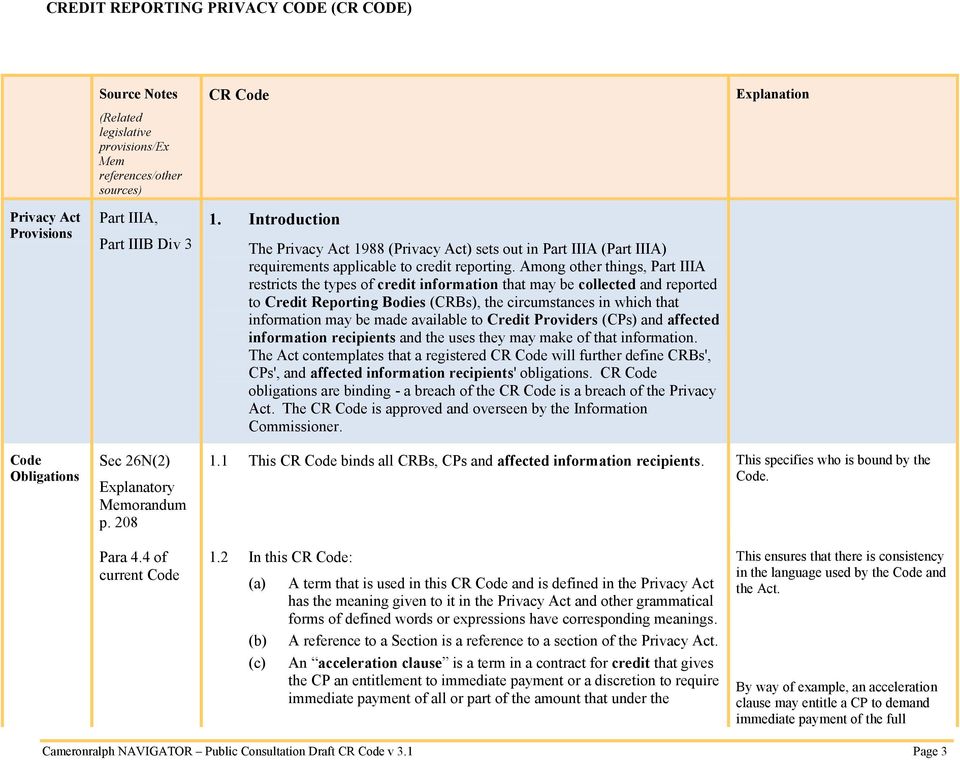
3 Privacy Act Provisions Code Obligations Part IIIA, Part IIIB Div 3 Sec 26N(2) orandum p Introduction The Privacy Act 1988 (Privacy Act) sets out in Part IIIA (Part IIIA) requirements applicable to credit reporting. Among other things, Part IIIA restricts the types of credit information that may be collected and reported to Credit Reporting Bodies (CRBs), the circumstances in which that information may be made available to Credit Providers (CPs) and affected information recipients and the uses they may make of that information. The Act contemplates that a registered will further define CRBs', CPs', and affected information recipients' obligations. obligations are binding - a breach of the is a breach of the Privacy Act. The is approved and overseen by the Information Commissioner. 1.1 This binds all CRBs, CPs and affected information recipients. This specifies who is bound by the Code. Para 4.4 of current Code 1.2 In this : A term that is used in this and is defined in the Privacy Act has the meaning given to it in the Privacy Act and other grammatical forms of defined words or expressions have corresponding meanings. A reference to a Section is a reference to a section of the Privacy Act. An acceleration clause is a term in a contract for credit that gives the CP an entitlement to immediate payment or a discretion to require immediate payment of all or part of the amount that under the This ensures that there is consistency in the language used by the Code and the Act. By way of example, an acceleration clause may entitle a CP to demand immediate payment of the full Cameronralph NAVIGATOR Public Consultation Draft v 3.1 Page 3
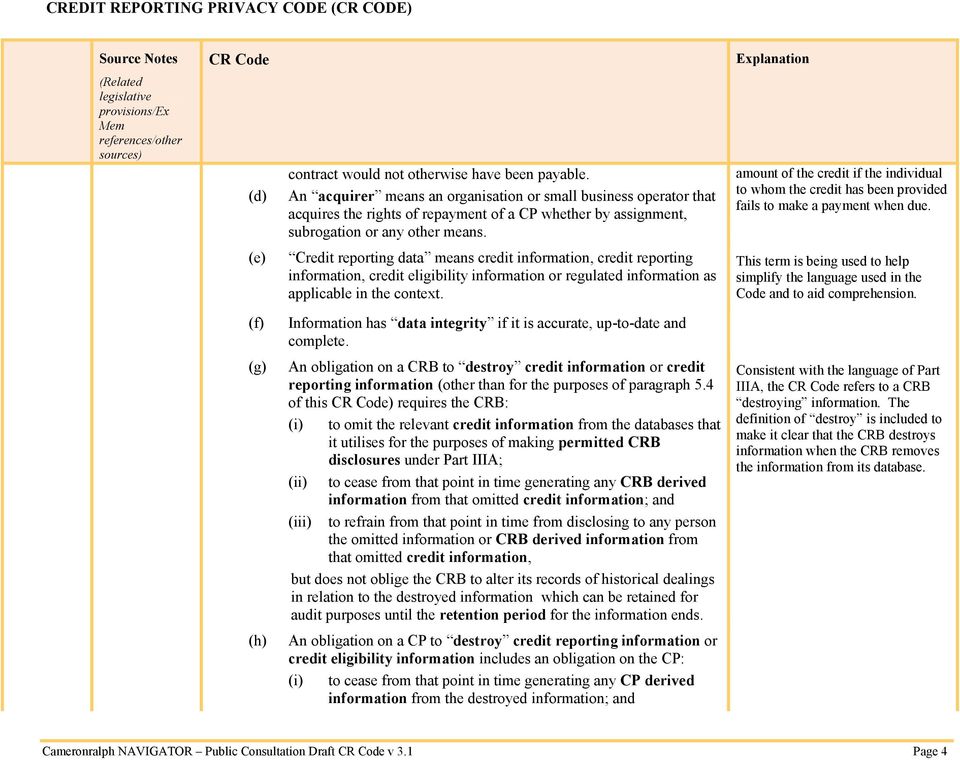
4 (d) (e) (f) (g) (h) contract would not otherwise have been payable. An acquirer means an organisation or small business operator that acquires the rights of repayment of a CP whether by assignment, subrogation or any other means. Credit reporting data means credit information, credit reporting information, credit eligibility information or regulated information as applicable in the context. Information has data integrity if it is accurate, up-to-date and complete. An obligation on a CRB to destroy credit information or credit reporting information (other than for the purposes of paragraph 5.4 of this ) requires the CRB: (i) to omit the relevant credit information from the databases that it utilises for the purposes of making permitted CRB disclosures under Part IIIA; (ii) to cease from that point in time generating any CRB derived information from that omitted credit information; and (iii) to refrain from that point in time from disclosing to any person the omitted information or CRB derived information from that omitted credit information, but does not oblige the CRB to alter its records of historical dealings in relation to the destroyed information which can be retained for audit purposes until the retention period for the information ends. An obligation on a CP to destroy credit reporting information or credit eligibility information includes an obligation on the CP: (i) to cease from that point in time generating any CP derived information from the destroyed information; and amount of the credit if the individual to whom the credit has been provided fails to make a payment when due. This term is being used to help simplify the language used in the Code and to aid comprehension. Consistent with the language of Part IIIA, the refers to a CRB destroying information. The definition of destroy is included to make it clear that the CRB destroys information when the CRB removes the information from its database. Cameronralph NAVIGATOR Public Consultation Draft v 3.1 Page 4
5 (ii) to refrain from that point in time from disclosing to any person the destroyed information or CP derived information from that destroyed information, but does not oblige the CP to alter its records of historical dealings in relation to the destroyed information which can be retained for audit purposes until the retention period for the information ends. (i) A section 6Q notice is a written notice that is given by a CP to an individual pursuant to Section 6Q requesting the individual to pay the overdue amount specified in the notice. (j) A transfer event is an event whereby the rights of a CP in relation to the repayment of an amount of consumer credit are acquired by an acquirer, whether by assignment, securitisation, subrogation or any other means. Privacy Act Part IIIA Provisions Sec 20N(3) and 20Q(2) 2. Credit reporting system arrangements Part IIIA requires CRBs to enter into written contracts with CPs that require CPs to ensure that credit information that they disclose to CRBs is accurate, up-to-date and complete and credit reporting information provided by CRBs to CPs is reasonably protected. Code Obligations Sec 20N(3) and 20Q(2), orandum p An agreement entered into by a CRB with a CP to meet the requirements of Section 20N(3) and Section 20Q(2) must oblige both parties to comply to the extent applicable from time to time with Part IIIA, Regulations made for the purposes of that Part and the. This ensures that a CRB is able to enforce the obligations a CP incurs under this Code and vice versa. Sec 20N(3) 2.2 Where a CP has entered into an agreement with a CRB pursuant to which the CP has disclosed consumer credit liability information and/or default This ensures that there is a current CRB/ CP agreement in place as required by Section 20N(3) Cameronralph NAVIGATOR Public Consultation Draft v 3.1 Page 5

6 Para 4.1 of current Code information to a CRB, the CP must not terminate its agreement with the CRB until the end of the retention period for that consumer credit liability information and/or default information. 2.3 CRBs, CPs, mortgage insurers and trade insurers must take reasonable steps: to inform employees, who deal with credit reporting data, of the requirements of Part IIIA and this that relate to information of these type; and to train employees, who deal with credit reporting data, in the practices, procedures and systems that are designed to achieve compliance with those requirements. pursuant to which the CP may report to the CRB credit termination information (see paragraph (g) of the definition of consumer credit liability information) and payment information (see Section 21E). This provision would not, however, prevent a CP and CRB agreeing to a variation of the commercial terms of the agreement. This establishes an obligation on those bound by the Code to train relevant employees about the Code. Privacy Act Part IIIA Provisions Sec 20B, Sec 21B, Sec 22A 3. Open and transparent management of credit reporting information Part IIIA obliges each CRB, CP and affected information recipient to have a written policy about their management of credit reporting data including the types of information they collect, how they collect and hold that information, what they use that information for and to whom the information is disclosed. This policy must be made freely available. They must also take reasonable steps to implement practices, procedures and systems to ensure compliance with their credit reporting obligations under Part IIIA and this. Cameronralph NAVIGATOR Public Consultation Draft v 3.1 Page 6

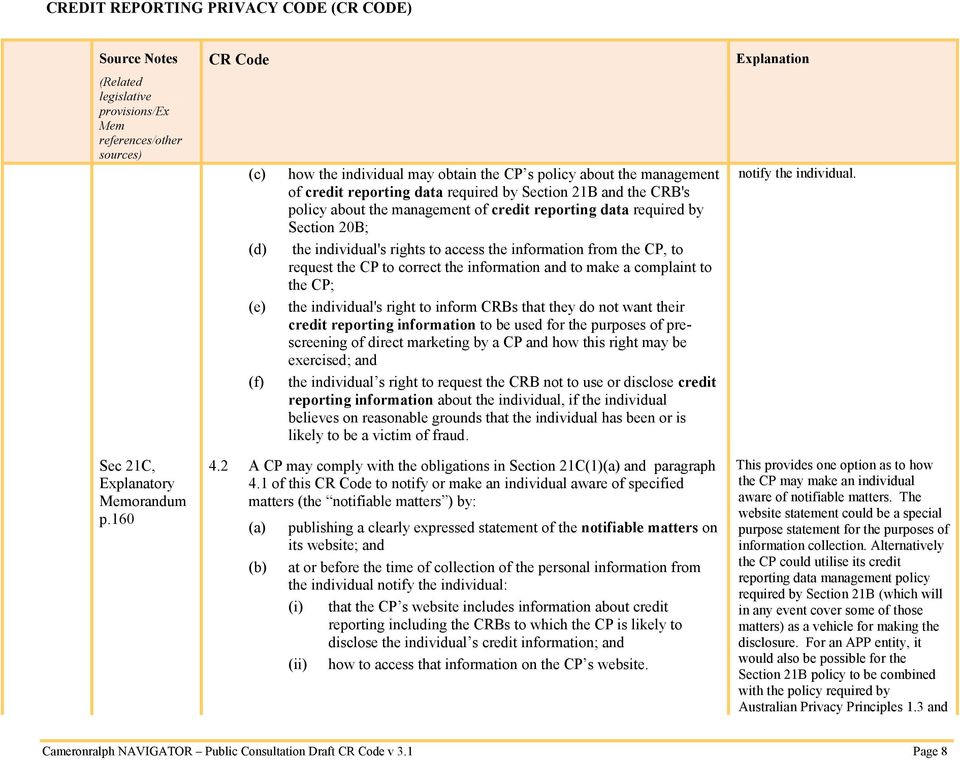
7 Code Obligations Sec 20B(5) & (6) Ex p.131 Para 1.6 of current Code. 3.1 A CRB must publish on its website its policy about the management of credit reporting information that is required by Section 20B(4). This specifies one way in which CRBs must make their credit reporting management policy publicly available. (Website publication does not, however, relieve a CRB of the obligation under Part IIIA to take reasonable steps to give the policy to a person on request in the requested form.) CPs may determine for themselves the way in which they will fulfil their obligation under Part IIIA to make their policies publicly available. Privacy Act Part IIIA Provisions Sec 21C 4. Information collection procedures Part IIIA obliges CPs to notify or ensure individuals are aware at or before the time of collection of personal information that the CP is likely to disclose to a CRB: of the CRBs with which the CP deals; and other matters required by the CR code. Code Obligations Sec 21C, orandum p At or before the time a CP collects personal information from an individual that the CP is likely to disclose to a CRB, the CP must notify or otherwise ensure that the individual is made aware of the following matters in addition to the matters specified in Section 21C(1): how that information will be held by the CP; to whom the CP may disclose the information and the purposes for which it may be used; This requires a CP to provide important information to a person from whom credit information is collected i.e. information in addition to that required by the legislation to be given. The CP s options as to how to convey the required information include arranging for a third party to Cameronralph NAVIGATOR Public Consultation Draft v 3.1 Page 7

8 (d) (e) (f) how the individual may obtain the CP s policy about the management of credit reporting data required by Section 21B and the CRB's policy about the management of credit reporting data required by Section 20B; the individual's rights to access the information from the CP, to request the CP to correct the information and to make a complaint to the CP; the individual's right to inform CRBs that they do not want their credit reporting information to be used for the purposes of prescreening of direct marketing by a CP and how this right may be exercised; and the individual s right to request the CRB not to use or disclose credit reporting information about the individual, if the individual believes on reasonable grounds that the individual has been or is likely to be a victim of fraud. notify the individual. Sec 21C, orandum p A CP may comply with the obligations in Section 21C(1) and paragraph 4.1 of this to notify or make an individual aware of specified matters (the notifiable matters ) by: publishing a clearly expressed statement of the notifiable matters on its website; and at or before the time of collection of the personal information from the individual notify the individual: (i) that the CP s website includes information about credit reporting including the CRBs to which the CP is likely to disclose the individual s credit information; and (ii) how to access that information on the CP s website. This provides one option as to how the CP may make an individual aware of notifiable matters. The website statement could be a special purpose statement for the purposes of information collection. Alternatively the CP could utilise its credit reporting data management policy required by Section 21B (which will in any event cover some of those matters) as a vehicle for making the disclosure. For an APP entity, it would also be possible for the Section 21B policy to be combined with the policy required by Australian Privacy Principles 1.3 and Cameronralph NAVIGATOR Public Consultation Draft v 3.1 Page 8
9 1.4. Privacy Act Part IIIA Provisions Sec 6N 5. Types of credit information Part IIIA permits CRBs, subject to conditions, to collect and disclose the following types of credit information: identification information about the individual; consumer credit liability information about the individual; repayment history information about the individual; (d) a statement that an information request has been made in relation to the individual by a CP, mortgage insurer or trade insurer; (e) the type of consumer credit or commercial credit and amount of credit sought in an application to a CP and in connection with which the CP has made an information request; (f) default information in relation to an individual; (g) payment information about the individual; (h) new arrangement information about the individual; (i) court proceedings information about the individual; (j) personal insolvency information about the individual; (k) publicly available information as to the individual's credit worthiness (subject to some exceptions); or (l) the CP's opinion that the individual has committed a serious credit infringement in relation to consumer credit provided by the CP to the individual. Code Obligations Sec 21D, 5.1 A CRB must not collect personal information in relation to consumer credit, if that personal information does not constitute Paragraph 5.1 fulfils the intent of the legislation that a CRB cannot collect information about CPs provision of consumer credit, other than the types Cameronralph NAVIGATOR Public Consultation Draft v 3.1 Page 9

10 credit information, unless: (i) the CRB collects the personal information for administrative purposes only ( administrative information ); and (ii) the CRB does not include the administrative information when the CRB discloses credit reporting information to a CP or affected information recipient. A CP must not disclose to a CRB personal information in relation to consumer credit, if that personal information does not constitute credit information, unless: (i) the information is administrative information; and (ii) the CRB does not include that administrative information when it discloses credit reporting information to a CP or affected information recipient. of information specifically enumerated in the legislation. Section 20N Para 2.4, 2.5 and 2.6 of existing Code 5.2 A CP must have reasonable practices, procedures and systems, given the size and complexity of its business, in place that are designed to: (d) (e) ensure that it does not disclose information to a CRB that it is prohibited by Part IIIA or this from disclosing; promptly advise the relevant CRB if the CP becomes aware that it has disclosed information to the CRB that it is prohibited from disclosing by Part IIIA or this ; ensure the data integrity of disclosed credit information; if it identifies data integrity issues in credit information that it has disclosed to a CRB: (i) promptly advise the CRB of those issues; and (ii) take reasonable steps to rectify those issues; promptly advise the relevant CRB if the CP becomes aware of data integrity issues in credit reporting information disclosed to it by This provides more detail as to what a CP must do to assist with data integrity pertaining to consumer credit-related information. The obligation is scaleable ie to have reasonable practices etc given the CP s circumstances. It will not be a breach of the Code if a CP, for example, occasionally inadvertently discloses information to a CRB that it is not permitted by the Act and this to disclose. By way of implementation guidance, it is intended that the Notes will include examples of situations where a CP would be expected to notify a CRB of data Cameronralph NAVIGATOR Public Consultation Draft v 3.1 Page 10

11 (f) (g) the CRB; where requested by a CRB: (i) review its credit reporting data management practices, procedures and systems, to the extent reasonable, to assess the data integrity of credit information it has disclosed to CRBs; (ii) take reasonable steps to rectify any data integrity issues that are identified; and (iii) advise the CRB of the results of the review and action taken to rectify data integrity issues; and otherwise provide reasonable assistance to CRBs to maintain data integrity in relation to credit reporting information and to rectify any issues that are detected. integrity issues, for example, where the CP becomes aware that a CRB has multiple records in relation to the same individual. Sec 20N orandum p.30 Para 1.3 and 1.4 of existing Code 5.3 A CRB must have reasonable practices, procedures and systems that are designed to enable the CRB to: (d) (e) use the information disclosed by CPs in relation to individuals dates of birth to identify any information disclosed by a CP that relates to an act, omission, matter or thing that occurred or existed before the relevant individual turned 18 that is prohibited by Part IIIA or this to be disclosed by the CP to the CRB; promptly assess collected information and destroy information that the CRB is prohibited by Part IIIA or this from collecting; promptly notify the relevant CP where information is destroyed on the basis that Part IIIA or this prohibits the CRB from collecting that information; undertake regular testing of the credit information that the CRB holds and uses to identify data integrity issues; rectify any data integrity issues in relation to credit reporting information that are identified through its regular testing or Paragraph 5.3 applies only to a CRB s activities that are regulated under Part IIIA. It does not apply to a CRB s collection and use of information about commercial credit. Paragraph 5.3 provides more detail as to what a CRB must do to comply with its obligation to ensure that credit reporting information is accurate, up-to-date and complete and that it does not collect information that is prohibited to be collected. Para requires a CRB to have practices, procedures and systems that aim to identify information about minors that the CRB is not permitted to hold. Note, however, Cameronralph NAVIGATOR Public Consultation Draft v 3.1 Page 11

12 (f) (g) otherwise, including destroying any information held by the CRB that the CRB is prohibted by Part IIIA or this from collecting; raise with the relevant CP any identified data integrity issues in credit information disclosed by the CP and, where appropriate, request the CP to: (i) review its credit information management practices, procedures and systems to the extent reasonable; (ii) rectify any data integrity issues that are identified; and (iii) advise the CRB of the results of the review; and where advised by a CP of data integrity issues in credit reporting information provided by the CRB to the CP: (i) promptly review its credit reporting information practices, procedures and systems and take reasonable steps to rectify any data integrity issues that are identified; and (ii) advise the CP of the results of the review and action taken to rectify data integrity issues. that Section 20C(5) and (6) permit a CRB to hold some information that pertains to the period before the individual turned 18. For para, a system generated error message could be the vehicle for notifying a CP where it provides information that is not permitted to be collected. Further guidance for CRBs would be possible in the Notes, for example: CRB's testing should look for CP data that is not consistent with usual pattern of reporting and which may be indicative of processing errors. Testing should aim to identify multiple records of the same individual or the same credit that are not linked together in a way that facilitates complete information being provided in relation to the individual or that credit Corrections and complaints data should be used as a source of intelligence to identify likely weaknesses e.g. incorrect approach taken to what is a serious credit infringement. Cameronralph NAVIGATOR Public Consultation Draft v 3.1 Page 12

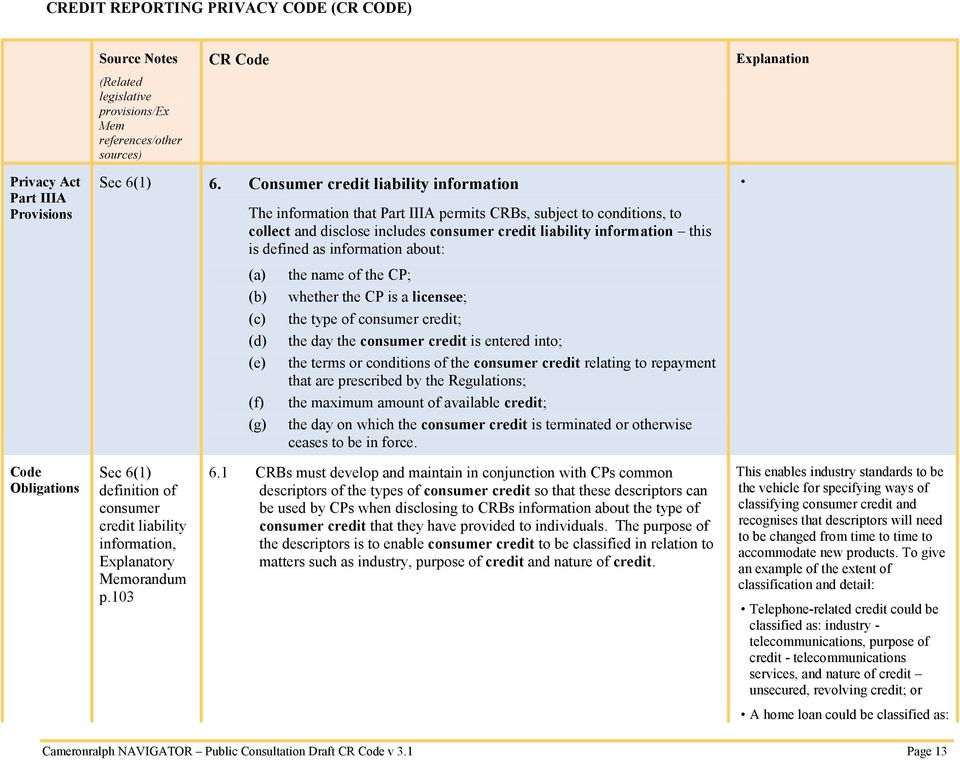
13 Privacy Act Part IIIA Provisions Sec 6(1) 6. Consumer credit liability information The information that Part IIIA permits CRBs, subject to conditions, to collect and disclose includes consumer credit liability information this is defined as information about: (d) (e) (f) (g) the name of the CP; whether the CP is a licensee; the type of consumer credit; the day the consumer credit is entered into; the terms or conditions of the consumer credit relating to repayment that are prescribed by the Regulations; the maximum amount of available credit; the day on which the consumer credit is terminated or otherwise ceases to be in force. Code Obligations Sec 6(1) definition of consumer credit liability information, orandum p CRBs must develop and maintain in conjunction with CPs common descriptors of the types of consumer credit so that these descriptors can be used by CPs when disclosing to CRBs information about the type of consumer credit that they have provided to individuals. The purpose of the descriptors is to enable consumer credit to be classified in relation to matters such as industry, purpose of credit and nature of credit. This enables industry standards to be the vehicle for specifying ways of classifying consumer credit and recognises that descriptors will need to be changed from time to time to accommodate new products. To give an example of the extent of classification and detail: Telephone-related credit could be classified as: industry - telecommunications, purpose of credit - telecommunications services, and nature of credit unsecured, revolving credit; or A home loan could be classified as: Cameronralph NAVIGATOR Public Consultation Draft v 3.1 Page 13
14 Sec 6(1) definition of consumer credit liability information, orandum p.103, When consumer credit liability information is either collected or disclosed in accordance with Part IIIA: the day the consumer credit is entered into is the day that, under the terms and conditions of the consumer credit, the credit is made available to the individual; the maximum amount of credit available is: (i) where no credit limit applies to revolving credit or a charge card contract no fixed limit; (ii) in the case of revolving credit with a credit limit - the credit limit applicable to that credit from time to time; (iii) in the case of credit where the principal amount is not repayable until a fixed date and, until that time, payments of interest only are required to be made - the principal amount of the credit; (iv) in the case of credit where payments of the principal amount must be made throughout the term of the credit - the amount as at the day the credit is entered into (or, if applicable, as at the date that the CP increases that amount) that is the maximum amount that the individual is entitled to have outstanding as at that date; (v) in the case of credit provided for the purposes of the acquisition of particular goods or services the applicable credit limit; (vi) in the case of credit provided by a supplier of goods and services where the contract specifies the amount of the credit industry - finance, purpose of credit - housing loan, nature of credit secured, fixed credit, principal and interest repayments. This further defines various limbs of the definition in the legislation of consumer credit liability information. Para defines how to determine what is the day the consumer credit is entered into and provides that the terms of the consumer credit facility are determinative of this. For example, depending upon the terms, credit may be available to the individual when: the borrower delivers their signed acceptance of the lender s offer; the borrower accepts the lender s offer by making the first drawdown on a credit facility; the lender issues a credit card; or the lender first charges a fee for providing the credit. Para defines how to determine what is the maximum amount of credit available and sets out 7 different possibilities depending upon the type of credit. The maximum amount of credit available Cameronralph NAVIGATOR Public Consultation Draft v 3.1 Page 14

15 or the credit limit - that amount; (vii) in the case of credit provided by a supplier of goods and services where the contract does not specify the amount of the credit or a credit limit and the amount to be paid depends upon the extent to which goods or services are obtained - the total amount that the supplier reasonably expects will be paid by the acquirer of the goods or services over the period of the contract; and the day credit is terminated or otherwise ceases to be in force is the day that under the relevant contract, arrangement or understanding debt is no longer available to the individual by reason of: (i) the payment by the individual of all amounts required to be paid in respect of the credit either in full or in accordance with a settlement agreed with the CP, without entitlement by the individual to incur and defer any further debt to the CP under that contract, arrangement or understanding; or (ii) the CP irrevocably terminating the relevant contract, arrangement or understanding. is determined at the inception of the loan. Where payment obligations include principal payments, the account balance will decline but this does not mean that the CP is permitted to update the disclosure provided to the CRB as to the maximum amount of credit available so as to track the account balance. Rather the CP may only update its disclosure of the maximum amount of credit available if the CP agrees to increase the amount of credit, for example, by increasing a credit card limit. The exercise of a redraw entitlement on a fixed loan would not increase the maximum amount of the credit. Para defines how to determine what is the day credit is terminated or otherwise ceases to be in force. Under para (i), no money would be owing at the time of termination either because of payment in full or because the CP has written off part of the debt. Under para (ii), there could be moneys owing to the CP at the time of termination of the credit that the CP is intending to take steps to recover, for example, through debt collection procedures, by proving in the individual s bankruptcy or by enforcing a Cameronralph NAVIGATOR Public Consultation Draft v 3.1 Page 15
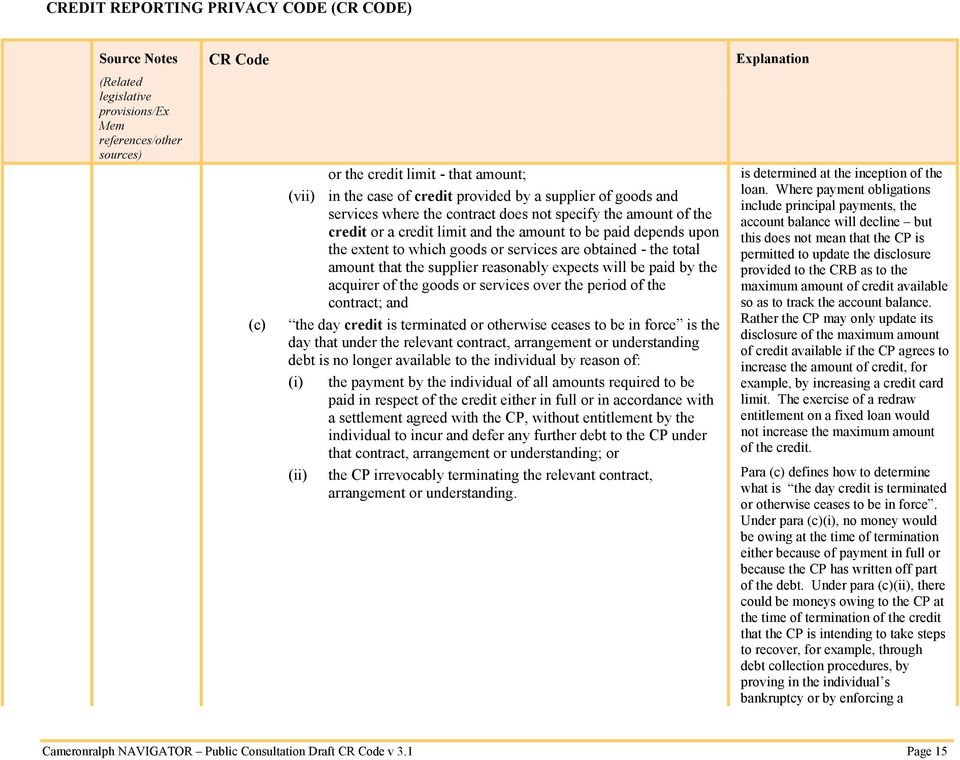
16 orandum p Where a CP chooses to disclose to a CRB the type of consumer credit that has been provided to an individual (paragraph of the definition of consumer credit liability information), the CP must disclose all elements of consumer credit liability information in relation to that credit, unless the information is not reasonably available. judgment debt. Where the type of consumer credit is disclosed by a CP to a CRB, it would seem appropriate to treat consumer credit liability information as one data set and so require information to be provided under all paragraphs of the definition where this is available. (The provision does not, however, prevent the continuation of the current practice whereby a CP may simply disclose that it is a current credit provider of an individual ie this provision would permit that to occur without disclosure of information within paragraphs to (f) of the definition of consumer credit liability information (see current Section 18E(1)(v)).) The exception from the disclosure obligation for information that is not reasonably available recognises that particularly where a CP discloses consumer credit liability information a long time after the credit is entered into, it may be difficult for the CP, for example, to identify the day the credit is entered into. Information to meet paras to (f) of the definition of consumer credit liability information will be able to be Cameronralph NAVIGATOR Public Consultation Draft v 3.1 Page 16
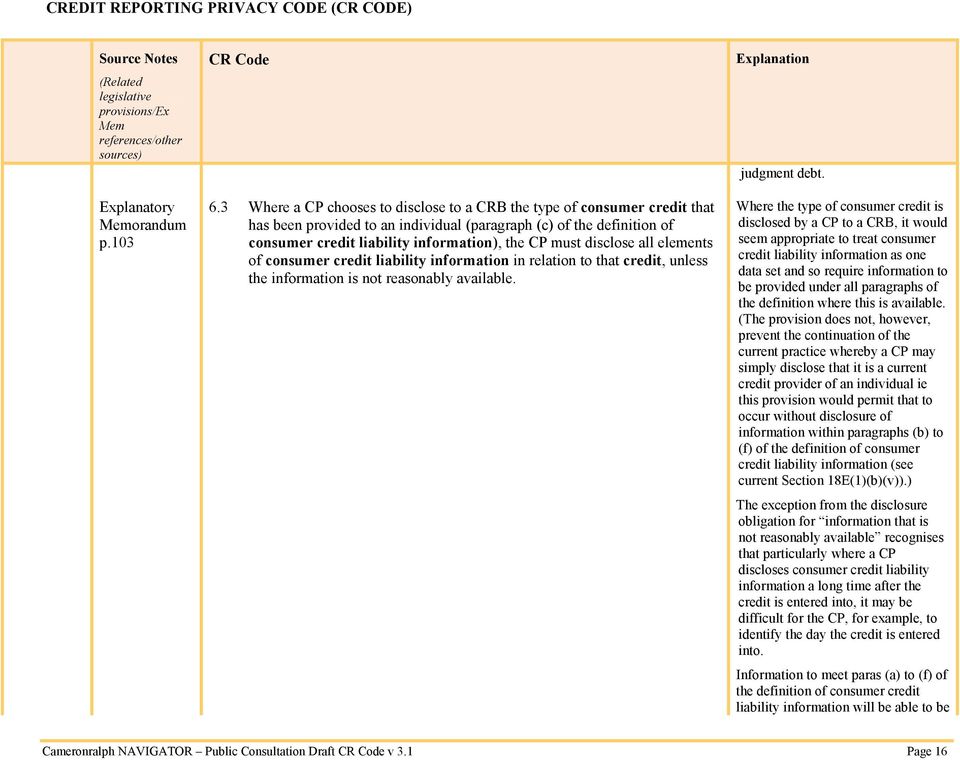
17 Current Code para Where a CP chooses to disclose to a CRB consumer credit liability information in relation to credit provided to an individual, the CP must, once that credit is terminated or otherwise ceases to be in force, disclose this to the CRB within 45 days of that date. disclosed at the time of the disclosure that the consumer credit has been entered into. The day of termination (para (g) of that definition) will, of course, be disclosed later (see para 6.4). This ensures that an individual s credit reporting information does not include credit that has been terminated ie present a misleading impression of indebtedness. This provision applies whether a CP chooses to simply disclose that it is a current consumer credit relationship with an individual (ie if the CP discloses information under paragraph of the definition of consumer credit liability information but not information under paragraphs to (f) of the definition of consumer credit liability information) or if the CP chooses to disclose information as to the type of consumer credit and so is obliged as a result of paragraph 6.3 to disclose information in relation to that credit under all paragraphs of the definition of consumer credit liability information. Privacy Act Part IIIA Provisions Section 6N(e) 7. Information requests Cameronralph NAVIGATOR Public Consultation Draft v 3.1 Page 17

18 Section 6N(e) Paragraph 2.1 of Current Code The information that Part IIIA permits CRBs, subject to conditions, to collect includes information requests. Where a CP makes an information request, the CRB may also collect the type of consumer credit or commercial credit and, the amount of credit sought by the individual in the application to the CP to which the CP s information request relates. 7.1 Where a CP makes an information request to a CRB in connection with an application for credit and the amount of credit sought is unknown or incapable of being specified, the credit information that the CRB may collect and disclose may include that an unspecified amount of credit is being sought from the CP. This recognises that at the time that a CP obtains a credit report from a CRB the CP may not know how much credit is being sought by the applicant. This should not prevent the CRB from collecting the information about the individual s credit application. Privacy Act Part IIIA Provisions Sec 6V 8. Repayment history information The information that Part IIIA permits CRBs, subject to conditions, to collect includes repayment history information. Collection is only permitted from a CP that is a licensee or is prescribed by the Regulations. Repayment history information is information about: whether an individual has met an obligation to make a monthly payment that is due and payable in relation to consumer credit; the day the monthly payment is due and payable; if late payment is made the day on which the individual makes that payment. Code Obligations Section 6V, orandum 8.1 When disclosing repayment history information to a CRB, a CP must reasonable steps to ensure that the CP only discloses that the individual has failed to make a due payment if, at least, 5 days have elapsed since the This provides a grace period before repayment history information may be reported to a CRB. Cameronralph NAVIGATOR Public Consultation Draft v 3.1 Page 18
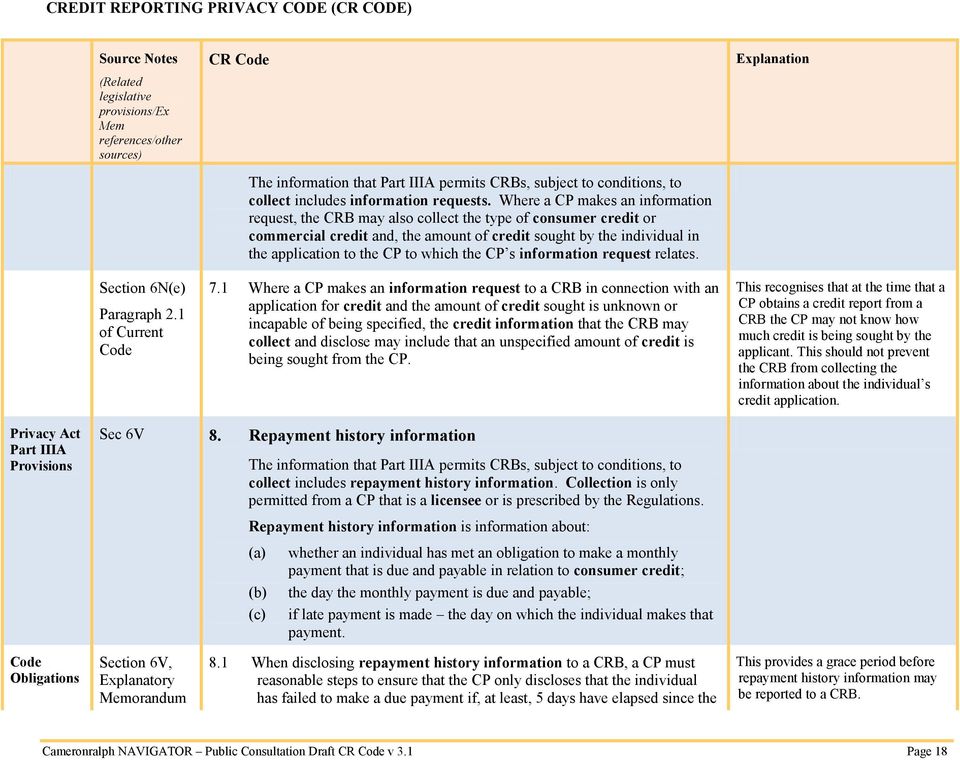
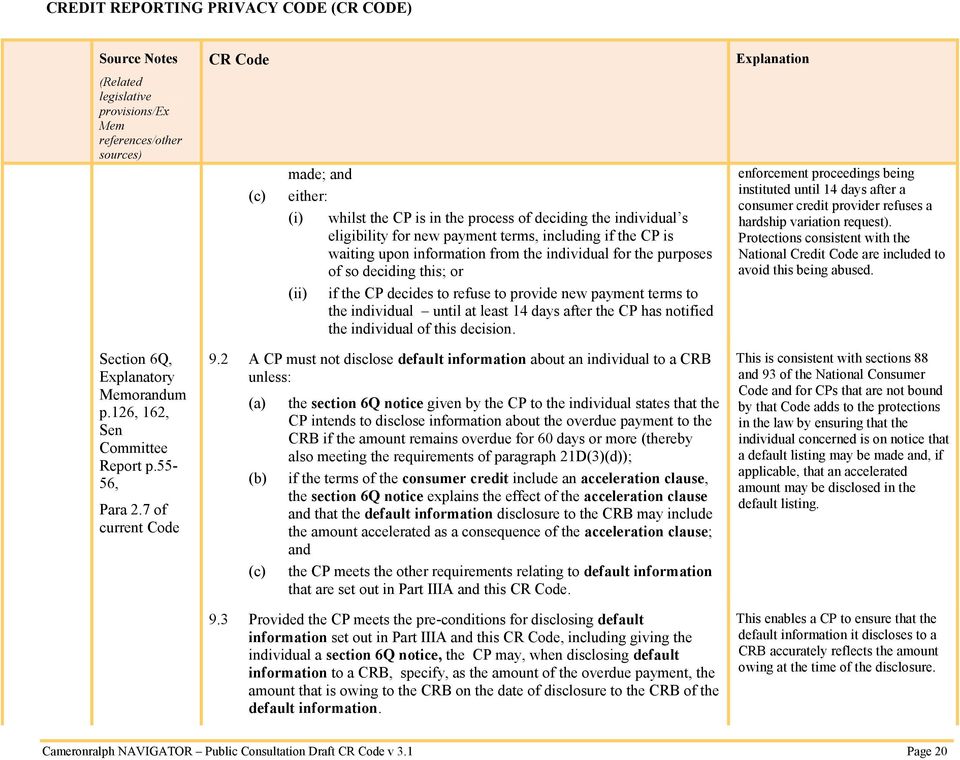
19 p CP's systems first classified that as being in arrears. 8.2 Where a CRB becomes aware that a CP has ceased disclosing to the CRB repayment history information in relation to credit although repayments are continuing to be made by the individual who has been provided with the credit, the CRB must take reasonable steps to ensure that any disclosure by it of the repayment history information that it holds in relation to that credit is accompanied by a note to this effect. If a CP begins disclosing repayment history information in relation to an account and then decides to cease disclosing this information to the CRB, this change needs to be apparent to a user of the information. For this reason, any credit reporting information disclosed by the CRB that includes that repayment history information should note that the repayment history information is not being updated by the CP. Privacy Act Part IIIA Provisions Sec 6Q 9. Default information The information that Part IIIA permits CRBs, subject to conditions, to collect and disclose includes default information. Preconditions to this include a consumer credit payment must be overdue by at least 60 days, the overdue amount must be not less than the Part IIIA specified minimum amount and the CP must have met the notice obligation specified in Part IIIA. Code Obligations orandum p.126, 9.1 A CP must not disclose a consumer credit overdue payment to a CRB as default information: if the individual has requested new payment terms (whether via a variation of the terms and conditions of the consumer credit or new consumer credit); if the individual has not made a request during the previous 4 months for new payment terms that the CP reasonably believes had bases that were materially the same as those on which the current request was This prevents a CP from reporting default information to a CRB if the individual has made a financial hardship assistance request and the CP has not yet decided whether to allow the request or has not given the individual a reasonable time to respond to a refusal of the request (the 14 day period aligns with the National Credit Code prohibition on Cameronralph NAVIGATOR Public Consultation Draft v 3.1 Page 19
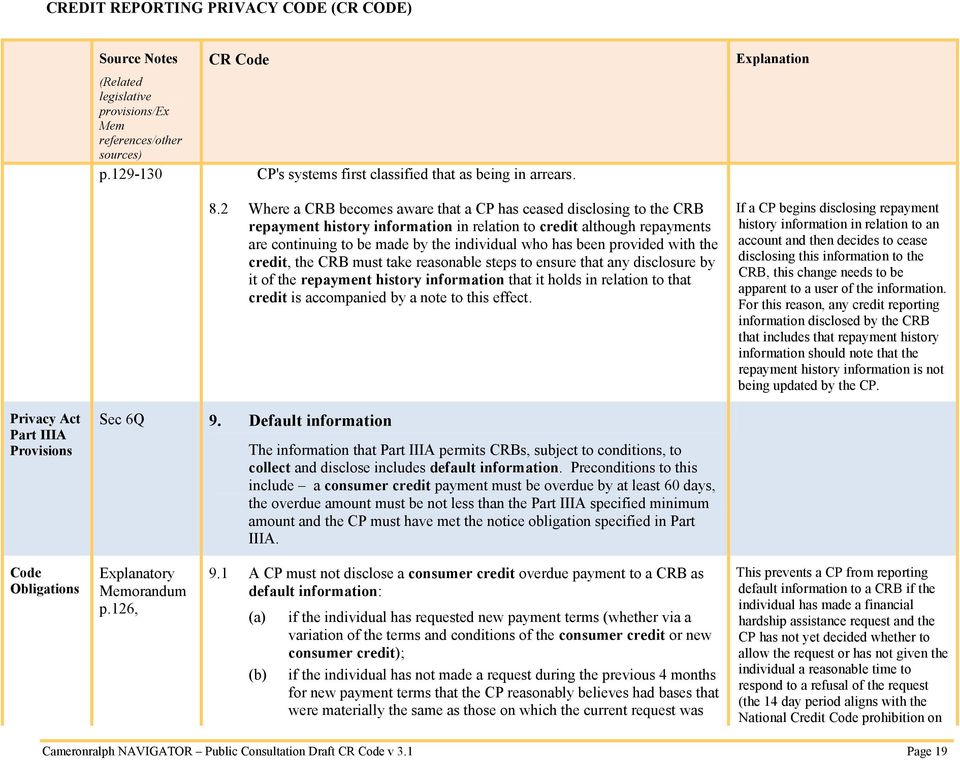
20 made; and either: (i) whilst the CP is in the process of deciding the individual s eligibility for new payment terms, including if the CP is waiting upon information from the individual for the purposes of so deciding this; or (ii) if the CP decides to refuse to provide new payment terms to the individual until at least 14 days after the CP has notified the individual of this decision. enforcement proceedings being instituted until 14 days after a consumer credit provider refuses a hardship variation request). Protections consistent with the National Credit Code are included to avoid this being abused. Section 6Q, orandum p.126, 162, Sen Committee Report p.55-56, Para 2.7 of current Code 9.2 A CP must not disclose default information about an individual to a CRB unless: the section 6Q notice given by the CP to the individual states that the CP intends to disclose information about the overdue payment to the CRB if the amount remains overdue for 60 days or more (thereby also meeting the requirements of paragraph 21D(3)(d)); if the terms of the consumer credit include an acceleration clause, the section 6Q notice explains the effect of the acceleration clause and that the default information disclosure to the CRB may include the amount accelerated as a consequence of the acceleration clause; and the CP meets the other requirements relating to default information that are set out in Part IIIA and this. 9.3 Provided the CP meets the pre-conditions for disclosing default information set out in Part IIIA and this, including giving the individual a section 6Q notice, the CP may, when disclosing default information to a CRB, specify, as the amount of the overdue payment, the amount that is owing to the CRB on the date of disclosure to the CRB of the default information. This is consistent with sections 88 and 93 of the National Consumer Code and for CPs that are not bound by that Code adds to the protections in the law by ensuring that the individual concerned is on notice that a default listing may be made and, if applicable, that an accelerated amount may be disclosed in the default listing. This enables a CP to ensure that the default information it discloses to a CRB accurately reflects the amount owing at the time of the disclosure. Cameronralph NAVIGATOR Public Consultation Draft v 3.1 Page 20
21 Privacy Act Part IIIA Provisions Section 6T 10. Payment information The information that Part IIIA permits CRBs, subject to conditions, to collect and disclose includes payment information this is a statement that payment has been made of an overdue payment that has previously been disclosed by the CP to the CRB as default information. Code Obligations Section 6T, orandum p For the purposes of the definition of "payment information" in the Privacy Act, the amount of the overdue payment to which the information relates is taken to be paid when: payment is made in cleared funds of the full amount of the overdue payment, including all interest, fees and other amounts that are owing as a result of the overdue payment; payment is made in cleared funds of part of the amount of the overdue payment and the CP accepts this amount in full settlement of the overdue payment; the CP waives the overdue payment.; or the CP agrees to terminate the consumer credit provided to the individual to which the overdue payment relates and replace it with new consumer credit. This provides further clarity as to the term payment information. Where an individual makes a partial payment without reaching a settlement of the credit, this is not payment information and so the mandatory obligation to disclose to the CRB will not apply. (d) Sec 21E, orandum p Where a CP has an obligation under Section 21E to disclose to a CRB payment information relating to an individual and the individual asks the CP to disclose this information to the CRB urgently, the CP must disclose the payment information within 5 business days of the later of: the individual s request; and the date of the payment information as determined in accordance with paragraph 10.1, This imposes a timeframe for disclosure required by the legislation (i.e. disclosure that payment has been made in relation to a default that has been previously reported by the CP to a CRB) but only where the individual asks the CP to make the payment disclosure to the CRB as a matter of Cameronralph NAVIGATOR Public Consultation Draft v 3.1 Page 21
22 unless the CP has reasonable grounds for requiring a longer period of time to do this. urgency. Privacy Act Part IIIA Provisions Section 6S 11. New arrangement information The information that Part IIIA permits CRBs, subject to conditions, to collect and disclose includes new arrangement information this is a statement that terms and conditions of consumer credit have been varied or an individual has been provided with new consumer credit in either case because of an overdue payment that has previously been disclosed by the CP to the CRB as default information. Code Obligations Section 6S, orandum p When disclosing new arrangement information to a CRB, a CP must disclose which of the following is the case: the terms or conditions of the original consumer credit have been varied; or the individual has been provided with new consumer credit. The legislation establishes 2 categories of new arrangement information. This requires a CP disclosing new arrangement information to a CRB to make it clear which category the new arrangement information constitutes. The CRB can then ensure that the individual s current credit position is accurately shown. A new arrangement may also mean that the CP will have an obligation under Part IIIA and this to disclose to the CRB payment information and the day on which consumer credit is terminated or otherwise ceases to be in force. Privacy Act Part IIIA Provisions Section 6N(k) 12. Publicly available information The information that Part IIIA permits CRBs, subject to conditions, to Cameronralph NAVIGATOR Public Consultation Draft v 3.1 Page 22
23 orandum p.124 collect and disclose includes publicly available information (an undefined term in the Privacy Act) A CRB must only collect publicly available information about an individual: from a government department or agency; and if the content of the information that is collected is generally available to members of the public (whether in the form provided to the CRB or another form and whether or not a fee must be paid to obtain that information). This places limits on the credit information that a CRB may collect and hence disclose under the publicly available information limb of the definition of credit information. To obtain the information, the CRB may have to pay a government fee. This is consistent with the definition of generally available publication in section 6(1). Privacy Act Part IIIA Provisions Sec 6(1) definition of serious credit infringement 13. Serious credit infringements The information that Part IIIA permits CRBs, subject to conditions, to collect and disclose includes serious credit infringements this is defined as: an act by an individual that involves fraudulently obtaining consumer credit or attempting to do this; an act by an individual that involves fraudulently evading the individual s consumer credit obligations or attempting to do this; or an act by an individual if: (i) a reasonable person would consider the act indicates an intention by the individual no longer to comply with the individual s obligations in relation to consumer credit provided by a CP; (ii) the CP has taken reasonable steps to contact the individual Cameronralph NAVIGATOR Public Consultation Draft v 3.1 Page 23
24 (iii) about the act; and at least 6 months have passed since the CP last had contact with the individual. Code Obligations Section 6(1) definition of serious credit infringement orandum p Where a CP discloses to a CRB that, in the CP's opinion, an individual has committed a serious credit infringement within paragraph of the Section 6(1) definition of that term, the CP must be able to reasonably establish that: (i) when obtaining or attempting to obtain consumer credit, the individual made, or arranged for someone else to make, a material false statement to the CP or knowingly allowed the CP to rely upon a material false statement; and (ii) the individual did this knowing that the false statement was untrue and with intent to deceive the CP, aware that the false statement was likely to materially affect the CP's decision as to whether or not to provide credit to the individual. Paras and specify the evidentiary grounds that a CP must be able to establish if the CP wants to disclose a serious credit infringement to a CRB on the basis of fraud. These paragraphs incorporate the legally-accepted elements of fraud. Note that a materially false statement could include a materially false assertion made by the individual or a forged document. Section 6(1) definition of serious credit infringement orandum p Where a CP discloses to a CRB that, in the CP's opinion, an individual has committed a serious credit infringement within paragraph of the Section 6(1) definition of that term, the CP must be able to reasonably establish that: (i) the individual made, or arranged for someone else to make, a material false statement to the CP or knowingly allowed the CP to rely upon a material false statement; and (ii) the individual did this knowing that the false statement was untrue and with intent to evade the individual's obligations in relation to consumer credit by deceiving the CP as to a Cameronralph NAVIGATOR Public Consultation Draft v 3.1 Page 24
25 material fact. Section 6(1) definition of serious credit infringement orandum p Before disclosing an overdue payment to a CRB as a serious credit infringement on the basis of paragraph of the Section 6(1) definition of that term, the CP must have disclosed the overdue payment to the CRB as default information. In order to establish that reasonable steps have been taken to contact the individual: (i) where possible, the CP must attempt to make contact with the individual by phone, and mail; (ii) if these contact attempts suggest that any of those contact details are no longer current, the CP must take reasonable steps to ascertain new contact details and, where new contact details are ascertained, repeat the previous contact attempts using the new contact details; (iii) in phone messages (where these can be left with an automatic answering service or with an adult) and s, the CP must take reasonable steps to provide its contact details and ask the individual to contact the CP as a matter of urgency; (iv) in mailed letters, the CP must: 1) give particulars of the default; and 2) state that if a period of 6 months elapses without contact with the individual about the default the CP intends to disclose the default to a CRB as a serious credit infringement and explain the effect of this; (v) the CP must retain such evidence of attempts to contact the individual as is reasonable in the circumstances; and. This sets out steps that a CP must undertake before reporting a serious credit infringement to a CRB on the basis that the individual cannot be contacted these requirements are in addition to those imposed by the legislation. In particular, this requires the CP to have previously disclosed the overdue payment as default information. The Notes could include the following as examples of the kind of records that might be reasonable to retain: the time, date, CP representative involved and outcome of phone calls; the date and text of an transmission, the address to which it is sent and any notification received in response to the ; and if registered mail is utilised - the Australia Post registered mail unique identification number. The Notes could provide further guidance as to what constitutes unsuccessful contact e.g. that return of registered mail because the individual refuses to sign for receipt constitutes unsuccessful Cameronralph NAVIGATOR Public Consultation Draft v 3.1 Page 25
26 Section 6(1) definition of serious credit infringement (vi) if the individual makes contact with the CP at any time during the 6 month period beginning on: 1) the date of the notice that the CP is required by Section 6Q to give to the individual; or 2) if more recent the date of last contact with the individual,notice was given by the CP the 6 months period referred to in paragraph (iii) of the definition of serious credit infringement recommences If a CP discloses payment information to a CRB that relates to an overdue amount the subject of a serious credit infringement disclosure pursuant to paragraph of the definition in the Privacy Act of serious credit infringement, the CRB must remove the serious credit infringement disclosure from the credit information it holds about the individual. contact, as does failure by the individual to respond to registered mail. This enables a non-fraud serious credit infringement to be removed if the individual gets into contact with the credit provider (albeit after 6 months of no contact) and makes payment of the overdue amount. (The default listing that preceded the serious credit infringement would, however, continue to be recorded against the individual s name.) Full payment would be evidence of the debtor s good faith justifying the removal of the serious credit infringement record. This provision also provides an incentive to a debtor to make full payment. Privacy Act Part IIIA Provisions Sect 6K 14. Transfer of rights of credit provider The Privacy Act recognises that the repayment rights of a CP in relation to Cameronralph NAVIGATOR Public Consultation Draft v 3.1 Page 26
27 credit may be acquired by assignment, subrogation or other means and treats the acquirer as a CP for the purposes of the credit. Code Obligations Sec 6K Para 2.3 of existing Code 14.1 If: an acquirer acquires the rights of a CP in relation to the repayment of an amount of consumer credit; the original CP notifies the individual to whom that consumer credit was provided of the transfer event; and prior to the transfer event, the original CP had disclosed to a CRB consumer credit liability information about the consumer credit, both the original CP and the acquirer must ensure that disclosure is made to the CRB of the transfer event within 45 days of its occurrence including the name of the acquirer. This ensures that the CRB s credit information about the individual is updated to reflect the acquirer s status as the new CP. Paragraph 14.1 enables both parties to notify the CRB of the transfer of rights to the acquirer. Alternatively, if they wish, they may agree as between themselves as to who must make this notification. Sec 6J, 6K 14.2 After a transfer event occurs in relation to credit, both the original CP and the acquirer must ensure the disclosure to the CRB of any information that is required to be disclosed under Part IIIA or this (and for the purposes of those subsequent disclosure the acquirer is taken to have made any disclosures by the original CP in relation to that credit that were made prior to the transfer event). Where the original CP transfers the right to repayment of credit to another organisation, paragraph 14.2 permits the original CP and the acquirer to agree as to which of them is to make updating disclosure (such as payment information) to the CRB. Privacy Act Part IIIA Provisions Sec 20F and 21G 15. Permitted CRB disclosures Part IIIA permits a CRB to disclose credit reporting information to CPs, mortgage insurers and trade insurers - but only for certain permitted purposes. Code Obligations Sec 20E, 20F 15.1 When a CRB receives a request from a CP, mortgage insurer or trade insurer for the disclosure of credit reporting information about an individual, the CRB is entitled to rely upon a written statement made by the This provides an efficient way for a CRB to evidence that its disclosure of credit reporting information is Cameronralph NAVIGATOR Public Consultation Draft v 3.1 Page 27
28 Sec 20F Sec 20E, 20F CP, mortgage insurer or trade insurer as to the basis on which the disclosure is a permitted CRB disclosure and, if applicable, that the individual has expressly consented to the disclosure of the information. This does not apply if, however, the CRB has actual knowledge that the CP, mortgage insurer or trade insurer does not meet the relevant Part IIIA condition for permitted CRB disclosure If a CP operates in an industry that is not covered by any of the recognised external dispute resolution schemes and accordingly the CP is not able to become a member of a recognised external dispute resolution scheme, the CP may nevertheless make an information request to a CRB for the purposes of a CRB making a permitted CRB disclosure to it Where CRB receives a request that it make a permitted CRB disclosure in relation to an individual and the CRB is not reasonably sure whether information it holds relates to the individual named in the request, the CRB permitted by the legislation. Section 20F does not require a CP to be a member of a recognised external dispute resolution scheme in order to obtain credit reporting information from a CRB. However, a request for credit reporting information may be thought to be the contribution of credit information of the kind described in section 6N(d) and, under section 21D(2)(i), a CP may only contribute credit information if it is a member of a recognised external dispute resolution scheme or is prescribed by the Regulations. This provision is designed to overcome that technical issue in particular for a supplier of goods and services on credit that: does not have access to such a scheme; and has not been prescribed by the Regulations. This provides a mechanism for a CRB to check before providing credit reporting information that it has correctly identified the individual the Cameronralph NAVIGATOR Public Consultation Draft v 3.1 Page 28
29 Paras 1.5, 2.2 and 2.15 of current Code may disclose identification information about an individual who may be the individual named in the request (but not other credit reporting information in relation to that individual) to the requesting CP, mortgage insurer or trade insurer, so as to provide the latter with an opportunity to verify that the identification information provided by the CRB matches the individual the subject of the request Where, in response to a request: a CRB discloses credit reporting information (other than a disclosure by a CRB that consists only of identification information in accordance with paragraph15.3) to a CP, mortgage insurer or trade insurer; or a CP discloses credit eligibility information to an entity to which a permitted CP disclosure may be made; and the CRB, CP or recipient of the information (as applicable) subsequently becomes aware that the credit reporting information or credit eligibility information was about an individual other than the individual the subject of the request: (d) in the case of a recipient of the information - it must: (i) advise the disclosing CRB or CP (as applicable) of the mistake as to identity (unless it was the disclosing CRB or CP that identified the mistake); and (ii) destroy the disclosed information; and in the case of a CRB or CP that disclosed the information - it must: (i) advise the recipient of the information of the mistake as to identity (unless it was the recipient of the information that identified the mistake); and (ii) as appropriate, review its disclosure practices, procedures and subject of the request. This sets out the steps that must be taken where credit reporting data is disclosed that relates to the wrong individual. The Notes could also note the relevance of s20 and s21u and, for example, if a CP notifies a CRB that it has provided information about the wrong person, the CRB would have an obligation to correct its records and tell those who had previously received the erroneous information. Cameronralph NAVIGATOR Public Consultation Draft v 3.1 Page 29
30 systems so that similar mistakes are minimised in the future. Para 1.15 of current Code 15.5 Before a CRB discloses credit reporting information to a CP, mortgage insurer or trade insurer, the CRB must have taken reasonable steps to ensure that the CP, mortgage insurer or trade insurer has been notified of the requirements of the Privacy Act governing limitations on use and disclosure of credit reporting information. This places an obligation on CRBs to ensure that they make their customers aware of the Part IIIA restrictions on credit reporting information use and disclosure. Information as to this only has to be provided once. Repeat customers do not need to be warned about the Part IIIA requirements every time they are provided with credit reporting information. Privacy Act Part IIIA Provisions 16. Security of credit reporting information Part IIIA requires CRBs and CPs to take reasonable steps to maintain the security of credit reporting data. CRBs are required to enter into agreements with CPs requiring them to protect credit reporting information from misuse, interference and loss and unauthorised access, modification or disclosure. Code Obligations Section 20Q, orandum p CRBs and CPs must maintain reasonable practices, procedures and systems to make electronic transmission of credit reporting data secure. Given the importance of electronic transmission of credit reporting data, this imposes a specific obligation to secure online transmission of data. The Notes could emphasise the importance of privacy enhancing software including firewalls, encryption software etc. Privacy Act Part IIIA Div 3, Subdiv D 17. Use and disclosure of credit reporting data by CPs and affected Cameronralph NAVIGATOR Public Consultation Draft v 3.1 Page 30
31 Provisions information recipients Part IIIA places restrictions and conditions on the use and disclosure of credit information and credit eligibility information. Sec 21H Item Notwithstanding anything in Part IIIA (other than Section 20H) or any other provision of this (other than paragraph 17.1), a CP or an affected information recipient must not use or disclose credit reporting information or credit eligibility information for the purposes of: (i) assessing the likelihood that the individual to which the information relates may accept: 1) an invitation to apply for, or an offer of, credit or insurance in relation to mortgage credit or commercial credit; or 2) an invitation to apply for a variation of, or an offer to vary, the amount of or terms on which credit or insurance in relation to mortgage credit or commercial credit is provided; or (ii) targeting or inviting an individual to apply, or accept an offer, for: 1) credit or insurance in relation to mortgage credit or commercial credit; or 2) variation of the amount of or terms on which credit or insurance in relation to mortgage credit or commercial credit is provided. A CP or affected information recipient that has received an application for credit or insurance in relation to mortgage credit or commercial credit is not, however, prohibited by paragraph from This ensures that information that is sourced from a CRB (whether directly or through a CP) is not used by the recipient for marketing purposes. In particular, it has the effect of placing constraints on the breadth of the words used in section 21H Item 1 internal management purposes.. directly related to the provision or management of consumer credit. Cameronralph NAVIGATOR Public Consultation Draft v 3.1 Page 31
32 using credit reporting information or credit eligibility information for the purposes of assessing the application (but this does not permit the CP to use that information to offer or invite the applicant to apply for a different product other than that applied for). Sec 21H Item 5, orandum p A CP must only request a CRB to disclose credit reporting information to the CP, for the purposes of assisting the individual to avoid defaulting on his or her obligations in relation to consumer credit provided by the CP to the individual, if the CP has a reasonable basis for believing that the individual may be at significant risk of defaulting on his or her obligations to the CP. This ensures that a CP does not obtain regular or continuous disclosures about an individual from a CRB for the purposes of simply monitoring or checking the individual s overall credit worthiness or behaviour. A CP would, however, be justified in seeking a credit report if an individual made a hardship request or if other CP indicators of financial difficulty are triggered. Another avenue open to the CP would be for the CP to ask a CRB to alert it if an individual triggered a CP-specified indicator of significant default risk for example: default to another credit provider; in the case of a CP that is a licensee - a payment that is 90 days overdue; or in the case of a CP that is utility change of residence. The reasonable basis test would be met in these circumstances ie specification by the CP of indicators that are objectively strongly Cameronralph NAVIGATOR Public Consultation Draft v 3.1 Page 32
33 indicative of default risk, with the CRB assisting the CP by applying those CP-specified indicators and thereby identifying for the CP the individuals that are likely to require assistance to avoid default. Code Obligations Sec 21P, orandum p Where a CP obtains credit reporting information about an individual from a CRB and, within 90 days of obtaining that information, the CP refuses a consumer credit application made by the individual whether alone or jointly with other applicants, the CP must provide a written notice of refusal that: (d) meets the requirements of Section 21P(2); explains the individual s right to access their credit reporting information without charge during the 90 days following the date of the CP s notice of refusal and how to request the relevant CRBs to provide access to that information; states that it is important for individuals to be proactive in checking the accuracy of the credit reporting information that CRBs hold; states that the CP relies upon information from a number of sources when deciding whether to refuse credit including information provided by the individual to the CP and credit reporting information disclosed to the CP by CRBs; provides information about factors that are often taken into account when refusing credit (these may include: (i) the adequacy of the applicant s level of income and other resources to meet repayments of credit; (ii) the extent of the applicant s indebtedness and other commitments; This specifies what must be included in the notice of refusal of credit. The aim is to educate individuals about the credit reporting process so that they become aware of the importance of monitoring their credit reporting information. Para (e) requires generic information to be provided rather than information about the specific factors that led to the particular individual s credit application being refused. The requirement for contact details of the CRB can be met by disclosing the CRB's website. (e) Cameronralph NAVIGATOR Public Consultation Draft v 3.1 Page 33
34 (f) (iii) (iv) the security of the applicant s employment; the applicant s credit history including previous bankruptcy, defaults, serious credit infringements, high number of credit applications and unsatisfactory repayment history); and refers to the CP's credit eligibility information access and correction processes and its complaints process. Sec 21J The written notice must be given to the individual either at the time the CP notifies the individual of the refusal decision or within 10 business days of that date As evidence of an individual's express consent to the disclosure by a CP (the "disclosing CP") of credit eligibility information to another CP with an Australian link (the "recipient"), the disclosing CP is entitled to rely upon a written statement provided by the recipient that: it has an Australian link; the individual has given their consent in the manner required by Section 21J to the disclosure of the information by any CP to the recipient for specified categories of purpose, for example, assessing an application made by the individual for consumer credit or commercial credit, assessing whether to accept the individual as a guarantor and collecting payments that are overdue in relation to consumer credit or commercial credit; and specifies the intended purpose for which the requested information will be used, provided, however, that this is one of the categories of purpose specified in the individual's statement of consent.. This is included to facilitate (as allowed by the legislation) a disclosing CP relying on consent from an individual that is obtained by the recipient CP ie the CP to which the disclosing CP will disclose credit eligibility information. The individual s consent need not specifically name each CP that is permitted to disclose information. The consent need not be a standalone document. It may, for example, be included in a credit application form. By way of implementation guidance, it is intended that the Notes will include consent wording that may be used by CPs. Privacy Act Sec 20K 18. Protections for victims of fraud Notes should state that it Cameronralph NAVIGATOR Public Consultation Draft v 3.1 Page 34
35 Part IIIA Provisions Where an individual has been a victim of fraud (including identity fraud), Part IIIA enables the individual to request a CRB to commence a ban period during which the CRB may not disclose or use the individual's credit reporting information unless the individual expressly consents in writing. would be open for CPs to obtain consent from borrowers at the time of establishing credit arrangements to disclosure and use of credit reporting information for managing debt or debt collection purposes while a ban period is in force. Code Obligations Sec 20K, orandum p.142, Where an individual reasonably believes that the individual has been or is likely to be a victim of fraud and the individual requests a CRB not to use or disclose their credit reporting information, the CRB must immediately: include on the credit reporting information held in relation to the individual a notation about the individual s request and retain this for the duration of the ban period; and explain to the individual the effect and duration of the ban period including that the individual may not be able to access credit during the ban period. This sets out processes where an individual is concerned about identity fraud and so requests a ban be placed on the use or disclosure of their credit reporting information without the individual s consent (unless required by or under an Australian law or a court/ tribunal order). Sec 20K, orandum p.142, Where a CRB receives a request from a CP for credit reporting information about an individual in relation to whose credit reporting information a ban period is in effect, the CRB must inform the CP of the ban period and its effect. This makes it clear that the ban on the use or disclosure of an individual s credit reporting information does not prevent a CRB from explaining to a CP that a it is unable to provide a credit report because of the establishment of a ban period. (A CRB is not prevented from continuing to collect credit information during a ban period save to the extent specified in Section 21F.) Sec 20K, 18.3 Where a CRB has established a ban period in relation to credit reporting information about an individual, the CRB must notify the individual not This sets out processes for the extension of a ban period. Cameronralph NAVIGATOR Public Consultation Draft v 3.1 Page 35
36 orandum p.142, Sec 20K, orandum p.142-3, 164 less than 10 business days before the end of the ban period: of the date the ban period is due to finish; about the individual's rights under Part IIIA and this to extend the ban period; and what, if any, information the CRB requires to support the individual's allegation of fraud Where, at an individual's request, a CRB establishes a ban period in relation to credit reporting information about the individual, the CRB may seek information relevant to the individual's fraud allegations from a CP who may have also been affected by the alleged fraud for the purposes of: deciding what extension period (if any) is reasonable in the circumstances; and determining whether the individual has been a victim of fraud that resulted in consumer credit being provided by the CP and accordingly whether information about that consumer credit should be destroyed by the CRB. This gives the CRB a right to obtain information from a CP so that the CRB can meet its obligations where identity fraud allegations are made by an individual. Privacy Act Part IIIA Provisions Sec 20G 19. Use by a CRB of credit reporting information to facilitate a CP s direct marketing Part IIIA restricts a CRB s use of credit reporting information to facilitate a CP s direct marketing. It does, however, permit a CRB at the request of a CP to undertake pre-screening of a list of individuals provided by the CP using eligibility requirements nominated by the CP. Sec 20E 19.1 Notwithstanding Section 20E(2), a CRB must not: use credit reporting information for the purpose of developing any tool for provision to a CP or affected information recipient for the This prohibits a CRB from using credit reporting information to develop a predictor or other tool for use by a CP in its marketing. It Cameronralph NAVIGATOR Public Consultation Draft v 3.1 Page 36
37 purposes of assisting them: (i) to assess the likelihood that an individual may accept: 1) an invitation to apply for, or an offer of, credit or insurance in relation to mortgage credit or commercial credit; or 2) an invitation to apply for a variation of, or an offer to vary, the amount of or terms on which credit or insurance in relation to mortgage credit or commercial credit is provided; or (ii) to target or invite an individual to apply, or accept an offer, for: 1) credit or insurance in relation to mortgage credit or commercial credit; or 2) variation of the amount of or terms on which credit or insurance in relation to mortgage credit or commercial credit is provided; or provide any such tool that uses credit reporting information to a CP or affected information recipient. thereby limits Section 20E which permits a CRB to use information in the course of carrying out its credit reporting business. Code Obligations Sec 20G(3) 19.2 When nominating eligibility requirements to a CRB for the purposes of a pre-screening assessment, a CP must not nominate eligibility requirements that are based specifically on attributes or behaviours that indicate the individual is, or may in the future be, unable to meet repayments under their existing credit. This ensures that pre-screening is used for responsible lending rather than to target high risk customers. Sec 20G(5) 19.3 A CRB must give effect to a request by an individual not to use their credit information for the purposes of pre-screening assessments, whether that request is made of the CRB through the CRB s website facility (if any), by telephone, mail, or other means. This ensures that an individual is not restricted as to the method in which they are able to exercise their right under the Act to opt out of prescreening assessments so that they are not sent direct marketing communications. Cameronralph NAVIGATOR Public Consultation Draft v 3.1 Page 37
38 Sec 20G(5) Sec 20G(3) 19.4 Each CRB must keep a confidential register of individuals who have made a request of the kind referred to in paragraph When providing the results of a CP requested pre-screening assessment to an entity where permitted by Part IIIA, the CRB must not provide the names or other details of individuals: who have requested the CRB not to use their information for the purposes of a pre-screening assessment; who were included in the pre-screening assessment but failed to meet the CP's eligibility requirements; or in relation to whom a ban period was in effect at the time of the prescreening assessment. The register constitutes a mechanism against which CRBs can wash prescreening requests. The Notes could provide guidance that CRBs do not need to offer individuals the choice of opting out of direct marketing for selected CPs i.e. the opt out is for all CPs. This ensures that a CRB does not report the results of its pre-screening in a way that enables the CP s agent to identify which individuals were excluded for what purpose. Privacy Act Part IIIA Provisions Sec 20R and 21T 20. Access Part IIIA obliges CRBs and CPs to provide access on request to credit reporting information held about the individual and to do so within a reasonable period (in the case of a CRB this cannot be longer than 10 days). A CRB is not permitted to charge for access if the individual (whether directly or through an agent) has not made a previous request within the preceding 12 months. If a previous request has been made within the preceding 12 months, the CRB may impose a charge but this must not be excessive. A CP (unless a government agency) may impose a reasonable charge for providing access to credit information. Cameronralph NAVIGATOR Public Consultation Draft v 3.1 Page 38
39 Code Obligations Sec 20R, 21T, Para 1.10, 2.17 and 2.18 of current Code 20.1 Where a person requests a CRB or CP to provide them with access to credit reporting information or credit eligibility information (as applicable), the CRB or CP (as applicable) must not provide access without first obtaining such evidence as is reasonable in the circumstances to satisfy itself as to the identity of the person making the request and that person's entitlement under Part IIIA to the access. This is to ensure that access is not inadvertently provided to someone other than the individual or other duly authorised access seeker. The Notes could provide guidance as to the evidence of identity that will need to be obtained i.e. that where someone seeks access on behalf of an individual, the CRB or CP will need to ensure that person has been authorised in writing (save in the case of the National Relay Service), the person is not someone prevented from being an access seeker by the legislation (e.g. an employer, general insurer, CP etc.) and that the terms of the authority cover the information being requested. This means that the written authorisation will need to be obtained. Current Code Para Where an individual (whether personally or through another access seeker) requests a CRB to provide access to the individual s credit reporting information, the CRB must not charge a fee for the provision of the individual s credit reporting information if, the individual provides the CRB with evidence that not more than 90 days previously, a CP refused a credit application made by the individual. This provides an entitlement to a free credit report to check credit reporting information that may have led to a CP s refusal of credit. Sec 20R, 21T 20.3 A CRB may establish a service whereby an individual (whether personally or through another access seeker) may for a fee obtain their credit reporting information ( fee-based service ) provided that: This gives visibility to rights to credit reporting information free of charge and minimises access barriers. Cameronralph NAVIGATOR Public Consultation Draft v 3.1 Page 39
40 the information made available by the CRB about the fee-based service prominently states that individuals have a right under Part IIIA to obtain their credit reporting information free of charge: (i) once every 12 months; (ii) if the access request relates to a CP s decision to refuse the individual s consumer credit application; and (iii) if the access request relates to a decision by a CRB or CP to correct credit reporting data about the individual; and the CRB takes reasonable steps to ensure that its service whereby individuals may obtain their credit reporting information free of charge is as available and easy to access as its fee-based service. Sec 20R, orandum p Where credit reporting information is provided to an access seeker free of charge by a CRB as required by Part IIIA or this : the CRB must provide the access seeker with: (i) all credit information in relation to the individual currently held in the databases that the CRB utilises for the purposes of making permitted CRB disclosures under Part IIIA; and (ii) all current CRB derived information about the individual that is available; the CRB must present the information clearly and accessibly and provide reasonable explanation and summaries of the information to assist the access seeker to understand the impact of the information on the individual s credit worthiness; and if the CRB does not provide the information to the access seeker in the manner requested by the access seeker, the CRB must take reasonable steps to provide access in a way that meets the needs of the CRB and the individual.. This ensures that the free credit reporting information is comprehensive, useful and provided in a way that meets the individual s needs. Para (ii) means that the CRB must disclose the individual s credit score. Para requires the CRB to provide explanation. It is not envisaged that this needs to be lengthy. Nor does it necessarily have to be tailored to the individual s particular circumstances. But the information should be sufficient to enable the individual to understand whether or not their credit reporting information adversely impacts their capacity to obtain credit. It is envisaged that the Notes could provide Cameronralph NAVIGATOR Public Consultation Draft v 3.1 Page 40
41 Sec 21T, Para 2.21 of current Code Sec 20R, 21T, 20.5 A CP must provide an accessible means for an individual to obtain access to credit eligibility information about them. Unless unusual circumstances apply, access should be provided within 30 days of the request. The CP must present the information clearly and accessibly and provide reasonable explanations and summaries of the information to assist the access seeker to understand the impact of the information on the individual s credit worthiness Where a CRB provides an access seeker with CRB derived information about the individual or a CP provides an access seeker with CP derived information about the individual, this may be done in a way that preserves further guidance as to this. Para is consistent with the approach taken in APP It is expected that if an access seeker requests access by standard delivery mail, fax or , the CRB would accommodate this request. This provides CPs with some flexibility as to the means and timeframe to respond to access requests, recognising that CPs will vary in the nature and scale of their activities. As for CRBs, there is a requirement for reasonable explanations and summaries of the information. Again it is not envisaged that this needs to be lengthy. Nor does it necessarily have to be tailored to the individual s particular circumstances. But the information should be sufficient to enable the individual to understand whether or not their credit eligibility information adversely impacts their capacity to obtain credit. It is envisaged that the Notes could provide further guidance as to this. This protects CRBs and CPs intellectual property in their derived data, whilst ensuring that access Cameronralph NAVIGATOR Public Consultation Draft v 3.1 Page 41
42 the confidentiality of the methodology, data analysis methods, computer programs or other information that is used to produce the derived information. seekers obtain meaningful information about derived data. Privacy Act Part IIIA Provisions Sec 20T, 21V 21. Correction of information Part IIIA provides an individual with correction of information rights. Where a CRB or CP is satisfied that credit reporting data is inaccurate, out-of-date, incomplete, irrelevant or misleading, the CRB or CP (as applicable) must take reasonable steps to correct the information within 30 days or longer period agreed to by the individual in writing. Where necessary to resolve the correction request, the CRB or CP ( as applicable) must consult with other CRBs or CPs. Code Obligations Sec 21V, orandum p Where a CP receives a correction request from an individual in accordance with Part IIIA and the CP does not either disclose credit information to a CRB or receive credit reporting information from a CRB, the CP must within 30 days inform the individual that it does not participate in the credit reporting system and so is unable to assist the individual. This clarifies that a CP that does not participate in the credit reporting system can fulfils its reasonable steps obligation in relation to a correction request by simply by informing the individual that it cannot assist with the correction request. If, however, a CP that does participate in the credit reporting system receives a correction request in relation to credit reporting data that the CP does not hold, the CP receiving the correction request must consult with relevant CRBs and CPs and manage that request through to finalisation. Cameronralph NAVIGATOR Public Consultation Draft v 3.1 Page 42
43 Sec 20T, 21V Sec 20T, 21V, orandum p.150, A CRB or CP consulted by another CRB or CP about a correction request must take reasonable steps to respond to the consultation request promptly If CRB or CP forms the view that it will not be able to resolve an individual's correction request within the 30 day period required by Part IIIA, the CRB or CP (as applicable) must promptly: notify the individual of the delay, the reasons for this and the expected timeframe to resolve the matter; seek the individual s consent to an extension; and advise that the individual may complain to a recognised external dispute resolution scheme or, in the case of a CP that is not a member of one, to the Commissioner. This is to ensure that the individual s correction request is not delayed because a consulted party is overly slow. The Notes could provide guidance that a 10 business day response time should be aimed for. The Notes could provide guidance that where a CP is satisfied that personal information it holds is inaccurate, out-of-date, incomplete, irrelevant or misleading and that information was disclosed by another party, the CP would be expected to consult with that other party, thereby triggering the correction of their information also. This specifies the process for seeking an individual s agreement to extension of time for a correction request. Notes to state that the notification seeking consent may point out that, if the individual is not willing to consent to an extension, the individual s correction request will have to be refused because the CRB or CP are not yet satisfied that correction is required. Sec 20S(1), 21.4 If a CRB or CP is satisfied that credit reporting data needs to be corrected, This makes it clear that a CRB or CP Cameronralph NAVIGATOR Public Consultation Draft v 3.1 Page 43
44 20T(2), 21U(1), 21V(2) Sen C'ee Rec 16, 17 & 18 Sec 20U, 21W, orandum p.14, Para 1.14, the CRB s or CP s obligation to take reasonable steps to correct the information is satisfied if they correct the credit information and take reasonable steps to ensure that any future derived information is based on the corrected credit information If an individual: enters into a new arrangement with a CP of the kind referred to in Section 6S(1); and requests a CRB to correct the credit reporting information held by the CRB about the individual by removing default information that relates to an overdue payment that is the subject of that new arrangement; and the request is made on the basis that the overdue payment occurred because of circumstances beyond the individual's control such as natural disaster, bank error in processing a direct debit or fraud, the CRB must, in consultation with the CP that disclosed the relevant default information, consider whether it would be appropriate to destroy the default information to avoid an inaccurate, out-of-date, incomplete, irrelevant or misleading impression that the individual lacks credit worthiness and, if the CRB and CP are satisfied that this is the case, the CRB must agree to remove the default information and effect this by taking the correction steps set out in Part IIIA A decision by a CRB or CP about a correction request made by an individual under Section 20T or Section 21V must be notified to the individual promptly and in any event so that person receives the notification within 7 business days of the decision. Where the decision is to correct the information, the notification to the individual must: include all credit reporting information or credit eligibility need not correct historical derived information. This provides a CRB with a discretion to determine whether there are extenuating circumstances that mean that default information would provide a misleading impression of an individual s credit worthiness and on that basis the default information should be removed. This discretion may only be exercised with the agreement of the CP that disclosed the relevant default information. This provides a timeframe for the notification of a correction decision. It also provides the individual with sufficient detail about the correction to check what has been done. Cameronralph NAVIGATOR Public Consultation Draft v 3.1 Page 44
45 3.14, 3.15 of current Code information (as applicable) held by the CRB or CP (as applicable) so that the individual can check that the information has been appropriately corrected; where the correction decision is made by a CP explain: (i) that individuals have a right under this to obtain their credit reporting information from the CRB free of charge if the access request to the CRB relates to a decision by a CP to correct information that is held by the CRB about the individual; and (ii) how that right may be exercised; and if the CRB or CP (as applicable) is proposing to rely upon paragraph 21.8 of this : (i) explain what CRBs, CPs and affected information recipients the CRB or CP (as applicable) is intending to notify to fulfil its notification obligation under Part IIIA and this ; and (ii) ask the individual if there is any other CP or affected information recipient that the individual wants the CRB or CP (as applicable) to notify of the correction. Section 20S(2), 20U(2), 21U(2) 21W(2) Section 20S(2), 20U(2), 21.7 Where a CRB or CP corrects credit reporting data by updating identification information about an individual, the CRB or CP (as applicable) is not obliged to notify any previous recipient of the information of the updating of that information Where a CRB or CP ( the correcting CRB or CP ) corrects credit reporting data and this gives rise to an obligation under Part IIIA to give notice to a CRB, CP or affected information recipient, unless it is If, for example, the individual changes address, there would seem no public policy purpose achieved by notifying CPs and others who have previously been provided with credit reporting data of that person s change of address. The provision thereby enhances the individual s privacy. This ensures notification of a correction to anyone who has received the pre-corrected information sufficiently recently that Cameronralph NAVIGATOR Public Consultation Draft v 3.1 Page 45
46 21U(2) 21W(2), orandum p.147, , Para 1.14 of current Code, Para 3.15 of current Code impracticable or illegal to give that notice, the notification obligation is taken to be met if: the correcting CRB or CP gives notice of the correction to: (i) all CRBs to which it disclosed the pre-corrected information; (ii) all CPs and affected information recipients to which it disclosed the pre-corrected information within the previous 3 months; and (iii) any other CP or affected information recipient that has been nominated by the individual and to which it disclosed the precorrected information more than 3 months previously; if notice is given to a CP or affected information recipient that previously received CRB derived information or CP derived information that is no longer correct by reason of the information correction - the notice must include revised CRB derived information or CP derived information (as applicable) derived after the information has been corrected; and the notice is given promptly and in any event within 7 business days of the correction. the pre-corrected information may have continuing relevance to them. It is a broader notification obligation than under the existing Code which restricts notification to a person who: received the pre-corrected information in the previous 3 months; and is nominated by the individual as someone who should be provided with the corrected information. Privacy Act Part IIIA Provisions 20T, 21V 21.9 Where an individual makes a correction request within Section 20T(1) or Section 21V(1), Part IIIA Division 5 Complaints will not also apply to the correction request even if the correction request includes an expression of dissatisfaction by the individual about an act or practice by the CRB or CP (as applicable). 22. Complaints Part IIIA enables an individual to complain either to a CRB or a CP about an act that may breach Part IIIA (other than certain provisions pertaining to access or corrections) or the (other than an obligation that pertains This makes it clear that where an individual expresses dissatisfaction in the course of making a correction request, the individual s request should nevertheless be dealt with as a correction rather than a complaint. Cameronralph NAVIGATOR Public Consultation Draft v 3.1 Page 46
47 to a Part IIIA excluded provision). The complaint must be acknowledged within 7 days, investigated and where necessary consultation with other CRBs or CPs must occur. A decision must be made in relation to the complaint within 30 days or longer period agreed to by the individual in writing. Code Obligations Div 5, orandum p.189, Para 3.1, 3.2, of current Code 22.1 Where a CRB or CP is required by Australian law, a condition of a licence issued by a regulatory authority or an enforceable Industry Code requirement to meet complaints handling requirements, the CRB or CP must comply with those requirements for the purposes of a complaint under Part IIIA. Any other CRB or CP must comply with the following sections of ISO Customer satisfaction - Guidelines for complaints handling in organisations for the purposes of a complaint under Part IIIA: (d) (e) Section 4 Guiding Principles; Section 5.1 Commitment; Section 6.4 Resources; Section 8.1 Collection of information; and Section 8.2 Analysis and evaluation of complaints. This ensures that a CRB or CP is subject to only one regulatory regime for complaints handling requirements e.g. ASIC Regulatory Guide 165 or Telecommunications Consumer Protections Code. For those not already subject to a regulatory regime for complaints handling, the ISO standard must be met. This standard is widely accepted and, for example, forms the foundation for ASIC Regulatory Guide 165. Sec 26N(3) 22.2 A CRB must be a member of a recognised external dispute resolution scheme. This obligation is imposed in view of the pivotal role played by CRBs in the credit reporting system. EDR Scheme membership will help to ensure that individuals obtain redress if a CRB fails to meet its obligations under Part IIIA and this. Sec 23B, orandum p A CRB or CP that is consulted by another CRB or CP about a complaint must take reasonable steps to respond to the consultation request promptly. This is to ensure that the individual s complaint is not delayed because a consulted party is overly slow. The Notes could provide guidance that a 10 business day Cameronralph NAVIGATOR Public Consultation Draft v 3.1 Page 47
48 Sec 23B(5) 22.4 If a CRB or CP forms the view that it will not be able to resolve a complaint within the 30 day period required by Part IIIA, the CRB or CP (as applicable) must: response time should be aimed for. This specifies the process for seeking an individual s agreement to extension of time for a complaint. inform the individual of this before the end of that period and provide the reason for the delay, the expected timeframe to resolve the complaint and seek their consent to an extension; and advise that the person may complain to the recognised external dispute resolution scheme of which the CRB or CP (as applicable) is a member or, in the case of a CP that is not a member of such a scheme, to the Commissioner. Sec 23C 22.5 Where a CRB has an obligation under Section 23C(2), unless it is impracticable or illegal to do so, to give notice to a CP about a complaint relating to a CRB's act or practice that may breach Section 20S, this obligation is taken to be met if the CRB gives notice as soon as practicable to: This relates to a complaint about a correction that a CRB has previously initiated. It requires the CRB to give notice of the complaint to relevant CPs. if the complaint relates to credit information that was disclosed to the CRB by a CP that CP; any other CP to which in the previous 3 months the CRB disclosed the credit information to which the complaint relates; and any other CP that has been nominated by the individual for this purpose. Sec 23C 22.6 Where a CP has an obligation under Section 23C(3), unless it is impracticable or illegal to do so, to give notice to a CRB or CP about a complaint relating to a CP's act or practice that may breach Section 21U, this obligation is taken to be met if the CP gives notice as soon as practicable to: This relates to a complaint about a correction that a CP has previously initiated or has failed to self-initiate. It requires the CP to give notice of the complaint to relevant CRBs and CPs. Cameronralph NAVIGATOR Public Consultation Draft v 3.1 Page 48
49 if the complaint relates to credit information that was disclosed to the CP by a CRB or another CP that CRB or CP; any other CP to which in the previous 3 months the CP disclosed the credit information to which the complaint relates; and any other CP that has been nominated by the individual for this purpose. Privacy Act Part IIIA Provisions 23. Record keeping Part IIIA imposes various obligations on CRBs and CPs to keep records where credit information is used or disclosed. Code Obligations orandum p.139, Para 1.17, 2.14, 2.14A, 2.19 of current Code 23.1 Each CRB and CP must maintain adequate records in relation to their management of credit reporting data sufficient to establish a reasonable audit trail. To the extent relevant, this includes an obligation to keep a record: where credit reporting data is destroyed in order to meet obligations under Part IIIA and this ; in the case of a CP that is disclosed credit eligibility information by another CP - the date on which that information was disclosed, the CP who disclosed the information, a brief description of the type of information disclosed and the evidence relied upon that the consent requirements have been met; for each disclosure they make of credit reporting data - the date of the request, the date of the disclosure, a brief description of the type of information disclosed, the CP, affected information recipient or other person to whom the disclosure was made and evidence that the disclosure was permitted under Part IIIA; of any consent provided by an individual (where required) to the collection or disclosure of credit reporting data; This imposes comprehensive record keeping obligations. The Notes could provide further guidance that CRBs or CPs may need to hold information for more than 5 years if other legislation so requires. (d) Cameronralph NAVIGATOR Public Consultation Draft v 3.1 Page 49
50 (e) (f) (g) (h) (i) (j) (k) (l) (m) (n) in the case of a CRB of any use made of de-identified credit reporting information; in the case of a CP - of any written notice given to an individual stating that a consumer credit application has been refused within 90 days of disclosure by a CRB to the CP of credit reporting information in relation to that individual; of correspondence and actions taken in relation to requests to establish or extend a banning period; of any requests for access to credit reporting data and the response made to the request; of any requests for corrections and the responses and notifications made in connection with these requests; any self-initiated corrections and notifications made in relation to these; of correspondence and actions taken in relation to complaints; of pre-screening requests by a CP; in the case of a CRB - of its monitoring and auditing of CPs in accordance with Part IIIA and this ; and in the case of a CP of its response to issues identified during an audit undertaken pursuant to paragraph 24.2(d) of this. Privacy Act Part IIIA Provisions Sec 20N and 20Q. Records must be retained for a minimum period of 5 years from the date on which the record is made unless, in the case of a CRB, the record includes information that the CRB is required by Part IIIA to destroy at the end of the applicable retention period, in which case the record must be retained for the duration of that retention period only. 24. Credit reporting system integrity Part IIIA includes measures to facilitate credit reporting system integrity Cameronralph NAVIGATOR Public Consultation Draft v 3.1 Page 50
51 including an obligation on CRBs to ensure that regular audits are conducted by an independent person to determine whether CPs are complying with aspects of their contractual obligations to the CRB. Code Obligations Sec 20N and 20Q. orandum p.30 and p A CRB must establish a documented, risk based program to monitor CPs' compliance with their Part IIIA obligations, incorporated in their agreements with the CRB, to ensure: the data integrity of credit information that the CP discloses to the CRB; that credit reporting information that the CRB discloses to the CP is protected by the CP from misuse, interference and loss and from unauthorised access, modification or disclosure; and that the CP takes the steps in relation to requests to correct credit reporting data required by Part IIIA and this. This obliges CRBs to monitor CPs compliance with their data integrity and data security obligations. CRBs can then use the intelligence acquired through monitoring to target to best effect the auditing of CPs that the legislation requires CRBs to ensure takes place. (See paragraph 25 for the oversight mechanisms in relation to CRBs.) Sec 20N and 20Q 24.2 The risk based program established by a CRB for the purposes of paragraph 24.1 must: (d) identify and evaluate indicators of risk of non-compliance by CPs with the obligations referred to in paragraph 24.1; assess the risk posed by CPs of significant non-compliance with those obligations utilising those risk indicators and the range of information available to the CRB including correction requests and complaints; utilise an appropriate range of monitoring techniques to validate and update those risk assessments from time to time (which could, for example, include questionnaires or attestations); include an audit program for CPs that are identified through the risk based program as posing a high risk of significant non-compliance with the obligations referred to in paragraph the frequency and extent of an audit of a CP s compliance with the obligations referred The risk assessment methodology set out in paragraphs and is modelled on the risk assessment methodology that the AML/ CTF Act mandates. For paragraph, the risk assessment needs to take into account both the likelihood of noncompliance and the impact of noncompliance. The risk assessment needs to be informed by the CRB s experience of dealing with CPs. For example, a risk indicator could be repeat provision of information that the CP is not permitted to disclose to a CRB. A CP identified as having done this would be prone to a higher risk Cameronralph NAVIGATOR Public Consultation Draft v 3.1 Page 51
52 to in paragraph 24.1 must be determined taking into account the CRB s risk assessment process. rating. Paragraph requires a CRB to utilise a range of monitoring techniques to test and refine the risk assessment. The aim is to target the CRB s auditing program to maximum effect. When carrying out monitoring activities, a CRB may choose to use the services of a suitably qualified, external services provider. Paragraph (d) enables a CRB to tailor its auditing of a CP to their circumstances and risk profile. For example, if a CP is not contributing information about new credit or new defaults and the agreement is merely to permit the CP to report through payment information in relation to previously reported default information (and if applicable credit closures in relation to previously disclosed credit), the CP would have quite a different risk profile from a CP that is reporting much more extensively to the CRB. Sec 20N(3), 20Q(2) 24.3 To be independent and so eligible under Part IIIA to conduct an audit of a CP as part of the CRB s auditing program referred to in paragraph 24.2: an auditor must not be a director or employee of the CP, have a significant financial interest in the CP or at any time during the previous 12 months had any such relationship or interest; This ensures that auditors have both actual and perceived independence. Cameronralph NAVIGATOR Public Consultation Draft v 3.1 Page 52
53 (d) if the auditor is an employee of the CRB the CRB s organisational structure and supervision arrangements must achieve functional independence for the auditor; if the auditor is an employee of an industry funded organisation the organisation s governance and supervision arrangements must achieve functional independence for the auditor; and the auditor must not have any other association that would impair the perception of the auditor s independence or had any such association at any time during the previous 12 months A CRB must take reasonable steps to ensure that a person who conducts an audit of a CP as part of the CRB s auditing program referred to in paragraph 24.2 has sufficient expertise for the role including: This ensures that auditors have sufficient expertise to ensure that audits are appropriately robust. knowledge of the requirements of Part IIIA and this ; knowledge of audit methodology and previous experience in conducting audits; and credit reporting system experience. Sec 20N and 20Q orandum p.30 and p Subject to paragraphs 24.3 and 24.4, a CRB's CP auditing program for the purposes of paragraph 24.2(d) may utilise as auditors: (d) a CRB s compliance or auditing team; consultants engaged by the CRB; consultants engaged by the CP where the CRB is satisfied as to the consultant s independence and expertise; or an industry funded organisation where the CRB is satisfied as to that organisation's independence and expertise. The legislation requires CRBs to ensure regular audits are conducted of CPs but does not specify who must carry out those audits. This provides guidance as to who CRBs may use to carry out that auditing. Cameronralph NAVIGATOR Public Consultation Draft v 3.1 Page 53
54 Sec 20N and 20Q orandum p.30 and p.145 Sec 20N and 20Q orandum p.30 and p.145 OAIC, Guide to Handing Personal Information Breaches orandum p.30 and p The CRB must take reasonable steps to ensure that its audit oversight including reporting arrangements is sufficient to enable the CRB to form a view as to whether the CP is complying with the obligations referred to in paragraph A CP must permit a person, who conducts an audit of a CP as part of the CRB s auditing program referred to in paragraph 24.2 auditor, to have reasonable access to the CP's records for the purposes of carrying out the audit A CP must take reasonable steps to rectify issues identified in the course of an audit undertaken pursuant to the CRB's auditing program referred to in paragraph Where a CRB, CP or affected information recipient becomes aware of a breach of Part IIIA or of this that creates a real risk of serious harm to an individual, the CRB, CP or affected information recipient must take reasonable steps to contact the individual to inform the individual of the breach Where a CP fails to meet its contractual obligation to a CRB to comply with Part IIIA and this and in particular fails to: ensure that the credit information that the CP discloses to the CRB is accurate, up-to-date and complete; or protect CRB disclosed credit reporting information from misuse, interference or loss, or unauthorised access, modification or disclosure; the CRB will take such action as is appropriate in the circumstances This ensures that the CRB retains accountability for audit activities. This obliges a CP to cooperate in a CRB-arranged audit. This obliges a CP to address issues identified during a CRB-arranged audit. This utilises the test set out in the OAIC Data Breach Notification Guide April 2012 to determine whether notification of the individual is appropriate. This obliges a CRB to address CP non-compliance. In the first instance, it would be expected that the CRB and CP would discuss and try to resolve issues. But if this proved impossible, a CRB could terminate their agreement with a CP, thereby depriving the CP of access to the CRB's credit reporting information. Note that the dispute Cameronralph NAVIGATOR Public Consultation Draft v 3.1 Page 54
55 orandum p.146 Sec 26N(3) which may include termination of the agreement, but termination may only occur if the CRB first provides the CP with reasonable notice of its intention to terminate the agreement and an opportunity to trigger the dispute resolution procedures in paragraph Where disputes arise between two or more CRBs, CPs and affected information recipients in relation to actions undertaken or required to fulfil their obligations under Part IIIA or this, the parties to the dispute must endeavour to resolve the dispute in a fair, efficient and timely manner A CRB must publish on its website a report for each financial year ending on 30 June (or in the case of the report provided in 2014, for the period beginning on the date of approval of this and ending on 30 June 2014) that includes information about the following: resolution requirements would apply in this type of scenario. This promotes accountability through providing transparency in relation to corrections requests and complaints. the percentage calculated in accordance with the following formula; % = CR/ IND x 100 where: CR is the number of correction requests received by the CRB during the reporting period; and IND is the number of individuals about whom credit information is held at the end of the reporting period; the percentage calculated in accordance with the following formula; % = SCR/ IND x 100 where: SCR is the number of successful correction requests, that is, correction requests received by the CRB during the reporting period where the CRB was satisfied that a correction should be made; and IND is the number of individuals about whom credit information is held at the end of the reporting period; the percentage calculated in accordance with the following formula; Cameronralph NAVIGATOR Public Consultation Draft v 3.1 Page 55
56 (d) (e) % = C/ IND x 100 where: C is the number of complaints received by the CRB during the reporting period; and IND is the number of individuals about whom credit information is held at the end of the reporting period; information about the types of correction requests and complaints that were received during the reporting period including about the industry sectors that gave rise to those correction requests and complaints; and the number of serious credit infringements that were disclosed to the CRB during the period and information about the industry sector sources of these. Privacy Act Part IIIA Provisions 25. Information Commissioner s role The Privacy Act specifies that this may impose obligations on CRB, CP or affected information recipients to report matters to the Commissioner. Para 4.2 of Current Code 25.1 The Commissioner may at the request of a CRB, CP or affected information recipient agree to vary time limits imposed by this where the CRB, CP or affected information recipient (as applicable) is unable to comply with the specified time limit due to circumstances such as technological failure or other practical or unforeseen difficulties. This provides the Commissioner with a discretion to modify time limits in exceptional circumstances. Code Obligations Sec 26N(3), orandum p.208-9, Paras 1.4, 25.2 A CRB must provide the Commissioner with a report for each financial year ending on 30 June (or in the case of the report provided in 2014 for the period beginning on the date of approval of this and ending on 30 June 2014) that includes the following: the CRB s publicly available report for the period prepared in This provides the Commissioner with the information that they need to oversee CRBs compliance with their credit reporting privacy obligations. The report as to systemic issues would need to cover CP issues of Cameronralph NAVIGATOR Public Consultation Draft v 3.1 Page 56
57 1.18, 2.6 and of Current Code, (d) (e) (f) (g) (h) accordance with paragraph 24.12; a certification by the CRB, signed by a person authorised by the CRB's Board, that to the best of that person's knowledge after making appropriate enquiries, there have been no material breaches by the CRB of its obligations under Part IIIA and this other than as disclosed in the report; details of any material breaches of Part IIIA or this, by the CRB or by a CP with which the CRB entered into an agreement pursuant to Part IIIA (without identification of the name of the CP involved), of which the CRB became aware during the period and a summary of the action taken in response to the breach; the number of individuals in relation to whom credit information is held at the end of the reporting period; the total number of CPs that during the period disclosed information to the CRB, their industry categories, the number of CPs that disclosed consumer credit liability information and the number of CPs that disclosed repayment history information; any systemic issues (without identification of the name of the CP or CRBs involved) of which the CRB became aware during the period and an explanation of the action taken to address these issues; the number of individuals that were during the period provided free of charge with access to their credit reporting information and the number of individuals that were during the period provided with access to their credit reporting information through the CRB s feebased service; the key issues raised in correction requests and complaints received by the CRB during the period, an overview of the outcomes of these and the timeframes for resolving these, an analysis of trends in relation to correction requests and complaints and an explanation of systemic improvements made by the CRB to address issues raised in which the CRB has become aware (as well as CRB issues). Cameronralph NAVIGATOR Public Consultation Draft v 3.1 Page 57
58 Sec 26N Sec 26T correction requests and complaints; (i) a summary of the activity undertaken by the CRB pursuant to its riskbased CP monitoring program and the results of that activity including the number and status of audits in progress during the period, the results of audits completed during the period and an explanation of rectification work planned or undertaken during the period in response to an audit; and (j) any other information requested by the Commissioner from time to time. A report must be provided to the Commissioner within one month of the end of the reporting period Every 3 years, or more frequently if the Commissioner requests, a CRB must commission an independent review of its operations and processes to assess compliance by the CRB with its obligations under Part IIIA and this. The CRB must consult with the Commissioner as to the choice of reviewer and scope of the review. The review report and the CRB's response to the review report must be provided to the Commissioner and made publicly available The Commissioner must ensure that this is reviewed after 3 years and every 5 years thereafter. These independent reviews are the equivalent of the CP audits that CRBs will oversee. But for CRBs, the Privacy Commissioner will oversee the review process. When a CRB consults with the Privacy Commissioner as to the choice of reviewer and scope of the review, the Privacy Commissioner may seek and take into account stakeholder views. Because of CRBs important public interest role and as for Ombudsman scheme reviews the review results should be publicly available. The first review is to be in 3 years time so that the review can address at an early stage issues that emerge, whilst encompassing sufficient experience of the. Thereafter reviews can be less Cameronralph NAVIGATOR Public Consultation Draft v 3.1 Page 58
59 frequent. Cameronralph NAVIGATOR Public Consultation Draft v 3.1 Page 59
Privacy business resource 3
 Privacy business resource 3 June 2013 Credit reporting what has changed As part of the reforms to the Privacy Act 1988 (Privacy Act), credit reporting in Australia is regulated by a new Part IIIA. 1 The
1.4 For information about our management of your other personal information, please see our Privacy Policy available at www.iba.gov.au.
 Indigenous Business Australia Credit Information Policy 1 Purpose and application of this policy 1.1 This credit reporting policy (Credit Information Policy) describes and establishes how Indigenous Business
Crampton Credit Reporting Policy
 Crampton Credit Reporting Policy Crampton Automotive Pty Ltd (ACN 057 283 253), trading as Toowoomba Holden and its related bodies corporate (Crampton) is committed to protecting the privacy of individuals
AMP Bank. Credit Reporting Policy AMP Bank Limited
 AMP Bank Credit Reporting Policy AMP Bank Limited Effective Date: 12 March 2014 Contents 1. Purpose of this Policy 1 2. Definitions 1 3. Collecting Credit Information 2 4. Disclosing and using Credit-Related
Important information about your credit card account ( Account )
 Important information about your credit card account ( Account ) This notice is provided to you with your December 2013 statement of Account and details changes to the terms and conditions of your account
Privacy Policy. Preparation date: 12 March 2014. toyotafinance.com.au
 Privacy Policy Preparation date: 12 March 2014 toyotafinance.com.au Contents Introduction 3 Who are we? 3 About this Privacy Policy 3 Personal information 3 What is personal information? 3 What kinds of
Community Telco Credit Management Policy
 Community Telco Australia Pty Ltd PO Box 1187 Bendigo VIC 3552 Telephone 1300 743 303 Facsimile 1300 224 569 email address: [email protected] web address: www.communitytelco.com.au Community
Credit Reporting Privacy Policy of Baybrick Pty Ltd
 Credit Reporting Privacy Policy of Baybrick Pty Ltd Introduction 1. This Credit Reporting Privacy Policy is the official privacy policy of Baybrick Pty Ltd and its subsidiaries which includes JBS Australia
first direct credit card terms
 first direct credit card terms 1 Definitions These are the definitions used in this Agreement: : a transfer to the Account of an amount you owe to another lender (who is not a member of the HSBC Group)
CREDIT REPORTING AND CREDIT RELATED PERSONAL INFORMATION POLICY
 Purpose CREDIT REPORTING AND CREDIT RELATED PERSONAL INFORMATION POLICY This is the privacy policy of Southern Steel Group Pty Limited ACN 003 067 838, Southern Steel Supplies Pty Limited ACN 000 060 131,
Hume Bank Limited Privacy Policy
 Hume Bank Limited Privacy Policy Hume Bank Limited (ACN 051 868 556) ('we', 'us', 'our') is subject to the Privacy Act 1988 (Cth) (Privacy Act), including the Australian Privacy Principles and Part IIIA
Home Loan Agreement General Terms
 Your Home Loan Agreement with us, China Construction Bank (New Zealand) Limited is made up of two documents: A. This document called ; and B. The document called Home Loan Agreement Specific Terms. Your
Lombard Visa Card Account Conditions of Use
 Lombard Finance Pty Limited Phone: 1300 132 302 PO Box 6227, Baulkham Hills NSW 2153 ABN 31 099 651 877 Australian Credit Licence 247 415 V0312 Lombard Visa Card Account Conditions of Use Your contract
Police Financial Services Limited Copyright exists in this document Privacy Policy 1
 Privacy January 2015 Policy Police Financial Services Limited ABN 33 087 651 661 ('we', 'us', 'our', BankVic ) is bound by the Australian Privacy Principles under the Privacy Act 1988 (Cth) (Privacy Act).
Home Loan Facility Agreement Terms and Conditions
 Home Loan Facility Agreement Terms and Conditions Terms and Conditions Effective 13th July, 2013 ABN 55 094 317 665, ACL 286655, AFSL 286655. All rights reserved. 1 2 ABN 55 094 317 665, ACL 286655, AFSL
American Express. Business Credit Card Conditions
 American Express Business Credit Card Conditions Effective 1st June 2006 Postal Address American Express Australia Limited Cardmember Services GPO Box 1582 Sydney NSW 2001 Lost or Stolen Cards In Australia
Electricity Contract. Standard Retail Contract between Aurora Energy and you. www.auroraenergy.com.au 1
 Electricity Contract Standard Retail Contract between Aurora Energy and you www.auroraenergy.com.au 1 Contents Introduction... 3 Your electricity contract with Aurora Energy... 3 Privacy Collection Statement...3
IC 24-4.5-7 Chapter 7. Small Loans
 IC 24-4.5-7 Chapter 7. Small Loans IC 24-4.5-7-101 Citation Sec. 101. This chapter shall be known and may be cited as Uniform Consumer Credit Code Small Loans. As added by P.L.38-2002, SEC.1. IC 24-4.5-7-102
3 What Personal Information do we collect and why do we need it?
 Privacy Policy 1 Protecting your privacy The worldwide rental system operated as Europcar is owned by Europcar International, a French Corporation. A number of independently owned licensees also trade
Terms and Conditions for Simple Business Overdrafts
 Terms and Conditions for Simple Business Overdrafts Dated 17 February 2014 Terms and conditions These products are issued by the Commonwealth Bank of Australia ABN 48 123 123 124 AFSL 234945 Contents Overdraft
Full name of business. ABN Years in business. Business structure (eg. Company/Trust/Partnership/Incorporation etc.)
 Application for Business Credit Card www.heritage.com.au Phone 13 14 22 Fax (07) 4694 9782 PO Box 190 Toowoomba Qld 4350 Use this form to apply for Business credit card only. Requests for cards to be linked
Privacy Policy Statement
 Privacy Policy Statement Our Commitment While information is the foundation for providing you with superior service, protecting the privacy of your personal information is of the highest importance to
Loan Contract Terms and Conditions booklet with:
 Loan Contract Terms and Conditions booklet with: Mortgage conditions; and Direct Debit Request Service Agreement This booklet contains some of the terms and conditions that apply to a loan we offer Borrower(s)
CUA Group APP Privacy & Credit information Policy
 For more information: Call 133 282 Visit www.cua.com.au Drop into your local branch CUA Group APP Privacy & Credit information Policy 1 August 2015 Credit Union Australia Limited ABN 44 087 650 959 AFSL
Business and Agri Loan Terms and Conditions
 October 2012 Thank you for choosing an ANZ loan. When you take out a loan, various terms and conditions apply to it. These are covered in this Terms and Conditions document and in your loan agreement.
COMMERCIAL CREDIT ACCOUNT APPLICATION
 COMMERCIAL CREDIT ACCOUNT APPLICATION *Mandatory field required to process application Please complete the below form in BLOCK LETTERS ONLY ensuring all information is entered with as much detail as possible.
David Jones Storecard and David Jones American Express Card Member Agreement, Financial Services Guide and Purchase Protection. Terms and Conditions
 David Jones Storecard and David Jones American Express Card Member Agreement, Financial Services Guide and Purchase Protection Terms and Conditions Issued May 2016 DAVID JONES STORECARD AND DAVID JONES
American Express Credit Card Terms & Conditions
 American Express Credit Card Terms & Conditions New Zealand July 2011 This booklet sets out the respective rights and obligations of you and American Express International (NZ), Inc. concerning the American
Diners Club Business/ Corporate Card Terms and Conditions
 Diners Club Business/ Corporate Card Terms and Conditions Important These terms and conditions apply to the Diners Club Business Card and the Diners Club Corporate Card. Please read these terms and conditions
Daltrak Building Services Pty Ltd ABN: 44 069 781 933. Privacy Policy Manual
 Daltrak Building Services Pty Ltd ABN: 44 069 781 933 Privacy Policy Manual Table Of Contents 1. Introduction Page 2 2. Australian Privacy Principles (APP s) Page 3 3. Kinds Of Personal Information That
HSBC Personal Loan Contract. Standard Terms And Conditions
 HSBC Personal Loan Contract Standard Terms And Conditions Published December 2015 CONTENTS 1. Your HSBC Personal Loan contract from HSBC 2 2. What we lend and when 2 3. Interest rate (the annual percentage
TREASURER S DIRECTIONS ACCOUNTING ASSETS Section A2.7 : Receivables
 TREASURER S DIRECTIONS ACCOUNTING ASSETS Section A2.7 : Receivables STATEMENT OF INTENT Agency receivables require efficient and effective management as they represent future claims to cash. This Section
Supervisory Policy Manual
 This module should be read in conjunction with the Introduction and with the Glossary, which contains an explanation of abbreviations and other terms used in this Manual. If reading on-line, click on blue
Business Corporate MasterCard
 1 Business Corporate MasterCard Terms and Conditions 25 May 2015 Contents 1. Definitions 1 2. Code of Banking Practice 5 3. About your contract 5 4. Opening the Facility 7 5. Activation and acceptance
Debt Management Plan. Terms of Business
 Debt Management Plan Terms of Business Important Note These terms of business (the Terms ) explain the rights and obligations of You and Us regarding the provision of your Debt Management Plan. You should
NOTE - This document is provided for guidance only and does not purport to be a legal interpretation. PERSONAL INSOLVENCY ACT 2012
 Background to and purpose of the Act PERSONAL INSOLVENCY ACT 2012 EXPLANATORY MEMORANDUM The Act provides for the reform of personal insolvency law and will introduce the following new non-judicial debt
Joint Consumer Submission regarding the. Credit Reporting Privacy Code
 Joint Consumer Submission regarding the Credit Reporting Privacy Code Thank you for the opportunity to provide a submission regarding the Credit Reporting Privacy Code (CR Code). This submission has been
Information Paper for the Legislative Council Panel on Financial Affairs. Protection of Consumer Credit Data
 LC Paper No. CB(1)691/03-04(01) Information Paper for the Legislative Council Panel on Financial Affairs Protection of Consumer Credit Data Purpose Pursuant to the request by the Panel vide the Clerk to
STANDARD CONDITIONS FOR INDIVIDUAL VOLUNTARY ARRANGEMENTS. Produced by the IVA FORUM
 Protocol Annex 4 STANDARD CONDITIONS FOR INDIVIDUAL VOLUNTARY ARRANGEMENTS Produced by the IVA FORUM Revised November 2013 For use in proposals issued on or after 1 January 2014 TABLE OF CONTENTS FOR STANDARD
Security Service Federal Credit Union Power MasterCard Business Credit Card. These APRs will vary with the market based on Prime Rate.
 Security Service Federal Credit Union Power MasterCard Business Credit Card Interest Rates and Interest Charges Purchase Annual 6.74% to 8.74% based on your creditworthiness. Percentage Rate (APR) These
Personal Loan Contract
 GE Money Personal Loan Contract Terms & Conditions GE imagination at work Contents What we lend and when 1 The annual interest rate 2 Interest charges 2 Repayments 3 Early repayment 3 Fees and charges
Why does Smart Business Telecom Pty. Ltd. collect personal information?
 Privacy Policy Smart Business Telecom Pty. Ltd. ABN: 31 155 359 541, Privacy Policy 1 st March 2015 Smart Business Telecom Pty. Ltd. provides broadband internet, mobile voice & data, and PSTN fixed landline
NAB Equity Lending. Facility Terms
 NAB Equity Lending Facility Terms This document contains important information regarding the terms and conditions which will apply to your NAB Equity Lending Facility. You should read this document carefully
STANDARD CONDITIONS FOR INDIVIDUAL VOLUNTARY ARRANGEMENTS
 Protocol Annex 4 STANDARD CONDITIONS FOR INDIVIDUAL VOLUNTARY ARRANGEMENTS Produced by the IVA FORUM Revised November 2013 For use in Proposals issued on or after 1 January 2014 TABLE OF CONTENTS FOR STANDARD
Postcode: Postcode: Australia Business Number (ABN):
 New client form Name of your AJ Park contact: Account name: Trading name: Full name of contact person: Mobile: Street address: Postcode: Postal address (if different from street address): Postcode: Phone:
Self-Managed Superannuation Fund (SMSF) Application
 Self-Managed Superannuation Fund (SMSF) Application Section 1 Applicant of Self-Managed Superannuation Fund SMSF ABN Please provide a certified copy of your Self-Managed Superannuation Fund Trust Deed.
STAMP PLACE HERE. PO BOX #4676 Station A. Canada, M5W 6A4. Toronto, Ontario STATE ZIP CODE CITY PROVINCE POSTAL CODE ENGROC(0214) STREET FROM
 FROM STREET CITY PROVINCE POSTAL CODE ENGROC(0214) STATE ZIP CODE PO BOX #4676 Station A Toronto, Ontario Canada, M5W 6A4 PLACE STAMP HERE YARD CARD CANADA CREDIT APPLICATION APPLICANT'S INFORMATION (Please
Our global technology. Your advantage. Telegraphic Transfers. Product Disclosure Statement Issued 2 June 2008
 Our global technology. Your advantage. Telegraphic Transfers Product Disclosure Statement Issued 2 June 2008 ONLINE SECURE SIMPLE FX INTERNATIONAL PAYMENTS Contents Product Disclosure Statement Telegraphic
American Express. Credit Card Conditions, Financial Services Guide and Credit Guide. December 2010 AU027108E
 American Express Credit Card Conditions, Financial Services Guide and Credit Guide December 2010 AU027108E Postal Address American Express Australia Limited Cardmember Services GPO Box 1582 Sydney NSW
No. 22 663 SUPPLEMENTARY GAZETTE THE SOUTH AUSTRALIAN GOVERNMENT GAZETTE. www.governmentgazette.sa.gov.au PUBLISHED BY AUTHORITY
 No. 22 663 SUPPLEMENTARY GAZETTE THE SOUTH AUSTRALIAN GOVERNMENT GAZETTE www.governmentgazette.sa.gov.au PUBLISHED BY AUTHORITY ALL PUBLIC ACTS appearing in this GAZETTE are to be considered official,
CONSUMER LOAN AND SECURITY GENERAL TERMS
 CONSUMER LOAN AND SECURITY GENERAL TERMS H0000275MD DEALER 05/15 Clause 1: Understanding and interpreting this Agreement We use ordinary words where possible. But sometimes we have to use legal words or
DSA. Guide to a Debt Settlement Arrangement
 nseirbhís Dócmhainneachta na héirea DSA Guide to a Debt Settlement Arrangement n Insolvency Service of Ireland A Debt Settlement Arrangement enables an eligible insolvent debtor to reach agreement with
The Mortgage Brokerages and Mortgage Administrators Regulations
 1 AND MORTGAGE ADMINISTRATORS M-20.1 REG 1 The Mortgage Brokerages and Mortgage Administrators Regulations being Chapter M-20.1 Reg 1 (effective October 1, 2010) as amended by Saskatchewan Regulations,
REVENUE AND DEBT COLLECTION POLICY
 REVENUE AND DEBT COLLECTION POLICY Approval Date: 18 June 2014 Review Date: May 2018 Author: Responsible Officer: Manager Finance Director Organisation Support 1. PURPOSE The purpose of this policy is
UMB Discover Cardholder Agreement
 UMB Discover Cardholder Agreement 1. Your Agreement to these Terms and Conditions; Definitions. The terms and conditions in this Agreement govern your Card and all credit extended to you under this Agreement.
Small Business Grants (Employment Incentive) Act 2015 No 14
 New South Wales Small Business Grants (Employment Incentive) Act 2015 No 14 Contents Page Part 1 Part 2 Preliminary 1 Name of Act 2 2 Commencement 2 3 Object of Act 2 4 Definitions 2 Grant scheme 5 Grant
Feel at home with the fine print
 Feel at home with the fine print Home Loans Terms and Conditions Date: 12 March 2014 Do I really need to read this? Thank you for considering an ING DIRECT Home Loan Since you re just about to make one
Residential Loan Agreement. General Terms and Conditions
 Residential Loan Agreement General Terms and Conditions Effective Date: 1 July 2014 IMPORTANT NOTE This document does not contain all the terms of your loan agreement or all of the information we are required
SHORT TERM FINANCE. Australian Bridging Finance. Consumer Loan Application Form. Introducer. Company name. Contact details
 Australian Bridging Finance SHORT TERM FINANCE Consumer Loan Application Form Introducer Company name Contact details Business phone: Business fax: Business email: BORROWERS DETAILS INDIVIDUAL Surname
CONDITIONS OF USE. for GREATER BUSINESS VISA CREDIT CARDS
 Head Office: 103 Tudor Street, Hamilton NSW 2303 PO Box 173, Hamilton NSW 2303 Phone: 1300 651 400 Fax: (02) 4921 9112 Web: www.greater.com.au Email: [email protected] ABN 88 087 651 956 Australian
General Conditions for Loans reference No.: General Terms and Conditions for Loans dated 1 March 2016
 General Conditions for Loans reference No.: General Terms and Conditions for Loans dated 1 March 2016 These General Conditions for Loans is made between ( Lender )and the Entity who signs the Schedule
Your Credit File Explained
 Your Credit File Explained Information to guide you through your credit file August 2014 These guidelines will help you to understand your credit file. You should have a copy of your credit file on hand
Lombard Visa Card. Terms and Conditions
 Lombard Visa Card Terms and Conditions Last Updated 30 Feb 2008 CONTENTS Lombard Visa Card Conditions of Use... pg 1-27 Part A: The Visa Card Account... pg 4-15 Part B: The Lombard Visa Card... pg 16-27
235.1. Federal Act on Data Protection (FADP) Aim, Scope and Definitions
 English is not an official language of the Swiss Confederation. This translation is provided for information purposes only and has no legal force. Federal Act on Data Protection (FADP) 235.1 of 19 June
DOWNRIVER COMMUNITY FEDERAL CREDIT UNION VISA BUSINESS CREDIT CARD AGREEMENT
 1 DOWNRIVER COMMUNITY FEDERAL CREDIT UNION VISA BUSINESS CREDIT CARD AGREEMENT THIS IS YOUR AGREEMENT WITH DOWNRIVER COMMUNITY FEDERAL CREDIT UNION REGARDING RIGHTS AND RESPONSIBILITIES ASSOCIATED WITH
Money Management Team Limited Limited Service & Fee Agreement
 Money Management Team Limited Limited Service & Fee Agreement These Terms of Business set out the agreement between you and us. Please ensure that you read them all carefully. If you do not understand
CONDITIONS OF USE for GREATER CREDIT CARDS
 Head Office: 103 Tudor Street, Hamilton NSW 2303 PO Box 173, Hamilton NSW 2303 Phone: 1300 651 400 Fax: (02) 4921 9112 Web: www.greater.com.au Email: [email protected] ABN 88 087 651 956 Australian
EQUIPMENT FINANCE EQUIPMENT LOAN TERMS AND CONDITIONS. Effective date: 01 November 2015
 EQUIPMENT FINANCE EQUIPMENT LOAN TERMS AND CONDITIONS Effective date: 01 November 2015 Rural Bank Limited Level 6, 80 Grenfell Street Adelaide SA 5000 Telephone 1300 660 115 ABN 74 083 938 416 AFSL No
Module 12 Managed Services TABLE OF CONTENTS. Use Guidelines
 1 Module 12 Managed Services Version 3.0 TABLE OF CONTENTS 1. AGREED TERMS AND INTERPRETATION... 2 2. TERM OF... 4 3. TRANSITION IN... 4 4. SERVICES... 10 5. SERVICE LEVELS... 12 6. CHANGE CONTROL... 13
ASSET FINANCE APPLICATION.
 ASSET FINANCE APPLICATION. For all enquiries please contact us on 1300 658 108 Mon to Fri 9am-5pm (Melbourne time) or email us at [email protected] Visit mebank.com.au Please complete this form and
Your. Product Disclosure Statement and Insurance Policy
 Your Product Disclosure Statement and Insurance Policy In arranging this insurance Defence Bank Limited ABN 57 087 651 385 AFSL /Australian Credit Licence 234582 is acting pursuant to an agreement with
Principles for the Reporting of Arrears, Arrangements and Defaults at Credit Reference Agencies
 Principles for the Reporting of Arrears, Arrangements and Defaults at Credit Reference Agencies Foreword by the Information Commissioner s Office The Information Commissioner s Office (ICO) published Data
Gem Visa Conditions of Use
 Gem Visa Conditions of Use gemvisa.co.nz Disclosure Statement Financial Advisers Act 2008 The information provided in this statement is important and may assist you in selecting a financial services provider,
Credit Card Contract
 Credit Card Contract Credit Card Booklet Cardholder enquiries & Lost and stolen cards Telephone : (679) 321 4300 Facsimile : (679) 330 3738 BSP/SecDocTemp006 Page 1 of 21 Template Issue No.3 reviewed 19032012
VISA CREDIT CARD AGREEMENT AND TRUTH IN LENDING DISCLOSURE
 Annual Percentage Rates (APRs) for purchases APR for Balance Transfers APR for Cash Advances Penalty APR and When It Applies Paying Interest For Credit Card Tips from the Federal Reserve Board VISA CREDIT
credit card Conditions of Use
 VISA credit card Conditions of Use EFFECTIVE FROM 20 MARCH 2013 a refreshing attitude to banking QUEENSLAND COUNTRY CREDIT UNION VISA CREDIT CARD 1 Contents 1. Introduction 3 2. Additional Cards 3 3. Application
PERSONAL ALERT SYSTEMS REBATE SCHEME PROVIDER PANER DEED
 DATED DAY OF 2015 PERSONAL ALERT SYSTEMS REBATE SCHEME PROVIDER PANER DEED between MINISTER FOR COMMUNITIES AND SOCIAL INCLUSION - and - [INSERT PARTY NAME] ACN [INSERT] Page 1 of 1 TABLE OF CONTENTS BACKGROUND...
Saffron Building Society Mortgages Savings Investments Insurance Loans. Residential mortgage conditions. www.saffronbs.co.
 Saffron Building Society Mortgages Savings Investments Insurance Loans Residential mortgage conditions www.saffronbs.co.uk 0800 072 1100 Saffron Building Society Residential Mortgage Conditions (England
Advantage Education Loan Promissory Note
 Promissory Note with Kentucky Higher Education Student Loan Corporation in Louisville, KY In this Promissory Note ( Note ) the words I, me, my, and we mean the borrower and cosigner(s) who have signed
SAMPLE. 1.1 Drawing your Loan Unless otherwise agreed by Westpac NZ, you can draw your Loan in one lump sum or in instalments.
 Choices Home Loan Terms And Conditions, having its principal place of business at 16 Takutai Square, Auckland (Westpac NZ) may offer to provide Choices Home Loans (each a Loan) to you from time to time.
UHomeLoan. Terms & Conditions. Effective 11 February 2014
 UHomeLoan Terms & Conditions Effective 11 February 2014 If you would like more information or have any questions concerning any aspect of your Loan Contract please call UBank on 13 30 80. Hello. 2. Inside.
Exposure Draft National Consumer Credit Protection Amendment (Enhancements) Bill 2011. Commentary on amendments: Reverse mortgages
 Exposure Draft National Consumer Credit Protection Amendment (Enhancements) Bill 2011 Table A: Main amendments Commentary on amendments: Reverse mortgages Topic Provision Commentary Definition of reverse
The finer details. ANZ Loan. Terms and conditions
 The finer details ANZ Loan Terms and conditions Everything you need to know about the terms and conditions of your ANZ loan Thank you for choosing an ANZ loan. When you take out a loan, both you and ANZ
privacy and credit reporting policy.
 privacy and credit reporting policy. ME, we, us or our refers to Members Equity Bank Ltd and its subsidiary ME Portfolio Management Ltd. about ME Every Australian deserves to get the most out of their
I loved reading the terms & conditions! said no one, ever. term deposit terms + conditions
 I loved reading the terms & conditions! said no one, ever term deposit terms + conditions index. Part a - general terms and conditions. 2 1 Purpose of this booklet. 2 2 Meaning of words used. 2 3 Opening