
Lecture 3: The Theory of the Banking Firm and Banking Competition
|
|
|
- Jeremy Robertson
- 10 years ago
- Views:
Transcription
1 Lecture 3: The Theory of the Banking Firm and Banking Competition This lecture focuses on the industrial organisation approach to the economics of banking, which considers how banks as firms react optimally to their environment. It gives an alternative way of justifying the existence of banks that they produce services. We are first going to explore the various models of banking competition, before noting some empirical evidence.
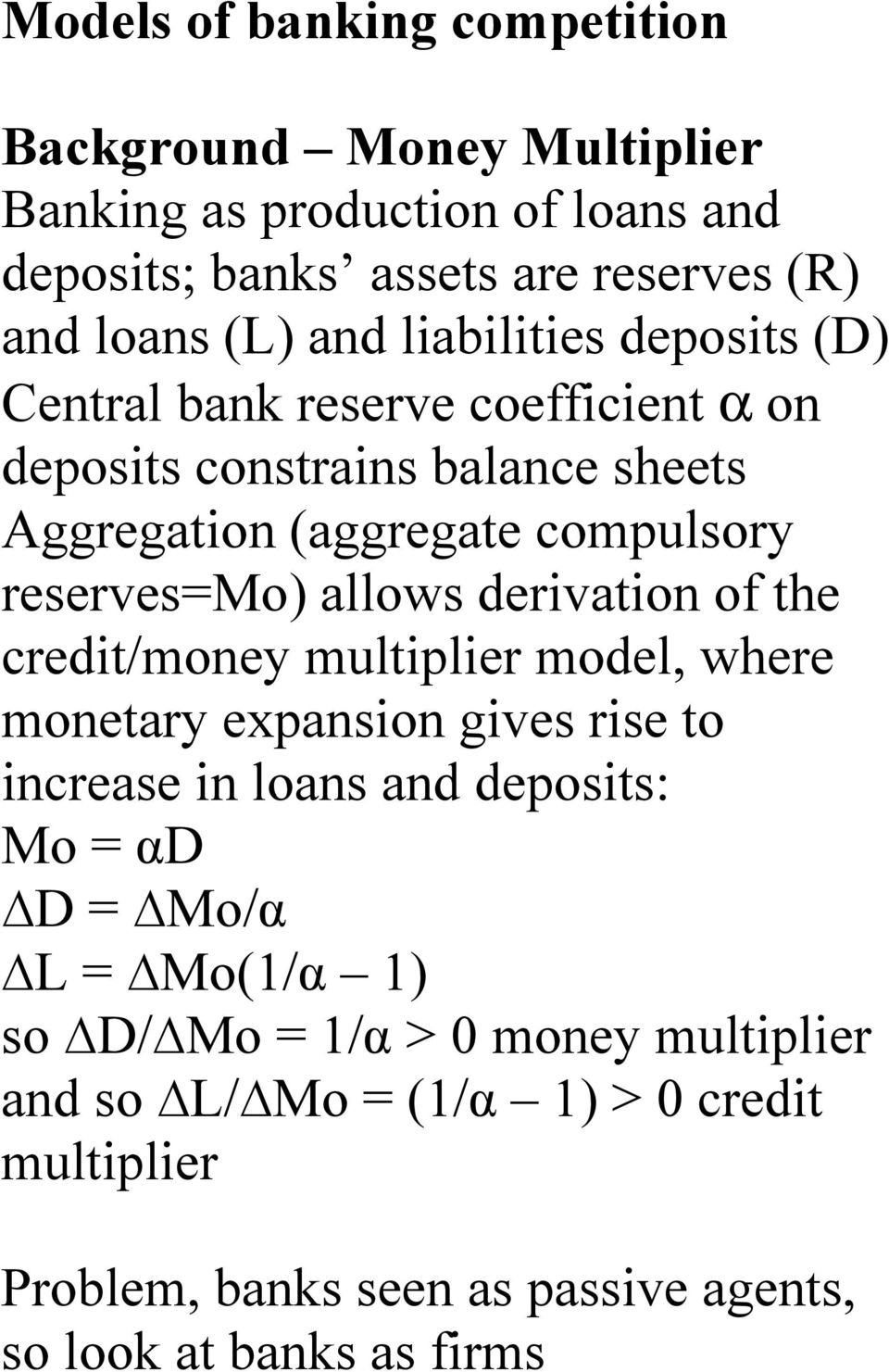
2 Models of banking competition Background Money Multiplier Banking as production of loans and deposits; banks assets are reserves (R) and loans (L) and liabilities deposits (D) Central bank reserve coefficient α on deposits constrains balance sheets Aggregation (aggregate compulsory reserves=mo) allows derivation of the credit/money multiplier model, where monetary expansion gives rise to increase in loans and deposits: Mo = αd D = Mo/α L = Mo(1/α 1) so D/ Mo = 1/α > 0 money multiplier and so L/ Mo = (1/α 1) > 0 credit multiplier Problem, banks seen as passive agents, so look at banks as firms
3 Perfect competition in the banking sector Assume there are n banks, cost function C(D, L) with diminishing returns Banks as price takers for loans r L, deposits r D and interbank r Bank profits, allowing for management costs Net interbank position of individual bank Profits can be rewritten as sum of intermediation margins on loans and deposits, net of management costs

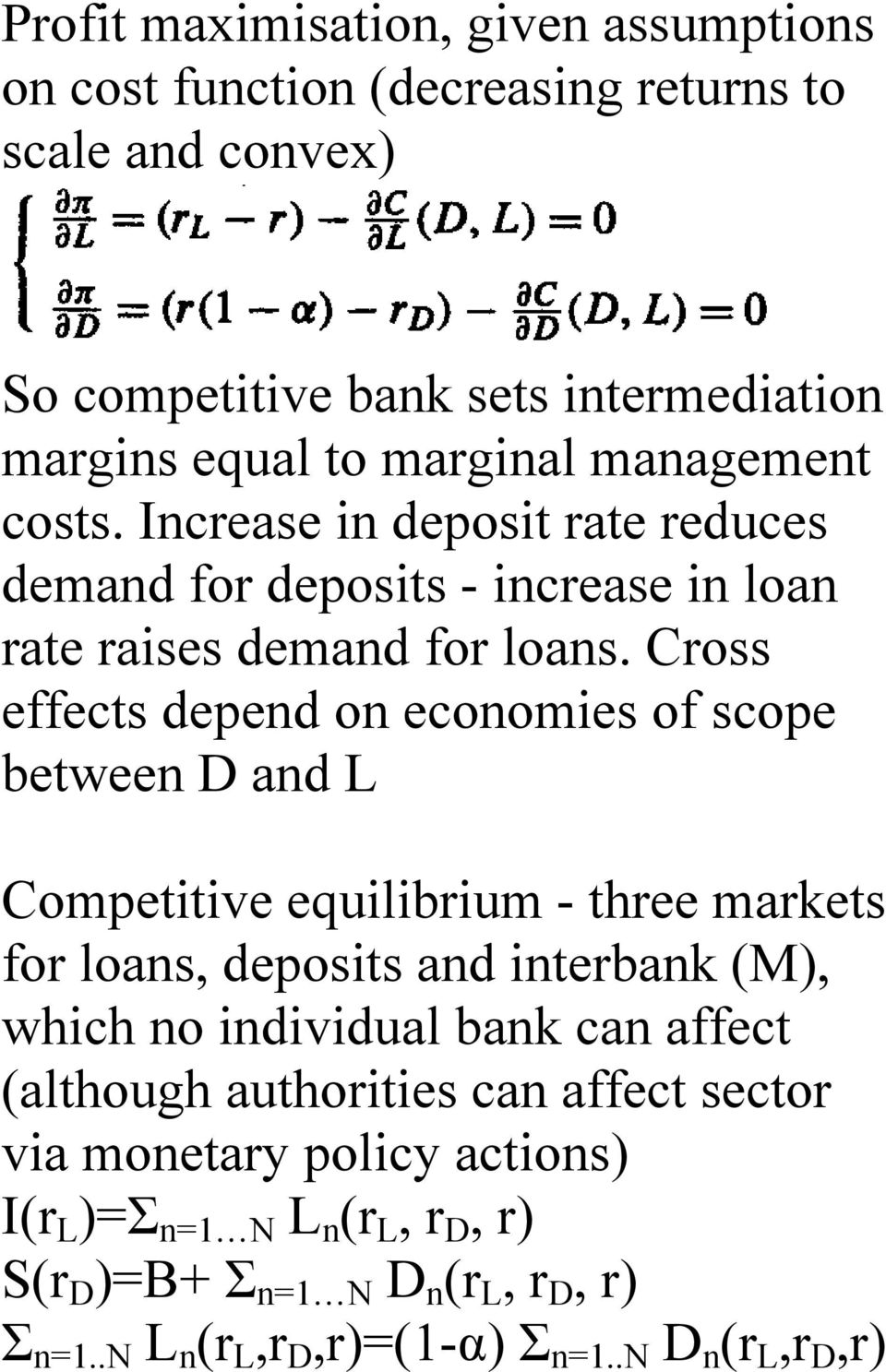
4 Profit maximisation, given assumptions on cost function (decreasing returns to scale and convex) So competitive bank sets intermediation margins equal to marginal management costs. Increase in deposit rate reduces demand for deposits - increase in loan rate raises demand for loans. Cross effects depend on economies of scope between D and L Competitive equilibrium - three markets for loans, deposits and interbank (M), which no individual bank can affect (although authorities can affect sector via monetary policy actions) I(r L )=Σ n=1 N L n (r L, r D, r) S(r D )=B+ Σ n=1 N D n (r L, r D, r) Σ n=1..n L n (r L,r D,r)=(1-α) Σ n=1..n D n (r L,r D,r)
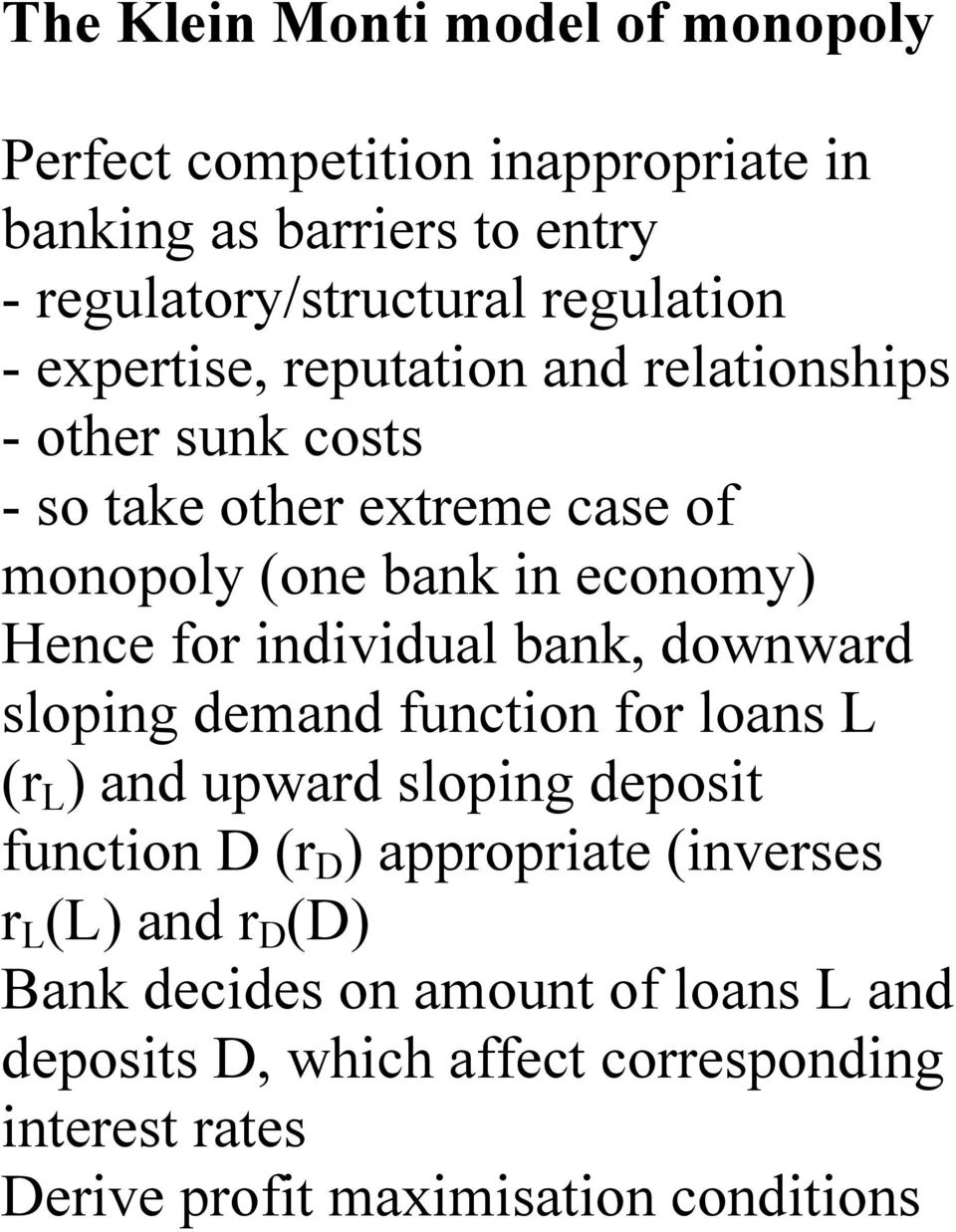
5 The Klein Monti model of monopoly Perfect competition inappropriate in banking as barriers to entry - regulatory/structural regulation - expertise, reputation and relationships - other sunk costs - so take other extreme case of monopoly (one bank in economy) Hence for individual bank, downward sloping demand function for loans L (r L ) and upward sloping deposit function D (r D ) appropriate (inverses r L (L) and r D (D) Bank decides on amount of loans L and deposits D, which affect corresponding interest rates Derive profit maximisation conditions
6 Profit function First order conditions Elasticities of demand (Loans) and supply (Deposits) Solutions (rearranging)
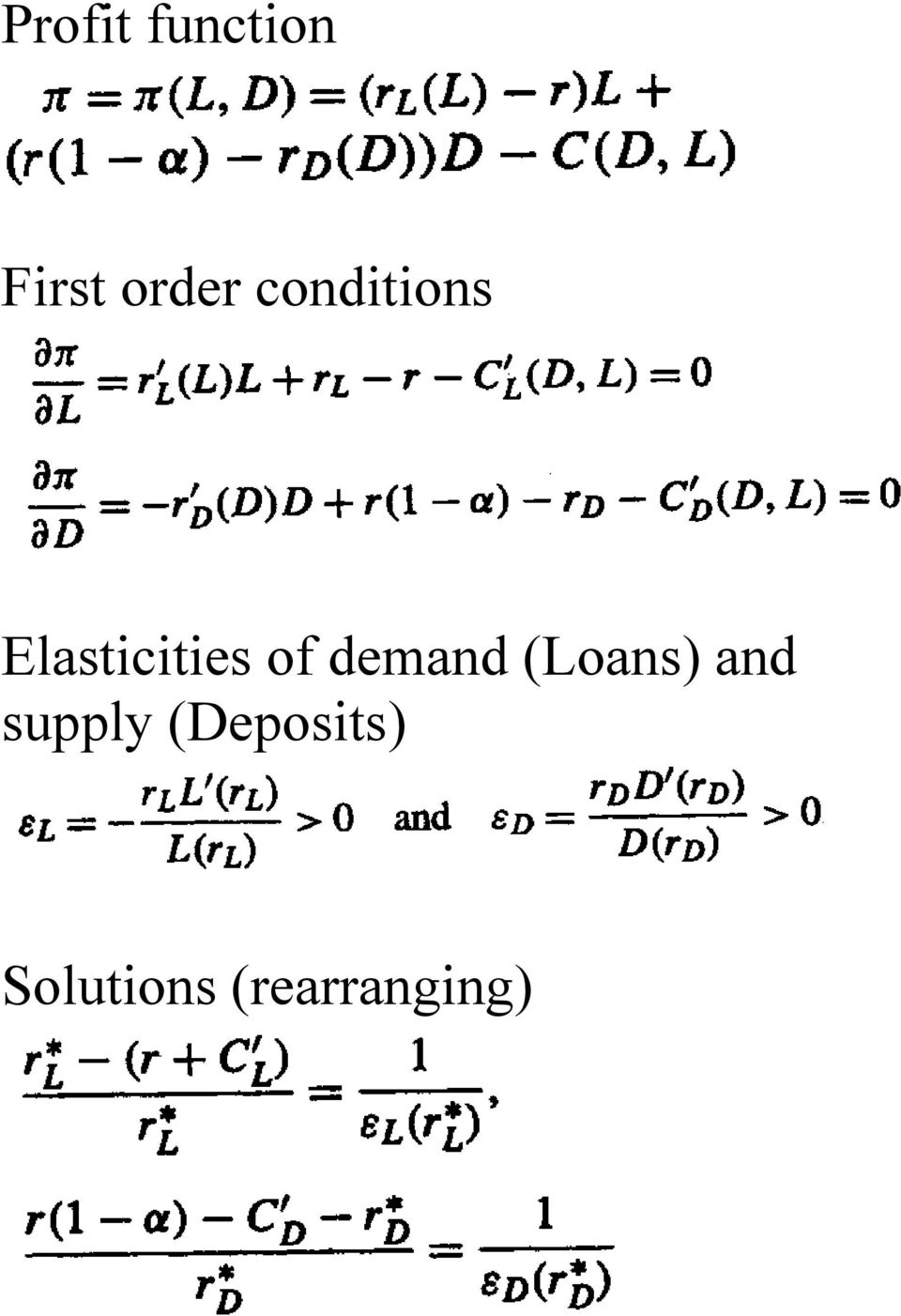
7 - Gives equality between Lerner indices (price minus cost divided by price) and inverse elasticities. The greater market power banks have, the smaller the elasticities and the higher the Lerner index, hence higher intermediation margins (lower deposit rates and higher loan rates) - So a monopolistic bank sets volume of loans and deposits to equate Lerner index to inverse elasticities - Bank can separate its decision process as optimal deposit rate is independent of the loan market and vice versa. - Implies intermediation margins reduced as substitutes for banking products appear

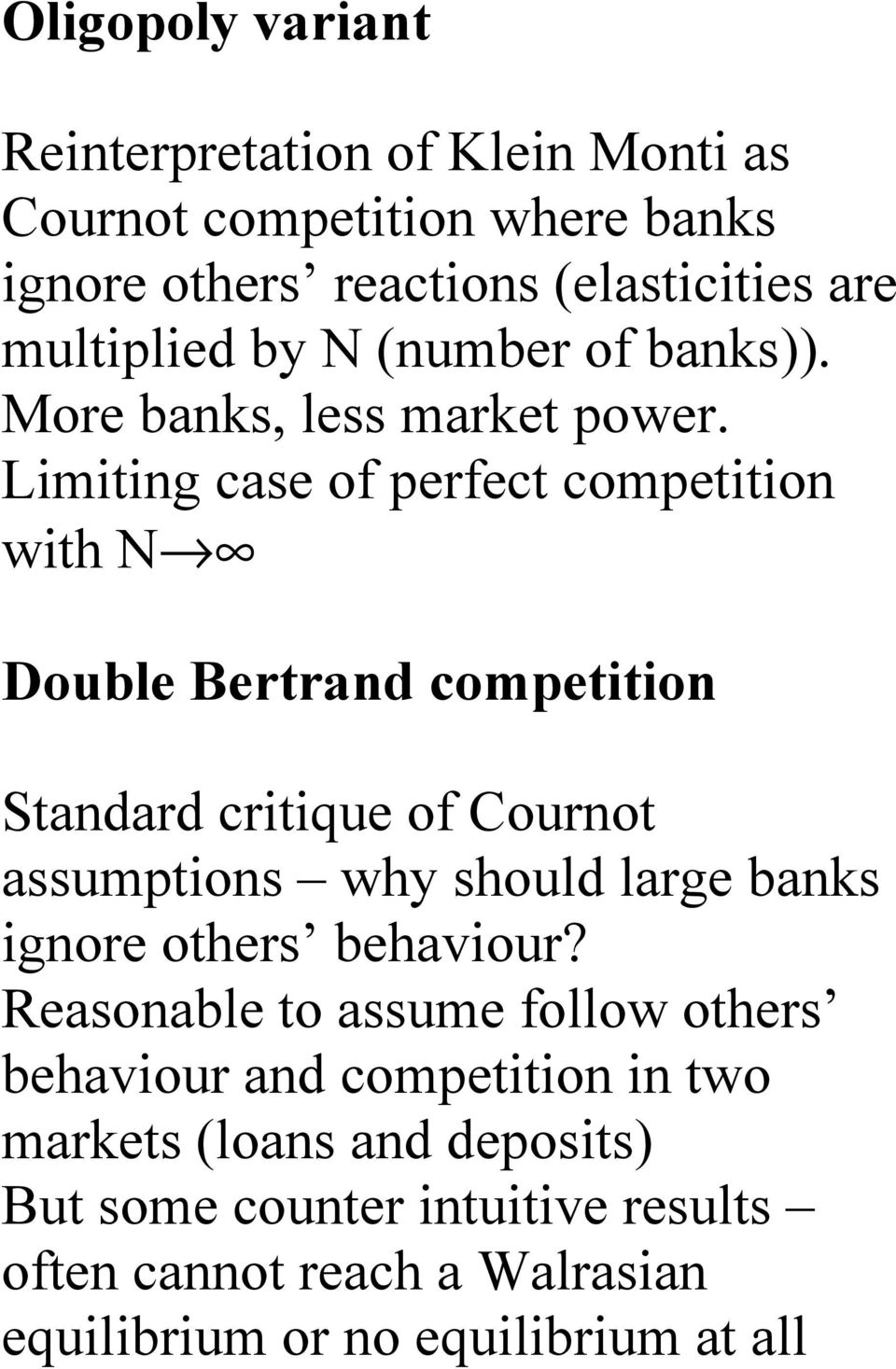
8 Oligopoly variant Reinterpretation of Klein Monti as Cournot competition where banks ignore others reactions (elasticities are multiplied by N (number of banks)). More banks, less market power. Limiting case of perfect competition with N Double Bertrand competition Standard critique of Cournot assumptions why should large banks ignore others behaviour? Reasonable to assume follow others behaviour and competition in two markets (loans and deposits) But some counter intuitive results often cannot reach a Walrasian equilibrium or no equilibrium at all
9 Monopolistic competition Assumptions of product differentiation introduced Salop model and role of distance travelled by consumer (location differentiates products) Optimum is minimisation of sum of setup costs and transportation But if there is free entry may be excessive capacity (standard critique of monopolistic competition) so could justify limits on entry or branching

10 Excess capacity under monopolistic competition? - Local bank does not reach size to minimise costs but sustainable due to downward sloping demand curve

11 Further types of industrial competition and their application to banking Contestable markets Relevance of potential competition may increase with deregulation Are there sunk costs in banking? (reputation, relationships, expertise) - less for deposits than loans? Strategic competition What strategic instruments do banks have, to generate or exploit sunk costs? - predatory pricing? - excessive research? - financial innovations? - exploit intertemporal advantages of relationships, reputation and expertise?

12 Empirical evidence: (1) Excess capacity in banking Assume banking has common technology, why does banking market structure differ crosscountry? Excess capacity under competitive paradigms - Inappropriate scale in perfect competition - X-inefficiency and high prices in imperfect competition - Monopolistic competition and excess capacity Free entry - Profit and risk based measures (see next slide) Restricted entry - Dispersion and capacity based measures (see table in Lecture 1)

13 A profitability-based measure of potential excess capacity using returns on equity (source: IBCA) Benchmark for low earning (equal to real money market rate) percentage points BE DK DE GR ES FR IE IT NL AT PT FI SE UK Percentage of banks having returns on equity below the benchmark BE DK DE GR ES FR IE IT NL AT PT FI SE UK Percentage of bank assets held by banks having returns on equity below the benchmark BE DK DE GR ES FR IE IT NL AT PT FI SE UK

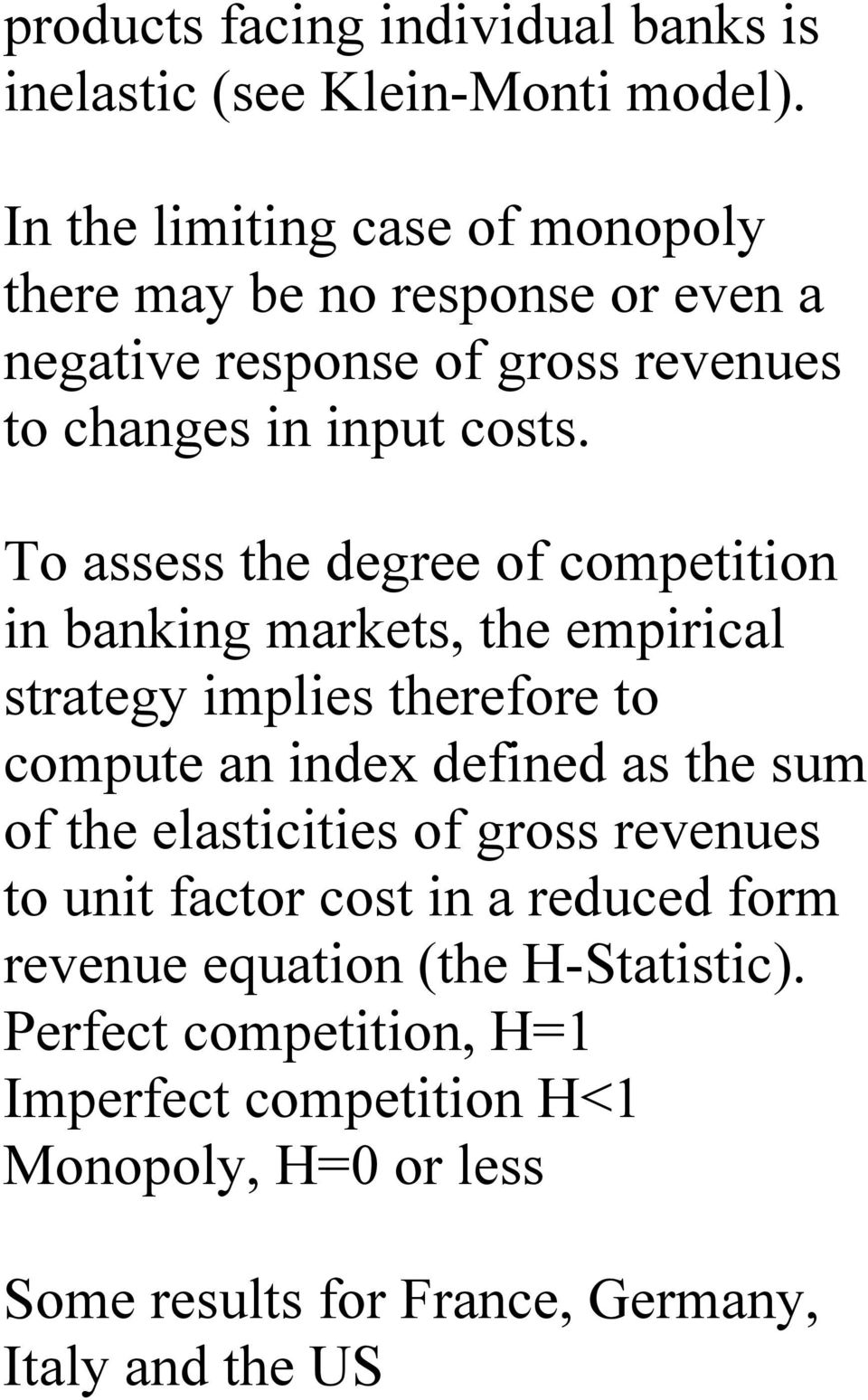
14 (2) The nature of competition (De Bandt and Davis 2000) Use of Rosse-Panzar H statistic Market power is measured by the extent to which changes in factor prices are reflected in revenues. With perfect competition, a proportional increase in factor prices induces an equiproportional change in gross revenues; output does not change in volume terms, while the output price rises to the same extent as the input price (i.e. demand is perfectly elastic). Under monopolistic competition, revenues will increase less than proportionally to changes in factor prices, as the demand for banking

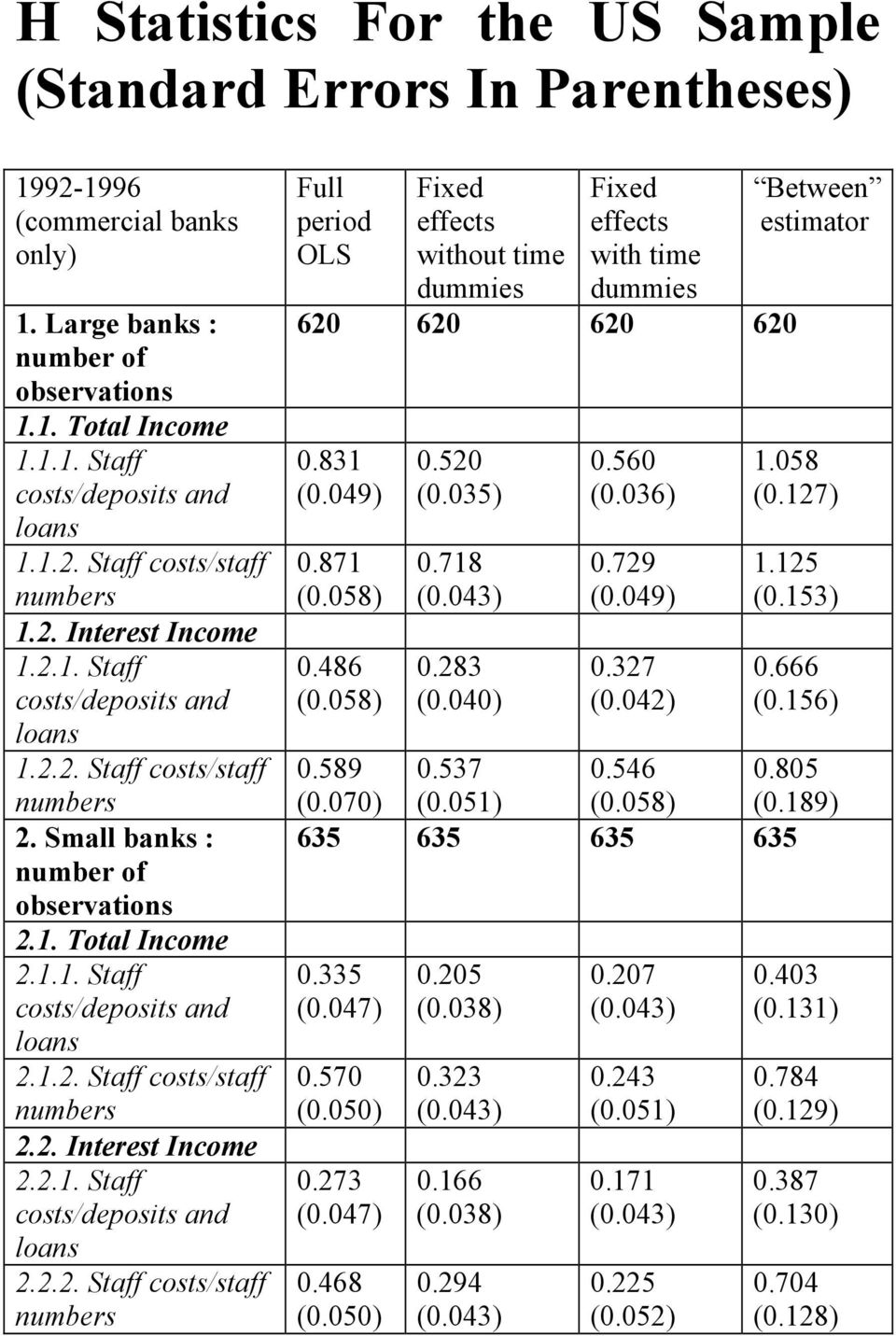
15 products facing individual banks is inelastic (see Klein-Monti model). In the limiting case of monopoly there may be no response or even a negative response of gross revenues to changes in input costs. To assess the degree of competition in banking markets, the empirical strategy implies therefore to compute an index defined as the sum of the elasticities of gross revenues to unit factor cost in a reduced form revenue equation (the H-Statistic). Perfect competition, H=1 Imperfect competition H<1 Monopoly, H=0 or less Some results for France, Germany, Italy and the US
16 H Statistics For the German Sample (Standard Errors In Parentheses) Large banks : number of observations 1.1. Total Income Staff costs/deposits and loans Staff costs/staff numbers 1.2. Interest Income Staff costs/deposits and loans Staff costs/staff numbers 2. Small banks : number of observations 2.1. Total Income Staff costs/deposits and loans Staff costs/staff numbers 2.2. Interest Income Staff costs/deposits and loans Staff costs/staff numbers Full period OLS Fixed effects without time dummies Fixed effects with time dummies Between estimator MC (0.085) NA MC (0.091) MC (0.075) [1.130 C (0.220)] MC (0.069) MC (0.084) NA MC (0.080) C (0.304) NA C (0.326) NA [0.983 C NA NA (0.245)] (0.037) MC (0.033) NA [0.051 (0.131)] M (0.037) (0.029) NA [0.010 (0.121)] MC (0.038) NA MC (0.033) NA (0.138) NA M (0.139) NA

17 H Statistics For the US Sample (Standard Errors In Parentheses) (commercial banks only) 1. Large banks : number of observations 1.1. Total Income Staff costs/deposits and loans Staff costs/staff numbers 1.2. Interest Income Staff costs/deposits and loans Staff costs/staff numbers 2. Small banks : number of observations 2.1. Total Income Staff costs/deposits and loans Staff costs/staff numbers 2.2. Interest Income Staff costs/deposits and loans Staff costs/staff numbers Full period OLS Fixed effects without time dummies Fixed effects with time dummies (0.049) (0.058) (0.058) (0.035) (0.043) (0.040) (0.036) (0.049) (0.042) Between estimator (0.127) (0.153) (0.156) (0.070) (0.051) (0.058) (0.189) (0.047) (0.050) (0.047) (0.050) (0.038) (0.043) (0.038) (0.043) (0.043) (0.051) (0.043) (0.052) (0.131) (0.129) (0.130) (0.128)
Chapter 9 Basic Oligopoly Models
 Managerial Economics & Business Strategy Chapter 9 Basic Oligopoly Models McGraw-Hill/Irwin Copyright 2010 by the McGraw-Hill Companies, Inc. All rights reserved. Overview I. Conditions for Oligopoly?
Managerial Economics & Business Strategy Chapter 9. Basic Oligopoly Models
 Managerial Economics & Business Strategy Chapter 9 Basic Oligopoly Models Overview I. Conditions for Oligopoly? II. Role of Strategic Interdependence III. Profit Maximization in Four Oligopoly Settings
Macroeconomics Lecture 1: The Solow Growth Model
 Macroeconomics Lecture 1: The Solow Growth Model Richard G. Pierse 1 Introduction One of the most important long-run issues in macroeconomics is understanding growth. Why do economies grow and what determines
Oligopoly and Strategic Pricing
 R.E.Marks 1998 Oligopoly 1 R.E.Marks 1998 Oligopoly Oligopoly and Strategic Pricing In this section we consider how firms compete when there are few sellers an oligopolistic market (from the Greek). Small
All these models were characterized by constant returns to scale technologies and perfectly competitive markets.
 Economies of scale and international trade In the models discussed so far, differences in prices across countries (the source of gains from trade) were attributed to differences in resources/technology.
Economics II: Micro Fall 2009 Exercise session 5. Market with a sole supplier is Monopolistic.
 Economics II: Micro Fall 009 Exercise session 5 VŠE 1 Review Optimal production: Independent of the level of market concentration, optimal level of production is where MR = MC. Monopoly: Market with a
Equilibrium of a firm under perfect competition in the short-run. A firm is under equilibrium at that point where it maximizes its profits.
 Equilibrium of a firm under perfect competition in the short-run. A firm is under equilibrium at that point where it maximizes its profits. Profit depends upon two factors Revenue Structure Cost Structure
Week 7 - Game Theory and Industrial Organisation
 Week 7 - Game Theory and Industrial Organisation The Cournot and Bertrand models are the two basic templates for models of oligopoly; industry structures with a small number of firms. There are a number
A2 Micro Business Economics Diagrams
 A2 Micro Business Economics Diagrams Advice on drawing diagrams in the exam The right size for a diagram is ½ of a side of A4 don t make them too small if needed, move onto a new side of paper rather than
Chapter 16 Monopolistic Competition and Oligopoly
 Chapter 16 Monopolistic Competition and Oligopoly Market Structure Market structure refers to the physical characteristics of the market within which firms interact It is determined by the number of firms
INTRODUCTORY MICROECONOMICS
 INTRODUCTORY MICROECONOMICS UNIT-I PRODUCTION POSSIBILITIES CURVE The production possibilities (PP) curve is a graphical medium of highlighting the central problem of 'what to produce'. To decide what
How To Learn Economics In India
 B.A. PROGRAMME DISCIPLINE COURSE ECONOMICS COURSE CONTENTS (Effective from the Academic Year 2011-2012 onwards) DEPARTMENT OF ECONOMICS UNIVERSITY OF DELHI DELHI 1 Syllabus for B.A. Programme - Economics
Pricing and Output Decisions: i Perfect. Managerial Economics: Economic Tools for Today s Decision Makers, 4/e By Paul Keat and Philip Young
 Chapter 9 Pricing and Output Decisions: i Perfect Competition and Monopoly M i l E i E i Managerial Economics: Economic Tools for Today s Decision Makers, 4/e By Paul Keat and Philip Young Pricing and
(a) Using an MPC of.5, the impact of $100 spent the government will be as follows: 1 100 100 2 50 150 3 25 175 4 12.5 187.5 5 6.25 193.
 S5 Solutions 24 points Chapter 2: Fiscal policy. If the marginal propensity to save is.5, how large is the multiplier? If the marginal propensity to save doubles to., what happens to the multiplier? With
MULTIPLE CHOICE. Choose the one alternative that best completes the statement or answers the question.
 MBA 640 Survey of Microeconomics Fall 2006, Quiz 6 Name MULTIPLE CHOICE. Choose the one alternative that best completes the statement or answers the question. 1) A monopoly is best defined as a firm that
TRADE WITH SCALE ECONOMIES AND IMPERFECT COMPETITION (CONT'D)
 ECO 352 Spring 2010 No. 14 Mar. 25 OLIGOPOLY TRADE WITH SCALE ECONOMIES AND IMPERFECT COMPETITION (CONT'D) Example using numbers from Precept Week 7 slides, pp. 2, 3. Ingredients: Industry with inverse
Market is a network of dealings between buyers and sellers.
 Market is a network of dealings between buyers and sellers. Market is the characteristic phenomenon of economic life and the constitution of markets and market prices is the central problem of Economics.
Advertising. Sotiris Georganas. February 2013. Sotiris Georganas () Advertising February 2013 1 / 32
 Advertising Sotiris Georganas February 2013 Sotiris Georganas () Advertising February 2013 1 / 32 Outline 1 Introduction 2 Main questions about advertising 3 How does advertising work? 4 Persuasive advertising
Subject CT7 Business Economics Core Technical Syllabus
 Subject CT7 Business Economics Core Technical Syllabus for the 2016 exams 1 June 2015 Aim The aim of the Business Economics subject is to introduce students to the core economic principles and how these
Oligopoly: How do firms behave when there are only a few competitors? These firms produce all or most of their industry s output.
 Topic 8 Chapter 13 Oligopoly and Monopolistic Competition Econ 203 Topic 8 page 1 Oligopoly: How do firms behave when there are only a few competitors? These firms produce all or most of their industry
Oligopoly: Cournot/Bertrand/Stackelberg
 Outline Alternative Market Models Wirtschaftswissenschaften Humboldt Universität zu Berlin March 5, 2006 Outline 1 Introduction Introduction Alternative Market Models 2 Game, Reaction Functions, Solution
11 PERFECT COMPETITION. Chapter. Competition
 Chapter 11 PERFECT COMPETITION Competition Topic: Perfect Competition 1) Perfect competition is an industry with A) a few firms producing identical goods B) a few firms producing goods that differ somewhat
QE1: Economics Notes 1
 QE1: Economics Notes 1 Box 1: The Household and Consumer Welfare The final basket of goods that is chosen are determined by three factors: a. Income b. Price c. Preferences Substitution Effect: change
Models of Imperfect Competition
 Models of Imperfect Competition Monopolistic Competition Oligopoly Models of Imperfect Competition So far, we have discussed two forms of market competition that are difficult to observe in practice Perfect
Curriculum and Contents: Diplom-Program in Business Administration (Year 1 and Year 2)
 Business School DeAN S OFFICE INTERNATIONAL RELATIONS L 5, 5 68131 Mannheim Germany Phone +49 (0) 6 21 1 81-1474 Fax +49 (0) 6 21 1 81-1471 [email protected] www.bwl.uni-mannheim.de Curriculum
Sample Midterm Solutions
 Sample Midterm Solutions Instructions: Please answer both questions. You should show your working and calculations for each applicable problem. Correct answers without working will get you relatively few
Learning Objectives. Chapter 6. Market Structures. Market Structures (cont.) The Two Extremes: Perfect Competition and Pure Monopoly
 Chapter 6 The Two Extremes: Perfect Competition and Pure Monopoly Learning Objectives List the four characteristics of a perfectly competitive market. Describe how a perfect competitor makes the decision
Introduction to microeconomics
 RELEVANT TO ACCA QUALIFICATION PAPER F1 / FOUNDATIONS IN ACCOUNTANCY PAPER FAB Introduction to microeconomics The new Paper F1/FAB, Accountant in Business carried over many subjects from its Paper F1 predecessor,
The New Trade Theory. Monopoly and oligopoly in trade. Luca De Benedictis 1. Topic 3. 1 University of Macerata
 The New Trade Theory Monopoly and oligopoly in trade Luca De Benedictis 1 1 University of Macerata Topic 3 A new generation of models Main characteristics and insights: Countries do not trade, rms do.
Employment and Pricing of Inputs
 Employment and Pricing of Inputs Previously we studied the factors that determine the output and price of goods. In chapters 16 and 17, we will focus on the factors that determine the employment level
Managerial Economics & Business Strategy Chapter 8. Managing in Competitive, Monopolistic, and Monopolistically Competitive Markets
 Managerial Economics & Business Strategy Chapter 8 Managing in Competitive, Monopolistic, and Monopolistically Competitive Markets I. Perfect Competition Overview Characteristics and profit outlook. Effect
INDUSTRIAL ECONOMICS COMPONENT: THE INTERACTIVE TEXTBOOK
 UNIT EC407, LEVEL 2 INDUSTRIAL ECONOMICS COMPONENT: THE INTERACTIVE TEXTBOOK Semester 1 1998/99 Lecturer: K. Hinde Room: 427 Northumberland Building Tel: 0191 2273936 email: [email protected] Web Page:
or, put slightly differently, the profit maximizing condition is for marginal revenue to equal marginal cost:
 Chapter 9 Lecture Notes 1 Economics 35: Intermediate Microeconomics Notes and Sample Questions Chapter 9: Profit Maximization Profit Maximization The basic assumption here is that firms are profit maximizing.
MULTIPLE CHOICE. Choose the one alternative that best completes the statement or answers the question.
 Chapter 11 Perfect Competition - Sample Questions MULTIPLE CHOICE. Choose the one alternative that best completes the statement or answers the question. 1) Perfect competition is an industry with A) a
INTERNATIONAL ECONOMICS, FINANCE AND TRADE Vol.I - Economics of Scale and Imperfect Competition - Bharati Basu
 ECONOMIES OF SCALE AND IMPERFECT COMPETITION Bharati Department of Economics, Central Michigan University, Mt. Pleasant, Michigan, USA Keywords: Economies of scale, economic geography, external economies,
Economics 203: Intermediate Microeconomics I Lab Exercise #11. Buy Building Lease F1 = 500 F1 = 750 Firm 2 F2 = 500 F2 = 400
 Page 1 March 19, 2012 Section 1: Test Your Understanding Economics 203: Intermediate Microeconomics I Lab Exercise #11 The following payoff matrix represents the long-run payoffs for two duopolists faced
Chapter 15: Monopoly WHY MONOPOLIES ARISE HOW MONOPOLIES MAKE PRODUCTION AND PRICING DECISIONS
 Chapter 15: While a competitive firm is a taker, a monopoly firm is a maker. A firm is considered a monopoly if... it is the sole seller of its product. its product does not have close substitutes. The
Principles of Economics
 Principles of Economics (8 th Edition) Dr. H. S. Agarwal Professor of Economics (Retd.) Agra College, AGRA professional publishing Contents JSASIC CONCEPTS^ 1. The Scope and Nature of Economics 1-31 Introduction;
Markups and Firm-Level Export Status: Appendix
 Markups and Firm-Level Export Status: Appendix De Loecker Jan - Warzynski Frederic Princeton University, NBER and CEPR - Aarhus School of Business Forthcoming American Economic Review Abstract This is
For a closed economy, the national income identity is written as Y = F (K; L)
 A CLOSED ECONOMY IN THE LONG (MEDIUM) RUN For a closed economy, the national income identity is written as Y = C(Y T ) + I(r) + G the left hand side of the equation is the total supply of goods and services
Chapter 7: Market Structures Section 3
 Chapter 7: Market Structures Section 3 Objectives 1. Describe characteristics and give examples of monopolistic competition. 2. Explain how firms compete without lowering prices. 3. Understand how firms
. In this case the leakage effect of tax increases is mitigated because some of the reduction in disposable income would have otherwise been saved.
 Chapter 4 Review Questions. Explain how an increase in government spending and an equal increase in lump sum taxes can generate an increase in equilibrium output. Under what conditions will a balanced
AP Microeconomics Chapter 12 Outline
 I. Learning Objectives In this chapter students will learn: A. The significance of resource pricing. B. How the marginal revenue productivity of a resource relates to a firm s demand for that resource.
= C + I + G + NX ECON 302. Lecture 4: Aggregate Expenditures/Keynesian Model: Equilibrium in the Goods Market/Loanable Funds Market
 Intermediate Macroeconomics Lecture 4: Introduction to the Goods Market Review of the Aggregate Expenditures model and the Keynesian Cross ECON 302 Professor Yamin Ahmad Components of Aggregate Demand
COMPETITIVE ISSUES OF FINANCIAL MODERNIZATION
 COMPETITIVE ISSUES OF FINANCIAL MODERNIZATION Santiago Carbó-Valverde (Universidad de Granada and Federal Reserve Bank of Chicago*) * The views in this presentation are those of the author and may not
4. Market Structures. Learning Objectives 4-63. Market Structures
 1. Supply and Demand: Introduction 3 2. Supply and Demand: Consumer Demand 33 3. Supply and Demand: Company Analysis 43 4. Market Structures 63 5. Key Formulas 81 2014 Allen Resources, Inc. All rights
Experiment 8: Entry and Equilibrium Dynamics
 Experiment 8: Entry and Equilibrium Dynamics Everyone is a demander of a meal. There are approximately equal numbers of values at 24, 18, 12 and 8. These will change, due to a random development, after
Mikroekonomia B by Mikolaj Czajkowski. MULTIPLE CHOICE. Choose the one alternative that best completes the statement or answers the question.
 Mikroekonomia B by Mikolaj Czajkowski Test 12 - Oligopoly Name Group MULTIPLE CHOICE. Choose the one alternative that best completes the statement or answers the question. 1) The market structure in which
Practice Questions Week 8 Day 1
 Practice Questions Week 8 Day 1 Multiple Choice Identify the choice that best completes the statement or answers the question. 1. The characteristics of a market that influence the behavior of market participants
0 100 200 300 Real income (Y)
 Lecture 11-1 6.1 The open economy, the multiplier, and the IS curve Assume that the economy is either closed (no foreign trade) or open. Assume that the exchange rates are either fixed or flexible. Assume
S.Y.B.COM. (SEM-III) ECONOMICS
 Fill in the Blanks. Module 1 S.Y.B.COM. (SEM-III) ECONOMICS 1. The continuous flow of money and goods and services between firms and households is called the Circular Flow. 2. Saving constitute a leakage
Lecture 28 Economics 181 International Trade
 Lecture 28 Economics 181 International Trade I. Introduction to Strategic Trade Policy If much of world trade is in differentiated products (ie manufactures) characterized by increasing returns to scale,
Lecture 2. Marginal Functions, Average Functions, Elasticity, the Marginal Principle, and Constrained Optimization
 Lecture 2. Marginal Functions, Average Functions, Elasticity, the Marginal Principle, and Constrained Optimization 2.1. Introduction Suppose that an economic relationship can be described by a real-valued
Market Structure: Duopoly and Oligopoly
 WSG10 7/7/03 4:24 PM Page 145 10 Market Structure: Duopoly and Oligopoly OVERVIEW An oligopoly is an industry comprising a few firms. A duopoly, which is a special case of oligopoly, is an industry consisting
Figure: Computing Monopoly Profit
 Name: Date: 1. Most electric, gas, and water companies are examples of: A) unregulated monopolies. B) natural monopolies. C) restricted-input monopolies. D) sunk-cost monopolies. Use the following to answer
Oligopoly and Trade. Notes for Oxford M.Phil. International Trade. J. Peter Neary. University of Oxford. November 26, 2009
 Oligopoly and Trade Notes for Oxford M.Phil. International Trade J. Peter Neary University of Oxford November 26, 2009 J.P. Neary (University of Oxford) Oligopoly and Trade November 26, 2009 1 / 11 Oligopoly
Microeconomics. Lecture Outline. Claudia Vogel. Winter Term 2009/2010. Part III Market Structure and Competitive Strategy
 Microeconomics Claudia Vogel EUV Winter Term 2009/2010 Claudia Vogel (EUV) Microeconomics Winter Term 2009/2010 1 / 25 Lecture Outline Part III Market Structure and Competitive Strategy 12 Monopolistic
Monopoly and Monopsony Labor Market Behavior
 Monopoly and Monopsony abor Market Behavior 1 Introduction For the purposes of this handout, let s assume that firms operate in just two markets: the market for their product where they are a seller) and
Lecture 1: The intertemporal approach to the current account
 Lecture 1: The intertemporal approach to the current account Open economy macroeconomics, Fall 2006 Ida Wolden Bache August 22, 2006 Intertemporal trade and the current account What determines when countries
How To Understand The Theory Of Economic Theory
 MICROECONOMICS II. ELTE Faculty of Social Sciences, Department of Economics Microeconomics II. MARKET THEORY AND MARKETING, PART 3 Author: Supervised by February 2011 Prepared by:, using Jack Hirshleifer,
Chapter 7 Monopoly, Oligopoly and Strategy
 Chapter 7 Monopoly, Oligopoly and Strategy After reading Chapter 7, MONOPOLY, OLIGOPOLY AND STRATEGY, you should be able to: Define the characteristics of Monopoly and Oligopoly, and explain why the are
19 : Theory of Production
 19 : Theory of Production 1 Recap from last session Long Run Production Analysis Return to Scale Isoquants, Isocost Choice of input combination Expansion path Economic Region of Production Session Outline
Chapter 8. Competitive Firms and Markets
 Chapter 8. Competitive Firms and Markets We have learned the production function and cost function, the question now is: how much to produce such that firm can maximize his profit? To solve this question,
Chapter 6 Competitive Markets
 Chapter 6 Competitive Markets After reading Chapter 6, COMPETITIVE MARKETS, you should be able to: List and explain the characteristics of Perfect Competition and Monopolistic Competition Explain why a
MULTIPLE CHOICE. Choose the one alternative that best completes the statement or answers the question.
 Chapter 11 Monopoly practice Davidson spring2007 MULTIPLE CHOICE. Choose the one alternative that best completes the statement or answers the question. 1) A monopoly industry is characterized by 1) A)
Solution to Homework Set 7
 Solution to Homework Set 7 Managerial Economics Fall 011 1. An industry consists of five firms with sales of $00 000, $500 000, $400 000, $300 000, and $100 000. a) points) Calculate the Herfindahl-Hirschman
2.4 Multiproduct Monopoly. 2.4 Multiproduct Monopoly
 .4 Multiproduct Monopoly Matilde Machado Slides available from: http://www.eco.uc3m.es/oi-i-mei/.4 Multiproduct Monopoly The firm is a monopoly in all markets where it operates i=,.n goods sold by the
BEE2017 Intermediate Microeconomics 2
 BEE2017 Intermediate Microeconomics 2 Dieter Balkenborg Sotiris Karkalakos Yiannis Vailakis Organisation Lectures Mon 14:00-15:00, STC/C Wed 12:00-13:00, STC/D Tutorials Mon 15:00-16:00, STC/106 (will
Chapter 8 Production Technology and Costs 8.1 Economic Costs and Economic Profit
 Chapter 8 Production Technology and Costs 8.1 Economic Costs and Economic Profit 1) Accountants include costs as part of a firm's costs, while economists include costs. A) explicit; no explicit B) implicit;
CHAPTER 10 MARKET POWER: MONOPOLY AND MONOPSONY
 CHAPTER 10 MARKET POWER: MONOPOLY AND MONOPSONY EXERCISES 3. A monopolist firm faces a demand with constant elasticity of -.0. It has a constant marginal cost of $0 per unit and sets a price to maximize
Market Structure: Perfect Competition and Monopoly
 WSG8 7/7/03 4:34 PM Page 113 8 Market Structure: Perfect Competition and Monopoly OVERVIEW One of the most important decisions made by a manager is how to price the firm s product. If the firm is a profit
Chapter 3: The effect of taxation on behaviour. Alain Trannoy AMSE & EHESS
 Chapter 3: The effect of taxation on behaviour Alain Trannoy AMSE & EHESS Introduction The most important empirical question for economics: the behavorial response to taxes Calibration of macro models
Do not open this exam until told to do so.
 Do not open this exam until told to do so. Department of Economics College of Social and Applied Human Sciences K. Annen, Winter 004 Final (Version ): Intermediate Microeconomics (ECON30) Solutions Final
14.581 MIT PhD International Trade Lecture 9: Increasing Returns to Scale and Monopolistic Competition (Theory)
 14.581 MIT PhD International Trade Lecture 9: Increasing Returns to Scale and Monopolistic Competition (Theory) Dave Donaldson Spring 2011 Today s Plan 1 Introduction to New Trade Theory 2 Monopolistically
Pre-Test Chapter 23 ed17
 Pre-Test Chapter 23 ed17 Multiple Choice Questions 1. The kinked-demand curve model of oligopoly: A. assumes a firm's rivals will ignore a price cut but match a price increase. B. embodies the possibility
KEELE UNIVERSITY MID-TERM TEST, 2007 BA BUSINESS ECONOMICS BA FINANCE AND ECONOMICS BA MANAGEMENT SCIENCE ECO 20015 MANAGERIAL ECONOMICS II
 KEELE UNIVERSITY MID-TERM TEST, 2007 Thursday 22nd NOVEMBER, 12.05-12.55 BA BUSINESS ECONOMICS BA FINANCE AND ECONOMICS BA MANAGEMENT SCIENCE ECO 20015 MANAGERIAL ECONOMICS II Candidates should attempt
MULTIPLE CHOICE. Choose the one alternative that best completes the statement or answers the question.
 Practice for Perfect Competition Name MULTIPLE CHOICE. Choose the one alternative that best completes the statement or answers the question. 1) Which of the following is a defining characteristic of a
-1- Worked Solutions 5. Lectures 9 and 10. Question Lecture 1. L9 2. L9 3. L9 4. L9 5. L9 6. L9 7. L9 8. L9 9. L9 10. L9 11. L9 12.
 -1- Worked Solutions 5 Lectures 9 and 10. Question Lecture 1. L9 2. L9 3. L9 4. L9 5. L9 6. L9 7. L9 8. L9 9. L9 10. L9 11. L9 12. L10 Unit 5 solutions Exercise 1 There may be practical difficulties in
Profit maximization in different market structures
 Profit maximization in different market structures In the cappuccino problem as well in your team project, demand is clearly downward sloping if the store wants to sell more drink, it has to lower the
Econ Wizard User s Manual
 1 Econ Wizard User s Manual Kevin Binns Matt Friedrichsen Purpose: This program is intended to be used by students enrolled in introductory economics classes. The program is meant to help these students
Economics I. Decision-making Firm in Imperfect Competition
 Economics I Decision-making Firm in Imperfect Competition The aim of the first lecture is to explain and analyze the markets in imperfect competition and firm behavior in imperfectly competitive environment.
SAMPLE PAPER II ECONOMICS Class - XII BLUE PRINT
 SAMPLE PAPER II ECONOMICS Class - XII Maximum Marks 100 Time : 3 hrs. BLUE PRINT Sl. No. Form of Very Short Short Answer Long Answer Total Questions (1 Mark) (3, 4 Marks) (6 Marks) Content Unit 1 Unit
Chapter 13 Oligopoly 1
 Chapter 13 Oligopoly 1 4. Oligopoly A market structure with a small number of firms (usually big) Oligopolists know each other: Strategic interaction: actions of one firm will trigger re-actions of others
Lecture 6: Price discrimination II (Nonlinear Pricing)
 Lecture 6: Price discrimination II (Nonlinear Pricing) EC 105. Industrial Organization. Fall 2011 Matt Shum HSS, California Institute of Technology November 14, 2012 EC 105. Industrial Organization. Fall
Chapter. Perfect Competition CHAPTER IN PERSPECTIVE
 Perfect Competition Chapter 10 CHAPTER IN PERSPECTIVE In Chapter 10 we study perfect competition, the market that arises when the demand for a product is large relative to the output of a single producer.
CHAPTER 6 MARKET STRUCTURE
 CHAPTER 6 MARKET STRUCTURE CHAPTER SUMMARY This chapter presents an economic analysis of market structure. It starts with perfect competition as a benchmark. Potential barriers to entry, that might limit
Monopoly: static and dynamic efficiency M.Motta, Competition Policy: Theory and Practice, Cambridge University Press, 2004; ch. 2
 Monopoly: static and dynamic efficiency M.Motta, Competition Policy: Theory and Practice, Cambridge University Press, 2004; ch. 2 Economics of Competition and Regulation 2015 Maria Rosa Battaggion Perfect
UNIVERSITY OF CALICUT MICRO ECONOMICS - II
 UNIVERSITY OF CALICUT SCHOOL OF DISTANCE EDUCATION BA ECONOMICS III SEMESTER CORE COURSE (2011 Admission onwards) MICRO ECONOMICS - II QUESTION BANK 1. Which of the following industry is most closely approximates
Oligopoly. Unit 4: Imperfect Competition. Unit 4: Imperfect Competition 4-4. Oligopolies FOUR MARKET MODELS
 1 Unit 4: Imperfect Competition FOUR MARKET MODELS Perfect Competition Monopolistic Competition Pure Characteristics of Oligopolies: A Few Large Producers (Less than 10) Identical or Differentiated Products
REVIEW OF MICROECONOMICS
 ECO 352 Spring 2010 Precepts Weeks 1, 2 Feb. 1, 8 REVIEW OF MICROECONOMICS Concepts to be reviewed Budget constraint: graphical and algebraic representation Preferences, indifference curves. Utility function
Chapter 12. Unemployment. covered in the final exam) 12-1 History of Unemployment in the New Zealand. discouraged and underemployed workers.
 Chapter 12 13-1 Unemployment (Note: Chapter 12 will not be covered in the final exam) 12-1 History of Unemployment in the New Zealand 13-2 Unemployment rate over time. Recap of definition & issue of discouraged
Competition and Regulation. Lecture 2: Background on imperfect competition
 Competition and Regulation Lecture 2: Background on imperfect competition Monopoly A monopolist maximizes its profits, choosing simultaneously quantity and prices, taking the Demand as a contraint; The
MULTIPLE CHOICE. Choose the one alternative that best completes the statement or answers the question on the accompanying scantron.
 Principles of Microeconomics Fall 2007, Quiz #6 Name MULTIPLE CHOICE. Choose the one alternative that best completes the statement or answers the question on the accompanying scantron. 1) A monopoly is
Econ 201 Lecture 17. The marginal benefit of expanding output by one unit is the market price. Marginal cost of producing corn
 Econ 201 Lecture 17 The Perfectly Competitive Firm Is a Taker (Recap) The perfectly competitive firm has no influence over the market price. It can sell as many units as it wishes at that price. Typically,
MULTIPLE CHOICE. Choose the one alternative that best completes the statement or answers the question.
 MULTIPLE CHOICE. Choose the one alternative that best completes the statement or answers the question. 1) The four-firm concentration ratio equals the percentage of the value of accounted for by the four
Chapter 12 Monopolistic Competition and Oligopoly
 Chapter Monopolistic Competition and Oligopoly Review Questions. What are the characteristics of a monopolistically competitive market? What happens to the equilibrium price and quantity in such a market
Online Supplementary Material
 Online Supplementary Material The Supplementary Material includes 1. An alternative investment goal for fiscal capacity. 2. The relaxation of the monopoly assumption in favor of an oligopoly market. 3.
Table of Contents MICRO ECONOMICS
 economicsentrance.weebly.com Basic Exercises Micro Economics AKG 09 Table of Contents MICRO ECONOMICS Budget Constraint... 4 Practice problems... 4 Answers... 4 Supply and Demand... 7 Practice Problems...
5. Suppose demand is perfectly elastic, and the supply of the good in question
 ECON 1620 Basic Economics Principles 2010 2011 2 nd Semester Mid term test (1) : 40 multiple choice questions Time allowed : 60 minutes 1. When demand is inelastic the price elasticity of demand is (A)
Agenda. Productivity, Output, and Employment, Part 1. The Production Function. The Production Function. The Production Function. The Demand for Labor
 Agenda Productivity, Output, and Employment, Part 1 3-1 3-2 A production function shows how businesses transform factors of production into output of goods and services through the applications of technology.