
Modifying Wastewater Inputs to On-site Systems
|
|
|
- Bennett Foster
- 10 years ago
- Views:
Transcription
1 Modifying Wastewater Inputs to On-site Systems Robert A. Patterson Presented as an oral Paper to the Conference On-site '99: Making on-site wastewater systems work July Held at University of New England, Armidale. Lanfax Laboratories, Armidale. Reference: PATTERSON, R.A. (1999). Modifying Wastewater Inputs to On-site Systems. in PATTERSON, R.A. (Ed) Proceedings of On-site '99 Conference: Making on-site wastewater systems work July Held at University of New England, Armidale. Lanfax Laboratories, Armidale. pp Lanfax Laboratories. Armidale NSW Australia Phone Web site

2 MODIFYING WASTEWATER INPUTS TO ON-SITE SYSTEMS Robert A. Patterson Director, Lanfax Laboratories. Armidale Abstract The cocktail of chemicals in domestic wastewater presents a significant problem for on-site application to the soil and plant environment. Highly corrosive and toxic chemicals are available for indiscriminate use within the household, for subsequent disposal to the wastewater stream. Many of the chemicals are capable of inducing soil dispersion and loss of hydraulic conductivity while others are potential bactericides, destroying essential soil microbes and diminishing within-soil treatment expected of irrigation or disposal areas. The key to the modification of the chemistry of the wastewater stream is to reduce water consumption and remove products at source, that is, prevent their entry to the wastewater stream. However, the alert consumer is unaware of the components in many household chemicals, and inadequate labelling ensures that such ignorance will continue. Labels with confusing messages are typical among many household products, particularly laundry and kitchen cleaning agents. Additional treatment, new treatment technologies or improved monitoring will not address the significant problem associated with chemicals such as sodium and strong acids and strong alkali materials. Removal of the offending products from the supermarket shelves appears to be the most immediate solution together with low sodium initiatives for household cleaning products. Keywords detergents, household chemicals, washing machines, wastewater, water conservation 1 Introduction In recent years, a plethora of protection of the environment, pollution control and environmental planning legislation has been enacted across many Australian States. Typical is the NSW legislation (NSW Government, 1998a) which requires the use of specific guidelines (DLG, 1998) for on-site wastewater management, and provides performance criteria for wastewater treatment devices and effluent disposal. The acceptance of an almost endless range of products, without commensurate regulations for septic tank safe products, results in wastewater having an extremely wide range of chemical components. Indeed, the use of the term sewage rather than wastewater in the NSW legislation and guidelines indicates the paranoia surrounding human faeces and urine as defined by the Local Government Act (NSW Govt. 1993), rather than the range of other potentially environmentally hazardous products disposed of through a domestic wastewater system. Sewerage schemes suffer the same avoidance of other chemicals, yet Load Based Licensing, under relevant legislation (NSW Govt 1998b), proposes to catch polluters after the consumption has occurred. Trade Waste Licences attempt to avoid potential wastewater treatment problems (ARMCANZ and ANZECC, 1994) through the rejection of chemically inappropriate discharges to sewer. As a consequence, planning for disposal based upon average chemical conditions is fraught with danger; that of under-estimating the pollutant loads in 50% of cases. Disposal areas are likely to be under-designed in relation to nutrient uptake, treatment or adsorption with the potential for off-site effects from overland flow and deep percolation. For the other 50%, where average levels of chemical components in the wastewater are not reached, system over-design results in additional costs borne by those households that are conservative in chemical use within the household. Modifying Wastewater Inputs- 273

3 The hydraulic loads from domestic dwellings can vary significantly depending upon water pressure, use of conservation devices, occupants water-use behaviour and security of supply. However, while water use is easily controlled, or managed, and can be manipulated according to adverse climatic conditions, the use of chemicals within the household often goes unchecked. Indeed, there is much evidence to suggest that to the majority of household occupants, out of sight, out of mind applies to the wastewater system. The term disposal is used in the context of this paper to refer to the numerous methods of soil absorption, evapotranspiration, and irrigation including drainage and deep percolation by which wastewater or effluent (treated wastewater) is returned to the hydrologic cycle. Its meaning infers that there may be some beneficial re-use of the liquid and nutrient components. This paper addresses the opportunities household occupants have for reducing the chemical loads on soil application areas, through the wise choice of water saving devices and vigilance in purchasing and using common household products for laundry, personal care and general cleaning. 2 Water Consumption 2.1 Subdivisional requirements Rural residential subdivisions are often required to have reticulated water supplies, even though connection to a sewerage scheme is not mandatory. With a secure, endless source of water, excess use of water within the house is controlled only through charges for water rates. The water fee structure for many NSW Council areas does not seriously reduce the consumption of water within the household, but may reduce the use of water for gardening and other aesthetic purposes. The NSW guidelines (DLG, 1998) suggest that, as a planning value, water consumption should be based at litres per person per day (Lpd) for houses with reticulated water. The source of the Department s value is not stated in the guidelines. The Australian Standard AS (Standards Australia, 1994) indicates that 300 litres per bedroom per day should be used as a planning value, although no distinction is made between rainwater or reticulated water supplies. Similarly, no source to the data is given. Research by Patterson (1998) shows that for homes connected to the Armidale sewer, average wastewater generation was 262 Lpd for winter and summer. In earlier research, Patterson (1985) showed that in 100% of houses surveyed, reticulated water use was 500 Lpd. There remains a paucity of current statistics on water consumption by houses relying upon reticulated water compared to those only on tank water. 2.2 Water pressure While a range of flow control devices is available for retro-fitting to pressurised water supplies, either reticulated or domestic pump driven, the benefits in reducing water consumption have not been espoused in the same way that low-flow shower roses and dual flush toilets have been advocated. The benefits of reducing household water pressure can be shown from the data presented in Table 1. An experiment was developed to show the reduction in water consumption from the use of a Control-a-flow tap jumper valve compared to a standard tap jumper valve in a domestic 15 mm cock. The Control-a-flow valve functions as a flow reducing device, limiting the rate at which water passes through the orifice when the tap is opened. The time taken to fill a 45.5 litre bucket was recorded over replicated trials. The importance of these data is that water flow is proportional to the pressure, irrespective of the tap washer, a 51% reduction from 480 kpa to 210 kpa being achieved by pressure reduction alone. However, with the fitting of the Control-a-flow valve, at least 30% reduction in flow rate is achieved for the same pressure. With the change from 480 kpa without the special valve to 210 kpa with Control-a-flow, a 62% reduction in flow rate is achieved. While the valve will not affect those persons who just turn the tap on a few more turns, it will reduce wastage that occurs from hand basins, showers and laundry-tub taps. There can be no effect on toilet flushing or washing machine usage, as these devices are based upon volume, not rate. Modifying Wastewater Inputs- 274

4 Table 1. Variation in water flow at varying water pressures. Tap open one-half turn Tap open one-full turn Standard valve Control-aflow valve Change with reduction device Standard valve Control-aflow valve Change with reduction device Static Pressure kpa (m) Flow rate L min -1 Flow rate L min -1 Flow rate L min -1 Flow rate L min (49) % % 410 (42) % % 345 (35) % % 275 (28) % % 210 (21) % % 1 kpa = m head Control-a-flow is a trade mark of J.Fenwicke, Walcha 2.3 Washing machines The choice of washing machine may result in reduced water use. The data represented in Fig.1 and Table 2 were compiled and further analysed from the results of 92 machines (7 repeats) tested by Choice (Australian Consumers Association, 1994; 1997a, 1997b; 1998). The water used for the average number of loads of washes per week (7.3 loads), as surveyed by Patterson (1994), was calculated. At an average of 5 kg per wash for a top loading washing machine, an average of 36 kg is washed weekly. In the later three tests conducted by the Australian Consumers Association (ACA), wash loads were less than the manufacturers stated levels. The weight of the load tested are reported below, together with the rating for the dirt removal score (%). Prices, as quoted, applied at time of ACA s publication. The major differences between front loading and top loading machines are presented in Table 2. Frequency of Water Use for 36 kg Load No.of models within each range Range of wash volume in litres Front loading Top Loading Figure 1 Frequency distribution of water use by washing machine type (source: Patterson, 1998b) Seventy six percent of households have top loaders (Patterson, 1994), 19% had twin tubs and 5% used front loading washing machines. Other considerations in the use of washing machines is the consumption of laundry detergent per wash. Modifying Wastewater Inputs- 275

5 Table 2 Parameter & range Max - median - min Comparison of washing machines by type Front Loading (27 units) Top Loading (65 units) price range ($) water consumption for 36 kg (L) dirt removal score (%) wash size (kg) gentleness score (%) wash cycle time (min) spin efficiency (%) overall efficiency (%) (Source: Patterson 1998b) 2.4 Dishwashing machines The ownership of automatic dishwashers is increasing in rural domestic residences in line with urban households. Patterson (1994) found that 24% of rural homes had a dishwasher, carrying out seven washes per week. Hand dishwashing occurred on an average of 16 times per week, and up to 30 times in households without dishwashers. Australian Consumers Association (ACA, 1997c) stated that improvements in recent years have reduced water use by dishwashers from L to L. Brand and Model of Dishwasher CHEF Classic Omega DW906 Fisher&Paykel Soft Touch Blanco BDW203 Simpson 840 Bosch SMS 4012 Whirlpool ADP 962 Bendix DWN 38LB Dishlex Global 300 Westinghouse Freestyle 920 ASKO 1605 Kleenmaid DW3 SMEG SA 425 Miele G664 AEG Oko Favorit 6050 Dishwashing Machines - Water Use Volume of water for 1 week (7 washes) normal economy Figure 2 Comparison of dishwasher water use for seven operations per week (Source: Patterson, 1998b) $749 to $1799. The data, presented in Figure 2 indicate the volumes of water used for normal and economy cycles for dishwashers tested by ACA (1997c), calculated for seven operations. The Kleenmaid used 57% more water on the normal cycle compared to the economy cycle, while the difference was 45% for Miele and 29% for the SMEG. Six machines had no difference, while the Fisher & Paykel and the Simpson 840 used 13% and 10% more water, respectively, on the economy than normal cycles. Average prices of $1162 were in the range of Average weekly water use was 153 L for normal cycle compared to 139 L for economy cycles. Prior to loading, all plates should be scraped to remove food scraps, oils and greases, not rinsed. The dishwasher should be operated at full capacity rather than partly filled. The environmental impact is not simply a result of reduced water use, but the combination of water, detergents and food wastes added to the wastewater. Modifying Wastewater Inputs- 276

6 2.5 Other water conservation devices With the emphasis on water conservation in the metropolitan areas, driven by finite water catchment areas and storage facilities, numerous water conservation devices have arrived on the market. Sydney Water Corporation, through its many glossy publications is promoting water conservation. Economies of scale will reduce their price and become more widely accepted. 3 Household Cleaning Agents 3.1 Laundry products The impact of household chemicals on the wastewater stream is no more evident than in the laundry. Powder detergents use a filler of sodium sulphate and numerous other sodium salts are carriers for surfactants and other constituents. Sodium, in high concentrations, is detrimental to both plants and soil particles, and reduces soil hydraulic conductivity Part of the action of a detergent is to disperse stains and soil in clothes, hold those particles in suspension and prevent them resettling on the clothes. Other action by the detergents is to make water wetter, that is, overcome surface effects which prevent water adhering to fabrics. Ameliorating the effects of calcium and magnesium salts, which impart hardness to water, may be a significant role for a laundry detergent in some areas. Two major effects of using laundry detergents are related to the elevated level of sodium salts in the wastewater and the significant increase in alkalinity (ph >10). Both effects reduce the hydraulic conductivity of a soil and lead to destruction of soil structure and soil structural stability. Combined with the detrimental effects of sodium upon plants and nutrient availability, the loss of vegetation will reduce the evapotranspiration potential from the disposal area. Figure 3 shows the significant increase in ph for a range of laundry powder and liquid detergents. The liquid detergents tend not to increase ph, while powders range through to above 10.5 from a clean water ph of 7.85 (Armidale) (Patterson, 1998). It is unclear as to how a product which, when mixed with a full 150 L washing load, produced ph 10.8, can be labelled For Sensitive Skins and Environmental Laundry Powder (Concentrated Aware, a product of Bionomics Australia Pty Ltd). Such a high ph contravenes trade waste limits and could not be disposed of to sewer. Figure 4 shows a range of laundry products tested with respect to sodium. Since sodium salts are always soluble, the removal at source is the most effective method of reducing the negative impact at the soil interface. The data tabulated in Figure 4 have been measured for their impact upon the full washing machine water volume used, that includes the spin and rinse water. Even though the latest washing machines use less water in the full cycle, as shown in Table 2, the recommended dose of laundry product has not been reduced. Of particular concern to on-site wastewater systems is the confusion over the use of the identifying symbols NP and P. The former symbol invites the observer to assume that the product contains No Phosphorus. However, the small print suggests that this products contains no added phosphorus. Levels below 0.5% may be present (Bushland Laundry Powder, 2 kg packet, a product of Campbell Consumer Products). It is unclear as to how 0.5%, or 5000 mg kg -1 can be proclaimed as consistent with No Phosphorus advertising. Similarly, the symbol P is used where The symbol complies with the agreed Australian industry standard on phosphorus, which imposes a maximum content of 7.8 grams per wash. (Colgate Palmolive Pty Ltd Modifying Wastewater Inputs- 277

7 labelling of Ultra Cold Power). Such a content equates to 52 mg L -1 for a 150 L washing machine load, or 39 mg L -1 for a 200 L load. When Load Based Licence limits for sewage treatment works effluent discharges are set at 0.3 mg L -1 (NSW Government, 1998b), the labelling fails to indicate the potential effects upon the environment. At 39 mg P L -1, such wastewater would fail to meet trade waste discharges to sewer (ARMCANZ & ANZECC, 1994). Laundry detergent influence on ph ph ranges < Number of products within each range Figure 3 Impact of powder and liquid laundry detergent on Armidale s water SAVINGS SARD AWARE PAY LESS CASTLE HOME PAK RINSO SURF C/TOP WASH GOWS EXCEL BLUE AJAX PLUS C/POWER LS SPREE H/B SOAP PROVEN EASE COLD POWER HURRICANE SOFTLY OMO FAB 3 NO FRILLS DRIVE SUNLIGHT SOAP RADIANT Fab L Dynamo L Cold Power L N/F/ SOAP Surf L HOME BRAND Drive L DYNAMO AMWAY No Frills L N/F Premium L LUX SOAP BIO AD Aura L Down to Earth L Bushland L Pay Less L Pearsons L u/case = powder, l/case = liquid g sodium salt per wash Figure 4. Sodium load for full wash using named laundry detergents (Patterson, 1994) Modifying Wastewater Inputs- 278

8 As the NSW Guidelines (DLG, 1998) require irrigation area sizing and longevity based upon a phosphorus balance over a 50 year disposal area life (page 116), the use of such labels must be entirely confusing, for not only the general public but for wastewater professionals alike. Unlike phosphorus, sodium salts are readily soluble (hence their use) and move with draining soil water. Toxicity to plants and loss of soil structural stability are two significant effects of sodium in wastewater. Amelioration efforts are temporary and strategies for limiting the use of fillers in laundry products and changing from sodium to potassium based products must follow. 3.2 Other household chemicals Other chemicals in the domestic wastewater stream can have a significant impact upon the soil to which the effluent is applied. Phosphorus is easily sorbed onto soil particles and is most difficult to leach from the soil, but can move with eroded soil material. Phosphorus comes from not only laundry products but significant quantities from food. Cheddar cheese, for example, contains 5060 mg kg -1 (0.51%) and rump steak has 0.24% phosphorus (Patterson, 1998c). Bactericides, such a bleach, will kill bacteria living in the septic tank and reduce the effectiveness of this primary treatment mechanism. Domestic bleaches may contain up to 5% sodium hypochlorite (active chlorine), 8 g L -1 sodium hydroxide (strong alkali), sodium carbonate (strong alkali), sodium perborate (powerful oxidising agent) or other corrosive chemicals. A single dose of one cup (250 ml) of bleach is sufficient to elevate the chlorine level in a 2000 L septic tank to 6 mg L -1, a level three times that maximum recommended chlorine dose for treatment of effluent from an aerated wastewater treatment device. Toilet cleaners (sodium hypochlorite and sodium hydroxide), drain cleaners (54% sodium hydroxide) and other highly corrosive chemicals are readily available for domestic use. The precautionary warnings on the labels of these products should suggest that their impact upon operations in the septic tank may be detrimental. However, many of the labels appear to offer significant benefits to the consumer but the fine print states Caution - Keep out of reach of children. Read Safety instructions or Warning - Corrosive - avoid contact with skin and eyes. But other products suggest relative safe products Active ingredients: 3% available oxygen without stating that the oxygen is connected with a powerful oxidising agent. Many labels do not report the concentration of the active ingredients but list either all or some of the constituents. It is not unusual to see labels such as No hydrocarbons or contains no phosphates, rather than what is contained therein. Greases and oils, derived from operations within the kitchen, are a cause for concern where greywater is disposed directly to soil. Modern cooking oils are liquid at ambient temperatures and cannot be removed by solidification. The use of high grade detergents in the kitchen carries the oils through a grease trap to the disposal field. Care must be given to the methods of disposal of oil where on-site wastewater treatment is practised. Less of a problem occurs where kitchen wastewater is directed to the septic tank, where longer retention and other solids assist separation. The effective operation of an on-site system requires vigilance on the part of the occupants. Strong disinfectants and powerful acids and alkalis should be used with caution, apart for safety reasons, for the beneficial operation of the anaerobic bacteria in the septic tank and the aerobes in the drainfield. Indeed, labelling of household cleaning products should enjoy the same labelling required of commercial products - that of caution. 4 Conclusion The potential cocktail of chemicals in domestic wastewater is derived not only from occupants dietary habits, but significantly from the use of chemicals in personal and household cleaning tasks. While the restriction of water devices may be one method of reducing overall consumption of water, hence generation Modifying Wastewater Inputs- 279

9 of wastewater, a commensurate decrease in the consumption of chemicals must follow, otherwise the concentration of those chemicals in the wastewater increases. The householder s confusion over the range of potentially environmentally hazardous chemicals is almost without equal. Product labelling which is designed to deceive, prevents the environmentally alert person from making informed decisions about suitability of the products for on-site wastewater treatment systems. With no codes of practice for septic tank safe products and ineffective labelling of product ingredients, the confusion is not only for the householders but for the professionals alike. That products are labelled as safe for sensitive skins, when the alkalinity is sufficiently high to cause caustic burns, indicates the lack of understanding that product manufacturers have for wastewater treatment generally. That sodium salts are used as useless fillers in laundry products is environmental vandalism at a commercial level. The removal of products from the supermarket shelves is, in many cases, the only option for removing the products from the wastewater stream. Treatment of the effluent, by either on-site or sophisticated off-site systems, is not possible for elements such as sodium. A strategy for the reduction of sodium products from household cleaning products should be paramount for all households, not only those using on-site facilities. Sodium in sewage treatment works effluent has the same implication for land application and other re-use projects as it does in the effluent from septic tanks. Unlike phosphorus, which can be immobilised in the soil, sodium salts are always soluble and in elevated concentrations are toxic to plants and detrimental to soil structural stability. Septic tank safe research and labelling objectives require serious consideration for environmentally sustainable wastewater and effluent disposal. On-site wastewater treatment and disposal (irrigation) requires improved labelling and consumer education. The effects of household chemicals needs to be more widely publicised and extensive research into chemical effects upon soil absorption areas must continue. Unfortunately the authorities appear more concerned with policy than action, developing guidelines based upon poorly researched assumptions. It is not expected that Government legislation will be effective, considering the labelling confusion over its well publicised Phosphate Reduction Campaign (NSW Public Works,1984). References ARMCANZ and ANZECC, Guidelines for Sewerage Systems. Acceptance of Trade Waste (Industrial Waste). AGPS. Canberra Australian Consumers Association. (various dates) Choice November 1994; April, 1997; September 1997; September Australian Consumers Association. Sydney Department of Local Government. (1998). Environment and Health Protection Guidelines On-site Sewage Management for Single Households. Dept.Local Govt, NSW Envir. Protection Auth.,, NSW Health, Dept. Land & Water Conservation and Dept Urban Affairs & Planning. Sydney. NSW Government. (1998a). Local Government (Approvals) Amendment (Sewage Management) Regulation 1998 and the Environment and Health Protection Guidelines On-site Sewage Management for Single Households. Government Printer. Sydney NSW Government. (1998b). Protection of the Environment Operations (General) Regulation Government Information Service. Sydney NSW Government. (1993). Local Government Act Government Printer, Sydney. NSW Public Works (1984). NSW Local Government Phosphorus Action Plan. NSW Public Works and Water Resources. Sydney Modifying Wastewater Inputs- 280

10 Patterson, R.A. (1998) Household Solutions to End-of-Line Re-use. Proceedings of Water Asia-Pacific th IWSA ASPAC Regional Conference, Sydney 2-5 November, 1998 Patterson, R.A. (1998b) Soil Capabilities for On-site Wastewater Treatment and Disposal. Lanfax Labs. Armidale Patterson, R.A. (1998c) Household Chemical Impact on Effluent Re-use. in Proceedings of WaterTECH 98, Aust. Water & Wastewater Assoc. Convention Centre, Brisbane April, 1998 Patterson, R.A On-site treatment and disposal of septic tank effluent. PhD thesis. Departments of Resource Engineering and Agronomy and Soil Science. University of New England. Armidale. Patterson, R.A., (1985) Rural Domestic Water Consumption Rates and Associated Catchment Storage Combinations. in Hydrology and Water Resources Symposium Sydney, May. Inst. Engineers, Australia. Nat.Conf.Publ.No 85/2. pp Standards Australia Australian Standard AS Disposal systems for effluent from domestic premises. Standards Australia. Sydney. Modifying Wastewater Inputs- 281

Envirocycle Do s & Don t s. Do s & Don ts
 Do s & Don ts HELPFUL HINTS To assist in keeping your treatment system operating at its best and within standards set by regulating bodies we provide the following hints. DO * Use bio-degradable detergents
Guidance on applying for approval of installation of a commercial onsite wastewater system
 Guidance on applying for approval of installation of a commercial onsite wastewater system This factsheet is designed to assist you to complete an Application to construct or install an apparatus for the
Looking after your Septic Tank System
 Looking after your Septic Tank System Name: Bought to you by Address: File this in your property file. 0800 TO FLUSH Call 0800 TO FLUSH 1 What do you know about your septic tank system? Just like your
ALL YOU NEED TO KNOW...
 ALL YOU NEED TO KNOW... What do you know about your septic tank system? For the purposes of this booklet, a septic tank system refers to any kind of on-site sewage management system including traditional
Help protect our special places by maintaining your septic tank
 Help protect our special places by maintaining your septic tank BC3136 A septic tank guide Help protect our special places Rural Auckland is a special place, but the remoteness also means that many homes
WASTEWATER TREATMENT OBJECTIVES
 WASTEWATER TREATMENT OBJECTIVES The student will do the following: 1. Define wastewater and list components of wastewater. 2. Describe the function of a wastewater treatment plant. 3. Create a wastewater
20. ECO-INFO SEPTIC SAFE PROTECT YOUR HEALTH AND ENVIRONMENT OPTIONS for ON-SITE SEWAGE MANAGEMENT
 20. ECO-INFO SEPTICSAFE PROTECT YOUR HEALTH AND ENVIRONMENT OPTIONS for ON-SITE SEWAGE MANAGEMENT Edited 20/12/01 This document is a summary of information on system options with methods to improve the
A HOMEOWNERS GUIDE ON-SITE SEWAGE MANAGEMENT SYSTEMS
 GEORGIA DEPARTMENT OF HUMAN RESOURCES ENVIRONMENTAL HEALTH SECTION A HOMEOWNERS GUIDE TO ON-SITE SEWAGE MANAGEMENT SYSTEMS March 12, 2002 WHAT IS AN ON-SITE SEWAGE MANAGEMENT SYSTEM An on-site sewage management
31. ECO-INFO -- SEPTIC SAFE PROTECT YOUR HEALTH AND ENVIRONMENT YOUR SEPTIC PUMP-OUT SYSTEM with SELF ASSESSMENT TROUBLE SHOOTING GUIDE
 31. ECO-INFO -- SEPTIC SAFE PROTECT YOUR HEALTH AND ENVIRONMENT YOUR SEPTIC PUMP-OUT SYSTEM with SELF ASSESSMENT TROUBLE SHOOTING GUIDE Edited 21/12/01 Wyong Shire Council has many non sewered areas that
DOMESTIC WASTEWATER SYSTEMS
 Environmental PROTECTION Systems DOMESTIC WASTEWATER SYSTEMS Highest quality sewage treatment systems from the name you can trust Hynds Aerated Wastewater Systems Hynds Lifestyle Systems are an elite range
Lesson Plan: How Do We Know What is Healthy Water?
 Lesson Plan: How Do We Know What is Healthy Water? Estimated Time: 1-3 days ph /Chlorine / Hardness State Standards taught and addressed Grade 8: Standards Taught (and evaluated at end of lesson) Science
Research of Grey Water for Use in Residential Applications Original date of publication: 12-14-2007 Updated: 8-06-2008
 What is Grey Water? Research of Grey Water for Use in Residential Applications Original date of publication: 12-14-2007 Updated: 8-06-2008 Grey water comes from many sources. Grey water, gray water, greywater,
What Is An On-Lot Sewage Disposal System?
 What Is An On-Lot Sewage Disposal System? Most rural homes and communities in Monroe County are not served by a public sewer system. In order to dispose of the wastewater (sewage) generated by homes and
GUIDELINES FOR LEACHATE CONTROL
 GUIDELINES FOR LEACHATE CONTROL The term leachate refers to liquids that migrate from the waste carrying dissolved or suspended contaminants. Leachate results from precipitation entering the landfill and
6. Principles of effective plumbing systems
 6. Principles of effective plumbing systems This chapter summarizes the aims and objectives of a good local plumbing system that is, the drinking-water supply that serves a building and the system for
Properly maintaining your septic system will help reduce the. It s Your Septic System. Homeowner s Guide. Here s How to Take Care of It
 Homeowner s Guide for Maintenance and Care of On-Site Sewage Systems It s Your Septic System Here s How to Take Care of It Properly maintaining your septic system will help reduce the possibility of health
Agricultural and Veterinary Chemicals Code (Listed Chemical Product Home Swimming Pool and Spa Products) Standard 2014
 Agricultural and Veterinary Chemicals Code (Listed Chemical Product Home Swimming Pool and Spa Products) Standard 2014 I, Kareena Arthy, Chief Executive Officer of the Australian Pesticides and Veterinary
Septic System Management Plan for Below Grade Systems
 The goal of a septic system is to protect human health and the environment by properly treating wastewater before returning it to the environment. Your septic system is designed to kill harmful organisms
septic systems What is a Septic System? How does a Septic System Work?
 septic systems What is a Septic System? A septic system is a private sewage treatment system. They are common in rural areas where there are no municipal sewage pipes for homes, farms, businesses or other
Maintenance Guidelines For Homeowners
 ON-SITE WASTEWATER SYSTEMS Maintenance Guidelines For Homeowners PROTECTING YOUR HEALTH, YOUR ENVIRONMENT, YOUR INVESTMENT PRODUCED BY: SWANS-SIG The Small Wastewater And Natural Systems Special Interest
Water Treatment & Purification Chemicals
 Lime-Out Extra Water Treatment Cleaning Chemicals Dissolves tough lime, calcium & rust stains Non-abrasive thick jelly like liquid clings to vertical surfaces Cleans tubs, sinks, shower doors, dishwashers
SEPTIC TANK SYSTEMS. Single purpose septic tank receives toilet wastes (blackwater) or sullage (greywater) only.
 SEPTIC TANK SYSTEMS There are three common types of septic tank systems in Tasmania Single purpose septic tank receives toilet wastes (blackwater) or sullage (greywater) only. Dual purpose (or all-waste)
SEPTIC SYSTEMS. 1. Building sewer connects the building plumbing to the septic tank.
 SEPTIC SYSTEMS Who Has A Septic System? Approximately 30 percent of Connecticut s population is served by on-site subsurface sewage disposal systems (a.k.a. septic systems). This means a large percentage
MARICOPA COUNTY ENVIRONMENTAL HEALTH CODE CHAPTER II SEWAGE AND WASTES SECTION 8
 MARICOPA COUNTY ENVIRONMENTAL HEALTH CODE CHAPTER II SEWAGE AND WASTES SECTION 8 ONSITE WASTEWATER TREATMENT FACILITIES REGULATION 1. Definitions a. Aggregate means a clean graded hard rock, volcanic rock,
THE BLUE WASHING BOOK
 Resources For other booklets and resources visit the Grampians Region Health Collaborative Website Infection Control at: http://www.grhc.org.au/infection-control A LITTLE YELLOW INFECTION CONTROL BOOK
The chemical components of detergents and their roles in the washing process
 The chemical components of detergents and their roles in the washing process Laundry detergents are formulated from six groups of substances :. surfactants. builders. bleachingagents. enzymes. fillers.
Septic System Care & Maintenance
 Septic System Care & Maintenance A User s Guide for Home/Cottage Owners Spring 2003 Preventing Septic Failure & Malfunction How many of us know how our septic system works, or think we know? We expect
YOUR SEPTIC SYSTEM UNCOVERED
 YOUR SEPTIC SYSTEM UNCOVERED By Raymond King District Director of Environmental Health It s underground where you can t see it. You don t really understand how it works. When it doesn t work your toilets
Georgia Department of Public Health. Georgia Onsite Sewage Management Systems. Background and Use of Onsite Wastewater Treatment Systems in Georgia
 Georgia Department of Public Health Georgia Onsite Sewage Management Systems Background and Use of Onsite Wastewater Treatment Systems in Georgia Background On-site sewage management systems are designed
Hand Dishwashing Detergents
 Good Environmental Choice Australia Managers of the Australian Ecolabel Program Final Standard No: GECA 15-2006 Issued: January 2006 The Australian Ecolabel Program Australian Voluntary Environmental Labelling
Ingredient % content Hazard data Cross linked Sodium Polyacrylite 70-90 CAS No:9003-04-7 Non chemical fillers 20-30 Zeolite 1-10
 Body Spill Granules Composition Ingredient % content Hazard data Cross linked Sodium Polyacrylite 70-90 CAS No:9003-04-7 Non chemical fillers 20-30 Zeolite 1-10 Hazards Identification Eye contact: May
Characterizing Beauty Salon Wastewater for the Purpose of Regulating Onsite Disposal Systems
 Characterizing Beauty Salon Wastewater for the Purpose of Regulating Onsite Disposal Systems Fred Bowers 1,2, Ph.D. New Jersey Department of Environmental Protection Division of Water Quality August 14,
Treatment options for hydrogen sulfide. Testing for hydrogen sulfide
 Sometimes hot water will have a sour smell, similar to that of an old damp rag. This smell often develops when the thermostat has been lowered to save energy or reduce the potential for scalding. Odor-causing
Development enquiry request
 Development enquiry request Water supply and/or drainage capacity assessment for a proposed development NOTE: Please ensure all relevant sections of the application are completed and refer to the attached
To meet our acceptance criteria, we may require you to partially treat your wastewater before it discharges to sewer.
 Trade Waste Acceptance criteria for trade waste Information sheet 6 Acceptance criteria for industrial waste Water Corporation s wastewater system is designed primarily to service households with normal
Homeowners and Home Buyers Guide to Wells and Private Sewage Systems
 Homeowners and Home Buyers Guide to Wells and Private Sewage Systems What every homeowner should know about living with a well and a private sewage system. YOUR ENVIRONMENTAL SYSTEMS Out of sight out of
You and Your Septic Tank
 You and Your Septic Tank A Guide to the Proper Operation and Maintenance of a Septic Tank System INTRODUCTION In South Florida, our sole source of drinking water is just a few feet beneath the surface
Florida Department of Environmental Protection
 Florida Department of Environmental Protection Background Mobile vehicle and equipment washing involves washing at a location where vehicles are based (such as a trucking company, warehouse, bus station,
Collection and disposal of wastewater
 10 Collection and disposal of wastewater 10.1 Characteristics and hazards of wastewater from health-care establishments Wastewater from health-care establishments is of a similar quality to urban wastewater,
Monitoring Water Use
 GIIRS Emerging Market Assessment Resource Guide: What s in this Guide? I. Definition: Water Use II. Why Monitor and Record Water Use? III. How to Monitor and Record Water Use? IV. Water Conservation V.
ENVIRONMENTAL HEALTH FACT SHEET NO. 500
 ENVIRONMENTAL HEALTH FACT SHEET NO. 500 DECOMMISSIONING OR REUSE OF ON-SITE WASTEWATER SYSTEMS This provides information regarding the destruction, removal or reuse of septic tanks, collection wells, aerated
WHAT YOU NEED TO KNOW...
 A GUIDE TO OPERATING & MAINTAINING YOUR SEPTIC SYSTEM WHAT YOU NEED TO KNOW... The way you treat your septic system will influence how long the system lasts and how well it functions. If you own or rent
Oasis Clearwater ENVIRONMENTAL SYSTEMS WASTEWATER TREATMENT ENGINEERS
 Oasis Clearwater ENVIRONMENTAL SYSTEMS WASTEWATER TREATMENT ENGINEERS The evolution continues in decentralised wastewater technology... The Process Decentralised wastewater treatment systems are defined
INDEX. Introduction 3. The Septic System 3. What Does The Septic Tank Do? 4. Where It All Goes 5. Problems 7. Some Dontʼs 8
 1 INDEX Introduction 3 The Septic System 3 What Does The Septic Tank Do? 4 Where It All Goes 5 Problems 7 Some Dontʼs 8 Management of Your On-Site System 9 Tank Maintenance 9 Disposal Field Area 10 Appendix
Phosphorus. Phosphorus Lake Whatcom Cooperative Management. www.ecy.wa.gov/programs/wq/nonpoint/phosphorus/phosphorusban.html
 Phosphorus Phosphorus Brochure Lake Whatcom Cooperative Management Reducing Phosphorus Website Washington State Department of Ecology www.ecy.wa.gov/programs/wq/nonpoint/phosphorus/phosphorusban.html Nutrients
Bio-Clean. for Septic Systems. Tips for Using Bio-Clean. Page Index METRIC CONVERSIONS
 Bio-Clean for Septic Systems METRIC CONVERSIONS 1 tablespoon = 15ml 1/4 cup = 57 ml 1/3 cup = 76 ml 1/2 cup = 114 ml 1 pint = 1/2 litre 1 quart = 1 litre 1/2 gallon = 2 litres 1 gallon = 4 litres 1 pound
Public Health (Sewage and Wastewater Treatment and Disposal) Regulations 2014
 Public Health (Sewage and Wastewater Treatment and Disposal) Regulations 2014 His Excellency Tom Marsters Queen s Representative Order in Executive Council At Avarua, Rarotonga this day of 2014 Present:
THE CORPORATION OF THE CITY OF COURTENAY BYLAW NO. 2182. A bylaw to amend Storm Sewer Bylaw No. 1402, 1986
 THE CORPORATION OF THE CITY OF COURTENAY BYLAW NO. 2182 A bylaw to amend Storm Sewer Bylaw No. 1402, 1986 The Council of the Corporation of the City of Courtenay in open meeting assembled enacts as follows:
Chemistry at Work. How Chemistry is used in the Water Service
 Chemistry at Work How Chemistry is used in the Water Service WATER TREATMENT Everyday, more than 100 water treatment works in Northern Ireland put approximately 680 million litres of water into the supply
MATERIAL SAFETY DATA SHEET Description: SAF DRAIN Revision Number: 00
 GRANULAR, ALKALINE DRAIN CLEANER GENERAL SAF-DRAIN is a powerful alkaline drain cleaner designed so that the product reaches the problem area before the reaction takes place. It effectively cleans organic
water Treatment Industries Design, Manufacture & Distribution Of Sewage Treatment Systems For Domestic & Commercial
 water Treatment Industries Design, Manufacture & Distribution Of Sewage Treatment Systems For Domestic & Commercial Dear Thank you for your enquiry concerning the 10 Person Aqua-Nova Treatment System approved
Water Efficiency Self-Assessment Guide from
 Water Efficiency Self-Assessment Guide from 1 Water Efficiency Self-Assessment Guide from Anglian Water Introduction More than 97% of the water in the world is too salty to drink, 2% is locked in glaciers
ON-SITE WASTEWATER TREATMENT SYSTEMS ACT
 ON-SITE WASTEWATER TREATMENT SYSTEMS ACT Revised and reproduced by the Colorado Department of Public Health and Environment June, 2012 (PLEASE NOTE: This is an unofficial copy of this statute. The official
KY-A-Syst for the Home Environmental Stewardship for Homeowners. Household Wastewater: Septic Systems and Other Treatment Methods
 IP-69 KY-A-Syst for the Home Environmental Stewardship for Homeowners Household Wastewater: Septic Systems and Other Treatment Methods Why Should You Be Concerned? Household wastewater carries dirt, soap,
Homeowner s Manual MIGHTY MAC. For: 500 Gallon-Per-Day. 600 Gallon-Per-Day. 750 Gallon-Per-Day
 Homeowner s Manual For: MIGHTY MAC 500 Gallon-Per-Day 600 Gallon-Per-Day 750 Gallon-Per-Day Table of Contents I. Introduction II. About Your MIGHTY MAC System III. Homeowner (System Owner) Responsibilities
Septic Systems Maintenance:
 Septic Systems Maintenance: A typical septic system consists of two basic components: a septic tank and an underground disposal field. Wastewater flows from the house to the septic tank. Effluent, after
CERTIFYING DRAINLAYER
 No. 9198 REGISTRATION EXAMINATION, NOVEMBER 2013 CERTIFYING DRAINLAYER ANSWER SCHEDULE Plumbers, Gasfitters and Drainlayers Board, 2013. All rights reserved. No part of this publication may be reproduced
SEPTIC SYSTEM. Taking care of your. ... what you need to know
 Taking care of your SEPTIC SYSTEM... what you need to know For more information, please call: WATER & WASTE MANAGEMENT PROGRAM (909) 387-4666 Visit our web site: www.sbcounty.gov/dehs A:\Septic System
Understanding Septic Tank Systems
 Understanding Septic Tank Systems Sewage and effluent can contain a variety of human disease-causing microorganisms and parasites. Disease can be spread to humans from this material by direct contact or
Septic Tank Maintenance Information
 Septic Tank Maintenance Information This section has been adapted from materials developed by the Rouge RAP Advisory Council On-site Septic Subcommittee, which included representatives from Oakland, Wayne
Who is responsible for making sure that wastewater is treated properly?
 WASTEWATER TREATMENT What is wastewater? Wastewater is water that has been used and must be treated before it is released into another body of water, so that it does not cause further pollution of water
Water Softeners and Septic Systems
 Water Softeners and Septic Systems Anna Howes, Ontario Rural Wastewater Centre Why Soften Water? Water with high levels of calcium and magnesium is termed hard water. Groundwater is usually hard water
14. Laundry & Dry Cleaning Industry
 PRTR Estimation Manual 14. Laundry & Dry Cleaning Industry January 2001 Revised: March 2002 All Japan Laundry & Dry-cleaning Association Contents 1. Class I Designated Chemical Substances related to the
Disposal of Fats, Oils, Grease and Food Waste Best Management Practice for Catering Outlets
 Disposal of Fats, Oils, Grease and Food Waste Best Management Practice for Catering Outlets Working in partnership with: Blank inside front cover page Best Management Practice for Catering Outlets Fat,
FREQUENTLY ASKED SEPTIC SYSTEM QUESTIONS
 FREQUENTLY ASKED SEPTIC SYSTEM QUESTIONS What is an OSSF (On-Site Sewage Facility)? This is the term used when referring to "septic systems". What is septic system? A septic system is a method of dealing
Drain to Drinking Water
 Drain to Drinking Water Adapted from Project WET Curriculum and Activity Guide Subject: Science, Social Studies Target Grades: 6-8 Duration: one class period Materials Per group (2-3 students) 1 set of
Package Treatment Plant Policy and Procedure
 Package Treatment Plant Policy and Procedure PURPOSE There has been increased interest in the use of package treatment plants for new development proposals in the County. Current review procedures are
1.3 Wastewater and Ambient Water Quality
 1.3 Wastewater and Ambient Water Quality Applicability and Approach...25 General Liquid Effluent Quality...26 Discharge to Surface Water...26 Discharge to Sanitary Sewer Systems...26 Land Application of
Understanding and Caring for Your Septic System
 Understanding and Caring for Your Septic System Summit County Public Health 1867 W. Market Street Akron, Ohio 44313 330-926-5600 www.scphoh.org The purpose of a home's subsurface septic system is to dispose
TEX-AIRE, INC. 1076 Pearl Drive Bossier City, LA 71111 318-752-3700
 TEX-AIRE, INC. 1076 Pearl Drive Bossier City, LA 71111 318-752-3700 MIGHTY MAC Aerobic Wastewater Treatment Homeowner s Manual For MIGHTY MAC 500 Gallon-Per-Day MIGHTY MAC 600 Gallon-Per-Day MIGHTY MAC
402-475-2462. Septic Maintenance Brochure How to Care for your Septic System And Lagoon
 Septic Maintenance Brochure How to Care for your Septic System And Lagoon Check out our website at www.southwickliquidwaste.com Jason and Jaime Kubik (owners) 105 Locust Street Hickman, NE 68372 402-475-2462
Lance DeClue, REHS Environmental Health Specialist II County of San Diego Department of Environmental Health
 Lance DeClue, REHS Environmental Health Specialist II County of San Diego Department of Environmental Health Basic OWTS system design and function OWTS maintenance OWTS failures & repairs OWTS-STS (Supplemental
Cleaning Fluids: Soaps and Detergents
 Cleaning Fluids: Soaps and Detergents Outcomes: Students will be expected to: Relate personal activities in formal and informal settings to specific science disciplines. (109-10) Provide examples of scientific
WATER QUALITY MONITORING AND APPLICATION OF HYDROLOGICAL MODELING TOOLS AT A WASTEWATER IRRIGATION SITE IN NAM DINH, VIETNAM
 WATER QUALITY MONITORING AND APPLICATION OF HYDROLOGICAL MODELING TOOLS AT A WASTEWATER IRRIGATION SITE IN NAM DINH, VIETNAM LeifBasherg (1) OlujZejlllJul Jessen (1) INTRODUCTION The current paper is the
Frequently Asked Questions about Septic Systems
 What is a septic tank? Where is my septic tank located? Do septic tanks last forever? What should and should not go into my septic tank? How can I tell if my septic tank is working properly? Why should
Organic Chemistry Lab Experiment 4 Preparation and Properties of Soap
 Organic Chemistry Lab Experiment 4 Preparation and Properties of Soap Introduction A soap is the sodium or potassium salt of a long-chain fatty acid. The fatty acid usually contains 12 to 18 carbon atoms.
Nature's Cleaning Process
 Nature's Cleaning Process Students learn how a septic system cleans wastewater by performing an experiment. Level(s): 6-8 Subject(s): Physical Science, Chemistry, Life Science Virginia SOLs: 6.5 f, g;
CERTIFIED SEPTIC EVALUATION PREPARED FOR MATT HASHEM 1673 MT. MAJOR HWY, ALTON, NH 03810
 DATE: May 31, 2013 N.H. LICENSED DESIGNER OF SUBSURFACE DISPOSAL SYSTEMS 216 Hill Road Phone & Fax: 934-6206 Franklin, NH 03235 Cell: 393-3085 CERTIFIED SEPTIC EVALUATION PREPARED FOR MATT HASHEM 1673
Product Safety Data Sheet
 Product Safety Data Sheet Document Code: D0147565 Version: 5.0 Description: HARPIC POWER PLUS GEL Status: Published Revision Reason: Formula change Issue Date: 19 May 2011 PSDS PSDS PAGE 1 OF TOTAL 6 1.
Septic System. Responsibility! Is Your. You should know that:
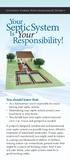 Southwest Florida Water Management District Septic System Your Is Your Responsibility! PIPE SEPTIC TANK DRAIN FIELD SOIL You should know that: As a homeowner you re responsible for maintaining your septic
Homeowner s Guide to Maintaining a Sewage Treatment System
 Homeowner s Guide to Maintaining a Sewage Treatment System Warren County Combined Health District 416 South East Street Lebanon, OH 45036 513-695-1220 Sewage Treatment Systems Septic Tank and Soil Absorption
Operation and Maintenance Guide for Homeowners
 LAGOON SEWAGE TREATMENT SYSTEMS It s Your On-Site System Operation and Maintenance Guide for Homeowners OKLAHOMA DEPARTMENT OF ENVIRONMENTAL QUALITY ENVIRONMENTAL COMPLAINTS AND LOCAL SERVICES P.O. Box
NOTES. Cornell Cooperative Extension, College of Human Ecology. Household Chemicals and your septic system
 16 Water Treatment NOTES Cornell Cooperative Extension, College of Human Ecology Household Chemicals and your septic system JOHN J. SCHWARTZ, ANN T. LEMLEY, KALPANA PRATAP Fact Sheet 16, December 2004
Plumbers Guide Pitt Town Water Plumbers Guide, December 21, 2012
 Plumbers Guide Table of Contents Welcome... 3 Contact us... 3 Plumbers guide... 4 Safe and reliable... 4 Connecting to Pitt Town recycled water... 4 Steps to connect... 5 Plumbing the house... 5 1. Standard
Working for our future today. Water saving tips. Water saving tips for your home, garden and pool
 Working for our future today Water saving tips Water saving tips for your home, garden and pool From the bathroom to the backyard, there are some simple things you can do that could save thousands of litres
Standard terms and conditions
 Standard terms and conditions INTRODUCTION For the provision of a water service (Water Supply, Wastewater and Drainage) Under Section 73(2)(a) of the Water Services Act 2012, landowners may be entitled
MAINTAINING YOUR SPA WATER
 MAINTAINING YOUR SPA WATER Tap water that is safe to drink is not always safe for a spa. Normal tap water is usually filled with minerals and microcontaminants that are not visible to the naked eye. Properly
 IMPACT OF CHEMICALS ADDITION IN WATER/WASTEWATER TREATMENT ON TDS CONCENTRATION AND SLUDGE GENERATION Jurek Patoczka, PhD, PE Hatch Mott MacDonald 27 Bleeker Str., Millburn, NJ 07041 (973) 912 2541 [email protected]
A Property Owner s Guide
 The Operation and Maintenance of Domestic and Commercial Sewers A Property Owner s Guide KILDARE LOCAL AUTHORITIES WATER SERVICES DEPARTMENT TABLE OF CONTENTS Introduction 1. Why should I care? 2. What
Material Safety Data Sheet According to 91/155 EC, 93/112/EC, 2001/58/EC
 Page 1/5 1 Product and company identification Application of the product: Professional cleaning/maintenance product for building care. Manufacturer/Supplier: JohnsonDiversey local operating company Information
Site Visit Report. MEAT PROCESSING FACILITY COD Reduction. Industrial Assistance Section Assessment Team
 N.C. Division of Pollution Prevention and Environmental Assistance North Carolina Department of Environment and Natural Resources Site Visit Report MEAT PROCESSING FACILITY COD Reduction Industrial Assistance
6 Chemicals from human settlements
 6 Chemicals from human settlements 6.1 Introduction The world is becoming increasingly urban, particularly in developing countries. The transition of people from rural areas to cities represents a major,
WASTEWATER TREATMENT PLANT MAINTENANCE INSTRUCTIONS part 1
 WASTEWATER TREATMENT PLANT MAINTENANCE INSTRUCTIONS part 1 General:... 2 Wastewater in areas of scattered settlement... 2 Preventive measures relating to treatment plant maintenance... 2 Operating principles