
Secondary Transition Handbook Moving From School to Adult Life
|
|
|
- Scarlett Lindsey
- 10 years ago
- Views:
Transcription
1 1 Secondary Transition Handbook Moving From School to Adult Life

2 2 The Arc Tennessee Secondary Transition Handbook Acknowledgments Bianca Knight, Disability Rights Tennessee Cindy Gardner, Special Needs Law Center (Formerly with Disability Rights Tennessee) Gale Feltner, Tennessee Division of Rehabilitation Services holly lu conant rees, former chair of Disability Coalition on Education Jane Winstead, Formerly With Tennessee Department of Education, Division of Special Populations Julie Sullivan, Family Voices of Tennessee Mary E. Morningstar, Ph.D., University of Kansas, Department of Special Education Sharon Townsend, Transition Coalition, Kansas Sherry Wilds, Disability Rights Tennessee Susan Moss, Tennessee Department of Developmental and Intellectual Disabilities Tennessee Disability Pathfinder The Arc Tennessee does not provide legal advice or endorse any website other than our own at Legal advice should be garnered only from an attorney. This handbook provides a place for Secondary Transition Planning. The Arc Tennessee values diversity and does not discriminate based on race, ethnicity, religion, age, geographic location, sexual orientation, gender or level of disability.

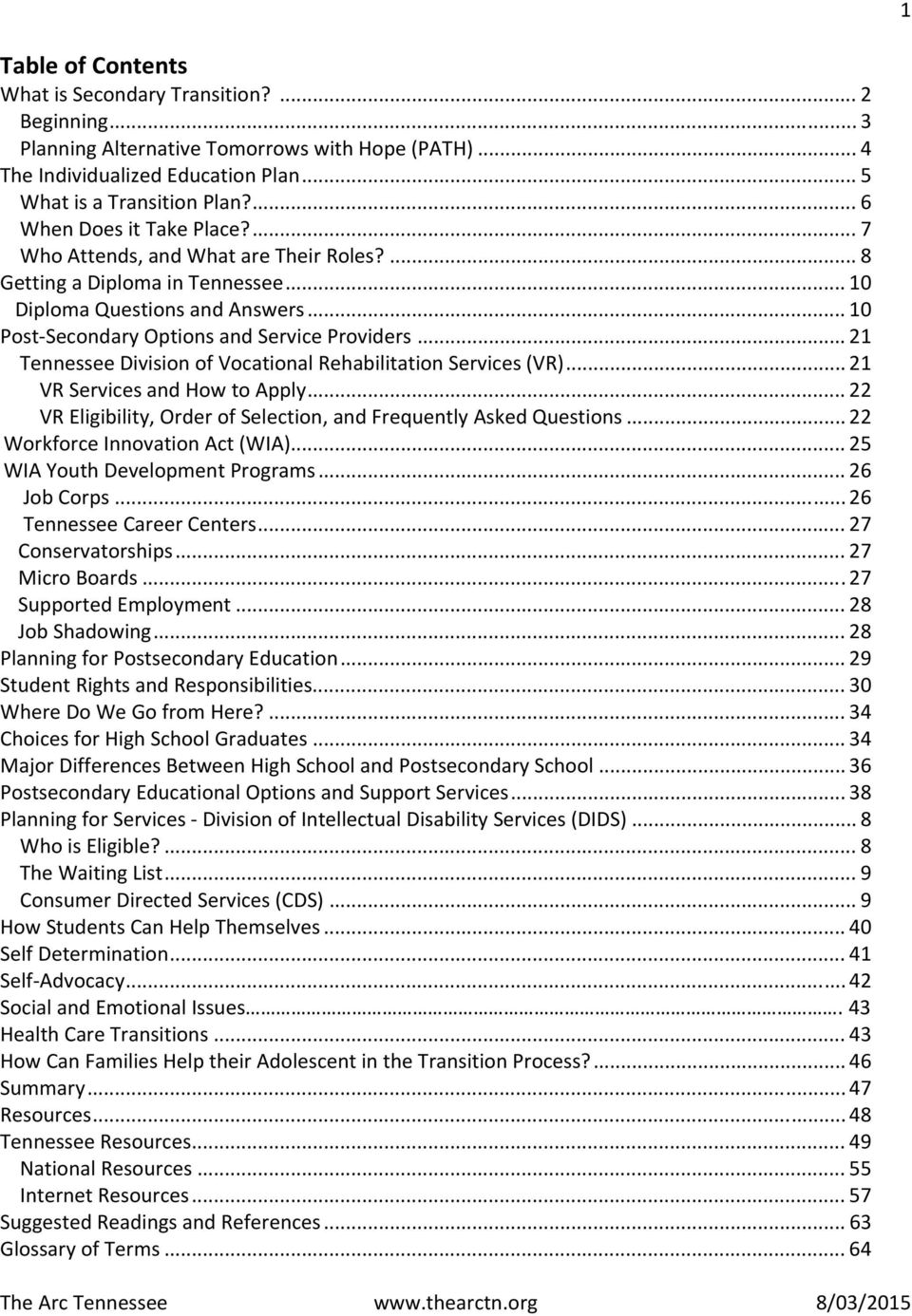
3 1 Table of Contents What is Secondary Transition?... 2 Beginning... 3 Planning Alternative Tomorrows with Hope (PATH)... 4 The Individualized Education Plan... 5 What is a Transition Plan?... 6 When Does it Take Place?... 7 Who Attends, and What are Their Roles?... 8 Getting a Diploma in Tennessee Diploma Questions and Answers Post Secondary Options and Service Providers Tennessee Division of Vocational Rehabilitation Services (VR) VR Services and How to Apply VR Eligibility, Order of Selection, and Frequently Asked Questions Workforce Innovation Act (WIA) WIA Youth Development Programs Job Corps Tennessee Career Centers Conservatorships Micro Boards Supported Employment Job Shadowing Planning for Postsecondary Education Student Rights and Responsibilities Where Do We Go from Here? Choices for High School Graduates Major Differences Between High School and Postsecondary School Postsecondary Educational Options and Support Services Planning for Services Division of Intellectual Disability Services (DIDS)... 8 Who is Eligible?... 8 The Waiting List... 9 Consumer Directed Services (CDS)... 9 How Students Can Help Themselves Self Determination Self Advocacy Social and Emotional Issues. 43 Health Care Transitions How Can Families Help their Adolescent in the Transition Process? Summary Resources Tennessee Resources National Resources Internet Resources Suggested Readings and References Glossary of Terms... 64
4 Secondary Transition is a Process 2 Transition is the process of moving from one place or time to another. In school, Secondary Transition is the process of moving from high school to adult life and community living. It is a bridge between the structure schools provide, and the opportunities and possibilities of adult life. Students with disabilities need help during the Secondary Transition process. Families, educators, and the community play an important role in the student s success. Remember the Secondary Transition Plan is the student s plan for their life after they leave school. Beginning The Secondary Transition process should begin with the end goals in mind. It begins with the learning about the student s preferences, interests, needs and strengths. Dream! Develop a vision for the future Develop the Secondary Transition Plan Implement the plan Evaluate the results Start over again at the next IEP Team Meeting Identify Student Preferences, Interests and Needs Dream! One way to find a student s dreams is to have a PATH (Planning Alternative Tomorrows with Hope). A PATH is an example of a Person Centered Planning process, developed by Jack Pearpoint and Martha Forest, and brought to Tennessee by Dave and Faye Wetherow. During a PATH, the person, a group of people who care about the person come together. With the help of a facilitator, they go through a series of exercises, to express hopes and dreams for the person s future. The PATH helps the circle decide specifically who needs to be involved, what will keep the group strong, and very specific next steps. The PATH is recorded on a big sheet of paper using lots of color. The individual takes this very visual record of the plan. It is up to the team to follow up to make sure they are doing their part to make the dreams and goals a reality. To learn more about how to have a PATH, contact The Arc Tennessee (thearctn.org or 800/ ). Develop a Vision for the Future Help the Student Set Life Goals Long Range Vision My Life (the young adult not mom and dad) Work (competitive employment?) Living (where/how/with whom?) Transportation (public/own vehicle?) Personal Goals (relationships, leisure activities?)

5 3 Developing the Student s Secondary Transition Plan in the IEP The student s plan is flexible and focuses on: 1) Individual s long term life goals; 2) Short term objectives; 3) Student services and supports; 4) Programs and personnel; and 5) Actions to reach these goals. Identify Needed Services and Supports Instruction; Accommodations; Course Selection; Training; Assistive Devices and others as needed. Develop a Written Plan Measurable Secondary Transition Goals; Action Statements; and, Who Will Provide Services and Supports, Including Outside Agencies/Organizations. When? Tennessee law requires the IEP Team begin Secondary Transition planning no later than a student s fourteenth birthday (earlier if needed). The longer the journey, the longer it takes to get there and the earlier planning should begin. Who? In Tennessee, the Secondary Transition Plan is developed during the IEP Team. The team must include: The student (if not present the student s plan information must obtained another way); Parent(s) and/or other family members (someone should attend all IEP Team Meetings); Special Education Teacher(s) (should attend all IEP Team Meetings); General Education Teacher(s) (should attend all IEP Team Meetings); LEA (Local Education Agency) Representative (should attend all IEP Team Meetings) Others who may attend the IEP Team Meeting: School Psychologist (to interpret new evaluation reports); Therapist(s) related services (if discussed); Peers, friends, and/or siblings; Vocational Rehabilitation (VR) Counselor (for postsecondary planning); and Others who know the child or who may be helpful in some aspect of planning.

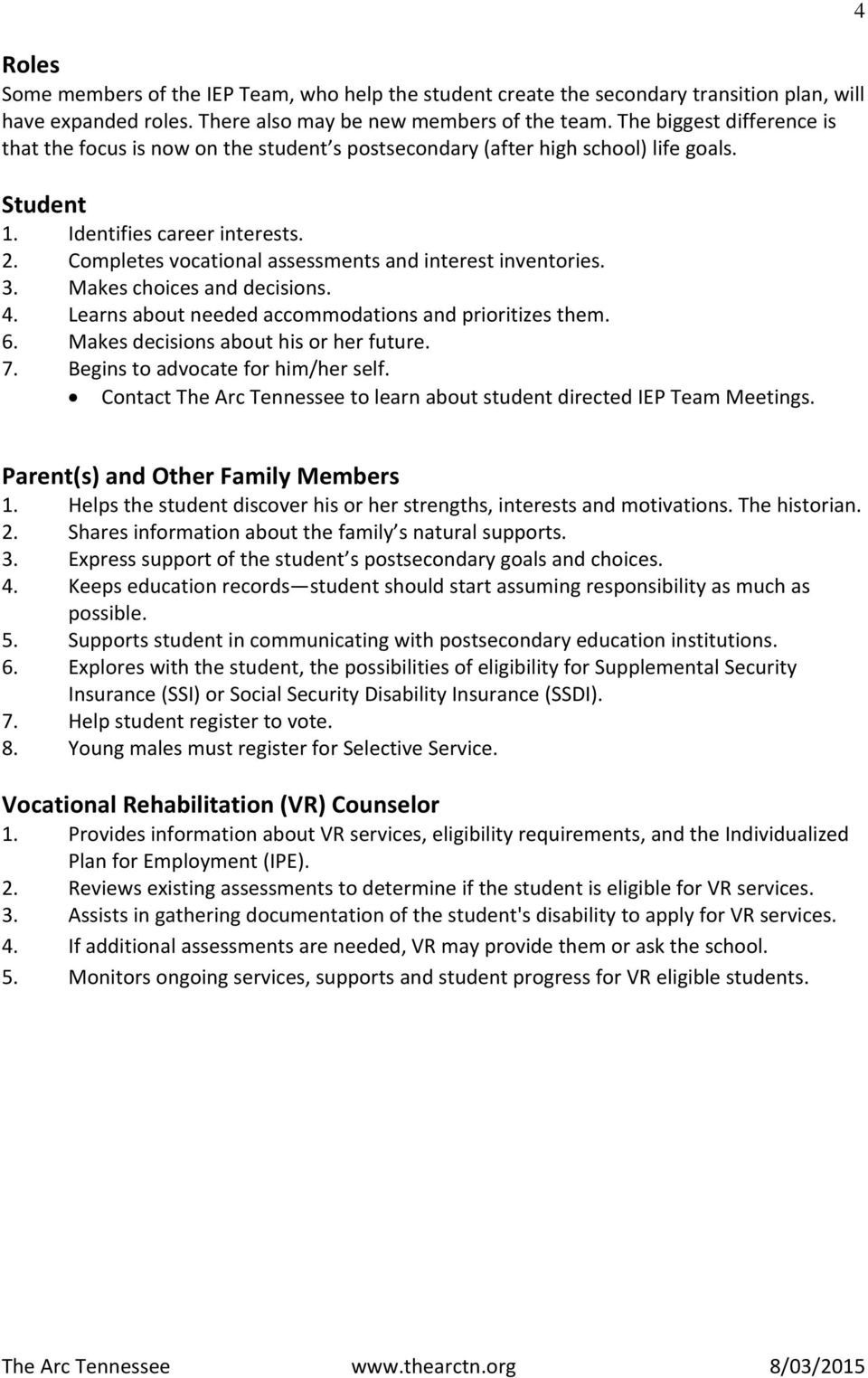
6 Roles Some members of the IEP Team, who help the student create the secondary transition plan, will have expanded roles. There also may be new members of the team. The biggest difference is that the focus is now on the student s postsecondary (after high school) life goals. Student 1. Identifies career interests. 2. Completes vocational assessments and interest inventories. 3. Makes choices and decisions. 4. Learns about needed accommodations and prioritizes them. 6. Makes decisions about his or her future. 7. Begins to advocate for him/her self. Contact The Arc Tennessee to learn about student directed IEP Team Meetings. 4 Parent(s) and Other Family Members 1. Helps the student discover his or her strengths, interests and motivations. The historian. 2. Shares information about the family s natural supports. 3. Express support of the student s postsecondary goals and choices. 4. Keeps education records student should start assuming responsibility as much as possible. 5. Supports student in communicating with postsecondary education institutions. 6. Explores with the student, the possibilities of eligibility for Supplemental Security Insurance (SSI) or Social Security Disability Insurance (SSDI). 7. Help student register to vote. 8. Young males must register for Selective Service. Vocational Rehabilitation (VR) Counselor 1. Provides information about VR services, eligibility requirements, and the Individualized Plan for Employment (IPE). 2. Reviews existing assessments to determine if the student is eligible for VR services. 3. Assists in gathering documentation of the student's disability to apply for VR services. 4. If additional assessments are needed, VR may provide them or ask the school. 5. Monitors ongoing services, supports and student progress for VR eligible students.
7 General and Special Education Teachers 1. Helps schedule and hold the IEP Team Meeting, including the Secondary Transition Planning. 2. Shares samples of student's work. 3. Identifies needed postsecondary accommodations. 4. Evaluates student strengths, preferences, and interests in: academics social skills pre vocational vocational adaptive functioning 5. Applies for accommodations for the student while taking the ACT and/or SAT. 6. Helps identify needed postsecondary accommodations available to the student at postsecondary schools. 8. Models sensitivity to the family s culture. 9. Makes sure the student has documentation of classroom and testing accommodation that can be used to get accommodations in postsecondary training. 10. Assists with identifying vocational, postsecondary education and community living goals, including: transportation money management independent living skills housing training program size and type work social/recreation/community involvement 11. Helps with postsecondary education application and visits to postsecondary schools. 12. Advises on coursework to prepare for postsecondary education and employment. 13. Prepares a summary of the student s academic achievement and functional performance. 14. Advises about needed postsecondary assistive technology. 15. Teaches student and family about transfer of rights, when the student turns Teaches student to advocate for him/herself. 5

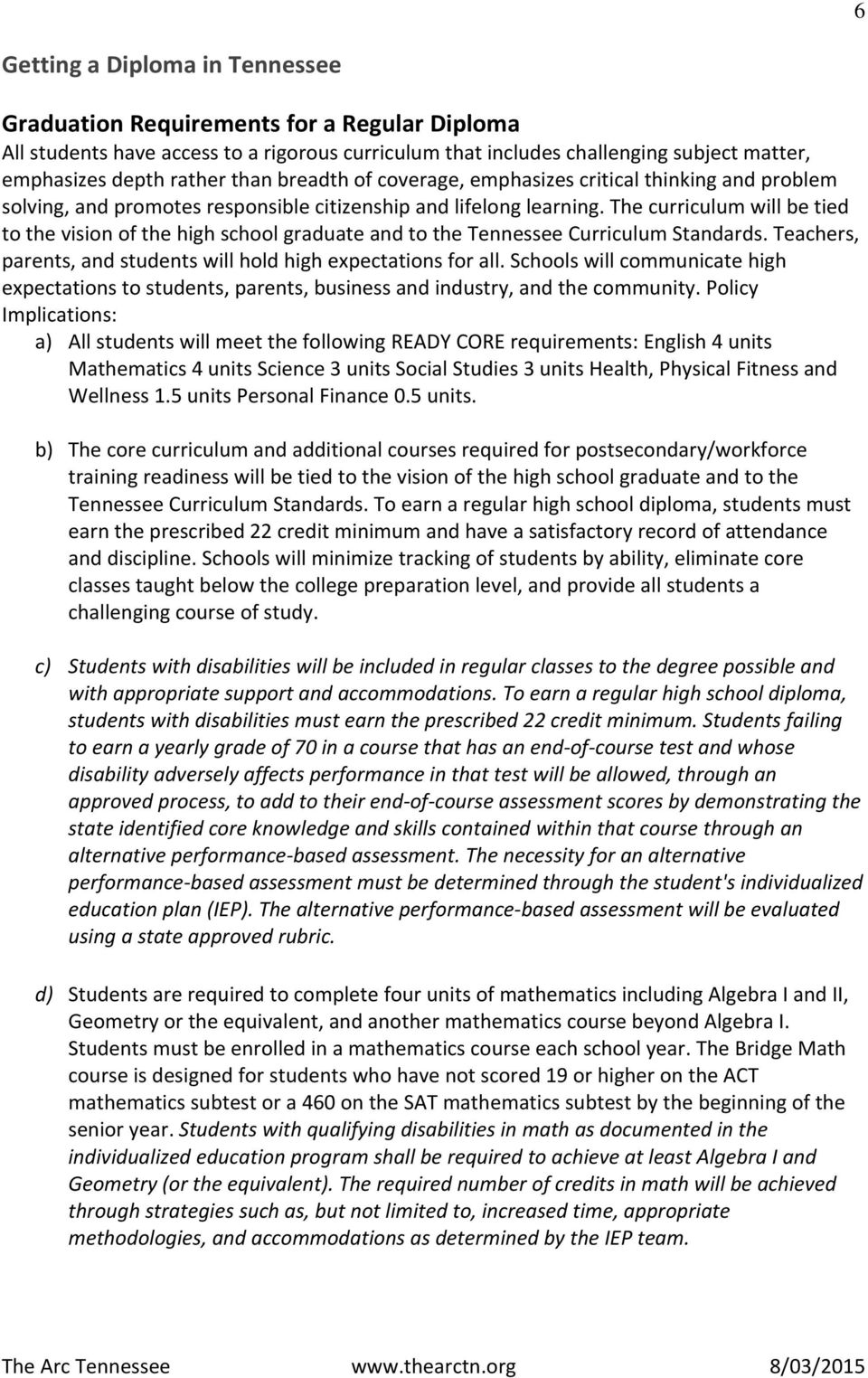
8 6 Getting a Diploma in Tennessee Graduation Requirements for a Regular Diploma All students have access to a rigorous curriculum that includes challenging subject matter, emphasizes depth rather than breadth of coverage, emphasizes critical thinking and problem solving, and promotes responsible citizenship and lifelong learning. The curriculum will be tied to the vision of the high school graduate and to the Tennessee Curriculum Standards. Teachers, parents, and students will hold high expectations for all. Schools will communicate high expectations to students, parents, business and industry, and the community. Policy Implications: a) All students will meet the following READY CORE requirements: English 4 units Mathematics 4 units Science 3 units Social Studies 3 units Health, Physical Fitness and Wellness 1.5 units Personal Finance 0.5 units. b) The core curriculum and additional courses required for postsecondary/workforce training readiness will be tied to the vision of the high school graduate and to the Tennessee Curriculum Standards. To earn a regular high school diploma, students must earn the prescribed 22 credit minimum and have a satisfactory record of attendance and discipline. Schools will minimize tracking of students by ability, eliminate core classes taught below the college preparation level, and provide all students a challenging course of study. c) Students with disabilities will be included in regular classes to the degree possible and with appropriate support and accommodations. To earn a regular high school diploma, students with disabilities must earn the prescribed 22 credit minimum. Students failing to earn a yearly grade of 70 in a course that has an end of course test and whose disability adversely affects performance in that test will be allowed, through an approved process, to add to their end of course assessment scores by demonstrating the state identified core knowledge and skills contained within that course through an alternative performance based assessment. The necessity for an alternative performance based assessment must be determined through the student's individualized education plan (IEP). The alternative performance based assessment will be evaluated using a state approved rubric. d) Students are required to complete four units of mathematics including Algebra I and II, Geometry or the equivalent, and another mathematics course beyond Algebra I. Students must be enrolled in a mathematics course each school year. The Bridge Math course is designed for students who have not scored 19 or higher on the ACT mathematics subtest or a 460 on the SAT mathematics subtest by the beginning of the senior year. Students with qualifying disabilities in math as documented in the individualized education program shall be required to achieve at least Algebra I and Geometry (or the equivalent). The required number of credits in math will be achieved through strategies such as, but not limited to, increased time, appropriate methodologies, and accommodations as determined by the IEP team.
9 e) Students must complete Biology, Chemistry or Physics, and a third lab science. Students with qualifying disabilities in reading and/or math as documented in the individualized education program shall be required to achieve at least Biology I and two other lab science credits. The required number of credits in science will be achieved through strategies such as, but not limited to, increased time, appropriate methodologies, and accommodations as determined by the IEP team. f) The social studies curriculum will be consistent with national goals and with admissions requirements of Tennessee public institutions of higher education; will include the study of United States History, World History/World Geography, Economics and Government; and will incorporate a global perspective. i. Students must complete ½ credit in Personal Finance. g) The health, physical fitness and wellness curriculum will integrate concepts from each of these areas and may be taught by a team of teachers from one or more teaching areas, including health, physical education, family and nutrition sciences, and health sciences education. Participation in marching band and interscholastic athletics may not be substituted for this aspect of the core curriculum. Credit earned in two years of JROTC may be substituted provided the local system has complied with requirements of the State Board of Education. h) Students are required to complete an additional ½ credit in Physical Education. This requirement may be met by substituting a documented and equivalent time of physical activity in marching band, JROTC, cheerleading, interscholastic athletics, school sponsored intramural athletics, and other areas approved by the local board of education. i) Computer education is not specifically listed in the READY CORE curriculum. However, TCA requires every candidate for graduation to have received a full year of computer education at some time during the candidate s educational career. 7 j) ONE PATH All students will pursue a focused program of study preparing them for postsecondary study. While all students may not enter postsecondary training immediately following high school, they must be prepared for lifelong learning. Policy Implications: i) Students will complete an elective focus of no less than three credits. The elective focus may be CTE, science and math, humanities, fine arts, AP/IB, or other areas approved by the local board of education. Students completing a CTE elective focus must complete three units in the same CTE program area or stateapproved program of study. Students completing a CTE elective focus in Trade & Industrial Education must complete three credits from one of the eight stateapproved focus areas. Schools should make every effort to ensure that all students complete a state or locally approved elective focus, however schools may waive the elective focus requirement for those students who transfer during the junior or senior year to a Tennessee high school from a school in

10 another state, if the completion of the elective focus would prevent or delay graduation. Students who begin an elective focus in a Tennessee high school and transfer during the junior or senior year to another Tennessee high school may, with the permission of the Director of Schools, have the elective focus requirement waived if the receiving school does not offer the same elective focus area and is unable to offer related coursework to complete a state or locally approved focus area, or if the completion of the elective focus would prevent or delay graduation. ii) Local boards of education are encouraged to consider requirements for students to complete a capstone experience such as, but not limited to: Senior Project Virtual Enterprise Internship Externship Work based Learning Service learning (minimum of 40 hours) Community Service (minimum of 40 hours) iii) Students will complete two units of the same foreign language and one unit of fine arts except in limited circumstances (students not planning to attend university), schools may waive the two units of foreign language and one unit of fine arts to expand and enhance their elective focus. iv) Students will be required to complete a total of 22 units, including electives. Since most high schools offer the opportunity to take at least 6 units each year, for a total of 24 units, students will actually have an opportunity to take a considerable number of electives. Students who attend high schools using block scheduling have the opportunity to take a total of 32 units. v) Graduation with Honors, State Honors, and State Distinction: 8 1. School systems may design student recognition programs that allow students to graduate with honors if they have met the graduation requirements and have obtained an overall grade point average of at least a 3.0 or higher on a 4.0 scale. School systems may set a higher GPA at their discretion. School systems may specify additional requirements, such as requiring students to demonstrate performance of distinction in one or more areas. 2. Students who score at or above all the subject area readiness benchmarks on the ACT or equivalent score on the SAT will graduate with state honors. Each local school board shall develop a policy prescribing how students graduating with state honors will be noted and recognized. 3. Students will be recognized as graduating with state distinction by attaining a B or better average and completing one of the following: a) earn a nationally recognized industry certification

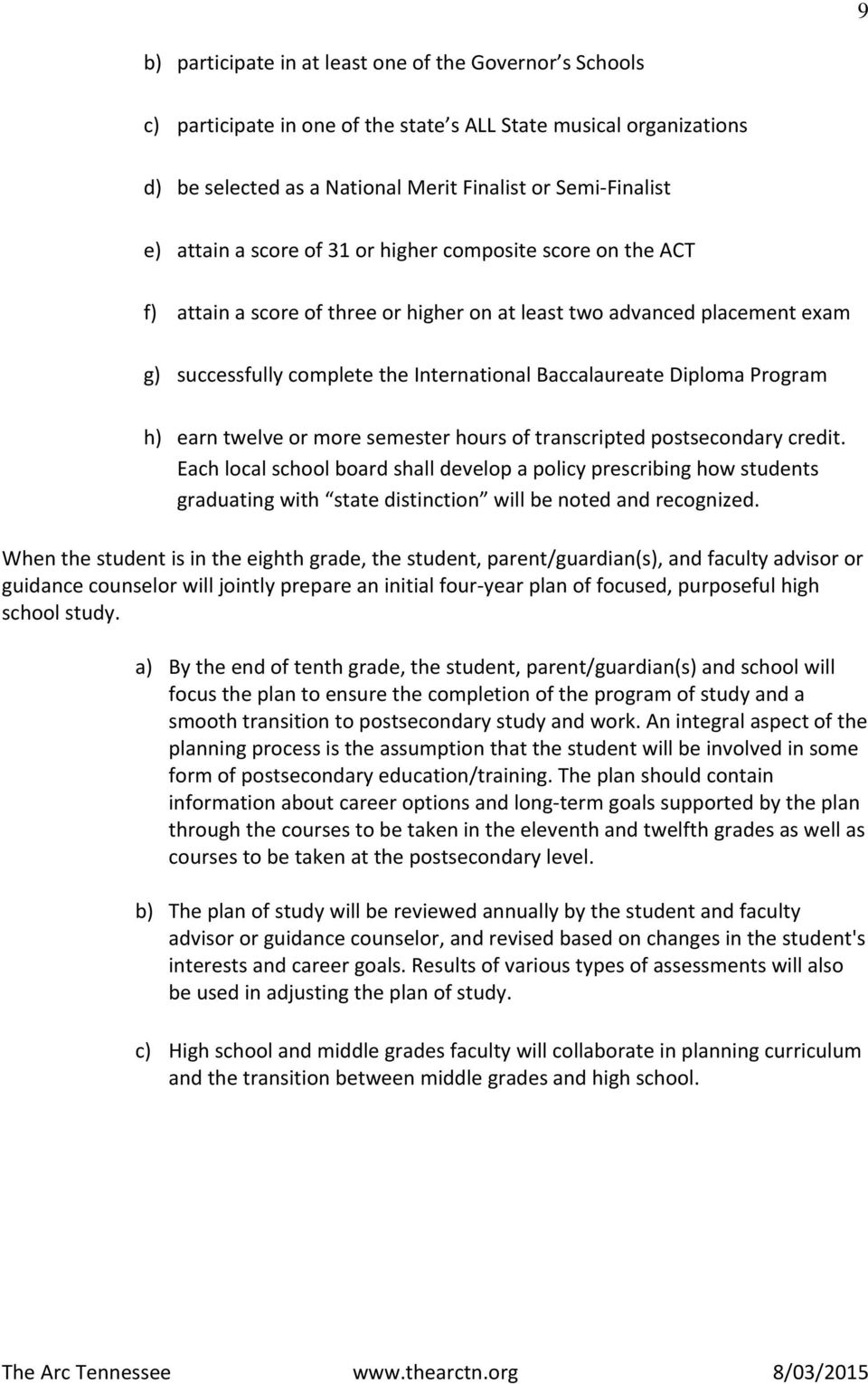
11 9 b) participate in at least one of the Governor s Schools c) participate in one of the state s ALL State musical organizations d) be selected as a National Merit Finalist or Semi Finalist e) attain a score of 31 or higher composite score on the ACT f) attain a score of three or higher on at least two advanced placement exam g) successfully complete the International Baccalaureate Diploma Program h) earn twelve or more semester hours of transcripted postsecondary credit. Each local school board shall develop a policy prescribing how students graduating with state distinction will be noted and recognized. When the student is in the eighth grade, the student, parent/guardian(s), and faculty advisor or guidance counselor will jointly prepare an initial four year plan of focused, purposeful high school study. a) By the end of tenth grade, the student, parent/guardian(s) and school will focus the plan to ensure the completion of the program of study and a smooth transition to postsecondary study and work. An integral aspect of the planning process is the assumption that the student will be involved in some form of postsecondary education/training. The plan should contain information about career options and long term goals supported by the plan through the courses to be taken in the eleventh and twelfth grades as well as courses to be taken at the postsecondary level. b) The plan of study will be reviewed annually by the student and faculty advisor or guidance counselor, and revised based on changes in the student's interests and career goals. Results of various types of assessments will also be used in adjusting the plan of study. c) High school and middle grades faculty will collaborate in planning curriculum and the transition between middle grades and high school.
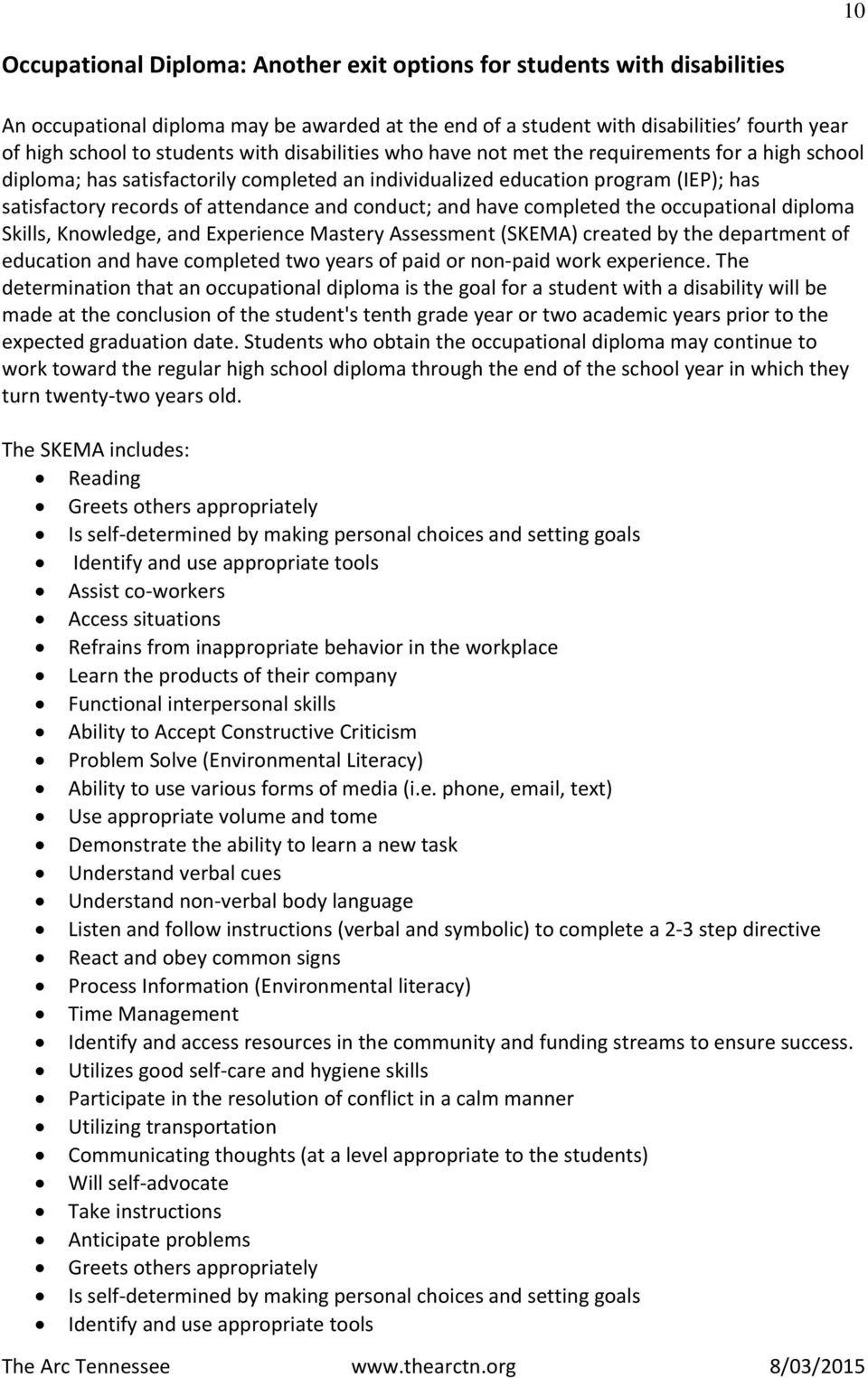
12 10 Occupational Diploma: Another exit options for students with disabilities An occupational diploma may be awarded at the end of a student with disabilities fourth year of high school to students with disabilities who have not met the requirements for a high school diploma; has satisfactorily completed an individualized education program (IEP); has satisfactory records of attendance and conduct; and have completed the occupational diploma Skills, Knowledge, and Experience Mastery Assessment (SKEMA) created by the department of education and have completed two years of paid or non paid work experience. The determination that an occupational diploma is the goal for a student with a disability will be made at the conclusion of the student's tenth grade year or two academic years prior to the expected graduation date. Students who obtain the occupational diploma may continue to work toward the regular high school diploma through the end of the school year in which they turn twenty two years old. The SKEMA includes: Reading Greets others appropriately Is self determined by making personal choices and setting goals Identify and use appropriate tools Assist co workers Access situations Refrains from inappropriate behavior in the workplace Learn the products of their company Functional interpersonal skills Ability to Accept Constructive Criticism Problem Solve (Environmental Literacy) Ability to use various forms of media (i.e. phone, , text) Use appropriate volume and tome Demonstrate the ability to learn a new task Understand verbal cues Understand non verbal body language Listen and follow instructions (verbal and symbolic) to complete a 2 3 step directive React and obey common signs Process Information (Environmental literacy) Time Management Identify and access resources in the community and funding streams to ensure success. Utilizes good self care and hygiene skills Participate in the resolution of conflict in a calm manner Utilizing transportation Communicating thoughts (at a level appropriate to the students) Will self advocate Take instructions Anticipate problems Greets others appropriately Is self determined by making personal choices and setting goals Identify and use appropriate tools
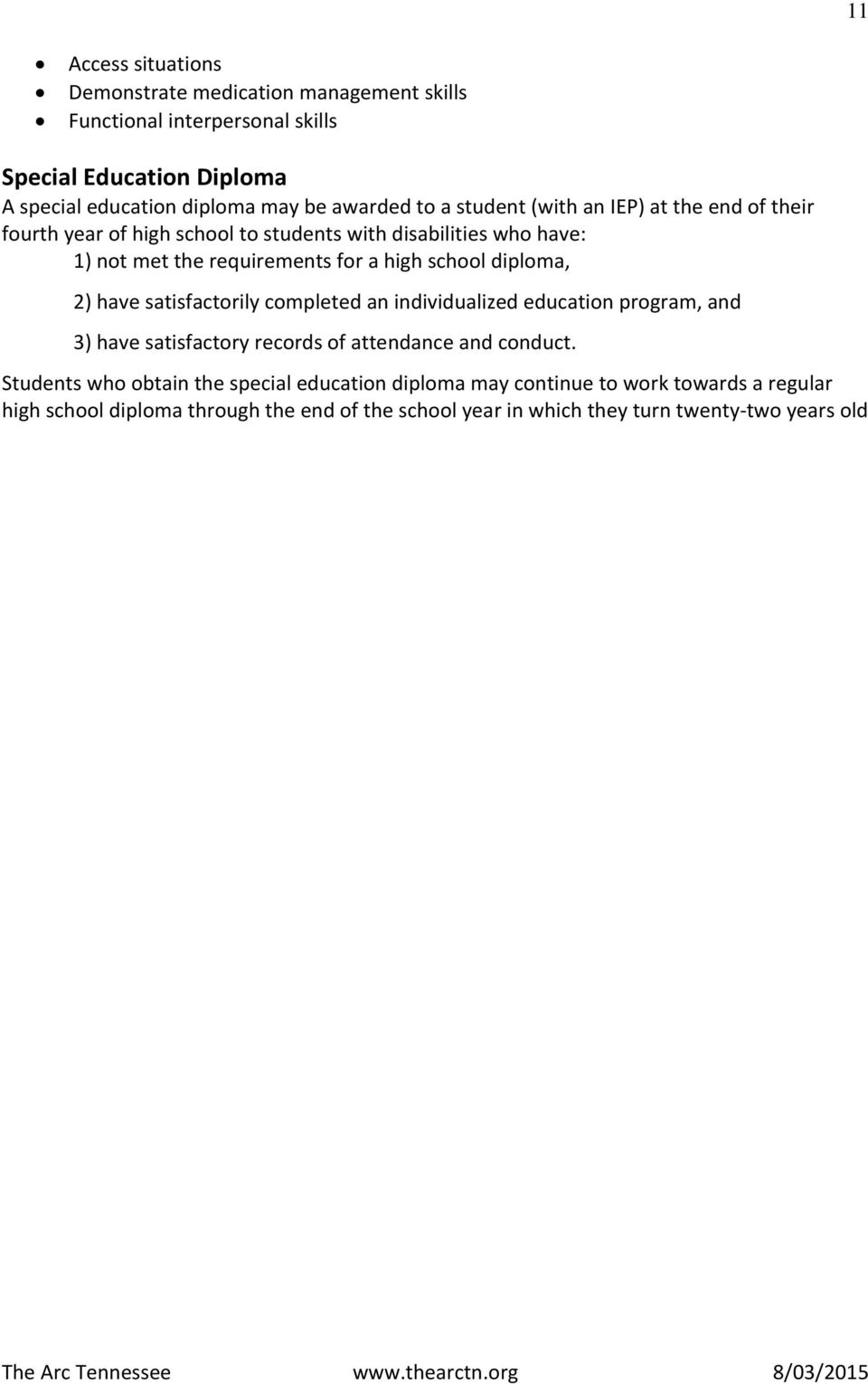
13 11 Access situations Demonstrate medication management skills Functional interpersonal skills Special Education Diploma A special education diploma may be awarded to a student (with an IEP) at the end of their fourth year of high school to students with disabilities who have: 1) not met the requirements for a high school diploma, 2) have satisfactorily completed an individualized education program, and 3) have satisfactory records of attendance and conduct. Students who obtain the special education diploma may continue to work towards a regular high school diploma through the end of the school year in which they turn twenty two years old
14 12 Post Secondary Options and Service Providers Vocational Rehabilitation/Department of Rehabilitation Services Vocational Rehabilitation is an employment program provided by the Tennessee Department of Human Services, Division of Rehabilitation Services. Since most people use the term Vocational Rehabilitation or VR, we will use that in this document. VR helps people with disabilities get paying meaningful jobs. When you apply for VR services you will: Have assessments to help learn about you and your job interests; Find out if you are eligible; Work with your VR Counselor on your Individual Plan for Employment (IPE); and Find out your Priority Category. (This is part of the Order of Selection used by VR when they do not have enough money to give everyone services who is eligible.) How Does VR Decide if You Are Eligible? People are eligible for VR services if: Their disability makes it hard for them to get or keep a job; They need help to get or keep a job that is right for them; and They can benefit from VR services. Your VR Counselor decides if you are eligible for VR services. This decision is based on things like your medical records, education records, information that you or your family give them, VR Counselor thinks and disability decisions made by other agencies. Your VR Counselor has 60 days after you apply to decide if you will get services. However, sometimes the decision takes longer. If more time is needed, your VR counselor will ask you to agree in writing to let them take more time. The eligibility decision may take longer if your VR Counselor thinks your disability is too bad for you to get VR services to help you get a job. When that happens, your VR Counselor will set up some assessments, such as trial work experiences or extended evaluations. They help the VR Counselor decide how VR services can help you get a job. People who get SSI or SSDI because they have a disability can get VR services if they want to work. Order of Selection and Priority Categories Order of Selection is important. It is required by law when there is not enough money for VR to serve everyone who is eligible for services. There are four Priority Categories. VR decides the Priority Category (PC) for each eligible person. By federal law, VR must serve individuals with the most significant disabilities first. People who qualify as Priority Category 1 (PC 1) have the most significant disabilities that cause serious problems in two or more areas that make it hardest to get a job, work, and take at least six months to get a job. They want a job.

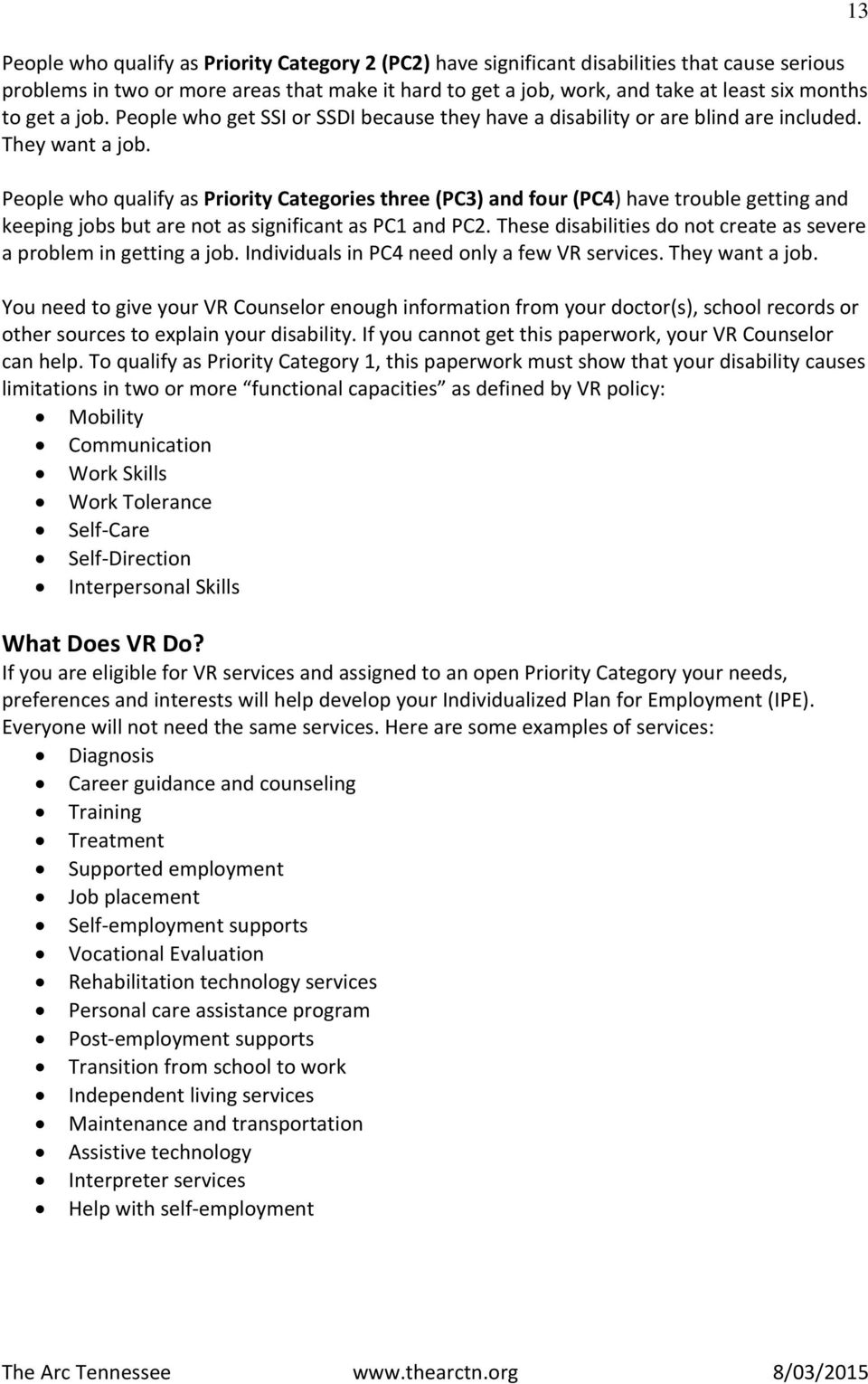
15 People who qualify as Priority Category 2 (PC2) have significant disabilities that cause serious problems in two or more areas that make it hard to get a job, work, and take at least six months to get a job. People who get SSI or SSDI because they have a disability or are blind are included. They want a job. People who qualify as Priority Categories three (PC3) and four (PC4) have trouble getting and keeping jobs but are not as significant as PC1 and PC2. These disabilities do not create as severe a problem in getting a job. Individuals in PC4 need only a few VR services. They want a job. You need to give your VR Counselor enough information from your doctor(s), school records or other sources to explain your disability. If you cannot get this paperwork, your VR Counselor can help. To qualify as Priority Category 1, this paperwork must show that your disability causes limitations in two or more functional capacities as defined by VR policy: Mobility Communication Work Skills Work Tolerance Self Care Self Direction Interpersonal Skills What Does VR Do? If you are eligible for VR services and assigned to an open Priority Category your needs, preferences and interests will help develop your Individualized Plan for Employment (IPE). Everyone will not need the same services. Here are some examples of services: Diagnosis Career guidance and counseling Training Treatment Supported employment Job placement Self employment supports Vocational Evaluation Rehabilitation technology services Personal care assistance program Post employment supports Transition from school to work Independent living services Maintenance and transportation Assistive technology Interpreter services Help with self employment 13
16 Finding the Right Type of Work for You Your VR Counselor will guide you through activities to identify your abilities, job skills, and job interests in order to develop an Individualized Plan for Employment (IPE). This plan will identify the kind of job you want and what training, educating, and/or services you will need to get that job. There are some things you can do to get ready for your first meeting with your VR Counselor. If you do not know what kind of work you want to do, here are some ways to look for ideas. Remember, you are not looking for just any job. You are looking for a job that interests you and that you can do with your abilities or with training you can receive in order to reach your employment. If you think you would like to be self employed, discuss how that might work with your VR Case Manager. Job Planning Tool Things That I Enjoy Doing: 14 Things That Are Okay to Do: Things That I Dislike Doing: Things I Really Dislike Doing:

17 15 Your Work Interests 1. What do you like to do? What are your interests and hobbies? Here is a tool to help: and partnerships/zarrow.html?rd=1. 2. What kind of work or volunteer experiences have you enjoyed? 3. Visit Tennessee s Career Center webpage to look at jobs: Do you see jobs you like? 5. Look through the Occupational Outlook Handbook. This will help you see skills and training needed for jobs: careers.aspx. 6. Talk to friends and relatives about their jobs. Is their work interesting? What training did they need? 7. Look at jobs at: jobs.net/tennessee.htm. What jobs look interesting? What do you like about them? This is a pretty complicated site. Ask for help if you need it.

18 16 Work Planning Knowing the kind of work you want will help when you work with your VR Counselor. This worksheet will help when you meet with your counselor. Ask a teacher or family member for help if you need it. 1. What things are you good at doing? 2. What education have you had? 3. What type of job training have you had? 4. What work experience have you had? 5. What volunteer experience have you had? 6. What kinds of work are you interested in? Why? 7. Do you need training to do the job you want? If you do, what type of training? 8. What kinds of jobs do NOT interest you? Why?

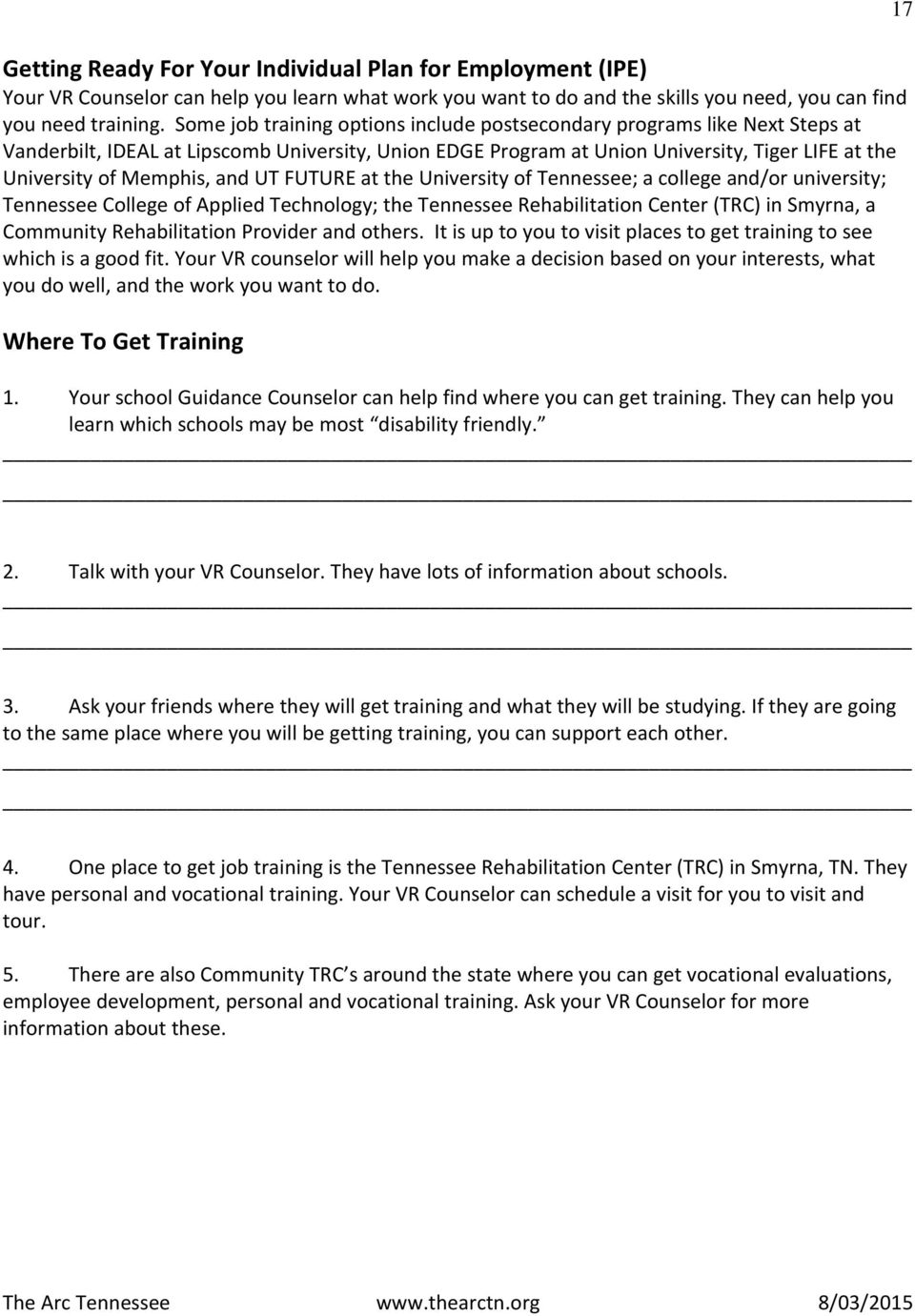
19 Getting Ready For Your Individual Plan for Employment (IPE) Your VR Counselor can help you learn what work you want to do and the skills you need, you can find you need training. Some job training options include postsecondary programs like Next Steps at Vanderbilt, IDEAL at Lipscomb University, Union EDGE Program at Union University, Tiger LIFE at the University of Memphis, and UT FUTURE at the University of Tennessee; a college and/or university; Tennessee College of Applied Technology; the Tennessee Rehabilitation Center (TRC) in Smyrna, a Community Rehabilitation Provider and others. It is up to you to visit places to get training to see which is a good fit. Your VR counselor will help you make a decision based on your interests, what you do well, and the work you want to do. Where To Get Training 1. Your school Guidance Counselor can help find where you can get training. They can help you learn which schools may be most disability friendly Talk with your VR Counselor. They have lots of information about schools. 3. Ask your friends where they will get training and what they will be studying. If they are going to the same place where you will be getting training, you can support each other. 4. One place to get job training is the Tennessee Rehabilitation Center (TRC) in Smyrna, TN. They have personal and vocational training. Your VR Counselor can schedule a visit for you to visit and tour. 5. There are also Community TRC s around the state where you can get vocational evaluations, employee development, personal and vocational training. Ask your VR Counselor for more information about these.
20 18 Responsibilities When You Get VR Services 1. You must help develop your Individualized Plan for Employment (IPE) and work towards getting a job. You need to work closely with your VR Counselor in finding types of services, service providers, and looking for your job. You can help by keeping appointments and working to reach your work goal. 2. When you are getting VR services, you must contact your VR Counselor every month to let them know how things are going. Call your VR Counselor if you need to reschedule a meeting. Leave a phone message or send an if you need to. Be sure you have their phone number and in a safe place. Answer letters, phone messages or s from your VR Counselor immediately. 3. VR helps get jobs if you have money or not. Unless you get SSI or SSDI, your counselor will talk to you about your income and assets to identify much you can help pay for services. This includes federal or state financial aid. If you can get them and will not use these benefits, you cannot get VR services. Rights When You Get VR Services* 1. You have the right to know if you are eligible within 60 days of when you apply. 34 CFR You have the right to develop your own IPE. 34 CFR You have the right to get all the services you need to help you reach your job goal. 34 CFR You have the right to decide what your job goal will be. CFR and You have the right to pick services and providers (schools, etc.). 34 CFR and You have the right to change your IPE, your job goal or services. 34 CFR You have the right to look at your IPE at least once a year with. 34 CFR You have the right to review the VR Policy Manual. 34 CFR You have the right to appeal any decision made by VR that you do not agree with. 34 CFR You have the right to have the Client Assistance Program (CAP) help you. 34 CFR * All rights are in the Code of Federal Regulations, Title 34, Part 361, State Vocational Rehabilitation Services Program. A copy of the regulations is available at

21 19 These are modified from Disability Rights Tennessee s VR Bill of Rights. If you need help understanding this information about your VR Rights or if you have questions you can call your VR Counselor or visit VR s website at or call the main office at (615) ; (615) (TTY); (TTY long distance). If you disagree with a decision made by your VR Counselor and cannot resolve it by talking to your counselor's supervisor, you can get help appealing from the Client Assistance Program (CAP) at Disability Tennessee Rights at 800/ ; 615/ (TDD); 888/ (TTY). VR Tips 1. If your school does not refer you to VR, you can do it. (Directory at the end of this booklet.) 2. When planning, be sure to think about what type of work you want to do. VR helps find paid jobs. The training you get will depend on the type of work you want to do. 3. If VR says you are on a waiting list for employment services, ask them about your options. 4. Once you have signed your IPE, you need to stay in touch with your VR Counselor at least once a month. If you call him/her, and s/he is not in the office, leave a message or send an Your VR Counselor must approve all changes to services listed on the IPE in advance. 6. For information on Ticket to Work: 7. Tell your VR Counselor which the best way to contact you; by phone, mail, or Let your VR Counselor know if you need information in a different format, such as on a CD or Braille, or a language other than English. 9. It is important to call your VR Counselor if you have a problem that affects your job training. 10. Keep who support you in the loop (parents, etc.). They will help if they know you need them. 11. Do not skip classes. Every class is essential to helping you meet your career goal. 12. If you have a rough semester in college or technical school, do not give up. Your VR Counselor is there to help you when the going gets rough. 13. Do not drop a class until you speak with your VR Counselor. 14. Connect with the Disability Services office where you attend school. They can help you talk with your instructors, help you find support services such as tutors, note takers, and more. 15. If you are living on campus, follow campus rules.
22 VR may close your case if: You have completed your IPE and have maintained employment for 90 days; You do not cooperate with or maintain contact with your VR Counselor; or You ask for it to be closed. 17. Do not expect others to look out for your rights. Ask questions until you get the answers. Take someone (like a parent) with you to your VR meetings. If someone tells you no, ask for the policy the refusal is based on. You have rights. VR Regional Offices with Counties Served Region Buffalo Street Johnson City, Tennessee Telephone: 423/ Fax: 423/ Counties & TRCs Served: Carter, Cocke, Grainger, Greene, Hamblen, Hancock, Hawkins, Jefferson, Johnson, Sullivan, Unicoi, Washington Region 3 Eastgate Center, Suite 602 B 5600 Brainerd Road Chattanooga, Tennessee Telephone: 423/ Fax: 423/ Counties & TRCs Served: Bledsoe, Bradley, Coffee, Franklin, Grundy, Hamilton, Marion, McMinn Meigs Moore Polk Rhea Region 5 88 Hermitage Avenue Nashville, Tennessee Telephone: 615/ Fax: 615/ Counties Served: Davidson, Robertson Region 2 State Office Building 531 W. Summit Hill Drove, Suite 301 Knoxville, Tennessee Telephone/TTY: 865/ Fax: 865/ or 865/ Counties & TRCs Served: Anderson, Blount, Campbell, Claiborne, Knox, Loudon, Monroe, Morgan, Roane, Scott, Sevier, Union Region E. 20 th Street Cookeville, Tennessee Telephone/TTY: 931/ Fax: 931/ Counties & TRCs Served: Cannon, Clay, Cumberland, DeKalb, Fentress, Jackson, Macon, Overton, Pickett, Putnam, Smith, Sumner, Trousdale, Van Buren, Warren White Region Trotwood Avenue Columbia, Tennessee Telephone: 931/ Fax: 931/ Counties & TRCs Served: Bedford, Giles, Hickman, Lawrence, Lewis, Lincoln, Marshall, Maury, Perry, Rutherford, Wayne, Williamson, Wilson
23 21 Region 7 Lowell Thomas State Office Bldg, Box Martin Luther King Boulevard Jackson, Tennessee Telephone: 731/ Fax: 731/ Counties & TRCs Served: Chester, Crockett, Decatur, Fayette, Hardeman, Hardin, Haywood, Henderson, Lauderdale, Madison, Region North Main Street, 3 rd Floor Memphis, Tennessee Telephone/TDD: 901/ Fax: 901/ Counties & Served: Shelby Region Benton Industrial Road Camden, Tennessee Telephone: 731/ Fax: 731/ Counties & TRCs Served: Benton, Carroll, Cheatham, Dickson, Dyer, Gibson, Henry, Houston, Humphreys, Lake, Montgomery, Obion, Robertson, Stewart, Weakley Region 10 & Region 11 Services for the Blind and Visually Impaired (10) Services for the Deaf and Hard of Hearing (11) Citizens Plaza State Office Building, 12th Floor 400 Deaderick Street Nashville, Tennessee Telephone: 615/ TTY, Long Distance: Fax: (615) Additional Employment Service Providers Other Employment Service Providers that might be of service to young adults are the Workforce Investment Act (WIA) and the Job Corps. Both of these service providers receive federal funding and have economic need as a qualification. Once a young adult turns eighteen, s/he may have access to these programs. S/he is a family of one. WIA considers his/her income, instead of the entire family s income. Workforce Investment Act (WIA) The WIA sets up programs to help individuals overcome barriers to work by providing job training and other services that will result in more employment and earnings, further educational and occupational skills, and less dependency on public assistance.. WIA is a project between government and industry. It is outcome based, helping participants become self sufficient through employment. WIA begins with eligibility and assessment and trains the individual, assisting with job search and employment. To access WIA services, contact WIA. Contact information on WIA is located in the resource section of this handbook. WIA Youth Department Programs Programs for adolescents between 14 and 21 years old: 1. Limited Work Experience Program provides funds for employment of adolescents with public agencies and non profit organizations. The participants get basic job skills, while supervised by trained professionals. Participants are paid minimum wage for work up to 6
24 22 months. Participants attend educational classes to be eligible for work. The program works to build work, maturity, employment skills, and specific job skills. 2. The Classroom Training Program prepares young adults for employment by training in specific basic/advanced job skills. Young adults must be able to learn the required material and succeed in a job setting. The training is provided at vocational technical schools or community colleges, and teaches necessary work skills. 3. Summer Youth Employment and Training Service lets students work and earn money and learn work skills through work experience in non profit and public agencies. Job Corps Job Corps is a major training and employment program of the U.S. Department of Labor. Their goal is to lessen employment problems young adults who have specific disadvantages face. Job Corps helps young adults who need, and can benefit from, the services they provide in a residential setting at a Job Corps Center. These services include: Basic education; General Education Diploma (GED); Job skills training; Work experience; Counseling; Leadership training; Health care; and Related support services. Eligibility criteria Between years old; From a family with low income (students with disabilities are a family of one); Have a condition that keeps them from getting an education or job; and Are able to benefit from Job Corps training. The Job Corps program offers education and skills training through a competency based approach with individualized instruction. The combination of training and support services helps students become responsible, productive citizens. Upon completion of the Job Corps program, young adults are better prepared to get and hold jobs; realize their potential by seeking more education/training; or satisfy entrance requirements for careers in the military. Job Corps provides placement and other support services to students finishing the program. Contact Job Corps to learn more about Job Corps and to apply for services (see resource section). Tennessee Career Centers The Tennessee Career Center System provides maximum workforce results from one convenient location. Tennessee Career Centers are where people and jobs connect. Tennessee has a network of centers across the state where job seekers can get help and career information. Each center offers job information on computers, internet access, workshops, and job placement, recruitment, and
25 23 training referrals. More information on Tennessee Career Centers can be found at: wfd/cc/. Students with Disabilities Preparing for Postsecondary Education Rights and Responsibilities Some students with disabilities can continue their education in postsecondary settings such as: Colleges/Universities Community Colleges Postsecondary College Programs For Students Who Did Not Earn A Regular Diploma Tennessee Colleges of Applied Technology (TCAT) All colleges, universities, community colleges and TCATs follow the Americans with Disabilities Act and Section 504 of The Rehabilitation Act. These laws tell how access to services, buildings, curriculum and housing are provided. Postsecondary schools access offices may be called Office of Disability Services or Access Centers. They help provide accommodations that level the academic playing field. The access offices assist students with documented disabilities and identify their eligibility for services and then working with students to determine reasonable accommodations and services which will, in turn, give the student equal access to the university. The U.S. Office for Civil Rights (OCR) enforces Section 504 of the Rehabilitation Act and Title II of the Americans with Disabilities Act (ADA) of 1990, which prohibit discrimination based on disability. Almost all postsecondary schools in the United States are subject to these laws. Postsecondary schools do not have to comply with the IDEA but must comply with other laws. The responsibilities of postsecondary schools are very different from those of school districts. Once a student leaves high school through graduation or at the end of the school year when they turns 22 years old, there are no more IEP s. Students must remember that it is their responsibility to request disability services in the postsecondary setting. Nobody else will take this step for you. When you apply for education at a postsecondary school, ask about the Disability Access Office then. The process of getting accommodations begins there. They help students recognize their potential by removing potential barriers to education. There is no IEP in postsecondary education. However, it is important to have a copy of the last IEP and most recent evaluations to document your access needs. Colleges/Universities: There are seven state Tennessee universities; 51 private colleges and universities in Tennessee; and six for profit colleges. Colleges and Universities provide the educational degrees: Bachelor of Arts, Bachelor of Science, Masters, and PhD degrees that lead to professional occupations such as business management, engineering, nursing, and teaching. Students with disabilities need to know their rights and responsibilities and the responsibilities postsecondary schools have toward them. Staying informed will help ensure a full opportunity to
26 24 enjoy the benefits of the postsecondary education experience. For a list of College and University Disability Services Contacts visit: services. For more information about colleges and universities visit: Community Colleges There are 13 Community Colleges in Tennessee. Students can earn Associate Degrees that lead to careers such as nursing, Business and Computer Programming, Early Childhood Education, Paramedic and Mechatronics. These degrees are normally achieved in two years. Alternately students may earn two years of education credits they can transfer to a Tennessee College or University. For more information on Tennessee Community Colleges go to: Postsecondary College Programs For Students Who Did Not Earn a Regular Diploma: There are five of these programs in Tennessee: Vanderbilt s Next Steps ( David Lipscomb s IDEAL ( program), University of Memphis TigerLIFE ( The University of Tennessee s FUTURE program ( and Union University s EDGE program ( These programs help integrate students with intellectual and developmental disabilities into college life. Students direct their program of study. Each student s program is customized to meet their plans for the future including academics, independent living, and university life. Although each program is different, they provide ample support for student success. Tennessee Colleges of Applied Technology (TCAT): There are 27 TCATs Tennessee s College of Applied Technology provide a framework of industry aligned training that helps a student in knowledge. They provide opportunities for students to obtain the technical skills and professional training necessary to advance in today s competitive job market, while ensuring that businesses and industry have access to a qualified workforce. For information about TCAT programs and locations visit: colleges applied technology. Postsecondary Student Rights and Responsibilities Postsecondary students have responsibilities that high school students do not. OCR strongly encourages students to know their responsibilities and those of postsecondary schools under Section 504 and Title II of the ADA, to increase postsecondary success. Section 504 and Title II of the ADA protect elementary, secondary, and postsecondary students from discrimination. Several requirements apply through high school, but are different from the requirements that apply beyond high school. Section 504 and IDEA require a school district to provide a Free Appropriate Public Education (FAPE) to students with disabilities. A school district must
27 25 identify an individual s education needs, provide regular and/or special education, related aids, and services needed to meet those needs as well as it meets the needs of students without disabilities. Postsecondary schools are not required to provide FAPE. IDEA does not apply to post secondary schools. Postsecondary schools are required to provide appropriate academic adjustment, to ensure they do not discriminate based on disability. If a postsecondary school provides housing to nondisabled students, it must provide similar accessible housing to students with disabilities at the same price. If a student meets requirements for admission, a postsecondary school may not deny admission because s/he has a disability. If a student wants the school to offer academic adjustment, they must identify as having a disability. Informing the school about a disability can help ensure assignment to accessible facilities. Disability disclosure is always voluntary. Academic adjustment is based on disability and need. Academic adjustment may include supplementary aids and modifications to academic requirements necessary to ensure equal educational opportunity. bullet point Examples of such adjustment are arranging for priority registration; reducing course load; substituting one course for another; providing note takers, recording devices, sign language interpreters, more time for testing and, if telephones are provided in dorm rooms, a TTY in the student s dorm room, and equipping school computers with screen readers, voice recognition or other adaptive software or hardware. In providing academic adjustment, a postsecondary school is not required to lower or effect substantial modifications to essential requirements. For example, although a school may provide extended testing time, it is not required to substantially change test content. A postsecondary school does not have to make modifications that would fundamentally alter the nature of a service, program or activity, or cause undue financial administrative burdens. A postsecondary school does not have to provide personal assistants, individually prescribed devices, readers for personal use or study, or other personal devices or services, such as tutoring and typing. To get academic adjustment the student informs the school of their disability and need for academic adjustment. A postsecondary school may require students to follow reasonable procedures to request academic adjustment. The student is responsible for knowing and following procedures. Postsecondary schools usually include, in their general information publications (i.e., recruitment materials, catalogs, and student handbooks, often available on school web sites), information on procedures and contacts for requesting academic adjustment. Many schools have staff whose purpose is to assist students with disabilities. For assistance in locating these procedures, ask an admissions officer or counselor. Students may request academic adjustment from their postsecondary school at any time the earlier the better. Some academic adjustments may take more time to provide than others. The student should follow the school s procedures to make sure the school has enough time to review his/her request and provide academic adjustment.
28 26 Postsecondary schools require documentation that a student has a disability and needs academic adjustment. Schools set reasonable standards for documentation. Schools may require documentation by a medical doctor, psychologist or other qualified diagnostician. The documentation may include: A diagnosis of the current disability The date of the diagnosis How the diagnosis was reached The credentials of the professional How the disability affects a major life activity and academic performance The documentation should provide enough information for the student and school to determine needed academic adjustment. Although an individualized education program (IEP) or Section 504 plan, if you have one, may help identify services that have been effective for a student, it may not be enough documentation. Postsecondary education presents different demands; and needs may be different. If the documentation does not meet their needs, a school official should tell you, in a timely manner, what more a student needs to provide. A new evaluation may be necessary. A high school may conduct a new evaluation to assist the student as they pursue higher education, however, neither the high school nor postsecondary school is required to perform or pay for a new evaluation to document a disability and need for academic adjustment. This may mean that you have to pay for or find funding to pay for a new evaluation. If a student is eligible for services through Vocational Rehabilitation, they may qualify for an evaluation at no cost. Information on how to contact them is at the end of this handbook in the resources section. Once the school has needed documentation, they will review the request based on the requirements for the program, to help determine needed academic adjustment (while not lowering or waiving essential requirements). If a specific academic adjustment is requested, the school may offer that or an effective alternate. The school may conduct an evaluation of a student s disability and needs at its own expense. Students should expect their school to work with them to identify appropriate academic adjustment for after s/he leaves school. Students should not expect the postsecondary school to invite parents to participate in the process or to develop an IEP. If a student wants parents to be involved in their postsecondary education, it is up to the student to ask them. If the academic adjustment is not working, the student needs to let the school know as soon as possible. They may be too late to correct the problem if you wait until the course or activity has ended. The student and school should work together to resolve issues. A postsecondary school may not charge students with disabilities more to participate in programs or activities than it charges students without disabilities. What if I believe the school is discriminating against me/my child? If a student feels a postsecondary school is discriminating against them, they should contact the Section 504 Coordinator, ADA Coordinator, or Disability Services Coordinator, who makes sure the
29 school follows Section 504 of the Rehabilitation Act, and ADA. They will to work things out and share information about complaint procedures if the student is not satisfied. This is not the same as due process protections in high school. The school s grievance procedures must include steps to ensure that a student may raise his/her concerns fully and fairly and must provide for prompt and just resolution. School publications, such as catalogs, usually describe the steps to start the grievance process. Schools may have formal and informal processes. If you use a grievance process, be ready to show all the reasons that support your request. An alternative to following grievance procedures is filing a complaint against the school with OCR or in a court. You may learn more by reading, How to File a Discrimination Complaint with the Office for Civil Rights, at For more information about postsecondary schools responsibilities to students with disabilities, read, Auxiliary Aids and Services for Postsecondary Students with Disabilities: Higher Education's Obligations Under Section 504 and Title II of the ADA. A copy is available at Students with disabilities who know their rights and responsibilities are more ready to succeed. It is important for a student to know his/her talents, and believe in him/herself as s/he embraces new challenges in education. Adapted from, U.S. Department of Education, Office for Civil Rights, Students with Disabilities Preparing for Postsecondary Education: Know Your Rights and Responsibilities, Washington, D.C., Where Do We Go From Here? Making Choices Transition possibilities for young adults include moving from: high school to work; high school to postsecondary education; or A combination. Each choice places the student in a different world, with a new set of rights and responsibilities. The decision about work or postsecondary education (immediately after high school), is the student s. The young adult needs valid information to use in making a decision. Choices for High School Graduates Full Time Employment Pros Cons Time to mature Young adult may lack necessary skills for work situations Develop personal organizational skills Lack of availability of satisfying work situations with limited training
30 28 Develop career interests Broader course of study Earn income Possible lack of skills for independent living Limited chance for advancement Limited income potential Technical Training: Pros Cons On the job training Potentially no support services offered Some supported work programs available including workshops and job coaching Student responsibility for managing academic/independent life Certificate/applied programs available Slower development of independence Open admissions May be seen as an extension of high school May have dual enrollment options at local high school Live at home while friends go away to school Community Colleges: Pros Cons Certificate/applied programs available May be seen as an extension of high school Open admissions Live at home while friends go away to school Can transfer credits to four year colleges Not as prestigious with peers No minimum SAT or ACT score needed to Slower development of independence enroll Prerequisite college courses offered No guarantee of free individualized supports. May have dual enrollment options at local high schools Four Year Colleges and Universities: Pros Cons More prestigious with peers Size of campus varies greatly Living away from home fosters independence Minimum SAT or ACT score required Bachelor's degree available Campus housing can be distracting Broader course of study Diminished family support More diverse student population No guarantee of individualized support services unless provided by special programs with additional tuition/cost. (Note see note above same concern about confusion) Adapted from The Post Secondary Learning Disabilities Primer, by Arlene C. Stewart. 1989, Cullowhee, North Carolina: Western Carolina University.
31 29 Major Differences in High School and Postsecondary Schools Type of instruction and support received in college is different from that the student received in high school. Below is a general list of major differences between high school and postsecondary school: High School Postsecondary School 1 Teacher/Instructor Interaction Teacher student contact closer and more frequent (5 days/week). Instructor student contact more difficult to arrange and less 2 Status Student establishes a personal status in academic and social, family or community situations 3 Counseling Counseling by teachers or school counselor is personalized. School Counselors are readily available. Parental contact is constant. 4 Dependence Student activities and behavior is controlled and restricted in most situations. frequent (1 to 3 times/week). Student is in a new situation with little carryover of either activity based on family or community factors Counseling must be sought by student and is less available Parental contact more sporadic and limited if student is living away. Student is on his/her own Self discipline is required. Follow up on instruction may be the rule. 5 Motivation Student gets support and encouragement to achieve or participate from parents, teachers, or counselors. 6 Freedom Parents, teachers, and school administrators on a daily basis supervise student. 7 Distractions Distractions are from school and community but are partially controlled by school and family. 8 Value Judgments Student often makes judgments based on parental values. Student may have value judgments made for him/her. Student must supply his/her own motivation. Student has more freedom and personal responsibility for actions. More distractions More temptations to neglect academic responsibilities and participate in nonproductive activities. Student student contact and instructor student contact may lead to new value judgments arrived at without parental guidance.
32 30 Adapted from "What's Education Like after High School? Successful Transition of students with Learning Disabilities to Postsecondary Educational Settings," by Daryl Mellard, 1994, in E.S. Ellis & D.D. Deschler (Eds.), Teaching the Learning Disabled Adolescent (p. 1 49). Copyright 1994 by Love Publishing. Postsecondary Educational Options and Support Services Minimal Support Services A student adapts on his or her own at this school. No special consideration is given during the admissions process. There are no special programs available after enrollment. Special, basic, remedial, or developmental courses may be available to all students. However, these classes may not be appropriate for all students. Students must advocate for themselves. (Students need to be familiar with their rights under the law to do this.) To do well on these campuses students need confidence in their abilities, motivation, and ability to function well in regular environments. Moderate Support Services At these colleges, supports are available to help students with disabilities adjust. Students with disabilities are part of the regular student body, enrolled in regular courses. Students may receive accommodations as well as advocacy and referral through an office of Disability Support Services (DSS). Students can schedule meetings with DSS Counselors to discuss his/her needs. Students who do well on such campuses communicate well about their needs with staff. Intensive Support Services These schools adjust to meet student needs, and offer programs and services, to help them: 1. Recognize and use their strengths 2. Manage their (disability related) needs 3. Successfully participate in their education Applying for College Most are separate entities within a college. Staff identifies learning styles and needs, and designs courses of study. Counseling and support groups help with personal adjustment and strengthen skills. These programs offer intense supports to prepare for participation in regular classes. Students may take regular courses and get special help to improve academic and study skills, and to develop learning strategies. Here are some examples of how to select a postsecondary school: 1. Read between the lines of college publications. (Or get someone to help.) 2. Attend college information nights or "fairs." Visit and tour the campus. 3. Ask questions about admissions requirements. 4. The student and his/her family may develop an ICP (Individual College Plan), including:
33 31 a. Accommodations b. Coping skills c. Available resources d. Plan of study and preparation e. Needed support services 5. Investigate support services offered at different colleges. 6. Decide which school's service system best meets the student s needs. 7. Students with disabilities must meet the course requirements like other students. 8. Question faculty track record of teaching students with disabilities. 9. Some effective postsecondary accommodations: a. A detailed course syllabus b. Clearly spelled out expectations before the course begins c. Outline are provided of material covered that day d. Handouts are available e. Copies of lecture notes when needed f. Allows audio recording g. Lectures no longer than 45 minutes h. Alternative format for Assignments given i. Extra time allowed for assignments when needed j. Allows some in class work to be done outside class k. Modified Rethinks grading criteria (e.g., not counting spelling errors) l. Provides test study guides in format and content of the test How Students Can Help Themselves In Postsecondary Education After choosing a postsecondary school, the student may prepare to self advocate by: 1. Increasing understanding of their disability and needs. 2. Rehearse/role play requesting accommodations. 3. Scheduling time to meet with instructors early to discuss needed accommodations. 4. Getting advance instructor permission to record lectures. 5. Learning about Section 504 of the Rehabilitation Act. 6. Becoming familiar with the Americans with Disabilities Act. 7. Planning three hours of studying for every hour in class. Leave time for relaxation.
34 32 8. Allow plenty of time on long assignments. Plan backwards from a few days before the due date, breaking the process into steps. Leave extra time for the unexpected. 9. The hardest part of keeping up with the workload can be getting started on a new assignment. Make a commitment of 30 minutes and then lengthen the study periods gradually. 10. Make sure you understand assignments before beginning. 11. Ask for help early. Schedule a meeting the instructor if you are confused or struggle. Do not wait until you are in danger of failing. Speak to the DSS coordinator get help. 12. Use the Drop Add period to adjust your schedule, and watch the calendar carefully for deadlines such as Drop Add, Withdrawals, and Pass Fail options. 13. Request books on tape if needed. Of course, the college DSS office will help with allowed accommodations, but the student should prepare to self advocate. Adapted from The College Student with a Learning Disability, by Susan Vogel, 1985, Barat College: Lake Forest, Illinois. Planning for Adult Services Tennessee Department of Intellectual and Developmental Disabilities Services (DIDD) DIDD is a source for intensive services and supports for people of all ages who have intellectual and developmental disabilities in Tennessee. For DIDD supports and services, a person must have an intellectual disability. According to Tennessee law [TCA (17)], cognitive disability (intellectual disability) means substantial limitations in functioning as shown by: Well below average thinking abilities; Below average adaptive skills that include: communication, self care, home living, social skills, community use, self direction, health and safety, functional academics, leisure, work; and Occurs before the age of 18. After completing an application for Medicaid Waiver, individuals are assigned a case manager to assist them in the intake process. Individuals who need services must apply, be identified as eligible, be placed on a weighted waiting list to eventually receive services. Individuals on the DIDD waiting list* must meet eligibility criteria for Medicaid Waiver Home and Community Based Services^. Since the waiting list for services in Tennessee is very long, it is important to get this paperwork completed as early as possible. During Intake, paperwork that documents eligibility is shared with a case manager. While there are financial eligibility criteria for Medicaid Services, DIDD does not typically seek this eligibility until the person is approved to begin the enrollment process.
35 33 Each person is assessed and assigned a Category of Need by a DIDD Intake Case Manager. The assessment helps to identify those in the most critical situations that need assistance immediately. The assessment will also identify those who do not need services now, but will be placed on the waiting list. A person s eligibility category can change depending on life circumstances. It is essential to contact the DIDD Case Manager at least once each year and anytime there are changes in the family. Enrollment priority is given to those who are determined to be in Crisis. People who are identified as in the Urgent category will also be given priority, as waiver services are available. *There is a waiting list for DIDD home and community based services in TN because services are not fully funded. ^ The Medicaid Home and Community Based Waiver permits individuals with cognitive disabilities who need these services to live in their community, as opposed to living in an institution. DIDD Category of Need Criteria Crisis The individual needs services immediately due to the most intense needs WITH one or more of the following being met: Homelessness; Death or Incapacitation of all available caregivers; or Immediate danger to self or others. Urgent The individual needs services soon and meets one or more of the following criteria: Aging or failing health of caregiver and no alternate caregiver is available to provide supports; Living situation presents a significant probability of abuse or neglect; Increasing risk of aggressive or assaultive behavior toward self or others; Stability of current living situation is severely threatened due to extensive support needs or family catastrophe; or Discharge from other service system (including but not limited to school, DCS, RMHI, Forensics) is imminent. Active The individual seeks services, but needs do not qualify for Crisis or Urgent category. Deferred The individual s need for services is more than one year away.
36 34 In 2015 a state law was passed that immediately provides Medicaid Waiver Services for children whose parents are eighty years old or older. Consumer Directed Services (CDS) is a state funded program providing $5 million per year to be distributed to those on the waiting list for services in the crisis, urgent and active categories. The yearly amount may differ, based on the number of people on the waiting list. Each person has money sent directly to them or the agency providing Home and Community Based Services, to be used to meet needs discussed with the case manager. Some examples are: dental services, home modifications, equipment and supplies, and respite care. This is not a complete list of examples but a place to start.
37 35 Futures Planning Conservatorships A conservatorship is a legal process that gives one or more person(s) the right and responsibility to make decisions for another person. It can be difficult to decide whether this is the best option for the person with a disability. Not everyone needs a conservatorship, but if conservatorship is necessary, conservatorship should be tailored to the person s needs respecting the person s autonomy as much as possible. The appointment of a conservator is a serious matter because it limits a person s independence and rights. There are alternatives to full conservatorship (e.g. limited conservatorship, healthcare surrogate, durable power attorney, irrevocable trust, etc.). However, in some situations, establishing conservatorship is the best way to protect a vulnerable individual. If needed, we recommend you seek an attorney for assistance. Legal paperwork may be filed with the court once the individual reaches the age of majority. Without conservatorship in place upon the person reaching age of majority (18 in Tennessee), all rights and responsibilities of an adult are passed from the parents/family to the student. These rights and responsibilities include, and are not limited to, access to medical and educational information and decision making at IEP meetings.. For more in depth information, contact the Arc of Tennessee, or download the handbook at Special Needs Trusts A Special Needs Trust is designed to protect an individual who is receiving benefits from state or federal government from losing eligibility for those benefits. For many parents, a Special Needs Trust is the most effective way to help their child with a disability. If you have a child or other family member who receives SSI, and/or medical coverage through the Medicaid Waiver program, the last thing you want to see happen is for your child to lose their benefits because they have received or will receive assets by gift or inheritance. A Special Needs Trust is used to manage such resources while also maintaining the child s eligibility for public assistance benefits. A Special Needs Trust can also safeguard your family member s assets from anyone who might mismanage their funds and can be set up either with or without a Conservator being appointed. There are several varieties of Special Needs Trusts. Some are created with the beneficiary s money (self settled) and some are created with someone else s money (third party). As the name implies, a Special Needs Trust or Supplemental Care Trust is designed not to provide basic support, but instead to supplement someone s care or pay for other comforts and luxuries that would either be
38 36 inappropriate or would cost more than the individuals benefits could afford. These trusts typically pay for things like education, recreation, counseling, and medical attention which is not covered by insurance and other things beyond the simple necessities of life. A Special Needs Trust (also known as Supplemental Care Trust ) can be used for a variety of items, such as: Medical and dental treatment and equipment not covered otherwise Rehabilitative expenses and occupational therapy services Extra nursing care Special dietary needs Eyeglasses Books, training or other educational materials or programs Companion or caretaker expenses Private case management Trips to museums, movies, shopping, or to visit other family Expenses associated with bringing relatives or friends to visit with the beneficiary Vacations for the individual and a caretaker Telephone service and answering machines Cable TV or movie rental Purchase of a computer, TV, radio, stereo or musical instruments for the beneficiary Purchase of furniture for the beneficiary Purchase of an automobile, if necessary for transportation to medical treatment Cost of making a house accessible Cost of modifying a vehicle to meet the needs of the beneficiary Often, special needs trusts are created by a parent or other family member for a child with special needs (even though the child may be an adult by the time the trust is created or funded). Such trusts also may be set up in a will as a way for an individual to leave assets to a relative with a disability. In addition, the individual with a disability can often create the trust himself, depending on the program for which he or she seeks benefits. These self settled trusts are frequently established by individuals who become disabled as the result of an accident or medical malpractice and later receive the proceeds of a personal injury award or settlement. A Special Needs Trust must be carefully drafted and implemented to conform with statutory and regulatory requirements to assure the ongoing SSI and Medicaid eligibility of the individual and certain rules must be followed in order for the Special Needs Trust to be allowed. Information shared from the Special Needs Law Center, (Mauer & Gardner, PLLC): Special Needs Law Center was formed by Ed Mauer and Cindy Gardner to serve families of individuals with disabilities all across the State of Tennessee. The firm has grown to include clients in every one of the 95 counties in Tennessee. Find more information at needs trusts/.
39 37 ABLE Act As readers of Capitol Insider are aware, The Stephen Beck, Jr., Achieving a Better Life Experience (ABLE) Act was signed into law on December 19, 2014 after many years of advocacy and bipartisan work in both the House and Senate. The Arc US has released two fact sheets about the new law a summary is available at and a more in depth look at the law is available at to educate the disability community about how this law will work. These are the first of several materials that will be produced by The Arc, so look for a fact sheet designed to be more family friendly and updates when federal regulations are released and accounts are set up in states. The law allows eligible individuals with disabilities the ability to establish ABLE accounts for qualified beneficiaries that resemble the qualified tuition programs, often called 529 accounts, that have been established under that section of the tax code since The new ABLE accounts will allow more individual choice and control over spending on qualified disability expenses and limited investment decisions, while protecting eligibility for Medicaid, Supplemental Security Income, and other important federal benefits for people with disabilities, with certain restrictions. ABLE Accounts: 10 Things You Must Know 1. What is an ABLE account? ABLE Accounts, which are tax advantaged savings accounts for individuals with disabilities and their families, will be created as a result of the passage of the ABLE Act of Income earned by the accounts would not be taxed. Contributions to the account made by any person (the account beneficiary, family and friends) would not be tax deductible. 2. Why the need for ABLE accounts? Millions of individuals with disabilities and their families depend on a wide variety of public benefits for income, health care and food and housing assistance. Eligibility for these public benefits (SSI, SNAP, Medicaid) require meeting a means or resource test that limits eligibility to individuals to report more than $2,000 in cash savings, retirement funds and other items of significant value. To remain eligible for these public benefits, an individual must remain poor. For the first time in public policy, the ABLE Act recognizes the extra and significant costs of living with a disability. These include costs, related to raising a child with significant disabilities or a working age adult with disabilities, for accessible housing and transportation, personal assistance services, assistive technology and health care not covered by insurance, Medicaid or Medicare. For the first time, eligible individuals and families will be allowed to establish ABLE savings accounts that will not affect their eligibility for SSI, Medicaid and other public benefits. The legislation explains further that an ABLE account will, with private savings, secure funding for disability related expenses on behalf of designated beneficiaries with disabilities that will supplement, but not supplant, benefits provided through private insurance, Medicaid, SSI, the beneficiary s employment and other sources. 3. Am I eligible for an ABLE account?
40 Passage of legislation is a result of a series of compromises. The final version of the ABLE Act limits eligibility to individuals with significant disabilities with an age of onset of disability before turning 26 years of age. If you meet this criteria and are also receiving benefits already under SSI and/or SSDI, you are automatically eligible to establish an ABLE account. If you are not a recipient of SSI and/or SSDI, but still meet the age of onset disability requirement, you would still be eligible to open an ABLE account if you meet SSI criteria regarding significant functional limitations. The regulations to be written in 2015 by the Treasury Department will have to explain further the standard of proof and required medical documentation. You need not be under the age of 26 to be eligible for an ABLE account. You could be over the age of 26, but must have the documentation of disability that indicates age of onset before the age of Are there limits to how much money can be put in an ABLE account? The total annual contributions by all participating individuals, including family and friends, is $14,000. The amount will be adjusted annually for inflation. Under current tax law, $14,000 is the maximum amount that individuals can make as a gift to someone else and not pay taxes (gift tax exclusion). The total limit over time that could be made to an ABLE account will be subject to the individual state and their limit for education related 529 savings accounts. Many states have set this limit at more than $300,000 per plan. However, for individuals with disabilities who are recipients of SSI and Medicaid, the ABLE Act sets some further limitations. The first $100,000 in ABLE accounts would be exempted from the SSI $2,000 individual resource limit. If and when an ABLE account exceeds $100,000, the beneficiary would be suspended from eligibility for SSI benefits and no longer receive that monthly income. However, the beneficiary would continue to be eligible for Medicaid. States would be able to recoup some expenses through Medicaid upon the death of the beneficiary. 5. Which expenses are allowed by ABLE accounts? A qualified disability expense means any expense related to the designated beneficiary as a result of living a life with disabilities. These include education, housing, transportation, employment training and support, assistive technology, personal support services, health care expenses, financial management and administrative services and other expenses which will be further described in regulations to be developed in 2015 by the Treasury Department. 6. Where do I go to open an ABLE account? Each state is responsible for establishing and operating an ABLE program. If a state should choose not to establish its own program, the state may choose to contract with another state to still offer its eligible individuals with significant disabilities the opportunity to open an ABLE account. After President Obama signs the ABLE Act, the Secretary of the Department of Treasury will begin to develop regulations that will guide the states in terms of a) the information required to be presented to open an ABLE account; b) the documentation needed to meet the requirements of ABLE account eligibility for a person with a disability; and c) the definition details of qualified disability expenses and the documentation that will be needed for tax reporting. No accounts can be established until the regulations are finalized following a public comment period on proposed rules for program implementation. States will begin to accept applications to establish ABLE accounts before the end of Can I have more than one ABLE account? 38
41 39 No. The ABLE Act limits the opportunity to one ABLE account per eligible individual. 8. Will states offer options to invest the savings contributed to an ABLE account? Like state 529 college savings plans, states are likely to offer qualified individuals and families multiple options to establish ABLE accounts with varied investment strategies. Each individual and family will need to project possible future needs and costs over time, and to assess their risk tolerance for possible future investment strategies to grow their savings. Account contributors or designated beneficiaries are limited, by the ABLE Act, to change the way their money is invested in the account up to two times per year. 9. How many eligible individuals and families might benefit from establishing an ABLE account? There are 58 million individuals with disabilities in the United States. To meet the definition of significant disability required by the legislation to be eligible to establish an ABLE account, the conservative number would be approximately 10 percent of the larger group, or 5.8 million individuals and families. Further analysis is needed to understand more fully the size of this market and more about their needs for new savings and investment products. 10. How is an ABLE account different than a special needs or pooled trust? An ABLE Account will provide more choice and control for the beneficiary and family. Cost of establishing an account will be considerably less than either a Special Needs Trust (SNT) or Pooled Income Trust. With an ABLE account, account owners will have the ability to control their funds and, if circumstances change, still have other options available to them. Determining which option is the most appropriate will depend upon individual circumstances. For many families, the ABLE account will be a significant and viable option in addition to, rather than instead of, a Trust program. Information shared from the National Disability Institute: National Disability Institute (NDI) is a national nonprofit organization dedicated to building a better economic future for people with disabilities. Find more information at MicroBoards A MicroBoard is one way to provide supports to an individual, with funding from agencies like Department of Intellectual and Developmental Disabilities (DIDD). A MicroBoard is an incorporated, not for profit organization that plans and provides services for individual. Information about MicroBoards is available from the Tennessee MicroBoards Association. Supported Employment Supported employment helps people who have severe disabilities, and who need ongoing support services in order to perform their job. Supported employment assists with job coaches, transportation, assistive technology, specialized job training, and individually tailored supervision. Supported employment is a way to move people from dependence on a service delivery system to independence through competitive employment. Studies indicate that the provision of on going support services for people with severe disabilities significantly increases their rates for employment
42 40 retention. Supported employment encourages people to work within their communities and encourages work, social interaction, and integration. Supported Employment services are not free. SSI, DIDD and private funds can be used to pay for this service. Job Shadowing Job shadowing is an opportunity for people to shadow, someone who does a job in which s/he is interested. While shadowing the mentor, a person will see the responsibilities and tasks associated with the mentor s work and ask questions about the knowledge, skills and more, required to do the job. While the purpose of job shadowing is to gather work related information, it also allows individuals to build communication skills, and become aware of trends. Several job shadowing experiences may be arranged to allow the individual to explore a variety of career paths.
43 41 Empowering Students To Be All They Can Be Begins in the Beginning Self Determination Self Determination is making your own decisions. Students with disabilities need to learn how to make choices like any other students in the process of growing into adulthood. It is parents and educators responsibility to provide opportunities for children and young adults to learn to make choices. It s never too early to start practicing self determination skills. Most people learning by doing so it s our responsibility to provide opportunities for our children to practice making their own decisions. Help your child make decisions by using these steps: 1. Think about it 2. Make sure you know what the decision means 3. Think about consequences of choices 4. Get information and study your choices 5. Ask for advice from someone you trust 6. Decide! The principles of Self Determination: Freedom to plan a real life: A person, along with his/her chosen family and friends, plans supports rather than purchases a program. Authority to control resources, to purchase supports. Support to build a life in your community: Arrange resources and personnel, formal and informal, to assist a person in living a socially rich life in the community. Responsibility to give back to our communities: Take a valued role in the community through competitive employment, spiritual development, caring for others, and spending public dollars responsibly to enhance the lives of persons with disabilities. Confirmation of your central role in leadership and change. Fussell, E. M. & DeMar, T. B. (2005). Self Advocacy: Teaching Individuals to Make Their Own Decisions [Instructor s Guide]. Knoxville, TN: The University of Tennessee. It is important to encourage your child to be self determined because families will not always be available to make decisions for them. Encourage young adults to succeed without you!
44 42 The Arc Tennessee has worked with DIDD to bring more self determination tools to Tennessee. Here is a link to some we have compiled many of these tools on our Secondary Transition webpage: Self Advocacy Self Advocacy is speaking for yourself. Self advocacy refers to an individual communicating, their interests, desires, needs, and rights. It involves making informed decisions and taking responsibility for those decisions. (VanReusen et al., 1994) In the 1960s people with disabilities began taking an active role in planning their lives. You can learn more about the history of the self advocacy movement here: Important outcomes of the self advocacy movement include the recognition that people with disabilities are people first. Click here for more information about People First Language. What Parents (and Young Adults) Need to Know About Self Determination and Self Advocacy When children are young, their parents are their greatest advocates. Then kids grow up. At some point, whether we like it or not, someone else will make choices and speak for our child. Who should that be? Think about it. Who can best speak for you? It s you! Why should it be any different for our children? Do not let your child s disability stand in the way; even those with significant needs can communicate specific preferences or desires. The adult world will require our children to make decisions. They must become their own advocate. Young adults will have all the rights and responsibilities afforded all adults, but will not automatically have self determination and self advocacy skills the day they turn 18, unless they have had opportunities to practice along the way. One of the best ways to practice self determination and self advocacy skills is for students to become active participants and perhaps leaders in their own IEP meetings. Contact The Arc Tennessee for more information on Student Directed IEPs. Modified from: Social and Emotional Issues Young adults with disabilities face many challenges that may follow them into adulthood. Anxiety or other mental illnesses can emerge with puberty and the transition from school to postsecondary life.
45 43 Some young adults will need professional help. Mental Illness is nothing to be ashamed of. It is as much a part of health as skin problems, vision, hearing, etc. Finding the right doctor and counseling situation is key to success. A client will not tell the counselor anything that they have not heard before. The doctor or counselor cannot tell what is discussed in a counseling session or other appointment to anyone. Look to family, friends, school, and your family doctor for help finding a doctor or counselor. There are lots of websites where information about doctors can be found. One site to see how other patients have ranked or evaluated medical professionals is: Getting a Driver s License in Tennessee If you think you will have a vehicle available to you and you don t have your driver s license, you might consider taking a Driver s Education class either in school, or in your community. Taking a driver s education class will lower your car insurance rate. Tennessee s Graduated Driver License (GDL) Program is found at Steps: Go to the Driver s License office or web page and get the book that explains driving rules: Study and take the practice tests Study the driving rules, practice the tests online, and go to your local Driver Testing Center with necessary forms of identification at If you are under the age of 18, you will also need to have: o A parent or legal guardian (with proof of guardianship) present to sign a minor/teenage affidavit and financial responsibility form o Show proof of school attendance/progress from a TN school or a letter from the school in another state that confirms your attendance/satisfactory progress. This letter must be signed and dated no more than 30 days prior to your TN application. Pass an eye exam Pass a computer exam about Rules of the Road to get a learner s permit Get a parent or other licensed adult to help you practice driving Take the driving test to get your driver s license Obtain insurance coverage for yourself as the primary driver To pass the driving test, you must: Know how to safely operate the vehicle you will be driving Know how to read and obey road signs Know how to drive on the highway and in town day and night in all kinds of weather Pass an exam about Rules of the Road To receive testing and/or driving accommodations, you must: Self identify as a person with a disability and provide a doctor s letter to verify your disability and/or your needed
46 44 accommodations (i.e. if you need the test read aloud, you must tell the driver tester that you have a disability that affects reading and that you need the test aloud). To inquire about driving modifications or assessment, you can: Search for a CDRS (Certified Driving Rehab Specialist) at ed.org/custom/directory/membership.cfm and request assessment and/or driving training. For more info: in.pdf Adapted From: Barclay, J. & Cobb, J. (2001) Full Life Ahead: A workbook and guide to adult life for students & families of students with disabilities. Health Care Transitions The family of a student moving toward his/her secondary transition has some non academic issues that must be addressed. Choices made can affect the individual s healthcare. Youth treated by pediatric specialist(s) may face challenges changing to adult providers. This transition should be a planned event with goals and outcomes that the youth and family meet by working together. It is important to work with your doctors and other health service providers to identify appropriate adult healthcare providers and options. Family Voices of Tennessee can help with this. Their contact information is in the resource section of this handbook. Here are useful tools shared by Family Voices of Tennessee. (
47 45 hrtw.org Health &Wellness 101 The Basics For Youth 1. I understand my health care needs, and disability and can explain my needs to others Yes I do this I want to do this I need to learn how Someone else will have to do this Who? 2. I can explain to others how our family s customs and beliefs might affect health care decisions 3. I carry my health insurance card everyday 4. I know my health and wellness baseline (pulse, respiration rate, elimination habits) 5. I track my own appointments and prescription refills expiration dates 5. I call for my own doctor appointments 7. Before a doctor s appointment I prepare written questions to ask 8. I know I have an option see my doctor by myself. 9. I call in my own prescriptions 10. I carry my important health information with me every day (i.e.: medical summary, including medical diagnosis, list of medications, allergy info., doctor s numbers, drug store number, etc.) 11. I can fill out medical records and receipts at home 12. I pay my co pays for medical visits 13. I co sign the permission for medical treatment form or can direct others to do so 14. I know when I need quick medical help 15. I know what to do in case of a medical emergency 16. I help monitor my medical equipment so it s in good working condition (daily and routine maintenance) 17. My family and I have a plan so I can keep my healthcare insurance after I turn 18.
48 46 hrtw.org Health &Wellness 101: The Basics For Parents Yes my child can do this I want my child to do this I need to learn how to teach my child to do this Someone else will have to do this for my youth. Who? 1. My child understands their health care needs, and disability and can explain needs to others 2. My child can explain to others how our family s customs and beliefs might affect health care decisions and medical treatments 3. My child carries their health insurance card 4. My child knows their health and wellness baseline (pulse, respiration rate, elimination habits) 5. My child tracks appointments and prescription refills expiration dates 6. My child call to make their own doctor appointments 7. Before a doctor s appointment my child prepares written questions to ask 8. My child is prepared to see the Doctor by their self. 9. My child orders their own prescriptions 10. My child carries their important health information everyday (i.e.: list of medications, allergy info, etc.) 11. My child helps file medical records and receipts at home 12. My child pays co pays for their medical visits 13. My child co signs the permission for medical treatment form 14. My child knows their symptoms that need quick medical attention 15. My child knows what to do if they have a medical emergency 16. My child knows how to monitor medical equipment so it s in good working condition (daily and routine maintenance) 17. My child and I have a plan to continue healthcare insurance after they turn 18.
49 47 How Can Families Help Young Adults in the Secondary Transition Process? Consider how the disability affects school, work, daily living, recreation, and relationships. Know and encourage student strengths. Help him/her "reframe" his/her self image. Help him/her make a plan focused on strengths and hopes. Promote and support self esteem by showing the importance of positive self talk. Help the student develop self advocacy and independent living skills. Be involved in your local community. Connect with school and community resources such as vocational rehabilitation, school business connections, and vocational training personnel. They are all critical components of transition. Encourage critical thinking, compensating, generalizing knowledge, and problem solving. Minimize stress in the young adult s life by working closely with school personnel (high school and college), and/or VR counselor to identify interventions for success. College personnel may only speak with parents of a student over 18, if the student allows. Help find a good fit between the young adult s talents and interests and his/her choices. Talk about the future. Help the young adult set realistic goals. Teach the young adult not to fear failure but see it as a chance to learn/grow. Encourage independence. Discourage "learned helplessness." Help the young adult learn to make decisions and communicate well. Show and teach how important planning and organization are. Help teach daily living and personal social skills. Encourage and help his/her social activities with peers. Support positive community citizenship and work values. Reinforce proper work related and social behaviors. Provide work related experiences. Encourage work at a community or neighborhood job. Encourage volunteering. Promote information about good money management, budgeting, and saving. Provide frequent opportunities for leisure and fun activities Emphasize "personal best;" deemphasize grades. Celebrate successes. Realize when a parent moves from being a coach, to being a cheerleader.
50 48 RESOURCES
51 49 Leadership training is important adults with disabilities and their families. Tennessee Council on Developmental Disabilities offers an exciting opportunities:
52 50 Tennessee Resources The Arc Tennessee Education resources: Disability related resources: Athens Way, Suite 100, Nashville, Tennessee Phone: (800) , or (615) Fax: (615) Center for Literacy, Education & Employment Henley Street, Suite 312 Knoxville, TN V/TDD: (865) Fax: Centers for Independent Living net/cil center and association directory results/tn 240 Great Circle Road, Suite 333, Nashville, TN Phone: (866) , or (615) Fax: (615) TTD/TTY: (615) College Pays/TSAC Suite 1510 Parkway Towers, 404 James Robertson Parkway, Nashville, TN Phone: (800) Source for information about financing college education in Tennessee. Disability Rights Tennessee Suite 825, 2 International Plaza, Nashville, TN Phone: (615) , or (800) Fax: (615) TTD/TTY: (888) Family Voices of Tennessee Tennessee Disability Coalition 955 Woodland Street, Nashville, TN Phone: (866) , or (615) Fax: (615) TTY: (615) Hope Scholarship Suite 1510, Parkway Towers, 404 James Robertson Parkway, Nashville, TN Phone: (615) , or 800) Next Step program at Vanderbilt University PMB 40, 230 Appleton Place, Nashville, TN Phone: (615)
53 51 Support and Training for Exceptional Parents, Inc Professional Plaza, Greeneville, Tennessee Phone: (800) , or (423) TTY: (423) Fax: (423) TennCare Family Assistance Service Center (For general information about TennCare) TennCare Solutions (To file an appeal about medical or prescription problems) Tennessee Health Options (If you do not have health insurance or are losing TennCare) TennCare Partners Advocacy (For help with mental health care or alcohol treatment) TennCare Advocacy Program (If you need help with other health related care) TTY or TDD Phone Calls Foreign Language Phone Lines Para información acerca de TennCare en español llame al Arabic/Kurdish Line: Bosnian Line: Somali Line: TENNderCARE Tennessee Career Centers Tennessee Department of Labor and Workforce Development wfd/cc/ 220 French Landing Drive, Nashville, Tennessee Phone: (615) Tennessee Career Information Delivery System Phone: (866) Online career supercenter Tennessee Council on Developmental Disabilities Parkway Towers, 404 James Robertson Pkwy., Suite 130, Nashville, TN Phone: Fax [email protected] Tennessee Department of Education 6 th Floor Andrew Johnson Tower, Nashville, Tennessee Phone: (615)
54 52 Tennessee Department of Education Division of Career and Technical Education James Robertson Parkway, 4th Floor, Nashville, Tennessee Phone: (615) Tennessee Department of Human Services, Division of Rehabilitation Services Vocational Rehabilitation Services (VR) Citizens Plaza State Office Building, 2nd Floor, 400 Deaderick Street, Nashville, TN Telephone: (800) ; or (615) Fax: (615) Tennessee Disability Pathfinder Vanderbilt Kennedy Center Phone: English & Español: (800)640 INFO (4636) or (615) TTY users: dial 711 for free relay service Tennessee Division of Special Education Career Resources 7th Floor Andrew Johnson Tower, 710 James Robertson Parkway, Nashville, Tennessee Phone: / Fax: Tennessee Division of Intellectual Disabilities Services 15th Floor Andrew Jackson Building, 500 Deaderick Street, Nashville, TN Phone: (800) , or (615) Fax: TTY: (615) or (866) Regional Offices: East Tennessee Regional Office, Phone: (888) or (865) Middle Tennessee Regional Office, Phone: (800) or (615) West Tennessee Regional Office, Phone: (866) or (731) Tennessee Human Rights Commission James Robertson Parkway, Suite 100, Corner of Rosa Parks Blvd., Nashville, TN Phone: Fax/3rd Floor Tennessee Microboards Association Phone: (615)
55 53 Tennessee Secondary Transition Department Tennessee Division of Special Education East Tennessee Regional Resource Center, 2763 Island Home Blvd. Knoxville, Phone: (865) Fax: (865) Tennessee State Board of Education 9 th Floor Andrew Johnson Tower, Nashville, Tennessee Phone: (615) Tennessee Technology Access Program Citizens Plaza State Office Building, 14th Floor, 400 Deaderick Street, Nashville, TN Phone: (800) , or (615) TTY: (615) Tennessee Workforce Investment Act (WIA)/TN Higher Education Commission Suite 1900 Parkway Towers, 404 James Robertson Parkway, Nashville, TN Phone: 615/ TennHelp An Internet based Statewide Directory of Agencies Providing Help to Those in Need Wilder Naifeh Technical Skills Scholarship National Resources DisabilityInfo.gov public/public/displaypage.do?parentfolderid=500 An online resource for people with disabilities. Free Application for Federal Student Aid (FAFSA) Phone: (800)4 FED AID (800/ ), or (319) TTY: (800) Heath National Clearinghouse on Postsecondary Education The George Washington University, HEATH Resource Center
56 G Street, N.W., Washington, D.C Phone: (800) Fax: (202) Job Corps, Atlanta Region Frances Perkins Building, 200 Constitution Avenue, NW, Washington, DC Phone: (800)733 JOBS (5627). TTY: (877) Office for Civil Rights U.S. Department of Education Washington, D.C Phone: (800) TDD: How to File a Discrimination Complaint with the Office for Civil Rights, at Recording for the Blind 20 Roszel Road, Princeton, New Jersey Phone: 866 RFBD 585 ( ), or (609) To Order: (800) or Social Security Administration Phone: (800) TDD: (800) Administers Supplemental Security Income (SSI). Tennessee recipients receive TennCare (Medicare). Be sure to apply for services 30 days before the individual s 18th birthday, even if s/he receives SSI or SSDI. Online handbook: hbk.htm US Department of Labor, Office of Disability Employment Policy Phone: (866)ODEP DOL ( ). TTY: (877) Transition Tech Manual 2. Postsecondary Innovative Transition Technology (POST IT) This has activities for parents, students and teachers 3. National Center on Secondary Education and Transition (NCSET) NCSET E Listserv news Career Planning Begins with Assessment: 4. National Secondary Transition Technical Assistance Center (NSTTAC) NSTTAC Listserv Notes e mail [email protected]
57 55 5. National Alliance for Secondary Education and Transition (NASET) 6. Council for Exceptional Children s Division on Career Development and Transition (DCDT) 7. Transition Coalition 8. Transition Coalition Family links amily 6. National Longitudinal Transition Study Zarrow Center for Learning Enrichment 8. Beach Center on Families and Disability 9. The Pacer Center Technical Assistance on Transition and the Rehabilitation Act (TATRA) Mums, National Parent to Parent Network LD Online ldonline.org 13. People First Language from Disability is Natural s Kathie Snow National Information Center for Children and Youth with Disabilities American Association of People with Disabilities dc.org/ 16. The Ragged Edge online magazine edge mag.com/ 17. TASH Operation Respect Council on Quality and Leadership Transition Solutions Beyond the Limits: An Autism Resource Connection Project TEAMS Disability Scoop Information From Other States 1. South Dakota Department of Education, transition assessments 2. South Dakota Transition Tackle Box 3. Montana Department of Education Secondary Transition Resources 4. Minnesota Governor's Council on Developmental Disabilities Parallels in Time I and II (disability history) 5. Pennsylvania Training and Technical Assistance Network, Secondary Transition
58 56 6. Minnesota Department of Education Secondary Transition Informationhttp://education.state.mn.us/mde/Learning_Support/Special_Education/Birth_to_Age_21_Pr ograms_services/secondary_transition/index.html 7. Michigan Transition Resources 8. Massachusetts Secondary Transition 9. Oregon Transition Toolbox School To Work Outreach Project (STWOP) Transindex Portland Research and Training Center South Dakota QuickBook of Transition Assessment Idaho Resources for Transition Assessment Assistive Technology 1. Quality Indicators for Assistive Technology 2. Industry Profile on Education Technology 3. USA Tech Guide 4. ABLEDATA Closing the Gap 6. Education, Transition, and the Role of Assistive Technology Inclusion 1. Circle of Inclusion 2. Institute for Community Inclusion 3. Cornell Youth and Society Program 4. Inclusion Network 5. Inclusion Press 6. Inclusion Daily Express news 7. National Institute for Urban School Improvement Listserv availablehttp:// Post Secondary Education 1. National Center for Research in Vocational Education 2. National Research Center for Career and Technical Education 3. Transition to Adult Living: A Guide for Secondary Education
59 57 4. Association for Career and Technical Education 5. Postsecondary Connection connection 6. The Access for Access to Computing Careers 7. Autism Society Award and Scholarship 8. Scholarships for Students of Parents With Disabilities 9. Proyecto Vision: Scholarship Opportunities for Latinos with Disabilities Evaluation/Assessment 1. Career Planning Assessment Guide 2. What is Your Learning Style? style test.html 3. DVC Learning Styles Survey 4. What is Your Personality Style? 5. Work Interest Quiz 6. Holland personality types survey 7. Career Game 8. Optimistic Outcomes They have a listserv as well. 9. Life Skills Assessment Jim Martin s Transition Assessment Timeline eline doc 11. Personal Data Wizard There are 10 accounts on this site (only one user can be on a particular account at a time) Username: test1, test2, etc test10 Password: test1, test2, etc..test Informal student checklists/interviews Transition Planning Inventory Enderle Severson Transition Rating Scales Choose and Take Action: Finding the Right Job for You assessment (it's a CD video careers selection) Jane Winstead s Transition page Career Planning Assessment Guide Self Determination/Self Advocacy
60 1. An Educational Journey from Self Discovery to Advocacy 2. My First Resume 3. My Future Career Toolbox 4. National Consortium on Leadership and Disability for Youth youth.info 5. University of North Carolina at Chapel Hill Center for Development and Learning (CDL) 6. Project STIR (Steps Toward Independence and Responsibility) advocate.org 7. Assertiveness 8. Kids as Self Advocates 9. AIR Self Determination Scale Student Directed Transition Planning Whose Future is it Anyway? Self Determination Assessments The Department of Justice's web site for youth The Guide to Future Planning Self determination Synthesis Project Self Determination Links National Center on Secondary Education and Transition project Self Directed IEPs programs/ special_education/documents/selfdirected_iep.pdf 19. Self Directed IEP programs c&query=self directed&criteria=0000&site=sw 20. The Association for Driver Rehabilitation Specialists A Person Centered Planning Facilitator s Manual The Learning Community for Person Centered Practices OCR: Preparing for Postsecondary Education: Know Your Rights and Responsibilities My Plan EPE Research Center Center for Self Determination determination.com/ 27. Getting Organized: Self Advocacy Online Ready, Set, Go: Guide to Becoming Independent Youth Lead, Youth Conference GPS LifePlan Think, Plan, Do 58
61 59 Community Involvement 1. The Full Life Ahead Foundation 2. Connections for Information and Resources on Community Living (CIRCL) 3. Supported Living: A Good Life guide 4. InSights To Community Living 5. Quality Mall: University of Minnesota Research and Training Center on Community Living 6. The Association for Driver Rehabilitation Specialists 7. Project C 3 Connecting Youth to Communities and Careers Work 1. National Youth Employment Coalition 2. My Future Career Toolbox 3. Work Incentives Transition Network 4. Work Support 5. Job Accommodation Network 6. Bridges from School to Work 7. TransCen 8. Job Accommodation Network (SOAR) 9. Youth Employment Selection (YES) Project C 3 Connecting Youth to Communities and Careers Institute for Work and the Economy National Collaborative on Workforce and Disability for Youth (NCWD/Youth) youth.info/ 13. APSE Supported Employment Evidence based Practices OSEP The Why, When, What, and How of Disclosure Healthcare 1. Healthy and Ready to Work (HRTW) National Resource Center 2. Youth and Alcohol and Drug Issues (SAMHSA) 3. Kids Health
62 4. Health Resource Center Parents Guide to Transition, 60 Legal 1. IDEA '04 Transition Requirements regs 2. Postsecondary Education Rights & Responsibilities 3. Technical Assistance Alliance for Parent Centers (TAALLIANCE) 4. Parent Advocates 5. Wrights Law The Special Ed Advocate Newsletter available
63 61 Suggested Readings and References Gajewksi, Roberta & Panzer, Sylvia. (1994). Life After High School: More than Just a Job. [Brochure]. Indiana: Indiana Division of Aging and Rehabilitative Services and Crossroads Rehabilitation Center. Grossman, Paul David. "Employment discrimination law for the learning disabled community." Learning Disability Quarterly. Fall, Vol. 15, No. 4. Keeney, L., Brinkerhoff, L., Barry, K., Smith, N. (1993). College students with learning disabilities. [Brochure]. Madison: McBurney Resource Center, University of Wisconsin. Marsh, Shawn. (1990). The Freshmen Experience. [Brochure]. Hardin Simmons University. Mellard, Daryl (in press). What s education like after high school? Successful transition of students with learning disabilities to postsecondary educational settings. In E. S. Ellis & D. D. Deschler (Eds.), Teaching the Learning Disabled Adolescent (pp. 1 49). Denver: Love Publishers. Reiff, Henry B. & defur, Sharon. "Transition for youths with learning disabilities: a focus on developing independence." Learning Disability Quarterly. Fall, Vol. 15. Scheiber, B. & Talpers, J. (1985). Support how much is enough? Campus Access for Learning Disabled Students: A Comprehensive Guide. [Brochure]. Washington, D.C.: The Parents Campaign for Handicapped Children and Youth. Stewart, Arlene C. (1989). The Post secondary Learning Disabilities Primer. [Brochure]. Cullowhee, North Carolina: Western Carolina University. Vogel, Susan. (1985). The College Student with a Learning Disability. [Brochure]. Lake Forest, Illinois: Barat College. Rhodes, Sallie. (2007). High School/High Tech Program Guide: A comprehensive transition program promoting careers in science, technology, engineering and math for youth with disabilities. Washington, DC: National Collaborative on Workforce and Disability for Youth, Institute for Educational Leadership. ISBN October 2007
64 62 Glossary of Terms Accommodations Interventions to improve opportunities for success. Advocate One pleading to the cause of, or promoting the needs of an individual. Case Manager Coordinator of all service personnel responsible for providing services within a particular agency.. Community College Area college, usually 2 year certification or degree programs. Competency based Based on the ability to perform the specific tasks. Daily Living Skills Those skills such as communication and money management that are necessary to function in daily life. Developmental Courses Remedial classes where college credit is given but cannot be used to fulfill graduation requirements. Flexibility in Course Requirements Waiving or substituting required courses. Habilitation To make able to. ICP Individual College Plan Outlines student needs and classroom accommodations, and course and program selection. IEP Individualized Education Program (Plan) The statement of service, time line and personnel to accomplish long and short term educational objectives designed for the individual student while in school. Job Coach A person who is hired by the placement agency to provide specialized on site training to assist the employee with a disability in learning and doing a job and adjusting to the work environment. Natural Supports Support from supervisors and co workers, such as mentoring, friendships, socializing at breaks and/or after work, providing feedback on job performance, or learning a new skill together at the invitation of a supervisor or co workers. These natural supports are particularly effective because they enhance the social integration between the employee with a disability and his/her co workers and supervisor. In addition, natural supports may be more permanent and readily available, helping with keeping jobs in the long term. Placement Testing Provides information as to the level at which a student performs to assist advisors in getting students started in courses for which they are prepared. Placement Testing does not affect a student s acceptance at the college. Pre Registration Register early for admittance to classes.
65 63 Glossary of Terms (Continued) Vocational rehabilitation The continuous and coordinated process which involves the provision of vocational guidance, vocational training and selective placement, designed to enable a person with a disability to secure and retain suitable employment. Self Talk The conversation that takes place within us that formulates opinions and attitudes about ourselves. Supportive Employment Employment that is structured and supervised. Time Line The designated time of initiation and duration of services and activities that will take place as stated in the IEP. Vocational Rehabilitation Counselor A representative, employed by VR, who works with a students to assess and plan employment needs and goals. Vocational Technical School Alternative to academic education; provides specific job skills training for occupations at skilled or semi skilled levels, in specific occupations.
66 64 The Arc of Tennessee DOES NOT provide legal advice or endorse any internet website other than our own at Anyone who needs legal advice should consult with his or her own lawyer. Please check our website often. We will add more resources as we find them. This handbook was prepared by The Arc of Tennessee staff, under an agreement with The State of Tennessee, Department of Education, Division of Special Education A.3 For more information on Secondary Transition, contact: Pat Edmiston (901) or Loria Hubbard Richardson (615) or Treva Maitland (731) or No part of the handbook should be taken as legal advice. The Arc of Tennessee values diversity and does not discriminate based on race, ethnicity, religion, age, geographic location, sexual orientation, gender, or level of disability.
Getting a Head Start With Vocational Rehabilitation
 Getting a Head Start With Vocational Rehabilitation What is Vocational Rehabilitation (VR)? Vocational Rehabilitation is an employment program provided by the Tennessee Department of Human Services, Division
Getting a Head Start with Vocational Rehabilitation
 Getting a Head Start with Vocational Rehabilitation 1 What Is Vocational Rehabilitation (VR)? The Vocational Rehabilitation Program is an employment program within the Tennessee Department of Human Services,
Tennessee Traffic Crashes by Year, Type and County 2004-2015 YTD (3/31/2015)
 2 0 0 4 Anderson 13 541 1,334 1,888 Bedford 7 387 820 1,214 Benton 6 147 256 409 Bledsoe 2 78 89 169 Blount 32 998 2,525 3,555 Bradley 14 750 1,893 2,657 Campbell 16 359 788 1,163 Cannon 5 84 248 337 Carroll
Tennessee Traffic Crash Injuries by Severity 2005-2015 YTD (9/30/2015)
 - YTD (//) Anderson,, Bedford,, Benton Bledsoe Blount,, Bradley,, Campbell,, Cannon Carroll, Carter,, Cheatham,, Chester Claiborne,, Clay Cocke,, Coffee,, Crockett Cumberland,, Davidson,,,, Decatur DeKalb
Post Labor Day School Start Dates in Tennessee: An Analysis of the Economic and Tax Revenue Impacts on the Tennessee Travel and Tourism Industry
 Post Labor Day School Start Dates in Tennessee: An Analysis of the Economic and Tax Revenue Impacts on the Tennessee Travel and Tourism Industry January 2008 Steve Morse, Ph.D. Director & Economist Tourism
TENNESSEE STATE BOARD OF EDUCATION
 TENNESSEE STATE BOARD OF EDUCATION HIGH SCHOOL POLICY 2.103 ELEMENTS OF SCHOOL-WIDE REFORM The following policy will be effective beginning with the ninth grade class entering high school during the 2009-2010
TENNCARE LONG-TERM SERVICES AND SUPPORTS CHOICES HOME AND COMMUNITY BASED PROVIDER APPLICATION. Provider Name:
 TENNCARE LONG-TERM SERVICES AND SUPPORTS CHOICES HOME AND COMMUNITY BASED PROVIDER APPLICATION Provider Name: Corporate Name: (as on W9) DBA Name: (if applicable) Provider Type (as listed on License):
2014 2015 ESP Ranking Report ESP Position: School Nurse Ranked By: Average Salary Compiled On: 5/6/2015
 2014 2015 ESP Ranking Report ESP Position: School Nurse Ranked By: Average Salary Compiled On: 5/6/2015 Districts were asked to provide the average hourly salary for full time employees designated as school
CJIS Support Center. Crime Statistics Newsletter. Crime in TN/LEOKA/Hate Crime Verification. Crime on Campus Data Verification. Who to Contact?
 CJIS Support Center February 2015 Volume 20, Issue 2 Crime Statistics Newsletter Crime in TN/LEOKA/Hate Crime Verification Every law enforcement agency should have received their Crime in Tennessee data
JOINT ANNUAL REPORT OF AMBULATORY SURGICAL TREATMENT CENTERS 2007. Schedule A - Identification
 TENNESSEE DEPARTMENT OF HEALTH Division of Health Statistics 4 th Floor, Cordell Hull Building 425 5th Avenue North Nashville, TN 37243 Telephone: (615) 741-1954 Fax: (615) 253-1688 JOINT ANNUAL REPORT
CJIS Support Center. TIBRS Newsletter. Crime in TN 6 Month Data Review. Reminder Address Edits. Welcome Zack Frisbee CJIS Support Specialist
 CJIS Support Center August 2015 Volume 21, Issue 7 Crime in TN 6 Month Data Review Newsletter Every law enforcement agency should have received their Crime in Tennessee data in the mail by the end of July.
CHRONIC DISEASE HEALTH PROFILE REGIONS AND COUNTIES: TENNESSEE EAST REGION
 CHRONIC DISEASE HEALTH PROFILE REGIONS AND COUNTIES: TENNESSEE EAST REGION TENNESSEE DEPARTMENT OF HEALTH OFFICE OF POLICY, PLANNING & ASSESSMENT SURVEILLANCE, EPIDEMIOLOGY AND EVALUATION DECEMBER 211
Overview of Tennessee Workers Compensation 2009
 Overview of Tennessee Workers Compensation 2009 1 Programs Within the Tennessee Workers Compensation Division The Workers Compensation Division manages ten different programs concerning employees and employers
The CTE Equation in Tennessee
 The CTE Equation in Tennessee A Research Study October 2015 $ The CTE Equation in Tennessee Christine Mokher, Christopher Sun, and Juliana Pearson October 2015 Unlimited distribution This report is published
Electrical Permitting Issue Agents October 2012
 STATE OF TENNESSEE DEPARTMENT OF COMMERCE AND INSURANCE DIVISION OF FIRE PREVENTION Contract Inspection Services Section 500 James Robertson Parkway Nashville, Tennessee 37243-1160 615-741-7170 Facsimile:
Shelby County Board of Education GRADUATION REQUIREMENTS
 Shelby County Board of Education GRADUATION REQUIREMENTS 5004 Issued Date: 08/26/10 Revised: 05/28/13 Effective: 07/01/13 I. PURPOSE To identify requirements for graduation for Shelby County Schools. II.
HANDBOOK FOR EMPLOYERS
 State of Tennessee Department of Labor and Workforce Development Division of Employment Security HANDBOOK FOR EMPLOYERS January 25, 2013 This handbook has been prepared to provide a simplified explanation
Areas of Legal Practice Tennessee Traffic Court Violations Tennessee Traffic Ticket - Tennessee Speeding Ticket
 Page 1 of 5!"#$! Areas of Legal Practice Tennessee Traffic Court Violations Tennessee Traffic Ticket - Tennessee Speeding Ticket Tennessee Traffic citations, including speeding tickets and traffic tickets,
CAPITAL EXPENDITURES FOR PUBLIC SCHOOLS 1 IN THIS REPORT EXECUTIVE SUMMARY
 IN THIS REPORT This report examines the impact of the Education Improvement Act (EIA) on total capital outlays for schools, and the relationship between those outlays and average daily attendance (ADM),
Families First Guide
 Families First Guide Making Families First Work for You in Tennessee This guide was written by the Tennessee Justice Center and the Legal Aid Society of Middle Tennessee and the Cumberlands. 8/09 How to
Planning Guide for Minnesota Students Entering Postsecondary Education Programs
 Planning Guide for Minnesota Students Entering Postsecondary Education Programs This pamphlet contains information for you and your family on postsecondary education. Postsecondary education includes many
Parole Hearing Handbook
 Safe Communities, Fewer Victims, Successful Reentry Parole Hearing From the Division of Victim Services Tennessee Board of Parole Our mission is to minimize public risk and maximize lawful behavior by
Vocational Rehabilitation Handbook of Services
 Vocational Rehabilitation Handbook of Services Employment Services for People with Disabilities We help people with disabilities find employment. To help Kansas citizens with disabilities meet their employment
How To Get A Job At The Blind People'S Farm (Blind People)
 State of North Carolina Department of Health and Human Services NC Division of Services for the Blind VOCATIONAL REHABILITATION HANDBOOK Our mission is to enable individuals who are blind or visually impaired
Summary of Vocational Rehabilitation Rights: Eligibility for Services
 Summary of Vocational Rehabilitation Rights: Eligibility for Services A Self-Advocacy Guide 5025 E. Washington 100 North Stone Avenue Suite 202 Suite 305 Phoenix, AZ 85034-2005 Tucson, AZ 85701 602-274-6287
Within the context of this policy, the following definitions apply:
 GRADUATION REQUIREMENTS BOARD OF EDUCATION Effective: July 1, 2015 I. Policy Statement The Board of Education is committed to ensuring that each student in the Howard County Public School System (HCPSS)
POLICY 8030 GRADUATION REQUIREMENTS. I. Policy Statement
 GRADUATION REQUIREMENTS BOARD OF EDUCATION Effective: July 1, 2014 I. Policy Statement The Board of Education is committed to ensuring that each student in the Howard County Public School System meets
High School Graduation Requirements
 High School Graduation Requirements Procedure No. 2410A A student graduating from a Longview high school shall receive a diploma indicating essential skills competency and exit outcomes proficiency. In
INDIANA S NEW HIGH SCHOOL COURSE AND CREDIT REQUIREMENTS
 Updated 6/15/06 Indiana State Board of Education FREQUENTLY ASKED QUESTIONS REGARDING INDIANA S NEW HIGH SCHOOL COURSE AND CREDIT REQUIREMENTS June 2006 TABLE OF CONTENTS General Information and Brief
INDIANA STUDENT STANDARDS FOR GUIDANCE. Indiana Department of Education September 2003
 INDIANA STUDENT STANDARDS FOR GUIDANCE Indiana Department of Education September 2003 Dear School Counselor, 2 Student guidance is an important aspect of the educational system and an important component
CMCSS Academic Catalog 2012-2013 Table of Contents
 CMCSS Academic Catalog 2012-2013 Table of Contents Planning for High School and Future Careers Introduction..ii EXPLORE, PLAN, ACT Readiness Benchmark Scores.......ii Graduation Requirements.....iii Focused
Transition Planning Handbook
 Transition Planning Handbook A Checklist for Parents of Children with Disabilities Member: National Disability Rights Network The Protection and Advocacy System for Indiana Indiana Protection and Advocacy
Evidence of Coverage:
 January 1 December 31, 2015 Evidence of Coverage: Your Medicare Health Benefits and Services as a Member of Cigna-HealthSpring Advantage (HMO) This booklet gives you the details about your Medicare health
6.9 6.9.1. GRADING SYSTEMS
 6.9 The professional staff will develop a program of studies which encourages students to continually strive for self-improvement and success in their academic work. 6.9.1. GRADING SYSTEMS Periodic grade
Updated Frequently Asked Questions for Oregon Diploma Options, 2014
 Updated Frequently Asked Questions for Oregon Diploma Options, 2014 This document is organized into topic areas: General: Definition and general implementation information Eligibility: Eligibility criteria
GLOUCESTER ONLINE ACADEMY OF LEARNING (GOAL)
 GLOUCESTER ONLINE ACADEMY OF LEARNING (GOAL) Gloucester County Public Schools STUDENT HANDBOOK Page 1 Table of Contents Welcome Letter...3 Site Information...4 Admission and Enrollment...5 Mission, Model,
Admission to the College
 Admission to the College Admission of Curriculum Students College of The Albemarle follows the open door admissions policy of the State Board of Community Colleges. This policy provides for the admission
Requirements for Admission
 Requirements for Admission 25 Requirements for Admission Admissions Office Cope Administration Building 208 Application Filing Deadlines The deadline for Fall Semester applications is July 1. The deadline
UNDERSTANDING VOCATIONAL REHABILITATION
 Knowing the Road Knowing The Road is a guide to the services offered by Louisiana Rehabilitation Services (LRS). Each step of the vocational rehabilitation (VR) process is described. These steps include:
CLARK COUNTY SCHOOL DISTRICT REGULATION HIGH SCHOOL GRADUATION REQUIREMENTS R-5127
 CLARK COUNTY SCHOOL DISTRICT REGULATION HIGH SCHOOL GRADUATION REQUIREMENTS R-5127 I. Graduation Requirements To receive a diploma signifying graduation from a Clark County School District high school,
Transition Planning From High School to Adult Life: A Student Handbook
 Transition Planning From High School to Adult Life: A Student Handbook OREGON DEPARTMENT OF EDUCATION OFFICE OF STUDENT LEARNING & PARTNERSHIPS July 2008 It is the policy of the State Board of Education
How To Plan For Transition In New Jersey
 TRANSITION PLANNING Acknowledgments This manual was written by Jenna L. Statfeld of the Education Law Center, with assistance from Elizabeth Athos and Ruth Deale Lowenkron, senior attorneys at the Education
1. for assessment to determine eligibility and rehabilitation needs; or, 2. for a Trial Work Experience (vocational rehabilitation only); or,
 2800 REHABILITATION SERVICES. West Virginia Department of Education and the Arts 2801 Requirements for Rehabilitation Service Provision. Rehabilitation services will be provided as follows: A. Services
10 Different State Diploma Structures from Across the Country. October 28, 2014
 10 Different State Diploma Structures from Across the Country October 28, 2014 Guiding Questions How do other states compare on issues of rigor, complexity of course requirements, and college and career
CLARK COUNTY SCHOOL DISTRICT REGULATION HIGH SCHOOL GRADUATION REQUIREMENTS R-5127
 CLARK COUNTY SCHOOL DISTRICT REGULATION HIGH SCHOOL GRADUATION REQUIREMENTS R-5127 I. Graduation Requirements To receive a diploma signifying graduation from a Clark County School District high school,
Michigan Merit Curriculum High School Graduation Requirements
 Michigan Merit Curriculum High School Graduation Requirements 45 Understanding Michigan s graduation requirements will enable you to help your child obtain a high school diploma and ultimately succeed
Welcome to the Sioux Falls School District High Schools!
 Welcome to the Sioux Falls School District High Schools! Dear Students, We welcome you and your parents/guardians to the Sioux Falls School District High Schools. We believe that high school can be full
The Summit Country Day School. College Counseling Freshman Handbook
 The Summit Country Day School College Counseling Freshman Handbook Overview of The Summit Country Day School College Counseling Team STAFF: Maureen Ferrell Director of College Counseling 513 871-4700 x226
FAIRFIELD HIGH SCHOOL ACADEMIC HANDBOOK
 FAIRFIELD HIGH SCHOOL ACADEMIC HANDBOOK It is the policy of Fairfield High School not to discriminate on the basis of race, color, national origin, sex, age, or handicap in all courses and programs as
WHAT HAPPENS IF MY CHILD IS HAVING TROUBLE LEARNING IN SCHOOL?
 TABLE OF CONTENTS INTRODUCTION... 1 WHAT HAPPENS IF MY CHILD IS HAVING TROUBLE LEARNING IN SCHOOL?... 2 STEPS TO GETTING SERVICES... 3 ANSWERS TO FREQUENTLY ASKED QUESTIONS... 9 REQUEST FOR ASSISTANCE...
How To Prepare For A Transition From School To Adulthood
 Transition Planning... NHVR Helping Youth Plan for the Future The State Board of Education and the New Hampshire Department of Education do not discriminate in their educational programs, activities or
Graduate Programs in Education and Human Development
 Graduate Programs in Education and Human Development Department of Curriculum and Instruction Two master s degree options and a doctorate degree are offered in Curriculum and Instruction. The Master of
New. High School Graduation. Michigan s. Requirements
 Michigan s New High School Graduation Requirements a guide for parents of 7th and 8th grade students. Monroe County Intermediate School District 1101 South Raisinville Road Monroe, MI 48161 www.misd.k12.mi.us
STEP-BY-STEP GUIDE TO VOCATIONAL REHABILITATION SERVICES
 STEP-BY-STEP GUIDE TO VOCATIONAL REHABILITATION SERVICES Stephen S. Pennington, Esquire, Executive Director Jamie Ray-Leonetti, Esquire, Co-Director CLIENT ASSISTANCE PROGRAM Attorney Margaret McKenna
The UNIVERSITY. of VERMONT
 The UNIVERSITY of VERMONT Licensure Master of Arts in Teaching in Curriculum and Instruction Secondary Education Teacher Preparation Program Grades 7-12 College of Education and Social Services Department
A Chief Academic Officer s Perspective
 A Chief Academic Officer s Perspective Denise King Vice President of Academic Affairs Cleveland State Community College [email protected] Ted A. Lewis Vice President of Academic Affairs Pellissippi
Miami-Dade County Public Schools
 Please note that the information included in this document may be revised, pending legislative changes resulting from the 2016 legislative session. The changes would be in effect for the 2016-2017 school
To help people with disabilities find and maintain employment, and enhance their independence.
 1 This handbook outlines the services offered by Vocational Rehabilitation (VR) and provides an overview of the VR program. Keep this booklet handy so you can refer to it at any time. If you have questions,
CHAPTER 4 THE INDIVIDUALIZED EDUCATION PROGRAM (IEP) INTRODUCTION A. IEP TEAM
 C H A P T E R 4 : T H E I N D I V I D U A L I Z E D E D U C A T I O N P R O G R A M ( I E P ) INTRODUCTION The Individualized Education Program is defined as a written statement for each student with an
2013-2014 Transfer Guide
 2013-2014 Transfer Guide South Seattle Community College Advising Revised July 2013 by Lynn Christiansen Introduction to College Transfer As a student at a community college, when you complete your Associate
OSPI Special Education Technical Assistance Paper No. 5 (TAP 5) REVISED
 OSPI Special Education Technical Assistance Paper No. 5 (TAP 5) REVISED The Individuals with Disabilities Education Act (IDEA): Evaluation Procedures Under Part B Note: All TAPS are posted on OSPI s Web
2015-16 TSSAA Handbook
 TENNESSEE SECONDARY SCHOOL ATHLETIC ASSOCIATION CONSTITUTION Article I Name and Purpose Section 1. The name of the corporation shall be the Tennessee Secondary School Athletic Association, and hereafter
Monroe Public Schools English Language Learner Program Description and Guidelines Revised, Fall 2012
 Monroe Public Schools Language Learner Program Description and Guidelines Revised, Fall 2012 It is the policy of Monroe Public Schools not to discriminate on the basis of race, color, national origin,
Transferring from Community College of Allegheny County to a Four-year Institution. A General Guide to a Successful Transfer
 Transferring from Community College of Allegheny County to a Four-year Institution A General Guide to a Successful Transfer Revised March 2013 TABLE OF CONTENTS CONGRATULATIONS!... 2 WHY BEGIN AT A COMMUNITY
Oh, that explains it. Michigan Merit Curriculum High School Graduation Requirements
 Oh, that explains it Michigan Merit Curriculum High School Graduation Requirements November 2006 Table of Contents Introduction... 1 Overview... 2 Non-Public and Home School Requirements... 4 Earning Credit...
DOCTOR OF PHILOSOPHY (Ph.D.) DEGREE PROGRAMS IN EDUCATIONAL ADMINISTRATION with an emphasis in HIGHER EDUCATION ADMINISTRATION
 DOCTOR OF PHILOSOPHY (Ph.D.) DEGREE PROGRAMS IN EDUCATIONAL ADMINISTRATION with an emphasis in HIGHER EDUCATION ADMINISTRATION Department of Educational Leadership & Policies College of Education University
UNDERGRADUATE APPLICATION AND REQUIREMENTS
 www.nku.edu E-Mail: [email protected] Office of Admissions, Lucas Administrative Center 400 Nunn Drive, Highland Heights, KY 41099 UNDERGRADUATE APPLICATION AND REQUIREMENTS Northern Kentucky University
UNIVERSITY, TECHNICAL COLLEGE/ APPRENTICESHIP, AND MILITARY ENTRANCE REQUIREMENTS. University of Wisconsin System: Preparing for College
 UNIVERSITY, TECHNICAL COLLEGE/ APPRENTICESHIP, AND MILITARY ENTRANCE REQUIREMENTS University of Wisconsin System: Preparing for College UW-Colleges (13 WI freshman/sophomore campuses) offer smaller classes
Middle College High School Southwest Tennessee Community College EXCEL/Early College Program
 Overview Middle College High School EXCEL/Early College Program Immersed in a collegiate and academically rigorous environment, Middle College High School students will have an opportunity to earn both
Department of Teaching & Learning
 Department of Teaching & Learning 757-68-28, 757 68-284 KaaVonia Hinton-Johnson, Chair The Department of Teaching and Learning offers programs leading to the Master of Science in Education Degree with
Postsecondary Education For Students with Disabilities. Handbook. Self-Advocacy Series
 Postsecondary Education For Students with Disabilities Handbook Self-Advocacy Series Postsecondary Education For Students with Disabilities Handbook This handbook is intended to help students with disabilities
Michigan s High School Graduation requirements Guide for Parents
 D i c k i n s o n - I r o n I n t e r m e d i a t e S c h o o l D i s t r i c t Michigan s High School Graduation requirements Guide for Parents Important Notice Information is subject to change. For the
DIVORCE IN TENNESSEE
 DIVORCE IN TENNESSEE WWW.LAET.ORG Serving Bledsoe, Bradley, Blount, Carter, Cocke, Grainger, Greene, Hamblen, Hamilton, Hancock, Hawkins, Jefferson, Johnson, Knox, Loudon, Marion, McMinn, Meigs, Monroe,
Louisiana Special Education Guidance
 Louisiana Special Education Guidance This document outlines how special education policies impact students with disabilities and serves as a reference guide for LEA administrators and high school staff
Glossary of College Terms
 Glossary of College Terms Academic Advisor: Member of student services who helps and advises students on what classes to take, what major to pursue, etc. He or she also assists students during the registration
HB5 Foundation High School Programs
 HB5 Foundation High School Programs Foundation High School Program 22 Credits 4 English Credits: English I, II, III, one advanced English course 3 Math Credits: Algebra I, Geometry, one credit in any authorized
Diploma Requirements Procedure (up to the Class of 2016) Hoover City Schools September 2013
 Note: These requirements apply to students who enrolled in the ninth (9 th ) grade before the 2013-14 school year. Graduation Credential Options The following sections describe the various options for
HOMESCHOOLING IN PENNSYLVANIA: A FACT SHEET
 HOMESCHOOLING IN PENNSYLVANIA: A FACT SHEET IMPORTANT: ELC's publications are intended to give you a general idea of the law. However, each situation is different. If, after reading our publications, you
QUESTIONS AND ANSWERS MassCore Updated October 16, 2015
 GENERAL QUESTIONS 1. What is? is a recommended, rigorous course of study based on standards in Massachusetts s curriculum frameworks that aligns high school coursework with college and career expectations.
Glossary of Special Education Terminology
 Glossary of Special Education Terminology 1. "A Child with a Disability": A student who has been properly evaluated in accordance with regulations who is found to have a disability which results in the
High School Graduation
 Genesee Intermediate School District Michigan s High School Graduation requirements Guide for Parents IMPORTANT NOTICE Information is subject to change. For the most current information, go to www.geneseeisd.org.
The students are: The most important people on our campuses, without them there would be no need for us.
 Student Handbook s 1 The students are: The most important people on our campuses, without them there would be no need for us. Not a cold enrollment statistic but flesh and blood human beings with emotions
POLICY FOR APPLICANTS FOR UNDERGRADUATE ADMISSION: Degree and Non-Degree 11/16/2015. Policy Statement
 OFFICIAL POLICY 12.1.6 POLICY FOR APPLICANTS FOR UNDERGRADUATE ADMISSION: Degree and Non-Degree 11/16/2015 Policy Statement Undergraduate Admissions Policy Statement: In support of the statement of institutional
TRANSITION PLANNING WHICH STUDENTS NEED TRANSITION PLANNING AND WHEN? TRANSITION PLANNING BEGINS
 TRANSITION PLANNING WHICH STUDENTS NEED TRANSITION PLANNING AND WHEN? A process designed to plan for life after graduation, through identifying dreams, goals, instructional needs and supports is beneficial
A GUIDE TO DISABILITY RIGHTS
 A GUIDE TO DISABILITY RIGHTS TABLE OF CONTENTS 1. HOW TO USE THIS GUIDE 2. THE CLIENT ASSISTANCE PROGRAM 3. SELF-ADVOCACY SKILLS 4. WHAT IS VOCATIONAL REHABILITATION? 5. SERVICES FROM THE VOCATIONAL REHABILITATION