
The Next Shiny Object: Understanding Accountable Care Organizations in the PCMH and Meaningful Use Context
|
|
|
- Amanda Walters
- 10 years ago
- Views:
Transcription
1 The Next Shiny Object: Understanding Accountable Care Organizations in the PCMH and Meaningful Use Context 1

2 The Next Shiny Object: Understanding Accountable Care Organizations in the PCMH and Meaningful Use Context The Patient Protection and Affordable Care Act (PPACA) requires, under Section 3022, that the Secretary of Health and Human Services (HHS) establish a shared savings program that promotes accountability for a patient population and coordinates items and services under Medicare parts A and B, and encourages investment in infrastructure and redesigned care processes for high quality and efficient service delivery. The Medicare Shared Savings Program (MSSP), which is intended to improve quality of care while containing costs, will begin by January 1, Groups of providers, healthcare organizations and other entities deemed appropriate by the Secretary of HHS may form Accountable Care Organizations (ACOs) in order to qualify for payments or shared savings by managing and coordinating care for Medicare fee-for-service beneficiaries. The Centers for Medicare and Medicaid Services (CMS) released a Proposed Rule governing the implementation of the MSSP on March 31, 2011 (Section 3022, Patient Protection and Affordable Care Act and Section 1899, Title XVIII Social Security Act, 42 U.S.C et seq.) 1, and the rule is presently in a 60-day comment period. The proposed rule describes an Accountable Care Organization as a health care entity responsible for the provision of care and accountable for improving the health and experience of care for individuals and improving the health of populations while reducing the rate of growth in health care spending. 2 ACOs must: Have a legal structure that allows for the distribution of shared savings among the participants and have a management structure that includes both clinical and administrative systems; Include a number of primary care providers sufficient to serve a minimum of 5,000 Medicare feefor-service beneficiaries; and Define processes for evidence-based medical practice and patient engagement as well as report on quality and cost measures and care coordination through use of technologies such as telehealth and remote patient monitoring. The Secretary of HHS is required by the statute to publish guidelines for the measurement of both quality improvement and cost reduction as well as to set a level of cost reduction for an ACO to qualify for shared savings payments. A good part of the proposed Rule deals with how healthcare organizations could organize, apply for and qualify to be considered an ACO. Shared savings for eligible ACOs will be determined on the basis of one of two risk models. The one-sided risk model permits sharing of savings only for the first two years and sharing of both savings and losses in the third year, while the two-sided risk model entails sharing of both savings and losses for all three year, allowing the ACO to opt for either model. 3 Eligible ACOs will be able to opt for either model, allowing organizations with less experience in risk-based models a gateway in to the program. As promulgated, however, the proposed Rule limits direct participation by Federally Qualified Health Centers (FQHCs) and Rural Health Centers (RHCs). As reported in a recent policy brief by Sara Rosenbaum and Peter Shin, Medicare s Accountable Care Organization Regulations: How will Medicare 1 42 CFR Part 425 Medicare Program; Medicare Shared Savings Program: Accountable Care Organizations [CMS-1345-P] 2 CMS MEDICARE FACT SHEET, March 31, CFR Part 425 [CMS-1345-P], p. 27 2

3 Beneficiaries who Reside in Medically Underserved Communities Fare? 4 FQHCs are excluded because of CMS interpretation of the statute, as requiring that only patients who are cared for directly by a physician can qualify for shared savings. 5 Essentially, because FQHCs often provide team-based care, and FQHC data is not procedure-code specific, lacking the HCPCS codes and data linking service to a specific provider, FQHC- formed ACOs are eliminated. FQHCs may, however apply, in collaboration with non- FQHC organizations, though this may prove challenging. 6 Further, incentives are provided for ACOs that include FQHCs (and RHCs) in the form of higher percentages of shared savings rates based on the percent of visits made by their eligible populations to an FQHC (up to 2.5% higher for 41%-50% of beneficiary population with 1 or more visits per year). Again, however, there are limitations to the incentive that effectively exclude FQHCs. CMS has stated As the Shared Savings Program develops, we will continue to assess the possibilities for collecting the requisite data from FQHCs (and RHCs), and in light of any such developments we will consider whether it is possible at some future date for Medicare beneficiaries to be assigned to an ACO on the basis of services furnished by an FQHC (or RHC), thereby allowing these entities to have their Medicare beneficiaries included in the AACO's assigned population. 7 While health centers are not initially able to qualify for shared savings, it is critical that CHCs and RHCs understand the ACO performance requirements since these will, in part, drive CMS focus on technology-enabled clinical reporting, financial reporting and outcomes measurement. First, once qualified, ACOs must stay in the program for at least three years, and are required to provide the data to calculate a per-beneficiary baseline for Medicare fee-for-service costs based on the beneficiary population and a Minimum Savings Rate (MSR) primarily driven by the size of its beneficiary population and some riskadjustment for population health and circumstances. 8 In addition, the ACO must report on 65 unique performance measures in five categories: Better Care for Individuals: o Patient/Caregiver Experience o Care Coordination/Information Systems o Patient Safety Better Health for Populations: o Preventive Health o At-Risk Population/Frail Elderly Health While grappling with ACOs, health centers must also address the meaningful use requirements for both Stage 1 (2011) and Stage 2 (2013) as well as Patient-Centered Medical Home (PCMH) certification. These will require substantial clinical and administrative process and information technology change. Are these changes complementary to, neutral toward, or - at worst - in conflict with the changes required by ACO participation? Let s try and see 4 Sara Rosenbaum and Peter Shin, Medicare s Accountable Care Organization Regulations: How Will Medicare beneficiaries who Reside in Medically Underserved Communities Fare Geiger Gibson RCHN Community Health Foundation Research Collaborative, April 20, Rosenbaum, p CFR Part 425, pp CFR Part 425, p CMS MEDICARE FACT SHEET, March 31, 2011 & CFR 42 Part 425 pp

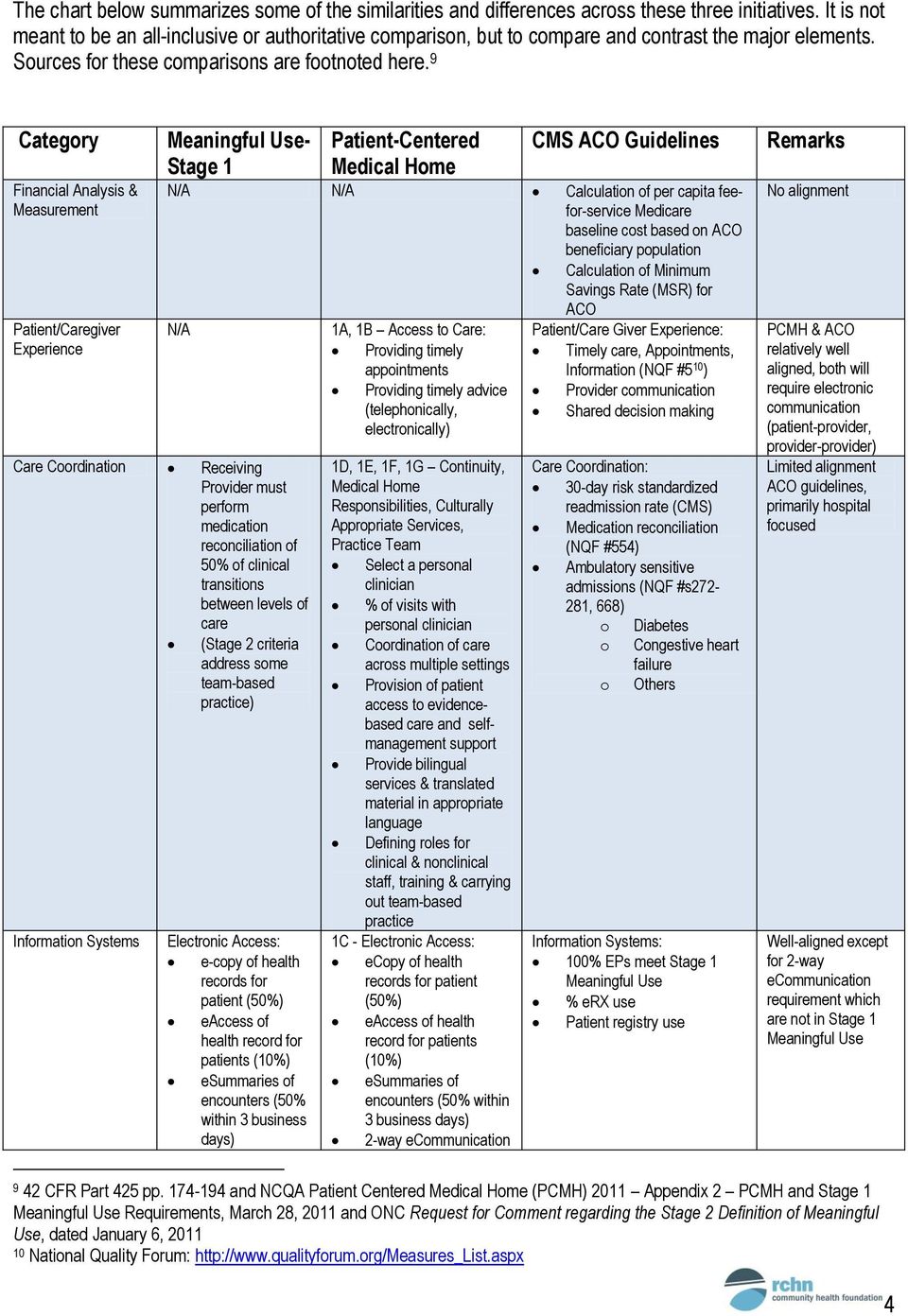
4 The chart below summarizes some of the similarities and differences across these three initiatives. It is not meant to be an all-inclusive or authoritative comparison, but to compare and contrast the major elements. Sources for these comparisons are footnoted here. 9 Category Financial Analysis & Measurement Patient/Caregiver Experience Meaningful Use- Stage 1 Patient-Centered Medical Home CMS ACO Guidelines N/A N/A Calculation of per capita feefor-service Medicare baseline cost based on ACO beneficiary population Calculation of Minimum Savings Rate (MSR) for ACO N/A 1A, 1B Access to Care: Patient/Care Giver Experience: Providing timely Timely care, Appointments, appointments Information (NQF #5 10 ) Providing timely advice Provider communication (telephonically, Shared decision making electronically) Care Coordination Receiving Provider must perform medication reconciliation of 50% of clinical transitions between levels of care (Stage 2 criteria address some team-based practice) Information Systems Electronic Access: e-copy of health records for patient (50%) eaccess of health record for patients (10%) esummaries of encounters (50% within 3 business days) 1D, 1E, 1F, 1G Continuity, Medical Home Responsibilities, Culturally Appropriate Services, Practice Team Select a personal clinician % of visits with personal clinician Coordination of care across multiple settings Provision of patient access to evidencebased care and selfmanagement support Provide bilingual services & translated material in appropriate language Defining roles for clinical & nonclinical staff, training & carrying out team-based practice 1C - Electronic Access: ecopy of health records for patient (50%) eaccess of health record for patients (10%) esummaries of encounters (50% within 3 business days) 2-way ecommunication Care Coordination: 30-day risk standardized readmission rate (CMS) Medication reconciliation (NQF #554) Ambulatory sensitive admissions (NQF #s , 668) o Diabetes o Congestive heart failure o Others Information Systems: 100% EPs meet Stage 1 Meaningful Use % erx use Patient registry use Remarks No alignment PCMH & ACO relatively well aligned, both will require electronic communication (patient-provider, provider-provider) Limited alignment ACO guidelines, primarily hospital focused Well-aligned except for 2-way ecommunication requirement which are not in Stage 1 Meaningful Use 9 42 CFR Part 425 pp and NCQA Patient Centered Medical Home (PCMH) 2011 Appendix 2 PCMH and Stage 1 Meaningful Use Requirements, March 28, 2011 and ONC Request for Comment regarding the Stage 2 Definition of Meaningful Use, dated January 6, National Quality Forum: 4
5 Educational & Community Resources Care Coordination Clinical Reporting/ Patient Safety Patient & Clinical Data patient problem & medication lists lab results patient reminders in Stage 1, 2 Use of certified EHR to identify and provide patient identified educational resources Electronic exchange of clinical data and summary records for care transitions, Submission of PQRI measures to CMS Electronic submission of data to disease registries Electronic submission of syndromic surveillance data to public health agencies CMS to announce rules to integrate PQRI & meaningful use incentives on January 1, 2012 (patient-provider) 2A,2B, 2D Patient Data, Clinical Data, Population Management Patient demographic data Patient clinical data Proactive reminders 4A, 4B Provide Self-care Support & Community Resources 5A, 5B, 5C Track & Coordinate Care 6A 6F Measure & Improve Performance Submission of PQRI measures to CMS Submission of clinical quality measures to other external agencies Electronic submission of data to disease registries Electronic submission of syndromic surveillance data to public health agencies Integration of Community Resources into treatment plans Care coordination required across multiple organizations and for chronic conditions (NQF #224) Patient Safety/Preventive Health Acquired Conditions Composite (AHRQ PQRI, NQF #531) Specific measures including: (Various PQRI & NQF measures) o Mammography screening o Colorectal cancer screening o Adult weight management o Others At-Risk Populations See above See above 6A 6F At Risk Populations: Various clinical procedures regarding (Various CMS, PQRI & NQF measures): Diabetes Heart failure Coronary artery disease Hypertension COPD 11 Frail/Elderly Limited alignment on community resources relatively good alignment PCMH & EHR incentives somewhat aligned, but limited alignment with ACO guidelines Limited alignment In a sense, the specifics notwithstanding, we could say that these three initiatives are in fact well aligned since the ACO guidelines also require 100% of Eligible Providers in the ACO to meet Stage 1 meaningful use criteria as well as the PCMH and meaningful use requirements. All three initiatives require some level of: eprescribing; Medication reconciliation; Use of patient registries; Reporting of selected PRI measures; 11 Chronic Obstructive Pulmonary Disease 5

6 Use of information exchange (of various types) for care coordination; Provider to provider & provider to patient communication of various types. In actuality, while there are some easily- identified similarities, the requirements of each initiative have many differences. Furthermore, demonstrating performance in these areas will require an information technology infrastructure and application suite that may be more extensive than that in place today in most CHCs. This may include: A high speed network at least at T1 speeds (1.5MB/second) or higher for health information exchange (HIE); Network monitoring and management tools to ensure reliability and availability of service; Redundant, modern application server hardware (reliable commercial hardware running a Microsoft or Linux server operating system with at least 4 GB of random access memory & 150 GB of user accessible memory per node); Redundant database server hardware (as above) managing at least 1 TB of data storage; Application suite consisting of a practice management system integrated with a certified EHR that provides a portal for consumer access to health records (or a separate collaboration portal that provides external provider access as well as consumer access. Both types of access could be provided by secure (NwHIN Direct), but consumers would need direct access by Stage 2 meaningful use). o EHR or separate software must also provide connections to disease registries, public health agencies & HIE capability; Finally, ACO participation will require financial analytic software and possibly the ability to provide data extracts from clinical and administrative data. There are two factors that make requirements for all of this complex IT and HIT infrastructure less daunting. The first is that the infrastructure may serve to support qualification for all three initiatives. Second is that all of this capability could be provided through a health center controlled network (HCCN), a state or regional primary care association (SR/PCA), or through a commercial hosting arrangement. That s the good news. The complexity is that qualifying for any of these initiatives will require changes in how a health center operates both its clinical and business functions., While all of these changes are positive over time, considerable effort will be required on the part of CHCs to make them a reality. So what are the implications of all this for health centers? Is there a strategy here that makes sense? In the end the implementation of an information technology infrastructure and application suite that will support and enable qualification for meaningful use and PCMH is essential. The close alignment of PCMH and meaningful use allows a single IT infrastructure to support both. Associated with building or contracting for this infrastructure is the training and change management required to meet the performance and utilization measures for both meaningful use and PCMH. This infrastructure also provides the foundation for building out the financial analysis and reporting capabilities that are required for ACO qualification and eventual participation in an ACO or other risk model. The clinical performance and reporting requirements for ACO participation can, for the most part, be met by the meaningful use/pcmh infrastructure. Understanding the requirements for all three initiatives is the crucial first step. Health centers have been working on meaningful use and PCMH for some time, but now need to quickly begin understanding the proposed ACO model. A next step is making sure that the center s HIT infrastructure and application suite will support each initiative, either in a standalone effort or through a PCA, HCCN or hosting partner. The final step is planning and implementing the capability for risk- based financial measurement.. This 6

7 need not be done immediately, but doing so will put a health center in a much better position to determine if ACO or other risk-based participation is right for them. Given the alignment across certain performance measures, and the shared emphasis on clinical coordination, evidence-based care and decision support, qualifying for meaningful use and/or PCMH certification should position health centers well for eventual ACO participation. Planning for the eventual calculation of per-patient (Medicare/Medicaid) costs will prove to be an operational advantage for, and those that have implemented sophisticated risk-model financial capability will be better positioned to participate in new payer models. 7

Gold Coast Health IT Resource Center. Accountable Care Organization (ACO)
 Gold Coast Health IT Resource Center Accountable Care Organization (ACO) August 27, 2013 Copyright 2013 Gold Coast HIT 1 Agenda Upcoming Webinars ACO s Copyright 2013 Gold Coast HIT 2 Upcoming Webinars
NATIONAL ASSOCIATION OF COMMUNITY HEALTH CENTERS. Briefing Paper on the Proposed Medicare Shared Savings Program
 NATIONAL ASSOCIATION OF COMMUNITY HEALTH CENTERS Briefing Paper on the Proposed Medicare Shared Savings Program The Centers for Medicare and Medicaid Services (CMS) recently issued a proposed rule to implement
Accountable Care Organizations: Notice of Proposed Rulemaking
 Accountable Care Organizations: Notice of Proposed Rulemaking Presentation by: Pam Silberman, JD, DrPH North Carolina Institute of Medicine April 15, 2011 1 Accountable Care Organizations (ACOs) An ACO
Improving Quality of Care for Medicare Patients: Accountable Care Organizations
 DEPARTMENT OF HEALTH AND HUMAN SERVICES Centers for Medicare & Medicaid Services Improving Quality of Care for Medicare Patients: FACT SHEET Overview http://www.cms.gov/sharedsavingsprogram On October
Telemedicine in the Patient Protection and Affordable Care Act (2010)
 Telemedicine in the Patient Protection and Affordable Care Act (2010) The new national health insurance reform legislation contains several advances for telemedicine that are listed below. There are numerous
What is an ACO? What forms of organizations may become an ACO? IAMSS 30 th Annual Education Conference Pearls of Wisdom
 IAMSS 30 th Annual Education Conference Pearls of Wisdom The Impact of Accountable Care Organizations (ACOs) and Health Care Reform on Credentialing, Privileging and Peer Review April 28-29, 2011 Michael
CMS QCDR (Qualified Clinical Data Registry) and Other Ways PPRNet Can Help with Value-Based Payment
 CMS QCDR (Qualified Clinical Data Registry) and Other Ways PPRNet Can Help with Value-Based Payment Cara Litvin MD, MS Assistant Professor MUSC Department of Medicine Agenda Provide an update of the current
Medicare Final Accountable Care Organization (ACO) Regulations Effective January 1, 2012 Median Savings of $470 Million over 4 Years
 October 20, 2011 CIT Healthcare, John M. Cousins, SVP Healthcare Intelligence [email protected] Tel: 850-668-2907 Cell: 716-867-9965 Medicare Final Accountable Care Organization (ACO) Regulations Effective
The HITECH Act and Meaningful Use Implications for Population and Public Health
 The HITECH Act and Meaningful Use Implications for Population and Public Health Bill Brand, MPH Public Health Informatics Institute Meaningful Use for Public Health Professionals: Basic Training May 16,
Medicare Shared Savings Program Quality Measure Benchmarks for the 2015 Reporting Year
 Medicare Shared Savings Program Quality Measure Benchmarks for the 2015 Reporting Year Release Notes/Summary of Changes (February 2015): Issued correction of 2015 benchmarks for ACO-9 and ACO-10 quality
Meaningful Use Qualification Plan
 Meaningful Use Qualification Plan Overview Certified EHR technology used in a meaningful way is one piece of a broader Health Information Technology infrastructure intended to reform the health care system
ESSENTIA HEALTH AS AN ACO (ACCOUNTABLE CARE ORGANIZATION)
 ESSENTIA HEALTH AS AN ACO (ACCOUNTABLE CARE ORGANIZATION) Hello and welcome. Thank you for taking part in this presentation entitled "Essentia Health as an ACO or Accountable Care Organization -- What
Geiger Gibson / RCHN Community Health Foundation Research Collaborative. Policy Research Brief # 23
 Geiger Gibson / RCHN Community Health Foundation Research Collaborative Policy Research Brief # 23 Medicare s Accountable Care Organization Regulations: How Will Medicare Beneficiaries who Reside in Medically
Accountable Care Organizations: What Providers Need to Know
 DEPARTMENT OF HEALTH AND HUMAN SERVICES Centers for Medicare & Medicaid Services Accountable Care Organizations: FACT SHEET Overview http://www.cms.gov/sharedsavingsprogram On October 20, 2011, the Centers
Improving Quality of Care for Medicare Patients: Accountable Care Organizations
 DEPARTMENT OF HEALTH AND HUMAN SERVICES Centers for Medicare & Medicaid Services Improving Quality of Medicare Patients: Overview The Centers for Medicare & Medicaid Services (), an agency within the Department
Home Health Care Today: Higher Acuity Level of Patients Highly skilled Professionals Costeffective Uses of Technology Innovative Care Techniques
 Comprehensive EHR Infrastructure Across the Health Care System The goal of the Administration and the Department of Health and Human Services to achieve an infrastructure for interoperable electronic health
Client Alert. CMS Releases Proposed Rule On Meaningful Use Of Electronic Health Record Technology
 Contact Attorneys Regarding This Matter: Tracy M. Field 404.873.8648 - direct 404.873.8649 - fax [email protected] Erin M. Rush 404.873.7030 - direct 404.873.7031 - fax [email protected] Client Alert
Medicare Shared Savings Program
 Medicare Shared Savings Program Shared Savings Program http://www.cms.gov/savingsprogram/ Centers for Medicare & Medicaid Services February 2012 Medicare Shared Savings Program (Shared Savings Program)
Appendix 2. PCMH 2014 and CMS Stage 2 Meaningful Use Requirements
 Appendix 2 PCMH 2014 and CMS Stage 2 Meaningful Use Requirements Appendix 2 PCMH 2014 and CMS Stage 2 Meaningful Use Requirements 2-1 APPENDIX 2 PCMH 2014 AND CMS STAGE 2 MEANINGFUL USE REQUIREMENTS Medicare
Frequently Asked Questions: Electronic Health Records (EHR) Incentive Payment Program
 1. Where did the Electronic Health Records (EHR) Incentive Program originate? The American Recovery and Reinvestment Act (ARRA) was signed into law on February 17, 2009, and established a framework of
RE: Medicare Program; Request for Information Regarding Accountable Care Organizations and the Medicare Shared Saving Program
 Centers for Medicare & Medicaid Services Department of Health and Human Services Attention: CMS 1345 NC P.O. Box 8013 Baltimore, MD 21244 8013 RE: Medicare Program; Request for Information Regarding Accountable
HCCN Meaningful Use Review. October 7 th, 2015 Louisiana Public Health Institute Kelly Maggiore Jack Millaway
 HCCN Meaningful Use Review October 7 th, 2015 Louisiana Public Health Institute Kelly Maggiore Jack Millaway What is Meaningful Use? Federal and State incentive payment program for Eligible Professionals
OPTIMIZING THE USE OF YOUR ELECTRONIC HEALTH RECORD. A collaborative training offered by Highmark and the Pittsburgh Regional Health Initiative
 OPTIMIZING THE USE OF YOUR ELECTRONIC HEALTH RECORD A collaborative training offered by Highmark and the Pittsburgh Regional Health Initiative Introductions Disclosures Successful completion of training
What GI Practices Need to Know About the Electronic Health Record Incentive Program. Joel V. Brill, MD, AGAF Lawrence R. Kosinski, MD, MBA, AGAF
 What GI Practices Need to Know About the Electronic Health Record Incentive Program Joel V. Brill, MD, AGAF Lawrence R. Kosinski, MD, MBA, AGAF Disclosures Joel V. Brill, MD AGAF AGA Registry Executive
NATIONAL ASSOCIATION OF COMMUNITY HEALTH CENTERS. Briefing Paper on the Proposed Medicare Shared Savings Program
 NATIONAL ASSOCIATION OF COMMUNITY HEALTH CENTERS Briefing Paper on the Proposed Medicare Shared Savings Program The Centers for Medicare and Medicaid Services (CMS) recently issued a proposed rule to implement
Presented by. Terri Gonzalez Director of Practice Improvement North Carolina Medical Society
 Presented by Terri Gonzalez Director of Practice Improvement North Carolina Medical Society Meaningful Use is using certified EHR technology to: Improve quality, safety, efficiency, and reduce errors Engage
LOOKING FORWARD TO STAGE 2 MEANINGFUL USE. 2012 Louisiana HIPAA & EHR Conference Presenter: Kathleen Keeley
 LOOKING FORWARD TO STAGE 2 MEANINGFUL USE 2012 Louisiana HIPAA & EHR Conference Presenter: Kathleen Keeley Topics of Discussion Stage 2 Eligibility Stage 2 Meaningful Use Clinical Quality Measures Payment
Continuity of Care Guide for Ambulatory Medical Practices
 Continuity of Care Guide for Ambulatory Medical Practices www.himss.org t ra n sf o r m i ng he a lth c a re th rou g h IT TM Table of Contents Introduction 3 Roles and Responsibilities 4 List of work/responsibilities
How Health Reform Will Affect Health Care Quality and the Delivery of Services
 Fact Sheet AARP Public Policy Institute How Health Reform Will Affect Health Care Quality and the Delivery of Services The recently enacted Affordable Care Act contains provisions to improve health care
Chapter Three Accountable Care Organizations
 Chapter Three Accountable Care Organizations One of the most talked-about changes in health care delivery in recent decades is Accountable Care Organizations, or ACOs. Having gained the attention of both
Explanation of CMS Proposed Performance Measurement Framework for ACOs and Comparison with IHA P4P Measure Set April 2011
 Explanation of CMS Proposed Performance ment Framework for ACOs and Comparison with IHA P4P Set April 2011 This briefing outlines Section II E ( and Other Reporting Requirements) of the Shared Savings
CMS s framework for Value Modifier
 CMS s framework for Value Modifier Relationship between quality of care, cost composites and the Value Modifier Clinical Care Patient Experience Population/ Community Health Patient Safety Care Coordination
Meaningful Use Objectives
 Meaningful Use Objectives The purpose of the electronic health records (EHR) incentive program is not so much the adoption of health information technology (HIT), but rather how HIT can further the goals
Accountable Care Organizations (ACO) Proposed Rule Summary March 31, 2011
 Accountable Care Organizations (ACO) Proposed Rule Summary March 31, 2011 On March 31, 2011, the Centers for Medicare & Medicaid Services (CMS) released the longawaited proposed rule on Accountable Care
DETAILED SUMMARY--MEDCIARE SHARED SAVINGS/ACCOUNTABLE CARE ORGANIZATION (ACO) PROGRAM
 1 DETAILED SUMMARY--MEDCIARE SHARED SAVINGS/ACCOUNTABLE CARE ORGANIZATION (ACO) PROGRAM Definition of ACO General Concept An ACO refers to a group of physician and other healthcare providers and suppliers
How To Prepare For A Patient Care System
 Preparing for Online Communication with Your Patients A Guide for Providers This easy-to-use, time-saving guide is designed to help medical practices and community clinics prepare for communicating with
Hospital-Based Provider A provider who furnishes 90% or more of their services in a hospital setting (inpatient, outpatient, or emergency room).
 Glossary of Terms Adopting, implementing or upgrading (AIU) certified EHR technology The process by which providers have installed and started using certified EHR technology that is capable of meeting
ACO Program: Quality Reporting Requirements. Jennifer Faerberg Mary Wheatley April 28, 2011
 ACO Program: Quality Reporting Requirements Jennifer Faerberg Mary Wheatley April 28, 2011 Agenda for Today s Call Overview Quality Reporting Requirements Benchmarks/Thresholds Scoring Model Scoring Methodology
CMS-1461-P Medicare Program; Medicare Shared Savings Program: Accountable Care Organizations
 February 6, 2015 Ms. Marilyn Tavenner Administrator Centers for Medicare & Medicaid Services Department of Health and Human Services 7500 Security Boulevard Baltimore, Maryland 21244 RE: CMS-1461-P Medicare
Accountable Care Organization Provisions in the Patient Protection and Affordable Care Act
 Accountable Care Organization Provisions in the Patient Protection and Affordable Care Act The consolidated Patient Protection and Affordable Care Act 1 is 974 pages long. Text related to Accountable Care
Medicare ACO Road Map
 PYALeadership Briefing Medicare ACO Road Map January, 2013 Medicare ACO Road Map The Centers for Medicare & Medicaid Services ( CMS ) has announced 106 new accountable care organizations ( ACOs ) have
Starting an ACO: IT Lessons Learned
 Starting an ACO: IT Lessons Learned Robert Slepin, PMP, VP and CIO John C. Lincoln Health Network Nathan Anspach, SVP and CEO John C. Lincoln Accountable Care Organization John C. Lincoln Physician Network
PROGRESS IN ELECTRONIC HEALTH RECORD IMPLEMENTATION THROUGH HRSA GRANTS TO HEALTH CENTER CONTROLLED NETWORKS
 Department of Health and Human Services OFFICE OF INSPECTOR GENERAL PROGRESS IN ELECTRONIC HEALTH RECORD IMPLEMENTATION THROUGH HRSA GRANTS TO HEALTH CENTER CONTROLLED NETWORKS Daniel R. Levinson Inspector
An Overview of Meaningful Use: FAQs
 An Overview of Meaningful Use: FAQs On Feb. 17, 2009, President Obama signed the American Recovery and Reinvestment Act of 2009 (ARRA) into law. This new law includes provisions (known as the HITECH Act)
Stage 2 Final Rule Overview: Updates to Stage 1 and New Stage 2 Requirements
 Stage 2 Final Rule Overview: Updates to Stage 1 and New Stage 2 Requirements The Centers for Medicare and Medicaid Services (CMS) issued the Stage 2 Final Rule on September 4, 2012. The Stage 2 Final Rule
Toward Meaningful Use of HIT
 Toward Meaningful Use of HIT Fred D Rachman, MD Health and Medicine Policy Research Group HIE Forum March 24, 2010 Why are we talking about technology? To improve the quality of the care we provide and
E Z BIS ELECTRONIC HEALTH RECORDS
 E Z BIS ELECTRONIC HEALTH RECORDS CERTIFICATION AND THE HITECH INCENTIVE PROGRAM The Incentives On July 13, 2010, the U.S. Department of Health and Human Services finalized the Electronic Health Record
Steven E. Ramsland, Ed.D., Senior Associate, OPEN MINDS The 2015 OPEN MINDS Performance Management Institute February 13, 2015 10:15am 11:30am
 Steven E. Ramsland, Ed.D., Senior Associate, OPEN MINDS The 2015 OPEN MINDS Performance Management Institute February 13, 2015 10:15am 11:30am The execution or accomplishment of work, acts, or feats The
Presented by Kathleen S. Wyka, AAS, CRT, THE AFFORDABLE CA ACT AND ITS IMPACT ON THE RESPIRATORY C PROFESSION
 Presented by Kathleen S. Wyka, AAS, CRT, THE AFFORDABLE CA ACT AND ITS IMPACT ON THE RESPIRATORY C PROFESSION At the end of this session, you will be able to: Identify ways RT skills can be utilized for
1900 K St. NW Washington, DC 20006 c/o McKenna Long
 1900 K St. NW Washington, DC 20006 c/o McKenna Long Centers for Medicare & Medicaid Services U. S. Department of Health and Human Services Attention CMS 1345 P P.O. Box 8013, Baltimore, MD 21244 8013 Re:
Advancing Health Equity. Through national health care quality standards
 Advancing Health Equity Through national health care quality standards TABLE OF CONTENTS Stage 1 Requirements for Certified Electronic Health Records... 3 Proposed Stage 2 Requirements for Certified Electronic
Summary of the Proposed Rule for the Medicare and Medicaid Electronic Health Records (EHR) Incentive Program (Eligible Professionals only)
 Summary of the Proposed Rule for the Medicare and Medicaid Electronic Health Records (EHR) Incentive Program (Eligible Professionals only) Background Enacted on February 17, 2009, the American Recovery
Medicare Physician Reporting: Beyond PQRS. Mary Patton Wheatley Senior Specialist, AAMC August 17, 2011
 Medicare Physician Reporting: Beyond PQRS Mary Patton Wheatley Senior Specialist, AAMC August 17, 2011 Who is the AAMC? The Association of American Medical Colleges (AAMC) serves and leads the academic
An Introduction to the Medicaid EHR Incentive Program for Eligible Professionals
 EHR Incentive Programs A program administered by the Centers for Medicare & Medicaid Services (CMS) An Introduction to the Medicaid EHR Incentive Program for Eligible Professionals cms.gov/ehrincentiveprograms
Entities eligible for ACO participation
 On Oct. 20, 2011, the Centers for Medicare & Medicaid Services (CMS) finalized new rules under the Medicare Shared Savings Program (MSSP) to help doctors, hospitals, and other health care providers better
ACCOUNTABLE CARE ANALYTICS: DEVELOPING A TRUSTED 360 DEGREE VIEW OF THE PATIENT
 ACCOUNTABLE CARE ANALYTICS: DEVELOPING A TRUSTED 360 DEGREE VIEW OF THE PATIENT Accountable Care Analytics: Developing a Trusted 360 Degree View of the Patient Introduction Recent federal regulations have
HL7 and Meaningful Use
 HL7 and Meaningful Use HIMSS Las Vegas February 23, 2012 Grant M. Wood Intermountain Healthcare Clinical Genetics Institute Meaningful Use What Does It Mean? HITECH rewards the Meaningful Use of health
Meaningful Use Rules Proposed for Electronic Health Record Incentives Under HITECH Act By: Cherilyn G. Murer, JD, CRA
 Meaningful Use Rules Proposed for Electronic Health Record Incentives Under HITECH Act By: Cherilyn G. Murer, JD, CRA Introduction On December 30, 2009, The Centers for Medicare & Medicaid Services (CMS)
STAGE 2 of the EHR Incentive Programs
 EHR Incentive Programs A program administered by the Centers for Medicare & Medicaid Services (CMS) Eligible Professional s Guide to STAGE 2 of the EHR Incentive Programs September 2013 TABLE OF CONTENTS...
Overview of MU Stage 2 Joel White, Health IT Now
 Overview of MU Stage 2 Joel White, Health IT Now 1 Agenda 1. Introduction 2. Context 3. Adoption Rates of HIT 4. Overview of Stage 2 Rules 5. Overview of Issues 6. Trend in Standards: Recommendations v.
CMS Next Generation ACO Model. Payment Models Work Group April 20 th, 2015
 CMS Next Generation ACO Model Payment Models Work Group April 20 th, 2015 1 Why is there a new ACO model? To address concerns about certain design elements of the existing Pioneer Program and the MSSP
Proposed Rule for Meaningful Use Stage 2
 Proposed Rule for Meaningful Use Stage 2 The Old The Changes The New Continuing Medical Education Disclaimer hi i if h i i S d Ch i This is to certify that Marnivia Spencer and Chris Hudson have disclosed
UPDATED NOVEMBER 2015. Providing and Billing Medicare for Chronic Care Management
 UPDATED NOVEMBER 2015 Providing and Billing Medicare for Chronic Care Management Research studies have demonstrated time and again that care management reduces total costs of care for chronic disease patients
NHCHC Meaningful Use of Electronic Health Records Resource Catalogue. Meaningful Use Overview
 Meaningful Use Overview Meaningful use is the use of a certified electronic health record (EHR) to demonstrate improved quality and safety of health care delivery for a patient population within a clinical
How To Write The 2013 Aco Narrative Measure
 December 21, 2012 Accountable Care Organization 2013 Program Analysis Quality Performance Standards Narrative Measure Specifications Prepared for Quality Measurement & Health Assessment Group Center for