
U.S. Health Care Spending: Comparison with Other OECD Countries
|
|
|
- Duane Allen
- 10 years ago
- Views:
Transcription
1 Order Code RL34175 U.S. Health Care Spending: Comparison with Other OECD Countries September 17, 2007 Chris L. Peterson and Rachel Burton Domestic Social Policy Division

2 U.S. Health Care Spending: Comparison with Other OECD Countries Summary The United States spends more money on health care than any other country in the Organization for Economic Cooperation and Development (OECD). The OECD consists of 30 democracies, most of which are considered the most economically advanced countries in the world. According to OECD data, the United States spent $6,102 per capita on health care in 2004 more than double the OECD average and 19.9% more than Luxembourg, the second-highest spending country. In 2004, 15.3% of the U.S. economy was devoted to health care, compared with 8.9% in the average OECD country and 11.6% in second-placed Switzerland. Why does the United States spend this amount on health care? Economists break health care spending into two parts: price and quantity (which includes the number of visits to health care providers and the intensity of those visits). In terms of quantity, OECD data indicate that the United States has far fewer doctor visits per person compared with the OECD average; for hospitalizations, the United States ranks well below the OECD and is roughly comparable in terms of length of hospital stays. The intensity of service delivery is a different story: the United States uses more of the newest medical technologies and performs several invasive procedures (such as coronary bypasses and angioplasties) more frequently than the average OECD country. In terms of price, the OECD has stated that there is no doubt that U.S. prices for medical care commodities and services are significantly higher than in other countries and serve as a key determinant of higher overall spending. What does the United States get for the money it spends? Said slightly differently, does the United States get corresponding value from the money it spends on health care? The available data often do not provide clear answers. For example, among OECD countries in 2004, the United States had shorter-than-average life expectancy and higher-than-average mortality rates. Does this mean that the U.S. system is inefficient in light of how much is spent on health care? Or does this reflect the greater prevalence of certain diseases in the United States (the United States has the highest incidence of cancer and AIDS in the OECD) and less healthy lifestyles (the United States has the highest obesity rates in the OECD)? These are some of the issues that confound international comparisons. However, research comparing the quality of care has not found the United States to be superior overall. Nor does the U.S. population have substantially better access to health care resources, even putting aside the issue of the uninsured. Although the United States does not have long wait times for non-emergency surgeries, unlike some OECD countries, Americans found it more difficult to make same-day doctor s appointments when sick and had the most difficulty getting care on nights and weekends. They were also most likely to delay or forgo treatment because of cost. The OECD data and other research provide some insight as to why health care spending is higher in the United States than in other countries, although many difficult research issues remain. This report presents some of the available data and research and concludes with a summary of study findings.

3 Contents How Much Does the United States Spend on Health Care?...1 Why Does the United States Spend So Much on Health Care?...4 Volume: Do Americans Use Health Care More Often?...5 Intensity: When Americans Receive Care, Is It More Involved?...8 Intensity of Hospitalizations...8 Intensity of Doctor Visits...12 Intra-national Variation in Intensity...16 Price: Do Americans Pay More for Health Care Services?...16 Salaries of Health Professionals...17 Price of Medical Equipment...19 Price of Medical Procedures...22 Price of Pharmaceuticals...22 Health Care Spending by Type of Service...28 What Spurs Health Care Prices and Utilization?...31 Factors that Affect Demand...31 Health...31 Age Structure of the Population...32 Income...33 Insurance...33 Tax Treatment...35 Tastes...37 Weak Bargaining Power...38 Factors that Affect Supply...39 Supplier-Induced Demand...39 Specialist Care Emphasis...41 Defensive Medicine...41 Structure of Health System...42 What Does the United States Get for Its Health Care Spending?...45 Wait Times...47 Self-Reported Health Status...48 Life Expectancy...48 Mortality Rates...48 Medical Errors...52 Infant Mortality Rates...52 Does the United States Spend Too Much on Health Care?...55 Conclusion...58 Summary of Findings...58 Total Spending...58 Health Care Resources...58 Pharmaceuticals...58 Health Administration and Insurance...59 Prices...59

4 Population Risk Factors...59 Quality...59 Wait Times...59 Health Outcomes...60 List of Figures Figure 1. Health Care Spending per Capita, Figure 2. Health Care Spending per Capita and GDP per Capita, Figure 3. Hospital Utilization, for All Causes and for Circulatory Conditions, Figure 4. Doctor Visits per Capita, Figure 5. Average Length of Acute Care Hospital Stay, Number of Days, Figure 6. Average Length of Hospital Stay Following Heart Attack, Figure 7. Average Length of Hospital Stay Following Normal Childbirth, Figure 8. Percentage of Live Births that Are Caesarean Sections, Figure 9. Rate (per 100,000 population) of Coronary Revascularization Procedures, Figure 10. Number of Staff per Acute Care Hospital Bed, Figure 11. Number of Nurses per Acute Care Hospital Bed, Figure 12. Number of CT Scanners per 1,000,000 Population, Figure 13. Number of MRI Units per 1,000,000 Population, Figure 14. Specialist Compensation and GDP per Capita (in U.S. $1,000s), Figure 15. Practicing Physicians per 1,000 Population, Figure 16. International Prescription Drug Prices as a Percentage of U.S. Prices, Figure 17. International Pharmaceutical Consumption as a Percentage of U.S. Consumption, for 249 Leading U.S. Molecules, Figure 18. Pharmaceutical Spending per Capita, Figure 19. Pharmaceutical Spending as a Percentage of Total Health Spending, Figure 20. Health Administration and Insurance Costs, Figure 21. Percentage of Health Care Costs Paid Out-of-Pocket, Figure 22. Acute Care Hospital Beds per 1,000 Population, Figure 23. Health Spending per Capita and Self-Reported Health Status, Figure 24. Health Spending per Capita and Life Expectancy, Figure 25. Deaths from Medical Errors per 100,000 Population, Figure 26. Infant Mortality Rates per 1,000 Live Births, Figure 27. Annual Excess Growth (Growth Not Attributable to Demographic or Economic Changes) in Health Spending per Capita, and List of Tables Table 1. Health Care Spending in OECD Countries, Table 2. Average Compensation in Certain Health Professions, 2004 (Dollars in U.S. Purchasing Power Parities)...18

5 Table 3. Average Spending for Treatment of Patients Who Had a Total Hip Arthroplasty...22 Table 4. U.S. Health Care Expenditures per Capita, by Major Categories, Compared with Reporting OECD Countries, Table 5. Life Expectancy and Mortality Rates,

6 U.S. Health Care Spending: Comparison with Other OECD Countries How Much Does the United States Spend on Health Care? In 2004, health care spending in the United States averaged $6,102 per person, according to data from the Organization for Economic Cooperation and Development (OECD). The OECD consists of 30 democracies (listed in Table 1), most of which are considered to be the most economically advanced countries in the world. 1 As shown in Figure 1 and Table 1, U.S. per capita health care spending was well over double the average of OECD countries, which was $2,560 in Health care made up 15.3% of the U.S. economy in 2004, as measured by Gross Domestic Product (GDP) up from 5.1% of GDP in No other OECD country devotes as much of its economy to health care, also shown in Table 1. Figure 2 shows the relationship between health care spending and GDP. The trendline in the figure suggests, based on a simple bivariate comparison, that 90% of the variation in health care spending across the 30 OECD countries may be attributable to GDP per capita. The two outliers are Luxembourg and the United States. Luxembourg appears below the trendline because of its high GDP per capita, which is inflated by its international financial services. 2 The United States appears above the trendline because of its high health care spending; specifically, U.S. health care spending per capita is 60% higher than might be expected, based on GDP. U.S. health care spending is high, even when taking into account how rich the country is. The next section of this report examines the volume, intensity, and price of U.S. health care and assesses the potential impact of each on U.S. spending. The following section discusses some structural causes affecting health care spending, such as the underlying health of countries populations, which may be partially linked to demographics. Although such structural factors can affect health care spending substantially, quantifying that impact for international comparisons is difficult. 1 The OECD Health Data 2006, from October 2006, provides much of the data for this report. Most of the data in this report are from 2004, the most recent year in which most countries provided data. For more information about the OECD, see CRS Report RS21128, The Organization for Economic Cooperation and Development, by James K. Jackson. Unless otherwise noted, the United States is included when calculating OECD averages. 2 Uwe Reinhardt et al., U.S. Health Care Spending in an International Context, Health Affairs, vol., 23, no. 3, May/June 2004, p. 24, available at [ cgi/reprint/23/3/10.pdf].

7 CRS-2 Finally, this report looks into the questions of what the United States gets for its health care spending and whether it spends too much. Table 1. Health Care Spending in OECD Countries, 2004 Country Health care spending per capita Health care spending per capita, as a percentage of U.S. amount Health care spending as a percentage of GDP GDP per capita Percentage of health care publicly financed United States $6, % 15.3% $39, % Luxembourg $5, % 8.0% $63, % Switzerland $4, % 11.6% $35, % Norway $3, % 9.7% $40, % Iceland $3, % 10.2% $32, % Canada $3, % 9.9% $31, % France $3, % 10.5% $29, % Austria $3, % 9.6% $32, % Australia $3, % 9.6% $32, % Belgium $3, % 10.1% $31, % Germany $3, % 10.6% $28, % Netherlands $3, % 9.2% $32, % Denmark $2, % 8.9% $32, % Sweden $2, % 9.1% $31, % Ireland $2, % 7.1% $36, % United Kingdom $2, % 8.1% $30, % Italy $2, % 8.7% $28, % Japan $2, % 8.0% $29, % Finland $2, % 7.5% $29, % Greece $2, % 10.0% $21, % Spain $2, % 8.1% $25, % New Zealand $2, % 8.4% $24, % Portugal $1, % 10.1% $18, % Czech Republic $1, % 7.3% $18, % Hungary $1, % 8.0% $15, % Korea $1, % 5.6% $20, % Poland $ % 6.5% $12, % Slovak Republic $ % 5.9% $14, % Mexico $ % 6.5% $10, % Turkey $ % 7.7% $7, % AVERAGE $2, % 8.9% $27, % excluding U.S. $2, % 8.6% $27, % Median $2, % 8.8% $29, % Source: OECD Health Data 2006 (October 2006), with Congressional Research Service calculations. Notes: GDP is Gross Domestic Product. Dollars are adjusted using U.S. dollar purchasing power parities, which convert currency from different countries into a common U.S. currency and equalize the purchasing power of different currencies. Health care spending per capita and spending as a percentage of GDP are based on estimates or prior-year spending for 15 countries (Belgium, Canada, Czech Republic, Denmark, France, Greece, Iceland, Japan, Luxembourg, Netherlands, Portugal, Slovak Republic, Spain, Sweden, and Switzerland). Data on the percentage of health care publicly financed in Denmark is from More information on the sources and methodology of countryspecific health expenditure and finance data is available online at [ 500.html].

8 CRS-3 Figure 1. Health Care Spending per Capita, 2004 United States Luxembourg Switzerland Norway Iceland Canada France Austria Australia Germany Netherlands Belgium Sweden Denmark Ireland AVERAGE United Kingdom Italy Japan Finland Greece Spain New Zealand Portugal Czech Republic Hungary Korea Poland Slovak Republic Mexico Turkey $4,077 $3,966 $3,331 $3,165 $3,158 $3,123 $3,121 $3,043 $3,038 $3,023 $2,825 $2,656 $2,596 $2,552 $2,508 $2,467 $2,249 $2,235 $2,162 $2,094 $2,083 $1,823 $1,362 $1,281 $1,149 $805 $778 $662 $580 $5,090 $6,102 $0 $1,000 $2,000 $3,000 $4,000 $5,000 $6,000 $7,000 Public Private Health Insurance and Out-of-Pocket Payments Source: OECD Health Data 2006 (October 2006). Notes: Average per capita spending does not exactly match the amount in Table 1 due to the use of data from different years for a few countries and other methodological issues. Dollars are adjusted using U.S. dollar purchasing power parities. Health care spending is based on estimates or on a previous year s spending for 15 countries: for Canada, the Czech Republic, France, Greece, Iceland, Luxembourg, the Netherlands, Portugal, Spain, Sweden, and Switzerland, the numbers are 2004 estimates; for Belgium, Japan, and the Slovak Republic, the numbers are from 2003; and for Denmark, the numbers are from More information on the sources and methodology of country-specific health expenditure and finance data is available online [

9 CRS-4 Figure 2. Health Care Spending per Capita and GDP per Capita, 2004 $8,000 $7,000 Health care spending per capita $6,000 $5,000 $4,000 $3,000 $2,000 United States Luxembourg $1,000 $0 $0 $10,000 $20,000 $30,000 $40,000 $50,000 $60,000 $70,000 GDP per capita Source: Congressional Research Service (CRS) analysis of OECD Health Data 2006 (October 2006). Notes: Health care spending is based on estimates or on prior-year spending for Belgium, Canada, Czech Republic, Denmark, France, Greece, Iceland, Japan, Luxembourg, Netherlands, Portugal, Slovak Republic, Spain, Sweden and Switzerland). More information on the sources of countryspecific expenditure and finance data is available online [ GDP is Gross Domestic Product. The R-squared for this trendline is Why Does the United States Spend So Much on Health Care? The standard economic approach to analyzing health care spending is to break it into two parts price and quantity because spending is calculated by multiplying the volume of units purchased by the unit price. However, health care spending is more complicated because for a particular unit (e.g., a hospital admission or a doctor visit ), total spending will vary by the intensity of care. For example, two hospitals may charge the same price for particular services. Following a heart attack, when individuals are admitted to the hospitals, total spending is going to vary according to the intensity of care whether patients undergo expensive surgeries or are simply given certain medications and monitored. To understand U.S.

10 CRS-5 health care spending in an international context, this section examines the volume (or utilization) of certain types of health care, the intensity of care, and the price of care. Volume: Do Americans Use Health Care More Often? When comparing U.S. utilization of hospital care with other OECD countries, the United States is well below the average. As shown in Figure 3, the United States experienced 121 hospital discharges per 1,000 people in 2004, compared with the OECD average of 161. One possible explanation for the low U.S. utilization of hospital care is that services that are available in outpatient settings in the United States are available only in inpatient hospital settings in some European countries. Diseases of the circulatory system were the largest single cause of hospitalizations in the OECD, accounting for 13% of all discharges. The United States had the highest proportion of hospital discharges because of diseases of the circulatory system (17%). Although the U.S. proportion was the highest in the OECD, the U.S. number of hospitalizations for circulatory-system diseases per 1,000 people in the population (21 per 1,000 people) was the same as the OECD average (as shown in the right-hand portion of Figure 3). This is because of the low U.S. hospitalization utilization generally. In 2004, physician services made up 22% of U.S. health care spending, second only to hospital care. When comparing per capita doctor visits in 27 OECD countries, the United States is the seventh lowest consumer of doctor visits, as shown in Figure 4. 3 Among the four countries with the highest overall spending after the United States Luxembourg, Switzerland, Norway and Iceland their average number of doctor visits was also below the OECD average. Countries with higher rates of doctor visits tended to have lower overall health spending. The number of doctor visits per capita may be influenced by whether patients are required to get a referral in order to see a specialist; in the United States, such gatekeeping, has subsided in recent years, whereas some European countries rely on this practice a great deal. The next-largest component of health care spending in the United States in 2004 was prescription drugs. According to the OECD data, the United States spent roughly twice as much on prescription drugs ($752 per person) as the average OECD country in 2004 (Figure 18). But because overall health spending per capita is even higher than in the average OECD country, prescription drugs ended up comprising a smaller portion of total U.S. health spending (12.3%) compared with the OECD average (17.8%) (Figure 19). 3 The OECD defines per capita doctor visits as ambulatory contacts with physicians (both generalists and specialists) divided by the entire population. The number of contacts normally includes visits of patients at the physician s office, in primary care clinics and in outpatient departments of hospitals, and visits made to the patient s home.

11 CRS-6 Figure 3. Hospital Utilization, for All Causes and for Circulatory Conditions, Austria France Hungary Finland United Kingdom Czech Republic Germany Slovak Republic Luxembourg Poland Norway Iceland Greece Denmark AVERAGE Sweden Belgium Australia Switzerland Italy New Zealand United States Korea Spain Ireland Japan Netherlands Portugal Canada Turkey Mexico All hospital discharges per 1,000 people Hospital discharges for circulatory diseases per 1,000 people Source: OECD Health Data 2006 (October 2006). Notes: Sorted by hospital utilization for all causes. Circulatory conditions include acute myocardial infarction (heart attack), angina pectoris, hypertensive diseases, and cerebrovascular diseases affecting blood flow to the brain. Data are from a previous year for 11 countries: for Belgium, Canada, Denmark, Germany, Italy, Mexico, Spain, and the United States, the data are from 2003; for Japan and Korea, the data are from 2002; and for Greece, the data are from 2000.

12 CRS-7 Figure 4. Doctor Visits per Capita, 2004 Japan 13.8 Czech Republic 13.1 Hungary 12.6 Slovak Republic 11.9 Korea Spain Belgium Denmark Germany 7.3 AVERAGE 6.7 Austria France Poland Canada Italy Luxembourg Australia Iceland Netherlands United Kingdom Finland United States Portugal Switzerland New Zealand Turkey 3.1 Sweden Mexico Source: OECD Health Data 2006 (October 2006). Notes: The OECD defines doctor visits per capita as ambulatory contacts with physicians (both generalists and specialists) divided by the entire population. The number of contacts normally includes visits by patients to physicians offices, primary care clinics, outpatient departments of hospitals, and visits made by a physician to a patient s home. Numbers are from a previous year for 12 countries: for Japan, Spain, France, Canada, the United States, and New Zealand, the data are from 2003; for Korea and Switzerland, the data are from 2002; for Iceland and Sweden, the data are from 2001; and for Germany and Italy, the data are from Recent data are only available for 27 of the 30 OECD countries. Greece, Ireland and Norway are not included.

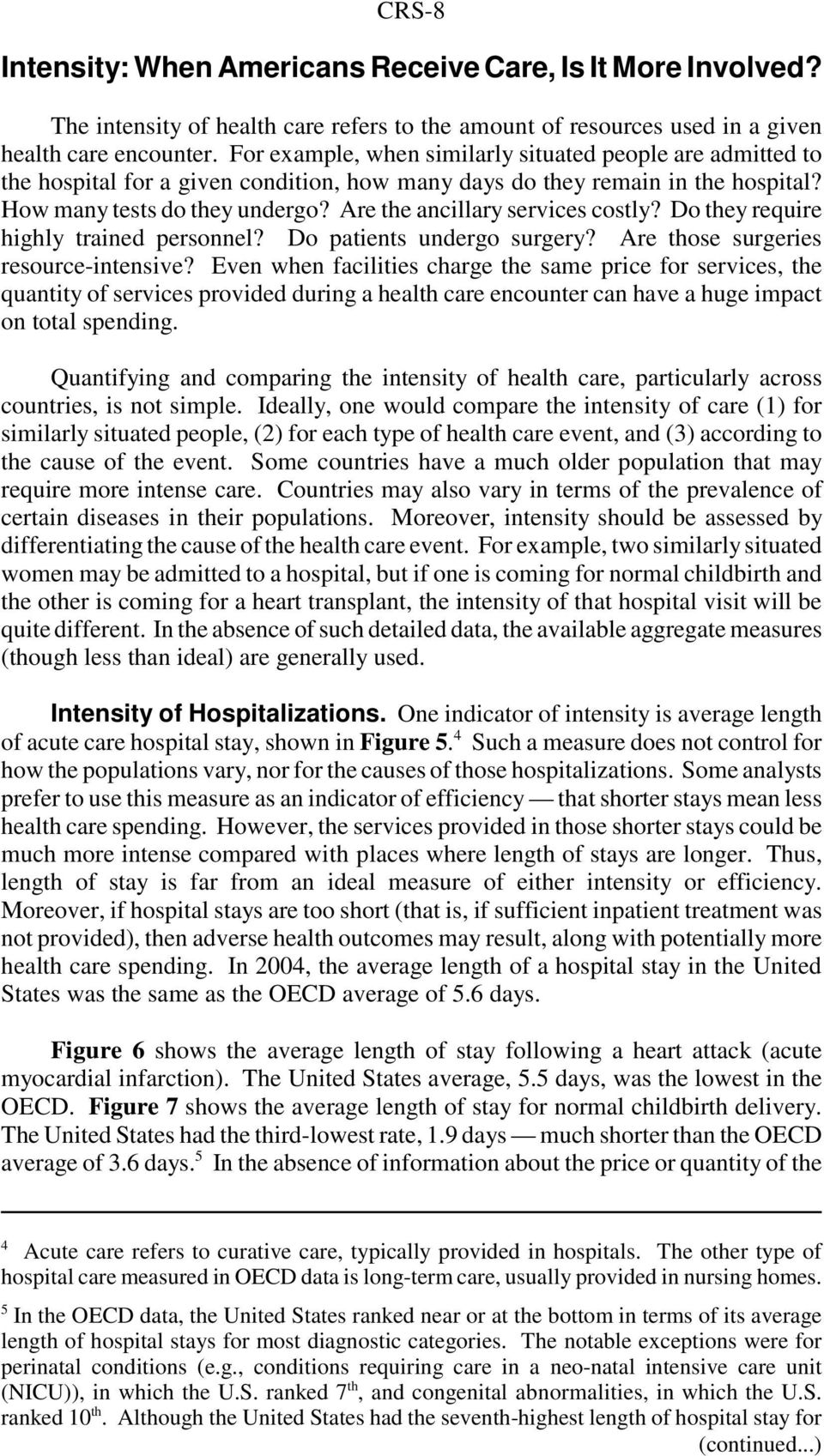
13 CRS-8 Intensity: When Americans Receive Care, Is It More Involved? The intensity of health care refers to the amount of resources used in a given health care encounter. For example, when similarly situated people are admitted to the hospital for a given condition, how many days do they remain in the hospital? How many tests do they undergo? Are the ancillary services costly? Do they require highly trained personnel? Do patients undergo surgery? Are those surgeries resource-intensive? Even when facilities charge the same price for services, the quantity of services provided during a health care encounter can have a huge impact on total spending. Quantifying and comparing the intensity of health care, particularly across countries, is not simple. Ideally, one would compare the intensity of care (1) for similarly situated people, (2) for each type of health care event, and (3) according to the cause of the event. Some countries have a much older population that may require more intense care. Countries may also vary in terms of the prevalence of certain diseases in their populations. Moreover, intensity should be assessed by differentiating the cause of the health care event. For example, two similarly situated women may be admitted to a hospital, but if one is coming for normal childbirth and the other is coming for a heart transplant, the intensity of that hospital visit will be quite different. In the absence of such detailed data, the available aggregate measures (though less than ideal) are generally used. Intensity of Hospitalizations. One indicator of intensity is average length of acute care hospital stay, shown in Figure 5. 4 Such a measure does not control for how the populations vary, nor for the causes of those hospitalizations. Some analysts prefer to use this measure as an indicator of efficiency that shorter stays mean less health care spending. However, the services provided in those shorter stays could be much more intense compared with places where length of stays are longer. Thus, length of stay is far from an ideal measure of either intensity or efficiency. Moreover, if hospital stays are too short (that is, if sufficient inpatient treatment was not provided), then adverse health outcomes may result, along with potentially more health care spending. In 2004, the average length of a hospital stay in the United States was the same as the OECD average of 5.6 days. Figure 6 shows the average length of stay following a heart attack (acute myocardial infarction). The United States average, 5.5 days, was the lowest in the OECD. Figure 7 shows the average length of stay for normal childbirth delivery. The United States had the third-lowest rate, 1.9 days much shorter than the OECD average of 3.6 days. 5 In the absence of information about the price or quantity of the 4 Acute care refers to curative care, typically provided in hospitals. The other type of hospital care measured in OECD data is long-term care, usually provided in nursing homes. 5 In the OECD data, the United States ranked near or at the bottom in terms of its average length of hospital stays for most diagnostic categories. The notable exceptions were for perinatal conditions (e.g., conditions requiring care in a neo-natal intensive care unit (NICU)), in which the U.S. ranked 7 th, and congenital abnormalities, in which the U.S. ranked 10 th. Although the United States had the seventh-highest length of hospital stay for (continued...)
14 CRS-9 services provided during hospital stays, the lower than average hospital utilization and lengths of stay would suggest lower than average spending, which is not the case. Figure 5. Average Length of Acute Care Hospital Stay, Number of Days, 2004 Japan Korea Germany Switzerland Czech Republic Slovak Republic Netherlands Belgium Canada Luxembourg Portugal Spain Italy Poland United Kingdom Hungary Ireland Greece Australia Austria AVERAGE Iceland United States France Norway Turkey New Zealand Finland Sweden Mexico Denmark Source: OECD Health Data 2006 (October 2006). Notes: Acute care is curative care generally provided in a hospital (as opposed to long-term care, which is generally provided in a nursing home). Numbers are from previous years for 10 countries: for Belgium, Italy, Korea, Mexico, Portugal, and Spain, the numbers are from 2003; for Turkey, the numbers are from 2002; for the Netherlands, the numbers are from 2001; for Greece, the numbers are from 2000; and for New Zealand, the numbers are from In Japan, most elderly patients requiring long-term care receive it in hospitals instead of nursing homes. 6 5 (...continued) perinatal conditions, it had the fourth-lowest number of hospital discharges for these conditions. In other words, the United States had relatively fewer individuals hospitalized for perinatal conditions, but those who were hospitalized had relatively long stays. 6 Naoki Ikegami et al., Applying RUG-III in Japanese long-term care facilities, The Gerontologist, 1994, vol. 34, no. 5, pp

15 CRS-10 Figure 6. Average Length of Hospital Stay Following Heart Attack, 2003 Figure 7. Average Length of Hospital Stay Following Normal Childbirth, 2003 Finland 11.9 Hungary 6.4 Austria Ireland Germany Slovak Republic Sw itzerland Czech Republic United Kingdom Spain Austria Poland Slovak Republic Poland Netherlands Belgium France Luxembourg Sw itzerland Portugal Belgium Germany Italy Norw ay Hungary Italy AVERAGE Iceland Canada Mexico Luxembourg Czech Republic France New Zealand Australia Norw ay Sw eden Denmark United States Finland AVERAGE Denmark Australia Portugal Spain Sw eden Iceland Netherlands New Zealand Mexico Canada United States Turkey United Kingdom Source: OECD Health Data 2006 (October 2006). Notes: Data from 2003 are available for only 26 of the 30 OECD countries.

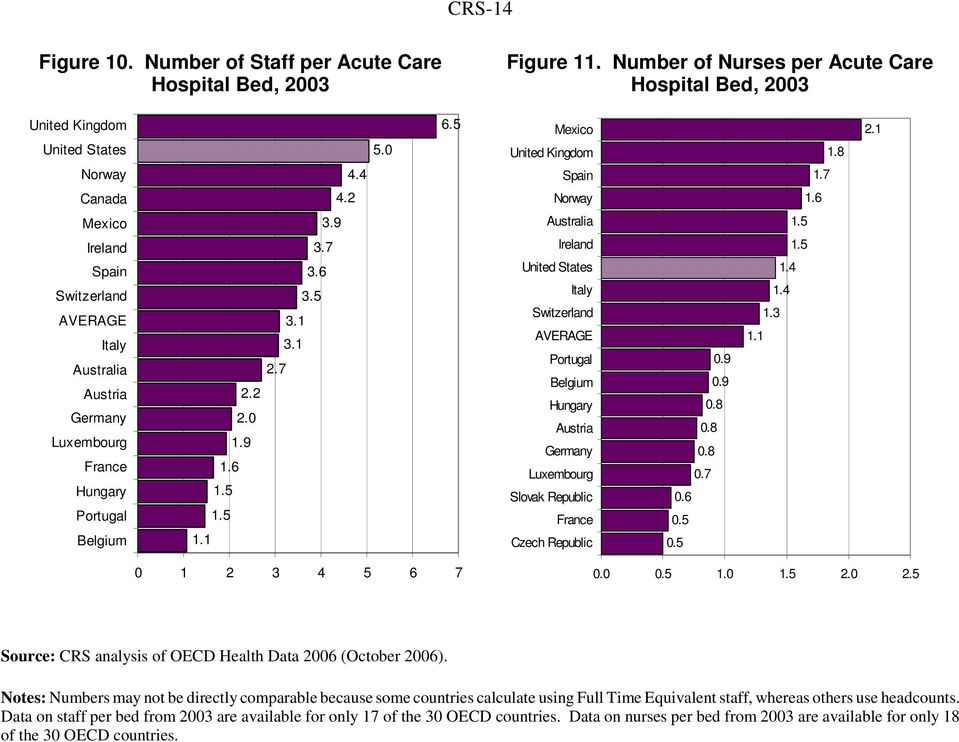
16 CRS-11 Although U.S. hospital stays are generally fewer and shorter, the services provided during those stays may be particularly intensive. Some evidence suggests this is the case. Figure 8 shows that the United States has the fifth-highest rate of caesarean section childbirths. In addition, the United States has one of the top five highest rates of performing organ transplants another particularly intensive type of procedure for all but one type of organ. 7 For all four types of heart procedures on which the OECD collects data, the United States consistently has one of the top five highest rates of performing such procedures. Figures 9 illustrates the use of two intensive surgical coronary revascularization procedures coronary artery bypass grafts (CABGs) and coronary angioplasties (PTCAs). In 2003, these procedures were performed on 587 out of 100,000 people in the United States more than double the OECD average. That said, cross-national comparisons do not always indicate consistently high levels of U.S. service intensity. The United States ranks 2 nd in its rate of knee replacements but 15 th in its rate of hip replacements. The United States performed more procedures than the OECD median for six conditions in 2003, but fewer procedures than the OECD median for four other conditions. 8 For acute care hospitalizations, other broad measures of intensity are the number of staff and the number of nurses per hospital bed. In 2003, the United States averaged five staff members for each occupied acute care hospital bed. This is 61% greater than the OECD average and second only to the United Kingdom (6.5 staff per bed), as shown in Figure When looking at the rate of nurses per occupied bed, the United States is closer to the OECD average, as shown in Figure 11. Although the intensity of hospitalizations in the United States (measured by number of staff per bed and number of intensive procedures performed) tends to be above the OECD average, it rarely ranks first. The exceptions are coronary revascularization procedures and kidney transplants. For the coronary procedures in particular, not only did the United States rank first, but the rates of these procedures were far greater than any other OECD country. 7 The exception is lung transplants, for which the United States was ranked ninth among reporting OECD countries in 2003 in terms of the number of transplants performed per 100,000 people in the population. 8 The conditions that the United States performed more frequently were coronary angioplasties (including stenting), coronary bypass grafts, cardiac catheterizations, implanting pacemakers, hysterectomies, and knee replacements. The conditions that the United States performed less frequently were appendectomies, prostatectomy, hip replacements, and mastectomies. The United States performed more organ transplants than the OECD median for all six types of transplants: bone marrow, heart, liver, lung, kidney, and functioning kidney. Medians are used in these cases because single outlier cases substantially skew the averages. 9 Note that some countries calculate this measure based on number of full-time equivalent staff, while others use a head count. Data for the United States use full-time equivalent staff, but do not match the OECD definition.

17 CRS-12 Other important measures of hospital care intensity are usage rates of resourceintensive technologies. International comparisons of the usage of technologies such as computerized tomography (CT) scanners and magnetic resonance imaging units (MRIs) are not available. However, the OECD data include information on the prevalence of these technologies, which may indicate their usage. The United States has nearly twice as many CT scanners (Figure 12) and three times as many MRI machines (Figure 13) per capita as the OECD average. In fact, the United States has the second-highest number of both CT scanners and MRI machines per population in the OECD, second only to Japan, where low reimbursement rates have driven the development and widespread adoption of inexpensive versions of these machines. 10 Widespread use of advanced medical technology can contribute to higher health spending in a number of ways: through the cost of the equipment or machines themselves; by keeping people alive longer and thereby increasing the opportunity for them to use health care; through eventual expansions in the populations being treated with these technologies; and because competition between hospitals can lead to an oversupply of machines, which in turn can lead to increases in health spending. 11 Intensity of Doctor Visits. The number of doctor visits per capita in the United States was well below the OECD average in 2004 (Figure 4), yet the United States spent much more per capita on outpatient care than any other OECD country. The United States spent $2,668 per capita on outpatient care alone in 2004 threeand-a-half times the OECD average and twice as much as the second-highest spender in this category. As mentioned earlier, this discrepancy could be partially due to the tendency to provide more types of procedures in outpatient settings in the United States compared with many other OECD countries. 10 Naoki Ikegami and John Creighton Campbell, Japan s Health Care System: Containing Costs and Attempting Reform, Health Affairs, May/June 2004, vol. 23, no. 3, pp , available at [ 11 James Lubitz, Health, Technology, And Medical Care Spending, Health Affairs, Web exclusive, September 26, 2005, pp. W5-R81-W5-R85, available at [

18 CRS-13 Figure 8. Percentage of Live Births that Are Caesarean Sections, 2003 Figure 9. Rate (per 100,000 population) of Coronary Revascularization Procedures, 2003 Italy 37% United States 587 Mexico Portugal Australia AVERAGE United States Luxembourg Hungary Sw itzerland Germany Canada Spain New Zealand Austria United Kingdom Denmark Slovak Republic Iceland Sw eden Norw ay Czech Republic 29% 28% 28% 28% 26% 25% 25% 25% 25% 24% 22% 22% 22% 19% 19% 18% 17% 16% 15% 36% Germany AVERAGE Hungary Norw ay Iceland Luxembourg Australia Denmark Ireland MEDIAN Sw eden Finland Spain New Zealand United Kingdom Netherlands Italy Sw itzerland Portugal Netherlands 14% Mexico 4 0% 10% 20% 30% 40% 50% Source: OECD Health Data 2006 (October 2006). Note: Coronary revascularization procedures are coronary artery bypass grafts (CABGs) and coronary angioplasties (PTCAs) and stenting. Caesarean section data from 2003 are available only for 21 of the 30 OECD countries. Coronary revascularization data from 2003 are available only for 19 of the 30 OECD countries. In Figure 9, the median (207) is also shown because the average (332) is so skewed by the U.S. rate.

19 CRS-14 Figure 10. Number of Staff per Acute Care Hospital Bed, 2003 Figure 11. Number of Nurses per Acute Care Hospital Bed, 2003 United Kingdom United States Norway Mexico United Kingdom Spain Canada 4.2 Norway 1.6 Mexico Ireland Spain Switzerland AVERAGE Italy Australia Austria Germany Luxembourg France Hungary Portugal Belgium Australia Ireland United States Italy Switzerland AVERAGE Portugal Belgium Hungary Austria Germany Luxembourg Slovak Republic France Czech Republic Source: CRS analysis of OECD Health Data 2006 (October 2006). Notes: Numbers may not be directly comparable because some countries calculate using Full Time Equivalent staff, whereas others use headcounts. Data on staff per bed from 2003 are available for only 17 of the 30 OECD countries. Data on nurses per bed from 2003 are available for only 18 of the 30 OECD countries.
20 CRS-15 Figure 12. Number of CT Scanners per 1,000,000 Population, 2004 Figure 13. Number of MRI Units per 1,000,000 Population, 2004 Japan United States Korea Belgium Luxembourg Austria Italy AVERAGE Switzerland Greece Iceland Germany Denmark Finland Spain Portugal Czech Republic New Zealand Canada Slovak Republic France Turkey Japan United States Iceland Austria Switzerland Finland Luxembourg Korea Denmark Italy AVERAGE Spain Belgium Germany United Kingdom Canada Portugal Australia New Zealand France Turkey Czech Republic Hungary United Kingdom Poland Hungary Mexico Greece Slovak Republic Poland Mexico Source: OECD Health Data 2006 (October 2006). Notes: Data for Belgium, Portugal, the Slovak Republic, and Turkey are from 2003; data for Greece and Japan are from Data on CT scanners from 2004 are available for only 25 of the 30 OECD countries. Source: OECD Health Data 2006 (October 2006). Notes: Data for Belgium, New Zealand, Portugal, and the Slovak Republic are from 2003; data for Greece and Japan are from Data on MRI machines from 2004 are available for only 26 of the 30 OECD countries.

21 CRS-16 Intra-national Variation in Intensity. It is necessary to note that there is a major amount of variation in health care intensity within the United States. For example, research by John Wennberg and his colleagues at Dartmouth College found that age-, sex-, and race-adjusted spending for traditional, fee-for-service (FFS) Medicare in the Miami hospital referral region in 1996 was $8,414 nearly two and a half times the $3,341 spent that year in the Minneapolis region. 12 They ruled out utilization of surgical procedures and price as the main drivers of these differences. Instead, they concluded that end-of-life care makes Miami truly exceptional: Patients in their last six months of life see more physicians and spend more time in intensive care than is the case virtually anywhere else. 13 Thus, to the extent that one concludes that U.S. spending levels are the highest in the world because of the intensity of care, it should be noted that level of intensity is not nationwide and is not consistently high for all services and for all similarly situated individuals within the United States. Price: Do Americans Pay More for Health Care Services? As previously discussed, Americans do not lead the world in per capita doctor visits or hospitalizations. When Americans receive health care services, they appear to receive a higher-than-average amount of certain surgical procedures and advanced medical technologies, but generally do not have the highest levels in the OECD. This leaves price as the last remaining factor in the equation to explain the high level of U.S. health care spending. In assessing what drives the difference between U.S. health care spending and the rest of the world, some leading health economists responded this way: It s the prices, stupid. 14 Put more formally, a report from the OECD declared that there is no doubt that U.S. prices for medical care commodities and services are significantly higher than in other countries and serve as a key determinant of higher overall spending. 15 While there is little disagreement that prices are a key determinant of higher U.S. health care spending, direct comparisons of international prices of health care 12 John E. Wennberg et al., Geography and the Debate Over Medicare Reform, Health Affairs, Web exclusive, February 13, 2002, pp. W96-W114, available at [ 13 Jonathan Skinner and John E. Wennberg, Exceptionalism Or Extravagance? What s Different About Health Care In South Florida, Health Affairs, Web exclusive, August , pp. W3-372-W3-375, available at [ w3.372v1.pdf]. 14 Gerard Anderson et al., It s the Prices, Stupid: Why The United States Is So Different From Other Countries, Health Affairs, May/June 2003, vol. 22, no. 3, pp , available at [ 15 Elizabeth Docteur et al., The US Health System: An Assessment and Prospective Directions for Reform, OECD Economics Department Working Paper No. 350, available at [
22 CRS-17 goods and services are extremely difficult, requiring analysts to answer some vexing methodological questions. For example, what index, among the various exchange rates and purchasing power parities (PPPs), should be used for currency conversion? Price comparisons are quite sensitive to these assumptions. What are the units to be priced for example, the average cost of an entire surgical procedure or the charges for components of the procedure (hourly rate of the health professionals, charges for equipment usage, etc.)? By choosing the former, intensity is inappropriately subsumed into the price ; however, the latter is difficult to ascertain for all the components of the procedure. Certainly, such price information is rare in an aggregate form that is comparable across multiple countries. This section of the report presents some price comparisons of certain health care goods and services. These comparisons are by no means exhaustive in covering the entire health care system, and require some of the methodological caveats alluded to earlier. Salaries of Health Professionals. Standard economic theory teaches that the production of any good or service requires labor and/or capital. Health care is particularly labor-intensive, requiring the involvement of many individuals, including numerous highly trained professionals such as doctors and nurses. Total health care costs, therefore, will partly be a function of the price of labor doctors and nurses salaries, for instance. As it turns out, U.S. health care professionals (specialists, general practitioners, and nurses) are among the highest paid health professionals in the world. As shown in Table 2, specialists are the third-highest paid, and general practitioners and nurses are the highest paid within their profession among reporting OECD countries. It is necessary to note, however, that higher education in most of the OECD is much less expensive (or even free) compared with the United States. As a result, health care professionals in the rest of the OECD generally begin their careers with considerably smaller educational debts compared with those in the United States. In 2006, 86.7% of new medical school graduates had outstanding educational loans, with an average total educational debt of $129, Depending on how the repayment is structured, the annual payments could be as low as $7,000 per year (with payments over 30 years) or as high as $18,000 per year (with payments over 10 years). 16 Association of American Medical Colleges, 2006 Medical School Graduation Questionnaire: All Schools Report, Final, p. 49, available at [ allschoolsreports/2006.pdf].
23 CRS-18 Table 2. Average Compensation in Certain Health Professions, 2004 (Dollars in U.S. Purchasing Power Parities) Specialists General practitioners Nurses in $1,000s Ratio to per capita GDP in $1,000s Ratio to per capita GDP in $1,000s Ratio to per capita GDP Netherlands $ $ Australia $ $ $ United States $ $ $ Belgium $ $ Canada $ $ United Kingdom $ $ $ France $ $ Ireland $ $ Switzerland $ $ Denmark $ $ $ New Zealand $ $ Germany $ Norway $ $ Sweden $ $ Finland $ $ $ Greece $ $ Portugal $ $ $ Czech Republic $ $ $ Hungary $ $ $ Mexico $ $ $ Poland $ AVERAGE $ $ $ excluding U.S. $ $ $ Median $ $ $ Source: Congressional Research Service (CRS) analysis of Remuneration of Health Professions, OECD Health Data 2006 (October 2006), available at [ Notes: Sorted by specialists compensation. Amounts are adjusted using U.S. dollar purchasing power parities. Amounts from previous years are trended up to 2004 dollars using the annualized Bureau of Labor Statistics Employment Cost Index for wages and salaries of health services workers in private industry. It is not known whether wage growth in health professions in other countries was similar to that in the United States. Amounts are from previous years for 10 countries: data for Australia, Canada, Denmark (for specialists and nurses), Finland (for nurses), and the Netherlands are from 2003; data for Belgium (for specialists), Denmark (for general practitioners), New Zealand (for nurses), and Sweden are from 2002; data for Switzerland and the United States (for specialists and general practitioners) are from 2001; and data for Belgium (for general practitioners) and the United States (for nurses) are from Ratios of salaries to GDP per capita reflect the year the data was collected and are not adjusted for inflation. For countries that have both self-employed and salaried professionals in a given field, the amount presented here is the higher of the two salaries. Four countries have both salaried and self-employed specialists: the Czech Republic (where compensation is $29,484 for salaried and $34,852 for self-employed specialists), Greece ($67,119 and $64,782), the Netherlands ($130,911 and $252,727), and the United States ($170,300 and $229,500). One country has both salaried and self-employed general practitioners: in the United States, salaried general practitioners earn $134,600, compared with $154,200 if self-employed. All nurses are salaried among this data. Recent data are available only for 21 of the 30 OECD countries.
24 CRS-19 Health professionals tend to be paid more generous salaries as the wealth of a country increases (indicated in Table 2 by larger ratios of provider salaries to per capita GDP). Even accounting for this trend, however, the United States pays health professionals more than would be predicted by U.S. wealth. As an example, Figure 14 presents specialist salaries and GDP per capita, with data points above the trendline indicating countries where salaries are more generous than GDP per capita would predict. The U.S. position above the trendline indicates that specialists are paid approximately $50,000 more than would be predicted by the high U.S. GDP. General practitioners are paid roughly $30,000 more than the U.S. GDP would predict, and nurses are paid $8,000 more (not shown). In the labor market, salaries are typically determined by the supply of available workers. When relatively low numbers of professionals with appropriate training exist, they are able to command higher salaries, based on the scarcity of their skills. Figure 15 shows that the United States has a relatively low supply of practicing physicians, which could help explain their high salaries. Price of Medical Equipment. Although it can be defined more broadly, capital in the classical economic sense generally refers to physical items used in the production of a good or service a building, equipment, etc. For health care equipment in particular, it is widely believed that the United States pays the highest prices. Part of the cause may be that the United States is an early adopter of new technologies. The OECD data indicate that when CT scanners, MRIs, and lithotriptors were new technologies, the United States had more of these per capita than any other country. Higher introductory prices are paid by early adopters. However, OECD data comparing international prices of medical equipment, let alone other forms of health care capital, are not available.
25 CRS-20 Figure 14. Specialist Compensation and GDP per Capita (in U.S. $1,000s), 2004 $300 $250 Australia Netherlands United States Specialist compensation $200 $150 $100 Belgium Canada Norway $50 $0 $0 $10 $20 $30 $40 $50 GDP per capita Source: Congressional Research Service (CRS) analysis of Remuneration of Health Professions, OECD Health Data 2006 (October 2006), available at [ Notes: Amounts are adjusted using U.S. dollar purchasing power parities. Amounts are from previous years for 10 countries: data for Australia, Canada, Denmark, and the Netherlands are from 2003; data for Belgium and Sweden are from 2002; data for Switzerland and the United States are from Amounts from previous years are trended up to 2004 dollars using the annualized Bureau of Labor Statistics Employment Cost Index for wages and salaries of health services workers in private industry. It is not known whether wage growth in health professions in other countries was similar to that in the United States. For countries that have both self-employed and salaried professionals in a given field, the amount presented here is the higher of the two salaries. Four countries have both salaried and self-employed specialists: the Czech Republic (where compensation is $29,484 for salaried and $34,852 for self-employed specialists), Greece ($67,119 and $64,782), the Netherlands ($130,911 and $252,727), and the United States ($170,300 and $229,500). One country has both salaried and self-employed general practitioners: in the U.S., salaried general practitioners earn $134,600, compared with $154,200 if self-employed. All nurses are salaried among this data. Recent data are available only for 21 of the 30 OECD countries. The R-squared for this trendline is 0.72.
26 CRS-21 Figure 15. Practicing Physicians per 1,000 Population, 2004 Italy Belgium Switzerland Iceland Netherlands Austria Czech Republic Norway France Germany Portugal Spain Hungary Sweden Slovak Republic AVERAGE Denmark Ireland Luxembourg Australia Finland United States Poland United Kingdom New Zealand Canada Japan Korea Mexico Turkey Source: OECD Health Data 2006 (October 2006). Notes: Data for Australia, Denmark, New Zealand, Sweden, and Turkey are from Recent data are available only for 29 of the 30 OECD countries.
27 CRS-22 Price of Medical Procedures. Although the OECD does not collect data comparing prices of medical procedures, several international studies have consistently found that the United States pays higher prices than other countries for medical procedures. One group of researchers compared in-hospital spending for total hip arthroplasty among patients in three teaching hospitals in Canada and three teaching hospitals in the United States over a five-year period. They found total spending for the procedure in the United States to be twice that in Canada with both overhead costs and direct care costs twice the Canadian level, as shown in Table 3. The spending on direct care in the United States was higher in spite of shorter hospital stays. Physician fees were not included in this analysis, but because they are generally much lower in Canada than in the United States, including that information would only increase the divergence in costs. 17 Table 3. Average Spending for Treatment of Patients Who Had a Total Hip Arthroplasty Spending Canada United States Spending on direct care $4,552 (67%) $8,221 (62%) Spending on overhead $2,214 (33%) $5,118 (38%) Total spending $6,766 (100%) $13,339 (100%) Source: Table II, John Antoniou et al., In-Hospital Cost of Total Hip Arthroplasty in Canada and the United States, Journal of Bone and Joint Surgery, November 2004, vol. 86, no. 11, pp Note: Reported spending in U.S. dollars. Canadian dollar spending amounts were converted to U.S. dollar amounts using purchasing power parities for 1997 through The two other studies that have compared procedure prices in the United States and Canada have found similar results: coronary artery bypass graft surgery costs twice as much in the United States than in Canada, 18 and open abdominal aortic aneurysm repair costs 47% more in the United States than in Canada. 19 Price of Pharmaceuticals. It is generally accepted that the United States pays higher prices for its prescription drugs than most of the world. How much more the United States pays continues to be debated. Direct international price comparisons of prescription drugs have been attempted over the years. 17 John Antoniou et al., In-Hospital Cost of Total Hip Arthroplasty in Canada and the United States, Journal of Bone and Joint Surgery, November 2004, vol. 86, no. 11, pp M.J. Eisenberg et al., Outcomes and cost of coronary artery bypass graft surgery in the United States and Canada, Archives of Internal Medicine, 2005, vol. 165, no. 13, pp Anya C. Brox et al., In-hospital cost of abdominal aortic aneurysm repair in Canada and the United States, Archives of Internal Medicine, November 10, 2003, vol. 163, no. 20, p
28 CRS-23 In the early 1990s, the Government Accountability Office (GAO) (then called the General Accounting Office) issued ground-breaking reports comparing U.S. prescription drug prices to those of Canada and the United Kingdom. 20 For the brand-name prescription drugs that were included in the GAO studies, the U.S. price averaged nearly 32% more than in Canada and 60% more than in the United Kingdom. 21 In spite of efforts to make valid comparisons, some other researchers argued that the U.S. numbers did not adequately reflect discounts and rebates given to HMOs, Medicaid, and other large purchasers. 22 In the intervening years, additional attempts have been made to perform international drug price comparisons, although many of the same limitations apply. A 2003 study by Patricia M. Danzon and Michael F. Furukawa, compared drug prices in the United States with prices in eight other countries. 23 The drugs used in the study were the 249 leading molecules (active ingredients) in the United States. The study found that brand-name prescription drugs still under patent were most expensive in Japan, with the United States ranked second among the nine countries. In the other seven countries, on-patent prescription drug prices were 24% to 39% less expensive than in the United States, as shown in Figure 16. However, among the generic drugs in the study, the United States had the second-lowest prices, also shown in Figure For over-the-counter drugs, the United States had the lowest prices 20 Prescription Drugs: Companies Typically Charge More in the United States Than in Canada, General Accounting Office (GAO) Report HRD92-110, September 1992, available at [ Prescription Drugs: Companies Typically Charge More in the United States Than in the United Kingdom, General Accounting Office (GAO) Report HEHS-94-29, January 1994, available at [ pdf]. 21 For these reports, price was the amount paid by wholesalers to drug manufacturers. 22 More generally, international drug price comparisons are extremely sensitive to choices made about certain key methodological issues, such as sample selection, unit of measurement for price and volume, the relative weight given to consumption patterns in the countries being compared, and the use of exchange rates or purchasing power parities for currency conversion. Patricia M. Danzon and Jeong D. Kim, International Price Comparisons for Pharmaceuticals: Measurement and Policy Issues, Pharmacoeconomics, 1998, 14 Suppl. 1, pp , available at [ 20Files/Intl%20Price%20Comparisons%20for%20Pharma_Mar98%20PharmacoEcon.pdf]. 23 Patricia M. Danzon and Michael F. Furukawa, Prices and Availability of Pharmaceuticals: Evidence from Nine Countries, Health Affairs Web exclusive, October 29, 2003, pp. W , available at [ hlthaff.w3.521v1.pdf]. The numbers represent the wholesale list prices (that is, the amount charged by manufacturers to wholesalers). The numbers also incorporate the authors estimates of off-invoice discounts, which reduced U.S. prices by approximately 8%. The comparisons are based on currency exchange rates rather than PPPs because currency exchange rates will be the basis of manufacturers decisions when projecting their sales revenue. 24 Research by the government of Australia suggests that the price of generics in the United States is not as low compared with other countries as the Danzon and Furukawa research indicates. However, the Australia report was intended for comparing other countries drug prices with Australia alone, not to each other. Methodological issues makes cross-country (continued...)
29 CRS-24 by far among the countries in the study. One commentator summarized the findings this way: It is not accurate to say, then, that the United States has higher prescription-drug prices than other countries. It is accurate to say only that the United States has a different pricing system from that of other countries. Americans pay more for drugs when they first come out and less as the drugs get older, while the rest of the world pays less in the beginning and more later. 25 Of course, price is only one part of the equation of a nation s spending on prescription drugs. Danzon and Furukawa found that the quantity of prescription drugs consumed in the United States is not markedly different from Canada, France and the United Kingdom, as shown in Figure 17. However, the figure also demonstrates how much more the United States consumes of new drugs (two years old or newer). Still, even though the United States has the highest drug spending in the world, at $752 per person (Figure 18), it is below the OECD average in terms of the percentage of health care spending devoted to pharmaceuticals (Figure 19). The below-average results for prescription drugs suggest that U.S. spending on prescription drugs is not as high compared to the rest of the industrialized world as is its spending on other types of health care, as discussed in the following section. 24 (...continued) comparisons for the Australia report problematic. As the bilateral comparisons are based on Australian consumption patterns and different bundles of pharmaceuticals for each country comparison with Australia, conclusions about relative price levels across countries cannot be drawn (Productivity Commission 2001, International Pharmaceutical Price Differences, Research Report, AusInfo, Canberra, available at [ pbsprices/finalreport/pbsprices.pdf]). 25 Malcolm Gladwell, High Prices, The New Yorker, October 25, 2004, vol. 80, no. 32, p. 86, available at [
30 CRS-25 Figure 16. International Prescription Drug Prices as a Percentage of U.S. Prices, % Average Percentage of U.S. Price 200% 150% 100% 50% 94% 64% On-patent Generic 101% 205% 195% 138% 130% 124% 113% 102% 76% 72% 76% 74% 61% 61% 100% 0% Canada Chile France Germany Italy Japan Mexico United Kingdom United States Source: Patricia M. Danzon and Michael F. Furukawa, Prices and Availability of Pharmaceuticals: Evidence from Nine Countries, Health Affairs, Web exclusive, October 29, 2003, pp. W3-521-W3-536, available at [ Exhibit 4; Patricia M. Danzon, Drug Importation: Economic Impact, June 2004 presentation, available at [ slide 18. Notes: On-patent drugs are brand-name prescription drugs available from only a single manufacturer that is also the company that developed the drug. The numbers represent the wholesale list prices (that is, the amount charged by manufacturers to wholesalers). The numbers also incorporate Danzon and Furukawa s estimates of off-invoice discounts in the United States, which reduced U.S. prices by approximately 8%. The comparisons are based on currency exchange rates rather than purchasing price parities (PPPs) because currency exchange rates will be the basis of manufacturers decisions when projecting their sales revenue. Note that on-patent brand name drugs and off-patent generic drugs are not the same price in the United States, despite their equivalent bars in this chart.
31 CRS-26 Figure 17. International Pharmaceutical Consumption as a Percentage of U.S. Consumption, for 249 Leading U.S. Molecules, % Consumption Per Capita Compared to U.S. 120% 100% 80% 60% 40% 20% 0% 97% 91% 78% 62% 58% 53% 44% 26% 25% 22% 2% Canada All Drugs New Drugs Chile France Germany Italy Japan 115% 100% 32% 12% 4% 1% Mexico United Kingdom United States Source: Patricia M. Danzon and Michael F. Furukawa, Prices and Availability of Pharmaceuticals: Evidence from Nine Countries, Health Affairs, Web exclusive, Oct. 29, 2003, pp. W3-521-W3-536, available at [ Exhibit 7. Notes: New drugs are those two years old or newer. From the 350 leading molecules (active ingredients) based on 1999 U.S. sales volume, Danzon and Furukawa chose 249 that were approved in at least four of the study countries or had been approved in the United States since All products with that active ingredient, including brand-name, generic, and over-the-counter products (if available), and all presentations (capsules, tablets) and strengths in each country were included. Note that consumption of new drugs and all drugs are not the same in the United States, despite their equivalent bars in this chart.
32 CRS-27 Figure 18. Pharmaceutical Spending per Capita, 2004 Figure 19. Pharmaceutical Spending as a Percentage of Total Health Spending, 2004 United States France Canada Italy Iceland Spain Luxembourg Germany Japan Sw itzerland Portugal Austria Australia AVERAGE Greece Norw ay Finland Sw eden Belgium Ireland Netherlands Korea Hungary Slovak Republic Denmark Czech Republic Poland Mexico Turkey $138 $112 $599 $559 $520 $494 $477 $434 $429 $425 $424 $421 $407 $400 $383 $377 $375 $364 $348 $344 $321 $318 $315 $308 $299 $270 $261 $238 $752 Poland Hungary Korea Turkey Portugal Spain Czech Republic Italy Mexico France Japan AVERAGE Canada Greece Finland Iceland Germany Austria Australia Ireland Sw eden United States Netherlands Belgium Sw itzerland Norw ay Denmark Luxembourg 29.6% 27.6% 27.4% 24.8% 23.1% 22.8% 22.0% 21.1% 20.9% 18.9% 18.9% 17.8% 17.7% 17.4% 16.3% 14.8% 14.1% 13.0% 12.8% 12.4% 12.3% 12.3% 11.5% 11.3% 10.4% 9.5% 9.4% 8.5% % 10% 20% 30% 40% Notes: Amounts are adjusted using U.S. dollar purchasing power parities, and are based on estimates and/or earlier years for 16 countries: for Canada, Denmark, France, Iceland, Luxembourg, Portugal, Spain, Sweden, and Switzerland, amounts are 2004 estimates; for Belgium (estimate), Japan (estimate), and the Slovak Republic, the numbers are from 2003; for the Czech Republic, Hungary, and the Netherlands, amounts are from 2002; and for Turkey, amounts are from Recent data are available only for 28 of the 30 OECD countries. Notes: Amounts are based on spending in previous years for seven countries: for Belgium, Japan, and the Slovak Republic, the numbers are from 2003; for the Czech Republic, Hungary, and the Netherlands, the numbers are from 2002; and for Turkey, the numbers are from Recent data are available only for 27 of the 30 OECD countries. Source: OECD Health Data 2006 (October 2006).
33 CRS-28 Health Care Spending by Type of Service Table 4 breaks down U.S. health care spending into component parts. For each of these components, the table shows the OECD median for the countries reporting the information and the U.S. rank for each category. In terms of the dollar amounts, U.S. spending was above the OECD median in every category in Table 4 and the top spender on outpatient care, pharmaceuticals, and public health and prevention. Table 4. U.S. Health Care Expenditures per Capita, by Major Categories, Compared with Reporting OECD Countries, 2004 Expenditure U.S. OECD Median U.S. Rank Outpatient care $2,668 $727 1 of 19 Inpatient care $1,636 $1,061 4 of 19 Home health care $147 $53 5 of 14 Ancillary services NA $133 NA of 13 Pharmaceuticals (non-durable medical goods) $752 $407 1 of 21 Therapeutic appliances (durable medical goods) $78 $76 9 of 18 Total personal health care $5,280 $2,676 1 of 21 Prevention and public health $224 $55 1 of 20 Health administration and insurance $465 $66 2 of 21 Total collective health care $689 $132 1 of 19 Total investment on medical facilities $132 $101 7 of 26 TOTAL HEALTH CARE EXPENDITURES $6,102 $2,596 1 of 27 Source: OECD Health Data 2006 (October 2006), with Congressional Research Service (CRS) calculations. Notes: U.S. outpatient and inpatient amounts are not exactly comparable with the other OECD countries, because in the United States, costs generated by hospital physicians who independently bill are counted as outpatient care instead of inpatient care. Dollars are adjusted using U.S. dollar purchasing power parities. Medians are calculated based on the countries reporting the applicable information; U.S. Rank indicates the number of reporting countries. N/A means not available. Therapeutic appliances includes items like eyeglasses, hearing aids, and wheelchairs. Ancillary services include laboratory tests, diagnostic imaging, and patient transport. The United States does not report expenditures on ancillary services. Some countries report estimates instead of actual expenditures. A breakdown by category was not available for 11 countries (Belgium, the Czech Republic, Greece, Hungary, Ireland, Japan, the Netherlands, New Zealand, the Slovak Republic, Turkey, and the United Kingdom). Their median total per capita spending was $2,162, compared with $3,043 in the other 19 countries.
34 CRS-29 The largest dollar difference between the U.S. and the OECD median was in outpatient care; U.S. spending was $2,668 per person three-and-a-half times the OECD median of $727. The U.S. level is almost double that of the second-highest spender in this category, Sweden ($1,381). However, the high level of U.S. outpatient spending may be driven partly by methodological issues. In the United States, it is common for physicians to provide inpatient hospital care while not being employees of the hospital. For categorizing U.S. spending, these physician services are considered outpatient services, even though they are provided in an inpatient setting. The result is that the United States appears to have a higher proportion of outpatient spending and a lower proportion of inpatient spending than it otherwise would. Combined, however, outpatient and inpatient services account for 71% of spending in the United States, compared with 69% of spending in the median OECD country quite similar percentages. Even so, total U.S. health spending per capita is still twice as high as the OECD average. If independently billing physician costs in the United States could be recategorized as inpatient spending, it is quite plausible that the United States would rank first in both outpatient and inpatient spending in Table 4, with proportions of spending in-line with the other countries. This highlights yet again the care that must be taken when comparing international health expenditure data. 26 Spending on health administration and insurance in the United States ($465) was seven times that of the OECD median ($66), based on the 21 countries reporting the information in As a percentage of total health care spending, the United States (7.6%) was far above the OECD median (2.5%). The United States was outspent by only one country Luxembourg ($490), which has two main types of private health insurance policies available to its 452,000 citizens: statutorily required, employer-sponsored private health insurance and voluntary supplemental health insurance policies (which cover 75% of the population yet pay out benefits worth only 2.2% of those paid out by the statutory plans). 27 Spending on health insurance and administration can be broken into three parts. The largest part, at least in the United States, comprises the difference between earned premiums and incurred benefits of private health insurers. This difference accounts for insurers administrative costs, net additions to reserves, rate credits and dividends, premium taxes, and profits or losses. The next largest part comprises the administrative expenses of government programs. The smallest part comprises the expenses associated with health activities of philanthropies. The complexity of the U.S. system may cause greater administrative costs within the other categories, but this is not quantified in the OECD data. 26 The categories of U.S. health care expenditures are available at [ NationalHealthExpendData/downloads/quickref.pdf]. For additional information, see Note on General Comparability of Health Expenditure and Finance Data in OECD Health Data 2005, [ which also provides a link to country-specific definitions. 27 Elizabeth Kerr, Health Care Systems in Transition: Luxembourg, European Observatory on Health Care Systems, 1999, available at [ e67498.pdf].
35 CRS-30 Figure 20. Health Administration and Insurance Costs, 2004 Luxembourg United States France Switzerland Belgium Germany Netherlands Canada AVERAGE Australia Austria Mexico Spain Denmark United Kingdom Japan Iceland Finland Czech Republic Korea Portugal Norway Poland Hungary Sweden Turkey Italy Slovak Republic $238 $198 $192 $172 $132 $131 $104 $86 $82 $68 $66 $61 $57 $52 $49 $49 $43 $40 $35 $29 $20 $18 $15 $10 $8 $3 $465 $490 $0 $100 $200 $300 $400 $500 $600 Source: OECD Health Data 2006 (October 2006). Notes: Amounts are adjusted using U.S. dollar purchasing power parities, and are from a previous year for six countries: for Belgium, Japan, and the Slovak Republic, amounts are from 2003; for Hungary, the amount is from 2002; for Turkey, the amount is from 2000; and for the United Kingdom, the amount is from Recent data are available only for 27 of the 30 OECD countries.
36 CRS-31 What Spurs Health Care Prices and Utilization? The preceding discussion described U.S. health care spending relative to most of the leading industrialized democracies. The discussion presented what information is available on the traditional components of spending: quantity (specifically, health care utilization in the form of volume and intensity) and price. However, price and quantity themselves are driven by even more fundamental factors, many of which have been alluded to already for example, the population s health and income. Rather than dealing with a few of these factors piecemeal, this section uses what data are available to look more comprehensively at the factors that affect health care spending. With a couple of exceptions that will be discussed, health care is similar in many respects to other goods and services that people purchase. For example, as prices drop, people tend to consume more. Using the classic supply-demand construct, health care has its suppliers (doctors, hospitals, pharmaceutical companies, etc.) and those who have a demand, or desire, to use health care (patients, consumers, etc.). This section describes many of the factors that can change the supply and the demand of health care, along with a discussion of their impact on price and utilization. Where possible, this section compares the impact of these factors in the United States with other OECD countries. Factors that Affect Demand Health. A population s health can affect the amount of health care they use. Determinants of health that are included in the OECD data are age (discussed in the next section), obesity, diet, and alcohol and tobacco consumption. The incidence of certain diseases in a population can affect a nation s health care spending compared with others. However, the OECD data provide such information only for cancer (i.e., malignant neoplasms) and acquired immunodeficiency syndrome (AIDS). In both cases, the United States has the highest incidence in the OECD. In 2002, the incidence of cancer in the United States was 358 per 100,000 population, compared with the second-highest rate of 331 in New Zealand and the OECD average of 266. In 2002, the incidence of AIDS in the United States was 147 per 100,000 population, compared with the second-highest rate of 97 in Portugal and the OECD average of 19. Using the available OECD data, if people in one country have greater rates of obesity than in another, one might expect them to have higher average health care spending. Although the OECD data provide estimates of the percentage of the population that is overweight and obese, only the United Kingdom uses a methodology similar to the United States. Both use actual measurements of people for their estimates. The other OECD countries use results from survey questions, which yields lower rates of obesity. In 2004, 34% of U.S. residents were estimated to be overweight (but not obese), compared with 39% of U.K. residents. However, the United States had a much greater percentage of its population that was considered obese (32%) than the United Kingdom (23%).
37 CRS-32 In lieu of comparable obesity data, information on populations food consumption may also indicate their health and tendencies that lead to chronic, costly diseases such as diabetes and heart disease. The United States ranked first in both daily calorie consumption and annual sugar consumption per person in 2003 among OECD countries. U.S. sugar consumption was notably higher than all the other countries, at 156 pounds per person per year, compared with the OECD average of 99 pounds of sugar consumed per year. 28 The United States had the 11 th lowest rate of alcohol consumption. Among individuals aged 15 and older, average annual consumption of pure alcohol was 2.2 gallons in the United States, compared with the OECD average of 2.5 gallons and the top-ranked average in Luxembourg of 4.1 gallons. 29 The United States had the thirdlowest percentage (17%) of daily smokers in 2004, after Canada (15%) and Sweden (16.2%). Greece had the highest percentage of daily smokers (39%). The effects of obesity on health and health care spending have been found to be more serious than smoking or problem drinking the effects of obesity are similar to 20 years aging. 30 According to one estimate, 27% of the increase in per capita U.S. health care spending between 1987 and 2001 was attributable to obesity. 31 Another group of researchers estimated that 9.1% of total U.S. medical spending was attributable to obesity in 1998, with Medicare and Medicaid paying for half of these costs. 32 The OECD data do not provide estimates of how this might compare with other countries. Age Structure of the Population. Because the incidence of many of the most costly diseases tends to increase with age, the age structure of a population may also affect its per capita health care spending as compared with other nations. In the OECD countries, the percentage of the population aged 65 and older ranges from 6% in Turkey to 19% in Japan, Germany, and Italy. In the United States, 12% of the population was 65 and older in 2004, below the OECD average of 14%. In the United States, 26% of the population is 19 or younger, the seventh-highest in the OECD. Considering the strong association between age and health care spending, an aging population (although of concern within the United States) cannot be used 28 OECD data is reported in kilograms, and has been converted to pounds in this report. The United States ranked 7 th in annual per capita consumption of fat, 6 th in consumption of protein, and 12 th in consumption of fruits and vegetables. 29 OECD data is reported in liters and has been converted into gallons in this report. 30 Roland Sturm, The Effects of Obesity, Smoking, and Drinking on Medical Problems and Costs, Health Affairs, March/April 2002, vol. 21, no. 2, pp , available at [ 31 Kenneth E. Thorpe et al., The Impact of Obesity on Rising Medical Spending, Health Affairs, Web exclusive, October 20, 2004, pp. W , available at [ 32 Eric Finkelstein, Iam Fiebelkorn, and Guijing Wang, National Medical Spending Attributable To Overweight And Obesity: How Much, And Who s Paying? Health Affairs, Web exclusive, May 14, 2003, pp. W3-219-W3-226, available at [
38 CRS-33 as an explanation for this country s high health care spending relative to the rest of the world. Income. Changes in people s income shifts their demand for health care. As income increases, people tend to consume greater quantities of goods, such as health care, and are willing to pay higher prices. If people s incomes rise and the supply of products is not increased, then the price of those products would be expected to rise. As discussed earlier and illustrated in Figure 2, a simple bivariate comparison suggests that varying GDP levels may account for 90% of the variation in per capita health care spending across the 30 OECD countries. Thus, one might expect the United States to have a high level of per capita health care spending compared with countries with a lower per capita GDP (although U.S. health care spending is still 60% higher than its GDP would predict). 33 Insurance. The presence of insurance also affects demand for health care. Because health insurance reduces people s out-of-pocket costs of care, people with health insurance will generally use more health care than people who lack insurance. The RAND Health Insurance Experiment, which took place in the 1970s and 1980s, found that those with a health insurance plan that covered all costs would seek nearly twice as much care as those with a health insurance plan that covered only 5% of the costs, with total spending directly related to the level of cost-sharing individuals faced. 34 The phenomenon of people seeking more (or any) health care because they face lower out-of-pocket costs from insurance is referred to in health economics as moral hazard. 35 If the vast majority of Americans had health insurance that 33 Health care is what economists call a luxury good, because richer people (and nations) buy it in greater proportions (see, for example, W.J. Moore et al., Measuring the Relationship between Income and National Health Expenditures, Health Care Financing Review 14, no. 1, 1992, pp ). For example, as GDP per capita rises, the percentage of GDP devoted to health care also rises. (If health care were a normal good, the percentage of a nation s GDP devoted to health would not change when GDP per capita increased.) Even so, the United States GDP per capita predicts that health care would comprise 10% of GDP rather than 15%. 34 Joseph P. Newhouse et al., Free for All? Lessons from the RAND Health Insurance Experiment (Cambridge, Massachusetts: Harvard University Press, 1993), Table For most people enrolled in the RAND experiment, who were typical of Americans covered by employment-based insurance, the variation in use across the plans appeared to have minimal to no effects on health status. By contrast, for those who were both poor and sick people who might be found among those covered by Medicaid or lacking insurance the reduction in use was harmful, on average. In particular, hypertension was less well controlled among that group, sufficiently so that the annual likelihood of death in that group rose approximately 10 percent. This adverse effect occurred in spite of the reduced cost sharing for low-income families, a feature generally not found in today s plans. (Joseph P. Newhouse, Consumer-Directed Health Plans And The RAND Health Insurance Experiment, Health Affairs, vol. 23, no. 6, November/December 2004, pp , available at [ 35 For example, Sherman Folland et al., The Economics of Health and Health Care, Prentice- Hall, Upper Saddle River, New Jersey, second edition, 1997, p For sometime, it has been questioned whether the increased care resulting from reduced out-of-pocket payments (continued...)
39 CRS-34 substantially lowered their out-of-pocket costs for health care, compared with people in other OECD countries, then the resulting increased utilization might arguably be attributed to moral hazard. However, this is not the picture that emerges. First, the United States has the lowest percentage of its population enrolled in health insurance among those countries reporting. The U.S. health care system is unique in the OECD area. The United States does not have a national insurance program and 14 percent of the population has no insurance coverage. 36 Twenty-two OECD countries provided 98% to 100% of their residents with public health insurance covering at least hospital and inpatient care in The percentage of residents covered by public insurance in the other three countries reporting data for 2004 were as follows: 90% in Germany, 70% in the Netherlands, and 27% in the United States. Besides the United States, only the Netherlands public health insurance coverage was below 90% among the 25 countries reporting. Including the Netherlands private health insurance, a very negligible portion of the population (less than 1%) remains uninsured. 37 Private health insurance increases U.S. coverage to 86% overall, still yielding the highest uninsured rate among the OECD countries reporting. 38 The OECD has noted that among its members only the United States, Mexico, and Turkey have not established universal or near-universal coverage. Mandatory/compulsory element (is) key to universality, according to the OECD. 39 At first glance, with 45 million uninsured, moral hazard might appear not to contribute to high health spending in the United States. However, there is another 35 (...continued) from insurance always results in a welfare loss (for example, see Mark Pauly, More on Moral Hazard, Journal of Health Economics 2, 1983, pp ), going so far as to say that sometimes moral hazard may represent a welfare gain to society (see, for example, John A. Nyman, Is Moral Hazard Inefficient? The Policy Implications of a New Theory, Health Affairs, vol 23, no. 5, September/October 2004, pp , available at [ It should also be noted that the presence of insurance can lead to increased spending for reasons besides individuals immediate response to potential out-of-pocket costs. For example, insurance may enable providers to charge higher prices, ultimately because individuals are insulated from the true costs (see Folland, p. 246, and Roger K. Howe, Moral Hazard Health Spending, Health Affairs, vol. 24, no. 2, pp , available at [ 24/2/568.pdf]. 36 Elizabeth Docteur et al., The US Health System, available at [ PDFILES/us_health_ecowp350.pdf], p Nicole Tapay and Fracesca Colombo, Private Health Insurance in the Netherlands: A Case Study, OECD Health Working Paper No. 18, p. 11, available at [ dataoecd/19/57/ pdf]. 38 Elizabeth Docteur et al., The US Health System, available at [ PDFILES/us_health_ecowp350.pdf], p Elizabeth Docteur, Reforming Health Systems in OECD Countries, presentation at OECD Breakfast Series, Washington, DC, June 26, 2003, available at [
40 CRS-35 factor affecting moral hazard besides simply coverage: Americans pay less out of pocket for care on average than the populations of most other OECD countries, which one might expect to lead to greater health care spending. Specifically, as shown in Figure 21, 13.2% of U.S. health care costs were paid by individuals out of their own pockets in This is the fifth-lowest average rate of cost-sharing in the OECD, even including the effect of the uninsured. However, this is based on the average amount paid out of pocket, which obscures the variation in individuals cost-sharing (e.g., some people who might be uninsured and face 100% cost-sharing, versus those with generous coverage who face little or no cost-sharing). More analyses are needed on the distribution of cost-sharing among countries populations to more fully appreciate the impact of cost-sharing on overall health care spending. 41 Tax Treatment. Health insurance increases health care spending to the extent that it reduces the cost of services to individuals. The same is true for the tax treatment of health care costs and health insurance premiums. In the United States, wages set aside by employers to pay for health insurance are not subject to personal income tax. As a result, more money is available to pay for health insurance compared with the amount if it were paid out to workers, taxed, and then used to purchase coverage. When payments for health insurance premiums receive tax advantages, individuals tend to purchase richer health insurance benefits than they would in the absence of those tax benefits. 42 In addition to tax preferences for employer-sponsored health insurance premiums, out-of-pocket health care costs are tax deductible once they exceed 7.5% of adjusted gross income (AGI) for those who itemize their tax returns. However, tax-advantaged accounts (for example, Health Savings Accounts) may enable some individuals to exempt all of their out-of-pocket health care costs from income tax regardless of the amount of those expenses or whether or not individuals tax returns are itemized. Premiums for non-group health insurance coverage (as opposed to employer-sponsored group coverage) are not tax deductible, except for the selfemployed (and except to the extent that nongroup premiums contribute to exceeding 7.5% of AGI for individuals who itemize) This does not include premiums or tax payments for health insurance. This refers to the cost of actual health care services paid by individuals. 41 Information on some European countries cost-sharing in their public health insurance programs is in Table 7.1 of Funding Health Care: Options for Europe, World Health Organization, Open University Press: Buckingham (U.K.), 2002, available at [ It is worth noting that high rates of cost-sharing do not always result in low total health spending. For example, Switzerland has the fourth-highest rate of cost-sharing and the third-highest total health spending per capita. 42 Richer benefit selection and increased health care consumption may or may not be beneficial to individuals. Exploring this is not the intent of this section, but normative questions regarding health care spending are discussed later. 43 For additional detail, see CRS Report RL33505, Tax Benefits for Health Insurance and Expenses: Overview of Current Law and Legislation, by Bob Lyke and Julie M. Whittaker.
41 CRS-36 Figure 21. Percentage of Health Care Costs Paid Out-of-Pocket, 2004 France Netherlands Czech Republic Slovak Republic United States Germany Ireland Denmark Austria Canada Norw ay Iceland New Zealand Japan Finland Turkey AVERAGE Australia Portugal Italy Spain Hungary Poland Sw itzerland Korea Greece Mexico 7.6% 7.8% 10.4% 11.7% 13.2% 13.3% 13.5% 13.9% 14.7% 14.9% 15.7% 16.6% 17.2% 17.3% 18.9% 19.3% 19.8% 20.0% 20.6% 21.0% 23.6% 25.1% 28.1% 31.9% 36.9% 45.2% 50.6% 0% 10% 20% 30% 40% 50% 60% Source: OECD Health Data 2006 (October 2006). Notes: Data are from a previous year for two countries: for the Slovak Republic, data are from 2003; for Japan, data are from Recent data are available only for 26 of the 30 OECD countries.
42 CRS-37 In the United States, the forgone tax revenues resulting from federal tax policy are called tax expenditures. The cost of all health care-related tax expenditures was $141.5 billion in 2006, or $473 per person. 44 Some of these tax expenditures include tax exemption of employers contributions for employee health insurance ($90.6 billion), deducting out-of-pocket medical expenses ($7.3 billion), and deducting health insurance premiums for the self-employed ($3.8 billion). 45 Unfortunately, a comparison of health-related tax expenditures across OECD countries is not available. Tastes. People s tastes can also affect demand for health care. Tastes for health care may be influenced by a variety of factors. A person s peers, or even culture, may encourage or discourage certain types of health care. 46 For example, one poll found that 34% of Americans thought that modern medicine could cure almost any illness, whereas only 27% of Canadians and 11% of Germans thought this. 47 It is possible that these attitudes may translate into greater reliance on advanced medical procedures by Americans. Variation in attitudes toward health care also exist within the United States. In the Miami area, the average spending per Medicare beneficiary was $11,352 in 2003, compared with the national average of $6, Some have suggested that this 44 U.S. Office of Management and Budget, Tax Expenditures, in Budget of the United States Government 2008, Analytical Perspectives, p. 289, available at [ U.S. population on July 1, 2006 was 299,398,484. Table 1: Annual Estimates of the Population for the United States, Regions, and States and for Puerto Rico: April 1, 2000 to July 1, 2006 (NST-EST ), Population Division, U.S. Census Bureau, December 22, 2006, available at [ 45 Total tax expenditures are from Estimates of Federal Tax Expenditures for Fiscal Years , Joint Committee on Taxation, U.S. Government Printing Office, April 25, 2006, available at [ 46 For example, Hispanic women, particularly Mexican, bring with them a cultural belief that certain parts of their body should only be touched by their husbands. However, if this cultural belief causes a woman to refuse a breast or pelvic examination, then we must work with her to adopt new beliefs so that these examinations help her maintain good health. From Lynette Grouse, Reducing Disparities in Cancer Health Care, BenchMarks, November 30, 2005, vol. 5, no Minah Kim, Robert Blendon, and John Benson, How Interested Are Americans In New Medical Technologies? A Multicountry Comparison, Health Affairs, September/October 2001, vol. 20, no. 5, pp , available at [ 20/5/194.pdf]. 48 From custom data table on the website of The Dartmouth Atlas of Health Care [ using hospital referral regions. Dartmouth researchers have published much research on the geographic variation in Medicare spending. Regarding the south Florida phenomena, see the previously cited article by Jonathan Skinner and John E. Wennberg, Exceptionalism Or Extravagance?
43 CRS-38 difference in spending is due to local expectations and patterns that are not attributable to local differences in population age, illness, or prices. 49 Other external factors, such as advertising, may also affect tastes. Between 1996 and 2003, direct-to-consumer (DTC) advertising for prescription drugs more than quadrupled in the United States. A study by a pharmaceutical consulting firm found that 90% of the brands that were advertised DTC experienced a positive return on that investment. Seventy percent of the brands experienced returns in excess of $1.50 for every DTC dollar spent. 50 Other research suggests even higher returns. 51 Despite the fact that the United States is one of only two industrialized countries that allows direct-to-consumer advertising, whether U.S. health care spending overall is significantly affected by DTC advertising is debatable, let alone the extent to which its use and impact varies across the OECD. 52 Weak Bargaining Power. Entities or individuals who purchase a relatively large amount of a good or service generally try to use that market power to obtain lower prices. As buying power becomes more diffuse, purchasers have reduced ability to obtain lower prices. Health care is no different. Insurers, representing thousands of people, are able to obtain lower prices for health care services; the uninsured, facing the market as individuals, often pay the highest prices. For example, one researcher found that uninsured individuals who were hospitalized for a heart attack were charged more than $30,000 on average, whereas the charge to insurance plans was less than $10, However, most Americans are covered by private health insurance and ostensibly receive care at lower prices than if they were uninsured. In addition, the publicly financed health insurance systems of Medicare and Medicaid do exert some buying power. However, some researchers note the potential impact of bargaining power: 49 John Wennberger et al., The Center for Evaluative Clinical Sciences, Dartmouth Medical School, The Quality of Medical Care in the United States: A Report on the Medicare Program, The Dartmouth Atlas of Health Care 1999 (Chicago: Health Forum, Inc., 1999), available at [ p. 11. Gina Kolata, Patients in Florida Lining Up For All That Medicare Covers, New York Times, September 13, 2003, p. A1. 50 IMS Management Consulting [David Gascoigne], DTC at the Crossroads: A Direct Hit... or Miss? IMS Issues and Insights, September 23, 2004, at [ portal/front/articlec/0,2777,6599_5266_ ,00.html]. 51 Meredith B. Rosenthal, Ernst R. Berndt, Julie M. Donohue, Arnold M. Epstein, and Richard G. Frank, Demand Effects of Recent Changes in Prescription Drug Promotion (Menlo Park, CA: The Kaiser Family Foundation, June 2003), pp New Zealand is the other industrialized country that allows direct-to-consumer advertising of prescription drugs. 53 Gerard Anderson, testimony to the House Energy and Commerce Subcommittee on Oversight and Investigations, June 24, 2004.
44 CRS-39 (T)he highly fragmented buy side of the U.S. health system is relatively weak by international standards. It is one factor, among others, that could explain the relatively high prices paid for health care and for health professionals in the United States. In comparison, the government-controlled health systems of Canada, Europe, and Japan allocate considerably more market power to the buy side. In each of the Canadian provinces, for example, the health insurance plans operated by the provincial governments constitute pure monopsonies: They purchase (pay for) all of the health services that are covered by the provincial health plan and used by the province s residents. 54 Several years ago, U.S. insurers attempted to rein in costs with managed care. In the era that has followed, with the easing of managed care restrictions, plans have sought to rein in costs by other means. Since the late 1990s, (p)lans strategies centered on consolidation and geographic expansion, aggressive pricing to expand market share, and development of less restrictive managed care products. 55 Through acquisitions, there are now megaplans such as United Healthcare, which covers 65 million enrollees. 56 As of , the top three insurers in each state covered more than two-thirds of commercial insurance enrollees. In only three state markets did the top three insurers cover less than half of commercial insurance enrollees. However, the price effects of these consolidations have apparently been more than counterbalanced by consolidations on the supply side, as discussed in another section below. 57 Having multiple health insurance plans creates increased administrative costs. As noted in Table 4 and Figure 21, the United States is the second-highest spender on health and insurance administration costs (at $465 per person), behind Luxembourg. However, this amount fails to capture spending by health care providers for their billing and insurance-related administration. These costs are discussed in the following section on the supply of health care. Factors that Affect Supply In addition to factors that can affect people s demand for health care, other factors can affect the quantity and type of health care services offered to patients. These supply factors can affect both price and utilization. Supplier-Induced Demand. Supplier-induced demand is defined as the change in demand for health care associated with the discretionary influence of 54 Anderson et al., It s the Prices, Stupid, p Cara S. Lesser and Paul B. Ginsburg, Update on the Nation s Health Care System: , Health Affairs, November/December 2000, vol. 19, no. 6, pp , available at [ 56 UnitedHealth Group Completes Merger with PacifiCare Health Systems, Inc., UnitedHealth Group news release, December 21, 2005, available at [ 57 James C. Robinson, Consolidation and the Transformation of Competition in Health Insurance, Health Affairs, November/December 2004, vol. 23, no. 6, pp , available at [
45 CRS-40 providers, especially physicians, over their patients. 58 Some research suggests that when patients are faced with a choice of treatments for a condition, local medical practice patterns tend to determine which procedure is used more often. 59 In addition, researchers looking at the seemingly unexplained variation in Medicare spending across geographic areas came to the following conclusions: Regions and academic medical centers with greater overall spending rates... is largely the result of the providers in these regions using more supply-sensitive care: more physician visits, hospitalizations, stays in ICUs, and diagnostic testing and imaging. The remarkable variation in the frequency of use of these services among regions demonstrates the role capacity plays. For example, rates of primary care visits vary by a factor of about three, visits to medical specialists by more than six, and hospitalizations for cancer, chronic lung disease and congestive heart failure by more than four. 60 Over the years, these researchers have consistently shown a positive association between the supply of staffed hospital beds and the rate of hospitalization for conditions that do not require surgery... A similar relationship can be seen between the supply of physicians and visit rates, particularly for those specialties that spent most of their time treating chronic illness. 61 Research also indicates that, on average, the additional utilization and spending do not necessarily lead to better health outcomes. 62 One study suggests that areas with new doctor-owned specialty cardiac hospitals see 200% faster growth in the number of heart procedures compared with areas with new cardiac programs at general hospitals. This research suggests that doctors financial stakes in specialty hospitals cause them to refer more patients for surgery especially relatively healthy patients. 63 There is also an extremely strong correlation between the number of acute hospital beds per capita and the number of acute care bed days per capita. 64 Even so, it is difficult to assess if the capacity is built to match demand, or the other way around. In terms of cross-country 58 Sherman Folland et al., The Economics of Health and Health Care, p Preference-Sensitive Care, A Dartmouth Atlas Project Topic Brief, November 15, 2005, available at [ 60 Supply-Sensitive Care, A Dartmouth Atlas Project Topic Brief, November 14, 2005, available at [ 61 Ibid. 62 Barbara Starfield et al., The Effects Of Specialist Supply On Populations Health: Assessing The Evidence, Health Affairs, Web exclusive, March 15, 2005, pp. W , available at [ 63 For angioplasties, the growth in procedures was driven by increased utilization by comparatively healthy patients who did not have acute myocardial infarction. Brahmajee Nallamothu, Mary Rogers, Michael Chernew, et al., Opening of Specialty Cardiac Hospitals and Use of Coronary Revascularization in Medicare Beneficiaries, JAMA - The Journal of the American Medical Association, March 7, 2007, vol. 297, no. 9, pp , available at [ 64 The R-squared is 0.94, among 25 reporting countries.
46 CRS-41 comparisons, OECD data do not demonstrate that supplier-induced demand and the payment incentives to health care providers drives U.S. health care spending above the rest of the world. Specialist Care Emphasis. In most Western industrialized countries, visits to generalists exceed the number of visits to specialists but not in the United States, according to the OECD. 65 Conversely, some researchers concluded that areas with a greater supply of primary care physicians have lower rates of deaths, even after controlling for socioeconomic and demographic factors. One group of researchers remarked that it is the relative roles of primary care physicians and specialists rather than their number that makes the difference in health outcomes. 66 Another study suggests that an increase in the number of general practitioners per population is associated with an increase in the quality of health care and reduced costs per patient. 67 One study comparing elderly medical care in the United States and Canada found that Canadian seniors received 44% more evaluation and management services but 25% fewer surgical procedures than American seniors. 68 A study comparing hospitals in Manhattan and Paris found that Manhattan hospitals saw 150% more hospital stays than Paris did for conditions that were considered to be preventable with appropriate primary care. There was less of a difference (20%) in the hospital rates for conditions that are not preventable through prior primary care. Because it also found that a higher proportion of Paris doctors practiced primary care (50%, compared with 30% of doctors in Manhattan), these researchers postulated that reduced use of primary care was causing increased use of hospitals for preventable conditions. 69 Defensive Medicine. Some have argued that U.S. physicians are more likely to practice defensive medicine that is, ordering more tests or providing more care 65 E. Van Doorslaer, X. Koolman, and F. Puffer, Equity in the Use of Physician Visits in OECD Countries: Has Equal Treatment for Equal Need Been Achieved? in Measuring Up: Improving Health System Performance in OECD Countries (Paris: Organization for Economic Coooperation and Development, 2002), pp Barbara Starfield, Leiyu Shi, Atul Grover, et al., The Effects Of Specialist Supply On Populations Health: Assessing The Evidence, Health Affairs, Web exclusive, March 15, 2005, pp. W5-97-W5-107, available at [ w5.97v1.pdf]. 67 Katherine Baicker and Amitabh Chandra, Medicare Spending, the Physician Workforce, and Beneficiaries Quality of Care, Health Affairs, Web exclusive, April 7, 2004, pp. W4-184-W4-197, available at [ 68 W. Pete Welch, Diana Verrilli, Steven Katz, et al., A Detailed Comparison of Physician Services for the Elderly in the United States and Canada, JAMA - The Journal of the American Medical Association, May 8, 1996, vol. 275, no. 18, pp Michael Gusmano, Victor Rodwin, and Daniel Weisz, A New Way To Compare Health Systems: Avoidable Hospital Conditions In Manhattan And Paris, Health Affairs, March/April 2006, vol. 25, no. 2, pp , available at [ cgi/reprint/25/2/510].
47 CRS-42 than they otherwise would in an attempt to avoid being sued for medical malpractice. In a recent survey of Pennsylvania physicians specializing in areas of medicine where litigation is frequent (such as surgeons, radiologists, and obstetricians/gynecologists), 93% reported practicing defensive medicine. 70 Quantifying the specific effect of defensive medicine on health spending is more difficult to measure. The most widely cited study on this issue indicated that states that adopted malpractice tort reforms reduced spending on two heart procedures (acute myocardial infarction and ischemic heart disease) by 5% to 9%. 71 However, a subsequent analysis by the Congressional Budget Office (CBO) that used a broader set of ailments found no effect of malpractice tort reform on health spending. It concluded that [o]n the basis of existing studies and its own research, CBO believes that savings from reducing defensive medicine would be very small. 72 A more recent CBO analysis found that studies on the relationship between tort reforms and health spending are inconsistent and mixed. CBO concluded that tort reforms are sometimes associated with higher health spending, sometimes lower spending, and sometimes no effect on health spending. 73 Structure of Health System. The structure of a country s health system and providers bargaining power has a major effect on a country s level of health spending. In the United States, many hospitals (and hospital systems) have consolidated in the past several years, enabling them to obtain better price leverage in negotiations of reimbursement rates with insurance plans. Available research indicates that this consolidation has enabled hospitals to obtain higher prices but has not led to demonstrable improvements in health care quality. 74 The numerous, evolving arrangements of health care providers make it difficult to define the current U.S. health care delivery system, let alone compare it with other countries, each with their own ongoing dynamics. 70 David Studdert, Michelle Mello, William Sage, et al., Defensive Medicine Among High- Risk Specialist Physicians in a Volatile Malpractice Environment, JAMA - The Journal of the American Medical Association, June 1, 2005, vol. 293, pp , available at [ 71 Daniel Kessler and Mark McClellan, Do doctors practice defensive medicine? The Quarterly Journal of Economics, May 1996, vol. 111, no. 2, pp , available at [ 72 Perry Beider and Stuart Hagen, Limiting Tort Liability for Medical Malpractice, Congressional Budget Office, January 8, 2004, available at [ 49xx/doc4968/01-08-MedicalMalpractice.pdf]. 73 Chapin White and Stuart Hagen, Medical Malpractice Tort Limits and Health Care Spending, Background Paper, Congressional Budget Office, April 2006, available at [ p Alison Evans Cuellar and Paul J. Gertler, How the Expansion of Hospital Systems Has Affected Consumers, Health Affairs, January/February 2005, vol. 24, no. 1, pp , available at [ Cory Capps and David Dranove, Hospital Consolidation and Negotiated PPO Prices, Health Affairs, March/April 2004, vol. 23, no. 2, pp , available at [ cgi/reprint/23/2/175.pdf].
48 CRS-43 The OECD health system that differs most from the United States in terms of the structure is the United Kingdom. The United Kingdom has a government-run National Health Service (NHS), which not only pays directly for health expenses but employs the doctors and nurses that provide the care, as well as owns and operates most of the sites where that care is given. Various estimates put the U.K. National Health Service at the third or the fifth largest employer in the world. 75 As shown in Table 2, in 2004 U.K. general practitioners were the second best-paid in the OECD, its nurses the third best-paid, and its specialists the sixth best-paid. Health care makes up 8.1% of GDP in the United Kingdom, compared with 15.3% in the United States. As one OECD researcher noted, Countries with single-payer systems or integrated public financing and delivery (national health services) found spending control easier. 76 For the NHS, this has been done using administered pricing, controls on the supply of health care, and specific budget limits. However, Simon Stevens, the British Prime Minister s health policy adviser from 1997 to 2004, said that the NHS had overly effective cost containment... As a consequence, U.K. health care infrastructure was outdated, with old buildings and inadequate equipment. Britain had relatively few health professionals: two practicing physicians per 1,000 population versus 2.8 in the United States and 3.3 in France and Germany. And it was undersupplying appropriate care, causing long waits for routine surgeries. These facts were reinforced by the growing tendency of the British media to substitute its long-standing stereotype of the NHS ( good ) versus the U.S. health system ( bad ), with an equally polemical comparison of the NHS ( bad ) with continental Europe ( good ). As a result, taxes were raised in 2003 in the U.K. with the explicit goal of raising the percentage of GDP attributable to health care. 77 It is beyond the scope of this report to delve into a specific comparison of the U.K. and U.S. health care systems. However, the preceding discussion illustrates that the different characteristics of one system, which may initially appear advantageous, can also bring different challenges with which policy makers must grapple. Earlier in this report, there was a discussion of insurers administrative costs. Health care providers also face their own administrative costs, which include billing and insurance-related (BIR) functions. Although international comparisons of these costs are difficult, they have been included in comparisons between the United States and Canada, for example. One study found that administration accounted for George Trefgarne, NHS reachs 1.4m employees, U.K. Telegraph, March 23, 2005, [ 76 Elizabeth Docteur, Reforming Health Systems in OECD Countries, presentation at OECD Breakfast Series, Washington, DC, June 26, 2003, available at [ 77 Simon Stevens, Reform Strategies for the English NHS, Health Affairs, May/June 2004, vol. 23, no. 6, pp , available at [ 23/3/37.pdf].
49 CRS-44 percent of health care expenditures in the United States and 16.7 percent of health care expenditures in Canada. The researchers found that private health insurance administrative costs in the United States (13.2% of private health insurance expenditures) were not much higher than in Canada (11.7%). However, the greater Canadian reliance on public health insurance, with its lower administrative costs, was seen as being responsible for some of the overall differences. They also found that providers administrative costs were lower in Canada. 78 A critic of this study has argued that the difference between these two countries administrative costs should be calculated a different way, whereby overhead costs would be $572 higher in the United States than Canada, instead of $752 higher Steffie Woolhandler et al., Costs of Health Care Administration in the United States and Canada, New England Journal of Medicine, August 21, 2003, vol. 349, no. 8, p Henry J. Aaron, The costs of health care administration in the United States and Canada - questionable answers to a questionable question, The New England Journal of Medicine, August 21, 2003, vol. 349, no. 8, p. 801, available at [ content/extract/349/8/801].
50 CRS-45 What Does the United States Get for Its Health Care Spending? This section presents study findings concerning certain outcomes in OECD health care systems. For the United States, many of the results are mixed. For example, in a study of five OECD countries (the United States, Canada, the United Kingdom., Australia, and New Zealand), no country emerged as clearly superior. The United States had the highest breast cancer survival rate but the lowest kidney transplant survival rate. In terms of preventable diseases, the United States had the highest prevalence of measles, but the lowest prevalence of Hepatitis B. In terms of process indicators, the United States had the highest rate of cervical cancer screenings. 80 Another survey found that higher proportions of Americans reported receiving recommended preventive services for diabetic and hypertensive patients compared with five other OECD countries. It also found that Americans were the least likely to have had the same doctor for five years or more, were most likely to complain that their doctor did not spend enough time with them, and were most likely to have left an appointment without getting important questions answered. 81 A six-country comparison found that the United States was the best provider of preventive care but had the worst rating in terms of medical errors. This international survey of practitioners also found that the United States was fifth out of the six countries in terms of the patient-centeredness of care and the coordination of care between multiple providers. Patients in the United States were most likely to visit an emergency department for a condition that could have been treated by a regular doctor. However, once discharged, patients in the United States were less likely to be re-hospitalized because of complications than patients in four of the other countries. In the United States, records or test results were the least likely to reach a doctor s office in time for an appointment, and U.S. patients were more likely to be sent for duplicate tests compared with patients in four of the other countries Peter S. Hussey, Gerard F. Anderson, Robin Osborn, et al., How Does The Quality of Care Compare in Five Countries? Health Affairs, May/June 2004, vol. 23, no. 3, pp , available at [ 81 Karen Davis, Cathy Schoen, Stephen Schoenbaum, et al., Mirror, Mirror on the Wall: An Update on the Quality of American Health Care through the Patient s Lens, The Commonwealth Fund, April 2006, available at [ mirrormirror_915.pdf]. 82 Karen Davis et al., Mirror, Mirror on the Wall: An International Update on the Comparative Performance of American Health Care, The Commonwealth Fund, May 2007, [ pdf?section=4039].
51 CRS-46 Figure 22. Acute Care Hospital Beds per 1,000 Population, 2004 Japan Austria Czech Republic Germany Hungary Korea Slovak Republic Luxembourg Belgium Poland AVERAGE Australia France Greece Switzerland Italy United Kingdom Denmark Norway Canada Finland Portugal Ireland Netherlands Spain United States Turkey Sweden Mexico Source: OECD Health Data 2006 (October 2006). Notes: Data for Canada, Denmark, Italy, Korea, the Netherlands, the Slovak Republic, and Spain are from 2003; data for Greece are from Recent data are available only for 28 of the 30 OECD countries.
52 CRS-47 Wait Times. The United States is one of eight OECD countries in which waiting times for elective surgery are reported to be low. Meanwhile, wait times are considered a serious health policy issue in 12 OECD countries. 83 In these 12 countries, wait times of 1 to 1½ months are common for procedures such as invasive heart surgery, whereas wait times for procedures like hip or knee replacement cluster around five months. In a recent survey, a quarter to a third of respondents in Canada, the United Kingdom, and Australia reported waiting more than four months for a non-emergency procedure, compared with only 5% of Americans. 84 Wait times are usually tied to capacity of the health care system, with low numbers of hospital beds and physicians typically associated with long wait times. Interestingly, the United States is the exception to this rule: here, low levels of beds and health care providers (Figures 15 and 22) have not been accompanied by long wait times for elective surgery. International trends suggest that wait times are also associated with low total health spending; however, the exception to this rule is Japan, which spends only $2,249 on health per capita (compared with $6,102 in the United States) yet does not have a wait time problem. Wait times are more common in countries where physicians are paid by salary (such as in the United Kingdom) instead of on a fee-for-service basis (as in the United States). 85 Although the United States does not have long wait times for non-emergency surgical procedures, this does not appear to be the case for primary care doctor visits. In a survey of five OECD countries in 2004, U.S. respondents were the second-least able to make a same-day doctor s appointment when sick and had the most difficulty getting care on nights and weekends. They were also the most likely to delay or forgo treatment because of cost Wait times are also reported to be low in Austria, Belgium, France, Germany, Japan, Luxembourg, and Switzerland. Conversely, wait times are a serious health policy issue in Australia, Canada, Denmark, Finland, Ireland, Italy, the Netherlands, New Zealand, Norway, Spain, Sweden, and the United Kingdom. Luigi Siciliani and Jeremy Hurst, OECD Health Working Papers No. 7: Explaining Waiting Times Variations for Elective Surgery across OECD Countries, Organization for Economics Cooperation and Development, 2003, available at [ 84 R.J. Blendon et al., Inequities in Health Care: A Five-Country Survey, Health Affairs, May/June 2002, vol. 21, no. 3, pp , available at [ cgi/reprint/21/3/182]. 85 Luigi Siciliani and Jeremy Hurst, OECD Health Working Papers No. 7: Explaining Waiting Times Variations for Elective Surgery across OECD Countries, Organization for Economics Cooperation and Development, 2003, available at [ dataoecd/31/10/ pdf]. 86 Cathy Schoen, Robin Osborn, Phuong Trang Huynh, et al., Primary Care And Health System Performance: Adults Experiences in Five Countries, Health Affairs, Web exclusive, October 28, 2004, pp. W4-487-W4-503, available at [ Karen Davis, Cathy Schoen, Stephen Schoenbaum, et al., Mirror, Mirror on the Wall: An Update on the Quality of American Health Care through the Patient s Lens, The Commonwealth Fund, April 2006, available at [
53 CRS-48 Self-Reported Health Status. As shown in Figure 23, 89% of Americans report their health as being good, very good, or excellent the third highest levels in the OECD. Across OECD countries, there is a tendency for increased spending on health to accompany increased percentages of the population rating themselves as being in at least good health. However, countries that spend less than the United States on health care nevertheless enjoy similar high levels of reported health status. In particular, New Zealand, Ireland, and Canada spend a half to a third as much as the United States, yet the percentages of their populations who report a good or better health status is nearly identical to the United States. 87 These data are self-reported by individuals, so they may reflect differences in how people from different countries respond about their health status to such a survey, which may not reflect actual differences in individuals health status. Life Expectancy. The average life expectancy for a person in the United States is 77 ½ years slightly below the OECD average, and 4½ years less than toprated Japan (Figure 24). Life expectancy is nearly 2½ years longer in Canada than in the United States. The United States is ranked 22 nd out of 30 countries on life expectancy at birth, but once people reach the age of 65, U.S. life expectancy improves to a rank of 11 th for men and 13 th for women out of 30 countries reporting. Between 1960 and 2004, the United States gained 7.6 years of life expectancy 2 years less than the OECD average of 9.7 years of additional life expectancy. Life expectancy tends to increase as countries spend more on health care per capita, except at very high levels of spending, as in the United States (Figure 24). 88 Mortality Rates. The United States has a higher rate of deaths from natural causes than 17 OECD countries (Table 5). The higher U.S. number of premature deaths (before the age of 70) from all causes except external causes (e.g., accidents) results in an average of 35.9 years of life lost per 1,000 people in the United States a loss of roughly 7 additional years compared to the OECD average of 29 years of lost life per 1,000 people. The top three causes of death in OECD countries are heart disease, cancer, and respiratory disease. 89 Death rates for heart disease in the United States are the 17 th worst in the OECD, despite the fact that the United States performs substantially more invasive heart procedures than all other countries in the OECD (Figure 9). However, since the OECD data do not provide the incidence of heart disease in the underlying population (which may be driven by more fundamental demographic characteristics), it is difficult to assess whether the death rates and frequency of certain procedures are appropriate or not. 87 There appears to be no relationship between the proportion of a country s population that is elderly and the percentage of the population that reports being in good or better health. 88 For more information, see CRS Report RL32792, Life Expectancy in the United States, by Laura Shrestha. 89 Heart diseases include ischemic heart diseases, acute myocardial infarction, and cerebrovascular diseases. Respiratory diseases include influenza, pneumonia, bronchitis, asthma, and emphysema.
54 CRS-49 As previously discussed, there are two diseases in the OECD for which incidence rates are provided: cancer and AIDS. In both cases, the incidence in the United States is higher than any other OECD country and well above the OECD average. Yet the United does not have the highest mortality rates for cancer or AIDS. For deaths resulting from cancer, the United States ranks 14 th. For deaths resulting from AIDS, the United States ranks second (4.2 deaths per 100,000 population) behind Portugal (8.6). In terms of respiratory diseases, the United States ranks 24 th out of 30 countries, with twice as many people dying from respiratory diseases in the United States compared with the top-ranked countries, France, Switzerland, and Italy. Again, however, it is difficult to use this directly as a measure of a health care system s outcomes without knowing the incidence of respiratory diseases in the respective populations generally. Figure 23. Health Spending per Capita and Self-Reported Health Status, New Zealand Canada Ireland Switzerland Luxembourg United States Percent of population in "good" health Mexico Slovak Republic Italy Japan 25 $0 $1,000 $2,000 $3,000 $4,000 $5,000 $6,000 $7,000 Health spending per capita Source: OECD Health Data 2006 (October 2006). Notes: Good health refers to people who reported their health status as being either good, very good, or excellent. For Canada, Hungary, Ireland, Italy, New Zealand, the Slovak Republic, Spain, Turkey, and the United Kingdom, data are from 2003; for the Czech Republic, Mexico, Norway, and Switzerland, data are from 2002; for Korea, data are from 2001; and for Denmark, data are from Health care spending per capita is based on estimates or prior-year spending for 15 countries (Belgium, Canada, Czech Republic, Denmark, France, Greece, Iceland, Japan, Luxembourg,
55 CRS-50 Netherlands, Portugal, Slovak Republic, Spain, Sweden and Switzerland). Dollars are adjusted for U.S. dollar purchasing power parity. R-squared of Recent data are available only for 25 of the 30 OECD countries. 90 Figure 24. Health Spending per Capita and Life Expectancy, Japan Switzerland Life Expectancy Canada Norway Luxembourg United States $0 $1,000 $2,000 $3,000 $4,000 $5,000 $6,000 $7,000 Health Spending per Capita Source: OECD Health Data 2006 (October 2006). Notes: Life expectancy data are from 2003 for seven countries: Ireland, Italy, Korea, Luxembourg, Portugal, United Kingdom, and the United States. Dollars are adjusted using U.S. dollar purchasing power parities. Health care spending per capita is based on estimates or prior-year spending for 15 countries (Belgium, Canada, Czech Republic, Denmark, France, Greece, Iceland, Japan, Luxembourg, Netherlands, Portugal, Slovak Republic, Spain, Sweden and Switzerland). Recent data are available only for 26 of the 30 OECD countries. The R-squared for this trendline is 0.73.
56 CRS-51 Table 5. Life Expectancy and Mortality Rates, 2004 Life expectancy at birth Mortality rate (deaths per 1,000 people) Potential years of life lost from natural causes, per 1,000 people Japan Switzerland Iceland Sweden Australia Spain France Norway Canada Italy Austria New Zealand Netherlands Greece Finland Belgium 78.8 N/A N/A Germany United Kingdom Ireland Luxembourg Denmark United States Portugal Korea Czech Republic Mexico 75.2 N/A N/A Poland Slovak Republic Hungary Turkey 71.2 N/A N/A AVERAGE Source: OECD Health Data 2006 (October 2006). Notes: Data sorted by life expectancy at birth. Mortality rate and potential years of life lost due to premature death do not include deaths from external causes. Potential years of life lost due to premature death is the sum of all deaths occurring at each age multiplied by the number of remaining years to live to age 70. N/A means not available. Data on life expectancy are from 2003 for seven countries: Ireland, Italy, Korea, Luxembourg, Portugal, United Kingdom, and the United States. Data on mortality rate are from previous years for all but six countries (Austria, the Czech Republic, Finland, Germany, Luxembourg, and the Netherlands): for Greece, Hungary, Iceland, Japan, Norway, Poland, Portugal, and Spain, the data are from 2003; for Australia, Canada, France, Ireland, Italy, Korea, the Slovak Republic, Sweden, Switzerland, the United Kingdom, and the United States, the data are from 2002; for Denmark, the data is from 2001; and for New Zealand, the data is from Data on potential years of lost life are from previous years for all but six countries (Austria, the Czech Republic, Finland, Germany, Luxembourg, and the Netherlands): for Greece, Hungary, Iceland, Japan, Norway, Poland, and Portugal, data are from 2003; for Australia, Canada, France, Ireland, Italy, Korea, the Slovak Republic, Spain, Sweden, Switzerland, the United Kingdom, and the United States, the data are from 2002; for Denmark, the data is from 2001; and for New Zealand, the data is from 2000.
57 CRS-52 Medical Errors. The United States has the third-highest rate of deaths from medical errors, among 26 countries reporting (Figure 25). This poor ranking could be due to differences in reporting methodologies across OECD countries, higher rates of surgical procedures performed by doctors in the United States, or actual differences in the quality of medical care relative to other countries. In a 2004 poll, Americans were slightly more likely to report being given a wrong medication or dose (13%, compared with 9%-10% in the four other English-speaking OECD countries in the survey). 90 Infant Mortality Rates. The United States has the third-highest infant mortality rate in the OECD, after Turkey and Mexico, as shown in Figure 26. However, this statistic is likely somewhat overstated because of differences in methodology. The United States is one of eight countries that counts very premature babies with low chances of survival as live births, which has the effect of increasing infant mortality rates over what they otherwise would be. Nevertheless, among the eight countries that report live births using the same methodology, the United States has the highest rate of infant mortality. Even with more consistent methodology, the U.S. ranking which has been slipping over time would probably not significantly improve Karen Davis, Cathy Schoen, Stephen Schoenbaum, et al., Mirror, Mirror on the Wall: An Update on the Quality of American Health Care through the Patient s Lens, The Commonwealth Fund, April 2006, available at [ mirrormirror_915.pdf]. 91 A 1990 analysis that added late fetal deaths in its calculation of infant mortality rates found that the United States was ranked 10 th out of 13 countries on this measure. This is only slightly better than the United States rank using the more traditional methodology, which resulted in a rating of 13 th out of 13 countries. U.S. Congress, Office of Technology Assessment, International Health Statistics: What the Numbers Mean for the United States Background Paper, OTA-BP-H-116 (Washington, DC: U.S. Government Printing Office, November 1993), available at [ PDF], pp. 31, 35, 46.
58 CRS-53 Figure 25. Deaths from Medical Errors per 100,000 Population, 2004 Finland Norway Czech Republic Denmark Slovak Republic Hungary Ireland Japan Korea Netherlands New Zealand Portugal AVERAGE Australia Italy Luxembourg Canada France Poland Spain United Kingdom Germany Iceland Sweden United States Austria Greece Source: OECD Health Data 2006 (October 2006). Notes: Excludes surgical and medical procedures that are performed correctly but cause abnormal reactions in patients. Data for Greece, Hungary, Iceland, Japan, Norway, Poland, Portugal, and Spain are from 2003; for Australia, Canada, France, Ireland, Italy, Korea, the Slovak Republic, Sweden, the United Kingdom, and the United States, the data are from 2002; for Denmark, the data are from 2001; for New Zealand, the data are from Recent data are available only for 26 of the 30 OECD countries. The reported differences could be due to differences in reporting methodologies across the OECD, higher rates of surgeries performed by doctors in some countries, or actual differences in care.
59 CRS-54 Figure 26. Infant Mortality Rates per 1,000 Live Births, 2004 Turkey Mexico United States Poland Slovak Republic Hungary New Zealand AVERAGE (All Countries) Canada Korea United Kingdom Ireland Australia Austria Denmark Belgium Switzerland Germany g Greece Italy Netherlands Portugal AVERAGE (Reporting Premature Births) France Luxembourg Czech Republic Spain Finland Norway Sweden Iceland Japan Source: OECD Health Data 2006 (October 2006). Notes: Infant mortality rate is the number of deaths of children who are under one year of age, expressed per 1,000 live births. OECD countries differ in how they calculate the number of live births: countries represented by light shaded bars register very premature babies with low odds of survival as live births (Canada, Denmark, Finland, Iceland, Japan, Norway, Sweden, and the United States); countries represented by dark shaded bars do not count these as live births. Numbers are from a previous year for four countries: for Canada and the United States, data are from 2003; for Korea and New Zealand, data are from 2002.
60 CRS-55 Does the United States Spend Too Much on Health Care? Health economists are divided over whether the amount the United States spends on health care is too much. Some economists have produced cost-benefit analyses finding that increased life expectancy and better health have been worth the increased cost of care. 92 Researchers also determined that, with respect to the seven years of additional life expectancy gained between 1960 and 2000, an average of $19,900 was spent per year of life gained. They concluded that the increases in medical spending since 1960 have provided reasonable value. 93 However, the amount spent per year of life gained varied depending on the decade and the age cohort. For example, the average cost of each year of life gained for individuals 65 and older was $145,000 between 1990 and 2000, which the authors indicated fails to meet many cost-benefit criteria. 94 Others have argued that just because benefits exceed costs does not mean U.S. health dollars are being spent as efficiently as they could be. Because the average OECD country experienced larger gains in life expectancy than the United States between 1960 and 2000 while spending less than the United States on health care, these countries would presumably have larger benefit-cost ratios using the above methodology. Some economists have pointed to studies finding that higher-cost, higher-intensity care is not associated with better health outcomes for Medicare patients. 95 Several have used the term flat-of-the-curve medicine to characterize much of the care provided in the United States, referring to the practice of providing extra medical care that provides little or no additional health benefit. 96 Others have argued that when the government is paying the bill (as in the Medicare program), 92 David M. Cutler and Mark McClellan, Is Technological Change In Medicine Worth It? Health Affairs, September/October 2001, vol. 20, no. 5, pp , available at [ 93 David M. Cutler, Allison B. Rosen, and Sandeep Vijan, The Value of Medical Spending in the United States, , The New England Journal of Medicine, August 31, 2006, vol. 355, no. 9, p. 920, available at [ subscription required. Cutler and colleagues find that each year of life expectancy gains costs more than the last the gain of an additional year of life expectancy cost $7,400 in the 1970s, but the most recent additional year cost $36,300 in the 1990s. 94 Ibid, p See, for example: Elliott S. Fisher et al., The Implications of Regional Variations in Medicare Spending. Part 1: The Content, Quality, and Accessibility of Care, Annals of Internal Medicine, February 18, 2003, vol. 138, pp , available at [ Patients received 60% more care in some regions, yet had a similar baseline health status as patients in lower-spending regions. 96 Victor R. Fuchs, More Variation In Use of Care, More Flat-Of-The-Curve Medicine, Health Affairs, Web exclusive, October 2, 2004, pp. VAR-104-VAR-107, available at [ Katherine Baicker and Amitabh Chandra, Medicare Spending, The Physician Workforce, And Beneficiaries Quality of Care, Health Affairs, Web exclusive, April 7, 2004, pp. W4-184-W4-197, available at [
61 CRS-56 providers should be required to practice more cost-effective medicine, based on an independent organization s assessments of the cost-effectiveness of clinical interventions. 97 Finally, another group of economists have argued that increases in health spending can actually be harmful to national health, because as spending rises, the cost of health insurance premiums also go up making it harder for people to afford coverage and to get access to care. 98 Rising health spending is occurring not only in the United States but also in the vast majority of OECD countries. U.S. growth in health spending was more than double inflation in 2004, at 6.9%, but this was not much higher than the OECD average rate of growth, at 6.2%. Over the longer term, health spending between 1970 and 2002 grew slightly faster in the United States (4.3% annually) than the average OECD country (3.8% annually, among 20 high-income OECD countries studied). One study by an analyst from CBO broke down growth in health spending into three parts: growth resulting from a country s population aging; growth resulting from increases in economic growth; and excess growth. 99 That analysis suggested that, from 1970 to 2002, the United States had below-average aging growth and economic growth, but nearly double the excess growth compared with the 20- country OECD average (Figure 27). Over time, the rate of annual excess growth had remained essentially unchanged in the United States, according to that analysis, but had dropped substantially in other OECD counties. The author stated the following: Those countries using public-integrated and public-contract financing models might have had more success in constraining spending than the United States has had. The United States, outside of Medicare, does not use a centralized authority to set health spending budgets or negotiate prices with providers, and this could contribute to a relative lack of spending constraint. Perhaps because of their relative success in constraining costs, the health care reforms currently under way in the OECD are no longer generally focused on cost constraint and are instead focused on quality of care, output and efficiency in the production of health care services, and responsiveness to patients needs Victor R. Fuchs, More Variation In Use of Care, More Flat-Of-The-Curve Medicine, Health Affairs, Web exclusive, October 2, 2004, pp. VAR-104-VAR-107, available at [ See also Uwe Reinhardt, Variations in California Hospital Regions: Another Wake-Up Call For Sleeping Policymakers, Health Affairs, Web exclusive, November 16, 2005, pp. W5-549-W5-551, available at [ 98 Richard Kronick and Todd Gilmer, Explaining The Decline in Health Insurance Coverage, , Health Affairs, vol. 18, no. 2, March/April 1999, available at [ 99 Excess growth is defined by this researcher as the rate of increase in real health spending per capita above and beyond the increase attributable to economic growth and population aging. 100 Chapin White, Health Care Spending Growth: How Different Is The United States From The Rest Of The OECD? Health Affairs, January/February 2007, vol. 26, no. 1, pp , available at [ subscription required. White is a CBO analyst, but his views do not necessarily reflect those of CBO.
62 CRS-57 Figure 27. Annual Excess Growth (Growth Not Attributable to Demographic or Economic Changes) in Health Spending per Capita, and Netherlands Denmark Greece Canada Finland Sweden Austria United Kingdom Switzerland Japan AVERAGE United States Germany Australia Spain Norway France Iceland Luxembourg Ireland Belgium Portugal 0% 1% 2% 3% 4% 5% Ireland Finland Denmark Japan Sweden Luxembourg Canada France Austria Germany AVERAGE Netherlands Australia Belgium Spain Greece United Kingdom Norway Iceland Portugal Switzerland United States 0% 1% 2% 3% 4% 5% Source: Chapin White, Health Care Spending Growth: How Different Is The United States From The Rest Of The OECD? Health Affairs, 2007, vol. 26, no. 1, pp , available at [ subscription required. Notes: For the period, three countries had negative rates of excess growth (not shown): Ireland (-0.6%), Finland (-0.4%), and Denmark (-0.1%).
63 CRS-58 Historically, growth in health spending in the United States has been accompanied by increases in the share of health spending that is publicly financed (from 25% in 1960 to 45% in 2005) and a lowering of the proportion of health spending that is paid out-of-pocket (from 47% in 1960 to 12.5% in 2005). 101 It may be reasonable to expect these trends to continue, if growth in health spending persists at its current pace. Summary of Findings Conclusion Total Spending. In 2004, the United States spent more than twice as much on health care as the average OECD country, at $6,102 per person (compared with the OECD average of $2,560). Health care spending comprised 15.3% of the U.S. GDP in 2004, compared with an average of 8.9% for the average OECD country (Figure 1). Although a country s health expenditures are highly correlated with GDP (Figure 2), U.S. health spending is nevertheless 60% greater than its GDP alone would predict. Health Care Resources. The United States has fewer hospital admissions (Figure 3) and doctor visits (Figure 4) than the average OECD country. The United States has a below-average number of hospital beds (Figure 22) and practicing physicians per population (Figure 15), but its number of nurses per population is roughly the same as the OECD average. The United States has a higher than average number of staff per hospital bed (Figure 10) and nurses per bed (Figure 11). The length of hospital stays in the United States are the same as the OECD average (Figure 5). The United States spent a per capita average of $2,668 on outpatient care in 2004 three-and-a-half times the OECD average. In most OECD countries, visits to general practitioners outnumber visits to specialists but not in the United States. The United States has a greater supply of advanced technological equipment than other OECD countries, with nearly twice as many CT scanners per capita as the OECD average (Figure 12) and three times as many MRI machines (Figure 13). The United States also performs far more heart procedures per population than the average OECD country (Figure 9), and an above-average amount of organ transplants per capita, but does not perform more of all types of surgical procedures. Pharmaceuticals. The United States spends more on prescription drugs per capita than any other OECD country (Figure 18). The United States also consumes more prescription drugs than most OECD countries, according to a nine-country study (Figure 17). That study found that the United States paid more for brand name drugs but less for generic drugs than other OECD countries (Figure 16). 101 National Health Expenditures by type of service and source of funds, CY , National Health Expenditure Data, Centers for Medicare & Medicaid Services, available at [ Historical.asp].
64 CRS-59 Health Administration and Insurance. Spending on health administration and insurance cost $465 per person in the United States in 2004, which was seven times that of the OECD median (Figure 20). Americans pay less out-of-pocket for health care (as a percentage of total health care spending) than residents of most OECD countries (Figure 21). Prices. Although OECD data does not compare prices of medical care, other studies have found that the United States pays higher prices for medical care than countries such as Canada and Germany. Part of the reason for this may be that U.S. general practitioners and nurses are the highest paid in the OECD, and U.S. specialists are the third-highest paid in the OECD (Table 2). Health professionals in wealthier countries earn higher salaries than those in poorer countries (Figure 14), but even accounting for this, U.S. health professionals are paid significantly more than the U.S. GDP would predict (for example, specialists are paid approximately $50,000 more than would be expected). However, U.S. health care professionals also enter the careers with substantially more educational debt than in other OECD countries. For example, in 2006, 62% of new U.S. medical school graduates had educational debt exceeding $100, Population Risk Factors. The United States had a lower than average proportion of the population that is elderly in 2004, and lower than average rates of smoking and drinking. The United States consumes more calories and sugar per capita than any other OECD country: the United States consumes 156 pounds of sugar per person per year, compared with 99 pounds in the average OECD country. In 2004, 34% of Americans were overweight and an additional 32% were obese. Obesity is associated with a 77% increase in consumption of medications and a 36% increase in inpatient and outpatient spending, according to one study. Quality. In terms of quality of health care, a five-country study found that each of the five countries studied (the United States, Canada, the United Kingdom, Australia, and New Zealand) had the best and worst health outcomes on at least one measure, but no country emerged as a clear quality leader. For example, the United States had the highest breast cancer survival rate but the lowest kidney transplant survival rate. A six-country study (the United States, Canada, the United Kingdom, Australia, New Zealand, and Germany) found that Americans were most likely to report receiving specific recommended preventive services for diabetic and hypertensive patients, but were most likely to complain that their doctor did not spend enough time with them and did not have a chance to answer all of their questions. Wait Times. The United States is one of eight countries in which wait times for elective surgery are reported to be low. In a recent survey, a quarter to a third of respondents in Canada, the United Kingdom, and Australia reported waiting more than four months for a non-emergency procedure, compared with only 5% of Americans. In terms of doctor visits to primary care physicians, a five-country 102 Association of American Medical Colleges, 2006 Medical School Graduation Questionnaire: All Schools Report, FINAL, p. 49, available at [ data/gq/allschoolsreports/2006.pdf].
65 CRS-60 survey found that Americans had the greatest difficulty getting care on nights and weekends and were the most likely to forgo care because of cost. Health Outcomes. The United States has the third-highest percentage of the population that reports their health status as being good, very good, or excellent (Figure 23). However, the United States has below-average life expectancy (Figure 24) and mortality rates (Table 5). The United States has the third-highest rate of deaths from medical errors (Figure 25) and the highest infant mortality rate among the eight countries that report this metric similarly (Figure 26). However, such measures are often subjective or limited by differing measurement methodologies. They may also reflect fundamental population differences (in underlying health, for example) rather than differences in countries health care systems. These are just some of the difficult research issues facing international comparisons like those used in this report.
U.S. Health Care Spending: Comparison with Other OECD Countries
 Cornell University ILR School DigitalCommons@ILR Federal Publications Key Workplace Documents 9-17-2007 U.S. Health Care Spending: Comparison with Other OECD Countries Chris L. Peterson Congressional Research
Expenditure and Outputs in the Irish Health System: A Cross Country Comparison
 Expenditure and Outputs in the Irish Health System: A Cross Country Comparison Paul Redmond Overview This document analyzes expenditure and outputs in the Irish health system and compares Ireland to other
Health Care Systems: An International Comparison. Strategic Policy and Research Intergovernmental Affairs May 2001
 Health Care Systems: An International Comparison Strategic Policy and Research Intergovernmental Affairs May 21 1 Most industrialized countries have established hybrid systems in which the public sector,
PUBLIC & PRIVATE HEALTH CARE IN CANADA
 PUBLIC & PRIVATE HEALTH CARE IN CANADA by Norma Kozhaya, Ph.D. Economist, Montreal Economic Institute before the Canadian Pension & Benefits Institute Winnipeg - June 15, 2007 Possible private contribution
PUBLIC VS. PRIVATE HEALTH CARE IN CANADA. Norma Kozhaya, Ph.D Economist, Montreal economic Institute CPBI, Winnipeg June 15, 2007
 PUBLIC VS. PRIVATE HEALTH CARE IN CANADA Norma Kozhaya, Ph.D Economist, Montreal economic Institute CPBI, Winnipeg June 15, 2007 Possible private contribution Possible private contribution in the health
Health Care Systems: Efficiency and Policy Settings
 Health Care Systems: Efficiency and Policy Settings Summary in English People in OECD countries are healthier than ever before, as shown by longer life expectancy and lower mortality for diseases such
Health Care in Crisis
 Health Care in Crisis The Economic Imperative for Health Care Reform James Kvaal and Ben Furnas February 19, 2009 1 Center for American Progress Health Care in Crisis U.S. spends twice as much per capita
Health Care a Public or Private Good?
 Health Care a Public or Private Good? Keith Schenone December 09, 2012 Economics & Institutions MGMT 7730-SIK Thesis Health care should be treated as a public good because it is not an ordinary commodity
The U.S Health Care Paradox: How Spending More is Getting Us Less
 The U.S Health Care Paradox: How Spending More is Getting Us Less Elizabeth H. Bradley Yale School of Public Health Lauren A. Taylor Harvard Divinity School 1 The paradox Then there's the problem of rising
HEALTH CARE DELIVERY IN BRITAIN AND GERMANY: TOWARDS CONVERGENCE?
 HEALTH CARE DELIVERY IN BRITAIN AND GERMANY: TOWARDS CONVERGENCE? Background: Two different health care systems Generally speaking, the British and the German health care systems differ not only with respect
Health at a Glance: Europe 2014
 Health at a Glance: Europe 2014 (joint publication of the OECD and the European Commission) Released on December 3, 2014 http://www.oecd.org/health/health-at-a-glance-europe-23056088.htm Table of Contents
Cross-country comparison of health care system efficiency
 Cross-country comparison of health care system efficiency Isabelle Joumard, OECD, Economics Department IMF conference, June 21, 2011 Public Health Care Reforms: Challenges and Lessons for Advanced and
Hong Kong s Health Spending 1989 to 2033
 Hong Kong s Health Spending 1989 to 2033 Gabriel M Leung School of Public Health The University of Hong Kong What are Domestic Health Accounts? Methodology used to determine a territory s health expenditure
relating to household s disposable income. A Gini Coefficient of zero indicates
 Gini Coefficient The Gini Coefficient is a measure of income inequality which is based on data relating to household s disposable income. A Gini Coefficient of zero indicates perfect income equality, whereas
SWECARE FOUNDATION. Uniting the Swedish health care sector for increased international competitiveness
 SWECARE FOUNDATION Uniting the Swedish health care sector for increased international competitiveness SWEDEN IN BRIEF Population: approx. 9 800 000 (2015) GDP/capita: approx. EUR 43 300 (2015) Unemployment
TOWARDS PUBLIC PROCUREMENT KEY PERFORMANCE INDICATORS. Paulo Magina Public Sector Integrity Division
 TOWARDS PUBLIC PROCUREMENT KEY PERFORMANCE INDICATORS Paulo Magina Public Sector Integrity Division 10 th Public Procurement Knowledge Exchange Platform Istanbul, May 2014 The Organization for Economic
Expenditure on Health Care in the UK: A Review of the Issues
 Expenditure on Health Care in the UK: A Review of the Issues Carol Propper Department of Economics and CMPO, University of Bristol NIERC 25 April 2001 1 Expenditure on health care in the UK: The facts
THE ORGANISATION AND FINANCING OF HEALTH CARE SYSTEM IN LATVIA
 THE ORGANISATION AND FINANCING OF HEALTH CARE SYSTEM IN LATVIA Eriks Mikitis Ministry of Health of the Republic of Latvia Department of Health Care Director General facts, financial resources Ministry
Belgium (Fr.) Australia. Austria. England. Belgium (Fl.) United States 2. Finland 2. Norway 2. Belgium (Fr.) Australia. Austria Norway 2, 4.
 How Much Are Teachers Paid? Indicator The statutory salaries of teachers with at least 15 years of experience average USD 38 914 at the primary level, USD 41 701 at the lower level and USD 43 711 at the
Waiting times and other barriers to health care access
 Dr. Frank Niehaus Wissenschaftliches Institut der PKV (Scientific Research Institute of the Association of German Private Health Insurers) Waiting times and other barriers to health care access 31.8 %
Imagine you are planning a trip to France
 International price comparisons based on purchasing power parity Because exchange rate movements, in general, tend to be more volatile than changes in national price levels, the purchasing power parity
Judicial performance and its determinants: a cross-country perspective
 No. 05 JUNE 2013 Judicial performance and its determinants: a cross-country perspective A GOING FOR GROWTH REPORT Box 1. Description of the data The data used in this study come primarily from three
A Comparison of the Tax Burden on Labor in the OECD
 FISCAL FACT July 2015 No. 475 A Comparison of the Tax Burden on Labor in the OECD By Sam Jordan & Kyle Pomerleau Research Assistant Economist Key Findings Average wage earners in the United States face
Delegation in human resource management
 From: Government at a Glance 2009 Access the complete publication at: http://dx.doi.org/10.1787/9789264075061-en Delegation in human resource management Please cite this chapter as: OECD (2009), Delegation
Eliminating Double Taxation through Corporate Integration
 FISCAL FACT Feb. 2015 No. 453 Eliminating Double Taxation through Corporate Integration By Kyle Pomerleau Economist Key Findings The United States tax code places a double-tax on corporate income with
OECD Health Data 2012 U.S. health care system from an international perspective
 OECD Health Data 2012 U.S. health care system from an international perspective Released on June 28, 2012 http://www.oecd.org/health/healthdata Why is the US health spending so high? 5 388 5 270 5 056
ORGANISATION FOR ECONOMIC CO-OPERATION AND DEVELOPMENT
 2 OECD RECOMMENDATION OF THE COUNCIL ON THE PROTECTION OF CRITICAL INFORMATION INFRASTRUCTURES ORGANISATION FOR ECONOMIC CO-OPERATION AND DEVELOPMENT The OECD is a unique forum where the governments of
What Proportion of National Wealth Is Spent on Education?
 Indicator What Proportion of National Wealth Is Spent on Education? In 2008, OECD countries spent 6.1% of their collective GDP on al institutions and this proportion exceeds 7.0% in Chile, Denmark, Iceland,
A Comparison of the Tax Burden on Labor in the OECD By Kyle Pomerleau
 FISCAL FACT Jun. 2014 No. 434 A Comparison of the Tax Burden on Labor in the OECD By Kyle Pomerleau Economist Key Findings Average wage earners in the United States face two major taxes: the individual
Table of Contents. Page Background 3. Executive Summary 4. Introduction 11. Health Care Funding Models 12. Health Care Costs 15
 Document 213108 Table of Contents Page Background 3 Executive Summary 4 Introduction 11 Health Care Funding Models 12 Health Care Costs 15 Use of Health Care Funds 18 Health Care Resources 19 Health Care
CO1.2: Life expectancy at birth
 Definitions and methodology CO1.2: at birth at birth is the average number of years a newborn can expect to live if he or she experienced the age-specific mortality rates prevalent in a particular year.
IMPROVING DENTAL CARE AND ORAL HEALTH A CALL TO ACTION EVIDENCE RESOURCE PACK
 IMPROVING DENTAL CARE AND ORAL HEALTH A CALL TO ACTION EVIDENCE RESOURCE PACK NHS England Dental Analytical Team February 2013/14 Gateway reference: 01173 Introduction to this pack This data pack has been
4/17/2015. Health Insurance. The Framework. The importance of health care. the role of government, and reasons for the costs increase
 Health Insurance PhD. Anto Bajo Faculty of Economics and Business, University of Zagreb The Framework The importance of healthcare, the role of government, and reasons for the costs increase Financing
41 T Korea, Rep. 52.3. 42 T Netherlands 51.4. 43 T Japan 51.1. 44 E Bulgaria 51.1. 45 T Argentina 50.8. 46 T Czech Republic 50.4. 47 T Greece 50.
 Overall Results Climate Change Performance Index 2012 Table 1 Rank Country Score** Partial Score Tendency Trend Level Policy 1* Rank Country Score** Partial Score Tendency Trend Level Policy 21 - Egypt***
Healthcare and Population Aging
 Healthcare and Population Aging Comisión Nacional de Seguros y Fianzas Seminario Internacional Mexico D.F. 10 11 Noviembre 2003 Howard J. Bolnick, FSA, MAAA, HonFIA Presidente, Sección de Salud, AAI Healthcare
It s The Prices, Stupid: Why The United States Is So Different From Other Countries
 It s The Prices, Stupid: Why The United States Is So Different From Other Countries Higher health spending but lower use of health services adds up to much higher prices in the United States than in any
Insurance corporations and pension funds in OECD countries
 Insurance corporations and pension funds in OECD countries Massimo COLETTA (Bank of Italy) Belén ZINNI (OECD) UNECE, Expert Group on National Accounts, Geneva - 3 May 2012 Outline Motivations Insurance
Multinational Comparisons of Health Systems Data, 2013
 Multinational Comparisons of Health Systems Data, 213 David Squires The Commonwealth Fund November 213 2 Health Care Spending and Coverage Average Health Care Spending per Capita, 198 211 Adjusted for
How many students study abroad and where do they go?
 From: Education at a Glance 2012 Highlights Access the complete publication at: http://dx.doi.org/10.1787/eag_highlights-2012-en How many students study abroad and where do they go? Please cite this chapter
B Financial and Human Resources
 Chapter B Financial and Human Resources Invested In Education Education at a Glance OECD 2011 203 chapter B Classification of al expenditure Educational expenditure in this chapter is classified through
SF3.1: Marriage and divorce rates
 Marriage rates Definitions and methodology SF3.1: Marriage and divorce rates The crude marriage rate is the number of marriages formed each year as a ratio to 1 000 people. This measure disregards other
INEQUALITIES IN HEALTH CARE SERVICES UTILISATION IN OECD COUNTRIES
 INEQUALITIES IN HEALTH CARE SERVICES UTILISATION IN OECD COUNTRIES Marion Devaux, OECD Health Division 2014 QICSS International Conference on Social Policy and Health Inequalities, Montreal, 9-May-2014
Social health insurance in Belgium. Charlotte Wilgos & Thomas Rousseau
 Social health insurance in Belgium Charlotte Wilgos & Thomas Rousseau Attachés NIHDI Content History Today Values Organizational overview Financial overview Evolutions and challenges Content History Today
Higher education institutions as places to integrate individual lifelong learning strategies
 Higher education institutions as places to integrate individual lifelong learning strategies Andrzej Krasniewski Warsaw University of Technology Bologna Expert QUALIFICATIONS FRAMEWORKS AS INSTRUMENTS
- 2 - Chart 2. Annual percent change in hourly compensation costs in manufacturing and exchange rates, 2010-2011
 For release 10:00 a.m. (EST) Wednesday, December 19, 2012 USDL-12-2460 Technical Information: (202) 691-5654 [email protected] www.bls.gov/ilc Media Contact: (202) 691-5902 [email protected] INTERNATIONAL
International Labor Comparisons
 Charting International Labor Comparisons 2010 Edition U.S. Department of Labor Material contained in this document is in the public domain and may be reproduced, fully or partially, without permission
Ageing OECD Societies
 ISBN 978-92-64-04661-0 Trends Shaping Education OECD 2008 Chapter 1 Ageing OECD Societies FEWER CHILDREN LIVING LONGER CHANGING AGE STRUCTURES The notion of ageing societies covers a major set of trends
How To Tax On Pension Income For Older People In European Countries
 Austria Belgium Czech Republic Tax credit of EUR 400 for low pension income up to EUR 17,000; the tax credit is fully phased out once pension income equals EUR 25,000. pension income of maximum EUR 1,901.19.
How To Calculate Tertiary Type A Graduation Rate
 Indicator How Many Students Finish Tertiary Education? Based on current patterns of graduation, it is estimated that an average of 46% of today s women and 31% of today s men in OECD countries will complete
Multinational Comparisons of Health Systems Data, 2014
 Multinational Comparisons of Health Systems Data, 214 Chloe Anderson The Commonwealth Fund November 214 Health Care Spending 2 Dollars ($US) Average Health Care Spending per Capita, 198 212 Adjusted for
International comparisons of obesity prevalence
 International comparisons of obesity prevalence June 2009 International Comparisons of Obesity Prevalence Executive Summary Obesity prevalence among adults and children has been increasing in most developed
Health and welfare Humanities and arts Social sciences, bussiness and law. Ireland. Portugal. Denmark. Spain. New Zealand. Argentina 1.
 Indicator to Which fields of education are students attracted? Women represent the majority of students and graduates in almost all OECD countries and largely dominate in the fields of education, health
Operations Research in Health Care or Who Let the Engineer Into the Hospital?
 Operations Research in Health Care or Who Let the Engineer Into the Hospital? Michael W. Carter Health Care Resource Modelling Group Mechanical and Industrial Engineering University of Toronto 1 Outline
What Is the Total Public Spending on Education?
 What Is the Total Public Spending on Education? Indicator On average, OECD countries devote 12.9% of total public expenditure to, but values for individual countries range from less than 10% in the Czech
PERMANENT AND TEMPORARY WORKERS
 PERMANENT AND TEMPORARY WORKERS Australia Permanent worker: Permanent workers are employees with paid leave entitlements in jobs or work contracts of unlimited duration, including regular workers whose
All persons gainfully employed under age 60. Self-employed are covered also.
 Prepared by First Life Financial Company. I SUMMARY Social Security Eligibility Retirement Contributions All persons gainfully employed under age 60. Self-employed are covered also. 60M/F To Social Security:
Education at a Glance 2008. OECD Technical Note For Spain
 Education at a Glance 2008 NO MEDIA OR WIRE TRANSMISSION BEFORE 9 SEPTEMBER 2008, 11:00 PARIS TIME OECD Technical Note For Spain Governments are paying increasing attention to international comparisons
INTERNATIONAL COMPARISONS OF HOURLY COMPENSATION COSTS
 For release 10:00 a.m. (EST) Tuesday, March 8, 2011 USDL-11-0303 Technical Information: (202) 691-5654 [email protected] www.bls.gov/ilc Media Contact: (202) 691-5902 [email protected] INTERNATIONAL COMPARISONS
WELFARE STATES AND PUBLIC HEALTH: AN INTERNATIONAL COMPARISON. Peter Abrahamson University of Copenhagen [email protected]
 WELFARE STATES AND PUBLIC HEALTH: AN INTERNATIONAL COMPARISON Peter Abrahamson University of Copenhagen [email protected] ECLAC,Santiago de Chile, Chile,November 3, 2008 Structure of presentation 1. Health
INTERNATIONAL COMPARISONS OF PART-TIME WORK
 OECD Economic Studies No. 29, 1997/II INTERNATIONAL COMPARISONS OF PART-TIME WORK Georges Lemaitre, Pascal Marianna and Alois van Bastelaer TABLE OF CONTENTS Introduction... 140 International definitions
Number 2 2007. Year 1998. Year 1996. Year 1995. Year 1997
 Number 2 2007 PROVIDER PAYMENTS AND COST-CONTAINMENT LESSONS FROM OECD COUNTRIES Historically the OECD countries have struggled to curb their public spending on health care through the use of both demand-oriented
Size and Development of the Shadow Economy of 31 European and 5 other OECD Countries from 2003 to 2015: Different Developments
 January 20, 2015 ShadEcEurope31_January2015.doc Size and Development of the Shadow Economy of 31 European and 5 other OECD Countries from 2003 to 2015: Different Developments by Friedrich Schneider *)
Social insurance, private insurance and social protection. The example of health care systems in some OECD countries
 Social insurance, private insurance and social protection. The example of health care systems in some OECD countries References OECD publications on Health care Swiss Re publications Sigma No 6/2007 on
Bismarck, Beveridge and The Blues
 Bismarck, Beveridge and The Blues The Paul H. Nitze School of Advanced International Studies Bologna, Italy October 14, 2010 Lloyd B. Minor, M.D. Provost and Senior Vice President for Academic Affairs
THE LOW INTEREST RATE ENVIRONMENT AND ITS IMPACT ON INSURANCE MARKETS. Mamiko Yokoi-Arai
 THE LOW INTEREST RATE ENVIRONMENT AND ITS IMPACT ON INSURANCE MARKETS Mamiko Yokoi-Arai Current macro economic environment is of Low interest rate Low inflation and nominal wage growth Slow growth Demographic
Comparing activities and performance of the hospital sector in Europe: how many surgical procedures performed as inpatient and day cases?
 FINAL REPORT ON WORK PACKAGE II Comparing activities and performance of the hospital sector in Europe: how many surgical procedures performed as inpatient and day cases? Gaetan Lafortune, Gaelle Balestat
Preventing fraud and corruption in public procurement
 Preventing fraud and corruption in public procurement CRIM, European Parliament 24 September 2012 Brussels János Bertók Head of division Public Sector Integrity OECD Data on trends in procurement Size
Topic 1: The learning and school environment in primary and secondary education
 FRANCE This note on France focuses on three major topics covered in the present edition of Education at a Glance, which particularly concern France. These topics are: the learning and school environment
Healthcare systems an international review: an overview
 Nephrol Dial Transplant (1999) 14 [Suppl 6]: 3-9 IMephrology Dialysis Transplantation Healthcare systems an international review: an overview N. Lameire, P. Joffe 1 and M. Wiedemann 2 University Hospital,
Creating the Future of Public Education: Graduation Requirements in New York State. NYS Board of Regents Regional Forum
 Creating the Future of Public Education: Graduation Requirements in New York State NYS Board of Regents Regional Forum 2011 1 60 Why Do We Need To Change? % 70 U.S. college graduation rates have stagnated
EXTERNAL DEBT AND LIABILITIES OF INDUSTRIAL COUNTRIES. Mark Rider. Research Discussion Paper 9405. November 1994. Economic Research Department
 EXTERNAL DEBT AND LIABILITIES OF INDUSTRIAL COUNTRIES Mark Rider Research Discussion Paper 9405 November 1994 Economic Research Department Reserve Bank of Australia I would like to thank Sally Banguis
DEMOGRAPHICS AND MACROECONOMICS
 1 UNITED KINGDOM DEMOGRAPHICS AND MACROECONOMICS Data from 2008 or latest available year. 1. Ratio of over 65-year-olds the labour force. Source: OECD, various sources. COUNTRY PENSION DESIGN STRUCTURE
Lecture 7: Policy Design: Health Insurance & Adverse Selection
 Health Insurance Spending & Health Adverse Selection Lecture 7: Policy Design: Health Insurance & Adverse Selection Johannes Spinnewijn London School of Economics Lecture Notes for Ec426 1 / 25 Health
SURVEY OF INVESTMENT REGULATION OF PENSION FUNDS. OECD Secretariat
 SURVEY OF INVESTMENT REGULATION OF PENSION FUNDS OECD Secretariat Methodological issues The information collected concerns all forms of quantitative portfolio restrictions applied to pension funds in OECD
2014 UXPA Salary Survey. November 2014
 2014 UXPA Salary Survey November 2014 Summary 1355 Total Responses from 58 Countries Salary Data converted to US Dollars Median Salary decreased 2% (in constant US Dollars) to $92,500 Median US Salary
Women s Earnings and Income
 Earnings and Income of U.S. Women and Men The median annual earnings for full-time, year-round women workers in 2010 was $36,931 compared to men s $47,715. 1 In 2011, the median weekly earnings for full-time
Policy Brief. Tackling Harmful Alcohol Use Economics and Public Health Policy. Directorate for Employment, Labour and Social Affairs.
 Policy Brief Tackling Harmful Alcohol Use Economics and Public Health Policy May 2015 Directorate for Employment, Labour and Social Affairs OECD s new flagship report examines the economic and public health
The facts about rising health care costs Underlying medical costs drive growth
 Quality health plans & benefits Healthier living Financial well-being Intelligent solutions The facts about rising health care costs Underlying medical costs drive growth October 2012 00.03.966.1-L11 A
VULNERABILITY OF SOCIAL INSTITUTIONS
 VULNERABILITY OF SOCIAL INSTITUTIONS 2 December 2014 Paris Seminar in Demographic Economics Falilou FALL Senior Economist OECD Economics Department 1 Introduction and outline Social institutions and the
Global Economic Impact of Multiple Sclerosis
 Global Economic Impact of Multiple Sclerosis May 2010 Literature Review Executive Summary Prepared for Multiple Sclerosis International Federation London, United Kingdom Prepared by Michael Trisolini,
Friends Life Protection Account Key features of Income Protection Cover
 Protection Friends Life Protection Account Key features of Income Protection Cover Why is this document important? The Financial Services Authority is the independent financial services regulator. It requires
Transfer issues and directions for reform: Australian transfer policy in comparative perspective
 Transfer issues and directions for reform: Australian transfer policy in comparative perspective Peter Whiteford, Social Policy Research Centre, University of New South Wales [email protected] 1
What Are the Incentives to Invest in Education?
 Indicator What Are the Incentives to Invest in Education? On average across 25 OECD countries, the total return (net present value), both private and public, to a man who successfully completes upper secondary
Culture Change in the Workforce in an Aging America: Are We Making Any Progress?
 Culture Change in the Workforce in an Aging America: Are We Making Any Progress? Anne Montgomery Center for Elder Care and Advanced Illness [email protected] Altarum Institute integrates independent
Private health care cost containment and supply-side regulation. CMS presentation to the Health Portfolio Committee 2014
 1 Private health care cost containment and supply-side regulation CMS presentation to the Health Portfolio Committee 2014 2 Contents Introduction Private hospital context Economic considerations Concentration
Japan 1. 0 25 50 75 100 % of students who benefit from public loans AND/OR scholarships/grants
 Indicator How Much Do Tertiary Students Pay and What Public Subsidies Do They Receive? In eight OECD countries, public charge no tuition fees, but in one- third of countries with available data, public
Differences in patterns of drug use between women and men
 Differences in patterns of drug use between women and men Differences in patterns of drug use between women and men Key findings Introduction Cannabis Ecstasy Tranquillisers and sedatives Alcohol and drug
Foreign Taxes Paid and Foreign Source Income INTECH Global Income Managed Volatility Fund
 Income INTECH Global Income Managed Volatility Fund Australia 0.0066 0.0375 Austria 0.0045 0.0014 Belgium 0.0461 0.0138 Bermuda 0.0000 0.0059 Canada 0.0919 0.0275 Cayman Islands 0.0000 0.0044 China 0.0000
How does Internet Usage Change in Turkey? An Assessment on Internet Users
 How does Internet Usage Change in Turkey? An Assessment on Internet Users Ü. Barış Urhan Research Associate İrem Kızılca Research Associate TEPAV Evaluation Note February 2011 How does Internet Usage Change
Reporting practices for domestic and total debt securities
 Last updated: 4 September 2015 Reporting practices for domestic and total debt securities While the BIS debt securities statistics are in principle harmonised with the recommendations in the Handbook on