
Understanding return to work in MSD claims versus psychological injuries, and for younger workers versus older workers
|
|
|
- Laura Dixon
- 10 years ago
- Views:
Transcription

1 : Celebrating 25 years of research on preventing work injury and disability Understanding return to work in MSD claims versus psychological injuries, and for younger workers versus older workers Peter Smith Open Plenary September 29, 2015
2 Research Team Malcolm Sim, Monash University Tony LaMontagne, Deakin University Rebbecca Lilley, University of Otago Sheilah Hogg-Johnson, Institute for Work & Health Christina Dimitriadis (Project Coordinator), Monash University 2
3 Research Partners WorkSafe Victoria SafeWork Australia Office of The Age Discrimination Commissioner Beyond Blue Australian Industry Group Other organisations involved Social Research Centre Institute for Safety, Compensation and Recovery Research (ISCRR) 3
4 What I want to do Tell you a little about Victoria and our study Show you lots of descriptive results What I want you to do Tell me what you think is interesting Ask me questions 4
5 Setting the context (1) Traditionally most workers compensation agencies in Canada have restricted mental health related claims to acute reactions to unexpected events Some workers compensation agencies (e.g. BC in 2012) have started to include a broader definition of work related stress disorders In 2014 the Workplace Safety and Insurance Appeal Tribunal allowed an appeal that the Ontario Workplace Safety and Insurance Act s restriction of mental health conditions is an infringement of the Charter of Rights 5
6 Setting the context (2) In Victoria (Australia) workers can lodge a claim for psychological injuries sustained as a result of chronic stress in the course of their employment 6
7 Psychological injuries are associated with greater wage replacement and direct costs following injury Median weeks of wage replacement Psych Claims All Claims $14,000 $12,000 $10,000 $8,000 $6,000 $4,000 $2,000 $- Source: SafeWork Australia, 2013 Median direct costs Psych Claims All Claims 7
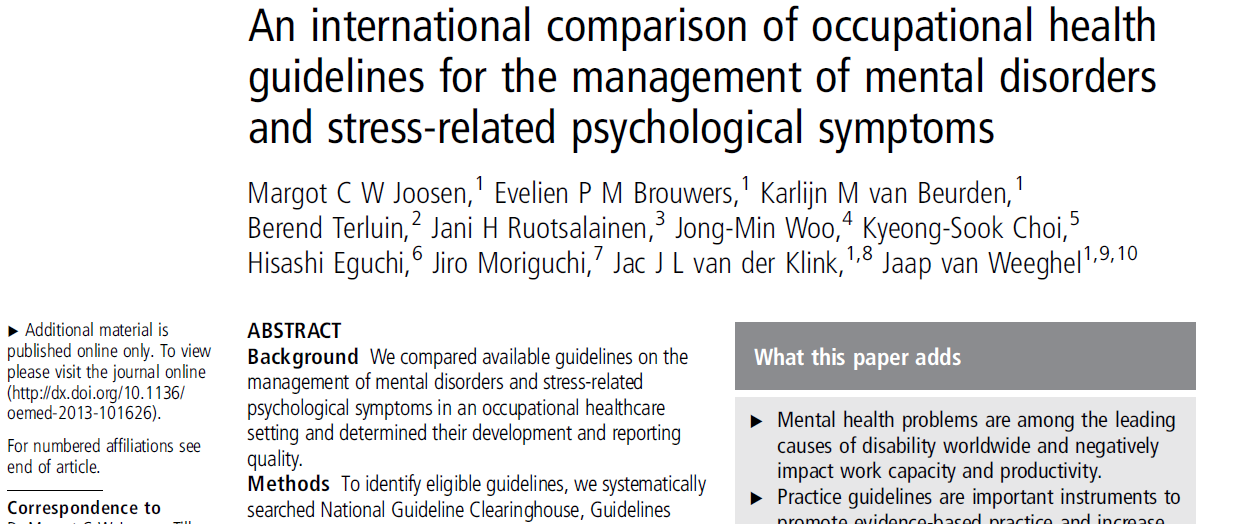
8 Guidelines on the management of mental health conditions that target occupational health outcomes are relatively rare 8 Joosen et al, OEM, 2015
9 Days of wage replacement following a work injury increase with age: Victoria: 2001 to < Age Group Berecki-Gisolf et al 2012
10 Some other things that make Victoria a little different (1) Employers are responsible for first 10 days of wage replacement, after which injury is reported to the employer s claims agent Management of workers compensation claims is performed by five external WorkSafe Claims Agents. All workplaces with rateable remuneration of $2 million or more are required to have a RTW coordinator at all times. Workplaces with less than $2 million rateable remuneration must appoint a RTW coordinator if an employee is injured 10
11 Some things that make Victoria a little different (2) The obligation for an employer to provide an injured worker with preinjury and/or suitable employment lasts for 52 weeks of incapacity (wage replacement can continue to 130 weeks of incapacity) Workers compensation claimants can sue for damages attributed to injuries that are considered serious under a common-law system 11
12 Our current project Objective to understand the RTW process among workers compensation claimants in Victoria. Focus on the RTW process for: Psychological compared to MSK injuries; and Older workers (55+ years) compared to younger workers. Design: Longitudinal cohort of workers compensation claimants Interviewed ASAP after claim acceptance, then again at 6 and 12 months post-baseline interview Target 960 claimants to achieve a final sample of
13 Injury and recruitment process Injury Event? days Work Incapacity At least 10 work days Claim Submission Up to 7 days Claim contact information sent to SRC Up to 30 days Claim Adjudication/ Acceptance Up to 28 days SRC sends out PAL & study info 21days SRC attempts to contact claimant 13
14 Current Progress Baseline survey: 869 interviews completed for baseline sample Response rate = 53%. 22% psychological claims; 21% 55 years and older. 91% agreed to link data to admin (claim, services, payments) 98% to be re-contacted at 6 months. 6 month follow-up: 468 interviews completed (September 2015) (74% response rate*, 96% when contacted). Modified survey (interview time: less than 30 mins). 12 month follow-up: 138 interviews completed (September 2015) (60% response rate*, 97% when contacted). 14
15 Two ways we will look at age/injury type and return to work/recovery Age or injury type Important predictors of RTW or recovery RTW or recovery outcomes Age or injury type Important predictors of RTW or recovery RTW or recovery outcomes 15
16 Baseline Survey content Intro/consent/eligibility Basic Job Information Workplace reaction to injury Current working status Return to work arrangements RTW Co-ordinator interactions RTW Case Manager interactions Fairness of the RTW process General Health Physical Function and disability Mental Health Self-efficacy to RTW Workplace contact Work Functioning Workplace Characteristics Recovery expectations Health care provider interactions Work Environment and Work Ability pre-injury Employment commitment and meaning of work Demographics Wrap up any issues Interview length < 40 mins 16
17 How does our sample compare to the target population? 90% 80% 70% 60% 50% 40% 30% 20% 10% 0% Source Population Our Sample 17
18 How does our sample compare to the target population? 30% 25% 20% Source Population Our Sample 15% 10% 5% 0% 18
19 How soon into the RTW process to we get claimants at our baseline interview? 45% 40% 35% 30% 25% 20% 15% 10% 5% 0% LT 2 months 2 to 3 months 3 to 4 months 4 to 5 months Time since injury (SR) (N = 869) Time since injury (Admin) (N = 790) Time since incapacity (N = 790) Time since claim submission (N = 790) 5 to 6 months 6+ months 19
20 Working status at baseline interview (N = 869) 60% 50% 40% MSK Less than 35 yrs 55+ yrs Psych 35 to 54 yrs 30% 20% 10% 0% Back at work - same job Back at work - different job Not back - has returned Not back - hasn't returned 20
21 Impact of work injury in the last week at baseline interview (N = 869) 40% 35% 30% Felt disabled Felt angry and frustrated* Felt dependent upon others 25% 20% 15% 10% 5% 0% All the time Most of the time Some of the time A slight bit of the time None of the time 21
22 K6 score above 13 (serious mental illness) at baseline interview (N = 869) 50% 45% 40% 35% 30% 25% 20% 15% 10% 5% 0% 22% 45% 32% MSK Psych Less than 35 yrs 25% 24% 35 to 54 yrs 55+ yrs 22
23 The things we think help in the return to work process The health care provider: discusses what worker can and cannot do (even if these things are not related to their job) Gives the worker a date they will return to work The workplace: Makes contact with the worker Has a return to work coordinator who is active in the return to work process Provides an offer of modified/alternate duties; or a return to work plan 23
24 The things we think help/hope that happen in the return to work process The health care provider, the worker and the workplace: Are in contact with each other The claims agent: Treats the worker with respect and provides information to the worker that they need The health care provider, RTW coordinator and the claims agent Are not creating a stressful return to work experience The worker: Believes they can, and that they will, return to work 24
25 The worker 25
26 Most respondents thought they would return to work. 80% 70% 60% 50% 40% 30% 20% 10% * MSK Psych Less than 35 yrs 35 to 54 yrs 55+ yrs 0% Very likely Somewhat likely Not al all likely Respondents not currently at work (N = 357) 26
27 Although they were less sure about returning to their pre-injury duties 60% 50% 40% MSK Less than 35 yrs 55+ yrs Psych 35 to 54 yrs 30% 20% 10% 0% Very likely Somewhat likely Not al all likely Respondents not currently at work or on modified duties(n = 643) 27
28 Recovery expectations did not differ by injury type or age group, with most expecting to get better slowly 70% 60% 50% 40% 30% 20% 10% 0% Get better soon Get better slowly Never get better or get worse Already fully recovered All respondents (N = 869) 28
29 Workplace factors 29
30 Psychological and younger claimants were more likely to have a negative supervisor response to their injury 90% 80% 70% 60% 50% 40% 30% 20% 10% MSK Less than 35 yrs 55+ yrs Psych 35 to 54 yrs 0% Negative Mixed Neutral Positive Respondents with a supervisor (N = 680) 30
31 Psychological claimants were also more likely to have a negative coworker response to their injury 90% 80% 70% 60% 50% 40% 30% 20% 10% MSK Less than 35 yrs 55+ yrs Psych 35 to 54 yrs 0% Negative Mixed Neutral Positive Respondents who worked with co-workers at time of injury (N = 653) 31
32 72% of claimants had been contacted by their workplace, and this did not differ by injury type or age group 80% 70% 60% 50% 40% 30% 20% 10% 0% Workplace has been in contact Workplace has not been in contact All respondents (N = 869) 32
33 Importance of receiving workplace contact during time off work differed by age group, but not by injury type 70% 60% 50% 40% MSK Less than 35 yrs 55+ yrs Psych 35 to 54 yrs 30% 20% 10% 0% Very important Important Moderately important Of little importance Unimportant Respondents contacted by workplace (N = 622) 33
34 Claimants with psychological injuries were less likely to have been contacted by their workplace s return to work coordinator 70% 60% 50% 40% MSK Less than 35 yrs 55+ yrs Psych 35 to 54 yrs 30% 20% 10% 0% Designated person has been in contact Designated person has not been in contact No designated person All respondents (N = 869) 34
35 Psychological claims and older workers were less likely to have been offered, and accepted modified duties 70% 60% 50% 40% 30% 20% 10% MSK Less than 35 yrs 55+ yrs Psych 35 to 54 yrs 0% Offered modified duties and accepted Offered modified duties and Not offered modified duties declined All respondents (N = 869) 35
36 Why did you not accept the offer for modified or alternate duties? 50% 40% 30% 20% 10% MSK Psych 0% Job not changed enough Job offered not meaningful or challenging No modification required Other Respondents who did not accept first offer of modified or alternate duties (N = 132) 36
37 Less than 30% of claimants currently off work had been given a return to work plan. This did not differ by age or injury type 80% 70% 60% 50% 40% 30% 20% 10% 0% Given a return to work plan by employer Not given a return to work plan by employer Respondents that have not returned to work (N = 357) 37
38 The health care provider 38
39 Health care providers often discussed activities that respondent s can do, and activities they should not do 100% 90% 80% 70% 60% 50% * 40% 30% 20% 10% 0% MSK Less than 35 yrs 55+ yrs Discussed possible activities respondent can do Psych 35 to 54 yrs Discussed activities respondent should not do Respondents that have received health care (N = 784) 39
40 Older and psychological claimants were less likely to have been given a return to work date, or a date they would return to pre-injury duties 100% 90% 80% 70% 60% 50% 40% 30% 20% 10% 0% MSK Less than 35 yrs 55+ yrs Psych 35 to 54 yrs Discussed return to work Given a return to work date Given a date when likely to perform pre-injury duties Respondents that have received health care (N = 784) 40
41 69% of claimants said their HC provider has contacted their employer. The importance of contact differed by injury type but not age group 80% 70% 60% 50% 40% 30% 20% 10% MSK Less than 35 yrs 55+ yrs Psych 35 to 54 yrs 0% Very Important Important Moderately Important Of little importance or not important Respondents that have received health care (N = 784) 41
42 The case manager 42
43 86% of claimants reported contact with their case manager (from their claims agent). 38% of those had a change in case manager. No differences were observed by age or injury type 100% 90% 80% 70% 60% 50% 40% 30% 20% 10% 0% Contact with case manager Case manager has changed All respondents (N = 869) 43
44 Stress in the return to work process 44
45 Psychological claimants reported more stress in interactions with their health care providers 70% 60% 50% 40% 30% 20% 10% MSK Less than 35 yrs 55+ yrs Psych 35 to 54 yrs 0% Not at all stressful Not very stressful A bit stressful Quite a bit/extremely stressful Respondents that have received health care (N = 803) 45
46 Psychological and younger claimants found interactions with RTW coordinator to be stressful 70% 60% 50% 40% 30% 20% 10% MSK Less than 35 yrs 55+ yrs Psych 35 to 54 yrs 0% Not at all stressful Not very stressful A bit stressful Quite a bit/ Extremely stressful Respondents that have had contact with their RTW coordinator (N = 607) 46
47 Psychological and younger claimants found interactions with their case manager to be stressful 70% 60% 50% MSK Less than 35 yrs 55+ yrs Psych 35 to 54 yrs 40% 30% 20% 10% 0% Not at all stressful Not very stressful A bit stressful Quite a bit/ Extremely stressful Respondents that have had contact with their case manager (N = 746) 47
48 Has your age influenced your [ ] s decision making about your ability to return to work? 60.0% 50.0% 40.0% HC provider RTW coordinator Claims agent 30.0% 20.0% 10.0% 0.0% 18 to 34 years 35 to 54 years 55+ years 48
49 New findings about the return to work process in Victoria (1) Concerning workers Most workers (69%) believe they will return to work, fewer (44%) think they will return to their pre-injury duties. Workers with psychological injuries are the most apprehensive about returning to work and their previous duties Most workers think their injury will get better slowly 49
50 New findings about the return to work process in Victoria (2) Concerning workplaces Psychological claimants experience more negative reactions from coworkers and supervisors following their injury Most claimants report contact from their workplace, with older workers placing more importance on receiving contact Psychological and older claimants are less likely to have been offered and accepted modified duties Psychological claimants are less likely than MSK claimants to have had contact with their workplace s return to work coordinator Less than 30% of claimants who were currently off work had a return to work plan 50
51 New findings about the return to work process in Victoria (3) Concerning healthcare providers Most claimants are being told what they can do (even if it is not related to their work), and what they should not do Older claimants and those with psychological injuries are not always given a return to work date, or a date they would return to pre-injury duties Older claimants are also less likely than younger claimants to discuss return to work 51
52 New findings about the return to work process in Victoria (4) Concerning stress in the return to work process Psychological claimants were more likely to report stress in their interactions with their health care providers, return to work coordinator and claims agent Younger claimants were more likely to report stress in their interactions with their return to work coordinator and claims agent For psychological and younger claimants, higher stress was partially explained by how they were treated and communication Claimants perceive their age influences decisions in the return to work process, but the impact is greatest among younger workers 52
53 Questions and comments? 53
Peter Smith School of Public Health and Preventive Medicine, Monash University
 The ageing workforce and its implications for occupational health and safety prevention programs and work-injury compensation systems: A Canadian perspective Peter Smith School of Public Health and Preventive
An Introduction to Workplace Rehabilitation
 An Introduction to Workplace Rehabilitation OUTLINE Definition of workplace rehabilitation Goals of workplace rehabilitation Obligations Who may be involved in rehabilitation Your employer s process for
Injured Worker s Guide to. Best Practice Return to Work for a Stress Injury
 Injured Worker s Guide to Best Practice Return to Work for a Stress Injury The best practice return to work guidelines for a stress injury were developed by the Australian Services Union with the support
Australia & New Zealand. Return to Work Monitor 2011/12. Heads of Workers Compensation Authorities
 Australia & New Zealand Return to Work Monitor 2011/12 Prepared for Heads of Workers Compensation Authorities July 2012 SUITE 3, 101-103 QUEENS PDE PO BOX 441, CLIFTON HILL, VICTORIA 3068 PHONE +613 9482
Employer s Guide to. Best Practice Return to Work for a Stress Injury
 Employer s Guide to Best Practice Return to Work for a Stress Injury Employers Guide to Best Practice Return to Work for a Stress Injury 1. Early Intervention 2. Claim Lodged 3. Claim Acceptance 4. Return
LESLEY MORRISON General Manager Recovery and Support, Comcare
 LESLEY MORRISON General Manager Recovery and Support, Comcare 1 Comcare Update SRC Act, Comcare and Seacare Reviews underway New Deputy CEO, Ms Cathy Skippington commenced New Service Delivery Directors
A guide for injured workers. Returning to work. April 2011
 A guide for injured workers Returning to work April 2011 Contents 1. Getting back to work 1 Ideas to help you return to work 2 Staying positive 2 Your employer s legal obligations 3 Anti-discrimination
About us. Your injured worker s recovery and return to work is a team effort. It involves you, your WorkSafe Agent, your worker and their doctor.
 1. About us Your injured worker s recovery and return to work is a team effort. It involves you, your WorkSafe Agent, your worker and their doctor. About WorkSafe Victoria WorkSafe Victoria (WorkSafe)
BIOPSYCHOSOCIAL INJURY MANAGEMENT. Introduction. The traditional medical model
 BIOPSYCHOSOCIAL INJURY MANAGEMENT Introduction This paper outlines HWCA s position on a biopsychosocial approach to injury management and recognises work undertaken by Workers Compensation Authorities
Claimant experiences and outcomes in compensation systems
 Claimant experiences and outcomes in compensation systems Dr Genevieve Grant Collaborators: A/Prof ML O Donnell (Melbourne), Dr MJ Spittal (Melbourne), Prof DM Studdert (Stanford) Funders: Transport Accident
Claim Estimates and WorkSafe Premiums
 Claim Estimates and WorkSafe Premiums Introduction For employers with annual rateable remuneration of over $200,000 premiums for WorkSafe insurance are calculated taking into account their claims performance
Supporting the return to work of employees with depression or anxiety
 Supporting the return to work of employees with depression or anxiety Advice for employers Around one million Australian adults live with depression. Over two million have an anxiety disorder. On average,
SUITABLE DUTIES ABOUT THIS FORM WHY USE THIS FORM? PRIVACY INFORMATION AUTHORISATION AND DECLARATION
 SUITABLE DUTIES ABOUT THIS FORM A key element to achieve an early and successful return to work (or maintenance at work) for an employee with a workplace injury or disease is for the workplace to be proactive
Workers guide to workers compensation Guide
 Workers guide to workers compensation Guide www.worksafe.nt.gov.au Disclaimer This publication contains information regarding workers rehabilitation and compensation. It includes some of your obligations
Stress and mental injuries how to compensate? Andrew McInerney, David Gregory Finity Consulting
 Stress and mental injuries how to compensate? Andrew McInerney, David Gregory Finity Consulting This presentation has been prepared for the Actuaries Institute 2013 Injury Schemes Seminar. The Institute
Rehabilitation Guidelines for Employers. Issued under section 41 of the Safety, Rehabilitation and Compensation Act 1988
 Rehabilitation Guidelines for Employers Issued under section 41 of the Safety, Rehabilitation and Compensation Act 1988 Publication details These guidelines are issued under section 41 of the Safety, Rehabilitation
WORKERS GUIDE YUKON WORKERS COMPENSATION HEALTH AND SAFETY BOARD. working together WITH YUKON WORKERS AND EMPLOYERS
 WORKERS GUIDE YUKON WORKERS COMPENSATION HEALTH AND SAFETY BOARD working together WITH YUKON WORKERS AND EMPLOYERS workers compensation WORKERS COMPENSATION Workers compensation is an employer-funded insurance
DEECD Corporate WorkSafe policy guide January 2013
 DEECD Corporate WorkSafe policy guide January 2013 Published by the Communications Division for Human Resources Division Department of Education and Early Childhood Development Melbourne January 2013 State
When Help Leads to Harm: Injured Worker Stigma in the Compensation System
 When Help Leads to Harm: Injured Worker Stigma in the Compensation System AWCBC Learning Symposium October 7, 2010 1 Overview Workplace Safety and Insurance Board (WSIB) Administers 300,000 claims and
Injury Management. Making it Work. Injury Management Making it Work 1
 Injury Management Making it Work Injury Management Making it Work 1 Please note This information is for guidance only and is not to be taken as an expression of the law. It should be read in conjunction
Modified Duty/Return to Work (RTW) Program
 Modified Duty/Return to Work (RTW) Program Client Name: Effective Date: PROGRAM OUTLINE 1. Accident Reporting and Return to Work Process 2. Modified Duty/Return to Work (RTW) Program 3. Employee Responsibility
Examining trends in no-lost-time claims in Ontario: 1991 to 2006
 Examining trends in no-lost-time claims in Ontario: 1991 to 2006 Peter Smith Co-investigators: Cameron Mustard, Sheilah Hogg-Johnson, Cynthia Chen, Emile Tompa and Linda Kacur IWH Plenary, October 12 th,
Rehabilitation and Return to Work Policy. Overview. Purpose. Scope. Policy
 Rehabilitation and Return to Work Policy Overview At NBN Co we are safe, disciplined and reliable. We act on our responsibilities to identify and remove potential and recognised risk to a healthy and safe
Information about workers' compensation. Information for newcomers to Ontario
 Information about workers' compensation Information for newcomers to Ontario What is the Workplace Safety and Insurance Board? The Workplace Safety and Insurance Board (WSIB) is Ontario's no-fault insurance
Introduction to Workers Compensation
 2013 Risk Management Seminar Putting Safety to Work Introduction to Workers Compensation To Begin Introduction to the Claims Department My goals and objectives Agenda Claims Management Philosophy The Roles
Procedure SO:1.28 Rehabilitation
 SO:1.28 Policy Workplace Health and Safety Document Control Responsible Officer: Chief Operations Officer Contact Officer: Workplace health and safety officer Effective Date: 8 June 2012 Procedure Number:
A new Return to Work scheme for South Australians
 A new Return to Work scheme for South Australians A policy statement to support the Return to Work Bill 2014 www.yoursay.sa.gov.au/yoursay/changes-to-workcover-august-2014-update Contents A message from
SELF-INSURANCE OF WORKERS COMPENSATION
 SELF-INSURANCE OF WORKERS COMPENSATION Information for: STAFF Page 2 SUPERVISORS & MANAGERS Page 5 TREATING DOCTORS Page 7 REPORTING PROCEDURE Page 8 Self-Insurance of Workers Compensation Revised February
WORKPLACE RETURN TO WORK PROCEDURE
 Date of Adoption: 25/6/2015 The process outlined by this Procedure will meet the minimum requirements to assist the Local Government Association Workers Compensation Scheme (LGAWCS) meet legislative compliance.
Better Practice Guide Maintaining & Returning Injured Workers to Work
 Better Practice Guide Maintaining & Returning Injured Workers to Work March 2013 This Better Practice Guide examines the key drivers for achieving favourable rehabilitation and return to work outcomes
BODY STRESSING INJURIES. Key messages for rehabilitation providers
 BODY STRESSING INJURIES Key messages for rehabilitation providers CONTENTS BACKGROUND 4 DELAYS IN PROVIDING REHABILITATION OR RETURN TO WORK ASSISTANCE TO EMPLOYEES INJURED AT WORK 6 DELAYS IN LODGING
BODY STRESSING INJURIES. Key messages for rehabilitation providers
 BODY STRESSING INJURIES Key messages for rehabilitation providers CONTENTS BACKGROUND 4 DELAYS IN PROVIDING REHABILITATION OR RETURN TO WORK ASSISTANCE TO EMPLOYEES INJURED AT WORK 6 DELAYS IN LODGING
Return to Work/Injury Management Plan
 Return to Work/Injury Management Plan (Incorporating initial assessment and subsequent reviews of RTW or IM Plans) Type of plan please 4 Return to Work Plan (RTWP) Injury Management Plan (IMP) Worker details
The Role of the Workplace Rehabilitation Provider
 The Role of the Workplace Rehabilitation Provider The Role of the Workplace Rehabilitation Provider 1 Please note This information is for guidance only and is not to be taken as an expression of the law.
CHEMSKILL RETURN TO WORK AND RISK MANAGEMENT PROTOCOL (This document can be found under the Contractor s Section at www.chemskill.com.au.
 CHEMSKILL RETURN TO WORK AND RISK MANAGEMENT PROTOCOL (This document can be found under the Contractor s Section at www.chemskill.com.au.) ChemSkill is committed to providing a safe and healthy work environment
Contents. Before you begin. How to work through this learner guide Assessment
 Contents Contents Before you begin How to work through this learner guide Assessment Introduction: Assisting with claims management, rehabilitation and return-to-work programs v v vi 1 Chapter 1: Assisting
Employers have certain obligations under the Workplace Injury Management and Workers Compensation Act 1998. These include:
 INFORMATION FOR EMPLOYERS Employer s Obligations Employers have certain obligations under the Workplace Injury Management and Workers Compensation Act 1998. These include: o Forwarding claims to CMI 48
Workplace Injury Management Procedure
 Version No: 2.0 Workplace Injury Management Procedure Issued: 18/11/2013 Next Review: 15/11/2018 The process outlined by this Procedure will meet the minimum requirements to assist the Local Government
Accident Compensation Amendment Act March 2010
 C Circulate to: A Assistance BIZassistInfoline: 1300 78 38 44 Or email: [email protected] Accident Compensation Amendment Act March 2010 Background On 10 December 2007, the Victorian Government
CLAIMS MANAGEMENT CHECKLIST
 CLAIMS MANAGEMENT CHECKLIST FORWARD ALL CLAIMS AND PAPERWORK TO WORKCOVER AGENT GALLAGHER BASSETT: Gallagher Bassett Workers Compensation Pty Ltd (GB) Locked Bag 2570 GPO Melbourne VIC 3001 Facsimile 03
How To Manage A Return To Work
 Policy Number: CS-1302-2013 Policy Title: Return to Work Occupational & Non-Occupational Absences due to Medical Reasons Policy Policy Owner: Chief Human Resources Officer Effective Date: March 27, 2013
Furthermore, this policy outlines the process in which a worker is able to make a claim for workers compensation.
 WS013 REHABILITATION AND RETURN TO WORK POLICY VICTORIA Purpose EI is committed to the rehabilitation of workers who are injured at work. This policy is designed to comply with EI obligation to make important
Early Intervention Programs CAN YOU AFFORD NOT TO?
 Early Intervention Programs CAN YOU AFFORD NOT TO? NT Safe Work Week (26/10/2014 to 1/11/2014) Rachel Cassar Current member of NT Workers Compensation Advisory Council Certificate IV TAE Graduate Certificate
South Australia Police POSITION INFORMATION DOCUMENT
 South Australia Police POSITION INFORMATION DOCUMENT Stream : Administrative Services Career Group : Consultancy and Information Discipline : Classification : ASO3 Command : Human Resources Service Position
Accident Compensation Act
 Accident Compensation Act Changes to the Accident Compensation Act 1985 explained Edition No. 1 March 2010 Contents Introduction 1 Overview of changes 2 Key changes Workers entitlement to compensation
Injury Management. Making it Work. Injury Management Making it Work 1
 Injury Management Making it Work Injury Management Making it Work 1 Please note This information is for guidance only and is not to be taken as an expression of the law. It should be read in conjunction
BEYOND WORKING WELL: A BETTER PRACTICE GUIDE. A practical approach to improving psychological injury prevention and management in the workplace
 BEYOND WORKING WELL: A BETTER PRACTICE GUIDE A practical approach to improving psychological injury prevention and management in the workplace CONTENTS INTRODUCTION 5 RESEARCH 7 HOLISTIC SYSTEMS APPROACH
UNISA INJURY/ILLNESS MANAGEMENT HANDBOOK A GUIDE FOR UNISA EMPLOYEES AND THEIR MANAGERS
 Introduction The University of South Australia, a self insured employer under the Return to Work Act 2014 (the Act), is committed to providing a sound injury/illness management program for all employees.
Workplace Injuries and ESA Violations among Young Workers: A Preliminary Report.
 Workplace Injuries and ESA Violations among Young Workers: A Preliminary Report. Alan Hall, Zachary Gerard and Jessica Toldo November, 2011 Labour Studies Programme University of Windsor 1 Over the last
Surviving the Medico-legal Process
 Surviving the Medico-legal Process Dr Jeannie Higgins February 2002 Invited paper International RSI Awareness Repetitive Strain Injury (RSI) & Overuse Injury Association Canberra, Australia Overview The
Management of Staff Occupational Health and Safety in Schools
 Management of Staff Occupational Health and Safety in Schools Victorian Auditor-General s Report May 2013 2012-13:31 V I C T O R I A Victorian Auditor-General Management of Staff Occupational Health and
A guide for injured workers. Introducing WorkSafe
 A guide for injured workers Introducing WorkSafe September July 2013 2011 Contents 1. About us 1 2. Weekly payments (income entitlements) 2 3. Services to help you get better 4 4. Getting back to work
1.1 Australian Capital Territory 1.2 New South Wales 1.3 Northern Territory 1.4 Queensland
 Attachment C 1. Workers Compensation Schemes 1.1 Australian Capital Territory 1.2 New South Wales 1.3 Northern Territory 1.4 Queensland 1.5 South Australia 1.6 Tasmania 1.7 Victoria 1.8 Western Australia
TELECLAIM APPLICATION WORKER
 TELECLAIM APPLICATION WORKER If you have any questions, please phone toll-free 1 888 967-5377. Claim number CSR user ID (entered by) IG14810 Intake date (Document date: yyyy-mm-dd) 2008-03-20 Interpreter
Health & Safety Law. Part 2: Workers Compensation Law & Injury Management. Workers Compensation Law
 Health & Safety Law Part 2: Workers Compensation Law & Injury Management Workers Compensation Law The Accident Compensation Act 1985; Accident Compensation (WorkCover Insurance) Act 1993; and, Workers
EMPLOYER INJURY CLAIM REPORT
 EMPLOYER INJURY CLAIM REPORT FOR HELP COMPLETING THIS FORM OR FOR MORE INFORMATION CONTACT: Your WorkSafe Victoria (WorkSafe) Agent The WorkSafe Advisory Service: freecall 1800 136 089 or (03) 9641 1444
Shelly L. Jackson & Thomas L. Hafemeister. Funding Provided by the National Institute of Justice
 Psychology of Violence Pure financial exploitation vs. Hybrid financial exploitation co-occurring with physical abuse and/or neglect of elderly persons Shelly L. Jackson & Thomas L. Hafemeister Funding
DEECD schools WorkSafe management manual A guide for principals, return to work coordinators and business managers
 DEECD schools WorkSafe management manual A guide for principals, return to work coordinators and business managers Published by the Human Resources Division Department of Education and Early Childhood
ACT PUBLIC SECTOR Managing Injury and Illness in the Workplace
 ACT PUBLIC SECTOR Managing Injury and Illness in 1. PURPOSE This document outlines the ACT Government policy for the care, recovery and support of ACTPS staff with work related and non-work related injuries
Understanding independent medical assessments a multi-jurisdictional analysis
 Understanding independent medical assessments a multi-jurisdictional analysis Agnieszka Kosny, Amy Allen (Department of Epidemiology & Preventive Medicine, Monash University), Alex Collie (ISCRR) Acknowledgement:
Rehabilitation of employees back to work after illness or injury Policy and Procedure
 Rehabilitation of employees back to work after illness or injury Policy and Procedure Document reference number HSAG 2011/3 Document developed by Revision number 4.13 Document approved by Approval date
New Approaches to Providing Vocational Rehabilitation Services to Injured Employees in the Texas Workers Compensation System
 New Approaches to Providing Vocational Rehabilitation Services to Employees in the Texas Workers Compensation System A Joint Report to The Legislature By Albert Betts, Commissioner Texas Department of
WORKERS COMPENSATION AND REHABILITATION QUESTIONS AND ANSWERS
 WORKERS COMPENSATION AND REHABILITATION QUESTIONS AND ANSWERS The Work Health & Safety Unit has responsibility for the management of workers compensation claims and the rehabilitation of injured employees.
Workers Compensation Optimal Claims Management
 OVERALL OBJECTIVE - ECM seeks to provide a consultative relationship in which we work with our clients to influence and improve their Risk Management Process. Following are a few suggestions regarding
Employment and MS. Your questions answered. Disclosure in the workplace: To tell or not to tell
 Employment and MS Your questions answered Now that you have had some time to adjust to your recent diagnosis and learn about multiple sclerosis (MS), you may have concerns about the potential impact of
Information for Workers. Information for Workers
 Information for Workers Information for Workers Revised March 2015 Contents Overview... 2 Workplace Injuries... 2 Worker Responsibilities... 2 Employer Responsibilities... 4 WCB Responsibilities... 4 Returning
Workplace Rehabilitation and Return to Work Policy and Procedures
 Workplace Rehabilitation and Return to Work Policy and Procedures For Synod services*, Presbyteries and Congregations Document no. Version 2.0 Status Current Effective date 1 June 2012 Review by date 1
SRC Commission. Positive Performance Indicators. Measuring Safety, Rehabilitation and Compensation Performance
 SRC Commission Positive Performance Indicators Measuring Safety, Rehabilitation and Compensation Performance A question for heads of corporate management Do you know if prevention and injury management
Effect of mental health on long-term recovery following a Road Traffic Crash: Results from UQ SuPPORT study
 1 Effect of mental health on long-term recovery following a Road Traffic Crash: Results from UQ SuPPORT study ACHRF 19 th November, Melbourne Justin Kenardy, Michelle Heron-Delaney, Jacelle Warren, Erin
Volunteer Return to Work
 Volunteer Return to Work Volunteer Modified Duty Handbook Workers Compensation Fund toll-free: 1.800.446.2667 web: www.wcfgroup.com Although preventing injuries is the best way to control workers compensation
DECS REHABILITATION RETURN TO WORK POLICY PROCEDURES
 DECS REHABILITATION & RETURN TO WORK POLICY & PROCEDURES FOREWORD The Department of Education and Children s Services (DECS) is committed to safe work practices that support the wellbeing of all employees.
VISION MISSION VALUES WORKERS RIGHTS. Eliminate workplace diseases and injuries.
 Worker s Handbook VISION Eliminate workplace diseases and injuries. MISSION In partnership with stakeholders, we ensure workplace safety, and care for workers. VALUES Respect We demonstrate care, compassion,
LAWYERS New South Wales & Victoria. A transport accident is an incident directly caused by a motor car or motor vehicle, a railway train, or a tram.
 LAWYERS New South Wales & Victoria Transport Accident Commission (TAC) Claims FREQUENTLY ASKED QUESTIONS What is a transport accident? A transport accident is an incident directly caused by a motor car
The Menzies-Nous Australian Health Survey 2012
 The Menzies-Nous Australian Health Survey 2012 Report 23 October 2012 Bold ideas Engaging people Influential, enduring solutions This page is intentionally blank. Nous Group n o usgro u p. c o m. a u i