
Module 8. Supply and Demand: Price Controls (Ceilings and Floors) What you will learn in this Module:
|
|
|
- Alexandrina Sullivan
- 10 years ago
- Views:
Transcription
1 Module 8 upply and emand: Controls (Ceilings and Floors) Why Governments Control s You learned in Module 6 that a market moves to equilibrium that is, the market price moves to the level at which the quantity supplied equals the quantity demanded. But this equilibrium price does not necessarily please either buyers or sellers. After all, buyers would always like to pay less if they could, and sometimes they can make a strong moral or political case that they should pay lower prices. For example, what if the equilibrium between supply and demand for apartments in a major city leads to rental rates that an average working person can t afford? In that case, a government might well be under pressure to impose limits on the rents landlords can charge. ellers, however, would always like to get more money for what they sell, and sometimes they can make a strong moral or political case that they should receive higher prices. For example, consider the labor market: the price for an hour of a worker s time is the wage rate. What if the equilibrium between supply and demand for less skilled workers leads to wage rates that yield an income below the poverty level? In that case, a government might well be pressured to require employers to pay a rate no lower than some specified minimum wage. In other words, there is often a strong political demand for governments to intervene in markets. And powerful interests can make a compelling case that a market intervention favoring them is fair. When a government intervenes to regulate prices, we say that it imposes price controls. These controls typically take the form of either an upper limit, a price ceiling, or a lower limit, a price floor. Unfortunately, it s not that easy to tell a market what to do. As we will now see, when a government tries to legislate prices whether it legislates them down by imposing a price ceiling or up by imposing a price floor there are certain predictable and unpleasant side effects. What you will learn in this Module: The meaning of price controls, one way government intervenes in markets How price controls can create problems and make a market inefficient Why economists are often deeply skeptical of attempts to intervene in markets Who benefits and who loses from price controls, and why they are used despite their well-known problems controls are legal restrictions on how high or low a market price may go. They can take two forms: a price ceiling, a maximum price sellers are allowed to charge for a good or service, or a price floor, a minimum price buyers are required to pay for a good or service. upply and emand: Controls (Ceilings and Floors) 77

2 We make an important assumption in this module: the markets in question are efficient before price controls are imposed. Markets can sometimes be inefficient for example, a market dominated by a monopolist, a single seller who has the power to influence the market price. When markets are inefficient, price controls don t necessarily cause problems and can potentially move the market closer to efficiency. In practice, however, price controls often are imposed on efficient markets like the New York City apartment market. And so the analysis in this module applies to many important realworld situations. 78 section 2 Ceilings Aside from rent control, there are not many price ceilings in the United tates today. But at times they have been widespread. ceilings are typically imposed during crises wars, harvest failures, natural disasters because these events often lead to sudden price increases that hurt many people but produce big gains for a lucky few. The U.. government imposed ceilings on many prices during World War II: the war sharply increased demand for raw materials, such as aluminum and steel, and price controls prevented those with access to these raw materials from earning huge profits. controls on oil were imposed in 1973, when an embargo by Arab oil-exporting countries seemed likely to generate huge profits for U.. oil companies. controls were imposed on California s wholesale electricity market in 2001, when a shortage created big profits for a few power-generating companies but led to higher electricity bills for consumers. Rent control in New York is, believe it or not, a legacy of World War II: it was imposed because wartime production created an economic boom, which increased demand for apartments at a time when the labor and raw materials that might have been used to build them were being used to win the war instead. Although most price controls were removed soon after the war ended, New York s rent limits were retained and gradually extended to buildings not previously covered, leading to some very strange situations. You can rent a one-bedroom apartment in Manhattan on fairly short notice if you are able and willing to pay several thousand dollars a month and live in a less-than-desirable area. Yet some people pay only a small fraction of this for comparable apartments, and others pay hardly more for bigger apartments in better locations. Aside from producing great deals for some renters, however, what are the broader consequences of New York s rent-control system? To answer this question, we turn to the supply and demand model. Modeling a Ceiling To see what can go wrong when a government imposes a price ceiling on an efficient market, consider Figure 8.1, which shows a simplified model of the market for apartments in New York. For the sake of simplicity, we imagine that all apartments are exactly the same and so would rent for the same price in an unregulated market. The table in the figure shows the demand and supply schedules; the demand and supply curves are shown on the left. We show the quantity of apartments on the horizontal axis and the monthly rent per apartment on the vertical axis. You can see that in an unregulated market the equilibrium would be at point : 2 million apartments would be rented for $1,000 each per month. Now suppose that the government imposes a price ceiling, limiting rents to a price below the equilibrium price say, no more than $800. Figure 8.2 shows the effect of the price ceiling, represented by the line at $800. At the enforced rental rate of $800, landlords have less incentive to offer apartments, so they won t be willing to supply as many as they would at the equilibrium rate of $1,000. They will choose point A on the supply curve, offering only 1.8 million apartments for rent, 200,000 fewer than in the unregulated market. At the same time, more people will want to rent apartments at a price of $800 than at the equilibrium price of $1,000; as shown at point B on the demand curve, at a monthly rent of $800 the quantity of apartments upply and emand

3 figure 8.1 Monthly rent (per apartment) $1,400 1,300 1,200 1,100 1, The Market for Apartments in the Absence of Government Controls Monthly rent (per apartment) $1,400 1,300 1,200 1,100 1, Quantity of apartments (millions) Quantity demanded Quantity supplied ection 2 upply and emand Quantity of apartments (millions) Without government intervention, the market for apartments reaches equilibrium at point with a market rent of $1,000 per month and 2 million apartments rented. demanded rises to 2.2 million, 200,000 more than in the unregulated market and 400,000 more than are actually available at the price of $800. o there is now a persistent shortage of rental housing: at that price, 400,000 more people want to rent than are able to find apartments. figure 8.2 The ffects of a Ceiling The black horizontal line represents the government-imposed price ceiling on rents of $800 per month. This price ceiling reduces the quantity of apartments supplied to 1.8 million, point A, and increases the quantity demanded to 2.2 million, point B. This creates a persistent shortage of 400,000 units: 400,000 people who want apartments at the legal rent of $800 but cannot get them. Monthly rent (per apartment) $1,400 1,200 1, A B ceiling 600 Housing shortage of 400,000 apartments caused by price ceiling Quantity of apartments (millions) upply and emand: Controls (Ceilings and Floors) 79

4 ceilings often lead to inefficiency in the form of inefficient allocation to consumers: people who want the good badly and are willing to pay a high price don t get it, and those who care relatively little about the good and are only willing to pay a relatively low price do get it. ceilings typically lead to inefficiency in the form of wasted resources: people expend money, effort, and time to cope with the shortages caused by the price ceiling. o price ceilings always cause shortages? No. If a price ceiling is set above the equilibrium price, it won t have any effect. uppose that the equilibrium rental rate on apartments is $1,000 per month and the city government sets a ceiling of $1,200. Who cares? In this case, the price ceiling won t be binding it won t actually constrain market behavior and it will have no effect. Inefficient Allocation to Consumers Rent control doesn t just lead to too few apartments being available. It can also lead to misallocation of the apartments that are available: people who badly need a place to live may not be able to find an apartment, while some apartments may be occupied by people with much less urgent needs. In the case shown in Figure 8.2, 2.2 million people would like to rent an apartment at $800 per month, but only 1.8 million apartments are available. Of those 2.2 million who are seeking an apartment, some want an apartment badly and are willing to pay a high price to get one. Others have a less urgent need and are only willing to pay a low price, perhaps because they have alternative housing. An efficient allocation of apartments would reflect these differences: people who really want an apartment will get one and people who aren t all that eager to find an apartment won t. In an inefficient distribution of apartments, the opposite will happen: some people who are not especially eager to find an apartment will get one and others who are very eager to find an apartment won t. Because people usually get apartments through luck or personal connections under rent control, it generally results in an inefficient allocation to consumers of the few apartments available. To see the inefficiency involved, consider the plight of the Lees, a family with young children who have no alternative housing and would be willing to pay up to $1,500 for an apartment but are unable to find one. Also consider George, a retiree who lives most of the year in Florida but still has a lease on the New York apartment he moved into 40 years ago. George pays $800 per month for this apartment, but if the rent were even slightly more say, $850 he would give it up and stay with his children when he is in New York. This allocation of apartments George has one and the Lees do not is a missed opportunity: there is a way to make the Lees and George both better off at no additional cost. The Lees would be happy to pay George, say, $1,200 a month to sublease his apartment, which he would happily accept since the apartment is worth no more than $849 a month to him. George would prefer the money he gets from the Lees to keeping his apartment; the Lees would prefer to have the apartment rather than the money. o both would be made better off by this transaction and nobody else would be made worse off. Generally, if people who really want apartments could sublease them from people who are less eager to live there, both those who gain apartments and those who trade their occupancy for money would be better off. However, subletting is illegal under rent control because it would occur at prices above the price ceiling. The fact that subletting is illegal doesn t mean it never happens. In fact, chasing down illegal subletting is a major business for New York private investigators. A 2007 report in the New York Times described how private investigators use hidden cameras and other tricks to prove that the legal tenants in rent-controlled apartments actually live in the suburbs, or even in other states, and have sublet their apartments at two or three times the controlled rent. This subletting is a kind of illegal activity, which we will discuss shortly. For now, just notice that the aggressive pursuit of illegal subletting surely discourages the practice, so there isn t enough subletting to eliminate the inefficient allocation of apartments. Wasted Resources Another reason a price ceiling causes inefficiency is that it leads to wasted resources: people expend money, effort, and time to cope with the shortages caused by the price ceiling. Back in 1979, U.. price controls on gasoline led to shortages that forced millions of Americans to spend hours each week waiting in lines at gas stations. The opportunity cost of the time spent in gas lines the wages not earned, the leisure time not enjoyed constituted wasted resources from the point of view of consumers and of the economy as a whole. Because of rent control, the Lees will spend all their spare time for several months searching for an apartment, time they would rather have spent working or engaged in family activities. That is, there is an opportunity cost to the Lees prolonged search for an apartment the leisure or income 80 section 2 upply and emand

5 they had to forgo. If the market for apartments worked freely, the Lees would quickly find an apartment at the equilibrium rent of $1,000, leaving them time to earn more or to enjoy themselves an outcome that would make them better off without making anyone else worse off. Again, rent control creates missed opportunities. Inefficiently Low Quality Yet another way a price ceiling causes inefficiency is by causing goods to be of inefficiently low quality. Inefficiently low quality means that sellers offer low-quality goods at a low price even though buyers would rather have higher quality and are willing to pay a higher price for it. Again, consider rent control. Landlords have no incentive to provide better conditions because they cannot raise rents to cover their repair costs but are able to find tenants easily. In many cases, tenants would be willing to pay much more for improved conditions than it would cost for the landlord to provide them for example, the upgrade of an antiquated electrical system that cannot safely run air conditioners or computers. But any additional payment for such improvements would be legally considered a rent increase, which is prohibited. Indeed, rent-controlled apartments are notoriously badly maintained, rarely painted, subject to frequent electrical and plumbing problems, sometimes even hazardous to inhabit. As one former manager of Manhattan buildings explained, At unregulated apartments we d do most things that the tenants requested. But on the rent-regulated units, we did absolutely only what the law required.... We had a perverse incentive to make those tenants unhappy. With regulated apartments, the ultimate objective is to get people out of the building [because rents can be raised for new tenants]. This whole situation is a missed opportunity some tenants would be happy to pay for better conditions, and landlords would be happy to provide them for payment. But such an exchange would occur only if the market were allowed to operate freely. Black Markets And that leads us to a last aspect of price ceilings: the incentive they provide for illegal activities, specifically the emergence of black markets. We have already described one kind of black market activity illegal subletting by tenants. But it does not stop there. Clearly, there is a temptation for a landlord to say to a potential tenant, Look, you can have the place if you slip me an extra few hundred in cash each month and for the tenant to agree, if he or she is one of those people who would be willing to pay much more than the maximum legal rent. What s wrong with black markets? In general, it s a bad thing if people break any law because it encourages disrespect for the law in general. Worse yet, in this case illegal activity worsens the position of those who try to be honest. If the Lees are scrupulous about upholding the rent-control law but other people who may need an apartment less than the Lees are willing to bribe landlords, the Lees may never find an apartment. o Why Are There Ceilings? We have seen three common results of price ceilings: a persistent shortage of the good inefficiency arising from this persistent shortage in the form of inefficiently low quantity, inefficient allocation of the good to consumers, resources wasted in searching for the good, and the inefficiently low quality of the good offered for sale the emergence of illegal, black market activity Given these unpleasant consequences, why do governments still sometimes impose price ceilings? Why does rent control, in particular, persist in New York? One answer is that although price ceilings may have adverse effects, they do benefit some people. In practice, New York s rent-control rules which are more complex than our. J. Baumeister Jr. / Alamy igns advertising apartments to rent or sublet are common in New York City. ceilings often lead to inefficiency in that the goods being offered are of inefficiently low quality: sellers offer low quality goods at a low price even though buyers would prefer a higher quality at a higher price. A black market is a market in which goods or services are bought and sold illegally either because it is illegal to sell them at all or because the prices charged are legally prohibited by a price ceiling. ection 2 upply and emand upply and emand: Controls (Ceilings and Floors) 81

6 The minimum wage is a legal floor on the wage rate, which is the market price of labor. simple model hurt most residents but give a small minority of renters much cheaper housing than they would get in an unregulated market. And those who benefit from the controls may be better organized and more vocal than those who are harmed by them. Also, when price ceilings have been in effect for a long time, buyers may not have a realistic idea of what would happen without them. In our previous example, the rental rate in an unregulated market (Figure 8.1) would be only 25% higher than in the regulated market (Figure 8.2): $1,000 instead of $800. But how would renters know that? Indeed, they might have heard about black market transactions at much higher prices the Lees or some other family paying George $1,200 or more and would not realize that these black market prices are much higher than the price that would prevail in a fully unregulated market. A last answer is that government officials often do not understand supply and demand analysis! It is a great mistake to suppose that economic policies in the real world are always sensible or well informed. Floors ometimes governments intervene to push market prices up instead of down. floors have been widely legislated for agricultural products, such as wheat and milk, as a way to support the incomes of farmers. Historically, there were also price floors on such services as trucking and air travel, although these were phased out by the U.. government in the 1970s. If you have ever worked in a fast-food restaurant, you are likely to have encountered a price floor: governments in the United tates and many other countries maintain a lower limit on the hourly wage rate of a worker s labor that is, a floor on the price of labor called the minimum wage. Just like price ceilings, price floors are intended to help some people but generate predictable and undesirable side effects. Figure 8.3 shows hypothetical supply and demand figure 8.3 The Market for Butter in the Absence of Government Controls of butter (per pound) $ of butter (per pound) $1.40 $1.30 $1.20 $1.10 $1.00 $0.90 $0.80 $0.70 $0.60 Quantity of butter (millions of pounds) Quantity demanded Quantity supplied Quantity of butter (millions of pounds) Without government intervention, the market for butter reaches equilibrium at a price of $1 per pound with 10 million pounds of butter bought and sold. 82 section 2 upply and emand

7 curves for butter. Left to itself, the market would move to equilibrium at point, with 10 million pounds of butter bought and sold at a price of $1 per pound. Now suppose that the government, in order to help dairy farmers, imposes a price floor on butter of $1.20 per pound. Its effects are shown in Figure 8.4, where the line at $1.20 represents the price floor. At a price of $1.20 per pound, producers would want to supply 12 million pounds (point B on the supply curve) but consumers would want to buy only 9 million pounds (point A on the demand curve). o the price floor leads to a persistent surplus of 3 million pounds of butter. oes a price floor always lead to an unwanted surplus? No. Just as in the case of a price ceiling, the floor may not be binding that is, it may be irrelevant. If the equilibrium price of butter is $1 per pound but the floor is set at only $0.80, the floor has no effect. But suppose that a price floor is binding: what happens to the unwanted surplus? The answer depends on government policy. In the case of agricultural price floors, governments buy up unwanted surplus. As a result, the U.. government has at times found itself warehousing thousands of tons of butter, cheese, and other farm products. (The uropean Commission, which administers price floors for a number of uropean countries, once found itself the owner of a so-called butter mountain, equal in weight to the entire population of Austria.) The government then has to find a way to dispose of these unwanted goods. ome countries pay exporters to sell products at a loss overseas; this is standard procedure for the uropean Union. The United tates gives surplus food away to schools, which use the products in school lunches. In some cases, governments have actually destroyed the surplus production. To avoid the problem of dealing with the unwanted surplus, the U.. government typically pays farmers not to produce the products at all. When the government is not prepared to purchase the unwanted surplus, a price floor means that would-be sellers cannot find buyers. This is what happens when there is a price floor on the wage rate paid for an hour of labor, the minimum wage: when the minimum wage is above the equilibrium wage rate, some people who are willing to work that is, sell labor cannot find buyers that is, employers willing to give them jobs. ection 2 upply and emand figure 8.4 The ffects of a Floor The dark horizontal line represents the government-imposed price floor of $1.20 per pound of butter. The quantity of butter demanded falls to 9 million pounds, and the quantity supplied rises to 12 million pounds, generating a persistent surplus of 3 million pounds of butter. of butter (per pound) $ A Butter surplus of 3 million pounds caused by price floor B floor Quantity of butter (millions of pounds) upply and emand: Controls (Ceilings and Floors) 83

8 irl in real life Floors and chool Lunches When you were in grade school, did your school offer free or very cheap lunches? If so, you were probably a beneficiary of price floors. Where did all the cheap food come from? uring the 1930s, when the U.. economy was going through the Great epression, a prolonged economic slump, prices were low and farmers were suffering severely. In an effort to help rural Americans, the U.. government imposed price floors on a number of agricultural products. The system of agricultural price floors officially called price support programs continues to this day. Among the products subject to price support are sugar and various dairy products; at times grains, beef, and pork have also had a minimum price. The big problem with any attempt to impose a price floor is that it creates a surplus. To some extent the U.. epartment of Agriculture has tried to head off surpluses by taking steps to reduce supply; for example, by paying farmers not to grow crops. As a last resort, however, the U.. government has been willing to buy up the surplus, taking the excess supply off the market. But then what? The government has to find a way to get rid of the agricultural products it has bought. It can t just sell them: that would depress market prices, forcing the government to buy the stuff right back. o it has to give it away in ways that don t depress market prices. One of the ways it does this is by giving surplus food, free, to school lunch programs. These gifts are known as bonus foods. Along with financial aid, bonus foods are what allow many school districts to provide free or very cheap lunches to their students. Is this a story with a happy ending? Not really. Nutritionists, concerned about growing child obesity in the United tates, place part of the blame on those bonus foods. chools get whatever the government has too much of and that has tended to include a lot of dairy products, beef, and corn, and not much in the way of fresh vegetables or fruit. As a result, school lunches that make extensive use of bonus foods tend to be very high in fat and calories. o this is a case in which there is such a thing as a free lunch but this lunch may be bad for your health. istockphoto floors lead to inefficient allocation of sales among sellers: those who would be willing to sell the good at the lowest price are not always those who manage to sell it. 84 section 2 How a Floor Causes Inefficiency The persistent surplus that results from a price floor creates missed opportunities inefficiencies that resemble those created by the shortage that results from a price ceiling. Inefficiently Low Quantity Because a price floor raises the price of a good to consumers, it reduces the quantity of that good demanded; because sellers can t sell more units of a good than buyers are willing to buy, a price floor reduces the quantity of a good bought and sold below the market equilibrium quantity. Notice that this is the same effect as a price ceiling. You might be tempted to think that a price floor and a price ceiling have opposite effects, but both have the effect of reducing the quantity of a good bought and sold. Inefficient Allocation of ales Among ellers Like a price ceiling, a price floor can lead to inefficient allocation but in this case inefficient allocation of sales among sellers rather than inefficient allocation to consumers. An episode from the Belgian movie Rosetta, a realistic fictional story, illustrates the problem of inefficient allocation of selling opportunities quite well. Like many uropean countries, Belgium has a high minimum wage, and jobs for young people are scarce. At one point Rosetta, a young woman who is very eager to work, loses her job at a fast-food stand because the owner of the stand replaces her with his son a very reluctant worker. Rosetta would be willing to work for less money, and with the money he would save, the owner could give his son an allowance and let him do something else. But to hire Rosetta for less than the minimum wage would be illegal. Wasted Resources Also like a price ceiling, a price floor generates inefficiency by wasting resources. The most graphic examples involve government purchases of the unwanted surpluses of agricultural products caused by price floors. When the surplus production is simply destroyed, and when the stored produce goes, as officials euphemistically put it, out of condition and must be thrown away, it is pure waste. upply and emand

9 floors also lead to wasted time and effort. Consider the minimum wage. Would-be workers who spend many hours searching for jobs, or waiting in line in the hope of getting jobs, play the same role in the case of price floors as hapless families searching for apartments in the case of price ceilings. Inefficiently High Quality Again like price ceilings, price floors lead to inefficiency in the quality of goods produced. We ve seen that when there is a price ceiling, suppliers produce goods that are of inefficiently low quality: buyers prefer higher-quality products and are willing to pay for them, but sellers refuse to improve the quality of their products because the price ceiling prevents their being compensated for doing so. This same logic applies to price floors, but in reverse: suppliers offer goods of inefficiently high quality. How can this be? Isn t high quality a good thing? Yes, but only if it is worth the cost. uppose that suppliers spend a lot to make goods of very high quality but that this quality isn t worth much to consumers, who would rather receive the money spent on that quality in the form of a lower price. This represents a missed opportunity: suppliers and buyers could make a mutually beneficial deal in which buyers got goods of lower quality for a much lower price. A good example of the inefficiency of excessive quality comes from the days when transatlantic airfares were set artificially high by international treaty. Forbidden to compete for customers by offering lower ticket prices, airlines instead offered expensive services, like lavish in-flight meals that went largely uneaten. At one point the regulators tried to restrict this practice by defining maximum service standards for example, that snack service should consist of no more than a sandwich. One airline then introduced what it called a candinavian andwich, a towering affair that forced the convening of another conference to define sandwich. All of this was wasteful, especially considering that what passengers really wanted was less food and lower airfares. ince the deregulation of U.. airlines in the 1970s, American passengers have experienced a large decrease in ticket prices accompanied by a decrease in the quality of in-flight service smaller seats, lower-quality food, and so on. veryone complains about the service but thanks to lower fares, the number of people flying on U.. carriers has grown several hundred percent since airline deregulation. Illegal Activity Finally, like price ceilings, price floors provide incentives for illegal activity. For example, in countries where the minimum wage is far above the equilibrium wage rate, workers desperate for jobs sometimes agree to work off the books for employers who conceal their employment from the government or bribe the government inspectors. This practice, known in urope as black labor, is especially common in southern uropean countries such as Italy and pain. floors often lead to inefficiency in that goods of inefficiently high quality are offered: sellers offer high-quality goods at a high price, even though buyers would prefer a lower quality at a lower price. istockphoto ection 2 upply and emand o Why Are There Floors? To sum up, a price floor creates various negative side effects: a persistent surplus of the good inefficiency arising from the persistent surplus in the form of inefficiently low quantity, inefficient allocation of sales among sellers, wasted resources, and an inefficiently high level of quality offered by suppliers the temptation to engage in illegal activity, particularly bribery and corruption of government officials o why do governments impose price floors when they have so many negative side effects? The reasons are similar to those for imposing price ceilings. Government officials often disregard warnings about the consequences of price floors either because they believe that the relevant market is poorly described by the supply and demand model or, more often, because they do not understand the model. Above all, just as price ceilings are often imposed because they benefit some influential buyers of a good, price floors are often imposed because they benefit some influential sellers. upply and emand: Controls (Ceilings and Floors) 85

10 Module 8 Review olutions appear at the back of the book. Check Your Understanding 1. On game days, homeowners near Middletown University s stadium used to rent parking spaces in their driveways to fans at a going rate of $11. A new town ordinance now sets a maximum parking fee of $7. Use the accompanying supply and demand diagram to explain how each of the following can result from the price ceiling. 2. True or false? xplain your answer. A price ceiling below the equilibrium price in an otherwise efficient market does the following: a. increases quantity supplied b. makes some people who want to consume the good worse off c. makes all producers worse off Parking fee $ The state legislature mandates a price floor for gasoline of P F per gallon. Assess the following statements and illustrate your answer using the figure provided. of gas ,200 3,600 4,000 4,400 4,800 Quantity of parking spaces P F P A B floor a. ome homeowners now think it s not worth the hassle to rent out spaces. b. ome fans who used to carpool to the game now drive alone. c. ome fans can t find parking and leave without seeing the game. xplain how each of the following adverse effects arises from the price ceiling. d. ome fans now arrive several hours early to find parking. e. Friends of homeowners near the stadium regularly attend games, even if they aren t big fans. But some serious fans have given up because of the parking situation. f. ome homeowners rent spaces for more than $7 but pretend that the buyers are non paying friends or family. Q F Quantity of gas a. Proponents of the law claim it will increase the income of gas station owners. Opponents claim it will hurt gas station owners because they will lose customers. b. Proponents claim consumers will be better off because gas stations will provide better service. Opponents claim consumers will be generally worse off because they prefer to buy gas at cheaper prices. c. Proponents claim that they are helping gas station owners without hurting anyone else. Opponents claim that consumers are hurt and will end up doing things like buying gas in a nearby state or on the black market. Q Multiple-Choice Questions 1. To be effective, a price ceiling must be set I. above the equilibrium price. II. in the housing market. III. to achieve the equilibrium market quantity. a. I b. II c. III d. I, II, and III e. None of the above $ Quantity 86 section 2 upply and emand
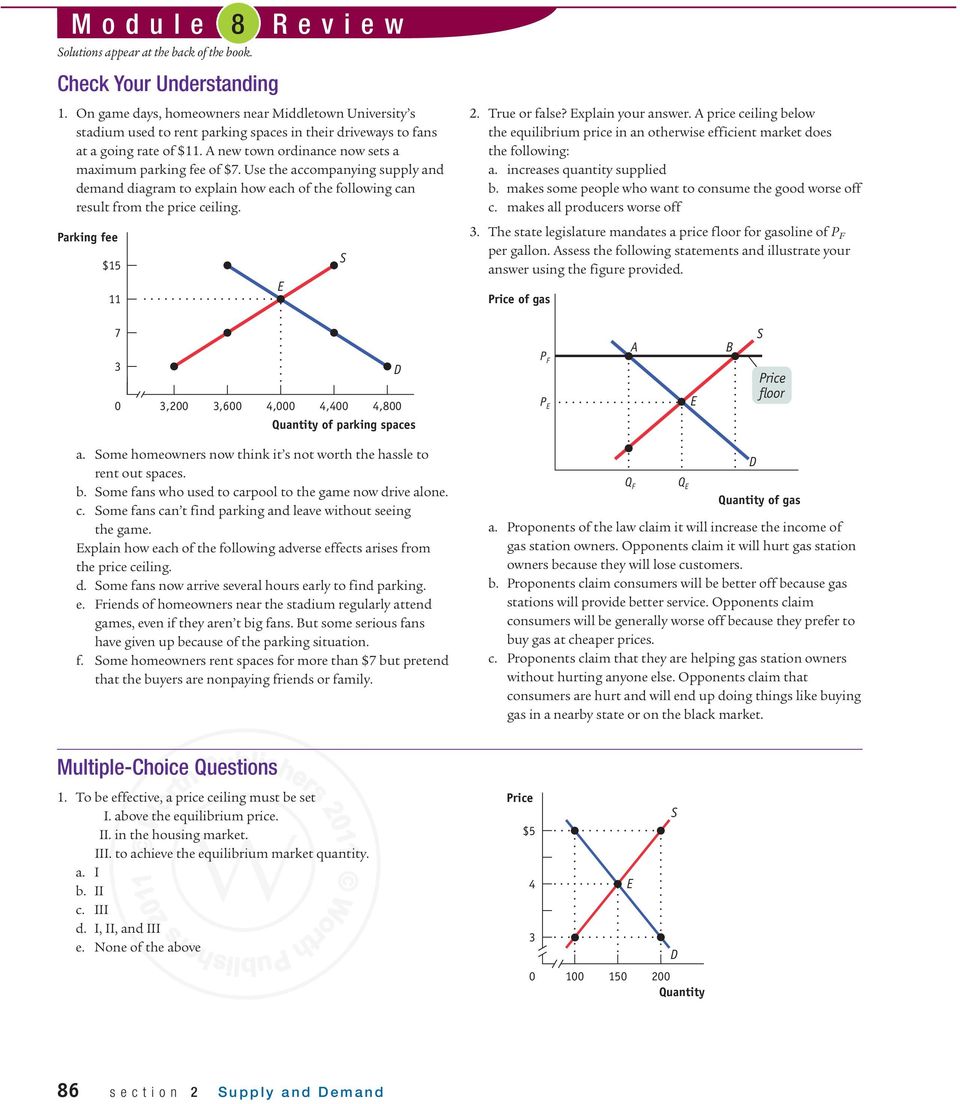
11 2. Refer to the graph provided. A price floor set at $5 will result in a. a shortage of 100 units. b. a surplus of 100 units. c. a shortage of 200 units. d. a surplus of 200 units. e. a surplus of 50 units. 3. ffective price ceilings are inefficient because they a. create shortages. b. lead to wasted resources. c. decrease quality. d. create black markets. e. do all of the above. 4. Refer to the graph provided. If the government establishes a minimum wage at $10, how many workers will benefit from the higher wage? a. 30 b. 50 c. 60 d. 80 e Refer to the graph for question 4. With a minimum wage of $10, how many workers are unemployed (would like to work, but are unable to find a job)? a. 30 b. 50 c. 60 d. 80 e. 110 ection 2 upply and emand Wage (per hour) $ Number of workers Critical-Thinking Question raw a correctly labeled graph of a housing market in equilibrium. On your graph, illustrate an effective legal limit (ceiling) on rent. Identify the quantity of housing demanded, the quantity of housing supplied, and the size of the resulting surplus or shortage. upply and emand: Controls (Ceilings and Floors) 87

Recitation #4 Week 02/02/2009 to 02/08/2009 Chapter 5: The Market Strikes Back
 Recitation #4 Week 02/02/2009 to 02/08/2009 Chapter 5: The Market Strikes Back Problems and Exercises 1. A price ceiling is implemented in the market for housing in Metropolitan City, where all housing
MULTIPLE CHOICE. Choose the one alternative that best completes the statement or answers the question.
 Chapter 6 - Markets in Action - Sample Questions MULTIPLE CHOICE. Choose the one alternative that best completes the statement or answers the question. 1) The short-run impact of the San Francisco earthquake
Econ 101: Principles of Microeconomics
 Econ 101: Principles of Microeconomics Chapter 5: The Market Strikes Back Fall 2010 Herriges (ISU) Ch. 5: The Market Strikes Back Fall 2010 1 / 17 Outline 1 2 Price Floors 3 Quantity Constraints Herriges
Supply and Demand Fundamental tool of economic analysis Used to discuss unemployment, value of $, protection of the environment, etc.
 Supply and emand Fundamental tool of economic analysis Used to discuss unemployment, value of $, protection of the environment, etc. Chapter Outline: (a) emand is the consumer side of the market. (b) Supply
Selected Homework Answers from Chapter 3
 elected Homework Answers from Chapter 3 NOTE: To save on space, I have not given specific labels to my axis, but rather stuck with just and. Ideally, you should put specific labels. For example, the vertical
Module 49 Consumer and Producer Surplus
 What you will learn in this Module: The meaning of consumer surplus and its relationship to the demand curve The meaning of producer surplus and its relationship to the supply curve Module 49 Consumer
Prices: The Marketplace s Communication System. April 2013. Classroom Edition
 PAGE ONE Economics the back story on front page economics NEWSLETTER Prices: The Marketplace s Communication System April 2013 Classroom Edition An informative and accessible economic essay with a classroom
Economic Efficiency, Government Price Setting, and Taxes
 CHAPTER 4 Economic Efficiency, Government Price Setting, and Taxes Modified by: Changwoo Nam 1 Economic Efficiency, Government Price Setting, and Taxes A legally determined maximum price that sellers may
Chapter 6 Supply, Demand, and Government Policies
 Chapter 6 Supply, Demand, and Government Policies Review Questions Using supply-demand diagrams, show the difference between a non-binding price ceiling and a binding price ceiling in the wheat market.
Supplement Unit 1. Demand, Supply, and Adjustments to Dynamic Change
 1 Supplement Unit 1. Demand, Supply, and Adjustments to Dynamic Change Introduction This supplemental highlights how markets work and their impact on the allocation of resources. This feature will investigate
6. In general, over longer periods, demand tends to become (A) More elastic (B) Perfectly elastic (C) Perfectly inelastic (D) Less elastic
 5. The demand for a good is said to be inelastic if (A) More units will be purchased if price increases (B) The percentage change in quantity demanded is greater than the percentage in price (C) The demand
Chapter 8 Price Ceilings and Floors (latest revision August 2004)
 1 Objectives for Chapter 8 Price Floors and Ceilings At the end of Chapter 8, you will be able to: 1. Define price ceiling and draw it on the demand supply graph. 2. Gives some examples of price ceilings.
Econ 201 Exam 1 F2002 Professor Phil Miller Name: Student Number:
 Econ 201 Exam 1 F2002 Professor Phil Miller Name: Student Number: Multiple Choice (3 points each) Directions: Identify the letter of the choice that best completes the statement or answers the question.
Chapter 3 Market Demand, Supply and Elasticity
 Chapter 3 Market Demand, Supply and Elasticity Multiple Choice Questions Choose the one alternative that best completes the statement or answers the question. 1. Ceteris paribus means (a) other things
Choose the single best answer for each question. Do all of your scratch work in the margins or in the blank space on the last page.
 Econ 101, Section 1, F09, Schroeter Final Exam, Red Choose the single best answer for each question. Do all of your scratch work in the margins or in the blank space on the last page. 1. Pete receives
LECTURE NOTES ON MACROECONOMIC PRINCIPLES
 LECTURE NOTES ON MACROECONOMIC PRINCIPLES Peter Ireland Department of Economics Boston College [email protected] http://www2.bc.edu/peter-ireland/ec132.html Copyright (c) 2013 by Peter Ireland. Redistribution
chapter >> Consumer and Producer Surplus Section 3: Consumer Surplus, Producer Surplus, and the Gains from Trade
 chapter 6 >> Consumer and Producer Surplus Section 3: Consumer Surplus, Producer Surplus, and the Gains from Trade One of the nine core principles of economics we introduced in Chapter 1 is that markets
Quantity of trips supplied (millions)
 Taxes chapter: 7 1. The United tates imposes an excise tax on the sale of domestic airline tickets. Let s assume that in 2010 the total excise tax was $6.10 per airline ticket (consisting of the $3.60
Ticker: Dutch Auctions With A Money-Back Guarantee Sandeep Baliga and Jeff Ely
 Results Ticker: Dutch Auctions With A Money-Back Guarantee Sandeep Baliga and Jeff Ely 2 Concept The Problem A venue like a stadium, a theatre, or an orchestra has a fixed capacity of seats in different
ACTIVITY 14.1 STOMPING GROUNDS: BUYERS
 LESSON 14 HOW ARE STOCK PRICES DETERMINED? ACTIVITY 14.1 STOMPING GROUNDS: BUYERS Coffee is your favorite drink. For you and everyone in your family, a good day begins with a nice fresh cup. Stomping Grounds,
Mortgage Secrets. What the banks don t want you to know.
 Mortgage Secrets What the banks don t want you to know. Copyright Notice: Copyright 2006 - All Rights Reserved Contents may not be shared or transmitted in any form, so don t even think about it. Trust
Seven Things You Must Know Before Hiring a Real Estate Agent
 Seven Things You Must Know Before Hiring a Real Estate Agent Seven Things To Know Before Hiring a Real Estate Agent Copyright All Rights Reserved 1 Introduction Selling a home can be one of the most stressful
3. George W. Bush is the current U.S. President. This is an example of a: A. Normative statement B. Positive statement
 Econ 3144 Fall 2006 Test 1 Dr. Rupp Name Sign Pledge I have neither given nor received aid on this exam Multiple Choice Questions (3 points each) 1. What you give up to obtain an item is called your A.
CHAPTER 18 MARKETS WITH MARKET POWER Principles of Economics in Context (Goodwin et al.)
 CHAPTER 18 MARKETS WITH MARKET POWER Principles of Economics in Context (Goodwin et al.) Chapter Summary Now that you understand the model of a perfectly competitive market, this chapter complicates the
Seven Things You Must Know Before Hiring a Real Estate Agent
 Seven Things You Must Know Before Hiring a Real Estate Agent 1 Introduction Selling a home can be one of the most stressful situations of your life. Whether you re upsizing, downsizing, moving across the
MULTIPLE CHOICE. Choose the one alternative that best completes the statement or answers the question.
 MULTIPLE CHOICE. Choose the one alternative that best completes the statement or answers the question. 1) It is efficient to produce an additional shirt if A) the marginal benefit of producing the shirt
Managing Feed and Milk Price Risk: Futures Markets and Insurance Alternatives
 Managing Feed and Milk Price Risk: Futures Markets and Insurance Alternatives Dillon M. Feuz Department of Applied Economics Utah State University 3530 Old Main Hill Logan, UT 84322-3530 435-797-2296 [email protected]
2 how a market works in the presence of. 3 about the different short-run and long-run. 4 why government interventions that cause
 L 5 Markets LEARNING OBJECTIVES In this chapter you will learn 1 that individual markets do not exist in isolation, and that changes in one market typically have repercussions in other markets. 2 how a
Chapter 13 Controlling Market Power: Antitrust and Regulation
 Page 1 Chapter 13 Controlling Market Power: Antitrust and Regulation 1)Which of the following is an example of natural monopoly? A) a market for cable TV services B) a market for breakfast cereals C) a
Top Producer Secrets About Cheap Leads Revealed!
 Special Insider s Report Top Producer Secrets About Cheap Leads Revealed! Avoiding The 5 Ways Cheap Leads Can Steal Your Money By Clint Jones CEO, ProspectZone TM Smart leads. Cost per Lead vs. Cost per
SUPPLY AND DEMAND : HOW MARKETS WORK
 SUPPLY AND DEMAND : HOW MARKETS WORK Chapter 4 : The Market Forces of and and demand are the two words that economists use most often. and demand are the forces that make market economies work. Modern
Demand, Supply, and Market Equilibrium
 3 Demand, Supply, and Market Equilibrium The price of vanilla is bouncing. A kilogram (2.2 pounds) of vanilla beans sold for $50 in 2000, but by 2003 the price had risen to $500 per kilogram. The price
MULTIPLE CHOICE. Choose the one alternative that best completes the statement or answers the question.
 Exam Name MULTIPLE CHOICE. Choose the one alternative that best completes the statement or answers the question. Hint: draw graphs in the margins to check your answers. And remember that an increase in
Guide for Homebuyers
 Guide for Homebuyers Tips for Getting a Safe Mortgage You Can Afford Q u i c k S u m m a ry Figure out what you can afford. Contact at least 3 different lenders or brokers. When you call, say: I m buying
MULTIPLE CHOICE. Choose the one alternative that best completes the statement or answers the question.
 Chapter 3 - Demand and Supply - Sample Questions Answers are at the end fo this file MULTIPLE CHOICE. Choose the one alternative that best completes the statement or answers the question. 1) A relative
Four Steps to Reduce Your Debt
 Four Steps to Reduce Your Debt Overview Simple steps you can take to reduce your debt. Admit that you have a problem and commit yourself to fixing it. Stop debt spending. Make a spending plan. Pay down
HOW TO SET UP A MERCHANT ACCOUNT WITHOUT GETTING RIPPED-OFF
 HOW TO SET UP A MERCHANT ACCOUNT WITHOUT GETTING RIPPED-OFF Discover Insider Information Sales Reps Do NOT Want You to Know: 3 Big Mistakes Business Owners Make When Setting Up a Merchant Account By Michael
Chapter 6 Competitive Markets
 Chapter 6 Competitive Markets After reading Chapter 6, COMPETITIVE MARKETS, you should be able to: List and explain the characteristics of Perfect Competition and Monopolistic Competition Explain why a
3) The excess supply curve of a product we (H) import from foreign countries (F) increases as B) excess demand of country F increases.
 International Economics, 8e (Krugman) Chapter 8 The Instruments of Trade Policy 8.1 Basic Tariff Analysis 1) Specific tariffs are A) import taxes stated in specific legal statutes. B) import taxes calculated
Demand and Supply. Demand and supply determine the quantities and prices of goods and services.
 Demand and Supply Chapter CHAPTER CHECKLIST Demand and supply determine the quantities and prices of goods and services. Distinguish between quantity demanded and demand, and explain what determines demand.
Principle of Microeconomics Econ 202-506 chapter 6
 Principle of Microeconomics Econ 202-506 chapter 6 MULTIPLE CHOICE. Choose the one alternative that best completes the statement or answers the question. 1) The buyers pay the entire sales tax levied on
The Seven Deadly Sins Of Car Buying That Could Cost You Dearly, And How To Avoid Them
 The Seven Deadly Sins Of Car Buying That Could Cost You Dearly, And How To Avoid Them The Car Business 101... 2 Sin #1: Shopping Based On Monthly Payment Instead Of Price... 3 Sin #2: Putting Money Down
PAGE 1. Econ 2113 - Test 2 Fall 2003 Dr. Rupp. Multiple Choice. 1. The price elasticity of demand measures
 PAGE 1 Econ 2113 - Test 2 Fall 2003 Dr. Rupp Multiple Choice 1. The price elasticity of demand measures a. how responsive buyers are to a change in income. b. how responsive sellers are to a change in
contracts consumer protector
 western cape office of the consumer protector What you should know about contracts The purpose of this guide is to give ordinary South African consumers a very basic guide to contracts and what they mean
Life After Bankruptcy. By Jason Amerine
 Life After Bankruptcy By Jason Amerine Bankruptcy: A Fresh Start for You Every day I have clients ask me about what life might be like after bankruptcy, and perhaps you re feeling that way, too. Sure,
SPECIAL REPORT: 4 BIG REASONS YOU CAN T AFFORD TO IGNORE BUSINESS CREDIT!
 SPECIAL REPORT: 4 BIG REASONS YOU CAN T AFFORD TO IGNORE BUSINESS CREDIT! 4 BIG REASONS YOU CAN T AFFORD TO IGNORE BUSINESS CREDIT! Provided compliments of: FIRSTUSA DATA SERVICES, LLC 877-857-5045 [email protected]
to Avoid Remodeling, Repair and Construction Problems
 16 Ways to Avoid Remodeling, Repair and Construction Problems BEFORE A PROJECT Finding and selecting a contractor Negotiating a contract DURING AND AFTER A PROJECT Avoiding problems Paying wisely Preventing
MULTIPLE CHOICE. Choose the one alternative that best completes the statement or answers the question.
 Economics 103 Spring 2012: Multiple choice review questions for final exam. Exam will cover chapters on perfect competition, monopoly, monopolistic competition and oligopoly up to the Nash equilibrium
Milk Hedging Strategies Utilizing Futures & Options
 Milk Hedging Strategies Utilizing Futures & Options A Basic Understanding of hedging and forward pricing scenarios Utilizing both futures & options traded at the Chicago Mercantile Exchange focusing on
SOME ANSWERS AND COMMENTS ON THE TEXT DISCUSSION QUESTIONS
 CHAPER 11: ES BANK SOME ANSWERS AND COMMENS ON HE EX DISCUSSION QUESIONS 1. he family s income, the family s debt, and the family s having cash for the down payment and closing costs. he most common reason
Answers to the Problems Chapter 3
 Answers to the Problems Chapter 3 1. a. ½ pound of wool trades for 1 pound of butter trades. b. Butter is 40 a pound. c. Yes, many people would accept Mr. Gregg s offer. People could use $1.60 to buy 8
GEORGIA PERFORMANCE STANDARDS International Domain [Type the author name]
![GEORGIA PERFORMANCE STANDARDS International Domain [Type the author name]](/thumbs/39/18787419.jpg "GEORGIA PERFORMANCE STANDARDS International Domain [Type the author name]") GEORGIA PERFORMANCE STANDARDS International Domain [Type the author name] GEORGIA PERFORMANCE STANDARDS INTERNATIONAL ECONOMICS Fundamental Economic Concepts SSEF3 The student will explain how specialization
GEORGIA PERFORMANCE STANDARDS International Domain [Type the author name] GEORGIA PERFORMANCE STANDARDS INTERNATIONAL ECONOMICS Fundamental Economic Concepts SSEF3 The student will explain how specialization
INTRODUCTION. A guide for homebuyers
 FINANCE GUIDE INTRODUCTION A guide for homebuyers The prospect of buying a home can be intimidating, particularly given the many changes to mortgage rules and requirements over the past several years.
What is an insurance policy? Financial Risk: Insurance Questions and Answers. What is insurable interest? What is insurable interest?
 Financial Risk: Insurance Questions and Answers What is an insurance policy? A legally binding contract Insurance company and the policyholder (person insured) In exchange for payment (premium) The insurance
THIRD EDITION. ECONOMICS and. MICROECONOMICS Paul Krugman Robin Wells. Chapter 19. Factor Markets and Distribution of Income
 THIRD EDITION ECONOMICS and MICROECONOMICS Paul Krugman Robin Wells Chapter 19 Factor Markets and Distribution of Income WHAT YOU WILL LEARN IN THIS CHAPTER How factors of production resources like land,
Rent to Own Housing. What is a Rent to Own Housing contract?
 Rent to Own Housing A rent to own housing agreement is not a good idea unless you are in very good financial condition and know that you will be so for the foreseeable future. There are many disadvantages
Notes on indifference curve analysis of the choice between leisure and labor, and the deadweight loss of taxation. Jon Bakija
 Notes on indifference curve analysis of the choice between leisure and labor, and the deadweight loss of taxation Jon Bakija This example shows how to use a budget constraint and indifference curve diagram
Club Accounts. 2011 Question 6.
 Club Accounts. 2011 Question 6. Anyone familiar with Farm Accounts or Service Firms (notes for both topics are back on the webpage you found this on), will have no trouble with Club Accounts. Essentially
Special Report: 5 Mistakes Homeowners Make When Selling A House. And The Simple Tricks To Avoid Them!
 Special Report: 5 Mistakes Homeowners Make When Selling A House And The Simple Tricks To Avoid Them! 1 Special Report: 5 Mistakes Homeowners Make When Selling A House Dear Homeowner, And The Simple Tricks
Midterm I. 1 Multiple-choice Questions (30 points) Economics 110 Spring 2005 Tanya Rosenblat. Name: Section:
 Economics 110 Spring 2005 Tanya Rosenblat Name: Section: Before you proceed, write down your name and section number above. Please read all questions carefully. You will get full credit only if you provide
MATURE BUYERS SENIOR RESIDENTIAL PROPERTY BUYERS A SPECIAL REPORT. Answering Eight Most Frequently Asked Questions $19.95
 A SPECIAL REPORT MATURE BUYERS SENIOR RESIDENTIAL PROPERTY BUYERS Answering Eight Most Frequently Asked Questions Copyright 2003 SAREC. All rights reserved, including the right to reproduce this report
How To Calculate Market Prices
 Finance 30210 roblem et #2 1) uppose you are thinking about starting a lawn service in your area. The lawn service market can be considered perfectly competitive. You own a $200 lawnmower. You have a fixed
Production Possibilities Curve, Absolute and Comparative Advantage, Opportunity Cost, and Marginal Analysis
 AP Macroeconomics Unit 1 Review Session Production Possibilities Curve, Absolute and Comparative Advantage, Opportunity Cost, and Marginal Analysis 1. Draw a PPC with linear opportunity cost. 2. Draw a
Seven Things You Must Know Before Hiring a Plumber
 Seven Things You Must Know Before Hiring a Plumber Introduction Have you ever had a toilet break in the middle of the night? Or maybe a pipe froze this last winter and burst, causing part of your house
chapter: Solution Monopolistic Competition and Product Differentiation
 S221-S230_Krugman2e_PS_Ch16.qxp 9/16/08 9:23 PM Page S-221 Monopolistic Competition and Product Differentiation chapter: 16 1. Use the three conditions for monopolistic competition discussed in the chapter
Demand and Supply Examples
 and Examples Review Price Floors and Ceilings keep market price from allocating scarce goods. Using demand and supply to predict changes in prices and quantities. Shifts in the demand schedule Shifts in
The 4 Ways You Can. When A Realtor Can t Do The Job
 The 4 Ways You Can Sell Your Home When A Realtor Can t Do The Job Table Of Contents: 1. Selling Your Home Fast. 2. Home Selling Guidelines 3. Is It A Good Idea To Sell The Home Yourself? 4. Marketing Your
FOR. 14 Recommendations from a Top Futures Broker. Stuart A. Vosk. Center for Futures Education, Inc.
 BASIC TRAINING FOR FUTURES TRADERS: 14 Recommendations from a Top Futures Broker Stuart A. Vosk Center for Futures Education, Inc. P.O. Box 309 Grove City, PA 16127 Tel.: (724) 458-5860 FAX: (724) 458-5962
driver s seat Australian Securities & Investments Commission s Car finance and car insurance tips
 In the driver s seat Australian Securities & Investments Commission s Car finance and car insurance tips Contents Don t drive into debt 2 Looking for a loan? 2 Choosing a policy 2 Applying for a policy
BUILDING YOUR MONEY PYRAMID: FINANCIAL PLANNING CFE 3218V
 BUILDING YOUR MONEY PYRAMID: FINANCIAL PLANNING CFE 3218V OPEN CAPTIONED MERIDIAN EDUCATION CORP. 1994 Grade Levels: 10-13+ 14 minutes 1 Instructional Graphic Enclosed DESCRIPTION Most people will earn
How to Win the Stock Market Game
 How to Win the Stock Market Game 1 Developing Short-Term Stock Trading Strategies by Vladimir Daragan PART 1 Table of Contents 1. Introduction 2. Comparison of trading strategies 3. Return per trade 4.
Douglas, Spring 2008 February 21, 2008 PLEDGE: I have neither given nor received unauthorized help on this exam.
 , Spring 2008 February 21, 2008 PLEDGE: I have neither given nor received unauthorized help on this exam. SIGNED: PRINT NAME: Econ 202 Midterm 1 1. What will happen to the equilibrium price of hamburgers
SPECIAL QUESTIONS. June 29, 2015
 June 29, 2015 SPECIAL QUESTIONS Data were collected June 1 4, and 195 Texas business executives responded to the surveys. Oil prices today are near $60 per barrel, down from over $100 a year ago. Natural
Two-State Options. John Norstad. [email protected] http://www.norstad.org. January 12, 1999 Updated: November 3, 2011.
 Two-State Options John Norstad [email protected] http://www.norstad.org January 12, 1999 Updated: November 3, 2011 Abstract How options are priced when the underlying asset has only two possible
chapter: Solution Externalities
 Externalities chapter: 16 1. What type of externality (positive or negative) is present in each of the following examples? Is the marginal social benefit of the activity greater than or equal to the marginal
Economics 181: International Trade Homework # 4 Solutions
 Economics 181: International Trade Homework # 4 Solutions Ricardo Cavazos and Robert Santillano University of California, Berkeley Due: November 1, 006 1. The nation of Bermuda is small and assumed to
The One Key Thing You Need to Be Successful In Prospecting and In Sales
 The One Key Thing You Need to Be Successful In Prospecting and In Sales The secret key to being successful in prospecting and in sales found in this report will work in ANY INDUSTRY for any product or
Final Exam Microeconomics Fall 2009 Key
 Final Exam Microeconomics Fall 2009 Key On your Scantron card, place: 1) your name, 2) the time and day your class meets, 3) the number of your test (it is found written in ink--the upper right-hand corner
Law of Demand: Other things equal, price and the quantity demanded are inversely related.
 SUPPLY AND DEMAND Law of Demand: Other things equal, price and the quantity demanded are inversely related. Every term is important -- 1. Other things equal means that other factors that affect demand
REVIEW ONE. Name: Class: Date: Matching
 Name: Class: Date: ID: A REVIEW ONE Matching Complete the following using these terms. a. outsourcing b. diversity c. entrepreneur d. competitive differentiation e. strategic alliance f. capital g. vision
chapter >> Externalities Section 2: Policies Toward Pollution
 chapter 19 >> Externalities Section 2: Policies Toward Pollution Before 1970, there were no rules governing the amount of sulfur dioxide power plants in the United States could emit which is why acid rain
Fire Sprinklers Save Lives and Money The Economics of Retrofit
 Fire Sprinklers Save Lives and Money The Economics of Retrofit by Kenneth E. Isman, P.E. Vice President of Engineering National Fire Sprinkler Association Fire sprinkler systems have been required for
The Basics of Building Credit
 The Basics of Building Credit This program was developed to help middle school students learn the basics of building credit. At the end of this lesson, you should know about all of the Key Topics below:»
Insurance LESSON 18. How Do I Purchase Insurance?
 Insurance LESSON 18 In life, bad things happen. Unpleasant as it may seem, something life threatening or fi nancially devastating could happen to you right now. Someone could steal your MP3 player or your
A Primer on Exchange Rates and Exporting WASHINGTON STATE UNIVERSITY EXTENSION EM041E
 A Primer on Exchange Rates and Exporting WASHINGTON STATE UNIVERSITY EXTENSION EM041E A Primer on Exchange Rates and Exporting By Andrew J. Cassey and Pavan Dhanireddy Abstract Opportunities to begin exporting
Chapter 18. Asymmetric Information. The buyer needs a hundred eyes, the seller not one. George Herbert (1651)
 Chapter 18 Asymmetric Information The buyer needs a hundred eyes, the seller not one. George Herbert (1651) Chapter 18 Outline 18.1 Problems Due to Asymmetric Information 18.2 Responses to Adverse Selection
Chapter 21: Consumer Behavior and Utility Maximization
 Chapter : Consumer Behavior and Utility Maximization ANSWERS TO END-OF-CHAPTER QUESTIONS - Explain the law of demand through the income and substitution effects, using a price increase as a point of departure
HW 2 Macroeconomics 102 Due on 06/12
 HW 2 Macroeconomics 102 Due on 06/12 1.What are the three important macroeconomic goals about which most economists, and society at large, agree? a. economic growth, full employment, and low interest rates
chapter >> Making Decisions Section 2: Making How Much Decisions: The Role of Marginal Analysis
 chapter 7 >> Making Decisions Section : Making How Much Decisions: The Role of Marginal Analysis As the story of the two wars at the beginning of this chapter demonstrated, there are two types of decisions:
chapter >> Consumer and Producer Surplus Section 1: Consumer Surplus and the Demand Curve
 chapter 6 A consumer s willingness to pay for a good is the maximum price at which he or she would buy that good. >> Consumer and Producer Surplus Section 1: Consumer Surplus and the Demand Curve The market
Chapter 5 End of Chapter Review Question KEY
 Chapter End of Chapter Review Question KEY - (Key Question) Complete the following table and answer the questions below: Units consumed Total utility Marginal utility 0 0 0 0 0 a. At which rate is total
Economics 101 Fall 2011 Homework #3 Due 10/11/11
 Economics 101 Fall 2011 Homework #3 Due 10/11/11 Directions: The homework will be collected in a box before the lecture. Please place your name, TA name and section number on top of the homework (legibly).
Chapter 23: Asymmetric Information
 Chapter 23: Asymmetric Information Asymmetric Information Adverse Selection Moral Hazard Lemons Market Second-Best Mechanism Designs Principal Agent Market Failure Signaling Screening Insurance Employer/
Gov t Intervention: Price Floors & Price Ceilings / Taxes & Subsidies
 Gov t Intervention: Price Floors & Price Ceilings / Taxes & Subsidies Price Floor: Regulated price, cannot charge below this price. A price floor will be binding if it is set above the true equilibrium
DEMAND AND SUPPLY. Chapter. Markets and Prices. Demand. C) the price of a hot dog minus the price of a hamburger.
 Chapter 3 DEMAND AND SUPPLY Markets and Prices Topic: Price and Opportunity Cost 1) A relative price is A) the slope of the demand curve B) the difference between one price and another C) the slope of
How to Meet EDI Compliance with Cloud ERP
 How to Meet EDI Compliance with Cloud ERP Lincoln: This is Trek Talk, the Cloud ERP podcast and today s topic is Advantages of an EDI Compliant Cloud ERP. With cloud ERP you can meet your goals for EDI