
Teacher Handbook NAVIGATE. Exploring College and Careers
|
|
|
- Bryce Rogers
- 10 years ago
- Views:
Transcription
1 Teacher Handbook NAVIGATE Exploring College and Careers

2 is produced by the Economic Education division, Communications and Outreach Department,. The is part of the Federal Reserve System, the central bank of the United States. The Dallas Fed has branch offices in El Paso, Houston and San Antonio. Senior Vice President Alfreda B. Norman Assistant Vice President Tom Siems Supervisor, Economic Education Princeton Williams Director, Publications Carol Dirks Authors Princeton Williams, Dallas Lupe Mares, El Paso Susan Kizer, Houston Graphic Designer and Illustrator Samantha Coplen Editor Jennifer Afflerbach Dallas Fed Economic Education materials are available at was inspired by Let's Talk About College, a program developed by the Federal Reserve Bank of Boston and the Citizens School.
3 Teacher Handbook NAVIGATE Exploring College and Careers Unit 1 Exploring Careers Unit 2 What About College? Unit 3 How Do I Get In? Unit 4 How Much Does College Cost? Unit 5 Paying for College Unit 6 Future Paths

4 Unit 1 Exploring Careers Unit 1 Exploring Careers The idea that education affects earning potential seems straightforward, but the data tell a powerful story. Workers with more education have a higher median salary and a lower unemployment rate. Economists attribute this to the role of education in developing human capital a person s knowledge, talent, experience and skills. People invest in their human capital by going to school, pursuing additional training and acquiring skills. Because workers who develop their human capital increase their productivity, they are generally paid more. To learn about the education and skills related to a particular job, a student can use the Occupational Outlook Handbook, produced by the U.S. Bureau of Labor Statistics. The handbook, an online guide to hundreds of careers, describes the median pay and working conditions of the jobs. It also includes the typical education required at the entry level, along with projections for the growth of the occupation over the next decade. The Occupational Outlook Handbook can be found at Lesson Overview To demonstrate the connection between skill development and productivity, students will create a name tent for their desks. Different groups of students will produce the name tent in different ways, such as using their nondominant hand. The students will debrief the activity by discussing how training and skill development affect productivity. Then, the class will brainstorm reasons to further their education after high school. Students will individually use information from the Bureau of Labor Statistics Occupational Outlook Handbook to research a career. They will describe the career, its work environment, required education/experience and pay/job outlook. Instructional Objectives Describe the relationship between education and the development of human capital. Describe the required education, the earning potential and the working conditions for a career. Compare the earning potential of workers who have different levels of educational attainment. Time Required 90 minutes 2200 N. Pearl Street Dallas, TX , ext [email protected] 2

5 Unit 1 Exploring Careers Materials Required For each student Student Workbook One sheet of light-colored construction paper Marker For the classroom Computer lab access (or printed copies of occupation profiles see step 10) Classroom computer with Internet access and projector One sheet of light-colored construction paper for demonstration Procedure 1. Tell students that they will create name tents for display on their desks for the day. 2. Demonstrate how to produce a name tent using a sheet of construction paper. Tell the students to watch but not to start their name tent. Fold the piece of construction paper in half by placing the shorter edges (8 ) together. Crease the center fold. The folded paper should measure 8 x 5.5. Open the paper to 8 x 11. Fold the bottom 8 edge to the middle crease. Crease the fold. Open the paper to 8 x 11. Fold the top 8 edge to the middle crease. Crease the fold. The paper should now have four sections, each measuring approximately 2.75 x 8. With the folds facing you, count down three rectangles from the top of the paper. Print your first name in large letters in the rectangle. Turn the paper upside down. Again count down three rectangles and print your first name in large letters in the rectangle. Fold the paper to create a tent with the name displayed on both sides. 3

6 Unit 1 Exploring Careers 3. Tell students that each of them will produce a name tent, but there will be different rules. Divide the students into four groups and describe the rules for each group as follows. Tell them to wait to start their name tent. Group 1 will remain seated to produce the name tents. They may use both hands. Group 2 will remain seated to produce the name tent, but they must keep their dominant hand the hand with which they write behind their back. They can only use their nondominant hand the hand with which they do not write to produce the name tent. Group 3 will remain seated to produce the name tent, but they must keep their nondominant hand the hand with which they do not write behind their back. They can only use their dominant hand the hand with which you do write to produce the name tent. Group 4 will produce the name tent while standing up and using only the nondominant hand to produce the name tent. They must keep their dominant hand behind their back. They may not use the desk, table, chair or floor. They may not work with another student. 4. Distribute a piece of construction paper and a marker to each student. Remind students that each group must fold name tents according to the rules described. Students should raise their hands individually when they have finished their name tents. Tell students to begin. 5. After most students have finished, ask everyone to stop producing name tents and discuss the following questions. Did any students find it very difficult to produce name tents? Why? Students in Groups 2 and 4 had the most difficulty. They found that using their nondominant hand was challenging. Standing and folding with the nondominant hand made it nearly impossible. In general, which group finished most quickly? Why? Group 1 was able to use both hands and was able to remain seated and use the table. In general, which group of students took the longest time to finish? Why? Group 4 took the longest and had the name tents that were the hardest to read. Students in this group had to use only the nondominant hand and stand. They also did not get to use tools, such as the desk or floor. What makes using your dominant hand so much easier? Students have been practicing writing since they were very young. They have been trained to write with their dominant hand. Did using the table make a difference? Without tools and equipment, such as the desk or floor, the task was more challenging. 6. Introduce the idea of human capital to the students. Use the following information to guide the discussion. Human capital is the knowledge, talent, experience and skills that people possess. People are able to invest in their human capital by going to school, pursuing additional training and developing skills. Workers who develop their human capital are more productive. Productivity is also increased by using tools and equipment. 4

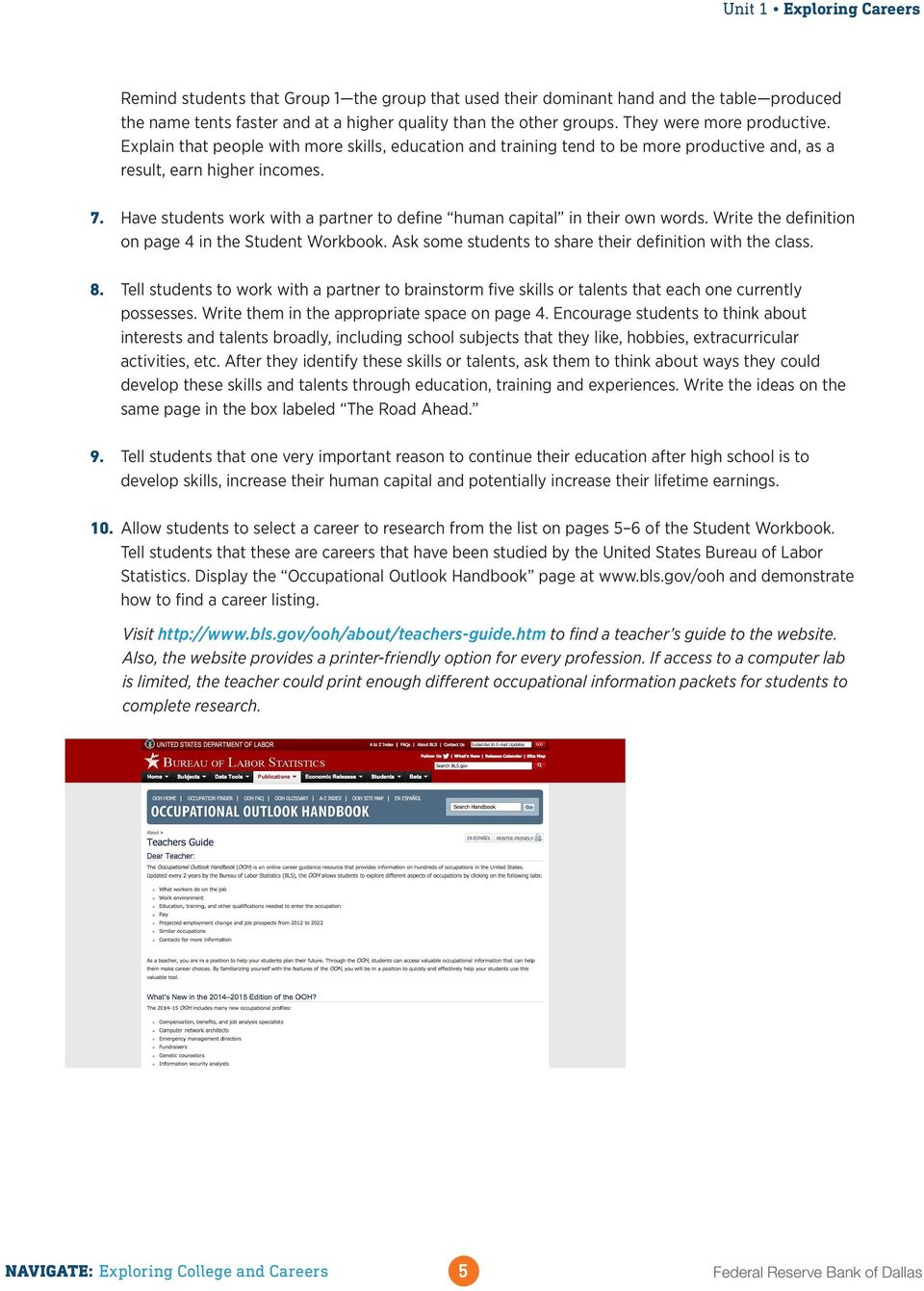
7 Unit 1 Exploring Careers Remind students that Group 1 the group that used their dominant hand and the table produced the name tents faster and at a higher quality than the other groups. They were more productive. Explain that people with more skills, education and training tend to be more productive and, as a result, earn higher incomes. 7. Have students work with a partner to define human capital in their own words. Write the definition on page 4 in the Student Workbook. Ask some students to share their definition with the class. 8. Tell students to work with a partner to brainstorm five skills or talents that each one currently possesses. Write them in the appropriate space on page 4. Encourage students to think about interests and talents broadly, including school subjects that they like, hobbies, extracurricular activities, etc. After they identify these skills or talents, ask them to think about ways they could develop these skills and talents through education, training and experiences. Write the ideas on the same page in the box labeled The Road Ahead. 9. Tell students that one very important reason to continue their education after high school is to develop skills, increase their human capital and potentially increase their lifetime earnings. 10. Allow students to select a career to research from the list on pages 5 6 of the Student Workbook. Tell students that these are careers that have been studied by the United States Bureau of Labor Statistics. Display the Occupational Outlook Handbook page at and demonstrate how to find a career listing. Visit to find a teacher s guide to the website. Also, the website provides a printer-friendly option for every profession. If access to a computer lab is limited, the teacher could print enough different occupational information packets for students to complete research. 5
8 Unit 1 Exploring Careers 11. Have students open the Student Workbook to page 7. Review the sections of the website that students will use to research the career that they selected. The What They Do tab contains information about the duties associated with the job and might contain information about specializations within the field. Students should use this information to complete Explain what you do. The Work Environment tab contains details about the typical workplace, schedule and hazards related to the career. Students should use this information to complete Describe where you work. The How to Become One tab contains information about required training, education and licenses. The BLS uses the following categories to describe educational requirements. They are defined in the glossary in the Student Workbook. Students should use this information to complete How much education will you need? Less than high school High school diploma or equivalent (such as a GED) Some college, no degree Postsecondary non-degree award Associate degree Bachelor s degree Master s degree Doctoral or professional degree The Pay tab contains the median wage for the career, along with comparisons to similar jobs and all occupations. Students should use this information to complete How much will you earn? Remind students that half of all workers in the career earn more than the median wage and half earn less. Students should compute median weekly wage by dividing the annual pay by 52. If only an hourly wage is given, multiply the wage by 40 hours to find weekly wage. Then multiply the weekly wage by 52 to find the annual wage. 12. Tell students to research information about the career they selected and record the information on page 7 of the Student Workbook. 13. Display the graph of earnings by educational attainment that can be found at ep_chart_001.htm. (Note: See the screen shot on the next page. To search for the graph, visit and search for income by educational attainment. ) Use the graph and the information below to discuss the link between higher educational attainment and average earnings. This graph compares the median weekly earnings of full-time workers, over age 25, with various levels of education. In general, workers with higher levels of educational attainment have higher wages. The chart also displays the unemployment rate by level of educational attainment. It shows that people with higher levels of educational attainment generally have a lower level of unemployment. Have students transfer the data on median weekly earnings from the chart to page 8 in the Student Workbook and answer the questions. 6


9 Unit 1 Exploring Careers Closure 14. Have students divide into groups based on the education required for an entry-level job in the career they researched. Within the groups, have students compare median salaries. Discuss the range of salaries within each level of educational attainment, using the information below: Assessment Salaries within each level of educational attainment will vary based on market conditions, including the number of jobs available, growth or decline in the field and the number of qualified candidates for the jobs. The nature of the job, including work environment, hazards and location, can also affect median salary. Consumer demand for the good or service produced by the worker affects the earnings. 15. Assess student research, using the rubric found on page 8. Extension Activity Have students visit Selecting the I m not really sure icon allows the student to complete an interest survey to identify potential careers that match the student s preferences. The name tent activity was originally developed by the Federal Reserve Bank of St. Louis and published in It s Your Paycheck, Lesson 1: Invest in Yourself. 7

10 Unit 1 Exploring Careers Assessment Rubric Student Name 1. Did the student identify a career? 4 0 Points Career identified No response 2. Did the student provide clear and complete information about the job description? Points Clear and complete information Some flaws in clarity or completeness Flaws in clarity and completeness Significant flaws in clarity and completeness No response 3. Did the student provide clear and complete information about the work environment? Points Clear and complete information Some flaws in clarity or completeness Flaws in clarity and completeness Significant flaws in clarity and completeness No response 4. Did the student identify the educational requirement? 4 0 Points Education level indicated No response 5. Did the student correctly compute weekly wage using annual wage? Points Correctly computed Mistakes in computation No response 6. Did the student complete the graph and answer the questions on page 8? Points Clear and complete information Some flaws in clarity or completeness Flaws in clarity and completeness Significant flaws in clarity and completeness No response Total Points (24 points possible) 8

11 Unit 2 What About College? Education after high school is critical as workers develop skills that will enhance their employment opportunities. Post-secondary education can be found at technical institutions, two-year (community or junior) colleges and four-year colleges and universities. In Navigate, these institutions are broadly referred to as colleges. A variety of traits and characteristics differentiate these colleges, including geographic setting, school size, course offerings, costs, student population and campus life. Information about a variety of colleges can be found on a College Board website called Big Future (bigfuture.collegeboard.org). The information is self-reported by the schools to the College Board. The website s standardized reporting format and easy search feature facilitate comparisons, and every college profile contains a link to the institution s website, where more in-depth information can be found. Lesson Overview Students will learn basic terms used to describe colleges and will conduct research on different types of institutions. Research findings will be presented on posters, and students will participate in a gallery walk to analyze common characteristics of different colleges. Instructional Objectives Use relevant terms when describing colleges. Compare the educational programs and related costs at various institutions. Use technology to find information about colleges. Time Required 45 minutes for website overview and research In-class or out-of-class time to create poster minutes for gallery walk and closure Materials Required For each student Student Workbook Large paper or poster 2200 boards N. Pearl Street Markers Dallas, TX For the classroom , ext Computer lab access [email protected] Classroom computer with Internet access and projector 9

12 Unit 2 What About College? Procedure 1. Remind students that in Unit 1: Exploring Careers, they researched various careers and identified the education required. This unit is about the types of schools where students can pursue education after they graduate from high school. 2. Tell students that they will be conducting research about a college. Have students turn to page 10 in the Student Workbook. Discuss each term and tell students that these are important words that will help them analyze college options. My School The official name of the institution Two-year or four-year Two-year schools offer associate degrees and workforce certification programs and are sometimes called junior or community colleges. Four-year schools offer bachelor s degrees, as well as graduate degrees in many cases. Public or private Public schools are colleges or universities that are administered by a local or state government and receive funding from government sources. Private schools are administered by a private organization and receive the majority of their funding from tuition, fees and donations to the school. Six-year graduation rate (only four-year schools) Most bachelor degrees are designed to be completed in four years of full-time studies. Since many students take more than four years to complete a bachelor s degree, the website offers a statistic that shows the percentage of students who complete a bachelor s degree within six years of enrollment. Location The city where the campus is located Commuter or residential A commuter school has a majority of students who live off-campus and travel to the school for courses and other activities. A residential school has a majority of students who live on-campus in dorms or other housing. Team name (mascot) Most schools have a mascot or a team name. Tuition and fees (in-state) An indicator of the cost of attending the school (Students will learn more about costs in Unit 4.) Number of undergraduates The total size of the institution Ethnic diversity The relative size of different ethnic groups enrolled at the school Gender ratio A comparison of the number of males and females enrolled at the school Student-faculty ratio The number of students per faculty member can be an indication of the average size of a class. Classes might be much larger or smaller than this ratio. 10

13 Unit 2 What About College? 3. Display bigfuture.collegeboard.org. Demonstrate the website by entering the name of a college or university in the search bar and selecting the institution from the search results. Note: Select a school that is familiar to students or choose the school that the teacher attended. On the school profile, point out the tabs on the left side. Tell students that the information about the school that they will be researching can be found in one of these sections. At a Glance (name of school, private or public, two-year or four-year, location, six-year graduation rate) Deadlines (not used in this research project) Majors and Learning Environment (student-faculty ratio) Campus Life (number of undergraduates, gender ratio, ethnic diversity, commuter vs. residential) Applying (not used in this research project) Paying (in-state tuition and fees) 4. Allow students to select a college to research or assign a school to each student. Tell students to write the information that they find for each category on page 10 in the Student Workbook. Note: It is helpful if students select a variety of types of institutions, including private and public, twoyear and four-year. If students have difficulty identifying colleges, the teacher could produce a list of schools and allow students to pick from the list. The search feature on the website allows the user to produce a list of all colleges in one or more states. 5. Have students produce a poster to communicate information about the school they selected. 6. Display posters in three groups private four-year schools, public four-year schools and two-year schools. 7. Group students in teams of two to four. Have groups conduct a gallery walk and compare the information about the various types of colleges. Have students record common characteristics of each type of college on the chart on page 11 of the Student Workbook. Closure 8. Discuss student observations using the information below and student notes. Students should use the space on page 12 in the Student Workbook to take notes during the discussion. 9. Discuss the common characteristics of private four-year colleges discovered during the gallery walk. Have students brainstorm advantages and disadvantages to this type of school. Answers might include, but are not limited to: Higher graduation rates Smaller student-faculty ratio Tuition and fees are higher 11

14 Unit 2 What About College? 10. Discuss the common characteristics of public four-year colleges discovered during the gallery walk. Have students brainstorm advantages and disadvantages to this type of school. Answers might include, but are not limited to: Larger campuses Lower tuition and fees More commuter students 11. Discuss the common characteristics of community colleges discovered during the gallery walk. Have students brainstorm advantages and disadvantages to this type of school. Answers might include, but are not limited to: Assessment Much lower tuition and fees Flexible schedules Usually commuter campuses Offer workforce certifications, such as technical studies, medicine and cosmetology 12. Assess student-created poster for accurate representation of data and neatness of student work. Use the rubric on page 13. Extension Activity Have students create a PowerPoint using information from research for presentation or electronic distribution. 12

15 Unit 2 What About College? Assessment Rubric Student Name My School Two-year or four-year Public or private Six-year graduation rate (only four-year schools) Location Commuter or residential Team name (mascot) Tuition and fees (in-state) Ethnic diversity Number of undergraduates Gender ratio Student-faculty ratio Included Not Included Overall Presentation (including neatness and creativity)

16 Unit 3 How Do I Get In? Admission to college can be competitive. If students create a plan to maximize their high school years, they increase their options for education beyond high school. There is no single path to college admission, but a well-thought-out plan will help students ensure that they have used their high school opportunities to maximum benefit. The vocabulary of the college application process can be daunting. Students encounter the idea of GPA and transcripts, along with national standardized tests such as SAT and ACT. Extracurricular activities, both in and out of school, provide valuable learning and service opportunities for students. However, students need to remember to track their activities and awards in preparation for applying for both financial aid and admission. States and local school districts set requirements for high school graduation, but many colleges require course work beyond basic requirements. These requirements can change from year to year. School counselors are a vital source of information about current graduation requirements. Lesson Overview Students will complete a graphic organizer during an interactive presentation about the factors that colleges consider during the admission process. Following the presentation, students will outline individual action items that will improve the likelihood of success in the college process. Instructors can extend the lesson by assigning students an admission essay. Instructional Objectives Identify key factors that colleges consider in the admission process. Create individual action plan to optimize future choices and success. Define relevant terms used in the college application. Time Required 90 minutes Materials Required For each student Student Workbook 2200 N. Pearl Street Dallas, TX For the classroom Unit 3 slides (available , at ext Classroom computer [email protected] with Internet access and projector 14

17 Unit 3 How Do I Get In? Procedure 1. Display Slide 1. Tell students that many high school students eagerly anticipate the day that an acceptance letter arrives from their college or university. There are many factors that will contribute to the student receiving an acceptance letter. 2. Display Slide 2. Introduce the items that colleges consider during the application process. Tell students to open the Student Workbook to pages and take notes on each of these blanks during the lesson. 3. Display Slide 3. Use the visual on the slide and the information below to discuss the importance of course selection to the college admission process. High school courses need to be varied. Most schools require a minimum of these core courses for graduation. Electives help students demonstrate a variety of interests. Core classes (English, math, social studies, science) Academic electives (Foreign languages, journalism, debate, college exploration/readiness, etc.) Arts (Band, choir, theater, art, etc.) Athletics Career and technology High school courses need to be challenging. Take the most advanced classes that you can. Tell students that counselors and academic advisors can help them select classes that align with their academic goals. It is important for students to get to know these individuals. Summarize by asking students why varied courses and challenging courses could be important. Answers will vary, but might include the following: to demonstrate the breadth of interests and ability; to provide exploration for possible careers; to meet requirements for graduation and college admission. Have students make a note under Courses that the courses they take should be varied and challenging. 4. Display Slide 4. Tell students to turn to the glossary in the Student Workbook. Select a student to read the definition of these four terms out loud. Discuss how these types of classes can be an important way to prepare students for college-level work, as well as earn college credit. Advanced Placement, or AP, courses Dual-credit courses International Baccalaureate (IB) Program courses Credit-by-exam Students can select advanced courses based on past performance, testing results and other factors. Tell students that they should talk to their counselor about advanced courses that are available. 5. Display Slide 5. Tell students that all of their high school grades will be recorded on their official school transcript. This transcript will contain the final grade from every high school class they take. Use the following definitions to discuss these terms with the students. 15

18 Unit 3 How Do I Get In? Transcript an official record of a student s grades Transcripts are maintained by the school and are usually sent to colleges directly by the school. Grade point average (GPA) a number that represents a student s average grade in all classes Some schools calculate the GPA using a numeric grade from each class that ranges from zero to 100. Other schools assign points to letter grades earned (4 for A, 3 for B, etc.). In this system, the GPA ranges from 0 to 4. (Teacher note: If possible, find out the system for GPA calculations used in your school district.) Weighted GPA a GPA that is calculated with extra points added to the grade value for honors or advanced courses Many schools add points to the final grade of an honors or advanced course, so a grade of 94 might be included in the weighted GPA as a 104. In schools with a zero to 4 scale, an A in these courses might receive 5 points (rather than 4), a B would receive 4 points (rather than 3), etc. Class rank a measure of a student s grades compared to the other students in the class The class rank is usually stated as a number compared to the number of students in the class. It can also be stated as a percentile. For example, if a student ranks 41st out of 427, the student is in the top 10 percent of the class. Ask students why grades are important in the college admission process. Answers will vary, but should include the following ideas: Grades can tell a college about a student s academic successes and failures. Grades can help a college predict future success. Grades allow a college to compare the performance of different applicants. Have students write the following sentence in the Grades box: All of my grades will be on my transcript. It will also have my GPA and my class rank. 6. Display Slide 6. Use the information on the slide to discuss how tests are an important part of the college admission process. 7. Display Slide 7. Use the information below and on the slide to discuss the types of tests that students take. General tests are designed to measure academic aptitude. One or more of these tests is generally required for admission to any college or university. For the college admission process, these tests are usually taken in the 11th and 12th grade years. However, the Duke Talent Identification Program allows 7th grade students to take the SAT or the ACT. High-scoring middle school students are recognized and invited to participate in a variety of enrichment programs. ACT Consists of four tests (English, mathematics, reading and science) that are scored on a scale of These four scores are averaged for a Composite Score. The ACT also includes an optional writing test. SAT Consists of three sections (critical reading, writing and mathematics) that are each scored on a scale of The total score is the sum of the scores on the three sections. 16

19 Unit 3 How Do I Get In? PSAT/NMSQT The Preliminary SAT/National Merit Scholarship Qualifying Test is administered to juniors. The test has a format similar to the SAT and allows students to practice for the college admission test. It is scored on a scale of for each of the three sections. Scores on this test qualify students for several competitions that provide scholarships and recognition. Course-specific tests Advanced Placement tests These tests are taken after a student has completed an Advanced Placement course. They consist of multiple-choice and free-response questions. Scores are reported on a scale of 1 5. Schools have different policies on awarding credit or making placement decisions based on the test score. International Baccalaureate tests These tests are taken after a student has completed an International Baccalaureate course. The tests are scored on a scale of 1 7, with up to three additional points available. SAT Subject Tests These are content-specific tests that students can take to demonstrate skills and knowledge in various academic subjects. Each one is scored on a scale of Under Test Scores, have students write the following sentence: Some tests are used for college admission, like the SAT or ACT. Some tests are used for college credit, like AP or IB. 8. Display Slide 8. Tell students that it is important to start a tracking system to record awards and achievements. The slide contains two fictitious examples. Review the types of information that the tracking sheet contains. It is helpful to keep track of references that can describe the award or comment on your qualifications. Ask students to name other awards of which they are aware. Write the following sentence under Achievements. It is important to track my awards and keep copies of documentation. The last page of the Student Workbook provides a form for students to use to track various achievements throughout their high school career. 9. Display Slide 9. Use the information below and on the slide to discuss how extracurricular activities allow students to develop skills and talents in school-based organizations and activities. Discuss the variety of opportunities that are available at school. They can include: Athletics Academic clubs and competitions Fine arts Service organizations Student leadership Under Extracurricular at School, have students list one activity that they currently participate in and identify a skill or a leadership quality that the activity can develop. 10. Display Slide 10. Use the information on the slide to discuss how involvement in community organizations and volunteer activities can provide opportunities for students to develop skills, serve their community and build relationships that can provide references. 17

20 Unit 3 How Do I Get In? Community organizations (Lions Clubs, Rotary, Kiwanis, etc.) Faith-based organizations (church, synagogue, etc.) Youth organizations and clubs (Boys and Girls Club, scouting, etc.) Federal programs (Upward Bound, Gear Up, etc.) Many college applications ask students to list the places they volunteered, along with the number of hours of community service. Tell students that paid and unpaid employment, such as internships, can allow for career exploration and reference development. They can also enhance a college application. Under Extracurricular Outside of School, students should identify one organization that could provide opportunities for membership or volunteer service. 11. Display Slide 11. Discuss the importance of personal references using the information on the slide. Have students think of two people who could provide a personal reference and write their name under References. Tell students that these names will likely change as they progress through high school, have new teachers, meet new people and experience new opportunities. 12. Display Slide 12. Use the information on the slide and below to discuss additional components of the college application. Closure Essay The topics of college essays vary but provide an opportunity for the student to show creativity and explain qualities that are not captured in other parts of the application. Auditions and portfolios Music, art or theater programs may require an audition or work samples as part of the application for admission. Interviews Some colleges require (or offer) an interview with a school representative. Under Other, list these three additional components. 13. Display Slide 13. Tell students that all colleges and universities require an application and supporting documents. It is important to remain aware of upcoming deadlines throughout high school. Counselors, teachers and advisors are crucial sources of information about the admission process. 14. Display Slide 14. Review the areas that the class has discussed. 18

21 Unit 3 How Do I Get In? Assessment 15. Have students imagine that as seniors they receive an acceptance letter to the college of their choice. Have them write the acceptance letter to themselves explaining the reasons that the college admitted the student. They should make their final copy on page 16 of the Student Workbook. 16. The letter should highlight at least four of the areas discussed in the lesson. Letters should be written in correct format. To assess student performance, consider the following questions. Extension a. Does the letter contain a college logo and a salutation? b. Does the letter include four areas of consideration that were introduced in the lesson? Courses Grades Test Scores Achievements Extracurricular at School Extracurricular Outside of School References Other c. Does the letter use correct spelling and grammar? 1. Have students write a college admission essay using one of the following prompts. Tell about a life-changing experience. How did it change the way you look at the world or relate to other people? Tell about a person who shaped your life. How did this person affect you? What did you learn from them? If you could change one thing in your community, what would it be? Why? 2. Invite a representative from a local college or university to talk about the admission process. 19
22 Unit 3 How Do I Get In? Unit 3 Slides Unit 3 How Do I Get In? What Do Colleges Look At? I ve been accepted! x.. Test Scores 1. A B C D E Courses Grades Achievements 2. A B C D E A B C D E A B Great student! Wonderful worker Very helpful Extracurricular At School Extracurricular Outside of School References Other Items Course Selection Course Selection: Learn the Lingo x.. x... x Advanced Placement (AP) Courses Dual-credit Courses Variety of Courses Challenging Courses International Baccalaureate (IB) Courses Credit-by-exam Grades: Learn the Lingo Tests Transcript Standardized tests are required for college admission. Grade Point Average (GPA) Every test has a different scoring scale. Weighted GPA Class Rank $ Test scores can provide opportunities for: Scholarships College credit Placement in select programs Tests: Learn the Lingo Extracurricular Activities at School Athletics 1. A B C D E 2. A B C D E A B C D E General Tests ACT SAT PSAT Course-specific Tests Academic clubs and competitions Fine Arts Get involved outside the classroom. Advanced Placement (AP tests) SAT Subject Tests Service organizations International Baccalaureate (IB tests) Student leadership
23 Unit 3 How Do I Get In? Unit 3 Slides Extracurricular Activities Outside of School Achievements and Awards Get involved in your community. Community organizations Faith-based organizations Youth organizations and clubs Award or Recognition Outstanding Social Studies Student 1st Place in the Regional Science Fair Organization Date Contact or Reference Your Junior High 4/23/2014 Principal Jones Your School District 2/18/2014 District Science Coordinator Brief Description Awarded to the student with highest grade in social studies. Competed against other science projects from the entire school district. Federal programs Volunteer activities allow you to serve your community and to build a resume for college. 9 Job Internships and jobs References Other Parts of the Application Great Student! 12th grade science teacher Best employee Manager Other parts of the application may include Auditions Focused on the future High school couselor Wonderful person Next door neighbor Application essay Admission interview Portfolios Application process Review MARCH S M T W TH F S NSU NAVIGATE STATE UNIVERSITY ADMISSION APPLICATION FEBRUARY S M T W TH F S JANUARY S M T W TH F S! FULL LEGAL NAME FIRST NAME LAST NAME MI DATE OF BIRTH SOCIAL SECURITY NUMBER GENDER MALE FEMALE x. Test Scores 1. A B C D E Course Selection Grades 2. Achievements A B C D E MAILING ADDRESS COUNTRY <> A B C D E CITY STATE <> ZIP CODE 13 PHONE # ( ) 14 Extracurricular At School Extracurricular Outside of School References Other Items
24 Unit 4 How Much Does College Cost? Continuing education beyond high school can be expensive, but a student s choices can have a significant impact on that cost. Students will examine the differences in cost between two-year and four-year educational institutions and between private and public schools. Some students may choose to minimize costs by living at home and attending community college before they transfer to a four-year college to complete their education. Others may opt to move away from home to attend schools they believe will most effectively allow them to attain their career goals. It is never too early to have students practice working with a budget that has limited resources and excess wants. The shopping basket exercise at the end of this unit provides a real-world example that challenges students to weigh benefits and costs and create a plan to balance their budget. Lesson Overview Students will learn about different categories of college costs and conduct research to determine costs for a variety of types of colleges and universities. As part of the research project, students will create circle graphs (or pie charts) and compare data. The lesson finishes with a budget activity and a discussion of how student choices affect college costs. Instructional Objectives Compare the total yearly monetary costs of different types of colleges and universities Identify student choices that affect the total cost of college Evaluate a budget for personal expenditures Time Required 90 minutes Materials Required For each student Student Workbook Colored pencils For the classroom 2200 N. Pearl Street Classroom computer Dallas, with TX Internet access and projector Computer lab access , ext [email protected] 22
25 Unit 4 How Much Does College Cost? Procedure 1. Define the following terms. Have students paraphrase the following definitions on page 18 of the Student Workbook. Tuition and fees the cost of instruction and facility use at an educational institution Tuition can be quoted as a cost per credit hour, or as a flat rate for a range of credit hours. Fees include general fees, such as libraries and student activity costs, and may include course-specific costs, such as lab fees. Room and board the cost of living and eating on campus This can be the cost of housing and meals provided by the school or an estimate of the cost of living off-campus. Estimated personal expenses costs that are not billed by the college These may include laundry, meals not covered under a meal plan, or personal items such as soap and shampoo. They also include academic supplies, such as calculators and computers. These costs vary based on an individual s habits and course selection. Transportation expenses The estimated cost of going to and from campus during the academic year These costs vary based on the distance you live from your chosen educational institution and your travel decisions, such as number of trips to and from school and means of transportation. Books and supplies the estimated cost of purchasing the textbooks and course supplies These costs vary based on the courses taken and books and supplies required. 2. Tell students that there are four broad categories of colleges and universities that vary significantly in cost. In this lesson, students will be researching the cost of a school in each category. Four-year public college or university in your home state Four-year public college or university in a state other than your home state Four-year private university Two-year community college or junior college Brainstorm schools that belong in each category. Refer to the posters that were created in Unit 2: What About College? Tell students to turn to pages in the Student Workbook and write the name of a school for each category on the appropriate page. 3. Tell students to research the cost of attending each school that they identified at collegeboard.org. Cost information can be found by clicking Paying on the left side of the school profile. Have students use the column for on campus expenses for this comparison. Remind students that to find the percentage cost of each item, divide the cost of the individual category by the total yearly cost and multiply by 100. Have students use the percentages to create a pie chart in the circle. Use colored pencils to complete the graphs. 23
26 Unit 4 How Much Does College Cost? 4. After students have completed their research, discuss the information they found. Ask students if they can make any generalizations about the types of institutions that are the least expensive. Answers should include the observation that two-year community colleges are often the least expensive, public schools are less expensive than private schools and in-state public schools are usually less expensive than out-of-state public schools. 5. Tell students that the choices they make affect the cost of attending college. Brainstorm with students how their choices affect each of these categories. Answers will vary, but might include: Tuition and fees (school choice, number of hours, course selection) Room and board (dorm choice, having a roommate vs. a single room, living at home, choice of meal plan, frequency of eating out) Books and supplies (new vs. used textbooks, digital textbooks, rented textbooks) Estimated personal expenses (clothing expenses, entertainment expenses and memberships in social organizations, clubs and intramural sports) Transportation expenses (car, number of trips home, use of public transportation) 6. Explain to students that the category of estimated personal expenses can include many items. Have students turn to page 21 in the Student Workbook. Review the instructions and ask students to modify the budget for personal expenses so that income matches expenditures. 7. Ask students to explain changes that they made to the budget. Remind students that their choices have a significant impact on the cost of going to college. Closure 8. Ask students to identify the following information from their research. Assessment What category represents the largest percentage of the total cost for each type of institution? Four-year public college or university in your home state (in-state tuition) Four-year public college or university in a state other than your home state (out-of-state tuition) Four-year private university Two-year community college or junior college (in-state tuition) What category represents the smallest percentage of the total cost of each type of institution? Four-year public college or university in your home state (in-state tuition) Four-year public college or university in a state other than your home state (out-of-state tuition) Four-year private university Two-year community college or junior college 9. Evaluate student research on college costs. Assess for completeness and accuracy of percentages and circle graphs. 24
27 Unit 4 How Much Does College Cost? Extension Activities For additional information and activities about budgeting, consider these resources: 1. Use the instructions and the table on page 22 of the Student Workbook to practice making choices about spending and saving, then developing a budget. 2. The signature personal finance program is Building Wealth. The suite of resources that includes a printed guide and classroom lessons is available at 3. The Budget Game: Living on a 20 Square Salary is a basic budget activity that is available from the office of two state treasurers, Ohio and West Virginia. Find it at ohiotreasurer.gov/documents/cms/budgetgame8%205x11.pdf or at Lesson11.30BudgetGameHandout1.pdf 25
28 Unit 5 Paying for College The cost of a post-secondary education should not be the barrier that prevents a student from achieving his or her career goal. This unit provides a broad overview of the financial options available to assist students and their families in paying for college. This is not intended to provide comprehensive coverage of the financial process, and students and their families are strongly encouraged to use the website to obtain the most current information for their personal situation. The financial process is rich in specialized vocabulary, and this unit provides an opportunity for students to become comfortable with this terminology. It is important to know that approximately 70 percent of all college students receive some type of financial assistance while in college. Becoming familiar with these websites and terminology will give students a head start to navigate this process. Lesson Overview Students will be introduced to the major types of financial aid in an independent reading. While reading, students will create an information web about paying for college. The types of aid are reviewed in a quiz game, with students competing in teams to earn financial aid that will help them in the college process. Instructional Objectives Describe the different types of financial aid. Identify significant differences between types of financial aid. Time Required 60 minutes Materials Required For each student Student Workbook For the classroom Unit 5 slides (available at 4 copies of Handout , N. cut Pearl into four Street cards 4 copies of Handout Dallas, 2, cut TX into certificates Classroom computer with Internet access and projector , ext [email protected] 26
29 Unit 5 Paying for College Procedure 1. Tell students that, according to the U.S. Department of Education, more than 70 percent of undergraduate students receive some type of financial aid. This lesson will explore different types of financial aid. 2. Tell students to turn to pages in the Student Workbook and read the information. After they complete the reading, students should fill in the information on page Discuss the students information web and the reading. Emphasize that there are three main types of financial aid: Gift aid (including scholarships and grants), work study, loans 4. Play a quiz game about financial aid. The questions and answers are provided below and on the slides. Divide students into four teams and give each team a set of cards from Handout 1. Tell students to answer the questions in the game by holding up the appropriate card that names the type of aid: a scholarship, a grant, work study or a loan. Have all teams hold up their selected card at the same time. Award one $1,500 certificate to each team that has the correct answer. Game Questions 1. You are an education major, and part of your financial aid is the money you earn as a tutor. (work study) 2. You are majoring in chemistry and entering your third year of college. You receive money from the federal government through a program that awards financial aid to students majoring in science, technology, engineering or math. (grant) 3. You receive $500 from the local cultural society. (scholarship) 4. Your father lost his job and the family s income became much lower. You received money from the government to pay for college. (grant) 5. You borrowed money through a federal program to pay for your education this year. (loan) 6. You entered your painting in a contest and won $750 to pay for your college expenses. (scholarship) 7. You work in an office on campus after class every day. (work study) 8. You received $3,000 per year from the lottery funds in your state. Every high school graduate can receive this aid if they attend an in-state college. (grant) 9. You received $4,000 from the federal government because you promised to teach in a school that serves low-income students after graduation. If you change your mind, you will have to repay the full amount. (grant) 10. You were a high school athlete. The university is paying your tuition while you play on the college team. (scholarship) 11. Your parents borrowed money through a U.S. government program for parents of college students. (loan) 27
30 Unit 5 Paying for College 12. You were raised by a single parent. Your family income qualified you to receive a need-based award from the U.S. government. (grant) 13. You are going to school to study voice performance, and you receive $1,000 per semester because you sing in the college choir. (scholarship) 14. You work 20 hours per week in the library at your college. (work study) 15. Your family qualified for a federal government program that reduced the interest on the money you borrowed to pay for college. (loan) 16. Your mom works for a company that will pay 50 percent of your tuition at any in-state public college. (scholarship) 17. You receive a $1,000 award to help pay for college from a local community organization in recognition of your volunteer activities. (scholarship) 18. Your other financial aid did not cover all of your college costs, so you borrowed money from a private lender. (loan) 19. You work in the college s computer lab three days per week. (work study) 20. Your PSAT scores qualified you as a National Merit Scholar. Several schools have offered you free tuition. (scholarship) 5. Ask each team to add up the total amount of financial aid that the team earned. Use the information below to remind students about the cost of tuition and fees at different types of institutions. Tell students that with more financial aid, they will have more choices about the type of institution that they might choose to attend. Closure Public Two-Year College (in-state students) $3,347 Public Four-Year College (in-state students) $9,139 Public Four-Year College (out-of-state students) $22,958 Private Four-Year College $31,231 Source: Teacher note: Remind students that these figures are for tuition and fees only. The cost of attending college will also include other items such as room and board, books and supplies, etc. See Unit 4 for more information about the total cost of attending college. 6. Ask students how many different cards they held up during the financial aid game. (They should have used all four.) Remind students that paying for education after high school may require a variety of sources. Planning, research and communication with college advisors and counselors at your high school will play a key role in your ability to pay for college. Assessment 7. Assess the fill-in-the-blank questions and the information web on page 26 of the Student Workbook for completeness and accuracy, using the key on page
31 Unit 5 Paying for College Unit 5 Slides Q: 1. You are an education major, and part of your financial aid is the money you earn as a tutor. A: 1. You are an education major, and part of your financial aid is the money you earn as a tutor. (work study) You are majoring in chemistry Q: and entering your third year of college. You receive money from the federal government through a program that awards financial aid to students majoring in science, technology, engineering or math. 2. You are majoring in chemistry A: and entering your third year of college. You receive money from the federal government through a program that awards financial aid to students majoring in science, technology, engineering or math. (grant) Q: 3. You receive $500 from the local cultural society. A: 3. You receive $500 from the local cultural society. (scholarship) Q: 4. Your father lost his job and the family s income became much lower. You received money from the government to pay for college. A: 4. Your father lost his job and the family s income became much lower. You received money from the government to pay for college. (grant)
32 Unit 5 Paying for College Unit 5 Slides Q:5. You borrowed money through a federal program to pay for your education this year. A: 5. You borrowed money through a federal program to pay for your education this year. (loan) Q: 6. You entered your painting in a contest and won $750 to pay for your college expenses. A: 6. You entered your painting in a contest and won $750 to pay for your college expenses. (scholarship) Q: 7. You work in an office on campus after class every day. A: 7. You work in an office on campus after class every day. (work study) Q:8. You received $3,000 per year from the lottery funds in your state. Every high school graduate can receive this aid if they attend an in-state college. A: 8. You received $3,000 per year from the lottery funds in your state. Every high school graduate can receive this aid if they attend an in-state college. (grant)
33 Unit 5 Paying for College Unit 5 Slides Q: 9. You received $4,000 from the federal government because you promised to teach in a school that serves low-income students after graduation. If you change your mind, you will have to repay the full amount. A: 9. You received $4,000 from the federal government because you promised to teach in a school that serves low-income students after graduation. If you change your mind, you will have to repay the full amount. (grant) Q: 10. You were a high school athlete. The university is paying your tuition while you play on the college team. A: 10. You were a high school athlete. The university is paying your tuition while you play on the college team. (scholarship) Q: 11. Your parents borrowed money through a U.S. government program for parents of college students. A: 11. Your parents borrowed money through a U.S. government program for parents of college students. (loan) Q: 12. You were raised by a single parent. Your family income qualified you to receive a need-based award from the U.S. government. A: 12. You were raised by a single parent. Your family income qualified you to receive a need-based award from the U.S. government. (grant)
34 Unit 5 Paying for College Unit 5 Slides Q: 13. You are going to school to study voice performance, and you receive $1,000 per semester because you sing in the college choir. A: 13. You are going to school to study voice performance, and you receive $1,000 per semester because you sing in the college choir. (scholarship) Q: 14. You work 20 hours per week in the library at your college. A: 14. You work 20 hours per week in the library at your college. (work study) Q: 15. Your family qualified for a federal government program that reduced the interest on the money you borrowed to pay for college. A: 15. Your family qualified for a federal government program that reduced the interest on the money you borrowed to pay for college. (loan) Q: 16. Your mom works for a company that will pay 50 percent of your tuition at any in-state public college. A: 16. Your mom works for a company that will pay 50 percent of your tuition at any in-state public college. (scholarship)
35 Unit 5 Paying for College Unit 5 Slides Q: 17. You receive a $1,000 award to help pay for college from a local community organization in recognition of your volunteer activities. A: 17. You receive a $1,000 award to help pay for college from a local community organization in recognition of your volunteer activities. (scholarship) Q: 18. Your other financial aid did not cover all of your college costs, so you borrowed money from a private lender. A: 18. Your other financial aid did not cover all of your college costs, so you borrowed money from a private lender. (loan) Q: 19. You work in the college s computer lab three days per week. A: 19. You work in the college s computer lab three days per week. (work study) Q: 20. Your PSAT scores qualified you as a National Merit Scholar. Several schools have offered you free tuition. A: 20. Your PSAT scores qualified you as a National Merit Scholar. Several schools have offered you free tuition. (scholarship)
36 Unit 5 Paying for College Answer key 1. Grants are often based on financial need and do not need to be repaid unless you do not complete the requirements. 2. Scholarships are a type of gift aid that are awarded based on merit, need or other criteria. 3. Work study is a type of aid that allows a student to earn money while enrolled in school that can be used to pay for educational and other expenses. 4. Loans are a type of financial aid that must be repaid with interest. 5. The FAFSA is a free application for financial aid. It is required for all types of aid from the U.S. government and used by many other financial aid providers. 6. The money that you or your family have earned and not spent is called savings. The money can be used for educational and other expenses. Information Web Financial aid Federal Financial aid Loans Private FAFSA Paying for College Work study Need or merit or other Federal and state government Saving College College or university Grants Private organization Gift aid Scholarships Private Need or merit or other 34
37 Unit 5 Paying for College Handout 1 Scholarship Grant Work Study Loan 35
38 Handout 2 $ $ $1500 $1500 Awarded for Extraordinary Knowledge about Financial Aid $ $ $1500 $1500 $ $ $1500 $1500 Awarded for Extraordinary Knowledge about Financial Aid $ $ $1500 $1500 Unit 5 Paying for College Awarded for Extraordinary Knowledge about Financial Aid Awarded for Extraordinary Knowledge about Financial Aid $ $ $1500 $1500 $ $ $1500 $1500 Awarded for Extraordinary Knowledge about Financial Aid Awarded for Extraordinary Knowledge about Financial Aid $ $ $1500 $1500 $ $ $1500 $1500 Awarded for Extraordinary Knowledge about Financial Aid Awarded for Extraordinary Knowledge about Financial Aid $ $ $1500 $1500 $ $ $1500 $1500 Awarded for Extraordinary Knowledge about Financial Aid Awarded for Extraordinary Knowledge about Financial Aid $ $ $1500 $1500 $ $ $1500 $1500 Awarded for Extraordinary Knowledge about Financial Aid Awarded for Extraordinary Knowledge about Financial Aid $ $ $1500 $1500 $ $ $1500 $1500 Awarded for Extraordinary Knowledge about Financial Aid Awarded for Extraordinary Knowledge about Financial Aid $ $ $1500 $1500 $ $ $1500 $1500 Awarded for Extraordinary Knowledge about Financial Aid Awarded for Extraordinary Knowledge about Financial Aid $ $ $1500 $1500 $ $ $1500 $1500 Awarded for Extraordinary Knowledge about Financial Aid Awarded for Extraordinary Knowledge about Financial Aid $ $ $1500 $1500 $ $ $1500 $1500 Awarded for Extraordinary Knowledge about Financial Aid Awarded for Extraordinary Knowledge about Financial Aid 36
39 Unit 6 Future Paths Throughout this workbook, we have asked students to dream about their future career, imagine the college they might attend, and think about the activities and courses they might select in high school. In this final unit, students bring all these units together as they create a life narrative of a successful alumnus from their own high school. Students evaluate the skill level needed for a career and select a possible education path. It is important to remind students that there are many factors to consider when they select a career. No career is inherently more important or better than another. Each provides individuals with benefits that they personally value at a cost that they were willing to pay. Additionally, students may pursue multiple careers in a lifetime as their life goals and objectives change. Their education will continue throughout their lives both on the job and in their personal lives. Lesson Overview Students will review key concepts, including career exploration, college choice, the application process, the cost of college and financial aid. Following the brief review, students will be given a career card and asked to write a possible success story for that career. Instructional Objectives Identify and review key concepts from Units 1 5. Create a success story for an assigned career. Time Required 60 minutes Materials Required For each student Student Workbook For the classroom Unit 6 slides (available at Copies of career cards, cut apart (available at Classroom computer Federal with Reserve Internet access Bank and of Dallas projector 2200 N. Pearl Street Dallas, TX , ext [email protected] 37
40 Unit 6 Future Paths Procedure 1. Use the slides for this unit to review key concepts about college. For additional information, have students review their completed Student Workbooks. Also refer to the information in the procedure documents for Units Distribute one career card to each student and tell students to open the Student Workbook to page 28. Tell students to brainstorm ways to prepare for the career in high school. For example, for a career in desktop publishing, student responses might include: Courses English, journalism, computer design, graphic arts Extracurricular at school Work on yearbook or school newspaper Extracurricular outside of school Develop and publish a newsletter for a youth group References English teacher, journalism teacher, yearbook sponsor, youth group leader 3. Tell students to read the prompt on page 29 and use the space to brainstorm information for the personal narrative. Remind students to use information on entry-level education and career description from the career card as they plan their essay. 4. Have students complete their final copy on page 30 of the Student Workbook. 5. Have students share their success stories with a partner to compare career paths. Closure 6. Debrief the writing activity by discussing the following questions: Assessment What was the most challenging part of writing the essay? How do you think that writing the essay will help you as you enter high school? What is the most important information you learned while studying Navigate. 7. Evaluate the student essay for completeness and inclusion of relevant details, using the rubric on page 39. Extension Activities 1. Students can interview an adult in a career that interests them and ask the adult to describe his or her career and educational path. 2. Students could do an oral report on the interview. 38
41 Unit 6 Future Paths Assessment Rubric Student Name 1. Did the student provide clear and complete information about high school preparation for the career? Points Clear and complete information Some flaws in clarity or completeness Flaws in clarity and completeness Significant flaws in clarity and completeness No response 2. Did the student provide clear and complete information about the post-secondary education required? Points Clear and complete information Some flaws in clarity or completeness Flaws in clarity and completeness Significant flaws in clarity and completeness No response 3. Did the student provide clear and complete information about the challenges that someone might face? Points Clear and complete information Some flaws in clarity or completeness Flaws in clarity and completeness Significant flaws in clarity and completeness No response 4. Did the student edit the final copy for spelling and grammar? Points No errors Few errors in spelling or grammar Multiple errors in spelling and grammar Significant errors in spelling and grammar Essay incomplete Total Points (16 points possible) 39
42 Unit 6 Future Paths Unit 6 Slides Exploring Careers How Much Does College Cost? Education beyond high school is required for many careers. There are many types of costs associated with attending college. $ Adults with more education can expect to earn higher wages. The cost of attending college varies widely among schools. 1 4 What About College? Paying for College There are more than 4,500 colleges in the U.S. Every college is unique. FAFSA There are government and private resources available to help pay the cost of college. Many of these require completion of the FAFSA. There are advantages and disadvantages for every school. LOAN +% Scholarships and grants are gifts that do not have to be repaid, but loans must be paid back with interest. 2 5 How Do I Get In? High school grades and course selection, along with test scores, impact college admissions. Extracurricular activities both in and out of school are an important part of an application for college. 3 40
43 Career Cards Unit 6 Future Paths Architecture and Engineering Drafters Drafters use software to convert the designs of engineers and architects into technical drawings and plans. Workers specialize in architectural, civil, electrical, or mechanical drafting and use technical drawings to help design everything from microchips to skyscrapers. Arts and Design Industrial designer Industrial designers develop the concepts for manufactured products, such as cars, home appliances, and toys. They combine art, business, and engineering to make products that people use every day. Industrial designers focus on the user experience in creating style and function for a particular gadget or appliance. Associate degree $49,630 Bachelor s degree $59,610 Architecture and Engineering Environmental engineering technicians Environmental engineering technicians carry out the plans that environmental engineers develop. They test, operate, and, if necessary, modify equipment used to prevent or clean up environmental pollution. They may collect samples for testing, or they may work to mitigate sources of environmental pollution. Arts and Design Interior designer Interior designers make interior spaces functional, safe, and beautiful by determining space requirements and selecting decorative items, such as colors, lighting, and materials. They read blueprints and must be aware of building codes and inspection regulations. Associate degree $45,350 Bachelor s degree $47,600 Architecture and Engineering Electrical engineer Electrical engineers design, develop, test, and supervise the manufacturing of electrical equipment, such as electric motors, radar and navigation systems, communications systems, and power generation equipment. Electronics engineers design and develop electronic equipment, such as broadcast and communications systems from portable music players to global positioning systems (GPS). Business and Financial Cost estimators Cost estimators collect and analyze data to estimate the time, money, materials, and labor required to manufacture a product, construct a building, or provide a service. They generally specialize in a particular industry or type of product. Bachelor s degree $89,630 Bachelor s degree $58,860 Architecture and Engineering Landscape architect Business and Financial Loan officers Landscape architects plan and design land areas for parks, recreational facilities, private homes, campuses, and other open spaces. Loan officers evaluate, authorize, or recommend approval of loan applications for people and businesses. Bachelor s degree $64,180 Bachelor s degree $59,820 41
44 Unit 6 Future Paths Community and Social Service Rehabilitation counselors Education, Training and Library Teacher assistants Rehabilitation counselors help people with emotional and physical disabilities live independently. They work with clients to overcome or manage the personal, social, and professional effects of disabilities on employment or independent living. Teacher assistants work under a teacher s supervision to give students additional attention and instruction. Master s degree $33,880 Some college, no degree $23,640 Computer and Information Technology Computer network architects Computer network architects design and build data communication networks, including local area networks (LANs), wide area networks (WANs), and intranets. These networks range from a small connection between two offices to a multinational series of globally distributed communications systems. Health Care Radiation therapists Radiation therapists treat cancer and other diseases in patients by administering radiation treatments. Bachelor s degree $91,000 Associate degree $77,560 Computer and Information Technology Information security analysts Information security analysts plan and carry out security measures to protect an organization's computer networks and systems. Their responsibilities are continually expanding as the number of cyberattacks increases. Health Care Dental hygienists Dental hygienists clean teeth, examine patients for signs of oral diseases such as gingivitis, and provide other preventative dental care. They also educate patients on ways to improve and maintain good oral health. Bachelor s degree $86,170 Associate degree $70,210 Education, Training and Library Special education teachers Special education teachers work with students who have a wide range of learning, mental, emotional, and physical disabilities. They adapt general education lessons and teach various subjects, such as reading, writing, and math, to students with mild and moderate disabilities. They also teach basic skills, such as literacy and communication techniques, to students with severe disabilities. Health Care Radiologic and MRI technologists Radiologic technologists perform diagnostic imaging examinations, such as x-rays, on patients. MRI technologists operate magnetic resonance imaging (MRI) scanners to create diagnostic images. Bachelor s degree $55,060 Associate degree $55,910 42
45 Unit 6 Future Paths Health Care Athletic trainers and exercise physiologists Athletic trainers specialize in preventing, diagnosing, and treating muscle and bone injuries and illnesses. Exercise physiologists develop fitness and exercise programs that help patients recover from chronic diseases and improve cardiovascular function, body composition, and flexibility. Health Care Licensed practical and licensed vocational nurses Licensed practical nurses (LPNs) and licensed vocational nurses (LVNs) provide basic nursing care. They work under the direction of registered nurses and doctors. Bachelor s degree $42,690 Postsecondary non-degree award $41,540 Health Care Dietitians and nutritionists Dietitians and nutritionists are experts in food and nutrition. They advise people on what to eat to lead a healthy lifestyle or achieve a specific health-related goal. Installation, Maintenance and Repair Medical equipment repairers Medical equipment repairers install, maintain, and repair patient care equipment. Bachelor s degree $55,240 Associate degree $44,570 Health Care Genetic counselors Genetic counselors assess individual or family risk for a variety of inherited conditions, such as genetic disorders and birth defects. They provide information and advice to other health care providers, or to individuals and families concerned with the risk of inherited conditions. Installation, Maintenance and Repair Aircraft mechanics and service technicians Aircraft and avionics equipment mechanics and technicians repair and perform scheduled maintenance on aircraft. They also may perform aircraft inspections as required by the Federal Aviation Administration (FAA). Master's degree $56,800 Postsecondary non-degree award $55,230 Health Care Dental assistants Dental assistants have many tasks, ranging from providing patient care and taking x-rays to recordkeeping and scheduling appointments. Their duties vary by state and by the dentists offices where they work. Installation, Maintenance and Repair Electrical and electronics repairers, commercial and industrial equipment Electrical and electronics installers and repairers install, repair, or replace a variety of electrical equipment in telecommunications, transportation, utilities, and other industries. Postsecondary non-degree award $34,500 Postsecondary non-degree award $51,220 43
46 Unit 6 Future Paths Installation, Maintenance and Repair Heating, air conditioning, and refrigeration mechanics and installers Heating, air conditioning, and refrigeration mechanics and installers often called HVACR technicians work on heating, ventilation, cooling, and refrigeration systems that control the temperature and air quality in buildings. Life, Physical and Social Science Conservation scientists and foresters Conservation scientists and foresters manage overall land quality of forests, parks, rangelands, and other natural resources. Postsecondary non-degree award $43,640 Bachelor s degree $59,060 Life, Physical and Social Science Environmental science and protection technicians, including health Environmental science and protection technicians do laboratory and field tests to monitor the environment and investigate sources of pollution, including those affecting public health. Many work under the supervision of environmental scientists and specialists, who direct the technicians work and evaluate their results. Life, Physical and Social Science Forensic science technicians Forensic science technicians help investigate crimes by collecting and analyzing physical evidence. Many technicians specialize in either crime scene investigation or laboratory analysis. Most forensic science technicians spend some time writing reports. Associate degree $41,240 Bachelor s degree $52,840 Life, Physical and Social Science Forest and conservation technicians Forest and conservation technicians measure and improve the quality of forests, rangeland, and other natural areas. Life, Physical and Social Science Epidemiologists Epidemiologists are public health professionals who investigate patterns and causes of disease and injury in humans. They seek to reduce the risk and occurrence of negative health outcomes through research, community education, and health policy. Associate degree $33,920 Master s degree $65,270 Life, Physical and Social Science Geological and petroleum technicians Geological and petroleum technicians provide support to scientists and engineers in exploring and extracting natural resources, such as minerals, oil, and natural gas. Life, Physical and Social Science Urban and regional planners Urban and regional planners develop plans and programs for the use of land. Their plans help create communities, accommodate population growth, and revitalize physical facilities in towns, cities, counties, and metropolitan areas. Associate degree $52,700 Master s degree $65,230 44
47 Unit 6 Future Paths Management Advertising, promotions and marketing managers Advertising, promotions, and marketing managers plan programs to generate interest in a product or service. They work with art directors, sales agents, and financial staff members. Media and Communication Film and video editors and camera operators Film and video editors and camera operators manipulate images that entertain or inform an audience. Bachelor s degree $115,750 Bachelor s degree $46,280 Management Human resources managers Human resources managers plan, direct, and coordinate the administrative functions of an organization. They oversee recruiting, interviewing, and hiring of staff; consult with top executives on strategic planning; and serve as a link between an organization s management and its employees. Media and Communication Technical writers Technical writers, also called technical communicators, prepare instruction manuals, journal articles, and other supporting documents to communicate complex and technical information more easily. They also develop, gather, and disseminate technical information among customers, designers, and manufacturers. Bachelor s degree $99,720 Bachelor s degree $65,500 Management Training and development managers Training and development managers plan, direct, and coordinate programs to enhance the knowledge and skills of an organization s employees. They also oversee a staff of training and development specialists. Media and Communication Sound engineering technicians Broadcast and sound engineering technicians set up, operate, and maintain the electrical equipment for radio and television broadcasts, concerts, sound recordings, movies and in office and school buildings. Bachelor s degree $95,400 Postsecondary non-degree award $41,200 Management Elementary, middle and high school principals Elementary, middle, and high school principals are responsible for managing all school operations. They manage daily school activities, coordinate curricula, and oversee teachers and other school staff to provide a safe and productive learning environment for students. Personal Care and Service Funeral service managers Funeral service workers organize and manage the details of a funeral. Master s degree $87,760 Associate degree $51,600 45
48 Unit 6 Future Paths Personal Care and Service Recreation workers Recreation workers design and lead leisure activities for groups in volunteer agencies or recreation facilities, such as playgrounds, parks, camps, aquatic centers, and senior centers. They may lead activities such as arts and crafts, sports, adventure programs, music, and camping. Protective Service Firefighters Firefighters control fires and respond to other emergencies, including medical emergencies. Bachelor s degree $22,240 Postsecondary non-degree award $45,250 Personal Care and Service Hairdressers, hairstylists, and cosmetologists Barbers, hairdressers, and cosmetologists provide hairstyling and beauty services. Sales Sales engineers Sales engineers sell complex scientific and technological products or services to businesses. They must have extensive knowledge of the products parts and functions and must understand the scientific processes that make these products work. Postsecondary non-degree award $22,770 Bachelor s degree $91,830 46
49 Glossary Glossary Admission process: the application and evaluation process a prospective student goes through to be accepted to a school. Advanced Placement (AP): a program of college-level courses taught in high schools to prepare students for Advanced Placement (AP) tests. These tests, administered by the College Board, provide the opportunity for students to earn college credit. Associate degree: a degree awarded by community colleges, technical schools and some universities after completion of a program of approximately 60 credit hours (also called a two-year degree). Bachelor s degree: a degree awarded by a college or university after completion of an academic program of approximately 120 credit hours (sometimes called a four-year degree). Career: a professional field or occupation that one trains for or undertakes as an intentional path. Class rank: a measure of a student s grades compared to the other students in the class. College: an institution that offers classes and instruction leading to a bachelor s degree and/ or vocational training and certification. Community college: a two-year school that offers associate degrees and workforce certification programs (sometimes called a junior college). Commuter student: student who lives offcampus and travels to the school for courses and other activities. Credit-by-exam: tests that provide the opportunity to earn college or high school credit by passing a standardized test without taking a course. Dual-credit courses: high school courses that count toward high school graduation requirements and earn college credit hours. Fees: see tuition and fees. Free Application for Federal Student Aid (FAFSA): an application that includes financial information about a student and his or her family and is used to determine the student's eligibility for financial aid. GED: a set of tests that allow people who did not gradate from high school to obtain high school credentials. GPA (grade point average): an average of a student s grades in all classes taken, often reported on a four-point scale. Human capital: knowledge, talent, experience and skills that people possess. In-state tuition: the tuition paid by students who reside in the same state as the college or university they attend. International Baccalaureate Program (IB Program): a program of challenging high school classes with a global focus. Courses include examinations that may allow a student to earn college credit. Junior college: see community college. Liberal arts college: an undergraduate school that awards degrees in areas such as English, history, economics, foreign languages, math and science. Major: the academic discipline in which a student takes most of his or her classes. 47
50 Glossary Master s degree: a one- to two-year graduate degree that is earned after a bachelor s degree. The field of study can be an academic discipline or professional field. Out-of-state tuition: the tuition paid by students who reside in a different state from the college or university they attend. Private school: a college or university that is administered by a private organization and receives the majority of its funding from tuition, fees and donations to the school. Professional degree: a graduate-level degree that provides training in specific skills related to a career, such as medicine or law. Public school: a college or university that is administered by a local or state government and receives funding from government sources. Religious affiliation: the historic or current association of a college with a religious faith. Some of these institutions may require specific religious instruction. Transcript: an official record of a student s grades. Tuition and fees: cost of instruction and facility use (classes) at an educational institution. Tuition can be quoted as a cost per credit hour or as a flat rate for a range of credit hours. Fees include general fees, such as for use of libraries and for student activities, and may include course-specific costs, such as lab fees. Undergraduate classes: classes offered to students who have not earned a college degree. University: an institution usually made up of multiple colleges (such as liberal arts, medical or business) that offers bachelor's, master's and doctoral degrees. Vocational school: see technical school. Weighted GPA: a grade point average (GPA) that is calculated with extra points added to the grade value for honors or advanced classes. Residential school: an educational institution that provides housing for students. Room and board: the cost of living and eating on campus. Six-year graduation rate: the portion of students at a college or university who complete a bachelor s degree within six years. Student-faculty ratio: the number of students per member of the faculty. Technical school (vocational school): posthigh-school institutions that provide technical training. Programs sometimes lead to certifications or licenses. 48
51
52 2200 N. Pearl Street Dallas, TX , ext /2015
Student Workbook Federal Reserve Bank of Dallas
 Unit 2 What About College? Education after high school is critical as workers develop skills that will enhance their employment opportunities. Post-secondary education can be found at technical institutions,
Unit 5. Paying for College. Lesson Overview. Instructional Objectives. Time Required. Materials Required. Federal Reserve Bank of Dallas
 Unit 5 Paying for College The cost of a post-secondary education should not be the barrier that prevents a student from achieving his or her career goal. This unit provides a broad overview of the financial
Technical/trade school, two-year, or four-year college? Public (state) or private college? Liberal arts or technical college?
 Grade 11 Keep Rising What Does My Ideal College Look Like? By now, you may be certain that you want to attend college. But how do you learn more about different colleges? There are many factors to consider
EDUCATION AFTER HIGH SCHOOL. What steps do I need to take to apply to college?
 The Road to College 2 EDUCATION AFTER HIGH SCHOOL The BIG Idea What steps do I need to take to apply to college? AGENDA Approx. 45 minutes I. Warm Up (5 minutes) II. What Colleges Need to Know About You
Finding the Right College for You
 Finding the Right College for You Are You on a Quest to Find the One? One college may seem a perfect fit; however, there are likely several colleges where you could be happy and successful. The key to
Student Workbook. Name: NAVIGATE. Exploring College and Careers
 Student Workbook Name: NAVIGATE Exploring College and Careers NAVIGATE: Exploring College and Careers is produced by the Economic Education division, Communications and Outreach Department, Federal Reserve
EDUCATION AFTER HIGH SCHOOL. How can I find out if I m academically qualified to attend the colleges on my list? MATERIALS
 Research I 6 EDUCATION AFTER HIGH SCHOOL The BIG Idea How can I find out if I m academically qualified to attend the colleges on my list? AGENDA Approx. 45 minutes I. Warm Up (5 minutes) II. Comparing
Students will devise a savings plan for college.
 Lesson Description Students will analyze data to determine the relationship between level of educational attainment and weekly earnings and the relationship between level of educational attainment and
Mapping Your Future Guide to Life after High School SM : Junior Year
 Mapping Your Future Guide to Life after High School SM : Junior Year Get prepared for life after high school Some people know from an early age exactly what they want to be when they are adults and how
Glossary of College Terms
 Glossary of College Terms Academic Advisor: Member of student services who helps and advises students on what classes to take, what major to pursue, etc. He or she also assists students during the registration
College Planning Calendar
 Bucharest Christian Academy office of college planning and preparedness College Planning Calendar F r e s h m e n Winter / Spring Spring Start a binder or file to track your academic course work throughout
The Summit Country Day School. College Counseling Freshman Handbook
 The Summit Country Day School College Counseling Freshman Handbook Overview of The Summit Country Day School College Counseling Team STAFF: Maureen Ferrell Director of College Counseling 513 871-4700 x226
EDUCATION AFTER HIGH SCHOOL. Approx. 45 minutes I. Warm Up: A Leg Up (10 minutes) III. Fees Please! (20 minutes)
 The Cost of College EDUCATION AFTER HIGH SCHOOL # 1 The BIG Idea The BIG Idea How much does college cost? AGENDA Approx. 45 minutes I. Warm Up: A Leg Up (10 minutes) II. IHaveAPlanIowa.gov: The College
Franco Martinez UH Terry Scholarship Coordinator The Honors College University of Houston 212 MD Anderson Library Houston, TX 77204-2001
 2015-2016 Terry Foundation Scholarship Application Guidelines for University of Houston Nominees Qualifications To be considered for the Terry Foundation Scholarship, students must demonstrate the following:
Build relationships with teachers and friends who support your college aspirations
 Full Checklist 9th Grade Make sure your classes are considered college prep Build relationships with teachers and friends who support your college aspirations Get involved in activities inside and outside
Glossary for ASPIRE Advisors, Students and Families
 Glossary for ASPIRE Advisors, Students and Families Academic Records Academic information kept on file by the school. This record includes a transcript of grades, test scores, and related academic materials.
Northpoint Bible College Haverhill, MA
 C O L L E G E P R O F I L E - O V E R V I E W Northpoint Bible College Haverhill, MA Northpoint Bible College (formerly Zion Bible College) is a private institution focused on training students for the
Florida s Guide to Public High School Graduation
 Florida s Guide to Public High School Graduation It s a Major Opportunity! For Students Entering Ninth Grade in 2008-2009 Florida Department of Education 2008 1 High School Graduation Programs Overview
How To Get A College Degree In North Carolina
 HIGH SCHOOL OPTIONS FAQ s High School Options - Quick Glance: pg 1 International Baccalaureate Program: pg 2 Health Sciences Academy: pg 3 Phoenix STEM Academy: pg 4 Rockingham Early College High: pg 5
Art Institute of Fort Lauderdale Fort Lauderdale, FL
 C O L L E G E P R O F I L E - O V E R V I E W Art Institute of Fort Lauderdale Fort Lauderdale, FL The Art Institute of Fort Lauderdale, founded in 1968, is a private, specialized institution. It is one
College Planning Timeline
 College Planning Timeline 9 th Grade - 12 th Grade Planning for Students and Parents Report by Stan Ezekiel, Founder and President: Join us on Facebook Visit our Website 1 Contents (click on the links
Mapping Your Future Guide to Life after High School SM : Sophomore Year
 Mapping Your Future Guide to Life after High School SM : Sophomore Year Get prepared for life after high school Some people know from an early age exactly what they want to be when they are adults and
Florida s Guide to Public High School Graduation
 Florida s Guide to Public High School Graduation It s a Major Opportunity! For Students Entering Ninth Grade in 2007-2008 Florida Department of Education 2007 High School Graduation Programs Overview If
Using Navigation101 for College Admissions and Financial Planning
 Using Navigation101 for College Admissions and Financial Planning October 22, 2009 1 Table of Contents FOREWORD 3 PART 1: INTRODUCTION TO NAVIGATION101 4 Helping You Answer The Question Why Navigation?
Tri-County Regional Vocational Technical High School
 High School Timetable Use this timeline to help you make sure you re accomplishing everything you need to accomplish on time. Ninth Grade As soon as you can, meet with your counselor to begin talking about
Chamberlain College of Nursing Houston, TX
 C O L L E G E P R O F I L E - O V E R V I E W Chamberlain College of Nursing Houston, TX Web Site www.chamberlain.edu/ Institution Type Private for-profit Coeducational Yes Undergraduate Students 258 Women
Issue Brief. Planning for Life After High School
 Issue Brief June 2013 iyi.org 603 East Washington Street, Suite 800 Indianapolis, IN 46204 Planning for Life After High School Planning for life after high school can seem daunting. According to the landmark
Apex School of Theology Durham, NC
 C O L L E G E P R O F I L E - O V E R V I E W Apex School of Theology Durham, NC Apex School of Theology is a religiously affiliated college offering associate, bachelor's, and master's degrees in theology,
Unit 6. Future Paths. Lesson Overview. Instructional Objectives. Time Required. Materials Required
 Unit 6 Future Paths Throughout this workbook, we have asked students to dream about their future career, imagine the college they might attend, and think about the activities and courses they might select
Art Institute of Phoenix Phoenix, AZ
 C O L L E G E P R O F I L E - O V E R V I E W Art Institute of Phoenix Phoenix, AZ The Art Institute of Phoenix is one of more than 40 Art Institute campuses in North America. The institute provides degrees
College Loan Debt: Is It Worth It?
 College Loan Debt: Is It Worth It? Lesson Overview In this lesson, students compare the benefits of a college education (which is primarily increased earning capacity) with the costs of borrowing to pay
New York School of Interior Design New York, NY
 New York School of Interior Design New York, NY C O L L E G E P R O F I L E - O V E R V I E W The New York School of Interior Design, founded in 1916, is a private, primarily specialized institute. Its
Central Christian College of the Bible Moberly, MO
 Central Christian College of the Bible Moberly, MO C O L L E G E P R O F I L E - O V E R V I E W Central Christian College of the Bible, founded in 1957, is a private, church-affiliated college. Its campus
California Coast University Santa Ana, CA
 C O L L E G E P R O F I L E - O V E R V I E W California Coast University Santa Ana, CA Web Site Institution Type Coeducational Undergraduate Students Women Men Graduate Students www.calcoast.edu/ Private
Art Institute of California - Hollywood North Hollywood, CA
 Art Institute of California - Hollywood North Hollywood, CA C O L L E G E P R O F I L E - O V E R V I E W The Art Institute of California - Hollywood is one of The Art Institutes, a system of more than
Which college is right for you? A WORKBOOK TO HELP YOU FIND COLLEGES THAT ARE INVESTING IN STUDENT SUCCESS
 Which college is right for you? A WORKBOOK TO HELP YOU FIND COLLEGES THAT ARE INVESTING IN STUDENT SUCCESS W H I C H C O L L E G E I S R I G H T F O R Y O U? I Higher education is more important than ever
Student Workbook IS THERE A COLLEGE WHERE I LL FIT IN? Appalachian State University Early College Planning. Name. Grade
 IS THERE A COLLEGE WHERE I LL FIT IN? Appalachian State University Early College Planning Student Workbook Name Grade School An Easy Way to Start Thinking About Your Future Getting the Answers You Need
Southern Baptist Theological Seminary Louisville, KY
 Southern Baptist Theological Seminary Louisville, KY C O L L E G E P R O F I L E - O V E R V I E W Southern Baptist Theological Seminary, founded in 1859, is the flagship seminary for the Southern Baptist
Denver School of Nursing Denver, CO
 C O L L E G E P R O F I L E - O V E R V I E W Denver School of Nursing Denver, CO Web Site www.denverschoolofnursing.edu/ Institution Type Private for-profit Coeducational Yes Undergraduate Students Women
Nursing Scholarship Program High School Seniors & College Nursing Program Applicants
 ALSO AVAILABLE ONLINE HTTP://WWW.HNEF.ORG Nursing Scholarship Program High School Seniors & College Nursing Program Applicants Thank you for your interest in the Healthcare and Nursing Nursing Scholarship
SOPHOMORE GUIDE to Successful College Planning
 SOPHOMORE GUIDE to Successful College Planning Artwork by: Jose O. Vigil Bell Multicultural Senior High School Class of 2000 Graduate COPYRIGHT 2003 DISTRICT OF COLUMBIA COLLEGE ACCESS PROGRAM. ALL RIGHTS
LEARN BOLDLY. LIVE TO INSPIRE. PARENT GUIDE. to COLLEGE
 BOLDLY. LIVE TO INSPIRE. PARENT GUIDE to COLLEGE DEAR PARENTS, Choosing the right college is one of the most important decisions a family will make. It is an investment which will pay a lifetime of dividends.
Nursing Scholarship Program High School Seniors & College Nursing Program Applicants
 ALSO AVAILABLE ONLINE www.hnef.org Nursing Scholarship Program High School Seniors & College Nursing Program Applicants Thank you for your interest in the Healthcare and Nursing Nursing Scholarship Program.
Please visit iknowican.org and columbus.k12.oh.us for more information and resources. DREAM BIG. WORK HARD. WE LL HELP. TM
 Beginning in elementary school, I Know I Can College Advisors and volunteers encourage students like you to dream big, work hard, and achieve your dream of going to college. To help you reach your goal,
Virginia University of Lynchburg Lynchburg, VA
 C O L L E G E P R O F I L E - O V E R V I E W Virginia University of Lynchburg Lynchburg, VA Virginia University of Lynchburg is a private institution with religious affiliation. Its campus is located
Georgia Gwinnett College Lawrenceville, GA
 C O L L E G E P R O F I L E - O V E R V I E W Georgia Gwinnett College Lawrenceville, GA Web Site www.ggc.edu/ Institution Type Public Coeducational Yes Undergraduate Students 9,719 Women 5,232 (53.8%)
Platt College San Diego San Diego, CA
 C O L L E G E P R O F I L E - O V E R V I E W Platt College San Diego San Diego, CA Web Site www.platt.edu/ Institution Type Private for-profit Coeducational Yes Undergraduate Students 369 Women 98 (26.6%)
New England Conservatory of Music Boston, MA
 New England Conservatory of Music Boston, MA C O L L E G E P R O F I L E - O V E R V I E W The New England Conservatory of Music, founded in 1867, is the oldest private conservatory of its kind in the
Guidance Department College Admissions Counseling
 Guidance Department College Admissions Counseling 2014-2015 3 Ryerson Avenue Caldwell, NJ 07006 973-226-0660 Fax: 973-226-2693 [email protected] www.msdacademy.org Dear students and families, As your
Benedict College Columbia, SC
 C O L L E G E P R O F I L E - O V E R V I E W Benedict College Columbia, SC Benedict, founded in 1870, is a private, liberal arts college. Its 100-acre campus is located in Columbia. Web Site www.benedict.edu/
Lesson Description. Texas Essential Knowledge and Skills (Target standards) Texas Essential Knowledge and Skills (Prerequisite standards)
 Lesson Description Students will learn various methods to pay for college, including savings, grants, scholarships, student loans, and work-study. They will create an interactive notebook in which they
South Georgia State College Douglas, GA
 C O L L E G E P R O F I L E - O V E R V I E W South Georgia State College Douglas, GA South Georgia State College is a co-ed public college of the University System of Georgia. In addition to associate
Peabody Conservatory of Johns Hopkins University Baltimore, MD
 C O L L E G E P R O F I L E - O V E R V I E W Peabody Conservatory of Johns Hopkins University Baltimore, MD The Peabody Conservatory is a private, coeducational school of music and dance affiliated with
Chamberlain College of Nursing Chicago, IL
 C O L L E G E P R O F I L E - O V E R V I E W Chamberlain College of Nursing Chicago, IL Web Site www.chamberlain.edu/ Institution Type Private for-profit Coeducational Yes Undergraduate Students 892 Women
Success: An Educational Toolkit for Philadelphia Foster Youth
 For the LOVE of Success: An Educational Toolkit for Philadelphia Foster Youth Table of Contents About this Toolkit Page 2 Section 1: Getting to Know You Basic Information Page 3 Interests and Activities
Planning Guide for Minnesota Students Entering Postsecondary Education Programs
 Planning Guide for Minnesota Students Entering Postsecondary Education Programs This pamphlet contains information for you and your family on postsecondary education. Postsecondary education includes many
Everglades University - Boca Raton Boca Raton, FL
 Everglades University - Boca Raton Boca Raton, FL C O L L E G E P R O F I L E - O V E R V I E W Web Site www.evergladesuniversity.edu/ Institution Type Private Coeducational Yes Undergraduate Students
San Francisco Conservatory of Music San Francisco, CA
 San Francisco Conservatory of Music San Francisco, CA C O L L E G E P R O F I L E - O V E R V I E W The San Francisco Conservatory of Music, founded in 1917, is a private conservatory of music. Its five-acre
Altria College Opportunity Fund Application and Program Information
 Altria College Opportunity Fund Application and Program Information What is the Altria College Opportunity Fund? The Altria College Opportunity Fund is a competitive scholarship program designed to help
How does education after high school affect my job opportunities and the money I ll make? Approx. 45 minutes I. Warm Up: Why College?
 The Value of a Degree 3 CAREERS The BIG Idea How does education after high school affect my job opportunities and the money I ll make? AGENDA Approx. 45 minutes I. Warm Up: Why College? (10 minutes) II.
Argosy University, Nashville Nashville, TN
 C O L L E G E P R O F I L E - O V E R V I E W Argosy University, Nashville Nashville, TN Argosy University is a private university offering bachelor's, master's, and doctoral degrees in psychology and
Art Center College of Design Pasadena, CA
 C O L L E G E P R O F I L E - O V E R V I E W Art Center College of Design Pasadena, CA Art Center College of Design, founded in 1930, is a private institution. It offers highly specialized programs focusing
South University - Savannah Savannah, GA
 C O L L E G E P R O F I L E - O V E R V I E W South University - Savannah Savannah, GA South University, founded in 1899, is a private college specializing in career education. Its Savannah campus is one
Art Institute of California - Orange County Santa Ana, CA
 Art Institute of California - Orange County Santa Ana, CA C O L L E G E P R O F I L E - O V E R V I E W The Art Institute of California - Orange County is one of The Art Institutes, a system of more than
Rasmussen College - Fort Myers Fort Myers, FL
 C O L L E G E P R O F I L E - O V E R V I E W Rasmussen College - Fort Myers Fort Myers, FL Web Site www.rasmussen.edu/ Institution Type Private for-profit Coeducational Yes Undergraduate Students 718
Columbus College of Art and Design Columbus, OH
 Columbus College of Art and Design Columbus, OH C O L L E G E P R O F I L E - O V E R V I E W The Columbus College of Art and Design, founded in 1879, is a private institution. Its 17-acre campus, adjacent
New Hope Christian College Eugene, OR
 C O L L E G E P R O F I L E - O V E R V I E W New Hope Christian College Eugene, OR New Hope Christian College (formerly Eugene Bible College), founded in 1925, is a private, coeducational, church-affiliated
OBJECTIVES. The BIG Idea. How can I find scholarships that suit my situation, and how do I keep track of my efforts? Searching for Scholarships II
 3 Financial Aid Searching for Scholarships II The BIG Idea How can I find scholarships that suit my situation, and how do I keep track of my efforts? AGENDA Approx. 45 minutes I. Warm Up (5 minutes) II.
Graduation Toolkit. Texas Education Agency. Foundation High School Program. Information for Planning Your High School Years & Beyond
 Texas Education Agency Graduation Toolkit Information for Planning Your High School Years & Beyond including information about the new Foundation High School Program Overview Benefits Choices Checklists
SENIOR YEAR INFO / PLANNING
 SENIOR YEAR INFO / PLANNING Planning for College All senior announcements/ scholarships will be posted on Raceland s website, announced during morning and afternoon announcements, emailed to seniors and
So you re thinking of applying to graduate school to pursue an advanced degree? It is a major decision and one that you Degrees
 So you re thinking of applying to graduate school to pursue an advanced degree? It is a major decision and one that you should give careful thought and Degrees preparation. Here is a step-by-step guide
Volunteer Handbook Delaware College Application Month 2015
 Volunteer Handbook Delaware College Application Month 2015 The power of the volunteer comes from students seeing that members of the broader community view education as an important goal. Dear College
PREPARING FOR LIFE AFTER HIGH SCHOOL
 PREPARING FOR LIFE AFTER HIGH SCHOOL A College/Career Preparation Checklist Produced by the Winter Haven Academic Booster Club To complete online visit www.whhsabc.com WELCOME TO WINTER HAVEN! The Winter
Edward Waters College Jacksonville, FL
 C O L L E G E P R O F I L E - O V E R V I E W Edward Waters College Jacksonville, FL Edward Waters College, founded in 1866, is a private, church-affiliated liberal arts college. Its 21-acre campus is
Goldfarb School of Nursing at Barnes-Jewish College St. Louis, MO
 C O L L E G E P R O F I L E - O V E R V I E W Goldfarb School of Nursing at Barnes-Jewish College St. Louis, MO Goldfarb School of Nursing at Barnes-Jewish College, founded by 1993, is a private, coeducational
APPLICATION. Bloomfield College UNDERGRADUATE APPLICATION FOR ADMISSION
 APPLICATION Bloomfield College UNDERGRADUATE APPLICATION FOR ADMISSION Office of Enrollment Management and Admission One Park Place, Bloomfield, New Jersey 07003 For additional information on admission
TINA: But we re getting ahead of ourselves. Let s start at the beginning This is Ivy Tech.
 SFX: Commercial Soundtrack STU: There s nothing like it. Walking across that stage knowing you ve graduated and you re ready for the next step. Whether it s a job or continuing on with your education Ivy
Argosy University, Atlanta Atlanta, GA
 C O L L E G E P R O F I L E - O V E R V I E W Argosy University, Atlanta Atlanta, GA Argosy University is a private university offering bachelor's, master's, and doctoral degrees in psychology and counseling,
2016 Scholarship and Internship Application Instructions
 2016 Scholarship and Internship Application Instructions A limited number of monetary and non-monetary awards are available for current students of the ACE Mentor Program of Chicago. Potential awards include
Argosy University, Hawaii Honolulu, HI
 C O L L E G E P R O F I L E - O V E R V I E W Argosy University, Hawaii Honolulu, HI Argosy University is a private university offering bachelor's, master's, and doctoral degrees in psychology and counseling,
Resurrection University Chicago, IL
 C O L L E G E P R O F I L E - O V E R V I E W Resurrection University Chicago, IL Resurrection University (formerly West Suburban College of Nursing), is a fully accredited, not-for-profit, Roman Catholic