
Simultaneous Topography-guided PRK Followed by Corneal Collagen Cross-linking for Keratoconus
|
|
|
- Derrick Nash
- 10 years ago
- Views:
Transcription
1 Simultaneous Topography-guided PRK Followed by Corneal Collagen Cross-linking for Keratoconus George D. Kymionis, MD, PhD; Georgios A. Kontadakis, MD, MSc; George A. Kounis, PhD; Dimitra M. Portaliou, MD; Alexandra E. Karavitaki, MD; Michael Magarakis, MD; Sonia Yoo, MD; Ioannis G. Pallikaris, MD, PhD ABSTRACT PURPOSE: To present the results after simultaneous photorefractive keratectomy (PRK) followed by corneal collagen cross-linking (CXL) for progressive keratoconus. METHODS: Twelve patients (14 eyes) with progressive keratoconus were prospectively treated with customized topography-guided PRK with the Pulzar Z1 (wavelength 213 nm, CustomVis) immediately followed by corneal collagen CXL with the use of ribofl avin and ultraviolet A irradiation. RESULTS: Mean follow-up was months (range: 3 to 16 months). Mean preoperative spherical equivalent refraction (SE) was diopters (D) and defocus was D; at last follow-up SE and defocus were statistically signifi cantly reduced to D and D, respectively (P.01). Preoperative mean (logmar) uncorrected visual acuity was and best spectacle-corrected visual acuity was , which improved postoperatively to and , respectively. The mean steepest keratometry was reduced from D preoperatively to D at last follow-up. CONCLUSIONS: Simultaneous PRK followed by CXL seems to be a promising treatment capable of offering functional vision in patients with keratoconus. [J Refract Surg. 2009;25:S807-S811.] doi: / x K eratoconus is a progressive corneal disorder that can lead to severe vision deterioration through the development of irregular astigmatism and corneal scarring. Thus far, techniques that have been employed to improve vision in patients with keratoconus include the use of spectacles, rigid gas permeable contact lenses, intracorneal ring segment implantation, 1,2 and, in the most severe cases, lamellar or penetrating keratoplasty. It has been shown that the progression of the disorder can be impeded by riboflavin-ultraviolet A (UVA) corneal collagen cross-linking (CXL). 3,4 The application of CXL is capable of stabilizing the cornea in keratoconus and in postoperative refractive ectasia for up to 5 years after the procedure, but topography and visual outcomes of treated patients show only minimal improvement. 5 The irregular astigmatism in keratoconus can be confronted with the use of customized laser ablations that restore the refractive properties of the anterior corneal surface. The application of customized topography-guided surface ablation has been reported in patients with stable or subclinical keratoconus with promising visual outcomes. 6-8 The disadvantage of ablative procedures is that tissue removal might lead to further destabilization of corneal biomechanics and progression of the ectatic disorder. Until recently, the combination of CXL with laser ablation has been reported only as a two-step procedure of CXL with consequent photorefractive keratectomy (PRK). 9 In this case series, we present a new technique and the results of simultaneous customized topography-guided surface ablation followed by CXL in patients with keratoconus. From the Institute of Vision and Optics University of Crete, Greece (Kymionis, Kontadakis, Kounis, Portaliou, Karavitaki, Magarakis, Pallikaris); and Bascom Palmer Eye Institute, Cornea and External Diseases, Miami, Fla (Yoo). Dr Kymionis was supported by a grant from the Hellenic Society of Intraocular Implant and Refractive Surgery. The authors have no financial or proprietary interest in the materials presented herein. Correspondence: George D. Kymionis, MD, PhD, Institute of Vision and Optics, University of Crete, Medical School, Heraklion, Crete, Greece. Tel: ; Fax: ; [email protected] S807
2 PATIENTS AND METHODS In this pilot study, 12 patients (14 eyes) with progressive keratoconus were included. Mean patient age was 28 years (range: 20 to 39 years). Inclusion criteria were progressive keratoconus, hard contact lens and full spectacle correction intolerance, expected central corneal thickness (CCT) after PRK 400 µm, and no other corneal pathological signs. Keratoconus was described as progressive when there was an increase in the cone apex keratometry of 0.75 diopters (D) or alteration of 0.75 D in the spherical equivalent refraction, in a period of at least 6 months. Patients were informed about the experimental nature of the intervention, the possible outcomes, and the current clinical experience, and provided written consent according to the Declaration of Helsinki and institutional guidelines. CLINICAL EVALUATION Preoperative evaluation consisted of general and ocular health history assessment; autorefractometry and autokeratometry (Canon autorefractor; Canon USA Inc, Lake Success, NY); corneal topography (itrace; Tracey Technologies, Houston Tex); assessment of uncorrected visual acuity (UCVA), best-spectacle corrected S808 TABLE 1 Attempted Correction and Maximum Ablation Depth* in 14 Eyes That Underwent Topography-guided PRK and Cross-linking Patient No. Attempted Correction (D) Ablation Depth (µm) (OD) (OS) (OD) (OS) *Ablation zone 4.5 to 6.0 mm. visual acuity (BSCVA), manifest and cycloplegic refraction; scotopic pupillometry; central ultrasound pachymetry (Corneo Gage Plus; Sonogage, Cleveland, Ohio); and slit-lamp examination of the anterior and posterior segments of the eye. SURGICAL PROCEDURE All procedures were performed by the same surgeon (G.D.K.). After topical anesthesia with tetracaine 1% and oxybuprocaine 0.4% eye drops, the epithelium was mechanically removed within an 8.5-mm diameter. A solid-state laser with a wavelength of 213 nm (Pulzar Z1; CustomVis, Perth, Wash) was used for the PRK procedure. The wavelength was generated using a major Nd:YAG laser system of 1064 nm and through special cultivated crystals the 213 nm is used. The customization was performed based on the corneal higher order aberrations. System software allows the use of a percentage of customization from 0% to 100%. Using 0% would be equivalent to a conventional laser treatment and 100% would be equivalent to a full customized treatment. Adjusting this percentage, attempted correction and ablation zone could lower the maximum depth of tissue removed. Maximum ablation depth was 50 µm. Attempted correction and maximum ablation depth are shown in Table 1. Riboflavin (0.1% solution 10 mg riboflavin-5-phosphate in 10 ml dextran-t % solution) was applied every 3 minutes for approximately 20 minutes until the stroma was completely penetrated and the aqueous was stained yellow (riboflavin shielding). A commercially available UVA system (UV-X illumination system version 1000; IROC AG, Zurich, Switzerland) was used for UVA irradiation. Before treatment, the intended 3 mw/cm 2 surface irradiance (5.4 J/cm 2 surface dose after 30 minutes) was calibrated using the UVA meter YK-34UV (Lutron Electronics Co Inc, Coopersburg, Pa), which is supplied with the UV-X device. During treatment, riboflavin solution was applied every 5 minutes to ensure saturation. After treatment, a bandage contact lens was applied until the epithelium healed completely, followed by application of fluorometholone 0.1% eye drops (FML Liquifilm; Allergan, Irvine, Calif) twice daily for 2 weeks. RESULTS All values are expressed as mean standard deviation. Visual acuity is expressed as logarithm of minimum angle of resolution (logmar). Mean follow up was months (range: 3 to 16 months). Mean preoperative spherical equivalent refraction was diopters (D) and defocus was D, and at last follow-up both were statisti- journalofrefractivesurgery.com

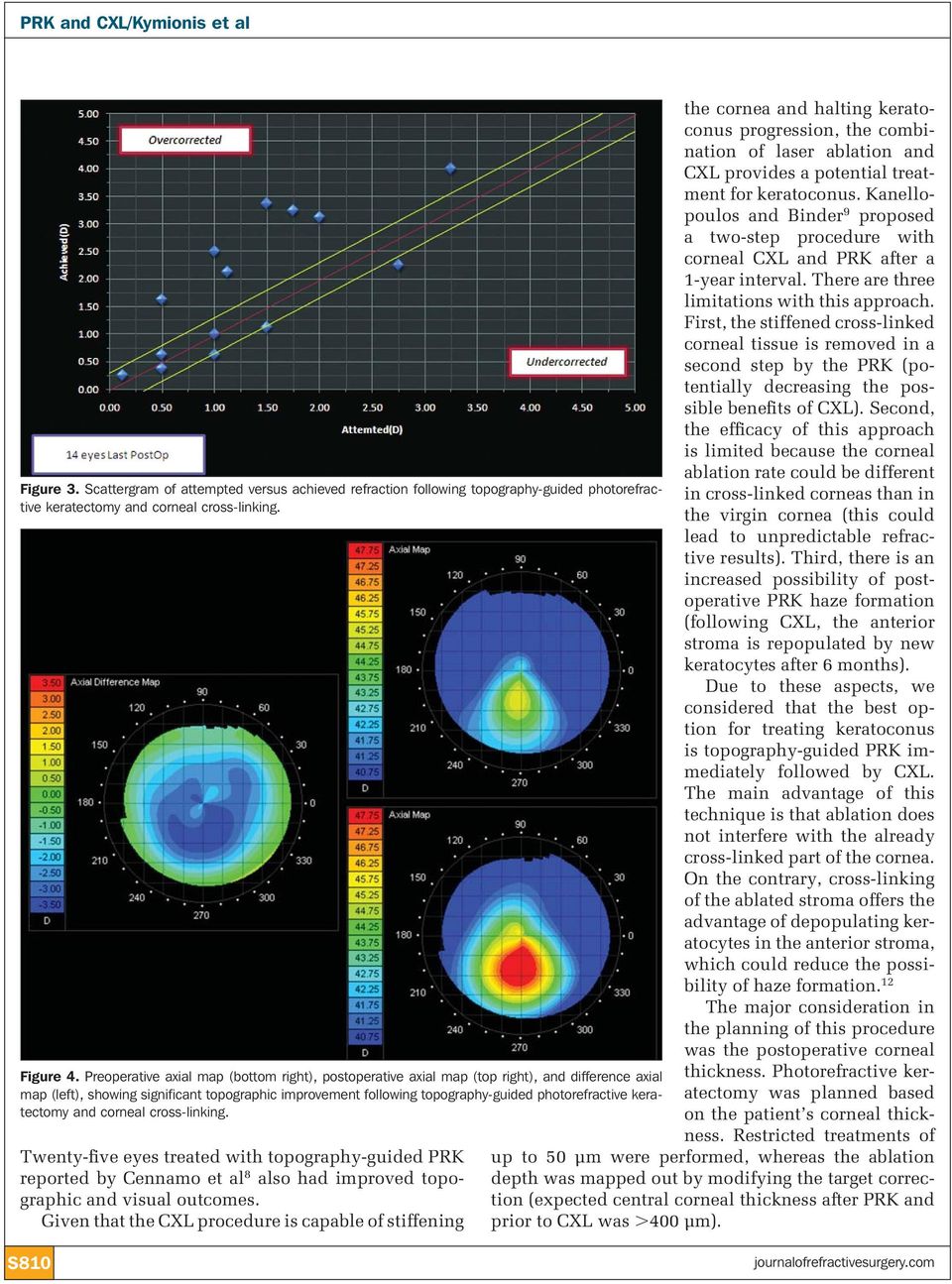
3 Figure 1. Preoperative best spectacle-corrected visual acuity (BSCVA) versus postoperative uncorrected visual acuity (UCVA, efficacy) following topography-guided photorefractive keratectomy and corneal cross-linking. Figure 2. Change in best spectacle-corrected visual acuity (safety) following topography-guided photorefractive keratectomy and corneal cross-linking. cally significantly (P.01) reduced to D and D, respectively. Preoperative mean UCVA and BSCVA were and , respectively, which improved at last follow-up to and , respectively. Postoperatively, all eyes had BSCVA of 20/100 (Snellen) or better (Fig 1). No eye lost 2 lines of BSCVA whereas 10% gained 3 lines postoperatively (Fig 2). Preoperatively, 93% of patients had BSCVA of 0.3 or less (logmar) whereas all eyes presented with UCVA of 0.3 or better at last follow-up. Figure 3 represents a scattergram of attempted versus achieved refraction. The mean steepest keratometry was reduced from D preoperatively to D at last followup (Table 2, Fig 4). DISCUSSION Treatment of keratoconus is an issue consisting of two parameters corneal biomechanical stability and optical inefficiency of the irregular cornea. The goal of our study was to develop a technique to treat keratoconic patients and offer them both stability and functional vision. Reaching functional vision consists of improving UCVA and BSCVA and normalization of corneal topography, which indicates that these patients are less dependent on contact lenses to achieve higher postoperative vision quality. Stabilization of corneas with ectatic disorders can be achieved with the application of CXL. The method is based on the absorption of UVA radiation by the cornea after the photosensitizer riboflavin is infused in the stroma. 10,11 Despite stabilizing the cornea, the topography and visual performance of patients treated with CXL show minimal improvement. The application of laser ablation had been introduced formerly for the correction of keratoconus with the main drawback being that it is a tissue removal technique. In stable or forme fruste keratoconus, surface ablation has been reported with promising results. Several studies report the application of excimer laser ablation to correct astigmatism in patients with stable keratoconus. Alpins and Stamatelatos 6 report a series of 32 eyes treated with photoastigmatic refractive keratectomy and followed for up to 10 years with no evidence of keratoconic progression. Koller et al 7 treated 11 eyes with customized PRK and reported improvement in refractive astigmatism, topography, and quality of vision in all patients. S809

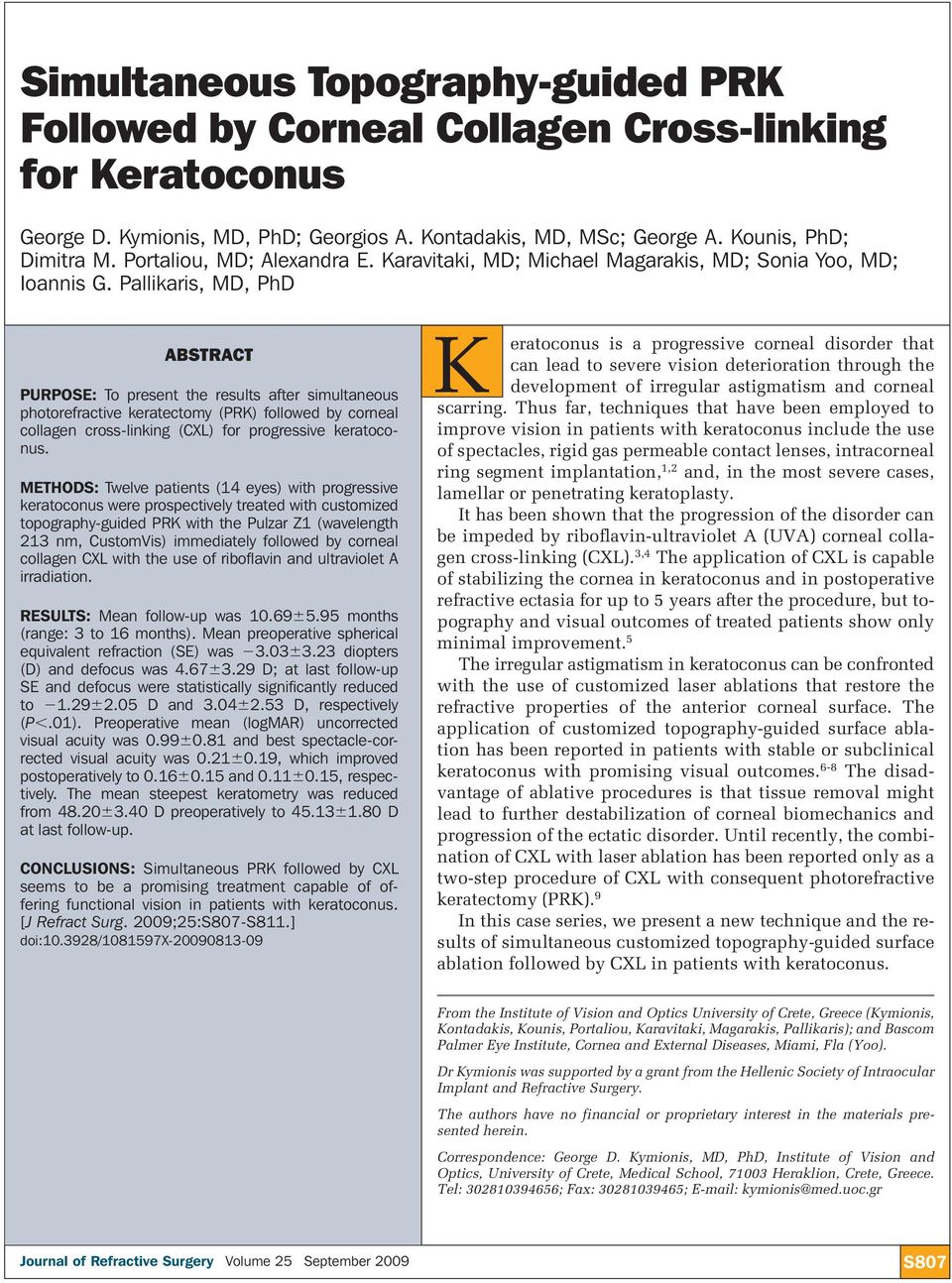
4 Figure 3. Scattergram of attempted versus achieved refraction following topography-guided photorefractive keratectomy and corneal cross-linking. Figure 4. Preoperative axial map (bottom right), postoperative axial map (top right), and difference axial map (left), showing significant topographic improvement following topography-guided photorefractive keratectomy and corneal cross-linking. Twenty-five eyes treated with topography-guided PRK reported by Cennamo et al 8 also had improved topographic and visual outcomes. Given that the CXL procedure is capable of stiffening the cornea and halting keratoconus progression, the combination of laser ablation and CXL provides a potential treatment for keratoconus. Kanellopoulos and Binder 9 proposed a two-step procedure with corneal CXL and PRK after a 1-year interval. There are three limitations with this approach. First, the stiffened cross-linked corneal tissue is removed in a second step by the PRK (potentially decreasing the possible benefits of CXL). Second, the efficacy of this approach is limited because the corneal ablation rate could be different in cross-linked corneas than in the virgin cornea (this could lead to unpredictable refractive results). Third, there is an increased possibility of postoperative PRK haze formation (following CXL, the anterior stroma is repopulated by new keratocytes after 6 months). Due to these aspects, we considered that the best option for treating keratoconus is topography-guided PRK immediately followed by CXL. The main advantage of this technique is that ablation does not interfere with the already cross-linked part of the cornea. On the contrary, cross-linking of the ablated stroma offers the advantage of depopulating keratocytes in the anterior stroma, which could reduce the possibility of haze formation. 12 The major consideration in the planning of this procedure was the postoperative corneal thickness. Photorefractive keratectomy was planned based on the patient s corneal thickness. Restricted treatments of up to 50 µm were performed, whereas the ablation depth was mapped out by modifying the target correction (expected central corneal thickness after PRK and prior to CXL was 400 µm). S810 journalofrefractivesurgery.com
5 TABLE 2 Pre- and Postoperative Data of 14 Eyes That Underwent Topography-guided Photorefractive Keratectomy and Cross-linking Mean SD (Range) Parameter Preoperative Last Follow-up Manifest refraction (D) (1.38 to 12.88) (1.25 to 4.00) Defocus (D) (14.50 to 1.00) (6.75 to 0.75) UCVA (logmar) (2 to 0.16) (0.32 to 0) BSCVA (logmar) (0.66 to 0.04) (0.3 to 0.08) Keratometry (flat/steep) (D) / / UCVA = uncorrected visual acuity, BSCVA = best spectacle-corrected visual acuity Patients treated with simultaneous topographyguided PRK with CXL showed a rapid and significant improvement in UCVA and BSCVA. Topographic evaluation of these patients showed marked improvement of irregularity. Even with relatively small correction due to the thickness limitations, patients may benefit. Simultaneous PRK followed by CXL seems to be a promising treatment. Performing this technique with careful observance of safety aspects may offer patients with keratoconus the opportunity to gain functional vision, avoid complications of long-term contact lens use, and also reduce the need for corneal transplantation. AUTHOR CONTIBUTIONS Study concept and design (G.D.K., G. Kontadakis, S.Y., I.G.P.); data collection (D.M.P., A.E.K., M.M.); interpretation and analysis of data (G. Kounis); drafting of the manuscript (G.D.K., G. Kontadakis, G. Kounis, D.M.P., A.E.K., M.M.); critical revision of the manuscript (S.Y., I.G.P.); statistical expertise (G. Kontadakis, G. Kounis); supervision (I.G.P.) REFERENCES 1. Kymionis GD, Siganos CS, Tsiklis NS, Anastasakis A, Yoo SH, Pallikaris AI, Astyrakakis N, Pallikaris IG. Long-term follow-up of Intacs in keratoconus. Am J Ophthalmol. 2007;143: Coskunseven E, Kymionis GD, Tsiklis NS, Atun S, Arslan E, Jankov MR, Pallikaris IG. One-year results of intrastromal corneal ring segment implantation (KeraRing) using femtosecond laser in patients with keratoconus. Am J Ophthalmol. 2008;145: Wollensak G, Spoerl E, Seiler T. Riboflavin/ultraviolet-a-induced collagen crosslinking for the treatment of keratoconus. Am J Ophthalmol. 2003;135: Wollensak G, Spoerl E, Seiler T. Stress strain measurements of human and porcine corneas after riboflavin-ultraviolet-a-induced cross-linking. J Cataract Refract Surg. 2003;29: Raiskup-Wolf F, Hoyer A, Spoerl E, Pillunat LE. Collagen crosslinking with riboflavin and ultraviolet-a light in keratoconus: long-term results. J Cataract Refract Surg. 2008;34: Alpins N, Stamatelatos G. Customized photoastigmatic refractive keratectomy using combined topographic and refractive data for myopia and astigmatism in eyes with forme fruste and mild keratoconus. J Cataract Refract Surg. 2007;33: Koller T, Iseli HP, Donitzky C, Ing D, Papadopoulos N, Seiler T. Topography-guided surface ablation for forme fruste keratoconus. Ophthalmology. 2006;113: Cennamo G, Intravaja A, Boccuzzi D, Marotta G, Cennamo G. Treatment of keratoconus by topography-guided customized photorefractive keratectomy: two-year follow-up study. J Refract Surg. 2008;24: Kanellopoulos AJ, Binder PS. Collagen cross-linking (CCL) with sequential topography-guided PRK: a temporizing alternative for keratoconus to penetrating keratoplasty. Cornea. 2007;26: Wollensak G. Crosslinking treatment of progressive keratoconus: new hope. Curr Opin Ophthalmol. 2006;17: Spoerl E, Huhle M, Seiler T. Induction of cross-links in corneal tissue. Exp Eye Res. 1998;66: Kymionis GD, Diakonis VF, Kalyvianaki M, Portaliou D, Siganos C, Kozobolis VP, Pallikaris AI. One-year follow-up of corneal confocal microscopy after corneal cross-linking in patients with post laser in situ keratomileusis ectasia and keratoconus. Am J Ophthalmol. 2009;147: e1. S811

Case Reports Post-LASIK ectasia treated with intrastromal corneal ring segments and corneal crosslinking
 Case Reports Post-LASIK ectasia treated with intrastromal corneal ring segments and corneal crosslinking Kay Lam, MD, Dan B. Rootman, MSc, Alejandro Lichtinger, and David S. Rootman, MD, FRCSC Author affiliations:
Intracorneal Ring Segments Implantation Followed by Same-day Topography-guided PRK and Corneal Collagen CXL in Low to Moderate Keratoconus
 SURGICAL TECHNIQUE Intracorneal Ring Segments Implantation Followed by Same-day Topography-guided PRK and Corneal Collagen CXL in Low to Moderate Keratoconus Waleed Al-Tuwairqi, MD; Mazen M. Sinjab, MD,
Complications of Combined Topography-Guided Photorefractive Keratectomy and Corneal Collagen Crosslinking in Keratoconus
 Complications of Combined Topography-Guided Photorefractive Keratectomy and Corneal Collagen Crosslinking in Keratoconus Michelle Cho, M.D. 1 Anastasios John Kanellopoulos, M.D 1,2 New York University
Management of Unpredictable Post-PRK Corneal Ectasia with Intacs Implantation
 Management of Unpredictable Post-PRK Corneal Ectasia with Intacs Implantation Mohammad Naser Hashemian, MD 1 Mahdi AliZadeh, MD 2 Hassan Hashemi, MD 1,3 Firoozeh Rahimi, MD 4 Abstract Purpose: To present
Short and long term complications of combined. Protocol) in 412 keratoconus eyes (2 7 years follow up)
 Short and long term complications of combined topography guided PRK and CXL (the Athens Protocol) in 412 keratoconus eyes (2 7 years follow up) Anastasios John Kanellopoulos, MD Director, Laservision.gr
Simultaneous Photorefractive keratectomy (PRK) with Corneal Cross Linking (CXL) For Treatment of Early Keratoconus.
 Simultaneous Photorefractive keratectomy (PRK) with Corneal Cross Linking (CXL) For Treatment of Early Keratoconus. Mahmoud M Saleh, Ahmed I Galhoom, Mohamed A El-Malah, Abdelgany Ib Abdelgany Department
How To Implant A Keraring
 Corneal Remodeling Using the Keraring A variety of thicknesses, arc lengths, and optical zone sizes allows tailoring of the procedure to the individual patient. BY DOMINIQUE PIETRINI, MD; AND TONY GUEDJ
KERATOCONUS IS A BILATERAL, ASYMMETRIC, CHRONIC,
 Comparison of and Intacs for Keratoconus and Post-LASIK Ectasia MUNISH SHARMA, MD, AND BRIAN S. BOXER WACHLER, MD PURPOSE: To evaluate the efficacy of single-segment Intacs and compare with double-segment
Surgical Advances in Keratoconus. Keratoconus. Innovations in Ophthalmology. New Surgical Advances. Diagnosis of Keratoconus. Scheimpflug imaging
 Surgical Advances in Keratoconus Keratoconus Ectatic disorder 1 in 1,000 individuals Starts in adolescence & early adulthood Uncertain cause 20% require corneal transplant Innovations in Ophthalmology
5/24/2013 ESOIRS 2013. Moderator: Alaa Ghaith, MD. Faculty: Ahmed El Masri, MD Mohamed Shafik, MD Mohamed El Kateb, MD
 ESOIRS 2013 Moderator: Alaa Ghaith, MD Faculty: Ahmed El Masri, MD Mohamed Shafik, MD Mohamed El Kateb, MD 1 A systematic approach to the management of Keratoconus through the presentation of different
Topography guided custom ablation treatment for treatment of keratoconus
 Symposium: Keratoconus Topography guided custom ablation treatment for treatment of keratoconus Rohit Shetty, Sharon D Souza, Samaresh Srivastava 1, R Ashwini Keratoconus is a progressive ectatic disorder
Keratoconus is a bilateral, nonsymmetric, and noninflammatory
 CASE REPORT Collagen Cross-Linking (CCL) With Sequential Topography-Guided PRK A Temporizing Alternative for Keratoconus to Penetrating Keratoplasty A. John Kanellopoulos, MD* and Perry S. Binder, MS,
Corneal Collagen Cross-Linking for Ectasia after LASIK and Photorefractive Keratectomy
 Corneal Collagen Cross-Linking for Ectasia after LASIK and Photorefractive Keratectomy Long-Term Results Olivier Richoz, MD, 1 Nikolaos Mavrakanas, MD, 1 Bojan Pajic, MD, PhD, 1 Farhad Hafezi, MD, PhD
CXL With the Epithelium on or off: Which Is Better?
 CXL With the Epithelium on or off: Which Is Better? Transepithelial CXL Is Gaining Ground By Roy S. Rubinfeld, MD, and the CXL-USA Study Group At its simplest, corneal collagen cross-linking (CXL) is a
Transepithelial Crosslinking vs. Corneal Pocket Crosslinking. Christoph Kranemann MD Anna Yu OD
 Transepithelial Crosslinking vs. Corneal Pocket Crosslinking Christoph Kranemann MD Anna Yu OD Rome 2013 We have no financial interests in this presentation. Corneal collagen cross linking Creates new
Keratoconus. Progressive bilateral ectasia. Onset puberty. Prevalence 1:2000. 20% progress to transplantation. Pathogenesis unclear
 Keratoconus Progressive bilateral ectasia Onset puberty Prevalence 1:2000 20% progress to transplantation Pathogenesis unclear Increased pepsin and catalase Decreased collagen crosslinking cf normal Conventional
ORIGINAL ARTICLES. Anastasios John Kanellopoulos, MD; Perry S. Binder, MS, MD
 ORIGINAL ARTICLES Management of Corneal Ectasia After LASIK With Combined, Same-day, Topographyguided Partial Transepithelial PRK and Collagen Cross-linking: The Athens Protocol Anastasios John Kanellopoulos,
Photorefractive keratectomy in mild to moderate keratoconus: Outcomes in over 40 year old patients
 Original Article Photorefractive keratectomy in mild to moderate keratoconus: Outcomes in over 40 year old patients Hamid Khakshoor, Fatemeh Razavi, Alireza Eslampour 1, Arash Omdtabrizi 1 Background:
Collagen cross-linking should be done separately. Canan Asli Utine, MD, MSc, FICO Yeditepe University, Istanbul, Turkey
 Collagen cross-linking should be done separately Canan Asli Utine, MD, MSc, FICO Yeditepe University, Istanbul, Turkey Collagen cross linking 1st established tx addressing the pathophysiology of corneal
Intacs for keratoconus Yaron S. Rabinowitz
 Intacs for keratoconus Yaron S. Rabinowitz Purpose of review The use of Intacs as a therapeutic modality in contact lens intolerant patients with mild to moderate keratoconus is increasingly gaining acceptance
Ectasia after laser in-situ keratomileusis (LASIK)
 Ectasia after laser in-situ keratomileusis (LASIK) 長 庚 紀 念 醫 院 眼 科 蕭 靜 熹 Post-LASIK ectasia A rare complication of LASIK Manhattan jury awarded a former investment banker a record $7.25 million for post-lasik
BY A. JOHN KANELLOPOULOS, MD
 Sequential Versus Simultaneous CXL and Topography-Guided PRK Simultaneous treatment appears to provide superior rehabilitation of keratoconus. BY A. JOHN KANELLOPOULOS, MD * Editor s note: The following
Original Article Corneal Collagen Cross Linking Pak Armed Forces Med J 2015; 65(1): 105-9
 Original Article Corneal Collagen Cross Linking Pak Armed Forces Med J 2015; 65(1): 105-9 COMPARISON OF RAPID AND CONVENTIONAL CORNEAL COLLAGEN CROSS LINKING IN PATIENTS HAVING KERATOCONUS Intisar ul Haq,
CENTRO OFTALMOLOGICO GUSTAVO TAMAYO BOGOTA COLOMBIA LASIK XTRA GUSTAVO TAMAYO MD CLAUDIA CASTELL MD PILAR VARGAS MD
 CENTRO OFTALMOLOGICO GUSTAVO TAMAYO BOGOTA COLOMBIA LASIK XTRA GUSTAVO TAMAYO MD CLAUDIA CASTELL MD PILAR VARGAS MD From: BOGOTA LASER REFRACTIVE INSTITUTE Bogota, Colombia DISCLOSURES FOR GUSTAVO TAMAYO
UPDATE ON AVEDRO CROSSLINKING STUDIES
 UPDATE ON AVEDRO CROSSLINKING STUDIES Peter S. Hersh, M.D. Director, Cornea & Laser Eye Institute CLEI Center for Keratoconus Clinical Professor of Ophthalmology, Rutgers Medical School Visiting Researcher,
How To Test For Cxl
 ARTICLE Complication and failure rates after corneal crosslinking Tobias Koller, MD, Michael Mrochen, PhD, Theo Seiler, MD, PhD PURPOSE: To evaluate the complication rate of corneal crosslinking (CXL)
Efficacy of Intacs Intrastromal Corneal Ring Segments in Patients with Post-LASIK Corneal Ectasia
 Efficacy of Intacs Intrastromal Corneal Ring Segments in Patients with Post-LASIK Corneal Ectasia Amirhushang Beheshtnejad, MD 1 Alireza Yazdani-Abyaneh, MD 2 Hassan Hashemi, MD 3,4 Mahmoud Jabbarvand,
Excimer Laser Photorefractive Keratectomy for Keratoconus
 C H A P T E R 1 4 Excimer Laser Photorefractive Keratectomy for Keratoconus Arun C. Gulani, MD; Lee T. Nordan, MD; Noel Alpins, FRANZCO, FRCOphth, FACS; and George Stamatelatos, BSCOptom P atients with
Irregular astigmatism can occur naturally or due to
 Combined Topography- Guided Transepithelial PRK and CXL in Patients With Keratoconus The combined procedure strengthens the cornea and regularizes the anterior surface. BY MIRKO R. JANKOV II, MD, PHD;
Corporate Medical Policy Implantation of Intrastromal Corneal Ring Segments
 Corporate Medical Policy Implantation of Intrastromal Corneal Ring Segments File Name: Origination: Last CAP Review: Next CAP Review: Last Review: implantation_of_intrastromal_corneal_ring_segments 8/2008
Medical Director, Shinagawa LASIK Center, Tokyo, Japan Adjunct Professor, Department of Ophthalmology, Wenzhou Medical College, Wenzhou, China
 Medical Director,, Tokyo, Japan Adjunct Professor, Department of Ophthalmology, Wenzhou Medical College, Wenzhou, China Financial disclosure: Ziemer Group AG, Switzerland AcuFocus, CA Schwind Eye-Tech-Solutions,
Corneal Collagen Cross-Linking (CXL) With Riboflavin
 Dr. Paul J. Dubord, MD, FRCSC Clinical Professor Department of Ophthalmology and Visual Sciences University of British Columbia Patient Information Guide Corneal Collagen Cross-Linking (CXL) With Riboflavin
Post LASIK Ectasia. Examination: Gina M. Rogers, MD and Kenneth M. Goins, MD
 Post LASIK Ectasia Gina M. Rogers, MD and Kenneth M. Goins, MD October 6, 2012 Chief Complaint: Decreasing vision after laser- assisted in- situ keratomileusis (LASIK) History of Present Illness: This
Wavefront technology has been used in our
 Wavefront Customized Ablations With the WASCA Asclepion Workstation Sophia I. Panagopoulou, BSc; Ioannis G. Pallikaris, MD ABSTRACT PURPOSE: WASCA (Wavefront Aberration Supported Cornea Ablation) is a
Sri Ganesh and Sheetal Brar. 1. Introduction. 2. Materials and Methods
 Ophthalmology Volume 215, Article ID 263412, 7 pages http://dx.doi.org/1.1155/215/263412 Clinical Study Clinical Outcomes of Small Incision Lenticule Extraction with Accelerated Cross-Linking (ReLEx SMILE
Clinical Results of Topography-based Customized Ablations in Highly Aberrated Eyes and Keratoconus/Ectasia With Cross-linking
 Clinical Results of Topography-based Customized Ablations in Highly Aberrated Eyes and Keratoconus/Ectasia With Cross-linking David T.C. Lin, MD, FRCSC; Simon Holland, MD, FRCSC; Johnson C.H. Tan, MBBS,
Refractive Surgery. Evolution of Refractive Error Correction
 Refractive Surgery Techniques that correct for refractive error in the eye have undergone dramatic evolution. The cornea is the easiest place to place a correction, so most techniques have focused on modifying
One-year results of photorefractive keratectomy and laser in situ keratomileusis for myopia using a 213 nm wavelength solid-state laser
 ARTICLE One-year results of photorefractive keratectomy and laser in situ keratomileusis for myopia using a 213 nm wavelength solid-state laser Nikolaos S. Tsiklis, MD, MSc, George D. Kymionis, MD, PhD,
NEW SURGICAL APPROACHES TO THE MANAGEMENT OF KERATOCONUS AND POST-LASIK ECTASIA
 NEW SURGICAL APPROACHES TO THE MANAGEMENT OF KERATOCONUS AND POST-LASIK ECTASIA BY Bryan U. Tan MD, Tracy L. Purcell PhD, Luis F. Torres MD PhD, AND David J. Schanzlin MD* ABSTRACT Purpose: The objective
Diego Fernando Suárez Sierra, MD Fellow Cornea and Refractive Surgery Fellow Lens and Ocular Surface Vejarano Laser Vision Center
 Corneal crosslinking with riboflavin and ultraviolet light before or after subepithelial keratectomy laser-assisted (LASEK) in patients with thin corneas. Diego Fernando Suárez Sierra, MD Fellow Cornea
THE BEST OF BOTH WORLDS Dual-Scheimpflug and Placido Reaching a new level in refractive screening
 THE BEST OF BOTH WORLDS Dual-Scheimpflug and Placido Reaching a new level in refractive screening GALILEI G4 Clinical Applications Corneal Implant Planning The comes with a licensable corneal inlay software
Introducing TOPOGRAPHY-GUIDED REFRACTIVE SURGERY
 Sponsored by Introducing TOPOGRAPHY-GUIDED REFRACTIVE SURGERY Results of the T-CAT Phase III Clinical Trial TOPOGRAPHY-GUIDED REFRACTIVE SURGERY Topography-Guided Custom Ablation Treatments (T-CAT) with
Comparison of Epi-LASIK and Off-Flap Epi-LASIK for the Treatment of Low and Moderate Myopia
 Comparison of Epi-LASIK and Off-Flap Epi-LASIK for the Treatment of Low and Moderate Myopia Maria I. Kalyvianaki, MD, PhD, 1,2 George D. Kymionis, MD, PhD, 1,2 George A. Kounis, PhD, 1 Sophia I. Panagopoulou,
Overview of Refractive Surgery
 Overview of Refractive Surgery Michael N. Wiggins, MD Assistant Professor, College of Health Related Professions and College of Medicine, Department of Ophthalmology Jones Eye Institute University of Arkansas
9/15/2013. Naturally-existing Corneal Pathology Forme Fruste Keratoconus Keratoconus Pellucid Marginal Degeneration
 Bill Tullo, OD, FAAO Diplomate Vice-President of Clinical Services TLC Vision 33386-PO 1 Hour Bill Tullo, OD has no financial interests in any of the products or companies discussed in this program Naturally-existing
FIRST EXPERIENCE WITH THE ZEISS FEMTOSECOND SYSTEM IN CONJUNC- TION WITH THE MEL 80 IN THE US
 FIRST EXPERIENCE WITH THE ZEISS FEMTOSECOND SYSTEM IN CONJUNC- TION WITH THE MEL 80 IN THE US JON DISHLER, MD DENVER, COLORADO, USA INTRODUCTION AND STUDY OBJECTIVES This article summarizes the first US
Keratoconus surgery: what works best and why-
 Keratoconus surgery: what works best and why-./-0&1#-!"#$%%&'&(%&)*-+,-,23$45&3*-6")$372)2&#/83-9#):5(5$*-.51$#)*-;3$$4$-
A.M.Sherif,M.A.Ammar,Y.S.Mostafa,S.A.GamalEldin,andA.A.Osman. Department of Ophthalmology, Faculty of Medicine, Cairo University, Cairo 12411, Egypt
 Ophthalmology Volume 2015, Article ID 321953, 7 pages http://dx.doi.org/10.1155/2015/321953 Clinical Study One-Year Results of Simultaneous Topography-Guided Photorefractive Keratectomy and Corneal Collagen
Trans-epithelial cross-linking with riboflavin solution: two-year clinical results
 Trans-epithelial cross-linking with riboflavin solution: two-year clinical results Authors: Ciro Caruso, M.D. 1,2, Luigi Pacente, M.D. 1, Robert L Epstein 5, Salvatore Troisi, M.D. 3, Gaetano Barbaro,
EUROPEAN JOURNAL OF PHARMACEUTICAL AND MEDICAL RESEARCH www.ejpmr.com
 ejpmr, 2015,2(3), 436-440 EUROPEAN JOURNAL OF PHARMACEUTICAL AND MEDICAL RESEARCH www.ejpmr.com Tumram et al. SJIF Impact Factor 2.026 Research Article ISSN 3294-3211 EJPMR CLINICAL OUTCOME OF TORIC IOL
Single-Segment and Double-Segment INTACS for Post-LASIK Ectasia. Received: 8 Mar. 2013; Accepted: 8 Oct. 2013
 ORIGINAL ARTICLE Single-Segment and Double-Segment INTACS for Post-LASIK Ectasia Hassan Hashemi 1, Ali Gholaminejad 1, Kazem Amanzadeh 1, Maryam Hashemi 2, and Mehdi Khabazkhoob 3 1 Noor Ophthalmology
Anterior Lamellar Keratoplasty With a Microkeratome: A Method for Managing Complications After Refractive Surgery
 Anterior Lamellar Keratoplasty With a Microkeratome: A Method for Managing Complications After Refractive Surgery Farhad Hafezi, MD; Michael Mrochen, PhD; Franz Fankhauser II, MD; Theo Seiler, MD, PhD
LASIK, Epi LASIK and PRK Past present and future
 LASIK, Epi LASIK and PRK Past present and future Ioannis G. Pallikaris MD, PhD Institute of Vision and Optics University of Crete Medical School Heraklion Crete Greece Photorefractive Keratectomy Kerr-Muir
Page: 1 of 6. Corneal Topography/Computer-Assisted Corneal Topography/ Photokeratoscopy
 Section: Surgery Effective Date: July 15, 2015 Last Review Status/Date: June 2015 Page: 1 of 6 Corneal Topography/ Photokeratoscopy Description Computer-assisted topography/photokeratoscopy provides a
The pinnacle of refractive performance.
 Introducing! The pinnacle of refractive performance. REFRACTIVE SURGERY sets a new standard in LASIK outcomes More than 98% of patients would choose it again. 1 It even outperformed glasses and contacts
Laser in situ keratomileusis (LASIK) has been. Retreatment of Hyperopia After Primary Hyperopic LASIK REPORTS
 REPORTS Retreatment of Hyperopia After Primary Hyperopic LASIK Julio Ortega-Usobiaga, MD, PhD; Rosario Cobo-Soriano, MD, PhD; Fernando Llovet, MD; Francisco Ramos, MD; Jaime Beltrán, MD; Julio Baviera-Sabater,
Refractive Surgery Issue. Inlays and Presbyopia: On the Horizon P. 24. Crack a SMILE or Raise a Flap? P. 30. LASIK Xtra: Who Should Get It? P.
 MULTIMODAL IMAGING OF PLACOID DISORDERS P. 42 WILLS RESIDENT CASE SERIES P. 67 NTG: THE NOCTURNAL BLOOD PRESSURE FACTOR P. 54 WISE CHOICES FOR OCULAR DIAGNOSES P. 50 NEW WAYS TO DETECT KERATOCONUS P. 58
How do we use the Galilei for cataract and refractive surgery?
 How do we use the Galilei for cataract and refractive surgery? Douglas D. Koch, MD Mariko Shirayama, MD* Li Wang, MD, PhD* Mitchell P. Weikert, MD Cullen Eye Institute Baylor College of Medicine Houston,
Sharjah: Al Zahra Private Hospital, Al Zahra square Tel: 06 5619999, Appointments: 06 5167080, 06 5167081
 Sharjah: Al Zahra Private Hospital, Al Zahra square Tel: 06 5619999, Appointments: 06 5167080, 06 5167081 Email: [email protected] Dubai: Al Zahra Medical Centre, Sheikh Zayed Road Tel: 04 3315000, Appointments:
Short and long term complications of combined. Protocol) in 412 keratoconus eyes (2 7 years follow up)
 Short and long term complications of combined topography guided PRK and CXL (the Athens Protocol) in 412 keratoconus eyes (2 7 years follow up) Anastasios John Kanellopoulos, MD Director, Laservision.gr
ICRS implantation with the Femto LDV laser in stabilized KC patients: 6 months results
 ICRS implantation with the Femto LDV laser in stabilized KC patients: 6 months results Jérôme C. VRYGHEM, M.D. Brussels Eye Doctors Brussels, Belgium No financial interest! A lot of KC patients show interest
Corneal Transparency After Cross-linking for Keratoconus: 1-Year Follow-up
 Corneal Transparency After Cross-linking for Keratoconus: 1-Year Follow-up Ramon Gutiérrez, MD, PhD; Inma Lopez, MD; Cesar Villa-Collar, OD, PhD; José Manuel González-Méijome, OD, PhD ABSTRACT PURPOSE:
Keratometric Changes after Corneal Collagen Cross linking for Keratoconus
 Original Article ISSN (O):2395-2822; ISSN (P):2395-2814 Keratometric Changes after Corneal Collagen Cross linking for Keratoconus Muhemmed Swadique 1, Priya S 2, Sanju TS 3 1 Associate Professor, Dept.
New topographic custom ablation procedure for treating irregular astigmatism post keratoplasty with high frequency (1 KHz) excimer laser.
 New topographic custom ablation procedure for treating irregular astigmatism post keratoplasty with high frequency (1 KHz) excimer laser. G. COLONNA M.D., G. Lorusso M.D., S. Santoro M.D. ESCRS Berlin
REFRACTIVE ERROR AND SURGERIES IN THE UNITED STATES
 Introduction REFRACTIVE ERROR AND SURGERIES IN THE UNITED STATES 150 million wear eyeglasses or contact lenses 2.3 million refractive surgeries performed between 1995 and 2001 Introduction REFRACTIVE SURGERY:
Customized corneal ablation and super vision. Customized Corneal Ablation and Super Vision
 Customized Corneal Ablation and Super Vision Scott M. MacRae, MD; James Schwiegerling, PhD; Robert Snyder, MD, PhD ABSTRACT PURPOSE: To review the early development of new technologies that are becoming
Pentacam HR Criteria for Curvature Change in Keratoconus and Postoperative LASIK Ectasia
 Pentacam HR Criteria for Curvature Change in Keratoconus and Postoperative LASIK Ectasia Robert L. Epstein, MD, MSEE; Yi-Lin Chiu, PhD; Greg L. Epstein, BS ABSTRACT PURPOSE: To determine criteria for keratoconus
Corneal thickness changes after corneal collagen crosslinking for keratoconus and corneal ectasia: One-year results
 ARTICLE Corneal thickness changes after corneal collagen crosslinking for keratoconus and corneal ectasia: One-year results Steven A. Greenstein, BA, Vinnie P. Shah, MD, Kristen L. Fry, OD, MS, Peter S.
VISX Wavefront-Guided LASIK for Correction of Myopic Astigmatism, Hyperopic Astigmatism and Mixed Astigmatism (CustomVue LASIK Laser Treatment)
 CustomVue Advantage Patient Information Sheet VISX Wavefront-Guided LASIK for Correction of Myopic Astigmatism, Hyperopic Astigmatism and Mixed Astigmatism (CustomVue LASIK Laser Treatment) Statements
Current Surgical Options for Visual Rehabilitation in Keratoconus
 ESCRS EUROTIMES Supplement April 2011 Current Surgical Options for Visual Rehabilitation in Keratoconus Friday 3 September 2010 Hotel Concorde Lafayette Paris, France Sponsors: Jérôme C Vryghem Introduction
One-Year Clinical Results after Epi-LASIK for Myopia
 One-Year Clinical Results after Epi-LASIK for Myopia Vikentia J. Katsanevaki, MD, PhD, 1,2 Maria I. Kalyvianaki, MD, 1,2 Dimitra S. Kavroulaki, MD, 1 Ioannis G. Pallikaris, MD, PhD 1,2 Purpose: To evaluate
Lasik Xtra Provides Corneal Stability and Improved Outcomes
 DOI 10.1007/s40123-015-0039-x REVIEW Lasik Xtra Provides Corneal Stability and Improved Outcomes Rajesh K. Rajpal. Christine B. Wisecarver. Dawn Williams. Sachin D. Rajpal. Rhonda Kerzner. Nick Nianiaris.
Cross-Linking with Refractive Surgery: Pros and Cons
 Cross-Linking with Refractive Surgery: Pros and Cons Raj K. Rajpal, M.D. Medical Director and Founder See Clearly Vision Group Mclean, Virginia Clinical Associate Professor Georgetown University Washington,
Validation of a New Scoring System for the Detection of Early Forme of Keratoconus
 10.5005/jp-journals-10025-1019 Alain Saad, Damien Gatinel ORIGINAL ARTICLE Validation of a New Scoring System for the Detection of Early Forme of Keratoconus Alain Saad, Damien Gatinel ABSTRACT Purpose:
Curtin G. Kelley, M.D. Director of Vision Correction Surgery Arena Eye Surgeons Associate Clinical Professor of Ophthalmology The Ohio State
 Curtin G. Kelley, M.D. Director of Vision Correction Surgery Arena Eye Surgeons Associate Clinical Professor of Ophthalmology The Ohio State University Columbus, Ohio Refractive Errors Myopia (nearsightedness)
High Order Aberration Outcomes of Corneal Collagen Crosslinking in Eyes with 10.5005/jp-journals-10025-1088
 IJKECD High Order Aberration Outcomes of Corneal Collagen Crosslinking in Eyes with 10.5005/jp-journals-10025-1088 Keratoconus and Post-LASIK Ectasia ORIGINAL ARTICLE High Order Aberration Outcomes of
Collagen Cross-linking combined with PRK and LASIK
 Collagen Cross-linking combined with PRK and LASIK./*0&1#*!"#$%%&'&(%&)2*+,* +$345"%*,46$57&62*8")$694)4&#/:6*;#)%4#45"%*?6&@$))&62*ABC*8"#:&#$*+$345"%*D51&&%2*AB!"#$%%&'&(%&)*+,!
LASIK. Complications. Customized Ablations. Photorefractive Keratectomy. Femtosecond Keratome for LASIK. Cornea Resculpted
 Refractive Surgery: Which Procedure for Which Patient? David R. Hardten, M.D. Minneapolis, Minnesota Have done research, consulting, or speaking for: Alcon, Allergan, AMO, Bausch & Lomb, Inspire, Medtronic,
Common Co-management Questions
 Issue 037 efocus Innovation. Leadership. Passion for Perfection 415.922.9500 --- www.pacificvision.org Common Co-management Questions Top questions recently asked by optometrists co-managing refractive
Comparison Combined LASIK Procedure for Ametropic Presbyopes and Planned Dual Interface for Post-LASIK Presbyopes Using Small Aperture Corneal Inlay
 Comparison Combined LASIK Procedure for Ametropic Presbyopes and Planned Dual Interface for Post-LASIK Presbyopes Using Small Aperture Corneal Inlay Minoru Tomita, MD, PhD 1,2 1) Shinagawa LASIK, Tokyo,
PATIENT CONSENT FOR LASER IN-SITU KERATOMILEUSIS (LASIK)
 INTRODUCTION: You have been diagnosed with myopia (nearsightedness) or hyperopia (farsightedness) with or without astigmatism, or astigmatism alone. Myopia is a result of light entering the eye and focusing