
Virtual Interactive Classroom (VIC) using Mobile Technology at the Bangladesh Open University (BOU)
|
|
|
- Conrad Lyons
- 10 years ago
- Views:
Transcription
1 Virtual Interactive Classroom (VIC) using Mobile Technology at the Bangladesh Open University (BOU) Md. Shafiqul Alam, Bangladesh Open University, Bangladesh, Dr Yousuf M Islam, Daffodil International University, Bangladesh [email protected] ABSTRACT Bangladesh Open University (BOU) is the only national institution in Bangladesh which is catering distance education in the country. It has extensive network through out the country to provide readily accessible contact points for its learners. After passing of 15 years since its inception, BOU has lagged behind in using technologies. In consideration of its limit to conventional method in teaching, a project was undertaken to test the effectiveness and viability of interactive television (TV) and mobile s Short Message Service (sms) classroom and explore the use of available and appropriate technologies to provide ICT enabled distance tuition. In this project, the mobile technology s sms along with perceived live telecast was used to create ideal classroom situation for distance learning through the Question Based Participation (QBP) technique. The existing videos of BOU TV programmes were made interactive using this technologies and technique. The existing BOU TV programme and interactive version of the same were showed to same learners of BOU to evaluate its effectiveness. It is found from the study that this interactive virtual classroom significantly perform well in teaching than BOU video programmes (noninteractive) which is used at present. This paper will describe the idea of virtual classroom setting and how this is effective for distance teaching in Bangladesh. How far this idea is realistic, appropriate, cost effective and user friendly in rural Bangladesh. What will be the impact of this interactive classroom on the Distance teaching/learning mode of education in the Country. INTRODUCTION Bangladesh Open University (BOU) is the only open institution in Bangladesh. It was established in 1992 under the Act No. 38 of the Bangladesh Parliament. The objectives of BOU are expand all levels of education, knowledge and science by a diversity of means, including the use of any communication technology to improve the quality of education and to provide opportunities for education to the general public through mass-orientation of education and to create efficient manpower by improving the quality of education in general (Bangladesh Gazette, 1992). It uses tutorial classes, print materials, audio tapes and Radio- TV broadcasting of lectures for delivering its programmes. It has a wide network consisting of 12 Regional Resources Centres (RRCs), 80 Coordinating Offices (TCs) and more than 1000 Coordination Offices (COs) through out the country. BOU has a sophisticated media centre with the facility of airing. The total number of students is about 0.5 million (BOU website). At BOU, tutorial classes are conducted by hired teachers from Universities, Colleges, Institutes, Government Offices, and High Schools according to the programmes. Usually, tutorial classes are held twice a month. The concept of tutoring at distance education is introduced to provide counseling to the students how do they study in distance and to provide guidelines in using of distance education materials and attending Radio/TV programmes including admission, examination and other related information. But, due to absent of interactions in other media of learning at BOU, learners demand lectures and interactions instead of counseling as stated above. As a result, tutorial classes at BOU seem like a lecturing on the subject matter rather than counseling. Moreover, the learners demand more tutorial sessions or interactions. Therefore, BOU is spending a considerable amount of money for its tutorial services towards the quality education.

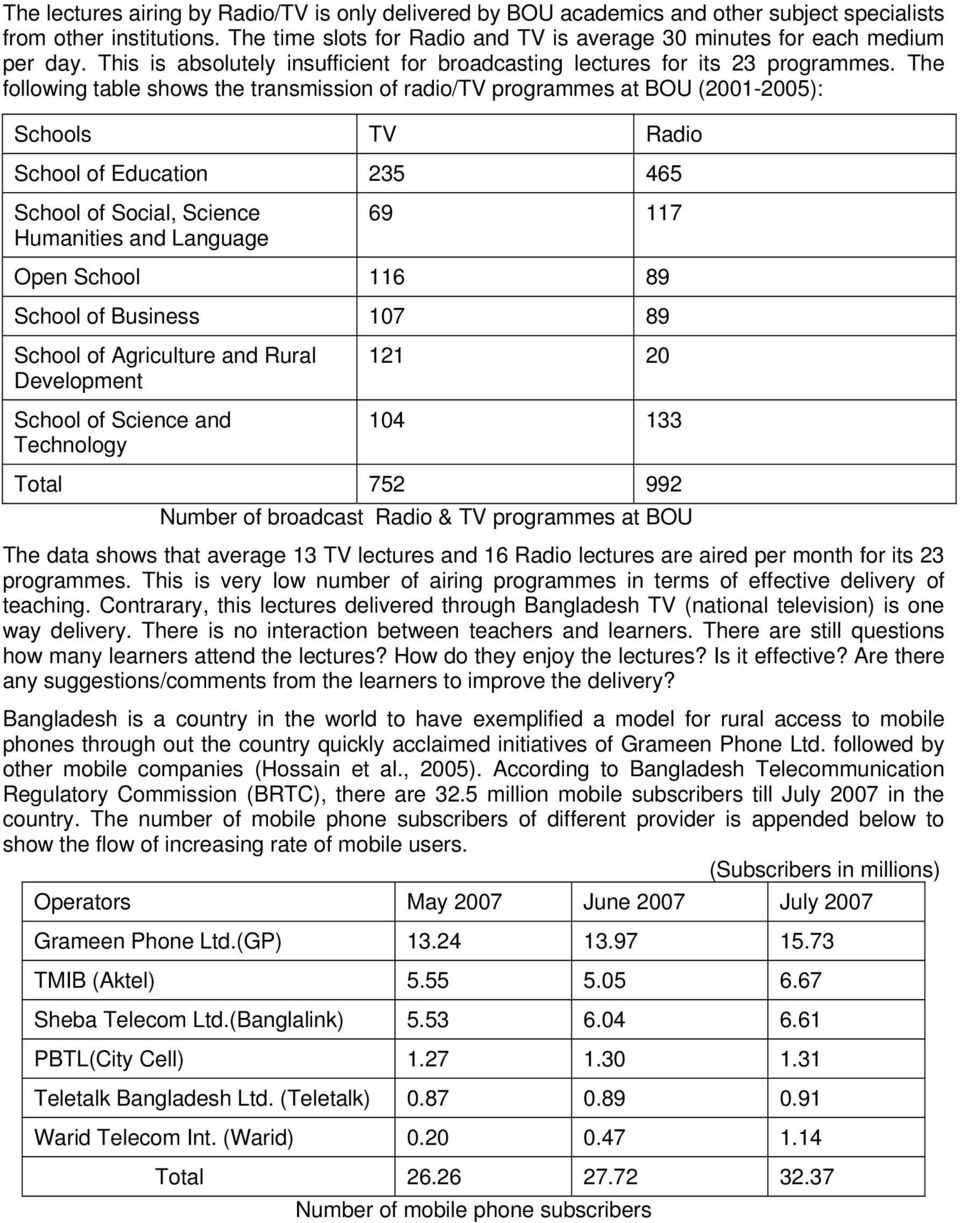
2 The lectures airing by Radio/TV is only delivered by BOU academics and other subject specialists from other institutions. The time slots for Radio and TV is average 30 minutes for each medium per day. This is absolutely insufficient for broadcasting lectures for its 23 programmes. The following table shows the transmission of radio/tv programmes at BOU ( ): Schools TV Radio School of Education School of Social, Science Humanities and Language Open School School of Business School of Agriculture and Rural Development School of Science and Technology Total Number of broadcast Radio & TV programmes at BOU The data shows that average 13 TV lectures and 16 Radio lectures are aired per month for its 23 programmes. This is very low number of airing programmes in terms of effective delivery of teaching. Contrarary, this lectures delivered through Bangladesh TV (national television) is one way delivery. There is no interaction between teachers and learners. There are still questions how many learners attend the lectures? How do they enjoy the lectures? Is it effective? Are there any suggestions/comments from the learners to improve the delivery? Bangladesh is a country in the world to have exemplified a model for rural access to mobile phones through out the country quickly acclaimed initiatives of Grameen Phone Ltd. followed by other mobile companies (Hossain et al., 2005). According to Bangladesh Telecommunication Regulatory Commission (BRTC), there are 32.5 million mobile subscribers till July 2007 in the country. The number of mobile phone subscribers of different provider is appended below to show the flow of increasing rate of mobile users. (Subscribers in millions) Operators May 2007 June 2007 July 2007 Grameen Phone Ltd.(GP) TMIB (Aktel) Sheba Telecom Ltd.(Banglalink) PBTL(City Cell) Teletalk Bangladesh Ltd. (Teletalk) Warid Telecom Int. (Warid) Total Number of mobile phone subscribers
3 The table indicates how fast the density of mobiles in the community is growing up. Almost every single village in Bangladesh has bought under mobile network system. There are now many who can keep mobile phone due to low cost of its charges. According to different data sources the mobile charge per minute stands between on average US$ and Short Messaging Services (SMS) cost is US$ per SMS message. This information indicates that the mobile phone is affordable. The phenomenon of Short Messaging Services (SMS) is one that has been growing exponentially in many countries in Asia. Ramos (1995) argued that the greater mobility and lower cost of mobile phones compared to computers means that there are more people in the region who can afford and make use of mobile technology. In Bangladesh, peoples use SMS mainly for communication purposes. But the ubiquitous presence of mobile phone, use of SMS in rural and urban areas, and overcoming different social-economic and gender issues mean that there is great potentiality for using this technology in productive way. A virtual classroom is a learning environment that exists solely in the form of digital content that is stored, accessed, and exchanged through networked computer and information systems. Everything in a virtual classroom occurs in an non-physical environment; students access the classroom by connecting to the internet, rather than travelling to a real, physical classroom (Creative Industries Faculty, QUT website). Virtual classroom means there will be electronic communication such as electronic mail, listservs, chat rooms (Powers & Mitchell, 1997) and that virtual class exists on the existing of technologies like computer, internet, radio and TV (Farrell, 2003). It shows that SMS technology is not mentioned as one of the possible means of virtual class for teaching and learning in distance mode. Ramos (2005) argued that more rigorious studies to determine the efficacy and feasibility of teaching through mobile SMS technology are stll laking. Therefore, considering the arguments stated above a study was conducted to test the efficacy and feasibility of virtual class integrating perceived broadcast Video and SMS technology using the Question Based Participation (QBP) technique. STUDY DESIGN Under this study, almost, an ideal classroom situation has been created integrating mobile SMS service and perceived telecast video and using multiple questions based participation by the students. The first demo of such video is developed in Orebro University by putting pedagogical inputs in a BOU video programme. Later on, this has been devloped at BOU. Then 2 vedios ( vedio 1- existing BOU vedio just incorporated questions and vedio 2- improved pedagogical aspects ) have been aired. The prior notice has been circulated via Radio and TV ( in BOU time slots) and print notice to the respective tutorial classes of BOU informing the date and time of airing of the video to the learners.. Vedio 2 are recorded with 2 learners participation in studio who answered many questions and interacted with teachers creating a classroom feeling. The distant learners have been asked to registrar and put forward the answers by mobile sms. The feedback was stored in computer server. The feebback was collected from the server and evaluted. OBJECTIVE OF STUDY Bangladesh Open University is the organization which caters education from 9 th grade to university level. However, teaching methods are traditional. Education is badly lacking in rural areas and among the disadvantaged and poorer segment of population. This study focused on using electronic means to provide better education in such areas. BOU has a mandate to deliver education to all kinds of people by means of ICT. However, its traditional method of teaching don t reflect interactive and student centred ways of teaching. Therefore, the study was conducted to focus on using affordable and userfriendly technology as a mean of effective delivery of teaching. Hence, the feasibility and efficacy of virtual interactive

4 classroom (VIC) concept which is created by BOU perceived telecast vedio and mobile sms technology was investigated. COMPARISON OF FEEDBACK MECHANISMS OF VIRTUAL INTERACTIVE CLASSROOM AND TRADITIONAL BOU VIDEO LECTURE Many characteristics of the physical classroom have been carried over into the virtual classroom. They both employ a very similar learning theory, curriculum design and pedagogy (White, 2004, pp ). Additionally, the way in which an instructor delivers educational materials remains an important factor in the success of both classrooms (White, 2004, pp.11-12). A prominent difference between the physical classroom and the virtual classroom is the location and space that is required to access and participate in classroom activities. The comparison of BOU traditional video and VIC mediated video is illustrated below to have the features of these two ways of delivery. Aspects Feedback from students during lecturing Attendance Interaction during airing of lecture Provision of evaluation of lectures by students BOU traditional Video Lectures No, lecture is delivered by teacher alone No record of attendance Not at all No VIC mediated lectures Students present at lecturing. They are allowed to participate in discussion Students are asked to registrar by SMS. Server kept the record. Yes, students viewed the recorded video by answering and voice calls. The server responds to the student giving the impression of a live show. However, the students answered their question by SMS. These are stored at server. Yes Analysis of students response Not for evaluation of lectures Technology used Video Video & Mobile Students answers are evaluated for further improvement of lectures Participation Teachers Teachers and Students Comparison between traditional video & VIC video programmes RESULT AND DISCUSSION As earlier mentioned two video programmes (video 1- existing BOU vedio just incorporated questions and vedio 2- improved pedagogical aspects with questions) are aired. The graphical presentation shows that learners has answered more questions than video 1. It seems to be more interactive. In video programme I, questions are asked. The number of responses is shown below. The graph shows that the number of answers increased with each question. During the video, it may be said that interest did not sag during the 25 minutes of the lesson. In fact students were encouraged to attempt answers.

5 Questions Answered 60 Number of Answers Series1 0 Q1 Q2 Q3 Q4 Video 1 Questions Number of answers upon airing of Video 1 [ Video 1 was an existing lesson taken from the Bangladesh Open University basic course on computers. In video 2, the pedagogy was improved. Here, two students participated in the studio with the teacher who answered many questions in the session. When the session started, the audience (learners) were present in front of television screen somewhere in Bangladesh, were asked to register their names. Out of the forty who were registered, the responses are shown below: Questions Answered Number of Questions Series1 32 Reg Q 1 Q 2 Video 2 Questions

6 In video 2, as many questions were asked to the students in the studio, the audiences at home were asked to answer just two questions via SMS. In the interviews, students appreciated the interactivity of the video sessions and express their views that the immediate response of right /wrong answers acted as a motivator and instigate them for trying to answer the next interactive questions. The participation of distant learners in the session is being known by this method which is not possible to know before at BOU. Even though the system and the teaching methods are now tested, it is important to understand that there is no single design to interactive teaching. By this study what we have done is planted a seed for new phenomenon at BOU- the idea of interactivity and virtual classroom. This is indeed possible in Bangladesh where there is no broadband infrastructure available and as sample, the project has shown this idea of interactivity in designing the interactive virtual class. CONCLUSION This small scale research study is not enough to commend on the efficacy and efficiency of this virtual interactive Classroom idea. However, the study suggests that it is possible to develop VIC in Bangladesh and it may be argued that the students enjoyed the differences of BOU traditional video programmes and VIC supported video programmes. It is supported by Powers & Mitchell (1997, p.21) in a study of computer mediated virtual class that it is possible to develop a community of learners and that students performance in and perceptions of a class remain positive. However, the very success of this research study is that it has attracted BOU policy makers and donor concerned to move forward to explore VIC method in large scale. REFERENCES Bangladesh Gazette (1992). The Bangladesh Open University Act no. 38, Bangladesh Parliament, the Government of the People s Republic of Bangladesh BOU Website: Creative Industries of Queensland University of Technology website, E-learning-the virtual classroom ( Farrell, G (2003). An overview of developments and trends in the application of information and Communication technologies in Education. In Farrell, G and C. Wachholz (eds.), Meta-survey on the use of technologies in education in Asia and the Pacific , pp Hossain, C.G, Chowdhury, M & Kushchu, I (2005). Prospect of using m-technologies for disaster Information management in Bangladesh and other LDCs. The proceedings of the first European mobile government conference, Brighton, UK Powers, S.M & Mitchell J (1997). Student perceptions and performance in a virtual classroom environment. Paper presented at the annual meeting of the American Education Research Association, Chicago Ramos, A.J.O (2005). The viability of mobile SMS technologies for non-formal distance learning in Asia ( website: White, G (2004). E-learning : Australian achievements in education and training. Paper presented to the CeBIT e Government Forum, Sydney, Australia
Awarding Institution: Institute of Education, University of London. Teaching Institutions: Institute of Education, University of London
 PROGRAMME SPECIFICATION MA Education and Technology Awarding Institution: Institute of Education, University of London Teaching Institutions: Institute of Education, University of London Name of final
EVALUATION OF EDUCATIONAL TELEVISION PROGRAMS FOR DISTANCE LEARNING
 EVALUATION OF EDUCATIONAL TELEVISION PROGRAMS FOR DISTANCE LEARNING Nasreen Akhter Assistant professor Education The Islamia University of Bahawalpur Pakistan [email protected] ABSTRACT This study was
STUDENT CENTERED INSTRUCTIONAL DESIGN FOR E-LEARNING CONTENT LEARNING MANAGEMENT SYSTEM (LMS)
 Proceedings of the 2 nd International Conference of Teaching and Learning (ICTL 2009) INTI University College, Malaysia STUDENT CENTERED INSTRUCTIONAL DESIGN FOR E-LEARNING CONTENT LEARNING MANAGEMENT
LUPANE STATE UNIVERSITY LUPANE STATE UNIVERSITY. P O Box AC 255, ASCOT, BULAWAYO ZIMBABWE. www.lsu.ac.zw. Lupane State University E-learning Policy
 LUPANE STATE UNIVERSITY Lupane State University E-learning Policy LUPANE STATE UNIVERSITY P O Box AC 255, ASCOT, BULAWAYO ZIMBABWE www.lsu.ac.zw Lupane State University E-learning Policy Date effected
Educational Media, Online Learning, Didactical Design, Master Program, Internet
 "Educational Media": An internet based master-program for teachers and educational managers Michael Kerres University of Duisburg-Essen, Germany Chair of Educational Media and Knowledge Management Director
The Impact of Web-Based Lecture Technologies on Current and Future Practices in Learning and Teaching
 The Impact of Web-Based Lecture Technologies on Current and Future Practices in Learning and Teaching Case Study Four: A Tale of Two Deliveries Discipline context Marketing Aim Comparing online and on
Developing Course Materials for Open and Distance Learning: BOU Perspective
 Turkish Online Journal of Distance Education-TOJDE July 2006 ISSN 1302-6488 Volume: 7 Number: 4 Article: 4 Developing Course Materials for Open and Distance Learning: BOU Perspective ABSTRACT Mohammad
Model for E-Learning in Higher Education of Agricultural Extension and Education in Iran
 Model for E-Learning in Higher Education of Agricultural Extension and Education in Iran Jafar Yaghoubi 1 and Iraj Malekmohammadi 2 1. Assistant Professor, Zanjan University, Iran, [email protected] 2.
Vocational content for the Certificates in Spoken and Written English. Denise E Murray
 Vocational content for the Certificates in Spoken and Written English Denise E Murray Acknowledgments Thank you to all the service providers and learners who so generously gave their time to participate
Distance Learning through Satellite
 Chapter 4 Distance Learning through Satellite - 44 - Distance Learning through Satellite 4.1 - Introduction 4.2 - Distance Learning and Internet 4.3 - Satellites for Education 4.4 - Distance Learning through
How Distance Education Has Changed Teaching and the Role of the Instructor
 How Distance Education Has Changed Teaching and the Role of the Instructor Therese DonGiovanni O Neil, M.Ed. Indiana University of Pennsylvania E-Leader Conference, Bratislava, Slovakia June 11-15, 2006
UNIVERSITY COLLEGE OF THE CARIBBEAN
 UNIVERSITY COLLEGE OF THE CARIBBEAN UCC ONLINE PROGRAMME OVERVIEW The UCC ONLINE degree programme responds to the growing number of students who are eager to earn college degrees but who require more flexibility
Distance Learning University of Bedfordshire
 Distance Learning University of Bedfordshire Professor Ashraf Jawaid Deputy Vice Chancellor External Relations University of Bedfordshire New University created in August 2006, merged University of Luton
Perspectives of Open and Distance Learning in Myanmar
 Perspectives of Open and Distance Learning in Myanmar Dr Hla Tint Acting Rector Yangon University of Distance Education Abstract This paper deals with the present situation of distance education implemented
Challenges of multisite video conferencing: The development of an alternative teaching/learning model
 Australian Journal of Educational Technology 1998, 14(2), 88-97 Challenges of multisite video conferencing: The development of an alternative teaching/learning model Trish Andrews and Greg Klease Central
The International Research Foundation for English Language Education
 Title of Report: Masters in Teaching English to Young Learners at the University of York Case Report Author: Annie Hughes Organization: University of York 1 - York, U.K. Date of Publication: February 2013
With best wishes, Members of Faculty School of Education IGNOU. About The Programme
 Programme Guide Dear student, We welcome you to our programme, Post Graduate Diploma in Educational Technology (PGDET). At the very outset we would like to tell you that following your enrolment in this
Honours Degree (top-up) Business Abbreviated Programme Specification Containing Both Core + Supplementary Information
 Honours Degree (top-up) Business Abbreviated Programme Specification Containing Both Core + Supplementary Information 1 Awarding Institution / body: Lancaster University 2a Teaching institution: University
Honours Degree (top-up) Computing Abbreviated Programme Specification Containing Both Core + Supplementary Information
 Honours Degree (top-up) Computing Abbreviated Programme Specification Containing Both Core + Supplementary Information 1 Awarding Institution / body: Lancaster University 2a Teaching institution: University
An Online Computer Science Workshop for High School Teachers based on Free Google Software Tools
 An Online Computer Science Workshop for High School Teachers based on Free Google Software Tools A. Naz and M. Lu West Virginia University Institute of Technology, Montgomery, West Virginia, USA Abstract
e-learning and Educational Service Delivery- A case study of the University of the South Pacific (USP)
 e- and Educational Service Delivery- A case study of the University of the South Pacific (USP) Gurmeet Singh *, R D Pathak **,Rafia Naz*** * Gurmeet Singh is Senior Lecturer, School of Management & Public
(ICON) Company Facts and Figures. Case: Symbiosis Centre for Distance Learning. Introduction. Why Technology based Learning?
 Case: Symbiosis Centre for Distance Learning Company Facts and Figures Industry: Higher education 2008 Revenues: US$37 million Scope of Services and Products: Providing post university education, 16 programs,
2015 2016 preparatory courses design pre-master s
 2015 2016 preparatory courses design pre-master s postgraduate programmes preparatory course design pre-master s 02 Brief descriptive summary Over the past 78 years this course at Istituto Marangoni has
Methodology of Online Learning and Teaching
 Methodology of Online Learning and Teaching Hakan Tuzun Indiana University, Bloomington Introduction Online learning, also known as Web-Based Instruction (WBI), and Internet-based education, has become
First World Summit Award Mobile Content
 UNITED NATIONS EDUCATIONAL, SCIENTIFIC AND CULTURAL ORGANIZATION First World Summit Award Mobile Content Releasing mobile potential for development Keynote Address by Mr. Jānis Kārkliņš Assistant Director
Moodle E-Learning Platforms and Technologies Project Project No. LLP-LdV-PRT-2012-LT-0316
 Moodle E-Learning Platforms and Technologies Project Project No. LLP-LdV-PRT--LT-36 Survey Report according answers to Questionnaire for Students The aim of the research This questionnaire is part of the
Distance Education in Library and Information Science in Thailand. Chutima Sacchanand
 Distance Education in Library and Information Science in Thailand Chutima Sacchanand 176 177 Distance Education in Library and Information Science in Thailand Chutima Sacchanand Abstract This paper presents
Introducing Web Conferencing Tools
 Introducing Web Conferencing Tools A Towards Maturity paper providing information and support for those new to web conferencing tools June 09 Introduction... 2 What is web conferencing?... 2 Benefits of
Republic of the Philippines Congress of the Philippines Metro Manila. Sixteenth Congress. Second Regular Session
 S. No. 2274 H. No. 4553 Republic of the Philippines Congress of the Philippines Metro Manila Sixteenth Congress Second Regular Session Begun and held in Metro Manila, on Monday, the twenty-eighth day of
Interactions, Student Enthusiasm And Perceived Learning In An Online Teacher Education Degree.
 Interactions, Student Enthusiasm And Perceived Learning In An Online Teacher Education Degree. Bill Ussher The University of Waikato, Hamilton, New Zealand. ABSTRACT Students in an online teaching degree
Training on Learning Material Development at District Level
 Page 1 20 th Regional Workshop on the Capacity Building for Trainers of NFE Facilitators in Asia and the Pacific - Yangon, Myanmar, 3-12 December 2002 - Training on Learning Material Development at District
Chapter 3 FACTORS OF DISTANCE LEARNING
 Chapter 3 FACTORS OF DISTANCE LEARNING 1. FACTORS OF DISTANCE LEARNING Distance learning, where the learner can be anywhere, anytime, is an important component of the future learning system discussed in
Keywords Distance Learning, Instruction, Telecommunications, Curricular Policies
 Categorizing Distance Learning Systems: Discovering Successful Ingredients 1 Greg Jones Department of Curriculum and Instruction / Instructional Technology College of Education University of Texas, Austin
2015 2016 one year courses digital image creation for luxury brands
 2015 2016 one year courses digital image creation for luxury brands undergraduate programmes one year course digital image creation for luxury brands 02 Brief descriptive summary Over the past 78 years
Distance Education Moves into the 21 st Century: A Comparison of Delivery Methods. Anita L. Callahan, Paul E. Givens, Russell G.
 Session 2542 Distance Education Moves into the 21 st Century: A Comparison of Delivery Methods Anita L. Callahan, Paul E. Givens, Russell G. Bly Industrial and Management Systems Engineering/University
VIEWS OF STUDENTS IN THE DEPARTMENT OF RECREATION AND SPORT MANAGEMENT ON DISTANCE EDUCATION
 VIEWS OF STUDENTS IN THE DEPARTMENT OF RECREATION AND SPORT MANAGEMENT ON DISTANCE EDUCATION Asst.Prof.Dr.Gülten Hergüner Sakarya University Physical Education and Sports Teaching Department [email protected]
Foundation Degree in Animation and Creative Video. This programme is only offered at Barking & Dagenham College
 UNIVERSITY OF EAST LONDON UNDERGRADUATE PROGRAMME SPECIFICATION Foundation Degree in Animation and Creative Video Production This programme is only offered at Barking & Dagenham College Final award Intermediate
Defining Blended Learning in the GDLN Context
 Defining Blended Learning in the GDLN Context Blended learning refers to an educational experience created cost-effectively using a mix of integrated distance learning technologies such as videoconferencing,
p e d a g o g y s t r a t e g y MCEETYA A u s t r a l i a N e w Z e a l a n d
 p e d a g o g y s t r a t e g y MCEETYA A u s t r a l i a N e w Z e a l a n d Pedagogies that integrate information and communication technologies can engage students in ways not previously possible, enhance
REMOVING THE DISTANCE FROM DISTANCE EDUCATION: STRATEGIES FOR SUCCESSFUL STUDENT ENGAGEMENT AND COLLABORATION
 Removing Distance from Distance Education 1 REMOVING THE DISTANCE FROM DISTANCE EDUCATION: STRATEGIES FOR SUCCESSFUL STUDENT ENGAGEMENT AND COLLABORATION Lisa Logan Rich, Athens State University Wendy
The People Process Product Continuum in E-Learning: The E-Learning P3 Model
 The People Process Product Continuum in E-Learning: The E-Learning P3 Model Badrul H. Khan Contributing Editor In e-learning, people are involved in the process of creating e-learning materials and making
THE CHANGING ROLE OF LIBRARIANS AND
 THE CHANGING ROLE OF LIBRARIANS AND THE ONLINE LEARNING ENVIRONMENT Vye Gower Perrone University of Waikato Library BIONOTES Vye Perrone is a reference librarian and information coach in the Education
LITERACY WATCH COMMITTEE OF NEPAL BULLETIN NO. 12 Special Issue on Introduction of Technologies in Literacy Programme 1999 August
 LITERACY WATCH COMMITTEE OF NEPAL BULLETIN NO. 12 Special Issue on Introduction of Technologies in Literacy Programme 1999 August To Commemorative International Literacy Day 8th September 1999 Editorial
What is Multimedia? Derived from the word Multi and Media
 What is Multimedia? Derived from the word Multi and Media Multi Many, Multiple, Media Tools that is used to represent or do a certain things, delivery medium, a form of mass communication newspaper, magazine
1. Nature of Distance Education
 The University of North Carolina at Chapel Hill February 5, 1999 Contact: Dr. Edward F. Brooks, Associate Provost CB# 3000, 104 South Building Chapel Hill, NC 27599-3000 1. Nature of Distance Education
Online Graduates & Employment: A Case Study Of Ignou Graduates
 Online Graduates & Employment: A Case Study Of Ignou Graduates Ashok Kumar Gaba, Ph.D Senior Research Officer Staff Training & Research Institute of Distance Education Indira Gandhi National Open University,
ITEM FOR FINANCE COMMITTEE
 For discussion on 20 April 2007 FCR(2007-08)2 ITEM FOR FINANCE COMMITTEE HEAD 156 GOVERNMENT SECRETARIAT : EDUCATION AND MANPOWER BUREAU New Capital Account Subhead Open University of Hong Kong New Item
Penn State Online Faculty Competencies for Online Teaching
 Teaching in an online environment can be considerably different in nature than teaching face-to-face. The competencies listed in this document are intended to provide faculty and administrators with a
Postgraduate Diploma in Higher Education (PGDHE) Customised for the Ministry of Health
 Postgraduate Diploma in Higher Education (PGDHE) Customised for the Ministry of Health The Training Agency The National Institute of Education (NIE) is Singapore's recognised premier centre for teacher
Explorations in Online Learning using Adobe Connect
 99 International Journal of Learning, Teaching and Educational Research Vol. 14, No. 2, pp. 99-110, December 2015 Explorations in Online Learning using Adobe Connect Deirdre Englehart University of Central
The design of the AFTRS Curriculum is based on the following principles:
 CURRICULUM POLICY Introduction The Australian Film, Television and Radio School (AFTRS) is an elite specialist and selfaccrediting higher education institution that provides excellence in education through
Examining Students Performance and Attitudes Towards the Use of Information Technology in a Virtual and Conventional Setting
 The Journal of Interactive Online Learning Volume 2, Number 3, Winter 2004 www.ncolr.org ISSN: 1541-4914 Examining Students Performance and Attitudes Towards the Use of Information Technology in a Virtual
c o n t e m p o r a r y
 c o n t e m p o r a r y MCEETYA A u s t r a l i a - N e w Z e a l a n d 21 st century education integrates technologies, engaging students in ways not previously possible, creating new learning and teaching
Let me offer some examples of the ways in which distance learning is being used at the post-secondary and K-12 levels.
 Testimony of Dr. Lynne Schrum On Behalf of the International Society for Technology in Education Before the United States Copyright Office January 27, 1999 It is my pleasure to have the opportunity to
2015 2016 three-year courses fashion styling
 2015 2016 three-year courses fashion styling undergraduate programmes three-year course fashion styling 02 Brief descriptive summary Over the past 78 years this course at Istituto Marangoni has grown and
The Management of the International Online Distance Learning Program in Thailand
 The Management of the International Online Distance Learning Program in Thailand Krisda Tanchaisak Assumption University [email protected] Abstract Online learning is popular throughout the world however
Teacher training and usage of ICT in education
 Teacher training and usage of ICT in education Jaco du Toit UNESCO Adviser for Communication and Information UNESCO Office for Eastern Africa Table of contents Definition of ICT-qualified; Professional
Online Education and International Students DR. SUSAN. BANDIAS CHARLES D ARWIN UNIVERSITY
 Online Education and International Students DR. SUSAN. BANDIAS CHARLES D ARWIN UNIVERSITY Campus Experience The campus experience of international students studying at Australian Higher Education institutions
Implementation of Smart Classroom with Video Conferencing Facilities at Bharathidasan University Library
 Implementation of Smart Classroom with Video Conferencing Facilities at Bharathidasan University Library Nithiya, S. 1, Srinivasaragavan, S. 2 and Surulinathi, M. 3 1. Ph.D. Scholar, DLIS, Bharathidasan
EDD- 7914 Curriculum Teaching and Technology by Joyce Matthews Marcus Matthews France Alcena
 EDD- 7914 Curriculum Teaching and Technology by Joyce Matthews Marcus Matthews France Alcena Assignment 1: Online Technology for Student Engagement: Kahoot Instructor: Dr. Shirley Walrod Nova Southeastern
Relationship of the Online English Teachers Competencies to Selected Variables: Implications to Online English Teaching
 Relationship of the Online English Teachers Competencies to Selected Variables: Implications to Online English Teaching Ivan Perry B. Mercado Centro Escolar University Makati Campus, Philippines Abstract
Birmingham City University Faculty of Computing, Engineering and the Built Environment. Undergraduate Programme. Programme Specification
 Birmingham City University Faculty of Computing, Engineering and the Built Environment Undergraduate Programme BSc (Hons) Digital Media Technology Date of Course Approval/Review Version Number Version
CONSUMERLAB. Mobile commerce in Emerging Asia
 CONSUMERLAB Mobile commerce in Emerging Asia An Ericsson Consumer Insight Summary Report August 2014 Contents METHODOLOGY 2 KEY FINDINGS 3 DIVERSE MARKETS 4 CASHONOMICS 6 DRIVING CHANGE 8 BUILDING BLOCKS
2014 2015 one year courses cosmetic and fragrance marketing & management
 2014 2015 one year courses cosmetic and fragrance marketing & management undergraduate programmes one year course cosmetic and fragrance marketing & management 02 Brief descriptive summary Over the past
It provides the performance indicators to evaluate the level of knowledge and competence of teacher to apply ICT in the educational setting.
 COMMISSION ON INFORMATION AND COMMUNICATIONS TECHNOLOGY NATIONAL ICT COMPETENCY STANDARD (NICS) FOR TEACHERS INTRODUCTION The National ICT Competency Standard (NICS) for Teachers defines the competency
Quality of Online Courses at a Tertiary Learning Institution: From its Academic Staff s Perspective. Lai Mei Leong* 1, Chong Lin Koh* 2
 Quality of Online Courses at a Tertiary Learning Institution: From its Academic Staff s Perspective Lai Mei Leong* 1, Chong Lin Koh* 2 0057 * 1 Universiti Sains Malaysia, Malaysia, * 2 INTI International
Communications Solutions for Schools
 White Paper Communications Solutions for Schools This document contains information proprietary to Gilat Satellite Networks Ltd. and may not be reproduced in whole or in part without the express written
A Proposed Collaborative Computer Network-Based Learning Model for Undergraduate Students with Different Learning Styles
 Turkish Online Journal of Distance Education-TOJDE November 2003 ISSN 1302-6488 Volume:4 Number:4 A Proposed Collaborative Computer Network-Based Learning Model for Undergraduate Students with Different
Regulations regarding instructor interaction in online courses:
 Regulations regarding instructor interaction in online courses: Federal: Higher Education Opportunities Act (2010): The HEOA defines distance education as education that uses one or more technologies to
NATO MOOC draft concept V 1.1
 NATO MOOC draft concept V 1.1 I have no use for knowledge that has not been preceded by a sensation Andre Gide Aim To assess the feasibility and utility of NATO MOOCs and Social Learning. Scope The purpose
The University of Manchester elearning Strategy
 The University of Manchester elearning Strategy Definition 1. The Joint Information Systems Committee (JISC) defines elearning as 'learning facilitated and supported through the use of information and
CALCULUS COURSES AT THE COMPUTER SCIENCE FACULTY, THE UNIVERSITY OF INDONESIA
 CALCULUS COURSES AT THE COMPUTER SCIENCE FACULTY, THE UNIVERSITY OF INDONESIA Kasiyah MACHMUDIN Department of Mathematics, University of Indonesia Computer Science Faculty, University of Indonesia [email protected]
MA Music Teaching in Professional Practice (Mtpp) For students entering in 2005
 MA Music Teaching in Professional Practice (Mtpp) For students entering in 2005 Awarding Institution: Teaching Institution: Faculty of Economic and Social Sciences The University of Reading The University
Certificate in Online/eLearning Instruction
 Certificate in Online/eLearning Instruction Participant Handbook Offered by the School of Instructor Education Updated July 31, 2014 Welcome to the Certificate in Online/eLearning The Internet has become
APEC Online Consumer Checklist for English Language Programs
 APEC Online Consumer Checklist for English Language Programs The APEC Online Consumer Checklist For English Language Programs will serve the training needs of government officials, businesspeople, students,
DISTANCE EDUCATION: A Second Best in Learning?
 Turkish Online Journal of Distance Education- TOJDE January 2000 ISSN 1302-6488 Volume: 1 Number: 1 Article No: 2 DISTANCE EDUCATION: A Second Best in Learning? INTRODUCTION Why people want to learn? Dr.
Australian Government Department of Education and Training More Support for Students with Disabilities 2012-2014
 Australian Government Department of Education and Training More Support for Students with Disabilities 2012-2014 Evaluation Case Study OnlineTraining Limited professional learning modules MSSD Output 5:
A SURVEY ON ACCEPTABILITY OF E-LEARNING MBA OFFERED BY THE PRIVATE UNIVERSITIES IN BANGLADESH
 A SURVEY ON ACCEPTABILITY OF E-LEARNING MBA OFFERED BY THE PRIVATE UNIVERSITIES IN BANGLADESH Touhid Bhuiyan Faculty of Science and Technology, Queensland University of Technology (AUSTRALIA) [email protected]
Creative Scotland, Youth Music Initiative. Case Study Young Music Makers in Edinburgh. Helping young people believe in themselves.
 Creative Scotland, Youth Music Initiative Case Study Young Music Makers in Edinburgh Helping young people believe in themselves. About this case study This case study was developed as part of Creative
BANGLADESH. Country Paper on Information Society Statistics: Core ICT Indicators. Presented by Ashis Kumar Kundu Deputy Director
 BANGLADESH Country Paper on Information Society Statistics: Core ICT Indicators Presented by Ashis Kumar Kundu Deputy Director Bangladesh Telecommunication Regulatory Commission (BTRC) Country Profile
COMPARATIVE ASSESSMENT OF ONLINE HYBRID AND FACE-TO- FACE TEACHING METHODS
 COMPARATIVE ASSESSMENT OF ONLINE HYBRID AND FACE-TO- FACE TEACHING METHODS Sahlemedhin Sertsu 1, Fabio Chacon 2 1 Department of Natural Sciences, Bowie State University, MD (UNITED STATES) 2 Division of
BROADBAND ROLLOUT AND THE REGULATORY AND INFRASTRUCTURAL CHALLENGES
 DEPARTMENT OF COMMUNICATIONS REPUBLIC OF SOUTH AFRICA WORKSHOP ON ELECTRONIC COMMERCE GENEVA, 17-18 JUNE 2013 Organised under the auspices of the WTO Council for Trade in Services BROADBAND ROLLOUT AND