
TABLE OF RADIO SPECTRUM USAGE IN NEW ZEALAND
|
|
|
- Marjory Hutchinson
- 10 years ago
- Views:
Transcription
1 PIB 21 Issue 6 December 2011 TABLE OF RADIO SPECTRUM USAGE IN NEW ZEALAND ISSN: (PDF)
2 Amendment history Date of effect Issue Description of amendment May Formal adoption of joint ITU and Table of s format. Incorporates article 5 tables from IRR, edition of 1998 August Incorporates changes to the IRR resulting from WRC2000 and WRC2003, and local changes during the period between issues. December Incorporates changes to the IRR resulting from WRC2007 and local changes during the period between issues.

3 CONTENTS 1. Introduction CONSISTENCY OF INFORMATION AND DISCLAIMER The Table of s HOW TO USE THE TABLE TERMINOLOGY AND NOMENCLATURE Frequency Bands Abbreviations and Acronyms Primary and secondary services NEW ZEALAND TABLE OF ALLOCATION VLF and LF Bands (3-300 khz) MF Band ( khz) HF Band (3-30 MHz) VHF Band ( MHz) UHF Band ( MHz) SHF Band (3-30 GHz) EHF Band ( GHz) ITU REGION 3 ARTICLE 5 FOOTNOTES

4 1. Introduction is a Member Administration of the International Telecommunications Union (ITU). It is a signatory to the final acts of radio conferences held by the ITU and subsequently a signatory to the International Radio Regulations. The International Radio Regulations have the status of a United Nations treaty and are the set of international legal documents within which international spectrum management is performed. The legal instruments under which national spectrum management is performed are the Radiocommunications Act 1989, and pursuant to this Act the Radiocommunications Regulations These legal instruments contain the tools that the Ministry of Economic Development (MED) uses to manage the radio spectrum resource. The MED uses a number of methods for licensing transmissions. They are Management Rights, Spectrum Licenses, Radio Licenses, General User Licenses and licence exemptions. An overview of the administrative Radio Licensing regime can be found on the Radio Spectrum Management (RSM) website at Further information pertaining to Management Rights and Spectrum Licenses (including the auctioning process) is contained in Public Information Brochure (PIB) 28: "Radio Spectrum Auctions. Radio frequency energy can be generated intentionally or unintentionally by electrical devices. Unintentional radiators and intentional radiators that utilise RF energy for purposes other than communications are not licensed within the strategic framework mentioned above. However, such devices may cause interference to the reception of intentional radiation, and thus an additional framework is necessary to minimise the possibility of interference, or to ensure the Electromagnetic Compatibility (EMC) of all electronic (including radiocommunication) products. Details of 's EMC framework can be found on the RSM website. A recognised technique for managing the radio spectrum to minimise interference is by frequency division; that is by dividing the radio spectrum into arbitrary blocks by frequency. This improves the efficiency by placing technically compatible transmissions in adjoining spectrum. These blocks are then allocated to a particular radio service e.g. Broadcasting, Fixed or Mobile services. A tabular form of this division is the essence of the table of frequency allocations. The table in section 2 indicates significant, but not necessarily exclusive, existing usage within of a range of frequencies (ie "bands") by various radio services. It is based on the International Radio Regulations Article 5, section IV, "Table of Frequency s" - particularly where international co-ordination is important such as in the aeronautical, maritime, satellite, navigation, space research, astronomy and amateur services. It should be noted, however, that where spectrum in is the subject of privately owned Management Rights, the rightholder determines the highest value use of the spectrum. This document is intended for use by persons of all levels of expertise from persons with a general interest in radio usage and allocation through to the professional radio engineer. It is expected to be used as a resource document for developing policies, recommendations and decisions pertaining to radio spectrum Page 2

5 usage in. A less detailed overview of the NZ table of radio spectrum allocations is given in the chart Radio Spectrum s in, available at the RSM website. 1.1 Consistency of Information and Disclaimer The information provided in this Ministry of Economic Development publication is intended to provide general information to the public and every effort has been taken to ensure that the information contained herein is accurate. However, readers are advised that: The information provided does not replace or alter the laws of and other official guidelines or requirements. Readers should take specific advice from qualified professional people before undertaking any action based on information published in this document The Crown does not accept any responsibility or liability whatsoever whether in contract, tort, equity or otherwise for any action taken as a result of reading, or reliance placed on the Ministry because of having read, any part, or all, of the information in this publication or for any error, inadequacy, deficiency, flaw in or omission from the information provided herein. All links and references to websites, organisations or people not within the Ministry of Economic Development are provided for convenience only and should not be taken as endorsement of those websites or information contained in those websites nor of organisations or people referred to. The Ministry also does not implicitly or impliedly endorse any website, organisation or people who have off-site links to the Ministry s website. All readers who ignore this disclaimer do so at their own risk. Page 3

6 2. The Table of s 2.1 How to use the Table The Table of s has been designed to be used in both electronic and printed formats. The table is divided into 5 columns, and generally is to be read from left to right. The first two columns are reproduced from Article 5 of the International Radio Regulations. ITU footnotes, relevant to ITU Region 3, to which belongs, are annexed at the end of this document Summary of Usage Frequency References and The first column indicates the frequency range that entries in the other columns relate to. The second column shows the International Radio Regulations Region 3 radio service allocations, with reference to associated footnotes that are included in section 2.4 of this document. The third column of the table shows the specific allocation(s) adopted from the ITU Region 3 allocations. The fourth column summarises the service usage in and may include more specific information related to the allocation. The fifth column lists any relevant references, standards, licensing arrangements or policies that pertain to use of the associated band in. The Ministry publishes, amongst other documents; specifications pertaining to the minimum performance characteristics of radio equipment (RFS), public information brochures (PIBs) pertaining to the use of equipment and/or frequency bands, and operational policy documents (POLDOCs). These reference documents are available on the RSM website at Table entries with a shaded background indicate bands managed (either by the Crown or private band managers) under the Management Rights Regime. Page 4

7 2.2 Terminology and Nomenclature The following section is dedicated to explanations of the terminology, nomenclature and abbreviations used in this document Frequency Bands Article 2 section I of the International Radio Regulations states that the radio spectrum shall be subdivided into nine frequency bands, which shall be designated by progressive whole numbers in accordance with the following table: Band number Symbol s Frequency range (lower limit exclusive, upper limit inclusive) Band Description 4 VLF 3 to 30 khz Very Low Frequency 5 LF 30 to 300 khz Low Frequency 6 MF 300 to khz Medium Frequency 7 HF 3 to 30 MHz High Frequency 8 VHF 30 to 300 MHz Very High Frequency 9 UHF 300 to MHz Ultra High Frequency 10 SHF 3 to 30 GHz Super High Frequency 11 EHF 30 to 300 GHz Extra High Frequency to GHz Infrared NOTE 1: Band N (N = band number) extends from N Hz to 3 10 N Hz. NOTE 2: Prefix: k = kilo (10 3 ), M = mega (10 6 ), G = giga (10 9 ) Abbreviations and Acronyms The following table gives a list of the abbreviations and/or acronyms and associated meanings used in the NZ table of allocations (section 2.3): Abbreviation (OR) (R) AMPS Cospas-Sarsat DAMPS DECT DGPS DSC DTH EPIRB FWA GMDSS GPS GSM ILS IRR ISM ITU LMDS MLS MMDS MR # NDB(s) PCS PHS PRS RADAR RLAN SAR SRD(s) VSAT Meaning Off-route, used in conjunction with Aeronautical Mobile Service Route, used in conjunction with Aeronautical Mobile Service Advanced Mobile Phone System International Satellite System for Search and Rescue Digital Advanced Mobile Phone System Digital Enhanced Cordless Telecommunications Differential Global Positioning System used for correcting dithered GPS signals to improve accuracy Distress and Safety Calling Direct to Home (reception), used in conjunction with the Fixed Satellite Service Emergency Position Indicating Radio Beacon Fixed Wireless Access Global Maritime Distress and Safety System Global Positioning System Global System for Mobile communications Instrument Landing System International Radio Regulations Industry, Scientific, and Medical International Telecommunications Union Local Multipoint Distribution Service Microwave Landing System Multichannel Multipoint Distribution Service Management Right (the # signifies an integer identification number) Non-Directional Beacon(s) Personal Communications System Personal Handyphone System Personal Radio Service RAdio Detection And Ranging Radio Local Area Network Search and Rescue Short Device(s) Very Small Aperture Terminals Page 5

8 2.2.3 Primary and secondary services There are two classes of allocation shown in the following Table of s. Where the status of the allocation is Primary, the service to which it applies is printed in upper case characters in columns 2 and 3. Where the status of the allocation is Secondary, the service is printed in lower case characters in columns 2 and 3. The formal definitions from the IRR are as follows: ) Where a band is indicated as allocated to more than one service, either on a worldwide or Regional basis, such services are listed in the following order: 5.25 a) services the names of which are printed in capitals (example: ) are called primary services; 5.26 b) services the names of which are printed in normal characters (example: Mobile) are called secondary services (see Nos to 5.31) ) Additional remarks shall be printed in normal characters (example: except aeronautical mobile) ) Stations of a secondary service: 5.29 a) shall not cause harmful interference to stations of primary services to which frequencies are already assigned or to which frequencies may be assigned at a later date; 5.30 b) cannot claim protection from harmful interference from stations of a primary service to which frequencies are already assigned or may be assigned at a later date; 5.31 c) can claim protection, however, from harmful interference from stations of the same or other secondary service(s) to which frequencies may be assigned at a later date ) Where a band is indicated in a footnote of the Table as allocated to a service on a secondary basis in an area smaller than a Region, or in a particular country, this is a secondary service (see Nos to 5.31) ) Where a band is indicated in a footnote of the Table as allocated to a service on a primary basis, in an area smaller than a Region, or in a particular country, this is a primary service only in that area or country. Page 6

9 2.3 Table of VLF and LF Bands (3-300 khz) Frequency Below 9 khz Not allocated NOT ALLOCATED Research of VLF propagation khz 9-90 khz khz MARITIME khz STANDARD FREQUENCY AND TIME SIGNAL (20 khz) Mobile (IRR-4.4) Leaky coaxial cable for communications underground e.g. Mining khz SRD usage restricted to Determination, Telemetry and Telecommand Licence for Short khz MARITIME khz 5.60 Fixed Maritime mobile khz MARITIME khz 5.60 Fixed Maritime mobile khz MARITIME Page 7

10 Page 8 Frequency khz 5.62 Fixed khz MARITIME khz 5.60 Fixed Maritime mobile khz MARITIME khz 5.60 Fixed Maritime mobile 5.64 Amateur (IRR-4.4) Mobile (IRR-4.4) khz SRD usage restricted to Determination, Telemetry and Telecommand Usage includes: Car locks, alarms and immobilizers Shop tag identification systems khz amateur usage Licence for Short Licence for Amateur Radio Operators khz MARITIME khz MARITIME khz MARITIME Amateur 5.67A B khz MARITIME khz Aeronautical radionavigation

11 khz AERONAUTICAL AERONAUTICAL Aeronautical NDBs khz AERONAUTICAL Aeronautical mobile khz AERONAUTICAL MARITIME (radiobeacons) 5.73 Page 9
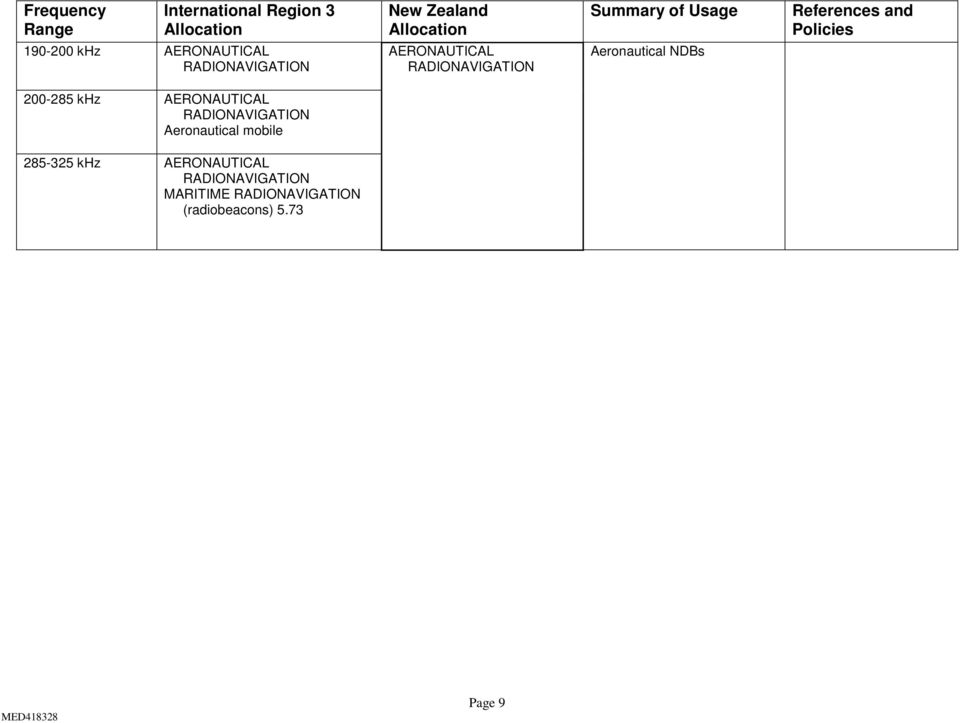
12 2.3.2 MF Band ( khz) Page 10 Frequency khz AERONAUTICAL MARITIME (radiobeacons) khz AERONAUTICAL Aeronautical mobile AERONAUTICAL Aeronautical NDBs khz 5.76 Aeronautical mobile khz MARITIME A Aeronautical radionavigation khz 5.82A 5.82B MARITIME khz Government Maritime Mobile Services 457 khz Avalanche beacons Licence for Emergency Transmitters khz MARITIME A 5.84 AERONAUTICAL Aeronautical mobile Land mobile khz BROADCASTING khz MF-AM Sound Broadcasting under MR regime khz under Ministerial Directive Radio Spectrum Auctions Ministerial Directive to CEO MED Broadcasting POLDOCs

13 khz BROADCASTING Mobile khz BROADCASTING khz BROADCASTING (Continued) khz MF-AM Sound Broadcasting under MR regime khz under Ministerial Directive Radio Spectrum Auctions Ministerial Directive to CEO MED Broadcasting POLDOCs khz khz Aeronautical NDBs khz under Ministerial Directive Ministerial Directive to CEO MED khz AMATEUR except aeronautical mobile Radiolocation khz khz AMATEUR except aeronautical mobile khz except aeronautical mobile Radiolocation CT1 Cordless Telephone base transmitters Generally licensed Radio Buoys Government Land & Maritime Mobile Services khz under Ministerial Directive Amateur 160m band Maritime Radio Buoys Government Maritime Mobile Services Licence for Cordless Telephones Licence for Maritime Mobile Ministerial Directive to CEO MED Licence for Amateur Radio Operators Licence for Maritime Purposes Page 11

14 Page 12 Frequency khz Maritime Mobile Land Mobile khz MARITIME MARITIME Maritime Mobile khz Maritime Mobile - coast stations Land Mobile Government Services khz MARITIME MARITIME Guard band for 2182 khz khz (distress and calling) khz distress, safety and calling Licence for Maritime Purposes khz MARITIME MARITIME Guard band for 2182 khz IRR Appendix khz Predominantly Mobile with some Fixed usage khz BROADCASTING Land and Maritime Mobile khz STANDARD FREQUENCY AND TIME SIGNAL (2 500 khz) STANDARD FREQUENCY 2.5 MHz khz STANDARD FREQUENCY AND TIME SIGNAL Space Research khz STANDARD FREQUENCY AND TIME SIGNAL khz Land, maritime and aeronautical mobile
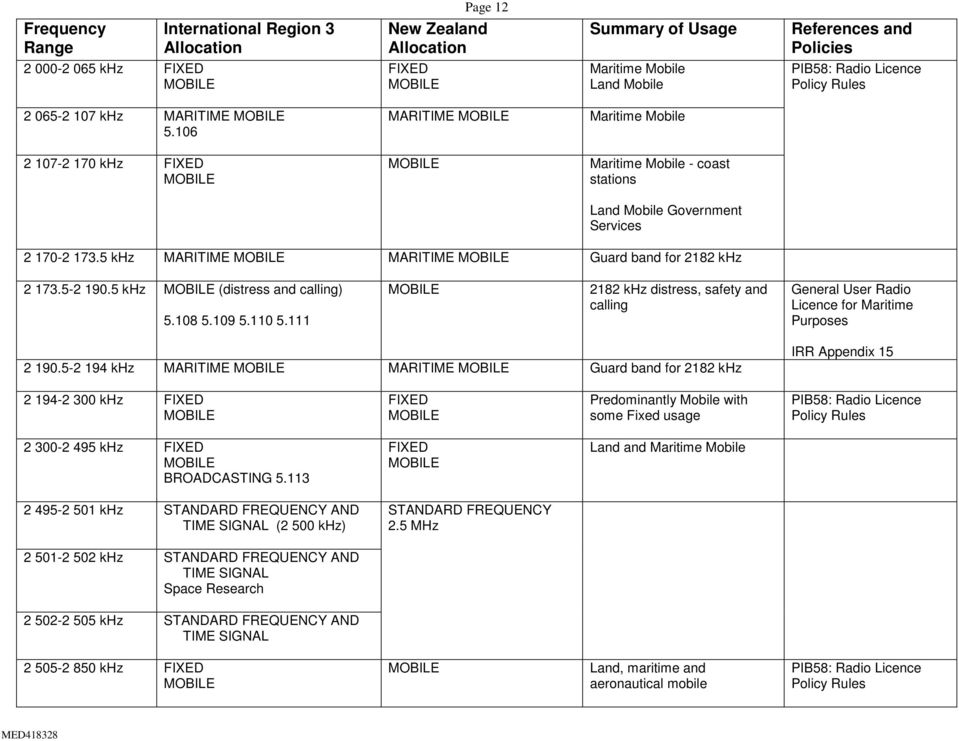
15 khz AERONAUTICAL (R) AERONAUTICAL (R) Aeronautical Base and SAR (3023 khz) Licence for Aeronautical Purposes IRR Appendix 27 Page 13
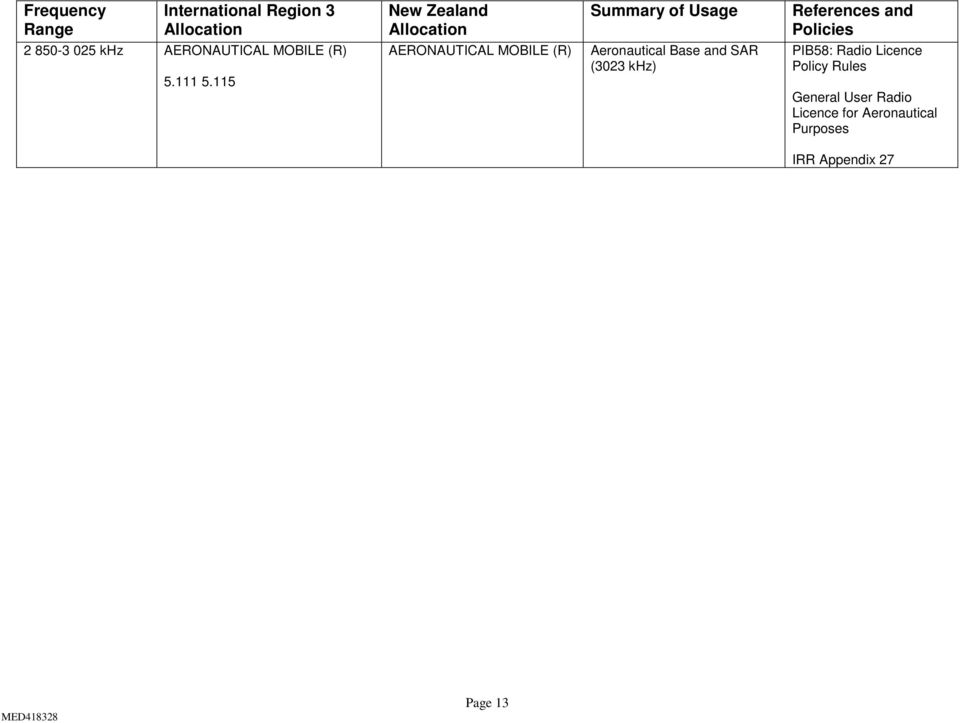
16 2.3.3 HF Band (3-30 MHz) Page 14 Frequency khz AERONAUTICAL (OR) AERONAUTICAL (OR) Commercial and Government aeronautical services Licence for Aeronautical Purposes khz except aeronautical mobile (R) khz except aeronautical mobile (R) BROADCASTING except aeronautical mobile (R) except aeronautical mobile (R) Land Mobile simplex and Aeronautical Mobile (OR) khz SRD usage Predominantly Land Mobile with a few Fixed assignments khz SRD usage IRR Appendix 26 Licence for Short khz except aeronautical mobile BROADCASTING khz AERONAUTICAL (R) AERONAUTICAL (R) Aeronautical base transmitters at Auckland Airport Licence for Aeronautical Purposes khz AMATEUR AMATEUR 80m Amateur Band khz SRD usage IRR Appendix 27 Licence for Amateur Radio Operators Licence for Short

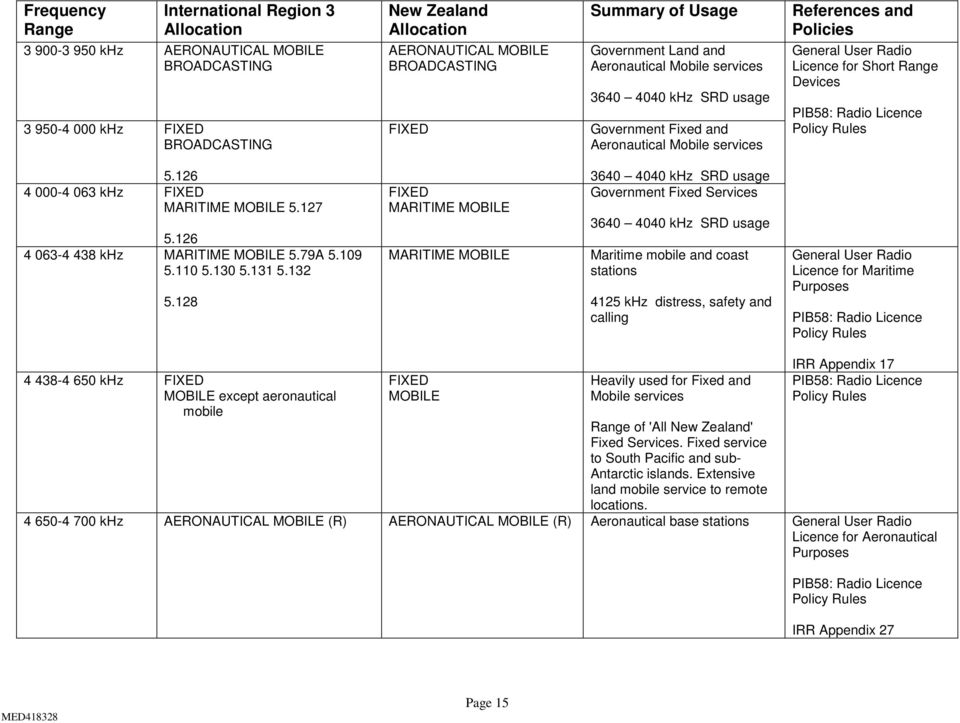
17 khz AERONAUTICAL BROADCASTING khz BROADCASTING AERONAUTICAL BROADCASTING Government Land and Aeronautical Mobile services khz SRD usage Government Fixed and Aeronautical Mobile services Licence for Short khz MARITIME khz MARITIME 5.79A MARITIME MARITIME khz SRD usage Government Fixed Services khz SRD usage Maritime mobile and coast stations 4125 khz distress, safety and calling Licence for Maritime Purposes khz except aeronautical mobile Heavily used for Fixed and Mobile services of 'All ' Fixed Services. Fixed service to South Pacific and sub- Antarctic islands. Extensive land mobile service to remote locations. IRR Appendix khz AERONAUTICAL (R) AERONAUTICAL (R) Aeronautical base stations Licence for Aeronautical Purposes IRR Appendix 27 Page 15
18 Page khz AERONAUTICAL (OR) AERONAUTICAL (OR) Government Aeronautical Mobile services. Licence for Aeronautical Purposes khz BROADCASTING Land mobile Land Mobile Government Services IRR Appendix khz LAND BROADCASTING khz STANDARD FREQUENCY AND TIME SIGNAL (5 000 khz) LAND Land Mobile Simplex Services STANDARD FREQUENCY 5 MHz khz STANDARD FREQUENCY AND TIME SIGNAL Space research khz BROADCASTING Government Fixed Service khz Mobile except aeronautical mobile Land Mobile Government Fixed and Land Mobile services khz except aeronautical mobile LAND Fixed and Land Mobile services Extensive Government and Civil Defence use khz AERONAUTICAL (OR) LAND AERONAUTICAL (OR) LAND Aeronautical and Land Mobile services IRR Appendix 27

19 khz AERONAUTICAL (R) AERONAUTICAL (R) Flight operations based in Auckland, Christchurch, Invercargill, Queenstown and Milford Licence for Aeronautical Purposes khz AERONAUTICAL (OR) AERONAUTICAL (OR) Aeronautical Mobile and SAR (5680 khz) IRR Appendix 27 Licence for Aeronautical Purposes khz Mobile except aeronautical mobile (R) Mobile except aeronautical mobile (R) Government Fixed and Land Mobile services IRR Appendix khz BROADCASTING BROADCASTING HF Sound Broadcasting and Government Fixed services khz BROADCASTING BROADCASTING HF sound broadcasting to the Pacific Islands MARITIME khz MARITIME Maritime mobile and coast stations 6215 khz distress, safety and calling khz AERONAUTICAL (R) AERONAUTICAL (R) Flight operations based in Auckland Licence for Martitime Purposes IRR Appendix 17 Licence for Aeronautical Purposes IRR Appendix 27 Page 17

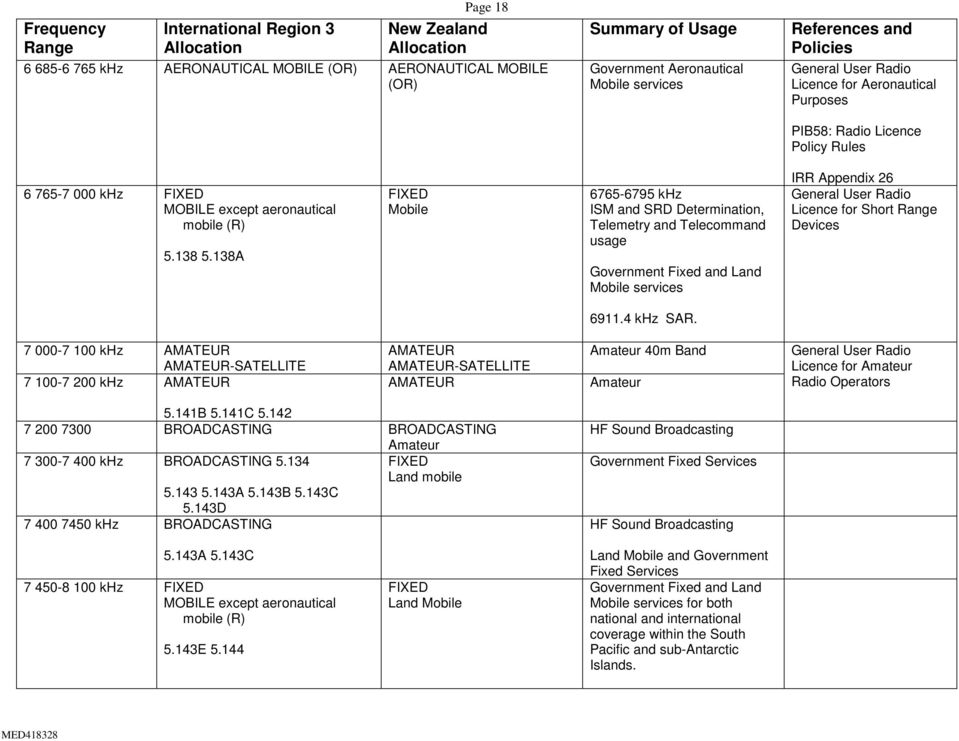
20 Page khz AERONAUTICAL (OR) AERONAUTICAL (OR) Government Aeronautical Mobile services Licence for Aeronautical Purposes khz except aeronautical mobile (R) A Mobile khz ISM and SRD Determination, Telemetry and Telecommand usage Government Fixed and Land Mobile services IRR Appendix 26 Licence for Short khz SAR khz AMATEUR AMATEUR-SATELLITE khz AMATEUR AMATEUR AMATEUR-SATELLITE AMATEUR Amateur 40m Band Amateur Licence for Amateur Radio Operators 5.141B 5.141C BROADCASTING BROADCASTING Amateur khz BROADCASTING Land mobile A 5.143B 5.143C 5.143D khz BROADCASTING HF Sound Broadcasting Government Fixed Services HF Sound Broadcasting 5.143A 5.143C khz except aeronautical mobile (R) 5.143E Land Mobile Land Mobile and Government Fixed Services Government Fixed and Land Mobile services for both national and international coverage within the South Pacific and sub-antarctic Islands.
21 khz MARITIME MARITIME Maritime Mobile services khz MARITIME MARITIME Maritime mobile and coast stations 8291 khz distress, safety and calling Licence for Maritime Purposes khz AERONAUTICAL (R) AERONAUTICAL (R) Flight operations based in Auckland IRR Appendix 17 Licence for Aeronautical Purposes khz AERONAUTICAL (OR) AERONAUTICAL (OR) Government Aeronautical services Flight operations based in Auckland IRR Appendix 27 Licence for Aeronautical Purposes khz Government Fixed and Land Mobile services for national and international coverage within the South Pacific and sub-antarctic Islands khz BROADCASTING BROADCASTING HF Sound Broadcasting Government Fixed services khz BROADCASTING HF Sound Broadcasting IRR Appendix Page 19
22 Page khz Government Fixed and Land Mobile services for both national and international coverage within the South Pacific and sub-antarctic Islands khz STANDARD FREQUENCY AND TIME SIGNAL ( khz) STANDARD FREQUENCY 10 MHz MHz STANDARD FREQUENCY AND TIME SIGNAL Space research MHz AERONAUTICAL (R) AERONAUTICAL (R) Flight operations based in Auckland Licence for Aeronautical Purposes MHz Amateur MHz Mobile except aeronautical mobile (R) IRR Appendix 27 Amateur Amateur 30m Band Licence for Amateur Radio Operators Government Fixed services for both national and international Licence for Short coverage MHz AERONAUTICAL (OR) AERONAUTICAL (OR) MHz SRD usage Government Aeronautical services Licence for Aeronautical Purposes IRR Appendix 26
23 MHz AERONAUTICAL (R) AERONAUTICAL (R) Flight operations based in Auckland MHz Government Fixed services MHz BROADCASTING S.134 Licence for Aeronautical Purposes IRR Appendix MHz BROADCASTING MHz BROADCASTING BROADCASTING HF Sound Broadcasting Government Fixed services MHz MHz MARITIME MARITIME MHz AERONAUTICAL (OR) AERONAUTICAL (OR) Maritime mobile and coast stations MHz distress, safety and calling Government Aeronautical services Licence for Maritime Purposes IRR Appendix 17 Licence for Aeronautical Purposes MHz AERONAUTICAL (R) AERONAUTICAL (R) Flight operations based in Auckland IRR Appendix 26 Licence for Aeronautical Purposes Page 21 IRR Appendix 27
24 MHz RADIO ASTRONOMY Page 22 Governmet Fixed services MHz Mobile except aeronautical mobile (R) MHz BROADCASTING MHz BROADCASTING MHz BROADCASTING Mobile Government Fixed and Land Mobile services MHz ISM & SRD Telemetry and Telecommand usage BROADCASTING HF Sound Broadcasting Licence for Short MHz Mobile except aeronautical mobile (R) MHz AMATEUR AMATEUR-SATELLITE AMATEUR AMATEUR-SATELLITE Fixed and Land Mobile services Amateur 20m Band MHz AMATEUR AMATEUR MHz Government Fixed services Mobile except aeronautical mobile (R) MHz STANDARD FREQUENCY AND TIME SIGNAL ( khz) STANDARD FREQUENCY 15 MHz Licence for Amateur Radio Operators 5.111
25 MHz STANDARD FREQUENCY AND TIME SIGNAL Space research MHz AERONAUTICAL (OR) AERONAUTICAL (OR) Government Aeronautical services Licence for Aeronautical Purposes MHz BROADCASTING BROADCASTING HF Sound Broadcasting IRR Appendix MHz BROADCASTING Government Fixed services HF Sound Broadcasting MHz MHz MARITIME MARITIME Government Aeronautical and Fixed services Maritime mobile and coast stations MHz distress, safety and calling Licence for Maritime Purposes MHz Government Fixed services MHz BROADCASTING IRR Appendix MHz BROADCASTING BROADCASTING Fixed Government Fixed services HF Sound Broadcasting Page 23
26 Page MHz AERONAUTICAL (R) AERONAUTICAL (R) Flight operations based in Auckland Licence for Aeronautical Purposes MHz AERONAUTICAL (OR) AERONAUTICAL (OR) Government Aeronautical services IRR Appendix 27 Licence for Aeronautical Purposes MHz Government Fixed services IRR Appendix MHz Space research MHz AMATEUR AMATEUR-SATELLITE MHz Mobile except aeronautical mobile AMATEUR Amateur 17m Band Licence for Amateur Radio Operators Government Fixed and Land Mobile services MHz MARITIME MARITIME Maritime mobile ship station IRR Appendix MHz BROADCASTING BROADCASTING MHz Government Fixed services MHz MARITIME MARITIME Maritime mobile coast station MHz Government Fixed services IRR Appendix 17
27 MHz STANDARD FREQUENCY AND TIME SIGNAL Space research STANDARD FREQUENCY 20 MHz MHz STANDARD FREQUENCY AND TIME SIGNAL ( khz) STANDARD FREQUENCY 20 MHz MHz Mobile Government Fixed and Land Mobile services MHz AMATEUR AMATEUR-SATELLITE MHz BROADCASTING BROADCASTING Fixed 4.4 AMATEUR Amateur 15m Band Licence for Amateur Radio Operators Government Fixed services MHz MHz 5.155B MHz AERONAUTICAL (R) AERONAUTICAL (R) Flight operations based in Auckland MHz MARITIME MARITIME Maritime mobile and coast stations MHz Government Fixed services Licence for Aeronautical Purposes IRR Appendix 27 IRR Appendix MHz Mobile except aeronautical mobile (R) MHz 5.156A AERONAUTICAL (OR) MHz except aeronautical mobile AERONAUTICAL Government Aeronautical (OR) services Government Fixed services Page 25
28 MHz LAND Page 26 LAND Government Fixed and Land Mobile Services MHz AMATEUR AMATEUR-SATELLITE MHz STANDARD FREQUENCY AND TIME SIGNAL( khz) AMATEUR AMATEUR-SATELLITE STANDARD FREQUENCY 25 MHz Amateur 12m band Licence for Amateur Radio Operators MHz STANDARD FREQUENCY AND TIME SIGNAL Space research MHz except aeronautical mobile Government Fixed services MHz MARITIME MARITIME Government Maritime services IRR Appendix MHz except aeronautical mobile Government Fixed and Land Mobile services MHz RADIO ASTRONOMY 4.4 Government Fixed services MHz BROADCASTING BROADCASTING MHz MARITIME MARITIME IRR Appendix MHz except aeronautical mobile except aeronautical mobile Government Fixed Services MHz Meteorological (auroral radar) at Birdlings Flat MHz Citizen Band "CB" radio service Licence for Citizen Band Radio
29 MHz (Continued) except aeronautical mobile (Continued) except aeronautical mobile MHz Local area paging services ISM usage SRD unrestricted usage Aeronautical model control Amateur Licence for Short Licence for Aeronautical Model Control Short Licence for Amateur Radio Operators MHz METEOROLOGICAL AIDS MHz AMATEUR AMATEUR-SATELLITE MHz AMATEUR AMATEUR-SATELLITE Government Fixed and Land Mobile services Amateur 10m Band MHz SRD unrestricted usage Aeronautical model control Licence for Amateur Radio Operators Licence for Short Government Fixed and Land Mobile services MHz Telemetry and telecommand Licence for Aeronautical Model Control Short Page 27
30 Page VHF Band ( MHz) Frequency MHz SPACE OPERATION (satellite identification) SPACE RESEARCH UNALLOCATED MHz MHz Government Fixed and Land Mobile services Licence for Short MHz Cordless Telephone CT1 Band base transmit Licence for Cordless Telephones MHz SRD usage Radio Paging usage Licence for Aeronautical Model Control Short MHz Aeronautical model control SRDs MHz TV Sound IF MHz Aeronautical model control SRDs MHz SRD unrestricted usage MHz Radio astronomy Government Fixed and Land Mobile services 5.149
31 MHz Government Fixed and Land Mobile services MHz TV Vision IF Licence for Aeronautical Model Control Short MHz Space research MHz MHz Aeronautical model control SRDs MHz Cordless Telephone CT1 Band Mobile Transmit Government Fixed and Land Mobile services MHz Aeronautical model control SRDs MHz SRD usage Telemetry and Telecommand Licence for Cordless Telephones Licence for Short Licence for Aeronautical Model Control Short MHz Aeronautical model control SRDs Space research MHz SRD usage Auroral Radar at Birdlings Flat MHz MHz BROADCASTING MHz VHF television broadcasting under MR regime (MR47) Radio Spectrum Auctions Broadcasting POLDOCs Radio Spectrum Auctions Page 29
32 47-50 MHz BROADCASTING Page 30 BROADCASTING MHz VHF television broadcasting under MR regime (MR47) Radio Spectrum Auctions Broadcasting POLDOCs Radio Spectrum Auctions MHz AMATEUR MHz BROADCASTING AMATEUR MHz AMATEUR Government Fixed and Land Mobile services Amateur 6m Band Licence for Amateur Radio Operators MHz BROADCASTING BROADCASTING VHF television broadcasting under MR regime (MR48) Broadcasting POLDOCs Radio Spectrum Auctions MHz Government and Commercial Fixed and Land Mobile Services MHz SRD usage MHz Aeronautical Model Control MHz Cordless Telephone CT1 Band Mobile Transmit Licence for Short Licence for Cordless Telephones Licence for Aeronautical Model Control Short MHz AERONAUTICAL AERONAUTICAL MHz MHz Land Mobile ESA Band Base Transmit PIB23: Mobile Service bands in
33 MHz MHz Land Mobile ESA Band Simplex MHz Land Mobile ESA Band Mobile Transmit PIB23: Mobile Service bands in MHz Land Mobile A Band MHz BROADCASTING BROADCASTING MHz Land Mobile A Band MHz Low power FM sound broadcasting PIB23: Mobile Service bands in MHz SRD usage MHz under Ministerial Directive Licence for Low Power FM Broadcasting Licence for Short Ministerial Directive to CEO MED MHz FM Sound broadcasting band Under MR regime (MR207) Radio Spectrum Auctions Broadcasting POLDOCs Page 31
34 Page MHz BROADCASTING BROADCASTING MHz FM sound broadcasting band Under MR regime (MR207) MHz low power FM sound broadcasting MHz SRD usage MHz under Ministerial Directive Radio Spectrum Auctions Broadcasting POLDOCs Licence for Short Licence for Low Power FM Broadcasting MHz AERONAUTICAL AERONAUTICAL MHz ILS Localisers at some airports Ministerial Directive to CEO MED 5.197A MHz VOR Aeronautical Beacons MHz AERONAUTICAL (R) AERONAUTICAL (R) MHz widespread aeronautical use MHz Search and Rescue MHz Low power search and rescue transceivers MHz aeronautical repeaters base transmit MHz aeronautical repeaters base receive Licence for Aeronautical Purposes Licence for Emergency Transmitters PIB23: Mobile Service bands in MHz Aeronautical data use
35 MHz SPACE OPERATION (space-to- Earth) METEOROLOGICAL-SATELLITE (space-to-earth) -SATELLITE (space-to- Earth) 5.208A 5.208B SPACE RESEARCH (space-to- Earth) Fixed Mobile except aeronautical mobile (R) -SATELLITE (spaceto-earth) METEOROLOGICAL- SATELLITE (space-to- Earth) Fixed Mobile MHz Government service usage MHz SPACE OPERATION (space-to- Earth) METEOROLOGICAL-SATELLITE (space-to-earth) SPACE RESEARCH (space-to- Earth) Fixed Mobile-satellite (space-to-earth) 5.208A 5.208B Mobile except aeronautical mobile (R) MHz SPACE OPERATION (space-to- Earth) METEOROLOGICAL-SATELLITE (space-to-earth) -SATELLITE (space-to- Earth) 5.208A 5.208B SPACE RESEARCH (space-to- Earth) Fixed Mobile except aeronautical mobile (R) Page 33
36 Page 34 Frequency MHz SPACE OPERATION (space-to- Earth) METEOROLOGICAL-SATELLITE (space-to-earth) SPACE RESEARCH (space-to- Earth) Fixed Mobile-satellite (space-to-earth) 5.208A 5.208B Mobile except aeronautical mobile (R) MHz Space research (space-to-earth) MHz SPACE RESEARCH(space-to- Earth) MHz Land mobile ESB Band PIB23: Mobile Service bands in MHz Space research (space-to-earth) MHz AMATEUR AMATEUR-SATELLITE MHz AMATEUR AMATEUR AMATEUR SATELLITE AMATEUR MHz Amateur 2m Band Limited Government service usage Licence for Amateur Radio Operators
37 MHz MHz MHz -SATELLITE (Earth-tospace) SATELLITE (Earth-tospace) A -SATELLITE 5.224B SATELLITE (Earth-tospace) - SATELLITE -SATELLITE (Earth-tospace) Mobile Satellite Services Civil Defence and Emergency service use throughout New Zealand MHz Land Mobile E Band Licence for Satellite Services PIB23: Mobile Service bands in MARITIME (distress and calling via DSC) MHz MHz MARITIME (distress and calling) MARITIME MARITIME (distress and calling) MHz Maritime Mobile VHF Band MHz distress, safety, and calling IRR Appendix 18 Licence for Maritime Purposes PIB23: Mobile Service bands in MHz A Page 35
38 Page 36 Frequency MHz (Continued) MHz Wide-Area Paging Band PIB23: Mobile Service bands in A (Continued) MHz Land Mobile MS band: Mobile transmit Licence for Short MHz Mobile Radio Reporter RR band MHz MS Simplex band MHz Bush winch simplex band Licence for Maritime Purposes MHz SRD unrestricted usage MHz Telemetry and Telecommand MHz Radio Paging MHz Maritime Mobile MHz Maritime Mobile MHz MS Base transmit band MHz Maritime Mobile
39 MHz (Continued) MHz Fixed "EE" band PIB22: Fixed Service Bands in A (Continued) MHz Land Mobile "EE" band PIB23: Mobile Service bands in MHz Fixed "EE band MHz Land Mobile "EE" band MHz Fixed "EE" band Licence for Short MHz Land Mobile "EE" band MHz Fixed "EE" band MHz Land Mobile EE band MHz Bush winch simplex band MHz BROADCASTING BROADCASTING MHz SRDs with some fixed and land mobile simplex use MHz Under MR regime (MR49) VHF Television (Band III) Radio Spectrum Auctions Broadcasting POLDOCs Radiomicrophones Cabinet decisions CAB Min (09) 45/12 Digital Switchover Page 37
40 Page 38 Frequency MHz BROADCASTING AERONAUTICAL Radiolocation BROADCASTING (Continued) MHz Under MR regime (MR49) VHF Television (Band III) Radiomicrophones Radio Spectrum Auctions Broadcasting POLDOCs Cabinet decisions CAB Min (09) 45/12 Digital Switchover MHz AERONAUTICAL AERONAUTICAL MHz Government Service usage General User Spectrum Licence - VHF radiomicrophone MHz MHz Space operation (space-to-earth) MHz Government Service usage MHz SRD determination, telemetry and telecommand 243 MHz Search and Rescue Service Licence for Short Licence for Emergency Transmitters MHz SPACE OPERATION (space-to-earth) MHz MHz Government usage MHz SRD determination, telemetry and telecommand Licence for Short
41 2.3.5 UHF Band ( MHz) Frequency MHz MHz Government usage Licence for Short MHz Mobile-satellite (Earth-to-space) MHz MHz SRD determination, telemetry and telecommand MHz RADIO ASTRONOMY MHz AERONAUTICAL AERONAUTICAL Aeronautical ILS glidepath transmitters at airports MHz MHz Government usage MHz Mobile-satellite (space-to-earth) 5.208A 5.208B MHz Page 39
42 MHz -SATELLITE (Earth-tospace) A -SATELLITE B Page 40 SATELLITE Mobile Satellite Services Licence for Satellite Services MHz STANDARD FREQUENCY AND TIME SIGNAL-SATELLITE (400.1 MHz) STANDARD FREQUENCY AND TIME SIGNAL- SATELLITE MHz METEOROLOGICAL AIDS METEOROLOGICAL-SATELLITE (space-to-earth) -SATELLITE (space-to- Earth) 5.208A 5.208B SPACE RESEARCH (space-to- Earth) Space operation (space-to-earth) METEOROLOGICAL AIDS METEOROLOGICAL- SATELLITE (space-to- Earth) Meteorological radio-sondes MHz METEOROLOGICAL AIDS SPACE OPERATION (space-to- Earth) EARTH EXPLORATION- SATELLITE (Earth-to-space) METEOROLOGICAL-SATELLITE (Earth-to-space) Fixed Mobile except aeronautical mobile METEOROLOGICAL AIDS EARTH EXPLORATION- SATELLITE (Earth-tospace) METEOROLOGICAL- SATELLITE (Earth-tospace) Fixed Land Mobile Meteorological Aids MHz METEOROLOGICAL AIDS EARTH EXPLORATION- SATELLITE (Earth-to-space) METEOROLOGICAL-SATELLITE (Earth-to-space) Fixed Mobile except aeronautical mobile METEOROLOGICAL AIDS EARTH EXPLORATION- SATELLITE (Earth-tospace) METEOROLOGICAL- SATELLITE (Earth-tospace) Fixed MHz SRDs limited to biomedical telemetry Licence for Short
43 MHz METEOROLOGICAL AIDS Fixed Mobile except aeronautical mobile METEOROLOGICAL AIDS Fixed Mobile MHz Fixed "I" band MHz SRDs limited to biomedical telemetry Meteorological Aids Government fixed and land mobile services PIB22: Fixed Service Bands in Licence for Short MHz -SATELLITE (Earth-tospace) -SATELLITE (Earthto-space) Satellite distress beacons (SDBs) Licence for Emergency Transmitters MHz except aeronautical mobile RADIO ASTRONOMY MHz except aeronautical mobile SPACE RESEARCH (space-tospace) Land Mobile Trunked dispatch "TD" band mobile transmit MHz MHz Fixed "I" band MHz TD band simplex PIB22: Fixed Service Bands in PIB23: Mobile Service bands in MHz (continued) MHz TD band base transmit PIB23: Mobile Service bands in MHz except aeronautical mobile Radiolocation except aeronautical mobile MHz Fixed I Band PIB22: Fixed Service Bands in Page 41
44 MHz Amateur Page 42 Amateur Amateur 70cm Band MHz Amateur Earth exploration-satellite (active) 5.279A Amateur Amateur Satellite MHz Short range devices MHz Amateur 70cm Band Licence for Short Licence for Amateur Radio Operators MHz Amateur Amateur Amateur 70cm Band Licence for Amateur Radio Operators MHz except aeronautical mobile Radiolocation except aeronautical mobile Radiolocation MHz Fixed "JL" band MHz SRD Biomedical telemetry usage MHz Land Mobile CNX band simplex PIB22: Fixed Service Bands in Licence for Short PIB23: Mobile Service bands in
45 MHz 5.286AA MHz Fixed JC Band A : MHz Land mobile "C" band, mobile transmit : MHz Land mobile "CNX" band simplex PIB22: Fixed Service Bands in PIB23: Mobile Service bands in MHz Fixed JB band : MHz Land Mobile "C" Band Simplex MHz 5.286AA : MHz Land Mobile "C" Band base Transmit A Page 43
46 MHz 5.286AA Page : MHz Land Mobile "C" Band base Transmit MHz Maritime onboard communications MHz Land Mobile D Band Simplex MHz SRD unrestricted usage MHz Land Mobile D Band Simplex PIB22: Fixed Service Bands in PIB23: Mobile Service bands in Licence for Maritime UHF On-board Communications Licence for Short MHz 5.286AA A MHz 5.286AA Meteorological-Satellite (space-to-earth) MHz Fixed JB and JNB Band MHz Fixed JD Band MHz Fixed JE Band
47 MHz (Continued) 5.286AA Meteorological-Satellite (space-to-earth) (Continued) MHz Land Mobile DNX and DNNX Band Simplex Channels : MHz Land Mobile DN and DNN Band Base Transmit : MHz Land Mobile DNX and DNNX Band Simplex Channels PIB23: Mobile Service bands in PIB22: Fixed Service Bands in Licence for Short MHz Fixed JF Band MHz Fixed JD Band Beta Transmit Licence for Maritime UHF On-board Communications MHz Land Mobile DNX and DNNX Band Simplex Channels MHz Short range devices MHz Land Mobile "DNX" and DNNX Band Simplex Channels MHz "DN" and DNN Band Mobile Transmit MHz Maritime onboard communications Page 45
48 MHz BROADCASTING Page MHz SRD usage Licence for Short MHz Land Mobile FNX and FNNX Band Simplex MHz SRD usage MHz Land Mobile FNX and FNNX Band Simplex PIB23: Mobile Service bands in Licence for Citizen band radio MHz Land Mobile "FN" and FNN Band Mobile Transmit channels MHz Land Mobile "FNX" and FNNX Band Simplex MHz Personal Radio Service PRS Band
49 MHz (Continued) BROADCASTING (Continued) (Continued) MHz Land Mobile "FNX" and FNNX Band Simplex MHz Land Mobile "FN" and FNN Band Base Transmit MHz Land Mobile "FNX" and FNNX Band Simplex PIB23: Mobile Service bands in Ministerial Directive to CEO MED MHz Land Mobile "FN" and FNN Band Base Transmit MHz Land Mobile "FNX" and FNNX Band Simplex MHz Land Mobile "FN" and FNN Band Mobile Transmit MHz Land Mobile ESC Band reserved for public safety MHz BROADCASTING UHF Television Digital Terrestrial Television Analog Television (until December 2013) Ministerial Directive to CEO MED Cabinet decisions CAB Min (09) 45/12 Digital Switchover Page 47
50 MHz (Continued) BROADCASTING (Continued) Page MHz BROADCASTING (Continued) UHF Television Digital Terrestrial Television Analog Television (until December 2013) under the Management Rights Regime Audio/video senders SRDs Radio Spectrum Auctions Broadcasting POLDOCs Licence for Short General User Spectrum Licence for UHF radiomicrophones Radiomicrophone SRDs Cabinet decisions CAB Min (09) 45/12 Digital Switchover MHz BROADCASTING Maori Television Service (Te Aratuku Whakaata Irirangi Maori) Act MHz 5.313A 5.317A BROADCASTING A MHz BROADCASTING (until December 2013) (from December 2013)
51 MHz (Continued) 5.313A 5.317A BROADCASTING A (Continued) MHz Fixed KK Band (12 x 500 khz channelling) MHz Land Mobile ESD Band (Emergency Services) Mobile Transmit MHz Land Mobile TS Band (Trunked Dispatch) Mobile Transmit MHz SRD and spread spectrum device usage PIB22: Fixed Service Bands in PIB23: Mobile Service bands in Licence for Short MHz unused MHz Cellular Communication Services (Private Management Rights) Radio Spectrum Auctions MHz Fixed KL Band restricted for Studio to Transmitter Linking MHz Fixed KK Band (12 x 500 khz channelling) MHz Land Mobile ESD Band (Emergency Services) Base Transmit PIB22: Fixed Service Bands in PIB23: Mobile Service bands in Page 49
52 MHz (Continued) 5.313A 5.317A BROADCASTING A (Continued) (Continued) Page MHz Land Mobile TS Band (Trunked Dispatch) Base Transmit MHz Cordless Telephone CT2 Band MHz Short range devices GURL band PIB23: Mobile Service bands in Licence for Cordless Telephones MHz Land Mobile TX Band Simplex operation Licence for Short MHz unused MHz Cellular Communication Services (Private Management Rights) Radio Spectrum Auctions MHz 5.317A BROADCASTING Radiolocation MHz Cellular Communication Services (Private Management Rights) MHz Fixed K Band - Studio to Transmitter Links (STLs) No new Fixed licences permitted. Allocated for SRDs from 24 December MHz SRD usage Radio Spectrum Auctions PIB22: Fixed Service Bands in Licence for Short
53 MHz (continued) 5.317A BROADCASTING Radiolocation (continued) (continued) MHz ISM, SRD, and Amateur usage MHz Fixed K Band - Studio to Transmitter Links (STLs) Licence for Short Licence for Amateur Radio Operators PIB22: Fixed Service Bands in MHz 5.317A BROADCASTING MHz Cellular Communication Services (Private Management Rights) Radio Spectrum Auctions MHz AERONAUTICAL AERONAUTICAL (R) 5.327A AERONAUTICAL Aeronautical Radionavigation (Distance Measuring Equipment and Secondary Surveillance Radar) Licence for Aeronautical Purposes MHz AERONAUTICAL SATELLITE (space-to-earth) (space-tospace) 5.328B 5.328A Page 51
54 MHz EARTH EXPLORATION- SATELLITE (active) -SATELLITE (space-to-earth) (space-tospace) 5.328B A SPACE RESEARCH (active) Page 52 - SATELLITE Radiolocation Radionavigation MHz EARTH EXPLORATION- SATELLITE (active) -SATELLITE (space-to-earth) (space-tospace) 5.328B A SPACE RESEARCH (active) Amateur - SATELLITE Amateur MHz Amateur Radio Licence for Amateur Radio Operators A MHz AERONAUTICAL SATELLITE (Earth-to-space) AERONAUTICAL Radiolocation Aeronautical Radar A MHz 5.338A MHz EARTH EXPLORATION- SATELLITE (passive) RADIO ASTRONOMY SPACE RESEARCH (passive) RADIO ASTRONOMY SPACE RESEARCH (passive) Astronomy and Space Research All emissions prohibited
55 MHz SPACE OPERATION (Earth-tospace) except aeronautical mobile 5.338A MHz MHz Fixed "LL" Band for narrow band high efficiency digital fixed links MHz Fixed L Band point to point linking PIB22: Fixed Service Bands in 5.338A MHz BROADCASTING BROADCASTING-SATELLITE 5.208B BROADCASTING BROADCASTING SATELLITE (Sound) MHz under Ministerial Directive MHz Fixed "L" band POLDOC Spectrum Band Plans 005 PIB22: Fixed Service Bands in MHz MHz Fixed L Band Ministerial Directive to CEO MED PIB22: Fixed Service Bands in MHz Fixed "LL" Band for narrow band high efficiency digital fixed links SATELLITE (space-toearth) A 5.348B 5.351A Page 53
56 MHz SPACE OPERATION (space-to- Earth) -SATELLITE (space-to- Earth) 5.208B 5.351A Earth exploration-satellite Mobile Page 54 -SATELLITE (space-to-earth) MHz Mobile Satellite service downlink MHz SPACE OPERATION (space-to- Earth) -SATELLITE (space-to- Earth) ) 5.208B 5.351A 5.353A Earth exploration-satellite Fixed Mobile MHz -SATELLITE (space-to- Earth) 5.208B 5.351A A A MHz AERONAUTICAL -SATELLITE (space-to-earth) (space to space) 5.208B 5.328B 5.329A - SATELLITE (Space-to- Earth) MHz Radionavigation Satellite (space-to-earth) Global Positioning System (GPS) 5.341
57 MHz SATELLITE (Earth-to- Space) 5.351A AERONAUTICAL Radiodetermination-satellite (Earth-to-Space) MHz SATELLITE (Earth-To- Space 5.351A RADIO ASTRONOMY AERONAUTICAL Radiodetermination-satellite (Earth-to-Space) SATELLITE (Earthto-Space) GHz Mobile Satellite Service GHz Aeronautical Mobile Satellite Service GHz Maritime Mobile Satellite Service Licence for Satellite Services Licence for Aeronautical Purposes Licence for Maritime Purposes MHz SATELLITE (Earth-to- Space) 5.351A AERONAUTICAL Mobile-Satellite (Space-to-Earth) 5.208B Radiodetermination-satellite (Earth-to-Space) MHz -SATELLITE (Earth-to- Space) 5.351A A A (Earth- -SATELLITE to-space) MHz Mobile Satellite (Earth-to-Space) - INMARSAT uplinks paired with MHz Page 55
58 MHz -SATELLITE (Earth-tospace) 5.351A RADIO ASTRONOMY Page 56 RADIO ASTRONOMY A MHz RADIO ASTRONOMY SPACE RESEARCH (passive) Fixed Mobile except aeronautical mobile RADIO ASTRONOMY SPACE RESEARCH (passive) METEOROLOGICAL AIDS A GHz -SATELLITE (Earth-tospace 5.351A 5.379B 5.379C RADIO ASTRONOMY SPACE RESEARCH (Passive) Fixed Mobile except aeronautical mobile A MHz METEOROLOGICAL AIDS except aeronautical mobile -SATELLITE (Earth-tospace) 5.351A 5.379B 5.379C RADIO ASTRONOMY D 5.379E MHz METEOROLOGICAL AIDS METEOROLOGICAL-SATELLITE (space-to-earth) -SATELLITE (Earth-tospace) 5.351A 5.379B METEOROLOGICAL AIDS METEOROLOGICAL- SATELLITE (space-to- Earth) Meteorological satellite downlinks D 5.379E 5.380A
59 MHz METEOROLOGICAL AIDS METEOROLOGICAL-SATELLITE (space-to-earth) except aeronautical mobile METEOROLOGICAL- SATELLITE (Space-to- Earth) Meteorological Satellite MHz METEOROLOGICAL AIDS METEOROLOGICAL-SATELLITE (space-to-earth) MHz METEOROLOGICAL-SATELLITE (space-to-earth) except aeronautical mobile MHz 5.384A 5.388A MHz Cellular communication services (Private Management Rights) MHz DECT cordless telephone systems MHz PHS cordless telephone systems Radio Spectrum Auctions Licence for Cordless Telephones MHz 5.388A MHz Cellular communication services (Private Management Rights) Radio Spectrum Auctions MHz 5.388A Page 57
60 MHz -SATELLITE (Earth-tospace) 5.351A Page 58 -SATELLITE (Earthto-space) Mobile Satellite Service uplink Licence for Satellite Services A MHz 5.388A MHz TDD, 3G cellular technologies and fixed services (Private Management Rights) Radio Spectrum Auctions MHz SPACE OPERATION (Earth-tospace) (space-to-space) EARTH EXPLORATION- SATELLITE (Earth-to-space) (space-to-space) SPACE RESEARCH (Earth-tospace) (space-to-space) MHz Fixed Wireless Access and Fixed services (Private Management Rights) MHz 5.388A SPACE RESEARCH (deep space) (Earth-to-space) MHz Cellular communication services (Private Management Rights) MHz 5.388A MHz 5.388A 5.388
61 MHz -SATELLITE (space-to- Earth) 5.351A -SATELLITE (spaceto-earth) A MHz SPACE OPERATION (space-to- Earth) (space-to-space) EARTH EXPLORATION- SATELLITE (space-to-earth) (space-to-space) SPACE RESEARCH (space-to- Earth) (space-to-space) MHz Private Management Rights - suitable for FWA and fixed services Radio Spectrum Auctions MHz except aeronautical mobile SPACE RESEARCH (deep space) (space-to-earth) MHz 5.384A Amateur MHz Amateur MHz Private Management Rights - suitable for MMDS, FWA or Fixed services MHz Amateur radio usage MHz ISM band, short range devices Licence for Amateur Radio Operators Licence for Short Page 59
62 MHz -SATELLITE (Space-to- Earth) 5.351A Radiodetermination-satellite (space-to-earth) Page 60 -SATELLITE (space-to-earth) Mobile Satellite Service downlink MHz -SATELLITE (space-to- Earth) except aeronautical mobile 5.384A -SATELLITE (space-to- Earth) 5.351A MHz Private Management Rights for cellular and FWA services MHz Managed Spectrum Park for local wireless services Radio Spectrum Auctions Managed Spectrum Park MHz -SATELLITE (space-to- Earth) except aeronautical mobile 5.384A BROADCASTING-SATELLITE MHz except aeronautical mobile 5.384A BROADCASTING-SATELLITE C 5.417D 5.418A 5.418B 5.418C
63 MHz -SATELLITE (Earth-tospace) except aeronautical Mobile 5.384A BROADCASTING-SATELLITE Earth exploration-satellite (passive) Radio astronomy Space research (passive) B MHz -SATELLITE (Earth-tospace) except aeronautical mobile 5.384A -SATELLITE (Earth-tospace) 5.351A Earth exploration-satellite (passive) Radio astronomy Space research (passive) MHz EARTH EXPLORATION- SATELLITE (passive) RADIO ASTRONOMY SPACE RESEARCH (passive) RADIO ASTRONOMY SPACE RESEARCH Astronomy Space Research MHz AERONAUTICAL Radiolocation AERONAUTICAL Radiolocation Fixed under IRR Fixed OX band Itinerant fixed linking for Television outside broadcast operations PIB22: Fixed Service Bands in Page 61
64 MHz 5.424A Page MHz SRD use limited to radiolocation Licence for Short
65 2.3.6 SHF Band (3-30 GHz) Frequency MHz (continued) 5.424A MHz Earth exploration-satellite (active) Space research (active) MHz SRD use limited to radiolocation Licence for Short MHz Amateur MHz -SATELLITE (space-to- Earth) Amateur Mobile 5.432B Radiolocation Amateur MHz AMATEUR Amateur Satellite MHz MHz SRD use limited to radiolocation MHz Amateur radio usage MHz Under Management Rights regime Licence for Amateur Radio Operators Licence for Short Radio Spectrum Auctions MHz -SATELLITE (space-to- Earth) except aeronautical mobile 5.433A Radiolocation MHz MHz -SATELLITE (Space-to-Earth) MHz Under Management Rights regime MHz Fixed Satellite C Band downlink Page 63
66 MHz -SATELLITE (space-to- Earth) except aeronautical mobile Radiolocation Page 64 -SATELLITE (Space-to-Earth) MHz Fixed 'P' band - usage must be co-ordinated with satellite earth stations operating in this band. PIB22: Fixed Service Bands in MHz -SATELLITE (space-to- Earth) except aeronautical mobile -SATELLITE (space-to- Earth) MHz AERONAUTICAL MHz MHz -SATELLITE (space-to- Earth) MHz Radio astronomy MHz except aeronautical mobile RADIO ASTRONOMY Space research (passive) AERONAUTICAL Radio Altimeters and associated ground transponders MHz Fixed 5 GHz Band MHz Planned fixed satellite service (spaceto-earth) as per IRR Licence for Aeronautical Purposes PIB22: Fixed Service Bands in IRR Appendix 30B
67 MHz AERONAUTICAL -SATELLITE (Earth-to-space) MHz AERONAUTICAL -SATELLITE (Earth-to-space) (space-tospace) 5.328B 5.443B MHz AERONAUTICAL MHz AERONAUTICAL AERONAUTICAL 5.444B A MHz AERONAUTICAL -SATELLITE (Earth-tospace) 5.447A except aeronautical mobile 5.446A 5.446B AERONAUTICAL except aeronautical mobile MHz SRD usage, wireless LAN systems Licence for Short B 5.447C MHz EARTH EXPLORATION- SATELLITE (active) SPACE RESEARCH 5.447D except aeronautical mobile 5.446A 5.447F 5.448A Page 65
68 MHz EARTH EXPLORATION- SATELLITE (active) SPACE RESEARCH (active) except aeronautical mobile 5.446A 5.447F Page 66 except aeronautical mobile MHz SRD usage, wireless LAN systems Licence for Short 5.448A MHz EARTH EXPLORATION- SATELLITE (active) 5.448B SPACE RESEARCH (active) 5.448C AERONAUTICAL D AERONAUTICAL MHz Airborne Doppler radar Licence for Aeronautical Purposes MHz EARTH EXPLORATION- SATELLITE (active) SPACE RESEARCH (active) 5.448D 5.448B MHz MARITIME except aeronautical mobile 5.446A 5.450A EARTH EXPLORATION- SATELLITE (active) SPACE RESEARCH (active) 5.450B MARITIME except aeronautical mobile Radiolocation MHz SRD usage GURL for radiolocation and wireless LAN MHz Ground based Meteorological RADAR Licence for Short 5.448B MHz MARITIME except aeronautical mobile 5.446A 5.450A 5.450B 5.452
69 MHz except aeronautical mobile 5.446A 5.450A Amateur Space research (deep space) MHz Amateur MHz Amateur Amateur-satellite (space-to-earth) MHz -SATELLITE (Earth-tospace) Radiolocation MHz -SATELLITE (Earth-tospace) 5.457A 5.457B except aeronautical mobile Amateur Amateur Amateur Satellite (space-to- Earth) -SATELLITE (Earth-tospace) -SATELLITE (Earth-tospace) MHz SRD GURL for radiolocation and wireless LAN MHz Amateur radio GURL MHz ISM band, SRD GURL MHz Fixed radio links GURL MHz ISM band, SRD GURL MHz Fixed Satellite Service "C" band uplink MHz Fixed R band MHz Fixed T band Licence for Amateur Radio Operators Licence for Short Licence for Fixed Radio Link Licence for Short PIB22: Fixed Service Bands in Page 67
70 MHz -SATELLITE (Earth-tospace) (space-to-earth) A 5.458B 5.458C MHz Page 68 -SATELLITE (Earth-tospace) (space-to-earth) MHz Fixed T band MHz Fixed Satellite Service MHz Fixed T band PIB22: Fixed Service Bands in PIB22: Fixed Service Bands in MHz SPACE RESEARCH (Earth-tospace) MHz Fixed V Band utilised for point to point linking and itinerant TV outside broadcasting MHz MHz -SATELLITE (space-to- Earth) MHz -SATELLITE (space-to- Earth) except aeronautical mobile MHz Fixed U Band for point-to-point linking
71 MHz -SATELLITE (space-to- Earth) METEOROLOGICAL-SATELLITE (space-to-earth) except aeronautical mobile (continued) MHz Fixed U Band for point-to-point linking PIB22: Fixed Service Bands in 5.461A MHz -SATELLITE (space-to- Earth) except aeronautical mobile MHz METEOROLOGICAL-SATELLITE (space-to-earth) 5.461B except aeronautical mobile MHz Fixed W Band for point-to-point linking MHz except aeronautical mobile MHz -SATELLITE (Earth-tospace) MHz EARTH EXPLORATION- SATELLITE (space-to-earth) -SATELLITE (Earth-tospace) A Page 69
72 MHz EARTH EXPLORATION- SATELLITE (space-to-earth) -SATELLITE (Earth-tospace) METEOROLOGICAL-SATELLITE (Earth-to-space) A MHz EARTH EXPLORATION- SATELLITE (space-to-earth) -SATELLITE (Earth-tospace) Page 70 (continued) MHz Fixed W Band MHz Fixed Y band PIB22: Fixed Service Bands in 5.462A MHz except aeronautical mobile SPACE RESEARCH (Space-to- Earth) MHz MHz SRD GURL MHz EARTH EXPLORATION- SATELLITE (active) SPACE RESEARCH (active) Licence for Short 5.469A MHz MHz AERONAUTICAL AERONAUTICAL MHz GURL for airborne Doppler radar MHz SRD GURL Licence for Aeronautical Purposes Licence for Short
73 MHz MARITIME MARITIME MHz SRD GURL Licence for Short MHz AERONAUTICAL Radiolocation 5.473A MHz MARITIME MHz EARTH EXPLORATION- SATELLITE (active) SPACE RESEARCH (active) A 5.475B 5.476A MHz EARTH EXPLORATION- SATELLITE (active) SPACE RESEARCH (active) AERONAUTICAL Radiolocation MARITIME Radiolocation MHz SRD GURL MHz Maritime Radionavigation (RADAR) MHz SRD GURL Licence for Short Licence for Maritime Purposes Licence for Short 5.476A MHz Earth exploration-satellite (active) Space research (active) Fixed 5.478A 5.478B MHz Fixed GHz Amateur Amateur GHz Amateur radio GURL MHz SRD GURL Licence for Amateur Radio Operators Page 71
74 GHz Amateur Amateur-satellite Page MHz SRD GURL Licence for Short GHz GHz except aeronautical mobile Radiolocation GHz Fixed H Band PIB22: Fixed Service Bands in GHz EARTH EXPLORATION- SATELLITE (passive) except aeronautical mobile RADIO ASTRONOMY SPACE RESEARCH (passive) Radiolocation A GHz EARTH EXPLORATION- SATELLITE (passive) RADIO ASTRONOMY SPACE RESEARCH (passive) RADIO ASTRONOMY SPACE RESEARCH (passive) Space Research (passive) GHz -SATELLITE (space-to- Earth) A except aeronautical mobile GHz Fixed Z Band PIB22: Fixed Service Bands in
75 GHz except aeronautical mobile BROADCASTING BROADCASTING-SATELLITE A GHz -SATELLITE (space-to- Earth) except aeronautical mobile BROADCASTING 5.484A GHz -SATELLITE (space-to- Earth) 5.484A except aeronautical mobile BROADCASTING-SATELLITE BROADCASTING SATELLITE BROADCASTING (including DATACASTING) SATELLITE (space-to- Earth) BROADCASTING SATELLITE -SATELLITE (space-to- Earth) GHz Satellite Ku band downlink GHz under Ministerial Directive Broadcast satellite service Fixed Satellite Ku Band downlink Broadcast Satellite Ku Band downlink Freeview and Sky TV satellite service Broadcast Satellite Ku Band downlink Freeview and Sky TV satellite service EDC Min (03) 19/6 13 August 2003 Ministerial Directive to CEO MED EDC Min (03) 19/6 13 August 2003 EDC Min (03) 19/6 13 August GHz -SATELLITE (Earth-tospace) Space research (deep space) (space-to-earth) Fixed X Band PIB22: Fixed Service Bands in GHz EARTH EXPLORATION- SATELLITE (active) AERONAUTICAL SPACE RESEARCH (active) 5.498A EARTH EXPLORATION- SATELLITE (active) AERONAUTICAL SPACE RESEARCH (active) Aeronautical Radionavigation GURL for Airborne Doppler radar Licence for Aeronautical Purposes Page 73
76 GHz EARTH EXPLORATION- SATELLITE (active) SPACE RESEARCH 5.501A Standard frequency and time signal-satellite (Earth-to-space) Page 74 EARTH EXPLORATION- SATELLITE (active) SPACE RESEARCH Government radiolocation usage 5.501B GHz -SATELLITE (Earth-tospace) 5.484A Earth exploration-satellite Standard frequency and time signal-satellite (Earth-to-space) Space research SATELLITE (Earth-tospace) GHz -SATELLITE (Earth-tospace) 5.457A 5.457B 5.484A B Mobile-satellite (Earth-to-space) 5.506A Space research 5.504A GHz -SATELLITE (Earth-tospace) 5.457A 5.457B 5.484A B Mobile-satellite (Earth-to-space) 5.506A Space research -SATELLITE (Earth-tospace) Mobile-satellite (Earth-tospace) Fixed Satellite Ku Band uplink GHz Maritime Mobile Satellite Service GHz Aeronautical Mobile Satellite Service GHz Mobile Satellite Service Licence for Maritime Purposes Licence for Aeronautical Purposes Licence for Satellite Services 5.504A
77 GHz -SATELLITE (Earth-tospace) 5.457A 5.484A except aeronautical mobile Mobile-satellite (Earth-to-space) 5.506A Radionavigation-satellite 5.504A GHz -SATELLITE (Earth-tospace) 5.457A 5.457B 5.484A except aeronautical mobile Mobile-satellite (Earth-to-space) 5.506A Space research (space-to-earth) -SATELLITE (Earth-tospace) Mobile-satellite (Earth-tospace) (Continued) GHz Aeronautical Mobile Satellite Service GHz Mobile Satellite Service Licence for Aeronautical Purposes Licence for Satellite Services 5.504A GHz -SATELLITE (Earth-tospace) 5.457A 5.457B 5.484A except aeronautical mobile Mobile-satellite (Earth-to-space) 5.504B 5.506A Radio astronomy A GHz -SATELLITE (Earth-tospace) Space research GHz Fixed G Band PIB22: Fixed Service Bands in Page 75
78 GHz Space research Page 76 (Continued) GHz Fixed G Band PIB22: Fixed Service Bands in GHz EARTH EXPLORATION- SATELLITE (passive) RADIO ASTRONOMY SPACE RESEARCH (passive) RADIO ASTRONOMY SPACE RESEARCH (passive) GHz AERONAUTICAL AERONAUTICAL 5.511D GHz -SATELLITE (space-to- Earth) (Earth-to-space) 5.511A AERONAUTICAL -SATELLITE (space-to- Earth) (Earth-to-space) AERONAUTICAL 5.511C GHz AERONAUTICAL AERONAUTICAL 5.511D GHz GHz Space research (deep space) (Earth-to-space) Space research (deep space) (Earth-to-space) GHz SRD usage Licence for Short GHz
79 GHz EARTH EXPLORATION- SATELLITE (active) SPACE RESEARCH (active) EARTH EXPLORATION- SATELLITE (active) SPACE RESEARCH (active) GHz SRD usage (Continued) Licence for Short 5.513A GHz -SATELLITE (Earth-tospace) Radiolocation -SATELLITE (Earth-tospace) Radiolocation GHz -SATELLITE (space-to-earth) 5.484A (Earth-to-space) GHz Fixed 18G Band PIB22: Fixed Service Bands in GHz -SATELLITE (space-to-earth) 5.484A 5.516B (Earth-to-space) GHz -SATELLITE (space-to- Earth) 5.484A 5.516B GHz EARTH EXPLORATION- SATELLITE (passive) -SATELLITE (space-to- Earth) 5.522B except aeronautical mobile Space research (passive) 5.522A Page 77
80 GHz -SATELLITE (space-to- Earth) 5.516B 5.523A GHz -SATELLITE (space-to- Earth) (Earth-to-space) 5.523B 5.523C 5.523D 5.523E Page 78 (Continued) GHz Fixed 18G Band (Continued) PIB22: Fixed Service Bands in GHz -SATELLITE (space-to- Earth) 5.484A 5.516B Mobile-satellite (space-to-earth) GHz -SATELLITE (space-to- Earth) 5.484A 5.516B -SATELLITE (space-to- Earth) GHz -SATELLITE (space-to- Earth) -SATELLITE (space-to- Earth) Standard frequency and time signal-satellite (space-to-earth GHz EARTH EXPLORATION- SATELLITE (passive) SPACE RESEARCH (passive) GHz Fixed 23G Band PIB22: Fixed Service Bands in GHz BROADCASTING-SATELLITE 5.208B 5.530
81 GHz except aeronautical mobile GHz EARTH EXPLORATION- SATELLITE (passive) except aeronautical mobile RADIO ASTRONOMY SPACE RESEARCH (passive) (continued) GHz Fixed 23G Band GHz Vehicular Radar PIB22: Fixed Service Bands in Licence for Vehicular Radar Short GHz GHz INTER-SATELLITE 5.338A GHz GHz EARTH EXPLORATION- SATELLITE (passive) RADIO ASTRONOMY SPACE RESEARCH (passive) RADIO ASTRONOMY SPACE RESEARCH (passive) GHz AMATEUR AMATEUR-SATELLITE AMATEUR AMATEUR-SATELLITE Amateur usage GHz ISM band, SRD usage GHz Vehicular Radar Licence for Amateur Radio Operators Licence for Short Page 79
82 GHz Amateur Earth exploration-satellite (active) GHz GHz INTER-SATELLITE GHz INTER-SATELLITE Page 80 Amateur Amateur usage GHz ISM band, SRD usage GHz Vehicular Radar GHz Private Management Rights suitable for LMDS and Fixed services GHz Vehicular Radar Licence for Amateur Radio Operators Licence for Short Licence for Vehicular Radar Short Radio Spectrum Auctions Licence for Vehicular Radar Short GHz -SATELLITE (Earth-tospace) GHz INTER-SATELLITE Standard frequency and time signal-satellite (Earth-to-space) GHz Vehicular Radar Licence for Vehicular Radar Short
83 GHz EARTH EXPLORATION- SATELLITE (space-to Earth) INTER-SATELLITE SPACE RESEARCH (space-to- Earth) Standard frequency and time signal-satellite (Earth-to-space) EARTH EXPLORATION- SATELLITE (space-to Earth) INTER-SATELLITE Standard frequency and time signal-satellite (Earth-tospace) GHz Private Management Rights suitable for LMDS and Fixed services GHz Vehicular Radar Radio Spectrum Auctions Licence for Vehicular Radar Short 5.536A GHz -SATELLITE (Earth-tospace) INTER-SATELLITE SATELLITE (Earth-tospace) INTER-SATELLITE GHz -SATELLITE (Earth-tospace) 5.484A 5.516B SATELLITE (Earth-tospace) GHz -SATELLITE (Earth-tospace) 5.484A 5.516B 5.523A Earth exploration-satellite (Earthto-space) SATELLITE (Earth-tospace) Page 81
84 GHz -SATELLITE (Earth-tospace) 5.516B 5.523C 5.523E 5.535A A Earth exploration-satellite (Earthto-space) Page 82 -SATELLITE (Earth-tospace) GHz -SATELLITE (Earth-tospace) 5.484A 5.516B Earth exploration-satellite (Earthto-space) Mobile-satellite (Earth-to-space) GHz -SATELLITE (Earth-tospace) 5.484A 5.516B SATELLITE (Earth-tospace) Earth exploration-satellite (Earthto-space) SATELLITE (Earth-tospace) -SATELLITE (Earthto-space)
85 2.3.7 EHF Band ( GHz) Frequency GHz -SATELLITE (Earth-tospace) 5.338A -SATELLITE (Earth-tospace) Standard frequency and time signal-satellite (space-to-earth) GHz 5.338A Standard frequency and time signal-satellite (space-to-earth) Space research GHz EARTH EXPLORATION- SATELLITE (passive) RADIO ASTRONOMY SPACE RESEARCH (passive) -SATELLITE (Earth-tospace) -SATELLITE (Earthto-space) RADIO ASTRONOMY SPACE RESEARCH (passive) GHz EARTH EXPLORATION- SATELLITE (passive) RADIO ASTRONOMY SPACE RESEARCH (passive) Fixed Mobile except aeronautical mobile RADIO ASTRONOMY SPACE RESEARCH (passive) Fixed Mobile except aeronautical mobile GHz 5.547A SPACE RESEARCH (deep space) (space-to-earth) GHz 5.547A SPACE RESEARCH (deep space) (space-to-earth) Page 83
86 GHz 5.547A INTER-SATELLITE SPACE RESEARCH (deep space ) (spaceto-earth) GHz 5.547A Page GHz GHz SRD usage Licence for Short GHz SPACE RESEARCH (deep space) (Earth-to-space) GHz Space research GHz METEOROLOGICAL AIDS GHz METEOROLOGICAL AIDS EARTH EXPLORATION- SATELLITE (active) SPACE RESEARCH (active) A GHz EARTH EXPLORATION- SATELLITE (passive) SPACE RESEARCH (passive) A GHz SPACE RESEARCH (space-to- Earth) METEOROLOGICAL AIDS METEOROLOGICAL AIDS SPACE RESEARCH (active) SPACE RESEARCH GHz Fixed 38G Band PIB22: Fixed Service Bands in
87 GHz -SATELLITE (space-to- Earth) SPACE RESEARCH (space-to- Earth) Earth exploration-satellite (spaceto-earth) GHz -SATELLITE (space-to- Earth) Earth exploration-satellite (spaceto-earth GHz -SATELLITE (space-to- Earth) 5.516B -SATELLITE (space-to- Earth) Earth exploration-satellite (spaceto-earth) Page 85
88 GHz EARTH EXPLORATION- SATELLITE (Earth-to-space) -SATELLITE (space-to- Earth) 5.516B -SATELLITE (space-to- Earth) SPACE RESEARCH (Earth-tospace) SPACE RESEARCH (Earth-tospace) Earth exploration-satellite (spaceto-earth) Page GHz -SATELLITE (space-to- Earth) BROADCASTING BROADCASTING-SATELLITE Mobile GHz -SATELLITE (space to Earth) 5.516B BROADCASTING BROADCASTING-SATELLITE Mobile H 5.551I GHz -SATELLITE (Earth-tospace) except aeronautical mobile RADIO ASTRONOMY
89 GHz SATELLITE -SATELLITE GHz SRD usage Licence for Short GHz AMATEUR AMATEUR-SATELLITE GHz -SATELLITE (Earth-tospace) AMATEUR AMATEUR-SATELLITE Amateur radio usage Licence for Amateur Radio Operators 5.552A GHz -SATELLITE (Earth-tospace) GHz -SATELLITE (Earth-tospace) A GHz -SATELLITE (Earth-tospace) 5.516B 5.338A GHz EARTH EXPLORATION- SATELLITE (passive) SPACE RESEARCH (passive) GHz -SATELLITE (Earth-tospace) 5.338A Mobile-satellite (Earth-to-space) GHz Fixed 50G Band PIB22: Fixed Service Bands in Page 87
90 GHz 5.338A Page GHz EARTH EXPLORATION- SATELLITE (passive) SPACE RESEARCH (passive) GHz EARTH EXPLORATION- SATELLITE (passive) INTER-SATELLITE.5.556A SPACE RESEARCH (passive) GHz EARTH EXPLORATION- SATELLITE (passive) 5.557A INTER-SATELLITE.5.556A SPACE RESEARCH (passive) SPACE RESEARCH (passive) GHz EARTH EXPLORATION- SATELLITE (passive) INTER-SATELLITE 5.558A SPACE RESEARCH (passive) EARTH EXPLORATION- SATELLITE (passive) INTER-SATELLITE 5.556A SPACE RESEARCH (passive) GHz SRD usage Licence for Short
91 GHz EARTH EXPLORATION- SATELLITE (passive) SPACE RESEARCH (passive) GHz SRD usage GHz ISM band Licence for Short GHz EARTH EXPLORATION- SATELLITE (passive) INTER-SATELLITE 5.556A SPACE RESEARCH (passive) GHz INTER-SATELLITE GHz INTER-SATELLITE except aeronautical mobile MHz EARTH EXPLORATION- SATELLITE INTER-SATELLITE except aeronautical mobile SPACE RESEARCH Page 89
92 66-71 GHz INTER-SATELLITE SATELLITE -SATELLITE Page GHz -SATELLITE -(space to Earth) -SATELLITE (space to Earth) GHz Fixed 80G Band PIB22: Fixed Service Bands in GHz -SATELLITE ( space to Earth) BROADCASTING BROADCASTING-SATELLITE Space research (space-to-earth) GHz Amateur radio usage Licence for Amateur Radio Operators GHz RADIO ASTRONOMY Amateur Amateur-Satellite Space research (space-to-earth) GHz AMATEUR AMATEUR-SATELLITE Radio astronomy Space research (space to Earth) AMATEUR AMATEUR-SATELLITE GHz SRD usage GHz Amateur radio usage GHz Amateur radio usage Licence for Short Licence for Amateur Radio Operators Licence for Amateur Radio Operators 5.149
93 78-79 GHz Amateur Amateur-satellite Radio astronomy Space research (space to Earth) AMATEUR AMATEUR-SATELLITE GHz Amateur radio usage Licence for Amateur Radio Operators GHz RADIO ASTRONOMY Amateur Amateur-satellite Space research (space-to-earth) GHz -SATELLITE (Earth to space) -SATELLITE (Earth-tospace) RADIO ASTRONOMY Space research (space-to-earth) Amateur Amateur-satellite GHz Fixed 80G Band PIB22: Fixed Service Bands in A GHz -SATELLITE (Earth to space) RADIO ASTRONOMY GHz EARTH EXPLORATION- SATELLITE (passive) RADIO ASTRONOMY SPACE RESEARCH (passive) Page 91
94 92-94 GHz RADIO ASTRONOMY Page 92 All emissions prohibited GHz EARTH EXPLORATION- SATELLITE (active) SPACE RESEARCH (active) Radio astronomy A GHz RADIO ASTRONOMY GHz RADIO ASTRONOMY -SATELLITE Radiolocation GHz EARTH EXPLORATION- SATELLITE (passive) RADIO ASTRONOMY SPACE RESEARCH (passive) GHz RADIO ASTRONOMY All emissions prohibited
95 GHz RADIO ASTRONOMY SPACE RESEARCH (Passive) 5.562B GHz EARTH EXPLORATION- SATELLITE (passive) RADIO ASTRONOMY SPACE RESEARCH (passive) GHz RADIO ASTRONOMY SPACE RESEARCH (passive) 5.562B All emissions prohibited GHz EARTH EXPLORATION- SATELLITE (passive) RADIO ASTRONOMY SPACE RESEARCH (passive) GHz EARTH EXPLORATION- SATELLITE (passive) INTER-SATELLITE 5.562C SPACE RESEARCH (passive) GHz EARTH EXPLORATION- SATELLITE (passive) INTER-SATELLITE 5.562C SPACE RESEARCH (passive) GHz ISM band, SRD usage Licence for Short Page 93
96 GHz EARTH EXPLORATION- SATELLITE (passive) INTER-SATELLITE Amateur GHz -SATELLITE (space to Earth) -SATELLITE (space to Earth) -SATELLITE Radio astronomy Page GHz ISM band, SRD usage Amateur radio usage Licence for Short Licence for Amateur Radio Operators GHz EARTH EXPLORATION- SATELLITE (active) 5.562E INTER-SATELLITE RADIO ASTRONOMY A GHz AMATEUR AMATEUR-SATELLITE Radio astronomy GHz RADIO ASTRONOMY Amateur Amateur-satellite AMATEUR AMATEUR-SATELLITE GHz Amateur radio usage Licence for Amateur Radio Operators GHz RADIO ASTRONOMY 5.149
97 GHz EARTH EXPLORATION- SATELLITE (passive) RADIO ASTRONOMY SPACE RESEARCH (passive) RADIO ASTRONOMY GHz EARTH EXPLORATION- SATELLITE (passive) RADIO ASTRONOMY SPACE RESEARCH (passive) 5.562B F 5.562G GHz -SATELLITE (space-to- Earth) -SATELLITE (space to Earth) GHz EARTH EXPLORATION- SATELLITE (passive) RADIO ASTRONOMY SPACE RESEARCH (passive) GHz -SATELLITE (space to Earth) INTER-SATELLITE Page 95
98 GHz INTER-SATELLITE GHz EARTH EXPLORATION- SATELLITE (passive) INTER-SATELLITE 5.562H SPACE RESEARCH (passive) GHz EARTH EXPLORATION- SATELLITE (passive) RADIO ASTRONOMY SPACE RESEARCH (passive) Page GHz EARTH EXPLORATION- SATELLITE (passive) INTER-SATELLITE 5.562H SPACE RESEARCH (passive) GHz EARTH EXPLORATION- SATELLITE (passive) SPACE RESEARCH (passive) GHz INTER-SATELLITE SATELLITE -SATELLITE GHz EARTH EXPLORATION- SATELLITE (passive) RADIO ASTRONOMY SPACE RESEARCH (passive) All emissions prohibited A
99 GHz EARTH EXPLORATION- SATELLITE (passive) RADIO ASTRONOMY SPACE RESEARCH (passive) All emissions prohibited A GHz -SATELLITE (Earth-tospace) RADIO ASTRONOMY GHz -SATELLITE (Earth to space) RADIO ASTRONOMY SPACE RESEARCH (passive) 5.562B GHz EARTH EXPLORATION- SATELLITE (passive) RADIO ASTRONOMY SPACE RESEARCH (passive) GHz Radiolocation GHz -SATELLITE (space to Earth) Radiolocation Page 97
100 GHz EARTH EXPLORATION- SATELLITE (passive) -SATELLITE (space-to- Earth) SPACE RESEARCH (passive) Page A 5.563B GHz -SATELLITE (space-to- Earth) -SATELLITE GHz GHz RADIO ASTRONOMY Amateur Amateur-satellite GHz AMATEUR AMATEUR-SATELLITE Radio astronomy Amateur Amateur-satellite Amateur Amateur-satellite GHz Amateur radio usage GHz ISM band, SRD usage GHz Amateur radio usage Licence for Amateur Radio Operators Licence for Short Licence for Amateur Radio Operators GHz EARTH EXPLORATION- SATELLITE (passive) RADIO ASTRONOMY SPACE RESEARCH (passive) A
101 GHz -SATELLITE (Earth tospace) RADIO ASTRONOMY -SATELLITE GHz -SATELLITE (Earth-tospace) RADIO ASTRONOMY A GHz (Not allocated) Page 99
102 2.4 ITU Region 3 Article 5 Footnotes 5.53 Administrations authorizing the use of frequencies below 9 khz shall ensure that no harmful interference is caused thereby to the services to which the bands above 9 khz are allocated Administrations conducting scientific research using frequencies below 9 khz are urged to advise other administrations that may be concerned in order that such research may be afforded all practicable protection from harmful interference The stations of services to which the bands khz and khz and in Region 1 also the bands khz and khz are allocated may transmit standard frequency and time signals. Such stations shall be afforded protection from harmful interference. In Armenia, Azerbaijan, Belarus, Bulgaria, the Russian Federation, Georgia, Kazakhstan, Mongolia, Kyrgyzstan, Slovakia, Tajikistan and Turkmenistan, the frequencies 25 khz and 50 khz will be used for this purpose under the same conditions. (WRC-07) 5.57 The use of the bands khz, khz and khz (72-84 khz and khz in Region 1) by the maritime mobile service is limited to coast radiotelegraph stations (A1A and F1B only). Exceptionally, the use of class J2B or J7B emissions is authorized subject to the necessary bandwidth not exceeding that normally used for class A1A or F1B emissions in the band concerned In the bands khz (70-86 khz in Region 1) and khz ( khz in Region 1), pulsed radionavigation systems may be used on condition that they do not cause harmful interference to other services to which these bands are allocated Administrations which operate stations in the radionavigation service in the band khz are urged to coordinate technical and operating characteristics in such a way as to avoid harmful interference to the services provided by these stations Only classes A1A or F1B, A2C, A3C, F1C or F3C emissions are authorized for stations of the fixed service in the bands allocated to this service between 90 khz and 160 khz (148.5 khz in Region 1) and for stations of the maritime mobile service in the bands allocated to this service between 110 khz and 160 khz (148.5 khz in Region 1). Exceptionally, class J2B or J7B emissions are also authorized in the bands between 110 khz and 160 khz (148.5 khz in Region 1) for stations of the maritime mobile service Additional allocation: in Mongolia, Kyrgyzstan and Turkmenistan, the band khz is also allocated to the radionavigation service on a secondary basis. Within and between these countries this service shall have an equal right to operate. (WRC-07) 5.67A Stations in the amateur service using frequencies in the band khz shall not exceed a maximum radiated power of 1 W (e.i.r.p.) and shall not cause harmful interference to stations of the radionavigation service operating in countries listed in No (WRC-07) 5.67B The use of the band khz in Algeria, Egypt, Iran (Islamic Republic of), Iraq, Libyan Arab Jamahiriya, Lebanon, Syrian Arab Republic, Sudan and Tunisia is limited to the fixed and maritime mobile services. The amateur service shall not be used in the above-mentioned countries in the band khz, and this should be taken into account by the countries authorizing such use. (WRC- 07) 5.73 The band khz ( khz in Region 1) in the maritime radionavigation service may be used to transmit supplementary navigational information using narrow-band techniques, on condition that no harmful interference is caused to radiobeacon stations operating in the radionavigation service The frequency 410 khz is designated for radio direction-finding in the maritime radionavigation service. The other radionavigation services to which the band khz is allocated shall not cause harmful interference to radio direction-finding in the band khz Different category of service: in Australia, China, the French overseas communities of Region 3, India, Iran (Islamic Republic of), Japan, Pakistan, Papua New Guinea and Sri Lanka, the allocation of the band khz to the aeronautical radionavigation service is on a primary basis. Administrations in these countries shall take all practical steps necessary to ensure that aeronautical radionavigation stations in the band khz do not cause interference to reception by coast stations of ship stations transmitting on frequencies designated for ship stations on a worldwide basis (see No ). (WRC-07) Page 100
103 5.79 The use of the bands khz and khz ( khz in Region 2) by the maritime mobile service is limited to radiotelegraphy. 5.79A When establishing coast stations in the NAVTEX service on the frequencies 490 khz, 518 khz and khz, administrations are strongly recommended to coordinate the operating characteristics in accordance with the procedures of the International Maritime Organization (IMO) (see Resolution 339 (Rev.WRC-97)).(WRC-97) 5.82 In the maritime mobile service, the frequency 490 khz is to be used exclusively for the transmission by coast stations of navigational and meteorological warnings and urgent information to ships, by means of narrow-band direct-printing telegraphy. The conditions for use of the frequency 490 khz are prescribed in Articles 31 and 52. In using the band khz for the aeronautical radionavigation service, administrations are requested to ensure that no harmful interference is caused to the frequency 490 khz. (WRC-07) 5.82A The use of the band khz is limited to radiotelegraphy. (WRC-07) 5.82B Administrations authorizing the use of frequencies in the band khz by services other than the maritime mobile service shall ensure that no harmful interference is caused to the maritime mobile service in this band or to the services having allocations in the adjacent bands, noting in particular the conditions of use of the frequencies 490 khz and 518 khz, as prescribed in Articles 31 and 52. (WRC-07) 5.84 The conditions for the use of the frequency 518 khz by the maritime mobile service are prescribed in Articles S31 and S52 and in Appendix S13. (WRC-97) 5.97 In Region 3, the Loran system operates either on 1850 khz or 1950 khz, the bands occupied being khz and khz respectively. Other services to which the band khz is allocated may use any frequency therein on condition that no harmful interference is caused to the Loran system operating on 1850 khz or 1950 khz In Regions 2 and 3, provided no harmful interference is caused to the maritime mobile service, the frequencies between 2065 khz and 2107 khz may be used by stations of the fixed service communicating only within national borders and whose mean power does not exceed 50 W. In notifying the frequencies, the attention of the Bureau should be drawn to these provisions The carrier frequency 2182 khz is an international distress and calling frequency for radiotelephony. The conditions for the use of the band khz are prescribed in Articles S31 and S52 and in Appendix S The frequencies khz, khz, 6312 khz, khz, khz and khz are international distress frequencies for digital selective calling. The conditions for the use of these frequencies are prescribed in Article S The frequencies khz, khz, 6268 khz, khz, khz and khz are international distress frequencies for narrow-band direct-printing telegraphy. The conditions for the use of these frequencies are prescribed in Article S The carrier frequencies 2182 khz, 3023 khz, 5680 khz, 8364 khz and the frequencies MHz, MHz and 243 MHz may also be used, in accordance with the procedures in force for terrestrial radiocommunication services, for search and rescue operations concerning manned space vehicles. The conditions for the use of the frequencies are prescribed in Article S31 and in Appendix S13. The same applies to the frequencies khz, khz and khz, but in each of these cases emissions must be confined in a band of ± 3 khz about the frequency For the conditions for the use of the bands khz (2498 khz in Region 1), khz, khz and khz by the broadcasting service, see Nos to 5.20, 5.21 and S23.3 to S The carrier (reference) frequencies 3023 khz and 5680 khz may also be used, in accordance with Article S31 and Appendix S13 by stations of the maritime mobile service engaged in coordinated search and rescue operations Administrations are urged to authorize the use of the band khz to provide a common worldwide channel for low power wireless hearing aids. Additional channels for these devices may be assigned by administrations in the bands between 3155 khz and 3400 khz to suit local needs. Page 101
104 5.126 In Region 3, the stations of those services to which the band khz is allocated may transmit standard frequency and time signals The use of the band khz by the maritime mobile service is limited to ship stations using radiotelephony (see No. S and Appendix S17) On condition that harmful interference is not caused to the maritime mobile service, the frequencies in the bands khz and khz may be used exceptionally by stations in the fixed service communicating only within the boundary of the country in which they are located with a mean power not exceeding 50 W The conditions for the use of the carrier frequencies 4125 khz and 6215 khz are prescribed in Articles S31 and S52 and in Appendix S The frequency khz is used exclusively for the transmission by coast stations of meteorological and navigational warnings and urgent information to ships by means of narrow-band direct-printing techniques. (WRC-97) The frequencies 4210 khz, 6314 khz, khz, khz, khz, khz, khz and khz are the international frequencies for the transmission of maritime safety information (MSI) (see Appendix S17) The use of the bands khz, khz, khz, khz, khz, khz, khz, khz and khz by the broadcasting service as from 1 April 2007 is subject to the application of the procedure of Article 12. Administrations are urged to use these bands to facilitate the introduction of digitally modulated emissions in accordance with the provisions of Resolution 517 (Rev WRC-03). (WRC-03) The band khz is allocated, until 1 April 2007, to the fixed service on a primary basis, as well as to the following services: in Region 1 to the land mobile service on a primary basis, in Region 2 to the mobile except aeronautical mobile (R) service on a primary basis, and in Region 3 to the mobile except aeronautical mobile (R) service on a secondary basis, subject to application of the procedure referred to in Resolution 21 (Rev.WRC-95). After 1 April 2007, frequencies in this band may be used by stations in the above-mentioned services, communicating only within the boundary of the country in which they are located, on the condition that harmful interference is not caused to the broadcasting service. When using frequencies for these services, administrations are urged to use the minimum power required and to take account of the seasonal use of frequencies by the broadcasting service published in accordance with the Radio Regulations On condition that harmful interference is not caused to the maritime mobile service, the bands khz and khz may be used exceptionally by stations in the fixed service, communicating only within the boundary of the country in which they are located, with a mean power not exceeding 50 W. At the time of notification of these frequencies, the attention of the Bureau will be drawn to the above conditions The following bands: khz (centre frequency 6780 khz), MHz (centre frequency MHz) in Region 1 except in the countries mentioned in No , GHz (centre frequency GHz), GHz (centre frequency GHz), and GHz (centre frequency 245 GHz) are designated for industrial, scientific and medical (ISM) applications. The use of these frequency bands for ISM applications shall be subject to special authorization by the administration concerned, in agreement with other administrations whose radiocommunication services might be affected. In applying this provision, administrations shall have due regard to the latest relevant ITU-R Recommendations A Until 29 March 2009, the band khz is allocated to the fixed service on a primary basis and to the land mobile service on a secondary basis. After this date, this band is allocated to the fixed and the mobile except aeronautical mobile (R) services on a primary basis. (WRC-03) 5.141C In Regions 1 and 3, the band khz is allocated to the broadcasting service until 29 March 2009 on a primary basis. (WRC-03) Page 102
105 5.142 Until 29 March 2009, the use of the band khz in region 2 by the amateur service shall not impose constraints on the broadcasting service intended for the use within Region 1 and Region 3. After 29 March 2009 the use of the band khz in Region 2 by the amateur service shall not impose constraints on the broadcasting service intended for use within Region 1 and Region 3. (WRC- 03) The band khz is allocated, until 1 April 2007, to the fixed service on a primary basis and to the land mobile service on a secondary basis, subject to application of the procedure referred to in Resolution 21 (Rev.WRC-95). After 1 April 2007, frequencies in this band may be used by stations in the above-mentioned services, communicating only within the boundary of the country in which they are located, on condition that harmful interference is not caused to the broadcasting service. When using frequencies for these services, administrations are urged to use the minimum power required and to take account of the seasonal use of frequencies by the broadcasting service published in accordance with the Radio Regulations A In Region 3, the band khz is allocated, until 29 March 2009, to the fixed service on a primary basis and to the land mobile service on a secondary basis. After 29 March 2009, frequencies in this band may be used by stations in the above-mentioned services, communicating only within the boundary of the country in which they are located, on condition that harmful interference is not caused to the broadcasting service. When using frequencies for these services, administrations are urged to use the minimum power required and to take account of the seasonal use of frequencies by the broadcasting service published in accordance with the Radio Regulations. (WRC-03) 5.143C Additional allocation: after 29 March 2009 in Algeria, Saudi Arabia, Bahrain, Comoros, Dijibouti, Egypt, United Arab Emirates, Iran (Islamic Republic of), Jordan, Kuwait, Libyan Ara Jamahiriya, Morocco, Mauritania, Oman, Qatar, Syrian Arab Republic, Sudan, Tunisia and Yemen, the bands khz and khz are also allocated to the fixed service on a primary basis. (WRC-03) 5.143D In Region 2, the band khz is allocated, until 29 March 2009, to the fixed service on a primary basis and to the land mobile service on a secondary basis. After 29 March 2009, frequencies in this band may be used by stations in the above-mentioned services, communicating only within the boundary of the country in which they are located, on condition that harmful interference is not caused to the broadcasting service. When using frequencies for these services, administrations are urged to use the minimum power required and to take account of the seasonal use of frequencies by the broadcasting service published in accordance with the Radio Regulations. (WRC-03) 5.143E Until 29 March 2009, the band khz is allocated to the fixed service on a primary basis and to the land mobile service on a secondary basis. (WRC-03) In Region 3, the stations of those services to which the band khz is allocated may transmit standard frequency and time signals The conditions for the use of the carrier frequencies 8291 khz, khz and khz are prescribed in Articles S31 and S52 and in Appendix S The bands khz, khz, khz, khz, khz and khz are allocated to the fixed service on a primary basis until 1 April 2007, subject to application of the procedure referred to in Resolution 21 (Rev.WRC-95). After 1 April 2007, frequencies in these bands may be used by stations in the fixed service, communicating only within the boundary of the country in which they are located, on condition that harmful interference is not caused to the broadcasting service. When using frequencies in the fixed service, administrations are urged to use the minimum power required and to take account of the seasonal use of frequencies by the broadcasting service published in accordance with the Radio Regulations On condition that harmful interference is not caused to the broadcasting service, frequencies in the bands khz, khz and khz may be used by stations in the fixed service communicating only within the boundary of the country in which they are located, each station using a total radiated power not exceeding 24 dbw In making assignments to stations of other services to which the bands khz, khz, MHz, MHz in Regions 1 and 3, MHz in Region 1, MHz, MHz, MHz in Regions 1 and 3, MHz, MHz, MHz, MHz, Page 103
106 MHz, MHz, MHz, MHz, MHz, MHz, MHz, MHz, GHz, GHz, GHz, GHz, GHz, GHz, GHz, GHz in Regions 1 and 3, GHz, GHz, GHz, GHz, GHz, GHz, GHz, GHz, GHz, GHz, GHz, GHz, GHz, GHz, GHz, GHz, GHz, GHz, GHz, GHz, GHz, GHz, GHz, GHz are allocated, administrations are urged to take all practicable steps to protect the radio astronomy service from harmful interference. Emissions from spaceborne or airborne stations can be particularly serious sources of interference to the radio astronomy service (see Nos. 4.5 and 4.6 and Article 29). (WRC-2000) The following bands: khz (centre frequency khz), khz (centre frequency khz), MHz (centre frequency MHz), MHz in Region 2 (centre frequency 915 MHz), MHz (centre frequency 2450 MHz), MHz (centre frequency 5800 MHz), and GHz (centre frequency GHz) are also designated for industrial, scientific and medical (ISM) applications. Radiocommunication services operating within these bands must accept harmful interference which may be caused by these applications. ISM equipment operating in these bands is subject to the provisions of No. S The bands khz and khz are allocated, until 1 April 2007, to the fixed service on a primary basis and to the mobile except aeronautical mobile (R) service on a secondary basis, subject to application of the procedure referred to in Resolution 21 (Rev.WRC-95). After 1 April 2007, frequencies in these bands may be used by stations in the above-mentioned services, communicating only within the boundary of the country in which they are located, on the condition that harmful interference is not caused to the broadcasting service. When using frequencies in these services, administrations are urged to use the minimum power required and to take account of the seasonal use of frequencies by the broadcasting service published in accordance with the Radio Regulations In Region 3, the stations of those services to which the band khz is allocated may transmit standard frequency and time signals B The band khz is used by the fixed service for provision of services related to aircraft flight safety A The use of the band khz by the fixed service is limited to provision of services related to aircraft flight safety The use of the band khz by the maritime mobile service is limited to inter-ship radiotelegraphy Additional allocation: in Australia and, the band MHz is also allocated to the broadcasting service on a primary basis. Page 104
107 5.166 Alternative allocation: in, the band MHz is allocated to the fixed, mobile and broadcasting services on a primary basis; the band MHz is allocated to the fixed and mobile services on a primary basis Additional allocation: in, the band MHz is also allocated to the fixed and mobile services on a primary basis The frequency 75 MHz is assigned to marker beacons. Administrations shall refrain from assigning frequencies close to the limits of the guardband to stations of other services which, because of their power or geographical position, might cause harmful interference or otherwise place a constraint on marker beacons. Every effort should be made to improve further the characteristics of airborne receivers and to limit the power of transmitting stations close to the limits 74.8 MHz and 75.2 MHz A The band MHz may also be used by the aeronautical mobile (R) service on a primary basis, limited to systems that transmit navigational information in support of air navigation and surveillance functions in accordance with recognized international aviation standards. Such use shall be in accordance with Resolution 413 (WRC-03) and shall not cause harmful interference to nor claim protection from stations operating in the aeronautical radionavigation service which operate in accordance with international aeronautical standards. (WRC-03) Additional allocation: the band MHz is also allocated to the aeronautical mobilesatellite (R) service on a secondary basis, subject to agreement obtained under No. S9.21. (WRC-97) The bands MHz and MHz are also allocated to the mobile-satellite service for the reception on board satellites of emissions from emergency position-indicating radiobeacons transmitting at MHz and 243 MHz (see Appendix S13) In the band MHz, the frequency MHz is the aeronautical emergency frequency and, where required, the frequency MHz is the aeronautical frequency auxiliary to MHz. Mobile stations of the maritime mobile service may communicate on these frequencies under the conditions laid down in Article S31 and Appendix S13 for distress and safety purposes with stations of the aeronautical mobile service In the band MHz, existing operational meteorological satellites may continue to operate, under the conditions defined in No. S4.4 with respect to the aeronautical mobile service, until 1 January Administrations shall not authorize new frequency assignments in this band to stations in the meteorological-satellite service. (WRC-97) The use of the band MHz by the mobile-satellite service is subject to coordination under No. S9.11A. (WRC-97) 5.208A In making assignments to space stations in the mobile-satellite service in the bands MHz, MHz and MHz, administrations shall take all practicable steps to protect the radio astronomy service in the bands MHz, MHz, MHz and MHz from harmful interference from unwanted emissions. The threshold levels of interference detrimental to the radio astronomy service are shown in Table 1 of Recommendation ITU-R RA (WRC-97) 5.208B * In the bands: MHz, MHz, MHz, MHz, MHz, MHz, MHz, GHz, Resolution 739 (Rev.WRC-07) applies. (WRC-07) * This provision was previously numbered as No A. It was renumbered to preserve the sequential order. Page 105
108 5.209 The use of the bands MHz, MHz, MHz, MHz, MHz and MHz by the mobile-satellite service is limited to non-geostationary-satellite systems. (WRC-97) Additional allocation: the band MHz is also allocated to the space operation service (Earth-to-space) on a primary basis, subject to agreement obtained under No. S9.21. The bandwidth of any individual transmission shall not exceed ± 25 khz The use of the band MHz by the mobile-satellite service is subject to coordination under No. S9.11A. The mobile-satellite service shall not constrain the development and use of the fixed, mobile and space operation services in the band MHz The use of the bands MHz and MHz by the mobile-satellite service is subject to coordination under No. S9.11A. The mobile-satellite service shall not constrain the development and use of the radionavigation-satellite service in the bands MHz and MHz. (WRC-97) Stations of the mobile-satellite service in the band MHz shall not cause harmful interference to, or claim protection from, stations of the fixed or mobile services operating in accordance with the Table of Frequency s in the following countries: Albania, Algeria, Germany, Saudi Arabia, Australia, Austria, Bahrain, Bangladesh, Barbados, Belarus, Belgium, Benin, Bosnia and Herzegovina, Botswana, Brunei Darussalam, Bulgaria, Cameroon, China, Cyprus, Congo (Rep. of the), Korea (Rep. of), Côte d'ivoire, Croatia, Cuba, Denmark, Egypt, the United Arab Emirates, Eritrea, Spain, Estonia, Ethiopia, the Russian Federation, Finland, France, Gabon, Ghana, Greece, Guinea, Guinea Bissau, Hungary, India, Iran (Islamic Republic of), Ireland, Iceland, Israel, Italy, the Libyan Arab Jamahiriya, Jamaica, Japan, Jordan, Kazakhstan, Kenya, Kuwait, The Former Yugoslav Republic of Macedonia, Lesotho, Latvia, Lebanon, Liechtenstein, Lithuania, Luxembourg, Malaysia, Mali, Malta, Mauritania, Moldova, Mongolia, Montenegro, Mozambique, Namibia, Norway,, Oman, Uganda, Uzbekistan, Pakistan, Panama, Papua New Guinea, Paraguay, the Netherlands, the Philippines, Poland, Portugal, Qatar, the Syrian Arab Republic, Kyrgyzstan, Dem. People s Rep. of Korea, Slovakia, Romania, the United Kingdom, Senegal, Serbia, Sierra Leone, Singapore, Slovenia, Sri Lanka, South Africa, Sweden, Switzerland, Swaziland, Tanzania, Chad, Thailand, Togo, Tonga, Trinidad and Tobago, Tunisia, Turkey, Ukraine, Viet Nam, Yemen, Zambia and Zimbabwe. (WRC-07) Emissions of the radionavigation-satellite service in the bands MHz and MHz may also be used by receiving earth stations of the space research service Recognizing that the use of the band MHz by the fixed and mobile services may cause harmful interference to the radionavigation-satellite service, administrations are urged not to authorize such use in application of No. S A The use of the bands MHz and MHz by the mobile-satellite service (Earth-to-space) is limited to the land mobile-satellite service (Earth-to-space) until 1 January (WRC-97) 5.224B The allocation of the bands MHz and MHz to the radionavigationsatellite service shall be effective until 1 January (WRC-97) The frequency MHz is the international distress, safety and calling frequency for the maritime mobile VHF radiotelephone service using digital selective calling (DSC). The conditions for the use of this frequency and the band MHz are contained in Articles 31 and 52, and in Appendix 18. The frequency MHz is the international distress, safety and calling frequency for the maritime mobile VHF radiotelephone service. The conditions for the use of this frequency and the band MHz are contained in Article 31 and Appendix 18. In the bands MHz, MHz, MHz, MHz and MHz, each administration shall give priority to the maritime mobile service on only such frequencies as are assigned to stations of the maritime mobile service by the administration (see Articles 31 and 52, and Appendix 18). Page 106
109 Any use of frequencies in these bands by stations of other services to which they are allocated should be avoided in areas where such use might cause harmful interference to the maritime mobile VHF radiocommunication service. However, the frequencies MHz and MHz and the frequency bands in which priority is given to the maritime mobile service may be used for radiocommunications on inland waterways subject to agreement between interested and affected administrations and taking into account current frequency usage and existing agreements. (WRC-07) Additional allocation: the bands MHz and MHz are also allocated to the fixed and land mobile services on a primary basis. The use of these bands by the fixed and land mobile services shall not cause harmful interference to nor claim protection from the maritime mobile VHF radiocommunication service. (WRC-07) 5.227A Additional allocation: the bands MHz and MHz are also allocated to the mobile-satellite service (Earth-to-space) on a secondary basis for the reception of automatic identification system (AIS) emissions from stations operating in the maritime-mobile service (see Appendix 18). (WRC-07) The bands MHz and MHz may be used by the mobile-satellite service, subject to agreement obtained under No. 9.21, on condition that stations in this service do no cause harmful interference to those of other services operating or planned to be operated in accordance with the Table of Frequency s except for the additional allocation made in footnote No A. (WRC-03) The bands MHz (Earth-to-space) and MHz (space-to-earth) in the mobilesatellite service may also be used by non-geostationary-satellite systems. Such use is subject to coordination under No. S9.11A The frequency 243 MHz is the frequency in this band for use by survival craft stations and equipment used for survival purposes. (WRC-07) The band MHz may be used by administrations for space telemetry in their countries on a primary basis, subject to agreement obtained under No. S Recognizing that the use of the band MHz by the fixed and mobile services may cause harmful interference to the radionavigation satellite service, administrations are urged not to authorize such use in application of No. S Emissions shall be confined in a band of ± 25 khz about the standard frequency MHz The band MHz is also allocated to the space research service in the space-to-space direction for communications with manned space vehicles. In this application, the space research service will not be regarded as a safety service The use of the band MHz by the mobile-satellite service is subject to coordination under No. S9.11A. The power flux-density limit indicated in Annex 1 of Appendix S5 shall apply until such time as a competent world radiocommunication conference revises it The use of the band MHz by the mobile-satellite service is limited to low power satellite emergency position-indicating radiobeacons (see also Article 31). (WRC-07) Any emission capable of causing harmful interference to the authorized uses of the band MHz is prohibited Use of the band MHz by the space research service is limited to communications within 5km of an orbiting, manned space vehicle. The power flux-density at the surface of the Earth produced by emissions from extra-vehicular activities shall not exceed -153 db(w/m 2 ) for 0 <= Ø <= 5, (Ø - 5) db(w/m 2 ) for 5 <= Ø <= 70 and -148 db(w/m 2 ) for 70 <= Ø <= 90, where Ø is the angle of arrival of the radio-frequency wave and the reference bandwidth is 4 khz. No.S4.10 does not apply to extra-vehicular activities. In this frequency band the space research (space-to-space) service shall not claim protection from, nor constrain the use and development of, stations of the fixed and mobile services. (WRC-97) 5.279A The use of this band by sensors in the Earth exploration-satellite service (active) shall be in accordance with Recommendation ITU-R SA Additional, the Earth exploration-satellite service (active) in the band MHz shall not cause harmful interference to the aeronautical radionavigation service in China. Page 107
110 The provisions of this footnote in no way diminish the obligation of the Earth explorationsatellite service (active) to operate as a secondary service in accordance with Nos and (WRC-03) In the bands MHz, MHz, MHz, MHz (in Regions 2 and 3 only) and MHz, the amateur-satellite service may operate subject to not causing harmful interference to other services operating in accordance with the Table (see No. 5.43). Administrations authorizing such use shall ensure that any harmful interference caused by emissions from a station in the amateur-satellite service is immediately eliminated in accordance with the provisions of No The use of the bands MHz and MHz by the amateur-satellite service is limited to the Earth-to-space direction The band MHz may be used for the space operation service (Earth-to-space) and the space research service (Earth-to-space), subject to agreement obtained under No. S A The use of the bands MHz and MHz by the mobile-satellite service is subject to coordination under No. S9.11A. (WRC-97) 5.286AA The band MHz is identified for use by administrations wishing to implement International Mobile Telecommunications (IMT). See Resolution 224 (Rev.WRC-07). This identification does not preclude the use of this band by any application of the services to which it is allocated and does not establish priority in the Radio Regulations. (WRC-07) In the maritime mobile service, the frequencies MHz, MHz, MHz, MHz, MHz and MHz may be used by on-board communication stations. Where needed, equipment designed for 12.5 khz channel spacing using also the additional frequencies MHz, MHz, MHz and MHz may be introduced for on-board communications. The use of these frequencies in territorial waters may be subject to the national regulations of the administration concerned. The characteristics of the equipment used shall conform to those specified in Recommendation ITU-R M (WRC-07) Earth exploration-satellite service applications, other than the meteorological-satellite service, may also be used in the bands MHz and MHz for space-to-earth transmissions subject to not causing harmful interference to stations operating in accordance with the Table A For the frequency band MHz, see also Resolution 549 (WRC-07). (WRC-07) 5.313A The band, or portions of the band MHz, in Bangladesh, China, Korea (Rep. of), India, Japan,, Papua New Guinea, Philippines and Singapore are identified for use by these administrations wishing to implement International Mobile Telecommunications (IMT). This identification does not preclude the use of these bands by any application of the services to which they are allocated and does not establish priority in the Radio Regulations. In China, the use of IMT in this band will not start until (WRC-07) 5.317A Those parts of the band MHz in Region 2 and the band MHz in Regions 1 and 3 which are allocated to the mobile service on a primary basis are identified for use by administrations wishing to implement International Mobile Telecommunications (IMT). See Resolutions 224 (Rev.WRC-07) and 749 (WRC-07). This identification does not preclude the use of these bands by any application of the services to which they are allocated and does not establish priority in the Radio Regulations. (WRC-07) Additional allocation: in Region 3, the bands MHz and MHz are also allocated to the mobile-satellite, except aeronautical mobile-satellite (R), service on a primary basis, subject to agreement obtained under No. S9.21. The use of this service is limited to operation within national boundaries. In seeking such agreement, appropriate protection shall be afforded to services operating in accordance with the Table, to ensure that no harmful interference is caused to such services A The use of the band MHz by the aeronautical mobile (R) service is limited to systems that operate in accordance with recognized international aeronautical standards. Such use shall be in accordance with Resolution 417 (WRC-07). (WRC-07) The use of the band MHz by the aeronautical radionavigation service is reserved on a worldwide basis for the operation and development of airborne electronic aids to air navigation and any directly associated ground-based facilities. (WRC-2000) 5.328A Stations in the radionavigation-satellite service in the band MHz shall operate in accordance with the provisions of Resolution 609 (Rev.WRC 07) and shall not claim protection from stations in the aeronautical radionavigation service in the band MHz. No. 5.43A does not apply. The provisions of No shall apply. (WRC 07) Page 108
111 5.328B The use of the bands MHz, MHz and MHz by systems and networks in the radionavigation-satellite service for which complete coordination or notification information, as appropriate, is received by the Radiocommunication Bureau after 1 January 2005 is subject to the application of the provisions of Nos. 9.12, 9.12A and Resolution 610 (WRC 03) shall also apply; however, in the case of radionavigation-satellite service (space-to-space) networks and systems, Resolution 610 (WRC-03) shall only apply to transmitting space stations. In accordance with No A, for systems and networks in the radionavigation-satellite service (space-to-space) in the bands MHz and MHz, the provisions of Nos. 9.7, 9.12, 9.12A and 9.13 shall only apply with respect to other systems and networks in the radionavigation-satellite service (space-tospace). (WRC-07) Use of the radionavigation-satellite service in the band MHz shall be subject to the condition that no harmful interference is caused to, and no protection is claimed from, the radionavigation service authorized under No Furthermore, the use of the radionavigationsatellite service in the band MHz shall be subject to the condition that no harmful interference is caused to the radiolocation service. No shall not apply in respect of the radiolocation services. Resolution 608 (WRC-03) shall apply. (WRC-03) 5.329A Use of systems in the radionavigation-satellite service (space-to-space) operating in the bands MHz and MHz is not intended to provide safety service applications, and shall not impose any additional constraints on radionavigation-satellite service (space-to-earth) systems or on other services operating in accordance with the Table of Frequency s. (WRC 07) In the band MHz, active spaceborne sensors in the Earth exploration-satellite and space research services shall not cause harmful interference to, claim protection from, or otherwise impose constraints on operation or development of the radiolocation service, the radionavigation-satellite service and other services allocated on a primary basis. (WRC-2000) 5.335A In the band MHz, active spaceborne sensors in the Earth exploration-satellite and space research services shall not cause harmful interference to, claim protection from, or otherwise impose constraints on operation or development of the radiolocation service and other services allocated by footnotes on a primary basis. (WRC-2000) The use of the bands MHz, MHz and MHz by the aeronautical radionavigation service is restricted to ground-based radars and to associated airborne transponders which transmit only on frequencies in these bands and only when actuated by radars operating in the same band A The use of the band MHz by earth stations in the radionavigation-satellite service and by stations in the radiolocation service shall not cause harmful interference to, nor constrain the operation and development of, the aeronautical-radionavigation service. (WRC-2000) 5.338A In the bands MHz, MHz, GHz, GHz, GHz, GHz and GHz, Resolution 750 (WRC-07) applies. (WRC-07) The bands MHz, MHz, MHz and GHz are also allocated to the space research (passive) and earth exploration-satellite (passive) services on a secondary basis All emissions are prohibited in the following bands: MHz MHz, except those provided for by No , GHz, except those provided for by No , GHz, except those provided for by No , GHz, GHz GHz, in Region 2, GHz, from airborne stations GHz² GHz GHz GHz GHz GHz GHz GHz, Page 109
112 GHz GHz GHz GHz GHz. (WRC-03) In the bands MHz, GHz and GHz, passive research is being conducted by some countries in a programme for the search for intentional emissions of extraterrestrial origin Use of the band MHz by the broadcasting-satellite service, and by the broadcasting service, is limited to digital audio broadcasting and is subject to the provisions of Resolution 528 (WARC-92) The use of the band MHz by the mobile-satellite service is subject to coordination under No. 9.11A. In the band MHz stations in the mobile-satellite service shall not claim protection from the stations in the fixed service. No. 5.43A does not apply. (WRC-03) 5.348A In the band MHz, the coordination threshold in terms of the power flux-density levels at the surface of the Earth in application of No. 911A for space stations in the mobile-satellite (space to Earth) service, with respect to the land mobile service use for specialized mobile radios or used in conjunction with public switched telecommunication networks (PSTN) operating within the territory of Japan, shall be 150 db(w/m²) in any 4 khz band for all angles of arrival, instead of those given in Table 5-2 of Appendix 5. In the band MHz stations in the mobile-satellite service shall not claim protection from stations in the mobile service in the territory of Japan No. 5.43A does not apply. (WRC-03) 5.348B In the band MHz, stations in the mobile-satellite service shall not claim protection from aeronautical mobile telemetry stations in the mobile service in the territory of the United State (see Nos and 5.344) and in the countries listed in No Nos. 5.43A does not apply. (WRC-03) The bands MHz, MHz, MHz and MHz shall not be used for feeder links of any service. In exceptional circumstances, however, an earth station at a specified fixed point in any of the mobile-satellite services may be authorized by an administration to communicate via space stations using these bands A For the use of the bands MHz, MHz, MHz, MHz, MHz, MHz, MHz, MHz and MHz by the mobile-satellite service, see Resolutions 212 (Rev.WRC 07) and 225 (Rev.WRC 07). (WRC 07) 5.353A In applying the procedures of Section II of Article 9 to the mobile-satellite service in the bands MHz and MHz, priority shall be given to accommodating the spectrum requirements for distress, urgency and safety communications of the Global Maritime Distress and Safety System (GMDSS). Maritime mobile-satellite distress, urgency and safety communications shall have priority access and immediate availability over all other mobile satellite communications operating within a network. Mobile-satellite systems shall not cause unacceptable interference to, or claim protection from, distress, urgency and safety communications of the GMDSS. Account shall be taken of the priority of safety-related communications in the other mobile-satellite services. (The provisions of Resolution 222 (WRC-2000) shall apply.) (WRC-2000) 5.353A In applying the procedures of Section II of Article 9 to the mobile-satellite service in the bands MHz and MHz, priority shall be given to accommodating the spectrum requirements for distress, urgency and safety communications of the Global Maritime Distress and Safety System (GMDSS). Maritime mobile-satellite distress, urgency and safety communications shall have priority access and immediate availability over all other mobile satellite communications operating within a network. Mobile-satellite systems shall not cause unacceptable interference to, or claim protection from, distress, urgency and safety communications of the GMDSS. Account shall be taken of the priority of safety-related communications in the other mobile-satellite services. (The provisions of Resolution 222 (WRC-2000) shall apply.) (WRC-2000) The use of the bands MHz and MHz by the mobile-satellite services is subject to coordination under No. S9.11A The use of the band MHz by the mobile-satellite service (space-to-earth) is limited to distress and safety communications (see Article S31). Page 110
113 5.357 Transmissions in the band MHz from terrestrial aeronautical stations directly to aircraft stations, or between aircraft stations, in the aeronautical mobile (R) service are also authorized when such transmissions are used to extend or supplement the satellite-to-aircraft links A In applying the procedures of Section II of Article 9 to the mobile-satellite service in the bands MHz and MHz, priority shall be given to accommodating the spectrum requirements of the aeronautical mobile-satellite (R) service providing transmission of messages with priority 1 to 6 in Article 44. Aeronautical mobile-satellite (R) service communications with priority 1 to 6 in Article 44 shall have priority access and immediate availability, by pre-emption if necessary, over all other mobile-satellite communications operating within a network. Mobile-satellite systems shall not cause unacceptable interference to, or claim protection from, aeronautical mobile-satellite (R) service communications with priority 1 to 6 in Article 44. Account shall be taken of the priority of safety-related communications in the other mobile-satellite services. (The provisions of Resolution 222 (WRC-2000) shall apply.) (WRC-2000) The use of the band MHz by the mobile-satellite service (Earth-to-space) and by the radiodetermination-satellite service (Earth-to-space) is subject to coordination under No. S9.11A. A mobile earth station operating in either of the services in this band shall not produce a peak e.i.r.p. density in excess of -15 db(w/4 khz) in the part of the band used by systems operating in accordance with the provisions of No (to which No. S4.10 applies), unless otherwise agreed by the affected administrations. In the part of the band where such systems are not operating, the mean e.i.r.p. density of a mobile earth station shall not exceed -3 db(w/4 khz). Stations of the mobile-satellite service shall not claim protection from stations in the aeronautical radionavigation service, stations operating in accordance with the provisions of No and stations in the fixed service operating in accordance with the provisions of No Administrations responsible for the coordination of mobile-satellite networks shall make all practicable efforts to ensure protection of stations operating in accordance with the provisions of No The use of the band MHz by the mobile-satellite service (space-to-earth) is subject to coordination under No. S9.11A The band MHz is reserved on a worldwide basis for the use and development of airborne electronic aids to air navigation and any directly associated ground-based or satellite-borne facilities. Such satellite use is subject to agreement obtained under No. S Additional allocation: The bands MHz and MHz are also allocated to the aeronautical mobile-satellite (R) service on a primary basis, subject to agreement obtained under No. S With respect to the radiodetermination-satellite and mobile-satellite services the provisions of No. S4.10 do not apply in the band MHz, with the exception of the aeronautical radionavigation-satellite service Harmful interference shall not be caused to stations of the radio astronomy service using the band MHz by stations of the radiodetermination-satellite and mobile-satellite services (No. S29.13 applies) Mobile earth stations in the mobile-satellite service operating in the bands MHz and MHz shall not cause harmful interference to stations in the fixed service operating in the countries listed in No (WRC-97) The use of the band MHz by the mobile-satellite service (Earth-to-space) and for inter-satellite links is limited to distress and safety communications (see Article S31) Transmissions in the band MHz from aircraft stations in the aeronautical mobile (R) service directly to terrestrial aeronautical stations, or between aircraft stations, are also authorized when such transmissions are used to extend or supplement the aircraft-to-satellite links A Mobile earth stations operating in the band MHz shall not cause harmful interference to stations in the radio astronomy service. (WRC-97) 5.379A Administrations are urged to give all practicable protection in the band MHz for future research in radio astronomy, particularly by eliminating air-to-ground transmissions in the meteorological aids service in the band MHz as soon as practicable B The use of the band MHz by the mobile-satellite service is subject to coordination under No. 9.11A. In the band MHz, Resolution 904 (WRC 07) shall apply. (WRC-07) Page 111
114 5.379C In order to protect the radio astronomy service in the band MHz, the aggregate power flux-density values produced by mobile earth stations in a network of the mobile-satellite service operating in this band shall not exceed 181 db(w/m²) in 10 MHz and 194 db(w/m²) in any 20 khz at any radio astronomy station recorded in the Master International Frequency Register, for more than 2% of integration periods of 2000s. (WRC-03) 5.379D For sharing of the band MHz between the mobile-satellite service and the fixed and mobile services, Resolution 744 (Rev.WRC 07) shall apply. (WRC-07) 5.379E For sharing of the band MHz between the mobile-satellite service and the fixed, mobile and space research (passive) services. Resolution 744 (WRC-03) shall apply. (WRC-03) 5.384A The bands, or portions of the bands, MHz, MHz and MHz, are identified for use by administrations wishing to implement International Mobile Telecommunications (IMT) in accordance with Resolution 223 (Rev.WRC 07). This identification does not preclude the use of these bands by any application of the services to which they are allocated and does not establish priority in the Radio Regulations. (WRC 07) Additional allocation: the band MHz is also allocated to the radio astronomy service on a secondary basis for spectral line observations. (WRC-2000) The bands MHz and MHz are intended for use, on a worldwide basis, by administrations wishing to implement International Mobile Telecommunications-2000 (IMT-2000). Such use does not preclude the use of these bands by other services to which they are allocated. The bands should be made available for IMT-2000 in accordance with Resolution 212 (Rev.WRC-97). (See also Resolution 223 (WRC-2000).) (WRC-2000) 5.388A In Regions 1 and 3, the bands MHz, MHz and MHz and, in Region 2, the bands MHz and MHz may be used by high altitude platform stations as base stations to provide International Mobile Telecommunications-2000 (IMT-2000), in accordance with Resolution 221 (Rev.WRC-03). Their use by IMT-2000 applications using high altitude platform stations as base stations does not preclude the use of these bands by any station in the services to which they are allocated and does not establish priority in the Radio Regulations. (WRC-03) 5.389A The use of the bands MHz and MHz by the mobile-satellite service is subject to coordination under No. 9.11A and to the provisions of Resolution 716 (Rev.WRC 2000). (WRC 07) In making assignments to the mobile service in the bands MHz and MHz, administrations shall not introduce high-density mobile systems, as described in Recommendation ITU- R SA.1154, and shall take that Recommendation into account for the introduction of any other type of mobile system. (WRC-97) Administrations are urged to take all practicable measures to ensure that space-to-space transmissions between two or more non-geostationary satellites, in the space research, space operations and Earth exploration-satellite services in the bands MHz and MHz, shall not impose any constraints on Earth-to-space, space-to-earth and other space-to-space transmissions of those services and in those bands between geostationary and non-geostationary satellites Space stations of the broadcasting-satellite service in the band MHz operating in accordance with No that may affect the services to which this band is allocated in other countries shall be coordinated and notified in accordance with Resolution 33 (Rev.WRC-97). Complementary terrestrial broadcasting stations shall be subject to bilateral coordination with neighbouring countries prior to their bringing into use In respect of the radiodetermination-satellite service in the band MHz, the provisions of No. S4.10 do not apply The use of the band MHz by the mobile-satellite and the radiodetermination-satellite services is subject to the coordination under No. S9.11A. Administrations are urged to take all practicable steps to prevent harmful interference to the radio astronomy service from emissions in the MHz band, especially those caused by second-harmonic radiation that would fall into the MHz band allocated to the radio astronomy service worldwide Subject to agreement obtained under No. 9.21, the band MHz may also be used for the mobile-satellite (space-to-earth), except aeronautical mobile-satellite, service for operation limited to within national boundaries. The provisions of No. 9.11A apply. (WRC-07) Page 112
115 5.413 In the design of systems in the broadcasting-satellite service in the bands between 2500 MHz and 2690 MHz, administrations are urged to take all necessary steps to protect the radio astronomy service in the band MHz The allocation of the frequency band MHz to the mobile-satellite service (space-to- Earth) is subject to coordination under No. 9.11A. (WRC-07) The use of the bands MHz in Region 2 and MHz and MHz in Region 3 by the fixed-satellite service is limited to national and regional systems, subject to agreement obtained under No. 9.21, giving particular attention to the broadcasting-satellite service in Region 1. (WRC-07) The use of the band MHz by the broadcasting-satellite service is limited to national and regional systems for community reception, subject to agreement obtained under No The provisions of No shall be applied by administrations in this band in their bilateral and multilateral negotiations. (WRC-07) 5.417C Use of the band MHz by non-geostationary-satellite systems in the broadcastingsatellite service (sound), pursuant to No A, for which complete Appendix 4 coordination information, or notification information, has been received after 4 July 2003, is subject to the application of the provisions of No (WRC-03) 5.417D Use of the band MHz by geostationary-satellite networks for which complete Appendix 4 coordination information, or notification information, has been received after 4 July 2003 is subject to the application of the provisions of No with respect to non-geostationary-satellite systems in the broadcasting-satellite service (sound), pursuant to No A, and No does not apply. (WRC-03) 5.418A In certain Region 3 countries listed in No , use of the band MHz by nongeostationary-satellite systems in the broadcasting-satellite service (sound) for which complete Appendix 4 coordination information or notification information, has been received after 2 June 2000, is subject to the application of the provisions of No. 9.12A, in respect of geostationary-satellite networks for which complete Appendix 4, coordination information, or notification information, is considered to have been received after 2 June 2000, and No does not apply. No shall continue to apply with respect to geostationary-satellite networks for which complete Appendix 4 coordination information, or notification information, is considered to have been received before 3 June 200. (WRC-03) 5.418B Use of the band MHz by non-geostationary-satellite systems in the broadcastingsatellite service (sound), pursuant to No , for which complete Appendix 4 coordination information, or notification information, has been received after 2 June 2000, is subject to the application of the provisions of No (WRC-03) 5.418C Use of the band MHz by geostationary-satellite networks for which complete Appendix 4 coordination information, or notification information, has been received after 2 June 2000 is subject to the application of the provisions of No with respect to non-geostationary-satellite systems in the broadcasting-satellite service (sound) pursuant to No and No does not apply. (WRC-03) When introducing systems of the mobile-satellite service in the band MHz, administrations shall take all necessary steps to protect the satellite systems operating in this band prior to 3 March The coordination of mobile-satellite systems in the band shall be in accordance with No. 9.11A. (WRC-07) The band MHz may also be used for the mobile-satellite (Earth-to-space), except aeronautical mobile-satellite, service for operation limited to within national boundaries, subject to agreement obtained under No The coordination under No. 9.11A applies. (WRC-07) In the band MHz, ground-based radars used for meteorological purposes are authorized to operate on a basis of equality with stations of the aeronautical radionavigation service A In the band MHz, stations in the radiolocation service shall not cause harmful inteference to, nor claim protection from, radar systems in the radionavigation service on a primary basis. (WRC-03) In the band MHz, the use of the shipborne interrogator-transponder system (SIT) shall be confined to the sub-band MHz The use of the band MHz by the aeronautical radionavigation service is limited to ground-based radars. Page 113
116 5.427 In the bands MHz and MHz, the response from radar transponders shall not be capable of being confused with the response from radar beacons (racons) and shall not cause interference to ship or aeronautical radars in the radionavigation service, having regard, however, to No. S In Regions 2 and 3, in the band MHz the radiolocation service is allocated on a primary basis. However, all administrations operating radiolocation systems in this band are urged to cease operations by Thereafter, administrations shall take all practicable steps to protect the fixed-satellite service and coordination requirements shall not be imposed on the fixed-satellite service Use of the band MHz by the aeronautical radionavigation service is reserved exclusively for radio altimeters installed on board aircraft and for the associated transponders on the ground. However, passive sensing in the earth exploration-satellite and space research services may be authorized in this band on a secondary basis (no protection is provided by the radio altimeters) The standard frequency and time signal-satellite service may be authorized to use the frequency 4202 MHz for space-to-earth transmissions and the frequency MHz for Earth-to-space transmissions. Such transmissions shall be confined within the limits of ± 2 MHz of these frequencies, subject to agreement obtained under No. S The use of the bands MHz (space-to-earth), MHz (Earth-to-space) by the fixed-satellite service shall be in accordance with the provisions of Appendix 30B. The use of the bands GHz (space-to-earth), GHz (space-to-earth) and GHz (Earthto-space) by geostationary-satellite systems in the fixed-satellite service shall be in accordance with the provisions of Appendix 30B. The use of the bands GHz (space-to Earth), GHz (space-to-earth) and GHz (Earth-to-space) by a non-geostationary-satellite system in the fixed-satellite service is subject to application of the provisions of No for coordination with other non-geostationary-satellite systems in the fixed-satellite service. Non-geostationary-satellite systems in the fixed-satellite service shall not claim protection from geostationary-satellite networks in the fixedsatellite service operating in accordance with the Radio Regulations, irrespective of the dates of receipt by the Bureau of the complete coordination or notification information, as appropriate, for the nongeostationary-satellite systems in the fixed-satellite service and of the complete coordination or notification information, as appropriate, for the geostationary-satellite networks, and No. 5.43A does not apply. Non-geostationary-satellite systems in the fixed-satellite service in the above bands shall be operated in such a way that any unacceptable interference that may occur during their operation shall be rapidly eliminated. (WRC-2000) In the bands MHz and MHz, the allocation to the mobile service is restricted to the mobile, except aeronautical mobile, service. In Region 2 (except Brazil, Cuba, Guatemala, Paraguay, Uruguay and Venezuela), and in Australia, the band MHz is also allocated to the aeronautical mobile service, limited to aeronautical mobile telemetry for flight testing by aircraft stations. Such use shall be in accordance with Resolution 416 (WRC 07) and shall not cause harmful interference to the fixed service. (WRC-07) The band MHz is to be used for the operation of the international standard system (microwave landing system) for precision approach and landing. In the band MHz, the requirements of this system shall take precedence over other uses of this band. For the use of the band MHz, No A and Resolution 114 (Rev.WRC 03) apply. (WRC 07) 5.444A Additional allocation: the band MHz is also allocated to the fixed-satellite service (Earth-to-space) on a primary basis. This allocation is limited to feeder links of non geostationary satellite systems in the mobile-satellite service and is subject to coordination under No. 9.11A. In the band MHz, the following conditions also apply: prior to 1 January 2018, the use of the band MHz by feeder links of non geostationary-satellite systems in the mobile-satellite service shall be made in accordance with Resolution 114 (Rev.WRC 03); after 1 January 2016, no new assignments shall be made to earth stations providing feeder links of non-geostationary mobile-satellite systems; after 1 January 2018, the fixed-satellite service will become secondary to the aeronautical radionavigation service. (WRC 07) Additional allocation: in the countries listed in Nos and 5.400, the band MHz is also allocated to the radiodetermination-satellite service (space-to-earth) on a primary basis, subject to Page 114
117 agreement obtained under No. S9.21. In Region 2, the band is also allocated to the radiodeterminationsatellite service (space-to- Earth) on a primary basis. In Regions 1 and 3, except those countries listed in Nos and 5.400, the band is also allocated to the radiodetermination-satellite service (space-to- Earth) on a secondary basis. The use by the radiodetermination-satellite service is limited to feeder links in conjunction with the radiodetermination-satellite service operating in the bands MHz and/or MHz. The total power flux-density at the Earth's surface shall in no case exceed -159 dbw/m 2 in any 4 khz band for all angles of arrival A The use of the bands MHz and MHz by the stations in the mobile, except aeronautical mobile, service shall be in accordance with Resolution 229 (WRC 03). (WRC 07) 5.446B In the band MHz, stations in the mobile-satellite service shall not claim protection from earth stations in the fixed-satellite service. No. 5.43A does not apply to the mobile service with respect to fixed-satellite service earth stations. (WRC-03) 5.447A The allocation to the fixed-satellite service (Earth-to-space) is limited to feeder links of nongeostationary- satellite systems in the mobile-satellite service and is subject to coordination under No. S9.11A B Additional allocation: the band MHz is also allocated to the fixed-satellite service (space-to-earth) on a primary basis. This allocation is limited to feeder links of non-geostationarysatellite systems in the mobile-satellite service and is subject to provisions of No. S9.11A. The power flux-density at the Earth's surface produced by space stations of the fixed-satellite service operating in the space-to-earth direction in the band MHz shall in no case exceed -164 db(w/m 2 ) in any 4 khz band for all angles of arrival C Administrations responsible for fixed-satellite service networks in the band MHz operated under Nos A and 5.447B shall coordinate on an equal basis in accordance with No. S9.11A with administrations responsible for non-geostationary-satellite networks operated under No and brought into. use prior to 17 November Satellite networks operated under No brought into use after 17 November 1995 shall not claim protection from, and shall not cause harmful interference to, stations of the fixed-satellite service operated under Nos A and 5.447B D The allocation of the band MHz to the space research service on a primary basis is limited to active spaceborne sensors. Other uses of the band by the space research service are on a secondary basis. (WRC-97) 5.447F In the band MHz, stations in the mobile service shall not claim protection from the radiolocation service, the Earth exploration-satellite service (active) and the space research service (active). These services shall not impose on the mobile service more stringent protection criteria, based on system characteristics and interference criteria, than those stated in Recommendations ITU-R M.1638 and ITU-R SA (WRC-03) 5.448A The Earth exploration-satellite (active) and space research (active) services in the frequency band MHz shall not claim protection from the radiolocation service. No. 5.43A does not apply. (WRC-03) 5.448B The Earth exploration-satellite service (active) operating in the band MHz and research service (active) operating in the band MHz shall not cause harmful interference to the aeronautical radionavigation service in the band MHz, the radionavigation service in the band MHz and the maritime radionavigation service in the band MHz. (WRC-03) 5.448C The space research service (active) operating in the band MHz shall nto cause harmful interference to nor claim protection from other services to which this band is allocated. (WRC- 03) 5.448D In the frequency band MHZ, stations in the radiolocation service shall not cause harmful interference to, nor claim protection from, radio systems in the aeronautical radionavigation service operating in accordance with No (WRC-03) The use of the band MHz by the aeronautical radionavigation service is limited to airborne radars and associated airborne beacons A In the band MHz, stations in the mobile service shall not claim protection from radiodetermination services. Radiodetermination services shall not impose on the mobile service more stringent protection criteria, based on system characteristics and interference criteria, than those stated in Recommendation IUT-R M (WRC-03) Page 115
118 5.450B In the frequency band MHz, stations in the radiolocation service, except groundbased radars used for meteorological purposes in the band MHz, shall not cause harmful interference to, nor claim protection from, radar systems in the maritime radionavigation service. (WRC-03) Between 5600 MHz and 5650 MHz, ground-based radars used for meteorological purposes are authorized to operate on a basis of equality with stations of the maritime radionavigation service Between MHz and MHz, ground-based radars used for meteorological purposes are authorized to operate on a basis of equality with stations of the maritime radionavigation service A In the bands MHz and GHz, earth stations located on board vessels may communicate with space stations of the fixed-satellite service. Such use shall be in accordance with Resolution 902 (WRC-03) (WRC-03) 5.457B In the bands MHz and GHz, earth staions located on board vessels may operate with the characteristics and under the conditions contained in Resolution 902 (WRC-03) in Algeria, Saudi Arabia, Bahrain, Comoros, Djibouti, Egypt, United Arab Emirates, Jordan, Kuwait, Libyan Arab Jamahiriya, Morocco, Mauritania, Oman, Quatar, Syrian Arab Republic, Sudan, Tunisia and Yemen, in the maritime mobile-satellite service on a secondary basis. Such use shall be in accordance with Resolution 902 (WRC-03). (WRC-03) In the band MHz, passive microwave sensor measurements are carried out over the oceans. In the band MHz, passive microwave sensor measurements are carried out. Administrations should bear in mind the needs of the Earth exploration-satellite (passive) and space research (passive) services in their future planning of the bands MHz and MHz A In making assignments in the band MHz to space stations of the fixed-satellite service, administrations are urged to take all practicable steps to protect spectral line observations of the radio astronomy service in the band MHz from harmful interference from unwanted emissions B The space-to-earth allocation to the fixed-satellite service in the band MHz is limited to feeder links for non-geostationary satellite systems of the mobile-satellite service and is subject to coordination under No. S9.11A. The use of the band MHz (space-to-earth) by feeder links for non-geostationary satellite systems in the mobile-satellite service is not subject to No. S C Administrations making submissions in the band MHz (Earth-to-space) for geostationary-satellite systems in the fixed-satellite service after 17 November 1995 shall consult on the basis of relevant ITU-R Recommendations with the administrations that have notified and brought into use non-geostationary-satellite systems in this frequency band before 18 November 1995 upon request of the latter administrations. This consultation shall be with a view to facilitating shared operation of both geostationary-satellite systems in the fixed-satellite service and non-geostationary-satellite systems in this band The use of band MHz by the space research service (Earth-to-space) is restricted to deep space; no emissions to deep space shall be effected in the band MHz. Geostationary satellites in the space research service operating in the band MHz shall not claim protection from existing and future stations of the fixed and mobile services and No. 5.43A does not apply. (WRC-03) Additional allocation: the bands MHz (space-to-earth) and MHz (Earth-tospace) are also allocated to the mobile-satellite service on a primary basis, subject to agreement obtained under No. S A The use of the band MHz by the meteorological-satellite service (space-to-earth) is limited to geostationary-satellite systems. Non-geostationary meteorological-satellite systems in this band notified before 30 November 1997 may continue to operate on a primary basis until the end of their lifetime. (WRC-97) 5.461B The use of the band MHz by the meteorological-satellite service (space-to-earth) is limited to non-geostationary satellite systems. (WRC-97) 5.462A In Regions 1 and 3 (except for Japan), in the band MHz, the earth explorationsatellite service using geostationary satellites shall not produce a power flux-density in excess of the following provisional values for angles of arrival (Ø), without the consent of the affected administration: -174 db(w/m 2 ) in a 4 khz band for 0 <= Ø < (Ø - 5) db(w/m 2 ) in a 4 khz band for 5 <= Ø < 25 Page 116
119 -164 db(w/m 2 ) in a 4 khz band for 25 <= Ø <= Aircraft stations are not permitted to transmit in the band MHz. (WRC-97) In the space research service, the use of the band MHz is limited to deep space A In the band MHz, stations in the earth exploration-satellite service (active) and space research service (active) shall not cause harmful interference to, or constrain the use and development of, stations of the radiolocation service. (WRC-97) The use of the band MHz by the aeronautical radionavigation service is limited to airborne Doppler navigation aids on a centre frequency of 8800 MHz In the bands MHz and MHz, the maritime radionavigation service is limited to shore-based radars A In the band MHz, stations operating in the radiolocation service shall not cause harmful interference to, nor claim protection from, systems identified in No operating in the aeronautical radionavigation service, or radar systems in the maritime radionavigation service operating in this band on a primary basis in the countries listed in No (WRC-07) In the band MHz, search and rescue transponders (SART) may be used, having due regard to the appropriate ITU-R Recommendation (see also Article S31) The use of the band MHz by the aeronautical radionavigation service is limited to airborne weather radars and ground-based radars. In addition, ground-based radar beacons in the aeronautical radionavigation service are permitted in the band MHz on condition that harmful interference is not caused to the maritime radionavigation service. (WRC-07) 5.475A The use of the band MHz by the Earth exploration-satellite service (active) and the space research service (active) is limited to systems requiring necessary bandwidth greater than 300 MHz that cannot be fully accommodated within the MHz band. (WRC 07) 5.475B In the band MHz, stations operating in the radiolocation service shall not cause harmful interference to, nor claim protection from, radars operating in the radionavigation service in conformity with the Radio Regulations. Ground-based radars used for meteorological purposes have priority over other radiolocation uses. (WRC 07) 5.476A In the band MHz, stations in the Earth exploration-satellite service (active) and space research service (active) shall not cause harmful interference to, nor claim protection from, stations of the radio-navigation and radiolocation services. (WRC 07) The band MHz is also allocated to the meteorological-satellite service on a secondary basis for use by weather radars In the band GHz, the power delivered to the antenna of stations of the fixed and mobile, except aeronautical mobile, services shall not exceed 3 dbw. This limit may be exceeded, subject to agreement obtained under No However, in Algeria, Saudi Arabia, Armenia, Azerbaijan, Bahrain, Bangladesh, Belarus, Egypt, United Arab Emirates, Georgia, India, Indonesia, Iran (Islamic Republic of), Iraq, Jordan, Libyan Arab Jamahiriya, Kazakhstan, Kuwait, Lebanon, Morocco, Mauritania, Moldova, Nigeria, Oman, Uzbekistan, Pakistan, Philippines, Qatar, Syrian Arab Republic, Kyrgyzstan, Singapore, Tajikistan, Tunisia, Turkmenistan and Viet Nam, this restriction on the fixed and mobile, except aeronautical mobile, service is not applicable. (WRC 07) 5.482A For sharing of the band GHz between the Earth exploration-satellite (passive) service and the fixed and mobile, except aeronautical mobile, services, Resolution 751 (WRC 07) applies. (WRC 07) 5.484A The use of the bands GHz (space-to-earth), GHz (space-to-earth), GHz (space-to-earth) in Region 2, GHz (space-to-earth) in Region 3, GHz (space-to-earth) in Region 1, GHz (Earth-to-space), GHz (space-to-earth), GHz (space-to-earth), GHz (Earth-to-space), GHz (Earth-to-space) by a nongeostationary-satellite system in the fixed-satellite service is subject to application of the provisions of No for coordination with other non-geostationary-satellite systems in the fixed-satellite service. Non-geostationary-satellite systems in the fixed-satellite service shall not claim protection from geostationary-satellite networks in the fixed-satellite service operating in accordance with the Radio Regulations, irrespective of the dates of receipt by the Bureau of the complete coordination or notification information, as appropriate, for the non-geostationary-satellite systems in the fixed-satellite service and of the complete coordination or notification information, as appropriate, for the geostationary-satellite networks, and No. 5.43A does not apply. Non-geostationary-satellite systems in Page 117
120 the fixed-satellite service in the above bands shall be operated in such a way that any unacceptable interference that may occur during their operation shall be rapidly eliminated. (WRC-2000) In the band GHz in Regions 1 and 3, the fixed, fixed-satellite, mobile, except aeronautical mobile, and broadcasting services, in accordance with their respective allocations, shall not cause harmful interference to, or claim protection from, broadcasting-satellite stations operating in accordance with the Regions 1 and 3 Plan in Appendix 30. (WRC-03) 5.487A Additional allocation: in Region 1, the band GHz, in Region 2, the band GHz and, in Region 3, the band GHz, are also allocated to the fixed-satellite service (spaceto-earth) on a primary basis, limited to non-geostationary systems and subject to application of the provisions of No for coordination with other non-geostationary-satellite systems in the fixedsatellite service. Non-geostationary-satellite sytems in the fixed-satellite service shall nto claim protection from geostationary-satellite networks in the broadcasting-satellite service operating in accordance with the Radio Regulations, irrespective of the dates of receipt by the Bureau of the complete coordination or notification information, as appropriate, for the non-geostationary-satellite systems in the fixed-satellite service and of the complete coordination or notification information, as appropriate, for the geostationary-satellite networks, and No. 5.43A does not apply. Non-geostationarysatellite systems in the fixed-satellite service in the above bands shall be operated in such a way that any unacceptable interference that may occur during their operation shall be rapidly eliminated. (WRC- 03) The broadcasting-satellite service in the band GHz in Region 3 is limited to a power flux-density not exceeding -111 db(w/m 2 )/27 MHz for all conditions and for all methods of modulation at the edge of the service area. (WRC-97) The use of the band GHz by the aeronautical radionavigation service is limited to Doppler navigation aids A The Earth exploration-satellite (active) and space research (active) services operating in the band GHz shall not cause harmful interference to, or constrain the use and development of, the aeronautical radionavigation service. (WRC-97) 5.501A The allocation of the band GHz to the space research service on a primary basis is limited to active spaceborne sensors. Other uses of the band by the space research service are on a secondary basis. (WRC-97) 5.501B In the band GHz, the Earth exploration-satellite (active) and space research (active) services shall not cause harmful interference to, or constrain the use and development of, the radiolocation service. (WRC-97) In the band GHz, an earth station of a geostationary fixed-satellite service network shall have a minimum antenna diameter of 1.2m and an earth station of a non-geostationary fixed-satellite service system shall have a minimum antenna diameter of 4.5m. In addition, the.e.i.r.p.m, averaged over one second, radiated by a station in the radiolocation or radionavigation services shall not exceed 59 dbw for elevation angles above 2 and 65 dbw at lower angles. Before an administration brings into use an earth station in a geostationary-satellite network in the fixed-satellite service in this band with an antenna size smaller than 4.5m, it shall ensure that the power flux-denisty produced by this earth station does not exceed: -115 db(w/(m² - 10 MHz)) for more than 1% of the time produced at 36m above sea levela t the low water mark, as officially recognised by the coastal state; -115 db(w/(m² - 10 MHz)) for more than 1% of the time produced 3 m above ground at the border fo the territory of an administration deploying or planning to deploy land mobile radars in this band, unless prior agreement has been obtained. For earth stations within the fixed-satellite service having an antenna diameter greater than or equal to 4.5m, the e.i.r.p. of any emission should be at least 68 dbw and should not exceed 85 dbw. (WRC-03) In the band GHz, geostationary space stations in the space research service for which information for advance publication has been received by the Bureau prior to 31 January 1002 shall operate on an equal basis with stations in the fixed-satellite service; after that date, new geostationary space stations in the space research service will operate on a secondary basis. Until those geostationary space stations in the space research service for which information for advance publication has been received by the Bureau prior to 31 January cease to operate in this band: Page 118
121 - in the band GHz, the e.i.r.p. density of emissions from any earth station in the fixed-satellite service operating with a space station in geostationary-satellite orbit shall not exceed: i) 4.7D + 28 db(w/40 khz), where D is the fixed-satellite service earth station antenna diameter (m) for antenna diameters equals to or greater than 1.2m and less than 4.5m; ii) iii) iv) log(d/4.5) db(w/40 khz), where D is the fixed-satellite service earth station antenna diameter (me) for antenna diameters equl to or greater than 4.5m and less than 31.9m; 66.2 db(w/40 khz) for any fixed-satellite servic earth station for antenna diameters (m) equal to or greater than 31.9m; 56.2 db(w/4 khz) for narrow-band (less than 40 khz of necessary bandwidth) fixed-satellite service earth station emissions from any fixed-satellite service earth station having an antenna diameter of 4.5m or greather; - the e.i.r.p. density of emissions from any earth station in the fixed-satellite service operating with a space station in non-geostationary-satellite orbit shall not exceed 51 dbw in the 6 MHz band from to GHz. Automatic power control may be used to increase the e.i.r.p. density in the frequency ranges to compensate for rain attenuation, to the extent that the power flux-density at the fixed-satellite service space station does not exceed the value resulting from use by an earth station of an e.i.r.p. meeting the above limits in clear-sky conditions. (WRC-03) The use of the band GHz by the radionavigation service shall be such as to provide sufficient protection to space stations of the fixed-satellite service A In the band GHz, aircraft earth stations in the secondary aeronautical mobile-satellite service may also communicate with space stations in the fixed-satellite service. The provisions of Nos. 5.29, 5.30 and 5.31 apply. (WRC-03) 5.504B Aircraft earth stations operating in the aeronautical mobile-satellite service I the band GHz shall comply with the provisions of Annex 1, Part C of Recommendation ITU-R M.1643, with respect to any radio astronomy station performing observations in the GHz band located on the territory of Spain, France, India, Italy, the United Kingdom and South Africa. (WRC-03) The band GHz may be used, within the fixed-satellite service (Earth-to-space), for feeder links for the broadcasting-satellite service, subject to coordination with other networks in the fixedsatellite service. Such use of feeder links is reserved for countries outside Europe A In the band GHz, ship earth stations with an e.i.r.p. greater than 21 dbw shall operate under the same conditions as earth stations located on board vessels, as provided in Resolution 902 (WRC-03). This footnote shall not apply to ship earth stations for which the complete Appendix 4 information has been received by the Bureau prior to 5 July (WRC-03) 5.506B Earth stations located on board vessels communicating with space stations in the fixed-satellite service may operate in the frequency band GHz without the need for prior agreement from Cyprus, Greece and Malta, within the minimum distance given by Resolution 902 (WRC-03) from these countries. (WRC-03) The use of the band GHz by the fixed-satellite service (Earth-to-space) is limited to feeder links for the broadcasting-satellite service. This use is reserved for countries outside Europe A The band GHz is also allocated to the fixed-satellite service (space-to-earth) on a primary basis. Use of the band GHz by the fixed-satellite service (space-to-earth and Earth-to-space) is limited to feeder links of non-geostationary systems in the mobile-satellite service, subject to coordination under No. 9.11A. The use of the frequency band GHz by the fixedsatellite service (space-to-earth) is limited to feeder links of non-geostationary systems in the mobilesatellite service for which advance publication information has been received by the Bureau prior to 2 June In the space-to-earth direction, the minimum earth station elevation angle above and gain towards the local horizontal plane and the minimum coordination distances to protect an earth station Page 119
122 from harmful interference shall be in accordance with Recommendation ITU-R S In order to protect the radio astronomy service in the band GHz, the aggregate power flux-density radiated in the GHz band by all the space stations within any feeder-link of a nongeostationary system in the mobile-satellite service (space-to-earth) operating in the GHz band shall not exceed the level of 156 db(w/m 2 ) in a 50 MHz bandwidth, into any radio astronomy observatory site for more than 2% of the time. (WRC-2000) 5.511C Stations operating in the aeronautical radionavigation service shall limit the effective e.i.r.p. in accordance with Recommendation ITU-R S The minimum coordination distance required to protect the aeronautical radionavigation stations (No. S4.10 applies) from harmful interference from feeder-link earth stations and the maximum e.i.r.p. transmitted towards the local horizontal plane by a feeder-link earth station shall be in accordance with Recommendation ITU-R S (WRC-97) 5.511D Fixed-satellite service systems for which complete information for advance publication has been received by the Bureau by 21 November 1997 may operate in the bands GHz and GHz in the space-to-earth direction and GHz in the Earth-to-space direction. In the bands GHz and GHz, emissions from a non-geostationary space station shall not exceed the power flux-density limits at the Earth's surface of -146 db(w/m 2 / MHz) for any angle of arrival. In the band GHz, where an administration plans emissions from a nongeostationary space station that exceed -146 db(w/m 2 / MHz) for any angle of arrival, it shall coordinate under No. S9.11A with the affected administrations. Stations in the fixed-satellite service operating in the band GHz in the Earth-to-space direction shall not cause harmful interference to stations in the aeronautical radionavigation service (No. S4.10 applies). (WRC-97) Additional allocation: in Israel, the band GHz is also allocated to the fixed and mobile services on a primary basis. These services shall not claim protection from or cause harmful interference to services operating in accordance with the Table in countries other than those included in No A Spaceborne active sensors operating in the band GHz shall not cause harmful interference to, or constrain the development of, the radiolocation and other services allocated on a primary basis. (WRC-97) The use of the band GHz by geostationary-satellite systems in the fixed-satellite service (Earth-to-space) is limited to feeder links for the broadcasting-satellite service. The use of the band GHz in Region 2 by systems in the fixed-satellite service (Earth-to-space) is limited to geostationary satellites. For the use of the band GHz in Region 2 by feeder links for the broadcasting-satellite service in the band GHz, see Article 11. The use of the bands GHz (Earth-to-space) in Regions 1 and 3 and GHz (Earth-to-space) in Region 2 by non-geostationary-satellite systems in the fixed-satellite service is subject to application of the provisions of No for coordination with other non-geostationary-satellite systems in the fixedsatellite service. Non-geostationary-satellite systems in the fixed-satellite service shall not claim protection from geostationary-satellite networks in the fixed-satellite service operating in accordance with the Radio Regulations, irrespective of the dates of receipt by the Bureau of the complete coordination or notification information, as appropriate, for the non-geostationary-satellite systems in the fixed-satellite service and of the complete coordination or notification information, as appropriate, for the geostationary-satellite networks, and No. 5.43A does not apply. Non-geostationary-satellite systems in the fixed-satellite service in the above bands shall be operated in such a way that any unacceptable interference that may occur during their operation shall be rapidly eliminated. (WRC-2000) 5.516B The following bands are identified for use by high-density applications in the fixed-satellite service: GHz (space-to-earth) in Region GHz (space-to-earth) in Region GHz (space-to-earth) in all Regions GHz (space-to-earth) in Region GHz (space-to-earth) in all Regions GHz (space-to-earth) in Region GHz (space-to-earth) in Region GHz (space-to-earth) in Region GHz (space-to-earth) in Region 1 and GHz (Earth-to-space) in Region GHz (Earth-to-space) in Region 2 Page 120
123 GHz (Earth-to-space) in all Regions GHz (Earth-to-space) in Region 2 and GHz (Earth-to-space) in Region GHz (Earth-to-space) in all Regions GHz (Earth-to-space) in Region 2 This identification does not preclude the use of these bands by other fixed-satellite service applications or by other services to which these bands are allocated on a co-primary basis and does not establish priority in these Regulations maong users of the bands. Administrations should take this into account when considering regulatory provisions in relation to these bands. See Resolution 143 (WRC-03). (WRC-03) Additional allocation: the bands GHz in Region 2 and GHz in Regions 1 and 3 are also allocated to the meteorological-satellite service (space-to-earth) on a primary basis. Their use is limited to geostationary satellites. (WRC-07) The use of the band GHz by the fixed-satellite service (Earth-to-space) is limited to feeder links for the broadcasting-satellite service A The emissions of the fixed service and the fixed-satellite service in the band GHz are limited to the values given in Nos. 21.5A and , respectively. (WRC-2000) 5.522B The use of the band GHz by the fixed-satellite service is limited to geostationary systems and systems with an orbit of apogee greater than km. (WRC-2000) 5.523A The use of the bands GHz (space-to-earth) and GHz (Earth-to-space) by geostationary and non-geostationary fixed-satellite service networks is subject to the application of the provisions of No. S9.11A and No. S22.2 does not apply. Administrations having geostationary-satellite networks under coordination prior to 18 November 1995 shall cooperate to the maximum extent possible to coordinate pursuant to No. S9.11A with non-geostationary-satellite networks for which notification information has been received by the Bureau prior to that date, with a view to reaching results acceptable to all the parties concerned. Non-geostationary-satellite networks shall not cause unacceptable interference to geostationary fixed-satellite service networks for which complete Appendix S4 notification information is considered as having been received by the Bureau prior to 18 November (WRC-97) 5.523B The use of the band GHz (Earth-to-space) by the fixed-satellite service is limited to feeder links for non-geostationary-satellite systems in the mobile-satellite service. Such use is subject to the application of the provisions of No. S9.11A, and No. S22.2 does not apply C No. S22.2 of the Radio Regulations shall continue to apply in the bands GHz and GHz, between feeder links of non-geostationary mobile-satellite service networks and those fixed-satellite service networks for which complete Appendix S4 coordination information, or notification information, is considered as having been received by the Bureau prior to 18 November (WRC- 97) 5.523D The use of the band GHz (space-to-earth) by geostationary fixed-satellite service systems and by feeder links for non-geostationary-satellite systems in the mobile-satellite service is subject to the application of the provisions of No. S9.11A, but not subject to the provisions of No. S22.2. The use of this band for other non-geostationary fixed-satellite service systems, or for the cases indicated in Nos C and 5.523E, is not subject to the provisions of No. S9.11A and shall continue to be subject to Articles S9 (except No. S9.11A) and S11 procedures, and to the provisions of No. S22.2. (WRC-97) 5.523E No. S22.2 of the Radio Regulations shall continue to apply in the bands GHz and GHz, between feeder links of non-geostationary mobile-satellite service networks and those fixed-satellite service networks for which complete Appendix S4 coordination information, or notification information, is considered as having been received by the Bureau by 21 November (WRC-97) In order to facilitate interregional coordination between networks in the mobile-satellite and fixedsatellite services, carriers in the mobile-satellite service that are most susceptible to interference shall, to the extent practicable, be located in the higher parts of the bands GHz and GHz In the bands GHz and GHz in Region 2, and in the bands GHz and GHz in Regions 1 and 3, networks which are both in the fixed-satellite service and in the mobile-satellite service may include links between earth stations at specified or unspecified points or while in motion, through one or more satellites for point-to-point and point-to-multipoint communications. Page 121
124 5.527 In the bands GHz and GHz, the provisions of No. S4.10 do not apply with respect to the mobile-satellite service The allocation to the mobile-satellite service is intended for use by networks which use narrow spot-beam antennas and other advanced technology at the space stations. Administrations operating systems in the mobile-satellite service in the band GHz in Region 2 and in the band GHz shall take all practicable steps to ensure the continued availability of these bands for administrations operating fixed and mobile systems in accordance with the provisions of No In Regions 1 and 3, the use of the band GHz by the broadcasting-satellite service is subject to the provisions of Resolution 525 (Rev.WRC 07). (WRC 07) The use of the band GHz by the Earth exploration-satellite (passive) and space research (passive) services shall not impose constraints upon the fixed and mobile, except aeronautical mobile, services The inter-satellite service shall not claim protection from harmful interference from airport surface detection equipment stations of the radionavigation service In the band GHz, feeder links to stations of the broadcasting-satellite service shall have priority over other uses in the fixed-satellite service (Earth-to-space). Such other uses shall protect and shall not claim protection from existing and future operating feeder-link networks to such broadcasting satellite stations A The use of the band GHz (Earth-to-space) by the fixed-satellite service is limited to geostationary-satellite systems and feeder links to non-geostationary-satellite systems in the mobilesatellite service. Such use is subject to the application of the provisions of No. 9.11A, but not subject to the provisions of No. 22.2, except as indicated in Nos C and 5.523E where such use is not subject to the provisions of No. 9.11A and shall continue to be subject to Articles 9 (except No. 9.11A) and 11 procedures, and to the provisions of No (WRC-97) Use of the GHz band by the inter-satellite service is limited to space research and Earth exploration-satellite applications, and also transmissions of data originating from industrial and medical activities in space A Administrations operating earth stations in the Earth exploration-satellite service or the space research service shall not claim protection from stations in the fixed and mobile services operated by other administrations. In addition, earth stations in the Earth exploration-satellite service or in the space research service should be operated taking into account Recommendations ITU-R SA.1278 and ITU-R SA.1625, respectively. (WRC Space services using non-geostationary satellites operating in the inter-satellite service in the band GHz are exempt from the provisions of No. S Additional allocation: the bands GHz and GHz are also allocated to the fixed-satellite service (space to Earth) on a primary basis for the beacon transmissions intended for up-link power control. Such space-to-earth transmissions shall not exceed an equivalent isotropically radiated power (e.i.r.p.) of 10 dbw in the direction of adjacent satellites on the geostationary-satellite orbit. (WRC-07) The band GHz may be used by the fixed-satellite service (Earth-to-space) for the provision of feeder links for the broadcasting-satellite service Additional allocation: the band GHz is also allocated to the fixed-satellite service (space-to-earth) on a secondary basis for beacon transmissions intended for up-link power control In the band GHz, the earth exploration-satellite service is limited to the transfer of data between stations and not to the primary collection of information by means of active or passive sensors A Feeder links of non-geostationary networks in the mobile-satellite service and geostationary networks in the fixed-satellite service operating in the band GHz (Earth-to-space) shall employ uplink adaptive power control or other methods of fade compensation, such that the earth station transmissions shall be conducted at the power level required to meet the desired link performance while reducing the level of mutual interference between both networks. These methods shall apply to networks for which Appendix 4 coordination information is considered as having been received by the Bureau after 17 May 1996 and until they are changed by a future competent world radiocommunication conference. Administrations submitting Appendix 4 information for coordination before this date are encouraged to utilize these techniques to the extent practicable. (WRC-2000) Page 122
125 5.543 The band GHz may be used for space-to-space links in the Earth exploration-satellite service for telemetry, tracking, and control purposes, on a secondary basis In the band GHz the power flux-density limits specified in Article S21, Table S21-4 shall apply to the space research service The bands GHz, GHz, GHz, GHz, GHz and GHz are available for high-density applications in the fixed service (see Resolution 75 (WRC-2000)). Administrations should take this into account when considering regulatory provisions in relation to these bands. Because of the potential deployment of high-density applications in the fixed-satellite service in the bands GHz and GHz (see No B), administrations should further take into account potential constraints to high-density applications in the fixed service, as appropriate. (WRC 07) 5.547A Administrations should take practical measures to minimize the potential interference between stations in the fixed service and airborne stations in the radionavigation service in the GHz band, taking into account the operational needs of the airborne radar systems. (WRC-2000) In designing systems for the inter-satellite service in the band GHz, for the radionavigation service in the band GHz, and for the space research service (deep space) in the band GHz, administrations shall take all necessary measures to prevent harmful interference between these services, bearing in mind the safety aspects of the radionavigation services (see Recommendation 707). (WRC-03) 5.549A In the band GHz, the mean power flux-density at the Earth s surface, generated by any spaceborne sensor in the Earth exploration-satellite service (active) or space research service (active), for any angle greater than 0.8 from the beam centre shall not exceed 73.3 db(w/m²) in this band. (WRC-03) 5.551H The equivalent power flux-density (epfd) produced in the band GHz by all space stations in any non-geostationary-satellite system in the fixed-satellite service (space-to-earth), or in the broadcasting-satellite service operating in the GHz band, shall not exceed the following values at the site of any radio astronomy station for more than 2% of the time: 230 db(w/m 2 ) in 1 GHz and 246 db(w/m 2 ) in any 500 khz of the GHz band at the site of any radio astronomy station registered as a single-dish telescope; and 209 db(w/m 2 ) in any 500 khz of the GHz band at the site of any radio astronomy station registered as a very long baseline interferometry station. These epfd values shall be evaluated using the methodology given in Recommendation ITU-R S and the reference antenna pattern and the maximum gain of an antenna in the radio astronomy service given in Recommendation ITU-R RA.1631 and shall apply over the whole sky and for elevation angles higher than the minimum operating angle θmin of the radiotelescope (for which a default value of 5 should be adopted in the absence of notified information). These values shall apply at any radio astronomy station that either: was in operation prior to 5 July 2003 and has been notified to the Bureau before 4 January 2004; or was notified before the date of receipt of the complete Appendix 4 information for coordination or notification, as appropriate, for the space station to which the limits apply. Other radio astronomy stations notified after these dates may seek an agreement with administrations that have authorized the space stations. In Region 2, Resolution 743 (WRC-03) shall apply. The limits in this footnote may be exceeded at the site of a radio astronomy station of any country whose administration so agreed I The power flux-density in the band GHz produced by any geostationary space station in the fixed-satellite service (space-to-earth), or the broadcasting-satellite service operating in the GHz band, shall not exceed the following values at the site of any radio astronomy station: 137 db(w/m 2 ) in 1 GHz and 153 db(w/m 2 ) in any 500 khz of the GHz band at the site of any radio astronomy station registered as a single-dish telescope; and 116 db(w/m 2 ) in any 500 khz of the GHz band at the site of any radio astronomy station registered as a very long baseline interferometry station. Page 123
126 These values shall apply at the site of any radio astronomy station that either: was in operation prior to 5 July 2003 and has been notified to the Bureau before 4 January 2004; or was notified before the date of receipt of the complete Appendix 4 information for coordination or notification, as appropriate, for the space station to which the limits apply. Other radio astronomy stations notified after these dates may seek an agreement with administrations that have authorized the space stations. In Region 2, Resolution 743 (WRC 03) shall apply. The limits in this footnote may be exceeded at the site of a radio astronomy station of any country whose administration so agreed. (WRC-03) The allocation of the spectrum for the fixed-satellite service in the bands GHz and GHz for Earth-to-space transmission is greater than that in the band GHz for space-to- Earth transmission in order to accommodate feeder links to broadcasting satellites. Administrations are urged to take all practicable steps to reserve the band GHz for feeder links for the broadcasting-satellite service operating in the band GHz A The allocation to the fixed service in the bands GHz and GHz is designated for use by high altitude platform stations. The use of the bands GHz and GHz is subject to the provisions of Resolution 122 (Rev.WRC-07). (WRC 07) In the bands GHz and GHz, stations in the land mobile service may be operated subject to not causing harmful interference to the space radiocommunication services to which these bands are allocated (see No. 5.43). (WRC-2000) In the bands GHz, GHz, GHz, GHz, GHz and GHz, satellite links connecting land stations at specified fixed points are also authorized when used in conjunction with the mobile-satellite service or the radionavigation-satellite service. (WRC-2000) Additional allocation: the band GHz is also allocated to the radio astronomy service on a primary basis. (WRC-2000) 5.555B The power flux-density in the band GHz produced by any geostationary space station in the fixed-satellite service (space-to-earth) operating in the bands GHz and GHz shall not exceed db(w/m²) in any 500 khz band at the site of any radio astronomy station. (WRC-03) In the bands GHz, GHz and GHz, radio astronomy observations may be carried out under national arrangements. (WRC-2000) 5.556A Use of the bands GHz, GHz and GHz by the inter-satellite service is limited to satellites in the geostationary-satellite orbit. The single-entry power flux-density at all altitudes from 0km to 1000km above the Earth's surface produced by a station in the inter-satellite service, for all conditions and for all methods of modulation, shall not exceed -147 db(w/m 2 /100 MHz) for all angles of arrival. (WRC-97) 5.557A In the band GHz, in order to protect stations in the Earth exploration-satellite service (passive), the maximum power density delivered by a transmitter to the antenna of a fixed service station is limited to 26 db(w/mhz). (WRC-2000) In the bands GHz, GHz, GHz, GHz, GHz, GHz and GHz, stations in the aeronautical mobile service may be operated subject to not causing harmful interference to the inter-satellite service (see No. 5.43). (WRC-2000) 5.558A Use of the band GHz by inter-satellite systems is limited to links between satellites in geostationary-satellite orbit and to transmissions from non-geostationary satellites in high-earth orbit to those in low-earth orbit. For links between satellites in the geostationary-satellite orbit, the single entry power flux-density at all altitudes from 0km to 1000km above the Earth's surface, for all conditions and for all methods of modulation, shall not exceed -147 db(w/m 2 /100 MHz) for all angles of arrival. (WRC- 97) In the band GHz, airborne radars in the radiolocation service may be operated subject to not causing harmful interference to the inter-satellite service (see No. 5.43). (WRC-2000). Page 124
127 5.560 In the band GHz radars located on space stations may be operated on a primary basis in the Earth exploration-satellite service and in the space research service In the band GHz, stations in the fixed, mobile and broadcasting services shall not cause harmful interference to stations of the fixed-satellite service or stations of the broadcasting-satellite service operating in accordance with the decisions of the appropriate frequency assignment planning conference for the broadcasting-satellite service. (WRC-2000) 5.561A The GHz band is also allocated to the amateur and amateur-satellite services on a secondary basis. (WRC-2000) The use of the band GHz by the Earth exploration-satellite (active) and space research (active) services is limited to spaceborne cloud radars. (WRC-97) 5.562E The allocation to the Earth exploration-satellite service (active) is limited to the band GHz. (WRC 2000) 5.562F In the band GHz, the allocation to the Earth exploration-satellite (passive) and space research (passive) services shall terminate on 1 January (WRC 2000) 5.562G The date of entry into force of the allocation to the fixed and mobile services in the band GHz shall be 1 January (WRC 2000) 5.562H Use of the bands GHz and GHz by the inter-satellite service is limited to satellites in the geostationary-satellite orbit. The single-entry power flux-density produced by a station in the inter-satellite service, for all conditions and for all methods of modulation, at all altitudes from 0 to km above the Earth s surface and in the vicinity of all geostationary orbital positions occupied by passive sensors, shall not exceed -144 db(w/(m 2 MHz)) for all angles of arrival. (WRC-2000) 5.563A In the bands GHz, GHz, GHz and GHz, ground-based passive atmospheric sensing is carried out to monitor atmospheric constituents. (WRC-2000) 5.563B The band GHz is also allocated to the Earth exploration-satellite service (active) and the space research service (active) for spaceborne cloud radars only. (WRC-2000) The frequency band GHz may be used by administrations for experimentation with, and development of, various active and passive services. In this band a need has been identified for the following spectral line measurements for passive services: radio astronomy service: GHz, GHz, GHz, GHz, GHz, GHz, GHz and GHz; Earth exploration-satellite service (passive) and space research service (passive): GHz, GHz, GHz, GHz, GHz, GHz, GHz, GHz, GHz, GHz, GHz, GHz, GHz, GHz, GHz, GHz and GHz. Future research in this largely unexplored spectral region may yield additional spectral lines and continuum bands of interest to the passive services. Administrations are urged to take all practicable steps to protect these passive services from harmful interference until the date when the allocation Table is established in the above-mentioned frequency band. (WRC-2000) Page 125
How To Get A Signal From Samoa
 1 Government of Samoa Office of the Regulator Private Bag, Apia, Samoa NATIONAL FREQUENCY ALLOCATION TABLE (This document is part of the National Spectrum Plan) Prepare by the Office of the Regulator 2
FCC ONLINE TABLE OF FREQUENCY ALLOCATIONS
 FEDERAL COMMUNICATIONS COMMISSION OFFICE OF ENGINEERING AND TECHNOLOGY POLICY AND RULES DIVISION FCC ONLINE TABLE OF FREQUENCY ALLOCATIONS 47 C.F.R. 2.106 Revised on August 13, 2015 Disclaimer: The Table
Hong Kong Table of Frequency Allocations. January 2016 Office of the Communications Authority
 Hong Kong Table of Frequency Allocations January 2016 Office of the Communications Authority Preface This handbook contains the table of frequency allocations in accordance with the Region 3 allocations
TABLE OF RADIO FREQUENCY ALLOCATIONS THE REPUBLIC OF CHINA
 TABLE OF RADIO FREQUENCY ALLOCATIONS OF THE Directorate General of Telecommunications Ministry of Transportation and Communications December 19, 2005 revised 1 Regulation: The table of radio frequency
How To Write A National Radio Plan
 NATIONAL FREQUENCY PLAN IN THE KINGDOM OF SAUDI ARABIA CONTENTS ARTICLE 1: TERMS ARTICLE:2 STRUCTURE OF THE NATIONAL FREQUENCY PLAN 1. Description of the National Table 2 Categories of Services 3 Spectrum
GHANA NATIONAL FREQUENCY ALLOCATION TABLE 2013
 GHANA NATIONAL FREQUENCY ALLOCATION TABLE 2013 Table of Contents INTRODUCTION... 3 TERMS AND DEFINITIONS... 4 STRUCTURE OF THE NATIONAL TABLE OF FREQUENCY ALLOCATIONS... 10 TABLE OF FREQUENCY ALLOCATION...
NATIONAL TABLE OF FREQUENCY ALLOCATIONS
 State Commission on Radio Frequencies of the Republic of Moldova NATIONAL TABLE OF FREQUENCY ALLOCATIONS Adopted by Decision of the State Commission on Radio Frequencies of the Republic of Moldova no.
THE EUROPEAN TABLE OF FREQUENCY ALLOCATIONS AND APPLICATIONS IN THE FREQUENCY RANGE 8.3 khz to 3000 GHz (ECA TABLE)
 Electronic Communications Committee (ECC) within the European Conference of Postal and Telecommunications Administrations (CEPT) THE EUROPEAN TABLE OF FREQUENCY ALLOCATIONS AND APPLICATIONS IN THE FREQUENCY
U.S. Spectrum Allocations 300-3000 MHz A Vertical Bar Chart With Frequency Bands Shown Approximately To Scale 1
 U.S. Spectrum Allocations 300-3000 MHz A Vertical Bar Chart With Frequency Bands Shown Approximately To Scale 1 John R. Williams OPP/FCC November 2002 1 Small bands have been enlarged slightly for legibility.
THE EUROPEAN TABLE OF FREQUENCY ALLOCATIONS AND UTILISATIONS IN THE FREQUENCY RANGE 9 khz to 3000 GHz
 ERC REPORT 25 Electronic Communications Committee (ECC) within the Conference of Postal and Telecommunications Administrations (CEPT) THE EUROPEAN TABLE OF FREQUENCY ALLOCATIONS AND UTILISATIONS IN THE
10 GHz 9 khz. khz. 27 500 khz. 1 000 GHz. GHz. 27.5 MHz RADIO FREQUENCY PLAN TABLE OF FREQUENCY ALLOCATIONS FOR IRELAND JULY 2004. MHz.
 10 GHz 9 khz 27 500 khz khz 1 000 GHz GHz MHz 27.5 MHz 10 000 MHz RADIO FREQUENCY PLAN TABLE OF FREQUENCY ALLOCATIONS FOR IRELAND JULY 2004 CONTENTS INTRODUCTION FOREWORD i INTRODUCTION ii STRUCTURE OF
THE EUROPEAN TABLE OF FREQUENCY ALLOCATIONS AND UTILISATIONS COVERING THE FREQUENCY RANGE 9 khz TO 275 GHz
 European Radiocommunications Committee (ERC) within the European Conference of Postal and Telecommunications Administrations (CEPT) THE EUROPEAN TABLE OF FREQUENCY ALLOCATIONS AND UTILISATIONS COVERING
Radio Spectrum Allocations 101
 Radio Spectrum Allocations 101 1. Introduction... 2 2. Regulation of Radio Spectrum in the United States... 2 3. The Radio Spectrum: Definition, Allocated Range, and Band Designators... 4 3.1. Definition
FREQUENCY ALLOCATION TABLE
 . UNITED KINGDOM FREQUENCY ALLOCATION TABLE 2013 Issue No. 17 Including The International Telecommunication Union Table of Frequency Allocations contained in the current Radio Regulations Issued by the
ब त र य जन एव समन वय स कन ध
 Department of Telecommunications Ministry of Communications & Information Technology Government of India ब त र य जन एव समन वय स कन ध Wireless Planning and Coordination Wing We should not depend on others
DIGITAL SATELLITE TELEVISION - SPECTRUM MANAGEMENT (PAPER D)
 OFFICE OF THE MINISTER OF BROADCASTING OFFICE OF THE ASSOCIATE MINISTER OF COMMUNICATIONS The Chair CABINET ECONOMIC DEVELOPMENT COMMITTEE DIGITAL SATELLITE TELEVISION - SPECTRUM MANAGEMENT (PAPER D) PROPOSAL
ECTEL GUIDANCE NOTES
 ECTEL EASTERN CARIBBEAN TELECOMMUNICATIONS AUTHORITY GUIDANCE NOTES Revised September 11 th, 2002 APPLICATION FOR A TELECOMMUNICATIONS LICENCE DISCLAIMER: The sole purpose of this document is to provide
COMMUNICATIONS AND MULTIMEDIA ACT 1998 CLASS ASSIGNMENTS NO. 1 OF 2015
 COMMUNICATIONS AND MULTIMEDIA ACT 1998 CLASS ASSIGNMENTS NO. 1 OF 2015 IN exercise of the powers conferred by section 169 of the Communications and Multimedia Act 1998 [Act 588], the Commission issues
Guidelines Importation of Radio Communications and Broadcasting Equipment REPUBLIC OF RWANDA RWANDA UTILITIES REGULATORY AGENCY P.O.
 REPUBLIC OF RWANDA RWANDA UTILITIES REGULATORY AGENCY P.O. BOX 7289 KIGALI PHONE: +250 58 45 62 FAX: +250 58 45 63 Email: [email protected] Website: www.rura.gov.rw GUIDELINES ISSUED BY THE RWANDA UTILITIES
INDEPENDENT COMMUNICATIONS AUTHORITY OF SOUTH AFRICA (ICASA)
 STAATSKOERANT, 22 JULl E 2008 No. 31264 3 NOTICE 890 OF 2008 INDEPENDENT COMMUNICATIONS AUTHORITY OF SOUTH AFRICA (ICASA) THE INDEPENDENT COMMUNICATIONS AUTHORITY OF SOUTH AFRICA HEREBY GIVES NOTICE OF
Frequency tolerance of transmitters
 Recommendation ITU-R SM.1045-1 (07/1997) of transmitters SM Series Spectrum management ii Rec. ITU-R SM.1045-1 Foreword The role of the Radiocommunication Sector is to ensure the rational, equitable, efficient
1. Introduction. FER-Zagreb, Satellite communication systems 2011/12
 1. Introduction Topics History Characteristics of satellite communications Frequencies Application 1 History Arthur C. Clark suggested in 1945. Earth coverage with 3 geostationary satellites. On 4th of
(Draft) RSPG Opinion on Common Policy Objectives for WRC-15 1
 EUROPEAN COMMISSION Directorate-General for Communications Networks, Content and Technology Electronic Communications Networks and Services Radio Spectrum Policy Group RSPG Secretariat Brussels, 12 November
COMMUNICATIONS AND MULTIMEDIA ACT 1998 NOTIFICATION OF ISSUANCE OF CLASS ASSIGNMENTS
 COMMUNICATIONS AND MULTIMEDIA ACT 1998 NOTIFICATION OF ISSUANCE OF CLASS ASSIGNMENTS IN exercise of the powers conferred by section 169 of the Communications and Multimedia Act 1998 [Act 588], the Commission
CIVIL AVIATION REQUIREMENTS SECTION 9 AIR SPACE AND AIR TRAFFIC MANAGEMENT SERIES 'D' PART VI
 GOVERNMENT OF INDIA OFFICE OF DIRECTOR GENERAL OF CIVIL AVIATION TECHNICAL CENTRE, OPP SAFDARJANG AIRPORT, NEW DELHI CIVIL AVIATION REQUIREMENTS SECTION 9 AIR SPACE AND AIR TRAFFIC MANAGEMENT SERIES 'D'
How To Communicate With The Sea From A Boat
 REPUBLIC OF THE UNION OF MYANMAR MINISTRY OF COMMUNICATIONS AND INFORMATION TECHNOLOGY UNION MINISTER'S OFFICE Annex C-2: Distress and Safety Communications Frequencies 4.1. Introduction In this chapter
Below 3000kHz. [khz] Fishery Radio Buoy / Maritime Radio Communications. Standard Frequency and Time Signal (40kHz/60kHz) Maritime Radio Beacon / DGPS
![Below 3000kHz. [khz] Fishery Radio Buoy / Maritime Radio Communications. Standard Frequency and Time Signal (40kHz/60kHz) Maritime Radio Beacon / DGPS](/thumbs/39/19332964.jpg "Below 3000kHz. [khz] Fishery Radio Buoy / Maritime Radio Communications. Standard Frequency and Time Signal (40kHz/60kHz) Maritime Radio Beacon / DGPS") Below 3000kHz Standard Frequency and Time Signal (40kHz/60kHz) Maritime Beacon / DGPS Loran C Maritime telegraphy / NAVTEX Roadside Communication Aeronautical Beacon AM Broadcasting Maritime and Aeronautical
Below 3000kHz Standard Frequency and Time Signal (40kHz/60kHz) Maritime Beacon / DGPS Loran C Maritime telegraphy / NAVTEX Roadside Communication Aeronautical Beacon AM Broadcasting Maritime and Aeronautical
II. Radio equipment which transmits only under the control of electronic communications networks
 LIST of radio equipment using frequency bands harmonised throughout the EU and electronic communications terminal equipment I. Electronic communications terminal equipment intended for connection to the
EBU Positions on WRC-12 Agenda items related to broadcasting
 Technical Report 012 EBU Positions on WRC-12 Agenda items related to broadcasting Version 2.0 Geneva December 2011 2 Contents 1. Introduction... 5 1.1 The WRC-12...5 1.2 How the EBU prepares the WRC-12...6
RECOMMENDATION ITU-R M.585-4 * Assignment and use of maritime mobile service identities
 Rec. ITU-R M.585-4 1 RECOMMENDATION ITU-R M.585-4 * Assignment and use of maritime mobile service identities (1982-1986-1990-2003-2007) Scope This Recommendation provides guidance to administrations for
UNITED STATES OF AMERICA DRAFT PROPOSALS FOR THE WORK OF THE CONFERENCE
 UNITED STATES OF AMERICA DRAFT PROPOSALS FOR THE WORK OF THE CONFERENCE Agenda Item 10: to recommend to the Council, items for inclusion in the agenda for the next WRC, and to give its views on the preliminary
CHAPTER VII. Distress and safety communications 1
 CHAPTER VII Distress and safety communications 1 1 C.VII For the purposes of this Chapter, distress and safety communications include distress, urgency and safety calls and messages. RR30-1 ARTICLE 30
Western Washington Amateur Relay Association
 WWARA BAND PLANS NOTE: This document has exactly the same content as the Western Washington Amateur Relay Association Coordination Policies (Adopted June 3, 2004) but is easier to read. It was written
Příloha č. 1: Přehled Článků, ze kterých může být ověřována schopnost správně přečíst, a přeložit odborný text z angličtiny do češtiny a naopak.
 Příloha č. 1: Přehled Článků, ze kterých může být ověřována schopnost správně přečíst, a přeložit odborný text z angličtiny do češtiny a naopak. Terms and definitions: - Maritime mobile service: A mobile
RECOMMENDATION ITU-R M.1082-1*, **
 Rec. ITU-R M.1082-1 1 RECOMMENDATION ITU-R M.1082-1*, ** INTERNATIONAL MARITIME MF/HF RADIOTELEPHONE SYSTEM WITH AUTOMATIC FACILITIES BASED ON DIGITAL SELECTIVE CALLING SIGNALLING FORMAT Rec. ITU-R M.1082-1
Spectrum Requirements of the Amateur and Amateur-Satellite Services
 The International Amateur Radio Union IARU Administrative Council, Revised March 1999 Spectrum Requirements of the Amateur and Amateur-Satellite Services Introduction The present and anticipated future
ECC/DEC/(04)08 ELECTRONIC COMMUNICATIONS COMMITTEE
 ELECTRONIC COMMUNICATIONS COMMITTEE ECC Decision of 09 July 2004 on the harmonised use of the 5 GHz frequency bands for the implementation of Wireless Access Systems including Radio Local Area Networks
ADS Chapter 564 Security Communications
 ADS Chapter 564 Security Communications Document Quality Check Date: 10/02/2012 Partial Revision Date: 12/30/2011 Responsible Office: SEC/CTIS File Name: 564_100212 12/30/2011 Partial Revision Functional
: Coaxial Cable Television Interference to Aviation Systems EXECUTIVE SUMMARY
 EUROCONTROL DIS/COM/SD Date : 15.03.2001 Subject Origin : Coaxial Cable Television Interference to Aviation Systems : EUROCONTROL EXECUTIVE SUMMARY This paper provides a brief on the impact of cable television
SARPS about Emergency frequency. 12 May 2015
 SARPS about Emergency frequency 12 May 2015 Annex 6 3.1.5 If an emergency situation which endangers the safety of the aeroplane or persons becomes known first to the flight operations officer/flight dispatcher,
ITU Service Publications (maritime) & the online information system. MARS (Maritime mobile Access and Retrieval System)
 ITU Service Publications (maritime) & the online information system MARS (Maritime mobile Access and Retrieval System) 1 Article 20 of the Radio Regulations (RR) ITU Service Publications (maritime) and
Wireless Public Address Systems (WPAS) Licensing. Information Briefing Westbury Hotel, Dublin 26 th July 2006
 Wireless Public Address Systems (WPAS) Licensing Information Briefing Westbury Hotel, Dublin 26 th July 2006 27/07/2006 2 Agenda WPAS: Wireless Public Address System 1. Background to WPAS Licensing Scheme
How To Use Vhf For Radio Communication
 Air Navigation Order (ANO) For Aeronautical Radio frequency Spectrum Utilization ANO (COM) A.5 FIRST EDITION FEBRUARY 2009 CIVIL AVIATION AUTHORITY BANGLADESH Civil Aviation Authority, Bangladesh ANO
Official USA Amateur Radio Band-Plans; reference the ARRL. 160 Meters (1.8-2.0 MHz) 80 Meters (3.5-4.0 MHz) 60 Meters (5 MHz channels)
 Official USA Amateur Radio Band-Plans; reference the ARRL 160 Meters (1.8-2.0 ) 1.800-2.000 CW 1.800-1.810 Digital Modes 1.810 CW QRP 1.843-2.000 SSB, SSTV and other wideband modes 1.910 SSB QRP 1.995-2.000
HANDLING AND USAGE OF EMERGENCY POSITION INDICATING RADIO BEACON (EPIRB) TO PREVENT FALSE ALERTs
 ERC REPORT 110 European Radiocommunications Committee (ERC) within the European Conference of Postal and Telecommunications Administrations (CEPT) HANDLING AND USAGE OF EMERGENCY POSITION INDICATING RADIO
Technician Licensing Class. Lesson 1. presented by the Arlington Radio Public Service Club Arlington County, Virginia
 Technician Licensing Class Lesson 1 presented by the Arlington Radio Public Service Club Arlington County, Virginia 1 FCC Rules Sub element T1 2 Why Amateur Radio? The basis & purpose of the amateur service
Regulations and Standards for Wireless Medical Applications
 Regulations and Standards for Wireless Medical Applications Salim A. Hanna Spectrum Engineering Branch, Industry Canada, 365 Laurier Ave. W., Ottawa, Ontario, Canada, K1A 0C8. ([email protected]) Abstract:
Mobile Communications Chapter 2: Wireless Transmission
 Mobile Communications Chapter 2: Wireless Transmission Frequencies Signals Antennas Signal propagation Multiplexing Spread spectrum Modulation Cellular systems Prof. Dr.-Ing. Jochen Schiller, http://www.jochenschiller.de/
Spectrum for WiMAX in Europe
 INTERCONNECT COMMUNICATIONS A Telcordia Technologies Company Spectrum for WiMAX in Europe The Search for a Home for the Next Generation of Wireless Broadband Image Pavel Losevsky / istockphoto.com Image
International Monitoring
 International Monitoring 1 Monitoring Regulations Engineering Inspection National Spectrum Management Registration Planning Licensing Coordination 1 Spectrum monitoring is part of the National Spectrum
CHAPTER 4. Electromagnetic Spectrum
 ELEC4504 Avionics Systems 9 CHAPTER 4. Electromagnetic Spectrum 4.1. Electromagnetic (EM) Waves In free space (or the atmosphere) the electric field is perpendicular to the magnetic field and both are
sources in our environment i.e. Natural and man-made. The sun, earth and ionosphere are the natural source.
 Electromagnetic Radiation (EMR) consist of waves of electric and magnetic energy moving together at the speed of light and sometimes is referred as electromagnetic field (EMF) They are basically two forms
IFI5481: RF Circuits, Theory and Design
 IFI5481: RF Circuits, Theory and Design Lecturer: Prof. Tor A. Fjeldly, UiO og NTNU/UNIK [[email protected]] Assistant: Malihe Zarre Dooghabadi [[email protected]] Syllabus: Lectured material and examples,
TECHNICAL INFORMATION FOR FREQUENCY PLANNING IN-BUILDING COAXIAL CABLE DISTRIBUTION SYSTEM (IBCCDS)
 HKTA 1105 ISSUE 5 TECHNICAL INFORMATION FOR FREQUENCY PLANNING OF IN-BUILDING COAXIAL CABLE DISTRIBUTION SYSTEM (IBCCDS) TELECOMMUNICATIONS AUTHORITY HONG KONG FOREWORD 1. This document intends to provide
Annex to the joint statement: Exposure of the general public to radiofrequency fields
 16 November 2009 Annex to the joint statement: Exposure of the general public to radiofrequency fields 1. Introduction This document presents typical exposure of the general public to radiofrequency (RF)
INTRODUCTION TO COMMUNICATION SYSTEMS AND TRANSMISSION MEDIA
 COMM.ENG INTRODUCTION TO COMMUNICATION SYSTEMS AND TRANSMISSION MEDIA 9/6/2014 LECTURES 1 Objectives To give a background on Communication system components and channels (media) A distinction between analogue
Unwanted emissions in the spurious domain
 Recommendation ITU-R SM.329-10 (02/2003) Unwanted emissions in the spurious domain SM Series Spectrum management ii Rec. ITU-R SM.329-10 Foreword The role of the Radiocommunication Sector is to ensure
PART C SECTION 7 SUBSECTION 7B
 National Standard for Commercial Vessels PART C DESIGN AND CONSTRUCTION SECTION 7 EQUIPMENT SUBSECTION 7B COMMUNICATIONS EQUIPMENT Part C Section 7 Subsection 7B Communications Equipment National Standard
Ordinance concerning Technical Regulations Conformity Certification etc. of Specified Radio Equipment
 Official texts of these Laws, Cabinet orders, Ordinances and Notifications are in Japanese. These are tentative translation and may be updated without notice. Ordinance concerning Technical Regulations
Strategic Review of Satellite and Space Science use of Spectrum. Satellite workshop 3 July 2015
 Strategic Review of Satellite and Space Science use of Spectrum Satellite workshop 3 July 2015 Agenda 09:30 10:00 Arrival and refreshments 10:00 10:30 Introduction 10:30 12:00 Stakeholder presentations
GEN 3.6 SEARCH AND RESCUE
 GEN 3.6-1 3 APR 14 GEN 3.6 SEARCH AND RESCUE 1. RESPONSIBLE SERVICE (S) 1.1 The search and rescue service in Singapore is provided by the Civil Aviation Authority of Singapore, in collaboration with the
About Me" List of Lectures" In This Course" Mobile and Sensor Systems. Lecture 1: Introduction to Wireless Systems" " Dr. Cecilia Mascolo" "
 About Me Reader in Mobile Systems NetOS Research Group Research on Mobile, Social and Sensor Systems More specifically, Human Mobility and Social Network modelling Opportunistic Mobile Networks Mobile
UK Allocations by Frequency Range
 UK Allocations by Not Allocated Radionavigation Broadcasting Aeronautical Radionavigation Maritime Radionavigation Mobile Land Mobile Radiolocation Amateur Aeronautical Mobile (OR) Aeronautical Mobile
INDEPENDENT COMMUNICATIONS AUTHORITY OF SOUTH AFRICA
 STAATSKOERANT, 7 APRIL 2008 No. 30955 3 NOTICE 432 OF 2008 INDEPENDENT COMMUNICATIONS AUTHORITY OF SOUTH AFRICA REGULATIONS IN RESPECT OF LICENCE EXEMPTIONS IN TERMS OF SECTION 6 OF THE ELECTRONIC COMMUNICATIONS
Wireless data communication in Control Systems
 Rules, standards and challenges for class Ståle Sneen Index DNV / class systematics Rules, standards Challenges and future work 2 DNV / class systematics 3 More than 140 years of managing risk Det Norske
Radio-frequency channel arrangements for fixed wireless system operating in the 10.0-10.68 GHz band
 Recommendation ITU-R F.747-1 (03/2012) Radio-frequency channel arrangements for fixed wireless system operating in the 10.0-10.68 GHz band F Series Fixed service ii Rec. ITU-R F.747-1 Foreword The role
SHARING BETWEEN TERRESTRIAL FLIGHT TELEPHONE SYSTEM (TFTS) AND RADIO ASTRONOMY IN THE 1.6 GHz BAND. Paris, May 1992
 European Radiocommunications Committee (ERC) within the European Conference of Postal and Telecommunications Administrations (CEPT) SHARING BETWEEN TERRESTRIAL FLIGHT TELEPHONE SYSTEM (TFTS) AND RADIO
EMR COMPLIANCE HOW TO ENSURE YOUR NATA ACCREDITED CONTRACTOR IS ABLE TO PROVIDE A NATA ENDORSED REPORT
 EMR COMPLIANCE HOW TO ENSURE YOUR NATA ACCREDITED CONTRACTOR IS ABLE TO PROVIDE A NATA ENDORSED REPORT Chris Zombolas Technical Director, EMC Technologies Pty Ltd 57 Assembly Drive Tullamarine Vic. 3043,
MANAGEMENT OF BI-DIRECTIONAL AMPLIFIERS IN THE LAND MOBILE SERVICE IN THE FREQUENCY RANGE 29.7 MHz TO 520 MHz
 RALI : LM 6 DATE OF EFFECT :.13/03/96 Sequence Number :.66 Radiocommunications Assignment and Licensing Instruction MANAGEMENT OF BI-DIRECTIONAL AMPLIFIERS IN THE LAND MOBILE SERVICE IN THE FREQUENCY RANGE
New licensing framework. for the. Republic of Namibia
 New licensing framework for the Republic of Namibia 2008 Draft for discussion purposes only Version 3.4 24 July 2008 2008 Namibia Ministry of ICT / Palladium Strategy Consultants (Pty) Ltd Page 1 of 9
Appendix A: Basic network architecture
 Appendix A: Basic network architecture TELECOMMUNICATIONS LOCAL ACCESS NETWORKS Traditionally, telecommunications networks are classified as either fixed or mobile, based on the degree of mobility afforded
Federal Ministry for Transport, Innovation and Technology (Austria)
 CENELEC/ETSI JOINT WORKING GROUP ON EMC OF CONDUCTED TRANSMISSION NETWORKS CENELEC/ETSI JWG(06)16_09 16 th MEETING TO BE HELD ON 21 & 22 February 2006 at ETSI, SOPHIA ANTIPOLIS Source: Federal Ministry
UK Radio Licence Interface Requirement 2036 For Mobile Asset Tracking Services
 UK Radio Licence Interface Requirement 2036 For Mobile Asset Tracking Services (Version 1.0) 98/34/EC Notification Number: 2000/393/UK Published 15 December 2000 Page 1 File name: ir2036.doc Blank Page
ETSI EN 300 328-2 V1.1.1 (2000-07)
 EN 300 328-2 V1.1.1 (2000-07) Candidate Harmonized European Standard (Telecommunications series) Electromagnetic compatibility and Radio spectrum Matters (ERM); Wideband Transmission systems; data transmission
Department of Defense Workbook Information File In Support of AWS-3 Transition Planning for the 1755-1780 MHz Band Rev. 9/10/14
 Department of Defense Workbook Information File In Support of AWS-3 Transition Planning for the 1755-1780 MHz Band Rev. 9/10/14 AWS-3 auction bidders should read and comprehend this document in its entirety
Spectrum Licence Wireless Cable Service
 Spectrum Licence Wireless Cable Service Licensee: Digital Mobile Television Limited Address: 4 Fort Hill Devonshire DV 02 Licence Number: 009-WCS-01 Issue Date: 30 October 2014 Expiry Date: 29 October
Electronic Communication Committee (ECC) within the European Conference of Postal and Telecommunications Administrations (CEPT)
 Page 1 Electronic Communication Committee (ECC) within the European Conference of Postal and Telecommunications Administrations (CEPT) ECC RECOMMENDATION (05)04 CRITERIA FOR THE ASSESSMENT OF RADIO INTERFERENCES
ELETRONIC COMMUNICATIONS COMMITTEE
 ELETRONIC COMMUNICATIONS COMMITTEE ECC Decision of 19 March 2004 on harmonised frequencies, technical characteristics and exemption from individual licensing of Non-specific Short Range Devices operating
Chapters 1-21 Introduction to Wireless Communication Systems
 Chapters 1-21 Introduction to Wireless Communication Systems Yimin Zhang, Ph.D. Department of Electrical & Computer Engineering Villanova University http://yiminzhang.com/ece8708 Yimin Zhang, Villanova
SATELLITE COMMUNICATION STATION LICENCE APPLICATION GUIDELINES
 SATELLITE COMMUNICATION STATION LICENCE APPLICATION GUIDELINES Introduction A Satellite Communication Station Licence may be granted the following classes of stations to enable the licensee to transmit,
Proposed changes to channel arrangements for microwave fixed point-to-point links Spectrum planning paper 2014/05 JULY 2014
 Proposed changes to channel arrangements for microwave fixed point-to-point links Spectrum planning paper 2014/05 JULY 2014 Canberra Red Building Benjamin Offices Chan Street Belconnen ACT PO Box 78 Belconnen
COMMISSION OF THE EUROPEAN COMMUNITIES. Draft COMMISSION DECISION
 COMMISSION OF THE EUROPEAN COMMUNITIES Brussels, C (2008) Draft COMMISSION DECISION of [ ] on harmonised conditions of spectrum use for the operation of mobile communication services on aircraft (MCA services)
RECOMMENDATION ITU-R M.1453-1 * Transport information and control systems Dedicated short range communications at 5.8 GHz
 Rec. ITU-R M.1453-1 1 RECOMMENDATION ITU-R M.1453-1 * Transport and control systems Dedicated short range communications at 5.8 GHz (Question ITU-R 205/8) (2000-2002) The ITU Radiocommunication Assembly,
Environmental Monitoring: Guide to Selecting Wireless Communication Solutions
 Environmental Monitoring: Guide to Selecting Wireless Communication Solutions By: Scott South Published in WaterWorld, January 2005 (Page 48) Rapidly growing demands for information and increased productivity
Section A: Ship s Details
 MSD/MRCS/004/2012 Application Form for a Ship Station Licence (applicable only to SOLAS ships) With regard to radiocommunications equipment, in terms of the Electronic Communications (Regulation) Act (Cap.399),
Cellular Network. Outline. Chapter 8. Conventional Radio
 Chapter 8 Cellular Network Outline The Development of Cellular Networks Cellular technologies and terminologies Second generation digital networks Third generation packet networks Other services 1 2 Conventional
Automated Meter Reading Frequently Asked Questions. What is AMR?
 Automated Meter Reading Frequently Asked Questions What is AMR? AMR stands for Automated Meter Reading. It is a method of using advanced communications technology to read meters remotely. It reduces human
Spectrum Management Handbook
 Spectrum Management Handbook Issue 1 Rev 2.6 February 2015 Infocomm Development Authority of Singapore 10 Pasir Panjang Road #10-01 Mapletree Business City Singapore 117438 Website: www.ida.gov.sg FOREWORD
for Communication Systems Protection EMI CD-ROM INCLUDED
 Krešimir Malarić EMI Protection for Communication Systems CD-ROM INCLUDED Contents Preface xiii CHAPTER 1 Communications Systems 1 1.1 Components of Communications Systems 1 1.2 Transmitter Systems 2 1.2.1
TECHNICAL SPECIFICATION FOR GSM MOBILE TERMINALS
 TECHNICAL SPECIFICATION FOR GSM MOBILE TERMINALS Suruhanjaya Komunikasi dan Multimedia Malaysia Off Pesiaran Multimedia, 63000 Cyberjaya, Selangor Darul Ehsan, Malaysia Copyright of SKMM, 2007 FOREWORD
Radio Technical Commission for Maritime Services. GPS Update. Bob Markle RTCM Arlington, VA USA. NMEA Convention & Expo 2010
 Radio Technical Commission for Maritime Services GPS Update NMEA Convention & Expo 2010 Bob Markle RTCM Arlington, VA USA What is RTCM? International non-profit scientific, professional and membership
Issue 1. BT response to the Ofcom consultation on Securing long term benefits from scarce spectrum resources a strategy for UHF bands IV and V
 BT response to the Ofcom consultation on Securing long term benefits from scarce spectrum resources a strategy for UHF bands IV and V Submitted to Ofcom on Executive Summary 1. BT welcomes the opportunity
Spectrum Management. Case Study: Australia INTERNATIONAL TELECOMMUNICATION UNION
 Spectrum Management Case Study: Australia Spectrum Management Case Study: Australia Indicators Contents Regulatory environment Spectrum management Spectrum users and applications Annexes: Spectrum Plan
UNOFFICIAL COPY 1993/12 RADIO REGULATIONS 1993
 Radio Regulations UNOFFICIAL COPY 1993/12 RADIO REGULATIONS 1993 A.P. Short Queen s Representative ORDER IN EXECUTIVE COUNCIL At Avarua, Rarotonga this 1st day of November 1993 Present: HIS EXCELLENCY
IARU REGION 1 HF BAND PLAN
 3.5 MHz Band: 1.8 MHz Band: FREQUENCY (khz) IARU REGION 1 HF BAND PLAN A recommendation for all radio amateurs how to use the bands, as revised at the General Conference Varna 2014 MAX BANDWIDTH (Hz)...PREFERRED