
General Motors Dealer s Standard Accounting System Manual
|
|
|
- Easter Stewart
- 10 years ago
- Views:
Transcription
1 General Motors Dealer s Standard Accounting System Manual 2013 General Motors Corporation This manual cannot be reproduced in whole or in part without the expressed written permission of General Motors Corporation.

2 TO THE GENERAL MOTORS DEALER: Accounting, the process of properly recording and classifying business transactions, is an important factor, recognized as essential to the successful management of a business. Control of capital and satisfactory profits are largely dependent upon the efficiency of management and its ability to direct the affairs of the business. Plans and decisions are necessary and these should be based on facts. Without facts, decisions may be made based on erroneous or unreliable information which, at worst, may jeopardize the business and, at best, may not utilize resources to their fullest extent to produce maximum profits. Accounting itself will not correct mistakes and weaknesses which may exist in the operation of a business. However, it will assist in revealing them and thus contribute to sound understanding and intelligent action aimed at their correction. Uniform accounting is necessary because it records the financial history of the business; but, more important, it provides the basis for meaningful comparisons. There is, however, another important purpose of uniform accounting in dealerships. If the most successful results are to be attained, a close relationship must exist between the dealers and the manufacturer. Dealership managers depend to an extent upon marketing policies established by the manufacturer for its products. It is essential that such policies be considered in the light of their effects upon the dealer organization. This fact is recognized by the manufacturer, but it must have factual information in order to make decisions and establish policies that are fair and equitable to the dealers and in the best interests of both parties. The Dealer s Standard Accounting System, properly operated, provides these facts when the operating data is forwarded to the manufacturer each month. Adherence to the provisions of this Dealer s Standard Accounting System Manual will also enhance internal control within the dealership. Your cooperation in this respect will do much toward the elimination of weaknesses and the building of a stronger and sounder dealer organization, capable of increasing sales at a satisfactory profit. GENERAL MOTORS CORPORATION

3 TO THE DEALER S ACCOUNTANT: The General Motors Dealer s Standard Accounting System Manual is not an explanation of the basic and fundamental principles or methods of bookkeeping, but is an accounting manual intended for use by an accountant. It is our desire to have the dealer employ a skilled accountant who recognizes the importance of gauging the business and of assisting in the formulation of policies on the basis of facts rather than guesswork. An accountant is one who understands the mechanics of bookkeeping and, in addition, has the ability to supervise the methods used in collecting the information to be recorded and to interpret and analyze the results disclosed by the operating data. Such an individual should be able to interpret: The trends of the business The results of changes in policies The fluctuations in various accounts The effect of such fluctuations The accountant should be aware of changes in conditions of the business, which might prove detrimental to profits, be able to forecast the probable results of any contemplated actions or changes in policy, and be able to determine the number of vehicles, which must be sold to cover the unabsorbed overhead and produce a desired profit. The value of the accountant is increased if he or she is able to furnish the dealer with the information outlined above. The duties of a dealer accountant are: 1. Maintain the Dealer s Standard Accounting System in accordance with the instructions contained in this manual and supervise all methods used in the business for the recording of transactions. 2. Submit required trial balance information to FACTS 2.0 on a timely basis. Prepare necessary supporting schedules of accounts. 3. Prepare sales and profit forecasts for future periods as a guide for the business and make comparisons between these forecasts and the actual results. 4. Use the FACTS 2.0 Compass Reports each month as a tool in managing the business.

4 Assets Cash & Contracts 200 Cash On Hand (Petty Cash) 201 Cash On Hand 202 Cash in Bank 205 Contracts in Transit 260 Securities Receivables 210 Notes Receivable - Customers 220 Accounts Receivable - Customers 225 Cash Sales 261 Factory Receivables 262 Due from Finance Companies 263 Warranty Claims 264 Ins. Commissions Receivable Inventories 230 Demonstrators 231 New Cars 235 New Medium Duty Trucks 237 New Trucks 238 Other Automotive 240 Used Cars 241 Used Trucks 242 Parts & Accessories 243 Tires 244 Gas, Oil & Grease 245 Paint & Body Shop Materials 246 Sublet Repairs 247 Work in Process-Labor 252 Other 258 Miscellaneous Assets Received in Trade Prepaid Expenses 270 Prepaid Taxes 271 Prepaid Insurance 274 Prepaid-Other Working Assets 275 Driver Training Vehicles 277 Lease & Rental Vehicles Fixed Assets 280 Land (Auto Business Only) 281 Buildings & Improvements (Auto Business Only) 282 Machinery & Shop Equipment 283 Parts & Accessories Equipment 284 Furniture & Fixtures 285 Company Vehicles 286 Leaseholds 287 IT - Hardware 288 IT - Software 289 Fixed Assets - Other Other Assets 291 Life Insurance-Cash Value 293 Notes & Accounts Receivable-Officers 294 Notes & Accounts Receivable-Other 296 Other Investments & Miscellaneous Assets
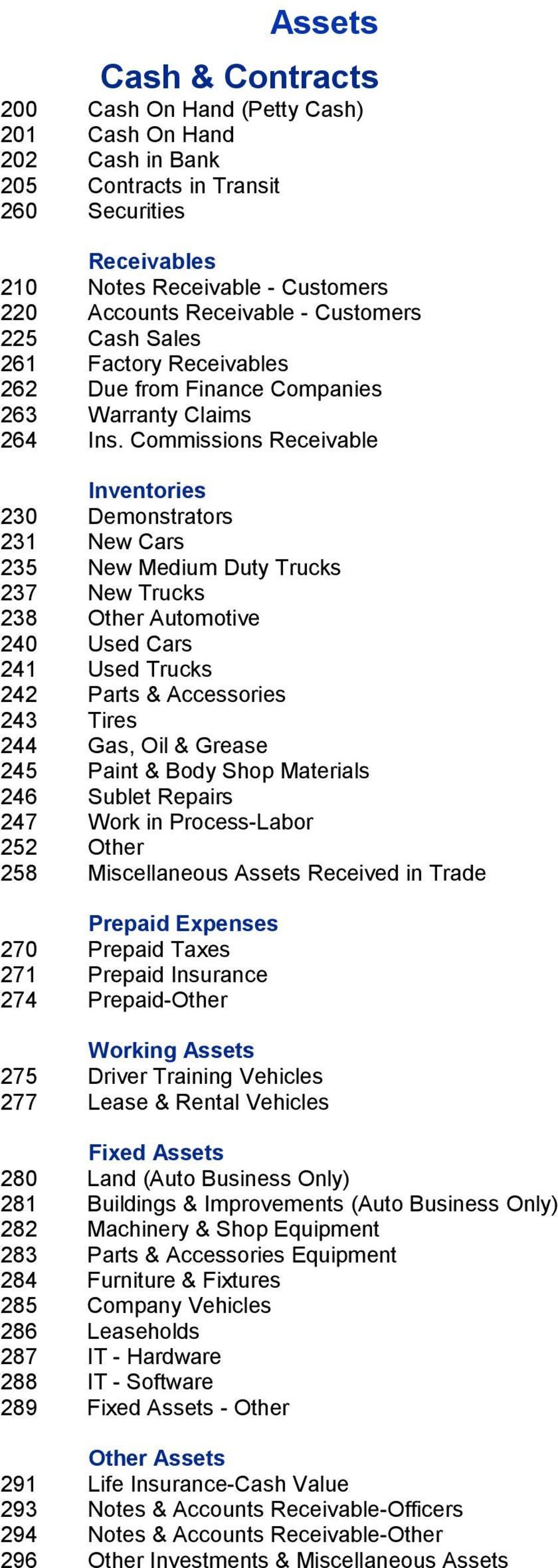
5 Liabilities Accounts Payable 300 Accounts Payable-Trade Creditors 305 Warranty Claims Advance Notes Payable 310 Notes Payable-New Vehicle & Demos 311 Notes Payable-Used Vehicles 312 Notes Payable-Lease & Rental Units 314 Notes Payable-Other Accrued Liabilities 320 Interest Payable 321 Salaries, Wages & Commissions Payable 322 Insurance Payable 323 Payroll Taxes Payable 324 Sales Taxes Payable 325 Other Taxes Payable 327 Income Taxes Payable 328 Employee's Incentives/Bonuses Payable 329 Owner's Bonuses Payable 330 Retirement Benefits Payable 331 Other Payables Long Term Liabilities 332 Other Reserves 333 Deferred Taxes 334 Long Term Debt 335 Mortgages Payable-Real Estate Contra Assets 340 Allowance for Doubtful Accounts 347 Accumulated Depreciation Lease & Rental Units 351 Accumulated Depreciation Buildings & Improvements 352 Accumulated Depreciation Machinery & Shop Equip. 353 Accumulated Depreciation Parts & Accessories Equipment 354 Accumulated Depreciation Furniture & Fixtures 355 Accumulated Depreciation Company Vehicles 356 Accumulated Amortization of Leaseholds 357 Accumulated Depreciation IT - Hardware 358 Accumulated Depreciation IT - Software 359 Accumulated Depreciation Other Owner's Equity Net Worth 360 Capital Stock & Additional Paid In Capital 370 Retained Earnings 375 Dividends 380 Investments 390 Drawings 399 Profit or Loss

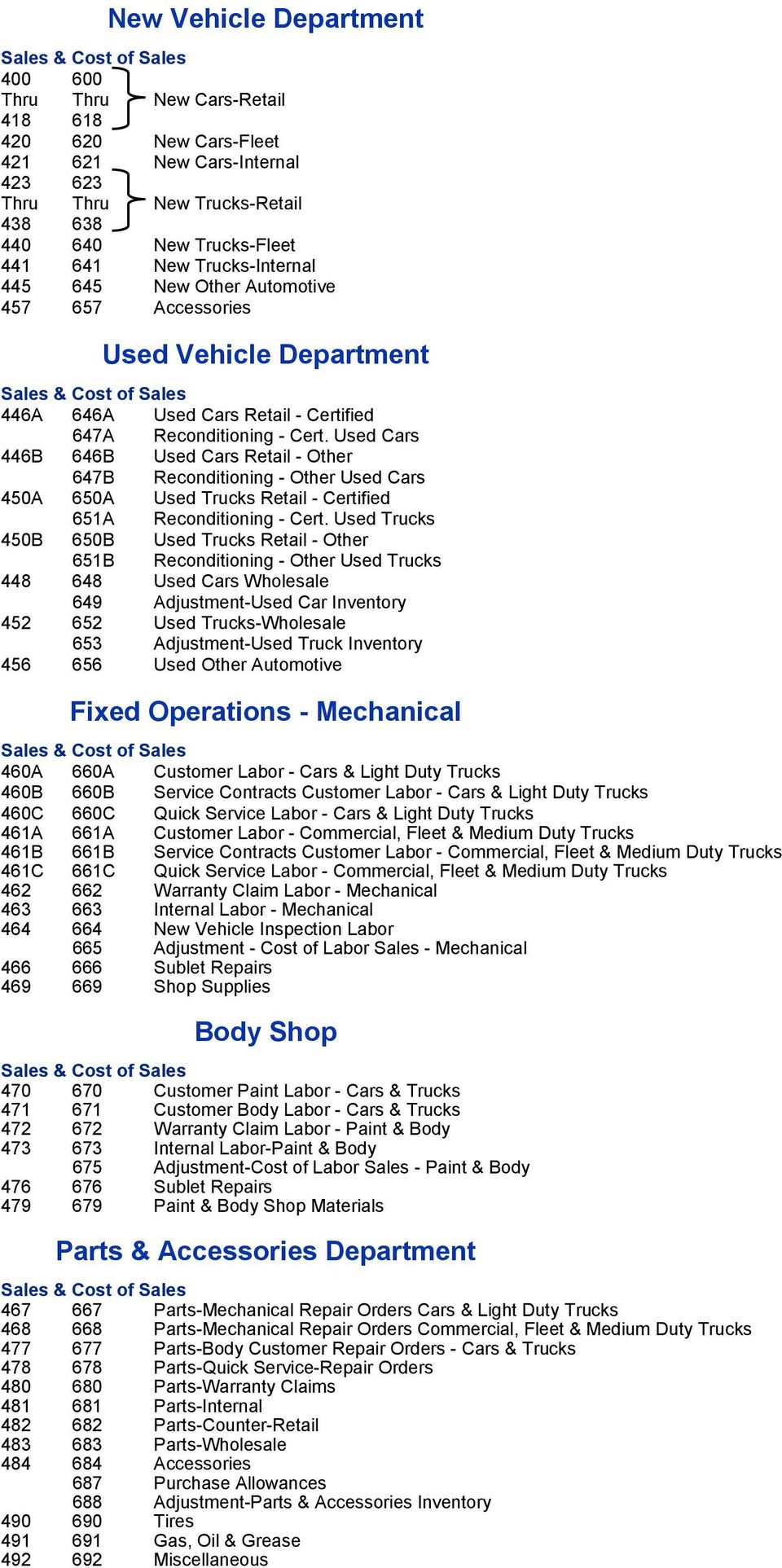
6 New Vehicle Department Sales & Cost of Sales Thru Thru New Cars-Retail New Cars-Fleet New Cars-Internal Thru Thru New Trucks-Retail New Trucks-Fleet New Trucks-Internal New Other Automotive Accessories Used Vehicle Department Sales & Cost of Sales 446A 646A Used Cars Retail - Certified 647A Reconditioning - Cert. Used Cars 446B 646B Used Cars Retail - Other 647B Reconditioning - Other Used Cars 450A 650A Used Trucks Retail - Certified 651A Reconditioning - Cert. Used Trucks 450B 650B Used Trucks Retail - Other 651B Reconditioning - Other Used Trucks Used Cars Wholesale 649 Adjustment-Used Car Inventory Used Trucks-Wholesale 653 Adjustment-Used Truck Inventory Used Other Automotive Fixed Operations - Mechanical Sales & Cost of Sales 460A 660A Customer Labor - Cars & Light Duty Trucks 460B 660B Service Contracts Customer Labor - Cars & Light Duty Trucks 460C 660C Quick Service Labor - Cars & Light Duty Trucks 461A 661A Customer Labor - Commercial, Fleet & Medium Duty Trucks 461B 661B Service Contracts Customer Labor - Commercial, Fleet & Medium Duty Trucks 461C 661C Quick Service Labor - Commercial, Fleet & Medium Duty Trucks Warranty Claim Labor - Mechanical Internal Labor - Mechanical New Vehicle Inspection Labor 665 Adjustment - Cost of Labor Sales - Mechanical Sublet Repairs Shop Supplies Body Shop Sales & Cost of Sales Customer Paint Labor - Cars & Trucks Customer Body Labor - Cars & Trucks Warranty Claim Labor - Paint & Body Internal Labor-Paint & Body 675 Adjustment-Cost of Labor Sales - Paint & Body Sublet Repairs Paint & Body Shop Materials Parts & Accessories Department Sales & Cost of Sales Parts-Mechanical Repair Orders Cars & Light Duty Trucks Parts-Mechanical Repair Orders Commercial, Fleet & Medium Duty Trucks Parts-Body Customer Repair Orders - Cars & Trucks Parts-Quick Service-Repair Orders Parts-Warranty Claims Parts-Internal Parts-Counter-Retail Parts-Wholesale Accessories 687 Purchase Allowances 688 Adjustment-Parts & Accessories Inventory Tires Gas, Oil & Grease Miscellaneous
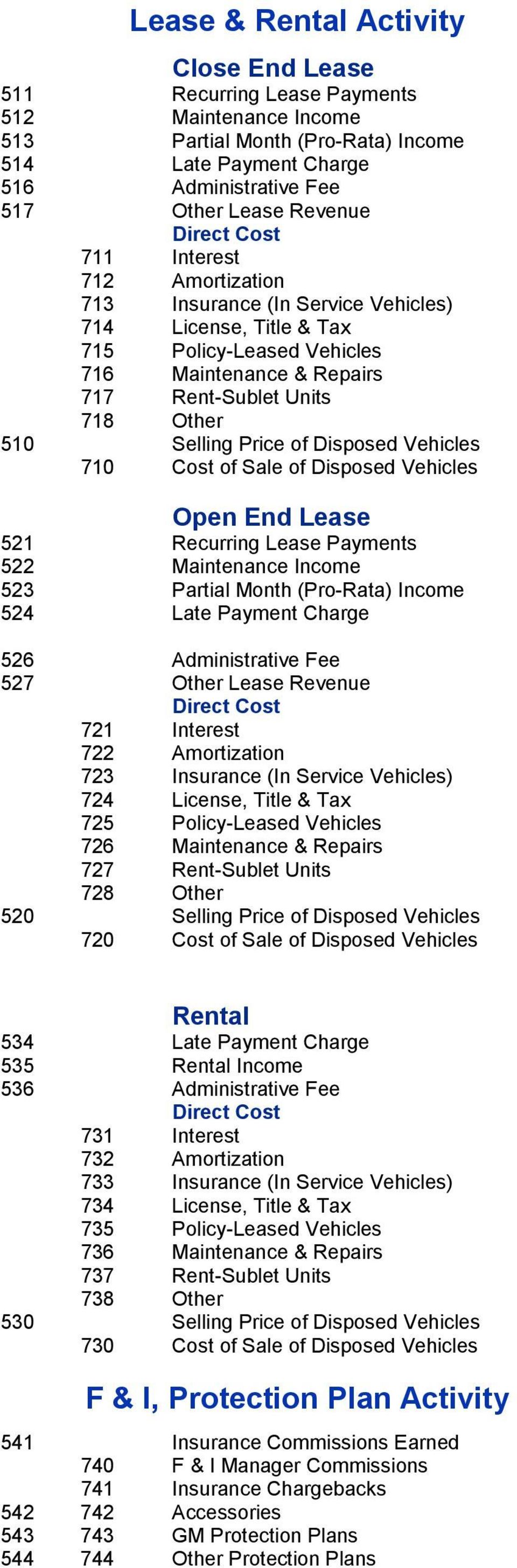
7 Lease & Rental Activity Close End Lease 511 Recurring Lease Payments 512 Maintenance Income 513 Partial Month (Pro-Rata) Income 514 Late Payment Charge 516 Administrative Fee 517 Other Lease Revenue Direct Cost 711 Interest 712 Amortization 713 Insurance (In Service Vehicles) 714 License, Title & Tax 715 Policy-Leased Vehicles 716 Maintenance & Repairs 717 Rent-Sublet Units 718 Other 510 Selling Price of Disposed Vehicles 710 Cost of Sale of Disposed Vehicles Open End Lease 521 Recurring Lease Payments 522 Maintenance Income 523 Partial Month (Pro-Rata) Income 524 Late Payment Charge 526 Administrative Fee 527 Other Lease Revenue Direct Cost 721 Interest 722 Amortization 723 Insurance (In Service Vehicles) 724 License, Title & Tax 725 Policy-Leased Vehicles 726 Maintenance & Repairs 727 Rent-Sublet Units 728 Other 520 Selling Price of Disposed Vehicles 720 Cost of Sale of Disposed Vehicles Rental 534 Late Payment Charge 535 Rental Income 536 Administrative Fee Direct Cost 731 Interest 732 Amortization 733 Insurance (In Service Vehicles) 734 License, Title & Tax 735 Policy-Leased Vehicles 736 Maintenance & Repairs 737 Rent-Sublet Units 738 Other 530 Selling Price of Disposed Vehicles 730 Cost of Sale of Disposed Vehicles F & I, Protection Plan Activity 541 Insurance Commissions Earned 740 F & I Manager Commissions 741 Insurance Chargebacks Accessories GM Protection Plans Other Protection Plans
8 Finance & Insurance Activity New 806 Finance Income-New 807 Insurance Commission Earned-New Accessories-New GM Protection Plans New Other Protection Plans - New 850 Finance & Insurance Chargebacks 853 Repossession Losses-New 855 F & I Compensation - New Used 808 Finance Income-Used 809 Insurance Commissions Earned-Used Accessories-Used GM Protection Plans Used Other Protection Plans - Used 851 Finance & Insurance Chargebacks 854 Repossession Losses-Used 856 F & I Compensation Used Additions to Income 902 Bad Debts Recovered 903 Cash Discounts Earned 905 Other Income Deductions from Income 952 LIFO Adjustment 953 Cash Discounts Allowed 955 Other Deductions

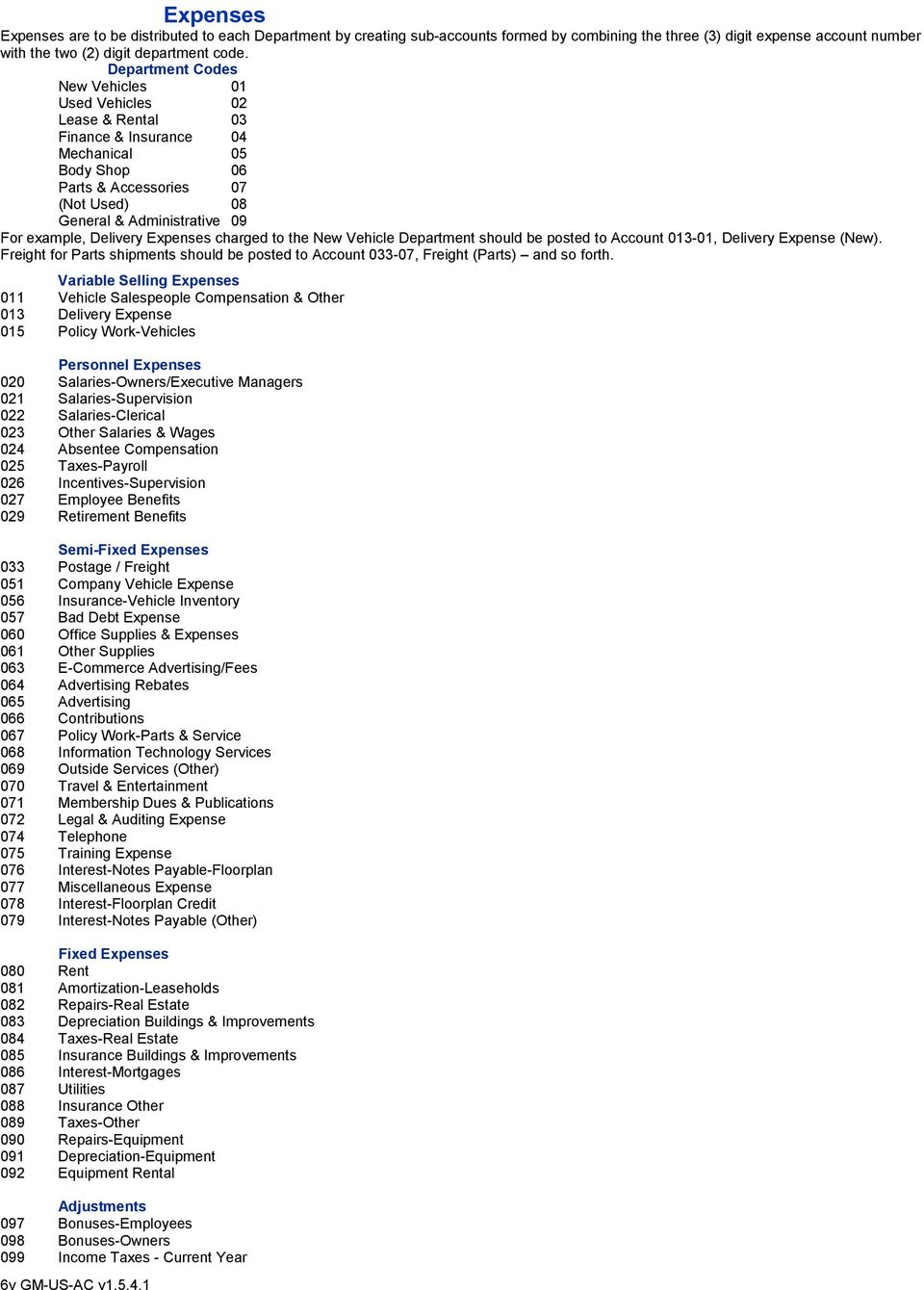
9 Expenses Expenses are to be distributed to each Department by creating sub-accounts formed by combining the three (3) digit expense account number with the two (2) digit department code. Department Codes New Vehicles 01 Used Vehicles 02 Lease & Rental 03 Finance & Insurance 04 Mechanical 05 Body Shop 06 Parts & Accessories 07 (Not Used) 08 General & Administrative 09 For example, Delivery Expenses charged to the New Vehicle Department should be posted to Account , Delivery Expense (New). Freight for Parts shipments should be posted to Account , Freight (Parts) and so forth. Variable Selling Expenses 011 Vehicle Salespeople Compensation & Other 013 Delivery Expense 015 Policy Work-Vehicles Personnel Expenses 020 Salaries-Owners/Executive Managers 021 Salaries-Supervision 022 Salaries-Clerical 023 Other Salaries & Wages 024 Absentee Compensation 025 Taxes-Payroll 026 Incentives-Supervision 027 Employee Benefits 029 Retirement Benefits Semi-Fixed Expenses 033 Postage / Freight 051 Company Vehicle Expense 056 Insurance-Vehicle Inventory 057 Bad Debt Expense 060 Office Supplies & Expenses 061 Other Supplies 063 E-Commerce Advertising/Fees 064 Advertising Rebates 065 Advertising 066 Contributions 067 Policy Work-Parts & Service 068 Information Technology Services 069 Outside Services (Other) 070 Travel & Entertainment 071 Membership Dues & Publications 072 Legal & Auditing Expense 074 Telephone 075 Training Expense 076 Interest-Notes Payable-Floorplan 077 Miscellaneous Expense 078 Interest-Floorplan Credit 079 Interest-Notes Payable (Other) Fixed Expenses 080 Rent 081 Amortization-Leaseholds 082 Repairs-Real Estate 083 Depreciation Buildings & Improvements 084 Taxes-Real Estate 085 Insurance Buildings & Improvements 086 Interest-Mortgages 087 Utilities 088 Insurance Other 089 Taxes-Other 090 Repairs-Equipment 091 Depreciation-Equipment 092 Equipment Rental Adjustments 097 Bonuses-Employees 098 Bonuses-Owners 099 Income Taxes - Current Year 6v GM-US-AC v
10 200 Cash on Hand (Petty Cash) Assets Cash and Contracts Synopsis Account 200, is established to record the amount of Cash kept at the dealership to provide change to customers and pay incidental bills, which are too small to warrant issuing a check. 1. The amount set aside when the fund is established 2. The amount added to increase the fund 1. The amount removed to decrease the fund Revised 7/9/2013 Assets Pg 1

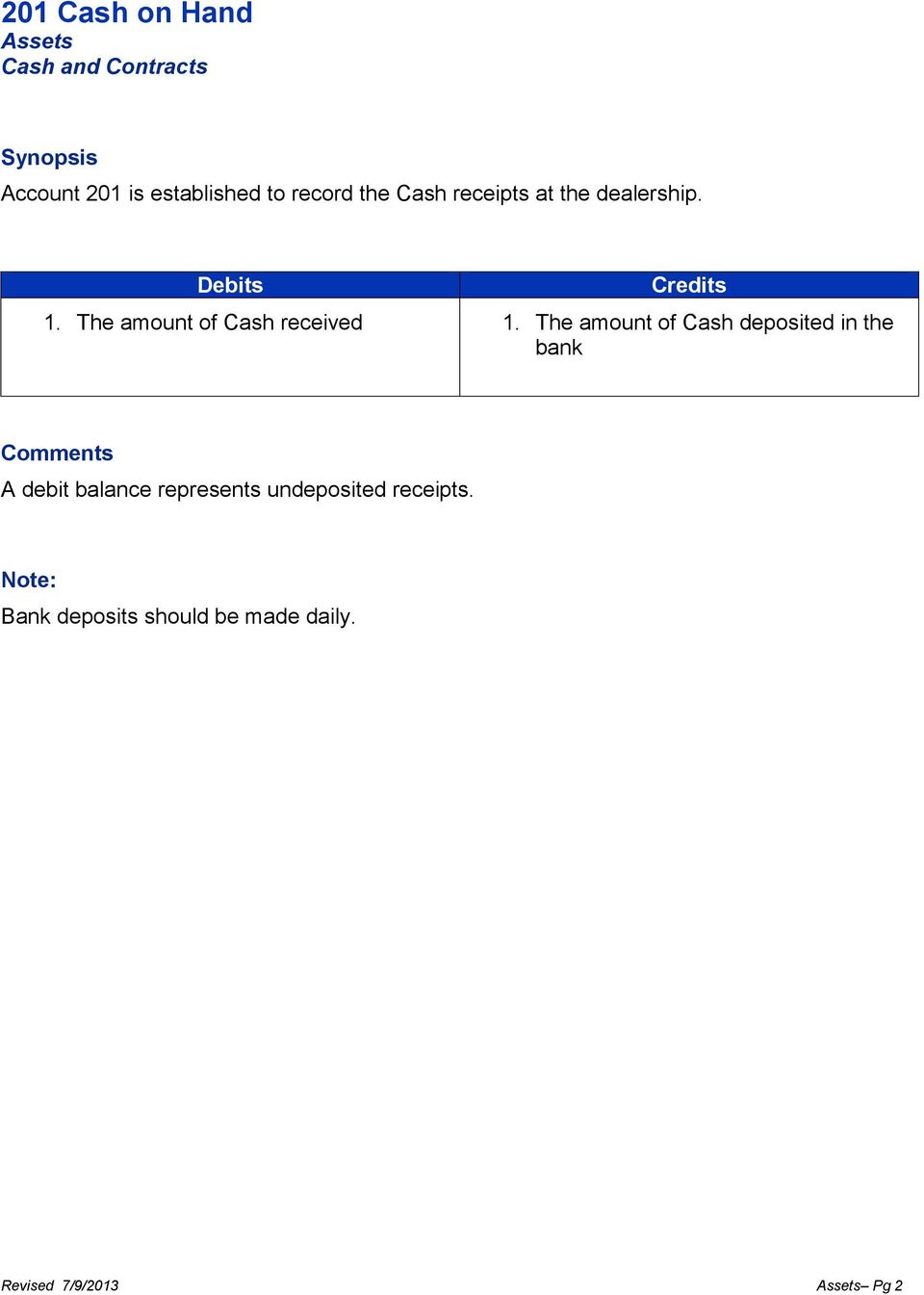
11 201 Cash on Hand Assets Cash and Contracts Synopsis Account 201 is established to record the Cash receipts at the dealership. 1. The amount of Cash received 1. The amount of Cash deposited in the bank Comments A debit balance represents undeposited receipts. Note: Bank deposits should be made daily. Revised 7/9/2013 Assets Pg 2
12 202 Cash in Bank Assets Cash and Contracts Synopsis Account 202 is established to record the Cash deposited with banks and other financial institutions. 1. Cash deposits 2. Savings deposits 3. Time deposits 4. Certificates of deposit 5. Interest on above deposits 1. Withdrawals 2. Deposited checks returned by the bank 3. Bank charges Comments A debit balance represents the amount of cash on deposit while a credit balance represents drafts written in excess of cash on deposits. Note: The month-end balance should be reconciled with that shown on the bank statements. Revised 7/9/2013 Assets Pg 3

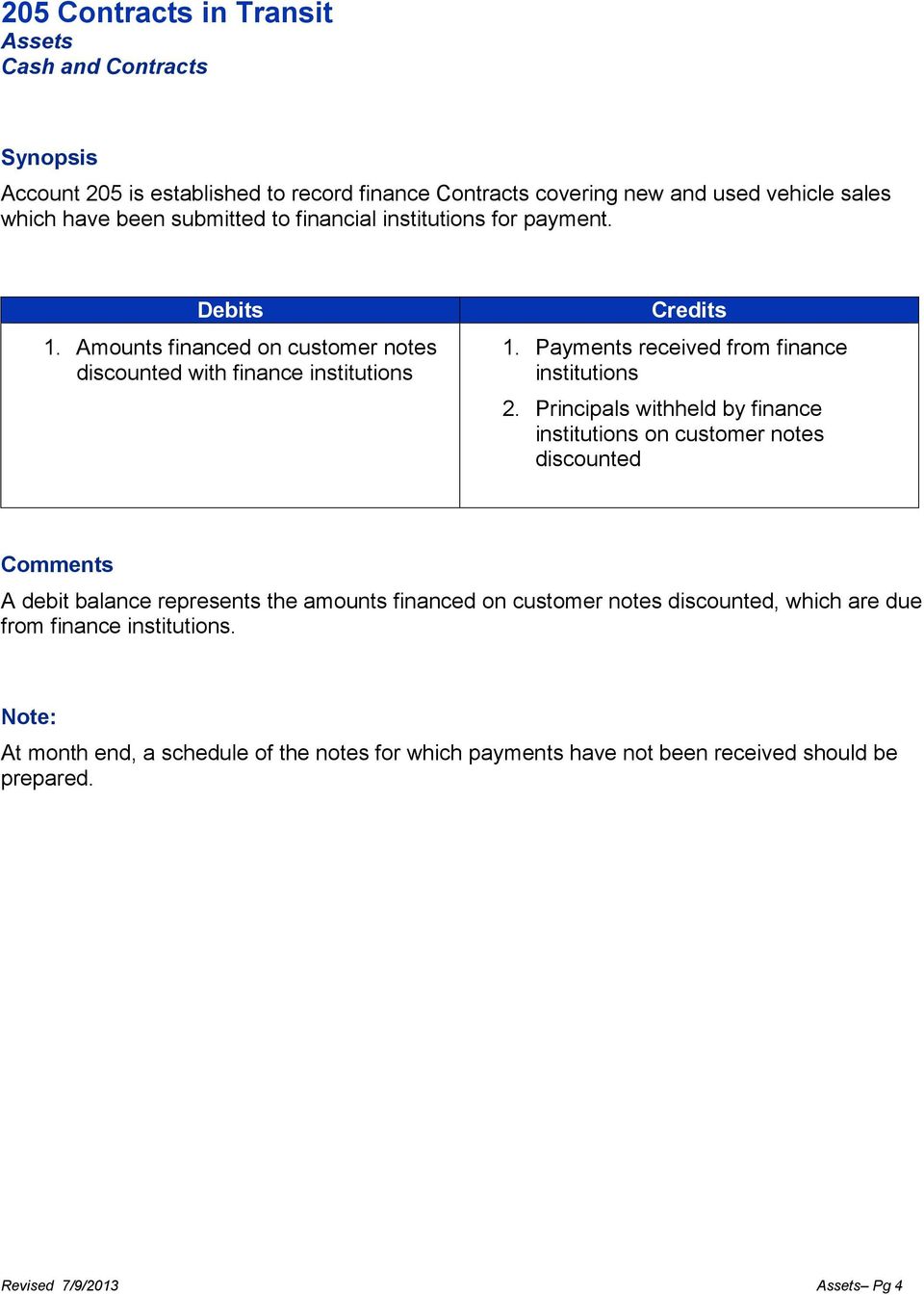
13 205 Contracts in Transit Assets Cash and Contracts Synopsis Account 205 is established to record finance Contracts covering new and used vehicle sales which have been submitted to financial institutions for payment. 1. Amounts financed on customer notes discounted with finance institutions 1. Payments received from finance institutions 2. Principals withheld by finance institutions on customer notes discounted Comments A debit balance represents the amounts financed on customer notes discounted, which are due from finance institutions. Note: At month end, a schedule of the notes for which payments have not been received should be prepared. Revised 7/9/2013 Assets Pg 4
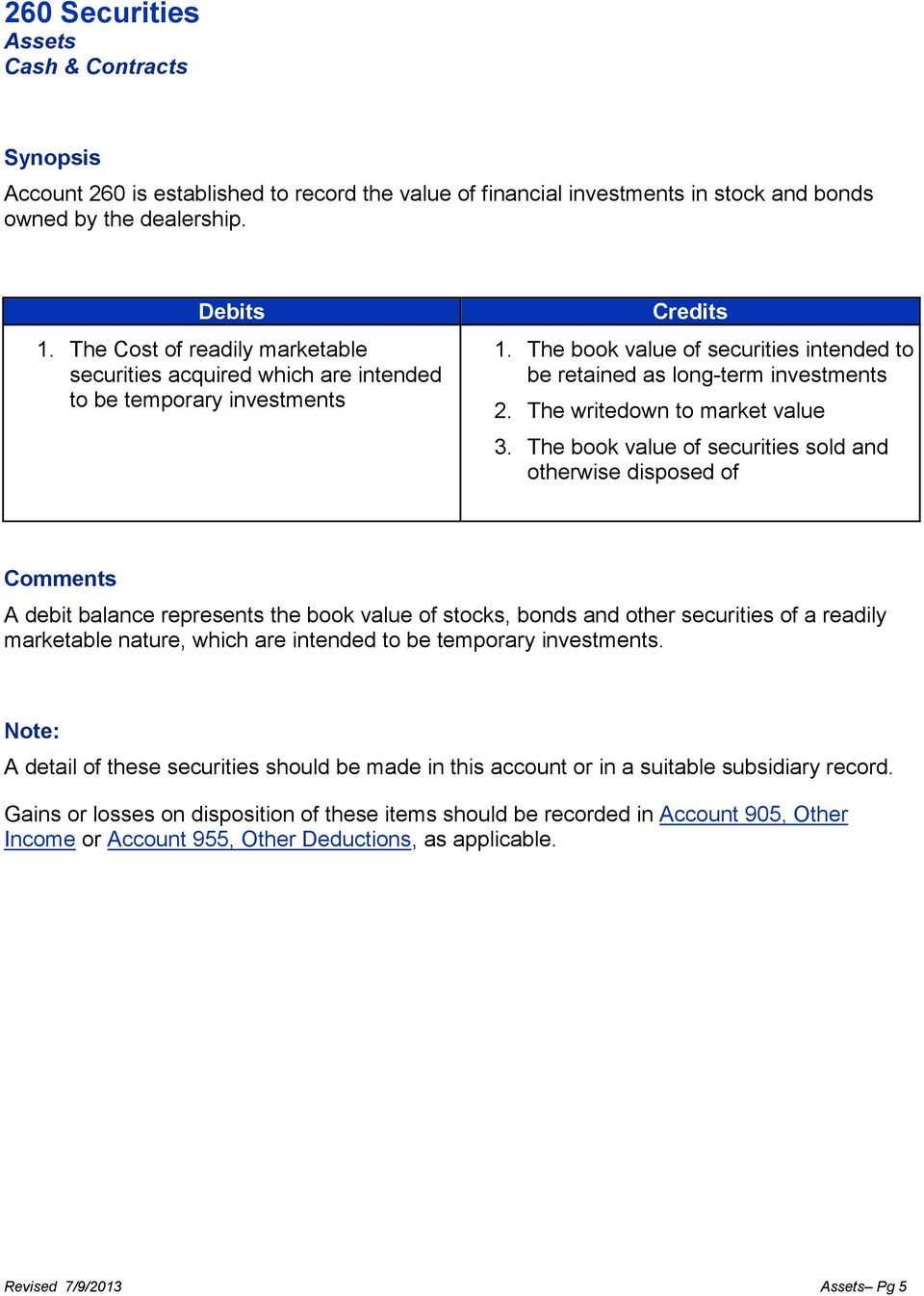
14 260 Securities Assets Cash & Contracts Synopsis Account 260 is established to record the value of financial investments in stock and bonds owned by the dealership. 1. The Cost of readily marketable securities acquired which are intended to be temporary investments 1. The book value of securities intended to be retained as long-term investments 2. The writedown to market value 3. The book value of securities sold and otherwise disposed of Comments A debit balance represents the book value of stocks, bonds and other securities of a readily marketable nature, which are intended to be temporary investments. Note: A detail of these securities should be made in this account or in a suitable subsidiary record. Gains or losses on disposition of these items should be recorded in Account 905, Other Income or Account 955, Other Deductions, as applicable. Revised 7/9/2013 Assets Pg 5
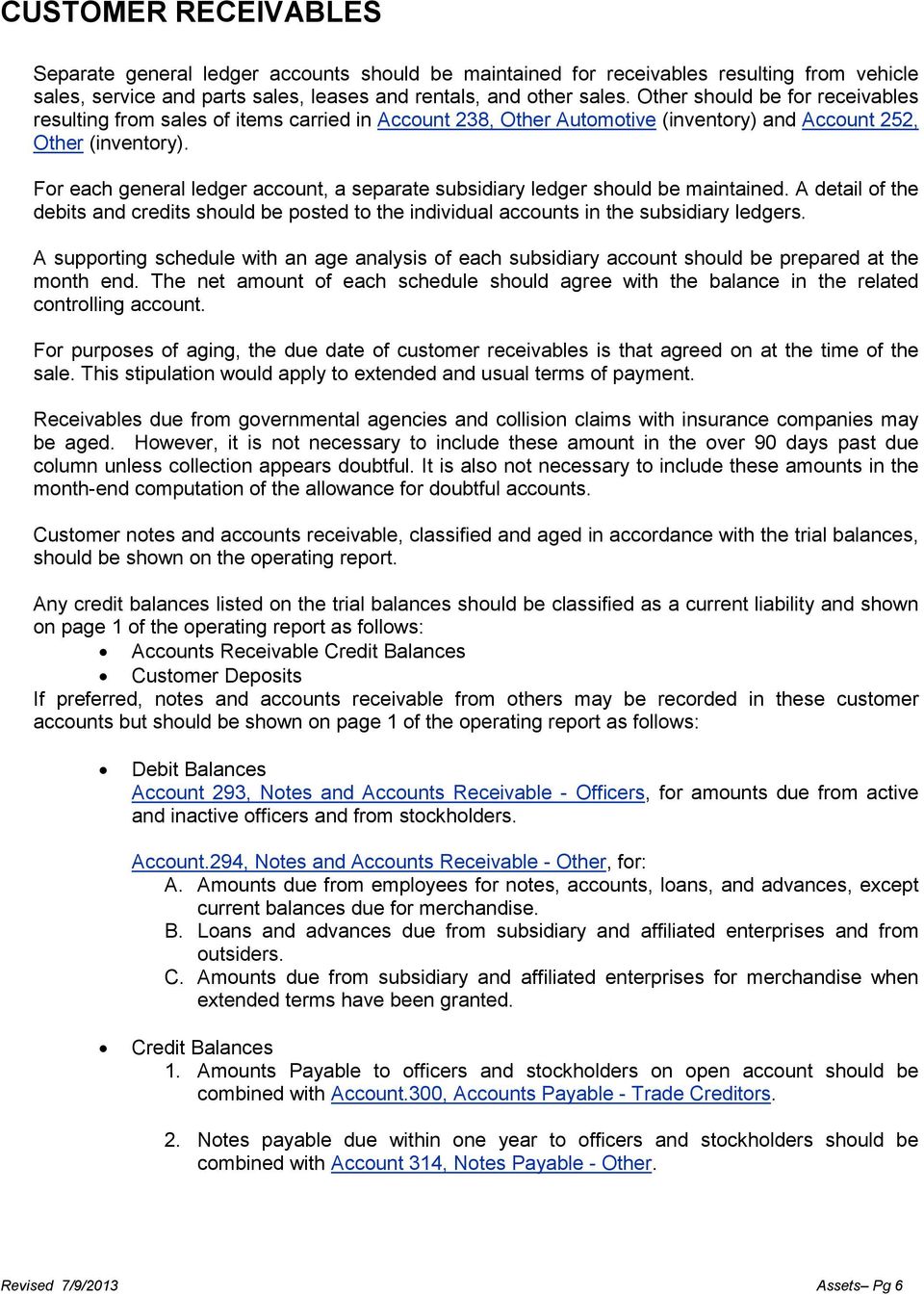
15 CUSTOMER RECEIVABLES Separate general ledger accounts should be maintained for receivables resulting from vehicle sales, service and parts sales, leases and rentals, and other sales. Other should be for receivables resulting from sales of items carried in Account 238, Other Automotive (inventory) and Account 252, Other (inventory). For each general ledger account, a separate subsidiary ledger should be maintained. A detail of the debits and credits should be posted to the individual accounts in the subsidiary ledgers. A supporting schedule with an age analysis of each subsidiary account should be prepared at the month end. The net amount of each schedule should agree with the balance in the related controlling account. For purposes of aging, the due date of customer receivables is that agreed on at the time of the sale. This stipulation would apply to extended and usual terms of payment. Receivables due from governmental agencies and collision claims with insurance companies may be aged. However, it is not necessary to include these amount in the over 90 days past due column unless collection appears doubtful. It is also not necessary to include these amounts in the month-end computation of the allowance for doubtful accounts. Customer notes and accounts receivable, classified and aged in accordance with the trial balances, should be shown on the operating report. Any credit balances listed on the trial balances should be classified as a current liability and shown on page 1 of the operating report as follows: Accounts Receivable Credit Balances Customer Deposits If preferred, notes and accounts receivable from others may be recorded in these customer accounts but should be shown on page 1 of the operating report as follows: Debit Balances Account 293, Notes and Accounts Receivable - Officers, for amounts due from active and inactive officers and from stockholders. Account.294, Notes and Accounts Receivable - Other, for: A. Amounts due from employees for notes, accounts, loans, and advances, except current balances due for merchandise. B. Loans and advances due from subsidiary and affiliated enterprises and from outsiders. C. Amounts due from subsidiary and affiliated enterprises for merchandise when extended terms have been granted. Credit Balances 1. Amounts Payable to officers and stockholders on open account should be combined with Account.300, Accounts Payable - Trade Creditors. 2. Notes payable due within one year to officers and stockholders should be combined with Account 314, Notes Payable - Other. Revised 7/9/2013 Assets Pg 6
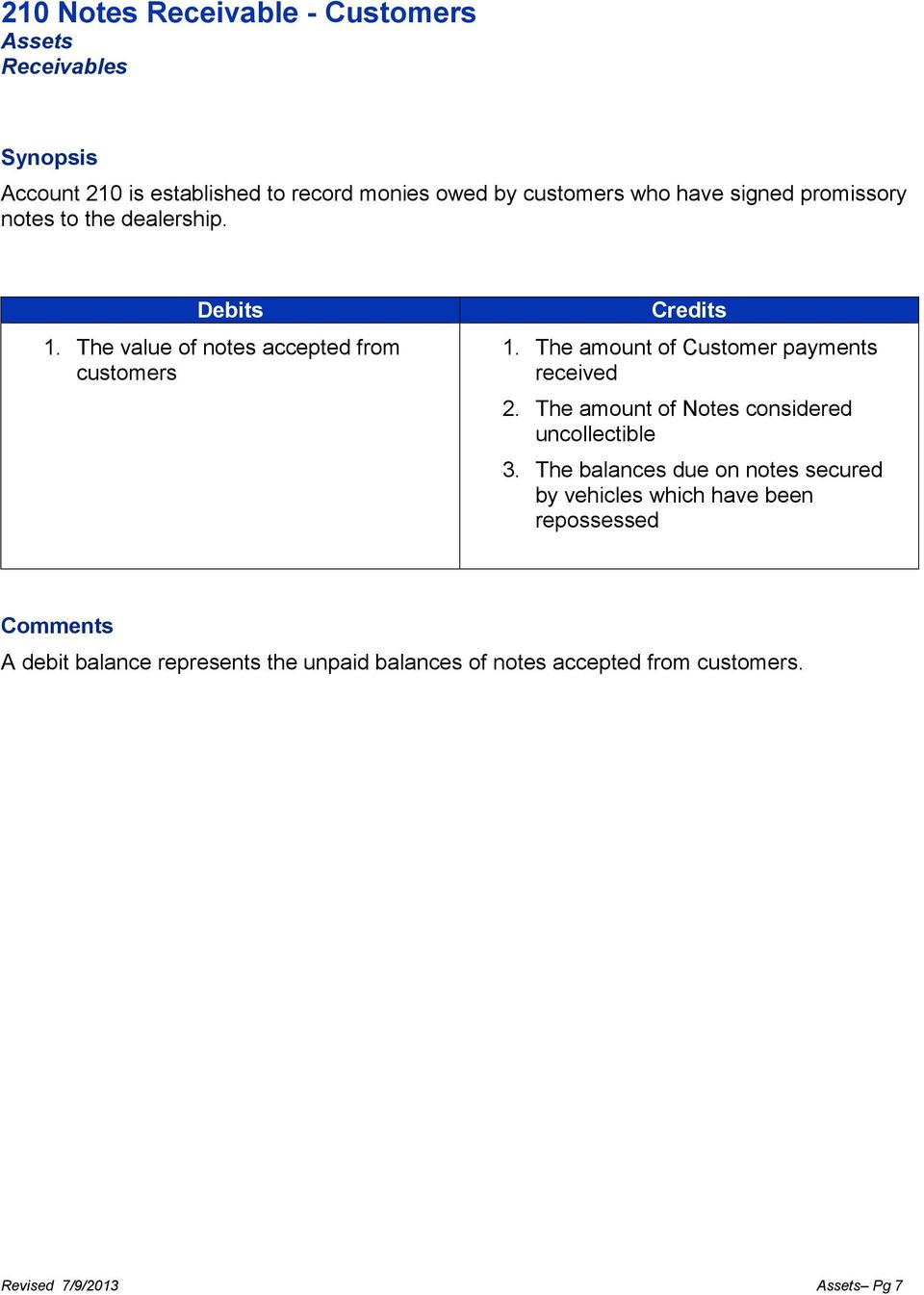
16 210 Notes Receivable - Customers Assets Receivables Synopsis Account 210 is established to record monies owed by customers who have signed promissory notes to the dealership. 1. The value of notes accepted from customers 1. The amount of Customer payments received 2. The amount of Notes considered uncollectible 3. The balances due on notes secured by vehicles which have been repossessed Comments A debit balance represents the unpaid balances of notes accepted from customers. Revised 7/9/2013 Assets Pg 7
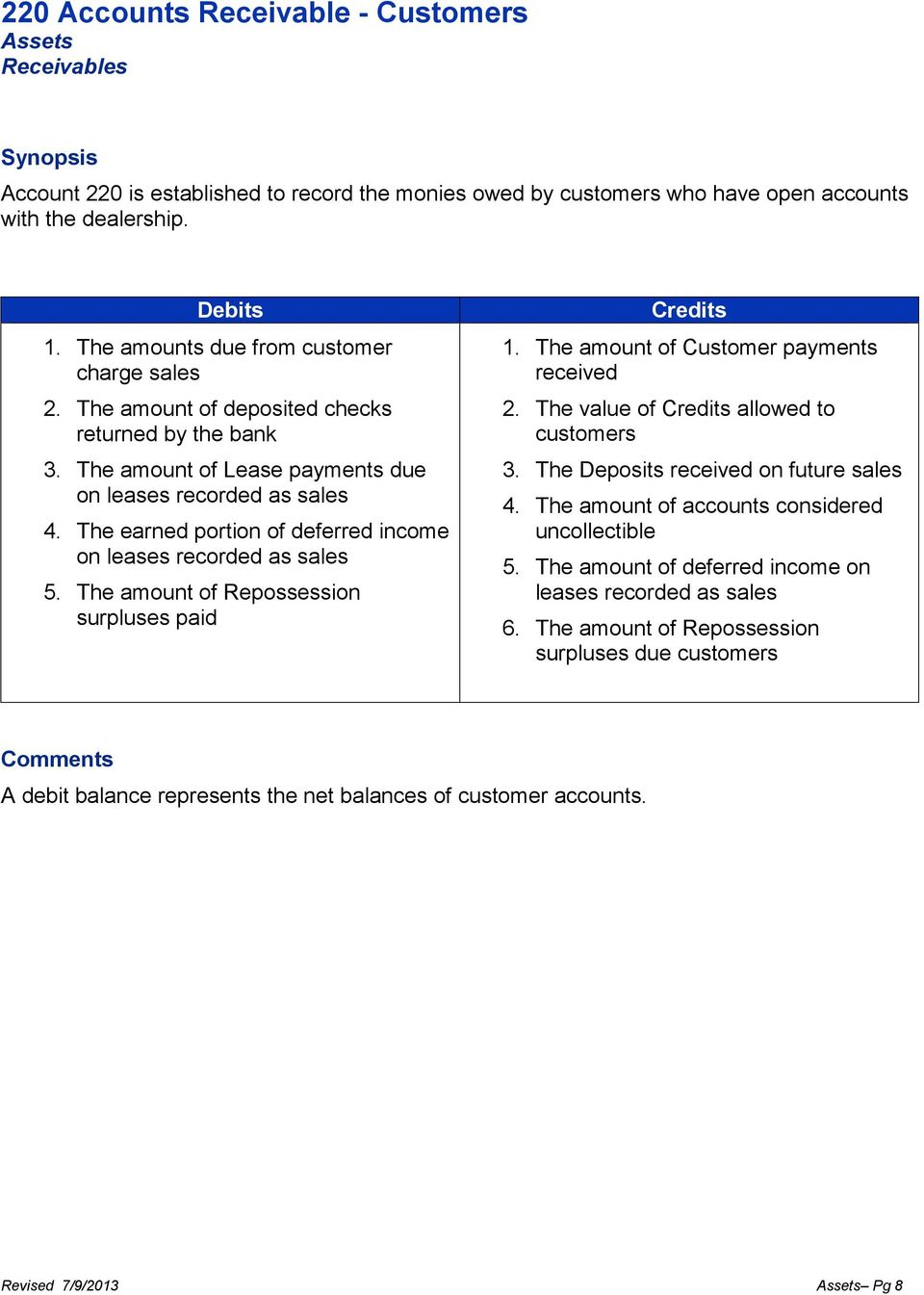
17 220 Accounts Receivable - Customers Assets Receivables Synopsis Account 220 is established to record the monies owed by customers who have open accounts with the dealership. 1. The amounts due from customer charge sales 2. The amount of deposited checks returned by the bank 3. The amount of Lease payments due on leases recorded as sales 4. The earned portion of deferred income on leases recorded as sales 5. The amount of Repossession surpluses paid 1. The amount of Customer payments received 2. The value of allowed to customers 3. The Deposits received on future sales 4. The amount of accounts considered uncollectible 5. The amount of deferred income on leases recorded as sales 6. The amount of Repossession surpluses due customers Comments A debit balance represents the net balances of customer accounts. Revised 7/9/2013 Assets Pg 8
18 225 Cash Sales Assets Receivables Synopsis Account 225 is established to record the cash received as a result of Sales transactions processed at the dealership. 1. Sales for cash 1. Cash received from cash sales 2. Cash refunds for return of merchandise by customers Note: This is a clearing account for cash sales and normally should have no month-end balance. If a balance exists, a month-end schedule should be prepared to determine the nature of the balance. The balance should be classified with the applicable asset and liability accounts on the trial balance. Revised 7/9/2013 Assets Pg 9

19 230 Demonstrators Assets Inventories Synopsis Account 230 is established to record the inventory value of vehicle Demonstrators maintained to provide test rides for customers. 1. The factory invoice amount, less holdback and other non-related items such as supplemental advertising funds, of new vehicles placed in demonstration and other temporary company service 2. The Cost of New Vehicles placed into Demonstration inventory 3. The Internal selling price of dealerinstalled accessories and optional equipment and the labor and material required for installation 4. The Destination, delivery and handling charges 1. The replacement value of accessories, optional equipment and tires removed from units and placed in Account. 242, Parts & Accessories (inventory) and Account 243, Tires (inventory) as applicable 2. The amount of subsequent factory price reductions 3. The cost of units taken out of service and transferred to new vehicle inventories prior to their sales as new vehicles Comments A debit balance represents the cost of new vehicles set aside for use as demonstrators and for other temporary company service. Note: A record of each unit in the vehicle inventories shown below should be made on a Vehicle Inventory Record at the time the unit is acquired. Stock numbers should be assigned in numerical sequence to new, used and repossessed units acquired. A used unit accepted in trade on the sale of a new unit should be given the same stock number as the new unit sold, but followed by the letter A. A used unit accepted in trade on the sale of another used unit should be given the same stock number as the used unit sold, but followed by the letter B, etc. Revised 7/9/2013 Assets Pg 10

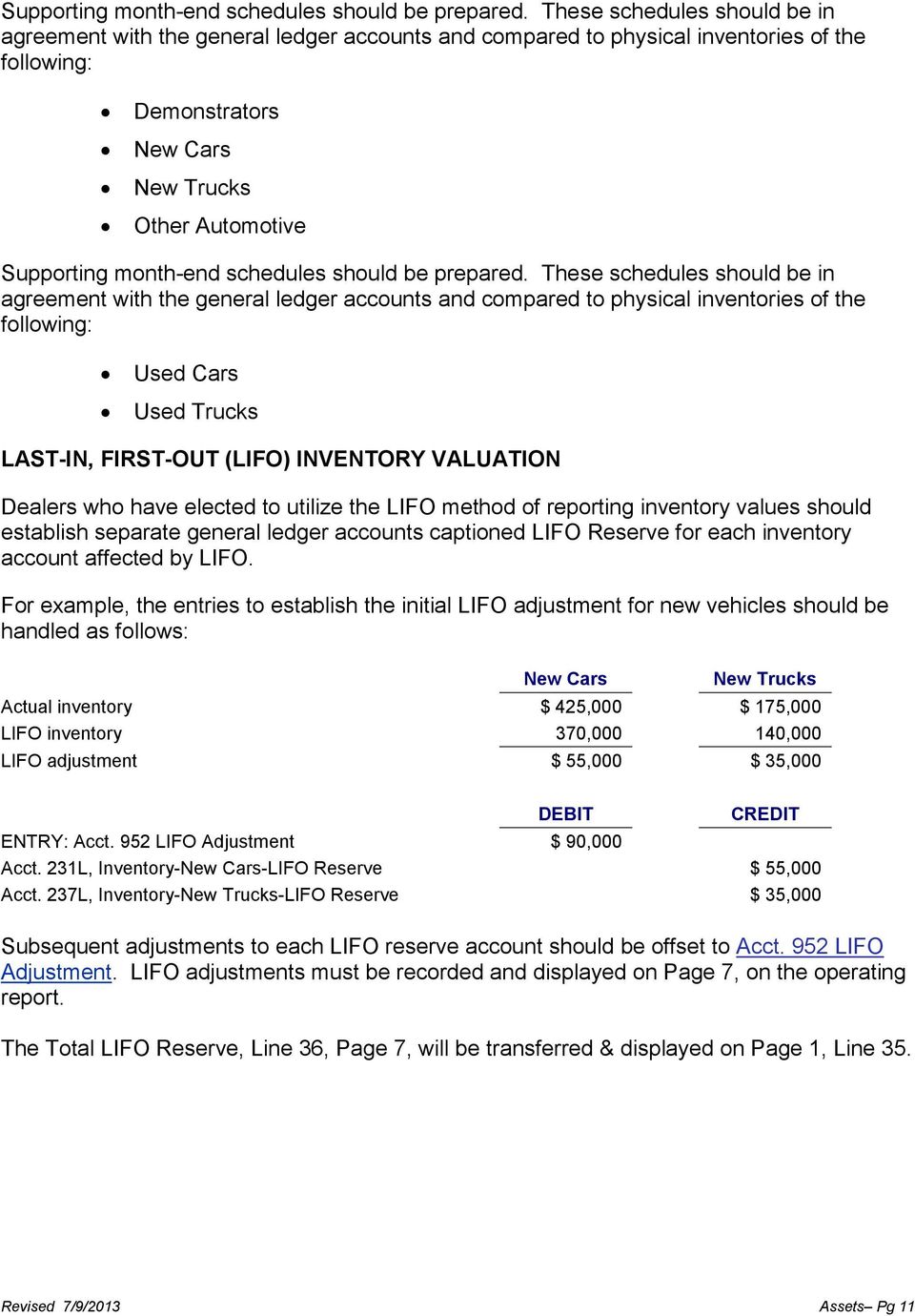
20 Supporting month-end schedules should be prepared. These schedules should be in agreement with the general ledger accounts and compared to physical inventories of the following: Demonstrators New Cars New Trucks Other Automotive Supporting month-end schedules should be prepared. These schedules should be in agreement with the general ledger accounts and compared to physical inventories of the following: Used Cars Used Trucks LAST-IN, FIRST-OUT (LIFO) INVENTORY VALUATION Dealers who have elected to utilize the LIFO method of reporting inventory values should establish separate general ledger accounts captioned LIFO Reserve for each inventory account affected by LIFO. For example, the entries to establish the initial LIFO adjustment for new vehicles should be handled as follows: New Cars New Trucks Actual inventory $ 425,000 $ 175,000 LIFO inventory 370, ,000 LIFO adjustment $ 55,000 $ 35,000 DEBIT CREDIT ENTRY: Acct. 952 LIFO Adjustment $ 90,000 Acct. 231L, Inventory-New Cars-LIFO Reserve $ 55,000 Acct. 237L, Inventory-New Trucks-LIFO Reserve $ 35,000 Subsequent adjustments to each LIFO reserve account should be offset to Acct. 952 LIFO Adjustment. LIFO adjustments must be recorded and displayed on Page 7, on the operating report. The Total LIFO Reserve, Line 36, Page 7, will be transferred & displayed on Page 1, Line 35. Revised 7/9/2013 Assets Pg 11
21 231 New Cars Assets Inventories Synopsis Account 231 is established to record the inventory value of New Cars on hand. 1. The factory invoice amount, less holdback and other non-related items such as supplemental advertising funds, of New Cars acquired 2. The Internal selling price of dealerinstalled accessories and optional equipment and the labor and materials required for installation 3. The Destination, delivery and handling charges 4. The Cost of new units transferred from demonstration and other temporary company service for sales as new cars 1. The replacement value of accessories, optional equipment and tires removed from new cars and placed in Account 242, Parts & Accessories (inventory) and Account 243, Tires (inventory) as applicable 2. The amount of subsequent factory price reductions 3. The Cost of New Cars placed in demonstration and other temporary company service 4. The Cost of New Cars transferred to other dealers 5. The Cost of New Cars sold and otherwise disposed of Comments A debit balance represents the cost of New Cars in inventory. Note: A record of each unit in the vehicle inventories shown below should be made on a Vehicle Inventory Record at the time the unit is acquired. Stock numbers should be assigned in numerical sequence to new, used and repossessed units acquired. A used unit accepted in trade on the sale of a new unit should be given the same stock number as the new unit sold, but followed by the letter A. A used unit accepted in trade on the sale of another used unit should be given the same stock number as the used unit sold, but followed by the letter B, etc. Revised 7/9/2013 Assets Pg 12
22 Supporting month-end schedules should be prepared. These schedules should be in agreement with the general ledger accounts and compared to physical inventories of the following: Demonstrators New Cars New Trucks Other Automotive Supporting month-end schedules should be prepared. These schedules should be in agreement with the general ledger accounts and compared to physical inventories of the following: Used Cars Used Trucks LAST-IN, FIRST-OUT (LIFO) INVENTORY VALUATION Dealers who have elected to utilize the LIFO method of reporting inventory values should establish separate general ledger accounts captioned LIFO Reserve for each inventory account affected by LIFO. For example, the entries to establish the initial LIFO adjustment for new vehicles should be handled as follows: New Cars New Trucks Actual inventory $ 425,000 $ 175,000 LIFO inventory 370, ,000 LIFO adjustment $ 55,000 $ 35,000 DEBIT CREDIT ENTRY: Acct. 952 LIFO Adjustment $ 90,000 Acct. 231L, Inventory-New Cars-LIFO Reserve $ 55,000 Acct. 237L, Inventory-New Trucks-LIFO Reserve $ 35,000 Subsequent adjustments to each LIFO reserve account should be offset to Acct. 952 LIFO Adjustment. LIFO adjustments must be recorded and displayed on Page 7, on the operating report. The Total LIFO Reserve, Line 36, Page 7, will be transferred & displayed on Page 1, Line 35. Revised 7/9/2013 Assets Pg 13
23 235 Medium Duty Trucks Assets Inventories Synopsis Account 235 is established to record the inventory value of New Medium Duty Trucks on hand. 1. The factory invoice amount, less holdback and other non-related items such as supplemental advertising funds, of new Medium Duty Trucks acquired 2. The Internal selling price of dealerinstalled accessories and optional equipment and the labor and materials required for installation 3. The cost of dealer installed Other Automotive items and the Internal selling price of the labor and materials required for installation 4. The Destination, delivery and handling charges 5. The Cost of new units transferred from demonstration and other temporary company service for sales as new Medium Duty Trucks 1. The replacement value of accessories, optional equipment and tires removed from new Medium Duty Trucks and placed in Account 242, Parts & Accessories (inventory) and Account 243, Tires (inventory) as applicable 2. The amount of subsequent factory price reductions 3. The Cost of new Medium Duty Trucks placed in demonstration and other temporary company service 4. The Cost of new Medium Duty Trucks transferred to other dealers 5. The Cost of new Medium Duty Trucks sold and otherwise disposed of Comments A debit balance represents the cost of new Medium Duty Trucks in inventory. Note: A record of each unit in the vehicle inventories shown below should be made on a Vehicle Inventory Record at the time the unit is acquired. Revised 7/9/2013 Assets Pg 14
24 Stock numbers should be assigned in numerical sequence to new, used and repossessed units acquired. A used unit accepted in trade on the sale of a new unit should be given the same stock number as the new unit sold, but followed by the letter A. A used unit accepted in trade on the sale of another used unit should be given the same stock number as the used unit sold, but followed by the letter B, etc. Supporting month-end schedules should be prepared. These schedules should be in agreement with the general ledger accounts and compared to physical inventories of the following: Demonstrators New Cars New Trucks Other Automotive Supporting month-end schedules should be prepared. These schedules should be in agreement with the general ledger accounts and compared to physical inventories of the following: Used Cars Used Trucks LAST-IN, FIRST-OUT (LIFO) INVENTORY VALUATION Dealers who have elected to utilize the LIFO method of reporting inventory values should establish separate general ledger accounts captioned LIFO Reserve for each inventory account affected by LIFO. For example, the entries to establish the initial LIFO adjustment for new vehicles should be handled as follows: New Cars New Trucks Actual inventory $ 425,000 $ 175,000 LIFO inventory 370, ,000 LIFO adjustment $ 55,000 $ 35,000 DEBIT CREDIT ENTRY: Acct. 952 LIFO Adjustment $ 90,000 Acct. 231L, Inventory-New Cars-LIFO Reserve $ 55,000 Acct. 237L, Inventory-New Trucks-LIFO Reserve $ 35,000 Subsequent adjustments to each LIFO reserve account should be offset to Acct. 952 LIFO Adjustment. LIFO adjustments must be recorded and displayed on Page 7, on the operating report. The Total LIFO Reserve, Line 36, Page 7, will be transferred & displayed on Page 1, Line 35. Revised 7/9/2013 Assets Pg 15
25 237 New Trucks Assets Inventories Synopsis Account 237 is established to record the inventory value of New Trucks and Motor Homes on hand. 1. The Factory invoice amount, less holdback and other non-related items such as supplemental advertising funds, of new trucks and motor homes acquired 2. The Internal selling price of dealerinstalled accessories and optional equipment and the labor and materials required for installation 3. The Cost of dealer-installed Other Automotive items and the internal selling price of the labor and materials required for installation 4. The Destination, delivery and handling charges 5. The Cost of new units transferred from demonstration and other temporary company service for sale as new trucks and motor homes 1. The replacement value of accessories, optional equipment and tires removed from new trucks and motor homes and placed in Account, 242, Parts & Accessories (inventory) and Account 243, Tires (inventory) as applicable 2. The Cost of new trucks and motor homes placed in demonstration and other temporary company service 3. The amount of subsequent factory price reductions 4. The Cost of New Trucks and Motor Homes transferred to other dealers 5. The Cost of new trucks and motor homes sold and otherwise disposed of Comments A debit balance represents the cost of new trucks and motor homes in inventory. Note: A record of each unit in the vehicle inventories shown below should be made on a Vehicle Inventory Record at the time the unit is acquired. Revised 7/9/2013 Assets Pg 16
26 Stock numbers should be assigned in numerical sequence to new, used and repossessed units acquired. A used unit accepted in trade on the sale of a new unit should be given the same stock number as the new unit sold, but followed by the letter A. A used unit accepted in trade on the sale of another used unit should be given the same stock number as the used unit sold, but followed by the letter B, etc. Supporting month-end schedules should be prepared. These schedules should be in agreement with the general ledger accounts and compared to physical inventories of the following: Demonstrators New Cars New Trucks Other Automotive Supporting month-end schedules should be prepared. These schedules should be in agreement with the general ledger accounts and compared to physical inventories of the following: Used Cars Used Trucks LAST-IN, FIRST-OUT (LIFO) INVENTORY VALUATION Dealers who have elected to utilize the LIFO method of reporting inventory values should establish separate general ledger accounts captioned LIFO Reserve for each inventory account affected by LIFO. For example, the entries to establish the initial LIFO adjustment for new vehicles should be handled as follows: New Cars New Trucks Actual inventory $ 425,000 $ 175,000 LIFO inventory 370, ,000 LIFO adjustment $ 55,000 $ 35,000 DEBIT CREDIT ENTRY: Acct. 952 LIFO Adjustment $ 90,000 Acct. 231L, Inventory-New Cars-LIFO Reserve $ 55,000 Acct. 237L, Inventory-New Trucks-LIFO Reserve $ 35,000 Subsequent adjustments to each LIFO reserve account should be offset to Acct. 952 LIFO Adjustment. LIFO adjustments must be recorded and displayed on Page 7, on the operating report. The Total LIFO Reserve, Line 36, Page 7, will be transferred & displayed on Page 1, Line 35. Revised 7/9/2013 Assets Pg 17
27 238 Other Automotive Assets Inventories Synopsis Account 238 is established to record inventory of Other Automotive merchandise that cannot be classified as a Car, Truck or Medium Duty Truck. 1. The factory invoice amount, less holdback and other non-related items such as supplemental advertising funds, of new other automotive items acquired 2. The Internal selling price of dealerinstalled accessories and optional equipment and the labor and materials required for installation 3. The Destination, delivery and handling charges 4. The lower of trade-in allowance or appraised wholesale value of used items accepted in trade on sales of new and used items 5. The Cost of used items purchased 6. The Traveling expenditures when acquiring these items 7. The selling price of the labor and materials used in reconditioning 8. The Auction fees on used items purchased 1. The replacement value of accessories, optional equipment and tires removed from other automotive items and placed in Account, 243 Tires (inventory) and Account 252, Other (inventory) as applicable 2. The amount of subsequent factory price reductions 3. Any required writedown of new items to market value 4. The monthly writedown of used items to appraised wholesale values 5. The Inventory value of items sold and otherwise disposed of Revised 7/9/2013 Assets Pg 18
28 Comments A debit balance represents the inventory value of other automotive items in inventory regularly stocked for resale. This should include all new and used self-propelled vehicles (other than motor homes) and other automotive-oriented merchandise such as: a. Aircraft b. Boats c. Camper bodies d. Farm tractors e. Golf carts f. Motorcycles g. Scooters h. Snowmobiles i. Special bodies j. Truck equipment and trainers k. Utility, house and camp trailers Note: A record of each unit in the vehicle inventories shown below should be made on a Vehicle Inventory Record at the time the unit is acquired. Stock numbers should be assigned in numerical sequence to new, used and repossessed units acquired. A used unit accepted in trade on the sale of a new unit should be given the same stock number as the new unit sold, but followed by the letter A. A used unit accepted in trade on the sale of another used unit should be given the same stock number as the used unit sold, but followed by the letter B, etc. Supporting month-end schedules should be prepared. These schedules should be in agreement with the general ledger accounts and compared to physical inventories of the following: Demonstrators New Cars New Trucks Other Automotive Supporting month-end schedules should be prepared. These schedules should be in agreement with the general ledger accounts and compared to physical inventories of the following: Used Cars Used Trucks Revised 7/9/2013 Assets Pg 19
29 LAST-IN, FIRST-OUT (LIFO) INVENTORY VALUATION Dealers who have elected to utilize the LIFO method of reporting inventory values should establish separate general ledger accounts captioned LIFO Reserve for each inventory account affected by LIFO. For example, the entries to establish the initial LIFO adjustment for new vehicles should be handled as follows: New Cars New Trucks Actual inventory $ 425,000 $ 175,000 LIFO inventory 370, ,000 LIFO adjustment $ 55,000 $ 35,000 DEBIT CREDIT ENTRY: Acct. 952 LIFO Adjustment $ 90,000 Acct. 231L, Inventory-New Cars-LIFO Reserve $ 55,000 Acct. 237L, Inventory-New Trucks-LIFO Reserve $ 35,000 Subsequent adjustments to each LIFO reserve account should be offset to Acct. 952 LIFO Adjustment. LIFO adjustments must be recorded and displayed on Page 7, on the operating report. The Total LIFO Reserve, Line 36, Page 7, will be transferred & displayed on Page 1, Line 35. Revised 7/9/2013 Assets Pg 20
30 240 Used Cars Assets Inventories Synopsis Account 240 is established to record the inventory value of Used Cars on hand. 1. The lower of trade-in allowance or appraised wholesale value of used cars accepted in trade on sales of new and used units 2. The Cost of used cars purchased, including those of factory representatives 3. The Internal selling price of the labor and materials used in reconditioning 4. The traveling expenditures when acquiring used cars 5. The auction fees on used cars purchased 6. The Appraised wholesale value of company-owned cars, other than those in demonstration and other temporary company service, transferred for sales as used cars 7. The Appraised wholesale value of repossessed cars 1. The Inventory value if used cars sold and otherwise disposed of 2. The monthly write down to appraised wholesale values Comments A debit balance represents the inventory value of used cars intended for resale. Revised 7/9/2013 Assets Pg 21
31 Note: The inventory value of each used vehicle should be the lower of cost or appraised wholesale value. The cost of a used vehicle is: Trade-in allowance OR Purchase price PLUS Internal selling price of mechanical and body reconditioning, including accessories, optional equipment and body and truck equipment plus the internal selling price of the labor and materials required for installation. Traveling expenditures when acquiring vehicles. Auction fees on vehicles purchased. At each month end, used vehicles should be adjusted to appraised wholesale values through Acct. 649, Adjustment-Used Car Inventory, and Acct. 653, Adjustment-Used Truck Inventory, as applicable. A record of the cost of reconditioning a used vehicle and the amount of the monthly writedown, if necessary, should be made on the applicable Vehicle Inventory Record. Used vehicles purchased at GM auctions and from GM divisions should be identified. This can be accomplished by the use of a prefix to the stock number such as PGM 236. The P meaning a purchased unit and GM meaning GM auction or divisions. A record of each unit in the vehicle inventories shown below should be made on a Vehicle Inventory Record at the time the unit is acquired. Stock numbers should be assigned in numerical sequence to new, used and repossessed units acquired. A used unit accepted in trade on the sale of a new unit should be given the same stock number as the new unit sold, but followed by the letter A. A used unit accepted in trade on the sale of another used unit should be given the same stock number as the used unit sold, but followed by the letter B, etc. Supporting month-end schedules should be prepared. These schedules should be in agreement with the general ledger accounts and compared to physical inventories of the following: Demonstrators New Cars New Trucks Other Automotive Revised 7/9/2013 Assets Pg 22
32 Supporting month-end schedules should be prepared. These schedules should be in agreement with the general ledger accounts and compared to physical inventories of the following: Used Cars Used Trucks LAST-IN, FIRST-OUT (LIFO) INVENTORY VALUATION Dealers who have elected to utilize the LIFO method of reporting inventory values should establish separate general ledger accounts captioned LIFO Reserve for each inventory account affected by LIFO. For example, the entries to establish the initial LIFO adjustment for new vehicles should be handled as follows: New Cars New Trucks Actual inventory $ 425,000 $ 175,000 LIFO inventory 370, ,000 LIFO adjustment $ 55,000 $ 35,000 DEBIT CREDIT ENTRY: Acct. 952 LIFO Adjustment $ 90,000 Acct. 231L, Inventory-New Cars-LIFO Reserve $ 55,000 Acct. 237L, Inventory-New Trucks-LIFO Reserve $ 35,000 Subsequent adjustments to each LIFO reserve account should be offset to Acct. 952 LIFO Adjustment. LIFO adjustments must be recorded and displayed on Page 7, on the operating report. The Total LIFO Reserve, Line 36, Page 7, will be transferred & displayed on Page 1, Line 35. Revised 7/9/2013 Assets Pg 23
33 241 Used Trucks Assets Inventories Synopsis Account 241 is established to record the inventory value of Used Trucks on hand. 1. The lower of trade-in allowance or appraised wholesale value of used trucks and motor homes accepted in trade on sales of new and used units 2. The Cost of used trucks and motor homes purchased, including those of factory representatives 3. The Internal selling price of the labor and materials used in reconditioning 4. The traveling expenditures when acquiring used trucks and motor homes 5. The auction fees on used trucks and motor homes purchased 6. The Appraised wholesale value of company-owned trucks and motor homes, other than those in demonstration and other temporary company service, transferred for sales as used trucks 7. The Appraised wholesale value of repossessed trucks 1. The Inventory value of used trucks and motor homes sold and otherwise disposed of 2. The monthly write down to appraised wholesale values Comments A debit balance represents the inventory value of used trucks and motor homes intended for resale. Revised 7/9/2013 Assets Pg 24
34 Note: The inventory value of each used vehicle should be the lower of cost or appraised wholesale value. The cost of a used vehicle is: Trade-in allowance OR Purchase price PLUS Internal selling price of mechanical and body reconditioning, including accessories, optional equipment and body and truck equipment plus the internal selling price of the labor and materials required for installation. Traveling expenditures when acquiring vehicles. Auction fees on vehicles purchased. At each month end, used vehicles should be adjusted to appraised wholesale values through Acct. 649, Adjustment-Used Car Inventory, and Acct. 653, Adjustment-Used Truck Inventory, as applicable. A record of the cost of reconditioning a used vehicle and the amount of the monthly writedown, if necessary, should be made on the applicable Vehicle Inventory Record. Used vehicles purchased at GM auctions and from GM divisions should be identified. This can be accomplished by the use of a prefix to the stock number such as PGM 236. The P meaning a purchased unit and GM meaning GM auction or divisions. A record of each unit in the vehicle inventories shown below should be made on a Vehicle Inventory Record at the time the unit is acquired. Stock numbers should be assigned in numerical sequence to new, used and repossessed units acquired. A used unit accepted in trade on the sale of a new unit should be given the same stock number as the new unit sold, but followed by the letter A. A used unit accepted in trade on the sale of another used unit should be given the same stock number as the used unit sold, but followed by the letter B, etc. Supporting month-end schedules should be prepared. These schedules should be in agreement with the general ledger accounts and compared to physical inventories of the following: Demonstrators New Cars New Trucks Other Automotive Revised 7/9/2013 Assets Pg 25
35 Supporting month-end schedules should be prepared. These schedules should be in agreement with the general ledger accounts and compared to physical inventories of the following: Used Cars Used Trucks LAST-IN, FIRST-OUT (LIFO) INVENTORY VALUATION Dealers who have elected to utilize the LIFO method of reporting inventory values should establish separate general ledger accounts captioned LIFO Reserve for each inventory account affected by LIFO. For example, the entries to establish the initial LIFO adjustment for new vehicles should be handled as follows: New Cars New Trucks Actual inventory $ 425,000 $ 175,000 LIFO inventory 370, ,000 LIFO adjustment $ 55,000 $ 35,000 DEBIT CREDIT ENTRY: Acct. 952 LIFO Adjustment $ 90,000 Acct. 231L, Inventory-New Cars-LIFO Reserve $ 55,000 Acct. 237L, Inventory-New Trucks-LIFO Reserve $ 35,000 Subsequent adjustments to each LIFO reserve account should be offset to Acct. 952 LIFO Adjustment. LIFO adjustments must be recorded and displayed on Page 7, on the operating report. The Total LIFO Reserve, Line 36, Page 7, will be transferred & displayed on Page 1, Line 35. Revised 7/9/2013 Assets Pg 26
36 242 Parts and Accessories Assets Inventories Synopsis Account 242 is established to record the inventory value of Parts and Accessories on hand. 1. The Cost of parts and accessories acquired, other than those purchased with new vehicles 2. The Cost of shop supplies acquired 3. The amount of Purchase discounts earned 4. The replacement value of accessories and optional equipment removed from new vehicles and placed in inventory 5. The Inventory value of parts and accessories returned by customers 6. The Adjustment for the difference between book and physical inventory count values 7. The Adjustment for periodic price increases by the manufacturer 1. The amount of Purchase discounts 2. The Inventory value of parts and accessories sold and otherwise disposed of 3. The Inventory value of parts and accessories returned to suppliers 4. The Adjustment for the difference between book and physical count values 5. The Inventory value of shop supplies sold and otherwise disposed of 6. The Adjustment for period price decreases by the manufacturer Comments A Debit Balance represents the inventory value of automotive parts and accessories. Note: Sub-Accounts should be set up for GM Accessories, Parts Cores and Shop Supplies. If other than new G.M. vehicles are sold by the dealership, a separate General Ledger Account should be established for the inventory of parts and accessories related to the other lines handled. This account should be combined with Account 242, Parts & Accessories when preparing the month-end trial balance. Revised 7/9/2013 Assets Pg 27
37 A physical inventory of parts and accessories should be taken at least once a year. It should be priced at the lower of cost or market value. Any difference between book and physical count values should be adjusted through Acct. 688, Adjustment-Parts and Accessories Inventory. Physical inventories should be taken at each month end of the following: Tires Gas, Oil and Grease Paint and Body Shop Materials These inventories should be priced at the lower of cost or market values. Any differences between book and physical count values should be adjusted through the following accounts, as applicable: Acct. 690, Cost of Sales-Tires Acct. 691, Cost of Sales-Gas, Oil and Grease Acct. 669, Cost of Sales-Shop Supplies Acct. 679, Cost of Sales-Paint and Body Shop Materials A physical inventory of other merchandise should be taken at least once each year. It should be priced at the lower of cost or market value. Any difference between book and physical count values should be adjusted through Acct. 692, Cost if Sales-Miscellaneous. LAST-IN, FIRST-OUT (LIFO) INVENTORY VALUATION Dealers who have elected to utilize the LIFO method for reporting other inventories should establish separate general ledger accounts captioned LIFO Reserve for each other inventory account affected by LIFO. For example, the entries to establish the initial LIFO adjustment should be handled as follows: Parts and Accessories Inventory Other Inventory Actual inventory $ 170,000 $ 50,000 LIFO inventory 135,000 42,000 LIFO adjustment $ 35,000 $ 8,000 DEBIT CREDIT ENTRY: Acct. 952 LIFO Adjustment $ 43,000 Acct. 242L, Inventory-Parts & Accessories-LIFO Reserve $ 35,000 Acct. 252L, Inventory-Other-LIFO Reserve $ 8,000 Subsequent adjustments to each LIFO reserve account should be offset to Acct. 952 LIFO Adjustment. LIFO adjustments must be recorded and displayed on Page 7, on the operating report. The Total LIFO Reserve, Line 36, Page 7, will be transferred & displayed on Page 1, Line 35. Revised 7/9/2013 Assets Pg 28
38 243 Tires Assets Inventories Synopsis Account 243 is established to record the inventory value of Tires on hand. 1. The Cost of tires acquired, other than those purchased with new vehicles 2. The replacement value of tires removed from new vehicles and placed in inventory 3. The Adjustment for the difference between book and physical count values 1. The Inventory value of tires sold and otherwise disposed of 2. The Inventory value of tires returned to suppliers 3. The Adjustment for the difference between book and physical count values Comments A debit balance represents the inventory value of tires. Note: Physical inventories should be taken at each month end of the following: Tires Gas, Oil and Grease Paint and Body Shop Materials These inventories should be priced at the lower of cost or market values. Any differences between book and physical count values should be adjusted through the following accounts, as applicable: Acct. 690, Cost of Sales-Tires Acct. 691, Cost of Sales-Gas, Oil and Grease Acct. 679, Cost of Sales-Paint and Body Shop Materials Revised 7/9/2013 Assets Pg 29
39 A physical inventory of other merchandise should be taken at least once each year. It should be priced at the lower of cost or market value. Any difference between book and physical count values should be adjusted through Acct. 692, Cost of Sales-Miscellaneous. LAST-IN, FIRST-OUT (LIFO) INVENTORY VALUATION Dealers who have elected to utilize the LIFO method for reporting other inventories should establish separate general ledger accounts captioned LIFO Reserve for each other inventory account affected by LIFO. For example, the entries to establish the initial LIFO adjustment should be handled as follows: Parts and Accessories Inventory Other Inventory Actual inventory $ 170,000 $ 50,000 LIFO inventory 135,000 42,000 LIFO adjustment $ 35,000 $ 8,000 DEBIT CREDIT ENTRY: Acct. 952 LIFO Adjustment $ 43,000 Acct. 242L, Inventory-Parts & Accessories-LIFO Reserve $ 35,000 Acct. 252L, Inventory-Other-LIFO Reserve $ 8,000 Subsequent adjustments to each LIFO reserve account should be offset to Acct. 952 LIFO Adjustment. LIFO adjustments must be recorded and displayed on Page 7, on the operating report. The Total LIFO Reserve, Line 36, Page 7, will be transferred & displayed on Page 1, Line 35. Revised 7/9/2013 Assets Pg 30
40 244 Gas, Oil and Grease Assets Inventories Synopsis Account 244 is established to record the inventory value of Gas (fuel), Oil and Grease on hand. 1. The Cost of gasoline (fuel), oil, grease and similar materials (lubricants) purchased 2. The Adjustment for the difference between book and physical count values 1. The Inventory value of gasoline (fuel), oil, grease and similar materials (lubricants) sold 2. The Inventory value of gasoline (fuel), oil, grease and similar materials (lubricants) consumed internally 3. The Adjustment for the difference between book and physical count values Comments A debit balance represents the inventory value of gasoline (fuel), oil, grease and similar materials (lubricants). Note: If gasoline is not carried in stock for resale, purchases may be charged directly to the appropriate expense account. Bulk purchases may be charged to Account 244, Gas, Oil and Grease and internal consumption recorded as a direct relief of inventory by a charge to the appropriate expense account. Physical inventories should be taken at each month end of the following: Tires Gas, Oil and Grease Paint and Body Shop Materials These inventories should be priced at the lower of cost or market values. Any differences between book and physical count values should be adjusted through the following accounts, as applicable: Revised 7/9/2013 Assets Pg 31
41 Acct. 690, Cost of Sales-Tires Acct. 691, Cost of Sales-Gas, Oil and Grease Acct. 679, Cost of Sales-Paint and Body Shop Materials A physical inventory of other merchandise should be taken at least once each year. It should be priced at the lower of cost or market value. Any difference between book and physical count values should be adjusted through Acct. 692, Cost of Sales-Miscellaneous. LAST-IN, FIRST-OUT (LIFO) INVENTORY VALUATION Dealers who have elected to utilize the LIFO method for reporting other inventories should establish separate general ledger accounts captioned LIFO Reserve for each other inventory account affected by LIFO. For example, the entries to establish the initial LIFO adjustment should be handled as follows: Parts and Accessories Inventory Other Inventory Actual inventory $ 170,000 $ 50,000 LIFO inventory 135,000 42,000 LIFO adjustment $ 35,000 $ 8,000 DEBIT CREDIT ENTRY: Acct. 952 LIFO Adjustment $ 43,000 Acct. 242L, Inventory-Parts & Accessories-LIFO Reserve $ 35,000 Acct. 252L, Inventory-Other-LIFO Reserve $ 8,000 Subsequent adjustments to each LIFO reserve account should be offset to Acct. 952 LIFO Adjustment. LIFO adjustments must be recorded and displayed on Page 7, on the operating report. The Total LIFO Reserve, Line 36, Page 7, will be transferred & displayed on Page 1, Line 35. Revised 7/9/2013 Assets Pg 32
42 245 Paint and Body Shop Materials Assets Inventories Synopsis Account 245 is established to record the inventory value of Paint and Body Shop Materials on hand. 1. The Cost of paint and body shop materials purchased 2. The Adjustment for the difference between book and physical count values 1. The Inventory value of paint and body shop materials sold 2. The Adjustment for the difference between book and physical count values Comments A debit balance represents the inventory value of paint and body shop materials, including trim materials. Note: Physical inventories should be taken at each month end of the following: Tires Gas, Oil and Grease Paint and Body Shop Materials These inventories should be priced at the lower of cost or market values. Any differences between book and physical count values should be adjusted through the following accounts, as applicable: Acct. 690, Cost of Sales-Tires Acct. 691, Cost of Sales-Gas, Oil and Grease Acct. 679, Cost of Sales-Paint and Body Shop Materials A physical inventory of other merchandise should be taken at least once each year. It should be priced at the lower of cost or market value. Any difference between book and physical count values should be adjusted through Acct. 692, Cost of Sales-Miscellaneous. Revised 7/9/2013 Assets Pg 33
43 LAST-IN, FIRST-OUT (LIFO) INVENTORY VALUATION Dealers who have elected to utilize the LIFO method for reporting other inventories should establish separate general ledger accounts captioned LIFO Reserve for each other inventory account affected by LIFO. For example, the entries to establish the initial LIFO adjustment should be handled as follows: Parts and Accessories Inventory Other Inventory Actual inventory $ 170,000 $ 50,000 LIFO inventory 135,000 42,000 LIFO adjustment $ 35,000 $ 8,000 DEBIT CREDIT ENTRY: Acct. 952 LIFO Adjustment $ 43,000 Acct. 242L, Inventory-Parts & Accessories-LIFO Reserve $ 35,000 Acct. 252L, Inventory-Other-LIFO Reserve $ 8,000 Subsequent adjustments to each LIFO reserve account should be offset to Acct. 952 LIFO Adjustment. LIFO adjustments must be recorded and displayed on Page 7, on the operating report. The Total LIFO Reserve, Line 36, Page 7, will be transferred & displayed on Page 1, Line 35. Revised 7/9/2013 Assets Pg 34
44 246 Sublet Repairs Assets Inventories Synopsis Account 246 is established to record the inventory value of Sublet Repairs, which have been completed, but not yet sold to customers. 1. The Cost of sublet repairs purchased 1. The Cost of sublet repairs sold Comments A debit balance represents the cost of sublet repairs unsold. Sublet repair is defined as service work assigned to outside garages, specialty shops, and other automotive jobbers. Note: A month-end schedule should be prepared showing the cost of each unsold sublet repair. Any difference between the total of this schedule and the account balance should be determined and corrected. It is suggested that a memo detail list of sublet repair purchases be maintained as an aid in costing sublet repair sales and in preparing the month-end schedule. Each purchase should be identified with the related repair order number. Revised 7/9/2013 Assets Pg 35
45 247 Work In Process - Labor Assets Inventories Synopsis Account 247 is established to record the amount of Work In Process which is defined as the compensation of Mechanical and Body Shop technicians, but not yet sold to customers. 1. The total agreed-upon compensation, including incentive pay, of mechanical and body shop technicians and their helpers. This includes those employed in reconditioning used vehicles and in preparing new vehicles for delivery 2. The amount of an employee s compensation applicable to productive service work if the individual functions as a service manager or foreman and as a technician 3. The compensation of employees not classified as technicians for any portion of their time, which is devoted to productive service work 1. The compensation of mechanical and body shop technicians for any portion of their time which is devoted to nonproductive work 2. The Cost of labor on completed repair orders 3. The monthly adjustment to agree with the schedule of cost of labor on mechanical repair orders in process 4. The monthly adjustments to agree with the schedule of cost of labor on body shop repair orders in process Comments A debit balance represents the cost of labor on repair orders in process. Note: 1. This compensation SHOULD NOT include absentee compensation such as holiday, vacation, sick leave and pay while attending training schools. 2. Separate general ledger accounts should be established for the cost of mechanical and body shop labor on repair orders in process. 3. Month-end Open Repair Orders should be reconciled to the General Ledger Work in Process inventory values for Mechanical and Body Shop. Revised 7/9/2013 Assets Pg 36
46 252 Other (Inventory) Assets Inventories Synopsis Account 252 is established to record the inventory value of Other merchandise on hand. 1. The Cost of other merchandise acquired 2. The replacement value of parts, accessories and optional equipment removed from new other automotive items and placed in inventory 3. The Adjustment for the difference between book and physical count values 1. The Inventory value of other merchandise sold and otherwise disposed of 2. The Adjustments for the difference between book and physical court values Comments A debit balance represents the inventory value if regularly stocked merchandise intended for resale that is not otherwise provided for. This should include both new and used items such as: a. Appliances b. Farm implements c. Hardware d. Motors e. Parts, accessories and optional equipment for items in Account 238, Other Automotive (inventory) Note: A detail of these items should be made in this account or in a suitable subsidiary record. Revised 7/9/2013 Assets Pg 37
47 258 Miscellaneous Assets Received in Trade (Inventory) Assets Inventories Synopsis Account 258 is established to record the inventory value of merchandise taken in trade on the sale of vehicles, which cannot be properly recorded in any other inventory account. 1. The lower of appraised or allowance values of miscellaneous assets received in trade which are not regularly stocked for resale 1. The Inventory value of miscellaneous assets NOT intended for immediate resale 2. The Inventory value of miscellaneous assets sold and otherwise disposed of Comments A debit balance represents the inventory value of miscellaneous assets received in trade on vehicle sales, which are intended for resale. This should include such items as: a. Jewelry b. Real Estate c. Stocks Note: 1. A detail of these items should be made in this account or in a suitable subsidiary record. 2. Gains or losses on disposition of these items should be recorded in Account 905, Other Income or Account 955, Other Deductions, as applicable. Revised 7/9/2013 Assets Pg 38
48 260 Securities Assets Cash & Contracts Synopsis Account 260 is established to record the value of financial investments in stock and bonds owned by the dealership. 1. The Cost of readily marketable securities acquired which are intended to be temporary investments 1. The book value of securities intended to be retained as long-term investments 2. The writedown to market value 3. The book value of securities sold and otherwise disposed of Comments A debit balance represents the book value of stocks, bonds and other securities of a readily marketable nature, which are intended to be temporary investments. Note: A detail of these securities should be made in this account or in a suitable subsidiary record. Gains or losses on disposition of these items should be recorded in Account 905, Other Income or Account 955, Other Deductions, as applicable. Revised 7/9/2013 Assets Pg 39
49 261 Factory Receivables Assets Receivables Synopsis Account 261 is established to record the amount of receivables owed by the manufacturer to the dealership. 1. The amount New vehicle holdback due on vehicles purchased from the factory 2. The amount of Factory incentives and rebates due 3. The New vehicle inspection labor and fuel fill claims due 4. Co-op advertising due on vehicles purchased from the factory 1. The amount of credits received from the factory Comments A debit balance represents amounts due from the factory for: a. New vehicle holdback b. Incentives and rebates c. Co-op advertising d. New vehicle inspection labor claims e. Fuel fill claims Note: The month-end balance of new vehicle holdback due should be reconciled with the manufacturer s statement. Any difference should be determined and corrected. Revised 7/9/2013 Assets Pg 40
50 262 Due From Finance Companies Assets Receivables Synopsis Account 262 is established to record the amount of monies Due From Finance Companies for the sale of retail finance contracts. As a matter of policy some finance institutions withhold a percentage of funds due to the dealership as a reserve to offset the Chargebacks that are likely to occur in the future. 1. The amount of finance income due on customer notes discounted with finance institutions 2. The main balance held by finance institutions on customer notes discounted 1. The amount of payments received from financial institutions 2. The monthly adjustments to this account Comments A debit balance represents unpaid finance income due to the dealership (the finance income is usually indicated on the check to the dealer and in the notice of acceptance). Note: The month-end balance should be reconciled with monthly finance institution statements. Any difference should be determined and corrected. Revised 7/9/2013 Assets Pg 41
51 263 Warranty Claims Assets Receivables Synopsis Account 263 is established to record the amount of Warranty and Transportation Claims that are due to the dealership from the manufacturer. 1. The amount of Warranty claims due from the factory 2. The amount of Transportation claims due from the factory 3. The amount of Adjustment for the difference between the month-end schedule and the account balance 1. The amount of received from the factory 2. Invalid claims rejected by the factory 3. The Adjustment for the difference between the month-end schedule and the account balance Comments A debit balance represents unpaid warranty and transportation claims due from the factory. Revised 7/9/2013 Assets Pg 42
52 264 Insurance Commissions Receivable Assets Receivables Synopsis Account 264 is established to record the amount of Insurance Commissions owed to the dealership from various Insurance Companies for policies sold to customers. 1. The Insurance commissions due from insurance companies 1. The payments received from insurance companies 2. The monthly adjustments necessary to reconcile this account Comments A debit balance represents unpaid insurance commissions due from insurance companies. Note: The month-end balance should be reconciled with the periodic insurance company statements. Any difference should be determined and corrected. Revised 7/9/2013 Assets Pg 43
53 270 Prepaid Taxes Assets Prepaid Expenses Synopsis Account 270 is established to record the amount of Taxes that have been paid in advance. 1. The amount of taxes paid in advance 1. The expired portion of taxes paid Comments A debit balance represents the unexpired portion of taxes paid in advance, such as: a. Real Estate taxes b. Personal property taxes The total amount of the Tax Payment should be pro-rated over the number of months for which the Tax is assessed. The pro-rated monthly provision of the Tax should be written off each month by crediting this account with the monthly provision and debiting Account 084, Taxes- Real Estate, Account 089, Taxes-Other, or whichever applies. Note: Professional tax and accounting advice should be obtained regarding the proper handling of tax payments. Revised 7/9/2013 Assets Pg 44
54 271 Prepaid Insurance Assets Prepaid Expenses Synopsis Account 271 is established to record the amount of Insurance premiums, which are paid to cover a term that provides coverage in the future. 1. The amount of insurance premiums paid in advance 2. The advance deposit premiums which are subject to future determination of earned premiums 1. The expired portion of insurance premiums paid 2. The advance deposit premiums applied in settlement of earned premiums Comments A debit balance represents the unexpired portion of insurance premiums paid in advance, such as: a. Building Insurance b. Garage Liability Insurance Revised 7/9/2013 Assets Pg 45
55 274 Prepaid Other Assets Prepaid Expenses Synopsis Account 274 is established to record the amount of payments for Other goods and services that are paid in advance. 1. The amount of other expenses of the business paid in advance 1. The expired portion of other expenses Comments A debit balance represents the unexpired portion of other expenses of the business paid in advance, such as: a. Advertising b. Rent c. Maintenance Agreements Revised 7/9/2013 Assets Pg 46
56 275 Driver Training Vehicles Assets Working Synopsis Account 275 is established to record the value of vehicles, which are loaned to a qualified Driver Training Schools. 1. The factory invoice amount, less holdback and other non-related items such as supplemental advertising funds, of new vehicles placed in driver training service 2. The Internal selling price of dealerinstalled accessories and optional equipment and the labor and materials required for installation 3. The Destination, delivery and handling charges 1. The amount of factory credits applied to vehicles placed in driver training service 2. The Cost of vehicles transferred to used vehicle inventories when taken out of service Comments A debit balance represents the cost of vehicles temporarily registered in the Driver Training Program. Revised 7/9/2013 Assets Pg 47
57 277 Lease and Rental Vehicles Assets Working Synopsis Account 277 is established to record the value of Lease and Rental vehicles that are placed in service in a dealership owned leasing and/or daily rental operation. 1. The Internal selling price of units placed in lease and rental service recorded as depreciable assets 2. The Cost of units purchased from other dealers and placed in lease and rental service recorded as depreciable assets 3. The Internal selling price of dealerinstalled special equipment, modifications, etc., and the labor and materials required for installation 1. The book value of units transferred to used vehicle inventories when taken out of service 2. The book value of units sold and otherwise disposed of Comments A debit balance represents the book value of lease and rental units. Only dealerships, which have leasing or rental departments operating within the dealership, use this account. As lessor, the dealership is underwriting the lease to the end user. No financial institution is involved in the transaction. Professional tax, accounting and legal advice should be obtained regarding the handling, accounting and management of the dealership owned leasing operation. Note: 1. When removed from service (and not sold by the Lease and Rental Department), Lease and Rental units should be transferred to Account 240, Used Cars (inventory) or Account 241, Used Trucks (inventory) as applicable, prior to their sales as used vehicles. Such units should be transferred at appraised wholesale value. Any differences between the book and appraised wholesale values should be recorded in Account. 712, Amortization (Closed End Lease), Account 722, Amortization (Open End Lease), or Account 732, Amortization (Rental) as applicable. 2. If more than just a nominal number of lease and rental units are in service, a separate general ledger account should be established for the writedown and captioned Account 347, Accumulated Depreciation Lease and Rental Units. This account should be combined with the related asset account when preparing the trial balance. Lease and Rental accumulated depreciation should be shown as a memo on page 1 line 43 of the Operating Report. Revised 7/9/2013 Assets Pg 48
58 280 Land - Auto Business Only Assets Fixed Synopsis Account 280 is established to record the acquisition price of Land purchased by the dealership and used in the automobile business. 1. The Cost of land acquired 1. The Cost of land sold and otherwise disposed of Comments A debit balance represents the cost of land purchased by the dealership. Revised 7/9/2013 Assets Pg 49
59 281 Building and Improvements - Auto Business Only Assets Fixed Synopsis Account 281 is established to record the acquisition cost of Building and Improvements purchased by the dealership and used in the automobile business. 1. The Cost of building and improvements acquired 1. The Cost of building and improvements sold and otherwise disposed of Comments A debit balance represents the cost of buildings and improvements situated on land owned by the dealership. Note: ONLY ASSETS USED IN THE OPERATION OF THE DEALERSHIP BUSINESS SHOULD BE INCLUDED IN THESE ACCOUNTS. Cost of assets should include additional items such as: 1. Expenses incidental to securing title 2. Installation and construction costs, including interest during construction 3. Accessories and optional equipment 4. Freight 5. Sales Tax Revised 7/9/2013 Assets Pg 50
60 282 Machinery and Shop Equipment Assets Fixed Synopsis Account 282 is established to record the acquisition cost of Machinery and Shop Equipment purchased by the dealership and used in the automobile business. 1. The Cost of machinery and shop equipment acquired 2. The Cost of machinery and shop equipment built 1. The Cost of machinery and shop equipment sold and otherwise disposed of Comments A debit balance represents the cost of machinery, permanent tools and equipment acquired and built for the use in the service department. This includes items of a moveable nature, not a permanent part of the building such as: a. Benches b. Cabinets c. Hoists d. Overhead racks e. Tool racks f. Jacks g. Diagnostic equipment Note: ONLY ASSETS USED IN THE OPERATION OF THE DEALERSHIP BUSINESS SHOULD BE INCLUDED IN THESE ACCOUNTS. Cost of assets should include additional items such as: 1. Expenses incidental to securing title 2. Installation and construction costs, including interest during construction 3. Accessories and optional equipment 4. Freight 5. Sales Tax Revised 7/9/2013 Assets Pg 51
61 283 Parts and Accessories Equipment Assets Fixed Synopsis Account 283 is established to record the acquisition cost of Parts & Accessories Equipment purchased by the dealership and used in the automobile business. 1. The Cost of Parts and Accessories equipment acquired 2. The Cost of Parts and Accessories equipment built 1. The Cost of Parts and Accessories equipment sold and otherwise disposed of Comments A debit balance represents the cost of equipment acquired and built for use in the parts and accessories department. This includes items of a movable nature, not a permanent part of the building, such as: a. Cabinets b. Containers c. Counters d. Parts bins e. Shelves f. Showcases Note: ONLY ASSETS USED IN THE OPERATION OF THE DEALERSHIP BUSINESS SHOULD BE INCLUDED IN THESE ACCOUNTS. Cost of assets should include additional items such as: 1. Expenses incidental to securing title 2. Installation and construction costs, including interest during construction 3. Accessories and optional equipment 4. Freight 5. Sales Tax Revised 7/9/2013 Assets Pg 52
62 284 Furniture and Fixtures Assets Fixed Synopsis Account 284 is established to record the acquisition cost of Furniture and Fixtures purchased by the dealership and used in the automobile business. 1. The Cost of furniture and fixtures acquired 2. The Cost of furniture and fixtures built 1. The Cost of furniture and fixtures sold and otherwise disposed of Comments A debit balance represents the cost of furniture and fixtures acquired and built for use in the business, such as: a. Chairs b. Desks c. File cabinets d. Moveable partitions e. Office machines f. Rugs g. Safes h. Signs i. Tables j. Telephone equipment Note: ONLY ASSETS USED IN THE OPERATION OF THE DEALERSHIP BUSINESS SHOULD BE INCLUDED IN THESE ACCOUNTS. Cost of assets should include additional items such as: 1. Expenses incidental to securing title 2. Installation and construction costs, including interest during construction 3. Accessories and optional equipment 4. Freight 5. Sales Tax Revised 7/9/2013 Assets Pg 53
63 285 Company Vehicles Assets Fixed Synopsis Account 285 is established to record the inventory value of vehicle placed in Company Vehicle service. 1. The Internal selling price of vehicles placed in permanent company service 2. The Internal selling price of dealerinstalled special equipment, modifications, etc., and the labor and materials required for installation 3. The Cost of vehicles acquired from other dealers for permanent company service 1. The Cost of company vehicles sold and otherwise disposed of 2. The Cost of vehicles transferred to used vehicle inventories when taken out of service Comments A debit balance represents the cost of vehicles set aside for permanent company use, including items such as: a. Antique vehicles b. Courtesy vehicles c. Delivery vehicles d. Motorcycles e. Parts trucks f. Parts vans g. Tow trucks Note: Company vehicles should be transferred to Account 240, Used Cars (inventory) or Account 241, Used Trucks (inventory) as applicable, prior to their sales as used vehicles. Such vehicles should be transferred at the lower of book or appraised wholesale value. Charge any excess to Account 091, Depreciation Equipment. Revised 7/9/2013 Assets Pg 54
64 ONLY ASSETS USED IN THE OPERATION OF THE DEALERSHIP BUSINESS SHOULD BE INCLUDED IN THESE ACCOUNTS. Cost of assets should include additional items such as: 1. Expenses incidental to securing title 2. Installation and construction costs, including interest during construction 3. Accessories and optional equipment 4. Freight 5. Sales Tax Revised 7/9/2013 Assets Pg 55
65 286 Leaseholds Assets Fixed Synopsis Account 286 is established to record the purchase price of Leasehold Improvements on property leased by the dealership and used in the automobile business. 1. The Cost of leaseholds and of buildings situated on leased land 2. The Cost of improvements to leasehold and to building situated on leased land. This includes entirely new buildings, permanent improvements to existing buildings, paving, etc. 1. The Cost of leaseholds and buildings and improvements sold and otherwise disposed of Comments A debit balance represents the cost of leaseholds, buildings situated on leased land and improvements to leaseholds and buildings. Revised 7/9/2013 Assets Pg 56
66 287 Information Technology - Hardware Assets Fixed Synopsis Account 287 is established to record the acquisition cost of Information Technology computer hardware purchased by the dealership and used in the automobile business. 1. The Cost of IT Hardware 1. The cost of IT Hardware when sold or otherwise disposed Comments A debit balance represents the initial cost of IT Hardware including shipping costs and sales tax. IT Hardware is any piece of computer equipment - whether it s a laptop, desktop, computer monitor, mouse, keyboard, printer, etc. Note: ONLY ASSETS USED IN THE OPERATION OF THE DEALERSHIP BUSINESS SHOULD BE INCLUDED IN THESE ACCOUNTS. Cost of assets should include additional items such as: 1. Expenses incidental to securing title 2. Installation and construction costs, including interest during construction 3. Accessories and optional equipment 4. Freight 5. Sales Tax Revised 7/9/2013 Assets Pg 57
67 288 Information Technology - Software Assets Fixed Synopsis Account 288 is established to record the acquisition price or license cost of Information Technology computer Software purchased by the dealership and used in the automobile business. 1. The Cost to acquire or license IT Software 1. The final value of IT Software when removed from service or otherwise disposed Comments IT Software is typically acquired under a license from the Software supplier. The acquisition cost is capitalized as a Fixed Asset while it used on a computer owned or operated by the dealership. This applies to Software used on personal computers as well as larger network systems connecting various departments within the entire dealership. Note: ONLY ASSETS USED IN THE OPERATION OF THE DEALERSHIP BUSINESS SHOULD BE INCLUDED IN THESE ACCOUNTS. Cost of assets should include additional items such as: 1. Expenses incidental to securing title 2. Installation and construction costs, including interest during construction 3. Accessories and optional equipment 4. Freight 5. Sales Tax Revised 7/9/2013 Assets Pg 58
68 289 Fixed Assets - Other Assets Fixed Synopsis Account 289 is established to record the acquisition costs of Other Fixed Assets purchased by the dealership and which cannot properly be recorded in any other account. It is also used to collect the cost of fixed assets purchased but not yet placed into service as well as the cost of construction in process. Once assets are put into service, the total cost of the assets should be put into the normal account classifications and depreciation should commence. 1. The cost of Other Fixed Assets 2. The cost of fixed assets purchased but not yet placed into service 3. Construction costs accumulated for building and leasehold improvements not yet completed 1. The cost of Other Fixed Assets when sold or otherwise disposed 2. The cost of fixed assets accumulated in this account but now being placed into service 3. The cost of building and leasehold improvements accumulated in this account but now placed into service Note: ONLY ASSETS USED IN THE OPERATION OF THE DEALERSHIP BUSINESS SHOULD BE INCLUDED IN THESE ACCOUNTS. Cost of assets should include additional items such as: 1. Expenses incidental to securing title 2. Installation and construction costs, including interest during construction 3. Accessories and optional equipment 4. Freight 5. Sales Tax Revised 7/9/2013 Assets Pg 59
69 291 Life Insurance - Cash Value Assets Other Synopsis Account 291 is established to record the value of the Cash Surrender Value of Life Insurance purchased by the dealership and for which the dealership is the beneficiary. 1. Periodic increase in the cash surrender value of policies 1. The Cash surrender values of policies terminated 2. Decreases to the cash surrender value when used to pay premiums Comments A debit balance represents the cash surrender values of life insurance policies owned by the dealership and for which the dealership is the beneficiary. Revised 7/9/2013 Assets Pg 60
70 293 Notes and Accounts Receivable - Officers Assets Other Synopsis Account 293 is established to record the amounts owed to the dealership by Officers and / or stockholders. 1. Notes and accounts due from active and inactive officers and from stockholders 1. Payments received from officers and stockholders Comments A debit balance represents notes and accounts due from active and inactive officers and from stockholders. Note: 1. This account is for use by corporations only. 2. A detail of these items should be made in this account or in a suitable subsidiary record. Revised 7/9/2013 Assets Pg 61
71 294 Notes and Accounts Receivable - Other Assets Other Synopsis Account 294 is established to record the amounts owed to the dealership by Other parties such as employees, subsidiaries, affiliated companies and third parties who are not customers. 1. The amounts due from employees, subsidiary and affiliated enterprises and outsiders 1. The amount of payments received from employees, subsidiary and affiliated enterprises and outsiders 2. Notes and accounts considered uncollectible Comments A debit balance represents receivables for which no provision has been made, such as: a. Notes, accounts, loans and advances due from all employees, excluding current balances due for merchandise which should be included with customer notes and accounts receivable b. Loans and advances to subsidiary and affiliated enterprises, including amounts due for merchandise when extended terms have been granted c. Loans and advances to outsiders Note: A detail of these items should be made in this account or in a suitable subsidiary record. Revised 7/9/2013 Assets Pg 62
72 296 Other Investments and Miscellaneous Assets Assets Other Synopsis Account 296 is established to record the amount of Other Investments and Miscellaneous Assets owned by the dealership. 1. The Cost of securities acquired which are intended to be retained as longterm investments (stocks and bonds) 2. The Cost of securities acquired which are not of a readily marketable nature (stocks and bonds) 3. The Cost of real estate not used in the operation of the business 4. The Cost of club memberships 5. The Cost of miscellaneous assets not intended for resale 6. The Cost of investments in subsidiary and affiliated enterprises 7. The Adjustments for net profits of subsidiary and affiliated enterprises whose net equity is recorded in this account 8. The Cost of investments in purchasing cooperatives 9. The amount of organization expense if capitalized 10. Deposits on contracts as a guarantee of performance 11. The amount of items of expense paid in advance relative to these assets 12. The Cost of other assets acquired 13. Goodwill 1. The monthly provision for depreciation 2. The expired portion of items of expenses paid 3. The Writedown of securities to market value 4. Deposits returned 5. The book value of assets sold and otherwise disposed of 6. The Adjustments for net losses of subsidiary and affiliated enterprises whose net equity is recorded in this account Revised 7/9/2013 Assets Pg 63
73 Comments A debit balance represents the book value of assets not used in the business and not otherwise provided for. Note: 1. Cost of assets should include additional items such as: a. Expenses incidental to securing title b. Installation and construction costs c. Freight d. Sales Tax 2. A detail of these assets should be made in this account or in a suitable subsidiary record. 3. Income and expenses relating to these assets should be recorded in Account 905, Other Income or Account 955, Other Deductions, as applicable. Revised 7/9/2013 Assets Pg 64
74 300 Accounts Payable Trade Creditors Liabilities Accounts Payable Synopsis Account 300 is established to record the amounts payable to suppliers and vendors. 1. The amount of cash discounts taken 2. Payments made on open account 3. Payments made on used and repossessed vehicles acquired 4. Purchases returned to suppliers 5. The amount of credit memos received from vendors or suppliers 6. Payments transmitted to others for customers 1. Purchases on open account 2. Liens due on used vehicles 3. Balances due on repossessed vehicles 4. Payments collected from customers for transmittal to others Comments A credit balance represents the net balance due trade creditors. Amounts owed to vendors through an established open account are credited to this account. Payments tendered to vendors are debited. An accounts payable subsidiary ledger should be established for each vendor. A purchase order system should be utilized so that all purchases are authorized by management and payments are matched to the amount authorized. Each vendor s account should be reviewed at the end of the month and discrepancies should be resolved immediately. Debit balances should be shown as Accounts Payable Debit Balances in the Receivables section on page 7, Line 58. Revised 7/9/2013 Liabilities Pg 1
75 305 Warranty Claims Advance Liabilities Accounts Payable Synopsis Account 305 is established to record the amount of credit given to the dealership from the manufacturer to compensate for the time that it takes to processes warranty claims. 1. Reduction of the advance 1. Initial advance received 2. Increase of the advance Comments A credit balance represents the amount advanced by the manufacturer for unpaid warranty claims. Revised 7/9/2013 Liabilities Pg 2
76 310 Notes Payable New Vehicles and Demonstrators Liabilities Notes Payable Synopsis Account 310 is established to record the amounts paid or payable to financial institutions for New Vehicle inventory financed on a short term line of credit. This line of credit is secured by the vehicles themselves and is commonly referred to as the floorplan. 1. Payments made 2. Amount due on vehicles placed in the Driver Training Program and in permanent company service 3. Amount due on vehicles sold to other departments 1. Notes payable on new vehicles and demonstrators Comments A credit balance represents the amounts owed to finance institutions on notes secured by new vehicles and demonstrators in inventory and new vehicles sold for which delayed payments have been authorized. Revised 7/9/2013 Liabilities Pg 3
77 311 Notes Payable Used Vehicles Liabilities Notes Payable Synopsis Account 311 is established to record the amounts paid or payable to financial institutions for Used Vehicle inventory financed on a short term line of credit. This line of credit is secured by the vehicles themselves and is commonly referred to as the floorplan. 1. The amount of payments made 1. Notes payable on used vehicles Comments A credit balance represents the amount owed to finance institutions on notes secured by used vehicles. Revised 7/9/2013 Liabilities Pg 4
78 312 Notes Payable Lease and Rental Units Liabilities Notes Payable Synopsis Account 312 is established to record the amounts paid or payable to financial institutions for Lease and Rental Units inventory financed on a short term line of credit. This line of credit is secured by the vehicles themselves and is commonly referred to as the floorplan. 1. Prepaid interest 2. Payments made 1. Notes payable on lease and rental units 2. Expired portion of prepaid interest Comments A credit balance represents the amounts owed to financial institutions on notes secured by lease and rental units. Revised 7/9/2013 Liabilities Pg 5
79 314 Notes Payable Other Liabilities Notes Payable Synopsis Account 314 is established to record amounts owed on short term loans. Notes payable on Company Vehicles, Driver Training Units or other short term notes payable are to be placed in this account. This account is also used to reclassify the short term portions of long term obligations (principal payments due in the next 12 months). 1. Principal payments on loans 1. Notes payable on driver training vehicles 2. Notes payable on permanent company vehicles 3. Other notes payable due within 12 months from the current operating report date 4. Current portion of long term notes payable, including mortgages (principal payments due within next 12 months) Note: * = Interest should be allowed across departments based on methods described in Distribution of Expenses section of this manual. Comments A credit balance represents the liability on the note. Amortization schedules should be maintained to allocate the principal and interest payments for notes with blended periodic payments due. Revised 7/9/2013 Liabilities Pg 6
80 320 Interest Payable Liabilities Accrued Synopsis Account 320 is established to record amounts of Interest payable or accrued on loans held by the dealership. 1. Payments made 1. Monthly portion of interest on interestbearing obligations Comments A credit balance represents unpaid interest which has accumulated on all interest-bearing obligations. Revised 7/9/2013 Liabilities Pg 7
81 321 Salaries, Wages and Commissions Payable Liabilities Accrued Synopsis Account 321 is established to record amounts payable to or accrued for employees in the form of Salaries, Wages and Commissions. 1. Net compensation paid 1. Compensation earned by employees including absentee pay Comments A credit balance represents unpaid salaries, wages and commissions earned by employees. Revised 7/9/2013 Liabilities Pg 8
82 322 Insurance Payable Liabilities Accrued Synopsis Account 322 is established to record the amount of Insurance premiums payable or accrued to cover policies held by the dealership. 1. Payments made 2. Advance deposits applied in settlement of earned premiums 1. Insurance premiums due or accrued Comments A credit balance represents insurance premiums which have not been paid or applied against advance deposits. Revised 7/9/2013 Liabilities Pg 9
83 323 Payroll Taxes Payable Liabilities Accrued Synopsis Account 323 is established to record the amount of Payroll Taxes payable or accrued. 1. Payments made 1. Employees taxes withheld 2. Employer s taxes on payrolls Comments A credit balance represents unpaid payroll taxes. Revised 7/9/2013 Liabilities Pg 10
84 324 Sales Tax Payable Liabilities Accrued Synopsis Account 324 is established to record the amount of Sales Tax payable or accrued. 1. Net payments made 2. Revenue for collecting sales taxes 1. Sales tax collected 2. Use taxes payable Comments A credit balance represents unpaid sales and use taxes. Note: If applicable, federal excise tax and luxury tax can be handled through separate general ledger sub-accounts, Account 324A, Sales Taxes Payable Excise Taxes and Account 324B, Sales taxes Payable Luxury Taxes. At month-end, these sub-accounts should be combined and shown with Account 324, Sales Taxes payable on the trial balance and operating report. Revised 7/9/2013 Liabilities Pg 11
85 325 Other Taxes Payable Liabilities Accrued Synopsis Account 325 is established to record the amount of Other Taxes payable or accrued. 1. Payments made 1. Provision for real estate taxes payable 2. Provision for personal property taxes payable 3. Provision for gross receipts taxes payable 4. Provision for state and local taxes payable, not based on income Comments A credit balance represents unpaid taxes other than payroll, sales, use and income taxes. Revised 7/9/2013 Liabilities Pg 12
86 327 Income Taxes Payable Liabilities Accrued Synopsis Account 327 is established to record the amount of current Income Taxes payable or accrued. 1. Monthly provision to equal year-todate income taxes payable 2. Payments made 1. Monthly provision to equal year-todate income taxes payable Comments A credit balance represents unpaid federal, state and local income taxes. Revised 7/9/2013 Liabilities Pg 13
87 328 Employees Incentives / Bonuses Payable Liabilities Accrued Synopsis Account 328 is established to record the amount of Employee Incentive Pay or Bonuses payable or accrued. 1. Monthly provision to equal year-todate bonuses payable to employees 2. Net payments made 1. Monthly provision equal to year-todate bonuses payable to employees Comments A credit balance represents unpaid employees bonuses. Revised 7/9/2013 Liabilities Pg 14
88 329 Owners Bonuses Payable Liabilities Accrued Synopsis Account 329 is established to record the amount of Bonuses payable or accrued for payment to Owners. 1. Monthly provision to equal year-todate bonuses payable to owners 2. Payments made 1. Monthly provision equal to year-todate bonuses payable to owners Comments A credit balance represents unpaid owners bonuses. Revised 7/9/2013 Liabilities Pg 15
89 330 Retirement Fund Payable Liabilities Accrued Synopsis Account 330 is established to record the amount of funds payable or accrued for payment toward a Retirement Fund. 1. Payments made 1. Provision for employer s contribution to an employee retirement fund 2. Employees contributions to an employee retirement fund Comments A credit balance represents unpaid contributions to an employee retirement fund. Revised 7/9/2013 Liabilities Pg 16
90 331 Other Payable Liabilities Accrued Synopsis Account 331 is established to record the amount payable or accrued for Other Payables. 1. Payments made 2. Dividends paid which were previously declared 1. Provision for other accrued expenses payable 2. Dividends declared and payable Comments A credit balance represents other payables and accrued expenses for items such as: a. Charitable contributions b. Inventory service c. Legal and auditing fees d. Rent e. Dividends Revised 7/9/2013 Liabilities Pg 17
91 332 Other (Reserves) Liabilities Long Term Synopsis Account 332 is established to record other reserves for potential losses, which can reasonably be anticipated. For example, when notice is received that a company owning the dealership files for bankruptcy, the monies owed may end up in default. The potential loss should be set up as a reserve in this account. 1. The amount of write off related to debts credited to this account 1. The amount of potential losses outstanding from debtors who have indicated that payment is unlikely Comments This account is provided to show extraneous reserves, which might be necessary, such as reserves set up for anticipated losses on notes receivable that have be subject to forfeiture by finance institutions or other providers. Note: As an example, in recent history, several privately owned extended warranty firms have gone out of business while still owing claim payments to dealers. Revised 7/9/2013 Liabilities Pg 18
92 333 Deferred Taxes Liabilities Long Term Synopsis Account 333 is established to record reserves for taxes, which are due beyond the next 12 month period. 1. The amount of taxes that have been deferred for payment beyond the next 12 months Comments Deferred Taxes is established to present the estimated actual taxes to be paid in future years. Note: Professional tax and accounting advice should be obtained regarding Deferred Taxes. Revised 7/9/2013 Liabilities Pg 19
93 334 Notes Payable - Capital Loans Liabilities Long Term Synopsis Account 334 is established to record the long term portion of outside loans which are intended to be long term capital of the company. Amounts due within the next 12 months (current portion) should recorded in Account 314, Notes Payable Other. 1. Principal payments on loans 1. Notes payable to banks and other financial institutions Note: * = Interest should be allocated across departments based on methods described in Distribution of Expenses section of this manual. Notes on equipment should be recorded in Account 336 Other Notes & Contracts Comments A credit balance represents the liability on the note. Amortization schedules should be maintained to allocate the principal and interest payments for notes with blended periodic payments due. Revised 7/9/2013 Liabilities Pg 20
94 335 Mortgages Payable & Facility Related Loans Liabilities Long Term Synopsis Account 335 is established to record the amount due beyond the next 12 months for loans secured by real estate used by the dealership. The account is also to be used for other funding that was used to make improvements to the facility including funding that is being held as unearned income. Amounts due within the next 12 months (current portion) should be recorded in Account 314, Notes Payable - Other. 1. Principal payments on loans 1. Notes payable secured by real estate not due within 12 months 2. Debt incurred for leasehold and image improvements made to dealership facilities Comments A credit balance: represents amounts NOT DUE within 12 months from the current operating report date and secured by real estate or funded real estate improvements. Professional advice should be obtained regarding tax treatment of unearned income Revised 7/9/2013 Liabilities Pg 21
95 336 Other Notes & Contracts Liabilities Long Term Synopsis Account 336 is established to record long term loans on equipment lease purchase contracts, such as financing that might be provided by R&R, ADP or other equipment providers. Financing that may be provided by a seller to the current business owners from the sale of the business should also be placed in this account. Amounts due within the next 12 months (current portion) should be recorded in Account 314, Notes Payable - Other 1. Principal payments on loans 1. Notes payable to banks and other financial institutions from the purchase of dealership fixed assets. 2. The net present value of lease payments for capital lease obligations. 3. The amounts owed by the dealership entity to prior business owners from the sale of the business. Note: * = Interest should be allocated across departments based on methods described in Distribution of Expenses section of this manual. Notes for the general capitalization of the company should be placed in Account 334 Notes Payable - Capital Loans. Comments A credit balance represents the liability on the note. Amortization schedules should be maintained to allocate the principal and interest payments for capital leases and term notes with blended periodic payments due. Revised 7/9/2013 Liabilities Pg 22
96 337 Other Notes - Owners Liabilities Long Term Synopsis Account 338 is established to record notes payable to equity owners of the dealership. 1. Principal payments to current owners of the dealership 1. Notes payable to current equity owners of the dealership Note: * = Interest should be allocated across departments based on methods described in Distribution of Expenses section of this manual. Comments A credit balance represents the liability on the obligations. All balances need to be supported by promissory notes. Amortization schedules should be maintained to allocate the principal and interest payments for notes with blended periodic payments due. Revised 7/9/2013 Liabilities Pg 23
97 338 Note Payable - Affiliated Companies Liabilities Long Term Synopsis Account 338 is established to record notes payable to entities that share common ownership with equity owners of the dealership. 1. Principal payments to affiliated companies 1. Notes payable to affiliated companies Note: * = Interest should be allocated across departments based on methods described in Distribution of Expenses section of this manual. Comments A credit balance represents the liability on the obligations. All balances need to be supported by promissory notes. Amortization schedules should be maintained to allocate the principal and interest payments for notes with blended periodic payments due. Revised 7/9/2013 Liabilities Pg 24
98 340 Allowance for Doubtful Accounts Liabilities Contra Assets Synopsis Account 340 is established to record the reserve for bad debts. 1. Customer receivables being written off as uncollectible 2. Monthly decrease of the provision to equal total customer receivables over 90 days past due 1. Establishment of the provision to equal total customer receivables over 90 days past due 2. Monthly increase of the provision to equal total customer receivables over 90 days past due 3. Amounts owed by customers who have become insolvent, regardless of the age of the account Comments A credit balance represents the provision for possible losses on uncollectible customer notes and accounts receivable. All receivables should be aged and collection efforts should be intensified, as debts get older. Professional advice should be obtained regarding items that remain uncollectible and the tax deduction status of accounts being written off. Revised 7/9/2013 Liabilities Pg 25
99 347 Accumulated Depreciation - Lease and Rental Units Liabilities Contra Assets Synopsis Account 347 is established to record the Accumulated Depreciation of Lease and Rental Units currently in service. These Lease and Rental units are assets owned by the dealership. 1. Accumulated depreciation of Lease and Rental units sold or otherwise disposed of 1. Monthly provision for depreciation Comments A credit balance represents the accumulated depreciation of lease and rental units. Note: Professional tax and accounting advice should be obtained regarding the proper handling and depreciation of Lease and Rental Units. Revised 7/9/2013 Liabilities Pg 26
100 351 Accumulated Depreciation of Buildings and Improvements Liabilities Contra Assets Synopsis Account 351 is established to record the total Depreciation applied to Buildings and Improvements used by the dealership in the automobile business. 1. Accumulated depreciation of buildings and improvements sold and otherwise disposed of 1. Monthly provision for depreciation Comments A credit balance represents the accumulated depreciation of buildings and improvements used in the operation of the business. Note: Professional tax and accounting advice should be obtained regarding the proper method of depreciation, which can be applied to Buildings and Improvements. Revised 7/9/2013 Liabilities Pg 27
101 352 Accumulated Depreciation of Machinery and Shop Equipment Liabilities Contra Assets Synopsis Account 352 is established to record the total Depreciation applied to Machinery and Shop Equipment used by the dealership in the automobile business. 1. Accumulated depreciation of machinery and shop equipment sold and otherwise disposed of 1. Monthly provision for depreciation Comments A credit balance represents the accumulated depreciation of machinery and shop equipment used in the operation of the business. Note: Professional tax and accounting advice should be obtained regarding the proper method of depreciation, which can be applied to Machinery and Shop Equipment. Revised 7/9/2013 Liabilities Pg 28
102 353 Accumulated Depreciation of Parts and Accessories Equipment Liabilities Contra Assets Synopsis Account 353 is established to record the total Depreciation applied to Parts and Accessories Equipment. 1. Accumulated depreciation of parts and accessories equipment sold and otherwise disposed of 1. Monthly provision for depreciation Comments A credit balance represents the accumulated depreciation of parts and accessories equipment used in the operation of the business. Note: Professional tax and accounting advice should be obtained regarding the proper method of depreciation, which can be applied to Parts and Accessories Equipment. Revised 7/9/2013 Liabilities Pg 29
103 354 Accumulated Depreciation of Furniture and Fixtures Liabilities Contra Assets Synopsis Account 354 is established to record the total Depreciation of Furniture and Fixtures owned by the dealership and used in the automobile business. 1. Accumulated depreciation of furniture and fixtures sold and otherwise disposed of 1. Monthly provision for depreciation Comments A credit balance represents the accumulated depreciation of furniture and fixtures used in the operation of the business. Note: Professional tax and accounting advice should be obtained regarding the proper method of depreciation, which can be applied to Furniture and Fixtures. Revised 7/9/2013 Liabilities Pg 30
104 355 Accumulated Depreciation of Company Vehicles Liabilities Contra Assets Synopsis Account 355 is established to record the total Depreciation applied to Company Vehicles owned by the dealership and used in the automobile business. 1. Accumulated depreciation of company vehicles sold and otherwise disposed of 1. Monthly provision for depreciation Comments A credit balance represents the accumulated depreciation of permanent company vehicles used in the operation of the business. Note: Professional tax and accounting advice should be obtained regarding the proper method of depreciation, which can be applied to Company Vehicles. Revised 7/9/2013 Liabilities Pg 31
105 356 Accumulated Amortization of Leaseholds Liabilities Contra Assets Synopsis Account 356 is established to record the total Amortization of Leasehold improvements on property rented by the dealership and used in the automobile business. 1. Accumulated amortization of leaseholds improvements sold or otherwise disposed of 1. Monthly provision for amortization Comments A credit balance represents the accumulated amortization of leaseholds and leasehold improvements used in the operation of the business. Note: Professional tax and accounting advice should be obtained regarding the proper method of amortization, which can be applied to Leasehold improvements. Revised 7/9/2013 Liabilities Pg 32
106 357 Accumulated Depreciation of IT - Hardware Liabilities Contra Assets Synopsis Account 357 is established to record the total Depreciation applied to computer Hardware owned by the dealership and used in the automobile business. 1. The total amount of Depreciation applied to IT Hardware when the Hardware is sold or otherwise disposed 1. The monthly provision for Depreciation applied to IT Hardware Note: Professional tax and accounting advice should be obtained regarding the proper method of depreciation, which can be applied to IT Hardware. Revised 7/9/2013 Liabilities Pg 33
107 358 Accumulated Depreciation of IT Software Liabilities Contra Assets Synopsis Account 358 is established to record the total Depreciation applied to IT Software purchased or licensed by the dealership for use in the automobile business. 1. The total amount of Depreciation applied to IT computer Software when such Software is sold or otherwise disposed 1. The monthly provision for Depreciation applied to IT software Note: Professional tax and accounting advice should be obtained regarding the proper method of depreciation, which can be applied to IT computer Software. Revised 7/9/2013 Liabilities Pg 34
108 359 Accumulated Depreciation - Other Liabilities Contra Assets Synopsis Account 359 is established to record the total Depreciation of assets which are recorded in Account 289, Other Fixed Assets. 1. The total amount of Depreciation applied to Assets recorded in Account 289, Other Fixed Assets when any of these assets are sold or otherwise disposed 1. The monthly provision for Depreciation applied to Other Fixed Assets held in Account 289 Comments This account is provided to show accumulated depreciation on all of the assets included in Account 289, Other Fixed Assets. Note: Professional tax and accounting advice should be obtained regarding the proper method of depreciation, which can be applied to Other Fixed Assets. Revised 7/9/2013 Liabilities Pg 35
109 360 Capital Stock and Additional Paid-In Capital Owner s Equity Net Worth Synopsis Account 360 is established to record the amount of capitalization for dealerships, which are organized as corporations. This account cannot be used by dealerships set up as partnerships or proprietorships (see Account 380, Investments). 1. Par or assigned value of capital stock retired 1. Par or assigned value of capital stock issued 2. Additional paid-in capital Comments A credit balance represents the par or assigned value of capital stock outstanding and additional paid-in capital. Note: Separate general ledger accounts should be established for each class of stock and additional paid-in capital. The balances in these accounts should be combined with Account 360, Capital Stock & Additional Paid In Capital on the trial balance. If a corporation purchases its own capital stock, one of the following procedures should be utilized. A. If the stock is retired, its par or assigned value should be recorded in Account 360, Capital Stock & Additional Paid In Capital. Amounts paid in excess of par or assigned value should be recorded in Account 370, Retained Earnings. If purchased for less, the discount should be credited to an account captioned Paid-In Surplus. The balance in this account should be combined with Account 360, Capital Stock & Additional Paid In Capital on the trial balance. B. If the stock is not retired, it should be recorded, at cost, in an account captioned Treasury Stock. The balance in this account should be combined with Account 360, Capital Stock & Additional Paid In Capital on the trial balance. C. If legal considerations require a recording and operating report presentation different than outlined above, such procedure should be followed. Revised 7/9/2013 Owner s Equity Pg 1
110 370 Retained Earnings Owner s Equity Net Worth Synopsis Account 370, Retained Earnings is established to record the accumulated profit (or loss) of the dealership. This account is for use by corporations only. 1. Amounts paid in excess of par or assigned value of capital stock retired 2. Balance in the dividends account at the end of the accounting year 3. Net loss at the end of the accounting year 1. Net profit at the end of the accounting year Comments A credit balance represents retained profits accumulated in prior years in an incorporated business. Revised 7/9/2013 Owner s Equity Pg 2
111 375 Dividends Owner s Equity Net Worth Synopsis Account 375 is established to record the amount of Dividends paid or payable to stockholders as declared by the Board of Directors. This account is for corporations only. 1. Dividends paid during the current year 1. Balance in the account at the end of the accounting year Revised 7/9/2013 Owner s Equity Pg 3
112 380 Investments Owner s Equity Net Worth Synopsis Account 380 is established for partnerships and proprietorships to record the Investments of owners. Corporations may not use this account. 1. Balance in the drawings account at the end of the accounting year 2. Net loss at the end of the accounting year 1. Investments in an unincorporated business 2. Net Profit at the end of the accounting year Comments A credit balance represents the investment and retained profits accumulated in prior years in an unincorporated business. Note: Separate general ledger accounts should be provided for each partner. The balances in these accounts should be combined in Account 380, Investments on the operating report. Revised 7/9/2013 Owner s Equity Pg 4
113 390 Drawings Owner s Equity Net Worth Synopsis Account 390, Drawings is established to record the amount of funds withdrawn from the dealership by partners or owners of an unincorporated business. 1. Withdrawals (other than salaries) during the current year by a proprietor and by partners 1. Balance in the account at the end of the accounting year Note: Separate general ledger accounts should be provided for each partner. The balances in these accounts should be combined in Account 390, Drawings on the operating report. Revised 7/9/2013 Owner s Equity Pg 5
114 399 Profit and Loss Owner s Equity Net Worth Synopsis Account 399 is established to report the Profit or Loss of the dealership. 1. Total of all costs of sales accounts at the end of the accounting year 2. Total of all expense accounts at the end of the accounting year 3. Total of all deductions from income accounts at the end of the accounting year 4. Net profit at the end of the accounting year 1. Total of all sales accounts at the end of the accounting year 2. Total of all lease and rental income and sales accounts at the end of the accounting year 3. Total of all additions to income accounts at the end of the accounting year 4. Net loss at the end of the accounting year Revised 7/9/2013 Owner s Equity Pg 6
115 New Cars - Retail Sales New Vehicle Department Sales Synopsis The sales of new GM Cars sold at retail to end-users are recorded in Accounts 400 through Actual selling price of new cars sold to retail customers New Cars - Retail Cost of Sales New Vehicle Department Cost of Sales Synopsis The cost of sales for cars sold at retail to end-users are recorded in Accounts 600 through Cost of new cars sold to retail customers 1. received from the factory on sales to General Motors employees under the General Motors Employee Purchase Plan Revised 7/9/2013 New Veh.- Pg 1
116 Comments New Car Sales for each respective Division should be posted in the accounts shown in the table below: Account Chevrolet (A) Buick (D) Cadillac (E) 400/600 Impala Verano DTS Platinum 401/601 DTS 402/602 Regal STS Platinum 403/603 SS LeSabre 404/604 Malibu Lucerne ELR 405/605 Camaro STS 406/606 Cavalier Lacrosse SRX 407/607 Corvette CTS V 408/608 Spark CTS 409/609 Aveo XTS 410/610 ATS 411/611 Cruze CTS Sport Wagon 412/612 Volt 413/613 Sonic 414/ / / / /618 The selling price is credited to the Sales account and the inventory value, is posted to the corresponding Cost of Sales account. Dealer installed Accessories sold by the New Vehicle Department should be recorded in Account 457, Accessories. Each vehicle sale should be recorded at actual selling price. Actual selling price means the selling price to the customer less discounts and overallowances. The manufacturer will designate the account number to assign to each model of vehicles sold as indicated in the table above. Each vehicle sale should be costed individually. The cost of a new vehicle is defined in the Asset section under Vehicle Inventories (New Vehicles). The cost of the vehicle should be determined from the Factory Invoice or other Vehicle Inventory record. If any items have not been posted to this record, refer to underlying repair orders and invoices to determine the vehicle s cost. Factory price reductions, which occur after the sales of vehicles, are reductions of cost and should be credited to the appropriate vehicle cost of sales account. Note: New vehicles transferred to other authorized GM dealers are not sales and should not be recorded in these sales and cost of sales accounts. Sales and exchanges of new vehicles between GM dealerships should be recorded as inventory transfers, at the vehicle inventory value, through the applicable new vehicle inventory accounts. Revised 7/9/2013 New Veh.- Pg 2
117 419 New Cars Internet (Memo Account) Sales New Vehicle Department Sales Synopsis Account 419, New Cars - Internet, is established as a memo account only to break-out sales produced by the dealership s Internet marketing efforts. 1. Actual selling price of new cars sold as a result of Internet activity recorded in Accounts above 619 New Cars Internet (Memo Account) Cost of Sales New Vehicle Department Cost of Sales Synopsis The inventory value of Cars sold above is recorded as the Cost of Sales in this account. 1. Cost of new cars sold resulting from Internet promotions recorded in Accounts Comments The Internet Sales for each respective Division should be recorded as indicated in the table below: Account (A) (D) (E) (J) 419/619 Chevrolet Buick Cadillac Other Non-GM Revised 7/9/2013 New Veh.- Pg 3
118 420 New Cars - Fleet Sales New Vehicle Department Sales Synopsis New Cars, which are sold to qualified Fleet customers, are recorded in this account. 1. Actual selling price of new cars sold to fleet customers 620 New Cars - Fleet Cost of Sales New Vehicle Department Cost of Sales Synopsis The inventory value of the New Cars, sold in the above account, are recorded in this Cost of Sale account. 1. Cost of new cars sold to fleet customers 1. Fleet incentive credits Comments The Fleet Sales for each respective Division should be recorded as indicated in the table below: Account (A) (D) (E) (J) 420/620 Chevrolet Buick Cadillac Other Non-GM Note: Incentives from GM offered as assistance for making Fleet Sales should be credited to Account 620, New Cars Fleet (Cost of Sales), which has the effect of reducing the cost of sale. The off-setting debit is recorded to Account 261, Factory Receivables. Revised 7/9/2013 New Veh.- Pg 4
119 421 New Cars - Internal Sales New Vehicle Department Sales Synopsis New Cars, which are sold to other departments within the dealership, are recorded in this account. For example, a car might be sold to the Mechanical Department as a courtesy vehicle. 1. Internal selling price of new cars sold to other departments 621 New Cars - Internal Cost of Sales New Vehicle Department Cost of Sales Synopsis The inventory value of Cars sold above is recorded as the Cost of Sales in this account. 1. Cost of new cars sold to other departments Comments The Internal Sales for each respective Division should be recorded as indicated in the table below: Account (A) (D) (E) (J) 421/621 Chevrolet Buick Cadillac Other Non-GM Internal sales of vehicles to other departments for permanent company service and for lease and rental service should be priced at cost plus $200. Revised 7/9/2013 New Veh.- Pg 5
120 New Trucks - Retail Sales New Vehicle Department Sales Synopsis The sales of New GM Trucks sold at retail to end-users are recorded in Accounts 423 through Actual selling price of new trucks sold to retail customers New Trucks - Retail Cost of Sales New Vehicle Department Cost of Sales Synopsis The inventory value for the New Trucks sold above are recorded in the Cost of Sales Accounts 623 through Cost of new trucks sold to retail customers 1. received from the factory on sales to General Motors employees under the General Motors Employee Purchase Plan Revised 7/9/2013 New Veh.- Pg 6
121 Comments New Truck Sales for each respective Division should be posted in the accounts shown in the table below: Account Chevrolet Buick Cadillac GMC Truck (A) (D) (E) (F) 423/623 Acadia 424/624 Terrain 425/625 Express Enclave G-Van (Savana) 426/626 Encore /628 Colorado Canyon 429/629 Silverado Escalade Platinum Sierra 430/630 Avalanche Escalade EXT 431/631 Tahoe Escalade Yukon-Denali 432/632 Suburban Escalade ESV Yukon XL-Denali 433/633 Escalade ESV Platinum 434/634 Equinox 435/635 HHR 436/636 Traverse 437/637 Med C-T-W Series Med C-T-W Series 438/638 The selling price is credited to the Sales account and the inventory value, is posted to the corresponding Cost of Sales account. Dealer installed Accessories sold by the New Vehicle Department should be recorded in Account 457, Accessories. Each vehicle sale should be recorded at actual selling price. Actual selling price means the selling price to the customer less discounts and overallowances. The manufacturer will designate the account number to assign to each model of vehicles sold as indicated in the table above. Each vehicle sale should be costed individually. The cost of a new vehicle is defined in the Asset section under Vehicle Inventories (New Vehicles). The cost of the vehicle should be determined from the Factory Invoice or other Vehicle Inventory record. If any items have not been posted to this record, refer to underlying repair orders and invoices to determine the vehicle s cost. Factory price reductions, which occur after the sales of vehicles, are reductions of cost and should be credited to the appropriate vehicle cost of sales account. Revised 7/9/2013 New Veh.- Pg 7
122 Note: New vehicles transferred to other authorized GM dealers are not sales and should not be recorded in these sales and cost of sales accounts. Sales and exchanges of new vehicles between GM dealerships should be recorded as inventory transfers, at the vehicle inventory value, through the applicable new vehicle inventory accounts. Revised 7/9/2013 New Veh.- Pg 8
123 439 New Trucks Internet (Memo Account) Sales New Vehicle Department Sales Synopsis Account 439, New Trucks - Internet, is established as a memo account only to break-out sales produced by the dealership s Internet marketing efforts. 1. Actual selling price of new trucks sold as a result of Internet activity recorded in Account above 639 New Trucks Internet (Memo Account) Cost of Sales New Vehicle Department Cost of Sales Synopsis The inventory value of Trucks sold above is recorded as the Cost of Sales in this account. 1. Cost of new trucks sold resulting from Internet promotions Comments The Internet Sales for each respective Division should be recorded as indicated in the table below: Account (A) (D) (E) (F) 439/639 Chevrolet Buick Cadillac GMC Truck Revised 7/9/2013 New Veh.- Pg 9
124 440 New Trucks - Fleet Sales New Vehicle Department Sales Synopsis New Trucks, which are sold to qualified Fleet customers, are recorded in this account. 1. Actual selling price of new trucks sold to fleet customers 640 New Trucks - Fleet Cost of Sales New Vehicle Department Cost of Sales Synopsis The inventory value of the New Trucks sold in the accounts above are recorded as the Cost of Sales in this account. 1. Cost of new trucks sold to fleet customers Comments The Fleet Sales for each respective Division should be recorded as indicated in the table below: Account (A) (D) (E) (F) 440/640 Chevrolet Buick Cadillac GMC Truck Note: Incentives from GM offered as assistance for making Fleet Sales should be credited to Account 640, New Trucks Fleet (Cost of Sales), which has the effect of reducing the cost of sale. The off-setting debit is recorded in Account 261, Factory Receivables. Revised 7/9/2013 New Veh.- Pg 10
125 441 New Trucks - Internal Sales New Vehicle Department Sales Synopsis New Trucks, which are sold to other departments within the dealership, are recorded in this account. For example, a pickup truck might be sold to the Parts Department as a delivery vehicle. 1. Internal selling price of new trucks sold to other departments 641 New Trucks - Internal Cost of Sales New Vehicle Department Cost of Sales Synopsis The inventory value of the Trucks sold above are recorded as the Cost of Sale in this account. 1. Cost of new trucks sold to other departments Comments The Internal Sales for each respective Division should be recorded as indicated in the table below: Account (A) (D) (E) (F) 441/641 Chevrolet Buick Cadillac GMC Truck Internal sales of vehicles to other departments for permanent company service and for lease and rental service should be priced at cost plus $200. Revised 7/9/2013 New Veh.- Pg 11
126 445 New Other Automotive Sales New Vehicle Department Sales Synopsis All New Other Automotive products, recorded in Account 238, Other Automotive (Inventory), sold at retail to end-users and other departments are recorded in this account. 1. Actual selling price of New Other Automotive items recorded in Account 238, Other Automotive sold to customers and other departments 645 New Other Automotive Cost of Sales New Vehicle Department Cost of Sales Synopsis The inventory values of New Other Automotive items sold are recorded as the Cost of Sales in this account. 1. Cost of new other automotive items recorded as sales in Account 445, New Other Automotive 2. Write-down of new items in Account 238, Other Automotive (Inventory) to market values Note: This account is displayed on page 7, line 69 of the monthly Operating Report. Revised 7/9/2013 New Veh.- Pg 12
127 457 Accessories Sales New Vehicle Department Sales Synopsis This account is established to record the sales of dealer installed Accessories sold by the New Vehicle Department. 1. The sales amount of Accessories sold through the New Vehicle Department 657 Accessories Cost of Sales New Vehicle Department Cost of Sales Synopsis The inventory value of dealer installed Accessories sold in the account above is recorded as the Cost of Sales in this account. 1. The cost of Accessories sold in Account 457, Accessories (Sales) Revised 7/9/2013 New Veh.- Pg 13
128 494 Divisional Extended Warranties (Sales) Sales; Finance & Insurance Activity New Vehicle Department Sales Synopsis The sales of Divisional Extended Warranties are recorded in Accounts 494A, 494D, 494E, & 494F. These accounts are shown on each of the divisional pages of the operating report. The totals of all these accounts are summed into account 494 that is shown on page 7 in the Finance, Insurance & Protection Plan Activity section. 1. Chargebacks due to early termination 1. The selling price of Divisional Extended Warranties sold with New Vehicles 694 Divisional Extended Warranties (Cost of Sales) Sales; Finance & Insurance Activity New Vehicle Department Cost of Sales Synopsis The Cost of Sales from Divisional Extended Warranties are recorded in Accounts 694A, 694D, 694E, & 694F. The sales and gross profit is shown on each of the divisional pages of the operating report. The totals of all these accounts are summed into account 694 that is shown on page 7 in the Finance, Insurance & Protection Plan Activity section. 1. The Cost of Sales of Divisional Extended Warranties sold with New Vehicles Revised 7/9/2013 New Veh.- Pg 14
129 446A Used Cars Retail - Certified Sales Used Vehicle Department Sales Synopsis This account is established to record the sale of GM Certified Used Cars sold at retail to endusers. (Certified Cars for Other manufacturers are recorded in Account 446B, Used Cars Retail Other) 1. Actual selling price of GM Certified Used Cars sold to retail customers 646A Used Cars Retail - Certified Cost of Sales Used Vehicle Department Cost of Sales Synopsis This account is established to record the Cost of Sales for vehicles sold in the above account (Account 446A Used Cars Retail Certified) 1. Inventory value, LESS reconditioning, of Certified Used Cars sold to retail customers 1. received from the factory for sales to General Motors Employees under the GM Employee Purchase Plan Comments As Used Cars are acquired, a timely determination must be made as to whether the Used Car is eligible to be sold under the GM Certified program. If the vehicle is eligible, then it must be reconditioned according to program rules and promptly Certified. When the Certified Used Car is sold at retail, the sale and cost of sales are recorded in these accounts. Revised 7/9/2013 Used Veh.- Pg 1
130 647A Reconditioning Certified Used Cars Cost of Sales Used Vehicle Department Cost of Sales Synopsis This account is established to record the amount of Reconditioning performed on GM Certified Used Cars in order to prepare each unit for sale. 1. Reconditioning cost of GM Certified Used Cars sold to retail customers Comments At the time of appraisal, an assessment of repairs necessary to recondition the vehicle for sale should be made. After the unit is placed in inventory and recorded in Account 240, Used Cars (Inventory), the Used Vehicle Manager should immediately prepare an Internal Repair Order describing the repair work to be completed. When the repairs are completed, the Internal Sale should be added to the vehicle inventory record and debited to Account 240, Used Cars. As each Certified Used Car is sold at retail, the total amount of Reconditioning performed is to be debited to this account and credited to Account 240, Used Cars. Revised 7/9/2013 Used Veh.- Pg 2
131 446B Used Cars Retail - Other Sales Used Vehicle Department Sales Synopsis This account is established to record the Retail sales of Other Used Cars, which are not eligible for the GM Certified Used Car program. 1. The selling price of all Other Used Cars sold to end users 646B Used Cars Retail - Other Cost of Sales Used Vehicle Department Cost of Sales Synopsis This account is established to record the inventory value (less Reconditioning) of Other Used Cars sold in Account 446B, Used Cars Retail Other, above. 1. The inventory value, LESS Reconditioning, of Other Used Cars sold to Retail customers Comments Used Cars, which do not qualify to be marketed as GM Certified, are to be recorded in these Sales and Cost of Sales accounts. As Used Cars are acquired, they should be placed in inventory by debiting Account 240, Used Cars (Inventory) at the lower of cost or market. The Used Car manager should immediately prepare an Internal Repair Order to have the necessary Reconditioning performed. The cost of the Reconditioning work is also debited to Account 240, Used Cars (Inventory). When Used Cars are sold at retail to end users, the sale and cost of sale, less reconditioning, respectively are posted to Account 446B, Used Cars Retail Other (Sales) and Account 646B, Used Cars Retail Other (Cost of Sales). Revised 7/9/2013 Used Veh.- Pg 3
132 647B Reconditioning Other Used Cars Cost of Sales Used Vehicle Department Cost of Sales Synopsis Account 647B, Reconditioning Other Used Cars is established to record the cost of Reconditioning of non-gm Certified Used Cars. 1. The Reconditioning cost of Other, non-gm Certified, Used Cars sold to retail customers Comments The Used Car manager is responsible for appraising Used Cars at the time of acquisition. The appraisal should include an estimate of necessary Reconditioning work in order to prepare the vehicle for sale. The Used Car manager should prepare the Internal Repair order to have the Reconditioning performed. The cost of Reconditioning should be charged to the vehicle by debiting Account 240, Used Cars (Inventory). When the vehicle is sold at retail to an end user, the Reconditioning cost is debited to this account. Note: The amount of Reconditioning done on Used Cars is an important statistic, which serves as feedback to inform management about the accuracy of the appraisal, the decision to sell the Car as a retail unit and the effectiveness of the Mechanical Department to perform the work. A comparison between the amount of Reconditioning and the Gross Profit is an indication of the return on the unit sold. Revised 7/9/2013 Used Veh.- Pg 4
133 450A Used Trucks Retail - Certified Sales Used Vehicle Department Sales Synopsis This account is established to record the sale of GM Certified Used Trucks sold at retail to endusers. (Certified Trucks for Other manufacturers are recorded in Account 450B, Used Trucks Retail Other) 1. Actual selling price of GM Certified Used Trucks sold to retail customers 650A Used Trucks Retail - Certified Cost of Sales Used Vehicle Department Cost of Sales Synopsis This account is established to record the Cost of Sales for vehicles sold in the account above (Account 450A Used Trucks Retail Certified) 1. Inventory value, LESS reconditioning, of GM Certified Used Trucks sold to retail customers 1. received from the factory for sales to General Motors employees under the General Motors Employee Purchase Plan Comments As Used Trucks are acquired, a timely determination must be made as to whether the Used Truck is eligible to be sold under the GM Certified program. If the vehicle is eligible, then it must be reconditioned according to program rules and promptly Certified. When the Certified Used Car is sold at retail, the sale and cost of sales are recorded in these accounts. Revised 7/9/2013 Used Veh.- Pg 5
134 651A Reconditioning Certified Used Trucks Cost of Sales Used Vehicle Department Cost of Sales Synopsis This account is established to record the amount of Reconditioning performed on GM Certified Used Trucks in order to prepare each unit for sale. 1. Reconditioning cost of GM Certified Used Trucks sold to retail customers Comments At the time of appraisal, an assessment of repairs necessary to recondition the vehicle for sale should be made. After the unit is placed in inventory and recorded in Account 241, Used Trucks (Inventory), the Used Vehicle Manager should immediately prepare an Internal Repair Order describing the repair work to be completed. When the repairs are completed, the cost of the Internal Sale should be added to the vehicle inventory record and debited to Account 241, Used Trucks. As each Certified Used Truck is sold at retail, the total amount of Reconditioning performed is to be debited to this account and credited to Account 241, Used Trucks. Revised 7/9/2013 Used Veh.- Pg 6
135 450B Used Trucks Retail - Other Sales Used Vehicle Department Sales Synopsis This account is established to record the Retail sales of Other Used Trucks, which are not eligible for the GM Certified Used Truck program. 1. The selling price of Other, non-gm Certified, Trucks 650B Used Trucks Retail - Other Cost of Sales Used Vehicle Department Cost of Sales Synopsis This account is established to record the inventory value (less Reconditioning) of Other Used Trucks sold in Account 450B, Used Trucks Retail Other, above. 1. The inventory value, LESS Reconditioning, of Other Used Trucks sold to Retail customers Comments Used Trucks, which do not qualify to be marketed as GM Certified, are to be recorded in these Sales and Cost of Sales accounts. As Used Trucks are acquired, they should be placed in inventory by debiting Account 241, Used Trucks (Inventory) at the lower of cost or market. The Used Vehicle manager should immediately prepare an Internal Repair Order to have the necessary Reconditioning performed. The cost of the Reconditioning work is also debited to Account 241, Used Trucks (Inventory). When Used Trucks are sold at retail to end users, the sale and cost of sale respectively are posted to Account 450B, Used Trucks Retail Other (Sales) and Account 650B, Used Trucks Retail Other (Cost of Sales). Revised 7/9/2013 Used Veh.- Pg 7
136 651B Reconditioning Other Used Trucks Cost of Sales Used Vehicle Department Cost of Sales Synopsis Account 651B, Reconditioning Other Used Trucks is established to record the cost of Reconditioning of non-gm Certified Used Trucks. 1. The Reconditioning cost of Other, non-gm Certified, Used Trucks sold to retail customers Comments The Used Vehicle manager is responsible for appraising Used Trucks at the time of acquisition. The appraisal should include an estimate of necessary Reconditioning work in order to prepare the vehicle for sale. The Used Vehicle manager should prepare the Internal Repair order to have the Reconditioning performed. The cost of Reconditioning should be charged to the vehicle by debiting Account 241, Used Trucks (Inventory). When the vehicle is sold at retail to an end user, the Reconditioning cost is debited to this account. Revised 7/9/2013 Used Veh.- Pg 8
137 448 Used Cars Wholesale Sales Used Vehicle Department Sales Synopsis This account is established to record the sale of Used Cars to other re-sellers such as other automobile dealers, used car lots, wholesalers and salvage yards. 1. Actual selling price of Used Cars sold to other dealers for the purpose of resale 2. Actual selling price of Used Cars sold at auctions 3. Actual selling price of Used Cars sold to wholesalers 4. Actual selling price of Used Cars sold to junk dealers 5. Revenue from the scrapping of Used Cars 648 Used Cars Wholesale Cost of Sales Used Vehicle Department Cost of Sales Synopsis This account is established to record the Cost of Sales of Used Cars sold as wholesale units recorded in Account 448, Used Cars Wholesale. 1. Inventory value, INCLUDING reconditioning, of Used Cars sold to customers for the purpose of resale Revised 7/9/2013 Used Veh.- Pg 9
138 649 Adjustment Used Car Inventory Cost of Sales Used Vehicle Department Cost of Sales Synopsis Account 649, Adjustment Used Car Inventory is established to record the amount required to bring the inventory in line with current market values. 1. Monthly writedown of used cars to appraised wholesale values Revised 7/9/2013 Used Veh.- Pg 10
139 452 Used Trucks - Wholesale Sales Used Vehicle Department Sales Synopsis This account is established to record the sale of Used Trucks to other re-sellers such as other automobile dealers, used car lots, wholesalers and salvage yards. 1. Actual selling price of Used Trucks sold to other dealers for the purpose of resale 2. Actual selling price of Used Trucks sold at auctions 3. Actual selling price of Used Trucks sold to wholesalers 4. Actual selling price of Used Trucks sold to junk dealers 5. Revenue from the scrapping of Used Trucks 652 Used Trucks - Wholesale Cost of Sales Used Vehicle Department Cost of Sales Synopsis This account is established to record the Cost of Sales of Used Trucks sold as wholesale units recorded in Account 452, Used Trucks - Wholesale 1. Inventory value, INCLUDING reconditioning, of Used Trucks sold to customers for the purpose of resale Revised 7/9/2013 Used Veh.- Pg 11
140 653 Adjustment Used Truck Inventory Cost of Sales Used Vehicle Department Cost of Sales Synopsis Account 653, Adjustment Used Truck Inventory is established to record the amount required to bring the inventory in line with current market values. 1. Monthly writedown of Used Trucks to appraised wholesale values Revised 7/9/2013 Used Veh.- Pg 12
141 456 Used Other Automotive Sales Used Vehicle Department Sales Synopsis Account 456, Used Other Automotive is established to record the sale of Used Other Automotive inventory maintained in Account 238, Other Automotive (Inventory) sold at retail to end users and other departments. 1. Actual selling price of Used Other Automotive items recorded in Account 238, Used Other Automotive sold to customers and other departments 656 Used Other Automotive Cost of Sales Used Vehicle Department Cost of Sales Synopsis The purpose of this account is to record the Cost of Sales of items sold in Account 456, Used Other Automotive, above. 1. Cost of Used Other Automotive items recorded as sales in Account 456, Used Other Automotive 2. Monthly writedown of used items in Account 238, Other Automotive (Inventory) to current wholesale values Revised 7/9/2013 Used Veh.- Pg 13
142 460A Customer Labor Cars & Light Duty Trucks 461A Customer Labor Commercial, Fleet, & Medium Duty Trucks Sales Fixed Operations Sales Synopsis Accounts 460A and 461A are established to record Mechanical Labor sales paid directly by customers for repairs performed by the Mechanical Department. Account 460A is for Cars & Light Duty Trucks and Account 461A is for Commercial, Fleet, & Medium Duty Trucks. 1. Actual selling price of mechanical labor sold to customers 2. Revenue from sources such as towing, battery-charge services and washes in connection with mechanical repairs 660A Customer Labor Cars & Light Duty Trucks 661A Customer Labor Commercial, Fleet, & Medium Duty Trucks Cost of Sales Fixed Operations Cost of Sales Synopsis Accounts 660A and 661A, respectively, are established to record the Cost of Sales, which is defined as compensation paid to technicians, for customer paid Mechanical Labor. 1. Cost of mechanical labor sold to customers Revised 7/9/2013 Fixed Operations - Pg 1
143 Note: Labor sales can be costed either on an actual basis or on a percentage basis. However, it is recommended that whenever practicable labor sales be costed on actual basis because material losses of productive time may be concealed by the inaccuracies inherent in percentage costing methods. Such inaccuracies can result from failure to update costing percentages when changes occur in the compensation of technicians and in the structural of selling prices of labor, and from other reasons. The following examples show how labor may be costed under various compensation plans: 1. Technicians are paid on a flat rate hour and customers are billed on a flat rate hour. Actual costing may be accompanied by multiplying the technician s flat rate by the flat rate hours spent on a particular job. Percentage costing may be accomplished as illustrated below. 2. Technicians are paid an hourly rate and customers are billed on a flat rate hour. Actual costing may be accomplished by multiplying the technician s hourly rate by the hours spent on a particular job. Percentage costing cannot be accomplished with any degree of accuracy. 3. Technicians are paid on an hourly rate and customers are billed on an hourly rate. Actual costing may be accomplished by multiplying the technician s hourly rate by the hours spent on a particular job. Percentage costing may be accomplished as illustrated below. 4. Technicians are paid a percentage of customer labor sales. Actual costing may be accomplished by multiplying each labor sale by the percentage received by the technician. Actual costing may also be accomplished by applying the percentage to the total labor sales at the month end. Percentage costing does not apply under these conditions. 5. Technicians are paid a minimum guarantee with additional compensation based on production which cannot be determined until the end of a pay period. Actual costing cannot be accomplished. Percentage costing, in this instance, may be accomplished as illustrated below with the exception of Step #1, which should be revised as follows: Total Productive Wages including incentives ( 8 Technicians for a 12 week test period) $ 54,910 Total Hours Worked / 3,800 Hourly Prime Cost of Labor $ It is preferred that added incentive pay of technicians and compensation of technicians helpers be comprehended in the costing of labor sales. Therefore such pay should be debited to Acct If this is not practicable, such pay should be debited to Acct. 665 and 675, as applicable. Revised 7/9/2013 Fixed Operations - Pg 2
144 EXAMPLE FOR DEVELOPING PERCENTAGES TO BE USED IN COSTING LABOR SALES STEP #1: Determine the weighted average hourly rate of technicians. This is the hourly prime cost of labor. Number of Technicians Hourly Rate Compensation 2 X = $ X = X = TOTAL 8 $ / 8 Hourly Prime Cost of Labor $ STEP #2: Determine the effective selling price of customer labor by sampling a consecutive number of repair orders.! Total customer labor sales on repair orders examined $ 21,900! Number of labor hours sold on repair orders examined / 500! Effective Customer Selling Price of Labor $ STEP #3: Determine the percent of the effective customer selling price that represents cost.! Hourly prime cost of labor (#1) $ 16.00! Effective customer selling price of labor (#2) / 43.80! Costing percentage of Customer Labor Sales 36.5% STEP #4: Determine the percent of internal selling price that represents cost.! Hourly prime cost of labor (#1) $ 16.00! Internal selling price of labor / 39.42! Costing percentage of Customer Labor Sales 40.6% NOTE: This study should be repeated whenever changes occur in either the hourly rate of technicians or the selling price of labor. Revised 7/9/2013 Fixed Operations - Pg 3
145 460B Service Contracts Customer Labor Cars & Light Duty Trucks 461B Service Contracts Customer Labor Commercial, Fleet, & Medium Duty Trucks Sales Fixed Operations Sales Synopsis Accounts 460B and 461B are established to record Service Contract Labor sales paid by Service Contract Underwriters including GMPP for repairs performed under Service Contract coverage by the Mechanical Department. Account 460B is for Cars & Light Duty Trucks and Account 461B is for Commercial, Fleet, & Medium Duty Trucks. 1. Actual selling price of mechanical labor performed under the coverage of Service Contracts 2. Revenue from sources such as towing, battery-charge services and washes in connection with mechanical repairs 660B Service Contract Customer Labor Cars & Light Duty Trucks 661B Service Contract Customer Labor Commercial, Fleet, & Medium Duty Trucks Cost of Sales Fixed Operations Cost of Sales Synopsis Accounts 660B and 661B, respectively, are established to record the Cost of Sales, which is defined as compensation paid to technicians, for Service Contract Mechanical Labor. 1. Cost of mechanical labor related to Service Contract labor sales Revised 7/9/2013 Fixed Operations - Pg 4
146 Note: Labor sales can be costed either on an actual basis or on a percentage basis. However, it is recommended that whenever practicable labor sales be costed on actual basis because material losses of productive time may be concealed by the inaccuracies inherent in percentage costing methods. Such inaccuracies can result from failure to update costing percentages when changes occur in the compensation of technicians and in the structural of selling prices of labor, and from other reasons. The following examples show how labor may be costed under various compensation plans: 1. Technicians are paid on a flat rate hour and customers are billed on a flat rate hour. Actual costing may be accompanied by multiplying the technician s flat rate by the flat rate hours spent on a particular job. Percentage costing may be accomplished as illustrated below. 2. Technicians are paid an hourly rate and customers are billed on a flat rate hour. Actual costing may be accomplished by multiplying the technician s hourly rate by the hours spent on a particular job. Percentage costing cannot be accomplished with any degree of accuracy. 3. Technicians are paid on an hourly rate and customers are billed on an hourly rate. Actual costing may be accomplished by multiplying the technician s hourly rate by the hours spent on a particular job. Percentage costing may be accomplished as illustrated below. 4. Technicians are paid a percentage of customer labor sales. Actual costing may be accomplished by multiplying each labor sale by the percentage received by the technician. Actual costing may also be accomplished by applying the percentage to the total labor sales at the month end. Percentage costing does not apply under these conditions. 5. Technicians are paid a minimum guarantee with additional compensation based on production which cannot be determined until the end of a pay period. Actual costing cannot be accomplished. Percentage costing, in this instance, may be accomplished as illustrated on below with the exception of Step #1, which should be revised as follows: Total Productive Wages including incentives ( 8 Technicians for a 12 week test period) $ 54,910 Total Hours Worked / 3,800 Hourly Prime Cost of Labor $ It is preferred that added incentive pay of technicians and compensation of technicians helpers be comprehended in the costing of labor sales. Therefore such pay should be debited to Acct If this is not practicable, such pay should be debited to Acct. 665 and 675, as applicable. Revised 7/9/2013 Fixed Operations - Pg 5
147 EXAMPLE FOR DEVELOPING PERCENTAGES TO BE USED IN COSTING LABOR SALES STEP #1: Determine the weighted average hourly rate of technicians. This is the hourly prime cost of labor. Number of Technicians Hourly Rate Compensation 2 X = $ X = X = TOTAL 8 $ / 8 Hourly Prime Cost of Labor $ STEP #2: Determine the effective selling price of customer labor by sampling a consecutive number of repair orders.! Total customer labor sales on repair orders examined $ 21,900! Number of labor hours sold on repair orders examined / 500! Effective Customer Selling Price of Labor $ STEP #3: Determine the percent of the effective customer selling price that represents cost.! Hourly prime cost of labor (#1) $ 16.00! Effective customer selling price of labor (#2) / 43.80! Costing percentage of Customer Labor Sales 36.5% STEP #4: Determine the percent of internal selling price that represents cost.! Hourly prime cost of labor (#1) $ 16.00! Internal selling price of labor / 39.42! Costing percentage of Customer Labor Sales 40.6% NOTE: This study should be repeated whenever changes occur in either the hourly rate of technicians or the selling price of labor. Revised 7/9/2013 Fixed Operations - Pg 6
148 460C Quick Service Labor Cars & Light Duty Trucks 461C Quick Service Labor Commercial, Fleet, & Medium Duty Trucks Sales Fixed Operations Sales Synopsis Accounts 460C and 461C are established to record Labor sales paid by Customers for Quick Service maintenance performed by the Mechanical Department. Account 460C is for Cars & Light Duty Trucks and Account 461C is for Commercial, Fleet, & Medium Duty Trucks. 1. The selling price of Mechanical Labor sold to customers completed in designated Quick Service bays 2. The selling price of single line item mechanical labor such as: a. Lube, oil & filter (LOF) b. Tire rotation c. Routine inspections 660C Quick Service Labor Cars & Light Duty Trucks 661C Quick Service Labor Commercial, Fleet, & Medium Duty Trucks Cost of Sales Fixed Operations Cost of Sales Synopsis Accounts 660C and 661C, respectively, are established to record the Cost of Sales, which is defined as compensation paid to technicians, for customer paid Quick Service Mechanical Labor. 1. Cost of mechanical labor related to Quick Service Labor sales Revised 7/9/2013 Fixed Operations - Pg 7
149 Comments If the dealership has a Quick Service Bay, then all Mechanical Labor performed by the Quick Service Technicians should be recorded in these accounts. When single line item repairs are performed by technicians paid on a lower scale, the mechanical labor should be considered as Quick Service and recorded in these accounts. Revised 7/9/2013 Fixed Operations - Pg 8
150 462 Warranty Claim Labor - Mechanical Sales Fixed Operations Sales Synopsis The purpose of this account is to record Warranty Claim Labor Sales performed by the Mechanical Department. 1. Actual selling price (at claim rate) of mechanical labor for which warranty and transportation claims are filed 662 Warranty Claim Labor - Mechanical Cost of Sales Fixed Operations Cost of Sales Synopsis Account 662 is established to record the Cost of Sales, which is defined as compensation paid to technicians for Warranty Claim repairs. 1. Cost of mechanical labor for which warranty and transportation claims are filed Revised 7/9/2013 Fixed Operations - Pg 9
151 463 Internal Labor - Mechanical Sales Fixed Operations Sales Synopsis Account 463 is established to record the amount of Internal Labor performed by the Mechanical Department. 1. Internal selling price of servicing new vehicles in addition to factory specifications 2. Internal selling price of reconditioning used vehicles 3. Internal selling price of installing and removing accessories, optional equipment, tires and special bodies 4. Internal selling price of dealer policy work 5. Internal selling price of repair and maintenance of company-owned vehicles 6. Internal selling price of maintaining used vehicles in salable condition 7. Internal selling price of repairing customers vehicles due to employee negligence, for which an employee is not charged 663 Internal Labor - Mechanical Cost of Sales Fixed Operations Cost of Sales Synopsis Account 663 is established to record the Cost of Sales, which is defined as compensation paid to technicians for Internal Labor Sales. Revised 7/9/2013 Fixed Operations - Pg 10
152 1. Cost of mechanical labor sold to other departments Note: Internal Sales Because the term Internal Sale may be foreign to the accountant, a brief explanation is in order. A retail selling price is generally arrived at by giving consideration to the following items: Prime Cost (cost of merchandise or labor) Plus Department Overhead Plus Department Profit Internal Sales are made up of prime cost and overhead only. Through the medium of internal sales, the selling department apportions its cost of doing business to another department within the dealership. Internal Sales of Labor It is recommended that labor sold internally be priced at customer price less 10%. If preferred, a rate sufficient to cover the prime cost of labor plus a pro rata share of the service department overhead to be absorbed by labor sales may be used. To determine this rate, the steps below should be followed: Example Step #1: Estimate the annual total productive mechanical technician hours available. Number of weeks per year Number of days per week Annual number of days Less: Average number of days for vacation and holidays Estimated total annual productive days available Productive hours available per day Annual productive hours available Number of mechanical technicians 52 X X 8 1,960 X 8 Annual Total Productive mechanical Technician Hours Available 15,680 Revised 7/9/2013 Fixed Operations - Pg 11
153 Step #2 Estimate the mechanical fixed overhead expense per productive hour. Estimated annual mechanical fixed overhead expense Estimated annual gross profit applicable to mechanical sales of sublet repairs and parts and accessories on custom repair orders Mechanical fixed overhead expense to be absorbed by labor sales Annual total productive mechanical technician hours available (#1) $357,464 - $47,000 $ 310,464 / 15,680 Mechanical Fixed Overhead Expense per Productive hour $19.80 Step #3: Compute the weighted average hourly wage paid mechanical technicians. This is the hourly prime cost of labor. Number of Hourly Compensation Technician Rate 2 X $ = $ X $ = $ X $ = $ Total 8 $ / 8 Hourly Prime Cost of Labor $ Step #4: Compute the internal selling price of mechanical labor. Mechanical fixed overhead expense per productive hour (#2) $19.80 Hourly prime cost of labor (#3) $16.00 Internal Selling Price of Mechanical Labor $ The preceding example determines the internal selling price of mechanical labor. If the dealership has a body shop operation, separate rates should be used for the internal sales of mechanical and body shop labor. The above steps should be followed, substituting the number of body shop technicians and their hourly rates; the gross profit applicable to body shop sale of sublet repairs, parts and accessories on custom repair orders, and paint and body shop materials; and the estimated annual body shop fixed overhead expense. Revised 7/9/2013 Fixed Operations - Pg 12
154 464 New Vehicle Inspection Labor Sales Fixed Operations Sales Synopsis Account 464 is established to record the Labor Sales required to perform new vehicle preparation by the Mechanical Department. 1. Actual selling price (warranty rate times the time allowed on the specific vehicle) of labor performed in conditioning new vehicles per factory specifications 664 New Vehicle Inspection Labor Cost of Sales Fixed Operations Cost of Sales Synopsis Account 664 is established to record the Cost of Sales, which is defined as compensation paid to technicians, for Labor related to New Vehicle preparation. 1. Cost of mechanical labor performed in conditioning new vehicles per factory specifications Revised 7/9/2013 Fixed Operations - Pg 13
155 665 Adjustment Cost of Labor Sales - Mechanical Cost of Sales Fixed Operations Cost of Sales Synopsis Account 665 is established to record the amount of adjustment required to reconcile Work in Process to the actual amount of labor on open repair orders. 1. Monthly adjustment of Account 247, Work in Process, to agree with the schedule of the cost of labor sales on mechanical repair orders in process Note: 1. This adjustment represents the cost of mechanical technicians compensation for productive time, which was not applied on repair orders. 2. This account should not have a credit balance. If it does, it is an indication of incorrect costing procedures. Revised 7/9/2013 Fixed Operations - Pg 14
156 466 Sublet Repairs - Mechanical Sales Fixed Operations Sales Synopsis Account 466 is established to record the selling price of repairs, which are performed by outside service suppliers. 1. Actual selling price of mechanical sublet repairs sold 2. Actual selling price (at claim rate) of mechanical sublet repairs for which warranty, transportation and new vehicle inspection claims are filed 666 Sublet Repairs - Mechanical Cost of Sales Fixed Operations Cost of Sales Synopsis Account 666 is established to record the Cost of Sales, which is defined as the purchase price of service repairs performed by outside suppliers. 1. Actual Cost of mechanical sublet repairs sold Revised 7/9/2013 Fixed Operations - Pg 15
157 467 Parts Customer Mechanical Repair Orders Cars and Light Duty Trucks 468 Parts Customer Mechanical Repair Orders Commercial, Fleet, & Medium Duty Trucks Sales Fixed Operations Sales Synopsis Accounts 467 and 468 are established to record the sales of Parts sold on Customer Mechanical Repair Orders. 1. The actual selling price of Parts sold on Customer Mechanical Repair Orders 2. The actual selling price of Parts sold on Service Contract Repair Orders 667 Parts Customer Mechanical Repair Orders Cars and Light Duty Trucks 668 Parts Customer Mechanical Repair Orders Commercial, Fleet, & Medium Duty Trucks Cost of Sales Fixed Operations Cost of Sales Synopsis Accounts 667 and 668 respectively are established to record the cost of sales for the Parts sold in Accounts 467 and 468 above. 1. The cost of Parts sold on customer mechanical repair orders 2. The cost of Parts sold on Service Contract Repair Orders Revised 7/9/2013 Fixed Operations - Pg 16
158 Comments Until a new account can be established, Parts sold on Service Contract Repair Orders are to be recorded in the accounts above along with Parts sold on Customer Mechanical Repair Orders. Revised 7/9/2013 Fixed Operations - Pg 17
159 469 Shop Supplies Sales Fixed Operations Sales Synopsis Account 469 is established to record the sale of Shop Supplies on Repair Orders such as cleaning rags, engine de-greaser, spray lubricants, and other consumable supplies. 1. The sales of Shop Supplies charged to customers on Repair Orders 669 Shop Supplies Cost of Sales Fixed Operations Cost of Sales Synopsis Account 669 is established to record the cost of Shop Supplies sold in Account 469 above. 1. The estimated cost of Shop Supplies Note: At the time of purchase, Shop Supplies should be recorded in Account 242, Parts and Accessories (inventory). As Shop Supplies are sold, Account 669, Shop Supplies (Cost of Sales) is debited and Account 242, Parts and Accessories is credited. It is preferable that these sales be costed individually at actual cost, however, they may be costed on a percentage basis at month end. If a percentage basis is used, an accurate percentage of sales should be developed to apply as cost for each classification of sales. Using a reasonable sample, such as a three-month sales period, all sales in each classification should be costed at actual cost on each repair order and counter sales invoice. A summary should be prepared of all sales and cost of sales included in this study. Total sales in each classification should be divided into the corresponding total actual costs. The resulting percentages should then be applied to the applicable sales classifications at each subsequent month end to determine cost of sales. This study should be repeated as frequently as necessary. Revised 7/9/2013 Fixed Operations - Pg 18
160 470 Customer Paint Labor Cars & Trucks Sales Fixed Operations Sales Synopsis Account 470 is established to record Body Shop Paint sales paid directly by customers for repairs performed by the Body Shop Department. 1. Actual selling price of Body Shop Paint Labor sold to customers 670 Customer Paint Labor Cars & Trucks Cost of Sales Fixed Operations Cost of Sales Synopsis Account 670 is established to record the Cost of Sales, which is defined as compensation paid to technicians, for customer paid Body Shop Paint Labor. 1. Cost of Body Shop Paint Labor sold to customers Note: Labor sales can be costed either on an actual basis or on a percentage basis. However, it is recommended that whenever practicable labor sales be costed on actual basis because material losses of productive time may be concealed by the inaccuracies inherent in percentage costing methods. Such inaccuracies can result from failure to update costing percentages when changes occur in the compensation of technicians and in the structural of selling prices of labor, and from other reasons. Revised 7/9/2013 Fixed Operations - Pg 19
161 The following examples show how labor may be costed under various compensation plans: 1. Technicians are paid on a flat rate hour and customers are billed on a flat rate hour. Actual costing may be accompanied by multiplying the technician s flat rate by the flat rate hours spent on a particular job. Percentage costing may be accomplished as illustrated below. 2. Technicians are paid an hourly rate and customers are billed on a flat rate hour. Actual costing may be accomplished by multiplying the technician s hourly rate by the hours spent on a particular job. Percentage costing cannot be accomplished with any degree of accuracy. 3. Technicians are paid on an hourly rate and customers are billed on an hourly rate. Actual costing may be accomplished by multiplying the technician s hourly rate by the hours spent on a particular job. Percentage costing may be accomplished as illustrated below. 4. Technicians are paid a percentage of customer labor sales. Actual costing may be accomplished by multiplying each labor sale by the percentage received by the technician. Actual costing may also be accomplished by applying the percentage to the total labor sales at the month end. Percentage costing does not apply under these conditions. 5. Technicians are paid a minimum guarantee with additional compensation based on production which cannot be determined until the end of a pay period. Actual costing cannot be accomplished. Percentage costing, in this instance, may be accomplished as illustrated below with the exception of Step #1, which should be revised as follows: Total Productive Wages including incentives ( 8 Technicians for a 12 week test period) $ 54,910 Total Hours Worked / 3,800 Hourly Prime Cost of Labor $ It is preferred that added incentive pay of technicians and compensation of technicians helpers be comprehended in the costing of labor sales. Therefore such pay should be debited to Acct If this is not practicable, such pay should be debited to Acct. 665 and 675, as applicable. Revised 7/9/2013 Fixed Operations - Pg 20
162 EXAMPLE FOR DEVELOPING PERCENTAGES TO BE USED IN COSTING LABOR SALES STEP #1: Determine the weighted average hourly rate of technicians. This is the hourly prime cost of labor. Number of Technicians Hourly Rate Compensation 2 X = $ X = X = TOTAL 8 $ / 8 Hourly Prime Cost of Labor $ STEP #2: Determine the effective selling price of customer labor by sampling a consecutive number of repair orders.! Total customer labor sales on repair orders examined $ 21,900! Number of labor hours sold on repair orders examined / 500! Effective Customer Selling Price of Labor $ STEP #3: Determine the percent of the effective customer selling price that represents cost.! Hourly prime cost of labor (#1) $ 16.00! Effective customer selling price of labor (#2) / 43.80! Costing percentage of Customer Labor Sales 36.5% STEP #4: Determine the percent of internal selling price that represents cost.! Hourly prime cost of labor (#1) $ 16.00! Internal selling price of labor / 39.42! Costing percentage of Customer Labor Sales 40.6% NOTE: This study should be repeated whenever changes occur in either the hourly rate of technicians or the selling price of labor. Revised 7/9/2013 Fixed Operations - Pg 21
163 471 Customer Body Labor Cars & Trucks Sales Fixed Operations Sales Synopsis Account 471 is established to record Body Shop Labor sales paid directly by customers for repairs performed by the Body Shop Department. 1. Actual selling price of Body Shop Labor sold to customers 2. Revenue from sources such as towing and washes in connection with Body Shop repairs 671 Customer Body Labor Cars & Trucks Cost of Sales Fixed Operations Cost of Sales Synopsis Account 671 is established to record the Cost of Sales, which is defined as compensation paid to technicians, for customer paid Body Shop Labor. 1. Cost of Body Shop Labor sold to customers Note: Labor sales can be costed either on an actual basis or on a percentage basis. However, it is recommended that whenever practicable labor sales be costed on actual basis because material losses of productive time may be concealed by the inaccuracies inherent in percentage costing methods. Such inaccuracies can result from failure to update costing percentages when changes occur in the compensation of technicians and in the structural of selling prices of labor, and from other reasons. Revised 7/9/2013 Fixed Operations - Pg 22
164 The following examples show how labor may be costed under various compensation plans: 1. Technicians are paid on a flat rate hour and customers are billed on a flat rate hour. Actual costing may be accompanied by multiplying the technician s flat rate by the flat rate hours spent on a particular job. Percentage costing may be accomplished as illustrated below. 2. Technicians are paid an hourly rate and customers are billed on a flat rate hour. Actual costing may be accomplished by multiplying the technician s hourly rate by the hours spent on a particular job. Percentage costing cannot be accomplished with any degree of accuracy. 3. Technicians are paid on an hourly rate and customers are billed on an hourly rate. Actual costing may be accomplished by multiplying the technician s hourly rate by the hours spent on a particular job. Percentage costing may be accomplished as illustrated below. 4. Technicians are paid a percentage of customer labor sales. Actual costing may be accomplished by multiplying each labor sale by the percentage received by the technician. Actual costing may also be accomplished by applying the percentage to the total labor sales at the month end. Percentage costing does not apply under these conditions. 5. Technicians are paid a minimum guarantee with additional compensation based on production which cannot be determined until the end of a pay period. Actual costing cannot be accomplished. Percentage costing, in this instance, may be accomplished as illustrated below with the exception of Step #1, which should be revised as follows: Total Productive Wages including incentives ( 8 Technicians for a 12 week test period) $ 54,910 Total Hours Worked / 3,800 Hourly Prime Cost of Labor $ It is preferred that added incentive pay of technicians and compensation of technicians helpers be comprehended in the costing of labor sales. Therefore such pay should be debited to Acct If this is not practicable, such pay should be debited to Acct. 665 and 675, as applicable. Revised 7/9/2013 Fixed Operations - Pg 23
165 EXAMPLE FOR DEVELOPING PERCENTAGES TO BE USED IN COSTING LABOR SALES STEP #1: Determine the weighted average hourly rate of technicians. This is the hourly prime cost of labor. Number of Technicians Hourly Rate Compensation 2 X = $ X = X = TOTAL 8 $ / 8 Hourly Prime Cost of Labor $ STEP #2: Determine the effective selling price of customer labor by sampling a consecutive number of repair orders.! Total customer labor sales on repair orders examined $ 21,900! Number of labor hours sold on repair orders examined / 500! Effective Customer Selling Price of Labor $ STEP #3: Determine the percent of the effective customer selling price that represents cost.! Hourly prime cost of labor (#1) $ 16.00! Effective customer selling price of labor (#2) / 43.80! Costing percentage of Customer Labor Sales 36.5% STEP #4: Determine the percent of internal selling price that represents cost.! Hourly prime cost of labor (#1) $ 16.00! Internal selling price of labor / 39.42! Costing percentage of Customer Labor Sales 40.6% NOTE: This study should be repeated whenever changes occur in either the hourly rate of technicians or the selling price of labor. Revised 7/9/2013 Fixed Operations - Pg 24
166 472 Warranty Claim Labor Body Shop Sales Fixed Operations Sales Synopsis Account 472, Warranty Claim Labor Body Shop, is established to record the sales of Body Shop Labor covered by the manufacturer s warranty and for which a claim is submitted. 1. Actual selling price (at claim rate) of Body Shop Paint & Labor for which warranty and transportation claims are filed 672 Warranty Claim Labor Body Shop Cost of Sales Fixed Operations Cost of Sales Synopsis Account 672 is established to record the Cost of Sales, which is defined as the compensation paid to Body Shop Technicians for Warranty Claim Labor. 1. Cost of Body Shop Paint & Labor for which Warranty and Transportation Claims are filed Revised 7/9/2013 Fixed Operations - Pg 25
167 473 Internal Labor Body Shop Sales Fixed Operations Sales Synopsis Account 473 is established to record the amount of Internal Body Shop Paint & Labor performed and sold to other departments. 1. Internal selling price of reconditioning used vehicles 2. Internal selling price of dealer policy work 3. Internal selling price of repairing company-owned vehicles 4. Internal selling price of maintaining used vehicles in salable condition 5. Internal selling price of repairing customers vehicles damaged due to employee negligence, for which an employee is not charged 673 Internal Labor Body Shop Cost of Sales Fixed Operations Cost of Sales Synopsis Account 673 is established to record the Cost of Sales of Internal Body Shop Paint & Labor sold above. 1. Cost of Body Shop Paint & Labor sold to customers sold to other Departments Revised 7/9/2013 Fixed Operations - Pg 26
168 Note: Internal Sales Because the term Internal Sale may be foreign to the accountant, a brief explanation is in order. A retail selling price is generally arrived at by giving consideration to the following items: Prime Cost (cost of merchandise or labor) Plus Department Overhead Plus Department Profit Internal Sales are made up of prime cost and overhead only. Through the medium of internal sales, the selling department apportions its cost of doing business to another department within the dealership. Internal Sales of Labor It is recommended that labor sold internally be priced at customer price less 10%. If preferred, a rate sufficient to cover the prime cost of labor plus a pro rata share of the service department overhead to be absorbed by labor sales may be used. To determine this rate, the steps below should be followed: Example Step #1: Estimate the annual total productive mechanical technician hours available. Number of weeks per year Number of days per week Annual number of days Less: Average number of days for vacation and holidays Estimated total annual productive days available Productive hours available per day Annual productive hours available Number of mechanical technicians 52 X X 8 1,960 X 8 Annual Total Productive mechanical Technician Hours Available 15,680 Revised 7/9/2013 Fixed Operations - Pg 27
169 Step #2 Estimate the mechanical fixed overhead expense per productive hour. Estimated annual mechanical fixed overhead expense Estimated annual gross profit applicable to mechanical sales of sublet repairs and parts and accessories on custom repair orders Mechanical fixed overhead expense to be absorbed by labor sales Annual total productive mechanical technician hours available (#1) $357,464 - $47,000 $ 310,464 / 15,680 Mechanical Fixed Overhead Expense per Productive hour $19.80 Step #3: Compute the weighted average hourly wage paid mechanical technicians. This is the hourly prime cost of labor. Number of Hourly Compensation Technician Rate 2 X $ = $ X $ = $ X $ = $ Total 8 $ / 8 Hourly Prime Cost of Labor $ Step #4: Compute the internal selling price of mechanical labor. Mechanical fixed overhead expense per productive hour (#2) $19.80 Hourly prime cost of labor (#3) $16.00 Internal Selling Price of Mechanical Labor $ The preceding example determines the internal selling price of mechanical labor. If the dealership has a body shop operation, separate rates should be used for the internal sales of mechanical and body shop labor. The above steps should be followed, substituting the number of body shop technicians and their hourly rates; the gross profit applicable to body shop sale of sublet repairs, parts and accessories on custom repair orders, and paint and body shop materials; and the estimated annual body shop fixed overhead expense. Revised 7/9/2013 Fixed Operations - Pg 28
170 675 Adjustment Cost of Labor Sales Body Shop Cost of Sales Fixed Operations Cost of Sales Synopsis Account 675 is established to record the amount of adjustment required to reconcile Work in Process to the actual amount of labor on open repair orders. 1. Monthly adjustment of Acct. 247, Work in Process Labor to agree with the schedule of the cost of labor sales on Body Shop Repair Orders in process Revised 7/9/2013 Fixed Operations - Pg 29
171 476 Sublet Repairs Body Shop Sales Fixed Operations Sales Synopsis Account 476 is established to record the amount of Body Shop repairs that are sub-contracted to outside suppliers and vendors. 1. Actual selling price of Body Shop Sublet Repairs sold 2. Actual selling price (at claim rate) of Body Shop Sublet Repairs for which Warranty And Transportation Claims are filed 676 Sublet Repairs Body Shop Cost of Sales Fixed Operations Cost of Sales Synopsis Account 676 is established to record the Cost of Sales for the Sublet Body Shop repairs sold above. 1. Actual cost of Body Shop Sublet Repairs sold Revised 7/9/2013 Fixed Operations - Pg 30
172 477 Parts Body Shop Customer Repair Orders Cars & Trucks Sales Fixed Operations Sales Synopsis Account 477 is established to record the amount of Parts sold on Customer Paid Repair Orders for Cars and Trucks respectively. 1. Actual selling price of Parts sold on Customer Body Shop Repair Orders 677 Parts Body Shop Customer Repair Orders Cars & Trucks Cost of Sales Fixed Operations Cost of Sales Synopsis Account 677 is established to record the cost of sales for the Parts sold in Account Cost of Parts sold on customer body shop repair orders Revised 7/9/2013 Fixed Operations - Pg 31
173 478 Parts Quick Service Repair Orders Sales Fixed Operations Sales Synopsis Account 478 is established to record the sales of Parts sold on Quick Service Repair Orders recorded in Account 460C, Quick Service Labor Cars & Light Duty Trucks and Account 461C, Quick Service Labor Commercial, Fleet, & Medium Duty Trucks. 1. The actual selling price of Parts sold on Quick Service Repair Orders 678 Parts Quick Service Repair Orders Cost of Sales Fixed Operations Cost of Sales Synopsis Account 678 is established to record the cost of sales for the Parts sold in Account 478 above. 1. The cost of Parts sold on Quick Service mechanical Repair Orders Revised 7/9/2013 Fixed Operations - Pg 32
174 479 Paint and Body Shop Materials Sales Fixed Operations Sales Synopsis Account 479 is established to record the sales of Paint and Body Shop Materials used on Body Shop repairs. 1. Actual selling price of Paint, Body Shop and similar Material sold 2. Actual selling price (at claim rate) of Paint, Body Shop and similar Materials for which Warranty and Transportation Claims are filed 679 Paint and Body Shop Materials Cost of Sales Fixed Operations Cost of Sales Synopsis Account 679 is established to record the Cost of Sales of Paint and Body Shop Materials sold in Account 479 above. 1. Cost of Paint, Body Shop and similar Materials sold 2. Adjustment of the Paint and Body Shop Materials inventory 1. Adjustment of the Paint and Body Shop Materials inventory Revised 7/9/2013 Fixed Operations - Pg 33
175 480 Parts Warranty Claims Sales Fixed Operations Sales Synopsis Account 480 is established to record the sales of Parts sold on Warranty and Transportation Claims. 1. Actual selling price (at claim rate) of Parts for which Warranty and Transportation Claims are filed 680 Parts Warranty Claims Cost of Sales Fixed Operations Cost of Sales Synopsis Account 680 is established to record the Cost of Sales for the Parts sold in Account 480 above. 1. Cost of Parts for which Warranty and Transportation Claims are filed Revised 7/9/2013 Fixed Operations - Pg 34
176 481 Parts - Internal Sales Fixed Operations Sales Synopsis Account 481 is established to record the sales of Parts sold on Internal Repair Orders for work performed for other departments. 1. Internal selling price of Parts sold on Internal Repair Orders 2. Internal selling price of Parts for installation on New Vehicles 3. Internal selling price of Parts for reconditioning Used Vehicles 4. Internal selling price of Parts for dealer Policy work 5. Internal selling price of Parts for repair and maintenance of company-owned vehicles 6. Internal selling price of Parts for repair of customers vehicles damaged due to employee negligence, for which an employee is not charged Comments It is recommended that the Internal sales of regularly stocked parts and accessories, other than parts and accessories sold on customer repair orders, be priced at COST PLUS 25%, but not to exceed the retail selling price of the item. If preferred, a rate sufficient to cover the prime cost of the parts and accessories plus a pro rata share of the parts and accessories department overhead may be used for all internal sales. To determine this rate, the steps below should be followed: EXAMPLE Estimated annual fixed overhead expense of the parts and accessories department $48,000 Estimated annual amount of the parts and accessories department cost of sales / $185,000 Percentage Mark-up 26% The internal selling price of parts and accessories equals cost plus 26%. Revised 7/9/2013 Fixed Operations - Pg 35
177 681 Parts - Internal Cost of Sales Fixed Operations Cost of Sales Synopsis Account 681 is established to record the Cost of Sales for Parts sold on Internal Repairs Orders above. 1. Cost of Parts sold to other departments Revised 7/9/2013 Fixed Operations - Pg 36
178 482 Parts Counter-Retail Sales Fixed Operations Sales Synopsis Account 482 is established to record the retail sales of Parts sold to Retail customers at the dealership. 1. Actual selling price of Parts returned by customers 1. Actual selling price of Parts sold over the counter to Retail and Fleet Customers and to employees 682 Parts Counter Retail Cost of Sales Fixed Operations Cost of Sales Synopsis Account 682 is established to record the Cost of Sales of Parts sold in Account 482 above. 1. Cost of Parts sold over the counter to Retail and Fleet Customers and to employees 1. Cost of Parts returned by customers Revised 7/9/2013 Fixed Operations - Pg 37
179 483 Parts Wholesale Sales Fixed Operations Sales Synopsis Account 483 is established to record the sales of Parts sold to other businesses for the purpose of resale to end-users. 1. Actual selling price of Parts returned by Wholesale Customers 1. Actual selling price of Parts sold to other dealers, body shops, independent garages, and other jobbers for the purpose of resale to retail customers 683 Parts Wholesale Cost of Sales Fixed Operations Cost of Sales Synopsis Account 683 is established to record the Cost of Sales for the Parts sold in Account 483 above. 1. Cost of Parts sold to other dealers, body shops, independent garages, and other jobbers for the purpose of resale 1. Cost of Parts returned by customers Comments Parts sold to wholesale accounts are normally exempt from sales tax provided that the wholesale customer is able to produce the required government issued tax exemption account number. Federal, state and local requirements should be strictly observed. Professional tax and accounting advice should be obtained regarding the proper documentation of tax-exempt transactions. Revised 7/9/2013 Fixed Operations - Pg 38
180 484 Accessories Sales Fixed Operations Sales Synopsis Account 484 is established to record the sales of Accessories sold by the Parts & Accessories Department. 1. The amount of Accessories returned by customers for re-stocking 1. The selling price of Accessories sold by the Parts and Accessories Department including sales on: a. Customer Repair Orders b. Warranty Claim sales at the claim rate c. Internal sales at the Internal rate d. Counter Retail e. Wholesale Comments It is recommended that the Internal sales of regularly stocked parts and accessories, other than parts and accessories sold on customer repair orders, be priced at COST PLUS 25%, but not to exceed the retail selling price of the item. If preferred, a rate sufficient to cover the prime cost of the parts and accessories plus a pro rata share of the parts and accessories department overhead may be used for all internal sales. To determine this rate, the steps below should be followed: EXAMPLE Estimated annual fixed overhead expense of the parts and accessories department $48,000 Estimated annual amount of the parts and accessories department cost of sales / $185,000 Percentage Mark-up 26% The internal selling price of parts and accessories equals cost plus 26%. Revised 7/9/2013 Fixed Operations - Pg 39
181 684 Accessories Cost of Sales Fixed Operations Cost of Sales Synopsis Account 684 is established to record the Cost of Sales of Accessories sold in Account 484 above. 1. The cost of Accessories sold Revised 7/9/2013 Fixed Operations - Pg 40
182 687 Purchase Allowances Cost of Sales Fixed Operations Cost of Sales Synopsis Account 687 is established to record the cash or credit from the manufacturer for ordering and/or selling Parts and Accessories under regular or promotional programs. 3. Purchase Allowances earned 4. Stock order Allowances earned 5. Purchase Discounts earned on Parts and Accessories Revised 7/9/2013 Fixed Operations - Pg 41
183 688 Adjustment Parts and Accessories Inventory Cost of Sales Fixed Operations Cost of Sales Synopsis Account 688 is established to record the amount of adjustment required to reconcile the value of inventory on hand recorded in Account 242, Parts & Accessories (Inventory). 1. Adjustment to decrease the Parts and Accessories inventory 2. Inventory value of parts and accessories scrapped 1. Adjustment to increase the Parts and Accessories inventory 2. Amount refunded under the Parts and Accessories Return Plan Revised 7/9/2013 Fixed Operations - Pg 42
184 490 Tires Sales Fixed Operations Sales Synopsis Account 490 is established to record the sales of Tires by the Parts and Accessories Department. 1. Actual selling price of tires sold to customers other than with new vehicles 2. Actual selling price (at claim rate) of tires for which Warranty and Transportation Claims are filed 3. Internal selling price of tires sold to other departments 690 Tires Cost of Sales Fixed Operations Cost of Sales Synopsis Account 690 is established to record the Cost of Sales of Tires sold in Account 490 above. 1. Cost of tires sold 2. Adjustment to decrease the value of Account 243, Tires (inventory) 1. Adjustment to increase the value of Account 243, Tires (inventory) Note: These sales may be costed individually at actual cost. However, at each month end, inventory adjustments to physical count values should be reflected in the applicable cost of sales accounts. Internal sales of regularly stocked tires should be priced at cost plus 25%, but not to exceed the retail selling price item. If it is determined that there is little or no additional cost involved in handling non-regularly stocked tires, such internal sales may be priced at a rate lower than cost plus 25%, if desired. Revised 7/9/2013 Fixed Operations - Pg 43
185 491 Gas, Oil and Grease Sales Fixed Operations Sales Synopsis Account 491 is established to record the sales of Gas, other fuel, Oil, Grease and other lubricants sold by the Parts and Accessories Department. 1. Actual selling price of gasoline (fuel), oil, grease and similar materials (lubricants) sold 691 Gas, Oil and Grease Cost of Sales Fixed Operations Cost of Sales Synopsis Account 691 is established to record the Cost of Sales of the items sold in Account 491 above. 1. Cost of gasoline (fuel), oil, grease and similar materials (lubricants) sold 2. Adjustment to decrease the value of Account 244, Gas, Oil and Grease (inventory) 1. Adjustment to increase the value of Account 244, Gas, Oil and Grease (inventory) Note: These sales may be costed individually at actual cost. However, at each month end, inventory adjustments to physical count values should be reflected in the applicable cost of sales accounts. Revised 7/9/2013 Fixed Operations - Pg 44
186 492 Miscellaneous Sales Fixed Operations Sales Synopsis Account 492, Miscellaneous is established to record the sales of items, which cannot be properly classified in any other account. 1. Actual selling price of automotive merchandise, materials and supplies sold which are not otherwise provided for 2. Actual selling price of other merchandise sold, which was recorded in Account 252, Other (inventory) 692 Miscellaneous Cost of Sales Fixed Operations Cost of Sales Synopsis Account 692 is established to record the Cost of Sales of items sold in Account 492 above. 1. Cost of items recorded as sales in Account 492, Miscellaneous 2. Adjustment to decrease the value of Account 252, Other (inventory) 1. Adjustment to increase the value of Account 252, Other (inventory) Revised 7/9/2013 Fixed Operations - Pg 45
187 Note: It is preferable that these sales be costed individually at actual cost, however, they may be costed on a percentage basis at month end. If a percentage basis is used, an accurate percentage of sales should be developed to apply as cost for each classification of sales. Using a reasonable sample, such as a three-month sales period, all sales in each classification should be costed at actual cost on each repair order and counter sales invoice. A summary should be prepared of all sales and cost of sales included in this study. Total sales in each classification should be divided into the corresponding total actual costs. The resulting percentages should then be applied to the applicable sales classifications at each subsequent month end to determine cost of sales. This study should be repeated as frequently as necessary. Revised 7/9/2013 Fixed Operations - Pg 46
188 511 Recurring Lease Payment (Closed End Lease) 521 Recurring Lease Payment (Open End Lease) Lease & Rental Activity Sales Synopsis Account 511, Recurring Lease Payment (Closed End Lease) and Account 521, Recurring Lease Payment (Open End Lease) are established to record the regular (typically on a monthly basis) Lease Payments received from customers for leased vehicles operated under arrangements for which the dealership is the owner and underwriter of the lease. 1. Amount of payments received and accrued from lease customers for vehicles leased directly from the dealership Comments This account is only for dealerships who operate their own leasing operations. Professional tax, accounting, and insurance advice should be obtained and strictly observed regarding the proper administration of dealership owned lease vehicles. Note: Lease and Rental vehicles are recorded in Account 277, Lease and Rental (inventory). Revised 7/9/2013 Lease & Rental - Pg 1
189 512 Maintenance Income (Closed End Lease) 522 Maintenance Income (Open End Lease) Lease & Rental Activity Sales Synopsis Account 512, Maintenance Income (Closed End Lease) and Account 522 (Open End Lease) are established to record the portion of the regular lease payment, which covers the vehicle maintenance of the lease vehicle. 1. The amount of payments received from and accrued for lease customers covering the maintenance of the lease vehicle Comments This account only applies to lease vehicles, which are leased with maintenance coverage. Revised 7/9/2013 Lease & Rental - Pg 2
190 513 Partial Month (Pro-Rata) Income (Closed End Lease) 523 Partial Month (Pro-Rata) Income (Open End Lease) Lease & Rental Activity Sales Synopsis Account 513, Partial Month (Pro-Rata) Income (Closed End Lease) and Account 523, Partial Month (Pro-Rata) Income (Open End Lease) are established to record Partial month lease payments. In some cases, leases may be written to allow for payments on a weekly basis. 1. The amount of Partial Month Lease payments received and accrued from lease customers Revised 7/9/2013 Lease & Rental - Pg 3
191 514 Late Payment Charge (Closed End Lease) 524 Late Payment Charge (Open End Lease) 534 Late Payment Charge (Rental) Lease & Rental Activity Sales Synopsis Accounts 514, 524 and 534, Late Payment Charges for Closed End Leases, Open End Leases and Rental vehicles, respectively, is established to record the amount of penalties assessed for Late Payments. 1. The reversal or refund of a Late Payment Charge 1. The amount of Late Payment Charges assessed to or collected from Lease and Rental Customers Revised 7/9/2013 Lease & Rental - Pg 4
192 516 Administrative Fee (Closed End Lease) 526 Administrative Fee (Open End Lease) 536 Administrative Fee (Rental) Lease & Rental Activity Sales Synopsis Accounts 516, 526, and 536, Administrative Fees for Closed End Leases, Open End Leases and Rental vehicles, respectively, are established to record the amount of Administrative Fees assessed on these vehicles. 1. The amount of Administrative Fees assessed to or collected from Lease and Rental Customers Revised 7/9/2013 Lease & Rental - Pg 5
193 517 Other Lease Revenue (Closed End Lease) 527 Other Lease Revenue (Open End Lease) Lease & Rental Activity Sales Synopsis Accounts 517 and 527, Other Lease Revenue from Closed End Leases and Open End Leases, respectively, is established to record Lease Revenue assessed or received from Lease Customers that cannot be properly recorded in any other account. 1. The amount of miscellaneous income received from Lease Customers Revised 7/9/2013 Lease & Rental - Pg 6
194 535 Rental Income (Rental) Lease & Rental Activity Sales Synopsis Account 535, Rental Income is established to record the receipts produced from the rental of vehicles to customers. 1. The amount of money collected and accrued from customers in payment of rental vehicles operated by the dealership 2. Amounts charged customers for insurance 3. Amounts charged other Departments for the use of Rental Vehicles Comments Professional tax, accounting and insurance advice should be obtained regarding the establishment of a dealership owned rent a car operation. Care must be taken to make sure that adequate and proper insurance coverage is in effect on all vehicles rented to customers. Revised 7/9/2013 Lease & Rental - Pg 7
195 711 Interest (Closed End Lease) 721 Interest (Open End Lease) 731 Interest (Rental) Lease & Rental Activity Direct Cost Cost of Sales Synopsis Accounts 711, 721, and 731, Interest for Closed End Lease, Open End Lease, and Rental vehicles, respectively, are established to record the Interest paid or payable for flooring Lease and Rental Vehicles while in service. 1. The amount of interest paid and accrued on notes payable secured by Lease and Rental vehicles Revised 7/9/2013 Lease & Rental - Pg 8
196 712 Amortization (Closed End Lease) 722 Amortization (Open End Lease) 732 Amortization (Rental) Lease & Rental Activity Direct Cost Cost of Sales Synopsis Accounts 712, 722, and 732, Amortization for Closed End Leases, Open End Leases and Rental Vehicles are established to record the amortization applied to Lease and Rental Vehicles owned by the dealership. 1. The monthly provision for amortization of Lease and Rental Vehicles 2. The adjustment for amortization to reflect the appraised wholesale value of Lease and Rental Vehicles removed from service 1. The adjustment for amortization to reflect the appraised wholesale value of Lease and Rental Vehicles removed from service Revised 7/9/2013 Lease & Rental - Pg 9
197 713 Insurance (Closed End Lease - In Service Vehicles) 723 Insurance (Open End Lease - In Service Vehicles) 733 Insurance (Rental - In Service Vehicles) Lease & Rental Activity Direct Cost Cost of Sales Synopsis Accounts 713, 723, and 733, Insurance for Closed End Lease, Open End Lease and Rental vehicles, respectively are established to record the cost of insurance premiums paid or payable for coverage of Lease and Rental Vehicles. 1. The monthly provision of the insurance premiums paid or payable to cover Lease and Rental vehicles Revised 7/9/2013 Lease & Rental - Pg 10
198 714 License, Title & Tax (Closed End Lease) 724 License, Title & Tax (Open End Lease) 734 License, Title & Tax (Rental) Lease & Rental Activity Direct Cost Cost of Sales Synopsis Accounts 714, 724, and 734, License, Title & Tax for Closed End Lease, Open End Lease and Rental vehicles, respectively are established to record the cost of registering such vehicles with the state DMV. 1. The monthly provision for License fees, Title costs and Sales Tax for Lease and Rental Vehicles Revised 7/9/2013 Lease & Rental - Pg 11
199 715 Policy-Leased Vehicles (Closed End Lease) 725 Policy-Leased Vehicles (Open End Lease) 735 Policy-Leased Vehicles (Rental) Lease & Rental Activity Direct Cost Cost of Sales Synopsis Accounts 715, 725, and 735, Policy (adjustments) for Closed End Lease, Open End Lease and Rental vehicles, respectively are established to record the cost of performing repairs to Lease and Rental vehicles for which the customer is not charged. 1. The Internal selling price of Labor & Materials for Lease and Rental vehicles Revised 7/9/2013 Lease & Rental - Pg 12
200 716 Maintenance & Repairs (Closed End Lease) 726 Maintenance & Repairs (Open End Lease) 736 Maintenance & Repairs (Rental) Lease & Rental Activity Direct Cost Cost of Sales Synopsis Accounts 716, 726, and 736, Maintenance & Repairs for Closed End Lease, Open End Lease and Rental vehicles, respectively are established to record the cost of performing routine Maintenance and Repairs on Lease and Rental Vehicles. 1. The Internal selling price of Labor & Materials used in maintaining and repairing Lease and Rental vehicles Revised 7/9/2013 Lease & Rental - Pg 13
201 717 Rent-Sublet Units (Closed End Lease) 727 Rent-Sublet Units (Closed End Lease) 737 Rent-Sublet Units (Rental) Lease & Rental Activity Direct Cost Cost of Sales Synopsis Accounts 717, 727, and 737, Rent-Sublet Units for Closed End Lease, Open End Lease and Rental vehicles, respectively are established to record the cost of Renting or Subletting Units to provide to Lease and Rental customers. 1. The cost of rental or sublet arrangements in order to provide vehicles for Lease and Rental customers Revised 7/9/2013 Lease & Rental - Pg 14
202 718 Other (Closed End Lease) 728 Other (Open End Lease) 738 Other (Rental) Lease & Rental Activity Direct Cost Cost of Sales Synopsis Accounts 718, 728, and 738, Other Direct Costs for Closed End Lease, Open End Lease and Rental vehicles, respectively are established to record the cost of miscellaneous Direct Costs, which cannot be properly classified in any other account, related to operating Lease and Rental vehicles. 1. Miscellaneous Direct Costs associated with the operation of Lease and Rental vehicles including: a. Gasoline b. Collection fees for late payments Revised 7/9/2013 Lease & Rental - Pg 15
203 510 Selling Price of Disposed Vehicles (Closed End Lease) 520 Selling Price of Disposed Vehicles (Open End Lease) 530 Selling Price of Disposed Vehicles (Rental) Lease & Rental Activity Direct Cost Sales Synopsis Accounts 510, 520, and 530, Selling Price of Disposed Vehicles for Closed End Lease, Open End Lease and Rental vehicles, respectively are established to record the Selling Price of Lease and Rental vehicles when they are retired from service. 1. The selling price of Lease and Rental vehicles upon removal from service that are NOT transferred back to the Used Vehicle Department 710 Cost of Sale of Disposed Vehicles (Closed End Lease) 720 Cost of Sale of Disposed Vehicles (Open End Lease) 730 Cost of Sale of Disposed Vehicles (Rental) Lease & Rental Activity Direct Cost Cost of Sales Synopsis Accounts 710, 720, and 730, Cost of Sale of Disposed Vehicles for Closed End Lease, Open End Lease and Rental vehicles, respectively are established to record the Cost of Sales of Lease and Rental vehicles when they are retired from service. 1. The Cost of Sale of Lease and Rental vehicles when removed from service Revised 7/9/2013 Lease & Rental - Pg 16
204 541 Insurance Commissions Earned Lease & Rental Activity F & I, Protection Plan Activity Sales Synopsis Account 541, Insurance Commissions Earned is established to record the commissions earned for selling supplemental insurance coverage such as GAP, collision damage waiver to Rental customers. 1. The amount of commissions earned on supplemental insurance sold to customers on Lease and Rental vehicles Revised 7/9/2013 Lease & Rental - Pg 17
205 740 F & I Manager Commissions Lease & Rental Activity F & I, Protection Plan Activity Cost of Sales Synopsis Account 740, F & I Manager Commissions is established to record the amount of Commissions earned by F & I Managers on Lease and Rental vehicles. 1. The amount of commissions paid or payable to F & I Managers related to Lease and Rental vehicles Revised 7/9/2013 Lease & Rental - Pg 18
206 741 Insurance Chargebacks Lease & Rental Activity F & I, Protection Plan Activity Cost of Sales Synopsis Account 741, Insurance Chargebacks is established to record the amount of Chargebacks levied against the dealership for early termination by customers of Insurance policies on Lease and Rental vehicles. 1. The amount charged back by various insurance companies for Lease and Rental vehicles Revised 7/9/2013 Lease & Rental - Pg 19
207 542 Accessories (Lease and Rental) (Sales) Lease & Rental Activity F & I, Protection Plan Activity Sales Synopsis Account 542 is established to record the amount of Accessories sold on Lease and Rental vehicles. 1. The selling price of Accessories on Lease and Rental vehicles 742 Accessories (Lease and Rental) (Cost of Sales) Lease & Rental Activity F & I, Protection Plan Activity Cost of Sales Synopsis Account 742 is established to record the Cost of Sales of Accessories sold on Lease and Rental vehicles in Account 542 above. 1. The cost of Accessories sold on Lease and Rental vehicles Revised 7/9/2013 Lease & Rental - Pg 20
208 543 GM Protection Plans (Sales) Lease & Rental Activity F & I, Protection Plan Activity Sales Synopsis Account 543 is established to record the Sales of GM Protection Plans on Lease and Rental Vehicles. 1. The selling price of GM Protection Plans sold on Lease and Rental vehicles 743 GM Protection Plans (Cost of Sales) Lease & Rental Activity F & I, Protection Plan Activity Cost of Sales Synopsis Account 743 is established to record the Cost of Sales of GM Protection Plans on Lease and Rental Vehicles. 1. The Cost of Sales of GM Protection Plans sold on Lease and Rental vehicles Revised 7/9/2013 Lease & Rental - Pg 21
209 544 Other Protection Plans (Sales) Lease & Rental Activity F & I, Protection Plan Activity Sales Synopsis Account 544 is established to record the Sales of non-gm protection plans on Lease and Rental vehicles. 1. The selling price of non-gm Protection Plans sold on Lease and Rental vehicles 744 Other Protection Plans (Cost of Sales) Lease & Rental Activity F & I, Protection Plan Activity Cost of Sales Synopsis Account 744 is established to record the Cost of Sales of non-gm protection plans on Lease and Rental vehicles. 1. The Cost of Sales of non-gm Protection Plans sold on Lease and Rental vehicles Revised 7/9/2013 Lease & Rental - Pg 22
210 806 Finance Income-New Vehicles Finance & Insurance Activity New Vehicle Sales Synopsis Account 806 is established to record the Finance Income generated as a result of selling retail finance contracts to lending institutions on New Vehicles. 1. Finance income on customer notes discounted relative to new vehicle sales 2. Finance charges included in customer notes receivable relative to new vehicle sales Note: Finance income considered unearned on customer notes receivable may be deferred by establishing and crediting a separate general ledger account captioned Unearned Finance Income, which should be reported with Account 210, Notes Receivable Customers on the trial balance. This account should be adjusted at month end through Account 806, Finance Income New or Account 808, Finance Income Used, as applicable with the portion of finance income considered earned. Revised 7/9/2013 Fin. & Ins. - Pg 1
211 807 Insurance Commission Earned-New Vehicles Finance & Insurance Activity New Vehicle Sales Synopsis Account 807 is established to record Commissions earned for selling supplemental insurance coverage on New Vehicles. 1. Insurance commissions earned relative to new vehicle sales including: a. Credit Life b. Accident & Health c. GAP Insurance Revised 7/9/2013 Fin. & Ins. - Pg 2
212 810 Accessories-New Vehicles (Sales) Finance & Insurance Activity New Vehicle Sales Synopsis Account 810 is established to record the Sales of Accessories on New Vehicles by the F & I Department. 1. The selling price of Accessories sold on New Vehicles by the F & I Department Comments Sub-accounts 810A and 810B for Cars and Trucks respectively should be established to break out Accessory sales on Cars and Trucks. 860 Accessories-New Vehicles (Cost of Sales) Finance & Insurance Activity New Vehicle Cost of Sales Synopsis Account 860 is established to record the Cost of Sales of Accessories on New Vehicles by the F & I Department. 1. The Cost of Sales of Accessories sold on New Vehicles by the F & I Department Revised 7/9/2013 Fin. & Ins. - Pg 3
213 443 GM Protection Plans New Vehicles (Sales) Finance & Insurance Activity New Vehicle Sales Synopsis Account 443 is established to record the Sales of GM Protection Plans by the F & I Department on New Vehicles. 1. Chargebacks due to early termination 1. The selling price of GM Protection Plans sold on New Vehicles 643 GM Protection Plans New Vehicles (Cost of Sales) Finance & Insurance Activity New Vehicle Cost of Sales Synopsis Account 643 is established to record the Cost of Sales of GM Protection Plans by the F & I Department on New Vehicles. 1. The Cost of Sales of GM Protection Plans Revised 7/9/2013 Fin. & Ins. - Pg 4
214 444 Other Protection Plans New Vehicles (Sales) Finance & Insurance Activity New Vehicle Sales Synopsis Account 444 is established to record the Sales of non-gm protection plans by the F & I Department. 1. Chargebacks due to early termination 1. The selling price of non-gm Protection Plans sold 644 Other Protection Plans (Cost of Sales) Finance & Insurance Activity New Vehicle Cost of Sales Synopsis Account 644 is established to record the Cost of Sales of non-gm protection plans by the F & I Department. 1. The Cost of Sales of non-gm Protection Plans sold Revised 7/9/2013 Fin. & Ins. - Pg 5
215 850 Finance & Insurance Chargebacks Finance & Insurance Activity New Vehicle Cost of Sales Synopsis Account 850 is established to record Chargebacks from various financial and insurance companies for early termination, by customers, of financing arrangements and insurance coverage. 1. Chargebacks from Finance institutions 2. Chargebacks from Insurance sales Revised 7/9/2013 Fin. & Ins. - Pg 6
216 853 Repossession Losses New Vehicles Finance & Insurance Activity New Vehicle Cost of Sales Synopsis Account 853 is established to record losses due to repossession of New Vehicles. 1. Excess of the amount due over the appraised wholesale value of repossessed vehicles, whether the vehicles are secured by notes held by the dealership or by notes discounted with finance institutions 2. Losses on repossessed vehicles sold by finance institutions 3. Repossession surpluses due customers 1. Deficiency settlements on repossessed vehicles Comments A debit balance represents repossession losses on previous new vehicle sales. Revised 7/9/2013 Fin. & Ins. - Pg 7
217 855 F & I Compensation-New Vehicles Finance & Insurance Activity New Vehicle Cost of Sales Synopsis Account 855 is established to record commissions or other monetary compensation related to the Sales of Finance Contracts and/or Insurance Policies on New Vehicle sales. 1. The compensation paid to or accrued for employees selling Finance Contracts, Insurance Policies, and Protection Plans Revised 7/9/2013 Fin. & Ins. - Pg 8
218 808 Finance Income-Used Vehicles Finance & Insurance Activity Used Vehicle Sales Synopsis Account 808 is established to record the Finance Income generated as a result of selling retail finance contracts to lending institutions on Used Vehicles. 1. Finance income on customer notes discounted relative to used vehicle sales 2. Finance charges included in customer notes receivable relative to used vehicle sales Note: Finance income considered unearned on customer notes receivable may be deferred by establishing and crediting a separate general ledger account captioned Unearned Finance Income, which should be reported with Account 210, Notes Receivable Customers on the trial balance. This account should be adjusted at the month end through Account 806, Finance Income - New or Account 808, Finance Income Used, as applicable, with the portion of finance income considered earned. Revised 7/9/2013 Fin. & Ins. - Pg 9
219 809 Insurance Commissions Earned-Used Vehicles Finance & Insurance Activity Used Vehicle Sales Synopsis Account 809 is established to record Commissions earned for selling supplemental insurance coverage on Used Vehicles. 1. Insurance commissions earned relative to Used vehicle sales including: a. Credit Life b. Accident & Health c. GAP Insurance Revised 7/9/2013 Fin. & Ins. - Pg 10
220 811 Accessories Used Vehicles (Sales) Finance & Insurance Activity Used Vehicle Sales Synopsis Account 811 is established to record the Sales of Accessories on Used Vehicles by the F & I Department. 1. The selling price of Accessories sold with Used Vehicles by the F & I Department Comments Sub-accounts 811A and 811B for Used Cars and Used Trucks respectively should be established to break out Accessory sales. 861 Accessories-Used Vehicles (Cost of Sales) Finance & Insurance Activity Used Vehicle Cost of Sales Synopsis Account 861 is established to record the Cost of Sales of Accessories on Used Vehicles by the F & I Department. 1. The Cost of Sales of Accessories sold with Used Vehicles by the F & I Department Revised 7/9/2013 Fin. & Ins. - Pg 11
221 454 GM Protection Plans Used Vehicles (Sales) Finance & Insurance Activity Used Vehicle Sales Synopsis Account 454 is established to record the Sales of GM Protection Plans on Used Vehicles, by the F & I Department. 1. Chargebacks due to early termination 1. The selling price of GM Protection Plans sold with Used Vehicles 654 GM Protection Plans Used Vehicles (Cost of Sales) Finance & Insurance Activity Used Vehicle Cost of Sales Synopsis Account 643 is established to record the Cost of Sales of GM Protection Plans sold on Used Vehicles. 1. The Cost of Sales of GM Protection Plans sold with Used Vehicles Revised 7/9/2013 Fin. & Ins. - Pg 12
222 455 Other Protection Plans (Sales) Finance & Insurance Activity Used Vehicle Sales Synopsis Account 455 is established to record the Sales of non-gm protection plans on Used Vehicles. 1. Chargebacks due to early termination 1. The selling price of non-gm Protection Plans sold with Used Vehicles 655 Other Protection Plans (Cost of Sales) Finance & Insurance Activity Used Vehicle Cost of Sales Synopsis Account 655 is established to record the Cost of Sales of non-gm protection plans on Used Vehicles. 1. The Cost of Sales of non-gm Protection Plans sold with Used Vehicles Revised 7/9/2013 Fin. & Ins. - Pg 13
223 851 Finance & Insurance Chargebacks Finance & Insurance Activity Used Vehicle Cost of Sales Synopsis Account 851 is established to record the Chargebacks from various financial and insurance companies for early termination by, customers, of financing arrangements and insurance coverage. This typically occur when customers trade or sell financed vehicles before the loan is fully paid. 1. Chargebacks from Finance institutions 2. Chargebacks from Insurance sales Revised 7/9/2013 Fin. & Ins. - Pg 14
224 854 Repossession Losses-Used Finance & Insurance Activity Used Vehicle Cost of Sales Synopsis Account 854 is established to record losses due to repossession of Used Vehicles. 1. Excess of the amount due over the appraised wholesale value of repossessed vehicles, whether the vehicles are secured by notes held by the dealership or by notes discounted with finance institutions 2. Losses on repossessed vehicles sold by finance institutions 3. Repossession surpluses due customers 1. Deficiency settlements on repossessed vehicles Comments A debit balance represents repossession losses on previous used vehicle sales Revised 7/9/2013 Fin. & Ins. - Pg 15
225 856 F & I Compensation-Used Vehicles Finance & Insurance Activity Used Vehicle Cost of Sales Synopsis Account 856 is established to record commissions or other monetary compensation related to the Sales of Finance Contracts and/or Insurance Policies on Used Vehicles. 1. The compensation paid to or accrued for employees selling Finance Contracts, Insurance Policies, and Protection Plans Revised 7/9/2013 Fin. & Ins. - Pg 16
226 902 Bad Debts Recovered Additions/Deductions Addition to Income Synopsis Account 902 is established to record late payments from over-aged accounts receivable, which have been written off as a Bad Debt. 1. Payment received on notes and accounts receivable previously charged off as uncollectible Revised 7/9/2013 Add. & Ded. - Pg 1
227 903 Cash Discounts Earned Additions/Deductions Addition to Income Synopsis Account 903 is established to record the reduction in price as a result of timely payment to Trade Creditors. 1. The amount of discount allowed by creditors for paying in full by an agreed upon deadline Revised 7/9/2013 Add. & Ded. - Pg 2
228 905 Other Income Additions/Deductions Addition to Income Synopsis Account 905 is established to record the amount of miscellaneous income received by the dealership. Only the monies, which cannot properly be recorded in any other account, are to be posted here. 1. Expense, including interest and depreciation, related to other investments and miscellaneous assets 2. Amounts paid in excess of factory costs for new vehicles transferred from other dealers 3. Expense of handling tags and titles 4. Expense in connection with purchasing cooperatives 5. Expense in connection with vending machines 1. Revenue from other investments and miscellaneous assets 2. Amounts received in excess of factory costs for new vehicles transferred to other dealers 3. Revenue from handling tags and titles 4. Revenue in connection with purchasing cooperatives 5. Revenue in connection with vending machines 6. Dividends from securities 7. Revenue from storage charges to customers 8. Gains on sales of fixed assets, securities, miscellaneous assets received in trade and other investments and miscellaneous assets 9. Interest earned on deposits in financial institutions 10. Finance charges on customer accounts receivable 11. Revenue from sales of scrap other than Used Vehicles 12. Reimbursement of expenses incurred for affiliates and subsidiaries, if it cannot be applied to specific expense accounts 13. Revenue for collecting sales tax 14. Excess of the increase in the cash surrender value over the premium Revised 7/9/2013 Add. & Ded. - Pg 3
229 paid on life insurance policies owned by the dealership 15. Revenue for collecting waste management fees (Federal and State) 16. Other non-operating income for which no provision has been made Revised 7/9/2013 Add. & Ded. - Pg 4
230 909 GM Reimbursements Additions/Deductions Addition to Income Synopsis Account 909 is established to record payments from General Motors for reimbursements earned under the various programs including the Standards For Excellence (SFE) and Essential Brand Element (EBE) programs. Volume incentives earned that do not apply to a single model line should also be recorded in this account. 1. The amount of reimbursement from GM for earnings under the Standards For Excellence (SFE) program 2. The amount of reimbursement due from GM for vehicles purchased under the Essential Brand Element (EBE) program 3. Volume incentives that do not apply to a single model line Comments Volume incentives earned that apply to a single model should be recorded as a reduction to the cost of sales for that model. Revised 7/9/2013 Add. & Ded. - Pg 5
231 910 Document Handling Fee Additions/Deductions Additions from Income Synopsis Account 910 is established to record income earned from handling tags, titles, and other related fees collected from vehicle customers. 1. Expense of handling tags and titles 1. Revenue from handling tags and titles Revised 7/9/2013 Add. & Ded. - Pg 6
232 952 LIFO Adjustment Additions/Deductions Deductions from Income Synopsis For dealerships using the Last In First Out method of cost accounting, Account 952 is established to record the amount of adjustment allowed by law under the LIFO regulations. 1. LIFO inventory adjustments 1. LIFO inventory adjustments Note: Professional tax and accounting advice should be obtained regarding the proper method of setting up and reporting LIFO reserves and adjustments. Revised 7/9/2013 Add. & Ded. - Pg 7
233 953 Cash Discounts Allowed Additions/Deductions Deductions from Income Synopsis Account 953 is established to record Cash Discounts granted to customers as an incentive to pay promptly. 1. Cash discounts allowed to customers for prompt payment Revised 7/9/2013 Add. & Ded. - Pg 8
234 955 Other Deductions Additions/Deductions Deductions from Income Synopsis Account 955 is established to record miscellaneous losses, expenses or deductions, which cannot properly be recorded in any other account. 1. Life insurance premiums paid on the lives of owners 2. Excess of the premium paid over the increase in the cash surrender value of life insurance policies owned by the dealership 3. Losses on sales of fixed assets, securities, miscellaneous assets received in trade and other investments and miscellaneous assets 4. Write off of organization expense 5. Moving expense 6. Fees and commissions paid brokers and others for arranging capital loans, mortgages, etc. 7. Casualty losses 8. Writedown of securities to market value 9. Notes and accounts in Account 294, Notes & Accounts Receivable-Other considered uncollectible 10. Other non operating deductions for which no provision has been made Revised 7/9/2013 Add. & Ded. - Pg 9
235 DISTRIBUTION OF EXPENSES Managing an automobile dealership is an inherently difficult task. Since dealerships are made up of New & Used Vehicle Sales Departments, Service, Parts & Body Shop Departments and more recently separate F & I and Lease & Rental Departments, running a dealership is equivalent to operating six (6) or seven (7) companies under one roof. In order to keep track of performance in each Department, it is necessary to adopt a Profit Center approach. Under a Profit Center structure, each Department is responsible for generating its own Sales & Gross Profit, controlling Expenses and producing an Operating Profit. Each Department manager must be held accountable for producing results and contributing to the overall Bottom Line of the entire Dealership. The General Motors Dealer Operating Report is designed to show Sales & Gross Profit results for each Department. However, this alone is not enough. It is important to allocate Expenses to each Department in a fair and consistent manner. Each Department Manager should be given the responsibility and the authority to control Departmental Expenses by reasonable budgeting & forecasting and monitoring the Daily Operating Control (DOC) report. One difficulty with this concept is the proper allocation of Expenses. Some Expenses such as the New Vehicle Floorplan Interest are clearly identified with the operation of the New Vehicle Department. On the other hand, Expenses such as Rent must be charged to each Department on a Fair Share basis. The methods to develop a fair share basis for the Dealership follow below. The cardinal rule for handling Expenses is that whenever an Expense can be identified and associated with a specific Department, the entire Expense should be charged to the Department. When more than one Department share an Expense, the amount of the Expense should be pro-rated between Departments. The procedures to distribute Expenses follow. Expenses should be distributed, on any one or any combination of the following basis, to Departments which: 1. are DIRECTLY RESPONSIBLE FOR incurring the expense. 2. receive the DIRECT BENEFIT OF the expense. 3. SHARE IN THE BENEFIT of the expense. Each department should be viewed as a separate entity. There are expenses, which each Department must incur in order to continue operations. Using Rent as an example, the monthly Rent should be allocated on a reasonable basis to ALL DEPARTMENTS of a dealership. Department Mangers are NOT DIRECTLY RESPONSIBLE FOR THE INCURRING OF RENT EXPENSE, BUT ALL RECEIVE THE BENEFIT OF THE DEALERSHIP S REAL ESTATE. General and Administrative Expenses (G & A) should be viewed as a RESPONSIBILITY OF GENERAL DEALERSHIP MANAGEMENT. G & A expenses are those, which do not directly or indirectly benefit any single Department, but are associated with the continuing operation of the entire business organization. An example is the salary of an owner who functions as a general manager. Typically, General and Administrative expenses are USUALLY MINIMAL in relation to total Expenses. No Expense item should be arbitrarily prorated to operating Departments. An item of Expense should not be haphazardly classified as General and Administrative because it is not directly incurred by or for a specific Department. It is ESPECIALLY IMPORTANT that no Expense should be classified as General and Administrative simply because it appears to be too difficult to allocate on a reasonable basis. Revised 7/9/2013 Expenses - Pg 1
236 Most Expenses have a clear, definable nature and can be reasonably and accurately distributed to specific Departments. Expenses which cannot be so easily defined MUST BE ANALYZED, and reasonable decisions must be made as to their proper distribution. THIS IS THE RESONSIBILTY of the accountant. The GM Dealer s Standard Accounting System provides for Expense Distribution designations through the use of a numbering system to identify each Department: It is shown in the table below. Operating Departments: Numeric Designation New Vehicle Department 01 Used Vehicle Department 02 Lease and Rental Department 03 Mechanical (Service) Department: 05 Body Shop 06 Parts and Accessories Department 07 General and Administrative Department 09 Expense account numbers classify the expense and the two-digit code (above) identifies the Department to which the expense is to be distributed. Distribution Examples Examples of proper Expense Distribution follow below. The examples are specific rather that general so that the rationale for distributing the Expense is clear. For instance, in Account 051, Company Vehicle Expense, the allowance to the office manager using a personal vehicle to make bank deposits, credit collection, etc. should charged to the General and Administrative Department. From this, a generalization can be inferred that an allowance to any employee using a personal vehicle for company business should be charged to the Department for which the vehicle is used. No attempt is made to cover all possible Expenses, which a dealership may incur. The examples are provided merely to show typical items to be charged to each expense account, and to serve as an aid to correctly distribute Expenses that are common to all GM dealerships. Therefore, a dealership may incur an Expense that is not shown; but the examples should provide assistance in correctly distributing that Expense. We are suggesting only one reasonable method to determine the manner in which a particular Expense item should be distributed. There may be other methods, which a dealer feels are more reasonable and accurate for particular Expense items; if so, they should be used. Revised 7/9/2013 Expenses - Pg 2
237 Glossary In order to make the distribution examples concise, phrases are used to describe the basis for distribution; they are self-explanatory. In some instances, certain key words are used in many Expense accounts. These are defined below. AREA Measure the square footage of each Department. Then add up all the Departments for the Total Dealership as shown in the table below: Calculate each Department s percentage to the Total Dealership. Area (Square Feet) New Used Lease & Mech. Body Parts & Gen. & Veh. Veh. Rental Shop Access. Admin. Total Square ft. 80,000 3,600 1, ,000 20,000 8,000 % of Total 5% 2% 1% 57% 25% 10% Multiply the total Expense by the respective percentage to determine the specific Department s expense. EMPLOYEES Tabulate the number of employees in each Department. Add up all the employees for the Total Dealership. Calculate the percentage of each Department s employees to the total number of employees as shown in the table below. Employees New Used Lease & Mech. Body Parts & Gen. & Veh. Veh. Rental Shop Access. Admin. Total Number of Employees % of Total 20% 10% 7% 40% 13% 10% Multiply the total expense by the respective Department s percentage to determine the specific Department s expense. EMPLOYEES PARTICIPATING When NOT all employees are involved, Employees Participating refers to only the employees that incur an Expense such as Health Insurance coverage or Pension Plan eligibility. Calculate the percentage of the Participating Employees in a Department to the total number of Participating Employees for the entire dealership. Participating Employees New Used Lease & Mech. Body Parts & Gen. & Veh. Veh. Rental Shop Access. Admin. Total Number of Participating Employees % of Total 13% 3% 3% 51% 20% 10% Multiply the total expense by the respective Department s percentage to determine the specific Department s expense. Revised 7/9/2013 Expenses - Pg 3
238 Relative Value Factor The value assigned by the dealer to each department based on importance, location, etc. Multiply the total expense by the percentage of a specific department s relative square foot value to determine that department s expense. EXAMPLE Relative Value Factor New Veh. Used Veh. Lease & Rental Mech Paint & Body Shop Parts & Access. Gen & Admin. Total Square Ft. 11,000 2,800 1, ,200 2, Relative Value Factor X 2 X 1.5 X 1 X 1 X 1 X 1 X 1 Relative Square Ft. = 5,600 = 1,500 = 200 = 3,200 = 2,600 = 800 = 400 % of Total 100% 39.1 % 10.5% 1.4% 22.4% 18.2% 5.6% 2.8% TIME An estimate of the reasonable amount of time devoted to a task by each Department should be used to calculate the respective Department s percentage of the Expense. An example is shown below. Time New Veh. Used Veh. Lease & Rental Mech Paint & Body Shop Parts & Access. Gen & Admin. Total Number of Hours % of Total 100% 20% 22% 5% 30% 5% 15% 3% Multiply the total Expense by the respective Department s percentage to determine the specific Department s expense. USAGE A reasonable estimate of the percentage of expense items (supplies, services, equipment, etc.) that a Department is projected to use should be calculated. Tables similar to the ones above can be applied to this task. Multiply the total Expense by the calculated percentage to determine a specific Department s expense. Note: Note: 1. Only expenses applicable to the operation of the business should be charged to the expense accounts. 2. All expenses applicable to the sales of new and used other automotive merchandise and nonautomotive-oriented merchandise should be classified in the regular expense accounts and distributed to the new or used vehicle department, as applicable, and the parts and accessories department, respectively. Revised 7/9/2013 Expenses - Pg 4
239 011 Vehicle Salespeople Compensation and Other Expenses Variable Selling Synopsis All compensation including commissions, spiffs, prizes, and other payments paid to sales personnel are properly recorded in Account 011, Vehicle Salespeople Compensation and Other. Not included is absentee pay for vacation nor compensation for attending training classes. Absentee wages are recorded in Account 024, Absentee Compensation. 1. Salaries, Commissions, Spiffs, other compensation and Incentives based on department performance (except absentee compensation) paid or payable to salespeople for selling vehicles, protection plans, items recorded in Account 238, Other Automotive, and for vehicle leases 2. Excess of guarantee over commissions earned 3. Cost of prizes and premiums 4. Fees and commissions paid to outsiders (e.g. Bird-dog fees ) 5. Vehicle sales commissions earned by a supervisor who also functions as a salesperson 6. Salesperson Career Builder Program Fees 7. The cost of various factory programs benefiting sales personnel such as a. The Mark of Excellence program b. GM Performance Rewards c. GM Performance Rewards Bonus 8. The month-end accrual of amounts earned during the current month, but payable in a subsequent period (i. e. next pay period) 1. The reversal of the previous month s accrual Revised 7/9/2013 Expenses - Pg 5
240 Distribution of Expenses Departmental Distribution 011 Vehicle Salespeople - Lease & Parts & Gen & Compensation & Other New Veh. Used Veh. Rental Mechanical Body Shop Access. Admin Salespeople s commissions For new Vehicle sales For used Vehicle sales For leases and rentals Commissions and fees to outsiders For new Vehicle sales For used Vehicle sales For leases and rentals Salaries and guarantees Time Time Time Prized and premiums For new Vehicle sales For used Vehicle sales For leases and rentals Commission earned by a supervisor for selling a vehicle Total Commission Total Commission Commission for selling other automotive items not installed on vehicles sold For new other automotive sales For used other automotive sales Comments The Pay Plan for salespeople should be simple and provide built in incentives for generating higher levels of gross profit and volume. It should be competitive with respect to other dealerships in the area in order to attract talented personnel. Once a successful Pay Plan is developed, it should not be changed unless there are compelling reasons. Frequent changes to the Pay Plan have a demoralizing effect on the sales staff. At the end of each month, the balance of this account should be analyzed by calculating the Compensation paid per vehicle and the balance should be compared to the total gross profit of the New and Used Vehicle Departments. Total Sales Compensation should not exceed 30% of the department s gross profit otherwise an operating loss is a likely result. Revised 7/9/2013 Expenses - Pg 6
241 013 Delivery Expense Expenses Variable Selling Synopsis When preparing a vehicle for delivery to a customer, all expenses related to this effort are recorded in Account 013, Delivery Expense. This includes mechanical labor to service the vehicle, the cost of gasoline provided at delivery and any additional costs related to preparing the vehicle. Not included are reconditioning costs for used vehicles reconditioning is recorded in Account 647A, Reconditioning Certified Used Cars; Account 647B, Reconditioning Other Used Cars; Account 651A, Reconditioning Certified Used Trucks; or Account 651B, Reconditioning Other Used Trucks. 1. The expense at Internal selling rates of preparing vehicles for delivery 2. The cost of cleaning and detailing vehicles just prior to delivery 3. The cost of safety inspections required by law prior to delivery 4. Internal selling price of the labor for removing accessories and optional equipment 5. Internal selling price or cost of gasoline supplied with individual New & Used vehicles sold 6. Cost of direct purchases of gasoline for individual New & Used vehicles sold 7. The cost of supplies to maintain vehicles while in inventory such as car wash, polish, towels, cleaning rags, etc. 8. Expense (such as tolls, parking, overtime meals and other expenses in addition to wages) of employees delivering vehicles to customers 9. The cost of minor damage to vehicles while in transit and for which a claim is not be filed against the carrier 1. Courtesy or distant delivery fees received from the factory or other dealers Revised 7/9/2013 Expenses - Pg 7
242 10. The cost of incidental items purchased solely for the delivery of use vehicles such as missing cigarette lighters, missing gearshift knobs and other removable items 11. The internal selling price of the labor and materials for maintaining used vehicles in salable condition after the vehicles have been reconditioned Distribution of Expenses 013 Delivery Expense Remove accessories from a new vehicle Departmental Distribution Lease & Parts & Gen & New Veh. Used Veh. Rental Mechanical Body Shop Access. Admin Total expense Gasoline furnished with a used vehicle sold Total expense Expense of an employee delivering a lease unit Total expense Additional pre-delivery work over factory specifications Total expense Washing cleaning and polishing used vehicles while in dealer inventory Total Expense Comments On a per unit basis, Delivery Expense should be sufficient to cover the cost of pre-delivery mechanical labor (depending on the dealership labor rate and internal charges), gasoline (fuel), necessary vehicle clean up and car washes. When the average expense exceeds these levels, the account should be analyzed to make sure that repairs, goodwill, or reconditioning costs are NOT charged to this account. Repairs should be posted to the inventory value of the vehicle using the corresponding inventory account below: Account 230, Demonstrators Account 231, New Cars Account 235, Medium Duty Trucks Account 237, New Trucks Account 238, Other Automotive Account 240, Used Cars Account 241, Used Trucks Note: Failure to account for repairs properly will result in over-stated vehicle gross profits and inflated sales commissions paid to sales personnel. Revised 7/9/2013 Expenses - Pg 8
243 015 Policy Work Vehicles Expenses Variable Selling Synopsis When a customer returns to the dealership for free service not covered by the vehicle warranty, then the value of the free service absorbed by the dealership is debited to Account 015, Policy Work - Vehicles. Also, if the amount of warranty paid is different from the amount of the claim submitted, the difference is recorded as a debit if the amount represents an underpayment; or a credit if the warranty payment is greater than the claim. 1. Internal selling price of the labor and materials used in preparing and adjusting vehicles previously sold and leased (except under a lease maintenance agreement) for which neither the customer nor the manufacturer will be charged 2. Adjustment for the difference between the month-end schedule of unpaid warranty and transportation claims and the balance in Account 263, Warranty Claims when the amount of claim payment is less than the warranty register amount 1. Adjustment for the difference between the month-end schedule of unpaid warranty and transportation claims and the balance in Account 263, Warranty Claims when the amount of the claims payment is greater than the warranty register amount Distribution of Expenses 015 Policy Work - Vehicles Repairs and adjustments to a used vehicle previously sold Departmental Distribution Lease & Parts & Gen & New Veh. Used Veh. Rental Mechanical Body Shop Access. Admin Total expense Adjustments to Acct. 263, Warranty Claims Total adjustment Repairs and adjustments to a lease unit not covered by warranty and not subject to a maintenance agreement Total expense Revised 7/9/2013 Expenses - Pg 9
244 Comments In order to achieve or maintain a high level of customer satisfaction, it is necessary to provide occasional Policy Work adjustments to customers when the situation calls for it. Policy Work, Policy Adjustment, or Goodwill is defined as service work or parts given to a customer when it is understood that neither the customer nor the manufacturer will be charged. Examples of typical Policy Work are buffing out minor scratches, fixing minor rattles, and replacing worn parts on a used vehicle after the customer has taken delivery. It is important that employees are fully trained regarding the coverage of the manufacturer s warranty and the dealership Policy Work so that all customers are treated consistently. Revised 7/9/2013 Expenses - Pg 10
245 020 Salaries Owners / Executive Managers Expenses Personnel Synopsis The compensation paid or accrued to Owners (Dealer Principal) and Executive Managers is recorded in Account 020, Salaries Owners / Executive Managers. Bonuses are not included, in this account. Bonus payments should be recorded in Account 098, Bonuses- Owners. 1. Compensation paid to or accrued for (including absentee compensation) active and inactive Owners, Partners, Proprietors or Executive Managers Distribution of Expenses Departmental Distribution 020 Salaries- Lease & Parts & Gen & Owners/Executive Managers New Veh. Used Veh. Rental Mechanical Body Shop Access. Admin Compensation (including absentee compensation) of a sole Owner Total expense Compensation of inactive Owners Total expense Compensation of an additional Owner functioning as the service manager Time Time Compensation of Executive Managers Total Commission Comments Only compensation paid or accrued to the Owners and Executive Managers are recorded in this account. Employees who own shares should have their salaries recorded in their respective categories. Note: Professional tax and accounting advice should be obtained regarding compensation paid to Proprietors and Partners in order to minimize tax obligations for both individuals and the dealership. Revised 7/9/2013 Expenses - Pg 11
246 021 Salaries Supervision Expenses Personnel Synopsis The compensation paid to managers and other supervisory personnel is recorded in Account 021, Salaries Supervision. Not included are incentives, spiffs and commissions, which are properly posted to Account 026, Incentives Supervision. 1. Compensation (except absentee compensation) of employees functioning as supervisors of operating departments and of the general office staff, such as a Business Manager, General Manager, New Vehicle Sales Manager, Service Manager, Body Shop Manager, Parts Manager and other supervisory personnel 2. Compensation of an individual Employed on a salary basis who functions as a supervisor and as a salesperson such as a Used Vehicle Manager 3. Compensation of an individual functioning as a service manager or shop foreman and as a productive technician Revised 7/9/2013 Expenses - Pg 12
247 Distribution of Expenses 021 Salaries Supervision Compensation of the general manager Departmental Distribution Lease & Parts & Gen & New Veh. Used Veh. Rental Mechanical Body Shop Access. Admin Total compensation Compensation of the business manager Total compensation Compensation of the lease and rental department manager Total compensation Compensation of the parts and accessories department manager Total compensation Compensation of the combination general manager and new vehicle department manager Time Time Compensation of the service department manager or body shop manager Time Time Comments As indicated in the Expense Distribution chart above, each Supervisor s compensation should be debited to the respective Department. In the case where a manager oversees two (2) or more Departments, then the compensation should be pro rated and proportionately charged to each respective Department. Compensation plans for Supervisors should contain incentives for controlling expenses and producing profit (see Account 026, Incentives-Supervision). Note: Job Descriptions should be prepared for each position. Periodic reviews should be conducted to discuss job performance and to set goals for the future. Revised 7/9/2013 Expenses - Pg 13
248 022 Salaries Clerical Expenses Personnel Synopsis The compensation paid to non-managerial, office personnel is recorded in Account 022, Salaries Clerical. 1. Compensation (except absentee compensation) of clerical Employees such as: a. Bookkeepers b. DMV Clerks (billlers) c. Customer Relations Coordinators d. Secretaries e. Cashiers f. Telephone operators g. Inventory clerks h. Warranty clerks i. Other clerical Employees Revised 7/9/2013 Expenses - Pg 14
249 Distribution of Expenses 022 Salaries-Clerical Compensation of dealership central telephone operators Departmental Distribution Lease & Parts & Gen & New Veh. Used Veh. Rental Mechanical Body Shop Access. Admin Total Compensation Compensation of the vehicle title clerk Time Time Time Compensation of the parts and accessories and service cashier Time Time Time Compensation of the lease and rental department clerk Compensation of the warranty clerk Compensation of the parts and accessories inventory clerk Total Compensation Department s percentage of warranty sales Department s percentage of warranty sales Department s percentage of warranty sales Total Compensation Compensation of general clerks, bookkeepers and secretaries Total Compensation Compensation of the clerk responsible for the records of service & parts & accessories departments Time Time Time Comments Compensation for each employee should be charged to the department to which the employee is assigned as indicated in the table above. In the case where an employee produces work for more than one department, the compensation expense should be pro-rated between each respective department. Note: Job Descriptions should be prepared for each position. Periodic reviews should be conducted to discuss job performance and to set goals for the future. Revised 7/9/2013 Expenses - Pg 15
250 023 Other Salaries and Wages Expenses Personnel Synopsis The compensation paid to Employees not classified in any other account is recorded in Account 023, Other Salaries and Wages. 1. Compensation (except absentee compensation) of other employees such as: a. Service advisors/salespeople b. Janitors c. Porters and lot attendants d. Parts helpers, counter people, and truck drivers 2. Other employees (other than supervisors) who: a. deliver new vehicles and lease rental units b. purchase and deliver used vehicles c. repair buildings and equipment 3. Commissions to non-supervisory personnel on sales of service labor and of parts and accessories other than those sold with vehicles 4. Amount of compensation of a technician for any time that is devoted to non-productive work 5. Compensation of other Employees not otherwise provided for 1. Amount of compensation of such Employees for any time that is devoted to productive service work Revised 7/9/2013 Expenses - Pg 16
251 Distribution of Expenses 023 Other Salaries & Wages Compensation of the mechanical service advisor/salesperson Departmental Distribution Lease & Parts & Gen & New Veh. Used Veh. Rental Mechanical Body Shop Access. Admin Total Compensation Compensation of the general porter or janitor Time Time Time Time Time Time Time Compensation of the used car lot attendant Total Compensation Compensation of the body shop porter Total Compensation Compensation of parts counter people, drivers, and helpers Total Compensation Compensation of the employee who delivers vehicles Time Time Time Commissions on labor and parts and accessories sales Same as regular compensation Same as regular compensation Same as regular compensation Compensation of a technician for doing maintenance work in the new and used vehicle departments Time Time Compensation of the protection guard Time Time Time Time Time Time Time Compensation of the service courtesy car driver Time Time Comments The compensation of employees in this category should be charged to the department to which the employee is assigned. In the case where work is done for more than one department, the compensation should be pro-rated and proportionately charged to each respective department. Note: Job Descriptions should be prepared for each position. Periodic reviews should be conducted to discuss job performance and to set goals for the future. Revised 7/9/2013 Expenses - Pg 17
252 024 Absentee Compensation Expenses Personnel Synopsis The amount of compensation paid or payable to employees (excluding owners) while away from the dealership on authorized leave is recorded in Account 024, Absentee Compensation. This includes Holiday pay, vacation pay, training school pay, jury duty pay and sick leave. 1. The amount of compensation paid or accrued to employees for Holiday and vacation pay (not including owners) 2. The amount of Sick leave compensation paid or accrued to employees (not including owners) 3. The compensation paid or payable to employees (not including owners) while attending training schools, classes or seminars 4. The compensation paid to employees while serving on jury duty Distribution of Expenses 024 Absentee Compensation Holiday vacation and sick leave pay of all employees Compensation while attending training sessions for all employees All absentee compensation of technicians Departmental Distribution Lease & Parts & Gen & New Veh. Used Veh. Rental Mechanical Body Shop Access. Admin Same as regular compensation Same as regular compensation Same as regular compensation Same as regular compensation Same as regular compensation Same as regular compensation Same as regular compensation Same as regular compensation Mechanical technicians compensation Same as regular compensation Same as regular compensation Mechanical technicians compensation Same as regular compensation Same as regular compensation Same as regular compensation Same as regular compensation Revised 7/9/2013 Expenses - Pg 18
253 Comments Vacation and sick pay should be accrued during the year by setting up a monthly provision for compensation earned by each employee. The monthly provision should be debited to this account and the offsetting credit should be applied to Account 321 Salaries, Wages, & Commissions Payable (Accrued Liabilities). The reason for accruing vacation and sick pay is to pro-rate this expense throughout the entire year. Otherwise, during popular vacation months in the summer, the dealership s operating profit is unduly impacted by payment of compensation while employees are away from work. The Absentee Compensation should be distributed to each respective department based on job assignment. When an employee serves two or more departments, the Absentee Compensation should be pro-rated and charged to the respective departments. Note: For related travel expenses when attending training sessions, refer to Account 075, Training Expense. Revised 7/9/2013 Expenses - Pg 19
254 025 Taxes - Payroll Expenses Personnel Synopsis Account 025, Taxes Payroll is established to record the monthly provision of the dealership s obligation for employee taxes such as the employer s share of the F.I.C.A. tax and/or unemployment taxes. 1. Monthly provision for employer s share of payroll taxes which include: a. F.I.C.A. b. Federal Unemployment c. State Unemployment d. Local municipal taxes, if applicable Distribution of Expenses 025 Taxes-Payroll Departmental Distribution Lease & Parts & Gen & New Veh. Used Veh. Rental Mechanical Body Shop Access. Admin F.I.C.A. Employees Employees Employees Employees Employees Employees Employees State and federal unemployment taxes Employees Employees Employees Employees Employees Employees Employees Comments Only the employer s share of Payroll Tax is posted to this account. Since most tax remittances are due on a quarterly basis, a monthly provision should be established and debited to this account. The offsetting credit is posted to Account 323, Payroll Taxes Payable (Accrued Liabilities). Revised 7/9/2013 Expenses - Pg 20
255 026 Incentives - Supervision Expenses Personnel Synopsis The Incentives, spiffs and commissions paid to supervisors in addition to regular salaries are recorded in Account 026, Incentives Supervision. Ordinary compensation such as salaries and wages are properly recorded in Account 021, Salaries Supervision. 1. Amounts paid and accrued for incentives, spiffs and commissions for supervisors 2. Special payment of additional incentives to supervisors 3. The cost of factory programs benefiting supervisors such as: a. Business Accounting Managers (BAM) Awards Bank System (ABS) b. Award Option expenses Distribution of Expenses 026 Incentives Supervision Incentives paid or payable to the general manager Departmental Distribution Lease & Parts & Gen & New Veh. Used Veh. Rental Mechanical Body Shop Access. Admin Total compensation Incentives paid or payable to the business manager Total compensation Incentives paid or payable to the lease and rental department manager Incentives paid or payable to the parts and accessories department manager Total compensation Total compensation Incentives paid or payable to the combination general manager and new vehicle department manager Time Time Incentives paid or payable to the service department manager Time Time Revised 7/9/2013 Expenses - Pg 21
256 Comments Extra compensation, paid to managers and supervisors, in addition to regular compensation recorded in Account 021, Salaries Supervision, is debited to this Account. Guidelines for paying incentives should be established and clearly communicated to the managers and supervisors. Generally, incentive should be performance based using criteria such as sales production, expense control, and training of subordinates to improve productivity. Most successful incentive plans reward supervisors for producing increases in departmental operating profit. Revised 7/9/2013 Expenses - Pg 22
257 027 Employee Benefits Expenses Personnel Synopsis The cost of Employee Benefits such as life, health, dental and other insurance is recorded in Account 027, Employee Benefits. 1. The cost of insurance premiums paid or accrued for Employee Benefit plans such as: a. Health insurance b. Life insurance c. Dental insurance d. Long Term Care Insurance 1. The amount of employee contribution to various benefits Distribution of Expenses 027 Employee Benefits Departmental Distribution Lease & Parts & Gen & New Veh. Used Veh. Rental Mechanical Body Shop Access. Admin Group life insurance Employees participating Employees participating Employees participating Employees participating Employees participating Employees participating Employees participating Hospitalization, health, accident and long term care insurance Employees participating Employees participating Employees participating Employees participating Employees participating Employees participating Employees participating Laundry coverall and uniform service Usage Usage Usage Usage Usage Usage Usage Workers compensation insurance Employees Employees Employees Employees Employees Employees Employees Comments In the area of insurance, there is a wide range of costs and coverage between policies. Comparisons should be made to determine which provider and which plan best suits the needs of the dealership and its employees. In addition to low cost, finding the best value should be a main criterion for selecting the coverage. The cost of Employee Benefits should be charged to each Department in proportion to the employees assigned to the Department. Revised 7/9/2013 Expenses - Pg 23
258 Note: One secret to attracting and retaining good employees is to provide Employee Benefits that satisfy employee needs. For this reason, the insurance plans that offer employee choices have become popular. The same is true for other fringe benefits. The cost of Employee Benefits must be weighed against the cost of recruiting, hiring and training new employees and riding out the learning curve until productivity becomes acceptable. Revised 7/9/2013 Expenses - Pg 24
259 029 Retirement Benefits Expenses Personnel Synopsis The amounts set aside for employee retirement plans are recorded in Account 029, Retirement Benefits. This includes pensions, 401(k) plans, annuities, and other retirement benefits. 1. The monthly amounts paid or the monthly accrual for employee pension plans 2. Compensation paid retired employees 3. In lieu of a formal retirement benefits, the lump sum payments to employees upon retirement Distribution of Expenses 029 Retirement Benefits Departmental Distribution Lease & Parts & Gen & New Veh. Used Veh. Rental Mechanical Body Shop Access. Admin Formal pension or retirement fund Employees participating Employees participating Employees participating Employees participating Employees participating Employees participating Employees participating Payments to retirees not covered by a formal plan Total expense Comments Similar to employee benefit insurance plans, wide ranges of retirement plans are available. A careful study of several retirement plans is advisable. It is important to select the best overall plan that meets employee needs and offers the best value. The monthly provision is debited to this account and the offsetting credit is applied to Account 330, Retirement Benefits Payable. The cost of the Retirement Benefits should be pro-rated to each department based on the employees in the Department. Revised 7/9/2013 Expenses - Pg 25
260 033 Postage / Freight Expenses Semi-Fixed Synopsis Expenses incurred for shipping and receiving goods are recorded in Account 033, Postage / Freight. In addition to parts shipments, costs for overnight express deliveries such as Federal Express, UPS and other carriers are recorded in this account. 1. The cost of postage other than postage for direct mail advertising 2. The Cost of Freight and shipping expenses for goods dispatched or received at the dealership including: a. Postage b. Trucking Freight bills c. US Postal Service d. Federal Express e. UPS f. Courier charges 1. Freight and shipping fees charged to the customer (i.e.) special ordered parts or direct parts shipments Distribution of Expenses 033 Postage / Freight Departmental Distribution Lease & Parts & Gen & New Veh. Used Veh. Rental Mechanical Body Shop Access. Admin Postage Usage Usage Usage Usage Usage Usage Usage The amount of trucking freight bills for shipping parts Total expense The cost of shipping goods by USPS Parcel Post, Federal Express, UPS Usage Usage Usage Usage Usage Usage Usage Comments As indicated in the Distribution of Expenses table above, the cost of shipping should be charged to the Department that benefits. Even though some fees are regulated, comparisons should be made to obtain the most favorable rates. Often, discounts are available for volume. A record of shipments should be kept and when invoices are received from Freight and express companies, the billing should be reconciled with the shipments. Discrepancies should be resolved immediately. Revised 7/9/2013 Expenses - Pg 26
261 051 Company Vehicle Expense Expenses Semi-Fixed Synopsis The cost of routine maintenance for vehicles recorded in Account 230, Demonstrators and Account 285, Company Vehicles is posted to Account 051, Company Vehicle Expense. This includes the internal labor and parts cost for performing regularly scheduled maintenance according to the manufacturer s recommendations. 1. The Internal selling price of the labor and materials for maintaining company-owned vehicles according to manufacturer recommend service intervals (other than lease and rental units) 2. The cost of car washes, gasoline and other consumable items related to the operation of Company Vehicles 3. The cost of license & registration fees and safety inspections for Company Vehicles 4. Expense allowances to employees for using personal vehicles for company business 1. Amount charged to employees for using company-owned vehicles other than lease and rental units 2. Occasional rental fees received from service customers using courtesy cars Revised 7/9/2013 Expenses - Pg 27
262 Distribution of Expenses Departmental Distribution 051 Company Vehicle Lease & Parts & Gen & Expense New Veh. Used Veh. Rental Mechanical Body Shop Access. Admin Expense and maintenance of new vehicle department demonstrators Total expense Expense and maintenance of company-owned vehicles (other than lease and rental units) assigned to specific departments Rental income from employees using company owned vehicles (other than lease and rental units) Vehicles assigned (Credit) Department charged with expense of vehicle Vehicles assigned (Credit) Department charged with expense of vehicle Vehicles assigned (Credit) Department charged with expense of vehicle Vehicles assigned (Credit) Department charged with expense of vehicle Vehicles assigned (Credit) Department charged with expense of vehicle Vehicles assigned (Credit) Department charged with expense of vehicle Vehicles assigned (Credit) Department charged with expense of vehicle Occasional courtesy car rental income from service customers (Credit) Department making sale (Credit) Department making sale Allowance to the office manager using personal vehicle to make bank deposits, credit collections, etc. Total expense Comments Company Vehicles should be used for company business only such as errands, deliveries, providing transportation to customers, etc. When only one department benefits from a Company Vehicle, then the full amount of the expense should be charged to the respective department. For example, expenses related to maintaining a tow truck should be charged to the Mechanical Department (05). If more than one department benefits, then the expense should be pro-rated between departments. For example, the cost to maintain a dealership snowplow should be pro-rated and charged to all departments. Revised 7/9/2013 Expenses - Pg 28
263 056 Insurance Inventory Expenses Semi-Fixed Synopsis Account 056, Insurance Inventory is created to record the amount of monthly insurance premium paid or payable for damage or theft coverage on New and/or Used Vehicles while financed on the dealership s Floorplan line of credit. 1. The amount of Insurance expense paid or payable for coverage of New and Used Vehicles on Floorplan 2. Other monthly vehicle Insurance expense Distribution of Expenses 056 Insurance Inventory Insurance premiums paid or payable to cover damage to New and Used Vehicles in inventory Departmental Distribution Lease & Parts & Gen & New Veh. Used Veh. Rental Mechanical Body Shop Access. Admin Vehicles covered Vehicles covered Other vehicle insurance expense Vehicles covered Vehicles covered Comments The monthly provision for payment of premiums for Insurance coverage of vehicles in inventory is debited to this account. Revised 7/9/2013 Expenses - Pg 29
264 057 Bad Debt Expense Expenses Semi-Fixed Synopsis The monthly adjustment for receivable accounts, which are past due and considered a Bad Debt, is recorded in Account 057, Bad Debt Expense. Professional tax and accounting advice should be obtained regarding the proper handling of past due accounts and the related writeoffs. 1. Monthly adjustments to increase the balance of Account 340, Allowance For Doubtful Accounts to equal past due customer Receivables over 90 days past due 2. Direct write-offs of accounts determined to be uncollectible 1. Monthly adjustments to decrease the balance of Account 340, Allowance For Doubtful Accounts to equal past due customer Receivables Distribution of Expenses 057 Bad Debt Expense Departmental Distribution Lease & Parts & Gen & New Veh. Used Veh. Rental Mechanical Body Shop Access. Admin Monthly Adjustment Amount of adjustment Amount of adjustment Amount of adjustment Amount of adjustment Amount of adjustment Amount of adjustment Amount of adjustment Comments As some receivables go unpaid and become past due, the likelihood of some customers paying the amount owed decreases. After a certain time, some accounts can be deemed uncollectible. Professional tax and accounting advice should be obtained about how aged receivables can be classified as Bad Debts and written off as an expense. Account 340, Allowance For Doubtful Accounts is a reserve account for the Bad Debts. As accounts become over-aged, or as accounts are deemed uncollectible, Account 340, Allowance For Doubtful Accounts is credited (thereby increasing the amount of the reserve balance) and Account 057, Bad Debt Expense is debited. Revised 7/9/2013 Expenses - Pg 30
265 Note: In spite of the fact that a Past Due Receivable is written off as a Bad Debt, collection efforts should continue. In some cases, turning Bad Debts over to a collection agency may be the best choice. As a further note, the fees paid to a collection agency should be debited to Account 069, Outside Services (Other). Revised 7/9/2013 Expenses - Pg 31
266 060 Office Supplies and Expenses Expenses Semi-Fixed Synopsis Account 060, Office Supplies and Expenses is established to record the cost of various office supplies such as stationery, copy paper, pens, toner, etc. It also includes the cost of daily postage. 1. Cost of Office Supplies and Expenses including: a. Letterhead & stationery b. Copy paper c. Repair Orders d. Buyer s Orders e. Appraisal Forms f. Odometer Affidavits g. Invoices h. Toner i. Pens & pencils j. Notepads k. General Office Supplies Revised 7/9/2013 Expenses - Pg 32
267 Distribution of Expenses Departmental Distribution 060 Office Supplies & Lease & Parts & Gen & Expenses New Veh. Used Veh. Rental Mechanical Body Shop Access. Admin Vehicle sales invoice Usage Usage Repair orders Usage Usage Parts counter sales invoices Total Expense Lease vehicle forms Total Expense Bookkeeping and computer supplies Usage Usage Usage Usage Usage Usage Usage Letterheads and envelopes for other than direct mail advertising materials Usage Usage Usage Usage Usage Usage Usage Comments Office Supplies should be competitively sourced to obtain the best quality at the best price. There is often a substantial savings for purchasing in bulk quantities. When a large supply is acquired, it should be inventoried. As supplies are used, the remaining inventory should be noted before placing a re-order. Disbursement of supplies should be convenient, but monitored to reduce waste. As indicated in the Expense Distribution table above, Office Supplies should be charged to each Department based on usage. Revised 7/9/2013 Expenses - Pg 33
268 061 Other Supplies Expenses Semi-Fixed Synopsis The cost of miscellaneous supplies and related shipping charges are properly recorded in Account 061, Other Supplies. 1. Cost of solvents, cleaning materials, rags, etc. 2. Cost of small tools 3. Cost of janitorial supplies 4. Cost of supplies not otherwise provided for Distribution of Expenses 061 Other Supplies Departmental Distribution Lease & Parts & Gen & New Veh. Used Veh. Rental Mechanical Body Shop Access. Admin Small tools and expendable materials for the service department Usage Usage Janitor supplies, light bulbs, etc. Usage Usage Usage Usage Usage Usage Usage Comments The distribution of Other Supplies expenses should be according to the Expense Distribution Table above. The Department which incurs the expense or benefits from the expenditure should be charged directly whenever possible. Otherwise, Other Supplies expenses should be pro-rated among the Departments involved. Revised 7/9/2013 Expenses - Pg 34
269 063 E-Commerce Advertising / Fees Expenses Semi-Fixed Synopsis Account 063, E-Commerce Advertising / Fees is established to record the cost of developing and maintaining the dealership s Web-Site(s). Other miscellaneous Internet expenses are also posted to this account. 1. Cost to develop Dealer Web-sites 2. Cost to maintain Dealer Web-sites 3. Cost to advertise the dealership s Web-sites on other Internet sites and search engines 4. Other miscellaneous Expenses related to Internet and E-Commerce support Distribution of Expenses Departmental Distribution 063 E-Commerce Lease & Parts & Gen & Advertising/Fees New Veh. Used Veh. Rental Mechanical Body Shop Access. Admin Web-site development & maintenance Usage Usage Usage Usage Usage Usage Usage Advertising of Web-site Usage Usage Usage Usage Usage Usage Usage Comments It is not sufficient to develop a Web-site and expect customers to find it by chance. For this reason, Account 063, E-Commerce Advertising / Fees has been created to record the various initial and on-going costs to maintain the dealership s Web-sites. The expenses should be prorated to each Department as indicated in the Expense Distribution chart above. Revised 7/9/2013 Expenses - Pg 35
270 064 Advertising Rebates Expenses Semi-Fixed Synopsis Account 064, Advertising Rebates is established to record monies and credits given to the dealership by manufactures, suppliers and agencies for advertising purchased. 1. GM Match Payments per the GM Dealer Co-Op Advertising Program 2. Advertising Distribution of Expenses 064 Advertising Rebates Rebates Received from Manufacturer Departmental Distribution Lease & Parts & Gen & New Veh. Used Veh. Rental Mechanical Body Shop Access. Admin (Credit) based on Usage (Credit) based on Usage (Credit) based on Usage (Credit) based on Usage Advertising Received (Credit) based on Usage (Credit) based on Usage (Credit) based on Usage (Credit) based on Usage (Credit) based on Usage (Credit) based on Usage Comments As part of special marketing and promotional plans, the manufacturer will reimburse the dealership for a portion of the local advertising costs. These payments are credited to this account. Some TV, radio and newspaper advertising departments offer Advertising discounts by means of credits against future advertising costs. When this is the case, such credits are posted to this account. The Rebates should be pro-rated to each respective department based on the amount of the expenditure that generated the credits. Revised 7/9/2013 Expenses - Pg 36
271 065 Advertising Expenses Semi-Fixed Synopsis The cost of advertising purchased directly by the dealership is recorded in Account 065, Advertising. 1. The cost of all Advertising, including various media such as Newspaper, TV, Radio, Direct Mail, etc. directly related to the sales promotion of: a. New Vehicles b. Used Vehicles c. Fleet Sales d. Service Labor e. Parts f. Body Shop repairs 2. Local Advertising & Marketing (LAM) charges as designated on factory vehicle invoices 3. The monthly provision for long term ads such as: a. Yellow Pages b. Billboards c. Other permanent advertising 4. The cost of sponsorships of: a. Local clubs & civic organizations b. School, community or Youth activities such as: i. Little league teams ii. iii. Soccer teams Bowling leagues Revised 7/9/2013 Expenses - Pg 37
272 5. Promotional give away items such as: a. License plate frames b. Key fobs c. Coffee cups d. Tee shirts e. Caps & visors 6. Other promotional items such as: a. Banners & pennants b. Balloons c. Special displays Distribution of Expenses 065 Advertising Advertising billed on factory vehicle invoices Departmental Distribution Lease & Parts & Gen & New Veh. Used Veh. Rental Mechanical Body Shop Access. Admin Total expense Media Advertising Department advertised Department advertised Department advertised Department advertised Department advertised Department advertised Dealership advertised Direct mail Advertising including postage Department advertised Department advertised Department advertised Department advertised Department advertised Department advertised Dealership advertised Telephone directory and other general-type Advertisements Total expense Free lubrications Total expense Sponsorship of teams Total expense New vehicle showroom window posters Total expense Sales promotions materials (handouts, brochures, etc.) Department advertised Department advertised Department advertised Department advertised Department advertised Department advertised Dealership advertised Road signs Department advertised Department advertised Department advertised Department advertised Department advertised Department advertised Dealership advertised Auto shows Total expense Banners for used car lot Total expense Promotional items (key-rings, windshield scrapers, etc.) Usage Usage Usage Usage Usage Usage Usage Revised 7/9/2013 Expenses - Pg 38
273 Comments Advertising is one the dealership s biggest controllable expenses. A budget should be prepared for each month s expenditures. Periodic reviews of overall Advertising should be conducted in order to maximize the effectiveness of the money spent. Also, some of the least expensive advertising can produce the best long-term results. Sponsorship of local organizations in surrounding communities often brings in the best customers community leaders. Revised 7/9/2013 Expenses - Pg 39
274 066 Contributions Expenses Semi-Fixed Synopsis Contributions given to various non-profit organizations are recorded in Account 066, Contributions. Professional tax and accounting advice should be obtained regarding the proper identification of non-profit organizations and their eligibility to receive tax-exempt Contributions. 1. Donations and Contributions to religious, charitable, education groups, etc. Distribution of Expenses 066 Contributions Contributions initiated by specific departments Departmental Distribution New Veh. Used Veh. Lease & Rental Mechanical Body Shop Parts & Access. Gen & Admin When When When When When When When initiated by initiated by initiated by initiated by initiated by initiated by initiated by department department department department department department department manager manager manager manager manager manager manager Comments In order to control this expense, decisions should be made in advance as to which organizations will receive Contributions from the dealership. It is beyond the scope of this manual to discuss charitable organizations except to recommend professional tax and accounting advice in this area. Background checks should be made to determine if an organization is a legitimate non-profit entity. Revised 7/9/2013 Expenses - Pg 40
275 067 Policy Work - Parts and Service Expenses Semi-Fixed Synopsis From time to time, a service (or parts) customer may return to the dealership with a complaint ( comeback ). Account 067, Policy Work Parts and Service is established to record follow-up repairs performed at no charge to the customer. 1. Internal selling price of the labor and materials for repairing and adjusting defective service work and for replacing defective parts and accessories sold for which neither the customer nor the manufacturer will be charged 2. Reductions in or adjustments to total charges on customer repair orders as a result of customer dissatisfaction with the work done or the amount of total charges Distribution of Expenses Departmental Distribution 067 Policy Work- Lease & Parts & Gen & Parts & Service New Veh. Used Veh. Rental Mechanical Body Shop Access. Admin Replace defective parts installed by dealership Total expense Re-do defective service work performed by a technician no longer employed Reductions in or adjustments to total charges on customer repair orders as a result of customer dissatisfaction with the work done or the amount of total charges Mechanical work Mechanical work Body shop work Body shop work Revised 7/9/2013 Expenses - Pg 41
276 Comments For the sake of good customer relations, it may be necessary to provide service free of charge to complaining customers. There are occasional instances of poor service work or defective parts that give a customer a valid reason to ask for a policy adjustment. Each incident should be handled on a case-by-case basis. An analysis of Policy Work may show patterns that might be correctable. For example, if one technician has more than an average number of comebacks, the technician might need more training, the appropriate tools or cautioned not to rush on each repair. Recognizing patterns is the first step toward correcting the underlying problems and controlling Policy Work Expense. Revised 7/9/2013 Expenses - Pg 42
277 068 Information Technology Services Expenses Semi-Fixed Synopsis The cost of computer services is recorded in Account 068, Information Technology Services. Primarily, this includes the cost of hardware leases, software licensing and service fees from the dealership s computer service provider. Professional tax and accounting advice should be obtained regarding which Information Technology Services can be expensed to this account and which should be capitalized as Fixed Assets (and depreciated accordingly to Account 091, Depreciation - Equipment). 1. Cost of outside data processing services including: a. Hardware leases b. Software licenses c. Service contract fees 2. The cost of computer services, provided by software help desks and outside computer companies (service bureaus), such as off-site data storage, specialized computer programming and other computer related services Revised 7/9/2013 Expenses - Pg 43
278 Distribution of Expenses Departmental Distribution 068 Information Technology Lease & Parts & Gen & Services New Veh. Used Veh. Rental Mechanical Body Shop Access. Admin General accounting system Total expense Lease and rental accounting system Total expense Parts and accessories inventory system Total expense Payroll system Employees Employees Employees Employees Employees Employees Employees Parts ordering system Total expense Warranty claim system Usage Usage Usage Accounts receivable system Total expense Comments Computer costs should be distributed to each Department as indicated in the table above. The reason for recommending professional tax and accounting advice in this area is due to the fact that some computer hardware and software must be capitalized and depreciated. A professional advisor is in the best position to counsel the dealership about these matters. Revised 7/9/2013 Expenses - Pg 44
279 069 Outside Services - Other Expenses Semi-Fixed Synopsis Sometimes, it is necessary to hire specialists to perform various services for the dealership. Often due to the need for specialized equipment or because of insurance restrictions, it is cost effective to hire out various tasks such as Janitorial Services, Annual Parts Department Inventory, tree trimming and other such jobs. Work performed by service vendors are considered Outside Services and are posted in Account 069, Outside Services Other. Not included are Data Processing expenses, which are recorded in Account 068, Information Technology Services and professional accounting and tax consulting fees that are posted to Account 072, Legal & Auditing Expense. 1. Cost of all Outside Services other than data processing and legal & auditing 2. Outside services include the following: a. janitorial or custodian services b. landscaping & gardening services c. trash & rubbish removal d. snow removal e. security & burglar alarm services f. credit bureau services g. Parts Department annual physical inventory h. collection agencies i. bank credit card service charges j. temporary employees k. armored car service l. shopper s surveys m. messenger services n. warranty claims preparation services 3. All other services not listed above performed by outside vendors Revised 7/9/2013 Expenses - Pg 45
280 Distribution of Expenses 069 Outside Services - Other Departmental Distribution Lease & Parts & Gen & New Veh. Used Veh. Rental Mechanical Body Shop Access. Admin Protection of entire premises Relative value factor Relative value factor Relative value factor Relative value factor Relative value factor Relative value factor Relative value factor Protection of new car storage lot Total expense Physical inventory of parts and accessories Total expense Bank service charges Total expense New car showroom window washing Total expense Refuse and snow removal Usage Usage Usage Usage Usage Usage Usage Credit card service fees Dept. making sale Dept. making sale Dept. making sale Dept. making sale Dept. making sale Dept. making sale Collection agency fees Dept. making sale Dept. making sale Dept. making sale Dept. making sale Dept. making sale Dept. making sale Credit reports Usage Usage Usage Usage Usage Usage Management fees Total Expense Total Expense Total Expense Total Expense Total Expense Total Expense Total Expense Shopper s service fees Usage Usage Usage Usage Usage Usage Janitorial service Usage Usage Usage Usage Usage Usage Usage Warranty claims preparation service Dept s percentage of warranty sales Dept s percentage of warranty sales Dept s percentage of warranty sales Revised 7/9/2013 Expenses - Pg 46
281 Comments Competitive bids should be requested or price comparisons should be made whenever Outside Services are contracted. It is important to search for the best value at the lowest price. A Purchase Order should be issued for each vendor and for each service. The invoices received from the vendor must be compared to the original Purchase Order and discrepancies should be resolved immediately. The manager of the department benefiting from the Outside Service should be responsible for inspecting quality and controlling costs. Note: When employees are assigned work tasks typically performed by an outside vendor, it is advisable to make sure that the employee has reasonable experience, training and skills. For the protection of the dealership, sufficient insurance coverage must be in effect. Revised 7/9/2013 Expenses - Pg 47
282 070 Travel and Entertainment Expenses Semi-Fixed Synopsis Account 070, Travel and Entertainment is established to record the expenses related to conducting business away from the dealership. This includes transportation, hotel and meal expense while attending meetings and contacting business associates. 1. Cost of entertainment for business purposes 2. Cost of travel (transportation, lodging and meals) for business purposes, other than when acquiring vehicles and attending training schools Distribution of Expenses 070 Travel and Entertainment Travel for general business purposes Departmental Distribution Lease & Parts & Gen & New Veh. Used Veh. Rental Mechanical Body Shop Access. Admin Total expense Travel to take used vehicles to auction Total expense Entertainment for business purposes Department benefited Department benefited Department benefited Department benefited Department benefited Department benefited Department benefited Travel for auto show Total expense Comments With the following exceptions, all business related Travel and Entertainment expenses should be debited to this account and charged to the department incurring the expense or benefiting from the expenditure. A policy for business travel and entertainment and guidelines for limiting expenses should be prepared in writing for employees. Travel and Entertainment expenses should be charged directly to the department incurring or benefiting from the expense. The exceptions are: Revised 7/9/2013 Expenses - Pg 48
283 The travel expenses incurred to acquire vehicles either for new vehicle dealer swaps or to buy used vehicles from a used car auction ( sale ), should be recorded in Account 013, Delivery Expense. The Travel expenses for employees to attend training classes should be recorded in Account 075, Training Expense. Note: Professional tax and accounting advice should be obtained regarding the proper documentation of travel or entertainment expenses. Revised 7/9/2013 Expenses - Pg 49
284 071 Memberships, Dues and Publications Expenses Semi-Fixed Synopsis Account 071, Memberships, Dues and Publications is established to record the cost of belonging to trade organizations and subscribing to various trade journals. 1. Cost of Business Accounting Managers (BAM) Council Program 2. Cost of Memberships in and Dues of organizations for business purposes 3. Cost of dealer associations dues 4. Cost of Used Vehicle Guidebooks 5. Cost of subscriptions to magazines, newspapers, etc. 6. Cost of parts price catalogs Distribution of Expenses Departmental Distribution 071 Membership Dues & Lease & Parts & Gen & Publications New Veh. Used Veh. Rental Mechanical Body Shop Access. Admin Dealer association dues Total expense Publications for service department waiting room Usage Usage Parts merchandising publications Total expense Publications for general use Total expense Business Accounting Managers (BAM) Council Program Total expense Membership dues Employees participating Employees participating Employees participating Employees participating Employees participating Employees participating Employees participating Parts price catalogs Total expense Revised 7/9/2013 Expenses - Pg 50
285 Comments Publications such as parts price catalogs, and technical shop manuals are requirements for maintaining a highly efficient dealership. Belonging to local civic organizations such as the chamber of commerce or various state and national dealer organizations has intangible benefits for the dealership. All Membership Dues and fees should be recorded in this account. Similarly, trade journals and other automotive magazines may be essential sources of information to supplement on-the-job training for key employees. Expenses for Memberships, Dues and various Publications should be charged to the Department, which incurs the expense as indicated in the Expense Distribution table above. In the case where more than one Department benefits, then the expenditure should be pro-rated between Departments. Whenever Memberships, Dues and Publications are paid in advance, the expenditure should be recorded in Account 274, Prepaid Other. The monthly provision to expense the Prepaid amount is debited to this account and credited to Account 274, Prepaid Other. Note: Professional tax and accounting advice should be obtained regarding the income tax deductibility of certain professional and social memberships. Revised 7/9/2013 Expenses - Pg 51
286 072 Legal and Auditing Expense Expenses Semi-Fixed Synopsis The cost of lawyer s fees and accounting and auditing expenses are recorded in Account 072, Legal and Auditing Expense. This includes retainers and professional fees. 1. Fees paid and/or accrued for Legal and Auditing services 2. Court Costs and Filing Fees Distribution of Expenses 072 Legal & Auditing Expense Attorney retainer fees Departmental Distribution Lease & Parts & Gen & New Veh. Used Veh. Rental Mechanical Body Shop Access. Admin Total expense Public accountant s fees Total expense Attorney s fees for new vehicle department legal work Total expense Attorney s fees for general legal work of the dealership Total expense Fees for filing in small claims courts Total expense Comments Legal and Auditing Expenses should be charged to the Department benefiting from the service. If more than one Department benefits, then the expense should be pro-rated to the Departments in question. Please refer to the Expense Distribution table above. Revised 7/9/2013 Expenses - Pg 52
287 074 Telephone Expenses Semi-Fixed Synopsis Cost related to Telephone lines and fax service are recorded in Account 074, Telephone. 1. Cost of Telephone and fax services 2. Cost of Intercom systems 3. The monthly cost of phone and fax equipment leases 4. The monthly cost of service contracts for phone and fax equipment and services 1. The reimbursement from employees for personal, long distance calls Distribution of Expenses 074 Telephone Departmental Distribution Lease & Parts & Gen & New Veh. Used Veh. Rental Mechanical Body Shop Access. Admin Basic Telephone service charge Outlets Outlets Outlets Outlets Outlets Outlets Outlets Toll calls and long distance calls Department responsible Department responsible Department responsible Department responsible Department responsible Department responsible Department responsible 800 line or lease line Usage Usage Usage Usage Usage Usage Usage Separate used car office billing Total expense FAX charges Usage Usage Usage Usage Usage Usage Usage Comments The cost of Telephone and fax service should be pro-rated to each department based on usage as indicated in the Expense Distribution table above. Long distance calls should be charged to the respective Department. When control of Long Distance calls becomes an issue, an authorization system should be adopted so that permission must be granted to make all such calls. Revised 7/9/2013 Expenses - Pg 53
288 075 Training Expense Expenses Semi-Fixed Synopsis Account 075, Training Expense is established to record the cost of training for dealership employees. Tuition, books, texts, training materials as well as travel expenses to attend training are posted to this account. 1. Cost of tuition and training materials 2. Cost of meals, lodging and transportation while attending training schools 3. Cost of videotapes, books, and other training material for use at the dealership Distribution of Expenses 075 Training Expense Departmental Distribution Lease & Parts & Gen & New Veh. Used Veh. Rental Mechanical Body Shop Access. Admin Tuition for Employees Department benefited Department benefited Department benefited Department benefited Department benefited Department benefited Department benefited Salespeople s kits Department benefited Department benefited Department benefited Lodging and travel while attending school Department benefited Department benefited Department benefited Department benefited Department benefited Department benefited Department benefited Comments As indicated in the Expense Distribution chart above, Training Expenses should be charged to the employee s Department. If an employee is assigned to more than one Department, the expense should be pro-rated to the respective Departments. Revised 7/9/2013 Expenses - Pg 54
289 Note: As a result of training, an improvement in employee effectiveness should be the intended result. Measuring improvement is often difficult and sometimes the improvement is noticeable only after time has been allowed to apply the training to new situations. Revised 7/9/2013 Expenses - Pg 55
290 076 Interest Floorplan Expenses Semi-Fixed Synopsis Account 076, Interest Floorplan is established to record the interest charges on vehicles in inventory, financed under the dealership s Floorplan line of credit. 1. Interest expense paid or accrued for new and used vehicles on Floorplan Distribution of Expenses 076 Interest Floorplan Interest on new vehicles and demonstrators Departmental Distribution Lease & Parts & Gen & New Veh. Used Veh. Rental Mechanical Body Shop Access. Admin Floorplan Interest Interest on used vehicles Floorplan Interest Comments Monthly statements from the lending institution itemizing interest charges should be reconciled and any discrepancies should be resolved immediately. Floorplan Interest on new vehicles and demonstrators should be charged to the New Vehicle Department. Used vehicle Floorplan Interest should be handled similarly. Note: When vehicles are financed on a wholesale line of credit, the loan is considered to be short term. This means that vehicles on Floorplan should be paid off as they are sold. Revised 7/9/2013 Expenses - Pg 56
291 077 Miscellaneous Expense Expenses Semi-Fixed Synopsis Account 077, Miscellaneous Expense is established to record expense that cannot properly be classified and applied to any other expense account. 1. Cost of operating expenses not otherwise provided for Distribution of Expenses 077 Miscellaneous Expense Departmental Distribution Lease & Parts & Gen & New Veh. Used Veh. Rental Mechanical Body Shop Access. Admin Departmental meetings Department benefited Department benefited Department benefited Department benefited Department benefited Department benefited Department benefited Dealership meeting Total expense Gifts not attributed to specific departments Total expense Auction registration fees Total expense Advertising for help Department advertising Department advertising Department advertising Department advertising Department advertising Department advertising Department advertising Vehicles damaged by Employee negligence Employees responsible Employees responsible Employees responsible Employees responsible Employees responsible Employees responsible Employees responsible Charges to the dealership under the Parts and Accessories Return Plan Total expense Comments Very few items should be charged to this account. However, expenses such as the cost of temporary help, flowers for special occasions, gifts, and employee meals are properly recorded in this account. Revised 7/9/2013 Expenses - Pg 57
292 078 Interest Floorplan Credit Expenses Semi-Fixed Synopsis received from the manufacturer to offset Floorplan Interest charges are posted to Account 078, Interest Floorplan Credit. 1. Interest credits received from the factory on new vehicles on Floorplan Distribution of Expenses 078 Interest Floorplan Credit Credit Received to Offset Floorplan Interest on New Vehicles Departmental Distribution Lease & Parts & Gen & New Veh. Used Veh. Rental Mechanical Body Shop Access. Admin (Credit) from Factory Comments If the manufacturer reimburses the dealership for Floorplan Interest, the amount is recorded in this account. Careful attention should be paid to the program rules. Revised 7/9/2013 Expenses - Pg 58
293 079 Interest Notes Payable Other Expenses Semi-Fixed Synopsis Account 079, Interest Notes Payable Other is established to record the interest that is paid or payable on various bank or private loans granted to the dealership. Not included are interest charges for New or Used Vehicles financed on the dealership s Floorplan line of credit, mortgages secured by dealership property, nor lease/rental vehicles. 1. Interest expense paid or accrued on obligations not secured by real estate mortgages, lease and rental units nor vehicle inventories Distribution of Expenses Departmental Distribution 079 Interest- Lease & Parts & Gen & Notes Payable Other New Veh. Used Veh. Rental Mechanical Body Shop Access. Admin Interest on other notes payable Relative Value Factor Relative Value Factor Relative Value Factor Relative Value Factor Relative Value Factor Relative Value Factor Relative Value Factor Interest on tax delinquencies Relative Value Factor Relative Value Factor Relative Value Factor Relative Value Factor Relative Value Factor Relative Value Factor Relative Value Factor Interest on Driver Training Vehicles Relative Value Factor Relative Value Factor Relative Value Factor Relative Value Factor Relative Value Factor Relative Value Factor Relative Value Factor Interest on Company Vehicles Department benefited Department benefited Department benefited Department benefited Department benefited Department benefited Department benefited Comments Only the interest paid or payable on capital loans, or private loans is posted to this account. As monthly statements are received from lenders, an inspection should be done to make sure that the previous payment has been posted properly and that the correct amount of principal and interest has been credited. Discrepancies should be reconciled immediately. Revised 7/9/2013 Expenses - Pg 59
294 080 Rent Expenses Fixed Synopsis Account 080, Rent is established to record the monthly amount paid or payable to the landlord as rent and other expenses related by agreement to the rental and leasing of property used in the automobile business. 1. Rent for real estate 2. Taxes included in monthly rental payment 3. Insurance included in monthly rental payment 1. Amounts received from subletting part of the premises occupied by the dealership Distribution of Expenses 080 Rent Individual Rental agreement including taxes and insurance for specific locations Departmental Distribution Lease & Parts & Gen & New Veh. Used Veh. Rental Mechanical Body Shop Access. Admin Department occupying location Department occupying location Department occupying location Department occupying location Department occupying location Department occupying location Department occupying location Rental agreement including taxes and insurance for several or all departments Relative value factor Relative value factor Relative value factor Relative value factor Relative value factor Relative value factor Relative value factor New vehicle storage lot Rental Total expense Separate used car lot Rental agreement including taxes and insurance Total expense Rental income from an affiliated company for the use of space in the dealership general office (Credit) Total income Rental income from subletting a portion of a rented used car lot (Credit) Total income Comments The distribution of Rent expense to each Department should be done by a RELATIVE VALUE FACTOR basis as indicated in the table above. Each Department should be charged with a fair share of the total dealership Rent expense. Revised 7/9/2013 Expenses - Pg 60
295 Note: At the beginning of a lease, if a security deposit representing the final month s rent is required, the security deposit should be recorded in Account 296, Other Investments And Miscellaneous Assets. Revised 7/9/2013 Expenses - Pg 61
296 081 Amortization - Leaseholds Expenses Fixed Synopsis The monthly provision to Amortize Leaseholds and leasehold improvements is recorded in Account 081, Amortization Leaseholds. Professional tax and accounting advice should be obtained regarding the proper handling of leaseholds and leasehold improvements and the related amortization schedules. 1. Monthly provision for Amortization of Leaseholds and leasehold improvements Distribution of Expenses 081 Amortization Leaseholds Leaseholds and improvements for separate used car lot Departmental Distribution Lease & Parts & Gen & New Veh. Used Veh. Rental Mechanical Body Shop Access. Admin Total expense Leaseholds and improvements for several or all departments Relative value factor Relative value factor Relative value factor Relative value factor Relative value factor Relative value factor Relative value factor Comments When a leasehold improvement is done for the benefit of a single Department, such as an overhead cover for the service write-up driveway, then the benefiting Department should be charged with the monthly provision of the Leasehold Amortization. If more than one department benefits, then the monthly provision should be pro-rated to each respective Department, by using the relative value factor. Revised 7/9/2013 Expenses - Pg 62
297 082 Repairs Real Estate Expenses Fixed Synopsis The cost of making repairs (as opposed to making improvements) is recorded in Account 082, Repairs Real Estate. Professional tax and accounting advice should be obtained regarding the classification of repairs versus improvements. 1. Cost of maintaining and Repairing Real Estate whether owned or leased Distribution of Expenses 082 Repairs Real Estate Departmental Distribution Lease & Parts & Gen & New Veh. Used Veh. Rental Mechanical Body Shop Access. Admin General repairs, painting, etc., to the main building (not capitalized) Relative value factor Relative value factor Relative value factor Relative value factor Relative value factor Relative value factor Relative value factor Plumbing repairs in the body shop Total expense Replace broken window in the showroom Total expense Minor repairs to the used car lot blacktop Total expense Painting of the general office area Total expense Comments When repairs to the dealership facility (real estate) are performed for a single Department, then the expense should be charged to the department. When more than one Department benefits from a repair, then the expense should be pro-rated according the Expense Distribution table above. Note: Not included in this account are costs related to Improvements to real estate owned by the dealership, which are properly recorded in Account 083, Depreciation Buildings and Improvements. Revised 7/9/2013 Expenses - Pg 63
298 083 Depreciation Buildings and Improvements Expenses Fixed Synopsis Account 083, Depreciation Buildings and Improvements is established to record the monthly provision to Depreciate Building and Improvements used in the dealership s auto business. 1. Monthly provision for Depreciation of Buildings and Improvements Distribution of Expenses Departmental Distribution 083 Depreciation Lease & Parts & Gen & Buildings and Improvements New Veh. Used Veh. Rental Mechanical Body Shop Access. Admin Main building which all departments occupy Relative value factor Relative value factor Relative value factor Relative value factor Relative value factor Relative value factor Relative value factor Separate body shop Total expense Separate used car office building Total expense Comments The monthly provision to Depreciate Buildings and Improvements should be pro-rated to each Department using the relative value factor method. The exception is when a Department occupies a completely separate facility such as an off-site used vehicle lot. For these exceptions, the entire monthly depreciation is charged to the benefiting Department. Revised 7/9/2013 Expenses - Pg 64
299 084 Taxes Real Estate Expenses Fixed Synopsis Account 084, Taxes Real Estate is established to record the monthly provision for Taxes due on Real Estate owned by the dealership and used for the auto business only. 1. Monthly provision for Taxes on Real Estate and improvements owned by the dealership 2. Monthly provision for taxes on a building built by the dealership situated on leased land Distribution of Expenses 084 Taxes Real Estate Departmental Distribution Lease & Parts & Gen & New Veh. Used Veh. Rental Mechanical Body Shop Access. Admin Taxes applicable to all or several departments Relative value factor Relative value factor Relative value factor Relative value factor Relative value factor Relative value factor Relative value factor Taxes on a separate body shop Total expense Taxes on a separate new car storage shop Total expense Comments The monthly provision for Real Estate Taxes should be pro-rated to each Department using the relative value factor method. The exception is when a Department occupies a completely separate facility such as an off-site service department. For these exceptions, the entire monthly provision is charged to the benefiting Department. Revised 7/9/2013 Expenses - Pg 65
300 085 Insurance Buildings and Improvements Expenses Fixed Synopsis Account 085, Insurance Buildings and Improvements is established to record the monthly provision for the policy premium covering Buildings and Improvements owned by the dealership and used for the auto business. 1. Monthly provision for insurance on real estate and improvements owned by the dealership 2. Monthly provision for insurance on a building built by the leadership situated on leased land Distribution of Expenses Departmental Distribution 085 Insurance Lease & Parts & Gen & Building and Improvements New Veh. Used Veh. Rental Mechanical Body Shop Access. Admin Billing applicable to several or all departments Relative value factor Relative value factor Relative value factor Relative value factor Relative value factor Relative value factor Relative value factor Billing for separate lease and rental building Total expense Billing for separate used car building Total expense Comments The monthly provision for Insurance covering Buildings and Improvements should be pro-rated to each Department using the relative value factor method. The exception is when a Department occupies a completely separate facility such as an off-site used vehicle lot. For these exceptions, the entire monthly provision is charged to the benefiting Department. Revised 7/9/2013 Expenses - Pg 66
301 Note: In most cases, insurance premiums are paid in advance for annual, semi-annual or quarterly periods. When this is the case, the amount of the premium is recorded in Account 271, Prepaid Insurance. A monthly provision to expense the premium is applied to this account, Account 085, Insurance Buildings and Improvements. Revised 7/9/2013 Expenses - Pg 67
302 086 Interest - Mortgages Expenses Fixed Synopsis The monthly provision for Interest paid or payable on Mortgage loans secured by real estate owned by the dealership and used in the auto business is recorded in Account 086, Interest Mortgages. 1. Interest paid or accrued on mortgages payable Distribution of Expenses 086 Interest - Mortgages Departmental Distribution Lease & Parts & Gen & New Veh. Used Veh. Rental Mechanical Body Shop Access. Admin Mortgage interest applicable to several or all departments Relative value factor Relative value factor Relative value factor Relative value factor Relative value factor Relative value factor Relative value factor Mortgage interest for separate lease and rental building Total expense Mortgage interest for separate used car building Total expense Comments The monthly provision for Interest paid on Real Estate Mortgages should be pro-rated to each Department using the relative value factor method. The exception is when a Department occupies a completely separate facility such as an off-site body shop. For these exceptions, the entire monthly provision is charged to the benefiting Department. As monthly statements are received from the lender, it should be inspected to make sure that the previous payment has been properly credited. Discrepancies should be recorded immediately. Revised 7/9/2013 Expenses - Pg 68
303 087 Utilities Expenses Fixed Synopsis Account 087, Utilities is established to record the monthly amount paid or payable for water, electricity, and heating fuel consumed by the dealership other than Telephone expense, which is recorded in Account 074, Telephone. 1. Cost of fuel, electricity, water, etc. Distribution of Expenses 087 Utilities Utility charges for separate new truck showroom Departmental Distribution Lease & Parts & Gen & New Veh. Used Veh. Rental Mechanical Body Shop Access. Admin Total expense Electricity for separate used car lot Total expense Electricity or heating fuel applicable to several or all departments Area or usage Area or usage Area or usage Area or usage Area or usage Area or usage Area or usage Water applicable to several or all departments Usage Usage Usage Usage Usage Usage Usage Comments Unless a Department operates from a separate, off-site facility, the Utilities expense should be pro-rated to each Department based on usage as indicated in the Expense Distribution table above. Revised 7/9/2013 Expenses - Pg 69
304 088 Insurance - Other Expenses Fixed Synopsis Account 088, Insurance Other is established to record the monthly provision to pay the policy premium for insurance coverage. Not included are premiums for real estate, which is posted to Account 085, Insurance Buildings & Improvements; lease and rental units, which are covered under automobile liability policies; and worker s compensation, which is recorded in Account 027, Employee Benefits. 1. Monthly provision for Insurance other than on real estate, improvements, lease and rental units and worker s compensation Distribution of Expenses 088 Insurance - Other Accounts receivable Departmental Distribution Lease & Parts & Gen & New Veh. Used Veh. Rental Mechanical Body Shop Access. Admin Total expense Fidelity bond Employees Employees Employees Employees Employees Employees Employees Collision coverage for companyowned vehicles other than lease and rental units General contents Valuable papers and records Vehicles assigned Department s Percentage of Insured Contents Vehicles assigned Department s Percentage of Insured Contents Vehicles assigned Department s Percentage of Insured Contents Vehicles assigned Department s Percentage of Insured Contents Vehicles assigned Department s Percentage of Insured Contents Vehicles assigned Department s Percentage of Insured Contents Vehicles assigned Department s Percentage of Insured Contents Total expense Plate glass and lettering in showroom (if separate from building insurance) Total expense Money and securities Total expense Business interruption and liability coverage Department s percentage of year-to-date gross profit Department s percentage of year-to-date gross profit Department s percentage of year-to-date gross profit Department s percentage of year-to-date gross profit Department s percentage of year-to-date gross profit Department s percentage of year-to-date gross profit Umbrella coverage Employees Employees Employees Employees Employees Employees Employees Comprehensive garage liability Employees Employees Employees Employees Employees Employees Employees Revised 7/9/2013 Expenses - Pg 70
305 Comments Premiums for policies such as the general garagekeepers policy, business interruption insurance, umbrella coverage, general contents & fire insurance, automobile coverage for company owned vehicles and other various policies are properly recorded in this account. In most cases, the premiums are paid in advance for annual, semi-annual, or quarterly terms. When this is the case, the premiums are recorded in Account 271, Prepaid Insurance and the monthly provision is posted to Account 088, Insurance - Other. Revised 7/9/2013 Expenses - Pg 71
306 089 Taxes - Other Expenses Fixed Synopsis Account 089, Taxes Other is established to record the monthly provision for taxes and licenses that cannot properly be recorded in any other account. Professional tax and accounting advice should be obtained regarding the proper classification and accounting for other taxes. 1. Monthly provision for taxes and licenses not otherwise provided for in any other account: a. Personal property taxes b. Gross Receipts taxes c. Business Licenses d. Permits Revised 7/9/2013 Expenses - Pg 72
307 Distribution of Expenses 089 Taxes - Other Personal property taxes Departmental Distribution Lease & Parts & Gen & New Veh. Used Veh. Rental Mechanical Body Shop Access. Admin Department s percentage of taxable items Department s percentage of taxable items Department s percentage of taxable items Department s percentage of taxable items Department s percentage of taxable items Department s percentage of taxable items Department s percentage of taxable items Tags for company owned vehicles other than lease and rental units Vehicles assigned Vehicles assigned Vehicles assigned Vehicles assigned Vehicles assigned Vehicles assigned Vehicles assigned Use taxes (not capitalized) Equipment and supplies usage Equipment and supplies usage Equipment and supplies usage Equipment and supplies usage Equipment and supplies usage Equipment and supplies usage Equipment and supplies usage General business licenses Total expense Specific business licenses Operation licensed Operation licensed Operation licensed Operation licensed Operation licensed Operation licensed Gross receipt taxes Year-to-date sales Year-to-date sales Year-to-date sales Year-to-date sales Year-to-date sales Year-to-date sales Taxes on specific signs Department advertised Department advertised Department advertised Department advertised Department advertised Department advertised Taxes on general signs Total expense Certification fees for technicians Mechanical technicians certified Mechanical technicians certified Capital stock and franchise taxes not based on income Total expense Salespeople s licenses For new vehicle sales For used vehicle sales For leases Comments Whenever possible, Taxes Other should be charged to the Department, which incurs the tax. If more than one Department is involved, the expense should be pro-rated based on usage. Please refer to the Expense Distribution table above. Revised 7/9/2013 Expenses - Pg 73
308 090 Repairs - Equipment Expenses Fixed Synopsis Account 090, Repairs Equipment is established to record the cost of performing repairs on equipment owned by the dealership and used in the auto business. The monthly provision for equipment service contracts is also posted to this account. 1. Cost of maintaining and Repairing Equipment other than company owned vehicles Distribution of Expenses 090 Repairs - Equipment Repairs to body shop equipment Departmental Distribution Lease & Parts & Gen & New Veh. Used Veh. Rental Mechanical Body Shop Access. Admin Total expense Repairs to parts bins Total expense Maintenance contract on equipment Equipment covered Equipment covered Equipment covered Equipment covered Equipment covered Equipment covered Equipment covered Maintenance contract on service department lifts Equipment covered Equipment covered Repair copying machine used in the general office Total expense Repairs to general office equipment Total expense Repairs to rented vehicles in company service (other than lease and rental units) Vehicles assigned Vehicles assigned Vehicles assigned Vehicles assigned Vehicles assigned Vehicles assigned Vehicles assigned Comments The cost of repairs and maintenance contracts are debited to this account. When a repair is done for the benefit a single Department, the entire cost of the repair should be charged to the Department. When two (2) or more Departments are involved, the expense should be prorated to each respective Department based on usage as indicated in the Expense Distribution table above. Revised 7/9/2013 Expenses - Pg 74
309 091 Depreciation - Equipment Expenses Fixed Synopsis The monthly provision to Depreciate Equipment owned by the dealership and used for the auto business is recorded in Account 091, Depreciation Equipment. Professional tax and accounting advice should be obtained regarding the proper capitalization of equipment and the related depreciation schedule. 1. Monthly provision for Depreciation of Equipment 2. Excess of book value over appraised wholesale value of vehicles recorded in Account 285, Company Vehicles taken out of service and transferred to used vehicle inventories 1. Excess of appraised wholesale value over book value of vehicles recorded in Account 285, Company Vehicles taken our of service and transferred to used vehicle inventories Distribution of Expenses 091 Depreciation - Equipment Departmental Distribution Lease & Parts & Gen & New Veh. Used Veh. Rental Mechanical Body Shop Access. Admin Machinery and shop equipment Equipment assigned Equipment assigned Parts and accessories equipment Total expense Company vehicles in Account 285, Company Vehicles Vehicles assigned Vehicles assigned Vehicles assigned Vehicles assigned Vehicles assigned Vehicles assigned Vehicles assigned Furniture and fixtures Equipment assigned Equipment assigned Equipment assigned Equipment assigned Equipment assigned Equipment assigned Equipment assigned Excess of book value over appraised wholesale value of a parts truck transferred to the used truck inventory for sale Total expense Comments When only one Department has equipment subject to depreciation such as the air compressor, then the monthly provision to depreciate the air compressor should be charged to the Service Department. If two (2) or more departments share equipment such as the phone system, then the monthly provision should be pro-rated to each department based on usage. Revised 7/9/2013 Expenses - Pg 75
310 092 Equipment Rental Expenses Fixed Synopsis Account 092, Equipment Rental is established to record the cost of Renting Equipment for the dealership other than Telephone expenses, which are recorded in Account 074, Telephone. The monthly rent or monthly provision is posted to this account. 1. Cost of Renting Equipment other than lease and rental units 2. Amounts charged other departments by the lease and rental department for the use of daily rental units, including those furnished to customers at no charge Distribution of Expenses 092 Equipment Rental General office furniture and equipment Departmental Distribution Lease & Parts & Gen & New Veh. Used Veh. Rental Mechanical Body Shop Access. Admin Total expense Parts bins Total expense Postage meters Total expense Used car lot signs Total expense Furniture and equipment used in new vehicle department Total expense Rental of vehicles for company use other than as lease and rental units Vehicles assigned Vehicles assigned Vehicles assigned Vehicles assigned Vehicles assigned Vehicles assigned Vehicles assigned Dealership identification sign Total expense Charges by the lease and rental department for use of a daily rental unit furnished to a service customer at no charge Department benefited Department benefited Revised 7/9/2013 Expenses - Pg 76
311 Comments When the need arises to Rent specialized Equipment the rental cost is charged to the Department that benefits from the usage of the equipment. If two (2) or more Departments share the equipment, then the rental cost should be pro-rated to each respective Department based on usage. Revised 7/9/2013 Expenses - Pg 77
312 097 Bonuses-Employees Adjustments Synopsis Account 097, Bonuses-Employees, is established to record the bonuses paid to employees over the normal salary, wage or pay plan arrangements. The purpose of the bonus is to reward exceptional performance or productivity and to share in the success of the dealership. Bonuses should be used to provide incentives for doing a job well and remaining loyal to the dealership. 1. The amount of Bonuses paid to employees 2. The amount of the monthly provision for Bonuses to be paid to employees at a later date 1. The amount of the monthly provision for Bonuses to be paid to employees at a later date Comments Employees who are eligible to receive a bonus should be given the terms of the bonus plan in writing. The criteria for earning the bonus should also be discussed with each employee to make sure that there are no misunderstandings about the requirements for earning the bonus. Bonus payments are subject withholding taxes and must be processed through the payroll system. When bonuses are paid each month, the amount of the bonus payment is debited to this account. If the bonus is to be paid at a later date, such as the end of the year, the monthly portion of the earned bonus should be accrued by crediting Account 328, Employee s Incentives/Bonuses Payable and debiting Account 097, Bonuses - Employees. Revised 7/9/2013 Adjustments - Pg 1
313 Note: Since the prospect of earning a Bonus serves as an incentive for good work performance and receiving a Bonus is a reward for a job well done, the motivational benefits of paying bonuses is an important part of successful personnel management. It goes without saying that Bonuses should be paid promptly along with a word of recognition. When employees fail to earn available bonuses, a review of the employee s performance is warranted. Revised 7/9/2013 Adjustments - Pg 2
314 098 Bonuses-Owners Adjustments Synopsis Account 098, Bonuses-Owners, is established to record the amount of Bonuses paid or payable to Owners of the dealership. Professional tax and accounting advice should be obtained regarding the tax implications to both the dealership and the Owners due to Bonuses paid. 1. The amount of Bonuses paid to owners 2. The amount of the monthly provision for Bonuses to be paid to owners at a later date 1. The amount of the monthly provision for Bonuses to be paid to owners at a later date Comments When Bonuses are paid to Owners during the month, the amounts of the Bonus payments are debited to this account. When Bonuses are paid at a later date, such as the end of the year, the monthly provision for the Bonuses should be credited to Account 329, Owner s Bonuses Payable and debited to Account 098, Bonuses-Owners. Revised 7/9/2013 Adjustments - Pg 3
315 099 Income Taxes Current Year Adjustments Synopsis Account 099, Income Taxes Current Year, is established to record the amount of Income Tax or estimated Income Tax due for Federal, State and/or Local Income Taxes. Professional tax and accounting advice should be obtained regarding the proper handling of Income Taxes due. 1. The monthly estimate of federal, State, and/or Local Income Tax 2. The amount to increase the income tax liability based on the final adjusted taxable income for the year 1. The amount to decrease the income tax liability based on the final adjusted taxable income for the year Comments An accrual should be set up by crediting Account 327, Income Taxes Payable with the estimated Income Taxes due. The offsetting credit is posted to Account 099, Income Taxes Current Year. Note: Quarterly payment and filing dates should be observed to avoid penalties and interest. Revised 7/9/2013 Adjustments - Pg 4
316 RECOMMENDED REPOSSESSION ACCOUNTING PROCEDURES Suggested Procedures for Determining And Refunding Repossession Surpluses And For Collecting Repossession Deficiencies INTRODUCTION Dealerships are legally required to refund the surplus remaining upon disposition of a repossessed vehicle and are limited in the circumstances and amounts of deficiencies they may collect from a defaulting debtor. Each dealer should consult with its attorney regarding the exact legal requirements applicable in the state where the dealership operates. The following are procedures, which General Motors recommends that dealers follow in determining surplus amounts to be paid to customers, and deficiencies, which dealers may collect, in connection with the disposition of repossessed vehicles financed through a recourse financing plan with any financing institution. These recommended procedures are designed to help assure dealership compliance with legal requirements. Since the law may change and may vary among the states, the dealership s attorney should periodically review these procedures to determine whether additional or different procedures should be followed. We suggest that all documents used for determining the surplus or deficiency be placed in vehicle record folders and retained there for at least two years from the date of disposition. Such folders should be clearly identified as repossession files and segregated in the dealership s records. RECOMMENDED DISPOSITION PROCEEDURES All aspects of the sale or lease of a repossessed vehicle should be commercially reasonable. The dealership should make the same efforts (consistent with legal requirements) to obtain the best possible price for a repossessed vehicle as the dealership would make for a comparable used vehicle. This means the same standard should be applied in determining appropriate reconditioning and disposition measures, except that a warranty for repossessed vehicle need not be offered as part of the vehicle sale price even if the dealership provides such warranties on non-repossessed used vehicles. Where laws applicable in your area require specified treatment of repossessed vehicles, such as disposition by public sale or disposition within a specified period after repossession, such laws must be observed. You should still attempt to obtain the best possible net return consistent with those laws. The dealership should not obtain waivers to defeat customers surplus or redemption rights, except in the precise manner and under the precise circumstances contemplated by the applicable state law versions of Sections 9-620, 9-621, 9-622, and of the Uniform Commercial Code. A waiver of a customer s right to a surplus may not be sought unless the dealer intends to return the collateral for its own use for the immediate future rather than to resell the collateral in the ordinary course of business. If a waiver is sought, the dealer should not represent that by proposing the waiver it proposes to forego its right to deficiency judgment, unless it intends to seek such a judgment should the waiver not be given. Remember the taking of such waivers, except in the very limited circumstances describes
317 above, may expose the dealer to legal action by the Federal Trade Commission and, depending on state law, by state law enforcement agencies or consumers. Therefore, you should consult with your attorney before attempting to take any such waiver. If you take a waiver, you should place and keep in the repossession file all documents relating to the repossession, handling, repair, retention and ultimate sale or lease (if any) of the vehicle. DEALER REPOSSESSION ACCOUNTING FORM The dealership should maintain a list of its repossessions. The list may be kept by the dealership on a form modeled after the Schedule of Repossessed Vehicles (Exhibit 3). The Dealer Repossession Accounting Form, a copy of which is attached to these instructions, should be completed for each repossessed vehicle. The following instructions explain how to complete the form. COMPUTATION OF SURPLUS OR DEFICIENCY The amount of any surplus or deficiency should be calculated as follows: A. Net Selling Price (Adjusted by underallowance or overallowance as described on Page R3. B. Add: Insurance and Service Contract Rebates Received, Insurance Claim Payments, and other amounts received (describe). C. Deduct: Insured Damage Repairs, where such repairs have been effected, and Dealer Payoff. D. Equals: Subtotal. E. Deduct: Allowable Expenses (as defined in this procedure) incurred by the dealership. F. Equals: Subtotal. G. Deduct: Allowable Expenses of the financing institution and any adjustments made by the financing institution to the contract balance in computing the Dealer s Payoff to the extent they are to be reimbursed to the financing institution by the dealership, perfected subordinate security interests in the vehicle that are allowed by state law and satisfied by the dealership out of the proceeds of sale, and other obligations owed to the dealership by the financing customer relating to the contract balance. H. Equals: Surplus to be Refunded to the financing customer or Deficiency on the repossession. Items A, B, C, E, and G should be derived from the appropriate vehicle record files. Place in these files all records used in preparing the Dealer Repossession Accounting Form. Lines 1 through 6 (left side) Record the name and address of the financing customer(s) on Lines 1, 2 and 3. Record the name and address of the new purchaser on Lines 4, 5 and 6. Information on Lines 4, 5 and 6 will not appear on the copy, which, as explained on page R9, should be sent to the financing customer(s) if there is a surplus or if a deficiency is sought. The name and address of the new purchaser should not be provided to the financing customer(s).
318 Lines 1 through 6 (right side) Describe the vehicle on Lines 1, 2, and 3. The date of disposition to be recorded on Line 4 is: (1) the date of the execution of a binding retail installment contract, if a credit transaction; (2) the date of the final settlement, if a cash transaction; or (3) the date of execution of a binding lease, if a lease transaction. The type of disposition should be entered on Line 5, using one of the following descriptions: private party, dealer, junk, lease, leasing company, auction, or other as applicable. Lines 7 through 11 The name and location of the financing institution should be recorded here. The amount of the dealer payoff and the related check number should also be recorded. Line 14: Net Selling Price The Net Selling Price to be entered on Line 14 is the price at which the vehicle was disposed of to an independent third party. In determining the Net Selling Price, the dealership should not use dispositions in which the purchaser is the dealership, the financing institution or a representative of either or use an estimated actual cash value. Such practices may expose the dealership to legal action by the Federal Trade Commission and, depending on state law, by state law enforcement agencies or consumers. In determining the Net Selling Price, amounts charged the buyer of the repossessed vehicle for any finance charges, insurance premiums, service contract charges, sales taxes, document and official fees, and other charges customarily imposed on the sale of used vehicles should be excluded. Also any separately priced services or accessories itemized in the vehicle sale or lease agreement or invoice, such as a separately priced warranty, or equipment added by or on behalf of the dealer (e.g., custom sound system, DVD entertainment system) should be excluded from the Net Selling Price, and the cost of such items should not be included in the allowable expenses, Lines 25 through 36. If the disposition is by lease rather than sale, the Net Selling Price is the cash value of the lease at the time it is executed. The cash value equals the sum of the principal payments called for in the lease plus the residual value at the expiration of the lease, discounted by the discount rate offered by the financing institution primarily used by dealer for the retail financing of that type vehicle at the time the lease is executed. A copy of the sales or lease invoice for the repossessed vehicle should be placed in the vehicle record file. An overallowance on a vehicle received in trade is a subtraction from the selling price; an underallowance on a vehicle received in trade is an addition to the selling price. An adjustment for overallowance or underallowance should be made only if that is the normal practice of the dealership and if it is not prohibited by law. Any underallowance realized on the disposition may be added in determining the Net Selling Price if overallowances are deducted on the disposition of other repossessed vehicles. The amount of any overallowance given on such a disposition may be deducted in determining the Net Selling Price if: (1) the amount so deducted was determined at the time of disposition and is no greater than the excess of the trade-in allowance over the wholesale value of the vehicle taken
319 in trade on the repossessed vehicle as that value is shown in a currently recognized guidebook used in the area, including condition adjustments where applicable; (2) overallowances are given and contemporaneously recorded in the normal course of the dealership s handling of non-repossessed vehicles; and (3) underallowances are included by the dealer in the proceeds of other repossessed vehicle dispositions wherever applicable. The relevant portion of the guidebook used in determining the value of the trade-in should be photocopied and placed in the vehicle record file. Lines 15 through 18 The following items should be added to the Net Selling Price: A. The unearned portion of the gross insurance premium and service contract charges (including portions identified as dealer commission) with respect to any coverage for which the dealer was the agent or which is received by the dealer from the carrier; B. All insurance claim payments received; and C. All other amounts received in connection with the repossessed vehicle (describe). NOTE: If warranty or service contract work has been performed for which reimbursement has been or is to be received, such reimbursement should not be added on Line 18, and no deduction should be made on Lines 25 through 36 for the corresponding repair work. If payment on a service contract has been made and the corresponding work will not be done, include the amount received on Line 18. Where appropriate, the dealer should promptly apply to insurance carrier for rebates with respect to any financed insurance or other coverage and promptly submit appropriate claims for covered collision or other damage. Copies of checks, receipts or other evidence of such payments should be placed in the vehicle record file. Lines 20 through 22 The following items should be deducted from Line 19 A. The amount of insured damage paid by insurance carrier, plus the deductible portions not paid by the carrier. The amount of insured damage may be deducted only if the related repairs have been completed. NOTE: If the repairs are completed, the cost of such repairs should not be included under Allowable Expenses (Lines below). In the event of uninsured damage the cost of repairs should be included as Allowable Expenses (See NOTE, Page R6). B. The dealer payoff (this is the amount paid to the financing institution by the dealer under its recourse obligations after deduction of the finance charge rebate and other appropriate adjustments, if any). Copies of checks, receipts or other evidence of such payments (or insurance estimates) should be placed in the vehicle record file.
320 Line 23 Subtotal If negative, no further calculation is required unless a deficiency is sought. Line 24 through 36 Allowance Expenses No itemization of deductions in Lines should be made beyond those, which exceed the positive amount on Line 23, unless a deficiency is sought. The expenses of reconditioning and repairs at a dealership s facilities should be charged at the dealership s direct cost. (See below.) Reconditioning and repairs performed by others should be charged at the dealership s direct cost. (See below.) Post-disposition reconditioning and repairs should be charged only when specifically required in writing in the vehicle sale or lease agreement and performed within 45 days of the date of sale. Parts and labor provided under a warranty or service contract should not be charged to the vehicle. Only commercially reasonable expenses that are allowable under state law should be deducted, such as the expenses listed below. Dealers could risk legal action by the Federal Trade Commission and, depending on state law, by state law enforcement agencies or consumers for deducting expenses other than expenses reasonably incurred as a direct result of the repossessing, holding, preparing for disposition and disposing of the vehicle and not otherwise reimbursed to the dealership or prohibited by law. Thus, fixed costs, overhead, profit on the disposition of the vehicle, and financing and insurance income lost as a result of the repossession should not be deducted. In addition, the dealership should consult its attorney to determine whether any items of expense listed in these procedures are not permissible deductions under the law of the state in which the dealership operates. Each expense should be entered under the appropriate heading (Lines 25 through 36) and should be supported by a repair order, invoice, receipt, cancelled check or other business record which demonstrates that the expense was incurred in relation to the particular vehicle. Copies of all supporting documents should be place in the vehicle record file. Line 25 - Dealer Reconditioning Labor and associated parts and supplies furnished by the dealership for the repair, reconditioning, or maintenance of the vehicle in preparation for disposition, including legally required inspections, should be computed at the following cost rates: I. The cost rate for mechanical or body work should be based upon the average hourly rate for mechanical technicians employed in the retail repair shop (for mechanical work) or for body/paint technicians employed in the retail body shop (for body work), which should be computed at either (a) the average hourly base rate for the category of technicians (mechanical or body/paint), plus twenty (20) percent of that average hourly base rate for fringe benefits, or (b) the sum of the average hourly base rate for that category of technicians, plus the average hourly cost for those voluntary and legislated fringe benefits for that category of technicians, to the extent those benefits are allowed under the form of Option B (Formula Rate) of the GM plan for reimbursing dealers for warranty, policy and
321 adjustment work in force as of January, The time factor of the cost of such work should be based upon actual time spent, except that the flat rate may be used if the dealership customarily pays its technicians on a flat rate basis. NOTE: If the dealer charges its customers on the basis of flat rate time but pays its technicians based on actual time, then actual time should be used in the technicians labor calculation. Copies of payroll or other records used in this calculation should be placed in the vehicle record file. II. The time factor of the cost for labor for other reconditioning clean-up and preparation work should be based on actual time spent on the vehicle. The cost rate should be computed at either (a) the base hourly wage rate for the employees involved, plus twenty (20) percent of the base hourly wage rate for the fringe benefits, or (b) the sum of the average hourly base rate for that category of employees, plus the average hourly cost for those voluntary and legislated fringe benefits for that category of employees, to the extent those benefits are allowed under the form of Option B (Formula Rate) of the GM plan for reimbursing dealers for warranty, policy and adjustment work in force as of January, Copies of payroll or other records used in this calculation should be placed in the vehicle record file. III. The cost rate for parts utilized from dealership inventory should be based on the dealership s cost for those parts as listed in the current manufacture s catalog. All other parts should be deducted at actual cost. IV. (a) The calculation of average hourly base rate for technicians should be based on a form modeled after the attached Computation of Labor Rate for Reconditioning Repossessed Vehicles Form (Exhibit 4). The dealer need not calculate average wage rates more than once each year, but may do so more often if it chooses. The form should be placed in a file to be kept with the other repossession files, but a copy need not be placed in each vehicle folder. (b) Where the dealer is basing fringe benefit expenses upon Option B (Formula Rate) of the GM plan for reimbursing dealers for warranty, policy, and adjustment work, the calculation should be supported by an Option B worksheet of the kind normally used by the dealer in calculating reimbursement under Option B. The dealer should use Option B worksheet only to calculate fringe benefits (do not go beyond Line 8 on the Option B summary). The dealer need not calculate fringe benefits under Option B more than once each year, but may do so more often if it chooses. This form should be placed in a file to be kept along with the other repossession files, but a copy need not be placed in each vehicle folder. NOTE: The cost of insured damage repairs completed should not be included under Allowable Expenses, since they have been reflected on Line 21. If there was uninsured collision damage, the cost of repair should be included on Lines 25-36, since the repair cost has not been offset. Line 26 Reconditioning by Others
322 Amounts paid to others for labor and associated parts and supplies purchased for the repair, reconditioning or maintenance (including legally required inspection) of the vehicle in preparation for resale. Copies of checks, receipts or other evidence of such payments should be placed in the vehicle record file. Line 27 Sales Commissions Commissions paid for actual participation in the disposition of the particular vehicle, computed so that the total amount is no higher than that applicable for the sale or lease, as applicable, of a similar, non-repossessed vehicle in similar circumstances and excluding portions of commissions attributable to the selling of service contracts, separately priced warranties, financing or insurance. The amount so determined may be increased to include voluntary and legislative fringe benefits incurred as a direct result of payment of the commission. This includes amounts such as FICA and federal and state unemployment taxes, which are determined on the basis of the amount of commissions paid. The dealer should not include the cost of fringe benefits, which are not determined on the basis of commissions paid, such as the use of a demonstrator, medical insurance, etc. Copies of checks, receipts or other evidence of such payments, including a document showing the manner in which fringe benefits have been calculated, should be placed in the vehicle record file. Line 28 Title and Registration Fees Fees paid to others to obtain title to the vehicle, to obtain legally required inspection of the vehicle, or to register the vehicle. Copies of checks, receipts or other evidence of such payments should be placed in the vehicle record file. Line 29 Legal Costs Filling fees, court costs, cost of bonds, fees and expenses paid to a sheriff or similar officer, and fees and expenses paid to an attorney who is not an employee of the dealer or the financing institution for obtaining possession of or title to the vehicle. Copies of checks, receipts or other evidence of such payments should be placed in the vehicle record file. Line 30 Auction Fees Fees and expenses paid to others for auctioning the vehicle, including no-sale fees. Copies of checks, receipts or other evidence of such payments should be placed in the vehicle record file. Line 31 Advertising A proportional share of expenditures for advertisements that specifically mention the particular vehicle. Copies of checks, receipts or other evidence of such payments and, of the extent available, of the advertising tear sheet or the printed advertisement should be placed in the vehicle record file. Line 32 Storage Expenses paid to others for storage (excluding a charge for storage at facilities operated by the dealership). Copies of checks, receipts or other evidence of such payments should be placed in the vehicle record file.
323 Line 33 Dealer Repossession Expense Expenses paid to others, not employees of the dealership or the financing institution that financed the vehicle, for repossessing, towing or transporting the vehicle. This includes payment of any amounts necessary to obtain possession of the vehicle. Copies of checks, receipts or other evidence of such payment should be placed in the vehicle record file. Line 34 Postage, Telephone and Copying Expenses paid to others for telephone calls, postage, other communications expense and photocopying necessary in arranging for the repossession, holding, transportation, reconditioning and disposition of the vehicle. Copies of checks, receipts or other evidence of such payment should be placed in the vehicle record file. Line 35 Insurance NOTE: The dealer may ignore this possible deduction because of the complexity of calculation and the small amount involved. Premiums paid specifically for insurance on the repossessed vehicle while in the dealer s possession. Where the insurance invoice does not separately identify the portion of the premium attributable to that vehicle, the dealer should ascertain the amount (if any) by which the premium was increased because the particular vehicle was in inventory. For example, under some insurance agreements the premium is based on actual inventory data at specified intervals. For example, assume the dealer pays for such insurance at the rate for $2 per month per $1,000 of inventory value with the inventory reported at each month s end and the repossessed vehicle has an inventory of $2,000 and is in the dealer s inventory at the month s end. The dealer s out-of-pocket cost of such insurance which may be deducted as an allowable expense would be $4 ($2,000 [inventory value] x 1 [number of months] x $2/$1,000 [monthly premium per dollar inventory value] = $4). If the repossession were involved in two such premium-determining inventories, the amount allowable would be twice as much. If the dealer makes such calculation, the vehicle record file should include copies of the relevant premium invoice(s) and of the insurance company or agent s letter or other statement indicating the cost basis upon which the calculation was made. Line 36 Other Expenses Allowable Under State Law Other expenses paid (describe) that are allowable under state law and that are not included on Lines Copies of checks, receipts or other evidence of such payments should be placed in the vehicle record file. Line 37 Subtotal If negative, no further calculation is required unless a deficiency is sought. Line 38 No itemization of deductions on lines is required beyond those, which exceed the positive amount on Line 37, unless a deficiency is sought. Line 39 Financing Institution Expenses and Allowances Indicate financing institution expenses and allowances that were not paid by the dealership in the payoff amount but which, under terms of the financing plan, the dealership is to reimburse the financing institution contingent upon the availability of customer funds to cover such reimbursement.
324 a. If the amount on Line 37 is positive, payment of the amount on Line 39 or Line 37, whichever is lower, should be made to the financing institution within a reasonable time after disposition. A copy of the check or other evidence of payment should be placed in the vehicle record file. b. If the amount on Line 37 is negative, no entry is required on Line 39 unless a Deficiency is to be sought. If a deficiency is to be sought, the amount of financing institution expenses and allowances to be paid will be entered on Line 39 for purposes of developing the total Deficiency amount. Evidence of the amount of these expenses and allowances should be placed in the vehicle record file. Payment should be made to the financing institution upon collection of the Deficiency. Copies of checks, or other evidence of such payment(s) should be placed in the vehicle record file. Line 40 Other Liens and Adjustments Indicate any perfected subordinate security interest (liens) provided for by state law and satisfied by the dealership out of the proceeds of disposition, including where the dealer made payment to the financing institution in connection with the retail installment contract and received with respect thereto a perfected subordinate security interest. Also include any amount owed to the dealer by the financing customer where the financing customer failed to make promised downpayments or where the financing customer s obligation on a trade-in used in the purchase of the repossessed vehicle was greater than the amount represented at the time retail installment contract was executed. However, the dealer should consult with its attorney to determine whether these items are considered under state law to be part of the secured indebtedness owing on the contract. Copies of checks, receipts or other evidence of such payment or obligations should be placed in the vehicle record file. Line 41 Surplus to be Refunded or (Deficiency) A positive balance remaining on Line 41 should be forwarded to the customer. The check should be accompanied by a copy of the Dealer Repossession Accounting Form and should be sent within a reasonable time of the date of disposition. CERTIFICATION The Dealer Repossession Accounting Form should be reviewed and signed by a dealership official authorized to sign retail installment contracts on behalf of the dealership. MAILING PROCEDURES The check and form should be set by first-class mail to the financing customer s last residence address known to either the dealership or the financing institution. The dealership need not, but may, send the check and form by certified mail. However, if the certified letter is returned because delivery is refused, the dealership should retain the receipt and re-send the check and form by first-class mail to the last residence address known. If the check is returned undelivered after the first-class mailing, the return envelope should be retained and the check and the form should be sent to the most recent of the following known addresses: the last employment address known to either the dealer or the financing institution; the address provided by the military locator service (see Exhibits 1 and 2) if the financing customer s last known employment is the military; or the address of a co-signer, relative or
325 other person through whom the customer may be reached. The cancelled check and dealership s copy of the Dealer Repossession Accounting Form shall constitute proof that the surplus was paid and the form was sent. If they are r ed, this should also be reflected on the form. The dealership s copy of the form, copy of the check and returned envelope should be placed in the vehicle record file. LATE REBATES, CREDITS AND OTHER PAYMENTS In the event of a rebate, credit, or other payment is received after the surplus has been paid, a second check for this amount should be sent in the same manner; if such a rebate, credit or payment is received after a prior computation indicated that there was no surplus, a revised computation should be made, and if a surplus results, it should be paid. In either event, payment should be made within a reasonable time of disposition or within a reasonable time of receiving the rebate, credit or payment, whichever is later. DEFICIENCIES If at any point in completing the Dealer Repossession Accounting form a negative balance is shown, the form need not be completed beyond that point unless the dealership wishes to seek a Deficiency from the financing customer. If the dealership wishes to seek a Deficiency, a Dealer Repossession Accounting Form completed in accordance with these instructions should be sent to the customer. Legal counsel should be consulted to determine whether and in what instances deficiencies may be collected under applicable law. Copies of any documents relating to the calculation or collection of a Deficiency should be kept in the vehicle record file. RECORD RETENTION The vehicle record folders for repossessions should be segregated and readily retrievable in the dealership s files. Each such folder should contain all underlying documentation for the entries made on the Dealer Repossession Accounting Form (including a copy of a document, such as a used car record card, showing the value of any vehicle received in trade on the sale of the repossession). All such files and the dealership s list of repossessions should be kept for at least two and preferably three years after the disposition of the repossessed vehicle. LEGAL LIABILITY Failure to adhere to the practices recommended above, or to account properly to customers for surpluses, may expose the dealer to legal action by the Federal Trade Commission and, depending on state law, by state law enforcement agencies or consumers. ACCOUNTING INSTRUCTIONS For purposes of the dealership s financial accounting, the disposition of a repossessed vehicle should be recorded in the same manner as any other used vehicle sale. In addition, any payment due to the financing customer should be recorded as a credit in Account 220, Accounts Receivable-Customers. The offsetting entry should be recorded as a debit to Account 853, Repossession Losses New or Account 854, Repossession Losses Used.
326
327 EXHIBIT 1 BRANCH OF SERVICE ADDRESS AND PHONE FEE U.S. Air Force U.S. Air Force World Wide Locator AFPC/MSIMDL 550 C Street West Suite 50 Randolph, AFB, TX $3.50 Payable to Treasurer of the United States U.S. Army U.S. Navy U.S. Marines U.S. Coast Guard Phone: Commander U.S. Army EREC Attn: Locator 8899 East 56 th Street Fort Benjamin Harrison, IN Phone: Commander Navy World Wide Locator Naval Military Personnel Command Locator Services Pers-312F 5720 Integrity Drive Millington, TN Phone: Headquarters - U.S. Marine Corps Personnel Management Support Branch (MMSB-10) 2008 Elliot Road Quantico, VA Phone: Commandant U.S. Coast Guard Coast Guard Personnel Command (CGPC-adm-3) nd. Street S.W. Washington, DC Phone: $3.50 Payable to Treasurer of the United States $3.50 Payable to Naval Military Personnel Command $3.50 Payable to U.S. Treasury Personnel Command None
328 EXHIBIT 2 (Military Personnel Locator Inquiry) (Addressee) (See Exhibit 1) RE: (Complete Customer Name) (Social Security No.) and/or (Service No.) (Rank, If Known) (Age or Birth Date, If Known) Dear Sir: We are endeavoring to communicate with (customer name) in order to pay this customer some money. Please advise of the latest duty station and address where we may correspond. Our check in the amount of $(see Exhibit 1) is enclosed for your handling fee. A stamped self-addressed envelope is enclosed for your reply. Sincerely, (Name) (Title)
329
330
331 Glossary The following definitions are of items as they relate to the automotive industry: Absorption Accelerated Depreciation Accounts Payable Accounts Receivable Accrued Liability Acid Test Ratio Add-On Interest Amortization Balance Sheet Bird Dog Fees Break-Even Point Budget Maintenance Cadat (computer aided dealership analysis tool) Capital Lease Capital Surplus Cash Flow Cash Flow Forecast Certificate Of Deposit Chargeback Chattel See Fixed Coverage. A method of computing depreciation which provides greater depreciation allowances in the early years of an asset s use than in subsequent years. See Depreciation. A liability on an open account to a creditor for purchases of merchandise and/or services. A claim against a debtor on an open account for the sale of merchandise and/or services. The liability covering an expense recognized or incurred but not payable until some future date. The ratio of the total current assets, less inventories and prepaid items, to current liabilities. Interest charged on the amount of a loan. Payments are computed by adding the amount of the loan and interest then dividing by the number of months in the loan period. A systematic charge-off of an asset s cost to income over the period estimated to be benefited. A statement of financial position as of a specific date; shown on page 1 of the Operating Report. Commissions paid to a person, not regularly employed by a dealership, for a sales lead resulting in the sale of a vehicle. This expense is considered a sales commission and is shown in Account. 11, Vehicle Salespeople - Compensation & Other. The volume point in terms of new unit sales at which a no-profit, no-loss situation would occur; this concept is intended for use in planning and setting objectives. Lease arrangement where a given amount is set aside for maintenance. Customer is responsible for all costs. If costs are under the allotted amount, the customer receives a refund; if over, the customer pays the overage. A personal computer software analytical tool that provides graphical displays and key business management reports. A lease which qualifies as a sales transaction. See Open-End Lease. See Paid-In Surplus. Net profit plus amounts charged off for depreciation, depletion, amortization and extra-ordinary charges to reserves, which are non-cash expenses. A projection of the movement of funds of a certain future period for the planning cash needs. A negotiable or transferable interest bearing receipt payable to the depositor for funds deposited with a financial institution. The term is generally 30 days or longer. An amount charged back to a dealership by finance or insurance companies as a result of the cancellation or early retirement of a finance or insurance company agreement with a customer. An item of tangible, moveable or immovable property, except real estate.
332 Closed-End Lease Compensating Balance Compound Interest Contract Cost Of Sales Convenant Not To Compete Current Assets Current Liabilities Current Ratio Curtailment Customer Satisfaction Index (CSI) Daily Operating Control (DOC) DCES (Dealer Consultant Expert System) Dealer Net Working Capital Deferred Income Delayed Payment Privilege Departmental Profit Depreciation Direct Costs Lessor furnishes the equipment and assumes depreciation risks. Closed-end leases are operating leases. Minimum balance on deposit required by lending institutions for the privilege of borrowing money from them. Interest computed on principal plus interest. An agreement between two parties for consideration to do a particular thing (e.g., the lease agreement). The total cost of merchandise and/or labor sold during a given accounting period; for recommended costing procedures. An agreement, where for consideration, the seller of a business agrees not to compete with the buyer for a period of time. Also called Non Compete Agreement. Unrestricted cash and other assets that are expected to be converted into cash, sold or consumed during the normal operating cycle of a business. Short term debt, regardless of its source, including any accrued liability which is to be paid out of current assets. The ratio of current assets to current liabilities. The reduction of an obligation The level of customer satisfaction as determined by surveys of dealership customers. A report intended to keep management informed as to daily progress toward sales and profit goals. An artificial intelligence tool that provides a consistent and complete dealership analysis and makes recommendations. The sum of total current assets, driver training units, and lease and rental units less total liabilities except for real estate mortgages payable plus qualified long term debt and the accumulated LIFO writedown. Income that will not be earned until a future period. A privilege granted by a financial institution to a dealership whereby the pay off of the vehicle note is delayed after the sale. Customer vehicle sales on extended payment terms usually qualify for delayed payment privilege. The amount by which the departmental gross profit exceeds the departmental total expenses. An allowance for the wear and tear, exhaustion, and decline in value of business property. Costs directly allocable to the production of lease and rental income, that vary directly with the number of units in service. For example, interest paid by the dealership on a lease unit would be a direct cost relating to the income produced by that unit. Discounted Finance Contract An installment sales contract assigned by the dealer to a bank or finance company. The net proceeds from such a contract equal the face amount of the contract less amounts withheld by the finance institution such as finance charges. Discounted Interest Effective Units Escrow Account Interest computed on the total amount of the loan and then deducted form the proceeds of the loan. The average number of lease and rental units in service during the year. Month-end units are used in computing the average. Money deposited with a third party that is not to be delivered until the fulfillment of certain conditions.
333 Facts Dealer Number Fair Value Finance Lease Financial Statements Fixed Coverage Fixed Expenses Fixed Gross Profit Fixed Net Loss Fixed Overhead Expenses Fixed Sales Flat Rate Time Fleet Sales Floor Plan Forecast GM Auction Vehicle Goodwill Gross Profit Guarantee The number by which each dealer is identified in the FACTS computer system. (This number is shown in the upper left-hand corner of the operating report.) The selling price of the vehicle to the lease customer as if the transaction was a purchase at the current market price. The lessor furnishes the vehicle with the lessee assuming the risk of depreciation. See Open-End Lease. Statements that reflect the collection, tabulation and final summarization of the accounting data. The statements generally are the balance sheet, profit and loss statement, statement of changes in financial position and the statement of retained earnings. A measure of the fixed gross profit expressed as a percentage of total fixed overhead expense. The ratio is intended primarily as a measure of the effectiveness of the Service and the Parts and Accessories Departments in the context of the dealership s total expense structure. Operating expenses which do not vary materially in the short term with changes in sales volume. The combined gross profits of the Service and the Parts and Accessories Department. The excess of the total fixed overhead expense over the combined gross profits of the Service and the Parts and Accessories Departments. See Unabsorbed Overhead. Expenses that do not vary proportionately with vehicle sales. These include personnel, semi-fixed and fixed expenses. Sales generated in the Service and Parts Departments. The time allowance to perform a particular service function based on time studies and specified in various service manuals used in the automotive industry. Vehicle sales made to fleet customers such as leasing companies and commercial accounts holding fleet certificates. The financing of vehicle inventories. A projection of sales, expenses and profits for a specific future period for the purpose of setting objectives and planning. A used vehicle purchased for resale at a GM auction or from a GM division. The amount paid for a business in excess of the fair market value of the net assets purchased. Also referred to as Blue Sky. Net sales less cost of goods and labor sold. A written promise by one person (the co-signer) to be liable for the debt of another person in the event that the debtor fails to perform his obligation.
334 Guide Averages Holdback Indirect Expense Insurance Insurance Additional Named Insured Insurance All Risk Insurance Insurance Cancelable Insurance Collision Insurance Combined Additional Coverage Insurance Combined Single Limit Insurance Comprehensive Insurance Conversion Insurance Credit Disability Insurance Credit Life Insurance Fire Insurance Insurance Garage Liability Insurance Liability Insurance Insurance Loss Payee Insurance Medical Averages applicable to various elements of the business, derived from composites of dealership operating reports, which are intended for use in the comparative evaluation of the performance of individual dealerships. Amounts specified as Holdback on new vehicle invoices billed to the dealership. The amount of the holdback generally is 3% of the list price of the vehicle and the total of the list prices of optional equipment and accessories on the vehicle. Holdback is not part of the cost of the vehicle and should be handled as a receivable from the factory. Holdback amounts are accumulated by the factory and are intended to be paid or credited to the dealership on a quarterly or monthly basis at the option of the dealer. An expense of a general nature not directly applicable to an operating department. A contractual relationship which exists when one party agrees to indemnify or guarantee another against loss from a contingent event. Anyone other than the insured who is protected against loss by the terms of the policy. A policy which covers against a loss caused by all perils except specific exclusions in the policy. A policy which may be terminated by an insurance company upon a 30-day written notice. Any act or instance of hitting or striking another object, regardless of fault, in which the insured s vehicle loss is covered. Coverage which pays for direct and accidental loss of or damage to a vehicle caused by only those perils explicitly listed in the policy. One total amount of coverage applicable to any one loss without restriction on the amount any one person may collect. Coverage against a loss caused by all perils on an insured vehicle. Any unauthorized act which deprives an owner of the use of his property permanently or for a period of time. In the event of the disability of an insured individual, prior to the expiration of the contract, the insurer will pay to the named recipient (in accordance with policy provisions) the insured individual s monthly payment during the term of disability. Generally, benefits are payable after a 30-day waiting period. In the event of the death of an insured individual, prior to the expiration of a contract, the insurer will fulfill the insured s remaining contract obligations in accordance with policy provisions. Coverage insuring against direct loss by fire and lighting. Insurance that protects the dealer on sales and service activities but may not cover the risks of a dealership s leasing activity. Coverage insuring the loss for any damages caused by the insured s negligence. A clause providing for payment of a loss for which the insurer is liable to the insured and to someone other than the insured. Coverage that pays for medical, surgical or dental services due
335 Payments Insurance Non-Cancelable Insurance Occasional Operator Insurance Physical Damage Insurance Proof of Insurance Insurance Theft Insurance Umbrella Insurance Underage Driver Insurance Uninsured Motorist Internal Control Internal Sales Inventories Investment Turnover Ratio Lease Leasehold Improvements Lease Term Leesee Lessor Letter Of Credit Lien LIFO (Last-In, First-Out) Long Term Liabilities to an accident. Coverage is limited and applies without regard to negligence. Coverage guaranteed for the term of the contract and cannot be cancelled with or without cause. One who is not the principal driver of the vehicle. Covers loss sustained on the insured vehicle. Written document (Certificate of Insurance) from an insurance company which attests that the vehicle is insured for certain coverages and limits. Coverage which pays for loss or damage caused by theft, larceny, robbery or pilferage. A contract that covers losses over and above the limits stipulated on the primary insurance policy. For insurance purposes, this means anyone with a valid driver s license but under a certain age set by each state. This is a protection against loss from being involved in an accident with a motorist who is not protected by insurance. It will cover losses caused by the uninsured motorist. The system of control adopted by a business to safeguard its assets, check the accuracy and reliability of its accounting data, and promote operational efficiency. Sales of vehicles, services or materials by the New Vehicle Department, Service Department or the Parts and Accessories Department to an operating or administrative department of the business. Such sales provide a means of charging the department benefited and reimbursing the selling department with the prime cost of the items sold plus an amount (reflected in the gross profit generated) sufficient to cover a pro rata share of the departmental overhead. Merchandise available for sale The ratio of net sales to net worth. A contract between an owner and a user of property. The owner turns over the use of his property to the user in return for periodic rental payments. The cost of improvements made to leased facilities. The duration of a lease. The user of leased property. The party who leases the property to the user or lessee. An instrument issued on behalf of a buyer of a buyer by a financial institution certifying that a third party is entitled to draw upon its credit with the financial institution up to a certain sum. A legal right on the property of another for payment of a debt. A cost flow assumption method that matches the last costs for items in inventory with current revenue, with the ending inventory value computed using the first costs incurred. Under LIFO, it is assumed that goods are sold in the reverse order of their acquisition. Thus, cost of sales is based upon the most recent costs. Ending inventory is based upon the costs of the earliest purchase made. Debts, including mortgages payable and any accrued or contingent liabilities, which are not to be paid during the current operating cycle.
336 Maintenance Lease Month-End Units Motor Vehicle Report Net Lease Net Sales Net Worth New Vehicle Inspection Labor Sale Non-Recourse Finance Contracts Open-End Lease Operating Lease Operating Profit Operating Report Other Assets Out-Of-Trust Paid-In Surplus Personnel Turnover Rate PNUS PNUSR Policy Work Policy Work Vehicles Policy Work Parts and Service Power Of Attorney Prepaid Expenses Prepaid Interest Lessor furnishes the vehicle and pays for maintenance according to the terms of the lease. The number of vehicles in inventory or lease and rental units in service at the month end. A report which is available through a state s Motor Vehicle Agency to indicate a driver s violations, accidents and suspensions. The lessor furnishes the vehicle and assumes the depreciation risks; commonly referred to as an operating lease. Total sales after all returns, allowances and discounts. Total assets less total liabilities, representing the owner s equity in the business. A labor sale chargeable to the factory dealing with the preparation of new vehicles for delivery. An installment sales contract assigned by the dealer to a bank or finance company for which the dealer is not liable for customer contract defaults. The lessor furnishes the vehicle and the lessee assumes the risk of depreciation. An open-end lease usually referred to as a capital lease. See Capital Lease. A lease which does not qualify as a sales transaction (usually segregated between maintenance and non-maintenance operating leases). See Closed-End Lease. The aggregate of all departmental gross profits less total expense. A financial reporting form specifically intended for use by General Motors dealers, consisting of a balance sheet, a departmentalized income and expense statement and additional statistical data derived from accounting records. Assets not used or not intended for use in the automotive business. A term used to describe the situation when a vehicle has been sold but the related note payable is still outstanding. Capital contributed by stockholders in excess of par or stated value of capital shares. (No additional shares are issued to represent this increase inequity.) The ratio of the number of personnel terminated and replaced to the average number of personnel employed during the accounting period. Per new unit sold Per new unit sold retail The internal selling price of labor and materials for which neither the customer nor manufacturer will be charged. The repair or adjustment of vehicles previously sold or leased (except under a lease maintenance agreement). The repair or adjustment of defective service work and the replacement of defective parts and accessories sold. The legal delegation of authority to act on behalf of another. Assets representing expenditures for future benefits which will be expensed as such benefits accrue. The excess of the face value of a loan over the proceeds of the loan.
337 Productive Personnel Profit and Loss Statement Protection Plan Purchase Allowances Qualified Long Term Debt Working Capital Exclusion Ratio of Debt To Net Worth Reconditioning Cost Recourse Finance Contract Rental Unit Residual Value Return on Investment Return on Sales Sales and Profit Forecast Security Deposit Self-Insurance Selling Ratio Semi-Fixed Expenses Service Absorption Simple Interest Smart Lease Stock Order Allowance Subrogation Subsidiary Supportive Personnel Total Fixed Overhead Dealership personnel who directly create gross profits by their primary activity. For example, service technicians and salespeople. A statement of revenue and expenses for a specific period of time. Mechanical breakdown insurance or what is commonly referred to as an extended service contract. Discounts allowed to a dealer by the factory for the purchase of certain parts and accessories. That portion of long term debt that is excluded when Calculating the dealer s net working capital. The ratio of total liabilities to total net worth. The cost incurred to restore a used vehicle to salable condition. An installment sales contract assigned by the dealer to a bank or finance company for which the dealer is liable for losses to the lending institutions resulting from customer contract default. A vehicle made available by one party for use by another party on a short-term basis for a fee. The value of an asset at the end of its useful life. In leasing, an estimate made of the wholesale value of the vehicle. A ratio of profit to investment, expressed as a percentage, applying to a given accounting period A ratio of profit to net sales, expressed as a percentage, applying to a given accounting period. A projection of sales, expenses and profits for a specific future period for the purpose of setting objectives and planning. An amount collected by the owner from the user at the beginning of a contract to provide a measure of protection for the owner against non-compliance with contract stipulations. If not used, this deposit is refundable at the end of the contract term. A practice whereby a company underwrites its own insurance protection. The ratio of used vehicle unit sales to new vehicle unit sales. Operating expenses which vary with, but not in direct proportion to, sales volume. Also called Fixed Coverage. Charges for a loan of money computed by applying a rate against the amount of the loan outstanding for a given period. A name given to a type of lease handled by GMAC. Discounts allowed to a dealer for the purchase of certain parts and accessories submitted via a stock order pad as specified by the factory. The right on an insurance company to recover the amount of a loss under a policy from a third party. A company controlled by a parent company owing substantial interest. All employees other than productive personnel. Total operating expenses of the building less Variable Selling Expenses.
338 Transport Claim Treasury Stock Unabsorbed Overhead Unapplied Time Variable Gross Profit Variable Net Profit Variable Sales Variable Selling Expense Vehicle Delivery Receipt Vehicle Return Receipt Warranty Claim Sales Without Sheet Working Assets Working Capital Working Capital Standard A claim made for reimbursement of the cost of repairs to vehicles damaged in transit. A purchase by a corporation of its own capital stock that is not retired. The excess of the total fixed overhead expense over the combined gross profits of the Service and the Parts and Accessories Departments. The cost of technicians compensation for productive time which is not applied as cost on repair orders. The combined gross profits of the New and Used Vehicle Departments and the Lease and Rental Department. The combined gross profits of the New and Used Vehicle Departments and Lease and Rental Department less Variable Selling Expenses. Sales made by the New, Used and Lease and Rental Departments. Operating expenses which are directly related to vehicle sales and tend to vary in direct proportion to vehicle sales volume. An acknowledgement of receipt of a vehicle by the buyer or user. A form completed at the end of lease contract where the lessor acknowledges return of the vehicle and agrees with the vehicle s condition. A sale chargeable to the manufacture under the warranty claims provision of a selling agreement. A record detailing the total gross profit derived from an original vehicle sale after all trade-ins resulting from that sale have been disposed. Non-current assets other than fixed and other assets, used in the automobile business. Driver training vehicles and lease and rental units are categorized as such. Same as dealer net working capital. The amount established by the vehicle division as to the minimum amount of working capital the dealership should have.
Assets. Dealership Chart of Accounts Manual. Page Publications June, 2002, All Rights Reserved.
 Assets Dealership Chart of Accounts Manual. Page Publications June, 2002, All Rights Reserved. Asset Accounts. This chapter should provide the NIADA dealer, office manager, internal auditor and outside
Account Numbering. By separating each account by several numbers, many new accounts can be added between any two while maintaining the logical order.
 Chart of Accounts The chart of accounts is a listing of all the accounts in the general ledger, each account accompanied by a reference number. To set up a chart of accounts, one first needs to define
How To Balance Sheet
 Page 1 of 6 Balance Sheet Accounts The Chart of Accounts is normally arranged or grouped by the Major Types of Accounts. The Balance Sheet Accounts (Assets, Liabilities, & Equity) are presented first,
Accounting Skills Assessment Practice Exam Page 1 of 10
 NAU ACCOUNTING SKILLS ASSESSMENT PRACTICE EXAM & KEY 1. A company received cash and issued common stock. What was the effect on the accounting equation? Assets Liabilities Stockholders Equity A. + NE +
out Chart of Accounts. for the MPC
 Chart of Accounts for the MPC A Chart of Accounts is a listing of all the accounts in the General Ledger. It represents the organization of the business s financial records. Each account functions like
A contractor s chart of accounts is the heart of the accounting system. Of particular importance is the cost of sales section (beginning in the 41000
 CHART OF ACCOUNTS A contractor s chart of accounts is the heart of the accounting system. Of particular importance is the cost of sales section (beginning in the 41000 series and ending in 43000). This
Chart of Accounts for JD Edwards EnterpriseOne (Oracle Business Accelerators North America) An Oracle White Paper January 2008
 Chart of Accounts for JD Edwards EnterpriseOne (Oracle Business Accelerators North America) An Oracle White Paper January 2008 PURPOSE STATEMENT THIS DOCUMENT PROVIDES AN OVERVIEW OF FEATURES AND ENHANCEMENTS
Chart of Accounts. Chart of Accounts
 Chart of Accounts A company s Chart of Accounts is a list of all Asset, Liability, Equity, Revenue, and Expense accounts included in the company s General Ledger. The number of accounts included in the
ACCOUNTING 105 CONCEPTS REVIEW
 ACCOUNTING 105 CONCEPTS REVIEW A note from the tutors: This handout is designed to help you review important information as you study for your cumulative final exam. While it does cover many important
Dealership Office Management and Ford Accounting -- Second Edition -- Unit 7. Introduction to Dealership Accounting
 Dealership Office Management and Ford Accounting -- Second Edition -- Unit 7. Introduction to Dealership Accounting In Units 1-6, we have discussed basic accounting using generic company information. In
Glossary of Accounting Terms Peter Baskerville
 Glossary of Accounting Terms Peter Baskerville Account for or 'bring to account': An accounting phrase used to describe the recording of a financial transaction that is required under the generally accepted
PERSONAL FINANCIAL STATEMENT
 PERSONAL FINANCIAL STATEMENT As of, 20 BUSINESS PLAN GUIDELINES Name: Residence Phone: Residence Address: City, State, Zip Code: Social Security Number: PERSONAL ASSETS PERSONAL LIABILITIES Cash in Bank
Accounting Norms and Principles January 7, 2003
 1 Accounting Norms and Principles January 7, 2003 The purpose of an accounting system is to provide credit union management with complete and accurate financial information that can be used to operate
STATE OF FLORIDA DEPARTMENT OF BUSINESS AND PROFESSIONAL REGULATION. BALANCE SHEET As of
 STATE OF FLORIDA DEPARTMENT OF BUSINESS AND PROFESSIONAL REGULATION BALANCE SHEET As of ASSETS CURRENT ASSETS Cash and Cash Equivalents Cash - Restricted Accounts Receivable - Trade Accounts Receivable
Dr. M.D. Chase Accounting Principles Examination 2J Page 1
 Accounting Principles Examination 2J Page 1 Code 1 1. The term "net sales" refers to gross sales revenue reduced by sales discounts and transportation-in. 2. The cost of goods available for sale in a given
CHAPTER 23. Statement of Cash Flows 1, 2, 7, 8, 12 3, 4, 5, 6, 16, 17, 19 9, 20 4, 5, 9, 10, 11 10, 13, 15, 16. 7. Worksheet adjustments.
 CHAPTER 23 Statement of Cash Flows ASSIGNMENT CLASSIFICATION TABLE (BY TOPIC) Topics Questions Brief Exercises Exercises Problems Concepts for Analysis 1. Format, objectives purpose, and source of statement.
General Ledger Account Explanations
 General Ledger Account Explanations 1040 Exchange - This account is used as a holding For example: when having to make a manual debit & credit to two accounts to offset each other, this account is used.
General Ledger Year-End Procedures 2014
 General Ledger Year-End Procedures 2014 Introduction As we approach the end of the year, it is necessary to prepare for the annual audit as well as finish up the year s work from an accounting perspective.
STATEMENT OF CASH FLOWS AND WORKING CAPITAL ANALYSIS
 C H A P T E R 1 0 STATEMENT OF CASH FLOWS AND WORKING CAPITAL ANALYSIS I N T R O D U C T I O N Historically, profit-oriented businesses have used the accrual basis of accounting in which the income statement,
How to Prepare a Cash Flow Forecast
 The Orangeville & Area Small Business Enterprise Centre (SBEC) 87 Broadway, Orangeville ON L9W 1K1 519-941-0440 Ext. 2286 or 2291 [email protected] www.orangevillebusiness.ca Supported by its Partners:
Statement of Cash Flows
 PREPARING THE STATEMENT OF CASH FLOWS: THE INDIRECT METHOD OF REPORTING CASH FLOWS FROM OPERATING ACTIVITIES The work sheet method described in the text book is not the recommended approach. We will provide
BUSINESS FINANCIAL STATEMENT. Limited Liability Company Partnership Corporation Other. Statement of Financial Condition as of, 20 for the period, to,
 BUSINESS FINANCIAL STATEMENT Name of Business Applicant Prepared By Title (Position) Limited Liability Company Partnership Corporation Other Statement of Financial Condition as of, 20 for the period, to,
Financial Accounting. (Exam)
 Financial Accounting (Exam) Your AccountingCoach PRO membership includes lifetime access to all of our materials Take a quick tour by visiting wwwaccountingcoachcom/quicktour Table of Contents (click to
NAHB Chart of Accounts
 1000 1990 Assets 1000 1090 Cash 1010 Petty cash All of a company s petty cash accounts, whether maintained in office or by construction superintendent in the field 1020 Cash on deposit, general Demand
CHAPTER II GENERAL LEDGER ACCOUNTS
 CHAPTER II GENERAL LEDGER ACCOUNTS A general ledger is basic to an accounting system. The General Ledger of a fund is a summary record containing the balance of assets, liabilities, deferred revenues,
ASSETS. Are cash and other Assets expected to be converted into cash, either in One Year or in the operating cycle, which ever is longer.
 ASSETS Current Assets: Are cash and other Assets expected to be converted into cash, either in One Year or in the operating cycle, which ever is longer. sold, or consumed funds. : It is the money on deposit
Century 21 Accounting, 8e General Journal Chapter Outlines
 Century 21 Accounting, 8e General Journal Chapter Outlines PART 1 Chapter 1 ACCOUNTING FOR A SERVICE BUSINESS ORGANIZED AS A PROPRIETORSHIP Starting A Proprietorship: Changes that Affect the Accounting
CHAPTER XII DOUBLE ENTRY ACCOUNTING SYSTEM
 12-1 CHAPTER XII DOUBLE ENTRY ACCOUNTING SYSTEM SECTION A - ACCOUNTING BASIS The accounting basis for recording transactions will vary according to the purpose for which each fund is established. Generally,
CHAE Review. Capital Leases & Forms of Business
 CHAE Review Financial Statements, Capital Leases & Forms of Business This is a complete review of the two volume text book, Certified Hospitality Accountant Executive Study Guide, as published by The Educational
OFF-ROAD VEHICLE AND BOAT DEALERS
 BULLETIN NO. 013 Issued March 2003 Revised July 2013 THE RETAIL SALES TAX ACT OFF-ROAD VEHICLE AND BOAT DEALERS This bulletin provides information to help off-road vehicle and boat dealers apply the Retail
SAMPLE CONSTRUCTION FINANCIAL STATEMENT
 SAMPLE CONSTRUCTION FINANCIAL STATEMENT Construction Contacts: Tim Klimchock, CPA, CCIFP Manager, AEC Industry Group M. Scott Hursh, CPA, CCIFP Principal, AEC Industry Group 1.800.745.8233 Web Site: www.stambaugh-ness.com
ACCRUAL BASIS ACCOUNTING
 CHART OF ACCOUNTS This chart of accounts is intended to give Career-Technical schools certified to operate in Virginia specific parameters for reporting financial information to SCHEV. It is recommended
A Assets and Other Debits: Code and Definitions 2-A-1. B Liabilities and Other Credits: Code and Definitions 2-B-1
 Section: Chapter Contents Date: June 006 Section Page A Assets and Other Debits: Code and Definitions -A-1 B Liabilities and Other Credits: Code and Definitions -B-1 NOTE 1: In order to maintain uniformity
Study Guide - Final Exam Accounting I
 Study Guide - Final Exam Accounting I True/False Indicate whether the sentence or statement is true or false. 1. Entries in a sales journal affect account balances in both the accounts receivable ledger
CHAPTER 2 CUSTOMIZING QUICKBOOKS AND THE CHART OF ACCOUNTS
 CHAPTER 2 CUSTOMIZING QUICKBOOKS AND THE CHART OF ACCOUNTS INSTRUCTOR NOTE: Assignments that can be graded using the QuickBooks Grade Assistant are designated with a *. To download the QuickBooks Grade
Equity. Types of Equity Accounts. Business Types and Equity Accounts
 Equity Equity, also known as capital or net worth, is the amount owners have invested in a business. In the equity section of your chart of accounts, you must do three things: show the initial investment
Financial Statements for Manufacturing Businesses
 Management Accounting 31 Financial Statements for Manufacturing Businesses Importance of Financial Statements Accounting plays a critical role in decision-making. Accounting provides the financial framework
UNITED STATES BANKRUPTCY COURT NORTHERN & EASTERN DISTRICTS OF TEXAS REGION 6 MONTHLY OPERATING REPORT
 ACCRUAL BASIS JUDGE: UNITED STATES BANKRUPTCY COURT NORTHERN & EASTERN DISTRICTS OF TEXAS REGION 6 MONTHLY OPERATING REPORT MONTH ENDING: MONTH YEAR IN ACCORDANCE WITH TITLE 28, SECTION 1746, OF THE UNITED
General Ledger Accounts Report
 General Ledger Accounts Report AcctID 1010 Cash in Bank All funds on deposit with a bank or savings and loan institution, normally in non-interest-bearing accounts. Interest-bearing accounts are recorded
How To Read The Financial Results Of 20Xx And 200X
 Name SAMPLE Financial Statements December 31, 20XX CPA Accounting Firm Name Table of Contents Page Accountant s Review Report 1 Financial Statements Balance Sheet 2 Income Statement 3 Schedule of General
2012 Annual Financial Statements Questionnaire
 Nair & Chen Chartered Accountants Limited 280 Great South Rd PO BOX 74-322 Greenlane Auckland 1051, New Zealand 2012 Annual Financial Statements Questionnaire Business Name: Financial Year ended: 2012
Accounting 201 Comprehensive Practice Exam 2C Page 1
 Accounting 201 Comprehensive Practice Exam 2C Page 1 1. A business organized as a corporation a. is not a separate legal entity in most states. b. requires that stockholders be personally liable for the
RAPID REVIEW Chapter Content
 RAPID REVIEW BASIC ACCOUNTING EQUATION (Chapter 2) INVENTORY (Chapters 5 and 6) Basic Equation Assets Owner s Equity Expanded Owner s Owner s Assets Equation = Liabilities Capital Drawing Revenues Debit
CENTURY 21 ACCOUNTING, 8e General Journal Chapter Objectives
 CENTURY 21 ACCOUNTING, 8e General Journal Chapter Objectives Chapter 1 Starting A Proprietorship: Changes that Affect the Accounting Equation After studying Chapter 1, you will be able to: 1. Define accounting
Financial Plan. A) Estimated One-Time Financial Requirements. Part One
 Financial Plan The Financial Plan is perhaps one of the most important components of your Business Plan (see Business Plan Handout). Not only is it essential if you are seeking external financing it is
Report Description. Business Counts. Top 10 States (by Business Counts) Page 1 of 16
 5-Year County-Level Financial Profile Industry Report Architectural Services (SIC Code: 8712) in Prince George County, Maryland Sales Range: $500,000 - $999,999 Date: 11/07/08 Report Description This 5-Year
Assessment Schedule 2013 Accounting: Prepare financial information for an entity that operates accounting subsystems (91176)
 NCEA Level 2 Accounting (91176) 2013 Page 1 of 7 Assessment Schedule 2013 Accounting: Prepare financial information for an entity that operates accounting subsystems (91176) Evidence Part A Question One
Audits of Automobile Body and Repair Shops
 Audits of Automobile Body and Repair Shops If you are in certain retail businesses, industry specific audit procedures may be performed by the IRS in addition to the standard procedures performed during
B Exercises 4-1. (d) Intangible assets. (i) Paid-in capital in excess of par.
 B Exercises E4-1B (Balance Sheet Classifications) Presented below are a number of balance sheet accounts of Castillo Inc. (a) Trading Securities. (h) Warehouse in Process of Construction. (b) Work in Process.
6. Depreciation is a process of a. asset devaluation. b. cost accumulation. c. cost allocation. d. asset valuation.
 1. A company purchased land for $72,000 cash. Real estate brokers' commission was $5,000 and $7,000 was spent for demolishing an old building on the land before construction of a new building could start.
Brief Report on Closing of Accounts (connection) for the Term Ended March 31, 2007
 MARUHAN Co., Ltd. Brief Report on Closing of (connection) for the Term Ended March 31, 2007 (Amounts less than 1 million yen omitted) 1.Business Results for the term ended on March, 2007 (From April 1,
S Corporation Tax Organizer
 S Corporation Tax Organizer CLIENT INFORMATION S Corporation Name: Email: Date of Incorporation: EIN#: Best Phone#: Corporate Address: Tax Period City: State: ZIP Code: What date was the corporation first
SAMPLE CONSTRUCTION COMPANY. FINANCIAL STATEMENT AND SUPPLENTARY INFORMANTION For the Year Ended December 31, 2011
 FINANCIAL STATEMENT AND SUPPLENTARY INFORMANTION For the Year Ended December 31, 2011 The financial statement, prepared by an independent Certified Public Accountant, is essential for bonding purposes.
中 原 大 學 95 學 年 度 轉 學 考 招 生 入 學 考 試
 中 原 大 學 95 學 年 度 轉 學 考 招 生 入 學 考 試 7 月 12 日 14:00~15:30 商 學 群 組 二 年 級 科 目 : 會 計 學 ( 共 七 頁 第 一 頁 ) 可 使 用 計 算 機, 惟 僅 限 不 具 可 程 式 及 多 重 記 憶 者 一 MULTIPLE CHOICE QUESTIONS: (50%) 誠 實 是 我 們 珍 視 的 美 德, 我 們 喜
Accounting II Second Semester Final
 Name: Class: Date: Accounting II Second Semester Final Multiple Choice Identify the letter of the choice that best completes the statement or answers the question. 1. Profit is the difference between:
Consolidated Financial Statements (For the fiscal year ended March 31, 2013)
 Consolidated Financial Statements (For the fiscal year ended ) Consolidated Balance Sheets Current assets: Cash and deposits Other Assets Notes receivable, accounts receivable from completed construction
* * * Chapter 15 Accounting & Financial Statements. Copyright 2013 Pearson Education, Inc. publishing as Prentice Hall
 Chapter 15 Accounting & Financial Statements Copyright 2013 Pearson Education, Inc. publishing as Prentice Hall Bookkeeping vs. Accounting Bookkeeping Accounting The recording of business transactions.
Consolidated Balance Sheet
 Consolidated Balance Sheet (As of March 31, 2010) Item Amount Item Amount [Assets] million yen [Liabilities] million yen Current assets 12,277Current liabilities 7,388 Notes payable and accounts 2,449
Business Start Up Basics III
 Business Start Up Basics III Intro to Accounting Presented by: Suzie Dills SBDC Business Consultant Agenda Key Objectives of the Course Brief History & Definition of Accounting General Ledger Double Entry
Bookkeeping Proficiency
 Bookkeeping Proficiency (Exam) Your AccountingCoach PRO membership includes lifetime access to all of our materials. Take a quick tour by visiting www.accountingcoach.com/quicktour. Table of Contents (click
ACCOUNTING ENTRANCE EXAMINATION PRACTICE QUESTION SET J.M. TULL SCHOOL OF ACCOUNTING ENTRANCE EXAMINATION PRACTICE QUESTION SET
 ACCOUNTING ENTRANCE EXAMINATION PRACTICE QUESTION SET J.M. TULL SCHOOL OF ACCOUNTING ENTRANCE EXAMINATION PRACTICE QUESTION SET Important: PRINT your response (A,B,C,D or E) that best completes the statement
CHAPTER 10. Acquisition and Disposition of Property, Plant, and Equipment 1, 2, 3, 5, 6, 11, 12, 21 11, 15, 16 8, 9, 10, 11, 12
 CHAPTER 10 Acquisition and Disposition of Property, Plant, and Equipment ASSIGNMENT CLASSIFICATION TABLE (BY TOPIC) Topics Questions Brief Exercises Exercises Problems Concepts for Analysis 1. Valuation
COMPONENTS OF THE STATEMENT OF CASH FLOWS
 ILLUSTRATION 24-1 OPERATING, INVESTING, AND FINANCING ACTIVITIES COMPONENTS OF THE STATEMENT OF CASH FLOWS CASH FLOWS FROM OPERATING ACTIVITIES + Sales and Service Revenue Received Cost of Sales Paid Selling
FINANCIAL REPORTING GUIDELINES
 FINANCIAL REPORTING GUIDELINES These policies support and extend COMTA Accreditation Standard XII. As such, institutions must demonstrate compliance to both. STATEMENT OF PURPOSE: All new institutional
Section A: Questions On Fill In The Blanks
 Section A : 26 FILL IN THE BLANK Section B : 10 TRUE OR FALSE QUESTIONS Section C : 11 Multiple Choice Questions Section A: Questions Fill In The Blanks the right column please insert the items from which
Appendix C: Examples of Common Accounting and Bookkeeping Procedures
 Appendix C: Examples of Common Accounting and Bookkeeping Procedures In this Appendix the use of the term monthly means on a regular cycle, based on the needs of your district. Some of the sample accounting
Answer on Question #41857, Management, Other
 Answer on Question #41857, Management, Other Distinguish between Revenue Expenditure and capital expenditure. How are they treated while preparing the final accounts? If by mistake the accountant of a
IV. ACCOUNTING SYSTEMS AND PROCEDURES A. CHART OF ACCOUNTS
 1. Account Coding Scheme IV. ACCOUNTING SYSTEMS AND PROCEDURES A. CHART OF ACCOUNTS The chart of accounts establishes the general ledger and subsidiary ledger accounts to be used by Rural Electric Cooperatives.
1. A set of procedures for controlling cash payments by preparing and approving vouchers before payments are made is known as a voucher system.
 Accounting II True/False Indicate whether the sentence or statement is true or false. 1. A set of procedures for controlling cash payments by preparing and approving vouchers before payments are made is
PROFESSOR S NAME ACC 255 FALL 2011 COVER SHEET FOR COMPREHENSIVE PROBLEM 2 (CHAPTERS 2, 5-8)
 COMPREHENSIVE PROBLEM 2 (CHAPTERS 2, 5-8) Page 137 NAME ANSWER KEY PROFESSOR S NAME SECTION SCORE ACC 255 FALL 2011 COVER SHEET FOR COMPREHENSIVE PROBLEM 2 (CHAPTERS 2, 5-8) INSTRUCTIONS: COMPLETE ALL
10-1. Auditing Business Process. Objectives Understand the Auditing of the Enteties Business. Process
 10-1 Auditing Business Process Auditing Business Process Objectives Understand the Auditing of the Enteties Business Process Identify the types of transactions in different Business Process Asses Control
Self-test Comprehensive Problems II 综 合 自 测 题 II
 Self-test Comprehensive Problems II 综 合 自 测 题 II Part One (30%) 1. Give the Chinese/English of the following terms: (5%) subsidiary ledger 统 制 账 户 purchase requisition 现 金 溢 缺 petty cash fund 永 续 盘 存 制
Basic Business Plan Outline
 Basic Business Plan Outline A business plan needs to be a well thought out, honest, appraisal of the business and opportunity. This outline is meant to be used for your road map. It should be a living
PREPARING FINAL ACCOUNTS. part
 15_1312MH_CH09 27/1/05 8:38 am Page 87 PREPARING part 3 FINAL ACCOUNTS 9 The final accounts of sole traders 10 Accounting principles, concepts and policies 11 Depreciation and fixed assets 12 Bad debts
Goodwill Industries of Northern Michigan, Inc. and Affiliate. Consolidated Financial Report with Additional Information September 30, 2012
 Consolidated Financial Report with Additional Information September 30, 2012 Contents Report Letter 1 Consolidated Financial Statements Balance Sheet 2 Statement of Activities and Changes in Net Assets
We now examine the documents and procedures used to perform each step. Step 1: Capture Transaction Data on Source Documents
 Journals and Ledgers TRANSACTION PROCESSING: DOCUMENTS AND PROCEDURES IN A MANUAL AIS One basic function of the AIS is the efficient and effective processing of data about a company s transactions. Transaction
HVAC Accounting and Bookkeeping Terms
 The following glossary is from our book Simple Accounting Procedures. This book is available for purchase at www.mrhvac.com. It contains the most common HVAC related accounting and bookkeeping terms. Seek
INDICE Preface Part 1 the accounting cycle 1 Accounting, the language of business What is accounting?
 INDICE Preface XV Part 1 the accounting cycle 1 Accounting, the language of business 2 What is accounting? The purpose and nature and accounting information, creating accounting information. Communicating
Cash Flow Forecasting & Break-Even Analysis
 Cash Flow Forecasting & Break-Even Analysis 1. Cash Flow Cash Flow Projections What is cash flow? Cash flow is an estimate of the timing of when the cash associated with sales will be received and when
USING QUICKBOOKS TO RECORD RESTRICTED TRANSACTIONS
 USING QUICKBOOKS TO RECORD RESTRICTED TRANSACTIONS Recording Pledges Pledges are unconditional promises that a donor gives to your organization, which could include a promise for money over a period of
SANYO TRADING COMPANY LIMITED. Financial Statements
 Financial Statements Year Ended September 30, 2014 English translation from original Japanese-language documents Balance Sheets As of September 30, 2014 ASSETS Current Assets Cash and deposits US$ 18,509,007
REGULATIONS OF CONNECTICUT STATE AGENCIES. Department of Energy and Environmental Protection. Public Utilities Regulatory Authority
 REGULATIONS OF CONNECTICUT STATE AGENCIES Department of Energy and Environmental Protection Public Utilities Regulatory Authority THIS COMPILATION WAS PREPARED BY THE STATE OF CONNECTICUT, PUBLIC UTILITIES
How To Calculate A Trial Balance For A Company
 THE BASIC MODEL The accounting information system is designed to collect and organize data into information that is useful for stakeholders. The Accounting Equation The basic accounting equation is what
AUDIT PLAN: RECEIVABLES
 Audit procedures for receivables AUDIT PLAN: RECEIVABLES Completeness Agree the balance from the individual sales ledger accounts to the aged receivables listing and vice versa. Match the total of the
JAMES A. MICHENER ART MUSEUM
 FINANCIAL STATEMENTS YEAR ENDED DECEMBER 31, 2010 CONTENTS INDEPENDENT AUDITOR'S REPORT 1 FINANCIAL STATEMENTS Statement of Financial Position 2 Statement of Activities 3 Statement of Functional Expenses
Gold Run Snowmobile. Adjusting Entries and Closing Entries For The Quarter Ended December 31. Final Project Evaluation. 5 th Edition.
 Gold Run Snowmobile 5 th Edition Adjusting Entries and Closing Entries For The Quarter Ended December 31 and the Final Project Evaluation Page 1 ADJUSTING ENTRIES FOR THE QUARTER Using a copy of the December
4370.3. The HUD Chart of Accounts uses account categories prescribed by generally accepted accounting principles.
 CHAPTER 6. HUD CHART OF ACCOUNTS 6-1. INTRODUCTION This chapter lists and defines the prescribed uniform system of accounts used by owners of all HUD-insured and HUD-held, cooperative projects. To assure
Consolidated Financial Results for Fiscal Year 2013 (April 1, 2013 March 31, 2014)
 Consolidated Financial Results for Fiscal Year 2013 (April 1, 2013 March 31, 2014) 28/4/2014 Name of registrant: ShinMaywa Industries, Ltd. Stock Exchange Listed: Tokyo Code number: 7224 (URL: http://www.shinmaywa.co.jp
Perriam & Partners Ltd Chartered Accountants & Business Advisors
 Perriam & Partners Ltd Chartered Accountants & Business Advisors 2014 BUSINESS QUESTIONNAIRE BUSINESS NAME: E-MAIL ADDRESS: CONTACT PERSON: HOME PHONE NUMBER: CELLPHONE NUMBER: ADDRESS: AUTHORITY AND TERMS
Tax Return Questionnaire - 2013 Tax Year
 Print this form out, take some time to fill it out, and bring it with you when you come to the office. This will save you time and money, and help us help you more effectively. Tax Return Questionnaire
INDEX TO FINANCIAL STATEMENTS. Balance Sheets as of June 30, 2015 and December 31, 2014 (Unaudited) F-2
 INDEX TO FINANCIAL STATEMENTS Page Financial Statements Balance Sheets as of and December 31, 2014 (Unaudited) F-2 Statements of Operations for the three months ended and 2014 (Unaudited) F-3 Statements
ACCT 652 Accounting. Review of last week. Should you always take discounts? 5/17/15. ACCT652 Week 4 1
 ACCT 652 Accounting Week 4 Special Journals, Cash, and Internal Controls Some slides Times Mirror Higher Education Division, Inc. Used by permission Michael D. Kinsman, Ph.D. Review of last week Some highlights
Chart of Accounts AA Corp Tax 0000-1020 / page 1. Sales. Income from participating interests. Income from other fixed asset investments
 0000-1020 / page 1 0000 Sales 0001 Sales type A 0002 Sales type B 0003 Sales type C 0004 Sales type D 0005 Sales type E 0006 Sales type F 0007 Sales type G 0008 Sales type H 0009 Sales type I 0100 UK sales
Chart of Accounts for Banks
 Chart of Accounts for Banks ASSETS Cash and Cash Equivalents 1 0 0 1 Cash in vault 1 0 0 2 Cash in ATM 1 0 0 3 Cash in transit 1 0 0 4 Damaged notes 1 0 0 5 Travellers cheques 1 0 0 6 Items for collection:
Appendix 16: Chart of Accounts for Small Business Investment Companies
 Appendix 16: Chart of Accounts for Small Business Investment Companies 10 06 A A. Account Numbering System. This system provides for two-digit number designations for major categories under which accounts