
Basel Committee on Banking Supervision. Consultative Document. Standards. Review of the Pillar 3 disclosure requirements
|
|
|
- Darren Parker
- 10 years ago
- Views:
Transcription
1 Basel Committee on Banking Supervision Consultative Document Standards Review of the Pillar 3 disclosure requirements Issued for comment by 26 September 2014 June 2014
2 This publication is available on the BIS website ( Bank for International Settlements All rights reserved. Brief excerpts may be reproduced or translated provided the source is stated. ISBN (print) ISBN (online)

3 Contents Review of the Pillar 3 disclosure requirements... 1 Part 1: Introduction... 1 I. Rationale and objective of the Pillar 3 framework review... 1 II. First phase: scope and method of the Pillar 3 framework review... 2 III. Towards the establishment of a single, coherent package of disclosure requirements... 3 A. A two-phase project... 3 B. Disclosure of hypothetical standardised approach capital... 3 C. Key metrics... 4 IV. Summary of findings and proposals... 4 A. Reporting format... 4 B. Scope of application, frequency and timing of disclosures... 4 C. Consistency and comparability... 5 D. Linkages with accounting information... 5 E. Maintaining the validity of Pillar 3 disclosures... 5 F. Assurance of Pillar 3 data... 5 Part 2: General considerations... 6 I. Guiding principles... 6 Principle 1: Disclosures should be clear... 6 Principle 2: Disclosures should be comprehensive... 6 Principle 3: Disclosures should be meaningful to users... 6 Principle 4: Disclosures should be consistent over time... 7 Principle 5: Disclosures should be comparable across banks... 7 II. How to read the requirements... 7 Templates and tables... 7 Templates with a fixed format... 7 Templates/tables with a flexible format... 7 Guidance on additional voluntary disclosures... 8 Navigation across templates... 8 Qualitative narrative accompanying templates... 8 List of format and frequency of each disclosure requirement... 8 Part 3: Overview of risk management and RWA Part 4: Linkages between financial statements and prudential exposures Part 5: Credit risk Review of the Pillar 3 disclosure requirements iii

4 I. General information about credit risk II. Protections available for credit risk exposures III. Credit risk under standardised approach IV. Credit risk under internal risk-based approaches Part 6: Counterparty credit risk Part 7: Securitisation I. Quantitative disclosure - description of the bank activities related to securitisation II. Quantitative disclosure - calculation of capital requirements Part 8: Market risk Part 9: Operational risk (unchanged) Part 10: Interest rate risk in the banking book (unchanged) Annex iv Review of the Pillar 3 disclosure requirements

5 Review of the Pillar 3 disclosure requirements Part 1: Introduction I. Rationale and objective of the Pillar 3 framework review 1. Market discipline has long been recognised as a key objective 1 of the Basel Committee on Banking Supervision (hereafter the Committee or BCBS). The provision of meaningful information about common key risk metrics to market participants is a fundamental tenet of a sound banking system. It reduces information asymmetry and helps promote comparability of banks risk profiles within and across jurisdictions. Pillar 3 of the Basel framework aims to promote market discipline through regulatory disclosure requirements. These requirements enable market participants to assess more effectively key information relating to a bank s regulatory capital and risk exposures in order to instil confidence about a bank s exposure to risk and overall regulatory capital adequacy. 2. Existing Pillar 3 disclosures 2 focus on regulatory measures defined in Pillar 1 of the Basel framework, which requires banks to adopt specified approaches for measuring credit, market and operational risks and their associated resulting risk-weighted assets (RWA) and capital requirements. In some instances, Pillar 3 also requires supplementary information to be disclosed to improve the understanding of underlying risks. The Committee continues to believe that a common disclosure framework based around Pillar 1 is an effective means of informing the market. However, in the wake of the financial crisis (the crisis ), it became apparent that the existing Pillar 3 framework failed to promote the early identification of a bank s material risks and did not provide sufficient information to enable market participants to assess a bank s overall capital adequacy. The Committee therefore initiated a review to respond to the lessons learned during the crisis. The findings of the first phase of this review, including proposals for revisions to existing disclosure requirements, are set out in this consultative document. 3. A key goal of the revised Pillar 3 disclosures is to improve comparability and consistency. The review therefore proposes greater use of templates to achieve this. However, it is recognised that a balance needs to be struck between the use of mandatory templates that promote consistency of reporting and comparability across banks, and the need to provide flexibility for senior management to provide commentary to the market on a bank s specific risk profile. To address this issue, the proposed disclosure regime introduces a hierarchy of disclosures; prescriptive templates are proposed for quantitative information that is considered essential for the analysis of a bank s regulatory capital requirements, and templates with a more flexible format are proposed for information which is considered meaningful to the market but not central to the analysis of a bank s regulatory capital adequacy. All of the templates provide senior management with the scope to provide qualitative commentary to reflect a bank s particular circumstances and risk profile. 1 2 See, for instance, BCBS, November 1995, Public disclosure of the trading and derivatives activities of banks and securities firms, accessible at Pillar 3 was issued in 2004 and subsequently revised in 2006 (Basel II: International Convergence of Capital Measurement and Capital Standards: A Revised Framework - Comprehensive Version (accessible at - referred to as the Basel framework in this consultative document) - and July 2009 (Enhancements to the Basel II framework (accessible at and Revisions to the Basel II market risk framework (accessible at Review of the Pillar 3 disclosure requirements 1

6 4. The Committee welcomes comments on this consultative document. As a key aim of the proposals is to improve market discipline, the Committee would particularly welcome feedback from investors, analysts, rating agencies and other market users of Pillar 3 data. It would also welcome feedback from the audit community, particularly in relation to Part 4 of this document - Linkages between financial statements and prudential exposures. 5. Comments on the proposals should be uploaded by Friday 26 September 2014 to: Alternatively, comments may be sent by post to: Secretariat of the Basel Committee on Banking Supervision, Bank for International Settlements, CH-4002 Basel, Switzerland. All comments may be published on the website of the Bank for International Settlements unless a comment contributor explicitly requests confidential treatment. II. First phase: scope and method of the Pillar 3 framework review 6. This consultative document sets out proposals from the first phase of the review. The focus of the Committee s review during this phase has been on the disclosure requirements in the areas of credit, market, counterparty credit risks as well as equity risk and securitisation. Disclosure requirements for other risk elements covered by the existing Pillar 3 framework, namely interest rate risk in the banking book and operational risk, will be considered in phase two of the project when the policy reviews in these areas have been completed. The existing Pillar 3 disclosure requirements for these risk elements have been incorporated unchanged in Parts 9 and 10 of this consultative document for the sake of completeness. 7. When finalised, the revised disclosure requirements proposed in this document will replace the existing Pillar 3 disclosure requirements issued in 2004, including the amendments made in July For the most part, the proposals do not introduce additional requirements when compared to the existing disclosure regime. Rather, the intention is to formulate clearer existing requirements in order to improve consistency in implementation and to disclose the data based on a common structure in order to make the information more comparable. 8. It is proposed that national authorities will give effect to the public disclosure requirements set out in this document by no later than 1 April Banks will be required to comply with these requirements from the first reporting period on or after 1 April The Committee encourages large internationally active banks to proceed with earlier implementation for the disclosure requirements. 9. The Committee has conducted its own review of the current Pillar 3 framework to identify weaknesses in the current structure and format of banks Pillar 3 reports and information shortfalls in the disclosures in the areas under review. The findings of the technical review, which are set out in paragraphs 16 to 29 below, are based on a detailed assessment of existing literature and analyst commentary on the failings of the current regime. They are also based on a comprehensive assessment of published Pillar 3 reports from 21 internationally active banks (of which 20 were G-SIBs) for the yearends 2011 and The Committee also considered feedback collected through global outreach meetings with users and preparers of Pillar 3 reports. In addition, the proposals reflect conclusions reached by the Committee following its assessment of the consistency of regulatory outcomes of the Basel framework, which highlighted the need for improved disclosure specifically in the areas of credit and market risk See footnote 2 above. See the various BCBS reports assessing consistency of regulatory outcomes, accessible at 2 Review of the Pillar 3 disclosure requirements

7 10. When conducting this review, the Committee also carefully considered the recommendations made by the Enhanced Disclosure Task Force 5 (EDTF), a private sector initiative facilitated by the Financial Stability Board, which was established to improve banks risk disclosures. The Committee built on the EDTF recommendations, where relevant, recognising also that the scope and objectives of the EDTF differed from those of Pillar 3. As noted above, Pillar 3 aims to enhance the comparability and consistency of prudential metrics, whereas the scope of the EDTF embraced prudential but also financial and internal measures of risk. The table in the Annex sets out the EDTF recommendations and how they relate to the proposed Pillar 3 disclosure requirements. III. Towards the establishment of a single, coherent package of disclosure requirements A. A two-phase project 11. The regulatory reform measures introduced by the Committee in response to the crisis have been wide-ranging and many have proposed specific new disclosure requirements. The Committee s intention is to require banks to provide all existing and new disclosure requirements in a single and coherent package. The Committee will give further consideration to the consolidation of all existing and proposed disclosure requirements as part of a second phase of this project. This phase will include, in particular, the disclosure requirements set out in the following documents: Pillar 3 disclosure requirements for remuneration (July 2011); 6 Composition of capital disclosure requirements (June 2012); 7 Global systemically important banks: updated assessment methodology and the higher loss absorbency requirement (July 2013); 8 Liquidity coverage ratio disclosure standards (January 2014); 9 and Basel III leverage ratio framework and disclosure requirements (January 2014) This second stage will update those existing Pillar 3 disclosure requirements which have not been covered in this first phase of the project, namely interest rate in the banking book and operational risk. It will also consider disclosure requirements arising from prospective regulatory amendments to the Basel framework, eg to the securitisation or market risk parts of the framework. B. Disclosure of hypothetical standardised approach capital 13. As part of the second phase, the Committee also intends to consider the possibility of requiring banks using internal ratings-based approaches for credit risk to disclose hypothetical capital requirements according to the standardised approach for credit risk. The aim of this requirement would be to reduce the opacity around banks RWA and to enhance comparability See 29 October 2012, Report of the Enhanced Disclosure Task Force (EDTF), accessible at Accessible at Accessible at Accessible at Accessible at Accessible at Review of the Pillar 3 disclosure requirements 3

8 C. Key metrics 14. Finally, in a separate discussion paper about balancing risk sensitivity, simplicity and comparability, 11 the Committee indicated that it would consider the introduction of a standardised suite of resilience measures that could serve as early warning signs of distress. As part of the second phase, the Committee intends to propose a dashboard of key metrics which would provide an overview of a bank s prudential situation. 15. This consultative document covers the first phase of the project only. IV. Summary of findings and proposals 16. The Committee s review of the existing Pillar 3 disclosure requirements identified a number of gaps in the current framework. The key findings of the review and the proposed changes to address the shortfalls in the current disclosure requirements are set out below: A. Reporting format 17. The current Pillar 3 regime offers banks discretion to determine the appropriate medium and location of their risk disclosures. This has resulted in risk and regulatory disclosures being spread across banks financial reporting and Pillar 3 reports, often with a lack of clear signposting between the two reporting regimes which makes it difficult for users to locate disclosures and to navigate them. To address this issue, it is proposed that banks publish their Pillar 3 disclosures in a separate document to provide a readily accessible source of risk data for users. The Pillar 3 report may be appended to, or form a discrete section of, a bank s financial reporting, but it must be easily identifiable to users. 18. The Committee recognises the need to minimise the overlap with disclosures required by other standard setters, 12 which are generally broader in scope. The Committee has made a considerable effort to ensure that the focus of Pillar 3 disclosure requirements does not conflict with accounting disclosure requirements in particular. The proposals in this consultative document aim to avoid unnecessary duplication by allowing certain information to be published elsewhere than in the Pillar 3 report, provided that it is easily accessible through signposting (see paragraph 44). B. Scope of application, frequency and timing of disclosures 19. The revised Pillar 3 framework set out in this consultative document forms an integral part of the Basel framework and is applicable to all internationally active banks. 20. The review identified a lack of consistency in the timing and frequency of publication of Pillar 3 data, constraining the ability of market participants to compare disclosures across banks and jurisdictions. To address this issue, the new Pillar 3 framework proposes greater prescription on both the timing and frequency of the disclosures. 21. The reporting frequency for each disclosure requirement is specified in paragraph 50 below. Banks should publish fixed format templates, which provide information specifically related to capital requirements calculations, on a quarterly basis, irrespective of the bank s normal financial reporting schedule. The majority of other Pillar 3 disclosure requirements is required to be provided in line with the reporting schedule of a bank s financial reporting (ie if a bank reports quarterly to the market, it See BCBS, July 2013, The regulatory framework: balancing risk sensitivity, simplicity and comparability - discussion paper, accessible at For example, accounting standard setters or listing requirements from market authorities. 4 Review of the Pillar 3 disclosure requirements

9 should similarly produce quarterly quantitative Pillar 3 reports). The information in the qualitative tables is required to be reported on an annual basis, unless material changes occur to such information between reporting dates. 22. On the timing of publication of Pillar 3 reports, banks must publish their Pillar 3 reports concurrently with their financial reporting when the two reporting dates align. When a bank issues a Pillar 3 report for a Pillar 3 reporting period for which it publishes no financial information, the bank must publish the Pillar 3 report as soon as practicable. The time lag must not exceed that followed for financial information reporting period ends. C. Consistency and comparability 23. The review identified different practices across banks regarding the granularity of data disclosed and the quality of their existing Pillar 3 disclosures, particularly in respect of the depth of narrative explanations supporting quantitative disclosures. The review also identified a lack of consistency in a number of areas, including: the interpretation of key terms through differing implementation of disclosure requirements by members jurisdictions; the demarcation of information disclosed in each risk category (eg counterparty credit risk is often included in the credit risk disclosure but not always); and the basis of the information disclosed (eg financial information disclosed rather than regulatory risk exposures or internal value-at-risk (VaR) rather than regulatory VaR). 24. In addition, a key output from the meetings with market participants was the need for Pillar 3 to address concerns about the composition of banks RWA and to allow greater comparability of these between banks. 25. As noted above, the Committee proposes to address these issues through greater use of templates for key quantitative data and to standardise a number of key definitions in the new Pillar 3 reporting framework. The proposed templates for each risk area are set out in the rest of this document (in parts 3 to 8). D. Linkages with accounting information 26. The review noted that it is currently difficult for users to understand differences between line items in banks financial statements and the regulatory exposure data in their Pillar 3 reports. While several banks provide some form of comparison as best practice, the consultative document proposes linkages between the information in banks financial statements and the risk disclosure templates in Pillar 3 and sets out a process to map line items in a bank s financial balance sheet to the exposure amounts used in its Pillar 3 report. Details of this mapping approach are set out in Part 4 below. E. Maintaining the validity of Pillar 3 disclosures 27. The review noted that there is no provision in the current Pillar 3 regime for periodic assessment of the relevance of existing disclosure requirements or for the introduction of new regulatory disclosure requirements to reflect emerging systemic risks. The Committee will periodically consider the validity of the disclosure requirements proposed in the new Pillar 3 regime and the need for additional disclosures to reflect changes to the regulatory framework or to meet emerging systemic risks that are identified to be of global significance. F. Assurance of Pillar 3 data 28. The information provided by banks under Pillar 3 should be subject, at a minimum, to the same level of internal review and internal control processes as the information provided by banks within their Review of the Pillar 3 disclosure requirements 5
10 financial reporting (ie not within the financial statements but rather within the management discussion and analysis (MD and A)). 29. Banks must establish a formal board-approved disclosure policy for Pillar 3 information that sets out the internal controls and procedures for disclosure of regulatory information. The key elements of this policy should be described in the Pillar 3 report or cross-referenced to another medium where they are available. The board of directors and senior management are responsible for establishing and maintaining an effective internal control structure over the disclosure of financial information, including Pillar 3 disclosures, and must ensure that appropriate review of the disclosures takes place. One or more senior officers of a bank, ideally at board level or equivalent, must attest that Pillar 3 disclosures have been prepared in accordance with the board-agreed internal control processes. Part 2: General considerations 30. Pillar 3 complements the minimum risk-based capital requirements and other quantitative requirements (Pillar 1) and the supervisory review process (Pillar 2). It aims to promote market discipline by providing meaningful regulatory information to investors and other interested parties on a consistent and comparable basis. I. Guiding principles 31. The Committee has identified five guiding principles for banks Pillar 3 risk disclosures. The principles aim to provide a firm foundation to achieve transparent, high-quality Pillar 3 risk disclosures that will enable users to understand more clearly a bank s business and its risks. The principles are as follows: Principle 1: Disclosures should be clear 32. Disclosures should be presented in a form that is understandable to key stakeholders (ie investors, analysts, financial customers and others) and communicated through an accessible medium. Important messages should be highlighted and easy to find. Complex issues should be explained in simple language with important terms defined. Related risk information should be presented together. Principle 2: Disclosures should be comprehensive 33. Disclosures should describe a bank s main activities and all significant risks, supported by relevant underlying data and information. Significant changes in risk exposures between reporting periods should be described, together with the appropriate response by management. 34. Disclosures should provide sufficient information in both qualitative and quantitative terms on a bank s processes and procedures for identifying, measuring and managing those risks. The level of detail of such disclosure should be proportionate to a bank s complexity. 35. Approaches to disclosure should be sufficiently flexible to reflect how senior management and the board of directors internally assess and manage risks and strategy, enabling users to understand better a bank s risk tolerance/appetite. 36. All disclosures should balance the needs of key stakeholders with any constraints imposed on banks when disclosing confidential proprietary data or information. Principle 3: Disclosures should be meaningful to users 37. Disclosures should be designed to highlight a bank s most significant current and most significant emerging risks and how those risks are being managed, including information that is likely to 6 Review of the Pillar 3 disclosure requirements

11 receive market attention. Where meaningful, references or linkages must be provided to line items on the balance sheet or the income statement. Information which is no longer meaningful or relevant should be removed. Generic disclosures that do not add value or do not communicate useful information should be avoided. Principle 4: Disclosures should be consistent over time 38. Disclosures should be consistent over time to enable key stakeholders to identify trends in a bank s risk profile across all significant aspects of its business. Additions, deletions and other important changes in disclosures from previous reports, including those arising from a bank s specific, regulatory or market developments, should be highlighted and explained. Principle 5: Disclosures should be comparable across banks 39. The level of detail and the format of presentation of disclosures should enable key stakeholders to perform meaningful comparisons of business activities, prudential metrics, risks and risk management between banks and across jurisdictions. II. How to read the requirements Templates and tables 40. The disclosure requirements are presented in the form of either templates or tables. Templates should be populated with quantitative figures according to the definitions provided below. The qualitative requirements are presented in the form of tables (which however in some instances contain requirements necessitating quantitative disclosures). 41. As noted above, the Committee has introduced the concept of a hierarchy of disclosures. Templates for quantitative information that is considered essential for the analysis of a bank s capital requirements must be completed by all banks in the prescribed form set out below. For all other disclosure requirements, banks are afforded flexibility on the presentation of the content required and, where appropriate, may signpost that the requirement is disclosed in a separate document. Templates with a fixed format 42. When the format of the template is prescribed, banks must populate the disclosure requirements in accordance with the instructions given. The numbering of lines and lettering of columns should not be changed. If a row/column is considered not to be applicable, the bank may delete the specific row/column from the template, but should not amend the numbers of the following rows/columns. If the cell is relevant, but the exposure is rounded to zero, then the bank should populate the cell with a 0. Templates/tables with a flexible format 43. When the format of a template/table is flexible, banks may present the information required either by following the format provided in this document or in a format that better suits the bank. Where a customised presentation of the information is used, the bank must provide information equivalent to (or greater than) that required in the disclosure requirement (ie at least the same level of granularity as if the template/table were completed). Review of the Pillar 3 disclosure requirements 7
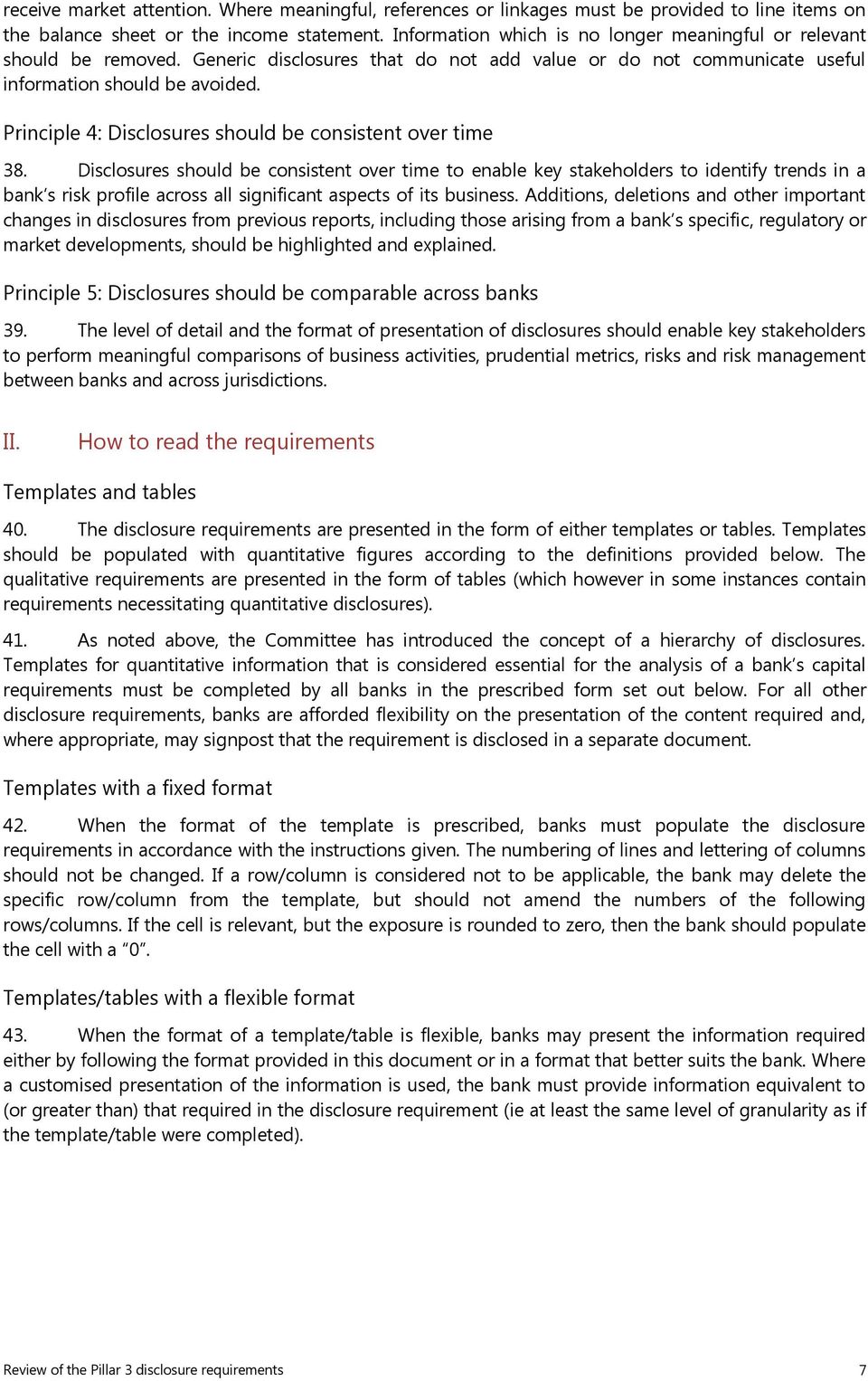
12 44. For those disclosure requirements available in a flexible format only, 13 banks may present the information in a separate document (eg the annual reports or regulatory reports). In such circumstances, a bank must signpost clearly in its Pillar 3 report where the disclosure requirement has been published. This should include: the name and number of the disclosure requirement; the document name in which the disclosure requirement has been published; a web link where relevant; and the page and paragraph number of the separate document. 45. Banks may only make use of this signposting facility if the level of assurance on the reliability of data in the separate document is equivalent to, or greater than, the internal assurance level required for the Pillar 3 report (see section on assurance above). Guidance on additional voluntary disclosures 46. Disclosure of additional quantitative and qualitative information will provide market participants with a broader picture of a bank s risk position and promote market discipline. 47. Additional voluntary risk disclosures allow banks to present information relevant to their business model that may not be adequately captured by the standardised requirements. Additional quantitative information that banks choose to disclose must provide sufficient information to enable market participants to understand and analyse any figures provided and be accompanied with a qualitative discussion. The additional disclosures must follow the guiding principles (see paragraphs 31 to 39) and clearly describe definitions used. Navigation across templates 48. To facilitate navigation between templates, linkages across templates are provided in the explanations to the templates. Cells are described with row number/column letter combination and, when located in another template, preceded by the template code. The cells whose content matches amounts reported in other templates are identified in the template with a double box. Qualitative narrative accompanying templates 49. Banks must always supplement the quantitative information provided in templates with additional qualitative commentary to explain significant changes between reporting periods and issues of interest to market participants which may be specific to the particular bank. List of format and frequency of each disclosure requirement 50. The list sets out whether the disclosure requirements are required in a prescribed or flexible format and the proposed frequency of publication of each template and table: 13 The Committee is aware that some jurisdictions may face constraints in implementing the requirements where signposting is not allowed in their regulatory framework due to legal constraints (eg where the content is already required to be disclosed in another disclosure regime). 8 Review of the Pillar 3 disclosure requirements

13 Tables and templates* Fixed format Flexible format Quarterly As frequently as financial reporting OVA OV1 LI1 LI2 LIA CRA CR1 CR2 CRB CRC CR3 CR4 CR5 CR6 CRD CR7 CR8 CRE CR9 CR10 CR11 CR12 CRF CR13 CCRA CCR1 CCR2 CCR3 CCR4 CCR5 CCR6 CCR7 CCR8 SECA SEC1 SEC2 SEC3 SEC4 SEC5 SEC6 MRA Annually MRB Review of the Pillar 3 disclosure requirements 9
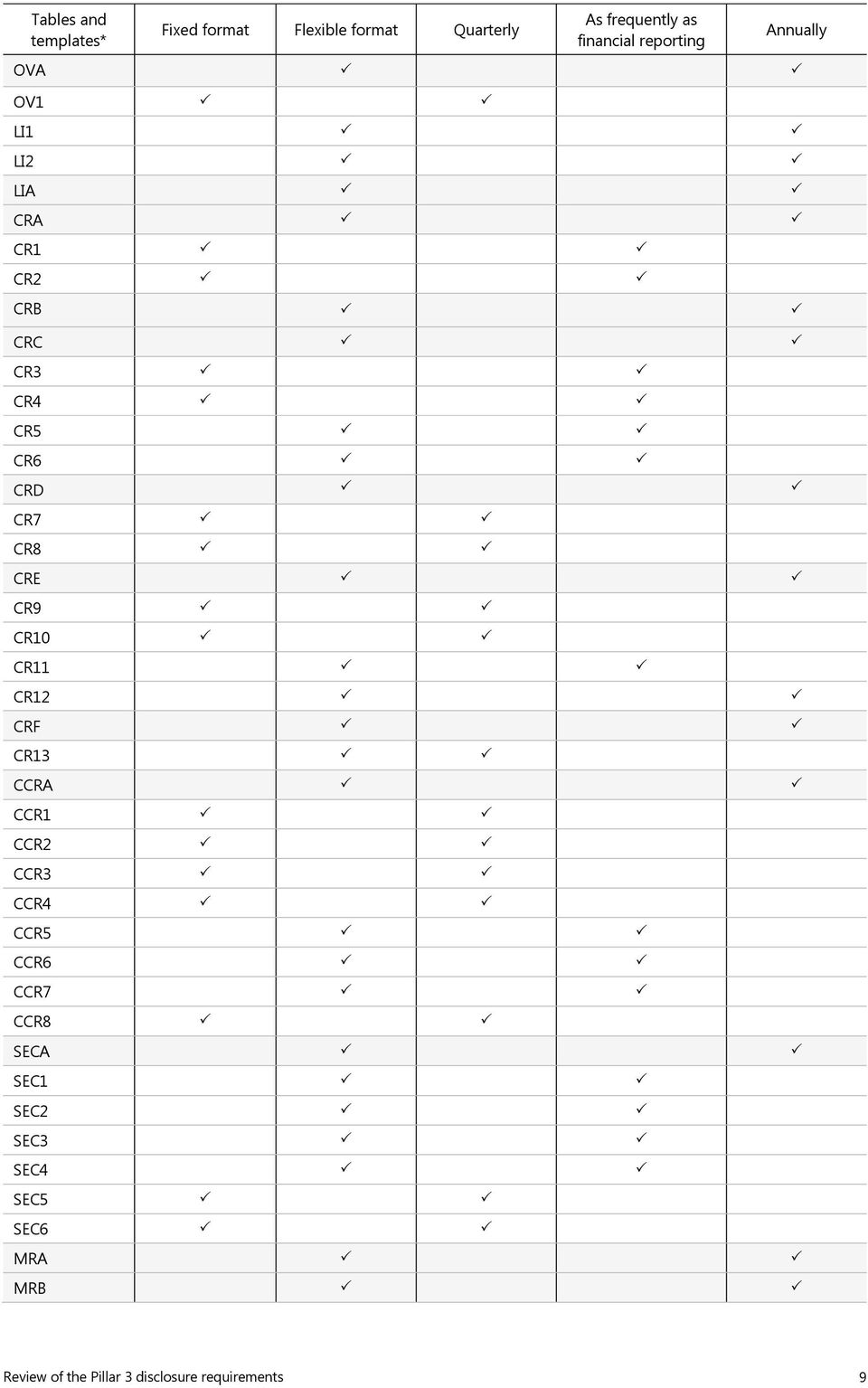
14 Tables and templates* Fixed format Flexible format Quarterly MR1 MR2 As frequently as financial reporting MR3 MR4 MR5 Total (12 tables, 35 templates) Annually *The shaded rows refer to tables and the unshaded rows are templates. 10 Review of the Pillar 3 disclosure requirements

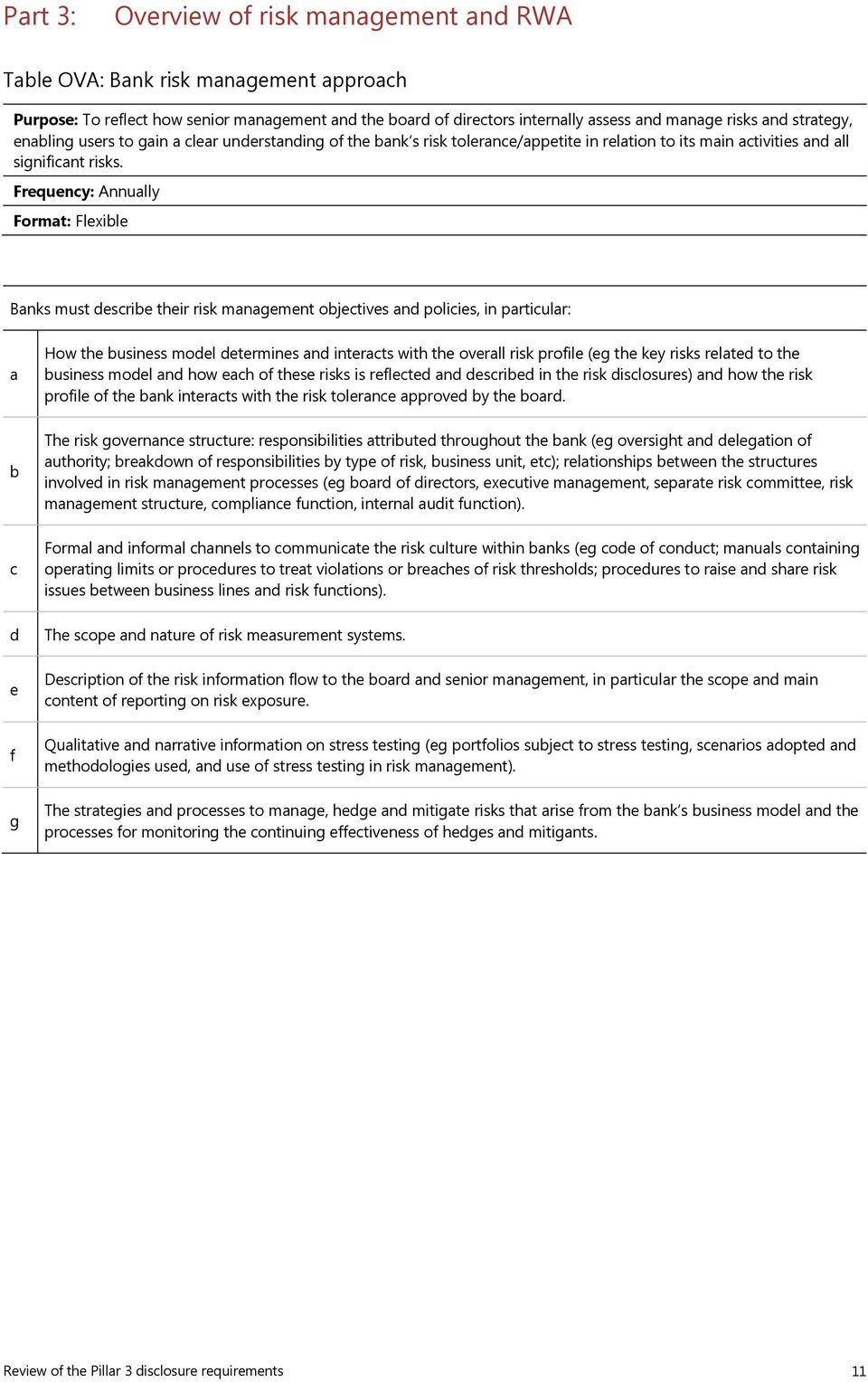
15 Part 3: Overview of risk management and RWA Table OVA: Bank risk management approach Purpose: To reflect how senior management and the board of directors internally assess and manage risks and strategy, enabling users to gain a clear understanding of the bank s risk tolerance/appetite in relation to its main activities and all significant risks. Frequency: Annually Format: Flexible Banks must describe their risk management objectives and policies, in particular: a How the business model determines and interacts with the overall risk profile (eg the key risks related to the business model and how each of these risks is reflected and described in the risk disclosures) and how the risk profile of the bank interacts with the risk tolerance approved by the board. b The risk governance structure: responsibilities attributed throughout the bank (eg oversight and delegation of authority; breakdown of responsibilities by type of risk, business unit, etc); relationships between the structures involved in risk management processes (eg board of directors, executive management, separate risk committee, risk management structure, compliance function, internal audit function). c d e f g Formal and informal channels to communicate the risk culture within banks (eg code of conduct; manuals containing operating limits or procedures to treat violations or breaches of risk thresholds; procedures to raise and share risk issues between business lines and risk functions). The scope and nature of risk measurement systems. Description of the risk information flow to the board and senior management, in particular the scope and main content of reporting on risk exposure. Qualitative and narrative information on stress testing (eg portfolios subject to stress testing, scenarios adopted and methodologies used, and use of stress testing in risk management). The strategies and processes to manage, hedge and mitigate risks that arise from the bank s business model and the processes for monitoring the continuing effectiveness of hedges and mitigants. Review of the Pillar 3 disclosure requirements 11
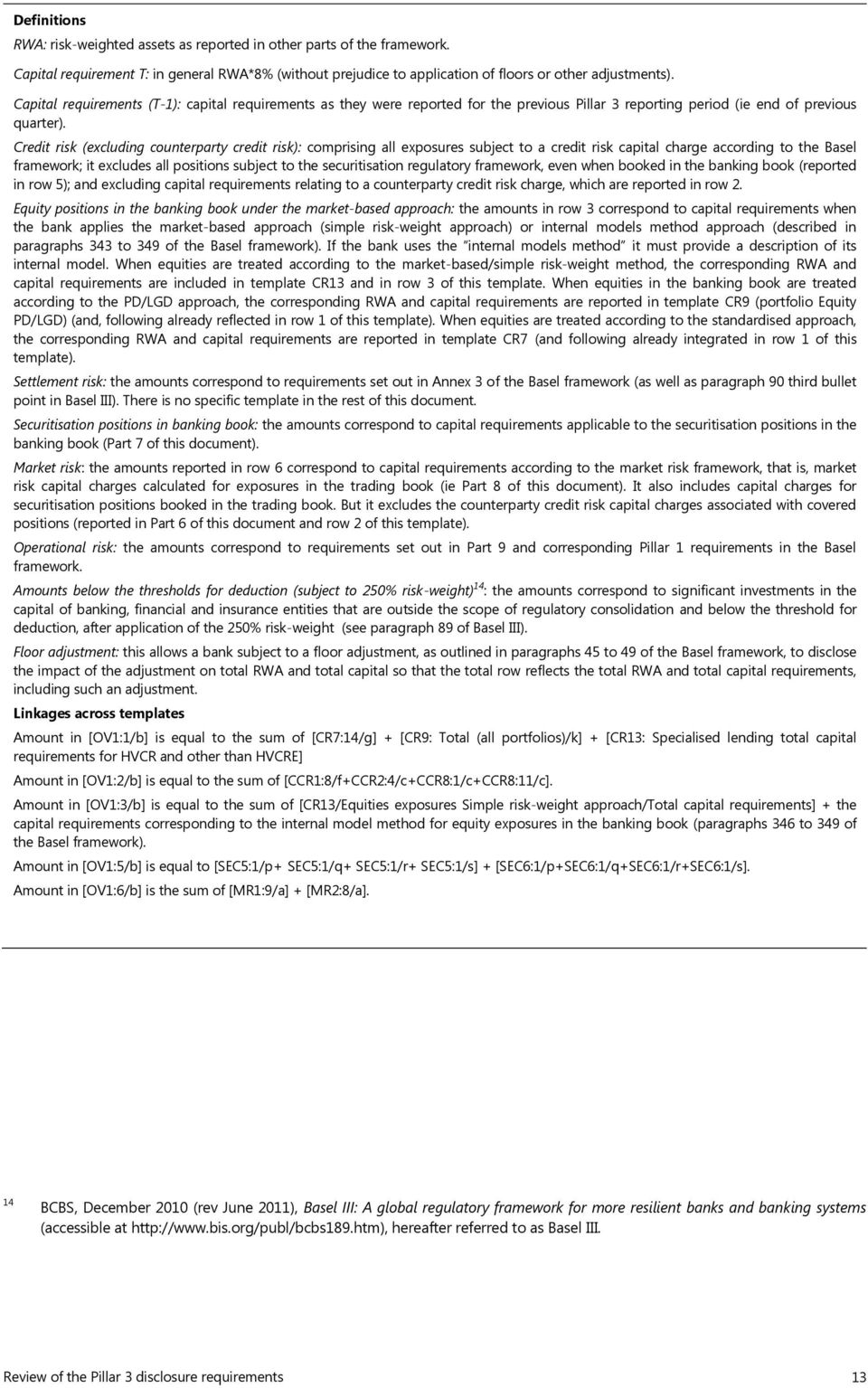
16 Template OV1: Overview of RWA Purpose: To provide a view of total risk-weighted assets (RWA) forming the denominator of the risk-based capital requirements. The detailed calculations of these RWA are detailed in subsequent parts. Frequency: Quarterly Format: Fixed Accompanying narrative: Explanations must supplement the template; in particular where distribution amongst each category is significantly different from that for the previous reporting date the explanation should include the drivers of such change. 1 Credit risk (excluding counterparty credit risk) 2 Counterparty credit risk 3 Equity positions in banking book under market-based approach 4 Settlement risk 5 Securitisation positions in banking book 6 Market risk 7 Operational risk 8 Amounts below the thresholds for deduction (subject to 250% risk-weight) 9 Floor adjustment 10 Total ( ) a b c RWA Minimum capital requirements T T-1 12 Review of the Pillar 3 disclosure requirements

17 Definitions RWA: risk-weighted assets as reported in other parts of the framework. Capital requirement T: in general RWA*8% (without prejudice to application of floors or other adjustments). Capital requirements (T-1): capital requirements as they were reported for the previous Pillar 3 reporting period (ie end of previous quarter). Credit risk (excluding counterparty credit risk): comprising all exposures subject to a credit risk capital charge according to the Basel framework; it excludes all positions subject to the securitisation regulatory framework, even when booked in the banking book (reported in row 5); and excluding capital requirements relating to a counterparty credit risk charge, which are reported in row 2. Equity positions in the banking book under the market-based approach: the amounts in row 3 correspond to capital requirements when the bank applies the market-based approach (simple risk-weight approach) or internal models method approach (described in paragraphs 343 to 349 of the Basel framework). If the bank uses the internal models method it must provide a description of its internal model. When equities are treated according to the market-based/simple risk-weight method, the corresponding RWA and capital requirements are included in template CR13 and in row 3 of this template. When equities in the banking book are treated according to the PD/LGD approach, the corresponding RWA and capital requirements are reported in template CR9 (portfolio Equity PD/LGD) (and, following already reflected in row 1 of this template). When equities are treated according to the standardised approach, the corresponding RWA and capital requirements are reported in template CR7 (and following already integrated in row 1 of this template). Settlement risk: the amounts correspond to requirements set out in Annex 3 of the Basel framework (as well as paragraph 90 third bullet point in Basel III). There is no specific template in the rest of this document. Securitisation positions in banking book: the amounts correspond to capital requirements applicable to the securitisation positions in the banking book (Part 7 of this document). Market risk: the amounts reported in row 6 correspond to capital requirements according to the market risk framework, that is, market risk capital charges calculated for exposures in the trading book (ie Part 8 of this document). It also includes capital charges for securitisation positions booked in the trading book. But it excludes the counterparty credit risk capital charges associated with covered positions (reported in Part 6 of this document and row 2 of this template). Operational risk: the amounts correspond to requirements set out in Part 9 and corresponding Pillar 1 requirements in the Basel framework. Amounts below the thresholds for deduction (subject to 250% risk-weight) 14 : the amounts correspond to significant investments in the capital of banking, financial and insurance entities that are outside the scope of regulatory consolidation and below the threshold for deduction, after application of the 250% risk-weight (see paragraph 89 of Basel III). Floor adjustment: this allows a bank subject to a floor adjustment, as outlined in paragraphs 45 to 49 of the Basel framework, to disclose the impact of the adjustment on total RWA and total capital so that the total row reflects the total RWA and total capital requirements, including such an adjustment. Linkages across templates Amount in [OV1:1/b] is equal to the sum of [CR7:14/g] + [CR9: Total (all portfolios)/k] + [CR13: Specialised lending total capital requirements for HVCR and other than HVCRE] Amount in [OV1:2/b] is equal to the sum of [CCR1:8/f+CCR2:4/c+CCR8:1/c+CCR8:11/c]. Amount in [OV1:3/b] is equal to the sum of [CR13/Equities exposures Simple risk-weight approach/total capital requirements] + the capital requirements corresponding to the internal model method for equity exposures in the banking book (paragraphs 346 to 349 of the Basel framework). Amount in [OV1:5/b] is equal to [SEC5:1/p+ SEC5:1/q+ SEC5:1/r+ SEC5:1/s] + [SEC6:1/p+SEC6:1/q+SEC6:1/r+SEC6:1/s]. Amount in [OV1:6/b] is the sum of [MR1:9/a] + [MR2:8/a]. 14 BCBS, December 2010 (rev June 2011), Basel III: A global regulatory framework for more resilient banks and banking systems (accessible at hereafter referred to as Basel III. Review of the Pillar 3 disclosure requirements 13
18 Part 4: Linkages between financial statements and prudential exposures Template LI1: Differences in financial and regulatory scopes of consolidation and mapping of financial statement categories with regulatory risk categories Purpose: Enables users to see in a first step (from column a) to b)) i) the difference between the accounting scope of consolidation and the regulatory scope of consolidation and, in a second step, ii) how the amounts reported in financial statements (in rows) are distributed within the regulatory categories (in columns). Frequency: Annually Format: Flexible (but the rows must align with the presentation of the financial information) Accompanying narrative: At a minimum, banks must explain the derivation of the main differences between the amounts in columns a) and b). a b c d e f g h Amounts as reported in published financial statements Amounts under regulatory scope of consolidation Of which subject to credit risk treatment Regulatory banking book Of which subject to counterparty credit risk treatment Of which subject to securitisation framework Regulatory trading book Of which subject to market risk treatment Of which subject to additional capital charge for counterparty credit risk Not subject to capital requirements Assets Cash and balances at central banks Items in the course of collection from other banks Trading portfolio assets Financial assets designated at fair value Derivative financial instruments Loans and advances to banks Loans and advances to customers Reverse repurchase agreements and other similar secured lending Available for sale financial investments. 14 Review of the Pillar 3 disclosure requirements
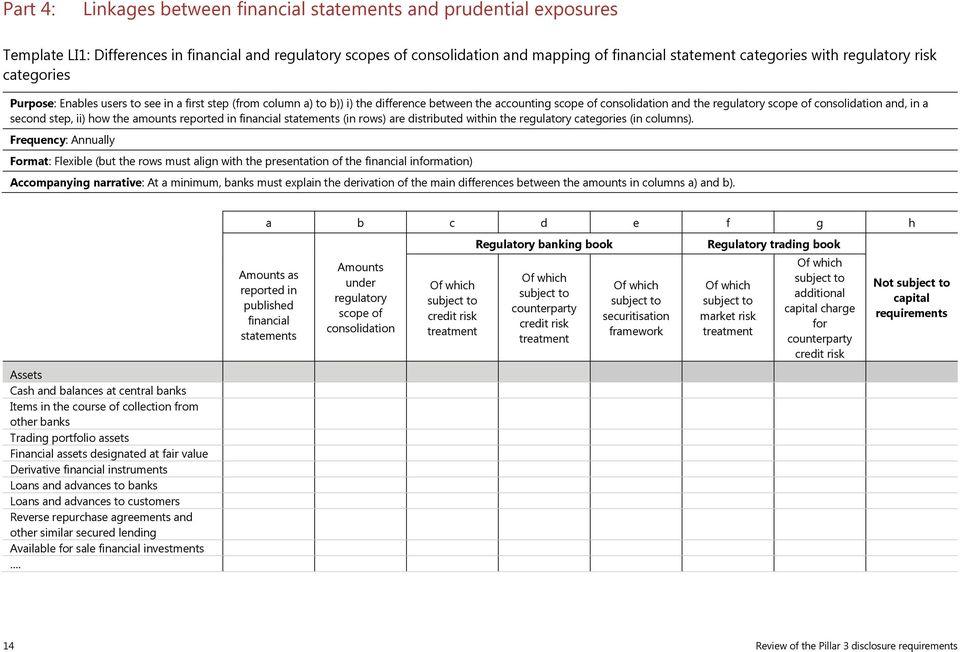
19 Total assets Off-balance sheet amounts considered for regulatory purposes Liabilities Deposits from banks Items in the course of collection due to other banks Customer accounts Repurchase agreements and other similar secured borrowings Trading portfolio liabilities Financial liabilities designated at fair value Derivative financial instruments. Total liabilities Off-balance sheet amounts considered for regulatory purposes Memo items: Securitisation positions included in the above on- and off-balance sheet portfolios Instructions Rows The rows must strictly follow the balance sheet presentation used by the bank in its financial reporting. The off-balance sheet items are presented in a separate line and must not be added to the total assets or total liabilities in order to keep the same scope as in financial statements. Securitisation positions are exposures to securitisation transactions defined in paragraphs 539 and 540 of the Basel framework. Columns If a bank has no difference at all between its accounting scope of consolidation and its regulatory scope of consolidation, columns a) and b) are merged together. The breakdown of regulatory categories (c to g) corresponds to the breakdown prescribed in the rest of the document, ie c) credit risk matches with exposures reported according to Part 5 below, d) and g) counterparty credit risk matches with exposures reported according to Part 6 below, e) securitisation framework corresponds to exposures in the banking book reported in Part 7 below, and f) market risk matches with exposures reported in Part 8 below. Column h), Not subject to capital requirements includes amounts not subject to capital requirements according to the Basel framework or subject to deductions from regulatory capital. Review of the Pillar 3 disclosure requirements 15

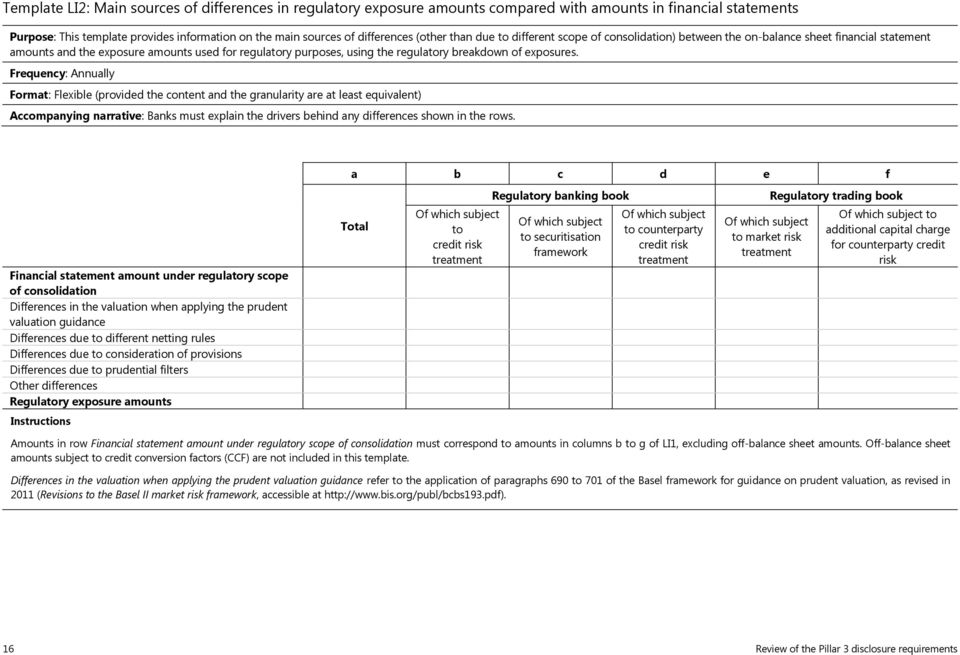
20 Template LI2: Main sources of differences in regulatory exposure amounts compared with amounts in financial statements Purpose: This template provides information on the main sources of differences (other than due to different scope of consolidation) between the on-balance sheet financial statement amounts and the exposure amounts used for regulatory purposes, using the regulatory breakdown of exposures. Frequency: Annually Format: Flexible (provided the content and the granularity are at least equivalent) Accompanying narrative: Banks must explain the drivers behind any differences shown in the rows. a b c d e f Financial statement amount under regulatory scope of consolidation Differences in the valuation when applying the prudent valuation guidance Differences due to different netting rules Differences due to consideration of provisions Differences due to prudential filters Other differences Regulatory exposure amounts Total Of which subject to credit risk treatment Regulatory banking book Of which subject to securitisation framework Of which subject to counterparty credit risk treatment Of which subject to market risk treatment Regulatory trading book Of which subject to additional capital charge for counterparty credit risk Instructions Amounts in row Financial statement amount under regulatory scope of consolidation must correspond to amounts in columns b to g of LI1, excluding off-balance sheet amounts. Off-balance sheet amounts subject to credit conversion factors (CCF) are not included in this template. Differences in the valuation when applying the prudent valuation guidance refer to the application of paragraphs 690 to 701 of the Basel framework for guidance on prudent valuation, as revised in 2011 (Revisions to the Basel II market risk framework, accessible at 16 Review of the Pillar 3 disclosure requirements
21 Table LIA: Qualitative disclosures of differences from financial to regulatory exposures Purpose: To provide qualitative explanations on the differences observed between accounting valuation and valuation for prudential purposes. Frequency: Annually Format: Flexible Banks must explain the sources of differences from financial statements amounts to regulatory exposure amounts, in particular due to implementation of the guidance on prudent valuation. 15 In particular, banks must explain: a b Systems and controls to ensure that the valuation estimates are prudent and reliable. Valuation methodologies, including a description of the extent of use of marking-to-market methodology and of a marking-to-model methodology. Disclosures must also describe the independent price verification process. c Procedures for valuation adjustments or reserves (including a description of the process and the methodology for valuing trading positions by type of instrument). 15 See paragraphs 690 to 701 of the Basel framework. Review of the Pillar 3 disclosure requirements 17
22 Part 5: Credit risk The scope of the credit risk section includes all exposures subject to a credit risk capital charge according to the Basel framework. It excludes all positions subject to the securitisation regulatory framework, even when booked in the banking book. 16 It excludes capital requirements relating to counterparty credit risk, which are dealt with in Part 6 of this document. 17 I. General information about credit risk Table CRA: General qualitative information about credit risk Purpose: To describe the main characteristics and elements of credit risk management (business model and credit risk profile, organisation and functions involved in credit risk management, risk management reporting) Frequency: Annually Format: Flexible Banks must describe their risk management objectives and policies for credit risk, in particular: a b c d e How the business model determines the overall credit risk profile Criteria for the definition of the credit risk approach and credit risk limits Structure and organisation of the credit risk management and control function Relationships between the credit risk management, risk control, compliance and internal audit functions Scope and main content of the reporting on credit risk exposure and the credit risk management function to the executive management and to the board of directors Template CR1: Analysis of exposures by products Purpose: To provide a comprehensive picture of the quality of a bank s credit exposures (on- and off-balance sheet). Banks are required to disclose a breakdown between defaulted and non-defaulted exposures together with provisions against those exposures. The data will provide users with a comprehensive understanding of both the credit quality and related coverage measures of those exposures. Frequency: Aligned with reporting schedule of financial statements. Format: Fixed (jurisdictions may require more granular breakdown of asset classes, but rows 1 to 4 as defined below are mandatory for all banks). Accompanying narrative: Banks must supplement the template with qualitative discussion. This should include their definition of default See Basel framework paragraphs 538 to 651 and revised securitisation framework (currently under development, see the consultative document Revisions to the securitisation framework accessible at See Basel framework Annex 4, and Basel III and The standardised approach for measuring counterparty credit risk exposures (accessible at 18 Review of the Pillar 3 disclosure requirements
23 a b c d e f g h i Past due (more than 90 days) Defaulted exposures All exposures (gross value) Non-defaulted exposures Other Impaired Other Allowances On defaulted exposures Past due (more than 90 days) Other On non-defaulted exposures Write offs Net value (a+b+c+d-e-f-g-h) 1 Loans 2 Debt Securities 3 Off-balance sheet exposures 4 Total Definitions Exposures: on- and off-balance sheet exposures giving rise to a credit risk exposure according to the Basel framework. On-balance sheet exposures include loans and debt securities. Off-balance sheet exposures must be measured according to the following criteria: (a) guarantees given maximum amount that the bank would have to pay if the guarantee is called (CCF and credit risk mitigation (CRM) techniques must not be considered); (b) irrevocable loan commitments total amount that the bank has committed to lend (CCF and CRM techniques must not be considered). Revocable loan commitments must not be included. The gross value is the accounting value before any impairment and partial write-off. Banks must not take into account the protections received. Defaulted exposures: any exposure meeting the definition of default provided by the Basel framework. In particular, when adopting the standardised or simplified standardised approaches, banks must refer in the past-due columns to exposures past due over 90 days. Banks adopting the IRB approach must refer in the column past-due to exposure past due according to paragraph 452, second bullet and in the column other to defaulted exposures where the obligor is unlikely to pay its credit obligations, according to paragraph 452, first bullet. Where jurisdictions apply the IRB definition of default in the standardised approach, the breakdown by past due and other is also relevant for banks using the standardised approach. Non-defaulted exposures: any exposure not meeting the Basel definition of default (ie an exposure with less than 90 days to default). Allowances: total amount of the impairments and provisions held against impaired and not impaired exposures (eg general reserves) according to the applicable accounting framework. Write offs: accumulated (total) amount of partial write-offs against impaired exposures according to the applicable accounting or regulatory requirements (net of recoveries). Net value: Total gross value less allowances less write offs. Linkages across templates Amount in [CR1:1/i] is equal to the sum [CR3:1/a+CR3:1/b+CR3:1/d+CR3/1/f]. Amount in [CR1:2/i] is equal to the sum [CR3:2/a+CR3:2/b+CR3:2/d+CR3:2/f]. Review of the Pillar 3 disclosure requirements 19
24 Template CR2: Changes in defaulted loans and debt securities Purpose: To analyse the recent evolution of defaulted exposures and in particular the movements between non defaulted and defaulted status and the reductions of defaulted exposures due to write offs. Frequency: Aligned with reporting schedule of financial statements. Format: Fixed (jurisdictions may require further breakdown into the columns (eg requiring a breakdown by counterparty types)). Accompanying narrative: At a minimum, banks must provide qualitative discussion to explain the results in the template such as changes in the amounts of defaulted exposures and, the key drivers of such changes when compared to the previous reporting date, especially from lines 2 (new defaulted), 3 (transfer from not defaulted) and 4 (return to not defaulted). 1 Defaulted loans and debt securities at end of the previous financial reporting period 2 New defaulted loans and debt securities 3 Transfer from not defaulted 4 Return to not-defaulted status 5 Amounts written off 6 Other changes 7 Defaulted loans and debt securities at end of the reporting period Definitions ( ±6) Defaulted exposure: must be reported net of write-offs and gross of impairment and provisions. New defaulted loans and debt securities: refers to loans originated / purchased or debt securities purchased after the end of the previous financial year and defaulted in the same reporting period. Transfer from not defaulted: refers to loans originated / purchased or debt securities purchased in a previous financial year that are subsequently transferred from not defaulted to defaulted during the current reporting period. Amounts written off: both total and partial write offs. Linkages across templates The amount in [CR2:7/a] is equal to the sum and subtraction of [CR1:1/a + CR1:1/b - CR1:1/h+ CR1:2/a + CR1:2/b - CR1:2/h] a Table CRB: Additional disclosure related to assets subject to credit risk treatment Purpose: To supplement the quantitative templates with qualitative information: the description of the differences in scope and definition for relevant metrics (eg past due, impaired exposures, default) used for accounting and regulatory purposes; an analysis of some important cases (eg past-due not impaired exposures). Other complementary quantitative data are requested on breakdown of credit exposures by industry and geographical area; on ageing of past-due (in order to have an idea of the extent of actual problematic or technical past-due exposures) and on breakdown by impaired and not impaired restructured exposures (to distinguish between commercial restructuration and forbearance aimed at recovery of problematic exposures). Frequency: Annually Format: Flexible 20 Review of the Pillar 3 disclosure requirements
25 Banks must provide the following disclosures: Qualitative disclosures a b c d The scope and definitions of past due and impaired exposures used for accounting purposes and the differences, if any, between the definition of past due and default for accounting and regulatory purposes. The extent of past-due exposures (more than 90 days) not impaired and the reasons why these exposures have not been considered impaired. Description of methods adopted for determining impairments. Definitions of restructured exposures. Quantitative disclosures e f g Breakdown of credit risk exposures by geographical areas, industry and residual maturity; Amounts of impaired exposures (according to the definition in use for accounting purposes) and related allowances and write-offs, broken down by geographical areas and industry; Ageing analysis of accounting past-due exposures; h Breakdown of restructured exposures between impaired and not impaired exposures. II. Protections available for credit risk exposures The templates CR 3, 4, 5, and 6 refer to all types of credit protections, provided they meet eligibility criteria for CRM techniques according to the Basel regulatory framework. The value of the protections (amount that can be obtained if the protection is used), within the above mentioned templates, is measured taking into account recovery costs (drawing cost/cost of liquidation or cost of settlement, discounting and maintenance costs). If the fair value of the protections is available, banks must consider this value. Where the value of the protection (amount that can be obtained if the protection is used) is above the amount of the exposure, the bank must report the amount of the exposure. Where an exposure is protected by collateral, financial guarantees and credit derivatives, its value should be attributed to columns b and c (covered by collateral) up to the value of the collateral, the remaining exposure should be attributed to columns d and e (covered by financial guarantees) up to the value of the financial guarantees and the remaining part (if any) should be attributed to columns f and g (covered by credit derivatives). In any case the total amount attributed to columns c, e and g according to the previous paragraph, cannot be higher than the amount of the exposure. Table CRC: Qualitative disclosure requirements related to protections Purpose: To provide qualitative information on the use of collateral to mitigate or reduce credit risk exposures. Frequency: Annually Format: Flexible Banks must disclose: a b c Policies and processes for, and an indication of the extent to which the bank makes use of, on- and off-balance sheet netting. Policies and processes for collateral evaluation and management. Information about market or credit risk concentrations under the credit risk mitigation instruments used (ie by guarantor type, collateral and credit derivative providers). Review of the Pillar 3 disclosure requirements 21
26 Template CR3: Protections overview Purpose: To disclose the extent of reduction of credit risk exposure due to the use of collateral, financial guarantees or credit derivatives as credit risk mitigation techniques. Frequency: Aligned with reporting schedule of financial statements. Format: Fixed (Individual jurisdictions might require a further breakdown of assets as defined in the rows titles, provided the template includes the total amount for each of the items defined in rows 1 to 4) Accompanying narrative: Banks must provide qualitative discussion to explain the results in the template including changes to the amounts compared to the previous reporting date and the drivers of such changes. 1 Loans 2 Debt securities 3 Total 4 Of which defaulted a b c d e f g Exposure unsecured Exposure secured by collateral Exposure secured by collateral, of which: secured amount Exposure secured by financial guarantees Exposure secured by financial guarantees, of which: secured amount Exposure secured by credit derivatives Exposure secured by credit derivatives, of which: secured amount Definitions Exposure secured by collateral: total amount of original exposure (net of provisions and impairments) for assets which are partly or totally secured by collateral, regardless of what portion of the original exposure is secured. The exposures secured by collateral include those benefitting from a recognised netting effect. Exposure secured by collateral of which secured amount: amount of exposure for assets secured by collateral which is covered by collateral. Where the value of the collateral (amount that the collateral can be settled for) is above the amount of the exposure, the bank must report the amount of the exposure, ie not to report the over-collateralisation. Exposure secured by financial guarantees: total amount of original exposure (net of provisions and impairments) for assets which are partly or totally secured by financial guarantees, regardless of what portion of the original exposure is guaranteed. Exposure secured by financial guarantees of which secured amount: amount of exposure for assets secured by financial guarantees which is covered by the guarantee. Where the value of the guarantee (amount that can be obtained if the guarantee is called) is above the amount of the exposure, the bank must report the amount of the exposure, ie not to report the excess value. Exposure secured by credit derivatives: total amount of original exposure (net of provisions and impairments) for assets secured by credit derivatives, regardless of what portion of the original exposure is secured. Exposure secured by credit derivatives of which secured amount: amount of exposure for assets secured by credit derivatives. Where the value of the credit derivative (amount that the credit derivative can be settled for) is above the amount of the exposure, the bank must report the amount of the exposure, i.e. not to report the excess value. Linkages across templates The amount in [CR3:3/d] is equal to the sum [CR5: Total/a + CR5: Total/b]. The amount in [CR3: 4/d] is equal to the amount in [CR5: Total/a]. The amount in [CR3:3/f] is equal to the sum of [CR6: Total/a + CR6: Total/b]. The amount in [CR3:4/f] is equal to the amount in [CR6: Total/a]. 22 Review of the Pillar 3 disclosure requirements
27 Template CR4: Protected exposures and coverage ratio Purpose: To distinguish between exposures that are fully protected, partially protected and unprotected (different level of risk). The breakdown by bands classifies the exposures according to their level of over or under collateralisation. The template also requires banks to distinguish between defaulted and non- defaulted exposures because credit risk mitigation techniques are more relevant where the original debtor is weaker. Frequency: Aligned with reporting schedule of financial statements. Format: Fixed (however banks may set the ratio bands in rows 2 to 6 and 8 to 12 differently, provided a minimum of 4 bands is provided for each category of exposure). Accompanying narrative: Banks must provide qualitative disclosure on any significant changes to the amounts compared to the previous reporting periods and the key drivers of such changes. 1 Fully protected exposures for which the ratio exposure/protection is: 2 - Less than 25% 3-25% to 50% 4-51% to 75% 5-76% to 90% 6-91% to 100% 7 Partially protected exposures For which the ratio protection/exposure is: 8 - Less than 25% 9-25% to 50% 10-51% to 75% 11-76% to 90% 12-91% to 100% 13 Not protected exposures 14 Total (1+7+13) Definitions a Defaulted exposures b Non defaulted exposures Banks must report the amount of the exposure fully protected (rows 1 to 6), partially protected (rows 7 to 12) or not protected (row 13). The exposures are fully protected where the amount of protection is higher than or at least equal to the amount of the exposure protected. Where the amount of protection is lower than the exposure, the exposure is partially protected. Defaulted and not defaulted exposures: Banks must report in columns a and b the amount of defaulted and non-defaulted exposures (accounting value of loans and debt securities) broken down by fully protected exposures, partially protected exposures and not protected exposures. Exposure/protection: amount of exposure (calculated according to the applicable accounting rules) to value of the protection (amount that can be obtained if the guarantee is called, collateral liquidated, CDS settled; see template 3 for measurement criteria). Contrary to template CR3, in this template, the percentage (exposure/protection) and (protection/exposure) must be calculated considering the actual amount of the protection, also when the amount of the protection exceeds the amount of protected exposure. Defaulted exposures: the definition of default must be the same as in template CR1. Review of the Pillar 3 disclosure requirements 23
28 Template CR5: Protected exposures by guarantor rating class Purpose: To disclose the reliability of the guarantors used by banks to reduce their credit risk exposures. The template also requires banks to distinguish between defaulted and non-defaulted exposures because CRM techniques are more relevant where the original debtor is weaker. Frequency: Aligned with reporting schedule of financial statements. Format: Flexible (the template is mandatory provided that it fits with national applicable regulations regarding the use of credit rating agencies for supervisory purposes. Alternatively, banks may refer to internal ratings for IRB exposures (and provide the breakdown by PD as included in template CR9) and risk weights attributed to the guarantor according to the standardised approach in use in their jurisdiction) Accompanying narrative: Banks must provide qualitative disclosure on any significant changes to the amounts compared to the previous reporting periods, the key drivers of such changes and how rating scales from external rating agencies were used in the template. a b AAA AA Unrated Total External rating of the guarantor Defaulted exposures Non defaulted exposures Definitions External Rating: the rating scale must be adapted according to the rating agency used by the bank. Where banks use more than one rating agency, they must include the worst rating attributed to the guarantor by these agencies (pursuant to the applicable regulatory framework). Defaulted exposures: the definition of default must be the same as described in Template CR1. 24 Review of the Pillar 3 disclosure requirements
29 Template CR6: Exposures protected by credit derivatives: breakdown by counterparty rating class Purpose: To disclose the reliability of the counterparties of credit derivatives used by banks to reduce their credit risk exposures. The template also requires banks to distinguish between defaulted and non-defaulted exposures because CRM techniques are more relevant where the original debtor is weaker. Frequency: Aligned with reporting schedule of financial statements. Format: Flexible (The template is mandatory provided that it fits in with national applicable regulations regarding the use of credit rating agencies for supervisory purposes. Alternatively, banks may refer instead to internal ratings for IRB exposures (and provide the breakdown by PD as included in template CR9) and risk weights attributed to the guarantor according to the standardised approach in use in their jurisdiction). Accompanying narrative: At a minimum, banks must provide qualitative disclosure on any significant changes compared to the previous reporting periods, the key drivers of those changes and how rating scales from external rating agencies were used in the template. AAA AA External rating of the protection provider (credit derivative protections) Unrated Total Definitions a Defaulted exposures b Non defaulted exposures Rating: the rating scale must be adapted according to the rating agency used by the bank. Where banks make use of more than one rating agency, they must include the worst rating attributed to the counterparty by these agencies (pursuant to the applicable regulatory framework). Defaulted and non-defaulted exposures: the definition of default must be the same as in Template CR1. III. Credit risk under standardised approach Table CRD: Qualitative disclosures related to standardised approach Purpose: To supplement the information on the standardised approach with qualitative data on use of external ratings. Frequency: Annually Format: Flexible. Applicable to banks using the standardised approach (or the simplified standardised approach) and where banks make use of external credit agencies ratings. A. For portfolios under the standardised approach, banks must disclose additional information according to the framework below: a b Names of the external credit assessment institutions (ECAIs) and export credit agencies (ECAs) used by the bank, and the reasons for any changes; The exposure classes for which each ECAI or ECA is used; Review of the Pillar 3 disclosure requirements 25
30 c d A description of the process used to transfer the issuer or issue credit ratings onto comparable assets in the banking book (see paragraphs 99 to 101 of the Basel framework); and The alignment of the alpha numerical scale of each agency used with risk buckets (except when the relevant supervisor publishes a standard mapping with which the bank complies). 26 Review of the Pillar 3 disclosure requirements
31 Template CR7: Standardised approach - credit risk exposure and CRM effects Purpose: The template is aimed at illustrating the effect of CRM (comprehensive and simple approach) on standardised approach capital requirements calculations. In particular, the comprehensive approach reduces the original exposure while the simple approach reduces the risk weight attributed to the original counterparty by a replacement effect (ie the guarantor risk weight is attributed to credit exposure instead of original debtor risk weight). RWA density provides a synthetic metric on riskiness of each portfolio. Frequency: Quarterly Format: Fixed The whole template is mandatory for banks using the standardised or the simplified standardised approach and must be used to disclose exposures treated according to this approach. The columns are fixed. The rows, as indicated, reflect the asset classes as defined under the Basel framework. However, the rows may slightly differ at the individual jurisdiction s level to reflect exposure categories as required under national implementation of the standardised approach. Accompanying narrative: Explanations must supplement the template, in particular changes compared to the previous issuance of the template. a b c d e f g Exposures before CRM CRM and CCF effects on exposures CRM effects on RWA RWA and capital requirements On balance sheet amount Off balance sheet amount Credit exposure post CCF and post- CRM (comprehensive approach) RWA before CRM (simple approach) RWA after CRM (simple approach) RWA density Capital requirements 1 Sovereigns and their central banks 2 Non-central government public sector entities 3 Multilateral development banks 4 Banks 5 Securities firms 6 Corporates 7 Regulatory retail portfolios 8 Secured by residential property 9 Secured by commercial real estate 10 Equity 11 Past due loans 12 Higher-risk categories 13 Other assets 14 Total Review of the Pillar 3 disclosure requirements 27
32 Definitions Rows: Higher-risk categories: Banks must include in this row the exposures included in paragraph 79 of the Basel framework that are not included in other regulatory portfolios (eg exposure weighted at 150% or higher risk weight reflecting the higher risks associated with these assets, such as venture capital and private equity investments). Other assets: refers to assets subject to specific risk-weight set out by paragraph 81 of the Basel framework and to significant investment in commercial entities that receive a 1250% risk-weight according to paragraph 90 fourth bullet of Basel III. Columns: On Balance sheet amount: banks must disclose the amount of exposure (net of allowances and write-offs) under the regulatory scope of consolidation. Off Balance sheet amount: banks must disclose the exposure value without taking into account conversion factors and the effect of credit risk mitigation techniques. Credit exposure post CCF and post-crm: This is the amount to which the capital requirements are applied. It is therefore a net credit equivalent amount, after having applied CRM techniques and CCF. RWA before CRM (simple approach): RWA of the exposure calculated according to the previous column and without considering the reductions in risk weight related to the simple CRM approach (see Basel framework paragraphs 129 and ). RWA after CRM (simple approach): RWA of the exposure calculated according to column d and after considering the reductions in risk weight related to the simple CRM approach (See Basel framework paragraphs 129 and ). RWA density: Total Risk Weighted Assets / exposure after CRM. Capital requirements: 8% of RWA, shortfall or surplus of expected losses compared to provisions are reported in the composition of capital. Linkages across templates The amount in [CR7:Total/c] is equal to the amount in [CR8:14/j] 28 Review of the Pillar 3 disclosure requirements
33 Template CR8: Standardised approach exposures by asset classes and risk weights Purpose: To display the breakdown of credit risk exposures calculated according to the standardised approach: by portfolio (type of counterparties) and risk weights (riskiness attributed according to standardised approach). Frequency: Quarterly Format: Fixed The template is mandatory for banks using the standardised (or simplified standardised) approach and must be used to disclose exposures treated according to this approach. The rows and columns will be fixed at the individual jurisdiction s level, potentially slightly differently, to reflect exposure categories required under national implementation of the standardised approach. Accompanying narrative: Explanations must supplement the template, in particular changes compared to the previous reporting date and the drivers of such changes. a b c d e f g h i j Risk Weight* Regulatory portfolio 1 Sovereigns 2 Non-central government public sector entities (PSEs) 3 Multilateral development banks (MDBs) 4 Banks 5 Securities firms 6 Corporates 7 Regulatory retail portfolios 8 Secured by residential property 9 Secured by commercial real estate 10 Equity 11 Past due loans 12 Higher-risk categories 13 Other assets 14 Total 0% 10% 20% 35% 50% 75% 100% 150% Others Total credit exposures amount (post CCF and post CRM) Review of the Pillar 3 disclosure requirements 29
34 *Banks subject to the simplified standardised approach should indicate risk weights determined by the national supervisory authority in the columns. Definitions Total credit exposure amount (post CCF and CRM): the amount relevant for the capital requirements calculation (both for on balance and off balance sheet amounts), therefore after having applied CRM techniques and CCF but before the application of the relevant risk-weights. Past-due loans: past-due loans (unsecured portion of any loan past due for more than 90 days, as defined in paragraph 75 of the Basel framework). Higher-risk categories: refers to claims risk weighted at 150% or higher (see paragraph 79 of the Basel framework). Exposures reported in this row should not be reported in the rows above. Other assets: refers to assets subject to specific risk-weight set out by paragraph 81 of the Basel framework and to significant investment in commercial entities that receive a 1250% risk-weight according to paragraph 90 fourth bullet of Basel III. 30 Review of the Pillar 3 disclosure requirements
35 IV. Credit risk under internal risk-based approaches Table CRE: Qualitative disclosures related to IRB models Purpose: To provide general information on IRB models. In particular, banks shall describe both qualitative items (organisation, processes and functions involved in the development and controls of the IRB models, internal risk reporting on IRB models) and other items related to the approval of the model (scope of supervisory acceptance, number of relevant models used). Banks shall also describe the main characteristics of IRB models (eg criteria and type of data used to estimate the relevant parameters). Frequency: Annually Format: Flexible The table is mandatory for banks using AIRB or FIRB approach for some or all of their exposures. Banks must provide the following information pertaining to their IRB models: a b b c d e f Internal model development, controls and changes: role of the functions involved in the development, approval and subsequent changes of the credit risk models. Relationships between risk management function and internal audit function and procedure to ensure the independency of the structure in charge of the review of the models from the functions responsible for the development of the models. Scope and main content of the reporting related to credit risk models. Scope of the supervisor s acceptance of approach. For each of the asset classes, the bank must indicate the part of EAD within the group (by percentage) covered by standardised, FIRB and AIRB approach and the part of portfolios that are involved in a roll-out plan (with the expected time-schedule for the approval of these models). The number of models included in each asset class, with a brief discussion of the main differences among the models within the same asset class. Description of the main characteristics of the approved models: (i) definitions, methods and data for estimation and validation of PD (eg how PDs are estimated for low default portfolios; if there are regulatory floors; the drivers for differences observed between PD and actual default rates at least for the last 3 periods); and where applicable: (ii) LGD (eg methods to calculate downturn LGD; how LGDs are estimated for low default portfolio; the time lapse between the default event and the closure of the exposure); (iii) credit conversion factors, including assumptions employed in the derivation of these variables; (iv) any deviation from the definition of default as permitted by prudential regulations (where these are determined to be material, banks must also indicate for each class the main categories of exposure affected by such deviations); Review of the Pillar 3 disclosure requirements 31
36 Template CR9: IRB - Credit risk exposures by portfolio and PD range Purpose: To provide all relevant parameters used for the calculation of capital requirements for IRB models. The disclosure of these parameters enhances the transparency of banks calculations and the reliability of regulatory measures. The breakdown by portfolio, by PD scale and by FIRB and IRB approaches ensures an appropriate granularity and meaningfulness of the analysis by type of counterparty and related risk levels. Frequency: Quarterly Format: Fixed The template is mandatory for banks using either the AIRB or FIRB approach. The columns and the PD scale in the rows are fixed, but the portfolio breakdown in the rows will be set at the individual jurisdiction level to reflect exposure categories under national implementations of the IRB approaches. Where a bank makes use of both FIRB and AIRB approaches, it must disclose two separate templates. Accompanying narrative: At a minimum, banks must supplement the template with qualitative discussions to explain the results of the table. This discussion should include any significant changes compared to the previous reporting periods and the key drivers of such changes. PD scale a b c d e f g h i j k l m Original on balance sheet gross exposure Off balance sheet exposures pre CCF Weighted average CCF EAD post CRM Average PD Number of obligors Weighted average LGD Weighted average maturity RWA RWA density Capital requirements EL Provisions Portfolio X 0.00 to < to < to < to < to < to < to < to < to < to < to < (Default) Sub-total Total (all portfolios) Definitions 32 Review of the Pillar 3 disclosure requirements
37 Rows The dimension Portfolio X includes the following prudential portfolios for the FIRB approach: i) Sovereign; ii) Banks; iii) Corporate; iv) Corporate Specialised Lending; v) Equity (PD/LGD methods described in paragraphs 350 to 358 of Basel II and paragraph 90 second bullet of Basel III); vi) Purchased receivables, and the following prudential portfolios for the AIRB approach: i) Sovereign; ii) Banks; iii) Corporate; iv) Corporate - Specialised Lending; v) Equity (PD/LGD method as described in paragraphs 350 to 358 of Basel II and paragraph 90 second bullet of Basel III); vi) Retail - qualifying revolving (QRRE); vii) Retail - Residential mortgage exposures; viii) Retail SME; ix) Other retail exposures; x) Purchased receivables. The information on FIRB and AIRB portfolios must be reported in two separate templates. Default: The data on defaulted exposures may be further broken down according to individual jurisdiction definitions for categories of defaulted exposures. Columns PD scale: Banks must map the PD scale they use in the RWA calculations into the PD scale provided in the template; Original on balance sheet gross exposure: amount of the on balance sheet exposure gross of accounting provisions (before taking into account the effect of credit risk mitigation techniques); Off balance sheet exposure pre conversion factor: exposure value without taking into account value adjustments and provisions, conversion factors and the effect of credit risk mitigation techniques; Weighted Average CCF: EAD for off balance sheet exposure to total off balance sheet exposure pre conversion factor; EAD post CRM: the amount relevant for the capital requirements calculation, therefore after having applied CRM techniques and CCF, but gross of accounting provisions; Weighted Average PD: obligor grade PD weighted by EAD; Weighted Average LGD: the obligor grade LGD weighted by EAD. The LGD must be net of any CRM effect; Weighted Average maturity: the obligor maturity weighted by EAD; RWA density: Total Risk Weighted Assets to EAD post-crm; EL: the expected losses as calculated according to paragraphs of the Basel framework; Provisions: provisions calculated according to paragraph 380 of the Basel framework. Review of the Pillar 3 disclosure requirements 33
38 Template CR10: IRB - credit risk mitigation techniques Purpose: The template illustrates the effect of CRM on the IRB approach capital requirements calculations. The use of CRM, under IRB approaches, can reduce EAD, LGD or PD according to the type of CRM technique (collateral, financial guarantee or credit derivative) or according to the approach used (AIRB or FIRB). The RWA has been chosen - in the template - as a benchmark parameter to illustrate the CRM effects, because all CRM applications (regardless whether directly related to EAD, LGD or PD) change RWA calculations and then RWA changes are a synthetic indicator of CRM benefits. Frequency: Quarterly Format: Fixed. The template is mandatory for banks using AIRB and/or FIRB approaches. Columns are fixed but the portfolio breakdown in the rows will be set at individual jurisdiction level to reflect exposure categories required under national implementations of IRB approaches. Accompanying narrative: explanations must supplement the template, describing the effects of CRM techniques on PD, LGD and other parameters. a b c d RWA pre CRM RWA post CRM, calculated after considering effects of: 1 Sovereign FIRB 2 Sovereign AIRB 3 Banks FIRB 4 Banks AIRB 5 Corporate FIRB 6 Corporate AIRB 7 Specialised lending- FIRB 8 Specialised lending- AIRB 9 Retail qualifying revolving (QRRE) 10 Retail residential mortgage exposures 11 Retail SME 12 Other retail exposures 13 Equity FIRB 14 Equity AIRB 15 Purchased receivables - FIRB 16 Purchased receivables AIRB 17 Total Collateral Financial guarantees Credit derivatives 34 Review of the Pillar 3 disclosure requirements
39 Template CR11: IRB RWA flow statements Purpose: To present a flow statement that reconciles movements for the period in the credit risk-weighted assets (RWA) due to the IRB approach, distinguishing the key drivers of changes. Frequency: Aligned with reporting schedule of financial statements. Format: Flexible (provided the content and the granularity are at least equivalent). Accompanying narrative: Explanations must supplement the template, in particular the main drivers of changes and how they affected RWA. 1 RWA as at end of previous reporting period 2 Asset size 3 Asset quality 4 Model updates 5 Methodology and policy 6 Acquisitions and disposals 7 Foreign exchange movements 8 Other 9 RWA as at end of reporting period a Amounts Asset size: organic changes in book size and composition (including origination of new businesses and maturing loans) but excluding changes in book size due to acquisitions and disposal of entities. Asset quality: changes in the assessed quality of the bank s assets due to changes in borrower risk, such as rating grade migration or similar effects. Model updates: changes due to model implementation, changes in model scope, or any changes intended to address model weaknesses. Methodology and policy: changes due to methodological changes in calculations driven by regulatory policy changes, such as new regulations. Other: this category must be used to capture changes that cannot be attributed to the above categories. Review of the Pillar 3 disclosure requirements 35
40 Template CR12: IRB Back-testing of probability of default (PD) per portfolio Purpose: To display back-testing elements of the reliability of PD calculations. In particular the template compares the PD used in IRB capital calculations with the effective default rates of bank obligors. A 5 year average annual default rate is requested, in order to compare the PD with a more stable default rate. The breakdown by portfolio and PD scale and by FIRB and IRB approaches ensures an appropriate granularity and meaningfulness of the analysis by type of counterparty and related risk levels. Frequency: Annually Format: Flexible (provided the content and the granularity are at least equivalent). The template is mandatory for banks using either an AIRB or a FIRB approach. The portfolio breakdown in the rows will be set at individual jurisdiction level to reflect exposure categories required under national implementations of IRB approaches. Where a bank makes use of an FIRB approach for certain exposures and an AIRB approach for others, it must disclose two separate sets of portfolio breakdown in two separate templates. Accompanying narrative: Explanations must supplement the template, in particular changes compared to the previous reporting date and the drivers of such changes. Banks must also supplement the template in disclosing the amount of exposure and the number of obligors whose defaulted exposures have been cured in the year. Portfolio X* PD Range External rating equivalent Weighted average PD Arithmetic average PD by obligors Number of obligors Beginning of the year End of the year Defaulted obligors in the year of which: new defaulted obligors in the year Average historical annual default rate (5 years) * The dimension Portfolio X includes the following prudential portfolios for the FIRB approach: (i) Sovereign; (ii) Banks; (iii) Corporate; (iv) Corporate Specialised lending; (v) Equity (PD/LGD method); (vi) Purchased receivables, and the following prudential portfolios for the AIRB approach: (i) Sovereign; (ii) Banks; (iii) Corporate; (iv) Corporate - Specialised Lending; (v) Equity (PD/LGD method); (vi) Retail - qualifying revolving (QRRE); (vii) Retail - Residential mortgage exposures; (viii) Retail SME; (ix) Other retail exposures; (x) Purchased receivables. External rating equivalent: one column for each rating agency authorised for prudential purposes in the jurisdictions where the bank operates has to be reported; Weighted average PD: the same as reported in template CR9; Arithmetic average PD by obligors: PD within range by number of obligor within the range; Number of obligors: two sets of information are required: the number of obligors at: (i) the end of the previous year; (ii) the end of the year subject to reporting; Defaulted obligors in the year: number of defaulted obligors during the year; of which: new obligors defaulted in the year: number of obligors having defaulted during the last 12-month period that were not funded at the end of the previous financial year; Average historical annual default rate: the 5 year average of the annual default rate (obligors at the beginning of each year that are defaulted during that year / total obligor hold at the beginning of the year). 36 Review of the Pillar 3 disclosure requirements
41 Table CRF: Qualitative disclosures related to specialised lending and equities under the simple risk weight method Purpose: To supplement the information on Supervisory risk weight approaches with qualitative data on use of external ratings. Frequency: Annually Format: Flexible Applicable to banks using the respective approach and where banks make use of external credit agencies ratings. Banks must disclose the following additional information: a b c Names of the external credit assessment institutions (ECAIs) and export credit agencies (ECAs) used by the bank, and the reasons for any changes; the exposure classes for which each ECAI or ECA is used; a description of the process used to infer an issuer or issue credit ratings to comparable assets. Review of the Pillar 3 disclosure requirements 37
42 Template CR13: IRB (specialised lending and equities under the simple risk weight method) Purpose: To complete the disclosure of all regulatory approaches disclosing the main data related to Supervisory risk weight approaches (eg Specialised lending and Simple risk weights for equity exposures ). Frequency: Quarterly Format: Flexible (provided the content and the granularity are equivalent or consistent with national application of the approaches included in the template). The template is mandatory for banks using one of the approaches included in the template. The breakdown by regulatory categories included in the template above is for illustrative purposes only. The data included in the template are provided by banks according to applicable national regulation. Accompanying narrative: Explanations must supplement the template, in particular changes compared to the previous reporting date and the drivers of such changes. 1. Specialised Lending Other than HVCRE Regulatory Categories Remaining Maturity On Balance sheet amount Off balance sheet amount RW Exposure amount PF OF CF IPRE Total RWA Capital requirements Expected losses Strong Less than 2.5 years 50% Equal to or more than 2.5 years 70% Good Less than 2.5 years 70% Equal to or more than 2.5 years 90% Satisfactory 115% Weak 250% Default - Total HVCRE Regulatory Categories Remaining On Balance Off balance RW Exposure amount RWA Capital Expected losses 38 Review of the Pillar 3 disclosure requirements
43 Strong Good Maturity sheet amount sheet amount Less than 2.5 years Equal to or more than 2.5 years Less than 2.5 years Equal to or more than 2.5 years 70% 95% 95% 120% Satisfactory 140% Weak 250% Default - Total 2. Equity Exposures- Simple Risk Weight Approach Categories On Balance sheet amount Off balance sheet amount Exchange traded equity exposures 190% Private equity exposures 290% Other equity exposures 370% Total RW Exposure amount RWA requirements Capital requirements On Balance sheet amount: banks must disclose the amount of exposure (net of allowances and write-offs) under the regulatory scope of consolidation. Off Balance sheet amount: banks must disclose the exposure value without taking into account conversion factors and the effect of credit risk mitigation techniques. Exposure amount: the amount relevant for the capital requirement s calculation, therefore after having applied CRM techniques and CCF. Expected losses: amount of expected losses calculated according to paragraphs of the Basel framework. HVCRE: High Volatility Commercial Real Estate. Review of the Pillar 3 disclosure requirements 39
44 PF: Project Finance OF: Object finance CF: Commodities Finance IPRE: Income Producing Real Estate 40 Review of the Pillar 3 disclosure requirements
45 Part 6: Counterparty credit risk The scope of the counterparty credit risk section includes all exposures subject to a counterparty credit risk charge, including the CVA capital charges and charges related to exposures to CCPs. 18 Table CCRA: Qualitative disclosure related to counterparty credit risk Purpose: To describe the main objectives and risk policies related to counterparty credit risk management (eg operating limits, use of guarantees and other CRM techniques, impacts of own credit down-grading). Frequency: Annually Format: Flexible Banks must provide: a b c d e Risk management objectives and policies related to counterparty credit risk, including: The method used to assign the operating limits defined in terms of internal capital for counterparty credit exposures and for CCP exposures; Policies relating to guarantees and assessments concerning counterparty risk, including exposures towards CCPs; Policies with respect to wrong-way risk exposures; The impact in terms of the amount of collateral that the bank would be required to provide given a credit rating downgrade. 18 The relevant portions of the Basel framework are primarily covered in Annex 4 of the Basel framework, as amended by: o o o o BCBS, December 2010 (rev June 2011), Basel III: A global regulatory framework for more resilient banks and banking systems (Basel III), accessible at BCBS, July 2012, Capital requirements for bank exposures to central counterparties (interim rules) BCBS, March 2014, The standardised approach for measuring counterparty credit risk exposures (accessible at and BCBS, April 2014, Capital requirements for bank exposures to central counterparties - final standard In general, the paragraphs and references to Annex 4 are representatives to the framework as applicable from 1 January 2017, however where necessary they correspond to the currently applicable standard. All the references can be retrieved from one of the texts referenced here above (or from the initial Basel framework). Review of the Pillar 3 disclosure requirements 41
46 Template CCR1: Analysis of counterparty credit risk exposure (CCR) by approach Purpose: To provide a comprehensive view of the methods used to calculate counterparty credit risk regulatory requirements. The template also provides the main parameters used within each method. Frequency: Quarterly Format: Fixed Accompanying narrative: Explanations must supplement the template, in particular changes compared to the previous reporting date and the drivers of such changes. a b c d e f Replacement cost Potential future Exposure/EEPE Alpha used for computing regulatory EAD EAD post CRM RWA Capital requirements 1 Current Exposure method (for derivatives) 2 Standardised Method (for derivatives) 3 Standardised approach (for derivatives) Internal Model method (for derivatives and SFTs) 5 Simple approach for credit risk mitigation (for SFTs) 6 Comprehensive approach for credit risk mitigation (for SFTs) 7 VaR for SFTs 8 Total Definitions Replacement Cost (RC): For trades that are not subject to margining requirements, the RC is the loss that would occur if a counterparty were to default and was closed out of its transactions immediately. For margined trades, it is the loss that would occur if a counterparty were to default at present or at a future date, assuming that the closeout and replacement of transactions occur instantaneously. However, closeout of a trade upon a counterparty default may not be instantaneous. The replacement cost under the Current Exposure Method is described under the Basel framework, Annex 4, paragraph 92 (i). The replacement cost under the standardised approach for measuring counterparty credit risk exposures is described in The standardised approach for measuring counterparty credit risk exposures (see footnote 19). Potential Future Exposure is any potential increase in exposure between the present and up to the end of the margin period of risk. The potential future exposure for the Current Exposure Method is described in Basel framework, Annex 4, paragraph 92 (i) The potential future exposure for the standardised approach is described in The standardised approach for measuring counterparty credit risk exposures. Effective Expected Positive Exposure (EEPE) is the weighted average over time of the effective expected exposure over the first year, or, if all the contracts in the netting set mature before one year, over the time period of the longest-maturity contract in the netting set where the weights are the proportion that an individual expected exposure represents of the entire time interval (see Annex 4, paragraph 2E). EAD post CRM: exposure at default. This refers to the amount relevant for the capital requirements calculation having applied CRM techniques, credit valuation adjustments according to paragraph 10 of Annex 4 and specific wrong way adjustments (see Annex 4, paragraph 58). 19 Row 3 will be applicable from 1 January 2017 whereas rows 1 and 2 will become obsolete from the same date; see BCBS, March 2014, The standardised approach for measuring counterparty credit risk exposures, accessible at 42 Review of the Pillar 3 disclosure requirements
47 Template CCR2: Credit valuation adjustment (CVA) capital charge Purpose: To provide the main data related to CVA regulatory calculations (with a breakdown by approach used: advanced or standardised). Frequency: Quarterly Format: Fixed Accompanying narrative: Explanations must supplement the template, in particular changes compared to the previous reporting date and the drivers of such changes. a b c EAD post CRM RWA Capital Requirements Total portfolios subject to the Advanced CVA capital charge 1 (i) VaR component (including the 3 multiplier) 2 (ii) Stressed VaR component (including the 3 multiplier) 3 All portfolios subject to the Standardised CVA capital charge 4 Total subject to the CVA capital charge Definitions Advanced CVA capital charge: the amount of Advanced capital charge calculated according to paragraphs 98 to 103 of Annex 4. Standardised CVA capital charge: the amount of the standardised capital charge calculated according to paragraph 104 of Annex 4 or with the definition provided in national regulation if use of external credit ratings is not permitted. EAD post CRM: exposure at default. This refers to the amount used for the capital requirements calculation. It is therefore the amount, after having applied CRM techniques, of the credit valuation adjustments according to paragraph 10 of Annex 4 of the Basel framework and of the specific wrong way adjustments (see Annex 4, paragraph 58). Review of the Pillar 3 disclosure requirements 43
48 Template CCR3: Standardised approach - CCR exposures by asset classes and risk weights Purpose: To display the breakdown of counterparty credit risk exposures calculated according to the standardised approach: by portfolio (type of counterparties) and risk weights (riskiness attributed according to standardised approach). Frequency: Quarterly Format: Fixed The template is mandatory for banks using the standardised (or simplified standardised) approach and must be used to disclose exposures treated according to this approach. The rows and columns will be fixed at individual jurisdiction level, potentially slightly differently, to reflect exposure categories required under national implementation of standardised approach. Accompanying narrative: Explanations must supplement the template, in particular changes compared to the previous reporting date and the drivers of such changes. a b c d e f g h i Risk Weight*, ** 0% 10% 20% 50% 75% 100% 150% Others Total credit exposure Regulatory portfolio* Sovereigns Non-central government public sector entities (PSEs) Multilateral development banks (MDBs) Banks Securities firms Corporates Regulatory retail portfolios Other assets Total * The breakdown by risk weights and regulatory portfolios included in the template are examples. Banks provide the breakdown according to the applicable national regulation. **Banks subject to the simplified standardised approach should indicate risk weights determined by the national supervisory authority in the columns. Total credit exposure: the amount relevant for the capital requirements calculation, having applied CRM techniques. 44 Review of the Pillar 3 disclosure requirements
49 Template CCR4: IRB - CCR exposures by portfolio and PD scale Purpose: To provide all relevant parameters used for the calculation of counterparty credit capital requirements for IRB models. The disclosure of these parameters enhances the transparency of banks calculations and the reliability of regulatory measures. Frequency: Quarterly Format: Fixed The table is mandatory for banks using an AIRB or FIRB approach. Columns and PD scales in the rows are fixed. However, the portfolio breakdown shown in the rows will be set by each jurisdiction to reflect the exposure categories required under national implementations of IRB approaches. Where a bank makes use of an FIRB approach for certain exposures and an AIRB approach for others, it must disclose two separate sets of portfolio breakdown in two separate templates. Accompanying narrative: Explanations must supplement the template, in particular changes compared to the previous reporting date and the drivers of such changes. PD scale Portfolio X 0.00 to < to < to < to < to < to < to < to < to < to < to < (Default) Sub-total Total (all portfolios) Definitions a b c d e f g h i j k l m Original on balance sheet gross exposure Off balance exposures pre CCF Weighted average CCF EAD post CRM Weighted average PD Number of obligors Weighted average LGD Weighted average maturity RWA RWA density Capital requirements EL Provisions Rows The dimension Portfolio X includes the following prudential portfolios for the FIRB approach: (i) Sovereign; (ii) Banks; (iii) Corporate; and the following prudential portfolios for the AIRB approach: (i) Sovereign; (ii) Banks; (iii) Corporate. The information on FIRB and AIRB portfolios must be reported in two separate templates. Default: The data on defaulted exposures can be further broken down according to single jurisdiction definitions for categories of defaulted exposures. Columns Review of the Pillar 3 disclosure requirements 45
50 PD scale: Banks must map the PD scale they use in the RWA calculations to the PD scale provided in the template; Original on balance sheet exposure: amount of the on balance sheet exposure gross of accounting provisions (before taking into account the effect of credit risk mitigation techniques); Off balance sheet exposure pre conversion factor: exposure value without taking into account value adjustments and provisions, conversion factors and the effect of credit risk mitigation techniques; Weighted Average CCF: EAD for off balance sheet exposure to total off balance sheet exposure pre conversion factor; EAD post CRM: exposure at default. The amount relevant for the capital requirements calculation, having applied CRM techniques and CCF, but gross of accounting provisions; Weighted Average PD: obligor grade PD weighted by EAD; Weighted Average LGD: the obligor grade LGD weighted by EAD. The LGD must be net of any CRM effect; Weighted Average maturity: the obligor maturity weighted by EAD; RW density: Total Risk Weight Assets to EAD post-crm; EL: the expected losses as calculated according to paragraphs of the Basel framework; Provisions: provisions calculated according to paragraph 380 of the Basel framework. 46 Review of the Pillar 3 disclosure requirements
51 Template CCR5: Composition of collateral for counterparty credit risk exposure Purpose: To provide an analysis of the value of all types of collateral posted or received by banks to support or reduce the counterparty credit risk exposures related to derivative transactions or to SFTs. Frequency: Aligned with reporting schedule of financial statements. Format: Flexible (the columns are fixed but the rows are flexible) Accompanying narrative: Explanations must supplement the template, in particular changes compared to the previous reporting date and the drivers of such changes. a b c d e f Cash - domestic currency Cash - other currencies Domestic sovereign debt Other sovereign debt Government agency debt Corporate bonds Equity securities Other collateral Total Collateral used in derivative transactions Fair value of collateral received Fair value of posted collateral Fair value of collateral Segregated Unsegregated Segregated Unsegregated received Collateral used in SFTs Fair value of posted collateral Review of the Pillar 3 disclosure requirements 47
52 Template CCR6: Credit derivative exposures Purpose: To illustrate the extent of exposures to credit derivative transactions. In particular, banks are requested to break down the operations on credit derivatives between those related to protections bought or sold. Frequency: Aligned with reporting schedule of financial statements. Format: Flexible (the columns are fixed but the rows are flexible) Accompanying narrative: Explanations must supplement the template, in particular changes compared to the previous reporting date and the drivers of such changes. Notionals Single name credit default swaps Index credit default swaps Total return swaps Credit options Other credit derivatives Total notionals Gross fair values Gross positive fair value Gross negative fair value a Protection bought b Protection sold 48 Review of the Pillar 3 disclosure requirements
53 Template CCR7: RWA flow statements- exposures under Internal Model Method Purpose: To present key drivers of material changes in risk-weighted assets (RWA) calculated according to the Internal Model Method for counterparty credit risk (derivatives and SFTs). Frequency: Aligned with reporting schedule of financial statements. Format: Flexible (provided the content and the granularity are equivalent) Accompanying narrative: Explanations must supplement the template, in particular main drivers of changes and how they affected RWA. 1 RWA as at end of previous reporting period 2 Asset size 3 Credit quality of counterparties 4 Model updates (IMM only) 5 Methodology and policy (IMM only) 6 Acquisitions and disposals 7 Foreign exchange movements 8 Other 9 RWA as at end of current reporting period a Amounts Asset size: organic changes in book size and composition (including origination of new businesses and maturing exposures) but excluding changes in book size due to acquisitions and disposal of entities. Credit quality of counterparties: changes in the assessed quality of the bank s counterparties as measured under the credit risk framework, whatever approach the bank uses. This row also includes potential changes due to IRB models when the bank uses an IRB approach. Model updates: changes due to model implementation, changes in model scope, or any changes intended to address model weaknesses. This row addresses only changes in the IMM model. Methodology and policy: changes due to methodological changes in calculations driven by regulatory policy changes, such as new regulations (only in the IMM model). Other: this category must be used to capture changes that cannot be attributed to the above categories. Review of the Pillar 3 disclosure requirements 49
54 Template CCR8: Exposures to central counterparties Purpose: To provide a comprehensive picture of the exposures to central counterparties. In particular, the template includes all types of exposures (due to operations, margins, fund contributions) and related capital requirements. According to the regulatory framework, banks are requested to provide a breakdown of the exposures by central counterparties (qualified or not qualified). Frequency: Quarterly Format: Fixed. This template will become applicable from 1 January Accompanying narrative: Explanations must supplement the template, in particular changes compared to the previous reporting date and the drivers of such changes. a b c EAD (post CRM) RWA Total Capital Requirements 1 Exposures to QCCPs (total) 2 Exposures for trades at QCCPs (excluding initial margin and default fund contributions); of which 3 (i) OTC derivatives 4 (ii) Exchange-traded derivatives 5 (iii) Securities financing transactions 6 (iv) Netting sets where cross-product netting has been approved 7 Segregated initial margin 8 Non-segregated initial margin 9 Pre-funded default fund contributions 10 Unfunded default fund contributions 11 Exposures to Non-QCCPs (total) 12 Exposures for trades at non-qccps (excluding initial margin and default fund contributions); of which 13 (i) OTC derivatives 14 (ii) Exchange-traded derivatives 15 (iii) Securities financing transactions 16 (iv) Netting sets where cross-product netting has been approved 17 Segregated initial margin 18 Non-segregated initial margin 19 Pre-funded default fund contributions 20 Unfunded default fund contributions 50 Review of the Pillar 3 disclosure requirements
55 Definitions Exposures to central counterparties: This includes any trades where the economic effect is equivalent to having a trade with the CCP (eg a direct clearing member acting as an agent or a principal in a client cleared trade). These trades shall fulfil the criteria set out in paragraph 114 or 115 ( qualifying criteria ) of the document Capital requirements for bank exposures to central counterparties issued in July EAD post CRM: exposure at default. The amount relevant for the capital requirements calculation, having applied CRM techniques, credit valuation adjustments according to paragraph 10 of Annex 4 and specific wrong way adjustments (see Annex 4, paragraph 58). A qualifying central counterparty (QCCP) is an entity that is licensed to operate as a CCP (including a licence granted by way of confirming an exemption), and is permitted by the appropriate regulator/overseer to operate as such with respect to the products offered. This is subject to the provision that the CCP is based and prudentially supervised in a jurisdiction where the relevant regulator/overseer has established, and publicly indicated that it applies to the CCP on an on-going basis, domestic rules and regulations that are consistent with the CPSS-IOSCO Principles for Financial Market Infrastructures. See BCBS, April 2014, Capital requirements for bank exposures to central counterparties for the comprehensive definition and associated criteria. Initial margin means a clearing member s or client s funded collateral posted to the CCP to mitigate the potential future credit exposure of the CCP to the clearing member arising from the possible future change in the value of their transactions. For the purposes of this template, initial margin does not include contributions to a CCP for mutualised loss sharing arrangements (ie, in cases where a CCP uses initial margin to mutualise losses among the clearing members, it will be treated as a default fund exposure). Prefunded default fund contributions are prefunded clearing member contributions towards, or underwriting of, a CCP s mutualised loss sharing arrangements. Unfunded default fund contributions are unfunded clearing member contributions towards, or underwriting of, a CCP s mutualised loss sharing arrangements. Review of the Pillar 3 disclosure requirements 51
56 Part 7: Securitisation The scope of the securitisation section includes: all securitisation positions in Table SEC-A and templates SEC 1 to SEC 4; only securitisation positions subject to capital charge according to the securitisation framework in templates SEC 5 and SEC 6. Capital charges related to securitisation positions in the trading book are reported in Part 7 Market risk. Table SECA: Qualitative disclosure requirements for all banks Purpose: To provide an overview of the bank s strategy and risk management with respect to securitisation activities, as well as other key qualitative information. Frequency: Annually (The table is mandatory as long as the bank has securitisation positions.) Format: Flexible (A) Banks must describe their risk management objectives and policies for securitisation activities and main features of these activities according to the framework below. If a bank holds securitisation positions reflected both in the regulatory banking book and in the regulatory trading book, the bank must develop each of the following points by distinguishing activities in each of the regulatory books. a b The bank s objectives in relation to securitisation activity, including the extent to which these activities transfer credit risk of the underlying securitised exposures away from the bank to other entities and including the type of risks assumed and retained with resecuritisation activity. The bank must provide a list of: For special purpose entities (SPEs) where the bank acts as sponsor (but not as originator-such as ABCP conduits), indicate whether the bank consolidates the exposure in the SPEs; and affiliated entities i) that the bank manages or advises and ii) that invest either in the securitisation exposures that the bank has securitised or in SPEs that the bank sponsors. c Summary of the bank s accounting policies for securitisation activities. d e If applicable, the names of external credit assessment institution (ECAIs) used for securitisations and the types of securitisation exposure for which each agency is used. If applicable, describe the process for implementing the Basel internal assessment approach (IAA). The description should include: structure of the internal assessment process and relation between internal assessment and external ratings, including information on ECAIs as referenced in item (d) of this table; use of internal assessment other than for IAA capital purposes; control mechanisms for the internal assessment process including discussion of independence, accountability, and internal assessment process review; the exposure type to which the internal assessment process is applied; and stress factors used for determining credit enhancement levels, by exposure type. Table footnotes A bank would generally be considered a sponsor if it, in fact or in substance, manages or advises the programme, places securities into the market, or provides liquidity and/or credit enhancements. The programme may include, for example, ABCP conduit programmes and structured investment vehicles. Securitisation exposures include, but are not restricted to, securities, liquidity facilities, protection provided to securitisation positions, other commitments and credit enhancements such as I/O strips, cash collateral accounts and other subordinated assets. For example, money market mutual funds, to be listed individually, and personal and private trusts, to be noted collectively. Where relevant, banks are encouraged to differentiate between valuation of securitisation exposures and re-securitisation exposures. For example, credit cards, home equity, auto, and securitisation exposures detailed by underlying exposure type and security type (eg RMBS, CMBS, ABS, CDOs) etc. 52 Review of the Pillar 3 disclosure requirements
57 I. Quantitative disclosure - description of the bank activities related to securitisation Template SEC1: Securitisation activities in the banking book Balance of securitised product exposures at the end of each reporting period (stock measure) Purpose: To present stock of sponsoring or originating securitisation activities in the banking book during the reporting period. Frequency: Aligned with reporting schedule of financial statements. Format: Flexible. Banks may in particular modify the breakdown proposed in rows if another breakdown would be more appropriate to reflect their activities. Accompanying narrative: Explanations must supplement the template, in particular changes to the amounts compared to the previous reporting date and the drivers of such changes. Retail (total) of which residential mortgage of which credit card of which other retail exposures of which resecuritisation Wholesale (total) of which loans to corporates of which commercial mortgage of which lease and receivables of which resecuritisation Definitions Securitised product exposures at the end of the reporting period Bank acts as originator or as sponsor Banks acts as investor Traditional Synthetic Sub-total Traditional Synthetic Sub-total 1. Securitised product exposures include, but are not restricted to, securities, liquidity facilities, protection provided to securitisation positions, other commitments and credit enhancements such as I/O strips, cash collateral accounts and other subordinated assets. 2. Balance of securitised product exposures when the bank acts as originator or as sponsor includes (i) amounts still unsold (in other words, kept) with the form of securitised products at the end of reporting period, and (ii) amounts once sold but repurchased by the bank during the period. (iii) Balance of exposures securitised where the bank does not get sales treatment or risk transfer recognition (all under Basel definition) and (iv) exposures (ie loans) in the pipeline at the end of the reporting period but to be securitised are posted in Template SEC2. 3. Synthetic transactions: if the bank has purchased protection, the total on and off-balance sheet amount of the pool of loans on which the bank has purchased protection should be listed in the originator or sponsor column (with narrative explanation because it becomes a negative number). If the bank has sold protection, the amount on which credit protection has been sold should be posted in the investor column. Review of the Pillar 3 disclosure requirements 53
58 Template SEC2: Securitisation activities in the banking book origination/sponsoring activities and related P&L (flow measure) Purpose: To present flows of originator or sponsoring securitisation activities in the banking book during the reporting period. Frequency: Aligned with reporting schedule of financial statements. Format: Flexible Accompanying narrative: Explanations must supplement the template, in particular changes to the amounts compared to the previous reporting date and the drivers of such changes. Retail (total) of which residential mortgage of which credit card of which other retail exposures of which re-securitisation Wholesale (total) of which loans to corporates of which commercial mortgage of which lease and receivables of which re-securitisation Definitions Activity during the reporting period Bank acts as originator or as sponsor Realised net Unrealised Exposures profit or net profits securitised Loss and losses Bank acts as investor Net profit or Loss Exposures securitised includes underlying exposures originated by the bank, whether generated/originated by the bank or purchased into the balance sheet, and include (i) balance of exposures securitised where the bank does not get sales treatment or risk transfer recognition (all under Basel definition) and (ii) exposures (ie loans) in the pipeline at the end of reporting period but to be securitised. Activity for investors is being measured solely by Net profit or loss on disposition of securitised products. 54 Review of the Pillar 3 disclosure requirements
59 Template SEC3: Securitisation activities in the trading book Balance of securitised product exposures at the end of each reporting period (stock measure) Purpose: To present stock of sponsoring or originating securitisation activities in the trading book during the reporting period. Frequency: Aligned with reporting schedule of financial statements. Format: Flexible Accompanying narrative: Explanations must supplement the template, in particular changes to the amounts compared to the previous reporting date and the drivers of such changes. Retail (total) of which residential mortgage of which credit card of which other retail exposures of which resecuritisation Wholesale (total) of which loans to corporates of which commercial mortgage of which lease and receivables of which resecuritisation Definitions Securitised product exposures at the end of the reporting period Bank acts as originator or as sponsor Bank acts as investor Traditional Synthetic Sub-total Traditional Synthetic Sub-total Securitised product exposures include, but are not restricted to, securities, liquidity facilities, protection provided to securitisation positions, other commitments and credit enhancements such as I/O strips, cash collateral accounts and other subordinated assets. Balance of securitised products exposures when the bank acts as originator or as sponsor includes (i) amounts still unsold (in other words, kept) with the form of securitised products at the end of reporting period, and (ii) amounts once sold but repurchased by the bank during the period. (iii) Balance of exposures securitised where the bank does not get sales treatment or risk transfer recognition (all under Basel definition) and (iv) exposures (ie loans) in the pipeline at the end of the reporting period but to be securitised are posted in Template SEC2. Synthetic transactions: if the bank has purchased protection, the total on and off-balance sheet amount of the pool of loans on which the bank has purchased protection should be listed in the originator or sponsor column (with narrative explanation because it becomes a negative number). If the bank has sold protection, the amount on which credit protection has been sold should be posted in the investor column. Review of the Pillar 3 disclosure requirements 55
60 Template SEC4: Securitisation activities in the trading book origination/sponsoring activities and related P&L (flow measure) Purpose: To present flows of originator or sponsoring securitisation activities in the trading book during the reporting period. Frequency: Aligned with reporting schedule of financial statements. Format: Flexible Accompanying narrative: Explanations must supplement the template, in particular changes to the amounts compared to the previous reporting date and the drivers of such changes. Retail (total) of which residential mortgage of which credit card of which other retail exposures of which re-securitisation Wholesale (total) of which loans to corporates of which commercial mortgage of which lease and receivables of which re-securitisation Definitions Activity during the reporting period Bank acts as originator or as sponsor Realised net Unrealised Exposures profit or net profits securitised Loss and losses Bank acts as investor Net profit or Loss Exposures securitised includes underlying exposures originated by the bank, whether generated/originated by the bank or purchased into the balance sheet, and include (i) balance of exposures securitised where the bank does not get sales treatment or risk transfer recognition (all under Basel definition) and (ii) exposures (ie loans) in the pipeline at the end of reporting period but to be securitised. Activity for investors is being measured solely by Net profit or loss on disposition of securitised products. 56 Review of the Pillar 3 disclosure requirements
61 AA- or better A+ to BBB- BB to CCC- Below CCC- a-1 Others Unrated IRB RBA (inc. IAA) IRB SFA: SA, /SSFA 1250% IRB RBA (inc. IAA): IRB SFA SA/SSFA 1250% IRB RBA (inc. IAA) IRB SFA SA/SSFA 1250% II. Quantitative disclosure - calculation of capital requirements Template SEC5: Securitisation positions in the banking book and associated regulatory capital requirements bank acting as originator or as sponsor Purpose: To present securitisation banking book positions when bank acts as originator or sponsor with the associated capital requirements according to regulatory approach applied. Frequency: Quarterly Format: Fixed. The format is fixed provided that it fits in with jurisdiction applicable regulations but the breakdown of columns a to g may be adapted at individual jurisdiction level where necessary. Accompanying narrative: Explanations must supplement the template, in particular changes to the amounts compared to the previous reporting date and the drivers of such changes. a b c d e f g h i j k l m n o p q r s Long-term external ratings Short term external ratings Exposure value RWA Capital charge after cap 1 Total exposures 2 Traditional securitisation 3 Of which securitisation 4 Of which retail underlying 5 Of which senior 6 Of which non-senior 7 Of which re-securitisation 8 Of which senior 9 Of which non-senior 10 Synthetic securitisation 12 Of which securitisation 13 Of which retail underlying 14 Of which senior 15 Of which non-senior 16 Of which re-securitisation 17 Of which senior 18 Of which non-senior Review of the Pillar 3 disclosure requirements 57
62 Definitions Columns a) to e) are defined in relation to external ratings. Columns j), n), and r) correspond to SA method (both RBA and Senior look through approach (paragraphs of the Basel framework)). Banks that are in jurisdictions that do not use credit ratings in their rules should report the amount under the alternative ( SSFA ) to credit rating approach used. Columns k), o) and s) refer to items subject to a 1250% risk-weight according to paragraph 90, first bullet point, of Basel III. Of note, after entry into force of the future framework, the following replacements could be made: IRB RBA (including IAA) replaced with IRBA IRB SFA replaced with ERBA and IAA SA/SSFA replaced with SA 58 Review of the Pillar 3 disclosure requirements
63 AA- or better A+ to BBB- BB to CCC- Below CCC- a-1 Others Unrated IRB RBA (inc.iaa) IRB SFA SA/SSFA 1250% IRB RBA (inc. IAA) IRB SFA SA/SSFA 1250% IRB RBA (inc. IAA) IRB SFA SA/SSFA 1250% Template SEC6: Securitisation positions in the banking book and associated capital requirements bank acting as investor Purpose: To present securitisation banking book positions when bank acts as investor with the associated capital requirements according to regulatory approach applied. Frequency: Quarterly Format: Fixed. The format is fixed provided that it fits in with jurisdiction applicable regulations but the breakdown of columns a) to g) may be adapted at individual jurisdiction level where necessary. Accompanying narrative: Explanations must supplement the template, in particular changes to the amounts compared to the previous reporting date and the drivers of such changes. a b c d e f g h i j k l m n o p q r s Long-term products Short term products Exposure value RWA Capital charge after cap 1 Total exposures 2 Traditional securitisation 3 Of which securitisation 4 Of which retail underlying 5 Of which senior 6 Of which non-senior 7 Of which re-securitisation 8 Of which senior 9 Of which non-senior 10 Synthetic securitisation 1 Of which securitisation 12 Of which retail underlying 13 Of which senior 14 Of which non-senior 15 Of which re-securitisation 16 Of which senior 17 Of which non-senior Review of the Pillar 3 disclosure requirements 59
64 Definitions Columns a) to e) are defined in relation to external ratings. Columns j), n), and r) correspond to SA method (both RBA and Senior look through approach (paragraphs of the Basel framework)). Banks that are in jurisdictions that do not use credit ratings in their rules should report the amount under the alternative ( SSFA ) to credit rating approach used. Columns k), o) and s) refer to items subject to a 1250% risk-weight according to paragraph 90, first bullet point, of Basel III. Of note, after entry into force of the future framework, the following replacements could be made: IRB RBA (including IAA) replaced with IRBA IRB SFA replaced with ERBA and IAA SA/SSFA replaced with SA 60 Review of the Pillar 3 disclosure requirements
65 Part 8: Market risk The scope of the market risk section includes market risk capital charges calculated for exposures of the trading book. It also includes capital charges for securitisation positions booked in the Trading Book, but it excludes the counterparty credit risk capital charges associated with covered positions. Table MRA: Qualitative disclosure requirements for all banks Purpose: To provide a description of the risk management objectives and policies concerning market risk associated with positions in financial instruments and commodities held in the regulatory trading book. Frequency: Annually Format: Flexible (A) Banks must describe their risk management objectives and policies for market risk according to the framework below: a b c Strategies and processes of the bank, including a discussion of the main management objectives of market risk; as well as the processes followed to identify, to measure, and to monitor the bank s market risks, including policies for hedging risk and strategies/processes for monitoring the continuing effectiveness of hedges. Structure and organisation of the market risk management function: description of the market risk governance structure established in order to implement the strategies and processes of the bank discussed in row a) above, and showing the relationships and the communication mechanisms between the different parties involved in market risk management. Scope and nature of risk reporting and/or measurement systems. Table MRB: Qualitative disclosures for banks using the IMA Purpose: To provide the scope, the main characteristics and the key modelling choices of the different models (VaR, stressed VaR, IRC, CRC) used for regulatory calculation related to market risks. Frequency: Annually Format: Flexible (the whole table is mandatory for banks using internal models) (B) For VaR models and stressed VaR models, banks must provide the following information: A B C D E e i) e ii) e iii) e iv) e v) Description of activities and risks covered by the VaR models and stressed VaR models. In addition banks must describe the main activities and risks not included in VaR/stressed VaR regulatory calculations (due to lack of historical data or model constraints) and treated under other model risk measures. Specify which entities in the group use the models or if a single model (VaR/stressed VaR) is used for all entities with market risk exposure General description of the models (VaR/stressed VaR) Discussion on the main differences if any between the model used for management purposes and the model used for regulatory purposes (10 days-99%) For VaR and stressed VaR models For VaR model specify: Data updating frequency Length of data period calibration / Weighting scheme applied Approach to calculate 10 days (overlapping or non-overlapping period, 1 day scaling approach) Aggregation approach Valuation approach (full revaluation or use of approximations) Review of the Pillar 3 disclosure requirements 61
66 e vi) F f i) f ii) f iii) f iv) G H Type of risk factor shocks (relative/absolute/mixed) For stressed VaR model specify: Approach to calculate 10 days (overlapping or non-overlapping period) Approach to choose stress period and resulting stress period calibration Valuation approach (full revaluation or use of approximations) Number of risk factors by category of risk (IR, Equity, ) Description of stress testing applied Description of the approach used for backtesting/validating the accuracy and consistency of the internal model and modelling processes. (C) Banks using internal models to measure the risk for the incremental risk capital charge must provide the following information: A a i) a ii) a iii) b c d General description of the methodology Information about the overall modelling approach (notably use of spread-based models or transition matrix based models) Information on the calibration of the transition matrix Information about correlation assumptions Approach used to determine liquidity horizons Methodology used to achieve a capital assessment that is consistent with the required soundness standard Approach used in the validation of the models (D) Banks using internal models to measure the risk for the comprehensive risk capital charge must provide the following information: a a i) a ii) a iii) b c d General description of the methodology Information about the overall modelling approach (notably choice of model correlation between default/migrations and spread : (i) separate but correlated stochastic processes driving migration/default and spread movement; (ii) spread changes driving migration/default; or (iii) default/migrations driving spread changes) Information on the parameters used in the calibration of the base correlation: LGD in pricing (constant or stochastic) Information on the choice on ageing of positions (calculated based on the time to expiry of each position at the end of the one-year capital horizon or using their time to expiry at the calculation date) Approach used to determine liquidity horizons Methodology used to achieve a capital assessment that is consistent with the required soundness standard Approach used in the validation of the models 62 Review of the Pillar 3 disclosure requirements
67 Template MR1: Market risk under standardised approach Purpose: To display the components of the capital requirement under the standardised approach for market risk in the regulatory trading book. Frequency: Quarterly Format: Fixed. The template is mandatory for banks using the standardised approach for part or all of their market risk exposures, rows and columns are fixed. Accompanying narrative: Explanations must supplement the template, in particular changes compared to the previous reporting date and the drivers of such changes. a Capital requirement b RWA Outright products 1 Interest rate risk (general and specific) 2 Equity risk (general and specific) 3 Foreign exchange risk 4 Commodity risk Options 5 Simplified approach 6 Delta-plus method 7 Scenario approach 8 Securitisation 9 Total Review of the Pillar 3 disclosure requirements 63
68 Template MR2: Market risk under internal model approach Purpose: To display the main components of the capital requirement for market risk in the trading book under the internal model approach. Frequency: Quarterly Format: Fixed. The template is mandatory for banks using the internal model approach for part or all of their market risk exposures, rows and columns are fixed. Accompanying narrative: Explanations must supplement the template, in particular changes compared to the previous reporting date and the drivers of such changes. 1 Regulatory Value at risk 2 Stressed Value at risk 3 Incremental risk charge 4 Comprehensive risk charge 5 Standardised specific risk charges/securitisation positions 6 Standardised specific risk charges/non-securitisation positions 7 Other capital charges 8 Total Definitions a Capital requirement b RWA Capital requirements: the capital requirements to be reported must reflect the Regulatory Value at Risk (10 days 99%), as well as additional capital charge related to VaR model on the supervisor s decision. Stressed Value at Risk: add reference 10 days 99% as well as include any additional capital charge on the supervisor s decision. Theoretical risk-weighted assets (RWA) corresponding to capital requirements (capital requirement x 12.5); this amount must reconcile the amounts shown in template OV1. (see Part III). Comprehensive risk charge: corresponds to the higher of the amounts reported in [MR4/17/a and MR4/18/a] as well as any additional capital charge on the supervisor s decision. Other capital charges includes specific capital charges (jurisdiction or firm specific) not reported in rows above. Additional rows can be disclosed where the jurisdictions provide more than one specific capital charge. 64 Review of the Pillar 3 disclosure requirements
69 Template MR3: RWA movement by key driver Purpose: To present a flow statement that reconciles the movements for the period in the market risk-weighted assets due to the internal model approach, distinguishing the key drivers of changes for each type of regulatory model. Frequency: Aligned with reporting schedule of financial statements. Format: Flexible (applies only to banks using an internal model approach) Accompanying narrative: Explanations must supplement the template, in particular key drivers of the material changes shown by the template. RWA at previous reporting period end VaR Stressed VaR IRC CRM Total RWA Movement in risk levels Model updates/changes Methodology and policy Acquisitions and disposals Market movement RWA at end of reporting period Movement in risk levels: changes due to position changes. Model changes: Updates to the model to reflect recent experience (eg recalibration), changes in model scope; if more than one model update has taken place, additional rows could be necessary. Methodology and policy: Methodology changes to the calculations driven by regulatory policy changes. Acquisitions and disposals: Modifications due to acquisition or disposal of business/product lines or entities. Market movement: market revaluations within existing business/product lines at previous period end market movements. Review of the Pillar 3 disclosure requirements 65
70 Template MR4: Internal models approach (IMA) for trading portfolios Purpose: To display the values (maximum, minimum, average and final date for the reporting period) resulting from the different types of models used for computing the regulatory capital charge, before any additional capital charge on the supervisor's decision. Frequency: Quarterly Format: Fixed. The template is mandatory for banks using internal model approaches, rows and columns are fixed. Accompanying narrative: Explanations must supplement the template. Banks may disclose an identical table for internal VaR (used for management purposes) and stressed VaR when it is different from regulatory VaR and from stressed VaR. VaR (10 days 99%) 1 Maximum Value 2 Average Value 3 Minimum Value 4 Period End Stressed VaR (10 days 99%) 5 Maximum Value 6 Average Value 7 Minimum Value 8 Period End Incremental Risk Charge (99.9%) 9 Maximum Value 10 Average Value 11 Minimum Value 12 Period End Comprehensive Risk capital charge (99.9%) 13 Maximum Value 14 Average Value 15 Minimum Value 16 Period End 17 Floor (standardised measurement method) All values are computed based on the last quarter of the reporting period being disclosed (eg if the reporting period ends on 30 June, the data reported should correspond to the period 1 April-30 June). VaR refers in this template to the regulatory VaR as used for computing the capital charge. The amounts reported do not include additional capital on the supervisor s decision (multiplier). Stressed VaR refers in this template to the regulatory stressed VaR as used for computing the capital charge, The amounts reported do not include additional capital on the supervisor s decision (multiplier). IRC refers in this template to the IRC as used for computing the capital charge, The amounts reported do not include additional capital on the supervisor s decision (multiplier). Comprehensive Risk capital charge: the rows 13, 14, 15 and 16 are un-floored numbers; the floor calculation is reflected in row 17. The floor amount in row 17 (see Adjustments to the Basel II market risk framework announced by the Basel Committee, 18 June 2010) is compared to the higher of the amounts reported in rows 14 and 16 (see paragraph 718 (xcv) as accessible in Revisions to the Basel II market risk framework, July 2009). Floor: 8% of the capital charge for specific risk according to the standardised measurement method ( 718(xcv) of the Revisions to the Basel II market risk framework as modified by the 18 June 2010 adjustment accessible at a 66 Review of the Pillar 3 disclosure requirements
71 Template MR5: Comparison of VaR estimates with gains/losses Purpose: To present a comparison of the results of estimates from the regulatory VaR model with both hypothetical and actual trading outcomes, to highlight the frequency and the extent of the backtesting exceptions, and to give an analysis of the main outliers in backtest results. Frequency: Aligned with reporting schedule of financial statements. Format: Flexible The template is mandatory for banks using internal models. Accompanying narrative: Explanations must supplement the template, in particular presenting an analysis of outliers (backtesting exception) in backtest results, specifying the dates and the corresponding excess (VaR-P&L). The analysis should at least specify the key drivers of the exceptions. Banks must disclose similar comparisons for actual P&L and hypothetical P&L. For actual P&L: banks should provide information about actual gains/losses, notably: specify if they include reserves, and if not, how they are integrated into the backtest process; and specify if commissions and fees are included or not Period Value Daily VaR actual gain/loss Daily VaR in this template should reflect the risk measures (used for regulatory purposes) calibrated to a one-day holding period to compare with the 99% of confidence level with its trading outcomes (Annex 10a of the Basel framework, see paragraphs 19 to 20). Review of the Pillar 3 disclosure requirements 67
72 Part 9: Operational risk (unchanged) Operational risk Qualitative disclosures (a) (b) (c)* In addition to the general qualitative disclosure requirement (paragraph 824), the approach(es) for operational risk capital assessment for which the bank qualifies. Description of the advanced measurement approaches for operational risk (AMA), if used by the bank, including a discussion of relevant internal and external factors considered in the bank s measurement approach. In the case of partial use, the scope and coverage of the different approaches used. For banks using the AMA, a description of the use of insurance for the purpose of mitigating operational risk. *Fulfilling this requirement is a condition for use of the particular approach (AMA) for the calculation of regulatory capital. Part 10: Interest rate risk in the banking book (unchanged) Interest rate risk in the banking book (IRRBB) Qualitative disclosures Quantitative disclosures (a) (b) The general qualitative disclosure requirement (paragraph 824), including the nature of IRRBB and key assumptions, including assumptions regarding loan prepayments and behaviour of non-maturity deposits, and frequency of IRRBB measurement. The increase (decline) in earnings or economic value (or relevant measure used by management) for upward and downward rate shocks according to management s method for measuring IRRBB, broken down by currency (as relevant). 68 Review of the Pillar 3 disclosure requirements
73 Annex Comparison between EDTF recommendations and Pillar 3 proposals Overview As part of its review of Pillar 3, the Committee engaged with preparers and users of disclosures. It also took into account recent disclosure initiatives that aim to increase banks transparency, including the recommendations emanating from the EDTF. A number of stakeholders were keen to understand how the proposed Pillar 3 requirements compare to the EDTF recommendations. The Committee has therefore prepared a comparison of the two documents in the table below. Overall, the comparison illustrates that the overlap between the EDTF report and the proposed Pillar 3 requirements is relatively limited, mainly because the objectives and scope are different. However, where the objectives and scope coincide, the comparison demonstrates that the disclosure contents are broadly aligned. Differences in objectives The underlying rationales of the EDTF recommendations and the Pillar 3 review are different. The Pillar 3 review aims to overhaul the existing regulatory disclosure requirements, whereas the EDTF recommendations aim to improve banks existing disclosure practices. This is also a key difference in the objectives. A primary objective of the proposed Pillar 3 disclosure requirements is to promote comparability across banks regulatory disclosures, thereby enhancing market discipline and allowing market participants to reach more informed decisions. To promote this comparability, the proposed Pillar 3 requirements make greater use of prescribed templates. The focus of the EDTF recommendations is less on comparability of disclosures across banks. Although the EDTF report included examples of best practice disclosures, under its recommendations banks make their risk disclosures based on their own risk management systems and risk profiles. Differences in scope and focus The Pillar 3 requirements focus on the regulatory measurement of risks and are therefore narrower in scope than the EDTF recommendations, which cover disclosures concerning the internal, regulatory and accounting measurement of risks. The proposed Pillar 3 requirements aim to enhance market confidence in banks regulatory ratios and in the risk-based capital measure in particular. The requirements aim to achieve this by requiring banks to provide additional granularity in the disclosures of all significant components that form the calculation of a bank s RWA and to provide linkages between prudential data and balance sheet and off-balance sheet items. This focus on greater transparency concerning regulatory ratios is more specific than that of the EDTF. Review of the Pillar 3 disclosure requirements 69
74 Areas of convergence and limited duplication Notwithstanding the differences in objectives and scope outlined above, the table below compares the EDTF recommendations against the proposed Pillar 3 requirements. The analysis suggests that there are limited areas of duplication between the EDTF recommendations and the Pillar 3 proposals. Where the requirements converge, those banks which have already made use of the EDTF recommendations to improve their disclosures will be well placed to comply with those Pillar 3 disclosure requirements that draw on the EDTF recommendations. Moreover, the aim has been to allow flexibility of reporting in the Pillar 3 regime (except for part of the requirements) through signposting to the relevant disclosure in another document. This avoids duplication in all areas that are not specific to regulatory measures. 70 Review of the Pillar 3 disclosure requirements
75 EDTF recommendation and associated figure Pillar 3 proposals, referred to as the consultative document (CD) General Recommendations 1 to 4 1. Present all related risk information together in any particular report. Where this is not practicable, provide an index or an aid to navigation to help users locate risk disclosures within the bank s reports. 2. Define the bank s risk terminology and risk measures and present key parameter values used. 3. Describe and discuss top and emerging risks, incorporating relevant information in the bank s external reports on a timely basis. This should include quantitative disclosures, if possible, and a discussion of any changes in those risk exposures during the reporting period. 4. Once the appropriate rules are finalised, outline plans to meet each new key regulatory ratio, eg the net stable funding ratio, liquidity coverage ratio and, once the appropriate rules are in force, provide such key ratios. The CD requires the Pillar 3 disclosures to be presented in a separate report. However, as the EDTF recommendations and the Pillar 3 proposals have different objectives, the format and content of the proposed disclosures in the two initiatives differ. To limit duplication with other disclosures, the Pillar 3 proposals allow for some elements of the regulatory disclosures to be made in a flexible format and/or signposting to other documents (see overview). Main references in the CD: Part 2 II How to read the requirements The scope of the Pillar 3 proposals is determined by existing regulatory requirements. The measures or metrics to be disclosed are regulatory metrics based on common regulatory definitions provided in the Basel framework. The EDTF recommendation requires banks to define their own individual risk terminology and risk measures. Where banks apply non-regulatory (proprietary) metrics or definitions for regulatory requirements, the Pillar 3 proposals require the relevant concepts to be defined in footnotes to the regulatory templates. For instance, CR1 requires banks explicitly to set out their definition of default, and CRA requires banks to disclose the criteria used for defining their risk appetite and for determining their credit risk profile. Main references in the CD: OVA, CR1, CRA, MRA, MRB The Pillar 3 proposals require banks to provide quantitative regulatory disclosures in template format, accompanied by narrative explanations of any changes from the previous reporting period and the drivers of such changes. They do not, however, require top and emerging risks to be disclosed as these are already required to be disclosed in a bank s management discussion and analysis (MD and A) section. Main references in the CD: Principles 2 & 3 Phase two of the review of Pillar 3 will incorporate the various disclosures agreed by the Basel Committee under Basel III and its wider reform agenda. These disclosures will include information on the net stable funding ratio, the liquidity coverage ratio and the leverage ratio. Main references in the CD: none. Recommendations Risk governance and risk management strategies/business model 5. Summarise prominently the bank s risk management organisation, processes and key functions. The Pillar 3 proposals include a general requirement to report on a bank s overall risk management function, risk profile and risk management. To limit duplication of disclosures, banks can meet this requirement by signposting to another document if the information is provided elsewhere. Main references in the CD: Principle 2, OVA, CRA, CRE, CCRA, SECA, MRA. Review of the Pillar 3 disclosure requirements 71
76 6. Provide a description of the bank s risk culture, and how procedures and strategies are applied to support the culture. 7. Describe the key risks that arise from the bank s business models and activities, the bank s risk appetite in the context of its business models and how the bank manages such risks. This is to enable users to understand how business activities are reflected in the bank s risk measures and how those risk measures relate to line items in the balance sheet and income statement. See Figure 1 in the appendix to Section Describe the use of stress testing within the bank s risk governance and capital frameworks. Stress testing disclosures should provide a narrative overview of the bank s internal stress testing process and governance. Recommendations 9 12 Capital adequacy 9. Provide minimum Pillar 1 capital requirements, including capital surcharges for G-SIBs and the application of counter-cyclical and capital conservation buffers or the minimum internal ratio established by management. Figure 2. Example of a flow statement for regulatory capital 10. Summarise information contained in the composition of capital templates adopted by the Basel Committee to provide an overview of the main components of capital, including capital instruments and regulatory adjustments. A reconciliation of the accounting balance sheet to the regulatory balance sheet should be disclosed. The Pillar 3 proposals require banks to describe their risk management and procedures for each of the main risk types. To limit duplication of disclosures, banks can meet this requirement by signposting to another document if the information is provided elsewhere. Main references in the CD: Principle 2, OVA, CRA, CCRA, MRA. The Pillar 3 disclosure proposals require banks to provide a comprehensive table covering the overall risk management organisation of the institution. This table supplements the risk-section specific disclosures on risk management. These qualitative disclosures, supported with the quantitative reconciliation disclosures in Part 4, should help market participants understand how regulatory risk measures relate to balance sheet and off-balance sheet items. The Pillar 3 disclosure proposals do not provide linkages to a bank s income statement. They focus on information related to regulatory capital requirements and RWA. To limit duplication of disclosures, banks can meet this requirement by signposting to another document if the information is provided elsewhere. Main references in the CD: Principle 2, OVA, CRA, CCRA, MRA. Out of scope of this CD. The Pillar 3 proposals do not include disclosures on capital requirements and capital buffers, which are governed by a previous BCBS publication (June 2012, Composition of capital disclosure requirements). These disclosure requirements will be considered for inclusion in Pillar 3 in the second phase of the review. Key information on risk-based capital requirements is covered in template OV1. Main references in the CD: Template OV1. The Pillar 3 proposals do not include disclosures on capital resources, which are governed by a previous BCBS publication (June 2012, Composition of capital disclosure requirements). These disclosure requirements will be considered for inclusion in Pillar 3 in the second phase of the review. The Pillar 3 proposals provide a framework to map the accounting balance sheet amounts and categories with regulatory categories. Main references in the CD: Ø. 72 Review of the Pillar 3 disclosure requirements
77 11. Present a flow statement of movements since the prior reporting date in regulatory capital, including changes in common equity tier 1, tier 1 and tier 2 capital. Figure 2: Example of a flow statement for regulatory capital. 12. Qualitatively and quantitatively discuss capital planning within a more general discussion of management s strategic planning, including a description of management s view of the required or targeted level of capital and how this will be established. Recommendations Risk-weighted assets 13. Provide granular information to explain how RWA relates to business activities and related risks. Disclosures on capital are governed by the previous BCBS publication (June 2012, Composition of capital disclosure requirements) and have not been dealt with in this CD. These disclosure requirements will be considered for inclusion in Pillar 3 in the second phase of the review. Main references in the CD: Ø. Disclosures on capital planning are out of scope of the Pillar 3 proposals. Capital planning is part of a bank s ICAAP and is reviewed under the Pillar 2 review process of the Basel framework. Main references in the CD: Ø. The disclosure requirements in the Pillar 3 disclosure proposals strike a balance between granularity of information for individual institutions and comparability across institutions. The Pillar 3 proposals require banks to disclose their risk-based capital requirements; mapping of financial statement amounts to exposure amounts for regulatory purposes through the LI templates; and the exposure amounts and associated RWA in specific risk templates. To ensure comparability across institutions and jurisdictions, risk exposures and RWA are required to be broken down between common regulatory portfolios, as opposed to business activities and related risks which vary from bank to bank. While the Pillar 3 breakdown across regulatory exposure classes is a minimum disclosure requirement, and is therefore compulsory, institutions remain free to provide breakdowns by business activities and related risks if they believe that these are also useful. Main references in the CD: Template OV1, LI1 and LI2, CR7, CR9, MR1, MR2. Review of the Pillar 3 disclosure requirements 73
78 14. Present a table showing the capital requirements for each method used for calculating RWAs for credit risk, including counterparty credit risk, for each Basel asset class as well as for major portfolios within those classes. For market risk and operational risk, present a table showing the capital requirements for each method used for calculating them. Disclosures should be accompanied by additional information about significant models used, eg data periods, downturn parameter thresholds and methodology for calculating loss given default (LGD). 15. Tabulate credit risk in the banking book showing average probability of default (PD) and LGD as well as exposure at default (EAD), total RWAs and RWA density for Basel asset classes and major portfolios within the Basel asset classes at a suitable level of granularity based on internal ratings grades. For non-retail banking book credit portfolios, internal ratings grades and PD bands should be mapped against external credit ratings and the number of PD bands presented should match the number of notch-specific ratings used by credit rating agencies. See Figure 3 in the Appendix to Section 5. In Section 6, Figures 11, 12, 13 and 14. The Pillar 3 disclosure proposals are similar to EDTF recommendation 14, because the scope of the latter is regulatory capital requirements according to regulatory risk types and regulatory approaches. These include credit risk and counterparty credit risk exposures, RWA and capital requirements under the standardised approach according to the applicable risk weights and under the IRB approaches for each major supervisory portfolio. The capital requirements and RWA for market risk under the standardised and the internal models approach are also required to be disclosed, broken down respectively by type of risk and by type of internal model. The characteristics of the credit risk and market risk models, including information about the number of models used and the model parameters used and the methodology for their calculation (for PD and LGD), are also required to be disclosed as part of the qualitative disclosure requirements contained in template CRE. These detailed qualitative disclosure requirements are believed necessary to enhance the understanding of users about the way and extent models are used to compute credit risk RWA, as well as on the evolution of the use of these models in terms of RWA they generate. Disclosure requirements for operational risk have not been revised under these Pillar 3 disclosure proposals. Such revisions will be addressed during the second phase of the revision of the Pillar 3 framework. Main references in the CD: CR7 and CR8 for the standardised approach to credit risk, CRE, CR9 and CR10 for the IRB approach to credit risk, CCR1 to CCR4 for counterparty credit risk, MRB, MR1 and MR2 for market risk. Templates CR9, CR10 and CCR4 dedicated to credit risk and counterparty risk exposures under the IRB approach include all the information recommended by the EDTF, but to be provided separately for credit and counterparty credit risk to increase transparency on counterparty credit risk and associated RWA. The templates included in the Pillar 3 disclosure proposals are more comprehensive than those provided in the illustrative EDTF template in Section 6 of the EDTF recommendations. The level of granularity of the illustrative template reflects current best practices regarding disclosures on exposures under the IRB approach. Providing granular and detailed information about RWA and all their parameters for exposures under the IRB approach is a key component in enhancing market confidence in minimum regulatory requirements. Exposures and risk parameters are required to be broken down across PD grades from a standard PD master scale, as opposed to the PD bands used by institutions for each portfolio and mapped against external ratings as recommended by the EDTF. Such an approach is believed to offer more comparability across institutions and jurisdictions, in particular with regards to the concentration of exposures in PD buckets. In the Pillar 3 proposals, enhanced comparability has been deliberately favoured over disclosures of idiosyncratic bank risk. In addition, this approach accommodates the legal constraints of institutions operating in jurisdictions where external ratings cannot be referred to for regulatory purposes. A mapping between PDs and external ratings is nevertheless provided in template CR12. Main references in the CD: CR9, CR10 and CCR4 for the IRB approach to credit risk and counterparty credit risk. 74 Review of the Pillar 3 disclosure requirements
79 16. Present a flow statement that reconciles movements in RWAs for the period for each RWA risk type. See Figure 4 in the appendix to Section 5. Template CR11 for credit risk and template MR3 for market risk are directly derived from this EDTF recommendation and its illustrative example. The only difference is in the breakdown of information: credit risk (CR11) and counterparty credit risk (CCR7) information is presented separately (consistently with the presentation of information in the CD); for market risk RWA, the flow statements included in the Pillar 3 disclosure proposals are more granular than recommended by the EDTF, requiring a breakdown of the variation of RWA across the different models used under the Internal Models Approach. This breakdown is considered both necessary and useful to provide transparency about the drivers for changes in market risk RWA, in line with the conclusions of the January and December 2013 Regulatory Consistency Assessment Programme Reports on risk-weighted assets for market risk in the trading book. Main references in the CD: CR11, CCR7, MR3 17. Provide a narrative putting Basel Pillar 3 backtesting requirements into context, including how the bank has assessed model performance and validated its models against default and loss. Recommendation 18 Liquidity 18. Describe how the bank manages its potential liquidity needs and provide a quantitative analysis of the components of the liquidity reserve held to meet these needs, ideally by providing averages as well as period-end balances. The description should be complemented by an explanation of possible limitations on the use of the liquidity reserve maintained in any material subsidiary or currency. Templates CR12 and MR5 of the Pillar 3 disclosure proposals are similar to EDTF recommendation 17, but also take into account the conclusions from the Basel Committee s January and December 2013 Regulatory Consistency Assessment Programme Reports on risk-weighted assets for market risk in the trading book, and July 2013 Analysis of risk-weighted assets for credit risk in the banking book. The Pillar 3 templates require additional granularity than the qualitative narrative suggested under the EDTF recommendation. This is mainly driven by the regulatory objective to enhance comparability of disclosures across banks. One illustration of this is to require backtesting results by PD band for each portfolio, as opposed to backtesting results for average values only. This level of granularity is considered necessary to provide full transparency and hereby enhance market confidence in RWA. Informed by its assessment of disclosures and its outreach meetings with preparers and users, the Committee does not require a backtesting of LGD and EL parameters against observed parameters. This is because of the complexity involved in defining suitable and reliable parameters to conduct such backtesting, and the relatively unreliable information that might result from it. The scope of minimum disclosure requirements for credit risk backtesting has therefore been limited to PDs. Main references in the CD: CR12 and MR5 The Pillar 3 proposals do not include disclosures on liquidity, which are governed by a previous BCBS publication, Liquidity coverage ratio disclosure standards, issued by the Basel Committee in January 2014 (rev. March 2014). These disclosure requirements will be considered for inclusion in Pillar 3 in the second phase of the review. Review of the Pillar 3 disclosure requirements 75
80 Recommendations Funding 19. Summarise encumbered and unencumbered assets [ ] 20. Tabulate consolidated total assets, liabilities and offbalance sheet commitments by remaining contractual maturity at the balance sheet date. [ ] 21. Discuss the bank s funding strategy, including key sources and any funding concentrations, to enable effective insight into available funding sources, reliance on wholesale funding, any geographical or currency risks and changes in those sources over time. See Figures 5 and 6 in the appendix to Section 5. Recommendations Market risk 22. Provide information that facilitates users understanding of the linkages between line items in the balance sheet and the income statement with positions included in the traded market risk disclosures (using the bank s primary risk management measures such as Value at Risk (VaR)) and non-traded market risk disclosures such as risk factor sensitivities, economic value and earnings scenarios and/or sensitivities. See Figure 7 in the appendix to Section 5. Mainly out of scope of this CD (partly covered by regulatory liquidity disclosure, see reference above). The overall objective of Pillar 3 disclosures is to foster transparency, comparability and enhanced market confidence in the regulatory measures. One of the ways to achieve this objective is to require the provision of mapping between balance sheet and off-balance sheet statements and regulatory requirements for market risk. No linkages to income statements are required by the Pillar 3 proposals because the regulatory requirements are essentially determined through balance sheet and offbalance sheet items and not through revenues. In addition, the mapping requirements differ from those recommended under EDTF Recommendation 22 because they focus on regulatory requirements, as opposed to risk management measures. The latter, being bank-specific, are essentially noncomparable. For instance, EDTF Recommendation 22 focuses on management-var while Pillar 3 requires the disclosure of the regulatory components that make up the overall regulatory capital charge for market risk. These components include a 10-day VaR charge, a stressed VaR charge and an Incremental Risk Charge (IRC charge) or, for banks which have received regulatory approval, a Comprehensive Risk Charge (CRC) including all of these components. In addition, the confidence intervals and time horizons between management VaR measures and regulatory components are significantly different. The Pillar 3 Template LI2 (flexible format) provides breakdowns which are different from those provided by the EDTF report (see Figure 7, page 22 for example) because the disclosures have different purposes. Main references in the CD: Part 4, Linkages between financial statements and prudential exposures, and LI1 in particular. 76 Review of the Pillar 3 disclosure requirements
81 23. Provide further qualitative and quantitative breakdowns of significant trading and non-trading market risk factors that may be relevant to the bank s portfolios beyond interest rates, foreign exchange, commodity and equity measures. 24. Provide qualitative and quantitative disclosures that describe significant market risk measurement model limitations, assumptions, validation procedures, use of proxies, changes in risk measures and models through time and descriptions of the reasons for back-testing exceptions, and how these results are used to enhance the parameters of the model. The scope of Pillar 3 disclosures differs from that of EDTF Recommendation 23 in several respects, reflecting differences in objectives. For trading market risk as defined by the regulatory framework, the granularity of the revised Pillar 3 disclosures is greater than that suggested by the EDTF because the regulatory disclosures are intended to promote comparability and market discipline. Some of the regulatory disclosures are intended to show market participants how well a bank complies with the operational requirements that condition its use of internal models for regulatory purposes. In particular, the revised Pillar 3 disclosures require specific qualitative and quantitative disclosures for each of the regulatory components of the capital charge for market risk (VaR/Stressed VaR, IRC charge, Comprehensive Risk Charge), depending upon the scope and type of supervisory approval that the bank has received from its regulator. However, regarding non-trading market risk, the scope of the regulatory disclosures is narrower than the corresponding EDTF Recommendation 23. This is because they currently only apply to the regulatory trading book, while the EDTF Recommendation also covers market risk factors relevant to non-trading portfolio exposures (for instance interest rate risk in the banking book IRRBB, or equity portfolio in the BB). Interest rate in the banking book will be considered during stage 2 of the work. Main reference in the CD: Tables MRA and MRB. The Pillar 3 disclosure requirements contained in the corresponding two tables and template (see reference below) are similar to those found under IFRS7 for market risk when requiring the disclosure of a bank s sensitivity analysis (paragraphs 40-42). However, the scope of Pillar 3 disclosure requirements is limited to models that have received regulatory approval to help determine regulatory capital charges whereas EDTF recommendation 24 and IFRS7 cover all of a bank s market risk measurement models. In addition, only exposures that are included in the regulatory trading book are covered in the tables referenced below, with neither interest rate in the banking book nor equity holdings in the banking book being included in them. In addition, Pillar 3 disclosures include requirements that are more specific, such as the need to break down the overall change in RWA/capital charges into key drivers. These drivers include, among others, model updates and changes in methodologies and policies. The purpose of this specific requirement, which has no equivalent in the EDTF Recommendations or under IFRS7, is to foster transparency and market confidence in regulatory capital requirements derived from banks internal models. Template MR5, which requires an explicit comparison of banks daily VaR estimates with actual gains and losses, has a similar objective. More generally, the publication of back-testing results is intended to foster comparability and enhance market discipline. This is because it creates an incentive for banks with excessively high numbers of exceptions to update, revise or otherwise improve their models. Main references in the CD: Tables MRA, MRB, template MR5. Review of the Pillar 3 disclosure requirements 77
82 25. Provide a description of the primary risk management techniques employed by the bank to measure and assess the risk of loss beyond reported risk measures and parameters, such as VaR, earnings or economic value scenario results, through methods such as stress tests, expected shortfall, economic capital, scenario analysis, stressed VaR or other alternative approaches. The disclosure should discuss how market liquidity horizons are considered and applied within such measures. Recommendations Credit risk 26. Provide information that facilitates users understanding of the bank s credit risk profile, including any significant credit risk concentrations. This should include a quantitative summary of aggregate credit risk exposures that reconciles to the balance sheet, including detailed tables for both retail and corporate portfolios that segments them by relevant factors. The disclosure should also incorporate credit risk likely to arise from off-balance The qualitative disclosures required under Tables MRA (for all banks) and MRB (for banks authorised to use the IMA) are similar to some extent to those suggested under EDTF Recommendation 25. However, the Pillar 3 requirements are again both more specific and more prescriptive than what is proposed by the EDTF. This is unsurprising because these disclosures are intended to meet the general objective of enhancing comparability and market discipline. The Pillar 3 disclosures may help market participants assess the accuracy and quality of the bank s results derived from its internal modelling when these results are used for regulatory capital purposes. The elements that a bank is required to disclose are part of the operational requirements that it has to fulfil to be authorised to use an IMA. Two typical examples are the need for a bank: to explain the approach it uses for back-testing and validating the accuracy of its results for each component of the overall capital charge for market risk; to describe the approach it uses to determine liquidity horizons for either the IRC charge or the CRC charge, depending on the type of modelling that it has been authorised to use for regulatory capital purposes. Similar to Recommendation 23, the scope of proposed Pillar 3 disclosures and those suggested by the EDTF recommendation differs. Pillar 3 disclosures focus on risk management techniques used for regulatory purposes, while the EDTF recommendation embraces all risk management techniques used for market risk. Main reference in the CD: Tables MRA and MRB. Although the presentation in Part 4, Linkages between financial statements and prudential exposures, may not be entirely in line with the presentation suggested by EDTF recommendation 26 with a breakdown by retail and corporate portfolios, Pillar 3 disclosures require links of financial statement line items to credit risk and counterparty credit risk, along with other areas of risk such as market risk, to give users a holistic picture that enables them to better understand the flow from financial statement to prudential exposures for all financial statement line items. In addition, the scope of Pillar 3 credit risk disclosures differs from that of EDTF Recommendation 26. For example, CR1 and CR2 are intended to provide an analysis of exposures by defaulted and non-defaulted credit exposures according to the definition of default provided in the Basel framework, whereas EDTF recommendation 26 provides examples of disclosure by performing, restructured and impaired/non-performing categories that are not defined in the Basel framework. Tables CRA and CRB contain some qualitative and quantitative disclosure requirements that support EDTF recommendation 26 to provide information to facilitate users understanding of a bank s credit risk profile. Table CRB requires a quantitative breakdown of credit risk exposures by geographical areas, industry and residual maturity, which generally supports EDTF recommendation 26 to disclose any significant credit risk concentration but may not directly address EDTF as Pillar 3 does not require disclosure of higher-risk exposures of current and emerging interest of investors as suggested by EDTF recommendation 26. To reduce the risk of duplication, disclosures required in the Pillar 3 disclosure templates CRA and CRB can be signposted. Main references in the CD: Templates LI 1 to 23, CR1 and CR2, and Tables CRA and CRB. 78 Review of the Pillar 3 disclosure requirements
83 27. Describe the policies for identifying impaired or non-performing loans, including how the bank defines impaired or non-performing, restructured and returned-to-performing (cured) loans as well as explanations of loan forbearance policies. 28. Provide a reconciliation of the opening and closing balances of non-performing or impaired loans in the period and the allowance for loan losses. Disclosures should include an explanation of the effects of loan acquisitions on ratio trends, and qualitative and quantitative information about restructured loans. See Figure 8 in the appendix to Section 5. Table CRB includes qualitative and quantitative disclosure requirements that reflect EDTF recommendation 27. CRB quantitative disclosures and templates CR1 and CR2 translate EDTF recommendation 27 into quantitative templates to achieve standardisation and therefore comparability for users. Loan forbearance disclosures have not been dealt with directly by the Pillar 3 disclosure proposals, as forbearance is not a regulatory concept in the Basel framework. Mindful of the overlaps that can exist between the qualitative requirements in CRB and disclosures that can be provided under other applicable frameworks, signposting is allowed. Main references in the CD: CR1, CR2 and Table CRB. The focus of template CR2 is on the regulatory definitions of defaulted exposures (in particular that of past due and the IRB definition of default) versus not defaulted exposures which drive regulatory capital charges. The EDTF focus is on a bank s own accounting measure for non-performing or impaired loans. This difference in scope between the Pillar 3 disclosures and EDTF recommendation 28 leads to a difference in the presentation of template CR2. The effects of loan acquisitions on ratio trends are not addressed by Pillar 3 disclosures as they are out of scope for prudential disclosures. The qualitative and quantitative information on restructured loans is consistent with EDTF recommendation 28 and is reflected in table CRB. Main references in the CD: CR2 and Table CRB. Review of the Pillar 3 disclosure requirements 79
84 29. Provide a quantitative and qualitative analysis of the bank s counterparty credit risk that arises from its derivatives transactions. This should quantify notional derivatives exposure, including whether derivatives are over-the-counter (OTC) or traded on recognised exchanges. Where the derivatives are OTC, the disclosure should quantify how much is settled by central counterparties and how much is not, as well as provide a description of collateral agreements. The scope of Pillar 3 counterparty credit risk disclosures includes all exposures subject to a counterparty credit risk charge, which includes activities arising from derivatives and securities financing transactions (SFTs). EDTF recommendation 29 is limited to disclosure of derivative transactions only and does not specify quantitative disclosure figures in its recommendation. Given the importance of counterparty credit risk exposures and their impact on regulatory capital requirements, greater transparency and comparability in disclosures is considered appropriate. The Pillar 3 disclosures proposed in the CD are consistent with EDTF recommendation 29 but go beyond the EDTF by providing users with a better overview of counterparty credit risk. For example: Template CCR 8 provides additional granularity of disclosures for exposures to CCPs and non-ccps broken down into OTC derivatives, exchange-traded derivatives, SFTs and other various categories; EDTF recommendation 29 only requires notional values of derivatives, whether the derivatives are OTC or traded on exchanges and how much is settled by central counterparties. Template CCR2 provides disclosure of CVAs which are a significant source of potential losses arising from CCR. This is not addressed by EDTF recommendation 29. Templates CCR3 and CCR4 mirror disclosures required for the standardised approach and IRB approach for credit risk to achieve more comparability between risk weights used for the standardised approach and PD bands used for the IRB approach. Template CCR5 provides a breakdown of collateral received and posted as part of derivative transactions and SFTs, presented by type of collateral. An additional feature is a distinction between segregated and unsegregated collateral. The purpose of this table is to allow investors to determine: i) to what extent a bank s derivative transactions are collateralised; and ii) the quality of such collateral. EDTF recommendation 29 only requires a description of collateral agreements. Template CCR6 breaks down notional amounts of credit derivatives by types of product, which is consistent with current regulation. Although the notional amounts do not reflect a bank s risk, they inform users of how active a bank is in various market segments. Main references in the CD: Table CCRA, Templates CCR1 to CCR7. 80 Review of the Pillar 3 disclosure requirements
85 30. Provide qualitative information on credit risk mitigation, including collateral held for all sources of credit risk and quantitative information where meaningful. Collateral disclosures should be sufficiently detailed to allow an assessment of the quality of collateral. Disclosures should also discuss the use of mitigants to manage credit risk arising from market risk exposures (ie the management of the impact of market risk on derivatives counterparty risk) and single name concentrations. Given the importance of credit risk mitigation to reduce regulatory capital requirements, the Pillar 3 revised disclosures introduce four quantitative templates that are much more detailed than EDTF recommendation 30, which is limited to qualitative disclosures. The proposed templates aim to achieve more transparency and enable comparability for the use of different credit risk mitigations across banks and jurisdictions. For example: Template CR3 gives an overview of credit risk protections by exposures secured by collateral, financial guarantees and credit derivatives, broken down by loans and debt securities as well as defaulted amounts. Template CR4 provides information on the protection coverage ratio for fully and partially protected exposures by defaulted and non-defaulted exposures. Templates CR5 and CR6 provide information on the quality of protection providers. Table CRC includes qualitative disclosures that are consistent with part of EDTF recommendation 30, eg requiring a commentary on market and credit risk concentrations under credit risk mitigation instruments used. Disclosure of single name concentrations is not addressed by the Pillar 3 disclosure. Main references in the CD: Table CRC and templates CR3 to CR6 Recommendations Other risks 31. Describe other risk types based on management s classifications and discuss how each one is identified, governed, measured and managed. In addition to risks such as operational risk, reputational risk, fraud risk and legal risk, it may be relevant to include topical risks such as business continuity, regulatory compliance, technology, and outsourcing. 32. Discuss publicly known risk events related to other risks, including operational, regulatory compliance and legal risks, where material or potentially material loss events have occurred. Such disclosures should concentrate on the effect on the business, the lessons learned and the resulting changes to risk processes already implemented or in progress. Out of scope of this CD. Out of scope of this CD. These disclosures are already required by applicable accounting frameworks. Review of the Pillar 3 disclosure requirements 81
Basel Committee on Banking Supervision. Standards. Revised Pillar 3 disclosure requirements
 Basel Committee on Banking Supervision Standards Revised Pillar 3 disclosure requirements January 2015 This publication is available on the BIS website (www.bis.org). Bank for International Settlements
Basel Committee on Banking Supervision. Frequently asked questions on the revised Pillar 3 disclosure requirements
 Basel Committee on Banking Supervision Frequently asked questions on the revised Pillar 3 disclosure requirements August 2016 This publication is available on the BIS website (www.bis.org). Bank for International
Basel Committee on Banking Supervision
 Basel Committee on Banking Supervision Liquidity coverage ratio disclosure standards January 2014 (rev. March 2014) This publication is available on the BIS website (www.bis.org). Bank for International
Basel Committee on Banking Supervision. Consultative Document. Standards. Capital floors: the design of a framework based on standardised approaches
 Basel Committee on Banking Supervision Consultative Document Standards Capital floors: the design of a framework based on standardised approaches Issued for comment by 27 March 2015 December 2014 This
Basel Committee on Banking Supervision
 Basel Committee on Banking Supervision Reducing excessive variability in banks regulatory capital ratios A report to the G20 November 2014 This publication is available on the BIS website (www.bis.org).
Basel Committee on Banking Supervision. Consultative Document. Net Stable Funding Ratio disclosure standards. Issued for comment by 6 March 2015
 Basel Committee on Banking Supervision Consultative Document Net Stable Funding Ratio disclosure standards Issued for comment by 6 March 2015 December 2014 This publication is available on the BIS website
Basel Committee on Banking Supervision. Net Stable Funding Ratio disclosure standards
 Basel Committee on Banking Supervision Net Stable Funding Ratio disclosure standards June 2015 This publication is available on the BIS website (www.bis.org). Bank for International Settlements 2015. All
Basel Committee on Banking Supervision. Capital requirements for banks equity investments in funds
 Basel Committee on Banking Supervision Capital requirements for banks equity investments in funds December 2013 This publication is available on the BIS website (www.bis.org). Bank for International Settlements
Basel Committee on Banking Supervision. Frequently asked questions on the Basel III Countercyclical Capital Buffer
 Basel Committee on Banking Supervision Frequently asked questions on the Basel III Countercyclical Capital Buffer October 2015 This publication is available on the BIS website (www.bis.org). Bank for International
DRAFT September 2007. specified in the ADI s IRB approval, application of the FIRB approach to one or more of its SL sub-asset classes.
 Reporting Form ARF 113.0E FIRB Specialised Lending Instruction Guide This instruction guide is designed to assist in the completion of the FIRB Specialised Lending form. This form captures the credit risk-weighted
Basel Committee on Banking Supervision. Consultative Document. TLAC Holdings. Issued for comment by 12 February 2016
 Basel Committee on Banking Supervision Consultative Document TLAC Holdings Issued for comment by 12 February 2016 November 2015 This publication is available on the BIS website (www.bis.org). Bank for
Basel II, Pillar 3 Disclosure for Sun Life Financial Trust Inc.
 Basel II, Pillar 3 Disclosure for Sun Life Financial Trust Inc. Introduction Basel II is an international framework on capital that applies to deposit taking institutions in many countries, including Canada.
EUROPEAN CENTRAL BANK
 19.2.2013 Official Journal of the European Union C 47/1 III (Preparatory acts) EUROPEAN CENTRAL BANK OPINION OF THE EUROPEAN CENTRAL BANK of 24 May 2012 on a draft Commission delegated regulation supplementing
PILLAR 3 DISCLOSURES 2009
 PILLAR 3 DISCLOSURES 2009 Company Registration Number: C 16343 Contents Page Introduction............................................................... 3 Risk Management Objectives and Policies.................................
Bank of Queensland Limited
 APRA 30 April 2012 The Basel II Capital Accord principles took effect in Australia on 1 January 2008. The framework for the application of Basel II in Australia is comprised of three pillars: Pillar 1:
Market Risk Capital Disclosures Report. For the Quarter Ended March 31, 2013
 MARKET RISK CAPITAL DISCLOSURES REPORT For the quarter ended March 31, 2013 Table of Contents Section Page 1 Morgan Stanley... 1 2 Risk-based Capital Guidelines: Market Risk... 1 3 Market Risk... 1 3.1
Basel Committee on Banking Supervision. Second consultative document. Standards. Revisions to the Standardised Approach for credit risk
 Basel Committee on Banking Supervision Second consultative document Standards Revisions to the Standardised Approach for credit risk Issued for comment by 11 March 2016 December 2015 This publication is
DG FISMA CONSULTATION PAPER ON FURTHER CONSIDERATIONS FOR THE IMPLEMENTATION OF THE NSFR IN THE EU
 EUROPEAN COMMISSION Directorate-General for Financial Stability, Financial Services and Capital Markets Union DG FISMA CONSULTATION PAPER ON FURTHER CONSIDERATIONS FOR THE IMPLEMENTATION OF THE NSFR IN
ZAG BANK BASEL II & III PILLAR 3 DISCLOSURES. December 31, 2014
 ZAG BANK BASEL II & III PILLAR 3 DISCLOSURES December 31, 2014 Zag Bank (the Bank ) is required to make certain disclosures to meet the requirements of the Office of the Superintendent of Financial Institutions
Capital Market Services UK Limited Pillar 3 Disclosure
 February 2013 Capital Market Services UK Limited Pillar 3 Disclosure Contents 1.0 Overview 2.0 Frequency and location of disclosure 3.0 Verification 4.0 Scope of application 5.1 Risk Management objectives
EBA/CP/2013/41 24.10.2013. Consultation Paper
 EBA/CP/2013/41 24.10.2013 Consultation Paper Draft Implementing Technical Standards On Disclosure for the Leverage Ratio under Article 451(2) of Regulation (EU) No 575/2013 (Capital Requirements Regulation
Basel Committee on Banking Supervision. Consultative Document. Basel III: The Net Stable Funding Ratio. Issued for comment by 11 April 2014
 Basel Committee on Banking Supervision Consultative Document Basel III: The Net Stable Funding Ratio Issued for comment by 11 April 2014 January 2014 This publication is available on the BIS website (www.bis.org).
ENHANCED DISCLOSURE TASK FORCE
 ENHANCED DISCLOSURE TASK FORCE 29 October 2012 Mr. Mark Carney, Chairman Financial Stability Board Bank for International Settlements Centralbahnplatz 2 CH-4002 Basel Switzerland Dear Mr. Carney, On behalf
Consultation Paper on Liquidity Coverage Ratio Disclosure Requirements
 CONSULTATION PAPER P018-2015 Consultation Paper on Disclosure Requirements October 2015 i TABLE OF CONTENTS TABLE OF CONTENTS... ii 1 Preface... 1 2 Specific Areas for Comment... 3 2.1 Scope of Application...
Basel Committee on Banking Supervision. Consultative Document. Standards. Revisions to the Standardised Approach for credit risk
 Basel Committee on Banking Supervision Consultative Document Standards Revisions to the Standardised Approach for credit risk Issued for comment by 27 March 2015 This publication is available on the BIS
Bank Capital Adequacy under Basel III
 Bank Capital Adequacy under Basel III Objectives The overall goal of this two-day workshop is to provide participants with an understanding of how capital is regulated under Basel II and III and appreciate
Basel Committee on Banking Supervision. Pillar 3 disclosure requirements for remuneration
 Basel Committee on Banking Supervision Pillar 3 disclosure requirements for remuneration July 2011 Copies of publications are available from: Bank for International Settlements Communications CH-4002
BASEL III PILLAR 3 CAPITAL ADEQUACY AND RISKS DISCLOSURES AS AT 30 SEPTEMBER 2015
 BASEL III PILLAR 3 CAPITAL ADEQUACY AND RISKS DISCLOSURES AS AT 30 SEPTEMBER 2015 COMMONWEALTH BANK OF AUSTRALIA ACN 123 123 124 5 NOVEMBER 2015 This page has been intentionally left blank Introduction
Basel Committee on Banking Supervision. Basel III counterparty credit risk - Frequently asked questions
 Basel Committee on Banking Supervision Basel III counterparty credit risk - Frequently asked questions November 2011 Copies of publications are available from: Bank for International Settlements Communications
Basel III Pillar 3 CAPITAL ADEQUACY AND RISK DISCLOSURES AS AT 30 SEPTEMBER 2014
 Basel III Pillar 3 CAPITAL ADEQUACY AND RISK DISCLOSURES AS AT 30 SEPTEMBER 2014 COMMONWEALTH BANK OF AUSTRALIA ACN 123 123 124 5 NOVEMBER 2014 1 Scope of Application The Commonwealth Bank of Australia
Measurement of Banks Exposure to Interest Rate Risk and Principles for the Management of Interest Rate Risk respectively.
 INTEREST RATE RISK IN THE BANKING BOOK Over the past decade the Basel Committee on Banking Supervision (the Basel Committee) has released a number of consultative documents discussing the management and
Proposed regulatory framework for haircuts on securities financing transactions
 Proposed regulatory framework for haircuts on securities financing transactions Instructions for the Quantitative Impact Study (QIS2) for Regulated Financial Intermediaries (Banks and Broker-Dealers) 5
Report codes for submission of reports in the XML format
 Decree No 11 of the Governor of Eesti Pank of 2 July 2014 Format for sending supervisory reports established on the basis of the Banking Regulation Report codes for submission of reports in the XML format
FR Y-14 Basel III and Dodd-Frank Schedule Instructions
 FR Y-14: Basel III and Dodd-Frank Schedule Instructions General Guidance FR Y-14 Basel III and Dodd-Frank Schedule Instructions The Basel III and Dodd-Frank quarterly and annual schedules collect historical
Basel Committee on Banking Supervision
 Basel Committee on Banking Supervision Frequently asked questions on the Basel III leverage ratio framework April 2016 (update of FAQs published in July 2015) This publication is available on the BIS website
Basel Committee on Banking Supervision. Basel III leverage ratio framework and disclosure requirements
 Basel Committee on Banking Supervision Basel III leverage ratio framework and disclosure requirements January 2014 This publication is available on the BIS website (www.bis.org). Bank for International
EN ANNEX VI ANNEX IX INSTRUCTIONS FOR REPORTING LARGE EXPOSURES AND CONCENTRATION RISK
 EN ANNEX VI ANNEX IX INSTRUCTIONS FOR REPORTING LARGE EXPOSURES AND CONCENTRATION RISK Table of Contents PART I: GENERAL INSTRUCTIONS... 1 1. STRUCTURE AND CONVENTIONS... 1 PART II: TEMPLATE RELATED INSTRUCTIONS...
18,343 18,308 3 Accumulated other comprehensive income (and other reserves)
 The information in this report is prepared quarterly based on the ADI financial records. The financial records are not audited for the Quarters ended 30 September, 31 December and 31 March. The report
For further information UBI Banca Investor Relations Tel.+ 39 0353922217 Email: [email protected] UBI Banca Press relations Tel.
 - - - For further information UBI Banca Investor Relations Tel.+ 39 0353922217 Email: [email protected] UBI Banca Press relations Tel.+ 39 0302433591 +39 3358268310 Email: [email protected]
TD Bank Financial Group Q4/08 Guide to Basel II
 TD Bank Financial Group Q4/08 Guide to Basel II 1. OVERVIEW General Information on Basel can be found on the Canadian Bankers Association website at www.cba.ca. Choose Issues, Standards, Rules and Guidelines
Information on Capital Structure, Liquidity and Leverage Ratios as per Basel III Framework. as at March 31, 2015 PUBLIC
 Information on Capital Structure, Liquidity and Leverage Ratios as per Basel III Framework as at Table of Contents Capital Structure Page Statement of Financial Position - Step 1 (Table 2(b)) 3 Statement
Pillar 3 Disclosures. (OCBC Group As at 31 December 2014)
 1. INTRODUCTION The purpose of this document is to provide the information in accordance with Pillar 3 directives under Monetary Authority of Singapore ( MAS ) Notice 637 on Risk Based Capital Adequacy
CITIGROUP INC. BASEL II.5 MARKET RISK DISCLOSURES AS OF AND FOR THE PERIOD ENDED MARCH 31, 2013
 CITIGROUP INC. BASEL II.5 MARKET RISK DISCLOSURES AS OF AND FOR THE PERIOD ENDED MARCH 31, 2013 DATED AS OF MAY 15, 2013 Table of Contents Qualitative Disclosures Basis of Preparation and Review... 3 Risk
DECLARATION ON STRENGTHENING THE FINANCIAL SYSTEM LONDON SUMMIT, 2 APRIL 2009
 DECLARATION ON STRENGTHENING THE FINANCIAL SYSTEM LONDON SUMMIT, 2 APRIL 2009 We, the Leaders of the G20, have taken, and will continue to take, action to strengthen regulation and supervision in line
Proposed Framework for Systemically Important Banks in Singapore
 CONSULTATION PAPER P008-2014 June 2014 Proposed Framework for Systemically Important Banks in Singapore PREFACE i MAS proposes a framework to identify domestic systemically important banks ( D-SIBs ) in
YEARENDED31DECEMBER2013 RISKMANAGEMENTDISCLOSURES
 RISKMANAGEMENTDISCLOSURES 2015 YEARENDED31DECEMBER2013 ACCORDINGTOCHAPTER7(PAR.34-38)OFPARTCANDANNEXXIOFTHECYPRUSSECURITIES ANDEXCHANGECOMMISSIONDIRECTIVEDI144-2007-05FORTHECAPITALREQUIREMENTSOF INVESTMENTFIRMS
Net Stable Funding Ratio
 Net Stable Funding Ratio Aims to establish a minimum acceptable amount of stable funding based on the liquidity characteristics of an institution s assets and activities over a one year horizon. The amount
BASEL III PILLAR 3 DISCLOSURES. March 31, 2014
 BASEL III PILLAR 3 DISCLOSURES Table of Contents 2 Table 1. Scope of application HomEquity Bank (the Bank) is a federally regulated Schedule I bank, incorporated and domiciled in Canada. The Bank s main
Close Brothers Group plc
 Close Brothers Group plc Pillar 3 disclosures for the year ended 31 July 2008 Close Brothers Group plc Pillar 3 disclosures for the year ended 31 July 2008 Contents 1. Overview 2. Risk management objectives
COMMERZBANK Capital Update - EU Wide Stress Test Results.
 COMMERZBANK Capital Update - EU Wide Stress Test Results. COMMERZBANK was subject to the 2011 EU-wide stress test conducted by the European Banking Authority (EBA), in cooperation with the Bundesanstalt
Basel Committee on Banking Supervision. Basel III definition of capital - Frequently asked questions
 Basel Committee on Banking Supervision Basel III definition of capital - Frequently asked questions July 2011 Copies of publications are available from: Bank for International Settlements Communications
Standard Chartered Bank (Thai) PCL & its Financial Business Group Pillar 3 Disclosures 30 June 2015
 Standard Chartered Bank (Thai) PCL & its Financial Business Group Registered Office: 90 North Sathorn Road, Silom Bangkok, 10500, Thailand Overview During 2013, the Bank of Thailand ( BOT ) published the
EQUITY RISK IN THE BANKING BOOK. 1. Form BA 340 - Equity risk in the banking book... 655
 654 EQUITY RISK IN THE BANKING BOOK Page no. 1. Form BA 340 - Equity risk in the banking book... 655 2. Regulation 31 - Directives and interpretations for completion of monthly return concerning equity
Report on Internal Control
 Annex to letter from the General Secretary of the Autorité de contrôle prudentiel to the Director General of the French Association of Credit Institutions and Investment Firms Report on Internal Control
1. This Prudential Standard is made under paragraph 230A(1)(a) of the Life Insurance Act 1995 (the Act).
 Prudential Standard LPS 110 Capital Adequacy Objective and key requirements of this Prudential Standard This Prudential Standard requires a life company to maintain adequate capital against the risks associated
Basel Committee on Banking Supervision. Consultative Document. Application of own credit risk adjustments to derivatives
 Basel Committee on Banking Supervision Consultative Document Application of own credit risk adjustments to derivatives Issued for comment by 17 February 2012 December 2011 This publication is available
Basel Committee on Banking Supervision. Basel III: the net stable funding ratio
 Basel Committee on Banking Supervision Basel III: the net stable funding ratio October 2014 This publication is available on the BIS website (www.bis.org). Bank for International Settlements 2014. All
Basel Committee on Banking Supervision. Working Paper No. 17
 Basel Committee on Banking Supervision Working Paper No. 17 Vendor models for credit risk measurement and management Observations from a review of selected models February 2010 The Working Papers of the
International Financial Reporting Standard 7. Financial Instruments: Disclosures
 International Financial Reporting Standard 7 Financial Instruments: Disclosures INTERNATIONAL FINANCIAL REPORTING STANDARD AUGUST 2005 International Financial Reporting Standard 7 Financial Instruments:
Regulatory Practice Letter November 2014 RPL 14-20
 Regulatory Practice Letter November 2014 RPL 14-20 BCBS Issues Final Net Stable Funding Ratio Standard Executive Summary The Basel Committee on Banking Supervision ( BCBS or Basel Committee ) issued its
Capital Adequacy: Asset Risk Charge
 Prudential Standard LPS 114 Capital Adequacy: Asset Risk Charge Objective and key requirements of this Prudential Standard This Prudential Standard requires a life company to maintain adequate capital
The Northern Trust Company, Canada Basel III Pillar lll Disclosure as at December 31, 2015
 The Northern Trust Company, Canada Basel III Pillar lll Disclosure as at December 31, 2015 Subject to Board Approval Posting date: January 29, 2016 Contents NORTHERN TRUST OVERVIEW AND SCOPE OF APPPLICATION.
Quarterly Financial Supplement - 1Q 2016
 Quarterly Financial Supplement - 1Q 2016 Page # Consolidated Financial Summary... 1 Consolidated Income Statement Information... 2 Consolidated Financial Information and Statistical Data... 3 Consolidated
Capital Adequacy: Advanced Measurement Approaches to Operational Risk
 Prudential Standard APS 115 Capital Adequacy: Advanced Measurement Approaches to Operational Risk Objective and key requirements of this Prudential Standard This Prudential Standard sets out the requirements
Basel III Pillar 3 and Leverage Ratio disclosures of ALTERNA BANK
 of ALTERNA BANK 1. Scope of Application CS Alterna Bank, a member of the Canada Deposit Insurance Corporation ( CDIC ), operates under the name Alterna Bank. It is a Schedule 1 Bank and received letters
CONSULTATION PAPER P016-2006 October 2006. Proposed Regulatory Framework on Mortgage Insurance Business
 CONSULTATION PAPER P016-2006 October 2006 Proposed Regulatory Framework on Mortgage Insurance Business PREFACE 1 Mortgage insurance protects residential mortgage lenders against losses on mortgage loans
Implementing a UK leverage ratio framework
 A response to the Prudential Regulation Authority s consultation Implementing a UK leverage ratio framework by the British Bankers Association October 2015 Introduction The BBA is pleased to respond to
Policy on the Management of Country Risk by Credit Institutions
 2013 Policy on the Management of Country Risk by Credit Institutions 1 Policy on the Management of Country Risk by Credit Institutions Contents 1. Introduction and Application 2 1.1 Application of this
UBS Group AG (consolidated) BIS Basel III leverage ratio information
 UBS Group AG (consolidated) BIS Basel III leverage ratio information This document provides BIS Basel III leverage ratio information as of 30 September 2015, as required by the revised FINMA Circular 2008
BVI s position on the Consultative Document of the Basel Committee on Banking Supervision: Capital requirements for banks equity investments in funds
 Frankfurt am Main, 4 October 2014 BVI s position on the Consultative Document of the Basel Committee on Banking Supervision: Capital requirements for banks equity investments in funds BVI 1 gladly takes
Part II Prudential regulatory requirements
 List of references to the Basel frameworks The questionnaire is aimed at assessing equivalence with respect to the provisions Capital Requirements Regulations () and the Capital Requirements Directive
The Internal Capital Adequacy Assessment Process (ICAAP) and the Supervisory Review and Evaluation Process (SREP)
 Supervisory Statement SS5/13 The Internal Capital Adequacy Assessment Process (ICAAP) and the Supervisory Review and Evaluation Process (SREP) December 2013 Prudential Regulation Authority 20 Moorgate
Controls and accounting policies
 Controls and accounting policies Controls and procedures Management s responsibility for financial information contained in this Annual Report is described on page 92. In addition, the Bank s Audit and
Basel II. Questions and Answers FINANCIAL SERVICES
 Basel II Questions and Answers FINANCIAL SERVICES Index Introduction 7 Basel II Accord 8 KPMG support regarding Basel II implementation 11 General questions on Basel II 13 1. What is the Bank for International
Guidelines. on the data collection exercise regarding high earners EBA/GL/2014/07. 16 July 2014
 EBA/GL/2014/07 16 July 2014 Guidelines on the data collection exercise regarding high earners Contents 1. Executive summary 3 2. Background and rationale 4 3. EBA Guidelines on the data collection exercise
1. Introduction... 3. 2. Process for determining the solvency need... 4. 3. Definitions of main risk types... 9
 Contents Page 1. Introduction... 3 2. Process for determining the solvency need... 4 2.1 The basis for capital management...4 2.2 Risk identification...5 2.3 Danske Bank s internal assessment of its solvency
Public consultation on the possibility for an investment fund to originate loans
 Public consultation on the possibility for an investment fund to originate loans The purpose of this consultation is to gather the opinions of all interested parties about the possibility for French investment
Consultation Paper. Draft Guidelines on credit institutions credit risk management practices and accounting for expected credit losses EBA/CP/2016/10
 EBA/CP/2016/10 26 July 2016 Consultation Paper Draft Guidelines on credit institutions credit risk management practices and accounting for expected credit losses Contents 1. Responding to this consultation
Supervisor of Banks: Proper Conduct of Banking Business [9] (4/13) Sound Credit Risk Assessment and Valuation for Loans Page 314-1
![Supervisor of Banks: Proper Conduct of Banking Business [9] (4/13) Sound Credit Risk Assessment and Valuation for Loans Page 314-1](/thumbs/39/20028146.jpg "Supervisor of Banks: Proper Conduct of Banking Business [9] (4/13) Sound Credit Risk Assessment and Valuation for Loans Page 314-1") Sound Credit Risk Assessment and Valuation for Loans Page 314-1 SOUND CREDIT RISK ASSESSMENT AND VALUATION FOR LOANS Principles for sound credit risk assessment and valuation for loans: 1. A banking corporation
Sound Credit Risk Assessment and Valuation for Loans Page 314-1 SOUND CREDIT RISK ASSESSMENT AND VALUATION FOR LOANS Principles for sound credit risk assessment and valuation for loans: 1. A banking corporation
Financial Instruments: Disclosures
 STATUTORY BOARD SB-FRS 107 FINANCIAL REPORTING STANDARD Financial Instruments: Disclosures This version of the Statutory Board Financial Reporting Standard does not include amendments that are effective
Morgan Stanley Reports Fourth Quarter and Full Year 2015:
 Media Relations: Michele Davis 212-761-9621 Investor Relations: Kathleen McCabe 212-761-4469 Morgan Stanley Reports Fourth Quarter and Full Year 2015: Fourth Quarter Net Revenues of $7.7 Billion and Earnings
CANADIAN TIRE BANK. BASEL PILLAR 3 DISCLOSURES December 31, 2014 (unaudited)
 (unaudited) 1. SCOPE OF APPLICATION Basis of preparation This document represents the Basel Pillar 3 disclosures for Canadian Tire Bank ( the Bank ) and is unaudited. The Basel Pillar 3 disclosures included
INTERNAL CAPITAL ADEQUACY ASSESSMENT
 INTERNAL CAPITAL ADEQUACY ASSESSMENT 30 june 2011 Contents Page 1. Introduction... 3 2. Process for determining the solvency need... 4 2.1. The basis for capital management... 4 2.2. Risk identification...
NEED TO KNOW. IFRS 9 Financial Instruments Impairment of Financial Assets
 NEED TO KNOW IFRS 9 Financial Instruments Impairment of Financial Assets 2 IFRS 9 FINANCIAL INSTRUMENTS IMPAIRMENT OF FINANCIAL ASSETS IFRS 9 FINANCIAL INSTRUMENTS IMPAIRMENT OF FINANCIAL ASSETS 3 TABLE
GE Capital Finance Australia APS 330: Public Disclosure of Prudential Information December 2013 (AUD $ million)
 December 2013 (AUD $ million) Important Notice This document has been prepared to meet the disclosure obligations under the Australian Prudential Regulation Authority (APRA) APS 330 Capital Adequacy: Public
CONSULTATION PAPER P001-2006 March 2006. Proposals for the Implementation of Basel II in Singapore - Phase 2
 CONSULTATION PAPER P001-2006 March 2006 Proposals for the Implementation of Basel II in Singapore - Phase 2 PREFACE In June 2004, the Basel Committee on Banking Supervision ( BCBS ) issued its report on
Morgan Stanley Reports Third Quarter 2015:
 Media Relations: Michele Davis 212-761-9621 Investor Relations: Kathleen McCabe 212-761-4469 Morgan Stanley Reports Third Quarter 2015: Net Revenues of $7.8 Billion and Earnings per Diluted Share of $0.48
Basel Committee on Banking Supervision. Consultative Document. Revisions to the Basel III leverage ratio framework. Issued for comment by 6 July 2016
 Basel Committee on Banking Supervision Consultative Document Revisions to the Basel III leverage ratio framework Issued for comment by 6 July 2016 April 2016 (rev. 25 April 2016) This publication is available
Morgan Stanley Reports First Quarter 2016:
 Media Relations: Michele Davis 212-761-9621 Investor Relations: Kathleen McCabe 212-761-4469 Morgan Stanley Reports First Quarter 2016: Net Revenues of $7.8 Billion and Earnings per Diluted Share of $0.55
BDW Version 3.4 and the Basel II Capital Accord
 Banking Data Warehouse and the International Convergence of Capital Measurement and Capital Standards: A Revised Framework BDW Version 3.4 and the Basel II Capital Accord Whitepaper December 2005 Banking
THE INSURANCE BUSINESS (SOLVENCY) RULES 2015
 THE INSURANCE BUSINESS (SOLVENCY) RULES 2015 Table of Contents Part 1 Introduction... 2 Part 2 Capital Adequacy... 4 Part 3 MCR... 7 Part 4 PCR... 10 Part 5 - Internal Model... 23 Part 6 Valuation... 34