
STANDARD OPERATING PROCEDURES (SOP) FOR THE COAST GUARD'S TRAINING SYSTEM. Volume 13
|
|
|
- Amelia Fletcher
- 10 years ago
- Views:
Transcription
1 STANDARD OPERATING PROCEDURES (SOP) FOR THE COAST GUARD'S TRAINING SYSTEM Volume 13 Professional Development for Instructors, Master Training Specialists, Instructional Designers, Certified Performance Technologists and Training Managers Performance, Training and Education Branch (FC-51) Coast Guard Force Readiness Command May 2009

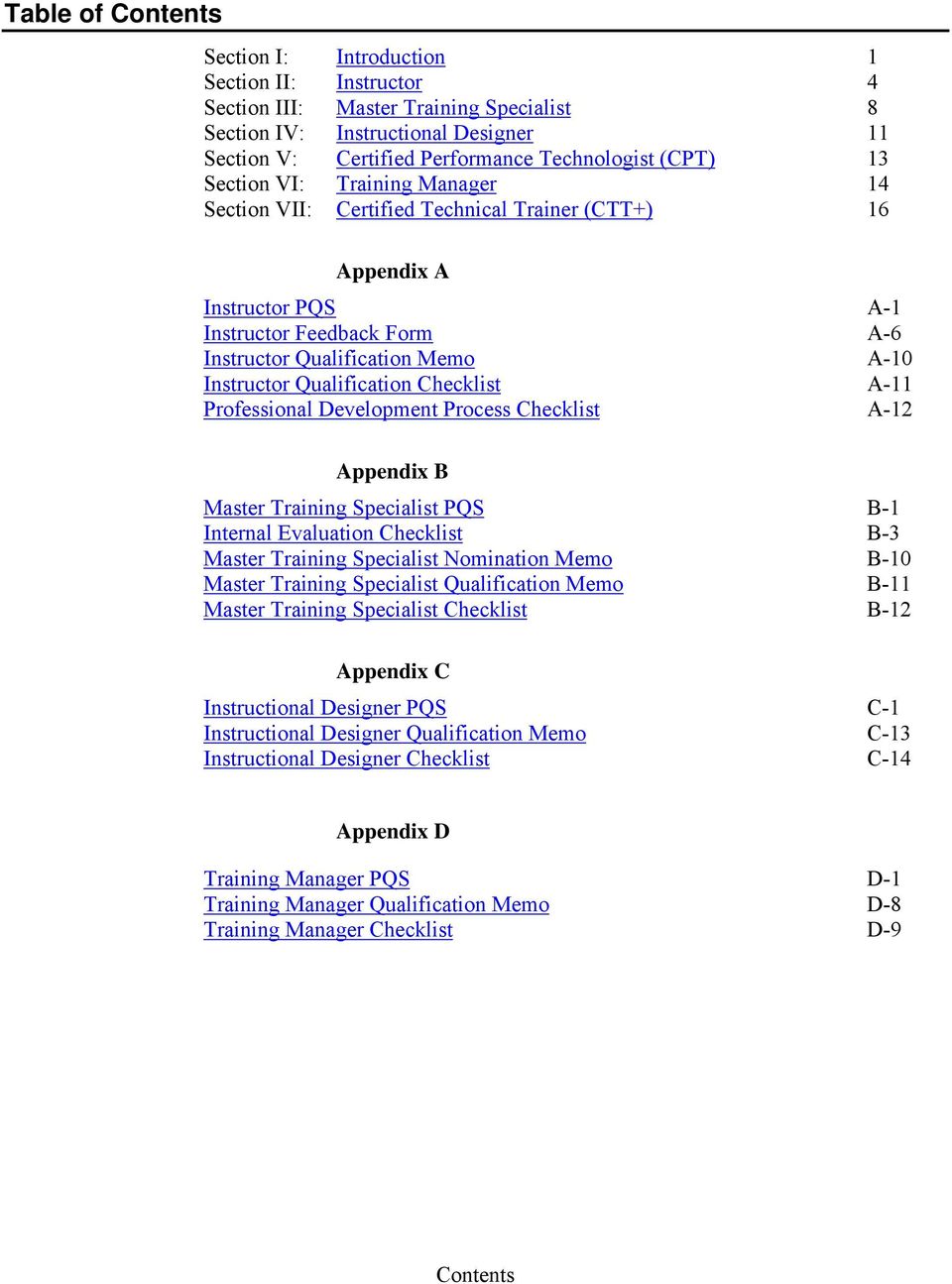
2 Table of Contents Section I: Introduction 1 Section II: Instructor 4 Section III: Master Training Specialist 8 Section IV: Instructional Designer 11 Section V: Certified Performance Technologist (CPT) 13 Section VI: Training Manager 14 Section VII: Certified Technical Trainer (CTT+) 16 Appendix A Instructor PQS A-1 Instructor Feedback Form A-6 Instructor Qualification Memo A-10 Instructor Qualification Checklist A-11 Professional Development Process Checklist A-12 Appendix B Master Training Specialist PQS B-1 Internal Evaluation Checklist B-3 Master Training Specialist Nomination Memo B-10 Master Training Specialist Qualification Memo B-11 Master Training Specialist Checklist B-12 Appendix C Instructional Designer PQS C-1 Instructional Designer Qualification Memo C-13 Instructional Designer Checklist C-14 Appendix D Training Manager PQS D-1 Training Manager Qualification Memo D-8 Training Manager Checklist D-9 Contents
3 SECTION I: Introduction Introduction This SOP describes the qualification requirements for the five professional training billets in the Coast Guard Training System: 1. Instructors 2. Master Training Specialists 3. Instructional Designers 4. Certified Performance Technologists 5. Training Managers Instructors are Coast Guard officers, enlisted, and civilians who: Implement lesson plans in various training environments. Manage all aspects of the learning environment, including environmental factors, activities, testing, etc. Although not required by normal business standards, the Coast Guard often selects persons for these positions that have performed exceptionally well in the operational context appropriate for the training content. Instructors are expected to adhere to the highest standards of conduct, military bearing, and judgment. Master Training Specialists are Instructors who have achieved a level of excellence above and beyond that of the basic Instructor by: Updating and improving their professional knowledge and skills. Specifying the instructional design process. Evaluating instructional effectiveness. Master Training Specialists are often relied upon to provide subject matter expertise to instructional design projects. Master Training Specialists also play a key role as advisors, mentors, and role models for our instructors; they set the example of loyalty to the Coast Guard and professional decorum. Instructional Designers are assigned to complete the various tasks involved in the design, development and evaluation of our training programs. Being an Instructor is not a prerequisite to being an Instructional Designer. The Instructional Designer is responsible for: Choosing appropriate learning activities. Developing unit lesson plans. Designing and conducting training evaluations. 1

4 SECTION I: Introduction Introduction (Continued) Certified Performance Technologists are involved in all aspects of Coast Guard training programs, including: Analysis Design Development Implementation Evaluation Management The Coast Guard Performance Technology post-graduate program is intended to develop officers and enlisted personnel into Performance Technologists. Many of our Performance Technologists are civilian personnel with equivalent education and/or experience. Training Managers are responsible for: Development, monitoring and attainment of budget and resource requirements (staffing & capital) for CG training programs. Development and management of course curriculum outlines, and for inclusion of all requirements therein. Purpose This SOP describes the competencies for the various levels of professional training billets and mandates the qualification requirements for all personnel assigned to them. Though the qualifications in this SOP may be mandated as prerequisites to hiring contracted personnel, this SOP is intended to apply only to Coast Guard active duty and civilian personnel. Background Members of the Coast Guard Training System play vital and complex roles in the performance of our personnel. We can no longer take successful members from the field and expect them to become successful trainers "overnight," simply due to their billet assignment. Through this volume of the SOP, the Coast Guard has promulgated the competencies required by various Training System billets. All personnel must demonstrate their ability to perform each competency listed in order to become qualified. 2

5 SECTION I: Introduction Copyright Statement The competencies and performance standards for Instructors, Instructional Designers, and Training Managers in this SOP are reprinted with permission of the International Board of Standards for Training, Performance and Instruction (IBSTPI). Permission received in International Board of Standards for Training, Performance and Instruction. Created for IBSTPI by Xuemei Wang. The term "Certified Performance Technologist" is used with permission of the International Society for Performance Improvement (ISPI). Competencies Competencies for each level of qualification are applicable at any CG training command to ensure that qualifications are transferable; however, units may add local job qualification requirements (JQRs) as necessary. Unit-level requirements should be used sparingly and reviewed annually. 3

6 SECTION II: Instructor Introduction Instructors have the majority of contact with learners in the resident training environment, and are critical to the success of the Training System. Instructors are primarily responsible for implementing learning activities, but may also be involved in other training management efforts. A standardized instructor qualification program will ensure a thorough and expedient training process for personnel assigned to instructor billets, and allow an instructor from one training command to be recognized as an instructor upon transfer to another training command. This section provides guidelines for basic instructor professional development to be incorporated at all training commands. Instructor Competencies The U.S. Coast Guard Instructor Qualification and Professional Development process is based on the instructor core competencies published by the International Board of Standards for Training Performance and Instruction (IBSTPI) and pertains to anyone not qualified within the previous 5 years. Those beyond the 5-year requirement may complete a modified qualification at the discretion of the school chief. Qualification Process Prospective instructors shall qualify within 6 months of reporting. School and Branch Chiefs shall qualify instructors only after they have completed all qualification requirements. Once qualified, the School and Branch Chiefs shall encourage continued professional development. To facilitate an organized approach to the instructor designation process, a fivephase program has been established: Phase I involves completing the Instructor Development Course (IDC) or alternate requirement. Phase II involves completing the Instructor Personnel Qualification Standards (PQS). Phase III involves receiving a minimum of three satisfactory instructor evaluations from different evaluators. The member s School Chief (or equivalent) must complete the third and final evaluation. Phase IV involves completing additional School or Branch Chief requirements; e.g., subject matter content, techniques, or methods of instruction. Phase V involves being recommended by the chain-of-command, designated via memo. 4

7 SECTION II: Instructor Phase I Instructor Development Course (IDC) Within 3 months of an Instructor reporting aboard, the School Chief shall submit an Electronic Training Request to the Training Quota Management Center to schedule prospective Instructors to attend IDC. Previous completion of IDC (within 5 years) negates this requirement. Phase I (Continued) Phase II (Personnel Qualification Standards) Phase III Instructor Evaluations In the event that IDC quotas are not readily available, the unit may conduct a workshop to prepare prospective instructors. The workshop should be facilitated by a prospective Master Training Specialist (MTS) to the satisfaction of the Command MTS. The workshop will provide an introduction to lesson development and instructor competencies, and will provide an opportunity for practice and feedback via a practical exercise. The exercise should require prospective instructors to design and deliver a 15-minute training module demonstrating the appropriate use of performance-based learning objectives, Gagne s Nine Events of instruction or ABCD 6-Ps (as appropriate), and the IBSTPI instructor competencies. This workshop would also provide the prospective MTS a greater opportunity for mentorship and would count towards completion of the PQS requirements of MTS qualification Phase III. Each Instructor PQS competency has associated performance criteria listed with it. These performance criteria are observable and measurable actions. Successful completion indicates competence in the task. A qualified Instructor must initial off each block of the PQS. The PQS is contained in Appendix A of this SOP. The Instructor Feedback Form (IFF) (see Appendix A) is to be completed during actual classroom presentations. Prospective instructors must receive at least three satisfactory evaluations. Instructor evaluations are considered satisfactory when all core competency performances are marked 3. Actions required for core competencies are as follows: Marks of 1 and 2 define performance below the standard of an instructor. Marks of 3 define the minimum standard of an instructor. The intent of the evaluation process is to provide feedback with an accompanied development plan for prospective instructors to show improvement on subsequent evaluations. This is especially true if the same lesson plan presentation is evaluated for a second or third time. Phase IV Additional School Chief Requirements School and Branch Chiefs must ensure that prospective instructors are competent in subject content. Prospective instructors may be required to complete additional requirements as deemed necessary by School Chiefs. 5

8 SECTION II: Instructor Phase IV Additional School Chief Requirements (Continued) These additional requirements may include, but are not limited to: Specific training methods used in particular schools, such as role playing. Table-top exercises, oral and in-basket scenarios. Operation and safety requirements of training aids/equipment utilized during a course of instruction. Additional instructor workshops. Phase V Chain-of- Command Recommendation The School Chief shall forward the following documents to the Branch Chief/Training Officer for signature: A Qualification Memo (see Appendix A) to the member stating that he or she has successfully completed all qualification requirements. Instructor PQS. unit JQR/School Chief performance requirements (if applicable). Three required instructor evaluations. Once signed, the Branch Chief/Training Officer shall provide a copy of the qualification letter to the Servicing Personnel Office (SPO) for assignment of the JC competency code in accordance with the U.S. Coast Guard Competency Management System Manual, COMDTINST M (series). Maintaining Instructional Skill Qualifying as an instructor does not mark the end of individual instructor development. All Coast Guard instructors shall maintain their instructional skills and pursue higher skill development. Professional Development Process Checklist Qualified instructors are encouraged to complete all essential and optional workshops/courses/topics listed on the Professional Development Process Checklist (see Appendix A). The checklist outlines a general development process that instructors can follow as they advance in skill and knowledge levels within the training community. School Chiefs, Course Managers, and Supervisors may also use the checklist to identify future needs and begin developing strategies for acquiring the necessary skills within their staff. 6

9 SECTION II: Instructor Inability To Qualify As An Instructor The goal of the Coast Guard instructor development program is to qualify all candidates within 6 months of their arrival. When prospective instructors fail to qualify within 1 year of their arrival, School Chiefs shall follow the guidance in Personnel Manual, COMDTINST M (series), Art. 4.E.4, Reassigning Members Unsuited for Special Duty. 7

10 SECTION III: Master Training Specialist Master Training Specialist Master Training Specialists (MTSs) are Instructors who have achieved a level of excellence above and beyond that of the basic instructor by: Updating and improving their professional knowledge and skills. Specifying the instructional design process. Evaluating instructional effectiveness. Master Training Specialists are often relied upon to provide subject matter expertise to instructional design projects. Master Training Specialists also play a key role as advisors, mentors, and role models for our instructors; they set the example of loyalty to the Coast Guard and professional decorum. Copyright Statement The competencies and performance standards in this section are used with permission of the International Board of Standards for Training, Performance and Instruction International Board of Standards for Training, Performance and Instruction. Created for IBSTPI by Xuemei Wang. Master Training Specialist Competencies The U.S. Coast Guard Master Training Specialist Qualification and Professional Development process is based on four core competencies published by the International Board of Standards for Training Performance and Instruction (IBSTPI). Qualification Process As an organization, the Coast Guard seeks to build the skills, behaviors, and capacities of professional educators. MTS designation is one way to recognize outstanding individual effort and fosters greater command training professionalism. It is highly recommended that all instructors achieve the MTS designation via the prescribed path. To facilitate an organized approach to the designation process, a five-phase program has been established: Phase I involves receiving a satisfactory Instructor Feedback Form (IFF) (See Appendix A) from a MTS. Phase II involves completion of the MTS Personnel Qualification Standards (PQSs). Phase III involves being nominated for MTS by the Branch Chief. Phase IV involves earning the Command MTS Board s recommendation by passing an oral board and being designated via memo. 8

11 SECTION III: Master Training Specialist Phase I Evaluation Phase I consists of receiving a satisfactory evaluation conducted by a Master Training Specialist from outside the candidate s department using the IFF. All competencies must receive a grade of satisfactory and the evaluator comments section of the form must contain a positive statement recommending MTS designation. Phase II Competencies Phase III Nomination The Master Training Specialist must complete the Master Training Specialist PQS (see Appendix B) that supports the following competencies: Update and improve one s professional knowledge and skills Comply with established ethical and legal standards Specify the instructional design process Evaluate instructional effectiveness The prospective MTS must be nominated by Branch Chief in a memo (see Appendix B). Phase IV MTS Oral Board & Recommendation The Command MTS Board will be comprised of three Master Training Specialists - the designated Command Master Training Specialist Coordinator (Chairperson) and two additional MTSs. The Command MTS Board will meet quarterly to interview prospective MTS candidates and recommend them to the Commanding Officer (CO) for qualification. The MTS Board will verify the completeness of each candidate s package before the Coordinator schedules these oral boards. At the board, each member of the Command MTS Board will ask a series of four questions from any MTS competency contained in SOPs for the Coast Guard s Training System or other applicable Coast Guard training materials. Each Board member will score candidates on a scale of 1 to 5 for each question asked. A maximum of 20 points are achievable from each board member s interview, yielding an aggregate total of 60 possible points. Nominees must score a minimum of 45 total points to pass the board. The MTS Board will forward its recommendation for final approval to the CO via the Training Officer (TO). The MTS qualification will be documented in a qualification memo to the member (see Appendix B). The MTS Board will forward its recommendation for final approval to the CO via the TO. Re-examination by MTS Board Personnel who do not satisfy the requirements of the Command MTS Board must undergo a 30-day remediation period before requesting another oral board. 9

12 SECTION III: Master Training Specialist MTS Coordinator Responsibilities The Command MTS Coordinator will: Be designated by the TO to serve a minimum of 1 year. Lead the Board. Be responsible for the management, development, and effective performance of the Board and the overall MTS program. Schedule, coordinate, and conduct quarterly MTS Boards. Provide necessary training to prospective MTS candidates. Supervise the final oral examination of each candidate. Forward the MTS Board recommendation to the Commanding Officer via the TO. Schedule and coordinate presentation ceremonies. Nominate a successor for the MTS Coordinator when relieved. MTS Board Member Responsibilities Master Training Specialist Board Members will: Provide necessary training to prospective MTS candidates. Ensure the MTS materials are up-to-date. Review prospective candidate packages for correctness and completeness. Participate in the oral board of each candidate. Track all MTS-related documentation. 10

13 SECTION IV: Instructional Designer Introduction The abilities of instructional designers are essential to the quality of training and the successful transfer of skills and knowledge to the learner. Regardless of the delivery media, the underlying instructional approach and materials must be competently designed in order to close performance gaps or take advantage of new opportunities. Instructional designers are expected to examine the results of performance analyses and develop instructional solutions to performance issues that are caused by a lack of knowledge or skills. It is only fitting that we have a standardized professional development program in place to support these instructional design efforts. References a. Instructional Design Competencies: The Standards (Third Edition). Richey, Rita, March b. Coast Guard Course Designer Course, CG Instructional Systems School c. SABA Optimizing Human Performance, Front-End Analysis (FEA) Course d. SABA Training Development Course e. SABA Training Design Course f. USCG Training System SOP for Analysis g. USCG Training System SOP for Evaluation h. USCG Training System SOP for Job Aids i. USCG Training System SOP for Resident Instruction j. USCG Training System SOP for Curriculum Outlines k. USCG Training System SOP for Performance Qualification Guide l. USCG Training System SOP for Non-Instructional Interventions Copyright Statement The competencies and performance standards in this section are used with permission of the International Board of Standards for Training, Performance and Instruction (IBSTPI) International Board of Standards for Training, Performance and Instruction. Created for IBSTPI by Xuemei Wang. 11

14 SECTION IV: Instructional Designer Instructional Designer Competencies The U.S. Coast Guard Instructional Designer Qualification and Professional Development process is based on 23 core competencies published by the International Board of Standards for Training Performance and Instruction (IBSTPI). Qualification Process As an organization, the Coast Guard seeks to build the skills and knowledge of personnel through training. The process for qualification as an Instructional Designer is as follows: Phase I involves assignment to instructional design duties for a course that requires modification. Phase II involves completion of the Coast Guard Course Designer Course (CDC), which is based on the ADDIE (Analysis, Design, Development, Implementation, and Evaluation) model of instructional design methodology, or complete the Saba Accomplishment-Based Curriculum Development (ABCD) course. Phase III involves completion of the Instructional Design PQS. Basic instructional design competencies are identified for entry-level course designers. Other competencies within each domain are recommended for advanced instructional designers or training managers. Phase IV involves recommendation by the chain-of-command and designation via memo. Phase I ISD Assignment The prospective Instructional Designer must be assigned a course that requires modification. Phase II CDC or ABCD Phase III Instructional Designer PQS The prospective Instructional Designer must complete the Coast Guard Course Design Course, which is based on the ADDIE (Analysis, Design, Develop, Implement and Evaluation) model of instructional design methodology, or complete the Saba Accomplishment-Based Curriculum Development course. Each Instructional Designer PQS competency has associated performance criteria listed with it. These performance criteria are observable and measurable actions. Successful completion indicates competence in the task. The Instructional Designer PQS is contained in Appendix C of this SOP. Phase IV Recommendation The prospective Instructional Designer s School Chief/Branch Chief will prepare a qualification memo and submit it, along with the CDC certificate and completed PQS, to the Branch Chief/Training Officer for signature. 12

15 SECTION V: Certified Performance Technologist (CPT) Introduction The pursuit of Certified Performance Technologist (CPT) designation is strongly encouraged for personnel assigned to the duties of a Performance Technology Center and FORCECOM (FC-51), or as designated by a Training Officer or FORCECOM (FC-51). The term used in the section of the SOP is "Performance Technologist" as defined and accepted by the International Society for Performance Improvement (ISPI) and the American Society for Training and Development (ASTD). Within the Coast Guard Training System, to be referred to as a Performance Technologist automatically indicates certification by ISPI (in affiliation with ASTD). Other terms related, but not synonymous, are analyst, performance consultant, quality performance consultant, or evaluator. Reference a. ISPI s certification website, Copyright Statement The competencies and performance standards in this section are used with permission of the International Society for Performance Improvement (ISPI). CPT Certification Requirements Requirements for designation as a CPT can be found at The Performance Technology Center (PTC) at Training Center Yorktown will maintain liaison with the ISPI staff regarding the certification of Coast Guard personnel and provide advice and assistance to prospective CPTs. The certification process requires 3 years of Performance Technology experience and the completion of projects that demonstrate adherence to the ISPI standards; therefore, it is possible for Coast Guard personnel to earn this certification over the course of a successful tour of duty at a Training Center, at the PTC, or FORCECOM (FC-51). 13

16 SECTION VI: Training Manager Introduction The Training Manager is responsible for overseeing all training activities in their operating departments. This responsibility includes determining the need for training in various subject areas, developing plans, ensuring the quality of the training, and evaluating the results in terms of improved performance. It is only fitting that we have a standardized professional development program in place to enhance these efforts. References a. Training Manager Competencies: The Standards (Third Edition). Foxon, M; Richey, R; Roberts, Robert; Spannaus, T., March b. Coast Guard Course Designer Course, CG Instructional Systems School c. SABA Optimizing Human Performance, Front-End Analysis (FEA) Course d. SABA Training Development Course e. SABA Training Design Course f. USCG Training System SOP for Analysis g. USCG Training System SOP for Evaluation h. USCG Training System SOP for Job Aids i. USCG Training System SOP for Resident Instruction j. USCG Training System SOP for Curriculum Outlines k. USCG Training System SOP for Performance Qualification Guide l. USCG Training System SOP for Non-Instructional Interventions Copyright Statement The competencies and performance standards in this section are used with permission of the International Board of Standards for Training, Performance and Instruction (IBSTPI) International Board of Standards for Training, Performance and Instruction. Created for IBSTPI by Xuemei Wang. 14

17 SECTION VI: Training Manager Training Manager Competencies The U.S. Coast Guard Training Manager Qualification and Professional Development process is based on 10 core competencies published by the International Board of Standards for Training Performance and Instruction (IBSTPI). Qualification Process As an organization, the Coast Guard seeks to build the skills, behaviors, and capacities of professional educators. Training manager designation is one way to recognize outstanding individual effort and foster greater command training professionalism. It is strongly recommended that all personnel in a training supervisory position achieve the Training Manager designation via the prescribed path. Phase I involves serving as a Training Manager for at least 1 year. Phase II involves completion of the Training Manager Personnel Qualification Standards (PQS) and Job Qualification Requirements (JQRs), if applicable. Phase III involves recommendation by the Training Manager s chain-ofcommand. Phase I Training Manager Experience Phase II Training Manager PQS/JQR The candidate must have served in the capacity of Training Manager for at least 1 year. Each Training Manager PQS competency has associated performance criteria listed with it. These performance criteria are observable and measurable actions. Successful completion indicates competence in the task. The Training Manager PQS is located in Appendix D of this SOP. Note: Only designated personnel may sign Training Manager PQS line items. The TO designates personnel who can sign the PQS for each qualification. Phase III Command Recommendation Upon completion of the required period of service and applicable PQS/JQR, the prospective Training Manager s supervisor will forward a qualification memo up the chain-of-command for signature by the member s Reporting Officer/Rating Official (as appropriate). 15

18 SECTION VII: Additional Certification Certified Technical Trainer (CTT+) Introduction Qualified instructors are highly encouraged to seek certification as a Certified Technical Trainer (CTT+). The CTT+ program is a cross-industry certification program available to all training professionals who provide technical instruction and education. Procedures Coast Guard instructors who pursue CTT+ certification must first qualify as an instructor and receive the "JC" qualification code. The CTT+ certification is divided into two areas of evaluation: a computer-based test and an instructor skills assessment that is videotaped. Knowledge Examination The CTT+ knowledge examination consists of 95 multiple-choice questions; candidates have 90 minutes to complete the examination and answer several biographical questions. Skills Assessment (Video) The CTT+ skills assessment is based on a 20-minute videotape submitted by candidates of their actual instructional performance. Professionals trained to evaluate the instructor s performance review the videotape. In addition to the videotape, the candidate must also complete and submit written videotape documentation, to provide additional information about the instructional performance. Additional information Additional information may be obtained by calling (630) or at 16

19 Appendix A Contents Instructor Personnel Qualification Standards (PQS) A-1 Instructor Feedback Form A-6 Instructor Qualification Memo A-10 Instructor Qualification Checklist A-11 Professional Development Process Checklist A-12 Appendix A

20 Instructor PQS Name: Unit: Division / Branch: Reported: Competency 1. Communicate effectively. a. Vary pitch, tone, inflection, and rate of speech. b. Use proper spelling, grammar, punctuation, and language appropriate for the students level of understanding. c. Use hand gestures and body motions to enhance the teaching points. d. Use eye contact appropriately and effectively. e. Maintain a comfortable distance from students. f. Use pauses appropriately to allow for student reflection and comprehension. Competency 2. Plan instructional methods and materials. a. Plan or modify instruction to accommodate for students experiences. b. Personalize lesson plan to check for understanding. c. Select (or adapt) instructional methods, strategies, and presentation techniques to accommodate learning styles. d. Adapt lesson plan to accommodate different instructional settings. e. Create and publish course agenda for students. f. Sequence the lesson plan in a logical order. A-1

21 Instructor PQS Competency 3. Prepare for instruction. a. Rehearse lesson plan timing with another qualified instructor. b. Make available all necessary resources, supplies, and reference materials to students. c. Confirm logistical arrangements and equipment readiness prior to class convening. d. Ensure environment is set up and conducive to learning. e. Test equipment operation and functionality prior to class convening. f. Eliminate (or minimize) internal and external distractions that prohibit learning and performance. g. Provide a safe and clean learning environment. Competency 4. Comply with established ethical and legal standards. a. Respect student s rights to confidentiality and anonymity in safeguarding personal information. b. Avoid conflicts of interest with the staff and students. c. Respect and comply with intellectual property laws. Competency 5. Establish and maintain professional credibility. a. Conform to Coast Guard Uniform Standards (or appropriate civilian attire). b. Demonstrate subject-matter expertise. c. Recognize and acknowledge mistakes and provide opportunities to correct them. A-2
22 Instructor PQS Competency 6. Stimulate and sustain learner motivation and engagement. a. Match learning outcomes (expectations) to student and course goals. b. Plan (and deliberately use) feedback and positive reinforcement during delivery of instruction. c. Use stories, analogies, and examples to gain and sustain student attention. Competency 7. Manage an environment that fosters learning and performance. a. Introduce oneself, co-instructors, and students at the beginning of the course (if necessary). b. Present clear expectations and ground rules for learning and interaction. c. Address undesirable behavior effectively, appropriately, and timely. d. Resolve student conflicts appropriately and timely. e. Manage group-paced and individual participation. f. Manage instructional time effectively and avoids digressions. g. Provide a positive learning environment for all students. Competency 8. Demonstrate effective presentation/facilitation skills. a. Use a lesson plan to deliver instruction. b. Present key ideas and concepts in a variety of ways. c. Provide examples to clarify meanings or teaching points. d. Involve students in presentations for discussion, questions, and reflection. e. Use examples, anecdotes, stories, analogies, and humor to reinforce teaching points. f. Use props and teaching aids effectively and appropriately. A-3
23 Instructor PQS Competency 9. Use instructional methods appropriately. a. Implement a variety of training methods. b. Manage the group dynamics associated with each method. c. Employ training techniques appropriate to methods and training situations prescribed. Competency 10. Use media and technology to enhance learning and performance. a. Use visual aids that support the objective(s) and teaching points. b. Use visual aids that are simple and easy to read and understand. c. Incorporate the use of job aids, handouts, or other printed materials in the learning environment. d. Incorporate different media to appeal to all learning styles. e. Establish a contingency plan in the event media fails during instruction. Competency 11. Demonstrate effective questioning techniques. a. Ask clear and relevant questions. b. Promptly follow up on student questions and concerns. c. Use a variety of question types and delivered at various levels. d. Direct and redirect questions effectively. e. Build responses to questions in current (or subsequent) learning environments. f. Repeat, rephrase, and restore questions from students. g. Provide positive reinforcement to student responses. h. Provide opportunity to involve all students in discussions. A-4
24 Instructor PQS Competency 12. Provide clarification and feedback. a. Provide clear, timely, relevant, and specific feedback. b. Provide opportunities for students to request clarification to teaching points. c. Assist students in giving and receiving feedback. d. Provide feedback targeted to the performance (and not to the student). e. Promote peer-to-peer feedback. Competency 13. Promote retention and transfer. a. Encourage students to elaborate on concepts and ideas. b. Provide opportunities to integrate new knowledge and practice new skills. c. Provide opportunities for reflection, review, and self-guided learning. d. Provide opportunities to practice in realistic settings. Competency 14. Assess learning and performance. a. Communicate assessment criteria to students. b. Monitor individual and group performance during practice and assessment. c. Provide students with opportunities for self-assessment. d. Assess student performance outcomes. e. Provide opportunities for remediation. A-5
25 Instructor: Course/Lesson Title: Instructor Feedback Form Rev. Dec 2005 Evaluator: : Start: Stop: This tool is designed to assist in the collection of data that assesses an instructor in fourteen competency areas. The table below explains the rating scores and the appropriate actions to be taken by the instructor who receives the feedback. Refer to Tips for Effective Use for additional information on using the form. Rating Measures Action Required by the Instructor 4 Demonstrated mastery, could serve as a model for this component. None consider mentoring colleagues who seek improvement. 3 Demonstrated competency. None consider seeking ways to continually improve. 2 Demonstrated some competency but needs improvement. Focus on improving per recommendations. 1 Did not demonstrate at all. Seek assistance and make improvements per recommendations before next class convenes. Provide detailed feedback and recommendations on the Instructor Improvement Plan for any ratings of 2 or below. Instructor Competency Instructor Effectiveness Prepares for Instruction (#3) Rehearses lesson plan timing with another qualified instructor. Makes available all necessary resources, supplies, and reference materials to students. Confirms logistical arrangements and equipment readiness prior to class convening. Ensures environment is set up and conducive to learning. Tests equipment operation and functionality prior to class convening. Eliminates (or minimizes) internal and external distractions that prohibit learning and performance. Provides a safe and clean learning environment. Plans Instructional Methods and Materials (#2) Plans or modifies instruction to accommodate for students experiences. Personalizes lesson plan to check for understanding. Lesson plan follows logical sequence. Selects (or adapts) instructional methods, strategies, and presentation techniques to accommodate learning styles. Adapts lesson plan to accommodate different instructional settings. Creates and publishes course agenda for students. Complies with Ethical and Legal Standards (#4) Respects student s rights to confidentiality and anonymity in safeguarding personal information. Avoids conflicts of interest with the staff and students. Respects and complies with intellectual property laws. Communicates Effectively (#1) Varies pitch, tone, inflection and rate of speech. Uses proper spelling, grammar, punctuation, and language that fit the students level of understanding. Uses hand gestures and body motions to enhance the teaching points. Uses eye contact appropriately and effectively. Maintains a comfortable distance from students. Uses pauses appropriately to allow for student reflection and comprehension. Establishes and Maintains Professional Credibility (#5) Conforms to Coast Guard Uniform Standards (or appropriate civilian attire). Demonstrates subject-matter expertise. Recognizes and acknowledges mistakes and provides opportunity to correct them. Stimulates and Sustains Learner Motivation and Engagement (#6) Matches learning outcomes (expectations) to student and course goals. Plans and deliberately uses feedback and positive reinforcement during delivery of instruction. Uses stories, analogies, and examples to gain and sustain student attention. A-6
26 Instructor Feedback Form Rev. Dec 2005 Manages an Environment that Fosters Learning and Performance (#7) Introduces oneself, co-instructors, and students at the beginning of the course (if necessary). Presents clear expectations and ground rules for learning and interaction. Addresses undesirable behavior effectively, appropriately, and timely. Resolves student conflicts appropriately and timely. Manages group-paced and individual participation. Manages instructional time effectively and avoids digressions. Provides a positive learning environment for all students. Demonstrates Effective Presentation /Facilitation Skills (#8) Uses a lesson plan to deliver instruction. Represents key ideas and concepts in a variety of ways. Provides examples to clarify meanings or teaching points. Involves students in presentations for discussion, questions, and reflection. Uses examples, anecdotes, stories, analogies, and humor to reinforce teaching points. Uses props and teaching aids effectively and appropriately. Uses Instructional Methods Appropriately (#9) Implements a variety of training methods. Manages the group dynamics associated with each method. Employs training techniques appropriate to methods and training situations prescribed. Uses Media & Technology to Enhance Learning (#10) Uses visual aids that support the objective(s) and teaching points. Uses visual aids that are simple and easy to read and understand. Incorporates the use of job aids, handouts, or other printed materials in the learning environment. Incorporates different media to appeal to all learning styles. Establishes a contingency plan in the event media fails during instruction. Demonstrates Effective Questioning Techniques (#11) Asks clear and relevant questions. Promptly follows up on student questions and concerns. Uses a variety of question types and delivered at various levels. Directs and redirects questions effectively. Builds responses to questions in current (or subsequent) learning environments. Repeats, rephrases, and restructures questions from students. Provides positive reinforcement to student responses. Provides opportunity to involve all students in discussions. Provides Clarification and Feedback (#12) Provides clear, timely, relevant, and specific feedback. Provides opportunities for students to request clarifications on teaching points. Assists students in giving and receiving feedback. Provides feedback targeted to the performance (and not to the student). Promotes peer-to-peer feedback. Promotes Retention and Transfer of Skills (#13) Encourages students to elaborate concepts and ideas. Provides opportunities to integrate new knowledge and practice new skills. Provides opportunities for reflection, review, and self-guided learning. Provides opportunities to practice in realistic settings. Assesses Learning and Performance (#14) Communicates assessment criteria to students. Monitors individual and group performance during practice and assessment. Provides students with opportunities for self-assessment. Assesses student performance outcomes. Provides opportunities for remediation. A-7
27 Instructor Feedback Form Rev. Dec 2005 Competency Instructor Improvement Plan Improvement Strategies for: Weakness (Δ) Strength (+) A-8
28 Instructor Feedback Form Rev. Dec 2005 Tips for Effective Use Because every training environment is different, and every Instructor brings a different set of skills to the job, it is important to tailor your evaluation session. After reviewing the competencies, focus only on the behaviors the Instructor may need to improve upon. If it is determined that many of the areas need to be addressed, you may consider breaking the feedback sessions into blocks where only a few of the competencies are evaluated at one sitting. If your course is primarily self-paced, you will need to observe the instructor during one-on-one feedback sessions to ensure they are demonstrating the competencies. The behaviors listed can be demonstrated in an Instructor-led lesson, as well as a more self-paced environment. For example, an Instructor needs to be able to use questioning techniques effectively, whether the Instructor is presenting to a group or to an individual. Discuss the evaluation session with the Instructor beforehand. Let the Instructor know your expectations, and ask the Instructor what areas the Instructor would like to improve upon. Rate the effectiveness of the Instructor in each competency area. The scale is from 1 (low effectiveness) to 4 (high effectiveness). All behaviors within each competency do not necessarily need to be demonstrated for the instructor to be effective. In addition, use the comment area to record specific behaviors that are demonstrated or missed, or provide additional comments regarding performance. Prior to evaluation, become familiar with competency descriptions and their associated improvement strategies. These items can be found at the end of this document. A-9
29 Instructor Qualification Memo Commanding Officer United States Coast Guard Training Center Yorktown Yorktown, VA Staff Symbol: xyz Phone: (757) 856-xxxx Fax: (757) 856-xxxx MEMORANDUM 1500 dd mmm yyyy From: To: Subj: Ref: F. M. Last, RANK, USCG CG TRACEN Yorktown (xyz) N. Instructor, RANK, USCG INSTRUCTOR QUALIFICATION (a) Standard Operating Procedures (SOP) for the Coast Guard s Training System, Volume 13 (b) U.S. Coast Guard Competency Management System Manual, COMDTINST M (series) 1. Congratulations! You have met all of the requirements of reference (a) and are hereby designated a qualified Coast Guard Instructor. You are entitled to be assigned the JC competency code in accordance with reference (b). I wish you continued success in your development as a training professional. Semper Paratus! # Copy: SPO Training Record A-10
30 Instructor Qualification Checklist Required Workshops/Courses/Topics /Initials PHASE I Electronic Training Request for Instructor Development Course (IDC). Complete Instructor Development Course/Alternate Workshop PHASE II PHASE III PHASE IV Complete Instructor PQS/JQR. Receive three satisfactory Instructor Feedback Forms: First Second Third Receive Chain-of-Command recommendation. Receive signed Qualification Memo. JC Competency Code issued. A-11
31 Professional Development Process Checklist Required Workshops/Courses/Topics Instructor Development Course (IDC) - Alternate Workshop Instructor Qualification JC Competency code issued Optional Online Workshops/Courses Use of technologies MS Word * Use of technologies MS PowerPoint * Use of technologies MS Outlook * Use of technologies MS Excel * Optional Instructor-Based Workshops Design and preparation of an instructional lesson Preparing and using instructional media Demonstrating appropriate action in the classroom Ethics and Coast Guard core values Communication skills Facilitation 101 Questioning and feedback skills Gaining and maintaining participation Establishing classroom climate that encourages participation Criterion referenced checklist Exercise and games in training Coast Guard Central (CG Central) Recommended Completion Within 3 months Within 6 months /Initials /Initials /Initials CTT+ Qualification Write Instructor Evaluation Reports ** Assemble PQS package for delivery ** * Available free on the Intranet mil/sfweb/index htm ** Skills required for Certified Technical Training (CTT) certification A-12
32 Appendix B Contents Master Training Specialist Personnel Qualification Standards B-1 Internal Evaluation Checklist B-3 Master Training Specialist Nomination Memo B-10 Master Training Specialist Qualification Memo B-11 Master Training Specialist Qualification Checklist B-12 Appendix B
33 Master Training Specialist PQS Name: Unit: Competency 1. Update and improve one s professional knowledge and skills. a. Complete the Course Designer Course (CDC) or Saba ABCD Series. b. Mentor a new instructor using the Coast Guard's Individual Development Plan (IDP). c. Facilitate a MTS workshop. d. Explain the function of the Operations Section (FC-511). e. Explain the function of the Mission Support Section (FC-512). f. Explain the function of the Resource Management Section (FC- 513). g. Explain the function of the Education & Professional Development Section (FC-514) h. Explain the function of the Advanced Distributed Learning Section (FC-515). Competency 2. Comply with established ethical and legal standards. a. Discuss how the Coast Guard's fraternization policy applies to instructors. b. Discuss how the Coast Guard's sexual harassment policy applies to Instructors. c. Discuss the instructor s responsibilities in terms of safety and curriculum. d. Explain the legality of intellectual property including copyright. e. Explain the purpose of a Student Evaluation board B-1
34 Master Training Specialist PQS Competency 3. Specify the instructional design process. a. Explain analysis methods used by the Coast Guard. b. Explain design methods used by the Coast Guard. c. Explain development methods used by the Coast Guard. d. Explain implement methods used by the Coast Guard. e. Explain the contents of a resident course curriculum outline. f. Explain the routing procedures for curriculum development/revision. Competency 4. Evaluate instructional effectiveness. a. Evaluate instructor performance. b. Evaluate the impact of the instructional setting and equipment. c. Explain the purpose of a Level 1 evaluation. d. Explain the purpose of a Level 2 evaluation. e. Explain the purpose of a Level 3 evaluation. f. Explain the purpose of a Level 4 evaluation. g. Conduct a self-assessment on a course task analysis using the Internal Evaluation Checklist. h. Conduct a self-assessment on each terminal performance objective (TPO) in a curriculum outline of a course using the Internal Evaluation Checklist. i. Conduct a self-assessment on job aids in a course using the Internal Evaluation Checklist. j. Conduct a self-assessment on a course performance checklist using the Internal Evaluation Checklist. k. Conduct a self-assessment on an instructor guide using the Internal Evaluation Checklist. l. Conduct a self-assessment on a student guide using the Internal Evaluation Checklist. B-2
35 Internal Evaluation Checklist (Required for MTS Qualification) When we set out to evaluate a course, we seek answers to the following questions: Are TPOs evaluated? Evaluate Terminal Performance Objectives (TPO) during the course of instruction. Evaluate knowledge cognitively (via a written test) if no culminating performance can be identified. True performance objectives should be evaluated at the highest level of simulation possible for each student using well-designed Performance Checklists. Is there a difference between what is written in the course curriculum outline and what is presented by the instructor? In many cases, instructors may present content that is closer to their own experience. In other cases, a group of instructors may choose to teach content and topics not contained in the approved curriculum. Over time, a wide gap (or delta gap ) develops, and without training management intervention, this delta gap threatens the effectiveness of the training. Is there a clear connection to the analysis or qualifications that led to the course? We develop every course of instruction based upon analysis and/or identification of qualifications. Having access to the central management documents, relevant to any course of instruction, builds the context for the effective implementation and management of that course. Is there a clear connection to the specific training-workplace context? Training is a performance intervention. Continuous connectedness to the world-of-work ensures that we are providing training that is relevant to the learner. This assessment reveals any disconnects between the training we are providing and the actual needs of the workforce. How to use the Course Curriculum Assessment Checklist To evaluate a course curriculum, you must complete a thorough review of all curriculum components, e.g., curriculum outlines, instructor guides, student guides, job aids, or evaluations, and the elements therein. This checklist (on the following pages) provides a breakdown of those documents, a list of questions, and criteria to further measure the effectiveness and efficiency of the curriculum components. Each curriculum component is numbered to assist you in compiling final recommendations when you complete this checklist. NOTE: If your command has curriculum checklists that provide this same level of detail, you may use those in place of the ones provided. Applicable References The Checklist makes reference to the following applicable volumes of the Coast Guard Training System Standard Operating Procedures (SOPs): Volume 2: Analysis Volume 3: Evaluation Volume 4: Job Aids Volume 5: Resident Instruction B-3
36 Internal Evaluation Checklist The following table tells you how to record the condition of the curriculum components as you complete your review: IF... THEN... the curriculum component meets the mark a Y in the Y/N block; may also mark a in design criteria the NI block. the curriculum component does not mark an N in the Y/N block and a in the NI meets the design criteria (needs improvement) block; and provide specific comments in the comments section. Curriculum Elements Task Analysis (Vol. 2) Design criteria Y/N NI 1. Is there a current task analysis or front-end analysis (FEA) on file? 2. Does each FEA/task analysis describe each task to a level of detail sufficient to reveal generalizations and discriminations? 3. Is the level of detail in each task appropriate for someone who has not yet performed the task, i.e., skills and knowledge? Comments: Curriculum Elements Terminal Performance Objectives (TPO) (Vols. 2, 3) Comments: Design criteria Y/N NI 1. Are the job performance qualifications (or job task analysis) current? 2. Does each terminal performance objective (TPO) in the curriculum outline state, as closely as practical, the actual task output, conditions, and standards as expected for the task to be performed on the job? 3. Does the TPO state the behavior verb and output produced as a result of successful completion of the task? B-4
37 Internal Evaluation Checklist Curriculum Elements Terminal Performance Objectives (TPO) (Vols. 2, 3) (Continued) Design criteria Y/N NI Does the TPO list, as appropriate: 4. Conditions that match as closely as practical the conditions found on the job? 5. Cue (or cues) that signal the performer to act? 6. Tools and equipment used to execute the task? 7. References, job aids, and assistance used to execute the task? 8. A range of conditions typically found on the job? 9. Any restrictions placed on the execution or its environment? Does the TPO, as appropriate: 10. Match the standards expected on the job? 11. Avoid words open to varying interpretation? 12. List only the criteria that separate acceptable performance from unacceptable? 13. List the observable characteristics of the task output? 14. List the observable steps if the procedure is part of the performance checklist? 15. Are the methods and media appropriate for the objectives? 16. Are TPOs being measured through practical exercise, written test, quizzes, etc.? 17. Is the performance level of practical exercise the same as the final evaluation? Comments: B-5
38 Internal Evaluation Checklist Curriculum Elements Job Aids (Vol. 4) Design criteria Y/N NI 1. Is there a job aid analysis on file for each TPO? 2. If appropriate, is there a job aid developed according to the task analysis/front end analysis (FEA)? 3. Does each job aid conform to the standards described in the Job Aid SOP? Comments: Curriculum Elements Performance Checklists (Vol. 2, 3) Design criteria Y/N NI 1. Is there a performance checklist for each TPO in the curriculum outline? 2. Does the performance checklist contain no more (and no less) cues than will be present on the job? 3. Does the performance checklist describe precisely each characteristic that meets the criteria of the task s output? 4. Is each characteristic described so that performance to standards results in Yes being checked? 5. If the performance checklist includes a procedure as well as an output, is each step numbered and listed on the checklist? 6. If the performance checklist involves a procedure as well as an output, is each step described as one would perform to standards? Do the instructions on the performance checklist include the following categories of information, as appropriate: 7. Equipment and resources required for checking the performance 8. Assistance allowed for the performer 9. Tools and references allowed for the performer 10. Verbatim instructions to be read to (or by) the performer 11. Remedial procedures to assign to the performer, based on specific errors in performance Comments: B-6
39 Internal Evaluation Checklist Curriculum Elements Instructor Guide (Vols. 3, 5) Design criteria Y/N NI 1. Is each TPO reflected in the instructor guide? 2. Does the TPO in the instructor guide match the TPO in the curriculum outline and the criteria in the TPOs performance checklist? 3. Does each instructor guide serve as a job aid on how to facilitate the learning objectives and complete the performance checklist? 4. Does the instructor guide provide cues to the instructor about when and how to use instructional materials, training aids, job aids, special tactics, and the performance checklist? 5. Throughout the instructor guide, are the instructions written in sufficient detail so the instructor will not omit key points? 6. Does each instructor guide include the complete performance checklist? 7. If developed according to Course Designer Course guidelines, does each instructor guide contain Gagne's Nine Instructional Events: a. Gaining attention b. Informing learners of the objective c. Stimulating recall of prior learning d. Presenting the stimulus e. Providing learner guidance f. Eliciting performance g. Providing feedback h. Assessing performance i. Enhancing retention and transfer j. Safety precautions and arrangements k. Does the instructor guide contain notes that are clear and concise, so that any instructor can use the instructor guide to conduct successful training? Comments: B-7
40 Internal Evaluation Checklist Curriculum Elements Instructor Guide (Vols. 3, 5) (Continued) Comments: Design criteria Y/N NI 8. If developed according to ABCD guidelines, does each instructor guide have the Six Ps embedded? a. Prerequisites (If applicable) b. Preview (i.e., big picture context ) c. Prime (i.e., demonstration) d. Prompt (N/A for job-aided tasks) e. Perform (N/A for job-aided tasks) f. Practice and feedback 9. Does the demonstration in the instructor guide show or tell the student the stimulus (or stimuli) for each response? 10. Does the instructor guide describe classroom preparation requirements, such as: a. How to reserve classrooms b. Tools/equipment (and where to obtain) c. Audiovisual or multimedia equipment (and where to obtain) d. Student materials (and where to obtain) e. How to set up classrooms f. Pre-work required of the students and how to create the assignment g. Safety precautions and arrangements h. Does the instructor guide contain notes that are clear and concise, so that any instructor can use the instructor guide to conduct successful training? B-8
41 Internal Evaluation Checklist Curriculum Elements Student Guide (Vol. 5) Design criteria 1. Does the level of simulation in each final practice exercise match the level of simulation on the related performance checklist? 2. Is each student guide written using a structured writing format as outlined in the Resident Training SOP? 3. When addressing task performance, does each student guide use job aid methodology? 4. To the extent possible, does each student guide use graphics directly related to performing the task and needs of the target audience? 5. Are the student guides easy to read (e.g., graphics, sentence structure)? 6. Is there adequate space in the student guide for note taking? 7. Is the A/V equipment sufficient to promote understanding of the objective? Y/N NI Comments: B-9
42 Master Training Specialist Nomination Memo Commanding Officer United States Coast Guard Training Center Yorktown Yorktown, VA Staff Symbol: xyz Phone: (757) 856-xxxx Fax: (757) 856-xxxx MEMORANDUM 1500 dd mmm yyyy From: To: Thru: Subj: Ref: F. M. Last, RANK, USCG {Branch Chief} CG TRACEN Yorktown (xyz) Command MTS Board Command MTS Coordinator NOMINATION FOR MASTER TRAINING SPECIALIST (c) Standard Operating Procedures (SOP) for the Coast Guard s Training System, Volume 13 (d) U.S. Coast Guard Competency Management System Manual, COMDTINST M (series) 2. has completed all requirements and is nominated to be designated as a Master Training Specialist. # FIRST ENDORSEMENT From: To: Subj: I. M. Coordinator, RANK, USCG {MTS Coordinator} CG TRACEN Yorktown (xyz) Command MTS Board NOMINATION FOR MASTER TRAINING SPECIALIST 1. Forwarded for consideration. # B-10
43 Master Training Specialist Qualification Memo Commanding Officer United States Coast Guard Training Center Yorktown Yorktown, VA Staff Symbol: xyz Phone: (757) 856-xxxx Fax: (757) 856-xxxx MEMORANDUM 1500 dd mmm yyyy From: To: Subj: Ref: F. M. Last, RANK, USCG CG TRACEN Yorktown (xyz) M. T. Specialist, RANK, USCG MASTER TRAINING SPECIALIST QUALIFICATION (a) Standard Operating Procedures (SOP) for the Coast Guard s Training System, Volume Congratulations! You have met all of the requirements of reference (a) and are hereby designated a qualified Coast Guard Master Training Specialist. This is a significant accomplishment and a clear indication of your commitment to our Service. I wish you continued success in your development as a training professional. Semper Paratus! # Copy: Training Record B-11
44 Master Training Specialist Checklist Required Workshops/Courses/Topics Instructor Development Course (IDC). Instructor Qualification JC competency code issued. /Initials PHASE I PHASE II PHASE III PHASE IV Receive a positive Instructor evaluation by an MTS Board member. Complete MTS PQS: Complete Course Designer Course (CDC). Facilitate a MTS workshop (Workshop: ). Mentor a new Instructor (Name: ). Be nominated by Branch Chief for MTS. Schedule MTS Board. Receive Qualification Memo. B-12
45 Appendix C Contents Instructional Designer Personnel Qualification Standard C-1 Instructional Designer Qualifications Memo C-13 Instructional Designer Qualifications Checklist C-14 Appendix C
46 Instructional Designer PQS Name: Unit: Competency 1. Communicate effectively in visual, oral and written form. (Basic) a. Create messages that accommodate learner needs and characteristics, content, and objectives. (Basic) b. Write and edit text to produce messages that are clear, concise, and grammatically correct. (Basic) c. Apply principles of message design to page layout and screen design. (Basic) d. Create or select visuals that instruct, orient, or motivate. (Basic) e. Deliver presentations that effectively engage and communicate. (Basic) f. Use active listening skills in all situations. g. Present and receive information in a manner that is appropriate for the norms and tasks of the group or team. (Basic) h. Seek and share information and ideas among individuals with diverse backgrounds and roles. (Basic) i. Facilitate meetings effectively. (Basic) Competency 2. Apply current research and theory to the practice of instructional design. (Basic and Advanced) a. Promote, apply, and disseminate the results of instructional design theory and research. (Advanced) b. Read instructional design research, theory, and practice literature. (Basic) c. Apply concepts, techniques, and theory of other disciplines to problems of learning, instruction, and instructional design. (Advanced) C-1
47 Instructional Designer PQS Competency 3. Update and improve one's knowledge, skills, and attitudes pertaining to instructional design and related fields. (Basic and Advanced) a. Apply developments in instructional design and related fields. (Basic) b. Acquire and apply new technology skills to instructional design practice. (Basic) c. Participate in professional activities. (Basic) d. Document one's work as a foundation for future efforts, publications, or professional presentation. (Advanced) e. Establish and maintain contacts with other professionals. (Basic) Competency 4. Apply fundamental research skills to instructional design projects. (Advanced) a. Use a variety of data collection tools and procedures. (Advanced) b. Apply appropriate research and methodologies to needs assessment and evaluation. (Advanced) c. Use basic statistical techniques in needs assessment and evaluation. (Advanced) d. Write research and evaluation reports. (Advanced) C-2
48 Instructional Designer PQS Competency 5. Identify and resolve ethical and legal implications of design in the workplace. (Advanced) a. Identify ethical and legal dimensions of instructional design practice. (Advanced) b. Anticipate and respond to ethical consequences of design decisions. (Advanced) c. Recognize and respect intellectual property rights of others. (Advanced) d. Recognize the ethical and legal implications and consequences of instructional products. (Advanced) e. Adhere to regulatory guidelines and organizational policies. (Advanced) Competency 6. Conduct a needs assessment. (Basic) a. Describe the problem and its dimensions, identifying the discrepancies between current and desired performance. (Basic) b. Clarify the varying perceptions of need and their implications. (Basic) c. Select and use appropriate needs assessment tools and techniques. d. Determine the possible causes of the problem and potential solutions. (Basic) e. Recommend and advocate non-instructional solutions when appropriate. (Basic) f. Complete a cost benefit analysis for recommended solutions. (Basic) C-3
49 Instructional Designer PQS Competency 7. Design a curriculum or program. (Basic) a. Determine the scope of the curriculum or program. (Basic) b. Specify courses based upon needs assessment outcomes. (Basic) c. Sequence courses for learners and groups of learners. (Basic) d. Analyze and modify existing curricula or programs to ensure adequate content coverage. (Basic) e. Modify an existing curriculum or program to reflect changes in society, the knowledge base, technology, or organization. (Basic) Competency 8. Select and use a variety of techniques for determining instructional content. (Basic) a. Identify content requirements in accordance with needs assessment findings. (Basic) b. Elicit, synthesize, and validate content from subject matter experts and other sources. (Basic) c. Determine the breadth and depth of intended content coverage given instructional constraints. (Basic) d. Determine prerequisites given the type of subject matter, and the needs of the learners and the organization. (Basic) e. Use of appropriate techniques to analyze varying types of content. (Basic) C-4
50 Instructional Designer PQS Competency 9. Identify and describe target population characteristics. (Basic) a. Determine characteristics of the target population influencing learning and transfer. (Basic) b. Analyze, evaluate, and select learner profile data for use in a particular design situation. (Basic) Competency 10. Analyze the characteristics of the environment. (Basic and Advanced) a. Identify aspects of the physical and social environments that impact the delivery of instruction. (Basic) b. Identify environmental and cultural aspects that influence attitudes toward instructional interventions. (Advanced) c. Identify environmental and cultural factors that influence learning, attitudes, and performance. (Advanced) d. Identify the nature and role of varying work environments in the teaching and learning processes. (Advanced) e. Determine the extent to which organizational mission, philosophy, and values influence the design and success of a project. (Advanced) Competency 11. Analyze the characteristics of existing and emerging technologies and their use in an instructional environment. (Basic) a. Specify the capabilities of existing and emerging technologies to enhance motivation, visualization, interaction, simulation, and individualization. (Basic) b. Evaluate the capacity of a given infrastructure to support selected technologies. (Basic) c. Assess the benefits of existing and emerging technologies. (Basic) C-5
51 Instructional Designer PQS Competency 12. Reflect upon the elements of a situation before finalizing design solutions and strategies. (Basic and Advanced) a. Generate multiple solutions to a given problem situation. (Advanced) b. Remain open to alternative solutions until sufficient data have been collected and verified. (Basic) c. Assess the consequences and implications of design decisions on the basis of prior experience, intuition and knowledge. (Advanced) d. Revisit selected solutions continuously and adjust as necessary. (Advanced) (Initials Competency 13. Select, modify, or create a design and development model appropriate for a given project. (Advanced) a. Consider multiple design and development models. (Advanced) b. Select or create a model suitable for the project based on an analysis of model elements. (Advanced) c. Modify the model if project parameters change. (Advanced) d. Provide a rationale for the selected design and development model. (Advanced) C-6
52 Instructional Designer PQS Competency 14. Select and use a variety of techniques to define and sequence the instructional content and strategies. (Basic) a. Use appropriate techniques to identify the conditions that determine the scope of the instructional content. (Basic) b. Use appropriate techniques to specify and sequence instructional goals and objectives. (Basic) c. Select appropriate media and delivery systems. (Basic) d. Analyze the learning outcomes and select appropriate strategies. (Basic) e. Analyze the instructional context and select appropriate strategies. (Basic) f. Select appropriate participation and motivational strategies. (Basic) g. Select and sequence assessment techniques. (Basic) h. Prepare a design document and circulate for review and approval. (Basic) Competency 15. Select or modify existing instructional materials. (Basic) a. Identify existing instructional materials for reuse or modification consistent with instructional specifications. (Basic) b. Select materials to support the content analyses, proposed technologies, delivery methods, and instructional strategies. (Basic) c. Use cost-benefit analyses to decide whether to modify, purchase or develop instructional materials. (Basic) d. Work with subject matter experts to validate material selection or modification. (Basic) e. Integrate existing instructional materials into the design. (Basic) C-7
53 Instructional Designer PQS Competency 16. Develop instructional materials. (Basic) a. Develop materials that support the content analyses, proposed technologies, delivery methods, and instructional strategies. (Basic) b. Work with subject matter experts during the development process. (Basic) c. Provide instructional materials in a variety of delivery formats. (Basic) Competency 17. Design instruction that reflects an understanding of the diversity of learners and groups of learners. (Basic) a. Design instruction that accommodates different learning styles. (Basic) b. Be sensitive to the cultural impact of instructional materials. (Basic) c. Accommodate cultural factors that may influence learning in the design. (Basic) C-8
54 Instructional Designer PQS Competency 18. Evaluate and assess instruction and its impact. (Advanced) a b c d e f g Construct reliable and valid test items using a variety of formats. (Advanced) Identify the processes and outcomes to be measured given the identified problem and proposed solution. (Advanced) Develop and implement formative evaluation plans. (Advanced) Develop and implement summative evaluation plans. (Advanced) Develop and implement confirmative evaluation plans. (Advanced) Determine the impact of instruction on the organization. (Advanced) Identify and assess the sources of evaluation data. (Advanced) h i Manage the evaluation process. (Advanced) Discuss and interpret evaluation reports with stakeholders. (Advanced) C-9
55 Instructional Designer PQS Competency 19. Plan and manage instructional design projects. (Advanced) a. Establish project scope and goals. (Advanced) b. Use a variety of techniques and tools to develop a project plan. (Advanced) c. Write project proposals. (Advanced) d. Develop project information systems. (Advanced) e. Monitor multiple instructional design projects. (Advanced) f. Allocate resources to support the project plan. (Advanced) g. Select and manage internal and external consultants. (Advanced) h. Monitor congruence between performance and project plans. (Advanced) i. Troubleshoot project problems. (Advanced) j. Debrief design team to establish lessons learned. (Advanced) C-10
56 Instructional Designer PQS Competency 20. Promote collaboration, partnerships, and relationships among the participants in a design project. (Advanced) a. Identify how and when collaboration and partnerships should be promoted. (Advanced) b. Identify stakeholders and the nature of their involvement. (Advanced) c. Identify subject matter experts to participate in the design and development process. (Advanced) d. Build and promote effective relationships that may impact a design project. (Advanced) e. Determine how to use cross-functional teams. (Advanced) f. Promote and manage the interactions among team members. (Advanced) g. Plan for the diffusion of instructional or performance improvement products. (Advanced) Competency 21. Apply business skills to managing instructional design. (Advanced) a. Link design efforts to strategic plans of the organization. (Advanced) b. Establish strategic and tactical goals for the design function. (Advanced) c. Use a variety of techniques to establish standards of excellence. (Advanced) d. Develop a business case to promote the critical role of the design function. (Advanced) e. Recruit, retain, and develop instructional design personnel. (Advanced) f. Provide financial plans and controls for the instructional design function. (Advanced) g. Maintain management and stakeholder support of the design function. (Advanced) h. Market services and manage customer relations. (Advanced) C-11
57 Instructional Designer PQS Competency 22. Design instructional management systems. (Advanced) a. Establish systems for documenting learner progress and course completion. (Advanced) b. Establish systems for maintaining records and issuing reports of individual and group progress. (Advanced) c. Establish systems for diagnosing individual needs and prescribing instructional alternatives. (Advanced) Competency 23. Provide for the effective implementation of instructional products and programs. (Basic) a. Use evaluation data as a guide for revision of products and programs. (Basic) b. Update instructional products and programs as required. (Basic) c. Monitor and revise the instructional delivery process as required. (Basic) d. Revise instructional products and programs to reflect changes in professional practice or policy. (Basic) e. Revise instructional products and programs to reflect changes in the organization or the target population. (Basic) f. Recommend plans for organizational support of instructional programs. (Basic) C-12
58 Instructional Designer Qualification Memo Commanding Officer United States Coast Guard Training Center Yorktown Yorktown, VA Staff Symbol: xyz Phone: (757) 856-xxxx Fax: (757) 856-xxxx MEMORANDUM 1500 dd mmm yyyy From: To: Subj: Ref: F. M. Last, RANK, USCG CG TRACEN Yorktown (xyz) I. Designer, RANK, USCG INSTRUCTIONAL DESIGNER QUALIFICATION (a) Standard Operating Procedures (SOP) for the Coast Guard s Training System, Volume Congratulations! You have met all of the requirements of reference (a) and are hereby designated a qualified Coast Guard Instructional Designer. This is a significant accomplishment and a clear indication of your commitment to our Service. I wish you continued success in your development as a training professional. Semper Paratus! # Copy: Training Record C-13
59 Instructional Designer Qualification Checklist Required Workshops/Courses/Topics /Initials PHASE I PHASE II Assigned a course that requires modification. Complete Course Designer Course (CDC) or Saba Accomplishment-Based Curriculum Development (ABCD) Course. PHASE III PHASE IV Complete Instructional Designer PQS / JQR. Receive Chain of Command Recommendation. Receive signed Qualification Memo. C-14
60 Appendix D Contents Training Manager Personnel Qualification Standards D-1 Training Manager Qualification Memo D-8 Training Manager Qualification Checklist D-9 Appendix D
61 Training Manager PQS Name: Unit: Competency 1. Communicate effectively in visual, oral, and written form. a. Write officer/enlisted performance evaluations. b. Conduct instructor classroom evaluations. c. Participate in an academic review board. d. Provide a recommendation to improve the Coast Guard's Training System SOPs. e. Write an individual development plan for your staff. f. Deliver a professional development workshop that engages and persuades staff. Competency 2. Comply with established legal and ethical standards. a. Enforce Coast Guard ethical and legal policies. b. Comply with copyright law. D-1
62 Training Manager PQS Competency 3. Maintain networks to advocate for and support the training and performance function. a. Knowledge of resources to support training functions. b. Be recognized by other Command's Training Managers. c. Explain points-of-contact for FC-51. d. Explain who the Program Manager is for your area of responsibility. e. Explain who the Rating Force Master Chief is for your area of responsibility (if applicable). Competency 4. Update and improve professional and business knowledge, skills, and attitudes. a. Keep up-to-date with and apply relevant developments in training, performance, and related fields. b. Maintain knowledge of the products, services, and operations of the organization. c. Keep up-to-date with developments in the business of the organization. d. Keep up-to-date with customer requirements. e. Continuously update technology skills. f. Maintain awareness of social, cultural, and political trends and issues and their implications for the organization. g. Participate in professional activities. D-2
63 Training Manager PQS Competency 5. Develop and monitor a strategic plan. a. Align the training function with the organization's vision and mission. b. Use advisory groups to review plans and assist with their implementation. c. Establish metrics to monitor the training function's performance against its strategic plan. d. Review the command strategic plan periodically and adjust training goals as required. Competency 6. Use performance analysis to improve the organization. a. Act as an internal consultant to identify performance problems and opportunities. b. Use an occupational analysis to analyze performance problems. c. Recommend cost-effective performance solutions. d. Advocate and use non-instructional solutions when appropriate. D-3
64 Training Manager PQS Competency 7. Plan and promote organizational change. a. Define expectations and establish criteria for success. b. Determine the potential political, economic, social, cultural, and emotional impact of performance solutions. c. Inform stakeholders of the benefits, risks, conditions for success, timelines, and costs of proposed solutions. d. Solicit confirmation and support for proposed changes. e. Promote lifelong learning as a continuous improvement process for the organization. Competency 8. Ensure the application of Human Performance Technology/ Instructional Systems Design principles. a. Adapt design processes to meet the needs of the Coast Guards Training System's SOPs. b. Ensure that design solutions reflect the characteristics of the organization. c. Ensure that design solutions reflect the diversity of learner characteristics. d. Promote the effective use of instructional design processes. D-4
65 Training Manager PQS Competency 9. Use technology to enhance the training function. a. Analyze existing and emerging technologies and their uses in the organization. b. Use technology to support the administration of the training function. c. Use technology to design, deliver, and administer training intervention. d. Promote effective e-learning solutions. e. Select technology that is compatible with the organization and the training role. f. Model the appropriate use of technology within the organization. Competency 10. Evaluate training and performance interventions. a. Develop comprehensive evaluation polices and strategies for the training function. b. Document direct and indirect costs of training and performance solutions. c. Document the impact of training and performance solutions. d. Use evaluation data to enhance the quality of training and performance solutions. e. Disseminate evaluation data to all project stakeholders. f. Evaluate and revise project processes and procedures. D-5
66 Training Manager PQS Competency 11. Apply leadership skills to the training function. a. Position the training function as a strategic partner in achieving business goals. b. Develop organizational support for training strategies and solutions. c. Market the training function. d. Ensure that training services and products reflect organizational philosophy, culture, and brand identity. e. Recruit and select training staff. f. Develop staff to enhance their professional skills and the training function. g. Create and build teams to meet project goals. h. Cultivate a sense of ownership within project teams. i. Identify and minimize the effects of internal barriers on achieving project goals. Competency 12. Apply management skills to the training function. a. Model a customer-focused business style. b. Manage relationships with internal and external consultants. c. Manage outsourcing. d. Anticipate and resolve conflicts. e. Manage and direct training personnel. f. Manage and direct multiple projects. g. Deliver products and services on a timely basis. D-6
67 Training Manager PQS Competency 13. Apply business skills to the training function. a. Manage the training function as a model of effective business practice. b. Promote the business case for performance interventions. c. Develop budgets. d. Manage financial and material resources. e. Maintain a business data collection, retrieval, and reporting system. f. Maintain and schedule training facilities and equipment. g. Publish materials and documents in a professional, economical, and timely manner. Competency 14. Implement knowledge management solutions. a. Promote knowledge management within the training function and the organization. b. Partner in the establishment of processes to gather, store, retrieve, and share information. c. Establish processes to reuse and add value to existing knowledge. d. Establish knowledge-sharing communities. e. Use knowledge management solutions to integrate learning into the work environment. D-7
68 Training Manager Qualification Memo Commandant United States Coast Guard 2100 Second St. S.W. Washington, DC Staff Symbol: CG-13xy Phone: (202) 267-xxxx Fax: (202) 267-xxxx MEMORANDUM 1500 dd mmm yyyy From: To: Subj: Ref: F. M. Last, RANK, USCG COMDT (CG 13xy) T. Manager, RANK, USCG TRAINING MANAGER QUALIFICATION (a) Standard Operating Procedures (SOP) for the Coast Guard s Training System, Volume Congratulations! You have met all of the requirements of reference (a) and are hereby designated a qualified Coast Guard Training Manager. This is a significant accomplishment and a clear indication of your commitment to our Service. I wish you continued success in your development as a training professional. Semper Paratus! # Copy: Training Record D-8
69 Training Manager Qualification Checklist Required Workshops/Courses/Topics /Initials PHASE I PHASE II PHASE III Complete 1 year of duties as a Training Manager Assigned: Complete Training Manager PQS/JQR. Receive Chain-of-Command recommendation. Receive signed Qualification Memo. D-9
NATO UNCLASSIFIED. Approval Date. Sponsor
 SOP 300 Approval Date Sponsor NSO Academic Quality Assurance Policy 01 October 2014 Direct all comments, change suggestions and queries related to this SOP to Director, Standards Evaluation & Training
UNIT LEADERSHIP DEVELOPMENT PROGRAM (ULDP)
 Commandant United States Coast Guard 1900 Half Street, S.W. Washington, DC 20593-0001 Staff Symbol: CG-133 Phone: (202) 475-5510 Fax: (202) 475-5917 COMDTINST 5351.5 JUL 31 2008 COMMANDANT INSTRUCTION
U. S. Coast Guard Auxiliary Instructor Development Course Mentor Guide Appendix C
 U. S. Coast Guard Auxiliary Instructor Development Course Mentor Guide Appendix C January 2007 Appendix C - 1 Intent This section is designed for the Mentor Instructor to use during both the ten to thirty
IDOL Outcomes and Competencies (ibstpi) 2
 Instructional Design for Online Learning (IDOL) Specialization Outcomes and Specialization Competencies Updated January 2008 Table of Contents Outcomes-based curricula at Capella University...3 IDOL MS
Performance Evaluation. August 20, 2013
 Performance Evaluation Discussion Points for University Support Staff August 20, 2013 Performance Evaluations method to assess job performance. A PSU system would include the following: 1. University Support
FORTRESS TRANSPORTATION AND INFRASTRUCTURE INVESTORS LLC CORPORATE GOVERNANCE GUIDELINES MAY 11, 2015
 FORTRESS TRANSPORTATION AND INFRASTRUCTURE INVESTORS LLC CORPORATE GOVERNANCE GUIDELINES MAY 11, 2015 The following Corporate Governance Guidelines have been adopted by the Board of Directors (the Board
Faculty Performance Appraisal System Akamai University
 Faculty Performance Appraisal System Akamai University A. University Position Statement Akamai faculty supervisors and the administration conduct periodic performance appraisals of all members of the faculty
CRITERIA FOR EVALUATION OF NUCLEAR FACILITY TRAINING PROGRAMS. (Formerly Titled: Guidelines for Evaluation of Nuclear Facility Training Programs)
 TS DOE STANDARD NOT MEASUREMENT SENSITIVE DOE-STD-1070-94 Reaffirmed July 2014 CRITERIA FOR EVALUATION OF NUCLEAR FACILITY TRAINING PROGRAMS (Formerly Titled: Guidelines for Evaluation of Nuclear Facility
Corporate Governance Guidelines. Apartment Investment and Management Company. Adopted as of March 8, 2004 (last updated July 2010)
 Corporate Governance Guidelines of Apartment Investment and Management Company Adopted as of March 8, 2004 (last updated July 2010) Corporate Governance Guidelines of Apartment Investment and Management
Ch. 354 PROFESSIONAL EDUCATORS 22 CHAPTER 354. PREPARATION OF PROFESSIONAL EDUCATORS GENERAL PROVISIONS GENERAL CATEGORY PROGRAM DESIGN
 Ch. 354 PROFESSIONAL EDUCATORS 22 CHAPTER 354. PREPARATION OF PROFESSIONAL EDUCATORS Sec. 354.1. Definitions. 354.2. Purpose. GENERAL PROVISIONS GENERAL 354.11. Minimum requirements for approval. 354.12.
CORPORATE GOVERNANCE GUIDELINES OF AUTOLIV, INC. Amended as of May 5, 2014
 CORPORATE GOVERNANCE GUIDELINES OF AUTOLIV, INC. Amended as of May 5, 2014 The following Corporate Governance Guidelines have been adopted by the Board of Directors (the Board ) of Autoliv Inc. (the Company
How To Be A Successful Supervisor
 Quick Guide For Administrators Based on TIP 52 Clinical Supervision and Professional Development of the Substance Abuse Counselor Contents Why a Quick Guide?...2 What Is a TIP?...3 Benefits and Rationale...4
TH E. General Guidelines for Charting Your Career Path
 TH E INDIVIDUAL DEVELOPMENT PLAN G U ID E General Guidelines for Charting Your Career Path Wildland Fire Leadership Development Program April 2010 TABLE OF CONTENTS Credits... ii Introduction... 1 What
The Container Store Group, Inc. Corporate Governance Guidelines
 The Container Store Group, Inc. Corporate Governance Guidelines (As of October 2013) The Board of Directors (the Board ) of The Container Store Group, Inc. (the Company ) has adopted these corporate governance
Model for Instructional Improvement. Teacher Evaluation
 Model for Instructional Improvement Teacher Evaluation Implemented 2008-09 Revised August 15, 2011 Table of Contents Vision and Mission Statements... 2 Teacher Evaluation Philosophy... 2 Purpose... 3 Objectives...
Contracting Officer s Technical Representation
 Court Services and Offender Supervision Agency for the District of Columbia POLICY STATEMENT Policy Area: Procurement Effective Date: Approved: Paul A. Quander, Jr., Director Contracting Officer s Technical
SECTION 4: MASTER OF EDUCATION DEGREE
 SECTION 4: MASTER OF EDUCATION DEGREE Beginning with the summer session in 1954, a fifthyear program of teacher education leading to the degree Master of Teaching was instituted at Northwestern Oklahoma
HHS MENTORING PROGRAM. Partnering for Excellence MENTORING PROGRAM GUIDE
 HHS MENTORING PROGRAM Partnering for Excellence MENTORING PROGRAM GUIDE November 17, 2008 TABLE OF CONTENTS Page I. VISION STATEMENT.... 2 II. MISSION STATEMENT. 2 III. INTRODUCTION...2 IV. PROGRAM OBJECTIVES.
CONDUCTING EFFECTIVE PERFORMANCE APPRAISALS
 Table of Contents SECTION 1. TRAINING PROGRAM INTRODUCTION..................3 Training Objectives...........................................3 Rationale for Training.........................................3
PUBLIC AFFAIRS WATCHSTANDER PERFORMANCE QUALIFICATION STANDARDS
 U.S. Department of Homeland Security United States Coast Guard PUBLIC AFFAIRS WATCHSTANDER PERFORMANCE QUALIFICATION STANDARDS COMDT (CG-0922) MAR 2013 PUBLIC AFFAIRS WATCHSTANDER PERFORMANCE QUALIFICATION
Seven Strategies of Assessment for Learning
 Seven Strategies of Assessment for Learning A STUDY GUIDE from ETS Assessment Training Institute Jan Chappuis Educational Testing Service Portland, Oregon Princeton, New Jersey Table of Contents Learning
ADEPT Performance Standards. for. Classroom-Based Teachers
 ADEPT Performance Standards for Classroom-Based Teachers Revised ADEPT Performance Standards for Classroom-Based Teachers Introduction Central to the ADEPT system is a set of expectations for what teaching
OHIO DEPARTMENT OF PUBLIC SAFETY DIVISION OF EMERGENCY MEDICAL SERVICES FIRE CHARTER APPLICATION
 OHIO DEPARTMENT OF PUBLIC SAFETY DIVISION OF EMERGENCY MEDICAL SERVICES FIRE CHARTER APPLICATION RETURN COMPLETE APPLICATION TO: OHIO DEPARTMENT OF PUBLIC SAFETY DIVISION OF EMERGENCY MEDICAL SERVICES
D.A.R.E. AMERICA NATIONAL POLICY AND PROCEDURES
 D.A.R.E. AMERICA NATIONAL POLICY AND PROCEDURES NUMBER 03-01 SUBJECT: STANDARDS FOR TRAINING CENTERS DATE: July 1, 2014 PURPOSE To guarantee the integrity and continuity of the D.A.R.E. curricula, training
Guidance Note: Corporate Governance - Board of Directors. March 2015. Ce document est aussi disponible en français.
 Guidance Note: Corporate Governance - Board of Directors March 2015 Ce document est aussi disponible en français. Applicability The Guidance Note: Corporate Governance - Board of Directors (the Guidance
I. Students succeed because teachers plan with individual learning results in mind.
 A. Students understand daily, weekly and unit learning goals and objectives. 1. The teacher designs and shares daily learning objectives for student reference. 2. Instructional strategies and learning
PRO-NET 2000. A Publication of Building Professional Development Partnerships for Adult Educators Project. April 2002
 Professional Development Coordinator Competencies and Sample Indicators for the Improvement of Adult Education Programs A Publication of Building Professional Development Partnerships for Adult Educators
Professional & Scientific Performance Appraisal
 Professional & Scientific Performance Appraisal Employee s Name: Employee s University ID #: Employee s Title: Department: Date Employee Began Current Position: Review Period: From: To: Supervisor s Name:
Federal Bureau of Investigation s Integrity and Compliance Program
 Evaluation and Inspection Division Federal Bureau of Investigation s Integrity and Compliance Program November 2011 I-2012-001 EXECUTIVE DIGEST In June 2007, the Federal Bureau of Investigation (FBI) established
LAW ENFORCEMENT PROGRAM ACCREDITATION MANAGER (PROGRAM SPECIALIST 4)
 From: To: Subject: Date: Galvan, Jodie Galvan, Jodie Emailing: Job Bulletin Tuesday, June 30, 2015 10:15:40 AM State of Washington Dept. of Fish and Wildlife invites applications for the position of: Accreditation
Fayetteville Technical Community College PERFORMANCE APPRAISAL MANUAL
 Fayetteville Technical Community College PERFORMANCE APPRAISAL MANUAL Current Version Originally Published Fall 2009 Last Revised: November 24, 2009 Proponent: Vice President for Human Resources Available
Human Resources Management Program Standard
 Human Resources Management Program Standard The approved program standard for Human Resources Management program of instruction leading to an Ontario College Graduate Certificate delivered by Ontario Colleges
Department of School Counseling Field Placement Manual I. INTRODUCTION
 I. INTRODUCTION his manual includes pertinent information regarding requirements for practicum/field experience in the School Counseling program. Be sure to read it over carefully as you are responsible
COMPETENCIES FOR TRAINERS
 COMPETENCIES FOR TRAINERS CORE COMPETENCIES Competency-Based Inservice Training 1. The trainer understands the role and function of inservice training as a management strategy to help the organization
The Framework for Online Instruction Program Endorsement Guidelines
 The Framework for Online Instruction Program Endorsement Guidelines June 2014 COMMONWEALTH OF PENNSYLVANIA DEPARTMENT OF EDUCATION 333 Market Street Harrisburg, PA 17126-0333 www.education.state.pa.us
How To Qualify For A Technical Qualification Program
 u.s. DEPART ENT of Office of ENERGY I Science Integrated Support Center Chicago Office Technical Qualification Program Description ~~~~~~'? H(.k:1/Zi.':"r'fl. ; ;!. /; h tj/ tl oxanne E. Purucker, M anager
AD-AUDIT BRANCH MANAGER
 Page 1 AD-AUDIT BRANCH MANAGER CHARACTERISTICS OF WORK: This position involves professional accounting and auditing work at an administrative level within the Department of Audit. Incumbent reviews all
Statewide Announcement is made of the following Active Guard Reserve (AGR) Position in the Nevada Air National Guard AMENDED 4
 Statewide Announcement is made of the following Active Guard Reserve (AGR) Position in the Nevada Air National Guard AMENDED 4 Announcement Number: 16-036 Amendment 4 Date of announcement: 20 April 2016
EMERGENCY NURSES ASSOCIATION
 TRAUMA NURSING CORE COURSE AND EMERGENCY NURSING PEDIATRIC COURSE REVISED SEPTEMBER 1, 2012 ENA IS THE SOLE AND EXCLUSIVE OWNER OF ALL RIGHTS, TITLES, INTERESTS, AND ALL ANCILLARY RIGHTS TO ANY AND ALL
Career Map for HR Information Systems Specialist (HRIS)
 Career Map for HR Information Systems Specialist (HRIS) General Information This document provides the recommendations within each of the career models for each of the identified HR functions. This includes
Corporate Governance Guidelines. Kenon Holdings Ltd. Adopted as of September 17, 2014
 Corporate Governance Guidelines of Kenon Holdings Ltd. Adopted as of September 17, 2014 Corporate Governance Guidelines of Kenon Holdings Ltd. The following Corporate Governance Guidelines have been adopted
INTEGRATED SILICON SOLUTION, INC. CORPORATE GOVERNANCE PRINCIPLES. Effective January 9, 2015
 INTEGRATED SILICON SOLUTION, INC. CORPORATE GOVERNANCE PRINCIPLES Effective January 9, 2015 These principles have been adopted by the Board of Directors (the "Board") of Integrated Silicon Solution, Inc.
Performance Factors and Campuswide Standards Guidelines. With Behavioral Indicators
 Performance Factors and Campuswide Standards Guidelines With Behavioral Indicators Rev. 05/06/2014 Contents PERFORMANCE FACTOR GUIDELINES... 1 Position Expertise... 1 Approach to Work... 2 Quality of Work...
The American Occupational Therapy Association Advisory Opinion for the Ethics Commission
 The American Occupational Therapy Association Advisory Opinion for the Ethics Commission OT/OTA Partnerships: Achieving High Ethical Standards in a Challenging Health Care Environment Introduction Health
OPM LEADERSHIP DEVELOPMENT MATRIX:
 1 OPM LEADERSHIP DEVELOPMENT MATRIX: The following Leadership Development Matrix is part of OPM s Effective Learning Interventions for Developing ECQs report. The Matrix lists a range of leadership development
Teacher Assistant Performance Evaluation Plan. Maine Township High School District 207. Our mission is to improve student learning.
 2012 2015 Teacher Assistant Performance Evaluation Plan Maine Township High School District 207 Our mission is to improve student learning. 0 P age Teacher Assistant Performance Evaluation Program Table
TOOL KIT for RESIDENT EDUCATOR and MENT OR MOVES
 Get to Know My RE Observe Collect Evidence Mentor Moments Reflect Review Respond Tailor Support Provide Provide specific feedback specific Feedback What does my RE need? Practice Habits Of Mind Share Data
NORFOLK PUBLIC SCHOOLS SUMMATIVE SPECIAL EDUCATION TEACHER EVALUATION. Summative Evaluation Directions
 Teacher: Date: School Year: Building: Assignment: Evaluation Status: Summative Evaluation Directions The purposes of the summative evaluation conference are: 1) to review and discuss the contents of the
Social Work Field Education: Overview
 Social Work Field Education: Overview As with all practice-based careers, social work requires its students to apply theory to direct and community practice with clients. Assimilation of theory occurs
How To Teach Human Resources Management
 Human Resources Management Training Curriculum Technical Assistance to the New Partners Initiative (TA-NPI) New Partners Initiative Technical Assistance Project (NuPITA) The New Partners Initiative Technical
Corporate Governance Guidelines. Huron Consulting Group Inc. DM5-LGL-#2531-v6
 Corporate Governance Guidelines of Huron Consulting Group Inc. Amended as of February 11, 2015 DM5-LGL-#2531-v6 CORPORATE GOVERNANCE GUIDELINES OF HURON CONSULTING GROUP INC. The following Corporate Governance
GUIDANCE COUNSELOR JD LOCATOR: 3.09.1 Adopted:
 Adopted: REPORTS TO: CLASSIFICATION: FLSA STATUS: TERMS OF EMPLOYMENT: EVALUATION: Building Principal or Director Certified Exempt Salary and work year as reviewed and established annually by the Board
State of Washington. Guide to Developing Succession Programs. Updated November 2008. Page 1 of 9
 State of Washington Guide to Developing Succession Programs Updated November 2008 Page 1 of 9 Introduction The purpose of succession planning is to develop a pool of internal candidates for future vacancies.
DEGREES. 6. Have earned and productively invested at least $150 by the member s own efforts or worked
 DEGREES Discovery: The Discovery FFA Degree is intended for use in state associations and local chapters where middle school membership is offered. Receipt of this degree is not necessary in order to obtain
WAL-MART STORES, INC. CORPORATE GOVERNANCE GUIDELINES
 WAL-MART STORES, INC. CORPORATE GOVERNANCE GUIDELINES The following Corporate Governance Guidelines have been adopted by the Board of Directors (the Board ) of Wal-Mart Stores, Inc. (the Company ) to assist
COTT CORPORATION CORPORATE GOVERNANCE GUIDELINES INTRODUCTION
 COTT CORPORATION CORPORATE GOVERNANCE GUIDELINES INTRODUCTION The Board of Directors of Cott Corporation (the Corporation ) is committed to fulfilling its statutory mandate to supervise the management
Table of Contents. Welcome!... 3. Introduction... 3. Myths About Teacher Assistants... 3. Ethical Considerations for Teacher Assistants...
 Table of Contents Welcome!... 3 Introduction... 3 Myths About Teacher Assistants... 3 Ethical Considerations for Teacher Assistants... 4 A Code of Ethics... 5 Do s and Don ts for Teacher Assistants...
COMPETENCIES AND TRAINING FOR YEOMEN ASSIGNED TO COAST GUARD LEGAL OFFICES AND STAFFS
 Commandant United States Coast Guard 2100 Second Street, SW Washington, DC 20593-0001 Staff Symbol: G-LPD Phone: (202)267-0072 COMMANDANT INSTRUCTION 1221.1 COMDTINST 1221.1 MAR 19 2002 Subj: COMPETENCIES
REHC 5990 Internship Manual. Master of Rehabilitation Counseling
 The University of Texas at El Paso REHC 5990 Internship Manual Master of Rehabilitation Counseling Department of Rehabilitation Sciences College of Health Sciences El Paso, TX 79901 Revised June 1, 2010
GLOBAL FINANCIAL PRIVATE CAPITAL, LLC. Job Description. JOB TITLE: Compliance Director
 GLOBAL FINANCIAL PRIVATE CAPITAL, LLC Job Description JOB TITLE: Compliance Director SUMMARY: This position is primarily responsible for serving as the manager and supervisor within the Compliance Department
Public Relations (Ontario College Graduate Certificate) Program Standard
 Public Relations (Ontario College Graduate Certificate) Program Standard The approved program standard for Public Relations program of instruction leading to an Ontario College Graduate Certificate delivered
How To Be An Alternative School Guidance Counselor
 ALTERNATIVE SCHOOL GUIDANCE COUNSELOR Adopted: 12/07 Revised: 3/09 REPORTS TO: CLASSIFICATION: FLSA STATUS: TERMS OF EMPLOYMENT: EVALUATION: Alternative School Principal Certified Exempt Salary and work
Massachusetts Department of Elementary and Secondary Education. Professional Development Self- Assessment Guidebook
 Massachusetts Department of Elementary and Secondary Education Professional Development Self- Assessment Guidebook For Teacher Professional Development Offerings Modified for use by the District and School
PUBLIC AFFAIRS OFFICER (PA OFF) COMPETENCY PROCESS GUIDE
 U.S. Department of Homeland Security United States Coast Guard PUBLIC AFFAIRS OFFICER (PA OFF) COMPETENCY PROCESS GUIDE COMDT (CG-0922) MAY 2013 Section 1 PA OFF Competency Process Guide Purpose Competencies
B o a r d of Governors of the Federal Reserve System. Supplemental Policy Statement on the. Internal Audit Function and Its Outsourcing
 B o a r d of Governors of the Federal Reserve System Supplemental Policy Statement on the Internal Audit Function and Its Outsourcing January 23, 2013 P U R P O S E This policy statement is being issued
Dr Ruby Training College
 Dr Ruby Training College We focus on those, who are from non-english, Asian background Certificate IV in Training and Assessment RTO: 32382 www.drrubytraining.com.au 01.2014 1 Introduction of Certificate
HANDBOOK OF SUPERVISION AND EXAMINATION. Part I: Course-based Master's Degree
 HANDBOOK OF SUPERVISION AND EXAMINATION Part I: Course-based Master's Degree Preamble This handbook contains the rules, guidelines and procedures of the Faculty of Graduate Studies that pertain to the
Career Map for HR Specialist Advanced Leader
 Career Map for HR Specialist Advanced Leader General Information This document provides the recommendations within each of the career models for each of the identified HR functions. This includes training,
COLLEGE OF EDUCATION AND LEADERSHIP 6801 N. Yates Road, Milwaukee Wisconsin, 53217
 COLLEGE OF EDUCATION AND LEADERSHIP 6801 N. Yates Road, Milwaukee Wisconsin, 53217 Department of Instructional Technology School of Education/College of Education and Leadership #92 Instructional Technology
Finding the Right People for Your Program Evaluation Team: Evaluator and Planning Team Job Descriptions
 : Evaluator and Planning Team Job Descriptions I. Overview II. Sample Evaluator Job Description III. Evaluator Competencies IV. Recruiting members of your strategic evaluation planning team V. Recruiting
Academic Program Review Handbook
 Handbook Continuously Improving Programs and Student Learning Revised July 2014 Original Issue: December 6, 2010 Approved: Derry Connolly, President Current Issue: July 3, 2014 Effective: July 3, 2014
Recruiting, Selecting and Hiring TAP Leaders
 Recruiting, Selecting and Hiring TAP Leaders Tap Recruitment Process Overview Sample Job Advertisement for Master/Mentor Teachers Sample Recruitment Flier for Master/Mentor Teachers Sample Meeting Agenda
Career Map for HR Specialist Position Classification
 Career Map for HR Specialist Position Classification General Information This document provides the recommendations within each of the career models for each of the identified HR functions. This includes
CITRIX SYSTEMS, INC. CORPORATE GOVERNANCE GUIDELINES
 CITRIX SYSTEMS, INC. CORPORATE GOVERNANCE GUIDELINES Set forth below are Citrix Systems, Inc. s corporate governance policies. These guidelines are subject to change from time to time at the direction
U. S. Coast Guard Auxiliary Instructor Development Course Performance Qualification System (PQS) Workbook Appendix B
 U. S. Coast Guard Auxiliary Instructor Development Course Performance Qualification System (PQS) Workbook Appendix B September 2007 Appendix B-1 Intent This Workbook will guide you through the Instructor
CORPORATE GOVERNANCE GUIDELINES
 CORPORATE GOVERNANCE GUIDELINES INTRODUCTION The Nominating and Corporate Governance Committee (the Governance Committee ) of the Board of Directors (the Board ) of Hilton Worldwide Holdings Inc. (the
National Commission for Academic Accreditation & Assessment. Standards for Quality Assurance and Accreditation of Higher Education Institutions
 National Commission for Academic Accreditation & Assessment Standards for Quality Assurance and Accreditation of Higher Education Institutions November 2009 Standards for Institutional Accreditation in
Instructional Designer Standards: Competencies & Performance Statements
 Standards Set 2012 ibstpi Instructional Designer Standards: Competencies & Performance Statements The 2012 ibstpi Instructional Designer Competencies and Performance statements are copyrighted by the International
EMC CORPORATION. Corporate Governance Guidelines
 EMC CORPORATION Corporate Governance Guidelines The following Corporate Governance Guidelines (the Guidelines ) have been adopted by the Board of Directors (the Board ) of EMC Corporation (the Company
Curriculum Manager Motor Vehicles Job Description
 Curriculum Manager Motor Vehicles Job Description Responsible To: Responsible For: Campus: Head of Department Curriculum Staff Southgate Campus Context The curriculum at Barnet and Southgate College is
Initial Professional Development - Professional Values, Ethics, and Attitudes (Revised)
 IFAC Board Exposure Draft July 2012 Comments due: October 11, 2012 Proposed International Education Standard (IES) 4 Initial Professional Development - Professional Values, Ethics, and Attitudes (Revised)
Performance-Based Evaluation Handbook
 Baltimore City Public School System Performance-Based Evaluation Handbook Department of Professional Development Performance-Based Evaluation October 2003 PBES Handbook (Revised 2003) i Table of Contents
Colorado Professional Teaching Standards
 Colorado Professional Teaching Standards Standard I: Teachers demonstrate knowledge of the content they teach a. Teachers provide instruction that is aligned with the Colorado Academic Standards and their
JAZZ PHARMACEUTICALS PLC CHARTER OF THE AUDIT COMMITTEE OF THE BOARD OF DIRECTORS
 JAZZ PHARMACEUTICALS PLC CHARTER OF THE AUDIT COMMITTEE OF THE BOARD OF DIRECTORS PURPOSE AND POLICY The purpose of the Audit Committee (the Committee ) shall be to act on behalf of the Board of Directors
GREATER DAYTON MINORITY BUSINESS ASSISTANCE CENTER PROGRAM DIRECTOR. Reports to: Executive Director, City of Dayton Human Relations Council
 GREATER DAYTON MINORITY BUSINESS ASSISTANCE CENTER PROGRAM DIRECTOR Reports to: Executive Director, City of Dayton Human Relations Council To apply send resumes to: Joann Wright Secretary to the Executive
CORPORATE GOVERNANCE GUIDELINES
 CORPORATE GOVERNANCE GUIDELINES The term "Corporation" refers to Pembina Pipeline Corporation, the term "Pembina" refers collectively to the Corporation and all entities controlled by the Corporation,
HRD 346 Training & Development. Instructor/Facilitator. Course Objectives. Spring 2005
 HRD 346 Training & Development Spring 2005 Instructor/Facilitator Orlando E. Blake, Ph.D., CPT Business Address: The Blake Group Organizational Consulting LLC HC 1 Box 577, Elgin, AZ 85611-9729 Phone:
St. Joseph s College Education Department Handbook for Student Teachers Cooperating Teachers College Supervisors
 St. Joseph s College Education Department Handbook for Student Teachers Cooperating Teachers College Supervisors Brooklyn Campus Long Island Campus 245 Clinton Avenue 155 West Roe Boulevard Brooklyn, NY
Assessment Method 1: Direct Skills Assessment
 2013-2014 Assessment Report Program: Applied Behavioral Analysis, MS College of Liberal Arts Psychology Applied Behavioral Analysis, MS Expected Outcome 1: Proficiency in Application of ABA Procedures
Immune Therapeutics. Corporate Governance Guidelines.
 Immune Therapeutics Corporate Governance Guidelines The Board of Directors has adopted these Guidelines in order to reflect the Company s commitment to good corporate governance. The Board believes that
Individual Development Planning (IDP)
 Individual Development Planning (IDP) Prepared for Commerce Employees U.S. Department of Commerce Office of Human Resources Management Table of Contents Introduction / Benefits of Career Planning 1 Your
ADVANCED DRAINAGE SYSTEMS, INC. CORPORATE GOVERNANCE GUIDELINES
 ADVANCED DRAINAGE SYSTEMS, INC. CORPORATE GOVERNANCE GUIDELINES These Corporate Governance Guidelines have been adopted by the Board of Directors (the Board ) of Advanced Drainage Systems, Inc. (the Company
Training and Human Resources Manager
 UNITED STATES BANKRUPTCY COURT SOUTHERN DISTRICT OF CALIFORNIA Training and Human Resources Manager Job Summary This position is located in the Administrative Section of the United States Bankruptcy Court
How To Train For A Cdc University Course
 REQUEST FOR PROPOSAL Purpose The Centers for Disease Control and Prevention (CDC) is issuing this Request for Proposal (RFP) seeking qualified vendors to conduct training for CDC employees. CDC University
Research Degree Procedures
 Research Degree Procedures The policies and procedures of the Australian Institute of Business (AIB) relating to research higher degree study are included in this document. 1. Research at AIB AIB is a
ARTICLE 26 - PERFORMANCE APPRAISAL
 ARTICLE 26 - PERFORMANCE APPRAISAL Page 1 The performance appraisal of employees in the AFGE bargaining unit shall he in accordance with this Article and VA Directive 5013 and VA handbook 5013. In the