
The Economic Value of Certainty By Les McGuire, MBA August 19, 2003
|
|
|
- Barbra Parks
- 10 years ago
- Views:
Transcription
1 The Economic Value of Certainty By Les McGuire, MBA August 19, 2003 This is supposed to be an article about Whole Life Insurance, and for those who have eyes to see it is. However, before discussing product, philosophy and process must first be scrutinized. Only then will we be in a position to determine the value of a product. The prevailing methodologies of most Financial and Insurance Planning are plagued with an error that will almost inevitably be a fatal flaw to the ultimate value of these plans to the client. The source of the error may sound overly simplistic to state, but the implications are profound and far-reaching beyond our ability to measure. The problem is that the stated objectives of most plans and their underlying philosophies violate the core principles of basic economics. While I believe most financial advisors are honestly trying to do what s best for their clients, a lack of economics training and the tools to test the validity of one strategy versus another limits their ability to clearly discern substance from illusion in the plans they create. From my observations of the financial services industry it seems to me that most of the training and education professionals receive is in product and company knowledge, basic tax law, historical performance of various assets, and sales skills. While these areas are absolutely essential for any advisor to understand, they leave professionals deficient in the skills and knowledge necessary to perform real economics analysis. A closer look at some common methodologies, when overlaid by a discussion of economics principles should help identify flaws and give clarity to alternate approaches which conform much more closely with sound economic philosophy. My definition of the word economics is The Science of Scarcity. Any time we are considering utilization of a scarce resource we have an economics dilemma. Money is certainly a scarce resource, but we must remember that it is not the only limited resource in peoples lives. Hence, economics is not inherently a financial discipline, but rather the science of the efficient use of any resource. Economic costs, therefore, are not limited to money, but rather any resource, which is underutilized, becomes a cost from an economics perspective. Furthermore, in economic terms, risk is not limited to the potential loss of money, but is broadened to include the possibility of underutilization of any resource, including, but not limited to, lost money. We and each of our clients possess numerous non-financial resources that must also be considered. These include assets such as time, effort, focus and attention, hope, faith, love, integrity, desire to contribute and excel, and willingness to take risk. It is entirely possible (and actually quite common) for the disclosed price of a choice to be low, but for the economic cost to be extremely high. So a true cost-benefit analysis must consider more factors than what readily meets the eye. In addition to the obvious (what is seen in economics jargon), we must also consider the consequences, which are unseen but nevertheless real. Embezzlement could be an example of an

2 2 economic loss that is real but unseen. These seen as well as real but unseen factors include both short and long-term consequences, and both primary and secondary effects. They include the impact of a choice not just in one area but in all areas. If we understand and believe that the ultimate objective of any economic planning in which we participate is to help a person achieve what he or she really wants most in all areas of his/her life, then we must be concerned with all scarce resources all the time. This is admittedly a tall task, but anything less is obviously less than ideal. In fact, if we want to maximize our own income and potential as professionals, we need to understand economics as it applies to our own self-interest. In a free-market economy, dollars follow value in the long run. So if you want a dollar that you currently do not possess, then obviously somebody else currently possesses that dollar. The only way that the person will part with the dollar is if he believes that the value you are providing is worth more than the dollar he is giving up. Hence, in order to achieve maximum profitability over time, you must learn to use your unique abilities to provide maximum value to others. If you do not have the skills, tools, or willingness to do that, then you always will be vulnerable to losing your customer to someone else who has the ability and desire to help that person identify and achieve what he wants most in all areas of life, both short and long term. If you pay the price to provide this level of value to your clients, they will never leave you, and your only competition at that point will be a persons lack of concern for his own future. With core economics philosophy in front of us, lets consider some common planning methods and test how they withstand economic scrutiny. The problem begins with the stated objective of most planning approaches. By their own admission, most plans are designed to meet the stated needs and financial goals of the client. While this sounds like a worthy objective at first glance, it is actually a serious violation of basic economic philosophy. If comprehending both what is seen and unseen, now and into perpetuity, is difficult for us as professionals, what could possibly qualify the individual, who has come to us for help, to really know what his needs will be over time? Is it possible that what he says he needs and wants might not actually be what he would want or need if he could see the end from the beginning? For example, I could ask a person how important disability income planning is to him and he might say it s not important at all. Is it possible that the assumptions he holds and based his answer on, i.e. what he sees, is not at all congruent with the reality he will face? If he ends up permanently disabled a month later, would he change his answer? If we take his answer at face value and design a strategy based on what he thought he wanted, would we really have helped him get what he wants most out of life? In order to generate proposals, advisors typically need to fix a number of unknown variables in order for their software to calculate. The most common approach is to either ask the client what he thinks the variables will be (such as inflation, market performance, interest rates, tax laws, life expectancy, health status, future income needs, desired future value of estate, etc.) or to tell the client, based on our understanding of historical data, what values would be reasonable. However, does what the client or the advisor thinks inflation will be have anything to do with

3 3 what inflation actually will be? Does what we or our clients think about any of these variables have any influence whatsoever on the reality that will unfold? Obviously the answer is, No, of course not. Therefore, is there much probability that the \answers our software generates based on these inputs will be anything remotely close to what the client actually experiences throughout his or her lifetime? Probably not. Then why do we ask these questions? My experience is that we do what we are trained to do, and we are unaware of any better alternative. Upon completion of the plan, most honest advisors tell their clients something like the following, The only thing we know for sure is that all of these numbers will be wrong. We will try our best to make adjustments each year in an annual review. Even the more advanced techniques, such as Monte Carlo simulations, while certainly more sophisticated and comprehensive in their methodology, are still limited by the probabilities gleaned from historical data. If we had a guarantee that history would repeat itself in all areas of possibility, then we would be fine using such approaches. The problem is that we have no such guarantee. By contrast, according to the science of scarcity, our only stated objective should be to achieve maximum utilization on all available resources with the highest degree of certainty possible. The clients stated needs or goals are irrelevant when the objective is maximization. Most people, limited by preconceptions and misinformation, will shoot for far less than their maximum potential if asked to state their needs and goals. For example, a client might tell me what his perceived life insurance needs are, but if he knew he was going to die next week, his stated need would be irrelevant, he would want as much as he could get. And since he may in fact die next week, the only right amount for him to have would be the amount he would want if the event actually occurred; in other words, the maximum. A person may tell me what he thinks his retirement income needs will be, but does he really know? No, he does not. How does he know what a dollar will even be worth in the future? How does he know how long he will live or what his health will be? What if he has cancer and a cure is discovered, but it costs 100 times more than the medical costs he had planned for? What new and exciting things will he want to do or own in the future that he has not even considered today? How can he know today how much money he will want to leave behind to charity or his heirs forty years from now? Is it possible that the same person may answer differently at age 90 than he did at age 40? Because of these and many other possibilities, the only right answer to the question, How much money will you need at retirement? is, I don t know. As much as I can get. What people really want, when their minds are opened to the possibility, is the maximum value in every area of their life with as much certainty as possible. Even those who are self-proclaimed risk tolerant are kidding themselves. We should assume that everyone has a risk tolerance of zero, meaning that if it was possible, they would want every economic choice they ever make to work perfectly. No one really wants to lose money; they just think that it is a prerequisite to making big money because that is what they have always been told. If they could make the same returns with no risk, everyone would want to. I am told that Warren Buffett, a somewhat successful investor himself, has three main rules of investing: Don t lose money, don t lose

4 money, don t lose money. 4 So how do we discover strategies that will give people what they really want, short- and longterm maximization of all resources with minimal risk, with the highest degree of certainty? Process, not product, is the key. The first step is to have the skills and take the time to help people discover what they really want most in life. Only when we understand their true desires and objectives can we begin to test the likelihood of various strategies getting them where they want to be. In determining what they want, separating methods from objectives is absolutely critical. For example, having a paid-off home is not an objective; it is a method that the client believes will give him what he wants. What he really wants is not a paid-off home, but the security and peace of mind it gives him, or the increased cash flow, or happiness based on a spiritual philosophy, etc. We must not allow people to believe that their preferred method is the objective in and of itself. It will inevitably lead to economic risk and loss every time. Next, we must have the skills and tools to test the possible outcomes of any given choice or combination of choices over time. This is similar to the process employed by a master chess player. Rather than trying to predict the future moves of the opponent, even if significant historical data on that persons past performance is available, his objective is to make moves that leave him in the ideal position, both in terms of safety and opportunity, across the widest range of possible circumstances. The ability to effectively make such moves will be entirely based on his ability to think through all possible outcomes of a given choice, ideally all the way out to the end of the game. This ability is very rare, and extremely difficult to acquire, but it is what separates great players from good or average players. Average players may understand perfectly each individual piece and what it can do, the relative value of the various pieces, and the rules of the game. But the game is won by effectively coordinating the various pieces over time based on the approach mentioned above, not by simply focusing on the most powerful pieces or some preconceived move. Sometimes, the queen can become much more powerful by simply moving a pawn. Master players do not focus on the inherent strength of individual pieces or products, but rather on the strategic coordination of all of the pieces. Master players also value protection at a premium, even above opportunity. They are patient because they know that if they can avoid losing their resources, that eventually lucrative opportunities will arise. Chess is a game about economics (utilization of scarce resources) and many of the same principles apply to both. So the best way to make economic choices is not to bet on the future based on results from the past, but to test the performance of every choice against the widest range of possibility, from absolute best case scenario to absolute worst, including the most probable scenario based on historical data. If we can identify strategies that out-perform all other alternatives across the widest range of possibility, then we still do not know how things will turn out (best case, worst case, or something in between), but we do know that our selected choices are superior to all others no matter what happens. In other words, we have maximized, or done the best we could do.

5 My experience is that the results of such an approach will out-perform the clients stated needs and goals significantly, and without much of the risk he thought he must take to even achieve his goals. Additionally, the best strategies for maximizing resource utilization also contain maximum loss prevention contingencies acquired at no net economic loss compared to the alternatives. So people end up with maximum protection built in whether they initially stated that objective or not. Because ultimately, people really do want protection benefits, they just have never been shown how to acquire them without a loss of wealth. An economics approach, rather than a traditional planning approach, will lead to these benefits and results nearly every time. So what does this have to do with Whole Life Insurance? Everything. From an economics perspective, a guaranteed dollar is worth more than a projected or non-guaranteed dollar. What does the internal rate of return of Whole Life cash values have to do with maximizing economic potential? Very little. The guarantees built into the contract, starting with the death benefit but including cash value and premium guarantees as well, have macro-economic value that does not show up on an illustration or ledger. There are so few moving parts inside a Whole Life Insurance contract that ownership of the contract provides a level of certainty that cannot be obtained in any other way. That certainty, in turn, allows people to make decisions external to life insurance, but with other resources, that they never would have made without Whole Life. This is analogous to driving down a 100-mile stretch of highway. If the road is dark, and all around is snow and ice, how aggressively do you drive down the road? The possibility of black ice or snow will limit your behavior. Now, in hindsight, once you have driven the road, you may realize that there was actually no snow or black ice and you could have driven faster safely. But did you actually drive fast or slow? The possibility of problems limited your actions, even though in hindsight it all may have worked out fine. Contrast that with the same 100-mile stretch of road in the daytime in the middle of summer with no traffic. Does the increased certainty allow you to change the way you drive, without fear? In the end, the road may have been identical in both scenarios, but your behavior varied greatly based on the degree of certainty you had before you made the drive. Many at-risk products or investments such as Variable Universal Life, mutual funds, IRAs or 401(k)s may work out great in hindsight, but people will not feel safe making significant, bold choices in other areas of their lives based on the expected performance of these assets because there is little certainty ahead of time. They will be in a cautious, wait-and-see mode through most of their lives. The true economic cost of this uncertainty over their entire lifetimes is absolutely enormous, but it is not disclosed anywhere in the prospectus or proposal because it is almost entirely unseen and therefore undetected. It is difficult to quantify also, and I believe that attempts to quantify this cost are usually understated significantly. How can we know what we might have been able to achieve if fear, worry, and doubt were not in our way? But just like embezzlement, the cost is absolutely real, and will prevent people from achieving their maximum economic potential because fear and uncertainty will prevent maximum utilization. Hence, as stated earlier, the disclosed price of a strategy such as term, variable, or survivorship life insurance may be low, but the true economic cost of these strategies is enormous due to their lack of certainty. 5

6 6 The real economic value of Whole Life Insurance is not in the rate of return on the cash value, nor in the ability to borrow at low rates, nor in the estate created for charity or heirs upon death, nor the tax treatment of the policy. Rather it lies within the world of economic possibility that opens up to the insured during his own lifetime because of the certainty he now has because of the contract guarantees and the resulting choices he can now make in other areas of life without fear, worry, or doubt. The insured quite literally becomes the beneficiary of his own life insurance policy during his own lifetime, perhaps many times over. How do you quantify the economic value of that freedom, or in other words, the macro-economic rate of return on a Whole Life policy? I believe it is impossible. How can you duplicate the economic value of that freedom, without using Whole Life and without increasing the economic risk or cost? I believe that is impossible as well. The way to maximize the value you provide to those you serve, simultaneously maximizing your own income potential and quality of life, is to pay the price to learn the skills and acquire the tools to help people identify what they really want, then perform a true personal macro-economic analysis for every person who relies on you for advice. Only then will you know you have given the best possible value that you can, which is giving people the highest probability of achieving their true potential. Philosophy, process, and approach are the keys, and Whole Life Insurance will nearly always be a part of the strategy.

0:00:29 Kim: Thank you Todd, happy to be here, looking forward to talking about selfdirected
 0:00:18 Todd: Hey everybody, welcome to another edition of The Prosperity Podcast, this is No BS Money Guy Todd Strobel. Once again, we have cohost and bestselling financial author Kim Butler in the house
CREATE TAX ADVANTAGED RETIREMENT INCOME YOU CAN T OUTLIVE. create tax advantaged retirement income you can t outlive
 create tax advantaged retirement income you can t outlive 1 Table Of Contents Insurance Companies Don t Just Sell Insurance... 4 Life Insurance Investing... 5 Guarantees... 7 Tax Strategy How to Get Tax-Free
0:00:18 Todd: 0:00:30 Kim: 0:01:15 Todd: 0:02:10 Kim: 0:04:10 Todd:
 0:00:18 Todd: Hey everybody, welcome to another edition of The Prosperity Podcast, this is No BS Money Guy Todd Strobel. Once again, we have my cohost and bestselling financial author Kim Butler with us,
5 STEPS TO TAKE CONTROL OF YOUR FINANCIAL SECURITY
 5 STEPS TO TAKE CONTROL OF YOUR FINANCIAL SECURITY What would it take for you to feel financially secure? A more stable job? Being debt free? Having millions in the bank? No matter how it s defined, we
Preserve what you spent a lifetime creating
 An Overview Guide for Consumers Preserve what you spent a lifetime creating A look at MassMutual Survivorship Whole Life insurance Insurance Strategies Contents 1 Life insurance that works as hard as you
Imagine Your Future Set YourGoals Chart Your Course. The Importance of Financial Planning
 Imagine Your Future Set YourGoals Chart Your Course The Importance of Financial Planning Ask yourself these questions: Financial Planning Provides Direction and Discipline It s important to know where
The Infinite Banking Concept (aka Becoming Your Own Banker ): One Actuary s Commentary
 The Infinite Banking Concept (aka Becoming Your Own Banker ): One Actuary s Commentary Advisors sometimes call LLIS because their clients have been approached by an insurance salesperson pitching a concept
Valuation of Your Early Drug Candidate. By Linda Pullan, Ph.D. www.sharevault.com. Toll-free USA 800-380-7652 Worldwide 1-408-717-4955
 Valuation of Your Early Drug Candidate By Linda Pullan, Ph.D. www.sharevault.com Toll-free USA 800-380-7652 Worldwide 1-408-717-4955 ShareVault is a registered trademark of Pandesa Corporation dba ShareVault
Filename: P4P 016 Todd: Kim: Todd: Kim:
 Filename: P4P 016 Todd: [0:00:18] Hey everybody, welcome to another edition of The Prosperity Podcast, this is No BS Money Guy Todd Strobel. Once again, we have my cohost, bestselling financial author
Financial Freedom: Three Steps to Creating and Enjoying the Wealth You Deserve
 Financial Freedom: Three Steps to Creating and Enjoying the Wealth You Deserve What does financial freedom mean to you? Does it mean freedom from having to work, yet still being able to enjoy life without
How will you be remembered? Your 5-minute Guide to Wealth Transfer Strategy
 How will you be remembered? Your 5-minute Guide to Wealth Transfer Strategy You ve accomplished a lot in your life but you re not done yet. With careful planning, you could give serious financial support
Whole Life Insurance is not A Retirement Plan
 Whole Life Insurance is not A Retirement Plan By Kyle J Christensen, CFP I decided to write this article because over the years I have had several clients forget how their whole life insurance fits in
Client(s): Jon Traditional. Katie Traditional. Advisor:
 Table of Contents Table of Contents... 1 Disclaimer... 2 Basics of Life... 4 Survivor Costs... 5 Survivor Costs vs. Resources... 9 Survivor Portfolio... 13 Survivor Costs vs. Resources w/ Add'l... 17 Survivor
Because life insurance may be the most underused strategy to protect large retirement balances from being decimated by the highest levels of taxation.
 Life Insurance for Life and Beyond Why I am talking about life insurance? Because life insurance may be the most underused strategy to protect large retirement balances from being decimated by the highest
Securities offered thru First Allied Securities, Inc. A Registered Broker /Dealer Member FINRA/SIPC
 The 14 Wealth Management Issues Today individuals and families are time-squeezed and often unsure how best to achieve financial goals and preserving their wealth can be a challenge. We have compressed
Purpose Driven Life Insurance
 Purpose Driven Life Insurance American National Insurance Company Galveston, TX Has someone ever called you on the phone and tried to sell you life insurance or another product without knowing anything
LIFE WHOLE. Whole Life. a foundation. for life
 LIFE WHOLE Whole Life a foundation for life At MetLife, our representatives are committed to helping you find solutions to all of life s possibilities and uncertainties the ifs in life. solutions for the
Preserving value for the next generation. Lincoln LifeLINC Advisor Guide. For agent or broker use only. Not for use with the public.
 Preserving value for the next generation Lincoln LifeLINC Advisor Guide For agent or broker use only. Not for use with the public. Contents Wealth transfer planning 2 Connect your clients to the Lincoln
How To Plan For Retirement
 Software Benefits Become a Higher Level Producer using: SIPS Structured Income Planning Software A comprehensive demonstration toolset for the Independent Financial Advisor Communicate your investment
! Insurance and Gambling
 2009-8-18 0 Insurance and Gambling Eric Hehner Gambling works as follows. You pay some money to the house. Then a random event is observed; it may be the roll of some dice, the draw of some cards, or the
Materials Lesson Objectives
 165 Materials 1. Play money ($2,000 per student) 2. Candy (Different types, 10 per student) 3. Savvy student reward, which is an item perceived by the students to be of greater value than all the candy
Understanding annuities
 ab Wealth Management Americas Understanding annuities Rethinking the role they play in retirement income planning Protecting your retirement income security from life s uncertainties. The retirement landscape
Todd: Kim: Todd: Kim: Todd: Kim:
 Todd: [0:00:18] Hey everybody, welcome to another edition of The Prosperity Podcast, this is No BS Money Guy Todd Strobel. Once again, we have my cohost, bestselling financial author Kim Butler with us,
RetirementWorks. proposes an allocation between an existing IRA and a rollover (or conversion) to a Roth IRA based on objective analysis;
 Roth IRA Rollover / Conversion RetirementWorks Among its functions, the Roth IRA Rollover / Conversion utility: proposes an allocation between an existing IRA and a rollover (or conversion) to a Roth IRA
Gifts of Life Insurance
 Gifts of Life Insurance Effective Ways to Make Them If you have a desire to make a major contribution to support our good works, life insurance can be an excellent tool for helping you accomplish your
Life Insurance as an Asset Class:
 Life Insurance as an Asset Class: A Predictable Asset for Unpredictable Times Producer Guide A Predictable Asset for Unpredictable Times Clients who have more money than they will spend will pass the excess
What is Whole Life insurance?
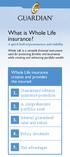 What is Whole Life insurance? A quick look at permanence and stability Whole Life is a versatile financial instrument used for protecting families and businesses while creating and enhancing portfolio
Chapter 9. By Jean-Philippe Loiselle
 11 THINGS YOU SHOULD THINK ABOUT BEFORE SELLING A HOUSE IN TODAY S MARKET Chapter 9 11 THINGS YOU SHOULD THINK ABOUT BEFORE SELLING A HOUSE IN TODAY S MARKET By Jean-Philippe Loiselle The story begins
Life Insurance as an Asset Class: A Predictable Asset for Unpredictable Times
 Life Insurance as an Asset Class: A Predictable Asset for Unpredictable Times This material is not intended to be used to avoid tax penalties. It was prepared to support the promotion or marketing of the
How To Sell An Annuity In The Secondary Market For Annuities
 By Michael Vaughan Illustration by Brian Raszka An emerging annuity alternative THE SECONDARY ANNUITY MARKET SMOOTHES THE WAY FOR LIFE S BIG, UNPLANNED CHANGES The problem seemed insoluble. Jim needed
Best Option Strategies For You How To Give Yourself A Serious Edge In The Stock Market
 GREAT OPTION TRADING STRATEGIES Best Option Strategies For You How To Give Yourself A Serious Edge In The Stock Market Brad Castro Best Option Strategies For You I hope I m not being too presumptuous (or
Annuities: Basics You Need to Know Last update: May 14, 2014
 Summary Annuities: Basics You Need to Know Last update: May 14, 2014 The key feature of most annuities is the promise to provide you an income for life, no matter how long you live. This paper explains
Making Loans and Gifts to Family Members Last update: January 14, 2015
 Summary Making Loans and Gifts to Family Members Last update: January 14, 2015 Loans to family members can sometimes be of financial benefit to both parties. Gifts also can be a blessing to both giver
Gifts of Life Insurance
 Gifts of Life Insurance Effective Ways to Make Them If you have a desire to make a major contribution to support our good works, life insurance can be an excellent tool for helping you accomplish your
8 Retirement Portfolio Red Flags
 8 Retirement Portfolio Red Flags > By David Fabian Investors that are in or nearing retirement have to think differently than those in the growth phase of their life cycle. If you have been fortunate enough
10 common IRA mistakes
 10 common mistakes Help protect your valuable retirement assets Not FDIC Insured May Lose Value No Bank Guarantee Not Insured by Any Government Agency You ve worked hard to build your retirement assets......
Understanding annuities
 Wealth Management Americas Understanding annuities Rethinking the role they play in retirement income planning Helping to protect your retirement income security from life s uncertainties. The retirement
RECOVERY ALTERNATIVES
 RECOVERY ALTERNATIVES Contact us at: 1-800-805-0499 http://www.recoveryalternatives.com INTERVENTION PREPARATION WORKSHEET To help guide you through the process of preparing for the intervention, a series
BOOK REPORT ARE YOU IN IT FOR THE LONG HAUL?
 BOOK REPORT Mirror, Mirror on the Wall, Am I the Most Valued of them All? The Ultimate Element of Differentiation is YOU By Leo J. Pusateri ISBN 0-9716056-0-2 ARE YOU IN IT FOR THE LONG HAUL? After years
Insurance Investment Comparison
 Insurance Investment Comparison An Illustration That Compares the Wealth Accumulation Potential Associated with a Universal Life Insurance Policy with a ''Buy-Term-and-Invest-the-Difference'' Approach
Securing the Finances of the Rabbi and his Family
 Securing the Finances of the Rabbi and his Family Rabbi Elozor Preil & Rabbi Ronald Schwarzberg ~ Thursday, May 7, 2009 ~ 1 2 3 4 5 6 7 8 9 Permission Slip One estate planning attorney s lesson in retirement/wealth
Annuities: Good, Not so Good, or Bad? (Another Free InvestEd Webinar)
 Annuities: Good, Not so Good, or Bad? (Another Free InvestEd Webinar) Bob Adams 2013 B. Adams 4 Annuities: Good, Not so Good, or Bad? Are They For You? More often than not, it s clear that variable annuities
Is Your Financial Plan Worth the Paper It s Printed On?
 T e c h n o l o g y & P l a n n i n g Is Your Financial Plan Worth the Paper It s Printed On? By Patrick Sullivan and Dr. David Lazenby, PhD www.scenarionow.com 2002-2005 ScenarioNow Inc. All Rights Reserved.
GETTING THE MOST OUT OF YOUR LIFE INSURANCE
 GETTING THE MOST OUT OF YOUR LIFE INSURANCE The Irrevocable Life Insurance Trust AMERICAN ACADEMY OF ESTATE PLANNING ATTORNEYS, INC. Getting The Most Out Of Your Life Insurance 1 If you own life insurance,
Investment Philosophy
 Investment Philosophy Our unique approach to investment management puts you at the heart of everything we do Wealth and Investment Management Discover a new side to your personality: your investment self
The Digital Divide: How the Online Behavior of Teens is Getting Past Parents
 June 2012 The Digital Divide: How the Online Behavior of Teens is Getting Past Parents Parent Disconnect Despite the obvious disconnect between teens online behaviors and parents knowledge of them, parents
We keep our promises.
 We keep our promises. So you can keep yours. It s a selfless act. The decision you make today is for someone else s future. Purchasing life insurance is about more than just planning for the future. It
Standard 5: The student will analyze the costs and benefits of saving and investing.
 TEACHER GUIDE 5.4 SAVING AND INVESTING PAGE 1 Standard 5: The student will analyze the costs and benefits of saving and investing. Time is Money Priority Academic Student Skills Personal Financial Literacy
Prepared by the National Association of Insurance Commissioners. This guide does not endorse any company or policy.
 Prepared by the National Association of Insurance Commissioners The National Association of Insurance Commissioners is an association of state insurance regulatory officials. This association helps the
STRESS TEST YOUR LIFE INSURANCE & AVOID THE ATTRACTIVE IMPOSSIBILITY by Gordon Schaller and Dick Weber
 This article first appeared in Steve Leimberg's Estate Planning Newsletter #1707 (October 18, 2010) Properly designed and managed life insurance is unique in its ability to deliver cash when it is needed
Plan Confidently Invest Wisely Live Fully
 Plan Confidently Invest Wisely Live Fully Our clients are up to something big. They are interested in making a difference for themselves, their families and their communities. Your Challenges and Responsibilities
Ticker: Dutch Auctions With A Money-Back Guarantee Sandeep Baliga and Jeff Ely
 Results Ticker: Dutch Auctions With A Money-Back Guarantee Sandeep Baliga and Jeff Ely 2 Concept The Problem A venue like a stadium, a theatre, or an orchestra has a fixed capacity of seats in different
Beneficiary Planning Investor Guide. Design a plan for you and your beneficiaries
 Beneficiary Planning Investor Guide Design a plan for you and your beneficiaries Today is an important day. It is the day you will develop a comprehensive beneficiary plan that will let you relax, knowing
How to Use the Auction Effect to Sell Your House Faster
 How to Use the Auction Effect to Sell Your House Faster This approach has also been called How to Sell Your House in 24 Hours but you can take a whole weekend! Have you ever noticed that some houses seem
The Police Have Left Word That They Want to Speak With You
 The Police Have Left Word That They Want to Speak With You What Does it Mean and What Should You Do? Don A. Murray, Esq. Shalley & Murray 125-10 Queens Blvd., Suite 10 Kew Gardens, NY 11415 273 Sea Cliff
An Introduction to the Impact of Mark to Market Accounting on MBIA and Financial Guarantors
 An Introduction to the Impact of Mark to Market Accounting on MBIA and Financial Guarantors MBIA provides credit protection on municipal, essential asset and securitized financings, and the terms and conditions
Why Rent When You Can Own?
 An Educational Guide for Consumers Why Rent When You Can Own? A comparison of term and permanent life insurance insure Insurance invest Strategies retire 3 Your coverage options 4 The Owning vs. Renting
Intermediate Savings Goals Prior to Retirement White Paper on Retirement, November 2014 Richard C Marston, Wharton School
 Intermediate Savings Goals Prior to Retirement White Paper on Retirement, November 2014 Richard C Marston, Wharton School Saving for retirement is tough for young and old alike. Most of us know how important
For Immediate Release
 For Immediate Release For a review copy of the book or an interview with John Vento, please contact Dottie DeHart, DeHart & Company Public Relations, at (828) 325-4966 or [email protected] Not
Protect your business and shape your future. Top 10 questions for business owners.
 Protect your business and shape your future. Top 10 questions for business owners. What is the sign of a good decision? Clarifying what you want to achieve in your life, what you care most about, and how
A brief guide to Trusts and our Trustbuilder tool
 guide to guide to trusts trusts A brief guide to Trusts and our Trustbuilder tool A Brief guide to Trusts and our Trustbuilder tool Introduction This brief guide explains some of the main features and
1 Uncertainty and Preferences
 In this chapter, we present the theory of consumer preferences on risky outcomes. The theory is then applied to study the demand for insurance. Consider the following story. John wants to mail a package
IRAs: Four Facts You Should Know
 IRAs: Four Facts You Should Know Overview: The decision between contributing to a traditional 2007 IRA and a Roth IRA depends on many factors. The following discusses some of the key concepts to consider
Why you need an estate plan. Now. Make things easier for the people you love.
 Why you need an estate plan. Now. Make things easier for the people you love. Eight questions it s best to answer now. No one can predict the future, but one thing is sure: If we leave unanswered questions
The 11 Components of a Best-In-Class 360 Assessment
 White Paper LEADERSHIP DEVELOPMENT The 11 Components of a Best-In-Class 360 Assessment Crucial elements for your 360 assessment 360-degree assessments are the backbone of most corporations leadership development
Shared Wisdom. To be effective advisors, it s more valuable to ask all the right questions than to have all the right answers.
 Shared Wisdom To be effective advisors, it s more valuable to ask all the right questions than to have all the right answers. Here s an example. The owner of a very substantial family business engaged
Essentials of Estate Planning
 Essentials of Estate Planning LIFE INSURANCE These materials are not intended to be used to avoid tax penalties, and were prepared to support the promotion or marketing of the matter addressed in this
Standard Life Active Retirement For accessing your pension money
 Standard Life Active Retirement For accessing your pension money Standard Life Active Retirement our ready-made investment solution that allows you to access your pension savings while still giving your
Year End Financial Planning for 2014
 Year End Financial Planning for 2014 As we near the end of 2014 and begin preparing for 2015, it is important to reflect on the changes we have experienced over the last year. Life s milestones can range
Business Succession Planning
 Business Succession Planning with Key Person Coverage and Buy-Sell Agreements Program Highlights & Fact Finder You put maximum effort into establishing and running your business. But are you taking the
How To Save Your Family From Deep Financial Mistakes With Proper Estate Planning
 How To Save Your Family From Deep Financial Mistakes With Proper Estate Planning Wills, Living Trusts, and How To Avoid Time Consuming and Expensive Probates. By: Brian Willie, Attorney At Law Orange County
Take the Sting Out of the 360 Degree Feedback Process
 Blog Carmen Klann Take the Sting Out of the 360 Degree Feedback Process Everybody agrees with the statement that constructive feedback is very worthwhile and tremendously crucial for every individual and
MYTHS AND MISCONCEPTIONS
 TEXAS ESTATE PLANNING Estate Planning and Special Needs Trusts MYTHS AND MISCONCEPTIONS HOW MUCH DO YOU REALLY KNOW ABOUT ESTATE PLANNING? There are a surprising number of myths and misconceptions surrounding